
A English
Work Energy Theorem and Conservation of Mechanical Energy Questions in English
Class 11 Physics · Work, Energy, Power and Collision · Work Energy Theorem and Conservation of Mechanical Energy
204+
Questions
English
Language
100%
With Solutions
Showing 4 of 204 questions in English
201
DifficultMCQ
$A$ spherical ball of mass $2 \text{ kg}$ falls from a height of $10 \text{ m}$ and is brought to rest after penetrating $10 \text{ cm}$ into sand. The average force exerted by sand on the ball is . . . . . . $\text{N}$. (Take $g = 10 \text{ m/s}^2$)
A
$1980$
B
$2020$
C
$2000$
D
$1000$
Solution
(B) According to the work-energy theorem,the net work done on the ball is equal to the change in its kinetic energy.
Since the ball starts from rest and ends at rest,the change in kinetic energy is $0$.
The forces acting on the ball are gravity $(mg)$ and the resistive force of the sand $(F_{avg})$.
The total displacement of the ball is $H + d$,where $H = 10 \text{ m}$ and $d = 10 \text{ cm} = 0.1 \text{ m}$.
Work done by gravity + Work done by sand = Change in kinetic energy
$mg(H + d) - F_{avg} \times d = 0$
$F_{avg} = \frac{mg(H + d)}{d}$
Substituting the values: $F_{avg} = \frac{2 \times 10 \times (10 + 0.1)}{0.1} = \frac{20 \times 10.1}{0.1} = 200 \times 10.1 = 2020 \text{ N}$.
Since the ball starts from rest and ends at rest,the change in kinetic energy is $0$.
The forces acting on the ball are gravity $(mg)$ and the resistive force of the sand $(F_{avg})$.
The total displacement of the ball is $H + d$,where $H = 10 \text{ m}$ and $d = 10 \text{ cm} = 0.1 \text{ m}$.
Work done by gravity + Work done by sand = Change in kinetic energy
$mg(H + d) - F_{avg} \times d = 0$
$F_{avg} = \frac{mg(H + d)}{d}$
Substituting the values: $F_{avg} = \frac{2 \times 10 \times (10 + 0.1)}{0.1} = \frac{20 \times 10.1}{0.1} = 200 \times 10.1 = 2020 \text{ N}$.
0 likes
View Solution202
DifficultMCQ
$A$ body of mass $1 \text{ kg}$ moves along a straight line with a velocity $v = 2x^2$. The work done by the body during displacement from $x = 0$ to $5 \text{ m}$ is . . . . . . $J$.
A
$0$
B
$250$
C
$1250$
D
$1000$
Solution
(C) The work done by the force is equal to the change in kinetic energy: $W = \Delta K = \frac{1}{2}m(v_f^2 - v_i^2)$.
Given $v = 2x^2$,at $x = 0$,the initial velocity $v_i = 2(0)^2 = 0 \text{ m/s}$.
At $x = 5 \text{ m}$,the final velocity $v_f = 2(5)^2 = 2(25) = 50 \text{ m/s}$.
Substituting the values into the work-energy theorem:
$W = \frac{1}{2} \times 1 \text{ kg} \times ((50 \text{ m/s})^2 - (0 \text{ m/s})^2)$
$W = \frac{1}{2} \times 1 \times 2500 = 1250 \text{ J}$.
Given $v = 2x^2$,at $x = 0$,the initial velocity $v_i = 2(0)^2 = 0 \text{ m/s}$.
At $x = 5 \text{ m}$,the final velocity $v_f = 2(5)^2 = 2(25) = 50 \text{ m/s}$.
Substituting the values into the work-energy theorem:
$W = \frac{1}{2} \times 1 \text{ kg} \times ((50 \text{ m/s})^2 - (0 \text{ m/s})^2)$
$W = \frac{1}{2} \times 1 \times 2500 = 1250 \text{ J}$.
0 likes
View Solution203
DifficultMCQ
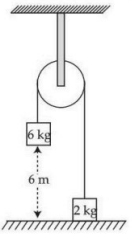
The velocity at which the $6 \text{ kg}$ mass (shown in the figure) strikes the ground when it is released from a height of $6 \text{ m}$ above the ground is . . . . . . $\text{m/s}$. Assume the pulley is massless and the string is light and inextensible. (Take $g = 10 \text{ m/s}^2$)
A
$7.74$
B
$7.2$
C
$6.55$
D
$4.5$
Solution
(A) Using the principle of conservation of mechanical energy,the loss in potential energy of the $6 \text{ kg}$ mass is equal to the gain in kinetic energy of the system (both $6 \text{ kg}$ and $2 \text{ kg}$ masses) plus the gain in potential energy of the $2 \text{ kg}$ mass.
Let $m_1 = 6 \text{ kg}$ and $m_2 = 2 \text{ kg}$. When the $6 \text{ kg}$ mass falls by $h = 6 \text{ m}$,the $2 \text{ kg}$ mass rises by $h = 6 \text{ m}$.
Loss in potential energy of $m_1 = m_1 g h = 6 \times 10 \times 6 = 360 \text{ J}$.
Gain in potential energy of $m_2 = m_2 g h = 2 \times 10 \times 6 = 120 \text{ J}$.
Gain in kinetic energy of the system = $\frac{1}{2}(m_1 + m_2)v^2 = \frac{1}{2}(6 + 2)v^2 = 4v^2$.
By conservation of energy: $m_1 g h = m_2 g h + \frac{1}{2}(m_1 + m_2)v^2$.
$360 = 120 + 4v^2$.
$240 = 4v^2$.
$v^2 = 60$.
$v = \sqrt{60} \approx 7.746 \text{ m/s}$.
Let $m_1 = 6 \text{ kg}$ and $m_2 = 2 \text{ kg}$. When the $6 \text{ kg}$ mass falls by $h = 6 \text{ m}$,the $2 \text{ kg}$ mass rises by $h = 6 \text{ m}$.
Loss in potential energy of $m_1 = m_1 g h = 6 \times 10 \times 6 = 360 \text{ J}$.
Gain in potential energy of $m_2 = m_2 g h = 2 \times 10 \times 6 = 120 \text{ J}$.
Gain in kinetic energy of the system = $\frac{1}{2}(m_1 + m_2)v^2 = \frac{1}{2}(6 + 2)v^2 = 4v^2$.
By conservation of energy: $m_1 g h = m_2 g h + \frac{1}{2}(m_1 + m_2)v^2$.
$360 = 120 + 4v^2$.
$240 = 4v^2$.
$v^2 = 60$.
$v = \sqrt{60} \approx 7.746 \text{ m/s}$.
0 likes
View Solution204
DifficultMCQ
The rain drop of mass $1 \text{ g}$,starts with zero velocity from a height of $1 \text{ km}$. It hits the ground with a speed of $5 \text{ m/s}$. The work done by the unknown resistive force is . . . . . . $J$. (take $g = 10 \text{ m/s}^2$)
A
-$8.75$
B
-$8.35$
C
-$9.55$
D
-$9.98$
Solution
(D) According to the work-energy theorem,the total work done on the object is equal to the change in its kinetic energy: $W_{\text{total}} = \Delta K$.
Here,the total work done is the sum of the work done by gravity $(W_g)$ and the work done by the resistive force $(W_r)$: $W_g + W_r = \Delta K$.
Given: mass $m = 1 \text{ g} = 0.001 \text{ kg}$,height $h = 1 \text{ km} = 1000 \text{ m}$,initial velocity $u = 0 \text{ m/s}$,final velocity $v = 5 \text{ m/s}$,and $g = 10 \text{ m/s}^2$.
Work done by gravity: $W_g = mgh = 0.001 \text{ kg} \times 10 \text{ m/s}^2 \times 1000 \text{ m} = 10 \text{ J}$.
Change in kinetic energy: $\Delta K = \frac{1}{2}mv^2 - \frac{1}{2}mu^2 = \frac{1}{2} \times 0.001 \text{ kg} \times (5 \text{ m/s})^2 - 0 = 0.0005 \times 25 = 0.0125 \text{ J}$.
Substituting the values into the work-energy theorem: $10 \text{ J} + W_r = 0.0125 \text{ J}$.
$W_r = 0.0125 \text{ J} - 10 \text{ J} = -9.9875 \text{ J}$.
The closest option is $-9.98 \text{ J}$.
Here,the total work done is the sum of the work done by gravity $(W_g)$ and the work done by the resistive force $(W_r)$: $W_g + W_r = \Delta K$.
Given: mass $m = 1 \text{ g} = 0.001 \text{ kg}$,height $h = 1 \text{ km} = 1000 \text{ m}$,initial velocity $u = 0 \text{ m/s}$,final velocity $v = 5 \text{ m/s}$,and $g = 10 \text{ m/s}^2$.
Work done by gravity: $W_g = mgh = 0.001 \text{ kg} \times 10 \text{ m/s}^2 \times 1000 \text{ m} = 10 \text{ J}$.
Change in kinetic energy: $\Delta K = \frac{1}{2}mv^2 - \frac{1}{2}mu^2 = \frac{1}{2} \times 0.001 \text{ kg} \times (5 \text{ m/s})^2 - 0 = 0.0005 \times 25 = 0.0125 \text{ J}$.
Substituting the values into the work-energy theorem: $10 \text{ J} + W_r = 0.0125 \text{ J}$.
$W_r = 0.0125 \text{ J} - 10 \text{ J} = -9.9875 \text{ J}$.
The closest option is $-9.98 \text{ J}$.
0 likes
View SolutionWork, Energy, Power and Collision — Work Energy Theorem and Conservation of Mechanical Energy · Frequently Asked Questions
1Are these Work, Energy, Power and Collision questions useful for JEE and NEET?
Yes. All questions in this section are mapped to JEE Main and NEET exam patterns. Previous year questions from JEE Main, NEET, GUJCET and state-level exams are included with full solutions.
2Can I switch to Hindi or Gujarati for these questions?
Yes. Use the language tabs in the hero section or the sidebar to view the same questions and solutions in English, Hindi or Gujarati.
3How do I generate a question paper from this subtopic?
Use the Vedclass Exam Paper Generator — select the chapter and subtopic, set difficulty, and generate Sets A, B, C, D automatically. First 3 chapters of every subject are free.
Vedclass Products
For Students
Vedclass Test Series
Mock tests in real JEE/NEET style with performance analysis. 5-day free trial.
Start Free TrialFor Teachers
Exam Paper Generator
Generate Set A/B/C/D papers from this chapter in 2 minutes. 3 chapters free.
Try FreeFor Institutes
Online Exam Module
Live online exams with unlimited students, 360° analytics & white-label branding.
See DemoFor Teachers & Institutes
Generate a Work, Energy, Power and Collision Exam Paper in 2 Minutes
Select subtopic & difficulty — Sets A, B, C, D auto-generated with No Repeat logic.
First 3 chapters of every subject are free — no payment required.