
A English
Work Energy Theorem and Conservation of Mechanical Energy Questions in English
Class 11 Physics · Work, Energy, Power and Collision · Work Energy Theorem and Conservation of Mechanical Energy
204+
Questions
English
Language
100%
With Solutions
Showing 47 of 204 questions in English
151
MediumMCQ
$A$ particle is released from height $S$ above the surface of the earth. At a certain height,its kinetic energy is three times its potential energy. The height from the surface of the earth and the speed of the particle at that instant are respectively:
A
$\frac{S}{2}, \sqrt{\frac{3gS}{2}}$
B
$\frac{S}{2}, \frac{3gS}{2}$
C
$\frac{S}{4}, \frac{3gS}{2}$
D
$\frac{S}{4}, \sqrt{\frac{3gS}{2}}$
Solution
(D) Let the height from the surface be $x$. The distance fallen by the particle is $(S - x)$.
Using the equation of motion $v^2 = u^2 + 2as$,where $u = 0$ and $a = g$,we get $v^2 = 2g(S - x)$.
The potential energy at height $x$ is $PE = mgx$.
The kinetic energy at that instant is $KE = \frac{1}{2}mv^2 = \frac{1}{2}m(2g(S - x)) = mg(S - x)$.
According to the problem,$KE = 3 \times PE$.
Substituting the expressions: $mg(S - x) = 3(mgx)$.
Dividing both sides by $mg$: $S - x = 3x$.
$S = 4x \Rightarrow x = \frac{S}{4}$.
Now,substitute $x$ into the velocity equation: $v^2 = 2g(S - \frac{S}{4}) = 2g(\frac{3S}{4}) = \frac{3gS}{2}$.
Therefore,$v = \sqrt{\frac{3gS}{2}}$.
The height is $\frac{S}{4}$ and the speed is $\sqrt{\frac{3gS}{2}}$.
Using the equation of motion $v^2 = u^2 + 2as$,where $u = 0$ and $a = g$,we get $v^2 = 2g(S - x)$.
The potential energy at height $x$ is $PE = mgx$.
The kinetic energy at that instant is $KE = \frac{1}{2}mv^2 = \frac{1}{2}m(2g(S - x)) = mg(S - x)$.
According to the problem,$KE = 3 \times PE$.
Substituting the expressions: $mg(S - x) = 3(mgx)$.
Dividing both sides by $mg$: $S - x = 3x$.
$S = 4x \Rightarrow x = \frac{S}{4}$.
Now,substitute $x$ into the velocity equation: $v^2 = 2g(S - \frac{S}{4}) = 2g(\frac{3S}{4}) = \frac{3gS}{2}$.
Therefore,$v = \sqrt{\frac{3gS}{2}}$.
The height is $\frac{S}{4}$ and the speed is $\sqrt{\frac{3gS}{2}}$.
0 likes
View Solution152
MediumMCQ
The kinetic energies of two similar cars $A$ and $B$ are $100 \ J$ and $225 \ J$ respectively. On applying brakes,car $A$ stops after $1000 \ m$ and car $B$ stops after $1500 \ m$. If $F_{A}$ and $F_{B}$ are the forces applied by the brakes on cars $A$ and $B$,respectively,then the ratio $F_{A} / F_{B}$ is:
A
$3/2$
B
$2/3$
C
$1/3$
D
$1/2$
Solution
(B) According to the Work-Energy Theorem,the work done by the braking force is equal to the change in kinetic energy of the car.
$W = \Delta KE$
Since the cars come to a stop,the work done by the braking force is $W = -F \cdot S$,where $F$ is the braking force and $S$ is the stopping distance.
For car $A$: $F_{A} \cdot S_{A} = KE_{A} \implies F_{A} \cdot 1000 = 100 \implies F_{A} = 0.1 \ N$.
For car $B$: $F_{B} \cdot S_{B} = KE_{B} \implies F_{B} \cdot 1500 = 225 \implies F_{B} = 225 / 1500 = 0.15 \ N$.
Now,calculating the ratio $F_{A} / F_{B} = 0.1 / 0.15 = 10 / 15 = 2/3$.
$W = \Delta KE$
Since the cars come to a stop,the work done by the braking force is $W = -F \cdot S$,where $F$ is the braking force and $S$ is the stopping distance.
For car $A$: $F_{A} \cdot S_{A} = KE_{A} \implies F_{A} \cdot 1000 = 100 \implies F_{A} = 0.1 \ N$.
For car $B$: $F_{B} \cdot S_{B} = KE_{B} \implies F_{B} \cdot 1500 = 225 \implies F_{B} = 225 / 1500 = 0.15 \ N$.
Now,calculating the ratio $F_{A} / F_{B} = 0.1 / 0.15 = 10 / 15 = 2/3$.
0 likes
View Solution153
DifficultMCQ
$A$ ball of mass $0.4 \ kg$ is thrown vertically upwards by applying a force by hand. If the hand moves $0.5 \ m$ while applying the force and the ball goes up to $5 \ m$ height further,find the magnitude of the force (in $N$) $(g = 10 \ m/s^2)$.
A
$11$
B
$22$
C
$33$
D
$44$
Solution
(D) According to the Work-Energy Theorem,the total work done on the ball is equal to the change in its kinetic energy.
$W_{\text{ext}} + W_{\text{gravity}} = \Delta KE$
Here,the ball starts from rest and ends at rest at the maximum height,so $\Delta KE = 0$.
The force $F$ is applied over a distance $d_1 = 0.5 \ m$.
The total height reached by the ball from the point where the force application ends is $h = 5 \ m$.
The total displacement against gravity is $d_1 + h = 0.5 + 5 = 5.5 \ m$.
$W_{\text{ext}} = F \times 0.5$
$W_{\text{gravity}} = -mg(d_1 + h) = -(0.4 \times 10 \times 5.5) = -22 \ J$
Substituting these into the theorem:
$F \times 0.5 - 22 = 0$
$0.5F = 22$
$F = 44 \ N$.
$W_{\text{ext}} + W_{\text{gravity}} = \Delta KE$
Here,the ball starts from rest and ends at rest at the maximum height,so $\Delta KE = 0$.
The force $F$ is applied over a distance $d_1 = 0.5 \ m$.
The total height reached by the ball from the point where the force application ends is $h = 5 \ m$.
The total displacement against gravity is $d_1 + h = 0.5 + 5 = 5.5 \ m$.
$W_{\text{ext}} = F \times 0.5$
$W_{\text{gravity}} = -mg(d_1 + h) = -(0.4 \times 10 \times 5.5) = -22 \ J$
Substituting these into the theorem:
$F \times 0.5 - 22 = 0$
$0.5F = 22$
$F = 44 \ N$.
0 likes
View Solution154
DifficultMCQ
$A$ particle is released from a height $s$. At a certain height,its kinetic energy is three times its potential energy. The height and speed of the particle at that instant are respectively:
A
$\frac{s}{4}, \frac{\sqrt{3gs}}{2}$
B
$s, \frac{\sqrt{3gs}}{2}$
C
$\frac{s}{2}, \sqrt{\frac{3gs}{2}}$
D
$\frac{s}{4}, \sqrt{\frac{3gs}{2}}$
Solution
(D) Let the total energy of the particle be $E = mgs$.
At the given instant,let the potential energy be $PE = x$.
According to the problem,the kinetic energy is $KE = 3x$.
By the law of conservation of energy,$KE + PE = E$.
$3x + x = mgs \Rightarrow 4x = mgs \Rightarrow x = \frac{mgs}{4}$.
Since $PE = mgh = x$,we have $mgh = \frac{mgs}{4}$,which gives the height $h = \frac{s}{4}$.
Now,for the speed $v$,we use $KE = \frac{1}{2}mv^2 = 3x$.
$\frac{1}{2}mv^2 = 3 \left( \frac{mgs}{4} \right) = \frac{3mgs}{4}$.
$v^2 = \frac{3gs}{2} \Rightarrow v = \sqrt{\frac{3gs}{2}}$.
Thus,the height is $\frac{s}{4}$ and the speed is $\sqrt{\frac{3gs}{2}}$.
At the given instant,let the potential energy be $PE = x$.
According to the problem,the kinetic energy is $KE = 3x$.
By the law of conservation of energy,$KE + PE = E$.
$3x + x = mgs \Rightarrow 4x = mgs \Rightarrow x = \frac{mgs}{4}$.
Since $PE = mgh = x$,we have $mgh = \frac{mgs}{4}$,which gives the height $h = \frac{s}{4}$.
Now,for the speed $v$,we use $KE = \frac{1}{2}mv^2 = 3x$.
$\frac{1}{2}mv^2 = 3 \left( \frac{mgs}{4} \right) = \frac{3mgs}{4}$.
$v^2 = \frac{3gs}{2} \Rightarrow v = \sqrt{\frac{3gs}{2}}$.
Thus,the height is $\frac{s}{4}$ and the speed is $\sqrt{\frac{3gs}{2}}$.
0 likes
View Solution155
MediumMCQ
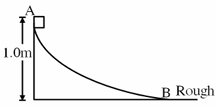
$A$ block weighing $20 \ N$ travels down a smooth curved track $AB$ joined to a rough horizontal surface (figure). The rough surface has a friction coefficient of $0.40$ with the block. If the block starts slipping on the track from a point $1.0 \ m$ above the horizontal surface,the distance it will move on the rough surface is: (in $m$)
A
$5.0$
B
$2.5$
C
$10$
D
$7.5$
Solution
(B) According to the work-energy theorem,the total work done on the block is equal to the change in its kinetic energy.
$W_{\text{gravity}} + W_{\text{friction}} = KE_f - KE_i$
Since the block starts from rest and comes to rest after moving a distance $x$ on the rough surface,$KE_i = 0$ and $KE_f = 0$.
The work done by gravity is $W_{\text{gravity}} = mgh = (mg)h = 20 \ N \times 1.0 \ m = 20 \ J$.
The work done by friction is $W_{\text{friction}} = -f_k \cdot x = -(\mu \cdot mg) \cdot x = -(0.40 \times 20 \ N) \cdot x = -8x \ J$.
Applying the work-energy theorem:
$20 - 8x = 0$
$8x = 20$
$x = \frac{20}{8} = 2.5 \ m$.
Thus,the distance the block will move on the rough surface is $2.5 \ m$.
$W_{\text{gravity}} + W_{\text{friction}} = KE_f - KE_i$
Since the block starts from rest and comes to rest after moving a distance $x$ on the rough surface,$KE_i = 0$ and $KE_f = 0$.
The work done by gravity is $W_{\text{gravity}} = mgh = (mg)h = 20 \ N \times 1.0 \ m = 20 \ J$.
The work done by friction is $W_{\text{friction}} = -f_k \cdot x = -(\mu \cdot mg) \cdot x = -(0.40 \times 20 \ N) \cdot x = -8x \ J$.
Applying the work-energy theorem:
$20 - 8x = 0$
$8x = 20$
$x = \frac{20}{8} = 2.5 \ m$.
Thus,the distance the block will move on the rough surface is $2.5 \ m$.
0 likes
View Solution156
MediumMCQ
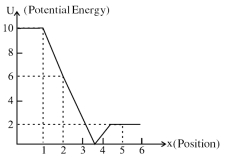
For a body of mass $1 \ kg$,the $U-x$ graph is shown in the figure. If the body is released from rest at $x = 2 \ m$,then its speed when it crosses $x = 5 \ m$ is:
A
$2 \sqrt{2} \ m/s$
B
$1 \ m/s$
C
$2 \ m/s$
D
$3 \ m/s$
Solution
(A) According to the law of conservation of mechanical energy,the total mechanical energy remains constant if only conservative forces act on the body.
Total energy at $x = 2 \ m$ is equal to the total energy at $x = 5 \ m$.
$(KE + PE)_{x=2} = (KE + PE)_{x=5}$
Given that the body is released from rest at $x = 2 \ m$,its kinetic energy $(KE)$ at $x = 2 \ m$ is $0$.
From the graph,the potential energy $(PE)$ at $x = 2 \ m$ is $6 \ J$ and at $x = 5 \ m$ is $2 \ J$.
Substituting these values:
$0 + 6 = \frac{1}{2} mv^2 + 2$
Given mass $m = 1 \ kg$:
$6 = \frac{1}{2} (1) v^2 + 2$
$4 = \frac{1}{2} v^2$
$v^2 = 8$
$v = \sqrt{8} = 2 \sqrt{2} \ m/s$.
Total energy at $x = 2 \ m$ is equal to the total energy at $x = 5 \ m$.
$(KE + PE)_{x=2} = (KE + PE)_{x=5}$
Given that the body is released from rest at $x = 2 \ m$,its kinetic energy $(KE)$ at $x = 2 \ m$ is $0$.
From the graph,the potential energy $(PE)$ at $x = 2 \ m$ is $6 \ J$ and at $x = 5 \ m$ is $2 \ J$.
Substituting these values:
$0 + 6 = \frac{1}{2} mv^2 + 2$
Given mass $m = 1 \ kg$:
$6 = \frac{1}{2} (1) v^2 + 2$
$4 = \frac{1}{2} v^2$
$v^2 = 8$
$v = \sqrt{8} = 2 \sqrt{2} \ m/s$.
0 likes
View Solution157
MediumMCQ
Given below are two statements: one is labelled as Assertion $(A)$ and the other is labelled as Reason $(R).$
Assertion $(A):$ Kinetic energy of a system can increase without applying external force on the system.
Reason $(R):$ If external forces are absent,then the work done by internal forces is equal to the change in kinetic energy.
In the light of the above statements,choose the most appropriate answer from the options given below:
Assertion $(A):$ Kinetic energy of a system can increase without applying external force on the system.
Reason $(R):$ If external forces are absent,then the work done by internal forces is equal to the change in kinetic energy.
In the light of the above statements,choose the most appropriate answer from the options given below:
A
Both $(A)$ and $(R)$ are true and $(R)$ is the correct explanation of $(A).$
B
Both $(A)$ and $(R)$ are true but $(R)$ is $\text{NOT}$ the correct explanation of $(A).$
C
$(A)$ is true but $(R)$ is false.
D
$(A)$ is false but $(R)$ is true.
Solution
(A) According to the work-energy theorem,the total work done by all forces (internal and external) acting on a system is equal to the change in its kinetic energy: $W_{\text{ext}} + W_{\text{int}} = \Delta K$.
If no external force is applied,$W_{\text{ext}} = 0$,so $W_{\text{int}} = \Delta K$.
Internal forces can perform work (e.g.,in an explosion or a spring-mass system),which leads to a change in the kinetic energy of the system.
Thus,the kinetic energy of a system can increase due to internal forces even in the absence of external forces.
Therefore,both Assertion $(A)$ and Reason $(R)$ are true,and $(R)$ is the correct explanation of $(A).$
If no external force is applied,$W_{\text{ext}} = 0$,so $W_{\text{int}} = \Delta K$.
Internal forces can perform work (e.g.,in an explosion or a spring-mass system),which leads to a change in the kinetic energy of the system.
Thus,the kinetic energy of a system can increase due to internal forces even in the absence of external forces.
Therefore,both Assertion $(A)$ and Reason $(R)$ are true,and $(R)$ is the correct explanation of $(A).$
0 likes
View Solution158
MediumMCQ
An open knife edge of mass $50 \ g$ is dropped from a height $2 \ m$ on a wooden floor. If the blade penetrates up to a depth of $10 \ cm$ into the wood,the average resistance offered by the wood to the knife edge is $....N$
A
$10.5$
B
$20.5$
C
$15.5$
D
$12.0$
Solution
(A) According to the Work-Energy Theorem,the total work done on the object is equal to the change in its kinetic energy.
$W_{mg} + W_{\text{resistive}} = \Delta KE$
Since the knife starts from rest and comes to rest after penetration,$\Delta KE = 0 - 0 = 0$.
The work done by gravity is $W_{mg} = mg(h + x)$,where $h = 2 \ m$ and $x = 10 \ cm = 0.1 \ m$.
The work done by the resistive force $F$ is $W_{\text{resistive}} = -F \cdot x$.
Thus,$mg(h + x) - Fx = 0$.
$F = \frac{mg(h + x)}{x}$.
Substituting the values: $m = 50 \ g = 0.05 \ kg$,$g = 10 \ m/s^2$,$h = 2 \ m$,$x = 0.1 \ m$.
$F = \frac{0.05 \times 10 \times (2 + 0.1)}{0.1} = \frac{0.5 \times 2.1}{0.1} = 5 \times 2.1 = 10.5 \ N$.
$W_{mg} + W_{\text{resistive}} = \Delta KE$
Since the knife starts from rest and comes to rest after penetration,$\Delta KE = 0 - 0 = 0$.
The work done by gravity is $W_{mg} = mg(h + x)$,where $h = 2 \ m$ and $x = 10 \ cm = 0.1 \ m$.
The work done by the resistive force $F$ is $W_{\text{resistive}} = -F \cdot x$.
Thus,$mg(h + x) - Fx = 0$.
$F = \frac{mg(h + x)}{x}$.
Substituting the values: $m = 50 \ g = 0.05 \ kg$,$g = 10 \ m/s^2$,$h = 2 \ m$,$x = 0.1 \ m$.
$F = \frac{0.05 \times 10 \times (2 + 0.1)}{0.1} = \frac{0.5 \times 2.1}{0.1} = 5 \times 2.1 = 10.5 \ N$.
0 likes
View Solution159
MediumMCQ
$A$ bullet is fired on a target with velocity $V$. Its velocity decreases from $V$ to $V/2$ when it penetrates $30 \text{ cm}$ in a target. Through what thickness will it penetrate further in the target before coming to rest (in $\text{ cm}$)?
A
$5$
B
$8$
C
$10$
D
$20$
Solution
(C) Let the initial velocity be $u = V$ and the final velocity after penetrating $s_1 = 30 \text{ cm}$ be $v = V/2$. Assuming constant retardation $a$, we use the third equation of motion: $v^2 = u^2 + 2as_1$.
$(V/2)^2 = V^2 + 2a(30)$
$V^2/4 = V^2 + 60a$
$60a = -3V^2/4$
$a = -V^2/80$.
Now, for the further penetration until the bullet comes to rest, the initial velocity is $u' = V/2$ and the final velocity is $v' = 0$. Let the additional distance be $s_2$.
$(v')^2 = (u')^2 + 2as_2$
$0 = (V/2)^2 + 2(-V^2/80)s_2$
$V^2/4 = (V^2/40)s_2$
$s_2 = (V^2/4) \times (40/V^2) = 10 \text{ cm}$.
$(V/2)^2 = V^2 + 2a(30)$
$V^2/4 = V^2 + 60a$
$60a = -3V^2/4$
$a = -V^2/80$.
Now, for the further penetration until the bullet comes to rest, the initial velocity is $u' = V/2$ and the final velocity is $v' = 0$. Let the additional distance be $s_2$.
$(v')^2 = (u')^2 + 2as_2$
$0 = (V/2)^2 + 2(-V^2/80)s_2$
$V^2/4 = (V^2/40)s_2$
$s_2 = (V^2/4) \times (40/V^2) = 10 \text{ cm}$.
0 likes
View Solution160
MediumMCQ
$A$ bullet is fired at a target with velocity $V$. Its velocity decreases from $V$ to $V/2$ when it penetrates $30 \ cm$ into the target. Through what additional thickness will it penetrate further into the target before coming to rest (in $cm$)?
A
$5$
B
$8$
C
$10$
D
$12$
Solution
(C) Let the initial velocity be $V$ and the final velocity be $V/2$ after penetrating a distance $s_1 = 30 \ cm$. Assuming constant deceleration $a$,we use the third equation of motion: $v^2 = u^2 + 2as$.
$(V/2)^2 = V^2 + 2a(30)$
$V^2/4 = V^2 + 60a$
$60a = -3V^2/4$
$a = -V^2/80$.
Now,let the bullet penetrate an additional distance $s_2$ before coming to rest. The initial velocity for this phase is $V/2$ and the final velocity is $0$.
$0^2 = (V/2)^2 + 2(-V^2/80)s_2$
$0 = V^2/4 - (V^2/40)s_2$
$V^2/4 = (V^2/40)s_2$
$s_2 = 40/4 = 10 \ cm$.
$(V/2)^2 = V^2 + 2a(30)$
$V^2/4 = V^2 + 60a$
$60a = -3V^2/4$
$a = -V^2/80$.
Now,let the bullet penetrate an additional distance $s_2$ before coming to rest. The initial velocity for this phase is $V/2$ and the final velocity is $0$.
$0^2 = (V/2)^2 + 2(-V^2/80)s_2$
$0 = V^2/4 - (V^2/40)s_2$
$V^2/4 = (V^2/40)s_2$
$s_2 = 40/4 = 10 \ cm$.
0 likes
View Solution161
MediumMCQ
$A$ pendulum bob has a speed $4 \,m/s$ at its lowest position. The pendulum is $1 \,m$ long. When the length of the string makes an angle of $60^{\circ}$ with the vertical, the speed of the bob at that position is (acceleration due to gravity, $g=10 \,m/s^2, \cos 60^{\circ}=0.5$).
A
$6 \,m/s$
B
$\sqrt{3} \,m/s$
C
$\sqrt{6} \,m/s$
D
$3 \,m/s$
Solution
(C) Let the length of the pendulum be $L = 1 \,m$ and the initial speed at the lowest point be $v_0 = 4 \,m/s$.
At the lowest point, the potential energy is taken as $0$. The total energy is $E = \frac{1}{2}mv_0^2$.
When the string makes an angle $\theta = 60^{\circ}$ with the vertical, the height of the bob is $h = L(1 - \cos \theta)$.
Substituting the values, $h = 1(1 - \cos 60^{\circ}) = 1(1 - 0.5) = 0.5 \,m$.
By the law of conservation of energy, the total energy at the lowest point equals the total energy at the angle $\theta$:
$\frac{1}{2}mv_0^2 = \frac{1}{2}mv^2 + mgh$
$v^2 = v_0^2 - 2gh$
$v^2 = (4)^2 - 2(10)(0.5)$
$v^2 = 16 - 10 = 6$
$v = \sqrt{6} \,m/s$.
At the lowest point, the potential energy is taken as $0$. The total energy is $E = \frac{1}{2}mv_0^2$.
When the string makes an angle $\theta = 60^{\circ}$ with the vertical, the height of the bob is $h = L(1 - \cos \theta)$.
Substituting the values, $h = 1(1 - \cos 60^{\circ}) = 1(1 - 0.5) = 0.5 \,m$.
By the law of conservation of energy, the total energy at the lowest point equals the total energy at the angle $\theta$:
$\frac{1}{2}mv_0^2 = \frac{1}{2}mv^2 + mgh$
$v^2 = v_0^2 - 2gh$
$v^2 = (4)^2 - 2(10)(0.5)$
$v^2 = 16 - 10 = 6$
$v = \sqrt{6} \,m/s$.
0 likes
View Solution162
MediumMCQ
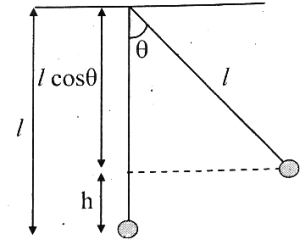
The bob of a pendulum of length '$l$' is pulled aside from its equilibrium position through an angle '$\theta$' and then released. The bob will then pass through its equilibrium position with speed '$v$',where '$v$' is equal to ($g=$ acceleration due to gravity).
A
$\sqrt{2gl(1-\cos \theta)}$
B
$\sqrt{2gl(1+\sin \theta)}$
C
$\sqrt{2gl(1-\sin \theta)}$
D
$\sqrt{2gl(1+\cos \theta)}$
Solution
(A) When the bob of a pendulum is raised to a height '$h$',the potential energy at the extreme position is converted into kinetic energy at the mean position.
By the law of conservation of energy:
$mgh = \frac{1}{2}mv^2$
$v = \sqrt{2gh}$
From the geometry of the pendulum,the vertical distance from the point of suspension to the bob at the extreme position is '$l \cos \theta$'.
Therefore,the vertical height '$h$' raised by the bob is:
$h = l - l \cos \theta = l(1 - \cos \theta)$
Substituting the value of '$h$' in the velocity equation:
$v = \sqrt{2gl(1 - \cos \theta)}$
By the law of conservation of energy:
$mgh = \frac{1}{2}mv^2$
$v = \sqrt{2gh}$
From the geometry of the pendulum,the vertical distance from the point of suspension to the bob at the extreme position is '$l \cos \theta$'.
Therefore,the vertical height '$h$' raised by the bob is:
$h = l - l \cos \theta = l(1 - \cos \theta)$
Substituting the value of '$h$' in the velocity equation:
$v = \sqrt{2gl(1 - \cos \theta)}$
0 likes
View Solution163
MediumMCQ
$A$ body of mass $0.25 \ kg$ travels along a straight line from $x=0$ to $x=2 \ m$ with a speed $v=k x^{3/2}$ where $k=2$ $SI$ units. The work done by the net force during this displacement is: (in $J$)
A
$8$
B
$16$
C
$32$
D
$4$
Solution
(D) According to the Work-Energy Theorem,the net work done on a body is equal to the change in its kinetic energy.
$W_{\text{net}} = \Delta KE = KE_f - KE_i$
Given mass $m = 0.25 \ kg$,speed $v = k x^{3/2}$,and $k = 2$.
At $x = 0$,$v_i = 2(0)^{3/2} = 0 \ m/s$,so $KE_i = 0 \ J$.
At $x = 2 \ m$,$v_f = 2(2)^{3/2} = 2 \times 2 \sqrt{2} = 4\sqrt{2} \ m/s$.
$KE_f = \frac{1}{2} m v_f^2 = \frac{1}{2} \times 0.25 \times (4\sqrt{2})^2$
$KE_f = \frac{1}{2} \times 0.25 \times 16 \times 2 = 0.25 \times 16 = 4 \ J$.
Therefore,$W_{\text{net}} = 4 \ J - 0 \ J = 4 \ J$.
$W_{\text{net}} = \Delta KE = KE_f - KE_i$
Given mass $m = 0.25 \ kg$,speed $v = k x^{3/2}$,and $k = 2$.
At $x = 0$,$v_i = 2(0)^{3/2} = 0 \ m/s$,so $KE_i = 0 \ J$.
At $x = 2 \ m$,$v_f = 2(2)^{3/2} = 2 \times 2 \sqrt{2} = 4\sqrt{2} \ m/s$.
$KE_f = \frac{1}{2} m v_f^2 = \frac{1}{2} \times 0.25 \times (4\sqrt{2})^2$
$KE_f = \frac{1}{2} \times 0.25 \times 16 \times 2 = 0.25 \times 16 = 4 \ J$.
Therefore,$W_{\text{net}} = 4 \ J - 0 \ J = 4 \ J$.
0 likes
View Solution164
MediumMCQ
$A$ truck accelerates from speed $v$ to $2v$. The work done during this process is:
A
three times the work done in accelerating it from rest to $v$
B
the same as the work done in accelerating it from rest to $v$
C
four times the work done in accelerating it from rest to $v$
D
less than the work done in accelerating it from rest to $v$
Solution
(A) According to the work-energy theorem,the work done is equal to the change in kinetic energy.
Work done to accelerate from $0$ to $v$ is $W_1 = \frac{1}{2}mv^2 - 0 = \frac{1}{2}mv^2$.
Work done to accelerate from $v$ to $2v$ is $W_2 = \Delta K = \frac{1}{2}m(2v)^2 - \frac{1}{2}mv^2$.
$W_2 = \frac{1}{2}m(4v^2) - \frac{1}{2}mv^2 = 2mv^2 - 0.5mv^2 = 1.5mv^2$.
Comparing $W_2$ with $W_1$:
$W_2 = 3 \times (\frac{1}{2}mv^2) = 3W_1$.
Therefore,the work done is three times the work done in accelerating it from rest to $v$.
Work done to accelerate from $0$ to $v$ is $W_1 = \frac{1}{2}mv^2 - 0 = \frac{1}{2}mv^2$.
Work done to accelerate from $v$ to $2v$ is $W_2 = \Delta K = \frac{1}{2}m(2v)^2 - \frac{1}{2}mv^2$.
$W_2 = \frac{1}{2}m(4v^2) - \frac{1}{2}mv^2 = 2mv^2 - 0.5mv^2 = 1.5mv^2$.
Comparing $W_2$ with $W_1$:
$W_2 = 3 \times (\frac{1}{2}mv^2) = 3W_1$.
Therefore,the work done is three times the work done in accelerating it from rest to $v$.
0 likes
View Solution165
DifficultMCQ
$A$ body of mass $m$ is travelling with a velocity $u$. When a constant retarding force $F$ is applied,it comes to rest after travelling a distance $s_{1}$. If the initial velocity is $2u$,with the same force $F$,the distance travelled before it comes to rest is $s_{2}$. Then,
A
$s_{2} = 4s_{1}$
B
$s_{2} = 2s_{1}$
C
$s_{2} = \frac{s_{1}}{2}$
D
$s_{2} = s_{1}$
Solution
(A) According to the work-energy theorem,the work done by the retarding force is equal to the change in kinetic energy of the body.
For the first case,the body comes to rest from velocity $u$ after covering distance $s_{1}$:
$F s_{1} = \frac{1}{2} m u^{2} \quad (i)$
For the second case,the body comes to rest from velocity $2u$ after covering distance $s_{2}$:
$F s_{2} = \frac{1}{2} m (2u)^{2} = \frac{1}{2} m (4u^{2}) = 4 \left( \frac{1}{2} m u^{2} \right) \quad (ii)$
Dividing equation $(ii)$ by equation $(i)$:
$\frac{F s_{2}}{F s_{1}} = \frac{4 (\frac{1}{2} m u^{2})}{\frac{1}{2} m u^{2}}$
$\frac{s_{2}}{s_{1}} = 4$
$s_{2} = 4s_{1}$
For the first case,the body comes to rest from velocity $u$ after covering distance $s_{1}$:
$F s_{1} = \frac{1}{2} m u^{2} \quad (i)$
For the second case,the body comes to rest from velocity $2u$ after covering distance $s_{2}$:
$F s_{2} = \frac{1}{2} m (2u)^{2} = \frac{1}{2} m (4u^{2}) = 4 \left( \frac{1}{2} m u^{2} \right) \quad (ii)$
Dividing equation $(ii)$ by equation $(i)$:
$\frac{F s_{2}}{F s_{1}} = \frac{4 (\frac{1}{2} m u^{2})}{\frac{1}{2} m u^{2}}$
$\frac{s_{2}}{s_{1}} = 4$
$s_{2} = 4s_{1}$
0 likes
View Solution166
EasyMCQ
$A$ body of mass $5 \,kg$ is thrown vertically up with a kinetic energy of $490 \,J$. The height at which the kinetic energy of the body becomes half of the original value is (acceleration due to gravity $=9.8 \,ms^{-2}$) (in $\,m$)
A
$5$
B
$2.5$
C
$10$
D
$12.5$
Solution
(A) Given: Mass $m = 5 \,kg$,Initial Kinetic Energy $KE_i = 490 \,J$,Acceleration due to gravity $g = 9.8 \,ms^{-2}$.
At the required height $h$,the kinetic energy $KE_f$ becomes half of the initial value:
$KE_f = \frac{1}{2} KE_i = \frac{490}{2} = 245 \,J$.
According to the law of conservation of energy,the total mechanical energy remains constant:
$KE_i = KE_f + PE_f$
$KE_i = KE_f + mgh$
Substituting the values:
$490 = 245 + 5 \times 9.8 \times h$
$490 - 245 = 49 \times h$
$245 = 49h$
$h = \frac{245}{49} = 5 \,m$.
Therefore,the height is $5 \,m$.
At the required height $h$,the kinetic energy $KE_f$ becomes half of the initial value:
$KE_f = \frac{1}{2} KE_i = \frac{490}{2} = 245 \,J$.
According to the law of conservation of energy,the total mechanical energy remains constant:
$KE_i = KE_f + PE_f$
$KE_i = KE_f + mgh$
Substituting the values:
$490 = 245 + 5 \times 9.8 \times h$
$490 - 245 = 49 \times h$
$245 = 49h$
$h = \frac{245}{49} = 5 \,m$.
Therefore,the height is $5 \,m$.
0 likes
View Solution167
EasyMCQ
$A$ car moving at a speed $v$ is stopped by a retarding force $F$ in a distance $s$. If the retarding force were $3 F$,then the car will be stopped in a distance
A
$s/3$
B
$s/6$
C
$s/9$
D
$s/12$
Solution
(A) According to the work-energy theorem,the work done by the retarding force is equal to the change in kinetic energy of the car.
Work done $W = F \cdot s = \Delta K = \frac{1}{2}mv^2$.
Since the initial kinetic energy and final kinetic energy (which is $0$) remain the same,the work done to stop the car must be constant.
$F \cdot s = F' \cdot s'$
Given $F' = 3F$,we have:
$F \cdot s = (3F) \cdot s'$
$s' = s/3$.
Therefore,the car will be stopped in a distance of $s/3$.
Work done $W = F \cdot s = \Delta K = \frac{1}{2}mv^2$.
Since the initial kinetic energy and final kinetic energy (which is $0$) remain the same,the work done to stop the car must be constant.
$F \cdot s = F' \cdot s'$
Given $F' = 3F$,we have:
$F \cdot s = (3F) \cdot s'$
$s' = s/3$.
Therefore,the car will be stopped in a distance of $s/3$.
0 likes
View Solution168
EasyMCQ
$A$ car travelling at $80 \ km/h$ can be stopped at a distance of $60 \ m$ by applying brakes. If the same car travels at $160 \ km/h$ and the same braking force is applied,the stopping distance is: (in $m$)
A
$240$
B
$170$
C
$360$
D
$480$
Solution
(A) The stopping distance $S$ is given by the formula $S = \frac{u^2}{2a}$,where $u$ is the initial velocity and $a$ is the deceleration (which is constant for a constant braking force).
From this relation,we can see that $S \propto u^2$.
Given: $u_1 = 80 \ km/h$,$S_1 = 60 \ m$,and $u_2 = 160 \ km/h$.
Using the ratio: $\frac{S_2}{S_1} = \left(\frac{u_2}{u_1}\right)^2$.
Substituting the values: $\frac{S_2}{60} = \left(\frac{160}{80}\right)^2 = (2)^2 = 4$.
Therefore,$S_2 = 4 \times 60 \ m = 240 \ m$.
From this relation,we can see that $S \propto u^2$.
Given: $u_1 = 80 \ km/h$,$S_1 = 60 \ m$,and $u_2 = 160 \ km/h$.
Using the ratio: $\frac{S_2}{S_1} = \left(\frac{u_2}{u_1}\right)^2$.
Substituting the values: $\frac{S_2}{60} = \left(\frac{160}{80}\right)^2 = (2)^2 = 4$.
Therefore,$S_2 = 4 \times 60 \ m = 240 \ m$.
0 likes
View Solution169
MediumMCQ
Brakes stop a train in a distance $x$. If the braking force is reduced to one-fourth of its original value,what distance will the train travel before coming to a stop?
A
Double
B
Half
C
Four times
D
Same
Solution
(C) From the work-energy theorem,the work done by the braking force is equal to the change in kinetic energy of the train.
$W = F \cdot d = \Delta K = \frac{1}{2}mv^2$
Since the initial velocity $v$ and mass $m$ are constant,the work done to stop the train must be constant.
$F_1 d_1 = F_2 d_2$
Given $F_1 = F$ and $d_1 = x$.
Given $F_2 = \frac{F}{4}$.
Substituting these values: $F \cdot x = (\frac{F}{4}) \cdot d_2$
$d_2 = 4x$.
Therefore,the train will travel four times the original distance.
$W = F \cdot d = \Delta K = \frac{1}{2}mv^2$
Since the initial velocity $v$ and mass $m$ are constant,the work done to stop the train must be constant.
$F_1 d_1 = F_2 d_2$
Given $F_1 = F$ and $d_1 = x$.
Given $F_2 = \frac{F}{4}$.
Substituting these values: $F \cdot x = (\frac{F}{4}) \cdot d_2$
$d_2 = 4x$.
Therefore,the train will travel four times the original distance.
0 likes
View Solution170
MediumMCQ
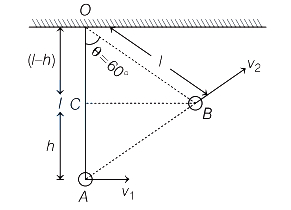
$A$ bob of a pendulum of length $0.5 \ m$ has a speed of $6 \ ms^{-1}$ at its lowest point. Find the speed of the bob when the string of the pendulum makes $60^{\circ}$ with the vertical. (Take $g=10 \ ms^{-2}$)
A
$26 \ ms^{-1}$
B
$\sqrt{31} \ ms^{-1}$
C
$13 \ ms^{-1}$
D
$1.3 \ ms^{-1}$
Solution
(B) Given: Length of pendulum,$l = 0.5 \ m$. Speed at lowest point,$v_1 = 6 \ ms^{-1}$. Angle made by string with vertical,$\theta = 60^{\circ}$.
In $\triangle OBC$,$\cos \theta = \frac{OC}{OB} = \frac{l-h}{l} = \cos 60^{\circ}$.
$\Rightarrow 1 - \frac{h}{l} = 0.5 \Rightarrow \frac{h}{l} = 0.5 \Rightarrow h = 0.5 \times 0.5 = 0.25 \ m$.
Using the law of conservation of mechanical energy:
$K_i + U_i = K_f + U_f$
$\frac{1}{2}mv_1^2 + 0 = \frac{1}{2}mv_2^2 + mgh$
$v_2^2 = v_1^2 - 2gh$
$v_2^2 = (6)^2 - 2 \times 10 \times 0.25 = 36 - 5 = 31$
$v_2 = \sqrt{31} \ ms^{-1}$.
Hence,the final velocity at an angle $60^{\circ}$ is $\sqrt{31} \ ms^{-1}$.
In $\triangle OBC$,$\cos \theta = \frac{OC}{OB} = \frac{l-h}{l} = \cos 60^{\circ}$.
$\Rightarrow 1 - \frac{h}{l} = 0.5 \Rightarrow \frac{h}{l} = 0.5 \Rightarrow h = 0.5 \times 0.5 = 0.25 \ m$.
Using the law of conservation of mechanical energy:
$K_i + U_i = K_f + U_f$
$\frac{1}{2}mv_1^2 + 0 = \frac{1}{2}mv_2^2 + mgh$
$v_2^2 = v_1^2 - 2gh$
$v_2^2 = (6)^2 - 2 \times 10 \times 0.25 = 36 - 5 = 31$
$v_2 = \sqrt{31} \ ms^{-1}$.
Hence,the final velocity at an angle $60^{\circ}$ is $\sqrt{31} \ ms^{-1}$.
0 likes
View Solution171
MediumMCQ
$A$ body is projected vertically upwards with a velocity of $20 \,m \,s^{-1}$. If the potential energy of the body at a height of $5 \,m$ from the ground is $100 \,J$, then the kinetic energy of the body at a height of $10 \,m$ from the ground is (Acceleration due to gravity $= 10 \,m \,s^{-2}$) (in $\,J$)
A
$200$
B
$300$
C
$150$
D
$250$
Solution
(A) The total mechanical energy of the body is conserved.
Initial kinetic energy at the ground $(h=0)$ is $K_i = \frac{1}{2} m v^2 = \frac{1}{2} m (20)^2 = 200m \,J$.
Initial potential energy at the ground is $U_i = 0 \,J$.
Total energy $E = K_i + U_i = 200m \,J$.
At a height of $5 \,m$, potential energy $U_5 = mgh = m(10)(5) = 50m \,J$.
Given $U_5 = 100 \,J$, so $50m = 100$, which gives $m = 2 \,kg$.
Total energy $E = 200(2) = 400 \,J$.
At a height of $10 \,m$, potential energy $U_{10} = mgh = 2(10)(10) = 200 \,J$.
By conservation of energy, $E = K_{10} + U_{10}$.
$400 = K_{10} + 200$.
$K_{10} = 200 \,J$.
Initial kinetic energy at the ground $(h=0)$ is $K_i = \frac{1}{2} m v^2 = \frac{1}{2} m (20)^2 = 200m \,J$.
Initial potential energy at the ground is $U_i = 0 \,J$.
Total energy $E = K_i + U_i = 200m \,J$.
At a height of $5 \,m$, potential energy $U_5 = mgh = m(10)(5) = 50m \,J$.
Given $U_5 = 100 \,J$, so $50m = 100$, which gives $m = 2 \,kg$.
Total energy $E = 200(2) = 400 \,J$.
At a height of $10 \,m$, potential energy $U_{10} = mgh = 2(10)(10) = 200 \,J$.
By conservation of energy, $E = K_{10} + U_{10}$.
$400 = K_{10} + 200$.
$K_{10} = 200 \,J$.
0 likes
View Solution172
MediumMCQ
$A$ ball of mass $300 g$ is dropped from a height $10 m$ above a sandy ground. On reaching the ground,it penetrates through a distance $1.5 m$ in sand and finally stops. The average resistance offered by the sand to oppose the motion is (acceleration due to gravity $= 10 m s^{-2}$) (in $N$)
A
$35$
B
$23$
C
$34$
D
$28$
Solution
(B) The mass of the ball is $m = 300 g = 0.3 kg$. The total height fallen by the ball is $H = 10 m + 1.5 m = 11.5 m$.
According to the work-energy theorem,the total work done by all forces is equal to the change in kinetic energy.
Since the ball starts from rest and comes to rest,the change in kinetic energy is $\Delta K = 0$.
The forces acting on the ball are gravity (downward) and the resistance force of the sand (upward).
Work done by gravity $W_g = mgH = 0.3 \times 10 \times 11.5 = 34.5 J$.
Work done by sand resistance $W_R = -F_R \times d$,where $d = 1.5 m$.
Applying the theorem: $W_g + W_R = 0
\Rightarrow 34.5 - F_R \times 1.5 = 0
\Rightarrow F_R = \frac{34.5}{1.5} = 23 N$.
According to the work-energy theorem,the total work done by all forces is equal to the change in kinetic energy.
Since the ball starts from rest and comes to rest,the change in kinetic energy is $\Delta K = 0$.
The forces acting on the ball are gravity (downward) and the resistance force of the sand (upward).
Work done by gravity $W_g = mgH = 0.3 \times 10 \times 11.5 = 34.5 J$.
Work done by sand resistance $W_R = -F_R \times d$,where $d = 1.5 m$.
Applying the theorem: $W_g + W_R = 0
\Rightarrow 34.5 - F_R \times 1.5 = 0
\Rightarrow F_R = \frac{34.5}{1.5} = 23 N$.
0 likes
View Solution173
MediumMCQ
$A$ force $\overrightarrow{F} = 4 \hat{i} - 15 \hat{j} \text{ N}$ acts on a body, resulting in a displacement of $\overrightarrow{S} = 6 \hat{i} \text{ m}$. If the body had a kinetic energy of $7 \text{ J}$ at the beginning of the displacement, what is the kinetic energy at the end of the displacement (in $\text{ J}$)?
A
$24$
B
$31$
C
$30$
D
$25$
Solution
(B) According to the work-energy theorem, the work done by the net force on a body is equal to the change in its kinetic energy.
$W = \Delta K = K_f - K_i$
Given:
Force $\overrightarrow{F} = (4 \hat{i} - 15 \hat{j}) \text{ N}$
Displacement $\overrightarrow{S} = 6 \hat{i} \text{ m}$
Initial kinetic energy $K_i = 7 \text{ J}$
Work done $W = \overrightarrow{F} \cdot \overrightarrow{S} = (4 \hat{i} - 15 \hat{j}) \cdot (6 \hat{i}) = (4 \times 6) + (-15 \times 0) = 24 \text{ J}$
Using the work-energy theorem:
$K_f - K_i = W$
$K_f - 7 = 24$
$K_f = 24 + 7 = 31 \text{ J}$
Therefore, the kinetic energy at the end of the displacement is $31 \text{ J}$.
$W = \Delta K = K_f - K_i$
Given:
Force $\overrightarrow{F} = (4 \hat{i} - 15 \hat{j}) \text{ N}$
Displacement $\overrightarrow{S} = 6 \hat{i} \text{ m}$
Initial kinetic energy $K_i = 7 \text{ J}$
Work done $W = \overrightarrow{F} \cdot \overrightarrow{S} = (4 \hat{i} - 15 \hat{j}) \cdot (6 \hat{i}) = (4 \times 6) + (-15 \times 0) = 24 \text{ J}$
Using the work-energy theorem:
$K_f - K_i = W$
$K_f - 7 = 24$
$K_f = 24 + 7 = 31 \text{ J}$
Therefore, the kinetic energy at the end of the displacement is $31 \text{ J}$.
0 likes
View Solution174
MediumMCQ
$A$ particle of mass $m$ slides down along a frictionless inclined plane $AC$ as shown in the figure. The kinetic energy of the particle at point $C$ is:
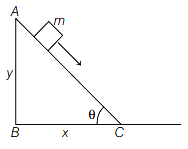
A
$mgy$
B
$mgx$
C
$mg\left(\frac{y}{\sin \theta}\right)$
D
$mg\left(\frac{y}{\cos \theta}\right)$
Solution
(A) According to the law of conservation of mechanical energy,the total mechanical energy of the system remains constant in the absence of non-conservative forces like friction.
At point $A$,the particle is at rest,so its kinetic energy is $0$ and its potential energy is $mgy$ (taking the reference level at $BC$).
At point $C$,the particle is at height $0$,so its potential energy is $0$ and its kinetic energy is $KE_C$.
Applying the conservation of energy principle:
$PE_A + KE_A = PE_C + KE_C$
$mgy + 0 = 0 + KE_C$
Therefore,the kinetic energy at point $C$ is $KE_C = mgy$.
At point $A$,the particle is at rest,so its kinetic energy is $0$ and its potential energy is $mgy$ (taking the reference level at $BC$).
At point $C$,the particle is at height $0$,so its potential energy is $0$ and its kinetic energy is $KE_C$.
Applying the conservation of energy principle:
$PE_A + KE_A = PE_C + KE_C$
$mgy + 0 = 0 + KE_C$
Therefore,the kinetic energy at point $C$ is $KE_C = mgy$.
0 likes
View Solution175
MediumMCQ
Potential energy of a body of mass $1 \ kg$ free to move along $X$-axis is given by $U(x) = (\frac{x^2}{2} - x) \ J$. If the total mechanical energy of the body is $2 \ J$,then the maximum speed of the body is (Assume only conservative force acts on the body).
A
$\sqrt{5} \ ms^{-1}$
B
$5 \ ms^{-1}$
C
$3.5 \ ms^{-1}$
D
$\sqrt{8} \ ms^{-1}$
Solution
(A) The total mechanical energy $E$ of a system is the sum of its potential energy $U$ and kinetic energy $KE$. That is,$E = U + KE$.
Given,$E = 2 \ J$ and $m = 1 \ kg$.
To find the maximum speed,we need the maximum kinetic energy,which occurs when the potential energy is at its minimum.
$U(x) = \frac{x^2}{2} - x$.
To find the minimum potential energy,we set $\frac{dU}{dx} = 0$:
$\frac{d}{dx}(\frac{x^2}{2} - x) = x - 1 = 0 \implies x = 1 \ m$.
$U_{\min} = U(1) = \frac{1^2}{2} - 1 = -0.5 \ J$.
Since $E = U + KE$,we have $KE_{\max} = E - U_{\min} = 2 - (-0.5) = 2.5 \ J$.
Using $KE = \frac{1}{2}mv^2$:
$2.5 = \frac{1}{2}(1)v^2 \implies v^2 = 5 \implies v = \sqrt{5} \ ms^{-1}$.
Given,$E = 2 \ J$ and $m = 1 \ kg$.
To find the maximum speed,we need the maximum kinetic energy,which occurs when the potential energy is at its minimum.
$U(x) = \frac{x^2}{2} - x$.
To find the minimum potential energy,we set $\frac{dU}{dx} = 0$:
$\frac{d}{dx}(\frac{x^2}{2} - x) = x - 1 = 0 \implies x = 1 \ m$.
$U_{\min} = U(1) = \frac{1^2}{2} - 1 = -0.5 \ J$.
Since $E = U + KE$,we have $KE_{\max} = E - U_{\min} = 2 - (-0.5) = 2.5 \ J$.
Using $KE = \frac{1}{2}mv^2$:
$2.5 = \frac{1}{2}(1)v^2 \implies v^2 = 5 \implies v = \sqrt{5} \ ms^{-1}$.
0 likes
View Solution176
EasyMCQ
$A$ body is released from a height of $30 \ m$ vertically downwards. The speed of the body at which potential energy is twice that of kinetic energy is (Acceleration due to gravity $= 10 \ m \ s^{-2}$)
A
$20 \sqrt{2} \ m \ s^{-1}$
B
$10 \sqrt{2} \ m \ s^{-1}$
C
$10 \ m \ s^{-1}$
D
$20 \ m \ s^{-1}$
Solution
(B) Let the total height be $H = 30 \ m$ and the velocity of the body be $v$ at a point where potential energy $(PE)$ is twice the kinetic energy $(KE)$.
According to the law of conservation of energy,the total energy at any point is equal to the initial potential energy:
$m g H = PE + KE$
Given that $PE = 2 \times KE$,we substitute this into the equation:
$m g H = 2 \times KE + KE = 3 \times KE$
Since $KE = \frac{1}{2} m v^2$,we have:
$m g H = 3 \times (\frac{1}{2} m v^2)$
$g H = \frac{3}{2} v^2$
$v^2 = \frac{2}{3} g H$
Substituting the values $g = 10 \ m \ s^{-2}$ and $H = 30 \ m$:
$v^2 = \frac{2}{3} \times 10 \times 30$
$v^2 = 2 \times 10 \times 10 = 200$
$v = \sqrt{200} = 10 \sqrt{2} \ m \ s^{-1}$
According to the law of conservation of energy,the total energy at any point is equal to the initial potential energy:
$m g H = PE + KE$
Given that $PE = 2 \times KE$,we substitute this into the equation:
$m g H = 2 \times KE + KE = 3 \times KE$
Since $KE = \frac{1}{2} m v^2$,we have:
$m g H = 3 \times (\frac{1}{2} m v^2)$
$g H = \frac{3}{2} v^2$
$v^2 = \frac{2}{3} g H$
Substituting the values $g = 10 \ m \ s^{-2}$ and $H = 30 \ m$:
$v^2 = \frac{2}{3} \times 10 \times 30$
$v^2 = 2 \times 10 \times 10 = 200$
$v = \sqrt{200} = 10 \sqrt{2} \ m \ s^{-1}$
0 likes
View Solution177
MediumMCQ
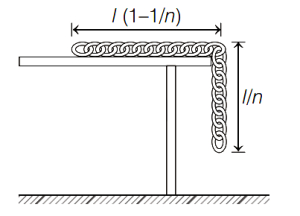
$A$ uniform chain of mass $m$ and length $l$ is on a smooth horizontal table with $\left(\frac{1}{n}\right)^{\text{th}}$ part of its length hanging from one end of the table. The velocity of the chain,when it completely slips off the table is
A
$\sqrt{g l\left(1-\frac{1}{n^2}\right)}$
B
$\sqrt{2 g l\left(1+\frac{1}{n^2}\right)}$
C
$\sqrt{2 g l\left(1-\frac{1}{n^2}\right)}$
D
$\sqrt{2 g l}$
Solution
(A) Let the mass per unit length be $\lambda = \frac{m}{l}$.
Initial state: The length hanging is $h_1 = \frac{l}{n}$. The mass of this part is $m_1 = \lambda \cdot \frac{l}{n} = \frac{m}{n}$. The center of mass of the hanging part is at a distance $\frac{l}{2n}$ below the table surface. Taking the table surface as the reference level $(U=0)$,the initial potential energy is $U_i = -m_1 g \left(\frac{l}{2n}\right) = -\left(\frac{m}{n}\right) g \left(\frac{l}{2n}\right) = -\frac{mgl}{2n^2}$.
Final state: When the chain completely slips off,its center of mass is at a distance $\frac{l}{2}$ below the table surface. The final potential energy is $U_f = -mg \left(\frac{l}{2}\right) = -\frac{mgl}{2}$.
By the law of conservation of energy,the loss in potential energy equals the gain in kinetic energy:
$K_f - K_i = U_i - U_f$
$\frac{1}{2}mv^2 - 0 = -\frac{mgl}{2n^2} - \left(-\frac{mgl}{2}\right)$
$\frac{1}{2}mv^2 = \frac{mgl}{2} \left(1 - \frac{1}{n^2}\right)$
$v^2 = gl \left(1 - \frac{1}{n^2}\right)$
$v = \sqrt{gl \left(1 - \frac{1}{n^2}\right)}$
Wait,checking the calculation: $\frac{1}{2}mv^2 = \frac{mgl}{2}(1 - 1/n^2) \implies v = \sqrt{gl(1 - 1/n^2)}$. Re-evaluating the options,the correct expression is $\sqrt{gl(1 - 1/n^2)}$. However,if the question implies the standard result,let's re-check the factor of $2$. The kinetic energy is $\frac{1}{2}mv^2$. The potential energy change is $\frac{mgl}{2}(1 - 1/n^2)$. Thus $v = \sqrt{gl(1 - 1/n^2)}$. Option $A$ matches this.
Initial state: The length hanging is $h_1 = \frac{l}{n}$. The mass of this part is $m_1 = \lambda \cdot \frac{l}{n} = \frac{m}{n}$. The center of mass of the hanging part is at a distance $\frac{l}{2n}$ below the table surface. Taking the table surface as the reference level $(U=0)$,the initial potential energy is $U_i = -m_1 g \left(\frac{l}{2n}\right) = -\left(\frac{m}{n}\right) g \left(\frac{l}{2n}\right) = -\frac{mgl}{2n^2}$.
Final state: When the chain completely slips off,its center of mass is at a distance $\frac{l}{2}$ below the table surface. The final potential energy is $U_f = -mg \left(\frac{l}{2}\right) = -\frac{mgl}{2}$.
By the law of conservation of energy,the loss in potential energy equals the gain in kinetic energy:
$K_f - K_i = U_i - U_f$
$\frac{1}{2}mv^2 - 0 = -\frac{mgl}{2n^2} - \left(-\frac{mgl}{2}\right)$
$\frac{1}{2}mv^2 = \frac{mgl}{2} \left(1 - \frac{1}{n^2}\right)$
$v^2 = gl \left(1 - \frac{1}{n^2}\right)$
$v = \sqrt{gl \left(1 - \frac{1}{n^2}\right)}$
Wait,checking the calculation: $\frac{1}{2}mv^2 = \frac{mgl}{2}(1 - 1/n^2) \implies v = \sqrt{gl(1 - 1/n^2)}$. Re-evaluating the options,the correct expression is $\sqrt{gl(1 - 1/n^2)}$. However,if the question implies the standard result,let's re-check the factor of $2$. The kinetic energy is $\frac{1}{2}mv^2$. The potential energy change is $\frac{mgl}{2}(1 - 1/n^2)$. Thus $v = \sqrt{gl(1 - 1/n^2)}$. Option $A$ matches this.
0 likes
View Solution178
EasyMCQ
$A$ particle is released from a height $H$. At a certain height,its kinetic energy is half of its potential energy with reference to the surface of the earth. The height and speed of the particle at that instant are respectively:
A
$\frac{H}{3}, \sqrt{\frac{2 g H}{3}}$
B
$\frac{H}{3}, 2 \sqrt{\frac{g H}{3}}$
C
$\frac{2 H}{3}, \sqrt{2 g H}$
D
$\frac{2 H}{3}, \sqrt{\frac{2 g H}{3}}$
Solution
(D) The total mechanical energy of the particle is conserved,so at any height $h$ from the ground,the sum of potential energy $(PE)$ and kinetic energy $(KE)$ is equal to the initial potential energy at height $H$:
$PE + KE = m g H$ ... $(i)$
Given that at a certain height,the kinetic energy is half of its potential energy:
$KE = \frac{1}{2} PE \implies PE = 2 KE$
Substituting this into equation $(i)$:
$2 KE + KE = m g H$
$3 KE = m g H$
$KE = \frac{m g H}{3}$
Since $PE = m g h$,we have $PE = 2 KE = 2 \left( \frac{m g H}{3} \right) = \frac{2}{3} m g H$.
Equating $m g h = \frac{2}{3} m g H$,we get the height $h = \frac{2 H}{3}$.
The speed $v$ of the particle at this height can be found using the work-energy theorem or kinematics. Since the particle falls from rest from height $H$,its speed at height $h$ is given by $v = \sqrt{2 g (H - h)}$.
Substituting $h = \frac{2 H}{3}$:
$v = \sqrt{2 g (H - \frac{2 H}{3})} = \sqrt{2 g (\frac{H}{3})} = \sqrt{\frac{2 g H}{3}}$.
Thus,the height is $\frac{2 H}{3}$ and the speed is $\sqrt{\frac{2 g H}{3}}$.
$PE + KE = m g H$ ... $(i)$
Given that at a certain height,the kinetic energy is half of its potential energy:
$KE = \frac{1}{2} PE \implies PE = 2 KE$
Substituting this into equation $(i)$:
$2 KE + KE = m g H$
$3 KE = m g H$
$KE = \frac{m g H}{3}$
Since $PE = m g h$,we have $PE = 2 KE = 2 \left( \frac{m g H}{3} \right) = \frac{2}{3} m g H$.
Equating $m g h = \frac{2}{3} m g H$,we get the height $h = \frac{2 H}{3}$.
The speed $v$ of the particle at this height can be found using the work-energy theorem or kinematics. Since the particle falls from rest from height $H$,its speed at height $h$ is given by $v = \sqrt{2 g (H - h)}$.
Substituting $h = \frac{2 H}{3}$:
$v = \sqrt{2 g (H - \frac{2 H}{3})} = \sqrt{2 g (\frac{H}{3})} = \sqrt{\frac{2 g H}{3}}$.
Thus,the height is $\frac{2 H}{3}$ and the speed is $\sqrt{\frac{2 g H}{3}}$.
0 likes
View Solution179
MediumMCQ
$A$ body of mass $2 \,kg$ moving in $X-Y$ plane has a potential energy given by $U = (6x + 8y) \,J$. The body is at rest at the point $(3, 2) \,m$. The work done by the body to reach another position after $2 \,s$ is: (in $\,J$)
A
$100$
B
$500$
C
$750$
D
$900$
Solution
(A) The force acting on the body is given by $\vec{F} = -\nabla U = -(\frac{\partial U}{\partial x} \hat{i} + \frac{\partial U}{\partial y} \hat{j}) = -(6 \hat{i} + 8 \hat{j}) \,N$.
The acceleration of the body is $\vec{a} = \frac{\vec{F}}{m} = \frac{-(6 \hat{i} + 8 \hat{j})}{2} = -(3 \hat{i} + 4 \hat{j}) \,m/s^2$.
Since the body starts from rest at $t = 0$, its velocity at $t = 2 \,s$ is $\vec{v} = \vec{u} + \vec{a}t = 0 + (-(3 \hat{i} + 4 \hat{j})) \times 2 = -(6 \hat{i} + 8 \hat{j}) \,m/s$.
The kinetic energy of the body at $t = 2 \,s$ is $K = \frac{1}{2} m v^2 = \frac{1}{2} \times 2 \times ((-6)^2 + (-8)^2) = 36 + 64 = 100 \,J$.
According to the work-energy theorem, the work done by the external force is equal to the change in kinetic energy. Since the body starts from rest $(K_i = 0)$, the work done by the force is $W = \Delta K = 100 - 0 = 100 \,J$.
The acceleration of the body is $\vec{a} = \frac{\vec{F}}{m} = \frac{-(6 \hat{i} + 8 \hat{j})}{2} = -(3 \hat{i} + 4 \hat{j}) \,m/s^2$.
Since the body starts from rest at $t = 0$, its velocity at $t = 2 \,s$ is $\vec{v} = \vec{u} + \vec{a}t = 0 + (-(3 \hat{i} + 4 \hat{j})) \times 2 = -(6 \hat{i} + 8 \hat{j}) \,m/s$.
The kinetic energy of the body at $t = 2 \,s$ is $K = \frac{1}{2} m v^2 = \frac{1}{2} \times 2 \times ((-6)^2 + (-8)^2) = 36 + 64 = 100 \,J$.
According to the work-energy theorem, the work done by the external force is equal to the change in kinetic energy. Since the body starts from rest $(K_i = 0)$, the work done by the force is $W = \Delta K = 100 - 0 = 100 \,J$.
0 likes
View Solution180
DifficultMCQ
An object of mass $20 \,kg$ is displaced by $x = 5t^2 \,m$ (where $t$ is time) due to the application of a force. The ratio of the work done in $3 \,s$ and $5 \,s$ is:
A
$2 / 3$
B
$4 / 9$
C
$3 / 5$
D
$9 / 25$
Solution
(D) Given, displacement of the block, $x = 5t^2$.
Velocity $v = \frac{dx}{dt} = \frac{d}{dt}(5t^2) = 10t \,m/s$.
At $t = 0 \,s$, $v_0 = 10(0) = 0 \,m/s$.
At $t = 3 \,s$, $v_1 = 10(3) = 30 \,m/s$.
At $t = 5 \,s$, $v_2 = 10(5) = 50 \,m/s$.
By the Work-Energy Theorem, the work done $W$ is equal to the change in kinetic energy: $W = \Delta K = \frac{1}{2}mv_f^2 - \frac{1}{2}mv_i^2$.
Work done in first $3 \,s$: $W_1 = \frac{1}{2}m(v_1^2 - v_0^2) = \frac{1}{2}m(30^2 - 0^2) = \frac{1}{2}m(900)$.
Work done in first $5 \,s$: $W_2 = \frac{1}{2}m(v_2^2 - v_0^2) = \frac{1}{2}m(50^2 - 0^2) = \frac{1}{2}m(2500)$.
Ratio $\frac{W_1}{W_2} = \frac{900}{2500} = \frac{9}{25}$.
Velocity $v = \frac{dx}{dt} = \frac{d}{dt}(5t^2) = 10t \,m/s$.
At $t = 0 \,s$, $v_0 = 10(0) = 0 \,m/s$.
At $t = 3 \,s$, $v_1 = 10(3) = 30 \,m/s$.
At $t = 5 \,s$, $v_2 = 10(5) = 50 \,m/s$.
By the Work-Energy Theorem, the work done $W$ is equal to the change in kinetic energy: $W = \Delta K = \frac{1}{2}mv_f^2 - \frac{1}{2}mv_i^2$.
Work done in first $3 \,s$: $W_1 = \frac{1}{2}m(v_1^2 - v_0^2) = \frac{1}{2}m(30^2 - 0^2) = \frac{1}{2}m(900)$.
Work done in first $5 \,s$: $W_2 = \frac{1}{2}m(v_2^2 - v_0^2) = \frac{1}{2}m(50^2 - 0^2) = \frac{1}{2}m(2500)$.
Ratio $\frac{W_1}{W_2} = \frac{900}{2500} = \frac{9}{25}$.
0 likes
View Solution181
EasyMCQ
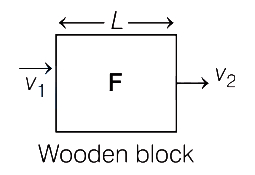
$A$ bullet of mass $m$ enters a wooden block of length $L$ at a speed $v_1$ and emerges out of the block with a speed $v_2$. If $F$ is the average force which impeded its motion through the wooden block,then (Assume uniform deceleration inside the block):
A
$F = \frac{m}{2L}(v_1^2 - v_2^2)$
B
$F = \frac{m}{2L}(v_2^2 - v_1^2)$
C
$F = \frac{m}{2L}(v_1^2 + v_2^2)$
D
$F = \frac{m}{L}(v_1^2 - v_2^2)$
Solution
(A) Given: Mass of the bullet $= m$,initial velocity $= v_1$,final velocity $= v_2$,and distance traveled $= L$.
Since the bullet experiences a resistive force $F$,it undergoes uniform deceleration $a = F/m$.
Using the third equation of motion,$v^2 - u^2 = 2as$,where $v = v_2$,$u = v_1$,$a = -F/m$,and $s = L$:
$v_2^2 - v_1^2 = 2(-F/m)L$
$v_2^2 - v_1^2 = -\frac{2FL}{m}$
$F = \frac{m(v_1^2 - v_2^2)}{2L}$
Since $v_1 > v_2$,the force $F$ is positive.
Since the bullet experiences a resistive force $F$,it undergoes uniform deceleration $a = F/m$.
Using the third equation of motion,$v^2 - u^2 = 2as$,where $v = v_2$,$u = v_1$,$a = -F/m$,and $s = L$:
$v_2^2 - v_1^2 = 2(-F/m)L$
$v_2^2 - v_1^2 = -\frac{2FL}{m}$
$F = \frac{m(v_1^2 - v_2^2)}{2L}$
Since $v_1 > v_2$,the force $F$ is positive.
0 likes
View Solution182
DifficultMCQ
$A$ car driver is trying to jump across a path as shown in the figure by driving horizontally off a cliff '$X$' at a speed of $10 \ m \ s^{-1}$. When he touches peak '$Z$' (ignore air resistance),what would be his speed (in $m \ s^{-1}$)? (use $g = 10 \ m \ s^{-2}$)
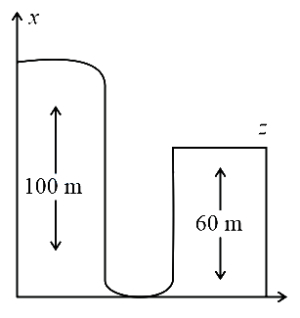
A
$30$
B
$40$
C
$15$
D
$50$
Solution
(A) According to the principle of conservation of mechanical energy,the sum of kinetic energy and potential energy at the starting point '$X$' must be equal to the sum of kinetic energy and potential energy at the peak '$Z$'.
$mgh + \frac{1}{2}mv^2 = mgh' + \frac{1}{2}mv'^2$
Dividing by mass $m$ on both sides:
$gh + \frac{1}{2}v^2 = gh' + \frac{1}{2}v'^2$
Rearranging for $v'^2$:
$v'^2 = 2g(h - h') + v^2$
Given: $h = 100 \ m$,$h' = 60 \ m$,$v = 10 \ m \ s^{-1}$,and $g = 10 \ m \ s^{-2}$.
$v'^2 = 2 \times 10 \times (100 - 60) + (10)^2$
$v'^2 = 20 \times 40 + 100$
$v'^2 = 800 + 100 = 900$
$v' = \sqrt{900} = 30 \ m \ s^{-1}$
$mgh + \frac{1}{2}mv^2 = mgh' + \frac{1}{2}mv'^2$
Dividing by mass $m$ on both sides:
$gh + \frac{1}{2}v^2 = gh' + \frac{1}{2}v'^2$
Rearranging for $v'^2$:
$v'^2 = 2g(h - h') + v^2$
Given: $h = 100 \ m$,$h' = 60 \ m$,$v = 10 \ m \ s^{-1}$,and $g = 10 \ m \ s^{-2}$.
$v'^2 = 2 \times 10 \times (100 - 60) + (10)^2$
$v'^2 = 20 \times 40 + 100$
$v'^2 = 800 + 100 = 900$
$v' = \sqrt{900} = 30 \ m \ s^{-1}$
0 likes
View Solution183
DifficultMCQ
$A$ bus moving on a level road with a velocity $v$ can be stopped at a distance of $x$ by the application of a retarding force $F$. The load on the bus is increased by $25\%$ by boarding the passengers. Now,if the bus is moving with the same speed and if the same retarding force is applied,the distance travelled by the bus before it stops is
A
$1.25 x$
B
$x$
C
$5 x$
D
$2.5 x$
Solution
(A) According to the work-energy theorem,the work done by the retarding force is equal to the change in kinetic energy of the bus.
$W = \Delta K$
$F \cdot s = \frac{1}{2} m v^2$
Since the retarding force $F$ and the initial velocity $v$ are constant,we have:
$s = \frac{m v^2}{2 F} \implies s \propto m$
Let the initial mass be $m_1 = m$ and the initial stopping distance be $s_1 = x$.
The new mass after increasing by $25\%$ is $m_2 = m + 0.25m = 1.25m$.
Using the proportionality $s \propto m$:
$\frac{s_2}{s_1} = \frac{m_2}{m_1}$
$s_2 = s_1 \cdot \frac{1.25m}{m}$
$s_2 = 1.25 x$.
$W = \Delta K$
$F \cdot s = \frac{1}{2} m v^2$
Since the retarding force $F$ and the initial velocity $v$ are constant,we have:
$s = \frac{m v^2}{2 F} \implies s \propto m$
Let the initial mass be $m_1 = m$ and the initial stopping distance be $s_1 = x$.
The new mass after increasing by $25\%$ is $m_2 = m + 0.25m = 1.25m$.
Using the proportionality $s \propto m$:
$\frac{s_2}{s_1} = \frac{m_2}{m_1}$
$s_2 = s_1 \cdot \frac{1.25m}{m}$
$s_2 = 1.25 x$.
0 likes
View Solution184
MediumMCQ
From a height of $h$ above the ground, a ball is projected up at an angle $30^{\circ}$ with the horizontal. If the ball strikes the ground with a speed of $1.25$ times its initial speed of $40 \,ms^{-1}$, the value of $h$ is (acceleration due to gravity $= 10 \,ms^{-2}$) (in $\,m$)
A
$75$
B
$60$
C
$30$
D
$45$
Solution
(D) Given initial speed $u = 40 \,ms^{-1}$ and angle $\theta = 30^{\circ}$.
The final speed $v = 1.25 \times u = 1.25 \times 40 = 50 \,ms^{-1}$.
Using the principle of conservation of energy, the total mechanical energy at the point of projection and at the point of striking the ground remains constant.
Taking the ground as the reference level for potential energy $(PE = 0)$:
$E_{initial} = E_{final}$
$\frac{1}{2} m u^2 + mgh = \frac{1}{2} m v^2$
Dividing by $m$ and multiplying by $2$:
$u^2 + 2gh = v^2$
Substitute the given values:
$(40)^2 + 2 \times 10 \times h = (50)^2$
$1600 + 20h = 2500$
$20h = 2500 - 1600$
$20h = 900$
$h = \frac{900}{20} = 45 \,m$.
Thus, the value of $h$ is $45 \,m$.
The final speed $v = 1.25 \times u = 1.25 \times 40 = 50 \,ms^{-1}$.
Using the principle of conservation of energy, the total mechanical energy at the point of projection and at the point of striking the ground remains constant.
Taking the ground as the reference level for potential energy $(PE = 0)$:
$E_{initial} = E_{final}$
$\frac{1}{2} m u^2 + mgh = \frac{1}{2} m v^2$
Dividing by $m$ and multiplying by $2$:
$u^2 + 2gh = v^2$
Substitute the given values:
$(40)^2 + 2 \times 10 \times h = (50)^2$
$1600 + 20h = 2500$
$20h = 2500 - 1600$
$20h = 900$
$h = \frac{900}{20} = 45 \,m$.
Thus, the value of $h$ is $45 \,m$.
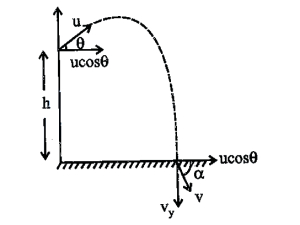
0 likes
View Solution185
EasyMCQ
$A$ body thrown vertically upwards from the ground reaches a maximum height $h$. The ratio of the kinetic and potential energies of the body at a height $40 \%$ of $h$ from the ground is
A
$2: 3$
B
$3: 2$
C
$1: 1$
D
$4: 9$
Solution
(B) Let the mass of the body be $m$ and the initial velocity be $u$. At maximum height $h$,the total energy is $E = mgh$.
At a height $y = 0.4h$ from the ground,the potential energy is $PE = mgy = mg(0.4h) = 0.4mgh$.
According to the law of conservation of energy,the total energy remains constant.
Therefore,$KE + PE = E$.
$KE = E - PE = mgh - 0.4mgh = 0.6mgh$.
The ratio of kinetic energy to potential energy is $\frac{KE}{PE} = \frac{0.6mgh}{0.4mgh} = \frac{0.6}{0.4} = \frac{3}{2}$.
Thus,the ratio is $3: 2$.
At a height $y = 0.4h$ from the ground,the potential energy is $PE = mgy = mg(0.4h) = 0.4mgh$.
According to the law of conservation of energy,the total energy remains constant.
Therefore,$KE + PE = E$.
$KE = E - PE = mgh - 0.4mgh = 0.6mgh$.
The ratio of kinetic energy to potential energy is $\frac{KE}{PE} = \frac{0.6mgh}{0.4mgh} = \frac{0.6}{0.4} = \frac{3}{2}$.
Thus,the ratio is $3: 2$.
0 likes
View Solution186
MediumMCQ
$A$ ball of mass $1 \ kg$ moves in a straight line with velocity $v = c x^\alpha$,where $c = 1$ ($SI$ unit) and $\alpha$ is a constant. If the work done by the net force during its displacement from $x = 0$ to $x = 4 \ m$ is $128 \ J$,then the value of $\alpha$ is
A
$1$
B
$\frac{3}{2}$
C
$2$
D
$\frac{1}{2}$
Solution
(C) According to the Work-Energy Theorem,the work done by the net force is equal to the change in kinetic energy:
$W = \Delta K = K_f - K_i$
Given $m = 1 \ kg$,$c = 1$,$v = x^\alpha$,$x_i = 0 \ m$,$x_f = 4 \ m$,and $W = 128 \ J$.
At $x = 0$,$v_i = 1 \times (0)^\alpha = 0$.
At $x = 4$,$v_f = 1 \times (4)^\alpha = 4^\alpha$.
Substituting these into the Work-Energy equation:
$128 = \frac{1}{2} m v_f^2 - \frac{1}{2} m v_i^2$
$128 = \frac{1}{2} (1) (4^\alpha)^2 - 0$
$128 = \frac{1}{2} (4^{2\alpha})$
$256 = 4^{2\alpha}$
Since $256 = 2^8 = (2^2)^4 = 4^4$,we have:
$4^4 = 4^{2\alpha}$
$2\alpha = 4$
$\alpha = 2$.
$W = \Delta K = K_f - K_i$
Given $m = 1 \ kg$,$c = 1$,$v = x^\alpha$,$x_i = 0 \ m$,$x_f = 4 \ m$,and $W = 128 \ J$.
At $x = 0$,$v_i = 1 \times (0)^\alpha = 0$.
At $x = 4$,$v_f = 1 \times (4)^\alpha = 4^\alpha$.
Substituting these into the Work-Energy equation:
$128 = \frac{1}{2} m v_f^2 - \frac{1}{2} m v_i^2$
$128 = \frac{1}{2} (1) (4^\alpha)^2 - 0$
$128 = \frac{1}{2} (4^{2\alpha})$
$256 = 4^{2\alpha}$
Since $256 = 2^8 = (2^2)^4 = 4^4$,we have:
$4^4 = 4^{2\alpha}$
$2\alpha = 4$
$\alpha = 2$.
0 likes
View Solution187
DifficultMCQ
$A$ mass of $2 \ kg$,initially at a height of $1.2 \ m$ above an uncompressed spring with spring constant $2 \times 10^4 \ N/m$,is released from rest to fall on the spring. Taking the acceleration due to gravity as $10 \ m/s^2$ and neglecting air resistance,the compression of the spring in $mm$ is:
A
$20$
B
$40$
C
$50$
D
$60$
Solution
(C) Let the compression of the spring be $x$ (in meters).
According to the law of conservation of mechanical energy,the total potential energy lost by the mass equals the potential energy gained by the spring.
The total height fallen by the mass is $(h + x)$,where $h = 1.2 \ m$.
So,$mg(h + x) = \frac{1}{2} kx^2$.
Substituting the given values: $2 \times 10 \times (1.2 + x) = \frac{1}{2} \times (2 \times 10^4) \times x^2$.
$20(1.2 + x) = 10^4 x^2$.
$24 + 20x = 10000x^2$.
$10000x^2 - 20x - 24 = 0$.
Dividing by $4$: $2500x^2 - 5x - 6 = 0$.
Using the quadratic formula $x = \frac{-b \pm \sqrt{b^2 - 4ac}}{2a}$:
$x = \frac{5 \pm \sqrt{(-5)^2 - 4(2500)(-6)}}{2(2500)} = \frac{5 \pm \sqrt{25 + 60000}}{5000} = \frac{5 \pm \sqrt{60025}}{5000} = \frac{5 \pm 245}{5000}$.
Since $x > 0$,$x = \frac{250}{5000} = 0.05 \ m$.
Converting to $mm$: $0.05 \ m = 50 \ mm$.
According to the law of conservation of mechanical energy,the total potential energy lost by the mass equals the potential energy gained by the spring.
The total height fallen by the mass is $(h + x)$,where $h = 1.2 \ m$.
So,$mg(h + x) = \frac{1}{2} kx^2$.
Substituting the given values: $2 \times 10 \times (1.2 + x) = \frac{1}{2} \times (2 \times 10^4) \times x^2$.
$20(1.2 + x) = 10^4 x^2$.
$24 + 20x = 10000x^2$.
$10000x^2 - 20x - 24 = 0$.
Dividing by $4$: $2500x^2 - 5x - 6 = 0$.
Using the quadratic formula $x = \frac{-b \pm \sqrt{b^2 - 4ac}}{2a}$:
$x = \frac{5 \pm \sqrt{(-5)^2 - 4(2500)(-6)}}{2(2500)} = \frac{5 \pm \sqrt{25 + 60000}}{5000} = \frac{5 \pm \sqrt{60025}}{5000} = \frac{5 \pm 245}{5000}$.
Since $x > 0$,$x = \frac{250}{5000} = 0.05 \ m$.
Converting to $mm$: $0.05 \ m = 50 \ mm$.
0 likes
View Solution188
MediumMCQ
$A$ particle of mass $m$ is moving along a circle of radius $R$ such that its tangential acceleration $a_t$ varies with distance covered $x$ as $a_t = \alpha x^2$,where $\alpha$ is a constant. The kinetic energy $K$ of the particle varies with the distance as $K = \beta x^c$,where $\beta$ and $c$ are constants. The values of $\beta$ and $c$ are:
A
$\beta = \frac{m\alpha}{3}, c = 3$
B
$\beta = \frac{m\alpha}{4}, c = 4$
C
$\beta = \frac{m\alpha}{2}, c = 4$
D
$\beta = \frac{m\alpha}{2}, c = 3$
Solution
(A) Given,tangential acceleration $a_t = \alpha x^2$.
Tangential force $F = m a_t = m \alpha x^2$.
According to the work-energy theorem,the work done by the tangential force is equal to the change in kinetic energy: $W = \Delta K$.
Assuming the particle starts from rest at $x = 0$,$K = \int_0^x F dx$.
$K = \int_0^x (m \alpha x^2) dx$.
$K = m \alpha \left[ \frac{x^3}{3} \right]_0^x = \frac{m \alpha}{3} x^3$.
Comparing this with the given expression $K = \beta x^c$,we get $\beta = \frac{m \alpha}{3}$ and $c = 3$.
Tangential force $F = m a_t = m \alpha x^2$.
According to the work-energy theorem,the work done by the tangential force is equal to the change in kinetic energy: $W = \Delta K$.
Assuming the particle starts from rest at $x = 0$,$K = \int_0^x F dx$.
$K = \int_0^x (m \alpha x^2) dx$.
$K = m \alpha \left[ \frac{x^3}{3} \right]_0^x = \frac{m \alpha}{3} x^3$.
Comparing this with the given expression $K = \beta x^c$,we get $\beta = \frac{m \alpha}{3}$ and $c = 3$.
0 likes
View Solution189
MediumMCQ
$A$ particle of mass $m \ kg$ moves along the $X$-axis with its velocity varying with the distance travelled as $v=k x^\beta$,where $k$ is a positive constant. The total work done by all the forces during displacement of the particle from $x=0$ to $x=d$ is close to
A
$\frac{m k^2}{2}$
B
$\frac{m k^2}{2} d^{2 \beta}$
C
$\frac{m k^2}{2 \beta}$
D
$\frac{m k^2 d}{2 \beta}$
Solution
(B) According to the work-energy theorem,the total work done by all forces is equal to the change in kinetic energy of the particle.
Work done $W = \Delta KE = KE_f - KE_i$.
The velocity of the particle is given by $v = k x^\beta$.
At $x = 0$,the initial velocity $v_i = k(0)^\beta = 0$.
At $x = d$,the final velocity $v_f = k d^\beta$.
The initial kinetic energy $KE_i = \frac{1}{2} m v_i^2 = \frac{1}{2} m (0)^2 = 0$.
The final kinetic energy $KE_f = \frac{1}{2} m v_f^2 = \frac{1}{2} m (k d^\beta)^2 = \frac{1}{2} m k^2 d^{2\beta}$.
Therefore,the total work done $W = \frac{1}{2} m k^2 d^{2\beta} - 0 = \frac{m k^2}{2} d^{2\beta}$.
Work done $W = \Delta KE = KE_f - KE_i$.
The velocity of the particle is given by $v = k x^\beta$.
At $x = 0$,the initial velocity $v_i = k(0)^\beta = 0$.
At $x = d$,the final velocity $v_f = k d^\beta$.
The initial kinetic energy $KE_i = \frac{1}{2} m v_i^2 = \frac{1}{2} m (0)^2 = 0$.
The final kinetic energy $KE_f = \frac{1}{2} m v_f^2 = \frac{1}{2} m (k d^\beta)^2 = \frac{1}{2} m k^2 d^{2\beta}$.
Therefore,the total work done $W = \frac{1}{2} m k^2 d^{2\beta} - 0 = \frac{m k^2}{2} d^{2\beta}$.
0 likes
View Solution190
DifficultMCQ
$A$ ball at rest is dropped from a height of $12 \,m$. It loses $25 \%$ of its kinetic energy on striking the ground and bounces back to a height '$h$'. Then the value of '$h$' is (in $\,m$)
A
$3$
B
$6$
C
$9$
D
$12$
Solution
(C) Let the initial height be $H = 12 \,m$. The potential energy at this height is $PE_1 = mgH$.
When the ball strikes the ground, its kinetic energy just before impact is $KE_1 = mgH$.
The ball loses $25 \%$ of its kinetic energy, so the remaining kinetic energy is $KE_2 = KE_1 - 0.25 KE_1 = 0.75 KE_1$.
The ball bounces back to a height '$h$', so its potential energy at the maximum height is $PE_2 = mgh$.
By the law of conservation of energy, the kinetic energy after the loss is equal to the potential energy at the new height: $mgh = 0.75 mgH$.
Therefore, $h = 0.75 H$.
Substituting $H = 12 \,m$: $h = 0.75 \times 12 = 9 \,m$.
When the ball strikes the ground, its kinetic energy just before impact is $KE_1 = mgH$.
The ball loses $25 \%$ of its kinetic energy, so the remaining kinetic energy is $KE_2 = KE_1 - 0.25 KE_1 = 0.75 KE_1$.
The ball bounces back to a height '$h$', so its potential energy at the maximum height is $PE_2 = mgh$.
By the law of conservation of energy, the kinetic energy after the loss is equal to the potential energy at the new height: $mgh = 0.75 mgH$.
Therefore, $h = 0.75 H$.
Substituting $H = 12 \,m$: $h = 0.75 \times 12 = 9 \,m$.
0 likes
View Solution191
EasyMCQ
$A$ body of mass $3 \text{ kg}$ is moving under the action of a force which causes a displacement of $\left(\frac{t^3}{3}\right) \text{ m}$, where '$t$' is time in seconds. The work done by the force in the first $2 \text{ seconds}$ is: (in $\text{ J}$)
A
$2$
B
$3.8$
C
$5.2$
D
$24$
Solution
(D) Given: Mass $m = 3 \text{ kg}$, Displacement $x = \frac{t^3}{3} \text{ m}$.
First, find the velocity $v$ by differentiating displacement with respect to time:
$v = \frac{dx}{dt} = \frac{d}{dt}\left(\frac{t^3}{3}\right) = t^2 \text{ m/s}$.
At $t = 0$, $v_i = 0^2 = 0 \text{ m/s}$.
At $t = 2 \text{ s}$, $v_f = 2^2 = 4 \text{ m/s}$.
According to the Work-Energy Theorem, the work done $W$ is equal to the change in kinetic energy:
$W = \Delta KE = KE_f - KE_i = \frac{1}{2}mv_f^2 - \frac{1}{2}mv_i^2$.
Substituting the values:
$W = \frac{1}{2} \times 3 \times (4)^2 - \frac{1}{2} \times 3 \times (0)^2 = \frac{1}{2} \times 3 \times 16 = 24 \text{ J}$.
First, find the velocity $v$ by differentiating displacement with respect to time:
$v = \frac{dx}{dt} = \frac{d}{dt}\left(\frac{t^3}{3}\right) = t^2 \text{ m/s}$.
At $t = 0$, $v_i = 0^2 = 0 \text{ m/s}$.
At $t = 2 \text{ s}$, $v_f = 2^2 = 4 \text{ m/s}$.
According to the Work-Energy Theorem, the work done $W$ is equal to the change in kinetic energy:
$W = \Delta KE = KE_f - KE_i = \frac{1}{2}mv_f^2 - \frac{1}{2}mv_i^2$.
Substituting the values:
$W = \frac{1}{2} \times 3 \times (4)^2 - \frac{1}{2} \times 3 \times (0)^2 = \frac{1}{2} \times 3 \times 16 = 24 \text{ J}$.
0 likes
View Solution192
EasyMCQ
When a body is acted upon by a resultant force,then the work done by the resultant force is equal to
A
its initial kinetic energy
B
its initial potential energy
C
change in the kinetic energy
D
change in the potential energy
Solution
(C) According to the Work-Energy Theorem,the work done by the net (resultant) force acting on a body is equal to the change in its kinetic energy.
Mathematically,$W_{net} = \Delta KE = KE_f - KE_i$.
Therefore,the correct option is $C$.
Mathematically,$W_{net} = \Delta KE = KE_f - KE_i$.
Therefore,the correct option is $C$.
0 likes
View Solution193
EasyMCQ
Under the action of a force, a $2 \,kg$ body moves such that its position $x$ as a function of time $t$ is given by $x = \alpha t^2 / 2$, where $x$ is in meters, $t$ is in seconds, and $\alpha = 1 \,m/s^2$. The work done by the force in the first two seconds is: (in $\,J$)
A
$4$
B
$16$
C
$40$
D
$2$
Solution
(A) Given: $m = 2 \,kg$, $x = \frac{\alpha t^2}{2}$, and $\alpha = 1 \,m/s^2$.
First, we find the velocity $v$ by differentiating the position $x$ with respect to time $t$:
$v = \frac{dx}{dt} = \frac{d}{dt} \left( \frac{\alpha t^2}{2} \right) = \alpha t$.
At $t = 2 \,s$, the velocity $v$ is:
$v = 1 \times 2 = 2 \,m/s$.
According to the work-energy theorem, the work done $W$ is equal to the change in kinetic energy:
$W = \Delta K = \frac{1}{2} m v_f^2 - \frac{1}{2} m v_i^2$.
At $t = 0$, $v_i = \alpha(0) = 0$.
At $t = 2 \,s$, $v_f = 2 \,m/s$.
Therefore, $W = \frac{1}{2} \times 2 \,kg \times (2 \,m/s)^2 - 0 = 4 \,J$.
First, we find the velocity $v$ by differentiating the position $x$ with respect to time $t$:
$v = \frac{dx}{dt} = \frac{d}{dt} \left( \frac{\alpha t^2}{2} \right) = \alpha t$.
At $t = 2 \,s$, the velocity $v$ is:
$v = 1 \times 2 = 2 \,m/s$.
According to the work-energy theorem, the work done $W$ is equal to the change in kinetic energy:
$W = \Delta K = \frac{1}{2} m v_f^2 - \frac{1}{2} m v_i^2$.
At $t = 0$, $v_i = \alpha(0) = 0$.
At $t = 2 \,s$, $v_f = 2 \,m/s$.
Therefore, $W = \frac{1}{2} \times 2 \,kg \times (2 \,m/s)^2 - 0 = 4 \,J$.
0 likes
View Solution194
EasyMCQ
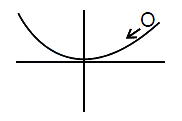
$A$ small sphere of mass $m$ and radius $r$ slides down the smooth surface of a large hemispherical bowl of radius $R$. If the sphere starts sliding from rest,the total kinetic energy of the sphere at the lowest point $A$ of the bowl will be [given,moment of inertia of sphere $= \frac{2}{5} mr^2$].
A
$mg(R-r)$
B
$\frac{7}{10} mg(R-r)$
C
$\frac{2}{7} mg(R-r)$
D
$\frac{10}{7} mg(R-r)$
Solution
(A) Since the surface of the bowl is smooth,there is no friction to cause the sphere to roll. The sphere will simply slide down the surface.
By the law of conservation of mechanical energy,the loss in potential energy is equal to the gain in kinetic energy.
The change in height of the center of mass of the sphere is $h = R - r$.
Potential energy lost = $mgh = mg(R - r)$.
Since the sphere is sliding (not rolling),its total kinetic energy is purely translational: $K = \frac{1}{2} mv^2$.
Therefore,the total kinetic energy at the lowest point is $K = mg(R - r)$.
By the law of conservation of mechanical energy,the loss in potential energy is equal to the gain in kinetic energy.
The change in height of the center of mass of the sphere is $h = R - r$.
Potential energy lost = $mgh = mg(R - r)$.
Since the sphere is sliding (not rolling),its total kinetic energy is purely translational: $K = \frac{1}{2} mv^2$.
Therefore,the total kinetic energy at the lowest point is $K = mg(R - r)$.
0 likes
View Solution195
MediumMCQ
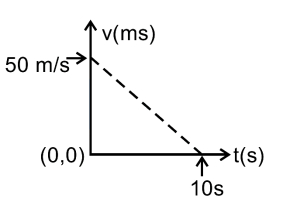
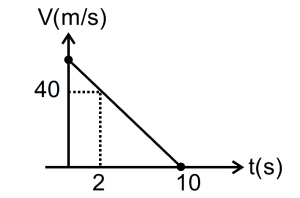
The velocity-time graph for a body of mass $10 \ kg$ is shown in the figure. The work done on the body in the first two seconds of motion is:
A
-$9300$ $J$
B
$12000$ $J$
C
-$4500$ $J$
D
-$1200$ $J$
Solution
(C) From the given velocity-time graph,the initial velocity at $t = 0 \ s$ is $u = 50 \ m/s$. The velocity becomes $0 \ m/s$ at $t = 10 \ s$.
The acceleration $a$ is the slope of the graph: $a = \frac{v_f - v_i}{t_f - t_i} = \frac{0 - 50}{10 - 0} = -5 \ m/s^2$.
The velocity at $t = 2 \ s$ is given by $v = u + at = 50 + (-5)(2) = 40 \ m/s$.
According to the work-energy theorem,the work done $W$ is equal to the change in kinetic energy:
$W = \Delta K = K_f - K_i = \frac{1}{2} m v^2 - \frac{1}{2} m u^2$
$W = \frac{1}{2} \times 10 \ kg \times ((40 \ m/s)^2 - (50 \ m/s)^2)$
$W = 5 \times (1600 - 2500) = 5 \times (-900) = -4500 \ J$.
The acceleration $a$ is the slope of the graph: $a = \frac{v_f - v_i}{t_f - t_i} = \frac{0 - 50}{10 - 0} = -5 \ m/s^2$.
The velocity at $t = 2 \ s$ is given by $v = u + at = 50 + (-5)(2) = 40 \ m/s$.
According to the work-energy theorem,the work done $W$ is equal to the change in kinetic energy:
$W = \Delta K = K_f - K_i = \frac{1}{2} m v^2 - \frac{1}{2} m u^2$
$W = \frac{1}{2} \times 10 \ kg \times ((40 \ m/s)^2 - (50 \ m/s)^2)$
$W = 5 \times (1600 - 2500) = 5 \times (-900) = -4500 \ J$.
0 likes
View Solution196
DifficultMCQ
$A$ body of mass $6 \,kg$ is acted upon by a force which causes a displacement in it given by $x = \frac{t^2}{4} \,m$,where $t$ is the time in seconds. The work done by the force in $2 \,seconds$ is: (in $\,J$)
A
$12$
B
$9$
C
$6$
D
$3$
Solution
(D) Given: Mass $m = 6 \,kg$,displacement $x = \frac{t^2}{4} \,m$.
Velocity $v = \frac{dx}{dt} = \frac{d}{dt}(\frac{t^2}{4}) = \frac{2t}{4} = \frac{t}{2} \,m/s$.
At $t = 0 \,s$,velocity $v_i = \frac{0}{2} = 0 \,m/s$.
At $t = 2 \,s$,velocity $v_f = \frac{2}{2} = 1 \,m/s$.
According to the Work-Energy Theorem,the work done $W$ is equal to the change in kinetic energy $\Delta K$.
$W = K_f - K_i = \frac{1}{2} m v_f^2 - \frac{1}{2} m v_i^2$.
$W = \frac{1}{2} \times 6 \times (1)^2 - \frac{1}{2} \times 6 \times (0)^2$.
$W = 3 - 0 = 3 \,J$.
Velocity $v = \frac{dx}{dt} = \frac{d}{dt}(\frac{t^2}{4}) = \frac{2t}{4} = \frac{t}{2} \,m/s$.
At $t = 0 \,s$,velocity $v_i = \frac{0}{2} = 0 \,m/s$.
At $t = 2 \,s$,velocity $v_f = \frac{2}{2} = 1 \,m/s$.
According to the Work-Energy Theorem,the work done $W$ is equal to the change in kinetic energy $\Delta K$.
$W = K_f - K_i = \frac{1}{2} m v_f^2 - \frac{1}{2} m v_i^2$.
$W = \frac{1}{2} \times 6 \times (1)^2 - \frac{1}{2} \times 6 \times (0)^2$.
$W = 3 - 0 = 3 \,J$.
0 likes
View Solution197
DifficultMCQ
$A$ bead $P$ slides on a frictionless semi-circular wire $(ACB)$. It is at point $S$ at $t = 0$,and at this instant,the horizontal component of its velocity is $v$. Another bead $Q$ of the same mass as $P$ is ejected from point $A$ at $t = 0$ along the horizontal wire $AB$ with speed $v$. Friction between the beads and the respective wires may be neglected in both cases. Let $t_P$ and $t_Q$ be the respective times taken by beads $P$ and $Q$ to reach point $B$. Then the relation between $t_P$ and $t_Q$ is:
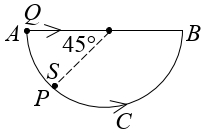
A
$t_{P} > t_{Q}$
B
$t_{P} < t_{Q}$
C
$t_{P} > 1.25 t_{Q}$
D
$t_{P} = t_{Q}$
Solution
(B) Let the radius of the semi-circle be $R$. The horizontal distance covered by bead $Q$ to reach point $B$ is $2R$. Since it moves with a constant horizontal velocity $v$,the time taken is $t_Q = \frac{2R}{v}$.
For bead $P$,the horizontal component of velocity is given as $v_x = v$ at point $S$. As the bead slides down the frictionless semi-circular wire,its speed increases due to gravity. The horizontal component of its velocity $v_x$ will be $v \cos \theta$,where $\theta$ is the angle the velocity vector makes with the horizontal. Since the bead is constrained to move along the semi-circle,its horizontal velocity component $v_x$ will always be greater than or equal to its initial horizontal velocity $v$ as it moves towards $C$ and then towards $B$. Because the average horizontal velocity of $P$ is greater than $v$,and the total horizontal distance $P$ needs to cover is $2R$,the time taken $t_P$ must be less than $t_Q$.
For bead $P$,the horizontal component of velocity is given as $v_x = v$ at point $S$. As the bead slides down the frictionless semi-circular wire,its speed increases due to gravity. The horizontal component of its velocity $v_x$ will be $v \cos \theta$,where $\theta$ is the angle the velocity vector makes with the horizontal. Since the bead is constrained to move along the semi-circle,its horizontal velocity component $v_x$ will always be greater than or equal to its initial horizontal velocity $v$ as it moves towards $C$ and then towards $B$. Because the average horizontal velocity of $P$ is greater than $v$,and the total horizontal distance $P$ needs to cover is $2R$,the time taken $t_P$ must be less than $t_Q$.
0 likes
View SolutionWork, Energy, Power and Collision — Work Energy Theorem and Conservation of Mechanical Energy · Frequently Asked Questions
1Are these Work, Energy, Power and Collision questions useful for JEE and NEET?
Yes. All questions in this section are mapped to JEE Main and NEET exam patterns. Previous year questions from JEE Main, NEET, GUJCET and state-level exams are included with full solutions.
2Can I switch to Hindi or Gujarati for these questions?
Yes. Use the language tabs in the hero section or the sidebar to view the same questions and solutions in English, Hindi or Gujarati.
3How do I generate a question paper from this subtopic?
Use the Vedclass Exam Paper Generator — select the chapter and subtopic, set difficulty, and generate Sets A, B, C, D automatically. First 3 chapters of every subject are free.
Vedclass Products
For Students
Vedclass Test Series
Mock tests in real JEE/NEET style with performance analysis. 5-day free trial.
Start Free TrialFor Teachers
Exam Paper Generator
Generate Set A/B/C/D papers from this chapter in 2 minutes. 3 chapters free.
Try FreeFor Institutes
Online Exam Module
Live online exams with unlimited students, 360° analytics & white-label branding.
See DemoFor Teachers & Institutes
Generate a Work, Energy, Power and Collision Exam Paper in 2 Minutes
Select subtopic & difficulty — Sets A, B, C, D auto-generated with No Repeat logic.
First 3 chapters of every subject are free — no payment required.