
A English
Work Done by Spring and Potential Energy of Spring Questions in English
Class 11 Physics · Work, Energy, Power and Collision · Work Done by Spring and Potential Energy of Spring
121+
Questions
English
Language
100%
With Solutions
Showing 50 of 121 questions in English
1
EasyMCQ
Two springs have their force constants as $k_1$ and $k_2$ $(k_1 > k_2)$. When they are stretched by the same force,which of the following is true?
A
No work is done in case of both the springs.
B
Equal work is done in case of both the springs.
C
More work is done in case of the second spring.
D
More work is done in case of the first spring.
Solution
(C) The work done $W$ in stretching a spring by a force $F$ is given by the formula $W = \frac{F^2}{2k}$.
Since both springs are stretched by the same force $F$,the work done is inversely proportional to the force constant,i.e.,$W \propto \frac{1}{k}$.
Given that $k_1 > k_2$,it follows that $\frac{1}{k_1} < \frac{1}{k_2}$.
Therefore,$W_1 < W_2$.
This implies that more work is done in the case of the second spring.
Since both springs are stretched by the same force $F$,the work done is inversely proportional to the force constant,i.e.,$W \propto \frac{1}{k}$.
Given that $k_1 > k_2$,it follows that $\frac{1}{k_1} < \frac{1}{k_2}$.
Therefore,$W_1 < W_2$.
This implies that more work is done in the case of the second spring.
0 likes
View Solution2
EasyMCQ
$A$ spring of force constant $10\, N/m$ has an initial stretch $0.20\, m$. In changing the stretch to $0.25\, m$,the increase in potential energy is about.....$joule$.
A
$0.1$
B
$0.2$
C
$0.3$
D
$0.5$
Solution
(A) The potential energy stored in a spring is given by $U = \frac{1}{2}kx^2$.
Given: Force constant $k = 10\, N/m$,initial stretch $x_1 = 0.20\, m$,and final stretch $x_2 = 0.25\, m$.
The increase in potential energy is $\Delta U = U_2 - U_1 = \frac{1}{2}k(x_2^2 - x_1^2)$.
Substituting the values: $\Delta U = \frac{1}{2} \times 10 \times [(0.25)^2 - (0.20)^2]$.
$\Delta U = 5 \times (0.0625 - 0.0400)$.
$\Delta U = 5 \times 0.0225 = 0.1125\, J$.
Rounding to the nearest provided option,the increase in potential energy is about $0.1\, J$.
Given: Force constant $k = 10\, N/m$,initial stretch $x_1 = 0.20\, m$,and final stretch $x_2 = 0.25\, m$.
The increase in potential energy is $\Delta U = U_2 - U_1 = \frac{1}{2}k(x_2^2 - x_1^2)$.
Substituting the values: $\Delta U = \frac{1}{2} \times 10 \times [(0.25)^2 - (0.20)^2]$.
$\Delta U = 5 \times (0.0625 - 0.0400)$.
$\Delta U = 5 \times 0.0225 = 0.1125\, J$.
Rounding to the nearest provided option,the increase in potential energy is about $0.1\, J$.
0 likes
View Solution3
MediumMCQ
The potential energy of a certain spring when stretched through a distance $S$ is $10 \, J$. The amount of work (in $J$) that must be done on this spring to stretch it through an additional distance $S$ will be
A
$30$
B
$40$
C
$10$
D
$20$
Solution
(A) The potential energy $U$ of a spring stretched by a distance $x$ is given by $U = \frac{1}{2} k x^2$.
Given that for $x = S$,$U_1 = \frac{1}{2} k S^2 = 10 \, J$.
We need to find the work done to stretch it by an additional distance $S$,meaning the final extension is $x_2 = S + S = 2S$.
The work done is equal to the change in potential energy: $W = U_2 - U_1$.
$U_2 = \frac{1}{2} k (2S)^2 = \frac{1}{2} k (4S^2) = 4 \times (\frac{1}{2} k S^2) = 4 \times 10 = 40 \, J$.
Therefore,$W = 40 \, J - 10 \, J = 30 \, J$.
Given that for $x = S$,$U_1 = \frac{1}{2} k S^2 = 10 \, J$.
We need to find the work done to stretch it by an additional distance $S$,meaning the final extension is $x_2 = S + S = 2S$.
The work done is equal to the change in potential energy: $W = U_2 - U_1$.
$U_2 = \frac{1}{2} k (2S)^2 = \frac{1}{2} k (4S^2) = 4 \times (\frac{1}{2} k S^2) = 4 \times 10 = 40 \, J$.
Therefore,$W = 40 \, J - 10 \, J = 30 \, J$.
0 likes
View Solution4
MediumMCQ
$A$ spring $40 \, mm$ long is stretched by the application of a force. If $10 \, N$ force is required to stretch the spring by $1 \, mm$,then the work done in stretching the spring by $40 \, mm$ is ............. $J$.
A
$84$
B
$68$
C
$23$
D
$8$
Solution
(D) The spring constant $k$ is given by Hooke's Law: $k = \frac{F}{x}$.
Given $F = 10 \, N$ and $x = 1 \, mm = 1 \times 10^{-3} \, m$.
So,$k = \frac{10}{1 \times 10^{-3}} = 10^4 \, N/m$.
The work done $W$ in stretching the spring by a displacement $x = 40 \, mm = 40 \times 10^{-3} \, m$ is given by $W = \frac{1}{2} k x^2$.
Substituting the values: $W = \frac{1}{2} \times 10^4 \times (40 \times 10^{-3})^2$.
$W = \frac{1}{2} \times 10^4 \times (1600 \times 10^{-6}) = \frac{1}{2} \times 10^4 \times 1.6 \times 10^{-3} = 0.5 \times 16 = 8 \, J$.
Given $F = 10 \, N$ and $x = 1 \, mm = 1 \times 10^{-3} \, m$.
So,$k = \frac{10}{1 \times 10^{-3}} = 10^4 \, N/m$.
The work done $W$ in stretching the spring by a displacement $x = 40 \, mm = 40 \times 10^{-3} \, m$ is given by $W = \frac{1}{2} k x^2$.
Substituting the values: $W = \frac{1}{2} \times 10^4 \times (40 \times 10^{-3})^2$.
$W = \frac{1}{2} \times 10^4 \times (1600 \times 10^{-6}) = \frac{1}{2} \times 10^4 \times 1.6 \times 10^{-3} = 0.5 \times 16 = 8 \, J$.
0 likes
View Solution5
MediumMCQ
$A$ body of mass $0.1 \ kg$ moving with a velocity of $10 \ m/s$ hits a spring (fixed at the other end) of force constant $1000 \ N/m$ and comes to rest after compressing the spring. The compression of the spring is .............. $m$.
A
$0.01$
B
$0.1$
C
$0.2$
D
$0.5$
Solution
(B) According to the law of conservation of mechanical energy,the kinetic energy of the body is converted into the potential energy of the spring at the point of maximum compression.
$K.E. = P.E._{spring}$
$\frac{1}{2}mv^2 = \frac{1}{2}kx^2$
Given: $m = 0.1 \ kg$,$v = 10 \ m/s$,$k = 1000 \ N/m$.
Substituting the values:
$\frac{1}{2} \times 0.1 \times (10)^2 = \frac{1}{2} \times 1000 \times x^2$
$0.1 \times 100 = 1000 \times x^2$
$10 = 1000 \times x^2$
$x^2 = \frac{10}{1000} = 0.01$
$x = \sqrt{0.01} = 0.1 \ m$.
$K.E. = P.E._{spring}$
$\frac{1}{2}mv^2 = \frac{1}{2}kx^2$
Given: $m = 0.1 \ kg$,$v = 10 \ m/s$,$k = 1000 \ N/m$.
Substituting the values:
$\frac{1}{2} \times 0.1 \times (10)^2 = \frac{1}{2} \times 1000 \times x^2$
$0.1 \times 100 = 1000 \times x^2$
$10 = 1000 \times x^2$
$x^2 = \frac{10}{1000} = 0.01$
$x = \sqrt{0.01} = 0.1 \ m$.
0 likes
View Solution6
EasyMCQ
$A$ spring of force constant $800\, N/m$ has an extension of $5\, cm$. The work done in extending it from $5\, cm$ to $15\, cm$ is ............. $J$.
A
$16$
B
$8$
C
$32$
D
$24$
Solution
(B) The work done $W$ in stretching a spring from an initial extension $x_1$ to a final extension $x_2$ is given by the formula: $W = \frac{1}{2}k(x_2^2 - x_1^2)$.
Given:
Force constant $k = 800\, N/m$.
Initial extension $x_1 = 5\, cm = 0.05\, m$.
Final extension $x_2 = 15\, cm = 0.15\, m$.
Substituting the values into the formula:
$W = \frac{1}{2} \times 800 \times ((0.15)^2 - (0.05)^2)$
$W = 400 \times (0.0225 - 0.0025)$
$W = 400 \times 0.0200$
$W = 8\, J$.
Given:
Force constant $k = 800\, N/m$.
Initial extension $x_1 = 5\, cm = 0.05\, m$.
Final extension $x_2 = 15\, cm = 0.15\, m$.
Substituting the values into the formula:
$W = \frac{1}{2} \times 800 \times ((0.15)^2 - (0.05)^2)$
$W = 400 \times (0.0225 - 0.0025)$
$W = 400 \times 0.0200$
$W = 8\, J$.
0 likes
View Solution7
MediumMCQ
When a spring is stretched by $2 \, cm$,it stores $100 \, J$ of energy. If it is stretched further by $2 \, cm$,the stored energy will be increased by ............. $J$.
A
$100$
B
$200$
C
$300$
D
$400$
Solution
(C) The potential energy stored in a spring is given by $U = \frac{1}{2} k x^2$.
Initially,for $x_1 = 2 \, cm$,the energy $U_1 = 100 \, J$.
So,$100 = \frac{1}{2} k (2)^2 \implies 100 = 2k \implies k = 50 \, J/cm^2$.
When the spring is stretched further by $2 \, cm$,the new extension is $x_2 = 2 \, cm + 2 \, cm = 4 \, cm$.
The new potential energy is $U_2 = \frac{1}{2} k x_2^2 = \frac{1}{2} (50) (4)^2 = 25 \times 16 = 400 \, J$.
The increase in stored energy is $\Delta U = U_2 - U_1 = 400 \, J - 100 \, J = 300 \, J$.
Initially,for $x_1 = 2 \, cm$,the energy $U_1 = 100 \, J$.
So,$100 = \frac{1}{2} k (2)^2 \implies 100 = 2k \implies k = 50 \, J/cm^2$.
When the spring is stretched further by $2 \, cm$,the new extension is $x_2 = 2 \, cm + 2 \, cm = 4 \, cm$.
The new potential energy is $U_2 = \frac{1}{2} k x_2^2 = \frac{1}{2} (50) (4)^2 = 25 \times 16 = 400 \, J$.
The increase in stored energy is $\Delta U = U_2 - U_1 = 400 \, J - 100 \, J = 300 \, J$.
0 likes
View Solution8
MediumMCQ
$A$ spring,when stretched by $2 \,mm$,has a potential energy of $4 \,J$. If it is stretched by $10 \,mm$,its potential energy will be:
A
$4 \,J$
B
$54 \,J$
C
$100 \,J$
D
None of these
Solution
(D) The potential energy $U$ of a spring stretched by a distance $x$ is given by the formula $U = \frac{1}{2}kx^2$,where $k$ is the spring constant.
Given,for $x_1 = 2 \,mm$,$U_1 = 4 \,J$.
When the spring is stretched by $x_2 = 10 \,mm$,the new potential energy $U_2$ is proportional to the square of the displacement $(U \propto x^2)$.
Therefore,$\frac{U_2}{U_1} = \left(\frac{x_2}{x_1}\right)^2$.
Substituting the values: $\frac{U_2}{4} = \left(\frac{10}{2}\right)^2 = (5)^2 = 25$.
Thus,$U_2 = 4 \times 25 = 100 \,J$.
Given,for $x_1 = 2 \,mm$,$U_1 = 4 \,J$.
When the spring is stretched by $x_2 = 10 \,mm$,the new potential energy $U_2$ is proportional to the square of the displacement $(U \propto x^2)$.
Therefore,$\frac{U_2}{U_1} = \left(\frac{x_2}{x_1}\right)^2$.
Substituting the values: $\frac{U_2}{4} = \left(\frac{10}{2}\right)^2 = (5)^2 = 25$.
Thus,$U_2 = 4 \times 25 = 100 \,J$.
0 likes
View Solution9
MediumMCQ
$A$ spring of spring constant $5 \times 10^3 \, N/m$ is stretched initially by $5 \, cm$ from the unstretched position. Then the work required to stretch it further by another $5 \, cm$ is .............. $J$.
A
$6.25$
B
$12.50$
C
$18.75$
D
$25.00$
Solution
(C) The work done in stretching a spring from an initial extension $x_1$ to a final extension $x_2$ is given by the formula: $W = \frac{1}{2} k (x_2^2 - x_1^2)$.
Given:
Spring constant $k = 5 \times 10^3 \, N/m$.
Initial extension $x_1 = 5 \, cm = 0.05 \, m$.
Final extension $x_2 = 5 \, cm + 5 \, cm = 10 \, cm = 0.10 \, m$.
Substituting the values into the formula:
$W = \frac{1}{2} \times (5 \times 10^3) \times ((0.10)^2 - (0.05)^2)$
$W = \frac{1}{2} \times 5000 \times (0.01 - 0.0025)$
$W = 2500 \times 0.0075$
$W = 18.75 \, J$.
Given:
Spring constant $k = 5 \times 10^3 \, N/m$.
Initial extension $x_1 = 5 \, cm = 0.05 \, m$.
Final extension $x_2 = 5 \, cm + 5 \, cm = 10 \, cm = 0.10 \, m$.
Substituting the values into the formula:
$W = \frac{1}{2} \times (5 \times 10^3) \times ((0.10)^2 - (0.05)^2)$
$W = \frac{1}{2} \times 5000 \times (0.01 - 0.0025)$
$W = 2500 \times 0.0075$
$W = 18.75 \, J$.
0 likes
View Solution10
EasyMCQ
$A$ mass of $0.5\,kg$ moving with a speed of $1.5\,m/s$ on a horizontal smooth surface,collides with a nearly weightless spring of force constant $k = 50\,N/m$. The maximum compression of the spring would be ............. $m$.
A
$0.15$
B
$0.12$
C
$1.5$
D
$0.5$
Solution
(A) According to the law of conservation of energy,the kinetic energy of the mass is converted into the elastic potential energy of the spring at the point of maximum compression.
Let $m = 0.5\,kg$ be the mass,$v = 1.5\,m/s$ be the velocity,and $k = 50\,N/m$ be the spring constant.
The kinetic energy of the mass is $K.E. = \frac{1}{2}mv^2$.
The potential energy stored in the spring at maximum compression $x$ is $P.E. = \frac{1}{2}kx^2$.
Equating the two energies:
$\frac{1}{2}mv^2 = \frac{1}{2}kx^2$
Solving for $x$:
$x^2 = \frac{mv^2}{k}$
$x = \sqrt{\frac{mv^2}{k}} = v\sqrt{\frac{m}{k}}$
Substituting the given values:
$x = 1.5 \times \sqrt{\frac{0.5}{50}}$
$x = 1.5 \times \sqrt{0.01}$
$x = 1.5 \times 0.1 = 0.15\,m$.
Thus,the maximum compression is $0.15\,m$.
Let $m = 0.5\,kg$ be the mass,$v = 1.5\,m/s$ be the velocity,and $k = 50\,N/m$ be the spring constant.
The kinetic energy of the mass is $K.E. = \frac{1}{2}mv^2$.
The potential energy stored in the spring at maximum compression $x$ is $P.E. = \frac{1}{2}kx^2$.
Equating the two energies:
$\frac{1}{2}mv^2 = \frac{1}{2}kx^2$
Solving for $x$:
$x^2 = \frac{mv^2}{k}$
$x = \sqrt{\frac{mv^2}{k}} = v\sqrt{\frac{m}{k}}$
Substituting the given values:
$x = 1.5 \times \sqrt{\frac{0.5}{50}}$
$x = 1.5 \times \sqrt{0.01}$
$x = 1.5 \times 0.1 = 0.15\,m$.
Thus,the maximum compression is $0.15\,m$.
0 likes
View Solution11
EasyMCQ
$A$ spring with spring constant $k$ when stretched through $1 \, cm$,the potential energy is $U$. If it is stretched by $4 \, cm$,the potential energy will be (in $U$)
A
$4$
B
$8$
C
$16$
D
$2$
Solution
(C) The potential energy $U$ of a spring stretched by a distance $x$ is given by the formula: $U = \frac{1}{2} k x^2$.
Since the spring constant $k$ is constant,the potential energy is directly proportional to the square of the displacement: $U \propto x^2$.
Initially,for $x_1 = 1 \, cm$,the potential energy is $U_1 = U$.
When the spring is stretched by $x_2 = 4 \, cm$,the new potential energy $U_2$ is:
$U_2 = \frac{1}{2} k (x_2)^2 = \frac{1}{2} k (4 \, cm)^2 = 16 \times (\frac{1}{2} k (1 \, cm)^2) = 16 U$.
Therefore,the potential energy becomes $16U$.
Since the spring constant $k$ is constant,the potential energy is directly proportional to the square of the displacement: $U \propto x^2$.
Initially,for $x_1 = 1 \, cm$,the potential energy is $U_1 = U$.
When the spring is stretched by $x_2 = 4 \, cm$,the new potential energy $U_2$ is:
$U_2 = \frac{1}{2} k (x_2)^2 = \frac{1}{2} k (4 \, cm)^2 = 16 \times (\frac{1}{2} k (1 \, cm)^2) = 16 U$.
Therefore,the potential energy becomes $16U$.
0 likes
View Solution12
EasyMCQ
$A$ spring with spring constant $k$ is extended from $x = 0$ to $x = x_1$. The work done will be
A
$kx_1^2$
B
$\frac{1}{2}kx_1^2$
C
$2kx_1^2$
D
$2kx_1$
Solution
(B) The restoring force exerted by the spring is given by $F = -kx$,where $k$ is the spring constant and $x$ is the displacement.
To calculate the work done by an external agent to extend the spring,we apply an external force $F_{ext} = -F = kx$.
The work done $W$ is the integral of the force over the displacement:
$W = \int_{0}^{x_1} F_{ext} dx = \int_{0}^{x_1} kx dx$
$W = k \left[ \frac{x^2}{2} \right]_{0}^{x_1}$
$W = k \left( \frac{x_1^2}{2} - 0 \right)$
$W = \frac{1}{2} k x_1^2$
Thus,the work done in extending the spring is $\frac{1}{2} k x_1^2$.
To calculate the work done by an external agent to extend the spring,we apply an external force $F_{ext} = -F = kx$.
The work done $W$ is the integral of the force over the displacement:
$W = \int_{0}^{x_1} F_{ext} dx = \int_{0}^{x_1} kx dx$
$W = k \left[ \frac{x^2}{2} \right]_{0}^{x_1}$
$W = k \left( \frac{x_1^2}{2} - 0 \right)$
$W = \frac{1}{2} k x_1^2$
Thus,the work done in extending the spring is $\frac{1}{2} k x_1^2$.
1 likes
View Solution13
EasyMCQ
If a long spring is stretched by $0.02\, m$,its potential energy is $U$. If the spring is stretched by $0.1\, m$,then its potential energy will be
A
$\frac{U}{5}$
B
$U$
C
$5U$
D
$25U$
Solution
(D) The potential energy $U$ stored in a spring stretched by a distance $x$ is given by the formula $U = \frac{1}{2}kx^2$,where $k$ is the spring constant.
From this relation,it is clear that $U \propto x^2$.
Given that for $x_1 = 0.02\, m$,the potential energy is $U_1 = U$.
For $x_2 = 0.1\, m$,let the potential energy be $U_2$.
Using the proportionality,we have $\frac{U_2}{U_1} = \left( \frac{x_2}{x_1} \right)^2$.
Substituting the values: $\frac{U_2}{U} = \left( \frac{0.1}{0.02} \right)^2 = (5)^2 = 25$.
Therefore,$U_2 = 25U$.
From this relation,it is clear that $U \propto x^2$.
Given that for $x_1 = 0.02\, m$,the potential energy is $U_1 = U$.
For $x_2 = 0.1\, m$,let the potential energy be $U_2$.
Using the proportionality,we have $\frac{U_2}{U_1} = \left( \frac{x_2}{x_1} \right)^2$.
Substituting the values: $\frac{U_2}{U} = \left( \frac{0.1}{0.02} \right)^2 = (5)^2 = 25$.
Therefore,$U_2 = 25U$.
0 likes
View Solution14
EasyMCQ
The potential energy of a weightless spring compressed by a distance $a$ is proportional to
A
$a$
B
$a^2$
C
$a^{-2}$
D
$a^0$
Solution
(B) The potential energy $(PE)$ stored in a spring compressed or stretched by a distance $x$ is given by the formula:
$PE = \frac{1}{2} k x^2$
where $k$ is the spring constant.
Given that the spring is compressed by a distance $a$,we substitute $x = a$ into the formula:
$PE = \frac{1}{2} k a^2$
Since $\frac{1}{2}$ and $k$ are constants,the potential energy is directly proportional to the square of the displacement:
$PE \propto a^2$
Therefore,the correct option is $B$.
$PE = \frac{1}{2} k x^2$
where $k$ is the spring constant.
Given that the spring is compressed by a distance $a$,we substitute $x = a$ into the formula:
$PE = \frac{1}{2} k a^2$
Since $\frac{1}{2}$ and $k$ are constants,the potential energy is directly proportional to the square of the displacement:
$PE \propto a^2$
Therefore,the correct option is $B$.
0 likes
View Solution15
MediumMCQ
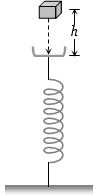
$A$ block of mass $m$ initially at rest is dropped from a height $h$ onto a spring of force constant $k$. If the maximum compression in the spring is $x$,then:
A
$mgh = \frac{1}{2}kx^2$
B
$mg(h + x) = \frac{1}{2}kx^2$
C
$mgh = \frac{1}{2}k(x + h)^2$
D
$mg(h + x) = \frac{1}{2}k(x + h)^2$
Solution
(B) According to the law of conservation of energy,the total mechanical energy of the system remains constant.
Let the initial position of the block be the reference level for gravitational potential energy $(U_g = 0)$.
When the block is at height $h$ above the spring,its total energy is $E_i = 0$ (since it is at rest and at the reference level).
When the spring is compressed by a maximum distance $x$,the block comes to rest momentarily at the lowest point.
The total vertical displacement of the block from its initial position is $(h + x)$.
The change in gravitational potential energy is $\Delta U_g = -mg(h + x)$.
The elastic potential energy stored in the spring is $U_s = \frac{1}{2}kx^2$.
Since the total energy is conserved,the loss in gravitational potential energy is equal to the gain in elastic potential energy:
$mg(h + x) = \frac{1}{2}kx^2$.
Let the initial position of the block be the reference level for gravitational potential energy $(U_g = 0)$.
When the block is at height $h$ above the spring,its total energy is $E_i = 0$ (since it is at rest and at the reference level).
When the spring is compressed by a maximum distance $x$,the block comes to rest momentarily at the lowest point.
The total vertical displacement of the block from its initial position is $(h + x)$.
The change in gravitational potential energy is $\Delta U_g = -mg(h + x)$.
The elastic potential energy stored in the spring is $U_s = \frac{1}{2}kx^2$.
Since the total energy is conserved,the loss in gravitational potential energy is equal to the gain in elastic potential energy:
$mg(h + x) = \frac{1}{2}kx^2$.
0 likes
View Solution16
MediumMCQ
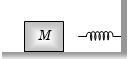
$A$ block of mass $M$ moving on a frictionless horizontal surface collides with a spring of spring constant $K$ and compresses it by a length $L$. The maximum momentum of the block during the collision process is
A
Zero
B
$\frac{M L^2}{K}$
C
$\sqrt{MK} L$
D
$\frac{K L^2}{2M}$
Solution
(C) When a block of mass $M$ moving with velocity $v$ collides with a spring,its kinetic energy is converted into the elastic potential energy of the spring at the point of maximum compression $L$.
By the law of conservation of energy:
$\frac{1}{2} M v^2 = \frac{1}{2} K L^2$
Solving for $v$:
$v^2 = \frac{K}{M} L^2 \implies v = L \sqrt{\frac{K}{M}}$
The momentum $P$ of the block is given by $P = Mv$.
Substituting the value of $v$:
$P = M \left( L \sqrt{\frac{K}{M}} \right) = \sqrt{M^2 \cdot \frac{K}{M}} L = \sqrt{MK} L$
Thus,the maximum momentum of the block is $\sqrt{MK} L$.
By the law of conservation of energy:
$\frac{1}{2} M v^2 = \frac{1}{2} K L^2$
Solving for $v$:
$v^2 = \frac{K}{M} L^2 \implies v = L \sqrt{\frac{K}{M}}$
The momentum $P$ of the block is given by $P = Mv$.
Substituting the value of $v$:
$P = M \left( L \sqrt{\frac{K}{M}} \right) = \sqrt{M^2 \cdot \frac{K}{M}} L = \sqrt{MK} L$
Thus,the maximum momentum of the block is $\sqrt{MK} L$.
0 likes
View Solution17
MediumMCQ
If the potential energy of a spring is $V$ on stretching it by $2 \, cm$,then its potential energy when it is stretched by $10 \, cm$ will be
A
$V/25$
B
$5V$
C
$V/5$
D
$25V$
Solution
(D) The potential energy $U$ stored in a spring stretched by a distance $l$ is given by the formula $U = \frac{1}{2} k l^2$,where $k$ is the spring constant.
This implies that $U \propto l^2$.
Given that the initial potential energy $U_1 = V$ for an extension $l_1 = 2 \, cm$.
We need to find the potential energy $U_2$ for an extension $l_2 = 10 \, cm$.
Using the proportionality $U \propto l^2$,we have:
$\frac{U_2}{U_1} = \left( \frac{l_2}{l_1} \right)^2$
$\frac{U_2}{V} = \left( \frac{10}{2} \right)^2 = (5)^2 = 25$
Therefore,$U_2 = 25V$.
This implies that $U \propto l^2$.
Given that the initial potential energy $U_1 = V$ for an extension $l_1 = 2 \, cm$.
We need to find the potential energy $U_2$ for an extension $l_2 = 10 \, cm$.
Using the proportionality $U \propto l^2$,we have:
$\frac{U_2}{U_1} = \left( \frac{l_2}{l_1} \right)^2$
$\frac{U_2}{V} = \left( \frac{10}{2} \right)^2 = (5)^2 = 25$
Therefore,$U_2 = 25V$.
0 likes
View Solution18
MediumMCQ
If a spring extends by $x$ on loading,then the energy stored by the spring is (if $T$ is tension in the spring and $k$ is spring constant).
A
$\frac{T^2}{2x}$
B
$\frac{T^2}{2k}$
C
$\frac{2x}{T^2}$
D
$\frac{2T^2}{k}$
Solution
(B) The potential energy $U$ stored in a stretched spring is given by the formula $U = \frac{1}{2} k x^2$.
According to Hooke's Law,the tension $T$ in the spring is related to the extension $x$ by the equation $T = kx$.
From this,we can express the extension as $x = \frac{T}{k}$.
Substituting this value of $x$ into the energy formula:
$U = \frac{1}{2} k \left( \frac{T}{k} \right)^2$
$U = \frac{1}{2} k \left( \frac{T^2}{k^2} \right)$
$U = \frac{T^2}{2k}$.
Therefore,the correct option is $B$.
According to Hooke's Law,the tension $T$ in the spring is related to the extension $x$ by the equation $T = kx$.
From this,we can express the extension as $x = \frac{T}{k}$.
Substituting this value of $x$ into the energy formula:
$U = \frac{1}{2} k \left( \frac{T}{k} \right)^2$
$U = \frac{1}{2} k \left( \frac{T^2}{k^2} \right)$
$U = \frac{T^2}{2k}$.
Therefore,the correct option is $B$.
1 likes
View Solution19
MediumMCQ
$K$ is the force constant of a spring. The work done in increasing its extension from $l_1$ to $l_2$ will be
A
$K(l_2 - l_1)$
B
$\frac{K}{2}(l_2 + l_1)$
C
$K(l_2^2 - l_1^2)$
D
$\frac{K}{2}(l_2^2 - l_1^2)$
Solution
(D) The potential energy stored in a spring with force constant $K$ at an extension $x$ is given by $U = \frac{1}{2}Kx^2$.
At extension $l_1$,the stored potential energy is $U_1 = \frac{1}{2}Kl_1^2$.
At extension $l_2$,the stored potential energy is $U_2 = \frac{1}{2}Kl_2^2$.
The work done $W$ in increasing the extension from $l_1$ to $l_2$ is equal to the change in potential energy:
$W = U_2 - U_1$
$W = \frac{1}{2}Kl_2^2 - \frac{1}{2}Kl_1^2$
$W = \frac{1}{2}K(l_2^2 - l_1^2)$.
At extension $l_1$,the stored potential energy is $U_1 = \frac{1}{2}Kl_1^2$.
At extension $l_2$,the stored potential energy is $U_2 = \frac{1}{2}Kl_2^2$.
The work done $W$ in increasing the extension from $l_1$ to $l_2$ is equal to the change in potential energy:
$W = U_2 - U_1$
$W = \frac{1}{2}Kl_2^2 - \frac{1}{2}Kl_1^2$
$W = \frac{1}{2}K(l_2^2 - l_1^2)$.
0 likes
View Solution20
MediumMCQ
When a $4\, kg$ mass is hung vertically on a light spring that obeys Hooke's law,the spring stretches by $2\, cm$. The work required to be done by an external agent in stretching this spring by $5\, cm$ will be ......... $J$ $(g = 9.8\, m/s^2)$.
A
$4.90$
B
$2.45$
C
$0.495$
D
$0.245$
Solution
(B) Given: Mass $m = 4\, kg$,extension $x_1 = 2\, cm = 0.02\, m$,final extension $x_2 = 5\, cm = 0.05\, m$,$g = 9.8\, m/s^2$.
First,find the spring constant $K$ using Hooke's law: $F = Kx_1 \implies mg = Kx_1$.
$K = \frac{mg}{x_1} = \frac{4 \times 9.8}{0.02} = \frac{39.2}{0.02} = 1960\, N/m$.
The work done by an external agent to stretch the spring by $x_2$ is given by $W = \frac{1}{2} K x_2^2$.
$W = \frac{1}{2} \times 1960 \times (0.05)^2$.
$W = 980 \times 0.0025 = 2.45\, J$.
First,find the spring constant $K$ using Hooke's law: $F = Kx_1 \implies mg = Kx_1$.
$K = \frac{mg}{x_1} = \frac{4 \times 9.8}{0.02} = \frac{39.2}{0.02} = 1960\, N/m$.
The work done by an external agent to stretch the spring by $x_2$ is given by $W = \frac{1}{2} K x_2^2$.
$W = \frac{1}{2} \times 1960 \times (0.05)^2$.
$W = 980 \times 0.0025 = 2.45\, J$.
0 likes
View Solution21
MediumMCQ
The force constants of two springs are $K_1$ and $K_2$. Both are stretched until their elastic potential energies are equal. If the stretching forces applied are $F_1$ and $F_2$,then the ratio $F_1:F_2$ is:
A
$K_1:K_2$
B
$K_2:K_1$
C
$\sqrt{K_1}:\sqrt{K_2}$
D
$K_1^2:K_2^2$
Solution
(C) The elastic potential energy $U$ stored in a spring is given by $U = \frac{F^2}{2K}$,where $F$ is the stretching force and $K$ is the force constant.
Given that the elastic energies are equal,we have $U_1 = U_2$.
Therefore,$\frac{F_1^2}{2K_1} = \frac{F_2^2}{2K_2}$.
Rearranging the terms,we get $\frac{F_1^2}{F_2^2} = \frac{K_1}{K_2}$.
Taking the square root on both sides,we find $\frac{F_1}{F_2} = \sqrt{\frac{K_1}{K_2}}$.
Thus,the ratio $F_1:F_2$ is $\sqrt{K_1}:\sqrt{K_2}$.
Given that the elastic energies are equal,we have $U_1 = U_2$.
Therefore,$\frac{F_1^2}{2K_1} = \frac{F_2^2}{2K_2}$.
Rearranging the terms,we get $\frac{F_1^2}{F_2^2} = \frac{K_1}{K_2}$.
Taking the square root on both sides,we find $\frac{F_1}{F_2} = \sqrt{\frac{K_1}{K_2}}$.
Thus,the ratio $F_1:F_2$ is $\sqrt{K_1}:\sqrt{K_2}$.
0 likes
View Solution22
EasyMCQ
Two springs with spring constants $K_1 = 1500 \, N/m$ and $K_2 = 3000 \, N/m$ are stretched by the same force. The ratio of potential energy stored in the springs will be
A
$2:1$
B
$1:2$
C
$4:1$
D
$1:4$
Solution
(A) The potential energy $U$ stored in a spring stretched by a force $F$ is given by the formula $U = \frac{F^2}{2K}$,where $K$ is the spring constant.
Since the force $F$ is the same for both springs,we have $U \propto \frac{1}{K}$.
Therefore,the ratio of potential energy stored in the two springs is $\frac{U_1}{U_2} = \frac{K_2}{K_1}$.
Substituting the given values $K_1 = 1500 \, N/m$ and $K_2 = 3000 \, N/m$,we get $\frac{U_1}{U_2} = \frac{3000}{1500} = 2$.
Thus,the ratio is $2:1$.
Since the force $F$ is the same for both springs,we have $U \propto \frac{1}{K}$.
Therefore,the ratio of potential energy stored in the two springs is $\frac{U_1}{U_2} = \frac{K_2}{K_1}$.
Substituting the given values $K_1 = 1500 \, N/m$ and $K_2 = 3000 \, N/m$,we get $\frac{U_1}{U_2} = \frac{3000}{1500} = 2$.
Thus,the ratio is $2:1$.
0 likes
View Solution23
EasyMCQ
If a spring extends by $x$ on loading,then the energy stored in the spring is (where $T$ is the tension in the spring and $K$ is the spring constant):
A
$\frac{T^2}{2x}$
B
$\frac{T^2}{2K}$
C
$\frac{2K}{T^2}$
D
$\frac{2T^2}{K}$
Solution
(B) The potential energy stored in a spring is given by the formula $U = \frac{1}{2} K x^2$.
According to Hooke's Law,the tension $T$ in the spring is related to the extension $x$ by the equation $T = K x$.
From this,we can express the extension as $x = \frac{T}{K}$.
Substituting this value of $x$ into the energy formula:
$U = \frac{1}{2} K \left( \frac{T}{K} \right)^2$
$U = \frac{1}{2} K \left( \frac{T^2}{K^2} \right)$
$U = \frac{T^2}{2K}$.
According to Hooke's Law,the tension $T$ in the spring is related to the extension $x$ by the equation $T = K x$.
From this,we can express the extension as $x = \frac{T}{K}$.
Substituting this value of $x$ into the energy formula:
$U = \frac{1}{2} K \left( \frac{T}{K} \right)^2$
$U = \frac{1}{2} K \left( \frac{T^2}{K^2} \right)$
$U = \frac{T^2}{2K}$.
0 likes
View Solution24
MediumMCQ
When a body of mass $m$ is attached to a vertical spring of natural length $L$ and released,the spring stretches by a distance $h$. What will be the potential energy of the stretched spring?
A
$\frac{mgh^2}{2}$
B
$mgh$
C
$\frac{1}{2}mgh$
D
$\frac{1}{2}mg(L + h)$
Solution
(C) The potential energy $(P.E.)$ stored in a stretched spring is given by the formula $P.E. = \frac{1}{2}kh^2$,where $k$ is the spring constant and $h$ is the extension.
When the body is in equilibrium,the gravitational force acting downwards is balanced by the spring force acting upwards.
Thus,$mg = kh$,which implies $k = \frac{mg}{h}$.
Substituting the value of $k$ into the potential energy formula:
$P.E. = \frac{1}{2} \left( \frac{mg}{h} \right) h^2$.
$P.E. = \frac{1}{2} mgh$.
When the body is in equilibrium,the gravitational force acting downwards is balanced by the spring force acting upwards.
Thus,$mg = kh$,which implies $k = \frac{mg}{h}$.
Substituting the value of $k$ into the potential energy formula:
$P.E. = \frac{1}{2} \left( \frac{mg}{h} \right) h^2$.
$P.E. = \frac{1}{2} mgh$.
0 likes
View Solution25
DifficultMCQ
When a spring is stretched by $2 \ cm$,it stores $100 \ J$ of energy. If it is stretched by another $2 \ cm$,the additional energy stored is ....... $J$.
A
$100$
B
$200$
C
$300$
D
$400$
Solution
(C) The potential energy stored in a spring is given by $U = \frac{1}{2}kx^2$.
Initially,for $x_1 = 2 \ cm$,the energy $U_1 = 100 \ J = \frac{1}{2}k(2)^2$.
When the spring is stretched by another $2 \ cm$,the total extension becomes $x_2 = 2 \ cm + 2 \ cm = 4 \ cm$.
The total energy stored at $x_2$ is $U_2 = \frac{1}{2}k(4)^2 = \frac{1}{2}k(16)$.
Since $U_1 = \frac{1}{2}k(4) = 100 \ J$,we have $\frac{1}{2}k = 25 \ J/cm^2$.
Therefore,$U_2 = 25 \times 16 = 400 \ J$.
The additional energy stored is $\Delta U = U_2 - U_1 = 400 \ J - 100 \ J = 300 \ J$.
Initially,for $x_1 = 2 \ cm$,the energy $U_1 = 100 \ J = \frac{1}{2}k(2)^2$.
When the spring is stretched by another $2 \ cm$,the total extension becomes $x_2 = 2 \ cm + 2 \ cm = 4 \ cm$.
The total energy stored at $x_2$ is $U_2 = \frac{1}{2}k(4)^2 = \frac{1}{2}k(16)$.
Since $U_1 = \frac{1}{2}k(4) = 100 \ J$,we have $\frac{1}{2}k = 25 \ J/cm^2$.
Therefore,$U_2 = 25 \times 16 = 400 \ J$.
The additional energy stored is $\Delta U = U_2 - U_1 = 400 \ J - 100 \ J = 300 \ J$.
0 likes
View Solution26
DifficultMCQ
$A$ spring of original length $L$ and spring constant $K$ is stretched by a small length $x$. It is further stretched by another small length $y$. Find the work done in the second stretching.
A
$\frac{1}{2}Ky^2$
B
$\frac{1}{2}K(x^2 + y^2)$
C
$\frac{1}{2}K(x + y)^2$
D
$\frac{1}{2}Ky(2x + y)$
Solution
(D) The potential energy stored in a spring stretched by a length $x$ is given by $U_1 = \frac{1}{2}Kx^2$.
When the spring is further stretched by an additional length $y$,the total extension becomes $(x + y)$.
The total potential energy stored in the spring is $U_2 = \frac{1}{2}K(x + y)^2$.
The work done in the second stretching is the change in potential energy:
$W = U_2 - U_1$
$W = \frac{1}{2}K(x + y)^2 - \frac{1}{2}Kx^2$
$W = \frac{1}{2}K(x^2 + 2xy + y^2) - \frac{1}{2}Kx^2$
$W = \frac{1}{2}K(x^2 + 2xy + y^2 - x^2)$
$W = \frac{1}{2}K(2xy + y^2)$
$W = \frac{1}{2}Ky(2x + y)$.
When the spring is further stretched by an additional length $y$,the total extension becomes $(x + y)$.
The total potential energy stored in the spring is $U_2 = \frac{1}{2}K(x + y)^2$.
The work done in the second stretching is the change in potential energy:
$W = U_2 - U_1$
$W = \frac{1}{2}K(x + y)^2 - \frac{1}{2}Kx^2$
$W = \frac{1}{2}K(x^2 + 2xy + y^2) - \frac{1}{2}Kx^2$
$W = \frac{1}{2}K(x^2 + 2xy + y^2 - x^2)$
$W = \frac{1}{2}K(2xy + y^2)$
$W = \frac{1}{2}Ky(2x + y)$.
0 likes
View Solution27
EasyMCQ
The work done in stretching a spring from $10 \ cm$ to $20 \ cm$ is:
A
Equal to the work done in stretching it from $20 \ cm$ to $30 \ cm$.
B
Less than the work done in stretching it from $20 \ cm$ to $30 \ cm$.
C
Greater than the work done in stretching it from $20 \ cm$ to $30 \ cm$.
D
Equal to the work done in stretching it from $0 \ cm$ to $10 \ cm$.
Solution
(B) The work done $W$ in stretching a spring by an extension $x$ is given by $W = \frac{1}{2} k x^2$.
The work done in stretching the spring from an initial extension $x_1$ to a final extension $x_2$ is given by $W = \frac{1}{2} k (x_2^2 - x_1^2)$.
For the first case ($10 \ cm$ to $20 \ cm$): $W_1 = \frac{1}{2} k (20^2 - 10^2) = \frac{1}{2} k (400 - 100) = 150 k$.
For the second case ($20 \ cm$ to $30 \ cm$): $W_2 = \frac{1}{2} k (30^2 - 20^2) = \frac{1}{2} k (900 - 400) = 250 k$.
Comparing the two,$W_1 < W_2$. Therefore,the work done in stretching the spring from $10 \ cm$ to $20 \ cm$ is less than the work done in stretching it from $20 \ cm$ to $30 \ cm$.
The work done in stretching the spring from an initial extension $x_1$ to a final extension $x_2$ is given by $W = \frac{1}{2} k (x_2^2 - x_1^2)$.
For the first case ($10 \ cm$ to $20 \ cm$): $W_1 = \frac{1}{2} k (20^2 - 10^2) = \frac{1}{2} k (400 - 100) = 150 k$.
For the second case ($20 \ cm$ to $30 \ cm$): $W_2 = \frac{1}{2} k (30^2 - 20^2) = \frac{1}{2} k (900 - 400) = 250 k$.
Comparing the two,$W_1 < W_2$. Therefore,the work done in stretching the spring from $10 \ cm$ to $20 \ cm$ is less than the work done in stretching it from $20 \ cm$ to $30 \ cm$.
0 likes
View Solution28
EasyMCQ
The potential energy of a spring...
A
increases when the spring is stretched.
B
decreases when the spring is stretched.
C
decreases when the spring is compressed.
D
increases whether the spring is stretched or compressed.
Solution
(D) The potential energy $(U)$ stored in a spring is given by the formula $U = \frac{1}{2} k x^2$,where $k$ is the spring constant and $x$ is the displacement from the equilibrium position.
Since $x$ is squared in the formula,the potential energy $U$ is always positive for any non-zero displacement $(x \neq 0)$.
Whether the spring is stretched $(x > 0)$ or compressed $(x < 0)$,the value of $x^2$ increases as the magnitude of displacement increases.
Therefore,the potential energy of a spring increases whenever it is either stretched or compressed from its natural length.
Since $x$ is squared in the formula,the potential energy $U$ is always positive for any non-zero displacement $(x \neq 0)$.
Whether the spring is stretched $(x > 0)$ or compressed $(x < 0)$,the value of $x^2$ increases as the magnitude of displacement increases.
Therefore,the potential energy of a spring increases whenever it is either stretched or compressed from its natural length.
0 likes
View Solution29
EasyMCQ
Statement-$1$ and Statement-$2$ are given. Two springs $S_1$ and $S_2$ have force constants $k_1$ and $k_2$ respectively,where $k_1 < k_2$. They are stretched by the same force $F$. It is found that the work done on spring $S_1$ is greater than the work done on spring $S_2$.
Statement-$1$: If stretched by the same force,the work done on $S_1$ is greater than the work done on $S_2$.
Statement-$2$: $k_1 < k_2$.
Statement-$1$: If stretched by the same force,the work done on $S_1$ is greater than the work done on $S_2$.
Statement-$2$: $k_1 < k_2$.
A
Statement-$1$ is true. Statement-$2$ is true and Statement-$2$ is not the correct explanation for Statement-$1$.
B
Statement-$1$ is false. Statement-$2$ is true.
C
Statement-$1$ is true. Statement-$2$ is false.
D
Statement-$1$ is true. Statement-$2$ is true and Statement-$2$ is the correct explanation for Statement-$1$.
Solution
(D) The work done $W$ on a spring with force constant $k$ when stretched by a force $F$ is given by $W = \frac{F^2}{2k}$.
Since the force $F$ is the same for both springs,the work done is inversely proportional to the force constant $k$ $(W \propto \frac{1}{k})$.
Given $k_1 < k_2$,it follows that $\frac{1}{k_1} > \frac{1}{k_2}$.
Therefore,$W_1 = \frac{F^2}{2k_1} > W_2 = \frac{F^2}{2k_2}$.
Thus,Statement-$1$ is true because the work done on $S_1$ is indeed greater than the work done on $S_2$.
Statement-$2$ $(k_1 < k_2)$ is also true and it is the direct reason why $W_1 > W_2$.
Hence,Statement-$2$ is the correct explanation for Statement-$1$.
Since the force $F$ is the same for both springs,the work done is inversely proportional to the force constant $k$ $(W \propto \frac{1}{k})$.
Given $k_1 < k_2$,it follows that $\frac{1}{k_1} > \frac{1}{k_2}$.
Therefore,$W_1 = \frac{F^2}{2k_1} > W_2 = \frac{F^2}{2k_2}$.
Thus,Statement-$1$ is true because the work done on $S_1$ is indeed greater than the work done on $S_2$.
Statement-$2$ $(k_1 < k_2)$ is also true and it is the direct reason why $W_1 > W_2$.
Hence,Statement-$2$ is the correct explanation for Statement-$1$.
0 likes
View Solution30
DifficultMCQ
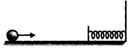
$A$ body of mass $0.5 \ kg$ moves with a speed of $1.5 \ m/s$ on a smooth horizontal surface. It hits a massless spring with a force constant $k = 50 \ N/m$. What will be the maximum compression of the spring in $m$?
A
$0.15$
B
$0.12$
C
$1.5$
D
$0.5$
Solution
(A) According to the law of conservation of energy,the kinetic energy of the body is converted into the elastic potential energy of the spring at maximum compression.
Let $m = 0.5 \ kg$,$v = 1.5 \ m/s$,$k = 50 \ N/m$,and $x$ be the maximum compression.
Kinetic Energy = Elastic Potential Energy
$\frac{1}{2} mv^2 = \frac{1}{2} kx^2$
$mv^2 = kx^2$
$0.5 \times (1.5)^2 = 50 \times x^2$
$0.5 \times 2.25 = 50 \times x^2$
$1.125 = 50 \times x^2$
$x^2 = \frac{1.125}{50} = 0.0225$
$x = \sqrt{0.0225} = 0.15 \ m$
Therefore,the maximum compression is $0.15 \ m$.
Let $m = 0.5 \ kg$,$v = 1.5 \ m/s$,$k = 50 \ N/m$,and $x$ be the maximum compression.
Kinetic Energy = Elastic Potential Energy
$\frac{1}{2} mv^2 = \frac{1}{2} kx^2$
$mv^2 = kx^2$
$0.5 \times (1.5)^2 = 50 \times x^2$
$0.5 \times 2.25 = 50 \times x^2$
$1.125 = 50 \times x^2$
$x^2 = \frac{1.125}{50} = 0.0225$
$x = \sqrt{0.0225} = 0.15 \ m$
Therefore,the maximum compression is $0.15 \ m$.
0 likes
View Solution31
DifficultMCQ
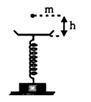
$A$ ball of mass $m$ falls from a height $h$ onto a platform attached to a vertical spring. The platform is displaced by a distance $x$. What is the spring constant?
A
$\frac{2mg}{x}$
B
$\frac{2mgh}{x^2}$
C
$\frac{2mg(h + x)}{x^2}$
D
$\frac{2mg(h + x)}{h^2}$
Solution
(C) The ball falls from a height $h$ and compresses the spring by a distance $x$.
According to the law of conservation of energy,the loss in gravitational potential energy of the ball is equal to the gain in elastic potential energy of the spring.
The total vertical displacement of the ball is $(h + x)$.
Therefore,the loss in potential energy is $mg(h + x)$.
The gain in elastic potential energy of the spring is $\frac{1}{2}kx^2$.
Equating the two: $mg(h + x) = \frac{1}{2}kx^2$.
Solving for the spring constant $k$: $k = \frac{2mg(h + x)}{x^2}$.
According to the law of conservation of energy,the loss in gravitational potential energy of the ball is equal to the gain in elastic potential energy of the spring.
The total vertical displacement of the ball is $(h + x)$.
Therefore,the loss in potential energy is $mg(h + x)$.
The gain in elastic potential energy of the spring is $\frac{1}{2}kx^2$.
Equating the two: $mg(h + x) = \frac{1}{2}kx^2$.
Solving for the spring constant $k$: $k = \frac{2mg(h + x)}{x^2}$.
0 likes
View Solution32
DifficultMCQ
An ideal spring with spring constant $k$ is suspended from the ceiling,and a block of mass $M$ is attached to its lower end. Initially,the spring is unstretched and the block is released from rest. What will be the maximum extension in the spring?
A
$4 Mg/k$
B
$2 Mg/k$
C
$Mg/k$
D
$Mg/2k$
Solution
(B) Let $x$ be the maximum extension in the spring. At the point of maximum extension,the velocity of the block is zero.
Applying the principle of conservation of mechanical energy,the loss in gravitational potential energy of the block is equal to the gain in elastic potential energy of the spring.
Loss in gravitational potential energy = $Mgx$
Gain in elastic potential energy = $\frac{1}{2} k x^2$
Equating the two: $Mgx = \frac{1}{2} k x^2$
Solving for $x$ (where $x \neq 0$): $x = \frac{2Mg}{k}$
Applying the principle of conservation of mechanical energy,the loss in gravitational potential energy of the block is equal to the gain in elastic potential energy of the spring.
Loss in gravitational potential energy = $Mgx$
Gain in elastic potential energy = $\frac{1}{2} k x^2$
Equating the two: $Mgx = \frac{1}{2} k x^2$
Solving for $x$ (where $x \neq 0$): $x = \frac{2Mg}{k}$
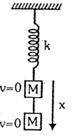
0 likes
View Solution33
MediumMCQ
Two springs with spring constants $1500 \ N/m$ and $3000 \ N/m$ respectively are stretched by the same force. What is the ratio of their potential energies?
A
$4 : 1$
B
$1 : 4$
C
$2 : 1$
D
$1 : 2$
Solution
(C) The potential energy $U$ stored in a spring is given by $U = \frac{1}{2} k x^2$.
Since the force $F$ applied is the same,we use the relation $F = kx$,which implies $x = \frac{F}{k}$.
Substituting this into the energy formula: $U = \frac{1}{2} k (\frac{F}{k})^2 = \frac{F^2}{2k}$.
Since $F$ is constant,$U \propto \frac{1}{k}$.
Therefore,the ratio of potential energies is $\frac{U_1}{U_2} = \frac{k_2}{k_1}$.
Given $k_1 = 1500 \ N/m$ and $k_2 = 3000 \ N/m$,we have $\frac{U_1}{U_2} = \frac{3000}{1500} = \frac{2}{1}$.
Thus,the ratio is $2 : 1$.
Since the force $F$ applied is the same,we use the relation $F = kx$,which implies $x = \frac{F}{k}$.
Substituting this into the energy formula: $U = \frac{1}{2} k (\frac{F}{k})^2 = \frac{F^2}{2k}$.
Since $F$ is constant,$U \propto \frac{1}{k}$.
Therefore,the ratio of potential energies is $\frac{U_1}{U_2} = \frac{k_2}{k_1}$.
Given $k_1 = 1500 \ N/m$ and $k_2 = 3000 \ N/m$,we have $\frac{U_1}{U_2} = \frac{3000}{1500} = \frac{2}{1}$.
Thus,the ratio is $2 : 1$.
0 likes
View Solution34
MediumMCQ
$A$ light spring of length $10 \ cm$ is stretched by $2 \ cm$ when a mass of $20 \ g$ is attached to its end. The mass is pulled until the total length of the spring becomes $14 \ cm$. What is the elastic potential energy stored in the spring (in Joules)?
A
$4 \times 10^{-2}$
B
$4 \times 10^{-3}$
C
$8 \times 10^{-2}$
D
$8 \times 10^{-3}$
Solution
(D) Given: Natural length $L_0 = 10 \ cm$,extension $x_1 = 2 \ cm = 0.02 \ m$,mass $m = 20 \ g = 0.02 \ kg$,$g = 10 \ m/s^2$.
At equilibrium,the spring force equals the gravitational force: $k x_1 = mg$.
$k(0.02) = 0.02 \times 10 \implies k = 10 \ N/m$.
The total length becomes $14 \ cm$,so the new extension is $x_2 = 14 \ cm - 10 \ cm = 4 \ cm = 0.04 \ m$.
The elastic potential energy stored in the spring is given by $U = \frac{1}{2} k x_2^2$.
$U = \frac{1}{2} \times 10 \times (0.04)^2 = 5 \times 0.0016 = 0.008 \ J = 8 \times 10^{-3} \ J$.
At equilibrium,the spring force equals the gravitational force: $k x_1 = mg$.
$k(0.02) = 0.02 \times 10 \implies k = 10 \ N/m$.
The total length becomes $14 \ cm$,so the new extension is $x_2 = 14 \ cm - 10 \ cm = 4 \ cm = 0.04 \ m$.
The elastic potential energy stored in the spring is given by $U = \frac{1}{2} k x_2^2$.
$U = \frac{1}{2} \times 10 \times (0.04)^2 = 5 \times 0.0016 = 0.008 \ J = 8 \times 10^{-3} \ J$.
0 likes
View Solution35
EasyMCQ
$A$ block of mass $m$ slides down an inclined plane as shown in the figure and hits a spring at the bottom,causing it to compress. If the spring constant is $K$,what is the maximum compression of the spring?
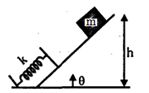
A
$\sqrt {\frac{{mgh}}{k}} $
B
$\sqrt {\frac{{2mgh}}{k}} $
C
$\sqrt {\frac{{gh}}{{mk}}} $
D
$\sqrt {\frac{{2gh}}{{mk}}} $
Solution
(B) According to the law of conservation of energy,the potential energy lost by the block as it descends a vertical height $h$ is equal to the elastic potential energy gained by the spring at maximum compression $x$.
The loss in gravitational potential energy of the block is $\Delta U_g = mgh$.
The gain in elastic potential energy of the spring is $\Delta U_s = \frac{1}{2} Kx^2$.
Equating the two:
$mgh = \frac{1}{2} Kx^2$
Solving for $x$:
$x^2 = \frac{2mgh}{K}$
$x = \sqrt{\frac{2mgh}{K}}$
The loss in gravitational potential energy of the block is $\Delta U_g = mgh$.
The gain in elastic potential energy of the spring is $\Delta U_s = \frac{1}{2} Kx^2$.
Equating the two:
$mgh = \frac{1}{2} Kx^2$
Solving for $x$:
$x^2 = \frac{2mgh}{K}$
$x = \sqrt{\frac{2mgh}{K}}$
0 likes
View Solution36
DifficultMCQ
$A$ block of mass $M$ moves on a frictionless horizontal surface and collides with a spring of spring constant $k$. The spring is compressed by a length $L$. What is the maximum momentum of the block after the collision?
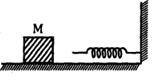
A
$\sqrt{Mk} \, L$
B
$\frac{kL^2}{2M}$
C
$0$
D
$\frac{ML^2}{k}$
Solution
(A) According to the law of conservation of mechanical energy,the initial kinetic energy of the block is converted into the elastic potential energy of the spring at the point of maximum compression.
Let $v$ be the velocity of the block just before it hits the spring.
$\frac{1}{2} M v^2 = \frac{1}{2} k L^2$
Solving for $v$:
$v^2 = \frac{k L^2}{M} \implies v = L \sqrt{\frac{k}{M}}$
The momentum $p$ of the block is given by $p = Mv$.
Substituting the value of $v$:
$p = M \left( L \sqrt{\frac{k}{M}} \right) = L \sqrt{M^2 \cdot \frac{k}{M}} = L \sqrt{Mk} = \sqrt{Mk} \, L$
Thus,the maximum momentum of the block is $\sqrt{Mk} \, L$.
Let $v$ be the velocity of the block just before it hits the spring.
$\frac{1}{2} M v^2 = \frac{1}{2} k L^2$
Solving for $v$:
$v^2 = \frac{k L^2}{M} \implies v = L \sqrt{\frac{k}{M}}$
The momentum $p$ of the block is given by $p = Mv$.
Substituting the value of $v$:
$p = M \left( L \sqrt{\frac{k}{M}} \right) = L \sqrt{M^2 \cdot \frac{k}{M}} = L \sqrt{Mk} = \sqrt{Mk} \, L$
Thus,the maximum momentum of the block is $\sqrt{Mk} \, L$.
0 likes
View Solution37
DifficultMCQ
$A$ spring is stretched by a distance $s$,and the potential energy stored in it is $10 \ J$. What is the work done to stretch the spring by an additional distance $s$ (in $J$)?
A
$30$
B
$40$
C
$10$
D
$20$
Solution
(A) The potential energy stored in a spring stretched by distance $s$ is given by $U_1 = \frac{1}{2}ks^2 = 10 \ J$.
When the spring is stretched by an additional distance $s$,the total extension becomes $x = s + s = 2s$.
The potential energy at this new extension is $U_2 = \frac{1}{2}k(2s)^2 = \frac{1}{2}k(4s^2) = 4 \times (\frac{1}{2}ks^2)$.
Substituting $U_1 = 10 \ J$,we get $U_2 = 4 \times 10 \ J = 40 \ J$.
The work done to stretch the spring from $s$ to $2s$ is the change in potential energy: $W = U_2 - U_1 = 40 \ J - 10 \ J = 30 \ J$.
When the spring is stretched by an additional distance $s$,the total extension becomes $x = s + s = 2s$.
The potential energy at this new extension is $U_2 = \frac{1}{2}k(2s)^2 = \frac{1}{2}k(4s^2) = 4 \times (\frac{1}{2}ks^2)$.
Substituting $U_1 = 10 \ J$,we get $U_2 = 4 \times 10 \ J = 40 \ J$.
The work done to stretch the spring from $s$ to $2s$ is the change in potential energy: $W = U_2 - U_1 = 40 \ J - 10 \ J = 30 \ J$.
0 likes
View Solution38
MediumMCQ
If a spring is stretched by a force $T$,what is the potential energy stored in the spring? (Given $T$ is the tension/force and $k$ is the spring constant.)
A
$\frac{2T}{k^2}$
B
$\frac{T^2}{2k}$
C
$\frac{2k}{T^2}$
D
$\frac{T^2}{2k^2}$
Solution
(B) The tension (force) in the spring is given by Hooke's Law: $T = kx$,where $x$ is the extension.
From this,the extension is $x = \frac{T}{k}$.
The potential energy $U$ stored in a stretched spring is given by the formula $U = \frac{1}{2}kx^2$.
Substituting the value of $x$ into the energy formula:
$U = \frac{1}{2}k \left( \frac{T}{k} \right)^2 = \frac{1}{2}k \left( \frac{T^2}{k^2} \right) = \frac{T^2}{2k}$.
From this,the extension is $x = \frac{T}{k}$.
The potential energy $U$ stored in a stretched spring is given by the formula $U = \frac{1}{2}kx^2$.
Substituting the value of $x$ into the energy formula:
$U = \frac{1}{2}k \left( \frac{T}{k} \right)^2 = \frac{1}{2}k \left( \frac{T^2}{k^2} \right) = \frac{T^2}{2k}$.
0 likes
View Solution39
MediumMCQ
$A$ spring with force constant $k$ is initially stretched by a distance $x$. If it is further stretched by a distance $y$,the work done during the second stretching is.........
A
$1/2 ky^2$
B
$1/2 k(x^2 + y^2)$
C
$1/2 k(x + y)^2$
D
$1/2 ky(2x + y)$
Solution
(D) The initial potential energy of the spring when stretched by $x$ is $U_1 = \frac{1}{2}kx^2$.
The final potential energy of the spring when stretched by a total distance $(x + y)$ is $U_2 = \frac{1}{2}k(x + y)^2$.
The work done during the second stretching is equal to the change in potential energy:
$W = U_2 - U_1$
$W = \frac{1}{2}k(x + y)^2 - \frac{1}{2}kx^2$
$W = \frac{1}{2}k(x^2 + 2xy + y^2 - x^2)$
$W = \frac{1}{2}k(2xy + y^2)$
$W = \frac{1}{2}ky(2x + y)$.
The final potential energy of the spring when stretched by a total distance $(x + y)$ is $U_2 = \frac{1}{2}k(x + y)^2$.
The work done during the second stretching is equal to the change in potential energy:
$W = U_2 - U_1$
$W = \frac{1}{2}k(x + y)^2 - \frac{1}{2}kx^2$
$W = \frac{1}{2}k(x^2 + 2xy + y^2 - x^2)$
$W = \frac{1}{2}k(2xy + y^2)$
$W = \frac{1}{2}ky(2x + y)$.
0 likes
View Solution40
EasyMCQ
$A$ block of weight $W$ moving with velocity $v$ on a frictionless horizontal surface hits a spring of force constant $k$. The maximum compression in the spring will be at a distance of .........
A
$v\sqrt{\frac{W}{k}}$
B
$v\sqrt{\frac{k}{W}}$
C
$v\sqrt{\frac{W}{kg}}$
D
$v\sqrt{\frac{kg}{W}}$
Solution
(C) According to the law of conservation of energy,the kinetic energy lost by the block is equal to the potential energy gained by the spring.
Let $d$ be the maximum compression in the spring.
The kinetic energy of the block is $K = \frac{1}{2}mv^2$,where $m = \frac{W}{g}$ is the mass of the block.
The potential energy stored in the spring at maximum compression is $U = \frac{1}{2}kd^2$.
Equating the two: $\frac{1}{2}mv^2 = \frac{1}{2}kd^2$.
Substituting $m = \frac{W}{g}$:
$\frac{1}{2} \left( \frac{W}{g} \right) v^2 = \frac{1}{2}kd^2$.
Solving for $d$:
$d^2 = \frac{Wv^2}{kg}$.
Therefore,$d = v\sqrt{\frac{W}{kg}}$.
Let $d$ be the maximum compression in the spring.
The kinetic energy of the block is $K = \frac{1}{2}mv^2$,where $m = \frac{W}{g}$ is the mass of the block.
The potential energy stored in the spring at maximum compression is $U = \frac{1}{2}kd^2$.
Equating the two: $\frac{1}{2}mv^2 = \frac{1}{2}kd^2$.
Substituting $m = \frac{W}{g}$:
$\frac{1}{2} \left( \frac{W}{g} \right) v^2 = \frac{1}{2}kd^2$.
Solving for $d$:
$d^2 = \frac{Wv^2}{kg}$.
Therefore,$d = v\sqrt{\frac{W}{kg}}$.
0 likes
View Solution41
EasyMCQ
$A$ spring with a force constant of $100 \ N/m$ is stretched by $5 \ cm$. Calculate the work done. (in $J$)
A
$1$
B
$0.125$
C
$2.5$
D
$3$
Solution
(B) The force constant of the spring is $k = 100 \ N/m$.
The displacement of the spring is $x = 5 \ cm = 0.05 \ m$.
The work done in stretching a spring is given by the formula $W = \frac{1}{2} k x^2$.
Substituting the values into the formula:
$W = \frac{1}{2} \times 100 \times (0.05)^2$
$W = 50 \times 0.0025$
$W = 0.125 \ J$.
The displacement of the spring is $x = 5 \ cm = 0.05 \ m$.
The work done in stretching a spring is given by the formula $W = \frac{1}{2} k x^2$.
Substituting the values into the formula:
$W = \frac{1}{2} \times 100 \times (0.05)^2$
$W = 50 \times 0.0025$
$W = 0.125 \ J$.
0 likes
View Solution42
DifficultMCQ
$A$ spring with a force constant of $800 \ N/m$ is stretched by $5 \ cm$. Find the work done in stretching it from $5 \ cm$ to $15 \ cm$ in $J$.
A
$16$
B
$8$
C
$32$
D
$24$
Solution
(B) The work done in stretching a spring is stored as potential energy in the spring,given by $U = \frac{1}{2} kx^2$.
The work done $W$ in stretching the spring from an initial extension $x_1$ to a final extension $x_2$ is given by the change in potential energy:
$W = \frac{1}{2} k x_2^2 - \frac{1}{2} k x_1^2 = \frac{1}{2} k (x_2^2 - x_1^2)$.
Given: $k = 800 \ N/m$,$x_1 = 5 \ cm = 0.05 \ m$,$x_2 = 15 \ cm = 0.15 \ m$.
$W = \frac{1}{2} \times 800 \times ((0.15)^2 - (0.05)^2)$
$W = 400 \times (0.0225 - 0.0025)$
$W = 400 \times 0.02 = 8 \ J$.
The work done $W$ in stretching the spring from an initial extension $x_1$ to a final extension $x_2$ is given by the change in potential energy:
$W = \frac{1}{2} k x_2^2 - \frac{1}{2} k x_1^2 = \frac{1}{2} k (x_2^2 - x_1^2)$.
Given: $k = 800 \ N/m$,$x_1 = 5 \ cm = 0.05 \ m$,$x_2 = 15 \ cm = 0.15 \ m$.
$W = \frac{1}{2} \times 800 \times ((0.15)^2 - (0.05)^2)$
$W = 400 \times (0.0225 - 0.0025)$
$W = 400 \times 0.02 = 8 \ J$.
0 likes
View Solution43
DifficultMCQ
When a spring is stretched by a distance $x$,its potential energy is $10 \ J$. The work done to stretch this spring by an additional distance $x$ is ........ $J$.
A
$10$
B
$20$
C
$30$
D
$40$
Solution
(C) The potential energy of a spring stretched by distance $x$ is given by $U_1 = \frac{1}{2}kx^2 = 10 \ J$.
When the spring is stretched by an additional distance $x$,the total extension becomes $x + x = 2x$.
The new potential energy is $U_2 = \frac{1}{2}k(2x)^2 = \frac{1}{2}k(4x^2) = 4 \times (\frac{1}{2}kx^2) = 4 \times 10 = 40 \ J$.
The work done to stretch the spring by the additional distance is the change in potential energy: $W = U_2 - U_1 = 40 \ J - 10 \ J = 30 \ J$.
When the spring is stretched by an additional distance $x$,the total extension becomes $x + x = 2x$.
The new potential energy is $U_2 = \frac{1}{2}k(2x)^2 = \frac{1}{2}k(4x^2) = 4 \times (\frac{1}{2}kx^2) = 4 \times 10 = 40 \ J$.
The work done to stretch the spring by the additional distance is the change in potential energy: $W = U_2 - U_1 = 40 \ J - 10 \ J = 30 \ J$.
0 likes
View Solution44
DifficultMCQ
$A$ spring with a spring constant of $5 \times 10^3 \ N/m$ is initially in its natural state. It is stretched by $5 \ cm$. How much work is required to stretch it by another $5 \ cm$?
A
$12.50$
B
$18.75$
C
$25$
D
$6.25$
Solution
(B) The work done to stretch a spring from an initial extension $x_1$ to a final extension $x_2$ is given by $W = \frac{1}{2} k (x_2^2 - x_1^2)$.
Here,$k = 5 \times 10^3 \ N/m$,$x_1 = 5 \ cm = 0.05 \ m$,and $x_2 = 5 \ cm + 5 \ cm = 10 \ cm = 0.10 \ m$.
Substituting the values:
$W = \frac{1}{2} \times (5 \times 10^3) \times [(0.10)^2 - (0.05)^2]$
$W = \frac{1}{2} \times 5000 \times [0.01 - 0.0025]$
$W = 2500 \times 0.0075$
$W = 18.75 \ J$.
Here,$k = 5 \times 10^3 \ N/m$,$x_1 = 5 \ cm = 0.05 \ m$,and $x_2 = 5 \ cm + 5 \ cm = 10 \ cm = 0.10 \ m$.
Substituting the values:
$W = \frac{1}{2} \times (5 \times 10^3) \times [(0.10)^2 - (0.05)^2]$
$W = \frac{1}{2} \times 5000 \times [0.01 - 0.0025]$
$W = 2500 \times 0.0075$
$W = 18.75 \ J$.
0 likes
View Solution45
MediumMCQ
$A$ smooth track extends to a horizontal part as shown in the figure. $A$ spring with a force constant of $400 \ N/m$ is firmly attached to one end of this horizontal part. $A$ mass of $40 \ g$ is released from a height of $4.9 \ m$. Calculate the compression in the spring in $cm$.
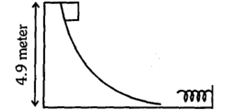
A
$11.25$
B
$8.4$
C
$12$
D
$9.8$
Solution
(D) According to the law of conservation of mechanical energy,the potential energy at the initial height is converted into the elastic potential energy of the spring at maximum compression.
$mgh = \frac{1}{2} kx^2$
Given:
Mass $m = 40 \ g = 0.04 \ kg$
Height $h = 4.9 \ m$
Spring constant $k = 400 \ N/m$
Acceleration due to gravity $g = 9.8 \ m/s^2$
Substituting the values:
$0.04 \times 9.8 \times 4.9 = \frac{1}{2} \times 400 \times x^2$
$1.9208 = 200 \times x^2$
$x^2 = \frac{1.9208}{200} = 0.009604$
$x = \sqrt{0.009604} = 0.098 \ m$
Converting to centimeters: $x = 0.098 \times 100 = 9.8 \ cm$.
$mgh = \frac{1}{2} kx^2$
Given:
Mass $m = 40 \ g = 0.04 \ kg$
Height $h = 4.9 \ m$
Spring constant $k = 400 \ N/m$
Acceleration due to gravity $g = 9.8 \ m/s^2$
Substituting the values:
$0.04 \times 9.8 \times 4.9 = \frac{1}{2} \times 400 \times x^2$
$1.9208 = 200 \times x^2$
$x^2 = \frac{1.9208}{200} = 0.009604$
$x = \sqrt{0.009604} = 0.098 \ m$
Converting to centimeters: $x = 0.098 \times 100 = 9.8 \ cm$.
0 likes
View Solution46
DifficultMCQ
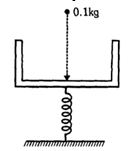
$A$ massless platform is kept on a light elastic spring as shown in the figure. When a sand particle of mass $0.1 \; kg$ is dropped on the pan from a height of $0.24 \; m$,the particle strikes the pan and the spring is compressed by $0.01 \; m$. From what height should the particle be dropped to cause a compression of $0.04 \; m$ (in $; m$)?
A
$3.96$
B
$5.25$
C
$2$
D
$6.2$
Solution
(A) By the law of conservation of mechanical energy,the potential energy lost by the particle is equal to the elastic potential energy gained by the spring.
$mg(h + x) = \frac{1}{2} kx^2$
For the first case: $m = 0.1 \; kg$,$h_1 = 0.24 \; m$,$x_1 = 0.01 \; m$.
$mg(0.24 + 0.01) = \frac{1}{2} k(0.01)^2$ --- $(1)$
For the second case: $h_2 = h$,$x_2 = 0.04 \; m$.
$mg(h + 0.04) = \frac{1}{2} k(0.04)^2$ --- $(2)$
Dividing equation $(2)$ by equation $(1)$:
$\frac{h + 0.04}{0.24 + 0.01} = \frac{(0.04)^2}{(0.01)^2}$
$\frac{h + 0.04}{0.25} = \frac{0.0016}{0.0001} = 16$
$h + 0.04 = 16 \times 0.25 = 4$
$h = 4 - 0.04 = 3.96 \; m$
$mg(h + x) = \frac{1}{2} kx^2$
For the first case: $m = 0.1 \; kg$,$h_1 = 0.24 \; m$,$x_1 = 0.01 \; m$.
$mg(0.24 + 0.01) = \frac{1}{2} k(0.01)^2$ --- $(1)$
For the second case: $h_2 = h$,$x_2 = 0.04 \; m$.
$mg(h + 0.04) = \frac{1}{2} k(0.04)^2$ --- $(2)$
Dividing equation $(2)$ by equation $(1)$:
$\frac{h + 0.04}{0.24 + 0.01} = \frac{(0.04)^2}{(0.01)^2}$
$\frac{h + 0.04}{0.25} = \frac{0.0016}{0.0001} = 16$
$h + 0.04 = 16 \times 0.25 = 4$
$h = 4 - 0.04 = 3.96 \; m$
1 likes
View Solution47
DifficultMCQ
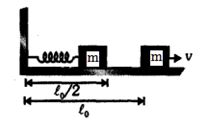
$A$ block of mass $m$ is pushed against a spring with spring constant $k$ which is attached to a wall. The block slides on a frictionless table as shown in the figure. The natural length of the spring is $\ell_0$ and it is compressed to half of its natural length when the block is released. What will be the final velocity of the block?
A
$\frac{{\ell _0}}{2}\sqrt {\frac{k}{m}} $
B
$\frac{{\ell _0}}{4}\sqrt {\frac{k}{m}} $
C
$\frac{1}{2}\sqrt {\frac{{k{\ell _0}}}{m}} $
D
$\sqrt {\frac{{k{\ell _0}}}{{2m}}} $
Solution
(A) According to the law of conservation of mechanical energy,the initial potential energy stored in the spring is converted into the kinetic energy of the block when the spring reaches its natural length.
Initial compression of the spring,$x = \frac{{\ell _0}}{2}$.
Initial potential energy,$U_i = \frac{1}{2}k x^2 = \frac{1}{2}k \left( \frac{{\ell _0}}{2} \right)^2 = \frac{1}{8}k \ell_0^2$.
Final kinetic energy of the block,$K_f = \frac{1}{2}mv^2$.
By conservation of energy,$U_i = K_f$.
$\frac{1}{8}k \ell_0^2 = \frac{1}{2}mv^2$.
$v^2 = \frac{k \ell_0^2}{4m}$.
$v = \frac{{\ell _0}}{2}\sqrt {\frac{k}{m}}$.
Initial compression of the spring,$x = \frac{{\ell _0}}{2}$.
Initial potential energy,$U_i = \frac{1}{2}k x^2 = \frac{1}{2}k \left( \frac{{\ell _0}}{2} \right)^2 = \frac{1}{8}k \ell_0^2$.
Final kinetic energy of the block,$K_f = \frac{1}{2}mv^2$.
By conservation of energy,$U_i = K_f$.
$\frac{1}{8}k \ell_0^2 = \frac{1}{2}mv^2$.
$v^2 = \frac{k \ell_0^2}{4m}$.
$v = \frac{{\ell _0}}{2}\sqrt {\frac{k}{m}}$.
0 likes
View Solution48
DifficultMCQ
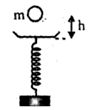
$A$ light elastic spring is placed on a massless platform as shown in the figure. $A$ sand particle of mass $0.1 \ kg$ is dropped onto the spring platform from a height of $0.24 \ m$. The particle sticks to the platform,causing the spring to compress by $0.01 \ m$. From what height should the particle be dropped so that the spring is compressed by $0.04 \ m$ (in $m$)?
A
$0.96$
B
$2.96$
C
$3.96$
D
$0.48$
Solution
(C) According to the law of conservation of energy,the potential energy of the particle at height $h$ plus the compression $x$ is converted into the elastic potential energy of the spring:
$mg(h + x) = \frac{1}{2} K x^2$
Case $I$: $m = 0.1 \ kg$,$h_1 = 0.24 \ m$,$x_1 = 0.01 \ m$
$mg(0.24 + 0.01) = \frac{1}{2} K (0.01)^2$
$mg(0.25) = \frac{1}{2} K (0.0001) \quad ... (1)$
Case $II$: $m = 0.1 \ kg$,$h_2 = h$,$x_2 = 0.04 \ m$
$mg(h + 0.04) = \frac{1}{2} K (0.04)^2$
$mg(h + 0.04) = \frac{1}{2} K (0.0016) \quad ... (2)$
Dividing equation $(2)$ by $(1)$:
$\frac{h + 0.04}{0.25} = \frac{0.0016}{0.0001} = 16$
$h + 0.04 = 16 \times 0.25$
$h + 0.04 = 4$
$h = 4 - 0.04 = 3.96 \ m$
$mg(h + x) = \frac{1}{2} K x^2$
Case $I$: $m = 0.1 \ kg$,$h_1 = 0.24 \ m$,$x_1 = 0.01 \ m$
$mg(0.24 + 0.01) = \frac{1}{2} K (0.01)^2$
$mg(0.25) = \frac{1}{2} K (0.0001) \quad ... (1)$
Case $II$: $m = 0.1 \ kg$,$h_2 = h$,$x_2 = 0.04 \ m$
$mg(h + 0.04) = \frac{1}{2} K (0.04)^2$
$mg(h + 0.04) = \frac{1}{2} K (0.0016) \quad ... (2)$
Dividing equation $(2)$ by $(1)$:
$\frac{h + 0.04}{0.25} = \frac{0.0016}{0.0001} = 16$
$h + 0.04 = 16 \times 0.25$
$h + 0.04 = 4$
$h = 4 - 0.04 = 3.96 \ m$
0 likes
View Solution49
DifficultMCQ
$A$ massless spring of force constant $K$ is placed between two blocks of masses $m$ and $M$ on a frictionless table and compressed by an amount $x$. Upon releasing the spring,both blocks move in opposite directions. The blocks lose contact with the spring when it reaches its natural length. The speed of the block of mass $M$ at the moment of separation is:
A
$\sqrt{\frac{Km}{M(M+m)}} \cdot x$
B
$\sqrt{\frac{Km}{m(M+m)}} \cdot x$
C
$\sqrt{\frac{KM}{m(M+m)}} \cdot x$
D
$\sqrt{\frac{(M+m)K}{m}} \cdot x$
Solution
(A) Let the speed of the block of mass $m$ be $v$ and the speed of the block of mass $M$ be $V$.
Since the system is on a frictionless table,the total mechanical energy and linear momentum are conserved.
According to the law of conservation of mechanical energy:
Initial potential energy = Final kinetic energy
$\frac{1}{2} K x^2 = \frac{1}{2} m v^2 + \frac{1}{2} M V^2 \quad \dots(1)$
According to the law of conservation of linear momentum (initial momentum is zero):
$m v = M V \implies v = \frac{M V}{m} \quad \dots(2)$
Substituting $v$ from equation $(2)$ into equation $(1)$:
$K x^2 = m \left( \frac{M V}{m} \right)^2 + M V^2$
$K x^2 = \frac{M^2 V^2}{m} + M V^2 = M V^2 \left( \frac{M}{m} + 1 \right) = M V^2 \left( \frac{M+m}{m} \right)$
$V^2 = \frac{K x^2 m}{M(M+m)}$
$V = \sqrt{\frac{Km}{M(M+m)}} \cdot x$
Since the system is on a frictionless table,the total mechanical energy and linear momentum are conserved.
According to the law of conservation of mechanical energy:
Initial potential energy = Final kinetic energy
$\frac{1}{2} K x^2 = \frac{1}{2} m v^2 + \frac{1}{2} M V^2 \quad \dots(1)$
According to the law of conservation of linear momentum (initial momentum is zero):
$m v = M V \implies v = \frac{M V}{m} \quad \dots(2)$
Substituting $v$ from equation $(2)$ into equation $(1)$:
$K x^2 = m \left( \frac{M V}{m} \right)^2 + M V^2$
$K x^2 = \frac{M^2 V^2}{m} + M V^2 = M V^2 \left( \frac{M}{m} + 1 \right) = M V^2 \left( \frac{M+m}{m} \right)$
$V^2 = \frac{K x^2 m}{M(M+m)}$
$V = \sqrt{\frac{Km}{M(M+m)}} \cdot x$
0 likes
View Solution50
MediumMCQ
When a spring is stretched by $2 \ cm$,the potential energy stored is $U$. If it is stretched by $10 \ cm$,the potential energy stored will be:
A
$U / 25$
B
$U / 5$
C
$5 U$
D
$25 U$
Solution
(D) The potential energy $U$ stored in a spring is given by the formula $U = \frac{1}{2} k x^2$,where $k$ is the spring constant and $x$ is the displacement.
From this relation,we can see that $U \propto x^2$.
Given the initial displacement $x_1 = 2 \ cm$ and initial energy $U_1 = U$.
The new displacement is $x_2 = 10 \ cm$.
Using the ratio method: $\frac{U_2}{U_1} = \left( \frac{x_2}{x_1} \right)^2$.
Substituting the values: $\frac{U_2}{U} = \left( \frac{10 \ cm}{2 \ cm} \right)^2 = (5)^2 = 25$.
Therefore,the new potential energy is $U_2 = 25 U$.
From this relation,we can see that $U \propto x^2$.
Given the initial displacement $x_1 = 2 \ cm$ and initial energy $U_1 = U$.
The new displacement is $x_2 = 10 \ cm$.
Using the ratio method: $\frac{U_2}{U_1} = \left( \frac{x_2}{x_1} \right)^2$.
Substituting the values: $\frac{U_2}{U} = \left( \frac{10 \ cm}{2 \ cm} \right)^2 = (5)^2 = 25$.
Therefore,the new potential energy is $U_2 = 25 U$.
0 likes
View SolutionWork, Energy, Power and Collision — Work Done by Spring and Potential Energy of Spring · Frequently Asked Questions
1Are these Work, Energy, Power and Collision questions useful for JEE and NEET?
Yes. All questions in this section are mapped to JEE Main and NEET exam patterns. Previous year questions from JEE Main, NEET, GUJCET and state-level exams are included with full solutions.
2Can I switch to Hindi or Gujarati for these questions?
Yes. Use the language tabs in the hero section or the sidebar to view the same questions and solutions in English, Hindi or Gujarati.
3How do I generate a question paper from this subtopic?
Use the Vedclass Exam Paper Generator — select the chapter and subtopic, set difficulty, and generate Sets A, B, C, D automatically. First 3 chapters of every subject are free.
Vedclass Products
For Students
Vedclass Test Series
Mock tests in real JEE/NEET style with performance analysis. 5-day free trial.
Start Free TrialFor Teachers
Exam Paper Generator
Generate Set A/B/C/D papers from this chapter in 2 minutes. 3 chapters free.
Try FreeFor Institutes
Online Exam Module
Live online exams with unlimited students, 360° analytics & white-label branding.
See DemoFor Teachers & Institutes
Generate a Work, Energy, Power and Collision Exam Paper in 2 Minutes
Select subtopic & difficulty — Sets A, B, C, D auto-generated with No Repeat logic.
First 3 chapters of every subject are free — no payment required.