
A English
Power Questions in English
Class 11 Physics · Work, Energy, Power and Collision · Power
180+
Questions
English
Language
100%
With Solutions
Showing 48 of 180 questions in English
1
MediumMCQ
$A$ particle moves with a velocity $\vec v = 6\hat i - 4\hat j + 3\hat k \, m/s$ under the influence of a constant force $\vec F = 20\hat i + 15\hat j - 5\hat k \, N$. The instantaneous power applied to the particle is ......... $J/s$.
A
$35$
B
$45$
C
$25$
D
$195$
Solution
(B) The instantaneous power $P$ delivered by a force $\vec F$ to a particle moving with velocity $\vec v$ is given by the dot product of the force and velocity vectors:
$P = \vec F \cdot \vec v$
Given $\vec F = 20\hat i + 15\hat j - 5\hat k \, N$ and $\vec v = 6\hat i - 4\hat j + 3\hat k \, m/s$.
$P = (20\hat i + 15\hat j - 5\hat k) \cdot (6\hat i - 4\hat j + 3\hat k)$
$P = (20 \times 6) + (15 \times -4) + (-5 \times 3)$
$P = 120 - 60 - 15$
$P = 120 - 75$
$P = 45 \, J/s$.
$P = \vec F \cdot \vec v$
Given $\vec F = 20\hat i + 15\hat j - 5\hat k \, N$ and $\vec v = 6\hat i - 4\hat j + 3\hat k \, m/s$.
$P = (20\hat i + 15\hat j - 5\hat k) \cdot (6\hat i - 4\hat j + 3\hat k)$
$P = (20 \times 6) + (15 \times -4) + (-5 \times 3)$
$P = 120 - 60 - 15$
$P = 120 - 75$
$P = 45 \, J/s$.
0 likes
View Solution2
EasyMCQ
The unit of power is
A
Joule
B
Joule per second only
C
Joule per second and watt both
D
Only watt
Solution
(C) Power is defined as the rate of doing work or the rate of energy transfer.
Mathematically,$P = \frac{W}{t}$.
The $SI$ unit of work $(W)$ is Joule $(J)$ and the $SI$ unit of time $(t)$ is second $(s)$.
Therefore,the unit of power is Joule per second $(J/s)$.
By definition,$1 \text{ Watt} = 1 \text{ Joule/second}$.
Thus,both Joule per second and Watt are valid units for power.
Mathematically,$P = \frac{W}{t}$.
The $SI$ unit of work $(W)$ is Joule $(J)$ and the $SI$ unit of time $(t)$ is second $(s)$.
Therefore,the unit of power is Joule per second $(J/s)$.
By definition,$1 \text{ Watt} = 1 \text{ Joule/second}$.
Thus,both Joule per second and Watt are valid units for power.
0 likes
View Solution3
DifficultMCQ
$A$ body of mass $m$ accelerates uniformly from rest to $v_1$ in time $t_1$. As a function of time $t$,the instantaneous power delivered to the body is
A
$\frac{mv_1t}{t_1}$
B
$\frac{mv_1^2t}{t_1}$
C
$\frac{mv_1t^2}{t_1}$
D
$\frac{mv_1^2t}{t_1^2}$
Solution
(D) The body starts from rest $(u = 0)$ and accelerates uniformly to $v_1$ in time $t_1$.
The acceleration $a$ is given by $a = \frac{v_1 - u}{t_1} = \frac{v_1}{t_1}$.
At any time $t$,the velocity of the body is $v = at = \left( \frac{v_1}{t_1} \right)t$.
The force acting on the body is $F = ma = m \left( \frac{v_1}{t_1} \right)$.
The instantaneous power $P$ delivered to the body is $P = F \cdot v$.
Substituting the expressions for $F$ and $v$:
$P = \left( m \frac{v_1}{t_1} \right) \times \left( \frac{v_1}{t_1} t \right) = \frac{mv_1^2t}{t_1^2}$.
The acceleration $a$ is given by $a = \frac{v_1 - u}{t_1} = \frac{v_1}{t_1}$.
At any time $t$,the velocity of the body is $v = at = \left( \frac{v_1}{t_1} \right)t$.
The force acting on the body is $F = ma = m \left( \frac{v_1}{t_1} \right)$.
The instantaneous power $P$ delivered to the body is $P = F \cdot v$.
Substituting the expressions for $F$ and $v$:
$P = \left( m \frac{v_1}{t_1} \right) \times \left( \frac{v_1}{t_1} t \right) = \frac{mv_1^2t}{t_1^2}$.
0 likes
View Solution4
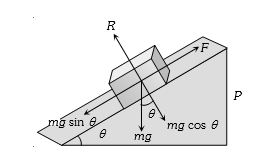
MediumMCQ
$A$ man is riding a cycle with a velocity of $7.2 \text{ km/hr}$ up a hill having a slope of $1$ in $20$. The total mass of the man and the cycle is $100 \text{ kg}$. The power of the man is ............ $\text{W}$. (in $\text{ W}$)
A
$200$
B
$175$
C
$125$
D
$98$
Solution
(D) Given:
Velocity $v = 7.2 \text{ km/hr} = 7.2 \times \frac{5}{18} = 2 \text{ m/s}$.
Slope is $1$ in $20$, so $\sin \theta = \frac{1}{20}$.
Mass $m = 100 \text{ kg}$.
Acceleration due to gravity $g = 9.8 \text{ m/s}^2$.
When the man and cycle move up the hill, the component of weight opposing the motion is $F = mg \sin \theta$.
The power $P$ required is given by $P = F \times v$.
$P = (mg \sin \theta) \times v$.
$P = 100 \times 9.8 \times \left( \frac{1}{20} \right) \times 2$.
$P = 98 \text{ W}$.
Velocity $v = 7.2 \text{ km/hr} = 7.2 \times \frac{5}{18} = 2 \text{ m/s}$.
Slope is $1$ in $20$, so $\sin \theta = \frac{1}{20}$.
Mass $m = 100 \text{ kg}$.
Acceleration due to gravity $g = 9.8 \text{ m/s}^2$.
When the man and cycle move up the hill, the component of weight opposing the motion is $F = mg \sin \theta$.
The power $P$ required is given by $P = F \times v$.
$P = (mg \sin \theta) \times v$.
$P = 100 \times 9.8 \times \left( \frac{1}{20} \right) \times 2$.
$P = 98 \text{ W}$.
0 likes
View Solution5
EasyMCQ
An electric motor exerts a force of $40 N$ on a cable and pulls it by a distance of $30 m$ in one minute. The power supplied by the motor (in Watts) is
A
$20$
B
$200$
C
$2$
D
$10$
Solution
(A) The power $P$ is defined as the rate of doing work,given by $P = \frac{W}{t}$.
Work done $W = F \times s$,where $F = 40 N$ and $s = 30 m$.
So,$W = 40 N \times 30 m = 1200 J$.
The time taken $t = 1 \text{ minute} = 60 s$.
Therefore,$P = \frac{1200 J}{60 s} = 20 W$.
Thus,the power supplied by the motor is $20 W$.
Work done $W = F \times s$,where $F = 40 N$ and $s = 30 m$.
So,$W = 40 N \times 30 m = 1200 J$.
The time taken $t = 1 \text{ minute} = 60 s$.
Therefore,$P = \frac{1200 J}{60 s} = 20 W$.
Thus,the power supplied by the motor is $20 W$.
0 likes
View Solution6
EasyMCQ
An electric motor creates a tension of $4500 \, N$ in a hoisting cable and reels it in at the rate of $2 \, m/s$. What is the power of the electric motor?
A
$15 \, kW$
B
$9 \, kW$
C
$225 \, W$
D
$9000 \, HP$
Solution
(B) The power $P$ delivered by a force $F$ moving an object at a constant velocity $v$ is given by the formula $P = F \cdot v$.
Given:
Tension (Force) $F = 4500 \, N$
Velocity $v = 2 \, m/s$
Substituting these values into the formula:
$P = 4500 \, N \times 2 \, m/s = 9000 \, W$
Since $1 \, kW = 1000 \, W$,we have:
$P = 9000 \, W = 9 \, kW$.
Therefore,the correct option is $B$.
Given:
Tension (Force) $F = 4500 \, N$
Velocity $v = 2 \, m/s$
Substituting these values into the formula:
$P = 4500 \, N \times 2 \, m/s = 9000 \, W$
Since $1 \, kW = 1000 \, W$,we have:
$P = 9000 \, W = 9 \, kW$.
Therefore,the correct option is $B$.
0 likes
View Solution7
EasyMCQ
$A$ weight lifter lifts $300 \ kg$ from the ground to a height of $2 \ m$ in $3 \ s$. The average power generated by him is $... \ W$.
A
$5880$
B
$4410$
C
$2205$
D
$1960$
Solution
(D) The power $P$ is defined as the rate of doing work,given by $P = \frac{W}{t}$.
Since the work done against gravity is $W = mgh$,the power is $P = \frac{mgh}{t}$.
Given values are mass $m = 300 \ kg$,height $h = 2 \ m$,time $t = 3 \ s$,and acceleration due to gravity $g = 9.8 \ m/s^2$.
Substituting these values into the formula:
$P = \frac{300 \times 9.8 \times 2}{3}$
$P = 100 \times 9.8 \times 2$
$P = 1960 \ W$.
Since the work done against gravity is $W = mgh$,the power is $P = \frac{mgh}{t}$.
Given values are mass $m = 300 \ kg$,height $h = 2 \ m$,time $t = 3 \ s$,and acceleration due to gravity $g = 9.8 \ m/s^2$.
Substituting these values into the formula:
$P = \frac{300 \times 9.8 \times 2}{3}$
$P = 100 \times 9.8 \times 2$
$P = 1960 \ W$.
0 likes
View Solution8
MediumMCQ
Power of a water pump is $2 \, kW$. If $g = 10 \, m/s^2$,the amount of water it can raise in one minute to a height of $10 \, m$ is .............. $liter$.
A
$2000$
B
$1000$
C
$100$
D
$1200$
Solution
(D) The power $P$ is given by the formula $P = \frac{W}{t} = \frac{mgh}{t}$.
Given: $P = 2 \, kW = 2000 \, W$,$g = 10 \, m/s^2$,$h = 10 \, m$,and $t = 1 \, \text{minute} = 60 \, s$.
Rearranging the formula to solve for mass $m$:
$m = \frac{P \times t}{g \times h} = \frac{2000 \times 60}{10 \times 10} = \frac{120000}{100} = 1200 \, kg$.
Since the density of water is $1000 \, kg/m^3$,the volume $V$ in cubic meters is $V = \frac{m}{\rho} = \frac{1200 \, kg}{1000 \, kg/m^3} = 1.2 \, m^3$.
Since $1 \, m^3 = 1000 \, liters$,the volume in liters is $1.2 \times 1000 = 1200 \, liters$.
Given: $P = 2 \, kW = 2000 \, W$,$g = 10 \, m/s^2$,$h = 10 \, m$,and $t = 1 \, \text{minute} = 60 \, s$.
Rearranging the formula to solve for mass $m$:
$m = \frac{P \times t}{g \times h} = \frac{2000 \times 60}{10 \times 10} = \frac{120000}{100} = 1200 \, kg$.
Since the density of water is $1000 \, kg/m^3$,the volume $V$ in cubic meters is $V = \frac{m}{\rho} = \frac{1200 \, kg}{1000 \, kg/m^3} = 1.2 \, m^3$.
Since $1 \, m^3 = 1000 \, liters$,the volume in liters is $1.2 \times 1000 = 1200 \, liters$.
0 likes
View Solution9
EasyMCQ
An engine develops $10 \text{ kW}$ of power. How much time will it take to lift a mass of $200 \text{ kg}$ to a height of $40 \text{ m}$? $(g = 10 \text{ m/s}^2)$
A
$4$
B
$5$
C
$8$
D
$10$
Solution
(C) Power $(P)$ is defined as the rate of doing work,given by $P = \frac{W}{t}$.
Here,the work done $(W)$ to lift a mass $(m)$ to a height $(h)$ is equal to the change in potential energy: $W = mgh$.
Therefore,$P = \frac{mgh}{t}$.
Given values: $P = 10 \text{ kW} = 10 \times 10^3 \text{ W}$,$m = 200 \text{ kg}$,$h = 40 \text{ m}$,and $g = 10 \text{ m/s}^2$.
Rearranging the formula for time $(t)$: $t = \frac{mgh}{P}$.
Substituting the values: $t = \frac{200 \times 10 \times 40}{10 \times 10^3}$.
$t = \frac{80000}{10000} = 8 \text{ s}$.
Thus,the time taken is $8 \text{ seconds}$.
Here,the work done $(W)$ to lift a mass $(m)$ to a height $(h)$ is equal to the change in potential energy: $W = mgh$.
Therefore,$P = \frac{mgh}{t}$.
Given values: $P = 10 \text{ kW} = 10 \times 10^3 \text{ W}$,$m = 200 \text{ kg}$,$h = 40 \text{ m}$,and $g = 10 \text{ m/s}^2$.
Rearranging the formula for time $(t)$: $t = \frac{mgh}{P}$.
Substituting the values: $t = \frac{200 \times 10 \times 40}{10 \times 10^3}$.
$t = \frac{80000}{10000} = 8 \text{ s}$.
Thus,the time taken is $8 \text{ seconds}$.
0 likes
View Solution10
MediumMCQ
$A$ car of mass $m$ is driven with acceleration $a$ along a straight level road against a constant external resistive force $R$. When the velocity of the car is $V$,the rate at which the engine of the car is doing work will be
A
$RV$
B
$maV$
C
$(R + ma)V$
D
$(ma - R)V$
Solution
(C) The power $P$ delivered by the engine is given by the product of the force $F$ exerted by the engine and the velocity $V$ of the car,i.e.,$P = FV$.
According to Newton's second law,the net force $F_{net}$ acting on the car is $F_{net} = ma$.
The forces acting on the car are the engine force $F$ (forward) and the resistive force $R$ (backward).
Therefore,$F - R = ma$,which gives the engine force $F = R + ma$.
Substituting this into the power formula,we get $P = (R + ma)V$.
According to Newton's second law,the net force $F_{net}$ acting on the car is $F_{net} = ma$.
The forces acting on the car are the engine force $F$ (forward) and the resistive force $R$ (backward).
Therefore,$F - R = ma$,which gives the engine force $F = R + ma$.
Substituting this into the power formula,we get $P = (R + ma)V$.
0 likes
View Solution11
EasyMCQ
The average power required to lift a $100 \ kg$ mass through a height of $50 \ m$ in approximately $50 \ s$ would be ............. $J/s$.
A
$50$
B
$5000$
C
$100$
D
$980$
Solution
(D) The formula for average power $P$ is given by $P = \frac{W}{t}$,where $W$ is the work done and $t$ is the time taken.
Work done $W$ to lift a mass $m$ to a height $h$ is $W = mgh$.
Given: $m = 100 \ kg$,$h = 50 \ m$,$t = 50 \ s$,and acceleration due to gravity $g = 9.8 \ m/s^2$.
Substituting the values: $P = \frac{100 \times 9.8 \times 50}{50}$.
$P = 100 \times 9.8 = 980 \ J/s$.
Therefore,the correct option is $D$.
Work done $W$ to lift a mass $m$ to a height $h$ is $W = mgh$.
Given: $m = 100 \ kg$,$h = 50 \ m$,$t = 50 \ s$,and acceleration due to gravity $g = 9.8 \ m/s^2$.
Substituting the values: $P = \frac{100 \times 9.8 \times 50}{50}$.
$P = 100 \times 9.8 = 980 \ J/s$.
Therefore,the correct option is $D$.
0 likes
View Solution12
MediumMCQ
From a waterfall,water is falling down at the rate of $100 \ kg/s$ on the blades of a turbine. If the height of the fall is $100 \ m$,then the power delivered to the turbine is approximately equal to ........... $kW$.
A
$100$
B
$10$
C
$1$
D
$1000$
Solution
(A) The power $P$ delivered to the turbine is given by the rate of change of potential energy.
$P = \frac{d}{dt}(mgh) = \left( \frac{dm}{dt} \right) gh$
Given:
Rate of mass flow $\frac{dm}{dt} = 100 \ kg/s$
Height $h = 100 \ m$
Acceleration due to gravity $g \approx 10 \ m/s^2$
Substituting the values:
$P = 100 \ kg/s \times 10 \ m/s^2 \times 100 \ m$
$P = 100,000 \ W$
Since $1 \ kW = 1000 \ W$,we have:
$P = \frac{100,000}{1000} \ kW = 100 \ kW$.
Thus,the correct option is $A$.
$P = \frac{d}{dt}(mgh) = \left( \frac{dm}{dt} \right) gh$
Given:
Rate of mass flow $\frac{dm}{dt} = 100 \ kg/s$
Height $h = 100 \ m$
Acceleration due to gravity $g \approx 10 \ m/s^2$
Substituting the values:
$P = 100 \ kg/s \times 10 \ m/s^2 \times 100 \ m$
$P = 100,000 \ W$
Since $1 \ kW = 1000 \ W$,we have:
$P = \frac{100,000}{1000} \ kW = 100 \ kW$.
Thus,the correct option is $A$.
0 likes
View Solution13
EasyMCQ
The power of a pump,which can pump $200 \ kg$ of water to a height of $200 \ m$ in $10 \ s$,is ................ $kW$ $(g = 10 \ m/s^2)$.
A
$40$
B
$80$
C
$400$
D
$960$
Solution
(A) The power $P$ is defined as the rate of doing work,given by $P = \frac{W}{t}$.
Here,the work done $W$ to lift the water is equal to the change in potential energy,$W = mgh$.
Given values are: mass $m = 200 \ kg$,height $h = 200 \ m$,time $t = 10 \ s$,and acceleration due to gravity $g = 10 \ m/s^2$.
Substituting these values into the formula:
$P = \frac{mgh}{t} = \frac{200 \times 10 \times 200}{10} = 40,000 \ W$.
To convert the power into kilowatts $(kW)$,we divide by $1000$:
$P = \frac{40,000}{1000} = 40 \ kW$.
Here,the work done $W$ to lift the water is equal to the change in potential energy,$W = mgh$.
Given values are: mass $m = 200 \ kg$,height $h = 200 \ m$,time $t = 10 \ s$,and acceleration due to gravity $g = 10 \ m/s^2$.
Substituting these values into the formula:
$P = \frac{mgh}{t} = \frac{200 \times 10 \times 200}{10} = 40,000 \ W$.
To convert the power into kilowatts $(kW)$,we divide by $1000$:
$P = \frac{40,000}{1000} = 40 \ kW$.
0 likes
View Solution14
MediumMCQ
$A$ $10 \text{ H.P.}$ motor pumps out water from a well of depth $20 \text{ m}$ and fills a water tank of volume $22380 \text{ litres}$ at a height of $10 \text{ m}$ from the ground. The running time of the motor to fill the empty water tank is ........... $\text{minutes}$ $(g = 10 \text{ m s}^{-2})$
A
$5$
B
$10$
C
$15$
D
$20$
Solution
(C) The total height through which the water is raised is $H = 20 \text{ m} + 10 \text{ m} = 30 \text{ m}$.
Volume of water $V = 22380 \text{ litres} = 22380 \times 10^{-3} \text{ m}^3 = 22.38 \text{ m}^3$.
Density of water $\rho = 10^3 \text{ kg/m}^3$,so mass $m = V \times \rho = 22.38 \times 10^3 \text{ kg} = 22380 \text{ kg}$.
Power of the motor $P = 10 \text{ H.P.} = 10 \times 746 \text{ W} = 7460 \text{ W}$.
The work done to lift the water is $W = mgh = 22380 \times 10 \times 30 \text{ J}$.
Power $P = \frac{W}{t}$,so $t = \frac{mgh}{P} = \frac{22380 \times 10 \times 30}{7460} \text{ seconds}$.
$t = \frac{22380 \times 300}{7460} = 3 \times 300 = 900 \text{ seconds}$.
Converting to minutes: $t = \frac{900}{60} = 15 \text{ minutes}$.
Volume of water $V = 22380 \text{ litres} = 22380 \times 10^{-3} \text{ m}^3 = 22.38 \text{ m}^3$.
Density of water $\rho = 10^3 \text{ kg/m}^3$,so mass $m = V \times \rho = 22.38 \times 10^3 \text{ kg} = 22380 \text{ kg}$.
Power of the motor $P = 10 \text{ H.P.} = 10 \times 746 \text{ W} = 7460 \text{ W}$.
The work done to lift the water is $W = mgh = 22380 \times 10 \times 30 \text{ J}$.
Power $P = \frac{W}{t}$,so $t = \frac{mgh}{P} = \frac{22380 \times 10 \times 30}{7460} \text{ seconds}$.
$t = \frac{22380 \times 300}{7460} = 3 \times 300 = 900 \text{ seconds}$.
Converting to minutes: $t = \frac{900}{60} = 15 \text{ minutes}$.
0 likes
View Solution15
MediumMCQ
$A$ force applied by an engine of a train of mass $2.05 \times 10^6 \; kg$ changes its velocity from $5 \; m/s$ to $25 \; m/s$ in $5$ minutes. The power of the engine is ........... $MW$.
A
$1.025$
B
$2.05$
C
$5$
D
$6$
Solution
(B) The power $P$ is defined as the rate of doing work,which is equal to the change in kinetic energy divided by time.
$P = \frac{\Delta K.E.}{t} = \frac{\frac{1}{2}m(v^2 - u^2)}{t}$
Given:
Mass $m = 2.05 \times 10^6 \; kg$
Initial velocity $u = 5 \; m/s$
Final velocity $v = 25 \; m/s$
Time $t = 5 \; min = 5 \times 60 \; s = 300 \; s$
Substituting the values:
$P = \frac{0.5 \times 2.05 \times 10^6 \times (25^2 - 5^2)}{300}$
$P = \frac{0.5 \times 2.05 \times 10^6 \times (625 - 25)}{300}$
$P = \frac{0.5 \times 2.05 \times 10^6 \times 600}{300}$
$P = 0.5 \times 2.05 \times 10^6 \times 2$
$P = 2.05 \times 10^6 \; W = 2.05 \; MW$
Thus,the power of the engine is $2.05 \; MW$.
$P = \frac{\Delta K.E.}{t} = \frac{\frac{1}{2}m(v^2 - u^2)}{t}$
Given:
Mass $m = 2.05 \times 10^6 \; kg$
Initial velocity $u = 5 \; m/s$
Final velocity $v = 25 \; m/s$
Time $t = 5 \; min = 5 \times 60 \; s = 300 \; s$
Substituting the values:
$P = \frac{0.5 \times 2.05 \times 10^6 \times (25^2 - 5^2)}{300}$
$P = \frac{0.5 \times 2.05 \times 10^6 \times (625 - 25)}{300}$
$P = \frac{0.5 \times 2.05 \times 10^6 \times 600}{300}$
$P = 0.5 \times 2.05 \times 10^6 \times 2$
$P = 2.05 \times 10^6 \; W = 2.05 \; MW$
Thus,the power of the engine is $2.05 \; MW$.
0 likes
View Solution16
MediumMCQ
$A$ $60 \ kg$ man runs up a staircase in $12 \ s$ while a $50 \ kg$ man runs up the same staircase in $11 \ s$. The ratio of the rate of doing their work is:
A
$6:5$
B
$12:11$
C
$11:10$
D
$10:11$
Solution
(C) The rate of doing work is defined as power $(P)$.
Power is given by the formula: $P = \frac{W}{t} = \frac{mgh}{t}$.
Since the staircase is the same,the height $(h)$ and acceleration due to gravity $(g)$ are constant for both men.
Therefore,the ratio of their power is: $\frac{P_1}{P_2} = \frac{m_1}{m_2} \times \frac{t_2}{t_1}$.
Given: $m_1 = 60 \ kg$,$t_1 = 12 \ s$,$m_2 = 50 \ kg$,$t_2 = 11 \ s$.
Substituting the values: $\frac{P_1}{P_2} = \frac{60}{50} \times \frac{11}{12}$.
$\frac{P_1}{P_2} = \frac{6}{5} \times \frac{11}{12} = \frac{66}{60} = \frac{11}{10}$.
Thus,the ratio is $11:10$.
Power is given by the formula: $P = \frac{W}{t} = \frac{mgh}{t}$.
Since the staircase is the same,the height $(h)$ and acceleration due to gravity $(g)$ are constant for both men.
Therefore,the ratio of their power is: $\frac{P_1}{P_2} = \frac{m_1}{m_2} \times \frac{t_2}{t_1}$.
Given: $m_1 = 60 \ kg$,$t_1 = 12 \ s$,$m_2 = 50 \ kg$,$t_2 = 11 \ s$.
Substituting the values: $\frac{P_1}{P_2} = \frac{60}{50} \times \frac{11}{12}$.
$\frac{P_1}{P_2} = \frac{6}{5} \times \frac{11}{12} = \frac{66}{60} = \frac{11}{10}$.
Thus,the ratio is $11:10$.
0 likes
View Solution17
EasyMCQ
What average horsepower is developed by an $80 \; kg$ man while climbing in $10 \; s$ a flight of stairs that rises $6 \; m$ vertically?
A
$0.63$
B
$1.26$
C
$1.8$
D
$2.1$
Solution
(A) The power $P$ developed by the man is given by the rate of doing work against gravity: $P = \frac{W}{t} = \frac{mgh}{t}$.
Given: mass $m = 80 \; kg$,height $h = 6 \; m$,time $t = 10 \; s$,and acceleration due to gravity $g = 9.8 \; m/s^2$.
Substituting the values: $P = \frac{80 \times 9.8 \times 6}{10} = 470.4 \; W$.
To convert power from Watts to Horsepower $(HP)$,we use the conversion factor $1 \; HP = 746 \; W$.
Thus,$P = \frac{470.4}{746} \; HP \approx 0.63 \; HP$.
Given: mass $m = 80 \; kg$,height $h = 6 \; m$,time $t = 10 \; s$,and acceleration due to gravity $g = 9.8 \; m/s^2$.
Substituting the values: $P = \frac{80 \times 9.8 \times 6}{10} = 470.4 \; W$.
To convert power from Watts to Horsepower $(HP)$,we use the conversion factor $1 \; HP = 746 \; W$.
Thus,$P = \frac{470.4}{746} \; HP \approx 0.63 \; HP$.
0 likes
View Solution18
EasyMCQ
$A$ car of mass $1000 \ kg$ accelerates uniformly from rest to a velocity of $54 \ km/h$ in $5 \ s$. The average power of the engine during this period in watts is .............. $W$ (neglect friction).
A
$2000$
B
$22500$
C
$5000$
D
$2250$
Solution
(B) Given: Mass $m = 1000 \ kg$,initial velocity $u = 0$,final velocity $v = 54 \ km/h = 54 \times \frac{5}{18} \ m/s = 15 \ m/s$,time $t = 5 \ s$.
Average power is defined as the rate of work done,which is equal to the change in kinetic energy divided by time.
$P_{avg} = \frac{\Delta K.E.}{t} = \frac{\frac{1}{2}mv^2 - 0}{t}$.
Substituting the values: $P_{avg} = \frac{0.5 \times 1000 \times (15)^2}{5}$.
$P_{avg} = \frac{500 \times 225}{5} = 100 \times 225 = 22500 \ W$.
Average power is defined as the rate of work done,which is equal to the change in kinetic energy divided by time.
$P_{avg} = \frac{\Delta K.E.}{t} = \frac{\frac{1}{2}mv^2 - 0}{t}$.
Substituting the values: $P_{avg} = \frac{0.5 \times 1000 \times (15)^2}{5}$.
$P_{avg} = \frac{500 \times 225}{5} = 100 \times 225 = 22500 \ W$.
0 likes
View Solution19
MediumMCQ
$A$ quarter horsepower motor runs at a speed of $600 \text{ r.p.m.}$ Assuming $40\%$ efficiency,the work done by the motor in one rotation will be:
A
$7.46 \text{ J}$
B
$7400 \text{ J}$
C
$7.46 \text{ ergs}$
D
$74.6 \text{ J}$
Solution
(A) The power of the motor is $P = \frac{1}{4} \text{ hp} = 0.25 \times 746 \text{ W} = 186.5 \text{ W}$.
Since the motor runs at $600 \text{ r.p.m.}$,the frequency is $n = \frac{600}{60} = 10 \text{ revolutions per second}$.
The time taken for one rotation is $t = \frac{1}{n} = \frac{1}{10} \text{ s} = 0.1 \text{ s}$.
The input energy for one rotation is $E_{\text{in}} = P \times t = 186.5 \times 0.1 = 18.65 \text{ J}$.
Given the efficiency is $40\%$,the useful work done is $W = \text{Efficiency} \times E_{\text{in}}$.
$W = 0.40 \times 18.65 \text{ J} = 7.46 \text{ J}$.
Since the motor runs at $600 \text{ r.p.m.}$,the frequency is $n = \frac{600}{60} = 10 \text{ revolutions per second}$.
The time taken for one rotation is $t = \frac{1}{n} = \frac{1}{10} \text{ s} = 0.1 \text{ s}$.
The input energy for one rotation is $E_{\text{in}} = P \times t = 186.5 \times 0.1 = 18.65 \text{ J}$.
Given the efficiency is $40\%$,the useful work done is $W = \text{Efficiency} \times E_{\text{in}}$.
$W = 0.40 \times 18.65 \text{ J} = 7.46 \text{ J}$.
0 likes
View Solution20
EasyMCQ
The power of a pump,which can pump $200 \ kg$ of water to a height of $50 \ m$ in $10 \ s$,will be:
A
$10 \times 10^3 \ W$
B
$20 \times 10^3 \ W$
C
$4 \times 10^3 \ W$
D
$60 \times 10^3 \ W$
Solution
(A) The power $P$ is defined as the rate of doing work,given by $P = \frac{W}{t}$.
Here,the work done $W$ in lifting the water is equal to the change in potential energy,$W = mgh$.
Given values are:
Mass $m = 200 \ kg$
Height $h = 50 \ m$
Time $t = 10 \ s$
Acceleration due to gravity $g = 10 \ m/s^2$
Substituting these values into the formula:
$P = \frac{mgh}{t} = \frac{200 \times 10 \times 50}{10}$
$P = 200 \times 50 = 10,000 \ W$
$P = 10 \times 10^3 \ W$.
Therefore,the correct option is $A$.
Here,the work done $W$ in lifting the water is equal to the change in potential energy,$W = mgh$.
Given values are:
Mass $m = 200 \ kg$
Height $h = 50 \ m$
Time $t = 10 \ s$
Acceleration due to gravity $g = 10 \ m/s^2$
Substituting these values into the formula:
$P = \frac{mgh}{t} = \frac{200 \times 10 \times 50}{10}$
$P = 200 \times 50 = 10,000 \ W$
$P = 10 \times 10^3 \ W$.
Therefore,the correct option is $A$.
0 likes
View Solution21
EasyMCQ
From an automatic gun,a man fires $360$ bullets per minute with a speed of $360 \ km/h$. If each bullet weighs $20 \ g$,the power of the gun is $...... \ W$.
A
$600$
B
$300$
C
$150$
D
$75$
Solution
(A) Given:
Number of bullets per minute,$n = 360 \text{ bullets/min} = \frac{360}{60} \text{ bullets/sec} = 6 \text{ bullets/sec}$.
Speed of each bullet,$v = 360 \ km/h = 360 \times \frac{5}{18} \ m/s = 100 \ m/s$.
Mass of each bullet,$m = 20 \ g = 20 \times 10^{-3} \ kg = 2 \times 10^{-2} \ kg$.
Power of the gun is the total kinetic energy delivered per unit time:
$P = n \times \left( \frac{1}{2}mv^2 \right)$
$P = 6 \times \left( \frac{1}{2} \times 2 \times 10^{-2} \times (100)^2 \right)$
$P = 6 \times (10^{-2} \times 10000)$
$P = 6 \times 100 = 600 \ W$.
Number of bullets per minute,$n = 360 \text{ bullets/min} = \frac{360}{60} \text{ bullets/sec} = 6 \text{ bullets/sec}$.
Speed of each bullet,$v = 360 \ km/h = 360 \times \frac{5}{18} \ m/s = 100 \ m/s$.
Mass of each bullet,$m = 20 \ g = 20 \times 10^{-3} \ kg = 2 \times 10^{-2} \ kg$.
Power of the gun is the total kinetic energy delivered per unit time:
$P = n \times \left( \frac{1}{2}mv^2 \right)$
$P = 6 \times \left( \frac{1}{2} \times 2 \times 10^{-2} \times (100)^2 \right)$
$P = 6 \times (10^{-2} \times 10000)$
$P = 6 \times 100 = 600 \ W$.
0 likes
View Solution22
EasyMCQ
$A$ man does a given amount of work in $10 \ s$. Another man does the same amount of work in $20 \ s$. The ratio of the output power of the first man to the second man is:
A
$1$
B
$0.5$
C
$2$
D
None of these
Solution
(C) Power is defined as the rate of doing work,given by the formula: $P = \frac{W}{t}$.
Since the amount of work $W$ done by both men is the same,the power $P$ is inversely proportional to the time $t$ taken $(P \propto \frac{1}{t})$.
Therefore,the ratio of the power of the first man $(P_1)$ to the second man $(P_2)$ is:
$\frac{P_1}{P_2} = \frac{t_2}{t_1} = \frac{20 \ s}{10 \ s} = \frac{2}{1} = 2$.
Thus,the ratio is $2$.
Since the amount of work $W$ done by both men is the same,the power $P$ is inversely proportional to the time $t$ taken $(P \propto \frac{1}{t})$.
Therefore,the ratio of the power of the first man $(P_1)$ to the second man $(P_2)$ is:
$\frac{P_1}{P_2} = \frac{t_2}{t_1} = \frac{20 \ s}{10 \ s} = \frac{2}{1} = 2$.
Thus,the ratio is $2$.
0 likes
View Solution23
DifficultMCQ
$A$ body is moved along a straight line by a machine delivering constant power. The distance moved by the body in time $t$ is proportional to
A
$t^{1/2}$
B
$t^{3/4}$
C
$t^{3/2}$
D
$t^2$
Solution
(C) Given that power $P$ is constant. We know that $P = Fv = mav = m \left( \frac{dv}{dt} \right) v$.
Integrating this expression: $\frac{P}{m} dt = v dv$.
Integrating both sides: $\int \frac{P}{m} dt = \int v dv \implies \frac{P}{m} t = \frac{v^2}{2}$.
Thus,$v^2 = \frac{2P}{m} t$,which gives $v = \sqrt{\frac{2P}{m}} t^{1/2}$.
Since $v = \frac{ds}{dt}$,we have $ds = \sqrt{\frac{2P}{m}} t^{1/2} dt$.
Integrating with respect to $t$: $s = \int \sqrt{\frac{2P}{m}} t^{1/2} dt = \sqrt{\frac{2P}{m}} \left( \frac{t^{3/2}}{3/2} \right) = \sqrt{\frac{2P}{m}} \left( \frac{2}{3} t^{3/2} \right)$.
Therefore,$s \propto t^{3/2}$.
Integrating this expression: $\frac{P}{m} dt = v dv$.
Integrating both sides: $\int \frac{P}{m} dt = \int v dv \implies \frac{P}{m} t = \frac{v^2}{2}$.
Thus,$v^2 = \frac{2P}{m} t$,which gives $v = \sqrt{\frac{2P}{m}} t^{1/2}$.
Since $v = \frac{ds}{dt}$,we have $ds = \sqrt{\frac{2P}{m}} t^{1/2} dt$.
Integrating with respect to $t$: $s = \int \sqrt{\frac{2P}{m}} t^{1/2} dt = \sqrt{\frac{2P}{m}} \left( \frac{t^{3/2}}{3/2} \right) = \sqrt{\frac{2P}{m}} \left( \frac{2}{3} t^{3/2} \right)$.
Therefore,$s \propto t^{3/2}$.
0 likes
View Solution24
MediumMCQ
$A$ body of mass $m$ starts from rest and acquires a velocity $v$ in time $t$ under the action of a constant force $F$. The instantaneous power delivered to the body at time $t$ is:
A
$mv/t$
B
$mv^2/t$
C
$Fv$
D
$Fv/2$
Solution
(B) The instantaneous power $P$ delivered to a body is given by the product of the force $F$ and the velocity $v$ at that instant,i.e.,$P = F \cdot v$.
Since the force $F$ is constant,the acceleration $a$ of the body is also constant,given by $a = F/m$.
Using the equation of motion $v = u + at$,where initial velocity $u = 0$,we have $v = (F/m)t$.
Thus,the force can be expressed as $F = (mv)/t$.
Substituting this into the power formula: $P = F \cdot v = (mv/t) \cdot v = (mv^2)/t$.
Since the force $F$ is constant,the acceleration $a$ of the body is also constant,given by $a = F/m$.
Using the equation of motion $v = u + at$,where initial velocity $u = 0$,we have $v = (F/m)t$.
Thus,the force can be expressed as $F = (mv)/t$.
Substituting this into the power formula: $P = F \cdot v = (mv/t) \cdot v = (mv^2)/t$.
0 likes
View Solution25
DifficultMCQ
$A$ vehicle of mass $m$ starts from rest and accelerates. If the engine delivers a constant power $P$,then the position $s$ of the vehicle at time $t$ is given by:
A
$(\frac{2Pt}{m})^{1/2} t$
B
$(\frac{8P}{9m})^{1/2} t^{3/2}$
C
$(\frac{9P}{8m})^{1/2} t^{1/2}$
D
$(\frac{8P}{9m})^{1/2} t$
Solution
(B) Power $P$ is given by $P = Fv = (ma)v = m(\frac{dv}{dt})v$.
Since $P$ is constant,$m v dv = P dt$.
Integrating both sides,$\int_0^v m v dv = \int_0^t P dt$,which gives $\frac{1}{2} m v^2 = Pt$.
So,$v^2 = \frac{2Pt}{m}$,or $v = (\frac{2P}{m})^{1/2} t^{1/2}$.
Since $v = \frac{ds}{dt}$,we have $\frac{ds}{dt} = (\frac{2P}{m})^{1/2} t^{1/2}$.
Integrating with respect to $t$,$s = \int_0^t (\frac{2P}{m})^{1/2} t^{1/2} dt$.
$s = (\frac{2P}{m})^{1/2} [\frac{t^{3/2}}{3/2}] = (\frac{2P}{m})^{1/2} \cdot \frac{2}{3} t^{3/2}$.
$s = (\frac{4}{9} \cdot \frac{2P}{m})^{1/2} t^{3/2} = (\frac{8P}{9m})^{1/2} t^{3/2}$.
Since $P$ is constant,$m v dv = P dt$.
Integrating both sides,$\int_0^v m v dv = \int_0^t P dt$,which gives $\frac{1}{2} m v^2 = Pt$.
So,$v^2 = \frac{2Pt}{m}$,or $v = (\frac{2P}{m})^{1/2} t^{1/2}$.
Since $v = \frac{ds}{dt}$,we have $\frac{ds}{dt} = (\frac{2P}{m})^{1/2} t^{1/2}$.
Integrating with respect to $t$,$s = \int_0^t (\frac{2P}{m})^{1/2} t^{1/2} dt$.
$s = (\frac{2P}{m})^{1/2} [\frac{t^{3/2}}{3/2}] = (\frac{2P}{m})^{1/2} \cdot \frac{2}{3} t^{3/2}$.
$s = (\frac{4}{9} \cdot \frac{2P}{m})^{1/2} t^{3/2} = (\frac{8P}{9m})^{1/2} t^{3/2}$.
0 likes
View Solution26
MediumMCQ
$A$ vehicle of mass $m$ starts from rest and accelerates. If the engine delivers a constant power $p$,what is the velocity of the vehicle at time $t$?
A
$v = \frac{pt}{m}$
B
$v = \frac{2pt}{m}$
C
$v = \sqrt{\frac{pt}{m}}$
D
$v = \sqrt{\frac{2pt}{m}}$
Solution
(D) Power $p$ is defined as the rate of doing work,$p = Fv$.
Since $F = ma = m \frac{dv}{dt}$,we can write $p = m v \frac{dv}{dt}$.
Rearranging the terms,we get $p \, dt = m v \, dv$.
Integrating both sides from $t = 0$ to $t$ and $v = 0$ to $v$:
$\int_{0}^{t} p \, dt = \int_{0}^{v} m v \, dv$.
$pt = m \left[ \frac{v^2}{2} \right]_{0}^{v}$.
$pt = \frac{1}{2} m v^2$.
Solving for $v$,we get $v^2 = \frac{2pt}{m}$,which implies $v = \sqrt{\frac{2pt}{m}}$.
Since $F = ma = m \frac{dv}{dt}$,we can write $p = m v \frac{dv}{dt}$.
Rearranging the terms,we get $p \, dt = m v \, dv$.
Integrating both sides from $t = 0$ to $t$ and $v = 0$ to $v$:
$\int_{0}^{t} p \, dt = \int_{0}^{v} m v \, dv$.
$pt = m \left[ \frac{v^2}{2} \right]_{0}^{v}$.
$pt = \frac{1}{2} m v^2$.
Solving for $v$,we get $v^2 = \frac{2pt}{m}$,which implies $v = \sqrt{\frac{2pt}{m}}$.
0 likes
View Solution27
DifficultMCQ
$A$ man of mass $80 \ kg$ climbs a ladder of height $6 \ m$ in $10 \ s$. What is the average power generated by him in $HP$ (Horsepower)?
A
$0.63$
B
$1.26$
C
$1.8$
D
$2.1$
Solution
(A) The power $P$ is defined as the rate of doing work,$P = \frac{W}{t}$.
Here,the work done against gravity is $W = mgh$.
Given: $m = 80 \ kg$,$g = 9.8 \ m/s^2$,$h = 6 \ m$,and $t = 10 \ s$.
Substituting the values: $P = \frac{80 \times 9.8 \times 6}{10} = 470.4 \ W$.
To convert power from Watts to Horsepower $(HP)$,we use the conversion factor $1 \ HP = 746 \ W$.
Therefore,$P_{HP} = \frac{470.4}{746} \approx 0.63 \ HP$.
Here,the work done against gravity is $W = mgh$.
Given: $m = 80 \ kg$,$g = 9.8 \ m/s^2$,$h = 6 \ m$,and $t = 10 \ s$.
Substituting the values: $P = \frac{80 \times 9.8 \times 6}{10} = 470.4 \ W$.
To convert power from Watts to Horsepower $(HP)$,we use the conversion factor $1 \ HP = 746 \ W$.
Therefore,$P_{HP} = \frac{470.4}{746} \approx 0.63 \ HP$.
0 likes
View Solution28
DifficultMCQ
$A$ car of mass $1250 \ kg$ is moving with a velocity of $30 \ m/s$. If the engine delivers $30 \ kW$ of power and the resistive force acting on the car is $750 \ N$,find the maximum acceleration of the car.
A
$1/3 \ m/s^2$
B
$1/4 \ m/s^2$
C
$1/5 \ m/s^2$
D
$1/6 \ m/s^2$
Solution
(C) The power $P$ delivered by the engine is given by $P = F_{engine} \cdot v$,where $F_{engine}$ is the force exerted by the engine and $v$ is the velocity.
$F_{engine} = \frac{P}{v} = \frac{30 \times 10^3 \ W}{30 \ m/s} = 1000 \ N$.
The net force $F_{net}$ acting on the car is the difference between the engine force and the resistive force $F_{resistive}$.
$F_{net} = F_{engine} - F_{resistive} = 1000 \ N - 750 \ N = 250 \ N$.
Using Newton's second law,$F_{net} = m \cdot a$,where $m$ is the mass of the car and $a$ is the acceleration.
$a = \frac{F_{net}}{m} = \frac{250 \ N}{1250 \ kg} = \frac{1}{5} \ m/s^2 = 0.2 \ m/s^2$.
$F_{engine} = \frac{P}{v} = \frac{30 \times 10^3 \ W}{30 \ m/s} = 1000 \ N$.
The net force $F_{net}$ acting on the car is the difference between the engine force and the resistive force $F_{resistive}$.
$F_{net} = F_{engine} - F_{resistive} = 1000 \ N - 750 \ N = 250 \ N$.
Using Newton's second law,$F_{net} = m \cdot a$,where $m$ is the mass of the car and $a$ is the acceleration.
$a = \frac{F_{net}}{m} = \frac{250 \ N}{1250 \ kg} = \frac{1}{5} \ m/s^2 = 0.2 \ m/s^2$.
0 likes
View Solution29
DifficultMCQ
$A$ body moves along a straight line due to a constant power delivered by a machine. The distance covered by the body in time $t$ is proportional to:
A
$t^{3/4}$
B
$t^{3/2}$
C
$t^{1/4}$
D
$t^{1/2}$
Solution
(B) Power $P = Fv = (ma)v = m \left( \frac{dv}{dt} \right) v = \text{constant}$.
Integrating $v \, dv = \frac{P}{m} \, dt$,we get $\frac{1}{2} v^2 = \frac{P}{m} t$,which implies $v = \sqrt{\frac{2P}{m}} t^{1/2}$.
Since $v = \frac{dx}{dt}$,we have $\frac{dx}{dt} = \sqrt{\frac{2P}{m}} t^{1/2}$.
Integrating with respect to time $t$,$x = \int \sqrt{\frac{2P}{m}} t^{1/2} \, dt = \sqrt{\frac{2P}{m}} \cdot \frac{t^{3/2}}{3/2}$.
Thus,$x \propto t^{3/2}$.
Integrating $v \, dv = \frac{P}{m} \, dt$,we get $\frac{1}{2} v^2 = \frac{P}{m} t$,which implies $v = \sqrt{\frac{2P}{m}} t^{1/2}$.
Since $v = \frac{dx}{dt}$,we have $\frac{dx}{dt} = \sqrt{\frac{2P}{m}} t^{1/2}$.
Integrating with respect to time $t$,$x = \int \sqrt{\frac{2P}{m}} t^{1/2} \, dt = \sqrt{\frac{2P}{m}} \cdot \frac{t^{3/2}}{3/2}$.
Thus,$x \propto t^{3/2}$.
0 likes
View Solution30
EasyMCQ
$A$ man riding a bicycle moves at a speed of $7.2 \ km/hr$ up an incline having a length of $20 \ m$ and a height of $1 \ m$. The total mass of the man and the bicycle is $100 \ kg$. What is the power of the man in $W$?
A
$98$
B
$49$
C
$196$
D
$147$
Solution
(A) Given:
Mass $m = 100 \ kg$
Velocity $v = 7.2 \ km/hr = 7.2 \times \frac{5}{18} \ m/s = 2 \ m/s$
Incline length $l = 20 \ m$
Height $h = 1 \ m$
From the geometry of the incline,$\sin \theta = \frac{h}{l} = \frac{1}{20}$.
The force required to move up the incline at a constant speed is $F = mg \sin \theta$.
The power $P$ is given by $P = F \cdot v = (mg \sin \theta) \cdot v$.
Substituting the values:
$P = 100 \times 9.8 \times \frac{1}{20} \times 2$
$P = 5 \times 9.8 \times 2 = 98 \ W$.
Mass $m = 100 \ kg$
Velocity $v = 7.2 \ km/hr = 7.2 \times \frac{5}{18} \ m/s = 2 \ m/s$
Incline length $l = 20 \ m$
Height $h = 1 \ m$
From the geometry of the incline,$\sin \theta = \frac{h}{l} = \frac{1}{20}$.
The force required to move up the incline at a constant speed is $F = mg \sin \theta$.
The power $P$ is given by $P = F \cdot v = (mg \sin \theta) \cdot v$.
Substituting the values:
$P = 100 \times 9.8 \times \frac{1}{20} \times 2$
$P = 5 \times 9.8 \times 2 = 98 \ W$.

0 likes
View Solution31
MediumMCQ
An engine pumps $100 \ kg$ of water to a height of $10 \ m$ in $5 \ s$. If the efficiency of the engine is $60\%$,the power of the engine is........$kW$. (Take $g = 10 \ m/s^2$.)
A
$3.3$
B
$0.33$
C
$0.033$
D
$33$
Solution
(A) The useful power delivered to the water is given by $P_{\text{out}} = \frac{mgh}{t}$.
Substituting the values: $P_{\text{out}} = \frac{100 \times 10 \times 10}{5} = 2000 \ W$.
Given that the efficiency $\eta = 60\% = 0.6$,the input power $P_{\text{in}}$ is related to the output power by $P_{\text{out}} = \eta \times P_{\text{in}}$.
Therefore,$P_{\text{in}} = \frac{P_{\text{out}}}{\eta} = \frac{2000}{0.6} = 3333.33 \ W$.
Converting to $kW$: $P_{\text{in}} \approx 3.33 \ kW$.
Substituting the values: $P_{\text{out}} = \frac{100 \times 10 \times 10}{5} = 2000 \ W$.
Given that the efficiency $\eta = 60\% = 0.6$,the input power $P_{\text{in}}$ is related to the output power by $P_{\text{out}} = \eta \times P_{\text{in}}$.
Therefore,$P_{\text{in}} = \frac{P_{\text{out}}}{\eta} = \frac{2000}{0.6} = 3333.33 \ W$.
Converting to $kW$: $P_{\text{in}} \approx 3.33 \ kW$.
0 likes
View Solution32
DifficultMCQ
$A$ body is moving in a straight line by a machine delivering constant power. The distance moved by the body in time $t$ is proportional to:
A
$t^{1/2}$
B
$t^{3/4}$
C
$t^{3/2}$
D
$t^2$
Solution
(C) Power $P$ is given by $P = Fv = mav = m(dv/dt)v$.
Rearranging the terms,we get $(P/m) dt = v dv$.
Integrating both sides,$\int (P/m) dt = \int v dv$,which gives $(P/m)t = v^2/2$.
Thus,$v = (2P/m)^{1/2} t^{1/2}$.
Since $v = ds/dt$,we have $ds = (2P/m)^{1/2} t^{1/2} dt$.
Integrating $s = \int ds = (2P/m)^{1/2} \int t^{1/2} dt = (2P/m)^{1/2} [t^{3/2} / (3/2)]$.
Therefore,$s = (2/3)(2P/m)^{1/2} t^{3/2}$,which implies $s \propto t^{3/2}$.
Rearranging the terms,we get $(P/m) dt = v dv$.
Integrating both sides,$\int (P/m) dt = \int v dv$,which gives $(P/m)t = v^2/2$.
Thus,$v = (2P/m)^{1/2} t^{1/2}$.
Since $v = ds/dt$,we have $ds = (2P/m)^{1/2} t^{1/2} dt$.
Integrating $s = \int ds = (2P/m)^{1/2} \int t^{1/2} dt = (2P/m)^{1/2} [t^{3/2} / (3/2)]$.
Therefore,$s = (2/3)(2P/m)^{1/2} t^{3/2}$,which implies $s \propto t^{3/2}$.
0 likes
View Solution33
EasyMCQ
If the heart pumps $1 \ cc$ of blood in $1 \ s$ at a pressure of $20000 \ N/m^2$,find the power of the heart in $W$.
A
$0.02$
B
$400$
C
$5 \times 10^{-10}$
D
$0.2$
Solution
(A) Power is defined as the rate of doing work,$P = \frac{W}{t}$.
Work done by the heart is given by the product of pressure and the change in volume,$W = P \times \Delta V$.
Given: Pressure $P = 20000 \ N/m^2$,Volume $\Delta V = 1 \ cc = 1 \times 10^{-6} \ m^3$,and time $t = 1 \ s$.
Substituting the values: $P = \frac{20000 \times 1 \times 10^{-6}}{1} \ W$.
$P = 2 \times 10^{-2} \ W = 0.02 \ W$.
Work done by the heart is given by the product of pressure and the change in volume,$W = P \times \Delta V$.
Given: Pressure $P = 20000 \ N/m^2$,Volume $\Delta V = 1 \ cc = 1 \times 10^{-6} \ m^3$,and time $t = 1 \ s$.
Substituting the values: $P = \frac{20000 \times 1 \times 10^{-6}}{1} \ W$.
$P = 2 \times 10^{-2} \ W = 0.02 \ W$.
1 likes
View Solution34
MediumMCQ
$A$ pump draws water from a tank which is $2.5\; m$ below the outlet and discharges it through a hose. The cross-sectional area of the hose is $10\; cm^{2}$,and the water leaves the end of the hose at a speed of $5\; m/s$. What is the power at which the pump is working (in $; W$)? (Assume $g = 10\; m/s^{2}$)
A
$100$
B
$185$
C
$96$
D
$200$
Solution
(B) The power $P$ required by the pump is given by the rate of change of mechanical energy: $P = \left(gh + \frac{v^{2}}{2}\right) \frac{dm}{dt}$.
First,calculate the mass flow rate $\frac{dm}{dt} = \rho A v$.
Given $\rho = 1000\; kg/m^{3}$,$A = 10\; cm^{2} = 10 \times 10^{-4}\; m^{2}$,and $v = 5\; m/s$:
$\frac{dm}{dt} = 1000 \times 10 \times 10^{-4} \times 5 = 5\; kg/s$.
Now,substitute the values into the power equation using $g = 10\; m/s^{2}$,$h = 2.5\; m$,and $v = 5\; m/s$:
$P = \left(10 \times 2.5 + \frac{5^{2}}{2}\right) \times 5$.
$P = (25 + 12.5) \times 5$.
$P = 37.5 \times 5 = 187.5\; W$.
Rounding to the nearest provided option,the correct value is $185\; W$.
First,calculate the mass flow rate $\frac{dm}{dt} = \rho A v$.
Given $\rho = 1000\; kg/m^{3}$,$A = 10\; cm^{2} = 10 \times 10^{-4}\; m^{2}$,and $v = 5\; m/s$:
$\frac{dm}{dt} = 1000 \times 10 \times 10^{-4} \times 5 = 5\; kg/s$.
Now,substitute the values into the power equation using $g = 10\; m/s^{2}$,$h = 2.5\; m$,and $v = 5\; m/s$:
$P = \left(10 \times 2.5 + \frac{5^{2}}{2}\right) \times 5$.
$P = (25 + 12.5) \times 5$.
$P = 37.5 \times 5 = 187.5\; W$.
Rounding to the nearest provided option,the correct value is $185\; W$.
0 likes
View Solution35
DifficultMCQ
$A$ body of mass $m$ starts from rest and moves with uniform acceleration such that it attains a velocity $v$ in time $T$. The instantaneous power delivered to the body as a function of time $t$ is given by:
A
$\frac{mv^2}{T^2} t$
B
$\frac{mv^2}{T^2} t^2$
C
$\frac{1}{2} \frac{mv^2}{T^2} t$
D
$\frac{1}{2} \frac{mv^2}{T^2} t^2$
Solution
(A) Given that the body starts from rest $(u = 0)$ and attains velocity $v$ in time $T$ with uniform acceleration $a$.
Using the equation of motion $v = u + at$,we get $v = 0 + aT$,which implies $a = \frac{v}{T}$.
At any time $t$,the velocity of the body is $v(t) = at = \left( \frac{v}{T} \right) t$.
The force acting on the body is $F = ma = m \left( \frac{v}{T} \right)$.
Instantaneous power $P$ is given by the product of force and velocity: $P = F \cdot v(t)$.
Substituting the values: $P = \left( m \frac{v}{T} \right) \left( \frac{v}{T} t \right) = \frac{mv^2}{T^2} t$.
Using the equation of motion $v = u + at$,we get $v = 0 + aT$,which implies $a = \frac{v}{T}$.
At any time $t$,the velocity of the body is $v(t) = at = \left( \frac{v}{T} \right) t$.
The force acting on the body is $F = ma = m \left( \frac{v}{T} \right)$.
Instantaneous power $P$ is given by the product of force and velocity: $P = F \cdot v(t)$.
Substituting the values: $P = \left( m \frac{v}{T} \right) \left( \frac{v}{T} t \right) = \frac{mv^2}{T^2} t$.
0 likes
View Solution36
EasyMCQ
Water falls from a waterfall onto the blades of a turbine at a rate of $100 \ kg/s$. If the height of the fall is $100 \ m$,what is the power generated by the turbine?
A
$100 \ kW$
B
$10 \ kW$
C
$1 \ kW$
D
$100 \ W$
Solution
(A) The power $P$ generated by the falling water is given by the rate of change of potential energy.
$P = \frac{dU}{dt} = \frac{d(mgh)}{dt} = gh \frac{dm}{dt}$
Given:
Rate of mass flow $\frac{dm}{dt} = 100 \ kg/s$
Height $h = 100 \ m$
Acceleration due to gravity $g = 10 \ m/s^2$
Substituting the values:
$P = 10 \ m/s^2 \times 100 \ m \times 100 \ kg/s$
$P = 100,000 \ W = 100 \ kW$
Therefore,the power generated is $100 \ kW$.
$P = \frac{dU}{dt} = \frac{d(mgh)}{dt} = gh \frac{dm}{dt}$
Given:
Rate of mass flow $\frac{dm}{dt} = 100 \ kg/s$
Height $h = 100 \ m$
Acceleration due to gravity $g = 10 \ m/s^2$
Substituting the values:
$P = 10 \ m/s^2 \times 100 \ m \times 100 \ kg/s$
$P = 100,000 \ W = 100 \ kW$
Therefore,the power generated is $100 \ kW$.
0 likes
View Solution37
MediumMCQ
$A$ pump is used to lift $7200 \ kg$ of water per hour from a depth of $100 \ m$. Calculate the power of the pump in $kW$. Assume its efficiency is $50\%$.
A
$2$
B
$6$
C
$12$
D
$4$
Solution
(D) The output power is given by $P_{\text{out}} = \frac{mgh}{t}$.
Given: $m = 7200 \ kg$, $h = 100 \ m$, $t = 1 \ hour = 3600 \ s$, and $g = 10 \ m/s^2$.
$P_{\text{out}} = \frac{7200 \times 10 \times 100}{3600} = 2000 \ W = 2 \ kW$.
Efficiency $\eta = \frac{P_{\text{out}}}{P_{\text{in}}}$.
Given $\eta = 50\% = 0.5$, so $P_{\text{in}} = \frac{P_{\text{out}}}{\eta} = \frac{2 \ kW}{0.5} = 4 \ kW$.
Given: $m = 7200 \ kg$, $h = 100 \ m$, $t = 1 \ hour = 3600 \ s$, and $g = 10 \ m/s^2$.
$P_{\text{out}} = \frac{7200 \times 10 \times 100}{3600} = 2000 \ W = 2 \ kW$.
Efficiency $\eta = \frac{P_{\text{out}}}{P_{\text{in}}}$.
Given $\eta = 50\% = 0.5$, so $P_{\text{in}} = \frac{P_{\text{out}}}{\eta} = \frac{2 \ kW}{0.5} = 4 \ kW$.
0 likes
View Solution38
DifficultMCQ
$A$ car of mass $m$ is driven with constant power $P$. If it starts from rest,find its velocity $v$ after traveling a distance $x$.
A
${\left( {\frac{{3xP}}{m}} \right)^{1/3}}$
B
${\left( {\frac{{2xP}}{m}} \right)^{1/2}}$
C
${\left( {\frac{{xP}}{m}} \right)^{1/3}}$
D
${\left( {\frac{{2xP}}{{3m}}} \right)^{1/4}}$
Solution
(A) Power is defined as $P = Fv$. Since $F = ma$,we have $P = mav$.
Using the definition of acceleration $a = v \frac{dv}{dx}$,we can write $P = m v \frac{dv}{dx} v = m v^2 \frac{dv}{dx}$.
Rearranging the terms,we get $P dx = m v^2 dv$.
Integrating both sides with initial conditions $x=0$ at $v=0$:
$\int_0^x P dx = \int_0^v m v^2 dv$.
$Px = m \frac{v^3}{3}$.
Solving for $v$,we get $v^3 = \frac{3Px}{m}$,which implies $v = {\left( {\frac{{3xP}}{m}} \right)^{1/3}}$.
Using the definition of acceleration $a = v \frac{dv}{dx}$,we can write $P = m v \frac{dv}{dx} v = m v^2 \frac{dv}{dx}$.
Rearranging the terms,we get $P dx = m v^2 dv$.
Integrating both sides with initial conditions $x=0$ at $v=0$:
$\int_0^x P dx = \int_0^v m v^2 dv$.
$Px = m \frac{v^3}{3}$.
Solving for $v$,we get $v^3 = \frac{3Px}{m}$,which implies $v = {\left( {\frac{{3xP}}{m}} \right)^{1/3}}$.
0 likes
View Solution39
EasyMCQ
An elevator lifts a load of $500 \ kg$ with a constant speed of $0.4 \ m/s$. What is the minimum horsepower $(H.P.)$ of the motor required?
A
$5$
B
$1.4$
C
$2.62$
D
$3.8$
Solution
(C) The power $P$ required to lift a load at a constant speed is given by the formula $P = Fv$,where $F$ is the force and $v$ is the velocity.
Since the elevator moves at a constant speed,the force $F$ is equal to the weight of the load,$mg$.
Given: $m = 500 \ kg$,$g = 9.8 \ m/s^2$,$v = 0.4 \ m/s$.
$P = (mg)v = 500 \times 9.8 \times 0.4 = 1960 \ W$.
To convert power from Watts to Horsepower $(H.P.)$,we use the conversion factor $1 \ H.P. = 746 \ W$.
$P = \frac{1960}{746} \approx 2.62 \ H.P.$
Since the elevator moves at a constant speed,the force $F$ is equal to the weight of the load,$mg$.
Given: $m = 500 \ kg$,$g = 9.8 \ m/s^2$,$v = 0.4 \ m/s$.
$P = (mg)v = 500 \times 9.8 \times 0.4 = 1960 \ W$.
To convert power from Watts to Horsepower $(H.P.)$,we use the conversion factor $1 \ H.P. = 746 \ W$.
$P = \frac{1960}{746} \approx 2.62 \ H.P.$
0 likes
View Solution40
MediumMCQ
$A$ truck of mass $10,000 \ kg$ is moving up an inclined plane with a slope of $1 \ m$ in $50 \ m$. If the speed of the truck is $36 \ km/hr$,find the power of the engine in $kW$. (Take $g = 10 \ m/s^2$)
A
$10$
B
$20$
C
$14$
D
$30$
Solution
(B) Given: Mass $m = 10,000 \ kg$,Slope $\sin \theta = \frac{1}{50}$,Velocity $v = 36 \ km/hr = 36 \times \frac{5}{18} = 10 \ m/s$,$g = 10 \ m/s^2$.
The force required to move the truck up the incline against gravity is $F = mg \sin \theta$.
$F = 10,000 \times 10 \times \frac{1}{50} = 2,000 \ N$.
The power $P$ is given by the product of force and velocity:
$P = F \times v = 2,000 \ N \times 10 \ m/s = 20,000 \ W$.
Converting to $kW$:
$P = 20 \ kW$.
The force required to move the truck up the incline against gravity is $F = mg \sin \theta$.
$F = 10,000 \times 10 \times \frac{1}{50} = 2,000 \ N$.
The power $P$ is given by the product of force and velocity:
$P = F \times v = 2,000 \ N \times 10 \ m/s = 20,000 \ W$.
Converting to $kW$:
$P = 20 \ kW$.
0 likes
View Solution41
MediumMCQ
$A$ tube-well pumps out $2400 \; kg$ of water per minute. If water is coming out with a velocity of $3 \; m/s$, how much work is done if the pump runs for $10 \; hours$?
A
$6.48 \times 10^2 \; J$
B
$5.48 \times 10^4 \; J$
C
$6.48 \times 10^6 \; J$
D
$5.48 \times 10^9 \; J$
Solution
(C) Mass of water pumped per minute = $2400 \; kg$.
Mass of water pumped per second $(m)$ = $\frac{2400}{60} = 40 \; kg/s$.
Velocity of water $(v)$ = $3 \; m/s$.
Kinetic energy per second (Power) = $\frac{1}{2} m v^2 = \frac{1}{2} \times 40 \times (3)^2 = 20 \times 9 = 180 \; W$ (or $J/s$).
Total time $(t)$ = $10 \; hours = 10 \times 3600 = 36000 \; s$.
Total work done = $\text{Power} \times \text{Time} = 180 \times 36000 = 6,480,000 \; J = 6.48 \times 10^6 \; J$.
Mass of water pumped per second $(m)$ = $\frac{2400}{60} = 40 \; kg/s$.
Velocity of water $(v)$ = $3 \; m/s$.
Kinetic energy per second (Power) = $\frac{1}{2} m v^2 = \frac{1}{2} \times 40 \times (3)^2 = 20 \times 9 = 180 \; W$ (or $J/s$).
Total time $(t)$ = $10 \; hours = 10 \times 3600 = 36000 \; s$.
Total work done = $\text{Power} \times \text{Time} = 180 \times 36000 = 6,480,000 \; J = 6.48 \times 10^6 \; J$.
0 likes
View Solution42
MediumMCQ
$A$ pump on the ground floor can pump up water to fill a tank of volume $30 \ m^3$ in $15 \ minutes$. If the tank is $40 \ m$ above the ground and the efficiency of the pump is $30\%$,then the electric power consumed by the pump is ....... $kW$.
A
$43.6$
B
$35.8$
C
$25.6$
D
$50.3$
Solution
(A) The mass of water $m = \text{Volume} \times \text{Density} = 30 \ m^3 \times 1000 \ kg/m^3 = 30,000 \ kg$.
The output power required to lift the water is $P_{\text{out}} = \frac{mgh}{t}$.
Given $h = 40 \ m$,$t = 15 \ minutes = 15 \times 60 \ s = 900 \ s$,and $g = 9.8 \ m/s^2$.
$P_{\text{out}} = \frac{30,000 \times 9.8 \times 40}{900} = \frac{11,760,000}{900} = 13,066.67 \ W$.
The efficiency $\eta = \frac{P_{\text{out}}}{P_{\text{in}}} \times 100\%$.
$30 = \frac{13,066.67}{P_{\text{in}}} \times 100$.
$P_{\text{in}} = \frac{13,066.67 \times 100}{30} = 43,555.56 \ W \approx 43.6 \ kW$.
The output power required to lift the water is $P_{\text{out}} = \frac{mgh}{t}$.
Given $h = 40 \ m$,$t = 15 \ minutes = 15 \times 60 \ s = 900 \ s$,and $g = 9.8 \ m/s^2$.
$P_{\text{out}} = \frac{30,000 \times 9.8 \times 40}{900} = \frac{11,760,000}{900} = 13,066.67 \ W$.
The efficiency $\eta = \frac{P_{\text{out}}}{P_{\text{in}}} \times 100\%$.
$30 = \frac{13,066.67}{P_{\text{in}}} \times 100$.
$P_{\text{in}} = \frac{13,066.67 \times 100}{30} = 43,555.56 \ W \approx 43.6 \ kW$.
0 likes
View Solution43
DifficultMCQ
$A$ body of mass $m$ starts from rest and is accelerated to a velocity $v$ in time $T$. The instantaneous power delivered to the body as a function of time $t$ is:
A
$mv^2/T^2 \cdot t$
B
$mv^2/T^2 \cdot t^2$
C
$mv^2/2T^2 \cdot t$
D
$mv^2/2T^2 \cdot t^2$
Solution
(A) Given: Mass = $m$,Initial velocity $u = 0$,Final velocity at time $T$ is $v$.
Since the body is accelerated,the acceleration $a$ is constant: $a = \frac{v - u}{T} = \frac{v}{T}$.
The velocity at any time $t$ is given by $v(t) = u + at = 0 + (\frac{v}{T})t = \frac{v}{T}t$.
The force acting on the body is $F = ma = m(\frac{v}{T})$.
The instantaneous power $P$ is given by $P = F \cdot v(t)$.
Substituting the values: $P = (m \cdot \frac{v}{T}) \cdot (\frac{v}{T}t) = \frac{mv^2}{T^2}t$.
Since the body is accelerated,the acceleration $a$ is constant: $a = \frac{v - u}{T} = \frac{v}{T}$.
The velocity at any time $t$ is given by $v(t) = u + at = 0 + (\frac{v}{T})t = \frac{v}{T}t$.
The force acting on the body is $F = ma = m(\frac{v}{T})$.
The instantaneous power $P$ is given by $P = F \cdot v(t)$.
Substituting the values: $P = (m \cdot \frac{v}{T}) \cdot (\frac{v}{T}t) = \frac{mv^2}{T^2}t$.
0 likes
View Solution44
MediumMCQ
$A$ body of mass $m$ starts from rest and is accelerated uniformly to a velocity $v_1$ in time $t_1$. The instantaneous power delivered to the body as a function of time $t$ is:
A
$\frac{m v_1 t}{t_1}$
B
$\frac{m v_1^2 t}{t_1^2}$
C
$\frac{m v_1 t^2}{t_1}$
D
$\frac{m v_1^2 t}{t_1}$
Solution
(B) Given that the body starts from rest,initial velocity $u = 0$.
Using the equation of motion $v = u + at$,we have $v_1 = 0 + a t_1$,which gives acceleration $a = \frac{v_1}{t_1}$.
At any time $t$,the velocity of the body is $v(t) = at = \left( \frac{v_1}{t_1} \right) t$.
The force acting on the body is $F = ma = m \left( \frac{v_1}{t_1} \right)$.
Instantaneous power $P$ is given by $P = F \cdot v$.
Substituting the values,$P = \left( m \frac{v_1}{t_1} \right) \times \left( \frac{v_1}{t_1} t \right) = \frac{m v_1^2 t}{t_1^2}$.
Using the equation of motion $v = u + at$,we have $v_1 = 0 + a t_1$,which gives acceleration $a = \frac{v_1}{t_1}$.
At any time $t$,the velocity of the body is $v(t) = at = \left( \frac{v_1}{t_1} \right) t$.
The force acting on the body is $F = ma = m \left( \frac{v_1}{t_1} \right)$.
Instantaneous power $P$ is given by $P = F \cdot v$.
Substituting the values,$P = \left( m \frac{v_1}{t_1} \right) \times \left( \frac{v_1}{t_1} t \right) = \frac{m v_1^2 t}{t_1^2}$.
0 likes
View Solution45
DifficultMCQ
$A$ weightlifter lifts a weight of $300\; kg$ to a height of $2\; m$ from the ground in $3\; s$. The average power generated by him is.....$W$.
A
$5880$
B
$4410$
C
$2205$
D
$1960$
Solution
(D) The work done $(W)$ by the weightlifter against gravity is equal to the change in potential energy: $W = mgh$.
Given: mass $m = 300\; kg$,height $h = 2\; m$,time $t = 3\; s$,and acceleration due to gravity $g = 9.8\; m/s^2$.
Power $(P)$ is defined as the rate of doing work: $P = \frac{W}{t} = \frac{mgh}{t}$.
Substituting the values: $P = \frac{300 \times 9.8 \times 2}{3}$.
$P = 100 \times 9.8 \times 2 = 1960\; W$.
Given: mass $m = 300\; kg$,height $h = 2\; m$,time $t = 3\; s$,and acceleration due to gravity $g = 9.8\; m/s^2$.
Power $(P)$ is defined as the rate of doing work: $P = \frac{W}{t} = \frac{mgh}{t}$.
Substituting the values: $P = \frac{300 \times 9.8 \times 2}{3}$.
$P = 100 \times 9.8 \times 2 = 1960\; W$.
0 likes
View Solution46
EasyMCQ
An electric motor produces a tension of $9000 \ N$ on a reel containing an electric cable at a rate of $2 \ ms^{-1}$. Calculate the power of the electric motor in $kW$.
A
$10$
B
$18$
C
$9$
D
$15$
Solution
(B) The power $P$ is given by the product of force $F$ and velocity $v$.
Given: Force $F = 9000 \ N$,Velocity $v = 2 \ ms^{-1}$.
Using the formula $P = F \times v$,we get:
$P = 9000 \ N \times 2 \ ms^{-1} = 18000 \ W$.
Since $1 \ kW = 1000 \ W$,we convert the power to $kW$:
$P = \frac{18000}{1000} \ kW = 18 \ kW$.
Given: Force $F = 9000 \ N$,Velocity $v = 2 \ ms^{-1}$.
Using the formula $P = F \times v$,we get:
$P = 9000 \ N \times 2 \ ms^{-1} = 18000 \ W$.
Since $1 \ kW = 1000 \ W$,we convert the power to $kW$:
$P = \frac{18000}{1000} \ kW = 18 \ kW$.
0 likes
View Solution47
DifficultMCQ
$A$ body moves along a straight line under the action of a constant power delivered by an engine. The distance covered by the body in time $t$ is proportional to:
A
$t^{1/4}$
B
$t^{1/2}$
C
$t^{3/4}$
D
$t^{3/2}$
Solution
(D) Power $P$ is given by $P = Fv = (ma)v$. Since $F = ma$,we have $P = m(dv/dt)v$.
Integrating $P dt = mv dv$,we get $Pt = (1/2)mv^2$,which implies $v = \sqrt{2Pt/m} = \sqrt{2P/m} \cdot t^{1/2}$.
Since $v = ds/dt$,we have $ds/dt = \sqrt{2P/m} \cdot t^{1/2}$.
Integrating with respect to time $t$,$s = \int \sqrt{2P/m} \cdot t^{1/2} dt = \sqrt{2P/m} \cdot (t^{3/2} / (3/2))$.
Therefore,$s \propto t^{3/2}$.
Integrating $P dt = mv dv$,we get $Pt = (1/2)mv^2$,which implies $v = \sqrt{2Pt/m} = \sqrt{2P/m} \cdot t^{1/2}$.
Since $v = ds/dt$,we have $ds/dt = \sqrt{2P/m} \cdot t^{1/2}$.
Integrating with respect to time $t$,$s = \int \sqrt{2P/m} \cdot t^{1/2} dt = \sqrt{2P/m} \cdot (t^{3/2} / (3/2))$.
Therefore,$s \propto t^{3/2}$.
1 likes
View Solution48
DifficultMCQ
The power of a water pump is $2 \; kW$. If we take $g = 10 \; m/s^2$, how many liters of water can be raised to a height of $10 \; m$ in one minute?
A
$2000$
B
$1000$
C
$100$
D
$1200$
Solution
(D) Power $P = 2 \; kW = 2000 \; W$. Time $t = 1 \; \text{minute} = 60 \; s$. Height $h = 10 \; m$. Acceleration due to gravity $g = 10 \; m/s^2$.
Using the formula for power: $P = \frac{mgh}{t}$.
Rearranging for mass $m$: $m = \frac{P \cdot t}{gh} = \frac{2000 \times 60}{10 \times 10} = \frac{120000}{100} = 1200 \; kg$.
Since the density of water is $1000 \; kg/m^3$, the volume $V$ in $m^3$ is $V = \frac{m}{\rho} = \frac{1200}{1000} = 1.2 \; m^3$.
Since $1 \; m^3 = 1000 \; \text{liters}$, the volume in liters is $1.2 \times 1000 = 1200 \; \text{liters}$.
Using the formula for power: $P = \frac{mgh}{t}$.
Rearranging for mass $m$: $m = \frac{P \cdot t}{gh} = \frac{2000 \times 60}{10 \times 10} = \frac{120000}{100} = 1200 \; kg$.
Since the density of water is $1000 \; kg/m^3$, the volume $V$ in $m^3$ is $V = \frac{m}{\rho} = \frac{1200}{1000} = 1.2 \; m^3$.
Since $1 \; m^3 = 1000 \; \text{liters}$, the volume in liters is $1.2 \times 1000 = 1200 \; \text{liters}$.
0 likes
View SolutionWork, Energy, Power and Collision — Power · Frequently Asked Questions
1Are these Work, Energy, Power and Collision questions useful for JEE and NEET?
Yes. All questions in this section are mapped to JEE Main and NEET exam patterns. Previous year questions from JEE Main, NEET, GUJCET and state-level exams are included with full solutions.
2Can I switch to Hindi or Gujarati for these questions?
Yes. Use the language tabs in the hero section or the sidebar to view the same questions and solutions in English, Hindi or Gujarati.
3How do I generate a question paper from this subtopic?
Use the Vedclass Exam Paper Generator — select the chapter and subtopic, set difficulty, and generate Sets A, B, C, D automatically. First 3 chapters of every subject are free.
Vedclass Products
For Students
Vedclass Test Series
Mock tests in real JEE/NEET style with performance analysis. 5-day free trial.
Start Free TrialFor Teachers
Exam Paper Generator
Generate Set A/B/C/D papers from this chapter in 2 minutes. 3 chapters free.
Try FreeFor Institutes
Online Exam Module
Live online exams with unlimited students, 360° analytics & white-label branding.
See DemoFor Teachers & Institutes
Generate a Work, Energy, Power and Collision Exam Paper in 2 Minutes
Select subtopic & difficulty — Sets A, B, C, D auto-generated with No Repeat logic.
First 3 chapters of every subject are free — no payment required.