
A English
Work Energy Theorem and Conservation of Mechanical Energy Questions in English
Class 11 Physics · Work, Energy, Power and Collision · Work Energy Theorem and Conservation of Mechanical Energy
204+
Questions
English
Language
100%
With Solutions
Showing 49 of 204 questions in English
51
MediumMCQ
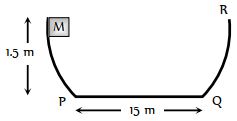
$A$ body of mass $M$ is released from a height of $1.5 \ m$ on a curved track. It slides down and moves along a horizontal surface $PQ$ of length $15 \ m$. If the coefficient of friction between the body and the horizontal surface is $0.2$,at what distance from $P$ will the body come to rest (in $m$)?
A
$1$
B
$7.5$
C
$2$
D
$5$
Solution
(B) According to the work-energy theorem,the loss in potential energy is equal to the work done against friction on the horizontal surface.
Let $h = 1.5 \ m$ be the initial height and $\mu = 0.2$ be the coefficient of friction.
The potential energy at the start is $PE = Mgh$.
The work done by friction over a distance $s$ on the horizontal surface is $W_f = f \cdot s = (\mu Mg) \cdot s$.
Equating the two: $Mgh = \mu Mgs$.
Solving for $s$: $s = \frac{h}{\mu} = \frac{1.5}{0.2} = 7.5 \ m$.
Since $7.5 \ m < 15 \ m$,the body comes to rest at a distance of $7.5 \ m$ from point $P$.
Let $h = 1.5 \ m$ be the initial height and $\mu = 0.2$ be the coefficient of friction.
The potential energy at the start is $PE = Mgh$.
The work done by friction over a distance $s$ on the horizontal surface is $W_f = f \cdot s = (\mu Mg) \cdot s$.
Equating the two: $Mgh = \mu Mgs$.
Solving for $s$: $s = \frac{h}{\mu} = \frac{1.5}{0.2} = 7.5 \ m$.
Since $7.5 \ m < 15 \ m$,the body comes to rest at a distance of $7.5 \ m$ from point $P$.
0 likes
View Solution52
MediumMCQ
$A$ body of mass $2 \, kg$ is thrown vertically upwards with a velocity of $4 \, m/s$. At what height will its kinetic energy be half of its initial value (in $, m$)? (Take $g = 10 \, m/s^2$)
A
$0.4$
B
$0.8$
C
$1.2$
D
$1.6$
Solution
(A) Initial kinetic energy $K_i = \frac{1}{2} m u^2 = \frac{1}{2} \times 2 \times (4)^2 = 16 \, J$.
At the required height $h$,the kinetic energy $K_f = \frac{1}{2} K_i = 8 \, J$.
Using the law of conservation of energy: $K_i + P_i = K_f + P_f$.
Taking the ground as the reference level $(P_i = 0)$,we have $16 + 0 = 8 + mgh$.
$16 = 8 + 2 \times 10 \times h$.
$8 = 20h$.
$h = \frac{8}{20} = 0.4 \, m$.
At the required height $h$,the kinetic energy $K_f = \frac{1}{2} K_i = 8 \, J$.
Using the law of conservation of energy: $K_i + P_i = K_f + P_f$.
Taking the ground as the reference level $(P_i = 0)$,we have $16 + 0 = 8 + mgh$.
$16 = 8 + 2 \times 10 \times h$.
$8 = 20h$.
$h = \frac{8}{20} = 0.4 \, m$.
0 likes
View Solution53
DifficultMCQ
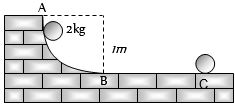
$A$ body of mass $2 \, kg$ is released from point $A$. Its velocity at point $B$ is $4 \, m/s$,and it comes to rest at point $C$. The work done against friction is ............. $J$.
A
$10$
B
$20$
C
$2$
D
$6$
Solution
(B) According to the work-energy theorem,the work done by all forces equals the change in kinetic energy.
Initial potential energy at $A$ is $U_A = mgh = 2 \times 10 \times 1 = 20 \, J$.
At point $C$,the body comes to rest,so the final kinetic energy is $0$.
The total initial energy is $20 \, J$ (assuming $g = 10 \, m/s^2$).
Since the body comes to rest at $C$,all the initial potential energy is dissipated as work done against friction.
Therefore,the work done against friction is $W_f = 20 \, J$.
Initial potential energy at $A$ is $U_A = mgh = 2 \times 10 \times 1 = 20 \, J$.
At point $C$,the body comes to rest,so the final kinetic energy is $0$.
The total initial energy is $20 \, J$ (assuming $g = 10 \, m/s^2$).
Since the body comes to rest at $C$,all the initial potential energy is dissipated as work done against friction.
Therefore,the work done against friction is $W_f = 20 \, J$.
0 likes
View Solution54
MediumMCQ
$A$ body is thrown vertically upwards and reaches a maximum height $h$. What is the ratio of its kinetic energy to its potential energy at a height of $\frac{3h}{4}$?
A
$3 : 4$
B
$1 : 3$
C
$4 : 3$
D
$3 : 1$
Solution
(B) Let the total mechanical energy of the body be $E = mgh$,where $m$ is the mass,$g$ is the acceleration due to gravity,and $h$ is the maximum height.
At a height of $y = \frac{3h}{4}$,the potential energy $U$ is given by $U = mgy = mg(\frac{3h}{4}) = \frac{3}{4}mgh$.
According to the law of conservation of energy,the total energy $E$ remains constant.
Therefore,the kinetic energy $K$ at this height is $K = E - U = mgh - \frac{3}{4}mgh = \frac{1}{4}mgh$.
The ratio of kinetic energy to potential energy is $\frac{K}{U} = \frac{\frac{1}{4}mgh}{\frac{3}{4}mgh} = \frac{1}{3}$.
At a height of $y = \frac{3h}{4}$,the potential energy $U$ is given by $U = mgy = mg(\frac{3h}{4}) = \frac{3}{4}mgh$.
According to the law of conservation of energy,the total energy $E$ remains constant.
Therefore,the kinetic energy $K$ at this height is $K = E - U = mgh - \frac{3}{4}mgh = \frac{1}{4}mgh$.
The ratio of kinetic energy to potential energy is $\frac{K}{U} = \frac{\frac{1}{4}mgh}{\frac{3}{4}mgh} = \frac{1}{3}$.
0 likes
View Solution55
MediumMCQ
$A$ block of mass $100 \, g$ moves on a rough surface. The heat produced when its velocity changes from $10 \, m/s$ to $5 \, m/s$ is ....... $J$.
A
$3.75$
B
$37.5$
C
$0.375$
D
$0.75$
Solution
(A) According to the work-energy theorem,the work done by friction is equal to the change in kinetic energy of the block.
The heat produced is equal to the magnitude of the work done by friction.
Given: mass $m = 100 \, g = 0.1 \, kg$,initial velocity $u = 10 \, m/s$,final velocity $v = 5 \, m/s$.
Change in kinetic energy $\Delta K = \frac{1}{2} m (u^2 - v^2)$.
$\Delta K = \frac{1}{2} \times 0.1 \times (10^2 - 5^2)$.
$\Delta K = 0.05 \times (100 - 25) = 0.05 \times 75 = 3.75 \, J$.
Thus,the heat produced is $3.75 \, J$.
The heat produced is equal to the magnitude of the work done by friction.
Given: mass $m = 100 \, g = 0.1 \, kg$,initial velocity $u = 10 \, m/s$,final velocity $v = 5 \, m/s$.
Change in kinetic energy $\Delta K = \frac{1}{2} m (u^2 - v^2)$.
$\Delta K = \frac{1}{2} \times 0.1 \times (10^2 - 5^2)$.
$\Delta K = 0.05 \times (100 - 25) = 0.05 \times 75 = 3.75 \, J$.
Thus,the heat produced is $3.75 \, J$.
0 likes
View Solution56
MediumMCQ
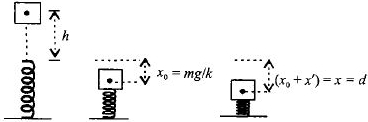
$A$ vertical spring with force constant $k$ is fixed on a table. $A$ ball of mass $m$ at a height $h$ above the free upper end of the spring falls vertically on the spring so that the spring is compressed by a distance $d$. The net work done in the process is
A
$mg(h + d) - \frac{1}{2}kd^2$
B
$mg(h - d) - \frac{1}{2}kd^2$
C
$mg(h - d) + \frac{1}{2}kd^2$
D
$mg(h + d) + \frac{1}{2}kd^2$
Solution
(A) According to the work-energy theorem,the net work done on the system is equal to the change in kinetic energy of the ball.
Let the initial position of the ball be at height $h$ above the spring. The final position is when the spring is compressed by distance $d$.
The total vertical displacement of the ball is $(h + d)$.
The forces acting on the ball are gravity (downward) and the spring force (upward).
The work done by gravity is $W_g = mg(h + d)$.
The work done by the spring force is $W_s = -\int_0^d kx \, dx = -\frac{1}{2}kd^2$.
The net work done on the ball is $W_{net} = W_g + W_s = mg(h + d) - \frac{1}{2}kd^2$.
Since the ball starts from rest and comes to rest momentarily at the maximum compression $d$,the change in kinetic energy is zero,which implies $W_{net} = 0$ for the entire process. However,the question asks for the net work done by the external forces (gravity and spring) during the displacement $d$,which is $mg(h + d) - \frac{1}{2}kd^2$.
Let the initial position of the ball be at height $h$ above the spring. The final position is when the spring is compressed by distance $d$.
The total vertical displacement of the ball is $(h + d)$.
The forces acting on the ball are gravity (downward) and the spring force (upward).
The work done by gravity is $W_g = mg(h + d)$.
The work done by the spring force is $W_s = -\int_0^d kx \, dx = -\frac{1}{2}kd^2$.
The net work done on the ball is $W_{net} = W_g + W_s = mg(h + d) - \frac{1}{2}kd^2$.
Since the ball starts from rest and comes to rest momentarily at the maximum compression $d$,the change in kinetic energy is zero,which implies $W_{net} = 0$ for the entire process. However,the question asks for the net work done by the external forces (gravity and spring) during the displacement $d$,which is $mg(h + d) - \frac{1}{2}kd^2$.
0 likes
View Solution57
MediumMCQ
$A$ body falls freely under gravity. Its speed is $v$ when it has lost an amount $U$ of the gravitational potential energy. Then its mass is
A
$\frac{Ug}{v^2}$
B
$\frac{U^2}{g}$
C
$\frac{2U}{v^2}$
D
$2Ug v^2$
Solution
(C) According to the law of conservation of energy,the loss in gravitational potential energy is equal to the gain in kinetic energy.
Given that the loss in gravitational potential energy is $U$.
The gain in kinetic energy is $\frac{1}{2}mv^2$.
Equating the two: $U = \frac{1}{2}mv^2$.
Solving for mass $m$: $m = \frac{2U}{v^2}$.
Given that the loss in gravitational potential energy is $U$.
The gain in kinetic energy is $\frac{1}{2}mv^2$.
Equating the two: $U = \frac{1}{2}mv^2$.
Solving for mass $m$: $m = \frac{2U}{v^2}$.
0 likes
View Solution58
DifficultMCQ
$A$ block of mass $m$ is suspended vertically from an elastic string with a force constant $k = mg/a$. Initially,the string is at its natural length and the block is allowed to fall freely. What will be its kinetic energy when the block passes through the equilibrium position?
A
$mga$
B
$mga/2$
C
$0$
D
$2mga$
Solution
(B) Let the equilibrium position be at a distance $x$ from the natural length.
At equilibrium,the spring force equals the gravitational force: $mg = kx$.
Given $k = mg/a$,we have $mg = (mg/a)x$,which gives $x = a$.
Using the principle of conservation of energy,the loss in gravitational potential energy equals the gain in elastic potential energy plus the kinetic energy at the equilibrium position.
$mgx = \frac{1}{2}kx^2 + KE$.
Substituting $x = a$ and $k = mg/a$:
$mg(a) = \frac{1}{2}(mg/a)(a^2) + KE$.
$mga = \frac{1}{2}mga + KE$.
$KE = mga - \frac{1}{2}mga = \frac{1}{2}mga$.
At equilibrium,the spring force equals the gravitational force: $mg = kx$.
Given $k = mg/a$,we have $mg = (mg/a)x$,which gives $x = a$.
Using the principle of conservation of energy,the loss in gravitational potential energy equals the gain in elastic potential energy plus the kinetic energy at the equilibrium position.
$mgx = \frac{1}{2}kx^2 + KE$.
Substituting $x = a$ and $k = mg/a$:
$mg(a) = \frac{1}{2}(mg/a)(a^2) + KE$.
$mga = \frac{1}{2}mga + KE$.
$KE = mga - \frac{1}{2}mga = \frac{1}{2}mga$.
0 likes
View Solution59
MediumMCQ
$A$ block of mass $m$ moving with a velocity $v_0$ on a smooth horizontal surface strikes and compresses a spring of stiffness $k$ until the mass comes to rest,as shown in the figure. This phenomenon is observed by two observers:
$A$: standing on the horizontal surface
$B$: standing on the block
To an observer $A$,the net work done on the block is
$A$: standing on the horizontal surface
$B$: standing on the block
To an observer $A$,the net work done on the block is

A
$ - mv_0^2$
B
$+mv_0^2$
C
$-\frac{1}{2}mv_0^2$
D
zero
Solution
(C) According to the work-energy theorem,the net work done on an object is equal to the change in its kinetic energy.
For observer $A$ (who is in an inertial frame),the initial kinetic energy of the block is $K_i = \frac{1}{2}mv_0^2$.
Since the block comes to rest,the final kinetic energy is $K_f = 0$.
The net work done on the block is $W_{net} = K_f - K_i = 0 - \frac{1}{2}mv_0^2 = -\frac{1}{2}mv_0^2$.
For observer $A$ (who is in an inertial frame),the initial kinetic energy of the block is $K_i = \frac{1}{2}mv_0^2$.
Since the block comes to rest,the final kinetic energy is $K_f = 0$.
The net work done on the block is $W_{net} = K_f - K_i = 0 - \frac{1}{2}mv_0^2 = -\frac{1}{2}mv_0^2$.
0 likes
View Solution60
MediumMCQ
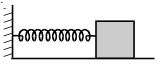
$A$ spring-block system is placed on a rough horizontal floor. The block is pulled towards the right to give the spring an elongation $x$ such that $\frac{\mu mg}{K} < x < \frac{2\mu mg}{K}$,and then released. Which of the following laws/principles of physics can be applied to the spring-block system?
A
Conservation of mechanical energy
B
Conservation of momentum
C
Work-energy principle
D
None
Solution
(C) $1$. The system consists of a block of mass $m$ attached to a spring of constant $K$ on a rough surface with coefficient of friction $\mu$.
$2$. Since the surface is rough,there is a non-conservative force (friction) acting on the system. Therefore,mechanical energy is not conserved.
$3$. The net external force on the system is not zero (due to the wall and friction),so linear momentum is not conserved.
$4$. The work-energy principle states that the work done by all forces (conservative and non-conservative) is equal to the change in kinetic energy of the system. This principle is universally applicable to any system,regardless of whether forces are conservative or non-conservative.
$5$. Thus,the work-energy principle can be applied to this system.
$2$. Since the surface is rough,there is a non-conservative force (friction) acting on the system. Therefore,mechanical energy is not conserved.
$3$. The net external force on the system is not zero (due to the wall and friction),so linear momentum is not conserved.
$4$. The work-energy principle states that the work done by all forces (conservative and non-conservative) is equal to the change in kinetic energy of the system. This principle is universally applicable to any system,regardless of whether forces are conservative or non-conservative.
$5$. Thus,the work-energy principle can be applied to this system.
0 likes
View Solution61
MediumMCQ
$A$ box of mass $m$ is released from rest at position $1$ on the frictionless curved track shown. It travels a distance $d$ along the track in time $t$ to reach position $2$,falling a vertical distance $h$. Let $v$ be the instantaneous speed and $a$ be the instantaneous acceleration of the box at position $2$. Which of the following equations is valid for this situation?
A
$h = vt$
B
$h = (1/2)gt^2$
C
$d = (1/2)at^2$
D
$mgh = (1/2)mv^2$
Solution
(D) The correct answer is $mgh = \frac{1}{2}mv^2$. This equation is an application of the law of conservation of mechanical energy. In this situation,the loss in potential energy,$mgh$,is equal to the gain in kinetic energy,$\frac{1}{2}mv^2$.
The other equations are kinematic equations that are only valid when the acceleration is constant. Since the track is curved,the component of the gravitational force on the box that is tangent to the track surface changes as the box slides. This component of the gravitational force is what accelerates the box. According to Newton's second law,$F = ma$,as the force changes,the acceleration also changes. Since the acceleration is not constant,the other equations are not valid.
The other equations are kinematic equations that are only valid when the acceleration is constant. Since the track is curved,the component of the gravitational force on the box that is tangent to the track surface changes as the box slides. This component of the gravitational force is what accelerates the box. According to Newton's second law,$F = ma$,as the force changes,the acceleration also changes. Since the acceleration is not constant,the other equations are not valid.
0 likes
View Solution62
EasyMCQ
$A$ particle of mass $100 \ g$ is thrown vertically upwards with a speed of $5 \ m/s$. The work done by the force of gravity during the time the particle goes up is.....$J$
A
$-1.25$
B
$1.25$
C
$0.5$
D
$-0.5$
Solution
(A) The mass of the particle is $m = 100 \ g = 0.1 \ kg$.
The initial velocity is $u = 5 \ m/s$.
At the highest point,the final velocity is $v = 0 \ m/s$.
According to the work-energy theorem,the work done by all forces is equal to the change in kinetic energy: $W_{total} = \Delta K.E$.
Here,the only force acting during the upward motion is gravity $(W_g)$.
$W_g = K.E_{final} - K.E_{initial} = 0 - \frac{1}{2} m u^2$.
$W_g = -\frac{1}{2} \times 0.1 \times (5)^2 = -0.5 \times 0.1 \times 25 = -1.25 \ J$.
The initial velocity is $u = 5 \ m/s$.
At the highest point,the final velocity is $v = 0 \ m/s$.
According to the work-energy theorem,the work done by all forces is equal to the change in kinetic energy: $W_{total} = \Delta K.E$.
Here,the only force acting during the upward motion is gravity $(W_g)$.
$W_g = K.E_{final} - K.E_{initial} = 0 - \frac{1}{2} m u^2$.
$W_g = -\frac{1}{2} \times 0.1 \times (5)^2 = -0.5 \times 0.1 \times 25 = -1.25 \ J$.
0 likes
View Solution63
MediumMCQ
The potential energy of a $1 \ kg$ particle free to move along the $x-$axis is given by: $U(x) = (\frac{x^4}{4} - \frac{x^2}{2}) \ J$. The total mechanical energy of the particle is $2 \ J$. Then,the maximum speed (in $m/s$) is:
A
$\frac{3}{\sqrt{2}}$
B
$\sqrt{2}$
C
$\frac{1}{\sqrt{2}}$
D
$2$
Solution
(A) The total mechanical energy $E$ is the sum of kinetic energy $K$ and potential energy $U$: $E = K + U = 2 \ J$.
To find the maximum speed,we need to maximize the kinetic energy $K = E - U$.
This occurs when the potential energy $U(x)$ is at its minimum.
To find the minimum of $U(x)$,we set the derivative $\frac{dU}{dx} = 0$:
$\frac{dU}{dx} = \frac{4x^3}{4} - \frac{2x}{2} = x^3 - x = 0$.
$x(x^2 - 1) = 0$,which gives $x = 0, 1, -1$.
Evaluating $U(x)$ at these points:
$U(0) = 0 \ J$.
$U(1) = \frac{1}{4} - \frac{1}{2} = -\frac{1}{4} \ J$.
$U(-1) = \frac{1}{4} - \frac{1}{2} = -\frac{1}{4} \ J$.
The minimum potential energy is $U_{\min} = -\frac{1}{4} \ J$.
Thus,$K_{\max} = E - U_{\min} = 2 - (-0.25) = 2.25 \ J = \frac{9}{4} \ J$.
Using $K_{\max} = \frac{1}{2}mv_{\max}^2$ with $m = 1 \ kg$:
$\frac{1}{2} \times 1 \times v_{\max}^2 = \frac{9}{4}$.
$v_{\max}^2 = \frac{9}{2}$.
$v_{\max} = \frac{3}{\sqrt{2}} \ m/s$.
To find the maximum speed,we need to maximize the kinetic energy $K = E - U$.
This occurs when the potential energy $U(x)$ is at its minimum.
To find the minimum of $U(x)$,we set the derivative $\frac{dU}{dx} = 0$:
$\frac{dU}{dx} = \frac{4x^3}{4} - \frac{2x}{2} = x^3 - x = 0$.
$x(x^2 - 1) = 0$,which gives $x = 0, 1, -1$.
Evaluating $U(x)$ at these points:
$U(0) = 0 \ J$.
$U(1) = \frac{1}{4} - \frac{1}{2} = -\frac{1}{4} \ J$.
$U(-1) = \frac{1}{4} - \frac{1}{2} = -\frac{1}{4} \ J$.
The minimum potential energy is $U_{\min} = -\frac{1}{4} \ J$.
Thus,$K_{\max} = E - U_{\min} = 2 - (-0.25) = 2.25 \ J = \frac{9}{4} \ J$.
Using $K_{\max} = \frac{1}{2}mv_{\max}^2$ with $m = 1 \ kg$:
$\frac{1}{2} \times 1 \times v_{\max}^2 = \frac{9}{4}$.
$v_{\max}^2 = \frac{9}{2}$.
$v_{\max} = \frac{3}{\sqrt{2}} \ m/s$.
0 likes
View Solution64
AdvancedMCQ
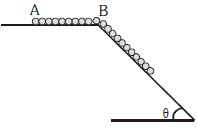
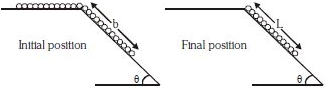
$A$ chain of length $L$ and mass $m$ is placed upon a smooth surface as shown. The length of the chain on the incline is $b$. Calculate the velocity of the chain when its end reaches point $B$.
A
$\sqrt { \frac{{2g\,\sin \,\theta }}{L}\left( {{L^2} - {b^2}} \right)}$
B
$2\sqrt { \frac{{g\,\sin \,\theta }}{L}\left( {{L^2} - {b^2}} \right)}$
C
$\sqrt { \frac{{g\,\sin \,\theta }}{L}\left( {{L^2} - {b^2}} \right)}$
D
$\sqrt { \frac{{g\,\sin \,\theta }}{{2L}}\left( {{L^2} - {b^2}} \right)} $
Solution
(C) Let the mass per unit length of the chain be $\lambda = \frac{m}{L}$.
Initially,a length $b$ of the chain is on the incline. The center of mass of this part is at a vertical depth of $\frac{b}{2} \sin \theta$ below the horizontal surface.
The potential energy of the chain initially is $PE_i = -(\lambda b) g (\frac{b}{2} \sin \theta) = -\frac{m g b^2}{2L} \sin \theta$.
Finally,the entire chain of length $L$ is on the incline. The center of mass of the entire chain is at a vertical depth of $\frac{L}{2} \sin \theta$ below the horizontal surface.
The potential energy of the chain finally is $PE_f = -(m) g (\frac{L}{2} \sin \theta) = -\frac{m g L}{2} \sin \theta$.
By the law of conservation of mechanical energy,the loss in potential energy equals the gain in kinetic energy:
$PE_i - PE_f = KE_f - KE_i$
$-\frac{m g b^2}{2L} \sin \theta - (-\frac{m g L}{2} \sin \theta) = \frac{1}{2} m v^2 - 0$
$\frac{m g}{2L} \sin \theta (L^2 - b^2) = \frac{1}{2} m v^2$
$v^2 = \frac{g \sin \theta}{L} (L^2 - b^2)$
$v = \sqrt{\frac{g \sin \theta}{L} (L^2 - b^2)}$
Initially,a length $b$ of the chain is on the incline. The center of mass of this part is at a vertical depth of $\frac{b}{2} \sin \theta$ below the horizontal surface.
The potential energy of the chain initially is $PE_i = -(\lambda b) g (\frac{b}{2} \sin \theta) = -\frac{m g b^2}{2L} \sin \theta$.
Finally,the entire chain of length $L$ is on the incline. The center of mass of the entire chain is at a vertical depth of $\frac{L}{2} \sin \theta$ below the horizontal surface.
The potential energy of the chain finally is $PE_f = -(m) g (\frac{L}{2} \sin \theta) = -\frac{m g L}{2} \sin \theta$.
By the law of conservation of mechanical energy,the loss in potential energy equals the gain in kinetic energy:
$PE_i - PE_f = KE_f - KE_i$
$-\frac{m g b^2}{2L} \sin \theta - (-\frac{m g L}{2} \sin \theta) = \frac{1}{2} m v^2 - 0$
$\frac{m g}{2L} \sin \theta (L^2 - b^2) = \frac{1}{2} m v^2$
$v^2 = \frac{g \sin \theta}{L} (L^2 - b^2)$
$v = \sqrt{\frac{g \sin \theta}{L} (L^2 - b^2)}$
0 likes
View Solution65
DifficultMCQ
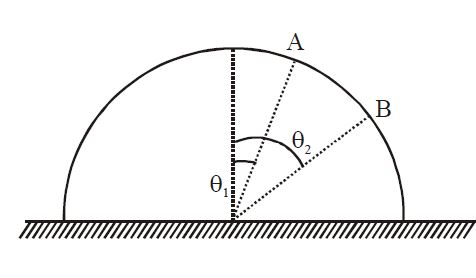
$A$ small block slides down from rest at point $A$ on the surface of a smooth cylinder,as shown. At point $B$,the block falls off (leaves) the cylinder. The equation relating the angles $\theta_1$ and $\theta_2$ is given by
A
$sin\ \theta_2 = \frac{2}{3}sin\ \theta_1$
B
$sin\ \theta_2 = \frac{3}{2}sin\ \theta_1$
C
$cos\ \theta_2 = \frac{2}{3}cos\ \theta_1$
D
$cos\ \theta_2 = \frac{3}{2}cos\ \theta_1$
Solution
(C) Let $R$ be the radius of the cylinder. The vertical height fallen by the block from point $A$ to point $B$ is $h = R \cos \theta_1 - R \cos \theta_2 = R(\cos \theta_1 - \cos \theta_2)$.
By the law of conservation of energy,the kinetic energy gained is equal to the potential energy lost: $\frac{1}{2}mv^2 = mgh = mgR(\cos \theta_1 - \cos \theta_2)$.
At point $B$,the normal force $N$ becomes zero as the block leaves the surface. The radial equation of motion is $mg \cos \theta_2 - N = \frac{mv^2}{R}$.
Setting $N = 0$,we get $v^2 = Rg \cos \theta_2$.
Substituting this into the energy equation: $\frac{1}{2}m(Rg \cos \theta_2) = mgR(\cos \theta_1 - \cos \theta_2)$.
Dividing by $mgR$: $\frac{1}{2} \cos \theta_2 = \cos \theta_1 - \cos \theta_2$.
Rearranging gives: $\frac{3}{2} \cos \theta_2 = \cos \theta_1$,or $\cos \theta_2 = \frac{2}{3} \cos \theta_1$.
By the law of conservation of energy,the kinetic energy gained is equal to the potential energy lost: $\frac{1}{2}mv^2 = mgh = mgR(\cos \theta_1 - \cos \theta_2)$.
At point $B$,the normal force $N$ becomes zero as the block leaves the surface. The radial equation of motion is $mg \cos \theta_2 - N = \frac{mv^2}{R}$.
Setting $N = 0$,we get $v^2 = Rg \cos \theta_2$.
Substituting this into the energy equation: $\frac{1}{2}m(Rg \cos \theta_2) = mgR(\cos \theta_1 - \cos \theta_2)$.
Dividing by $mgR$: $\frac{1}{2} \cos \theta_2 = \cos \theta_1 - \cos \theta_2$.
Rearranging gives: $\frac{3}{2} \cos \theta_2 = \cos \theta_1$,or $\cos \theta_2 = \frac{2}{3} \cos \theta_1$.
0 likes
View Solution66
MediumMCQ
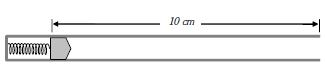
$A$ toy gun fires a plastic pellet with a mass of $0.5\ g$. The pellet is propelled by a spring with a spring constant of $1.25\ N/cm$, which is compressed $2.0\ cm$ before firing. The plastic pellet travels horizontally $10\ cm$ down the barrel (from its compressed position) with a constant friction force of $0.0475\ N$. What is the speed (in $SI\ units$) of the bullet as it emerges from the barrel?
A
$5$
B
$7$
C
$9$
D
$11$
Solution
(C) Given: Mass $m = 0.5\ g = 0.5 \times 10^{-3}\ kg$, Spring constant $k = 1.25\ N/cm = 125\ N/m$, Compression $x = 2.0\ cm = 0.02\ m$, Distance $d = 10\ cm = 0.1\ m$, Friction force $f = 0.0475\ N$.
According to the Work-Energy Theorem, the work done by the spring minus the work done against friction equals the change in kinetic energy:
$W_{spring} - W_{friction} = \Delta K$
$\frac{1}{2} k x^2 - f d = \frac{1}{2} m v^2$
Substituting the values:
$\frac{1}{2} \times 125 \times (0.02)^2 - 0.0475 \times 0.1 = \frac{1}{2} \times 0.5 \times 10^{-3} \times v^2$
$0.5 \times 125 \times 4 \times 10^{-4} - 0.00475 = 0.25 \times 10^{-3} \times v^2$
$0.025 - 0.00475 = 0.25 \times 10^{-3} \times v^2$
$0.02025 = 0.25 \times 10^{-3} \times v^2$
$v^2 = \frac{0.02025}{0.25 \times 10^{-3}} = \frac{20.25}{0.25} = 81$
$v = 9\ m/s$.
According to the Work-Energy Theorem, the work done by the spring minus the work done against friction equals the change in kinetic energy:
$W_{spring} - W_{friction} = \Delta K$
$\frac{1}{2} k x^2 - f d = \frac{1}{2} m v^2$
Substituting the values:
$\frac{1}{2} \times 125 \times (0.02)^2 - 0.0475 \times 0.1 = \frac{1}{2} \times 0.5 \times 10^{-3} \times v^2$
$0.5 \times 125 \times 4 \times 10^{-4} - 0.00475 = 0.25 \times 10^{-3} \times v^2$
$0.025 - 0.00475 = 0.25 \times 10^{-3} \times v^2$
$0.02025 = 0.25 \times 10^{-3} \times v^2$
$v^2 = \frac{0.02025}{0.25 \times 10^{-3}} = \frac{20.25}{0.25} = 81$
$v = 9\ m/s$.
0 likes
View Solution67
DifficultMCQ
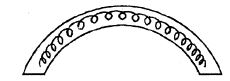
$A$ smooth semicircular tube $AB$ of radius $R$ is fixed in a vertical plane and contains a heavy flexible chain of length $\pi R$. Find the velocity $v$ with which it will emerge from the open end $B$ of the tube,when slightly displaced.
A
$\sqrt {2gR\left( {2\pi \, + \,2/\pi } \right)} $
B
$\sqrt {\frac{{gR}}{2}\left( {\frac{\pi }{4} + 4\pi } \right)} $
C
$\sqrt {2gR\left( {\frac{2}{\pi } + \frac{\pi }{2}} \right)} $
D
$\sqrt {gR\left( {\pi + \frac{1}{\pi }} \right)} $
Solution
(C) Let the mass of the chain be $M$. The length of the chain is $L = \pi R$. The mass per unit length is $\lambda = M/(\pi R)$.
Initially,the center of mass of the semicircular chain is at a height $h_i = \frac{2R}{\pi}$ from the horizontal diameter.
Initial potential energy $PE_i = Mgh_i = Mg \frac{2R}{\pi}$. Initial kinetic energy $KE_i = 0$.
When the chain emerges from the tube,it hangs vertically. The center of mass of the chain of length $\pi R$ is at a distance $L/2 = \pi R / 2$ below the horizontal diameter.
Final potential energy $PE_f = -Mg \frac{\pi R}{2}$. Final kinetic energy $KE_f = \frac{1}{2} Mv^2$.
By the law of conservation of mechanical energy: $KE_i + PE_i = KE_f + PE_f$.
$0 + Mg \frac{2R}{\pi} = \frac{1}{2} Mv^2 - Mg \frac{\pi R}{2}$.
$MgR \left( \frac{2}{\pi} + \frac{\pi}{2} \right) = \frac{1}{2} Mv^2$.
$v^2 = 2gR \left( \frac{2}{\pi} + \frac{\pi}{2} \right)$.
$v = \sqrt{2gR \left( \frac{2}{\pi} + \frac{\pi}{2} \right)}$.
Initially,the center of mass of the semicircular chain is at a height $h_i = \frac{2R}{\pi}$ from the horizontal diameter.
Initial potential energy $PE_i = Mgh_i = Mg \frac{2R}{\pi}$. Initial kinetic energy $KE_i = 0$.
When the chain emerges from the tube,it hangs vertically. The center of mass of the chain of length $\pi R$ is at a distance $L/2 = \pi R / 2$ below the horizontal diameter.
Final potential energy $PE_f = -Mg \frac{\pi R}{2}$. Final kinetic energy $KE_f = \frac{1}{2} Mv^2$.
By the law of conservation of mechanical energy: $KE_i + PE_i = KE_f + PE_f$.
$0 + Mg \frac{2R}{\pi} = \frac{1}{2} Mv^2 - Mg \frac{\pi R}{2}$.
$MgR \left( \frac{2}{\pi} + \frac{\pi}{2} \right) = \frac{1}{2} Mv^2$.
$v^2 = 2gR \left( \frac{2}{\pi} + \frac{\pi}{2} \right)$.
$v = \sqrt{2gR \left( \frac{2}{\pi} + \frac{\pi}{2} \right)}$.
0 likes
View Solution68
MediumMCQ
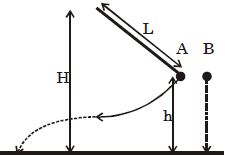
Two monkeys with the same mass stand on a branch at height $h$ above the horizontal jungle floor. Monkey $A$ steps off the branch holding the end of an inextensible rope of length $L$ whose other end is tied to another branch at height $H$,lets go at the bottom of the swing,and falls freely to the floor,as shown below. Monkey $B$ steps off and falls straight downward. Then,neglecting air resistance but not the tension in the rope,the total work $W$ done on each monkey and the speed $v$ with which each hits the floor are as follows:
A
$W_A < W_B, v_A < v_B$
B
$W_A = W_B, v_A < v_B$
C
$W_A = W_B, v_A = v_B$
D
$W_A < W_B, v_A = v_B$
Solution
(C) According to the Work-Energy Theorem,the total work done on an object is equal to the change in its kinetic energy: $W = \Delta K = K_f - K_i$.
Since both monkeys start from rest at the same height $h$,their initial kinetic energy $K_i = 0$ is the same.
Both monkeys hit the floor at the same final height (zero),so their final kinetic energy $K_f$ depends only on the change in potential energy,which is $\Delta U = mgh$ for both.
For monkey $B$,the only force doing work is gravity,so $W_B = \Delta K_B = mgh$.
For monkey $A$,the forces acting are gravity and the tension in the rope. The tension acts perpendicular to the displacement during the swing,so it does zero work. When monkey $A$ lets go,it is in free fall. Thus,the total work done on monkey $A$ is also $W_A = mgh$.
Since $W_A = W_B$,both monkeys have the same change in kinetic energy,and since they start from rest,they have the same final kinetic energy $K_f = mgh$.
Therefore,their final speeds $v = \sqrt{2gh}$ are also equal: $v_A = v_B$.
Since both monkeys start from rest at the same height $h$,their initial kinetic energy $K_i = 0$ is the same.
Both monkeys hit the floor at the same final height (zero),so their final kinetic energy $K_f$ depends only on the change in potential energy,which is $\Delta U = mgh$ for both.
For monkey $B$,the only force doing work is gravity,so $W_B = \Delta K_B = mgh$.
For monkey $A$,the forces acting are gravity and the tension in the rope. The tension acts perpendicular to the displacement during the swing,so it does zero work. When monkey $A$ lets go,it is in free fall. Thus,the total work done on monkey $A$ is also $W_A = mgh$.
Since $W_A = W_B$,both monkeys have the same change in kinetic energy,and since they start from rest,they have the same final kinetic energy $K_f = mgh$.
Therefore,their final speeds $v = \sqrt{2gh}$ are also equal: $v_A = v_B$.
0 likes
View Solution69
MediumMCQ
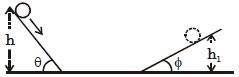
$A$ demonstration apparatus on a table in the lab is shown in the diagram. It consists of a metal track (shown as a thick solid line in the figure) along which a perfectly spherical marble can roll without slipping. In one run,the marble is released from rest at a height $h$ above the table on the left section,rolls down one side and then up the other side without slipping,briefly stopping when it has reached $h_1$. Assuming the table to be horizontal and neglecting air drag as well as any energy loss due to rolling,which of the following is true?
A
$h_1 < h$ always,because the friction that keeps the ball rolling must dissipate energy.
B
$h_1 = h$,since total mechanical energy is conserved.
C
$h_1 = h$ only if tilt angles $\phi$ and $\theta$ are equal.
D
$h_1 = h$ only if tilt angle $\phi$ is larger than $\theta$.
Solution
(B) The marble rolls without slipping. The force of static friction acts on the marble,but it does no work because the point of contact is instantaneously at rest relative to the track. Since we are neglecting air resistance and any other non-conservative forces (like rolling resistance),the total mechanical energy of the system is conserved.
Initially,the marble is at rest at height $h$,so its total mechanical energy is $E_i = mgh$.
At the highest point on the other side,the marble briefly stops at height $h_1$. Its velocity is zero,so its kinetic energy (both translational and rotational) is zero. Its total mechanical energy is $E_f = mgh_1$.
By the law of conservation of mechanical energy,$E_i = E_f$,which implies $mgh = mgh_1$,or $h_1 = h$.
Therefore,the height reached on the other side is equal to the initial height,regardless of the angles of inclination $\theta$ and $\phi$.
Initially,the marble is at rest at height $h$,so its total mechanical energy is $E_i = mgh$.
At the highest point on the other side,the marble briefly stops at height $h_1$. Its velocity is zero,so its kinetic energy (both translational and rotational) is zero. Its total mechanical energy is $E_f = mgh_1$.
By the law of conservation of mechanical energy,$E_i = E_f$,which implies $mgh = mgh_1$,or $h_1 = h$.
Therefore,the height reached on the other side is equal to the initial height,regardless of the angles of inclination $\theta$ and $\phi$.
0 likes
View Solution70
MediumMCQ
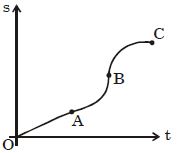
The displacement-time graph of a particle moving in a straight line is as shown in the figure. Select the correct alternative.
A
Work done by all forces in region $OA$ is positive.
B
Work done by all forces in region $AB$ is negative.
C
Work done by all forces in region $BC$ is positive.
D
Work done by all forces in region $AB$ is positive.
Solution
(D) According to the work-energy theorem, the work done by all forces is equal to the change in kinetic energy: $W = \Delta K = \frac{1}{2} m(v_f^2 - v_i^2)$.
Since the slope of the displacement-time $(s-t)$ graph represents velocity $(v = ds/dt)$, we analyze the slope in each region:
$1$. In region $OA$, the slope is constant, so velocity is constant. Thus, $\Delta K = 0$ and work done is zero.
$2$. In region $AB$, the slope is increasing, which means the velocity is increasing $(v_f > v_i)$. Therefore, the change in kinetic energy is positive, and the work done by all forces is positive.
$3$. In region $BC$, the slope is decreasing, which means the velocity is decreasing $(v_f < v_i)$. Therefore, the change in kinetic energy is negative, and the work done by all forces is negative.
Thus, the correct statement is that the work done by all forces in region $AB$ is positive.
Since the slope of the displacement-time $(s-t)$ graph represents velocity $(v = ds/dt)$, we analyze the slope in each region:
$1$. In region $OA$, the slope is constant, so velocity is constant. Thus, $\Delta K = 0$ and work done is zero.
$2$. In region $AB$, the slope is increasing, which means the velocity is increasing $(v_f > v_i)$. Therefore, the change in kinetic energy is positive, and the work done by all forces is positive.
$3$. In region $BC$, the slope is decreasing, which means the velocity is decreasing $(v_f < v_i)$. Therefore, the change in kinetic energy is negative, and the work done by all forces is negative.
Thus, the correct statement is that the work done by all forces in region $AB$ is positive.
0 likes
View Solution71
MediumMCQ
$A$ block of mass $1\,kg$ slides on a rough horizontal surface. If the speed of the block decreases from $10\,m/s$ to $8\,m/s$,the thermal energy developed in this process is .................. $J$.
A
$50$
B
$36$
C
$18$
D
$25$
Solution
(C) According to the work-energy theorem,the work done by friction is equal to the change in kinetic energy of the block.
Since the surface is rough,the loss in kinetic energy is dissipated as thermal energy $(H)$.
$H = |\Delta K| = |K_f - K_i| = |\frac{1}{2} m v_f^2 - \frac{1}{2} m v_i^2|$
Given: $m = 1\,kg$,$v_i = 10\,m/s$,$v_f = 8\,m/s$.
$H = \frac{1}{2} \times 1 \times (10^2 - 8^2)$
$H = \frac{1}{2} \times (100 - 64)$
$H = \frac{1}{2} \times 36 = 18\,J$.
Therefore,the thermal energy developed is $18\,J$.
Since the surface is rough,the loss in kinetic energy is dissipated as thermal energy $(H)$.
$H = |\Delta K| = |K_f - K_i| = |\frac{1}{2} m v_f^2 - \frac{1}{2} m v_i^2|$
Given: $m = 1\,kg$,$v_i = 10\,m/s$,$v_f = 8\,m/s$.
$H = \frac{1}{2} \times 1 \times (10^2 - 8^2)$
$H = \frac{1}{2} \times (100 - 64)$
$H = \frac{1}{2} \times 36 = 18\,J$.
Therefore,the thermal energy developed is $18\,J$.
0 likes
View Solution72
DifficultMCQ
$A$ body dropped from height $H$ reaches the ground with a speed of $1.1 \sqrt{gH}$. Calculate the work done by air friction in terms of $mgH$.
A
$0.395$
B
$-0.395$
C
$0.400$
D
$-0.400$
Solution
(B) According to the work-energy theorem,the total work done on the body is equal to the change in its kinetic energy.
$W_{\text{gravity}} + W_{\text{air friction}} = \Delta K.E.$
$W_{\text{gravity}} = mgH$
Final kinetic energy $K.E. = \frac{1}{2} m v^2 = \frac{1}{2} m (1.1 \sqrt{gH})^2 = \frac{1}{2} m (1.21 gH) = 0.605 mgH$
Since the body starts from rest,initial kinetic energy is $0$.
So,$mgH + W_{\text{air friction}} = 0.605 mgH$
$W_{\text{air friction}} = 0.605 mgH - mgH = -0.395 mgH$
Therefore,the work done by air friction is $-0.395 mgH$.
$W_{\text{gravity}} + W_{\text{air friction}} = \Delta K.E.$
$W_{\text{gravity}} = mgH$
Final kinetic energy $K.E. = \frac{1}{2} m v^2 = \frac{1}{2} m (1.1 \sqrt{gH})^2 = \frac{1}{2} m (1.21 gH) = 0.605 mgH$
Since the body starts from rest,initial kinetic energy is $0$.
So,$mgH + W_{\text{air friction}} = 0.605 mgH$
$W_{\text{air friction}} = 0.605 mgH - mgH = -0.395 mgH$
Therefore,the work done by air friction is $-0.395 mgH$.
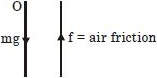
0 likes
View Solution73
MediumMCQ
Three particles $A, B$, and $C$ are thrown from the top of a tower with the same speed $u$. Particle $A$ is thrown upwards, $B$ is thrown downwards, and $C$ is thrown horizontally. If they hit the ground with speeds $V_A, V_B$, and $V_C$ respectively, then:
A
$V_A = V_B = V_C$
B
$V_A = V_B > V_C$
C
$V_B > V_C > V_A$
D
$V_A > V_B = V_C$
Solution
(A) According to the law of conservation of mechanical energy, the total mechanical energy at the top of the tower must be equal to the total mechanical energy at the ground level.
Let $m$ be the mass of each particle, $h$ be the height of the tower, and $u$ be the initial speed.
At the top: $E_i = mgh + \frac{1}{2}mu^2$
At the ground: $E_f = 0 + \frac{1}{2}mV^2$
Since $E_i = E_f$, we have $mgh + \frac{1}{2}mu^2 = \frac{1}{2}mV^2$.
This simplifies to $V^2 = u^2 + 2gh$, or $V = \sqrt{u^2 + 2gh}$.
Since $u, g$, and $h$ are the same for all three particles, the final speed $V$ will be the same for all three particles regardless of the direction of projection.
Therefore, $V_A = V_B = V_C$.
Let $m$ be the mass of each particle, $h$ be the height of the tower, and $u$ be the initial speed.
At the top: $E_i = mgh + \frac{1}{2}mu^2$
At the ground: $E_f = 0 + \frac{1}{2}mV^2$
Since $E_i = E_f$, we have $mgh + \frac{1}{2}mu^2 = \frac{1}{2}mV^2$.
This simplifies to $V^2 = u^2 + 2gh$, or $V = \sqrt{u^2 + 2gh}$.
Since $u, g$, and $h$ are the same for all three particles, the final speed $V$ will be the same for all three particles regardless of the direction of projection.
Therefore, $V_A = V_B = V_C$.
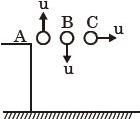
0 likes
View Solution74
MediumMCQ
The pulley and spring are massless,and friction is absent everywhere. $A$ $5\, kg$ block is released from rest. Find the speed of the $5\, kg$ block when the $2\, kg$ block leaves contact with the ground. (Take the force constant of the spring $K = 40\, N/m$ and $g = 10\, m/s^2$.)
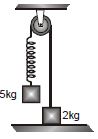
A
$\sqrt{2}\, m/s$
B
$2\sqrt{2}\, m/s$
C
$2\, m/s$
D
$4\sqrt{2}\, m/s$
Solution
(B) For the $2\, kg$ block to leave the ground,the spring force must equal the weight of the $2\, kg$ block: $kx = m_2g \Rightarrow 40x = 2 \times 10 \Rightarrow x = 0.5\, m$.
Initially,the spring is at its natural length (as the $5\, kg$ block is released from rest). When the $5\, kg$ block descends by $x = 0.5\, m$,the spring stretches by $x = 0.5\, m$.
Applying the Conservation of Mechanical Energy $(COME)$ for the system (including the $5\, kg$ block and the spring):
Loss in gravitational potential energy of $5\, kg$ block = Gain in kinetic energy of $5\, kg$ block + Gain in elastic potential energy of the spring.
$m_1gx = \frac{1}{2}m_1v^2 + \frac{1}{2}kx^2$
$5 \times 10 \times 0.5 = \frac{1}{2} \times 5 \times v^2 + \frac{1}{2} \times 40 \times (0.5)^2$
$25 = 2.5v^2 + 20 \times 0.25$
$25 = 2.5v^2 + 5$
$2.5v^2 = 20$
$v^2 = 8$
$v = \sqrt{8} = 2\sqrt{2}\, m/s$.
Initially,the spring is at its natural length (as the $5\, kg$ block is released from rest). When the $5\, kg$ block descends by $x = 0.5\, m$,the spring stretches by $x = 0.5\, m$.
Applying the Conservation of Mechanical Energy $(COME)$ for the system (including the $5\, kg$ block and the spring):
Loss in gravitational potential energy of $5\, kg$ block = Gain in kinetic energy of $5\, kg$ block + Gain in elastic potential energy of the spring.
$m_1gx = \frac{1}{2}m_1v^2 + \frac{1}{2}kx^2$
$5 \times 10 \times 0.5 = \frac{1}{2} \times 5 \times v^2 + \frac{1}{2} \times 40 \times (0.5)^2$
$25 = 2.5v^2 + 20 \times 0.25$
$25 = 2.5v^2 + 5$
$2.5v^2 = 20$
$v^2 = 8$
$v = \sqrt{8} = 2\sqrt{2}\, m/s$.
0 likes
View Solution75
DifficultMCQ
$A$ body of mass $M$ is dropped from a height $h$ on a sand floor. If the body penetrates $x$ into the sand,the average resistance offered by the sand to the body is
A
$Mg\left( \frac{h}{x} \right)$
B
$Mg\left( 1 + \frac{h}{x} \right)$
C
$Mgh + Mgx$
D
$Mg\left( 1 - \frac{h}{x} \right)$
Solution
(B) Let the body strike the sand floor with velocity $v$. By the law of conservation of energy,the potential energy at height $h$ is converted into kinetic energy just before impact: $Mgh = \frac{1}{2} Mv^2$.
When the body enters the sand,it travels a distance $x$ before coming to rest. Let $F$ be the average resistive force of the sand.
Applying the work-energy theorem: The net work done on the body is equal to the change in its kinetic energy.
The forces acting on the body inside the sand are the weight $Mg$ (downwards) and the resistive force $F$ (upwards).
Work done by net force = $(F - Mg)x = \Delta K = 0 - \frac{1}{2} Mv^2$.
Since $\frac{1}{2} Mv^2 = Mgh$,we have $(F - Mg)x = Mgh$.
$Fx - Mgx = Mgh \implies Fx = Mgh + Mgx$.
$F = Mg \left( 1 + \frac{h}{x} \right)$.
When the body enters the sand,it travels a distance $x$ before coming to rest. Let $F$ be the average resistive force of the sand.
Applying the work-energy theorem: The net work done on the body is equal to the change in its kinetic energy.
The forces acting on the body inside the sand are the weight $Mg$ (downwards) and the resistive force $F$ (upwards).
Work done by net force = $(F - Mg)x = \Delta K = 0 - \frac{1}{2} Mv^2$.
Since $\frac{1}{2} Mv^2 = Mgh$,we have $(F - Mg)x = Mgh$.
$Fx - Mgx = Mgh \implies Fx = Mgh + Mgx$.
$F = Mg \left( 1 + \frac{h}{x} \right)$.
0 likes
View Solution76
DifficultMCQ
$A$ ball bounces to $80\%$ of its original height. What fraction of its mechanical energy is lost in each bounce?
A
$0.20$
B
$0.60$
C
$0.40$
D
$1$
Solution
(A) Let the ball be dropped from an initial height $h$.
Initial mechanical energy $E_i = mgh$.
After the bounce,the ball reaches a height $h' = 80\% \text{ of } h = 0.8h = \frac{4}{5}h$.
The mechanical energy after the bounce is $E_f = mgh' = mg(\frac{4}{5}h) = \frac{4}{5}mgh$.
The energy lost in each bounce is $\Delta E = E_i - E_f = mgh - \frac{4}{5}mgh = \frac{1}{5}mgh$.
The fraction of mechanical energy lost is $\frac{\Delta E}{E_i} = \frac{\frac{1}{5}mgh}{mgh} = \frac{1}{5} = 0.20$.
Initial mechanical energy $E_i = mgh$.
After the bounce,the ball reaches a height $h' = 80\% \text{ of } h = 0.8h = \frac{4}{5}h$.
The mechanical energy after the bounce is $E_f = mgh' = mg(\frac{4}{5}h) = \frac{4}{5}mgh$.
The energy lost in each bounce is $\Delta E = E_i - E_f = mgh - \frac{4}{5}mgh = \frac{1}{5}mgh$.
The fraction of mechanical energy lost is $\frac{\Delta E}{E_i} = \frac{\frac{1}{5}mgh}{mgh} = \frac{1}{5} = 0.20$.
0 likes
View Solution77
MediumMCQ
$A$ bullet when fired at a target with a velocity of $100\,m/s$ penetrates $1\,m$ into it. If the bullet is fired at a similar target with a thickness of $0.5\,m$,then it will emerge from it with a velocity of:
A
$50\sqrt{2}\,m/s$
B
$\frac{50}{\sqrt{2}}\,m/s$
C
$50\,m/s$
D
$10\,m/s$
Solution
(A) Let the mass of the bullet be $m$ and the resistive force be $F$. Using the work-energy theorem for the first case:
$W = \Delta K$
$-F \times 1 = 0 - \frac{1}{2} m (100)^2$
$F = 5000m$
Now,for the second case where the thickness is $0.5\,m$,let the final velocity be $v'$.
$-F \times 0.5 = \frac{1}{2} m (v')^2 - \frac{1}{2} m (100)^2$
Substituting $F = 5000m$:
$-(5000m) \times 0.5 = \frac{1}{2} m (v')^2 - \frac{1}{2} m (10000)$
$-2500m = \frac{1}{2} m (v')^2 - 5000m$
$2500m = \frac{1}{2} m (v')^2$
$(v')^2 = 5000$
$v' = \sqrt{5000} = 50\sqrt{2}\,m/s$.
$W = \Delta K$
$-F \times 1 = 0 - \frac{1}{2} m (100)^2$
$F = 5000m$
Now,for the second case where the thickness is $0.5\,m$,let the final velocity be $v'$.
$-F \times 0.5 = \frac{1}{2} m (v')^2 - \frac{1}{2} m (100)^2$
Substituting $F = 5000m$:
$-(5000m) \times 0.5 = \frac{1}{2} m (v')^2 - \frac{1}{2} m (10000)$
$-2500m = \frac{1}{2} m (v')^2 - 5000m$
$2500m = \frac{1}{2} m (v')^2$
$(v')^2 = 5000$
$v' = \sqrt{5000} = 50\sqrt{2}\,m/s$.
0 likes
View Solution78
DifficultMCQ
$A$ body of mass $m$ starts moving from rest along the $x-$axis such that its velocity varies as $v = a\sqrt{s}$,where $a$ is a constant and $s$ is the distance covered by the body. The total work done by all the forces acting on the body in the first $t$ seconds after the start of the motion is:
A
$\frac{1}{8} m a^4 t^2$
B
$4 m a^4 t^2$
C
$8 m a^4 t^2$
D
$\frac{1}{4} m a^4 t^2$
Solution
(A) Given the velocity $v = a\sqrt{s}$.
Since $v = \frac{ds}{dt}$,we have $\frac{ds}{dt} = a\sqrt{s}$.
Separating variables,we get $\int s^{-1/2} ds = \int a dt$.
Integrating both sides,$2\sqrt{s} = at + C$. Since the body starts from rest at $t=0$,$s=0$,so $C=0$.
Thus,$\sqrt{s} = \frac{at}{2}$,which implies $s = \frac{a^2 t^2}{4}$.
Differentiating $s$ with respect to $t$,we get velocity $v = \frac{ds}{dt} = \frac{a^2 t}{2}$.
Differentiating $v$ with respect to $t$,we get acceleration $a_{acc} = \frac{dv}{dt} = \frac{a^2}{2}$.
According to the work-energy theorem,the total work done is equal to the change in kinetic energy: $W = \Delta K = \frac{1}{2} m v^2$.
Substituting $v = \frac{a^2 t}{2}$,we get $W = \frac{1}{2} m \left( \frac{a^2 t}{2} \right)^2 = \frac{1}{2} m \left( \frac{a^4 t^2}{4} \right) = \frac{1}{8} m a^4 t^2$.
Since $v = \frac{ds}{dt}$,we have $\frac{ds}{dt} = a\sqrt{s}$.
Separating variables,we get $\int s^{-1/2} ds = \int a dt$.
Integrating both sides,$2\sqrt{s} = at + C$. Since the body starts from rest at $t=0$,$s=0$,so $C=0$.
Thus,$\sqrt{s} = \frac{at}{2}$,which implies $s = \frac{a^2 t^2}{4}$.
Differentiating $s$ with respect to $t$,we get velocity $v = \frac{ds}{dt} = \frac{a^2 t}{2}$.
Differentiating $v$ with respect to $t$,we get acceleration $a_{acc} = \frac{dv}{dt} = \frac{a^2}{2}$.
According to the work-energy theorem,the total work done is equal to the change in kinetic energy: $W = \Delta K = \frac{1}{2} m v^2$.
Substituting $v = \frac{a^2 t}{2}$,we get $W = \frac{1}{2} m \left( \frac{a^2 t}{2} \right)^2 = \frac{1}{2} m \left( \frac{a^4 t^2}{4} \right) = \frac{1}{8} m a^4 t^2$.
0 likes
View Solution79
DifficultMCQ
The velocity-time graph for a body of mass $10\, kg$ is shown in the figure. The work done on the body in the first two seconds of the motion is ................ $J$.
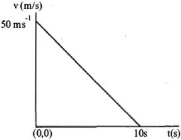
A
$-9300$
B
$12000$
C
$-4500$
D
$-12000$
Solution
(C) From the given velocity-time graph,the initial velocity at $t = 0$ is $u = 50\, m/s$ and the final velocity at $t = 10\, s$ is $v = 0\, m/s$.
The acceleration $a$ is the slope of the graph:
$a = \frac{v_f - v_i}{t_f - t_i} = \frac{0 - 50}{10 - 0} = -5\, m/s^2$.
The velocity at $t = 2\, s$ is given by $v(t) = u + at$:
$v(2) = 50 + (-5)(2) = 50 - 10 = 40\, m/s$.
According to the work-energy theorem,the work done $W$ is equal to the change in kinetic energy $\Delta K.E.$:
$W = \Delta K.E. = \frac{1}{2} m (v_f^2 - v_i^2)$
$W = \frac{1}{2} \times 10\, kg \times ((40\, m/s)^2 - (50\, m/s)^2)$
$W = 5 \times (1600 - 2500)$
$W = 5 \times (-900) = -4500\, J$.
The acceleration $a$ is the slope of the graph:
$a = \frac{v_f - v_i}{t_f - t_i} = \frac{0 - 50}{10 - 0} = -5\, m/s^2$.
The velocity at $t = 2\, s$ is given by $v(t) = u + at$:
$v(2) = 50 + (-5)(2) = 50 - 10 = 40\, m/s$.
According to the work-energy theorem,the work done $W$ is equal to the change in kinetic energy $\Delta K.E.$:
$W = \Delta K.E. = \frac{1}{2} m (v_f^2 - v_i^2)$
$W = \frac{1}{2} \times 10\, kg \times ((40\, m/s)^2 - (50\, m/s)^2)$
$W = 5 \times (1600 - 2500)$
$W = 5 \times (-900) = -4500\, J$.
0 likes
View Solution80
DifficultMCQ
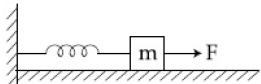
$A$ block of mass $m$,lying on a smooth horizontal surface,is attached to a spring (of negligible mass) of spring constant $k$. The other end of the spring is fixed,as shown in the figure. The block is initially at rest in an equilibrium position. If now the block is pulled with a constant force $F$,the maximum speed of the block is
A
$\frac{2F}{\sqrt{mk}}$
B
$\frac{F}{\pi\sqrt{mk}}$
C
$\frac{\pi F}{\sqrt{mk}}$
D
$\frac{F}{\sqrt{mk}}$
Solution
(D) The block reaches its maximum speed when its acceleration becomes zero.
At this point,the spring force balances the applied force $F$,so $kx = F$,which gives $x = \frac{F}{k}$.
Applying the work-energy theorem,the total work done on the block equals the change in its kinetic energy:
$W_{\text{spring}} + W_F = \Delta K.E.$
$-\frac{1}{2}kx^2 + Fx = \frac{1}{2}mv_{\max}^2$
Substituting $x = \frac{F}{k}$ into the equation:
$-\frac{1}{2}k\left(\frac{F}{k}\right)^2 + F\left(\frac{F}{k}\right) = \frac{1}{2}mv_{\max}^2$
$-\frac{F^2}{2k} + \frac{F^2}{k} = \frac{1}{2}mv_{\max}^2$
$\frac{F^2}{2k} = \frac{1}{2}mv_{\max}^2$
$v_{\max}^2 = \frac{F^2}{mk}$
$v_{\max} = \frac{F}{\sqrt{mk}}$
At this point,the spring force balances the applied force $F$,so $kx = F$,which gives $x = \frac{F}{k}$.
Applying the work-energy theorem,the total work done on the block equals the change in its kinetic energy:
$W_{\text{spring}} + W_F = \Delta K.E.$
$-\frac{1}{2}kx^2 + Fx = \frac{1}{2}mv_{\max}^2$
Substituting $x = \frac{F}{k}$ into the equation:
$-\frac{1}{2}k\left(\frac{F}{k}\right)^2 + F\left(\frac{F}{k}\right) = \frac{1}{2}mv_{\max}^2$
$-\frac{F^2}{2k} + \frac{F^2}{k} = \frac{1}{2}mv_{\max}^2$
$\frac{F^2}{2k} = \frac{1}{2}mv_{\max}^2$
$v_{\max}^2 = \frac{F^2}{mk}$
$v_{\max} = \frac{F}{\sqrt{mk}}$
0 likes
View Solution81
MediumMCQ
$A$ force acts on a $2\,kg$ object so that its position is given as a function of time as $x = 3t^2 + 5$. What is the work done by this force in the first $5\,seconds$? ................ $J$
A
$850$
B
$950$
C
$875$
D
$900$
Solution
(D) Given: Mass $m = 2\,kg$, Position $x = 3t^2 + 5$.
First, find the velocity $v$ by differentiating position with respect to time: $v = \frac{dx}{dt} = \frac{d}{dt}(3t^2 + 5) = 6t\,m/s$.
At $t = 0\,s$, velocity $v_i = 6(0) = 0\,m/s$.
At $t = 5\,s$, velocity $v_f = 6(5) = 30\,m/s$.
According to the Work-Energy Theorem, the work done $W$ is equal to the change in kinetic energy $\Delta K$: $W = \Delta K = K_f - K_i$.
$W = \frac{1}{2}mv_f^2 - \frac{1}{2}mv_i^2$.
$W = \frac{1}{2}(2)(30)^2 - \frac{1}{2}(2)(0)^2$.
$W = 900 - 0 = 900\,J$.
First, find the velocity $v$ by differentiating position with respect to time: $v = \frac{dx}{dt} = \frac{d}{dt}(3t^2 + 5) = 6t\,m/s$.
At $t = 0\,s$, velocity $v_i = 6(0) = 0\,m/s$.
At $t = 5\,s$, velocity $v_f = 6(5) = 30\,m/s$.
According to the Work-Energy Theorem, the work done $W$ is equal to the change in kinetic energy $\Delta K$: $W = \Delta K = K_f - K_i$.
$W = \frac{1}{2}mv_f^2 - \frac{1}{2}mv_i^2$.
$W = \frac{1}{2}(2)(30)^2 - \frac{1}{2}(2)(0)^2$.
$W = 900 - 0 = 900\,J$.
0 likes
View Solution82
MediumMCQ
$A$ particle which is experiencing a force,given by $\vec F = 3\hat i - 12\hat j$,undergoes a displacement of $\vec d = 4\hat i$. If the particle had a kinetic energy of $3\, J$ at the beginning of the displacement,what is its kinetic energy (in $J$) at the end of the displacement?
A
$9$
B
$12$
C
$10$
D
$15$
Solution
(D) According to the Work-Energy Theorem,the work done by the net force on a particle is equal to the change in its kinetic energy.
$W = \Delta K.E. = K.E._{final} - K.E._{initial}$
Given:
Force $\vec F = 3\hat i - 12\hat j$
Displacement $\vec d = 4\hat i$
Initial Kinetic Energy $K.E._{initial} = 3\, J$
Work done $W = \vec F \cdot \vec d = (3\hat i - 12\hat j) \cdot (4\hat i) = (3 \times 4) + (-12 \times 0) = 12\, J$
Using the theorem:
$12 = K.E._{final} - 3$
$K.E._{final} = 12 + 3 = 15\, J$
$W = \Delta K.E. = K.E._{final} - K.E._{initial}$
Given:
Force $\vec F = 3\hat i - 12\hat j$
Displacement $\vec d = 4\hat i$
Initial Kinetic Energy $K.E._{initial} = 3\, J$
Work done $W = \vec F \cdot \vec d = (3\hat i - 12\hat j) \cdot (4\hat i) = (3 \times 4) + (-12 \times 0) = 12\, J$
Using the theorem:
$12 = K.E._{final} - 3$
$K.E._{final} = 12 + 3 = 15\, J$
0 likes
View Solution83
MediumMCQ
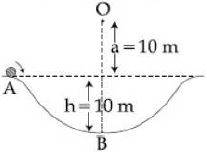
$A$ particle of mass $20\,g$ is released with an initial velocity $5\,m/s$ along the curve from the point $A,$ as shown in the figure. The point $A$ is at height $h = 10\,m$ from point $B.$ The particle slides along the frictionless surface. When the particle reaches point $B,$ its angular momentum about $O$ will be ......... $kg \cdot m^2/s$. [Take $g = 10\,m/s^2$]
A
$2$
B
$8$
C
$6$
D
$3$
Solution
(D) Using the law of conservation of energy between point $A$ and point $B$:
$E_A = E_B$
$\frac{1}{2}mv_A^2 + mgh = \frac{1}{2}mv_B^2$
$v_B = \sqrt{v_A^2 + 2gh}$
Given $v_A = 5\,m/s$,$g = 10\,m/s^2$,and $h = 10\,m$:
$v_B = \sqrt{5^2 + 2 \times 10 \times 10} = \sqrt{25 + 200} = \sqrt{225} = 15\,m/s$
At point $B$,the particle is at a distance $r = a = 10\,m$ from point $O$. The velocity vector at $B$ is perpendicular to the radius $OB$.
The angular momentum $L$ about $O$ is given by:
$L = m \cdot v_B \cdot r$
$L = (20 \times 10^{-3}\,kg) \times (15\,m/s) \times (10\,m)$
$L = 0.02 \times 150 = 3\,kg \cdot m^2/s$.
$E_A = E_B$
$\frac{1}{2}mv_A^2 + mgh = \frac{1}{2}mv_B^2$
$v_B = \sqrt{v_A^2 + 2gh}$
Given $v_A = 5\,m/s$,$g = 10\,m/s^2$,and $h = 10\,m$:
$v_B = \sqrt{5^2 + 2 \times 10 \times 10} = \sqrt{25 + 200} = \sqrt{225} = 15\,m/s$
At point $B$,the particle is at a distance $r = a = 10\,m$ from point $O$. The velocity vector at $B$ is perpendicular to the radius $OB$.
The angular momentum $L$ about $O$ is given by:
$L = m \cdot v_B \cdot r$
$L = (20 \times 10^{-3}\,kg) \times (15\,m/s) \times (10\,m)$
$L = 0.02 \times 150 = 3\,kg \cdot m^2/s$.
0 likes
View Solution84
MediumMCQ
$A$ bullet of mass $20\,g$ has an initial speed of $1\,ms^{-1}$ just before it starts penetrating a mud wall of thickness $20\,cm.$ If the wall offers a mean resistance of $2.5 \times 10^{-2}\,N,$ the speed of the bullet after emerging from the other side of the wall is close to .............. $ms^{-1}$
A
$0.7$
B
$0.3$
C
$0.1$
D
$0.4$
Solution
(A) Given:
Mass of the bullet,$m = 20\,g = 20 \times 10^{-3}\,kg = 0.02\,kg$
Initial velocity,$u = 1\,ms^{-1}$
Thickness of the wall,$s = 20\,cm = 0.2\,m$
Mean resistance force,$F = 2.5 \times 10^{-2}\,N$
According to the Work-Energy Theorem,the work done by the resistive force is equal to the change in kinetic energy:
$W = \Delta K$
$-F \times s = \frac{1}{2}m(v^2 - u^2)$
Substituting the values:
$-(2.5 \times 10^{-2}) \times 0.2 = \frac{1}{2} \times (20 \times 10^{-3}) \times (v^2 - 1^2)$
$-0.5 \times 10^{-2} = 10 \times 10^{-3} \times (v^2 - 1)$
$-0.005 = 0.01 \times (v^2 - 1)$
$-0.5 = v^2 - 1$
$v^2 = 1 - 0.5 = 0.5$
$v = \sqrt{0.5} \approx 0.707\,ms^{-1}$
Thus,the speed is close to $0.7\,ms^{-1}$.
Mass of the bullet,$m = 20\,g = 20 \times 10^{-3}\,kg = 0.02\,kg$
Initial velocity,$u = 1\,ms^{-1}$
Thickness of the wall,$s = 20\,cm = 0.2\,m$
Mean resistance force,$F = 2.5 \times 10^{-2}\,N$
According to the Work-Energy Theorem,the work done by the resistive force is equal to the change in kinetic energy:
$W = \Delta K$
$-F \times s = \frac{1}{2}m(v^2 - u^2)$
Substituting the values:
$-(2.5 \times 10^{-2}) \times 0.2 = \frac{1}{2} \times (20 \times 10^{-3}) \times (v^2 - 1^2)$
$-0.5 \times 10^{-2} = 10 \times 10^{-3} \times (v^2 - 1)$
$-0.005 = 0.01 \times (v^2 - 1)$
$-0.5 = v^2 - 1$
$v^2 = 1 - 0.5 = 0.5$
$v = \sqrt{0.5} \approx 0.707\,ms^{-1}$
Thus,the speed is close to $0.7\,ms^{-1}$.
0 likes
View Solution85
MediumMCQ
$A$ child is swinging on a swing. The minimum and maximum heights of the swing from the earth's surface are $0.75\,m$ and $2\,m$ respectively. The maximum velocity of this swing is ............. $m/s$.
A
$5$
B
$10$
C
$15$
D
$20$
Solution
(A) According to the law of conservation of mechanical energy,the loss in potential energy is equal to the gain in kinetic energy at the lowest point.
Let $m$ be the mass of the child,$g$ be the acceleration due to gravity $(g = 10\,m/s^2)$,$h_{max} = 2\,m$,and $h_{min} = 0.75\,m$.
Loss in potential energy = $mg(h_{max} - h_{min})$
Gain in kinetic energy = $\frac{1}{2}mv^2$
Equating the two:
$mg(2 - 0.75) = \frac{1}{2}mv^2$
$g(1.25) = \frac{1}{2}v^2$
$v^2 = 2 \times 10 \times 1.25$
$v^2 = 25$
$v = 5\,m/s$.
Let $m$ be the mass of the child,$g$ be the acceleration due to gravity $(g = 10\,m/s^2)$,$h_{max} = 2\,m$,and $h_{min} = 0.75\,m$.
Loss in potential energy = $mg(h_{max} - h_{min})$
Gain in kinetic energy = $\frac{1}{2}mv^2$
Equating the two:
$mg(2 - 0.75) = \frac{1}{2}mv^2$
$g(1.25) = \frac{1}{2}v^2$
$v^2 = 2 \times 10 \times 1.25$
$v^2 = 25$
$v = 5\,m/s$.
0 likes
View Solution86
EasyMCQ
The work-energy theorem is valid in the presence of:
A
external forces
B
conservative forces
C
non-conservative forces
D
all types of forces
Solution
(D) The work-energy theorem states that the net work done on an object by all forces (external,internal,conservative,and non-conservative) is equal to the change in its kinetic energy,i.e.,$W_{net} = \Delta K$.
This theorem is derived from Newton's second law of motion and is a fundamental principle in mechanics.
It does not depend on the nature of the forces involved,whether they are conservative or non-conservative.
Therefore,the work-energy theorem is valid in the presence of all types of forces.
This theorem is derived from Newton's second law of motion and is a fundamental principle in mechanics.
It does not depend on the nature of the forces involved,whether they are conservative or non-conservative.
Therefore,the work-energy theorem is valid in the presence of all types of forces.
0 likes
View Solution87
DifficultMCQ
$A$ uniform flexible chain of mass $m$ and length $2l$ hangs in equilibrium over a smooth horizontal pin of negligible diameter. One end of the chain is given a small vertical displacement so that the chain slips over the pin. The speed of the chain when it leaves the pin is
A
$\sqrt{2gl}$
B
$\sqrt{gl}$
C
$\sqrt{4gl}$
D
$\sqrt{3gl}$
Solution
(B) Let the chain have mass $m$ and length $2l$. Initially,it hangs symmetrically over the pin,so $l$ length is on each side. The center of mass of each half is at a distance $l/2$ below the pin.
When the chain is displaced,let it slip by a distance $x$. The new lengths on the two sides are $(l+x)$ and $(l-x)$.
Using the Conservation of Mechanical Energy $(COME)$: The decrease in Potential Energy $(P.E.)$ equals the increase in Kinetic Energy $(K.E.)$.
Initially,the center of mass of each half is at $h_i = -l/2$ relative to the pin. Total $P.E._i = 2 \times (m/2)g(-l/2) = -mgl/2$.
Finally,when the chain leaves the pin,one end is at $2l$ and the other is at $0$. The center of mass is at $h_f = -l$. Total $P.E._f = mg(-l) = -mgl$.
Change in $P.E. = P.E._i - P.E._f = (-mgl/2) - (-mgl) = mgl/2$.
Equating to $K.E. = \frac{1}{2}mv^2$,we get $\frac{1}{2}mv^2 = mgl/2$,which simplifies to $v = \sqrt{gl}$.
When the chain is displaced,let it slip by a distance $x$. The new lengths on the two sides are $(l+x)$ and $(l-x)$.
Using the Conservation of Mechanical Energy $(COME)$: The decrease in Potential Energy $(P.E.)$ equals the increase in Kinetic Energy $(K.E.)$.
Initially,the center of mass of each half is at $h_i = -l/2$ relative to the pin. Total $P.E._i = 2 \times (m/2)g(-l/2) = -mgl/2$.
Finally,when the chain leaves the pin,one end is at $2l$ and the other is at $0$. The center of mass is at $h_f = -l$. Total $P.E._f = mg(-l) = -mgl$.
Change in $P.E. = P.E._i - P.E._f = (-mgl/2) - (-mgl) = mgl/2$.
Equating to $K.E. = \frac{1}{2}mv^2$,we get $\frac{1}{2}mv^2 = mgl/2$,which simplifies to $v = \sqrt{gl}$.
0 likes
View Solution88
EasyMCQ
When work is done on a body by an external force,its
A
Only kinetic energy increases
B
Only potential energy increases
C
Both kinetic and potential energies may increase
D
Sum of kinetic and potential energies remains constant
Solution
(C) According to the Work-Energy Theorem,the work done by an external force on a body is equal to the change in its kinetic energy $(W = \Delta K)$.
Additionally,work done by an external force can also change the potential energy of a system (e.g.,lifting an object against gravity).
Therefore,depending on the nature of the force and the system,an external force can increase the kinetic energy,the potential energy,or both simultaneously.
Thus,the correct statement is that both kinetic and potential energies may increase.
Additionally,work done by an external force can also change the potential energy of a system (e.g.,lifting an object against gravity).
Therefore,depending on the nature of the force and the system,an external force can increase the kinetic energy,the potential energy,or both simultaneously.
Thus,the correct statement is that both kinetic and potential energies may increase.
0 likes
View Solution89
DifficultMCQ
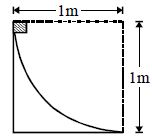
$A$ body of mass $2 \, kg$ slides down a curved track which is a quadrant of a circle of radius $1 \, m$ as shown in the figure. All the surfaces are frictionless. If the body starts from rest,its speed at the bottom of the track is ............. $m/s$.
A
$4.43$
B
$2$
C
$0.5$
D
$19.6$
Solution
(A) According to the law of conservation of mechanical energy,the potential energy lost by the body is equal to the kinetic energy gained by it.
Let $m$ be the mass of the body,$g$ be the acceleration due to gravity,$h$ be the height,and $v$ be the final velocity.
Potential Energy lost = $mgh$
Kinetic Energy gained = $\frac{1}{2}mv^2$
Equating the two: $mgh = \frac{1}{2}mv^2$
$v^2 = 2gh$
Given $h = 1 \, m$ and $g = 9.8 \, m/s^2$:
$v = \sqrt{2 \times 9.8 \times 1} = \sqrt{19.6} \approx 4.43 \, m/s$.
Let $m$ be the mass of the body,$g$ be the acceleration due to gravity,$h$ be the height,and $v$ be the final velocity.
Potential Energy lost = $mgh$
Kinetic Energy gained = $\frac{1}{2}mv^2$
Equating the two: $mgh = \frac{1}{2}mv^2$
$v^2 = 2gh$
Given $h = 1 \, m$ and $g = 9.8 \, m/s^2$:
$v = \sqrt{2 \times 9.8 \times 1} = \sqrt{19.6} \approx 4.43 \, m/s$.
0 likes
View Solution90
MediumMCQ
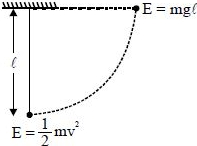
$A$ sphere is suspended by a thread of length $\ell$. What minimum horizontal velocity has to be imparted to the sphere for it to reach the height of the suspension point?
A
$g\ell$
B
$2g\ell$
C
$\sqrt{g\ell}$
D
$\sqrt{2g\ell}$
Solution
(D) To reach the height of the suspension point,the sphere must gain a potential energy equal to the work done against gravity.
Let the mass of the sphere be $m$ and the initial velocity be $v$.
At the lowest point,the kinetic energy is $K.E. = \frac{1}{2}mv^2$.
At the height of the suspension point,the potential energy is $P.E. = mg\ell$.
By the law of conservation of mechanical energy:
$\frac{1}{2}mv^2 = mg\ell$
$v^2 = 2g\ell$
$v = \sqrt{2g\ell}$
Let the mass of the sphere be $m$ and the initial velocity be $v$.
At the lowest point,the kinetic energy is $K.E. = \frac{1}{2}mv^2$.
At the height of the suspension point,the potential energy is $P.E. = mg\ell$.
By the law of conservation of mechanical energy:
$\frac{1}{2}mv^2 = mg\ell$
$v^2 = 2g\ell$
$v = \sqrt{2g\ell}$
0 likes
View Solution91
MediumMCQ
$A$ bullet of mass $25\,g$ moving with a velocity of $200\,m/s$ is stopped within $5\,cm$ of the target. The average resistance offered by the target is ............... $kN$.
A
$10$
B
$20$
C
$30$
D
$40$
Solution
(A) According to the Work-Energy Theorem,the work done by the resistive force is equal to the change in kinetic energy of the bullet.
$W = \Delta K$
$F \cdot s = \frac{1}{2} m u^2$
Given:
Mass $m = 25\,g = 25 \times 10^{-3}\,kg$
Velocity $u = 200\,m/s$
Distance $s = 5\,cm = 5 \times 10^{-2}\,m$
Substituting the values:
$F = \frac{m u^2}{2 s} = \frac{25 \times 10^{-3} \times (200)^2}{2 \times 5 \times 10^{-2}}$
$F = \frac{25 \times 10^{-3} \times 40000}{10 \times 10^{-2}}$
$F = \frac{1000}{0.1} = 10000\,N$
$F = 10\,kN$.
$W = \Delta K$
$F \cdot s = \frac{1}{2} m u^2$
Given:
Mass $m = 25\,g = 25 \times 10^{-3}\,kg$
Velocity $u = 200\,m/s$
Distance $s = 5\,cm = 5 \times 10^{-2}\,m$
Substituting the values:
$F = \frac{m u^2}{2 s} = \frac{25 \times 10^{-3} \times (200)^2}{2 \times 5 \times 10^{-2}}$
$F = \frac{25 \times 10^{-3} \times 40000}{10 \times 10^{-2}}$
$F = \frac{1000}{0.1} = 10000\,N$
$F = 10\,kN$.
0 likes
View Solution92
MediumMCQ
Work equal to $25\,J$ is done on a mass of $2\,kg$ to set it in motion. If the whole of it is used to increase the kinetic energy,then the velocity acquired by the mass is ............ $m/s$.
A
$5$
B
$12.5$
C
$25$
D
$50$
Solution
(A) According to the work-energy theorem,the work done on an object is equal to the change in its kinetic energy.
$W = \Delta K$
Given that the initial kinetic energy is zero,the work done is equal to the final kinetic energy:
$W = \frac{1}{2}mv^2$
Substituting the given values ($W = 25\,J$,$m = 2\,kg$):
$25 = \frac{1}{2} \times 2 \times v^2$
$25 = v^2$
$v = \sqrt{25} = 5\,m/s$
Therefore,the velocity acquired by the mass is $5\,m/s$.
$W = \Delta K$
Given that the initial kinetic energy is zero,the work done is equal to the final kinetic energy:
$W = \frac{1}{2}mv^2$
Substituting the given values ($W = 25\,J$,$m = 2\,kg$):
$25 = \frac{1}{2} \times 2 \times v^2$
$25 = v^2$
$v = \sqrt{25} = 5\,m/s$
Therefore,the velocity acquired by the mass is $5\,m/s$.
0 likes
View Solution93
MediumMCQ
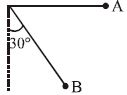
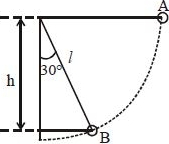
$A$ simple pendulum is released from point $A$ as shown in the figure. If $m$ and $l$ represent the mass of the bob and the length of the pendulum respectively,the gain in kinetic energy at point $B$ is:
A
$\frac{mgl}{2}$
B
$\frac{mgl}{\sqrt{2}}$
C
$\frac{\sqrt{3}}{2}mgl$
D
$\frac{2}{\sqrt{3}}mgl$
Solution
(A) Let the point of suspension be $O$. The pendulum is released from $A$,where the string is horizontal. The vertical distance of $A$ from $O$ is $0$.
At point $B$,the string makes an angle of $30^{\circ}$ with the vertical. The vertical distance of $B$ below the point of suspension $O$ is $h' = l \cos 30^{\circ} = l \frac{\sqrt{3}}{2}$.
The vertical distance of $A$ below the point of suspension $O$ is $0$. Therefore,the vertical distance of $A$ above $B$ is $h = l - h' = l - l \cos 30^{\circ} = l(1 - \frac{\sqrt{3}}{2})$.
By the law of conservation of mechanical energy,the gain in kinetic energy at $B$ is equal to the loss in potential energy as the bob moves from $A$ to $B$.
Loss in potential energy $= mg h = mg l(1 - \cos 30^{\circ}) = mgl(1 - \frac{\sqrt{3}}{2})$.
Wait,looking at the provided image,$h$ is defined as the vertical distance from the horizontal level of $A$ to the level of $B$. The vertical distance of $B$ from the horizontal level of $A$ is $h = l \sin 30^{\circ} = l/2$.
Loss in potential energy $= mgh = mg(l \sin 30^{\circ}) = mg(l/2) = \frac{mgl}{2}$.
Therefore,the gain in kinetic energy at $B$ is $\frac{mgl}{2}$.
At point $B$,the string makes an angle of $30^{\circ}$ with the vertical. The vertical distance of $B$ below the point of suspension $O$ is $h' = l \cos 30^{\circ} = l \frac{\sqrt{3}}{2}$.
The vertical distance of $A$ below the point of suspension $O$ is $0$. Therefore,the vertical distance of $A$ above $B$ is $h = l - h' = l - l \cos 30^{\circ} = l(1 - \frac{\sqrt{3}}{2})$.
By the law of conservation of mechanical energy,the gain in kinetic energy at $B$ is equal to the loss in potential energy as the bob moves from $A$ to $B$.
Loss in potential energy $= mg h = mg l(1 - \cos 30^{\circ}) = mgl(1 - \frac{\sqrt{3}}{2})$.
Wait,looking at the provided image,$h$ is defined as the vertical distance from the horizontal level of $A$ to the level of $B$. The vertical distance of $B$ from the horizontal level of $A$ is $h = l \sin 30^{\circ} = l/2$.
Loss in potential energy $= mgh = mg(l \sin 30^{\circ}) = mg(l/2) = \frac{mgl}{2}$.
Therefore,the gain in kinetic energy at $B$ is $\frac{mgl}{2}$.
0 likes
View Solution94
EasyMCQ
Select the incorrect statement regarding the mechanical energy of a body/system.
A
It is the sum of kinetic and potential energy.
B
It may be conserved even if a non-conservative force acts on the body/system.
C
Work done by a conservative force is always equal to the negative of the change in mechanical energy.
D
Both $(A)$ and $(B)$.
Solution
(C) Mechanical energy $E$ is defined as the sum of kinetic energy $K$ and potential energy $U$,so $E = K + U$. Thus,statement $(A)$ is correct.
Mechanical energy is conserved only when only conservative forces do work. If a non-conservative force (like friction) acts on the system,it typically changes the mechanical energy (often dissipating it as heat). Therefore,statement $(B)$ is incorrect.
The work done by a conservative force $W_c$ is equal to the negative change in potential energy,i.e.,$W_c = -\Delta U$. Since $\Delta E = \Delta K + \Delta U$,if only conservative forces act,$\Delta E = 0$. Statement $(C)$ claims $W_c = -\Delta E$,which is only true if $\Delta K = 0$. In general,$W_c = -\Delta U$,not $-\Delta E$. Thus,statement $(C)$ is also incorrect.
Since both $(B)$ and $(C)$ are incorrect,and the question asks for the incorrect statement,there is an ambiguity in the provided options. However,based on standard physics definitions,$(C)$ is fundamentally incorrect as a general principle.
Mechanical energy is conserved only when only conservative forces do work. If a non-conservative force (like friction) acts on the system,it typically changes the mechanical energy (often dissipating it as heat). Therefore,statement $(B)$ is incorrect.
The work done by a conservative force $W_c$ is equal to the negative change in potential energy,i.e.,$W_c = -\Delta U$. Since $\Delta E = \Delta K + \Delta U$,if only conservative forces act,$\Delta E = 0$. Statement $(C)$ claims $W_c = -\Delta E$,which is only true if $\Delta K = 0$. In general,$W_c = -\Delta U$,not $-\Delta E$. Thus,statement $(C)$ is also incorrect.
Since both $(B)$ and $(C)$ are incorrect,and the question asks for the incorrect statement,there is an ambiguity in the provided options. However,based on standard physics definitions,$(C)$ is fundamentally incorrect as a general principle.
0 likes
View Solution95
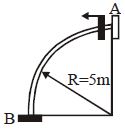
MediumMCQ
$A$ bead of mass $\frac{1}{2} \, kg$ starts from rest from point $A$ to move in a vertical plane along a smooth fixed quarter ring of radius $5 \, m$,under the action of a constant horizontal force $F = 5 \, N$ as shown. The speed of the bead as it reaches point $B$ is ................ $m/s$. [Take $g = 10 \, m/s^2$]
A
$14.14$
B
$7.07$
C
$5$
D
$25$
Solution
(A) According to the work-energy theorem,the total work done on the bead is equal to the change in its kinetic energy.
$W_{F} + W_{mg} + W_{N} = \Delta K$
Here,$W_{F}$ is the work done by the constant horizontal force $F$,$W_{mg}$ is the work done by gravity,and $W_{N}$ is the work done by the normal force.
Since the ring is smooth,the normal force $N$ is always perpendicular to the displacement,so $W_{N} = 0$.
The horizontal force $F$ acts in the direction of the horizontal displacement,which is $R = 5 \, m$. Thus,$W_{F} = F \times R = 5 \, N \times 5 \, m = 25 \, J$.
The bead moves from $A$ to $B$,which is a vertical downward displacement of $R = 5 \, m$. Thus,$W_{mg} = mgR = (\frac{1}{2} \, kg) \times (10 \, m/s^2) \times (5 \, m) = 25 \, J$.
The change in kinetic energy is $\Delta K = \frac{1}{2}mv^2 - 0 = \frac{1}{2} \times (\frac{1}{2} \, kg) \times v^2 = \frac{1}{4}v^2$.
Equating the work done to the change in kinetic energy:
$25 + 25 = \frac{1}{4}v^2$
$50 = \frac{1}{4}v^2$
$v^2 = 200$
$v = \sqrt{200} = 10\sqrt{2} \approx 14.14 \, m/s$.
$W_{F} + W_{mg} + W_{N} = \Delta K$
Here,$W_{F}$ is the work done by the constant horizontal force $F$,$W_{mg}$ is the work done by gravity,and $W_{N}$ is the work done by the normal force.
Since the ring is smooth,the normal force $N$ is always perpendicular to the displacement,so $W_{N} = 0$.
The horizontal force $F$ acts in the direction of the horizontal displacement,which is $R = 5 \, m$. Thus,$W_{F} = F \times R = 5 \, N \times 5 \, m = 25 \, J$.
The bead moves from $A$ to $B$,which is a vertical downward displacement of $R = 5 \, m$. Thus,$W_{mg} = mgR = (\frac{1}{2} \, kg) \times (10 \, m/s^2) \times (5 \, m) = 25 \, J$.
The change in kinetic energy is $\Delta K = \frac{1}{2}mv^2 - 0 = \frac{1}{2} \times (\frac{1}{2} \, kg) \times v^2 = \frac{1}{4}v^2$.
Equating the work done to the change in kinetic energy:
$25 + 25 = \frac{1}{4}v^2$
$50 = \frac{1}{4}v^2$
$v^2 = 200$
$v = \sqrt{200} = 10\sqrt{2} \approx 14.14 \, m/s$.
0 likes
View Solution96
MediumMCQ
$A$ uniform chain of mass $M$ and length $L$ is released from rest from a smooth horizontal surface as shown in the figure. The velocity of the chain at the instant it completely comes off the table will be:
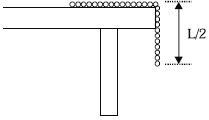
A
$V=\sqrt{gL}$
B
$V=\sqrt{\frac{3gL}{4}}$
C
$V=\frac{1}{2}\sqrt{5gL}$
D
$V=\frac{1}{2}\sqrt{gL}$
Solution
(B) Let the chain have mass $M$ and length $L$. Initially,a length $L/2$ hangs off the table. The mass of the hanging part is $M/2$. The center of mass of this hanging part is at a depth $L/4$ below the table surface. Taking the table surface as the reference level $(U=0)$,the initial potential energy is $U_i = -(M/2)g(L/4) = -MgL/8$.
When the chain completely leaves the table,its center of mass is at a depth $L/2$ below the table surface. The final potential energy is $U_f = -Mg(L/2) = -MgL/2$.
The initial kinetic energy is $K_i = 0$ (released from rest).
By the law of conservation of mechanical energy,$K_i + U_i = K_f + U_f$.
$0 - MgL/8 = (1/2)MV^2 - MgL/2$.
$(1/2)MV^2 = MgL/2 - MgL/8 = 3MgL/8$.
$V^2 = 3gL/4$.
$V = \sqrt{3gL/4}$.
When the chain completely leaves the table,its center of mass is at a depth $L/2$ below the table surface. The final potential energy is $U_f = -Mg(L/2) = -MgL/2$.
The initial kinetic energy is $K_i = 0$ (released from rest).
By the law of conservation of mechanical energy,$K_i + U_i = K_f + U_f$.
$0 - MgL/8 = (1/2)MV^2 - MgL/2$.
$(1/2)MV^2 = MgL/2 - MgL/8 = 3MgL/8$.
$V^2 = 3gL/4$.
$V = \sqrt{3gL/4}$.
0 likes
View Solution97
DifficultMCQ
$A$ particle is released from a height $H$. At a certain height $h$,its kinetic energy is two times its potential energy. The height $h$ and the speed $v$ of the particle at that instant are:
A
$\frac{H}{3}, \sqrt{\frac{2gH}{3}}$
B
$\frac{H}{3}, 2\sqrt{\frac{gH}{3}}$
C
$\frac{2H}{3}, \sqrt{\frac{2gH}{3}}$
D
$\frac{H}{3}, \sqrt{2gH}$
Solution
(B) Let the particle be at height $h$ from the ground. The distance fallen by the particle is $(H - h)$.
The potential energy at height $h$ is $PE = mgh$.
The kinetic energy at height $h$ is $KE = \frac{1}{2}mv^2$. Since the particle falls from rest,$v^2 = 2g(H - h)$,so $KE = mg(H - h)$.
According to the problem,$KE = 2PE$.
Substituting the expressions: $mg(H - h) = 2(mgh)$.
Dividing by $mg$: $H - h = 2h$,which gives $3h = H$,or $h = \frac{H}{3}$.
Now,calculate the speed $v$ at this height:
$v = \sqrt{2g(H - h)} = \sqrt{2g(H - \frac{H}{3})} = \sqrt{2g(\frac{2H}{3})} = \sqrt{\frac{4gH}{3}} = 2\sqrt{\frac{gH}{3}}$.
Thus,the height is $\frac{H}{3}$ and the speed is $2\sqrt{\frac{gH}{3}}$.
The potential energy at height $h$ is $PE = mgh$.
The kinetic energy at height $h$ is $KE = \frac{1}{2}mv^2$. Since the particle falls from rest,$v^2 = 2g(H - h)$,so $KE = mg(H - h)$.
According to the problem,$KE = 2PE$.
Substituting the expressions: $mg(H - h) = 2(mgh)$.
Dividing by $mg$: $H - h = 2h$,which gives $3h = H$,or $h = \frac{H}{3}$.
Now,calculate the speed $v$ at this height:
$v = \sqrt{2g(H - h)} = \sqrt{2g(H - \frac{H}{3})} = \sqrt{2g(\frac{2H}{3})} = \sqrt{\frac{4gH}{3}} = 2\sqrt{\frac{gH}{3}}$.
Thus,the height is $\frac{H}{3}$ and the speed is $2\sqrt{\frac{gH}{3}}$.

0 likes
View Solution98
MediumMCQ
The figure shows the vertical section of a frictionless surface. $A$ block of mass $2\, kg$ is released from position $A$. Its kinetic energy $(KE)$ as it reaches position $C$ is .............. $J$.
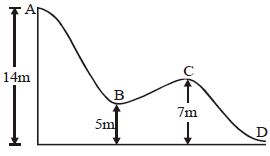
A
$180$
B
$140$
C
$40$
D
$280$
Solution
(B) According to the law of conservation of mechanical energy,since the surface is frictionless,the total mechanical energy remains constant.
The total energy at position $A$ is equal to the total energy at position $C$.
$E_A = E_C$
At position $A$,the block is released from rest,so its kinetic energy $K_A = 0$. The potential energy is $U_A = mgh_A$,where $h_A = 14\, m$.
At position $C$,the kinetic energy is $K_C$ and the potential energy is $U_C = mgh_C$,where $h_C = 7\, m$.
$0 + mgh_A = K_C + mgh_C$
$K_C = mg(h_A - h_C)$
Given:
$m = 2\, kg$
$g = 10\, m/s^2$
$h_A = 14\, m$
$h_C = 7\, m$
$K_C = 2 \times 10 \times (14 - 7)$
$K_C = 20 \times 7$
$K_C = 140\, J$
The total energy at position $A$ is equal to the total energy at position $C$.
$E_A = E_C$
At position $A$,the block is released from rest,so its kinetic energy $K_A = 0$. The potential energy is $U_A = mgh_A$,where $h_A = 14\, m$.
At position $C$,the kinetic energy is $K_C$ and the potential energy is $U_C = mgh_C$,where $h_C = 7\, m$.
$0 + mgh_A = K_C + mgh_C$
$K_C = mg(h_A - h_C)$
Given:
$m = 2\, kg$
$g = 10\, m/s^2$
$h_A = 14\, m$
$h_C = 7\, m$
$K_C = 2 \times 10 \times (14 - 7)$
$K_C = 20 \times 7$
$K_C = 140\, J$
0 likes
View Solution99
DifficultMCQ
The system shown in the figure is released from rest. The pulley and spring are massless,and friction is absent everywhere. The speed of the $5 \, kg$ block when the $2 \, kg$ block leaves contact with the ground is (take the force constant of the spring $k = 40 \, N/m$ and $g = 10 \, m/s^2$):
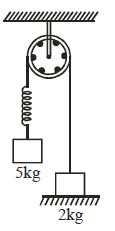
A
$\sqrt{2} \, m/s$
B
$2\sqrt{2} \, m/s$
C
$2 \, m/s$
D
$4\sqrt{2} \, m/s$
Solution
(B) Let $x$ be the extension in the spring when the $2 \, kg$ block leaves contact with the ground. At this instant,the tension in the string equals the weight of the $2 \, kg$ block.
$kx = m_2 g$
$x = \frac{m_2 g}{k} = \frac{2 \times 10}{40} = 0.5 \, m$
Now,apply the principle of conservation of mechanical energy for the $5 \, kg$ block as it moves down by a distance $x = 0.5 \, m$:
Loss in gravitational potential energy = Gain in spring potential energy + Gain in kinetic energy
$m_1 g x = \frac{1}{2} k x^2 + \frac{1}{2} m_1 v^2$
$5 \times 10 \times 0.5 = \frac{1}{2} \times 40 \times (0.5)^2 + \frac{1}{2} \times 5 \times v^2$
$25 = 20 \times 0.25 + 2.5 v^2$
$25 = 5 + 2.5 v^2$
$20 = 2.5 v^2$
$v^2 = \frac{20}{2.5} = 8$
$v = \sqrt{8} = 2\sqrt{2} \, m/s$
$kx = m_2 g$
$x = \frac{m_2 g}{k} = \frac{2 \times 10}{40} = 0.5 \, m$
Now,apply the principle of conservation of mechanical energy for the $5 \, kg$ block as it moves down by a distance $x = 0.5 \, m$:
Loss in gravitational potential energy = Gain in spring potential energy + Gain in kinetic energy
$m_1 g x = \frac{1}{2} k x^2 + \frac{1}{2} m_1 v^2$
$5 \times 10 \times 0.5 = \frac{1}{2} \times 40 \times (0.5)^2 + \frac{1}{2} \times 5 \times v^2$
$25 = 20 \times 0.25 + 2.5 v^2$
$25 = 5 + 2.5 v^2$
$20 = 2.5 v^2$
$v^2 = \frac{20}{2.5} = 8$
$v = \sqrt{8} = 2\sqrt{2} \, m/s$
0 likes
View SolutionWork, Energy, Power and Collision — Work Energy Theorem and Conservation of Mechanical Energy · Frequently Asked Questions
1Are these Work, Energy, Power and Collision questions useful for JEE and NEET?
Yes. All questions in this section are mapped to JEE Main and NEET exam patterns. Previous year questions from JEE Main, NEET, GUJCET and state-level exams are included with full solutions.
2Can I switch to Hindi or Gujarati for these questions?
Yes. Use the language tabs in the hero section or the sidebar to view the same questions and solutions in English, Hindi or Gujarati.
3How do I generate a question paper from this subtopic?
Use the Vedclass Exam Paper Generator — select the chapter and subtopic, set difficulty, and generate Sets A, B, C, D automatically. First 3 chapters of every subject are free.
Vedclass Products
For Students
Vedclass Test Series
Mock tests in real JEE/NEET style with performance analysis. 5-day free trial.
Start Free TrialFor Teachers
Exam Paper Generator
Generate Set A/B/C/D papers from this chapter in 2 minutes. 3 chapters free.
Try FreeFor Institutes
Online Exam Module
Live online exams with unlimited students, 360° analytics & white-label branding.
See DemoFor Teachers & Institutes
Generate a Work, Energy, Power and Collision Exam Paper in 2 Minutes
Select subtopic & difficulty — Sets A, B, C, D auto-generated with No Repeat logic.
First 3 chapters of every subject are free — no payment required.