
A English
Kinetic Energy Questions in English
Class 11 Physics · Work, Energy, Power and Collision · Kinetic Energy
144+
Questions
English
Language
100%
With Solutions
Showing 49 of 144 questions in English
51
MediumMCQ
$A$ particle is initially at rest on a frictionless horizontal surface. $A$ force of constant magnitude and direction is applied to it. The graph shows the work done $(W)$ on the particle versus its speed $(v)$. If no other horizontal forces act on the particle,what should the graph look like?
A
B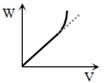
C
D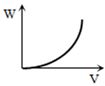
Solution
(D) According to the work-energy theorem,the work done $(W)$ on a particle is equal to the change in its kinetic energy $(K)$.
Since the particle starts from rest,the initial kinetic energy is $0$.
Therefore,$W = K = \frac{1}{2}mv^2$.
Here,$m$ is the mass of the particle,which is constant.
Thus,$W \propto v^2$.
This relationship represents a parabola opening upwards along the $W$-axis.
Comparing this with the given options,the graph in option $D$ represents a parabolic curve where $W$ increases with the square of $v$.
Since the particle starts from rest,the initial kinetic energy is $0$.
Therefore,$W = K = \frac{1}{2}mv^2$.
Here,$m$ is the mass of the particle,which is constant.
Thus,$W \propto v^2$.
This relationship represents a parabola opening upwards along the $W$-axis.
Comparing this with the given options,the graph in option $D$ represents a parabolic curve where $W$ increases with the square of $v$.
0 likes
View Solution52
EasyMCQ
$A$ light body and a heavy body have the same kinetic energy. Which one has a greater momentum?
A
The light body has greater momentum.
B
The heavy body has greater momentum.
C
Both have the same momentum.
D
More information is required to answer.
Solution
(B) The relationship between kinetic energy $(K)$ and momentum $(p)$ for a body of mass $(m)$ is given by $K = \frac{p^2}{2m}$.
Rearranging this,we get $p = \sqrt{2mK}$.
Since both bodies have the same kinetic energy $(K)$,the momentum $(p)$ is directly proportional to the square root of the mass $(p \propto \sqrt{m})$.
Because the heavy body has a larger mass $(m)$ compared to the light body,it will have a greater momentum $(p)$.
Rearranging this,we get $p = \sqrt{2mK}$.
Since both bodies have the same kinetic energy $(K)$,the momentum $(p)$ is directly proportional to the square root of the mass $(p \propto \sqrt{m})$.
Because the heavy body has a larger mass $(m)$ compared to the light body,it will have a greater momentum $(p)$.
0 likes
View Solution53
EasyMCQ
$A$ force of $10 \ N$ is applied on an object of mass $2 \ kg$ over a distance of $1 \ m$. What will be the kinetic energy gained by the object in $J$?
A
$20$
B
$10$
C
$5$
D
$2.5$
Solution
(B) According to the Work-Energy Theorem,the work done by the net force on an object is equal to the change in its kinetic energy.
Work done $(W)$ = Force $(F)$ $\times$ Displacement $(s)$.
Given: $F = 10 \ N$,$s = 1 \ m$.
$W = 10 \ N \times 1 \ m = 10 \ J$.
Since the object starts from rest (implied),the change in kinetic energy is equal to the work done.
Therefore,the kinetic energy gained = $10 \ J$.
Work done $(W)$ = Force $(F)$ $\times$ Displacement $(s)$.
Given: $F = 10 \ N$,$s = 1 \ m$.
$W = 10 \ N \times 1 \ m = 10 \ J$.
Since the object starts from rest (implied),the change in kinetic energy is equal to the work done.
Therefore,the kinetic energy gained = $10 \ J$.
0 likes
View Solution54
EasyMCQ
What is the kinetic energy of an object with a mass of $3 \ kg$ and a momentum of $2 \ Ns$?
A
$1 \ J$
B
$\frac{2}{3} \ J$
C
$\frac{3}{2} \ J$
D
$4 \ J$
Solution
(B) Given:
Mass,$m = 3 \ kg$
Momentum,$p = 2 \ Ns$
The relationship between kinetic energy $(K)$ and momentum $(p)$ is given by the formula:
$K = \frac{p^2}{2m}$
Substituting the given values:
$K = \frac{(2)^2}{2 \times 3}$
$K = \frac{4}{6}$
$K = \frac{2}{3} \ J$
Therefore,the kinetic energy of the object is $\frac{2}{3} \ J$.
Mass,$m = 3 \ kg$
Momentum,$p = 2 \ Ns$
The relationship between kinetic energy $(K)$ and momentum $(p)$ is given by the formula:
$K = \frac{p^2}{2m}$
Substituting the given values:
$K = \frac{(2)^2}{2 \times 3}$
$K = \frac{4}{6}$
$K = \frac{2}{3} \ J$
Therefore,the kinetic energy of the object is $\frac{2}{3} \ J$.
0 likes
View Solution55
MediumMCQ
Two bodies of masses $1 \ g$ and $4 \ g$ are moving with the same kinetic energy. What is the ratio of their linear momenta?
A
$4 : 1$
B
$\sqrt{2} : 1$
C
$1 : 2$
D
$1 : 16$
Solution
(C) The relationship between linear momentum $P$,mass $m$,and kinetic energy $E$ is given by $P = \sqrt{2mE}$.
Since the kinetic energy $E$ is the same for both bodies,we have $P \propto \sqrt{m}$.
Therefore,the ratio of their momenta is $\frac{P_1}{P_2} = \sqrt{\frac{m_1}{m_2}}$.
Given $m_1 = 1 \ g$ and $m_2 = 4 \ g$,we substitute these values:
$\frac{P_1}{P_2} = \sqrt{\frac{1}{4}} = \frac{1}{2}$.
Thus,the ratio of their linear momenta is $1 : 2$.
Since the kinetic energy $E$ is the same for both bodies,we have $P \propto \sqrt{m}$.
Therefore,the ratio of their momenta is $\frac{P_1}{P_2} = \sqrt{\frac{m_1}{m_2}}$.
Given $m_1 = 1 \ g$ and $m_2 = 4 \ g$,we substitute these values:
$\frac{P_1}{P_2} = \sqrt{\frac{1}{4}} = \frac{1}{2}$.
Thus,the ratio of their linear momenta is $1 : 2$.
0 likes
View Solution56
EasyMCQ
If the kinetic energy of an object becomes four times its initial value,what will be its new momentum?
A
Double its initial value
B
Three times its initial value
C
Four times its initial value
D
Remains constant
Solution
(A) The relationship between kinetic energy $(K)$ and momentum $(p)$ is given by $K = \frac{p^2}{2m}$,where $m$ is the mass of the object.
From this,we can write $p = \sqrt{2mK}$.
Let the initial kinetic energy be $K_1$ and the initial momentum be $p_1 = \sqrt{2mK_1}$.
Let the new kinetic energy be $K_2 = 4K_1$.
The new momentum $p_2$ is given by $p_2 = \sqrt{2mK_2} = \sqrt{2m(4K_1)}$.
$p_2 = \sqrt{4} \times \sqrt{2mK_1} = 2 \times p_1$.
Therefore,the new momentum is double its initial value.
From this,we can write $p = \sqrt{2mK}$.
Let the initial kinetic energy be $K_1$ and the initial momentum be $p_1 = \sqrt{2mK_1}$.
Let the new kinetic energy be $K_2 = 4K_1$.
The new momentum $p_2$ is given by $p_2 = \sqrt{2mK_2} = \sqrt{2m(4K_1)}$.
$p_2 = \sqrt{4} \times \sqrt{2mK_1} = 2 \times p_1$.
Therefore,the new momentum is double its initial value.
0 likes
View Solution57
DifficultMCQ
In the Olympic games,an athlete covers a distance of $100 \ m$ in $10 \ s$. The estimated range of their kinetic energy is:
A
$200 \ J - 500 \ J$
B
$2 \times 10^5 \ J - 3 \times 10^5 \ J$
C
$20,000 \ J - 50,000 \ J$
D
$2,000 \ J - 5,000 \ J$
Solution
(D) The average velocity is given by $\bar{v} = \frac{d}{t}$.
Given $d = 100 \ m$ and $t = 10 \ s$,we have $\bar{v} = \frac{100}{10} = 10 \ m/s$.
Assuming the mass of an athlete $(m)$ ranges from $50 \ kg$ to $100 \ kg$,we calculate the kinetic energy $(K = \frac{1}{2}mv^2)$:
For $m_1 = 50 \ kg$: $K_1 = \frac{1}{2} \times 50 \times (10)^2 = 25 \times 100 = 2,500 \ J$.
For $m_2 = 100 \ kg$: $K_2 = \frac{1}{2} \times 100 \times (10)^2 = 50 \times 100 = 5,000 \ J$.
Thus,the estimated range of kinetic energy is $2,000 \ J - 5,000 \ J$.
Given $d = 100 \ m$ and $t = 10 \ s$,we have $\bar{v} = \frac{100}{10} = 10 \ m/s$.
Assuming the mass of an athlete $(m)$ ranges from $50 \ kg$ to $100 \ kg$,we calculate the kinetic energy $(K = \frac{1}{2}mv^2)$:
For $m_1 = 50 \ kg$: $K_1 = \frac{1}{2} \times 50 \times (10)^2 = 25 \times 100 = 2,500 \ J$.
For $m_2 = 100 \ kg$: $K_2 = \frac{1}{2} \times 100 \times (10)^2 = 50 \times 100 = 5,000 \ J$.
Thus,the estimated range of kinetic energy is $2,000 \ J - 5,000 \ J$.
0 likes
View Solution58
DifficultMCQ
$A$ man increases his speed by $2 \ m/s$, and as a result, his kinetic energy doubles. What was his initial speed?
A
$(1 + 2\sqrt{2}) \ m/s$
B
$4 \ m/s$
C
$(2 + 2\sqrt{2}) \ m/s$
D
$(2 + \sqrt{2}) \ m/s$
Solution
(C) Let the initial speed be $u$ and the mass of the man be $m$.
The initial kinetic energy is $E_1 = \frac{1}{2}mu^2$.
The final speed is $(u + 2) \ m/s$.
The final kinetic energy is $E_2 = \frac{1}{2}m(u + 2)^2$.
Given that the kinetic energy doubles, $E_2 = 2E_1$.
Substituting the expressions: $\frac{1}{2}m(u + 2)^2 = 2 \times \frac{1}{2}mu^2$.
Simplifying: $(u + 2)^2 = 2u^2$.
Taking the square root on both sides: $u + 2 = \sqrt{2}u$.
Rearranging for $u$: $\sqrt{2}u - u = 2 \implies u(\sqrt{2} - 1) = 2$.
Solving for $u$: $u = \frac{2}{\sqrt{2} - 1}$.
Rationalizing the denominator: $u = \frac{2(\sqrt{2} + 1)}{(\sqrt{2} - 1)(\sqrt{2} + 1)} = \frac{2(\sqrt{2} + 1)}{2 - 1} = 2\sqrt{2} + 2 \ m/s$.
The initial kinetic energy is $E_1 = \frac{1}{2}mu^2$.
The final speed is $(u + 2) \ m/s$.
The final kinetic energy is $E_2 = \frac{1}{2}m(u + 2)^2$.
Given that the kinetic energy doubles, $E_2 = 2E_1$.
Substituting the expressions: $\frac{1}{2}m(u + 2)^2 = 2 \times \frac{1}{2}mu^2$.
Simplifying: $(u + 2)^2 = 2u^2$.
Taking the square root on both sides: $u + 2 = \sqrt{2}u$.
Rearranging for $u$: $\sqrt{2}u - u = 2 \implies u(\sqrt{2} - 1) = 2$.
Solving for $u$: $u = \frac{2}{\sqrt{2} - 1}$.
Rationalizing the denominator: $u = \frac{2(\sqrt{2} + 1)}{(\sqrt{2} - 1)(\sqrt{2} + 1)} = \frac{2(\sqrt{2} + 1)}{2 - 1} = 2\sqrt{2} + 2 \ m/s$.
0 likes
View Solution59
DifficultMCQ
When the speed of a vehicle increases by $2 \ m/s$,its kinetic energy doubles. What is the original speed of the vehicle?
A
$(\sqrt{2} + 1) \ m/s$
B
$\sqrt{2} \ m/s$
C
$2(\sqrt{2} + 1) \ m/s$
D
$\sqrt{2}(\sqrt{2} + 1) \ m/s$
Solution
(C) Let the original speed of the vehicle be $v$.
The kinetic energy $K_1 = \frac{1}{2}mv^2$.
When the speed increases by $2 \ m/s$,the new speed is $(v + 2) \ m/s$.
The new kinetic energy $K_2 = \frac{1}{2}m(v + 2)^2$.
According to the problem,$K_2 = 2K_1$.
Therefore,$\frac{1}{2}m(v + 2)^2 = 2 \times (\frac{1}{2}mv^2)$.
$(v + 2)^2 = 2v^2$.
Taking the square root on both sides: $v + 2 = \sqrt{2}v$.
Rearranging the terms: $2 = \sqrt{2}v - v = v(\sqrt{2} - 1)$.
$v = \frac{2}{\sqrt{2} - 1}$.
Rationalizing the denominator: $v = \frac{2(\sqrt{2} + 1)}{(\sqrt{2} - 1)(\sqrt{2} + 1)} = \frac{2(\sqrt{2} + 1)}{2 - 1} = 2(\sqrt{2} + 1) \ m/s$.
The kinetic energy $K_1 = \frac{1}{2}mv^2$.
When the speed increases by $2 \ m/s$,the new speed is $(v + 2) \ m/s$.
The new kinetic energy $K_2 = \frac{1}{2}m(v + 2)^2$.
According to the problem,$K_2 = 2K_1$.
Therefore,$\frac{1}{2}m(v + 2)^2 = 2 \times (\frac{1}{2}mv^2)$.
$(v + 2)^2 = 2v^2$.
Taking the square root on both sides: $v + 2 = \sqrt{2}v$.
Rearranging the terms: $2 = \sqrt{2}v - v = v(\sqrt{2} - 1)$.
$v = \frac{2}{\sqrt{2} - 1}$.
Rationalizing the denominator: $v = \frac{2(\sqrt{2} + 1)}{(\sqrt{2} - 1)(\sqrt{2} + 1)} = \frac{2(\sqrt{2} + 1)}{2 - 1} = 2(\sqrt{2} + 1) \ m/s$.
0 likes
View Solution60
MediumMCQ
The kinetic energy of a particle increases by $300\%$. The percentage increase in its momentum is ........ $\%$.
A
$100$
B
$120$
C
$150$
D
$200$
Solution
(A) The relation between kinetic energy $(KE)$ and momentum $(p)$ is given by $KE = \frac{p^2}{2m}$,which implies $p = \sqrt{2m \cdot KE}$.
Let the initial kinetic energy be $KE_1 = KE$ and the initial momentum be $p_1 = \sqrt{2m \cdot KE}$.
The kinetic energy increases by $300\%$,so the new kinetic energy is $KE_2 = KE + 300\% \text{ of } KE = KE + 3KE = 4KE$.
The new momentum is $p_2 = \sqrt{2m \cdot KE_2} = \sqrt{2m \cdot 4KE} = 2 \sqrt{2m \cdot KE} = 2p_1$.
The percentage increase in momentum is given by $\frac{p_2 - p_1}{p_1} \times 100\%$.
Substituting the values: $\frac{2p_1 - p_1}{p_1} \times 100\% = \frac{p_1}{p_1} \times 100\% = 100\%$.
Let the initial kinetic energy be $KE_1 = KE$ and the initial momentum be $p_1 = \sqrt{2m \cdot KE}$.
The kinetic energy increases by $300\%$,so the new kinetic energy is $KE_2 = KE + 300\% \text{ of } KE = KE + 3KE = 4KE$.
The new momentum is $p_2 = \sqrt{2m \cdot KE_2} = \sqrt{2m \cdot 4KE} = 2 \sqrt{2m \cdot KE} = 2p_1$.
The percentage increase in momentum is given by $\frac{p_2 - p_1}{p_1} \times 100\%$.
Substituting the values: $\frac{2p_1 - p_1}{p_1} \times 100\% = \frac{p_1}{p_1} \times 100\% = 100\%$.
0 likes
View Solution61
DifficultMCQ
If the momentum of an object is increased by $100\ \%$,then its kinetic energy increases by ......... $(\%)$ percent.
A
$150$
B
$200$
C
$300$
D
$400$
Solution
(C) The kinetic energy $E$ is related to momentum $p$ by the formula $E = \frac{p^2}{2m}$.
Let the initial momentum be $p_1 = p$ and the initial kinetic energy be $E_1 = \frac{p^2}{2m}$.
Given that the momentum increases by $100\ \%$,the new momentum $p_2 = p + 100\% \text{ of } p = p + p = 2p$.
The new kinetic energy $E_2 = \frac{p_2^2}{2m} = \frac{(2p)^2}{2m} = 4 \left( \frac{p^2}{2m} \right) = 4E_1$.
The percentage increase in kinetic energy is given by $\frac{E_2 - E_1}{E_1} \times 100\ \%$.
Substituting the values: $\frac{4E_1 - E_1}{E_1} \times 100\ \% = \frac{3E_1}{E_1} \times 100\ \% = 300\ \%$.
Let the initial momentum be $p_1 = p$ and the initial kinetic energy be $E_1 = \frac{p^2}{2m}$.
Given that the momentum increases by $100\ \%$,the new momentum $p_2 = p + 100\% \text{ of } p = p + p = 2p$.
The new kinetic energy $E_2 = \frac{p_2^2}{2m} = \frac{(2p)^2}{2m} = 4 \left( \frac{p^2}{2m} \right) = 4E_1$.
The percentage increase in kinetic energy is given by $\frac{E_2 - E_1}{E_1} \times 100\ \%$.
Substituting the values: $\frac{4E_1 - E_1}{E_1} \times 100\ \% = \frac{3E_1}{E_1} \times 100\ \% = 300\ \%$.
0 likes
View Solution62
MediumMCQ
$A$ particle of mass $m_1$ moves with velocity $v_1$ and another particle of mass $m_2$ moves with velocity $v_2$. Both have the same momentum,but their kinetic energies are $E_1$ and $E_2$ respectively. If $m_1 > m_2$,then:
A
$E_1 < E_2$
B
$\frac{E_1}{E_2} = \frac{m_1}{m_2}$
C
$E_1 > E_2$
D
$E_1 = E_2$
Solution
(A) The kinetic energy $E$ of a particle with momentum $p$ and mass $m$ is given by the relation $E = \frac{p^2}{2m}$.
Since the momentum $p$ is constant for both particles,we have $E \propto \frac{1}{m}$.
Given that $m_1 > m_2$,it follows that the kinetic energy is inversely proportional to the mass.
Therefore,$E_1 < E_2$.
Since the momentum $p$ is constant for both particles,we have $E \propto \frac{1}{m}$.
Given that $m_1 > m_2$,it follows that the kinetic energy is inversely proportional to the mass.
Therefore,$E_1 < E_2$.
0 likes
View Solution63
DifficultMCQ
The momentum of an object increases by $50\%$. By what percentage will its $K.E.$ increase?
A
$50$
B
$125$
C
$330$
D
$400$
Solution
(B) The relation between kinetic energy $(E)$ and momentum $(p)$ is given by $E = \frac{p^2}{2m}$.
Since mass $(m)$ is constant,$E \propto p^2$.
Let the initial momentum be $p_1 = 100$ and initial kinetic energy be $E_1$.
If the momentum increases by $50\%$,the new momentum is $p_2 = 100 + 50 = 150$.
The new kinetic energy is $E_2 = \frac{p_2^2}{2m}$.
The percentage increase in kinetic energy is given by $\frac{E_2 - E_1}{E_1} \times 100$.
Substituting the values: $\frac{(150)^2 - (100)^2}{(100)^2} \times 100$.
$= \frac{22500 - 10000}{10000} \times 100 = \frac{12500}{10000} \times 100 = 125\%$.
Thus,the kinetic energy increases by $125\%$.
Since mass $(m)$ is constant,$E \propto p^2$.
Let the initial momentum be $p_1 = 100$ and initial kinetic energy be $E_1$.
If the momentum increases by $50\%$,the new momentum is $p_2 = 100 + 50 = 150$.
The new kinetic energy is $E_2 = \frac{p_2^2}{2m}$.
The percentage increase in kinetic energy is given by $\frac{E_2 - E_1}{E_1} \times 100$.
Substituting the values: $\frac{(150)^2 - (100)^2}{(100)^2} \times 100$.
$= \frac{22500 - 10000}{10000} \times 100 = \frac{12500}{10000} \times 100 = 125\%$.
Thus,the kinetic energy increases by $125\%$.
0 likes
View Solution64
DifficultMCQ
If the kinetic energy of an object is increased by $300 \%$,find the percentage $(\%)$ increase in its linear momentum.
A
$100$
B
$90$
C
$70$
D
$30$
Solution
(A) The relationship between linear momentum $p$ and kinetic energy $E$ is given by $p = \sqrt{2mE}$.
Since mass $m$ is constant,$p \propto \sqrt{E}$.
Let the initial kinetic energy be $E_1 = E$.
The final kinetic energy is $E_2 = E + 300\% \text{ of } E = E + 3E = 4E$.
The initial momentum is $p_1 = \sqrt{2mE}$.
The final momentum is $p_2 = \sqrt{2m(4E)} = 2\sqrt{2mE} = 2p_1$.
The percentage increase in momentum is given by $\frac{p_2 - p_1}{p_1} \times 100\%$.
Substituting the values: $\frac{2p_1 - p_1}{p_1} \times 100\% = \frac{p_1}{p_1} \times 100\% = 100\%$.
Since mass $m$ is constant,$p \propto \sqrt{E}$.
Let the initial kinetic energy be $E_1 = E$.
The final kinetic energy is $E_2 = E + 300\% \text{ of } E = E + 3E = 4E$.
The initial momentum is $p_1 = \sqrt{2mE}$.
The final momentum is $p_2 = \sqrt{2m(4E)} = 2\sqrt{2mE} = 2p_1$.
The percentage increase in momentum is given by $\frac{p_2 - p_1}{p_1} \times 100\%$.
Substituting the values: $\frac{2p_1 - p_1}{p_1} \times 100\% = \frac{p_1}{p_1} \times 100\% = 100\%$.
0 likes
View Solution65
MediumMCQ
If the centripetal force acting on an object moving in a circle of radius $20 \, cm$ is $10 \, N$,what is its kinetic energy in $Joule$?
A
$0.1$
B
$0.2$
C
$2$
D
$1$
Solution
(D) The formula for centripetal force is $F_c = \frac{mv^2}{r}$.
Given $F_c = 10 \, N$ and $r = 20 \, cm = 0.2 \, m$.
Substituting the values: $\frac{mv^2}{0.2} = 10$.
This implies $mv^2 = 10 \times 0.2 = 2 \, J$.
The kinetic energy $K$ is given by $K = \frac{1}{2}mv^2$.
Substituting $mv^2 = 2$,we get $K = \frac{1}{2} \times 2 = 1 \, J$.
Given $F_c = 10 \, N$ and $r = 20 \, cm = 0.2 \, m$.
Substituting the values: $\frac{mv^2}{0.2} = 10$.
This implies $mv^2 = 10 \times 0.2 = 2 \, J$.
The kinetic energy $K$ is given by $K = \frac{1}{2}mv^2$.
Substituting $mv^2 = 2$,we get $K = \frac{1}{2} \times 2 = 1 \, J$.
0 likes
View Solution66
DifficultMCQ
The kinetic energy of a man is half that of a boy whose mass is half that of the man. If the man increases his speed by $1 \ m/s$,his kinetic energy becomes equal to that of the boy. What is the initial speed of the man?
A
$\sqrt{2} \ m/s$
B
$(\sqrt{2} - 1) \ m/s$
C
$\frac{1}{(\sqrt{2} - 1)} \ m/s$
D
$\frac{1}{\sqrt{2}} \ m/s$
Solution
(C) Let the mass of the man be $M$ and his initial speed be $V$. Let the mass of the boy be $m = M/2$ and his speed be $v$.
Given,kinetic energy of the man is half that of the boy:
$\frac{1}{2} M V^2 = \frac{1}{2} \left( \frac{1}{2} m v^2 \right)$
Substituting $m = M/2$:
$\frac{1}{2} M V^2 = \frac{1}{2} \left( \frac{1}{2} \cdot \frac{M}{2} \cdot v^2 \right) \implies V^2 = \frac{v^2}{4} \implies v = 2V$ ... $(i)$
When the man increases his speed by $1 \ m/s$,his kinetic energy becomes equal to the boy's kinetic energy:
$\frac{1}{2} M (V + 1)^2 = \frac{1}{2} m v^2$
$\frac{1}{2} M (V + 1)^2 = \frac{1}{2} \left( \frac{M}{2} \right) v^2$
$(V + 1)^2 = \frac{v^2}{2}$
Taking the square root: $V + 1 = \frac{v}{\sqrt{2}}$ ... (ii)
Substitute $v = 2V$ from $(i)$ into (ii):
$V + 1 = \frac{2V}{\sqrt{2}} = \sqrt{2} V$
$1 = V(\sqrt{2} - 1)$
$V = \frac{1}{\sqrt{2} - 1} \ m/s$.
Given,kinetic energy of the man is half that of the boy:
$\frac{1}{2} M V^2 = \frac{1}{2} \left( \frac{1}{2} m v^2 \right)$
Substituting $m = M/2$:
$\frac{1}{2} M V^2 = \frac{1}{2} \left( \frac{1}{2} \cdot \frac{M}{2} \cdot v^2 \right) \implies V^2 = \frac{v^2}{4} \implies v = 2V$ ... $(i)$
When the man increases his speed by $1 \ m/s$,his kinetic energy becomes equal to the boy's kinetic energy:
$\frac{1}{2} M (V + 1)^2 = \frac{1}{2} m v^2$
$\frac{1}{2} M (V + 1)^2 = \frac{1}{2} \left( \frac{M}{2} \right) v^2$
$(V + 1)^2 = \frac{v^2}{2}$
Taking the square root: $V + 1 = \frac{v}{\sqrt{2}}$ ... (ii)
Substitute $v = 2V$ from $(i)$ into (ii):
$V + 1 = \frac{2V}{\sqrt{2}} = \sqrt{2} V$
$1 = V(\sqrt{2} - 1)$
$V = \frac{1}{\sqrt{2} - 1} \ m/s$.
0 likes
View Solution67
MediumMCQ
If the momentum increases by $0.01\%$,what is the percentage increase in kinetic energy (in $\%$)?
A
$0.01$
B
$0.02$
C
$0.04$
D
$0.08$
Solution
(B) The kinetic energy $K$ is related to momentum $p$ by the formula $K = \frac{p^2}{2m}$.
Since $m$ is constant,$K \propto p^2$.
Taking the logarithmic derivative,we get $\frac{\Delta K}{K} = 2 \frac{\Delta p}{p}$.
Given the percentage change in momentum $\frac{\Delta p}{p} \times 100 = 0.01\%$.
Therefore,the percentage change in kinetic energy is $\frac{\Delta K}{K} \times 100 = 2 \times (0.01\%) = 0.02\%$.
Since $m$ is constant,$K \propto p^2$.
Taking the logarithmic derivative,we get $\frac{\Delta K}{K} = 2 \frac{\Delta p}{p}$.
Given the percentage change in momentum $\frac{\Delta p}{p} \times 100 = 0.01\%$.
Therefore,the percentage change in kinetic energy is $\frac{\Delta K}{K} \times 100 = 2 \times (0.01\%) = 0.02\%$.
0 likes
View Solution68
DifficultMCQ
If the momentum increases by $100 \%$,what is the percentage increase in kinetic energy?
A
$150$
B
$200$
C
$300$
D
$400$
Solution
(C) The kinetic energy $E$ is related to momentum $P$ by the formula $E = \frac{P^2}{2m}$.
Let the initial momentum be $P_1 = P$ and the initial kinetic energy be $E_1 = \frac{P^2}{2m}$.
Since the momentum increases by $100 \%$,the new momentum $P_2 = P + 100 \% \text{ of } P = P + P = 2P$.
The new kinetic energy $E_2$ is given by $E_2 = \frac{P_2^2}{2m} = \frac{(2P)^2}{2m} = 4 \left( \frac{P^2}{2m} \right) = 4E_1$.
The percentage increase in kinetic energy is given by $\frac{E_2 - E_1}{E_1} \times 100 \%$.
Substituting the values,we get $\frac{4E_1 - E_1}{E_1} \times 100 \% = \frac{3E_1}{E_1} \times 100 \% = 300 \%$.
Let the initial momentum be $P_1 = P$ and the initial kinetic energy be $E_1 = \frac{P^2}{2m}$.
Since the momentum increases by $100 \%$,the new momentum $P_2 = P + 100 \% \text{ of } P = P + P = 2P$.
The new kinetic energy $E_2$ is given by $E_2 = \frac{P_2^2}{2m} = \frac{(2P)^2}{2m} = 4 \left( \frac{P^2}{2m} \right) = 4E_1$.
The percentage increase in kinetic energy is given by $\frac{E_2 - E_1}{E_1} \times 100 \%$.
Substituting the values,we get $\frac{4E_1 - E_1}{E_1} \times 100 \% = \frac{3E_1}{E_1} \times 100 \% = 300 \%$.
0 likes
View Solution69
MediumMCQ
Two bodies of masses $1 \ g$ and $9 \ g$ have equal kinetic energy. The ratio of their momenta is:
A
$1 : 9$
B
$9 : 1$
C
$1 : 3$
D
$3 : 1$
Solution
(C) The relationship between momentum $P$,mass $m$,and kinetic energy $E$ is given by the formula $P = \sqrt{2mE}$.
Since the kinetic energy $E$ is the same for both bodies,we have $P \propto \sqrt{m}$.
Therefore,the ratio of their momenta is $\frac{P_1}{P_2} = \sqrt{\frac{m_1}{m_2}}$.
Given $m_1 = 1 \ g$ and $m_2 = 9 \ g$,we substitute these values:
$\frac{P_1}{P_2} = \sqrt{\frac{1}{9}} = \frac{1}{3}$.
Thus,the ratio of their momenta is $1 : 3$.
Since the kinetic energy $E$ is the same for both bodies,we have $P \propto \sqrt{m}$.
Therefore,the ratio of their momenta is $\frac{P_1}{P_2} = \sqrt{\frac{m_1}{m_2}}$.
Given $m_1 = 1 \ g$ and $m_2 = 9 \ g$,we substitute these values:
$\frac{P_1}{P_2} = \sqrt{\frac{1}{9}} = \frac{1}{3}$.
Thus,the ratio of their momenta is $1 : 3$.
0 likes
View Solution70
EasyMCQ
If the velocity of an object of mass $300 \ g$ is $(3\hat{i} + 4\hat{j}) \ m/s$,then its kinetic energy is . . . . . . $J$.
A
$1.35$
B
$2.4$
C
$3.75$
D
$7.35$
Solution
(C) Given: Mass $m = 300 \ g = 0.3 \ kg$.
Velocity vector $\vec{v} = (3\hat{i} + 4\hat{j}) \ m/s$.
The magnitude of velocity is $v = |\vec{v}| = \sqrt{3^2 + 4^2} = \sqrt{9 + 16} = \sqrt{25} = 5 \ m/s$.
The formula for kinetic energy is $K = \frac{1}{2}mv^2$.
Substituting the values: $K = \frac{1}{2} \times 0.3 \times (5)^2$.
$K = 0.15 \times 25 = 3.75 \ J$.
Velocity vector $\vec{v} = (3\hat{i} + 4\hat{j}) \ m/s$.
The magnitude of velocity is $v = |\vec{v}| = \sqrt{3^2 + 4^2} = \sqrt{9 + 16} = \sqrt{25} = 5 \ m/s$.
The formula for kinetic energy is $K = \frac{1}{2}mv^2$.
Substituting the values: $K = \frac{1}{2} \times 0.3 \times (5)^2$.
$K = 0.15 \times 25 = 3.75 \ J$.
0 likes
View Solution71
MediumMCQ
If two bodies of masses $m_1$ and $m_2$ have the same kinetic energy,what is the ratio of their momenta?
A
$m_1/m_2$
B
$m_2/m_1$
C
$\sqrt{m_1/m_2}$
D
$\sqrt{m_2/m_1}$
Solution
(C) The relationship between momentum $P$,mass $m$,and kinetic energy $E$ is given by $P = \sqrt{2mE}$.
Since the kinetic energy $E$ is the same for both bodies,we have $P \propto \sqrt{m}$.
Therefore,the ratio of their momenta is $\frac{P_1}{P_2} = \sqrt{\frac{m_1}{m_2}}$.
Thus,the correct option is $C$.
Since the kinetic energy $E$ is the same for both bodies,we have $P \propto \sqrt{m}$.
Therefore,the ratio of their momenta is $\frac{P_1}{P_2} = \sqrt{\frac{m_1}{m_2}}$.
Thus,the correct option is $C$.
0 likes
View Solution72
EasyMCQ
What is the shape of the graph between the speed and kinetic energy of a body?
A
Straight line
B
Hyperbola
C
Parabola
D
Exponential
Solution
(C) The kinetic energy $K$ of a body of mass $m$ moving with speed $v$ is given by the formula $K = \frac{1}{2}mv^2$.
Since the mass $m$ is constant,we have $K \propto v^2$.
This equation is of the form $y = ax^2$,which represents a parabola.
Therefore,the graph plotted between speed $v$ (on the x-axis) and kinetic energy $K$ (on the y-axis) is a parabola.
Since the mass $m$ is constant,we have $K \propto v^2$.
This equation is of the form $y = ax^2$,which represents a parabola.
Therefore,the graph plotted between speed $v$ (on the x-axis) and kinetic energy $K$ (on the y-axis) is a parabola.
0 likes
View Solution73
MediumMCQ
The kinetic energy of a body decreases by $36\%$. The decrease in its momentum is ............... $\%$
A
$36$
B
$20$
C
$8$
D
$6$
Solution
(B) The relationship between momentum $P$ and kinetic energy $E$ is given by $P = \sqrt{2mE}$.
Since $m$ is constant,$P \propto \sqrt{E}$.
If the kinetic energy decreases by $36\%$,the new kinetic energy $E_2$ is $100\% - 36\% = 64\%$ of the initial kinetic energy $E_1$.
So,$E_2 = 0.64 E_1$.
The ratio of the new momentum $P_2$ to the initial momentum $P_1$ is $\frac{P_2}{P_1} = \sqrt{\frac{E_2}{E_1}} = \sqrt{0.64} = 0.8$.
This means $P_2 = 0.8 P_1$,which is $80\%$ of the initial momentum.
The decrease in momentum is $100\% - 80\% = 20\%$.
Since $m$ is constant,$P \propto \sqrt{E}$.
If the kinetic energy decreases by $36\%$,the new kinetic energy $E_2$ is $100\% - 36\% = 64\%$ of the initial kinetic energy $E_1$.
So,$E_2 = 0.64 E_1$.
The ratio of the new momentum $P_2$ to the initial momentum $P_1$ is $\frac{P_2}{P_1} = \sqrt{\frac{E_2}{E_1}} = \sqrt{0.64} = 0.8$.
This means $P_2 = 0.8 P_1$,which is $80\%$ of the initial momentum.
The decrease in momentum is $100\% - 80\% = 20\%$.
0 likes
View Solution74
MediumMCQ
Which of the following graphs represents the graphical relation between momentum $(p)$ and kinetic energy $(K)$ for a body in motion?
A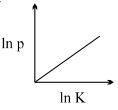
B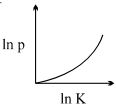
C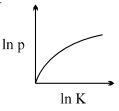
D
None of these.
Solution
(A) The relation between kinetic energy $(K)$ and momentum $(p)$ is given by $K = \frac{p^2}{2m}$,where $m$ is the mass of the body.
Taking the natural logarithm on both sides:
$\ln K = \ln \left( \frac{p^2}{2m} \right)$
$\ln K = \ln(p^2) - \ln(2m)$
$\ln K = 2 \ln p - \ln(2m)$
Rearranging the terms to express $\ln p$ in terms of $\ln K$:
$2 \ln p = \ln K + \ln(2m)$
$\ln p = \frac{1}{2} \ln K + \frac{1}{2} \ln(2m)$
This equation is of the form $y = mx + c$,where $y = \ln p$,$x = \ln K$,the slope $m = \frac{1}{2}$,and the intercept $c = \frac{1}{2} \ln(2m)$.
Since the slope is positive and constant,the graph of $\ln p$ versus $\ln K$ is a straight line.
Taking the natural logarithm on both sides:
$\ln K = \ln \left( \frac{p^2}{2m} \right)$
$\ln K = \ln(p^2) - \ln(2m)$
$\ln K = 2 \ln p - \ln(2m)$
Rearranging the terms to express $\ln p$ in terms of $\ln K$:
$2 \ln p = \ln K + \ln(2m)$
$\ln p = \frac{1}{2} \ln K + \frac{1}{2} \ln(2m)$
This equation is of the form $y = mx + c$,where $y = \ln p$,$x = \ln K$,the slope $m = \frac{1}{2}$,and the intercept $c = \frac{1}{2} \ln(2m)$.
Since the slope is positive and constant,the graph of $\ln p$ versus $\ln K$ is a straight line.
0 likes
View Solution75
DifficultMCQ
When the momentum of a body increases by $100\%$,its $KE$ increases by .............. $\%$
A
$400$
B
$100$
C
$300$
D
none
Solution
(C) The kinetic energy $(KE)$ of a body is related to its momentum $(p)$ by the formula: $KE = \frac{p^2}{2m}$,where $m$ is the mass of the body.
Let the initial momentum be $p_1 = p$. Then the initial kinetic energy is $KE_1 = \frac{p^2}{2m}$.
When the momentum increases by $100\%$,the new momentum $p_2$ becomes:
$p_2 = p + 100\% \text{ of } p = p + p = 2p$.
The new kinetic energy $KE_2$ is:
$KE_2 = \frac{(2p)^2}{2m} = \frac{4p^2}{2m} = 4 \times KE_1$.
The percentage increase in kinetic energy is given by:
$\text{Percentage Increase} = \frac{KE_2 - KE_1}{KE_1} \times 100\%$
$= \frac{4 KE_1 - KE_1}{KE_1} \times 100\%$
$= \frac{3 KE_1}{KE_1} \times 100\% = 300\%$.
Let the initial momentum be $p_1 = p$. Then the initial kinetic energy is $KE_1 = \frac{p^2}{2m}$.
When the momentum increases by $100\%$,the new momentum $p_2$ becomes:
$p_2 = p + 100\% \text{ of } p = p + p = 2p$.
The new kinetic energy $KE_2$ is:
$KE_2 = \frac{(2p)^2}{2m} = \frac{4p^2}{2m} = 4 \times KE_1$.
The percentage increase in kinetic energy is given by:
$\text{Percentage Increase} = \frac{KE_2 - KE_1}{KE_1} \times 100\%$
$= \frac{4 KE_1 - KE_1}{KE_1} \times 100\%$
$= \frac{3 KE_1}{KE_1} \times 100\% = 300\%$.
0 likes
View Solution76
MediumMCQ
An athlete in the Olympic games covers a distance of $100 \ m$ in $10 \ s$. His kinetic energy can be estimated to be in the range
A
$2000 \ J - 5000 \ J$
B
$200 \ J - 500 \ J$
C
$2 \times 10^5 \ J - 3 \times 10^5 \ J$
D
$20,000 \ J - 50,000 \ J$
Solution
(A) The average speed of the athlete is $v = \frac{100 \ m}{10 \ s} = 10 \ m/s$.
The kinetic energy $(K.E.)$ is given by the formula $K.E. = \frac{1}{2}mv^2$.
Assuming the mass $(m)$ of an athlete typically ranges between $40 \ kg$ and $100 \ kg$:
For $m = 40 \ kg$: $K.E. = \frac{1}{2} \times 40 \times (10)^2 = 20 \times 100 = 2000 \ J$.
For $m = 100 \ kg$: $K.E. = \frac{1}{2} \times 100 \times (10)^2 = 50 \times 100 = 5000 \ J$.
Thus,the range of kinetic energy is $2000 \ J - 5000 \ J$.
The kinetic energy $(K.E.)$ is given by the formula $K.E. = \frac{1}{2}mv^2$.
Assuming the mass $(m)$ of an athlete typically ranges between $40 \ kg$ and $100 \ kg$:
For $m = 40 \ kg$: $K.E. = \frac{1}{2} \times 40 \times (10)^2 = 20 \times 100 = 2000 \ J$.
For $m = 100 \ kg$: $K.E. = \frac{1}{2} \times 100 \times (10)^2 = 50 \times 100 = 5000 \ J$.
Thus,the range of kinetic energy is $2000 \ J - 5000 \ J$.
0 likes
View Solution77
MediumMCQ
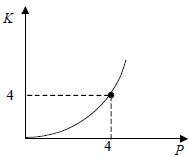
$A$ graph between kinetic energy $K$ and momentum $P$ of a particle is plotted as shown in the figure. The mass of the moving particle is ........ $kg$.
A
$1$
B
$2$
C
$3$
D
$4$
Solution
(B) The relationship between kinetic energy $K$ and momentum $P$ is given by the formula:
$K = \frac{P^2}{2m}$
From the given graph,we can identify a point on the curve where the kinetic energy $K = 4$ and the momentum $P = 4$.
Substituting these values into the formula:
$4 = \frac{4^2}{2m}$
$4 = \frac{16}{2m}$
$4 = \frac{8}{m}$
Solving for $m$:
$m = \frac{8}{4} = 2 \ kg$
Therefore,the mass of the moving particle is $2 \ kg$.
$K = \frac{P^2}{2m}$
From the given graph,we can identify a point on the curve where the kinetic energy $K = 4$ and the momentum $P = 4$.
Substituting these values into the formula:
$4 = \frac{4^2}{2m}$
$4 = \frac{16}{2m}$
$4 = \frac{8}{m}$
Solving for $m$:
$m = \frac{8}{4} = 2 \ kg$
Therefore,the mass of the moving particle is $2 \ kg$.
0 likes
View Solution78
MediumMCQ
An object has momentum $p$ and kinetic energy $E$. If its momentum becomes $2p$,then its kinetic energy will be:
A
$E/2$
B
$3E$
C
$2E$
D
$4E$
Solution
(D) The relationship between kinetic energy $E$ and momentum $p$ for an object of mass $m$ is given by $E = \frac{p^2}{2m}$.
When the momentum becomes $p' = 2p$,the new kinetic energy $E'$ is given by:
$E' = \frac{(p')^2}{2m} = \frac{(2p)^2}{2m} = \frac{4p^2}{2m}$.
Substituting $E = \frac{p^2}{2m}$ into the equation for $E'$,we get:
$E' = 4 \times \left( \frac{p^2}{2m} \right) = 4E$.
Therefore,the new kinetic energy will be $4E$.
When the momentum becomes $p' = 2p$,the new kinetic energy $E'$ is given by:
$E' = \frac{(p')^2}{2m} = \frac{(2p)^2}{2m} = \frac{4p^2}{2m}$.
Substituting $E = \frac{p^2}{2m}$ into the equation for $E'$,we get:
$E' = 4 \times \left( \frac{p^2}{2m} \right) = 4E$.
Therefore,the new kinetic energy will be $4E$.
0 likes
View Solution79
MediumMCQ
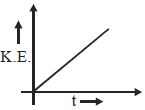
The kinetic energy of a body moving along a straight line varies with time as shown in the figure. The force acting on the body is:
A
zero
B
constant
C
directly proportional to velocity.
D
inversely proportional to velocity.
Solution
(D) From the graph,the kinetic energy $(K.E.)$ is directly proportional to time $(t)$:
$K.E. = \frac{1}{2} m v^{2} = k t$ (where $k$ is a constant)
$v^{2} \propto t \Rightarrow v \propto \sqrt{t}$
Let $v = \alpha \sqrt{t}$,where $\alpha$ is a constant.
The acceleration $a$ is the rate of change of velocity:
$a = \frac{d v}{d t} = \frac{d}{d t} (\alpha \sqrt{t}) = \frac{\alpha}{2 \sqrt{t}}$
The force $F$ acting on the body is given by Newton's second law:
$F = m a = m \left( \frac{\alpha}{2 \sqrt{t}} \right)$
Since $v = \alpha \sqrt{t}$,we have $\sqrt{t} = \frac{v}{\alpha}$.
Substituting this into the expression for force:
$F = m \left( \frac{\alpha}{2 (v / \alpha)} \right) = \frac{m \alpha^{2}}{2 v}$
Thus,$F \propto \frac{1}{v}$.
Therefore,the force is inversely proportional to the velocity.
$K.E. = \frac{1}{2} m v^{2} = k t$ (where $k$ is a constant)
$v^{2} \propto t \Rightarrow v \propto \sqrt{t}$
Let $v = \alpha \sqrt{t}$,where $\alpha$ is a constant.
The acceleration $a$ is the rate of change of velocity:
$a = \frac{d v}{d t} = \frac{d}{d t} (\alpha \sqrt{t}) = \frac{\alpha}{2 \sqrt{t}}$
The force $F$ acting on the body is given by Newton's second law:
$F = m a = m \left( \frac{\alpha}{2 \sqrt{t}} \right)$
Since $v = \alpha \sqrt{t}$,we have $\sqrt{t} = \frac{v}{\alpha}$.
Substituting this into the expression for force:
$F = m \left( \frac{\alpha}{2 (v / \alpha)} \right) = \frac{m \alpha^{2}}{2 v}$
Thus,$F \propto \frac{1}{v}$.
Therefore,the force is inversely proportional to the velocity.
0 likes
View Solution80
MediumMCQ
Two bodies with masses $M_1$ and $M_2$ have equal kinetic energies. If $p_1$ and $p_2$ are their respective momenta,then $p_1/p_2$ is equal to
A
$M_1 : M_2$
B
$M_2 : M_1$
C
$M_1^2 : M_2^2$
D
$\sqrt{M_1} : \sqrt{M_2}$
Solution
(D) The kinetic energy $K$ of a body of mass $m$ and momentum $p$ is given by the relation $K = \frac{p^2}{2m}$.
Since the kinetic energies of the two bodies are equal,we have $K_1 = K_2$.
Therefore,$\frac{p_1^2}{2M_1} = \frac{p_2^2}{2M_2}$.
Rearranging the terms,we get $\frac{p_1^2}{p_2^2} = \frac{M_1}{M_2}$.
Taking the square root on both sides,we obtain $\frac{p_1}{p_2} = \sqrt{\frac{M_1}{M_2}} = \sqrt{M_1} : \sqrt{M_2}$.
Since the kinetic energies of the two bodies are equal,we have $K_1 = K_2$.
Therefore,$\frac{p_1^2}{2M_1} = \frac{p_2^2}{2M_2}$.
Rearranging the terms,we get $\frac{p_1^2}{p_2^2} = \frac{M_1}{M_2}$.
Taking the square root on both sides,we obtain $\frac{p_1}{p_2} = \sqrt{\frac{M_1}{M_2}} = \sqrt{M_1} : \sqrt{M_2}$.
0 likes
View Solution81
DifficultMCQ
In the non-relativistic regime,if the momentum is increased by $100\%$,the percentage increase in kinetic energy is (in $\%$)
A
$100$
B
$200$
C
$300$
D
$400$
Solution
(C) The kinetic energy $K$ is related to momentum $p$ by the formula $K = \frac{p^2}{2m}$.
Since mass $m$ is constant,we have $K \propto p^2$.
Let the initial momentum be $p_1 = p$ and the final momentum be $p_2 = p + 100\% \text{ of } p = 2p$.
The ratio of kinetic energies is $\frac{K_2}{K_1} = \left(\frac{p_2}{p_1}\right)^2 = \left(\frac{2p}{p}\right)^2 = 4$.
Thus,$K_2 = 4K_1$.
The percentage increase in kinetic energy is given by $\frac{K_2 - K_1}{K_1} \times 100\% = \frac{4K_1 - K_1}{K_1} \times 100\% = 300\%$.
Since mass $m$ is constant,we have $K \propto p^2$.
Let the initial momentum be $p_1 = p$ and the final momentum be $p_2 = p + 100\% \text{ of } p = 2p$.
The ratio of kinetic energies is $\frac{K_2}{K_1} = \left(\frac{p_2}{p_1}\right)^2 = \left(\frac{2p}{p}\right)^2 = 4$.
Thus,$K_2 = 4K_1$.
The percentage increase in kinetic energy is given by $\frac{K_2 - K_1}{K_1} \times 100\% = \frac{4K_1 - K_1}{K_1} \times 100\% = 300\%$.
0 likes
View Solution82
MediumMCQ
$A$ $120\, g$ mass has a velocity $\vec v = 2\hat i + 5\hat j\, m/s$ at a certain instant. Its kinetic energy is .................. $J$.
A
$3$
B
$4$
C
$5$
D
$1.74$
Solution
(D) The kinetic energy $(K.E.)$ of an object is given by the formula: $K.E. = \frac{1}{2} mv^2$.
First,convert the mass from grams to kilograms: $m = 120\, g = 0.12\, kg$.
Next,calculate the square of the velocity magnitude $(v^2)$ using the dot product of the velocity vector with itself: $v^2 = \vec{v} \cdot \vec{v} = (2\hat{i} + 5\hat{j}) \cdot (2\hat{i} + 5\hat{j}) = (2^2 + 5^2) = 4 + 25 = 29\, m^2/s^2$.
Now,substitute these values into the kinetic energy formula:
$K.E. = \frac{1}{2} \times 0.12\, kg \times 29\, m^2/s^2$
$K.E. = 0.06 \times 29 = 1.74\, J$.
Therefore,the kinetic energy is $1.74\, J$.
First,convert the mass from grams to kilograms: $m = 120\, g = 0.12\, kg$.
Next,calculate the square of the velocity magnitude $(v^2)$ using the dot product of the velocity vector with itself: $v^2 = \vec{v} \cdot \vec{v} = (2\hat{i} + 5\hat{j}) \cdot (2\hat{i} + 5\hat{j}) = (2^2 + 5^2) = 4 + 25 = 29\, m^2/s^2$.
Now,substitute these values into the kinetic energy formula:
$K.E. = \frac{1}{2} \times 0.12\, kg \times 29\, m^2/s^2$
$K.E. = 0.06 \times 29 = 1.74\, J$.
Therefore,the kinetic energy is $1.74\, J$.
0 likes
View Solution83
MediumMCQ
$2$ particles of mass $1\,kg$ and $5\,kg$ have the same momentum. Calculate the ratio of their kinetic energies $(K.E.)$.
A
$5:1$
B
$25:1$
C
$1:1$
D
$1:5$
Solution
(A) The kinetic energy $(K.E.)$ of a particle with mass $m$ and momentum $p$ is given by the formula: $K.E. = \frac{p^2}{2m}$.
Given that both particles have the same momentum $(p_1 = p_2 = p)$,the ratio of their kinetic energies is:
$\frac{K.E._1}{K.E._2} = \frac{p^2 / (2m_1)}{p^2 / (2m_2)} = \frac{m_2}{m_1}$.
Substituting the given masses $m_1 = 1\,kg$ and $m_2 = 5\,kg$:
$\frac{K.E._1}{K.E._2} = \frac{5}{1} = 5:1$.
Given that both particles have the same momentum $(p_1 = p_2 = p)$,the ratio of their kinetic energies is:
$\frac{K.E._1}{K.E._2} = \frac{p^2 / (2m_1)}{p^2 / (2m_2)} = \frac{m_2}{m_1}$.
Substituting the given masses $m_1 = 1\,kg$ and $m_2 = 5\,kg$:
$\frac{K.E._1}{K.E._2} = \frac{5}{1} = 5:1$.
0 likes
View Solution84
MediumMCQ
$A$ body is falling under gravity from rest. When it loses a gravitational potential energy by $U,$ its speed increases to $v.$ The mass of the body shall be
A
$\frac{2U}{v}$
B
$\frac{U}{2v}$
C
$\frac{2U}{v^2}$
D
$\frac{U}{2v^2}$
Solution
(C) According to the principle of conservation of mechanical energy,the loss in gravitational potential energy is equal to the gain in kinetic energy.
Given that the body starts from rest,the initial kinetic energy is $0$.
Let $m$ be the mass of the body.
The loss in potential energy is given as $U$.
The gain in kinetic energy is $\frac{1}{2}mv^2 - 0 = \frac{1}{2}mv^2$.
Equating the two: $U = \frac{1}{2}mv^2$.
Solving for $m$: $m = \frac{2U}{v^2}$.
Given that the body starts from rest,the initial kinetic energy is $0$.
Let $m$ be the mass of the body.
The loss in potential energy is given as $U$.
The gain in kinetic energy is $\frac{1}{2}mv^2 - 0 = \frac{1}{2}mv^2$.
Equating the two: $U = \frac{1}{2}mv^2$.
Solving for $m$: $m = \frac{2U}{v^2}$.
0 likes
View Solution85
EasyMCQ
If the linear momentum is increased by $5\%$,the kinetic energy will increase by.......$\%$
A
$5$
B
$10$
C
$10.25$
D
$25$
Solution
(C) The relationship between kinetic energy $E$ and linear momentum $p$ is given by $E = \frac{p^2}{2m}$.
For small percentage changes,we can use the differential method: $\frac{\Delta E}{E} = 2 \left( \frac{\Delta p}{p} \right)$.
Given $\frac{\Delta p}{p} = 5\% = 0.05$,the change in kinetic energy is $\frac{\Delta E}{E} = 2 \times 5\% = 10\%$.
Alternatively,using the exact formula: $E' = \frac{(1.05p)^2}{2m} = 1.1025 E$.
The percentage increase is $(1.1025 - 1) \times 100 = 10.25\%$. Since $10.25\%$ is the precise value,we select the closest standard approximation or the exact value if provided.
For small percentage changes,we can use the differential method: $\frac{\Delta E}{E} = 2 \left( \frac{\Delta p}{p} \right)$.
Given $\frac{\Delta p}{p} = 5\% = 0.05$,the change in kinetic energy is $\frac{\Delta E}{E} = 2 \times 5\% = 10\%$.
Alternatively,using the exact formula: $E' = \frac{(1.05p)^2}{2m} = 1.1025 E$.
The percentage increase is $(1.1025 - 1) \times 100 = 10.25\%$. Since $10.25\%$ is the precise value,we select the closest standard approximation or the exact value if provided.
0 likes
View Solution86
Easy
In a ballistics demonstration,a police officer fires a bullet of mass $50.0 \; g$ with a speed of $200 \; m s^{-1}$ into soft plywood of thickness $2.00 \; cm$. The bullet emerges with only $10 \%$ of its initial kinetic energy. What is the emergent speed of the bullet?
Solution
(C) The initial kinetic energy $(K_i)$ of the bullet is given by $K_i = \frac{1}{2} m v_i^2$.
Given $m = 50.0 \; g = 0.050 \; kg$ and $v_i = 200 \; m s^{-1}$.
$K_i = \frac{1}{2} \times 0.050 \times (200)^2 = 0.025 \times 40000 = 1000 \; J$.
The bullet emerges with $10 \%$ of its initial kinetic energy,so the final kinetic energy $(K_f)$ is:
$K_f = 0.10 \times 1000 \; J = 100 \; J$.
Let $v_f$ be the emergent speed of the bullet.
Using the formula $K_f = \frac{1}{2} m v_f^2$:
$100 = \frac{1}{2} \times 0.050 \times v_f^2$.
$100 = 0.025 \times v_f^2$.
$v_f^2 = \frac{100}{0.025} = 4000$.
$v_f = \sqrt{4000} \approx 63.25 \; m s^{-1}$.
Thus,the emergent speed of the bullet is approximately $63.2 \; m s^{-1}$.
Given $m = 50.0 \; g = 0.050 \; kg$ and $v_i = 200 \; m s^{-1}$.
$K_i = \frac{1}{2} \times 0.050 \times (200)^2 = 0.025 \times 40000 = 1000 \; J$.
The bullet emerges with $10 \%$ of its initial kinetic energy,so the final kinetic energy $(K_f)$ is:
$K_f = 0.10 \times 1000 \; J = 100 \; J$.
Let $v_f$ be the emergent speed of the bullet.
Using the formula $K_f = \frac{1}{2} m v_f^2$:
$100 = \frac{1}{2} \times 0.050 \times v_f^2$.
$100 = 0.025 \times v_f^2$.
$v_f^2 = \frac{100}{0.025} = 4000$.
$v_f = \sqrt{4000} \approx 63.25 \; m s^{-1}$.
Thus,the emergent speed of the bullet is approximately $63.2 \; m s^{-1}$.
0 likes
View Solution87
Medium
Give an important factor to control the speed of a vehicle in the area of a school or hospital.
Solution
(N/A) The most important factor to control the speed of a vehicle in areas like schools or hospitals is the application of $braking$ $force$ to reduce $kinetic$ $energy$. By applying the brakes,a negative acceleration (deceleration) is produced,which opposes the motion of the vehicle. According to the equation of motion $v^2 = u^2 + 2as$,where $v$ is the final velocity,$u$ is the initial velocity,$a$ is acceleration,and $s$ is displacement,reducing the velocity $v$ requires a negative value of $a$. This ensures safety by allowing the driver to stop the vehicle within a shorter distance in case of an emergency.
0 likes
View Solution88
MediumMCQ
If an object has no kinetic energy,it cannot have momentum. Do you agree?
A
Yes
B
No
C
Sometimes
D
Cannot be determined
Solution
(A) Yes,$I$ agree. The kinetic energy $(K)$ of an object is given by the formula $K = \frac{p^2}{2m}$,where $p$ is the momentum and $m$ is the mass of the object.
If $K = 0$,then $\frac{p^2}{2m} = 0$,which implies $p^2 = 0$,and therefore $p = 0$.
Since momentum $p = mv$,if $p = 0$ and $m \neq 0$,then the velocity $v$ must be $0$.
Thus,an object with no kinetic energy must be at rest,and consequently,it has no momentum.
If $K = 0$,then $\frac{p^2}{2m} = 0$,which implies $p^2 = 0$,and therefore $p = 0$.
Since momentum $p = mv$,if $p = 0$ and $m \neq 0$,then the velocity $v$ must be $0$.
Thus,an object with no kinetic energy must be at rest,and consequently,it has no momentum.
0 likes
View Solution89
EasyMCQ
If the kinetic energy of a body increases,then what happens to its momentum?
A
Its momentum increases.
B
Its momentum decreases.
C
Its momentum remains constant.
D
Its momentum becomes zero.
Solution
(A) The relationship between kinetic energy $(K)$ and linear momentum $(p)$ of a body of mass $(m)$ is given by the formula: $K = \frac{p^2}{2m}$.
From this equation,we can express momentum as: $p = \sqrt{2mK}$.
Since mass $(m)$ is constant,the momentum $(p)$ is directly proportional to the square root of the kinetic energy $(p \propto \sqrt{K})$.
Therefore,if the kinetic energy $(K)$ of a body increases,its momentum $(p)$ must also increase.
From this equation,we can express momentum as: $p = \sqrt{2mK}$.
Since mass $(m)$ is constant,the momentum $(p)$ is directly proportional to the square root of the kinetic energy $(p \propto \sqrt{K})$.
Therefore,if the kinetic energy $(K)$ of a body increases,its momentum $(p)$ must also increase.
0 likes
View Solution90
Difficult
Define kinetic energy. Give its unit and dimensional formula and mention works by using it.
Solution
(N/A) The energy of a body is the ability (or capacity) of the body to do work.
Half of the product of the mass of a body and the square of its velocity is defined as kinetic energy $(K)$ of the body.
$\therefore K = \frac{1}{2} mv^2$,where $m$ is the mass of the body and $v$ is the velocity or speed of the body.
The unit of kinetic energy is the same as the unit of work. Its $SI$ unit is Joule $(J)$ and its $CGS$ unit is erg. The dimensional formula of kinetic energy is $[M^1 L^2 T^{-2}]$.
Kinetic energy is a scalar quantity. It indicates the magnitude of work that a body can perform due to its motion.
Examples of work done using kinetic energy:
$1$. The kinetic energy of a fast-flowing stream has been used to grind grains.
$2$. Sailing ships employ the kinetic energy of the wind.
$3$. Electricity is generated by wind mills using the kinetic energy of air.
Half of the product of the mass of a body and the square of its velocity is defined as kinetic energy $(K)$ of the body.
$\therefore K = \frac{1}{2} mv^2$,where $m$ is the mass of the body and $v$ is the velocity or speed of the body.
The unit of kinetic energy is the same as the unit of work. Its $SI$ unit is Joule $(J)$ and its $CGS$ unit is erg. The dimensional formula of kinetic energy is $[M^1 L^2 T^{-2}]$.
Kinetic energy is a scalar quantity. It indicates the magnitude of work that a body can perform due to its motion.
Examples of work done using kinetic energy:
$1$. The kinetic energy of a fast-flowing stream has been used to grind grains.
$2$. Sailing ships employ the kinetic energy of the wind.
$3$. Electricity is generated by wind mills using the kinetic energy of air.
0 likes
View Solution91
MediumMCQ
Is kinetic energy a scalar quantity or vector quantity?
A
Scalar quantity
B
Vector quantity
C
Both
D
None
Solution
(A) Kinetic energy is defined as the energy possessed by an object due to its motion.
It is given by the formula $K = \frac{1}{2}mv^2$,where $m$ is the mass and $v$ is the speed of the object.
Since mass is a scalar and the square of speed $(v^2)$ is also a scalar,the product $\frac{1}{2}mv^2$ results in a scalar quantity.
Kinetic energy does not have a direction associated with it; it only has magnitude.
Therefore,kinetic energy is a scalar quantity.
It is given by the formula $K = \frac{1}{2}mv^2$,where $m$ is the mass and $v$ is the speed of the object.
Since mass is a scalar and the square of speed $(v^2)$ is also a scalar,the product $\frac{1}{2}mv^2$ results in a scalar quantity.
Kinetic energy does not have a direction associated with it; it only has magnitude.
Therefore,kinetic energy is a scalar quantity.
0 likes
View Solution92
EasyMCQ
Two bodies of unequal masses have the same momentum. Which one will have more kinetic energy?
A
The heavier body
B
The lighter body
C
Both have equal kinetic energy
D
None of the above
Solution
(B) The kinetic energy $K$ of a body with mass $m$ and momentum $p$ is given by the relation $K = \frac{p^2}{2m}$.
Since the momentum $p$ is the same for both bodies,we have $K \propto \frac{1}{m}$.
This implies that the kinetic energy is inversely proportional to the mass of the body.
Therefore,the body with the smaller mass (the lighter body) will have more kinetic energy.
Since the momentum $p$ is the same for both bodies,we have $K \propto \frac{1}{m}$.
This implies that the kinetic energy is inversely proportional to the mass of the body.
Therefore,the body with the smaller mass (the lighter body) will have more kinetic energy.
0 likes
View Solution93
MediumMCQ
If the momentum of an object is doubled,what is the percentage increase in its kinetic energy (in $\%$)?
A
$100$
B
$200$
C
$300$
D
$400$
Solution
(C) The kinetic energy $K$ of an object with mass $m$ and momentum $p$ is given by $K = \frac{p^2}{2m}$.
If the momentum is doubled,the new momentum $p' = 2p$.
The new kinetic energy $K'$ is given by $K' = \frac{(p')^2}{2m} = \frac{(2p)^2}{2m} = \frac{4p^2}{2m} = 4K$.
The increase in kinetic energy is $\Delta K = K' - K = 4K - K = 3K$.
The percentage increase in kinetic energy is $\frac{\Delta K}{K} \times 100 = \frac{3K}{K} \times 100 = 300\%$.
If the momentum is doubled,the new momentum $p' = 2p$.
The new kinetic energy $K'$ is given by $K' = \frac{(p')^2}{2m} = \frac{(2p)^2}{2m} = \frac{4p^2}{2m} = 4K$.
The increase in kinetic energy is $\Delta K = K' - K = 4K - K = 3K$.
The percentage increase in kinetic energy is $\frac{\Delta K}{K} \times 100 = \frac{3K}{K} \times 100 = 300\%$.
0 likes
View Solution94
Easy
Express momentum in terms of mass and kinetic energy.
Solution
(N/A) The kinetic energy $K$ of an object of mass $m$ moving with velocity $v$ is given by $K = \frac{1}{2}mv^2$.
Multiply and divide the expression by $m$:
$K = \frac{1}{2} \frac{m^2v^2}{m} = \frac{(mv)^2}{2m}$.
Since momentum $p = mv$,we can substitute $p$ into the equation:
$K = \frac{p^2}{2m}$.
Rearranging for $p$:
$p^2 = 2mK$.
Therefore,the momentum is $p = \sqrt{2mK}$.
Multiply and divide the expression by $m$:
$K = \frac{1}{2} \frac{m^2v^2}{m} = \frac{(mv)^2}{2m}$.
Since momentum $p = mv$,we can substitute $p$ into the equation:
$K = \frac{p^2}{2m}$.
Rearranging for $p$:
$p^2 = 2mK$.
Therefore,the momentum is $p = \sqrt{2mK}$.
0 likes
View Solution95
EasyMCQ
What is the kinetic energy in Joules of a bullet of mass $2 \, g$ moving with a velocity of $500 \, m/s$ (in $, J$)?
A
$250$
B
$500$
C
$125$
D
$1000$
Solution
(A) The formula for kinetic energy $(K)$ is given by $K = \frac{1}{2} m v^2$.
Given:
Mass $(m)$ = $2 \, g = 2 \times 10^{-3} \, kg$.
Velocity $(v)$ = $500 \, m/s$.
Substituting the values into the formula:
$K = \frac{1}{2} \times (2 \times 10^{-3} \, kg) \times (500 \, m/s)^2$.
$K = 10^{-3} \times 250,000$.
$K = 250 \, J$.
Given:
Mass $(m)$ = $2 \, g = 2 \times 10^{-3} \, kg$.
Velocity $(v)$ = $500 \, m/s$.
Substituting the values into the formula:
$K = \frac{1}{2} \times (2 \times 10^{-3} \, kg) \times (500 \, m/s)^2$.
$K = 10^{-3} \times 250,000$.
$K = 250 \, J$.
0 likes
View Solution96
DifficultMCQ
If $E - V < 0$,is this condition possible?
A
Yes
B
No
C
Depends on the system
D
Cannot be determined
Solution
(B) The total mechanical energy $E$ of a system is given by the sum of kinetic energy $K$ and potential energy $V$,i.e.,$E = K + V$.
Rearranging this,we get $K = E - V$.
Since kinetic energy $K$ must always be greater than or equal to zero $(K \ge 0)$,the expression $E - V$ cannot be negative.
Therefore,the condition $E - V < 0$ is not possible.
Rearranging this,we get $K = E - V$.
Since kinetic energy $K$ must always be greater than or equal to zero $(K \ge 0)$,the expression $E - V$ cannot be negative.
Therefore,the condition $E - V < 0$ is not possible.
0 likes
View Solution97
MediumMCQ
If $p$ is the linear momentum of an object and $v$ is its velocity,write the formula for its kinetic energy.
A
$K = pv$
B
$K = \frac{1}{2} pv$
C
$K = \frac{p^2}{2m}$
D
$K = \frac{1}{2} mv^2$
Solution
(B) The kinetic energy $K$ of an object is given by $K = \frac{1}{2} mv^2$.
We know that linear momentum $p = mv$,which implies $m = \frac{p}{v}$.
Substituting the value of $m$ into the kinetic energy formula:
$K = \frac{1}{2} (\frac{p}{v}) v^2$
$K = \frac{1}{2} pv$.
We know that linear momentum $p = mv$,which implies $m = \frac{p}{v}$.
Substituting the value of $m$ into the kinetic energy formula:
$K = \frac{1}{2} (\frac{p}{v}) v^2$
$K = \frac{1}{2} pv$.
0 likes
View Solution98
MediumMCQ
$A$ boy is rolling a $0.5\, kg$ ball on a frictionless floor with a speed of $20\, ms^{-1}$. The ball gets deflected by an obstacle on the way. After deflection,it moves with $5\%$ of its initial kinetic energy. What is the speed of the ball now? (in $ms^{-1}$)
A
$19.0$
B
$4.47$
C
$14.41$
D
$1.00$
Solution
(B) Given: Mass $m = 0.5\, kg$,Initial speed $u = 20\, ms^{-1}$.
Initial kinetic energy $K_i = \frac{1}{2} mu^2 = \frac{1}{2} \times 0.5 \times (20)^2 = 100\, J$.
After deflection,the final kinetic energy $K_f$ is $5\%$ of $K_i$.
$K_f = \frac{5}{100} \times 100 = 5\, J$.
Let the final speed be $v$. Then $K_f = \frac{1}{2} mv^2$.
$5 = \frac{1}{2} \times 0.5 \times v^2$.
$5 = 0.25 \times v^2$.
$v^2 = \frac{5}{0.25} = 20$.
$v = \sqrt{20} \approx 4.47\, ms^{-1}$.
Initial kinetic energy $K_i = \frac{1}{2} mu^2 = \frac{1}{2} \times 0.5 \times (20)^2 = 100\, J$.
After deflection,the final kinetic energy $K_f$ is $5\%$ of $K_i$.
$K_f = \frac{5}{100} \times 100 = 5\, J$.
Let the final speed be $v$. Then $K_f = \frac{1}{2} mv^2$.
$5 = \frac{1}{2} \times 0.5 \times v^2$.
$5 = 0.25 \times v^2$.
$v^2 = \frac{5}{0.25} = 20$.
$v = \sqrt{20} \approx 4.47\, ms^{-1}$.
0 likes
View Solution99
MediumMCQ
Two solids $A$ and $B$ of mass $1\, kg$ and $2\, kg$ respectively are moving with equal linear momentum. The ratio of their kinetic energies $(K.E.)_{A} : (K.E.)_{B}$ will be $\frac{A}{1},$ so the value of $A$ will be ..... .
A
$1$
B
$2$
C
$3$
D
$4$
Solution
(B) The kinetic energy $K$ of a body with mass $m$ and linear momentum $P$ is given by the formula $K = \frac{P^2}{2m}$.
Since both solids $A$ and $B$ have equal linear momentum,we have $P_A = P_B = P$.
Therefore,the kinetic energy is inversely proportional to the mass: $K \propto \frac{1}{m}$.
Taking the ratio of the kinetic energies of $A$ and $B$,we get $\frac{(K.E.)_A}{(K.E.)_B} = \frac{m_B}{m_A}$.
Given $m_A = 1\, kg$ and $m_B = 2\, kg$,we substitute these values: $\frac{(K.E.)_A}{(K.E.)_B} = \frac{2}{1}$.
Comparing this with the given ratio $\frac{A}{1}$,we find that $A = 2$.
Since both solids $A$ and $B$ have equal linear momentum,we have $P_A = P_B = P$.
Therefore,the kinetic energy is inversely proportional to the mass: $K \propto \frac{1}{m}$.
Taking the ratio of the kinetic energies of $A$ and $B$,we get $\frac{(K.E.)_A}{(K.E.)_B} = \frac{m_B}{m_A}$.
Given $m_A = 1\, kg$ and $m_B = 2\, kg$,we substitute these values: $\frac{(K.E.)_A}{(K.E.)_B} = \frac{2}{1}$.
Comparing this with the given ratio $\frac{A}{1}$,we find that $A = 2$.
0 likes
View SolutionWork, Energy, Power and Collision — Kinetic Energy · Frequently Asked Questions
1Are these Work, Energy, Power and Collision questions useful for JEE and NEET?
Yes. All questions in this section are mapped to JEE Main and NEET exam patterns. Previous year questions from JEE Main, NEET, GUJCET and state-level exams are included with full solutions.
2Can I switch to Hindi or Gujarati for these questions?
Yes. Use the language tabs in the hero section or the sidebar to view the same questions and solutions in English, Hindi or Gujarati.
3How do I generate a question paper from this subtopic?
Use the Vedclass Exam Paper Generator — select the chapter and subtopic, set difficulty, and generate Sets A, B, C, D automatically. First 3 chapters of every subject are free.
Vedclass Products
For Students
Vedclass Test Series
Mock tests in real JEE/NEET style with performance analysis. 5-day free trial.
Start Free TrialFor Teachers
Exam Paper Generator
Generate Set A/B/C/D papers from this chapter in 2 minutes. 3 chapters free.
Try FreeFor Institutes
Online Exam Module
Live online exams with unlimited students, 360° analytics & white-label branding.
See DemoFor Teachers & Institutes
Generate a Work, Energy, Power and Collision Exam Paper in 2 Minutes
Select subtopic & difficulty — Sets A, B, C, D auto-generated with No Repeat logic.
First 3 chapters of every subject are free — no payment required.