
A English
Kinetic Energy Questions in English
Class 11 Physics · Work, Energy, Power and Collision · Kinetic Energy
144+
Questions
English
Language
100%
With Solutions
Showing 46 of 144 questions in English
1
MediumMCQ
Two bodies of masses $m_1$ and $m_2$ have equal kinetic energies. If $p_1$ and $p_2$ are their respective momenta,then the ratio $p_1:p_2$ is equal to
A
$m_1:m_2$
B
$m_2:m_1$
C
$\sqrt{m_1}:\sqrt{m_2}$
D
$m_1^2:m_2^2$
Solution
(C) The kinetic energy $E$ of a body of mass $m$ and momentum $p$ is given by the relation $E = \frac{p^2}{2m}$.
Rearranging this formula,we get $p = \sqrt{2mE}$.
Since the kinetic energies of the two bodies are equal $(E_1 = E_2 = E)$,the momentum $p$ is directly proportional to the square root of the mass: $p \propto \sqrt{m}$.
Therefore,the ratio of their momenta is $\frac{p_1}{p_2} = \sqrt{\frac{m_1}{m_2}}$.
Thus,the ratio $p_1:p_2$ is $\sqrt{m_1}:\sqrt{m_2}$.
Rearranging this formula,we get $p = \sqrt{2mE}$.
Since the kinetic energies of the two bodies are equal $(E_1 = E_2 = E)$,the momentum $p$ is directly proportional to the square root of the mass: $p \propto \sqrt{m}$.
Therefore,the ratio of their momenta is $\frac{p_1}{p_2} = \sqrt{\frac{m_1}{m_2}}$.
Thus,the ratio $p_1:p_2$ is $\sqrt{m_1}:\sqrt{m_2}$.
0 likes
View Solution2
EasyMCQ
$A$ light and a heavy body have equal momenta. Which one has greater kinetic energy $(K.E.)$?
A
The light body
B
The heavy body
C
The $K.E.$ are equal
D
Data is incomplete
Solution
(A) The kinetic energy $(K.E.)$ of a body of mass $m$ and momentum $P$ is given by the formula: $K.E. = \frac{P^2}{2m}$.
Since the momenta $(P)$ of both bodies are equal,the kinetic energy is inversely proportional to the mass of the body $(K.E. \propto \frac{1}{m})$.
Therefore,the body with the smaller mass (the light body) will have a greater kinetic energy.
Since the momenta $(P)$ of both bodies are equal,the kinetic energy is inversely proportional to the mass of the body $(K.E. \propto \frac{1}{m})$.
Therefore,the body with the smaller mass (the light body) will have a greater kinetic energy.
0 likes
View Solution3
MediumMCQ
The kinetic energy possessed by a body of mass $m$ moving with a velocity $v$ is equal to $\frac{1}{2}mv^2$,provided
A
The body moves with velocities comparable to that of light
B
The body moves with velocities negligible compared to the speed of light
C
The body moves with velocities greater than that of light
D
None of the above statements is correct
Solution
(B) The classical expression for kinetic energy,$K = \frac{1}{2}mv^2$,is derived from Newtonian mechanics.
According to Einstein's theory of special relativity,the total energy of a body is given by $E = \gamma mc^2$,where $\gamma = \frac{1}{\sqrt{1 - v^2/c^2}}$.
The kinetic energy is the difference between the total energy and the rest energy: $K = E - mc^2 = mc^2(\gamma - 1)$.
Using the binomial expansion for $\gamma$ when $v \ll c$,we get $\gamma \approx 1 + \frac{1}{2}\frac{v^2}{c^2}$.
Substituting this back,$K \approx mc^2(1 + \frac{1}{2}\frac{v^2}{c^2} - 1) = \frac{1}{2}mv^2$.
Thus,the classical formula is valid only when the velocity of the body is negligible compared to the speed of light.
According to Einstein's theory of special relativity,the total energy of a body is given by $E = \gamma mc^2$,where $\gamma = \frac{1}{\sqrt{1 - v^2/c^2}}$.
The kinetic energy is the difference between the total energy and the rest energy: $K = E - mc^2 = mc^2(\gamma - 1)$.
Using the binomial expansion for $\gamma$ when $v \ll c$,we get $\gamma \approx 1 + \frac{1}{2}\frac{v^2}{c^2}$.
Substituting this back,$K \approx mc^2(1 + \frac{1}{2}\frac{v^2}{c^2} - 1) = \frac{1}{2}mv^2$.
Thus,the classical formula is valid only when the velocity of the body is negligible compared to the speed of light.
0 likes
View Solution4
EasyMCQ
If the momentum of a body is increased $n$ times,its kinetic energy increases by a factor of:
A
$n$ times
B
$2n$ times
C
$\sqrt{n}$ times
D
$n^2$ times
Solution
(D) The relationship between kinetic energy $(E)$ and momentum $(P)$ for a body of mass $(m)$ is given by the formula:
$E = \frac{P^2}{2m}$
From this equation,we can see that kinetic energy is directly proportional to the square of the momentum:
$E \propto P^2$
If the momentum $(P)$ is increased $n$ times,the new momentum becomes $P' = nP$.
Substituting this into the proportionality:
$E' \propto (nP)^2 = n^2 P^2$
Therefore,the new kinetic energy $(E')$ becomes $n^2$ times the original kinetic energy $(E)$.
Thus,the kinetic energy increases by a factor of $n^2$.
$E = \frac{P^2}{2m}$
From this equation,we can see that kinetic energy is directly proportional to the square of the momentum:
$E \propto P^2$
If the momentum $(P)$ is increased $n$ times,the new momentum becomes $P' = nP$.
Substituting this into the proportionality:
$E' \propto (nP)^2 = n^2 P^2$
Therefore,the new kinetic energy $(E')$ becomes $n^2$ times the original kinetic energy $(E)$.
Thus,the kinetic energy increases by a factor of $n^2$.
0 likes
View Solution5
MediumMCQ
Two masses of $1 \,g$ and $4 \,g$ are moving with equal kinetic energies. The ratio of the magnitudes of their linear momenta is
A
$4:1$
B
$\sqrt{2}:1$
C
$1:2$
D
$1:16$
Solution
(C) The relationship between linear momentum $P$,mass $m$,and kinetic energy $E$ is given by $P = \sqrt{2mE}$.
Since the kinetic energies $E$ are equal for both masses,we have $P \propto \sqrt{m}$.
Therefore,the ratio of their linear momenta is $\frac{P_1}{P_2} = \sqrt{\frac{m_1}{m_2}}$.
Substituting the given values $m_1 = 1 \,g$ and $m_2 = 4 \,g$,we get $\frac{P_1}{P_2} = \sqrt{\frac{1}{4}} = \frac{1}{2}$.
Thus,the ratio is $1:2$.
Since the kinetic energies $E$ are equal for both masses,we have $P \propto \sqrt{m}$.
Therefore,the ratio of their linear momenta is $\frac{P_1}{P_2} = \sqrt{\frac{m_1}{m_2}}$.
Substituting the given values $m_1 = 1 \,g$ and $m_2 = 4 \,g$,we get $\frac{P_1}{P_2} = \sqrt{\frac{1}{4}} = \frac{1}{2}$.
Thus,the ratio is $1:2$.
0 likes
View Solution6
MediumMCQ
If the kinetic energy of a body is increased by $300\%$,then the percentage change in momentum will be:
A
$100\%$
B
$150\%$
C
$\sqrt{300}\%$
D
$175\%$
Solution
(A) Let the initial kinetic energy be $E_1 = E$.
Final kinetic energy $E_2 = E + 300\% \text{ of } E = E + 3E = 4E$.
We know that the relationship between momentum $P$ and kinetic energy $E$ is $P = \sqrt{2mE}$,which implies $P \propto \sqrt{E}$.
Therefore,the ratio of final momentum $P_2$ to initial momentum $P_1$ is $\frac{P_2}{P_1} = \sqrt{\frac{E_2}{E_1}} = \sqrt{\frac{4E}{E}} = \sqrt{4} = 2$.
This means $P_2 = 2P_1$.
The percentage change in momentum is given by $\frac{P_2 - P_1}{P_1} \times 100\% = \frac{2P_1 - P_1}{P_1} \times 100\% = 100\%$.
Thus,the momentum increases by $100\%$.
Final kinetic energy $E_2 = E + 300\% \text{ of } E = E + 3E = 4E$.
We know that the relationship between momentum $P$ and kinetic energy $E$ is $P = \sqrt{2mE}$,which implies $P \propto \sqrt{E}$.
Therefore,the ratio of final momentum $P_2$ to initial momentum $P_1$ is $\frac{P_2}{P_1} = \sqrt{\frac{E_2}{E_1}} = \sqrt{\frac{4E}{E}} = \sqrt{4} = 2$.
This means $P_2 = 2P_1$.
The percentage change in momentum is given by $\frac{P_2 - P_1}{P_1} \times 100\% = \frac{2P_1 - P_1}{P_1} \times 100\% = 100\%$.
Thus,the momentum increases by $100\%$.
0 likes
View Solution7
EasyMCQ
$A$ light and a heavy body have equal kinetic energy. Which one has a greater momentum?
A
The light body
B
The heavy body
C
Both have equal momentum
D
It is not possible to say anything without additional information
Solution
(B) The relationship between kinetic energy $E$ and momentum $P$ is given by $P = \sqrt{2mE}$.
Since the kinetic energy $E$ is equal for both bodies,we have $P \propto \sqrt{m}$.
This implies that the body with the larger mass $m$ will have a greater momentum $P$.
Therefore,the heavy body will possess greater momentum.
Since the kinetic energy $E$ is equal for both bodies,we have $P \propto \sqrt{m}$.
This implies that the body with the larger mass $m$ will have a greater momentum $P$.
Therefore,the heavy body will possess greater momentum.
0 likes
View Solution8
DifficultMCQ
If the linear momentum is increased by $50\%$,the kinetic energy will increase by ............. $\%$
A
$50$
B
$100$
C
$125$
D
$25$
Solution
(C) Let the initial linear momentum be $P_1 = P$.
The new linear momentum is $P_2 = P_1 + 0.5P_1 = 1.5P_1 = \frac{3}{2}P_1$.
The relationship between kinetic energy $E$ and linear momentum $P$ is given by $E = \frac{P^2}{2m}$,which implies $E \propto P^2$.
Therefore,the ratio of the new kinetic energy $E_2$ to the initial kinetic energy $E_1$ is $\frac{E_2}{E_1} = \left( \frac{P_2}{P_1} \right)^2$.
Substituting the values,$\frac{E_2}{E_1} = \left( \frac{1.5P_1}{P_1} \right)^2 = (1.5)^2 = 2.25$.
This means $E_2 = 2.25 E_1 = E_1 + 1.25 E_1$.
The percentage increase in kinetic energy is $\frac{E_2 - E_1}{E_1} \times 100\% = 1.25 \times 100\% = 125\%.$
The new linear momentum is $P_2 = P_1 + 0.5P_1 = 1.5P_1 = \frac{3}{2}P_1$.
The relationship between kinetic energy $E$ and linear momentum $P$ is given by $E = \frac{P^2}{2m}$,which implies $E \propto P^2$.
Therefore,the ratio of the new kinetic energy $E_2$ to the initial kinetic energy $E_1$ is $\frac{E_2}{E_1} = \left( \frac{P_2}{P_1} \right)^2$.
Substituting the values,$\frac{E_2}{E_1} = \left( \frac{1.5P_1}{P_1} \right)^2 = (1.5)^2 = 2.25$.
This means $E_2 = 2.25 E_1 = E_1 + 1.25 E_1$.
The percentage increase in kinetic energy is $\frac{E_2 - E_1}{E_1} \times 100\% = 1.25 \times 100\% = 125\%.$
0 likes
View Solution9
MediumMCQ
If the kinetic energy $(K.E.)$ of a particle is doubled,then its momentum will
A
Remain unchanged
B
Be doubled
C
Be quadrupled
D
Increase $\sqrt{2}$ times
Solution
(D) The relationship between momentum $(P)$ and kinetic energy $(E)$ is given by the formula: $P = \sqrt{2mE}$.
Since mass $(m)$ is constant,we have $P \propto \sqrt{E}$.
If the kinetic energy is doubled,the new kinetic energy $E' = 2E$.
Therefore,the new momentum $P' = \sqrt{2m(2E)} = \sqrt{2} \times \sqrt{2mE} = \sqrt{2}P$.
Thus,the momentum increases by a factor of $\sqrt{2}$.
Since mass $(m)$ is constant,we have $P \propto \sqrt{E}$.
If the kinetic energy is doubled,the new kinetic energy $E' = 2E$.
Therefore,the new momentum $P' = \sqrt{2m(2E)} = \sqrt{2} \times \sqrt{2mE} = \sqrt{2}P$.
Thus,the momentum increases by a factor of $\sqrt{2}$.
0 likes
View Solution10
EasyMCQ
If the kinetic energy of a body increases by $0.1\%$,the percent increase of its momentum will be .............. $\%$
A
$0.05$
B
$0.1$
C
$1$
D
$10$
Solution
(A) The relationship between momentum $P$ and kinetic energy $E$ is given by $P = \sqrt{2mE}$.
Since $m$ is constant,$P \propto \sqrt{E}$.
Taking the derivative or using the approximation for small changes: $\frac{\Delta P}{P} \approx \frac{1}{2} \frac{\Delta E}{E}$.
Given the percentage increase in kinetic energy is $\frac{\Delta E}{E} \times 100 = 0.1\%$.
The percentage increase in momentum is $\frac{\Delta P}{P} \times 100 = \frac{1}{2} \times (0.1\%) = 0.05\%$.
Since $m$ is constant,$P \propto \sqrt{E}$.
Taking the derivative or using the approximation for small changes: $\frac{\Delta P}{P} \approx \frac{1}{2} \frac{\Delta E}{E}$.
Given the percentage increase in kinetic energy is $\frac{\Delta E}{E} \times 100 = 0.1\%$.
The percentage increase in momentum is $\frac{\Delta P}{P} \times 100 = \frac{1}{2} \times (0.1\%) = 0.05\%$.
0 likes
View Solution11
EasyMCQ
If the velocity of a body is twice its previous velocity,then its kinetic energy will become:
A
$2$ times
B
$\frac{1}{2}$ times
C
$4$ times
D
$1$ time
Solution
(C) The kinetic energy $(K.E.)$ of a body of mass $m$ moving with velocity $v$ is given by the formula: $K.E. = \frac{1}{2}mv^2$.
From this relation,it is clear that $K.E. \propto v^2$.
If the new velocity $v' = 2v$,then the new kinetic energy $K.E.'$ will be:
$K.E.' = \frac{1}{2}m(v')^2 = \frac{1}{2}m(2v)^2 = \frac{1}{2}m(4v^2) = 4 \times (\frac{1}{2}mv^2)$.
Therefore,$K.E.' = 4 \times K.E.$
Thus,the kinetic energy becomes $4$ times the previous value.
From this relation,it is clear that $K.E. \propto v^2$.
If the new velocity $v' = 2v$,then the new kinetic energy $K.E.'$ will be:
$K.E.' = \frac{1}{2}m(v')^2 = \frac{1}{2}m(2v)^2 = \frac{1}{2}m(4v^2) = 4 \times (\frac{1}{2}mv^2)$.
Therefore,$K.E.' = 4 \times K.E.$
Thus,the kinetic energy becomes $4$ times the previous value.
0 likes
View Solution12
EasyMCQ
Two bodies $A$ and $B$ having masses in the ratio of $3 : 1$ possess the same kinetic energy. The ratio of their linear momenta is then
A
$3:1$
B
$9:1$
C
$1:1$
D
$\sqrt{3}:1$
Solution
(D) The relationship between linear momentum $P$,mass $m$,and kinetic energy $E$ is given by $P = \sqrt{2mE}$.
Since both bodies possess the same kinetic energy $(E_A = E_B = E)$,the ratio of their linear momenta is given by:
$\frac{P_A}{P_B} = \frac{\sqrt{2m_A E}}{\sqrt{2m_B E}} = \sqrt{\frac{m_A}{m_B}}$.
Given the ratio of masses is $\frac{m_A}{m_B} = \frac{3}{1}$,we substitute this into the equation:
$\frac{P_A}{P_B} = \sqrt{\frac{3}{1}} = \sqrt{3} : 1$.
Therefore,the correct option is $D$.
Since both bodies possess the same kinetic energy $(E_A = E_B = E)$,the ratio of their linear momenta is given by:
$\frac{P_A}{P_B} = \frac{\sqrt{2m_A E}}{\sqrt{2m_B E}} = \sqrt{\frac{m_A}{m_B}}$.
Given the ratio of masses is $\frac{m_A}{m_B} = \frac{3}{1}$,we substitute this into the equation:
$\frac{P_A}{P_B} = \sqrt{\frac{3}{1}} = \sqrt{3} : 1$.
Therefore,the correct option is $D$.
0 likes
View Solution13
EasyMCQ
Two bodies of masses $m$ and $2m$ have the same momentum. Their respective kinetic energies $E_1$ and $E_2$ are in the ratio:
A
$1:2$
B
$2:1$
C
$1:\sqrt{2}$
D
$1:4$
Solution
(B) The kinetic energy $E$ of a body with momentum $P$ and mass $m$ is given by the formula $E = \frac{P^2}{2m}$.
Since the momentum $P$ is the same for both bodies,we have $E \propto \frac{1}{m}$.
Therefore,the ratio of their kinetic energies is $\frac{E_1}{E_2} = \frac{m_2}{m_1}$.
Given $m_1 = m$ and $m_2 = 2m$,we get $\frac{E_1}{E_2} = \frac{2m}{m} = \frac{2}{1}$.
Thus,the ratio is $2:1$.
Since the momentum $P$ is the same for both bodies,we have $E \propto \frac{1}{m}$.
Therefore,the ratio of their kinetic energies is $\frac{E_1}{E_2} = \frac{m_2}{m_1}$.
Given $m_1 = m$ and $m_2 = 2m$,we get $\frac{E_1}{E_2} = \frac{2m}{m} = \frac{2}{1}$.
Thus,the ratio is $2:1$.
0 likes
View Solution14
EasyMCQ
Two bodies with kinetic energies in the ratio of $4 : 1$ are moving with equal linear momentum. The ratio of their masses is
A
$1:2$
B
$1:1$
C
$4:1$
D
$1:4$
Solution
(D) The kinetic energy $E$ of a body with mass $m$ and linear momentum $p$ is given by the relation: $E = \frac{p^2}{2m}$.
Since the linear momentum $p$ is constant for both bodies,we have $E \propto \frac{1}{m}$,which implies $m \propto \frac{1}{E}$.
Given the ratio of kinetic energies is $\frac{E_1}{E_2} = \frac{4}{1}$.
Therefore,the ratio of their masses is $\frac{m_1}{m_2} = \frac{E_2}{E_1} = \frac{1}{4}$.
Thus,the ratio of their masses is $1:4$.
Since the linear momentum $p$ is constant for both bodies,we have $E \propto \frac{1}{m}$,which implies $m \propto \frac{1}{E}$.
Given the ratio of kinetic energies is $\frac{E_1}{E_2} = \frac{4}{1}$.
Therefore,the ratio of their masses is $\frac{m_1}{m_2} = \frac{E_2}{E_1} = \frac{1}{4}$.
Thus,the ratio of their masses is $1:4$.
0 likes
View Solution15
EasyMCQ
If the kinetic energy of a body becomes four times its initial value,then the new momentum will
A
Become twice its initial value
B
Become three times its initial value
C
Become four times its initial value
D
Remain constant
Solution
(A) The relationship between kinetic energy $E$ and momentum $P$ is given by the formula $P = \sqrt{2mE}$.
Since $m$ is constant,we have $P \propto \sqrt{E}$.
Let the initial kinetic energy be $E_1$ and initial momentum be $P_1$. Then $P_1 = \sqrt{2mE_1}$.
Let the new kinetic energy be $E_2 = 4E_1$ and the new momentum be $P_2$.
Then $P_2 = \sqrt{2mE_2} = \sqrt{2m(4E_1)} = 2\sqrt{2mE_1} = 2P_1$.
Therefore,the new momentum becomes twice its initial value.
Since $m$ is constant,we have $P \propto \sqrt{E}$.
Let the initial kinetic energy be $E_1$ and initial momentum be $P_1$. Then $P_1 = \sqrt{2mE_1}$.
Let the new kinetic energy be $E_2 = 4E_1$ and the new momentum be $P_2$.
Then $P_2 = \sqrt{2mE_2} = \sqrt{2m(4E_1)} = 2\sqrt{2mE_1} = 2P_1$.
Therefore,the new momentum becomes twice its initial value.
0 likes
View Solution16
EasyMCQ
Two bodies of masses $2m$ and $m$ have their kinetic energies in the ratio $8 : 1$. What is the ratio of their momenta (in $:1$)?
A
$1$
B
$2$
C
$4$
D
$8$
Solution
(C) The relationship between momentum $p$,mass $m$,and kinetic energy $E$ is given by $p = \sqrt{2mE}$.
For two bodies,the ratio of their momenta is $\frac{p_1}{p_2} = \sqrt{\frac{m_1}{m_2} \times \frac{E_1}{E_2}}$.
Given $m_1 = 2m$,$m_2 = m$,and $\frac{E_1}{E_2} = \frac{8}{1}$.
Substituting these values,we get $\frac{p_1}{p_2} = \sqrt{\frac{2m}{m} \times \frac{8}{1}} = \sqrt{2 \times 8} = \sqrt{16} = 4$.
Therefore,the ratio of their momenta is $4:1$.
For two bodies,the ratio of their momenta is $\frac{p_1}{p_2} = \sqrt{\frac{m_1}{m_2} \times \frac{E_1}{E_2}}$.
Given $m_1 = 2m$,$m_2 = m$,and $\frac{E_1}{E_2} = \frac{8}{1}$.
Substituting these values,we get $\frac{p_1}{p_2} = \sqrt{\frac{2m}{m} \times \frac{8}{1}} = \sqrt{2 \times 8} = \sqrt{16} = 4$.
Therefore,the ratio of their momenta is $4:1$.
0 likes
View Solution17
MediumMCQ
If the increase in the kinetic energy of a body is $22\%$,then the increase in the momentum will be ........... $\%$
A
$22$
B
$44$
C
$10$
D
$300$
Solution
(C) The relationship between momentum $P$ and kinetic energy $E$ is given by $P = \sqrt{2mE}$.
Assuming mass $m$ is constant,we have $P \propto \sqrt{E}$.
Let the initial kinetic energy be $E_1$ and the final kinetic energy be $E_2 = E_1 + 0.22E_1 = 1.22E_1$.
The ratio of the final momentum $P_2$ to the initial momentum $P_1$ is $\frac{P_2}{P_1} = \sqrt{\frac{E_2}{E_1}} = \sqrt{1.22} \approx 1.1$.
Thus,$P_2 = 1.1P_1 = (1 + 0.1)P_1 = P_1 + 0.1P_1$.
This represents an increase of $0.1 \times 100\% = 10\%$ in the momentum.
Assuming mass $m$ is constant,we have $P \propto \sqrt{E}$.
Let the initial kinetic energy be $E_1$ and the final kinetic energy be $E_2 = E_1 + 0.22E_1 = 1.22E_1$.
The ratio of the final momentum $P_2$ to the initial momentum $P_1$ is $\frac{P_2}{P_1} = \sqrt{\frac{E_2}{E_1}} = \sqrt{1.22} \approx 1.1$.
Thus,$P_2 = 1.1P_1 = (1 + 0.1)P_1 = P_1 + 0.1P_1$.
This represents an increase of $0.1 \times 100\% = 10\%$ in the momentum.
0 likes
View Solution18
MediumMCQ
If momentum is increased by $20\%$,then kinetic energy ($K$.$E$.) increases by ........... $\%$
A
$44$
B
$55$
C
$66$
D
$77$
Solution
(A) The relationship between kinetic energy $E$ and momentum $P$ is given by $E = \frac{P^2}{2m}$.
Since mass $m$ is constant,we have $E \propto P^2$.
Let the initial momentum be $P_1 = P$ and the final momentum be $P_2 = P + 0.20P = 1.2P$.
The ratio of kinetic energies is $\frac{E_2}{E_1} = \left( \frac{P_2}{P_1} \right)^2 = \left( \frac{1.2P}{P} \right)^2 = (1.2)^2 = 1.44$.
This implies $E_2 = 1.44 E_1$.
The percentage increase in kinetic energy is given by $\frac{E_2 - E_1}{E_1} \times 100\% = (1.44 - 1) \times 100\% = 0.44 \times 100\% = 44\%$.
Therefore,the kinetic energy increases by $44\%$.
Since mass $m$ is constant,we have $E \propto P^2$.
Let the initial momentum be $P_1 = P$ and the final momentum be $P_2 = P + 0.20P = 1.2P$.
The ratio of kinetic energies is $\frac{E_2}{E_1} = \left( \frac{P_2}{P_1} \right)^2 = \left( \frac{1.2P}{P} \right)^2 = (1.2)^2 = 1.44$.
This implies $E_2 = 1.44 E_1$.
The percentage increase in kinetic energy is given by $\frac{E_2 - E_1}{E_1} \times 100\% = (1.44 - 1) \times 100\% = 0.44 \times 100\% = 44\%$.
Therefore,the kinetic energy increases by $44\%$.
0 likes
View Solution19
EasyMCQ
The kinetic energy of a body of mass $2 \ kg$ and momentum of $2 \ Ns$ is ............. $J$.
A
$1$
B
$2$
C
$3$
D
$4$
Solution
(A) The relationship between kinetic energy $(E)$,momentum $(P)$,and mass $(m)$ is given by the formula: $E = \frac{P^2}{2m}$.
Given:
Mass $(m)$ = $2 \ kg$
Momentum $(P)$ = $2 \ Ns$
Substituting these values into the formula:
$E = \frac{(2)^2}{2 \times 2}$
$E = \frac{4}{4}$
$E = 1 \ J$.
Therefore,the kinetic energy is $1 \ J$.
Given:
Mass $(m)$ = $2 \ kg$
Momentum $(P)$ = $2 \ Ns$
Substituting these values into the formula:
$E = \frac{(2)^2}{2 \times 2}$
$E = \frac{4}{4}$
$E = 1 \ J$.
Therefore,the kinetic energy is $1 \ J$.
0 likes
View Solution20
EasyMCQ
An object of $1 \, kg$ mass has a momentum of $10 \, kg \cdot m/s$. Then,the kinetic energy of the object will be .............. $J$.
A
$100$
B
$50$
C
$1000$
D
$200$
Solution
(B) The relationship between kinetic energy $(E)$ and momentum $(P)$ for an object of mass $(m)$ is given by the formula:
$E = \frac{P^2}{2m}$
Given:
Mass $(m)$ = $1 \, kg$
Momentum $(P)$ = $10 \, kg \cdot m/s$
Substituting the values into the formula:
$E = \frac{(10)^2}{2 \times 1}$
$E = \frac{100}{2} = 50 \, J$
Therefore,the kinetic energy of the object is $50 \, J$.
$E = \frac{P^2}{2m}$
Given:
Mass $(m)$ = $1 \, kg$
Momentum $(P)$ = $10 \, kg \cdot m/s$
Substituting the values into the formula:
$E = \frac{(10)^2}{2 \times 1}$
$E = \frac{100}{2} = 50 \, J$
Therefore,the kinetic energy of the object is $50 \, J$.
0 likes
View Solution21
DifficultMCQ
$A$ running man has half the kinetic energy of a boy who has half the man's mass. The man speeds up by $1 \, m/s$ so that his kinetic energy becomes equal to that of the boy. The original speed of the man is:
A
$\sqrt{2} \, m/s$
B
$(\sqrt{2} - 1) \, m/s$
C
$\frac{1}{\sqrt{2} - 1} \, m/s$
D
$\frac{1}{\sqrt{2}} \, m/s$
Solution
(C) Let $M$ be the mass of the man and $m$ be the mass of the boy. Given $m = M/2$.
Let $V$ be the initial velocity of the man and $v$ be the velocity of the boy.
The kinetic energy of the man is $K_M = \frac{1}{2} M V^2$ and the kinetic energy of the boy is $K_b = \frac{1}{2} m v^2$.
According to the problem,$K_M = \frac{1}{2} K_b$,so $\frac{1}{2} M V^2 = \frac{1}{2} (\frac{1}{2} m v^2) = \frac{1}{4} m v^2$. Substituting $m = M/2$,we get $\frac{1}{2} M V^2 = \frac{1}{4} (M/2) v^2$,which simplifies to $V^2 = v^2/4$,or $v = 2V$.
When the man increases his speed by $1 \, m/s$,his new kinetic energy is $\frac{1}{2} M (V+1)^2$. This is equal to the boy's kinetic energy $K_b = \frac{1}{2} m v^2 = \frac{1}{2} (M/2) (2V)^2 = M V^2$.
Thus,$\frac{1}{2} M (V+1)^2 = M V^2$.
Dividing by $M/2$,we get $(V+1)^2 = 2V^2$.
Taking the square root,$V+1 = \sqrt{2} V$.
Rearranging gives $1 = V(\sqrt{2} - 1)$,so $V = \frac{1}{\sqrt{2} - 1} \, m/s$.
Let $V$ be the initial velocity of the man and $v$ be the velocity of the boy.
The kinetic energy of the man is $K_M = \frac{1}{2} M V^2$ and the kinetic energy of the boy is $K_b = \frac{1}{2} m v^2$.
According to the problem,$K_M = \frac{1}{2} K_b$,so $\frac{1}{2} M V^2 = \frac{1}{2} (\frac{1}{2} m v^2) = \frac{1}{4} m v^2$. Substituting $m = M/2$,we get $\frac{1}{2} M V^2 = \frac{1}{4} (M/2) v^2$,which simplifies to $V^2 = v^2/4$,or $v = 2V$.
When the man increases his speed by $1 \, m/s$,his new kinetic energy is $\frac{1}{2} M (V+1)^2$. This is equal to the boy's kinetic energy $K_b = \frac{1}{2} m v^2 = \frac{1}{2} (M/2) (2V)^2 = M V^2$.
Thus,$\frac{1}{2} M (V+1)^2 = M V^2$.
Dividing by $M/2$,we get $(V+1)^2 = 2V^2$.
Taking the square root,$V+1 = \sqrt{2} V$.
Rearranging gives $1 = V(\sqrt{2} - 1)$,so $V = \frac{1}{\sqrt{2} - 1} \, m/s$.
0 likes
View Solution22
EasyMCQ
The masses of two substances are $4 \text{ g}$ and $9 \text{ g}$ respectively. If their kinetic energies are the same,then the ratio of their momenta will be
A
$4:9$
B
$9:4$
C
$3:2$
D
$2:3$
Solution
(D) The relationship between momentum $P$,mass $m$,and kinetic energy $E$ is given by the formula $P = \sqrt{2mE}$.
Since the kinetic energies $E$ of both substances are the same,we have $P \propto \sqrt{m}$.
Therefore,the ratio of their momenta is $\frac{P_1}{P_2} = \sqrt{\frac{m_1}{m_2}}$.
Given $m_1 = 4 \text{ g}$ and $m_2 = 9 \text{ g}$,we substitute these values:
$\frac{P_1}{P_2} = \sqrt{\frac{4}{9}} = \frac{2}{3}$.
Thus,the ratio of their momenta is $2:3$.
Since the kinetic energies $E$ of both substances are the same,we have $P \propto \sqrt{m}$.
Therefore,the ratio of their momenta is $\frac{P_1}{P_2} = \sqrt{\frac{m_1}{m_2}}$.
Given $m_1 = 4 \text{ g}$ and $m_2 = 9 \text{ g}$,we substitute these values:
$\frac{P_1}{P_2} = \sqrt{\frac{4}{9}} = \frac{2}{3}$.
Thus,the ratio of their momenta is $2:3$.
0 likes
View Solution23
MediumMCQ
If the momentum of a body is increased by $100\%$,then the percentage increase in the kinetic energy is ............ $\%$
A
$150$
B
$200$
C
$225$
D
$300$
Solution
(D) The kinetic energy $E$ of a body with momentum $P$ and mass $m$ is given by $E = \frac{P^2}{2m}$.
Let the initial momentum be $P_1 = P$ and the initial kinetic energy be $E_1 = \frac{P^2}{2m}$.
Since the momentum is increased by $100\%$,the new momentum $P_2 = P + 100\% \text{ of } P = P + P = 2P$.
The new kinetic energy $E_2$ is given by $E_2 = \frac{P_2^2}{2m} = \frac{(2P)^2}{2m} = 4 \left( \frac{P^2}{2m} \right) = 4E_1$.
The percentage increase in kinetic energy is given by $\frac{E_2 - E_1}{E_1} \times 100\%$.
Substituting the values,we get $\frac{4E_1 - E_1}{E_1} \times 100\% = \frac{3E_1}{E_1} \times 100\% = 300\%$.
Let the initial momentum be $P_1 = P$ and the initial kinetic energy be $E_1 = \frac{P^2}{2m}$.
Since the momentum is increased by $100\%$,the new momentum $P_2 = P + 100\% \text{ of } P = P + P = 2P$.
The new kinetic energy $E_2$ is given by $E_2 = \frac{P_2^2}{2m} = \frac{(2P)^2}{2m} = 4 \left( \frac{P^2}{2m} \right) = 4E_1$.
The percentage increase in kinetic energy is given by $\frac{E_2 - E_1}{E_1} \times 100\%$.
Substituting the values,we get $\frac{4E_1 - E_1}{E_1} \times 100\% = \frac{3E_1}{E_1} \times 100\% = 300\%$.
0 likes
View Solution24
EasyMCQ
Two masses of $1\,kg$ and $16\,kg$ are moving with equal kinetic energy. The ratio of the magnitude of their linear momentum is:
A
$1:2$
B
$1:4$
C
$1:\sqrt{2}$
D
$\sqrt{2}:1$
Solution
(B) The relationship between linear momentum $P$,mass $m$,and kinetic energy $E$ is given by the formula $P = \sqrt{2mE}$.
Since the kinetic energy $E$ is equal for both masses,we have $P \propto \sqrt{m}$.
Therefore,the ratio of the linear momenta is $\frac{P_1}{P_2} = \sqrt{\frac{m_1}{m_2}}$.
Given $m_1 = 1\,kg$ and $m_2 = 16\,kg$,we get $\frac{P_1}{P_2} = \sqrt{\frac{1}{16}} = \frac{1}{4}$.
Thus,the ratio is $1:4$.
Since the kinetic energy $E$ is equal for both masses,we have $P \propto \sqrt{m}$.
Therefore,the ratio of the linear momenta is $\frac{P_1}{P_2} = \sqrt{\frac{m_1}{m_2}}$.
Given $m_1 = 1\,kg$ and $m_2 = 16\,kg$,we get $\frac{P_1}{P_2} = \sqrt{\frac{1}{16}} = \frac{1}{4}$.
Thus,the ratio is $1:4$.
0 likes
View Solution25
MediumMCQ
$A$ particle of mass $m$ at rest is acted upon by a force $F$ for a time $t$. Its kinetic energy after an interval $t$ is
A
$\frac{F^2 t^2}{m}$
B
$\frac{F^2 t^2}{2m}$
C
$\frac{F^2 t^2}{3m}$
D
$\frac{Ft}{2m}$
Solution
(B) According to Newton's second law,the impulse applied to the particle is equal to the change in momentum.
Impulse $J = F \times t = \Delta P$.
Since the particle starts from rest,its initial momentum $P_i = 0$.
Therefore,the final momentum $P_f = F \times t$.
The kinetic energy $E$ of a particle is given by the formula $E = \frac{P^2}{2m}$.
Substituting the value of $P_f$,we get $E = \frac{(Ft)^2}{2m} = \frac{F^2 t^2}{2m}$.
Impulse $J = F \times t = \Delta P$.
Since the particle starts from rest,its initial momentum $P_i = 0$.
Therefore,the final momentum $P_f = F \times t$.
The kinetic energy $E$ of a particle is given by the formula $E = \frac{P^2}{2m}$.
Substituting the value of $P_f$,we get $E = \frac{(Ft)^2}{2m} = \frac{F^2 t^2}{2m}$.
0 likes
View Solution26
EasyMCQ
Two bodies of masses $m$ and $4m$ are moving with equal kinetic energy $(K.E.)$. The ratio of their linear momentums is
A
$4:1$
B
$1:1$
C
$1:2$
D
$1:4$
Solution
(C) The relationship between linear momentum $(p)$,mass $(m)$,and kinetic energy $(K.E.)$ is given by the formula: $p = \sqrt{2m(K.E.)}$.
Since the kinetic energy $(K.E.)$ is equal for both bodies,we have $p \propto \sqrt{m}$.
Therefore,the ratio of their linear momentums is $\frac{p_1}{p_2} = \sqrt{\frac{m_1}{m_2}}$.
Given $m_1 = m$ and $m_2 = 4m$,we substitute these values:
$\frac{p_1}{p_2} = \sqrt{\frac{m}{4m}} = \sqrt{\frac{1}{4}} = \frac{1}{2}$.
Thus,the ratio is $1:2$.
Since the kinetic energy $(K.E.)$ is equal for both bodies,we have $p \propto \sqrt{m}$.
Therefore,the ratio of their linear momentums is $\frac{p_1}{p_2} = \sqrt{\frac{m_1}{m_2}}$.
Given $m_1 = m$ and $m_2 = 4m$,we substitute these values:
$\frac{p_1}{p_2} = \sqrt{\frac{m}{4m}} = \sqrt{\frac{1}{4}} = \frac{1}{2}$.
Thus,the ratio is $1:2$.
0 likes
View Solution27
EasyMCQ
The kinetic energy of a body of mass $3 \,kg$ and momentum $2 \,N-s$ is
A
$1 \,J$
B
$\frac{2}{3} \,J$
C
$\frac{3}{2} \,J$
D
$4 \,J$
Solution
(B) The relationship between kinetic energy $(E)$,momentum $(P)$,and mass $(m)$ is given by the formula: $E = \frac{P^2}{2m}$.
Given:
Mass $(m)$ = $3 \,kg$
Momentum $(P)$ = $2 \,N-s$
Substituting the values into the formula:
$E = \frac{(2)^2}{2 \times 3}$
$E = \frac{4}{6}$
$E = \frac{2}{3} \,J$
Therefore,the correct option is $B$.
Given:
Mass $(m)$ = $3 \,kg$
Momentum $(P)$ = $2 \,N-s$
Substituting the values into the formula:
$E = \frac{(2)^2}{2 \times 3}$
$E = \frac{4}{6}$
$E = \frac{2}{3} \,J$
Therefore,the correct option is $B$.
0 likes
View Solution28
MediumMCQ
$A$ particle of mass $m_1$ is moving with a velocity $v_1$ and another particle of mass $m_2$ is moving with a velocity $v_2$. Both of them have the same momentum,but their kinetic energies are $E_1$ and $E_2$ respectively. If $m_1 > m_2$,then:
A
$E_1 < E_2$
B
$\frac{E_1}{E_2} = \frac{m_1}{m_2}$
C
$E_1 > E_2$
D
$E_1 = E_2$
Solution
(A) The kinetic energy $E$ of a particle with momentum $P$ and mass $m$ is given by the formula $E = \frac{P^2}{2m}$.
Since both particles have the same momentum $(P_1 = P_2 = P)$,the kinetic energy is inversely proportional to the mass: $E \propto \frac{1}{m}$.
Given that $m_1 > m_2$,it follows that the kinetic energy of the first particle must be less than that of the second particle.
Therefore,$E_1 < E_2$.
Since both particles have the same momentum $(P_1 = P_2 = P)$,the kinetic energy is inversely proportional to the mass: $E \propto \frac{1}{m}$.
Given that $m_1 > m_2$,it follows that the kinetic energy of the first particle must be less than that of the second particle.
Therefore,$E_1 < E_2$.
0 likes
View Solution29
MediumMCQ
$A$ ball of mass $2\,kg$ and another of mass $4\,kg$ are dropped together from a $60\,ft$ tall building. After a fall of $30\,ft$ each towards the earth,their respective kinetic energies will be in the ratio of:
A
$\sqrt{2}:1$
B
$1:4$
C
$1:2$
D
$1:\sqrt{2}$
Solution
(C) The kinetic energy $(KE)$ of an object is given by the formula $KE = \frac{1}{2}mv^2$.
Since both balls are dropped from rest and fall through the same height $(h = 30\,ft)$,they will have the same final velocity $(v)$ according to the equation of motion $v^2 = u^2 + 2gh$,where $u = 0$.
Since $v$ is the same for both balls,the kinetic energy is directly proportional to the mass $(KE \propto m)$.
Therefore,the ratio of their kinetic energies is $\frac{KE_1}{KE_2} = \frac{m_1}{m_2}$.
Given $m_1 = 2\,kg$ and $m_2 = 4\,kg$,the ratio is $\frac{2}{4} = \frac{1}{2}$.
Since both balls are dropped from rest and fall through the same height $(h = 30\,ft)$,they will have the same final velocity $(v)$ according to the equation of motion $v^2 = u^2 + 2gh$,where $u = 0$.
Since $v$ is the same for both balls,the kinetic energy is directly proportional to the mass $(KE \propto m)$.
Therefore,the ratio of their kinetic energies is $\frac{KE_1}{KE_2} = \frac{m_1}{m_2}$.
Given $m_1 = 2\,kg$ and $m_2 = 4\,kg$,the ratio is $\frac{2}{4} = \frac{1}{2}$.
0 likes
View Solution30
EasyMCQ
Four particles are given,all having the same momentum. Which one has the maximum kinetic energy?
A
Proton
B
Electron
C
Deuteron
D
$\alpha$-particle
Solution
(B) The kinetic energy $E$ of a particle with momentum $P$ and mass $m$ is given by the formula $E = \frac{P^2}{2m}$.
Since the momentum $P$ is constant for all particles,we have $E \propto \frac{1}{m}$.
This implies that the particle with the smallest mass will possess the maximum kinetic energy.
Comparing the masses of the given particles: $m_{\text{electron}} < m_{\text{proton}} < m_{\text{deuteron}} < m_{\alpha\text{-particle}}$.
Therefore,the electron,being the lightest particle,has the maximum kinetic energy.
Since the momentum $P$ is constant for all particles,we have $E \propto \frac{1}{m}$.
This implies that the particle with the smallest mass will possess the maximum kinetic energy.
Comparing the masses of the given particles: $m_{\text{electron}} < m_{\text{proton}} < m_{\text{deuteron}} < m_{\alpha\text{-particle}}$.
Therefore,the electron,being the lightest particle,has the maximum kinetic energy.
0 likes
View Solution31
MediumMCQ
If a man increases his speed by $2 \, m/s$,his kinetic energy is doubled. The original speed of the man is:
A
$(1 + 2\sqrt{2}) \, m/s$
B
$4 \, m/s$
C
$(2 + 2\sqrt{2}) \, m/s$
D
$(2 + \sqrt{2}) \, m/s$
Solution
(C) Let the initial speed of the man be $v$ and his mass be $m$.
Initial kinetic energy is $E = \frac{1}{2}mv^2$ ... $(i)$
When the speed increases by $2 \, m/s$,the new speed becomes $(v + 2) \, m/s$.
The new kinetic energy is $2E = \frac{1}{2}m(v + 2)^2$ ... (ii)
Dividing equation (ii) by equation $(i)$:
$\frac{2E}{E} = \frac{\frac{1}{2}m(v + 2)^2}{\frac{1}{2}mv^2}$
$2 = \frac{(v + 2)^2}{v^2}$
Taking the square root on both sides:
$\sqrt{2} = \frac{v + 2}{v}$
$v\sqrt{2} = v + 2$
$v(\sqrt{2} - 1) = 2$
$v = \frac{2}{\sqrt{2} - 1}$
Rationalizing the denominator:
$v = \frac{2(\sqrt{2} + 1)}{(\sqrt{2} - 1)(\sqrt{2} + 1)} = \frac{2\sqrt{2} + 2}{2 - 1} = 2 + 2\sqrt{2} \, m/s$.
Initial kinetic energy is $E = \frac{1}{2}mv^2$ ... $(i)$
When the speed increases by $2 \, m/s$,the new speed becomes $(v + 2) \, m/s$.
The new kinetic energy is $2E = \frac{1}{2}m(v + 2)^2$ ... (ii)
Dividing equation (ii) by equation $(i)$:
$\frac{2E}{E} = \frac{\frac{1}{2}m(v + 2)^2}{\frac{1}{2}mv^2}$
$2 = \frac{(v + 2)^2}{v^2}$
Taking the square root on both sides:
$\sqrt{2} = \frac{v + 2}{v}$
$v\sqrt{2} = v + 2$
$v(\sqrt{2} - 1) = 2$
$v = \frac{2}{\sqrt{2} - 1}$
Rationalizing the denominator:
$v = \frac{2(\sqrt{2} + 1)}{(\sqrt{2} - 1)(\sqrt{2} + 1)} = \frac{2\sqrt{2} + 2}{2 - 1} = 2 + 2\sqrt{2} \, m/s$.
0 likes
View Solution32
EasyMCQ
Which among the following is a form of energy?
A
Light
B
Pressure
C
Momentum
D
Power
Solution
(A) Energy is defined as the capacity to do work. Among the given options, $\text{Light}$ is a form of electromagnetic energy.
$\text{Pressure}$ is defined as force per unit area.
$\text{Momentum}$ is the product of mass and velocity.
$\text{Power}$ is the rate at which work is done.
Therefore, $\text{Light}$ is the correct answer.
$\text{Pressure}$ is defined as force per unit area.
$\text{Momentum}$ is the product of mass and velocity.
$\text{Power}$ is the rate at which work is done.
Therefore, $\text{Light}$ is the correct answer.
0 likes
View Solution33
EasyMCQ
Masses of two substances are $1\, g$ and $9\, g$ respectively. If their kinetic energies are same,then the ratio of their momentum will be
A
$1:9$
B
$9:1$
C
$3:1$
D
$1:3$
Solution
(D) The relationship between kinetic energy $(K)$,momentum $(P)$,and mass $(m)$ is given by $K = \frac{P^2}{2m}$.
Since the kinetic energies are the same $(K_1 = K_2)$,we have $\frac{P_1^2}{2m_1} = \frac{P_2^2}{2m_2}$.
Rearranging the terms,we get $\frac{P_1^2}{P_2^2} = \frac{m_1}{m_2}$.
Taking the square root on both sides,the ratio of their momenta is $\frac{P_1}{P_2} = \sqrt{\frac{m_1}{m_2}}$.
Given $m_1 = 1\, g$ and $m_2 = 9\, g$,we substitute these values:
$\frac{P_1}{P_2} = \sqrt{\frac{1}{9}} = \frac{1}{3}$.
Therefore,the ratio of their momentum is $1:3$.
Since the kinetic energies are the same $(K_1 = K_2)$,we have $\frac{P_1^2}{2m_1} = \frac{P_2^2}{2m_2}$.
Rearranging the terms,we get $\frac{P_1^2}{P_2^2} = \frac{m_1}{m_2}$.
Taking the square root on both sides,the ratio of their momenta is $\frac{P_1}{P_2} = \sqrt{\frac{m_1}{m_2}}$.
Given $m_1 = 1\, g$ and $m_2 = 9\, g$,we substitute these values:
$\frac{P_1}{P_2} = \sqrt{\frac{1}{9}} = \frac{1}{3}$.
Therefore,the ratio of their momentum is $1:3$.
1 likes
View Solution34
DifficultMCQ
If the momentum of a body increases by $0.01\%$,its kinetic energy will increase by ........... $\%$
A
$0.01$
B
$0.02$
C
$0.04$
D
$0.08$
Solution
(B) The relationship between kinetic energy $E$ and momentum $P$ is given by $E = \frac{P^2}{2m}$.
Since the mass $m$ of the body is constant,we have $E \propto P^2$.
Taking the logarithmic derivative,we get $\frac{dE}{E} = 2 \frac{dP}{P}$.
For small percentage changes,the percentage increase in kinetic energy is approximately twice the percentage increase in momentum.
Given that the percentage increase in momentum is $0.01\%$,the percentage increase in kinetic energy is $2 \times 0.01\% = 0.02\%$.
Since the mass $m$ of the body is constant,we have $E \propto P^2$.
Taking the logarithmic derivative,we get $\frac{dE}{E} = 2 \frac{dP}{P}$.
For small percentage changes,the percentage increase in kinetic energy is approximately twice the percentage increase in momentum.
Given that the percentage increase in momentum is $0.01\%$,the percentage increase in kinetic energy is $2 \times 0.01\% = 0.02\%$.
0 likes
View Solution35
EasyMCQ
The kinetic energy acquired by a mass $m$ in travelling a certain distance $d$ starting from rest under the action of a constant force is directly proportional to
A
$\sqrt{m}$
B
Independent of $m$
C
$1/\sqrt{m}$
D
$m$
Solution
(B) According to the work-energy theorem,the work done by the net force on an object is equal to the change in its kinetic energy.
Since the object starts from rest,the initial kinetic energy is $0$.
Work done $W = F \times d$.
Therefore,the final kinetic energy $K.E. = F \times d$.
Since the force $F$ and the distance $d$ are constant,the kinetic energy acquired depends only on the product of the force and the distance.
It does not depend on the mass $m$ of the object.
Thus,the kinetic energy is independent of $m$.
Since the object starts from rest,the initial kinetic energy is $0$.
Work done $W = F \times d$.
Therefore,the final kinetic energy $K.E. = F \times d$.
Since the force $F$ and the distance $d$ are constant,the kinetic energy acquired depends only on the product of the force and the distance.
It does not depend on the mass $m$ of the object.
Thus,the kinetic energy is independent of $m$.
0 likes
View Solution36
MediumMCQ
$A$ particle is dropped from a height $h$. $A$ constant horizontal velocity $u$ is given to the particle. Taking $g$ to be constant everywhere, the kinetic energy $E$ of the particle with respect to time $t$ is correctly shown in:
A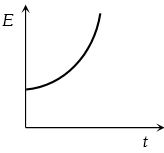
B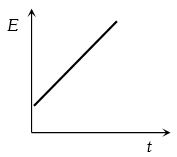
C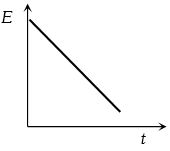
D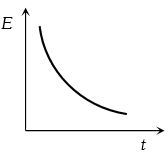
Solution
(A) Let the particle be projected horizontally with velocity $u$ at $t = 0$. The horizontal component of velocity remains constant, $v_x = u$. The vertical component of velocity at time $t$ is $v_y = gt$. The total velocity $v$ is given by $v^2 = v_x^2 + v_y^2 = u^2 + (gt)^2$. The kinetic energy $E$ is given by $E = \frac{1}{2}mv^2 = \frac{1}{2}m(u^2 + g^2t^2)$. This equation represents a parabola of the form $E = At^2 + B$, where $A = \frac{1}{2}mg^2$ and $B = \frac{1}{2}mu^2$. Since $u > 0$, the initial kinetic energy at $t = 0$ is $E_0 = \frac{1}{2}mu^2 > 0$. As $t$ increases, $E$ increases parabolically. Therefore, the correct graph is shown in option $A$.
0 likes
View Solution37
EasyMCQ
The graph between $\sqrt{E}$ and $\frac{1}{p}$ is ($E$ = kinetic energy and $p$ = momentum).
A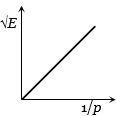
B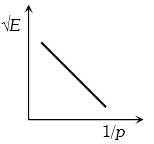
C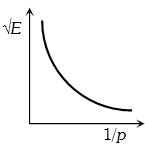
D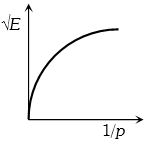
Solution
(C) The relationship between kinetic energy $E$ and momentum $p$ is given by $E = \frac{p^2}{2m}$,where $m$ is the mass of the particle.
Taking the square root on both sides,we get $\sqrt{E} = \frac{p}{\sqrt{2m}}$.
This can be rewritten as $\sqrt{E} = \frac{1}{\sqrt{2m}} \cdot p$.
However,the question asks for the graph between $\sqrt{E}$ and $\frac{1}{p}$.
From $E = \frac{p^2}{2m}$,we have $p = \sqrt{2mE}$.
Therefore,$\frac{1}{p} = \frac{1}{\sqrt{2mE}} = \frac{1}{\sqrt{2m}} \cdot \frac{1}{\sqrt{E}}$.
This implies $\sqrt{E} = \frac{1}{\sqrt{2m}} \cdot \frac{1}{(1/p)}$.
Let $y = \sqrt{E}$ and $x = \frac{1}{p}$. Then $y = \frac{k}{x}$,where $k = \frac{1}{\sqrt{2m}}$ is a constant.
This is the equation of a rectangular hyperbola. Thus,the graph between $\sqrt{E}$ and $\frac{1}{p}$ is a hyperbola.
Taking the square root on both sides,we get $\sqrt{E} = \frac{p}{\sqrt{2m}}$.
This can be rewritten as $\sqrt{E} = \frac{1}{\sqrt{2m}} \cdot p$.
However,the question asks for the graph between $\sqrt{E}$ and $\frac{1}{p}$.
From $E = \frac{p^2}{2m}$,we have $p = \sqrt{2mE}$.
Therefore,$\frac{1}{p} = \frac{1}{\sqrt{2mE}} = \frac{1}{\sqrt{2m}} \cdot \frac{1}{\sqrt{E}}$.
This implies $\sqrt{E} = \frac{1}{\sqrt{2m}} \cdot \frac{1}{(1/p)}$.
Let $y = \sqrt{E}$ and $x = \frac{1}{p}$. Then $y = \frac{k}{x}$,where $k = \frac{1}{\sqrt{2m}}$ is a constant.
This is the equation of a rectangular hyperbola. Thus,the graph between $\sqrt{E}$ and $\frac{1}{p}$ is a hyperbola.
0 likes
View Solution38
EasyMCQ
The graph between kinetic energy $E$ and velocity $v$ is:
A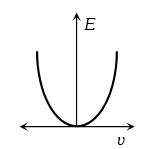
B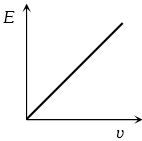
C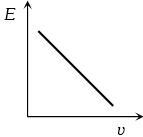
D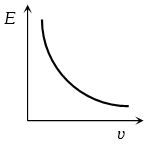
Solution
(A) The kinetic energy $E$ of an object of mass $m$ moving with velocity $v$ is given by the formula:
$E = \frac{1}{2}mv^2$
This equation shows that $E$ is directly proportional to the square of the velocity $(E \propto v^2)$.
This relationship represents a parabola that is symmetric about the $E$-axis,where $E$ increases as the magnitude of $v$ increases in either the positive or negative direction. Therefore,the correct graph is the one showing a parabolic curve opening upwards,which corresponds to option $A$.
$E = \frac{1}{2}mv^2$
This equation shows that $E$ is directly proportional to the square of the velocity $(E \propto v^2)$.
This relationship represents a parabola that is symmetric about the $E$-axis,where $E$ increases as the magnitude of $v$ increases in either the positive or negative direction. Therefore,the correct graph is the one showing a parabolic curve opening upwards,which corresponds to option $A$.
0 likes
View Solution39
EasyMCQ
Two particles have masses in the ratio $1 : 2$. If they have the same kinetic energy, what is the ratio of their momenta?
A
$1 : 2$
B
$1 : 4$
C
$1 : \sqrt{2}$
D
$1 : 1$
Solution
(C) The relationship between kinetic energy $(K)$, momentum $(p)$, and mass $(m)$ is given by the formula $K = \frac{p^2}{2m}$.
From this, we can express momentum as $p = \sqrt{2mK}$.
Given that the kinetic energies are the same $(K_1 = K_2 = K)$, the ratio of the momenta of the two particles is:
$\frac{p_1}{p_2} = \frac{\sqrt{2m_1K}}{\sqrt{2m_2K}} = \sqrt{\frac{m_1}{m_2}}$.
Given the ratio of masses is $\frac{m_1}{m_2} = \frac{1}{2}$, we substitute this into the equation:
$\frac{p_1}{p_2} = \sqrt{\frac{1}{2}} = \frac{1}{\sqrt{2}}$.
Therefore, the ratio of their momenta is $1 : \sqrt{2}$.
From this, we can express momentum as $p = \sqrt{2mK}$.
Given that the kinetic energies are the same $(K_1 = K_2 = K)$, the ratio of the momenta of the two particles is:
$\frac{p_1}{p_2} = \frac{\sqrt{2m_1K}}{\sqrt{2m_2K}} = \sqrt{\frac{m_1}{m_2}}$.
Given the ratio of masses is $\frac{m_1}{m_2} = \frac{1}{2}$, we substitute this into the equation:
$\frac{p_1}{p_2} = \sqrt{\frac{1}{2}} = \frac{1}{\sqrt{2}}$.
Therefore, the ratio of their momenta is $1 : \sqrt{2}$.
0 likes
View Solution40
EasyMCQ
$A$ body of mass $2 \ kg$ is projected vertically upwards with a velocity of $2 \ m \ s^{-1}$. What will be its kinetic energy in $J$ just before it hits the ground?
A
$2$
B
$1$
C
$4$
D
$8$
Solution
(C) According to the law of conservation of energy,the speed of the body when it returns to the point of projection will be equal to the speed with which it was projected.
Since the body is projected upwards with a velocity $v = 2 \ m \ s^{-1}$,it will return to the ground with the same velocity $v = 2 \ m \ s^{-1}$.
The kinetic energy $K$ is given by the formula $K = \frac{1}{2}mv^2$.
Substituting the values $m = 2 \ kg$ and $v = 2 \ m \ s^{-1}$:
$K = \frac{1}{2} \times 2 \times (2)^2 = 4 \ J$.
Since the body is projected upwards with a velocity $v = 2 \ m \ s^{-1}$,it will return to the ground with the same velocity $v = 2 \ m \ s^{-1}$.
The kinetic energy $K$ is given by the formula $K = \frac{1}{2}mv^2$.
Substituting the values $m = 2 \ kg$ and $v = 2 \ m \ s^{-1}$:
$K = \frac{1}{2} \times 2 \times (2)^2 = 4 \ J$.
0 likes
View Solution41
EasyMCQ
The kinetic energy of an object decreases by $19\%$. What is the percentage decrease in its momentum?
A
$20$
B
$15$
C
$10$
D
$5$
Solution
(C) Let the initial kinetic energy be $K_1$ and the final kinetic energy be $K_2$.
Given that the kinetic energy decreases by $19\%$,so $K_2 = K_1 - 0.19 K_1 = 0.81 K_1$.
We know the relation between kinetic energy $(K)$ and momentum $(p)$ is $K = \frac{p^2}{2m}$.
Therefore,$\frac{K_2}{K_1} = \left( \frac{p_2}{p_1} \right)^2$.
Substituting the values: $0.81 = \left( \frac{p_2}{p_1} \right)^2$.
Taking the square root on both sides: $\frac{p_2}{p_1} = \sqrt{0.81} = 0.9$.
This means $p_2 = 0.9 p_1$.
The percentage decrease in momentum is given by $\frac{p_1 - p_2}{p_1} \times 100\%$.
$= \frac{p_1 - 0.9 p_1}{p_1} \times 100\% = 0.1 \times 100\% = 10\%$.
Given that the kinetic energy decreases by $19\%$,so $K_2 = K_1 - 0.19 K_1 = 0.81 K_1$.
We know the relation between kinetic energy $(K)$ and momentum $(p)$ is $K = \frac{p^2}{2m}$.
Therefore,$\frac{K_2}{K_1} = \left( \frac{p_2}{p_1} \right)^2$.
Substituting the values: $0.81 = \left( \frac{p_2}{p_1} \right)^2$.
Taking the square root on both sides: $\frac{p_2}{p_1} = \sqrt{0.81} = 0.9$.
This means $p_2 = 0.9 p_1$.
The percentage decrease in momentum is given by $\frac{p_1 - p_2}{p_1} \times 100\%$.
$= \frac{p_1 - 0.9 p_1}{p_1} \times 100\% = 0.1 \times 100\% = 10\%$.
0 likes
View Solution42
MediumMCQ
$A$ body starting from rest is moved by a constant force for a fixed distance. The kinetic energy of a body of mass $m$ is proportional to:
A
$\sqrt{m}$
B
independent of $m$
C
$1/\sqrt{m}$
D
$m$
Solution
(B) According to the Work-Energy Theorem,the work done by the net force on an object is equal to the change in its kinetic energy.
$W = \Delta K.E. = K.E._{final} - K.E._{initial}$
Since the body starts from rest,the initial kinetic energy $K.E._{initial} = 0$.
Thus,$K.E. = W = F \cdot d$,where $F$ is the constant force and $d$ is the fixed distance.
Since both $F$ and $d$ are constant,the kinetic energy $K.E.$ is independent of the mass $m$ of the body.
$W = \Delta K.E. = K.E._{final} - K.E._{initial}$
Since the body starts from rest,the initial kinetic energy $K.E._{initial} = 0$.
Thus,$K.E. = W = F \cdot d$,where $F$ is the constant force and $d$ is the fixed distance.
Since both $F$ and $d$ are constant,the kinetic energy $K.E.$ is independent of the mass $m$ of the body.
0 likes
View Solution43
MediumMCQ
If the force acting on a body is inversely proportional to its speed,then its kinetic energy is
A
constant
B
inversely proportional to time
C
linearly related to time
D
inversely proportional to the square of time
Solution
(C) Given that the force $(F)$ is inversely proportional to the speed $(v)$,we have $F = \frac{k}{v}$,where $k$ is a constant.
Using Newton's second law,$F = ma = m \frac{dv}{dt}$.
Substituting $F$,we get $m \frac{dv}{dt} = \frac{k}{v}$.
Rearranging the terms,we get $mv \, dv = k \, dt$.
Integrating both sides,we get $\int mv \, dv = \int k \, dt$,which gives $\frac{1}{2} mv^2 = kt + C$.
Assuming the body starts from rest at $t = 0$,the constant $C = 0$.
Thus,the kinetic energy $(KE = \frac{1}{2} mv^2)$ is equal to $kt$.
Therefore,the kinetic energy is linearly related to time.
Using Newton's second law,$F = ma = m \frac{dv}{dt}$.
Substituting $F$,we get $m \frac{dv}{dt} = \frac{k}{v}$.
Rearranging the terms,we get $mv \, dv = k \, dt$.
Integrating both sides,we get $\int mv \, dv = \int k \, dt$,which gives $\frac{1}{2} mv^2 = kt + C$.
Assuming the body starts from rest at $t = 0$,the constant $C = 0$.
Thus,the kinetic energy $(KE = \frac{1}{2} mv^2)$ is equal to $kt$.
Therefore,the kinetic energy is linearly related to time.
0 likes
View Solution44
EasyMCQ
$A$ body of mass $m$ moving with velocity $v$ has kinetic energy equal to $\frac{1}{2} mv^2$. This statement is valid when:
A
The body moves with a velocity comparable to the speed of light.
B
The body moves with a velocity negligible compared to the speed of light.
C
The body moves with a velocity greater than the speed of light.
D
None of the above statements are true.
Solution
(B) The expression for kinetic energy,$K = \frac{1}{2} mv^2$,is derived from classical mechanics (Newtonian mechanics).
In classical mechanics,the mass $m$ of an object is considered a constant,independent of its velocity.
However,according to Einstein's theory of special relativity,as an object's velocity $v$ approaches the speed of light $c$,its relativistic mass increases according to the formula $m = \frac{m_0}{\sqrt{1 - v^2/c^2}}$.
Therefore,the classical formula $K = \frac{1}{2} mv^2$ is only valid when the velocity $v$ is much smaller than the speed of light $(v \ll c)$,meaning the velocity is negligible compared to the speed of light.
In classical mechanics,the mass $m$ of an object is considered a constant,independent of its velocity.
However,according to Einstein's theory of special relativity,as an object's velocity $v$ approaches the speed of light $c$,its relativistic mass increases according to the formula $m = \frac{m_0}{\sqrt{1 - v^2/c^2}}$.
Therefore,the classical formula $K = \frac{1}{2} mv^2$ is only valid when the velocity $v$ is much smaller than the speed of light $(v \ll c)$,meaning the velocity is negligible compared to the speed of light.
0 likes
View Solution45
MediumMCQ
Two bodies of different masses $m_1$ and $m_2$ have the same kinetic energy. If $p_1$ and $p_2$ are their respective momenta,find the ratio $p_1 : p_2$.
A
$m_1 : m_2$
B
$m_2 : m_1$
C
$\sqrt{m_1} : \sqrt{m_2}$
D
$m_1^2 : m_2^2$
Solution
(C) The kinetic energy $K$ of a body with mass $m$ and momentum $p$ is given by the relation $K = \frac{p^2}{2m}$.
Rearranging this for momentum,we get $p = \sqrt{2mK}$.
Since the kinetic energy $K$ is the same for both bodies,we have $p \propto \sqrt{m}$.
Therefore,the ratio of their momenta is $\frac{p_1}{p_2} = \sqrt{\frac{m_1}{m_2}}$.
Thus,$p_1 : p_2 = \sqrt{m_1} : \sqrt{m_2}$.
Rearranging this for momentum,we get $p = \sqrt{2mK}$.
Since the kinetic energy $K$ is the same for both bodies,we have $p \propto \sqrt{m}$.
Therefore,the ratio of their momenta is $\frac{p_1}{p_2} = \sqrt{\frac{m_1}{m_2}}$.
Thus,$p_1 : p_2 = \sqrt{m_1} : \sqrt{m_2}$.
0 likes
View Solution46
EasyMCQ
If a light object (mass $M_1$ and velocity $V_1$) and a heavy object (mass $M_2$ and velocity $V_2$) have the same kinetic energy,then which of the following is true regarding their momenta ($P_1 = M_1 V_1$ and $P_2 = M_2 V_2$)?
A
$M_2 V_2 < M_1 V_1$
B
$M_2 V_2 = M_1 V_1$
C
$M_2 V_1 = M_1 V_2$
D
$M_2 V_2 > M_1 V_1$
Solution
(D) The kinetic energy $(KE)$ of an object is given by $KE = \frac{P^2}{2M}$,where $P$ is the momentum and $M$ is the mass.
Given that both objects have the same kinetic energy,we have $KE_1 = KE_2$.
This implies $\frac{P_1^2}{2M_1} = \frac{P_2^2}{2M_2}$.
Rearranging the terms,we get $\frac{P_1^2}{P_2^2} = \frac{M_1}{M_2}$,which simplifies to $\frac{P_1}{P_2} = \sqrt{\frac{M_1}{M_2}}$.
Since the second object is heavier,we have $M_2 > M_1$.
Therefore,$\sqrt{\frac{M_2}{M_1}} > 1$,which means $P_2 > P_1$.
Thus,the momentum of the heavy object is greater than the momentum of the light object,i.e.,$M_2 V_2 > M_1 V_1$.
Given that both objects have the same kinetic energy,we have $KE_1 = KE_2$.
This implies $\frac{P_1^2}{2M_1} = \frac{P_2^2}{2M_2}$.
Rearranging the terms,we get $\frac{P_1^2}{P_2^2} = \frac{M_1}{M_2}$,which simplifies to $\frac{P_1}{P_2} = \sqrt{\frac{M_1}{M_2}}$.
Since the second object is heavier,we have $M_2 > M_1$.
Therefore,$\sqrt{\frac{M_2}{M_1}} > 1$,which means $P_2 > P_1$.
Thus,the momentum of the heavy object is greater than the momentum of the light object,i.e.,$M_2 V_2 > M_1 V_1$.
0 likes
View SolutionWork, Energy, Power and Collision — Kinetic Energy · Frequently Asked Questions
1Are these Work, Energy, Power and Collision questions useful for JEE and NEET?
Yes. All questions in this section are mapped to JEE Main and NEET exam patterns. Previous year questions from JEE Main, NEET, GUJCET and state-level exams are included with full solutions.
2Can I switch to Hindi or Gujarati for these questions?
Yes. Use the language tabs in the hero section or the sidebar to view the same questions and solutions in English, Hindi or Gujarati.
3How do I generate a question paper from this subtopic?
Use the Vedclass Exam Paper Generator — select the chapter and subtopic, set difficulty, and generate Sets A, B, C, D automatically. First 3 chapters of every subject are free.
Vedclass Products
For Students
Vedclass Test Series
Mock tests in real JEE/NEET style with performance analysis. 5-day free trial.
Start Free TrialFor Teachers
Exam Paper Generator
Generate Set A/B/C/D papers from this chapter in 2 minutes. 3 chapters free.
Try FreeFor Institutes
Online Exam Module
Live online exams with unlimited students, 360° analytics & white-label branding.
See DemoFor Teachers & Institutes
Generate a Work, Energy, Power and Collision Exam Paper in 2 Minutes
Select subtopic & difficulty — Sets A, B, C, D auto-generated with No Repeat logic.
First 3 chapters of every subject are free — no payment required.