
A English
Kinetic Energy Questions in English
Class 11 Physics · Work, Energy, Power and Collision · Kinetic Energy
144+
Questions
English
Language
100%
With Solutions
Showing 43 of 144 questions in English
101
MediumMCQ
Two particles having masses $4\, g$ and $16\, g$ respectively are moving with equal kinetic energies. The ratio of the magnitudes of their linear momentum is $n : 2$. The value of $n$ will be ...... .
A
$1$
B
$2$
C
$3$
D
$4$
Solution
(A) The kinetic energy $K$ of a particle with mass $m$ and linear momentum $p$ is given by the formula $K = \frac{p^2}{2m}$.
Since the kinetic energies of the two particles are equal,we have $K_1 = K_2$.
Substituting the formula,we get $\frac{p_1^2}{2m_1} = \frac{p_2^2}{2m_2}$.
Given $m_1 = 4\, g$ and $m_2 = 16\, g$,we have $\frac{p_1^2}{2 \times 4} = \frac{p_2^2}{2 \times 16}$.
Simplifying this,$\frac{p_1^2}{4} = \frac{p_2^2}{16}$,which implies $\frac{p_1^2}{p_2^2} = \frac{4}{16} = \frac{1}{4}$.
Taking the square root of both sides,$\frac{p_1}{p_2} = \frac{1}{2}$.
We are given that the ratio of the magnitudes of their linear momentum is $n : 2$,so $\frac{p_1}{p_2} = \frac{n}{2}$.
Comparing $\frac{n}{2} = \frac{1}{2}$,we find $n = 1$.
Since the kinetic energies of the two particles are equal,we have $K_1 = K_2$.
Substituting the formula,we get $\frac{p_1^2}{2m_1} = \frac{p_2^2}{2m_2}$.
Given $m_1 = 4\, g$ and $m_2 = 16\, g$,we have $\frac{p_1^2}{2 \times 4} = \frac{p_2^2}{2 \times 16}$.
Simplifying this,$\frac{p_1^2}{4} = \frac{p_2^2}{16}$,which implies $\frac{p_1^2}{p_2^2} = \frac{4}{16} = \frac{1}{4}$.
Taking the square root of both sides,$\frac{p_1}{p_2} = \frac{1}{2}$.
We are given that the ratio of the magnitudes of their linear momentum is $n : 2$,so $\frac{p_1}{p_2} = \frac{n}{2}$.
Comparing $\frac{n}{2} = \frac{1}{2}$,we find $n = 1$.
0 likes
View Solution102
MediumMCQ
If the kinetic energy of a moving body becomes four times its initial kinetic energy,then the percentage change in its momentum will be $...\%$
A
$100$
B
$300$
C
$400$
D
$200$
Solution
(A) Let the initial kinetic energy be $K_1$ and the final kinetic energy be $K_2 = 4K_1$.
Since kinetic energy $K = \frac{P^2}{2m}$,where $P$ is momentum and $m$ is mass,we have $P = \sqrt{2mK}$.
Therefore,the ratio of final momentum $P_2$ to initial momentum $P_1$ is $\frac{P_2}{P_1} = \sqrt{\frac{K_2}{K_1}} = \sqrt{\frac{4K_1}{K_1}} = \sqrt{4} = 2$.
This implies $P_2 = 2P_1$.
The percentage change in momentum is given by $\frac{P_2 - P_1}{P_1} \times 100$.
Substituting the values,we get $\frac{2P_1 - P_1}{P_1} \times 100 = \frac{P_1}{P_1} \times 100 = 100\%$.
Since kinetic energy $K = \frac{P^2}{2m}$,where $P$ is momentum and $m$ is mass,we have $P = \sqrt{2mK}$.
Therefore,the ratio of final momentum $P_2$ to initial momentum $P_1$ is $\frac{P_2}{P_1} = \sqrt{\frac{K_2}{K_1}} = \sqrt{\frac{4K_1}{K_1}} = \sqrt{4} = 2$.
This implies $P_2 = 2P_1$.
The percentage change in momentum is given by $\frac{P_2 - P_1}{P_1} \times 100$.
Substituting the values,we get $\frac{2P_1 - P_1}{P_1} \times 100 = \frac{P_1}{P_1} \times 100 = 100\%$.
1 likes
View Solution103
EasyMCQ
$A$ body of mass $8\,kg$ and another of mass $2\,kg$ are moving with equal kinetic energy. The ratio of their respective momenta will be.
A
$1:1$
B
$2:1$
C
$1:4$
D
$4:1$
Solution
(B) The kinetic energy $K$ and momentum $P$ are related by the formula $K = \frac{P^2}{2m}$,which implies $P = \sqrt{2mK}$.
Given that the kinetic energies are equal $(K_1 = K_2 = K)$,the ratio of their momenta is:
$\frac{P_1}{P_2} = \frac{\sqrt{2m_1K}}{\sqrt{2m_2K}} = \sqrt{\frac{m_1}{m_2}}$.
Substituting the given masses $m_1 = 8\,kg$ and $m_2 = 2\,kg$:
$\frac{P_1}{P_2} = \sqrt{\frac{8}{2}} = \sqrt{4} = 2$.
Thus,the ratio is $2:1$.
Given that the kinetic energies are equal $(K_1 = K_2 = K)$,the ratio of their momenta is:
$\frac{P_1}{P_2} = \frac{\sqrt{2m_1K}}{\sqrt{2m_2K}} = \sqrt{\frac{m_1}{m_2}}$.
Substituting the given masses $m_1 = 8\,kg$ and $m_2 = 2\,kg$:
$\frac{P_1}{P_2} = \sqrt{\frac{8}{2}} = \sqrt{4} = 2$.
Thus,the ratio is $2:1$.
0 likes
View Solution104
DifficultMCQ
$A$ bullet of mass $200\,g$ having initial kinetic energy $90\,J$ is shot inside a long swimming pool as shown in the figure. If its kinetic energy reduces to $40\,J$ within $1\,s$,the minimum length of the pool the bullet has to travel so that it completely comes to rest is $.....m$.
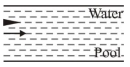
A
$45$
B
$90$
C
$125$
D
$25$
Solution
(A) Given: Mass $m = 200\,g = 0.2\,kg$,Initial kinetic energy $K_i = 90\,J$,Final kinetic energy $K_f = 40\,J$ at time $t = 1\,s$.
Using the relation $K = \frac{1}{2}mv^2$,we find the velocities:
Initial velocity $u = \sqrt{\frac{2K_i}{m}} = \sqrt{\frac{2 \times 90}{0.2}} = \sqrt{900} = 30\,m/s$.
Final velocity $v = \sqrt{\frac{2K_f}{m}} = \sqrt{\frac{2 \times 40}{0.2}} = \sqrt{400} = 20\,m/s$.
Assuming constant retardation,the acceleration $a$ is:
$a = \frac{v - u}{t} = \frac{20 - 30}{1} = -10\,m/s^2$.
To find the distance $s$ required to come to rest $(v_{final} = 0)$:
Using $v_{final}^2 = u^2 + 2as$,we get $0 = (30)^2 + 2(-10)s$.
$20s = 900 \implies s = 45\,m$.
Using the relation $K = \frac{1}{2}mv^2$,we find the velocities:
Initial velocity $u = \sqrt{\frac{2K_i}{m}} = \sqrt{\frac{2 \times 90}{0.2}} = \sqrt{900} = 30\,m/s$.
Final velocity $v = \sqrt{\frac{2K_f}{m}} = \sqrt{\frac{2 \times 40}{0.2}} = \sqrt{400} = 20\,m/s$.
Assuming constant retardation,the acceleration $a$ is:
$a = \frac{v - u}{t} = \frac{20 - 30}{1} = -10\,m/s^2$.
To find the distance $s$ required to come to rest $(v_{final} = 0)$:
Using $v_{final}^2 = u^2 + 2as$,we get $0 = (30)^2 + 2(-10)s$.
$20s = 900 \implies s = 45\,m$.
0 likes
View Solution105
MediumMCQ
If momentum of a body is increased by $20 \%$,then its kinetic energy increases by $....\%$
A
$36$
B
$40$
C
$44$
D
$48$
Solution
(C) The relationship between kinetic energy $K$ and momentum $P$ is given by $K = \frac{P^2}{2m}$.
Let the initial momentum be $P$ and the initial kinetic energy be $K = \frac{P^2}{2m}$.
The new momentum $P'$ is increased by $20\%$,so $P' = P + 0.20P = 1.2P$.
The new kinetic energy $K'$ is $K' = \frac{(P')^2}{2m} = \frac{(1.2P)^2}{2m} = 1.44 \times \frac{P^2}{2m} = 1.44K$.
The percentage increase in kinetic energy is given by $\frac{K' - K}{K} \times 100$.
Substituting the values,we get $\frac{1.44K - K}{K} \times 100 = 0.44 \times 100 = 44\%$.
Let the initial momentum be $P$ and the initial kinetic energy be $K = \frac{P^2}{2m}$.
The new momentum $P'$ is increased by $20\%$,so $P' = P + 0.20P = 1.2P$.
The new kinetic energy $K'$ is $K' = \frac{(P')^2}{2m} = \frac{(1.2P)^2}{2m} = 1.44 \times \frac{P^2}{2m} = 1.44K$.
The percentage increase in kinetic energy is given by $\frac{K' - K}{K} \times 100$.
Substituting the values,we get $\frac{1.44K - K}{K} \times 100 = 0.44 \times 100 = 44\%$.
0 likes
View Solution106
MediumMCQ
The $KE$ of a body is increased by $44 \%$. What is the percentage increase in its momentum?
A
$10$
B
$20$
C
$30$
D
$44$
Solution
(B) The relationship between kinetic energy $(K)$ and momentum $(P)$ is given by $K = \frac{P^2}{2m}$,which implies $P = \sqrt{2mK}$.
Let the initial kinetic energy be $K_1$ and the final kinetic energy be $K_2 = K_1 + 0.44 K_1 = 1.44 K_1$.
Let the initial momentum be $P_1$ and the final momentum be $P_2$.
Since $P \propto \sqrt{K}$,we have $\frac{P_2}{P_1} = \sqrt{\frac{K_2}{K_1}} = \sqrt{1.44} = 1.2$.
Therefore,$P_2 = 1.2 P_1$.
The percentage increase in momentum is $\frac{P_2 - P_1}{P_1} \times 100 = (1.2 - 1) \times 100 = 20 \%$.
Let the initial kinetic energy be $K_1$ and the final kinetic energy be $K_2 = K_1 + 0.44 K_1 = 1.44 K_1$.
Let the initial momentum be $P_1$ and the final momentum be $P_2$.
Since $P \propto \sqrt{K}$,we have $\frac{P_2}{P_1} = \sqrt{\frac{K_2}{K_1}} = \sqrt{1.44} = 1.2$.
Therefore,$P_2 = 1.2 P_1$.
The percentage increase in momentum is $\frac{P_2 - P_1}{P_1} \times 100 = (1.2 - 1) \times 100 = 20 \%$.
1 likes
View Solution107
MediumMCQ
Two bodies of masses $m_1$ and $m_2$ are moving with the same kinetic energy. If $P_1$ and $P_2$ are their respective momenta,the ratio $\frac{P_1}{P_2}$ is equal to:
A
$\frac{m_1}{m_2}$
B
$\sqrt{\frac{m_2}{m_1}}$
C
$\sqrt{\frac{m_1}{m_2}}$
D
$\frac{m_1^2}{m_2^2}$
Solution
(C) The kinetic energy $K$ of a body of mass $m$ and momentum $P$ is given by the relation $K = \frac{P^2}{2m}$.
Since both bodies have the same kinetic energy,we can write:
$K_1 = K_2$
$\frac{P_1^2}{2m_1} = \frac{P_2^2}{2m_2}$
Rearranging the terms to find the ratio of momenta $\frac{P_1}{P_2}$:
$\frac{P_1^2}{P_2^2} = \frac{m_1}{m_2}$
Taking the square root on both sides:
$\frac{P_1}{P_2} = \sqrt{\frac{m_1}{m_2}}$
Therefore,the correct option is $C$.
Since both bodies have the same kinetic energy,we can write:
$K_1 = K_2$
$\frac{P_1^2}{2m_1} = \frac{P_2^2}{2m_2}$
Rearranging the terms to find the ratio of momenta $\frac{P_1}{P_2}$:
$\frac{P_1^2}{P_2^2} = \frac{m_1}{m_2}$
Taking the square root on both sides:
$\frac{P_1}{P_2} = \sqrt{\frac{m_1}{m_2}}$
Therefore,the correct option is $C$.
0 likes
View Solution108
MediumMCQ
The momentum of a body is increased by $50 \%$. The percentage increase in the kinetic energy of the body is $...........\,\%$
A
$50$
B
$125$
C
$100$
D
$25$
Solution
(B) The kinetic energy $(KE)$ of a body is related to its momentum $(p)$ by the formula: $KE = \frac{p^2}{2m}$.
Let the initial momentum be $p_i$. The initial kinetic energy is $KE_i = \frac{p_i^2}{2m}$.
The momentum is increased by $50 \%$,so the final momentum $p_f = p_i + 0.50 p_i = 1.5 p_i$.
The final kinetic energy is $KE_f = \frac{p_f^2}{2m} = \frac{(1.5 p_i)^2}{2m} = \frac{2.25 p_i^2}{2m} = 2.25 KE_i$.
The percentage increase in kinetic energy is given by $\frac{KE_f - KE_i}{KE_i} \times 100$.
Substituting the values: $\frac{2.25 KE_i - KE_i}{KE_i} \times 100 = 1.25 \times 100 = 125 \%$.
Let the initial momentum be $p_i$. The initial kinetic energy is $KE_i = \frac{p_i^2}{2m}$.
The momentum is increased by $50 \%$,so the final momentum $p_f = p_i + 0.50 p_i = 1.5 p_i$.
The final kinetic energy is $KE_f = \frac{p_f^2}{2m} = \frac{(1.5 p_i)^2}{2m} = \frac{2.25 p_i^2}{2m} = 2.25 KE_i$.
The percentage increase in kinetic energy is given by $\frac{KE_f - KE_i}{KE_i} \times 100$.
Substituting the values: $\frac{2.25 KE_i - KE_i}{KE_i} \times 100 = 1.25 \times 100 = 125 \%$.
0 likes
View Solution109
DifficultMCQ
Two bodies of mass $4 \,g$ and $25 \,g$ are moving with equal kinetic energies. The ratio of the magnitude of their linear momentum is:
A
$3: 5$
B
$5: 4$
C
$2: 5$
D
$4: 5$
Solution
(C) The kinetic energy $K$ of a body is related to its linear momentum $P$ and mass $m$ by the formula $K = \frac{P^2}{2m}$.
Given that both bodies have equal kinetic energies, we have $K_1 = K_2$.
Therefore, $\frac{P_1^2}{2m_1} = \frac{P_2^2}{2m_2}$.
Rearranging the terms to find the ratio of their momenta, we get $\frac{P_1^2}{P_2^2} = \frac{m_1}{m_2}$.
Taking the square root on both sides, $\frac{P_1}{P_2} = \sqrt{\frac{m_1}{m_2}}$.
Substituting the given masses $m_1 = 4 \,g$ and $m_2 = 25 \,g$, we get $\frac{P_1}{P_2} = \sqrt{\frac{4}{25}} = \frac{2}{5}$.
Thus, the ratio of their linear momentum is $2: 5$.
Given that both bodies have equal kinetic energies, we have $K_1 = K_2$.
Therefore, $\frac{P_1^2}{2m_1} = \frac{P_2^2}{2m_2}$.
Rearranging the terms to find the ratio of their momenta, we get $\frac{P_1^2}{P_2^2} = \frac{m_1}{m_2}$.
Taking the square root on both sides, $\frac{P_1}{P_2} = \sqrt{\frac{m_1}{m_2}}$.
Substituting the given masses $m_1 = 4 \,g$ and $m_2 = 25 \,g$, we get $\frac{P_1}{P_2} = \sqrt{\frac{4}{25}} = \frac{2}{5}$.
Thus, the ratio of their linear momentum is $2: 5$.
0 likes
View Solution110
MediumMCQ
$A$ bullet of mass $50 \ g$ is fired with a speed $100 \ m/s$ on a plywood and emerges with $40 \ m/s$. The percentage loss of kinetic energy is:
A
$32$
B
$44$
C
$16$
D
$84$
Solution
(D) Initial kinetic energy $K_{i} = \frac{1}{2} m v_{i}^2 = \frac{1}{2} m (100)^2 = 5000 m \ J$.
Final kinetic energy $K_{f} = \frac{1}{2} m v_{f}^2 = \frac{1}{2} m (40)^2 = 800 m \ J$.
Percentage loss of kinetic energy $= \frac{K_{i} - K_{f}}{K_{i}} \times 100$.
$= \frac{5000 m - 800 m}{5000 m} \times 100$.
$= \frac{4200}{5000} \times 100 = 84 \%$.
Final kinetic energy $K_{f} = \frac{1}{2} m v_{f}^2 = \frac{1}{2} m (40)^2 = 800 m \ J$.
Percentage loss of kinetic energy $= \frac{K_{i} - K_{f}}{K_{i}} \times 100$.
$= \frac{5000 m - 800 m}{5000 m} \times 100$.
$= \frac{4200}{5000} \times 100 = 84 \%$.
0 likes
View Solution111
DifficultMCQ
Four particles $A, B, C, D$ of mass $\frac{m}{2}, m, 2m, 4m$ have the same momentum,respectively. The particle with maximum kinetic energy is:
A
$D$
B
$C$
C
$A$
D
$B$
Solution
(C) The kinetic energy $KE$ of a particle is related to its momentum $p$ and mass $m$ by the formula: $KE = \frac{p^2}{2m}$.
Since all four particles have the same momentum $p$,the kinetic energy is inversely proportional to the mass $(KE \propto \frac{1}{m})$.
Therefore,the particle with the smallest mass will have the maximum kinetic energy.
Comparing the masses: $\frac{m}{2} < m < 2m < 4m$.
The particle $A$ has the smallest mass,$\frac{m}{2}$.
Thus,particle $A$ has the maximum kinetic energy.
Since all four particles have the same momentum $p$,the kinetic energy is inversely proportional to the mass $(KE \propto \frac{1}{m})$.
Therefore,the particle with the smallest mass will have the maximum kinetic energy.
Comparing the masses: $\frac{m}{2} < m < 2m < 4m$.
The particle $A$ has the smallest mass,$\frac{m}{2}$.
Thus,particle $A$ has the maximum kinetic energy.
0 likes
View Solution112
DifficultMCQ
When kinetic energy of a body becomes $36$ times of its original value,the percentage increase in the momentum of the body will be : (in $\%$)
A
$500$
B
$600$
C
$6$
D
$60$
Solution
(A) The relationship between kinetic energy $K$ and momentum $P$ is given by $K = \frac{P^2}{2m}$,where $m$ is the mass of the body.
From this,we can write $P = \sqrt{2mK}$.
Let the initial kinetic energy be $K_i$ and the final kinetic energy be $K_f = 36 K_i$.
The initial momentum is $P_i = \sqrt{2mK_i}$ and the final momentum is $P_f = \sqrt{2mK_f} = \sqrt{2m(36K_i)} = 6\sqrt{2mK_i} = 6P_i$.
The percentage increase in momentum is given by $\frac{P_f - P_i}{P_i} \times 100 \%$.
Substituting the values,we get $\frac{6P_i - P_i}{P_i} \times 100 \% = \frac{5P_i}{P_i} \times 100 \% = 500 \%$.
From this,we can write $P = \sqrt{2mK}$.
Let the initial kinetic energy be $K_i$ and the final kinetic energy be $K_f = 36 K_i$.
The initial momentum is $P_i = \sqrt{2mK_i}$ and the final momentum is $P_f = \sqrt{2mK_f} = \sqrt{2m(36K_i)} = 6\sqrt{2mK_i} = 6P_i$.
The percentage increase in momentum is given by $\frac{P_f - P_i}{P_i} \times 100 \%$.
Substituting the values,we get $\frac{6P_i - P_i}{P_i} \times 100 \% = \frac{5P_i}{P_i} \times 100 \% = 500 \%$.
0 likes
View Solution113
DifficultMCQ
Three bodies $A, B$ and $C$ have equal kinetic energies and their masses are $400 \,g, 1.2 \,kg$ and $1.6 \,kg$ respectively. The ratio of their linear momenta is:
A
$1: \sqrt{3}: 2$
B
$1: \sqrt{3}: \sqrt{2}$
C
$\sqrt{2}: \sqrt{3}: 1$
D
$\sqrt{3}: \sqrt{2}: 1$
Solution
(A) The kinetic energy $KE$ of a body is related to its linear momentum $P$ and mass $m$ by the formula $KE = \frac{P^2}{2m}$.
Since the kinetic energies are equal, we have $P^2 = 2m(KE)$, which implies $P = \sqrt{2m(KE)}$.
Since $2$ and $KE$ are constants, the linear momentum is directly proportional to the square root of the mass: $P \propto \sqrt{m}$.
Given masses are $m_A = 400 \,g = 0.4 \,kg$, $m_B = 1.2 \,kg$, and $m_C = 1.6 \,kg$.
The ratio of their momenta is $P_A : P_B : P_C = \sqrt{m_A} : \sqrt{m_B} : \sqrt{m_C}$.
Substituting the values: $P_A : P_B : P_C = \sqrt{0.4} : \sqrt{1.2} : \sqrt{1.6}$.
Multiplying by $\sqrt{10}$ to simplify: $\sqrt{4} : \sqrt{12} : \sqrt{16} = 2 : 2\sqrt{3} : 4$.
Dividing by $2$, we get $1 : \sqrt{3} : 2$.
Since the kinetic energies are equal, we have $P^2 = 2m(KE)$, which implies $P = \sqrt{2m(KE)}$.
Since $2$ and $KE$ are constants, the linear momentum is directly proportional to the square root of the mass: $P \propto \sqrt{m}$.
Given masses are $m_A = 400 \,g = 0.4 \,kg$, $m_B = 1.2 \,kg$, and $m_C = 1.6 \,kg$.
The ratio of their momenta is $P_A : P_B : P_C = \sqrt{m_A} : \sqrt{m_B} : \sqrt{m_C}$.
Substituting the values: $P_A : P_B : P_C = \sqrt{0.4} : \sqrt{1.2} : \sqrt{1.6}$.
Multiplying by $\sqrt{10}$ to simplify: $\sqrt{4} : \sqrt{12} : \sqrt{16} = 2 : 2\sqrt{3} : 4$.
Dividing by $2$, we get $1 : \sqrt{3} : 2$.
0 likes
View Solution114
MediumMCQ
$A$ ball is thrown vertically upwards with a velocity $v$ and an initial kinetic energy $E$. When it reaches half way to the top of its flight,what are its velocity and kinetic energy respectively?
A
$ \frac{v}{2}, \frac{E}{2} $
B
$ \frac{v}{\sqrt{2}}, \frac{E}{2} $
C
$ \frac{v}{4}, \frac{E}{2} $
D
$ \frac{v}{4}, \frac{E}{\sqrt{2}} $
Solution
(B) Let the maximum height reached by the ball be $H$. At the maximum height,the final velocity is $0$. Using the equation of motion $v_f^2 = v_i^2 - 2gH$,we get $0 = v^2 - 2gH$,which implies $H = \frac{v^2}{2g}$.
At half the height,$h = \frac{H}{2} = \frac{v^2}{4g}$.
Using the equation $v'^2 = v^2 - 2gh$,the velocity $v'$ at height $h$ is $v'^2 = v^2 - 2g(\frac{v^2}{4g}) = v^2 - \frac{v^2}{2} = \frac{v^2}{2}$.
Thus,$v' = \frac{v}{\sqrt{2}}$.
The kinetic energy $E'$ at this point is $E' = \frac{1}{2}mv'^2 = \frac{1}{2}m(\frac{v^2}{2}) = \frac{1}{2}(\frac{1}{2}mv^2) = \frac{E}{2}$.
At half the height,$h = \frac{H}{2} = \frac{v^2}{4g}$.
Using the equation $v'^2 = v^2 - 2gh$,the velocity $v'$ at height $h$ is $v'^2 = v^2 - 2g(\frac{v^2}{4g}) = v^2 - \frac{v^2}{2} = \frac{v^2}{2}$.
Thus,$v' = \frac{v}{\sqrt{2}}$.
The kinetic energy $E'$ at this point is $E' = \frac{1}{2}mv'^2 = \frac{1}{2}m(\frac{v^2}{2}) = \frac{1}{2}(\frac{1}{2}mv^2) = \frac{E}{2}$.
0 likes
View Solution115
MediumMCQ
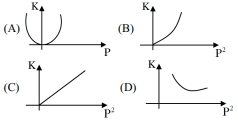
Kinetic energy $(K)$ depends on momentum $(P)$ as $K = \frac{P^2}{2m}$. Which of the following graphs is/are correct?
A
$A$ and $B$
B
$B$ and $C$
C
$A$ and $C$
D
$B$ and $D$
Solution
(C) The relationship between kinetic energy $(K)$ and momentum $(P)$ is given by $K = \frac{P^2}{2m}$.
$1$. For the graph between $K$ and $P$,the equation is $K = \frac{1}{2m} P^2$. This is of the form $y = ax^2$,which represents a parabola opening upwards. Thus,graph $(A)$ is correct.
$2$. For the graph between $K$ and $P^2$,let $X = P^2$. Then the equation becomes $K = \frac{1}{2m} X$. This is of the form $y = mx$,which represents a straight line passing through the origin. Thus,graph $(C)$ is correct.
Therefore,graphs $(A)$ and $(C)$ are correct.
$1$. For the graph between $K$ and $P$,the equation is $K = \frac{1}{2m} P^2$. This is of the form $y = ax^2$,which represents a parabola opening upwards. Thus,graph $(A)$ is correct.
$2$. For the graph between $K$ and $P^2$,let $X = P^2$. Then the equation becomes $K = \frac{1}{2m} X$. This is of the form $y = mx$,which represents a straight line passing through the origin. Thus,graph $(C)$ is correct.
Therefore,graphs $(A)$ and $(C)$ are correct.
0 likes
View Solution116
DifficultMCQ
If the momentum of a body of mass $m$ is increased by $20 \%$,then its kinetic energy increases by: (in $\%$)
A
$44$
B
$55$
C
$66$
D
$77$
Solution
(A) The kinetic energy $(K.E.)$ of a body is related to its momentum $(p)$ by the formula: $K.E. = \frac{p^2}{2m}$.
When the momentum increases by $20 \%$,the new momentum $p'$ becomes:
$p' = p + 0.20p = 1.2p$.
The new kinetic energy $(K.E.')$ is:
$K.E.' = \frac{(p')^2}{2m} = \frac{(1.2p)^2}{2m} = \frac{1.44p^2}{2m}$.
Since $K.E. = \frac{p^2}{2m}$,we have $K.E.' = 1.44 \times K.E$.
The percentage increase in kinetic energy is given by:
$\Delta K.E. \% = \frac{K.E.' - K.E.}{K.E.} \times 100 \%$
$= \frac{1.44 K.E. - K.E.}{K.E.} \times 100 \%$
$= 0.44 \times 100 \% = 44 \%$.
When the momentum increases by $20 \%$,the new momentum $p'$ becomes:
$p' = p + 0.20p = 1.2p$.
The new kinetic energy $(K.E.')$ is:
$K.E.' = \frac{(p')^2}{2m} = \frac{(1.2p)^2}{2m} = \frac{1.44p^2}{2m}$.
Since $K.E. = \frac{p^2}{2m}$,we have $K.E.' = 1.44 \times K.E$.
The percentage increase in kinetic energy is given by:
$\Delta K.E. \% = \frac{K.E.' - K.E.}{K.E.} \times 100 \%$
$= \frac{1.44 K.E. - K.E.}{K.E.} \times 100 \%$
$= 0.44 \times 100 \% = 44 \%$.
0 likes
View Solution117
EasyMCQ
If a lighter body of mass $M_1$ and velocity $V_1$ and a heavy body of mass $M_2$ and velocity $V_2$ have the same kinetic energy,then:
A
$M_2 V_2 < M_1 V_1$
B
$M_2 V_2 = M_1 V_1$
C
$M_2 V_1 < M_1 V_2$
D
$M_2 V_2 > M_1 V_1$
Solution
(D) The kinetic energy $(KE)$ of a body is given by $KE = \frac{1}{2} mv^2 = \frac{p^2}{2m}$,where $p = mv$ is the momentum.
Since both bodies have the same kinetic energy,$KE_1 = KE_2$.
Therefore,$\frac{p_1^2}{2M_1} = \frac{p_2^2}{2M_2}$.
This implies $\frac{p_1^2}{p_2^2} = \frac{M_1}{M_2}$,or $\frac{p_1}{p_2} = \sqrt{\frac{M_1}{M_2}}$.
Since the body with mass $M_2$ is heavier,$M_2 > M_1$,which means $\frac{M_1}{M_2} < 1$.
Consequently,$\frac{p_1}{p_2} < 1$,which implies $p_1 < p_2$.
Since $p = mv$,we have $M_1 V_1 < M_2 V_2$ or $M_2 V_2 > M_1 V_1$.
Since both bodies have the same kinetic energy,$KE_1 = KE_2$.
Therefore,$\frac{p_1^2}{2M_1} = \frac{p_2^2}{2M_2}$.
This implies $\frac{p_1^2}{p_2^2} = \frac{M_1}{M_2}$,or $\frac{p_1}{p_2} = \sqrt{\frac{M_1}{M_2}}$.
Since the body with mass $M_2$ is heavier,$M_2 > M_1$,which means $\frac{M_1}{M_2} < 1$.
Consequently,$\frac{p_1}{p_2} < 1$,which implies $p_1 < p_2$.
Since $p = mv$,we have $M_1 V_1 < M_2 V_2$ or $M_2 V_2 > M_1 V_1$.
0 likes
View Solution118
EasyMCQ
The kinetic energy of a light body and a heavy body is same. Which one of them has greater momentum?
A
$A$ body having high velocity
B
Heavy body
C
Light body
D
$A$ body having large displacement
Solution
(B) The relationship between kinetic energy $K$ and momentum $p$ is given by $K = \frac{p^2}{2m}$,where $m$ is the mass of the body.
Rearranging this formula,we get $p = \sqrt{2mK}$.
Since the kinetic energy $K$ is the same for both bodies,the momentum $p$ is directly proportional to the square root of the mass,i.e.,$p \propto \sqrt{m}$.
Therefore,the body with the larger mass will have a greater momentum.
Thus,the heavy body has greater momentum.
Rearranging this formula,we get $p = \sqrt{2mK}$.
Since the kinetic energy $K$ is the same for both bodies,the momentum $p$ is directly proportional to the square root of the mass,i.e.,$p \propto \sqrt{m}$.
Therefore,the body with the larger mass will have a greater momentum.
Thus,the heavy body has greater momentum.
0 likes
View Solution119
EasyMCQ
Three bodies $P$,$Q$ and $R$ have masses $m \ kg$,$2m \ kg$ and $3m \ kg$ respectively. If all the bodies have equal kinetic energy,then which body/bodies will have the greater momentum?
A
$Q$
B
$R$
C
$P$ and $Q$
D
$P$
Solution
(B) The kinetic energy $K$ is related to momentum $p$ and mass $m$ by the formula $K = \frac{p^2}{2m}$.
Rearranging this formula for momentum,we get $p^2 = 2mK$,which implies $p = \sqrt{2mK}$.
Since all three bodies have equal kinetic energy ($K$ is constant),the momentum is directly proportional to the square root of the mass: $p \propto \sqrt{m}$.
Comparing the masses: $m_P = m$,$m_Q = 2m$,and $m_R = 3m$.
Since $m_R > m_Q > m_P$,it follows that $p_R > p_Q > p_P$.
Therefore,the body with the greatest mass,which is $R$,will have the greatest momentum.
Rearranging this formula for momentum,we get $p^2 = 2mK$,which implies $p = \sqrt{2mK}$.
Since all three bodies have equal kinetic energy ($K$ is constant),the momentum is directly proportional to the square root of the mass: $p \propto \sqrt{m}$.
Comparing the masses: $m_P = m$,$m_Q = 2m$,and $m_R = 3m$.
Since $m_R > m_Q > m_P$,it follows that $p_R > p_Q > p_P$.
Therefore,the body with the greatest mass,which is $R$,will have the greatest momentum.
0 likes
View Solution120
EasyMCQ
$A$ body initially at rest is acted upon by a constant force $F$ for time $t$. The kinetic energy at time $t$ is
A
$\frac{F^{2} t^{2}}{m}$
B
$\left(\frac{Ft}{m}\right)^{2}$
C
$\frac{Ft}{2m}$
D
$\frac{F^{2} t^{2}}{2m}$
Solution
(D) Given that the body is initially at rest,the initial velocity $u = 0$.
According to Newton's second law,the acceleration $a = \frac{F}{m}$.
Using the first equation of motion,the velocity $v$ at time $t$ is $v = u + at = 0 + \left(\frac{F}{m}\right)t = \frac{Ft}{m}$.
The kinetic energy $K$ is given by the formula $K = \frac{1}{2}mv^{2}$.
Substituting the value of $v$,we get $K = \frac{1}{2}m\left(\frac{Ft}{m}\right)^{2}$.
$K = \frac{1}{2}m \frac{F^{2}t^{2}}{m^{2}} = \frac{F^{2}t^{2}}{2m}$.
According to Newton's second law,the acceleration $a = \frac{F}{m}$.
Using the first equation of motion,the velocity $v$ at time $t$ is $v = u + at = 0 + \left(\frac{F}{m}\right)t = \frac{Ft}{m}$.
The kinetic energy $K$ is given by the formula $K = \frac{1}{2}mv^{2}$.
Substituting the value of $v$,we get $K = \frac{1}{2}m\left(\frac{Ft}{m}\right)^{2}$.
$K = \frac{1}{2}m \frac{F^{2}t^{2}}{m^{2}} = \frac{F^{2}t^{2}}{2m}$.
0 likes
View Solution121
EasyMCQ
The work done by a force on a body of mass $5 \,kg$ to accelerate it in the direction of the force from rest to $20 \,m/s$ in $10 \,s$ is:
A
$2 \times 10^3 \,J$
B
$10^3 \,J$
C
$10^{-3} \,J$
D
$4 \times 10^3 \,J$
Solution
(B) The correct option is $B$.
Concept: According to the work-energy theorem, the total work done by all forces acting on a body is equal to the change in its kinetic energy $(K.E.)$.
Given: Mass $m = 5 \,kg$, initial velocity $u = 0 \,m/s$, final velocity $v = 20 \,m/s$.
Work done $W = \Delta K.E. = K.E._{final} - K.E._{initial}$.
$W = \frac{1}{2} mv^2 - \frac{1}{2} mu^2$.
$W = \frac{1}{2} \times 5 \times (20)^2 - 0$.
$W = \frac{1}{2} \times 5 \times 400 = 5 \times 200 = 1000 \,J = 10^3 \,J$.
Concept: According to the work-energy theorem, the total work done by all forces acting on a body is equal to the change in its kinetic energy $(K.E.)$.
Given: Mass $m = 5 \,kg$, initial velocity $u = 0 \,m/s$, final velocity $v = 20 \,m/s$.
Work done $W = \Delta K.E. = K.E._{final} - K.E._{initial}$.
$W = \frac{1}{2} mv^2 - \frac{1}{2} mu^2$.
$W = \frac{1}{2} \times 5 \times (20)^2 - 0$.
$W = \frac{1}{2} \times 5 \times 400 = 5 \times 200 = 1000 \,J = 10^3 \,J$.
0 likes
View Solution122
EasyMCQ
$A$ $4 \,kg$ mass and a $1 \,kg$ mass are moving with equal kinetic energies. The ratio of the magnitude of their linear momenta is
A
$2: 1$
B
$4: 1$
C
$1: 2$
D
$1: 1$
Solution
(A) The kinetic energy $K$ and linear momentum $p$ of a body of mass $m$ are related by the formula: $K = \frac{p^2}{2m}$.
From this,we can express momentum as: $p = \sqrt{2mK}$.
Given that both masses have equal kinetic energy $(K_1 = K_2 = K)$,the ratio of their momenta is:
$\frac{p_1}{p_2} = \frac{\sqrt{2m_1K}}{\sqrt{2m_2K}} = \sqrt{\frac{m_1}{m_2}}$.
Substituting the given masses $m_1 = 4 \,kg$ and $m_2 = 1 \,kg$:
$\frac{p_1}{p_2} = \sqrt{\frac{4}{1}} = \frac{2}{1}$.
Thus,the ratio of the magnitude of their linear momenta is $2: 1$.
From this,we can express momentum as: $p = \sqrt{2mK}$.
Given that both masses have equal kinetic energy $(K_1 = K_2 = K)$,the ratio of their momenta is:
$\frac{p_1}{p_2} = \frac{\sqrt{2m_1K}}{\sqrt{2m_2K}} = \sqrt{\frac{m_1}{m_2}}$.
Substituting the given masses $m_1 = 4 \,kg$ and $m_2 = 1 \,kg$:
$\frac{p_1}{p_2} = \sqrt{\frac{4}{1}} = \frac{2}{1}$.
Thus,the ratio of the magnitude of their linear momenta is $2: 1$.
0 likes
View Solution123
MediumMCQ
Two masses of $1 \ g$ and $4 \ g$ are moving with equal kinetic energy. The ratio of the magnitudes of their momenta is
A
$1: 2$
B
$1: 4$
C
$1: 1$
D
$2: 1$
Solution
(A) The kinetic energy $K$ of a body of mass $m$ and momentum $p$ is given by the relation $K = \frac{p^2}{2m}$.
Given that the kinetic energies of the two masses are equal,we have $K_1 = K_2$.
Substituting the expression for kinetic energy,we get $\frac{p_1^2}{2m_1} = \frac{p_2^2}{2m_2}$.
Rearranging the terms to find the ratio of momenta,we get $\frac{p_1^2}{p_2^2} = \frac{m_1}{m_2}$.
Taking the square root on both sides,the ratio of momenta is $\frac{p_1}{p_2} = \sqrt{\frac{m_1}{m_2}}$.
Given $m_1 = 1 \ g$ and $m_2 = 4 \ g$,we substitute these values:
$\frac{p_1}{p_2} = \sqrt{\frac{1}{4}} = \frac{1}{2}$.
Therefore,the ratio of their momenta is $1: 2$.
Given that the kinetic energies of the two masses are equal,we have $K_1 = K_2$.
Substituting the expression for kinetic energy,we get $\frac{p_1^2}{2m_1} = \frac{p_2^2}{2m_2}$.
Rearranging the terms to find the ratio of momenta,we get $\frac{p_1^2}{p_2^2} = \frac{m_1}{m_2}$.
Taking the square root on both sides,the ratio of momenta is $\frac{p_1}{p_2} = \sqrt{\frac{m_1}{m_2}}$.
Given $m_1 = 1 \ g$ and $m_2 = 4 \ g$,we substitute these values:
$\frac{p_1}{p_2} = \sqrt{\frac{1}{4}} = \frac{1}{2}$.
Therefore,the ratio of their momenta is $1: 2$.
0 likes
View Solution124
EasyMCQ
Two particles of masses $m_{1}$ and $m_{2}$ have equal kinetic energies. The ratio of their momentum is
A
$m_{1}: m_{2}$
B
$m_{2}: m_{1}$
C
$\sqrt{m_{1}}: \sqrt{m_{2}}$
D
$m_{1}^{2}: m_{2}^{2}$
Solution
(C) Given,the kinetic energy $(K)$ of two particles of masses $m_{1}$ and $m_{2}$ is equal.
We know that kinetic energy is related to momentum $(p)$ by the formula $K = \frac{p^{2}}{2m}$.
Since $K_{1} = K_{2}$,we have $\frac{p_{1}^{2}}{2m_{1}} = \frac{p_{2}^{2}}{2m_{2}}$.
Rearranging the terms to find the ratio of momenta $\frac{p_{1}}{p_{2}}$,we get $\frac{p_{1}^{2}}{p_{2}^{2}} = \frac{m_{1}}{m_{2}}$.
Taking the square root on both sides,we obtain $\frac{p_{1}}{p_{2}} = \sqrt{\frac{m_{1}}{m_{2}}} = \frac{\sqrt{m_{1}}}{\sqrt{m_{2}}}$.
Therefore,the ratio of their momenta is $\sqrt{m_{1}}: \sqrt{m_{2}}$.
We know that kinetic energy is related to momentum $(p)$ by the formula $K = \frac{p^{2}}{2m}$.
Since $K_{1} = K_{2}$,we have $\frac{p_{1}^{2}}{2m_{1}} = \frac{p_{2}^{2}}{2m_{2}}$.
Rearranging the terms to find the ratio of momenta $\frac{p_{1}}{p_{2}}$,we get $\frac{p_{1}^{2}}{p_{2}^{2}} = \frac{m_{1}}{m_{2}}$.
Taking the square root on both sides,we obtain $\frac{p_{1}}{p_{2}} = \sqrt{\frac{m_{1}}{m_{2}}} = \frac{\sqrt{m_{1}}}{\sqrt{m_{2}}}$.
Therefore,the ratio of their momenta is $\sqrt{m_{1}}: \sqrt{m_{2}}$.
0 likes
View Solution125
MediumMCQ
If the linear momentum of a body is increased by $50 \%$,then the kinetic energy of that body increases by (in $\%$)
A
$100$
B
$125$
C
$225$
D
$25$
Solution
(B) The kinetic energy $K$ of a body is related to its linear momentum $p$ by the formula $K = \frac{p^2}{2m}$,where $m$ is the mass of the body.
Since the mass $m$ remains constant,we have $K \propto p^2$.
Let the initial momentum be $p_1 = p$ and the final momentum be $p_2 = p + 0.50p = 1.5p$.
The ratio of the final kinetic energy $K_2$ to the initial kinetic energy $K_1$ is given by:
$\frac{K_2}{K_1} = \left(\frac{p_2}{p_1}\right)^2 = \left(\frac{1.5p}{p}\right)^2 = (1.5)^2 = 2.25$.
To find the percentage increase in kinetic energy,we use the formula:
$\text{Percentage increase} = \left(\frac{K_2}{K_1} - 1\right) \times 100 \%$.
Substituting the value: $(2.25 - 1) \times 100 \% = 1.25 \times 100 \% = 125 \%$.
Since the mass $m$ remains constant,we have $K \propto p^2$.
Let the initial momentum be $p_1 = p$ and the final momentum be $p_2 = p + 0.50p = 1.5p$.
The ratio of the final kinetic energy $K_2$ to the initial kinetic energy $K_1$ is given by:
$\frac{K_2}{K_1} = \left(\frac{p_2}{p_1}\right)^2 = \left(\frac{1.5p}{p}\right)^2 = (1.5)^2 = 2.25$.
To find the percentage increase in kinetic energy,we use the formula:
$\text{Percentage increase} = \left(\frac{K_2}{K_1} - 1\right) \times 100 \%$.
Substituting the value: $(2.25 - 1) \times 100 \% = 1.25 \times 100 \% = 125 \%$.
0 likes
View Solution126
EasyMCQ
The kinetic energy of a body of mass $4 \,kg$ and momentum $6 \,Ns$ will be (in $\,J$)
A
$2.5$
B
$3.5$
C
$4.5$
D
$5.5$
Solution
(C) Given: mass $m = 4 \,kg$, momentum $p = 6 \,Ns$.
The relationship between kinetic energy $K$ and momentum $p$ is given by $K = \frac{p^2}{2m}$.
Substituting the given values into the formula:
$K = \frac{6^2}{2 \times 4} = \frac{36}{8} = 4.5 \,J$.
Therefore, the kinetic energy of the body is $4.5 \,J$.
The relationship between kinetic energy $K$ and momentum $p$ is given by $K = \frac{p^2}{2m}$.
Substituting the given values into the formula:
$K = \frac{6^2}{2 \times 4} = \frac{36}{8} = 4.5 \,J$.
Therefore, the kinetic energy of the body is $4.5 \,J$.
0 likes
View Solution127
EasyMCQ
$A$ light body of momentum $P_L$ and a heavy body of momentum $P_H$,both have the same kinetic energy,then:
A
$P_L > P_H$
B
$P_H > P_L$
C
$P_L = P_H$
D
Always $P_H = 2 P_L$
Solution
(B) The kinetic energy $K$ of a body with momentum $P$ and mass $m$ is given by the relation $K = \frac{P^2}{2m}$.
Given that both bodies have the same kinetic energy,we have $K_H = K_L$.
Substituting the formula,we get $\frac{P_H^2}{2 m_H} = \frac{P_L^2}{2 m_L}$.
Rearranging the terms,we get $\frac{P_H^2}{P_L^2} = \frac{m_H}{m_L}$,which implies $\frac{P_H}{P_L} = \sqrt{\frac{m_H}{m_L}}$.
Since the body is heavy,$m_H > m_L$,which means $\frac{m_H}{m_L} > 1$.
Therefore,$\frac{P_H}{P_L} > 1$,which leads to $P_H > P_L$.
Given that both bodies have the same kinetic energy,we have $K_H = K_L$.
Substituting the formula,we get $\frac{P_H^2}{2 m_H} = \frac{P_L^2}{2 m_L}$.
Rearranging the terms,we get $\frac{P_H^2}{P_L^2} = \frac{m_H}{m_L}$,which implies $\frac{P_H}{P_L} = \sqrt{\frac{m_H}{m_L}}$.
Since the body is heavy,$m_H > m_L$,which means $\frac{m_H}{m_L} > 1$.
Therefore,$\frac{P_H}{P_L} > 1$,which leads to $P_H > P_L$.
0 likes
View Solution128
EasyMCQ
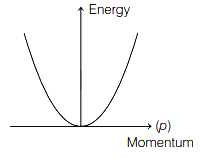
What is the nature of the graph between the momentum of a body and its kinetic energy?
A
Straight line
B
Parabola
C
Circle
D
Ellipse
Solution
(B) Let the mass of the body be $m$ and the velocity of the body be $v$,such that it has momentum $p$ and kinetic energy $E$.
Momentum is given by $p = mv$.
Squaring both sides,we get $p^2 = m^2 v^2$.
Kinetic energy is given by $E = \frac{1}{2} mv^2$.
We can rewrite this as $E = \frac{m^2 v^2}{2m} = \frac{p^2}{2m}$.
Since $m$ is constant for a given body,we have $E \propto p^2$.
This equation is of the form $y = kx^2$,which represents a parabola.
Therefore,the nature of the graph between the momentum and kinetic energy of a body is a parabola.
Momentum is given by $p = mv$.
Squaring both sides,we get $p^2 = m^2 v^2$.
Kinetic energy is given by $E = \frac{1}{2} mv^2$.
We can rewrite this as $E = \frac{m^2 v^2}{2m} = \frac{p^2}{2m}$.
Since $m$ is constant for a given body,we have $E \propto p^2$.
This equation is of the form $y = kx^2$,which represents a parabola.
Therefore,the nature of the graph between the momentum and kinetic energy of a body is a parabola.
0 likes
View Solution129
EasyMCQ
The kinetic energy of a body is increased by $4$ times. Its momentum will
A
increase twice
B
increase four times
C
decrease twice
D
remains constant
Solution
(A) The relationship between kinetic energy $K$ and momentum $p$ is given by $K = \frac{p^2}{2m}$,which implies $p = \sqrt{2mK}$.
Let the initial kinetic energy be $K_1 = K$ and the final kinetic energy be $K_2 = 4K$.
The initial momentum is $p_1 = \sqrt{2mK_1} = \sqrt{2mK}$.
The final momentum is $p_2 = \sqrt{2mK_2} = \sqrt{2m(4K)} = 2\sqrt{2mK}$.
Comparing the two,we get $p_2 = 2p_1$.
Therefore,the momentum increases by $2$ times.
Let the initial kinetic energy be $K_1 = K$ and the final kinetic energy be $K_2 = 4K$.
The initial momentum is $p_1 = \sqrt{2mK_1} = \sqrt{2mK}$.
The final momentum is $p_2 = \sqrt{2mK_2} = \sqrt{2m(4K)} = 2\sqrt{2mK}$.
Comparing the two,we get $p_2 = 2p_1$.
Therefore,the momentum increases by $2$ times.
0 likes
View Solution130
EasyMCQ
Two objects of masses $m_1$ and $m_2$ possess equal kinetic energies. If $p_1$ and $p_2$ are their respective momentum,then $p_1: p_2$ is
A
$m_1: m_2$
B
$m_2: m_1$
C
$\sqrt{m_1}: \sqrt{m_2}$
D
$m_1^2: m_2^2$
Solution
(C) The kinetic energy $K$ of an object of mass $m$ and momentum $p$ is given by the relation $K = \frac{p^2}{2m}$.
Given that the kinetic energies are equal,we have $K_1 = K_2$.
Therefore,$\frac{p_1^2}{2m_1} = \frac{p_2^2}{2m_2}$.
Rearranging the terms to find the ratio of momenta,we get $\frac{p_1^2}{p_2^2} = \frac{m_1}{m_2}$.
Taking the square root on both sides,we obtain $\frac{p_1}{p_2} = \sqrt{\frac{m_1}{m_2}} = \frac{\sqrt{m_1}}{\sqrt{m_2}}$.
Thus,the ratio $p_1: p_2$ is $\sqrt{m_1}: \sqrt{m_2}$.
Given that the kinetic energies are equal,we have $K_1 = K_2$.
Therefore,$\frac{p_1^2}{2m_1} = \frac{p_2^2}{2m_2}$.
Rearranging the terms to find the ratio of momenta,we get $\frac{p_1^2}{p_2^2} = \frac{m_1}{m_2}$.
Taking the square root on both sides,we obtain $\frac{p_1}{p_2} = \sqrt{\frac{m_1}{m_2}} = \frac{\sqrt{m_1}}{\sqrt{m_2}}$.
Thus,the ratio $p_1: p_2$ is $\sqrt{m_1}: \sqrt{m_2}$.
0 likes
View Solution131
MediumMCQ
The kinetic energy of a car is doubled when its velocity is increased by $1 \,m/s$. Then the initial velocity of the car is
A
$(2+\sqrt{2}) \,m/s$
B
$(1-\sqrt{2}) \,m/s$
C
$(2-\sqrt{2}) \,m/s$
D
$(1+\sqrt{2}) \,m/s$
Solution
(D) Let the initial velocity be $v$.
Initial kinetic energy $E = \frac{1}{2}mv^2$.
When the velocity is increased by $1 \,m/s$, the new velocity becomes $v' = v + 1$.
The new kinetic energy $E' = \frac{1}{2}m(v+1)^2$.
According to the problem, the kinetic energy is doubled, so $E' = 2E$.
Substituting the expressions: $\frac{1}{2}m(v+1)^2 = 2 \times (\frac{1}{2}mv^2)$.
Simplifying the equation: $(v+1)^2 = 2v^2$.
Expanding the left side: $v^2 + 2v + 1 = 2v^2$.
Rearranging the terms to form a quadratic equation: $v^2 - 2v - 1 = 0$.
Using the quadratic formula $v = \frac{-b \pm \sqrt{b^2 - 4ac}}{2a}$:
$v = \frac{2 \pm \sqrt{(-2)^2 - 4(1)(-1)}}{2(1)} = \frac{2 \pm \sqrt{4 + 4}}{2} = \frac{2 \pm \sqrt{8}}{2} = \frac{2 \pm 2\sqrt{2}}{2} = 1 \pm \sqrt{2}$.
Since velocity must be positive, we take $v = (1 + \sqrt{2}) \,m/s$.
Initial kinetic energy $E = \frac{1}{2}mv^2$.
When the velocity is increased by $1 \,m/s$, the new velocity becomes $v' = v + 1$.
The new kinetic energy $E' = \frac{1}{2}m(v+1)^2$.
According to the problem, the kinetic energy is doubled, so $E' = 2E$.
Substituting the expressions: $\frac{1}{2}m(v+1)^2 = 2 \times (\frac{1}{2}mv^2)$.
Simplifying the equation: $(v+1)^2 = 2v^2$.
Expanding the left side: $v^2 + 2v + 1 = 2v^2$.
Rearranging the terms to form a quadratic equation: $v^2 - 2v - 1 = 0$.
Using the quadratic formula $v = \frac{-b \pm \sqrt{b^2 - 4ac}}{2a}$:
$v = \frac{2 \pm \sqrt{(-2)^2 - 4(1)(-1)}}{2(1)} = \frac{2 \pm \sqrt{4 + 4}}{2} = \frac{2 \pm \sqrt{8}}{2} = \frac{2 \pm 2\sqrt{2}}{2} = 1 \pm \sqrt{2}$.
Since velocity must be positive, we take $v = (1 + \sqrt{2}) \,m/s$.
0 likes
View Solution132
EasyMCQ
$A$ toy car of mass $100 \,g$ is moving with a velocity of $(\hat{i}+2 \hat{j}-3 \hat{k}) \,m/s$. The kinetic energy of the car is: (in $\,J$)
A
$7$
B
$70$
C
$0.7$
D
$0.07$
Solution
(C) Given mass, $m = 100 \,g = 0.1 \,kg$.
Velocity vector, $\vec{v} = (\hat{i} + 2\hat{j} - 3\hat{k}) \,m/s$.
The magnitude of the velocity squared is given by $v^2 = |\vec{v}|^2 = (1)^2 + (2)^2 + (-3)^2 = 1 + 4 + 9 = 14 \,m^2/s^2$.
Kinetic energy $K$ is calculated using the formula $K = \frac{1}{2}mv^2$.
Substituting the values, $K = \frac{1}{2} \times 0.1 \,kg \times 14 \,m^2/s^2 = 0.05 \times 14 = 0.7 \,J$.
Velocity vector, $\vec{v} = (\hat{i} + 2\hat{j} - 3\hat{k}) \,m/s$.
The magnitude of the velocity squared is given by $v^2 = |\vec{v}|^2 = (1)^2 + (2)^2 + (-3)^2 = 1 + 4 + 9 = 14 \,m^2/s^2$.
Kinetic energy $K$ is calculated using the formula $K = \frac{1}{2}mv^2$.
Substituting the values, $K = \frac{1}{2} \times 0.1 \,kg \times 14 \,m^2/s^2 = 0.05 \times 14 = 0.7 \,J$.
0 likes
View Solution133
EasyMCQ
What is the shape of the graph between speed and kinetic energy of a body?
A
$A$ straight line
B
$A$ hyperbola
C
$A$ parabola
D
Exponential
Solution
(C) The kinetic energy $(K.E.)$ of an object is defined by the formula $K.E. = \frac{1}{2}mv^2$,where $m$ is the mass and $v$ is the speed of the body.
Since the mass $m$ is constant,the relationship between kinetic energy and speed is $K.E. \propto v^2$.
This equation is of the form $y = kx^2$,which represents a parabola.
Therefore,the graph plotted between speed $(v)$ on the $x$-axis and kinetic energy $(K.E.)$ on the $y$-axis is a parabola.
Since the mass $m$ is constant,the relationship between kinetic energy and speed is $K.E. \propto v^2$.
This equation is of the form $y = kx^2$,which represents a parabola.
Therefore,the graph plotted between speed $(v)$ on the $x$-axis and kinetic energy $(K.E.)$ on the $y$-axis is a parabola.
0 likes
View Solution134
EasyMCQ
Two bodies having kinetic energy in the ratio $4: 1$ are moving with the same linear velocity. The ratio of their masses is
A
$1: 2$
B
$1: 1$
C
$4: 1$
D
$1: 4$
Solution
(C) The kinetic energy $(K.E.)$ of a body is given by the formula $K.E. = \frac{1}{2}mv^2$.
Since the bodies are moving with the same linear velocity $(v_1 = v_2 = v)$,the kinetic energy is directly proportional to the mass $(K.E. \propto m)$.
Therefore,the ratio of their kinetic energies is equal to the ratio of their masses:
$\frac{K.E._1}{K.E._2} = \frac{m_1}{m_2}$.
Given that $\frac{K.E._1}{K.E._2} = \frac{4}{1}$,it follows that $\frac{m_1}{m_2} = \frac{4}{1}$.
Thus,the ratio of their masses is $4: 1$.
Since the bodies are moving with the same linear velocity $(v_1 = v_2 = v)$,the kinetic energy is directly proportional to the mass $(K.E. \propto m)$.
Therefore,the ratio of their kinetic energies is equal to the ratio of their masses:
$\frac{K.E._1}{K.E._2} = \frac{m_1}{m_2}$.
Given that $\frac{K.E._1}{K.E._2} = \frac{4}{1}$,it follows that $\frac{m_1}{m_2} = \frac{4}{1}$.
Thus,the ratio of their masses is $4: 1$.
0 likes
View Solution135
EasyMCQ
When the mass and speed of the body are doubled,the kinetic energy of the body
A
becomes double
B
becomes four times
C
becomes eight times
D
remains unchanged
Solution
(C) The kinetic energy $(KE)$ of a body is given by the formula: $KE = \frac{1}{2} m v^2$,where $m$ is the mass and $v$ is the speed.
Let the initial mass be $m$ and the initial speed be $v$. Then the initial kinetic energy is $KE_i = \frac{1}{2} m v^2$.
According to the problem,the mass is doubled $(m' = 2m)$ and the speed is doubled $(v' = 2v)$.
The final kinetic energy $KE_f$ is given by:
$KE_f = \frac{1}{2} (2m) (2v)^2$
$KE_f = \frac{1}{2} (2m) (4v^2)$
$KE_f = 8 \times (\frac{1}{2} m v^2)$
$KE_f = 8 KE_i$
Therefore,the kinetic energy becomes eight times the initial kinetic energy.
Let the initial mass be $m$ and the initial speed be $v$. Then the initial kinetic energy is $KE_i = \frac{1}{2} m v^2$.
According to the problem,the mass is doubled $(m' = 2m)$ and the speed is doubled $(v' = 2v)$.
The final kinetic energy $KE_f$ is given by:
$KE_f = \frac{1}{2} (2m) (2v)^2$
$KE_f = \frac{1}{2} (2m) (4v^2)$
$KE_f = 8 \times (\frac{1}{2} m v^2)$
$KE_f = 8 KE_i$
Therefore,the kinetic energy becomes eight times the initial kinetic energy.
0 likes
View Solution136
EasyMCQ
$A$ man who is running has half the kinetic energy of a boy of half his mass. The man speeds up by $1 \,ms^{-1}$ and then has the same kinetic energy as the boy. The initial speed of the boy is
A
$\sqrt{2}+1 \,ms^{-1}$
B
$2(\sqrt{2}+1) \,ms^{-1}$
C
$\sqrt{2} \,ms^{-1}$
D
$2 \,ms^{-1}$
Solution
(B) Let the mass of the man be $m$. Then the mass of the boy is $m_b = \frac{m}{2}$.
Let the initial speed of the man be $v_m$ and the speed of the boy be $v_b$.
According to the problem,the kinetic energy of the man is half the kinetic energy of the boy:
$\frac{1}{2} m v_m^2 = \frac{1}{2} (\frac{1}{2} m_b v_b^2) = \frac{1}{2} (\frac{1}{2} \cdot \frac{m}{2} v_b^2) = \frac{1}{8} m v_b^2$.
Simplifying,$v_m^2 = \frac{1}{4} v_b^2$,which gives $v_m = \frac{v_b}{2}$.
When the man speeds up by $1 \,ms^{-1}$,his new speed is $v_m' = v_m + 1 = \frac{v_b}{2} + 1$.
Now,his kinetic energy equals the boy's kinetic energy:
$\frac{1}{2} m (\frac{v_b}{2} + 1)^2 = \frac{1}{2} (\frac{m}{2}) v_b^2$.
Dividing both sides by $\frac{m}{2}$,we get $(\frac{v_b}{2} + 1)^2 = \frac{v_b^2}{2}$.
Taking the square root of both sides: $\frac{v_b}{2} + 1 = \frac{v_b}{\sqrt{2}}$.
$1 = v_b (\frac{1}{\sqrt{2}} - \frac{1}{2}) = v_b (\frac{2 - \sqrt{2}}{2\sqrt{2}})$.
$v_b = \frac{2\sqrt{2}}{2 - \sqrt{2}} = \frac{2\sqrt{2}(2 + \sqrt{2})}{4 - 2} = \frac{4\sqrt{2} + 4}{2} = 2\sqrt{2} + 2 = 2(\sqrt{2} + 1) \,ms^{-1}$.
Let the initial speed of the man be $v_m$ and the speed of the boy be $v_b$.
According to the problem,the kinetic energy of the man is half the kinetic energy of the boy:
$\frac{1}{2} m v_m^2 = \frac{1}{2} (\frac{1}{2} m_b v_b^2) = \frac{1}{2} (\frac{1}{2} \cdot \frac{m}{2} v_b^2) = \frac{1}{8} m v_b^2$.
Simplifying,$v_m^2 = \frac{1}{4} v_b^2$,which gives $v_m = \frac{v_b}{2}$.
When the man speeds up by $1 \,ms^{-1}$,his new speed is $v_m' = v_m + 1 = \frac{v_b}{2} + 1$.
Now,his kinetic energy equals the boy's kinetic energy:
$\frac{1}{2} m (\frac{v_b}{2} + 1)^2 = \frac{1}{2} (\frac{m}{2}) v_b^2$.
Dividing both sides by $\frac{m}{2}$,we get $(\frac{v_b}{2} + 1)^2 = \frac{v_b^2}{2}$.
Taking the square root of both sides: $\frac{v_b}{2} + 1 = \frac{v_b}{\sqrt{2}}$.
$1 = v_b (\frac{1}{\sqrt{2}} - \frac{1}{2}) = v_b (\frac{2 - \sqrt{2}}{2\sqrt{2}})$.
$v_b = \frac{2\sqrt{2}}{2 - \sqrt{2}} = \frac{2\sqrt{2}(2 + \sqrt{2})}{4 - 2} = \frac{4\sqrt{2} + 4}{2} = 2\sqrt{2} + 2 = 2(\sqrt{2} + 1) \,ms^{-1}$.
0 likes
View Solution137
MediumMCQ
$A$ particle is released freely from a height $H$. At a certain height,its kinetic energy is two times its potential energy. Then,the height and the speed of the particle at that instant are respectively ($g=$ acceleration due to gravity).
A
$\frac{H}{3}, \sqrt{\frac{2 g H}{3}}$
B
$\frac{H}{3}, 2 \sqrt{\frac{g H}{3}}$
C
$\frac{2 H}{3}, \sqrt{\frac{2 g H}{3}}$
D
$\frac{H}{3}, \sqrt{2 g H}$
Solution
(B) Let the particle fall from height $H$ and reach a height $h$ from the ground.
At this height $h$,the potential energy is $PE = mgh$.
The distance fallen by the particle is $x = H - h$.
The kinetic energy at this point is $KE = mgx = mg(H - h)$.
According to the problem,$KE = 2(PE)$.
Substituting the expressions,we get $mg(H - h) = 2(mgh)$.
$H - h = 2h \Rightarrow H = 3h \Rightarrow h = \frac{H}{3}$.
Now,to find the speed $v$ at height $h = \frac{H}{3}$,we use the equation of motion $v^2 = u^2 + 2ax$,where $u = 0$ and $x = H - h = H - \frac{H}{3} = \frac{2H}{3}$.
$v^2 = 2g(\frac{2H}{3}) = \frac{4gH}{3}$.
$v = \sqrt{\frac{4gH}{3}} = 2\sqrt{\frac{gH}{3}}$.
Thus,the height is $\frac{H}{3}$ and the speed is $2\sqrt{\frac{gH}{3}}$.
At this height $h$,the potential energy is $PE = mgh$.
The distance fallen by the particle is $x = H - h$.
The kinetic energy at this point is $KE = mgx = mg(H - h)$.
According to the problem,$KE = 2(PE)$.
Substituting the expressions,we get $mg(H - h) = 2(mgh)$.
$H - h = 2h \Rightarrow H = 3h \Rightarrow h = \frac{H}{3}$.
Now,to find the speed $v$ at height $h = \frac{H}{3}$,we use the equation of motion $v^2 = u^2 + 2ax$,where $u = 0$ and $x = H - h = H - \frac{H}{3} = \frac{2H}{3}$.
$v^2 = 2g(\frac{2H}{3}) = \frac{4gH}{3}$.
$v = \sqrt{\frac{4gH}{3}} = 2\sqrt{\frac{gH}{3}}$.
Thus,the height is $\frac{H}{3}$ and the speed is $2\sqrt{\frac{gH}{3}}$.
0 likes
View Solution138
EasyMCQ
If the kinetic energy of a body moving with a velocity of $(2 \hat{i} + 3 \hat{j} - 4 \hat{k}) \text{ m/s}$ is $87 \text{ J}$, then the mass of the body is: (in $\text{ kg}$)
A
$3$
B
$12$
C
$9$
D
$6$
Solution
(D) The kinetic energy $(K)$ of a body is given by the formula $K = \frac{1}{2}mv^2$, where $m$ is the mass and $v$ is the magnitude of the velocity.
First, calculate the magnitude of the velocity vector $\vec{v} = (2 \hat{i} + 3 \hat{j} - 4 \hat{k}) \text{ m/s}$.
$v = |\vec{v}| = \sqrt{2^2 + 3^2 + (-4)^2} = \sqrt{4 + 9 + 16} = \sqrt{29} \text{ m/s}$.
Thus, $v^2 = 29 \text{ m}^2/\text{s}^2$.
Given $K = 87 \text{ J}$, substitute the values into the kinetic energy formula:
$87 = \frac{1}{2} \times m \times 29$.
$87 = 14.5 \times m$.
$m = \frac{87}{14.5} = 6 \text{ kg}$.
Therefore, the mass of the body is $6 \text{ kg}$.
First, calculate the magnitude of the velocity vector $\vec{v} = (2 \hat{i} + 3 \hat{j} - 4 \hat{k}) \text{ m/s}$.
$v = |\vec{v}| = \sqrt{2^2 + 3^2 + (-4)^2} = \sqrt{4 + 9 + 16} = \sqrt{29} \text{ m/s}$.
Thus, $v^2 = 29 \text{ m}^2/\text{s}^2$.
Given $K = 87 \text{ J}$, substitute the values into the kinetic energy formula:
$87 = \frac{1}{2} \times m \times 29$.
$87 = 14.5 \times m$.
$m = \frac{87}{14.5} = 6 \text{ kg}$.
Therefore, the mass of the body is $6 \text{ kg}$.
0 likes
View Solution139
EasyMCQ
The kinetic energy of a body of mass $4 \ kg$ moving with a velocity of $(2 \hat{i}-4 \hat{j}-\hat{k}) \ ms^{-1}$ is (in $J$)
A
$84$
B
$63$
C
$42$
D
$21$
Solution
(C) Given: Mass $m = 4 \ kg$. Velocity vector $\vec{v} = (2 \hat{i} - 4 \hat{j} - \hat{k}) \ ms^{-1}$.
First,calculate the magnitude of the velocity $v = |\vec{v}| = \sqrt{(2)^2 + (-4)^2 + (-1)^2}$.
$v = \sqrt{4 + 16 + 1} = \sqrt{21} \ ms^{-1}$.
The kinetic energy $K.E.$ is given by the formula $K.E. = \frac{1}{2} mv^2$.
Substituting the values: $K.E. = \frac{1}{2} \times 4 \times (\sqrt{21})^2$.
$K.E. = 2 \times 21 = 42 \ J$.
First,calculate the magnitude of the velocity $v = |\vec{v}| = \sqrt{(2)^2 + (-4)^2 + (-1)^2}$.
$v = \sqrt{4 + 16 + 1} = \sqrt{21} \ ms^{-1}$.
The kinetic energy $K.E.$ is given by the formula $K.E. = \frac{1}{2} mv^2$.
Substituting the values: $K.E. = \frac{1}{2} \times 4 \times (\sqrt{21})^2$.
$K.E. = 2 \times 21 = 42 \ J$.
0 likes
View Solution140
MediumMCQ
Two bodies of masses $1 \,g$ and $4 \,g$ are moving with equal kinetic energies. The ratio of the magnitudes of their linear momenta is
A
$4:1$
B
$\sqrt{2}:1$
C
$1:2$
D
$1:16$
Solution
(C) Given: Masses $m_1 = 1 \,g$ and $m_2 = 4 \,g$. Kinetic energies are equal, $K_1 = K_2$.
We know the relation between kinetic energy $K$ and linear momentum $p$ is $K = \frac{p^2}{2m}$, which implies $p = \sqrt{2mK}$.
Since $K_1 = K_2$, the ratio of momenta is $\frac{p_1}{p_2} = \frac{\sqrt{2m_1K_1}}{\sqrt{2m_2K_2}} = \sqrt{\frac{m_1}{m_2}}$.
Substituting the values: $\frac{p_1}{p_2} = \sqrt{\frac{1}{4}} = \frac{1}{2}$.
Thus, the ratio of their linear momenta is $1:2$.
We know the relation between kinetic energy $K$ and linear momentum $p$ is $K = \frac{p^2}{2m}$, which implies $p = \sqrt{2mK}$.
Since $K_1 = K_2$, the ratio of momenta is $\frac{p_1}{p_2} = \frac{\sqrt{2m_1K_1}}{\sqrt{2m_2K_2}} = \sqrt{\frac{m_1}{m_2}}$.
Substituting the values: $\frac{p_1}{p_2} = \sqrt{\frac{1}{4}} = \frac{1}{2}$.
Thus, the ratio of their linear momenta is $1:2$.
0 likes
View Solution141
EasyMCQ
Two particles have masses $m$ and $4m$,and their kinetic energies are in the ratio $2:1$. What is the ratio of their linear momenta?
A
$\frac{1}{\sqrt{2}}$
B
$\frac{1}{2}$
C
$\frac{1}{4}$
D
$\frac{1}{16}$
Solution
(A) The relationship between kinetic energy $(K)$ and linear momentum $(p)$ is given by $K = \frac{p^2}{2m}$,which implies $p = \sqrt{2mK}$.
Given masses are $m_1 = m$ and $m_2 = 4m$.
Given kinetic energies are $K_1$ and $K_2$ such that $\frac{K_1}{K_2} = \frac{2}{1}$.
The ratio of their linear momenta is $\frac{p_1}{p_2} = \sqrt{\frac{2m_1 K_1}{2m_2 K_2}} = \sqrt{\frac{m_1}{m_2} \times \frac{K_1}{K_2}}$.
Substituting the values: $\frac{p_1}{p_2} = \sqrt{\frac{m}{4m} \times \frac{2}{1}} = \sqrt{\frac{1}{4} \times 2} = \sqrt{\frac{1}{2}} = \frac{1}{\sqrt{2}}$.
Thus,the ratio of their linear momenta is $\frac{1}{\sqrt{2}}$.
Given masses are $m_1 = m$ and $m_2 = 4m$.
Given kinetic energies are $K_1$ and $K_2$ such that $\frac{K_1}{K_2} = \frac{2}{1}$.
The ratio of their linear momenta is $\frac{p_1}{p_2} = \sqrt{\frac{2m_1 K_1}{2m_2 K_2}} = \sqrt{\frac{m_1}{m_2} \times \frac{K_1}{K_2}}$.
Substituting the values: $\frac{p_1}{p_2} = \sqrt{\frac{m}{4m} \times \frac{2}{1}} = \sqrt{\frac{1}{4} \times 2} = \sqrt{\frac{1}{2}} = \frac{1}{\sqrt{2}}$.
Thus,the ratio of their linear momenta is $\frac{1}{\sqrt{2}}$.
0 likes
View Solution142
MediumMCQ
If the kinetic energy of a body changes by $20 \%$,then its momentum would change by:
A
$20 \%$
B
$24 \%$
C
$40 \%$
D
None of the above
Solution
(D) The relationship between kinetic energy $K$ and momentum $p$ is given by $K = \frac{p^2}{2m}$.
Let the initial kinetic energy be $K_i$ and the final kinetic energy be $K_f$. Given that the kinetic energy changes by $20 \%$,we have $K_f = 1.20 K_i$.
Since $K \propto p^2$,we can write $\frac{K_f}{K_i} = \left( \frac{p_f}{p_i} \right)^2$.
Substituting the values,$1.20 = \left( \frac{p_f}{p_i} \right)^2$.
Taking the square root on both sides,$\frac{p_f}{p_i} = \sqrt{1.20} \approx 1.0954$.
The percentage change in momentum is given by $\frac{p_f - p_i}{p_i} \times 100 = (1.0954 - 1) \times 100 = 9.54 \%$.
Since $9.54 \%$ is not among the given options,the correct answer is $D$.
Let the initial kinetic energy be $K_i$ and the final kinetic energy be $K_f$. Given that the kinetic energy changes by $20 \%$,we have $K_f = 1.20 K_i$.
Since $K \propto p^2$,we can write $\frac{K_f}{K_i} = \left( \frac{p_f}{p_i} \right)^2$.
Substituting the values,$1.20 = \left( \frac{p_f}{p_i} \right)^2$.
Taking the square root on both sides,$\frac{p_f}{p_i} = \sqrt{1.20} \approx 1.0954$.
The percentage change in momentum is given by $\frac{p_f - p_i}{p_i} \times 100 = (1.0954 - 1) \times 100 = 9.54 \%$.
Since $9.54 \%$ is not among the given options,the correct answer is $D$.
0 likes
View Solution143
EasyMCQ
If momentum is increased by $20 \%$,then kinetic energy increases by (in $\%$)
A
$48$
B
$44$
C
$40$
D
$36$
Solution
(B) The relationship between kinetic energy $K$ and momentum $P$ is given by $K = \frac{P^2}{2m}$.
Let the initial momentum be $P$ and the initial kinetic energy be $K = \frac{P^2}{2m}$.
If the momentum is increased by $20 \%$,the new momentum $P'$ becomes $P' = P + 0.20P = 1.2P$.
The new kinetic energy $K'$ is given by $K' = \frac{(P')^2}{2m} = \frac{(1.2P)^2}{2m} = \frac{1.44P^2}{2m}$.
Substituting $K = \frac{P^2}{2m}$,we get $K' = 1.44K$.
The percentage increase in kinetic energy is given by $\frac{K' - K}{K} \times 100 \% = \frac{1.44K - K}{K} \times 100 \% = 0.44 \times 100 \% = 44 \%$.
Let the initial momentum be $P$ and the initial kinetic energy be $K = \frac{P^2}{2m}$.
If the momentum is increased by $20 \%$,the new momentum $P'$ becomes $P' = P + 0.20P = 1.2P$.
The new kinetic energy $K'$ is given by $K' = \frac{(P')^2}{2m} = \frac{(1.2P)^2}{2m} = \frac{1.44P^2}{2m}$.
Substituting $K = \frac{P^2}{2m}$,we get $K' = 1.44K$.
The percentage increase in kinetic energy is given by $\frac{K' - K}{K} \times 100 \% = \frac{1.44K - K}{K} \times 100 \% = 0.44 \times 100 \% = 44 \%$.
0 likes
View SolutionWork, Energy, Power and Collision — Kinetic Energy · Frequently Asked Questions
1Are these Work, Energy, Power and Collision questions useful for JEE and NEET?
Yes. All questions in this section are mapped to JEE Main and NEET exam patterns. Previous year questions from JEE Main, NEET, GUJCET and state-level exams are included with full solutions.
2Can I switch to Hindi or Gujarati for these questions?
Yes. Use the language tabs in the hero section or the sidebar to view the same questions and solutions in English, Hindi or Gujarati.
3How do I generate a question paper from this subtopic?
Use the Vedclass Exam Paper Generator — select the chapter and subtopic, set difficulty, and generate Sets A, B, C, D automatically. First 3 chapters of every subject are free.
Vedclass Products
For Students
Vedclass Test Series
Mock tests in real JEE/NEET style with performance analysis. 5-day free trial.
Start Free TrialFor Teachers
Exam Paper Generator
Generate Set A/B/C/D papers from this chapter in 2 minutes. 3 chapters free.
Try FreeFor Institutes
Online Exam Module
Live online exams with unlimited students, 360° analytics & white-label branding.
See DemoFor Teachers & Institutes
Generate a Work, Energy, Power and Collision Exam Paper in 2 Minutes
Select subtopic & difficulty — Sets A, B, C, D auto-generated with No Repeat logic.
First 3 chapters of every subject are free — no payment required.