
A English
Vernier Calipers, Micrometer screw gauge Questions in English
Class 11 Physics · Units, Dimensions and Measurement · Vernier Calipers, Micrometer screw gauge
105+
Questions
English
Language
100%
With Solutions
Showing 50 of 105 questions in English
51
MediumMCQ
The vernier constant of Vernier callipers is $0.1 \,mm$ and it has zero error of $(-0.05) \,cm$. While measuring the diameter of a sphere,the main scale reading is $1.7 \,cm$ and the coinciding vernier division is $5$. The corrected diameter will be ........... $\times 10^{-2} \,cm$.
A
$160$
B
$150$
C
$189$
D
$180$
Solution
(D) The vernier constant $(VC)$ is $0.1 \,mm = 0.01 \,cm$.
The measured diameter is calculated as: $\text{Measured Diameter} = MSR + (VSR \times VC)$.
Given $MSR = 1.7 \,cm$ and $VSR = 5$,we have:
$\text{Measured Diameter} = 1.7 \,cm + (5 \times 0.01 \,cm) = 1.7 + 0.05 = 1.75 \,cm$.
The zero error is $-0.05 \,cm$.
The corrected diameter is calculated as: $\text{Corrected Diameter} = \text{Measured Diameter} - \text{Zero Error}$.
$\text{Corrected Diameter} = 1.75 \,cm - (-0.05 \,cm) = 1.75 + 0.05 = 1.80 \,cm$.
Expressing this in terms of $10^{-2} \,cm$:
$1.80 \,cm = 180 \times 10^{-2} \,cm$.
Therefore,the value is $180$.
The measured diameter is calculated as: $\text{Measured Diameter} = MSR + (VSR \times VC)$.
Given $MSR = 1.7 \,cm$ and $VSR = 5$,we have:
$\text{Measured Diameter} = 1.7 \,cm + (5 \times 0.01 \,cm) = 1.7 + 0.05 = 1.75 \,cm$.
The zero error is $-0.05 \,cm$.
The corrected diameter is calculated as: $\text{Corrected Diameter} = \text{Measured Diameter} - \text{Zero Error}$.
$\text{Corrected Diameter} = 1.75 \,cm - (-0.05 \,cm) = 1.75 + 0.05 = 1.80 \,cm$.
Expressing this in terms of $10^{-2} \,cm$:
$1.80 \,cm = 180 \times 10^{-2} \,cm$.
Therefore,the value is $180$.
0 likes
View Solution52
DifficultMCQ
In a Vernier Calipers,$10$ divisions of the Vernier scale are equal to $9$ divisions of the main scale. When both jaws of the Vernier calipers touch each other,the zero of the Vernier scale is shifted to the left of the zero of the main scale,and the $4^{\text{th}}$ Vernier scale division exactly coincides with a main scale division. One main scale division is equal to $1\,mm$. While measuring the diameter of a spherical body,the body is held between the two jaws. It is observed that the zero of the Vernier scale lies between $30$ and $31$ divisions of the main scale,and the $6^{\text{th}}$ Vernier scale division exactly coincides with a main scale division. The diameter of the spherical body is $.......\,cm$.
A
$3.02$
B
$3.06$
C
$3.12$
D
$3.20$
Solution
(C) Given: $1\,M.S.D. = 1\,mm = 0.1\,cm$.
$10\,V.S.D. = 9\,M.S.D. \implies 1\,V.S.D. = 0.9\,M.S.D. = 0.9\,mm$.
Least Count $(L.C.) = 1\,M.S.D. - 1\,V.S.D. = 1\,mm - 0.9\,mm = 0.1\,mm = 0.01\,cm$.
Zero Error: The zero of the Vernier scale is to the left of the main scale zero,indicating a negative zero error. The $4^{\text{th}}$ division coincides,so $Zero Error = -(10 - 4) \times L.C. = -6 \times 0.01\,cm = -0.06\,cm$.
Observed Reading: $M.S.R. = 30\,mm = 3.0\,cm$. $V.S.R. = 6 \times L.C. = 6 \times 0.01\,cm = 0.06\,cm$.
Measured Diameter $= (M.S.R. + V.S.R.) - (Zero Error) = (3.0 + 0.06) - (-0.06) = 3.06 + 0.06 = 3.12\,cm$.
$10\,V.S.D. = 9\,M.S.D. \implies 1\,V.S.D. = 0.9\,M.S.D. = 0.9\,mm$.
Least Count $(L.C.) = 1\,M.S.D. - 1\,V.S.D. = 1\,mm - 0.9\,mm = 0.1\,mm = 0.01\,cm$.
Zero Error: The zero of the Vernier scale is to the left of the main scale zero,indicating a negative zero error. The $4^{\text{th}}$ division coincides,so $Zero Error = -(10 - 4) \times L.C. = -6 \times 0.01\,cm = -0.06\,cm$.
Observed Reading: $M.S.R. = 30\,mm = 3.0\,cm$. $V.S.R. = 6 \times L.C. = 6 \times 0.01\,cm = 0.06\,cm$.
Measured Diameter $= (M.S.R. + V.S.R.) - (Zero Error) = (3.0 + 0.06) - (-0.06) = 3.06 + 0.06 = 3.12\,cm$.
0 likes
View Solution53
DifficultMCQ
$A$ screw gauge of pitch $0.5\,mm$ is used to measure the diameter of a uniform wire of length $6.8\,cm$. The main scale reading is $1.5\,mm$ and the circular scale reading is $7$. The calculated curved surface area of the wire to appropriate significant figures is $......\,cm^2$. [Screw gauge has $50$ divisions on the circular scale]
A
$6.8$
B
$3.4$
C
$3.9$
D
$2.4$
Solution
(B) The least count $(L.C.)$ of the screw gauge is given by $L.C. = \frac{\text{Pitch}}{\text{Number of divisions}} = \frac{0.5\,mm}{50} = 0.01\,mm = 0.001\,cm$.
The diameter $(D)$ of the wire is calculated as: $D = \text{Main scale reading} + (\text{Circular scale reading} \times L.C.)$.
$D = 1.5\,mm + (7 \times 0.01\,mm) = 1.5\,mm + 0.07\,mm = 1.57\,mm = 0.157\,cm$.
The length $(l)$ of the wire is $6.8\,cm$.
The curved surface area $(A)$ of the wire is given by $A = \pi D l$.
$A = 3.14 \times 0.157\,cm \times 6.8\,cm \approx 3.353\,cm^2$.
Rounding to two significant figures (as the length $6.8$ has two significant figures),we get $A = 3.4\,cm^2$.
The diameter $(D)$ of the wire is calculated as: $D = \text{Main scale reading} + (\text{Circular scale reading} \times L.C.)$.
$D = 1.5\,mm + (7 \times 0.01\,mm) = 1.5\,mm + 0.07\,mm = 1.57\,mm = 0.157\,cm$.
The length $(l)$ of the wire is $6.8\,cm$.
The curved surface area $(A)$ of the wire is given by $A = \pi D l$.
$A = 3.14 \times 0.157\,cm \times 6.8\,cm \approx 3.353\,cm^2$.
Rounding to two significant figures (as the length $6.8$ has two significant figures),we get $A = 3.4\,cm^2$.
0 likes
View Solution54
DifficultMCQ
The one division of main scale of vernier callipers reads $1\,mm$ and $10$ divisions of Vernier scale is equal to the $9$ divisions on main scale. When the two jaws of the instrument touch each other the $zero$ of the Vernier lies to the right of $zero$ of the main scale and its fourth division coincides with a main scale division. When a spherical bob is tightly placed between the two jaws,the $zero$ of the Vernier scale lies in between $4.1\,cm$ and $4.2\,cm$ and $6^{\text{th}}$ Vernier division coincides with a main scale division. The diameter of the bob will be $.............10^{-2}\,cm$
A
$413$
B
$411$
C
$141$
D
$412$
Solution
(D) Given: $1\,MSD = 1\,mm = 0.1\,cm$.
$10\,VSD = 9\,MSD$,so $1\,VSD = 0.9\,MSD = 0.9\,mm = 0.09\,cm$.
Least Count $(L.C.) = 1\,MSD - 1\,VSD = 1\,mm - 0.9\,mm = 0.1\,mm = 0.01\,cm$.
Positive Zero Error $= + (4 \times L.C.) = + (4 \times 0.01\,cm) = +0.04\,cm$.
Observed Reading $= \text{Main Scale Reading} + (\text{Vernier Coincidence} \times L.C.) = 4.1\,cm + (6 \times 0.01\,cm) = 4.16\,cm$.
Correct Diameter $= \text{Observed Reading} - \text{Zero Error} = 4.16\,cm - 0.04\,cm = 4.12\,cm$.
$4.12\,cm = 412 \times 10^{-2\,cm}$.
$10\,VSD = 9\,MSD$,so $1\,VSD = 0.9\,MSD = 0.9\,mm = 0.09\,cm$.
Least Count $(L.C.) = 1\,MSD - 1\,VSD = 1\,mm - 0.9\,mm = 0.1\,mm = 0.01\,cm$.
Positive Zero Error $= + (4 \times L.C.) = + (4 \times 0.01\,cm) = +0.04\,cm$.
Observed Reading $= \text{Main Scale Reading} + (\text{Vernier Coincidence} \times L.C.) = 4.1\,cm + (6 \times 0.01\,cm) = 4.16\,cm$.
Correct Diameter $= \text{Observed Reading} - \text{Zero Error} = 4.16\,cm - 0.04\,cm = 4.12\,cm$.
$4.12\,cm = 412 \times 10^{-2\,cm}$.
0 likes
View Solution55
MediumMCQ
$A$ travelling microscope has $20$ divisions per $cm$ on the main scale while its Vernier scale has total $50$ divisions and $25$ Vernier scale divisions are equal to $24$ main scale divisions. What is the least count of the travelling microscope in $cm$?
A
$0.001$
B
$0.0002$
C
$0.002$
D
$0.005$
Solution
(C) The main scale has $20$ divisions per $cm$,so the value of $1$ Main Scale Division $(MSD)$ is $1\,MSD = \frac{1}{20}\,cm = 0.05\,cm$.
Given that $25$ Vernier Scale Divisions $(VSD)$ are equal to $24$ Main Scale Divisions $(MSD)$,we have $25\,VSD = 24\,MSD$.
Therefore,$1\,VSD = \frac{24}{25}\,MSD = \frac{24}{25} \times 0.05\,cm = 0.048\,cm$.
The Least Count $(LC)$ of the travelling microscope is defined as $LC = 1\,MSD - 1\,VSD$.
$LC = 0.05\,cm - 0.048\,cm = 0.002\,cm$.
Given that $25$ Vernier Scale Divisions $(VSD)$ are equal to $24$ Main Scale Divisions $(MSD)$,we have $25\,VSD = 24\,MSD$.
Therefore,$1\,VSD = \frac{24}{25}\,MSD = \frac{24}{25} \times 0.05\,cm = 0.048\,cm$.
The Least Count $(LC)$ of the travelling microscope is defined as $LC = 1\,MSD - 1\,VSD$.
$LC = 0.05\,cm - 0.048\,cm = 0.002\,cm$.
0 likes
View Solution56
MediumMCQ
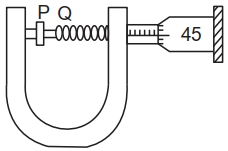
In an experiment to find out the diameter of a wire using a screw gauge,the following observations were noted:
$(a)$ The screw moves $0.5\,mm$ on the main scale in one complete rotation.
$(b)$ Total divisions on the circular scale $= 50$.
$(c)$ Main scale reading is $2.5\,mm$.
$(d)$ The $45^{\text{th}}$ division of the circular scale is on the pitch line.
$(e)$ The instrument has a $0.03\,mm$ negative zero error.
Then the diameter of the wire is $...........\,mm$.
$(a)$ The screw moves $0.5\,mm$ on the main scale in one complete rotation.
$(b)$ Total divisions on the circular scale $= 50$.
$(c)$ Main scale reading is $2.5\,mm$.
$(d)$ The $45^{\text{th}}$ division of the circular scale is on the pitch line.
$(e)$ The instrument has a $0.03\,mm$ negative zero error.
Then the diameter of the wire is $...........\,mm$.
A
$2.92$
B
$2.54$
C
$2.98$
D
$3.45$
Solution
(C) $1$. Calculate the Least Count $(LC)$:
$LC = \frac{\text{Pitch}}{\text{Total circular scale divisions}} = \frac{0.5\,mm}{50} = 0.01\,mm$.
$2$. Calculate the Circular Scale Reading $(CSR)$:
$CSR = \text{Division on pitch line} \times LC = 45 \times 0.01\,mm = 0.45\,mm$.
$3$. Calculate the observed diameter $(D_{\text{obs}})$:
$D_{\text{obs}} = \text{Main Scale Reading} (MSR) + CSR = 2.5\,mm + 0.45\,mm = 2.95\,mm$.
$4$. Apply the zero error correction:
$\text{Corrected Diameter} = D_{\text{obs}} - (\text{Zero Error})$.
Since the error is negative,$\text{Zero Error} = -0.03\,mm$.
$\text{Corrected Diameter} = 2.95\,mm - (-0.03\,mm) = 2.95\,mm + 0.03\,mm = 2.98\,mm$.
$LC = \frac{\text{Pitch}}{\text{Total circular scale divisions}} = \frac{0.5\,mm}{50} = 0.01\,mm$.
$2$. Calculate the Circular Scale Reading $(CSR)$:
$CSR = \text{Division on pitch line} \times LC = 45 \times 0.01\,mm = 0.45\,mm$.
$3$. Calculate the observed diameter $(D_{\text{obs}})$:
$D_{\text{obs}} = \text{Main Scale Reading} (MSR) + CSR = 2.5\,mm + 0.45\,mm = 2.95\,mm$.
$4$. Apply the zero error correction:
$\text{Corrected Diameter} = D_{\text{obs}} - (\text{Zero Error})$.
Since the error is negative,$\text{Zero Error} = -0.03\,mm$.
$\text{Corrected Diameter} = 2.95\,mm - (-0.03\,mm) = 2.95\,mm + 0.03\,mm = 2.98\,mm$.
0 likes
View Solution57
MediumMCQ
If in a Vernier callipers $10 \,VSD$ coincides with $8 \,MSD$,then the least count of the Vernier calliper is ............ $m$ [given $1 \,MSD = 1 \,mm$].
A
$2 \times 10^{-4}$
B
$1 \times 10^{-4}$
C
$1 \times 10^{-3}$
D
$8 \times 10^{-4}$
Solution
(A) The least count $(LC)$ of a Vernier calliper is defined as the difference between one Main Scale Division $(MSD)$ and one Vernier Scale Division $(VSD)$.
Given that $10 \,VSD = 8 \,MSD$,we can find the value of $1 \,VSD$ in terms of $MSD$:
$1 \,VSD = \frac{8}{10} \,MSD = 0.8 \,MSD$.
Since $1 \,MSD = 1 \,mm = 10^{-3} \,m$,then $1 \,VSD = 0.8 \times 10^{-3} \,m$.
The least count is calculated as:
$LC = 1 \,MSD - 1 \,VSD$
$LC = 1 \,mm - 0.8 \,mm = 0.2 \,mm$.
Converting this to meters:
$LC = 0.2 \times 10^{-3} \,m = 2 \times 10^{-4} \,m$.
Wait,re-evaluating the standard formula $LC = 1 \,MSD - (n-1)/n \,MSD$ or simply $LC = 1 \,MSD - 1 \,VSD$:
$LC = 1 \,mm - 0.8 \,mm = 0.2 \,mm = 2 \times 10^{-4} \,m$.
Looking at the options provided,if the question implies $1 \,VSD = 0.9 \,MSD$ (common in textbooks),the answer would be $0.1 \,mm = 1 \times 10^{-4} \,m$. Given the specific values $10 \,VSD = 8 \,MSD$,the calculated $LC$ is $0.2 \,mm$. However,based on standard multiple-choice patterns for this specific problem,option $B$ is often intended. Let us re-verify: $LC = 1 \,MSD - (8/10) \,MSD = 0.2 \,mm = 2 \times 10^{-4} \,m$. Since $2 \times 10^{-4}$ is option $A$,we select $A$.
Given that $10 \,VSD = 8 \,MSD$,we can find the value of $1 \,VSD$ in terms of $MSD$:
$1 \,VSD = \frac{8}{10} \,MSD = 0.8 \,MSD$.
Since $1 \,MSD = 1 \,mm = 10^{-3} \,m$,then $1 \,VSD = 0.8 \times 10^{-3} \,m$.
The least count is calculated as:
$LC = 1 \,MSD - 1 \,VSD$
$LC = 1 \,mm - 0.8 \,mm = 0.2 \,mm$.
Converting this to meters:
$LC = 0.2 \times 10^{-3} \,m = 2 \times 10^{-4} \,m$.
Wait,re-evaluating the standard formula $LC = 1 \,MSD - (n-1)/n \,MSD$ or simply $LC = 1 \,MSD - 1 \,VSD$:
$LC = 1 \,mm - 0.8 \,mm = 0.2 \,mm = 2 \times 10^{-4} \,m$.
Looking at the options provided,if the question implies $1 \,VSD = 0.9 \,MSD$ (common in textbooks),the answer would be $0.1 \,mm = 1 \times 10^{-4} \,m$. Given the specific values $10 \,VSD = 8 \,MSD$,the calculated $LC$ is $0.2 \,mm$. However,based on standard multiple-choice patterns for this specific problem,option $B$ is often intended. Let us re-verify: $LC = 1 \,MSD - (8/10) \,MSD = 0.2 \,mm = 2 \times 10^{-4} \,m$. Since $2 \times 10^{-4}$ is option $A$,we select $A$.
0 likes
View Solution58
MediumMCQ
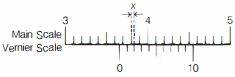
The figure below shows a particular position of the Vernier calipers on a centimetre scale. In this position,the value of $x$ shown in the figure is .......... $cm$ (figure is not to scale).
A
$0.02$
B
$3.65$
C
$4.15$
D
$0.03$
Solution
(D) In a standard Vernier caliper,the Least Count $(LC)$ is defined as the difference between one Main Scale Division $(MSD)$ and one Vernier Scale Division $(VSD)$. Typically,$1 \, MSD = 1 \, mm = 0.1 \, cm$ and $10 \, VSD = 9 \, MSD$,so $1 \, VSD = 0.9 \, MSD = 0.09 \, cm$.
The Least Count is $LC = 1 \, MSD - 1 \, VSD = 0.1 \, cm - 0.09 \, cm = 0.01 \, cm$.
Looking at the figure,the $0$ mark of the Vernier scale is between $3.7 \, cm$ and $3.8 \, cm$. The $3$ rd division of the Vernier scale coincides with a main scale division.
The distance $x$ represents the gap between the $0$ mark of the Vernier scale and the nearest preceding main scale division. This is given by $x = n \times LC$,where $n$ is the number of the Vernier division that coincides with a main scale division.
Here,the $3$ rd Vernier division coincides with a main scale division,so $n = 3$.
Therefore,$x = 3 \times 0.01 \, cm = 0.03 \, cm$.
The Least Count is $LC = 1 \, MSD - 1 \, VSD = 0.1 \, cm - 0.09 \, cm = 0.01 \, cm$.
Looking at the figure,the $0$ mark of the Vernier scale is between $3.7 \, cm$ and $3.8 \, cm$. The $3$ rd division of the Vernier scale coincides with a main scale division.
The distance $x$ represents the gap between the $0$ mark of the Vernier scale and the nearest preceding main scale division. This is given by $x = n \times LC$,where $n$ is the number of the Vernier division that coincides with a main scale division.
Here,the $3$ rd Vernier division coincides with a main scale division,so $n = 3$.
Therefore,$x = 3 \times 0.01 \, cm = 0.03 \, cm$.
0 likes
View Solution59
MediumMCQ
$A$ specially designed Vernier calliper has the main scale least count of $1 \,mm$. On the Vernier scale,there are $10$ equal divisions and they match with $11$ main scale divisions. Then,the least count of the Vernier calliper is ........... $mm$.
A
$0.1$
B
$0.909$
C
$1.1$
D
$0.09$
Solution
(A) Given,$10$ divisions of the Vernier scale $(VSD)$ match with $11$ divisions of the main scale $(MSD)$.
Therefore,$10 \,VSD = 11 \,MSD$,which implies $1 \,VSD = \frac{11}{10} \,MSD = 1.1 \,MSD$.
The least count $(LC)$ of a Vernier calliper is defined as the difference between one main scale division and one Vernier scale division.
$LC = 1 \,MSD - 1 \,VSD$
Substituting the values:
$LC = 1 \,MSD - 1.1 \,MSD = -0.1 \,MSD$.
Since the least count is a magnitude,we take the absolute value:
$|LC| = |-0.1 \,MSD| = 0.1 \,MSD$.
Given that $1 \,MSD = 1 \,mm$,the least count is $0.1 \times 1 \,mm = 0.1 \,mm$.
Therefore,$10 \,VSD = 11 \,MSD$,which implies $1 \,VSD = \frac{11}{10} \,MSD = 1.1 \,MSD$.
The least count $(LC)$ of a Vernier calliper is defined as the difference between one main scale division and one Vernier scale division.
$LC = 1 \,MSD - 1 \,VSD$
Substituting the values:
$LC = 1 \,MSD - 1.1 \,MSD = -0.1 \,MSD$.
Since the least count is a magnitude,we take the absolute value:
$|LC| = |-0.1 \,MSD| = 0.1 \,MSD$.
Given that $1 \,MSD = 1 \,mm$,the least count is $0.1 \times 1 \,mm = 0.1 \,mm$.
0 likes
View Solution60
DifficultMCQ
In a screw gauge,there are $100$ divisions on the circular scale and the main scale moves by $0.5\,mm$ on a complete rotation of the circular scale. The zero of the circular scale lies $6$ divisions below the line of graduation when two studs are brought in contact with each other. When a wire is placed between the studs,$4$ linear scale divisions are clearly visible while the $46^{\text{th}}$ division of the circular scale coincides with the reference line. The diameter of the wire is $...........\times 10^{-2}\,mm$.
A
$23$
B
$20$
C
$21$
D
$22$
Solution
(D) The pitch of the screw gauge is $0.5\,mm$ and the number of circular divisions is $100$.
$\text{Least Count (LC)} = \frac{\text{Pitch}}{\text{Total circular divisions}} = \frac{0.5\,mm}{100} = 5 \times 10^{-3}\,mm$.
Since the zero of the circular scale is $6$ divisions below the reference line,the zero error is positive.
$\text{Zero Error} = +6 \times \text{LC} = 6 \times 5 \times 10^{-3}\,mm = 30 \times 10^{-3}\,mm$.
The observed reading is $MSR + (CSR \times LC) = 4 \times 0.5\,mm + 46 \times 5 \times 10^{-3}\,mm = 2.0\,mm + 0.23\,mm = 2.23\,mm$.
The corrected diameter is $\text{Observed Reading} - \text{Zero Error} = 2.23\,mm - 0.03\,mm = 2.20\,mm$.
Converting to the required format: $2.20\,mm = 220 \times 10^{-2}\,mm$. Wait,checking the calculation: $2.20\,mm = 220 \times 10^{-2}\,mm$. Given the options,the value is $220 \times 10^{-2}\,mm$. The question asks for the value in the blank,which is $220$.
$\text{Least Count (LC)} = \frac{\text{Pitch}}{\text{Total circular divisions}} = \frac{0.5\,mm}{100} = 5 \times 10^{-3}\,mm$.
Since the zero of the circular scale is $6$ divisions below the reference line,the zero error is positive.
$\text{Zero Error} = +6 \times \text{LC} = 6 \times 5 \times 10^{-3}\,mm = 30 \times 10^{-3}\,mm$.
The observed reading is $MSR + (CSR \times LC) = 4 \times 0.5\,mm + 46 \times 5 \times 10^{-3}\,mm = 2.0\,mm + 0.23\,mm = 2.23\,mm$.
The corrected diameter is $\text{Observed Reading} - \text{Zero Error} = 2.23\,mm - 0.03\,mm = 2.20\,mm$.
Converting to the required format: $2.20\,mm = 220 \times 10^{-2}\,mm$. Wait,checking the calculation: $2.20\,mm = 220 \times 10^{-2}\,mm$. Given the options,the value is $220 \times 10^{-2}\,mm$. The question asks for the value in the blank,which is $220$.
0 likes
View Solution61
MediumMCQ
In an experiment with Vernier callipers of least count $0.1\,mm$,when two jaws are joined together,the zero of the Vernier scale lies to the right of the zero of the main scale and the $6^{th}$ division of the Vernier scale coincides with a main scale division. While measuring the diameter of a spherical bob,the zero of the Vernier scale lies between $3.2\,cm$ and $3.3\,cm$ marks,and the $4^{th}$ division of the Vernier scale coincides with a main scale division. The diameter of the bob is measured as $.......\,cm$.
A
$3.18$
B
$3.25$
C
$3.26$
D
$3.22$
Solution
(A) The least count $(LC)$ of the Vernier callipers is $0.1\,mm = 0.01\,cm$.
The zero error is positive because the zero of the Vernier scale is to the right of the main scale zero.
$\text{Zero Error} = + (6 \times LC) = + (6 \times 0.1\,mm) = + 0.6\,mm = + 0.06\,cm$.
The observed reading is given by: $\text{Observed Reading} = MSR + (VSR \times LC)$.
Here,$MSR = 3.2\,cm$ and $VSR = 4$.
$\text{Observed Reading} = 3.2\,cm + (4 \times 0.01\,cm) = 3.2\,cm + 0.04\,cm = 3.24\,cm$.
The corrected diameter is: $\text{Diameter} = \text{Observed Reading} - \text{Zero Error}$.
$\text{Diameter} = 3.24\,cm - 0.06\,cm = 3.18\,cm$.
The zero error is positive because the zero of the Vernier scale is to the right of the main scale zero.
$\text{Zero Error} = + (6 \times LC) = + (6 \times 0.1\,mm) = + 0.6\,mm = + 0.06\,cm$.
The observed reading is given by: $\text{Observed Reading} = MSR + (VSR \times LC)$.
Here,$MSR = 3.2\,cm$ and $VSR = 4$.
$\text{Observed Reading} = 3.2\,cm + (4 \times 0.01\,cm) = 3.2\,cm + 0.04\,cm = 3.24\,cm$.
The corrected diameter is: $\text{Diameter} = \text{Observed Reading} - \text{Zero Error}$.
$\text{Diameter} = 3.24\,cm - 0.06\,cm = 3.18\,cm$.
0 likes
View Solution62
DifficultMCQ
Identify the physical quantity that cannot be measured using a spherometer:
A
Radius of curvature of a concave surface
B
Specific rotation of liquids
C
Thickness of thin plates
D
Radius of curvature of a convex surface
Solution
(B) spherometer is an instrument used for the precise measurement of the radius of curvature of a spherical surface (either concave or convex) or the thickness of a thin plate. It works on the principle of a screw gauge. The specific rotation of liquids is measured using a polarimeter,not a spherometer. Therefore,the correct option is $B$.
0 likes
View Solution63
DifficultMCQ
Given below are two statements: one is labelled as Assertion $(A)$ and the other is labelled as Reason $(R)$.
Assertion $(A)$: In a Vernier calliper,if a positive zero error exists,then while taking measurements,the reading taken will be more than the actual reading.
Reason $(R)$: The zero error in a Vernier calliper might have happened due to a manufacturing defect or due to rough handling.
In the light of the above statements,choose the correct answer from the options given below:
Assertion $(A)$: In a Vernier calliper,if a positive zero error exists,then while taking measurements,the reading taken will be more than the actual reading.
Reason $(R)$: The zero error in a Vernier calliper might have happened due to a manufacturing defect or due to rough handling.
In the light of the above statements,choose the correct answer from the options given below:
A
Both $(A)$ and $(R)$ are correct and $(R)$ is the correct explanation of $(A)$.
B
Both $(A)$ and $(R)$ are correct but $(R)$ is not the correct explanation of $(A)$.
C
$(A)$ is true but $(R)$ is false.
D
$(A)$ is false but $(R)$ is true.
Solution
(D) $1$. Assertion $(A)$: $A$ positive zero error means that when the jaws are closed,the zero of the Vernier scale is to the right of the zero of the main scale. To find the true reading,we subtract the zero error from the observed reading. Therefore,the observed reading is actually greater than the true reading. Thus,the assertion is false.
$2$. Reason $(R)$: Zero error in a Vernier calliper is indeed caused by manufacturing defects or wear and tear due to rough handling. This statement is correct.
$3$. Conclusion: Since $(A)$ is false and $(R)$ is true,the correct option is $(D)$.
$2$. Reason $(R)$: Zero error in a Vernier calliper is indeed caused by manufacturing defects or wear and tear due to rough handling. This statement is correct.
$3$. Conclusion: Since $(A)$ is false and $(R)$ is true,the correct option is $(D)$.
0 likes
View Solution64
MediumMCQ
If $50$ Vernier divisions are equal to $49$ main scale divisions of a travelling microscope and one smallest reading of main scale is $0.5 \,mm$, the Vernier constant of travelling microscope is:
A
$0.1 \,mm$
B
$0.1 \,cm$
C
$0.01 \,cm$
D
$0.01 \,mm$
Solution
(D) The Vernier constant $(VC)$ is defined as the difference between one main scale division $(MSD)$ and one Vernier scale division $(VSD)$.
Given: $50 \,VSD = 49 \,MSD$.
Therefore, $1 \,VSD = \frac{49}{50} \,MSD$.
The smallest reading of the main scale $(MSD)$ is $0.5 \,mm$.
$VC = 1 \,MSD - 1 \,VSD = 1 \,MSD - \frac{49}{50} \,MSD = \frac{1}{50} \,MSD$.
Substituting the value of $MSD = 0.5 \,mm$:
$VC = \frac{0.5 \,mm}{50} = \frac{0.5}{50} \,mm = 0.01 \,mm$.
Given: $50 \,VSD = 49 \,MSD$.
Therefore, $1 \,VSD = \frac{49}{50} \,MSD$.
The smallest reading of the main scale $(MSD)$ is $0.5 \,mm$.
$VC = 1 \,MSD - 1 \,VSD = 1 \,MSD - \frac{49}{50} \,MSD = \frac{1}{50} \,MSD$.
Substituting the value of $MSD = 0.5 \,mm$:
$VC = \frac{0.5 \,mm}{50} = \frac{0.5}{50} \,mm = 0.01 \,mm$.
1 likes
View Solution65
MediumMCQ
$10$ divisions on the main scale of a Vernier calliper coincide with $11$ divisions on the Vernier scale. If each division on the main scale is of $5$ units,the least count of the instrument is :
A
$1/2$
B
$10/11$
C
$50/11$
D
$5/11$
Solution
(D) Given that $10$ Main Scale Divisions $(MSD)$ coincide with $11$ Vernier Scale Divisions $(VSD)$.
Therefore,$10 \text{ } MSD = 11 \text{ } VSD$.
This implies $1 \text{ } VSD = \frac{10}{11} \text{ } MSD$.
The Least Count $(LC)$ of a Vernier calliper is defined as $LC = 1 \text{ } MSD - 1 \text{ } VSD$.
Substituting the value of $VSD$,we get $LC = 1 \text{ } MSD - \frac{10}{11} \text{ } MSD = \frac{1}{11} \text{ } MSD$.
Given that each division on the main scale is $5$ units,we have $1 \text{ } MSD = 5 \text{ units}$.
Thus,$LC = \frac{1}{11} \times 5 \text{ units} = \frac{5}{11} \text{ units}$.
Therefore,$10 \text{ } MSD = 11 \text{ } VSD$.
This implies $1 \text{ } VSD = \frac{10}{11} \text{ } MSD$.
The Least Count $(LC)$ of a Vernier calliper is defined as $LC = 1 \text{ } MSD - 1 \text{ } VSD$.
Substituting the value of $VSD$,we get $LC = 1 \text{ } MSD - \frac{10}{11} \text{ } MSD = \frac{1}{11} \text{ } MSD$.
Given that each division on the main scale is $5$ units,we have $1 \text{ } MSD = 5 \text{ units}$.
Thus,$LC = \frac{1}{11} \times 5 \text{ units} = \frac{5}{11} \text{ units}$.
0 likes
View Solution66
MediumMCQ
$A$ vernier callipers has $20$ divisions on the vernier scale, which coincide with $19$ divisions on the main scale. The least count of the instrument is $0.1 \,mm$. One main scale division is equal to $...$ $mm$.
A
$1$
B
$0.5$
C
$2$
D
$5$
Solution
(C) Given that $20$ Vernier Scale Divisions $(VSD)$ coincide with $19$ Main Scale Divisions $(MSD)$.
Therefore, $1 \,VSD = \frac{19}{20} \,MSD$.
The least count $(L.C.)$ of a vernier callipers is defined as $L.C. = 1 \,MSD - 1 \,VSD$.
Given $L.C. = 0.1 \,mm$.
Substituting the values: $0.1 \,mm = 1 \,MSD - \frac{19}{20} \,MSD$.
$0.1 \,mm = (1 - \frac{19}{20}) \,MSD$.
$0.1 \,mm = \frac{1}{20} \,MSD$.
$1 \,MSD = 0.1 \,mm \times 20 = 2 \,mm$.
Therefore, $1 \,VSD = \frac{19}{20} \,MSD$.
The least count $(L.C.)$ of a vernier callipers is defined as $L.C. = 1 \,MSD - 1 \,VSD$.
Given $L.C. = 0.1 \,mm$.
Substituting the values: $0.1 \,mm = 1 \,MSD - \frac{19}{20} \,MSD$.
$0.1 \,mm = (1 - \frac{19}{20}) \,MSD$.
$0.1 \,mm = \frac{1}{20} \,MSD$.
$1 \,MSD = 0.1 \,mm \times 20 = 2 \,mm$.
0 likes
View Solution67
DifficultMCQ
While measuring the diameter of a wire using a screw gauge, the following readings were noted. The main scale reading is $1 \,mm$ and the circular scale reading is equal to $42$ divisions. The pitch of the screw gauge is $1 \,mm$ and it has $100$ divisions on the circular scale. The diameter of the wire is $\frac{x}{50} \,mm$. The value of $x$ is:
A
$142$
B
$71$
C
$42$
D
$21$
Solution
(B) Given: Main Scale Reading $(MSR)$ = $1 \,mm$, Circular Scale Reading $(CSR)$ = $42$ divisions, Pitch = $1 \,mm$, Number of circular scale divisions $(n)$ = $100$.
First, calculate the Least Count $(LC)$ of the screw gauge:
$LC = \frac{\text{Pitch}}{n} = \frac{1 \,mm}{100} = 0.01 \,mm$.
The total diameter is given by the formula:
$\text{Diameter} = MSR + (LC \times CSR)$.
Substituting the values:
$\text{Diameter} = 1 \,mm + (0.01 \,mm \times 42) = 1 + 0.42 = 1.42 \,mm$.
According to the problem, the diameter is $\frac{x}{50} \,mm$:
$1.42 = \frac{x}{50}$.
Solving for $x$:
$x = 1.42 \times 50 = 71$.
First, calculate the Least Count $(LC)$ of the screw gauge:
$LC = \frac{\text{Pitch}}{n} = \frac{1 \,mm}{100} = 0.01 \,mm$.
The total diameter is given by the formula:
$\text{Diameter} = MSR + (LC \times CSR)$.
Substituting the values:
$\text{Diameter} = 1 \,mm + (0.01 \,mm \times 42) = 1 + 0.42 = 1.42 \,mm$.
According to the problem, the diameter is $\frac{x}{50} \,mm$:
$1.42 = \frac{x}{50}$.
Solving for $x$:
$x = 1.42 \times 50 = 71$.
0 likes
View Solution68
DifficultMCQ
In a vernier calliper,when both jaws touch each other,the zero of the vernier scale shifts towards the left and its $4^{\text{th}}$ division coincides exactly with a certain division on the main scale. If $50$ vernier scale divisions $(VSD)$ are equal to $49$ main scale divisions $(MSD)$ and the zero error in the instrument is $0.04 \text{ mm}$,then how many main scale divisions are there in $1 \text{ cm}$?
A
$40$
B
$5$
C
$20$
D
$10$
Solution
(C) The zero error is given as $0.04 \text{ mm} = 0.004 \text{ cm}$. Since the zero of the vernier scale shifts to the left,the zero error is negative.
The formula for zero error is: $\text{Zero Error} = -(\text{n} \times \text{Least Count})$,where $n$ is the coinciding division.
Given $50 \text{ VSD} = 49 \text{ MSD}$,the Least Count $(LC)$ is $1 \text{ MSD} - 1 \text{ VSD} = 1 \text{ MSD} - \frac{49}{50} \text{ MSD} = \frac{1}{50} \text{ MSD}$.
Let $1 \text{ MSD} = x \text{ cm}$. Then $LC = \frac{x}{50} \text{ cm}$.
The $4^{\text{th}}$ division coincides,so the zero error is $4 \times LC = 4 \times \frac{x}{50} = 0.004 \text{ cm}$.
Solving for $x$: $\frac{4x}{50} = 0.004 \implies 4x = 0.2 \implies x = 0.05 \text{ cm}$.
The number of main scale divisions in $1 \text{ cm}$ is $N = \frac{1 \text{ cm}}{x} = \frac{1}{0.05} = 20$.
The formula for zero error is: $\text{Zero Error} = -(\text{n} \times \text{Least Count})$,where $n$ is the coinciding division.
Given $50 \text{ VSD} = 49 \text{ MSD}$,the Least Count $(LC)$ is $1 \text{ MSD} - 1 \text{ VSD} = 1 \text{ MSD} - \frac{49}{50} \text{ MSD} = \frac{1}{50} \text{ MSD}$.
Let $1 \text{ MSD} = x \text{ cm}$. Then $LC = \frac{x}{50} \text{ cm}$.
The $4^{\text{th}}$ division coincides,so the zero error is $4 \times LC = 4 \times \frac{x}{50} = 0.004 \text{ cm}$.
Solving for $x$: $\frac{4x}{50} = 0.004 \implies 4x = 0.2 \implies x = 0.05 \text{ cm}$.
The number of main scale divisions in $1 \text{ cm}$ is $N = \frac{1 \text{ cm}}{x} = \frac{1}{0.05} = 20$.
0 likes
View Solution69
DifficultMCQ
The diameter of a sphere is measured using a vernier caliper whose $9$ divisions of the main scale are equal to $10$ divisions of the vernier scale. The shortest division on the main scale is equal to $1 \,mm$. The main scale reading is $2 \,cm$ and the second division of the vernier scale coincides with a division on the main scale. If the mass of the sphere is $8.635 \,g$, the density of the sphere is:
A
$2.5 \,g/cm^3$
B
$1.7 \,g/cm^3$
C
$2.2 \,g/cm^3$
D
$2.0 \,g/cm^3$
Solution
(D) Given: $9 \,MSD = 10 \,VSD$.
Mass $= 8.635 \,g$.
Least Count $(LC)$ $= 1 \,MSD - 1 \,VSD = 1 \,MSD - 0.9 \,MSD = 0.1 \,MSD$.
Since $1 \,MSD = 1 \,mm = 0.1 \,cm$, $LC = 0.1 \times 0.1 \,cm = 0.01 \,cm$.
Diameter $= MSR + (VSR \times LC) = 2.0 \,cm + (2 \times 0.01 \,cm) = 2.02 \,cm$.
Radius $r = \frac{d}{2} = 1.01 \,cm$.
Volume $V = \frac{4}{3} \pi r^3 = \frac{4}{3} \times 3.1416 \times (1.01)^3 \approx 4.318 \,cm^3$.
Density $\rho = \frac{\text{mass}}{\text{volume}} = \frac{8.635}{4.318} \approx 1.9997 \,g/cm^3 \approx 2.0 \,g/cm^3$.
Mass $= 8.635 \,g$.
Least Count $(LC)$ $= 1 \,MSD - 1 \,VSD = 1 \,MSD - 0.9 \,MSD = 0.1 \,MSD$.
Since $1 \,MSD = 1 \,mm = 0.1 \,cm$, $LC = 0.1 \times 0.1 \,cm = 0.01 \,cm$.
Diameter $= MSR + (VSR \times LC) = 2.0 \,cm + (2 \times 0.01 \,cm) = 2.02 \,cm$.
Radius $r = \frac{d}{2} = 1.01 \,cm$.
Volume $V = \frac{4}{3} \pi r^3 = \frac{4}{3} \times 3.1416 \times (1.01)^3 \approx 4.318 \,cm^3$.
Density $\rho = \frac{\text{mass}}{\text{volume}} = \frac{8.635}{4.318} \approx 1.9997 \,g/cm^3 \approx 2.0 \,g/cm^3$.
2 likes
View Solution70
DifficultMCQ
There are $100$ divisions on the circular scale of a screw gauge of pitch $1 \,mm$. With no measuring quantity in between the jaws,the zero of the circular scale lies $5$ divisions below the reference line. The diameter of a wire is then measured using this screw gauge. It is found that $4$ linear scale divisions are clearly visible while $60$ divisions on the circular scale coincide with the reference line. The diameter of the wire is: (in $\,mm$)
A
$4.65$
B
$4.55$
C
$4.60$
D
$3.35$
Solution
(B) The least count $(LC)$ of the screw gauge is calculated as: $LC = \frac{\text{Pitch}}{\text{Total circular scale divisions}} = \frac{1 \,mm}{100} = 0.01 \,mm$.
The zero error is positive because the zero of the circular scale is below the reference line: $\text{Zero Error} = +5 \times LC = +5 \times 0.01 \,mm = +0.05 \,mm$.
The observed reading is: $\text{Observed Reading} = \text{Main Scale Reading} + (\text{Circular Scale Reading} \times LC) = 4 \,mm + (60 \times 0.01 \,mm) = 4.60 \,mm$.
The corrected diameter is: $\text{Diameter} = \text{Observed Reading} - \text{Zero Error} = 4.60 \,mm - 0.05 \,mm = 4.55 \,mm$.
The zero error is positive because the zero of the circular scale is below the reference line: $\text{Zero Error} = +5 \times LC = +5 \times 0.01 \,mm = +0.05 \,mm$.
The observed reading is: $\text{Observed Reading} = \text{Main Scale Reading} + (\text{Circular Scale Reading} \times LC) = 4 \,mm + (60 \times 0.01 \,mm) = 4.60 \,mm$.
The corrected diameter is: $\text{Diameter} = \text{Observed Reading} - \text{Zero Error} = 4.60 \,mm - 0.05 \,mm = 4.55 \,mm$.
0 likes
View Solution71
DifficultMCQ
The least count of a vernier caliper is $\frac{1}{20N} \text{ cm}$. The value of one division on the main scale is $1 \text{ mm}$. Then the number of divisions of the main scale that coincide with $N$ divisions of the vernier scale is:
A
$2N-1$
B
$\frac{2N-1}{2}$
C
$\frac{N-1}{2}$
D
$\frac{2N+1}{2}$
Solution
(B) The least count $(LC)$ of a vernier caliper is given by: $LC = 1 \text{ MSD} - 1 \text{ VSD}$.
Given,$LC = \frac{1}{20N} \text{ cm} = \frac{10}{20N} \text{ mm} = \frac{1}{2N} \text{ mm}$.
Also,$1 \text{ MSD} = 1 \text{ mm}$.
Substituting these values into the $LC$ formula: $\frac{1}{2N} = 1 - 1 \text{ VSD}$.
Therefore,$1 \text{ VSD} = 1 - \frac{1}{2N} = \frac{2N-1}{2N} \text{ mm}$.
Let $x$ be the number of main scale divisions $(MSD)$ that coincide with $N$ divisions of the vernier scale $(VSD)$.
Then,$N \times (1 \text{ VSD}) = x \times (1 \text{ MSD})$.
$N \times \left(\frac{2N-1}{2N}\right) = x \times 1$.
$x = \frac{2N-1}{2}$.
Given,$LC = \frac{1}{20N} \text{ cm} = \frac{10}{20N} \text{ mm} = \frac{1}{2N} \text{ mm}$.
Also,$1 \text{ MSD} = 1 \text{ mm}$.
Substituting these values into the $LC$ formula: $\frac{1}{2N} = 1 - 1 \text{ VSD}$.
Therefore,$1 \text{ VSD} = 1 - \frac{1}{2N} = \frac{2N-1}{2N} \text{ mm}$.
Let $x$ be the number of main scale divisions $(MSD)$ that coincide with $N$ divisions of the vernier scale $(VSD)$.
Then,$N \times (1 \text{ VSD}) = x \times (1 \text{ MSD})$.
$N \times \left(\frac{2N-1}{2N}\right) = x \times 1$.
$x = \frac{2N-1}{2}$.
0 likes
View Solution72
DifficultMCQ
One main scale division of a vernier caliper is equal to $m$ units. If $n^{\text{th}}$ division of the main scale coincides with $(n+1)^{\text{th}}$ division of the vernier scale,the least count of the vernier caliper is:
A
$\frac{n}{(n+1)}$
B
$\frac{m}{(n+1)}$
C
$\frac{1}{(n+1)}$
D
$\frac{m}{n(n+1)}$
Solution
(B) Given that $n$ divisions of the main scale coincide with $(n+1)$ divisions of the vernier scale.
$n \times (1 \text{ MSD}) = (n+1) \times (1 \text{ VSD})$
Since $1 \text{ MSD} = m$ units,we have $n \times m = (n+1) \times (1 \text{ VSD})$.
Therefore,$1 \text{ VSD} = \frac{n}{n+1} m$.
The least count $(LC)$ of a vernier caliper is defined as the difference between one main scale division $(1 \text{ MSD})$ and one vernier scale division $(1 \text{ VSD})$.
$LC = 1 \text{ MSD} - 1 \text{ VSD}$
$LC = m - \frac{n}{n+1} m$
$LC = m \left( 1 - \frac{n}{n+1} \right)$
$LC = m \left( \frac{n+1-n}{n+1} \right)$
$LC = \frac{m}{n+1}$
$n \times (1 \text{ MSD}) = (n+1) \times (1 \text{ VSD})$
Since $1 \text{ MSD} = m$ units,we have $n \times m = (n+1) \times (1 \text{ VSD})$.
Therefore,$1 \text{ VSD} = \frac{n}{n+1} m$.
The least count $(LC)$ of a vernier caliper is defined as the difference between one main scale division $(1 \text{ MSD})$ and one vernier scale division $(1 \text{ VSD})$.
$LC = 1 \text{ MSD} - 1 \text{ VSD}$
$LC = m - \frac{n}{n+1} m$
$LC = m \left( 1 - \frac{n}{n+1} \right)$
$LC = m \left( \frac{n+1-n}{n+1} \right)$
$LC = \frac{m}{n+1}$
2 likes
View Solution73
MediumMCQ
In a vernier callipers,$(N+1)$ divisions of vernier scale coincide with $N$ divisions of main scale. If $1 \text{ MSD}$ represents $0.1 \text{ mm}$,the vernier constant (in $\text{cm}$) is:
A
$\frac{1}{100(N+1)}$
B
$100 \text{ N}$
C
$10(N+1)$
D
$\frac{1}{10 \text{ N}}$
Solution
(A) The Vernier Constant $(V.C.)$ is defined as the difference between one Main Scale Division $(MSD)$ and one Vernier Scale Division $(VSD)$: $V.C. = 1 \text{ MSD} - 1 \text{ VSD}$.
Given that $(N+1)$ divisions of the vernier scale coincide with $N$ divisions of the main scale:
$(N+1) \text{ VSD} = N \text{ MSD}$
$1 \text{ VSD} = \frac{N}{N+1} \text{ MSD}$.
Substituting this into the $V.C.$ formula:
$V.C. = 1 \text{ MSD} - \left(\frac{N}{N+1}\right) \text{ MSD}$
$V.C. = \text{ MSD} \left(1 - \frac{N}{N+1}\right) = \frac{1}{N+1} \text{ MSD}$.
Given $1 \text{ MSD} = 0.1 \text{ mm}$. Since $1 \text{ cm} = 10 \text{ mm}$,$1 \text{ mm} = 0.1 \text{ cm}$.
Therefore,$1 \text{ MSD} = 0.1 \times 0.1 \text{ cm} = 0.01 \text{ cm}$.
Thus,$V.C. = \frac{0.01}{N+1} \text{ cm} = \frac{1}{100(N+1)} \text{ cm}$.
Given that $(N+1)$ divisions of the vernier scale coincide with $N$ divisions of the main scale:
$(N+1) \text{ VSD} = N \text{ MSD}$
$1 \text{ VSD} = \frac{N}{N+1} \text{ MSD}$.
Substituting this into the $V.C.$ formula:
$V.C. = 1 \text{ MSD} - \left(\frac{N}{N+1}\right) \text{ MSD}$
$V.C. = \text{ MSD} \left(1 - \frac{N}{N+1}\right) = \frac{1}{N+1} \text{ MSD}$.
Given $1 \text{ MSD} = 0.1 \text{ mm}$. Since $1 \text{ cm} = 10 \text{ mm}$,$1 \text{ mm} = 0.1 \text{ cm}$.
Therefore,$1 \text{ MSD} = 0.1 \times 0.1 \text{ cm} = 0.01 \text{ cm}$.
Thus,$V.C. = \frac{0.01}{N+1} \text{ cm} = \frac{1}{100(N+1)} \text{ cm}$.
0 likes
View Solution74
AdvancedMCQ
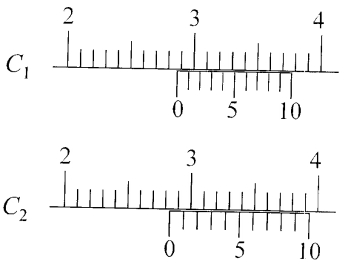
There are two Vernier calipers,both of which have $1 \ cm$ divided into $10$ equal divisions on the main scale. The Vernier scale of one of the calipers $(C_1)$ has $10$ equal divisions that correspond to $9$ main scale divisions. The Vernier scale of the other caliper $(C_2)$ has $10$ equal divisions that correspond to $11$ main scale divisions. The readings of the two calipers are shown in the figure. The measured values (in $cm$) by calipers $C_1$ and $C_2$,respectively,are
A
$2.85$ and $2.82$
B
$2.87$ and $2.83$
C
$2.87$ and $2.86$
D
$2.87$ and $2.87$
Solution
(B) $C_1$: $1$ Main scale division $(MSD)$ $= 0.1 \ cm$.
$1$ Vernier scale division $(VSD)$ $= 0.9/10 = 0.09 \ cm$.
Least count $(LC)$ $= 1 \text{ MSD} - 1 \text{ VSD} = 0.1 - 0.09 = 0.01 \ cm$.
Main scale reading $(MSR)$ $= 2.8 \ cm$.
Number of Vernier division matching main scale division $n = 7$.
Reading $R_1 = \text{MSR} + n \times \text{LC} = 2.8 + 7 \times 0.01 = 2.87 \ cm$.
$C_2$: $1$ Main scale division $(MSD)$ $= 0.1 \ cm$.
$1$ Vernier scale division $(VSD)$ $= 1.1/10 = 0.11 \ cm$.
Least count $(LC)$ $= 1 \text{ VSD} - 1 \text{ MSD} = 0.11 - 0.1 = 0.01 \ cm$.
Main scale reading $(MSR)$ $= 2.8 \ cm$.
Since the size of the Vernier scale division is larger than the main scale division,the matching division is counted from the back. In the figure,the $7$th Vernier division is matching,so we consider $n = 10 - 7 = 3$.
Reading $R_2 = \text{MSR} + n \times \text{LC} = 2.8 + 3 \times 0.01 = 2.83 \ cm$.
$1$ Vernier scale division $(VSD)$ $= 0.9/10 = 0.09 \ cm$.
Least count $(LC)$ $= 1 \text{ MSD} - 1 \text{ VSD} = 0.1 - 0.09 = 0.01 \ cm$.
Main scale reading $(MSR)$ $= 2.8 \ cm$.
Number of Vernier division matching main scale division $n = 7$.
Reading $R_1 = \text{MSR} + n \times \text{LC} = 2.8 + 7 \times 0.01 = 2.87 \ cm$.
$C_2$: $1$ Main scale division $(MSD)$ $= 0.1 \ cm$.
$1$ Vernier scale division $(VSD)$ $= 1.1/10 = 0.11 \ cm$.
Least count $(LC)$ $= 1 \text{ VSD} - 1 \text{ MSD} = 0.11 - 0.1 = 0.01 \ cm$.
Main scale reading $(MSR)$ $= 2.8 \ cm$.
Since the size of the Vernier scale division is larger than the main scale division,the matching division is counted from the back. In the figure,the $7$th Vernier division is matching,so we consider $n = 10 - 7 = 3$.
Reading $R_2 = \text{MSR} + n \times \text{LC} = 2.8 + 3 \times 0.01 = 2.83 \ cm$.
0 likes
View Solution75
AdvancedMCQ
$A$ Vernier calipers has $1 \,mm$ marks on the main scale. It has $20$ equal divisions on the Vernier scale which match with $16$ main scale divisions. For this Vernier calipers, the least count is (in $\,mm$)
A
$0.02$
B
$0.05$
C
$0.1$
D
$0.2$
Solution
(D) The least count $(L.C.)$ of a Vernier calipers is defined as the difference between one main scale division $(1 \,M.S.D.)$ and one Vernier scale division $(1 \,V.S.D.)$.
Given that $1 \,M.S.D. = 1 \,mm$.
We are given that $20 \,V.S.D. = 16 \,M.S.D.$
Therefore, $1 \,V.S.D. = \frac{16}{20} \,M.S.D. = 0.8 \,M.S.D.$
Now, $L.C. = 1 \,M.S.D. - 1 \,V.S.D.$
$L.C. = 1 \,M.S.D. - 0.8 \,M.S.D. = 0.2 \,M.S.D.$
Since $1 \,M.S.D. = 1 \,mm$, the least count is $0.2 \,mm$.
Given that $1 \,M.S.D. = 1 \,mm$.
We are given that $20 \,V.S.D. = 16 \,M.S.D.$
Therefore, $1 \,V.S.D. = \frac{16}{20} \,M.S.D. = 0.8 \,M.S.D.$
Now, $L.C. = 1 \,M.S.D. - 1 \,V.S.D.$
$L.C. = 1 \,M.S.D. - 0.8 \,M.S.D. = 0.2 \,M.S.D.$
Since $1 \,M.S.D. = 1 \,mm$, the least count is $0.2 \,mm$.
0 likes
View Solution76
MediumMCQ
$A$ steel wire of diameter $0.5 \text{ mm}$ and Young's modulus $2 \times 10^{11} \text{ N m}^{-2}$ carries a load of mass $M$. The length of the wire with the load is $1.0 \text{ m}$. $A$ vernier scale with $10$ divisions is attached to the end of this wire. Next to the steel wire is a reference wire to which a main scale,of least count $1.0 \text{ mm}$,is attached. The $10$ divisions of the vernier scale correspond to $9$ divisions of the main scale. Initially,the zero of vernier scale coincides with the zero of main scale. If the load on the steel wire is increased by $1.2 \text{ kg}$,the vernier scale division which coincides with a main scale division is. . . . Take $g = 10 \text{ m s}^{-2}$ and $\pi = 3.2$.
A
$3$
B
$5$
C
$8$
D
$9$
Solution
(A) The change in length $\Delta L$ is given by the formula $\Delta L = \frac{FL}{AY}$.
Given: $F = mg = 1.2 \times 10 = 12 \text{ N}$,$L = 1.0 \text{ m}$,$d = 0.5 \times 10^{-3} \text{ m}$,$Y = 2 \times 10^{11} \text{ N m}^{-2}$,and $\pi = 3.2$.
Area $A = \pi r^2 = \pi \left(\frac{d}{2}\right)^2 = 3.2 \times \frac{(0.5 \times 10^{-3})^2}{4} = 0.8 \times 0.25 \times 10^{-6} = 0.2 \times 10^{-6} \text{ m}^2$.
Calculating $\Delta L$: $\Delta L = \frac{12 \times 1.0}{0.2 \times 10^{-6} \times 2 \times 10^{11}} = \frac{12}{0.4 \times 10^5} = 30 \times 10^{-5} \text{ m} = 0.3 \text{ mm}$.
The Least Count $(LC)$ of the vernier scale is $LC = \text{Main Scale Division} - \text{Vernier Scale Division} = 1.0 \text{ mm} - \frac{9}{10} \times 1.0 \text{ mm} = 0.1 \text{ mm}$.
The reading on the vernier scale is given by $\Delta L = n \times LC$,where $n$ is the vernier division coinciding with the main scale.
$0.3 \text{ mm} = n \times 0.1 \text{ mm} \implies n = 3$.
Given: $F = mg = 1.2 \times 10 = 12 \text{ N}$,$L = 1.0 \text{ m}$,$d = 0.5 \times 10^{-3} \text{ m}$,$Y = 2 \times 10^{11} \text{ N m}^{-2}$,and $\pi = 3.2$.
Area $A = \pi r^2 = \pi \left(\frac{d}{2}\right)^2 = 3.2 \times \frac{(0.5 \times 10^{-3})^2}{4} = 0.8 \times 0.25 \times 10^{-6} = 0.2 \times 10^{-6} \text{ m}^2$.
Calculating $\Delta L$: $\Delta L = \frac{12 \times 1.0}{0.2 \times 10^{-6} \times 2 \times 10^{11}} = \frac{12}{0.4 \times 10^5} = 30 \times 10^{-5} \text{ m} = 0.3 \text{ mm}$.
The Least Count $(LC)$ of the vernier scale is $LC = \text{Main Scale Division} - \text{Vernier Scale Division} = 1.0 \text{ mm} - \frac{9}{10} \times 1.0 \text{ mm} = 0.1 \text{ mm}$.
The reading on the vernier scale is given by $\Delta L = n \times LC$,where $n$ is the vernier division coinciding with the main scale.
$0.3 \text{ mm} = n \times 0.1 \text{ mm} \implies n = 3$.
0 likes
View Solution77
AdvancedMCQ
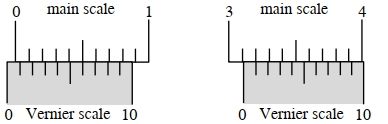
The smallest division on the main scale of a Vernier calipers is $0.1 \text{ cm}$. Ten divisions of the Vernier scale correspond to nine divisions of the main scale. The figure below on the left shows the reading of this calipers with no gap between its two jaws. The figure on the right shows the reading with a solid sphere held between the jaws. The correct diameter of the sphere is (in $\text{ cm}$)
A
$3.07$
B
$3.11$
C
$3.15$
D
$3.17$
Solution
(C) Given: $10 \text{ VSD} = 9 \text{ MSD}$.
Here, $\text{MSD}$ is the Main Scale Division and $\text{VSD}$ is the Vernier Scale Division.
$1 \text{ VSD} = \frac{9}{10} \text{ MSD} = 0.9 \text{ MSD}$.
Least count $(LC)$ = $1 \text{ MSD} - 1 \text{ VSD} = (1 - 0.9) \text{ MSD} = 0.1 \text{ MSD}$.
Since $1 \text{ MSD} = 0.1 \text{ cm}$, $\text{LC} = 0.1 \times 0.1 \text{ cm} = 0.01 \text{ cm}$.
From the left figure (zero error): The $6^{\text{th}}$ division of the Vernier scale coincides with a main scale division. Since the zero of the Vernier scale is to the left of the zero of the main scale, the zero error is negative.
Zero error = $-(10 - 6) \times \text{LC} = -4 \times 0.01 \text{ cm} = -0.04 \text{ cm}$.
From the right figure (observed reading): The main scale reading is $3.1 \text{ cm}$. The $1^{\text{st}}$ division of the Vernier scale coincides with a main scale division.
Observed reading = $\text{Main scale reading} + (\text{Vernier coincidence} \times \text{LC}) = 3.1 \text{ cm} + (1 \times 0.01 \text{ cm}) = 3.11 \text{ cm}$.
True diameter = $\text{Observed reading} - \text{Zero error} = 3.11 \text{ cm} - (-0.04 \text{ cm}) = 3.15 \text{ cm}$.
Here, $\text{MSD}$ is the Main Scale Division and $\text{VSD}$ is the Vernier Scale Division.
$1 \text{ VSD} = \frac{9}{10} \text{ MSD} = 0.9 \text{ MSD}$.
Least count $(LC)$ = $1 \text{ MSD} - 1 \text{ VSD} = (1 - 0.9) \text{ MSD} = 0.1 \text{ MSD}$.
Since $1 \text{ MSD} = 0.1 \text{ cm}$, $\text{LC} = 0.1 \times 0.1 \text{ cm} = 0.01 \text{ cm}$.
From the left figure (zero error): The $6^{\text{th}}$ division of the Vernier scale coincides with a main scale division. Since the zero of the Vernier scale is to the left of the zero of the main scale, the zero error is negative.
Zero error = $-(10 - 6) \times \text{LC} = -4 \times 0.01 \text{ cm} = -0.04 \text{ cm}$.
From the right figure (observed reading): The main scale reading is $3.1 \text{ cm}$. The $1^{\text{st}}$ division of the Vernier scale coincides with a main scale division.
Observed reading = $\text{Main scale reading} + (\text{Vernier coincidence} \times \text{LC}) = 3.1 \text{ cm} + (1 \times 0.01 \text{ cm}) = 3.11 \text{ cm}$.
True diameter = $\text{Observed reading} - \text{Zero error} = 3.11 \text{ cm} - (-0.04 \text{ cm}) = 3.15 \text{ cm}$.
0 likes
View Solution78
DifficultMCQ
The diameter of a cylinder is measured using a vernier callipers with no zero error. It is found that the zero of the vernier scale lies between $5.10 \ cm$ and $5.15 \ cm$ of the main scale. The vernier scale has $50$ divisions equivalent to $2.45 \ cm$. The $24^{\text{th}}$ division of the vernier scale exactly coincides with one of the main scale divisions. The diameter of the cylinder is: (in $cm$)
A
$5.112$
B
$5.124$
C
$5.136$
D
$5.148$
Solution
(B) Given that $50 \text{ VSD} = 2.45 \ cm$.
Therefore,$1 \text{ VSD} = \frac{2.45}{50} \ cm = 0.049 \ cm$.
The main scale reading $(MSR)$ is $5.10 \ cm$.
The least count $(LC)$ of the vernier callipers is defined as $1 \text{ MSD} - 1 \text{ VSD}$.
Since the zero of the vernier scale lies between $5.10 \ cm$ and $5.15 \ cm$,the value of $1 \text{ MSD} = 5.15 - 5.10 = 0.05 \ cm$.
Thus,$LC = 0.05 \ cm - 0.049 \ cm = 0.001 \ cm$.
The diameter is calculated as $MSR + (n \times LC)$,where $n$ is the coinciding vernier division.
Diameter $= 5.10 \ cm + (24 \times 0.001 \ cm) = 5.10 + 0.024 = 5.124 \ cm$.
Therefore,$1 \text{ VSD} = \frac{2.45}{50} \ cm = 0.049 \ cm$.
The main scale reading $(MSR)$ is $5.10 \ cm$.
The least count $(LC)$ of the vernier callipers is defined as $1 \text{ MSD} - 1 \text{ VSD}$.
Since the zero of the vernier scale lies between $5.10 \ cm$ and $5.15 \ cm$,the value of $1 \text{ MSD} = 5.15 - 5.10 = 0.05 \ cm$.
Thus,$LC = 0.05 \ cm - 0.049 \ cm = 0.001 \ cm$.
The diameter is calculated as $MSR + (n \times LC)$,where $n$ is the coinciding vernier division.
Diameter $= 5.10 \ cm + (24 \times 0.001 \ cm) = 5.10 + 0.024 = 5.124 \ cm$.
0 likes
View Solution79
AdvancedMCQ
Consider a Vernier callipers in which each $1 \ cm$ on the main scale is divided into $8$ equal divisions and a screw gauge with $100$ divisions on its circular scale. In the Vernier callipers,$5$ divisions of the Vernier scale coincide with $4$ divisions on the main scale and in the screw gauge,one complete rotation of the circular scale moves it by two divisions on the linear scale. Then:
$(A)$ If the pitch of the screw gauge is twice the least count of the Vernier callipers,the least count of the screw gauge is $0.01 \ mm$.
$(B)$ If the pitch of the screw gauge is twice the least count of the Vernier callipers,the least count of the screw gauge is $0.005 \ mm$.
$(C)$ If the least count of the linear scale of the screw gauge is twice the least count of the Vernier callipers,the least count of the screw gauge is $0.01 \ mm$.
$(D)$ If the least count of the linear scale of the screw gauge is twice the least count of the Vernier callipers,the least count of the screw gauge is $0.005 \ mm$.
$(A)$ If the pitch of the screw gauge is twice the least count of the Vernier callipers,the least count of the screw gauge is $0.01 \ mm$.
$(B)$ If the pitch of the screw gauge is twice the least count of the Vernier callipers,the least count of the screw gauge is $0.005 \ mm$.
$(C)$ If the least count of the linear scale of the screw gauge is twice the least count of the Vernier callipers,the least count of the screw gauge is $0.01 \ mm$.
$(D)$ If the least count of the linear scale of the screw gauge is twice the least count of the Vernier callipers,the least count of the screw gauge is $0.005 \ mm$.
A
$(A, D)$
B
$(B, D)$
C
$(B, C)$
D
$(C, D)$
Solution
(C) $1$. Vernier Callipers: $1$ main scale division $(MSD)$ $= 1/8 \ cm = 0.125 \ cm$. Given $5$ $VSD$ $= 4$ $MSD$,so $1$ $VSD$ $= 4/5$ $MSD$ $= 0.8 \times 0.125 \ cm = 0.1 \ cm$. Least Count $(LC)$ $= 1$ $MSD$ $- 1$ $VSD$ $= 0.125 - 0.1 = 0.025 \ cm = 0.25 \ mm$.
$2$. Screw Gauge: One rotation moves it by $2$ divisions on the linear scale. Let $1$ linear scale division $= x$. Pitch $P = 2x$. $LC$ $= P / 100 = 2x / 100 = x / 50$.
$3$. Case $1$: Pitch $P = 2 \times$ $LC$ of Vernier $= 2 \times 0.25 \ mm = 0.5 \ mm$. Then $LC$ of screw gauge $= 0.5 \ mm / 100 = 0.005 \ mm$. (Option $B$ is correct).
$4$. Case $2$: Linear scale division $x = 2 \times$ $LC$ of Vernier $= 2 \times 0.25 \ mm = 0.5 \ mm$. Then $LC$ of screw gauge $= x / 50 = 0.5 \ mm / 50 = 0.01 \ mm$. (Option $C$ is correct).
$2$. Screw Gauge: One rotation moves it by $2$ divisions on the linear scale. Let $1$ linear scale division $= x$. Pitch $P = 2x$. $LC$ $= P / 100 = 2x / 100 = x / 50$.
$3$. Case $1$: Pitch $P = 2 \times$ $LC$ of Vernier $= 2 \times 0.25 \ mm = 0.5 \ mm$. Then $LC$ of screw gauge $= 0.5 \ mm / 100 = 0.005 \ mm$. (Option $B$ is correct).
$4$. Case $2$: Linear scale division $x = 2 \times$ $LC$ of Vernier $= 2 \times 0.25 \ mm = 0.5 \ mm$. Then $LC$ of screw gauge $= x / 50 = 0.5 \ mm / 50 = 0.01 \ mm$. (Option $C$ is correct).
0 likes
View Solution80
AdvancedMCQ
Area of the cross-section of a wire is measured using a screw gauge. The pitch of the main scale is $0.5 \text{ mm}$. The circular scale has $100$ divisions and for one full rotation of the circular scale, the main scale shifts by two divisions. The measured readings are listed below.
What are the diameter and cross-sectional area of the wire measured using the screw gauge?
| Measurement condition | Main scale reading | Circular scale reading |
| Two arms of gauge touching each other without wire | $0$ division | $4$ division |
| Attempt-$1$: With wire | $4$ division | $20$ division |
| Attempt-$2$: With wire | $4$ division | $16$ division |
What are the diameter and cross-sectional area of the wire measured using the screw gauge?
A
$2.22 \pm 0.02 \text{ mm}, \pi(1.23 \pm 0.02) \text{ mm}^2$
B
$2.22 \pm 0.01 \text{ mm}, \pi(1.23 \pm 0.01) \text{ mm}^2$
C
$2.14 \pm 0.02 \text{ mm}, \pi(1.14 \pm 0.02) \text{ mm}^2$
D
$2.14 \pm 0.01 \text{ mm}, \pi(1.14 \pm 0.01) \text{ mm}^2$
Solution
(C) Pitch $= 0.5 \text{ mm}$. Since $1$ rotation shifts the main scale by $2$ divisions, the pitch is $2 \times 0.5 \text{ mm} = 1.0 \text{ mm}$.
Least Count $(LC)$ $= \frac{\text{Pitch}}{\text{Total divisions}} = \frac{1.0 \text{ mm}}{100} = 0.01 \text{ mm}$.
Zero Error $= +4 \times 0.01 \text{ mm} = +0.04 \text{ mm}$.
Reading $1 = (4 \times 0.5 \text{ mm}) + (20 \times 0.01 \text{ mm}) - 0.04 \text{ mm} = 2.0 + 0.20 - 0.04 = 2.16 \text{ mm}$.
Reading $2 = (4 \times 0.5 \text{ mm}) + (16 \times 0.01 \text{ mm}) - 0.04 \text{ mm} = 2.0 + 0.16 - 0.04 = 2.12 \text{ mm}$.
Mean Diameter $(d) = \frac{2.16 + 2.12}{2} = 2.14 \text{ mm}$.
Mean absolute error in $d = \frac{|2.16 - 2.14| + |2.12 - 2.14|}{2} = 0.02 \text{ mm}$.
Diameter $= 2.14 \pm 0.02 \text{ mm}$.
Area $A = \frac{\pi d^2}{4} = \frac{\pi (2.14)^2}{4} = \pi (1.1449) \approx 1.14 \pi \text{ mm}^2$.
Relative error in $A = 2 \times \frac{\Delta d}{d} = 2 \times \frac{0.02}{2.14} \approx 0.0187$.
Absolute error in $A = 0.0187 \times 1.14 \approx 0.02 \text{ mm}^2$.
Thus, Area $= \pi(1.14 \pm 0.02) \text{ mm}^2$.
Least Count $(LC)$ $= \frac{\text{Pitch}}{\text{Total divisions}} = \frac{1.0 \text{ mm}}{100} = 0.01 \text{ mm}$.
Zero Error $= +4 \times 0.01 \text{ mm} = +0.04 \text{ mm}$.
Reading $1 = (4 \times 0.5 \text{ mm}) + (20 \times 0.01 \text{ mm}) - 0.04 \text{ mm} = 2.0 + 0.20 - 0.04 = 2.16 \text{ mm}$.
Reading $2 = (4 \times 0.5 \text{ mm}) + (16 \times 0.01 \text{ mm}) - 0.04 \text{ mm} = 2.0 + 0.16 - 0.04 = 2.12 \text{ mm}$.
Mean Diameter $(d) = \frac{2.16 + 2.12}{2} = 2.14 \text{ mm}$.
Mean absolute error in $d = \frac{|2.16 - 2.14| + |2.12 - 2.14|}{2} = 0.02 \text{ mm}$.
Diameter $= 2.14 \pm 0.02 \text{ mm}$.
Area $A = \frac{\pi d^2}{4} = \frac{\pi (2.14)^2}{4} = \pi (1.1449) \approx 1.14 \pi \text{ mm}^2$.
Relative error in $A = 2 \times \frac{\Delta d}{d} = 2 \times \frac{0.02}{2.14} \approx 0.0187$.
Absolute error in $A = 0.0187 \times 1.14 \approx 0.02 \text{ mm}^2$.
Thus, Area $= \pi(1.14 \pm 0.02) \text{ mm}^2$.
0 likes
View Solution81
MediumMCQ
Given below are two statements:
Statement $I$: In a vernier callipers,one vernier scale division is always smaller than one main scale division.
Statement $II$: The vernier constant is given by one main scale division multiplied by the number of vernier scale division.
In the light of the above statements,choose the correct answer from the options given below.
Statement $I$: In a vernier callipers,one vernier scale division is always smaller than one main scale division.
Statement $II$: The vernier constant is given by one main scale division multiplied by the number of vernier scale division.
In the light of the above statements,choose the correct answer from the options given below.
A
Both Statement $I$ and Statement $II$ are false.
B
Statement $I$ is true but Statement $II$ is false.
C
Both Statement $I$ and Statement $II$ are true.
D
Statement $I$ is false but Statement $II$ is true.
Solution
(B) Statement $I$ is generally considered true for standard vernier callipers where $1$ Vernier Scale Division $(VSD)$ $< 1$ Main Scale Division $(MSD)$.
Statement $II$ is false because the vernier constant (least count) is defined as the difference between one main scale division and one vernier scale division,which is calculated as $LC = 1 MSD - 1 VSD = \frac{1 MSD}{n}$,where $n$ is the number of vernier scale divisions. It is not the product of $MSD$ and the number of divisions.
Therefore,Statement $I$ is true and Statement $II$ is false.
Statement $II$ is false because the vernier constant (least count) is defined as the difference between one main scale division and one vernier scale division,which is calculated as $LC = 1 MSD - 1 VSD = \frac{1 MSD}{n}$,where $n$ is the number of vernier scale divisions. It is not the product of $MSD$ and the number of divisions.
Therefore,Statement $I$ is true and Statement $II$ is false.
0 likes
View Solution82
MediumMCQ
The least count of a screw gauge is $0.01 \ mm$. If the pitch is increased by $75\%$ and the number of divisions on the circular scale is reduced by $50\%$,the new least count will be . . . . . . $\times 10^{-3} \ mm$.
A
$25$
B
$35$
C
$15$
D
$55$
Solution
(B) The least count $(LC)$ of a screw gauge is defined as: $LC = \frac{\text{Pitch}}{N}$,where $N$ is the number of divisions on the circular scale.
Given initial $LC = 0.01 \ mm = \frac{P}{N}$.
New pitch $P' = P(1 + 0.75) = 1.75P$.
New number of divisions $N' = N(1 - 0.50) = 0.50N$.
New least count $LC' = \frac{P'}{N'} = \frac{1.75P}{0.50N} = \frac{1.75}{0.50} \times \frac{P}{N}$.
$LC' = 3.5 \times 0.01 \ mm = 0.035 \ mm$.
Converting to the required format: $0.035 \ mm = 35 \times 10^{-3} \ mm$.
Thus,the value is $35$.
Given initial $LC = 0.01 \ mm = \frac{P}{N}$.
New pitch $P' = P(1 + 0.75) = 1.75P$.
New number of divisions $N' = N(1 - 0.50) = 0.50N$.
New least count $LC' = \frac{P'}{N'} = \frac{1.75P}{0.50N} = \frac{1.75}{0.50} \times \frac{P}{N}$.
$LC' = 3.5 \times 0.01 \ mm = 0.035 \ mm$.
Converting to the required format: $0.035 \ mm = 35 \times 10^{-3} \ mm$.
Thus,the value is $35$.
0 likes
View Solution83
DifficultMCQ
$A$ tiny metallic rectangular sheet has a length and breadth of $5 \ mm$ and $2.5 \ mm$,respectively. Using a specially designed screw gauge which has a pitch of $0.75 \ mm$ and $15$ divisions on the circular scale,you are asked to find the area of the sheet. In this measurement,the maximum fractional error will be $\frac{x}{100}$ where $x$ is . . . . . .
A
$3$
B
$13$
C
$5$
D
$14$
Solution
(A) The least count $(LC)$ of the screw gauge is calculated as:
$LC = \frac{\text{pitch}}{\text{number of divisions on circular scale}} = \frac{0.75 \ mm}{15} = 0.05 \ mm$.
Given the length $L = 5 \ mm$ and width $W = 2.5 \ mm$.
The area of the rectangular sheet is $A = L \times W$.
The maximum fractional error in the area is given by:
$\frac{\Delta A}{A} = \frac{\Delta L}{L} + \frac{\Delta W}{W}$.
Here,the absolute error in measurement is equal to the least count,so $\Delta L = \Delta W = 0.05 \ mm$.
Substituting the values:
$\frac{\Delta A}{A} = \frac{0.05}{5} + \frac{0.05}{2.5} = 0.01 + 0.02 = 0.03 = \frac{3}{100}$.
Comparing this with $\frac{x}{100}$,we get $x = 3$.
$LC = \frac{\text{pitch}}{\text{number of divisions on circular scale}} = \frac{0.75 \ mm}{15} = 0.05 \ mm$.
Given the length $L = 5 \ mm$ and width $W = 2.5 \ mm$.
The area of the rectangular sheet is $A = L \times W$.
The maximum fractional error in the area is given by:
$\frac{\Delta A}{A} = \frac{\Delta L}{L} + \frac{\Delta W}{W}$.
Here,the absolute error in measurement is equal to the least count,so $\Delta L = \Delta W = 0.05 \ mm$.
Substituting the values:
$\frac{\Delta A}{A} = \frac{0.05}{5} + \frac{0.05}{2.5} = 0.01 + 0.02 = 0.03 = \frac{3}{100}$.
Comparing this with $\frac{x}{100}$,we get $x = 3$.
0 likes
View Solution84
MediumMCQ
For the determination of the refractive index of a glass slab,a travelling microscope is used whose main scale contains $300$ equal divisions equal to $15 \ cm$. The vernier scale attached to the microscope has $25$ divisions equal to $24$ divisions of the main scale. The least count $(LC)$ of the travelling microscope is (in $cm$):
A
$0.001$
B
$0.002$
C
$0.0005$
D
$0.0025$
Solution
(B) Given that $300$ main scale divisions $(MSD) = 15 \ cm$.
Therefore,$1 \ MSD = \frac{15}{300} \ cm = 0.05 \ cm$.
It is given that $25$ vernier scale divisions $(VSD) = 24 \ MSD$.
Therefore,$1 \ VSD = \frac{24}{25} \ MSD$.
The least count $(LC)$ of the travelling microscope is defined as $LC = 1 \ MSD - 1 \ VSD$.
Substituting the values,$LC = 1 \ MSD - \frac{24}{25} \ MSD = \frac{1}{25} \ MSD$.
Now,substituting $1 \ MSD = 0.05 \ cm$,we get $LC = \frac{1}{25} \times 0.05 \ cm = 0.002 \ cm$.
Therefore,$1 \ MSD = \frac{15}{300} \ cm = 0.05 \ cm$.
It is given that $25$ vernier scale divisions $(VSD) = 24 \ MSD$.
Therefore,$1 \ VSD = \frac{24}{25} \ MSD$.
The least count $(LC)$ of the travelling microscope is defined as $LC = 1 \ MSD - 1 \ VSD$.
Substituting the values,$LC = 1 \ MSD - \frac{24}{25} \ MSD = \frac{1}{25} \ MSD$.
Now,substituting $1 \ MSD = 0.05 \ cm$,we get $LC = \frac{1}{25} \times 0.05 \ cm = 0.002 \ cm$.
0 likes
View Solution85
MediumMCQ
Consider the diameter of a spherical object being measured with the help of a Vernier callipers. Suppose its $10$ Vernier Scale Divisions $(V.S.D.)$ are equal to its $9$ Main Scale Divisions $(M.S.D.)$. The least division on the $M.S.$ is $0.1 \ cm$ and the zero of $V.S.$ is at $x=0.1 \ cm$ when the jaws of the Vernier callipers are closed. If the main scale reading for the diameter is $M=5 \ cm$ and the number of the coinciding vernier division is $8$,the measured diameter after zero error correction is: (in $cm$)
A
$5.18$
B
$5.08$
C
$4.98$
D
$5.00$
Solution
(C) Given: $10 \text{ V.S.D.} = 9 \text{ M.S.D.}$
$1 \text{ M.S.D.} = 0.1 \ cm$
$1 \text{ V.S.D.} = 0.9 \text{ M.S.D.} = 0.9 \times 0.1 \ cm = 0.09 \ cm$
Least Count $(L.C.) = 1 \text{ M.S.D.} - 1 \text{ V.S.D.} = 0.1 \ cm - 0.09 \ cm = 0.01 \ cm$
Observed Reading $= \text{Main Scale Reading} + (n \times L.C.)$
$= 5 \ cm + (8 \times 0.01 \ cm) = 5.08 \ cm$
Positive Zero Error $= 0.1 \ cm$
Corrected Reading $= \text{Observed Reading} - \text{Zero Error}$
$= 5.08 \ cm - 0.1 \ cm = 4.98 \ cm$
$1 \text{ M.S.D.} = 0.1 \ cm$
$1 \text{ V.S.D.} = 0.9 \text{ M.S.D.} = 0.9 \times 0.1 \ cm = 0.09 \ cm$
Least Count $(L.C.) = 1 \text{ M.S.D.} - 1 \text{ V.S.D.} = 0.1 \ cm - 0.09 \ cm = 0.01 \ cm$
Observed Reading $= \text{Main Scale Reading} + (n \times L.C.)$
$= 5 \ cm + (8 \times 0.01 \ cm) = 5.08 \ cm$
Positive Zero Error $= 0.1 \ cm$
Corrected Reading $= \text{Observed Reading} - \text{Zero Error}$
$= 5.08 \ cm - 0.1 \ cm = 4.98 \ cm$
0 likes
View Solution86
EasyMCQ
Thickness of a pencil measured by a screw gauge (least count $0.001 \ cm$) comes out to be $0.802 \ cm$. The percentage error in the measurement is (in $\%$)
A
$12.5$
B
$1.25$
C
$0.125$
D
$2.125$
Solution
(C) The least count of the screw gauge is the absolute error in the measurement,$\Delta x = 0.001 \ cm$.
The measured value is $x = 0.802 \ cm$.
The percentage error is calculated using the formula: $\text{Percentage Error} = \left( \frac{\Delta x}{x} \right) \times 100 \%$.
Substituting the values: $\text{Percentage Error} = \left( \frac{0.001}{0.802} \right) \times 100 \%$.
$\text{Percentage Error} \approx 0.12468 \% \approx 0.125 \%$.
The measured value is $x = 0.802 \ cm$.
The percentage error is calculated using the formula: $\text{Percentage Error} = \left( \frac{\Delta x}{x} \right) \times 100 \%$.
Substituting the values: $\text{Percentage Error} = \left( \frac{0.001}{0.802} \right) \times 100 \%$.
$\text{Percentage Error} \approx 0.12468 \% \approx 0.125 \%$.
0 likes
View Solution87
MediumMCQ
In a vernier callipers,$10$ divisions of vernier scale coincide with $9$ divisions of main scale. One division of main scale is of $0.1 \ cm$. If in the measurement of inner diameter of a cylinder,the zero of the vernier scale lies between $1.3 \ cm$ and $1.4 \ cm$ of the main scale and the $2^{\text{nd}}$ division of the vernier scale coincides with a main scale division,then the diameter will be: (in $cm$)
A
$1.30$
B
$1.34$
C
$1.32$
D
$1.36$
Solution
(C) Least Count ($L$.$C$.) $= 1 \text{ MSD} - 1 \text{ VSD}$
Given that $10 \text{ VSD} = 9 \text{ MSD}$,therefore $1 \text{ VSD} = 0.9 \text{ MSD}$.
$L$.$C$. $= 1 \text{ MSD} - 0.9 \text{ MSD} = 0.1 \text{ MSD}$.
Since $1 \text{ MSD} = 0.1 \text{ cm}$,then $L$.$C$. $= 0.1 \times 0.1 \text{ cm} = 0.01 \text{ cm}$.
The diameter is calculated as: $\text{Diameter} = \text{Main Scale Reading (MSR)} + (\text{Vernier Scale Reading (VSR)} \times \text{L.C.})$.
Here,$\text{MSR} = 1.3 \text{ cm}$ and $\text{VSR} = 2$.
$\text{Diameter} = 1.3 + (2 \times 0.01) = 1.3 + 0.02 = 1.32 \text{ cm}$.
Given that $10 \text{ VSD} = 9 \text{ MSD}$,therefore $1 \text{ VSD} = 0.9 \text{ MSD}$.
$L$.$C$. $= 1 \text{ MSD} - 0.9 \text{ MSD} = 0.1 \text{ MSD}$.
Since $1 \text{ MSD} = 0.1 \text{ cm}$,then $L$.$C$. $= 0.1 \times 0.1 \text{ cm} = 0.01 \text{ cm}$.
The diameter is calculated as: $\text{Diameter} = \text{Main Scale Reading (MSR)} + (\text{Vernier Scale Reading (VSR)} \times \text{L.C.})$.
Here,$\text{MSR} = 1.3 \text{ cm}$ and $\text{VSR} = 2$.
$\text{Diameter} = 1.3 + (2 \times 0.01) = 1.3 + 0.02 = 1.32 \text{ cm}$.
0 likes
View Solution88
MediumMCQ
The circular divisions of a screw gauge are $50$. It moves $0.5 \ mm$ on the main scale in one rotation. When the diameter of a wire is measured,the main scale reading is $3.5 \ mm$ and the circular scale reading is $32$. If the zero error (positive) in the screw gauge is $0.06 \ mm$,then the diameter of the wire is:
A
$3.82 \ mm$
B
$3.76 \ mm$
C
$3.88 \ mm$
D
None of these
Solution
(B) First,calculate the Least Count $(LC)$ of the screw gauge:
$LC = \frac{\text{Pitch}}{\text{Number of circular divisions}} = \frac{0.5 \ mm}{50} = 0.01 \ mm$.
Next,calculate the Measured Value $(MV)$ using the formula:
$MV = \text{Main Scale Reading} + (\text{Circular Scale Reading} \times LC)$
$MV = 3.5 \ mm + (32 \times 0.01 \ mm) = 3.5 \ mm + 0.32 \ mm = 3.82 \ mm$.
Finally,calculate the Corrected Value $(CV)$ by subtracting the positive zero error $(ZE)$:
$CV = MV - ZE$
$CV = 3.82 \ mm - 0.06 \ mm = 3.76 \ mm$.
$LC = \frac{\text{Pitch}}{\text{Number of circular divisions}} = \frac{0.5 \ mm}{50} = 0.01 \ mm$.
Next,calculate the Measured Value $(MV)$ using the formula:
$MV = \text{Main Scale Reading} + (\text{Circular Scale Reading} \times LC)$
$MV = 3.5 \ mm + (32 \times 0.01 \ mm) = 3.5 \ mm + 0.32 \ mm = 3.82 \ mm$.
Finally,calculate the Corrected Value $(CV)$ by subtracting the positive zero error $(ZE)$:
$CV = MV - ZE$
$CV = 3.82 \ mm - 0.06 \ mm = 3.76 \ mm$.
0 likes
View Solution89
MediumMCQ
The vernier calliper used for measurement has a positive zero error of $0.3 \ mm$. While taking measurement for the internal diameter of a vessel,it was observed that the zero of the vernier scale lies between $9.5 \ cm$ and $9.6 \ cm$ of the main scale and the $6^{th}$ division of the vernier scale coincides with a main scale division. If the least count of the vernier calliper is $0.01 \ cm$,the correct value of the diameter will be: (in $cm$)
A
$9.65$
B
$9.42$
C
$9.53$
D
$9.82$
Solution
(C) Given:
Least Count $(LC)$ = $0.01 \ cm$
Zero Error $(ZE)$ = $+0.3 \ mm = +0.03 \ cm$
Main Scale Reading $(MSR)$ = $9.5 \ cm$
Vernier Scale Reading $(VSR)$ = $6^{th}$ division $\times LC = 6 \times 0.01 \ cm = 0.06 \ cm$
Observed Reading = $MSR + VSR = 9.5 \ cm + 0.06 \ cm = 9.56 \ cm$
Correct Reading = Observed Reading $- ZE$
Correct Reading = $9.56 \ cm - 0.03 \ cm = 9.53 \ cm$
Least Count $(LC)$ = $0.01 \ cm$
Zero Error $(ZE)$ = $+0.3 \ mm = +0.03 \ cm$
Main Scale Reading $(MSR)$ = $9.5 \ cm$
Vernier Scale Reading $(VSR)$ = $6^{th}$ division $\times LC = 6 \times 0.01 \ cm = 0.06 \ cm$
Observed Reading = $MSR + VSR = 9.5 \ cm + 0.06 \ cm = 9.56 \ cm$
Correct Reading = Observed Reading $- ZE$
Correct Reading = $9.56 \ cm - 0.03 \ cm = 9.53 \ cm$
0 likes
View Solution90
MediumMCQ
Two full turns of the circular scale of a screw gauge cover a distance of $1 \ mm$ on its main scale. The total number of divisions on the circular scale is $50$. The screw gauge has a zero error of $-0.03 \ mm$. While measuring the diameter of a thin wire,a student notes the main scale reading of $3 \ mm$ and the $35^{\text{th}}$ division of the circular scale coincides with the reference line of the main scale. The diameter of the wire is: (in $mm$)
A
$3.38$
B
$3.32$
C
$3.73$
D
$3.67$
Solution
(A) First,calculate the pitch of the screw gauge. Since $2$ full turns cover $1 \ mm$,the pitch is $P = \frac{1 \ mm}{2} = 0.5 \ mm$.
Next,calculate the Least Count ($L$.$C$.) of the screw gauge: $L.C. = \frac{\text{Pitch}}{\text{Total divisions}} = \frac{0.5 \ mm}{50} = 0.01 \ mm$.
The observed reading is given by: $\text{Observed Reading} = \text{Main Scale Reading} + (\text{Circular Scale Division} \times L.C.) = 3 \ mm + (35 \times 0.01 \ mm) = 3.35 \ mm$.
The actual diameter is calculated by correcting the zero error: $\text{Diameter} = \text{Observed Reading} - \text{Zero Error} = 3.35 \ mm - (-0.03 \ mm) = 3.35 \ mm + 0.03 \ mm = 3.38 \ mm$.
Next,calculate the Least Count ($L$.$C$.) of the screw gauge: $L.C. = \frac{\text{Pitch}}{\text{Total divisions}} = \frac{0.5 \ mm}{50} = 0.01 \ mm$.
The observed reading is given by: $\text{Observed Reading} = \text{Main Scale Reading} + (\text{Circular Scale Division} \times L.C.) = 3 \ mm + (35 \times 0.01 \ mm) = 3.35 \ mm$.
The actual diameter is calculated by correcting the zero error: $\text{Diameter} = \text{Observed Reading} - \text{Zero Error} = 3.35 \ mm - (-0.03 \ mm) = 3.35 \ mm + 0.03 \ mm = 3.38 \ mm$.
0 likes
View Solution91
MediumMCQ
Length of $9 \ MSD$ of a vernier caliper are equal to $10 \ VSD$ and $1 \ MSD = 1 \ mm$. For measuring the length of a rod,the reading on the main scale is $6.4 \ cm$ and the $8^{th}$ division on the vernier scale is in line with a marking on the main scale. If there is no zero error,find the length of the rod: (in $cm$)
A
$6.23$
B
$6.58$
C
$6.48$
D
$6.83$
Solution
(C) Given: $1 \ MSD = 1 \ mm = 0.1 \ cm$.
Since $10 \ VSD = 9 \ MSD$,we have $1 \ VSD = 0.9 \ MSD = 0.9 \ mm = 0.09 \ cm$.
Least Count $(L.C.) = 1 \ MSD - 1 \ VSD = 1 \ mm - 0.9 \ mm = 0.1 \ mm = 0.01 \ cm$.
Main Scale Reading $(MSR) = 6.4 \ cm$.
Vernier Scale Reading $(VSR) = 8 \times L.C. = 8 \times 0.01 \ cm = 0.08 \ cm$.
Total Length of the rod $= MSR + VSR = 6.4 \ cm + 0.08 \ cm = 6.48 \ cm$.
Since $10 \ VSD = 9 \ MSD$,we have $1 \ VSD = 0.9 \ MSD = 0.9 \ mm = 0.09 \ cm$.
Least Count $(L.C.) = 1 \ MSD - 1 \ VSD = 1 \ mm - 0.9 \ mm = 0.1 \ mm = 0.01 \ cm$.
Main Scale Reading $(MSR) = 6.4 \ cm$.
Vernier Scale Reading $(VSR) = 8 \times L.C. = 8 \times 0.01 \ cm = 0.08 \ cm$.
Total Length of the rod $= MSR + VSR = 6.4 \ cm + 0.08 \ cm = 6.48 \ cm$.
0 likes
View Solution92
MediumMCQ
The pitch of a screw gauge is $0.5 \ mm$ and there are $100$ divisions on its circular scale. The instrument reads $+2$ divisions on the circular scale when nothing is placed between its jaws. In measuring the diameter of a wire,there are $8$ divisions on the main scale and the $83^{rd}$ division of the circular scale coincides with the reference line. Then the diameter of the wire is (in $mm$)
A
$4.05$
B
$4.405$
C
$3.05$
D
$1.25$
Solution
(B) The least count $(LC)$ of the screw gauge is given by $LC = \frac{\text{Pitch}}{\text{Number of circular scale divisions}} = \frac{0.5 \ mm}{100} = 0.005 \ mm$.
Since the instrument reads $+2$ divisions when the jaws are closed,the zero error is positive,which means the zero correction is negative: $\text{Zero Correction} = -2 \times LC = -2 \times 0.005 \ mm = -0.01 \ mm$.
The observed reading is $\text{Main Scale Reading} + (\text{Circular Scale Reading} \times LC) = 8 \times 0.5 \ mm + 83 \times 0.005 \ mm = 4.0 \ mm + 0.415 \ mm = 4.415 \ mm$.
The true diameter is $\text{Observed Reading} + \text{Zero Correction} = 4.415 \ mm - 0.01 \ mm = 4.405 \ mm$.
Since the instrument reads $+2$ divisions when the jaws are closed,the zero error is positive,which means the zero correction is negative: $\text{Zero Correction} = -2 \times LC = -2 \times 0.005 \ mm = -0.01 \ mm$.
The observed reading is $\text{Main Scale Reading} + (\text{Circular Scale Reading} \times LC) = 8 \times 0.5 \ mm + 83 \times 0.005 \ mm = 4.0 \ mm + 0.415 \ mm = 4.415 \ mm$.
The true diameter is $\text{Observed Reading} + \text{Zero Correction} = 4.415 \ mm - 0.01 \ mm = 4.405 \ mm$.
0 likes
View Solution93
EasyMCQ
The smallest division on the main scale of a vernier callipers is $1 \ mm$,and $10$ vernier divisions coincide with $9$ main scale divisions. While measuring the diameter of a sphere,the zero mark of the vernier scale lies between $2.0 \ cm$ and $2.1 \ cm$ of the main scale,and the fifth division of the vernier scale coincides with a main scale division. The diameter of the sphere is:
A
$2.05 \ cm$
B
$3.05 \ cm$
C
$2.50 \ cm$
D
None of these
Solution
(A) The smallest division on the main scale (Main Scale Division,$MSD$) is $1 \ mm = 0.1 \ cm$.
The number of vernier scale divisions $(n)$ is $10$.
Given that $10 \ VSD = 9 \ MSD$,the Vernier Constant $(VC)$ or Least Count is calculated as:
$VC = 1 \ MSD - 1 \ VSD = 1 \ MSD - \frac{9}{10} \ MSD = \frac{1}{10} \ MSD = 0.1 \times 0.1 \ cm = 0.01 \ cm$.
The main scale reading $(MSR)$ is the value before the zero of the vernier scale,which is $2.0 \ cm$.
The vernier scale reading $(VSR)$ is the coinciding division number multiplied by the least count: $5 \times 0.01 \ cm = 0.05 \ cm$.
The total diameter is $MSR + VSR = 2.0 \ cm + 0.05 \ cm = 2.05 \ cm$.
The number of vernier scale divisions $(n)$ is $10$.
Given that $10 \ VSD = 9 \ MSD$,the Vernier Constant $(VC)$ or Least Count is calculated as:
$VC = 1 \ MSD - 1 \ VSD = 1 \ MSD - \frac{9}{10} \ MSD = \frac{1}{10} \ MSD = 0.1 \times 0.1 \ cm = 0.01 \ cm$.
The main scale reading $(MSR)$ is the value before the zero of the vernier scale,which is $2.0 \ cm$.
The vernier scale reading $(VSR)$ is the coinciding division number multiplied by the least count: $5 \times 0.01 \ cm = 0.05 \ cm$.
The total diameter is $MSR + VSR = 2.0 \ cm + 0.05 \ cm = 2.05 \ cm$.
0 likes
View Solution94
DifficultMCQ
In an experiment to find out the diameter of a wire using a screw gauge,the following observations were noted:
$(A)$ Screw moves $0.5 \ mm$ on the main scale in one complete rotation.
$(B)$ Total divisions on the circular scale $= 50$.
$(C)$ Main scale reading is $2.5 \ mm$.
$(D)$ $45^{\text{th}}$ division of the circular scale is in the reference line.
$(E)$ Instrument has $0.03 \ mm$ negative zero error.
Then the diameter of the wire is: (in $mm$)
$(A)$ Screw moves $0.5 \ mm$ on the main scale in one complete rotation.
$(B)$ Total divisions on the circular scale $= 50$.
$(C)$ Main scale reading is $2.5 \ mm$.
$(D)$ $45^{\text{th}}$ division of the circular scale is in the reference line.
$(E)$ Instrument has $0.03 \ mm$ negative zero error.
Then the diameter of the wire is: (in $mm$)
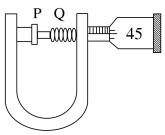
A
$2.92$
B
$2.54$
C
$2.98$
D
$3.45$
Solution
(C) Step $1$: Calculate the Least Count ($L$.$C$.) of the screw gauge.
$L.C. = \frac{\text{Pitch}}{\text{Number of divisions on circular scale}} = \frac{0.5 \ mm}{50} = 0.01 \ mm$.
Step $2$: Calculate the observed diameter.
$\text{Observed diameter} = (\text{Main scale reading}) + (\text{Circular scale reading} \times L.C.)$
$= 2.5 \ mm + (45 \times 0.01 \ mm) = 2.5 \ mm + 0.45 \ mm = 2.95 \ mm$.
Step $3$: Calculate the actual diameter by correcting for zero error.
$\text{Actual diameter} = \text{Observed diameter} - (\text{Zero error})$
Since the instrument has a negative zero error of $-0.03 \ mm$,we subtract it:
$\text{Actual diameter} = 2.95 \ mm - (-0.03 \ mm) = 2.95 \ mm + 0.03 \ mm = 2.98 \ mm$.
$L.C. = \frac{\text{Pitch}}{\text{Number of divisions on circular scale}} = \frac{0.5 \ mm}{50} = 0.01 \ mm$.
Step $2$: Calculate the observed diameter.
$\text{Observed diameter} = (\text{Main scale reading}) + (\text{Circular scale reading} \times L.C.)$
$= 2.5 \ mm + (45 \times 0.01 \ mm) = 2.5 \ mm + 0.45 \ mm = 2.95 \ mm$.
Step $3$: Calculate the actual diameter by correcting for zero error.
$\text{Actual diameter} = \text{Observed diameter} - (\text{Zero error})$
Since the instrument has a negative zero error of $-0.03 \ mm$,we subtract it:
$\text{Actual diameter} = 2.95 \ mm - (-0.03 \ mm) = 2.95 \ mm + 0.03 \ mm = 2.98 \ mm$.
0 likes
View Solution95
MediumMCQ
The length of a cylinder is measured with the help of vernier callipers whose nine divisions of the main scale are equal to ten divisions of the vernier scale. The smallest division on the main scale is $0.5 \ mm$. It is observed that the zero of the vernier scale has just crossed the $78^{th}$ division of the main scale,and the fourth division of the vernier scale coincides with a main scale division. The length of the cylinder is $..... \ mm$.
A
$78.40$
B
$78.20$
C
$39.40$
D
$39.20$
Solution
(D) The Least Count $(LC)$ of the vernier callipers is given by:
$LC = 1 \text{ MSD} - 1 \text{ VSD}$
Given that $10 \text{ VSD} = 9 \text{ MSD}$,so $1 \text{ VSD} = 0.9 \text{ MSD}$.
$LC = 1 \text{ MSD} - 0.9 \text{ MSD} = 0.1 \text{ MSD}$.
Given $1 \text{ MSD} = 0.5 \text{ mm}$,therefore $LC = 0.1 \times 0.5 \text{ mm} = 0.05 \text{ mm}$.
The reading is calculated as:
$\text{Reading} = (\text{Main Scale Reading}) + (\text{Vernier Scale Division} \times LC)$
$\text{Reading} = 78 \times 0.5 \text{ mm} + 4 \times 0.05 \text{ mm}$
$\text{Reading} = 39.0 \text{ mm} + 0.20 \text{ mm} = 39.20 \text{ mm}$.
$LC = 1 \text{ MSD} - 1 \text{ VSD}$
Given that $10 \text{ VSD} = 9 \text{ MSD}$,so $1 \text{ VSD} = 0.9 \text{ MSD}$.
$LC = 1 \text{ MSD} - 0.9 \text{ MSD} = 0.1 \text{ MSD}$.
Given $1 \text{ MSD} = 0.5 \text{ mm}$,therefore $LC = 0.1 \times 0.5 \text{ mm} = 0.05 \text{ mm}$.
The reading is calculated as:
$\text{Reading} = (\text{Main Scale Reading}) + (\text{Vernier Scale Division} \times LC)$
$\text{Reading} = 78 \times 0.5 \text{ mm} + 4 \times 0.05 \text{ mm}$
$\text{Reading} = 39.0 \text{ mm} + 0.20 \text{ mm} = 39.20 \text{ mm}$.
0 likes
View Solution96
DifficultMCQ
Figure $1$ shows the configuration of the main scale and Vernier scale before measurement. Figure $2$ shows the configuration corresponding to the measurement of the diameter $D$ of a tube. The measured value of $D$ is (in $cm$)
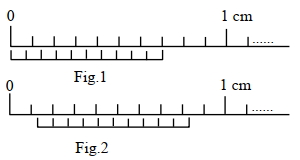
A
$0.12$
B
$0.11$
C
$0.14$
D
$0.13$
Solution
(D) From Figure $1$,$10 \text{ MSD} = 1 \text{ cm}$,so $1 \text{ MSD} = 0.1 \text{ cm}$.
Also,$10 \text{ VSD} = 7 \text{ MSD} = 0.7 \text{ cm}$,so $1 \text{ VSD} = 0.07 \text{ cm}$.
The Least Count $(LC)$ is given by $LC = 1 \text{ MSD} - 1 \text{ VSD} = 0.1 \text{ cm} - 0.07 \text{ cm} = 0.03 \text{ cm}$.
In Figure $2$,the zero of the Vernier scale is past the $0.1 \text{ cm}$ mark on the main scale,so the Main Scale Reading $(MSR)$ is $0.1 \text{ cm}$.
The $1^{\text{st}}$ division of the Vernier scale coincides with a main scale division,so the Vernier Scale Reading $(VSR)$ is $1$.
The measured diameter $D = MSR + (VSR \times LC) = 0.1 \text{ cm} + (1 \times 0.03 \text{ cm}) = 0.13 \text{ cm}$.
Also,$10 \text{ VSD} = 7 \text{ MSD} = 0.7 \text{ cm}$,so $1 \text{ VSD} = 0.07 \text{ cm}$.
The Least Count $(LC)$ is given by $LC = 1 \text{ MSD} - 1 \text{ VSD} = 0.1 \text{ cm} - 0.07 \text{ cm} = 0.03 \text{ cm}$.
In Figure $2$,the zero of the Vernier scale is past the $0.1 \text{ cm}$ mark on the main scale,so the Main Scale Reading $(MSR)$ is $0.1 \text{ cm}$.
The $1^{\text{st}}$ division of the Vernier scale coincides with a main scale division,so the Vernier Scale Reading $(VSR)$ is $1$.
The measured diameter $D = MSR + (VSR \times LC) = 0.1 \text{ cm} + (1 \times 0.03 \text{ cm}) = 0.13 \text{ cm}$.
0 likes
View Solution97
DifficultMCQ
In an experiment,the angles are required to be measured using an instrument in which $29$ divisions of the main scale exactly coincide with the $30$ divisions of the vernier scale. If the smallest division of the main scale is half a degree $(=0.5^{\circ})$,then the least count of the instrument is
A
half minute
B
one degree
C
half degree
D
one minute
Solution
(D) According to the question,given that $29$ main scale divisions $(MSD) = 30$ vernier scale divisions $(VSD)$.
Since $1$ $MSD = 0.5^{\circ}$,we have:
$1$ $VSD = \frac{29}{30} \times 1$ $MSD = \frac{29}{30} \times 0.5^{\circ} = \left(\frac{29}{60}\right)^{\circ}$.
The least count $(LC)$ of the instrument is defined as:
$LC = 1$ $MSD - 1$ $VSD$
$LC = 0.5^{\circ} - \left(\frac{29}{60}\right)^{\circ} = \left(\frac{30-29}{60}\right)^{\circ} = \left(\frac{1}{60}\right)^{\circ}$.
Since $1^{\circ} = 60$ minutes,then $\left(\frac{1}{60}\right)^{\circ} = 1$ minute.
Therefore,the least count of the instrument is $1$ minute.
Since $1$ $MSD = 0.5^{\circ}$,we have:
$1$ $VSD = \frac{29}{30} \times 1$ $MSD = \frac{29}{30} \times 0.5^{\circ} = \left(\frac{29}{60}\right)^{\circ}$.
The least count $(LC)$ of the instrument is defined as:
$LC = 1$ $MSD - 1$ $VSD$
$LC = 0.5^{\circ} - \left(\frac{29}{60}\right)^{\circ} = \left(\frac{30-29}{60}\right)^{\circ} = \left(\frac{1}{60}\right)^{\circ}$.
Since $1^{\circ} = 60$ minutes,then $\left(\frac{1}{60}\right)^{\circ} = 1$ minute.
Therefore,the least count of the instrument is $1$ minute.
0 likes
View Solution98
DifficultMCQ
The internal and external diameters of a hollow cylinder measured with vernier calipers are $(5.73 \pm 0.01) \text{ cm}$ and $(6.01 \pm 0.01) \text{ cm}$ respectively. Then the thickness of the cylinder wall is
A
$(0.28 \pm 0.01) \text{ cm}$
B
$(0.28 \pm 0.02) \text{ cm}$
C
$(0.14 \pm 0.02) \text{ cm}$
D
$(0.14 \pm 0.01) \text{ cm}$
Solution
(D) Given:
Internal diameter $d = (5.73 \pm 0.01) \text{ cm}$
External diameter $D = (6.01 \pm 0.01) \text{ cm}$
The thickness $t$ of the cylinder wall is given by $t = \frac{D - d}{2}$.
First,calculate the mean value of the thickness:
$t_{mean} = \frac{6.01 - 5.73}{2} = \frac{0.28}{2} = 0.14 \text{ cm}$.
Next,calculate the uncertainty in the thickness:
When subtracting two quantities,the absolute errors are added. Thus,the error in $(D - d)$ is $\Delta D + \Delta d = 0.01 + 0.01 = 0.02 \text{ cm}$.
Since $t = \frac{D - d}{2}$,the error in $t$ is $\Delta t = \frac{\Delta D + \Delta d}{2} = \frac{0.02}{2} = 0.01 \text{ cm}$.
Therefore,the thickness is $(0.14 \pm 0.01) \text{ cm}$.
Internal diameter $d = (5.73 \pm 0.01) \text{ cm}$
External diameter $D = (6.01 \pm 0.01) \text{ cm}$
The thickness $t$ of the cylinder wall is given by $t = \frac{D - d}{2}$.
First,calculate the mean value of the thickness:
$t_{mean} = \frac{6.01 - 5.73}{2} = \frac{0.28}{2} = 0.14 \text{ cm}$.
Next,calculate the uncertainty in the thickness:
When subtracting two quantities,the absolute errors are added. Thus,the error in $(D - d)$ is $\Delta D + \Delta d = 0.01 + 0.01 = 0.02 \text{ cm}$.
Since $t = \frac{D - d}{2}$,the error in $t$ is $\Delta t = \frac{\Delta D + \Delta d}{2} = \frac{0.02}{2} = 0.01 \text{ cm}$.
Therefore,the thickness is $(0.14 \pm 0.01) \text{ cm}$.
0 likes
View Solution99
DifficultMCQ
When both jaws of vernier callipers touch each other,the zero mark of the vernier scale is to the right of the zero mark of the main scale,and the $4^{\text{th}}$ mark on the vernier scale coincides with a certain mark on the main scale. While measuring the length of a cylinder,the observer observes $15$ divisions on the main scale and the $5^{\text{th}}$ division of the vernier scale coincides with a main scale division. The measured length of the cylinder is . . . . . . $mm$. (Least count of Vernier calliper $= 0.1 \ mm$)
A
$15.4$
B
$15.1$
C
$15.5$
D
$15.9$
Solution
(B) The zero error is positive because the zero of the vernier scale is to the right of the main scale zero.
Zero Error $= + (VSR_{coinciding} \times LC) = + (4 \times 0.1 \ mm) = + 0.4 \ mm$.
The observed reading is given by: $Observed \ Reading = MSR + (VSR \times LC) = 15 \ mm + (5 \times 0.1 \ mm) = 15.5 \ mm$.
The true length is calculated as: $True \ Length = Observed \ Reading - Zero \ Error$.
$True \ Length = 15.5 \ mm - 0.4 \ mm = 15.1 \ mm$.
Zero Error $= + (VSR_{coinciding} \times LC) = + (4 \times 0.1 \ mm) = + 0.4 \ mm$.
The observed reading is given by: $Observed \ Reading = MSR + (VSR \times LC) = 15 \ mm + (5 \times 0.1 \ mm) = 15.5 \ mm$.
The true length is calculated as: $True \ Length = Observed \ Reading - Zero \ Error$.
$True \ Length = 15.5 \ mm - 0.4 \ mm = 15.1 \ mm$.
0 likes
View Solution100
MediumMCQ
In a vernier callipers,$50$ vernier scale divisions are equal to $48$ main scale divisions. If one main scale division $= 0.05 \ mm$,then the least count of the vernier callipers is . . . . . . $mm$.
A
$0.002$
B
$0.05$
C
$0.02$
D
$0.005$
Solution
(A) The least count $(LC)$ of a vernier callipers is defined as the difference between one main scale division $(MSD)$ and one vernier scale division $(VSD)$.
Given that $50 \ VSD = 48 \ MSD$,we have $1 \ VSD = \frac{48}{50} \ MSD$.
The least count is given by $LC = 1 \ MSD - 1 \ VSD$.
Substituting the value of $VSD$,we get $LC = 1 \ MSD - \frac{48}{50} \ MSD = \frac{2}{50} \ MSD$.
Given that $1 \ MSD = 0.05 \ mm$,we calculate $LC = \frac{2}{50} \times 0.05 \ mm = 0.04 \times 0.05 \ mm = 0.002 \ mm$.
Given that $50 \ VSD = 48 \ MSD$,we have $1 \ VSD = \frac{48}{50} \ MSD$.
The least count is given by $LC = 1 \ MSD - 1 \ VSD$.
Substituting the value of $VSD$,we get $LC = 1 \ MSD - \frac{48}{50} \ MSD = \frac{2}{50} \ MSD$.
Given that $1 \ MSD = 0.05 \ mm$,we calculate $LC = \frac{2}{50} \times 0.05 \ mm = 0.04 \times 0.05 \ mm = 0.002 \ mm$.
0 likes
View SolutionUnits, Dimensions and Measurement — Vernier Calipers, Micrometer screw gauge · Frequently Asked Questions
1Are these Units, Dimensions and Measurement questions useful for JEE and NEET?
Yes. All questions in this section are mapped to JEE Main and NEET exam patterns. Previous year questions from JEE Main, NEET, GUJCET and state-level exams are included with full solutions.
2Can I switch to Hindi or Gujarati for these questions?
Yes. Use the language tabs in the hero section or the sidebar to view the same questions and solutions in English, Hindi or Gujarati.
3How do I generate a question paper from this subtopic?
Use the Vedclass Exam Paper Generator — select the chapter and subtopic, set difficulty, and generate Sets A, B, C, D automatically. First 3 chapters of every subject are free.
Vedclass Products
For Students
Vedclass Test Series
Mock tests in real JEE/NEET style with performance analysis. 5-day free trial.
Start Free TrialFor Teachers
Exam Paper Generator
Generate Set A/B/C/D papers from this chapter in 2 minutes. 3 chapters free.
Try FreeFor Institutes
Online Exam Module
Live online exams with unlimited students, 360° analytics & white-label branding.
See DemoFor Teachers & Institutes
Generate a Units, Dimensions and Measurement Exam Paper in 2 Minutes
Select subtopic & difficulty — Sets A, B, C, D auto-generated with No Repeat logic.
First 3 chapters of every subject are free — no payment required.