
A English
Mix Examples-Thermodynamics Questions in English
Class 11 Physics · Thermodynamics · Mix Examples-Thermodynamics
331+
Questions
English
Language
100%
With Solutions
Showing 26 of 331 questions in English
301
EasyMCQ
The ratio of the specific heat capacities of a gas is $1.5$. When the gas undergoes an adiabatic process,its volume is doubled and its pressure becomes $P_1$. When the gas undergoes an isothermal process,its volume is doubled and its pressure becomes $P_2$. If $P_1 = P_2$,what is the ratio of the initial pressures of the gas when it undergoes adiabatic and isothermal processes?
A
$\sqrt{3}: \sqrt{2}$
B
$1: 1$
C
$\sqrt{3}: 1$
D
$\sqrt{2}: 1$
Solution
(D) Given,the ratio of specific heat capacities $\gamma = 1.5 = 3/2$.
For an adiabatic process,$P_i V_i^\gamma = P_f V_f^\gamma$. Given $V_f = 2V_i$ and $P_f = P_1$,we have $P_{i,ad} V_i^{1.5} = P_1 (2V_i)^{1.5}$.
Thus,$P_{i,ad} = P_1 (2)^{1.5} = P_1 (2\sqrt{2})$.
For an isothermal process,$P_i V_i = P_f V_f$. Given $V_f = 2V_i$ and $P_f = P_2$,we have $P_{i,iso} V_i = P_2 (2V_i)$.
Thus,$P_{i,iso} = 2P_2$.
Given $P_1 = P_2$,the ratio of initial pressures is $\frac{P_{i,ad}}{P_{i,iso}} = \frac{P_1 (2\sqrt{2})}{2P_1} = \frac{2\sqrt{2}}{2} = \sqrt{2} : 1$.
For an adiabatic process,$P_i V_i^\gamma = P_f V_f^\gamma$. Given $V_f = 2V_i$ and $P_f = P_1$,we have $P_{i,ad} V_i^{1.5} = P_1 (2V_i)^{1.5}$.
Thus,$P_{i,ad} = P_1 (2)^{1.5} = P_1 (2\sqrt{2})$.
For an isothermal process,$P_i V_i = P_f V_f$. Given $V_f = 2V_i$ and $P_f = P_2$,we have $P_{i,iso} V_i = P_2 (2V_i)$.
Thus,$P_{i,iso} = 2P_2$.
Given $P_1 = P_2$,the ratio of initial pressures is $\frac{P_{i,ad}}{P_{i,iso}} = \frac{P_1 (2\sqrt{2})}{2P_1} = \frac{2\sqrt{2}}{2} = \sqrt{2} : 1$.
0 likes
View Solution302
EasyMCQ
An ideal gas at pressure $P_0$ undergoes an isothermal expansion until its volume is $8.0$ times its initial volume. The gas is slowly and adiabatically compressed back to its original volume. If the adiabatic constant of the gas is $\gamma = 4/3$, then the ratio of the average kinetic energy per molecule in this final state to that in the initial state is
A
$1.44$
B
$1.68$
C
$2$
D
$1.2$
Solution
(C) Let the initial state be $A$ with $(P_0, V_0, T_0)$.
In the isothermal process $A \to B$, the temperature remains constant, so the state at $B$ is $(P', 8V_0, T_0)$.
In the adiabatic process $B \to C$, the gas is compressed to volume $V_0$. The adiabatic relation is $T V^{\gamma-1} = \text{constant}$.
For the process $B \to C$:
$T_0 (8V_0)^{\gamma-1} = T'' (V_0)^{\gamma-1}$
Given $\gamma = 4/3$, so $\gamma - 1 = 1/3$.
$T_0 (8V_0)^{1/3} = T'' (V_0)^{1/3}$
$T_0 \cdot 8^{1/3} = T''$
$T'' = 2 T_0$
The average kinetic energy per molecule is given by $U_{av} = \frac{3}{2} k_B T$, which implies $U_{av} \propto T$.
Therefore, the ratio of the average kinetic energy in the final state to the initial state is:
$\frac{(U_{av})_f}{(U_{av})_i} = \frac{T''}{T_0} = \frac{2 T_0}{T_0} = 2$.
In the isothermal process $A \to B$, the temperature remains constant, so the state at $B$ is $(P', 8V_0, T_0)$.
In the adiabatic process $B \to C$, the gas is compressed to volume $V_0$. The adiabatic relation is $T V^{\gamma-1} = \text{constant}$.
For the process $B \to C$:
$T_0 (8V_0)^{\gamma-1} = T'' (V_0)^{\gamma-1}$
Given $\gamma = 4/3$, so $\gamma - 1 = 1/3$.
$T_0 (8V_0)^{1/3} = T'' (V_0)^{1/3}$
$T_0 \cdot 8^{1/3} = T''$
$T'' = 2 T_0$
The average kinetic energy per molecule is given by $U_{av} = \frac{3}{2} k_B T$, which implies $U_{av} \propto T$.
Therefore, the ratio of the average kinetic energy in the final state to the initial state is:
$\frac{(U_{av})_f}{(U_{av})_i} = \frac{T''}{T_0} = \frac{2 T_0}{T_0} = 2$.

0 likes
View Solution303
EasyMCQ
An ideal gas at initial temperature $T_0$ and initial volume $V_0$ is expanded adiabatically to a volume $2 V_0$. The gas is then expanded isothermally to a volume $5 V_0$ and thereafter compressed adiabatically so that the temperature of the gas becomes again $T_0$. If the final volume of the gas is $\alpha V_0$,then the value of constant $\alpha$ is
A
$2.5$
B
$1.5$
C
$2$
D
$3$
Solution
(A) For an adiabatic process,the relation between temperature and volume is $T V^{\gamma-1} = \text{constant}$.
Step $1$: Adiabatic expansion from $V_0$ to $2 V_0$.
$T_0 V_0^{\gamma-1} = T_1 (2 V_0)^{\gamma-1} \Rightarrow T_1 = T_0 \left(\frac{1}{2}\right)^{\gamma-1}$.
Step $2$: Isothermal expansion from $2 V_0$ to $5 V_0$.
Since the process is isothermal,the temperature remains constant at $T_1$.
Step $3$: Adiabatic compression from $5 V_0$ to $V_f$ such that the final temperature is $T_0$.
$T_1 (5 V_0)^{\gamma-1} = T_0 (V_f)^{\gamma-1}$.
Substituting $T_1$ from Step $1$:
$T_0 \left(\frac{1}{2}\right)^{\gamma-1} (5 V_0)^{\gamma-1} = T_0 (V_f)^{\gamma-1}$.
$\left(\frac{5 V_0}{2}\right)^{\gamma-1} = (V_f)^{\gamma-1}$.
$V_f = 2.5 V_0$.
Comparing with $V_f = \alpha V_0$,we get $\alpha = 2.5$.
Step $1$: Adiabatic expansion from $V_0$ to $2 V_0$.
$T_0 V_0^{\gamma-1} = T_1 (2 V_0)^{\gamma-1} \Rightarrow T_1 = T_0 \left(\frac{1}{2}\right)^{\gamma-1}$.
Step $2$: Isothermal expansion from $2 V_0$ to $5 V_0$.
Since the process is isothermal,the temperature remains constant at $T_1$.
Step $3$: Adiabatic compression from $5 V_0$ to $V_f$ such that the final temperature is $T_0$.
$T_1 (5 V_0)^{\gamma-1} = T_0 (V_f)^{\gamma-1}$.
Substituting $T_1$ from Step $1$:
$T_0 \left(\frac{1}{2}\right)^{\gamma-1} (5 V_0)^{\gamma-1} = T_0 (V_f)^{\gamma-1}$.
$\left(\frac{5 V_0}{2}\right)^{\gamma-1} = (V_f)^{\gamma-1}$.
$V_f = 2.5 V_0$.
Comparing with $V_f = \alpha V_0$,we get $\alpha = 2.5$.
0 likes
View Solution304
EasyMCQ
Two moles of a gas are expanded to double their volume by two different processes. One is isobaric and the other is isothermal. If $W_1$ and $W_2$ are the works done,respectively,then:
A
$W_2 = \frac{W_1}{\log_e 2}$
B
$W_2 = W_1$
C
$W_2 = W_1 \log_e 2^2$
D
$W_2 = W_1 \log_e 2$
Solution
(D) Given: $n = 2$ moles. The volume is doubled from $V$ to $2V$.
For the isobaric process,the work done is $W_1 = P \Delta V = P(2V - V) = PV$.
For the isothermal process,the work done is $W_2 = nRT \ln(\frac{V_2}{V_1})$.
Since $PV = nRT$,we can substitute $nRT$ with $PV$.
Thus,$W_2 = PV \ln(\frac{2V}{V}) = PV \ln(2)$.
Comparing the two expressions,since $W_1 = PV$,we get $W_2 = W_1 \ln(2)$.
For the isobaric process,the work done is $W_1 = P \Delta V = P(2V - V) = PV$.
For the isothermal process,the work done is $W_2 = nRT \ln(\frac{V_2}{V_1})$.
Since $PV = nRT$,we can substitute $nRT$ with $PV$.
Thus,$W_2 = PV \ln(\frac{2V}{V}) = PV \ln(2)$.
Comparing the two expressions,since $W_1 = PV$,we get $W_2 = W_1 \ln(2)$.
0 likes
View Solution305
DifficultMCQ
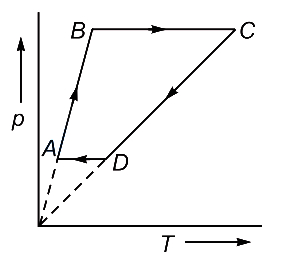
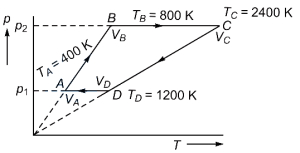
$3$ moles of an ideal monoatomic gas performs an $ABCDA$ cyclic process as shown in the figure below. The gas temperatures are $T_A=400 \, K$, $T_B=800 \, K$, $T_C=2400 \, K$, and $T_D=1200 \, K$. The work done by the gas is (approximately) $(R=8.314 \, J/mol \cdot K)$. (in $ \, kJ$)
A
$10$
B
$20$
C
$40$
D
$100$
Solution
(B) For an ideal gas, the equation of state is $pV = \mu RT$, which implies $p = (\frac{\mu R}{V})T$.
In a $p-T$ diagram, lines passing through the origin represent isochoric processes (constant volume) because $p \propto T$ implies $V = \text{constant}$.
Processes $AB$ and $CD$ are straight lines passing through the origin, so they are isochoric processes.
Work done in an isochoric process is zero. Thus, $W_{AB} = 0$ and $W_{CD} = 0$.
Processes $BC$ and $DA$ are isobaric processes (constant pressure).
Work done in an isobaric process is $W = p\Delta V = \mu R \Delta T$.
For process $BC$ (at pressure $p_2$): $W_{BC} = \mu R(T_C - T_B) = 3 \times R \times (2400 - 800) = 3R \times 1600 = 4800R$.
For process $DA$ (at pressure $p_1$): $W_{DA} = \mu R(T_A - T_D) = 3 \times R \times (400 - 1200) = 3R \times (-800) = -2400R$.
The total work done in the cycle is $W = W_{AB} + W_{BC} + W_{CD} + W_{DA} = 0 + 4800R + 0 - 2400R = 2400R$.
Substituting $R = 8.314 \, J/mol \cdot K$: $W = 2400 \times 8.314 = 19953.6 \, J \approx 20 \, kJ$.
In a $p-T$ diagram, lines passing through the origin represent isochoric processes (constant volume) because $p \propto T$ implies $V = \text{constant}$.
Processes $AB$ and $CD$ are straight lines passing through the origin, so they are isochoric processes.
Work done in an isochoric process is zero. Thus, $W_{AB} = 0$ and $W_{CD} = 0$.
Processes $BC$ and $DA$ are isobaric processes (constant pressure).
Work done in an isobaric process is $W = p\Delta V = \mu R \Delta T$.
For process $BC$ (at pressure $p_2$): $W_{BC} = \mu R(T_C - T_B) = 3 \times R \times (2400 - 800) = 3R \times 1600 = 4800R$.
For process $DA$ (at pressure $p_1$): $W_{DA} = \mu R(T_A - T_D) = 3 \times R \times (400 - 1200) = 3R \times (-800) = -2400R$.
The total work done in the cycle is $W = W_{AB} + W_{BC} + W_{CD} + W_{DA} = 0 + 4800R + 0 - 2400R = 2400R$.
Substituting $R = 8.314 \, J/mol \cdot K$: $W = 2400 \times 8.314 = 19953.6 \, J \approx 20 \, kJ$.
0 likes
View Solution306
MediumMCQ
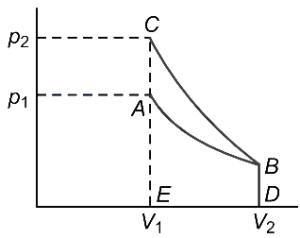
An ideal gas expands isothermally from volume $V_1$ to volume $V_2$. It is then compressed to the original volume $V_1$ adiabatically. If $p_1$ and $p_2$ represent the initial pressure and final pressure respectively,and $W$ represents the net work done by the gas during the entire process,then:
A
$p_1 > p_2, W = 0$
B
$p_1 > p_2, W > 0$
C
$p_2 > p_1, W > 0$
D
$p_2 > p_1, W < 0$
Solution
(D) $1$. In the $p-V$ diagram,the isothermal expansion from $A$ to $B$ follows the curve $AB$. The work done by the gas is the area under the curve $AB$,which is the area $ABDE$.
$2$. The adiabatic compression from $B$ to $C$ follows the curve $BC$. The work done on the gas is the area under the curve $BC$,which is the area $BCDE$.
$3$. From the graph,it is clear that the final pressure $p_2$ at point $C$ is greater than the initial pressure $p_1$ at point $A$,so $p_2 > p_1$.
$4$. The net work done by the gas $W$ is the sum of the work done during expansion $(W_{exp} > 0)$ and the work done during compression $(W_{comp} < 0)$.
$5$. Since the area under the adiabatic curve $BC$ (which represents the magnitude of work done on the gas) is greater than the area under the isothermal curve $AB$ (which represents the magnitude of work done by the gas),the net work done $W = W_{AB} - W_{BC}$ is negative $(W < 0)$.
$6$. Therefore,$p_2 > p_1$ and $W < 0$.
$2$. The adiabatic compression from $B$ to $C$ follows the curve $BC$. The work done on the gas is the area under the curve $BC$,which is the area $BCDE$.
$3$. From the graph,it is clear that the final pressure $p_2$ at point $C$ is greater than the initial pressure $p_1$ at point $A$,so $p_2 > p_1$.
$4$. The net work done by the gas $W$ is the sum of the work done during expansion $(W_{exp} > 0)$ and the work done during compression $(W_{comp} < 0)$.
$5$. Since the area under the adiabatic curve $BC$ (which represents the magnitude of work done on the gas) is greater than the area under the isothermal curve $AB$ (which represents the magnitude of work done by the gas),the net work done $W = W_{AB} - W_{BC}$ is negative $(W < 0)$.
$6$. Therefore,$p_2 > p_1$ and $W < 0$.
0 likes
View Solution307
DifficultMCQ
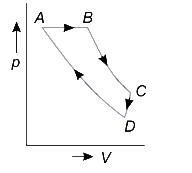
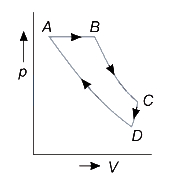
An ideal gas is subjected to a cyclic process $A B C D$ as depicted in the $p-V$ diagram given below. Which of the following curves represents the equivalent cyclic process?
A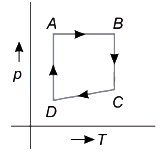
B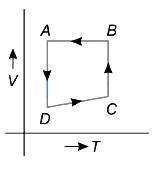
C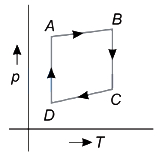
D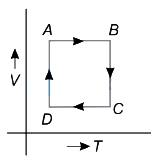
Solution
(C) The process $A \rightarrow B \rightarrow C \rightarrow D \rightarrow A$ is a clockwise cycle.
$1$. During $A \rightarrow B$: Pressure $p$ is constant (isobaric process).
$2$. During $B \rightarrow C$: The process follows $p \propto \frac{1}{V}$, which implies $pV = \text{constant}$, so temperature $T$ is constant (isothermal process).
$3$. During $C \rightarrow D$: Volume $V$ is constant (isochoric process).
$4$. During $D \rightarrow A$: The process follows $p \propto \frac{1}{V}$, which implies $pV = \text{constant}$, so temperature $T$ is constant (isothermal process).
Comparing these characteristics with the given options, we look for a $V-T$ diagram where:
- $A \rightarrow B$ is a process where $V \propto T$ (isobaric, since $pV = nRT \Rightarrow V = (\frac{nR}{p})T$).
- $B \rightarrow C$ is a vertical line (isothermal, $T$ is constant).
- $C \rightarrow D$ is a horizontal line (isochoric, $V$ is constant).
- $D \rightarrow A$ is a vertical line (isothermal, $T$ is constant).
Option $C$ correctly represents this cycle in the $V-T$ plane.
$1$. During $A \rightarrow B$: Pressure $p$ is constant (isobaric process).
$2$. During $B \rightarrow C$: The process follows $p \propto \frac{1}{V}$, which implies $pV = \text{constant}$, so temperature $T$ is constant (isothermal process).
$3$. During $C \rightarrow D$: Volume $V$ is constant (isochoric process).
$4$. During $D \rightarrow A$: The process follows $p \propto \frac{1}{V}$, which implies $pV = \text{constant}$, so temperature $T$ is constant (isothermal process).
Comparing these characteristics with the given options, we look for a $V-T$ diagram where:
- $A \rightarrow B$ is a process where $V \propto T$ (isobaric, since $pV = nRT \Rightarrow V = (\frac{nR}{p})T$).
- $B \rightarrow C$ is a vertical line (isothermal, $T$ is constant).
- $C \rightarrow D$ is a horizontal line (isochoric, $V$ is constant).
- $D \rightarrow A$ is a vertical line (isothermal, $T$ is constant).
Option $C$ correctly represents this cycle in the $V-T$ plane.
0 likes
View Solution308
DifficultMCQ
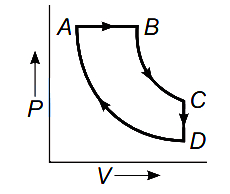
$A$ cyclic process $ABCD$ is shown in the given $P-V$ diagram. Which of the following diagrams represents the same process in a $P-T$ graph?
A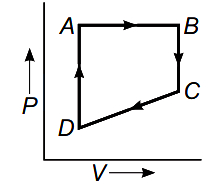
B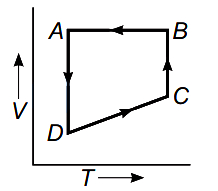
C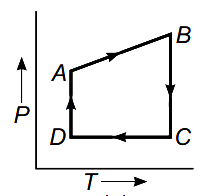
D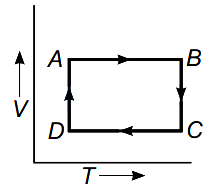
Solution
(A) In the $P-V$ diagram:
$1$. Process $AB$ is an isobaric process,where pressure $P$ remains constant. In a $P-T$ diagram,this is represented by a horizontal line.
$2$. Process $BC$ is an isothermal process,where temperature $T$ remains constant. In a $P-T$ diagram,this is represented by a vertical line.
$3$. Process $CD$ is an isochoric process,where volume $V$ remains constant. Since $PV = nRT$,for constant $V$,$P \propto T$. Thus,in a $P-T$ diagram,this is a straight line passing through the origin.
$4$. Process $DA$ is an adiabatic process,which is represented by a curve in the $P-T$ diagram.
Comparing these characteristics,the correct $P-T$ diagram is shown in option $(a)$.
$1$. Process $AB$ is an isobaric process,where pressure $P$ remains constant. In a $P-T$ diagram,this is represented by a horizontal line.
$2$. Process $BC$ is an isothermal process,where temperature $T$ remains constant. In a $P-T$ diagram,this is represented by a vertical line.
$3$. Process $CD$ is an isochoric process,where volume $V$ remains constant. Since $PV = nRT$,for constant $V$,$P \propto T$. Thus,in a $P-T$ diagram,this is a straight line passing through the origin.
$4$. Process $DA$ is an adiabatic process,which is represented by a curve in the $P-T$ diagram.
Comparing these characteristics,the correct $P-T$ diagram is shown in option $(a)$.
0 likes
View Solution309
DifficultMCQ
$A$ given mass of a gas is compressed isothermally until its pressure is doubled. It is then allowed to expand adiabatically until its original volume is restored and its pressure is then found to be $0.75$ of its initial pressure. The ratio of the specific heats of the gas is approximately:
A
$1.2$
B
$1.41$
C
$1.67$
D
$1.83$
Solution
(B) In an isothermal process,the temperature of the gas remains constant,so the gas obeys Boyle's law: $P \propto \frac{1}{V}$.
Let the initial pressure be $P$ and initial volume be $V_1$. After isothermal compression,pressure $P_2 = 2P$ and volume $V_2 = V_1/2$.
Thus,$\frac{V_1}{V_2} = 2$.
Now,the gas expands adiabatically to its original volume $V_1$. Let the final pressure be $P_3 = 0.75P$.
For an adiabatic process,$P_2 V_2^\gamma = P_3 V_1^\gamma$.
Substituting the values: $(2P) \left(\frac{V_1}{2}\right)^\gamma = (0.75P) V_1^\gamma$.
$2 \cdot \left(\frac{1}{2}\right)^\gamma = 0.75$.
$2^{1-\gamma} = \frac{3}{4} = 3 \cdot 2^{-2}$.
$2^{3-\gamma} = 3$.
Taking log on both sides: $(3-\gamma) \log 2 = \log 3$.
$3-\gamma = \frac{\log 3}{\log 2} \approx 1.585$.
$\gamma = 3 - 1.585 = 1.415 \approx 1.41$.
Let the initial pressure be $P$ and initial volume be $V_1$. After isothermal compression,pressure $P_2 = 2P$ and volume $V_2 = V_1/2$.
Thus,$\frac{V_1}{V_2} = 2$.
Now,the gas expands adiabatically to its original volume $V_1$. Let the final pressure be $P_3 = 0.75P$.
For an adiabatic process,$P_2 V_2^\gamma = P_3 V_1^\gamma$.
Substituting the values: $(2P) \left(\frac{V_1}{2}\right)^\gamma = (0.75P) V_1^\gamma$.
$2 \cdot \left(\frac{1}{2}\right)^\gamma = 0.75$.
$2^{1-\gamma} = \frac{3}{4} = 3 \cdot 2^{-2}$.
$2^{3-\gamma} = 3$.
Taking log on both sides: $(3-\gamma) \log 2 = \log 3$.
$3-\gamma = \frac{\log 3}{\log 2} \approx 1.585$.
$\gamma = 3 - 1.585 = 1.415 \approx 1.41$.
0 likes
View Solution310
EasyMCQ
The internal energy of the air in a room of volume $V$ at temperature $T$,with outside pressure $P$ increasing linearly with time,varies as
A
increases linearly
B
increases exponentially
C
decreases linearly
D
remains constant
Solution
(A) According to the ideal gas law,$PV = nRT$. Since the volume $V$ of the room is constant,we have $T = \frac{PV}{nR}$.
The internal energy $U$ of an ideal gas is given by $U = nC_vT$.
Substituting the expression for $T$,we get $U = nC_v \left( \frac{PV}{nR} \right) = \left( \frac{C_v V}{R} \right) P$.
Since $C_v$,$V$,and $R$ are constants,the internal energy $U$ is directly proportional to the pressure $P$ $(U \propto P)$.
Given that the pressure $P$ increases linearly with time,the internal energy $U$ must also increase linearly with time.
The internal energy $U$ of an ideal gas is given by $U = nC_vT$.
Substituting the expression for $T$,we get $U = nC_v \left( \frac{PV}{nR} \right) = \left( \frac{C_v V}{R} \right) P$.
Since $C_v$,$V$,and $R$ are constants,the internal energy $U$ is directly proportional to the pressure $P$ $(U \propto P)$.
Given that the pressure $P$ increases linearly with time,the internal energy $U$ must also increase linearly with time.
0 likes
View Solution311
MediumMCQ
Consider an engine that absorbs $130 \text{ cal}$ of heat from a hot reservoir and delivers $30 \text{ cal}$ of heat to a cold reservoir in each cycle. The engine also consumes $2 \text{ J}$ of energy in each cycle to overcome friction. If the engine works at $90 \text{ cycles per minute}$, what will be the maximum power delivered to the load (in $\text{ W}$)? [Assume the thermal equivalent of heat is $4.2 \text{ J/cal}$]
A
$816$
B
$819$
C
$627$
D
$630$
Solution
(C) The heat absorbed per cycle is $Q_H = 130 \text{ cal}$.
The heat rejected per cycle is $Q_C = 30 \text{ cal}$.
The net heat converted to work per cycle is $W_{\text{net}} = (Q_H - Q_C) \times 4.2 \text{ J/cal} = (130 - 30) \times 4.2 = 100 \times 4.2 = 420 \text{ J}$.
The energy consumed to overcome friction per cycle is $W_f = 2 \text{ J}$.
The useful work delivered to the load per cycle is $W_{\text{load}} = W_{\text{net}} - W_f = 420 \text{ J} - 2 \text{ J} = 418 \text{ J}$.
The engine operates at $90 \text{ cycles per minute}$, which is $90/60 = 1.5 \text{ cycles per second}$.
The power delivered to the load is $P = W_{\text{load}} \times \text{frequency} = 418 \text{ J} \times 1.5 \text{ s}^{-1} = 627 \text{ W}$.
The heat rejected per cycle is $Q_C = 30 \text{ cal}$.
The net heat converted to work per cycle is $W_{\text{net}} = (Q_H - Q_C) \times 4.2 \text{ J/cal} = (130 - 30) \times 4.2 = 100 \times 4.2 = 420 \text{ J}$.
The energy consumed to overcome friction per cycle is $W_f = 2 \text{ J}$.
The useful work delivered to the load per cycle is $W_{\text{load}} = W_{\text{net}} - W_f = 420 \text{ J} - 2 \text{ J} = 418 \text{ J}$.
The engine operates at $90 \text{ cycles per minute}$, which is $90/60 = 1.5 \text{ cycles per second}$.
The power delivered to the load is $P = W_{\text{load}} \times \text{frequency} = 418 \text{ J} \times 1.5 \text{ s}^{-1} = 627 \text{ W}$.
0 likes
View Solution312
MediumMCQ
$2$ moles of an ideal monoatomic gas is carried from a state $(p_{0}, V_{0})$ to state $(2 p_{0}, 2 V_{0})$ along a straight line path in a $p-V$ diagram. The amount of heat absorbed by the gas in the process is given by
A
$3 p_{0} V_{0}$
B
$\frac{9}{2} p_{0} V_{0}$
C
$6 p_{0} V_{0}$
D
$\frac{3}{2} p_{0} V_{0}$
Solution
(C) For a monoatomic gas,the molar heat capacity at constant volume is $C_{v} = \frac{3}{2}R$. The change in internal energy is given by $\Delta U = n C_{v} \Delta T = n \left(\frac{3}{2}R\right) \Delta T$.
Using the ideal gas law $pV = nRT$,we have $\Delta T = \frac{p_f V_f - p_i V_i}{nR}$.
Substituting the values: $\Delta U = \frac{3}{2} (p_f V_f - p_i V_i) = \frac{3}{2} (4 p_{0} V_{0} - p_{0} V_{0}) = \frac{3}{2} (3 p_{0} V_{0}) = \frac{9}{2} p_{0} V_{0}$.
The work done $W$ is the area under the $p-V$ graph,which is a trapezoid: $W = \frac{1}{2} (p_i + p_f) (V_f - V_i) = \frac{1}{2} (p_{0} + 2 p_{0}) (2 V_{0} - V_{0}) = \frac{1}{2} (3 p_{0}) (V_{0}) = \frac{3}{2} p_{0} V_{0}$.
According to the first law of thermodynamics,$\Delta Q = \Delta U + W$.
$\Delta Q = \frac{9}{2} p_{0} V_{0} + \frac{3}{2} p_{0} V_{0} = \frac{12}{2} p_{0} V_{0} = 6 p_{0} V_{0}$.
Using the ideal gas law $pV = nRT$,we have $\Delta T = \frac{p_f V_f - p_i V_i}{nR}$.
Substituting the values: $\Delta U = \frac{3}{2} (p_f V_f - p_i V_i) = \frac{3}{2} (4 p_{0} V_{0} - p_{0} V_{0}) = \frac{3}{2} (3 p_{0} V_{0}) = \frac{9}{2} p_{0} V_{0}$.
The work done $W$ is the area under the $p-V$ graph,which is a trapezoid: $W = \frac{1}{2} (p_i + p_f) (V_f - V_i) = \frac{1}{2} (p_{0} + 2 p_{0}) (2 V_{0} - V_{0}) = \frac{1}{2} (3 p_{0}) (V_{0}) = \frac{3}{2} p_{0} V_{0}$.
According to the first law of thermodynamics,$\Delta Q = \Delta U + W$.
$\Delta Q = \frac{9}{2} p_{0} V_{0} + \frac{3}{2} p_{0} V_{0} = \frac{12}{2} p_{0} V_{0} = 6 p_{0} V_{0}$.
0 likes
View Solution313
DifficultMCQ
The pressure $p$,volume $V$ and temperature $T$ for a certain gas are related by $p=\frac{A T-B T^{2}}{V}$ where $A$ and $B$ are constants. The work done by the gas when the temperature changes from $T_{1}$ to $T_{2}$ while the pressure remains constant,is given by
A
$A\left(T_{2}-T_{1}\right)+B\left(T_{2}^{2}-T_{1}^{2}\right)$
B
$\frac{A\left(T_{2}-T_{1}\right)}{V_{2}-V_{1}}-\frac{B\left(T_{2}^{2}-T_{1}^{2}\right)}{V_{2}-V_{1}}$
C
$A\left(T_{2}-T_{1}\right)-\frac{B}{2}\left(T_{2}^{2}-T_{1}^{2}\right)$
D
$\frac{A\left(T_{2}-T_{1}^{2}\right)}{V_{2}-V_{1}}$
Solution
(A) Given the equation of state: $PV = AT - BT^2$.
Since the pressure $P$ is constant,we differentiate the equation with respect to $T$:
$P dV = A dT - B(2T) dT$.
Work done $W = \int P dV$.
Substituting $P dV$ into the integral:
$W = \int_{T_1}^{T_2} (A - 2BT) dT$.
$W = A \int_{T_1}^{T_2} dT - 2B \int_{T_1}^{T_2} T dT$.
$W = A(T_2 - T_1) - 2B \left[ \frac{T^2}{2} \right]_{T_1}^{T_2}$.
$W = A(T_2 - T_1) - B(T_2^2 - T_1^2)$.
Since the pressure $P$ is constant,we differentiate the equation with respect to $T$:
$P dV = A dT - B(2T) dT$.
Work done $W = \int P dV$.
Substituting $P dV$ into the integral:
$W = \int_{T_1}^{T_2} (A - 2BT) dT$.
$W = A \int_{T_1}^{T_2} dT - 2B \int_{T_1}^{T_2} T dT$.
$W = A(T_2 - T_1) - 2B \left[ \frac{T^2}{2} \right]_{T_1}^{T_2}$.
$W = A(T_2 - T_1) - B(T_2^2 - T_1^2)$.
0 likes
View Solution314
EasyMCQ
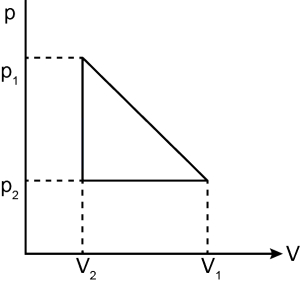
One mole of a van der Waals' gas obeying the equation $\left(p+\frac{a}{V^{2}}\right)(V-b)=R T$ undergoes the quasi-static cyclic process which is shown in the $p-V$ diagram. The net heat absorbed by the gas in this process is
A
$\frac{1}{2}(p_{1}-p_{2})(V_{1}-V_{2})$
B
$\frac{1}{2}(p_{1}+p_{2})(V_{1}-V_{2})$
C
$\frac{1}{2}(p_{1}+\frac{a}{V_{1}^{2}}-p_{2}-\frac{a}{V_{2}^{2}})(V_{1}-V_{2})$
D
$\frac{1}{2}(p_{1}+\frac{a}{V_{1}^{2}}+p_{2}+\frac{a}{V_{2}^{2}})(V_{1}-V_{2})$
Solution
(A) For a cyclic process,the change in internal energy $\Delta U$ is zero. According to the first law of thermodynamics,$\Delta Q = \Delta U + \Delta W$. Since $\Delta U = 0$,the net heat absorbed $\Delta Q$ is equal to the net work done $\Delta W$ by the gas.
The net work done in a cyclic process is equal to the area enclosed by the cycle in the $p-V$ diagram.
The area of the triangle in the $p-V$ diagram is given by:
$\text{Area} = \frac{1}{2} \times \text{base} \times \text{height}$
Here,the base is $(V_{1}-V_{2})$ and the height is $(p_{1}-p_{2})$.
Therefore,the net heat absorbed $\Delta Q = \frac{1}{2}(p_{1}-p_{2})(V_{1}-V_{2})$.
The net work done in a cyclic process is equal to the area enclosed by the cycle in the $p-V$ diagram.
The area of the triangle in the $p-V$ diagram is given by:
$\text{Area} = \frac{1}{2} \times \text{base} \times \text{height}$
Here,the base is $(V_{1}-V_{2})$ and the height is $(p_{1}-p_{2})$.
Therefore,the net heat absorbed $\Delta Q = \frac{1}{2}(p_{1}-p_{2})(V_{1}-V_{2})$.
0 likes
View Solution315
MediumMCQ
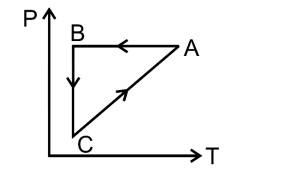
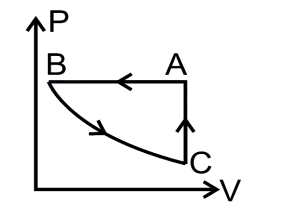
For an ideal gas,a cyclic process $ABCA$ as shown in the $P-T$ diagram,when presented in a $P-V$ plot,would be:
A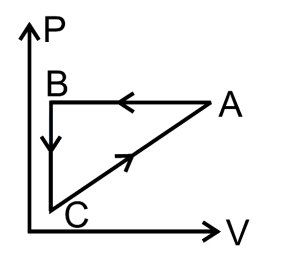
B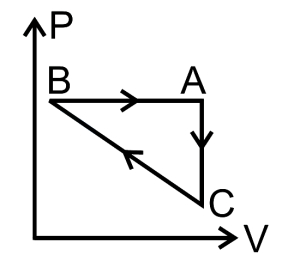
C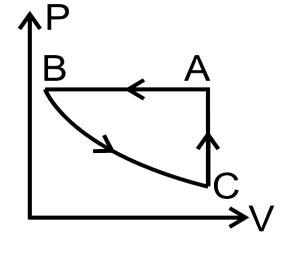
D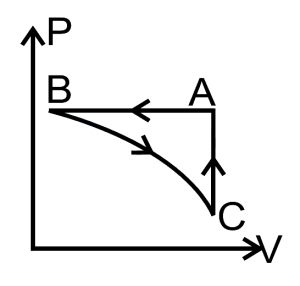
Solution
(D) In the given $P-T$ diagram:
$AB$: The pressure $P$ is constant,and temperature $T$ decreases. Since $PV = nRT$,if $P$ is constant and $T$ decreases,volume $V$ must decrease. Thus,$AB$ is an isobaric compression.
$BC$: The process is a vertical line,meaning temperature $T$ is constant. Since $P$ decreases,$V$ must increase to keep $PV$ constant. Thus,$BC$ is an isothermal expansion.
$CA$: The process is a line passing through the origin in a $P-T$ diagram,meaning $P \propto T$. Since $PV = nRT$,$P/T = nR/V$,so $V$ must be constant. Thus,$CA$ is an isochoric process.
Comparing these characteristics with the given options,the correct $P-V$ diagram is represented by option $D$.
$AB$: The pressure $P$ is constant,and temperature $T$ decreases. Since $PV = nRT$,if $P$ is constant and $T$ decreases,volume $V$ must decrease. Thus,$AB$ is an isobaric compression.
$BC$: The process is a vertical line,meaning temperature $T$ is constant. Since $P$ decreases,$V$ must increase to keep $PV$ constant. Thus,$BC$ is an isothermal expansion.
$CA$: The process is a line passing through the origin in a $P-T$ diagram,meaning $P \propto T$. Since $PV = nRT$,$P/T = nR/V$,so $V$ must be constant. Thus,$CA$ is an isochoric process.
Comparing these characteristics with the given options,the correct $P-V$ diagram is represented by option $D$.
0 likes
View Solution316
EasyMCQ
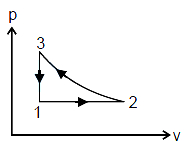
$A$ cyclic process is shown in the $p-v$ diagram. Which of the following statement$(s)$ is/are true?
A
$1 \rightarrow 2$: Isobaric,$2 \rightarrow 3$: Isothermal
B
$3 \rightarrow 1$: Isochoric,$2 \rightarrow 3$: Adiabatic
C
Work done by the system in the complete cyclic process is non-zero
D
The heat absorbed by the system in the complete cyclic process is non-zero
Solution
(A, B, C, D) In a $p-v$ diagram:
$1$. The process $1 \rightarrow 2$ is a horizontal line,meaning pressure $p$ is constant. Thus,it is an isobaric process.
$2$. The process $3 \rightarrow 1$ is a vertical line,meaning volume $v$ is constant. Thus,it is an isochoric process.
$3$. The process $2 \rightarrow 3$ is a curve,which represents an adiabatic process in this cycle.
$4$. For any complete cyclic process,the change in internal energy $\Delta U = 0$. According to the first law of thermodynamics,$Q = \Delta U + W$. Since $\Delta U = 0$,$Q = W$. The work done $W$ in a cyclic process is equal to the area enclosed by the cycle,which is non-zero. Therefore,both work done and heat absorbed are non-zero.
Thus,statements $A$,$B$,$C$,and $D$ are all correct.
$1$. The process $1 \rightarrow 2$ is a horizontal line,meaning pressure $p$ is constant. Thus,it is an isobaric process.
$2$. The process $3 \rightarrow 1$ is a vertical line,meaning volume $v$ is constant. Thus,it is an isochoric process.
$3$. The process $2 \rightarrow 3$ is a curve,which represents an adiabatic process in this cycle.
$4$. For any complete cyclic process,the change in internal energy $\Delta U = 0$. According to the first law of thermodynamics,$Q = \Delta U + W$. Since $\Delta U = 0$,$Q = W$. The work done $W$ in a cyclic process is equal to the area enclosed by the cycle,which is non-zero. Therefore,both work done and heat absorbed are non-zero.
Thus,statements $A$,$B$,$C$,and $D$ are all correct.
0 likes
View Solution317
DifficultMCQ
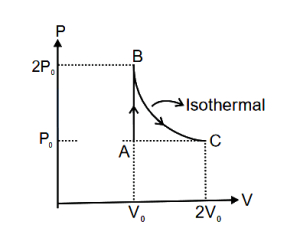
One mole of a diatomic ideal gas undergoes a process shown in $P-V$ diagram. The total heat given to the gas $(\ln 2 = 0.7)$ is (in $P_0 V_0$)
A
$2.5$
B
$3.9$
C
$1.1$
D
$1.4$
Solution
(B) For a diatomic gas,the total heat given is $\Delta Q_{total} = \Delta Q_{AB} + \Delta Q_{BC}$.
$1$. For process $AB$ (Isochoric process):
$\Delta Q_{AB} = n C_V \Delta T = n \left( \frac{R}{\gamma - 1} \right) \Delta T = \frac{P_f V_f - P_i V_i}{\gamma - 1}$
Given $n = 1$ mole,diatomic gas $\gamma = 1.4 = 7/5$.
$\Delta Q_{AB} = \frac{2 P_0 V_0 - P_0 V_0}{7/5 - 1} = \frac{P_0 V_0}{2/5} = 2.5 P_0 V_0$.
$2$. For process $BC$ (Isothermal process):
$\Delta Q_{BC} = W_{BC} = n R T \ln \left( \frac{V_f}{V_i} \right) = P_B V_B \ln \left( \frac{V_C}{V_B} \right)$
Since $P_B V_B = 2 P_0 V_0$ and $V_C = 2 V_0, V_B = V_0$:
$\Delta Q_{BC} = 2 P_0 V_0 \ln \left( \frac{2 V_0}{V_0} \right) = 2 P_0 V_0 \ln 2 = 2 P_0 V_0 (0.7) = 1.4 P_0 V_0$.
Total heat $\Delta Q_{total} = 2.5 P_0 V_0 + 1.4 P_0 V_0 = 3.9 P_0 V_0$.
$1$. For process $AB$ (Isochoric process):
$\Delta Q_{AB} = n C_V \Delta T = n \left( \frac{R}{\gamma - 1} \right) \Delta T = \frac{P_f V_f - P_i V_i}{\gamma - 1}$
Given $n = 1$ mole,diatomic gas $\gamma = 1.4 = 7/5$.
$\Delta Q_{AB} = \frac{2 P_0 V_0 - P_0 V_0}{7/5 - 1} = \frac{P_0 V_0}{2/5} = 2.5 P_0 V_0$.
$2$. For process $BC$ (Isothermal process):
$\Delta Q_{BC} = W_{BC} = n R T \ln \left( \frac{V_f}{V_i} \right) = P_B V_B \ln \left( \frac{V_C}{V_B} \right)$
Since $P_B V_B = 2 P_0 V_0$ and $V_C = 2 V_0, V_B = V_0$:
$\Delta Q_{BC} = 2 P_0 V_0 \ln \left( \frac{2 V_0}{V_0} \right) = 2 P_0 V_0 \ln 2 = 2 P_0 V_0 (0.7) = 1.4 P_0 V_0$.
Total heat $\Delta Q_{total} = 2.5 P_0 V_0 + 1.4 P_0 V_0 = 3.9 P_0 V_0$.
0 likes
View Solution318
EasyMCQ
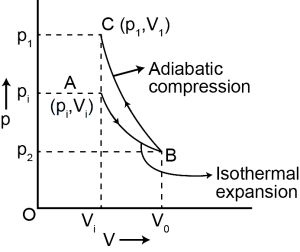
For an ideal gas with initial pressure and volume $p_{i}$ and $V_{i}$ respectively, a reversible isothermal expansion occurs until its volume becomes $V_{0}$. Then, it is compressed to its original volume $V_{i}$ by a reversible adiabatic process. If the final pressure is $p_{f}$, then which of the following statement(s) is/are true?
A
$p_{f}=p_{i}$
B
$p_{f} > p_{i}$
C
$p_{f} < p_{i}$
D
$\frac{p_{f}}{V_{0}}=\frac{p_{i}}{V_{i}}$
Solution
(B) In a $p-V$ diagram, the slope of an adiabatic curve at any point is steeper than that of an isothermal curve at that same point.
Let the initial state be $A(p_{i}, V_{i})$.
During the reversible isothermal expansion to volume $V_{0}$, the gas moves along the isothermal curve to state $B(p_{2}, V_{0})$, where $p_{2} < p_{i}$.
During the subsequent reversible adiabatic compression from volume $V_{0}$ back to $V_{i}$, the gas moves along an adiabatic curve from state $B(p_{2}, V_{0})$ to state $C(p_{f}, V_{i})$.
Since the adiabatic curve is steeper than the isothermal curve, the path from $B$ to $C$ lies above the path from $A$ to $B$ in the $p-V$ plane.
Therefore, the final pressure $p_{f}$ at volume $V_{i}$ must be greater than the initial pressure $p_{i}$.
Thus, $p_{f} > p_{i}$.
Let the initial state be $A(p_{i}, V_{i})$.
During the reversible isothermal expansion to volume $V_{0}$, the gas moves along the isothermal curve to state $B(p_{2}, V_{0})$, where $p_{2} < p_{i}$.
During the subsequent reversible adiabatic compression from volume $V_{0}$ back to $V_{i}$, the gas moves along an adiabatic curve from state $B(p_{2}, V_{0})$ to state $C(p_{f}, V_{i})$.
Since the adiabatic curve is steeper than the isothermal curve, the path from $B$ to $C$ lies above the path from $A$ to $B$ in the $p-V$ plane.
Therefore, the final pressure $p_{f}$ at volume $V_{i}$ must be greater than the initial pressure $p_{i}$.
Thus, $p_{f} > p_{i}$.
0 likes
View Solution319
EasyMCQ
Which of the following statement$(s)$ is/are true? "Internal energy of an ideal gas ..........."
A
decreases in an isothermal process.
B
remains constant in an isothermal process.
C
increases in an isobaric process.
D
decreases in an isobaric expansion.
Solution
(B, C) The internal energy $(U)$ of an ideal gas is a function of temperature $(T)$ only, given by $U = f(T)$.
In an isothermal process, the temperature of the gas remains constant $(\Delta T = 0)$.
Since the internal energy depends only on temperature, it remains constant in an isothermal process.
In an isobaric process, if the gas expands, the temperature increases (from $PV = nRT$, if $P$ is constant and $V$ increases, $T$ must increase), leading to an increase in internal energy.
Therefore, both statement $(B)$ and statement $(C)$ are true.
In an isothermal process, the temperature of the gas remains constant $(\Delta T = 0)$.
Since the internal energy depends only on temperature, it remains constant in an isothermal process.
In an isobaric process, if the gas expands, the temperature increases (from $PV = nRT$, if $P$ is constant and $V$ increases, $T$ must increase), leading to an increase in internal energy.
Therefore, both statement $(B)$ and statement $(C)$ are true.
0 likes
View Solution320
DifficultMCQ
$A$ heating element of resistance $r$ is fitted inside an adiabatic cylinder which carries a frictionless piston of mass $m$ and cross-sectional area $A$. The cylinder contains one mole of a diatomic gas. The temperature of the gas varies with time $t$ as $T = \alpha t + \frac{1}{2} \beta t^2$ (where $\alpha$ and $\beta$ are constants),while the pressure remains constant. The atmospheric pressure above the piston is $P_0$. Then:
A
the rate of increase in internal energy is $\frac{5}{2} R(\alpha+\beta t)$
B
the current flowing in the element is $\sqrt{\frac{5}{2 r} R(\alpha+\beta t)}$
C
the piston moves upwards with constant acceleration
D
the piston moves upwards with constant speed
Solution
(A, C) For a diatomic gas,the degree of freedom $f = 5$. The internal energy is $U = \frac{n f R T}{2} = \frac{5 R}{2} (\alpha t + \frac{1}{2} \beta t^2)$.
The rate of increase in internal energy is $\frac{dU}{dt} = \frac{5 R}{2} (\alpha + \beta t)$.
Since the pressure is constant,the heat supplied is $dQ = n C_p dT$. For a diatomic gas,$C_p = \frac{7}{2} R$.
Thus,the power supplied by the heating element is $i^2 r = \frac{dQ}{dt} = n C_p \frac{dT}{dt} = 1 \times \frac{7}{2} R \times (\alpha + \beta t)$.
Therefore,the current $i = \sqrt{\frac{7 R}{2 r} (\alpha + \beta t)}$.
From the ideal gas law $PV = nRT$,since $P$ is constant,$V = \frac{nRT}{P} = \frac{R}{P} (\alpha t + \frac{1}{2} \beta t^2)$.
The position of the piston $x = \frac{V}{A} = \frac{R}{PA} (\alpha t + \frac{1}{2} \beta t^2)$.
The velocity $v = \frac{dx}{dt} = \frac{R}{PA} (\alpha + \beta t)$.
The acceleration $a = \frac{dv}{dt} = \frac{R \beta}{PA}$,which is constant. Thus,options $(a)$ and $(c)$ are correct.
The rate of increase in internal energy is $\frac{dU}{dt} = \frac{5 R}{2} (\alpha + \beta t)$.
Since the pressure is constant,the heat supplied is $dQ = n C_p dT$. For a diatomic gas,$C_p = \frac{7}{2} R$.
Thus,the power supplied by the heating element is $i^2 r = \frac{dQ}{dt} = n C_p \frac{dT}{dt} = 1 \times \frac{7}{2} R \times (\alpha + \beta t)$.
Therefore,the current $i = \sqrt{\frac{7 R}{2 r} (\alpha + \beta t)}$.
From the ideal gas law $PV = nRT$,since $P$ is constant,$V = \frac{nRT}{P} = \frac{R}{P} (\alpha t + \frac{1}{2} \beta t^2)$.
The position of the piston $x = \frac{V}{A} = \frac{R}{PA} (\alpha t + \frac{1}{2} \beta t^2)$.
The velocity $v = \frac{dx}{dt} = \frac{R}{PA} (\alpha + \beta t)$.
The acceleration $a = \frac{dv}{dt} = \frac{R \beta}{PA}$,which is constant. Thus,options $(a)$ and $(c)$ are correct.
0 likes
View Solution321
DifficultMCQ
An ideal gas is compressed isothermally until its pressure is doubled and then allowed to expand adiabatically to regain its original volume ($\gamma = 1.4$ and $2^{-1.4} = 0.38$). The ratio of the final to initial pressure is (in $: 1$)
A
$0.76$
B
$1$
C
$0.66$
D
$0.86$
Solution
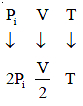
(A) Let the initial state of the gas be $(P_i, V, T)$.
Step $1$: Isothermal compression.
The gas is compressed until the pressure doubles. Since the process is isothermal,$P_i V = P_f V_f$. Given $P_f = 2P_i$,we have $P_i V = (2P_i) V_f$,which gives $V_f = V/2$.
The state after isothermal compression is $(2P_i, V/2, T)$.
Step $2$: Adiabatic expansion.
The gas expands adiabatically to regain its original volume $V$. Let the final pressure be $P_f'$.
Using the adiabatic process equation $P_1 V_1^\gamma = P_2 V_2^\gamma$:
$(2P_i) (V/2)^\gamma = P_f' V^\gamma$
$P_f' = (2P_i) \left(\frac{V/2}{V}\right)^\gamma = (2P_i) \left(\frac{1}{2}\right)^\gamma = 2P_i \times 2^{-\gamma}$
$P_f' = P_i \times 2^{1-\gamma}$
Given $\gamma = 1.4$,we have $P_f' = P_i \times 2^{1-1.4} = P_i \times 2^{-0.4}$.
Wait,the problem states $2^{-1.4} = 0.38$. Let's re-evaluate: $P_f' = 2P_i \times (1/2)^{1.4} = 2P_i \times 2^{-1.4}$.
Substituting the given value: $P_f' = 2P_i \times 0.38 = 0.76 P_i$.
Therefore,the ratio of the final to initial pressure is $P_f'/P_i = 0.76: 1$.
Step $1$: Isothermal compression.
The gas is compressed until the pressure doubles. Since the process is isothermal,$P_i V = P_f V_f$. Given $P_f = 2P_i$,we have $P_i V = (2P_i) V_f$,which gives $V_f = V/2$.
The state after isothermal compression is $(2P_i, V/2, T)$.
Step $2$: Adiabatic expansion.
The gas expands adiabatically to regain its original volume $V$. Let the final pressure be $P_f'$.
Using the adiabatic process equation $P_1 V_1^\gamma = P_2 V_2^\gamma$:
$(2P_i) (V/2)^\gamma = P_f' V^\gamma$
$P_f' = (2P_i) \left(\frac{V/2}{V}\right)^\gamma = (2P_i) \left(\frac{1}{2}\right)^\gamma = 2P_i \times 2^{-\gamma}$
$P_f' = P_i \times 2^{1-\gamma}$
Given $\gamma = 1.4$,we have $P_f' = P_i \times 2^{1-1.4} = P_i \times 2^{-0.4}$.
Wait,the problem states $2^{-1.4} = 0.38$. Let's re-evaluate: $P_f' = 2P_i \times (1/2)^{1.4} = 2P_i \times 2^{-1.4}$.
Substituting the given value: $P_f' = 2P_i \times 0.38 = 0.76 P_i$.
Therefore,the ratio of the final to initial pressure is $P_f'/P_i = 0.76: 1$.
0 likes
View Solution322
MediumMCQ
One mole of an ideal diatomic gas expands from volume $V$ to $2V$ isothermally at a temperature $27^{\circ} C$ and does $W$ joule of work. If the gas undergoes the same magnitude of expansion adiabatically from $27^{\circ} C$ doing the same amount of work $W$,then its final temperature will be (close to) . . . . . . ${ }^{\circ} C$.
A
$-189$
B
$-56$
C
$-30$
D
$-117$
Solution
(B) For an isothermal process,the work done is given by $W_{\text{isothermal}} = nRT \ln \left(\frac{V_2}{V_1}\right)$.
Given $n = 1$,$T = 27^{\circ} C = 300 \ K$,and $V_2/V_1 = 2$,we have $W = 1 \cdot R \cdot 300 \cdot \ln(2) \approx 300R(0.693)$.
For an adiabatic process,the work done is $W_{\text{adiabatic}} = \frac{nR(T_1 - T_2)}{\gamma - 1}$.
For a diatomic gas,$\gamma = 1.4$.
Given $W_{\text{isothermal}} = W_{\text{adiabatic}}$,we equate the two expressions:
$\frac{1 \cdot R(300 - T_{\text{final}})}{1.4 - 1} = 300R(0.693)$.
$\frac{300 - T_{\text{final}}}{0.4} = 300(0.693)$.
$300 - T_{\text{final}} = 0.4 \cdot 300 \cdot 0.693 = 83.16$.
$T_{\text{final}} = 300 - 83.16 = 216.84 \ K$.
Converting to Celsius: $T(^{\circ} C) = 216.84 - 273.15 \approx -56.31^{\circ} C$.
Thus,the final temperature is close to $-56^{\circ} C$.
Given $n = 1$,$T = 27^{\circ} C = 300 \ K$,and $V_2/V_1 = 2$,we have $W = 1 \cdot R \cdot 300 \cdot \ln(2) \approx 300R(0.693)$.
For an adiabatic process,the work done is $W_{\text{adiabatic}} = \frac{nR(T_1 - T_2)}{\gamma - 1}$.
For a diatomic gas,$\gamma = 1.4$.
Given $W_{\text{isothermal}} = W_{\text{adiabatic}}$,we equate the two expressions:
$\frac{1 \cdot R(300 - T_{\text{final}})}{1.4 - 1} = 300R(0.693)$.
$\frac{300 - T_{\text{final}}}{0.4} = 300(0.693)$.
$300 - T_{\text{final}} = 0.4 \cdot 300 \cdot 0.693 = 83.16$.
$T_{\text{final}} = 300 - 83.16 = 216.84 \ K$.
Converting to Celsius: $T(^{\circ} C) = 216.84 - 273.15 \approx -56.31^{\circ} C$.
Thus,the final temperature is close to $-56^{\circ} C$.
0 likes
View Solution323
MediumMCQ
$10 \text{ mole}$ of oxygen is heated at constant volume from $30^{\circ} C$ to $40^{\circ} C$. The change in the internal energy of the gas is . . . . . . $\text{cal}$. (The molecular specific heat of oxygen at constant pressure,$C_p = 7 \text{ cal/mol}^{\circ} C$ and $R = 2 \text{ cal/mol}^{\circ} C$.)
A
$250$
B
$700$
C
$500$
D
$100$
Solution
(C) The change in internal energy $\Delta U$ for an ideal gas is given by the formula: $\Delta U = n C_v \Delta T$.
Given that the process occurs at constant volume,$C_v = C_p - R$.
Substituting the given values: $C_v = 7 - 2 = 5 \text{ cal/mol}^{\circ} C$.
Number of moles $n = 10 \text{ mol}$.
Change in temperature $\Delta T = 40^{\circ} C - 30^{\circ} C = 10^{\circ} C$.
Therefore,$\Delta U = 10 \times 5 \times 10 = 500 \text{ cal}$.
Given that the process occurs at constant volume,$C_v = C_p - R$.
Substituting the given values: $C_v = 7 - 2 = 5 \text{ cal/mol}^{\circ} C$.
Number of moles $n = 10 \text{ mol}$.
Change in temperature $\Delta T = 40^{\circ} C - 30^{\circ} C = 10^{\circ} C$.
Therefore,$\Delta U = 10 \times 5 \times 10 = 500 \text{ cal}$.
0 likes
View Solution324
DifficultMCQ
One mole of diatomic gas having rotational modes only is kept in a cylinder with a piston system. The cross-section area of the cylinder is $4 \text{ cm}^2$. The gas is heated slowly to raise the temperature by $1.2^\circ\text{C}$ during which the piston moves by $25 \text{ mm}$. The amount of heat supplied to the gas is . . . . . . $J$. (Atmospheric pressure = $100 \text{ kPa}$,$R = 8.3 \text{ J/mol}\cdot\text{K}$) (Neglect mass of the piston)
A
$24.8$
B
$25$
C
$15.04$
D
$29.98$
Solution
(B) For a diatomic gas with rotational modes only,the degrees of freedom $f = 5$ ($3$ translational + $2$ rotational). Thus,$C_v = \frac{f}{2}R = \frac{5}{2}R$.
Change in internal energy $\Delta U = nC_v \Delta T = 1 \times \frac{5}{2} \times 8.3 \times 1.2 = 24.9 \text{ J}$.
Work done by the gas $W = P \Delta V = P(A \Delta x)$.
Given $P = 10^5 \text{ Pa}$,$A = 4 \times 10^{-4} \text{ m}^2$,and $\Delta x = 25 \times 10^{-3} \text{ m}$.
$W = 10^5 \times 4 \times 10^{-4} \times 25 \times 10^{-3} = 1 \text{ J}$.
Total heat supplied $Q = \Delta U + W = 24.9 + 1 = 25.9 \text{ J}$.
Comparing with the given options,$25 \text{ J}$ is the closest value.
Change in internal energy $\Delta U = nC_v \Delta T = 1 \times \frac{5}{2} \times 8.3 \times 1.2 = 24.9 \text{ J}$.
Work done by the gas $W = P \Delta V = P(A \Delta x)$.
Given $P = 10^5 \text{ Pa}$,$A = 4 \times 10^{-4} \text{ m}^2$,and $\Delta x = 25 \times 10^{-3} \text{ m}$.
$W = 10^5 \times 4 \times 10^{-4} \times 25 \times 10^{-3} = 1 \text{ J}$.
Total heat supplied $Q = \Delta U + W = 24.9 + 1 = 25.9 \text{ J}$.
Comparing with the given options,$25 \text{ J}$ is the closest value.
0 likes
View Solution325
MediumMCQ
Heat is supplied to a diatomic gas at constant pressure. Then the ratio of $\Delta Q : \Delta U : \Delta W$ is . . . . . . .
A
$2 : 3 : 5$
B
$5 : 3 : 2$
C
$2 : 5 : 7$
D
$7 : 5 : 2$
Solution
(D) For a diatomic gas,the molar heat capacity at constant pressure is $C_p = \frac{7}{2}R$ and at constant volume is $C_v = \frac{5}{2}R$.
Heat supplied at constant pressure is given by $\Delta Q = nC_p \Delta T = n(\frac{7}{2}R)\Delta T$.
Change in internal energy is given by $\Delta U = nC_v \Delta T = n(\frac{5}{2}R)\Delta T$.
According to the first law of thermodynamics,work done is $\Delta W = \Delta Q - \Delta U = n(\frac{7}{2}R - \frac{5}{2}R)\Delta T = n(\frac{2}{2}R)\Delta T = nR \Delta T$.
The ratio $\Delta Q : \Delta U : \Delta W$ is $\frac{7}{2} : \frac{5}{2} : \frac{2}{2} = 7 : 5 : 2$.
Heat supplied at constant pressure is given by $\Delta Q = nC_p \Delta T = n(\frac{7}{2}R)\Delta T$.
Change in internal energy is given by $\Delta U = nC_v \Delta T = n(\frac{5}{2}R)\Delta T$.
According to the first law of thermodynamics,work done is $\Delta W = \Delta Q - \Delta U = n(\frac{7}{2}R - \frac{5}{2}R)\Delta T = n(\frac{2}{2}R)\Delta T = nR \Delta T$.
The ratio $\Delta Q : \Delta U : \Delta W$ is $\frac{7}{2} : \frac{5}{2} : \frac{2}{2} = 7 : 5 : 2$.
0 likes
View Solution326
DifficultMCQ
Consider the following statements:
$A$. Zeroth law of thermodynamics gives the concept of temperature.
$B$. First law of thermodynamics gives the concept of internal energy.
$C$. In isothermal expansion of an ideal gas, $\Delta Q \neq \Delta W$.
$D$. The product of intensive and extensive variables is extensive.
$E$. The ratio of any extensive variable to mass will be an extensive variable.
Choose the correct combination of statements from the options given below:
$A$. Zeroth law of thermodynamics gives the concept of temperature.
$B$. First law of thermodynamics gives the concept of internal energy.
$C$. In isothermal expansion of an ideal gas, $\Delta Q \neq \Delta W$.
$D$. The product of intensive and extensive variables is extensive.
$E$. The ratio of any extensive variable to mass will be an extensive variable.
Choose the correct combination of statements from the options given below:
A
$C, D$ and $E$ Only
B
$A, B$ and $C$ Only
C
$A, B$ and $D$ Only
D
$B, C$ and $D$ Only
Solution
$A$ is correct: The Zeroth law of thermodynamics provides the concept of temperature.
$B$ is correct: The First law of thermodynamics provides the concept of internal energy.
$C$ is incorrect: For an isothermal expansion of an ideal gas, the change in internal energy $\Delta U = 0$. According to the first law $\Delta Q = \Delta U + \Delta W$, therefore $\Delta Q = \Delta W$.
$D$ is correct: The product of an intensive variable and an extensive variable is an extensive variable (e.g., $P \times V = \text{Energy}$, which is extensive).
$E$ is incorrect: The ratio of an extensive variable to mass is an intensive property (e.g., $\text{Volume} / \text{Mass} = \text{Density}$, which is intensive).
$B$ is correct: The First law of thermodynamics provides the concept of internal energy.
$C$ is incorrect: For an isothermal expansion of an ideal gas, the change in internal energy $\Delta U = 0$. According to the first law $\Delta Q = \Delta U + \Delta W$, therefore $\Delta Q = \Delta W$.
$D$ is correct: The product of an intensive variable and an extensive variable is an extensive variable (e.g., $P \times V = \text{Energy}$, which is extensive).
$E$ is incorrect: The ratio of an extensive variable to mass is an intensive property (e.g., $\text{Volume} / \text{Mass} = \text{Density}$, which is intensive).
0 likes
View SolutionThermodynamics — Mix Examples-Thermodynamics · Frequently Asked Questions
1Are these Thermodynamics questions useful for JEE and NEET?
Yes. All questions in this section are mapped to JEE Main and NEET exam patterns. Previous year questions from JEE Main, NEET, GUJCET and state-level exams are included with full solutions.
2Can I switch to Hindi or Gujarati for these questions?
Yes. Use the language tabs in the hero section or the sidebar to view the same questions and solutions in English, Hindi or Gujarati.
3How do I generate a question paper from this subtopic?
Use the Vedclass Exam Paper Generator — select the chapter and subtopic, set difficulty, and generate Sets A, B, C, D automatically. First 3 chapters of every subject are free.
Vedclass Products
For Students
Vedclass Test Series
Mock tests in real JEE/NEET style with performance analysis. 5-day free trial.
Start Free TrialFor Teachers
Exam Paper Generator
Generate Set A/B/C/D papers from this chapter in 2 minutes. 3 chapters free.
Try FreeFor Institutes
Online Exam Module
Live online exams with unlimited students, 360° analytics & white-label branding.
See DemoFor Teachers & Institutes
Generate a Thermodynamics Exam Paper in 2 Minutes
Select subtopic & difficulty — Sets A, B, C, D auto-generated with No Repeat logic.
First 3 chapters of every subject are free — no payment required.