
A English
Heat, Work done and Internal Energy from Graph Questions in English
Class 11 Physics · Thermodynamics · Heat, Work done and Internal Energy from Graph
183+
Questions
English
Language
100%
With Solutions
Showing 49 of 183 questions in English
51
MediumMCQ
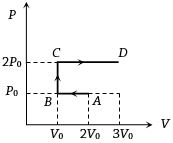
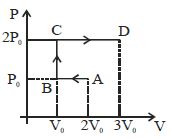
The $P-V$ diagram of an ideal gas is as shown in the figure. The work done by the gas in the process $ABCD$ is:
A
$4\,{P_0}{V_0}$
B
$2\,{P_0}{V_0}$
C
$3\,{P_0}{V_0}$
D
${P_0}{V_0}$
Solution
(C) The work done in a $P-V$ diagram is given by the area under the curve.
For process $AB$: The gas moves from $V = 2V_0$ to $V = V_0$ at constant pressure $P = P_0$. Work $W_{AB} = P_0(V_0 - 2V_0) = -P_0V_0$.
For process $BC$: The gas moves from $V = V_0$ to $V = V_0$ at constant volume. Work $W_{BC} = 0$.
For process $CD$: The gas moves from $V = V_0$ to $V = 3V_0$ at constant pressure $P = 2P_0$. Work $W_{CD} = 2P_0(3V_0 - V_0) = 2P_0(2V_0) = 4P_0V_0$.
The total work done $W_{ABCD} = W_{AB} + W_{BC} + W_{CD} = -P_0V_0 + 0 + 4P_0V_0 = 3P_0V_0$.
For process $AB$: The gas moves from $V = 2V_0$ to $V = V_0$ at constant pressure $P = P_0$. Work $W_{AB} = P_0(V_0 - 2V_0) = -P_0V_0$.
For process $BC$: The gas moves from $V = V_0$ to $V = V_0$ at constant volume. Work $W_{BC} = 0$.
For process $CD$: The gas moves from $V = V_0$ to $V = 3V_0$ at constant pressure $P = 2P_0$. Work $W_{CD} = 2P_0(3V_0 - V_0) = 2P_0(2V_0) = 4P_0V_0$.
The total work done $W_{ABCD} = W_{AB} + W_{BC} + W_{CD} = -P_0V_0 + 0 + 4P_0V_0 = 3P_0V_0$.
0 likes
View Solution52
EasyMCQ
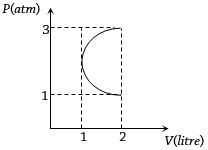
In the $P-V$ diagram shown in the figure,$ABC$ is a semicircle. The work done in the process $ABC$ is
A
Zero
B
$\frac{\pi}{2} \text{ atm-L}$
C
$-\frac{\pi}{2} \text{ atm-L}$
D
$4 \text{ atm-L}$
Solution
(B) The work done in a $P-V$ diagram is equal to the area under the curve.
For the given semicircle,the diameter is along the pressure axis from $P = 1 \text{ atm}$ to $P = 3 \text{ atm}$.
Thus,the diameter $d = 3 - 1 = 2 \text{ atm}$,so the radius $r = 1 \text{ atm}$.
The volume changes from $V = 2 \text{ L}$ to $V = 1 \text{ L}$ and back to $V = 2 \text{ L}$.
Since the process goes from $V = 2 \text{ L}$ to $V = 1 \text{ L}$ (compression) and then from $V = 1 \text{ L}$ to $V = 2 \text{ L}$ (expansion),the area under the expansion part is greater than the area under the compression part.
The net work done is equal to the area of the semicircle.
Area of semicircle $= \frac{1}{2} \pi r^2 = \frac{1}{2} \times \pi \times (1 \text{ atm})^2 \times (1 \text{ L}) = \frac{\pi}{2} \text{ atm-L}$.
Since the cycle is traversed in a clockwise direction,the work done is positive.
For the given semicircle,the diameter is along the pressure axis from $P = 1 \text{ atm}$ to $P = 3 \text{ atm}$.
Thus,the diameter $d = 3 - 1 = 2 \text{ atm}$,so the radius $r = 1 \text{ atm}$.
The volume changes from $V = 2 \text{ L}$ to $V = 1 \text{ L}$ and back to $V = 2 \text{ L}$.
Since the process goes from $V = 2 \text{ L}$ to $V = 1 \text{ L}$ (compression) and then from $V = 1 \text{ L}$ to $V = 2 \text{ L}$ (expansion),the area under the expansion part is greater than the area under the compression part.
The net work done is equal to the area of the semicircle.
Area of semicircle $= \frac{1}{2} \pi r^2 = \frac{1}{2} \times \pi \times (1 \text{ atm})^2 \times (1 \text{ L}) = \frac{\pi}{2} \text{ atm-L}$.
Since the cycle is traversed in a clockwise direction,the work done is positive.
0 likes
View Solution53
DifficultMCQ
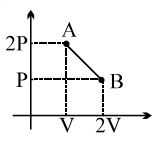
The process $AB$ is shown in the diagram. As the gas is taken from $A$ to $B$,its temperature
A
initially increases then decreases
B
initially decreases then increases
C
remains constant
D
variation depends on type of gas
Solution
(A) The equation of the straight line $AB$ passing through $(V, 2P)$ and $(2V, P)$ is given by:
$\frac{P' - 2P}{V' - V} = \frac{P - 2P}{2V - V} = \frac{-P}{V}$
$P' - 2P = -\frac{P}{V}(V' - V)$
$P' = -\frac{P}{V}V' + 3P$
From the ideal gas equation,$PV = nRT$,so $T \propto PV$.
Let $f(V') = P'V' = V'(-\frac{P}{V}V' + 3P) = -\frac{P}{V}(V')^2 + 3PV'$.
This is a downward-opening parabola with respect to $V'$. The maximum value occurs at $V' = -\frac{b}{2a} = -\frac{3P}{2(-P/V)} = 1.5V$.
Since the volume $V'$ increases from $V$ to $2V$,the product $PV$ (and thus temperature $T$) first increases until $V' = 1.5V$ and then decreases as $V'$ approaches $2V$.
$\frac{P' - 2P}{V' - V} = \frac{P - 2P}{2V - V} = \frac{-P}{V}$
$P' - 2P = -\frac{P}{V}(V' - V)$
$P' = -\frac{P}{V}V' + 3P$
From the ideal gas equation,$PV = nRT$,so $T \propto PV$.
Let $f(V') = P'V' = V'(-\frac{P}{V}V' + 3P) = -\frac{P}{V}(V')^2 + 3PV'$.
This is a downward-opening parabola with respect to $V'$. The maximum value occurs at $V' = -\frac{b}{2a} = -\frac{3P}{2(-P/V)} = 1.5V$.
Since the volume $V'$ increases from $V$ to $2V$,the product $PV$ (and thus temperature $T$) first increases until $V' = 1.5V$ and then decreases as $V'$ approaches $2V$.
0 likes
View Solution54
MediumMCQ
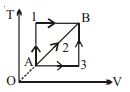
$A$ given mass of a gas expands from a state $A$ to the state $B$ by three paths $1, 2$ and $3$ as shown in the $T-V$ indicator diagram. If $W_1, W_2$ and $W_3$ respectively be the work done by the gas along the three paths,then
A
$W_1 > W_2 > W_3$
B
$W_1 < W_2 < W_3$
C
$W_1 = W_2 = W_3$
D
$W_1 < W_2, W_1 > W_3$
Solution
(A) The work done by a gas in a process is given by the area under the $P-V$ curve. In a $T-V$ diagram,the work done is proportional to the area under the curve if we consider the ideal gas equation $PV = nRT$,which implies $P = nRT/V$. Thus,$W = \int P \, dV = \int (nRT/V) \, dV$.
For a given expansion from $V_A$ to $V_B$,the work done is greater if the temperature $T$ is higher throughout the process.
Looking at the $T-V$ diagram:
Path $1$ involves an increase in temperature at constant volume followed by an expansion at constant temperature (or higher average temperature).
Path $2$ is a straight line from $A$ to $B$.
Path $3$ involves an expansion at constant temperature (or lower average temperature) followed by an increase in temperature at constant volume.
Comparing the areas under the curves in the $P-V$ plane (which corresponds to the integral of $T/V$ with respect to $V$),we find that the path that stays at higher temperatures for larger volumes results in more work.
Thus,the work done follows the order $W_1 > W_2 > W_3$.
For a given expansion from $V_A$ to $V_B$,the work done is greater if the temperature $T$ is higher throughout the process.
Looking at the $T-V$ diagram:
Path $1$ involves an increase in temperature at constant volume followed by an expansion at constant temperature (or higher average temperature).
Path $2$ is a straight line from $A$ to $B$.
Path $3$ involves an expansion at constant temperature (or lower average temperature) followed by an increase in temperature at constant volume.
Comparing the areas under the curves in the $P-V$ plane (which corresponds to the integral of $T/V$ with respect to $V$),we find that the path that stays at higher temperatures for larger volumes results in more work.
Thus,the work done follows the order $W_1 > W_2 > W_3$.
0 likes
View Solution55
MediumMCQ
In the given thermodynamic process,which of the following statements is correct?
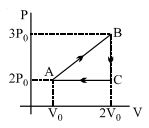
A
Heat given in the complete cycle $ABCA$ is zero.
B
Work done in the complete cycle $ABCA$ is zero.
C
Work done in the complete cycle $ABCA$ is $(1/2 P_0V_0)$.
D
None of these.
Solution
(C) The work done in a cyclic process is equal to the area enclosed by the $P-V$ diagram.
In the given cycle $ABCA$,the shape is a right-angled triangle with vertices at $A(V_0, 2P_0)$,$B(2V_0, 3P_0)$,and $C(2V_0, 2P_0)$.
The base of the triangle is the segment $AC$,which has a length of $(2V_0 - V_0) = V_0$.
The height of the triangle is the segment $BC$,which has a length of $(3P_0 - 2P_0) = P_0$.
The area of the triangle is given by $\text{Area} = (1/2) \times \text{base} \times \text{height} = (1/2) \times V_0 \times P_0 = (1/2) P_0V_0$.
Since the cycle is traversed in a clockwise direction,the work done is positive.
Therefore,the work done in the complete cycle $ABCA$ is $(1/2 P_0V_0)$.
In the given cycle $ABCA$,the shape is a right-angled triangle with vertices at $A(V_0, 2P_0)$,$B(2V_0, 3P_0)$,and $C(2V_0, 2P_0)$.
The base of the triangle is the segment $AC$,which has a length of $(2V_0 - V_0) = V_0$.
The height of the triangle is the segment $BC$,which has a length of $(3P_0 - 2P_0) = P_0$.
The area of the triangle is given by $\text{Area} = (1/2) \times \text{base} \times \text{height} = (1/2) \times V_0 \times P_0 = (1/2) P_0V_0$.
Since the cycle is traversed in a clockwise direction,the work done is positive.
Therefore,the work done in the complete cycle $ABCA$ is $(1/2 P_0V_0)$.
0 likes
View Solution56
MediumMCQ
The pressure versus temperature $(P-T)$ graph of an ideal gas is shown in the figure.
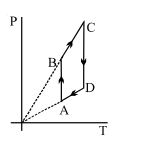
A
During the process $AB$,the work done by the gas is positive.
B
During the process $CD$,the work done by the gas is negative.
C
During the process $BC$,the internal energy of the gas is increasing.
D
None of these.
Solution
(C) For an ideal gas,the internal energy $U$ is a function of temperature $T$ only $(U = f(T))$.
$1$. In process $AB$,the temperature $T$ is constant (isochoric process in $P-V$ diagram,but here $T$ is constant,so it is an isothermal process). Since $T$ is constant,the internal energy does not change.
$2$. In process $BC$,the temperature $T$ increases. Since the internal energy of an ideal gas depends only on temperature,an increase in $T$ leads to an increase in internal energy.
$3$. In process $CD$,the temperature $T$ is constant (isothermal process),so the internal energy does not change.
Therefore,the statement 'during the process $BC$,the internal energy of the gas is increasing' is correct.
$1$. In process $AB$,the temperature $T$ is constant (isochoric process in $P-V$ diagram,but here $T$ is constant,so it is an isothermal process). Since $T$ is constant,the internal energy does not change.
$2$. In process $BC$,the temperature $T$ increases. Since the internal energy of an ideal gas depends only on temperature,an increase in $T$ leads to an increase in internal energy.
$3$. In process $CD$,the temperature $T$ is constant (isothermal process),so the internal energy does not change.
Therefore,the statement 'during the process $BC$,the internal energy of the gas is increasing' is correct.
0 likes
View Solution57
AdvancedMCQ
An ideal gas is taken from point $A$ to point $C$ on a $P-V$ diagram through two processes $AOC$ and $ABC$ as shown in the figure. Process $AOC$ is isothermal.
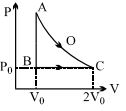
A
Process $AOC$ requires more heat than process $ABC$.
B
Process $ABC$ requires more heat than process $AOC$.
C
Both processes $AOC$ and $ABC$ require the same amount of heat.
D
Data is insufficient for comparison of heat requirement for the two processes.
Solution
(A) Since internal energy $(\Delta U)$ is a state function,the change in internal energy is the same for both processes $AOC$ and $ABC$,i.e.,$\Delta U_{AOC} = \Delta U_{ABC}$.
According to the first law of thermodynamics,$\Delta Q = \Delta U + W$,where $W$ is the work done.
The work done $W$ is equal to the area under the $P-V$ curve.
From the figure,the area under the curve $AOC$ is greater than the area under the path $ABC$ (which is a rectangle $V_0BC2V_0$ plus the area under $AB$). Specifically,the area under $AOC$ covers the entire region under the curve $AOC$,while the area under $ABC$ is only the area under the line $BC$ (since $AB$ is a vertical line,the area under $AB$ is zero).
Therefore,$W_{AOC} > W_{ABC}$.
Since $\Delta U_{AOC} = \Delta U_{ABC}$ and $W_{AOC} > W_{ABC}$,it follows that $\Delta Q_{AOC} > \Delta Q_{ABC}$.
According to the first law of thermodynamics,$\Delta Q = \Delta U + W$,where $W$ is the work done.
The work done $W$ is equal to the area under the $P-V$ curve.
From the figure,the area under the curve $AOC$ is greater than the area under the path $ABC$ (which is a rectangle $V_0BC2V_0$ plus the area under $AB$). Specifically,the area under $AOC$ covers the entire region under the curve $AOC$,while the area under $ABC$ is only the area under the line $BC$ (since $AB$ is a vertical line,the area under $AB$ is zero).
Therefore,$W_{AOC} > W_{ABC}$.
Since $\Delta U_{AOC} = \Delta U_{ABC}$ and $W_{AOC} > W_{ABC}$,it follows that $\Delta Q_{AOC} > \Delta Q_{ABC}$.
0 likes
View Solution58
AdvancedMCQ
$A$ gas takes part in two processes in which it is heated from the same initial state $1$ to the same final temperature. The processes are shown on the $P-V$ diagram by the straight lines $1-2$ and $1-3$. Points $2$ and $3$ lie on the same isothermal curve. If $Q_1$ and $Q_2$ are the heat transferred along the two processes,then:
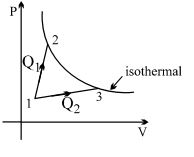
A
$Q_1 = Q_2$
B
$Q_1 < Q_2$
C
$Q_1 > Q_2$
D
Insufficient data
Solution
(B) Let the initial state be $1$ with temperature $T_1$. Points $2$ and $3$ lie on the same isothermal curve,so $T_2 = T_3 = T_f$.
According to the first law of thermodynamics,$Q = \Delta U + W$.
Since the change in internal energy $\Delta U$ depends only on the change in temperature,$\Delta U_1 = nC_v(T_f - T_1)$ and $\Delta U_2 = nC_v(T_f - T_1)$. Thus,$\Delta U_1 = \Delta U_2$.
Work done $W$ is equal to the area under the $P-V$ curve. From the diagram,the area under the path $1-3$ is greater than the area under the path $1-2$,so $W_2 > W_1$.
Since $Q = \Delta U + W$ and $\Delta U_1 = \Delta U_2$,the process with greater work done will have greater heat transfer.
Therefore,$Q_2 > Q_1$ or $Q_1 < Q_2$.
According to the first law of thermodynamics,$Q = \Delta U + W$.
Since the change in internal energy $\Delta U$ depends only on the change in temperature,$\Delta U_1 = nC_v(T_f - T_1)$ and $\Delta U_2 = nC_v(T_f - T_1)$. Thus,$\Delta U_1 = \Delta U_2$.
Work done $W$ is equal to the area under the $P-V$ curve. From the diagram,the area under the path $1-3$ is greater than the area under the path $1-2$,so $W_2 > W_1$.
Since $Q = \Delta U + W$ and $\Delta U_1 = \Delta U_2$,the process with greater work done will have greater heat transfer.
Therefore,$Q_2 > Q_1$ or $Q_1 < Q_2$.
0 likes
View Solution59
DifficultMCQ
An enclosed ideal gas is taken through a cycle as shown in the figure. Then
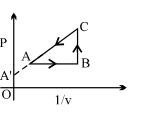
A
Along $AB$,temperature decreases while along $BC$ temperature increases.
B
Along $AB$,temperature increases while along $BC$ the temperature decreases.
C
Along $CA$ work is done by the gas and the internal energy remains constant.
D
Along $CA$ work is done on the gas and internal energy of the gas increases.
Solution
(A) For an ideal gas,the equation of state is $PV = nRT$,which can be written as $P = nRT(1/V)$.
Along $AB$,the pressure $P$ is constant,and the value of $(1/V)$ increases. Since $P = nRT(1/V)$,if $P$ is constant and $(1/V)$ increases,the temperature $T$ must decrease.
Along $BC$,the value of $(1/V)$ is constant,and the pressure $P$ increases. Since $P = nRT(1/V)$,if $(1/V)$ is constant and $P$ increases,the temperature $T$ must increase.
Therefore,the correct statement is that along $AB$,temperature decreases while along $BC$ temperature increases.
Along $AB$,the pressure $P$ is constant,and the value of $(1/V)$ increases. Since $P = nRT(1/V)$,if $P$ is constant and $(1/V)$ increases,the temperature $T$ must decrease.
Along $BC$,the value of $(1/V)$ is constant,and the pressure $P$ increases. Since $P = nRT(1/V)$,if $(1/V)$ is constant and $P$ increases,the temperature $T$ must increase.
Therefore,the correct statement is that along $AB$,temperature decreases while along $BC$ temperature increases.
0 likes
View Solution60
DifficultMCQ
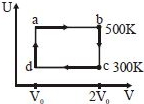
The figure given below shows the variation in the internal energy $U$ with volume $V$ of $2.0 \text{ mole}$ of an ideal gas in a cyclic process $abcda$. The temperatures of the gas during the processes $ab$ and $cd$ are $500 \text{ K}$ and $300 \text{ K}$ respectively. The heat absorbed by the gas during the complete process is .... $J$. (Take $R = 8.3 \text{ J/mol-K}$ and $\ln 2 = 0.69$)
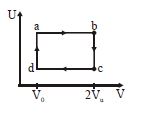
A
$3200$
B
$0$
C
$2100$
D
$2291$
Solution
(D) For a cyclic process,the change in internal energy $\Delta U = 0$. According to the first law of thermodynamics,$Q = \Delta U + W$. Since $\Delta U = 0$,the total heat absorbed $Q = W$,where $W$ is the total work done in the cycle.
The work done in an isothermal process is given by $W = nRT \ln(V_f / V_i)$.
Process $ab$ is isothermal at $T_1 = 500 \text{ K}$ with volume changing from $V_0$ to $2V_0$:
$W_{ab} = nRT_1 \ln(2V_0 / V_0) = nRT_1 \ln 2$
Process $bc$ is isochoric ($V$ is constant),so $W_{bc} = 0$.
Process $cd$ is isothermal at $T_2 = 300 \text{ K}$ with volume changing from $2V_0$ to $V_0$:
$W_{cd} = nRT_2 \ln(V_0 / 2V_0) = nRT_2 \ln(1/2) = -nRT_2 \ln 2$
Process $da$ is isochoric ($V$ is constant),so $W_{da} = 0$.
Total work $W = W_{ab} + W_{bc} + W_{cd} + W_{da} = nR(T_1 - T_2) \ln 2$.
Substituting the given values ($n = 2.0 \text{ mol}$,$R = 8.3 \text{ J/mol-K}$,$T_1 = 500 \text{ K}$,$T_2 = 300 \text{ K}$,$\ln 2 = 0.69$):
$Q = 2.0 \times 8.3 \times (500 - 300) \times 0.69$
$Q = 2.0 \times 8.3 \times 200 \times 0.69$
$Q = 3320 \times 0.69 = 2290.8 \text{ J} \approx 2291 \text{ J}$.
The work done in an isothermal process is given by $W = nRT \ln(V_f / V_i)$.
Process $ab$ is isothermal at $T_1 = 500 \text{ K}$ with volume changing from $V_0$ to $2V_0$:
$W_{ab} = nRT_1 \ln(2V_0 / V_0) = nRT_1 \ln 2$
Process $bc$ is isochoric ($V$ is constant),so $W_{bc} = 0$.
Process $cd$ is isothermal at $T_2 = 300 \text{ K}$ with volume changing from $2V_0$ to $V_0$:
$W_{cd} = nRT_2 \ln(V_0 / 2V_0) = nRT_2 \ln(1/2) = -nRT_2 \ln 2$
Process $da$ is isochoric ($V$ is constant),so $W_{da} = 0$.
Total work $W = W_{ab} + W_{bc} + W_{cd} + W_{da} = nR(T_1 - T_2) \ln 2$.
Substituting the given values ($n = 2.0 \text{ mol}$,$R = 8.3 \text{ J/mol-K}$,$T_1 = 500 \text{ K}$,$T_2 = 300 \text{ K}$,$\ln 2 = 0.69$):
$Q = 2.0 \times 8.3 \times (500 - 300) \times 0.69$
$Q = 2.0 \times 8.3 \times 200 \times 0.69$
$Q = 3320 \times 0.69 = 2290.8 \text{ J} \approx 2291 \text{ J}$.
0 likes
View Solution61
MediumMCQ
In a cyclic process,a gas is taken from state $A$ to $B$ via path $-I$ as shown in the indicator diagram and taken back to state $A$ from state $B$ via path $-II$. In the complete cycle
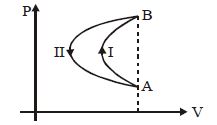
A
positive work is done on the gas
B
heat is given to gas
C
no work is done by the gas
D
nothing can be said about work as data is insufficient
Solution
(A) In a $P-V$ diagram,the area under the curve represents the work done by the gas.
For the path $A \rightarrow B$ via path $-I$,the gas expands (volume increases),so the work done by the gas is positive $(W_I > 0)$.
For the path $B \rightarrow A$ via path $-II$,the gas is compressed (volume decreases),so the work done by the gas is negative $(W_{II} < 0)$.
Since the area under path $-II$ is larger than the area under path $-I$ (as seen in the diagram),the magnitude of work done during compression is greater than the work done during expansion.
Therefore,the net work done in the cycle $(W_{net} = W_I + W_{II})$ is negative.
Negative net work done by the gas means that positive work is done on the gas.
For the path $A \rightarrow B$ via path $-I$,the gas expands (volume increases),so the work done by the gas is positive $(W_I > 0)$.
For the path $B \rightarrow A$ via path $-II$,the gas is compressed (volume decreases),so the work done by the gas is negative $(W_{II} < 0)$.
Since the area under path $-II$ is larger than the area under path $-I$ (as seen in the diagram),the magnitude of work done during compression is greater than the work done during expansion.
Therefore,the net work done in the cycle $(W_{net} = W_I + W_{II})$ is negative.
Negative net work done by the gas means that positive work is done on the gas.
0 likes
View Solution62
DifficultMCQ
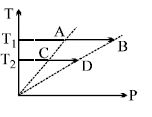
On a $TP$ diagram,two moles of an ideal gas perform processes $AB$ and $CD$. If the work done by the gas in the process $AB$ is two times the work done in the process $CD$,then what is the value of $T_1/T_2$?
A
$1/2$
B
$1$
C
$2$
D
$4$
Solution
(C) For an ideal gas,$PV = nRT$,so $V = (nR/P)T$.
Work done $W = \int P dV$.
From $PV = nRT$,$P dV + V dP = nR dT$.
For processes $AB$ and $CD$,$T$ is constant,so $dT = 0$,which implies $P dV = -V dP$.
Thus,$W = \int_{P_i}^{P_f} P dV = -\int_{P_i}^{P_f} V dP = -\int_{P_i}^{P_f} (nRT/P) dP = -nRT \ln(P_f/P_i) = nRT \ln(P_i/P_f)$.
Let the lines passing through the origin be $T = m_1 P$ and $T = m_2 P$.
For process $AB$,$T = T_1$,$P_A = T_1/m_1$,$P_B = T_1/m_2$.
$W_{AB} = nRT_1 \ln(P_A/P_B) = nRT_1 \ln((T_1/m_1) / (T_1/m_2)) = nRT_1 \ln(m_2/m_1)$.
Similarly,for process $CD$,$W_{CD} = nRT_2 \ln(m_2/m_1)$.
Given $W_{AB} = 2 W_{CD}$,we have $nRT_1 \ln(m_2/m_1) = 2 nRT_2 \ln(m_2/m_1)$.
Therefore,$T_1 = 2 T_2$,which gives $T_1/T_2 = 2$.
Work done $W = \int P dV$.
From $PV = nRT$,$P dV + V dP = nR dT$.
For processes $AB$ and $CD$,$T$ is constant,so $dT = 0$,which implies $P dV = -V dP$.
Thus,$W = \int_{P_i}^{P_f} P dV = -\int_{P_i}^{P_f} V dP = -\int_{P_i}^{P_f} (nRT/P) dP = -nRT \ln(P_f/P_i) = nRT \ln(P_i/P_f)$.
Let the lines passing through the origin be $T = m_1 P$ and $T = m_2 P$.
For process $AB$,$T = T_1$,$P_A = T_1/m_1$,$P_B = T_1/m_2$.
$W_{AB} = nRT_1 \ln(P_A/P_B) = nRT_1 \ln((T_1/m_1) / (T_1/m_2)) = nRT_1 \ln(m_2/m_1)$.
Similarly,for process $CD$,$W_{CD} = nRT_2 \ln(m_2/m_1)$.
Given $W_{AB} = 2 W_{CD}$,we have $nRT_1 \ln(m_2/m_1) = 2 nRT_2 \ln(m_2/m_1)$.
Therefore,$T_1 = 2 T_2$,which gives $T_1/T_2 = 2$.
0 likes
View Solution63
MediumMCQ
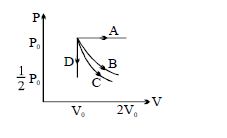
The $PV$ diagram shows four different possible reversible processes performed on a monatomic ideal gas. Process $A$ is isobaric (constant pressure). Process $B$ is isothermal (constant temperature). Process $C$ is adiabatic. Process $D$ is isochoric (constant volume). For which process(es) does the temperature of the gas decrease?
A
Process $A$ only
B
Process $C$ only
C
Only Processes $C$ and $D$
D
Only Processes $B$,$C$ and $D$
Solution
(C) For an ideal gas,the temperature $T$ is proportional to the product $PV$ (from $PV = nRT$).
$1$. Process $A$ (isobaric expansion): $P$ is constant and $V$ increases,so $PV$ increases,meaning temperature $T$ increases.
$2$. Process $B$ (isothermal expansion): $T$ remains constant by definition.
$3$. Process $C$ (adiabatic expansion): Both $P$ and $V$ change such that $PV^{\gamma}$ is constant. Since $V$ increases,$P$ must decrease significantly. For an adiabatic expansion,$T$ decreases.
$4$. Process $D$ (isochoric compression): $V$ is constant and $P$ decreases,so $PV$ decreases,meaning temperature $T$ decreases.
Thus,the temperature decreases in both processes $C$ and $D$. Therefore,option $C$ is the correct answer.
$1$. Process $A$ (isobaric expansion): $P$ is constant and $V$ increases,so $PV$ increases,meaning temperature $T$ increases.
$2$. Process $B$ (isothermal expansion): $T$ remains constant by definition.
$3$. Process $C$ (adiabatic expansion): Both $P$ and $V$ change such that $PV^{\gamma}$ is constant. Since $V$ increases,$P$ must decrease significantly. For an adiabatic expansion,$T$ decreases.
$4$. Process $D$ (isochoric compression): $V$ is constant and $P$ decreases,so $PV$ decreases,meaning temperature $T$ decreases.
Thus,the temperature decreases in both processes $C$ and $D$. Therefore,option $C$ is the correct answer.
0 likes
View Solution64
AdvancedMCQ
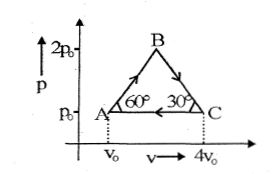
Four moles of an ideal monoatomic gas undergoes a cyclic process $ABCA$ as shown in the figure. Find the ratio of the temperature of $A$ and $B$.
A
$\frac{4}{7}$
B
$\frac{5}{7}$
C
$\frac{2}{7}$
D
None of these
Solution
(C) From the ideal gas equation,$PV = nRT$,so $T \propto PV$.
At point $A$,$P_A = P_0$ and $V_A = V_0$,so $T_A \propto P_0 V_0$.
At point $B$,$P_B = 2P_0$. Let the volume at $B$ be $V_B$. Then $T_B \propto (2P_0) V_B$.
Thus,$\frac{T_A}{T_B} = \frac{P_0 V_0}{2P_0 V_B} = \frac{V_0}{2V_B}$.
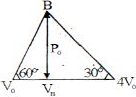
From the geometry of the $PV$ diagram,the slope of line $AB$ is $\tan 60^{\circ} = \frac{2P_0 - P_0}{V_B - V_0} = \frac{P_0}{V_B - V_0}$.
So,$V_B - V_0 = \frac{P_0}{\tan 60^{\circ}} = \frac{P_0}{\sqrt{3}}$.
The slope of line $BC$ is $-\tan 30^{\circ} = \frac{P_0 - 2P_0}{4V_0 - V_B} = \frac{-P_0}{4V_0 - V_B}$.
So,$4V_0 - V_B = \frac{P_0}{\tan 30^{\circ}} = P_0 \sqrt{3}$.
Dividing the two equations: $\frac{V_B - V_0}{4V_0 - V_B} = \frac{1/\sqrt{3}}{\sqrt{3}} = \frac{1}{3}$.
$3V_B - 3V_0 = 4V_0 - V_B \implies 4V_B = 7V_0 \implies V_B = \frac{7}{4}V_0$.
Substituting $V_B$ into the ratio: $\frac{T_A}{T_B} = \frac{V_0}{2(7/4)V_0} = \frac{V_0}{(7/2)V_0} = \frac{2}{7}$.
At point $A$,$P_A = P_0$ and $V_A = V_0$,so $T_A \propto P_0 V_0$.
At point $B$,$P_B = 2P_0$. Let the volume at $B$ be $V_B$. Then $T_B \propto (2P_0) V_B$.
Thus,$\frac{T_A}{T_B} = \frac{P_0 V_0}{2P_0 V_B} = \frac{V_0}{2V_B}$.
From the geometry of the $PV$ diagram,the slope of line $AB$ is $\tan 60^{\circ} = \frac{2P_0 - P_0}{V_B - V_0} = \frac{P_0}{V_B - V_0}$.
So,$V_B - V_0 = \frac{P_0}{\tan 60^{\circ}} = \frac{P_0}{\sqrt{3}}$.
The slope of line $BC$ is $-\tan 30^{\circ} = \frac{P_0 - 2P_0}{4V_0 - V_B} = \frac{-P_0}{4V_0 - V_B}$.
So,$4V_0 - V_B = \frac{P_0}{\tan 30^{\circ}} = P_0 \sqrt{3}$.
Dividing the two equations: $\frac{V_B - V_0}{4V_0 - V_B} = \frac{1/\sqrt{3}}{\sqrt{3}} = \frac{1}{3}$.
$3V_B - 3V_0 = 4V_0 - V_B \implies 4V_B = 7V_0 \implies V_B = \frac{7}{4}V_0$.
Substituting $V_B$ into the ratio: $\frac{T_A}{T_B} = \frac{V_0}{2(7/4)V_0} = \frac{V_0}{(7/2)V_0} = \frac{2}{7}$.
0 likes
View Solution65
MediumMCQ
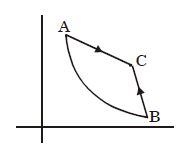
The graph shows a $P-V$ diagram where $A-B$ is an adiabatic curve. Choose the correct statement regarding the processes $AC$ and $BC$.
A
Process $AC$ and $BC$, both are exothermic.
B
Process $AC$ and $BC$, both are endothermic.
C
Process $AC$ is endothermic, $BC$ is exothermic.
D
Process $AC$ is exothermic, $BC$ is endothermic.
Solution
(C) In a $P-V$ diagram, the internal energy $U$ of an ideal gas depends only on temperature $T$ $(U = nC_vT)$. The isotherms are curves of constant temperature. For an ideal gas, $PV = nRT$, so $T = PV/nR$.
$1$. Consider the adiabatic curve $AB$. Since it is an adiabatic expansion, the temperature at $A$ $(T_A)$ is greater than the temperature at $B$ $(T_B)$.
$2$. For process $AC$: The path moves from $A$ to $C$. Since $C$ lies above the adiabatic curve $AB$, the temperature at $C$ $(T_C)$ is greater than the temperature at any point on the adiabatic curve $AB$ at the same volume. Specifically, $T_C > T_A$. Since the temperature increases, the internal energy increases $(\Delta U > 0)$. Since the gas expands from $A$ to $C$, work is done by the gas $(W > 0)$. By the first law of thermodynamics, $Q = \Delta U + W$. Since both $\Delta U$ and $W$ are positive, $Q > 0$, meaning the process is endothermic.
$3$. For process $BC$: The path moves from $B$ to $C$. Since $C$ is at a higher temperature than $B$ $(T_C > T_B)$, the internal energy increases $(\Delta U > 0)$. However, the path $BC$ is a compression (volume decreases), so work is done on the gas $(W < 0)$. In this specific geometry, the heat $Q$ is negative because the energy required to increase the temperature is less than the energy released by compression, or more simply, $C$ lies below the isotherm passing through $B$. Thus, $BC$ is exothermic.
$1$. Consider the adiabatic curve $AB$. Since it is an adiabatic expansion, the temperature at $A$ $(T_A)$ is greater than the temperature at $B$ $(T_B)$.
$2$. For process $AC$: The path moves from $A$ to $C$. Since $C$ lies above the adiabatic curve $AB$, the temperature at $C$ $(T_C)$ is greater than the temperature at any point on the adiabatic curve $AB$ at the same volume. Specifically, $T_C > T_A$. Since the temperature increases, the internal energy increases $(\Delta U > 0)$. Since the gas expands from $A$ to $C$, work is done by the gas $(W > 0)$. By the first law of thermodynamics, $Q = \Delta U + W$. Since both $\Delta U$ and $W$ are positive, $Q > 0$, meaning the process is endothermic.
$3$. For process $BC$: The path moves from $B$ to $C$. Since $C$ is at a higher temperature than $B$ $(T_C > T_B)$, the internal energy increases $(\Delta U > 0)$. However, the path $BC$ is a compression (volume decreases), so work is done on the gas $(W < 0)$. In this specific geometry, the heat $Q$ is negative because the energy required to increase the temperature is less than the energy released by compression, or more simply, $C$ lies below the isotherm passing through $B$. Thus, $BC$ is exothermic.
0 likes
View Solution66
MediumMCQ
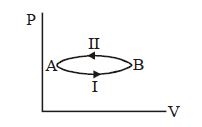
$A$ system goes from $A$ to $B$ via two processes $I$ and $II$ as shown in the figure. If $\Delta U_1$ and $\Delta U_2$ are the changes in internal energies in the processes $I$ and $II$ respectively,then
A
$\Delta U_1 = \Delta U_2$
B
The relation between $\Delta U_1$ and $\Delta U_2$ cannot be determined
C
$\Delta U_2 > \Delta U_1$
D
$\Delta U_2 < \Delta U_1$
Solution
(A) Internal energy is a state function,meaning it depends only on the initial and final states of the system and is independent of the path taken.
Since both processes $I$ and $II$ start at state $A$ and end at state $B$,the change in internal energy for both processes is the same.
Therefore,$\Delta U_1 = \Delta U_2$.
Since both processes $I$ and $II$ start at state $A$ and end at state $B$,the change in internal energy for both processes is the same.
Therefore,$\Delta U_1 = \Delta U_2$.
0 likes
View Solution67
MediumMCQ
In the following figures,in which case is heat absorbed by the gas?
A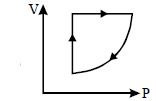
B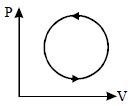
C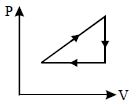
D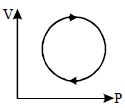
Solution
(C) For a cyclic process,the first law of thermodynamics is $\Delta U = Q - W = 0$,which implies $Q = W$.
Heat absorbed $(Q > 0)$ corresponds to a positive net work done $(W > 0)$ by the gas.
In a $P-V$ diagram,work done is positive for a clockwise cycle and negative for an anticlockwise cycle.
Figure $A$ is a $V-P$ diagram (note the axes). $A$ clockwise cycle in a $V-P$ diagram corresponds to a net work done $W < 0$.
Figure $B$ is a $P-V$ diagram with an anticlockwise cycle,so $W < 0$.
Figure $C$ is a $P-V$ diagram with a clockwise cycle,so $W > 0$.
Figure $D$ is a $V-P$ diagram with a clockwise cycle,so $W < 0$.
Therefore,only in Figure $C$ is the net work done positive,meaning heat is absorbed by the gas.
Heat absorbed $(Q > 0)$ corresponds to a positive net work done $(W > 0)$ by the gas.
In a $P-V$ diagram,work done is positive for a clockwise cycle and negative for an anticlockwise cycle.
Figure $A$ is a $V-P$ diagram (note the axes). $A$ clockwise cycle in a $V-P$ diagram corresponds to a net work done $W < 0$.
Figure $B$ is a $P-V$ diagram with an anticlockwise cycle,so $W < 0$.
Figure $C$ is a $P-V$ diagram with a clockwise cycle,so $W > 0$.
Figure $D$ is a $V-P$ diagram with a clockwise cycle,so $W < 0$.
Therefore,only in Figure $C$ is the net work done positive,meaning heat is absorbed by the gas.
0 likes
View Solution68
MediumMCQ
The adjoining figure shows the $P-V$ diagram for a fixed mass of an ideal gas undergoing a cyclic process. $AB$ represents an isothermal process and $CA$ represents an isochoric process. Which of the graphs shown in the following figures represents the $P-T$ diagram of the cyclic process?
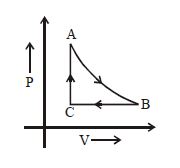
A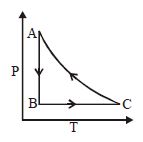
B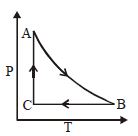
C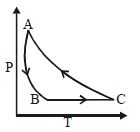
D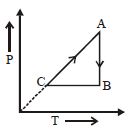
Solution
(C) In the given $P-V$ diagram:
$1$. $AB$ is an isothermal process $(T = \text{constant})$. Since $V$ increases from $A$ to $B$, $P$ must decrease $(P \propto 1/V)$.
$2$. $BC$ is an isobaric process $(P = \text{constant})$. Since $V$ decreases from $B$ to $C$, $T$ must decrease $(V \propto T)$.
$3$. $CA$ is an isochoric process $(V = \text{constant})$. Since $P$ increases from $C$ to $A$, $T$ must increase $(P \propto T)$.
Mapping these to a $P-T$ diagram:
- $AB$: $T$ is constant, so the graph is a vertical line. Since $P$ decreases, the direction is downwards.
- $BC$: $P$ is constant, so the graph is a horizontal line. Since $T$ decreases, the direction is towards the left.
- $CA$: $V$ is constant, so $P \propto T$. The graph is a straight line passing through the origin. Since $T$ increases, the direction is away from the origin.
Comparing these characteristics, the correct $P-T$ diagram is represented by option $C$.
$1$. $AB$ is an isothermal process $(T = \text{constant})$. Since $V$ increases from $A$ to $B$, $P$ must decrease $(P \propto 1/V)$.
$2$. $BC$ is an isobaric process $(P = \text{constant})$. Since $V$ decreases from $B$ to $C$, $T$ must decrease $(V \propto T)$.
$3$. $CA$ is an isochoric process $(V = \text{constant})$. Since $P$ increases from $C$ to $A$, $T$ must increase $(P \propto T)$.
Mapping these to a $P-T$ diagram:
- $AB$: $T$ is constant, so the graph is a vertical line. Since $P$ decreases, the direction is downwards.
- $BC$: $P$ is constant, so the graph is a horizontal line. Since $T$ decreases, the direction is towards the left.
- $CA$: $V$ is constant, so $P \propto T$. The graph is a straight line passing through the origin. Since $T$ increases, the direction is away from the origin.
Comparing these characteristics, the correct $P-T$ diagram is represented by option $C$.
0 likes
View Solution69
MediumMCQ
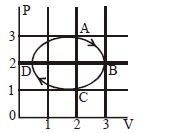
The figure shows the $P-V$ plot of an ideal gas taken through a cycle $ABCDA.$ The part $ABC$ is a semicircle and $CDA$ is half of an ellipse. Then,
A
The process during the path $A \to B$ is isothermal
B
Heat is absorbed by the gas during the path $B \to C \to D$
C
Work done during the path $A \to B \to C$ is zero
D
Positive work is done by the gas in the cycle $ABCDA$
Solution
(D) In a $P-V$ diagram,the work done by the gas is given by the area under the curve.
For a cyclic process,the net work done is equal to the area enclosed by the cycle.
If the cycle is traversed in a clockwise direction,the net work done by the gas is positive.
If the cycle is traversed in a counter-clockwise direction,the net work done by the gas is negative.
Looking at the provided $P-V$ diagram,the cycle $ABCDA$ is traversed in a clockwise direction.
Therefore,the net work done by the gas in the cycle $ABCDA$ is positive.
For a cyclic process,the net work done is equal to the area enclosed by the cycle.
If the cycle is traversed in a clockwise direction,the net work done by the gas is positive.
If the cycle is traversed in a counter-clockwise direction,the net work done by the gas is negative.
Looking at the provided $P-V$ diagram,the cycle $ABCDA$ is traversed in a clockwise direction.
Therefore,the net work done by the gas in the cycle $ABCDA$ is positive.
0 likes
View Solution70
MediumMCQ
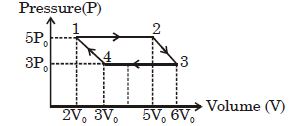
An ideal monoatomic gas is taken round the cycle $12341$ shown in the figure ($p-V$ diagram). The work done in one cycle is (in $P_0V_0$)?
A
$3$
B
$8$
C
$6$
D
$5$
Solution
(C) The work done in a cyclic process on a $p-V$ diagram is equal to the area enclosed by the cycle.
Since the cycle $12341$ is traversed in a clockwise direction,the work done is positive.
The area enclosed by the cycle is the area of the trapezoid formed by the vertices $1, 2, 3, 4$.
Vertices are: $1(2V_0, 5P_0)$,$2(5V_0, 5P_0)$,$3(6V_0, 3P_0)$,and $4(3V_0, 3P_0)$.
The shape is a trapezoid with parallel sides of lengths $(5V_0 - 2V_0) = 3V_0$ and $(6V_0 - 3V_0) = 3V_0$ at constant pressures $5P_0$ and $3P_0$ respectively.
Alternatively,the area of the trapezoid is given by $\text{Area} = \frac{1}{2} \times (\text{sum of parallel sides}) \times \text{height}$.
Here,the parallel sides are horizontal segments at $P = 5P_0$ (length $5V_0 - 2V_0 = 3V_0$) and $P = 3P_0$ (length $6V_0 - 3V_0 = 3V_0$).
Actually,looking at the figure,the shape is a parallelogram with base $b = (5V_0 - 2V_0) = 3V_0$ and height $h = (5P_0 - 3P_0) = 2P_0$.
Work done $W = \text{Area} = \text{base} \times \text{height} = (3V_0) \times (2P_0) = 6P_0V_0$.
Since the cycle $12341$ is traversed in a clockwise direction,the work done is positive.
The area enclosed by the cycle is the area of the trapezoid formed by the vertices $1, 2, 3, 4$.
Vertices are: $1(2V_0, 5P_0)$,$2(5V_0, 5P_0)$,$3(6V_0, 3P_0)$,and $4(3V_0, 3P_0)$.
The shape is a trapezoid with parallel sides of lengths $(5V_0 - 2V_0) = 3V_0$ and $(6V_0 - 3V_0) = 3V_0$ at constant pressures $5P_0$ and $3P_0$ respectively.
Alternatively,the area of the trapezoid is given by $\text{Area} = \frac{1}{2} \times (\text{sum of parallel sides}) \times \text{height}$.
Here,the parallel sides are horizontal segments at $P = 5P_0$ (length $5V_0 - 2V_0 = 3V_0$) and $P = 3P_0$ (length $6V_0 - 3V_0 = 3V_0$).
Actually,looking at the figure,the shape is a parallelogram with base $b = (5V_0 - 2V_0) = 3V_0$ and height $h = (5P_0 - 3P_0) = 2P_0$.
Work done $W = \text{Area} = \text{base} \times \text{height} = (3V_0) \times (2P_0) = 6P_0V_0$.
0 likes
View Solution71
DifficultMCQ
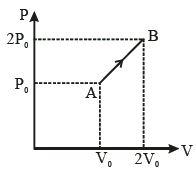
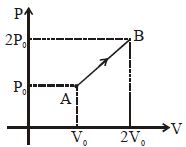
The $P-V$ diagram of $2\,g$ of helium gas for a certain process $A \to B$ is shown in the figure. What is the heat given to the gas during the process $A \to B$ (in $,P_0V_0$)?
A
$4$
B
$6$
C
$4.5$
D
$2$
Solution
(B) The heat given to the gas is given by the first law of thermodynamics: $\Delta Q = \Delta U + \Delta W$.
First,calculate the work done $\Delta W$ during the process $A \to B$,which is the area under the $P-V$ curve:
$\Delta W = \text{Area of trapezium} = \frac{1}{2} \times (P_A + P_B) \times (V_B - V_A)$
$\Delta W = \frac{1}{2} \times (P_0 + 2P_0) \times (2V_0 - V_0) = \frac{1}{2} \times 3P_0 \times V_0 = 1.5 P_0 V_0$.
Next,calculate the change in internal energy $\Delta U = n C_v \Delta T$. For a monoatomic gas like helium,$C_v = \frac{3}{2}R$.
Using the ideal gas equation $PV = nRT$,we have $nRT_A = P_0 V_0$ and $nRT_B = (2P_0)(2V_0) = 4P_0 V_0$.
Thus,$nR \Delta T = nR(T_B - T_A) = 4P_0 V_0 - P_0 V_0 = 3P_0 V_0$.
Therefore,$\Delta U = \frac{3}{2} (nR \Delta T) = \frac{3}{2} (3P_0 V_0) = 4.5 P_0 V_0$.
Finally,the heat given is $\Delta Q = \Delta U + \Delta W = 4.5 P_0 V_0 + 1.5 P_0 V_0 = 6 P_0 V_0$.
First,calculate the work done $\Delta W$ during the process $A \to B$,which is the area under the $P-V$ curve:
$\Delta W = \text{Area of trapezium} = \frac{1}{2} \times (P_A + P_B) \times (V_B - V_A)$
$\Delta W = \frac{1}{2} \times (P_0 + 2P_0) \times (2V_0 - V_0) = \frac{1}{2} \times 3P_0 \times V_0 = 1.5 P_0 V_0$.
Next,calculate the change in internal energy $\Delta U = n C_v \Delta T$. For a monoatomic gas like helium,$C_v = \frac{3}{2}R$.
Using the ideal gas equation $PV = nRT$,we have $nRT_A = P_0 V_0$ and $nRT_B = (2P_0)(2V_0) = 4P_0 V_0$.
Thus,$nR \Delta T = nR(T_B - T_A) = 4P_0 V_0 - P_0 V_0 = 3P_0 V_0$.
Therefore,$\Delta U = \frac{3}{2} (nR \Delta T) = \frac{3}{2} (3P_0 V_0) = 4.5 P_0 V_0$.
Finally,the heat given is $\Delta Q = \Delta U + \Delta W = 4.5 P_0 V_0 + 1.5 P_0 V_0 = 6 P_0 V_0$.
0 likes
View Solution72
AdvancedMCQ
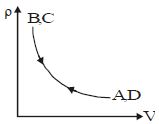
The density $\rho$ versus volume $V$ graph is shown in the figure. Find the corresponding pressure $P$ versus temperature $T$ graph.
A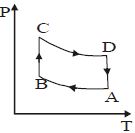
B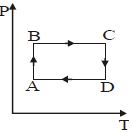
C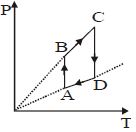
D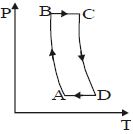
Solution
(C) From the given $(\rho - V)$ graph,we observe that for processes $AB$ and $CD$,the volume $V$ is constant. Therefore,$AB$ and $CD$ are isochoric processes.
In an isochoric process,the pressure $P$ is directly proportional to the temperature $T$ $(P \propto T)$,which means the graph of $P$ versus $T$ should be a straight line passing through the origin.
For processes $BC$ and $AD$,the density $\rho$ is constant. Since $\rho = \frac{m}{V}$,constant density implies constant volume,which contradicts the graph. However,looking at the provided options,the graph $D$ represents processes where $AB$ and $CD$ are vertical lines (isochoric) and $BC$ and $AD$ are curves. Re-evaluating the graph: $AB$ and $CD$ are vertical lines in the $(\rho - V)$ graph,meaning they are isochoric. In the $(P - T)$ graph,isochoric processes must be straight lines passing through the origin. Option $D$ shows $AB$ and $CD$ as vertical lines,which is incorrect. Option $C$ shows $AB$ and $CD$ as straight lines passing through the origin,which is the correct representation for isochoric processes.
In an isochoric process,the pressure $P$ is directly proportional to the temperature $T$ $(P \propto T)$,which means the graph of $P$ versus $T$ should be a straight line passing through the origin.
For processes $BC$ and $AD$,the density $\rho$ is constant. Since $\rho = \frac{m}{V}$,constant density implies constant volume,which contradicts the graph. However,looking at the provided options,the graph $D$ represents processes where $AB$ and $CD$ are vertical lines (isochoric) and $BC$ and $AD$ are curves. Re-evaluating the graph: $AB$ and $CD$ are vertical lines in the $(\rho - V)$ graph,meaning they are isochoric. In the $(P - T)$ graph,isochoric processes must be straight lines passing through the origin. Option $D$ shows $AB$ and $CD$ as vertical lines,which is incorrect. Option $C$ shows $AB$ and $CD$ as straight lines passing through the origin,which is the correct representation for isochoric processes.
0 likes
View Solution73
EasyMCQ
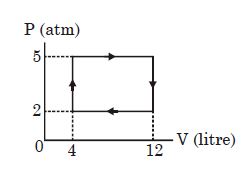
An ideal gas undergoes a cyclic process as shown in the diagram. The net work done by the gas in the cycle is
A
$12\, \text{litre-atm}$
B
$24\, \text{J}$
C
$24\, \text{litre-atm}$
D
$-24\, \text{J}$
Solution
(C) The work done by the gas in a cyclic process is equal to the area enclosed by the cycle on the $P-V$ diagram.
Since the cycle is traced in a clockwise direction, the work done is positive.
The area of the rectangle is given by:
$W = \Delta P \times \Delta V$
$W = (P_{max} - P_{min}) \times (V_{max} - V_{min})$
From the graph, $P_{max} = 5\, \text{atm}$, $P_{min} = 2\, \text{atm}$, $V_{max} = 12\, \text{litre}$, and $V_{min} = 4\, \text{litre}$.
$W = (5 - 2) \times (12 - 4)$
$W = 3 \times 8 = 24\, \text{litre-atm}$.
Since the cycle is traced in a clockwise direction, the work done is positive.
The area of the rectangle is given by:
$W = \Delta P \times \Delta V$
$W = (P_{max} - P_{min}) \times (V_{max} - V_{min})$
From the graph, $P_{max} = 5\, \text{atm}$, $P_{min} = 2\, \text{atm}$, $V_{max} = 12\, \text{litre}$, and $V_{min} = 4\, \text{litre}$.
$W = (5 - 2) \times (12 - 4)$
$W = 3 \times 8 = 24\, \text{litre-atm}$.
0 likes
View Solution74
DifficultMCQ
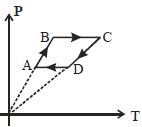
Six moles of an ideal gas perform the cycle shown in the figure. If the temperatures are $T_A = 600 \, K$, $T_B = 800 \, K$, $T_C = 2200 \, K$, and $T_D = 1200 \, K$, the work done per cycle is ........ $kJ$.
A
$20$
B
$30$
C
$40$
D
$60$
Solution
(C) In a $P-T$ diagram, lines passing through the origin represent isochoric processes (constant volume, $V = \text{constant}$).
From the figure, processes $A \rightarrow B$ and $C \rightarrow D$ are isochoric because they lie on lines passing through the origin.
For isochoric processes, the work done $W = \int P \, dV = 0$.
Thus, $W_{AB} = 0$ and $W_{CD} = 0$.
Processes $B \rightarrow C$ and $D \rightarrow A$ are isobaric (constant pressure, $P = \text{constant}$).
For an isobaric process, the work done is $W = P \Delta V = \mu R \Delta T$.
The total work done per cycle is $W = W_{AB} + W_{BC} + W_{CD} + W_{DA}$.
$W = 0 + \mu R(T_C - T_B) + 0 + \mu R(T_A - T_D)$.
$W = \mu R(T_C - T_B + T_A - T_D)$.
Given $\mu = 6 \, \text{moles}$ and $R = \frac{25}{3} \, J/(mol \cdot K)$.
$W = 6 \times \frac{25}{3} \times (2200 - 800 + 600 - 1200)$.
$W = 2 \times 25 \times (1400 - 600) = 50 \times 800 = 40000 \, J = 40 \, kJ$.
From the figure, processes $A \rightarrow B$ and $C \rightarrow D$ are isochoric because they lie on lines passing through the origin.
For isochoric processes, the work done $W = \int P \, dV = 0$.
Thus, $W_{AB} = 0$ and $W_{CD} = 0$.
Processes $B \rightarrow C$ and $D \rightarrow A$ are isobaric (constant pressure, $P = \text{constant}$).
For an isobaric process, the work done is $W = P \Delta V = \mu R \Delta T$.
The total work done per cycle is $W = W_{AB} + W_{BC} + W_{CD} + W_{DA}$.
$W = 0 + \mu R(T_C - T_B) + 0 + \mu R(T_A - T_D)$.
$W = \mu R(T_C - T_B + T_A - T_D)$.
Given $\mu = 6 \, \text{moles}$ and $R = \frac{25}{3} \, J/(mol \cdot K)$.
$W = 6 \times \frac{25}{3} \times (2200 - 800 + 600 - 1200)$.
$W = 2 \times 25 \times (1400 - 600) = 50 \times 800 = 40000 \, J = 40 \, kJ$.
0 likes
View Solution75
MediumMCQ
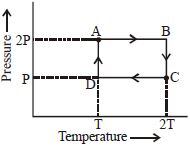
An ideal monoatomic gas is taken through the thermodynamic states $A \to B \to C \to D$ via the paths shown in the figure. If $U_A, U_B, U_C$ and $U_D$ represent the internal energy of the gas in states $A, B, C$ and $D$ respectively,then which of the following is not true?
A
$U_A - U_D = 0$
B
$U_B - U_C = 0$
C
$U_C - U_D > 0$
D
$U_B - U_A < 0$
Solution
(D) The internal energy of an ideal gas is given by $U = \frac{f}{2} nRT$,where $f$ is the degrees of freedom. For a monoatomic gas,$f=3$,so $U \propto T$.
From the graph:
State $A$: $T_A = T$
State $B$: $T_B = 2T$
State $C$: $T_C = 2T$
State $D$: $T_D = T$
Comparing internal energies:
$U_A = U_D$ (since $T_A = T_D$),so $U_A - U_D = 0$. (True)
$U_B = U_C$ (since $T_B = T_C$),so $U_B - U_C = 0$. (True)
$U_C > U_D$ (since $T_C > T_D$),so $U_C - U_D > 0$. (True)
$U_B > U_A$ (since $T_B > T_A$),so $U_B - U_A > 0$. Therefore,$U_B - U_A < 0$ is false.
From the graph:
State $A$: $T_A = T$
State $B$: $T_B = 2T$
State $C$: $T_C = 2T$
State $D$: $T_D = T$
Comparing internal energies:
$U_A = U_D$ (since $T_A = T_D$),so $U_A - U_D = 0$. (True)
$U_B = U_C$ (since $T_B = T_C$),so $U_B - U_C = 0$. (True)
$U_C > U_D$ (since $T_C > T_D$),so $U_C - U_D > 0$. (True)
$U_B > U_A$ (since $T_B > T_A$),so $U_B - U_A > 0$. Therefore,$U_B - U_A < 0$ is false.
0 likes
View Solution76
MediumMCQ
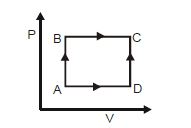
As shown in the figure,the amount of heat absorbed along the path $ABC$ is $90\,J$ and the amount of work done by the system is $30\,J$. If the amount of work done along the path $ADC$ is $20\,J$,the amount of heat absorbed will be .... $J$.
A
$80$
B
$90$
C
$110$
D
$120$
Solution
(A) The change in internal energy $\Delta U$ is a state function,meaning it depends only on the initial and final states,not the path taken.
For paths $ABC$ and $ADC$,the initial state is $A$ and the final state is $C$. Therefore,$\Delta U_{ABC} = \Delta U_{ADC}$.
According to the first law of thermodynamics,$\Delta Q = \Delta U + W$,which implies $\Delta U = \Delta Q - W$.
For path $ABC$: $\Delta U_{ABC} = \Delta Q_{ABC} - W_{ABC} = 90\,J - 30\,J = 60\,J$.
Since $\Delta U_{ADC} = \Delta U_{ABC} = 60\,J$,we have for path $ADC$:
$\Delta Q_{ADC} - W_{ADC} = 60\,J$
$\Delta Q_{ADC} - 20\,J = 60\,J$
$\Delta Q_{ADC} = 60\,J + 20\,J = 80\,J$.
For paths $ABC$ and $ADC$,the initial state is $A$ and the final state is $C$. Therefore,$\Delta U_{ABC} = \Delta U_{ADC}$.
According to the first law of thermodynamics,$\Delta Q = \Delta U + W$,which implies $\Delta U = \Delta Q - W$.
For path $ABC$: $\Delta U_{ABC} = \Delta Q_{ABC} - W_{ABC} = 90\,J - 30\,J = 60\,J$.
Since $\Delta U_{ADC} = \Delta U_{ABC} = 60\,J$,we have for path $ADC$:
$\Delta Q_{ADC} - W_{ADC} = 60\,J$
$\Delta Q_{ADC} - 20\,J = 60\,J$
$\Delta Q_{ADC} = 60\,J + 20\,J = 80\,J$.
0 likes
View Solution77
MediumMCQ
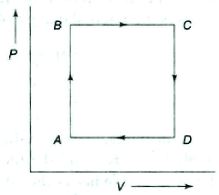
In a thermodynamic process,the pressures and volumes corresponding to some points in the figure are $P_A = 3 \times 10^4 \, Pa$,$V_A = 2 \times 10^{-3} \, m^3$,$P_B = 8 \times 10^4 \, Pa$,and $V_D = 5 \times 10^{-3} \, m^3$. In process $AB$,$600 \, J$ of heat is added,and in process $BC$,$200 \, J$ of heat is added to the system. The change in the internal energy in process $AC$ would be .... $J$.
A
$560$
B
$800$
C
$600$
D
$640$
Solution
(A) The total heat added in the process $ABC$ is $Q_{ABC} = Q_{AB} + Q_{BC} = 600 \, J + 200 \, J = 800 \, J$.
The work done in the process $ABC$ consists of work done in $AB$ and $BC$. Since $AB$ is an isochoric process $(V_A = V_B)$,$W_{AB} = 0$.
In process $BC$,the pressure is constant at $P_B = 8 \times 10^4 \, Pa$. The volume changes from $V_B = V_A = 2 \times 10^{-3} \, m^3$ to $V_C = V_D = 5 \times 10^{-3} \, m^3$.
Work done in process $BC$ is $W_{BC} = P_B(V_C - V_B) = 8 \times 10^4 \times (5 - 2) \times 10^{-3} = 8 \times 10^4 \times 3 \times 10^{-3} = 240 \, J$.
Total work done $W_{ABC} = W_{AB} + W_{BC} = 0 + 240 = 240 \, J$.
According to the first law of thermodynamics,$\Delta Q = \Delta U + W$,so $\Delta U_{AC} = Q_{ABC} - W_{ABC}$.
$\Delta U_{AC} = 800 \, J - 240 \, J = 560 \, J$.
The work done in the process $ABC$ consists of work done in $AB$ and $BC$. Since $AB$ is an isochoric process $(V_A = V_B)$,$W_{AB} = 0$.
In process $BC$,the pressure is constant at $P_B = 8 \times 10^4 \, Pa$. The volume changes from $V_B = V_A = 2 \times 10^{-3} \, m^3$ to $V_C = V_D = 5 \times 10^{-3} \, m^3$.
Work done in process $BC$ is $W_{BC} = P_B(V_C - V_B) = 8 \times 10^4 \times (5 - 2) \times 10^{-3} = 8 \times 10^4 \times 3 \times 10^{-3} = 240 \, J$.
Total work done $W_{ABC} = W_{AB} + W_{BC} = 0 + 240 = 240 \, J$.
According to the first law of thermodynamics,$\Delta Q = \Delta U + W$,so $\Delta U_{AC} = Q_{ABC} - W_{ABC}$.
$\Delta U_{AC} = 800 \, J - 240 \, J = 560 \, J$.
0 likes
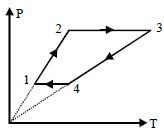
View Solution78
DifficultMCQ
Three moles of an ideal monatomic gas perform a cyclic process as shown in the figure. The temperatures in different states are $T_1 = 400\,K, T_2 = 800\,K, T_3 = 2400\,K$ and $T_4 = 1200\,K$. Determine the work done by the gas during the cycle in $kJ$. (Given $R = 8.31\, J\, mol^{-1} K^{-1}$)
A
$19.94$
B
$22.65$
C
$15.81$
D
$10.37$
Solution
(A) In a $P-T$ diagram,the work done $W$ is given by the area under the process curve. For an ideal gas,$PV = nRT$,so $V = \frac{nRT}{P}$.
Processes $1-2$ and $3-4$ are isochoric (constant volume) because they lie on lines passing through the origin $(P \propto T)$,so $W_{12} = 0$ and $W_{34} = 0$.
Processes $2-3$ and $4-1$ are isobaric (constant pressure),so $W = P\Delta V = nR\Delta T$.
Total work done $W = W_{12} + W_{23} + W_{34} + W_{41} = 0 + nR(T_3 - T_2) + 0 + nR(T_1 - T_4)$.
$W = nR(T_3 - T_2 + T_1 - T_4) = 3 \times 8.31 \times (2400 - 800 + 400 - 1200) \, J$.
$W = 3 \times 8.31 \times (800) \, J = 19944 \, J = 19.944 \, kJ$.
Processes $1-2$ and $3-4$ are isochoric (constant volume) because they lie on lines passing through the origin $(P \propto T)$,so $W_{12} = 0$ and $W_{34} = 0$.
Processes $2-3$ and $4-1$ are isobaric (constant pressure),so $W = P\Delta V = nR\Delta T$.
Total work done $W = W_{12} + W_{23} + W_{34} + W_{41} = 0 + nR(T_3 - T_2) + 0 + nR(T_1 - T_4)$.
$W = nR(T_3 - T_2 + T_1 - T_4) = 3 \times 8.31 \times (2400 - 800 + 400 - 1200) \, J$.
$W = 3 \times 8.31 \times (800) \, J = 19944 \, J = 19.944 \, kJ$.
0 likes
View Solution79
MediumMCQ
An ideal gas is taken through a quasi-static process described by $P = \alpha V^2$,where $\alpha = 5 \text{ atm}/m^6$. The gas is expanded to twice its original volume of $1 \text{ m}^3$. How much work is done by the expanding gas in this process?
A
$10.8 \text{ J}$
B
$1.18 \text{ MJ}$
C
$5 \text{ J}$
D
$4.3 \text{ MJ}$
Solution
(B) The work done by the gas in a quasi-static process is given by $W = \int_{V_1}^{V_2} P \, dV$.
Given $P = \alpha V^2$ and $\alpha = 5 \text{ atm}/m^6$. Since $1 \text{ atm} = 1.01325 \times 10^5 \text{ Pa}$,we use $\alpha = 5 \times 1.01325 \times 10^5 \text{ Pa}/m^6 \approx 5.066 \times 10^5 \text{ Pa}/m^6$.
Initial volume $V_1 = 1 \text{ m}^3$,final volume $V_2 = 2 \text{ m}^3$.
$W = \int_{1}^{2} (\alpha V^2) \, dV = \alpha \left[ \frac{V^3}{3} \right]_1^2 = \frac{\alpha}{3} (2^3 - 1^3) = \frac{7\alpha}{3}$.
Substituting $\alpha = 5.066 \times 10^5 \text{ Pa}/m^6$:
$W = \frac{7 \times 5.066 \times 10^5}{3} \approx 11.82 \times 10^5 \text{ J} = 1.182 \text{ MJ}$.
Thus,the correct option is $B$.
Given $P = \alpha V^2$ and $\alpha = 5 \text{ atm}/m^6$. Since $1 \text{ atm} = 1.01325 \times 10^5 \text{ Pa}$,we use $\alpha = 5 \times 1.01325 \times 10^5 \text{ Pa}/m^6 \approx 5.066 \times 10^5 \text{ Pa}/m^6$.
Initial volume $V_1 = 1 \text{ m}^3$,final volume $V_2 = 2 \text{ m}^3$.
$W = \int_{1}^{2} (\alpha V^2) \, dV = \alpha \left[ \frac{V^3}{3} \right]_1^2 = \frac{\alpha}{3} (2^3 - 1^3) = \frac{7\alpha}{3}$.
Substituting $\alpha = 5.066 \times 10^5 \text{ Pa}/m^6$:
$W = \frac{7 \times 5.066 \times 10^5}{3} \approx 11.82 \times 10^5 \text{ J} = 1.182 \text{ MJ}$.
Thus,the correct option is $B$.
0 likes
View Solution80
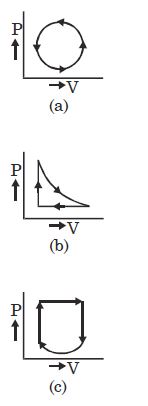
MediumMCQ
What is the nature of the change in internal energy for the following three thermodynamic processes shown in the figure?
A
$\Delta U$ is positive in all three cases.
B
$\Delta U$ is negative in all three cases.
C
$\Delta U$ is positive for $(a)$,negative for $(b)$,and zero for $(c)$.
D
$\Delta U = 0$ in all three cases.
Solution
(D) Internal energy $(U)$ is a state function,meaning its value depends only on the initial and final states of the system,not on the path taken.
For a cyclic process,the system returns to its initial state after completing the cycle.
Since the initial state and final state are identical,the change in internal energy $(\Delta U)$ for any cyclic process is always zero.
All three figures $(a)$,$(b)$,and $(c)$ represent cyclic processes because the path starts and ends at the same point.
Therefore,$\Delta U = 0$ for all three cases.
For a cyclic process,the system returns to its initial state after completing the cycle.
Since the initial state and final state are identical,the change in internal energy $(\Delta U)$ for any cyclic process is always zero.
All three figures $(a)$,$(b)$,and $(c)$ represent cyclic processes because the path starts and ends at the same point.
Therefore,$\Delta U = 0$ for all three cases.
0 likes
View Solution81
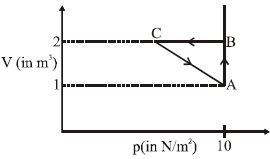
DifficultMCQ
An ideal gas is taken through the cycle $A \to B \to C \to A$,as shown in the figure. If the net heat supplied to the gas in the cycle is $5\,J$,the work done by the gas in the process $C \to A$ is ...... $J$.
A
$-5$
B
$-10$
C
$-15$
D
$-20$
Solution
(C) For a cyclic process,the change in internal energy $\Delta U = 0$. According to the first law of thermodynamics,$\Delta Q = \Delta W_{net}$.
Given $\Delta Q = 5\,J$,therefore the net work done in the cycle $\Delta W_{net} = 5\,J$.
The total work done is the sum of work done in each process: $\Delta W_{net} = \Delta W_{AB} + \Delta W_{BC} + \Delta W_{CA}$.
Process $A \to B$: This is an isochoric process (volume is constant at $V = 1\,m^3$),so $\Delta W_{AB} = 0$.
Process $B \to C$: This is an isobaric process at $p = 10\,N/m^2$. The volume changes from $V_B = 2\,m^3$ to $V_C = 1\,m^3$. Thus,$\Delta W_{BC} = p(V_C - V_B) = 10(1 - 2) = -10\,J$.
Now,$\Delta W_{net} = \Delta W_{AB} + \Delta W_{BC} + \Delta W_{CA} \implies 5 = 0 + (-10) + \Delta W_{CA}$.
Solving for $\Delta W_{CA}$,we get $\Delta W_{CA} = 5 + 10 = 15\,J$.
Given $\Delta Q = 5\,J$,therefore the net work done in the cycle $\Delta W_{net} = 5\,J$.
The total work done is the sum of work done in each process: $\Delta W_{net} = \Delta W_{AB} + \Delta W_{BC} + \Delta W_{CA}$.
Process $A \to B$: This is an isochoric process (volume is constant at $V = 1\,m^3$),so $\Delta W_{AB} = 0$.
Process $B \to C$: This is an isobaric process at $p = 10\,N/m^2$. The volume changes from $V_B = 2\,m^3$ to $V_C = 1\,m^3$. Thus,$\Delta W_{BC} = p(V_C - V_B) = 10(1 - 2) = -10\,J$.
Now,$\Delta W_{net} = \Delta W_{AB} + \Delta W_{BC} + \Delta W_{CA} \implies 5 = 0 + (-10) + \Delta W_{CA}$.
Solving for $\Delta W_{CA}$,we get $\Delta W_{CA} = 5 + 10 = 15\,J$.
0 likes
View Solution82
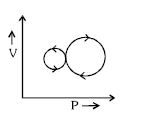
DifficultMCQ
In the indicator diagram (shown in the figure),the net amount of work done will be
A
Positive
B
Negative
C
Infinity
D
Zero
Solution
(B) The given graph is a $V-P$ graph. In a $P-V$ diagram,the work done is the area under the curve. For a $V-P$ diagram,the work done is the area enclosed by the loop,but with a sign convention opposite to that of a $P-V$ diagram.
In a $P-V$ diagram,a clockwise loop represents positive work,and an anticlockwise loop represents negative work.
In this $V-P$ diagram,the smaller loop is anticlockwise (which corresponds to positive work in $V-P$ coordinates) and the larger loop is clockwise (which corresponds to negative work in $V-P$ coordinates).
Since the area of the larger clockwise loop is greater than the area of the smaller anticlockwise loop,the net work done will be negative.
In a $P-V$ diagram,a clockwise loop represents positive work,and an anticlockwise loop represents negative work.
In this $V-P$ diagram,the smaller loop is anticlockwise (which corresponds to positive work in $V-P$ coordinates) and the larger loop is clockwise (which corresponds to negative work in $V-P$ coordinates).
Since the area of the larger clockwise loop is greater than the area of the smaller anticlockwise loop,the net work done will be negative.
0 likes
View Solution83
DifficultMCQ
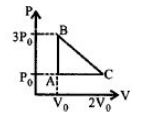
One mole of an ideal monoatomic gas is taken along the path $ABCA$ as shown in the $PV$ diagram. The maximum temperature attained by the gas along the path $BC$ is given by
A
$\frac{25}{8} \frac{P_0 V_0}{R}$
B
$\frac{25}{4} \frac{P_0 V_0}{R}$
C
$\frac{25}{16} \frac{P_0 V_0}{R}$
D
$\frac{5}{8} \frac{P_0 V_0}{R}$
Solution
(A) The path $BC$ is a straight line passing through points $(V_0, 3P_0)$ and $(2V_0, P_0)$.
The slope of the line $BC$ is $m = \frac{P_0 - 3P_0}{2V_0 - V_0} = \frac{-2P_0}{V_0}$.
The equation of the line $BC$ is $P - 3P_0 = \frac{-2P_0}{V_0}(V - V_0)$,which simplifies to $P = 3P_0 - \frac{2P_0}{V_0}(V - V_0) = P_0(5 - \frac{2V}{V_0})$.
Using the ideal gas law $PV = nRT$ with $n = 1$,we have $T = \frac{PV}{R} = \frac{P_0}{R}(5V - \frac{2V^2}{V_0})$.
To find the maximum temperature,we set $\frac{dT}{dV} = 0$:
$\frac{dT}{dV} = \frac{P_0}{R}(5 - \frac{4V}{V_0}) = 0 \implies V = \frac{5}{4}V_0$.
Substituting $V = \frac{5}{4}V_0$ back into the expression for $T$:
$T_{max} = \frac{P_0}{R}(5(\frac{5}{4}V_0) - \frac{2}{V_0}(\frac{25}{16}V_0^2)) = \frac{P_0}{R}(\frac{25}{4}V_0 - \frac{25}{8}V_0) = \frac{25}{8} \frac{P_0 V_0}{R}$.
The slope of the line $BC$ is $m = \frac{P_0 - 3P_0}{2V_0 - V_0} = \frac{-2P_0}{V_0}$.
The equation of the line $BC$ is $P - 3P_0 = \frac{-2P_0}{V_0}(V - V_0)$,which simplifies to $P = 3P_0 - \frac{2P_0}{V_0}(V - V_0) = P_0(5 - \frac{2V}{V_0})$.
Using the ideal gas law $PV = nRT$ with $n = 1$,we have $T = \frac{PV}{R} = \frac{P_0}{R}(5V - \frac{2V^2}{V_0})$.
To find the maximum temperature,we set $\frac{dT}{dV} = 0$:
$\frac{dT}{dV} = \frac{P_0}{R}(5 - \frac{4V}{V_0}) = 0 \implies V = \frac{5}{4}V_0$.
Substituting $V = \frac{5}{4}V_0$ back into the expression for $T$:
$T_{max} = \frac{P_0}{R}(5(\frac{5}{4}V_0) - \frac{2}{V_0}(\frac{25}{16}V_0^2)) = \frac{P_0}{R}(\frac{25}{4}V_0 - \frac{25}{8}V_0) = \frac{25}{8} \frac{P_0 V_0}{R}$.
0 likes
View Solution84
MediumMCQ
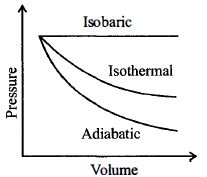
$A$ sample of gas expands from $V_1$ to $V_2$. In which of the following processes will the work done be greatest?
A
Same in all processes
B
Isobaric process
C
Isothermal process
D
Adiabatic process
Solution
(B) The work done by a gas during expansion is given by the area under the $PV$ curve with respect to the volume axis,i.e.,$W = \int_{V_1}^{V_2} P \, dV$.
From the given $PV$ diagram,for the same change in volume from $V_1$ to $V_2$,the pressure $P$ remains highest for the isobaric process compared to the isothermal and adiabatic processes.
Since the area under the curve is the greatest for the isobaric process,the work done is also the greatest for the isobaric process.
From the given $PV$ diagram,for the same change in volume from $V_1$ to $V_2$,the pressure $P$ remains highest for the isobaric process compared to the isothermal and adiabatic processes.
Since the area under the curve is the greatest for the isobaric process,the work done is also the greatest for the isobaric process.
0 likes
View Solution85
DifficultMCQ
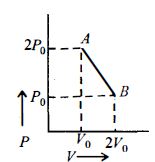
$n$ moles of an ideal gas undergo a process $A \to B$ as shown in the figure. The maximum temperature of the gas during the process is
A
$\frac{9 P_0 V_0}{nR}$
B
$\frac{3 P_0 V_0}{2nR}$
C
$\frac{9 P_0 V_0}{2nR}$
D
$\frac{9 P_0 V_0}{4nR}$
Solution
(D) For the given graph,the equation of the $P-V$ line passing through $(V_0, 2P_0)$ and $(2V_0, P_0)$ is:
$P - 2P_0 = \frac{P_0 - 2P_0}{2V_0 - V_0} (V - V_0)$
$P - 2P_0 = -\frac{P_0}{V_0} (V - V_0)$
$P = 3P_0 - \frac{P_0}{V_0} V$
Using the ideal gas equation $PV = nRT$,we have $T = \frac{PV}{nR}$.
Substituting $P$ in terms of $V$:
$T = \frac{1}{nR} (3P_0 - \frac{P_0}{V_0} V) V = \frac{1}{nR} (3P_0 V - \frac{P_0}{V_0} V^2)$
For maximum temperature,$\frac{dT}{dV} = 0$:
$\frac{d}{dV} (3P_0 V - \frac{P_0}{V_0} V^2) = 0$
$3P_0 - \frac{2P_0}{V_0} V = 0$
$V = \frac{3}{2} V_0$
Substituting $V = \frac{3}{2} V_0$ back into the pressure equation:
$P = 3P_0 - \frac{P_0}{V_0} (\frac{3}{2} V_0) = 3P_0 - \frac{3}{2} P_0 = \frac{3}{2} P_0$
Now,calculate the maximum temperature:
$T_{max} = \frac{P V}{nR} = \frac{(\frac{3}{2} P_0) (\frac{3}{2} V_0)}{nR} = \frac{9 P_0 V_0}{4nR}$
$P - 2P_0 = \frac{P_0 - 2P_0}{2V_0 - V_0} (V - V_0)$
$P - 2P_0 = -\frac{P_0}{V_0} (V - V_0)$
$P = 3P_0 - \frac{P_0}{V_0} V$
Using the ideal gas equation $PV = nRT$,we have $T = \frac{PV}{nR}$.
Substituting $P$ in terms of $V$:
$T = \frac{1}{nR} (3P_0 - \frac{P_0}{V_0} V) V = \frac{1}{nR} (3P_0 V - \frac{P_0}{V_0} V^2)$
For maximum temperature,$\frac{dT}{dV} = 0$:
$\frac{d}{dV} (3P_0 V - \frac{P_0}{V_0} V^2) = 0$
$3P_0 - \frac{2P_0}{V_0} V = 0$
$V = \frac{3}{2} V_0$
Substituting $V = \frac{3}{2} V_0$ back into the pressure equation:
$P = 3P_0 - \frac{P_0}{V_0} (\frac{3}{2} V_0) = 3P_0 - \frac{3}{2} P_0 = \frac{3}{2} P_0$
Now,calculate the maximum temperature:
$T_{max} = \frac{P V}{nR} = \frac{(\frac{3}{2} P_0) (\frac{3}{2} V_0)}{nR} = \frac{9 P_0 V_0}{4nR}$
0 likes
View Solution86
MediumMCQ
The pressure of an ideal gas varies with volume as $P = \alpha V,$ where $\alpha$ is a constant. One mole of the gas is allowed to undergo expansion such that its volume becomes $m$ times its initial volume. The work done by the gas in the process is
A
$\frac{\alpha V^2}{2}(m^2 - 1)$
B
$\frac{\alpha^2 V^2}{2}(m^2 - 1)$
C
$\frac{\alpha}{2}(m^2 - 1)$
D
$\frac{\alpha V}{2}(m^2 - 1)$
Solution
(A) Given the pressure-volume relationship: $P = \alpha V$.
The work done $W$ by the gas during expansion from initial volume $V_i = V$ to final volume $V_f = mV$ is given by the integral:
$W = \int_{V_i}^{V_f} P \, dV$
Substituting $P = \alpha V$:
$W = \int_{V}^{mV} \alpha V \, dV$
Integrating with respect to $V$:
$W = \alpha \left[ \frac{V^2}{2} \right]_{V}^{mV}$
$W = \frac{\alpha}{2} [(mV)^2 - V^2]$
$W = \frac{\alpha V^2}{2} (m^2 - 1)$
The work done $W$ by the gas during expansion from initial volume $V_i = V$ to final volume $V_f = mV$ is given by the integral:
$W = \int_{V_i}^{V_f} P \, dV$
Substituting $P = \alpha V$:
$W = \int_{V}^{mV} \alpha V \, dV$
Integrating with respect to $V$:
$W = \alpha \left[ \frac{V^2}{2} \right]_{V}^{mV}$
$W = \frac{\alpha}{2} [(mV)^2 - V^2]$
$W = \frac{\alpha V^2}{2} (m^2 - 1)$
0 likes
View Solution87
EasyMCQ
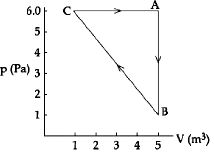
For the given cyclic process $CAB$ as shown for a gas,the work done is ..... $J$.
A
$30$
B
$10$
C
$1$
D
$5$
Solution
(B) The work done in a cyclic process on a $P-V$ diagram is equal to the area enclosed by the loop.
For the triangle $CAB$:
The base of the triangle along the $V$-axis is $\Delta V = 5 - 1 = 4 \, m^3$.
The height of the triangle along the $P$-axis is $\Delta P = 6 - 1 = 5 \, Pa$.
The area of the triangle is given by $\text{Area} = \frac{1}{2} \times \text{base} \times \text{height}$.
$\text{Area} = \frac{1}{2} \times 4 \times 5 = 10 \, J$.
Since the cycle $CAB$ is traversed in the counter-clockwise direction,the work done is negative. However,in magnitude,the work done is $10 \, J$.
For the triangle $CAB$:
The base of the triangle along the $V$-axis is $\Delta V = 5 - 1 = 4 \, m^3$.
The height of the triangle along the $P$-axis is $\Delta P = 6 - 1 = 5 \, Pa$.
The area of the triangle is given by $\text{Area} = \frac{1}{2} \times \text{base} \times \text{height}$.
$\text{Area} = \frac{1}{2} \times 4 \times 5 = 10 \, J$.
Since the cycle $CAB$ is traversed in the counter-clockwise direction,the work done is negative. However,in magnitude,the work done is $10 \, J$.
0 likes
View Solution88
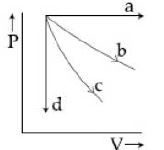
MediumMCQ
The given diagram shows four processes,i.e.,isochoric,isobaric,isothermal,and adiabatic. The correct assignment of the processes,in the same order,is given by
A
$a, d, c, b$
B
$a, d, b, c$
C
$d, a, c, b$
D
$d, a, b, c$
Solution
(D) In a $P-V$ diagram:
$1$. An isobaric process is represented by a horizontal line where pressure is constant. Thus,isobaric $\rightarrow$ process $a$.
$2$. An isochoric process is represented by a vertical line where volume is constant. Thus,isochoric $\rightarrow$ process $d$.
$3$. For isothermal and adiabatic processes,the slope of the adiabatic curve is $\gamma$ times the slope of the isothermal curve,where $\gamma > 1$. Therefore,the adiabatic curve is steeper than the isothermal curve.
$4$. Comparing curves $b$ and $c$,curve $c$ is steeper than curve $b$. Hence,isothermal $\rightarrow$ process $b$ and adiabatic $\rightarrow$ process $c$.
$5$. The correct order is: isochoric $(d)$,isobaric $(a)$,isothermal $(b)$,adiabatic $(c)$.
$6$. Therefore,the correct sequence is $d, a, b, c$.
$1$. An isobaric process is represented by a horizontal line where pressure is constant. Thus,isobaric $\rightarrow$ process $a$.
$2$. An isochoric process is represented by a vertical line where volume is constant. Thus,isochoric $\rightarrow$ process $d$.
$3$. For isothermal and adiabatic processes,the slope of the adiabatic curve is $\gamma$ times the slope of the isothermal curve,where $\gamma > 1$. Therefore,the adiabatic curve is steeper than the isothermal curve.
$4$. Comparing curves $b$ and $c$,curve $c$ is steeper than curve $b$. Hence,isothermal $\rightarrow$ process $b$ and adiabatic $\rightarrow$ process $c$.
$5$. The correct order is: isochoric $(d)$,isobaric $(a)$,isothermal $(b)$,adiabatic $(c)$.
$6$. Therefore,the correct sequence is $d, a, b, c$.
0 likes
View Solution89
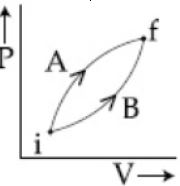
MediumMCQ
The following figure shows two processes $A$ and $B$ for a gas. If $\Delta Q_A$ and $\Delta Q_B$ are the amounts of heat absorbed by the system in the two cases,and $\Delta U_A$ and $\Delta U_B$ are the changes in internal energies,respectively,then:
A
$\Delta Q_A = \Delta Q_B; \Delta U_A = \Delta U_B$
B
$\Delta Q_A > \Delta Q_B; \Delta U_A = \Delta U_B$
C
$\Delta Q_A < \Delta Q_B; \Delta U_A < \Delta U_B$
D
$\Delta Q_A > \Delta Q_B; \Delta U_A > \Delta U_B$
Solution
(B) The initial state $i$ and final state $f$ are the same for both processes $A$ and $B$.
Since internal energy is a state function,the change in internal energy depends only on the initial and final states.
Therefore,$\Delta U_A = \Delta U_B$.
The work done $W$ in a $P-V$ diagram is equal to the area under the curve.
Since the area under curve $A$ is greater than the area under curve $B$,the work done in process $A$ is greater than the work done in process $B$ $(W_A > W_B)$.
According to the first law of thermodynamics,$\Delta Q = \Delta U + W$.
Since $\Delta U_A = \Delta U_B$ and $W_A > W_B$,it follows that $\Delta Q_A > \Delta Q_B$.
Since internal energy is a state function,the change in internal energy depends only on the initial and final states.
Therefore,$\Delta U_A = \Delta U_B$.
The work done $W$ in a $P-V$ diagram is equal to the area under the curve.
Since the area under curve $A$ is greater than the area under curve $B$,the work done in process $A$ is greater than the work done in process $B$ $(W_A > W_B)$.
According to the first law of thermodynamics,$\Delta Q = \Delta U + W$.
Since $\Delta U_A = \Delta U_B$ and $W_A > W_B$,it follows that $\Delta Q_A > \Delta Q_B$.
0 likes
View Solution90
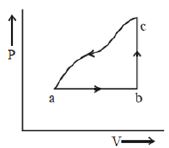
MediumMCQ
$A$ sample of an ideal gas is taken through the cyclic process $abca$ as shown in the figure. The change in the internal energy of the gas along the path $ca$ is $-180\, J$. The gas absorbs $250\, J$ of heat along the path $ab$ and $60\, J$ along the path $bc$. The work done by the gas along the path $abc$ is ..... $J$.
A
$120$
B
$100$
C
$140$
D
$130$
Solution
(D) For a cyclic process,the total change in internal energy is zero: $\Delta U_{ab} + \Delta U_{bc} + \Delta U_{ca} = 0$.
Given $\Delta U_{ca} = -180\, J$,we have $\Delta U_{ab} + \Delta U_{bc} = 180\, J$.
From the first law of thermodynamics,$\Delta Q = \Delta U + \Delta W$.
For path $bc$,the process is isochoric (vertical line in $P-V$ diagram),so $\Delta W_{bc} = 0$. Thus,$\Delta U_{bc} = \Delta Q_{bc} = 60\, J$.
Substituting this into the cyclic equation: $\Delta U_{ab} + 60 = 180 \implies \Delta U_{ab} = 120\, J$.
Now,for path $ab$,$\Delta W_{ab} = \Delta Q_{ab} - \Delta U_{ab} = 250 - 120 = 130\, J$.
The total work done along path $abc$ is $\Delta W_{abc} = \Delta W_{ab} + \Delta W_{bc} = 130 + 0 = 130\, J$.
Given $\Delta U_{ca} = -180\, J$,we have $\Delta U_{ab} + \Delta U_{bc} = 180\, J$.
From the first law of thermodynamics,$\Delta Q = \Delta U + \Delta W$.
For path $bc$,the process is isochoric (vertical line in $P-V$ diagram),so $\Delta W_{bc} = 0$. Thus,$\Delta U_{bc} = \Delta Q_{bc} = 60\, J$.
Substituting this into the cyclic equation: $\Delta U_{ab} + 60 = 180 \implies \Delta U_{ab} = 120\, J$.
Now,for path $ab$,$\Delta W_{ab} = \Delta Q_{ab} - \Delta U_{ab} = 250 - 120 = 130\, J$.
The total work done along path $abc$ is $\Delta W_{abc} = \Delta W_{ab} + \Delta W_{bc} = 130 + 0 = 130\, J$.
0 likes
View Solution91
DifficultMCQ
The $P-V$ diagram of an ideal gas is as shown. Find the work done by the gas in the $ABCD$ process.
A
$4\,{P_0}{V_0}$
B
$2\,{P_0}{V_0}$
C
$3\,{P_0}{V_0}$
D
${P_0}{V_0}$
Solution
(C) The work done in a $P-V$ diagram is given by the area under the curve.
For process $AB$ (isobaric compression from $2V_0$ to $V_0$ at pressure $P_0$):
$W_{AB} = P_0(V_0 - 2V_0) = -P_0V_0$
For process $BC$ (isochoric heating from $P_0$ to $2P_0$ at volume $V_0$):
$W_{BC} = 0$
For process $CD$ (isobaric expansion from $V_0$ to $3V_0$ at pressure $2P_0$):
$W_{CD} = 2P_0(3V_0 - V_0) = 2P_0(2V_0) = 4P_0V_0$
The total work done in the process $ABCD$ is:
$W_{net} = W_{AB} + W_{BC} + W_{CD}$
$W_{net} = -P_0V_0 + 0 + 4P_0V_0 = 3P_0V_0$
For process $AB$ (isobaric compression from $2V_0$ to $V_0$ at pressure $P_0$):
$W_{AB} = P_0(V_0 - 2V_0) = -P_0V_0$
For process $BC$ (isochoric heating from $P_0$ to $2P_0$ at volume $V_0$):
$W_{BC} = 0$
For process $CD$ (isobaric expansion from $V_0$ to $3V_0$ at pressure $2P_0$):
$W_{CD} = 2P_0(3V_0 - V_0) = 2P_0(2V_0) = 4P_0V_0$
The total work done in the process $ABCD$ is:
$W_{net} = W_{AB} + W_{BC} + W_{CD}$
$W_{net} = -P_0V_0 + 0 + 4P_0V_0 = 3P_0V_0$
0 likes
View Solution92
DifficultMCQ
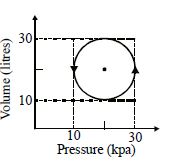
The heat energy absorbed by a system in going through a cyclic process shown in the figure is:
A
$10^3\pi \, J$
B
$10^2\pi \, J$
C
$10^4\pi \, J$
D
$10^7\pi \, J$
Solution
(B) In a cyclic process, the net heat absorbed is equal to the net work done by the system, which is equal to the area enclosed by the cycle in the $P-V$ diagram.
From the figure, the process is a circle in the $P-V$ plane.
The diameter of the circle along the pressure axis is $\Delta P = 30 \, \text{kPa} - 10 \, \text{kPa} = 20 \, \text{kPa} = 20 \times 10^3 \, \text{Pa}$.
Thus, the radius $r_P = 10 \times 10^3 \, \text{Pa}$.
The diameter of the circle along the volume axis is $\Delta V = 30 \, \text{litres} - 10 \, \text{litres} = 20 \, \text{litres} = 20 \times 10^{-3} \, \text{m}^3$.
Thus, the radius $r_V = 10 \times 10^{-3} \, \text{m}^3$.
The area of an ellipse (or circle) in a $P-V$ diagram is given by $A = \pi \times r_P \times r_V$.
$A = \pi \times (10 \times 10^3 \, \text{Pa}) \times (10 \times 10^{-3} \, \text{m}^3) = 100\pi \, \text{J} = 10^2\pi \, \text{J}$.
Since the cycle is clockwise, the work done is positive, meaning heat is absorbed.
From the figure, the process is a circle in the $P-V$ plane.
The diameter of the circle along the pressure axis is $\Delta P = 30 \, \text{kPa} - 10 \, \text{kPa} = 20 \, \text{kPa} = 20 \times 10^3 \, \text{Pa}$.
Thus, the radius $r_P = 10 \times 10^3 \, \text{Pa}$.
The diameter of the circle along the volume axis is $\Delta V = 30 \, \text{litres} - 10 \, \text{litres} = 20 \, \text{litres} = 20 \times 10^{-3} \, \text{m}^3$.
Thus, the radius $r_V = 10 \times 10^{-3} \, \text{m}^3$.
The area of an ellipse (or circle) in a $P-V$ diagram is given by $A = \pi \times r_P \times r_V$.
$A = \pi \times (10 \times 10^3 \, \text{Pa}) \times (10 \times 10^{-3} \, \text{m}^3) = 100\pi \, \text{J} = 10^2\pi \, \text{J}$.
Since the cycle is clockwise, the work done is positive, meaning heat is absorbed.
0 likes
View Solution93
DifficultMCQ
The $P-V$ diagram of $2\,g$ of $He$ gas for the process $A \to B$ is shown. What is the heat given to the gas (in $,P_0V_0$)?
A
$4$
B
$6$
C
$4.5$
D
$2$
Solution
(B) The work done $W$ is equal to the area under the $P-V$ graph.
$W = \text{Area of trapezium} = \frac{1}{2} \times (P_A + P_B) \times (V_B - V_A)$
$W = \frac{1}{2} \times (P_0 + 2P_0) \times (2V_0 - V_0) = \frac{1}{2} \times (3P_0) \times (V_0) = \frac{3}{2} P_0V_0$
Using the ideal gas equation $PV = \mu RT$:
At point $A$: $P_0V_0 = \mu RT_A$
At point $B$: $(2P_0)(2V_0) = 4P_0V_0 = \mu RT_B$
Change in internal energy $\Delta U = \mu C_v \Delta T = \mu \left( \frac{3}{2}R \right) (T_B - T_A) = \frac{3}{2} (\mu RT_B - \mu RT_A)$
Substituting the values: $\Delta U = \frac{3}{2} (4P_0V_0 - P_0V_0) = \frac{3}{2} (3P_0V_0) = \frac{9}{2} P_0V_0$
According to the first law of thermodynamics,$Q = W + \Delta U$
$Q = \frac{3}{2} P_0V_0 + \frac{9}{2} P_0V_0 = \frac{12}{2} P_0V_0 = 6 P_0V_0$
$W = \text{Area of trapezium} = \frac{1}{2} \times (P_A + P_B) \times (V_B - V_A)$
$W = \frac{1}{2} \times (P_0 + 2P_0) \times (2V_0 - V_0) = \frac{1}{2} \times (3P_0) \times (V_0) = \frac{3}{2} P_0V_0$
Using the ideal gas equation $PV = \mu RT$:
At point $A$: $P_0V_0 = \mu RT_A$
At point $B$: $(2P_0)(2V_0) = 4P_0V_0 = \mu RT_B$
Change in internal energy $\Delta U = \mu C_v \Delta T = \mu \left( \frac{3}{2}R \right) (T_B - T_A) = \frac{3}{2} (\mu RT_B - \mu RT_A)$
Substituting the values: $\Delta U = \frac{3}{2} (4P_0V_0 - P_0V_0) = \frac{3}{2} (3P_0V_0) = \frac{9}{2} P_0V_0$
According to the first law of thermodynamics,$Q = W + \Delta U$
$Q = \frac{3}{2} P_0V_0 + \frac{9}{2} P_0V_0 = \frac{12}{2} P_0V_0 = 6 P_0V_0$
0 likes
View Solution94
DifficultMCQ
$A$ thermodynamic system is taken through the closed cycle $PQRSP$ process as shown in the figure. The net work done by the system is ...... $J$.
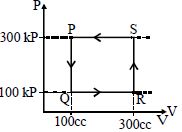
A
$20$
B
$-20$
C
$40$
D
$-40$
Solution
(D) The net work done in a cyclic process is equal to the area enclosed by the cycle on a $P-V$ diagram.
For a clockwise cycle,the work done is positive,and for a counter-clockwise cycle,the work done is negative.
In the given figure,the cycle $P \rightarrow Q \rightarrow R \rightarrow S \rightarrow P$ is counter-clockwise.
Area of the rectangle $PQRS = \text{width} \times \text{height} = (V_R - V_Q) \times (P_P - P_Q)$.
Given: $V_Q = 100 \text{ cc} = 100 \times 10^{-6} \text{ m}^3$,$V_R = 300 \text{ cc} = 300 \times 10^{-6} \text{ m}^3$.
$P_P = 300 \text{ kPa} = 300 \times 10^3 \text{ Pa}$,$P_Q = 100 \text{ kPa} = 100 \times 10^3 \text{ Pa}$.
Area $= (300 - 100) \times 10^{-6} \text{ m}^3 \times (300 - 100) \times 10^3 \text{ Pa} = 200 \times 10^{-6} \times 200 \times 10^3 = 40000 \times 10^{-3} = 40 \text{ J}$.
Since the cycle is counter-clockwise,the net work done is $-40 \text{ J}$.
For a clockwise cycle,the work done is positive,and for a counter-clockwise cycle,the work done is negative.
In the given figure,the cycle $P \rightarrow Q \rightarrow R \rightarrow S \rightarrow P$ is counter-clockwise.
Area of the rectangle $PQRS = \text{width} \times \text{height} = (V_R - V_Q) \times (P_P - P_Q)$.
Given: $V_Q = 100 \text{ cc} = 100 \times 10^{-6} \text{ m}^3$,$V_R = 300 \text{ cc} = 300 \times 10^{-6} \text{ m}^3$.
$P_P = 300 \text{ kPa} = 300 \times 10^3 \text{ Pa}$,$P_Q = 100 \text{ kPa} = 100 \times 10^3 \text{ Pa}$.
Area $= (300 - 100) \times 10^{-6} \text{ m}^3 \times (300 - 100) \times 10^3 \text{ Pa} = 200 \times 10^{-6} \times 200 \times 10^3 = 40000 \times 10^{-3} = 40 \text{ J}$.
Since the cycle is counter-clockwise,the net work done is $-40 \text{ J}$.
0 likes
View Solution95
EasyMCQ
For one complete cycle of a thermodynamic process on a gas as shown in the $P-V$ diagram,which of the following is true?
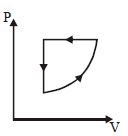
A
$\Delta U = 0; Q < 0$
B
$\Delta U > 0; Q < 0$
C
$\Delta U = 0; Q > 0$
D
$\Delta U < 0; Q > 0$
Solution
(A) $1$. Internal energy $(U)$ is a state function. For any complete thermodynamic cycle,the initial and final states are the same,therefore the change in internal energy is zero: $(\Delta U)_{\text{cycle}} = 0$.
$2$. The work done $(W)$ in a $P-V$ diagram is equal to the area enclosed by the cycle. If the cycle is traversed in an anticlockwise direction,the net work done by the gas is negative $(W < 0)$.
$3$. According to the First Law of Thermodynamics,$Q = \Delta U + W$.
$4$. Substituting the values,$Q = 0 + W$. Since $W < 0$,it follows that $Q < 0$.
$5$. Therefore,the correct condition is $\Delta U = 0$ and $Q < 0$.
$2$. The work done $(W)$ in a $P-V$ diagram is equal to the area enclosed by the cycle. If the cycle is traversed in an anticlockwise direction,the net work done by the gas is negative $(W < 0)$.
$3$. According to the First Law of Thermodynamics,$Q = \Delta U + W$.
$4$. Substituting the values,$Q = 0 + W$. Since $W < 0$,it follows that $Q < 0$.
$5$. Therefore,the correct condition is $\Delta U = 0$ and $Q < 0$.
0 likes
View Solution96
DifficultMCQ
$3\, \text{moles}$ of an ideal monoatomic gas perform a cycle as shown in the figure. The gas temperatures in different states are: $T_1 = 400\, K$, $T_2 = 800\, K$, $T_3 = 2400\, K$ and $T_4 = 1200\, K$. The work done by the gas during the cycle is ...... $kJ$.
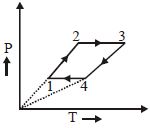
A
$10$
B
$20$
C
$5$
D
$8.3$
Solution
(B) In the $P-T$ diagram, the lines passing through the origin represent isochoric processes (constant volume) because $P \propto T$ implies $V = \text{constant}$.
Thus, processes $1-2$ and $3-4$ are isochoric, and no work is done during these segments ($W_{1-2} = 0$, $W_{3-4} = 0$).
Processes $2-3$ and $4-1$ are isobaric (constant pressure) because they are horizontal lines in the $P-T$ diagram.
The work done in an isobaric process is $W = P\Delta V = nR\Delta T$.
For the cycle, the total work done is $W_{\text{total}} = W_{2-3} + W_{4-1}$.
$W_{2-3} = nR(T_3 - T_2) = 3 \times R \times (2400 - 800) = 3R(1600) = 4800R$.
$W_{4-1} = nR(T_1 - T_4) = 3 \times R \times (400 - 1200) = 3R(-800) = -2400R$.
$W_{\text{total}} = 4800R - 2400R = 2400R$.
Using $R \approx 8.314\, J/(mol \cdot K)$:
$W_{\text{total}} = 2400 \times 8.314 \approx 19953.6\, J \approx 20\, kJ$.
Thus, processes $1-2$ and $3-4$ are isochoric, and no work is done during these segments ($W_{1-2} = 0$, $W_{3-4} = 0$).
Processes $2-3$ and $4-1$ are isobaric (constant pressure) because they are horizontal lines in the $P-T$ diagram.
The work done in an isobaric process is $W = P\Delta V = nR\Delta T$.
For the cycle, the total work done is $W_{\text{total}} = W_{2-3} + W_{4-1}$.
$W_{2-3} = nR(T_3 - T_2) = 3 \times R \times (2400 - 800) = 3R(1600) = 4800R$.
$W_{4-1} = nR(T_1 - T_4) = 3 \times R \times (400 - 1200) = 3R(-800) = -2400R$.
$W_{\text{total}} = 4800R - 2400R = 2400R$.
Using $R \approx 8.314\, J/(mol \cdot K)$:
$W_{\text{total}} = 2400 \times 8.314 \approx 19953.6\, J \approx 20\, kJ$.
0 likes
View Solution97
MediumMCQ
$A$ monoatomic gas is taken along path $AB$ as shown in the $V-P$ diagram. Calculate the change in internal energy of the system.
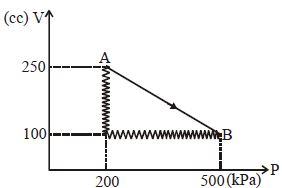
A
$279.8\,\,J$
B
$341\,\,J$
C
$241\,\,J$
D
None of these
Solution
(D) For a monoatomic gas,the internal energy is given by $U = \frac{3}{2}PV$.
The change in internal energy is $\Delta U = U_B - U_A = \frac{3}{2}(P_B V_B - P_A V_A)$.
From the graph:
At point $A$: $P_A = 200\,\text{kPa} = 200 \times 10^3\,\text{Pa}$,$V_A = 250\,\text{cc} = 250 \times 10^{-6}\,\text{m}^3$.
At point $B$: $P_B = 500\,\text{kPa} = 500 \times 10^3\,\text{Pa}$,$V_B = 100\,\text{cc} = 100 \times 10^{-6}\,\text{m}^3$.
Calculate $P_A V_A = (200 \times 10^3) \times (250 \times 10^{-6}) = 50\,\text{J}$.
Calculate $P_B V_B = (500 \times 10^3) \times (100 \times 10^{-6}) = 50\,\text{J}$.
Therefore,$\Delta U = \frac{3}{2}(50 - 50) = 0\,\text{J}$.
The correct option is $D$.
The change in internal energy is $\Delta U = U_B - U_A = \frac{3}{2}(P_B V_B - P_A V_A)$.
From the graph:
At point $A$: $P_A = 200\,\text{kPa} = 200 \times 10^3\,\text{Pa}$,$V_A = 250\,\text{cc} = 250 \times 10^{-6}\,\text{m}^3$.
At point $B$: $P_B = 500\,\text{kPa} = 500 \times 10^3\,\text{Pa}$,$V_B = 100\,\text{cc} = 100 \times 10^{-6}\,\text{m}^3$.
Calculate $P_A V_A = (200 \times 10^3) \times (250 \times 10^{-6}) = 50\,\text{J}$.
Calculate $P_B V_B = (500 \times 10^3) \times (100 \times 10^{-6}) = 50\,\text{J}$.
Therefore,$\Delta U = \frac{3}{2}(50 - 50) = 0\,\text{J}$.
The correct option is $D$.
0 likes
View Solution98
MediumMCQ
$A$ gas is taken through a cyclic process $ABCA$ as shown in the figure. If $2.4 \, cal$ of heat is given in the process,what is the value of $J$ in $J/cal$ (mechanical equivalent of heat)?
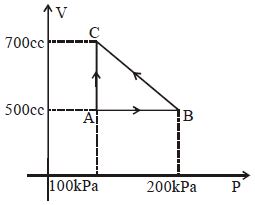
A
$4.17$
B
$4.4$
C
$4.1$
D
None of these
Solution
(A) For a cyclic process,the change in internal energy is zero,so the net heat supplied is equal to the net work done: $dQ = dW$.
The work done $dW$ is equal to the area enclosed by the cycle $ABCA$ in the $V-P$ diagram.
Area $= \frac{1}{2} \times \text{base} \times \text{height}$
Base $= (200 \, kPa - 100 \, kPa) = 100 \times 10^3 \, Pa$
Height $= (700 \, cc - 500 \, cc) = 200 \, cm^3 = 200 \times 10^{-6} \, m^3$
$dW = \frac{1}{2} \times (100 \times 10^3 \, Pa) \times (200 \times 10^{-6} \, m^3) = 10 \, J$.
Given heat $dQ = 2.4 \, cal$.
Since $dW = J \times dQ$,we have $J = \frac{dW}{dQ} = \frac{10 \, J}{2.4 \, cal} = 4.166... \approx 4.17 \, J/cal$.
The work done $dW$ is equal to the area enclosed by the cycle $ABCA$ in the $V-P$ diagram.
Area $= \frac{1}{2} \times \text{base} \times \text{height}$
Base $= (200 \, kPa - 100 \, kPa) = 100 \times 10^3 \, Pa$
Height $= (700 \, cc - 500 \, cc) = 200 \, cm^3 = 200 \times 10^{-6} \, m^3$
$dW = \frac{1}{2} \times (100 \times 10^3 \, Pa) \times (200 \times 10^{-6} \, m^3) = 10 \, J$.
Given heat $dQ = 2.4 \, cal$.
Since $dW = J \times dQ$,we have $J = \frac{dW}{dQ} = \frac{10 \, J}{2.4 \, cal} = 4.166... \approx 4.17 \, J/cal$.
0 likes
View Solution99
DifficultMCQ
Calculate the heat given to the gas during the cyclic process $ABA$ shown in the figure (in $J$).
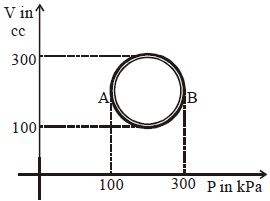
A
$3.14$
B
$314$
C
$31.4$
D
None of these
Solution
(C) For a cyclic process,the change in internal energy $\Delta U = 0$.
According to the first law of thermodynamics,$\Delta Q = \Delta U + \Delta W$,which implies $\Delta Q = \Delta W$.
The work done $\Delta W$ in a cyclic process is equal to the area enclosed by the $P-V$ loop.
The loop is a circle with diameter along the $P$-axis as $(300 - 100) \text{ kPa} = 200 \text{ kPa} = 2 \times 10^5 \text{ Pa}$.
The radius $r_P = 100 \text{ kPa} = 10^5 \text{ Pa}$.
The diameter along the $V$-axis is $(300 - 100) \text{ cc} = 200 \text{ cc} = 200 \times 10^{-6} \text{ m}^3 = 2 \times 10^{-4} \text{ m}^3$.
The radius $r_V = 100 \text{ cc} = 10^{-4} \text{ m}^3$.
The area of the ellipse (or circle in this scale) is $\pi \times r_P \times r_V$.
$\Delta W = \pi \times (10^5 \text{ Pa}) \times (10^{-4} \text{ m}^3) = \pi \times 10 \text{ J} = 3.14 \times 10 \text{ J} = 31.4 \text{ J}$.
Since the process is clockwise,the work done is positive,so $\Delta Q = 31.4 \text{ J}$.
According to the first law of thermodynamics,$\Delta Q = \Delta U + \Delta W$,which implies $\Delta Q = \Delta W$.
The work done $\Delta W$ in a cyclic process is equal to the area enclosed by the $P-V$ loop.
The loop is a circle with diameter along the $P$-axis as $(300 - 100) \text{ kPa} = 200 \text{ kPa} = 2 \times 10^5 \text{ Pa}$.
The radius $r_P = 100 \text{ kPa} = 10^5 \text{ Pa}$.
The diameter along the $V$-axis is $(300 - 100) \text{ cc} = 200 \text{ cc} = 200 \times 10^{-6} \text{ m}^3 = 2 \times 10^{-4} \text{ m}^3$.
The radius $r_V = 100 \text{ cc} = 10^{-4} \text{ m}^3$.
The area of the ellipse (or circle in this scale) is $\pi \times r_P \times r_V$.
$\Delta W = \pi \times (10^5 \text{ Pa}) \times (10^{-4} \text{ m}^3) = \pi \times 10 \text{ J} = 3.14 \times 10 \text{ J} = 31.4 \text{ J}$.
Since the process is clockwise,the work done is positive,so $\Delta Q = 31.4 \text{ J}$.
0 likes
View SolutionThermodynamics — Heat, Work done and Internal Energy from Graph · Frequently Asked Questions
1Are these Thermodynamics questions useful for JEE and NEET?
Yes. All questions in this section are mapped to JEE Main and NEET exam patterns. Previous year questions from JEE Main, NEET, GUJCET and state-level exams are included with full solutions.
2Can I switch to Hindi or Gujarati for these questions?
Yes. Use the language tabs in the hero section or the sidebar to view the same questions and solutions in English, Hindi or Gujarati.
3How do I generate a question paper from this subtopic?
Use the Vedclass Exam Paper Generator — select the chapter and subtopic, set difficulty, and generate Sets A, B, C, D automatically. First 3 chapters of every subject are free.
Vedclass Products
For Students
Vedclass Test Series
Mock tests in real JEE/NEET style with performance analysis. 5-day free trial.
Start Free TrialFor Teachers
Exam Paper Generator
Generate Set A/B/C/D papers from this chapter in 2 minutes. 3 chapters free.
Try FreeFor Institutes
Online Exam Module
Live online exams with unlimited students, 360° analytics & white-label branding.
See DemoFor Teachers & Institutes
Generate a Thermodynamics Exam Paper in 2 Minutes
Select subtopic & difficulty — Sets A, B, C, D auto-generated with No Repeat logic.
First 3 chapters of every subject are free — no payment required.