
A English
Heat Engine and Carnot Cycle Questions in English
Class 11 Physics · Thermodynamics · Heat Engine and Carnot Cycle
247+
Questions
English
Language
100%
With Solutions
Showing 49 of 247 questions in English
151
EasyMCQ
$A$ frictionless heat engine can be $100 \%$ efficient only if its exhaust temperature is ............
A
Equal to its input temperature
B
Less than its input temperature
C
$0 \, K$
D
$0^{\circ} C$
Solution
(C) The efficiency $\eta$ of a Carnot heat engine is given by the formula $\eta = 1 - \frac{T_2}{T_1}$,where $T_1$ is the source (input) temperature and $T_2$ is the sink (exhaust) temperature in Kelvin.
For the engine to be $100 \%$ efficient,$\eta$ must be equal to $1$.
Substituting $\eta = 1$ into the equation: $1 = 1 - \frac{T_2}{T_1}$.
This implies $\frac{T_2}{T_1} = 0$,which means $T_2 = 0 \, K$.
Therefore,a heat engine can be $100 \%$ efficient only if its exhaust temperature is absolute zero $(0 \, K)$.
For the engine to be $100 \%$ efficient,$\eta$ must be equal to $1$.
Substituting $\eta = 1$ into the equation: $1 = 1 - \frac{T_2}{T_1}$.
This implies $\frac{T_2}{T_1} = 0$,which means $T_2 = 0 \, K$.
Therefore,a heat engine can be $100 \%$ efficient only if its exhaust temperature is absolute zero $(0 \, K)$.
0 likes
View Solution152
EasyMCQ
$A$ reversible engine and an irreversible engine are working between the same temperatures. The efficiency of the ...........
A
Two engines are same
B
Reversible engine is greater
C
Irreversible engine is greater
D
Two engines cannot be compared
Solution
(B) According to Carnot's theorem,the efficiency of all reversible engines operating between the same two temperatures is the same.
Furthermore,the efficiency of any irreversible engine operating between the same two temperatures is always less than the efficiency of a reversible engine.
Therefore,the efficiency of the reversible engine is greater than that of the irreversible engine.
Furthermore,the efficiency of any irreversible engine operating between the same two temperatures is always less than the efficiency of a reversible engine.
Therefore,the efficiency of the reversible engine is greater than that of the irreversible engine.
0 likes
View Solution153
EasyMCQ
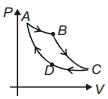
The Carnot cycle is plotted on a $P-V$ graph. Which portion represents an isothermal expansion?
A
$A B$
B
$B C$
C
$C D$
D
$D A$
Solution
(A) In a standard Carnot cycle represented on a $P-V$ diagram:
$1$. The process $A B$ represents an isothermal expansion at a higher temperature $T_1$.
$2$. The process $B C$ represents an adiabatic expansion.
$3$. The process $C D$ represents an isothermal compression at a lower temperature $T_2$.
$4$. The process $D A$ represents an adiabatic compression.
Therefore,the portion $A B$ represents the isothermal expansion.
$1$. The process $A B$ represents an isothermal expansion at a higher temperature $T_1$.
$2$. The process $B C$ represents an adiabatic expansion.
$3$. The process $C D$ represents an isothermal compression at a lower temperature $T_2$.
$4$. The process $D A$ represents an adiabatic compression.
Therefore,the portion $A B$ represents the isothermal expansion.
0 likes
View Solution154
EasyMCQ
$A$ Carnot's heat engine works between the temperatures $427^{\circ} C$ and $27^{\circ} C$. How much heat in $kcal/s$ should it consume per second to deliver mechanical work at the rate of $1.0\,kW$?
A
$0.417$
B
$4.17$
C
$41.7$
D
$0.212$
Solution
(A) The efficiency $\eta$ of a Carnot engine is given by $\eta = 1 - \frac{T_2}{T_1}$.
Given $T_1 = 427^{\circ} C = 427 + 273 = 700\,K$ and $T_2 = 27^{\circ} C = 27 + 273 = 300\,K$.
$\eta = 1 - \frac{300}{700} = 1 - \frac{3}{7} = \frac{4}{7}$.
Efficiency is also defined as $\eta = \frac{W}{Q_1}$,where $W$ is the work done per second $(1.0\,kW = 1000\,J/s)$ and $Q_1$ is the heat absorbed per second.
$Q_1 = \frac{W}{\eta} = \frac{1000\,J/s}{4/7} = 1000 \times \frac{7}{4} = 1750\,J/s$.
To convert $J/s$ (Watts) to $kcal/s$,we use the conversion $1\,kcal = 4184\,J$ (or approximately $4200\,J$).
$Q_1 = \frac{1750}{4184} \approx 0.418\,kcal/s$. Given the options,$0.417\,kcal/s$ is the correct value.
Given $T_1 = 427^{\circ} C = 427 + 273 = 700\,K$ and $T_2 = 27^{\circ} C = 27 + 273 = 300\,K$.
$\eta = 1 - \frac{300}{700} = 1 - \frac{3}{7} = \frac{4}{7}$.
Efficiency is also defined as $\eta = \frac{W}{Q_1}$,where $W$ is the work done per second $(1.0\,kW = 1000\,J/s)$ and $Q_1$ is the heat absorbed per second.
$Q_1 = \frac{W}{\eta} = \frac{1000\,J/s}{4/7} = 1000 \times \frac{7}{4} = 1750\,J/s$.
To convert $J/s$ (Watts) to $kcal/s$,we use the conversion $1\,kcal = 4184\,J$ (or approximately $4200\,J$).
$Q_1 = \frac{1750}{4184} \approx 0.418\,kcal/s$. Given the options,$0.417\,kcal/s$ is the correct value.
0 likes
View Solution155
EasyMCQ
$A$ Carnot engine works first between $200^{\circ} C$ and $0^{\circ} C$ and then between $0^{\circ} C$ and $-200^{\circ} C$. The ratio of its efficiency in the two cases is
A
$0.577$
B
$1.0$
C
$0.34$
D
$0.68$
Solution
(A) Case $1$: The engine operates between $T_H = 200^{\circ} C = 473 \ K$ and $T_L = 0^{\circ} C = 273 \ K$.
The efficiency is $\eta_1 = 1 - \frac{T_L}{T_H} = 1 - \frac{273}{473} = \frac{200}{473} \approx 0.4228$.
Case $2$: The engine operates between $T_H = 0^{\circ} C = 273 \ K$ and $T_L = -200^{\circ} C = 73 \ K$.
The efficiency is $\eta_2 = 1 - \frac{T_L}{T_H} = 1 - \frac{73}{273} = \frac{200}{273} \approx 0.7326$.
The ratio of efficiencies is $\frac{\eta_1}{\eta_2} = \frac{200/473}{200/273} = \frac{273}{473} \approx 0.577$.
The efficiency is $\eta_1 = 1 - \frac{T_L}{T_H} = 1 - \frac{273}{473} = \frac{200}{473} \approx 0.4228$.
Case $2$: The engine operates between $T_H = 0^{\circ} C = 273 \ K$ and $T_L = -200^{\circ} C = 73 \ K$.
The efficiency is $\eta_2 = 1 - \frac{T_L}{T_H} = 1 - \frac{73}{273} = \frac{200}{273} \approx 0.7326$.
The ratio of efficiencies is $\frac{\eta_1}{\eta_2} = \frac{200/473}{200/273} = \frac{273}{473} \approx 0.577$.
0 likes
View Solution156
MediumMCQ
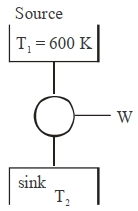
$A$ Carnot engine with efficiency $50\,\%$ takes heat from a source at $600\,K$. In order to increase the efficiency to $70\,\%$,keeping the temperature of the sink the same,the new temperature of the source will be $.........\,K$.
A
$360$
B
$1000$
C
$900$
D
$300$
Solution
(B) Initially,the efficiency $\eta_1 = 50\,\% = 0.5$. The source temperature $T_1 = 600\,K$.
Using the Carnot efficiency formula $\eta = 1 - \frac{T_2}{T_1}$:
$0.5 = 1 - \frac{T_2}{600}$
$\frac{T_2}{600} = 0.5$
$T_2 = 300\,K$ (This is the temperature of the sink).
Now,the efficiency is increased to $\eta_2 = 70\,\% = 0.7$,while the sink temperature $T_2$ remains $300\,K$. Let the new source temperature be $T_1'$.
Using the formula again:
$0.7 = 1 - \frac{300}{T_1'}$
$\frac{300}{T_1'} = 1 - 0.7 = 0.3$
$T_1' = \frac{300}{0.3} = 1000\,K$.
Using the Carnot efficiency formula $\eta = 1 - \frac{T_2}{T_1}$:
$0.5 = 1 - \frac{T_2}{600}$
$\frac{T_2}{600} = 0.5$
$T_2 = 300\,K$ (This is the temperature of the sink).
Now,the efficiency is increased to $\eta_2 = 70\,\% = 0.7$,while the sink temperature $T_2$ remains $300\,K$. Let the new source temperature be $T_1'$.
Using the formula again:
$0.7 = 1 - \frac{300}{T_1'}$
$\frac{300}{T_1'} = 1 - 0.7 = 0.3$
$T_1' = \frac{300}{0.3} = 1000\,K$.
0 likes
View Solution157
MediumMCQ
Given below are two statements: one is labelled as Assertion $A$ and the other is labelled as Reason $R$.
Assertion $A$: Efficiency of a reversible heat engine will be highest at $-273^{\circ} C$ temperature of cold reservoir.
Reason $R$: The efficiency of Carnot's engine depends not only on the temperature of the cold reservoir but it depends on the temperature of the hot reservoir too and is given as $\eta = (1 - \frac{T_2}{T_1})$.
In the light of the above statements,choose the correct answer from the options given below:
Assertion $A$: Efficiency of a reversible heat engine will be highest at $-273^{\circ} C$ temperature of cold reservoir.
Reason $R$: The efficiency of Carnot's engine depends not only on the temperature of the cold reservoir but it depends on the temperature of the hot reservoir too and is given as $\eta = (1 - \frac{T_2}{T_1})$.
In the light of the above statements,choose the correct answer from the options given below:
A
$A$ is true but $R$ is false
B
Both $A$ and $R$ are true but $R$ is $NOT$ the correct explanation of $A$
C
$A$ is false but $R$ is true
D
Both $A$ and $R$ are true and $R$ is the correct explanation of $A$
Solution
(D) The efficiency of a Carnot engine is given by $\eta = 1 - \frac{T_2}{T_1}$,where $T_2$ is the temperature of the cold reservoir and $T_1$ is the temperature of the hot reservoir.
As $T_2$ decreases,the ratio $\frac{T_2}{T_1}$ decreases,which leads to an increase in efficiency $\eta$.
The lowest possible temperature for the cold reservoir is absolute zero,which is $-273.15^{\circ} C$ (often approximated as $-273^{\circ} C$).
At $T_2 = 0 \ K$,the efficiency $\eta$ becomes $1 - 0 = 1$ or $100\%$,which is the maximum possible efficiency.
Therefore,Assertion $A$ is true.
Reason $R$ correctly states the formula for efficiency and explains that it depends on both temperatures,which justifies why lowering $T_2$ increases the efficiency.
Thus,both $A$ and $R$ are true,and $R$ is the correct explanation of $A$.
As $T_2$ decreases,the ratio $\frac{T_2}{T_1}$ decreases,which leads to an increase in efficiency $\eta$.
The lowest possible temperature for the cold reservoir is absolute zero,which is $-273.15^{\circ} C$ (often approximated as $-273^{\circ} C$).
At $T_2 = 0 \ K$,the efficiency $\eta$ becomes $1 - 0 = 1$ or $100\%$,which is the maximum possible efficiency.
Therefore,Assertion $A$ is true.
Reason $R$ correctly states the formula for efficiency and explains that it depends on both temperatures,which justifies why lowering $T_2$ increases the efficiency.
Thus,both $A$ and $R$ are true,and $R$ is the correct explanation of $A$.
0 likes
View Solution158
MediumMCQ
$A$ Carnot engine operating between two reservoirs has an efficiency of $\frac{1}{3}$. When the temperature of the cold reservoir is raised by $x$,its efficiency decreases to $\frac{1}{6}$. The value of $x$,if the temperature of the hot reservoir is $99^{\circ} C$,will be $........ K$.
A
$16.5$
B
$33$
C
$66$
D
$62$
Solution
(D) The efficiency of a Carnot engine is given by $\eta = 1 - \frac{T_C}{T_H}$.
Given $T_H = 99^{\circ} C = 99 + 273 = 372 K$.
For the first case,$\eta_1 = \frac{1}{3} = 1 - \frac{T_C}{372}$.
$\frac{T_C}{372} = 1 - \frac{1}{3} = \frac{2}{3}$.
$T_C = \frac{2}{3} \times 372 = 248 K$.
For the second case,the cold reservoir temperature is increased by $x$,so $T_C' = T_C + x = 248 + x$.
The new efficiency is $\eta_2 = \frac{1}{6} = 1 - \frac{248 + x}{372}$.
$\frac{248 + x}{372} = 1 - \frac{1}{6} = \frac{5}{6}$.
$248 + x = \frac{5}{6} \times 372 = 5 \times 62 = 310$.
$x = 310 - 248 = 62 K$.
Given $T_H = 99^{\circ} C = 99 + 273 = 372 K$.
For the first case,$\eta_1 = \frac{1}{3} = 1 - \frac{T_C}{372}$.
$\frac{T_C}{372} = 1 - \frac{1}{3} = \frac{2}{3}$.
$T_C = \frac{2}{3} \times 372 = 248 K$.
For the second case,the cold reservoir temperature is increased by $x$,so $T_C' = T_C + x = 248 + x$.
The new efficiency is $\eta_2 = \frac{1}{6} = 1 - \frac{248 + x}{372}$.
$\frac{248 + x}{372} = 1 - \frac{1}{6} = \frac{5}{6}$.
$248 + x = \frac{5}{6} \times 372 = 5 \times 62 = 310$.
$x = 310 - 248 = 62 K$.
0 likes
View Solution159
MediumMCQ
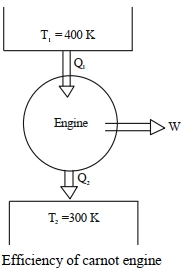
Work done by a Carnot engine operating between temperatures $127^{\circ}C$ and $27^{\circ}C$ is $2\,kJ$. The amount of heat transferred to the engine by the source is $........\,kJ$.
A
$4$
B
$2$
C
$8$
D
$2.67$
Solution
(C) The efficiency $\eta$ of a Carnot engine is given by $\eta = 1 - \frac{T_2}{T_1}$,where $T_1$ is the temperature of the source and $T_2$ is the temperature of the sink.
Given temperatures are $T_1 = 127^{\circ}C = 127 + 273 = 400\,K$ and $T_2 = 27^{\circ}C = 27 + 273 = 300\,K$.
Efficiency $\eta = 1 - \frac{300}{400} = 1 - 0.75 = 0.25$.
Also,efficiency is defined as $\eta = \frac{W}{Q_1}$,where $W$ is the work done and $Q_1$ is the heat absorbed from the source.
Given $W = 2\,kJ$,we have $0.25 = \frac{2\,kJ}{Q_1}$.
Therefore,$Q_1 = \frac{2}{0.25} = 8\,kJ$.
Given temperatures are $T_1 = 127^{\circ}C = 127 + 273 = 400\,K$ and $T_2 = 27^{\circ}C = 27 + 273 = 300\,K$.
Efficiency $\eta = 1 - \frac{300}{400} = 1 - 0.75 = 0.25$.
Also,efficiency is defined as $\eta = \frac{W}{Q_1}$,where $W$ is the work done and $Q_1$ is the heat absorbed from the source.
Given $W = 2\,kJ$,we have $0.25 = \frac{2\,kJ}{Q_1}$.
Therefore,$Q_1 = \frac{2}{0.25} = 8\,kJ$.
0 likes
View Solution160
MediumMCQ
An engine operating between the boiling and freezing points of water will have:
$1.$ Efficiency more than $27 \%$
$2.$ Efficiency less than the efficiency of a Carnot engine operating between the same two temperatures.
$3.$ Efficiency equal to $27 \%$
$4.$ Efficiency less than $27 \%$
$1.$ Efficiency more than $27 \%$
$2.$ Efficiency less than the efficiency of a Carnot engine operating between the same two temperatures.
$3.$ Efficiency equal to $27 \%$
$4.$ Efficiency less than $27 \%$
A
$2$ and $4$ only
B
$2$ and $3$ only
C
$1$ and $2$ only
D
$3$ and $4$ only
Solution
(A) The temperatures are $T_1 = 373 \text{ K}$ (boiling point) and $T_2 = 273 \text{ K}$ (freezing point).
The efficiency of a Carnot engine is given by $\eta = 1 - \frac{T_2}{T_1} = 1 - \frac{273}{373} \approx 0.268$ or $26.8 \%$.
Any real engine operating between these two temperatures must have an efficiency less than the Carnot efficiency $(\eta < 26.8 \%)$.
Therefore,the efficiency is less than $26.8 \%$,which implies it is less than $27 \%$.
Thus,statements $2$ and $4$ are correct.
The efficiency of a Carnot engine is given by $\eta = 1 - \frac{T_2}{T_1} = 1 - \frac{273}{373} \approx 0.268$ or $26.8 \%$.
Any real engine operating between these two temperatures must have an efficiency less than the Carnot efficiency $(\eta < 26.8 \%)$.
Therefore,the efficiency is less than $26.8 \%$,which implies it is less than $27 \%$.
Thus,statements $2$ and $4$ are correct.
0 likes
View Solution161
MediumMCQ
$A$ Carnot engine has an efficiency of $50\%$ when its source is at a temperature $327^{\circ}C$. The temperature of the sink is $.........^{\circ}C$.
A
$200$
B
$27$
C
$15$
D
$100$
Solution
(B) The efficiency of a Carnot engine is given by the formula:
$\eta = 1 - \frac{T_{\text{sink}}}{T_{\text{source}}}$
Given efficiency $\eta = 50\% = 0.5$.
The temperature of the source $T_{\text{source}} = 327^{\circ}C = 327 + 273 = 600\,K$.
Substituting the values into the formula:
$0.5 = 1 - \frac{T_{\text{sink}}}{600}$
$\frac{T_{\text{sink}}}{600} = 1 - 0.5 = 0.5$
$T_{\text{sink}} = 0.5 \times 600 = 300\,K$.
To convert the temperature back to Celsius:
$T_{\text{sink}}(^{\circ}C) = 300 - 273 = 27^{\circ}C$.
$\eta = 1 - \frac{T_{\text{sink}}}{T_{\text{source}}}$
Given efficiency $\eta = 50\% = 0.5$.
The temperature of the source $T_{\text{source}} = 327^{\circ}C = 327 + 273 = 600\,K$.
Substituting the values into the formula:
$0.5 = 1 - \frac{T_{\text{sink}}}{600}$
$\frac{T_{\text{sink}}}{600} = 1 - 0.5 = 0.5$
$T_{\text{sink}} = 0.5 \times 600 = 300\,K$.
To convert the temperature back to Celsius:
$T_{\text{sink}}(^{\circ}C) = 300 - 273 = 27^{\circ}C$.
0 likes
View Solution162
MediumMCQ
$A$ Carnot engine $(E)$ is working between two temperatures $473 \ K$ and $273 \ K$. In a new system,two engines are used: engine $E_1$ works between $473 \ K$ and $373 \ K$,and engine $E_2$ works between $373 \ K$ and $273 \ K$. If $\eta_{12}$,$\eta_1$,and $\eta_2$ are the efficiencies of the engines $E$,$E_1$,and $E_2$ respectively,then:
A
$\eta_{12} < \eta_1 + \eta_2$
B
$\eta_{12} = \eta_1 \eta_2$
C
$\eta_{12} = \eta_1 + \eta_2$
D
$\eta_{12} \geq \eta_1 + \eta_2$
Solution
(A) The efficiency of a Carnot engine is given by $\eta = 1 - \frac{T_L}{T_H}$.
For engine $E$: $\eta_{12} = 1 - \frac{273}{473} = \frac{200}{473} \approx 0.423$.
For engine $E_1$: $\eta_1 = 1 - \frac{373}{473} = \frac{100}{473} \approx 0.211$.
For engine $E_2$: $\eta_2 = 1 - \frac{273}{373} = \frac{100}{373} \approx 0.268$.
Calculating the sum: $\eta_1 + \eta_2 = 0.211 + 0.268 = 0.479$.
Comparing the values: $0.423 < 0.479$,therefore $\eta_{12} < \eta_1 + \eta_2$.
For engine $E$: $\eta_{12} = 1 - \frac{273}{473} = \frac{200}{473} \approx 0.423$.
For engine $E_1$: $\eta_1 = 1 - \frac{373}{473} = \frac{100}{473} \approx 0.211$.
For engine $E_2$: $\eta_2 = 1 - \frac{273}{373} = \frac{100}{373} \approx 0.268$.
Calculating the sum: $\eta_1 + \eta_2 = 0.211 + 0.268 = 0.479$.
Comparing the values: $0.423 < 0.479$,therefore $\eta_{12} < \eta_1 + \eta_2$.
0 likes
View Solution163
MediumMCQ
An engine operating between temperatures $T_1$ and $T_2$ has efficiency $\eta = \frac{1}{5}$. When $T_2$ is lowered by $45 \ K$,its efficiency becomes $\eta' = \frac{1}{2}$. Temperatures $T_1$ and $T_2$ are respectively:
A
$100 \ K, 70 \ K$
B
$160 \ K, 120 \ K$
C
$140 \ K, 110 \ K$
D
$150 \ K, 120 \ K$
Solution
(D) The efficiency of a Carnot engine is given by $\eta = 1 - \frac{T_2}{T_1}$.
Given $\eta = \frac{1}{5}$,we have $\frac{1}{5} = 1 - \frac{T_2}{T_1}$,which implies $\frac{T_2}{T_1} = \frac{4}{5}$ or $T_2 = 0.8 T_1$.
When $T_2$ is lowered by $45 \ K$,the new temperature is $T_2' = T_2 - 45$.
The new efficiency is $\eta' = \frac{1}{2}$,so $\frac{1}{2} = 1 - \frac{T_2 - 45}{T_1}$.
This simplifies to $\frac{T_2 - 45}{T_1} = \frac{1}{2}$,or $T_2 - 45 = 0.5 T_1$.
Substitute $T_2 = 0.8 T_1$ into the equation: $0.8 T_1 - 45 = 0.5 T_1$.
$0.3 T_1 = 45$,which gives $T_1 = \frac{45}{0.3} = 150 \ K$.
Now,find $T_2$: $T_2 = 0.8 \times 150 = 120 \ K$.
Thus,the temperatures are $150 \ K$ and $120 \ K$.
Given $\eta = \frac{1}{5}$,we have $\frac{1}{5} = 1 - \frac{T_2}{T_1}$,which implies $\frac{T_2}{T_1} = \frac{4}{5}$ or $T_2 = 0.8 T_1$.
When $T_2$ is lowered by $45 \ K$,the new temperature is $T_2' = T_2 - 45$.
The new efficiency is $\eta' = \frac{1}{2}$,so $\frac{1}{2} = 1 - \frac{T_2 - 45}{T_1}$.
This simplifies to $\frac{T_2 - 45}{T_1} = \frac{1}{2}$,or $T_2 - 45 = 0.5 T_1$.
Substitute $T_2 = 0.8 T_1$ into the equation: $0.8 T_1 - 45 = 0.5 T_1$.
$0.3 T_1 = 45$,which gives $T_1 = \frac{45}{0.3} = 150 \ K$.
Now,find $T_2$: $T_2 = 0.8 \times 150 = 120 \ K$.
Thus,the temperatures are $150 \ K$ and $120 \ K$.
0 likes
View Solution164
MediumMCQ
$A$ Carnot engine has an efficiency of $\frac{1}{6}$. When the temperature of the sink is lowered by $57 \ K$,its efficiency becomes $\frac{1}{3}$. The temperature of the source is: (in $K$)
A
$171$
B
$399$
C
$342$
D
$285$
Solution
(C) The efficiency $\eta$ of a Carnot engine is given by $\eta = 1 - \frac{T_2}{T_1}$,where $T_1$ is the source temperature and $T_2$ is the sink temperature.
Case $1$: $\eta_1 = \frac{1}{6} = 1 - \frac{T_2}{T_1} \implies \frac{T_2}{T_1} = 1 - \frac{1}{6} = \frac{5}{6} \implies T_2 = \frac{5}{6} T_1$.
Case $2$: $\eta_2 = \frac{1}{3} = 1 - \frac{T_2 - 57}{T_1} \implies \frac{T_2 - 57}{T_1} = 1 - \frac{1}{3} = \frac{2}{3} \implies T_2 - 57 = \frac{2}{3} T_1$.
Substitute $T_2 = \frac{5}{6} T_1$ into the second equation:
$\frac{5}{6} T_1 - 57 = \frac{2}{3} T_1$
$\frac{5}{6} T_1 - \frac{4}{6} T_1 = 57$
$\frac{1}{6} T_1 = 57$
$T_1 = 57 \times 6 = 342 \ K$.
Thus,the temperature of the source is $342 \ K$.
Case $1$: $\eta_1 = \frac{1}{6} = 1 - \frac{T_2}{T_1} \implies \frac{T_2}{T_1} = 1 - \frac{1}{6} = \frac{5}{6} \implies T_2 = \frac{5}{6} T_1$.
Case $2$: $\eta_2 = \frac{1}{3} = 1 - \frac{T_2 - 57}{T_1} \implies \frac{T_2 - 57}{T_1} = 1 - \frac{1}{3} = \frac{2}{3} \implies T_2 - 57 = \frac{2}{3} T_1$.
Substitute $T_2 = \frac{5}{6} T_1$ into the second equation:
$\frac{5}{6} T_1 - 57 = \frac{2}{3} T_1$
$\frac{5}{6} T_1 - \frac{4}{6} T_1 = 57$
$\frac{1}{6} T_1 = 57$
$T_1 = 57 \times 6 = 342 \ K$.
Thus,the temperature of the source is $342 \ K$.
0 likes
View Solution165
EasyMCQ
$A$ Carnot heat engine has an efficiency of $20 \%$. The energy is supplied to the engine at the rate of $2 \text{ kW}$. The output power of the engine is (in $\text{ W}$)
A
$300$
B
$400$
C
$500$
D
$600$
Solution
(B) The efficiency $(\eta)$ of a heat engine is defined as the ratio of the output power $(P_{\text{out}})$ to the input power $(P_{\text{in}})$.
$\eta = \frac{P_{\text{out}}}{P_{\text{in}}}$
Given,$\eta = 20 \% = 0.20$ and $P_{\text{in}} = 2 \text{ kW} = 2000 \text{ W}$.
Substituting the values into the formula:
$0.20 = \frac{P_{\text{out}}}{2000 \text{ W}}$
$P_{\text{out}} = 0.20 \times 2000 \text{ W} = 400 \text{ W}$.
Therefore,the output power of the engine is $400 \text{ W}$.
$\eta = \frac{P_{\text{out}}}{P_{\text{in}}}$
Given,$\eta = 20 \% = 0.20$ and $P_{\text{in}} = 2 \text{ kW} = 2000 \text{ W}$.
Substituting the values into the formula:
$0.20 = \frac{P_{\text{out}}}{2000 \text{ W}}$
$P_{\text{out}} = 0.20 \times 2000 \text{ W} = 400 \text{ W}$.
Therefore,the output power of the engine is $400 \text{ W}$.
0 likes
View Solution166
MediumMCQ
$A$ diatomic ideal gas is used in a Carnot engine as a working substance. If during the adiabatic expansion part of the cycle,the volume of the gas increases from $V$ to $32V$,the efficiency of the engine is:
A
$0.25$
B
$0.5$
C
$0.75$
D
$0.9$
Solution
(C) For an adiabatic process,the relationship between temperature $T$ and volume $V$ is given by $TV^{\gamma-1} = \text{constant}$.
Thus,$T_H V_1^{\gamma-1} = T_C V_2^{\gamma-1}$,where $T_H$ is the source temperature and $T_C$ is the sink temperature.
Given that the gas is diatomic,the adiabatic index $\gamma = 1.4$.
The volume changes from $V_1 = V$ to $V_2 = 32V$.
Substituting these values:
$\frac{T_C}{T_H} = \left(\frac{V_1}{V_2}\right)^{\gamma-1} = \left(\frac{V}{32V}\right)^{1.4-1} = \left(\frac{1}{32}\right)^{0.4}$.
Since $32 = 2^5$,we have $\left(\frac{1}{2^5}\right)^{0.4} = \left(\frac{1}{2^5}\right)^{2/5} = \left(\frac{1}{2}\right)^2 = \frac{1}{4} = 0.25$.
The efficiency of the Carnot engine is $\eta = 1 - \frac{T_C}{T_H}$.
$\eta = 1 - 0.25 = 0.75$.
Thus,$T_H V_1^{\gamma-1} = T_C V_2^{\gamma-1}$,where $T_H$ is the source temperature and $T_C$ is the sink temperature.
Given that the gas is diatomic,the adiabatic index $\gamma = 1.4$.
The volume changes from $V_1 = V$ to $V_2 = 32V$.
Substituting these values:
$\frac{T_C}{T_H} = \left(\frac{V_1}{V_2}\right)^{\gamma-1} = \left(\frac{V}{32V}\right)^{1.4-1} = \left(\frac{1}{32}\right)^{0.4}$.
Since $32 = 2^5$,we have $\left(\frac{1}{2^5}\right)^{0.4} = \left(\frac{1}{2^5}\right)^{2/5} = \left(\frac{1}{2}\right)^2 = \frac{1}{4} = 0.25$.
The efficiency of the Carnot engine is $\eta = 1 - \frac{T_C}{T_H}$.
$\eta = 1 - 0.25 = 0.75$.
0 likes
View Solution167
EasyMCQ
$A$ Carnot engine,whose efficiency is $40 \%$,takes heat from a source maintained at a temperature of $600 \ K$. If it is desired to have an efficiency of $60 \%$,then the intake temperature for the same exhaust (sink) temperature should be: (in $K$)
A
$1800$
B
$1200$
C
$900$
D
$600$
Solution
(C) For a Carnot engine,the efficiency $\eta$ is given by $\eta = 1 - \frac{T_L}{T_H}$,where $T_L$ is the sink temperature and $T_H$ is the source temperature.
Given $\eta_1 = 40 \% = 0.4$ and $T_{H1} = 600 \ K$:
$0.4 = 1 - \frac{T_L}{600}$
$\frac{T_L}{600} = 1 - 0.4 = 0.6$
$T_L = 0.6 \times 600 = 360 \ K$.
Now,for the desired efficiency $\eta_2 = 60 \% = 0.6$ with the same sink temperature $T_L = 360 \ K$:
$0.6 = 1 - \frac{360}{T_{H2}}$
$\frac{360}{T_{H2}} = 1 - 0.6 = 0.4$
$T_{H2} = \frac{360}{0.4} = 900 \ K$.
Given $\eta_1 = 40 \% = 0.4$ and $T_{H1} = 600 \ K$:
$0.4 = 1 - \frac{T_L}{600}$
$\frac{T_L}{600} = 1 - 0.4 = 0.6$
$T_L = 0.6 \times 600 = 360 \ K$.
Now,for the desired efficiency $\eta_2 = 60 \% = 0.6$ with the same sink temperature $T_L = 360 \ K$:
$0.6 = 1 - \frac{360}{T_{H2}}$
$\frac{360}{T_{H2}} = 1 - 0.6 = 0.4$
$T_{H2} = \frac{360}{0.4} = 900 \ K$.
0 likes
View Solution168
EasyMCQ
$A$ Carnot cycle operating between $T_H = 600 \ K$ and $T_C = 300 \ K$ produces $1.5 \ kJ$ of mechanical work per cycle. The heat transferred to the engine by the reservoir is: (in $kJ$)
A
$2.5$
B
$3.0$
C
$3.5$
D
$4.0$
Solution
(B) The efficiency $(\eta)$ of a Carnot engine is given by the formula: $\eta = 1 - \frac{T_C}{T_H}$.
Substituting the given values $T_H = 600 \ K$ and $T_C = 300 \ K$:
$\eta = 1 - \frac{300}{600} = 1 - 0.5 = 0.5$.
Efficiency is also defined as the ratio of work done $(W)$ to the heat absorbed from the source $(Q)$:
$\eta = \frac{W}{Q}$.
Given $W = 1.5 \ kJ$,we can solve for $Q$:
$0.5 = \frac{1.5}{Q}$.
$Q = \frac{1.5}{0.5} = 3.0 \ kJ$.
Therefore,the heat transferred to the engine is $3.0 \ kJ$.
Substituting the given values $T_H = 600 \ K$ and $T_C = 300 \ K$:
$\eta = 1 - \frac{300}{600} = 1 - 0.5 = 0.5$.
Efficiency is also defined as the ratio of work done $(W)$ to the heat absorbed from the source $(Q)$:
$\eta = \frac{W}{Q}$.
Given $W = 1.5 \ kJ$,we can solve for $Q$:
$0.5 = \frac{1.5}{Q}$.
$Q = \frac{1.5}{0.5} = 3.0 \ kJ$.
Therefore,the heat transferred to the engine is $3.0 \ kJ$.
0 likes
View Solution169
MediumMCQ
$A$ heat engine operating between temperatures $T_1$ and $T_2$ has an efficiency of $\frac{1}{6}$. When $T_2$ is lowered by $62 \ K$,its efficiency increases to $\frac{1}{3}$. Then $T_1$ and $T_2$ respectively are:
A
$372 \ K, 310 \ K$
B
$372 \ K, 330 \ K$
C
$330 \ K, 268 \ K$
D
$310 \ K, 248 \ K$
Solution
(A) The efficiency of a Carnot engine is given by $\eta = 1 - \frac{T_2}{T_1}$.
Given $\eta_1 = \frac{1}{6}$,we have $\frac{1}{6} = 1 - \frac{T_2}{T_1}$,which implies $\frac{T_2}{T_1} = \frac{5}{6}$,or $T_2 = \frac{5}{6} T_1$ (Equation $i$).
When $T_2$ is lowered by $62 \ K$,the new temperature is $(T_2 - 62) \ K$. The new efficiency is $\eta_2 = \frac{1}{3}$.
Thus,$\frac{1}{3} = 1 - \frac{T_2 - 62}{T_1}$.
Rearranging gives $\frac{T_2 - 62}{T_1} = 1 - \frac{1}{3} = \frac{2}{3}$.
Substituting $T_2 = \frac{5}{6} T_1$ into this equation:
$\frac{\frac{5}{6} T_1 - 62}{T_1} = \frac{2}{3}$.
$\frac{5}{6} - \frac{62}{T_1} = \frac{2}{3}$.
$\frac{62}{T_1} = \frac{5}{6} - \frac{2}{3} = \frac{5-4}{6} = \frac{1}{6}$.
Therefore,$T_1 = 62 \times 6 = 372 \ K$.
Now,$T_2 = \frac{5}{6} \times 372 = 310 \ K$.
Given $\eta_1 = \frac{1}{6}$,we have $\frac{1}{6} = 1 - \frac{T_2}{T_1}$,which implies $\frac{T_2}{T_1} = \frac{5}{6}$,or $T_2 = \frac{5}{6} T_1$ (Equation $i$).
When $T_2$ is lowered by $62 \ K$,the new temperature is $(T_2 - 62) \ K$. The new efficiency is $\eta_2 = \frac{1}{3}$.
Thus,$\frac{1}{3} = 1 - \frac{T_2 - 62}{T_1}$.
Rearranging gives $\frac{T_2 - 62}{T_1} = 1 - \frac{1}{3} = \frac{2}{3}$.
Substituting $T_2 = \frac{5}{6} T_1$ into this equation:
$\frac{\frac{5}{6} T_1 - 62}{T_1} = \frac{2}{3}$.
$\frac{5}{6} - \frac{62}{T_1} = \frac{2}{3}$.
$\frac{62}{T_1} = \frac{5}{6} - \frac{2}{3} = \frac{5-4}{6} = \frac{1}{6}$.
Therefore,$T_1 = 62 \times 6 = 372 \ K$.
Now,$T_2 = \frac{5}{6} \times 372 = 310 \ K$.
0 likes
View Solution170
EasyMCQ
The first operation involved in a Carnot cycle is
A
isothermal expansion.
B
adiabatic expansion.
C
isothermal compression.
D
adiabatic compression.
Solution
(A) The Carnot cycle consists of four reversible processes:
$1$. Isothermal expansion: The gas expands at a constant high temperature $T_H$ by absorbing heat $Q_H$ from the source.
$2$. Adiabatic expansion: The gas expands further without any heat exchange,and its temperature drops to $T_L$.
$3$. Isothermal compression: The gas is compressed at a constant low temperature $T_L$ while rejecting heat $Q_L$ to the sink.
$4$. Adiabatic compression: The gas is compressed back to its initial state without heat exchange,and its temperature rises back to $T_H$.
Therefore,the first operation is isothermal expansion.
$1$. Isothermal expansion: The gas expands at a constant high temperature $T_H$ by absorbing heat $Q_H$ from the source.
$2$. Adiabatic expansion: The gas expands further without any heat exchange,and its temperature drops to $T_L$.
$3$. Isothermal compression: The gas is compressed at a constant low temperature $T_L$ while rejecting heat $Q_L$ to the sink.
$4$. Adiabatic compression: The gas is compressed back to its initial state without heat exchange,and its temperature rises back to $T_H$.
Therefore,the first operation is isothermal expansion.
0 likes
View Solution171
MediumMCQ
$A$ Carnot engine with efficiency $50 \%$ takes heat from a source at $600 \ K$. To increase the efficiency to $70 \%$,keeping the temperature of the sink same,the new temperature of the source will be (in $K$)
A
$360$
B
$1000$
C
$900$
D
$300$
Solution
(B) The efficiency of a Carnot engine is given by $\eta = 1 - \frac{T_C}{T_H}$.
Given initial efficiency $\eta_1 = 50 \% = 0.5$ and source temperature $T_{H1} = 600 \ K$.
$0.5 = 1 - \frac{T_C}{600} \implies \frac{T_C}{600} = 0.5 \implies T_C = 300 \ K$.
Now,the efficiency is increased to $\eta_2 = 70 \% = 0.7$ while keeping the sink temperature $T_C = 300 \ K$ constant.
$0.7 = 1 - \frac{300}{T_{H2}}$.
$\frac{300}{T_{H2}} = 1 - 0.7 = 0.3$.
$T_{H2} = \frac{300}{0.3} = 1000 \ K$.
Thus,the new temperature of the source is $1000 \ K$.
Given initial efficiency $\eta_1 = 50 \% = 0.5$ and source temperature $T_{H1} = 600 \ K$.
$0.5 = 1 - \frac{T_C}{600} \implies \frac{T_C}{600} = 0.5 \implies T_C = 300 \ K$.
Now,the efficiency is increased to $\eta_2 = 70 \% = 0.7$ while keeping the sink temperature $T_C = 300 \ K$ constant.
$0.7 = 1 - \frac{300}{T_{H2}}$.
$\frac{300}{T_{H2}} = 1 - 0.7 = 0.3$.
$T_{H2} = \frac{300}{0.3} = 1000 \ K$.
Thus,the new temperature of the source is $1000 \ K$.
0 likes
View Solution172
DifficultMCQ
$A$ Carnot engine has the same efficiency between $(i)$ $100 \ K$ and $600 \ K$ and (ii) $T \ K$ and $960 \ K$. The temperature $T$ in kelvin of the sink is
A
$120$
B
$160$
C
$240$
D
$320$
Solution
(B) The efficiency of a Carnot engine is given by $\eta = 1 - \frac{T_C}{T_H}$.
For case $(i)$,the sink temperature $T_C = 100 \ K$ and the source temperature $T_H = 600 \ K$.
Therefore,$\eta_1 = 1 - \frac{100}{600} = 1 - \frac{1}{6} = \frac{5}{6}$.
For case $(ii)$,the sink temperature $T_C = T \ K$ and the source temperature $T_H = 960 \ K$.
Therefore,$\eta_2 = 1 - \frac{T}{960}$.
Since the efficiency is the same in both cases,$\eta_1 = \eta_2$.
$\frac{5}{6} = 1 - \frac{T}{960}$.
$\frac{T}{960} = 1 - \frac{5}{6} = \frac{1}{6}$.
$T = \frac{960}{6} = 160 \ K$.
For case $(i)$,the sink temperature $T_C = 100 \ K$ and the source temperature $T_H = 600 \ K$.
Therefore,$\eta_1 = 1 - \frac{100}{600} = 1 - \frac{1}{6} = \frac{5}{6}$.
For case $(ii)$,the sink temperature $T_C = T \ K$ and the source temperature $T_H = 960 \ K$.
Therefore,$\eta_2 = 1 - \frac{T}{960}$.
Since the efficiency is the same in both cases,$\eta_1 = \eta_2$.
$\frac{5}{6} = 1 - \frac{T}{960}$.
$\frac{T}{960} = 1 - \frac{5}{6} = \frac{1}{6}$.
$T = \frac{960}{6} = 160 \ K$.
0 likes
View Solution173
MediumMCQ
$A$ Carnot engine operates with a source at $227^{\circ}C$ and a sink at $27^{\circ}C$. If the source supplies $50 \ kJ$ of heat energy,the work done by the engine is (in $kJ$)
A
$2$
B
$5$
C
$10$
D
$20$
Solution
(D) The efficiency of a Carnot engine is given by the formula: $\eta = 1 - \frac{T_2}{T_1}$
Here,the temperature of the source $T_1 = 227^{\circ}C = 227 + 273 = 500 \ K$.
The temperature of the sink $T_2 = 27^{\circ}C = 27 + 273 = 300 \ K$.
Substituting these values: $\eta = 1 - \frac{300}{500} = 1 - 0.6 = 0.4$ or $\frac{2}{5}$.
We know that efficiency $\eta = \frac{W}{Q_1}$,where $W$ is the work done and $Q_1$ is the heat supplied.
Given $Q_1 = 50 \ kJ$,we have $W = \eta \times Q_1$.
$W = 0.4 \times 50 \ kJ = 20 \ kJ$.
Here,the temperature of the source $T_1 = 227^{\circ}C = 227 + 273 = 500 \ K$.
The temperature of the sink $T_2 = 27^{\circ}C = 27 + 273 = 300 \ K$.
Substituting these values: $\eta = 1 - \frac{300}{500} = 1 - 0.6 = 0.4$ or $\frac{2}{5}$.
We know that efficiency $\eta = \frac{W}{Q_1}$,where $W$ is the work done and $Q_1$ is the heat supplied.
Given $Q_1 = 50 \ kJ$,we have $W = \eta \times Q_1$.
$W = 0.4 \times 50 \ kJ = 20 \ kJ$.
0 likes
View Solution174
MediumMCQ
For which combination of working temperatures,the efficiency of a 'Carnot engine' is the least?
A
$60 \ K, 40 \ K$
B
$40 \ K, 20 \ K$
C
$80 \ K, 60 \ K$
D
$100 \ K, 80 \ K$
Solution
(D) The efficiency $\eta$ of a Carnot engine is given by the formula: $\eta = 1 - \frac{T_2}{T_1}$,where $T_1$ is the source temperature and $T_2$ is the sink temperature.
For option $A$ $(T_1 = 60 \ K, T_2 = 40 \ K)$: $\eta = 1 - \frac{40}{60} = 1 - 0.667 = 0.333$.
For option $B$ $(T_1 = 40 \ K, T_2 = 20 \ K)$: $\eta = 1 - \frac{20}{40} = 1 - 0.5 = 0.5$.
For option $C$ $(T_1 = 80 \ K, T_2 = 60 \ K)$: $\eta = 1 - \frac{60}{80} = 1 - 0.75 = 0.25$.
For option $D$ $(T_1 = 100 \ K, T_2 = 80 \ K)$: $\eta = 1 - \frac{80}{100} = 1 - 0.8 = 0.2$.
Comparing the values,the efficiency is the least for the combination $T_1 = 100 \ K$ and $T_2 = 80 \ K$.
For option $A$ $(T_1 = 60 \ K, T_2 = 40 \ K)$: $\eta = 1 - \frac{40}{60} = 1 - 0.667 = 0.333$.
For option $B$ $(T_1 = 40 \ K, T_2 = 20 \ K)$: $\eta = 1 - \frac{20}{40} = 1 - 0.5 = 0.5$.
For option $C$ $(T_1 = 80 \ K, T_2 = 60 \ K)$: $\eta = 1 - \frac{60}{80} = 1 - 0.75 = 0.25$.
For option $D$ $(T_1 = 100 \ K, T_2 = 80 \ K)$: $\eta = 1 - \frac{80}{100} = 1 - 0.8 = 0.2$.
Comparing the values,the efficiency is the least for the combination $T_1 = 100 \ K$ and $T_2 = 80 \ K$.
0 likes
View Solution175
MediumMCQ
The efficiency of a Carnot engine which operates between the two temperatures $T_{1} = 500 \ K$ and $T_{2} = 300 \ K$ is: (in $\%$)
A
$50$
B
$25$
C
$75$
D
$40$
Solution
(D) The efficiency $\eta$ of a Carnot engine is given by the formula: $\eta = \left(1 - \frac{T_{2}}{T_{1}}\right) \times 100 \%$.
Given: $T_{1} = 500 \ K$ (source temperature) and $T_{2} = 300 \ K$ (sink temperature).
Substituting the values into the formula:
$\eta = \left(1 - \frac{300}{500}\right) \times 100 \%$.
$\eta = \left(1 - 0.6\right) \times 100 \%$.
$\eta = 0.4 \times 100 \% = 40 \%$.
Thus,the efficiency of the Carnot engine is $40 \%$.
Given: $T_{1} = 500 \ K$ (source temperature) and $T_{2} = 300 \ K$ (sink temperature).
Substituting the values into the formula:
$\eta = \left(1 - \frac{300}{500}\right) \times 100 \%$.
$\eta = \left(1 - 0.6\right) \times 100 \%$.
$\eta = 0.4 \times 100 \% = 40 \%$.
Thus,the efficiency of the Carnot engine is $40 \%$.
0 likes
View Solution176
MediumMCQ
What is the source temperature of the Carnot engine required to get $70 \%$ efficiency (in $^{\circ}C$)? Given sink temperature $= 27^{\circ}C$.
A
$1000$
B
$90$
C
$270$
D
$727$
Solution
(D) Given,efficiency,$\eta = 70 \% = 0.7$.
Sink temperature,$T_2 = 27^{\circ}C = 273 + 27 = 300 \ K$.
The efficiency of a Carnot engine is given by the formula: $\eta = 1 - \frac{T_2}{T_1}$.
Substituting the given values: $0.7 = 1 - \frac{300}{T_1}$.
Rearranging the terms: $\frac{300}{T_1} = 1 - 0.7 = 0.3$.
Solving for source temperature $T_1$: $T_1 = \frac{300}{0.3} = 1000 \ K$.
Converting the temperature back to Celsius: $T_1 = 1000 - 273 = 727^{\circ}C$.
Therefore,the source temperature required is $727^{\circ}C$.
Sink temperature,$T_2 = 27^{\circ}C = 273 + 27 = 300 \ K$.
The efficiency of a Carnot engine is given by the formula: $\eta = 1 - \frac{T_2}{T_1}$.
Substituting the given values: $0.7 = 1 - \frac{300}{T_1}$.
Rearranging the terms: $\frac{300}{T_1} = 1 - 0.7 = 0.3$.
Solving for source temperature $T_1$: $T_1 = \frac{300}{0.3} = 1000 \ K$.
Converting the temperature back to Celsius: $T_1 = 1000 - 273 = 727^{\circ}C$.
Therefore,the source temperature required is $727^{\circ}C$.
0 likes
View Solution177
MediumMCQ
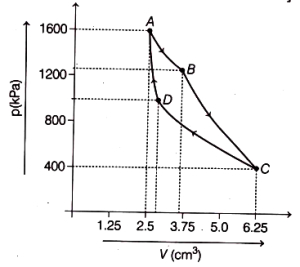
The $p-V$ diagram of a Carnot's engine is shown in the graph below. The engine uses $1$ mole of an ideal gas as the working substance. From the graph,the area enclosed by the $p-V$ diagram is equal to the net work done by the engine. Given that the heat supplied to the gas is $8000 \ J$,calculate the net work done by the engine. (Note: The efficiency of a Carnot engine is $\eta = 1 - \frac{T_2}{T_1} = \frac{W}{Q_1}$) (in $J$)
A
$1200$
B
$2000$
C
$3000$
D
$1000$
Solution
(C) The efficiency $\eta$ of a Carnot engine is given by $\eta = 1 - \frac{T_2}{T_1} = \frac{W}{Q_1}$.
From the $p-V$ diagram,the process $AB$ is isothermal expansion at $T_1$ and $CD$ is isothermal compression at $T_2$.
For an isothermal process,$pV = \text{constant}$.
At point $A$: $p_A = 1600 \ kPa$,$V_A = 2.5 \ cm^3$. So,$p_A V_A = 1600 \times 2.5 = 4000$.
At point $C$: $p_C = 400 \ kPa$,$V_C = 6.25 \ cm^3$. So,$p_C V_C = 400 \times 6.25 = 2500$.
Since $pV = \mu RT$,we have $\frac{T_2}{T_1} = \frac{p_C V_C}{p_A V_A} = \frac{2500}{4000} = \frac{5}{8} = 0.625$.
The efficiency is $\eta = 1 - 0.625 = 0.375$.
Given heat supplied $Q_1 = 8000 \ J$.
Work done $W = \eta \times Q_1 = 0.375 \times 8000 = 3000 \ J$.
From the $p-V$ diagram,the process $AB$ is isothermal expansion at $T_1$ and $CD$ is isothermal compression at $T_2$.
For an isothermal process,$pV = \text{constant}$.
At point $A$: $p_A = 1600 \ kPa$,$V_A = 2.5 \ cm^3$. So,$p_A V_A = 1600 \times 2.5 = 4000$.
At point $C$: $p_C = 400 \ kPa$,$V_C = 6.25 \ cm^3$. So,$p_C V_C = 400 \times 6.25 = 2500$.
Since $pV = \mu RT$,we have $\frac{T_2}{T_1} = \frac{p_C V_C}{p_A V_A} = \frac{2500}{4000} = \frac{5}{8} = 0.625$.
The efficiency is $\eta = 1 - 0.625 = 0.375$.
Given heat supplied $Q_1 = 8000 \ J$.
Work done $W = \eta \times Q_1 = 0.375 \times 8000 = 3000 \ J$.
0 likes
View Solution178
DifficultMCQ
$A$ number of Carnot engines are operated at identical cold reservoir temperatures $(T_{L})$. However,their hot reservoir temperatures are kept different. $A$ graph of the efficiency of the engines versus hot reservoir temperature $(T_{H})$ is plotted. The correct graphical representation is
A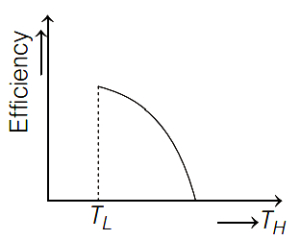
B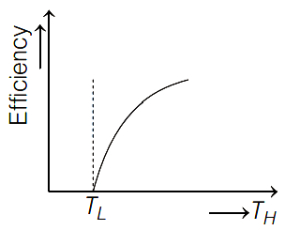
C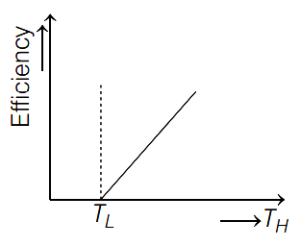
D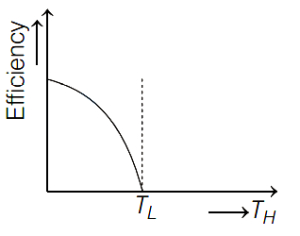
Solution
(B) The efficiency $(\eta)$ of a Carnot engine is given by the formula:
$\eta = 1 - \frac{T_{L}}{T_{H}}$
where $T_{L}$ is the temperature of the cold reservoir and $T_{H}$ is the temperature of the hot reservoir.
For a fixed cold reservoir temperature $T_{L}$,as the hot reservoir temperature $T_{H}$ increases,the ratio $\frac{T_{L}}{T_{H}}$ decreases.
Consequently,the efficiency $\eta = 1 - \frac{T_{L}}{T_{H}}$ increases as $T_{H}$ increases.
When $T_{H} = T_{L}$,the efficiency $\eta = 1 - \frac{T_{L}}{T_{L}} = 0$.
As $T_{H} \to \infty$,the efficiency $\eta \to 1$.
The graph of $\eta$ versus $T_{H}$ starts from $0$ at $T_{H} = T_{L}$ and increases with a decreasing slope (concave down) towards the value $1$.
This behavior is correctly represented by the graph in option $(b)$.
$\eta = 1 - \frac{T_{L}}{T_{H}}$
where $T_{L}$ is the temperature of the cold reservoir and $T_{H}$ is the temperature of the hot reservoir.
For a fixed cold reservoir temperature $T_{L}$,as the hot reservoir temperature $T_{H}$ increases,the ratio $\frac{T_{L}}{T_{H}}$ decreases.
Consequently,the efficiency $\eta = 1 - \frac{T_{L}}{T_{H}}$ increases as $T_{H}$ increases.
When $T_{H} = T_{L}$,the efficiency $\eta = 1 - \frac{T_{L}}{T_{L}} = 0$.
As $T_{H} \to \infty$,the efficiency $\eta \to 1$.
The graph of $\eta$ versus $T_{H}$ starts from $0$ at $T_{H} = T_{L}$ and increases with a decreasing slope (concave down) towards the value $1$.
This behavior is correctly represented by the graph in option $(b)$.
0 likes
View Solution179
EasyMCQ
$A$ Carnot engine takes $300$ calories of heat from a source at $500 \,K$ and rejects $150$ calories of heat to the sink. The temperature of the sink is (in $\,K$)
A
$125$
B
$250$
C
$750$
D
$1000$
Solution
(B) Given: Heat taken from source,$Q_{1} = 300$ calories; Temperature of source,$T_{1} = 500 \,K$; Heat rejected to the sink,$Q_{2} = 150$ calories.
We need to find the temperature of the sink,$T_{2}$.
For a Carnot engine,the efficiency $\eta$ is given by the ratio of heat exchange as $\eta = \frac{Q_{1} - Q_{2}}{Q_{1}}$ and also by the temperatures as $\eta = \frac{T_{1} - T_{2}}{T_{1}}$.
Equating the two expressions for efficiency:
$\frac{Q_{1} - Q_{2}}{Q_{1}} = \frac{T_{1} - T_{2}}{T_{1}}$
Substituting the given values:
$\frac{300 - 150}{300} = \frac{500 - T_{2}}{500}$
$\frac{150}{300} = 1 - \frac{T_{2}}{500}$
$\frac{1}{2} = 1 - \frac{T_{2}}{500}$
$\frac{T_{2}}{500} = 1 - \frac{1}{2}$
$\frac{T_{2}}{500} = \frac{1}{2}$
$T_{2} = 500 \times \frac{1}{2} = 250 \,K$.
Thus,the temperature of the sink is $250 \,K$.
We need to find the temperature of the sink,$T_{2}$.
For a Carnot engine,the efficiency $\eta$ is given by the ratio of heat exchange as $\eta = \frac{Q_{1} - Q_{2}}{Q_{1}}$ and also by the temperatures as $\eta = \frac{T_{1} - T_{2}}{T_{1}}$.
Equating the two expressions for efficiency:
$\frac{Q_{1} - Q_{2}}{Q_{1}} = \frac{T_{1} - T_{2}}{T_{1}}$
Substituting the given values:
$\frac{300 - 150}{300} = \frac{500 - T_{2}}{500}$
$\frac{150}{300} = 1 - \frac{T_{2}}{500}$
$\frac{1}{2} = 1 - \frac{T_{2}}{500}$
$\frac{T_{2}}{500} = 1 - \frac{1}{2}$
$\frac{T_{2}}{500} = \frac{1}{2}$
$T_{2} = 500 \times \frac{1}{2} = 250 \,K$.
Thus,the temperature of the sink is $250 \,K$.
0 likes
View Solution180
EasyMCQ
$A$ Carnot engine working between $300 \ K$ and $400 \ K$ produces $800 \ J$ of useful work. The amount of heat energy supplied to the engine from the source is: (in $J$)
A
$2400$
B
$3200$
C
$1200$
D
$3600$
Solution
(B) Given:
Temperature of source,$T_1 = 400 \ K$
Temperature of sink,$T_2 = 300 \ K$
Useful work done,$W = 800 \ J$
Efficiency of a Carnot engine is given by $\eta = 1 - \frac{T_2}{T_1}$.
Also,efficiency is defined as $\eta = \frac{W}{Q_1}$,where $Q_1$ is the heat supplied.
Equating the two,we get $1 - \frac{T_2}{T_1} = \frac{W}{Q_1}$.
Substituting the values: $1 - \frac{300}{400} = \frac{800}{Q_1}$.
$\frac{100}{400} = \frac{800}{Q_1}$.
$\frac{1}{4} = \frac{800}{Q_1}$.
$Q_1 = 800 \times 4 = 3200 \ J$.
Thus,the heat energy supplied to the engine is $3200 \ J$.
Temperature of source,$T_1 = 400 \ K$
Temperature of sink,$T_2 = 300 \ K$
Useful work done,$W = 800 \ J$
Efficiency of a Carnot engine is given by $\eta = 1 - \frac{T_2}{T_1}$.
Also,efficiency is defined as $\eta = \frac{W}{Q_1}$,where $Q_1$ is the heat supplied.
Equating the two,we get $1 - \frac{T_2}{T_1} = \frac{W}{Q_1}$.
Substituting the values: $1 - \frac{300}{400} = \frac{800}{Q_1}$.
$\frac{100}{400} = \frac{800}{Q_1}$.
$\frac{1}{4} = \frac{800}{Q_1}$.
$Q_1 = 800 \times 4 = 3200 \ J$.
Thus,the heat energy supplied to the engine is $3200 \ J$.
0 likes
View Solution181
MediumMCQ
For which combination of working temperatures of source and sink,the efficiency of Carnot's heat engine is maximum?
A
$600 \ K, 400 \ K$
B
$400 \ K, 200 \ K$
C
$500 \ K, 300 \ K$
D
$300 \ K, 100 \ K$
Solution
(D) The efficiency of a Carnot heat engine is given by the formula $\eta = 1 - \frac{T_2}{T_1}$,where $T_1$ is the temperature of the source and $T_2$ is the temperature of the sink.
For option $A$: $\eta_A = 1 - \frac{400}{600} = 1 - \frac{2}{3} = \frac{1}{3} \approx 0.333$.
For option $B$: $\eta_B = 1 - \frac{200}{400} = 1 - \frac{1}{2} = \frac{1}{2} = 0.500$.
For option $C$: $\eta_C = 1 - \frac{300}{500} = 1 - \frac{3}{5} = \frac{2}{5} = 0.400$.
For option $D$: $\eta_D = 1 - \frac{100}{300} = 1 - \frac{1}{3} = \frac{2}{3} \approx 0.667$.
Comparing the values,$\eta_D$ is the maximum efficiency.
Therefore,the correct combination is $T_1 = 300 \ K$ and $T_2 = 100 \ K$.
For option $A$: $\eta_A = 1 - \frac{400}{600} = 1 - \frac{2}{3} = \frac{1}{3} \approx 0.333$.
For option $B$: $\eta_B = 1 - \frac{200}{400} = 1 - \frac{1}{2} = \frac{1}{2} = 0.500$.
For option $C$: $\eta_C = 1 - \frac{300}{500} = 1 - \frac{3}{5} = \frac{2}{5} = 0.400$.
For option $D$: $\eta_D = 1 - \frac{100}{300} = 1 - \frac{1}{3} = \frac{2}{3} \approx 0.667$.
Comparing the values,$\eta_D$ is the maximum efficiency.
Therefore,the correct combination is $T_1 = 300 \ K$ and $T_2 = 100 \ K$.
0 likes
View Solution182
MediumMCQ
The efficiency of a Carnot heat engine is $0.5$ when the temperature of the source is $T_{1}$ and that of the sink is $T_{2}$. The efficiency of another Carnot heat engine is also $0.5$. The temperatures of the source and sink of the second engine are respectively:
A
$2 \,T_{1}, 2 \,T_{2}$
B
$2 \,T_{1}, \frac{T_{2}}{2}$
C
$T_{1}+5, \,T_{2}-5$
D
$T_{1}+10, \,T_{2}-10$
Solution
(A) The efficiency $\eta$ of a Carnot heat engine is given by the formula: $\eta = 1 - \frac{T_{2}}{T_{1}}$.
Given that $\eta = 0.5$, we have $0.5 = 1 - \frac{T_{2}}{T_{1}}$, which implies $\frac{T_{2}}{T_{1}} = 0.5$, or $T_{1} = 2T_{2}$.
For another Carnot engine to have the same efficiency of $0.5$, the ratio of the sink temperature to the source temperature must remain the same, i.e., $\frac{T_{2}'}{T_{1}'} = 0.5$.
If we multiply both the source and sink temperatures by the same factor $k$, the new efficiency is $\eta' = 1 - \frac{k T_{2}}{k T_{1}} = 1 - \frac{T_{2}}{T_{1}} = 0.5$.
Therefore, if the source temperature is $2T_{1}$ and the sink temperature is $2T_{2}$, the efficiency remains $0.5$.
Given that $\eta = 0.5$, we have $0.5 = 1 - \frac{T_{2}}{T_{1}}$, which implies $\frac{T_{2}}{T_{1}} = 0.5$, or $T_{1} = 2T_{2}$.
For another Carnot engine to have the same efficiency of $0.5$, the ratio of the sink temperature to the source temperature must remain the same, i.e., $\frac{T_{2}'}{T_{1}'} = 0.5$.
If we multiply both the source and sink temperatures by the same factor $k$, the new efficiency is $\eta' = 1 - \frac{k T_{2}}{k T_{1}} = 1 - \frac{T_{2}}{T_{1}} = 0.5$.
Therefore, if the source temperature is $2T_{1}$ and the sink temperature is $2T_{2}$, the efficiency remains $0.5$.
0 likes
View Solution183
EasyMCQ
$A$ Carnot's engine operates with a source at $127^{\circ} C$ and a sink at $27^{\circ} C$. If the source supplies $40 \ kJ$ of heat energy,the work done by the engine is (in $kJ$)
A
$30$
B
$10$
C
$4$
D
$1$
Solution
(B) The efficiency $\eta$ of a Carnot engine is given by $\eta = 1 - \frac{T_2}{T_1}$,where $T_1$ is the temperature of the source and $T_2$ is the temperature of the sink in Kelvin.
Given: $T_1 = 127^{\circ} C = 127 + 273 = 400 \ K$ and $T_2 = 27^{\circ} C = 27 + 273 = 300 \ K$.
Substituting the values: $\eta = 1 - \frac{300}{400} = 1 - 0.75 = 0.25$ or $\frac{1}{4}$.
Efficiency is also defined as $\eta = \frac{W}{Q_1}$,where $W$ is the work done and $Q_1$ is the heat supplied.
Given $Q_1 = 40 \ kJ$,we have $\frac{1}{4} = \frac{W}{40 \ kJ}$.
Therefore,$W = \frac{40}{4} \ kJ = 10 \ kJ$.
Given: $T_1 = 127^{\circ} C = 127 + 273 = 400 \ K$ and $T_2 = 27^{\circ} C = 27 + 273 = 300 \ K$.
Substituting the values: $\eta = 1 - \frac{300}{400} = 1 - 0.75 = 0.25$ or $\frac{1}{4}$.
Efficiency is also defined as $\eta = \frac{W}{Q_1}$,where $W$ is the work done and $Q_1$ is the heat supplied.
Given $Q_1 = 40 \ kJ$,we have $\frac{1}{4} = \frac{W}{40 \ kJ}$.
Therefore,$W = \frac{40}{4} \ kJ = 10 \ kJ$.
0 likes
View Solution184
DifficultMCQ
The efficiency of a heat engine that works between the temperatures where Celsius-Fahrenheit scales coincide and Kelvin-Fahrenheit scales coincide is (approximately) (in $\%$)
A
$45$
B
$35$
C
$60$
D
$50$
Solution
(C) Step $1$: Find the temperature where Celsius and Fahrenheit scales coincide.
Let the temperature be $T_1$. The relation is $\frac{C}{5} = \frac{F-32}{9}$. Setting $C = F = T_1$:
$\frac{T_1}{5} = \frac{T_1-32}{9} \Rightarrow 9T_1 = 5T_1 - 160 \Rightarrow 4T_1 = -160 \Rightarrow T_1 = -40^{\circ}C$.
In Kelvin,$T_1 = -40 + 273.15 = 233.15 \ K$.
Step $2$: Find the temperature where Kelvin and Fahrenheit scales coincide.
Let the temperature be $T_2$. The relation is $\frac{K-273.15}{5} = \frac{F-32}{9}$. Setting $K = F = T_2$:
$\frac{T_2-273.15}{5} = \frac{T_2-32}{9} \Rightarrow 9T_2 - 2458.35 = 5T_2 - 160 \Rightarrow 4T_2 = 2298.35 \Rightarrow T_2 \approx 574.59 \ K$.
Step $3$: Calculate the efficiency $\eta$ of the Carnot engine.
$\eta = 1 - \frac{T_{cold}}{T_{hot}} = 1 - \frac{233.15}{574.59} \approx 1 - 0.405 = 0.595 \approx 60 \%$.
Let the temperature be $T_1$. The relation is $\frac{C}{5} = \frac{F-32}{9}$. Setting $C = F = T_1$:
$\frac{T_1}{5} = \frac{T_1-32}{9} \Rightarrow 9T_1 = 5T_1 - 160 \Rightarrow 4T_1 = -160 \Rightarrow T_1 = -40^{\circ}C$.
In Kelvin,$T_1 = -40 + 273.15 = 233.15 \ K$.
Step $2$: Find the temperature where Kelvin and Fahrenheit scales coincide.
Let the temperature be $T_2$. The relation is $\frac{K-273.15}{5} = \frac{F-32}{9}$. Setting $K = F = T_2$:
$\frac{T_2-273.15}{5} = \frac{T_2-32}{9} \Rightarrow 9T_2 - 2458.35 = 5T_2 - 160 \Rightarrow 4T_2 = 2298.35 \Rightarrow T_2 \approx 574.59 \ K$.
Step $3$: Calculate the efficiency $\eta$ of the Carnot engine.
$\eta = 1 - \frac{T_{cold}}{T_{hot}} = 1 - \frac{233.15}{574.59} \approx 1 - 0.405 = 0.595 \approx 60 \%$.
0 likes
View Solution185
MediumMCQ
$A$ Carnot engine having efficiency $60 \%$ receives heat from a source at a temperature $600 \text{ K}$. For the same sink temperature, to increase its efficiency to $80 \%$, the temperature of the source is (in $\text{ K}$)
A
$300$
B
$900$
C
$1200$
D
$720$
Solution
(C) The efficiency of a Carnot engine is given by $\eta = 1 - \frac{T_2}{T_1}$, where $T_1$ is the source temperature and $T_2$ is the sink temperature.
For the first case: $\eta_1 = 0.60$, $T_1 = 600 \text{ K}$.
$0.60 = 1 - \frac{T_2}{600} \implies \frac{T_2}{600} = 0.40 \implies T_2 = 240 \text{ K}$.
For the second case: $\eta_2 = 0.80$, $T_2 = 240 \text{ K}$.
$0.80 = 1 - \frac{240}{T_1'} \implies \frac{240}{T_1'} = 0.20 \implies T_1' = \frac{240}{0.20} = 1200 \text{ K}$.
Thus, the new source temperature required is $1200 \text{ K}$.
For the first case: $\eta_1 = 0.60$, $T_1 = 600 \text{ K}$.
$0.60 = 1 - \frac{T_2}{600} \implies \frac{T_2}{600} = 0.40 \implies T_2 = 240 \text{ K}$.
For the second case: $\eta_2 = 0.80$, $T_2 = 240 \text{ K}$.
$0.80 = 1 - \frac{240}{T_1'} \implies \frac{240}{T_1'} = 0.20 \implies T_1' = \frac{240}{0.20} = 1200 \text{ K}$.
Thus, the new source temperature required is $1200 \text{ K}$.
0 likes
View Solution186
MediumMCQ
$A$ Carnot heat engine absorbs $600 \ J$ of heat from a source at a temperature of $127^{\circ} C$ and rejects $400 \ J$ of heat to a sink in each cycle. The temperature of the sink is (in $K$)
A
$266.7$
B
$166.7$
C
$133.3$
D
$333.3$
Solution
(A) For a Carnot engine,the ratio of heat exchanged is equal to the ratio of the absolute temperatures of the source and the sink: $\frac{Q_1}{Q_2} = \frac{T_1}{T_2}$.
Given:
Heat absorbed from source,$Q_1 = 600 \ J$.
Heat rejected to sink,$Q_2 = 400 \ J$.
Temperature of source,$T_1 = 127^{\circ} C = 127 + 273 = 400 \ K$.
Using the formula: $\frac{600}{400} = \frac{400}{T_2}$.
Simplifying the ratio: $1.5 = \frac{400}{T_2}$.
Solving for $T_2$: $T_2 = \frac{400}{1.5} = 266.67 \ K \approx 266.7 \ K$.
Given:
Heat absorbed from source,$Q_1 = 600 \ J$.
Heat rejected to sink,$Q_2 = 400 \ J$.
Temperature of source,$T_1 = 127^{\circ} C = 127 + 273 = 400 \ K$.
Using the formula: $\frac{600}{400} = \frac{400}{T_2}$.
Simplifying the ratio: $1.5 = \frac{400}{T_2}$.
Solving for $T_2$: $T_2 = \frac{400}{1.5} = 266.67 \ K \approx 266.7 \ K$.
0 likes
View Solution187
MediumMCQ
$A$ Carnot engine $A$ working between temperatures $600 \ K$ and $T$ $(T < 600 \ K)$ and another Carnot engine $B$ working between temperatures $T$ $(T > 400 \ K)$ and $400 \ K$ are connected in series. If the work done by both the engines is the same, then $T =$ (in $K$)
A
$550$
B
$500$
C
$575$
D
$525$
Solution
(B) For a Carnot engine, the efficiency $\eta$ is given by $\eta = 1 - \frac{T_{low}}{T_{high}}$.
Also, the work done $W$ is given by $W = Q_{in} \cdot \eta$, where $Q_{in}$ is the heat absorbed from the source.
For engine $A$: $W_A = Q_A \left(1 - \frac{T}{600}\right)$.
For engine $B$: $W_B = Q_B \left(1 - \frac{400}{T}\right)$.
Since the engines are in series, the heat rejected by engine $A$ is the heat absorbed by engine $B$, so $Q_B = Q_A \left(\frac{T}{600}\right)$.
Given $W_A = W_B$, we have $Q_A \left(1 - \frac{T}{600}\right) = Q_A \left(\frac{T}{600}\right) \left(1 - \frac{400}{T}\right)$.
Simplifying the equation: $1 - \frac{T}{600} = \frac{T}{600} - \frac{400}{600}$.
$1 + \frac{400}{600} = \frac{2T}{600}$.
$1 + \frac{2}{3} = \frac{T}{300} \implies \frac{5}{3} = \frac{T}{300}$.
$T = \frac{5 \times 300}{3} = 500 \ K$.
Also, the work done $W$ is given by $W = Q_{in} \cdot \eta$, where $Q_{in}$ is the heat absorbed from the source.
For engine $A$: $W_A = Q_A \left(1 - \frac{T}{600}\right)$.
For engine $B$: $W_B = Q_B \left(1 - \frac{400}{T}\right)$.
Since the engines are in series, the heat rejected by engine $A$ is the heat absorbed by engine $B$, so $Q_B = Q_A \left(\frac{T}{600}\right)$.
Given $W_A = W_B$, we have $Q_A \left(1 - \frac{T}{600}\right) = Q_A \left(\frac{T}{600}\right) \left(1 - \frac{400}{T}\right)$.
Simplifying the equation: $1 - \frac{T}{600} = \frac{T}{600} - \frac{400}{600}$.
$1 + \frac{400}{600} = \frac{2T}{600}$.
$1 + \frac{2}{3} = \frac{T}{300} \implies \frac{5}{3} = \frac{T}{300}$.
$T = \frac{5 \times 300}{3} = 500 \ K$.
0 likes
View Solution188
MediumMCQ
In a Carnot engine,if the work done during isothermal expansion is $25 \%$ more than the work done during isothermal compression,then the efficiency of the engine is: (in $\%$)
A
$10$
B
$15$
C
$20$
D
$25$
Solution
(C) In a Carnot engine,the work done during isothermal expansion $(W_{exp})$ is given by $W_{exp} = nRT_H \ln(V_2/V_1)$ and the work done during isothermal compression $(W_{comp})$ is given by $W_{comp} = nRT_L \ln(V_2/V_1)$.
Given that $W_{exp} = W_{comp} + 0.25 W_{comp} = 1.25 W_{comp}$.
Substituting the expressions,we get $nRT_H \ln(V_2/V_1) = 1.25 nRT_L \ln(V_2/V_1)$.
This simplifies to $T_H = 1.25 T_L$,or $T_L/T_H = 1/1.25 = 0.8$.
The efficiency of a Carnot engine is given by $\eta = 1 - (T_L/T_H)$.
Substituting the value,$\eta = 1 - 0.8 = 0.2$.
Thus,the efficiency is $20 \%$.
Given that $W_{exp} = W_{comp} + 0.25 W_{comp} = 1.25 W_{comp}$.
Substituting the expressions,we get $nRT_H \ln(V_2/V_1) = 1.25 nRT_L \ln(V_2/V_1)$.
This simplifies to $T_H = 1.25 T_L$,or $T_L/T_H = 1/1.25 = 0.8$.
The efficiency of a Carnot engine is given by $\eta = 1 - (T_L/T_H)$.
Substituting the value,$\eta = 1 - 0.8 = 0.2$.
Thus,the efficiency is $20 \%$.
0 likes
View Solution189
EasyMCQ
In a Carnot engine,if the absolute temperature of the source is $25 \%$ more than the absolute temperature of the sink,then the efficiency of the engine is (in $\%$)
A
$25$
B
$50$
C
$20$
D
$40$
Solution
(C) The efficiency $\eta$ of a Carnot engine is given by the formula: $\eta = 1 - \frac{T_2}{T_1}$,where $T_1$ is the temperature of the source and $T_2$ is the temperature of the sink.
Given that the source temperature $T_1$ is $25 \%$ more than the sink temperature $T_2$,we have: $T_1 = T_2 + 0.25 T_2 = 1.25 T_2$.
Substituting $T_1$ into the efficiency formula: $\eta = 1 - \frac{T_2}{1.25 T_2} = 1 - \frac{1}{1.25}$.
Since $1.25 = \frac{5}{4}$,we get: $\eta = 1 - \frac{4}{5} = \frac{1}{5}$.
Converting this to percentage: $\eta = \frac{1}{5} \times 100 \% = 20 \%$.
Given that the source temperature $T_1$ is $25 \%$ more than the sink temperature $T_2$,we have: $T_1 = T_2 + 0.25 T_2 = 1.25 T_2$.
Substituting $T_1$ into the efficiency formula: $\eta = 1 - \frac{T_2}{1.25 T_2} = 1 - \frac{1}{1.25}$.
Since $1.25 = \frac{5}{4}$,we get: $\eta = 1 - \frac{4}{5} = \frac{1}{5}$.
Converting this to percentage: $\eta = \frac{1}{5} \times 100 \% = 20 \%$.
0 likes
View Solution190
MediumMCQ
The ratio of the efficiencies of two Carnot engines $A$ and $B$ is $1.25$. The temperature difference between the source and the sink is the same in both engines. The ratio of the absolute temperatures of the sources of engines $A$ and $B$ is
A
$2: 3$
B
$2: 5$
C
$3: 4$
D
$4: 5$
Solution
(D) The efficiency of a Carnot engine is given by $\eta = 1 - \frac{T_2}{T_1} = \frac{T_1 - T_2}{T_1}$,where $T_1$ is the source temperature and $T_2$ is the sink temperature.
Let $\Delta T = T_1 - T_2$ be the temperature difference,which is constant for both engines.
Thus,$\eta = \frac{\Delta T}{T_1}$.
Given the ratio of efficiencies $\frac{\eta_A}{\eta_B} = 1.25 = \frac{5}{4}$.
Since $\eta_A = \frac{\Delta T}{T_{1A}}$ and $\eta_B = \frac{\Delta T}{T_{1B}}$,we have $\frac{\eta_A}{\eta_B} = \frac{T_{1B}}{T_{1A}} = \frac{5}{4}$.
Therefore,the ratio of the absolute temperatures of the sources $T_{1A} : T_{1B} = 4 : 5$.
Let $\Delta T = T_1 - T_2$ be the temperature difference,which is constant for both engines.
Thus,$\eta = \frac{\Delta T}{T_1}$.
Given the ratio of efficiencies $\frac{\eta_A}{\eta_B} = 1.25 = \frac{5}{4}$.
Since $\eta_A = \frac{\Delta T}{T_{1A}}$ and $\eta_B = \frac{\Delta T}{T_{1B}}$,we have $\frac{\eta_A}{\eta_B} = \frac{T_{1B}}{T_{1A}} = \frac{5}{4}$.
Therefore,the ratio of the absolute temperatures of the sources $T_{1A} : T_{1B} = 4 : 5$.
0 likes
View Solution191
MediumMCQ
The efficiency of a Carnot's heat engine is $\frac{1}{3}$. If the temperature of the source is decreased by $50 \ K$ and the temperature of the sink is increased by $25 \ K$,the efficiency of the engine becomes $\frac{3}{16}$. The initial temperature of the sink is (in $K$)
A
$325$
B
$375$
C
$350$
D
$300$
Solution
(D) The efficiency of a Carnot engine is given by $\eta = 1 - \frac{T_2}{T_1}$,where $T_1$ is the source temperature and $T_2$ is the sink temperature.
Given $\eta_1 = \frac{1}{3}$,so $1 - \frac{T_2}{T_1} = \frac{1}{3} \implies \frac{T_2}{T_1} = \frac{2}{3} \implies T_1 = 1.5 T_2$.
When the source temperature is decreased by $50 \ K$ and the sink temperature is increased by $25 \ K$,the new efficiency is $\eta_2 = \frac{3}{16}$.
Thus,$1 - \frac{T_2 + 25}{T_1 - 50} = \frac{3}{16} \implies \frac{T_2 + 25}{T_1 - 50} = \frac{13}{16}$.
Substituting $T_1 = 1.5 T_2$ into the equation:
$\frac{T_2 + 25}{1.5 T_2 - 50} = \frac{13}{16}$.
Cross-multiplying: $16(T_2 + 25) = 13(1.5 T_2 - 50)$.
$16 T_2 + 400 = 19.5 T_2 - 650$.
$1050 = 3.5 T_2$.
$T_2 = \frac{1050}{3.5} = 300 \ K$.
Given $\eta_1 = \frac{1}{3}$,so $1 - \frac{T_2}{T_1} = \frac{1}{3} \implies \frac{T_2}{T_1} = \frac{2}{3} \implies T_1 = 1.5 T_2$.
When the source temperature is decreased by $50 \ K$ and the sink temperature is increased by $25 \ K$,the new efficiency is $\eta_2 = \frac{3}{16}$.
Thus,$1 - \frac{T_2 + 25}{T_1 - 50} = \frac{3}{16} \implies \frac{T_2 + 25}{T_1 - 50} = \frac{13}{16}$.
Substituting $T_1 = 1.5 T_2$ into the equation:
$\frac{T_2 + 25}{1.5 T_2 - 50} = \frac{13}{16}$.
Cross-multiplying: $16(T_2 + 25) = 13(1.5 T_2 - 50)$.
$16 T_2 + 400 = 19.5 T_2 - 650$.
$1050 = 3.5 T_2$.
$T_2 = \frac{1050}{3.5} = 300 \ K$.
0 likes
View Solution192
EasyMCQ
In a Carnot engine,the absolute temperature of the source is $25 \%$ more than the absolute temperature of the sink. The efficiency of the engine is (in $\%$)
A
$10$
B
$50$
C
$25$
D
$20$
Solution
(D) Let the absolute temperature of the sink be $T_2 = T$.
The absolute temperature of the source $T_1$ is $25 \%$ more than the sink temperature,so $T_1 = T + 0.25T = 1.25T$.
The efficiency $\eta$ of a Carnot engine is given by the formula $\eta = 1 - \frac{T_2}{T_1}$.
Substituting the values,we get $\eta = 1 - \frac{T}{1.25T} = 1 - \frac{1}{1.25} = 1 - \frac{100}{125} = 1 - \frac{4}{5} = \frac{1}{5}$.
To express this as a percentage,$\eta = \frac{1}{5} \times 100 \% = 20 \%$.
The absolute temperature of the source $T_1$ is $25 \%$ more than the sink temperature,so $T_1 = T + 0.25T = 1.25T$.
The efficiency $\eta$ of a Carnot engine is given by the formula $\eta = 1 - \frac{T_2}{T_1}$.
Substituting the values,we get $\eta = 1 - \frac{T}{1.25T} = 1 - \frac{1}{1.25} = 1 - \frac{100}{125} = 1 - \frac{4}{5} = \frac{1}{5}$.
To express this as a percentage,$\eta = \frac{1}{5} \times 100 \% = 20 \%$.
0 likes
View Solution193
EasyMCQ
An ideal heat engine operates in a Carnot cycle between $127^{\circ} C$ and $27^{\circ} C$. It absorbs $5 \times 10^4 \text{ cal}$ of heat at the higher temperature. The amount of heat converted to work is:
A
$4.8 \times 10^4 \text{ cal}$
B
$2.4 \times 10^4 \text{ cal}$
C
$1.25 \times 10^4 \text{ cal}$
D
$6 \times 10^4 \text{ cal}$
Solution
(C) For a Carnot cycle,the efficiency $\eta$ is given by $\eta = 1 - \frac{T_2}{T_1} = \frac{W}{Q_1}$.
Given temperatures in Kelvin: $T_1 = 127 + 273 = 400 \text{ K}$ and $T_2 = 27 + 273 = 300 \text{ K}$.
Given heat absorbed $Q_1 = 5 \times 10^4 \text{ cal}$.
Substituting the values into the efficiency formula:
$\eta = 1 - \frac{300}{400} = 1 - 0.75 = 0.25$.
Since $\eta = \frac{W}{Q_1}$,we have $W = \eta \times Q_1$.
$W = 0.25 \times 5 \times 10^4 \text{ cal} = 1.25 \times 10^4 \text{ cal}$.
Thus,the amount of heat converted to work is $1.25 \times 10^4 \text{ cal}$.
Given temperatures in Kelvin: $T_1 = 127 + 273 = 400 \text{ K}$ and $T_2 = 27 + 273 = 300 \text{ K}$.
Given heat absorbed $Q_1 = 5 \times 10^4 \text{ cal}$.
Substituting the values into the efficiency formula:
$\eta = 1 - \frac{300}{400} = 1 - 0.75 = 0.25$.
Since $\eta = \frac{W}{Q_1}$,we have $W = \eta \times Q_1$.
$W = 0.25 \times 5 \times 10^4 \text{ cal} = 1.25 \times 10^4 \text{ cal}$.
Thus,the amount of heat converted to work is $1.25 \times 10^4 \text{ cal}$.
0 likes
View Solution194
EasyMCQ
$A$ Carnot engine has the same efficiency between $800 \ K$ and $500 \ K$ and between $x \ K$ and $600 \ K$. The value of '$x$' is: (in $K$)
A
$1000$
B
$960$
C
$846$
D
$754$
Solution
(B) The efficiency of a Carnot engine is given by $\eta = 1 - \frac{T_{sink}}{T_{source}}$.
For the first case,$T_1 = 800 \ K$ and $T_2 = 500 \ K$.
$\eta_1 = 1 - \frac{500}{800} = 1 - \frac{5}{8} = \frac{3}{8}$.
For the second case,$T_{source} = x \ K$ and $T_{sink} = 600 \ K$.
$\eta_2 = 1 - \frac{600}{x}$.
Since the efficiencies are equal,$\eta_1 = \eta_2$.
$1 - \frac{600}{x} = \frac{3}{8}$.
$\frac{600}{x} = 1 - \frac{3}{8} = \frac{5}{8}$.
$x = \frac{600 \times 8}{5} = 120 \times 8 = 960 \ K$.
For the first case,$T_1 = 800 \ K$ and $T_2 = 500 \ K$.
$\eta_1 = 1 - \frac{500}{800} = 1 - \frac{5}{8} = \frac{3}{8}$.
For the second case,$T_{source} = x \ K$ and $T_{sink} = 600 \ K$.
$\eta_2 = 1 - \frac{600}{x}$.
Since the efficiencies are equal,$\eta_1 = \eta_2$.
$1 - \frac{600}{x} = \frac{3}{8}$.
$\frac{600}{x} = 1 - \frac{3}{8} = \frac{5}{8}$.
$x = \frac{600 \times 8}{5} = 120 \times 8 = 960 \ K$.
0 likes
View Solution195
EasyMCQ
The efficiency of a Carnot cycle is $\frac{1}{6}$. By lowering the temperature of the sink by $65 \ K$,it increases to $\frac{1}{3}$. The initial and final temperatures of the sink are:
A
$400 \ K, 310 \ K$
B
$525 \ K, 65 \ K$
C
$309 \ K, 235 \ K$
D
$325 \ K, 260 \ K$
Solution
(D) The efficiency of a Carnot engine is given by $\eta = 1 - \frac{T_2}{T_1}$,where $T_1$ is the source temperature and $T_2$ is the sink temperature.
For the first case: $\frac{1}{6} = 1 - \frac{T_2}{T_1} \Rightarrow \frac{T_2}{T_1} = \frac{5}{6} \Rightarrow T_2 = \frac{5}{6} T_1$ ....$(i)$
For the second case,the sink temperature is reduced by $65 \ K$,so the new sink temperature is $(T_2 - 65)$.
$\frac{1}{3} = 1 - \frac{T_2 - 65}{T_1} \Rightarrow \frac{T_2 - 65}{T_1} = \frac{2}{3}$ ....(ii)
Substituting $T_2 = \frac{5}{6} T_1$ from equation $(i)$ into equation (ii):
$\frac{\frac{5}{6} T_1 - 65}{T_1} = \frac{2}{3} \Rightarrow \frac{5}{6} - \frac{65}{T_1} = \frac{2}{3}$
$\frac{65}{T_1} = \frac{5}{6} - \frac{2}{3} = \frac{5-4}{6} = \frac{1}{6}$
$T_1 = 65 \times 6 = 390 \ K$
Now,calculating the initial sink temperature $T_2$:
$T_2 = \frac{5}{6} \times 390 = 325 \ K$
The final sink temperature is $T_2 - 65 = 325 - 65 = 260 \ K$.
Thus,the initial and final temperatures of the sink are $325 \ K$ and $260 \ K$ respectively.
For the first case: $\frac{1}{6} = 1 - \frac{T_2}{T_1} \Rightarrow \frac{T_2}{T_1} = \frac{5}{6} \Rightarrow T_2 = \frac{5}{6} T_1$ ....$(i)$
For the second case,the sink temperature is reduced by $65 \ K$,so the new sink temperature is $(T_2 - 65)$.
$\frac{1}{3} = 1 - \frac{T_2 - 65}{T_1} \Rightarrow \frac{T_2 - 65}{T_1} = \frac{2}{3}$ ....(ii)
Substituting $T_2 = \frac{5}{6} T_1$ from equation $(i)$ into equation (ii):
$\frac{\frac{5}{6} T_1 - 65}{T_1} = \frac{2}{3} \Rightarrow \frac{5}{6} - \frac{65}{T_1} = \frac{2}{3}$
$\frac{65}{T_1} = \frac{5}{6} - \frac{2}{3} = \frac{5-4}{6} = \frac{1}{6}$
$T_1 = 65 \times 6 = 390 \ K$
Now,calculating the initial sink temperature $T_2$:
$T_2 = \frac{5}{6} \times 390 = 325 \ K$
The final sink temperature is $T_2 - 65 = 325 - 65 = 260 \ K$.
Thus,the initial and final temperatures of the sink are $325 \ K$ and $260 \ K$ respectively.
0 likes
View Solution196
EasyMCQ
The efficiency of a Carnot engine is $25 \%$,when the temperature of the sink is $300 \ K$. The increase in the temperature of the source required for the efficiency to become $50 \%$ is (in $K$)
A
$225$
B
$400$
C
$200$
D
$100$
Solution
(C) For a Carnot engine,the efficiency $\eta$ is given by $\eta = 1 - \frac{T_2}{T_1}$,where $T_1$ is the source temperature and $T_2$ is the sink temperature.
Given $\eta_1 = 25\% = 0.25$ and $T_2 = 300 \ K$:
$0.25 = 1 - \frac{300}{T_1} \implies \frac{300}{T_1} = 0.75 \implies T_1 = \frac{300}{0.75} = 400 \ K$.
Now,we want the efficiency to become $\eta_2 = 50\% = 0.5$ by increasing the source temperature by $x$:
$0.5 = 1 - \frac{300}{400 + x} \implies \frac{300}{400 + x} = 0.5 \implies 400 + x = \frac{300}{0.5} = 600 \ K$.
$x = 600 - 400 = 200 \ K$.
Thus,the required increase in the source temperature is $200 \ K$.
Given $\eta_1 = 25\% = 0.25$ and $T_2 = 300 \ K$:
$0.25 = 1 - \frac{300}{T_1} \implies \frac{300}{T_1} = 0.75 \implies T_1 = \frac{300}{0.75} = 400 \ K$.
Now,we want the efficiency to become $\eta_2 = 50\% = 0.5$ by increasing the source temperature by $x$:
$0.5 = 1 - \frac{300}{400 + x} \implies \frac{300}{400 + x} = 0.5 \implies 400 + x = \frac{300}{0.5} = 600 \ K$.
$x = 600 - 400 = 200 \ K$.
Thus,the required increase in the source temperature is $200 \ K$.
0 likes
View Solution197
MediumMCQ
In a Carnot engine,when the temperatures are $T_2 = 0^{\circ} C$ and $T_1 = 200^{\circ} C$,its efficiency is $\eta_1$. When the temperatures are $T_1 = 0^{\circ} C$ and $T_2 = -200^{\circ} C$,its efficiency is $\eta_2$. Then the value of $\frac{\eta_1}{\eta_2}$ is:
A
$0.58$
B
$0.73$
C
$0.64$
D
$0.42$
Solution
(A) The efficiency of a Carnot engine is given by $\eta = 1 - \frac{T_{sink}}{T_{source}}$,where temperatures must be in Kelvin $(K = ^{\circ}C + 273)$.
Case $1$: $T_{source} = 200^{\circ}C = 473 \ K$ and $T_{sink} = 0^{\circ}C = 273 \ K$.
$\eta_1 = 1 - \frac{273}{473} = \frac{473 - 273}{473} = \frac{200}{473}$.
Case $2$: $T_{source} = 0^{\circ}C = 273 \ K$ and $T_{sink} = -200^{\circ}C = 73 \ K$.
$\eta_2 = 1 - \frac{73}{273} = \frac{273 - 73}{273} = \frac{200}{273}$.
Now,calculating the ratio:
$\frac{\eta_1}{\eta_2} = \frac{200}{473} \times \frac{273}{200} = \frac{273}{473} \approx 0.577 \approx 0.58$.
Case $1$: $T_{source} = 200^{\circ}C = 473 \ K$ and $T_{sink} = 0^{\circ}C = 273 \ K$.
$\eta_1 = 1 - \frac{273}{473} = \frac{473 - 273}{473} = \frac{200}{473}$.
Case $2$: $T_{source} = 0^{\circ}C = 273 \ K$ and $T_{sink} = -200^{\circ}C = 73 \ K$.
$\eta_2 = 1 - \frac{73}{273} = \frac{273 - 73}{273} = \frac{200}{273}$.
Now,calculating the ratio:
$\frac{\eta_1}{\eta_2} = \frac{200}{473} \times \frac{273}{200} = \frac{273}{473} \approx 0.577 \approx 0.58$.
0 likes
View Solution198
MediumMCQ
The efficiency of a Carnot engine is found to increase from $25 \%$ to $40 \%$ on increasing the temperature $(T_1)$ of the source alone by $100 \ K$. The temperature $(T_2)$ of the sink is given by: (in $K$)
A
$300$
B
$250$
C
$325$
D
$125$
Solution
(A) The efficiency of a Carnot engine is given by $\eta = 1 - \frac{T_2}{T_1}$.
Initially,$\eta_1 = 25 \% = 0.25$.
So,$0.25 = 1 - \frac{T_2}{T_1} \implies \frac{T_2}{T_1} = 0.75 = \frac{3}{4}$.
This gives $T_1 = \frac{4}{3} T_2$.
When the source temperature is increased by $100 \ K$,the new efficiency $\eta_2 = 40 \% = 0.4$.
So,$0.4 = 1 - \frac{T_2}{T_1 + 100}$.
This implies $\frac{T_2}{T_1 + 100} = 0.6 = \frac{3}{5}$.
Substituting $T_1 = \frac{4}{3} T_2$ into the equation:
$\frac{T_2}{\frac{4}{3} T_2 + 100} = \frac{3}{5}$.
$5 T_2 = 3 \left( \frac{4}{3} T_2 + 100 \right)$.
$5 T_2 = 4 T_2 + 300$.
$T_2 = 300 \ K$.
Initially,$\eta_1 = 25 \% = 0.25$.
So,$0.25 = 1 - \frac{T_2}{T_1} \implies \frac{T_2}{T_1} = 0.75 = \frac{3}{4}$.
This gives $T_1 = \frac{4}{3} T_2$.
When the source temperature is increased by $100 \ K$,the new efficiency $\eta_2 = 40 \% = 0.4$.
So,$0.4 = 1 - \frac{T_2}{T_1 + 100}$.
This implies $\frac{T_2}{T_1 + 100} = 0.6 = \frac{3}{5}$.
Substituting $T_1 = \frac{4}{3} T_2$ into the equation:
$\frac{T_2}{\frac{4}{3} T_2 + 100} = \frac{3}{5}$.
$5 T_2 = 3 \left( \frac{4}{3} T_2 + 100 \right)$.
$5 T_2 = 4 T_2 + 300$.
$T_2 = 300 \ K$.
0 likes
View Solution199
EasyMCQ
The efficiency of a Carnot heat engine is $25 \%$ and the temperature of its source is $127^{\circ} C$. Without changing the temperature of the source,if the absolute temperature of the sink is decreased by $10 \%$,the new efficiency of the engine is: (in $\%$)
A
$27.5$
B
$17.5$
C
$32.5$
D
$22.5$
Solution
(C) For a Carnot engine,efficiency $\eta = 1 - \frac{T_2}{T_1}$.
Given $\eta = 25 \% = 0.25$ and $T_1 = 127^{\circ} C = (127 + 273) K = 400 K$.
Substituting these values: $0.25 = 1 - \frac{T_2}{400}$.
$\frac{T_2}{400} = 1 - 0.25 = 0.75$.
$T_2 = 0.75 \times 400 = 300 K$.
In the second case,the sink temperature is decreased by $10 \%$,so $T_2' = T_2 - 0.10 T_2 = 0.9 T_2$.
$T_2' = 0.9 \times 300 = 270 K$.
The new efficiency $\eta' = 1 - \frac{T_2'}{T_1} = 1 - \frac{270}{400}$.
$\eta' = 1 - 0.675 = 0.325 = 32.5 \%$.
Given $\eta = 25 \% = 0.25$ and $T_1 = 127^{\circ} C = (127 + 273) K = 400 K$.
Substituting these values: $0.25 = 1 - \frac{T_2}{400}$.
$\frac{T_2}{400} = 1 - 0.25 = 0.75$.
$T_2 = 0.75 \times 400 = 300 K$.
In the second case,the sink temperature is decreased by $10 \%$,so $T_2' = T_2 - 0.10 T_2 = 0.9 T_2$.
$T_2' = 0.9 \times 300 = 270 K$.
The new efficiency $\eta' = 1 - \frac{T_2'}{T_1} = 1 - \frac{270}{400}$.
$\eta' = 1 - 0.675 = 0.325 = 32.5 \%$.
0 likes
View SolutionThermodynamics — Heat Engine and Carnot Cycle · Frequently Asked Questions
1Are these Thermodynamics questions useful for JEE and NEET?
Yes. All questions in this section are mapped to JEE Main and NEET exam patterns. Previous year questions from JEE Main, NEET, GUJCET and state-level exams are included with full solutions.
2Can I switch to Hindi or Gujarati for these questions?
Yes. Use the language tabs in the hero section or the sidebar to view the same questions and solutions in English, Hindi or Gujarati.
3How do I generate a question paper from this subtopic?
Use the Vedclass Exam Paper Generator — select the chapter and subtopic, set difficulty, and generate Sets A, B, C, D automatically. First 3 chapters of every subject are free.
Vedclass Products
For Students
Vedclass Test Series
Mock tests in real JEE/NEET style with performance analysis. 5-day free trial.
Start Free TrialFor Teachers
Exam Paper Generator
Generate Set A/B/C/D papers from this chapter in 2 minutes. 3 chapters free.
Try FreeFor Institutes
Online Exam Module
Live online exams with unlimited students, 360° analytics & white-label branding.
See DemoFor Teachers & Institutes
Generate a Thermodynamics Exam Paper in 2 Minutes
Select subtopic & difficulty — Sets A, B, C, D auto-generated with No Repeat logic.
First 3 chapters of every subject are free — no payment required.