
A English
Rolling On Inclined Plane Questions in English
Class 11 Physics · System of Particles and Rotational Motion · Rolling On Inclined Plane
239+
Questions
English
Language
100%
With Solutions
Showing 50 of 239 questions in English
151
DifficultMCQ
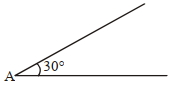
$A$ sphere of mass $2 \, kg$ and radius $0.5 \, m$ is rolling with an initial speed of $1 \, m/s$ up an inclined plane which makes an angle of $30^{\circ}$ with the horizontal plane,without slipping. How long will the sphere take to return to the starting point $A$? (in seconds)
A
$0.60$
B
$0.52$
C
$0.57$
D
$0.80$
Solution
(C) For a sphere rolling up an incline without slipping,the acceleration $a$ is given by $a = \frac{g \sin \theta}{1 + \frac{I}{mR^2}}$.
For a solid sphere,the moment of inertia $I = \frac{2}{5} mR^2$.
Substituting this,$a = \frac{g \sin \theta}{1 + \frac{2}{5}} = \frac{g \sin \theta}{7/5} = \frac{5}{7} g \sin \theta$.
Given $g = 9.8 \, m/s^2$ (or $10 \, m/s^2$ for approximation),$\theta = 30^{\circ}$,and $v_0 = 1 \, m/s$.
Using $g = 9.8 \, m/s^2$: $a = \frac{5}{7} \times 9.8 \times \sin(30^{\circ}) = \frac{5}{7} \times 9.8 \times 0.5 = 3.5 \, m/s^2$.
The time taken to reach the highest point is $t_{up} = \frac{v_0}{a} = \frac{1}{3.5} = \frac{2}{7} \, s$.
The total time to return to point $A$ is $T = 2 \times t_{up} = 2 \times \frac{2}{7} = \frac{4}{7} \approx 0.57 \, s$.
For a solid sphere,the moment of inertia $I = \frac{2}{5} mR^2$.
Substituting this,$a = \frac{g \sin \theta}{1 + \frac{2}{5}} = \frac{g \sin \theta}{7/5} = \frac{5}{7} g \sin \theta$.
Given $g = 9.8 \, m/s^2$ (or $10 \, m/s^2$ for approximation),$\theta = 30^{\circ}$,and $v_0 = 1 \, m/s$.
Using $g = 9.8 \, m/s^2$: $a = \frac{5}{7} \times 9.8 \times \sin(30^{\circ}) = \frac{5}{7} \times 9.8 \times 0.5 = 3.5 \, m/s^2$.
The time taken to reach the highest point is $t_{up} = \frac{v_0}{a} = \frac{1}{3.5} = \frac{2}{7} \, s$.
The total time to return to point $A$ is $T = 2 \times t_{up} = 2 \times \frac{2}{7} = \frac{4}{7} \approx 0.57 \, s$.
0 likes
View Solution152
DifficultMCQ
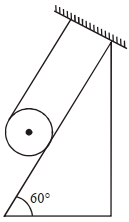
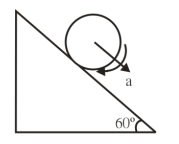
$A$ solid cylinder of mass $m$ is wrapped with an inextensible light string and is placed on a rough inclined plane as shown in the figure. The frictional force acting between the cylinder and the inclined plane is: [The coefficient of static friction,$\mu_{s}$,is $0.4$]
A
$\frac{7}{2} mg$
B
$5 mg$
C
$\frac{mg}{5}$
D
$0$
Solution
(C) Let the solid cylinder be in equilibrium.
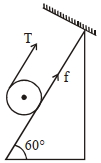
The forces acting along the inclined plane are the tension $T$ and the friction $f$. The component of gravity along the plane is $mg \sin 60^{\circ}$.
For translational equilibrium: $T + f = mg \sin 60^{\circ} \quad ......(i)$
For rotational equilibrium about the center of the cylinder: $TR - fR = 0 \implies T = f \quad ......(ii)$
Substituting $(ii)$ into $(i)$: $2f = mg \sin 60^{\circ} \implies f = \frac{mg \sin 60^{\circ}}{2} = \frac{mg \sqrt{3}}{4} \approx 0.433 mg$.
The limiting friction is $f_{L} = \mu_{s} N = \mu_{s} mg \cos 60^{\circ} = 0.4 \times mg \times 0.5 = 0.2 mg$.
Since the required friction $(0.433 mg)$ is greater than the limiting friction $(0.2 mg)$,the cylinder will not remain in static equilibrium and will roll down.
The friction acting will be kinetic friction: $f_{k} = \mu_{k} N$. Assuming $\mu_{k} = \mu_{s} = 0.4$,we get $f_{k} = 0.4 \times mg \times 0.5 = 0.2 mg = \frac{mg}{5}$.
The forces acting along the inclined plane are the tension $T$ and the friction $f$. The component of gravity along the plane is $mg \sin 60^{\circ}$.
For translational equilibrium: $T + f = mg \sin 60^{\circ} \quad ......(i)$
For rotational equilibrium about the center of the cylinder: $TR - fR = 0 \implies T = f \quad ......(ii)$
Substituting $(ii)$ into $(i)$: $2f = mg \sin 60^{\circ} \implies f = \frac{mg \sin 60^{\circ}}{2} = \frac{mg \sqrt{3}}{4} \approx 0.433 mg$.
The limiting friction is $f_{L} = \mu_{s} N = \mu_{s} mg \cos 60^{\circ} = 0.4 \times mg \times 0.5 = 0.2 mg$.
Since the required friction $(0.433 mg)$ is greater than the limiting friction $(0.2 mg)$,the cylinder will not remain in static equilibrium and will roll down.
The friction acting will be kinetic friction: $f_{k} = \mu_{k} N$. Assuming $\mu_{k} = \mu_{s} = 0.4$,we get $f_{k} = 0.4 \times mg \times 0.5 = 0.2 mg = \frac{mg}{5}$.
0 likes
View Solution153
DifficultMCQ
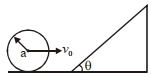
$A$ sphere of radius $a$ and mass $m$ rolls along a horizontal plane with constant speed $v_{0}$. It encounters an inclined plane at angle $\theta$ and climbs upward. Assuming that it rolls without slipping,how far up the sphere will travel?
A
$\frac{7v_0^2}{10g \sin \theta}$
B
$\frac{v_{0}^{2}}{5 g \sin \theta}$
C
$\frac{2}{5} \frac{v_{0}^{2}}{g \sin \theta}$
D
$\frac{v_{0}^{2}}{2 g \sin \theta}$
Solution
(A) The total initial energy of the sphere is $E_i = \frac{1}{2}mv_0^2 + \frac{1}{2}I\omega_0^2$.
Since it rolls without slipping,$\omega_0 = \frac{v_0}{a}$.
For a solid sphere,the moment of inertia is $I = \frac{2}{5}ma^2$.
Substituting these into the energy equation: $E_i = \frac{1}{2}mv_0^2 + \frac{1}{2}(\frac{2}{5}ma^2)(\frac{v_0}{a})^2 = \frac{1}{2}mv_0^2 + \frac{1}{5}mv_0^2 = \frac{7}{10}mv_0^2$.
At the maximum height $h$,the sphere momentarily comes to rest,so its final kinetic energy is zero. By the law of conservation of energy,$E_i = E_f = mgh$.
Therefore,$mgh = \frac{7}{10}mv_0^2$,which gives $h = \frac{7v_0^2}{10g}$.
The distance $d$ traveled along the incline is related to height $h$ by $h = d \sin \theta$.
Thus,$d \sin \theta = \frac{7v_0^2}{10g}$,which implies $d = \frac{7v_0^2}{10g \sin \theta}$.
This matches option $A$.
Since it rolls without slipping,$\omega_0 = \frac{v_0}{a}$.
For a solid sphere,the moment of inertia is $I = \frac{2}{5}ma^2$.
Substituting these into the energy equation: $E_i = \frac{1}{2}mv_0^2 + \frac{1}{2}(\frac{2}{5}ma^2)(\frac{v_0}{a})^2 = \frac{1}{2}mv_0^2 + \frac{1}{5}mv_0^2 = \frac{7}{10}mv_0^2$.
At the maximum height $h$,the sphere momentarily comes to rest,so its final kinetic energy is zero. By the law of conservation of energy,$E_i = E_f = mgh$.
Therefore,$mgh = \frac{7}{10}mv_0^2$,which gives $h = \frac{7v_0^2}{10g}$.
The distance $d$ traveled along the incline is related to height $h$ by $h = d \sin \theta$.
Thus,$d \sin \theta = \frac{7v_0^2}{10g}$,which implies $d = \frac{7v_0^2}{10g \sin \theta}$.
This matches option $A$.
0 likes
View Solution154
DifficultMCQ
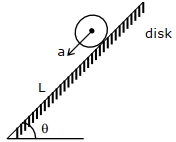
$A$ circular disc reaches from top to bottom of an inclined plane of length $L$. When it slips down the plane,it takes time $t_{1}$. When it rolls down the plane,it takes time $t_{2}$. The value of $\frac{t_{2}}{t_{1}}$ is $\sqrt{\frac{3}{x}}$. The value of $x$ will be .... .
A
$8$
B
$6$
C
$4$
D
$2$
Solution
(D) If the disk slips on an inclined plane,its acceleration is $a_{1} = g \sin \theta$.
Using the equation of motion $L = \frac{1}{2} a_{1} t_{1}^{2}$,we get $t_{1} = \sqrt{\frac{2L}{a_{1}}} \quad \dots (i)$.
If the disk rolls on an inclined plane,its acceleration is $a_{2} = \frac{g \sin \theta}{1 + \frac{I}{mR^{2}}}$.
For a circular disk,the moment of inertia $I = \frac{1}{2} mR^{2}$,so $a_{2} = \frac{g \sin \theta}{1 + \frac{1}{2}} = \frac{2}{3} g \sin \theta$.
Using the equation of motion $L = \frac{1}{2} a_{2} t_{2}^{2}$,we get $t_{2} = \sqrt{\frac{2L}{a_{2}}} \quad \dots (ii)$.
Taking the ratio $\frac{t_{2}}{t_{1}} = \sqrt{\frac{a_{1}}{a_{2}}} = \sqrt{\frac{g \sin \theta}{\frac{2}{3} g \sin \theta}} = \sqrt{\frac{3}{2}}$.
Comparing this with $\sqrt{\frac{3}{x}}$,we get $x = 2$.
Using the equation of motion $L = \frac{1}{2} a_{1} t_{1}^{2}$,we get $t_{1} = \sqrt{\frac{2L}{a_{1}}} \quad \dots (i)$.
If the disk rolls on an inclined plane,its acceleration is $a_{2} = \frac{g \sin \theta}{1 + \frac{I}{mR^{2}}}$.
For a circular disk,the moment of inertia $I = \frac{1}{2} mR^{2}$,so $a_{2} = \frac{g \sin \theta}{1 + \frac{1}{2}} = \frac{2}{3} g \sin \theta$.
Using the equation of motion $L = \frac{1}{2} a_{2} t_{2}^{2}$,we get $t_{2} = \sqrt{\frac{2L}{a_{2}}} \quad \dots (ii)$.
Taking the ratio $\frac{t_{2}}{t_{1}} = \sqrt{\frac{a_{1}}{a_{2}}} = \sqrt{\frac{g \sin \theta}{\frac{2}{3} g \sin \theta}} = \sqrt{\frac{3}{2}}$.
Comparing this with $\sqrt{\frac{3}{x}}$,we get $x = 2$.
0 likes
View Solution155
MediumMCQ
$A$ body rolls down an inclined plane without slipping. The kinetic energy of rotation is $50 \%$ of its translational kinetic energy. The body is :
A
Solid sphere
B
Solid cylinder
C
Hollow cylinder
D
Ring
Solution
(B) Let $K_r$ be the rotational kinetic energy and $K_t$ be the translational kinetic energy.
Given $K_r = 0.5 K_t$,where $K_r = \frac{1}{2} I \omega^2$ and $K_t = \frac{1}{2} m v^2$.
Since the body rolls without slipping,$v = \omega R$,so $\omega = \frac{v}{R}$.
Substituting this into the rotational energy formula: $K_r = \frac{1}{2} I (\frac{v}{R})^2 = \frac{1}{2} (\frac{I}{R^2}) v^2$.
According to the problem,$\frac{1}{2} (\frac{I}{R^2}) v^2 = 0.5 \times (\frac{1}{2} m v^2)$.
This simplifies to $\frac{I}{R^2} = 0.5 m$,which means $I = 0.5 m R^2 = \frac{1}{2} m R^2$.
The moment of inertia $I = \frac{1}{2} m R^2$ corresponds to a solid cylinder or a disk.
Given $K_r = 0.5 K_t$,where $K_r = \frac{1}{2} I \omega^2$ and $K_t = \frac{1}{2} m v^2$.
Since the body rolls without slipping,$v = \omega R$,so $\omega = \frac{v}{R}$.
Substituting this into the rotational energy formula: $K_r = \frac{1}{2} I (\frac{v}{R})^2 = \frac{1}{2} (\frac{I}{R^2}) v^2$.
According to the problem,$\frac{1}{2} (\frac{I}{R^2}) v^2 = 0.5 \times (\frac{1}{2} m v^2)$.
This simplifies to $\frac{I}{R^2} = 0.5 m$,which means $I = 0.5 m R^2 = \frac{1}{2} m R^2$.
The moment of inertia $I = \frac{1}{2} m R^2$ corresponds to a solid cylinder or a disk.
0 likes
View Solution156
MediumMCQ
Two bodies,a ring and a solid cylinder of the same material,are rolling down without slipping an inclined plane. The radii of the bodies are the same. The ratio of the velocity of the centre of mass at the bottom of the inclined plane of the ring to that of the cylinder is $\frac{\sqrt{x}}{2}$. Then,the value of $x$ is .... .
A
$1$
B
$3$
C
$9$
D
$10$
Solution
(B) For a body rolling down an inclined plane of height $h$,the conservation of energy gives $mgh = \frac{1}{2}mv^2 + \frac{1}{2}I\omega^2$. Since $v = R\omega$,we have $mgh = \frac{1}{2}mv^2 + \frac{1}{2}I(\frac{v}{R})^2 = \frac{1}{2}mv^2(1 + \frac{I}{mR^2})$.
For a ring,$I = mR^2$,so $mgh = \frac{1}{2}mv_R^2(1 + 1) = mv_R^2$. Thus,$v_R = \sqrt{gh}$.
For a solid cylinder,$I = \frac{1}{2}mR^2$,so $mgh = \frac{1}{2}mv_c^2(1 + \frac{1}{2}) = \frac{3}{4}mv_c^2$. Thus,$v_c = \sqrt{\frac{4gh}{3}}$.
The ratio of velocities is $\frac{v_R}{v_c} = \frac{\sqrt{gh}}{\sqrt{4gh/3}} = \sqrt{\frac{3}{4}} = \frac{\sqrt{3}}{2}$.
Comparing this to $\frac{\sqrt{x}}{2}$,we get $x = 3$.
For a ring,$I = mR^2$,so $mgh = \frac{1}{2}mv_R^2(1 + 1) = mv_R^2$. Thus,$v_R = \sqrt{gh}$.
For a solid cylinder,$I = \frac{1}{2}mR^2$,so $mgh = \frac{1}{2}mv_c^2(1 + \frac{1}{2}) = \frac{3}{4}mv_c^2$. Thus,$v_c = \sqrt{\frac{4gh}{3}}$.
The ratio of velocities is $\frac{v_R}{v_c} = \frac{\sqrt{gh}}{\sqrt{4gh/3}} = \sqrt{\frac{3}{4}} = \frac{\sqrt{3}}{2}$.
Comparing this to $\frac{\sqrt{x}}{2}$,we get $x = 3$.
0 likes
View Solution157
MediumMCQ
Consider a situation in which a ring,a solid cylinder,and a solid sphere roll down on the same inclined plane without slipping. Assume that they start rolling from rest and have identical diameters. The correct statement for this situation is:
A
The sphere has the greatest and the ring has the least velocity of the centre of mass at the bottom of the inclined plane.
B
The ring has the greatest and the cylinder has the least velocity of the centre of mass at the bottom of the inclined plane.
C
All of them will have the same velocity.
D
The cylinder has the greatest and the sphere has the least velocity of the centre of mass at the bottom of the inclined plane.
Solution
(A) The acceleration of a body rolling down an inclined plane is given by $a = \frac{g \sin \theta}{1 + \frac{I}{mR^2}}$.
The moment of inertia $I$ for the objects are: $I_{\text{ring}} = mR^2$,$I_{\text{cylinder}} = \frac{1}{2}mR^2$,and $I_{\text{sphere}} = \frac{2}{5}mR^2$.
Comparing the moments of inertia: $I_{\text{ring}} > I_{\text{cylinder}} > I_{\text{sphere}}$.
Since $a$ is inversely proportional to the factor $(1 + \frac{I}{mR^2})$,the acceleration follows the order: $a_{\text{ring}} < a_{\text{cylinder}} < a_{\text{sphere}}$.
Using the kinematic equation $v^2 = u^2 + 2as$ with $u = 0$,the final velocity $v = \sqrt{2as}$ is directly proportional to the square root of acceleration.
Therefore,the final velocities at the bottom of the plane follow the order: $v_{\text{ring}} < v_{\text{cylinder}} < v_{\text{sphere}}$.
Thus,the sphere has the greatest velocity and the ring has the least velocity.
The moment of inertia $I$ for the objects are: $I_{\text{ring}} = mR^2$,$I_{\text{cylinder}} = \frac{1}{2}mR^2$,and $I_{\text{sphere}} = \frac{2}{5}mR^2$.
Comparing the moments of inertia: $I_{\text{ring}} > I_{\text{cylinder}} > I_{\text{sphere}}$.
Since $a$ is inversely proportional to the factor $(1 + \frac{I}{mR^2})$,the acceleration follows the order: $a_{\text{ring}} < a_{\text{cylinder}} < a_{\text{sphere}}$.
Using the kinematic equation $v^2 = u^2 + 2as$ with $u = 0$,the final velocity $v = \sqrt{2as}$ is directly proportional to the square root of acceleration.
Therefore,the final velocities at the bottom of the plane follow the order: $v_{\text{ring}} < v_{\text{cylinder}} < v_{\text{sphere}}$.
Thus,the sphere has the greatest velocity and the ring has the least velocity.
0 likes
View Solution158
DifficultMCQ
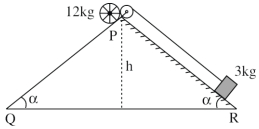
$A$ rolling wheel of $12 \, kg$ is on an inclined plane at position $P$ and connected to a mass of $3 \, kg$ through a string of fixed length and a pulley as shown in the figure. Consider $PR$ as a friction-free surface. The velocity of the centre of mass of the wheel when it reaches the bottom $Q$ of the inclined plane $PQ$ will be $\frac{1}{2} \sqrt{xgh} \, m/s$. The value of $x$ is.............
A
$5$
B
$6$
C
$1$
D
$3$
Solution
(D) Let $M = 12 \, kg$ be the mass of the wheel and $m = 3 \, kg$ be the hanging mass. When the wheel moves down by a vertical height $h$,the mass $m$ moves up by a vertical height $h$.
Applying the principle of conservation of mechanical energy:
Loss in potential energy of the wheel = Gain in potential energy of the mass $m$ + Gain in kinetic energy of the system.
$Mgh = mgh + \frac{1}{2} Mv^2 + \frac{1}{2} I \omega^2 + \frac{1}{2} mv^2$
Assuming the wheel is a disc,$I = \frac{1}{2} Mr^2$ and $\omega = \frac{v}{r}$.
$(M - m)gh = \frac{1}{2} Mv^2 + \frac{1}{2} (\frac{1}{2} Mr^2) (\frac{v}{r})^2 + \frac{1}{2} mv^2$
$(12 - 3)gh = \frac{1}{2} (12)v^2 + \frac{1}{4} (12)v^2 + \frac{1}{2} (3)v^2$
$9gh = 6v^2 + 3v^2 + 1.5v^2 = 10.5v^2$
$v^2 = \frac{9gh}{10.5} = \frac{90gh}{105} = \frac{6}{7} gh$
$v = \sqrt{\frac{6}{7} gh} = \frac{1}{2} \sqrt{\frac{24}{7} gh}$.
Comparing with $\frac{1}{2} \sqrt{xgh}$,we get $x = \frac{24}{7} \approx 3.43$. Given the options,the closest integer value is $3$.
Applying the principle of conservation of mechanical energy:
Loss in potential energy of the wheel = Gain in potential energy of the mass $m$ + Gain in kinetic energy of the system.
$Mgh = mgh + \frac{1}{2} Mv^2 + \frac{1}{2} I \omega^2 + \frac{1}{2} mv^2$
Assuming the wheel is a disc,$I = \frac{1}{2} Mr^2$ and $\omega = \frac{v}{r}$.
$(M - m)gh = \frac{1}{2} Mv^2 + \frac{1}{2} (\frac{1}{2} Mr^2) (\frac{v}{r})^2 + \frac{1}{2} mv^2$
$(12 - 3)gh = \frac{1}{2} (12)v^2 + \frac{1}{4} (12)v^2 + \frac{1}{2} (3)v^2$
$9gh = 6v^2 + 3v^2 + 1.5v^2 = 10.5v^2$
$v^2 = \frac{9gh}{10.5} = \frac{90gh}{105} = \frac{6}{7} gh$
$v = \sqrt{\frac{6}{7} gh} = \frac{1}{2} \sqrt{\frac{24}{7} gh}$.
Comparing with $\frac{1}{2} \sqrt{xgh}$,we get $x = \frac{24}{7} \approx 3.43$. Given the options,the closest integer value is $3$.
0 likes
View Solution159
MediumMCQ
$A$ solid cylinder and a solid sphere,having same mass $M$ and radius $R$,roll down the same inclined plane from the top without slipping. They start from rest. The ratio of the velocity of the solid cylinder to that of the solid sphere,with which they reach the ground,will be:
A
$\sqrt{\frac{5}{3}}$
B
$\sqrt{\frac{4}{5}}$
C
$\sqrt{\frac{3}{5}}$
D
$\sqrt{\frac{14}{15}}$
Solution
(D) The velocity $V$ of a body rolling down an inclined plane of height $H$ without slipping is given by the formula: $V = \sqrt{\frac{2gH}{1 + k^2/R^2}}$,where $k$ is the radius of gyration.
For a solid cylinder,the moment of inertia $I = \frac{1}{2}MR^2$,so $k^2/R^2 = 1/2$.
For a solid sphere,the moment of inertia $I = \frac{2}{5}MR^2$,so $k^2/R^2 = 2/5$.
The ratio of velocities is given by: $\frac{V_{\text{cylinder}}}{V_{\text{sphere}}} = \sqrt{\frac{1 + k_{\text{sphere}}^2/R^2}{1 + k_{\text{cylinder}}^2/R^2}}$.
Substituting the values: $\frac{V_{\text{cylinder}}}{V_{\text{sphere}}} = \sqrt{\frac{1 + 2/5}{1 + 1/2}} = \sqrt{\frac{7/5}{3/2}} = \sqrt{\frac{7}{5} \times \frac{2}{3}} = \sqrt{\frac{14}{15}}$.
For a solid cylinder,the moment of inertia $I = \frac{1}{2}MR^2$,so $k^2/R^2 = 1/2$.
For a solid sphere,the moment of inertia $I = \frac{2}{5}MR^2$,so $k^2/R^2 = 2/5$.
The ratio of velocities is given by: $\frac{V_{\text{cylinder}}}{V_{\text{sphere}}} = \sqrt{\frac{1 + k_{\text{sphere}}^2/R^2}{1 + k_{\text{cylinder}}^2/R^2}}$.
Substituting the values: $\frac{V_{\text{cylinder}}}{V_{\text{sphere}}} = \sqrt{\frac{1 + 2/5}{1 + 1/2}} = \sqrt{\frac{7/5}{3/2}} = \sqrt{\frac{7}{5} \times \frac{2}{3}} = \sqrt{\frac{14}{15}}$.
0 likes
View Solution160
DifficultMCQ
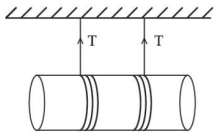
$A$ solid cylinder is suspended symmetrically by two massless strings,as shown in the figure. The distance the cylinder should fall by unbinding the strings to achieve a speed of $4\,ms^{-1}$ is $........cm$. (Take $g=10\,ms^{-2}$)
A
$60$
B
$30$
C
$120$
D
$150$
Solution
(C) By the principle of conservation of energy,the loss in potential energy equals the gain in kinetic energy (translational + rotational).
$mgh = \frac{1}{2}mv^2 + \frac{1}{2}I\omega^2$
For a solid cylinder,the moment of inertia $I = \frac{1}{2}mR^2$. Since the string unwinds without slipping,the condition $v = R\omega$ holds,which implies $\omega = \frac{v}{R}$.
Substituting these into the energy equation:
$mgh = \frac{1}{2}mv^2 + \frac{1}{2}(\frac{1}{2}mR^2)(\frac{v}{R})^2$
$mgh = \frac{1}{2}mv^2 + \frac{1}{4}mv^2$
$mgh = \frac{3}{4}mv^2$
$gh = \frac{3}{4}v^2$
Given $g = 10\,ms^{-2}$ and $v = 4\,ms^{-1}$:
$10h = \frac{3}{4}(4)^2$
$10h = \frac{3}{4} \times 16$
$10h = 12$
$h = 1.2\,m = 120\,cm$.
$mgh = \frac{1}{2}mv^2 + \frac{1}{2}I\omega^2$
For a solid cylinder,the moment of inertia $I = \frac{1}{2}mR^2$. Since the string unwinds without slipping,the condition $v = R\omega$ holds,which implies $\omega = \frac{v}{R}$.
Substituting these into the energy equation:
$mgh = \frac{1}{2}mv^2 + \frac{1}{2}(\frac{1}{2}mR^2)(\frac{v}{R})^2$
$mgh = \frac{1}{2}mv^2 + \frac{1}{4}mv^2$
$mgh = \frac{3}{4}mv^2$
$gh = \frac{3}{4}v^2$
Given $g = 10\,ms^{-2}$ and $v = 4\,ms^{-1}$:
$10h = \frac{3}{4}(4)^2$
$10h = \frac{3}{4} \times 16$
$10h = 12$
$h = 1.2\,m = 120\,cm$.
0 likes
View Solution161
AdvancedMCQ
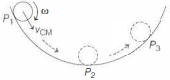
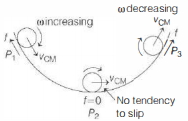
$A$ small ring is rolling without slipping on the circumference of a large bowl as shown in the figure. The ring is moving down at $P_{1}$,comes down to the lowest point $P_{2}$,and is climbing up at $P_{3}$. Let $v_{CM}$ denote the velocity of the centre of mass of the ring. Choose the correct statement regarding the frictional force on the ring.
A
It is opposite to $v_{CM}$ at the points $P_{1}, P_{2}$ and $P_{3}$.
B
It is opposite to $v_{CM}$ at $P_{1}$ and in the same direction as $v_{CM}$ at $P_{3}$.
C
It is in the same direction as $v_{CM}$ at $P_{1}$ and opposite to $v_{CM}$ at $P_{3}$.
D
It is zero at the points $P_{1}, P_{2}$ and $P_{3}$.
Solution
(B) At $P_{1}$,the ring is moving down and its angular velocity $\omega$ is increasing to satisfy the rolling condition $(v_{CM} = R\omega)$. The friction force $f$ acts upwards (opposite to $v_{CM}$) to provide the necessary torque to increase $\omega$.
At $P_{2}$,the velocity $v_{CM}$ is horizontal and the acceleration of the center of mass is purely centripetal. There is no tangential acceleration,so the frictional force is zero.
At $P_{3}$,the ring is moving up and its angular velocity $\omega$ is decreasing to satisfy the rolling condition. The friction force $f$ acts upwards (in the same direction as $v_{CM}$) to provide the torque required to decrease $\omega$.
Therefore,the frictional force is opposite to $v_{CM}$ at $P_{1}$ and in the same direction as $v_{CM}$ at $P_{3}$.
At $P_{2}$,the velocity $v_{CM}$ is horizontal and the acceleration of the center of mass is purely centripetal. There is no tangential acceleration,so the frictional force is zero.
At $P_{3}$,the ring is moving up and its angular velocity $\omega$ is decreasing to satisfy the rolling condition. The friction force $f$ acts upwards (in the same direction as $v_{CM}$) to provide the torque required to decrease $\omega$.
Therefore,the frictional force is opposite to $v_{CM}$ at $P_{1}$ and in the same direction as $v_{CM}$ at $P_{3}$.
0 likes
View Solution162
MediumMCQ
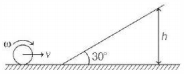
$A$ uniform ring of radius $R$ is moving on a horizontal surface with speed $v$,then climbs up a ramp of inclination $30^{\circ}$ to a height $h$. There is no slipping in the entire motion. Then,$h$ is
A
$v^{2} / 2 g$
B
$v^{2} / g$
C
$3 v^{2} / 2 g$
D
$2 v^{2} / g$
Solution
(B) Since the ring is rolling without any slippage,the total initial kinetic energy is equal to the total final potential energy at height $h$.
Total initial kinetic energy = Kinetic energy of translation + Kinetic energy of rotation
$\Rightarrow K.E. = \frac{1}{2} m v^{2} + \frac{1}{2} I \omega^{2}$
For a ring,the moment of inertia $I = m R^{2}$ and the condition for pure rolling is $v = R \omega$,which implies $\omega = v / R$.
Substituting these into the energy equation:
$K.E. = \frac{1}{2} m v^{2} + \frac{1}{2} (m R^{2}) (v / R)^{2}$
$K.E. = \frac{1}{2} m v^{2} + \frac{1}{2} m v^{2} = m v^{2}$
At the maximum height $h$,the final kinetic energy is zero,so the total initial kinetic energy is converted into potential energy:
$m v^{2} = m g h$
$h = \frac{v^{2}}{g}$
Total initial kinetic energy = Kinetic energy of translation + Kinetic energy of rotation
$\Rightarrow K.E. = \frac{1}{2} m v^{2} + \frac{1}{2} I \omega^{2}$
For a ring,the moment of inertia $I = m R^{2}$ and the condition for pure rolling is $v = R \omega$,which implies $\omega = v / R$.
Substituting these into the energy equation:
$K.E. = \frac{1}{2} m v^{2} + \frac{1}{2} (m R^{2}) (v / R)^{2}$
$K.E. = \frac{1}{2} m v^{2} + \frac{1}{2} m v^{2} = m v^{2}$
At the maximum height $h$,the final kinetic energy is zero,so the total initial kinetic energy is converted into potential energy:
$m v^{2} = m g h$
$h = \frac{v^{2}}{g}$
0 likes
View Solution163
DifficultMCQ
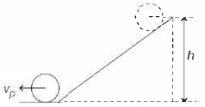
$A$ solid cylinder $P$ rolls without slipping from rest down an inclined plane,attaining a speed $v_p$ at the bottom. Another smooth solid cylinder $Q$ of the same mass and dimensions slides without friction from rest down the inclined plane,attaining a speed $v_q$ at the bottom. The ratio of the speeds $\frac{v_q}{v_p}$ is
A
$\sqrt{\frac{3}{4}}$
B
$\sqrt{\frac{3}{2}}$
C
$\sqrt{\frac{2}{3}}$
D
$\sqrt{\frac{4}{3}}$
Solution
(B) For cylinder $P$ (rolling without slipping):
By the principle of conservation of energy,the initial potential energy is converted into translational and rotational kinetic energy at the bottom:
$mgh = \frac{1}{2}mv_p^2 + \frac{1}{2}I\omega^2$
Since $I = \frac{1}{2}mr^2$ and $v_p = r\omega$,we have:
$mgh = \frac{1}{2}mv_p^2 + \frac{1}{2}(\frac{1}{2}mr^2)(\frac{v_p}{r})^2$
$mgh = \frac{1}{2}mv_p^2 + \frac{1}{4}mv_p^2 = \frac{3}{4}mv_p^2$
$v_p = \sqrt{\frac{4gh}{3}}$
For cylinder $Q$ (sliding without friction):
Since there is no friction,the cylinder does not rotate. All potential energy is converted into translational kinetic energy:
$mgh = \frac{1}{2}mv_q^2$
$v_q = \sqrt{2gh}$
The ratio of the speeds is:
$\frac{v_q}{v_p} = \frac{\sqrt{2gh}}{\sqrt{\frac{4gh}{3}}} = \sqrt{2 \cdot \frac{3}{4}} = \sqrt{\frac{3}{2}}$
By the principle of conservation of energy,the initial potential energy is converted into translational and rotational kinetic energy at the bottom:
$mgh = \frac{1}{2}mv_p^2 + \frac{1}{2}I\omega^2$
Since $I = \frac{1}{2}mr^2$ and $v_p = r\omega$,we have:
$mgh = \frac{1}{2}mv_p^2 + \frac{1}{2}(\frac{1}{2}mr^2)(\frac{v_p}{r})^2$
$mgh = \frac{1}{2}mv_p^2 + \frac{1}{4}mv_p^2 = \frac{3}{4}mv_p^2$
$v_p = \sqrt{\frac{4gh}{3}}$
For cylinder $Q$ (sliding without friction):
Since there is no friction,the cylinder does not rotate. All potential energy is converted into translational kinetic energy:
$mgh = \frac{1}{2}mv_q^2$
$v_q = \sqrt{2gh}$
The ratio of the speeds is:
$\frac{v_q}{v_p} = \frac{\sqrt{2gh}}{\sqrt{\frac{4gh}{3}}} = \sqrt{2 \cdot \frac{3}{4}} = \sqrt{\frac{3}{2}}$
0 likes
View Solution164
MediumMCQ
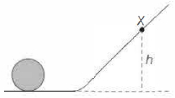
$A$ solid sphere rolls without slipping,first horizontally and then up to a point $X$ at height $h$ on an inclined plane before rolling down,as shown in the figure below. The initial horizontal speed of the sphere is
A
$\sqrt{10 g h / 7}$
B
$\sqrt{7 g h / 5}$
C
$\sqrt{5 g h / 7}$
D
$\sqrt{2 g h}$
Solution
(A) Let the initial horizontal speed of the sphere be $v$.
Since the sphere rolls without slipping,its total kinetic energy on the horizontal surface is the sum of its translational and rotational kinetic energies:
$KE_{total} = KE_{trans} + KE_{rot} = \frac{1}{2} m v^2 + \frac{1}{2} I \omega^2$
For a solid sphere,the moment of inertia $I = \frac{2}{5} m R^2$ and the condition for rolling without slipping is $v = R \omega$,so $\omega = v/R$.
Substituting these values:
$KE_{total} = \frac{1}{2} m v^2 + \frac{1}{2} (\frac{2}{5} m R^2) (\frac{v}{R})^2 = \frac{1}{2} m v^2 + \frac{1}{5} m v^2 = \frac{7}{10} m v^2$
At the maximum height $h$,the sphere momentarily comes to rest before rolling back down. By the principle of conservation of mechanical energy,the initial kinetic energy equals the potential energy at height $h$:
$\frac{7}{10} m v^2 = m g h$
Solving for $v$:
$v^2 = \frac{10}{7} g h$
$v = \sqrt{\frac{10 g h}{7}}$
Since the sphere rolls without slipping,its total kinetic energy on the horizontal surface is the sum of its translational and rotational kinetic energies:
$KE_{total} = KE_{trans} + KE_{rot} = \frac{1}{2} m v^2 + \frac{1}{2} I \omega^2$
For a solid sphere,the moment of inertia $I = \frac{2}{5} m R^2$ and the condition for rolling without slipping is $v = R \omega$,so $\omega = v/R$.
Substituting these values:
$KE_{total} = \frac{1}{2} m v^2 + \frac{1}{2} (\frac{2}{5} m R^2) (\frac{v}{R})^2 = \frac{1}{2} m v^2 + \frac{1}{5} m v^2 = \frac{7}{10} m v^2$
At the maximum height $h$,the sphere momentarily comes to rest before rolling back down. By the principle of conservation of mechanical energy,the initial kinetic energy equals the potential energy at height $h$:
$\frac{7}{10} m v^2 = m g h$
Solving for $v$:
$v^2 = \frac{10}{7} g h$
$v = \sqrt{\frac{10 g h}{7}}$
0 likes
View Solution165
AdvancedMCQ
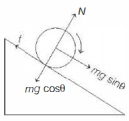
$A$ solid uniform sphere having a mass $M$,radius $R$ and moment of inertia of $\frac{2}{5} M R^2$ rolls down a plane inclined at an angle $\theta$ to the horizontal starting from rest. The coefficient of static friction between the sphere and the plane is $\mu_s$. Then,
A
the sphere will always roll without slipping
B
the sphere will always slide
C
the sphere will roll without slipping only,if $\theta \leq \sin^{-1} \frac{7 \mu_s}{2}$
D
the sphere will roll without slipping only,if $\theta \leq \tan^{-1} \frac{7 \mu_s}{2}$
Solution
(D) For a sphere in pure rolling,the equations of motion are:
$N - Mg \cos \theta = 0 \quad \dots(i)$
$Mg \sin \theta - f = Ma_{CM} \quad \dots(ii)$
$\tau = f \times R = I \alpha = I \frac{a_{CM}}{R} \quad \dots(iii)$
Since $I = \frac{2}{5} MR^2$,substituting into $(iii)$ gives $f = \frac{2}{5} Ma_{CM}$.
Substituting $f$ into $(ii)$:
$Mg \sin \theta - \frac{2}{5} Ma_{CM} = Ma_{CM} \implies Mg \sin \theta = \frac{7}{5} Ma_{CM} \implies a_{CM} = \frac{5}{7} g \sin \theta$.
Now,substituting $a_{CM}$ back into the expression for $f$:
$f = \frac{2}{5} M \left( \frac{5}{7} g \sin \theta \right) = \frac{2}{7} Mg \sin \theta$.
For pure rolling without slipping,the static friction must satisfy $f \leq \mu_s N$.
Substituting $f = \frac{2}{7} Mg \sin \theta$ and $N = Mg \cos \theta$:
$\frac{2}{7} Mg \sin \theta \leq \mu_s Mg \cos \theta$
$\tan \theta \leq \frac{7}{2} \mu_s$
$\theta \leq \tan^{-1} \left( \frac{7}{2} \mu_s \right)$.
$N - Mg \cos \theta = 0 \quad \dots(i)$
$Mg \sin \theta - f = Ma_{CM} \quad \dots(ii)$
$\tau = f \times R = I \alpha = I \frac{a_{CM}}{R} \quad \dots(iii)$
Since $I = \frac{2}{5} MR^2$,substituting into $(iii)$ gives $f = \frac{2}{5} Ma_{CM}$.
Substituting $f$ into $(ii)$:
$Mg \sin \theta - \frac{2}{5} Ma_{CM} = Ma_{CM} \implies Mg \sin \theta = \frac{7}{5} Ma_{CM} \implies a_{CM} = \frac{5}{7} g \sin \theta$.
Now,substituting $a_{CM}$ back into the expression for $f$:
$f = \frac{2}{5} M \left( \frac{5}{7} g \sin \theta \right) = \frac{2}{7} Mg \sin \theta$.
For pure rolling without slipping,the static friction must satisfy $f \leq \mu_s N$.
Substituting $f = \frac{2}{7} Mg \sin \theta$ and $N = Mg \cos \theta$:
$\frac{2}{7} Mg \sin \theta \leq \mu_s Mg \cos \theta$
$\tan \theta \leq \frac{7}{2} \mu_s$
$\theta \leq \tan^{-1} \left( \frac{7}{2} \mu_s \right)$.
0 likes
View Solution166
AdvancedMCQ
Two uniform thin spherical shells are made from different materials. Both shells have a mass of $2 \,kg$ and an outer radius of $20 \,cm$. When they are both rolled down the same inclined plane without slipping,the times they take to cover equal distances differ by $1 \%$. If the thickness of the thinner shell is $0.5 \,cm$,the thickness of the other one is closest to ........... $\,cm$.
A
$0.505$
B
$0.525$
C
$1.0$
D
$1.5$
Solution
(D) The time taken for a body to roll down an inclined plane is given by $t = \sqrt{\frac{2s(1 + \beta)}{g \sin \theta}}$,where $\beta = \frac{I}{MR^2}$. For a thin spherical shell,$I = \frac{2}{3}MR^2$,so $\beta = 2/3$. However,for a shell with thickness $t$,the moment of inertia is $I = \frac{2}{3}M \frac{R_o^5 - R_i^5}{R_o^3 - R_i^3}$. Given $R_o = 20 \,cm$ and $t \ll R_o$,$I \approx \frac{2}{3}MR^2(1 + \frac{t}{R})$. Thus,$\beta \approx \frac{2}{3}(1 + \frac{t}{R})$. The time $t \propto \sqrt{1 + \beta}$. Since the time difference is $1 \%$,$\frac{\Delta t}{t} = \frac{1}{2} \frac{\Delta \beta}{1 + \beta} \approx 0.01$. Given $\beta \approx 2/3$,$1 + \beta \approx 5/3$. Then $\frac{1}{2} \frac{\Delta \beta}{5/3} = 0.01 \implies \Delta \beta = 0.033$. Since $\beta = \frac{2}{3}(1 + \frac{t}{R})$,$\Delta \beta = \frac{2}{3} \frac{\Delta t}{R}$. Substituting values: $0.033 = \frac{2}{3} \frac{\Delta t}{20} \implies \Delta t = 0.033 \times 30 = 0.99 \,cm$. The total thickness is $0.5 + 0.99 = 1.49 \,cm$,which is closest to $1.5 \,cm$.
0 likes
View Solution167
MediumMCQ
Two discs having masses in the ratio $1:2$ and radii in the ratio $1:8$ roll down without slipping one by one from an inclined plane of height $h$. The ratio of their linear velocities on reaching the ground is ........
A
$1:16$
B
$1:128$
C
$1:8\sqrt{2}$
D
$1:1$
Solution
(D) For an object rolling down an inclined plane without slipping,the conservation of energy states that the potential energy at the top is equal to the total kinetic energy at the bottom.
$mgh = K.E._{trans} + K.E._{rot} = \frac{1}{2}mv^2 + \frac{1}{2}I\omega^2$
For a disc,the moment of inertia $I = \frac{1}{2}mr^2$ and the rolling condition is $\omega = \frac{v}{r}$.
Substituting these into the energy equation:
$mgh = \frac{1}{2}mv^2 + \frac{1}{2}(\frac{1}{2}mr^2)(\frac{v}{r})^2$
$mgh = \frac{1}{2}mv^2 + \frac{1}{4}mv^2 = \frac{3}{4}mv^2$
$v = \sqrt{\frac{4gh}{3}}$
Since the final velocity $v$ depends only on the height $h$ and the acceleration due to gravity $g$,and is independent of the mass $m$ and radius $r$ of the disc,both discs will have the same linear velocity upon reaching the ground.
Therefore,the ratio of their linear velocities is $1:1$.
$mgh = K.E._{trans} + K.E._{rot} = \frac{1}{2}mv^2 + \frac{1}{2}I\omega^2$
For a disc,the moment of inertia $I = \frac{1}{2}mr^2$ and the rolling condition is $\omega = \frac{v}{r}$.
Substituting these into the energy equation:
$mgh = \frac{1}{2}mv^2 + \frac{1}{2}(\frac{1}{2}mr^2)(\frac{v}{r})^2$
$mgh = \frac{1}{2}mv^2 + \frac{1}{4}mv^2 = \frac{3}{4}mv^2$
$v = \sqrt{\frac{4gh}{3}}$
Since the final velocity $v$ depends only on the height $h$ and the acceleration due to gravity $g$,and is independent of the mass $m$ and radius $r$ of the disc,both discs will have the same linear velocity upon reaching the ground.
Therefore,the ratio of their linear velocities is $1:1$.
0 likes
View Solution168
MediumMCQ
Which of the following (assuming mass and radius are the same) has the maximum percentage of total $K.E.$ in rotational form during pure rolling?
A
Disc
B
Sphere
C
Ring
D
Hollow sphere
Solution
(C) The total kinetic energy $(K_{total})$ during pure rolling is the sum of translational kinetic energy $(K_{trans})$ and rotational kinetic energy $(K_{rot})$.
$K_{total} = K_{trans} + K_{rot} = \frac{1}{2}mv^2 + \frac{1}{2}I\omega^2$.
Since $v = R\omega$,we have $K_{total} = \frac{1}{2}mv^2 + \frac{1}{2}I(\frac{v}{R})^2 = \frac{1}{2}mv^2(1 + \frac{I}{mR^2})$.
The ratio of rotational kinetic energy to total kinetic energy is:
$\text{Ratio} = \frac{K_{rot}}{K_{total}} = \frac{\frac{1}{2}I\omega^2}{\frac{1}{2}mv^2 + \frac{1}{2}I\omega^2} = \frac{\frac{1}{2}I(\frac{v}{R})^2}{\frac{1}{2}mv^2 + \frac{1}{2}I(\frac{v}{R})^2} = \frac{I}{mR^2 + I} = \frac{1}{1 + \frac{mR^2}{I}}$.
For a Disc $(I = \frac{1}{2}mR^2)$: $\text{Ratio} = \frac{1}{1 + 2} = \frac{1}{3} \approx 0.33$.
For a Solid Sphere $(I = \frac{2}{5}mR^2)$: $\text{Ratio} = \frac{1}{1 + 2.5} = \frac{2}{7} \approx 0.28$.
For a Ring $(I = mR^2)$: $\text{Ratio} = \frac{1}{1 + 1} = \frac{1}{2} = 0.5$.
For a Hollow Sphere $(I = \frac{2}{3}mR^2)$: $\text{Ratio} = \frac{1}{1 + 1.5} = \frac{2}{5} = 0.4$.
Comparing the values,the Ring has the maximum percentage of rotational kinetic energy. Thus,option $C$ is correct.
$K_{total} = K_{trans} + K_{rot} = \frac{1}{2}mv^2 + \frac{1}{2}I\omega^2$.
Since $v = R\omega$,we have $K_{total} = \frac{1}{2}mv^2 + \frac{1}{2}I(\frac{v}{R})^2 = \frac{1}{2}mv^2(1 + \frac{I}{mR^2})$.
The ratio of rotational kinetic energy to total kinetic energy is:
$\text{Ratio} = \frac{K_{rot}}{K_{total}} = \frac{\frac{1}{2}I\omega^2}{\frac{1}{2}mv^2 + \frac{1}{2}I\omega^2} = \frac{\frac{1}{2}I(\frac{v}{R})^2}{\frac{1}{2}mv^2 + \frac{1}{2}I(\frac{v}{R})^2} = \frac{I}{mR^2 + I} = \frac{1}{1 + \frac{mR^2}{I}}$.
For a Disc $(I = \frac{1}{2}mR^2)$: $\text{Ratio} = \frac{1}{1 + 2} = \frac{1}{3} \approx 0.33$.
For a Solid Sphere $(I = \frac{2}{5}mR^2)$: $\text{Ratio} = \frac{1}{1 + 2.5} = \frac{2}{7} \approx 0.28$.
For a Ring $(I = mR^2)$: $\text{Ratio} = \frac{1}{1 + 1} = \frac{1}{2} = 0.5$.
For a Hollow Sphere $(I = \frac{2}{3}mR^2)$: $\text{Ratio} = \frac{1}{1 + 1.5} = \frac{2}{5} = 0.4$.
Comparing the values,the Ring has the maximum percentage of rotational kinetic energy. Thus,option $C$ is correct.
0 likes
View Solution169
MediumMCQ
$A$ solid cylinder of mass $M$ and radius $R$ rolls down an inclined plane of height $h$. The angular velocity of the cylinder when it reaches the bottom of the plane will be
A
$\frac{1}{2 R} \sqrt{g h}$
B
$\frac{2}{R} \sqrt{g h}$
C
$\frac{2}{R} \sqrt{\frac{g h}{3}}$
D
$\frac{2}{R} \sqrt{\frac{g h}{2}}$
Solution
(C) By the law of conservation of energy,the potential energy at the top is equal to the total kinetic energy at the bottom.
$PE = Mgh$
$KE = \frac{1}{2} Mv^2 + \frac{1}{2} I\omega^2$
For a solid cylinder,the moment of inertia $I = \frac{1}{2} MR^2$ and the condition for pure rolling is $v = R\omega$.
Substituting these into the kinetic energy equation:
$KE = \frac{1}{2} Mv^2 + \frac{1}{2} (\frac{1}{2} MR^2) (\frac{v}{R})^2 = \frac{1}{2} Mv^2 + \frac{1}{4} Mv^2 = \frac{3}{4} Mv^2$
Equating potential energy and kinetic energy:
$Mgh = \frac{3}{4} Mv^2$
$v^2 = \frac{4gh}{3} \implies v = 2 \sqrt{\frac{gh}{3}}$
Since $\omega = \frac{v}{R}$,the angular velocity is:
$\omega = \frac{2}{R} \sqrt{\frac{gh}{3}}$
$PE = Mgh$
$KE = \frac{1}{2} Mv^2 + \frac{1}{2} I\omega^2$
For a solid cylinder,the moment of inertia $I = \frac{1}{2} MR^2$ and the condition for pure rolling is $v = R\omega$.
Substituting these into the kinetic energy equation:
$KE = \frac{1}{2} Mv^2 + \frac{1}{2} (\frac{1}{2} MR^2) (\frac{v}{R})^2 = \frac{1}{2} Mv^2 + \frac{1}{4} Mv^2 = \frac{3}{4} Mv^2$
Equating potential energy and kinetic energy:
$Mgh = \frac{3}{4} Mv^2$
$v^2 = \frac{4gh}{3} \implies v = 2 \sqrt{\frac{gh}{3}}$
Since $\omega = \frac{v}{R}$,the angular velocity is:
$\omega = \frac{2}{R} \sqrt{\frac{gh}{3}}$
0 likes
View Solution170
EasyMCQ
$A$ solid cylinder and a solid sphere of same mass and radius roll without slipping on a rough inclined plane. The force of friction is ..........
A
Same for both the bodies
B
More for cylinder
C
More for sphere
D
Double for sphere than for cylinder
Solution
(B) For an object of mass $M$,radius $R$,and moment of inertia $I = kMR^2$ rolling down an inclined plane of angle $\theta$,the force of friction $f$ is given by the formula:
$f = \frac{Mg \sin\theta}{1 + \frac{MR^2}{I}} = \frac{Mg \sin\theta}{1 + \frac{1}{k}}$
For a solid cylinder,$I = \frac{1}{2}MR^2$,so $k = \frac{1}{2}$. Thus,$f_{cylinder} = \frac{Mg \sin\theta}{1 + 2} = \frac{1}{3}Mg \sin\theta$.
For a solid sphere,$I = \frac{2}{5}MR^2$,so $k = \frac{2}{5}$. Thus,$f_{sphere} = \frac{Mg \sin\theta}{1 + \frac{5}{2}} = \frac{Mg \sin\theta}{3.5} = \frac{2}{7}Mg \sin\theta$.
Comparing the two,$\frac{1}{3} \approx 0.333$ and $\frac{2}{7} \approx 0.285$.
Since $\frac{1}{3} > \frac{2}{7}$,the force of friction is more for the cylinder.
$f = \frac{Mg \sin\theta}{1 + \frac{MR^2}{I}} = \frac{Mg \sin\theta}{1 + \frac{1}{k}}$
For a solid cylinder,$I = \frac{1}{2}MR^2$,so $k = \frac{1}{2}$. Thus,$f_{cylinder} = \frac{Mg \sin\theta}{1 + 2} = \frac{1}{3}Mg \sin\theta$.
For a solid sphere,$I = \frac{2}{5}MR^2$,so $k = \frac{2}{5}$. Thus,$f_{sphere} = \frac{Mg \sin\theta}{1 + \frac{5}{2}} = \frac{Mg \sin\theta}{3.5} = \frac{2}{7}Mg \sin\theta$.
Comparing the two,$\frac{1}{3} \approx 0.333$ and $\frac{2}{7} \approx 0.285$.
Since $\frac{1}{3} > \frac{2}{7}$,the force of friction is more for the cylinder.
0 likes
View Solution171
EasyMCQ
$A$ solid sphere is thrown up a rough incline. The sphere rolls up without slipping and eventually comes down rolling without slipping. The direction of rolling friction in upward and downward motion respectively is ............
A
Downward,upward
B
Upward,downward
C
Downward,downward
D
Upward,upward
Solution
(D) When the sphere is thrown up the incline,it has both translational velocity $v$ and angular velocity $\omega$. For pure rolling up the incline,the friction must act to oppose the tendency of slipping. As the sphere moves up,the friction acts in the upward direction to provide the necessary torque to maintain the rolling condition.
When the sphere reaches its highest point and starts moving down,the direction of its translational velocity reverses. To maintain pure rolling while moving down the incline,the friction again acts in the upward direction to oppose the tendency of the sphere to slip down the incline.
Therefore,the direction of rolling friction is upward during both the upward and downward motion.
When the sphere reaches its highest point and starts moving down,the direction of its translational velocity reverses. To maintain pure rolling while moving down the incline,the friction again acts in the upward direction to oppose the tendency of the sphere to slip down the incline.
Therefore,the direction of rolling friction is upward during both the upward and downward motion.
0 likes
View Solution172
MediumMCQ
Two solid spheres of different mass,radii,and density roll down a rough inclined plane under identical situations. Their time to come down is independent of their ............
A
Mass
B
Radius
C
Density
D
All of these
Solution
(D) For a body rolling down an inclined plane,the acceleration of the center of mass is given by:
$a_{cm} = \frac{g \sin \theta}{1 + \frac{I}{MR^2}}$
For a solid sphere,the moment of inertia is $I = \frac{2}{5} MR^2$.
Substituting this into the acceleration formula:
$a_{cm} = \frac{g \sin \theta}{1 + \frac{2/5 MR^2}{MR^2}} = \frac{g \sin \theta}{1 + 2/5} = \frac{5}{7} g \sin \theta$
The time taken to travel a distance $L$ along the incline is given by $L = \frac{1}{2} a_{cm} t^2$,which implies $t = \sqrt{\frac{2L}{a_{cm}}}$.
Substituting $a_{cm}$:
$t = \sqrt{\frac{2L}{\frac{5}{7} g \sin \theta}} = \sqrt{\frac{14L}{5g \sin \theta}}$
As seen from the expression,the time $t$ depends only on the length of the incline $L$,the angle of inclination $\theta$,and the acceleration due to gravity $g$. It is independent of the mass $M$,radius $R$,and density $\rho$ of the sphere. Thus,the time is independent of all these factors.
$a_{cm} = \frac{g \sin \theta}{1 + \frac{I}{MR^2}}$
For a solid sphere,the moment of inertia is $I = \frac{2}{5} MR^2$.
Substituting this into the acceleration formula:
$a_{cm} = \frac{g \sin \theta}{1 + \frac{2/5 MR^2}{MR^2}} = \frac{g \sin \theta}{1 + 2/5} = \frac{5}{7} g \sin \theta$
The time taken to travel a distance $L$ along the incline is given by $L = \frac{1}{2} a_{cm} t^2$,which implies $t = \sqrt{\frac{2L}{a_{cm}}}$.
Substituting $a_{cm}$:
$t = \sqrt{\frac{2L}{\frac{5}{7} g \sin \theta}} = \sqrt{\frac{14L}{5g \sin \theta}}$
As seen from the expression,the time $t$ depends only on the length of the incline $L$,the angle of inclination $\theta$,and the acceleration due to gravity $g$. It is independent of the mass $M$,radius $R$,and density $\rho$ of the sphere. Thus,the time is independent of all these factors.
0 likes
View Solution173
MediumMCQ
$A$ thin circular ring first slips down a smooth incline then rolls down a rough incline of identical geometry from the same height. The ratio of the time taken in the two motions is ........
A
$\frac{1}{2}$
B
$1$
C
$\frac{1}{\sqrt{2}}$
D
$\frac{1}{4}$
Solution
(C) Case $(i)$: Slipping down a smooth incline.
In this case,the ring undergoes pure translational motion. The acceleration is $a_1 = g \sin \theta$.
Using the equation of motion $s = ut + \frac{1}{2}at^2$ with initial velocity $u = 0$,we get $s = \frac{1}{2} (g \sin \theta) t_1^2$,so $t_1 = \sqrt{\frac{2s}{g \sin \theta}}$.
Case $(ii)$: Rolling down a rough incline.
In this case,the ring undergoes rolling motion. The acceleration is $a_2 = \frac{g \sin \theta}{1 + \frac{I}{MR^2}}$.
For a thin circular ring,the moment of inertia $I = MR^2$. Substituting this,$a_2 = \frac{g \sin \theta}{1 + 1} = \frac{g \sin \theta}{2}$.
Using the same equation of motion,$s = \frac{1}{2} a_2 t_2^2$,so $t_2 = \sqrt{\frac{2s}{a_2}} = \sqrt{\frac{4s}{g \sin \theta}}$.
Ratio of times:
$\frac{t_1}{t_2} = \frac{\sqrt{\frac{2s}{g \sin \theta}}}{\sqrt{\frac{4s}{g \sin \theta}}} = \sqrt{\frac{2}{4}} = \frac{1}{\sqrt{2}}$.
In this case,the ring undergoes pure translational motion. The acceleration is $a_1 = g \sin \theta$.
Using the equation of motion $s = ut + \frac{1}{2}at^2$ with initial velocity $u = 0$,we get $s = \frac{1}{2} (g \sin \theta) t_1^2$,so $t_1 = \sqrt{\frac{2s}{g \sin \theta}}$.
Case $(ii)$: Rolling down a rough incline.
In this case,the ring undergoes rolling motion. The acceleration is $a_2 = \frac{g \sin \theta}{1 + \frac{I}{MR^2}}$.
For a thin circular ring,the moment of inertia $I = MR^2$. Substituting this,$a_2 = \frac{g \sin \theta}{1 + 1} = \frac{g \sin \theta}{2}$.
Using the same equation of motion,$s = \frac{1}{2} a_2 t_2^2$,so $t_2 = \sqrt{\frac{2s}{a_2}} = \sqrt{\frac{4s}{g \sin \theta}}$.
Ratio of times:
$\frac{t_1}{t_2} = \frac{\sqrt{\frac{2s}{g \sin \theta}}}{\sqrt{\frac{4s}{g \sin \theta}}} = \sqrt{\frac{2}{4}} = \frac{1}{\sqrt{2}}$.
0 likes
View Solution174
MediumMCQ
What is the minimum coefficient of friction for a solid sphere to roll without slipping on an inclined plane of inclination $\theta$?
A
$\frac{2}{7} \tan \theta$
B
$\frac{1}{3} \tan \theta$
C
$\frac{1}{2} \tan \theta$
D
$\frac{2}{5} \tan \theta$
Solution
(A) For a body of mass $m$ and radius $r$ rolling down an inclined plane of angle $\theta$,the acceleration $a$ is given by $a = \frac{mg \sin \theta}{m + \frac{I}{r^2}}$.
The frictional force $f$ required for pure rolling is $f = ma_{cm} \cdot \frac{I}{mr^2} = \frac{mg \sin \theta}{1 + \frac{mr^2}{I}}$.
For a solid sphere,the moment of inertia $I = \frac{2}{5} mr^2$.
Substituting $I$ into the friction equation: $f = \frac{mg \sin \theta}{1 + \frac{mr^2}{(2/5)mr^2}} = \frac{mg \sin \theta}{1 + 2.5} = \frac{mg \sin \theta}{3.5} = \frac{2}{7} mg \sin \theta$.
Since $f \le \mu N$ and $N = mg \cos \theta$,we have $\mu \ge \frac{f}{N} = \frac{(2/7) mg \sin \theta}{mg \cos \theta} = \frac{2}{7} \tan \theta$.
Thus,the minimum coefficient of friction is $\mu_{min} = \frac{2}{7} \tan \theta$.
The frictional force $f$ required for pure rolling is $f = ma_{cm} \cdot \frac{I}{mr^2} = \frac{mg \sin \theta}{1 + \frac{mr^2}{I}}$.
For a solid sphere,the moment of inertia $I = \frac{2}{5} mr^2$.
Substituting $I$ into the friction equation: $f = \frac{mg \sin \theta}{1 + \frac{mr^2}{(2/5)mr^2}} = \frac{mg \sin \theta}{1 + 2.5} = \frac{mg \sin \theta}{3.5} = \frac{2}{7} mg \sin \theta$.
Since $f \le \mu N$ and $N = mg \cos \theta$,we have $\mu \ge \frac{f}{N} = \frac{(2/7) mg \sin \theta}{mg \cos \theta} = \frac{2}{7} \tan \theta$.
Thus,the minimum coefficient of friction is $\mu_{min} = \frac{2}{7} \tan \theta$.
0 likes
View Solution175
DifficultMCQ
An object slides down a smooth incline and reaches the bottom with velocity $v$. If the same mass is in the form of a ring and it rolls down an inclined plane of the same height and angle of inclination,then its velocity at the bottom of the inclined plane will be ............
A
$v$
B
$\frac{v}{\sqrt{2}}$
C
$2v$
D
$\sqrt{2}v$
Solution
(B) For an object sliding down a smooth incline,the potential energy is converted entirely into translational kinetic energy:
$mgh = \frac{1}{2}mv^2 \implies v = \sqrt{2gh}$.
For a ring rolling down an inclined plane,the potential energy is converted into both translational and rotational kinetic energy:
$mgh = \frac{1}{2}mv'^2 + \frac{1}{2}I\omega^2$.
Since for a ring $I = mr^2$ and $\omega = \frac{v'}{r}$,we have:
$mgh = \frac{1}{2}mv'^2 + \frac{1}{2}(mr^2)(\frac{v'^2}{r^2}) = \frac{1}{2}mv'^2 + \frac{1}{2}mv'^2 = mv'^2$.
Equating the two expressions for $mgh$:
$mv'^2 = \frac{1}{2}mv^2 \implies v'^2 = \frac{v^2}{2} \implies v' = \frac{v}{\sqrt{2}}$.
$mgh = \frac{1}{2}mv^2 \implies v = \sqrt{2gh}$.
For a ring rolling down an inclined plane,the potential energy is converted into both translational and rotational kinetic energy:
$mgh = \frac{1}{2}mv'^2 + \frac{1}{2}I\omega^2$.
Since for a ring $I = mr^2$ and $\omega = \frac{v'}{r}$,we have:
$mgh = \frac{1}{2}mv'^2 + \frac{1}{2}(mr^2)(\frac{v'^2}{r^2}) = \frac{1}{2}mv'^2 + \frac{1}{2}mv'^2 = mv'^2$.
Equating the two expressions for $mgh$:
$mv'^2 = \frac{1}{2}mv^2 \implies v'^2 = \frac{v^2}{2} \implies v' = \frac{v}{\sqrt{2}}$.
0 likes
View Solution176
MediumMCQ
$A$ hollow sphere of mass $m$ and radius $R$ is rolling downward on a rough inclined plane of inclination $\theta$. If the coefficient of friction between the hollow sphere and incline is $\mu$,then ........
A
Friction opposes its translation
B
Friction supports rotational motion
C
On decreasing $\theta$,frictional force decreases
D
All of these
Solution
(D) For a body rolling down an inclined plane,the force of friction $f$ acts in the upward direction along the incline.
$1$. Since the sphere is moving downward,the friction $f$ acts upward,which opposes the translational motion.
$2$. The torque produced by the friction $f$ about the center of the sphere is $\tau = f \times R$. This torque causes an angular acceleration $\alpha$ in the direction of rolling,meaning friction supports the rotational motion.
$3$. The equation of motion for translation is $mg \sin \theta - f = ma$,and for rotation is $fR = I\alpha$. For a hollow sphere,$I = \frac{2}{3}mR^2$. Solving these,we find $f = \frac{mg \sin \theta}{1 + \frac{mR^2}{I}} = \frac{mg \sin \theta}{1 + \frac{3}{2}} = \frac{2}{5} mg \sin \theta$.
$4$. Since $f = \frac{2}{5} mg \sin \theta$,it is clear that $f \propto \sin \theta$. Therefore,if $\theta$ decreases,$\sin \theta$ decreases,and consequently,the frictional force $f$ decreases.
Thus,all the given statements are correct.
$1$. Since the sphere is moving downward,the friction $f$ acts upward,which opposes the translational motion.
$2$. The torque produced by the friction $f$ about the center of the sphere is $\tau = f \times R$. This torque causes an angular acceleration $\alpha$ in the direction of rolling,meaning friction supports the rotational motion.
$3$. The equation of motion for translation is $mg \sin \theta - f = ma$,and for rotation is $fR = I\alpha$. For a hollow sphere,$I = \frac{2}{3}mR^2$. Solving these,we find $f = \frac{mg \sin \theta}{1 + \frac{mR^2}{I}} = \frac{mg \sin \theta}{1 + \frac{3}{2}} = \frac{2}{5} mg \sin \theta$.
$4$. Since $f = \frac{2}{5} mg \sin \theta$,it is clear that $f \propto \sin \theta$. Therefore,if $\theta$ decreases,$\sin \theta$ decreases,and consequently,the frictional force $f$ decreases.
Thus,all the given statements are correct.
0 likes
View Solution177
MediumMCQ
$A$ cylinder rolls down two different inclined planes of the same height but of different inclinations.
A
In both cases the speed and time of descent will be different.
B
In both cases the speed and time of descent will be same.
C
The time of descent will be different but speed will be same.
D
The speed will be same but time of descent will be different.
Solution
(D) For a cylinder rolling down an inclined plane of height $h$,the mechanical energy is conserved. The potential energy at the top is converted into translational and rotational kinetic energy at the bottom: $mgh = \frac{1}{2}mv^2 + \frac{1}{2}I\omega^2$. Since $I = \frac{1}{2}mr^2$ and $v = r\omega$,we have $mgh = \frac{1}{2}mv^2 + \frac{1}{2}(\frac{1}{2}mr^2)(\frac{v}{r})^2 = \frac{3}{4}mv^2$. Thus,$v = \sqrt{\frac{4gh}{3}}$. Since $h$ is the same,the final speed $v$ is the same in both cases.
The acceleration of a body rolling down an incline is $a = \frac{g \sin \theta}{1 + \frac{I}{mr^2}}$. Since the inclination $\theta$ is different,the acceleration $a$ will be different. The time of descent is given by $t = \sqrt{\frac{2s}{a}}$,where $s = \frac{h}{\sin \theta}$. Substituting $a$,we get $t = \sqrt{\frac{2h}{g \sin^2 \theta} (1 + \frac{I}{mr^2})}$. Since $\theta$ is different,the time of descent $t$ will be different. Therefore,the speed is the same,but the time of descent is different.
The acceleration of a body rolling down an incline is $a = \frac{g \sin \theta}{1 + \frac{I}{mr^2}}$. Since the inclination $\theta$ is different,the acceleration $a$ will be different. The time of descent is given by $t = \sqrt{\frac{2s}{a}}$,where $s = \frac{h}{\sin \theta}$. Substituting $a$,we get $t = \sqrt{\frac{2h}{g \sin^2 \theta} (1 + \frac{I}{mr^2})}$. Since $\theta$ is different,the time of descent $t$ will be different. Therefore,the speed is the same,but the time of descent is different.
0 likes
View Solution178
MediumMCQ
$A$ disc of mass $3 \, kg$ rolls down an inclined plane of height $5 \, m$. The translational kinetic energy of the disc on reaching the bottom of the inclined plane is .......... $J$. (Take $g = 10 \, m/s^2$)
A
$50$
B
$100$
C
$150$
D
$175$
Solution
(B) Using the principle of conservation of mechanical energy,the potential energy at the top is converted into translational and rotational kinetic energy at the bottom.
$mgh = K_{trans} + K_{rot}$
For a disc,the moment of inertia $I = \frac{1}{2} mR^2$ and the rolling condition is $v = R\omega$.
$K_{rot} = \frac{1}{2} I \omega^2 = \frac{1}{2} (\frac{1}{2} mR^2) (\frac{v}{R})^2 = \frac{1}{4} mv^2$.
Thus,$mgh = \frac{1}{2} mv^2 + \frac{1}{4} mv^2 = \frac{3}{4} mv^2$.
Given $m = 3 \, kg$,$h = 5 \, m$,and $g = 10 \, m/s^2$:
$3 \times 10 \times 5 = \frac{3}{4} mv^2$
$150 = \frac{3}{4} mv^2$
$mv^2 = 200$
Translational kinetic energy $K_{trans} = \frac{1}{2} mv^2 = \frac{1}{2} (200) = 100 \, J$.
$mgh = K_{trans} + K_{rot}$
For a disc,the moment of inertia $I = \frac{1}{2} mR^2$ and the rolling condition is $v = R\omega$.
$K_{rot} = \frac{1}{2} I \omega^2 = \frac{1}{2} (\frac{1}{2} mR^2) (\frac{v}{R})^2 = \frac{1}{4} mv^2$.
Thus,$mgh = \frac{1}{2} mv^2 + \frac{1}{4} mv^2 = \frac{3}{4} mv^2$.
Given $m = 3 \, kg$,$h = 5 \, m$,and $g = 10 \, m/s^2$:
$3 \times 10 \times 5 = \frac{3}{4} mv^2$
$150 = \frac{3}{4} mv^2$
$mv^2 = 200$
Translational kinetic energy $K_{trans} = \frac{1}{2} mv^2 = \frac{1}{2} (200) = 100 \, J$.
0 likes
View Solution179
MediumMCQ
One solid sphere and one disc of the same radius are rolling down an inclined plane without slipping. One reaches the bottom earlier than the other due to:
A
different radius of gyration
B
different sizes
C
different friction
D
different moment of inertia
Solution
(A) The acceleration $a$ of a body rolling down an inclined plane is given by $a = \frac{g \sin \theta}{1 + K^2 / R^2}$,where $K$ is the radius of gyration and $R$ is the radius.
$(i)$ For a solid sphere,$I = \frac{2}{5} MR^2 = MK^2$,so $K^2 = \frac{2}{5} R^2$. The acceleration is $a_s = \frac{g \sin \theta}{1 + 2/5} = \frac{5}{7} g \sin \theta$.
$(ii)$ For a disc,$I = \frac{1}{2} MR^2 = MK^2$,so $K^2 = \frac{1}{2} R^2$. The acceleration is $a_d = \frac{g \sin \theta}{1 + 1/2} = \frac{2}{3} g \sin \theta$.
$(iii)$ Since $a_s > a_d$,the solid sphere reaches the bottom earlier. The difference in acceleration is due to the different values of the radius of gyration $K$ for the two bodies.
$(i)$ For a solid sphere,$I = \frac{2}{5} MR^2 = MK^2$,so $K^2 = \frac{2}{5} R^2$. The acceleration is $a_s = \frac{g \sin \theta}{1 + 2/5} = \frac{5}{7} g \sin \theta$.
$(ii)$ For a disc,$I = \frac{1}{2} MR^2 = MK^2$,so $K^2 = \frac{1}{2} R^2$. The acceleration is $a_d = \frac{g \sin \theta}{1 + 1/2} = \frac{2}{3} g \sin \theta$.
$(iii)$ Since $a_s > a_d$,the solid sphere reaches the bottom earlier. The difference in acceleration is due to the different values of the radius of gyration $K$ for the two bodies.
0 likes
View Solution180
MediumMCQ
Two uniform solid spheres having unequal masses and unequal radii are released from rest from the same height on a rough incline. If the spheres roll without slipping,
A
the heavier sphere reaches the bottom first
B
the bigger sphere reaches the bottom first
C
the two spheres reach the bottom together
D
the information given is not sufficient to tell which sphere will reach the bottom first.
Solution
(C) The acceleration $a$ of a body rolling without slipping on an inclined plane of angle $\theta$ is given by the formula:
$a = \frac{g \sin \theta}{1 + \frac{K^2}{R^2}}$
where $K$ is the radius of gyration and $R$ is the radius of the sphere.
For a uniform solid sphere,the moment of inertia $I = \frac{2}{5}MR^2$. Since $I = MK^2$,we have $K^2 = \frac{2}{5}R^2$,which implies $\frac{K^2}{R^2} = \frac{2}{5}$.
Substituting this into the acceleration formula:
$a = \frac{g \sin \theta}{1 + \frac{2}{5}} = \frac{g \sin \theta}{\frac{7}{5}} = \frac{5}{7} g \sin \theta$
Since the acceleration $a$ is independent of both the mass $M$ and the radius $R$,both spheres will have the same acceleration. Given they start from rest from the same height,they will reach the bottom at the same time. Thus,option $C$ is correct.
$a = \frac{g \sin \theta}{1 + \frac{K^2}{R^2}}$
where $K$ is the radius of gyration and $R$ is the radius of the sphere.
For a uniform solid sphere,the moment of inertia $I = \frac{2}{5}MR^2$. Since $I = MK^2$,we have $K^2 = \frac{2}{5}R^2$,which implies $\frac{K^2}{R^2} = \frac{2}{5}$.
Substituting this into the acceleration formula:
$a = \frac{g \sin \theta}{1 + \frac{2}{5}} = \frac{g \sin \theta}{\frac{7}{5}} = \frac{5}{7} g \sin \theta$
Since the acceleration $a$ is independent of both the mass $M$ and the radius $R$,both spheres will have the same acceleration. Given they start from rest from the same height,they will reach the bottom at the same time. Thus,option $C$ is correct.
0 likes
View Solution181
MediumMCQ
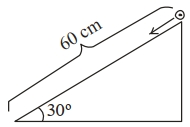
$A$ solid cylinder is released from rest from the top of an inclined plane of inclination $30^{\circ}$ and length $60\,cm$. If the cylinder rolls without slipping,its speed upon reaching the bottom of the inclined plane is $...........\,ms^{-1}$. (Given $g = 10\,ms^{-2}$)
A
$3$
B
$2$
C
$4$
D
$8$
Solution
(B) The formula for the velocity $v$ of a body rolling down an inclined plane without slipping is given by $v = \sqrt{\frac{2gh}{1 + \frac{k^2}{R^2}}}$.
Here,$h$ is the vertical height of the inclined plane,$h = L \sin \theta = 60 \times 10^{-2} \times \sin 30^{\circ} = 0.6 \times 0.5 = 0.3\,m$.
For a solid cylinder,the radius of gyration $k$ satisfies $k^2 = \frac{R^2}{2}$,so $\frac{k^2}{R^2} = \frac{1}{2}$.
Substituting these values into the formula:
$v = \sqrt{\frac{2 \times 10 \times 0.3}{1 + 0.5}} = \sqrt{\frac{6}{1.5}} = \sqrt{4} = 2\,ms^{-1}$.
Here,$h$ is the vertical height of the inclined plane,$h = L \sin \theta = 60 \times 10^{-2} \times \sin 30^{\circ} = 0.6 \times 0.5 = 0.3\,m$.
For a solid cylinder,the radius of gyration $k$ satisfies $k^2 = \frac{R^2}{2}$,so $\frac{k^2}{R^2} = \frac{1}{2}$.
Substituting these values into the formula:
$v = \sqrt{\frac{2 \times 10 \times 0.3}{1 + 0.5}} = \sqrt{\frac{6}{1.5}} = \sqrt{4} = 2\,ms^{-1}$.
0 likes
View Solution182
DifficultMCQ
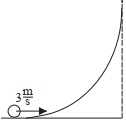
$A$ hollow spherical ball of uniform density rolls up a curved surface with an initial velocity $3\, m/s$ (as shown in figure). The maximum height with respect to the initial position covered by it will be $...........cm$.
A
$75$
B
$74$
C
$73$
D
$72$
Solution
(A) At the highest point,the final kinetic energy $KE_f = 0$.
Initial kinetic energy $KE_i$ is the sum of translational and rotational kinetic energy:
$KE_i = \frac{1}{2} mv^2 + \frac{1}{2} I \omega^2$
For a hollow spherical ball,the moment of inertia $I = \frac{2}{3} mR^2$. In the case of pure rolling,$v = R\omega$,so $\omega = \frac{v}{R}$.
Substituting these values:
$KE_i = \frac{1}{2} mv^2 + \frac{1}{2} \times (\frac{2}{3} mR^2) \times (\frac{v}{R})^2$
$KE_i = \frac{1}{2} mv^2 + \frac{1}{3} mv^2 = \frac{5}{6} mv^2$
Applying the law of conservation of energy,the initial kinetic energy is converted into potential energy at the maximum height $h$:
$KE_i = PE_f$
$\frac{5}{6} mv^2 = mgh$
$h = \frac{5v^2}{6g}$
Given $v = 3\, m/s$ and taking $g = 10\, m/s^2$:
$h = \frac{5 \times (3)^2}{6 \times 10} = \frac{5 \times 9}{60} = \frac{45}{60} = 0.75\, m$
Converting to centimeters: $0.75\, m = 75\, cm$.
Initial kinetic energy $KE_i$ is the sum of translational and rotational kinetic energy:
$KE_i = \frac{1}{2} mv^2 + \frac{1}{2} I \omega^2$
For a hollow spherical ball,the moment of inertia $I = \frac{2}{3} mR^2$. In the case of pure rolling,$v = R\omega$,so $\omega = \frac{v}{R}$.
Substituting these values:
$KE_i = \frac{1}{2} mv^2 + \frac{1}{2} \times (\frac{2}{3} mR^2) \times (\frac{v}{R})^2$
$KE_i = \frac{1}{2} mv^2 + \frac{1}{3} mv^2 = \frac{5}{6} mv^2$
Applying the law of conservation of energy,the initial kinetic energy is converted into potential energy at the maximum height $h$:
$KE_i = PE_f$
$\frac{5}{6} mv^2 = mgh$
$h = \frac{5v^2}{6g}$
Given $v = 3\, m/s$ and taking $g = 10\, m/s^2$:
$h = \frac{5 \times (3)^2}{6 \times 10} = \frac{5 \times 9}{60} = \frac{45}{60} = 0.75\, m$
Converting to centimeters: $0.75\, m = 75\, cm$.
0 likes
View Solution183
DifficultMCQ
$A$ ring and a solid sphere roll down the same inclined plane without slipping. They start from rest. The radii of both bodies are identical and the ratio of their kinetic energies is $\frac{7}{x}$ where $x$ is . . . . . . .
A
$5$
B
$7$
C
$10$
D
$40$
Solution
(B) In pure rolling motion,the work done by static friction is zero because the point of contact is instantaneously at rest.
By the law of conservation of energy,the initial potential energy $(PE = mgh)$ is converted into the total kinetic energy $(KE)$ at the bottom of the incline.
Since both objects start from rest at the same height $h$,their total kinetic energies at the bottom must be equal,regardless of their moments of inertia.
Therefore,$KE_{\text{ring}} = KE_{\text{sphere}}$.
The ratio of their kinetic energies is $\frac{KE_{\text{ring}}}{KE_{\text{sphere}}} = 1$.
Given that the ratio is $\frac{7}{x}$,we have $\frac{7}{x} = 1$,which implies $x = 7$.
By the law of conservation of energy,the initial potential energy $(PE = mgh)$ is converted into the total kinetic energy $(KE)$ at the bottom of the incline.
Since both objects start from rest at the same height $h$,their total kinetic energies at the bottom must be equal,regardless of their moments of inertia.
Therefore,$KE_{\text{ring}} = KE_{\text{sphere}}$.
The ratio of their kinetic energies is $\frac{KE_{\text{ring}}}{KE_{\text{sphere}}} = 1$.
Given that the ratio is $\frac{7}{x}$,we have $\frac{7}{x} = 1$,which implies $x = 7$.
0 likes
View Solution184
DifficultMCQ
$A$ cylinder is rolling down on an inclined plane of inclination $60^{\circ}$. Its acceleration during rolling down will be $\frac{x}{\sqrt{3}} \ m/s^2$,where $x=$ . . . . . . . (use $g=10 \ m/s^2$)
A
$1$
B
$5$
C
$7$
D
$10$
Solution
(D) For a body rolling down an inclined plane without slipping,the acceleration $a$ is given by the formula:
$a = \frac{g \sin \theta}{1 + \frac{I_{cm}}{MR^2}}$
For a solid cylinder,the moment of inertia about its central axis is $I_{cm} = \frac{1}{2} MR^2$.
Substituting this into the formula:
$a = \frac{g \sin \theta}{1 + \frac{\frac{1}{2} MR^2}{MR^2}} = \frac{g \sin \theta}{1 + \frac{1}{2}} = \frac{g \sin \theta}{\frac{3}{2}} = \frac{2}{3} g \sin \theta$
Given $g = 10 \ m/s^2$ and $\theta = 60^{\circ}$:
$a = \frac{2}{3} \times 10 \times \sin(60^{\circ}) = \frac{20}{3} \times \frac{\sqrt{3}}{2} = \frac{10 \sqrt{3}}{3} = \frac{10}{\sqrt{3}} \ m/s^2$
Comparing this with the given expression $\frac{x}{\sqrt{3}} \ m/s^2$,we get $x = 10$.
$a = \frac{g \sin \theta}{1 + \frac{I_{cm}}{MR^2}}$
For a solid cylinder,the moment of inertia about its central axis is $I_{cm} = \frac{1}{2} MR^2$.
Substituting this into the formula:
$a = \frac{g \sin \theta}{1 + \frac{\frac{1}{2} MR^2}{MR^2}} = \frac{g \sin \theta}{1 + \frac{1}{2}} = \frac{g \sin \theta}{\frac{3}{2}} = \frac{2}{3} g \sin \theta$
Given $g = 10 \ m/s^2$ and $\theta = 60^{\circ}$:
$a = \frac{2}{3} \times 10 \times \sin(60^{\circ}) = \frac{20}{3} \times \frac{\sqrt{3}}{2} = \frac{10 \sqrt{3}}{3} = \frac{10}{\sqrt{3}} \ m/s^2$
Comparing this with the given expression $\frac{x}{\sqrt{3}} \ m/s^2$,we get $x = 10$.
0 likes
View Solution185
DifficultMCQ
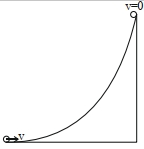
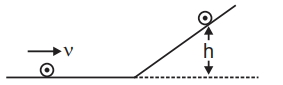
$A$ disc of radius $R$ and mass $M$ is rolling horizontally without slipping with speed $v$. It then moves up an inclined smooth surface as shown in figure. The maximum height that the disc can go up the incline is:
A
$\frac{v^2}{g}$
B
$\frac{3}{4} \frac{v^2}{g}$
C
$\frac{1}{2} \frac{v^2}{g}$
D
$\frac{2}{3} \frac{v^2}{g}$
Solution
(C) The disc is rolling on a horizontal surface without slipping,so it possesses both translational kinetic energy $(K_t = \frac{1}{2} Mv^2)$ and rotational kinetic energy $(K_r = \frac{1}{2} I\omega^2)$.
When the disc moves up a smooth inclined surface,there is no friction. Therefore,the torque due to friction is zero,and the rotational kinetic energy remains constant throughout the motion.
Only the translational kinetic energy is converted into gravitational potential energy as the disc climbs the incline.
Applying the law of conservation of energy for the translational part:
$\frac{1}{2} Mv^2 = Mgh$
Solving for $h$:
$h = \frac{v^2}{2g}$
When the disc moves up a smooth inclined surface,there is no friction. Therefore,the torque due to friction is zero,and the rotational kinetic energy remains constant throughout the motion.
Only the translational kinetic energy is converted into gravitational potential energy as the disc climbs the incline.
Applying the law of conservation of energy for the translational part:
$\frac{1}{2} Mv^2 = Mgh$
Solving for $h$:
$h = \frac{v^2}{2g}$
0 likes
View Solution186
DifficultMCQ
$A$ solid sphere and a hollow cylinder roll up without slipping on the same inclined plane with the same initial speed $v$. The sphere and the cylinder reach maximum heights $h_1$ and $h_2$,respectively,above the initial level. The ratio $h_1: h_2$ is $\frac{n}{10}$. The value of $n$ is . . . . . . .
A
$6$
B
$7$
C
$8$
D
$9$
Solution
(B) Using the principle of conservation of energy,the loss in kinetic energy equals the gain in potential energy.
$mgh = K.E._{total} = \frac{1}{2}mv^2 + \frac{1}{2}I\omega^2$
Since the object rolls without slipping,$\omega = \frac{v}{R}$ and $I = Mk^2$,where $k$ is the radius of gyration.
$mgh = \frac{1}{2}mv^2(1 + \frac{k^2}{R^2})$
$h = \frac{v^2}{2g}(1 + \frac{k^2}{R^2})$
Thus,$h \propto (1 + \frac{k^2}{R^2})$.
For a solid sphere,$\frac{k^2}{R^2} = \frac{2}{5}$,so $h_1 \propto (1 + \frac{2}{5}) = \frac{7}{5}$.
For a hollow cylinder,$\frac{k^2}{R^2} = 1$,so $h_2 \propto (1 + 1) = 2$.
Therefore,$\frac{h_1}{h_2} = \frac{7/5}{2} = \frac{7}{10}$.
Given $\frac{h_1}{h_2} = \frac{n}{10}$,we find $n = 7$.
$mgh = K.E._{total} = \frac{1}{2}mv^2 + \frac{1}{2}I\omega^2$
Since the object rolls without slipping,$\omega = \frac{v}{R}$ and $I = Mk^2$,where $k$ is the radius of gyration.
$mgh = \frac{1}{2}mv^2(1 + \frac{k^2}{R^2})$
$h = \frac{v^2}{2g}(1 + \frac{k^2}{R^2})$
Thus,$h \propto (1 + \frac{k^2}{R^2})$.
For a solid sphere,$\frac{k^2}{R^2} = \frac{2}{5}$,so $h_1 \propto (1 + \frac{2}{5}) = \frac{7}{5}$.
For a hollow cylinder,$\frac{k^2}{R^2} = 1$,so $h_2 \propto (1 + 1) = 2$.
Therefore,$\frac{h_1}{h_2} = \frac{7/5}{2} = \frac{7}{10}$.
Given $\frac{h_1}{h_2} = \frac{n}{10}$,we find $n = 7$.
0 likes
View Solution187
DifficultMCQ
$A$ circular disc reaches from top to bottom of an inclined plane of length $l$. When it slips down the plane,it takes $t \ s$. When it rolls down the plane,it takes $\left(\frac{\alpha}{2}\right)^{1/2} t \ s$,where $\alpha$ is:
A
$3$
B
$4$
C
$5$
D
$6$
Solution
(A) For slipping down the plane without friction,the acceleration is $a = g \sin \theta$. The time taken to cover distance $l$ is $t = \sqrt{\frac{2l}{g \sin \theta}}$.
For rolling down the plane,the acceleration is $a' = \frac{g \sin \theta}{1 + \frac{k^2}{R^2}}$. For a circular disc,the radius of gyration $k$ is $\frac{R}{\sqrt{2}}$,so $\frac{k^2}{R^2} = \frac{1}{2}$.
Thus,$a' = \frac{g \sin \theta}{1 + 1/2} = \frac{2}{3} g \sin \theta$.
The time taken for rolling is $t' = \sqrt{\frac{2l}{a'}} = \sqrt{\frac{2l}{\frac{2}{3} g \sin \theta}} = \sqrt{\frac{3}{2}} \sqrt{\frac{2l}{g \sin \theta}} = \sqrt{\frac{3}{2}} t$.
Comparing this with $t' = \left(\frac{\alpha}{2}\right)^{1/2} t$,we get $\sqrt{\frac{\alpha}{2}} = \sqrt{\frac{3}{2}}$,which implies $\alpha = 3$.
For rolling down the plane,the acceleration is $a' = \frac{g \sin \theta}{1 + \frac{k^2}{R^2}}$. For a circular disc,the radius of gyration $k$ is $\frac{R}{\sqrt{2}}$,so $\frac{k^2}{R^2} = \frac{1}{2}$.
Thus,$a' = \frac{g \sin \theta}{1 + 1/2} = \frac{2}{3} g \sin \theta$.
The time taken for rolling is $t' = \sqrt{\frac{2l}{a'}} = \sqrt{\frac{2l}{\frac{2}{3} g \sin \theta}} = \sqrt{\frac{3}{2}} \sqrt{\frac{2l}{g \sin \theta}} = \sqrt{\frac{3}{2}} t$.
Comparing this with $t' = \left(\frac{\alpha}{2}\right)^{1/2} t$,we get $\sqrt{\frac{\alpha}{2}} = \sqrt{\frac{3}{2}}$,which implies $\alpha = 3$.
0 likes
View Solution188
DifficultMCQ
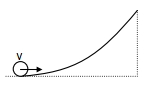
$A$ small object of uniform density rolls up a curved surface with an initial velocity $v$. It reaches up to a maximum height of $\frac{3 v^2}{4 g}$ with respect to the initial position. The object is
A
ring
B
solid sphere
C
hollow sphere
D
disc
Solution
(D) For an object rolling without slipping,the total initial kinetic energy is the sum of translational and rotational kinetic energy: $K_i = \frac{1}{2}mv^2 + \frac{1}{2}I\omega^2 = \frac{1}{2}mv^2(1 + \frac{k^2}{r^2})$.
At the maximum height $h$,the kinetic energy is converted into potential energy: $K_i = mgh$.
Equating the two: $\frac{1}{2}mv^2(1 + \frac{k^2}{r^2}) = mgh$.
Given $h = \frac{3v^2}{4g}$,we substitute this into the equation:
$\frac{1}{2}v^2(1 + \frac{k^2}{r^2}) = g(\frac{3v^2}{4g})$
$\frac{1}{2}(1 + \frac{k^2}{r^2}) = \frac{3}{4}$
$1 + \frac{k^2}{r^2} = \frac{3}{2}$
$\frac{k^2}{r^2} = \frac{1}{2}$.
Since the radius of gyration $k$ for a disc is given by $k^2 = \frac{1}{2}r^2$,the object is a disc.
At the maximum height $h$,the kinetic energy is converted into potential energy: $K_i = mgh$.
Equating the two: $\frac{1}{2}mv^2(1 + \frac{k^2}{r^2}) = mgh$.
Given $h = \frac{3v^2}{4g}$,we substitute this into the equation:
$\frac{1}{2}v^2(1 + \frac{k^2}{r^2}) = g(\frac{3v^2}{4g})$
$\frac{1}{2}(1 + \frac{k^2}{r^2}) = \frac{3}{4}$
$1 + \frac{k^2}{r^2} = \frac{3}{2}$
$\frac{k^2}{r^2} = \frac{1}{2}$.
Since the radius of gyration $k$ for a disc is given by $k^2 = \frac{1}{2}r^2$,the object is a disc.
0 likes
View Solution189
DifficultMCQ
$STATEMENT-1$: Two cylinders,one hollow (metal) and the other solid (wood) with the same mass and identical dimensions,are simultaneously allowed to roll without slipping down an inclined plane from the same height. The hollow cylinder will reach the bottom of the inclined plane first.
$STATEMENT-2$: By the principle of conservation of energy,the total kinetic energies of both the cylinders are identical when they reach the bottom of the incline.
$STATEMENT-2$: By the principle of conservation of energy,the total kinetic energies of both the cylinders are identical when they reach the bottom of the incline.
A
$STATEMENT-1$ is True,$STATEMENT-2$ is True; $STATEMENT-2$ is a correct explanation for $STATEMENT-1$
B
$STATEMENT-1$ is True,$STATEMENT-2$ is True; $STATEMENT-2$ is $NOT$ a correct explanation for $STATEMENT-1$
C
$STATEMENT-1$ is True,$STATEMENT-2$ is False
D
$STATEMENT-1$ is False,$STATEMENT-2$ is True
Solution
(D) For an object rolling down an inclined plane,the acceleration is given by $a = \frac{g \sin \theta}{1 + \frac{I}{mR^2}}$.
For a hollow cylinder,$I = mR^2$,so $a_{hollow} = \frac{g \sin \theta}{1 + 1} = \frac{g \sin \theta}{2}$.
For a solid cylinder,$I = \frac{1}{2}mR^2$,so $a_{solid} = \frac{g \sin \theta}{1 + 0.5} = \frac{g \sin \theta}{1.5} = \frac{2g \sin \theta}{3}$.
Since $a_{solid} > a_{hollow}$,the solid cylinder reaches the bottom first. Thus,$STATEMENT-1$ is False.
By the principle of conservation of energy,the potential energy lost $(mgh)$ is converted into total kinetic energy $(K_{total} = K_{trans} + K_{rot})$. Since both have the same mass and height,their total kinetic energies at the bottom are identical. Thus,$STATEMENT-2$ is True.
For a hollow cylinder,$I = mR^2$,so $a_{hollow} = \frac{g \sin \theta}{1 + 1} = \frac{g \sin \theta}{2}$.
For a solid cylinder,$I = \frac{1}{2}mR^2$,so $a_{solid} = \frac{g \sin \theta}{1 + 0.5} = \frac{g \sin \theta}{1.5} = \frac{2g \sin \theta}{3}$.
Since $a_{solid} > a_{hollow}$,the solid cylinder reaches the bottom first. Thus,$STATEMENT-1$ is False.
By the principle of conservation of energy,the potential energy lost $(mgh)$ is converted into total kinetic energy $(K_{total} = K_{trans} + K_{rot})$. Since both have the same mass and height,their total kinetic energies at the bottom are identical. Thus,$STATEMENT-2$ is True.
0 likes
View Solution190
AdvancedMCQ
$A$ ring and a disc are initially at rest, side by side, at the top of an inclined plane which makes an angle $60^{\circ}$ with the horizontal. They start to roll without slipping at the same instant of time along the shortest path. If the time difference between their reaching the ground is $(2-\sqrt{3}) / \sqrt{10} \,s$, then the height of the top of the inclined plane, in metres, is. . . . . . Take $g=10 \,m \,s^{-2}$.
A
$0.60$
B
$0.70$
C
$0.75$
D
$0.80$
Solution
(C) The acceleration of a body rolling down an inclined plane is given by $a = \frac{g \sin \theta}{1 + \frac{k^2}{R^2}}$.
For a ring, $k^2 = R^2$, so $a_R = \frac{g \sin \theta}{1 + 1} = \frac{g \sin \theta}{2}$.
For a disc, $k^2 = \frac{R^2}{2}$, so $a_D = \frac{g \sin \theta}{1 + 0.5} = \frac{2g \sin \theta}{3}$.
The distance traveled along the incline is $d = \frac{h}{\sin \theta}$.
Using $d = \frac{1}{2} a t^2$, we have $t = \sqrt{\frac{2d}{a}} = \sqrt{\frac{2h}{a \sin \theta}}$.
For the ring: $t_R = \sqrt{\frac{2h}{(g \sin \theta / 2) \sin \theta}} = \sqrt{\frac{4h}{g \sin^2 \theta}}$.
For the disc: $t_D = \sqrt{\frac{2h}{(2g \sin \theta / 3) \sin \theta}} = \sqrt{\frac{3h}{g \sin^2 \theta}}$.
Given $\theta = 60^{\circ}$, $\sin \theta = \frac{\sqrt{3}}{2}$, so $\sin^2 \theta = \frac{3}{4}$.
$t_R = \sqrt{\frac{4h}{g(3/4)}} = \sqrt{\frac{16h}{3g}}$ and $t_D = \sqrt{\frac{3h}{g(3/4)}} = \sqrt{\frac{4h}{g}}$.
Given $t_R - t_D = \frac{2-\sqrt{3}}{\sqrt{10}}$, we have $\sqrt{\frac{h}{g}} \left( \frac{4}{\sqrt{3}} - 2 \right) = \frac{2-\sqrt{3}}{\sqrt{10}}$.
$\sqrt{\frac{h}{10}} \left( \frac{4-2\sqrt{3}}{\sqrt{3}} \right) = \frac{2-\sqrt{3}}{\sqrt{10}}$.
$\sqrt{h} \left( \frac{2(2-\sqrt{3})}{\sqrt{3}} \right) = 2-\sqrt{3} \Rightarrow \sqrt{h} = \frac{\sqrt{3}}{2} \Rightarrow h = \frac{3}{4} = 0.75 \,m$.
For a ring, $k^2 = R^2$, so $a_R = \frac{g \sin \theta}{1 + 1} = \frac{g \sin \theta}{2}$.
For a disc, $k^2 = \frac{R^2}{2}$, so $a_D = \frac{g \sin \theta}{1 + 0.5} = \frac{2g \sin \theta}{3}$.
The distance traveled along the incline is $d = \frac{h}{\sin \theta}$.
Using $d = \frac{1}{2} a t^2$, we have $t = \sqrt{\frac{2d}{a}} = \sqrt{\frac{2h}{a \sin \theta}}$.
For the ring: $t_R = \sqrt{\frac{2h}{(g \sin \theta / 2) \sin \theta}} = \sqrt{\frac{4h}{g \sin^2 \theta}}$.
For the disc: $t_D = \sqrt{\frac{2h}{(2g \sin \theta / 3) \sin \theta}} = \sqrt{\frac{3h}{g \sin^2 \theta}}$.
Given $\theta = 60^{\circ}$, $\sin \theta = \frac{\sqrt{3}}{2}$, so $\sin^2 \theta = \frac{3}{4}$.
$t_R = \sqrt{\frac{4h}{g(3/4)}} = \sqrt{\frac{16h}{3g}}$ and $t_D = \sqrt{\frac{3h}{g(3/4)}} = \sqrt{\frac{4h}{g}}$.
Given $t_R - t_D = \frac{2-\sqrt{3}}{\sqrt{10}}$, we have $\sqrt{\frac{h}{g}} \left( \frac{4}{\sqrt{3}} - 2 \right) = \frac{2-\sqrt{3}}{\sqrt{10}}$.
$\sqrt{\frac{h}{10}} \left( \frac{4-2\sqrt{3}}{\sqrt{3}} \right) = \frac{2-\sqrt{3}}{\sqrt{10}}$.
$\sqrt{h} \left( \frac{2(2-\sqrt{3})}{\sqrt{3}} \right) = 2-\sqrt{3} \Rightarrow \sqrt{h} = \frac{\sqrt{3}}{2} \Rightarrow h = \frac{3}{4} = 0.75 \,m$.

0 likes
View Solution191
MediumMCQ
$A$ ring and a disc are initially at rest,side by side,at the top of an inclined plane which makes an angle $60^{\circ}$ with the horizontal. They start to roll without slipping at the same instant of time along the shortest path. If the time difference between their reaching the ground is $(2-\sqrt{3}) / \sqrt{10} \ s$,then the height of the top of the inclined plane,in metres,is. . . . . . . . Take $g=10 \ m \ s^{-2}$.
A
$0.70$
B
$0.75$
C
$0.80$
D
$0.85$
Solution
(B) The acceleration $a$ of a body rolling down an inclined plane is given by $a = \frac{g \sin \theta}{1 + \frac{k^2}{R^2}}$.
For a ring,$k^2 = R^2$,so $a_R = \frac{g \sin \theta}{1+1} = \frac{g \sin \theta}{2}$.
For a disc,$k^2 = R^2/2$,so $a_D = \frac{g \sin \theta}{1+0.5} = \frac{2g \sin \theta}{3}$.
The distance to be covered along the incline is $d = \frac{h}{\sin \theta}$.
Using $d = \frac{1}{2} a t^2$,we have $t = \sqrt{\frac{2d}{a}} = \sqrt{\frac{2h}{a \sin \theta}}$.
For the ring: $t_R = \sqrt{\frac{2h}{(g \sin \theta / 2) \sin \theta}} = \sqrt{\frac{4h}{g \sin^2 \theta}} = \sqrt{\frac{4h}{g (3/4)}} = \sqrt{\frac{16h}{3g}}$.
For the disc: $t_D = \sqrt{\frac{2h}{(2g \sin \theta / 3) \sin \theta}} = \sqrt{\frac{3h}{g \sin^2 \theta}} = \sqrt{\frac{3h}{g (3/4)}} = \sqrt{\frac{4h}{g}}$.
Given $t_R - t_D = \frac{2-\sqrt{3}}{\sqrt{10}}$,we have $\sqrt{\frac{h}{g}} \left( \sqrt{\frac{16}{3}} - 2 \right) = \frac{2-\sqrt{3}}{\sqrt{10}}$.
$\sqrt{\frac{h}{10}} \left( \frac{4 - 2\sqrt{3}}{\sqrt{3}} \right) = \frac{2-\sqrt{3}}{\sqrt{10}}$.
$\sqrt{h} \left( \frac{2(2-\sqrt{3})}{\sqrt{3}} \right) = 2-\sqrt{3}$.
$\sqrt{h} = \frac{\sqrt{3}}{2} \implies h = \frac{3}{4} = 0.75 \ m$.
For a ring,$k^2 = R^2$,so $a_R = \frac{g \sin \theta}{1+1} = \frac{g \sin \theta}{2}$.
For a disc,$k^2 = R^2/2$,so $a_D = \frac{g \sin \theta}{1+0.5} = \frac{2g \sin \theta}{3}$.
The distance to be covered along the incline is $d = \frac{h}{\sin \theta}$.
Using $d = \frac{1}{2} a t^2$,we have $t = \sqrt{\frac{2d}{a}} = \sqrt{\frac{2h}{a \sin \theta}}$.
For the ring: $t_R = \sqrt{\frac{2h}{(g \sin \theta / 2) \sin \theta}} = \sqrt{\frac{4h}{g \sin^2 \theta}} = \sqrt{\frac{4h}{g (3/4)}} = \sqrt{\frac{16h}{3g}}$.
For the disc: $t_D = \sqrt{\frac{2h}{(2g \sin \theta / 3) \sin \theta}} = \sqrt{\frac{3h}{g \sin^2 \theta}} = \sqrt{\frac{3h}{g (3/4)}} = \sqrt{\frac{4h}{g}}$.
Given $t_R - t_D = \frac{2-\sqrt{3}}{\sqrt{10}}$,we have $\sqrt{\frac{h}{g}} \left( \sqrt{\frac{16}{3}} - 2 \right) = \frac{2-\sqrt{3}}{\sqrt{10}}$.
$\sqrt{\frac{h}{10}} \left( \frac{4 - 2\sqrt{3}}{\sqrt{3}} \right) = \frac{2-\sqrt{3}}{\sqrt{10}}$.
$\sqrt{h} \left( \frac{2(2-\sqrt{3})}{\sqrt{3}} \right) = 2-\sqrt{3}$.
$\sqrt{h} = \frac{\sqrt{3}}{2} \implies h = \frac{3}{4} = 0.75 \ m$.

0 likes
View Solution192
AdvancedMCQ
$A$ horizontal force $F$ is applied at the center of mass of a cylindrical object of mass $m$ and radius $R$,perpendicular to its axis as shown in the figure. The coefficient of friction between the object and the ground is $\mu$. The center of mass of the object has an acceleration $a$. The acceleration due to gravity is $g$. Given that the object rolls without slipping,which of the following statement$(s)$ is(are) correct?
$(A)$ For the same $F$,the value of $a$ does not depend on whether the cylinder is solid or hollow
$(B)$ For a solid cylinder,the maximum possible value of $a$ is $2 \mu g$
$(C)$ The magnitude of the frictional force on the object due to the ground is always $\mu m g$
$(D)$ For a thin-walled hollow cylinder,$a = \frac{F}{2m}$
$(A)$ For the same $F$,the value of $a$ does not depend on whether the cylinder is solid or hollow
$(B)$ For a solid cylinder,the maximum possible value of $a$ is $2 \mu g$
$(C)$ The magnitude of the frictional force on the object due to the ground is always $\mu m g$
$(D)$ For a thin-walled hollow cylinder,$a = \frac{F}{2m}$
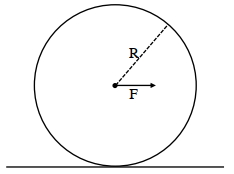
A
$A, B$
B
$A, C$
C
$B, C$
D
$B, D$
Solution
(D) Let $a_c$ be the acceleration of the center of mass and $f$ be the frictional force.
From Newton's second law for translation: $F - f = ma_c$ $(1)$
From the torque equation about the center of mass: $fR = I_c \alpha$ $(2)$
For rolling without slipping: $a_c = \alpha R$,so $\alpha = \frac{a_c}{R}$.
Substituting $\alpha$ in $(2)$: $fR = I_c \frac{a_c}{R} \implies f = \frac{I_c a_c}{R^2}$.
Substituting $f$ in $(1)$: $F - \frac{I_c a_c}{R^2} = ma_c \implies a_c = \frac{F}{m + \frac{I_c}{R^2}}$.
$(A)$ Incorrect: $a_c$ depends on $I_c$,which differs for solid $(I_c = \frac{1}{2}mR^2)$ and hollow $(I_c = mR^2)$ cylinders.
$(D)$ Correct: For a thin-walled hollow cylinder,$I_c = mR^2$. Thus,$a_c = \frac{F}{m + \frac{mR^2}{R^2}} = \frac{F}{2m}$.
$(C)$ Incorrect: The frictional force $f = \frac{I_c a_c}{R^2} = \frac{I_c F}{R^2(m + I_c/R^2)}$,which is not necessarily $\mu mg$.
$(B)$ Correct: For rolling without slipping,$f \leq \mu mg$. Since $f = \frac{I_c a_c}{R^2}$,we have $\frac{I_c a_c}{R^2} \leq \mu mg \implies a_c \leq \frac{\mu mgR^2}{I_c}$. For a solid cylinder,$I_c = \frac{1}{2}mR^2$,so $a_c \leq \frac{\mu mgR^2}{0.5mR^2} = 2\mu g$.
From Newton's second law for translation: $F - f = ma_c$ $(1)$
From the torque equation about the center of mass: $fR = I_c \alpha$ $(2)$
For rolling without slipping: $a_c = \alpha R$,so $\alpha = \frac{a_c}{R}$.
Substituting $\alpha$ in $(2)$: $fR = I_c \frac{a_c}{R} \implies f = \frac{I_c a_c}{R^2}$.
Substituting $f$ in $(1)$: $F - \frac{I_c a_c}{R^2} = ma_c \implies a_c = \frac{F}{m + \frac{I_c}{R^2}}$.
$(A)$ Incorrect: $a_c$ depends on $I_c$,which differs for solid $(I_c = \frac{1}{2}mR^2)$ and hollow $(I_c = mR^2)$ cylinders.
$(D)$ Correct: For a thin-walled hollow cylinder,$I_c = mR^2$. Thus,$a_c = \frac{F}{m + \frac{mR^2}{R^2}} = \frac{F}{2m}$.
$(C)$ Incorrect: The frictional force $f = \frac{I_c a_c}{R^2} = \frac{I_c F}{R^2(m + I_c/R^2)}$,which is not necessarily $\mu mg$.
$(B)$ Correct: For rolling without slipping,$f \leq \mu mg$. Since $f = \frac{I_c a_c}{R^2}$,we have $\frac{I_c a_c}{R^2} \leq \mu mg \implies a_c \leq \frac{\mu mgR^2}{I_c}$. For a solid cylinder,$I_c = \frac{1}{2}mR^2$,so $a_c \leq \frac{\mu mgR^2}{0.5mR^2} = 2\mu g$.
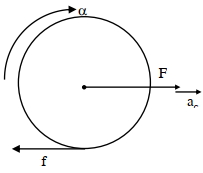
0 likes
View Solution193
AdvancedMCQ
Two solid cylinders $P$ and $Q$ of same mass and same radius start rolling down a fixed inclined plane from the same height at the same time. Cylinder $P$ has most of its mass concentrated near its surface,while $Q$ has most of its mass concentrated near the axis. Which statement$(s)$ is (are) correct?
A
Both cylinders $P$ and $Q$ reach the ground at the same time.
B
Cylinder $P$ has larger linear acceleration than cylinder $Q$.
C
Both cylinder $Q$ reaches the ground with same translational kinetic energy.
D
Cylinder $Q$ reaches the ground with larger angular speed.
Solution
(D) The moment of inertia $I$ of a body depends on the distribution of mass. Since cylinder $P$ has mass concentrated near its surface,it has a larger moment of inertia $(I_P > I_Q)$.
The linear acceleration $a$ of a rolling body on an inclined plane is given by $a = \frac{g \sin \theta}{1 + \frac{I}{mR^2}}$.
Since $I_P > I_Q$,it follows that $a_P < a_Q$. This means cylinder $Q$ accelerates faster.
Using the kinematic equation $s = \frac{1}{2}at^2$,the time taken to reach the bottom is $t = \sqrt{\frac{2s}{a}}$. Since $a_P < a_Q$,we have $t_P > t_Q$,meaning $Q$ reaches the ground first.
The final velocity $v$ is given by $v^2 = 2as$. Since $a_Q > a_P$,$v_Q > v_P$. The translational kinetic energy is $\frac{1}{2}mv^2$,so $Q$ has higher translational kinetic energy.
Finally,since $v = \omega R$,the angular speed $\omega = \frac{v}{R}$. Since $v_Q > v_P$,it follows that $\omega_Q > \omega_P$. Thus,cylinder $Q$ reaches the ground with a larger angular speed.
The linear acceleration $a$ of a rolling body on an inclined plane is given by $a = \frac{g \sin \theta}{1 + \frac{I}{mR^2}}$.
Since $I_P > I_Q$,it follows that $a_P < a_Q$. This means cylinder $Q$ accelerates faster.
Using the kinematic equation $s = \frac{1}{2}at^2$,the time taken to reach the bottom is $t = \sqrt{\frac{2s}{a}}$. Since $a_P < a_Q$,we have $t_P > t_Q$,meaning $Q$ reaches the ground first.
The final velocity $v$ is given by $v^2 = 2as$. Since $a_Q > a_P$,$v_Q > v_P$. The translational kinetic energy is $\frac{1}{2}mv^2$,so $Q$ has higher translational kinetic energy.
Finally,since $v = \omega R$,the angular speed $\omega = \frac{v}{R}$. Since $v_Q > v_P$,it follows that $\omega_Q > \omega_P$. Thus,cylinder $Q$ reaches the ground with a larger angular speed.
0 likes
View Solution194
MediumMCQ
Two identical uniform discs roll without slipping on two different surfaces $AB$ and $CD$ (see figure) starting at $A$ and $C$ with linear speeds $v_1$ and $v_2$,respectively,and always remain in contact with the surfaces. If they reach $B$ and $D$ with the same linear speed and $v_1 = 3 \ m/s$,then $v_2$ in $m/s$ is $(g = 10 \ m/s^2)$.
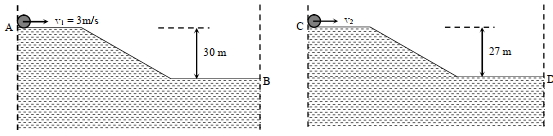
A
$5$
B
$6$
C
$7$
D
$8$
Solution
(C) The total mechanical energy of a disc rolling without slipping is the sum of its translational and rotational kinetic energies,plus its potential energy.
Total energy $E = K_{trans} + K_{rot} + U = \frac{1}{2}mv^2 + \frac{1}{2}I\omega^2 + mgh$.
For a uniform disc,$I = \frac{1}{2}mR^2$ and for pure rolling,$\omega = \frac{v}{R}$.
Thus,$E = \frac{1}{2}mv^2 + \frac{1}{2}(\frac{1}{2}mR^2)(\frac{v}{R})^2 + mgh = \frac{1}{2}mv^2 + \frac{1}{4}mv^2 + mgh = \frac{3}{4}mv^2 + mgh$.
Applying the law of conservation of energy between points $A$ and $B$,and $C$ and $D$:
For path $AB$: $E_A = E_B \implies \frac{3}{4}mv_1^2 + mgh_1 = \frac{3}{4}mv_f^2 + 0$,where $h_1 = 30 \ m$.
For path $CD$: $E_C = E_D \implies \frac{3}{4}mv_2^2 + mgh_2 = \frac{3}{4}mv_f^2 + 0$,where $h_2 = 27 \ m$.
Equating the two expressions for $\frac{3}{4}mv_f^2$:
$\frac{3}{4}mv_1^2 + mgh_1 = \frac{3}{4}mv_2^2 + mgh_2$.
Substituting the given values: $\frac{3}{4}(3)^2 + 10(30) = \frac{3}{4}v_2^2 + 10(27)$.
$\frac{27}{4} + 300 = \frac{3}{4}v_2^2 + 270$.
$6.75 + 30 = \frac{3}{4}v_2^2 \implies 36.75 = \frac{3}{4}v_2^2$.
$v_2^2 = \frac{36.75 \times 4}{3} = 12.25 \times 4 = 49$.
$v_2 = \sqrt{49} = 7 \ m/s$.
Total energy $E = K_{trans} + K_{rot} + U = \frac{1}{2}mv^2 + \frac{1}{2}I\omega^2 + mgh$.
For a uniform disc,$I = \frac{1}{2}mR^2$ and for pure rolling,$\omega = \frac{v}{R}$.
Thus,$E = \frac{1}{2}mv^2 + \frac{1}{2}(\frac{1}{2}mR^2)(\frac{v}{R})^2 + mgh = \frac{1}{2}mv^2 + \frac{1}{4}mv^2 + mgh = \frac{3}{4}mv^2 + mgh$.
Applying the law of conservation of energy between points $A$ and $B$,and $C$ and $D$:
For path $AB$: $E_A = E_B \implies \frac{3}{4}mv_1^2 + mgh_1 = \frac{3}{4}mv_f^2 + 0$,where $h_1 = 30 \ m$.
For path $CD$: $E_C = E_D \implies \frac{3}{4}mv_2^2 + mgh_2 = \frac{3}{4}mv_f^2 + 0$,where $h_2 = 27 \ m$.
Equating the two expressions for $\frac{3}{4}mv_f^2$:
$\frac{3}{4}mv_1^2 + mgh_1 = \frac{3}{4}mv_2^2 + mgh_2$.
Substituting the given values: $\frac{3}{4}(3)^2 + 10(30) = \frac{3}{4}v_2^2 + 10(27)$.
$\frac{27}{4} + 300 = \frac{3}{4}v_2^2 + 270$.
$6.75 + 30 = \frac{3}{4}v_2^2 \implies 36.75 = \frac{3}{4}v_2^2$.
$v_2^2 = \frac{36.75 \times 4}{3} = 12.25 \times 4 = 49$.
$v_2 = \sqrt{49} = 7 \ m/s$.
0 likes
View Solution195
AdvancedMCQ
$A$ solid sphere of mass $1 kg$ and radius $1 m$ rolls without slipping on a fixed inclined plane with an angle of inclination $\theta = 30^{\circ}$ from the horizontal. Two forces of magnitude $1 N$ each,parallel to the incline,act on the sphere,both at a distance $r = 0.5 m$ from the center of the sphere,as shown in the figure. The acceleration of the sphere down the plane is . . . $m s^{-2}$. (Take $g = 10 m s^{-2}$.)
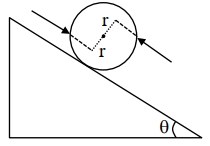
A
$2.40$
B
$2.80$
C
$2.45$
D
$2.86$
Solution
(D) Given: Mass $M = 1 kg$,Radius $R = 1 m$,$\theta = 30^{\circ}$,$g = 10 m s^{-2}$.
Component of weight down the plane: $Mg \sin \theta = 1 \times 10 \times \sin 30^{\circ} = 10 \times 0.5 = 5 N$.
Let $f$ be the friction force acting up the plane. The two external forces of $1 N$ each act in opposite directions relative to the center,creating a net torque.
Equation of motion for translation: $Mg \sin \theta - f - F_{ext} = Ma$. Here,the two $1 N$ forces act such that one aids motion and one opposes it,but they create a net torque. Looking at the diagram,the net force along the incline is $Mg \sin \theta = 5 N$. The two $1 N$ forces cancel each other out in terms of net translational force.
So,$5 - f = 1 \times a \Rightarrow f = 5 - a$.
Equation of motion for rotation about the center of mass $(COM)$: $\tau_{net} = I \alpha$.
The torque due to friction $f$ is $fR$ (counter-clockwise). The torque due to the two $1 N$ forces is $2 \times (1 N \times 0.5 m) = 1 N m$ (clockwise).
Thus,$fR - 1 = I \alpha$,where $I = \frac{2}{5} MR^2 = 0.4 kg m^2$ and $\alpha = \frac{a}{R} = a$.
$f(1) - 1 = 0.4 a \Rightarrow f = 1 + 0.4 a$.
Equating the two expressions for $f$: $5 - a = 1 + 0.4 a$.
$4 = 1.4 a \Rightarrow a = \frac{4}{1.4} = \frac{40}{14} = \frac{20}{7} \approx 2.86 m s^{-2}$.
Component of weight down the plane: $Mg \sin \theta = 1 \times 10 \times \sin 30^{\circ} = 10 \times 0.5 = 5 N$.
Let $f$ be the friction force acting up the plane. The two external forces of $1 N$ each act in opposite directions relative to the center,creating a net torque.
Equation of motion for translation: $Mg \sin \theta - f - F_{ext} = Ma$. Here,the two $1 N$ forces act such that one aids motion and one opposes it,but they create a net torque. Looking at the diagram,the net force along the incline is $Mg \sin \theta = 5 N$. The two $1 N$ forces cancel each other out in terms of net translational force.
So,$5 - f = 1 \times a \Rightarrow f = 5 - a$.
Equation of motion for rotation about the center of mass $(COM)$: $\tau_{net} = I \alpha$.
The torque due to friction $f$ is $fR$ (counter-clockwise). The torque due to the two $1 N$ forces is $2 \times (1 N \times 0.5 m) = 1 N m$ (clockwise).
Thus,$fR - 1 = I \alpha$,where $I = \frac{2}{5} MR^2 = 0.4 kg m^2$ and $\alpha = \frac{a}{R} = a$.
$f(1) - 1 = 0.4 a \Rightarrow f = 1 + 0.4 a$.
Equating the two expressions for $f$: $5 - a = 1 + 0.4 a$.
$4 = 1.4 a \Rightarrow a = \frac{4}{1.4} = \frac{40}{14} = \frac{20}{7} \approx 2.86 m s^{-2}$.
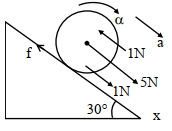
0 likes
View Solution196
MediumMCQ
$A$ solid sphere of mass $m$ and radius $r$ is allowed to roll without slipping from the highest point of an inclined plane of length $L$ that makes an angle $30^{\circ}$ with the horizontal. The speed of the sphere at the bottom of the plane is $v_1$. If the angle of inclination is increased to $45^{\circ}$ while keeping $L$ constant,the new speed of the sphere at the bottom of the plane is $v_2$. The ratio of $v_1^2 : v_2^2$ is
A
$1: \sqrt{2}$
B
$1: 3$
C
$1: 2$
D
$1: \sqrt{3}$
Solution
(A) Using the Work-Energy Theorem $(WET)$:
$W_g = K_f - K_i$
Since the sphere starts from rest,$K_i = 0$. The work done by gravity is $W_g = mgL \sin \theta$.
The total kinetic energy $(K.E.)$ in pure rolling is given by:
$K_f = \frac{1}{2} mv^2 + \frac{1}{2} I_{cm} \omega^2$
For a solid sphere,$I_{cm} = \frac{2}{5} mr^2$ and for pure rolling,$\omega = \frac{v}{r}$.
$K_f = \frac{1}{2} mv^2 + \frac{1}{2} (\frac{2}{5} mr^2) (\frac{v^2}{r^2}) = \frac{1}{2} mv^2 + \frac{1}{5} mv^2 = \frac{7}{10} mv^2$.
Equating work done to change in kinetic energy:
$mgL \sin \theta = \frac{7}{10} mv^2$
$v^2 = \frac{10}{7} gL \sin \theta$
This implies $v^2 \propto \sin \theta$.
Therefore,the ratio is:
$\frac{v_1^2}{v_2^2} = \frac{\sin 30^{\circ}}{\sin 45^{\circ}} = \frac{1/2}{1/\sqrt{2}} = \frac{1}{\sqrt{2}}$.
Thus,the ratio $v_1^2 : v_2^2$ is $1 : \sqrt{2}$.
$W_g = K_f - K_i$
Since the sphere starts from rest,$K_i = 0$. The work done by gravity is $W_g = mgL \sin \theta$.
The total kinetic energy $(K.E.)$ in pure rolling is given by:
$K_f = \frac{1}{2} mv^2 + \frac{1}{2} I_{cm} \omega^2$
For a solid sphere,$I_{cm} = \frac{2}{5} mr^2$ and for pure rolling,$\omega = \frac{v}{r}$.
$K_f = \frac{1}{2} mv^2 + \frac{1}{2} (\frac{2}{5} mr^2) (\frac{v^2}{r^2}) = \frac{1}{2} mv^2 + \frac{1}{5} mv^2 = \frac{7}{10} mv^2$.
Equating work done to change in kinetic energy:
$mgL \sin \theta = \frac{7}{10} mv^2$
$v^2 = \frac{10}{7} gL \sin \theta$
This implies $v^2 \propto \sin \theta$.
Therefore,the ratio is:
$\frac{v_1^2}{v_2^2} = \frac{\sin 30^{\circ}}{\sin 45^{\circ}} = \frac{1/2}{1/\sqrt{2}} = \frac{1}{\sqrt{2}}$.
Thus,the ratio $v_1^2 : v_2^2$ is $1 : \sqrt{2}$.
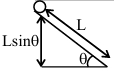
0 likes
View Solution197
MediumMCQ
$A$ uniform solid cylinder of mass $m$ and radius $r$ rolls along an inclined rough plane of inclination $45^{\circ}$. If it starts to roll from rest from the top of the plane,then the linear acceleration of the cylinder axis will be:
A
$\frac{1}{\sqrt{2}} g$
B
$\frac{1}{3 \sqrt{2}} g$
C
$\frac{\sqrt{2} g}{3}$
D
$\sqrt{2} g$
Solution
(C) The linear acceleration $a$ of a body rolling down an inclined plane is given by the formula: $a = \frac{g \sin \theta}{1 + \frac{I}{mr^2}}$.
For a uniform solid cylinder,the moment of inertia about its central axis is $I = \frac{1}{2} mr^2$.
Substituting this into the acceleration formula: $a = \frac{g \sin \theta}{1 + \frac{1/2 mr^2}{mr^2}} = \frac{g \sin \theta}{1 + 1/2} = \frac{g \sin \theta}{3/2} = \frac{2}{3} g \sin \theta$.
Given the angle of inclination $\theta = 45^{\circ}$,we have $\sin 45^{\circ} = \frac{1}{\sqrt{2}}$.
Substituting the value of $\sin 45^{\circ}$ into the expression for $a$: $a = \frac{2}{3} g \left( \frac{1}{\sqrt{2}} \right) = \frac{\sqrt{2} g}{3}$.
For a uniform solid cylinder,the moment of inertia about its central axis is $I = \frac{1}{2} mr^2$.
Substituting this into the acceleration formula: $a = \frac{g \sin \theta}{1 + \frac{1/2 mr^2}{mr^2}} = \frac{g \sin \theta}{1 + 1/2} = \frac{g \sin \theta}{3/2} = \frac{2}{3} g \sin \theta$.
Given the angle of inclination $\theta = 45^{\circ}$,we have $\sin 45^{\circ} = \frac{1}{\sqrt{2}}$.
Substituting the value of $\sin 45^{\circ}$ into the expression for $a$: $a = \frac{2}{3} g \left( \frac{1}{\sqrt{2}} \right) = \frac{\sqrt{2} g}{3}$.
0 likes
View Solution198
MediumMCQ
$A$ solid sphere and a hollow sphere of the same mass and of same radius are rolled on an inclined plane. Let the time taken to reach the bottom by the solid sphere and the hollow sphere be $t_1$ and $t_2$,respectively,then
A
$t_1 < t_2$
B
$t_1 = t_2$
C
$t_1 = 2t_2$
D
$t_1 > t_2$
Solution
(A) The time taken to reach the bottom of an inclined plane of length $\ell$ is given by $t = \sqrt{\frac{2\ell}{a_{cm}}}$.
The acceleration of a body rolling down an inclined plane is $a_{cm} = \frac{g \sin \theta}{1 + \frac{I_{cm}}{MR^2}}$.
For a solid sphere,$I_{cm} = \frac{2}{5}MR^2$,so $a_1 = \frac{g \sin \theta}{1 + 2/5} = \frac{5g \sin \theta}{7}$.
For a hollow sphere,$I_{cm} = \frac{2}{3}MR^2$,so $a_2 = \frac{g \sin \theta}{1 + 2/3} = \frac{3g \sin \theta}{5}$.
Comparing the accelerations,$a_1 = \frac{5}{7}g \sin \theta \approx 0.714 g \sin \theta$ and $a_2 = \frac{3}{5}g \sin \theta = 0.6 g \sin \theta$. Thus,$a_1 > a_2$.
Since $t \propto \frac{1}{\sqrt{a_{cm}}}$,a higher acceleration results in a shorter time. Therefore,$t_1 < t_2$.
The acceleration of a body rolling down an inclined plane is $a_{cm} = \frac{g \sin \theta}{1 + \frac{I_{cm}}{MR^2}}$.
For a solid sphere,$I_{cm} = \frac{2}{5}MR^2$,so $a_1 = \frac{g \sin \theta}{1 + 2/5} = \frac{5g \sin \theta}{7}$.
For a hollow sphere,$I_{cm} = \frac{2}{3}MR^2$,so $a_2 = \frac{g \sin \theta}{1 + 2/3} = \frac{3g \sin \theta}{5}$.
Comparing the accelerations,$a_1 = \frac{5}{7}g \sin \theta \approx 0.714 g \sin \theta$ and $a_2 = \frac{3}{5}g \sin \theta = 0.6 g \sin \theta$. Thus,$a_1 > a_2$.
Since $t \propto \frac{1}{\sqrt{a_{cm}}}$,a higher acceleration results in a shorter time. Therefore,$t_1 < t_2$.
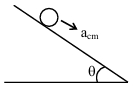
0 likes
View Solution199
MediumMCQ
$A$ circular ring and a solid sphere having the same radius roll down an inclined plane from rest without slipping. The ratio of their velocities when they reach the bottom of the plane is $\sqrt{\frac{x}{5}}$,where $x=$ . . . . . . .
A
$4$
B
$2$
C
$6$
D
$9$
Solution
(A) Using the principle of conservation of mechanical energy,the potential energy at the top is converted into translational and rotational kinetic energy at the bottom: $Mgh = \frac{1}{2} Mv^2 + \frac{1}{2} I\omega^2$.
Since the object rolls without slipping,$\omega = \frac{v}{R}$,so $Mgh = \frac{1}{2} Mv^2 (1 + \frac{k^2}{R^2})$,where $k$ is the radius of gyration.
Thus,$v = \sqrt{\frac{2gh}{1 + \frac{k^2}{R^2}}}$.
For a ring,$I = MR^2$,so $k^2 = R^2$ and $v_{\text{ring}} = \sqrt{\frac{2gh}{1+1}} = \sqrt{gh}$.
For a solid sphere,$I = \frac{2}{5}MR^2$,so $k^2 = \frac{2}{5}R^2$ and $v_{\text{sphere}} = \sqrt{\frac{2gh}{1 + 2/5}} = \sqrt{\frac{10gh}{7}}$.
The ratio of velocities is $\frac{v_{\text{ring}}}{v_{\text{sphere}}} = \frac{\sqrt{gh}}{\sqrt{10gh/7}} = \sqrt{\frac{7}{10}}$.
To match the form $\sqrt{\frac{x}{5}}$,we write $\sqrt{\frac{7}{10}} = \sqrt{\frac{3.5}{5}}$.
Rounding to the nearest integer,$x = 4$.
Since the object rolls without slipping,$\omega = \frac{v}{R}$,so $Mgh = \frac{1}{2} Mv^2 (1 + \frac{k^2}{R^2})$,where $k$ is the radius of gyration.
Thus,$v = \sqrt{\frac{2gh}{1 + \frac{k^2}{R^2}}}$.
For a ring,$I = MR^2$,so $k^2 = R^2$ and $v_{\text{ring}} = \sqrt{\frac{2gh}{1+1}} = \sqrt{gh}$.
For a solid sphere,$I = \frac{2}{5}MR^2$,so $k^2 = \frac{2}{5}R^2$ and $v_{\text{sphere}} = \sqrt{\frac{2gh}{1 + 2/5}} = \sqrt{\frac{10gh}{7}}$.
The ratio of velocities is $\frac{v_{\text{ring}}}{v_{\text{sphere}}} = \frac{\sqrt{gh}}{\sqrt{10gh/7}} = \sqrt{\frac{7}{10}}$.
To match the form $\sqrt{\frac{x}{5}}$,we write $\sqrt{\frac{7}{10}} = \sqrt{\frac{3.5}{5}}$.
Rounding to the nearest integer,$x = 4$.
0 likes
View Solution200
EasyMCQ
$A$ sphere is rolling down an incline without slipping. If the height of the incline is $14 \ m$,find its linear velocity at the bottom.
A
$10 \sqrt{2} \ m/s$
B
$20 \sqrt{2} \ m/s$
C
$10 \ \text{m/s}$
D
$20 \ \text{m/s}$
Solution
(A) For a body rolling down an incline without slipping,the linear velocity $v$ at the bottom is given by the formula: $v = \sqrt{\frac{2gh}{1 + \frac{K^2}{R^2}}}$.
For a solid sphere,the radius of gyration $K$ is given by $K^2 = \frac{2}{5}R^2$,so $\frac{K^2}{R^2} = \frac{2}{5}$.
Substituting the given values $g = 10 \ \text{m/s}^2$ and $h = 14 \ \text{m}$:
$v = \sqrt{\frac{2 \times 10 \times 14}{1 + \frac{2}{5}}} = \sqrt{\frac{280}{\frac{7}{5}}} = \sqrt{\frac{280 \times 5}{7}}$.
$v = \sqrt{40 \times 5} = \sqrt{200} = 10 \sqrt{2} \ \text{m/s}$.
For a solid sphere,the radius of gyration $K$ is given by $K^2 = \frac{2}{5}R^2$,so $\frac{K^2}{R^2} = \frac{2}{5}$.
Substituting the given values $g = 10 \ \text{m/s}^2$ and $h = 14 \ \text{m}$:
$v = \sqrt{\frac{2 \times 10 \times 14}{1 + \frac{2}{5}}} = \sqrt{\frac{280}{\frac{7}{5}}} = \sqrt{\frac{280 \times 5}{7}}$.
$v = \sqrt{40 \times 5} = \sqrt{200} = 10 \sqrt{2} \ \text{m/s}$.
0 likes
View SolutionSystem of Particles and Rotational Motion — Rolling On Inclined Plane · Frequently Asked Questions
1Are these System of Particles and Rotational Motion questions useful for JEE and NEET?
Yes. All questions in this section are mapped to JEE Main and NEET exam patterns. Previous year questions from JEE Main, NEET, GUJCET and state-level exams are included with full solutions.
2Can I switch to Hindi or Gujarati for these questions?
Yes. Use the language tabs in the hero section or the sidebar to view the same questions and solutions in English, Hindi or Gujarati.
3How do I generate a question paper from this subtopic?
Use the Vedclass Exam Paper Generator — select the chapter and subtopic, set difficulty, and generate Sets A, B, C, D automatically. First 3 chapters of every subject are free.
Vedclass Products
For Students
Vedclass Test Series
Mock tests in real JEE/NEET style with performance analysis. 5-day free trial.
Start Free TrialFor Teachers
Exam Paper Generator
Generate Set A/B/C/D papers from this chapter in 2 minutes. 3 chapters free.
Try FreeFor Institutes
Online Exam Module
Live online exams with unlimited students, 360° analytics & white-label branding.
See DemoFor Teachers & Institutes
Generate a System of Particles and Rotational Motion Exam Paper in 2 Minutes
Select subtopic & difficulty — Sets A, B, C, D auto-generated with No Repeat logic.
First 3 chapters of every subject are free — no payment required.