
A English
Rolling On Inclined Plane Questions in English
Class 11 Physics · System of Particles and Rotational Motion · Rolling On Inclined Plane
239+
Questions
English
Language
100%
With Solutions
Showing 39 of 239 questions in English
201
MediumMCQ
$A$ sphere of mass $m$ and radius $r$ rolls on a horizontal plane without slipping with the speed $u$. Now if it rolls up an incline, the maximum height it would attain will be
A
$3 u^2 / 4 g$
B
$5 u^2 / 2 g$
C
$7 u^2 / 10 g$
D
$u^2 / 2 g$
Solution
(C) The total kinetic energy of a rolling sphere is the sum of its translational and rotational kinetic energies: $K = \frac{1}{2} mu^2 + \frac{1}{2} I \omega^2$.
For a solid sphere, the moment of inertia $I = \frac{2}{5} mr^2$ and the rolling condition is $\omega = u/r$.
Substituting these, $K = \frac{1}{2} mu^2 + \frac{1}{2} (\frac{2}{5} mr^2) (u/r)^2 = \frac{1}{2} mu^2 (1 + \frac{2}{5}) = \frac{1}{2} mu^2 (\frac{7}{5}) = \frac{7}{10} mu^2$.
By the law of conservation of energy, the total kinetic energy is converted into potential energy at the maximum height $H$: $K = mgH$.
Therefore, $\frac{7}{10} mu^2 = mgH$.
Solving for $H$, we get $H = \frac{7 u^2}{10 g}$.
For a solid sphere, the moment of inertia $I = \frac{2}{5} mr^2$ and the rolling condition is $\omega = u/r$.
Substituting these, $K = \frac{1}{2} mu^2 + \frac{1}{2} (\frac{2}{5} mr^2) (u/r)^2 = \frac{1}{2} mu^2 (1 + \frac{2}{5}) = \frac{1}{2} mu^2 (\frac{7}{5}) = \frac{7}{10} mu^2$.
By the law of conservation of energy, the total kinetic energy is converted into potential energy at the maximum height $H$: $K = mgH$.
Therefore, $\frac{7}{10} mu^2 = mgH$.
Solving for $H$, we get $H = \frac{7 u^2}{10 g}$.
0 likes
View Solution202
MediumMCQ
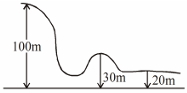
$A$ spherical ball of mass $20 \ kg$ is stationary at the top of a hill of height $100 \ m$. It rolls down a surface to the ground,then climbs up another hill of height $30 \ m$ and finally rolls down to a horizontal base at a height of $20 \ m$ above the ground. The velocity attained by the ball is
A
$40 \sqrt{\frac{5}{7}} \ m/s$
B
$20 \ m/s$
C
$10 \ m/s$
D
$10 \sqrt{30} \ m/s$
Solution
(A) According to the law of conservation of mechanical energy,the loss in potential energy $(PE)$ is equal to the gain in total kinetic energy $(KE_{total})$,which includes both translational and rotational kinetic energy.
Initial height $h_1 = 100 \ m$,final height $h_2 = 20 \ m$.
Change in height $\Delta h = h_1 - h_2 = 100 \ m - 20 \ m = 80 \ m$.
Loss in $PE = mg \Delta h = m \times 10 \times 80 = 800m \ J$.
Gain in $KE_{total} = \frac{1}{2} mv^2 + \frac{1}{2} I \omega^2$.
For a solid spherical ball,the moment of inertia $I = \frac{2}{5} mr^2$ and $\omega = \frac{v}{r}$.
Substituting these values: $KE_{total} = \frac{1}{2} mv^2 + \frac{1}{2} (\frac{2}{5} mr^2) (\frac{v}{r})^2 = \frac{1}{2} mv^2 + \frac{1}{5} mv^2 = \frac{7}{10} mv^2$.
Equating loss in $PE$ to gain in $KE_{total}$:
$800m = \frac{7}{10} mv^2$.
$v^2 = \frac{8000}{7}$.
$v = \sqrt{\frac{8000}{7}} = \sqrt{\frac{1600 \times 5}{7}} = 40 \sqrt{\frac{5}{7}} \ m/s$.
Initial height $h_1 = 100 \ m$,final height $h_2 = 20 \ m$.
Change in height $\Delta h = h_1 - h_2 = 100 \ m - 20 \ m = 80 \ m$.
Loss in $PE = mg \Delta h = m \times 10 \times 80 = 800m \ J$.
Gain in $KE_{total} = \frac{1}{2} mv^2 + \frac{1}{2} I \omega^2$.
For a solid spherical ball,the moment of inertia $I = \frac{2}{5} mr^2$ and $\omega = \frac{v}{r}$.
Substituting these values: $KE_{total} = \frac{1}{2} mv^2 + \frac{1}{2} (\frac{2}{5} mr^2) (\frac{v}{r})^2 = \frac{1}{2} mv^2 + \frac{1}{5} mv^2 = \frac{7}{10} mv^2$.
Equating loss in $PE$ to gain in $KE_{total}$:
$800m = \frac{7}{10} mv^2$.
$v^2 = \frac{8000}{7}$.
$v = \sqrt{\frac{8000}{7}} = \sqrt{\frac{1600 \times 5}{7}} = 40 \sqrt{\frac{5}{7}} \ m/s$.
0 likes
View Solution203
MediumMCQ
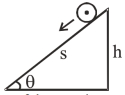
$A$ ring,sphere,and disc are rolling down an inclined plane from the same height. Find the wrong statement: (where $t$ is the time of descent,$a$ is the acceleration,and $v$ is the speed at the bottom).
A
$t_{\text{sphere}} < t_{\text{disc}} < t_{\text{ring}}$
B
$a_{\text{sphere}} > a_{\text{disc}} > a_{\text{ring}}$
C
$v_{\text{sphere}} > v_{\text{disc}} > v_{\text{ring}}$
D
$t_{\text{sphere}} > t_{\text{disc}} > t_{\text{ring}}$
Solution
(D) For an object rolling down an inclined plane,the acceleration is given by $a = \frac{g \sin \theta}{1 + \frac{I}{MR^2}}$.
Since the moment of inertia $I$ for a ring is $MR^2$,for a disc is $\frac{1}{2}MR^2$,and for a solid sphere is $\frac{2}{5}MR^2$,we have $I_{\text{ring}} > I_{\text{disc}} > I_{\text{sphere}}$.
Consequently,the acceleration follows the order $a_{\text{sphere}} > a_{\text{disc}} > a_{\text{ring}}$.
The speed at the bottom is $v = \sqrt{2ah} / \sqrt{\sin \theta} = \sqrt{\frac{2gh}{1 + \frac{I}{MR^2}}}$,so $v_{\text{sphere}} > v_{\text{disc}} > v_{\text{ring}}$.
The time of descent is $t = \sqrt{\frac{2s}{a}}$,which means $t \propto \frac{1}{\sqrt{a}}$. Therefore,$t_{\text{sphere}} < t_{\text{disc}} < t_{\text{ring}}$.
Comparing these with the given options,option $D$ is the wrong statement.
Since the moment of inertia $I$ for a ring is $MR^2$,for a disc is $\frac{1}{2}MR^2$,and for a solid sphere is $\frac{2}{5}MR^2$,we have $I_{\text{ring}} > I_{\text{disc}} > I_{\text{sphere}}$.
Consequently,the acceleration follows the order $a_{\text{sphere}} > a_{\text{disc}} > a_{\text{ring}}$.
The speed at the bottom is $v = \sqrt{2ah} / \sqrt{\sin \theta} = \sqrt{\frac{2gh}{1 + \frac{I}{MR^2}}}$,so $v_{\text{sphere}} > v_{\text{disc}} > v_{\text{ring}}$.
The time of descent is $t = \sqrt{\frac{2s}{a}}$,which means $t \propto \frac{1}{\sqrt{a}}$. Therefore,$t_{\text{sphere}} < t_{\text{disc}} < t_{\text{ring}}$.
Comparing these with the given options,option $D$ is the wrong statement.
0 likes
View Solution204
MediumMCQ
$A$ solid sphere rolls without slipping on an inclined plane at an angle $\theta$. The ratio of total kinetic energy to its rotational kinetic energy is
A
$\frac{7}{2}$
B
$\frac{5}{2}$
C
$\frac{7}{3}$
D
$\frac{5}{4}$
Solution
(A) The moment of inertia of a solid sphere is $I = \frac{2}{5} MR^2$.
Since the sphere rolls without slipping,the condition $v = R\omega$ holds.
The rotational kinetic energy $E_{rot}$ is given by $E_{rot} = \frac{1}{2} I \omega^2 = \frac{1}{2} (\frac{2}{5} MR^2) \omega^2 = \frac{1}{5} MR^2 \omega^2 = \frac{1}{5} Mv^2$.
The total kinetic energy $E_{total}$ is the sum of translational and rotational kinetic energy: $E_{total} = \frac{1}{2} Mv^2 + \frac{1}{2} I \omega^2 = \frac{1}{2} Mv^2 + \frac{1}{5} Mv^2 = (\frac{5+2}{10}) Mv^2 = \frac{7}{10} Mv^2$.
The ratio of total kinetic energy to rotational kinetic energy is $\frac{E_{total}}{E_{rot}} = \frac{\frac{7}{10} Mv^2}{\frac{1}{5} Mv^2} = \frac{7}{10} \times 5 = \frac{7}{2}$.
Since the sphere rolls without slipping,the condition $v = R\omega$ holds.
The rotational kinetic energy $E_{rot}$ is given by $E_{rot} = \frac{1}{2} I \omega^2 = \frac{1}{2} (\frac{2}{5} MR^2) \omega^2 = \frac{1}{5} MR^2 \omega^2 = \frac{1}{5} Mv^2$.
The total kinetic energy $E_{total}$ is the sum of translational and rotational kinetic energy: $E_{total} = \frac{1}{2} Mv^2 + \frac{1}{2} I \omega^2 = \frac{1}{2} Mv^2 + \frac{1}{5} Mv^2 = (\frac{5+2}{10}) Mv^2 = \frac{7}{10} Mv^2$.
The ratio of total kinetic energy to rotational kinetic energy is $\frac{E_{total}}{E_{rot}} = \frac{\frac{7}{10} Mv^2}{\frac{1}{5} Mv^2} = \frac{7}{10} \times 5 = \frac{7}{2}$.
0 likes
View Solution205
MediumMCQ
$A$ solid cylinder and a solid sphere having same mass and same radius roll down on the same inclined plane. The ratio of the acceleration of the cylinder '$a_{c}$' to that of sphere '$a_{s}$' is
A
$\frac{11}{15}$
B
$\frac{13}{14}$
C
$\frac{15}{14}$
D
$\frac{14}{15}$
Solution
(D) For a solid sphere,the moment of inertia is $I_{S} = \frac{2}{5} MR^2$.
For a solid cylinder,the moment of inertia is $I_{C} = \frac{1}{2} MR^2$.
The acceleration of a body rolling down an inclined plane is given by $a = \frac{g \sin \theta}{1 + \frac{I}{MR^2}}$.
Therefore,the ratio of the acceleration of the cylinder '$a_{c}$' to that of the sphere '$a_{s}$' is:
$\frac{a_{c}}{a_{s}} = \frac{1 + \frac{I_{S}}{MR^2}}{1 + \frac{I_{C}}{MR^2}} = \frac{1 + \frac{2}{5}}{1 + \frac{1}{2}} = \frac{\frac{7}{5}}{\frac{3}{2}} = \frac{7}{5} \times \frac{2}{3} = \frac{14}{15}$.
For a solid cylinder,the moment of inertia is $I_{C} = \frac{1}{2} MR^2$.
The acceleration of a body rolling down an inclined plane is given by $a = \frac{g \sin \theta}{1 + \frac{I}{MR^2}}$.
Therefore,the ratio of the acceleration of the cylinder '$a_{c}$' to that of the sphere '$a_{s}$' is:
$\frac{a_{c}}{a_{s}} = \frac{1 + \frac{I_{S}}{MR^2}}{1 + \frac{I_{C}}{MR^2}} = \frac{1 + \frac{2}{5}}{1 + \frac{1}{2}} = \frac{\frac{7}{5}}{\frac{3}{2}} = \frac{7}{5} \times \frac{2}{3} = \frac{14}{15}$.
0 likes
View Solution206
MediumMCQ
$A$ body slides down a smooth inclined plane of inclination $\theta$ and reaches the bottom with velocity $V$. If the same body is a ring which rolls down the same inclined plane,then the linear velocity at the bottom of the plane is:
A
$\frac{V}{\sqrt{2}}$
B
$V$
C
$2V$
D
$\frac{V}{2}$
Solution
(A) For a body sliding down a smooth inclined plane of height $h$,the potential energy is converted into kinetic energy: $mgh = \frac{1}{2}mV^2$,which gives $V = \sqrt{2gh}$.
For a ring rolling down the same inclined plane,the potential energy is converted into both translational and rotational kinetic energy: $mgh = \frac{1}{2}mv^2 + \frac{1}{2}I\omega^2$.
For a ring,the moment of inertia $I = mr^2$ and the rolling condition is $v = r\omega$,so $\omega = v/r$.
Substituting these into the energy equation: $mgh = \frac{1}{2}mv^2 + \frac{1}{2}(mr^2)(v/r)^2 = \frac{1}{2}mv^2 + \frac{1}{2}mv^2 = mv^2$.
Thus,$v^2 = gh$,which means $v = \sqrt{gh}$.
Comparing the two velocities: $v = \sqrt{gh} = \frac{\sqrt{2gh}}{\sqrt{2}} = \frac{V}{\sqrt{2}}$.
For a ring rolling down the same inclined plane,the potential energy is converted into both translational and rotational kinetic energy: $mgh = \frac{1}{2}mv^2 + \frac{1}{2}I\omega^2$.
For a ring,the moment of inertia $I = mr^2$ and the rolling condition is $v = r\omega$,so $\omega = v/r$.
Substituting these into the energy equation: $mgh = \frac{1}{2}mv^2 + \frac{1}{2}(mr^2)(v/r)^2 = \frac{1}{2}mv^2 + \frac{1}{2}mv^2 = mv^2$.
Thus,$v^2 = gh$,which means $v = \sqrt{gh}$.
Comparing the two velocities: $v = \sqrt{gh} = \frac{\sqrt{2gh}}{\sqrt{2}} = \frac{V}{\sqrt{2}}$.
0 likes
View Solution207
MediumMCQ
An inclined plane makes an angle $30^{\circ}$ with the horizontal. $A$ solid sphere rolling down an inclined plane from rest without slipping has a linear acceleration (where $g$ is the acceleration due to gravity and $\sin 30^{\circ} = 0.5$).
A
$\frac{5g}{7}$
B
$\frac{5g}{14}$
C
$\frac{2g}{3}$
D
$\frac{g}{3}$
Solution
(B) The linear acceleration $a$ of a body rolling down an inclined plane without slipping is given by the formula: $a = \frac{g \sin \theta}{1 + \frac{I}{MR^2}}$.
For a solid sphere,the moment of inertia $I$ about its center of mass is $\frac{2}{5}MR^2$.
Substituting this into the formula: $a = \frac{g \sin \theta}{1 + \frac{2/5 MR^2}{MR^2}} = \frac{g \sin \theta}{1 + 2/5} = \frac{g \sin \theta}{7/5} = \frac{5}{7} g \sin \theta$.
Given $\theta = 30^{\circ}$ and $\sin 30^{\circ} = 0.5$,we have:
$a = \frac{5}{7} g (0.5) = \frac{5}{7} g \left(\frac{1}{2}\right) = \frac{5g}{14}$.
Therefore,the correct option is $B$.
For a solid sphere,the moment of inertia $I$ about its center of mass is $\frac{2}{5}MR^2$.
Substituting this into the formula: $a = \frac{g \sin \theta}{1 + \frac{2/5 MR^2}{MR^2}} = \frac{g \sin \theta}{1 + 2/5} = \frac{g \sin \theta}{7/5} = \frac{5}{7} g \sin \theta$.
Given $\theta = 30^{\circ}$ and $\sin 30^{\circ} = 0.5$,we have:
$a = \frac{5}{7} g (0.5) = \frac{5}{7} g \left(\frac{1}{2}\right) = \frac{5g}{14}$.
Therefore,the correct option is $B$.
0 likes
View Solution208
MediumMCQ
$A$ solid sphere rolling without friction on a horizontal surface with a constant speed of $2 \,m/s$, rolls up on an inclined ramp which is inclined at $30^{\circ}$. The maximum distance travelled by the sphere on the inclined ramp is (acceleration due to gravity $g=10 \,m/s^2, \sin 30^{\circ}=1/2$) (in $\,m$)
A
$0.56$
B
$0.25$
C
$0.47$
D
$0.84$
Solution
(A) For a solid sphere rolling without slipping, the total kinetic energy $K$ is the sum of translational and rotational kinetic energy: $K = \frac{1}{2}mv^2 + \frac{1}{2}I\omega^2$.
Since $I = \frac{2}{5}mr^2$ and $v = r\omega$, we have $K = \frac{1}{2}mv^2 + \frac{1}{2}(\frac{2}{5}mr^2)(\frac{v}{r})^2 = \frac{1}{2}mv^2 + \frac{1}{5}mv^2 = \frac{7}{10}mv^2$.
When the sphere moves up the ramp, this kinetic energy is converted into potential energy $U = mgh$, where $h = d \sin \theta$ and $d$ is the distance along the ramp.
Equating $K = U$: $\frac{7}{10}mv^2 = mgd \sin \theta$.
Solving for $d$: $d = \frac{7v^2}{10g \sin \theta}$.
Substituting the given values: $v = 2 \,m/s$, $g = 10 \,m/s^2$, $\theta = 30^{\circ}$:
$d = \frac{7 \times (2)^2}{10 \times 10 \times (1/2)} = \frac{7 \times 4}{100 \times 0.5} = \frac{28}{50} = 0.56 \,m$.
Since $I = \frac{2}{5}mr^2$ and $v = r\omega$, we have $K = \frac{1}{2}mv^2 + \frac{1}{2}(\frac{2}{5}mr^2)(\frac{v}{r})^2 = \frac{1}{2}mv^2 + \frac{1}{5}mv^2 = \frac{7}{10}mv^2$.
When the sphere moves up the ramp, this kinetic energy is converted into potential energy $U = mgh$, where $h = d \sin \theta$ and $d$ is the distance along the ramp.
Equating $K = U$: $\frac{7}{10}mv^2 = mgd \sin \theta$.
Solving for $d$: $d = \frac{7v^2}{10g \sin \theta}$.
Substituting the given values: $v = 2 \,m/s$, $g = 10 \,m/s^2$, $\theta = 30^{\circ}$:
$d = \frac{7 \times (2)^2}{10 \times 10 \times (1/2)} = \frac{7 \times 4}{100 \times 0.5} = \frac{28}{50} = 0.56 \,m$.
0 likes
View Solution209
MediumMCQ
$A$ solid sphere at rest rolls down an inclined plane of vertical height $h$ without sliding. Its speed on reaching the bottom of the plane is ($g=$ acceleration due to gravity).
A
$\left(\frac{9gh}{11}\right)^{1/2}$
B
$\left(\frac{10gh}{7}\right)^{1/2}$
C
$\left(\frac{8gh}{7}\right)^{1/2}$
D
$\left(\frac{6gh}{7}\right)^{1/2}$
Solution
(B) For a body rolling down an inclined plane without slipping,mechanical energy is conserved.
Initial potential energy at the top is $PE = mgh$.
Initial kinetic energy at the top is $KE = 0$ (since it starts from rest).
At the bottom,the total kinetic energy is the sum of translational and rotational kinetic energy: $KE_{total} = \frac{1}{2}mv^2 + \frac{1}{2}I\omega^2$.
For a solid sphere,the moment of inertia $I = \frac{2}{5}mr^2$.
Since it rolls without slipping,$v = r\omega$,so $\omega = v/r$.
Substituting these into the kinetic energy equation: $KE_{total} = \frac{1}{2}mv^2 + \frac{1}{2}(\frac{2}{5}mr^2)(\frac{v}{r})^2 = \frac{1}{2}mv^2 + \frac{1}{5}mv^2 = \frac{7}{10}mv^2$.
By conservation of energy,$mgh = \frac{7}{10}mv^2$.
Solving for $v$,we get $v^2 = \frac{10gh}{7}$,which implies $v = \left(\frac{10gh}{7}\right)^{1/2}$.
Initial potential energy at the top is $PE = mgh$.
Initial kinetic energy at the top is $KE = 0$ (since it starts from rest).
At the bottom,the total kinetic energy is the sum of translational and rotational kinetic energy: $KE_{total} = \frac{1}{2}mv^2 + \frac{1}{2}I\omega^2$.
For a solid sphere,the moment of inertia $I = \frac{2}{5}mr^2$.
Since it rolls without slipping,$v = r\omega$,so $\omega = v/r$.
Substituting these into the kinetic energy equation: $KE_{total} = \frac{1}{2}mv^2 + \frac{1}{2}(\frac{2}{5}mr^2)(\frac{v}{r})^2 = \frac{1}{2}mv^2 + \frac{1}{5}mv^2 = \frac{7}{10}mv^2$.
By conservation of energy,$mgh = \frac{7}{10}mv^2$.
Solving for $v$,we get $v^2 = \frac{10gh}{7}$,which implies $v = \left(\frac{10gh}{7}\right)^{1/2}$.
0 likes
View Solution210
EasyMCQ
An inclined plane makes an angle of $30^{\circ}$ with the horizontal. $A$ solid sphere rolling down this inclined plane from rest without slipping has a linear acceleration ($g=$ acceleration due to gravity,$\sin 30^{\circ}=0.5$).
A
$\frac{2g}{3}$
B
$\frac{5g}{14}$
C
$\frac{g}{3}$
D
$\frac{5g}{7}$
Solution
(B) The linear acceleration $a$ of a body rolling down an inclined plane without slipping is given by the formula: $a = \frac{g \sin \theta}{1 + \frac{K^2}{R^2}}$.
For a solid sphere,the radius of gyration $K$ is given by $K^2 = \frac{2}{5}R^2$,so $\frac{K^2}{R^2} = \frac{2}{5}$.
Substituting the given values $\theta = 30^{\circ}$ and $\sin 30^{\circ} = 0.5$ into the formula:
$a = \frac{g \sin 30^{\circ}}{1 + \frac{2}{5}} = \frac{g \times 0.5}{\frac{7}{5}} = \frac{0.5g \times 5}{7} = \frac{2.5g}{7} = \frac{5g}{14}$.
For a solid sphere,the radius of gyration $K$ is given by $K^2 = \frac{2}{5}R^2$,so $\frac{K^2}{R^2} = \frac{2}{5}$.
Substituting the given values $\theta = 30^{\circ}$ and $\sin 30^{\circ} = 0.5$ into the formula:
$a = \frac{g \sin 30^{\circ}}{1 + \frac{2}{5}} = \frac{g \times 0.5}{\frac{7}{5}} = \frac{0.5g \times 5}{7} = \frac{2.5g}{7} = \frac{5g}{14}$.
0 likes
View Solution211
MediumMCQ
An inclined plane makes an angle $30^{\circ}$ with the horizontal. $A$ solid sphere rolls down from the top of the inclined plane from rest without slipping. Its linear acceleration along the plane is equal to (where $g$ is acceleration due to gravity and $\sin 30^{\circ} = 0.5$):
A
$\frac{5g}{14}$
B
$\frac{5g}{4}$
C
$\frac{2g}{3}$
D
$\frac{g}{3}$
Solution
(A) The linear acceleration $a$ of a body rolling down an inclined plane without slipping is given by the formula:
$a = \frac{g \sin \theta}{1 + \frac{K^2}{R^2}}$
For a solid sphere,the radius of gyration $K$ is related to the radius $R$ by $K^2 = \frac{2}{5}R^2$,so $\frac{K^2}{R^2} = \frac{2}{5}$.
Given $\theta = 30^{\circ}$ and $\sin 30^{\circ} = 0.5 = \frac{1}{2}$.
Substituting these values into the formula:
$a = \frac{g \sin 30^{\circ}}{1 + \frac{2}{5}}$
$a = \frac{g \times (1/2)}{7/5}$
$a = \frac{g}{2} \times \frac{5}{7} = \frac{5g}{14}$.
$a = \frac{g \sin \theta}{1 + \frac{K^2}{R^2}}$
For a solid sphere,the radius of gyration $K$ is related to the radius $R$ by $K^2 = \frac{2}{5}R^2$,so $\frac{K^2}{R^2} = \frac{2}{5}$.
Given $\theta = 30^{\circ}$ and $\sin 30^{\circ} = 0.5 = \frac{1}{2}$.
Substituting these values into the formula:
$a = \frac{g \sin 30^{\circ}}{1 + \frac{2}{5}}$
$a = \frac{g \times (1/2)}{7/5}$
$a = \frac{g}{2} \times \frac{5}{7} = \frac{5g}{14}$.
0 likes
View Solution212
DifficultMCQ
$A$ body of mass $m$ slides down an incline and reaches the bottom with a velocity $V$. If the same mass were in the form of a disc which rolls down this same incline,the velocity of the disc at the bottom would be
A
$V \sqrt{\frac{3}{4}}$
B
$V \sqrt{\frac{3}{2}}$
C
$V \sqrt{\frac{1}{3}}$
D
$V \sqrt{\frac{2}{3}}$
Solution
(D) Case $1$: For a sliding body,the potential energy is converted into translational kinetic energy: $\frac{1}{2} m V^2 = mgh$ ... $(i)$
Case $2$: For a rolling disc,the potential energy is converted into both translational and rotational kinetic energy: $\frac{1}{2} m (v')^2 + \frac{1}{2} I \omega^2 = mgh$
For a disc,the moment of inertia is $I = \frac{1}{2} mR^2$ and the rolling condition is $\omega = \frac{v'}{R}$.
Substituting these into the energy equation: $\frac{1}{2} m (v')^2 + \frac{1}{2} (\frac{1}{2} mR^2) (\frac{v'}{R})^2 = mgh$
$\frac{1}{2} m (v')^2 + \frac{1}{4} m (v')^2 = mgh$
$\frac{3}{4} m (v')^2 = mgh$ ... $(ii)$
Equating $(i)$ and $(ii)$: $\frac{1}{2} m V^2 = \frac{3}{4} m (v')^2$
$V^2 = \frac{3}{2} (v')^2$
$(v')^2 = \frac{2}{3} V^2$
$v' = V \sqrt{\frac{2}{3}}$
Case $2$: For a rolling disc,the potential energy is converted into both translational and rotational kinetic energy: $\frac{1}{2} m (v')^2 + \frac{1}{2} I \omega^2 = mgh$
For a disc,the moment of inertia is $I = \frac{1}{2} mR^2$ and the rolling condition is $\omega = \frac{v'}{R}$.
Substituting these into the energy equation: $\frac{1}{2} m (v')^2 + \frac{1}{2} (\frac{1}{2} mR^2) (\frac{v'}{R})^2 = mgh$
$\frac{1}{2} m (v')^2 + \frac{1}{4} m (v')^2 = mgh$
$\frac{3}{4} m (v')^2 = mgh$ ... $(ii)$
Equating $(i)$ and $(ii)$: $\frac{1}{2} m V^2 = \frac{3}{4} m (v')^2$
$V^2 = \frac{3}{2} (v')^2$
$(v')^2 = \frac{2}{3} V^2$
$v' = V \sqrt{\frac{2}{3}}$
0 likes
View Solution213
MediumMCQ
$A$ solid cylinder of mass $M$ and radius $R$ rolls down a smooth inclined plane about its own axis and reaches the bottom with velocity $v$. What is the height of the inclined plane? (Assume $g$ is the acceleration due to gravity.)
A
$\frac{3 v^{2}}{4 g}$
B
$\frac{4 v^{2}}{5 g}$
C
$\frac{7 v^{2}}{9 g}$
D
$\frac{3 v^{2}}{4 g}$
Solution
(A) For a solid cylinder rolling down an inclined plane,the total energy at the top is potential energy $PE = Mgh$.
At the bottom,the total energy is the sum of translational kinetic energy and rotational kinetic energy: $KE = \frac{1}{2} Mv^2 + \frac{1}{2} I\omega^2$.
For a solid cylinder,the moment of inertia $I = \frac{1}{2} MR^2$ and the rolling condition is $v = R\omega$,so $\omega = \frac{v}{R}$.
Substituting these into the energy equation: $Mgh = \frac{1}{2} Mv^2 + \frac{1}{2} (\frac{1}{2} MR^2) (\frac{v}{R})^2$.
$Mgh = \frac{1}{2} Mv^2 + \frac{1}{4} Mv^2$.
$Mgh = \frac{3}{4} Mv^2$.
Solving for height $h$: $h = \frac{3 v^2}{4 g}$.
At the bottom,the total energy is the sum of translational kinetic energy and rotational kinetic energy: $KE = \frac{1}{2} Mv^2 + \frac{1}{2} I\omega^2$.
For a solid cylinder,the moment of inertia $I = \frac{1}{2} MR^2$ and the rolling condition is $v = R\omega$,so $\omega = \frac{v}{R}$.
Substituting these into the energy equation: $Mgh = \frac{1}{2} Mv^2 + \frac{1}{2} (\frac{1}{2} MR^2) (\frac{v}{R})^2$.
$Mgh = \frac{1}{2} Mv^2 + \frac{1}{4} Mv^2$.
$Mgh = \frac{3}{4} Mv^2$.
Solving for height $h$: $h = \frac{3 v^2}{4 g}$.
0 likes
View Solution214
MediumMCQ
$A$ solid cylinder of radius $R$ and mass $M$ rolls down an inclined plane of height $h$. When it reaches the bottom of the plane,its rotational kinetic energy is ($g =$ acceleration due to gravity).
A
$\frac{Mgh}{3}$
B
$Mgh$
C
$\frac{Mgh}{2}$
D
$\frac{Mgh}{4}$
Solution
(A) For a solid cylinder rolling down an inclined plane,the total potential energy $Mgh$ is converted into translational kinetic energy and rotational kinetic energy.
Total energy $E = Mgh = \frac{1}{2} Mv^2 + \frac{1}{2} I\omega^2$.
For a solid cylinder,the moment of inertia $I = \frac{1}{2} MR^2$ and the rolling condition is $v = R\omega$.
Substituting these into the energy equation:
$Mgh = \frac{1}{2} Mv^2 + \frac{1}{2} (\frac{1}{2} MR^2) (\frac{v}{R})^2$
$Mgh = \frac{1}{2} Mv^2 + \frac{1}{4} Mv^2 = \frac{3}{4} Mv^2$.
Thus,$Mv^2 = \frac{4}{3} Mgh$.
The rotational kinetic energy $K_{rot} = \frac{1}{2} I\omega^2 = \frac{1}{2} (\frac{1}{2} MR^2) (\frac{v}{R})^2 = \frac{1}{4} Mv^2$.
Substituting $Mv^2 = \frac{4}{3} Mgh$ into the expression for $K_{rot}$:
$K_{rot} = \frac{1}{4} (\frac{4}{3} Mgh) = \frac{Mgh}{3}$.
Total energy $E = Mgh = \frac{1}{2} Mv^2 + \frac{1}{2} I\omega^2$.
For a solid cylinder,the moment of inertia $I = \frac{1}{2} MR^2$ and the rolling condition is $v = R\omega$.
Substituting these into the energy equation:
$Mgh = \frac{1}{2} Mv^2 + \frac{1}{2} (\frac{1}{2} MR^2) (\frac{v}{R})^2$
$Mgh = \frac{1}{2} Mv^2 + \frac{1}{4} Mv^2 = \frac{3}{4} Mv^2$.
Thus,$Mv^2 = \frac{4}{3} Mgh$.
The rotational kinetic energy $K_{rot} = \frac{1}{2} I\omega^2 = \frac{1}{2} (\frac{1}{2} MR^2) (\frac{v}{R})^2 = \frac{1}{4} Mv^2$.
Substituting $Mv^2 = \frac{4}{3} Mgh$ into the expression for $K_{rot}$:
$K_{rot} = \frac{1}{4} (\frac{4}{3} Mgh) = \frac{Mgh}{3}$.
0 likes
View Solution215
MediumMCQ
$A$ disc of mass $m$ and radius $r$ rolls down an inclined plane of height $h$. When it reaches the bottom of the plane,its rotational kinetic energy is ($g=$ acceleration due to gravity).
A
$\frac{mgh}{3}$
B
$\frac{mgh}{6}$
C
$\frac{mgh}{2}$
D
$\frac{mgh}{4}$
Solution
(A) For a disc rolling down an inclined plane,the total potential energy at the top is converted into translational and rotational kinetic energy at the bottom.
By the law of conservation of energy: $mgh = K_{trans} + K_{rot}$.
For a disc,the moment of inertia $I = \frac{1}{2}mr^2$.
Since the disc rolls without slipping,$v = r\omega$,so $\omega = \frac{v}{r}$.
The translational kinetic energy is $K_{trans} = \frac{1}{2}mv^2$.
The rotational kinetic energy is $K_{rot} = \frac{1}{2}I\omega^2 = \frac{1}{2}(\frac{1}{2}mr^2)(\frac{v}{r})^2 = \frac{1}{4}mv^2$.
Total energy $mgh = \frac{1}{2}mv^2 + \frac{1}{4}mv^2 = \frac{3}{4}mv^2$.
Thus,$\frac{1}{2}mv^2 = \frac{2}{3}mgh$.
Substituting this into the expression for rotational kinetic energy: $K_{rot} = \frac{1}{4}mv^2 = \frac{1}{2}(\frac{1}{2}mv^2) = \frac{1}{2}(\frac{2}{3}mgh) = \frac{mgh}{3}$.
By the law of conservation of energy: $mgh = K_{trans} + K_{rot}$.
For a disc,the moment of inertia $I = \frac{1}{2}mr^2$.
Since the disc rolls without slipping,$v = r\omega$,so $\omega = \frac{v}{r}$.
The translational kinetic energy is $K_{trans} = \frac{1}{2}mv^2$.
The rotational kinetic energy is $K_{rot} = \frac{1}{2}I\omega^2 = \frac{1}{2}(\frac{1}{2}mr^2)(\frac{v}{r})^2 = \frac{1}{4}mv^2$.
Total energy $mgh = \frac{1}{2}mv^2 + \frac{1}{4}mv^2 = \frac{3}{4}mv^2$.
Thus,$\frac{1}{2}mv^2 = \frac{2}{3}mgh$.
Substituting this into the expression for rotational kinetic energy: $K_{rot} = \frac{1}{4}mv^2 = \frac{1}{2}(\frac{1}{2}mv^2) = \frac{1}{2}(\frac{2}{3}mgh) = \frac{mgh}{3}$.
0 likes
View Solution216
MediumMCQ
$A$ solid cylinder of mass $M$ and radius $R$ rolls down an inclined plane of height $h$. When it reaches the foot of the plane,its rotational kinetic energy is ($g=$ acceleration due to gravity).
A
$\frac{Mgh}{3}$
B
$\frac{Mgh}{6}$
C
$\frac{Mgh}{4}$
D
$\frac{Mgh}{2}$
Solution
(A) By the law of conservation of energy,the total potential energy at the top is equal to the sum of translational and rotational kinetic energy at the bottom:
$Mgh = \frac{1}{2} Mv^2 + \frac{1}{2} I\omega^2$
For a solid cylinder,the moment of inertia $I = \frac{1}{2} MR^2$ and the condition for pure rolling is $v = R\omega$.
Substituting these into the energy equation:
$Mgh = \frac{1}{2} M(R\omega)^2 + \frac{1}{2} (\frac{1}{2} MR^2)\omega^2$
$Mgh = \frac{1}{2} MR^2\omega^2 + \frac{1}{4} MR^2\omega^2 = \frac{3}{4} MR^2\omega^2$
Thus,the rotational kinetic energy $K_{rot} = \frac{1}{2} I\omega^2 = \frac{1}{2} (\frac{1}{2} MR^2)\omega^2 = \frac{1}{4} MR^2\omega^2$.
From the energy equation,$MR^2\omega^2 = \frac{4}{3} Mgh$.
Substituting this into the expression for $K_{rot}$:
$K_{rot} = \frac{1}{4} (\frac{4}{3} Mgh) = \frac{Mgh}{3}$.
$Mgh = \frac{1}{2} Mv^2 + \frac{1}{2} I\omega^2$
For a solid cylinder,the moment of inertia $I = \frac{1}{2} MR^2$ and the condition for pure rolling is $v = R\omega$.
Substituting these into the energy equation:
$Mgh = \frac{1}{2} M(R\omega)^2 + \frac{1}{2} (\frac{1}{2} MR^2)\omega^2$
$Mgh = \frac{1}{2} MR^2\omega^2 + \frac{1}{4} MR^2\omega^2 = \frac{3}{4} MR^2\omega^2$
Thus,the rotational kinetic energy $K_{rot} = \frac{1}{2} I\omega^2 = \frac{1}{2} (\frac{1}{2} MR^2)\omega^2 = \frac{1}{4} MR^2\omega^2$.
From the energy equation,$MR^2\omega^2 = \frac{4}{3} Mgh$.
Substituting this into the expression for $K_{rot}$:
$K_{rot} = \frac{1}{4} (\frac{4}{3} Mgh) = \frac{Mgh}{3}$.
0 likes
View Solution217
MediumMCQ
$A$ solid sphere rolls down from the top of an inclined plane,$7 \ m$ high,without slipping. Its linear speed at the foot of the plane is $\left(g = 10 \ m/s^2\right)$
A
$\sqrt{70} \ m/s$
B
$\sqrt{\frac{140}{3}} \ m/s$
C
$\sqrt{\frac{280}{3}} \ m/s$
D
$10 \ m/s$
Solution
(D) Given,height of the inclined plane,$h = 7 \ m$.
Acceleration due to gravity,$g = 10 \ m/s^2$.
By the law of conservation of energy,the potential energy lost by the solid sphere equals the total kinetic energy gained (translational + rotational).
$mgh = \frac{1}{2}mv^2 + \frac{1}{2}I\omega^2$
For a solid sphere,the moment of inertia $I = \frac{2}{5}mR^2$ and the condition for rolling without slipping is $\omega = \frac{v}{R}$.
Substituting these values:
$mgh = \frac{1}{2}mv^2 + \frac{1}{2} \left(\frac{2}{5}mR^2\right) \left(\frac{v}{R}\right)^2$
$mgh = \frac{1}{2}mv^2 + \frac{1}{5}mv^2$
$mgh = \frac{7}{10}mv^2$
$v^2 = \frac{10}{7}gh$
$v = \sqrt{\frac{10}{7} \times 10 \times 7} = \sqrt{100} = 10 \ m/s$.
Acceleration due to gravity,$g = 10 \ m/s^2$.
By the law of conservation of energy,the potential energy lost by the solid sphere equals the total kinetic energy gained (translational + rotational).
$mgh = \frac{1}{2}mv^2 + \frac{1}{2}I\omega^2$
For a solid sphere,the moment of inertia $I = \frac{2}{5}mR^2$ and the condition for rolling without slipping is $\omega = \frac{v}{R}$.
Substituting these values:
$mgh = \frac{1}{2}mv^2 + \frac{1}{2} \left(\frac{2}{5}mR^2\right) \left(\frac{v}{R}\right)^2$
$mgh = \frac{1}{2}mv^2 + \frac{1}{5}mv^2$
$mgh = \frac{7}{10}mv^2$
$v^2 = \frac{10}{7}gh$
$v = \sqrt{\frac{10}{7} \times 10 \times 7} = \sqrt{100} = 10 \ m/s$.
0 likes
View Solution218
MediumMCQ
$A$ body slides down a smooth inclined plane having angle $\theta$ and reaches the bottom with velocity $v$. If the body is a solid sphere rolling down the same plane,then its linear velocity at the bottom of the plane is
A
$\sqrt{\frac{2}{7}} v$
B
$\sqrt{\frac{3}{7}} v$
C
$\sqrt{\frac{5}{7}} v$
D
$\sqrt{\frac{9}{7}} v$
Solution
(C) For a body sliding down a smooth inclined plane,the potential energy is converted entirely into translational kinetic energy. Thus,$v = \sqrt{2gh}$.
For a sphere rolling down a rough inclined plane,the potential energy is converted into both translational and rotational kinetic energy. The velocity at the bottom is given by $v_{CM} = \sqrt{\frac{2gh}{1 + \frac{K^2}{R^2}}}$.
Substituting $v = \sqrt{2gh}$,we get $v_{CM} = \frac{v}{\sqrt{1 + \frac{K^2}{R^2}}}$.
For a solid sphere,the radius of gyration $K$ satisfies $\frac{K^2}{R^2} = \frac{2}{5}$.
Substituting this value,$v_{CM} = \frac{v}{\sqrt{1 + \frac{2}{5}}} = \frac{v}{\sqrt{\frac{7}{5}}} = \sqrt{\frac{5}{7}} v$.
For a sphere rolling down a rough inclined plane,the potential energy is converted into both translational and rotational kinetic energy. The velocity at the bottom is given by $v_{CM} = \sqrt{\frac{2gh}{1 + \frac{K^2}{R^2}}}$.
Substituting $v = \sqrt{2gh}$,we get $v_{CM} = \frac{v}{\sqrt{1 + \frac{K^2}{R^2}}}$.
For a solid sphere,the radius of gyration $K$ satisfies $\frac{K^2}{R^2} = \frac{2}{5}$.
Substituting this value,$v_{CM} = \frac{v}{\sqrt{1 + \frac{2}{5}}} = \frac{v}{\sqrt{\frac{7}{5}}} = \sqrt{\frac{5}{7}} v$.
0 likes
View Solution219
DifficultMCQ
Three bodies: a ring $(R)$,a solid cylinder $(C)$,and a solid sphere $(S)$ having the same mass and same radius roll down an inclined plane without slipping. They start from rest. If $v_{R}$,$v_{C}$,and $v_{S}$ are the velocities of the respective bodies on reaching the bottom of the plane,then:
A
$v_{R} = v_{C} = v_{S}$
B
$v_{R} > v_{C} > v_{S}$
C
$v_{R} < v_{C} < v_{S}$
D
$v_{R} = v_{C} > v_{S}$
Solution
(C) The velocity $v$ of a body rolling without slipping down an inclined plane of height $h$ is given by the formula:
$v = \sqrt{\frac{2gh}{1 + \frac{K^2}{R^2}}}$
where $K$ is the radius of gyration and $R$ is the radius of the body.
For a ring,$K^2 = R^2$,so $v_{R} = \sqrt{\frac{2gh}{1+1}} = \sqrt{gh}$.
For a solid cylinder,$K^2 = \frac{R^2}{2}$,so $v_{C} = \sqrt{\frac{2gh}{1+1/2}} = \sqrt{\frac{4gh}{3}} \approx 1.15 \sqrt{gh}$.
For a solid sphere,$K^2 = \frac{2}{5}R^2$,so $v_{S} = \sqrt{\frac{2gh}{1+2/5}} = \sqrt{\frac{10gh}{7}} \approx 1.19 \sqrt{gh}$.
Comparing the values,we find that $v_{R} < v_{C} < v_{S}$.
$v = \sqrt{\frac{2gh}{1 + \frac{K^2}{R^2}}}$
where $K$ is the radius of gyration and $R$ is the radius of the body.
For a ring,$K^2 = R^2$,so $v_{R} = \sqrt{\frac{2gh}{1+1}} = \sqrt{gh}$.
For a solid cylinder,$K^2 = \frac{R^2}{2}$,so $v_{C} = \sqrt{\frac{2gh}{1+1/2}} = \sqrt{\frac{4gh}{3}} \approx 1.15 \sqrt{gh}$.
For a solid sphere,$K^2 = \frac{2}{5}R^2$,so $v_{S} = \sqrt{\frac{2gh}{1+2/5}} = \sqrt{\frac{10gh}{7}} \approx 1.19 \sqrt{gh}$.
Comparing the values,we find that $v_{R} < v_{C} < v_{S}$.
0 likes
View Solution220
DifficultMCQ
$A$ solid sphere of mass $m$ rolls down an inclined plane without slipping,starting from rest at the top of an inclined plane. The linear speed of the sphere at the bottom of the inclined plane is $v$. The kinetic energy of the sphere at the bottom is
A
$\frac{1}{2} m v^{2}$
B
$\frac{5}{3} m v^{2}$
C
$\frac{2}{5} m v^{2}$
D
$\frac{7}{10} m v^{2}$
Solution
(D) The total kinetic energy $(KE)$ of a body rolling without slipping is the sum of its translational kinetic energy and rotational kinetic energy.
$KE = KE_{\text{trans}} + KE_{\text{rot}}$
$KE = \frac{1}{2} m v^{2} + \frac{1}{2} I \omega^{2}$
For a solid sphere,the moment of inertia $I = \frac{2}{5} m R^{2}$ and the condition for rolling without slipping is $v = R \omega$,which implies $\omega = \frac{v}{R}$.
Substituting these into the equation:
$KE = \frac{1}{2} m v^{2} + \frac{1}{2} (\frac{2}{5} m R^{2}) (\frac{v}{R})^{2}$
$KE = \frac{1}{2} m v^{2} + \frac{1}{2} (\frac{2}{5} m v^{2})$
$KE = \frac{1}{2} m v^{2} (1 + \frac{2}{5})$
$KE = \frac{1}{2} m v^{2} (\frac{7}{5})$
$KE = \frac{7}{10} m v^{2}$
$KE = KE_{\text{trans}} + KE_{\text{rot}}$
$KE = \frac{1}{2} m v^{2} + \frac{1}{2} I \omega^{2}$
For a solid sphere,the moment of inertia $I = \frac{2}{5} m R^{2}$ and the condition for rolling without slipping is $v = R \omega$,which implies $\omega = \frac{v}{R}$.
Substituting these into the equation:
$KE = \frac{1}{2} m v^{2} + \frac{1}{2} (\frac{2}{5} m R^{2}) (\frac{v}{R})^{2}$
$KE = \frac{1}{2} m v^{2} + \frac{1}{2} (\frac{2}{5} m v^{2})$
$KE = \frac{1}{2} m v^{2} (1 + \frac{2}{5})$
$KE = \frac{1}{2} m v^{2} (\frac{7}{5})$
$KE = \frac{7}{10} m v^{2}$
0 likes
View Solution221
DifficultMCQ
$A$ solid cylinder of mass $m$ and radius $R$ rolls down an inclined plane of height $h$ without slipping. The speed of its centre of mass when it reaches the bottom is
A
$\sqrt{2gh}$
B
$\sqrt{\frac{4gh}{3}}$
C
$\sqrt{\frac{3gh}{4}}$
D
$\sqrt{\frac{4g}{h}}$
Solution
(B) For a solid cylinder rolling without slipping,the total kinetic energy $(K.E.)$ is the sum of translational and rotational kinetic energy:
$K.E. = \frac{1}{2}mv^2 + \frac{1}{2}I\omega^2$
Since the moment of inertia of a solid cylinder is $I = \frac{1}{2}mR^2$ and the condition for rolling without slipping is $v = R\omega$ (or $\omega = v/R$):
$K.E. = \frac{1}{2}mv^2 + \frac{1}{2}(\frac{1}{2}mR^2)(\frac{v}{R})^2$
$K.E. = \frac{1}{2}mv^2 + \frac{1}{4}mv^2 = \frac{3}{4}mv^2$
By the law of conservation of energy,the loss in potential energy $(P.E.)$ equals the gain in kinetic energy:
$mgh = \frac{3}{4}mv^2$
$v^2 = \frac{4gh}{3}$
$v = \sqrt{\frac{4gh}{3}}$
$K.E. = \frac{1}{2}mv^2 + \frac{1}{2}I\omega^2$
Since the moment of inertia of a solid cylinder is $I = \frac{1}{2}mR^2$ and the condition for rolling without slipping is $v = R\omega$ (or $\omega = v/R$):
$K.E. = \frac{1}{2}mv^2 + \frac{1}{2}(\frac{1}{2}mR^2)(\frac{v}{R})^2$
$K.E. = \frac{1}{2}mv^2 + \frac{1}{4}mv^2 = \frac{3}{4}mv^2$
By the law of conservation of energy,the loss in potential energy $(P.E.)$ equals the gain in kinetic energy:
$mgh = \frac{3}{4}mv^2$
$v^2 = \frac{4gh}{3}$
$v = \sqrt{\frac{4gh}{3}}$
0 likes
View Solution222
MediumMCQ
$A$ solid sphere of mass $4 \ kg$ and radius $28 \ cm$ is on an inclined plane. If the acceleration of the sphere when it rolls down without sliding is $3.5 \ m \ s^{-2}$,then the acceleration of the sphere when it slides down without rolling is (in $m \ s^{-2}$)
A
$2.5$
B
$3.5$
C
$1.7$
D
$4.9$
Solution
(D) For a solid sphere rolling down an inclined plane without sliding,the acceleration is given by $a_{roll} = \frac{g \sin \theta}{1 + \frac{I}{MR^2}}$.
For a solid sphere,the moment of inertia $I = \frac{2}{5} MR^2$,so $a_{roll} = \frac{g \sin \theta}{1 + 2/5} = \frac{5}{7} g \sin \theta$.
Given $a_{roll} = 3.5 \ m \ s^{-2}$,we have $3.5 = \frac{5}{7} g \sin \theta$,which implies $g \sin \theta = 3.5 \times \frac{7}{5} = 4.9 \ m \ s^{-2}$.
When the sphere slides down without rolling,there is no rotational motion,so the acceleration is simply $a_{slide} = g \sin \theta$.
Therefore,$a_{slide} = 4.9 \ m \ s^{-2}$.
For a solid sphere,the moment of inertia $I = \frac{2}{5} MR^2$,so $a_{roll} = \frac{g \sin \theta}{1 + 2/5} = \frac{5}{7} g \sin \theta$.
Given $a_{roll} = 3.5 \ m \ s^{-2}$,we have $3.5 = \frac{5}{7} g \sin \theta$,which implies $g \sin \theta = 3.5 \times \frac{7}{5} = 4.9 \ m \ s^{-2}$.
When the sphere slides down without rolling,there is no rotational motion,so the acceleration is simply $a_{slide} = g \sin \theta$.
Therefore,$a_{slide} = 4.9 \ m \ s^{-2}$.
0 likes
View Solution223
EasyMCQ
$A$ small disc of mass $500 \ g$ and radius $5 \ cm$ rolls down an inclined plane without slipping. The speed of its center of mass when it reaches the bottom of the inclined plane depends on:
A
mass and radius
B
mass and height of the incline
C
height of the incline
D
height of the incline and acceleration due to gravity
Solution
(D) When a disc rolls down an inclined plane without slipping,the loss in gravitational potential energy is converted into translational and rotational kinetic energy.
By the law of conservation of energy: $mgh = \frac{1}{2}mv^2 + \frac{1}{2}I\omega^2$.
For a disc,the moment of inertia is $I = \frac{1}{2}mr^2$ and the rolling condition is $\omega = \frac{v}{r}$.
Substituting these values: $mgh = \frac{1}{2}mv^2 + \frac{1}{2}(\frac{1}{2}mr^2)(\frac{v}{r})^2$.
$mgh = \frac{1}{2}mv^2 + \frac{1}{4}mv^2 = \frac{3}{4}mv^2$.
Canceling $m$ from both sides: $gh = \frac{3}{4}v^2$.
Solving for $v$: $v = \sqrt{\frac{4gh}{3}}$.
Thus,the velocity $v$ depends only on the height of the incline $h$ and the acceleration due to gravity $g$.
By the law of conservation of energy: $mgh = \frac{1}{2}mv^2 + \frac{1}{2}I\omega^2$.
For a disc,the moment of inertia is $I = \frac{1}{2}mr^2$ and the rolling condition is $\omega = \frac{v}{r}$.
Substituting these values: $mgh = \frac{1}{2}mv^2 + \frac{1}{2}(\frac{1}{2}mr^2)(\frac{v}{r})^2$.
$mgh = \frac{1}{2}mv^2 + \frac{1}{4}mv^2 = \frac{3}{4}mv^2$.
Canceling $m$ from both sides: $gh = \frac{3}{4}v^2$.
Solving for $v$: $v = \sqrt{\frac{4gh}{3}}$.
Thus,the velocity $v$ depends only on the height of the incline $h$ and the acceleration due to gravity $g$.
0 likes
View Solution224
EasyMCQ
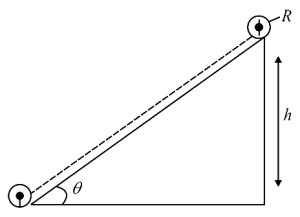
Three bodies: a ring,a solid cylinder,and a solid sphere,roll down an inclined plane without slipping. They start from rest. Which of the bodies reaches the bottom of the plane with the minimum velocity?
A
ring
B
solid cylinder
C
solid sphere
D
both ring and solid sphere
Solution
(A) Let the radius of gyration of the body be $K$,mass be $m$,height be $h$,and radius be $R$.
According to the law of conservation of mechanical energy,the potential energy at the top equals the sum of translational and rotational kinetic energy at the bottom:
$mgh = \frac{1}{2}mv^2 + \frac{1}{2}I\omega^2$
Since $I = mK^2$ and $\omega = v/R$,we have:
$mgh = \frac{1}{2}mv^2(1 + \frac{K^2}{R^2})$
$v = \sqrt{\frac{2gh}{1 + \frac{K^2}{R^2}}}$
For a ring,$K^2 = R^2$,so $v_{\text{ring}} = \sqrt{\frac{2gh}{1+1}} = \sqrt{gh}$.
For a solid cylinder,$K^2 = \frac{R^2}{2}$,so $v_{\text{cylinder}} = \sqrt{\frac{2gh}{1+0.5}} = \sqrt{\frac{4gh}{3}} \approx 1.15\sqrt{gh}$.
For a solid sphere,$K^2 = \frac{2}{5}R^2$,so $v_{\text{sphere}} = \sqrt{\frac{2gh}{1+0.4}} = \sqrt{\frac{10gh}{7}} \approx 1.19\sqrt{gh}$.
Comparing the velocities,the ring has the minimum velocity at the bottom of the inclined plane.
According to the law of conservation of mechanical energy,the potential energy at the top equals the sum of translational and rotational kinetic energy at the bottom:
$mgh = \frac{1}{2}mv^2 + \frac{1}{2}I\omega^2$
Since $I = mK^2$ and $\omega = v/R$,we have:
$mgh = \frac{1}{2}mv^2(1 + \frac{K^2}{R^2})$
$v = \sqrt{\frac{2gh}{1 + \frac{K^2}{R^2}}}$
For a ring,$K^2 = R^2$,so $v_{\text{ring}} = \sqrt{\frac{2gh}{1+1}} = \sqrt{gh}$.
For a solid cylinder,$K^2 = \frac{R^2}{2}$,so $v_{\text{cylinder}} = \sqrt{\frac{2gh}{1+0.5}} = \sqrt{\frac{4gh}{3}} \approx 1.15\sqrt{gh}$.
For a solid sphere,$K^2 = \frac{2}{5}R^2$,so $v_{\text{sphere}} = \sqrt{\frac{2gh}{1+0.4}} = \sqrt{\frac{10gh}{7}} \approx 1.19\sqrt{gh}$.
Comparing the velocities,the ring has the minimum velocity at the bottom of the inclined plane.
0 likes
View Solution225
MediumMCQ
$A$ rigid body of mass $M$ and radius $R$ rolls without slipping on an inclined plane of inclination $\theta$,under gravity. Match the type of body in Column-$I$ with the magnitude of the force of friction in Column-$II$.
| Column-$I$ | Column-$II$ |
| $(A)$ Ring | $(I)$ $\frac{Mg \sin \theta}{3.5}$ |
| $(B)$ Solid sphere | $(II)$ $\frac{Mg \sin \theta}{2}$ |
| $(C)$ Solid cylinder | $(III)$ $\frac{Mg \sin \theta}{3}$ |
| $(D)$ Hollow cylinder | $(IV)$ $\frac{Mg \sin \theta}{2.5}$ |
A
$A-IV, B-III, C-II, D-IV$
B
$A-II, B-I, C-IV, D-IV$
C
$A-II, B-III, C-IV, D-II$
D
$A-IV, B-III, C-II, D-II$
Solution
(C) For a rigid body rolling without slipping on an inclined plane,the force of friction $f$ is given by the formula: $f = \frac{Mg \sin \theta}{1 + \frac{MR^2}{I}}$.
$(A)$ For a ring,$I = MR^2$. Thus,$f = \frac{Mg \sin \theta}{1 + 1} = \frac{Mg \sin \theta}{2}$.
$(B)$ For a solid sphere,$I = \frac{2}{5}MR^2$. Thus,$f = \frac{Mg \sin \theta}{1 + 2.5} = \frac{Mg \sin \theta}{3.5}$.
$(C)$ For a solid cylinder,$I = \frac{1}{2}MR^2$. Thus,$f = \frac{Mg \sin \theta}{1 + 2} = \frac{Mg \sin \theta}{3}$.
$(D)$ For a hollow cylinder,$I = MR^2$. Thus,$f = \frac{Mg \sin \theta}{1 + 1} = \frac{Mg \sin \theta}{2}$.
Matching the results: $A-II, B-I, C-III, D-II$.
$(A)$ For a ring,$I = MR^2$. Thus,$f = \frac{Mg \sin \theta}{1 + 1} = \frac{Mg \sin \theta}{2}$.
$(B)$ For a solid sphere,$I = \frac{2}{5}MR^2$. Thus,$f = \frac{Mg \sin \theta}{1 + 2.5} = \frac{Mg \sin \theta}{3.5}$.
$(C)$ For a solid cylinder,$I = \frac{1}{2}MR^2$. Thus,$f = \frac{Mg \sin \theta}{1 + 2} = \frac{Mg \sin \theta}{3}$.
$(D)$ For a hollow cylinder,$I = MR^2$. Thus,$f = \frac{Mg \sin \theta}{1 + 1} = \frac{Mg \sin \theta}{2}$.
Matching the results: $A-II, B-I, C-III, D-II$.
0 likes
View Solution226
DifficultMCQ
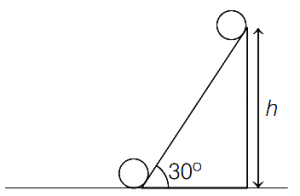
$A$ solid sphere of mass $2 \,kg$ rolls on a smooth horizontal surface at $10 \,m/s$. It then rolls up a smooth inclined plane of inclination $30^{\circ}$ with the horizontal. The height attained by the sphere before it stops is [take $g=10 \,m/s^2$].
A
$70 \,cm$
B
$701 \,cm$
C
$7.0 \,m$
D
$70 \,m$
Solution
(C) Let $h$ be the height attained by the sphere before it stops. According to the law of conservation of energy, the total initial kinetic energy (translational + rotational) is converted into potential energy at the maximum height.
$K_{\text{rot}} + K_{\text{trans}} = mgh$
$\frac{1}{2} I \omega^2 + \frac{1}{2} m v_{CM}^2 = mgh$
Since the sphere is rolling, $v_{CM} = R\omega$ and for a solid sphere, the moment of inertia $I = \frac{2}{5} mR^2$.
Substituting these values:
$\frac{1}{2} \left( \frac{2}{5} mR^2 \right) \left( \frac{v_{CM}}{R} \right)^2 + \frac{1}{2} m v_{CM}^2 = mgh$
$\frac{1}{5} m v_{CM}^2 + \frac{1}{2} m v_{CM}^2 = mgh$
Dividing by $m$ and simplifying:
$v_{CM}^2 \left( \frac{1}{5} + \frac{1}{2} \right) = gh$
$v_{CM}^2 \left( \frac{2+5}{10} \right) = gh$
$\frac{7}{10} v_{CM}^2 = gh$
Given $v_{CM} = 10 \,m/s$ and $g = 10 \,m/s^2$:
$\frac{7}{10} \times (10)^2 = 10 \times h$
$\frac{7}{10} \times 100 = 10h$
$70 = 10h$
$h = 7 \,m$
$K_{\text{rot}} + K_{\text{trans}} = mgh$
$\frac{1}{2} I \omega^2 + \frac{1}{2} m v_{CM}^2 = mgh$
Since the sphere is rolling, $v_{CM} = R\omega$ and for a solid sphere, the moment of inertia $I = \frac{2}{5} mR^2$.
Substituting these values:
$\frac{1}{2} \left( \frac{2}{5} mR^2 \right) \left( \frac{v_{CM}}{R} \right)^2 + \frac{1}{2} m v_{CM}^2 = mgh$
$\frac{1}{5} m v_{CM}^2 + \frac{1}{2} m v_{CM}^2 = mgh$
Dividing by $m$ and simplifying:
$v_{CM}^2 \left( \frac{1}{5} + \frac{1}{2} \right) = gh$
$v_{CM}^2 \left( \frac{2+5}{10} \right) = gh$
$\frac{7}{10} v_{CM}^2 = gh$
Given $v_{CM} = 10 \,m/s$ and $g = 10 \,m/s^2$:
$\frac{7}{10} \times (10)^2 = 10 \times h$
$\frac{7}{10} \times 100 = 10h$
$70 = 10h$
$h = 7 \,m$
0 likes
View Solution227
MediumMCQ
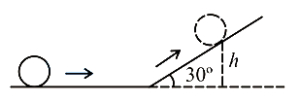
$A$ solid spherical ball rolls on a horizontal surface at $10 \ m \ s^{-1}$ and continues to roll up on an inclined surface as shown in the figure. If the mass of the ball is $11 \ kg$ and frictional losses are negligible,the value of $h$,where the ball stops and starts rolling down the inclination is $($Assume $g = 10 \ m \ s^{-2} )$ (in $m$)
A
$8$
B
$6$
C
$7$
D
$10$
Solution
(C) Given:
Initial velocity of the solid spherical ball is $v = 10 \ m \ s^{-1}$.
Mass of the ball is $m = 11 \ kg$.
Since frictional losses are negligible,the total mechanical energy is conserved.
The initial total kinetic energy of a rolling solid sphere is the sum of its translational and rotational kinetic energy:
$K_i = \frac{1}{2} m v^2 + \frac{1}{2} I \omega^2$
For a solid sphere,the moment of inertia $I = \frac{2}{5} m R^2$ and $\omega = \frac{v}{R}$.
$K_i = \frac{1}{2} m v^2 + \frac{1}{2} (\frac{2}{5} m R^2) (\frac{v}{R})^2 = \frac{1}{2} m v^2 (1 + \frac{2}{5}) = \frac{1}{2} m v^2 (\frac{7}{5}) = \frac{7}{10} m v^2$.
At the maximum height $h$,the ball momentarily stops,so its final kinetic energy $K_f = 0$.
The potential energy gained by the ball is $U_f = m g h$.
By the law of conservation of energy,$K_i = U_f$:
$\frac{7}{10} m v^2 = m g h$
$h = \frac{7 v^2}{10 g} = \frac{7 \times (10)^2}{10 \times 10} = \frac{7 \times 100}{100} = 7 \ m$.
Thus,the value of $h$ is $7 \ m$.
Initial velocity of the solid spherical ball is $v = 10 \ m \ s^{-1}$.
Mass of the ball is $m = 11 \ kg$.
Since frictional losses are negligible,the total mechanical energy is conserved.
The initial total kinetic energy of a rolling solid sphere is the sum of its translational and rotational kinetic energy:
$K_i = \frac{1}{2} m v^2 + \frac{1}{2} I \omega^2$
For a solid sphere,the moment of inertia $I = \frac{2}{5} m R^2$ and $\omega = \frac{v}{R}$.
$K_i = \frac{1}{2} m v^2 + \frac{1}{2} (\frac{2}{5} m R^2) (\frac{v}{R})^2 = \frac{1}{2} m v^2 (1 + \frac{2}{5}) = \frac{1}{2} m v^2 (\frac{7}{5}) = \frac{7}{10} m v^2$.
At the maximum height $h$,the ball momentarily stops,so its final kinetic energy $K_f = 0$.
The potential energy gained by the ball is $U_f = m g h$.
By the law of conservation of energy,$K_i = U_f$:
$\frac{7}{10} m v^2 = m g h$
$h = \frac{7 v^2}{10 g} = \frac{7 \times (10)^2}{10 \times 10} = \frac{7 \times 100}{100} = 7 \ m$.
Thus,the value of $h$ is $7 \ m$.
0 likes
View Solution228
MediumMCQ
$A$ solid sphere and a thin uniform circular disc of same radius are rolling down an inclined plane without slipping. If the acceleration of the sphere is $3 \,ms^{-2}$, then the acceleration of the disc is (in $\,ms^{-2}$)
A
$4$
B
$2.8$
C
$3$
D
$3.2$
Solution
(B) The acceleration of a body rolling down an inclined plane without slipping is given by $a = \frac{g \sin \theta}{1 + \frac{I}{MR^2}}$, where $I$ is the moment of inertia about the center of mass.
For a solid sphere, $I_{sphere} = \frac{2}{5} MR^2$. Thus, $a_{sphere} = \frac{g \sin \theta}{1 + 2/5} = \frac{g \sin \theta}{7/5} = \frac{5}{7} g \sin \theta = 3 \,ms^{-2}$.
This implies $g \sin \theta = \frac{3 \times 7}{5} = 4.2 \,ms^{-2}$.
For a thin uniform circular disc, $I_{disc} = \frac{1}{2} MR^2$. Thus, $a_{disc} = \frac{g \sin \theta}{1 + 1/2} = \frac{g \sin \theta}{3/2} = \frac{2}{3} g \sin \theta$.
Substituting the value of $g \sin \theta$, we get $a_{disc} = \frac{2}{3} \times 4.2 = 2.8 \,ms^{-2}$.
For a solid sphere, $I_{sphere} = \frac{2}{5} MR^2$. Thus, $a_{sphere} = \frac{g \sin \theta}{1 + 2/5} = \frac{g \sin \theta}{7/5} = \frac{5}{7} g \sin \theta = 3 \,ms^{-2}$.
This implies $g \sin \theta = \frac{3 \times 7}{5} = 4.2 \,ms^{-2}$.
For a thin uniform circular disc, $I_{disc} = \frac{1}{2} MR^2$. Thus, $a_{disc} = \frac{g \sin \theta}{1 + 1/2} = \frac{g \sin \theta}{3/2} = \frac{2}{3} g \sin \theta$.
Substituting the value of $g \sin \theta$, we get $a_{disc} = \frac{2}{3} \times 4.2 = 2.8 \,ms^{-2}$.
0 likes
View Solution229
EasyMCQ
$A$ solid sphere rolls down without slipping from the top of an inclined plane of height $28 \text{ m}$ and angle of inclination $30^{\circ}$. The velocity of the sphere, when it reaches the bottom of the plane is (Acceleration due to gravity $= 10 \text{ ms}^{-2}$)
A
$20 \text{ ms}^{-1}$
B
$28 \text{ ms}^{-1}$
C
$10 \text{ ms}^{-1}$
D
$14 \text{ ms}^{-1}$
Solution
(A) For a solid sphere rolling down an inclined plane without slipping, the velocity $v$ at the bottom is given by the formula:
$v = \sqrt{\frac{2gh}{1 + \frac{k^2}{R^2}}}$
Where $g = 10 \text{ ms}^{-2}$, $h = 28 \text{ m}$, and for a solid sphere, the radius of gyration $k$ satisfies $k^2 = \frac{2}{5}R^2$, so $\frac{k^2}{R^2} = \frac{2}{5}$.
Substituting the values:
$v = \sqrt{\frac{2 \times 10 \times 28}{1 + \frac{2}{5}}}$
$v = \sqrt{\frac{560}{\frac{7}{5}}}$
$v = \sqrt{\frac{560 \times 5}{7}}$
$v = \sqrt{80 \times 5} = \sqrt{400} = 20 \text{ ms}^{-1}$.
$v = \sqrt{\frac{2gh}{1 + \frac{k^2}{R^2}}}$
Where $g = 10 \text{ ms}^{-2}$, $h = 28 \text{ m}$, and for a solid sphere, the radius of gyration $k$ satisfies $k^2 = \frac{2}{5}R^2$, so $\frac{k^2}{R^2} = \frac{2}{5}$.
Substituting the values:
$v = \sqrt{\frac{2 \times 10 \times 28}{1 + \frac{2}{5}}}$
$v = \sqrt{\frac{560}{\frac{7}{5}}}$
$v = \sqrt{\frac{560 \times 5}{7}}$
$v = \sqrt{80 \times 5} = \sqrt{400} = 20 \text{ ms}^{-1}$.
0 likes
View Solution230
MediumMCQ
$A$ hollow cylinder and a solid cylinder,initially at rest at the top of an inclined plane,are rolling down without slipping. If the time taken by the hollow cylinder to reach the bottom of the inclined plane is $2 \ s$,the time taken by the solid cylinder to reach the bottom of the inclined plane is: (in $s$)
A
$2$
B
$1.414$
C
$1$
D
$1.732$
Solution
(D) For an object rolling down an inclined plane of length $l$ and angle $\theta$,the acceleration is given by $a = \frac{g \sin \theta}{1 + K^2/R^2}$.
Using the equation of motion $s = ut + \frac{1}{2}at^2$ with $u=0$ and $s=l$,we get $l = \frac{1}{2} \left( \frac{g \sin \theta}{1 + K^2/R^2} \right) t^2$.
Thus,$t = \sqrt{\frac{2l(1 + K^2/R^2)}{g \sin \theta}}$,which implies $t \propto \sqrt{1 + K^2/R^2}$.
For a hollow cylinder,the radius of gyration $K^2 = R^2$,so $K^2/R^2 = 1$. Thus,$t_1 \propto \sqrt{1 + 1} = \sqrt{2}$.
For a solid cylinder,the radius of gyration $K^2 = R^2/2$,so $K^2/R^2 = 1/2$. Thus,$t_2 \propto \sqrt{1 + 1/2} = \sqrt{3/2}$.
Taking the ratio,$\frac{t_2}{t_1} = \frac{\sqrt{3/2}}{\sqrt{2}} = \sqrt{\frac{3}{4}} = \frac{\sqrt{3}}{2}$.
Given $t_1 = 2 \ s$,we have $t_2 = \frac{\sqrt{3}}{2} \times 2 = \sqrt{3} \approx 1.732 \ s$.
Using the equation of motion $s = ut + \frac{1}{2}at^2$ with $u=0$ and $s=l$,we get $l = \frac{1}{2} \left( \frac{g \sin \theta}{1 + K^2/R^2} \right) t^2$.
Thus,$t = \sqrt{\frac{2l(1 + K^2/R^2)}{g \sin \theta}}$,which implies $t \propto \sqrt{1 + K^2/R^2}$.
For a hollow cylinder,the radius of gyration $K^2 = R^2$,so $K^2/R^2 = 1$. Thus,$t_1 \propto \sqrt{1 + 1} = \sqrt{2}$.
For a solid cylinder,the radius of gyration $K^2 = R^2/2$,so $K^2/R^2 = 1/2$. Thus,$t_2 \propto \sqrt{1 + 1/2} = \sqrt{3/2}$.
Taking the ratio,$\frac{t_2}{t_1} = \frac{\sqrt{3/2}}{\sqrt{2}} = \sqrt{\frac{3}{4}} = \frac{\sqrt{3}}{2}$.
Given $t_1 = 2 \ s$,we have $t_2 = \frac{\sqrt{3}}{2} \times 2 = \sqrt{3} \approx 1.732 \ s$.
0 likes
View Solution231
MediumMCQ
$A$ solid cylinder of mass $m$ and radius $R$ rolls down an inclined plane of height $30 \ m$ without slipping. The speed of its centre of mass when the cylinder reaches the bottom is $[$use $g=10 \ m \ s^{-2}]$ (in $m \ s^{-1}$)
A
$10$
B
$20$
C
$30$
D
$40$
Solution
(B) Since the cylinder rolls without slipping,the work done by friction is zero. Therefore,we can apply the principle of conservation of mechanical energy.
At the top,the total energy is purely potential: $E_i = mgh$.
At the bottom,the total energy is the sum of translational and rotational kinetic energy: $E_f = \frac{1}{2}mv^2 + \frac{1}{2}I\omega^2$.
For a solid cylinder,the moment of inertia $I = \frac{1}{2}mR^2$ and for pure rolling,$\omega = \frac{v}{R}$.
Equating $E_i = E_f$:
$mgh = \frac{1}{2}mv^2 + \frac{1}{2}(\frac{1}{2}mR^2)(\frac{v}{R})^2$
$mgh = \frac{1}{2}mv^2 + \frac{1}{4}mv^2 = \frac{3}{4}mv^2$
$v^2 = \frac{4gh}{3}$
$v = \sqrt{\frac{4 \times 10 \times 30}{3}} = \sqrt{400} = 20 \ m \ s^{-1}$.
At the top,the total energy is purely potential: $E_i = mgh$.
At the bottom,the total energy is the sum of translational and rotational kinetic energy: $E_f = \frac{1}{2}mv^2 + \frac{1}{2}I\omega^2$.
For a solid cylinder,the moment of inertia $I = \frac{1}{2}mR^2$ and for pure rolling,$\omega = \frac{v}{R}$.
Equating $E_i = E_f$:
$mgh = \frac{1}{2}mv^2 + \frac{1}{2}(\frac{1}{2}mR^2)(\frac{v}{R})^2$
$mgh = \frac{1}{2}mv^2 + \frac{1}{4}mv^2 = \frac{3}{4}mv^2$
$v^2 = \frac{4gh}{3}$
$v = \sqrt{\frac{4 \times 10 \times 30}{3}} = \sqrt{400} = 20 \ m \ s^{-1}$.
0 likes
View Solution232
DifficultMCQ
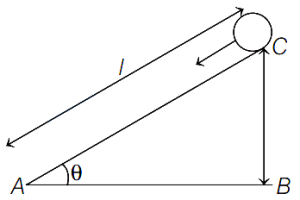
$A$ solid cylinder is released from rest from the top of an inclined plane of inclination $30^{\circ}$ and length $60 \,cm$. If the cylinder rolls without slipping, then the speed when it reaches the bottom is (in $\,m/s$)
A
$1.5$
B
$2.0$
C
$3.0$
D
$6.0$
Solution
(B) Given: Inclination $\theta = 30^{\circ}$, length $l = 60 \,cm = 0.6 \,m$, acceleration due to gravity $g = 10 \,m/s^2$.
Using the law of conservation of mechanical energy, the potential energy at the top equals the sum of translational and rotational kinetic energy at the bottom:
$mgh = \frac{1}{2}mv^2 + \frac{1}{2}I\omega^2$
Here, $h = l \sin \theta = 0.6 \times \sin 30^{\circ} = 0.6 \times 0.5 = 0.3 \,m$.
For a solid cylinder, the moment of inertia $I = \frac{1}{2}mr^2$ and for rolling without slipping, $\omega = \frac{v}{r}$.
Substituting these values:
$mgh = \frac{1}{2}mv^2 + \frac{1}{2}(\frac{1}{2}mr^2)(\frac{v}{r})^2$
$mgh = \frac{1}{2}mv^2 + \frac{1}{4}mv^2 = \frac{3}{4}mv^2$
$gh = \frac{3}{4}v^2 \Rightarrow v = \sqrt{\frac{4gh}{3}}$
$v = \sqrt{\frac{4 \times 10 \times 0.3}{3}} = \sqrt{\frac{12}{3}} = \sqrt{4} = 2 \,m/s$.
Using the law of conservation of mechanical energy, the potential energy at the top equals the sum of translational and rotational kinetic energy at the bottom:
$mgh = \frac{1}{2}mv^2 + \frac{1}{2}I\omega^2$
Here, $h = l \sin \theta = 0.6 \times \sin 30^{\circ} = 0.6 \times 0.5 = 0.3 \,m$.
For a solid cylinder, the moment of inertia $I = \frac{1}{2}mr^2$ and for rolling without slipping, $\omega = \frac{v}{r}$.
Substituting these values:
$mgh = \frac{1}{2}mv^2 + \frac{1}{2}(\frac{1}{2}mr^2)(\frac{v}{r})^2$
$mgh = \frac{1}{2}mv^2 + \frac{1}{4}mv^2 = \frac{3}{4}mv^2$
$gh = \frac{3}{4}v^2 \Rightarrow v = \sqrt{\frac{4gh}{3}}$
$v = \sqrt{\frac{4 \times 10 \times 0.3}{3}} = \sqrt{\frac{12}{3}} = \sqrt{4} = 2 \,m/s$.
0 likes
View Solution233
MediumMCQ
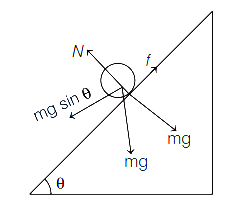
$A$ uniform sphere of radius $R$ and mass $m$ is placed on an inclined plane which makes an angle $45^{\circ}$ to the horizontal. For which of the following values of the coefficient of friction does the sphere roll without slipping? Select the incorrect option.
A
$\frac{3}{7}$
B
$\frac{1}{2}$
C
$\frac{5}{8}$
D
$\frac{1}{7}$
Solution
(D) Given: Radius of sphere $= R$,mass of sphere $= m$,and angle of inclination $\theta = 45^{\circ}$.
For a solid sphere rolling without slipping on an inclined plane,the linear acceleration is given by:
$a = \frac{g \sin \theta}{1 + \frac{I}{m R^2}} = \frac{g \sin \theta}{1 + \frac{2/5 m R^2}{m R^2}} = \frac{5}{7} g \sin \theta$
Applying Newton's second law for linear motion along the incline:
$m g \sin \theta - f = m a$
$f = m g \sin \theta - m \left( \frac{5}{7} g \sin \theta \right) = \frac{2}{7} m g \sin \theta$
The normal force is $N = m g \cos \theta$.
The coefficient of static friction $\mu_s$ must satisfy:
$\mu_s \geq \frac{f}{N} = \frac{\frac{2}{7} m g \sin \theta}{m g \cos \theta} = \frac{2}{7} \tan \theta$
Since $\theta = 45^{\circ}$,$\tan 45^{\circ} = 1$,so $\mu_s \geq \frac{2}{7} \approx 0.2857$.
Comparing the options:
$(A)$ $\frac{3}{7} \approx 0.428 > 0.2857$
$(B)$ $\frac{1}{2} = 0.5 > 0.2857$
$(C)$ $\frac{5}{8} = 0.625 > 0.2857$
$(D)$ $\frac{1}{7} \approx 0.1428 < 0.2857$
Since $\frac{1}{7}$ is less than $\frac{2}{7}$,the sphere will slip. Thus,option $(D)$ is the incorrect value for rolling without slipping.
For a solid sphere rolling without slipping on an inclined plane,the linear acceleration is given by:
$a = \frac{g \sin \theta}{1 + \frac{I}{m R^2}} = \frac{g \sin \theta}{1 + \frac{2/5 m R^2}{m R^2}} = \frac{5}{7} g \sin \theta$
Applying Newton's second law for linear motion along the incline:
$m g \sin \theta - f = m a$
$f = m g \sin \theta - m \left( \frac{5}{7} g \sin \theta \right) = \frac{2}{7} m g \sin \theta$
The normal force is $N = m g \cos \theta$.
The coefficient of static friction $\mu_s$ must satisfy:
$\mu_s \geq \frac{f}{N} = \frac{\frac{2}{7} m g \sin \theta}{m g \cos \theta} = \frac{2}{7} \tan \theta$
Since $\theta = 45^{\circ}$,$\tan 45^{\circ} = 1$,so $\mu_s \geq \frac{2}{7} \approx 0.2857$.
Comparing the options:
$(A)$ $\frac{3}{7} \approx 0.428 > 0.2857$
$(B)$ $\frac{1}{2} = 0.5 > 0.2857$
$(C)$ $\frac{5}{8} = 0.625 > 0.2857$
$(D)$ $\frac{1}{7} \approx 0.1428 < 0.2857$
Since $\frac{1}{7}$ is less than $\frac{2}{7}$,the sphere will slip. Thus,option $(D)$ is the incorrect value for rolling without slipping.
0 likes
View Solution234
DifficultMCQ
$A$ solid sphere of radius $R$ undergoes pure rolling down a plane inclined to the horizontal at an angle $\theta$. If the radius of gyration is $k$,then its acceleration is
A
$\frac{g \sin \theta}{1+\frac{k^2}{R^2}}$
B
$\frac{g \sin \theta}{R^2+k^2}$
C
$\frac{g \sin \theta}{2(R^2+k^2)}$
D
$\frac{g \sin \theta}{2(1+\frac{k^2}{R^2})}$
Solution
(A) For a body undergoing pure rolling on an inclined plane,the forces acting along the plane are the component of gravity $mg \sin \theta$ and the frictional force $f$. The equation of motion is $ma = mg \sin \theta - f$.
The torque equation about the center of mass is $\tau = I \alpha = fR$.
Since the body is in pure rolling,$\alpha = \frac{a}{R}$. Also,the moment of inertia $I = mk^2$.
Substituting these into the torque equation: $mk^2 \cdot \frac{a}{R} = fR$,which gives $f = \frac{ma k^2}{R^2}$.
Substituting the expression for $f$ into the force equation: $ma = mg \sin \theta - \frac{ma k^2}{R^2}$.
Rearranging the terms: $ma(1 + \frac{k^2}{R^2}) = mg \sin \theta$.
Therefore,the acceleration is $a = \frac{g \sin \theta}{1 + \frac{k^2}{R^2}}$.
The torque equation about the center of mass is $\tau = I \alpha = fR$.
Since the body is in pure rolling,$\alpha = \frac{a}{R}$. Also,the moment of inertia $I = mk^2$.
Substituting these into the torque equation: $mk^2 \cdot \frac{a}{R} = fR$,which gives $f = \frac{ma k^2}{R^2}$.
Substituting the expression for $f$ into the force equation: $ma = mg \sin \theta - \frac{ma k^2}{R^2}$.
Rearranging the terms: $ma(1 + \frac{k^2}{R^2}) = mg \sin \theta$.
Therefore,the acceleration is $a = \frac{g \sin \theta}{1 + \frac{k^2}{R^2}}$.
0 likes
View Solution235
MediumMCQ
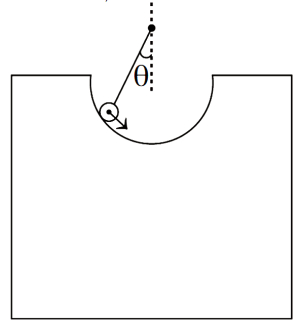
$A$ solid sphere is rolling without slipping on a semi-circular track of radius $R = 10 \ m$ as shown in the figure. The radius of the solid sphere is much smaller than the radius of the semi-circular track. At the lowest point,it has a velocity $v = 10 \ m/s$. To what maximum angle $\theta$ from the vertical will the sphere travel before it comes back down? Neglect the rolling friction between the sphere and the track. (Take $g = 10 \ m/s^2$)
A
$\sin^{-1}\left(\frac{3}{5}\right)$
B
$\sin^{-1}\left(\frac{3}{7}\right)$
C
$\cos^{-1}\left(\frac{3}{10}\right)$
D
$\cos^{-1}\left(\frac{1}{3}\right)$
Solution
(C) Since the sphere is rolling without slipping and there is no friction,the total mechanical energy is conserved.
Let $R$ be the radius of the track and $r$ be the radius of the sphere. Given $r \ll R$.
The total energy at the lowest point (bottom) is the sum of translational and rotational kinetic energy:
$E_{bottom} = \frac{1}{2}mv^2 + \frac{1}{2}I\omega^2$
For a solid sphere,$I = \frac{2}{5}mr^2$. Since it rolls without slipping,$\omega = \frac{v}{r}$.
$E_{bottom} = \frac{1}{2}mv^2 + \frac{1}{2}\left(\frac{2}{5}mr^2\right)\left(\frac{v}{r}\right)^2 = \frac{1}{2}mv^2 + \frac{1}{5}mv^2 = \frac{7}{10}mv^2$
At the maximum height $h$ reached by the center of mass,the velocity becomes zero,so the total energy is purely potential energy:
$E_{top} = mgh$
Equating the energies: $\frac{7}{10}mv^2 = mgh \Rightarrow h = \frac{7v^2}{10g}$
From the geometry of the track,$h = R(1 - \cos\theta)$.
Substituting the values $v = 10 \ m/s$,$g = 10 \ m/s^2$,and $R = 10 \ m$:
$h = \frac{7 \times (10)^2}{10 \times 10} = 7 \ m$
$7 = 10(1 - \cos\theta) \Rightarrow 0.7 = 1 - \cos\theta \Rightarrow \cos\theta = 0.3 = \frac{3}{10}$
Therefore,$\theta = \cos^{-1}\left(\frac{3}{10}\right)$.
Let $R$ be the radius of the track and $r$ be the radius of the sphere. Given $r \ll R$.
The total energy at the lowest point (bottom) is the sum of translational and rotational kinetic energy:
$E_{bottom} = \frac{1}{2}mv^2 + \frac{1}{2}I\omega^2$
For a solid sphere,$I = \frac{2}{5}mr^2$. Since it rolls without slipping,$\omega = \frac{v}{r}$.
$E_{bottom} = \frac{1}{2}mv^2 + \frac{1}{2}\left(\frac{2}{5}mr^2\right)\left(\frac{v}{r}\right)^2 = \frac{1}{2}mv^2 + \frac{1}{5}mv^2 = \frac{7}{10}mv^2$
At the maximum height $h$ reached by the center of mass,the velocity becomes zero,so the total energy is purely potential energy:
$E_{top} = mgh$
Equating the energies: $\frac{7}{10}mv^2 = mgh \Rightarrow h = \frac{7v^2}{10g}$
From the geometry of the track,$h = R(1 - \cos\theta)$.
Substituting the values $v = 10 \ m/s$,$g = 10 \ m/s^2$,and $R = 10 \ m$:
$h = \frac{7 \times (10)^2}{10 \times 10} = 7 \ m$
$7 = 10(1 - \cos\theta) \Rightarrow 0.7 = 1 - \cos\theta \Rightarrow \cos\theta = 0.3 = \frac{3}{10}$
Therefore,$\theta = \cos^{-1}\left(\frac{3}{10}\right)$.
0 likes
View Solution236
EasyMCQ
Three bodies,a ring,a solid disc,and a solid sphere,roll down the same inclined plane without slipping. The radii of the bodies are identical,and they start from rest. If $V_S, V_R$,and $V_D$ are the speeds of the sphere,ring,and disc,respectively,when they reach the bottom,then the correct option is:
A
$V_S > V_R > V_D$
B
$V_D > V_S > V_R$
C
$V_R > V_D > V_S$
D
$V_S > V_D > V_R$
Solution
(D) When a body of mass $m$ and radius $R$ rolls down an inclined plane of height $h$ without slipping,its velocity at the bottom is given by $v = \sqrt{\frac{2gh}{1 + \frac{k^2}{R^2}}}$,where $k$ is the radius of gyration.
For a ring,$k^2 = R^2$,so $v_R = \sqrt{\frac{2gh}{1+1}} = \sqrt{gh}$.
For a solid disc,$k^2 = \frac{R^2}{2}$,so $v_D = \sqrt{\frac{2gh}{1+0.5}} = \sqrt{\frac{4gh}{3}} \approx 1.15 \sqrt{gh}$.
For a solid sphere,$k^2 = \frac{2R^2}{5}$,so $v_S = \sqrt{\frac{2gh}{1+0.4}} = \sqrt{\frac{10gh}{7}} \approx 1.19 \sqrt{gh}$.
Comparing the values,we find $V_S > V_D > V_R$.
For a ring,$k^2 = R^2$,so $v_R = \sqrt{\frac{2gh}{1+1}} = \sqrt{gh}$.
For a solid disc,$k^2 = \frac{R^2}{2}$,so $v_D = \sqrt{\frac{2gh}{1+0.5}} = \sqrt{\frac{4gh}{3}} \approx 1.15 \sqrt{gh}$.
For a solid sphere,$k^2 = \frac{2R^2}{5}$,so $v_S = \sqrt{\frac{2gh}{1+0.4}} = \sqrt{\frac{10gh}{7}} \approx 1.19 \sqrt{gh}$.
Comparing the values,we find $V_S > V_D > V_R$.
0 likes
View Solution237
EasyMCQ
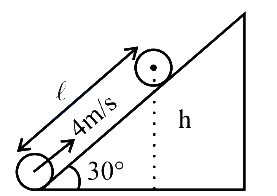
$A$ solid spherical ball is rolled up an inclined plane of angle of inclination $30^{\circ}$ with an initial speed of $4 \ m/s$ at the bottom of the inclination. How far will the ball go up the plane (in $cm$)? (Use $g=10 \ m/s^2$)
A
$56$
B
$112$
C
$224$
D
$120$
Solution
(C) By the law of conservation of energy,the total initial mechanical energy equals the total final mechanical energy at the highest point.
Initial energy: $E_i = K.E_{trans} + K.E_{rot} = \frac{1}{2}mv^2 + \frac{1}{2}I\omega^2$
For a solid sphere,$I = \frac{2}{5}mR^2$ and for pure rolling,$\omega = \frac{v}{R}$.
$E_i = \frac{1}{2}mv^2 + \frac{1}{2}(\frac{2}{5}mR^2)(\frac{v}{R})^2 = \frac{1}{2}mv^2 + \frac{1}{5}mv^2 = \frac{7}{10}mv^2$
At the highest point,the final kinetic energy is zero,and the potential energy is $mgh$.
So,$\frac{7}{10}mv^2 = mgh \Rightarrow h = \frac{7v^2}{10g}$
Given $v = 4 \ m/s$ and $g = 10 \ m/s^2$,$h = \frac{7 \times 4^2}{10 \times 10} = \frac{7 \times 16}{100} = 1.12 \ m$.
The distance $\ell$ along the plane is given by $\ell = \frac{h}{\sin 30^{\circ}} = \frac{1.12}{0.5} = 2.24 \ m = 224 \ cm$.
Initial energy: $E_i = K.E_{trans} + K.E_{rot} = \frac{1}{2}mv^2 + \frac{1}{2}I\omega^2$
For a solid sphere,$I = \frac{2}{5}mR^2$ and for pure rolling,$\omega = \frac{v}{R}$.
$E_i = \frac{1}{2}mv^2 + \frac{1}{2}(\frac{2}{5}mR^2)(\frac{v}{R})^2 = \frac{1}{2}mv^2 + \frac{1}{5}mv^2 = \frac{7}{10}mv^2$
At the highest point,the final kinetic energy is zero,and the potential energy is $mgh$.
So,$\frac{7}{10}mv^2 = mgh \Rightarrow h = \frac{7v^2}{10g}$
Given $v = 4 \ m/s$ and $g = 10 \ m/s^2$,$h = \frac{7 \times 4^2}{10 \times 10} = \frac{7 \times 16}{100} = 1.12 \ m$.
The distance $\ell$ along the plane is given by $\ell = \frac{h}{\sin 30^{\circ}} = \frac{1.12}{0.5} = 2.24 \ m = 224 \ cm$.
0 likes
View Solution238
MediumMCQ
$A$ uniform solid spherical ball is rolling down a smooth inclined plane from a height $h$. The velocity attained by the ball when it reaches the bottom of the inclined plane is $v$. If the ball is now thrown vertically upwards with the same velocity $v$,the maximum height to which the ball will rise is
A
$\frac{5 h}{8}$
B
$\frac{3 h}{5}$
C
$\frac{5 h}{7}$
D
$\frac{7 h}{9}$
Solution
(C) For a solid sphere rolling without slipping down an inclined plane,the total kinetic energy $K$ at the bottom is the sum of translational and rotational kinetic energy.
$K = K_{\text{trans}} + K_{\text{rot}} = \frac{1}{2}mv^2 + \frac{1}{2}I\omega^2$.
Since $I = \frac{2}{5}mR^2$ and $v = R\omega$,we have $K = \frac{1}{2}mv^2 + \frac{1}{2}(\frac{2}{5}mR^2)(\frac{v}{R})^2 = \frac{1}{2}mv^2 + \frac{1}{5}mv^2 = \frac{7}{10}mv^2$.
By conservation of energy,the potential energy at height $h$ equals the total kinetic energy at the bottom:
$mgh = \frac{7}{10}mv^2 \implies v^2 = \frac{10}{7}gh$.
When the ball is thrown vertically upwards with velocity $v$,it undergoes motion under gravity. At the maximum height $h'$,the final velocity is $0$. Using the kinematic equation $v_f^2 = v_i^2 - 2gh'$:
$0 = v^2 - 2gh' \implies h' = \frac{v^2}{2g}$.
Substituting $v^2 = \frac{10}{7}gh$:
$h' = \frac{10/7 gh}{2g} = \frac{5}{7}h$.
$K = K_{\text{trans}} + K_{\text{rot}} = \frac{1}{2}mv^2 + \frac{1}{2}I\omega^2$.
Since $I = \frac{2}{5}mR^2$ and $v = R\omega$,we have $K = \frac{1}{2}mv^2 + \frac{1}{2}(\frac{2}{5}mR^2)(\frac{v}{R})^2 = \frac{1}{2}mv^2 + \frac{1}{5}mv^2 = \frac{7}{10}mv^2$.
By conservation of energy,the potential energy at height $h$ equals the total kinetic energy at the bottom:
$mgh = \frac{7}{10}mv^2 \implies v^2 = \frac{10}{7}gh$.
When the ball is thrown vertically upwards with velocity $v$,it undergoes motion under gravity. At the maximum height $h'$,the final velocity is $0$. Using the kinematic equation $v_f^2 = v_i^2 - 2gh'$:
$0 = v^2 - 2gh' \implies h' = \frac{v^2}{2g}$.
Substituting $v^2 = \frac{10}{7}gh$:
$h' = \frac{10/7 gh}{2g} = \frac{5}{7}h$.
0 likes
View Solution239
DifficultMCQ
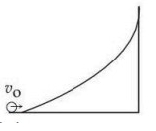
An object of uniform density rolls up a curved path with an initial velocity $v_0$ as shown in the figure. If the maximum height attained by the object is $\frac{7v_0^2}{10g}$ ($g =$ acceleration due to gravity),the object is a . . . . . . .
A
solid cylinder
B
ring
C
disc
D
solid sphere
Solution
(D) By the law of conservation of energy,the initial kinetic energy (translational + rotational) is converted into gravitational potential energy at the maximum height $h$.
Initial kinetic energy $K_i = \frac{1}{2}mv_0^2 + \frac{1}{2}I\omega^2$.
Since the object rolls without slipping,$\omega = \frac{v_0}{R}$.
Substituting the moment of inertia $I = kmR^2$,we get:
$K_i = \frac{1}{2}mv_0^2 + \frac{1}{2}(kmR^2)(\frac{v_0}{R})^2 = \frac{1}{2}mv_0^2(1+k)$.
At maximum height $h$,the potential energy is $U_f = mgh$.
Equating $K_i = U_f$,we have $\frac{1}{2}mv_0^2(1+k) = mgh$.
Thus,$h = \frac{v_0^2(1+k)}{2g}$.
Given $h = \frac{7v_0^2}{10g}$,we equate the two expressions:
$\frac{v_0^2(1+k)}{2g} = \frac{7v_0^2}{10g} \Rightarrow 1+k = \frac{14}{10} = 1.4 \Rightarrow k = 0.4$.
For a solid sphere,the moment of inertia is $I = \frac{2}{5}mR^2$,so $k = 0.4$.
Therefore,the object is a solid sphere.
Initial kinetic energy $K_i = \frac{1}{2}mv_0^2 + \frac{1}{2}I\omega^2$.
Since the object rolls without slipping,$\omega = \frac{v_0}{R}$.
Substituting the moment of inertia $I = kmR^2$,we get:
$K_i = \frac{1}{2}mv_0^2 + \frac{1}{2}(kmR^2)(\frac{v_0}{R})^2 = \frac{1}{2}mv_0^2(1+k)$.
At maximum height $h$,the potential energy is $U_f = mgh$.
Equating $K_i = U_f$,we have $\frac{1}{2}mv_0^2(1+k) = mgh$.
Thus,$h = \frac{v_0^2(1+k)}{2g}$.
Given $h = \frac{7v_0^2}{10g}$,we equate the two expressions:
$\frac{v_0^2(1+k)}{2g} = \frac{7v_0^2}{10g} \Rightarrow 1+k = \frac{14}{10} = 1.4 \Rightarrow k = 0.4$.
For a solid sphere,the moment of inertia is $I = \frac{2}{5}mR^2$,so $k = 0.4$.
Therefore,the object is a solid sphere.
0 likes
View SolutionSystem of Particles and Rotational Motion — Rolling On Inclined Plane · Frequently Asked Questions
1Are these System of Particles and Rotational Motion questions useful for JEE and NEET?
Yes. All questions in this section are mapped to JEE Main and NEET exam patterns. Previous year questions from JEE Main, NEET, GUJCET and state-level exams are included with full solutions.
2Can I switch to Hindi or Gujarati for these questions?
Yes. Use the language tabs in the hero section or the sidebar to view the same questions and solutions in English, Hindi or Gujarati.
3How do I generate a question paper from this subtopic?
Use the Vedclass Exam Paper Generator — select the chapter and subtopic, set difficulty, and generate Sets A, B, C, D automatically. First 3 chapters of every subject are free.
Vedclass Products
For Students
Vedclass Test Series
Mock tests in real JEE/NEET style with performance analysis. 5-day free trial.
Start Free TrialFor Teachers
Exam Paper Generator
Generate Set A/B/C/D papers from this chapter in 2 minutes. 3 chapters free.
Try FreeFor Institutes
Online Exam Module
Live online exams with unlimited students, 360° analytics & white-label branding.
See DemoFor Teachers & Institutes
Generate a System of Particles and Rotational Motion Exam Paper in 2 Minutes
Select subtopic & difficulty — Sets A, B, C, D auto-generated with No Repeat logic.
First 3 chapters of every subject are free — no payment required.