
A English
Periodic, Oscillatory motion and its characteristics and types of SHM and Equation of SHM Questions in English
Class 11 Physics · Oscillations · Periodic, Oscillatory motion and its characteristics and types of SHM and Equation of SHM
239+
Questions
English
Language
100%
With Solutions
Showing 50 of 239 questions in English
151
EasyMCQ
$SHM$ is associated with what kind of motion?
A
Periodic motion
B
Linear motion
C
Circular motion
D
Random motion
Solution
(A) $SHM$ stands for Simple Harmonic Motion.
Simple Harmonic Motion is a special type of periodic motion where the restoring force is directly proportional to the displacement and acts in the direction opposite to that of displacement.
Since $SHM$ repeats its path after a fixed interval of time, it is fundamentally a type of periodic motion.
Simple Harmonic Motion is a special type of periodic motion where the restoring force is directly proportional to the displacement and acts in the direction opposite to that of displacement.
Since $SHM$ repeats its path after a fixed interval of time, it is fundamentally a type of periodic motion.
0 likes
View Solution152
Easy
Write the phase difference between displacement and velocity,displacement and acceleration,and velocity and acceleration for a particle executing Simple Harmonic Motion $(SHM)$.
Solution
For a particle executing Simple Harmonic Motion $(SHM)$,the displacement is given by $x(t) = A \sin(\omega t + \phi)$.
$1$. Velocity $v(t) = \frac{dx}{dt} = A\omega \cos(\omega t + \phi) = A\omega \sin(\omega t + \phi + \frac{\pi}{2})$.
Comparing $x(t)$ and $v(t)$,the phase difference between displacement and velocity is $\frac{\pi}{2}$ radians.
$2$. Acceleration $a(t) = \frac{dv}{dt} = -A\omega^2 \sin(\omega t + \phi) = A\omega^2 \sin(\omega t + \phi + \pi)$.
Comparing $x(t)$ and $a(t)$,the phase difference between displacement and acceleration is $\pi$ radians.
$3$. Comparing $v(t) = A\omega \sin(\omega t + \phi + \frac{\pi}{2})$ and $a(t) = A\omega^2 \sin(\omega t + \phi + \pi)$,the phase difference between velocity and acceleration is $\pi - \frac{\pi}{2} = \frac{\pi}{2}$ radians.
$1$. Velocity $v(t) = \frac{dx}{dt} = A\omega \cos(\omega t + \phi) = A\omega \sin(\omega t + \phi + \frac{\pi}{2})$.
Comparing $x(t)$ and $v(t)$,the phase difference between displacement and velocity is $\frac{\pi}{2}$ radians.
$2$. Acceleration $a(t) = \frac{dv}{dt} = -A\omega^2 \sin(\omega t + \phi) = A\omega^2 \sin(\omega t + \phi + \pi)$.
Comparing $x(t)$ and $a(t)$,the phase difference between displacement and acceleration is $\pi$ radians.
$3$. Comparing $v(t) = A\omega \sin(\omega t + \phi + \frac{\pi}{2})$ and $a(t) = A\omega^2 \sin(\omega t + \phi + \pi)$,the phase difference between velocity and acceleration is $\pi - \frac{\pi}{2} = \frac{\pi}{2}$ radians.
0 likes
View Solution153
Difficult
Write the force law for $SHM$ and obtain the formula for the period of an $SHM$ particle.
Solution
(N/A) The acceleration of an $SHM$ particle is given by:
$a(t) = -\omega^{2} x(t)$
where $x(t)$ is the displacement at time $t$.
According to Newton's second law of motion,the force $F$ exerted on the particle is:
$F = m a(t)$
Substituting the expression for acceleration:
$F = -m \omega^{2} x(t) \quad (1)$
In $SHM$,the restoring force is directly proportional to the displacement and directed towards the mean position:
$F = -k x(t) \quad (2)$
where $k$ is the force constant.
Comparing equations $(1)$ and $(2)$:
$k = m \omega^{2}$
$\omega = \sqrt{\frac{k}{m}}$
Since the angular frequency $\omega = \frac{2 \pi}{T}$,where $T$ is the time period:
$\frac{2 \pi}{T} = \sqrt{\frac{k}{m}}$
$T = 2 \pi \sqrt{\frac{m}{k}}$
$a(t) = -\omega^{2} x(t)$
where $x(t)$ is the displacement at time $t$.
According to Newton's second law of motion,the force $F$ exerted on the particle is:
$F = m a(t)$
Substituting the expression for acceleration:
$F = -m \omega^{2} x(t) \quad (1)$
In $SHM$,the restoring force is directly proportional to the displacement and directed towards the mean position:
$F = -k x(t) \quad (2)$
where $k$ is the force constant.
Comparing equations $(1)$ and $(2)$:
$k = m \omega^{2}$
$\omega = \sqrt{\frac{k}{m}}$
Since the angular frequency $\omega = \frac{2 \pi}{T}$,where $T$ is the time period:
$\frac{2 \pi}{T} = \sqrt{\frac{k}{m}}$
$T = 2 \pi \sqrt{\frac{m}{k}}$
0 likes
View Solution154
Difficult
Obtain the expression of displacement from the force law for simple harmonic motion.
Solution
(N/A) The force law for $SHM$ is given by $F = -kx(t)$.
Since $F = ma(t)$ and $k = m\omega^2$,we have $ma(t) = -m\omega^2 x(t)$,which simplifies to $a(t) = -\omega^2 x(t)$.
We know that acceleration $a(t) = \frac{dv}{dt}$ and velocity $v(t) = \frac{dx}{dt}$.
Substituting $a(t) = \frac{dv}{dt}$,we get $\frac{dv}{dt} = -\omega^2 x$.
Using the chain rule,$\frac{dv}{dx} \cdot \frac{dx}{dt} = -\omega^2 x$,which implies $v \frac{dv}{dx} = -\omega^2 x$.
Integrating both sides with respect to $x$: $\int v dv = -\omega^2 \int x dx$.
$\frac{v^2}{2} = -\omega^2 \frac{x^2}{2} + C$.
At extreme position $x = A$,$v = 0$,so $C = \frac{1}{2} \omega^2 A^2$.
Thus,$v^2 = \omega^2 (A^2 - x^2)$,or $v = \pm \omega \sqrt{A^2 - x^2}$.
Since $v = \frac{dx}{dt}$,we have $\frac{dx}{\sqrt{A^2 - x^2}} = \omega dt$.
Integrating both sides: $\sin^{-1}(\frac{x}{A}) = \omega t + \phi$.
Therefore,the expression for displacement is $x(t) = A \sin(\omega t + \phi)$.
Since $F = ma(t)$ and $k = m\omega^2$,we have $ma(t) = -m\omega^2 x(t)$,which simplifies to $a(t) = -\omega^2 x(t)$.
We know that acceleration $a(t) = \frac{dv}{dt}$ and velocity $v(t) = \frac{dx}{dt}$.
Substituting $a(t) = \frac{dv}{dt}$,we get $\frac{dv}{dt} = -\omega^2 x$.
Using the chain rule,$\frac{dv}{dx} \cdot \frac{dx}{dt} = -\omega^2 x$,which implies $v \frac{dv}{dx} = -\omega^2 x$.
Integrating both sides with respect to $x$: $\int v dv = -\omega^2 \int x dx$.
$\frac{v^2}{2} = -\omega^2 \frac{x^2}{2} + C$.
At extreme position $x = A$,$v = 0$,so $C = \frac{1}{2} \omega^2 A^2$.
Thus,$v^2 = \omega^2 (A^2 - x^2)$,or $v = \pm \omega \sqrt{A^2 - x^2}$.
Since $v = \frac{dx}{dt}$,we have $\frac{dx}{\sqrt{A^2 - x^2}} = \omega dt$.
Integrating both sides: $\sin^{-1}(\frac{x}{A}) = \omega t + \phi$.
Therefore,the expression for displacement is $x(t) = A \sin(\omega t + \phi)$.
0 likes
View Solution155
Medium
What is a linear harmonic oscillator? And what is a non-linear oscillator?
Solution
(N/A) linear harmonic oscillator is a system where the restoring force $F$ acting on a particle is directly proportional to its displacement $x$ from the equilibrium position,expressed as $F = -kx$,where $k$ is a constant.
In a non-linear oscillator,the restoring force is not strictly proportional to the displacement. It may contain higher-order terms of the displacement,such as $x^2, x^3, \dots$,meaning the force is expressed as $F = -kx - ax^2 - bx^3 - \dots$. These systems do not follow simple harmonic motion.
In a non-linear oscillator,the restoring force is not strictly proportional to the displacement. It may contain higher-order terms of the displacement,such as $x^2, x^3, \dots$,meaning the force is expressed as $F = -kx - ax^2 - bx^3 - \dots$. These systems do not follow simple harmonic motion.
0 likes
View Solution156
Easy
What is a linear harmonic oscillator and a non-linear harmonic oscillator?
Solution
(N/A) linear harmonic oscillator is a system where the restoring force $F$ is directly proportional to the displacement $x$ from the equilibrium position,i.e.,$F = -kx$,where $k$ is the force constant. The motion of such an oscillator is simple harmonic motion $(SHM)$.
$A$ non-linear harmonic oscillator is a system where the restoring force $F$ is not proportional to the displacement $x$. In such cases,the force can be expressed as a non-linear function of displacement,such as $F = -kx - ax^3$ or other higher-order terms. Consequently,the motion of a non-linear oscillator is not simple harmonic motion.
$A$ non-linear harmonic oscillator is a system where the restoring force $F$ is not proportional to the displacement $x$. In such cases,the force can be expressed as a non-linear function of displacement,such as $F = -kx - ax^3$ or other higher-order terms. Consequently,the motion of a non-linear oscillator is not simple harmonic motion.
0 likes
View Solution157
Easy
Write the equation representing the relation between time period and frequency.
Solution
(N/A) The time period $(T)$ of a wave is defined as the time taken to complete one full oscillation or cycle.
Frequency $(f)$ is defined as the number of oscillations or cycles completed per unit time.
Since frequency is the reciprocal of the time period,the relationship is given by the equation:
$f = \frac{1}{T}$
Alternatively,it can be expressed as:
$T = \frac{1}{f}$
where $f$ is the frequency measured in Hertz $(Hz)$ and $T$ is the time period measured in seconds $(s)$.
Frequency $(f)$ is defined as the number of oscillations or cycles completed per unit time.
Since frequency is the reciprocal of the time period,the relationship is given by the equation:
$f = \frac{1}{T}$
Alternatively,it can be expressed as:
$T = \frac{1}{f}$
where $f$ is the frequency measured in Hertz $(Hz)$ and $T$ is the time period measured in seconds $(s)$.
0 likes
View Solution158
Easy
Write the equation that represents the relation between time period $(T)$ and angular frequency $(\omega)$.
Solution
(N/A) The angular frequency $(\omega)$ of an oscillating system is defined as the rate of change of phase angle with respect to time.
For a complete cycle, the phase changes by $2\pi$ radians, and the time taken is the time period $(T)$.
Therefore, the relationship is given by:
$\omega = \frac{2\pi}{T}$
Alternatively, it can be expressed as $T = \frac{2\pi}{\omega}$.
For a complete cycle, the phase changes by $2\pi$ radians, and the time taken is the time period $(T)$.
Therefore, the relationship is given by:
$\omega = \frac{2\pi}{T}$
Alternatively, it can be expressed as $T = \frac{2\pi}{\omega}$.
0 likes
View Solution159
MediumMCQ
What are called normal modes of oscillation of a system?
A
The modes of vibration with the lowest frequency.
B
The modes of vibration with the highest frequency.
C
The patterns of vibration in which all parts of the system oscillate with the same frequency.
D
The modes of vibration where the amplitude is zero everywhere.
Solution
(C) Normal modes of oscillation are specific patterns of vibration in a system where every part of the system oscillates sinusoidally with the same frequency.
In these modes,the system moves as a whole,and the relative amplitudes of different parts remain constant over time.
For a system like a string fixed at both ends,these correspond to the fundamental frequency and its harmonics (overtones).
Therefore,the correct description is that they are patterns of vibration in which all parts of the system oscillate with the same frequency.
In these modes,the system moves as a whole,and the relative amplitudes of different parts remain constant over time.
For a system like a string fixed at both ends,these correspond to the fundamental frequency and its harmonics (overtones).
Therefore,the correct description is that they are patterns of vibration in which all parts of the system oscillate with the same frequency.
0 likes
View Solution160
EasyMCQ
An artificial satellite is orbiting the Earth. Is its circular motion a simple harmonic motion?
A
Yes,it is a simple harmonic motion.
B
No,it is a periodic motion but not a simple harmonic motion.
C
Yes,because it is a periodic motion.
D
No,it is neither periodic nor simple harmonic.
Solution
(B) No,the motion of an artificial satellite in a circular orbit is not simple harmonic motion $(SHM)$.
For a motion to be $SHM$,the restoring force must be directly proportional to the displacement from the mean position $(F = -kx)$.
In the case of an artificial satellite,the gravitational force provides the necessary centripetal force $(F_c = \frac{mv^2}{r})$,which is constant in magnitude for a circular orbit.
While the motion is periodic (it repeats itself after a fixed time interval),it lacks the linear restoring force characteristic required for $SHM$.
For a motion to be $SHM$,the restoring force must be directly proportional to the displacement from the mean position $(F = -kx)$.
In the case of an artificial satellite,the gravitational force provides the necessary centripetal force $(F_c = \frac{mv^2}{r})$,which is constant in magnitude for a circular orbit.
While the motion is periodic (it repeats itself after a fixed time interval),it lacks the linear restoring force characteristic required for $SHM$.
0 likes
View Solution161
Easy
What provides the restoring force in the following cases?
$(1)$ Compressed spring.
$(2)$ Displacement of water in a $U$-tube.
$(3)$ Displacement of a pendulum bob from its mean position.
$(1)$ Compressed spring.
$(2)$ Displacement of water in a $U$-tube.
$(3)$ Displacement of a pendulum bob from its mean position.
Solution
(N/A) $(1)$ The restoring force is provided by the elasticity of the material of the spring,which acts according to Hooke's Law $(F = -kx)$.
$(2)$ The restoring force is provided by the weight of the water column (gravity) that is displaced,creating a pressure difference that pulls the water back to equilibrium.
$(3)$ The restoring force is provided by the tangential component of the weight of the bob $(mg \sin \theta)$,which acts to return the bob to its mean position.
$(2)$ The restoring force is provided by the weight of the water column (gravity) that is displaced,creating a pressure difference that pulls the water back to equilibrium.
$(3)$ The restoring force is provided by the tangential component of the weight of the bob $(mg \sin \theta)$,which acts to return the bob to its mean position.
0 likes
View Solution162
EasyMCQ
How many amplitudes does a Simple Harmonic Oscillator $(SHO)$ cover in half of its time period?
A
$1$ amplitude
B
$2$ amplitudes
C
$3$ amplitudes
D
$4$ amplitudes
Solution
(B) In a Simple Harmonic Motion $(SHM)$, the time period $(T)$ is the time taken to complete one full oscillation.
One full oscillation consists of moving from the mean position to the extreme position $(+A)$, back to the mean position, then to the other extreme position $(-A)$, and finally back to the mean position.
In half of the time period $(T/2)$, the oscillator covers the distance from one extreme position to the other extreme position.
Starting from the positive extreme $(+A)$, it moves to the mean position (distance $A$) and then to the negative extreme $(-A$, distance $A$).
Thus, the total distance covered in $T/2$ is $A + A = 2A$, which corresponds to $2$ amplitudes.
One full oscillation consists of moving from the mean position to the extreme position $(+A)$, back to the mean position, then to the other extreme position $(-A)$, and finally back to the mean position.
In half of the time period $(T/2)$, the oscillator covers the distance from one extreme position to the other extreme position.
Starting from the positive extreme $(+A)$, it moves to the mean position (distance $A$) and then to the negative extreme $(-A$, distance $A$).
Thus, the total distance covered in $T/2$ is $A + A = 2A$, which corresponds to $2$ amplitudes.
0 likes
View Solution163
EasyMCQ
The displacement of a particle in $SHM$ is given by $x = 5 \sin(\pi t)$,where $x$ is in $cm$. What is the time taken by the particle to travel from the mean position to the position of maximum displacement (in $, s$)?
A
$0.25$
B
$0.5$
C
$1.0$
D
$2.0$
Solution
(B) The equation for displacement is $x = 5 \sin(\pi t)$.
The particle starts from the mean position at $t = 0$.
Maximum displacement occurs when $x = A = 5 \, cm$.
Substituting $x = 5$ into the equation: $5 = 5 \sin(\pi t)$.
Dividing by $5$,we get $1 = \sin(\pi t)$.
Since $\sin(\pi/2) = 1$,we equate the arguments: $\pi t = \pi/2$.
Solving for $t$,we get $t = 1/2 = 0.5 \, s$.
Therefore,the time taken is $0.5 \, s$.
The particle starts from the mean position at $t = 0$.
Maximum displacement occurs when $x = A = 5 \, cm$.
Substituting $x = 5$ into the equation: $5 = 5 \sin(\pi t)$.
Dividing by $5$,we get $1 = \sin(\pi t)$.
Since $\sin(\pi/2) = 1$,we equate the arguments: $\pi t = \pi/2$.
Solving for $t$,we get $t = 1/2 = 0.5 \, s$.
Therefore,the time taken is $0.5 \, s$.
0 likes
View Solution164
Easy
The periodic time of $SHM$ is also measured by $T = 2 \pi \sqrt{\frac{\text{displacement}}{\text{acceleration}}}$. Can we say that the time period depends on the displacement?
Solution
(N/A) No,the time period does not depend on the displacement. In $SHM$,the acceleration $a$ is directly proportional to the displacement $x$,given by the relation $a = -\omega^2 x$. When we substitute this into the formula,the displacement terms cancel out: $T = 2 \pi \sqrt{\frac{x}{\omega^2 x}} = 2 \pi \sqrt{\frac{1}{\omega^2}} = \frac{2 \pi}{\omega}$. Thus,the time period is independent of the displacement.
0 likes
View Solution165
MediumMCQ
Which basic properties are needed for a system to oscillate?
A
Inertia and elasticity
B
Mass and friction
C
Velocity and acceleration
D
Force and displacement
Solution
(A) For a system to undergo oscillatory motion,it must possess two fundamental properties:
$1$. Inertia: This allows the system to store kinetic energy and overshoot its equilibrium position.
$2$. Elasticity (or a restoring force): This allows the system to store potential energy and provides the force necessary to bring the system back toward its equilibrium position.
Therefore,the correct answer is Inertia and elasticity.
$1$. Inertia: This allows the system to store kinetic energy and overshoot its equilibrium position.
$2$. Elasticity (or a restoring force): This allows the system to store potential energy and provides the force necessary to bring the system back toward its equilibrium position.
Therefore,the correct answer is Inertia and elasticity.
0 likes
View Solution166
EasyMCQ
Can an oscillatory motion be non-periodic?
A
Yes
B
No
C
Sometimes
D
Depends on the system
Solution
(B) No,an oscillatory motion cannot be non-periodic. By definition,an oscillatory motion is the repetitive movement of an object about an equilibrium position. Since the motion repeats itself over a definite interval of time,it is inherently periodic.
0 likes
View Solution167
EasyMCQ
What is the value of frequency in the differential equation of $SHM$ $\frac{d^{2}x}{dt^{2}} + 100x = 0$?
A
$\frac{10}{\pi} \ Hz$
B
$\frac{5}{\pi} \ Hz$
C
$\frac{20}{\pi} \ Hz$
D
$\frac{1}{\pi} \ Hz$
Solution
(B) The general differential equation for $SHM$ is given by $\frac{d^{2}x}{dt^{2}} + \omega^{2}x = 0$.
Comparing the given equation $\frac{d^{2}x}{dt^{2}} + 100x = 0$ with the general equation,we get $\omega^{2} = 100$.
Taking the square root,we find the angular frequency $\omega = 10 \ rad/s$.
Since the relationship between angular frequency $\omega$ and frequency $f$ is $\omega = 2\pi f$,we have $2\pi f = 10$.
Therefore,the frequency $f = \frac{10}{2\pi} = \frac{5}{\pi} \ Hz$.
Comparing the given equation $\frac{d^{2}x}{dt^{2}} + 100x = 0$ with the general equation,we get $\omega^{2} = 100$.
Taking the square root,we find the angular frequency $\omega = 10 \ rad/s$.
Since the relationship between angular frequency $\omega$ and frequency $f$ is $\omega = 2\pi f$,we have $2\pi f = 10$.
Therefore,the frequency $f = \frac{10}{2\pi} = \frac{5}{\pi} \ Hz$.
0 likes
View Solution168
Medium
Write the difference between periodic motion and simple harmonic motion.
Solution
(N/A) $1$. Periodic motion is any motion that repeats itself at regular intervals of time. Simple Harmonic Motion $(SHM)$ is a specific type of periodic motion.
$2$. In periodic motion,the restoring force is not necessarily proportional to the displacement. In $SHM$,the restoring force is always directly proportional to the displacement and directed towards the mean position,given by $F = -kx$.
$3$. Periodic motion does not require a specific force law,whereas $SHM$ requires a linear restoring force.
$4$. All $SHM$ is periodic,but not all periodic motion is $SHM$ (e.g.,uniform circular motion is periodic but not $SHM$).
$2$. In periodic motion,the restoring force is not necessarily proportional to the displacement. In $SHM$,the restoring force is always directly proportional to the displacement and directed towards the mean position,given by $F = -kx$.
$3$. Periodic motion does not require a specific force law,whereas $SHM$ requires a linear restoring force.
$4$. All $SHM$ is periodic,but not all periodic motion is $SHM$ (e.g.,uniform circular motion is periodic but not $SHM$).
0 likes
View Solution169
Medium
Fill in the blanks:
$1.$ The ratio of displacement at any position and ....... remains constant for a particle executing $SHM$.
$2.$ The radius of the reference circle is equal to the .......... of the oscillator.
$3.$ Increase in phase per second of $SHO =$ ......... .
$4.$ $SHO$ covers ......... distance in one periodic time.
$1.$ The ratio of displacement at any position and ....... remains constant for a particle executing $SHM$.
$2.$ The radius of the reference circle is equal to the .......... of the oscillator.
$3.$ Increase in phase per second of $SHO =$ ......... .
$4.$ $SHO$ covers ......... distance in one periodic time.
Solution
(A) $1.$ The ratio of displacement $x$ to acceleration $a$ in $SHM$ is given by $x/a = -1/\omega^2$,which is constant. Thus,the ratio of displacement to acceleration is constant.
$2.$ The radius of the reference circle represents the maximum displacement from the mean position,which is the amplitude $(A)$.
$3.$ The phase of $SHO$ is $\phi = \omega t + \phi_0$. The rate of change of phase with respect to time is $d\phi/dt = \omega$,which is the angular frequency.
$4.$ In one complete oscillation (periodic time $T$),the particle moves from mean to extreme $(A)$,extreme to mean $(A)$,mean to other extreme $(A)$,and back to mean $(A)$. Total distance $= 4A$ (four times the amplitude).
$2.$ The radius of the reference circle represents the maximum displacement from the mean position,which is the amplitude $(A)$.
$3.$ The phase of $SHO$ is $\phi = \omega t + \phi_0$. The rate of change of phase with respect to time is $d\phi/dt = \omega$,which is the angular frequency.
$4.$ In one complete oscillation (periodic time $T$),the particle moves from mean to extreme $(A)$,extreme to mean $(A)$,mean to other extreme $(A)$,and back to mean $(A)$. Total distance $= 4A$ (four times the amplitude).
0 likes
View Solution170
Medium
Fill in the blanks:
$1.$ In $SHM$,......... quantities are always positive.
$2.$ $A$ periodic motion that obeys the force law ......... is only a simple harmonic motion.
$3.$ $A$ $SHO$ with a periodic time of $2 \ s$ starts its oscillation from the lower end of its path of motion; its phase will be .......... at time $t = 2 \ s$.
$1.$ In $SHM$,......... quantities are always positive.
$2.$ $A$ periodic motion that obeys the force law ......... is only a simple harmonic motion.
$3.$ $A$ $SHO$ with a periodic time of $2 \ s$ starts its oscillation from the lower end of its path of motion; its phase will be .......... at time $t = 2 \ s$.
Solution
(N/A) $1.$ In $SHM$,the magnitude of force and acceleration are always positive.
$2.$ $A$ periodic motion that obeys the force law $F = -kx$ is a simple harmonic motion.
$3.$ Given $T = 2 \ s$,initial position is at the lower end (extreme position),so initial phase $\phi = \frac{3\pi}{2}$.
Phase $\theta = \frac{2\pi t}{T} + \phi = \frac{2\pi}{2} \times 2 + \frac{3\pi}{2} = 2\pi + \frac{3\pi}{2} = \frac{7\pi}{2} \ rad$.
$2.$ $A$ periodic motion that obeys the force law $F = -kx$ is a simple harmonic motion.
$3.$ Given $T = 2 \ s$,initial position is at the lower end (extreme position),so initial phase $\phi = \frac{3\pi}{2}$.
Phase $\theta = \frac{2\pi t}{T} + \phi = \frac{2\pi}{2} \times 2 + \frac{3\pi}{2} = 2\pi + \frac{3\pi}{2} = \frac{7\pi}{2} \ rad$.
0 likes
View Solution171
Medium
What are the two basic characteristics of a simple harmonic motion?
Solution
(N/A) The two basic characteristics of a simple harmonic motion are:
$(i)$ The acceleration of the particle is directly proportional to its displacement from the mean position,i.e.,$a \propto -x$.
$(ii)$ The direction of the acceleration is always towards the mean position,which is opposite to the direction of displacement.
$(i)$ The acceleration of the particle is directly proportional to its displacement from the mean position,i.e.,$a \propto -x$.
$(ii)$ The direction of the acceleration is always towards the mean position,which is opposite to the direction of displacement.
0 likes
View Solution172
MediumMCQ
What is the ratio between the distance travelled by the oscillator in one time period and the amplitude?
A
$1$
B
$2$
C
$4$
D
$8$
Solution
(C) In one time period $(T)$,an oscillator performing Simple Harmonic Motion $(SHM)$ moves from the mean position to the extreme position $(+A)$,then back to the mean position,then to the other extreme position $(-A)$,and finally returns to the mean position.
The total distance travelled $(d)$ is the sum of the magnitudes of these displacements:
$d = |+A| + |-A| + |-A| + |+A| = 4A$
Here,$A$ is the amplitude of the oscillation.
The ratio of the distance travelled $(d)$ to the amplitude $(A)$ is:
$\text{Ratio} = \frac{d}{A} = \frac{4A}{A} = 4$
The total distance travelled $(d)$ is the sum of the magnitudes of these displacements:
$d = |+A| + |-A| + |-A| + |+A| = 4A$
Here,$A$ is the amplitude of the oscillation.
The ratio of the distance travelled $(d)$ to the amplitude $(A)$ is:
$\text{Ratio} = \frac{d}{A} = \frac{4A}{A} = 4$
0 likes
View Solution173
Medium
Show that the motion of a particle represented by $y = \sin \omega t - \cos \omega t$ is simple harmonic with a period of $\frac{2\pi}{\omega}$.
Solution
The given displacement equation is $y = \sin \omega t - \cos \omega t$.
To express this in the standard form of $SHM$,$y = A \sin(\omega t + \phi)$,we multiply and divide by $\sqrt{1^2 + (-1)^2} = \sqrt{2}$:
$y = \sqrt{2} \left[ \frac{1}{\sqrt{2}} \sin \omega t - \frac{1}{\sqrt{2}} \cos \omega t \right]$
Using the trigonometric identity $\sin(A - B) = \sin A \cos B - \cos A \sin B$,where $\cos(\pi/4) = 1/\sqrt{2}$ and $\sin(\pi/4) = 1/\sqrt{2}$:
$y = \sqrt{2} \left[ \sin \omega t \cos \frac{\pi}{4} - \cos \omega t \sin \frac{\pi}{4} \right]$
$y = \sqrt{2} \sin \left( \omega t - \frac{\pi}{4} \right)$
This equation is in the form $y = A \sin(\omega t + \phi)$,where the amplitude $A = \sqrt{2}$ and the phase constant $\phi = -\pi/4$.
The angular frequency is $\omega$. The time period $T$ is given by the relation $T = \frac{2\pi}{\omega}$.
Since the motion can be expressed as a sinusoidal function of time,it represents $SHM$ with a time period of $T = \frac{2\pi}{\omega}$.
To express this in the standard form of $SHM$,$y = A \sin(\omega t + \phi)$,we multiply and divide by $\sqrt{1^2 + (-1)^2} = \sqrt{2}$:
$y = \sqrt{2} \left[ \frac{1}{\sqrt{2}} \sin \omega t - \frac{1}{\sqrt{2}} \cos \omega t \right]$
Using the trigonometric identity $\sin(A - B) = \sin A \cos B - \cos A \sin B$,where $\cos(\pi/4) = 1/\sqrt{2}$ and $\sin(\pi/4) = 1/\sqrt{2}$:
$y = \sqrt{2} \left[ \sin \omega t \cos \frac{\pi}{4} - \cos \omega t \sin \frac{\pi}{4} \right]$
$y = \sqrt{2} \sin \left( \omega t - \frac{\pi}{4} \right)$
This equation is in the form $y = A \sin(\omega t + \phi)$,where the amplitude $A = \sqrt{2}$ and the phase constant $\phi = -\pi/4$.
The angular frequency is $\omega$. The time period $T$ is given by the relation $T = \frac{2\pi}{\omega}$.
Since the motion can be expressed as a sinusoidal function of time,it represents $SHM$ with a time period of $T = \frac{2\pi}{\omega}$.
0 likes
View Solution174
DifficultMCQ
The equation of a particle executing $SHM$ is given by $x = 3 \cos(\frac{\pi}{2}t)$ cm,where $t$ is in seconds. The distance travelled by the particle in the first $8.5$ seconds is:
A
$24 + \frac{3}{\sqrt{2}}$ cm
B
$27 - \frac{3}{\sqrt{2}}$ cm
C
$24 - \frac{3}{\sqrt{2}}$ cm
D
$27 + \frac{3}{\sqrt{2}}$ cm
Solution
(B) The given equation is $x(t) = 3 \cos(\frac{\pi}{2}t)$.
The angular frequency is $\omega = \frac{\pi}{2}$ rad/s.
The time period is $T = \frac{2\pi}{\omega} = \frac{2\pi}{\pi/2} = 4$ s.
In one time period ($T = 4$ s),the particle travels a distance of $4A$,where $A = 3$ cm.
So,distance in one period = $4 \times 3 = 12$ cm.
In $8.5$ seconds,the number of periods is $n = \frac{8.5}{4} = 2.125$ periods.
Distance in $2$ full periods = $2 \times 12 = 24$ cm.
Remaining time is $0.5$ s.
At $t = 8$ s,the particle is at $x(8) = 3 \cos(\frac{\pi}{2} \times 8) = 3 \cos(4\pi) = 3$ cm.
At $t = 8.5$ s,the particle is at $x(8.5) = 3 \cos(\frac{\pi}{2} \times 8.5) = 3 \cos(4\pi + \frac{\pi}{4}) = 3 \cos(\frac{\pi}{4}) = 3 \times \frac{1}{\sqrt{2}} = \frac{3}{\sqrt{2}}$ cm.
The distance travelled in the last $0.5$ s is $|x(8.5) - x(8)| = |\frac{3}{\sqrt{2}} - 3| = 3 - \frac{3}{\sqrt{2}}$ cm.
Total distance = $24 + (3 - \frac{3}{\sqrt{2}}) = 27 - \frac{3}{\sqrt{2}}$ cm.
The angular frequency is $\omega = \frac{\pi}{2}$ rad/s.
The time period is $T = \frac{2\pi}{\omega} = \frac{2\pi}{\pi/2} = 4$ s.
In one time period ($T = 4$ s),the particle travels a distance of $4A$,where $A = 3$ cm.
So,distance in one period = $4 \times 3 = 12$ cm.
In $8.5$ seconds,the number of periods is $n = \frac{8.5}{4} = 2.125$ periods.
Distance in $2$ full periods = $2 \times 12 = 24$ cm.
Remaining time is $0.5$ s.
At $t = 8$ s,the particle is at $x(8) = 3 \cos(\frac{\pi}{2} \times 8) = 3 \cos(4\pi) = 3$ cm.
At $t = 8.5$ s,the particle is at $x(8.5) = 3 \cos(\frac{\pi}{2} \times 8.5) = 3 \cos(4\pi + \frac{\pi}{4}) = 3 \cos(\frac{\pi}{4}) = 3 \times \frac{1}{\sqrt{2}} = \frac{3}{\sqrt{2}}$ cm.
The distance travelled in the last $0.5$ s is $|x(8.5) - x(8)| = |\frac{3}{\sqrt{2}} - 3| = 3 - \frac{3}{\sqrt{2}}$ cm.
Total distance = $24 + (3 - \frac{3}{\sqrt{2}}) = 27 - \frac{3}{\sqrt{2}}$ cm.
0 likes
View Solution175
MediumMCQ
Identify the function which represents a periodic motion.
A
$e^{-\omega t}$
B
$e^{\omega t}$
C
$\log_{e}(\omega t)$
D
$\sin \omega t + \cos \omega t$
Solution
(D) function $f(t)$ is periodic if it repeats its value after a fixed interval of time $T$,such that $f(t) = f(t + T)$.
$1$. The functions $e^{-\omega t}$,$e^{\omega t}$,and $\log_{e}(\omega t)$ are non-periodic functions because they do not repeat their values at regular intervals.
$2$. For the function $f(t) = \sin \omega t + \cos \omega t$,we can check for periodicity by replacing $t$ with $t + T$:
$f(t + T) = \sin(\omega(t + T)) + \cos(\omega(t + T)) = \sin(\omega t + \omega T) + \cos(\omega t + \omega T)$.
$3$. If we choose $T = \frac{2\pi}{\omega}$,then $\omega T = 2\pi$. Substituting this:
$f(t + T) = \sin(\omega t + 2\pi) + \cos(\omega t + 2\pi) = \sin \omega t + \cos \omega t = f(t)$.
Since the function repeats itself after a time period $T = \frac{2\pi}{\omega}$,it represents a periodic motion.
$1$. The functions $e^{-\omega t}$,$e^{\omega t}$,and $\log_{e}(\omega t)$ are non-periodic functions because they do not repeat their values at regular intervals.
$2$. For the function $f(t) = \sin \omega t + \cos \omega t$,we can check for periodicity by replacing $t$ with $t + T$:
$f(t + T) = \sin(\omega(t + T)) + \cos(\omega(t + T)) = \sin(\omega t + \omega T) + \cos(\omega t + \omega T)$.
$3$. If we choose $T = \frac{2\pi}{\omega}$,then $\omega T = 2\pi$. Substituting this:
$f(t + T) = \sin(\omega t + 2\pi) + \cos(\omega t + 2\pi) = \sin \omega t + \cos \omega t = f(t)$.
Since the function repeats itself after a time period $T = \frac{2\pi}{\omega}$,it represents a periodic motion.
0 likes
View Solution176
DifficultMCQ
The function of time representing a simple harmonic motion with a period of $\frac{\pi}{\omega}$ is :
A
$\sin (\omega t)+\cos (\omega t)$
B
$\cos (\omega t)+\cos (2 \omega t)+\cos (3 \omega t)$
C
$\sin ^{2}(\omega t)$
D
$3 \cos \left(\frac{\pi}{4}-2 \omega t\right)$
Solution
(D) The time period of a simple harmonic motion $(SHM)$ is given by $T = \frac{2\pi}{\omega'}$,where $\omega'$ is the angular frequency of the $SHM$.
Given $T = \frac{\pi}{\omega}$,we have $\frac{\pi}{\omega} = \frac{2\pi}{\omega'}$,which implies $\omega' = 2\omega$.
We need to find the function that represents $SHM$ with an angular frequency of $2\omega$.
For option $(C)$: $\sin^2(\omega t) = \frac{1 - \cos(2\omega t)}{2} = \frac{1}{2} - \frac{1}{2}\cos(2\omega t)$. This represents a constant shift plus an $SHM$ with angular frequency $2\omega$.
For option $(D)$: $3 \cos \left(\frac{\pi}{4} - 2\omega t\right) = 3 \cos \left(2\omega t - \frac{\pi}{4}\right)$. This is a standard $SHM$ equation $x(t) = A \cos(\omega' t + \phi)$ with angular frequency $\omega' = 2\omega$.
Both $(C)$ and $(D)$ have the correct frequency,but $(D)$ is a pure $SHM$ function,whereas $(C)$ includes a constant term.
Given $T = \frac{\pi}{\omega}$,we have $\frac{\pi}{\omega} = \frac{2\pi}{\omega'}$,which implies $\omega' = 2\omega$.
We need to find the function that represents $SHM$ with an angular frequency of $2\omega$.
For option $(C)$: $\sin^2(\omega t) = \frac{1 - \cos(2\omega t)}{2} = \frac{1}{2} - \frac{1}{2}\cos(2\omega t)$. This represents a constant shift plus an $SHM$ with angular frequency $2\omega$.
For option $(D)$: $3 \cos \left(\frac{\pi}{4} - 2\omega t\right) = 3 \cos \left(2\omega t - \frac{\pi}{4}\right)$. This is a standard $SHM$ equation $x(t) = A \cos(\omega' t + \phi)$ with angular frequency $\omega' = 2\omega$.
Both $(C)$ and $(D)$ have the correct frequency,but $(D)$ is a pure $SHM$ function,whereas $(C)$ includes a constant term.
0 likes
View Solution177
DifficultMCQ
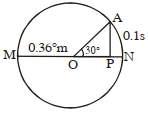
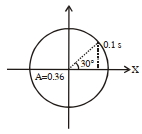
The point $A$ moves with a uniform speed along the circumference of a circle of radius $0.36\, m$ and covers $30^{\circ}$ in $0.1\, s$. The perpendicular projection $P$ from $A$ on the diameter $MN$ represents the simple harmonic motion of $P$. The restoring force per unit mass when $P$ touches $M$ will be ...... $N/kg$.
A
$100$
B
$0.49$
C
$50$
D
$9.87$
Solution
(D) Given,the point $A$ covers an angle $\theta = 30^{\circ} = \frac{\pi}{6} \text{ radians}$ in time $t = 0.1\, s$.
Since the speed is uniform,the angular velocity $\omega$ is given by $\omega = \frac{\theta}{t} = \frac{\pi/6}{0.1} = \frac{\pi}{0.6} = \frac{10\pi}{6} = \frac{5\pi}{3} \text{ rad/s}$.
The radius of the circle $R = 0.36\, m$,which represents the amplitude $A_{amp}$ of the simple harmonic motion.
The restoring force $F$ on a particle of mass $m$ executing simple harmonic motion is given by $F = -m\omega^2 x$,where $x$ is the displacement.
When $P$ touches $M$,the displacement $x$ is equal to the amplitude $R = 0.36\, m$.
The restoring force per unit mass is $\frac{F}{m} = \omega^2 R$.
Substituting the values: $\frac{F}{m} = \left(\frac{5\pi}{3}\right)^2 \times 0.36 = \frac{25\pi^2}{9} \times 0.36$.
Using $\pi^2 \approx 9.87$,we get $\frac{F}{m} = \frac{25 \times 9.87}{9} \times 0.36 = 25 \times 9.87 \times 0.04 = 25 \times 0.3948 = 9.87\, N/kg$.
Since the speed is uniform,the angular velocity $\omega$ is given by $\omega = \frac{\theta}{t} = \frac{\pi/6}{0.1} = \frac{\pi}{0.6} = \frac{10\pi}{6} = \frac{5\pi}{3} \text{ rad/s}$.
The radius of the circle $R = 0.36\, m$,which represents the amplitude $A_{amp}$ of the simple harmonic motion.
The restoring force $F$ on a particle of mass $m$ executing simple harmonic motion is given by $F = -m\omega^2 x$,where $x$ is the displacement.
When $P$ touches $M$,the displacement $x$ is equal to the amplitude $R = 0.36\, m$.
The restoring force per unit mass is $\frac{F}{m} = \omega^2 R$.
Substituting the values: $\frac{F}{m} = \left(\frac{5\pi}{3}\right)^2 \times 0.36 = \frac{25\pi^2}{9} \times 0.36$.
Using $\pi^2 \approx 9.87$,we get $\frac{F}{m} = \frac{25 \times 9.87}{9} \times 0.36 = 25 \times 9.87 \times 0.04 = 25 \times 0.3948 = 9.87\, N/kg$.
0 likes
View Solution178
AdvancedMCQ
$A$ point particle is acted upon by a restoring force $F = -k x^3$. The time period of oscillation is $T$ when the amplitude is $A$. The time period for an amplitude $2A$ will be
A
$T$
B
$T/2$
C
$2T$
D
$4T$
Solution
(B) The restoring force is given by $F = -kx^3$. The potential energy $U$ is given by $U = \int kx^3 dx = \frac{1}{4} kx^4$.
For a particle of mass $m$ oscillating with amplitude $A$,the total energy $E$ is $E = \frac{1}{4} kA^4$.
The velocity $v$ at any position $x$ is given by $\frac{1}{2} mv^2 + \frac{1}{4} kx^4 = \frac{1}{4} kA^4$.
$v = \frac{dx}{dt} = \sqrt{\frac{k}{2m}} \sqrt{A^4 - x^4}$.
The time period $T$ is $4 \times$ time taken to go from $x=0$ to $x=A$:
$T = 4 \int_0^A \frac{dx}{\sqrt{\frac{k}{2m}} \sqrt{A^4 - x^4}} = 4 \sqrt{\frac{2m}{k}} \int_0^A \frac{dx}{\sqrt{A^4 - x^4}}$.
Let $x = Ay$,then $dx = A dy$. When $x=0, y=0$; when $x=A, y=1$.
$T = 4 \sqrt{\frac{2m}{k}} \int_0^1 \frac{A dy}{\sqrt{A^4 - A^4 y^4}} = 4 \sqrt{\frac{2m}{k}} \frac{A}{A^2} \int_0^1 \frac{dy}{\sqrt{1 - y^4}} = \frac{4}{A} \sqrt{\frac{2m}{k}} \int_0^1 \frac{dy}{\sqrt{1 - y^4}}$.
Thus,$T \propto \frac{1}{A}$.
If the amplitude changes from $A$ to $2A$,the new time period $T'$ is given by $\frac{T'}{T} = \frac{A}{2A} = \frac{1}{2}$.
Therefore,$T' = T/2$.
For a particle of mass $m$ oscillating with amplitude $A$,the total energy $E$ is $E = \frac{1}{4} kA^4$.
The velocity $v$ at any position $x$ is given by $\frac{1}{2} mv^2 + \frac{1}{4} kx^4 = \frac{1}{4} kA^4$.
$v = \frac{dx}{dt} = \sqrt{\frac{k}{2m}} \sqrt{A^4 - x^4}$.
The time period $T$ is $4 \times$ time taken to go from $x=0$ to $x=A$:
$T = 4 \int_0^A \frac{dx}{\sqrt{\frac{k}{2m}} \sqrt{A^4 - x^4}} = 4 \sqrt{\frac{2m}{k}} \int_0^A \frac{dx}{\sqrt{A^4 - x^4}}$.
Let $x = Ay$,then $dx = A dy$. When $x=0, y=0$; when $x=A, y=1$.
$T = 4 \sqrt{\frac{2m}{k}} \int_0^1 \frac{A dy}{\sqrt{A^4 - A^4 y^4}} = 4 \sqrt{\frac{2m}{k}} \frac{A}{A^2} \int_0^1 \frac{dy}{\sqrt{1 - y^4}} = \frac{4}{A} \sqrt{\frac{2m}{k}} \int_0^1 \frac{dy}{\sqrt{1 - y^4}}$.
Thus,$T \propto \frac{1}{A}$.
If the amplitude changes from $A$ to $2A$,the new time period $T'$ is given by $\frac{T'}{T} = \frac{A}{2A} = \frac{1}{2}$.
Therefore,$T' = T/2$.
0 likes
View Solution179
AdvancedMCQ
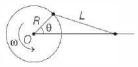
One end of a rod of length $L$ is fixed to a point on the circumference of a wheel of radius $R$. The other end is sliding freely along a straight channel passing through the centre of the wheel as shown in the figure below. The wheel is rotating with a constant angular velocity $\omega$ about $O$. Taking $T = \frac{2 \pi}{\omega}$,the motion of the rod is
A
simple harmonic with a period of $T$
B
simple harmonic with a period of $T / 2$
C
not simple harmonic but periodic with a period of $T$
D
not simple harmonic but periodic with a period of $T / 2$
Solution
(C) Let the position of the point on the circumference be $(R \cos \theta, R \sin \theta)$,where $\theta = \omega t$. The other end of the rod is at a distance $x$ from the center $O$ along the horizontal axis. Using the Pythagorean theorem in the triangle formed by the rod,we have $L^2 = (x - R \cos \theta)^2 + (R \sin \theta)^2$.
Expanding this,$L^2 = x^2 - 2xR \cos \theta + R^2 \cos^2 \theta + R^2 \sin^2 \theta$,which simplifies to $L^2 = x^2 - 2xR \cos \theta + R^2$.
This is a quadratic equation in $x$: $x^2 - (2R \cos \theta)x + (R^2 - L^2) = 0$.
Solving for $x$,we get $x = R \cos \theta + \sqrt{R^2 \cos^2 \theta - (R^2 - L^2)} = R \cos \theta + \sqrt{L^2 - R^2 \sin^2 \theta}$.
Since the motion depends on $\cos \theta$ and $\sin^2 \theta$ (where $\theta = \omega t$),the position $x(t)$ is a periodic function with period $T = \frac{2 \pi}{\omega}$. However,because of the square root term,the motion is not simple harmonic (which requires $x(t) = A \cos(\omega t + \phi)$). Thus,the motion is periodic but not simple harmonic.
Expanding this,$L^2 = x^2 - 2xR \cos \theta + R^2 \cos^2 \theta + R^2 \sin^2 \theta$,which simplifies to $L^2 = x^2 - 2xR \cos \theta + R^2$.
This is a quadratic equation in $x$: $x^2 - (2R \cos \theta)x + (R^2 - L^2) = 0$.
Solving for $x$,we get $x = R \cos \theta + \sqrt{R^2 \cos^2 \theta - (R^2 - L^2)} = R \cos \theta + \sqrt{L^2 - R^2 \sin^2 \theta}$.
Since the motion depends on $\cos \theta$ and $\sin^2 \theta$ (where $\theta = \omega t$),the position $x(t)$ is a periodic function with period $T = \frac{2 \pi}{\omega}$. However,because of the square root term,the motion is not simple harmonic (which requires $x(t) = A \cos(\omega t + \phi)$). Thus,the motion is periodic but not simple harmonic.
0 likes
View Solution180
MediumMCQ
$A$ body is executing simple harmonic motion of amplitude $a$ and period $T$ about the equilibrium position $x=0$. Large numbers of snapshots are taken at random of this body in motion. The probability of the body being found in a very small interval $x$ to $x+|dx|$ is highest at
A
$x=\pm a$
B
$x=0$
C
$x=\pm \frac{a}{2}$
D
$x=\pm \frac{a}{\sqrt{2}}$
Solution
(A) In simple harmonic motion,the velocity of the body is given by $v = \omega \sqrt{a^2 - x^2}$.
The time $dt$ spent by the body in a small interval $dx$ is given by $dt = \frac{dx}{v} = \frac{dx}{\omega \sqrt{a^2 - x^2}}$.
The probability $P(x)dx$ of finding the body in the interval $dx$ is proportional to the time spent in that interval,i.e.,$P(x) \propto \frac{1}{v} = \frac{1}{\omega \sqrt{a^2 - x^2}}$.
As $x \to \pm a$,the velocity $v \to 0$,which means the time spent $dt \to \infty$.
Therefore,the probability of finding the body is highest at the extreme positions $x = \pm a$.
Thus,the correct option is $A$.
The time $dt$ spent by the body in a small interval $dx$ is given by $dt = \frac{dx}{v} = \frac{dx}{\omega \sqrt{a^2 - x^2}}$.
The probability $P(x)dx$ of finding the body in the interval $dx$ is proportional to the time spent in that interval,i.e.,$P(x) \propto \frac{1}{v} = \frac{1}{\omega \sqrt{a^2 - x^2}}$.
As $x \to \pm a$,the velocity $v \to 0$,which means the time spent $dt \to \infty$.
Therefore,the probability of finding the body is highest at the extreme positions $x = \pm a$.
Thus,the correct option is $A$.
0 likes
View Solution181
AdvancedMCQ
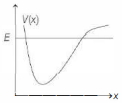
Consider a one-dimensional potential $V(x)$ as shown in the figure below. $A$ classical particle of mass $m$ moves under its influence and has total energy $E$ as shown below. The motion is
A
non-periodic
B
stationary
C
periodic but not a simple harmonic
D
simple harmonic
Solution
(C) The correct answer is $C$.
In the given potential energy curve $V(x)$,the particle is confined between the turning points $r_1$ and $r_2$ where the total energy $E$ equals the potential energy $V(x)$.
Since the particle is confined between two points and the potential energy is finite,the particle will oscillate back and forth between $r_1$ and $r_2$,making the motion periodic.
However,for a motion to be simple harmonic,the potential energy must be symmetric about the equilibrium position $r_0$ and follow the form $U(x) = \frac{1}{2} k (x - r_0)^2$.
As seen in the figure,the potential energy curve $V(x)$ is not symmetric about the equilibrium position $r_0$ (it is asymmetric). Therefore,the motion is periodic but not simple harmonic.
In the given potential energy curve $V(x)$,the particle is confined between the turning points $r_1$ and $r_2$ where the total energy $E$ equals the potential energy $V(x)$.
Since the particle is confined between two points and the potential energy is finite,the particle will oscillate back and forth between $r_1$ and $r_2$,making the motion periodic.
However,for a motion to be simple harmonic,the potential energy must be symmetric about the equilibrium position $r_0$ and follow the form $U(x) = \frac{1}{2} k (x - r_0)^2$.
As seen in the figure,the potential energy curve $V(x)$ is not symmetric about the equilibrium position $r_0$ (it is asymmetric). Therefore,the motion is periodic but not simple harmonic.
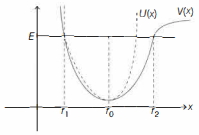
0 likes
View Solution182
AdvancedMCQ
$A$ potential is given by $V(x) = k(x+a)^2 / 2$ for $x < 0$ and $V(x) = k(x-a)^2 / 2$ for $x > 0$. The schematic variation of the oscillation period $T$ for a particle performing periodic motion in this potential as a function of its energy $E$ is:
A
B
C
D
Solution
(B) The potential is given by:
$V(x) = \begin{cases} \frac{k(x+a)^2}{2}, & x < 0 \\ \frac{k(x-a)^2}{2}, & x > 0 \end{cases}$
This represents two half-parabolas joined at $x = 0$. The potential energy $U(x) = mV(x)$ is symmetric about $x = 0$ if we consider the absolute value,but here it is defined piecewise.
For a particle of energy $E$,the turning points are found by $U(x) = E$.
If $E$ is small,the particle oscillates in one of the two wells (either $x < 0$ or $x > 0$). In this case,the motion is simple harmonic with an effective spring constant $k$,so the period $T = 2\pi \sqrt{m/k}$,which is independent of $E$.
As $E$ increases,the particle eventually crosses the barrier at $x = 0$. For $E > V(0) = ka^2/2$,the particle oscillates over both regions. The total period $T$ is the sum of the times spent in each region. As $E$ increases further,the particle spends more time in the flatter parts of the potential,causing the period $T$ to increase with $E$. Thus,the graph shows a constant $T$ for low $E$,followed by a jump and an increasing $T$ for higher $E$,which corresponds to graph $(b)$.
$V(x) = \begin{cases} \frac{k(x+a)^2}{2}, & x < 0 \\ \frac{k(x-a)^2}{2}, & x > 0 \end{cases}$
This represents two half-parabolas joined at $x = 0$. The potential energy $U(x) = mV(x)$ is symmetric about $x = 0$ if we consider the absolute value,but here it is defined piecewise.
For a particle of energy $E$,the turning points are found by $U(x) = E$.
If $E$ is small,the particle oscillates in one of the two wells (either $x < 0$ or $x > 0$). In this case,the motion is simple harmonic with an effective spring constant $k$,so the period $T = 2\pi \sqrt{m/k}$,which is independent of $E$.
As $E$ increases,the particle eventually crosses the barrier at $x = 0$. For $E > V(0) = ka^2/2$,the particle oscillates over both regions. The total period $T$ is the sum of the times spent in each region. As $E$ increases further,the particle spends more time in the flatter parts of the potential,causing the period $T$ to increase with $E$. Thus,the graph shows a constant $T$ for low $E$,followed by a jump and an increasing $T$ for higher $E$,which corresponds to graph $(b)$.
0 likes
View Solution183
MediumMCQ
$A$ particle is executing $SHM$ about $y=0$ along the $y$-axis. Its position at an instant is given by $y = (7 \, m) \sin(\pi t)$. Its average velocity for the time interval $0$ to $0.5 \, s$ is ........... $m/s$.
A
$14$
B
$7$
C
$1/7$
D
$28$
Solution
(A) Average velocity is defined as the ratio of total displacement to the total time interval.
$v_{\text{avg}} = \frac{\Delta y}{\Delta t} = \frac{y(t_2) - y(t_1)}{t_2 - t_1}$
Given the position equation $y(t) = 7 \sin(\pi t)$.
At $t_1 = 0 \, s$,$y_1 = 7 \sin(0) = 0 \, m$.
At $t_2 = 0.5 \, s$,$y_2 = 7 \sin(\pi \times 0.5) = 7 \sin(\pi/2) = 7 \times 1 = 7 \, m$.
Displacement $\Delta y = y_2 - y_1 = 7 - 0 = 7 \, m$.
Time interval $\Delta t = 0.5 - 0 = 0.5 \, s$.
Therefore,$v_{\text{avg}} = \frac{7}{0.5} = 14 \, m/s$.
$v_{\text{avg}} = \frac{\Delta y}{\Delta t} = \frac{y(t_2) - y(t_1)}{t_2 - t_1}$
Given the position equation $y(t) = 7 \sin(\pi t)$.
At $t_1 = 0 \, s$,$y_1 = 7 \sin(0) = 0 \, m$.
At $t_2 = 0.5 \, s$,$y_2 = 7 \sin(\pi \times 0.5) = 7 \sin(\pi/2) = 7 \times 1 = 7 \, m$.
Displacement $\Delta y = y_2 - y_1 = 7 - 0 = 7 \, m$.
Time interval $\Delta t = 0.5 - 0 = 0.5 \, s$.
Therefore,$v_{\text{avg}} = \frac{7}{0.5} = 14 \, m/s$.
0 likes
View Solution184
EasyMCQ
Identify the correct definition.
A
If after every certain interval of time,a particle repeats its motion,then the motion is called periodic motion.
B
To and fro motion of a particle over the same path about its mean position in a certain time interval is called oscillatory motion.
C
Oscillatory motion described in terms of single sine and cosine functions is called simple harmonic motion.
D
All of these.
Solution
(D) Periodic motion is defined as motion that repeats itself at regular intervals of time.
Oscillatory motion is defined as the to-and-fro motion of a particle about a mean position within a fixed time interval.
Simple harmonic motion is a specific type of oscillatory motion that can be described mathematically using a single sine or cosine function.
Since all three statements are scientifically accurate definitions,the correct option is $(d)$.
Oscillatory motion is defined as the to-and-fro motion of a particle about a mean position within a fixed time interval.
Simple harmonic motion is a specific type of oscillatory motion that can be described mathematically using a single sine or cosine function.
Since all three statements are scientifically accurate definitions,the correct option is $(d)$.
0 likes
View Solution185
EasyMCQ
The displacement of a particle executing $S.H.M.$ is given by $x = 0.01 \sin 100 \pi(t + 0.05)$. The time period is ........ $s$.
A
$0.01$
B
$0.02$
C
$0.1$
D
$0.2$
Solution
(B) The given equation for displacement is $x = 0.01 \sin 100 \pi(t + 0.05)$.
Comparing this with the standard $S.H.M.$ equation $x = A \sin(\omega t + \phi)$,we identify the angular frequency $\omega = 100 \pi \, rad/s$.
The time period $T$ is related to the angular frequency by the formula $T = \frac{2 \pi}{\omega}$.
Substituting the value of $\omega$:
$T = \frac{2 \pi}{100 \pi} = \frac{1}{50} = 0.02 \, s$.
Thus,the time period is $0.02 \, s$.
Comparing this with the standard $S.H.M.$ equation $x = A \sin(\omega t + \phi)$,we identify the angular frequency $\omega = 100 \pi \, rad/s$.
The time period $T$ is related to the angular frequency by the formula $T = \frac{2 \pi}{\omega}$.
Substituting the value of $\omega$:
$T = \frac{2 \pi}{100 \pi} = \frac{1}{50} = 0.02 \, s$.
Thus,the time period is $0.02 \, s$.
0 likes
View Solution186
EasyMCQ
The equation of simple harmonic motion may not be expressed as (each term has its usual meaning):
A
$x = A \sin(\omega t + \phi)$
B
$x = A \cos(\omega t - \phi)$
C
$x = a \sin(\omega t) + b \cos(\omega t)$
D
$x = A \sin(\omega t + \phi) + B \sin(2\omega t + \phi)$
Solution
(D) The correct answer is $(D)$.
Simple Harmonic Motion $(S.H.M.)$ is defined by a single frequency component.
Options $(A)$,$(B)$,and $(C)$ represent standard forms of $S.H.M.$ with a single angular frequency $\omega$.
Option $(D)$ represents the superposition of two $S.H.M.$s with different frequencies ($\omega$ and $2\omega$).
Since the resulting motion involves multiple frequencies,it is not a simple harmonic motion,but rather a complex periodic motion.
Simple Harmonic Motion $(S.H.M.)$ is defined by a single frequency component.
Options $(A)$,$(B)$,and $(C)$ represent standard forms of $S.H.M.$ with a single angular frequency $\omega$.
Option $(D)$ represents the superposition of two $S.H.M.$s with different frequencies ($\omega$ and $2\omega$).
Since the resulting motion involves multiple frequencies,it is not a simple harmonic motion,but rather a complex periodic motion.
0 likes
View Solution187
EasyMCQ
Select the wrong statement about simple harmonic motion $(S.H.M.)$.
A
The body is uniformly accelerated.
B
The velocity of the body changes smoothly at all instants.
C
The amplitude of oscillation is symmetric about the equilibrium position.
D
The frequency of oscillation is independent of amplitude.
Solution
(A) In $S.H.M.$,the acceleration $a$ is given by the equation $a = -\omega^2 x$,where $\omega$ is the angular frequency and $x$ is the displacement from the equilibrium position.
Since the acceleration $a$ depends on the displacement $x$,it is not constant throughout the motion.
Therefore,the body is not uniformly accelerated; rather,its acceleration varies linearly with displacement.
Thus,the statement that the body is uniformly accelerated is incorrect.
Since the acceleration $a$ depends on the displacement $x$,it is not constant throughout the motion.
Therefore,the body is not uniformly accelerated; rather,its acceleration varies linearly with displacement.
Thus,the statement that the body is uniformly accelerated is incorrect.
0 likes
View Solution188
EasyMCQ
For a particle showing motion under the force $F = -5(x - 2)$,the motion is ...........
A
$S.H.M.$
B
Oscillatory
C
Translatory
D
Both $(a)$ and $(b)$
Solution
(D) The given force is $F = -5(x - 2)$.
Let $x' = x - 2$,then $F = -5x'$.
Since the force is proportional to the negative displacement from the equilibrium position $(F \propto -x')$,the motion is Simple Harmonic Motion $(S.H.M.)$.
Every $S.H.M.$ is also an oscillatory motion.
Therefore,the motion is both $S.H.M.$ and oscillatory.
Let $x' = x - 2$,then $F = -5x'$.
Since the force is proportional to the negative displacement from the equilibrium position $(F \propto -x')$,the motion is Simple Harmonic Motion $(S.H.M.)$.
Every $S.H.M.$ is also an oscillatory motion.
Therefore,the motion is both $S.H.M.$ and oscillatory.
0 likes
View Solution189
MediumMCQ
$A$ particle executes simple harmonic motion according to the equation $4 \frac{d^2 x}{d t^2} + 320 x = 0$. Its time period of oscillation is .........
A
$\frac{2 \pi}{5 \sqrt{3}} \ s$
B
$\frac{\pi}{3 \sqrt{2}} \ s$
C
$\frac{\pi}{2 \sqrt{5}} \ s$
D
$\frac{2 \pi}{\sqrt{3}} \ s$
Solution
(C) The given equation is $4 \frac{d^2 x}{d t^2} + 320 x = 0$.
Dividing by $4$,we get $\frac{d^2 x}{d t^2} + 80 x = 0$.
Since the acceleration $a = \frac{d^2 x}{d t^2}$,we can write $a = -80 x$.
Comparing this with the standard $S.H.M.$ equation $a = -\omega^2 x$,we get $\omega^2 = 80$.
Therefore,$\omega = \sqrt{80} = \sqrt{16 \times 5} = 4 \sqrt{5} \ rad/s$.
The time period $T$ is given by $T = \frac{2 \pi}{\omega}$.
Substituting the value of $\omega$,we get $T = \frac{2 \pi}{4 \sqrt{5}} = \frac{\pi}{2 \sqrt{5}} \ s$.
Dividing by $4$,we get $\frac{d^2 x}{d t^2} + 80 x = 0$.
Since the acceleration $a = \frac{d^2 x}{d t^2}$,we can write $a = -80 x$.
Comparing this with the standard $S.H.M.$ equation $a = -\omega^2 x$,we get $\omega^2 = 80$.
Therefore,$\omega = \sqrt{80} = \sqrt{16 \times 5} = 4 \sqrt{5} \ rad/s$.
The time period $T$ is given by $T = \frac{2 \pi}{\omega}$.
Substituting the value of $\omega$,we get $T = \frac{2 \pi}{4 \sqrt{5}} = \frac{\pi}{2 \sqrt{5}} \ s$.
0 likes
View Solution190
EasyMCQ
The $S.H.M.$ of a particle is given by the equation $x = 2 \sin \omega t + 4 \cos \omega t$. Its amplitude of oscillation is ........ units.
A
$4$
B
$2$
C
$6$
D
$2 \sqrt{5}$
Solution
(D) The given equation is $x = 2 \sin \omega t + 4 \cos \omega t$.
Any equation of the form $x = A_1 \sin \omega t + A_2 \cos \omega t$ can be rewritten as $x = A \sin(\omega t + \phi)$,where the amplitude $A$ is given by $A = \sqrt{A_1^2 + A_2^2}$.
Here,$A_1 = 2$ and $A_2 = 4$.
Substituting these values into the formula:
$A = \sqrt{2^2 + 4^2}$
$A = \sqrt{4 + 16}$
$A = \sqrt{20}$
$A = \sqrt{4 \times 5} = 2 \sqrt{5}$.
Therefore,the amplitude of oscillation is $2 \sqrt{5}$ units.
Any equation of the form $x = A_1 \sin \omega t + A_2 \cos \omega t$ can be rewritten as $x = A \sin(\omega t + \phi)$,where the amplitude $A$ is given by $A = \sqrt{A_1^2 + A_2^2}$.
Here,$A_1 = 2$ and $A_2 = 4$.
Substituting these values into the formula:
$A = \sqrt{2^2 + 4^2}$
$A = \sqrt{4 + 16}$
$A = \sqrt{20}$
$A = \sqrt{4 \times 5} = 2 \sqrt{5}$.
Therefore,the amplitude of oscillation is $2 \sqrt{5}$ units.
0 likes
View Solution191
EasyMCQ
The equation of an $S.H.M.$ with amplitude $A$ and angular frequency $\omega$ in which all distances are measured from one extreme position and time is taken to be zero at the other extreme position is ...
A
$x = A \sin \omega t$
B
$x = A(\cos \omega t + \sin \omega t)$
C
$x = A - A \cos \omega t$
D
$x = A + A \cos \omega t$
Solution
(D) Let the two extreme positions be $x = 0$ and $x = 2A$.
At $t = 0$,the particle is at the 'other' extreme position. Let this be $x = 2A$.
The general equation for $S.H.M.$ is $x' = A \cos(\omega t + \phi)$,where $x'$ is measured from the mean position $x = A$.
Thus,$x - A = A \cos(\omega t + \phi)$.
At $t = 0$,$x = 2A$,so $2A - A = A \cos(\phi) \implies A = A \cos(\phi) \implies \cos(\phi) = 1 \implies \phi = 0$.
Substituting $\phi = 0$ into the equation: $x - A = A \cos(\omega t) \implies x = A + A \cos(\omega t)$.
At $t = 0$,the particle is at the 'other' extreme position. Let this be $x = 2A$.
The general equation for $S.H.M.$ is $x' = A \cos(\omega t + \phi)$,where $x'$ is measured from the mean position $x = A$.
Thus,$x - A = A \cos(\omega t + \phi)$.
At $t = 0$,$x = 2A$,so $2A - A = A \cos(\phi) \implies A = A \cos(\phi) \implies \cos(\phi) = 1 \implies \phi = 0$.
Substituting $\phi = 0$ into the equation: $x - A = A \cos(\omega t) \implies x = A + A \cos(\omega t)$.
0 likes
View Solution192
MediumMCQ
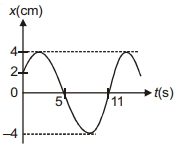
The figure shows the position-time graph of an object in $S.H.M.$ The correct equation representing this motion is ..........
A
$2 \sin \left(\frac{2 \pi}{5} t+\frac{\pi}{6}\right)$
B
$4 \sin \left(\frac{\pi}{5} t+\frac{\pi}{6}\right)$
C
$4 \sin \left(\frac{\pi}{6} t+\frac{\pi}{3}\right)$
D
$4 \sin \left(\frac{\pi}{6} t+\frac{\pi}{6}\right)$
Solution
(D) The general equation for $S.H.M.$ is $x = A \sin(\omega t + \phi)$.
From the graph,the amplitude $A = 4 \, cm$.
The particle passes through the mean position $(x=0)$ at $t=5 \, s$ and reaches the mean position again at $t=11 \, s$. The time taken to complete half a cycle is $11 - 5 = 6 \, s$. Therefore,the time period $T = 2 \times 6 = 12 \, s$.
The angular frequency is $\omega = \frac{2 \pi}{T} = \frac{2 \pi}{12} = \frac{\pi}{6} \, rad/s$.
At $t = 0$,the displacement $x = 2 \, cm$. Substituting these values into the general equation:
$2 = 4 \sin(\omega(0) + \phi)$
$2 = 4 \sin(\phi)$
$\sin(\phi) = \frac{1}{2}$
$\phi = \frac{\pi}{6}$ (since the particle is moving towards the positive extreme).
Thus,the equation is $x = 4 \sin \left(\frac{\pi}{6} t + \frac{\pi}{6}\right)$.
From the graph,the amplitude $A = 4 \, cm$.
The particle passes through the mean position $(x=0)$ at $t=5 \, s$ and reaches the mean position again at $t=11 \, s$. The time taken to complete half a cycle is $11 - 5 = 6 \, s$. Therefore,the time period $T = 2 \times 6 = 12 \, s$.
The angular frequency is $\omega = \frac{2 \pi}{T} = \frac{2 \pi}{12} = \frac{\pi}{6} \, rad/s$.
At $t = 0$,the displacement $x = 2 \, cm$. Substituting these values into the general equation:
$2 = 4 \sin(\omega(0) + \phi)$
$2 = 4 \sin(\phi)$
$\sin(\phi) = \frac{1}{2}$
$\phi = \frac{\pi}{6}$ (since the particle is moving towards the positive extreme).
Thus,the equation is $x = 4 \sin \left(\frac{\pi}{6} t + \frac{\pi}{6}\right)$.
0 likes
View Solution193
MediumMCQ
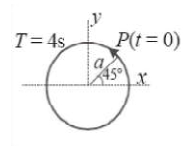
$A$ particle is executing simple harmonic motion $(SHM)$ with a time period $T = 4 \ s$. At $t = 0$,the particle is at a position where its angular position is $45^\circ$ with the $x$-axis. Find the displacement equation of the particle along the $x$-axis.
A
$x = a \sin(\frac{\pi}{2}t + \frac{\pi}{4})$
B
$x = a \cos(\frac{\pi}{2}t + \frac{\pi}{4})$
C
$x = a \sin(\frac{\pi}{4}t + \frac{\pi}{2})$
D
$x = a \cos(\frac{\pi}{4}t + \frac{\pi}{4})$
Solution
(B) The general equation for displacement in $SHM$ is given by $x(t) = a \cos(\omega t + \phi)$,where $a$ is the amplitude,$\omega$ is the angular frequency,and $\phi$ is the initial phase angle.
Given the time period $T = 4 \ s$,the angular frequency is $\omega = \frac{2\pi}{T} = \frac{2\pi}{4} = \frac{\pi}{2} \ \text{rad/s}$.
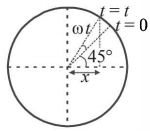
At $t = 0$,the particle is at an angle of $45^\circ$ with the $x$-axis,so the initial phase $\phi = 45^\circ = \frac{\pi}{4} \ \text{rad}$.
Substituting these values into the general equation,we get $x(t) = a \cos(\frac{\pi}{2}t + \frac{\pi}{4})$.
Thus,the correct option is $B$.
Given the time period $T = 4 \ s$,the angular frequency is $\omega = \frac{2\pi}{T} = \frac{2\pi}{4} = \frac{\pi}{2} \ \text{rad/s}$.
At $t = 0$,the particle is at an angle of $45^\circ$ with the $x$-axis,so the initial phase $\phi = 45^\circ = \frac{\pi}{4} \ \text{rad}$.
Substituting these values into the general equation,we get $x(t) = a \cos(\frac{\pi}{2}t + \frac{\pi}{4})$.
Thus,the correct option is $B$.
0 likes
View Solution194
DifficultMCQ
$A$ point particle of mass $0.1 \ kg$ is executing $S.H.M.$ with an amplitude of $0.1 \ m$. When the particle passes through the mean position,its kinetic energy is $8 \times 10^{-3} \ J$. Obtain the equation of motion of this particle if the initial phase of oscillation is $45^{\circ}$.
A
$y=0.1 \sin \left(\pm 4 t+\frac{\pi}{4}\right)$
B
$y=0.2 \sin \left(\pm 4 t+\frac{\pi}{4}\right)$
C
$y=0.1 \sin \left(\pm 2 t+\frac{\pi}{4}\right)$
D
$y=0.2 \sin \left(\pm 2 t+\frac{\pi}{4}\right)$
Solution
(A) The displacement of a particle in $S.H.M.$ is given by: $y = a \sin (\omega t + \phi)$.
The velocity is given by $v = \frac{dy}{dt} = \omega a \cos (\omega t + \phi)$.
The velocity is maximum at the mean position,where $v_{max} = \omega a$.
The kinetic energy at the mean position is $K.E._{max} = \frac{1}{2} m v_{max}^2 = \frac{1}{2} m \omega^2 a^2$.
Given $m = 0.1 \ kg$,$a = 0.1 \ m$,and $K.E._{max} = 8 \times 10^{-3} \ J$,we have:
$8 \times 10^{-3} = \frac{1}{2} \times 0.1 \times \omega^2 \times (0.1)^2$.
$8 \times 10^{-3} = 0.5 \times 0.1 \times \omega^2 \times 0.01$.
$8 \times 10^{-3} = 0.0005 \times \omega^2$.
$\omega^2 = \frac{8 \times 10^{-3}}{5 \times 10^{-4}} = 16$.
$\omega = \pm 4 \ rad/s$.
Given the initial phase $\phi = 45^{\circ} = \frac{\pi}{4} \ rad$,the equation of motion is $y = 0.1 \sin (\pm 4t + \frac{\pi}{4})$.
The velocity is given by $v = \frac{dy}{dt} = \omega a \cos (\omega t + \phi)$.
The velocity is maximum at the mean position,where $v_{max} = \omega a$.
The kinetic energy at the mean position is $K.E._{max} = \frac{1}{2} m v_{max}^2 = \frac{1}{2} m \omega^2 a^2$.
Given $m = 0.1 \ kg$,$a = 0.1 \ m$,and $K.E._{max} = 8 \times 10^{-3} \ J$,we have:
$8 \times 10^{-3} = \frac{1}{2} \times 0.1 \times \omega^2 \times (0.1)^2$.
$8 \times 10^{-3} = 0.5 \times 0.1 \times \omega^2 \times 0.01$.
$8 \times 10^{-3} = 0.0005 \times \omega^2$.
$\omega^2 = \frac{8 \times 10^{-3}}{5 \times 10^{-4}} = 16$.
$\omega = \pm 4 \ rad/s$.
Given the initial phase $\phi = 45^{\circ} = \frac{\pi}{4} \ rad$,the equation of motion is $y = 0.1 \sin (\pm 4t + \frac{\pi}{4})$.
0 likes
View Solution195
MediumMCQ
The displacement of a particle is given at time $t$,by: $x = A \sin (-2 \omega t) + B \sin^2 \omega t$. Then,
A
the motion of the particle is $SHM$ with an amplitude of $\sqrt{A^2 + \frac{B^2}{4}}$
B
the motion of the particle is not $SHM$,but oscillatory with a time period of $T = \pi / \omega$
C
the motion of the particle is oscillatory with a time period of $T = \pi / 2 \omega$
D
the motion of the particle is aperiodic.
Solution
(A) The displacement of the particle is given by: $x = A \sin (-2 \omega t) + B \sin^2 \omega t$.
Using the trigonometric identity $\sin^2 \theta = \frac{1 - \cos 2 \theta}{2}$,we get:
$x = -A \sin 2 \omega t + \frac{B}{2} (1 - \cos 2 \omega t)$.
$x = -A \sin 2 \omega t - \frac{B}{2} \cos 2 \omega t + \frac{B}{2}$.
Let $x' = x - \frac{B}{2} = -(A \sin 2 \omega t + \frac{B}{2} \cos 2 \omega t)$.
This is of the form $x' = -R \sin (2 \omega t + \phi)$,where $R = \sqrt{A^2 + (B/2)^2} = \sqrt{A^2 + \frac{B^2}{4}}$.
Since the displacement can be expressed as a single sine function about a mean position $x = B/2$,the motion is Simple Harmonic Motion $(SHM)$ with amplitude $\sqrt{A^2 + \frac{B^2}{4}}$.
Using the trigonometric identity $\sin^2 \theta = \frac{1 - \cos 2 \theta}{2}$,we get:
$x = -A \sin 2 \omega t + \frac{B}{2} (1 - \cos 2 \omega t)$.
$x = -A \sin 2 \omega t - \frac{B}{2} \cos 2 \omega t + \frac{B}{2}$.
Let $x' = x - \frac{B}{2} = -(A \sin 2 \omega t + \frac{B}{2} \cos 2 \omega t)$.
This is of the form $x' = -R \sin (2 \omega t + \phi)$,where $R = \sqrt{A^2 + (B/2)^2} = \sqrt{A^2 + \frac{B^2}{4}}$.
Since the displacement can be expressed as a single sine function about a mean position $x = B/2$,the motion is Simple Harmonic Motion $(SHM)$ with amplitude $\sqrt{A^2 + \frac{B^2}{4}}$.
0 likes
View Solution196
EasyMCQ
Identify the function which represents a non-periodic motion.
A
$e^{-\omega t}$
B
$\sin \omega t$
C
$\sin \omega t + \cos \omega t$
D
$\sin (\omega t + \pi / 4)$
Solution
(A) periodic function is one that repeats its values at regular intervals of time.
Functions like $\sin \omega t$,$\cos \omega t$,and their linear combinations are periodic because they repeat their values after a time period $T = 2\pi / \omega$.
The function $f(t) = e^{-\omega t}$ is an exponential decay function.
As $t$ increases,$e^{-\omega t}$ decreases monotonically and approaches zero as $t \to \infty$.
Since it never repeats its values,it represents a non-periodic motion.
Functions like $\sin \omega t$,$\cos \omega t$,and their linear combinations are periodic because they repeat their values after a time period $T = 2\pi / \omega$.
The function $f(t) = e^{-\omega t}$ is an exponential decay function.
As $t$ increases,$e^{-\omega t}$ decreases monotonically and approaches zero as $t \to \infty$.
Since it never repeats its values,it represents a non-periodic motion.
0 likes
View Solution197
EasyMCQ
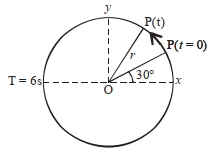
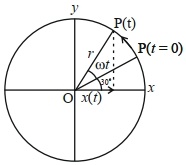
For particle $P$ revolving around the centre $O$ with radius of circular path $r$ and angular velocity $\omega$,as shown in the figure,the projection of $OP$ on the $x$-axis at time $t$ is .................
A
$x(t)=r \cos \left(\omega t+\frac{\pi}{6}\right)$
B
$x(t)=r \cos (\omega t)$
C
$x(t)=r \sin \left(\omega t+\frac{\pi}{6}\right)$
D
$x(t)=r \cos \left(\omega t-\frac{\pi}{6}\right)$
Solution
(A) The particle $P$ is performing uniform circular motion. At $t=0$,the position vector $OP$ makes an angle of $30^{\circ}$ (or $\pi/6$ radians) with the positive $x$-axis.
At any time $t$,the particle rotates by an angle $\omega t$ in the counter-clockwise direction.
Therefore,the total angle $\theta$ made by the position vector $OP$ with the positive $x$-axis at time $t$ is $\theta = \omega t + 30^{\circ} = \omega t + \frac{\pi}{6}$.
The projection of the position vector $OP$ on the $x$-axis is given by $x(t) = r \cos(\theta)$.
Substituting the value of $\theta$,we get $x(t) = r \cos \left(\omega t + \frac{\pi}{6}\right)$.
At any time $t$,the particle rotates by an angle $\omega t$ in the counter-clockwise direction.
Therefore,the total angle $\theta$ made by the position vector $OP$ with the positive $x$-axis at time $t$ is $\theta = \omega t + 30^{\circ} = \omega t + \frac{\pi}{6}$.
The projection of the position vector $OP$ on the $x$-axis is given by $x(t) = r \cos(\theta)$.
Substituting the value of $\theta$,we get $x(t) = r \cos \left(\omega t + \frac{\pi}{6}\right)$.
0 likes
View Solution198
MediumMCQ
In a linear simple harmonic motion $(SHM)$:
$(A)$ Restoring force is directly proportional to the displacement.
$(B)$ The acceleration and displacement are opposite in direction.
$(C)$ The velocity is maximum at the mean position.
$(D)$ The acceleration is minimum at extreme points.
Choose the correct answer from the options given below:
$(A)$ Restoring force is directly proportional to the displacement.
$(B)$ The acceleration and displacement are opposite in direction.
$(C)$ The velocity is maximum at the mean position.
$(D)$ The acceleration is minimum at extreme points.
Choose the correct answer from the options given below:
A
$(A), (B)$ and $(C)$ only
B
$(C)$ and $(D)$ only
C
$(A), (B)$ and $(D)$ only
D
$(A), (C)$ and $(D)$ only
Solution
(A) In a linear simple harmonic motion $(SHM)$:
$(A)$ The restoring force is given by $F = -kx$,which means the force is directly proportional to the displacement $x$ and acts in the opposite direction. Thus,statement $(A)$ is true.
$(B)$ The acceleration $a$ is given by $a = -\omega^2 x$. Since the acceleration is proportional to the negative of the displacement,they are always opposite in direction. Thus,statement $(B)$ is true.
$(C)$ The velocity $v$ in $SHM$ is given by $v = \omega \sqrt{A^2 - x^2}$. At the mean position $(x = 0)$,the velocity is $v = \omega A$,which is the maximum value. Thus,statement $(C)$ is true.
$(D)$ The magnitude of acceleration is $|a| = \omega^2 |x|$. At the extreme points $(x = \pm A)$,the displacement is maximum,so the acceleration is also maximum. Thus,statement $(D)$ is false.
Therefore,statements $(A), (B),$ and $(C)$ are correct.
$(A)$ The restoring force is given by $F = -kx$,which means the force is directly proportional to the displacement $x$ and acts in the opposite direction. Thus,statement $(A)$ is true.
$(B)$ The acceleration $a$ is given by $a = -\omega^2 x$. Since the acceleration is proportional to the negative of the displacement,they are always opposite in direction. Thus,statement $(B)$ is true.
$(C)$ The velocity $v$ in $SHM$ is given by $v = \omega \sqrt{A^2 - x^2}$. At the mean position $(x = 0)$,the velocity is $v = \omega A$,which is the maximum value. Thus,statement $(C)$ is true.
$(D)$ The magnitude of acceleration is $|a| = \omega^2 |x|$. At the extreme points $(x = \pm A)$,the displacement is maximum,so the acceleration is also maximum. Thus,statement $(D)$ is false.
Therefore,statements $(A), (B),$ and $(C)$ are correct.
0 likes
View Solution199
MediumMCQ
If $x=5 \sin \left(\pi t+\frac{\pi}{3}\right) \text{ m}$ represents the motion of a particle executing simple harmonic motion,the amplitude and time period of motion,respectively,are
A
$5 \text{ m}, 2 \text{ s}$
B
$5 \text{ cm}, 1 \text{ s}$
C
$5 \text{ m}, 1 \text{ s}$
D
$5 \text{ cm}, 2 \text{ s}$
Solution
(A) The general equation for simple harmonic motion is given by $x = A \sin(\omega t + \phi)$.
Comparing the given equation $x = 5 \sin \left(\pi t + \frac{\pi}{3}\right) \text{ m}$ with the general equation:
Amplitude $A = 5 \text{ m}$.
Angular frequency $\omega = \pi \text{ rad/s}$.
The time period $T$ is related to angular frequency by the formula $T = \frac{2\pi}{\omega}$.
Substituting the value of $\omega$: $T = \frac{2\pi}{\pi} = 2 \text{ s}$.
Thus,the amplitude is $5 \text{ m}$ and the time period is $2 \text{ s}$.
Comparing the given equation $x = 5 \sin \left(\pi t + \frac{\pi}{3}\right) \text{ m}$ with the general equation:
Amplitude $A = 5 \text{ m}$.
Angular frequency $\omega = \pi \text{ rad/s}$.
The time period $T$ is related to angular frequency by the formula $T = \frac{2\pi}{\omega}$.
Substituting the value of $\omega$: $T = \frac{2\pi}{\pi} = 2 \text{ s}$.
Thus,the amplitude is $5 \text{ m}$ and the time period is $2 \text{ s}$.
0 likes
View Solution200
AdvancedMCQ
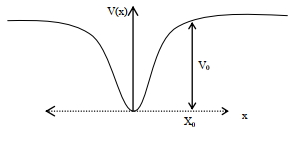
When a particle of mass $m$ moves on the $x$-axis in a potential of the form $V(x)=kx^2$,it performs simple harmonic motion. The corresponding time period is proportional to $\sqrt{\frac{m}{k}}$,as can be seen easily using dimensional analysis. However,the motion of a particle can be periodic even when its potential energy increases on both sides of $x=0$ in a way different from $kx^2$ and its total energy is such that the particle does not escape to infinity. Consider a particle of mass $m$ moving on the $x$-axis. Its potential energy is $V(x)=\alpha x^4$ $(\alpha>0)$ for $|x|$ near the origin and becomes a constant equal to $V_0$ for $|x| \geq X_0$ (see figure).
$1.$ If the total energy of the particle is $E$,it will perform periodic motion only if
$(A)$ $E < 0$
$(B)$ $E > 0$
$(C)$ $V_0 > E > 0$
$(D)$ $E > V_0$
$2.$ For periodic motion of small amplitude $A$,the time period $T$ of this particle is proportional to
$(A)$ $A \sqrt{\frac{m}{\alpha}}$
$(B)$ $\frac{1}{A} \sqrt{\frac{m}{\alpha}}$
$(C)$ $A \sqrt{\frac{\alpha}{m}}$
$(D)$ $A \sqrt{\frac{\alpha}{m}}$
$3.$ The acceleration of this particle for $|x|>X_0$ is
$(A)$ proportional to $V_0$
$(B)$ proportional to $\frac{V_0}{mX_0}$
$(C)$ proportional to $\sqrt{\frac{V_0}{mX_0}}$
$(D)$ zero
Give the answer for questions $1, 2$ and $3$.
$1.$ If the total energy of the particle is $E$,it will perform periodic motion only if
$(A)$ $E < 0$
$(B)$ $E > 0$
$(C)$ $V_0 > E > 0$
$(D)$ $E > V_0$
$2.$ For periodic motion of small amplitude $A$,the time period $T$ of this particle is proportional to
$(A)$ $A \sqrt{\frac{m}{\alpha}}$
$(B)$ $\frac{1}{A} \sqrt{\frac{m}{\alpha}}$
$(C)$ $A \sqrt{\frac{\alpha}{m}}$
$(D)$ $A \sqrt{\frac{\alpha}{m}}$
$3.$ The acceleration of this particle for $|x|>X_0$ is
$(A)$ proportional to $V_0$
$(B)$ proportional to $\frac{V_0}{mX_0}$
$(C)$ proportional to $\sqrt{\frac{V_0}{mX_0}}$
$(D)$ zero
Give the answer for questions $1, 2$ and $3$.
A
$(A, B, C)$
B
$(C, B, D)$
C
$(C, B, A)$
D
$(A, C, D)$
Solution
(C) $1.$ For periodic motion,the particle must be trapped in the potential well. Since $V(x) \geq 0$ and $V(x) \to V_0$ as $|x| \to X_0$,the particle is trapped only if $0 < E < V_0$. Thus,the correct option is $(C)$.
$2.$ The potential energy is $V(x) = \alpha x^4$. The total energy is $E = \frac{1}{2} m v^2 + \alpha x^4 = \alpha A^4$.
$v = \frac{dx}{dt} = \sqrt{\frac{2\alpha}{m} (A^4 - x^4)}$.
$T = 4 \int_0^A \frac{dx}{v} = 4 \sqrt{\frac{m}{2\alpha}} \int_0^A \frac{dx}{\sqrt{A^4 - x^4}}$.
Let $x = Au$,then $dx = A du$.
$T = 4 \sqrt{\frac{m}{2\alpha}} \frac{1}{A} \int_0^1 \frac{du}{\sqrt{1 - u^4}}$.
Thus,$T \propto \frac{1}{A} \sqrt{\frac{m}{\alpha}}$. The correct option is $(B)$.
$3.$ For $|x| > X_0$,the potential energy $V(x) = V_0$ (a constant). The force $F = -\frac{dV}{dx} = 0$. Since $F = ma$,the acceleration $a = 0$. The correct option is $(D)$.
$2.$ The potential energy is $V(x) = \alpha x^4$. The total energy is $E = \frac{1}{2} m v^2 + \alpha x^4 = \alpha A^4$.
$v = \frac{dx}{dt} = \sqrt{\frac{2\alpha}{m} (A^4 - x^4)}$.
$T = 4 \int_0^A \frac{dx}{v} = 4 \sqrt{\frac{m}{2\alpha}} \int_0^A \frac{dx}{\sqrt{A^4 - x^4}}$.
Let $x = Au$,then $dx = A du$.
$T = 4 \sqrt{\frac{m}{2\alpha}} \frac{1}{A} \int_0^1 \frac{du}{\sqrt{1 - u^4}}$.
Thus,$T \propto \frac{1}{A} \sqrt{\frac{m}{\alpha}}$. The correct option is $(B)$.
$3.$ For $|x| > X_0$,the potential energy $V(x) = V_0$ (a constant). The force $F = -\frac{dV}{dx} = 0$. Since $F = ma$,the acceleration $a = 0$. The correct option is $(D)$.
0 likes
View SolutionOscillations — Periodic, Oscillatory motion and its characteristics and types of SHM and Equation of SHM · Frequently Asked Questions
1Are these Oscillations questions useful for JEE and NEET?
Yes. All questions in this section are mapped to JEE Main and NEET exam patterns. Previous year questions from JEE Main, NEET, GUJCET and state-level exams are included with full solutions.
2Can I switch to Hindi or Gujarati for these questions?
Yes. Use the language tabs in the hero section or the sidebar to view the same questions and solutions in English, Hindi or Gujarati.
3How do I generate a question paper from this subtopic?
Use the Vedclass Exam Paper Generator — select the chapter and subtopic, set difficulty, and generate Sets A, B, C, D automatically. First 3 chapters of every subject are free.
Vedclass Products
For Students
Vedclass Test Series
Mock tests in real JEE/NEET style with performance analysis. 5-day free trial.
Start Free TrialFor Teachers
Exam Paper Generator
Generate Set A/B/C/D papers from this chapter in 2 minutes. 3 chapters free.
Try FreeFor Institutes
Online Exam Module
Live online exams with unlimited students, 360° analytics & white-label branding.
See DemoFor Teachers & Institutes
Generate a Oscillations Exam Paper in 2 Minutes
Select subtopic & difficulty — Sets A, B, C, D auto-generated with No Repeat logic.
First 3 chapters of every subject are free — no payment required.