
A English
Periodic, Oscillatory motion and its characteristics and types of SHM and Equation of SHM Questions in English
Class 11 Physics · Oscillations · Periodic, Oscillatory motion and its characteristics and types of SHM and Equation of SHM
239+
Questions
English
Language
100%
With Solutions
Showing 37 of 239 questions in English
201
MediumMCQ
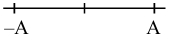
$A$ particle is executing simple harmonic motion with time period $2 \ s$ and amplitude $1 \ cm$. If $D$ and $d$ are the total distance and displacement covered by the particle in $12.5 \ s$,then $\frac{D}{d}$ is:
A
$\frac{15}{4}$
B
$25$
C
$10$
D
$\frac{16}{5}$
Solution
(B) Given: Time period $T = 2 \ s$,Amplitude $A = 1 \ cm$,Total time $t = 12.5 \ s$.
Number of cycles $n = \frac{t}{T} = \frac{12.5}{2} = 6.25$ cycles.
In one complete cycle,the total distance covered is $4A = 4 \times 1 \ cm = 4 \ cm$.
For $6$ complete cycles,distance $D_1 = 6 \times 4 \ cm = 24 \ cm$.
For the remaining $0.25$ cycle (which is $\frac{T}{4}$),the particle moves from the mean position to the extreme position,covering a distance of $A = 1 \ cm$.
Total distance $D = 24 \ cm + 1 \ cm = 25 \ cm$.
After $6$ complete cycles,the particle returns to the mean position. In the remaining $0.25$ cycle,it moves from the mean position to the extreme position $(A = 1 \ cm)$.
Thus,the displacement $d = 1 \ cm$.
Therefore,$\frac{D}{d} = \frac{25 \ cm}{1 \ cm} = 25$.
Number of cycles $n = \frac{t}{T} = \frac{12.5}{2} = 6.25$ cycles.
In one complete cycle,the total distance covered is $4A = 4 \times 1 \ cm = 4 \ cm$.
For $6$ complete cycles,distance $D_1 = 6 \times 4 \ cm = 24 \ cm$.
For the remaining $0.25$ cycle (which is $\frac{T}{4}$),the particle moves from the mean position to the extreme position,covering a distance of $A = 1 \ cm$.
Total distance $D = 24 \ cm + 1 \ cm = 25 \ cm$.
After $6$ complete cycles,the particle returns to the mean position. In the remaining $0.25$ cycle,it moves from the mean position to the extreme position $(A = 1 \ cm)$.
Thus,the displacement $d = 1 \ cm$.
Therefore,$\frac{D}{d} = \frac{25 \ cm}{1 \ cm} = 25$.
0 likes
View Solution202
DifficultMCQ
Given below are two statements. One is labelled as Assertion $(A)$ and the other is labelled as Reason $(R)$.
Assertion $(A) :$ Knowing initial position $x_0$ and initial momentum $p_0$ is enough to determine the position and momentum at any time $t$ for a simple harmonic motion with a given angular frequency $\omega$.
Reason $(R) :$ The amplitude and phase can be expressed in terms of $x_0$ and $p_0$. In the light of the above statements,choose the correct answer from the options given below $:$
Assertion $(A) :$ Knowing initial position $x_0$ and initial momentum $p_0$ is enough to determine the position and momentum at any time $t$ for a simple harmonic motion with a given angular frequency $\omega$.
Reason $(R) :$ The amplitude and phase can be expressed in terms of $x_0$ and $p_0$. In the light of the above statements,choose the correct answer from the options given below $:$
A
Both $(A)$ and $(R)$ are true but $(R)$ is $\text{NOT}$ the correct explanation of $(A)$.
B
$(A)$ is false but $(R)$ is true.
C
$(A)$ is true but $(R)$ is false.
D
Both $(A)$ and $(R)$ are true and $(R)$ is the correct explanation of $(A)$.
Solution
(D) For a simple harmonic motion,the position is given by $x(t) = A \sin(\omega t + \phi)$.
At $t = 0$,$x_0 = A \sin \phi$ $..........(1)$
The momentum is $p(t) = m \frac{dx}{dt} = m A \omega \cos(\omega t + \phi)$.
At $t = 0$,$p_0 = m A \omega \cos \phi$ $..........(2)$
From equations $(1)$ and $(2)$,we can solve for the two unknowns,amplitude $A$ and phase constant $\phi$,using the initial conditions $x_0$ and $p_0$.
Specifically,$\tan \phi = \frac{m \omega x_0}{p_0}$ and $A = \sqrt{x_0^2 + (p_0 / m \omega)^2}$.
Since $A$ and $\phi$ are uniquely determined by $x_0$ and $p_0$,the state of the system at any time $t$ is fully determined.
Thus,both Assertion $(A)$ and Reason $(R)$ are true,and $(R)$ is the correct explanation of $(A)$.
At $t = 0$,$x_0 = A \sin \phi$ $..........(1)$
The momentum is $p(t) = m \frac{dx}{dt} = m A \omega \cos(\omega t + \phi)$.
At $t = 0$,$p_0 = m A \omega \cos \phi$ $..........(2)$
From equations $(1)$ and $(2)$,we can solve for the two unknowns,amplitude $A$ and phase constant $\phi$,using the initial conditions $x_0$ and $p_0$.
Specifically,$\tan \phi = \frac{m \omega x_0}{p_0}$ and $A = \sqrt{x_0^2 + (p_0 / m \omega)^2}$.
Since $A$ and $\phi$ are uniquely determined by $x_0$ and $p_0$,the state of the system at any time $t$ is fully determined.
Thus,both Assertion $(A)$ and Reason $(R)$ are true,and $(R)$ is the correct explanation of $(A)$.
0 likes
View Solution203
EasyMCQ
The motion of the particle is given by the equation $x = A \sin \omega t + B \cos \omega t$. The motion of the particle is:
A
simple harmonic with amplitude $(A+B)$
B
simple harmonic with amplitude $(A-B)$
C
simple harmonic with amplitude $(A^2+B^2)^{1/2}$
D
not simple harmonic
Solution
(C) Given the equation of motion: $x = A \sin \omega t + B \cos \omega t$.
To express this in the standard form of simple harmonic motion $x = R \sin(\omega t + \phi)$,we multiply and divide by $\sqrt{A^2 + B^2}$:
$x = \sqrt{A^2 + B^2} \left( \frac{A}{\sqrt{A^2 + B^2}} \sin \omega t + \frac{B}{\sqrt{A^2 + B^2}} \cos \omega t \right)$.
Let $\frac{A}{\sqrt{A^2 + B^2}} = \cos \phi$ and $\frac{B}{\sqrt{A^2 + B^2}} = \sin \phi$.
Then,$x = \sqrt{A^2 + B^2} (\sin \omega t \cos \phi + \cos \omega t \sin \phi)$.
Using the trigonometric identity $\sin(a+b) = \sin a \cos b + \cos a \sin b$,we get:
$x = \sqrt{A^2 + B^2} \sin(\omega t + \phi)$.
This is the standard equation of simple harmonic motion with amplitude $R = \sqrt{A^2 + B^2} = (A^2 + B^2)^{1/2}$.
To express this in the standard form of simple harmonic motion $x = R \sin(\omega t + \phi)$,we multiply and divide by $\sqrt{A^2 + B^2}$:
$x = \sqrt{A^2 + B^2} \left( \frac{A}{\sqrt{A^2 + B^2}} \sin \omega t + \frac{B}{\sqrt{A^2 + B^2}} \cos \omega t \right)$.
Let $\frac{A}{\sqrt{A^2 + B^2}} = \cos \phi$ and $\frac{B}{\sqrt{A^2 + B^2}} = \sin \phi$.
Then,$x = \sqrt{A^2 + B^2} (\sin \omega t \cos \phi + \cos \omega t \sin \phi)$.
Using the trigonometric identity $\sin(a+b) = \sin a \cos b + \cos a \sin b$,we get:
$x = \sqrt{A^2 + B^2} \sin(\omega t + \phi)$.
This is the standard equation of simple harmonic motion with amplitude $R = \sqrt{A^2 + B^2} = (A^2 + B^2)^{1/2}$.
0 likes
View Solution204
MediumMCQ
$A$ point particle of mass $200 \text{ g}$ is executing $S.H.M.$ of amplitude $0.2 \text{ m}$. When the particle passes through the mean position,its kinetic energy is $16 \times 10^{-3} \text{ J}$. The equation of motion of this particle is (Initial phase of oscillation $= 0^{\circ}$)
A
$Y = 0.2 \sin(4t)$
B
$Y = 0.2 \sin\left(\frac{t}{4}\right)$
C
$Y = 0.2 \sin\left(\frac{t}{2}\right)$
D
$Y = 0.2 \sin(2t)$
Solution
(D) Given: Mass $m = 200 \text{ g} = 0.2 \text{ kg}$,Amplitude $A = 0.2 \text{ m}$,Kinetic Energy at mean position $K_{max} = 16 \times 10^{-3} \text{ J}$.
At the mean position,the velocity is maximum,$v_{max} = A\omega$.
The maximum kinetic energy is given by $K_{max} = \frac{1}{2} m v_{max}^2 = \frac{1}{2} m (A\omega)^2$.
Substituting the values: $16 \times 10^{-3} = \frac{1}{2} \times 0.2 \times (0.2 \times \omega)^2$.
$16 \times 10^{-3} = 0.1 \times 0.04 \times \omega^2$.
$16 \times 10^{-3} = 0.004 \times \omega^2$.
$\omega^2 = \frac{16 \times 10^{-3}}{4 \times 10^{-3}} = 4$.
$\omega = 2 \text{ rad/s}$.
The general equation for $S.H.M.$ is $Y = A \sin(\omega t + \phi)$.
Given initial phase $\phi = 0^{\circ}$,so $Y = 0.2 \sin(2t)$.
At the mean position,the velocity is maximum,$v_{max} = A\omega$.
The maximum kinetic energy is given by $K_{max} = \frac{1}{2} m v_{max}^2 = \frac{1}{2} m (A\omega)^2$.
Substituting the values: $16 \times 10^{-3} = \frac{1}{2} \times 0.2 \times (0.2 \times \omega)^2$.
$16 \times 10^{-3} = 0.1 \times 0.04 \times \omega^2$.
$16 \times 10^{-3} = 0.004 \times \omega^2$.
$\omega^2 = \frac{16 \times 10^{-3}}{4 \times 10^{-3}} = 4$.
$\omega = 2 \text{ rad/s}$.
The general equation for $S.H.M.$ is $Y = A \sin(\omega t + \phi)$.
Given initial phase $\phi = 0^{\circ}$,so $Y = 0.2 \sin(2t)$.
0 likes
View Solution205
MediumMCQ
The displacement of a particle performing $S.H.M.$ is given by $Y = A \cos [\pi(t + \phi)]$. If at $t = 0$,the displacement is $y = 2 \text{ cm}$ and velocity is $v = 2\pi \text{ cm/s}$,the value of amplitude $A$ in $\text{cm}$ is:
A
$2$
B
$\sqrt{2}$
C
$2\sqrt{2}$
D
$\frac{1}{\sqrt{2}}$
Solution
(C) The displacement equation is $y = A \cos(\pi t + \pi \phi)$.
Taking the derivative with respect to time,the velocity is $v = \frac{dy}{dt} = -A\pi \sin(\pi t + \pi \phi)$.
At $t = 0$,we have $y_0 = A \cos(\pi \phi)$ and $v_0 = -A\pi \sin(\pi \phi)$.
From these,we get $\cos(\pi \phi) = \frac{y_0}{A}$ and $\sin(\pi \phi) = -\frac{v_0}{A\pi}$.
Using the identity $\cos^2(\pi \phi) + \sin^2(\pi \phi) = 1$,we get $\left(\frac{y_0}{A}\right)^2 + \left(-\frac{v_0}{A\pi}\right)^2 = 1$.
This simplifies to $y_0^2 + \frac{v_0^2}{\pi^2} = A^2$.
Substituting the given values $y_0 = 2 \text{ cm}$ and $v_0 = 2\pi \text{ cm/s}$:
$2^2 + \frac{(2\pi)^2}{\pi^2} = A^2$.
$4 + 4 = A^2$.
$A^2 = 8$.
$A = \sqrt{8} = 2\sqrt{2} \text{ cm}$.
Taking the derivative with respect to time,the velocity is $v = \frac{dy}{dt} = -A\pi \sin(\pi t + \pi \phi)$.
At $t = 0$,we have $y_0 = A \cos(\pi \phi)$ and $v_0 = -A\pi \sin(\pi \phi)$.
From these,we get $\cos(\pi \phi) = \frac{y_0}{A}$ and $\sin(\pi \phi) = -\frac{v_0}{A\pi}$.
Using the identity $\cos^2(\pi \phi) + \sin^2(\pi \phi) = 1$,we get $\left(\frac{y_0}{A}\right)^2 + \left(-\frac{v_0}{A\pi}\right)^2 = 1$.
This simplifies to $y_0^2 + \frac{v_0^2}{\pi^2} = A^2$.
Substituting the given values $y_0 = 2 \text{ cm}$ and $v_0 = 2\pi \text{ cm/s}$:
$2^2 + \frac{(2\pi)^2}{\pi^2} = A^2$.
$4 + 4 = A^2$.
$A^2 = 8$.
$A = \sqrt{8} = 2\sqrt{2} \text{ cm}$.
0 likes
View Solution206
EasyMCQ
When a particle in linear $S.H.M.$ completes two oscillations,its phase increases by
A
$\pi \ rad$.
B
$2 \pi \ rad$.
C
$3 \pi \ rad$.
D
$4 \pi \ rad$.
Solution
(D) In $S.H.M.$,one complete oscillation corresponds to a phase change of $2 \pi \ rad$.
Therefore,for $n$ oscillations,the total phase change is given by $\Delta \phi = n \times 2 \pi \ rad$.
Given that the particle completes $n = 2$ oscillations.
Thus,the phase change $= 2 \times 2 \pi \ rad = 4 \pi \ rad$.
Therefore,for $n$ oscillations,the total phase change is given by $\Delta \phi = n \times 2 \pi \ rad$.
Given that the particle completes $n = 2$ oscillations.
Thus,the phase change $= 2 \times 2 \pi \ rad = 4 \pi \ rad$.
0 likes
View Solution207
EasyMCQ
For a particle performing linear $S.H.M.$,its average speed over one oscillation is ($A=$ amplitude of $S.H.M.$,$n=$ frequency of oscillation) (in $nA$)
A
$4$
B
$8$
C
$2$
D
$6$
Solution
(A) The total distance covered by a particle in one complete oscillation of linear $S.H.M.$ is equal to $4A$,where $A$ is the amplitude.
The time period $T$ of the oscillation is related to the frequency $n$ by the formula $T = \frac{1}{n}$.
Average speed is defined as the total distance divided by the total time taken.
Therefore,average speed $v_{av} = \frac{\text{Total Distance}}{\text{Total Time}} = \frac{4A}{T} = \frac{4A}{1/n} = 4nA$.
The time period $T$ of the oscillation is related to the frequency $n$ by the formula $T = \frac{1}{n}$.
Average speed is defined as the total distance divided by the total time taken.
Therefore,average speed $v_{av} = \frac{\text{Total Distance}}{\text{Total Time}} = \frac{4A}{T} = \frac{4A}{1/n} = 4nA$.
0 likes
View Solution208
MediumMCQ
$A$ particle executes simple harmonic motion with an amplitude '$A$'. The distance travelled by it in one periodic time is
A
$\frac{A}{2}$
B
$A$
C
$2A$
D
$4A$
Solution
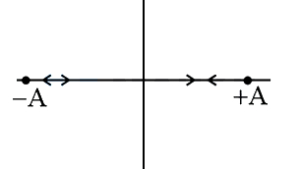
(D) In simple harmonic motion $(SHM)$,a particle oscillates between two extreme positions,$-A$ and $+A$,passing through the mean position $0$.
One complete periodic time $(T)$ represents one full oscillation.
Starting from the mean position $(0)$:
$1$. The particle moves from $0$ to $+A$ (distance = $A$).
$2$. The particle moves from $+A$ back to $0$ (distance = $A$).
$3$. The particle moves from $0$ to $-A$ (distance = $A$).
$4$. The particle moves from $-A$ back to $0$ (distance = $A$).
Total distance travelled in one periodic time = $A + A + A + A = 4A$.
One complete periodic time $(T)$ represents one full oscillation.
Starting from the mean position $(0)$:
$1$. The particle moves from $0$ to $+A$ (distance = $A$).
$2$. The particle moves from $+A$ back to $0$ (distance = $A$).
$3$. The particle moves from $0$ to $-A$ (distance = $A$).
$4$. The particle moves from $-A$ back to $0$ (distance = $A$).
Total distance travelled in one periodic time = $A + A + A + A = 4A$.
0 likes
View Solution209
DifficultMCQ
For a particle performing linear $SHM$,its average speed over $1$ oscillation is ($A =$ amplitude of $SHM$,$n =$ frequency of oscillation). (in $A \ n$)
A
$2$
B
$4$
C
$6$
D
$8$
Solution
(B) In one complete oscillation,a particle in $SHM$ travels from the mean position to one extreme $(A)$,back to the mean position $(A)$,to the other extreme $(A)$,and back to the mean position $(A)$.
Total distance travelled in $1$ oscillation $= A + A + A + A = 4 \ A$.
The time taken for one complete oscillation is the time period $T$.
The frequency of oscillation is $n = \frac{1}{T}$,which implies $T = \frac{1}{n}$.
Average speed is defined as the total distance divided by the total time.
$\text{Average speed} = \frac{\text{Total distance}}{\text{Total time}} = \frac{4 \ A}{T}$.
Substituting $T = \frac{1}{n}$,we get $\text{Average speed} = 4 \ A \ n$.
Total distance travelled in $1$ oscillation $= A + A + A + A = 4 \ A$.
The time taken for one complete oscillation is the time period $T$.
The frequency of oscillation is $n = \frac{1}{T}$,which implies $T = \frac{1}{n}$.
Average speed is defined as the total distance divided by the total time.
$\text{Average speed} = \frac{\text{Total distance}}{\text{Total time}} = \frac{4 \ A}{T}$.
Substituting $T = \frac{1}{n}$,we get $\text{Average speed} = 4 \ A \ n$.
0 likes
View Solution210
MediumMCQ
The motion of a particle is described by the equation $a = -bx$,where $a$ is the acceleration,$x$ is the displacement from the equilibrium position,and $b$ is a constant. The periodic time will be
A
$\frac{2 \pi}{b}$
B
$\frac{2 \pi}{\sqrt{b}}$
C
$2 \pi \sqrt{b}$
D
$2 \sqrt{\frac{\pi}{b}}$
Solution
(B) Given the equation of motion for the particle is $a = -bx$.
Comparing this with the standard equation for Simple Harmonic Motion $(SHM)$,which is $a = -\omega^2 x$,where $\omega$ is the angular frequency.
Equating the two expressions,we get $\omega^2 = b$,which implies $\omega = \sqrt{b}$.
The time period $T$ of an $SHM$ is given by the formula $T = \frac{2 \pi}{\omega}$.
Substituting the value of $\omega$,we get $T = \frac{2 \pi}{\sqrt{b}}$.
Comparing this with the standard equation for Simple Harmonic Motion $(SHM)$,which is $a = -\omega^2 x$,where $\omega$ is the angular frequency.
Equating the two expressions,we get $\omega^2 = b$,which implies $\omega = \sqrt{b}$.
The time period $T$ of an $SHM$ is given by the formula $T = \frac{2 \pi}{\omega}$.
Substituting the value of $\omega$,we get $T = \frac{2 \pi}{\sqrt{b}}$.
0 likes
View Solution211
MediumMCQ
For a particle performing $S.H.M.$,the equation is $\frac{d^2 x}{dt^2} + \alpha x = 0$. Then the time period of the motion will be
A
$\frac{2 \pi}{\alpha}$
B
$2 \pi \alpha$
C
$2 \pi \sqrt{\alpha}$
D
$\frac{2 \pi}{\sqrt{\alpha}}$
Solution
(D) The correct option is $D$.
Concept: The standard differential equation for $S.H.M.$ is given by $\frac{d^2 x}{dt^2} + \omega^2 x = 0$,where $\omega$ is the angular frequency.
Comparing the given equation $\frac{d^2 x}{dt^2} + \alpha x = 0$ with the standard equation,we get $\omega^2 = \alpha$,which implies $\omega = \sqrt{\alpha}$.
The time period $T$ of the motion is defined as $T = \frac{2 \pi}{\omega}$.
Substituting the value of $\omega$,we get $T = \frac{2 \pi}{\sqrt{\alpha}}$.
Concept: The standard differential equation for $S.H.M.$ is given by $\frac{d^2 x}{dt^2} + \omega^2 x = 0$,where $\omega$ is the angular frequency.
Comparing the given equation $\frac{d^2 x}{dt^2} + \alpha x = 0$ with the standard equation,we get $\omega^2 = \alpha$,which implies $\omega = \sqrt{\alpha}$.
The time period $T$ of the motion is defined as $T = \frac{2 \pi}{\omega}$.
Substituting the value of $\omega$,we get $T = \frac{2 \pi}{\sqrt{\alpha}}$.
0 likes
View Solution212
MediumMCQ
$A$ particle moves in $S.H.M.$ such that its acceleration is $a = -px$,where '$x$' is the displacement of the particle from the equilibrium position and '$p$' is a constant. The period of oscillation is
A
$2 \pi \sqrt{p}$
B
$2 \sqrt{\frac{\pi}{p}}$
C
$\frac{2 \pi}{p}$
D
$\frac{2 \pi}{\sqrt{p}}$
Solution
(D) For $S.H.M.$,the acceleration $a$ is proportional to the displacement $x$ and is directed towards the mean position of the particle:
$a = -\omega^2 x = -px$
where $\omega$ is the angular frequency of the $S.H.M.$
Comparing the two expressions,we get $\omega^2 = p$,which implies $\omega = \sqrt{p}$.
The time period of oscillation $T$ is given by the formula:
$T = \frac{2 \pi}{\omega}$
Substituting the value of $\omega$:
$T = \frac{2 \pi}{\sqrt{p}}$
$a = -\omega^2 x = -px$
where $\omega$ is the angular frequency of the $S.H.M.$
Comparing the two expressions,we get $\omega^2 = p$,which implies $\omega = \sqrt{p}$.
The time period of oscillation $T$ is given by the formula:
$T = \frac{2 \pi}{\omega}$
Substituting the value of $\omega$:
$T = \frac{2 \pi}{\sqrt{p}}$
0 likes
View Solution213
DifficultMCQ
$A$ simple harmonic motion is represented by $\alpha \frac{d^2 x}{d t^2}+\beta x=0$. Its period is
A
$2 \pi \frac{\beta}{\alpha}$
B
$2 \pi \sqrt{\frac{\alpha}{\beta}}$
C
$2 \pi \sqrt{\frac{\beta}{\alpha}}$
D
$2 \pi \frac{\alpha}{\beta}$
Solution
(B) The standard differential equation for simple harmonic motion $(SHM)$ is given by $\frac{d^2 x}{d t^2} + \omega^2 x = 0$,which can be rewritten as $\frac{d^2 x}{d t^2} = -\omega^2 x$.
Given equation: $\alpha \frac{d^2 x}{d t^2} + \beta x = 0$.
Rearranging the given equation: $\frac{d^2 x}{d t^2} = -\frac{\beta}{\alpha} x$.
Comparing this with the standard form $\frac{d^2 x}{d t^2} = -\omega^2 x$,we get $\omega^2 = \frac{\beta}{\alpha}$,which implies $\omega = \sqrt{\frac{\beta}{\alpha}}$.
The time period $T$ is given by $T = \frac{2 \pi}{\omega}$.
Substituting the value of $\omega$: $T = \frac{2 \pi}{\sqrt{\frac{\beta}{\alpha}}} = 2 \pi \sqrt{\frac{\alpha}{\beta}}$.
Given equation: $\alpha \frac{d^2 x}{d t^2} + \beta x = 0$.
Rearranging the given equation: $\frac{d^2 x}{d t^2} = -\frac{\beta}{\alpha} x$.
Comparing this with the standard form $\frac{d^2 x}{d t^2} = -\omega^2 x$,we get $\omega^2 = \frac{\beta}{\alpha}$,which implies $\omega = \sqrt{\frac{\beta}{\alpha}}$.
The time period $T$ is given by $T = \frac{2 \pi}{\omega}$.
Substituting the value of $\omega$: $T = \frac{2 \pi}{\sqrt{\frac{\beta}{\alpha}}} = 2 \pi \sqrt{\frac{\alpha}{\beta}}$.
0 likes
View Solution214
EasyMCQ
The displacement of a particle executing linear $S.H.M.$ is given by $x = 0.25 \sin(11t + 0.5) \ m$. The period of $S.H.M.$ is (take $\pi = \frac{22}{7}$):
A
$\frac{2}{7} \ s$
B
$\frac{4}{7} \ s$
C
$\frac{3}{7} \ s$
D
$\frac{1}{7} \ s$
Solution
(B) The standard equation for linear $S.H.M.$ is given by $x = A \sin(\omega t + \phi)$.
Comparing the given equation $x = 0.25 \sin(11t + 0.5)$ with the standard equation,we identify the angular frequency $\omega = 11 \ rad/s$.
The time period $T$ of $S.H.M.$ is related to angular frequency by the formula $T = \frac{2\pi}{\omega}$.
Substituting the given values $\pi = \frac{22}{7}$ and $\omega = 11$:
$T = \frac{2 \times (22/7)}{11} = \frac{2 \times 22}{11 \times 7} = \frac{44}{77} = \frac{4}{7} \ s$.
Thus,the period of $S.H.M.$ is $\frac{4}{7} \ s$.
Comparing the given equation $x = 0.25 \sin(11t + 0.5)$ with the standard equation,we identify the angular frequency $\omega = 11 \ rad/s$.
The time period $T$ of $S.H.M.$ is related to angular frequency by the formula $T = \frac{2\pi}{\omega}$.
Substituting the given values $\pi = \frac{22}{7}$ and $\omega = 11$:
$T = \frac{2 \times (22/7)}{11} = \frac{2 \times 22}{11 \times 7} = \frac{44}{77} = \frac{4}{7} \ s$.
Thus,the period of $S.H.M.$ is $\frac{4}{7} \ s$.
0 likes
View Solution215
EasyMCQ
The displacement equation of a simple harmonic oscillator is given by $y = A \sin \omega t - B \cos \omega t$. The amplitude of the oscillator will be
A
$A - B$
B
$A + B$
C
$\sqrt{A^2 + B^2}$
D
$(A^2 + B^2)$
Solution
(C) The given displacement equation is $y = A \sin \omega t - B \cos \omega t$.
To find the amplitude,we express the equation in the form $y = R \sin(\omega t - \phi)$.
Let $A = R \cos \phi$ and $B = R \sin \phi$.
Then,$y = R \cos \phi \sin \omega t - R \sin \phi \cos \omega t = R \sin(\omega t - \phi)$.
Squaring and adding the expressions for $A$ and $B$:
$A^2 + B^2 = R^2 \cos^2 \phi + R^2 \sin^2 \phi = R^2(\cos^2 \phi + \sin^2 \phi) = R^2$.
Therefore,the amplitude $R = \sqrt{A^2 + B^2}$.
To find the amplitude,we express the equation in the form $y = R \sin(\omega t - \phi)$.
Let $A = R \cos \phi$ and $B = R \sin \phi$.
Then,$y = R \cos \phi \sin \omega t - R \sin \phi \cos \omega t = R \sin(\omega t - \phi)$.
Squaring and adding the expressions for $A$ and $B$:
$A^2 + B^2 = R^2 \cos^2 \phi + R^2 \sin^2 \phi = R^2(\cos^2 \phi + \sin^2 \phi) = R^2$.
Therefore,the amplitude $R = \sqrt{A^2 + B^2}$.
0 likes
View Solution216
EasyMCQ
$A$ particle executing $SHM$ has a maximum speed of $0.5 \ m s^{-1}$ and a maximum acceleration of $1.0 \ m s^{-2}$. The angular frequency of oscillation is
A
$2 \ rad \ s^{-1}$
B
$0.5 \ rad \ s^{-1}$
C
$2 \pi \ rad \ s^{-1}$
D
$0.5 \pi \ rad \ s^{-1}$
Solution
(A) Given: Maximum speed,$v_{\max} = 0.5 \ m s^{-1}$; Maximum acceleration,$a_{\max} = 1.0 \ m s^{-2}$.
We know that for $SHM$,the maximum speed is given by $v_{\max} = \omega A$,where $\omega$ is the angular frequency and $A$ is the amplitude.
Also,the maximum acceleration is given by $a_{\max} = \omega^2 A$.
Dividing the expression for maximum acceleration by the expression for maximum speed:
$\frac{a_{\max}}{v_{\max}} = \frac{\omega^2 A}{\omega A} = \omega$.
Substituting the given values:
$\omega = \frac{1.0 \ m s^{-2}}{0.5 \ m s^{-1}} = 2 \ rad \ s^{-1}$.
Thus,the angular frequency of oscillation is $2 \ rad \ s^{-1}$.
We know that for $SHM$,the maximum speed is given by $v_{\max} = \omega A$,where $\omega$ is the angular frequency and $A$ is the amplitude.
Also,the maximum acceleration is given by $a_{\max} = \omega^2 A$.
Dividing the expression for maximum acceleration by the expression for maximum speed:
$\frac{a_{\max}}{v_{\max}} = \frac{\omega^2 A}{\omega A} = \omega$.
Substituting the given values:
$\omega = \frac{1.0 \ m s^{-2}}{0.5 \ m s^{-1}} = 2 \ rad \ s^{-1}$.
Thus,the angular frequency of oscillation is $2 \ rad \ s^{-1}$.
0 likes
View Solution217
MediumMCQ
If the function $\sin^2 \omega t$ (where $t$ is time in seconds) represents a periodic motion,then the period of the motion is:
A
$\sqrt{\frac{\pi}{\omega}} \ s$
B
$\frac{\pi}{\omega} \ s$
C
$\frac{2\pi}{\omega} \ s$
D
$\sqrt{\frac{2\pi}{\omega}} \ s$
Solution
(B) The given function is $f(t) = \sin^2 \omega t$.
Using the trigonometric identity $\sin^2 \theta = \frac{1 - \cos 2\theta}{2}$,we can rewrite the function as:
$f(t) = \frac{1 - \cos(2\omega t)}{2} = \frac{1}{2} - \frac{1}{2} \cos(2\omega t)$.
The term $\cos(2\omega t)$ represents a periodic function with angular frequency $\omega' = 2\omega$.
The time period $T$ of a periodic function $\cos(\omega' t)$ is given by $T = \frac{2\pi}{\omega'}$.
Substituting $\omega' = 2\omega$,we get $T = \frac{2\pi}{2\omega} = \frac{\pi}{\omega}$.
Thus,the period of the motion is $\frac{\pi}{\omega} \ s$.
Using the trigonometric identity $\sin^2 \theta = \frac{1 - \cos 2\theta}{2}$,we can rewrite the function as:
$f(t) = \frac{1 - \cos(2\omega t)}{2} = \frac{1}{2} - \frac{1}{2} \cos(2\omega t)$.
The term $\cos(2\omega t)$ represents a periodic function with angular frequency $\omega' = 2\omega$.
The time period $T$ of a periodic function $\cos(\omega' t)$ is given by $T = \frac{2\pi}{\omega'}$.
Substituting $\omega' = 2\omega$,we get $T = \frac{2\pi}{2\omega} = \frac{\pi}{\omega}$.
Thus,the period of the motion is $\frac{\pi}{\omega} \ s$.
0 likes
View Solution218
EasyMCQ
If the displacement of a particle executing simple harmonic motion is given by $x = 0.5 \cos (125.6 t)$,then the time period of oscillation of the particle is nearly. (Here $x$ is displacement in metre and $t$ is time in second) (in $s$)
A
$1$
B
$2$
C
$0.09$
D
$0.05$
Solution
(D) The general equation for simple harmonic motion is given by $x = A \cos (\omega t + \phi)$.
Comparing the given equation $x = 0.5 \cos (125.6 t)$ with the general equation,we get the angular frequency $\omega = 125.6 \ rad/s$.
The relationship between the time period $T$ and angular frequency $\omega$ is $T = \frac{2\pi}{\omega}$.
Substituting the values,we get $T = \frac{2 \times 3.14}{125.6}$.
$T = \frac{6.28}{125.6} = 0.05 \ s$.
Therefore,the time period of oscillation is $0.05 \ s$.
Comparing the given equation $x = 0.5 \cos (125.6 t)$ with the general equation,we get the angular frequency $\omega = 125.6 \ rad/s$.
The relationship between the time period $T$ and angular frequency $\omega$ is $T = \frac{2\pi}{\omega}$.
Substituting the values,we get $T = \frac{2 \times 3.14}{125.6}$.
$T = \frac{6.28}{125.6} = 0.05 \ s$.
Therefore,the time period of oscillation is $0.05 \ s$.
0 likes
View Solution219
MediumMCQ
The equation of motion of a particle executing simple harmonic motion is $4 \frac{d^2 y}{dt^2}+\pi^2 y=0$,where $y$ is in metres and $t$ is in seconds. The time period of oscillation of the particle is (in $s$)
A
$1$
B
$2$
C
$3$
D
$4$
Solution
(D) The given equation of motion is $4 \frac{d^2 y}{dt^2} + \pi^2 y = 0$.
Dividing by $4$,we get $\frac{d^2 y}{dt^2} + \frac{\pi^2}{4} y = 0$.
The general equation for simple harmonic motion is $\frac{d^2 y}{dt^2} + \omega^2 y = 0$.
Comparing the two equations,we find $\omega^2 = \frac{\pi^2}{4}$,which gives $\omega = \frac{\pi}{2} \ rad/s$.
The time period $T$ is given by the formula $T = \frac{2\pi}{\omega}$.
Substituting the value of $\omega$,we get $T = \frac{2\pi}{\pi/2} = 2\pi \times \frac{2}{\pi} = 4 \ s$.
Dividing by $4$,we get $\frac{d^2 y}{dt^2} + \frac{\pi^2}{4} y = 0$.
The general equation for simple harmonic motion is $\frac{d^2 y}{dt^2} + \omega^2 y = 0$.
Comparing the two equations,we find $\omega^2 = \frac{\pi^2}{4}$,which gives $\omega = \frac{\pi}{2} \ rad/s$.
The time period $T$ is given by the formula $T = \frac{2\pi}{\omega}$.
Substituting the value of $\omega$,we get $T = \frac{2\pi}{\pi/2} = 2\pi \times \frac{2}{\pi} = 4 \ s$.
0 likes
View Solution220
MediumMCQ
$A$ particle of mass $m$ is under the influence of a force $F = (-kx + F_0) \text{ N}$. The particle,when disturbed,will oscillate
A
about $x = 0$ with $\omega = \sqrt{\frac{k}{m}}$
B
about $x = 0$ with $\omega = \sqrt{\frac{m}{k}}$
C
about $x = \frac{F_0}{k}$ with $\omega = \sqrt{\frac{k}{m}}$
D
about $x = \frac{F_0}{k}$ with $\omega \neq \sqrt{\frac{k}{m}}$
Solution
(C) Given that,the force acting on the particle is $F = -kx + F_0$.
We can rewrite this as $F = -k(x - \frac{F_0}{k})$.
Let $y = x - \frac{F_0}{k}$,then the force becomes $F = -ky$.
This is the standard form of the restoring force for Simple Harmonic Motion $(SHM)$,where the mean position is defined by $F = 0$.
Setting $F = 0$,we get $-k(x - \frac{F_0}{k}) = 0$,which implies $x = \frac{F_0}{k}$.
Thus,the particle oscillates about the mean position $x = \frac{F_0}{k}$.
Comparing $F = -ky$ with the standard $SHM$ equation $F = -m\omega^2 y$,we get $m\omega^2 = k$.
Therefore,the angular frequency is $\omega = \sqrt{\frac{k}{m}}$.
We can rewrite this as $F = -k(x - \frac{F_0}{k})$.
Let $y = x - \frac{F_0}{k}$,then the force becomes $F = -ky$.
This is the standard form of the restoring force for Simple Harmonic Motion $(SHM)$,where the mean position is defined by $F = 0$.
Setting $F = 0$,we get $-k(x - \frac{F_0}{k}) = 0$,which implies $x = \frac{F_0}{k}$.
Thus,the particle oscillates about the mean position $x = \frac{F_0}{k}$.
Comparing $F = -ky$ with the standard $SHM$ equation $F = -m\omega^2 y$,we get $m\omega^2 = k$.
Therefore,the angular frequency is $\omega = \sqrt{\frac{k}{m}}$.
0 likes
View Solution221
MediumMCQ
The ratio of the maximum acceleration to the maximum velocity of a simple harmonic oscillator is
A
$\omega$
B
$\frac{\omega}{2}$
C
$\omega^2$
D
$2 \omega$
Solution
(A) For a simple harmonic oscillator $(SHM)$,we know that:
The maximum acceleration is given by $|a_{\max}| = \omega^2 A$.
The maximum velocity is given by $|v_{\max}| = \omega A$.
Here,$\omega$ is the angular frequency and $A$ is the amplitude of oscillation.
Therefore,the ratio of maximum acceleration to maximum velocity is:
$\frac{|a_{\max}|}{|v_{\max}|} = \frac{\omega^2 A}{\omega A} = \omega$.
The maximum acceleration is given by $|a_{\max}| = \omega^2 A$.
The maximum velocity is given by $|v_{\max}| = \omega A$.
Here,$\omega$ is the angular frequency and $A$ is the amplitude of oscillation.
Therefore,the ratio of maximum acceleration to maximum velocity is:
$\frac{|a_{\max}|}{|v_{\max}|} = \frac{\omega^2 A}{\omega A} = \omega$.
0 likes
View Solution222
MediumMCQ
$A$ particle of mass $0.4 \text{ kg}$ executes simple harmonic motion of amplitude $0.4 \text{ m}$. When it passes through the mean position,its kinetic energy is $256 \times 10^{-3} \text{ J}$. If the initial phase of the oscillation is $\pi / 4$,then the equation of its motion is
A
$x=0.4 \sin \left((0.4) t+\frac{\pi}{4}\right)$
B
$x=0.2 \sin \left(2 \sqrt{2} t+\frac{\pi}{4}\right)$
C
$x=0.8 \sin \left((2 \sqrt{2}) t+\frac{\pi}{2}\right)$
D
$x=0.4 \sin \left((2 \sqrt{2}) t+\frac{\pi}{4}\right)$
Solution
(D) Given: Mass of the particle $m = 0.4 \text{ kg}$,Amplitude $A = 0.4 \text{ m}$,Initial phase $\phi = \pi / 4$.
The kinetic energy at the mean position is equal to the total energy of the oscillator,given by $KE = \frac{1}{2} m \omega^2 A^2$.
Substituting the given values: $256 \times 10^{-3} = \frac{1}{2} \times 0.4 \times \omega^2 \times (0.4)^2$.
$0.256 = 0.2 \times \omega^2 \times 0.16$.
$0.256 = 0.032 \times \omega^2$.
$\omega^2 = \frac{0.256}{0.032} = 8$.
$\omega = \sqrt{8} = 2 \sqrt{2} \text{ rad/s}$.
The general equation for simple harmonic motion is $x = A \sin(\omega t + \phi)$.
Substituting the values,we get $x = 0.4 \sin \left((2 \sqrt{2}) t + \frac{\pi}{4}\right)$.
The kinetic energy at the mean position is equal to the total energy of the oscillator,given by $KE = \frac{1}{2} m \omega^2 A^2$.
Substituting the given values: $256 \times 10^{-3} = \frac{1}{2} \times 0.4 \times \omega^2 \times (0.4)^2$.
$0.256 = 0.2 \times \omega^2 \times 0.16$.
$0.256 = 0.032 \times \omega^2$.
$\omega^2 = \frac{0.256}{0.032} = 8$.
$\omega = \sqrt{8} = 2 \sqrt{2} \text{ rad/s}$.
The general equation for simple harmonic motion is $x = A \sin(\omega t + \phi)$.
Substituting the values,we get $x = 0.4 \sin \left((2 \sqrt{2}) t + \frac{\pi}{4}\right)$.
0 likes
View Solution223
EasyMCQ
Two particles executing $SHM$ along a straight line have the same amplitude $A$ and time period $T$. At $t=0$,one particle is at a displacement $+A$ and another is at a displacement $-\frac{A}{2}$ and they are approaching towards each other. They cross each other after a time.
A
$\frac{T}{3}$
B
$\frac{T}{4}$
C
$\frac{5T}{6}$
D
$\frac{T}{6}$
Solution
(D) The displacement of a particle in $SHM$ is given by $x(t) = A \cos(\omega t + \phi)$.
For the first particle at $t=0$,$x_1 = A$. Thus,$A = A \cos(\phi_1) \implies \phi_1 = 0$.
So,$x_1(t) = A \cos(\omega t)$.
For the second particle at $t=0$,$x_2 = -A/2$. Thus,$-A/2 = A \cos(\phi_2) \implies \phi_2 = 2\pi/3$ or $4\pi/3$. Since the particle is approaching the first one (moving towards positive direction),its velocity $v_2 = -A\omega \sin(\phi_2)$ must be positive. Thus,$\sin(\phi_2)$ must be negative,so $\phi_2 = 4\pi/3$.
So,$x_2(t) = A \cos(\omega t + 4\pi/3)$.
They cross when $x_1(t) = x_2(t)$:
$A \cos(\omega t) = A \cos(\omega t + 4\pi/3)$.
Using $\cos(\theta) = \cos(2\pi - \theta)$,we have $\omega t = 2\pi - (\omega t + 4\pi/3) = 2\pi - \omega t - 4\pi/3$.
$2\omega t = 2\pi/3 \implies \omega t = \pi/3$.
Since $\omega = 2\pi/T$,we get $(2\pi/T)t = \pi/3 \implies t = T/6$.
For the first particle at $t=0$,$x_1 = A$. Thus,$A = A \cos(\phi_1) \implies \phi_1 = 0$.
So,$x_1(t) = A \cos(\omega t)$.
For the second particle at $t=0$,$x_2 = -A/2$. Thus,$-A/2 = A \cos(\phi_2) \implies \phi_2 = 2\pi/3$ or $4\pi/3$. Since the particle is approaching the first one (moving towards positive direction),its velocity $v_2 = -A\omega \sin(\phi_2)$ must be positive. Thus,$\sin(\phi_2)$ must be negative,so $\phi_2 = 4\pi/3$.
So,$x_2(t) = A \cos(\omega t + 4\pi/3)$.
They cross when $x_1(t) = x_2(t)$:
$A \cos(\omega t) = A \cos(\omega t + 4\pi/3)$.
Using $\cos(\theta) = \cos(2\pi - \theta)$,we have $\omega t = 2\pi - (\omega t + 4\pi/3) = 2\pi - \omega t - 4\pi/3$.
$2\omega t = 2\pi/3 \implies \omega t = \pi/3$.
Since $\omega = 2\pi/T$,we get $(2\pi/T)t = \pi/3 \implies t = T/6$.
0 likes
View Solution224
EasyMCQ
The displacement of a particle in an oscillatory motion at a time $t$ is given by $x = 8 \sin \frac{\pi t}{4} \text{ cm}$. Calculate its displacement in the time interval $t = 0 \text{ s}$ to $t = 2 \text{ s}$. (in $\text{ cm}$)
A
$4$
B
$2$
C
$12$
D
$8$
Solution
(D) The displacement equation is given by $x(t) = 8 \sin \left( \frac{\pi t}{4} \right) \text{ cm}$.
At $t = 0 \text{ s}$,the displacement is $x(0) = 8 \sin(0) = 0 \text{ cm}$.
At $t = 2 \text{ s}$,the displacement is $x(2) = 8 \sin \left( \frac{\pi \times 2}{4} \right) = 8 \sin \left( \frac{\pi}{2} \right) = 8 \times 1 = 8 \text{ cm}$.
The displacement in the time interval $t = 0 \text{ s}$ to $t = 2 \text{ s}$ is $\Delta x = x(2) - x(0) = 8 \text{ cm} - 0 \text{ cm} = 8 \text{ cm}$.
At $t = 0 \text{ s}$,the displacement is $x(0) = 8 \sin(0) = 0 \text{ cm}$.
At $t = 2 \text{ s}$,the displacement is $x(2) = 8 \sin \left( \frac{\pi \times 2}{4} \right) = 8 \sin \left( \frac{\pi}{2} \right) = 8 \times 1 = 8 \text{ cm}$.
The displacement in the time interval $t = 0 \text{ s}$ to $t = 2 \text{ s}$ is $\Delta x = x(2) - x(0) = 8 \text{ cm} - 0 \text{ cm} = 8 \text{ cm}$.
0 likes
View Solution225
MediumMCQ
$A$ particle is executing simple harmonic motion with an amplitude of $2 \,m$. The difference in the magnitudes of its maximum acceleration and maximum velocity is $4$. The time-period of its oscillation and its velocity when it is $1 \,m$ away from the mean position are respectively:
A
$2 \,s, 2 \sqrt{3} \,ms^{-1}$
B
$\frac{7}{22} \,s, 4 \sqrt{3} \,ms^{-1}$
C
$\frac{22}{7} \,s, 2 \sqrt{3} \,ms^{-1}$
D
$\frac{44}{7} \,s, 4 \sqrt{3} \,ms^{-1}$
Solution
(C) Given,amplitude $A = 2 \,m$.
Maximum acceleration $a_{max} = A \omega^2$ and maximum velocity $v_{max} = A \omega$.
According to the problem,$|A \omega^2| - |A \omega| = 4$.
Substituting $A = 2$:
$2 \omega^2 - 2 \omega = 4$
$\omega^2 - \omega - 2 = 0$
$(\omega - 2)(\omega + 1) = 0$.
Since $\omega > 0$,we get $\omega = 2 \,rad/s$.
Time period $T = \frac{2 \pi}{\omega} = \frac{2 \pi}{2} = \pi = \frac{22}{7} \,s$.
Velocity at displacement $y = 1 \,m$ is given by $v = \omega \sqrt{A^2 - y^2}$.
$v = 2 \sqrt{2^2 - 1^2} = 2 \sqrt{4 - 1} = 2 \sqrt{3} \,ms^{-1}$.
Maximum acceleration $a_{max} = A \omega^2$ and maximum velocity $v_{max} = A \omega$.
According to the problem,$|A \omega^2| - |A \omega| = 4$.
Substituting $A = 2$:
$2 \omega^2 - 2 \omega = 4$
$\omega^2 - \omega - 2 = 0$
$(\omega - 2)(\omega + 1) = 0$.
Since $\omega > 0$,we get $\omega = 2 \,rad/s$.
Time period $T = \frac{2 \pi}{\omega} = \frac{2 \pi}{2} = \pi = \frac{22}{7} \,s$.
Velocity at displacement $y = 1 \,m$ is given by $v = \omega \sqrt{A^2 - y^2}$.
$v = 2 \sqrt{2^2 - 1^2} = 2 \sqrt{4 - 1} = 2 \sqrt{3} \,ms^{-1}$.
0 likes
View Solution226
EasyMCQ
$A$ particle is executing simple harmonic motion with an instantaneous displacement $x = A \sin^2(\omega t - \frac{\pi}{4})$. The time period of oscillation of the particle is
A
$\frac{2\pi}{\omega}$
B
$\frac{\pi}{\omega}$
C
$\frac{\pi}{2\omega}$
D
$\frac{\omega}{2\pi}$
Solution
(B) Given,the instantaneous displacement of the particle is $x = A \sin^2(\omega t - \frac{\pi}{4})$.
Using the trigonometric identity $\sin^2 \theta = \frac{1 - \cos(2\theta)}{2}$,we can rewrite the expression as:
$x = A \left[ \frac{1 - \cos(2(\omega t - \frac{\pi}{4}))}{2} \right]$
$x = \frac{A}{2} [1 - \cos(2\omega t - \frac{\pi}{2})]$
In simple harmonic motion,the general form is $x = x_0 + A' \cos(\omega' t + \phi)$.
Comparing the expression,the angular frequency of the oscillation is $\omega' = 2\omega$.
The time period $T'$ is given by $T' = \frac{2\pi}{\omega'}$.
Substituting $\omega' = 2\omega$,we get $T' = \frac{2\pi}{2\omega} = \frac{\pi}{\omega}$.
Using the trigonometric identity $\sin^2 \theta = \frac{1 - \cos(2\theta)}{2}$,we can rewrite the expression as:
$x = A \left[ \frac{1 - \cos(2(\omega t - \frac{\pi}{4}))}{2} \right]$
$x = \frac{A}{2} [1 - \cos(2\omega t - \frac{\pi}{2})]$
In simple harmonic motion,the general form is $x = x_0 + A' \cos(\omega' t + \phi)$.
Comparing the expression,the angular frequency of the oscillation is $\omega' = 2\omega$.
The time period $T'$ is given by $T' = \frac{2\pi}{\omega'}$.
Substituting $\omega' = 2\omega$,we get $T' = \frac{2\pi}{2\omega} = \frac{\pi}{\omega}$.
0 likes
View Solution227
MediumMCQ
$A$ particle of mass $0.1 \ kg$ is executing simple harmonic motion of amplitude $0.1 \ m$. When the particle passes through the mean position,its kinetic energy is $8 \times 10^{-3} \ J$. If the initial phase is $45^{\circ}$,the equation of its motion is (Assume $x(t)$ as the position of the particle at time $t$)
A
$x(t) = 0.1 \sin(4t + \pi/4)$
B
$x(t) = 0.1 \sin(16t + \pi/4)$
C
$x(t) = 0.1 \sin(2t + \pi/4)$
D
$x(t) = 0.1 \sin(8t + \pi/4)$
Solution
(A) The mass of the particle is $m = 0.1 \ kg$.
Amplitude of the particle performing $\text{SHM}$ is $A = 0.1 \ m$.
The initial phase of the particle is $\phi = 45^{\circ} = \pi/4$.
The general equation of a particle performing $\text{SHM}$ is $x(t) = A \sin(\omega t + \phi)$.
When the particle passes through the mean position,its kinetic energy is maximum,given by:
$KE_{max} = \frac{1}{2} m \omega^2 A^2 = 8 \times 10^{-3} \ J$.
Substituting the values:
$\frac{1}{2} \times 0.1 \times \omega^2 \times (0.1)^2 = 8 \times 10^{-3}$.
$0.05 \times \omega^2 \times 0.01 = 8 \times 10^{-3}$.
$0.0005 \times \omega^2 = 0.008$.
$\omega^2 = \frac{0.008}{0.0005} = 16$.
$\omega = 4 \ rad/s$.
Substituting $\omega$,$A$,and $\phi$ into the general equation:
$x(t) = 0.1 \sin(4t + \pi/4)$.
Amplitude of the particle performing $\text{SHM}$ is $A = 0.1 \ m$.
The initial phase of the particle is $\phi = 45^{\circ} = \pi/4$.
The general equation of a particle performing $\text{SHM}$ is $x(t) = A \sin(\omega t + \phi)$.
When the particle passes through the mean position,its kinetic energy is maximum,given by:
$KE_{max} = \frac{1}{2} m \omega^2 A^2 = 8 \times 10^{-3} \ J$.
Substituting the values:
$\frac{1}{2} \times 0.1 \times \omega^2 \times (0.1)^2 = 8 \times 10^{-3}$.
$0.05 \times \omega^2 \times 0.01 = 8 \times 10^{-3}$.
$0.0005 \times \omega^2 = 0.008$.
$\omega^2 = \frac{0.008}{0.0005} = 16$.
$\omega = 4 \ rad/s$.
Substituting $\omega$,$A$,and $\phi$ into the general equation:
$x(t) = 0.1 \sin(4t + \pi/4)$.
0 likes
View Solution228
MediumMCQ
$A$ particle of mass $4 \text{ mg}$ is executing simple harmonic motion along the $x$-axis with an angular frequency of $40 \text{ rad s}^{-1}$. If the potential energy of the particle is $V(x) = a + bx^2$,where $V(x)$ is in joule and $x$ is in metre,then the value of $b$ is
A
$800 \times 10^{-6} \text{ J m}^{-2}$
B
$1600 \times 10^{-6} \text{ J m}^{-2}$
C
$3200 \times 10^{-6} \text{ J m}^{-2}$
D
$6400 \times 10^{-6} \text{ J m}^{-2}$
Solution
(C) For a particle executing simple harmonic motion $(SHM)$,the mass $m = 4 \text{ mg} = 4 \times 10^{-3} \text{ g} = 4 \times 10^{-6} \text{ kg}$.
The angular frequency is $\omega = 40 \text{ rad s}^{-1}$.
The potential energy is given by $V(x) = a + bx^2$.
The restoring force $F$ is given by $F = -\frac{dV}{dx} = -\frac{d}{dx}(a + bx^2) = -2bx$.
For $SHM$,the restoring force is also given by $F = -m\omega^2x$.
Comparing the two expressions for force,we get $2b = m\omega^2$.
Thus,$b = \frac{m\omega^2}{2}$.
Substituting the values: $b = \frac{(4 \times 10^{-6} \text{ kg}) \times (40 \text{ rad s}^{-1})^2}{2}$.
$b = \frac{4 \times 10^{-6} \times 1600}{2} = 2 \times 10^{-6} \times 1600 = 3200 \times 10^{-6} \text{ J m}^{-2}$.
The angular frequency is $\omega = 40 \text{ rad s}^{-1}$.
The potential energy is given by $V(x) = a + bx^2$.
The restoring force $F$ is given by $F = -\frac{dV}{dx} = -\frac{d}{dx}(a + bx^2) = -2bx$.
For $SHM$,the restoring force is also given by $F = -m\omega^2x$.
Comparing the two expressions for force,we get $2b = m\omega^2$.
Thus,$b = \frac{m\omega^2}{2}$.
Substituting the values: $b = \frac{(4 \times 10^{-6} \text{ kg}) \times (40 \text{ rad s}^{-1})^2}{2}$.
$b = \frac{4 \times 10^{-6} \times 1600}{2} = 2 \times 10^{-6} \times 1600 = 3200 \times 10^{-6} \text{ J m}^{-2}$.
0 likes
View Solution229
MediumMCQ
The displacement of a particle is given by the relation $x = 4(\cos \pi t + \sin \pi t)$. The amplitude of the particle is
A
$-4$
B
$4$
C
$4 \sqrt{2}$
D
$8$
Solution
(C) The given displacement equation is $x = 4(\cos \pi t + \sin \pi t)$.
To find the amplitude,we express the equation in the form $x = A \sin(\omega t + \phi)$.
Multiply and divide by $\sqrt{1^2 + 1^2} = \sqrt{2}$:
$x = 4 \sqrt{2} \left( \frac{1}{\sqrt{2}} \cos \pi t + \frac{1}{\sqrt{2}} \sin \pi t \right)$.
Using the trigonometric identity $\sin(A + B) = \sin A \cos B + \cos A \sin B$,where $\sin \frac{\pi}{4} = \frac{1}{\sqrt{2}}$ and $\cos \frac{\pi}{4} = \frac{1}{\sqrt{2}}$:
$x = 4 \sqrt{2} \left( \sin \frac{\pi}{4} \cos \pi t + \cos \frac{\pi}{4} \sin \pi t \right)$.
$x = 4 \sqrt{2} \sin \left( \pi t + \frac{\pi}{4} \right)$.
Comparing this with the standard $SHM$ equation $x = A \sin(\omega t + \phi)$,the amplitude $A$ is $4 \sqrt{2}$.
To find the amplitude,we express the equation in the form $x = A \sin(\omega t + \phi)$.
Multiply and divide by $\sqrt{1^2 + 1^2} = \sqrt{2}$:
$x = 4 \sqrt{2} \left( \frac{1}{\sqrt{2}} \cos \pi t + \frac{1}{\sqrt{2}} \sin \pi t \right)$.
Using the trigonometric identity $\sin(A + B) = \sin A \cos B + \cos A \sin B$,where $\sin \frac{\pi}{4} = \frac{1}{\sqrt{2}}$ and $\cos \frac{\pi}{4} = \frac{1}{\sqrt{2}}$:
$x = 4 \sqrt{2} \left( \sin \frac{\pi}{4} \cos \pi t + \cos \frac{\pi}{4} \sin \pi t \right)$.
$x = 4 \sqrt{2} \sin \left( \pi t + \frac{\pi}{4} \right)$.
Comparing this with the standard $SHM$ equation $x = A \sin(\omega t + \phi)$,the amplitude $A$ is $4 \sqrt{2}$.
0 likes
View Solution230
EasyMCQ
$A$ particle executes simple harmonic motion according to the equation $x(t) = A \sin^2(\alpha t)$. If the time period of the $SHM$ is $0.2 \ s$, then the value of $\alpha$ (in units of $rad/s$) is (in $pi$)
A
$2$
B
$10$
C
$5$
D
$2.5$
Solution
(C) Given the equation of motion: $x(t) = A \sin^2(\alpha t)$.
Using the trigonometric identity $\sin^2 \theta = \frac{1 - \cos 2\theta}{2}$, we can rewrite the equation as:
$x(t) = A \left[ \frac{1 - \cos(2\alpha t)}{2} \right] = \frac{A}{2} - \frac{A}{2} \cos(2\alpha t)$.
The general equation for simple harmonic motion $(SHM)$ is given by $x(t) = a_1 + a_2 \cos(\omega t)$, where $\omega$ is the angular frequency.
Comparing the given equation with the general form, we identify the angular frequency as $\omega = 2\alpha$.
The relationship between angular frequency $\omega$ and time period $T$ is $\omega = \frac{2\pi}{T}$.
Given $T = 0.2 \ s$, we have:
$2\alpha = \frac{2\pi}{0.2}$
$\alpha = \frac{\pi}{0.2} = \frac{\pi}{1/5} = 5\pi \ rad/s$.
Therefore, the value of $\alpha$ is $5\pi \ rad/s$.
Using the trigonometric identity $\sin^2 \theta = \frac{1 - \cos 2\theta}{2}$, we can rewrite the equation as:
$x(t) = A \left[ \frac{1 - \cos(2\alpha t)}{2} \right] = \frac{A}{2} - \frac{A}{2} \cos(2\alpha t)$.
The general equation for simple harmonic motion $(SHM)$ is given by $x(t) = a_1 + a_2 \cos(\omega t)$, where $\omega$ is the angular frequency.
Comparing the given equation with the general form, we identify the angular frequency as $\omega = 2\alpha$.
The relationship between angular frequency $\omega$ and time period $T$ is $\omega = \frac{2\pi}{T}$.
Given $T = 0.2 \ s$, we have:
$2\alpha = \frac{2\pi}{0.2}$
$\alpha = \frac{\pi}{0.2} = \frac{\pi}{1/5} = 5\pi \ rad/s$.
Therefore, the value of $\alpha$ is $5\pi \ rad/s$.
0 likes
View Solution231
MediumMCQ
$A$ particle is executing simple harmonic motion with an amplitude $A$ and time period $T$. The displacement of the particle after $2T$ time from its initial position is
A
$A$
B
$4A$
C
$8A$
D
zero
Solution
(D) Simple harmonic motion is a periodic motion.
By definition,the time period $T$ is the smallest interval of time after which the motion of the particle repeats itself.
This means that at any time $t = nT$ (where $n$ is an integer),the particle returns to its initial position.
Since the particle starts from its initial position,after $2T$ time,it will have completed two full cycles and returned to the starting point.
Therefore,the displacement from the initial position is $0$.
By definition,the time period $T$ is the smallest interval of time after which the motion of the particle repeats itself.
This means that at any time $t = nT$ (where $n$ is an integer),the particle returns to its initial position.
Since the particle starts from its initial position,after $2T$ time,it will have completed two full cycles and returned to the starting point.
Therefore,the displacement from the initial position is $0$.
0 likes
View Solution232
EasyMCQ
The displacement of a particle executing simple harmonic motion is given by $x=2 \cos (t)$,where $t$ is the time in seconds. Then,the time period of the particle is:
A
$\pi \text{ s}$
B
$2 \pi \text{ s}$
C
$3 \pi \text{ s}$
D
$0.5 \pi \text{ s}$
Solution
(B) The general equation for simple harmonic motion is given by $x = A \cos(\omega t)$.
Comparing the given equation $x = 2 \cos(t)$ with the general equation,we find the angular frequency $\omega = 1 \text{ rad/s}$.
The relationship between the time period $T$ and angular frequency $\omega$ is given by $T = \frac{2 \pi}{\omega}$.
Substituting the value of $\omega$:
$T = \frac{2 \pi}{1} = 2 \pi \text{ s}$.
Therefore,the time period of the particle is $2 \pi \text{ seconds}$.
Comparing the given equation $x = 2 \cos(t)$ with the general equation,we find the angular frequency $\omega = 1 \text{ rad/s}$.
The relationship between the time period $T$ and angular frequency $\omega$ is given by $T = \frac{2 \pi}{\omega}$.
Substituting the value of $\omega$:
$T = \frac{2 \pi}{1} = 2 \pi \text{ s}$.
Therefore,the time period of the particle is $2 \pi \text{ seconds}$.
0 likes
View Solution233
DifficultMCQ
If the displacement $(x)$ and velocity $(v)$ of a particle executing simple harmonic motion are related through the expression $4v^2 = 25 - x^2$,then the time period is
A
$\pi$
B
$2\pi$
C
$4\pi$
D
$6\pi$
Solution
(C) Given the expression: $4v^2 = 25 - x^2$.
Dividing by $4$,we get $v^2 = \frac{25}{4} - \frac{x^2}{4}$.
Comparing this with the standard equation for simple harmonic motion $(SHM)$,$v^2 = \omega^2(A^2 - x^2)$,we can rewrite our equation as $v^2 = \frac{1}{4}(25 - x^2)$.
Thus,$\omega^2 = \frac{1}{4}$,which implies $\omega = \frac{1}{2} \text{ rad/s}$.
The time period $T$ is given by $T = \frac{2\pi}{\omega}$.
Substituting the value of $\omega$: $T = \frac{2\pi}{1/2} = 4\pi \text{ s}$.
Dividing by $4$,we get $v^2 = \frac{25}{4} - \frac{x^2}{4}$.
Comparing this with the standard equation for simple harmonic motion $(SHM)$,$v^2 = \omega^2(A^2 - x^2)$,we can rewrite our equation as $v^2 = \frac{1}{4}(25 - x^2)$.
Thus,$\omega^2 = \frac{1}{4}$,which implies $\omega = \frac{1}{2} \text{ rad/s}$.
The time period $T$ is given by $T = \frac{2\pi}{\omega}$.
Substituting the value of $\omega$: $T = \frac{2\pi}{1/2} = 4\pi \text{ s}$.
0 likes
View Solution234
EasyMCQ
Which of the following equations represents a simple harmonic motion? $(\omega$ is angular frequency,$A$ is amplitude of oscillation and $i = \sqrt{-1})$
A
$\frac{dx}{dt} = i \omega \sqrt{x^2 - A^2}$
B
$\frac{d^2 x}{dt^2} = \omega^2 x$
C
$\frac{d^2 x}{dt^2} = i \omega \sqrt{x^2 - A^2}$
D
$\frac{d^2 x}{dt^2} = \omega x^2$
Solution
(A) The displacement equation for $SHM$ is given by $x = A \sin(\omega t + \phi)$.
Differentiating with respect to time $t$,we get $\frac{dx}{dt} = A \omega \cos(\omega t + \phi)$.
Using the identity $\cos \theta = \sqrt{1 - \sin^2 \theta}$,we have $\frac{dx}{dt} = A \omega \sqrt{1 - \sin^2(\omega t + \phi)}$.
Substituting $\sin(\omega t + \phi) = \frac{x}{A}$,we get $\frac{dx}{dt} = A \omega \sqrt{1 - \frac{x^2}{A^2}}$.
Simplifying this,$\frac{dx}{dt} = \omega \sqrt{A^2 - x^2}$.
Since $A^2 - x^2 = -(x^2 - A^2)$,we can write $\frac{dx}{dt} = \omega \sqrt{-(x^2 - A^2)}$.
Using $i = \sqrt{-1}$,we get $\frac{dx}{dt} = i \omega \sqrt{x^2 - A^2}$.
Differentiating with respect to time $t$,we get $\frac{dx}{dt} = A \omega \cos(\omega t + \phi)$.
Using the identity $\cos \theta = \sqrt{1 - \sin^2 \theta}$,we have $\frac{dx}{dt} = A \omega \sqrt{1 - \sin^2(\omega t + \phi)}$.
Substituting $\sin(\omega t + \phi) = \frac{x}{A}$,we get $\frac{dx}{dt} = A \omega \sqrt{1 - \frac{x^2}{A^2}}$.
Simplifying this,$\frac{dx}{dt} = \omega \sqrt{A^2 - x^2}$.
Since $A^2 - x^2 = -(x^2 - A^2)$,we can write $\frac{dx}{dt} = \omega \sqrt{-(x^2 - A^2)}$.
Using $i = \sqrt{-1}$,we get $\frac{dx}{dt} = i \omega \sqrt{x^2 - A^2}$.
0 likes
View Solution235
EasyMCQ
The displacement of a particle in $S.H.M.$ varies according to the relation $x=4(\cos \pi t+\sin \pi t)$. The amplitude of the particle is
A
-$4$
B
$4$
C
$4 \sqrt{2}$
D
$8$
Solution
(C) The given equation is $x = 4(\cos \pi t + \sin \pi t)$.
We can rewrite this in the form $x = A \sin(\omega t + \phi)$ or $x = A \cos(\omega t + \phi)$.
Multiply and divide by $\sqrt{4^2 + 4^2} = \sqrt{16 + 16} = \sqrt{32} = 4\sqrt{2}$.
$x = 4\sqrt{2} \left( \frac{4}{4\sqrt{2}} \cos \pi t + \frac{4}{4\sqrt{2}} \sin \pi t \right)$.
$x = 4\sqrt{2} \left( \frac{1}{\sqrt{2}} \cos \pi t + \frac{1}{\sqrt{2}} \sin \pi t \right)$.
Using the trigonometric identity $\sin(A + B) = \sin A \cos B + \cos A \sin B$,we can write:
$x = 4\sqrt{2} \sin(\pi t + \frac{\pi}{4})$.
Comparing this with the standard equation $x = A \sin(\omega t + \phi)$,the amplitude $A$ is $4\sqrt{2}$.
We can rewrite this in the form $x = A \sin(\omega t + \phi)$ or $x = A \cos(\omega t + \phi)$.
Multiply and divide by $\sqrt{4^2 + 4^2} = \sqrt{16 + 16} = \sqrt{32} = 4\sqrt{2}$.
$x = 4\sqrt{2} \left( \frac{4}{4\sqrt{2}} \cos \pi t + \frac{4}{4\sqrt{2}} \sin \pi t \right)$.
$x = 4\sqrt{2} \left( \frac{1}{\sqrt{2}} \cos \pi t + \frac{1}{\sqrt{2}} \sin \pi t \right)$.
Using the trigonometric identity $\sin(A + B) = \sin A \cos B + \cos A \sin B$,we can write:
$x = 4\sqrt{2} \sin(\pi t + \frac{\pi}{4})$.
Comparing this with the standard equation $x = A \sin(\omega t + \phi)$,the amplitude $A$ is $4\sqrt{2}$.
0 likes
View Solution236
DifficultMCQ
The equation of motion of a particle is given by $x = a \sin(50t + \frac{\pi}{3}) \text{ cm}$. The particle will come to rest at time $t_1$ and it will have zero acceleration at time $t_2$. The $t_1$ and $t_2$ respectively are . . . . . . .
A
$\frac{\pi}{300} \text{ s}, \frac{\pi}{75} \text{ s}$
B
$\frac{\pi}{75} \text{ s}, \frac{\pi}{300} \text{ s}$
C
$\frac{\pi}{300} \text{ s}, \frac{\pi}{25} \text{ s}$
D
$\frac{\pi}{50} \text{ s}, \frac{\pi}{100} \text{ s}$
Solution
(A) The velocity $v$ is given by the derivative of displacement $x$ with respect to time $t$: $v = \frac{dx}{dt} = 50a \cos(50t + \frac{\pi}{3})$.
For the particle to come to rest,$v = 0$. Thus,$\cos(50t + \frac{\pi}{3}) = 0$. The first positive value occurs when $50t + \frac{\pi}{3} = \frac{\pi}{2}$,which gives $50t = \frac{\pi}{6}$,so $t_1 = \frac{\pi}{300} \text{ s}$.
The acceleration $a_{acc}$ is the derivative of velocity $v$ with respect to time $t$: $a_{acc} = \frac{dv}{dt} = -2500a \sin(50t + \frac{\pi}{3})$.
For zero acceleration,$a_{acc} = 0$. Thus,$\sin(50t + \frac{\pi}{3}) = 0$. The first positive value occurs when $50t + \frac{\pi}{3} = \pi$,which gives $50t = \frac{2\pi}{3}$,so $t_2 = \frac{2\pi}{150} = \frac{\pi}{75} \text{ s}$.
Therefore,$t_1 = \frac{\pi}{300} \text{ s}$ and $t_2 = \frac{\pi}{75} \text{ s}$.
For the particle to come to rest,$v = 0$. Thus,$\cos(50t + \frac{\pi}{3}) = 0$. The first positive value occurs when $50t + \frac{\pi}{3} = \frac{\pi}{2}$,which gives $50t = \frac{\pi}{6}$,so $t_1 = \frac{\pi}{300} \text{ s}$.
The acceleration $a_{acc}$ is the derivative of velocity $v$ with respect to time $t$: $a_{acc} = \frac{dv}{dt} = -2500a \sin(50t + \frac{\pi}{3})$.
For zero acceleration,$a_{acc} = 0$. Thus,$\sin(50t + \frac{\pi}{3}) = 0$. The first positive value occurs when $50t + \frac{\pi}{3} = \pi$,which gives $50t = \frac{2\pi}{3}$,so $t_2 = \frac{2\pi}{150} = \frac{\pi}{75} \text{ s}$.
Therefore,$t_1 = \frac{\pi}{300} \text{ s}$ and $t_2 = \frac{\pi}{75} \text{ s}$.
0 likes
View Solution237
DifficultMCQ
Match the following functions with their corresponding nature of motion, where $\omega$ is a constant:
| List-$I$ | List-$II$ |
| $A$. $\sin^2 \omega t$ | $I$. Periodic but not $SHM$ $(T = 2\pi/\omega)$ |
| $B$. $\sin^3 \omega t$ | $II$. Periodic but not $SHM$ $(T = \pi/\omega)$ |
| $C$. $\sin \omega t + \cos \pi \omega t$ | $III$. Non-periodic |
| $D$. $\cos \omega t + \cos 2\omega t$ | $IV$. Periodic but not $SHM$ $(T = 2\pi/\omega)$ |
A
$A-III, B-I, C-IV, D-II$
B
$A-II, B-I, C-III, D-IV$
C
$A-III, B-II, C-IV, D-I$
D
$A-II, B-I, C-IV, D-III$
Solution
(B) The analysis of the given functions is as follows:
$A$. $\sin^2 \omega t = \frac{1-\cos 2\omega t}{2}$. This is a periodic function with period $T = \pi/\omega$, but it is not Simple Harmonic Motion $(SHM)$ because it contains a constant term and a frequency $2\omega$. Thus, $A-II$.
$B$. $\sin^3 \omega t = \frac{3\sin \omega t - \sin 3\omega t}{4}$. This is a periodic function with period $T = 2\pi/\omega$, but it is not $SHM$ because it involves multiple frequencies. Thus, $B-I$.
$C$. $\sin \omega t + \cos \pi \omega t$ is non-periodic because the ratio of the frequencies $\omega/\pi\omega = 1/\pi$ is an irrational number. Thus, $C-III$.
$D$. $\cos \omega t + \cos 2\omega t$ is a periodic function with period $T = 2\pi/\omega$, but it is not $SHM$ as it is a superposition of two different frequencies. Thus, $D-IV$.
Therefore, the correct matching is $A-II, B-I, C-III, D-IV$.
$A$. $\sin^2 \omega t = \frac{1-\cos 2\omega t}{2}$. This is a periodic function with period $T = \pi/\omega$, but it is not Simple Harmonic Motion $(SHM)$ because it contains a constant term and a frequency $2\omega$. Thus, $A-II$.
$B$. $\sin^3 \omega t = \frac{3\sin \omega t - \sin 3\omega t}{4}$. This is a periodic function with period $T = 2\pi/\omega$, but it is not $SHM$ because it involves multiple frequencies. Thus, $B-I$.
$C$. $\sin \omega t + \cos \pi \omega t$ is non-periodic because the ratio of the frequencies $\omega/\pi\omega = 1/\pi$ is an irrational number. Thus, $C-III$.
$D$. $\cos \omega t + \cos 2\omega t$ is a periodic function with period $T = 2\pi/\omega$, but it is not $SHM$ as it is a superposition of two different frequencies. Thus, $D-IV$.
Therefore, the correct matching is $A-II, B-I, C-III, D-IV$.
0 likes
View SolutionOscillations — Periodic, Oscillatory motion and its characteristics and types of SHM and Equation of SHM · Frequently Asked Questions
1Are these Oscillations questions useful for JEE and NEET?
Yes. All questions in this section are mapped to JEE Main and NEET exam patterns. Previous year questions from JEE Main, NEET, GUJCET and state-level exams are included with full solutions.
2Can I switch to Hindi or Gujarati for these questions?
Yes. Use the language tabs in the hero section or the sidebar to view the same questions and solutions in English, Hindi or Gujarati.
3How do I generate a question paper from this subtopic?
Use the Vedclass Exam Paper Generator — select the chapter and subtopic, set difficulty, and generate Sets A, B, C, D automatically. First 3 chapters of every subject are free.
Vedclass Products
For Students
Vedclass Test Series
Mock tests in real JEE/NEET style with performance analysis. 5-day free trial.
Start Free TrialFor Teachers
Exam Paper Generator
Generate Set A/B/C/D papers from this chapter in 2 minutes. 3 chapters free.
Try FreeFor Institutes
Online Exam Module
Live online exams with unlimited students, 360° analytics & white-label branding.
See DemoFor Teachers & Institutes
Generate a Oscillations Exam Paper in 2 Minutes
Select subtopic & difficulty — Sets A, B, C, D auto-generated with No Repeat logic.
First 3 chapters of every subject are free — no payment required.