
A English
Periodic, Oscillatory motion and its characteristics and types of SHM and Equation of SHM Questions in English
Class 11 Physics · Oscillations · Periodic, Oscillatory motion and its characteristics and types of SHM and Equation of SHM
239+
Questions
English
Language
100%
With Solutions
Showing 50 of 239 questions in English
101
Medium
Which of the following functions of time represent $(a)$ periodic and $(b)$ non-periodic motion? Give the period for each case of periodic motion $[\omega$ is any positive constant].
$(i)$ $\sin \omega t + \cos \omega t$
$(ii)$ $\sin \omega t + \cos 2\omega t + \sin 4\omega t$
$(iii)$ $e^{-\omega t}$
$(iv)$ $\log(\omega t)$
$(i)$ $\sin \omega t + \cos \omega t$
$(ii)$ $\sin \omega t + \cos 2\omega t + \sin 4\omega t$
$(iii)$ $e^{-\omega t}$
$(iv)$ $\log(\omega t)$
Solution
(N/A) $(i)$ $\sin \omega t + \cos \omega t$ can be written as $\sqrt{2} \sin(\omega t + \pi/4)$. Since $\sin(\omega t + \pi/4 + 2\pi) = \sin(\omega(t + 2\pi/\omega) + \pi/4)$,it is a periodic function with period $T = 2\pi/\omega$.
$(ii)$ $\sin \omega t + \cos 2\omega t + \sin 4\omega t$ is a periodic function. The individual periods are $T_1 = 2\pi/\omega$,$T_2 = 2\pi/(2\omega) = \pi/\omega$,and $T_3 = 2\pi/(4\omega) = \pi/(2\omega)$. The least common multiple of these periods is $T = 2\pi/\omega$. Thus,the sum is periodic with period $2\pi/\omega$.
$(iii)$ $e^{-\omega t}$ is a non-periodic function. It decreases monotonically as $t$ increases and tends to $0$ as $t \to \infty$,so it never repeats its value.
$(iv)$ $\log(\omega t)$ is a non-periodic function. It increases monotonically with time $t$ and diverges to $\infty$ as $t \to \infty$,so it never repeats its value.
$(ii)$ $\sin \omega t + \cos 2\omega t + \sin 4\omega t$ is a periodic function. The individual periods are $T_1 = 2\pi/\omega$,$T_2 = 2\pi/(2\omega) = \pi/\omega$,and $T_3 = 2\pi/(4\omega) = \pi/(2\omega)$. The least common multiple of these periods is $T = 2\pi/\omega$. Thus,the sum is periodic with period $2\pi/\omega$.
$(iii)$ $e^{-\omega t}$ is a non-periodic function. It decreases monotonically as $t$ increases and tends to $0$ as $t \to \infty$,so it never repeats its value.
$(iv)$ $\log(\omega t)$ is a non-periodic function. It increases monotonically with time $t$ and diverges to $\infty$ as $t \to \infty$,so it never repeats its value.
0 likes
View Solution102
Medium
Which of the following functions of time represent $(a)$ simple harmonic motion and $(b)$ periodic but not simple harmonic? Give the period for each case.
$(1)$ $\sin \omega t - \cos \omega t$
$(2)$ $\sin^2 \omega t$
$(1)$ $\sin \omega t - \cos \omega t$
$(2)$ $\sin^2 \omega t$
Solution
(A) $(1)$ $\sin \omega t - \cos \omega t$
$= \sqrt{2} \left( \frac{1}{\sqrt{2}} \sin \omega t - \frac{1}{\sqrt{2}} \cos \omega t \right)$
$= \sqrt{2} \sin (\omega t - \pi/4)$
This function represents a simple harmonic motion with period $T = 2\pi/\omega$.
$(2)$ $\sin^2 \omega t = \frac{1 - \cos 2\omega t}{2} = \frac{1}{2} - \frac{1}{2} \cos 2\omega t$
This function is periodic but not simple harmonic because it represents a motion about an equilibrium position shifted by $1/2$. The period is $T = \pi/\omega$.
$= \sqrt{2} \left( \frac{1}{\sqrt{2}} \sin \omega t - \frac{1}{\sqrt{2}} \cos \omega t \right)$
$= \sqrt{2} \sin (\omega t - \pi/4)$
This function represents a simple harmonic motion with period $T = 2\pi/\omega$.
$(2)$ $\sin^2 \omega t = \frac{1 - \cos 2\omega t}{2} = \frac{1}{2} - \frac{1}{2} \cos 2\omega t$
This function is periodic but not simple harmonic because it represents a motion about an equilibrium position shifted by $1/2$. The period is $T = \pi/\omega$.
0 likes
View Solution103
Medium
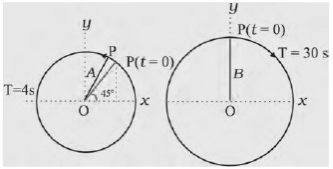
The figure given below depicts two circular motions. The radius of the circle,the period of revolution,the initial position and the sense of revolution are indicated in the figures. Obtain the simple harmonic motions of the $x$-projection of the radius vector of the rotating particle $P$ in each case.
Solution
(N/A) At $t=0$,$OP$ makes an angle of $45^{\circ} = \pi/4 \text{ rad}$ with the positive $x$-axis. After time $t$,it covers an angle of $\frac{2\pi}{T}t$ in the anticlockwise direction,making an angle of $\left(\frac{2\pi}{T}t + \frac{\pi}{4}\right)$ with the $x$-axis. The projection of $OP$ on the $x$-axis at time $t$ is $x(t) = A \cos\left(\frac{2\pi}{T}t + \frac{\pi}{4}\right)$. For $T = 4 \text{ s}$,$x(t) = A \cos\left(\frac{\pi}{2}t + \frac{\pi}{4}\right)$,which is a $SHM$ of amplitude $A$,period $4 \text{ s}$,and initial phase $\pi/4$.
$(b)$ At $t=0$,$OP$ makes an angle of $90^{\circ} = \pi/2 \text{ rad}$ with the $x$-axis. After time $t$,it covers an angle of $\frac{2\pi}{T}t$ in the clockwise direction,making an angle of $\left(\frac{\pi}{2} - \frac{2\pi}{T}t\right)$ with the $x$-axis. The projection of $OP$ on the $x$-axis at time $t$ is $x(t) = B \cos\left(\frac{\pi}{2} - \frac{2\pi}{T}t\right) = B \sin\left(\frac{2\pi}{T}t\right)$. For $T = 30 \text{ s}$,$x(t) = B \sin\left(\frac{\pi}{15}t\right) = B \cos\left(\frac{\pi}{15}t - \frac{\pi}{2}\right)$,which is a $SHM$ of amplitude $B$,period $30 \text{ s}$,and initial phase $-\pi/2$.
$(b)$ At $t=0$,$OP$ makes an angle of $90^{\circ} = \pi/2 \text{ rad}$ with the $x$-axis. After time $t$,it covers an angle of $\frac{2\pi}{T}t$ in the clockwise direction,making an angle of $\left(\frac{\pi}{2} - \frac{2\pi}{T}t\right)$ with the $x$-axis. The projection of $OP$ on the $x$-axis at time $t$ is $x(t) = B \cos\left(\frac{\pi}{2} - \frac{2\pi}{T}t\right) = B \sin\left(\frac{2\pi}{T}t\right)$. For $T = 30 \text{ s}$,$x(t) = B \sin\left(\frac{\pi}{15}t\right) = B \cos\left(\frac{\pi}{15}t - \frac{\pi}{2}\right)$,which is a $SHM$ of amplitude $B$,period $30 \text{ s}$,and initial phase $-\pi/2$.
0 likes
View Solution104
Medium
$A$ body oscillates with $SHM$ according to the equation (in $SI$ units):
$x = 5 \cos (2 \pi t + \pi / 4)$
At $t = 1.5 \, s$,calculate the:
$(a)$ displacement
$(b)$ speed
$(c)$ acceleration of the body.
$x = 5 \cos (2 \pi t + \pi / 4)$
At $t = 1.5 \, s$,calculate the:
$(a)$ displacement
$(b)$ speed
$(c)$ acceleration of the body.
Solution
(N/A) The given equation is $x = 5 \cos (2 \pi t + \pi / 4)$. The angular frequency $\omega = 2 \pi \, rad/s$.
$(a)$ Displacement at $t = 1.5 \, s$:
$x = 5 \cos (2 \pi \times 1.5 + \pi / 4) = 5 \cos (3 \pi + \pi / 4) = 5 \cos (5 \pi / 4) = 5 \times (-1 / \sqrt{2}) \approx -3.535 \, m$.
$(b)$ Speed $v = dx/dt = -5 \times 2 \pi \sin (2 \pi t + \pi / 4)$:
At $t = 1.5 \, s$,$v = -10 \pi \sin (3 \pi + \pi / 4) = -10 \pi \times (-1 / \sqrt{2}) = 10 \pi / \sqrt{2} \approx 22.21 \, m/s$.
$(c)$ Acceleration $a = -\omega^2 x$:
$a = -(2 \pi)^2 \times (-3.535) = 4 \pi^2 \times 3.535 \approx 39.48 \times 3.535 \approx 139.56 \, m/s^2$.
$(a)$ Displacement at $t = 1.5 \, s$:
$x = 5 \cos (2 \pi \times 1.5 + \pi / 4) = 5 \cos (3 \pi + \pi / 4) = 5 \cos (5 \pi / 4) = 5 \times (-1 / \sqrt{2}) \approx -3.535 \, m$.
$(b)$ Speed $v = dx/dt = -5 \times 2 \pi \sin (2 \pi t + \pi / 4)$:
At $t = 1.5 \, s$,$v = -10 \pi \sin (3 \pi + \pi / 4) = -10 \pi \times (-1 / \sqrt{2}) = 10 \pi / \sqrt{2} \approx 22.21 \, m/s$.
$(c)$ Acceleration $a = -\omega^2 x$:
$a = -(2 \pi)^2 \times (-3.535) = 4 \pi^2 \times 3.535 \approx 39.48 \times 3.535 \approx 139.56 \, m/s^2$.
0 likes
View Solution105
Medium
Which of the following examples represent periodic motion?
$(a)$ $A$ swimmer completing one (return) trip from one bank of a river to the other and back.
$(b)$ $A$ freely suspended bar magnet displaced from its $N-S$ direction and released.
$(c)$ $A$ hydrogen molecule rotating about its centre of mass.
$(d)$ An arrow released from a bow.
$(a)$ $A$ swimmer completing one (return) trip from one bank of a river to the other and back.
$(b)$ $A$ freely suspended bar magnet displaced from its $N-S$ direction and released.
$(c)$ $A$ hydrogen molecule rotating about its centre of mass.
$(d)$ An arrow released from a bow.
Solution
(B, C) and $(c)$
The swimmer's motion is not periodic. The motion of the swimmer between the banks of a river is back and forth. However,it does not have a definite period. This is because the time taken by the swimmer during his back and forth journey may not be the same.
The motion of a freely-suspended magnet,if displaced from its $N-S$ direction and released,is periodic. This is because the magnet oscillates about its position with a definite period of time.
When a hydrogen molecule rotates about its centre of mass,it comes to the same position again and again after an equal interval of time. Such motion is periodic.
An arrow released from a bow moves only in the forward direction. It does not come backward. Hence,this motion is not periodic.
The swimmer's motion is not periodic. The motion of the swimmer between the banks of a river is back and forth. However,it does not have a definite period. This is because the time taken by the swimmer during his back and forth journey may not be the same.
The motion of a freely-suspended magnet,if displaced from its $N-S$ direction and released,is periodic. This is because the magnet oscillates about its position with a definite period of time.
When a hydrogen molecule rotates about its centre of mass,it comes to the same position again and again after an equal interval of time. Such motion is periodic.
An arrow released from a bow moves only in the forward direction. It does not come backward. Hence,this motion is not periodic.
0 likes
View Solution106
Medium
Which of the following examples represent (nearly) simple harmonic motion and which represent periodic but not simple harmonic motion?
$(a)$ The rotation of Earth about its axis.
$(b)$ Motion of an oscillating mercury column in a $U$-tube.
$(c)$ Motion of a ball bearing inside a smooth curved bowl,when released from a point slightly above the lowermost point.
$(d)$ General vibrations of a polyatomic molecule about its equilibrium position.
$(a)$ The rotation of Earth about its axis.
$(b)$ Motion of an oscillating mercury column in a $U$-tube.
$(c)$ Motion of a ball bearing inside a smooth curved bowl,when released from a point slightly above the lowermost point.
$(d)$ General vibrations of a polyatomic molecule about its equilibrium position.
Solution
(B, C) and $(c)$ represent simple harmonic motion $(SHM)$,while $(a)$ and $(d)$ represent periodic motion that is not $SHM$.
$(a)$ The rotation of Earth about its axis is a periodic motion because it repeats its orientation at equal intervals of time. However,it is not $SHM$ because it does not involve a to-and-fro motion about a fixed equilibrium point.
$(b)$ An oscillating mercury column in a $U$-tube is $SHM$. The mercury moves to-and-fro along the same path about a fixed equilibrium position with a constant period,satisfying the conditions for $SHM$.
$(c)$ When a ball bearing is released from a point slightly above the lowermost point of a smooth curved bowl,it oscillates to-and-fro about the equilibrium position. For small displacements,the restoring force is proportional to the displacement,making it $SHM$.
$(d)$ The vibrations of a polyatomic molecule are periodic but not $SHM$. $A$ polyatomic molecule has multiple natural frequencies of oscillation,and its overall vibration is a superposition of several different simple harmonic motions.
$(a)$ The rotation of Earth about its axis is a periodic motion because it repeats its orientation at equal intervals of time. However,it is not $SHM$ because it does not involve a to-and-fro motion about a fixed equilibrium point.
$(b)$ An oscillating mercury column in a $U$-tube is $SHM$. The mercury moves to-and-fro along the same path about a fixed equilibrium position with a constant period,satisfying the conditions for $SHM$.
$(c)$ When a ball bearing is released from a point slightly above the lowermost point of a smooth curved bowl,it oscillates to-and-fro about the equilibrium position. For small displacements,the restoring force is proportional to the displacement,making it $SHM$.
$(d)$ The vibrations of a polyatomic molecule are periodic but not $SHM$. $A$ polyatomic molecule has multiple natural frequencies of oscillation,and its overall vibration is a superposition of several different simple harmonic motions.
0 likes
View Solution107
Medium
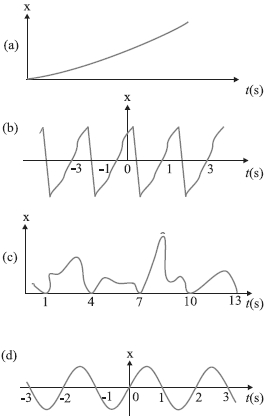
The figure depicts four $x-t$ plots for the linear motion of a particle. Which of the plots represent periodic motion? What is the period of motion (in case of periodic motion)?
Solution
(B AND D) Periodic motion is defined as a motion that repeats itself at regular intervals of time.
$(a)$ This is not a periodic motion. The displacement $x$ increases continuously with time $t$. There is no repetition of the motion.
$(b)$ This is a periodic motion. The particle repeats its motion after every $2 \ s$ (e.g.,from $t = -1 \ s$ to $t = 1 \ s$). The period of motion is $T = 2 \ s$.
$(c)$ This is not a periodic motion. Although the particle returns to the same position,the pattern of motion does not repeat itself in equal intervals of time.
$(d)$ This is a periodic motion. The particle follows a sinusoidal path and repeats its motion after every $2 \ s$ (e.g.,from $t = -1 \ s$ to $t = 1 \ s$). The period of motion is $T = 2 \ s$.
$(a)$ This is not a periodic motion. The displacement $x$ increases continuously with time $t$. There is no repetition of the motion.
$(b)$ This is a periodic motion. The particle repeats its motion after every $2 \ s$ (e.g.,from $t = -1 \ s$ to $t = 1 \ s$). The period of motion is $T = 2 \ s$.
$(c)$ This is not a periodic motion. Although the particle returns to the same position,the pattern of motion does not repeat itself in equal intervals of time.
$(d)$ This is a periodic motion. The particle follows a sinusoidal path and repeats its motion after every $2 \ s$ (e.g.,from $t = -1 \ s$ to $t = 1 \ s$). The period of motion is $T = 2 \ s$.
0 likes
View Solution108
Medium
Which of the following functions of time represent $(a)$ simple harmonic,$(b)$ periodic but not simple harmonic,and $(c)$ non-periodic motion? Give period for each case of periodic motion ($\omega$ is any positive constant):
$(a)$ $\sin \omega t - \cos \omega t$
$(b)$ $\sin^3 \omega t$
$(c)$ $3 \cos (\pi/4 - 2 \omega t)$
$(d)$ $\cos \omega t + \cos 3 \omega t + \cos 5 \omega t$
$(e)$ $\exp(-\omega^2 t^2)$
$(f)$ $1 + \omega t + \omega^2 t^2$
$(a)$ $\sin \omega t - \cos \omega t$
$(b)$ $\sin^3 \omega t$
$(c)$ $3 \cos (\pi/4 - 2 \omega t)$
$(d)$ $\cos \omega t + \cos 3 \omega t + \cos 5 \omega t$
$(e)$ $\exp(-\omega^2 t^2)$
$(f)$ $1 + \omega t + \omega^2 t^2$
Solution
(A) $\sin \omega t - \cos \omega t = \sqrt{2} \sin(\omega t - \pi/4)$. This is $SHM$ with period $T = 2\pi/\omega$.
$(b)$ $\sin^3 \omega t = (3 \sin \omega t - \sin 3 \omega t)/4$. This is a superposition of two $SHM$s,hence periodic but not $SHM$. The period is $T = 2\pi/\omega$.
$(c)$ $3 \cos(\pi/4 - 2 \omega t) = 3 \cos(2 \omega t - \pi/4)$. This is $SHM$ with period $T = 2\pi/(2\omega) = \pi/\omega$.
$(d)$ $\cos \omega t + \cos 3 \omega t + \cos 5 \omega t$. This is a superposition of three $SHM$s,hence periodic but not $SHM$. The period is $T = 2\pi/\omega$.
$(e)$ $\exp(-\omega^2 t^2)$ is a non-periodic motion as it decays to zero as $t \to \infty$.
$(f)$ $1 + \omega t + \omega^2 t^2$ is a non-periodic motion as it increases indefinitely with time.
$(b)$ $\sin^3 \omega t = (3 \sin \omega t - \sin 3 \omega t)/4$. This is a superposition of two $SHM$s,hence periodic but not $SHM$. The period is $T = 2\pi/\omega$.
$(c)$ $3 \cos(\pi/4 - 2 \omega t) = 3 \cos(2 \omega t - \pi/4)$. This is $SHM$ with period $T = 2\pi/(2\omega) = \pi/\omega$.
$(d)$ $\cos \omega t + \cos 3 \omega t + \cos 5 \omega t$. This is a superposition of three $SHM$s,hence periodic but not $SHM$. The period is $T = 2\pi/\omega$.
$(e)$ $\exp(-\omega^2 t^2)$ is a non-periodic motion as it decays to zero as $t \to \infty$.
$(f)$ $1 + \omega t + \omega^2 t^2$ is a non-periodic motion as it increases indefinitely with time.
0 likes
View Solution109
MediumMCQ
Which of the following relationships between the acceleration $a$ and the displacement $x$ of a particle involve simple harmonic motion?
$(a)\; a=0.7 x$
$(b)\; a=-200 x^{2}$
$(c)\; a=-10 x$
$(d)\; a=100 x^{3}$
$(a)\; a=0.7 x$
$(b)\; a=-200 x^{2}$
$(c)\; a=-10 x$
$(d)\; a=100 x^{3}$
A
$a=0.7 x$
B
$a=-200 x^{2}$
C
$a=-10 x$
D
$a=100 x^{3}$
Solution
(C) motion represents simple harmonic motion $(SHM)$ if it is governed by the force law:
$F = -kx \Rightarrow ma = -kx$
$\therefore a = -\left(\frac{k}{m}\right)x$
Where:
$F$ is the restoring force.
$m$ is the mass of the body (a constant).
$x$ is the displacement from the equilibrium position.
$a$ is the acceleration.
$k$ is the force constant.
For $SHM$,the acceleration $a$ must be directly proportional to the negative of the displacement $x$ $(a \propto -x)$.
Among the given equations,only $a = -10x$ follows the form $a = -\omega^2 x$,where $\omega^2 = 10$.
Therefore,the correct relationship is $a = -10x$.
$F = -kx \Rightarrow ma = -kx$
$\therefore a = -\left(\frac{k}{m}\right)x$
Where:
$F$ is the restoring force.
$m$ is the mass of the body (a constant).
$x$ is the displacement from the equilibrium position.
$a$ is the acceleration.
$k$ is the force constant.
For $SHM$,the acceleration $a$ must be directly proportional to the negative of the displacement $x$ $(a \propto -x)$.
Among the given equations,only $a = -10x$ follows the form $a = -\omega^2 x$,where $\omega^2 = 10$.
Therefore,the correct relationship is $a = -10x$.
0 likes
View Solution110
Difficult
The motion of a particle executing simple harmonic motion is described by the displacement function,$x(t) = A \cos (\omega t + \phi)$. If the initial $(t = 0)$ position of the particle is $1 \; cm$ and its initial velocity is $\omega \; cm/s$,what are its amplitude and initial phase angle? The angular frequency of the particle is $\pi \; s^{-1}$. If instead of the cosine function,we choose the sine function to describe the $SHM$: $x = B \sin (\omega t + \alpha)$,what are the amplitude and initial phase of the particle with the above initial conditions?
Solution
(A) Initially,at $t = 0$:
Displacement,$x = 1 \; cm$
Initial velocity,$v = \omega \; cm/s$
Angular frequency,$\omega = \pi \; rad/s$
For $x(t) = A \cos (\omega t + \phi)$:
$1 = A \cos (\omega \times 0 + \phi) = A \cos \phi \implies A \cos \phi = 1 \dots (i)$
Velocity $v = \frac{dx}{dt} = -A \omega \sin (\omega t + \phi)$
$\omega = -A \omega \sin (\phi) \implies A \sin \phi = -1 \dots (ii)$
Squaring and adding $(i)$ and $(ii)$:
$A^2 (\cos^2 \phi + \sin^2 \phi) = 1^2 + (-1)^2 = 2$
$A = \sqrt{2} \; cm$
Dividing $(ii)$ by $(i)$:
$\tan \phi = -1 \implies \phi = \frac{3\pi}{4} \; rad$
For $x = B \sin (\omega t + \alpha)$:
$1 = B \sin (\alpha) \implies B \sin \alpha = 1 \dots (iii)$
Velocity $v = \frac{dx}{dt} = B \omega \cos (\omega t + \alpha)$
$\omega = B \omega \cos (\alpha) \implies B \cos \alpha = 1 \dots (iv)$
Squaring and adding $(iii)$ and $(iv)$:
$B^2 (\sin^2 \alpha + \cos^2 \alpha) = 1^2 + 1^2 = 2$
$B = \sqrt{2} \; cm$
Dividing $(iii)$ by $(iv)$:
$\tan \alpha = 1 \implies \alpha = \frac{\pi}{4} \; rad$
Displacement,$x = 1 \; cm$
Initial velocity,$v = \omega \; cm/s$
Angular frequency,$\omega = \pi \; rad/s$
For $x(t) = A \cos (\omega t + \phi)$:
$1 = A \cos (\omega \times 0 + \phi) = A \cos \phi \implies A \cos \phi = 1 \dots (i)$
Velocity $v = \frac{dx}{dt} = -A \omega \sin (\omega t + \phi)$
$\omega = -A \omega \sin (\phi) \implies A \sin \phi = -1 \dots (ii)$
Squaring and adding $(i)$ and $(ii)$:
$A^2 (\cos^2 \phi + \sin^2 \phi) = 1^2 + (-1)^2 = 2$
$A = \sqrt{2} \; cm$
Dividing $(ii)$ by $(i)$:
$\tan \phi = -1 \implies \phi = \frac{3\pi}{4} \; rad$
For $x = B \sin (\omega t + \alpha)$:
$1 = B \sin (\alpha) \implies B \sin \alpha = 1 \dots (iii)$
Velocity $v = \frac{dx}{dt} = B \omega \cos (\omega t + \alpha)$
$\omega = B \omega \cos (\alpha) \implies B \cos \alpha = 1 \dots (iv)$
Squaring and adding $(iii)$ and $(iv)$:
$B^2 (\sin^2 \alpha + \cos^2 \alpha) = 1^2 + 1^2 = 2$
$B = \sqrt{2} \; cm$
Dividing $(iii)$ by $(iv)$:
$\tan \alpha = 1 \implies \alpha = \frac{\pi}{4} \; rad$
0 likes
View Solution111
Medium
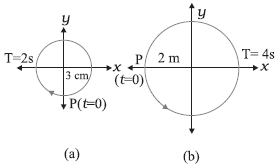
The figures correspond to two circular motions. The radius of the circle,the period of revolution,the initial position,and the sense of revolution (i.e.,clockwise or anti-clockwise) are indicated on each figure. Obtain the corresponding simple harmonic motions of the $x$-projection of the radius vector of the revolving particle $P$,in each case.
Solution
(N/A) For figure $(a)$:
Time period,$T = 2 \, s$
Amplitude,$A = 3 \, cm$
At time $t = 0$,the particle $P$ is at the negative $y$-axis. The angle made by the radius vector $OP$ with the positive $x$-axis is $\phi = -\frac{\pi}{2}$ (or $\frac{3\pi}{2}$).
The equation of simple harmonic motion for the $x$-projection is given by $x = A \cos \left( \frac{2\pi t}{T} + \phi \right)$.
Substituting the values: $x = 3 \cos \left( \frac{2\pi t}{2} - \frac{\pi}{2} \right) = 3 \cos \left( \pi t - \frac{\pi}{2} \right) = 3 \sin(\pi t) \, cm$.
For figure $(b)$:
Time period,$T = 4 \, s$
Amplitude,$A = 2 \, m$
At time $t = 0$,the particle $P$ is at the negative $x$-axis. The angle made by the radius vector $OP$ with the positive $x$-axis is $\phi = \pi$.
The equation of simple harmonic motion for the $x$-projection is given by $x = A \cos \left( \frac{2\pi t}{T} + \phi \right)$.
Substituting the values: $x = 2 \cos \left( \frac{2\pi t}{4} + \pi \right) = 2 \cos \left( \frac{\pi t}{2} + \pi \right) = -2 \cos \left( \frac{\pi t}{2} \right) \, m$.
Time period,$T = 2 \, s$
Amplitude,$A = 3 \, cm$
At time $t = 0$,the particle $P$ is at the negative $y$-axis. The angle made by the radius vector $OP$ with the positive $x$-axis is $\phi = -\frac{\pi}{2}$ (or $\frac{3\pi}{2}$).
The equation of simple harmonic motion for the $x$-projection is given by $x = A \cos \left( \frac{2\pi t}{T} + \phi \right)$.
Substituting the values: $x = 3 \cos \left( \frac{2\pi t}{2} - \frac{\pi}{2} \right) = 3 \cos \left( \pi t - \frac{\pi}{2} \right) = 3 \sin(\pi t) \, cm$.
For figure $(b)$:
Time period,$T = 4 \, s$
Amplitude,$A = 2 \, m$
At time $t = 0$,the particle $P$ is at the negative $x$-axis. The angle made by the radius vector $OP$ with the positive $x$-axis is $\phi = \pi$.
The equation of simple harmonic motion for the $x$-projection is given by $x = A \cos \left( \frac{2\pi t}{T} + \phi \right)$.
Substituting the values: $x = 2 \cos \left( \frac{2\pi t}{4} + \pi \right) = 2 \cos \left( \frac{\pi t}{2} + \pi \right) = -2 \cos \left( \frac{\pi t}{2} \right) \, m$.
0 likes
View Solution112
Medium
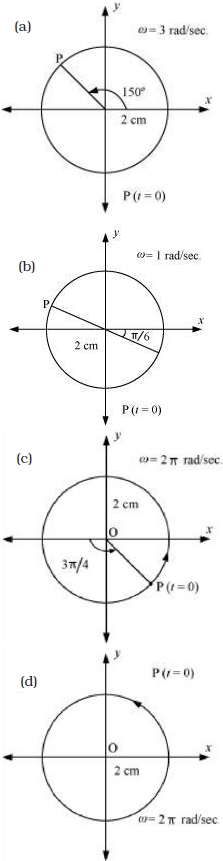
Plot the corresponding reference circle for each of the following simple harmonic motions. Indicate the initial $(t = 0)$ position of the particle,the radius of the circle,and the angular speed of the rotating particle. For simplicity,the sense of rotation may be fixed to be anticlockwise in every case: ($x$ is in $cm$ and $t$ is in $s$).
$(a)\; x = -2 \sin (3t + \pi/3)$
$(b)\; x = \cos (\pi/6 - t)$
$(c)\; x = 3 \sin (2\pi t + \pi/4)$
$(d)\; x = 2 \cos \pi t$
$(a)\; x = -2 \sin (3t + \pi/3)$
$(b)\; x = \cos (\pi/6 - t)$
$(c)\; x = 3 \sin (2\pi t + \pi/4)$
$(d)\; x = 2 \cos \pi t$
Solution
(N/A) The general equation for $SHM$ is $x = A \cos (\omega t + \phi)$.
$(a)\; x = -2 \sin (3t + \pi/3) = 2 \cos (3t + \pi/3 + \pi/2) = 2 \cos (3t + 5\pi/6)$.
Comparing with $x = A \cos (\omega t + \phi)$,we get $A = 2 \text{ cm}$,$\omega = 3 \text{ rad/s}$,and $\phi = 5\pi/6 = 150^{\circ}$.
$(b)\; x = \cos (\pi/6 - t) = \cos (t - \pi/6)$.
Comparing with $x = A \cos (\omega t + \phi)$,we get $A = 1 \text{ cm}$,$\omega = 1 \text{ rad/s}$,and $\phi = -\pi/6 = -30^{\circ}$.
$(c)\; x = 3 \sin (2\pi t + \pi/4) = 3 \cos (2\pi t + \pi/4 - \pi/2) = 3 \cos (2\pi t - \pi/4)$.
Comparing with $x = A \cos (\omega t + \phi)$,we get $A = 3 \text{ cm}$,$\omega = 2\pi \text{ rad/s}$,and $\phi = -\pi/4 = -45^{\circ}$.
$(d)\; x = 2 \cos (\pi t)$.
Comparing with $x = A \cos (\omega t + \phi)$,we get $A = 2 \text{ cm}$,$\omega = \pi \text{ rad/s}$,and $\phi = 0$.
$(a)\; x = -2 \sin (3t + \pi/3) = 2 \cos (3t + \pi/3 + \pi/2) = 2 \cos (3t + 5\pi/6)$.
Comparing with $x = A \cos (\omega t + \phi)$,we get $A = 2 \text{ cm}$,$\omega = 3 \text{ rad/s}$,and $\phi = 5\pi/6 = 150^{\circ}$.
$(b)\; x = \cos (\pi/6 - t) = \cos (t - \pi/6)$.
Comparing with $x = A \cos (\omega t + \phi)$,we get $A = 1 \text{ cm}$,$\omega = 1 \text{ rad/s}$,and $\phi = -\pi/6 = -30^{\circ}$.
$(c)\; x = 3 \sin (2\pi t + \pi/4) = 3 \cos (2\pi t + \pi/4 - \pi/2) = 3 \cos (2\pi t - \pi/4)$.
Comparing with $x = A \cos (\omega t + \phi)$,we get $A = 3 \text{ cm}$,$\omega = 2\pi \text{ rad/s}$,and $\phi = -\pi/4 = -45^{\circ}$.
$(d)\; x = 2 \cos (\pi t)$.
Comparing with $x = A \cos (\omega t + \phi)$,we get $A = 2 \text{ cm}$,$\omega = \pi \text{ rad/s}$,and $\phi = 0$.
0 likes
View Solution113
EasyMCQ
Study of which motion is required to understand many physical phenomena?
A
Linear motion
B
Oscillatory motion
C
Circular motion
D
Projectile motion
Solution
(B) The study of oscillatory motion is essential to understand many physical phenomena. Oscillatory motion is a type of periodic motion where a body moves back and forth about a mean position. Many natural phenomena,such as the vibration of atoms in a solid,the propagation of sound waves,and the behavior of electromagnetic waves,are fundamentally based on the principles of oscillatory motion.
0 likes
View Solution114
EasyMCQ
Which concepts are needed for the description of a periodic motion?
A
Period and frequency
B
Displacement and amplitude
C
Phase
D
All of the above
Solution
(D) For the description of periodic motion,basic concepts such as period $(T)$,frequency ($f$ or $\nu$),displacement $(x)$,amplitude $(A)$,and phase $(\phi)$ are required.
These parameters collectively define the state,timing,and extent of the motion.
These parameters collectively define the state,timing,and extent of the motion.
0 likes
View Solution115
MediumMCQ
Generation and propagation of sound and electromagnetic waves can be understood by which motion?
A
Linear motion
B
Periodic motion
C
Circular motion
D
Random motion
Solution
(B) The generation and propagation of sound waves (mechanical waves) and electromagnetic waves involve the oscillation of particles or fields about an equilibrium position.
These oscillations repeat themselves at regular intervals of time.
Such a motion,which repeats itself after a fixed interval of time,is known as periodic motion.
Therefore,the fundamental nature of wave propagation is based on periodic motion.
These oscillations repeat themselves at regular intervals of time.
Such a motion,which repeats itself after a fixed interval of time,is known as periodic motion.
Therefore,the fundamental nature of wave propagation is based on periodic motion.
0 likes
View Solution116
Easy
What is periodic motion? Give its examples.
Solution
(N/A) Periodic motion is defined as the motion of a body that repeats itself along a certain path at regular,definite intervals of time.
Examples:
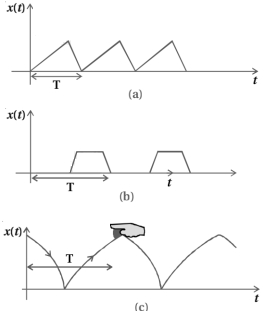
$(1)$ An insect climbs up a ramp and falls down; it returns to the initial point and repeats the process identically. If we plot a graph of its height above the ground versus time,it resembles figure $(a)$.
$(2)$ If a child climbs up a step,comes down,and repeats the process,its height above the ground versus time graph resembles figure $(b)$.
$(3)$ When playing a game of bouncing a ball on the ground between your palm and the ground,its height versus time graph resembles figure $(c)$.
Examples:
$(1)$ An insect climbs up a ramp and falls down; it returns to the initial point and repeats the process identically. If we plot a graph of its height above the ground versus time,it resembles figure $(a)$.
$(2)$ If a child climbs up a step,comes down,and repeats the process,its height above the ground versus time graph resembles figure $(b)$.
$(3)$ When playing a game of bouncing a ball on the ground between your palm and the ground,its height versus time graph resembles figure $(c)$.
0 likes
View Solution117
Easy
What is oscillatory motion? Give its examples.
Solution
(N/A) If a body moves to and fro,back and forth,or up and down about a fixed point in a definite interval of time,such a motion is called an oscillatory motion.
For example:
$(1)$ $A$ ball placed in a bowl will be in equilibrium at the bottom. If displaced a little from this point,it will perform oscillations in the bowl.
$(2)$ The motion of the pendulum of a wall clock is an oscillatory motion.
$(3)$ The motion of a loaded spring,when the load attached to the spring is pulled once a little from its mean position and released.
Every oscillatory motion is periodic,but every periodic motion need not be oscillatory.
Restoring force is produced in such type of motion; hence,no external force is constantly needed for the continuation of this motion. Such type of motion is also known as harmonic motion.
For example:
$(1)$ $A$ ball placed in a bowl will be in equilibrium at the bottom. If displaced a little from this point,it will perform oscillations in the bowl.
$(2)$ The motion of the pendulum of a wall clock is an oscillatory motion.
$(3)$ The motion of a loaded spring,when the load attached to the spring is pulled once a little from its mean position and released.
Every oscillatory motion is periodic,but every periodic motion need not be oscillatory.
Restoring force is produced in such type of motion; hence,no external force is constantly needed for the continuation of this motion. Such type of motion is also known as harmonic motion.
0 likes
View Solution118
Medium
Define simple harmonic motion and write its important characteristics.
Solution
(N/A) Simple Harmonic Motion $(SHM)$ is defined as the periodic motion of a body about a fixed point on a linear path,where the restoring force acting on the body is always directed towards the fixed point (mean position) and is directly proportional to the displacement of the body from that fixed point.
Mathematically,this is expressed as $F = -kx$,where $F$ is the restoring force,$x$ is the displacement from the mean position,and $k$ is the force constant.
Important characteristics of $SHM$:
$1$. The motion is periodic and oscillatory.
$2$. The restoring force is always directed towards the mean position.
$3$. The magnitude of the restoring force is directly proportional to the displacement from the mean position $(F \propto x)$.
$4$. The acceleration of the particle is also proportional to the displacement and directed towards the mean position $(a = -\omega^2 x)$.
$5$. $A$ body performing simple harmonic motion is called a Simple Harmonic Oscillator.
Mathematically,this is expressed as $F = -kx$,where $F$ is the restoring force,$x$ is the displacement from the mean position,and $k$ is the force constant.
Important characteristics of $SHM$:
$1$. The motion is periodic and oscillatory.
$2$. The restoring force is always directed towards the mean position.
$3$. The magnitude of the restoring force is directly proportional to the displacement from the mean position $(F \propto x)$.
$4$. The acceleration of the particle is also proportional to the displacement and directed towards the mean position $(a = -\omega^2 x)$.
$5$. $A$ body performing simple harmonic motion is called a Simple Harmonic Oscillator.
0 likes
View Solution119
Medium
What is the difference between periodic motion and simple harmonic motion?
Solution
(N/A)
| Periodic Motion | Simple Harmonic Motion $(SHM)$ |
|---|---|
| $(1)$ All $SHM$ is periodic motion,but not all periodic motion is $SHM$. | $(1)$ $SHM$ is a specific type of periodic motion. |
| $(2)$ The restoring force is not necessarily proportional to the displacement from the mean position. | $(2)$ The restoring force is always directly proportional to the displacement and directed towards the mean position $(F = -kx)$. |
0 likes
View Solution120
Medium
Write the difference between oscillations and vibrations.
Solution
(N/A)
| Oscillations | Vibrations |
|---|---|
| $(1)$ $A$ body performing oscillations typically has a lower frequency. | $(1)$ $A$ body performing vibrations typically has a higher frequency. |
| $(2)$ Example: The oscillation of tree branches. | $(2)$ Example: The vibrations of the string of a musical instrument. |
0 likes
View Solution121
Medium
Define periodic time and frequency. State their $SI$ units,dimensional formulas,and the relationship between them.
Solution
(N/A) Periodic Time: The smallest interval of time after which the motion is repeated is called its period. It is the time required to complete one oscillation. It is denoted by $T$. Its $SI$ unit is second $(s)$. The dimensional formula is $[M^0 L^0 T^1]$.
Frequency: The number of oscillations completed in one second is called frequency. It is denoted by $f$ or $\nu$. Its $SI$ unit is $Hz$ (Hertz) or $s^{-1}$. The dimensional formula is $[M^0 L^0 T^{-1}]$.
Relationship: Frequency is the reciprocal of periodic time. Mathematically,$f = \frac{1}{T}$ or $T = \frac{1}{f}$.
Frequency: The number of oscillations completed in one second is called frequency. It is denoted by $f$ or $\nu$. Its $SI$ unit is $Hz$ (Hertz) or $s^{-1}$. The dimensional formula is $[M^0 L^0 T^{-1}]$.
Relationship: Frequency is the reciprocal of periodic time. Mathematically,$f = \frac{1}{T}$ or $T = \frac{1}{f}$.
0 likes
View Solution122
Medium
What is displacement? Explain its general meaning by giving examples.
Solution
(N/A) Displacement: The distance of an oscillator (a body performing simple harmonic motion) at any instant from its equilibrium (fixed or reference) position is called the displacement of the oscillator at that instant.
The displacement is considered positive on one side of the equilibrium point and negative on the other side. In short,displacement can have zero,positive,or negative values.
Displacement refers to the change with time of any physical property under consideration. Its examples are as follows:
$(1)$ In the case of rectilinear motion of a steel ball on a surface,the distance from the starting point as a function of time is its position displacement. The choice of origin is a matter of convenience.
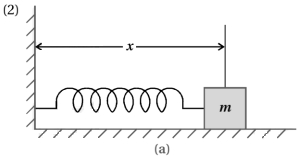
$(2)$ Consider a block of mass $m$ attached to a spring,the other end of which is fixed to a rigid wall,as shown in figure $(a)$. The block moves on a frictionless surface. The motion of the block can be described in terms of its distance or displacement $x$ from the wall.
The displacement is considered positive on one side of the equilibrium point and negative on the other side. In short,displacement can have zero,positive,or negative values.
Displacement refers to the change with time of any physical property under consideration. Its examples are as follows:
$(1)$ In the case of rectilinear motion of a steel ball on a surface,the distance from the starting point as a function of time is its position displacement. The choice of origin is a matter of convenience.
$(2)$ Consider a block of mass $m$ attached to a spring,the other end of which is fixed to a rigid wall,as shown in figure $(a)$. The block moves on a frictionless surface. The motion of the block can be described in terms of its distance or displacement $x$ from the wall.
0 likes
View Solution123
Medium
Explain periodic function.
Solution
(N/A) periodic function is a function that repeats its values in regular intervals or periods.
In physics,periodic functions are used to represent periodic motion.
The simplest periodic functions are the sine and cosine functions.
Consider the function $f(t) = A \cos \omega t$.
The periodic time $T$ of this function is $T = \frac{2 \pi}{\omega}$,because when the argument $\omega t$ is increased by an integral multiple of $2 \pi$ radians,the value of the function remains the same.
Thus,the function $f(t)$ is periodic with period $T$,satisfying $f(t) = f(t + T)$.
Similarly,$f(t) = A \sin \omega t$ is a periodic function with the same period $T$.
$A$ linear combination of sine and cosine functions,$f(t) = A \sin \omega t + B \cos \omega t$,is also a periodic function with period $T$.
We can express this as $f(t) = D \sin(\omega t + \phi)$,where $D = \sqrt{A^2 + B^2}$ is the resultant amplitude and $\phi$ is the phase constant.
In physics,periodic functions are used to represent periodic motion.
The simplest periodic functions are the sine and cosine functions.
Consider the function $f(t) = A \cos \omega t$.
The periodic time $T$ of this function is $T = \frac{2 \pi}{\omega}$,because when the argument $\omega t$ is increased by an integral multiple of $2 \pi$ radians,the value of the function remains the same.
Thus,the function $f(t)$ is periodic with period $T$,satisfying $f(t) = f(t + T)$.
Similarly,$f(t) = A \sin \omega t$ is a periodic function with the same period $T$.
$A$ linear combination of sine and cosine functions,$f(t) = A \sin \omega t + B \cos \omega t$,is also a periodic function with period $T$.
We can express this as $f(t) = D \sin(\omega t + \phi)$,where $D = \sqrt{A^2 + B^2}$ is the resultant amplitude and $\phi$ is the phase constant.
0 likes
View Solution124
Medium
What is the importance of periodic $\text{sine}$ and $\text{cosine}$ functions in physics?
Solution
(N/A) Periodic $\text{sine}$ and $\text{cosine}$ functions are fundamental because any complex periodic function can be expressed as a superposition (sum) of $\text{sine}$ and $\text{cosine}$ functions of different frequencies and amplitudes,a concept known as $\text{Fourier}$ series. This allows physicists to analyze complex oscillatory motions by breaking them down into simpler,manageable harmonic components.
0 likes
View Solution125
Medium
Define periodic motion and oscillatory motion.
Solution
(N/A) $1$. Periodic Motion: $A$ motion that repeats itself at regular intervals of time is called periodic motion. For example,the revolution of the Earth around the Sun or the motion of the hands of a clock.
$2$. Oscillatory Motion: $A$ motion in which a body moves to and fro or back and forth about a fixed point (mean position) is called oscillatory motion. For example,the motion of a simple pendulum or the vibration of a string in a musical instrument.
Note: All oscillatory motions are periodic,but not all periodic motions are oscillatory.
$2$. Oscillatory Motion: $A$ motion in which a body moves to and fro or back and forth about a fixed point (mean position) is called oscillatory motion. For example,the motion of a simple pendulum or the vibration of a string in a musical instrument.
Note: All oscillatory motions are periodic,but not all periodic motions are oscillatory.
0 likes
View Solution126
Medium
Write the difference between periodic and simple harmonic motion.
Solution
(N/A) $1$. Periodic Motion: Any motion that repeats itself at regular intervals of time is called periodic motion. It does not necessarily require a restoring force proportional to displacement. Example: The motion of the Earth around the Sun.
$2$. Simple Harmonic Motion $(SHM)$: It is a special type of periodic motion where the restoring force is directly proportional to the displacement from the mean position and is directed towards the mean position. The equation of motion is given by $F = -kx$,where $k$ is the force constant and $x$ is the displacement. Example: The motion of a simple pendulum for small amplitudes.
$2$. Simple Harmonic Motion $(SHM)$: It is a special type of periodic motion where the restoring force is directly proportional to the displacement from the mean position and is directed towards the mean position. The equation of motion is given by $F = -kx$,where $k$ is the force constant and $x$ is the displacement. Example: The motion of a simple pendulum for small amplitudes.
0 likes
View Solution127
Medium
Define simple harmonic motion. Write important characteristics of simple harmonic motion.
Solution
(N/A) Simple Harmonic Motion $(SHM)$ is a special type of periodic motion where the restoring force is directly proportional to the displacement from the mean position and is always directed towards the mean position. Mathematically,$F = -kx$,where $k$ is the force constant and $x$ is the displacement.
Important characteristics of $SHM$ are:
$1$. The motion is periodic and oscillatory.
$2$. The restoring force is always proportional to the displacement $(F \propto -x)$.
$3$. The acceleration of the particle is proportional to the displacement and directed towards the mean position $(a = -\omega^2 x)$.
$4$. The total mechanical energy of the system remains conserved.
$5$. The motion can be represented by a sine or cosine function,such as $x(t) = A \sin(\omega t + \phi)$.
Important characteristics of $SHM$ are:
$1$. The motion is periodic and oscillatory.
$2$. The restoring force is always proportional to the displacement $(F \propto -x)$.
$3$. The acceleration of the particle is proportional to the displacement and directed towards the mean position $(a = -\omega^2 x)$.
$4$. The total mechanical energy of the system remains conserved.
$5$. The motion can be represented by a sine or cosine function,such as $x(t) = A \sin(\omega t + \phi)$.
0 likes
View Solution128
Medium
Write the difference between oscillation and vibrations.
Solution
(N/A) $1$. Definition: Oscillation is a general term for any periodic motion of a body about a mean position. Vibration is a specific type of oscillation that occurs at a relatively high frequency.
$2$. Frequency: Oscillations can occur at any frequency,including very low frequencies (e.g.,a pendulum swinging). Vibrations typically involve high-frequency oscillations (e.g.,the strings of a guitar or the diaphragm of a speaker).
$3$. Context: The term 'oscillation' is often used in the context of mechanics and large-scale systems (like a swing or a pendulum). The term 'vibration' is commonly used in the context of acoustics,structural engineering,and molecular dynamics.
$4$. Examples: $A$ simple pendulum swinging is an oscillation. The rapid movement of a tuning fork or a vibrating string is a vibration.
$2$. Frequency: Oscillations can occur at any frequency,including very low frequencies (e.g.,a pendulum swinging). Vibrations typically involve high-frequency oscillations (e.g.,the strings of a guitar or the diaphragm of a speaker).
$3$. Context: The term 'oscillation' is often used in the context of mechanics and large-scale systems (like a swing or a pendulum). The term 'vibration' is commonly used in the context of acoustics,structural engineering,and molecular dynamics.
$4$. Examples: $A$ simple pendulum swinging is an oscillation. The rapid movement of a tuning fork or a vibrating string is a vibration.
0 likes
View Solution129
Medium
Define periodic time and frequency,their units,and the relationship between them.
Solution
(N/A) $1$. Periodic Time $(T)$: It is defined as the time taken by an oscillating particle to complete one full oscillation. Its $SI$ unit is second $(s)$.
$2$. Frequency ($f$ or $\nu$): It is defined as the number of oscillations completed by a particle in one second. Its $SI$ unit is Hertz $(Hz)$,where $1 \ Hz = 1 \ s^{-1}$.
$3$. Relationship: The frequency is the reciprocal of the periodic time. Mathematically,$f = \frac{1}{T}$ or $T = \frac{1}{f}$.
$2$. Frequency ($f$ or $\nu$): It is defined as the number of oscillations completed by a particle in one second. Its $SI$ unit is Hertz $(Hz)$,where $1 \ Hz = 1 \ s^{-1}$.
$3$. Relationship: The frequency is the reciprocal of the periodic time. Mathematically,$f = \frac{1}{T}$ or $T = \frac{1}{f}$.
0 likes
View Solution130
Difficult
Define displacement variable and periodic function.
Solution
(N/A) $1$. Displacement Variable: In the context of oscillatory motion,the displacement variable represents the change in position of an object from its mean (equilibrium) position at any given time $t$. It is typically denoted by $x(t)$ or $y(t)$.
$2$. Periodic Function: $A$ function is called periodic if it repeats its values at regular intervals of time. Mathematically,a function $f(t)$ is periodic if $f(t + T) = f(t)$ for all $t$,where $T$ is a positive constant known as the time period of the function.
$2$. Periodic Function: $A$ function is called periodic if it repeats its values at regular intervals of time. Mathematically,a function $f(t)$ is periodic if $f(t + T) = f(t)$ for all $t$,where $T$ is a positive constant known as the time period of the function.
0 likes
View Solution131
Difficult
Why is the periodic time $T = \frac{2\pi}{\omega}$ taken for the function $f(t) = A \cos \omega t$?
Solution
(N/A) The periodic time $T$ is defined as the smallest positive time interval after which the function repeats its value.
For the function $f(t) = A \cos \omega t$,the condition for periodicity is $f(t + T) = f(t)$.
Substituting the function,we get $A \cos \omega(t + T) = A \cos \omega t$.
This implies $\cos(\omega t + \omega T) = \cos \omega t$.
We know that the cosine function repeats its value after an interval of $2\pi$,i.e.,$\cos(\theta + 2\pi) = \cos \theta$.
Comparing the arguments,we have $\omega T = 2\pi$.
Therefore,the periodic time is $T = \frac{2\pi}{\omega}$.
For the function $f(t) = A \cos \omega t$,the condition for periodicity is $f(t + T) = f(t)$.
Substituting the function,we get $A \cos \omega(t + T) = A \cos \omega t$.
This implies $\cos(\omega t + \omega T) = \cos \omega t$.
We know that the cosine function repeats its value after an interval of $2\pi$,i.e.,$\cos(\theta + 2\pi) = \cos \theta$.
Comparing the arguments,we have $\omega T = 2\pi$.
Therefore,the periodic time is $T = \frac{2\pi}{\omega}$.
0 likes
View Solution132
Difficult
Define simple harmonic motion and explain it.
Solution
(N/A) Simple Harmonic Motion $(SHM)$: The periodic motion about a fixed point on a linear path under the influence of a restoring force that acts towards the fixed point and is directly proportional to the displacement of the body from that fixed point is called Simple Harmonic Motion.
Alternatively,simple harmonic motion is a periodic motion in which the displacement is a sinusoidal function of time.
In an oscillatory motion,a restoring force is exerted towards the mean position from any point. Therefore,in simple harmonic motion,the displacement $x$ of a particle from the origin varies with time $t$ as:
$x(t) = A \cos (\omega t + \phi)$
where $A$ is the amplitude,$\omega$ is the angular frequency,and $\phi$ is the initial phase constant.
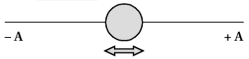
The figure shows a particle oscillating back and forth about the origin of an $X$-axis between the limits $+A$ and $-A$.
Alternatively,simple harmonic motion is a periodic motion in which the displacement is a sinusoidal function of time.
In an oscillatory motion,a restoring force is exerted towards the mean position from any point. Therefore,in simple harmonic motion,the displacement $x$ of a particle from the origin varies with time $t$ as:
$x(t) = A \cos (\omega t + \phi)$
where $A$ is the amplitude,$\omega$ is the angular frequency,and $\phi$ is the initial phase constant.
The figure shows a particle oscillating back and forth about the origin of an $X$-axis between the limits $+A$ and $-A$.
0 likes
View Solution133
Difficult
Draw a graph of displacement versus time as a function of time in simple harmonic motion.
Solution
(N/A) The graph of displacement $x$ versus time $t$ represents the displacement as a continuous function of time. This is given by the equation $x(t) = A \cos(\omega t + \phi)$.
Here,$A$,$\omega$,and $\phi$ are constants that determine the characteristics of $SHM$.
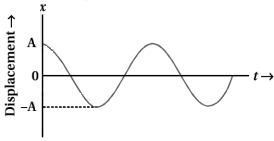
The graph of displacement as a continuous function of time for simple harmonic motion is shown below:
[Graph showing a cosine wave starting at $x = A$ at $t = 0$,oscillating between $A$ and $-A$]
The standard symbols in the equation $x(t) = A \cos(\omega t + \phi)$ are defined as follows:
$x(t)$: Displacement $x$ as a function of time $t$
$A$: Amplitude
$\omega$: Angular frequency
$\omega t + \phi$: Phase (Time-Dependent)
$\phi$: Phase constant
Here,$A$,$\omega$,and $\phi$ are constants that determine the characteristics of $SHM$.
The graph of displacement as a continuous function of time for simple harmonic motion is shown below:
[Graph showing a cosine wave starting at $x = A$ at $t = 0$,oscillating between $A$ and $-A$]
The standard symbols in the equation $x(t) = A \cos(\omega t + \phi)$ are defined as follows:
$x(t)$: Displacement $x$ as a function of time $t$
$A$: Amplitude
$\omega$: Angular frequency
$\omega t + \phi$: Phase (Time-Dependent)
$\phi$: Phase constant
0 likes
View Solution134
Medium
Define the amplitude of $SHM$ and draw two different $SHM$s in one figure having two different amplitudes.
Solution
(N/A) Amplitude: The magnitude of the maximum displacement of the particle executing $SHM$ from its mean position is called the amplitude of the $SHM$.
The symbol for amplitude is $A$ or $a$,and its $SI$ unit is $m$. The dimensional formula is $[M^0 L^1 T^0]$.
The displacement of an $SHM$ particle oscillates between two extreme points $+A$ and $-A$.
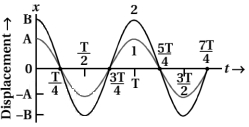
The plot of displacement as a function of time with initial phase $\phi = 0$ for two different amplitudes is shown in the figure. The curves $1$ and $2$ represent $SHM$s with amplitudes $A$ and $B$ respectively,where $x(t) = A \cos \omega t$ and $x(t) = B \cos \omega t$.
The symbol for amplitude is $A$ or $a$,and its $SI$ unit is $m$. The dimensional formula is $[M^0 L^1 T^0]$.
The displacement of an $SHM$ particle oscillates between two extreme points $+A$ and $-A$.
The plot of displacement as a function of time with initial phase $\phi = 0$ for two different amplitudes is shown in the figure. The curves $1$ and $2$ represent $SHM$s with amplitudes $A$ and $B$ respectively,where $x(t) = A \cos \omega t$ and $x(t) = B \cos \omega t$.
0 likes
View Solution135
Medium
Define periodic time and angular frequency and obtain the relation between them.
Solution
(N/A) Periodic time: The time taken by an oscillator to complete one full oscillation is called periodic time $(T)$.
Angular frequency: The product of $2\pi$ and the frequency of an oscillator is called angular frequency $(\omega)$.
The displacement of a particle in Simple Harmonic Motion $(SHM)$ with amplitude $A$ and initial phase $\phi = 0$ at time $t$ is given by:
$x(t) = A \sin(\omega t)$ ... $(1)$
Since the motion is periodic with period $T$,the displacement repeats after time $T$:
$x(t) = x(t + T)$
$A \sin(\omega t) = A \sin(\omega(t + T))$
Since the sine function is periodic with a period of $2\pi$,the phase must increase by $2\pi$ for the motion to repeat:
$\omega(t + T) = \omega t + 2\pi$
$\omega t + \omega T = \omega t + 2\pi$
$\omega T = 2\pi$
Therefore,the relation is:
$\omega = \frac{2\pi}{T}$
Since frequency $v = \frac{1}{T}$,we can also write:
$\omega = 2\pi v$
Angular frequency: The product of $2\pi$ and the frequency of an oscillator is called angular frequency $(\omega)$.
The displacement of a particle in Simple Harmonic Motion $(SHM)$ with amplitude $A$ and initial phase $\phi = 0$ at time $t$ is given by:
$x(t) = A \sin(\omega t)$ ... $(1)$
Since the motion is periodic with period $T$,the displacement repeats after time $T$:
$x(t) = x(t + T)$
$A \sin(\omega t) = A \sin(\omega(t + T))$
Since the sine function is periodic with a period of $2\pi$,the phase must increase by $2\pi$ for the motion to repeat:
$\omega(t + T) = \omega t + 2\pi$
$\omega t + \omega T = \omega t + 2\pi$
$\omega T = 2\pi$
Therefore,the relation is:
$\omega = \frac{2\pi}{T}$
Since frequency $v = \frac{1}{T}$,we can also write:
$\omega = 2\pi v$
0 likes
View Solution136
Medium
Draw plots for initial phase $\phi = 0$ for different periods.
Solution
(N/A) The general equation for simple harmonic motion is $x(t) = A \sin(\omega t + \phi)$.
Given the initial phase $\phi = 0$,the equation becomes $x(t) = A \sin(\omega t)$.
This represents a sine wave starting from the origin at $t = 0$. However,if the motion starts from the extreme position,the equation is $x(t) = A \cos(\omega t)$.
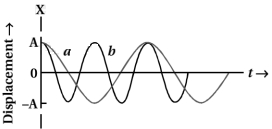
The provided graph shows displacement versus time for two different periods.
In this plot,curve $(b)$ has half the period $(T_b = T_a / 2)$ and twice the frequency $(f_b = 2f_a)$ compared to curve $(a)$.
Given the initial phase $\phi = 0$,the equation becomes $x(t) = A \sin(\omega t)$.
This represents a sine wave starting from the origin at $t = 0$. However,if the motion starts from the extreme position,the equation is $x(t) = A \cos(\omega t)$.
The provided graph shows displacement versus time for two different periods.
In this plot,curve $(b)$ has half the period $(T_b = T_a / 2)$ and twice the frequency $(f_b = 2f_a)$ compared to curve $(a)$.
0 likes
View Solution137
Medium
Define simple harmonic motion $(SHM)$.
Solution
(N/A) Simple harmonic motion $(SHM)$ is a special type of periodic motion where the restoring force acting on a particle is directly proportional to its displacement from the mean position and is always directed towards the mean position.
Mathematically,it is expressed as $F = -kx$,where $F$ is the restoring force,$x$ is the displacement from the equilibrium position,and $k$ is the force constant.
In $SHM$,the acceleration of the particle is also proportional to its displacement and is given by $a = -\omega^2 x$,where $\omega$ is the angular frequency.
Mathematically,it is expressed as $F = -kx$,where $F$ is the restoring force,$x$ is the displacement from the equilibrium position,and $k$ is the force constant.
In $SHM$,the acceleration of the particle is also proportional to its displacement and is given by $a = -\omega^2 x$,where $\omega$ is the angular frequency.
0 likes
View Solution138
Medium
Draw a graph of displacement of $SHM$ as a function of time.
Solution
The displacement $x(t)$ of a particle executing Simple Harmonic Motion $(SHM)$ is given by the equation: $x(t) = A \sin(\omega t + \phi)$,where $A$ is the amplitude,$\omega$ is the angular frequency,and $\phi$ is the initial phase constant.
Assuming the particle starts from the mean position at $t = 0$ with $\phi = 0$,the equation simplifies to $x(t) = A \sin(\omega t)$.
The graph of $x(t)$ versus $t$ is a sinusoidal wave.
$1$. At $t = 0$,$x = 0$.
$2$. At $t = T/4$,$x = A$ (maximum positive displacement).
$3$. At $t = T/2$,$x = 0$.
$4$. At $t = 3T/4$,$x = -A$ (maximum negative displacement).
$5$. At $t = T$,$x = 0$.
The graph oscillates between $+A$ and $-A$ with a period $T = 2\pi/\omega$.
Assuming the particle starts from the mean position at $t = 0$ with $\phi = 0$,the equation simplifies to $x(t) = A \sin(\omega t)$.
The graph of $x(t)$ versus $t$ is a sinusoidal wave.
$1$. At $t = 0$,$x = 0$.
$2$. At $t = T/4$,$x = A$ (maximum positive displacement).
$3$. At $t = T/2$,$x = 0$.
$4$. At $t = 3T/4$,$x = -A$ (maximum negative displacement).
$5$. At $t = T$,$x = 0$.
The graph oscillates between $+A$ and $-A$ with a period $T = 2\pi/\omega$.
0 likes
View Solution139
MediumMCQ
Who decides the characteristics of $SHM$?
A
The restoring force
B
The external force
C
The friction
D
The mass of the object
Solution
(A) The characteristics of $SHM$ (Simple Harmonic Motion) are determined by the restoring force.
In $SHM$,the restoring force $F$ is directly proportional to the displacement $x$ from the equilibrium position and acts in the opposite direction,given by $F = -kx$,where $k$ is the force constant.
This restoring force is the fundamental factor that dictates the frequency,period,and amplitude of the oscillation.
In $SHM$,the restoring force $F$ is directly proportional to the displacement $x$ from the equilibrium position and acts in the opposite direction,given by $F = -kx$,where $k$ is the force constant.
This restoring force is the fundamental factor that dictates the frequency,period,and amplitude of the oscillation.
0 likes
View Solution140
Difficult
Define the amplitude of $SHM$.
Solution
(N/A) The amplitude of $SHM$ (Simple Harmonic Motion) is defined as the maximum displacement of the oscillating particle from its mean or equilibrium position.
It represents the extent of the motion on either side of the equilibrium point.
Mathematically,if the displacement of a particle in $SHM$ is given by $x(t) = A \sin(\omega t + \phi)$,then $A$ is the amplitude of the motion.
The $SI$ unit of amplitude is the meter $(m)$.
It represents the extent of the motion on either side of the equilibrium point.
Mathematically,if the displacement of a particle in $SHM$ is given by $x(t) = A \sin(\omega t + \phi)$,then $A$ is the amplitude of the motion.
The $SI$ unit of amplitude is the meter $(m)$.
0 likes
View Solution141
Medium
Define periodic time.
Solution
(N/A) Periodic time,also known as the time period $(T)$,is defined as the minimum time interval after which the motion of an object repeats itself.
In the context of oscillatory or simple harmonic motion,it is the time taken by the particle to complete one full oscillation or cycle.
The $SI$ unit of periodic time is the second $(s)$.
In the context of oscillatory or simple harmonic motion,it is the time taken by the particle to complete one full oscillation or cycle.
The $SI$ unit of periodic time is the second $(s)$.
0 likes
View Solution142
Difficult
Give the relation between periodic time and angular frequency.
Solution
(N/A) The periodic time $T$ is defined as the time taken by an object to complete one full oscillation.
The angular frequency $\omega$ is defined as the rate of change of phase angle,given by $\omega = \frac{2\pi}{T}$.
Therefore,the relation between periodic time $T$ and angular frequency $\omega$ is given by $T = \frac{2\pi}{\omega}$.
The angular frequency $\omega$ is defined as the rate of change of phase angle,given by $\omega = \frac{2\pi}{T}$.
Therefore,the relation between periodic time $T$ and angular frequency $\omega$ is given by $T = \frac{2\pi}{\omega}$.
0 likes
View Solution143
Medium
Show that simple harmonic motion may be regarded as the projection of uniform circular motion along a diameter of the circle.
Solution
(N/A) Consider a particle moving in a circle of radius $R$ with a constant angular speed $\omega$ in a horizontal plane.
The position of the particle at any time $t$ can be represented by the angle $\theta = \omega t$ with respect to a reference diameter.
If we project the position of the particle onto a diameter of the circle,the displacement $y$ of the projection from the center of the circle at time $t$ is given by $y = R \sin(\omega t)$.
This equation $y = R \sin(\omega t)$ represents the displacement of a particle executing simple harmonic motion $(SHM)$.
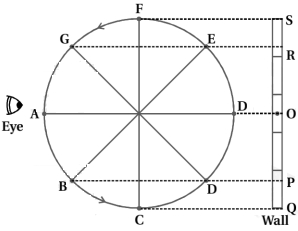
As shown in the figure,as the particle moves along the circular path through points $A, B, C, D, E, F, G$,its projection on the vertical diameter moves back and forth between the extreme points $S$ and $Q$ through the center $O$. This oscillatory motion of the projection is simple harmonic motion.
The position of the particle at any time $t$ can be represented by the angle $\theta = \omega t$ with respect to a reference diameter.
If we project the position of the particle onto a diameter of the circle,the displacement $y$ of the projection from the center of the circle at time $t$ is given by $y = R \sin(\omega t)$.
This equation $y = R \sin(\omega t)$ represents the displacement of a particle executing simple harmonic motion $(SHM)$.
As shown in the figure,as the particle moves along the circular path through points $A, B, C, D, E, F, G$,its projection on the vertical diameter moves back and forth between the extreme points $S$ and $Q$ through the center $O$. This oscillatory motion of the projection is simple harmonic motion.
0 likes
View Solution144
Difficult
Explain that simple harmonic motion is the projection of uniform circular motion on a diameter of the reference circle and obtain the velocity and acceleration.
Solution
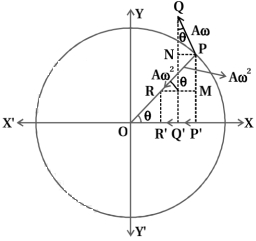
(N/A) Consider a particle moving with a constant angular speed $\omega$ in an anti-clockwise direction on a circular path of radius $A$ centered at the origin $O$. At time $t$,the particle is at position $P$ with phase $\theta = \omega t + \phi$,where $\phi$ is the initial phase.
$1$. Displacement: The projection of the position vector $\vec{OP}$ on the $X$-axis is $x(t) = A \cos(\omega t + \phi)$.
$2$. Velocity: The velocity of the particle in circular motion is $v = A\omega$ directed tangentially. The projection of this velocity vector on the $X$-axis gives the velocity of the simple harmonic motion $(SHM)$:
$v(t) = \frac{dx}{dt} = -A\omega \sin(\omega t + \phi)$.
$3$. Acceleration: The centripetal acceleration of the particle in circular motion is $a_c = A\omega^2$ directed towards the center $O$. The projection of this acceleration vector on the $X$-axis gives the acceleration of the $SHM$:
$a(t) = \frac{dv}{dt} = -A\omega^2 \cos(\omega t + \phi) = -\omega^2 x(t)$.
This confirms that the motion is simple harmonic.
$1$. Displacement: The projection of the position vector $\vec{OP}$ on the $X$-axis is $x(t) = A \cos(\omega t + \phi)$.
$2$. Velocity: The velocity of the particle in circular motion is $v = A\omega$ directed tangentially. The projection of this velocity vector on the $X$-axis gives the velocity of the simple harmonic motion $(SHM)$:
$v(t) = \frac{dx}{dt} = -A\omega \sin(\omega t + \phi)$.
$3$. Acceleration: The centripetal acceleration of the particle in circular motion is $a_c = A\omega^2$ directed towards the center $O$. The projection of this acceleration vector on the $X$-axis gives the acceleration of the $SHM$:
$a(t) = \frac{dv}{dt} = -A\omega^2 \cos(\omega t + \phi) = -\omega^2 x(t)$.
This confirms that the motion is simple harmonic.
0 likes
View Solution145
Medium
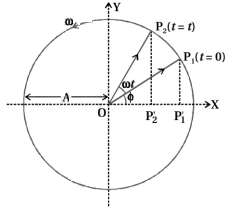
Explain the concepts of a reference particle and a reference circle,and show that simple harmonic motion $(SHM)$ is the projection of uniform circular motion on a diameter of the reference circle.
Solution
(N/A) At time $t=0$,the particle is at position $P_{1}$ and its position vector $\overrightarrow{OP}_{1}$ makes an angle $\phi$ with the positive $X$-axis.
The projection of $OP_{1}$ on the $X$-axis is $OP_{1}^{\prime}$.
At time $t=t$,the particle has undergone an angular displacement $\omega t$,reaching point $P_{2}$,and its position vector $\overrightarrow{OP}_{2}$ makes an angle $\omega t+\phi$ with the $X$-axis.
The projection of the position vector $OP_{2}$ on the $X$-axis is $OP_{2}^{\prime}$.
As the particle $P$ moves on a circle,its perpendicular projection on the $X$-axis is given by $x(t)=A \cos(\omega t+\phi)$. This represents the $X$-component of the position vector at any time.
This equation is the general equation of $SHM$.
From this,it is concluded that the projection of uniform circular motion on a diameter of the reference circle is $SHM$.
The particle moving on a uniform circular path is called the reference particle,and the circular path of the reference particle is called the reference circle.
If the projection of the reference particle is taken on the $Y$-axis,the displacement of the particle on the $Y$-axis is $y(t)=A \sin(\omega t+\phi)$.
The projection of $OP_{1}$ on the $X$-axis is $OP_{1}^{\prime}$.
At time $t=t$,the particle has undergone an angular displacement $\omega t$,reaching point $P_{2}$,and its position vector $\overrightarrow{OP}_{2}$ makes an angle $\omega t+\phi$ with the $X$-axis.
The projection of the position vector $OP_{2}$ on the $X$-axis is $OP_{2}^{\prime}$.
As the particle $P$ moves on a circle,its perpendicular projection on the $X$-axis is given by $x(t)=A \cos(\omega t+\phi)$. This represents the $X$-component of the position vector at any time.
This equation is the general equation of $SHM$.
From this,it is concluded that the projection of uniform circular motion on a diameter of the reference circle is $SHM$.
The particle moving on a uniform circular path is called the reference particle,and the circular path of the reference particle is called the reference circle.
If the projection of the reference particle is taken on the $Y$-axis,the displacement of the particle on the $Y$-axis is $y(t)=A \sin(\omega t+\phi)$.
0 likes
View Solution146
MediumMCQ
Linear simple harmonic motion is a projection of uniform circular motion along any one diameter of a circle. Is there any distinction between these two?
A
Yes,the forces involved are different.
B
No,they are identical in every aspect.
C
Yes,the velocity is constant in both.
D
No,the acceleration is zero in both.
Solution
(A) Linear simple harmonic motion $(SHM)$ is the projection of uniform circular motion $(UCM)$ on a diameter.
In $UCM$,the particle experiences a constant centripetal force $F_c = \frac{mv^2}{r} = m\omega^2r$ directed towards the center.
In linear $SHM$,the particle experiences a restoring force $F = -m\omega^2x$,which is proportional to the displacement $x$ from the mean position and directed towards it.
While the kinematics (position,velocity,acceleration) of the projection match $SHM$,the physical nature of the forces is different: $UCM$ requires a constant magnitude force,whereas $SHM$ requires a force that varies linearly with displacement.
In $UCM$,the particle experiences a constant centripetal force $F_c = \frac{mv^2}{r} = m\omega^2r$ directed towards the center.
In linear $SHM$,the particle experiences a restoring force $F = -m\omega^2x$,which is proportional to the displacement $x$ from the mean position and directed towards it.
While the kinematics (position,velocity,acceleration) of the projection match $SHM$,the physical nature of the forces is different: $UCM$ requires a constant magnitude force,whereas $SHM$ requires a force that varies linearly with displacement.
0 likes
View Solution147
EasyMCQ
What is the projection of uniform circular motion?
A
Simple Harmonic Motion $(SHM)$
B
Uniform linear motion
C
Projectile motion
D
Circular motion
Solution
(A) The projection of uniform circular motion on any diameter of the circle is Simple Harmonic Motion $(SHM)$.
Consider a particle moving in a circle of radius $A$ with a constant angular velocity $\omega$.
The position of the particle at any time $t$ can be represented by the angle $\theta = \omega t + \phi$.
The projection of this position on the $x$-axis is given by $x(t) = A \cos(\omega t + \phi)$.
This equation represents the displacement of a particle executing Simple Harmonic Motion.
Consider a particle moving in a circle of radius $A$ with a constant angular velocity $\omega$.
The position of the particle at any time $t$ can be represented by the angle $\theta = \omega t + \phi$.
The projection of this position on the $x$-axis is given by $x(t) = A \cos(\omega t + \phi)$.
This equation represents the displacement of a particle executing Simple Harmonic Motion.
0 likes
View Solution148
Medium
What is a reference particle and a reference circle?
Solution
(N/A) reference circle is a circle of radius $A$ (where $A$ is the amplitude of the simple harmonic motion) centered at the origin of a coordinate system.
$A$ reference particle is a hypothetical particle that moves with a constant angular velocity $\omega$ along the circumference of the reference circle.
The projection of the position of this reference particle onto any diameter of the reference circle executes simple harmonic motion $(SHM)$. The displacement of the $SHM$ is given by $x(t) = A \cos(\omega t + \phi)$,where $A$ is the radius of the reference circle and $\omega t + \phi$ is the angular position of the reference particle at time $t$.
$A$ reference particle is a hypothetical particle that moves with a constant angular velocity $\omega$ along the circumference of the reference circle.
The projection of the position of this reference particle onto any diameter of the reference circle executes simple harmonic motion $(SHM)$. The displacement of the $SHM$ is given by $x(t) = A \cos(\omega t + \phi)$,where $A$ is the radius of the reference circle and $\omega t + \phi$ is the angular position of the reference particle at time $t$.
0 likes
View Solution149
EasyMCQ
What is the amplitude of a particle executing uniform circular motion?
A
The radius of the circle
B
The diameter of the circle
C
Zero
D
Infinity
Solution
(A) Uniform circular motion is the motion of a particle along a circular path with a constant speed.
When we project this motion onto a diameter of the circle,the projection executes Simple Harmonic Motion $(SHM)$.
The maximum displacement of this projection from the mean position (the center of the circle) is equal to the radius of the circular path.
Therefore,the amplitude of the resulting $SHM$ is equal to the radius of the circle.
When we project this motion onto a diameter of the circle,the projection executes Simple Harmonic Motion $(SHM)$.
The maximum displacement of this projection from the mean position (the center of the circle) is equal to the radius of the circular path.
Therefore,the amplitude of the resulting $SHM$ is equal to the radius of the circle.
0 likes
View Solution150
EasyMCQ
What is the angular frequency of a reference particle executing $SHM$?
A
$\omega = \frac{2\pi}{T}$
B
$\omega = 2\pi T$
C
$\omega = \frac{T}{2\pi}$
D
$\omega = \sqrt{\frac{k}{m}}$
Solution
(A) The angular frequency $\omega$ of a particle executing Simple Harmonic Motion $(SHM)$ is defined as the rate of change of phase with respect to time.
It is related to the time period $T$ of the oscillation by the formula $\omega = \frac{2\pi}{T}$, where $2\pi$ represents the total phase change in one complete cycle.
Alternatively, it is also related to the frequency $f$ by $\omega = 2\pi f$.
It is related to the time period $T$ of the oscillation by the formula $\omega = \frac{2\pi}{T}$, where $2\pi$ represents the total phase change in one complete cycle.
Alternatively, it is also related to the frequency $f$ by $\omega = 2\pi f$.
0 likes
View SolutionOscillations — Periodic, Oscillatory motion and its characteristics and types of SHM and Equation of SHM · Frequently Asked Questions
1Are these Oscillations questions useful for JEE and NEET?
Yes. All questions in this section are mapped to JEE Main and NEET exam patterns. Previous year questions from JEE Main, NEET, GUJCET and state-level exams are included with full solutions.
2Can I switch to Hindi or Gujarati for these questions?
Yes. Use the language tabs in the hero section or the sidebar to view the same questions and solutions in English, Hindi or Gujarati.
3How do I generate a question paper from this subtopic?
Use the Vedclass Exam Paper Generator — select the chapter and subtopic, set difficulty, and generate Sets A, B, C, D automatically. First 3 chapters of every subject are free.
Vedclass Products
For Students
Vedclass Test Series
Mock tests in real JEE/NEET style with performance analysis. 5-day free trial.
Start Free TrialFor Teachers
Exam Paper Generator
Generate Set A/B/C/D papers from this chapter in 2 minutes. 3 chapters free.
Try FreeFor Institutes
Online Exam Module
Live online exams with unlimited students, 360° analytics & white-label branding.
See DemoFor Teachers & Institutes
Generate a Oscillations Exam Paper in 2 Minutes
Select subtopic & difficulty — Sets A, B, C, D auto-generated with No Repeat logic.
First 3 chapters of every subject are free — no payment required.