
The displacement-time graph of a particle executing $SHM$ is as shown in the figure. The corresponding graph between potential energy $(PE)$ and time is:
- A
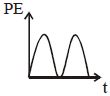
- B
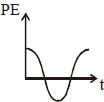
- C
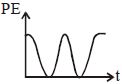
- D
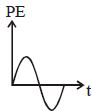
Explore More
Similar Questions
Starting from the origin,a particle oscillates simple harmonically with a time period of $2 \ s$. After what time will its kinetic energy be $75 \%$ of the total energy?
Medium
View Solution$A$ particle executing a simple harmonic motion of period $2 \ s$. When it is at its extreme displacement from its mean position,it receives an additional energy equal to what it had in its mean position. Due to this,in its subsequent motion,
Medium
View SolutionThe variations of potential energy $(U)$ with position $x$ for three simple harmonic oscillators $A, B$ and $C$ are shown in the figure. The oscillators have the same mass. The time period of oscillation is greatest for
Medium
View Solution$A$ particle is executing simple harmonic motion with a time period of $3 \,s$. At a position where the displacement of the particle is $60 \%$ of its amplitude, the ratio of the kinetic and potential energies of the particle is
$A$ block kept on a frictionless horizontal surface is connected to one end of a horizontal spring of constant $100 \text{ Nm}^{-1}$ whose other end is fixed to a rigid vertical wall. Initially, the block is at its equilibrium position. The block is pulled to a distance of $8 \text{ cm}$ and released. The kinetic energy of the block when it is at a distance of $3 \text{ cm}$ from the mean position is (in $\text{ J}$)
Vedclass Products
For Students
Vedclass Test Series
Mock tests in real JEE/NEET style with performance analysis. 5-day free trial.
Start Free TrialFor Teachers
Exam Paper Generator
Generate Set A/B/C/D exam papers from 7.5L+ questions in 2 minutes. 3 chapters free.
Try FreeFor Institutes
Online Exam Module
Live online exams with unlimited students, 360° analytics & white-label branding.
See Demo