
A English
Newton's First Law: Mass and Inertia Questions in English
Class 11 Physics · Newton's Laws of Motion and Friction · Newton's First Law: Mass and Inertia
55+
Questions
English
Language
100%
With Solutions
Showing 49 of 55 questions in English
1
MediumMCQ
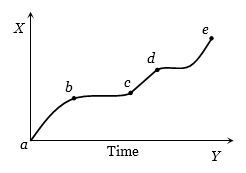
The displacement versus time graph for a body moving in a straight line is shown in the figure. Which of the following regions represents the motion when no force is acting on the body?
A
$ab$
B
$bc$
C
$cd$
D
$de$
Solution
(C) According to Newton's first law of motion,if no net force acts on a body,it will either remain at rest or move with a constant velocity.
In a displacement-time graph,the velocity is represented by the slope of the graph.
- In region $ab$,the slope is changing (curved),indicating acceleration.
- In region $bc$,the slope is zero (horizontal),indicating the body is at rest.
- In region $cd$,the graph is a straight line,which means the slope (velocity) is constant.
- In region $de$,the slope is changing (curved),indicating acceleration.
Since the velocity is constant in region $cd$,there is no acceleration,which implies that no net force is acting on the body in this region.
In a displacement-time graph,the velocity is represented by the slope of the graph.
- In region $ab$,the slope is changing (curved),indicating acceleration.
- In region $bc$,the slope is zero (horizontal),indicating the body is at rest.
- In region $cd$,the graph is a straight line,which means the slope (velocity) is constant.
- In region $de$,the slope is changing (curved),indicating acceleration.
Since the velocity is constant in region $cd$,there is no acceleration,which implies that no net force is acting on the body in this region.
0 likes
View Solution2
EasyMCQ
$A$ stone tied to a string is rotated in a circle. If the string is cut,the stone flies away from the circle because
A
$A$ centrifugal force acts on the stone
B
Of its inertia
C
$A$ centripetal force acts on the stone
D
Reaction of the centripetal force
Solution
(B) When a stone is rotated in a circle,it requires a centripetal force provided by the tension in the string to change its direction continuously.
According to Newton's first law of motion,an object continues to move in a straight line unless acted upon by an external force.
When the string is cut,the centripetal force (tension) becomes zero.
Due to its inertia,the stone continues to move in the direction of its velocity at that instant,which is tangent to the circular path.
According to Newton's first law of motion,an object continues to move in a straight line unless acted upon by an external force.
When the string is cut,the centripetal force (tension) becomes zero.
Due to its inertia,the stone continues to move in the direction of its velocity at that instant,which is tangent to the circular path.
0 likes
View Solution3
EasyMCQ
$A$ rider on horseback falls when the horse starts running all of a sudden because:
A
Rider is taken back
B
Rider is suddenly afraid of falling
C
Inertia of rest keeps the upper part of the body at rest whereas the lower part of the body moves forward with the horse
D
None of the above
Solution
(C) The correct answer is $C$. This phenomenon is based on Newton's First Law of Motion,which states that an object at rest tends to remain at rest unless acted upon by an external force.
When the horse is at rest,the rider is also at rest.
When the horse suddenly starts running,the lower part of the rider's body,which is in contact with the horse,moves forward along with the horse.
However,the upper part of the rider's body tends to remain at its state of rest due to the inertia of rest.
As a result,the upper part of the body lags behind,causing the rider to fall backward.
When the horse is at rest,the rider is also at rest.
When the horse suddenly starts running,the lower part of the rider's body,which is in contact with the horse,moves forward along with the horse.
However,the upper part of the rider's body tends to remain at its state of rest due to the inertia of rest.
As a result,the upper part of the body lags behind,causing the rider to fall backward.
0 likes
View Solution4
EasyMCQ
When a train stops suddenly,passengers in the running train feel an instant jerk in the forward direction because
A
The back of the seat suddenly pushes the passengers forward
B
Inertia of rest stops the train and takes the body forward
C
The upper part of the body continues to be in the state of motion,whereas the lower part of the body in contact with the seat comes to rest
D
Nothing can be said due to insufficient data
Solution
(C) This phenomenon is explained by Newton's First Law of Motion,which is the law of inertia.
When the train is moving,the entire body of the passenger is in a state of uniform motion.
When the train stops suddenly,the lower part of the passenger's body,which is in contact with the seat,also comes to rest due to the friction between the seat and the body.
However,the upper part of the body tends to continue its state of motion due to the inertia of motion.
As a result,the upper part of the body moves forward,causing the passengers to feel a jerk in the forward direction.
When the train is moving,the entire body of the passenger is in a state of uniform motion.
When the train stops suddenly,the lower part of the passenger's body,which is in contact with the seat,also comes to rest due to the friction between the seat and the body.
However,the upper part of the body tends to continue its state of motion due to the inertia of motion.
As a result,the upper part of the body moves forward,causing the passengers to feel a jerk in the forward direction.
1 likes
View Solution5
MediumMCQ
Inertia is that property of a body by virtue of which the body is
A
Unable to change by itself the state of rest
B
Unable to change by itself the state of uniform motion
C
Unable to change by itself the direction of motion
D
Unable to change by itself the state of rest and of uniform linear motion
Solution
(D) . Inertia is defined as the inherent property of a body due to which it resists any change in its state of rest or of uniform motion along a straight line.
According to Newton's first law of motion,a body continues to be in its state of rest or of uniform motion unless acted upon by an external unbalanced force.
Therefore,the body is unable to change its state of rest or uniform linear motion by itself.
According to Newton's first law of motion,a body continues to be in its state of rest or of uniform motion unless acted upon by an external unbalanced force.
Therefore,the body is unable to change its state of rest or uniform linear motion by itself.
0 likes
View Solution6
EasyMCQ
$A$ man getting down from a running bus falls forward because:
A
Due to inertia of rest,the road is left behind and the man reaches forward.
B
Due to inertia of motion,the upper part of the body continues to be in motion in the forward direction while the feet come to rest as soon as they touch the road.
C
He leans forward as a matter of habit.
D
Of the combined effect of all the three factors stated in $(a)$,$(b)$,and $(c)$.
Solution
(B) When a person is inside a moving bus,their entire body is in a state of motion with the same velocity as the bus.
When the person steps down,their feet touch the ground and come to rest due to friction.
However,due to the inertia of motion,the upper part of the body continues to move forward at the same speed as the bus.
Consequently,the upper part of the body moves ahead of the feet,causing the person to fall forward.
When the person steps down,their feet touch the ground and come to rest due to friction.
However,due to the inertia of motion,the upper part of the body continues to move forward at the same speed as the bus.
Consequently,the upper part of the body moves ahead of the feet,causing the person to fall forward.
0 likes
View Solution7
EasyMCQ
Newton's first law of motion describes the following:
A
Energy
B
Work
C
Inertia
D
Moment of inertia
Solution
(C) Newton's first law of motion defines the inertia of a body.
It states that every body has a natural tendency to remain in its state of rest or uniform motion in a straight line unless compelled to change that state by an external force.
This inherent property of a body to resist any change in its state is known as inertia.
It states that every body has a natural tendency to remain in its state of rest or uniform motion in a straight line unless compelled to change that state by an external force.
This inherent property of a body to resist any change in its state is known as inertia.
0 likes
View Solution8
EasyMCQ
$A$ particle is moving with a constant speed along a straight line path. $A$ force is not required to
A
Increase its speed
B
Decrease the momentum
C
Change the direction
D
Keep it moving with uniform velocity
Solution
(D) According to Newton's First Law of Motion,an object in motion will continue to move with a constant velocity in a straight line unless acted upon by an external unbalanced force.
Since the particle is already moving with a constant speed along a straight line,it possesses uniform velocity.
Therefore,no external force is required to maintain this state of motion.
Options $A$,$B$,and $C$ involve changing the state of motion (acceleration),which requires a force.
Since the particle is already moving with a constant speed along a straight line,it possesses uniform velocity.
Therefore,no external force is required to maintain this state of motion.
Options $A$,$B$,and $C$ involve changing the state of motion (acceleration),which requires a force.
0 likes
View Solution9
MediumMCQ
When a bus suddenly takes a turn,the passengers are thrown outwards because of
A
Inertia of motion
B
Acceleration of motion
C
Speed of motion
D
Both $(b)$ and $(c)$
Solution
(A) According to the law of inertia of motion,a body will continue moving with constant velocity unless an external force acts on it.
When a bus is moving straight,the passengers inside are also moving in a straight line.
When the bus suddenly turns,the passengers tend to continue moving in their original straight-line path due to their inertia of motion.
Since no immediate force acts on the passengers to change their direction of motion along with the bus,they appear to be thrown outwards relative to the bus.
When a bus is moving straight,the passengers inside are also moving in a straight line.
When the bus suddenly turns,the passengers tend to continue moving in their original straight-line path due to their inertia of motion.
Since no immediate force acts on the passengers to change their direction of motion along with the bus,they appear to be thrown outwards relative to the bus.
0 likes
View Solution10
EasyMCQ
An object will continue moving uniformly until
A
The resultant force acting on it begins to decrease
B
The resultant force on it is zero
C
The resultant force is at right angle to its rotation
D
The resultant force on it is increased continuously
Solution
(B) According to Newton's First Law of Motion,an object remains in a state of rest or uniform motion in a straight line unless acted upon by an external unbalanced force. If the resultant force acting on an object is zero,the object will continue to move with a constant velocity (uniform motion). Therefore,the condition for uniform motion is that the resultant force must be zero.
0 likes
View Solution11
EasyMCQ
An aircraft is moving with a velocity of $300\,m/s$. If all the forces acting on it are balanced,then:
A
It still moves with the same velocity
B
It will be just floating at the same point in space
C
It will fall down instantaneously
D
It will lose its velocity gradually
Solution
(A) According to Newton's First Law of Motion,an object will maintain its state of rest or uniform motion in a straight line unless acted upon by an external unbalanced force.
Given that all forces acting on the aircraft are balanced,the net force $F_{net} = 0$.
From Newton's Second Law,$F_{net} = ma$. Since $F_{net} = 0$,the acceleration $a = 0$.
An acceleration of zero implies that the velocity of the aircraft remains constant.
Therefore,the aircraft will continue to move with the same velocity of $300\,m/s$ in a straight line.
Given that all forces acting on the aircraft are balanced,the net force $F_{net} = 0$.
From Newton's Second Law,$F_{net} = ma$. Since $F_{net} = 0$,the acceleration $a = 0$.
An acceleration of zero implies that the velocity of the aircraft remains constant.
Therefore,the aircraft will continue to move with the same velocity of $300\,m/s$ in a straight line.
0 likes
View Solution12
EasyMCQ
When a car at high speed makes a sharp turn,the driver in the car tends to get thrown in the direction opposite to that of the turn. This is due to which property?
A
Inertia of direction
B
Inertia of rest
C
Inertia of motion
D
None of these
Solution
(A) According to Newton's first law of motion,an object continues to be in its state of rest or of uniform motion in a straight line unless compelled by an external force to change that state.
When a car moves at high speed and takes a sharp turn,the car changes its direction of motion.
However,the driver,due to the property of inertia of direction,tends to continue moving in the original straight-line path.
As the car turns away from this straight path,the driver feels a force pushing them towards the side opposite to the turn relative to the car's frame of reference.
Therefore,this phenomenon is due to the inertia of direction.
When a car moves at high speed and takes a sharp turn,the car changes its direction of motion.
However,the driver,due to the property of inertia of direction,tends to continue moving in the original straight-line path.
As the car turns away from this straight path,the driver feels a force pushing them towards the side opposite to the turn relative to the car's frame of reference.
Therefore,this phenomenon is due to the inertia of direction.
0 likes
View Solution13
EasyMCQ
$A$ girl jumps down from a moving bus,along the direction of motion of the bus,tilting slightly forward. She falls on $(a)$ a sheet of ice $(b)$ a patch of glue. Which of the following statements is correct regarding her fall?
A
In both cases $(a)$ and $(b)$ she falls forward.
B
In both cases $(a)$ and $(b)$ she falls backward.
C
In case $(a)$ she falls forward and in case $(b)$ she falls backward.
D
In case $(a)$ she falls backward and in case $(b)$ she falls forward.
Solution
(A) When the girl jumps from a moving bus,her entire body possesses the velocity of the bus due to the inertia of motion.
When her feet touch the ground,they experience a retarding force.
In case $(b)$,the patch of glue provides a large frictional force,bringing her feet to an immediate stop,while her upper body continues to move forward due to inertia,causing her to fall forward.
In case $(a)$,the sheet of ice provides very little friction. Her feet continue to slide forward along with the rest of her body,which helps her maintain balance or at least prevents the sudden stop that causes a forward fall. However,if she does fall,the inertia of motion still acts on her upper body,and she will still tend to fall forward if her feet are obstructed or if she loses balance,but the effect is most pronounced in case $(b)$. Given the standard physics problem context,in both scenarios,the inertia of motion causes a forward tendency; thus,she falls forward in both cases.
When her feet touch the ground,they experience a retarding force.
In case $(b)$,the patch of glue provides a large frictional force,bringing her feet to an immediate stop,while her upper body continues to move forward due to inertia,causing her to fall forward.
In case $(a)$,the sheet of ice provides very little friction. Her feet continue to slide forward along with the rest of her body,which helps her maintain balance or at least prevents the sudden stop that causes a forward fall. However,if she does fall,the inertia of motion still acts on her upper body,and she will still tend to fall forward if her feet are obstructed or if she loses balance,but the effect is most pronounced in case $(b)$. Given the standard physics problem context,in both scenarios,the inertia of motion causes a forward tendency; thus,she falls forward in both cases.
0 likes
View Solution14
EasyMCQ
$A$ person is sitting in a travelling train and facing the engine. He tosses up a coin and the coin falls behind him. It can be concluded that the train is
A
Moving forward and gaining speed
B
Moving forward and losing speed
C
Moving forward with uniform speed
D
Moving backward with uniform speed
Solution
(A) When the person tosses the coin,the coin shares the horizontal velocity of the train.
If the train moves with a uniform velocity,the coin will fall back into the person's hand due to the principle of inertia.
However,if the train is accelerating forward,the train gains more velocity while the coin is in the air.
Since the coin maintains its initial horizontal velocity (due to inertia),the train moves ahead of the coin,causing the coin to fall behind the person.
Therefore,the train is moving forward and gaining speed.
If the train moves with a uniform velocity,the coin will fall back into the person's hand due to the principle of inertia.
However,if the train is accelerating forward,the train gains more velocity while the coin is in the air.
Since the coin maintains its initial horizontal velocity (due to inertia),the train moves ahead of the coin,causing the coin to fall behind the person.
Therefore,the train is moving forward and gaining speed.
0 likes
View Solution15
MediumMCQ
For ordinary terrestrial experiments,which of the following observers is inertial?
A
$A$ child revolving in a giant wheel.
B
$A$ driver in a sports car moving with a constant high speed of $200 \ km/h$ on a straight road.
C
The pilot of an aeroplane which is taking off.
D
$A$ cyclist negotiating a sharp turn.
Solution
(B) An inertial frame of reference is one that is either at rest or moving with a constant velocity (zero acceleration).
In option $A$,the child is in circular motion,which involves centripetal acceleration.
In option $B$,the sports car is moving with a constant speed on a straight road,meaning its velocity is constant and its acceleration is zero. Thus,the driver is in an inertial frame.
In option $C$,the aeroplane is taking off,meaning it is accelerating.
In option $D$,the cyclist is turning,which involves centripetal acceleration.
Therefore,only the observer in option $B$ is in an inertial frame.
In option $A$,the child is in circular motion,which involves centripetal acceleration.
In option $B$,the sports car is moving with a constant speed on a straight road,meaning its velocity is constant and its acceleration is zero. Thus,the driver is in an inertial frame.
In option $C$,the aeroplane is taking off,meaning it is accelerating.
In option $D$,the cyclist is turning,which involves centripetal acceleration.
Therefore,only the observer in option $B$ is in an inertial frame.
0 likes
View Solution16
EasyMCQ
Physical independence of force is a consequence of
A
first law of motion
B
second law of motion
C
third law of motion
D
all of these laws
Solution
(A) Newton's first law of motion states that an object will remain at rest or in uniform motion in a straight line unless acted upon by an external force.
This law defines force as that which changes the state of rest or uniform motion of an object.
It implies that force is an external agent that can exist independently of the object's motion,establishing the concept of the physical independence of force.
Therefore,the first law of motion is the basis for the physical independence of force.
This law defines force as that which changes the state of rest or uniform motion of an object.
It implies that force is an external agent that can exist independently of the object's motion,establishing the concept of the physical independence of force.
Therefore,the first law of motion is the basis for the physical independence of force.
0 likes
View Solution17
EasyMCQ
For ordinary terrestrial experiments,the observer in an inertial frame in the following cases is
A
a child revolving in a giant wheel
B
a driver in a sports car moving with a constant high speed of $200 \ km \ h^{-1}$ on a straight road
C
the pilot of an aeroplane which is taking off
D
a cyclist negotiating a sharp curve
Solution
(B) An inertial frame is a frame of reference that is either at rest or moving with a constant velocity (zero acceleration).
In option $A$,the child is in circular motion,which involves centripetal acceleration.
In option $B$,the car is moving with a constant speed on a straight road,meaning its velocity is constant and its acceleration is zero. Therefore,it acts as an inertial frame.
In option $C$,the aeroplane is accelerating during takeoff.
In option $D$,the cyclist is changing direction,which involves acceleration.
Thus,the driver in the sports car is the correct observer in an inertial frame.
In option $A$,the child is in circular motion,which involves centripetal acceleration.
In option $B$,the car is moving with a constant speed on a straight road,meaning its velocity is constant and its acceleration is zero. Therefore,it acts as an inertial frame.
In option $C$,the aeroplane is accelerating during takeoff.
In option $D$,the cyclist is changing direction,which involves acceleration.
Thus,the driver in the sports car is the correct observer in an inertial frame.
0 likes
View Solution18
EasyMCQ
$Assertion$ : The driver in a vehicle moving with a constant speed on a straight road is an inertial frame of reference.
$Reason$ : $A$ reference frame in which Newton's laws of motion are applicable is non-inertial.
$Reason$ : $A$ reference frame in which Newton's laws of motion are applicable is non-inertial.
A
If both $Assertion$ and $Reason$ are correct and the $Reason$ is a correct explanation of the $Assertion$.
B
If both $Assertion$ and $Reason$ are correct but $Reason$ is not a correct explanation of the $Assertion$.
C
If the $Assertion$ is correct but $Reason$ is incorrect.
D
If both the $Assertion$ and $Reason$ are incorrect.
Solution
(C) An inertial frame of reference is defined as a frame in which Newton's laws of motion are valid.
Since the vehicle is moving with a constant speed on a straight road,its acceleration is $0$. Therefore,it is an inertial frame of reference.
Thus,the $Assertion$ is correct.
However,the $Reason$ states that a frame where Newton's laws are applicable is non-inertial,which is false. Newton's laws are applicable in inertial frames,not non-inertial frames.
Therefore,the $Assertion$ is correct but the $Reason$ is incorrect.
Since the vehicle is moving with a constant speed on a straight road,its acceleration is $0$. Therefore,it is an inertial frame of reference.
Thus,the $Assertion$ is correct.
However,the $Reason$ states that a frame where Newton's laws are applicable is non-inertial,which is false. Newton's laws are applicable in inertial frames,not non-inertial frames.
Therefore,the $Assertion$ is correct but the $Reason$ is incorrect.
0 likes
View Solution19
EasyMCQ
An astronaut accidentally gets separated from his small spaceship accelerating in interstellar space at a constant rate of $100 \; m/s^2$. What is the acceleration of the astronaut the instant after he is outside the spaceship (in $; m/s^2$)? (Assume that there are no nearby stars to exert gravitational force on him.)
A
$0$
B
$100$
C
$50$
D
$9.8$
Solution
(A) According to Newton's first law of motion,an object remains in its state of rest or uniform motion in a straight line unless acted upon by an external force.
Once the astronaut is separated from the spaceship,there are no external forces acting on him because there are no nearby stars to exert gravitational force,and the gravitational pull of the small spaceship is negligible.
Since the net external force $F_{net} = 0$,the acceleration $a = F_{net}/m$ must also be $0$.
Therefore,the acceleration of the astronaut the instant after he is outside the spaceship is $0 \; m/s^2$.
Once the astronaut is separated from the spaceship,there are no external forces acting on him because there are no nearby stars to exert gravitational force,and the gravitational pull of the small spaceship is negligible.
Since the net external force $F_{net} = 0$,the acceleration $a = F_{net}/m$ must also be $0$.
Therefore,the acceleration of the astronaut the instant after he is outside the spaceship is $0 \; m/s^2$.
1 likes
View Solution20
EasyMCQ
$A$ trolley of mass $300 \; kg$ carrying a sandbag of $25 \; kg$ is moving uniformly with a speed of $27 \; km/h$ on a frictionless track. After a while,sand starts leaking out of a hole on the floor of the trolley at the rate of $0.05 \; kg \cdot s^{-1}$. What is the speed (in $km/h$) of the trolley after the entire sandbag is empty?
A
$36$
B
$9$
C
$54$
D
$27$
Solution
(D) The trolley and the sandbag constitute a system moving on a frictionless track.
Since there is no external horizontal force acting on the system,the net external force is zero.
According to Newton's first law of motion,an object in motion will continue to move with the same velocity unless acted upon by an external force.
The leaking of sand is an internal process within the system and does not exert any external force on the trolley.
Therefore,the velocity of the trolley remains constant throughout the process.
Thus,the speed of the trolley after the sandbag is empty remains $27 \; km/h$.
Since there is no external horizontal force acting on the system,the net external force is zero.
According to Newton's first law of motion,an object in motion will continue to move with the same velocity unless acted upon by an external force.
The leaking of sand is an internal process within the system and does not exert any external force on the trolley.
Therefore,the velocity of the trolley remains constant throughout the process.
Thus,the speed of the trolley after the sandbag is empty remains $27 \; km/h$.
0 likes
View Solution21
Medium
What is dynamics? What is mechanics?
Solution
(N/A) $(1)$ Dynamics: The branch of physics that describes the motion of objects along with its causes (forces) is known as Dynamics.
$(2)$ Mechanics: The branch of physics which studies and deals with the motion of objects is called Mechanics. Alternatively,Kinematics and Dynamics are combinedly known as Mechanics.
$(2)$ Mechanics: The branch of physics which studies and deals with the motion of objects is called Mechanics. Alternatively,Kinematics and Dynamics are combinedly known as Mechanics.
0 likes
View Solution22
Medium
Explain the difference between mass and weight.
Solution
(N/A) The differences between mass and weight are summarized in the table below:
| Mass | Weight |
|---|---|
| $1$. It is the quantity of matter contained in a body. It is denoted by $m$. | $1$. It is the gravitational force acting on a body. It is denoted by $W$. |
| $2$. It is a scalar and fundamental physical quantity. | $2$. It is a vector and derived physical quantity. |
| $3$. The mass of an object can never be zero. | $3$. The weight of an object can be zero. At the center of the Earth,$g = 0$,so the weight is zero. |
| $4$. Its $SI$ unit is $kg$. | $4$. Its $SI$ unit is $newton$ $(N)$. |
| $5$. Mass remains constant everywhere. | $5$. Weight varies from place to place. |
1 likes
View Solution23
EasyMCQ
$A$ stone tied to the end of a string is whirled in a circular path. Why does the stone move in the direction of the tangent at that point when the string breaks?
A
Due to the centripetal force acting on it.
B
Due to the inertia of direction.
C
Due to the gravitational force.
D
Due to the tension in the string.
Solution
(B) When a stone is whirled in a circular path,its velocity vector is always directed along the tangent to the circle at any given point.
When the string breaks,the centripetal force,which was responsible for keeping the stone in circular motion,vanishes.
According to Newton's First Law of Motion,an object in motion continues to move in a straight line at a constant velocity unless acted upon by an external force. Therefore,due to the inertia of direction,the stone continues to move along the tangent at the point where the string broke.
When the string breaks,the centripetal force,which was responsible for keeping the stone in circular motion,vanishes.
According to Newton's First Law of Motion,an object in motion continues to move in a straight line at a constant velocity unless acted upon by an external force. Therefore,due to the inertia of direction,the stone continues to move along the tangent at the point where the string broke.
0 likes
View Solution24
Easy
Explain the primary concept of force.
Solution
(N/A) To bring a stationary object into motion,a force is required. Similarly,to slow down an object in motion or to stop a moving object,a force is required.
$A$ ball is moving down along a slope. By applying a force in the opposite direction,it can be stopped. The external parameter (agency) by which the state of motion or rest can be changed is called force.
The effects of force on a body can be the following:
$(i)$ Force can bring a body from rest to motion or a body from motion to rest.
$(ii)$ It can increase or decrease the speed of an object.
$(iii)$ Force can change the direction of motion of an object.
$(iv)$ Force can change the shape of an object.
$A$ ball is moving down along a slope. By applying a force in the opposite direction,it can be stopped. The external parameter (agency) by which the state of motion or rest can be changed is called force.
The effects of force on a body can be the following:
$(i)$ Force can bring a body from rest to motion or a body from motion to rest.
$(ii)$ It can increase or decrease the speed of an object.
$(iii)$ Force can change the direction of motion of an object.
$(iv)$ Force can change the shape of an object.
0 likes
View Solution25
Medium
What was Aristotle's view regarding motion? How was it wrong? What is the flaw in his argument?
Solution
(N/A) Greek philosopher Aristotle,based on his observations of daily life,assumed that an external agency (force) is required to maintain the uniform motion of a body. This is known as Aristotle's law of motion. According to him,an arrow released from a bow continues its motion because the air behind the arrow pushes it forward.
Aristotle's mistake was that he treated practical experience as a fundamental law of nature. In reality,frictional forces oppose the motion of solid objects,and viscous forces oppose the motion of fluids. He failed to account for these resistive forces. His flaw was the assumption that a force is needed to sustain motion,whereas,in reality,a force is only required to overcome resistive forces to maintain uniform motion.
Aristotle's mistake was that he treated practical experience as a fundamental law of nature. In reality,frictional forces oppose the motion of solid objects,and viscous forces oppose the motion of fluids. He failed to account for these resistive forces. His flaw was the assumption that a force is needed to sustain motion,whereas,in reality,a force is only required to overcome resistive forces to maintain uniform motion.
0 likes
View Solution26
Difficult
State Aristotle's law regarding motion.
Solution
(N/A) Aristotle's law of motion states that an external force is required to keep a body in motion. According to this view,if a body is moving,it will come to rest as soon as the external force acting on it is removed. In modern physics,this is understood to be incorrect because it ignores the effect of friction,which is the actual force that brings moving objects to rest on Earth.
0 likes
View Solution27
Easy
What was the mistake in Aristotle's idea regarding motion?
Solution
(N/A) Aristotle's fundamental mistake was the assumption that an external force is required to keep a body in a state of uniform motion. According to Aristotle,if a body is moving,it must be pushed by an external agent to maintain its velocity. He failed to account for the role of friction and air resistance,which are the actual forces that bring a moving object to rest in real-world scenarios. In the absence of such resistive forces,an object in motion will continue to move with a constant velocity indefinitely,as stated by Newton's First Law of Motion.
0 likes
View Solution28
EasyMCQ
What does the mass of a body measure?
A
Force
B
Inertia
C
Weight
D
Velocity
Solution
(B) The mass of a body is a quantitative measure of its inertia.
Inertia is the property of a body by virtue of which it resists any change in its state of rest or uniform motion in a straight line.
Therefore,a body with greater mass has greater inertia,meaning it is harder to change its state of motion.
Inertia is the property of a body by virtue of which it resists any change in its state of rest or uniform motion in a straight line.
Therefore,a body with greater mass has greater inertia,meaning it is harder to change its state of motion.
0 likes
View Solution29
Medium
Write and explain Newton's first law of motion.
Solution
(N/A) Galileo's law of inertia was the basis of Newton's laws of motion.
Newton's first law of motion: Every body continues to be in its state of rest or of uniform motion in a straight line unless compelled by some external force to act otherwise.
$A$ body at rest or a body moving with constant velocity both represent zero acceleration. Hence,Newton's first law can be interpreted as follows:
Force is a physical quantity which can bring a body at rest into motion and which can change the velocity of an object.
In short,the physical quantity which can produce acceleration in a body is called force.
From Newton's first law,the magnitude of force cannot be determined. This is its limitation.
Newton's first law of motion: Every body continues to be in its state of rest or of uniform motion in a straight line unless compelled by some external force to act otherwise.
$A$ body at rest or a body moving with constant velocity both represent zero acceleration. Hence,Newton's first law can be interpreted as follows:
Force is a physical quantity which can bring a body at rest into motion and which can change the velocity of an object.
In short,the physical quantity which can produce acceleration in a body is called force.
From Newton's first law,the magnitude of force cannot be determined. This is its limitation.
0 likes
View Solution30
MediumMCQ
When a body is at rest or in uniform motion,no force acts on it. Is this statement true or false?
A
True
B
False
Solution
(B) The statement is False.
When a body is at rest or in uniform motion,it does not mean that no force acts on it. Rather,it means that the net (resultant) external force acting on the body is zero.
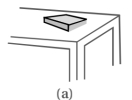
For example,consider a book at rest on a horizontal table:
$(1)$ The gravitational force (weight,$W = mg$) acts on the book in the downward direction.
$(2)$ The normal force $(N)$ exerted by the table acts on the book in the upward direction.
Since the book is at rest,by Newton's first law of motion,the net force must be zero. Therefore,the normal force and the weight must be equal in magnitude and opposite in direction $(N = W)$.
Thus,multiple forces act on the body,but their vector sum is zero.
When a body is at rest or in uniform motion,it does not mean that no force acts on it. Rather,it means that the net (resultant) external force acting on the body is zero.
For example,consider a book at rest on a horizontal table:
$(1)$ The gravitational force (weight,$W = mg$) acts on the book in the downward direction.
$(2)$ The normal force $(N)$ exerted by the table acts on the book in the upward direction.
Since the book is at rest,by Newton's first law of motion,the net force must be zero. Therefore,the normal force and the weight must be equal in magnitude and opposite in direction $(N = W)$.
Thus,multiple forces act on the body,but their vector sum is zero.
0 likes
View Solution31
Medium
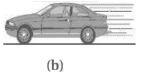
Explain: "For a car moving with constant (uniform) velocity, the resultant force is zero."
Solution
(N/A) According to Newton's First Law of Motion, an object remains in a state of rest or uniform motion in a straight line unless acted upon by an external unbalanced force.
If a car is moving with a constant (uniform) velocity, its acceleration $(a)$ is zero.
According to Newton's Second Law of Motion, the resultant force $(F_{net})$ acting on an object is given by $F_{net} = m \cdot a$.
Since the velocity is constant, the acceleration $a = 0$. Therefore, $F_{net} = m \cdot 0 = 0$.
This means that the vector sum of all external forces acting on the car (such as the driving force from the engine, air resistance, and rolling friction) must be zero for the car to maintain a constant velocity.
If a car is moving with a constant (uniform) velocity, its acceleration $(a)$ is zero.
According to Newton's Second Law of Motion, the resultant force $(F_{net})$ acting on an object is given by $F_{net} = m \cdot a$.
Since the velocity is constant, the acceleration $a = 0$. Therefore, $F_{net} = m \cdot 0 = 0$.
This means that the vector sum of all external forces acting on the car (such as the driving force from the engine, air resistance, and rolling friction) must be zero for the car to maintain a constant velocity.
0 likes
View Solution32
Medium
We are standing in a stationary bus. When the bus suddenly starts,why are we thrown in the backward direction?
Solution
(N/A) When we are standing in a stationary bus,our feet are in contact with the floor. There is a frictional force between our feet and the floor of the bus.
When the bus suddenly starts,due to friction,our feet start moving in the direction of the bus,whereas the rest of our body tries to retain its position due to inertia of rest.
Hence,we are thrown in the backward direction,which is opposite to the direction of the acceleration of the bus.
When the bus suddenly starts,due to friction,our feet start moving in the direction of the bus,whereas the rest of our body tries to retain its position due to inertia of rest.
Hence,we are thrown in the backward direction,which is opposite to the direction of the acceleration of the bus.
0 likes
View Solution33
DifficultMCQ
We are standing in a bus moving with constant velocity. When brakes are applied to the bus,we are thrown in the forward direction. Why?
A
Due to inertia of rest.
B
Due to inertia of motion.
C
Due to the force of friction.
D
Due to the gravitational force.
Solution
(B) When the bus is moving with a constant velocity,our body is also in a state of motion along with the bus.
According to Newton's First Law of Motion,an object in motion will continue to remain in motion unless acted upon by an external force.
When the brakes are applied,the bus comes to a state of rest,but our body,due to the inertia of motion,tends to continue moving forward.
Therefore,we experience a jerk in the forward direction.
According to Newton's First Law of Motion,an object in motion will continue to remain in motion unless acted upon by an external force.
When the brakes are applied,the bus comes to a state of rest,but our body,due to the inertia of motion,tends to continue moving forward.
Therefore,we experience a jerk in the forward direction.
0 likes
View Solution34
Easy
What is inertia?
Solution
(N/A) Inertia is the inherent property of a body by virtue of which it resists any change in its state of rest or uniform motion in a straight line.
It is a measure of the mass of an object; the greater the mass,the greater the inertia.
There are three types of inertia: inertia of rest,inertia of motion,and inertia of direction.
It is a measure of the mass of an object; the greater the mass,the greater the inertia.
There are three types of inertia: inertia of rest,inertia of motion,and inertia of direction.
0 likes
View Solution35
EasyMCQ
Why is a large initial force required to accelerate a heavy object?
A
Due to high inertia
B
Due to low friction
C
Due to high velocity
D
Due to low mass
Solution
(A) According to Newton's second law of motion,$F = ma$.
If the acceleration $a$ is to be kept constant,then the force $F$ is directly proportional to the mass $m$ $(F \propto m)$.
Therefore,a heavier object (having larger mass $m$) requires a larger force $F$ to achieve the same acceleration $a$.
If the acceleration $a$ is to be kept constant,then the force $F$ is directly proportional to the mass $m$ $(F \propto m)$.
Therefore,a heavier object (having larger mass $m$) requires a larger force $F$ to achieve the same acceleration $a$.
0 likes
View Solution36
EasyMCQ
Due to which property of an object does it resist any attempt to change its state of motion?
A
Mass
B
Inertia
C
Force
D
Momentum
Solution
(B) The property of an object by virtue of which it resists any change in its state of rest or uniform motion in a straight line is called $Inertia$. $Inertia$ is a measure of the mass of the body; the greater the mass,the greater the $Inertia$.
0 likes
View Solution37
Medium
Give two points of difference between mass and weight.
Solution
(N/A)
| Mass | Weight |
|---|---|
| $1$. Mass is the quantity of matter contained in a body. | $1$. Weight is the gravitational force acting on a body. |
| $2$. It remains constant at all places. | $2$. It varies from place to place. |
| $3$. It is a scalar quantity. | $3$. It is a vector quantity. |
| $4$. Its $SI$ unit is $kg$. | $4$. Its $SI$ unit is $kg \cdot m/s^2$ (Newton). |
0 likes
View Solution38
Easy
$A$ person driving a car suddenly applies the brakes on seeing a child on the road ahead. If he is not wearing a seat belt,he falls forward and hits his head against the steering wheel. Why?
Solution
(N/A) When a person driving a car suddenly applies the brakes,the lower part of the body,which is in contact with the seat,slows down along with the car due to the frictional force.
However,the upper part of the body continues to move forward due to the $inertia$ $of$ $motion$.
Since the person is not wearing a seat belt,there is no external force to stop the forward motion of the upper body,causing them to fall forward and hit their head against the steering wheel.
However,the upper part of the body continues to move forward due to the $inertia$ $of$ $motion$.
Since the person is not wearing a seat belt,there is no external force to stop the forward motion of the upper body,causing them to fall forward and hit their head against the steering wheel.
0 likes
View Solution39
EasyMCQ
$A$ mass of $2\, kg$ is suspended from a rigid support by a thread $AB$. Another thread $CD$ of the same type is attached to the lower end of the $2\, kg$ mass. If the lower thread $CD$ is pulled with a sudden jerk,what happens?
A
Thread $AB$ breaks.
B
Thread $CD$ breaks.
C
Both threads break simultaneously.
D
Neither thread breaks.
Solution
(B) When the lower thread $CD$ is pulled with a sudden jerk,the force applied is impulsive and acts only on the lower thread $CD$.
Due to the inertia of the $2\, kg$ mass,it does not immediately move downwards to transmit the force to the upper thread $AB$.
As a result,the tension in the lower thread $CD$ exceeds its breaking strength almost instantaneously,causing it to break.
The upper thread $AB$ remains unaffected because the force does not have enough time to be transmitted to it.
Therefore,the correct option is $B$.
Due to the inertia of the $2\, kg$ mass,it does not immediately move downwards to transmit the force to the upper thread $AB$.
As a result,the tension in the lower thread $CD$ exceeds its breaking strength almost instantaneously,causing it to break.
The upper thread $AB$ remains unaffected because the force does not have enough time to be transmitted to it.
Therefore,the correct option is $B$.
0 likes
View Solution40
Easy
Is it possible for a body to have inertia but no weight?
Solution
(N/A) Yes,it is possible. Inertia is a property of a body determined by its mass $(m)$,which is an intrinsic property and remains constant regardless of the location. Weight $(W = mg)$ is the force exerted by gravity on the body. At the centre of the Earth,the gravitational acceleration $(g)$ becomes zero. Therefore,a body placed at the centre of the Earth will have mass (and thus inertia) but its weight will be zero.
0 likes
View Solution41
EasyMCQ
An athlete does not come to rest immediately after crossing the winning line due to the
A
Inertia of rest
B
Inertia of motion
C
Inertia of direction
D
None of these
Solution
(B) The correct answer is $(B)$.
When an athlete is running,their body is in a state of uniform motion.
According to Newton's First Law of Motion,an object in motion will continue to remain in motion unless acted upon by an external force.
Therefore,due to the inertia of motion,the athlete cannot come to rest immediately upon crossing the winning line,as their body tends to maintain its state of motion.
When an athlete is running,their body is in a state of uniform motion.
According to Newton's First Law of Motion,an object in motion will continue to remain in motion unless acted upon by an external force.
Therefore,due to the inertia of motion,the athlete cannot come to rest immediately upon crossing the winning line,as their body tends to maintain its state of motion.
0 likes
View Solution42
EasyMCQ
Newton's first law is applicable
A
In all reference frames
B
Only in inertial reference frames
C
Only in non-inertial reference frames
D
None of these
Solution
(B) Newton's first law of motion states that an object will remain at rest or in uniform motion in a straight line unless acted upon by an external force.
This law is valid only in inertial reference frames,which are frames of reference that are not accelerating.
In non-inertial reference frames,pseudo-forces appear,and the law does not hold in its standard form.
Therefore,the correct option is $B$.
This law is valid only in inertial reference frames,which are frames of reference that are not accelerating.
In non-inertial reference frames,pseudo-forces appear,and the law does not hold in its standard form.
Therefore,the correct option is $B$.
0 likes
View Solution43
EasyMCQ
$A$ body of mass $2 \, kg$ is sliding with a constant velocity of $4 \, m/s$ on a frictionless horizontal table. The force required to keep the body moving with the same velocity is .......... $N$.
A
$8$
B
$0$
C
$2 \times 10^4$
D
$1/2$
Solution
(B) According to Newton's First Law of Motion,an object in motion will continue to move with a constant velocity in a straight line unless acted upon by an external unbalanced force.
Since the body is moving with a constant velocity of $4 \, m/s$ on a frictionless surface,there is no acceleration $(a = 0)$.
Using Newton's Second Law,$F = ma$.
Substituting the values,$F = 2 \, kg \times 0 \, m/s^2 = 0 \, N$.
Therefore,no external force is required to maintain the constant velocity.
Since the body is moving with a constant velocity of $4 \, m/s$ on a frictionless surface,there is no acceleration $(a = 0)$.
Using Newton's Second Law,$F = ma$.
Substituting the values,$F = 2 \, kg \times 0 \, m/s^2 = 0 \, N$.
Therefore,no external force is required to maintain the constant velocity.
0 likes
View Solution44
EasyMCQ
Three forces given by vectors $2 \hat{i} + 2 \hat{j}$,$2 \hat{i} - 2 \hat{j}$,and $-4 \hat{i}$ are acting together on a point object at rest. The object moves along the direction:
A
$x$-axis
B
$y$-axis
C
$z$-axis
D
Object does not move
Solution
(D) To determine the motion of the object,we calculate the resultant force $\vec{F}_{net}$ acting on it.
Given forces are $\vec{F}_1 = 2 \hat{i} + 2 \hat{j}$,$\vec{F}_2 = 2 \hat{i} - 2 \hat{j}$,and $\vec{F}_3 = -4 \hat{i}$.
The resultant force is $\vec{F}_{net} = \vec{F}_1 + \vec{F}_2 + \vec{F}_3$.
$\vec{F}_{net} = (2 \hat{i} + 2 \hat{j}) + (2 \hat{i} - 2 \hat{j}) + (-4 \hat{i})$.
$\vec{F}_{net} = (2 + 2 - 4) \hat{i} + (2 - 2) \hat{j} = 0 \hat{i} + 0 \hat{j} = 0$.
Since the net force acting on the object is zero,the object remains in its state of rest according to Newton's first law of motion.
Therefore,the object does not move.
Given forces are $\vec{F}_1 = 2 \hat{i} + 2 \hat{j}$,$\vec{F}_2 = 2 \hat{i} - 2 \hat{j}$,and $\vec{F}_3 = -4 \hat{i}$.
The resultant force is $\vec{F}_{net} = \vec{F}_1 + \vec{F}_2 + \vec{F}_3$.
$\vec{F}_{net} = (2 \hat{i} + 2 \hat{j}) + (2 \hat{i} - 2 \hat{j}) + (-4 \hat{i})$.
$\vec{F}_{net} = (2 + 2 - 4) \hat{i} + (2 - 2) \hat{j} = 0 \hat{i} + 0 \hat{j} = 0$.
Since the net force acting on the object is zero,the object remains in its state of rest according to Newton's first law of motion.
Therefore,the object does not move.
0 likes
View Solution45
EasyMCQ
$A$ reference frame attached to the Earth cannot be an inertial frame because
A
the Earth is revolving around the Sun
B
the Earth is rotating about its axis
C
both $(a)$ and $(b)$
D
Newton's laws are applicable in this frame
Solution
(C) An inertial frame of reference is one that is either at rest or moving with a constant velocity (zero acceleration).
Since the Earth revolves around the Sun and rotates about its own axis,it possesses centripetal acceleration in both cases.
Because the Earth is an accelerating frame,any reference frame attached to it is non-inertial.
Therefore,both the revolution of the Earth around the Sun and the rotation of the Earth about its axis contribute to it being a non-inertial frame.
Thus,the correct option is $C$.
Since the Earth revolves around the Sun and rotates about its own axis,it possesses centripetal acceleration in both cases.
Because the Earth is an accelerating frame,any reference frame attached to it is non-inertial.
Therefore,both the revolution of the Earth around the Sun and the rotation of the Earth about its axis contribute to it being a non-inertial frame.
Thus,the correct option is $C$.
0 likes
View Solution46
MediumMCQ
Given below are two statements: one is labelled as Assertion $A$ and the other is labelled as Reason $R.$
Assertion $A:$ An electric fan continues to rotate for some time after the current is switched off.
Reason $R:$ The fan continues to rotate due to inertia of motion.
In the light of the above statements,choose the most appropriate answer from the options given below.
Assertion $A:$ An electric fan continues to rotate for some time after the current is switched off.
Reason $R:$ The fan continues to rotate due to inertia of motion.
In the light of the above statements,choose the most appropriate answer from the options given below.
A
$A$ is correct but $R$ is not correct.
B
Both $A$ and $R$ are correct and $R$ is the correct explanation of $A$.
C
$A$ is not correct but $R$ is correct.
D
Both $A$ and $R$ are correct but $R$ is $NOT$ the correct explanation of $A$.
Solution
(B) Assertion $A$ is correct because an electric fan has rotational inertia. When the power is switched off,the fan does not stop instantly due to its inertia of motion,which resists the change in its state of rotation.
Reason $R$ is also correct because the tendency of a body to maintain its state of motion is defined as the inertia of motion. Therefore,the fan continues to rotate because of this property.
Since $R$ correctly explains why the fan continues to rotate after the power is cut,$R$ is the correct explanation of $A$.
Reason $R$ is also correct because the tendency of a body to maintain its state of motion is defined as the inertia of motion. Therefore,the fan continues to rotate because of this property.
Since $R$ correctly explains why the fan continues to rotate after the power is cut,$R$ is the correct explanation of $A$.
0 likes
View Solution47
DifficultMCQ
$STATEMENT-1$: $A$ cloth covers a table. Some dishes are kept on it. The cloth can be pulled out without dislodging the dishes from the table. Because
$STATEMENT-2$: For every action there is an equal and opposite reaction.
$STATEMENT-2$: For every action there is an equal and opposite reaction.
A
$Statement-1$ is True,$Statement-2$ is True; $Statement-2$ is a correct explanation for $Statement-1$.
B
$Statement-1$ is True,$Statement-2$ is True; $Statement-2$ is $NOT$ a correct explanation for $Statement-1$.
C
$Statement-1$ is True,$Statement-2$ is False.
D
$Statement-1$ is False,$Statement-2$ is True.
Solution
(B) $Statement-1$ is True because of the property of inertia. When the cloth is pulled out very quickly,the time interval for the force to act on the dishes is extremely small. Due to the inertia of rest,the dishes tend to remain in their position.
$Statement-2$ is a fundamental law of motion (Newton's Third Law),which is also True. However,the phenomenon of pulling the cloth without moving the dishes is explained by Newton's First Law (Inertia),not the Third Law.
Therefore,$Statement-2$ is not the correct explanation for $Statement-1$.
$Statement-2$ is a fundamental law of motion (Newton's Third Law),which is also True. However,the phenomenon of pulling the cloth without moving the dishes is explained by Newton's First Law (Inertia),not the Third Law.
Therefore,$Statement-2$ is not the correct explanation for $Statement-1$.
0 likes
View Solution48
EasyMCQ
An aircraft is moving with a uniform velocity of $150 \ m/s$ in space. If all forces acting on it are balanced,then it will
A
Keep moving with the same velocity
B
Remain floating at its place
C
Escape in space
D
Fall down on earth
Solution
(A) According to Newton's first law of motion,an object will maintain its state of rest or uniform motion in a straight line unless acted upon by an external unbalanced force.
Since all the forces acting on the aircraft are balanced,the net force $(F_{net})$ acting on it is $0 \ N$.
Therefore,the aircraft will continue to move with the same uniform velocity of $150 \ m/s$ without any change in its speed or direction.
Since all the forces acting on the aircraft are balanced,the net force $(F_{net})$ acting on it is $0 \ N$.
Therefore,the aircraft will continue to move with the same uniform velocity of $150 \ m/s$ without any change in its speed or direction.
0 likes
View Solution49
EasyMCQ
Which one of the following persons is in an inertial frame of reference?
A
$A$ person (man) in a train which is slowing down to stop.
B
$A$ person (child) revolving in a merry-go-round.
C
$A$ person (driver) in a bus which is moving with constant velocity.
D
$A$ person (pilot) in an aeroplane which is taking off.
Solution
(C) An inertial frame of reference is a frame that is either at rest or moving with a constant velocity (zero acceleration).
In option $A$,the train is slowing down,meaning it has a non-zero acceleration (deceleration).
In option $B$,the child is revolving,which involves a change in direction,meaning there is centripetal acceleration.
In option $C$,the bus is moving with a constant velocity,which implies zero acceleration. Therefore,this is an inertial frame of reference.
In option $D$,the aeroplane is taking off,which involves changing speed and direction,meaning it has non-zero acceleration.
Thus,the correct option is $C$.
In option $A$,the train is slowing down,meaning it has a non-zero acceleration (deceleration).
In option $B$,the child is revolving,which involves a change in direction,meaning there is centripetal acceleration.
In option $C$,the bus is moving with a constant velocity,which implies zero acceleration. Therefore,this is an inertial frame of reference.
In option $D$,the aeroplane is taking off,which involves changing speed and direction,meaning it has non-zero acceleration.
Thus,the correct option is $C$.
0 likes
View SolutionNewton's Laws of Motion and Friction — Newton's First Law: Mass and Inertia · Frequently Asked Questions
1Are these Newton's Laws of Motion and Friction questions useful for JEE and NEET?
Yes. All questions in this section are mapped to JEE Main and NEET exam patterns. Previous year questions from JEE Main, NEET, GUJCET and state-level exams are included with full solutions.
2Can I switch to Hindi or Gujarati for these questions?
Yes. Use the language tabs in the hero section or the sidebar to view the same questions and solutions in English, Hindi or Gujarati.
3How do I generate a question paper from this subtopic?
Use the Vedclass Exam Paper Generator — select the chapter and subtopic, set difficulty, and generate Sets A, B, C, D automatically. First 3 chapters of every subject are free.
Vedclass Products
For Students
Vedclass Test Series
Mock tests in real JEE/NEET style with performance analysis. 5-day free trial.
Start Free TrialFor Teachers
Exam Paper Generator
Generate Set A/B/C/D papers from this chapter in 2 minutes. 3 chapters free.
Try FreeFor Institutes
Online Exam Module
Live online exams with unlimited students, 360° analytics & white-label branding.
See DemoFor Teachers & Institutes
Generate a Newton's Laws of Motion and Friction Exam Paper in 2 Minutes
Select subtopic & difficulty — Sets A, B, C, D auto-generated with No Repeat logic.
First 3 chapters of every subject are free — no payment required.