
A English
Motion of Body (or Connected Bodies) on an inclined plane Questions in English
Class 11 Physics · Newton's Laws of Motion and Friction · Motion of Body (or Connected Bodies) on an inclined plane
67+
Questions
English
Language
100%
With Solutions
Showing 17 of 67 questions in English
51
MediumMCQ
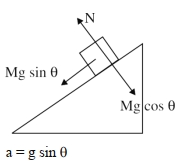
$A$ block '$A$' takes $2\,s$ to slide down a frictionless incline of $30^{\circ}$ and length '$l$',kept inside a lift going up with uniform velocity '$v$'. If the incline is changed to $45^{\circ}$,the time taken by the block to slide down the incline will be approximately $........\,s$.
A
$2.66$
B
$0.83$
C
$1.68$
D
$0.70$
Solution
(C) Since the lift is moving with uniform velocity,its acceleration is zero. Therefore,the effective acceleration due to gravity on the block remains '$g$'.
For a block sliding down a frictionless incline,the acceleration is $a = g \sin \theta$.
Using the equation of motion $s = ut + \frac{1}{2}at^2$,where $u = 0$ and $s = l$:
$l = \frac{1}{2} (g \sin 30^{\circ}) (2)^2 = \frac{1}{2} g (0.5) (4) = g$.
Now,for the incline of $45^{\circ}$,let the time taken be '$t$':
$l = \frac{1}{2} (g \sin 45^{\circ}) t^2$.
Since '$l$' is constant,we equate the two expressions:
$g = \frac{1}{2} g \left(\frac{1}{\sqrt{2}}\right) t^2$.
$1 = \frac{1}{2\sqrt{2}} t^2 \Rightarrow t^2 = 2\sqrt{2} \approx 2.828$.
$t = \sqrt{2.828} \approx 1.68\,s$.
For a block sliding down a frictionless incline,the acceleration is $a = g \sin \theta$.
Using the equation of motion $s = ut + \frac{1}{2}at^2$,where $u = 0$ and $s = l$:
$l = \frac{1}{2} (g \sin 30^{\circ}) (2)^2 = \frac{1}{2} g (0.5) (4) = g$.
Now,for the incline of $45^{\circ}$,let the time taken be '$t$':
$l = \frac{1}{2} (g \sin 45^{\circ}) t^2$.
Since '$l$' is constant,we equate the two expressions:
$g = \frac{1}{2} g \left(\frac{1}{\sqrt{2}}\right) t^2$.
$1 = \frac{1}{2\sqrt{2}} t^2 \Rightarrow t^2 = 2\sqrt{2} \approx 2.828$.
$t = \sqrt{2.828} \approx 1.68\,s$.
0 likes
View Solution52
DifficultMCQ
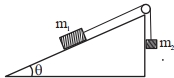
Two bodies of masses $m_{1}=5\,kg$ and $m_{2}=3\,kg$ are connected by a light string going over a smooth light pulley on a smooth inclined plane as shown in the figure. The system is at rest. The force exerted by the inclined plane on the body of mass $m_{1}$ will be $....N$ [Take $g=10\,ms^{-2}$]
A
$30$
B
$40$
C
$50$
D
$60$
Solution
(B) For the system to be at rest (equilibrium),the tension $T$ in the string must balance the weight of $m_{2}$ and the component of weight of $m_{1}$ along the incline.
$T = m_{2}g$
$T = m_{1}g \sin \theta$
Equating the two,we get $m_{2}g = m_{1}g \sin \theta$,which implies $\sin \theta = \frac{m_{2}}{m_{1}} = \frac{3}{5}$.
Since $\sin \theta = \frac{3}{5}$,we have $\cos \theta = \sqrt{1 - \sin^2 \theta} = \sqrt{1 - (\frac{3}{5})^2} = \frac{4}{5}$.
The force exerted by the inclined plane on the body of mass $m_{1}$ is the normal force $N$,which balances the component of weight perpendicular to the incline:
$N = m_{1}g \cos \theta$
Substituting the values: $N = 5 \times 10 \times \frac{4}{5} = 40\,N$.
$T = m_{2}g$
$T = m_{1}g \sin \theta$
Equating the two,we get $m_{2}g = m_{1}g \sin \theta$,which implies $\sin \theta = \frac{m_{2}}{m_{1}} = \frac{3}{5}$.
Since $\sin \theta = \frac{3}{5}$,we have $\cos \theta = \sqrt{1 - \sin^2 \theta} = \sqrt{1 - (\frac{3}{5})^2} = \frac{4}{5}$.
The force exerted by the inclined plane on the body of mass $m_{1}$ is the normal force $N$,which balances the component of weight perpendicular to the incline:
$N = m_{1}g \cos \theta$
Substituting the values: $N = 5 \times 10 \times \frac{4}{5} = 40\,N$.
0 likes
View Solution53
EasyMCQ
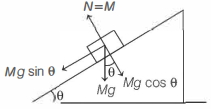
$A$ block of mass $M$ is at rest on a plane surface inclined at an angle $\theta$ to the horizontal. The magnitude of the force exerted by the plane on the block is
A
$M g \cos \theta$
B
$M g \tan \theta$
C
$M g \sin \theta$
D
$M g$
Solution
(A) The weight of the block,$W = Mg$,acts vertically downwards.
We can resolve this weight into two rectangular components:
$1$. $A$ component perpendicular to the inclined plane: $Mg \cos \theta$.
$2$. $A$ component parallel to the inclined plane: $Mg \sin \theta$.
Since the block is at rest on the inclined plane,the net force perpendicular to the plane must be zero.
The plane exerts a normal reaction force $N$ on the block,which balances the perpendicular component of the weight.
Therefore,$N = Mg \cos \theta$.
The total force exerted by the plane on the block is the normal reaction force $N$ (assuming a frictionless surface or considering only the normal component as implied by the options).
Thus,the magnitude of the force exerted by the plane on the block is $Mg \cos \theta$.
We can resolve this weight into two rectangular components:
$1$. $A$ component perpendicular to the inclined plane: $Mg \cos \theta$.
$2$. $A$ component parallel to the inclined plane: $Mg \sin \theta$.
Since the block is at rest on the inclined plane,the net force perpendicular to the plane must be zero.
The plane exerts a normal reaction force $N$ on the block,which balances the perpendicular component of the weight.
Therefore,$N = Mg \cos \theta$.
The total force exerted by the plane on the block is the normal reaction force $N$ (assuming a frictionless surface or considering only the normal component as implied by the options).
Thus,the magnitude of the force exerted by the plane on the block is $Mg \cos \theta$.
0 likes
View Solution54
MediumMCQ
$A$ block of mass $m$ is released on a smooth inclined plane of inclination $\theta$ with the horizontal. The force exerted by the plane on the block has a magnitude
A
$m g$
B
$\frac{m g}{\cos \theta}$
C
$m g \tan \theta$
D
$m g \cos \theta$
Solution
(D) The force exerted by the plane on the block is the normal reaction force $N$.
When a block of mass $m$ is placed on an inclined plane with an angle of inclination $\theta$,the gravitational force $mg$ acts vertically downwards.
We can resolve the gravitational force into two rectangular components:
$1$. $A$ component perpendicular to the inclined plane: $mg \cos \theta$.
$2$. $A$ component parallel to the inclined plane: $mg \sin \theta$.
Since the block does not move in the direction perpendicular to the plane,the normal force $N$ exerted by the plane must balance the perpendicular component of the gravitational force.
Therefore,$N = mg \cos \theta$.
Thus,the magnitude of the force exerted by the plane on the block is $mg \cos \theta$.
When a block of mass $m$ is placed on an inclined plane with an angle of inclination $\theta$,the gravitational force $mg$ acts vertically downwards.
We can resolve the gravitational force into two rectangular components:
$1$. $A$ component perpendicular to the inclined plane: $mg \cos \theta$.
$2$. $A$ component parallel to the inclined plane: $mg \sin \theta$.
Since the block does not move in the direction perpendicular to the plane,the normal force $N$ exerted by the plane must balance the perpendicular component of the gravitational force.
Therefore,$N = mg \cos \theta$.
Thus,the magnitude of the force exerted by the plane on the block is $mg \cos \theta$.

0 likes
View Solution55
MediumMCQ
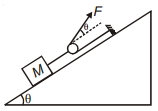
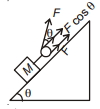
What is the minimum value of $F$ needed so that the block of mass $M$ begins to move upward on a frictionless inclined plane as shown?
A
$M g \tan \left(\frac{\theta}{2}\right)$
B
$M g \cot \left(\frac{\theta}{2}\right)$
C
$\frac{M g \sin \theta}{(1+\sin \theta)}$
D
$M g \sin \left(\frac{\theta}{2}\right)$
Solution
(A) The force $F$ is applied to the pulley. The tension in the string connected to the block $M$ is $F$. The string passes over the pulley,and one end is fixed to the incline. The force $F$ acts at an angle $\theta$ with the incline. The component of $F$ along the incline is $F \cos \theta$. The total force pulling the block up the incline is $T_{total} = F + F \cos \theta$.
For the block to move upward,this force must balance the component of gravity acting down the incline:
$F + F \cos \theta = M g \sin \theta$
$F(1 + \cos \theta) = M g \sin \theta$
$F = \frac{M g \sin \theta}{1 + \cos \theta}$
Using trigonometric identities $\sin \theta = 2 \sin \frac{\theta}{2} \cos \frac{\theta}{2}$ and $1 + \cos \theta = 2 \cos^2 \frac{\theta}{2}$:
$F = \frac{M g (2 \sin \frac{\theta}{2} \cos \frac{\theta}{2})}{2 \cos^2 \frac{\theta}{2}}$
$F = M g \tan \frac{\theta}{2}$
For the block to move upward,this force must balance the component of gravity acting down the incline:
$F + F \cos \theta = M g \sin \theta$
$F(1 + \cos \theta) = M g \sin \theta$
$F = \frac{M g \sin \theta}{1 + \cos \theta}$
Using trigonometric identities $\sin \theta = 2 \sin \frac{\theta}{2} \cos \frac{\theta}{2}$ and $1 + \cos \theta = 2 \cos^2 \frac{\theta}{2}$:
$F = \frac{M g (2 \sin \frac{\theta}{2} \cos \frac{\theta}{2})}{2 \cos^2 \frac{\theta}{2}}$
$F = M g \tan \frac{\theta}{2}$
0 likes
View Solution56
MediumMCQ
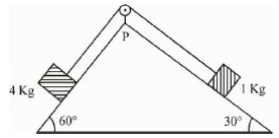
As per the given figure,a weightless pulley $P$ is attached on a double inclined frictionless surface. The tension in the string (massless) will be (if $g = 10 \, m/s^2$):
A
$(-4 \sqrt{3} + 1) \, N$
B
$4(\sqrt{3} + 1) \, N$
C
$-4(\sqrt{3} - 1) \, N$
D
$(4 \sqrt{3} - 1) \, N$
Solution
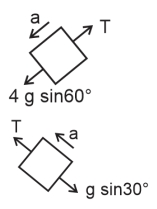
(B) Let the mass $m_1 = 4 \, kg$ be on the $60^{\circ}$ incline and $m_2 = 1 \, kg$ be on the $30^{\circ}$ incline.
For the $4 \, kg$ block,the equation of motion is: $m_1 g \sin 60^{\circ} - T = m_1 a \implies 4 \times 10 \times \frac{\sqrt{3}}{2} - T = 4a \implies 20\sqrt{3} - T = 4a \dots (1)$
For the $1 \, kg$ block,the equation of motion is: $T - m_2 g \sin 30^{\circ} = m_2 a \implies T - 1 \times 10 \times \frac{1}{2} = 1a \implies T - 5 = a \dots (2)$
From equation $(2)$,$a = T - 5$. Substituting this into equation $(1)$:
$20\sqrt{3} - T = 4(T - 5)$
$20\sqrt{3} - T = 4T - 20$
$5T = 20\sqrt{3} + 20$
$T = 4(\sqrt{3} + 1) \, N$.
For the $4 \, kg$ block,the equation of motion is: $m_1 g \sin 60^{\circ} - T = m_1 a \implies 4 \times 10 \times \frac{\sqrt{3}}{2} - T = 4a \implies 20\sqrt{3} - T = 4a \dots (1)$
For the $1 \, kg$ block,the equation of motion is: $T - m_2 g \sin 30^{\circ} = m_2 a \implies T - 1 \times 10 \times \frac{1}{2} = 1a \implies T - 5 = a \dots (2)$
From equation $(2)$,$a = T - 5$. Substituting this into equation $(1)$:
$20\sqrt{3} - T = 4(T - 5)$
$20\sqrt{3} - T = 4T - 20$
$5T = 20\sqrt{3} + 20$
$T = 4(\sqrt{3} + 1) \, N$.
0 likes
View Solution57
DifficultMCQ
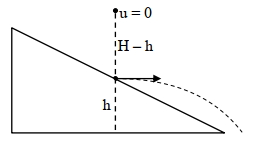
$A$ body starts falling freely from height $H$ and hits an inclined plane in its path at height $h$ from the ground. As a result of this perfectly elastic impact,the direction of the velocity of the body becomes horizontal. The value of $\frac{H}{h}$ for which the body will take the maximum time to reach the ground is . . . . . . .
A
$2$
B
$3$
C
$4$
D
$5$
Solution
(A) Let the body fall from height $H$. It hits the inclined plane at a height $h$ from the ground,meaning it has fallen a distance of $(H-h)$.
The time taken to fall the distance $(H-h)$ is $t_1 = \sqrt{\frac{2(H-h)}{g}}$.
At this point,the impact is perfectly elastic and the velocity becomes horizontal. The body then falls from height $h$ with an initial vertical velocity of $0$. The time taken to fall this remaining distance $h$ is $t_2 = \sqrt{\frac{2h}{g}}$.
The total time of flight $T$ is $T = t_1 + t_2 = \sqrt{\frac{2(H-h)}{g}} + \sqrt{\frac{2h}{g}}$.
To find the value of $h$ for which $T$ is maximum,we differentiate $T$ with respect to $h$ and set it to $0$:
$\frac{dT}{dh} = \sqrt{\frac{2}{g}} \left( \frac{1}{2\sqrt{H-h}} \cdot (-1) + \frac{1}{2\sqrt{h}} \right) = 0$.
This implies $\frac{1}{\sqrt{h}} = \frac{1}{\sqrt{H-h}}$,which gives $h = H - h$,or $2h = H$.
Therefore,$\frac{H}{h} = 2$.
The time taken to fall the distance $(H-h)$ is $t_1 = \sqrt{\frac{2(H-h)}{g}}$.
At this point,the impact is perfectly elastic and the velocity becomes horizontal. The body then falls from height $h$ with an initial vertical velocity of $0$. The time taken to fall this remaining distance $h$ is $t_2 = \sqrt{\frac{2h}{g}}$.
The total time of flight $T$ is $T = t_1 + t_2 = \sqrt{\frac{2(H-h)}{g}} + \sqrt{\frac{2h}{g}}$.
To find the value of $h$ for which $T$ is maximum,we differentiate $T$ with respect to $h$ and set it to $0$:
$\frac{dT}{dh} = \sqrt{\frac{2}{g}} \left( \frac{1}{2\sqrt{H-h}} \cdot (-1) + \frac{1}{2\sqrt{h}} \right) = 0$.
This implies $\frac{1}{\sqrt{h}} = \frac{1}{\sqrt{H-h}}$,which gives $h = H - h$,or $2h = H$.
Therefore,$\frac{H}{h} = 2$.
0 likes
View Solution58
AdvancedMCQ
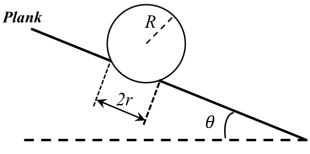
$A$ football of radius $R$ is kept on a hole of radius $r$ (where the diameter of the hole is $2r$ and $r < R$) made on a plank kept horizontally. One end of the plank is now lifted so that it gets tilted,making an angle $\theta$ with the horizontal as shown in the figure. The maximum value of $\theta$ such that the football does not start rolling down the plank satisfies (figure is schematic and not drawn to scale) -
A
$\sin \theta = \frac{r}{R}$
B
$\tan \theta = \frac{r}{R}$
C
$\sin \theta = \frac{r}{2R}$
D
$\cos \theta = \frac{r}{2R}$
Solution
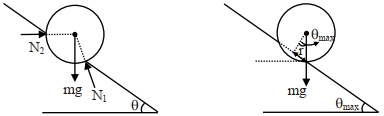
(A) Let the radius of the football be $R$ and the radius of the hole be $r$. The diameter of the hole is $2r$. When the plank is tilted at an angle $\theta$,the football rests on the edge of the hole.
At the point of impending motion (rolling),the normal force from the other side of the hole becomes zero.
Let the center of the football be $O$. The football is in contact with the edge of the hole at a point $P$. The distance from the center $O$ to the point of contact $P$ is $R$.
The vertical line passing through the center $O$ makes an angle $\theta$ with the line perpendicular to the plank.
In the triangle formed by the center of the football,the center of the hole,and the point of contact,the distance from the center of the hole to the point of contact is $r$.
Thus,$\sin \theta = \frac{r}{R}$.
Therefore,the maximum angle $\theta$ for which the football does not roll is given by $\sin \theta = \frac{r}{R}$.
At the point of impending motion (rolling),the normal force from the other side of the hole becomes zero.
Let the center of the football be $O$. The football is in contact with the edge of the hole at a point $P$. The distance from the center $O$ to the point of contact $P$ is $R$.
The vertical line passing through the center $O$ makes an angle $\theta$ with the line perpendicular to the plank.
In the triangle formed by the center of the football,the center of the hole,and the point of contact,the distance from the center of the hole to the point of contact is $r$.
Thus,$\sin \theta = \frac{r}{R}$.
Therefore,the maximum angle $\theta$ for which the football does not roll is given by $\sin \theta = \frac{r}{R}$.
0 likes
View Solution59
MediumMCQ
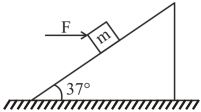
$A$ block of mass $m$ is placed on a smooth fixed inclined plane with an angle of inclination of $37^{\circ}$. $A$ horizontal force $F$ is applied to keep the block at rest. Find the value of $F$.
A
$\frac{mg}{4}$
B
$\frac{3 mg}{4}$
C
$\frac{mg}{5}$
D
$\frac{2 m g}{5}$
Solution
(B) To keep the block at rest on the smooth inclined plane,the forces acting on the block must be balanced.
Along the inclined plane,the component of the gravitational force acting downwards is $mg \sin 37^{\circ}$.
The horizontal force $F$ is applied,and its component along the inclined plane acting upwards is $F \cos 37^{\circ}$.
For the block to be in equilibrium,these two forces must be equal:
$F \cos 37^{\circ} = mg \sin 37^{\circ}$
Using the values $\cos 37^{\circ} = \frac{4}{5}$ and $\sin 37^{\circ} = \frac{3}{5}$:
$F \left( \frac{4}{5} \right) = mg \left( \frac{3}{5} \right)$
$F = \frac{3 mg}{4}$
Along the inclined plane,the component of the gravitational force acting downwards is $mg \sin 37^{\circ}$.
The horizontal force $F$ is applied,and its component along the inclined plane acting upwards is $F \cos 37^{\circ}$.
For the block to be in equilibrium,these two forces must be equal:
$F \cos 37^{\circ} = mg \sin 37^{\circ}$
Using the values $\cos 37^{\circ} = \frac{4}{5}$ and $\sin 37^{\circ} = \frac{3}{5}$:
$F \left( \frac{4}{5} \right) = mg \left( \frac{3}{5} \right)$
$F = \frac{3 mg}{4}$
0 likes
View Solution60
EasyMCQ
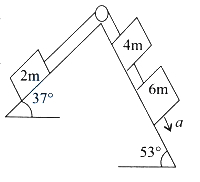
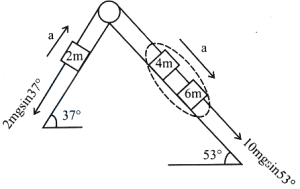
Three blocks of masses $2m$,$4m$,and $6m$ are placed as shown in the figure. If $\sin 37^{\circ}=\frac{3}{5}$ and $\sin 53^{\circ}=\frac{4}{5}$,the acceleration of the system is:
A
$a=\frac{17}{30} g$
B
$a=\frac{13}{30} g$
C
$a=\frac{13}{15} g$
D
$a=\frac{15}{35} g$
Solution
(A) The total mass of the system is $M = 2m + 4m + 6m = 12m$.
The driving force along the incline for the blocks on the right side is $F_1 = (4m + 6m)g \sin 53^{\circ} = 10mg \sin 53^{\circ}$.
The opposing force along the incline for the block on the left side is $F_2 = 2mg \sin 37^{\circ}$.
Using Newton's second law for the system,$F_{net} = Ma$,where $F_{net} = F_1 - F_2$:
$10mg \sin 53^{\circ} - 2mg \sin 37^{\circ} = 12ma$
Substituting the given values $\sin 53^{\circ} = \frac{4}{5}$ and $\sin 37^{\circ} = \frac{3}{5}$:
$10mg \left(\frac{4}{5}\right) - 2mg \left(\frac{3}{5}\right) = 12ma$
$8mg - 1.2mg = 12ma$
$6.8mg = 12ma$
$a = \frac{6.8}{12} g = \frac{68}{120} g = \frac{17}{30} g$.
The driving force along the incline for the blocks on the right side is $F_1 = (4m + 6m)g \sin 53^{\circ} = 10mg \sin 53^{\circ}$.
The opposing force along the incline for the block on the left side is $F_2 = 2mg \sin 37^{\circ}$.
Using Newton's second law for the system,$F_{net} = Ma$,where $F_{net} = F_1 - F_2$:
$10mg \sin 53^{\circ} - 2mg \sin 37^{\circ} = 12ma$
Substituting the given values $\sin 53^{\circ} = \frac{4}{5}$ and $\sin 37^{\circ} = \frac{3}{5}$:
$10mg \left(\frac{4}{5}\right) - 2mg \left(\frac{3}{5}\right) = 12ma$
$8mg - 1.2mg = 12ma$
$6.8mg = 12ma$
$a = \frac{6.8}{12} g = \frac{68}{120} g = \frac{17}{30} g$.
0 likes
View Solution61
MediumMCQ
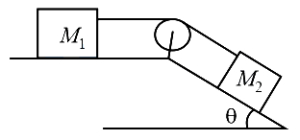
Two masses $M_1$ and $M_2$ are arranged as shown in the figure. Let '$a$' be the magnitude of the acceleration of the system. If the mass of $M_1$ is doubled and that of $M_2$ is halved,then the new acceleration of the system is (Treat all surfaces as smooth; masses of pulley and rope are negligible).
A
$\left(\frac{M_1+M_2}{4 M_1+M_2}\right) a$
B
$\left(\frac{2 M_1+M_2}{4 M_1+M_2}\right) a$
C
$\left(\frac{M_1+2 M_2}{4 M_1+2 M_2}\right) a$
D
$\left(\frac{M_1+2 M_2}{M_1+M_2}\right) a$
Solution
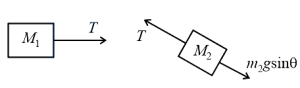
(A) For the given system,the equation of motion is derived from the net force divided by the total mass.
$a = \frac{M_2 g \sin \theta}{M_1 + M_2}$
When the mass of $M_1$ is doubled $(M_1' = 2M_1)$ and the mass of $M_2$ is halved $(M_2' = M_2/2)$,the new acceleration $a'$ is:
$a' = \frac{M_2' g \sin \theta}{M_1' + M_2'} = \frac{(M_2/2) g \sin \theta}{2M_1 + M_2/2}$
Multiplying the numerator and denominator by $2$:
$a' = \frac{M_2 g \sin \theta}{4M_1 + M_2}$
Now,express $a'$ in terms of $a$:
$a' = \left( \frac{M_2 g \sin \theta}{M_1 + M_2} \right) \times \left( \frac{M_1 + M_2}{4M_1 + M_2} \right) = a \left( \frac{M_1 + M_2}{4M_1 + M_2} \right)$
$a = \frac{M_2 g \sin \theta}{M_1 + M_2}$
When the mass of $M_1$ is doubled $(M_1' = 2M_1)$ and the mass of $M_2$ is halved $(M_2' = M_2/2)$,the new acceleration $a'$ is:
$a' = \frac{M_2' g \sin \theta}{M_1' + M_2'} = \frac{(M_2/2) g \sin \theta}{2M_1 + M_2/2}$
Multiplying the numerator and denominator by $2$:
$a' = \frac{M_2 g \sin \theta}{4M_1 + M_2}$
Now,express $a'$ in terms of $a$:
$a' = \left( \frac{M_2 g \sin \theta}{M_1 + M_2} \right) \times \left( \frac{M_1 + M_2}{4M_1 + M_2} \right) = a \left( \frac{M_1 + M_2}{4M_1 + M_2} \right)$
0 likes
View Solution62
MediumMCQ
An object requires $500 \,N$ force to be pulled up on a $30^{\circ}$ frictionless smooth inclined plane at a constant speed. The weight of the object is
A
$500 \sqrt{2} \,N$
B
$1000 \,N$
C
$1000 \sqrt{2} \,N$
D
$500 \sqrt{3} \,N$
Solution
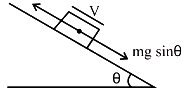
(B) For an object moving at a constant speed on a frictionless inclined plane, the net force acting on it must be zero.
When the object is pulled up the plane, the applied force $F$ must balance the component of the gravitational force acting down the plane.
The component of the weight $W = mg$ acting down the inclined plane is $mg \sin \theta$.
Given:
Applied force $F = 500 \,N$
Angle of inclination $\theta = 30^{\circ}$
Since the object moves at a constant speed, the forces are in equilibrium:
$F = mg \sin 30^{\circ}$
$500 \,N = mg \cdot \frac{1}{2}$
$mg = 500 \,N \times 2$
$mg = 1000 \,N$
Therefore, the weight of the object is $1000 \,N$.
When the object is pulled up the plane, the applied force $F$ must balance the component of the gravitational force acting down the plane.
The component of the weight $W = mg$ acting down the inclined plane is $mg \sin \theta$.
Given:
Applied force $F = 500 \,N$
Angle of inclination $\theta = 30^{\circ}$
Since the object moves at a constant speed, the forces are in equilibrium:
$F = mg \sin 30^{\circ}$
$500 \,N = mg \cdot \frac{1}{2}$
$mg = 500 \,N \times 2$
$mg = 1000 \,N$
Therefore, the weight of the object is $1000 \,N$.
0 likes
View Solution63
MediumMCQ
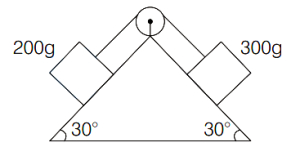
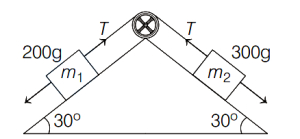
$A$ double inclined plane as shown in the figure has a fixed horizontal base and smooth faces with the same angle of inclination of $30^{\circ}$. $A$ block of mass $m_2 = 300 \ g$ is on one face and is connected by a cord passing over a frictionless pulley to a second block of mass $m_1 = 200 \ g$ kept on the other face. The acceleration with which the system of the blocks moves is ........ $\%$ of acceleration due to gravity $(g)$.
A
$5$
B
$10$
C
$15$
D
$20$
Solution
(B) Let $m_2 = 300 \ g$ and $m_1 = 200 \ g$. The angle of inclination is $\theta = 30^{\circ}$.
For the block of mass $m_2$,the equation of motion is: $m_2 g \sin \theta - T = m_2 a$ $(i)$
For the block of mass $m_1$,the equation of motion is: $T - m_1 g \sin \theta = m_1 a$ (ii)
Adding equations $(i)$ and (ii),we get:
$(m_2 - m_1) g \sin \theta = (m_1 + m_2) a$
$a = \frac{(m_2 - m_1) g \sin \theta}{m_1 + m_2}$
Substituting the values: $a = \frac{(300 - 200) g \sin 30^{\circ}}{300 + 200}$
$a = \frac{100 \times g \times 0.5}{500} = \frac{50}{500} g = \frac{1}{10} g$
$a = 0.1 g = 10 \% \text{ of } g$.
For the block of mass $m_2$,the equation of motion is: $m_2 g \sin \theta - T = m_2 a$ $(i)$
For the block of mass $m_1$,the equation of motion is: $T - m_1 g \sin \theta = m_1 a$ (ii)
Adding equations $(i)$ and (ii),we get:
$(m_2 - m_1) g \sin \theta = (m_1 + m_2) a$
$a = \frac{(m_2 - m_1) g \sin \theta}{m_1 + m_2}$
Substituting the values: $a = \frac{(300 - 200) g \sin 30^{\circ}}{300 + 200}$
$a = \frac{100 \times g \times 0.5}{500} = \frac{50}{500} g = \frac{1}{10} g$
$a = 0.1 g = 10 \% \text{ of } g$.
0 likes
View Solution64
MediumMCQ
Two smooth inclined planes $A$ and $B$ each of height $20 \ m$ have angles of inclination $30^{\circ}$ and $60^{\circ}$ respectively. If $t_1$ and $t_2$ are respectively the times taken by two blocks to reach the bottom of the planes $A$ and $B$ from the top,then $t_1 - t_2 = $ (Acceleration due to gravity $= 10 \ m \ s^{-2}$)
A
$\frac{\sqrt{3}-1}{\sqrt{3}} \ s$
B
$3(\sqrt{3}-1) \ s$
C
$4\left(\frac{\sqrt{3}-1}{\sqrt{3}}\right) \ s$
D
$(3 \sqrt{3}-2) \ s$
Solution
(C) The length of an inclined plane of height $h$ and angle $\theta$ is $L = \frac{h}{\sin \theta}$.
The acceleration of a block sliding down a smooth inclined plane is $a = g \sin \theta$.
Using the equation of motion $s = ut + \frac{1}{2}at^2$,where $u = 0$ and $s = L$:
$L = \frac{1}{2} (g \sin \theta) t^2 \implies \frac{h}{\sin \theta} = \frac{1}{2} g \sin \theta \ t^2$.
Thus,$t = \sqrt{\frac{2h}{g \sin^2 \theta}} = \frac{1}{\sin \theta} \sqrt{\frac{2h}{g}}$.
Given $h = 20 \ m$ and $g = 10 \ m \ s^{-2}$,we have $\sqrt{\frac{2h}{g}} = \sqrt{\frac{2 \times 20}{10}} = 2 \ s$.
For plane $A$ $(\theta_1 = 30^{\circ})$: $t_1 = \frac{1}{\sin 30^{\circ}} \times 2 = \frac{1}{0.5} \times 2 = 4 \ s$.
For plane $B$ $(\theta_2 = 60^{\circ})$: $t_2 = \frac{1}{\sin 60^{\circ}} \times 2 = \frac{1}{\sqrt{3}/2} \times 2 = \frac{4}{\sqrt{3}} \ s$.
Therefore,$t_1 - t_2 = 4 - \frac{4}{\sqrt{3}} = 4 \left( 1 - \frac{1}{\sqrt{3}} \right) = 4 \left( \frac{\sqrt{3}-1}{\sqrt{3}} \right) \ s$.
The acceleration of a block sliding down a smooth inclined plane is $a = g \sin \theta$.
Using the equation of motion $s = ut + \frac{1}{2}at^2$,where $u = 0$ and $s = L$:
$L = \frac{1}{2} (g \sin \theta) t^2 \implies \frac{h}{\sin \theta} = \frac{1}{2} g \sin \theta \ t^2$.
Thus,$t = \sqrt{\frac{2h}{g \sin^2 \theta}} = \frac{1}{\sin \theta} \sqrt{\frac{2h}{g}}$.
Given $h = 20 \ m$ and $g = 10 \ m \ s^{-2}$,we have $\sqrt{\frac{2h}{g}} = \sqrt{\frac{2 \times 20}{10}} = 2 \ s$.
For plane $A$ $(\theta_1 = 30^{\circ})$: $t_1 = \frac{1}{\sin 30^{\circ}} \times 2 = \frac{1}{0.5} \times 2 = 4 \ s$.
For plane $B$ $(\theta_2 = 60^{\circ})$: $t_2 = \frac{1}{\sin 60^{\circ}} \times 2 = \frac{1}{\sqrt{3}/2} \times 2 = \frac{4}{\sqrt{3}} \ s$.
Therefore,$t_1 - t_2 = 4 - \frac{4}{\sqrt{3}} = 4 \left( 1 - \frac{1}{\sqrt{3}} \right) = 4 \left( \frac{\sqrt{3}-1}{\sqrt{3}} \right) \ s$.
0 likes
View Solution65
MediumMCQ
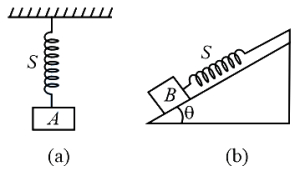
As shown in the figure,an iron block $A$ of volume $0.25 \ m^3$ is attached to a spring $S$ of unstretched length $1.0 \ m$ and hanging from the ceiling. The spring gets stretched by $0.2 \ m$. This block is removed and another iron block $B$ of volume $0.75 \ m^3$ is now attached to the same spring and kept on a frictionless inclined plane of $30^{\circ}$ inclination. The distance of the block from the top along the incline at equilibrium is (in $m$)
A
$1.1$
B
$1.3$
C
$1.6$
D
$1.9$
Solution
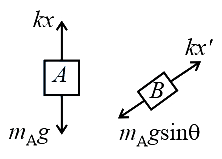
(B) The free body diagrams of the blocks are shown in the figure.
At equilibrium,the net force on a body is zero.
For block $A$ hanging vertically:
$m_A g = k x$
$\Rightarrow k = \frac{m_A g}{x}$
For block $B$ on the inclined plane:
$m_B g \sin 30^{\circ} = k x^{\prime}$
$\Rightarrow x^{\prime} = \frac{m_B g \sin 30^{\circ}}{k} = \frac{m_B g \sin 30^{\circ}}{(m_A g / x)} = \frac{m_B}{m_A} x \sin 30^{\circ}$
Since both blocks are made of the same material,mass is proportional to volume $(m = \rho V)$:
$\Rightarrow x^{\prime} = \frac{V_B}{V_A} x \sin 30^{\circ} = \frac{0.75}{0.25} \times 0.2 \times \sin 30^{\circ}$
$\Rightarrow x^{\prime} = 3 \times 0.2 \times 0.5 = 0.3 \ m$
The total distance of the block from the top is the sum of the unstretched length $l$ and the extension $x^{\prime}$:
$d = l + x^{\prime} = 1.0 \ m + 0.3 \ m = 1.3 \ m$.
At equilibrium,the net force on a body is zero.
For block $A$ hanging vertically:
$m_A g = k x$
$\Rightarrow k = \frac{m_A g}{x}$
For block $B$ on the inclined plane:
$m_B g \sin 30^{\circ} = k x^{\prime}$
$\Rightarrow x^{\prime} = \frac{m_B g \sin 30^{\circ}}{k} = \frac{m_B g \sin 30^{\circ}}{(m_A g / x)} = \frac{m_B}{m_A} x \sin 30^{\circ}$
Since both blocks are made of the same material,mass is proportional to volume $(m = \rho V)$:
$\Rightarrow x^{\prime} = \frac{V_B}{V_A} x \sin 30^{\circ} = \frac{0.75}{0.25} \times 0.2 \times \sin 30^{\circ}$
$\Rightarrow x^{\prime} = 3 \times 0.2 \times 0.5 = 0.3 \ m$
The total distance of the block from the top is the sum of the unstretched length $l$ and the extension $x^{\prime}$:
$d = l + x^{\prime} = 1.0 \ m + 0.3 \ m = 1.3 \ m$.
0 likes
View Solution66
MediumMCQ
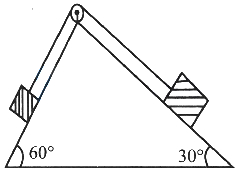
Two blocks of equal masses are tied to the ends of a light string. The string passes over a massless pulley fixed on a frictionless surface as shown in the figure. The acceleration of the centre of mass of the blocks is ($g$ = acceleration due to gravity).
A
$\left(\frac{\sqrt{3}-1}{4 \sqrt{2}}\right) g$
B
$\left(\frac{\sqrt{3}+1}{4 \sqrt{2}}\right) g$
C
$\left(\frac{\sqrt{3}-1}{2 \sqrt{2}}\right) g$
D
$\left(\frac{\sqrt{3}+1}{2 \sqrt{2}}\right) g$
Solution
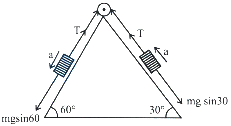
(A) Let the mass of each block be $m$. The forces acting along the incline are $mg \sin 60^{\circ}$ and $mg \sin 30^{\circ}$.
Since $mg \sin 60^{\circ} > mg \sin 30^{\circ}$,the system accelerates such that the block on the $60^{\circ}$ incline moves down.
For the block on the $60^{\circ}$ incline: $mg \sin 60^{\circ} - T = ma$ --- $(i)$
For the block on the $30^{\circ}$ incline: $T - mg \sin 30^{\circ} = ma$ --- (ii)
Adding $(i)$ and (ii): $mg(\sin 60^{\circ} - \sin 30^{\circ}) = 2ma$
$a = \frac{g}{2} \left(\frac{\sqrt{3}}{2} - \frac{1}{2}\right) = \frac{(\sqrt{3}-1)g}{4}$.
The acceleration vectors for the blocks are $\vec{a}_1 = a(\cos 60^{\circ} \hat{i} - \sin 60^{\circ} \hat{j})$ and $\vec{a}_2 = a(-\cos 30^{\circ} \hat{i} - \sin 30^{\circ} \hat{j})$.
The acceleration of the centre of mass is $\vec{a}_{cm} = \frac{m\vec{a}_1 + m\vec{a}_2}{2m} = \frac{\vec{a}_1 + \vec{a}_2}{2}$.
$\vec{a}_{cm} = \frac{a}{2} [(\cos 60^{\circ} - \cos 30^{\circ}) \hat{i} - (\sin 60^{\circ} + \sin 30^{\circ}) \hat{j}]$.
Using $\cos 60^{\circ} = 1/2, \cos 30^{\circ} = \sqrt{3}/2, \sin 60^{\circ} = \sqrt{3}/2, \sin 30^{\circ} = 1/2$:
$|\vec{a}_{cm}| = \frac{a}{2} \sqrt{(\frac{1-\sqrt{3}}{2})^2 + (\frac{\sqrt{3}+1}{2})^2} = \frac{a}{2} \sqrt{\frac{1+3-2\sqrt{3} + 3+1+2\sqrt{3}}{4}} = \frac{a}{2} \sqrt{\frac{8}{4}} = \frac{a\sqrt{2}}{2} = \frac{a}{\sqrt{2}}$.
Substituting $a$: $|\vec{a}_{cm}| = \frac{(\sqrt{3}-1)g}{4\sqrt{2}}$.
Since $mg \sin 60^{\circ} > mg \sin 30^{\circ}$,the system accelerates such that the block on the $60^{\circ}$ incline moves down.
For the block on the $60^{\circ}$ incline: $mg \sin 60^{\circ} - T = ma$ --- $(i)$
For the block on the $30^{\circ}$ incline: $T - mg \sin 30^{\circ} = ma$ --- (ii)
Adding $(i)$ and (ii): $mg(\sin 60^{\circ} - \sin 30^{\circ}) = 2ma$
$a = \frac{g}{2} \left(\frac{\sqrt{3}}{2} - \frac{1}{2}\right) = \frac{(\sqrt{3}-1)g}{4}$.
The acceleration vectors for the blocks are $\vec{a}_1 = a(\cos 60^{\circ} \hat{i} - \sin 60^{\circ} \hat{j})$ and $\vec{a}_2 = a(-\cos 30^{\circ} \hat{i} - \sin 30^{\circ} \hat{j})$.
The acceleration of the centre of mass is $\vec{a}_{cm} = \frac{m\vec{a}_1 + m\vec{a}_2}{2m} = \frac{\vec{a}_1 + \vec{a}_2}{2}$.
$\vec{a}_{cm} = \frac{a}{2} [(\cos 60^{\circ} - \cos 30^{\circ}) \hat{i} - (\sin 60^{\circ} + \sin 30^{\circ}) \hat{j}]$.
Using $\cos 60^{\circ} = 1/2, \cos 30^{\circ} = \sqrt{3}/2, \sin 60^{\circ} = \sqrt{3}/2, \sin 30^{\circ} = 1/2$:
$|\vec{a}_{cm}| = \frac{a}{2} \sqrt{(\frac{1-\sqrt{3}}{2})^2 + (\frac{\sqrt{3}+1}{2})^2} = \frac{a}{2} \sqrt{\frac{1+3-2\sqrt{3} + 3+1+2\sqrt{3}}{4}} = \frac{a}{2} \sqrt{\frac{8}{4}} = \frac{a\sqrt{2}}{2} = \frac{a}{\sqrt{2}}$.
Substituting $a$: $|\vec{a}_{cm}| = \frac{(\sqrt{3}-1)g}{4\sqrt{2}}$.
0 likes
View Solution67
DifficultMCQ
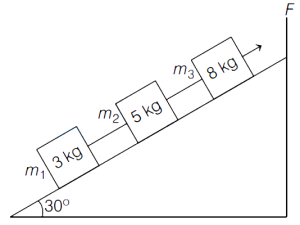
Three blocks are connected by massless strings on a frictionless inclined plane of $30^{\circ}$ as shown in the figure. $A$ force of $104 \,N$ is applied upward along the incline to mass $m_3$ causing an upward motion of the blocks. What is the acceleration of the blocks (in $\,m / s^2$)? (Assume,acceleration due to gravity,$g=10 \,m / s^2$ )
A
$6.0$
B
$4.5$
C
$3.0$
D
$1.5$
Solution
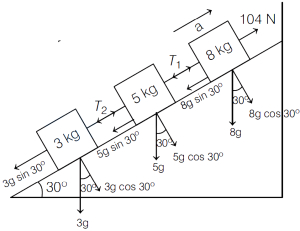
(D) The total mass of the system is $M = (8 + 5 + 3) \,kg = 16 \,kg$.
Since the blocks are connected and move together,the entire system can be treated as a single body of mass $M = 16 \,kg$ moving up the incline with acceleration $a$.
The external force applied is $F = 104 \,N$.
The component of the total weight acting down the incline is $Mg \sin 30^{\circ}$.
Applying Newton's second law to the system:
$F - Mg \sin 30^{\circ} = Ma$
$104 - 16 \times 10 \times \sin 30^{\circ} = 16a$
$104 - 160 \times 0.5 = 16a$
$104 - 80 = 16a$
$24 = 16a$
$a = \frac{24}{16} = 1.5 \,m / s^2$.
Thus,the acceleration of the blocks is $1.5 \,m / s^2$.
Since the blocks are connected and move together,the entire system can be treated as a single body of mass $M = 16 \,kg$ moving up the incline with acceleration $a$.
The external force applied is $F = 104 \,N$.
The component of the total weight acting down the incline is $Mg \sin 30^{\circ}$.
Applying Newton's second law to the system:
$F - Mg \sin 30^{\circ} = Ma$
$104 - 16 \times 10 \times \sin 30^{\circ} = 16a$
$104 - 160 \times 0.5 = 16a$
$104 - 80 = 16a$
$24 = 16a$
$a = \frac{24}{16} = 1.5 \,m / s^2$.
Thus,the acceleration of the blocks is $1.5 \,m / s^2$.
0 likes
View SolutionNewton's Laws of Motion and Friction — Motion of Body (or Connected Bodies) on an inclined plane · Frequently Asked Questions
1Are these Newton's Laws of Motion and Friction questions useful for JEE and NEET?
Yes. All questions in this section are mapped to JEE Main and NEET exam patterns. Previous year questions from JEE Main, NEET, GUJCET and state-level exams are included with full solutions.
2Can I switch to Hindi or Gujarati for these questions?
Yes. Use the language tabs in the hero section or the sidebar to view the same questions and solutions in English, Hindi or Gujarati.
3How do I generate a question paper from this subtopic?
Use the Vedclass Exam Paper Generator — select the chapter and subtopic, set difficulty, and generate Sets A, B, C, D automatically. First 3 chapters of every subject are free.
Vedclass Products
For Students
Vedclass Test Series
Mock tests in real JEE/NEET style with performance analysis. 5-day free trial.
Start Free TrialFor Teachers
Exam Paper Generator
Generate Set A/B/C/D papers from this chapter in 2 minutes. 3 chapters free.
Try FreeFor Institutes
Online Exam Module
Live online exams with unlimited students, 360° analytics & white-label branding.
See DemoFor Teachers & Institutes
Generate a Newton's Laws of Motion and Friction Exam Paper in 2 Minutes
Select subtopic & difficulty — Sets A, B, C, D auto-generated with No Repeat logic.
First 3 chapters of every subject are free — no payment required.