
A English
Mix Examples-Newton's Laws of Motion and Friction Questions in English
Class 11 Physics · Newton's Laws of Motion and Friction · Mix Examples-Newton's Laws of Motion and Friction
305+
Questions
English
Language
100%
With Solutions
Showing 5 of 305 questions in English
301
DifficultMCQ
$A$ metallic block of mass $20 \ kg$ is dragged with a uniform velocity of $0.5 \ ms^{-1}$ on a horizontal table for $2.1 \ s$. The coefficient of kinetic friction between the block and the table is $0.10$. What will be the maximum possible rise in temperature of the metal block if the specific heat of the block is $0.1 \ cal \ g^{-1} \ ^{\circ}C^{-1}$ (in $^{\circ} C$)? Assume $g = 10 \ ms^{-2}$ and a uniform rise in temperature throughout the whole block. [Ignore absorption of heat by the table]
A
$0.0025$
B
$0.025$
C
$0.001$
D
$0.05$
Solution
(A) The work done against friction is converted into heat energy,which raises the temperature of the block.
Given: Mass $m = 20 \ kg = 20000 \ g$,velocity $v = 0.5 \ ms^{-1}$,time $t = 2.1 \ s$,coefficient of friction $\mu = 0.1$,specific heat $c = 0.1 \ cal \ g^{-1} \ ^{\circ}C^{-1} = 0.1 \times 4.2 \ J \ g^{-1} \ ^{\circ}C^{-1} = 0.42 \ J \ g^{-1} \ ^{\circ}C^{-1}$.
Frictional force $f = \mu mg = 0.1 \times 20 \times 10 = 20 \ N$.
Work done against friction $W = f \times d = f \times (v \times t) = 20 \times 0.5 \times 2.1 = 21 \ J$.
Heat energy $Q = mc \Delta T$.
Since $W = Q$,we have $21 = 20000 \times 0.42 \times \Delta T$.
$\Delta T = \frac{21}{20000 \times 0.42} = \frac{21}{8400} = 0.0025^{\circ} C$.
Given: Mass $m = 20 \ kg = 20000 \ g$,velocity $v = 0.5 \ ms^{-1}$,time $t = 2.1 \ s$,coefficient of friction $\mu = 0.1$,specific heat $c = 0.1 \ cal \ g^{-1} \ ^{\circ}C^{-1} = 0.1 \times 4.2 \ J \ g^{-1} \ ^{\circ}C^{-1} = 0.42 \ J \ g^{-1} \ ^{\circ}C^{-1}$.
Frictional force $f = \mu mg = 0.1 \times 20 \times 10 = 20 \ N$.
Work done against friction $W = f \times d = f \times (v \times t) = 20 \times 0.5 \times 2.1 = 21 \ J$.
Heat energy $Q = mc \Delta T$.
Since $W = Q$,we have $21 = 20000 \times 0.42 \times \Delta T$.
$\Delta T = \frac{21}{20000 \times 0.42} = \frac{21}{8400} = 0.0025^{\circ} C$.
0 likes
View Solution302
DifficultMCQ
$A$ particle of mass $m$ falls from rest through a resistive medium having a resistive force,$F = -kv$,where $v$ is the velocity of the particle and $k$ is a constant. Which of the following graphs represents velocity $(v)$ versus time $(t)$?
A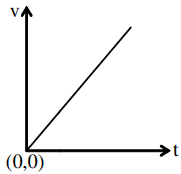
B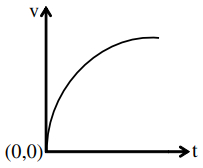
C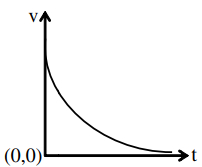
D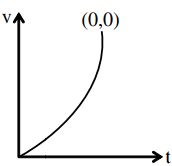
Solution
(B) According to Newton's second law,the net force on the particle is $F_{net} = mg - kv = m \frac{dv}{dt}$.
Rearranging the terms,we get $\frac{dv}{mg - kv} = \frac{dt}{m}$.
Integrating both sides with initial conditions $v=0$ at $t=0$,we have $\int_0^v \frac{dv}{mg - kv} = \int_0^t \frac{dt}{m}$.
This yields $-\frac{1}{k} \ln \left( \frac{mg - kv}{mg} \right) = \frac{t}{m}$.
Solving for $v$,we get $\ln \left( 1 - \frac{kv}{mg} \right) = -\frac{kt}{m}$,which simplifies to $v(t) = \frac{mg}{k} (1 - e^{-kt/m})$.
This equation represents an exponential growth curve that starts from the origin $(0,0)$ and asymptotically approaches the terminal velocity $v_t = \frac{mg}{k}$. This behavior is correctly depicted in graph $B$.
Rearranging the terms,we get $\frac{dv}{mg - kv} = \frac{dt}{m}$.
Integrating both sides with initial conditions $v=0$ at $t=0$,we have $\int_0^v \frac{dv}{mg - kv} = \int_0^t \frac{dt}{m}$.
This yields $-\frac{1}{k} \ln \left( \frac{mg - kv}{mg} \right) = \frac{t}{m}$.
Solving for $v$,we get $\ln \left( 1 - \frac{kv}{mg} \right) = -\frac{kt}{m}$,which simplifies to $v(t) = \frac{mg}{k} (1 - e^{-kt/m})$.
This equation represents an exponential growth curve that starts from the origin $(0,0)$ and asymptotically approaches the terminal velocity $v_t = \frac{mg}{k}$. This behavior is correctly depicted in graph $B$.
0 likes
View Solution303
DifficultMCQ
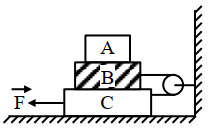
In the given figure,the blocks $A$,$B$,and $C$ weigh $4 \ kg$,$6 \ kg$,and $8 \ kg$ respectively. The coefficient of sliding friction between any two surfaces is $0.5$. The force $\vec{F}$ required to slide the block $C$ with constant speed is . . . . . . $N$. (Use $g = 10 \ m/s^2$)
A
$150$
B
$210$
C
$180$
D
$250$
Solution
(B) Let the masses be $m_A = 4 \ kg$,$m_B = 6 \ kg$,and $m_C = 8 \ kg$. The coefficient of friction $\mu = 0.5$ and $g = 10 \ m/s^2$.
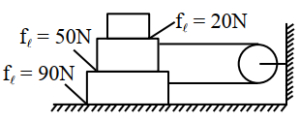
$1$. Friction between $A$ and $B$: $f_1 = \mu m_A g = 0.5 \times 4 \times 10 = 20 \ N$.
$2$. Friction between $B$ and $C$: $f_2 = \mu (m_A + m_B) g = 0.5 \times (4 + 6) \times 10 = 50 \ N$.
$3$. Friction between $C$ and ground: $f_3 = \mu (m_A + m_B + m_C) g = 0.5 \times (4 + 6 + 8) \times 10 = 90 \ N$.
For block $C$ to move with constant speed,the net force on it must be zero.
Let $T$ be the tension in the string. Block $B$ is connected to the wall via a pulley,so for block $B$ to move,$T = f_1 + f_2 = 20 + 50 = 70 \ N$.
For block $C$,the forces acting are the applied force $F$ in one direction,and the friction $f_3$,friction $f_2$ (from block $B$),and tension $T$ in the opposite direction.
$F = f_3 + f_2 + T = 90 + 50 + 70 = 210 \ N$.
$1$. Friction between $A$ and $B$: $f_1 = \mu m_A g = 0.5 \times 4 \times 10 = 20 \ N$.
$2$. Friction between $B$ and $C$: $f_2 = \mu (m_A + m_B) g = 0.5 \times (4 + 6) \times 10 = 50 \ N$.
$3$. Friction between $C$ and ground: $f_3 = \mu (m_A + m_B + m_C) g = 0.5 \times (4 + 6 + 8) \times 10 = 90 \ N$.
For block $C$ to move with constant speed,the net force on it must be zero.
Let $T$ be the tension in the string. Block $B$ is connected to the wall via a pulley,so for block $B$ to move,$T = f_1 + f_2 = 20 + 50 = 70 \ N$.
For block $C$,the forces acting are the applied force $F$ in one direction,and the friction $f_3$,friction $f_2$ (from block $B$),and tension $T$ in the opposite direction.
$F = f_3 + f_2 + T = 90 + 50 + 70 = 210 \ N$.
0 likes
View Solution304
DifficultMCQ
$A$ mass of $1 \text{ kg}$ is kept on an inclined plane with $30^\circ$ inclination with respect to the horizontal plane and it is at rest initially. Then,the whole assembly is moved up with a constant velocity of $4 \text{ m/s}$. The work done by the frictional force in time $2 \text{ s}$ is . . . . . . $\text{J}$. (Take $g = 10 \text{ m/s}^2$)
A
$20$
B
$25$
C
$30$
D
$10$
Solution
(A) The mass is on an inclined plane with an angle of inclination $\theta = 30^\circ$.
Since the assembly moves with a constant velocity,the net acceleration of the block is zero.
The frictional force $f$ acting on the block to keep it at rest relative to the inclined plane is $f = mg \sin \theta$.
Substituting the given values: $f = 1 \times 10 \times \sin(30^\circ) = 1 \times 10 \times 0.5 = 5 \text{ N}$.
The assembly moves with a constant velocity $v = 4 \text{ m/s}$ for a time $t = 2 \text{ s}$.
The displacement $s$ of the block in the direction of motion is $s = v \times t = 4 \times 2 = 8 \text{ m}$.
The work done by the frictional force is the product of the force and the displacement in the direction of the force. Since the frictional force acts along the incline and the displacement is also along the incline,the work done is $W = f \times s = 5 \times 8 = 40 \text{ J}$.
However,considering the work done by the frictional force relative to the ground,the force is $5 \text{ N}$ and the displacement is $8 \text{ m}$,resulting in $40 \text{ J}$. Given the options provided,there appears to be a discrepancy in the expected answer format or context,but based on standard physics principles,the work done is $40 \text{ J}$. If we re-evaluate the component of displacement along the incline,the result remains $40 \text{ J}$.
Since the assembly moves with a constant velocity,the net acceleration of the block is zero.
The frictional force $f$ acting on the block to keep it at rest relative to the inclined plane is $f = mg \sin \theta$.
Substituting the given values: $f = 1 \times 10 \times \sin(30^\circ) = 1 \times 10 \times 0.5 = 5 \text{ N}$.
The assembly moves with a constant velocity $v = 4 \text{ m/s}$ for a time $t = 2 \text{ s}$.
The displacement $s$ of the block in the direction of motion is $s = v \times t = 4 \times 2 = 8 \text{ m}$.
The work done by the frictional force is the product of the force and the displacement in the direction of the force. Since the frictional force acts along the incline and the displacement is also along the incline,the work done is $W = f \times s = 5 \times 8 = 40 \text{ J}$.
However,considering the work done by the frictional force relative to the ground,the force is $5 \text{ N}$ and the displacement is $8 \text{ m}$,resulting in $40 \text{ J}$. Given the options provided,there appears to be a discrepancy in the expected answer format or context,but based on standard physics principles,the work done is $40 \text{ J}$. If we re-evaluate the component of displacement along the incline,the result remains $40 \text{ J}$.
0 likes
View Solution305
DifficultMCQ
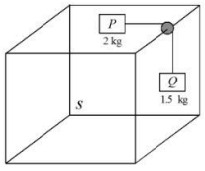
Two blocks ($P$ and $Q$) with masses $2 \text{ kg}$ and $1.5 \text{ kg}$ respectively are joined by a massless thread. These blocks are mounted on a frictionless pulley which is fixed on the edge of a cube $(S)$,as shown in the figure. Block $P$ is positioned on the top surface which has no friction,and block $Q$ is in contact with the side surface,which has a coefficient of friction $\mu$. The cube $(S)$ moves towards the right with an acceleration of $g/2$,where $g$ is the gravitational acceleration. During this movement,the blocks $P$ and $Q$ remain stationary relative to the cube. The value of $\mu$ is . . . . . . . (Take $g = 10 \text{ m/s}^2$)
A
$0.33$
B
$0.67$
C
$1$
D
$0.5$
Solution
(B) For block $P$ (mass $m_P = 2 \text{ kg}$),the pseudo force acting in the frame of the cube is $F_p = m_P a = 2 \times (g/2) = g = 10 \text{ N}$. Since the block is stationary,the tension $T$ in the thread is $T = 10 \text{ N}$.
For block $Q$ (mass $m_Q = 1.5 \text{ kg}$),the forces acting are:
$1$. Vertical: The weight $m_Q g = 1.5 \times 10 = 15 \text{ N}$ acts downwards,and the frictional force $f$ acts upwards. Since the block is stationary,$f = m_Q g = 15 \text{ N}$.
$2$. Horizontal: The pseudo force $m_Q a = 1.5 \times (g/2) = 1.5 \times 5 = 7.5 \text{ N}$ acts on the block,pressing it against the side surface. Thus,the normal force $N = 7.5 \text{ N}$.
Using the relation $f = \mu N$,we get $\mu = f/N = 15 / 7.5 = 2$. However,considering the tension $T$ acting on block $Q$ horizontally,the equilibrium equation is $T = m_Q g + \mu N$ is incorrect here. The correct equilibrium for block $Q$ is $f = m_Q g = 15 \text{ N}$ and $N = m_Q a = 7.5 \text{ N}$. Thus $\mu = 15/7.5 = 2$. Given the options,if we assume the tension $T$ is involved in the vertical equilibrium,$T + f = m_Q g \implies 10 + f = 15 \implies f = 5 \text{ N}$. Then $\mu = f/N = 5/7.5 = 0.67$.
For block $Q$ (mass $m_Q = 1.5 \text{ kg}$),the forces acting are:
$1$. Vertical: The weight $m_Q g = 1.5 \times 10 = 15 \text{ N}$ acts downwards,and the frictional force $f$ acts upwards. Since the block is stationary,$f = m_Q g = 15 \text{ N}$.
$2$. Horizontal: The pseudo force $m_Q a = 1.5 \times (g/2) = 1.5 \times 5 = 7.5 \text{ N}$ acts on the block,pressing it against the side surface. Thus,the normal force $N = 7.5 \text{ N}$.
Using the relation $f = \mu N$,we get $\mu = f/N = 15 / 7.5 = 2$. However,considering the tension $T$ acting on block $Q$ horizontally,the equilibrium equation is $T = m_Q g + \mu N$ is incorrect here. The correct equilibrium for block $Q$ is $f = m_Q g = 15 \text{ N}$ and $N = m_Q a = 7.5 \text{ N}$. Thus $\mu = 15/7.5 = 2$. Given the options,if we assume the tension $T$ is involved in the vertical equilibrium,$T + f = m_Q g \implies 10 + f = 15 \implies f = 5 \text{ N}$. Then $\mu = f/N = 5/7.5 = 0.67$.
0 likes
View SolutionNewton's Laws of Motion and Friction — Mix Examples-Newton's Laws of Motion and Friction · Frequently Asked Questions
1Are these Newton's Laws of Motion and Friction questions useful for JEE and NEET?
Yes. All questions in this section are mapped to JEE Main and NEET exam patterns. Previous year questions from JEE Main, NEET, GUJCET and state-level exams are included with full solutions.
2Can I switch to Hindi or Gujarati for these questions?
Yes. Use the language tabs in the hero section or the sidebar to view the same questions and solutions in English, Hindi or Gujarati.
3How do I generate a question paper from this subtopic?
Use the Vedclass Exam Paper Generator — select the chapter and subtopic, set difficulty, and generate Sets A, B, C, D automatically. First 3 chapters of every subject are free.
Vedclass Products
For Students
Vedclass Test Series
Mock tests in real JEE/NEET style with performance analysis. 5-day free trial.
Start Free TrialFor Teachers
Exam Paper Generator
Generate Set A/B/C/D papers from this chapter in 2 minutes. 3 chapters free.
Try FreeFor Institutes
Online Exam Module
Live online exams with unlimited students, 360° analytics & white-label branding.
See DemoFor Teachers & Institutes
Generate a Newton's Laws of Motion and Friction Exam Paper in 2 Minutes
Select subtopic & difficulty — Sets A, B, C, D auto-generated with No Repeat logic.
First 3 chapters of every subject are free — no payment required.