
A English
Conservation of Linear Momentum Questions in English
Class 11 Physics · Newton's Laws of Motion and Friction · Conservation of Linear Momentum
208+
Questions
English
Language
100%
With Solutions
Showing 6 of 208 questions in English
201
DifficultMCQ
An object of mass $2m$ is projected with a speed of $100 \ m/s$ at an angle $\theta = \sin^{-1}(3/5)$ to the horizontal. At the highest point,the object breaks into two pieces of same mass $m$ and the first one comes to rest. The distance between the point of projection and the point of landing of the second piece (in metres) is $(g = 10 \ m/s^2)$.
A
$3840$
B
$1280$
C
$1440$
D
$960$
Solution
(C) The initial horizontal velocity of the object is $u_x = u \cos \theta$. Given $\sin \theta = 3/5$,then $\cos \theta = 4/5$. So,$u_x = 100 \times (4/5) = 80 \ m/s$.
At the highest point,the vertical velocity is $0$,and the horizontal velocity is $80 \ m/s$. The momentum of the system at the highest point is $P = (2m) \times 80 = 160m$.
After the explosion,the first piece $(m)$ comes to rest,so its velocity is $0$. Let the velocity of the second piece $(m)$ be $v$. By conservation of linear momentum: $160m = m(0) + m(v)$,which gives $v = 160 \ m/s$.
The time taken to reach the highest point is $t = (u \sin \theta) / g = (100 \times 3/5) / 10 = 6 \ s$. The horizontal distance covered to reach the highest point is $x_1 = u_x \times t = 80 \times 6 = 480 \ m$.
The second piece travels from the highest point to the ground in time $t = 6 \ s$ with a constant horizontal velocity of $160 \ m/s$. The additional horizontal distance covered is $x_2 = v \times t = 160 \times 6 = 960 \ m$.
The total distance from the point of projection is $x_1 + x_2 = 480 + 960 = 1440 \ m$.
At the highest point,the vertical velocity is $0$,and the horizontal velocity is $80 \ m/s$. The momentum of the system at the highest point is $P = (2m) \times 80 = 160m$.
After the explosion,the first piece $(m)$ comes to rest,so its velocity is $0$. Let the velocity of the second piece $(m)$ be $v$. By conservation of linear momentum: $160m = m(0) + m(v)$,which gives $v = 160 \ m/s$.
The time taken to reach the highest point is $t = (u \sin \theta) / g = (100 \times 3/5) / 10 = 6 \ s$. The horizontal distance covered to reach the highest point is $x_1 = u_x \times t = 80 \times 6 = 480 \ m$.
The second piece travels from the highest point to the ground in time $t = 6 \ s$ with a constant horizontal velocity of $160 \ m/s$. The additional horizontal distance covered is $x_2 = v \times t = 160 \times 6 = 960 \ m$.
The total distance from the point of projection is $x_1 + x_2 = 480 + 960 = 1440 \ m$.
0 likes
View Solution202
MediumMCQ
For a system to follow the law of conservation of linear momentum during a collision,the condition is:
$(1)$ Total external force acting on the system is zero.
$(2)$ Total external force acting on the system is finite and the time of collision is negligible.
$(3)$ Total internal force acting on the system is zero.
$(1)$ Total external force acting on the system is zero.
$(2)$ Total external force acting on the system is finite and the time of collision is negligible.
$(3)$ Total internal force acting on the system is zero.
A
$(1)$ only
B
$(2)$ only
C
$(3)$ only
D
$(1)$ or $(2)$
Solution
(D) According to Newton's second law of motion,the rate of change of linear momentum is equal to the net external force acting on the system:
$F_{ext} = \frac{dp}{dt}$
If the total external force $F_{ext} = 0$,then $\frac{dp}{dt} = 0$,which implies that the linear momentum $p$ is constant (conserved).
In the case of a collision,if the time interval $\Delta t$ is extremely small (negligible) and the external force is finite,the impulse $J = F_{ext} \cdot \Delta t$ approaches zero.
Therefore,for a collision,the linear momentum is conserved if the external force is zero $OR$ if the external force is finite and the collision time is negligible.
Thus,both conditions $(1)$ and $(2)$ satisfy the requirement for the conservation of linear momentum.
$F_{ext} = \frac{dp}{dt}$
If the total external force $F_{ext} = 0$,then $\frac{dp}{dt} = 0$,which implies that the linear momentum $p$ is constant (conserved).
In the case of a collision,if the time interval $\Delta t$ is extremely small (negligible) and the external force is finite,the impulse $J = F_{ext} \cdot \Delta t$ approaches zero.
Therefore,for a collision,the linear momentum is conserved if the external force is zero $OR$ if the external force is finite and the collision time is negligible.
Thus,both conditions $(1)$ and $(2)$ satisfy the requirement for the conservation of linear momentum.
0 likes
View Solution203
EasyMCQ
$A$ bomb of mass $16 \,kg$ explodes into two pieces of masses $4 \,kg$ and $12 \,kg$. The velocity of the $12 \,kg$ mass is $4 \,ms^{-1}$. The kinetic energy of the second piece (the $4 \,kg$ piece) is: (in $\,J$)
A
$144$
B
$192$
C
$96$
D
$288$
Solution
(D) Let the mass of the first piece be $m_1 = 4 \,kg$ and its velocity be $v_1$.
Let the mass of the second piece be $m_2 = 12 \,kg$ and its velocity be $v_2 = 4 \,ms^{-1}$.
According to the law of conservation of linear momentum, the initial momentum of the bomb is zero (assuming it was at rest).
Therefore, $m_1 v_1 + m_2 v_2 = 0$.
Taking magnitudes, $m_1 v_1 = m_2 v_2$.
$4 \times v_1 = 12 \times 4$.
$v_1 = 12 \,ms^{-1}$.
The kinetic energy of the $4 \,kg$ piece is $KE_1 = \frac{1}{2} m_1 v_1^2$.
$KE_1 = \frac{1}{2} \times 4 \times (12)^2 = 2 \times 144 = 288 \,J$.
Let the mass of the second piece be $m_2 = 12 \,kg$ and its velocity be $v_2 = 4 \,ms^{-1}$.
According to the law of conservation of linear momentum, the initial momentum of the bomb is zero (assuming it was at rest).
Therefore, $m_1 v_1 + m_2 v_2 = 0$.
Taking magnitudes, $m_1 v_1 = m_2 v_2$.
$4 \times v_1 = 12 \times 4$.
$v_1 = 12 \,ms^{-1}$.
The kinetic energy of the $4 \,kg$ piece is $KE_1 = \frac{1}{2} m_1 v_1^2$.
$KE_1 = \frac{1}{2} \times 4 \times (12)^2 = 2 \times 144 = 288 \,J$.
0 likes
View Solution204
DifficultMCQ
$A$ cannon shell fired breaks into two equal parts at its highest point. One part retraces the path to the cannon with kinetic energy $E_1$ and the kinetic energy of the second part is $E_2$. The relation between $E_1$ and $E_2$ is:
A
$E_2 = 15 E_1$
B
$E_2 = E_1$
C
$E_2 = 4 E_1$
D
$E_2 = 9 E_1$
Solution
(D) Let the mass of the shell be $M$ and its velocity at the highest point be $v_h = u \cos \theta$. The momentum at the highest point is $P = M u \cos \theta$.
After breaking into two equal parts of mass $M/2$,one part retraces its path,meaning its velocity is $-u \cos \theta$. Let the velocity of the second part be $v_2$.
By conservation of linear momentum:
$M u \cos \theta = \frac{M}{2} (-u \cos \theta) + \frac{M}{2} v_2$
$u \cos \theta = -\frac{1}{2} u \cos \theta + \frac{1}{2} v_2$
$\frac{3}{2} u \cos \theta = \frac{1}{2} v_2 \implies v_2 = 3 u \cos \theta$.
The kinetic energy of the first part is $E_1 = \frac{1}{2} (M/2) (u \cos \theta)^2 = \frac{1}{4} M u^2 \cos^2 \theta$.
The kinetic energy of the second part is $E_2 = \frac{1}{2} (M/2) (3 u \cos \theta)^2 = \frac{1}{4} M (9 u^2 \cos^2 \theta) = \frac{9}{4} M u^2 \cos^2 \theta$.
Comparing the two,we get $E_2 = 9 E_1$.
After breaking into two equal parts of mass $M/2$,one part retraces its path,meaning its velocity is $-u \cos \theta$. Let the velocity of the second part be $v_2$.
By conservation of linear momentum:
$M u \cos \theta = \frac{M}{2} (-u \cos \theta) + \frac{M}{2} v_2$
$u \cos \theta = -\frac{1}{2} u \cos \theta + \frac{1}{2} v_2$
$\frac{3}{2} u \cos \theta = \frac{1}{2} v_2 \implies v_2 = 3 u \cos \theta$.
The kinetic energy of the first part is $E_1 = \frac{1}{2} (M/2) (u \cos \theta)^2 = \frac{1}{4} M u^2 \cos^2 \theta$.
The kinetic energy of the second part is $E_2 = \frac{1}{2} (M/2) (3 u \cos \theta)^2 = \frac{1}{4} M (9 u^2 \cos^2 \theta) = \frac{9}{4} M u^2 \cos^2 \theta$.
Comparing the two,we get $E_2 = 9 E_1$.
0 likes
View Solution205
EasyMCQ
$A$ shell of mass $5 M$,acted upon by no external force and initially at rest,bursts into three fragments of masses $M, 2 M$,and $2 M$ respectively. The first two fragments move in opposite directions with velocities of magnitudes $2 v$ and $v$ respectively. The third fragment will
A
move with a velocity $v$ in a direction perpendicular to the other two
B
move with a velocity $2 v$ in the direction of velocity of the first fragment
C
be at rest
D
move with velocity $v$ in the direction of velocity of the second fragment
Solution
(C) Let the velocity of the third fragment be $v'$.
According to the law of conservation of linear momentum,since no external force acts on the system,the total initial momentum is equal to the total final momentum.
Initial momentum $P_i = 5 M \times 0 = 0$.
Let the velocity of the first fragment $(M)$ be $\vec{v}_1 = 2v \hat{i}$ and the velocity of the second fragment $(2M)$ be $\vec{v}_2 = -v \hat{i}$ (since they move in opposite directions).
Final momentum $P_f = M(2v \hat{i}) + 2M(-v \hat{i}) + 2M(\vec{v}') = 0$.
$2Mv \hat{i} - 2Mv \hat{i} + 2M(\vec{v}') = 0$.
$0 + 2M(\vec{v}') = 0$.
Therefore,$\vec{v}' = 0$.
The third fragment will be at rest.
According to the law of conservation of linear momentum,since no external force acts on the system,the total initial momentum is equal to the total final momentum.
Initial momentum $P_i = 5 M \times 0 = 0$.
Let the velocity of the first fragment $(M)$ be $\vec{v}_1 = 2v \hat{i}$ and the velocity of the second fragment $(2M)$ be $\vec{v}_2 = -v \hat{i}$ (since they move in opposite directions).
Final momentum $P_f = M(2v \hat{i}) + 2M(-v \hat{i}) + 2M(\vec{v}') = 0$.
$2Mv \hat{i} - 2Mv \hat{i} + 2M(\vec{v}') = 0$.
$0 + 2M(\vec{v}') = 0$.
Therefore,$\vec{v}' = 0$.
The third fragment will be at rest.
0 likes
View Solution206
MediumMCQ
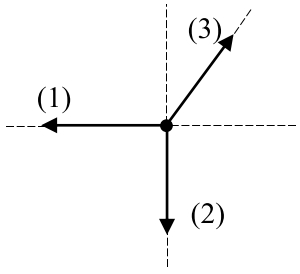
$A$ body of mass $14 \ kg$ initially at rest explodes and breaks into three fragments of masses in the ratio $2:2:3$. The two pieces of equal masses fly off perpendicular to each other with a speed of $18 \ m/s$ each. The velocity of the heavier fragment is . . . . . . $m/s$.
A
$10\sqrt{2}$
B
$12\sqrt{2}$
C
$12$
D
$24\sqrt{2}$
Solution
(B) The total mass of the body is $M = 14 \ kg$. The masses of the three fragments are in the ratio $2:2:3$. Let the masses be $m_1 = 4 \ kg$,$m_2 = 4 \ kg$,and $m_3 = 6 \ kg$ (since $2x + 2x + 3x = 7x = 14 \ kg$,so $x = 2 \ kg$).
Initially,the body is at rest,so the initial momentum is zero. By the law of conservation of linear momentum,the final total momentum must also be zero: $\vec{p}_1 + \vec{p}_2 + \vec{p}_3 = 0$.
Let the two equal fragments move along the negative $x$-axis and negative $y$-axis respectively: $\vec{v}_1 = -18 \hat{i} \ m/s$ and $\vec{v}_2 = -18 \hat{j} \ m/s$.
The momentum of the first two fragments is $\vec{p}_1 + \vec{p}_2 = m_1 \vec{v}_1 + m_2 \vec{v}_2 = 4(-18 \hat{i}) + 4(-18 \hat{j}) = -72 \hat{i} - 72 \hat{j} \ kg \cdot m/s$.
Since $\vec{p}_1 + \vec{p}_2 + \vec{p}_3 = 0$,we have $\vec{p}_3 = -(\vec{p}_1 + \vec{p}_2) = 72 \hat{i} + 72 \hat{j} \ kg \cdot m/s$.
The velocity of the third (heavier) fragment is $\vec{v}_3 = \frac{\vec{p}_3}{m_3} = \frac{72 \hat{i} + 72 \hat{j}}{6} = 12 \hat{i} + 12 \hat{j} \ m/s$.
The magnitude of the velocity is $|\vec{v}_3| = \sqrt{12^2 + 12^2} = \sqrt{144 + 144} = \sqrt{288} = 12\sqrt{2} \ m/s$.
Initially,the body is at rest,so the initial momentum is zero. By the law of conservation of linear momentum,the final total momentum must also be zero: $\vec{p}_1 + \vec{p}_2 + \vec{p}_3 = 0$.
Let the two equal fragments move along the negative $x$-axis and negative $y$-axis respectively: $\vec{v}_1 = -18 \hat{i} \ m/s$ and $\vec{v}_2 = -18 \hat{j} \ m/s$.
The momentum of the first two fragments is $\vec{p}_1 + \vec{p}_2 = m_1 \vec{v}_1 + m_2 \vec{v}_2 = 4(-18 \hat{i}) + 4(-18 \hat{j}) = -72 \hat{i} - 72 \hat{j} \ kg \cdot m/s$.
Since $\vec{p}_1 + \vec{p}_2 + \vec{p}_3 = 0$,we have $\vec{p}_3 = -(\vec{p}_1 + \vec{p}_2) = 72 \hat{i} + 72 \hat{j} \ kg \cdot m/s$.
The velocity of the third (heavier) fragment is $\vec{v}_3 = \frac{\vec{p}_3}{m_3} = \frac{72 \hat{i} + 72 \hat{j}}{6} = 12 \hat{i} + 12 \hat{j} \ m/s$.
The magnitude of the velocity is $|\vec{v}_3| = \sqrt{12^2 + 12^2} = \sqrt{144 + 144} = \sqrt{288} = 12\sqrt{2} \ m/s$.
0 likes
View SolutionNewton's Laws of Motion and Friction — Conservation of Linear Momentum · Frequently Asked Questions
1Are these Newton's Laws of Motion and Friction questions useful for JEE and NEET?
Yes. All questions in this section are mapped to JEE Main and NEET exam patterns. Previous year questions from JEE Main, NEET, GUJCET and state-level exams are included with full solutions.
2Can I switch to Hindi or Gujarati for these questions?
Yes. Use the language tabs in the hero section or the sidebar to view the same questions and solutions in English, Hindi or Gujarati.
3How do I generate a question paper from this subtopic?
Use the Vedclass Exam Paper Generator — select the chapter and subtopic, set difficulty, and generate Sets A, B, C, D automatically. First 3 chapters of every subject are free.
Vedclass Products
For Students
Vedclass Test Series
Mock tests in real JEE/NEET style with performance analysis. 5-day free trial.
Start Free TrialFor Teachers
Exam Paper Generator
Generate Set A/B/C/D papers from this chapter in 2 minutes. 3 chapters free.
Try FreeFor Institutes
Online Exam Module
Live online exams with unlimited students, 360° analytics & white-label branding.
See DemoFor Teachers & Institutes
Generate a Newton's Laws of Motion and Friction Exam Paper in 2 Minutes
Select subtopic & difficulty — Sets A, B, C, D auto-generated with No Repeat logic.
First 3 chapters of every subject are free — no payment required.