
A English
Uniformly Accelerated Motion Questions in English
Class 11 Physics · Motion in Straight Line · Uniformly Accelerated Motion
304+
Questions
English
Language
100%
With Solutions
Showing 4 of 304 questions in English
301
EasyMCQ
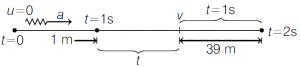
$A$ body travels in a straight line from point $A$ to point $B$ with an initial velocity zero and uniform acceleration, covering $1 \,m$ during the first second and $39 \,m$ during the last second. The distance between $A$ and $B$ in metre is
A
$50$
B
$100$
C
$390$
D
$400$
Solution
(D) Let the total time of travel be $T$ seconds and acceleration be $a$. The initial velocity $u = 0$.
Distance covered in the first second ($t=1$ s) is given by $s_1 = ut + \frac{1}{2}at^2$.
$1 = 0(1) + \frac{1}{2}a(1)^2 \Rightarrow a = 2 \,m/s^2$.
Distance covered in the last second is given by the formula for distance in the $n^{th}$ second: $s_n = u + \frac{a}{2}(2n - 1)$.
Here, $s_n = 39 \,m$, $u = 0$, $a = 2 \,m/s^2$.
$39 = 0 + \frac{2}{2}(2T - 1) \Rightarrow 39 = 2T - 1 \Rightarrow 2T = 40 \Rightarrow T = 20 \,s$.
The total distance $S$ covered in $T = 20 \,s$ is given by $S = ut + \frac{1}{2}aT^2$.
$S = 0(20) + \frac{1}{2}(2)(20)^2 = 400 \,m$.
Distance covered in the first second ($t=1$ s) is given by $s_1 = ut + \frac{1}{2}at^2$.
$1 = 0(1) + \frac{1}{2}a(1)^2 \Rightarrow a = 2 \,m/s^2$.
Distance covered in the last second is given by the formula for distance in the $n^{th}$ second: $s_n = u + \frac{a}{2}(2n - 1)$.
Here, $s_n = 39 \,m$, $u = 0$, $a = 2 \,m/s^2$.
$39 = 0 + \frac{2}{2}(2T - 1) \Rightarrow 39 = 2T - 1 \Rightarrow 2T = 40 \Rightarrow T = 20 \,s$.
The total distance $S$ covered in $T = 20 \,s$ is given by $S = ut + \frac{1}{2}aT^2$.
$S = 0(20) + \frac{1}{2}(2)(20)^2 = 400 \,m$.
0 likes
View Solution302
MediumMCQ
Consider a vehicle moving with a velocity $54 \,km/h$. At a distance of $400 \,m$ from the traffic light, brakes are applied. The acceleration of the vehicle after the application of brakes is $-0.3 \,m/s^2$. The vehicle's position relative to the traffic light is: (in $\,m$)
A
$25$
B
$375$
C
$425$
D
$30$
Solution
(A) Given, initial velocity $u = 54 \,km/h = 54 \times \frac{5}{18} \,m/s = 15 \,m/s$.
Distance of signal from vehicle $d = 400 \,m$, acceleration $a = -0.3 \,m/s^2$.
When the vehicle stops, final velocity $v = 0$.
Using the equation of motion $v^2 = u^2 + 2as$:
$0^2 = (15)^2 + 2(-0.3)s$
$0 = 225 - 0.6s$
$0.6s = 225$
$s = \frac{225}{0.6} = 375 \,m$.
The vehicle's position relative to the traffic light is $d - s = 400 \,m - 375 \,m = 25 \,m$.
Distance of signal from vehicle $d = 400 \,m$, acceleration $a = -0.3 \,m/s^2$.
When the vehicle stops, final velocity $v = 0$.
Using the equation of motion $v^2 = u^2 + 2as$:
$0^2 = (15)^2 + 2(-0.3)s$
$0 = 225 - 0.6s$
$0.6s = 225$
$s = \frac{225}{0.6} = 375 \,m$.
The vehicle's position relative to the traffic light is $d - s = 400 \,m - 375 \,m = 25 \,m$.
0 likes
View Solution303
DifficultMCQ
Two cars $A$ and $B$ initially at rest are moving in the same direction with accelerations $a_1$ and $a_2$ respectively. After a certain time $t$,they achieve velocities $v_1$ and $v_2$ respectively and are separated by a distance of $50 \ m$. If $(a_1 - a_2) = 4 \ m \ s^{-2}$,then the quantity $(v_1 - v_2)$ will be: (in $m \ s^{-1}$)
A
$24$
B
$20$
C
$40$
D
$12$
Solution
(B) Using the first equation of motion,$v = u + at$. Since both cars start from rest $(u = 0)$,their velocities after time $t$ are:
$v_1 = a_1 t$ and $v_2 = a_2 t$
Subtracting these,we get: $(v_1 - v_2) = (a_1 - a_2)t \dots (1)$
Using the second equation of motion,$s = ut + \frac{1}{2}at^2$. The distance between them is:
$s_1 - s_2 = \frac{1}{2}a_1 t^2 - \frac{1}{2}a_2 t^2 = \frac{1}{2}(a_1 - a_2)t^2$
Given $s_1 - s_2 = 50 \ m$ and $(a_1 - a_2) = 4 \ m \ s^{-2}$,we have:
$50 = \frac{1}{2} \times 4 \times t^2 \Rightarrow 50 = 2t^2 \Rightarrow t^2 = 25 \Rightarrow t = 5 \ s$
Substituting $t = 5 \ s$ and $(a_1 - a_2) = 4 \ m \ s^{-2}$ into equation $(1)$:
$(v_1 - v_2) = 4 \times 5 = 20 \ m \ s^{-1}$.
$v_1 = a_1 t$ and $v_2 = a_2 t$
Subtracting these,we get: $(v_1 - v_2) = (a_1 - a_2)t \dots (1)$
Using the second equation of motion,$s = ut + \frac{1}{2}at^2$. The distance between them is:
$s_1 - s_2 = \frac{1}{2}a_1 t^2 - \frac{1}{2}a_2 t^2 = \frac{1}{2}(a_1 - a_2)t^2$
Given $s_1 - s_2 = 50 \ m$ and $(a_1 - a_2) = 4 \ m \ s^{-2}$,we have:
$50 = \frac{1}{2} \times 4 \times t^2 \Rightarrow 50 = 2t^2 \Rightarrow t^2 = 25 \Rightarrow t = 5 \ s$
Substituting $t = 5 \ s$ and $(a_1 - a_2) = 4 \ m \ s^{-2}$ into equation $(1)$:
$(v_1 - v_2) = 4 \times 5 = 20 \ m \ s^{-1}$.
0 likes
View Solution304
MediumMCQ
The velocity of a car travelling on a straight road is $3.6 \ km/h$ at an instant of time. Now,travelling with uniform acceleration for $10 \ s$,the velocity becomes exactly double. If the wheel radius of the car is $25 \ cm$,then which of the following is the closest to the number of revolutions that the wheel makes during this $10 \ s$?
A
$84$
B
$95$
C
$126$
D
$135$
Solution
(B) Initial velocity $u = 3.6 \ km/h = 3.6 \times \frac{5}{18} \ m/s = 1 \ m/s$.
Final velocity $v = 2 \times u = 2 \ m/s$.
Time $t = 10 \ s$.
Acceleration $a = \frac{v - u}{t} = \frac{2 - 1}{10} = 0.1 \ m/s^2$.
Distance covered $s = ut + \frac{1}{2}at^2 = (1)(10) + \frac{1}{2}(0.1)(10)^2 = 10 + 5 = 15 \ m$.
Circumference of the wheel $C = 2 \pi r = 2 \pi (0.25) = 0.5 \pi \ m$.
Number of revolutions $n = \frac{s}{C} = \frac{15}{0.5 \pi} = \frac{30}{\pi} \approx \frac{30}{3.14159} \approx 9.54$.
Wait,checking the calculation: $n = 9.54$ revolutions. Re-evaluating the question context: If the question implies angular displacement $\theta$ in radians,$\theta = \frac{s}{r} = \frac{15}{0.25} = 60 \ rad$. Number of revolutions $n = \frac{\theta}{2 \pi} = \frac{60}{2 \pi} = \frac{30}{\pi} \approx 9.55$. Given the options,there might be a unit or scale factor discrepancy in the problem statement,but based on standard kinematics,the value is approximately $9.5$. If the intended answer is $95$,it implies a factor of $10$ difference.
Final velocity $v = 2 \times u = 2 \ m/s$.
Time $t = 10 \ s$.
Acceleration $a = \frac{v - u}{t} = \frac{2 - 1}{10} = 0.1 \ m/s^2$.
Distance covered $s = ut + \frac{1}{2}at^2 = (1)(10) + \frac{1}{2}(0.1)(10)^2 = 10 + 5 = 15 \ m$.
Circumference of the wheel $C = 2 \pi r = 2 \pi (0.25) = 0.5 \pi \ m$.
Number of revolutions $n = \frac{s}{C} = \frac{15}{0.5 \pi} = \frac{30}{\pi} \approx \frac{30}{3.14159} \approx 9.54$.
Wait,checking the calculation: $n = 9.54$ revolutions. Re-evaluating the question context: If the question implies angular displacement $\theta$ in radians,$\theta = \frac{s}{r} = \frac{15}{0.25} = 60 \ rad$. Number of revolutions $n = \frac{\theta}{2 \pi} = \frac{60}{2 \pi} = \frac{30}{\pi} \approx 9.55$. Given the options,there might be a unit or scale factor discrepancy in the problem statement,but based on standard kinematics,the value is approximately $9.5$. If the intended answer is $95$,it implies a factor of $10$ difference.
0 likes
View SolutionMotion in Straight Line — Uniformly Accelerated Motion · Frequently Asked Questions
1Are these Motion in Straight Line questions useful for JEE and NEET?
Yes. All questions in this section are mapped to JEE Main and NEET exam patterns. Previous year questions from JEE Main, NEET, GUJCET and state-level exams are included with full solutions.
2Can I switch to Hindi or Gujarati for these questions?
Yes. Use the language tabs in the hero section or the sidebar to view the same questions and solutions in English, Hindi or Gujarati.
3How do I generate a question paper from this subtopic?
Use the Vedclass Exam Paper Generator — select the chapter and subtopic, set difficulty, and generate Sets A, B, C, D automatically. First 3 chapters of every subject are free.
Vedclass Products
For Students
Vedclass Test Series
Mock tests in real JEE/NEET style with performance analysis. 5-day free trial.
Start Free TrialFor Teachers
Exam Paper Generator
Generate Set A/B/C/D papers from this chapter in 2 minutes. 3 chapters free.
Try FreeFor Institutes
Online Exam Module
Live online exams with unlimited students, 360° analytics & white-label branding.
See DemoFor Teachers & Institutes
Generate a Motion in Straight Line Exam Paper in 2 Minutes
Select subtopic & difficulty — Sets A, B, C, D auto-generated with No Repeat logic.
First 3 chapters of every subject are free — no payment required.