
A English
Uniformly Accelerated Motion Questions in English
Class 11 Physics · Motion in Straight Line · Uniformly Accelerated Motion
304+
Questions
English
Language
100%
With Solutions
Showing 49 of 304 questions in English
251
MediumMCQ
$A$ vehicle starts from rest and accelerates along a straight path at $2 \,m/s^2$. At the starting point of the vehicle, there is a stationary electric siren. How far has the vehicle nearly gone when the driver hears the siren at $94 \%$ of its original frequency when the vehicle was at rest (in $\,m$)? (Speed of sound $= 330 \,m/s$)
A
$98$
B
$49$
C
$196$
D
$24.5$
Solution
(A) Let $v_s = 0$ be the speed of the source (siren) and $v_o$ be the speed of the observer (vehicle). The frequency heard by the observer is given by the Doppler effect formula: $f' = f_0 \left( \frac{v - v_o}{v} \right)$, where $v = 330 \,m/s$ is the speed of sound.
Given $f' = 0.94 f_0$, we have $0.94 = \frac{330 - v_o}{330}$.
Solving for $v_o$: $330 \times 0.94 = 330 - v_o \implies 310.2 = 330 - v_o \implies v_o = 19.8 \,m/s$.
The vehicle starts from rest $(u = 0)$ with acceleration $a = 2 \,m/s^2$. Using the equation of motion $v_o^2 = u^2 + 2as$:
$(19.8)^2 = 0^2 + 2(2)s \implies 392.04 = 4s$.
$s = \frac{392.04}{4} = 98.01 \,m$.
Thus, the vehicle has gone nearly $98 \,m$.
Given $f' = 0.94 f_0$, we have $0.94 = \frac{330 - v_o}{330}$.
Solving for $v_o$: $330 \times 0.94 = 330 - v_o \implies 310.2 = 330 - v_o \implies v_o = 19.8 \,m/s$.
The vehicle starts from rest $(u = 0)$ with acceleration $a = 2 \,m/s^2$. Using the equation of motion $v_o^2 = u^2 + 2as$:
$(19.8)^2 = 0^2 + 2(2)s \implies 392.04 = 4s$.
$s = \frac{392.04}{4} = 98.01 \,m$.
Thus, the vehicle has gone nearly $98 \,m$.
0 likes
View Solution252
MediumMCQ
$A$ body starts from rest and moves with constant acceleration for $t$ seconds. It travels a distance $x_{1}$ in the first half of the time and $x_{2}$ in the next half of the time. Then:
A
$x_{2} = x_{1}$
B
$x_{2} = 2x_{1}$
C
$x_{2} = 3x_{1}$
D
$x_{2} = 4x_{1}$
Solution
(C) Let the total time be $t$ and acceleration be $a$. The initial velocity $u = 0$.
For the first half of the time,$t_{1} = t/2$:
$x_{1} = u t_{1} + \frac{1}{2} a t_{1}^{2} = 0 + \frac{1}{2} a (t/2)^{2} = \frac{1}{8} a t^{2}$.
For the total time $t$,the total distance $x_{total} = x_{1} + x_{2} = \frac{1}{2} a t^{2}$.
Substituting $x_{1} = \frac{1}{8} a t^{2}$ into the total distance equation:
$\frac{1}{8} a t^{2} + x_{2} = \frac{1}{2} a t^{2}$.
$x_{2} = \frac{1}{2} a t^{2} - \frac{1}{8} a t^{2} = \frac{4-1}{8} a t^{2} = \frac{3}{8} a t^{2}$.
Comparing $x_{1}$ and $x_{2}$:
$x_{2} = 3 \times (\frac{1}{8} a t^{2}) = 3 x_{1}$.
For the first half of the time,$t_{1} = t/2$:
$x_{1} = u t_{1} + \frac{1}{2} a t_{1}^{2} = 0 + \frac{1}{2} a (t/2)^{2} = \frac{1}{8} a t^{2}$.
For the total time $t$,the total distance $x_{total} = x_{1} + x_{2} = \frac{1}{2} a t^{2}$.
Substituting $x_{1} = \frac{1}{8} a t^{2}$ into the total distance equation:
$\frac{1}{8} a t^{2} + x_{2} = \frac{1}{2} a t^{2}$.
$x_{2} = \frac{1}{2} a t^{2} - \frac{1}{8} a t^{2} = \frac{4-1}{8} a t^{2} = \frac{3}{8} a t^{2}$.
Comparing $x_{1}$ and $x_{2}$:
$x_{2} = 3 \times (\frac{1}{8} a t^{2}) = 3 x_{1}$.
0 likes
View Solution253
MediumMCQ
$A$ car moving with a velocity of $20 \,m \,s^{-1}$ is stopped in a distance of $40 \,m$. If the same car is travelling at double the velocity, the distance travelled by it for the same retardation is (in $\,m$)
A
$640$
B
$320$
C
$1280$
D
$160$
Solution
(D) Using the third equation of motion, $v^2 - u^2 = 2as$, where $v = 0$ (final velocity), $u$ is initial velocity, $a$ is retardation $(-a)$, and $s$ is distance.
$0^2 - u^2 = 2(-a)s \Rightarrow u^2 = 2as \Rightarrow s = \frac{u^2}{2a}$.
Since the retardation $a$ is constant, $s \propto u^2$.
For the first case: $40 = \frac{(20)^2}{2a} \Rightarrow 2a = \frac{400}{40} = 10 \,m \,s^{-2}$.
For the second case, the new velocity $u' = 2 \times 20 = 40 \,m \,s^{-1}$.
The new distance $s' = \frac{(u')^2}{2a} = \frac{(40)^2}{10} = \frac{1600}{10} = 160 \,m$.
$0^2 - u^2 = 2(-a)s \Rightarrow u^2 = 2as \Rightarrow s = \frac{u^2}{2a}$.
Since the retardation $a$ is constant, $s \propto u^2$.
For the first case: $40 = \frac{(20)^2}{2a} \Rightarrow 2a = \frac{400}{40} = 10 \,m \,s^{-2}$.
For the second case, the new velocity $u' = 2 \times 20 = 40 \,m \,s^{-1}$.
The new distance $s' = \frac{(u')^2}{2a} = \frac{(40)^2}{10} = \frac{1600}{10} = 160 \,m$.
0 likes
View Solution254
EasyMCQ
$A$ body of mass $4 \,kg$ is accelerated by a constant force. It travels a distance of $5 \,m$ in the first second and a distance of $2 \,m$ in the third second. The force acting on the body is: (in $\,N$)
A
$2$
B
$4$
C
$6$
D
$8$
Solution
(C) The distance travelled by a body in the $n^{\text{th}}$ second is given by the formula: $S_n = u + \frac{a}{2}(2n - 1)$.
For the first second $(n=1)$: $5 = u + \frac{a}{2}(2(1) - 1) \implies 5 = u + \frac{a}{2}$ (Eq. $i$).
For the third second $(n=3)$: $2 = u + \frac{a}{2}(2(3) - 1) \implies 2 = u + \frac{5a}{2}$ (Eq. $ii$).
Subtracting Eq. $i$ from Eq. $ii$: $(2 - 5) = (u + \frac{5a}{2}) - (u + \frac{a}{2}) \implies -3 = 2a \implies a = -1.5 \,m/s^2$.
The negative sign indicates deceleration.
The magnitude of the force is $F = |m \times a| = 4 \,kg \times 1.5 \,m/s^2 = 6 \,N$.
For the first second $(n=1)$: $5 = u + \frac{a}{2}(2(1) - 1) \implies 5 = u + \frac{a}{2}$ (Eq. $i$).
For the third second $(n=3)$: $2 = u + \frac{a}{2}(2(3) - 1) \implies 2 = u + \frac{5a}{2}$ (Eq. $ii$).
Subtracting Eq. $i$ from Eq. $ii$: $(2 - 5) = (u + \frac{5a}{2}) - (u + \frac{a}{2}) \implies -3 = 2a \implies a = -1.5 \,m/s^2$.
The negative sign indicates deceleration.
The magnitude of the force is $F = |m \times a| = 4 \,kg \times 1.5 \,m/s^2 = 6 \,N$.
0 likes
View Solution255
MediumMCQ
$A$ body is moving along a straight line with initial velocity $v_0$. Its acceleration $a$ is constant. After $t$ seconds,its velocity becomes $v$. The average velocity of the body over the given time interval is
A
$\bar{v}=\frac{v^2-v_0^2}{a t}$
B
$\bar{v}=\frac{v^2+v_0^2}{2 a t}$
C
$\bar{v}=\frac{v^2+v_0^2}{a t}$
D
$\bar{v}=\frac{v^2-v_0^2}{2 a t}$
Solution
(D) Given: Initial velocity $= v_0$,Final velocity $= v$,Acceleration $= a$,Time interval $= t$.
Using the third equation of motion: $v^2 - v_0^2 = 2as$.
From this,the total distance covered $s$ is given by: $s = \frac{v^2 - v_0^2}{2a}$.
Average velocity is defined as the total displacement divided by the total time interval.
$\bar{v} = \frac{s}{t} = \frac{\frac{v^2 - v_0^2}{2a}}{t}$.
Therefore,$\bar{v} = \frac{v^2 - v_0^2}{2at}$.
Using the third equation of motion: $v^2 - v_0^2 = 2as$.
From this,the total distance covered $s$ is given by: $s = \frac{v^2 - v_0^2}{2a}$.
Average velocity is defined as the total displacement divided by the total time interval.
$\bar{v} = \frac{s}{t} = \frac{\frac{v^2 - v_0^2}{2a}}{t}$.
Therefore,$\bar{v} = \frac{v^2 - v_0^2}{2at}$.
0 likes
View Solution256
DifficultMCQ
The displacement $x$ (in $m$) of a particle of mass $m$ (in $kg$) moving in one dimension under the action of a force,is related to time $t$ (in $s$) by $t = \sqrt{x} + 3$. The displacement of the particle when its velocity is zero,will be
A
zero
B
$6 \ m$
C
$2 \ m$
D
$4 \ m$
Solution
(A) The displacement $x$ is given as a function of time $t$ by the equation: $t = \sqrt{x} + 3$.
Rearranging for $\sqrt{x}$,we get: $\sqrt{x} = t - 3$.
Squaring both sides,we obtain the expression for displacement: $x = (t - 3)^2 = t^2 - 6t + 9$.
The velocity $v$ of the particle is the derivative of displacement with respect to time: $v = \frac{dx}{dt} = \frac{d}{dt}(t^2 - 6t + 9) = 2t - 6$.
To find the displacement when velocity is zero,we set $v = 0$:
$2t - 6 = 0 \Rightarrow 2t = 6 \Rightarrow t = 3 \ s$.
Now,substitute $t = 3 \ s$ into the displacement equation:
$x = (3 - 3)^2 = 0^2 = 0 \ m$.
Thus,the displacement of the particle when its velocity is zero is $0 \ m$.
Rearranging for $\sqrt{x}$,we get: $\sqrt{x} = t - 3$.
Squaring both sides,we obtain the expression for displacement: $x = (t - 3)^2 = t^2 - 6t + 9$.
The velocity $v$ of the particle is the derivative of displacement with respect to time: $v = \frac{dx}{dt} = \frac{d}{dt}(t^2 - 6t + 9) = 2t - 6$.
To find the displacement when velocity is zero,we set $v = 0$:
$2t - 6 = 0 \Rightarrow 2t = 6 \Rightarrow t = 3 \ s$.
Now,substitute $t = 3 \ s$ into the displacement equation:
$x = (3 - 3)^2 = 0^2 = 0 \ m$.
Thus,the displacement of the particle when its velocity is zero is $0 \ m$.
0 likes
View Solution257
MediumMCQ
An object moving along the $x$-axis with a uniform acceleration has a velocity $\vec{v} = (12 \ cm \ s^{-1}) \hat{i}$ at $x = 3 \ cm$. After $2 \ s$,if it is at $x = -5 \ cm$,then its acceleration is:
A
$\vec{a} = (-16 \ cm \ s^{-2}) \hat{i}$
B
$\vec{a} = (11 \ cm \ s^{-2}) \hat{i}$
C
$\vec{a} = (-11 \ cm \ s^{-2}) \hat{i}$
D
$\vec{a} = (8 \ cm \ s^{-2}) \hat{i}$
Solution
(A) Given: Initial position $x_i = 3 \ cm$,final position $x_f = -5 \ cm$,initial velocity $\vec{u} = 12 \hat{i} \ cm \ s^{-1}$,and time $t = 2 \ s$.
Displacement $\vec{s} = x_f - x_i = (-5 - 3) \hat{i} = -8 \hat{i} \ cm$.
Using the equation of motion $\vec{s} = \vec{u}t + \frac{1}{2} \vec{a}t^2$:
$-8 \hat{i} = (12 \hat{i})(2) + \frac{1}{2} \vec{a} (2)^2$
$-8 \hat{i} = 24 \hat{i} + 2 \vec{a}$
$2 \vec{a} = -8 \hat{i} - 24 \hat{i} = -32 \hat{i}$
$\vec{a} = -16 \ cm \ s^{-2} \hat{i}$.
Displacement $\vec{s} = x_f - x_i = (-5 - 3) \hat{i} = -8 \hat{i} \ cm$.
Using the equation of motion $\vec{s} = \vec{u}t + \frac{1}{2} \vec{a}t^2$:
$-8 \hat{i} = (12 \hat{i})(2) + \frac{1}{2} \vec{a} (2)^2$
$-8 \hat{i} = 24 \hat{i} + 2 \vec{a}$
$2 \vec{a} = -8 \hat{i} - 24 \hat{i} = -32 \hat{i}$
$\vec{a} = -16 \ cm \ s^{-2} \hat{i}$.
0 likes
View Solution258
MediumMCQ
An object is moving with a uniform acceleration which is parallel to its instantaneous direction of motion. The displacement $(s)-$ velocity $(v)$ graph of this object is
A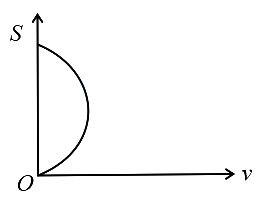
B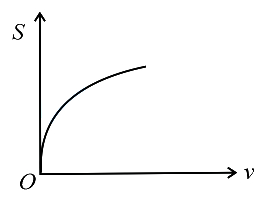
C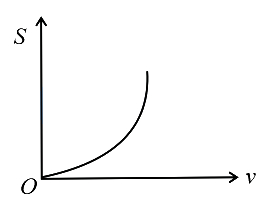
D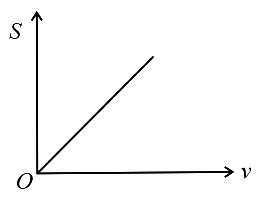
Solution
(C) From the third equation of kinematics,we have $v^2 - u^2 = 2as$.
Assuming the object starts from rest,the initial velocity $u = 0$.
Substituting this into the equation,we get $v^2 = 2as$,which can be rearranged as $s = \frac{v^2}{2a}$.
Since $a$ is a uniform (constant) acceleration,the relationship between displacement $s$ and velocity $v$ is $s \propto v^2$.
This represents a parabola opening along the $s$-axis.
Graph $C$ shows a parabolic curve where $s$ increases with the square of $v$,starting from the origin $(0, 0)$,which matches the derived relationship $s = \frac{1}{2a} v^2$.
Assuming the object starts from rest,the initial velocity $u = 0$.
Substituting this into the equation,we get $v^2 = 2as$,which can be rearranged as $s = \frac{v^2}{2a}$.
Since $a$ is a uniform (constant) acceleration,the relationship between displacement $s$ and velocity $v$ is $s \propto v^2$.
This represents a parabola opening along the $s$-axis.
Graph $C$ shows a parabolic curve where $s$ increases with the square of $v$,starting from the origin $(0, 0)$,which matches the derived relationship $s = \frac{1}{2a} v^2$.
0 likes
View Solution259
MediumMCQ
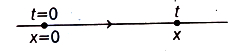
$A$ particle is moving along the $X$-axis with velocity $v = e^{-\beta x}$. At time $t = 0$,the particle is located at $x = 0$. The displacement of the particle as a function of time is
A
$e^{-\beta t}$
B
$\frac{1}{\beta} e^{(1-\beta t)}$
C
$\frac{1}{\beta} \log [1-\beta t]$
D
$\frac{1}{\beta} \log [1+\beta t]$
Solution
(D) The velocity of the particle is given by $v = e^{-\beta x}$.
Since $v = \frac{dx}{dt}$,we have $\frac{dx}{dt} = e^{-\beta x}$.
Rearranging the terms to separate the variables,we get $e^{\beta x} dx = dt$.
Integrating both sides with the initial condition that at $t = 0$,$x = 0$:
$\int_0^x e^{\beta x} dx = \int_0^t dt$
$\left[ \frac{e^{\beta x}}{\beta} \right]_0^x = [t]_0^t$
$\frac{1}{\beta} (e^{\beta x} - e^0) = t - 0$
$\frac{1}{\beta} (e^{\beta x} - 1) = t$
$e^{\beta x} - 1 = \beta t$
$e^{\beta x} = 1 + \beta t$
Taking the natural logarithm on both sides:
$\beta x = \log(1 + \beta t)$
$x = \frac{1}{\beta} \log(1 + \beta t)$
Since $v = \frac{dx}{dt}$,we have $\frac{dx}{dt} = e^{-\beta x}$.
Rearranging the terms to separate the variables,we get $e^{\beta x} dx = dt$.
Integrating both sides with the initial condition that at $t = 0$,$x = 0$:
$\int_0^x e^{\beta x} dx = \int_0^t dt$
$\left[ \frac{e^{\beta x}}{\beta} \right]_0^x = [t]_0^t$
$\frac{1}{\beta} (e^{\beta x} - e^0) = t - 0$
$\frac{1}{\beta} (e^{\beta x} - 1) = t$
$e^{\beta x} - 1 = \beta t$
$e^{\beta x} = 1 + \beta t$
Taking the natural logarithm on both sides:
$\beta x = \log(1 + \beta t)$
$x = \frac{1}{\beta} \log(1 + \beta t)$
0 likes
View Solution260
EasyMCQ
Acceleration of a body whose displacement follows the equation $3 s = 9 t + 5 t^2$ is in $m s^{-2}$. (in $/3$)
A
$5$
B
$14$
C
$10$
D
$19$
Solution
(C) Given,the displacement equation is $3 s = 9 t + 5 t^2$.
Dividing the entire equation by $3$,we get $s = 3 t + (5/3) t^2$.
The standard equation of motion for a body with constant acceleration is $s = u t + (1/2) a t^2$,where $u$ is the initial velocity and $a$ is the acceleration.
Comparing the given equation $s = 3 t + (5/3) t^2$ with the standard equation $s = u t + (1/2) a t^2$,we find that $(1/2) a = 5/3$.
Solving for $a$,we get $a = 2 \times (5/3) = 10/3 \ m s^{-2}$.
Dividing the entire equation by $3$,we get $s = 3 t + (5/3) t^2$.
The standard equation of motion for a body with constant acceleration is $s = u t + (1/2) a t^2$,where $u$ is the initial velocity and $a$ is the acceleration.
Comparing the given equation $s = 3 t + (5/3) t^2$ with the standard equation $s = u t + (1/2) a t^2$,we find that $(1/2) a = 5/3$.
Solving for $a$,we get $a = 2 \times (5/3) = 10/3 \ m s^{-2}$.
0 likes
View Solution261
EasyMCQ
The displacement of a particle moving with uniform acceleration in time $t$ is given by $S = 30t + 5t^2$. Its initial velocity is $.......$ (in $m \ s^{-1}$)
A
$35$
B
$30$
C
$40$
D
$45$
Solution
(B) Given the displacement equation: $S = 30t + 5t^2$.
Velocity $v$ is the rate of change of displacement with respect to time: $v = \frac{dS}{dt}$.
Differentiating $S$ with respect to $t$: $v = \frac{d}{dt}(30t + 5t^2) = 30 + 10t$.
Initial velocity is the velocity at $t = 0$.
Substituting $t = 0$ into the velocity equation: $v = 30 + 10(0) = 30 \ m \ s^{-1}$.
Therefore,the initial velocity is $30 \ m \ s^{-1}$.
Velocity $v$ is the rate of change of displacement with respect to time: $v = \frac{dS}{dt}$.
Differentiating $S$ with respect to $t$: $v = \frac{d}{dt}(30t + 5t^2) = 30 + 10t$.
Initial velocity is the velocity at $t = 0$.
Substituting $t = 0$ into the velocity equation: $v = 30 + 10(0) = 30 \ m \ s^{-1}$.
Therefore,the initial velocity is $30 \ m \ s^{-1}$.
0 likes
View Solution262
EasyMCQ
$A$ car moving with a velocity $6.25 \,ms^{-1}$ is decelerated with $2.5 \sqrt{v} \,ms^{-2}$ (where $v$ is the instantaneous velocity). The time taken by the car to come to rest is: (in $\,s$)
A
$2$
B
$3$
C
$2.5$
D
$4$
Solution
(A) Given: Initial velocity $u = 6.25 \,ms^{-1}$, acceleration $a = -2.5 \sqrt{v} \,ms^{-2}$, and final velocity $v = 0$ (at rest).
We know that acceleration $a = \frac{dv}{dt}$.
Substituting the given values:
$\frac{dv}{dt} = -2.5 \sqrt{v}$
Rearranging the terms to integrate:
$\frac{dv}{\sqrt{v}} = -2.5 dt$
Integrating both sides from initial velocity $u$ to final velocity $0$ over time $t$ from $0$ to $T$:
$\int_{6.25}^{0} v^{-1/2} dv = \int_{0}^{T} -2.5 dt$
$[2 \sqrt{v}]_{6.25}^{0} = -2.5 [t]_{0}^{T}$
$2(\sqrt{0} - \sqrt{6.25}) = -2.5(T - 0)$
$2(0 - 2.5) = -2.5T$
$-5 = -2.5T$
$T = \frac{5}{2.5} = 2 \,s$
Therefore, the time taken for the car to come to rest is $2 \,s$.
We know that acceleration $a = \frac{dv}{dt}$.
Substituting the given values:
$\frac{dv}{dt} = -2.5 \sqrt{v}$
Rearranging the terms to integrate:
$\frac{dv}{\sqrt{v}} = -2.5 dt$
Integrating both sides from initial velocity $u$ to final velocity $0$ over time $t$ from $0$ to $T$:
$\int_{6.25}^{0} v^{-1/2} dv = \int_{0}^{T} -2.5 dt$
$[2 \sqrt{v}]_{6.25}^{0} = -2.5 [t]_{0}^{T}$
$2(\sqrt{0} - \sqrt{6.25}) = -2.5(T - 0)$
$2(0 - 2.5) = -2.5T$
$-5 = -2.5T$
$T = \frac{5}{2.5} = 2 \,s$
Therefore, the time taken for the car to come to rest is $2 \,s$.
0 likes
View Solution263
MediumMCQ
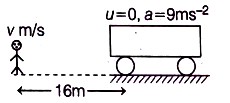
$A$ student is at a distance of $16 \ m$ from a bus when the bus begins to move with a constant acceleration of $9 \ m \ s^{-2}$. The minimum velocity with which the student should run towards the bus so as to catch it is $\alpha \sqrt{2} \ m \ s^{-1}$. The value of $\alpha$ is
A
$10$
B
$12$
C
$15$
D
$20$
Solution
(B) Let $v$ be the minimum velocity of the student so that they can catch the bus.
If the student catches the bus in time $t$,then the distance travelled by the student in time $t$ is equal to $16 \ m$ plus the distance travelled by the bus in time $t$.
Using the equations of motion:
Distance travelled by student $= v t$
Distance travelled by bus $= u t + \frac{1}{2} a t^2 = 0 \times t + \frac{1}{2} \times 9 \times t^2 = 4.5 t^2$
Equating the distances:
$v t = 16 + 4.5 t^2$
$4.5 t^2 - v t + 16 = 0$
Multiply by $2$ to simplify:
$9 t^2 - 2 v t + 32 = 0$
For the student to catch the bus,the time $t$ must be a real value. Therefore,the discriminant of this quadratic equation must be greater than or equal to zero $(D \geq 0)$:
$(-2 v)^2 - 4 \times 9 \times 32 \geq 0$
$4 v^2 - 1152 \geq 0$
$v^2 \geq 288$
$v \geq \sqrt{288} = \sqrt{144 \times 2} = 12 \sqrt{2} \ m \ s^{-1}$
The minimum velocity is $12 \sqrt{2} \ m \ s^{-1}$.
Comparing this with $\alpha \sqrt{2} \ m \ s^{-1}$,we get $\alpha = 12$.
If the student catches the bus in time $t$,then the distance travelled by the student in time $t$ is equal to $16 \ m$ plus the distance travelled by the bus in time $t$.
Using the equations of motion:
Distance travelled by student $= v t$
Distance travelled by bus $= u t + \frac{1}{2} a t^2 = 0 \times t + \frac{1}{2} \times 9 \times t^2 = 4.5 t^2$
Equating the distances:
$v t = 16 + 4.5 t^2$
$4.5 t^2 - v t + 16 = 0$
Multiply by $2$ to simplify:
$9 t^2 - 2 v t + 32 = 0$
For the student to catch the bus,the time $t$ must be a real value. Therefore,the discriminant of this quadratic equation must be greater than or equal to zero $(D \geq 0)$:
$(-2 v)^2 - 4 \times 9 \times 32 \geq 0$
$4 v^2 - 1152 \geq 0$
$v^2 \geq 288$
$v \geq \sqrt{288} = \sqrt{144 \times 2} = 12 \sqrt{2} \ m \ s^{-1}$
The minimum velocity is $12 \sqrt{2} \ m \ s^{-1}$.
Comparing this with $\alpha \sqrt{2} \ m \ s^{-1}$,we get $\alpha = 12$.
0 likes
View Solution264
EasyMCQ
$A$ body starting from rest moves with an acceleration of $\frac{5}{4} \,ms^{-2}$. The distance travelled by the body in the third second is:
A
$\frac{15}{8} \,m$
B
$\frac{25}{8} \,m$
C
$\frac{25}{4} \,m$
D
$\frac{12}{7} \,m$
Solution
(B) Given: Initial velocity $u = 0$, acceleration $a = \frac{5}{4} \,ms^{-2}$, and time $n = 3 \,s$.
The formula for the distance travelled in the $n^{th}$ second is given by $S_{n} = u + \frac{a}{2}(2n - 1)$.
Substituting the values into the formula:
$S_{3} = 0 + \frac{5/4}{2}(2 \times 3 - 1)$
$S_{3} = \frac{5}{8}(6 - 1)$
$S_{3} = \frac{5}{8} \times 5$
$S_{3} = \frac{25}{8} \,m$.
The formula for the distance travelled in the $n^{th}$ second is given by $S_{n} = u + \frac{a}{2}(2n - 1)$.
Substituting the values into the formula:
$S_{3} = 0 + \frac{5/4}{2}(2 \times 3 - 1)$
$S_{3} = \frac{5}{8}(6 - 1)$
$S_{3} = \frac{5}{8} \times 5$
$S_{3} = \frac{25}{8} \,m$.
0 likes
View Solution265
MediumMCQ
The relation between time $t$ and displacement $x$ is $t = \alpha x^2 + \beta x$,where $\alpha$ and $\beta$ are constants. If $v$ is the velocity,the retardation is:
A
$2 \alpha v \beta^2$
B
$2 \alpha \beta v^3$
C
$-2 \beta v^3$
D
$2 \alpha v^3$
Solution
(D) Given the relation: $t = \alpha x^2 + \beta x$.
Differentiating both sides with respect to $t$:
$1 = 2 \alpha x \left( \frac{dx}{dt} \right) + \beta \left( \frac{dx}{dt} \right)$.
Since $v = \frac{dx}{dt}$,we have:
$1 = (2 \alpha x + \beta) v \implies v = \frac{1}{2 \alpha x + \beta}$.
Acceleration $a = \frac{dv}{dt} = \frac{dv}{dx} \cdot \frac{dx}{dt} = v \frac{dv}{dx}$.
Differentiating $v = (2 \alpha x + \beta)^{-1}$ with respect to $x$:
$\frac{dv}{dx} = -1(2 \alpha x + \beta)^{-2} \cdot (2 \alpha) = -2 \alpha v^2$.
Thus,$a = v (-2 \alpha v^2) = -2 \alpha v^3$.
Retardation is defined as negative acceleration:
$\text{Retardation} = -a = -(-2 \alpha v^3) = 2 \alpha v^3$.
Differentiating both sides with respect to $t$:
$1 = 2 \alpha x \left( \frac{dx}{dt} \right) + \beta \left( \frac{dx}{dt} \right)$.
Since $v = \frac{dx}{dt}$,we have:
$1 = (2 \alpha x + \beta) v \implies v = \frac{1}{2 \alpha x + \beta}$.
Acceleration $a = \frac{dv}{dt} = \frac{dv}{dx} \cdot \frac{dx}{dt} = v \frac{dv}{dx}$.
Differentiating $v = (2 \alpha x + \beta)^{-1}$ with respect to $x$:
$\frac{dv}{dx} = -1(2 \alpha x + \beta)^{-2} \cdot (2 \alpha) = -2 \alpha v^2$.
Thus,$a = v (-2 \alpha v^2) = -2 \alpha v^3$.
Retardation is defined as negative acceleration:
$\text{Retardation} = -a = -(-2 \alpha v^3) = 2 \alpha v^3$.
0 likes
View Solution266
MediumMCQ
If the velocity of a particle moving along a straight line with uniform acceleration is given by $V = \sqrt{196 - 16x} \text{ m/s}$, then its acceleration is ($x$ is the displacement of the particle). (in $\text{ m/s}^2$)
A
$8$
B
$14$
C
$-8$
D
$-16$
Solution
(C) The velocity of the particle is given by $v = \sqrt{196 - 16x}$.
Squaring both sides, we get $v^2 = 196 - 16x$.
Differentiating both sides with respect to time $t$, we get:
$\frac{d}{dt}(v^2) = \frac{d}{dt}(196 - 16x)$
$2v \frac{dv}{dt} = -16 \frac{dx}{dt}$
Since acceleration $a = \frac{dv}{dt}$ and velocity $v = \frac{dx}{dt}$, we substitute these into the equation:
$2v \cdot a = -16v$
Dividing both sides by $2v$ (assuming $v \neq 0$):
$a = -8 \text{ m/s}^2$.
Thus, the acceleration of the particle is constant at $-8 \text{ m/s}^2$.
Squaring both sides, we get $v^2 = 196 - 16x$.
Differentiating both sides with respect to time $t$, we get:
$\frac{d}{dt}(v^2) = \frac{d}{dt}(196 - 16x)$
$2v \frac{dv}{dt} = -16 \frac{dx}{dt}$
Since acceleration $a = \frac{dv}{dt}$ and velocity $v = \frac{dx}{dt}$, we substitute these into the equation:
$2v \cdot a = -16v$
Dividing both sides by $2v$ (assuming $v \neq 0$):
$a = -8 \text{ m/s}^2$.
Thus, the acceleration of the particle is constant at $-8 \text{ m/s}^2$.
0 likes
View Solution267
EasyMCQ
$A$ car moving along a straight line is brought to a stop within a distance of $200 \,m$ and in a time of $10 \,s$. The initial speed of the car is (in $\,ms^{-1}$)
A
$20$
B
$40$
C
$60$
D
$80$
Solution
(B) Given: Displacement of the car,$s = 200 \,m$.
Time taken,$t = 10 \,s$.
Final velocity of the car,$v = 0 \,m/s$.
We know that the average velocity is given by $\frac{v + u}{2}$,where $u$ is the initial velocity.
The displacement is given by the product of average velocity and time:
$s = \left(\frac{v + u}{2}\right) \times t$
Substituting the given values:
$200 = \left(\frac{0 + u}{2}\right) \times 10$
$200 = 5u$
$u = \frac{200}{5} = 40 \,m/s$.
Therefore,the initial speed of the car is $40 \,m/s$.
Time taken,$t = 10 \,s$.
Final velocity of the car,$v = 0 \,m/s$.
We know that the average velocity is given by $\frac{v + u}{2}$,where $u$ is the initial velocity.
The displacement is given by the product of average velocity and time:
$s = \left(\frac{v + u}{2}\right) \times t$
Substituting the given values:
$200 = \left(\frac{0 + u}{2}\right) \times 10$
$200 = 5u$
$u = \frac{200}{5} = 40 \,m/s$.
Therefore,the initial speed of the car is $40 \,m/s$.
0 likes
View Solution268
EasyMCQ
Which of the following decreases,in motion on a straight line,with constant retardation?
A
Speed
B
Acceleration
C
Displacement
D
Distance
Solution
(A) Using the equation of motion $v = u + at$.
Here,$v$ is the final speed,$u$ is the initial speed,and $a$ is the acceleration for time $t$.
Since there is constant retardation,the acceleration is negative,i.e.,$a_{eff} = -a$.
Substituting this into the equation:
$v = u + (-a)t = u - at$.
Since $at > 0$ for $t > 0$,it follows that $v < u$.
Therefore,the speed of the body decreases under constant retardation.
Here,$v$ is the final speed,$u$ is the initial speed,and $a$ is the acceleration for time $t$.
Since there is constant retardation,the acceleration is negative,i.e.,$a_{eff} = -a$.
Substituting this into the equation:
$v = u + (-a)t = u - at$.
Since $at > 0$ for $t > 0$,it follows that $v < u$.
Therefore,the speed of the body decreases under constant retardation.
0 likes
View Solution269
EasyMCQ
The displacement of a particle starting from rest at $t=0$ is given by $s=9 t^2-2 t^3$. The time in seconds at which the particle will attain zero velocity is (in $s$)
A
$8$
B
$6$
C
$4$
D
$3$
Solution
(D) The velocity of the particle is given by the derivative of displacement with respect to time: $v = \frac{ds}{dt}$.
Given $s = 9t^2 - 2t^3$,we differentiate with respect to $t$:
$v = \frac{d}{dt}(9t^2 - 2t^3) = 18t - 6t^2$.
To find the time when the particle attains zero velocity,we set $v = 0$:
$18t - 6t^2 = 0$.
Factoring out $6t$,we get:
$6t(3 - t) = 0$.
This gives two solutions: $t = 0$ and $t = 3$.
Since the particle starts from rest at $t = 0$,the time at which it will attain zero velocity again is $t = 3 \ s$.
Given $s = 9t^2 - 2t^3$,we differentiate with respect to $t$:
$v = \frac{d}{dt}(9t^2 - 2t^3) = 18t - 6t^2$.
To find the time when the particle attains zero velocity,we set $v = 0$:
$18t - 6t^2 = 0$.
Factoring out $6t$,we get:
$6t(3 - t) = 0$.
This gives two solutions: $t = 0$ and $t = 3$.
Since the particle starts from rest at $t = 0$,the time at which it will attain zero velocity again is $t = 3 \ s$.
0 likes
View Solution270
MediumMCQ
$A$ body starts from rest with uniform acceleration and its velocity at a time of $n$ seconds is $v$. The total displacement of the body in the $n^{\text{th}}$ and $(n-1)^{\text{th}}$ seconds of its motion is:
A
$\frac{v(n+1)}{n}$
B
$\frac{2v(n+1)}{n}$
C
$\frac{2v(n-1)}{n}$
D
$\frac{v(n-1)}{n}$
Solution
(C) Given that the body starts from rest,the initial velocity $u = 0$. Let the uniform acceleration be $a$.
At time $t = n$,the velocity $v = u + at = 0 + an$,so $a = \frac{v}{n}$.
The displacement in the $k^{\text{th}}$ second is given by $S_k = u + \frac{a}{2}(2k - 1)$.
Since $u = 0$,$S_k = \frac{a}{2}(2k - 1)$.
The displacement in the $n^{\text{th}}$ second is $S_n = \frac{a}{2}(2n - 1)$.
The displacement in the $(n-1)^{\text{th}}$ second is $S_{n-1} = \frac{a}{2}(2(n-1) - 1) = \frac{a}{2}(2n - 3)$.
The total displacement in these two seconds is $S_{total} = S_n + S_{n-1} = \frac{a}{2}(2n - 1 + 2n - 3) = \frac{a}{2}(4n - 4) = 2a(n - 1)$.
Substituting $a = \frac{v}{n}$,we get $S_{total} = 2(\frac{v}{n})(n - 1) = \frac{2v(n - 1)}{n}$.
At time $t = n$,the velocity $v = u + at = 0 + an$,so $a = \frac{v}{n}$.
The displacement in the $k^{\text{th}}$ second is given by $S_k = u + \frac{a}{2}(2k - 1)$.
Since $u = 0$,$S_k = \frac{a}{2}(2k - 1)$.
The displacement in the $n^{\text{th}}$ second is $S_n = \frac{a}{2}(2n - 1)$.
The displacement in the $(n-1)^{\text{th}}$ second is $S_{n-1} = \frac{a}{2}(2(n-1) - 1) = \frac{a}{2}(2n - 3)$.
The total displacement in these two seconds is $S_{total} = S_n + S_{n-1} = \frac{a}{2}(2n - 1 + 2n - 3) = \frac{a}{2}(4n - 4) = 2a(n - 1)$.
Substituting $a = \frac{v}{n}$,we get $S_{total} = 2(\frac{v}{n})(n - 1) = \frac{2v(n - 1)}{n}$.
0 likes
View Solution271
EasyMCQ
$A$ truck moving with a constant velocity $12 \,m/s$ crosses a car moving from rest with uniform acceleration $2 \,m/s^2$. The distance the car has to travel from the starting point to cross the truck again is (in $\,m$)
A
$50$
B
$60$
C
$144$
D
$120$
Solution
(C) Let the truck move with constant velocity $v_t = 12 \,m/s$ and the car start from rest $(u_c = 0)$ with acceleration $a_c = 2 \,m/s^2$.
Let the time taken for the car to catch up with the truck be $t$.
In time $t$, the distance traveled by the truck is $s_t = v_t \times t = 12t$.
The distance traveled by the car is $s_c = u_c t + \frac{1}{2} a_c t^2 = 0 + \frac{1}{2} \times 2 \times t^2 = t^2$.
For the car to cross the truck, the distances must be equal: $s_c = s_t$.
Therefore, $t^2 = 12t$.
Since $t \neq 0$, we have $t = 12 \,s$.
The distance traveled by the car is $s_c = t^2 = (12)^2 = 144 \,m$.
Let the time taken for the car to catch up with the truck be $t$.
In time $t$, the distance traveled by the truck is $s_t = v_t \times t = 12t$.
The distance traveled by the car is $s_c = u_c t + \frac{1}{2} a_c t^2 = 0 + \frac{1}{2} \times 2 \times t^2 = t^2$.
For the car to cross the truck, the distances must be equal: $s_c = s_t$.
Therefore, $t^2 = 12t$.
Since $t \neq 0$, we have $t = 12 \,s$.
The distance traveled by the car is $s_c = t^2 = (12)^2 = 144 \,m$.
0 likes
View Solution272
EasyMCQ
$A$ car moving with uniform acceleration covers a distance of $200 \,m$ in the first $2 \,s$ and a distance of $220 \,m$ in the next $4 \,s$. The velocity of the car after $7 \,s$ is: (in $\,m/s$)
A
$10$
B
$20$
C
$15$
D
$30$
Solution
(A) Let the initial velocity be $u$ and uniform acceleration be $a$.
Using the equation of motion $S = ut + \frac{1}{2}at^2$:
For the first $2 \,s$,$S_1 = 200 \,m$:
$200 = u(2) + \frac{1}{2}a(2)^2 \implies 200 = 2u + 2a \implies u + a = 100$ ...$(1)$
For the first $6 \,s$ (first $2 \,s$ + next $4 \,s$),the total distance $S_2 = 200 + 220 = 420 \,m$:
$420 = u(6) + \frac{1}{2}a(6)^2 \implies 420 = 6u + 18a \implies u + 3a = 70$ ...$(2)$
Subtracting equation $(1)$ from $(2)$:
$(u + 3a) - (u + a) = 70 - 100 \implies 2a = -30 \implies a = -15 \,m/s^2$
Substituting $a$ in equation $(1)$:
$u - 15 = 100 \implies u = 115 \,m/s$
The velocity after $t = 7 \,s$ is given by $v = u + at$:
$v = 115 + (-15)(7) = 115 - 105 = 10 \,m/s$.
Using the equation of motion $S = ut + \frac{1}{2}at^2$:
For the first $2 \,s$,$S_1 = 200 \,m$:
$200 = u(2) + \frac{1}{2}a(2)^2 \implies 200 = 2u + 2a \implies u + a = 100$ ...$(1)$
For the first $6 \,s$ (first $2 \,s$ + next $4 \,s$),the total distance $S_2 = 200 + 220 = 420 \,m$:
$420 = u(6) + \frac{1}{2}a(6)^2 \implies 420 = 6u + 18a \implies u + 3a = 70$ ...$(2)$
Subtracting equation $(1)$ from $(2)$:
$(u + 3a) - (u + a) = 70 - 100 \implies 2a = -30 \implies a = -15 \,m/s^2$
Substituting $a$ in equation $(1)$:
$u - 15 = 100 \implies u = 115 \,m/s$
The velocity after $t = 7 \,s$ is given by $v = u + at$:
$v = 115 + (-15)(7) = 115 - 105 = 10 \,m/s$.
0 likes
View Solution273
DifficultMCQ
If the engine of a long train moving with constant acceleration crosses a tree with velocity $u$ and the last compartment of the train crosses the same tree with velocity $v$,then the velocity with which the middle compartment crosses the same tree is
A
$\frac{(v+u)}{2}$
B
$\frac{2uv}{(u+v)}$
C
$\sqrt{\frac{v^2+u^2}{2}}$
D
$\sqrt{2(u^2+v^2)}$
Solution
(C) Using the third equation of motion,$v_f^2 - v_i^2 = 2as$.
Let the total length of the train be $L$.
When the engine crosses the tree,the initial velocity is $u$. When the last compartment crosses the tree,the train has covered a distance equal to its length $L$,and its final velocity is $v$.
Thus,$v^2 - u^2 = 2aL$,which gives $a = \frac{v^2 - u^2}{2L}$ ....$(1)$
Now,consider the middle compartment. It is at a distance of $\frac{L}{2}$ from the engine.
Let $v_m$ be the velocity of the middle compartment as it crosses the tree.
Using the equation of motion for the distance $\frac{L}{2}$:
$v_m^2 - u^2 = 2a(\frac{L}{2}) = aL$.
Substituting the value of $a$ from equation $(1)$:
$v_m^2 = u^2 + (\frac{v^2 - u^2}{2L}) \times L$
$v_m^2 = u^2 + \frac{v^2 - u^2}{2} = \frac{2u^2 + v^2 - u^2}{2} = \frac{v^2 + u^2}{2}$
Therefore,$v_m = \sqrt{\frac{v^2 + u^2}{2}}$.
Let the total length of the train be $L$.
When the engine crosses the tree,the initial velocity is $u$. When the last compartment crosses the tree,the train has covered a distance equal to its length $L$,and its final velocity is $v$.
Thus,$v^2 - u^2 = 2aL$,which gives $a = \frac{v^2 - u^2}{2L}$ ....$(1)$
Now,consider the middle compartment. It is at a distance of $\frac{L}{2}$ from the engine.
Let $v_m$ be the velocity of the middle compartment as it crosses the tree.
Using the equation of motion for the distance $\frac{L}{2}$:
$v_m^2 - u^2 = 2a(\frac{L}{2}) = aL$.
Substituting the value of $a$ from equation $(1)$:
$v_m^2 = u^2 + (\frac{v^2 - u^2}{2L}) \times L$
$v_m^2 = u^2 + \frac{v^2 - u^2}{2} = \frac{2u^2 + v^2 - u^2}{2} = \frac{v^2 + u^2}{2}$
Therefore,$v_m = \sqrt{\frac{v^2 + u^2}{2}}$.
0 likes
View Solution274
EasyMCQ
The velocity $(v)$ of a particle starting from rest increases linearly with time $(t)$ as $v = 4t$,where $v$ is in $m s^{-1}$ and $t$ is in seconds. The distance covered by the particle in the first $4$ seconds is (in $m$)
A
$16$
B
$32$
C
$8$
D
$64$
Solution
(B) The velocity of the particle is given by $v = 4t$. Since the particle starts from rest,the initial velocity $u = 0$.
We know that the distance $S$ covered by a particle is given by the integral of velocity with respect to time:
$S = \int_{0}^{t} v \ dt$
Substituting the given expression for $v$:
$S = \int_{0}^{4} 4t \ dt$
$S = 4 \left[ \frac{t^2}{2} \right]_{0}^{4}$
$S = 2 \times [t^2]_{0}^{4}$
$S = 2 \times (4^2 - 0^2)$
$S = 2 \times 16 = 32 \ m$
Alternatively,using the kinematic equation $v = u + at$,we compare $v = 4t$ with $v = 0 + at$ to find acceleration $a = 4 \ m s^{-2}$.
Using $S = ut + \frac{1}{2}at^2$:
$S = 0(4) + \frac{1}{2}(4)(4)^2 = 2 \times 16 = 32 \ m$.
We know that the distance $S$ covered by a particle is given by the integral of velocity with respect to time:
$S = \int_{0}^{t} v \ dt$
Substituting the given expression for $v$:
$S = \int_{0}^{4} 4t \ dt$
$S = 4 \left[ \frac{t^2}{2} \right]_{0}^{4}$
$S = 2 \times [t^2]_{0}^{4}$
$S = 2 \times (4^2 - 0^2)$
$S = 2 \times 16 = 32 \ m$
Alternatively,using the kinematic equation $v = u + at$,we compare $v = 4t$ with $v = 0 + at$ to find acceleration $a = 4 \ m s^{-2}$.
Using $S = ut + \frac{1}{2}at^2$:
$S = 0(4) + \frac{1}{2}(4)(4)^2 = 2 \times 16 = 32 \ m$.
0 likes
View Solution275
MediumMCQ
An object travelling at a speed of $36 \ km/h$ comes to rest in a distance of $200 \ m$ after the brakes are applied. The retardation produced by the brakes is (in $m/s^2$)
A
$0.25$
B
$0.20$
C
$0.15$
D
$0.10$
Solution
(A) Given initial velocity $u = 36 \ km/h = 36 \times \frac{5}{18} \ m/s = 10 \ m/s$.
Since the object comes to rest,the final velocity $v = 0 \ m/s$.
The distance covered $s = 200 \ m$.
Using the third equation of motion,$v^2 - u^2 = 2as$.
Substituting the values: $0^2 - (10)^2 = 2 \times a \times 200$.
$-100 = 400a$.
$a = -\frac{100}{400} = -0.25 \ m/s^2$.
The negative sign indicates retardation.
Therefore,the retardation produced by the brakes is $0.25 \ m/s^2$.
Since the object comes to rest,the final velocity $v = 0 \ m/s$.
The distance covered $s = 200 \ m$.
Using the third equation of motion,$v^2 - u^2 = 2as$.
Substituting the values: $0^2 - (10)^2 = 2 \times a \times 200$.
$-100 = 400a$.
$a = -\frac{100}{400} = -0.25 \ m/s^2$.
The negative sign indicates retardation.
Therefore,the retardation produced by the brakes is $0.25 \ m/s^2$.
0 likes
View Solution276
MediumMCQ
$A$ body of mass $10 \,kg$ has a constant velocity of $10 \,m \,s^{-1}$. $A$ constant force is applied for a duration of $4 \,s$ on the object, which gives it a speed of $2 \,m \,s^{-1}$ in the opposite direction. Find the acceleration produced in it.
A
$3 \,m \,s^{-2}$
B
$-3 \,m \,s^{-2}$
C
$0.3 \,m \,s^{-2}$
D
$-0.3 \,m \,s^{-2}$
Solution
(B) Given: Mass of the body, $m = 10 \,kg$.
Initial velocity, $u = 10 \,m \,s^{-1}$.
Time duration, $t = 4 \,s$.
Final velocity, $v = -2 \,m \,s^{-1}$ (since it is in the opposite direction).
Using the first equation of motion, $v = u + at$.
Rearranging for acceleration: $a = \frac{v - u}{t}$.
Substituting the values: $a = \frac{-2 - 10}{4} = \frac{-12}{4} = -3 \,m \,s^{-2}$.
Thus, the acceleration produced is $-3 \,m \,s^{-2}$.
Initial velocity, $u = 10 \,m \,s^{-1}$.
Time duration, $t = 4 \,s$.
Final velocity, $v = -2 \,m \,s^{-1}$ (since it is in the opposite direction).
Using the first equation of motion, $v = u + at$.
Rearranging for acceleration: $a = \frac{v - u}{t}$.
Substituting the values: $a = \frac{-2 - 10}{4} = \frac{-12}{4} = -3 \,m \,s^{-2}$.
Thus, the acceleration produced is $-3 \,m \,s^{-2}$.
0 likes
View Solution277
DifficultMCQ
$A$ body starts from rest and moves with uniform acceleration. If the distance travelled by it in the first $2 \,s$ is $x_1$ and in the next $2 \,s$ is $x_2$, then $x_1$ and $x_2$ are related as
A
$x_1=x_2$
B
$x_1=2 x_2$
C
$2 x_1=x_2$
D
$3 x_1=x_2$
Solution
(D) Let $u=0$ be the initial velocity and $a$ be the uniform acceleration of the body.
Distance travelled in the first $t=2 \,s$ is:
$x_1 = ut + \frac{1}{2}at^2 = 0(2) + \frac{1}{2}a(2)^2 = 2a$ --- $(i)$
Velocity at the end of $2 \,s$ is:
$v = u + at = 0 + a(2) = 2a$ --- (ii)
Distance travelled in the next $2 \,s$ (from $t=2 \,s$ to $t=4 \,s$) with initial velocity $v=2a$ is:
$x_2 = vt + \frac{1}{2}at^2 = (2a)(2) + \frac{1}{2}a(2)^2 = 4a + 2a = 6a$
Comparing $x_1$ and $x_2$:
$x_2 = 6a = 3(2a) = 3x_1$
Thus, $x_2 = 3x_1$.
Distance travelled in the first $t=2 \,s$ is:
$x_1 = ut + \frac{1}{2}at^2 = 0(2) + \frac{1}{2}a(2)^2 = 2a$ --- $(i)$
Velocity at the end of $2 \,s$ is:
$v = u + at = 0 + a(2) = 2a$ --- (ii)
Distance travelled in the next $2 \,s$ (from $t=2 \,s$ to $t=4 \,s$) with initial velocity $v=2a$ is:
$x_2 = vt + \frac{1}{2}at^2 = (2a)(2) + \frac{1}{2}a(2)^2 = 4a + 2a = 6a$
Comparing $x_1$ and $x_2$:
$x_2 = 6a = 3(2a) = 3x_1$
Thus, $x_2 = 3x_1$.
0 likes
View Solution278
MediumMCQ
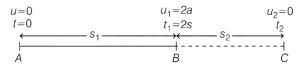
$A$ body starting from rest at $t=0$ moves along a straight line with a constant acceleration. At $t=2 \ s$,the body reverses its direction keeping the acceleration same. The body returns to the initial position at $t=t_0$,then $t_0$ is
A
$4 \ s$
B
$(4+2 \sqrt{2}) \ s$
C
$(2+2 \sqrt{2}) \ s$
D
$(4+4 \sqrt{2}) \ s$
Solution
(B) Let the body start from point $A$ at $t=0$ with initial velocity $u=0$ and constant acceleration $a$. At $t=2 \ s$,it reaches point $B$. The distance covered is $s_1 = \frac{1}{2} a (2)^2 = 2a$. The velocity at $B$ is $v_B = a(2) = 2a$.
At $t=2 \ s$,the body reverses its direction but the acceleration $a$ remains in the same direction (acting as deceleration). It stops at point $C$ where its velocity becomes $0$. Let the time taken from $B$ to $C$ be $t'$. Using $v = u + at$,we have $0 = 2a - a(t')$,which gives $t' = 2 \ s$. The distance $BC$ is $s_2 = (2a)(2) - \frac{1}{2} a (2)^2 = 4a - 2a = 2a$.
The total distance from $A$ to $C$ is $AC = s_1 + s_2 = 2a + 2a = 4a$.
Now,the body starts from rest at $C$ and moves towards $A$ with constant acceleration $a$. Let the time taken to cover distance $AC$ be $T$. Using $s = ut + \frac{1}{2}at^2$,we have $4a = 0 + \frac{1}{2} a T^2$,which gives $T^2 = 8$,so $T = 2\sqrt{2} \ s$.
The total time $t_0$ is the sum of time to reach $C$ and time to return to $A$. Time to reach $C$ is $2 \ s + 2 \ s = 4 \ s$. Thus,$t_0 = 4 + 2\sqrt{2} \ s$.
At $t=2 \ s$,the body reverses its direction but the acceleration $a$ remains in the same direction (acting as deceleration). It stops at point $C$ where its velocity becomes $0$. Let the time taken from $B$ to $C$ be $t'$. Using $v = u + at$,we have $0 = 2a - a(t')$,which gives $t' = 2 \ s$. The distance $BC$ is $s_2 = (2a)(2) - \frac{1}{2} a (2)^2 = 4a - 2a = 2a$.
The total distance from $A$ to $C$ is $AC = s_1 + s_2 = 2a + 2a = 4a$.
Now,the body starts from rest at $C$ and moves towards $A$ with constant acceleration $a$. Let the time taken to cover distance $AC$ be $T$. Using $s = ut + \frac{1}{2}at^2$,we have $4a = 0 + \frac{1}{2} a T^2$,which gives $T^2 = 8$,so $T = 2\sqrt{2} \ s$.
The total time $t_0$ is the sum of time to reach $C$ and time to return to $A$. Time to reach $C$ is $2 \ s + 2 \ s = 4 \ s$. Thus,$t_0 = 4 + 2\sqrt{2} \ s$.
0 likes
View Solution279
EasyMCQ
$A$ rifle bullet loses $\left(\frac{1}{25}\right)^{th}$ of its velocity in passing through a plank. The least number of such planks required just to stop the bullet is
A
$5$
B
$10$
C
$11$
D
$13$
Solution
(D) Let $u$ be the initial velocity of the bullet. After passing through one plank,the velocity becomes $v = u - \frac{u}{25} = \frac{24u}{25}$.
Using the kinematic equation $v^2 - u^2 = 2as$,where $s$ is the thickness of one plank and $a$ is the constant retardation:
$\left(\frac{24u}{25}\right)^2 - u^2 = 2as$
$\frac{576u^2}{625} - u^2 = 2as$
$2as = -\frac{49u^2}{625}$.
If $n$ planks are required to stop the bullet,the final velocity becomes $0$ after a total distance $ns$:
$0^2 - u^2 = 2a(ns)$
$-u^2 = n(2as)$
$-u^2 = n \left(-\frac{49u^2}{625}\right)$
$n = \frac{625}{49} \approx 12.75$.
Since the number of planks must be an integer,we need at least $13$ planks to stop the bullet.
Using the kinematic equation $v^2 - u^2 = 2as$,where $s$ is the thickness of one plank and $a$ is the constant retardation:
$\left(\frac{24u}{25}\right)^2 - u^2 = 2as$
$\frac{576u^2}{625} - u^2 = 2as$
$2as = -\frac{49u^2}{625}$.
If $n$ planks are required to stop the bullet,the final velocity becomes $0$ after a total distance $ns$:
$0^2 - u^2 = 2a(ns)$
$-u^2 = n(2as)$
$-u^2 = n \left(-\frac{49u^2}{625}\right)$
$n = \frac{625}{49} \approx 12.75$.
Since the number of planks must be an integer,we need at least $13$ planks to stop the bullet.
0 likes
View Solution280
EasyMCQ
The kinetic energy of a particle moving along a straight line is proportional to the time '$t$' of its travel. Then its acceleration is proportional to
A
$\frac{1}{\sqrt{t}}$
B
$\frac{1}{t}$
C
$t$
D
$t^2$
Solution
(A) Given that kinetic energy $K \propto t$.
Since $K = \frac{1}{2}mv^2$,we have $\frac{1}{2}mv^2 \propto t$,which implies $v^2 \propto t$ or $v \propto t^{1/2}$.
Acceleration $a = \frac{dv}{dt}$.
Since $v = kt^{1/2}$ (where $k$ is a constant),differentiating with respect to $t$ gives $a = k \cdot \frac{1}{2} t^{-1/2} = \frac{k}{2\sqrt{t}}$.
Therefore,$a \propto \frac{1}{\sqrt{t}}$.
Since $K = \frac{1}{2}mv^2$,we have $\frac{1}{2}mv^2 \propto t$,which implies $v^2 \propto t$ or $v \propto t^{1/2}$.
Acceleration $a = \frac{dv}{dt}$.
Since $v = kt^{1/2}$ (where $k$ is a constant),differentiating with respect to $t$ gives $a = k \cdot \frac{1}{2} t^{-1/2} = \frac{k}{2\sqrt{t}}$.
Therefore,$a \propto \frac{1}{\sqrt{t}}$.
0 likes
View Solution281
EasyMCQ
$A$ bullet fired into a target loses one-third of its velocity after travelling a distance $x$ meters into the target. If the bullet comes to rest by travelling a further distance $x^{\prime}$,then the ratio $\frac{x^{\prime}}{x}$ is
A
$\frac{2}{3}$
B
$\frac{1}{3}$
C
$\frac{4}{5}$
D
$\frac{4}{9}$
Solution
(C) Let the initial velocity of the bullet be $u$.
After travelling a distance $x$,the velocity becomes $v_1 = u - \frac{1}{3}u = \frac{2u}{3}$.
Using the equation of motion $v^2 = u^2 + 2as$,where $a$ is the retardation (deceleration) inside the target:
$(\frac{2u}{3})^2 = u^2 - 2ax$
$\frac{4u^2}{9} = u^2 - 2ax$
$2ax = u^2 - \frac{4u^2}{9} = \frac{5u^2}{9} \quad \dots (1)$
Now,for the second part of the motion,the bullet starts with velocity $\frac{2u}{3}$ and comes to rest (final velocity $v_2 = 0$) after travelling a further distance $x^{\prime}$:
$0^2 = (\frac{2u}{3})^2 - 2ax^{\prime}$
$2ax^{\prime} = \frac{4u^2}{9} \quad \dots (2)$
Dividing equation $(2)$ by equation $(1)$:
$\frac{2ax^{\prime}}{2ax} = \frac{4u^2/9}{5u^2/9}$
$\frac{x^{\prime}}{x} = \frac{4}{5}$.
After travelling a distance $x$,the velocity becomes $v_1 = u - \frac{1}{3}u = \frac{2u}{3}$.
Using the equation of motion $v^2 = u^2 + 2as$,where $a$ is the retardation (deceleration) inside the target:
$(\frac{2u}{3})^2 = u^2 - 2ax$
$\frac{4u^2}{9} = u^2 - 2ax$
$2ax = u^2 - \frac{4u^2}{9} = \frac{5u^2}{9} \quad \dots (1)$
Now,for the second part of the motion,the bullet starts with velocity $\frac{2u}{3}$ and comes to rest (final velocity $v_2 = 0$) after travelling a further distance $x^{\prime}$:
$0^2 = (\frac{2u}{3})^2 - 2ax^{\prime}$
$2ax^{\prime} = \frac{4u^2}{9} \quad \dots (2)$
Dividing equation $(2)$ by equation $(1)$:
$\frac{2ax^{\prime}}{2ax} = \frac{4u^2/9}{5u^2/9}$
$\frac{x^{\prime}}{x} = \frac{4}{5}$.
0 likes
View Solution282
MediumMCQ
$A$ body starts from rest and acquires a velocity of $10 \ m \ s^{-1}$ in $2 \ s$. What is the acceleration of the body and the distance travelled?
A
$5 \ m \ s^{-2}$ and $10 \ m$
B
$5 \ m \ s^{-2}$ and $5 \ m$
C
$5 \ m \ s^{-2}$ and $6 \ m$
D
$6 \ m \ s^{-2}$ and $5 \ m$
Solution
(A) Given: Initial velocity $u = 0 \ m \ s^{-1}$,Final velocity $v = 10 \ m \ s^{-1}$,Time $t = 2 \ s$.
For constant acceleration,we use the first equation of motion:
$v = u + at$
$10 = 0 + a \times 2$
$a = \frac{10}{2} = 5 \ m \ s^{-2}$.
Now,for the distance travelled $(s)$,we use the second equation of motion:
$s = ut + \frac{1}{2}at^2$
$s = 0 \times 2 + \frac{1}{2} \times 5 \times (2)^2$
$s = 0 + \frac{1}{2} \times 5 \times 4$
$s = 10 \ m$.
Thus,the acceleration is $5 \ m \ s^{-2}$ and the distance travelled is $10 \ m$.
For constant acceleration,we use the first equation of motion:
$v = u + at$
$10 = 0 + a \times 2$
$a = \frac{10}{2} = 5 \ m \ s^{-2}$.
Now,for the distance travelled $(s)$,we use the second equation of motion:
$s = ut + \frac{1}{2}at^2$
$s = 0 \times 2 + \frac{1}{2} \times 5 \times (2)^2$
$s = 0 + \frac{1}{2} \times 5 \times 4$
$s = 10 \ m$.
Thus,the acceleration is $5 \ m \ s^{-2}$ and the distance travelled is $10 \ m$.
0 likes
View Solution283
MediumMCQ
The velocity of a particle moving along the $x$-axis varies as a function of time $t$ as $v(t) = (1 - 3t^2 + 2t^3) \ m/s$. If its position at $t = 0$ is $x = 0$,then at $t = 2 \ s$,its position is: (in $m$)
A
$1$
B
$2$
C
$4$
D
$18$
Solution
(B) The velocity of the particle is given by $v(t) = 1 - 3t^2 + 2t^3$.
We know that velocity is the rate of change of position,$v = \frac{dx}{dt}$.
Therefore,the displacement $x$ can be found by integrating the velocity with respect to time:
$x(t) = \int v(t) \ dt = \int (1 - 3t^2 + 2t^3) \ dt$.
Performing the integration:
$x(t) = t - t^3 + \frac{2t^4}{4} + C = t - t^3 + \frac{t^4}{2} + C$.
Given that at $t = 0$,$x = 0$,we substitute these values to find the constant $C$:
$0 = 0 - 0^3 + \frac{0^4}{2} + C \Rightarrow C = 0$.
So,the position function is $x(t) = t - t^3 + \frac{t^4}{2}$.
At $t = 2 \ s$,the position is:
$x(2) = 2 - (2)^3 + \frac{(2)^4}{2} = 2 - 8 + \frac{16}{2} = 2 - 8 + 8 = 2 \ m$.
We know that velocity is the rate of change of position,$v = \frac{dx}{dt}$.
Therefore,the displacement $x$ can be found by integrating the velocity with respect to time:
$x(t) = \int v(t) \ dt = \int (1 - 3t^2 + 2t^3) \ dt$.
Performing the integration:
$x(t) = t - t^3 + \frac{2t^4}{4} + C = t - t^3 + \frac{t^4}{2} + C$.
Given that at $t = 0$,$x = 0$,we substitute these values to find the constant $C$:
$0 = 0 - 0^3 + \frac{0^4}{2} + C \Rightarrow C = 0$.
So,the position function is $x(t) = t - t^3 + \frac{t^4}{2}$.
At $t = 2 \ s$,the position is:
$x(2) = 2 - (2)^3 + \frac{(2)^4}{2} = 2 - 8 + \frac{16}{2} = 2 - 8 + 8 = 2 \ m$.
0 likes
View Solution284
MediumMCQ
$A$ particle moving along the $X$-axis has acceleration $f$ at time $t$ given by $f=f_0\left(1-\frac{t}{T}\right)$,where $f_0$ and $T$ are constants. The particle at $t=0$ has zero velocity. In the time interval between $t=0$ and the instant when $f=0$,the particle's velocity is
A
$\frac{1}{2} f_0 T^2$
B
$f_0 T^2$
C
$\frac{1}{2} f_0 T$
D
$f_0 T$
Solution
(C) The acceleration of the particle is given by $f = f_0 \left(1 - \frac{t}{T}\right)$.
Since $f = \frac{dv}{dt}$,the velocity $v$ is obtained by integrating the acceleration with respect to time:
$v = \int f dt = \int f_0 \left(1 - \frac{t}{T}\right) dt = f_0 \left(t - \frac{t^2}{2T}\right) + C$.
Given that at $t = 0$,$v = 0$,we find the constant of integration $C = 0$.
Thus,the velocity at any time $t$ is $v = f_0 \left(t - \frac{t^2}{2T}\right)$.
The acceleration becomes zero when $f = 0$,which implies $1 - \frac{t}{T} = 0$,so $t = T$.
Substituting $t = T$ into the velocity equation:
$v = f_0 \left(T - \frac{T^2}{2T}\right) = f_0 \left(T - \frac{T}{2}\right) = \frac{f_0 T}{2}$.
Since $f = \frac{dv}{dt}$,the velocity $v$ is obtained by integrating the acceleration with respect to time:
$v = \int f dt = \int f_0 \left(1 - \frac{t}{T}\right) dt = f_0 \left(t - \frac{t^2}{2T}\right) + C$.
Given that at $t = 0$,$v = 0$,we find the constant of integration $C = 0$.
Thus,the velocity at any time $t$ is $v = f_0 \left(t - \frac{t^2}{2T}\right)$.
The acceleration becomes zero when $f = 0$,which implies $1 - \frac{t}{T} = 0$,so $t = T$.
Substituting $t = T$ into the velocity equation:
$v = f_0 \left(T - \frac{T^2}{2T}\right) = f_0 \left(T - \frac{T}{2}\right) = \frac{f_0 T}{2}$.
0 likes
View Solution285
MediumMCQ
Consider a particle moving along the positive direction of the $X$-axis. The velocity of the particle is given by $v = \alpha \sqrt{x}$ (where $\alpha$ is a positive constant). At time $t = 0$,the particle is located at $x = 0$. Find the time dependence of the velocity and the acceleration of the particle,respectively.
A
$\frac{\alpha^2}{2} t$ and $\frac{\alpha^2}{2}$
B
$\alpha^2 t$ and $\alpha^2$
C
$\frac{\alpha}{2} t$ and $\frac{\alpha}{2}$
D
$\frac{\alpha^2}{4} t$ and $\frac{\alpha^2}{4}$
Solution
(A) Given,$v = \alpha \sqrt{x}$.
Since $v = \frac{dx}{dt}$,we have $\frac{dx}{dt} = \alpha \sqrt{x}$.
Separating variables: $\frac{dx}{\sqrt{x}} = \alpha dt$.
Integrating both sides: $\int x^{-1/2} dx = \int \alpha dt \Rightarrow 2\sqrt{x} = \alpha t + C$.
At $t = 0$,$x = 0$,so $C = 0$. Thus,$2\sqrt{x} = \alpha t \Rightarrow \sqrt{x} = \frac{\alpha t}{2}$.
Squaring both sides: $x = \frac{\alpha^2 t^2}{4}$.
Velocity $v = \frac{dx}{dt} = \frac{d}{dt} \left( \frac{\alpha^2 t^2}{4} \right) = \frac{\alpha^2}{4} (2t) = \frac{\alpha^2 t}{2}$.
Acceleration $a = \frac{dv}{dt} = \frac{d}{dt} \left( \frac{\alpha^2 t}{2} \right) = \frac{\alpha^2}{2}$.
Since $v = \frac{dx}{dt}$,we have $\frac{dx}{dt} = \alpha \sqrt{x}$.
Separating variables: $\frac{dx}{\sqrt{x}} = \alpha dt$.
Integrating both sides: $\int x^{-1/2} dx = \int \alpha dt \Rightarrow 2\sqrt{x} = \alpha t + C$.
At $t = 0$,$x = 0$,so $C = 0$. Thus,$2\sqrt{x} = \alpha t \Rightarrow \sqrt{x} = \frac{\alpha t}{2}$.
Squaring both sides: $x = \frac{\alpha^2 t^2}{4}$.
Velocity $v = \frac{dx}{dt} = \frac{d}{dt} \left( \frac{\alpha^2 t^2}{4} \right) = \frac{\alpha^2}{4} (2t) = \frac{\alpha^2 t}{2}$.
Acceleration $a = \frac{dv}{dt} = \frac{d}{dt} \left( \frac{\alpha^2 t}{2} \right) = \frac{\alpha^2}{2}$.
0 likes
View Solution286
MediumMCQ
An object moves in a straight line with deceleration whose magnitude varies with velocity as $3 v^{2/3}$. If at an initial point,the velocity is $8 \,m/s$,then the distance travelled by the object before it stops is (in $\,m$)
A
$2$
B
$4$
C
$6$
D
$8$
Solution
(B) Given that,deceleration $a = -3 v^{2/3} \,m/s^2$.
At initial point $(t=0)$,velocity $u = 8 \,m/s$.
We know that acceleration $a = v \frac{dv}{ds}$.
Substituting the given expression for $a$:
$-3 v^{2/3} = v \frac{dv}{ds}$
$-3 v^{2/3} ds = v dv$
$ds = -\frac{1}{3} v^{1 - 2/3} dv = -\frac{1}{3} v^{1/3} dv$.
Integrating both sides:
$\int_{0}^{s} ds = -\frac{1}{3} \int_{8}^{0} v^{1/3} dv$
$s = -\frac{1}{3} \left[ \frac{v^{4/3}}{4/3} \right]_{8}^{0}$
$s = -\frac{1}{3} \cdot \frac{3}{4} [0 - 8^{4/3}]$
$s = -\frac{1}{4} [0 - (2^3)^{4/3}]$
$s = -\frac{1}{4} [0 - 16] = 4 \,m$.
Therefore,the distance travelled by the object before it stops is $4 \,m$.
At initial point $(t=0)$,velocity $u = 8 \,m/s$.
We know that acceleration $a = v \frac{dv}{ds}$.
Substituting the given expression for $a$:
$-3 v^{2/3} = v \frac{dv}{ds}$
$-3 v^{2/3} ds = v dv$
$ds = -\frac{1}{3} v^{1 - 2/3} dv = -\frac{1}{3} v^{1/3} dv$.
Integrating both sides:
$\int_{0}^{s} ds = -\frac{1}{3} \int_{8}^{0} v^{1/3} dv$
$s = -\frac{1}{3} \left[ \frac{v^{4/3}}{4/3} \right]_{8}^{0}$
$s = -\frac{1}{3} \cdot \frac{3}{4} [0 - 8^{4/3}]$
$s = -\frac{1}{4} [0 - (2^3)^{4/3}]$
$s = -\frac{1}{4} [0 - 16] = 4 \,m$.
Therefore,the distance travelled by the object before it stops is $4 \,m$.
0 likes
View Solution287
MediumMCQ
The deceleration of a car traveling on a straight highway is a function of its instantaneous velocity $v$ given by $\omega = a \sqrt{v}$,where $a$ is a constant. If the initial velocity of the car is $v_0$,the distance the car will travel and the time it takes before it stops are:
A
$\frac{2 v_0^{3/2}}{3 a}, \frac{2 \sqrt{v_0}}{a}$
B
$\frac{3 v_0^{3/2}}{2 a}, \frac{1}{2 a} \sqrt{v_0}$
C
$\frac{3 a}{2} v_0^{3/2}, \frac{a}{2} \sqrt{v_0}$
D
$\frac{2}{3 a} v_0, \frac{2}{a} v_0$
Solution
(A) Given deceleration $\omega = -\frac{dv}{dt} = a \sqrt{v}$.
$1$. To find time $t$:
$\frac{dv}{dt} = -a \sqrt{v} \implies \int_{v_0}^{0} v^{-1/2} dv = \int_{0}^{t} -a dt$
$[2 \sqrt{v}]_{v_0}^{0} = -at \implies -2 \sqrt{v_0} = -at \implies t = \frac{2 \sqrt{v_0}}{a}$.
$2$. To find distance $s$:
Using $\omega = v \frac{dv}{ds} = a \sqrt{v} \implies v \frac{dv}{ds} = -a \sqrt{v} \implies \sqrt{v} dv = -a ds$.
Integrating both sides: $\int_{v_0}^{0} v^{1/2} dv = \int_{0}^{s} -a ds$
$[\frac{2}{3} v^{3/2}]_{v_0}^{0} = -as \implies -\frac{2}{3} v_0^{3/2} = -as \implies s = \frac{2 v_0^{3/2}}{3 a}$.
$1$. To find time $t$:
$\frac{dv}{dt} = -a \sqrt{v} \implies \int_{v_0}^{0} v^{-1/2} dv = \int_{0}^{t} -a dt$
$[2 \sqrt{v}]_{v_0}^{0} = -at \implies -2 \sqrt{v_0} = -at \implies t = \frac{2 \sqrt{v_0}}{a}$.
$2$. To find distance $s$:
Using $\omega = v \frac{dv}{ds} = a \sqrt{v} \implies v \frac{dv}{ds} = -a \sqrt{v} \implies \sqrt{v} dv = -a ds$.
Integrating both sides: $\int_{v_0}^{0} v^{1/2} dv = \int_{0}^{s} -a ds$
$[\frac{2}{3} v^{3/2}]_{v_0}^{0} = -as \implies -\frac{2}{3} v_0^{3/2} = -as \implies s = \frac{2 v_0^{3/2}}{3 a}$.
0 likes
View Solution288
EasyMCQ
The displacement of a particle moving in a straight line is given by the expression $x = A t^3 + B t^2 + C t + D$ in metres,where $t$ is in seconds and $A, B, C$ and $D$ are constants. The ratio between the initial acceleration and initial velocity is
A
$\frac{2 C}{B}$
B
$\frac{2 B}{C}$
C
$2 C$
D
$\frac{C}{2 B}$
Solution
(B) The displacement of the particle is given by $x = A t^3 + B t^2 + C t + D$.
To find the velocity $v$,we differentiate $x$ with respect to time $t$:
$v = \frac{dx}{dt} = 3At^2 + 2Bt + C$.
The initial velocity $(v_{\text{initial}})$ is the velocity at $t = 0$:
$v_{\text{initial}} = 3A(0)^2 + 2B(0) + C = C$.
To find the acceleration $a$,we differentiate $v$ with respect to time $t$:
$a = \frac{dv}{dt} = 6At + 2B$.
The initial acceleration $(a_{\text{initial}})$ is the acceleration at $t = 0$:
$a_{\text{initial}} = 6A(0) + 2B = 2B$.
The ratio between the initial acceleration and initial velocity is $\frac{a_{\text{initial}}}{v_{\text{initial}}} = \frac{2B}{C}$.
To find the velocity $v$,we differentiate $x$ with respect to time $t$:
$v = \frac{dx}{dt} = 3At^2 + 2Bt + C$.
The initial velocity $(v_{\text{initial}})$ is the velocity at $t = 0$:
$v_{\text{initial}} = 3A(0)^2 + 2B(0) + C = C$.
To find the acceleration $a$,we differentiate $v$ with respect to time $t$:
$a = \frac{dv}{dt} = 6At + 2B$.
The initial acceleration $(a_{\text{initial}})$ is the acceleration at $t = 0$:
$a_{\text{initial}} = 6A(0) + 2B = 2B$.
The ratio between the initial acceleration and initial velocity is $\frac{a_{\text{initial}}}{v_{\text{initial}}} = \frac{2B}{C}$.
0 likes
View Solution289
MediumMCQ
For a particle moving along a straight line path,the displacements in the third and fifth seconds of its motion are $10 \ m$ and $18 \ m$ respectively. The speed of the particle at time $t=4 \ s$ is (in $ms^{-1}$)
A
$32$
B
$8$
C
$12$
D
$16$
Solution
(D) The displacement of a particle in the $n^{th}$ second is given by the formula: $S_n = u + \frac{a}{2}(2n - 1)$,where $u$ is the initial velocity and $a$ is the constant acceleration.
For the $3^{rd}$ second $(n=3)$: $10 = u + \frac{a}{2}(2(3) - 1) \implies 10 = u + 2.5a$ --- (Equation $1$)
For the $5^{th}$ second $(n=5)$: $18 = u + \frac{a}{2}(2(5) - 1) \implies 18 = u + 4.5a$ --- (Equation $2$)
Subtracting Equation $1$ from Equation $2$: $(18 - 10) = (u + 4.5a) - (u + 2.5a) \implies 8 = 2a \implies a = 4 \ ms^{-2}$.
Substituting $a = 4$ into Equation $1$: $10 = u + 2.5(4) \implies 10 = u + 10 \implies u = 0 \ ms^{-1}$.
The velocity at time $t$ is given by $v = u + at$.
At $t = 4 \ s$: $v = 0 + (4)(4) = 16 \ ms^{-1}$.
For the $3^{rd}$ second $(n=3)$: $10 = u + \frac{a}{2}(2(3) - 1) \implies 10 = u + 2.5a$ --- (Equation $1$)
For the $5^{th}$ second $(n=5)$: $18 = u + \frac{a}{2}(2(5) - 1) \implies 18 = u + 4.5a$ --- (Equation $2$)
Subtracting Equation $1$ from Equation $2$: $(18 - 10) = (u + 4.5a) - (u + 2.5a) \implies 8 = 2a \implies a = 4 \ ms^{-2}$.
Substituting $a = 4$ into Equation $1$: $10 = u + 2.5(4) \implies 10 = u + 10 \implies u = 0 \ ms^{-1}$.
The velocity at time $t$ is given by $v = u + at$.
At $t = 4 \ s$: $v = 0 + (4)(4) = 16 \ ms^{-1}$.
0 likes
View Solution290
EasyMCQ
The relation between time $t$ and distance $x$ of a particle is $t = ax^2 + bx$,where $a$ and $b$ are constants. If $v$ is the velocity of the particle,then its acceleration is
A
$-2abv^2$
B
$2bv^3$
C
$-2av^3$
D
$2av^2$
Solution
(C) Given the relation: $t = ax^2 + bx$.
Differentiating both sides with respect to $x$: $\frac{dt}{dx} = 2ax + b$.
Since velocity $v = \frac{dx}{dt}$,we have $\frac{dt}{dx} = \frac{1}{v}$.
Therefore,$\frac{1}{v} = 2ax + b$,which implies $v = (2ax + b)^{-1}$.
Acceleration $a_{acc} = \frac{dv}{dt} = \frac{dv}{dx} \cdot \frac{dx}{dt} = v \cdot \frac{dv}{dx}$.
Differentiating $v$ with respect to $x$: $\frac{dv}{dx} = -1(2ax + b)^{-2} \cdot (2a) = -2a(2ax + b)^{-2}$.
Substituting $(2ax + b) = \frac{1}{v}$: $\frac{dv}{dx} = -2a \cdot (\frac{1}{v})^{-2} = -2av^2$.
Thus,acceleration $a_{acc} = v \cdot (-2av^2) = -2av^3$.
Differentiating both sides with respect to $x$: $\frac{dt}{dx} = 2ax + b$.
Since velocity $v = \frac{dx}{dt}$,we have $\frac{dt}{dx} = \frac{1}{v}$.
Therefore,$\frac{1}{v} = 2ax + b$,which implies $v = (2ax + b)^{-1}$.
Acceleration $a_{acc} = \frac{dv}{dt} = \frac{dv}{dx} \cdot \frac{dx}{dt} = v \cdot \frac{dv}{dx}$.
Differentiating $v$ with respect to $x$: $\frac{dv}{dx} = -1(2ax + b)^{-2} \cdot (2a) = -2a(2ax + b)^{-2}$.
Substituting $(2ax + b) = \frac{1}{v}$: $\frac{dv}{dx} = -2a \cdot (\frac{1}{v})^{-2} = -2av^2$.
Thus,acceleration $a_{acc} = v \cdot (-2av^2) = -2av^3$.
0 likes
View Solution291
EasyMCQ
$A$ bullet enters a wooden block with velocity $120 \,m/s$. The bullet travels $1.5 \,s$ in the block before its velocity reduces to zero due to a resistance force which is proportional to the square root of the velocity. The distance travelled by the bullet in the wooden block is (in $\,m$)
A
$10$
B
$60$
C
$25$
D
$40$
Solution
(B) Given, resistance force $F \propto \sqrt{v}$, so $ma = -k\sqrt{v}$, which implies $a = -c\sqrt{v}$ where $c$ is a constant.
We know $a = \frac{dv}{dt} = -c\sqrt{v}$.
Rearranging, $\frac{dv}{\sqrt{v}} = -c \, dt$.
Integrating from $t=0$ $(v=u)$ to $t=T$ $(v=0)$:
$\int_{u}^{0} v^{-1/2} \, dv = \int_{0}^{T} -c \, dt \Rightarrow [2\sqrt{v}]_{u}^{0} = -cT \Rightarrow -2\sqrt{u} = -cT \Rightarrow c = \frac{2\sqrt{u}}{T}$.
Now, $v \frac{dv}{ds} = -c\sqrt{v} \Rightarrow \sqrt{v} \, dv = -c \, ds$.
Integrating from $s=0$ $(v=u)$ to $s=S$ $(v=0)$:
$\int_{u}^{0} v^{1/2} \, dv = \int_{0}^{S} -c \, ds \Rightarrow [\frac{2}{3} v^{3/2}]_{u}^{0} = -cS \Rightarrow -\frac{2}{3} u^{3/2} = -cS \Rightarrow S = \frac{2u^{3/2}}{3c}$.
Substituting $c = \frac{2\sqrt{u}}{T}$:
$S = \frac{2u^{3/2}}{3(2\sqrt{u}/T)} = \frac{uT}{3}$.
Given $u = 120 \,m/s$ and $T = 1.5 \,s$:
$S = \frac{120 \times 1.5}{3} = \frac{180}{3} = 60 \,m$.
Since $60 \,m$ is not in the options, the provided options are incorrect.
We know $a = \frac{dv}{dt} = -c\sqrt{v}$.
Rearranging, $\frac{dv}{\sqrt{v}} = -c \, dt$.
Integrating from $t=0$ $(v=u)$ to $t=T$ $(v=0)$:
$\int_{u}^{0} v^{-1/2} \, dv = \int_{0}^{T} -c \, dt \Rightarrow [2\sqrt{v}]_{u}^{0} = -cT \Rightarrow -2\sqrt{u} = -cT \Rightarrow c = \frac{2\sqrt{u}}{T}$.
Now, $v \frac{dv}{ds} = -c\sqrt{v} \Rightarrow \sqrt{v} \, dv = -c \, ds$.
Integrating from $s=0$ $(v=u)$ to $s=S$ $(v=0)$:
$\int_{u}^{0} v^{1/2} \, dv = \int_{0}^{S} -c \, ds \Rightarrow [\frac{2}{3} v^{3/2}]_{u}^{0} = -cS \Rightarrow -\frac{2}{3} u^{3/2} = -cS \Rightarrow S = \frac{2u^{3/2}}{3c}$.
Substituting $c = \frac{2\sqrt{u}}{T}$:
$S = \frac{2u^{3/2}}{3(2\sqrt{u}/T)} = \frac{uT}{3}$.
Given $u = 120 \,m/s$ and $T = 1.5 \,s$:
$S = \frac{120 \times 1.5}{3} = \frac{180}{3} = 60 \,m$.
Since $60 \,m$ is not in the options, the provided options are incorrect.
0 likes
View Solution292
MediumMCQ
$A$ vehicle starts moving in a straight line with an acceleration $a = 4 \,m/s^2$, with initial velocity equal to zero. After accelerating for time $t_1$, the vehicle moves uniformly for time $t_2$, and finally decelerates for time $t_1$, eventually coming to a stop. The total time taken during the motion is $10 \,s$ and the average velocity during the motion is $5.1 \,m/s$. The time taken by the vehicle during acceleration is (in $\,s$)
A
$2$
B
$2.5$
C
$1.5$
D
$1.8$
Solution
(C) For the first part of the journey: $u = 0, a = 4 \,m/s^2$, time $= t_1$. The velocity attained at the end of time $t_1$ is $v_1 = u + at_1 = 4t_1$.
The displacement in the first $t_1$ seconds is $s_1 = \frac{1}{2}at_1^2 = \frac{1}{2} \times 4 \times t_1^2 = 2t_1^2$.
For the second part of the journey: initial velocity $v_1 = 4t_1$, time $= t_2$, and acceleration $= 0$.
The displacement in the next $t_2$ seconds is $s_2 = v_1 t_2 = 4t_1 t_2$.
For the third part of the journey: initial velocity $v_1 = 4t_1$, final velocity $= 0$, time interval $= t_1$.
The displacement in the third part is $s_3 = \frac{v_1 + v_f}{2} \times t_1 = \frac{4t_1 + 0}{2} \times t_1 = 2t_1^2$.
Total time $T = t_1 + t_2 + t_1 = 2t_1 + t_2 = 10 \,s$, so $t_2 = 10 - 2t_1$.
Average velocity $v_{\text{avg}} = \frac{\text{Total displacement}}{\text{Total time}} = \frac{s_1 + s_2 + s_3}{10} = 5.1$.
Substituting the values: $5.1 = \frac{2t_1^2 + 4t_1 t_2 + 2t_1^2}{10} = \frac{4t_1^2 + 4t_1(10 - 2t_1)}{10}$.
$51 = 4t_1^2 + 40t_1 - 8t_1^2$.
$4t_1^2 - 40t_1 + 51 = 0$.
Solving the quadratic equation: $t_1 = \frac{40 \pm \sqrt{1600 - 4(4)(51)}}{2(4)} = \frac{40 \pm \sqrt{1600 - 816}}{8} = \frac{40 \pm \sqrt{784}}{8} = \frac{40 \pm 28}{8}$.
$t_1 = \frac{68}{8} = 8.5 \,s$ (not possible) or $t_1 = \frac{12}{8} = 1.5 \,s$.
Therefore, $t_1 = 1.5 \,s$.
The displacement in the first $t_1$ seconds is $s_1 = \frac{1}{2}at_1^2 = \frac{1}{2} \times 4 \times t_1^2 = 2t_1^2$.
For the second part of the journey: initial velocity $v_1 = 4t_1$, time $= t_2$, and acceleration $= 0$.
The displacement in the next $t_2$ seconds is $s_2 = v_1 t_2 = 4t_1 t_2$.
For the third part of the journey: initial velocity $v_1 = 4t_1$, final velocity $= 0$, time interval $= t_1$.
The displacement in the third part is $s_3 = \frac{v_1 + v_f}{2} \times t_1 = \frac{4t_1 + 0}{2} \times t_1 = 2t_1^2$.
Total time $T = t_1 + t_2 + t_1 = 2t_1 + t_2 = 10 \,s$, so $t_2 = 10 - 2t_1$.
Average velocity $v_{\text{avg}} = \frac{\text{Total displacement}}{\text{Total time}} = \frac{s_1 + s_2 + s_3}{10} = 5.1$.
Substituting the values: $5.1 = \frac{2t_1^2 + 4t_1 t_2 + 2t_1^2}{10} = \frac{4t_1^2 + 4t_1(10 - 2t_1)}{10}$.
$51 = 4t_1^2 + 40t_1 - 8t_1^2$.
$4t_1^2 - 40t_1 + 51 = 0$.
Solving the quadratic equation: $t_1 = \frac{40 \pm \sqrt{1600 - 4(4)(51)}}{2(4)} = \frac{40 \pm \sqrt{1600 - 816}}{8} = \frac{40 \pm \sqrt{784}}{8} = \frac{40 \pm 28}{8}$.
$t_1 = \frac{68}{8} = 8.5 \,s$ (not possible) or $t_1 = \frac{12}{8} = 1.5 \,s$.
Therefore, $t_1 = 1.5 \,s$.
0 likes
View Solution293
MediumMCQ
$A$ particle initially at rest is moving along a straight line with an acceleration of $2 \,m/s^2$. At a time of $3 \,s$ after the beginning of motion, the direction of acceleration is reversed. The time from the beginning of the motion in which the particle returns to its initial position is
A
$(3+\sqrt{3}) \,s$
B
$(2+\sqrt{2}) \,s$
C
$3(1+\sqrt{2}) \,s$
D
$2(3+\sqrt{3}) \,s$
Solution
(C) $1$. For the first $3 \,s$, the particle starts from rest $(u=0)$ with acceleration $a_1 = 2 \,m/s^2$.
$2$. Velocity at $t=3 \,s$ is $v = u + a_1 t = 0 + 2(3) = 6 \,m/s$.
$3$. Displacement at $t=3 \,s$ is $s_1 = ut + 0.5 a_1 t^2 = 0 + 0.5(2)(3^2) = 9 \,m$.
$4$. After $t=3 \,s$, the acceleration reverses, so $a_2 = -2 \,m/s^2$. Let the additional time be $t'$.
$5$. The position at time $t'$ is $s = s_1 + vt' + 0.5 a_2 (t')^2$.
$6$. For the particle to return to its initial position, $s=0$.
$7$. $0 = 9 + 6t' - 0.5(2)(t')^2 \Rightarrow 0 = 9 + 6t' - (t')^2 \Rightarrow (t')^2 - 6t' - 9 = 0$.
$8$. Using the quadratic formula $t' = \frac{-b \pm \sqrt{b^2 - 4ac}}{2a} = \frac{6 \pm \sqrt{36 - 4(1)(-9)}}{2} = \frac{6 \pm \sqrt{72}}{2} = 3 \pm 3\sqrt{2}$.
$9$. Since $t' > 0$, $t' = 3 + 3\sqrt{2} = 3(1+\sqrt{2}) \,s$.
$10$. Total time $T = 3 + t' = 3 + 3 + 3\sqrt{2} = 6 + 3\sqrt{2} = 3(2+\sqrt{2}) \,s$.
$2$. Velocity at $t=3 \,s$ is $v = u + a_1 t = 0 + 2(3) = 6 \,m/s$.
$3$. Displacement at $t=3 \,s$ is $s_1 = ut + 0.5 a_1 t^2 = 0 + 0.5(2)(3^2) = 9 \,m$.
$4$. After $t=3 \,s$, the acceleration reverses, so $a_2 = -2 \,m/s^2$. Let the additional time be $t'$.
$5$. The position at time $t'$ is $s = s_1 + vt' + 0.5 a_2 (t')^2$.
$6$. For the particle to return to its initial position, $s=0$.
$7$. $0 = 9 + 6t' - 0.5(2)(t')^2 \Rightarrow 0 = 9 + 6t' - (t')^2 \Rightarrow (t')^2 - 6t' - 9 = 0$.
$8$. Using the quadratic formula $t' = \frac{-b \pm \sqrt{b^2 - 4ac}}{2a} = \frac{6 \pm \sqrt{36 - 4(1)(-9)}}{2} = \frac{6 \pm \sqrt{72}}{2} = 3 \pm 3\sqrt{2}$.
$9$. Since $t' > 0$, $t' = 3 + 3\sqrt{2} = 3(1+\sqrt{2}) \,s$.
$10$. Total time $T = 3 + t' = 3 + 3 + 3\sqrt{2} = 6 + 3\sqrt{2} = 3(2+\sqrt{2}) \,s$.
0 likes
View Solution294
MediumMCQ
$A$ body moving with uniform acceleration travels a distance of $25 \ m$ in the fourth second and $37 \ m$ in the sixth second. The distance covered by the body in the next two seconds is: (in $m$)
A
$63$
B
$84$
C
$49$
D
$92$
Solution
(D) For uniformly accelerated motion,the distance covered in the $n^{th}$ second is given by $S_n = u + (2n - 1) \frac{a}{2}$.
For the fourth second $(n=4)$: $25 = u + (2 \times 4 - 1) \frac{a}{2} = u + 3.5a$ ...$(i)$
For the sixth second $(n=6)$: $37 = u + (2 \times 6 - 1) \frac{a}{2} = u + 5.5a$ ...(ii)
Subtracting $(i)$ from (ii): $12 = 2a \implies a = 6 \ m/s^2$.
Substituting $a$ in $(i)$: $25 = u + 3.5(6) = u + 21 \implies u = 4 \ m/s$.
The distance covered in the next two seconds (i.e.,from $t=6 \ s$ to $t=8 \ s$) is calculated using $S = ut + \frac{1}{2}at^2$ with $u=4 \ m/s$,$a=6 \ m/s^2$,and $t=2 \ s$:
$S = (4 \times 2) + \frac{1}{2} \times 6 \times (2)^2 = 8 + 12 = 20 \ m$ is incorrect based on the provided solution logic. Re-evaluating: The velocity at $t=6 \ s$ is $v = u + at = 4 + (6 \times 6) = 40 \ m/s$.
Distance covered in the next $2 \ s$ starting from $t=6 \ s$ is $S = vt + \frac{1}{2}at^2 = (40 \times 2) + \frac{1}{2} \times 6 \times (2)^2 = 80 + 12 = 92 \ m$.
For the fourth second $(n=4)$: $25 = u + (2 \times 4 - 1) \frac{a}{2} = u + 3.5a$ ...$(i)$
For the sixth second $(n=6)$: $37 = u + (2 \times 6 - 1) \frac{a}{2} = u + 5.5a$ ...(ii)
Subtracting $(i)$ from (ii): $12 = 2a \implies a = 6 \ m/s^2$.
Substituting $a$ in $(i)$: $25 = u + 3.5(6) = u + 21 \implies u = 4 \ m/s$.
The distance covered in the next two seconds (i.e.,from $t=6 \ s$ to $t=8 \ s$) is calculated using $S = ut + \frac{1}{2}at^2$ with $u=4 \ m/s$,$a=6 \ m/s^2$,and $t=2 \ s$:
$S = (4 \times 2) + \frac{1}{2} \times 6 \times (2)^2 = 8 + 12 = 20 \ m$ is incorrect based on the provided solution logic. Re-evaluating: The velocity at $t=6 \ s$ is $v = u + at = 4 + (6 \times 6) = 40 \ m/s$.
Distance covered in the next $2 \ s$ starting from $t=6 \ s$ is $S = vt + \frac{1}{2}at^2 = (40 \times 2) + \frac{1}{2} \times 6 \times (2)^2 = 80 + 12 = 92 \ m$.
0 likes
View Solution295
MediumMCQ
$A$ body starts from rest with uniform acceleration. If its velocity after $n^{\text{th}}$ second (last second) is $V$,then its displacement in the last two seconds is
A
$\frac{2V(n+1)}{n}$
B
$\frac{V(n+1)}{n}$
C
$\frac{V(n-1)}{n}$
D
$\frac{2V(n-1)}{n}$
Solution
(D) Given that the body starts from rest,so initial velocity $u = 0$.
Let the uniform acceleration be $a$.
The velocity after $n$ seconds is given by $v = u + at$.
Substituting the values,$V = 0 + a(n)$,which gives $a = \frac{V}{n}$.
The displacement $S$ in the last $t = 2 \text{ s}$ can be calculated using the formula $S = v_{final}t - \frac{1}{2}at^2$,where $v_{final} = V$.
$S = V(2) - \frac{1}{2} \left(\frac{V}{n}\right)(2)^2$.
$S = 2V - \frac{1}{2} \left(\frac{V}{n}\right)(4)$.
$S = 2V - \frac{2V}{n}$.
$S = 2V \left(1 - \frac{1}{n}\right) = \frac{2V(n-1)}{n}$.
Let the uniform acceleration be $a$.
The velocity after $n$ seconds is given by $v = u + at$.
Substituting the values,$V = 0 + a(n)$,which gives $a = \frac{V}{n}$.
The displacement $S$ in the last $t = 2 \text{ s}$ can be calculated using the formula $S = v_{final}t - \frac{1}{2}at^2$,where $v_{final} = V$.
$S = V(2) - \frac{1}{2} \left(\frac{V}{n}\right)(2)^2$.
$S = 2V - \frac{1}{2} \left(\frac{V}{n}\right)(4)$.
$S = 2V - \frac{2V}{n}$.
$S = 2V \left(1 - \frac{1}{n}\right) = \frac{2V(n-1)}{n}$.
0 likes
View Solution296
EasyMCQ
$A$ car starts at time $t=0$ from an initial speed of $10 \,m/s$ and accelerates uniformly with $2 \,m/s^2$ on a straight road for time $0 \leq t \leq 10 \,s$. Let $S_1$ and $S_2$ be the distance covered by the car in time $3 \leq t \leq 4 \,s$ and $4 \leq t \leq 5 \,s$ respectively. The ratio $\frac{S_2}{S_1}$ is
A
$1$
B
$\frac{19}{17}$
C
$\frac{9}{7}$
D
$\frac{5}{3}$
Solution
(B) The initial velocity $u = 10 \,m/s$ and acceleration $a = 2 \,m/s^2$.
Using the equation of motion $S = ut + \frac{1}{2}at^2$ for a time interval $\Delta t = 1 \,s$:
For $S_1$ (interval $t=3 \,s$ to $t=4 \,s$):
The velocity at $t=3 \,s$ is $v_3 = u + at = 10 + 2(3) = 16 \,m/s$.
$S_1 = v_3(1) + \frac{1}{2}a(1)^2 = 16(1) + \frac{1}{2}(2)(1)^2 = 16 + 1 = 17 \,m$.
For $S_2$ (interval $t=4 \,s$ to $t=5 \,s$):
The velocity at $t=4 \,s$ is $v_4 = u + at = 10 + 2(4) = 18 \,m/s$.
$S_2 = v_4(1) + \frac{1}{2}a(1)^2 = 18(1) + \frac{1}{2}(2)(1)^2 = 18 + 1 = 19 \,m$.
Therefore,the ratio $\frac{S_2}{S_1} = \frac{19}{17}$.
Using the equation of motion $S = ut + \frac{1}{2}at^2$ for a time interval $\Delta t = 1 \,s$:
For $S_1$ (interval $t=3 \,s$ to $t=4 \,s$):
The velocity at $t=3 \,s$ is $v_3 = u + at = 10 + 2(3) = 16 \,m/s$.
$S_1 = v_3(1) + \frac{1}{2}a(1)^2 = 16(1) + \frac{1}{2}(2)(1)^2 = 16 + 1 = 17 \,m$.
For $S_2$ (interval $t=4 \,s$ to $t=5 \,s$):
The velocity at $t=4 \,s$ is $v_4 = u + at = 10 + 2(4) = 18 \,m/s$.
$S_2 = v_4(1) + \frac{1}{2}a(1)^2 = 18(1) + \frac{1}{2}(2)(1)^2 = 18 + 1 = 19 \,m$.
Therefore,the ratio $\frac{S_2}{S_1} = \frac{19}{17}$.
0 likes
View Solution297
DifficultMCQ
The acceleration of a particle is increasing linearly with time $t$ as $a = 6t$. The particle starts from the origin with an initial velocity $u = 10 \ m/s$. The distance travelled by the particle after $t = 2 \ s$ will be: (in $m$)
A
$18$
B
$28$
C
$22$
D
$26$
Solution
(B) Given: Acceleration $a = 6t$,Initial velocity $u = 10 \ m/s$,Initial position $x_0 = 0$.
Step $1$: Find velocity $v(t)$ by integrating acceleration.
$v(t) = \int a \ dt = \int 6t \ dt = 3t^2 + C$.
At $t = 0$,$v = 10 \ m/s$,so $C = 10$. Thus,$v(t) = 3t^2 + 10$.
Step $2$: Find position $x(t)$ by integrating velocity.
$x(t) = \int v(t) \ dt = \int (3t^2 + 10) \ dt = t^3 + 10t + C'$.
At $t = 0$,$x = 0$,so $C' = 0$. Thus,$x(t) = t^3 + 10t$.
Step $3$: Calculate distance at $t = 2 \ s$.
$x(2) = (2)^3 + 10(2) = 8 + 20 = 28 \ m$.
Since the velocity $v(t) = 3t^2 + 10$ is always positive for $t \ge 0$,the distance travelled is equal to the displacement.
The correct answer is $28 \ m$.
Step $1$: Find velocity $v(t)$ by integrating acceleration.
$v(t) = \int a \ dt = \int 6t \ dt = 3t^2 + C$.
At $t = 0$,$v = 10 \ m/s$,so $C = 10$. Thus,$v(t) = 3t^2 + 10$.
Step $2$: Find position $x(t)$ by integrating velocity.
$x(t) = \int v(t) \ dt = \int (3t^2 + 10) \ dt = t^3 + 10t + C'$.
At $t = 0$,$x = 0$,so $C' = 0$. Thus,$x(t) = t^3 + 10t$.
Step $3$: Calculate distance at $t = 2 \ s$.
$x(2) = (2)^3 + 10(2) = 8 + 20 = 28 \ m$.
Since the velocity $v(t) = 3t^2 + 10$ is always positive for $t \ge 0$,the distance travelled is equal to the displacement.
The correct answer is $28 \ m$.
0 likes
View Solution298
EasyMCQ
Consider that a truck is moving initially with $54 \,km/h$. It is stopped by the driver after looking at an obstacle with a deceleration of $10 \,m/s^2$. The distance travelled by the truck before coming to rest is (in $\,m$)
A
$12$
B
$11.25$
C
$11.30$
D
$11.20$
Solution
(B) Given,initial velocity of the truck,$u = 54 \,km/h = 54 \times \frac{5}{18} = 15 \,m/s$.
Final velocity,$v = 0$.
Deceleration,$a = -10 \,m/s^2$.
Using the equation of motion,$v^2 = u^2 + 2as$.
Substituting the values,$(0)^2 = (15)^2 + 2 \times (-10) \times s$.
$0 = 225 - 20s$.
$20s = 225$.
$s = \frac{225}{20} = 11.25 \,m$.
Final velocity,$v = 0$.
Deceleration,$a = -10 \,m/s^2$.
Using the equation of motion,$v^2 = u^2 + 2as$.
Substituting the values,$(0)^2 = (15)^2 + 2 \times (-10) \times s$.
$0 = 225 - 20s$.
$20s = 225$.
$s = \frac{225}{20} = 11.25 \,m$.
0 likes
View Solution299
EasyMCQ
$A$ particle starts from the origin at time $t=0$ and moves in the positive $x$-direction. Its velocity $v$ varies with time as $v=10t \text{ cm/s}$. The distance covered by the particle in $8 \text{ s}$ will be: (in $\text{ cm}$)
A
$320$
B
$80$
C
$120$
D
$640$
Solution
(A) Given that the velocity $v$ is a function of time: $v(t) = 10t \text{ cm/s}$.
Since the particle starts from the origin at $t=0$, the initial velocity $u = v(0) = 0 \text{ cm/s}$.
The acceleration $a$ is the derivative of velocity with respect to time: $a = \frac{dv}{dt} = \frac{d}{dt}(10t) = 10 \text{ cm/s}^2$.
Using the second equation of motion for constant acceleration, the distance $s$ covered in time $t$ is given by:
$s = ut + \frac{1}{2}at^2$
Substituting the values $u = 0 \text{ cm/s}$, $a = 10 \text{ cm/s}^2$, and $t = 8 \text{ s}$:
$s = (0)(8) + \frac{1}{2} \times 10 \times (8)^2$
$s = 0 + 5 \times 64$
$s = 320 \text{ cm}$.
Thus, the distance covered by the particle in $8 \text{ s}$ is $320 \text{ cm}$.
Since the particle starts from the origin at $t=0$, the initial velocity $u = v(0) = 0 \text{ cm/s}$.
The acceleration $a$ is the derivative of velocity with respect to time: $a = \frac{dv}{dt} = \frac{d}{dt}(10t) = 10 \text{ cm/s}^2$.
Using the second equation of motion for constant acceleration, the distance $s$ covered in time $t$ is given by:
$s = ut + \frac{1}{2}at^2$
Substituting the values $u = 0 \text{ cm/s}$, $a = 10 \text{ cm/s}^2$, and $t = 8 \text{ s}$:
$s = (0)(8) + \frac{1}{2} \times 10 \times (8)^2$
$s = 0 + 5 \times 64$
$s = 320 \text{ cm}$.
Thus, the distance covered by the particle in $8 \text{ s}$ is $320 \text{ cm}$.
0 likes
View SolutionMotion in Straight Line — Uniformly Accelerated Motion · Frequently Asked Questions
1Are these Motion in Straight Line questions useful for JEE and NEET?
Yes. All questions in this section are mapped to JEE Main and NEET exam patterns. Previous year questions from JEE Main, NEET, GUJCET and state-level exams are included with full solutions.
2Can I switch to Hindi or Gujarati for these questions?
Yes. Use the language tabs in the hero section or the sidebar to view the same questions and solutions in English, Hindi or Gujarati.
3How do I generate a question paper from this subtopic?
Use the Vedclass Exam Paper Generator — select the chapter and subtopic, set difficulty, and generate Sets A, B, C, D automatically. First 3 chapters of every subject are free.
Vedclass Products
For Students
Vedclass Test Series
Mock tests in real JEE/NEET style with performance analysis. 5-day free trial.
Start Free TrialFor Teachers
Exam Paper Generator
Generate Set A/B/C/D papers from this chapter in 2 minutes. 3 chapters free.
Try FreeFor Institutes
Online Exam Module
Live online exams with unlimited students, 360° analytics & white-label branding.
See DemoFor Teachers & Institutes
Generate a Motion in Straight Line Exam Paper in 2 Minutes
Select subtopic & difficulty — Sets A, B, C, D auto-generated with No Repeat logic.
First 3 chapters of every subject are free — no payment required.