
A English
Motion Under Gravity Questions in English
Class 11 Physics · Motion in Straight Line · Motion Under Gravity
334+
Questions
English
Language
100%
With Solutions
Showing 49 of 334 questions in English
1
EasyMCQ
Which of the following statements is correct?
A
$A$ body having zero velocity will not necessarily have zero acceleration.
B
$A$ body having zero velocity will necessarily have zero acceleration.
C
$A$ body having uniform speed can have only uniform acceleration.
D
$A$ body having non-uniform velocity will have zero acceleration.
Solution
(A) The correct statement is $(A)$.
When a body is projected vertically upward,at the highest point of its trajectory,its velocity becomes $0 \ m/s$.
However,the acceleration due to gravity acting on the body remains $g = 9.8 \ m/s^2$ downwards.
Therefore,a body with zero velocity does not necessarily have zero acceleration.
When a body is projected vertically upward,at the highest point of its trajectory,its velocity becomes $0 \ m/s$.
However,the acceleration due to gravity acting on the body remains $g = 9.8 \ m/s^2$ downwards.
Therefore,a body with zero velocity does not necessarily have zero acceleration.
0 likes
View Solution2
EasyMCQ
Consider the acceleration,velocity,and displacement of a tennis ball as it falls to the ground and bounces back. The directions of which of these change during the process?
A
Velocity only
B
Displacement and velocity
C
Acceleration,velocity,and displacement
D
Displacement and acceleration
Solution
(B) $1$. During the fall,the tennis ball moves downward,so its displacement and velocity are directed downward.
$2$. Upon hitting the ground and bouncing back,the ball moves upward,so the directions of both displacement and velocity change to upward.
$3$. Throughout the entire motion (falling and rising),the acceleration due to gravity $(g)$ always acts vertically downward.
$4$. Therefore,only the directions of displacement and velocity change,while the direction of acceleration remains constant.
$2$. Upon hitting the ground and bouncing back,the ball moves upward,so the directions of both displacement and velocity change to upward.
$3$. Throughout the entire motion (falling and rising),the acceleration due to gravity $(g)$ always acts vertically downward.
$4$. Therefore,only the directions of displacement and velocity change,while the direction of acceleration remains constant.
0 likes
View Solution3
EasyMCQ
$A$ stone falls from a balloon that is descending at a uniform rate of $12 \, m/s$. The displacement of the stone from the point of release after $10 \, s$ is.......$m$ $(g = 9.8 \, m/s^2)$
A
$490$
B
$510$
C
$610$
D
$725$
Solution
(C) Given: Initial velocity of the balloon (and thus the stone) $u = 12 \, m/s$ (downward).
Acceleration due to gravity $g = 9.8 \, m/s^2$ (downward).
Time $t = 10 \, s$.
Since the stone is released from a descending balloon,its initial velocity is in the direction of motion (downward).
Taking the downward direction as positive,the displacement $s$ is given by the kinematic equation:
$s = ut + \frac{1}{2}gt^2$
Substituting the values:
$s = (12 \, m/s)(10 \, s) + \frac{1}{2}(9.8 \, m/s^2)(10 \, s)^2$
$s = 120 + 0.5 \times 9.8 \times 100$
$s = 120 + 490$
$s = 610 \, m$.
Therefore,the displacement of the stone after $10 \, s$ is $610 \, m$.
Acceleration due to gravity $g = 9.8 \, m/s^2$ (downward).
Time $t = 10 \, s$.
Since the stone is released from a descending balloon,its initial velocity is in the direction of motion (downward).
Taking the downward direction as positive,the displacement $s$ is given by the kinematic equation:
$s = ut + \frac{1}{2}gt^2$
Substituting the values:
$s = (12 \, m/s)(10 \, s) + \frac{1}{2}(9.8 \, m/s^2)(10 \, s)^2$
$s = 120 + 0.5 \times 9.8 \times 100$
$s = 120 + 490$
$s = 610 \, m$.
Therefore,the displacement of the stone after $10 \, s$ is $610 \, m$.
1 likes
View Solution4
DifficultMCQ
$A$ ball is dropped on the floor from a height of $10 \, m$. It rebounds to a height of $2.5 \, m$. If the ball is in contact with the floor for $0.01 \, s$,the average acceleration during contact is:
A
$2100 \, m/s^2$ downwards
B
$2100 \, m/s^2$ upwards
C
$1400 \, m/s^2$
D
$700 \, m/s^2$
Solution
(B) Velocity at the time of striking the floor $(u_1)$:
$u_1 = \sqrt{2gh_1} = \sqrt{2 \times 9.8 \times 10} = \sqrt{196} = 14 \, m/s$ (downwards).
Taking downward direction as negative,$u_1 = -14 \, m/s$.
Velocity with which it rebounds $(v_1)$:
$v_1 = \sqrt{2gh_2} = \sqrt{2 \times 9.8 \times 2.5} = \sqrt{49} = 7 \, m/s$ (upwards).
Taking upward direction as positive,$v_1 = +7 \, m/s$.
Change in velocity $\Delta v = v_1 - u_1 = 7 - (-14) = 21 \, m/s$.
Average acceleration $a = \frac{\Delta v}{\Delta t} = \frac{21}{0.01} = 2100 \, m/s^2$.
Since the change in velocity is positive,the acceleration is directed upwards.
$u_1 = \sqrt{2gh_1} = \sqrt{2 \times 9.8 \times 10} = \sqrt{196} = 14 \, m/s$ (downwards).
Taking downward direction as negative,$u_1 = -14 \, m/s$.
Velocity with which it rebounds $(v_1)$:
$v_1 = \sqrt{2gh_2} = \sqrt{2 \times 9.8 \times 2.5} = \sqrt{49} = 7 \, m/s$ (upwards).
Taking upward direction as positive,$v_1 = +7 \, m/s$.
Change in velocity $\Delta v = v_1 - u_1 = 7 - (-14) = 21 \, m/s$.
Average acceleration $a = \frac{\Delta v}{\Delta t} = \frac{21}{0.01} = 2100 \, m/s^2$.
Since the change in velocity is positive,the acceleration is directed upwards.
0 likes
View Solution5
MediumMCQ
$A$ body $A$ is projected upwards with a velocity of $98 \, m/s$. $A$ second body $B$ is projected upwards with the same initial velocity but after $4 \, s$. Both the bodies will meet after how many seconds (from the start of body $A$)?
A
$6$
B
$8$
C
$10$
D
$12$
Solution
(D) Let $t$ be the time elapsed since body $A$ was projected. The displacement of body $A$ is given by $h_A = ut - \frac{1}{2}gt^2$.
Since body $B$ is projected $4 \, s$ later,its time of flight is $(t-4) \, s$. Its displacement is $h_B = u(t-4) - \frac{1}{2}g(t-4)^2$.
When the bodies meet,$h_A = h_B$.
$98t - \frac{1}{2} \times 9.8 \times t^2 = 98(t-4) - \frac{1}{2} \times 9.8 \times (t-4)^2$.
$98t - 4.9t^2 = 98t - 392 - 4.9(t^2 - 8t + 16)$.
$98t - 4.9t^2 = 98t - 392 - 4.9t^2 + 39.2t - 78.4$.
$0 = -392 + 39.2t - 78.4$.
$39.2t = 470.4$.
$t = \frac{470.4}{39.2} = 12 \, s$.
Since body $B$ is projected $4 \, s$ later,its time of flight is $(t-4) \, s$. Its displacement is $h_B = u(t-4) - \frac{1}{2}g(t-4)^2$.
When the bodies meet,$h_A = h_B$.
$98t - \frac{1}{2} \times 9.8 \times t^2 = 98(t-4) - \frac{1}{2} \times 9.8 \times (t-4)^2$.
$98t - 4.9t^2 = 98t - 392 - 4.9(t^2 - 8t + 16)$.
$98t - 4.9t^2 = 98t - 392 - 4.9t^2 + 39.2t - 78.4$.
$0 = -392 + 39.2t - 78.4$.
$39.2t = 470.4$.
$t = \frac{470.4}{39.2} = 12 \, s$.
1 likes
View Solution6
MediumMCQ
Two bodies of different masses $m_a$ and $m_b$ are dropped from two different heights $a$ and $b$. The ratio of the time taken by the two to cover these distances is
A
$a:b$
B
$b:a$
C
$\sqrt{a} : \sqrt{b}$
D
$a^2:b^2$
Solution
(C) For a body dropped from rest,the distance $h$ covered in time $t$ is given by the equation of motion: $h = \frac{1}{2}gt^2$.
Rearranging for time $t$,we get: $t = \sqrt{\frac{2h}{g}}$.
For the first body dropped from height $a$,the time taken is $t_a = \sqrt{\frac{2a}{g}}$.
For the second body dropped from height $b$,the time taken is $t_b = \sqrt{\frac{2b}{g}}$.
The ratio of the time taken is $\frac{t_a}{t_b} = \frac{\sqrt{2a/g}}{\sqrt{2b/g}} = \sqrt{\frac{a}{b}}$.
Thus,the ratio is $\sqrt{a} : \sqrt{b}$.
Rearranging for time $t$,we get: $t = \sqrt{\frac{2h}{g}}$.
For the first body dropped from height $a$,the time taken is $t_a = \sqrt{\frac{2a}{g}}$.
For the second body dropped from height $b$,the time taken is $t_b = \sqrt{\frac{2b}{g}}$.
The ratio of the time taken is $\frac{t_a}{t_b} = \frac{\sqrt{2a/g}}{\sqrt{2b/g}} = \sqrt{\frac{a}{b}}$.
Thus,the ratio is $\sqrt{a} : \sqrt{b}$.
0 likes
View Solution7
MediumMCQ
$A$ body falls freely from rest. It covers as much distance in the last second of its motion as it covers in the first three seconds. The body has fallen for a total time of ........ $s$.
A
$3$
B
$5$
C
$7$
D
$9$
Solution
(B) Let the total time of motion be $n$ seconds.
Distance covered in the first $3$ seconds is given by $s_3 = \frac{1}{2} g (3)^2 = 4.5g$.
Distance covered in the last second of motion is given by $s_{last} = u + \frac{g}{2} (2n - 1)$.
Since the body falls from rest,$u = 0$,so $s_{last} = \frac{g}{2} (2n - 1)$.
According to the problem,$s_{last} = s_3$.
Therefore,$\frac{g}{2} (2n - 1) = \frac{1}{2} g (3)^2$.
Canceling $\frac{g}{2}$ from both sides,we get $2n - 1 = 9$.
$2n = 10$,which gives $n = 5 \; s$.
Distance covered in the first $3$ seconds is given by $s_3 = \frac{1}{2} g (3)^2 = 4.5g$.
Distance covered in the last second of motion is given by $s_{last} = u + \frac{g}{2} (2n - 1)$.
Since the body falls from rest,$u = 0$,so $s_{last} = \frac{g}{2} (2n - 1)$.
According to the problem,$s_{last} = s_3$.
Therefore,$\frac{g}{2} (2n - 1) = \frac{1}{2} g (3)^2$.
Canceling $\frac{g}{2}$ from both sides,we get $2n - 1 = 9$.
$2n = 10$,which gives $n = 5 \; s$.
0 likes
View Solution8
DifficultMCQ
$A$ stone is dropped into water from a bridge $44.1 \ m$ above the water. Another stone is thrown vertically downward $1 \ s$ later. Both strike the water simultaneously. What was the initial speed of the second stone in $m/s$?
A
$12.25$
B
$14.75$
C
$16.23$
D
$17.15$
Solution
(A) Let $t$ be the time taken by the first stone to reach the water surface. Using the equation of motion $h = ut + \frac{1}{2}gt^2$,where $u = 0$ (dropped),$h = 44.1 \ m$,and $g = 9.8 \ m/s^2$:
$44.1 = 0 + \frac{1}{2} \times 9.8 \times t^2$
$t^2 = \frac{44.1 \times 2}{9.8} = 9$
$t = 3 \ s$
Since the second stone is thrown $1 \ s$ later and reaches the water at the same time,the time taken by the second stone is $t' = 3 - 1 = 2 \ s$.
Using the equation $h = u't' + \frac{1}{2}g(t')^2$ for the second stone:
$44.1 = u' \times 2 + \frac{1}{2} \times 9.8 \times (2)^2$
$44.1 = 2u' + 19.6$
$2u' = 44.1 - 19.6 = 24.5$
$u' = 12.25 \ m/s$.
$44.1 = 0 + \frac{1}{2} \times 9.8 \times t^2$
$t^2 = \frac{44.1 \times 2}{9.8} = 9$
$t = 3 \ s$
Since the second stone is thrown $1 \ s$ later and reaches the water at the same time,the time taken by the second stone is $t' = 3 - 1 = 2 \ s$.
Using the equation $h = u't' + \frac{1}{2}g(t')^2$ for the second stone:
$44.1 = u' \times 2 + \frac{1}{2} \times 9.8 \times (2)^2$
$44.1 = 2u' + 19.6$
$2u' = 44.1 - 19.6 = 24.5$
$u' = 12.25 \ m/s$.
0 likes
View Solution9
DifficultMCQ
$A$ body is thrown vertically upwards. If air resistance is to be taken into account,then the time during which the body rises is
A
Equal to the time of fall
B
Less than the time of fall
C
Greater than the time of fall
D
Twice the time of fall
Solution
(B) Let the initial velocity of the body be $u$ and the acceleration due to air resistance be $a$.
During the upward motion,both gravity $(g)$ and air resistance $(a)$ act downwards. The net acceleration is $(g + a)$. The time of rise $t_1$ is given by $t_1 = \frac{u}{g + a}$.
The maximum height reached is $H = \frac{u^2}{2(g + a)}$.
During the downward motion,gravity acts downwards while air resistance acts upwards. The net acceleration is $(g - a)$. The time of fall $t_2$ is given by $H = \frac{1}{2}(g - a)t_2^2$.
Substituting $H$,we get $\frac{1}{2}(g - a)t_2^2 = \frac{u^2}{2(g + a)}$,which simplifies to $t_2 = \frac{u}{\sqrt{(g + a)(g - a)}}$.
Comparing $t_1$ and $t_2$,we see that $t_2 = t_1 \sqrt{\frac{g + a}{g - a}}$. Since $\sqrt{\frac{g + a}{g - a}} > 1$,it follows that $t_2 > t_1$. Thus,the time of rise is less than the time of fall.
During the upward motion,both gravity $(g)$ and air resistance $(a)$ act downwards. The net acceleration is $(g + a)$. The time of rise $t_1$ is given by $t_1 = \frac{u}{g + a}$.
The maximum height reached is $H = \frac{u^2}{2(g + a)}$.
During the downward motion,gravity acts downwards while air resistance acts upwards. The net acceleration is $(g - a)$. The time of fall $t_2$ is given by $H = \frac{1}{2}(g - a)t_2^2$.
Substituting $H$,we get $\frac{1}{2}(g - a)t_2^2 = \frac{u^2}{2(g + a)}$,which simplifies to $t_2 = \frac{u}{\sqrt{(g + a)(g - a)}}$.
Comparing $t_1$ and $t_2$,we see that $t_2 = t_1 \sqrt{\frac{g + a}{g - a}}$. Since $\sqrt{\frac{g + a}{g - a}} > 1$,it follows that $t_2 > t_1$. Thus,the time of rise is less than the time of fall.
0 likes
View Solution10
MediumMCQ
$A$ body is released from a great height and falls freely towards the earth. Another body is released from the same height exactly one second later. The separation between the two bodies,two seconds after the release of the second body is.......$m$
A
$4.9$
B
$9.8$
C
$19.6$
D
$24.5$
Solution
(D) Let the first body be released at $t = 0$. Its position after $t$ seconds is given by $y_1 = \frac{1}{2}gt^2$.
The second body is released at $t = 1 \; s$. Its position after $t$ seconds (where $t > 1$) is given by $y_2 = \frac{1}{2}g(t - 1)^2$.
We need to find the separation $2 \; s$ after the release of the second body. This corresponds to a total time of $t = 1 + 2 = 3 \; s$ from the release of the first body.
Position of the first body at $t = 3 \; s$: $y_1 = \frac{1}{2} \times 9.8 \times (3)^2 = 4.9 \times 9 = 44.1 \; m$.
Position of the second body at $t = 3 \; s$ (which is $2 \; s$ after its release): $y_2 = \frac{1}{2} \times 9.8 \times (2)^2 = 4.9 \times 4 = 19.6 \; m$.
Separation between the two bodies: $\Delta y = y_1 - y_2 = 44.1 - 19.6 = 24.5 \; m$.
The second body is released at $t = 1 \; s$. Its position after $t$ seconds (where $t > 1$) is given by $y_2 = \frac{1}{2}g(t - 1)^2$.
We need to find the separation $2 \; s$ after the release of the second body. This corresponds to a total time of $t = 1 + 2 = 3 \; s$ from the release of the first body.
Position of the first body at $t = 3 \; s$: $y_1 = \frac{1}{2} \times 9.8 \times (3)^2 = 4.9 \times 9 = 44.1 \; m$.
Position of the second body at $t = 3 \; s$ (which is $2 \; s$ after its release): $y_2 = \frac{1}{2} \times 9.8 \times (2)^2 = 4.9 \times 4 = 19.6 \; m$.
Separation between the two bodies: $\Delta y = y_1 - y_2 = 44.1 - 19.6 = 24.5 \; m$.
1 likes
View Solution11
EasyMCQ
An object is projected upwards with a velocity of $100 \, m/s$. It will strike the ground after (approximately) ........ $sec$.
A
$10$
B
$20$
C
$15$
D
$5$
Solution
(B) The time of flight $T$ for an object projected vertically upwards with initial velocity $u$ is given by the formula $T = \frac{2u}{g}$.
Given,initial velocity $u = 100 \, m/s$ and acceleration due to gravity $g \approx 10 \, m/s^2$.
Substituting the values into the formula:
$T = \frac{2 \times 100}{10} = \frac{200}{10} = 20 \, sec$.
Therefore,the object will strike the ground after $20 \, sec$.
Given,initial velocity $u = 100 \, m/s$ and acceleration due to gravity $g \approx 10 \, m/s^2$.
Substituting the values into the formula:
$T = \frac{2 \times 100}{10} = \frac{200}{10} = 20 \, sec$.
Therefore,the object will strike the ground after $20 \, sec$.
0 likes
View Solution12
EasyMCQ
$A$ stone dropped from the top of the tower touches the ground in $4 \, s$. The height of the tower is about..........$m$.
A
$80$
B
$40$
C
$20$
D
$160$
Solution
(A) Given that the stone is dropped from the top of the tower,its initial velocity $u = 0 \, m/s$.
The time taken to reach the ground is $t = 4 \, s$.
Taking the acceleration due to gravity $g = 10 \, m/s^2$.
Using the second equation of motion for vertical distance $h$:
$h = ut + \frac{1}{2}gt^2$
Substituting the values:
$h = 0 \times 4 + \frac{1}{2} \times 10 \times (4)^2$
$h = 0 + 5 \times 16$
$h = 80 \, m$.
Therefore,the height of the tower is $80 \, m$.
The time taken to reach the ground is $t = 4 \, s$.
Taking the acceleration due to gravity $g = 10 \, m/s^2$.
Using the second equation of motion for vertical distance $h$:
$h = ut + \frac{1}{2}gt^2$
Substituting the values:
$h = 0 \times 4 + \frac{1}{2} \times 10 \times (4)^2$
$h = 0 + 5 \times 16$
$h = 80 \, m$.
Therefore,the height of the tower is $80 \, m$.
0 likes
View Solution13
MediumMCQ
$A$ body is released from the top of a tower of height $h$. It takes $t$ seconds to reach the ground. Where will the body be after time $t/2$ seconds?
A
At $h/2$ from the ground
B
At $h/4$ from the ground
C
Depends upon the mass and volume of the body
D
At $3h/4$ from the ground
Solution
(D) Let the initial position be at the top of the tower $(y = h)$ and the ground be at $y = 0$. The body is released,so initial velocity $u = 0$.
Using the equation of motion $s = ut + \frac{1}{2}at^2$,the total height $h$ is given by $h = \frac{1}{2}gt^2$ ... $(i)$
After time $t/2$,the distance covered from the top is $x = \frac{1}{2}g(t/2)^2 = \frac{1}{2}g(t^2/4) = \frac{1}{8}gt^2$ ... (ii)
From equation $(i)$,we know $\frac{1}{2}gt^2 = h$,so substituting this into equation (ii),we get $x = h/4$.
This $x$ represents the distance from the top of the tower.
The height from the ground is $h - x = h - h/4 = 3h/4$.
Using the equation of motion $s = ut + \frac{1}{2}at^2$,the total height $h$ is given by $h = \frac{1}{2}gt^2$ ... $(i)$
After time $t/2$,the distance covered from the top is $x = \frac{1}{2}g(t/2)^2 = \frac{1}{2}g(t^2/4) = \frac{1}{8}gt^2$ ... (ii)
From equation $(i)$,we know $\frac{1}{2}gt^2 = h$,so substituting this into equation (ii),we get $x = h/4$.
This $x$ represents the distance from the top of the tower.
The height from the ground is $h - x = h - h/4 = 3h/4$.
0 likes
View Solution14
MediumMCQ
$A$ particle is projected upwards with an initial velocity of $80 \; ft/sec$. The particle will be at a height of $96 \; ft$ from the ground after:
A
$2.0 \; sec$ and $3.0 \; sec$
B
Only at $3.0 \; sec$
C
Only at $2.0 \; sec$
D
After $1 \; sec$ and $2 \; sec$
Solution
(A) The equation of motion for a particle under gravity is given by $h = ut - \frac{1}{2}gt^2$.
Here,$u = 80 \; ft/sec$,$h = 96 \; ft$,and $g = 32 \; ft/sec^2$.
Substituting these values into the equation:
$96 = 80t - \frac{1}{2}(32)t^2$
$96 = 80t - 16t^2$
Dividing the entire equation by $16$:
$6 = 5t - t^2$
Rearranging into a standard quadratic form:
$t^2 - 5t + 6 = 0$
Factoring the quadratic equation:
$(t - 2)(t - 3) = 0$
Thus,$t = 2 \; sec$ or $t = 3 \; sec$.
The particle reaches a height of $96 \; ft$ at $2 \; sec$ while moving upwards and at $3 \; sec$ while moving downwards.
Here,$u = 80 \; ft/sec$,$h = 96 \; ft$,and $g = 32 \; ft/sec^2$.
Substituting these values into the equation:
$96 = 80t - \frac{1}{2}(32)t^2$
$96 = 80t - 16t^2$
Dividing the entire equation by $16$:
$6 = 5t - t^2$
Rearranging into a standard quadratic form:
$t^2 - 5t + 6 = 0$
Factoring the quadratic equation:
$(t - 2)(t - 3) = 0$
Thus,$t = 2 \; sec$ or $t = 3 \; sec$.
The particle reaches a height of $96 \; ft$ at $2 \; sec$ while moving upwards and at $3 \; sec$ while moving downwards.
0 likes
View Solution15
EasyMCQ
$A$ body falls from rest. Its velocity at the end of the first second is ......... $ft/sec$ $(g = 32 ft/sec^2)$.
A
$16$
B
$32$
C
$64$
D
$24$
Solution
(B) Given that the body falls from rest,the initial velocity $u = 0 \ ft/sec$.
The acceleration due to gravity is $g = 32 \ ft/sec^2$.
The time elapsed is $t = 1 \ sec$.
Using the first equation of motion for a body falling under gravity:
$v = u + gt$
Substituting the values:
$v = 0 + (32 \ ft/sec^2) \times (1 \ sec)$
$v = 32 \ ft/sec$.
Therefore,the velocity at the end of the first second is $32 \ ft/sec$.
The acceleration due to gravity is $g = 32 \ ft/sec^2$.
The time elapsed is $t = 1 \ sec$.
Using the first equation of motion for a body falling under gravity:
$v = u + gt$
Substituting the values:
$v = 0 + (32 \ ft/sec^2) \times (1 \ sec)$
$v = 32 \ ft/sec$.
Therefore,the velocity at the end of the first second is $32 \ ft/sec$.
0 likes
View Solution16
MediumMCQ
$A$ stone thrown upward with a speed $u$ from the top of a tower reaches the ground with a velocity $3u$. The height of the tower is (in $u^2/g$)
A
$3$
B
$4$
C
$6$
D
$9$
Solution
(B) Let the upward direction be positive and the downward direction be negative.
Initial velocity $u_i = +u$.
Final velocity at the ground $v_f = -3u$.
Acceleration due to gravity $a = -g$.
Let the height of the tower be $h$. The displacement $s = -h$.
Using the third equation of motion: $v_f^2 = u_i^2 + 2as$.
Substituting the values: $(-3u)^2 = (u)^2 + 2(-g)(-h)$.
$9u^2 = u^2 + 2gh$.
$8u^2 = 2gh$.
$h = 4u^2/g$.
Initial velocity $u_i = +u$.
Final velocity at the ground $v_f = -3u$.
Acceleration due to gravity $a = -g$.
Let the height of the tower be $h$. The displacement $s = -h$.
Using the third equation of motion: $v_f^2 = u_i^2 + 2as$.
Substituting the values: $(-3u)^2 = (u)^2 + 2(-g)(-h)$.
$9u^2 = u^2 + 2gh$.
$8u^2 = 2gh$.
$h = 4u^2/g$.
0 likes
View Solution17
MediumMCQ
Two stones of different masses are dropped simultaneously from the top of a building. Which of the following statements is true regarding their motion?
A
The smaller stone hits the ground earlier.
B
The larger stone hits the ground earlier.
C
Both stones reach the ground simultaneously.
D
Which stone reaches the ground earlier depends on the composition of the stone.
Solution
(C) When an object is dropped from a height $h$ under gravity,its motion is governed by the equation of motion $h = ut + \frac{1}{2}gt^2$. Since the initial velocity $u = 0$,the equation simplifies to $h = \frac{1}{2}gt^2$. Solving for time $t$,we get $t = \sqrt{\frac{2h}{g}}$. As the time of flight $t$ depends only on the height $h$ and the acceleration due to gravity $g$,and is independent of the mass of the object,both stones will reach the ground simultaneously.
0 likes
View Solution18
EasyMCQ
$A$ body thrown vertically upwards with an initial speed of $96\,ft/\sec$ reaches the ground after..........$sec$ $(g = 32\,ft/\sec^2)$.
A
$3$
B
$6$
C
$12$
D
$8$
Solution
(B) The body is thrown vertically upwards and returns to the ground. The total time of flight $T$ is given by the formula $T = \frac{2u}{g}$.
Given initial speed $u = 96\,ft/\sec$ and acceleration due to gravity $g = 32\,ft/\sec^2$.
Substituting the values: $T = \frac{2 \times 96}{32} = \frac{192}{32} = 6\,sec$.
Therefore,the body reaches the ground after $6\,sec$.
Given initial speed $u = 96\,ft/\sec$ and acceleration due to gravity $g = 32\,ft/\sec^2$.
Substituting the values: $T = \frac{2 \times 96}{32} = \frac{192}{32} = 6\,sec$.
Therefore,the body reaches the ground after $6\,sec$.
0 likes
View Solution19
MediumMCQ
$A$ stone is dropped from a certain height and reaches the ground in $5\, s$. If the stone is stopped after $3\, s$ of its fall and then allowed to fall again,then the time taken by the stone to reach the ground for the remaining distance is........$s$.
A
$2$
B
$3$
C
$4$
D
None of these
Solution
(C) Let the total height be $H$. The stone is dropped from rest,so $u = 0$.
Using the equation of motion $H = \frac{1}{2}gt^2$,for $t = 5\, s$,we get $H = \frac{1}{2}g(5)^2 = \frac{25}{2}g$.
Distance covered in the first $3\, s$ is $h_1 = \frac{1}{2}g(3)^2 = \frac{9}{2}g$.
Remaining distance $h_2 = H - h_1 = \frac{25}{2}g - \frac{9}{2}g = \frac{16}{2}g = 8g$.
When the stone is stopped after $3\, s$,its velocity at that instant is $v = gt = 3g$. However,it is then allowed to fall again from rest (as it was stopped),so for the remaining distance $h_2$,the initial velocity $u' = 0$.
Using $h_2 = \frac{1}{2}gt'^2$,where $t'$ is the time to cover the remaining distance:
$8g = \frac{1}{2}gt'^2$
$16 = t'^2$
$t' = 4\, s$.
Using the equation of motion $H = \frac{1}{2}gt^2$,for $t = 5\, s$,we get $H = \frac{1}{2}g(5)^2 = \frac{25}{2}g$.
Distance covered in the first $3\, s$ is $h_1 = \frac{1}{2}g(3)^2 = \frac{9}{2}g$.
Remaining distance $h_2 = H - h_1 = \frac{25}{2}g - \frac{9}{2}g = \frac{16}{2}g = 8g$.
When the stone is stopped after $3\, s$,its velocity at that instant is $v = gt = 3g$. However,it is then allowed to fall again from rest (as it was stopped),so for the remaining distance $h_2$,the initial velocity $u' = 0$.
Using $h_2 = \frac{1}{2}gt'^2$,where $t'$ is the time to cover the remaining distance:
$8g = \frac{1}{2}gt'^2$
$16 = t'^2$
$t' = 4\, s$.
0 likes
View Solution20
DifficultMCQ
$A$ man in a balloon rising vertically with an acceleration of $4.9\,m/s^2$ releases a ball $2\,s$ after the balloon is let go from the ground. The greatest height above the ground reached by the ball is...........$m$ $(g = 9.8\,m/s^2)$
A
$14.7$
B
$19.6$
C
$9.8$
D
$24.5$
Solution
(A) $1$. Height reached by the balloon in $t = 2\,s$:
$h_1 = \frac{1}{2} a t^2 = \frac{1}{2} \times 4.9 \times (2)^2 = 9.8\,m$.
$2$. Velocity of the balloon at $t = 2\,s$:
$v = a t = 4.9 \times 2 = 9.8\,m/s$.
$3$. When the ball is released,it has an initial upward velocity $u = 9.8\,m/s$. It moves under gravity until its velocity becomes zero at maximum height $h_2$ relative to the release point:
$v^2 = u^2 - 2 g h_2 \implies 0 = (9.8)^2 - 2 \times 9.8 \times h_2 \implies h_2 = \frac{9.8}{2} = 4.9\,m$.
$4$. The greatest height above the ground is the sum of the height at release and the additional height gained by the ball:
$H = h_1 + h_2 = 9.8 + 4.9 = 14.7\,m$.
$h_1 = \frac{1}{2} a t^2 = \frac{1}{2} \times 4.9 \times (2)^2 = 9.8\,m$.
$2$. Velocity of the balloon at $t = 2\,s$:
$v = a t = 4.9 \times 2 = 9.8\,m/s$.
$3$. When the ball is released,it has an initial upward velocity $u = 9.8\,m/s$. It moves under gravity until its velocity becomes zero at maximum height $h_2$ relative to the release point:
$v^2 = u^2 - 2 g h_2 \implies 0 = (9.8)^2 - 2 \times 9.8 \times h_2 \implies h_2 = \frac{9.8}{2} = 4.9\,m$.
$4$. The greatest height above the ground is the sum of the height at release and the additional height gained by the ball:
$H = h_1 + h_2 = 9.8 + 4.9 = 14.7\,m$.
0 likes
View Solution21
DifficultMCQ
$A$ particle is dropped under gravity from rest from a height $h$ $(g = 9.8 \ m/s^2)$. If it travels a distance of $9h/25$ in the last second of its motion,the height $h$ is ......... $m$.
A
$100$
B
$122.5$
C
$145$
D
$167.5$
Solution
(B) Let the total time taken to fall from height $h$ be $n$ seconds.
Using the equation of motion for distance covered from rest: $h = \frac{1}{2}gn^2$ ... $(i)$
Distance covered in the last second ($n^{th}$ second) is given by $S_n = \frac{g}{2}(2n - 1)$.
According to the problem,$S_n = \frac{9h}{25}$.
Substituting the value of $h$ from $(i)$ into this expression:
$\frac{9}{25} \left( \frac{1}{2}gn^2 \right) = \frac{g}{2}(2n - 1)$
$\frac{9n^2}{25} = 2n - 1$
$9n^2 = 50n - 25$
$9n^2 - 50n + 25 = 0$
Solving the quadratic equation: $9n^2 - 45n - 5n + 25 = 0$
$9n(n - 5) - 5(n - 5) = 0$
$(9n - 5)(n - 5) = 0$
Since $n$ must be greater than $1$ second for the last second to exist,we take $n = 5 \ s$.
Now,substitute $n = 5$ into equation $(i)$:
$h = \frac{1}{2} \times 9.8 \times (5)^2$
$h = 4.9 \times 25 = 122.5 \ m$.
Using the equation of motion for distance covered from rest: $h = \frac{1}{2}gn^2$ ... $(i)$
Distance covered in the last second ($n^{th}$ second) is given by $S_n = \frac{g}{2}(2n - 1)$.
According to the problem,$S_n = \frac{9h}{25}$.
Substituting the value of $h$ from $(i)$ into this expression:
$\frac{9}{25} \left( \frac{1}{2}gn^2 \right) = \frac{g}{2}(2n - 1)$
$\frac{9n^2}{25} = 2n - 1$
$9n^2 = 50n - 25$
$9n^2 - 50n + 25 = 0$
Solving the quadratic equation: $9n^2 - 45n - 5n + 25 = 0$
$9n(n - 5) - 5(n - 5) = 0$
$(9n - 5)(n - 5) = 0$
Since $n$ must be greater than $1$ second for the last second to exist,we take $n = 5 \ s$.
Now,substitute $n = 5$ into equation $(i)$:
$h = \frac{1}{2} \times 9.8 \times (5)^2$
$h = 4.9 \times 25 = 122.5 \ m$.
0 likes
View Solution22
MediumMCQ
$A$ balloon is at a height of $81\, m$ and is ascending upwards with a velocity of $12\, m/s$. $A$ body of $2\, kg$ weight is dropped from it. If $g = 10\, m/s^2$,the body will reach the surface of the earth in ......... $s$.
A
$1.5$
B
$4.025$
C
$5.4$
D
$6.75$
Solution
(C) When the body is dropped from the ascending balloon,it acquires the same initial velocity as the balloon.
Initial velocity $u = +12\, m/s$ (upwards).
Displacement $s = -81\, m$ (downwards from the point of release to the ground).
Acceleration $a = g = -10\, m/s^2$.
Using the equation of motion $s = ut + \frac{1}{2}at^2$:
$-81 = 12t + \frac{1}{2}(-10)t^2$
$-81 = 12t - 5t^2$
$5t^2 - 12t - 81 = 0$
Using the quadratic formula $t = \frac{-b \pm \sqrt{b^2 - 4ac}}{2a}$:
$t = \frac{12 \pm \sqrt{(-12)^2 - 4(5)(-81)}}{2(5)}$
$t = \frac{12 \pm \sqrt{144 + 1620}}{10}$
$t = \frac{12 \pm \sqrt{1764}}{10}$
$t = \frac{12 \pm 42}{10}$
Since time cannot be negative,we take $t = \frac{12 + 42}{10} = \frac{54}{10} = 5.4\, s$.
Initial velocity $u = +12\, m/s$ (upwards).
Displacement $s = -81\, m$ (downwards from the point of release to the ground).
Acceleration $a = g = -10\, m/s^2$.
Using the equation of motion $s = ut + \frac{1}{2}at^2$:
$-81 = 12t + \frac{1}{2}(-10)t^2$
$-81 = 12t - 5t^2$
$5t^2 - 12t - 81 = 0$
Using the quadratic formula $t = \frac{-b \pm \sqrt{b^2 - 4ac}}{2a}$:
$t = \frac{12 \pm \sqrt{(-12)^2 - 4(5)(-81)}}{2(5)}$
$t = \frac{12 \pm \sqrt{144 + 1620}}{10}$
$t = \frac{12 \pm \sqrt{1764}}{10}$
$t = \frac{12 \pm 42}{10}$
Since time cannot be negative,we take $t = \frac{12 + 42}{10} = \frac{54}{10} = 5.4\, s$.
0 likes
View Solution23
DifficultMCQ
Water drops fall at regular intervals from a tap which is $5\,m$ above the ground. The third drop is leaving the tap at the instant the first drop touches the ground. How far above the ground is the second drop at that instant?
A
$2.50$
B
$3.75$
C
$4$
D
$1.25$
Solution
(B) Let the time interval between consecutive drops be $\Delta t$.
When the first drop reaches the ground,the total time elapsed is $t = 2\Delta t$ (since the third drop is just leaving,meaning two intervals have passed).
Using the equation of motion $h = \frac{1}{2}gt^2$,for the first drop: $5 = \frac{1}{2} \times 10 \times t^2$,which gives $t^2 = 1$,so $t = 1\,s$.
Since $t = 2\Delta t$,the interval $\Delta t = 0.5\,s$.
At the instant the first drop hits the ground,the second drop has been falling for $\Delta t = 0.5\,s$.
The distance covered by the second drop from the tap is $y = \frac{1}{2}g(\Delta t)^2 = \frac{1}{2} \times 10 \times (0.5)^2 = 5 \times 0.25 = 1.25\,m$.
The height of the second drop above the ground is $H = 5 - 1.25 = 3.75\,m$.
When the first drop reaches the ground,the total time elapsed is $t = 2\Delta t$ (since the third drop is just leaving,meaning two intervals have passed).
Using the equation of motion $h = \frac{1}{2}gt^2$,for the first drop: $5 = \frac{1}{2} \times 10 \times t^2$,which gives $t^2 = 1$,so $t = 1\,s$.
Since $t = 2\Delta t$,the interval $\Delta t = 0.5\,s$.
At the instant the first drop hits the ground,the second drop has been falling for $\Delta t = 0.5\,s$.
The distance covered by the second drop from the tap is $y = \frac{1}{2}g(\Delta t)^2 = \frac{1}{2} \times 10 \times (0.5)^2 = 5 \times 0.25 = 1.25\,m$.
The height of the second drop above the ground is $H = 5 - 1.25 = 3.75\,m$.
0 likes
View Solution24
EasyMCQ
$A$ ball is thrown vertically upwards from the top of a tower at $4.9 \ m/s$. It strikes the pond near the base of the tower after $3 \ s$. The height of the tower is........$m$
A
$73.5$
B
$44.1$
C
$29.4$
D
None of these
Solution
(C) Given: Initial velocity $u = 4.9 \ m/s$ (upwards is taken as positive),time $t = 3 \ s$,acceleration due to gravity $g = 9.8 \ m/s^2$ (downwards is negative).
Using the equation of motion for displacement: $s = ut + \frac{1}{2}at^2$.
Here,the displacement $s$ is the height of the tower $h$ in the downward direction,so $s = -h$.
The acceleration $a = -g = -9.8 \ m/s^2$.
Substituting the values: $-h = (4.9)(3) + \frac{1}{2}(-9.8)(3)^2$.
$-h = 14.7 - 4.9 \times 9$.
$-h = 14.7 - 44.1$.
$-h = -29.4$.
Therefore,$h = 29.4 \ m$.
Using the equation of motion for displacement: $s = ut + \frac{1}{2}at^2$.
Here,the displacement $s$ is the height of the tower $h$ in the downward direction,so $s = -h$.
The acceleration $a = -g = -9.8 \ m/s^2$.
Substituting the values: $-h = (4.9)(3) + \frac{1}{2}(-9.8)(3)^2$.
$-h = 14.7 - 4.9 \times 9$.
$-h = 14.7 - 44.1$.
$-h = -29.4$.
Therefore,$h = 29.4 \ m$.
0 likes
View Solution25
MediumMCQ
$A$ body starts to fall freely under gravity. The distances covered by it in the first,second,and third seconds are in the ratio:
A
$1:3:5$
B
$1:2:3$
C
$1:4:9$
D
$1:5:6$
Solution
(A) The distance covered by a body in the $n^{th}$ second is given by the formula: $S_n = u + \frac{g}{2}(2n - 1)$.
Since the body starts from rest,the initial velocity $u = 0$.
Therefore,the distance covered in the $n^{th}$ second is $S_n = \frac{g}{2}(2n - 1)$.
For the first second $(n=1)$: $S_1 = \frac{g}{2}(2(1) - 1) = \frac{g}{2}(1) = \frac{g}{2}$.
For the second second $(n=2)$: $S_2 = \frac{g}{2}(2(2) - 1) = \frac{g}{2}(3) = \frac{3g}{2}$.
For the third second $(n=3)$: $S_3 = \frac{g}{2}(2(3) - 1) = \frac{g}{2}(5) = \frac{5g}{2}$.
Taking the ratio $S_1 : S_2 : S_3$,we get $\frac{g}{2} : \frac{3g}{2} : \frac{5g}{2} = 1 : 3 : 5$.
Since the body starts from rest,the initial velocity $u = 0$.
Therefore,the distance covered in the $n^{th}$ second is $S_n = \frac{g}{2}(2n - 1)$.
For the first second $(n=1)$: $S_1 = \frac{g}{2}(2(1) - 1) = \frac{g}{2}(1) = \frac{g}{2}$.
For the second second $(n=2)$: $S_2 = \frac{g}{2}(2(2) - 1) = \frac{g}{2}(3) = \frac{3g}{2}$.
For the third second $(n=3)$: $S_3 = \frac{g}{2}(2(3) - 1) = \frac{g}{2}(5) = \frac{5g}{2}$.
Taking the ratio $S_1 : S_2 : S_3$,we get $\frac{g}{2} : \frac{3g}{2} : \frac{5g}{2} = 1 : 3 : 5$.
0 likes
View Solution26
EasyMCQ
$P, Q$ and $R$ are three balloons ascending with velocities $U, 4U$ and $8U$ respectively. If stones of the same mass are dropped from each when they are at the same height $h$,which stone reaches the ground first?
A
They reach the ground at the same time
B
Stone from $P$ reaches the ground first
C
Stone from $R$ reaches the ground first
D
Stone from $Q$ reaches the ground first
Solution
(B) When a stone is dropped from an ascending balloon,it inherits the velocity of the balloon at the moment of release. Let the height be $h$ and the acceleration due to gravity be $g$. The equation of motion for the stone is given by $h = -ut + \frac{1}{2}gt^2$,where $u$ is the upward velocity of the balloon.
Rearranging this gives a quadratic equation in time $t$: $\frac{1}{2}gt^2 - ut - h = 0$.
Solving for $t$ using the quadratic formula: $t = \frac{u + \sqrt{u^2 + 2gh}}{g}$.
Since $g$ and $h$ are constant for all stones,the time $t$ depends on the initial upward velocity $u$. As $u$ increases,the time $t$ taken to reach the ground increases.
Given velocities are $U_P = U$,$U_Q = 4U$,and $U_R = 8U$. Since $U_P < U_Q < U_R$,the stone with the smallest initial upward velocity $(U_P)$ will take the least amount of time to reach the ground.
Therefore,the stone from balloon $P$ reaches the ground first.
Rearranging this gives a quadratic equation in time $t$: $\frac{1}{2}gt^2 - ut - h = 0$.
Solving for $t$ using the quadratic formula: $t = \frac{u + \sqrt{u^2 + 2gh}}{g}$.
Since $g$ and $h$ are constant for all stones,the time $t$ depends on the initial upward velocity $u$. As $u$ increases,the time $t$ taken to reach the ground increases.
Given velocities are $U_P = U$,$U_Q = 4U$,and $U_R = 8U$. Since $U_P < U_Q < U_R$,the stone with the smallest initial upward velocity $(U_P)$ will take the least amount of time to reach the ground.
Therefore,the stone from balloon $P$ reaches the ground first.
0 likes
View Solution27
DifficultMCQ
$A$ body is projected upwards with a speed $u$ and the time taken by it to reach the maximum height $H$ is $T$. Pick out the correct statement.
A
It reaches $H/2$ in $T/2 \ s$.
B
It acquires velocity $u/2$ in $T/2 \ s$.
C
Its velocity is $u/2$ at $H/2$.
D
It has the same velocity at $2T$.
Solution
(B) At maximum height,the final velocity $v = 0$.
Using the first equation of motion,$v = u + at$:
$0 = u - gT \Rightarrow u = gT$.
To find the time $t$ when the velocity is $u/2$:
$v = u - gt$
$\frac{u}{2} = u - gt$
$gt = \frac{u}{2}$
Substituting $u = gT$ into the equation:
$gt = \frac{gT}{2} \Rightarrow t = \frac{T}{2}$.
Thus,the body acquires a velocity of $u/2$ at time $t = T/2$.
Using the first equation of motion,$v = u + at$:
$0 = u - gT \Rightarrow u = gT$.
To find the time $t$ when the velocity is $u/2$:
$v = u - gt$
$\frac{u}{2} = u - gt$
$gt = \frac{u}{2}$
Substituting $u = gT$ into the equation:
$gt = \frac{gT}{2} \Rightarrow t = \frac{T}{2}$.
Thus,the body acquires a velocity of $u/2$ at time $t = T/2$.
0 likes
View Solution28
MediumMCQ
$A$ body dropped from a height $h$ with an initial speed zero,strikes the ground with a velocity $3 \ km/h$. Another body of the same mass is dropped from the same height $h$ with an initial speed of $4 \ km/h$. Find the final velocity of the second body with which it strikes the ground in $km/h$.
A
$3$
B
$4$
C
$5$
D
$12$
Solution
(C) For the first body,using the equation of motion $v^2 = u^2 + 2gh$:
Given $u = 0$,$v = 3 \ km/h$.
So,$3^2 = 0^2 + 2gh \implies 2gh = 9 \ (km/h)^2$.
For the second body,the initial speed $u = 4 \ km/h$ and it is dropped from the same height $h$.
Using the same equation $v'^2 = u^2 + 2gh$:
$v'^2 = (4)^2 + 2gh$.
Substituting $2gh = 9$:
$v'^2 = 16 + 9 = 25$.
$v' = \sqrt{25} = 5 \ km/h$.
Therefore,the final velocity is $5 \ km/h$.
Given $u = 0$,$v = 3 \ km/h$.
So,$3^2 = 0^2 + 2gh \implies 2gh = 9 \ (km/h)^2$.
For the second body,the initial speed $u = 4 \ km/h$ and it is dropped from the same height $h$.
Using the same equation $v'^2 = u^2 + 2gh$:
$v'^2 = (4)^2 + 2gh$.
Substituting $2gh = 9$:
$v'^2 = 16 + 9 = 25$.
$v' = \sqrt{25} = 5 \ km/h$.
Therefore,the final velocity is $5 \ km/h$.
0 likes
View Solution29
MediumMCQ
With what velocity should a ball be projected vertically so that the distance covered by it in the $5^{th}$ second is twice the distance it covers in its $6^{th}$ second? (Take $g = 10 \, m/s^2$)
A
$58.8$
B
$49$
C
$65$
D
$19.6$
Solution
(C) The distance covered in the $n^{th}$ second for an object projected vertically upwards is given by the formula: $h_{n^{th}} = u - \frac{g}{2}(2n - 1)$.
For the $5^{th}$ second $(n = 5)$: $h_{5^{th}} = u - \frac{10}{2}(2 \times 5 - 1) = u - 5(9) = u - 45$.
For the $6^{th}$ second $(n = 6)$: $h_{6^{th}} = u - \frac{10}{2}(2 \times 6 - 1) = u - 5(11) = u - 55$.
According to the problem,the distance covered in the $5^{th}$ second is twice the distance covered in the $6^{th}$ second:
$h_{5^{th}} = 2 \times h_{6^{th}}$.
Substituting the values:
$u - 45 = 2(u - 55)$.
$u - 45 = 2u - 110$.
$u = 110 - 45 = 65 \, m/s$.
For the $5^{th}$ second $(n = 5)$: $h_{5^{th}} = u - \frac{10}{2}(2 \times 5 - 1) = u - 5(9) = u - 45$.
For the $6^{th}$ second $(n = 6)$: $h_{6^{th}} = u - \frac{10}{2}(2 \times 6 - 1) = u - 5(11) = u - 55$.
According to the problem,the distance covered in the $5^{th}$ second is twice the distance covered in the $6^{th}$ second:
$h_{5^{th}} = 2 \times h_{6^{th}}$.
Substituting the values:
$u - 45 = 2(u - 55)$.
$u - 45 = 2u - 110$.
$u = 110 - 45 = 65 \, m/s$.
0 likes
View Solution30
MediumMCQ
$A$ ball is dropped downwards. After $1$ second,another ball is dropped downwards from the same point. What is the distance between them after $3$ seconds?
A
$25$
B
$20$
C
$50$
D
$9.8$
Solution
(A) Let the first ball be $B_1$ and the second ball be $B_2$.
$B_1$ is dropped at $t = 0$. The distance covered by $B_1$ in $3$ seconds is $s_1 = \frac{1}{2} g (3)^2 = 4.5g$.
$B_2$ is dropped at $t = 1$ second. Therefore,at $t = 3$ seconds,$B_2$ has been falling for $2$ seconds. The distance covered by $B_2$ is $s_2 = \frac{1}{2} g (2)^2 = 2g$.
Taking $g = 10 \ m/s^2$,we get $s_1 = 45 \ m$ and $s_2 = 20 \ m$.
The distance between them is $s_1 - s_2 = 45 - 20 = 25 \ m$.
$B_1$ is dropped at $t = 0$. The distance covered by $B_1$ in $3$ seconds is $s_1 = \frac{1}{2} g (3)^2 = 4.5g$.
$B_2$ is dropped at $t = 1$ second. Therefore,at $t = 3$ seconds,$B_2$ has been falling for $2$ seconds. The distance covered by $B_2$ is $s_2 = \frac{1}{2} g (2)^2 = 2g$.
Taking $g = 10 \ m/s^2$,we get $s_1 = 45 \ m$ and $s_2 = 20 \ m$.
The distance between them is $s_1 - s_2 = 45 - 20 = 25 \ m$.
0 likes
View Solution31
EasyMCQ
$A$ stone is thrown with an initial speed of $4.9 \, m/s$ from a bridge in a vertically upward direction. It falls down into the water after $2 \, s$. The height of the bridge is .......... $m$.
A
$4.9$
B
$9.8$
C
$19.8$
D
$24.7$
Solution
(B) Let the upward direction be positive and the downward direction be negative.
Initial velocity $u = +4.9 \, m/s$.
Time $t = 2 \, s$.
Acceleration due to gravity $g = -9.8 \, m/s^2$.
Using the equation of motion $s = ut + \frac{1}{2}at^2$:
$h = (4.9)(2) + \frac{1}{2}(-9.8)(2)^2$
$h = 9.8 - 4.9 \times 4$
$h = 9.8 - 19.6$
$h = -9.8 \, m$.
The negative sign indicates that the displacement is $9.8 \, m$ below the starting point.
Therefore,the height of the bridge is $9.8 \, m$.
Initial velocity $u = +4.9 \, m/s$.
Time $t = 2 \, s$.
Acceleration due to gravity $g = -9.8 \, m/s^2$.
Using the equation of motion $s = ut + \frac{1}{2}at^2$:
$h = (4.9)(2) + \frac{1}{2}(-9.8)(2)^2$
$h = 9.8 - 4.9 \times 4$
$h = 9.8 - 19.6$
$h = -9.8 \, m$.
The negative sign indicates that the displacement is $9.8 \, m$ below the starting point.
Therefore,the height of the bridge is $9.8 \, m$.
0 likes
View Solution32
MediumMCQ
$A$ stone is shot straight upward with a speed of $20\, m/s$ from a tower $200\, m$ high. The speed with which it strikes the ground is approximately........$m/s$.
A
$60$
B
$65$
C
$70$
D
$75$
Solution
(B) Using the principle of conservation of energy or kinematic equations,we can find the final velocity.
Let the upward direction be positive. The initial velocity $u = 20\, m/s$ and the displacement $s = -200\, m$ (since it lands below the starting point).
The acceleration due to gravity $g = -9.8\, m/s^2$.
Using the equation $v^2 = u^2 + 2as$:
$v^2 = (20)^2 + 2(-9.8)(-200)$
$v^2 = 400 + 3920 = 4320$
$v = \sqrt{4320} \approx 65.7\, m/s$.
Rounding to the nearest integer,the speed is approximately $65\, m/s$.
Let the upward direction be positive. The initial velocity $u = 20\, m/s$ and the displacement $s = -200\, m$ (since it lands below the starting point).
The acceleration due to gravity $g = -9.8\, m/s^2$.
Using the equation $v^2 = u^2 + 2as$:
$v^2 = (20)^2 + 2(-9.8)(-200)$
$v^2 = 400 + 3920 = 4320$
$v = \sqrt{4320} \approx 65.7\, m/s$.
Rounding to the nearest integer,the speed is approximately $65\, m/s$.
0 likes
View Solution33
DifficultMCQ
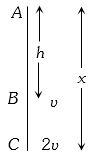
$A$ body freely falling from rest has a velocity $v$ after it falls through a height $h$. The total distance it has to fall down from the starting point for its velocity to become double is: (in $h$)
A
$2$
B
$4$
C
$6$
D
$8$
Solution
(B) Let the body start from rest at point $A$ with initial velocity $u = 0$.
For the motion from $A$ to $B$ (falling through height $h$):
Using the equation of motion $v^2 = u^2 + 2as$,where $u = 0$,$a = g$,and $s = h$:
$v^2 = 0 + 2gh$ ---$(i)$
For the motion from $A$ to $C$ (falling through total height $x$ to reach velocity $2v$):
Using the same equation $v_f^2 = u^2 + 2as$,where $v_f = 2v$,$u = 0$,$a = g$,and $s = x$:
$(2v)^2 = 0 + 2gx$
$4v^2 = 2gx$ ---(ii)
Dividing equation (ii) by equation $(i)$:
$\frac{4v^2}{v^2} = \frac{2gx}{2gh}$
$4 = \frac{x}{h}$
$x = 4h$
Therefore,the total distance from the starting point is $4h$.
For the motion from $A$ to $B$ (falling through height $h$):
Using the equation of motion $v^2 = u^2 + 2as$,where $u = 0$,$a = g$,and $s = h$:
$v^2 = 0 + 2gh$ ---$(i)$
For the motion from $A$ to $C$ (falling through total height $x$ to reach velocity $2v$):
Using the same equation $v_f^2 = u^2 + 2as$,where $v_f = 2v$,$u = 0$,$a = g$,and $s = x$:
$(2v)^2 = 0 + 2gx$
$4v^2 = 2gx$ ---(ii)
Dividing equation (ii) by equation $(i)$:
$\frac{4v^2}{v^2} = \frac{2gx}{2gh}$
$4 = \frac{x}{h}$
$x = 4h$
Therefore,the total distance from the starting point is $4h$.
0 likes
View Solution34
EasyMCQ
The velocity of a body upon reaching the point from which it was projected upwards is:
A
$v = 0$
B
$v = 2u$
C
$v = 0.5u$
D
$v = u$
Solution
(D) When a body is projected upwards with an initial velocity $u$,it undergoes constant deceleration due to gravity $(g)$.
At the maximum height,its velocity becomes $0$.
As it falls back down to the point of projection,it undergoes constant acceleration due to gravity $(g)$ over the same displacement.
Using the kinematic equation $v^2 = u^2 + 2as$,where $a = -g$ for the upward journey and $a = g$ for the downward journey,the final velocity $v$ at the starting point will have the same magnitude as the initial velocity $u$,but in the opposite direction.
Therefore,the speed of the body upon returning to the point of projection is $v = u$.
At the maximum height,its velocity becomes $0$.
As it falls back down to the point of projection,it undergoes constant acceleration due to gravity $(g)$ over the same displacement.
Using the kinematic equation $v^2 = u^2 + 2as$,where $a = -g$ for the upward journey and $a = g$ for the downward journey,the final velocity $v$ at the starting point will have the same magnitude as the initial velocity $u$,but in the opposite direction.
Therefore,the speed of the body upon returning to the point of projection is $v = u$.
1 likes
View Solution35
EasyMCQ
$A$ body projected vertically upwards with a velocity $u$ returns to the starting point in $4 \, s$. If $g = 10 \, m/s^2$,the value of $u$ is $......... \, m/s$.
A
$5$
B
$10$
C
$15$
D
$20$
Solution
(D) The time of flight $T$ for a body projected vertically upwards is given by the formula $T = \frac{2u}{g}$.
Given that the total time taken to return to the starting point is $T = 4 \, s$ and the acceleration due to gravity is $g = 10 \, m/s^2$.
Substituting these values into the formula:
$4 = \frac{2u}{10}$
$40 = 2u$
$u = 20 \, m/s$.
Therefore,the initial velocity $u$ is $20 \, m/s$.
Given that the total time taken to return to the starting point is $T = 4 \, s$ and the acceleration due to gravity is $g = 10 \, m/s^2$.
Substituting these values into the formula:
$4 = \frac{2u}{10}$
$40 = 2u$
$u = 20 \, m/s$.
Therefore,the initial velocity $u$ is $20 \, m/s$.
0 likes
View Solution36
EasyMCQ
Time taken by an object falling from rest to cover the height of $h_1$ and $h_2$ is respectively $t_1$ and $t_2$,then the ratio of $t_1$ to $t_2$ is:
A
$h_1 : h_2$
B
$\sqrt{h_1} : \sqrt{h_2}$
C
$h_1 : 2h_2$
D
$2h_1 : h_2$
Solution
(B) For an object falling from rest,the distance $h$ covered in time $t$ is given by the equation of motion: $h = \frac{1}{2}gt^2$.
From this,we can express time $t$ as: $t = \sqrt{\frac{2h}{g}}$.
For heights $h_1$ and $h_2$ with corresponding times $t_1$ and $t_2$,we have:
$t_1 = \sqrt{\frac{2h_1}{g}}$ and $t_2 = \sqrt{\frac{2h_2}{g}}$.
Taking the ratio of $t_1$ to $t_2$:
$\frac{t_1}{t_2} = \frac{\sqrt{\frac{2h_1}{g}}}{\sqrt{\frac{2h_2}{g}}} = \sqrt{\frac{h_1}{h_2}} = \frac{\sqrt{h_1}}{\sqrt{h_2}}$.
Thus,the ratio is $\sqrt{h_1} : \sqrt{h_2}$.
From this,we can express time $t$ as: $t = \sqrt{\frac{2h}{g}}$.
For heights $h_1$ and $h_2$ with corresponding times $t_1$ and $t_2$,we have:
$t_1 = \sqrt{\frac{2h_1}{g}}$ and $t_2 = \sqrt{\frac{2h_2}{g}}$.
Taking the ratio of $t_1$ to $t_2$:
$\frac{t_1}{t_2} = \frac{\sqrt{\frac{2h_1}{g}}}{\sqrt{\frac{2h_2}{g}}} = \sqrt{\frac{h_1}{h_2}} = \frac{\sqrt{h_1}}{\sqrt{h_2}}$.
Thus,the ratio is $\sqrt{h_1} : \sqrt{h_2}$.
0 likes
View Solution37
EasyMCQ
$A$ body is thrown vertically up from the ground. It reaches a maximum height of $100\,m$ in $5\,sec$. After what time will it reach the ground from the maximum height position?
A
$1.2$
B
$5$
C
$10$
D
$25$
Solution
(B) For a body thrown vertically upwards,the time taken to reach the maximum height (time of ascent) is equal to the time taken to fall back to the ground from that maximum height (time of descent),provided the air resistance is negligible.
Given that the time of ascent is $5\,sec$,the time of descent will also be $5\,sec$.
Therefore,the body will reach the ground from the maximum height position in $5\,sec$.
Given that the time of ascent is $5\,sec$,the time of descent will also be $5\,sec$.
Therefore,the body will reach the ground from the maximum height position in $5\,sec$.
0 likes
View Solution38
DifficultMCQ
$A$ body thrown vertically upwards with an initial velocity $u$ reaches maximum height in $6$ seconds. The ratio of the distances travelled by the body in the first second and the seventh second is
A
$1:1$
B
$11:1$
C
$1:2$
D
$1:11$
Solution
(B) Given,time of ascent $t = 6 \; s$. Since $t = u/g$,we have $u = 6 \times 10 = 60 \; m/s$ (taking $g = 10 \; m/s^2$).
Distance travelled in the $n^{th}$ second is given by $S_n = u + \frac{a}{2}(2n - 1)$.
For the first second $(n = 1)$: $S_1 = 60 + \frac{-10}{2}(2(1) - 1) = 60 - 5 = 55 \; m$.
For the seventh second $(n = 7)$: $S_7 = 60 + \frac{-10}{2}(2(7) - 1) = 60 - 5(13) = 60 - 65 = -5 \; m$.
The magnitude of distance is $5 \; m$.
The ratio of the distances is $55:5 = 11:1$.
Distance travelled in the $n^{th}$ second is given by $S_n = u + \frac{a}{2}(2n - 1)$.
For the first second $(n = 1)$: $S_1 = 60 + \frac{-10}{2}(2(1) - 1) = 60 - 5 = 55 \; m$.
For the seventh second $(n = 7)$: $S_7 = 60 + \frac{-10}{2}(2(7) - 1) = 60 - 5(13) = 60 - 65 = -5 \; m$.
The magnitude of distance is $5 \; m$.
The ratio of the distances is $55:5 = 11:1$.
0 likes
View Solution39
MediumMCQ
$A$ ball is thrown vertically upward. It has a speed of $10 \; m/s$ when it has reached one-half of its maximum height. How high does the ball rise? (Take $g = 10 \; m/s^2$)
A
$5$
B
$10$
C
$15$
D
$20$
Solution
(B) Let the initial velocity be $u$ and the maximum height be $H$. The maximum height is given by $H = \frac{u^2}{2g}$.
At height $h = \frac{H}{2}$,the velocity $v = 10 \; m/s$.
Using the equation of motion $v^2 = u^2 - 2gh$:
$(10)^2 = u^2 - 2g \left( \frac{H}{2} \right)$
$100 = u^2 - gH$
Substitute $H = \frac{u^2}{2g}$ into the equation:
$100 = u^2 - g \left( \frac{u^2}{2g} \right)$
$100 = u^2 - \frac{u^2}{2} = \frac{u^2}{2}$
$u^2 = 200 \; m^2/s^2$.
Now,calculate the maximum height $H$:
$H = \frac{u^2}{2g} = \frac{200}{2 \times 10} = \frac{200}{20} = 10 \; m$.
At height $h = \frac{H}{2}$,the velocity $v = 10 \; m/s$.
Using the equation of motion $v^2 = u^2 - 2gh$:
$(10)^2 = u^2 - 2g \left( \frac{H}{2} \right)$
$100 = u^2 - gH$
Substitute $H = \frac{u^2}{2g}$ into the equation:
$100 = u^2 - g \left( \frac{u^2}{2g} \right)$
$100 = u^2 - \frac{u^2}{2} = \frac{u^2}{2}$
$u^2 = 200 \; m^2/s^2$.
Now,calculate the maximum height $H$:
$H = \frac{u^2}{2g} = \frac{200}{2 \times 10} = \frac{200}{20} = 10 \; m$.
1 likes
View Solution40
EasyMCQ
$A$ body,thrown upwards with some velocity,reaches a maximum height of $20\,m$. Another body with double the mass thrown up with double the initial velocity will reach a maximum height of..........$m$.
A
$200$
B
$16$
C
$80$
D
$40$
Solution
(C) The maximum height $H$ attained by a body thrown vertically upwards with initial velocity $u$ is given by the formula $H = \frac{u^2}{2g}$.
From this formula,it is clear that the maximum height $H$ is independent of the mass of the body.
Given that the initial height $H_1 = 20\,m$ for initial velocity $u_1 = u$.
For the second body,the initial velocity $u_2 = 2u$.
The new maximum height $H_2$ is given by $H_2 = \frac{(2u)^2}{2g} = 4 \times \frac{u^2}{2g} = 4H_1$.
Substituting the value of $H_1$,we get $H_2 = 4 \times 20\,m = 80\,m$.
From this formula,it is clear that the maximum height $H$ is independent of the mass of the body.
Given that the initial height $H_1 = 20\,m$ for initial velocity $u_1 = u$.
For the second body,the initial velocity $u_2 = 2u$.
The new maximum height $H_2$ is given by $H_2 = \frac{(2u)^2}{2g} = 4 \times \frac{u^2}{2g} = 4H_1$.
Substituting the value of $H_1$,we get $H_2 = 4 \times 20\,m = 80\,m$.
0 likes
View Solution41
DifficultMCQ
$A$ balloon starts rising from the ground with an acceleration of $1.25\, m/s^2$. After $8\,s$,a stone is released from the balloon. The stone will $(g = 10\, m/s^2)$:
A
Reach the ground in $4\, s$
B
Begin to move down after being released
C
Have a displacement of $50\, m$
D
Cover a distance of $40\, m$ in reaching the ground
Solution
(A) $1$. Velocity of the balloon at $t = 8\, s$: $v = a \times t = 1.25 \times 8 = 10\, m/s$ (upward).
$2$. Height of the balloon at $t = 8\, s$: $s = \frac{1}{2} \times a \times t^2 = \frac{1}{2} \times 1.25 \times 8^2 = 40\, m$.
$3$. When the stone is released,its initial velocity is $u = 10\, m/s$ (upward) and its initial position is $h = 40\, m$ above the ground.
$4$. Using the equation of motion for displacement: $s = ut + \frac{1}{2}at^2$. Here,$s = -40\, m$ (downward),$u = 10\, m/s$,$a = -g = -10\, m/s^2$.
$-40 = 10t - 5t^2 \implies 5t^2 - 10t - 40 = 0 \implies t^2 - 2t - 8 = 0$.
Solving the quadratic equation: $(t - 4)(t + 2) = 0$. Since $t > 0$,$t = 4\, s$.
$5$. The displacement of the stone from the release point to the ground is $40\, m$ (downward).
$6$. The stone moves upward until its velocity becomes zero: $v^2 - u^2 = 2as \implies 0 - 10^2 = 2(-10)d \implies d = 5\, m$.
$7$. Total distance covered = $40\, m$ (upward) + $5\, m$ (upward) + $5\, m$ (downward) = $50\, m$.
$2$. Height of the balloon at $t = 8\, s$: $s = \frac{1}{2} \times a \times t^2 = \frac{1}{2} \times 1.25 \times 8^2 = 40\, m$.
$3$. When the stone is released,its initial velocity is $u = 10\, m/s$ (upward) and its initial position is $h = 40\, m$ above the ground.
$4$. Using the equation of motion for displacement: $s = ut + \frac{1}{2}at^2$. Here,$s = -40\, m$ (downward),$u = 10\, m/s$,$a = -g = -10\, m/s^2$.
$-40 = 10t - 5t^2 \implies 5t^2 - 10t - 40 = 0 \implies t^2 - 2t - 8 = 0$.
Solving the quadratic equation: $(t - 4)(t + 2) = 0$. Since $t > 0$,$t = 4\, s$.
$5$. The displacement of the stone from the release point to the ground is $40\, m$ (downward).
$6$. The stone moves upward until its velocity becomes zero: $v^2 - u^2 = 2as \implies 0 - 10^2 = 2(-10)d \implies d = 5\, m$.
$7$. Total distance covered = $40\, m$ (upward) + $5\, m$ (upward) + $5\, m$ (downward) = $50\, m$.
0 likes
View Solution42
EasyMCQ
$A$ body is thrown vertically upwards with a velocity $u$. Find the true statement from the following:
A
Both velocity and acceleration are zero at its highest point.
B
Velocity is maximum and acceleration is zero at the highest point.
C
Velocity is maximum and acceleration is $g$ downwards at its highest point.
D
Velocity is zero at the highest point and maximum height reached is $u^2 / 2g$.
Solution
(D) At the highest point of vertical motion,the body momentarily comes to rest,so the velocity $v = 0$.
However,the acceleration due to gravity $g$ continues to act downwards throughout the motion.
Using the kinematic equation $v^2 = u^2 - 2gH$,at the highest point $v = 0$,so $0 = u^2 - 2gH_{\max}$.
Solving for $H_{\max}$,we get $H_{\max} = u^2 / 2g$.
Therefore,option $D$ is the correct statement.
However,the acceleration due to gravity $g$ continues to act downwards throughout the motion.
Using the kinematic equation $v^2 = u^2 - 2gH$,at the highest point $v = 0$,so $0 = u^2 - 2gH_{\max}$.
Solving for $H_{\max}$,we get $H_{\max} = u^2 / 2g$.
Therefore,option $D$ is the correct statement.
0 likes
View Solution43
MediumMCQ
$A$ man throws a ball vertically upward and it rises through $20 \; m$ and returns to his hands. What was the initial velocity $(u)$ of the ball and for how much time $(T)$ it remained in the air? $[g = 10 \; m/s^2]$
A
$u = 10 \; m/s, T = 2 \; s$
B
$u = 10 \; m/s, T = 4 \; s$
C
$u = 20 \; m/s, T = 2 \; s$
D
$u = 20 \; m/s, T = 4 \; s$
Solution
(D) Given: Maximum height $h = 20 \; m$,acceleration due to gravity $g = 10 \; m/s^2$.
At the highest point,the final velocity $v = 0$.
Using the equation of motion $v^2 = u^2 - 2gh$:
$0^2 = u^2 - 2 \times 10 \times 20$
$u^2 = 400$
$u = 20 \; m/s$.
Now,the total time of flight $T$ is given by $T = \frac{2u}{g}$:
$T = \frac{2 \times 20}{10} = 4 \; s$.
Therefore,the initial velocity is $20 \; m/s$ and the time in the air is $4 \; s$.
At the highest point,the final velocity $v = 0$.
Using the equation of motion $v^2 = u^2 - 2gh$:
$0^2 = u^2 - 2 \times 10 \times 20$
$u^2 = 400$
$u = 20 \; m/s$.
Now,the total time of flight $T$ is given by $T = \frac{2u}{g}$:
$T = \frac{2 \times 20}{10} = 4 \; s$.
Therefore,the initial velocity is $20 \; m/s$ and the time in the air is $4 \; s$.
0 likes
View Solution44
DifficultMCQ
$A$ particle is thrown vertically upwards. It passes the same height at $t_1 = 2 \; s$ and $t_2 = 10 \; s$. The height is:
A
$g$
B
$2g$
C
$5g$
D
$10g$
Solution
(D) For a particle moving under gravity,if it passes the same height $h$ at two different times $t_1$ and $t_2$,the height $h$ is given by the formula:
$h = \frac{1}{2} g t_1 t_2$
Given $t_1 = 2 \; s$ and $t_2 = 10 \; s$:
$h = \frac{1}{2} \times g \times 2 \times 10$
$h = 10g$
Thus,the correct option is $D$.
$h = \frac{1}{2} g t_1 t_2$
Given $t_1 = 2 \; s$ and $t_2 = 10 \; s$:
$h = \frac{1}{2} \times g \times 2 \times 10$
$h = 10g$
Thus,the correct option is $D$.
0 likes
View Solution45
MediumMCQ
From the top of a tower,a particle is thrown vertically downwards with a velocity of $10\; m/s$. The ratio of the distances covered by it in the $3^{rd}$ and $2^{nd}$ seconds of the motion is (Take $g = 10\; m/s^2$).
A
$5:7$
B
$7:5$
C
$3:6$
D
$6:3$
Solution
(B) The distance covered in the $n^{th}$ second is given by the formula: $S_n = u + \frac{g}{2}(2n - 1)$.
Given: Initial velocity $u = 10\; m/s$,acceleration $g = 10\; m/s^2$.
For the $3^{rd}$ second $(n=3)$:
$S_3 = 10 + \frac{10}{2}(2 \times 3 - 1) = 10 + 5(5) = 10 + 25 = 35\; m$.
For the $2^{nd}$ second $(n=2)$:
$S_2 = 10 + \frac{10}{2}(2 \times 2 - 1) = 10 + 5(3) = 10 + 15 = 25\; m$.
The ratio of the distances is $\frac{S_3}{S_2} = \frac{35}{25} = \frac{7}{5}$.
Given: Initial velocity $u = 10\; m/s$,acceleration $g = 10\; m/s^2$.
For the $3^{rd}$ second $(n=3)$:
$S_3 = 10 + \frac{10}{2}(2 \times 3 - 1) = 10 + 5(5) = 10 + 25 = 35\; m$.
For the $2^{nd}$ second $(n=2)$:
$S_2 = 10 + \frac{10}{2}(2 \times 2 - 1) = 10 + 5(3) = 10 + 15 = 25\; m$.
The ratio of the distances is $\frac{S_3}{S_2} = \frac{35}{25} = \frac{7}{5}$.
0 likes
View Solution46
MediumMCQ
From a building,two balls $A$ and $B$ are thrown such that $A$ is thrown upwards and $B$ is thrown downwards with the same speed $u$ (both vertically). If $v_{A}$ and $v_{B}$ are their respective velocities on reaching the ground,then:
A
$v_{B} > v_{A}$
B
$v_{A} > v_{B}$
C
$v_{A} = v_{B}$
D
Their velocities depend on their masses.
Solution
(C) Using the third equation of motion: $v^2 = u^2 + 2gh$,where $u$ is the initial speed,$g$ is the acceleration due to gravity,and $h$ is the height of the building.
For ball $A$ thrown upwards: The initial velocity is $u$ upwards. It will rise to a certain height and then fall back to the ground level. When it passes the point of projection on its way down,its speed will be $u$ downwards. Thus,it reaches the ground with a speed $v_A = \sqrt{u^2 + 2gh}$.
For ball $B$ thrown downwards: The initial velocity is $u$ downwards. It reaches the ground with a speed $v_B = \sqrt{u^2 + 2gh}$.
Since both $u$,$g$,and $h$ are the same for both balls,we have $v_A = v_B$.
For ball $A$ thrown upwards: The initial velocity is $u$ upwards. It will rise to a certain height and then fall back to the ground level. When it passes the point of projection on its way down,its speed will be $u$ downwards. Thus,it reaches the ground with a speed $v_A = \sqrt{u^2 + 2gh}$.
For ball $B$ thrown downwards: The initial velocity is $u$ downwards. It reaches the ground with a speed $v_B = \sqrt{u^2 + 2gh}$.
Since both $u$,$g$,and $h$ are the same for both balls,we have $v_A = v_B$.
0 likes
View Solution47
DifficultMCQ
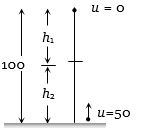
$A$ ball is dropped from the top of a tower of $100 \, m$ height. Simultaneously,another ball is thrown upward from the bottom of the tower with a speed of $50 \, m/s$ $(g = 10 \, m/s^2)$. They will cross each other after . . . . . . $s$.
A
$1$
B
$2$
C
$3$
D
$4$
Solution
(B) Let the first ball dropped from the top travel a distance $h_1$ in time $t$. Using the equation of motion $s = ut + \frac{1}{2}at^2$,where $u = 0$ and $a = g$,we get:
$h_1 = \frac{1}{2}gt^2$
Let the second ball thrown from the bottom travel a distance $h_2$ in the same time $t$. Using $s = ut - \frac{1}{2}gt^2$,where $u = 50 \, m/s$,we get:
$h_2 = 50t - \frac{1}{2}gt^2$
Since the total height of the tower is $100 \, m$,the sum of the distances covered by both balls when they meet is equal to the height of the tower:
$h_1 + h_2 = 100$
Substituting the expressions for $h_1$ and $h_2$:
$\frac{1}{2}gt^2 + (50t - \frac{1}{2}gt^2) = 100$
$50t = 100$
$t = 2 \, s$
Thus,the balls will cross each other after $2 \, s$.
$h_1 = \frac{1}{2}gt^2$
Let the second ball thrown from the bottom travel a distance $h_2$ in the same time $t$. Using $s = ut - \frac{1}{2}gt^2$,where $u = 50 \, m/s$,we get:
$h_2 = 50t - \frac{1}{2}gt^2$
Since the total height of the tower is $100 \, m$,the sum of the distances covered by both balls when they meet is equal to the height of the tower:
$h_1 + h_2 = 100$
Substituting the expressions for $h_1$ and $h_2$:
$\frac{1}{2}gt^2 + (50t - \frac{1}{2}gt^2) = 100$
$50t = 100$
$t = 2 \, s$
Thus,the balls will cross each other after $2 \, s$.
1 likes
View Solution48
EasyMCQ
$A$ cricket ball is thrown up with a speed of $19.6 \ m/s$. The maximum height it can reach is ......... $m$.
A
$9.8$
B
$19.6$
C
$29.4$
D
$39.2$
Solution
(B) Given: Initial velocity $u = 19.6 \ m/s$,acceleration due to gravity $g = 9.8 \ m/s^2$,and final velocity at maximum height $v = 0 \ m/s$.
Using the third equation of motion: $v^2 = u^2 - 2gH$.
Substituting the values: $0^2 = (19.6)^2 - 2 \times 9.8 \times H$.
$0 = 384.16 - 19.6 \times H$.
$19.6 \times H = 384.16$.
$H = \frac{384.16}{19.6} = 19.6 \ m$.
Therefore,the maximum height reached is $19.6 \ m$.
Using the third equation of motion: $v^2 = u^2 - 2gH$.
Substituting the values: $0^2 = (19.6)^2 - 2 \times 9.8 \times H$.
$0 = 384.16 - 19.6 \times H$.
$19.6 \times H = 384.16$.
$H = \frac{384.16}{19.6} = 19.6 \ m$.
Therefore,the maximum height reached is $19.6 \ m$.
0 likes
View Solution49
DifficultMCQ
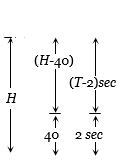
$A$ body falling from a high minaret travels $40 \ m$ in the last $2 \ s$ of its fall to the ground. The height of the minaret in meters is (take $g = 10 \ m/s^2$):
A
$60$
B
$45$
C
$80$
D
$50$
Solution
(B) Let the height of the minaret be $H$ and the total time taken by the body to fall from the top to the ground be $T$.
Using the equation of motion $s = ut + \frac{1}{2}at^2$,where $u = 0$ and $a = g = 10 \ m/s^2$:
$H = \frac{1}{2}gT^2 = 5T^2$ ... $(i)$
In the last $2 \ s$,the body travels $40 \ m$. This means that in $(T - 2) \ s$,the body travels a distance of $(H - 40) \ m$.
$(H - 40) = \frac{1}{2}g(T - 2)^2 = 5(T - 2)^2$ ... (ii)
Substitute $H = 5T^2$ from $(i)$ into (ii):
$5T^2 - 40 = 5(T^2 - 4T + 4)$
$5T^2 - 40 = 5T^2 - 20T + 20$
$20T = 60$
$T = 3 \ s$
Now,substitute $T = 3 \ s$ into equation $(i)$:
$H = 5(3)^2 = 5 \times 9 = 45 \ m$.
Thus,the height of the minaret is $45 \ m$.
Using the equation of motion $s = ut + \frac{1}{2}at^2$,where $u = 0$ and $a = g = 10 \ m/s^2$:
$H = \frac{1}{2}gT^2 = 5T^2$ ... $(i)$
In the last $2 \ s$,the body travels $40 \ m$. This means that in $(T - 2) \ s$,the body travels a distance of $(H - 40) \ m$.
$(H - 40) = \frac{1}{2}g(T - 2)^2 = 5(T - 2)^2$ ... (ii)
Substitute $H = 5T^2$ from $(i)$ into (ii):
$5T^2 - 40 = 5(T^2 - 4T + 4)$
$5T^2 - 40 = 5T^2 - 20T + 20$
$20T = 60$
$T = 3 \ s$
Now,substitute $T = 3 \ s$ into equation $(i)$:
$H = 5(3)^2 = 5 \times 9 = 45 \ m$.
Thus,the height of the minaret is $45 \ m$.
0 likes
View SolutionMotion in Straight Line — Motion Under Gravity · Frequently Asked Questions
1Are these Motion in Straight Line questions useful for JEE and NEET?
Yes. All questions in this section are mapped to JEE Main and NEET exam patterns. Previous year questions from JEE Main, NEET, GUJCET and state-level exams are included with full solutions.
2Can I switch to Hindi or Gujarati for these questions?
Yes. Use the language tabs in the hero section or the sidebar to view the same questions and solutions in English, Hindi or Gujarati.
3How do I generate a question paper from this subtopic?
Use the Vedclass Exam Paper Generator — select the chapter and subtopic, set difficulty, and generate Sets A, B, C, D automatically. First 3 chapters of every subject are free.
Vedclass Products
For Students
Vedclass Test Series
Mock tests in real JEE/NEET style with performance analysis. 5-day free trial.
Start Free TrialFor Teachers
Exam Paper Generator
Generate Set A/B/C/D papers from this chapter in 2 minutes. 3 chapters free.
Try FreeFor Institutes
Online Exam Module
Live online exams with unlimited students, 360° analytics & white-label branding.
See DemoFor Teachers & Institutes
Generate a Motion in Straight Line Exam Paper in 2 Minutes
Select subtopic & difficulty — Sets A, B, C, D auto-generated with No Repeat logic.
First 3 chapters of every subject are free — no payment required.