
A English
Motion Under Gravity Questions in English
Class 11 Physics · Motion in Straight Line · Motion Under Gravity
334+
Questions
English
Language
100%
With Solutions
Showing 49 of 334 questions in English
51
MediumMCQ
$A$ body falls from a height $h = 200\,m$ (at New Delhi). The ratio of distance travelled in each $2\,s$ interval during $t = 0$ to $t = 6\,s$ of the journey is
A
$1:4:9$
B
$1:2:4$
C
$1:3:5$
D
$1:2:3$
Solution
(C) For a body falling from rest under gravity,the distance $S$ travelled in time $t$ is given by $S = \frac{1}{2}gt^2$.
The distance travelled in successive equal time intervals $\Delta t$ starting from $t=0$ follows the ratio of odd numbers.
Let the time interval be $\Delta t = 2\,s$.
Distance in the first $2\,s$ ($t=0$ to $t=2$): $S_1 = \frac{1}{2}g(2)^2 = 2g$.
Distance in the second $2\,s$ ($t=2$ to $t=4$): $S_2 = \frac{1}{2}g(4)^2 - \frac{1}{2}g(2)^2 = 8g - 2g = 6g$.
Distance in the third $2\,s$ ($t=4$ to $t=6$): $S_3 = \frac{1}{2}g(6)^2 - \frac{1}{2}g(4)^2 = 18g - 8g = 10g$.
The ratio is $S_1 : S_2 : S_3 = 2g : 6g : 10g = 1 : 3 : 5$.
The distance travelled in successive equal time intervals $\Delta t$ starting from $t=0$ follows the ratio of odd numbers.
Let the time interval be $\Delta t = 2\,s$.
Distance in the first $2\,s$ ($t=0$ to $t=2$): $S_1 = \frac{1}{2}g(2)^2 = 2g$.
Distance in the second $2\,s$ ($t=2$ to $t=4$): $S_2 = \frac{1}{2}g(4)^2 - \frac{1}{2}g(2)^2 = 8g - 2g = 6g$.
Distance in the third $2\,s$ ($t=4$ to $t=6$): $S_3 = \frac{1}{2}g(6)^2 - \frac{1}{2}g(4)^2 = 18g - 8g = 10g$.
The ratio is $S_1 : S_2 : S_3 = 2g : 6g : 10g = 1 : 3 : 5$.
0 likes
View Solution52
DifficultMCQ
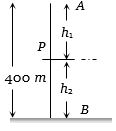
$A$ man drops a ball from the roof of a tower of height $400 \ m$. At the same time,another ball is thrown upwards with a velocity of $50 \ m/s$ from the base of the tower. At what height from the base of the tower will they meet (in $m$)?
A
$100$
B
$320$
C
$80$
D
$240$
Solution
(C) Let the two balls meet at point $P$ after time $t$.
For ball $A$ dropped from the top,the distance covered downwards is $h_1 = \frac{1}{2}gt^2$.
For ball $B$ thrown upwards from the base,the distance covered upwards is $h_2 = ut - \frac{1}{2}gt^2$,where $u = 50 \ m/s$.
The total height of the tower is $h_1 + h_2 = 400 \ m$.
Substituting the expressions: $\frac{1}{2}gt^2 + (ut - \frac{1}{2}gt^2) = 400$.
This simplifies to $ut = 400$.
Given $u = 50 \ m/s$,we have $50t = 400$,which gives $t = 8 \ s$.
The height from the base is the distance covered by ball $B$,which is $h_2 = ut - \frac{1}{2}gt^2$.
Assuming $g = 10 \ m/s^2$,$h_2 = 50(8) - \frac{1}{2}(10)(8^2) = 400 - 5(64) = 400 - 320 = 80 \ m$.
For ball $A$ dropped from the top,the distance covered downwards is $h_1 = \frac{1}{2}gt^2$.
For ball $B$ thrown upwards from the base,the distance covered upwards is $h_2 = ut - \frac{1}{2}gt^2$,where $u = 50 \ m/s$.
The total height of the tower is $h_1 + h_2 = 400 \ m$.
Substituting the expressions: $\frac{1}{2}gt^2 + (ut - \frac{1}{2}gt^2) = 400$.
This simplifies to $ut = 400$.
Given $u = 50 \ m/s$,we have $50t = 400$,which gives $t = 8 \ s$.
The height from the base is the distance covered by ball $B$,which is $h_2 = ut - \frac{1}{2}gt^2$.
Assuming $g = 10 \ m/s^2$,$h_2 = 50(8) - \frac{1}{2}(10)(8^2) = 400 - 5(64) = 400 - 320 = 80 \ m$.
0 likes
View Solution53
MediumMCQ
Two balls are dropped from heights $h$ and $2h$ respectively from the Earth's surface. The ratio of the time taken by these balls to reach the Earth is
A
$1:\sqrt{2}$
B
$\sqrt{2}:1$
C
$2:1$
D
$1:4$
Solution
(A) For a body dropped from a height $h$,the time taken to reach the ground is given by the equation of motion $h = ut + \frac{1}{2}gt^2$. Since the initial velocity $u = 0$,we have $h = \frac{1}{2}gt^2$,which gives $t = \sqrt{\frac{2h}{g}}$.
For the first ball dropped from height $h_1 = h$,the time taken is $t_1 = \sqrt{\frac{2h}{g}}$.
For the second ball dropped from height $h_2 = 2h$,the time taken is $t_2 = \sqrt{\frac{2(2h)}{g}} = \sqrt{\frac{4h}{g}}$.
The ratio of the times is $\frac{t_1}{t_2} = \frac{\sqrt{2h/g}}{\sqrt{4h/g}} = \sqrt{\frac{2h}{4h}} = \sqrt{\frac{1}{2}} = \frac{1}{\sqrt{2}}$.
Thus,the ratio is $1:\sqrt{2}$.
For the first ball dropped from height $h_1 = h$,the time taken is $t_1 = \sqrt{\frac{2h}{g}}$.
For the second ball dropped from height $h_2 = 2h$,the time taken is $t_2 = \sqrt{\frac{2(2h)}{g}} = \sqrt{\frac{4h}{g}}$.
The ratio of the times is $\frac{t_1}{t_2} = \frac{\sqrt{2h/g}}{\sqrt{4h/g}} = \sqrt{\frac{2h}{4h}} = \sqrt{\frac{1}{2}} = \frac{1}{\sqrt{2}}$.
Thus,the ratio is $1:\sqrt{2}$.
0 likes
View Solution54
EasyMCQ
$A$ body falls from rest in the gravitational field of the earth. The distance travelled in the fifth second of its motion is ......... $m$ $(g = 10\,m/s^2)$.
A
$25$
B
$45$
C
$90$
D
$125$
Solution
(B) The distance travelled by an object in the $n^{th}$ second is given by the formula: $h_n = u + \frac{g}{2}(2n - 1)$.
Since the body falls from rest,the initial velocity $u = 0$.
Given $g = 10\,m/s^2$ and $n = 5$ seconds.
Substituting these values into the formula:
$h_5 = 0 + \frac{10}{2}(2 \times 5 - 1)$
$h_5 = 5(10 - 1)$
$h_5 = 5 \times 9 = 45\,m$.
Therefore,the distance travelled in the fifth second is $45\,m$.
Since the body falls from rest,the initial velocity $u = 0$.
Given $g = 10\,m/s^2$ and $n = 5$ seconds.
Substituting these values into the formula:
$h_5 = 0 + \frac{10}{2}(2 \times 5 - 1)$
$h_5 = 5(10 - 1)$
$h_5 = 5 \times 9 = 45\,m$.
Therefore,the distance travelled in the fifth second is $45\,m$.
0 likes
View Solution55
EasyMCQ
If a body is thrown up with the velocity of $15 \, m/s$,then the maximum height attained by the body is .......... $m$ $(g = 10 \, m/s^2)$.
A
$11.25$
B
$16.2$
C
$24.5$
D
$7.62$
Solution
(A) The formula for the maximum height $h_{\max}$ attained by a body thrown vertically upwards with an initial velocity $u$ is given by $h_{\max} = \frac{u^2}{2g}$.
Given,initial velocity $u = 15 \, m/s$ and acceleration due to gravity $g = 10 \, m/s^2$.
Substituting these values into the formula:
$h_{\max} = \frac{(15)^2}{2 \times 10}$
$h_{\max} = \frac{225}{20}$
$h_{\max} = 11.25 \, m$.
Therefore,the maximum height attained is $11.25 \, m$.
Given,initial velocity $u = 15 \, m/s$ and acceleration due to gravity $g = 10 \, m/s^2$.
Substituting these values into the formula:
$h_{\max} = \frac{(15)^2}{2 \times 10}$
$h_{\max} = \frac{225}{20}$
$h_{\max} = 11.25 \, m$.
Therefore,the maximum height attained is $11.25 \, m$.
0 likes
View Solution56
MediumMCQ
$A$ balloon is rising vertically up with a velocity of $29 \,ms^{-1}$. $A$ stone is dropped from it and it reaches the ground in $10 \,s$. The height of the balloon when the stone was dropped from it is...........$m$ $(g = 9.8 \,ms^{-2})$
A
$100$
B
$200$
C
$400$
D
$150$
Solution
(B) When the stone is dropped from the rising balloon,its initial velocity $u$ is equal to the velocity of the balloon,directed upwards. Let the upward direction be positive.
Initial velocity $u = +29 \,ms^{-1}$.
Time taken $t = 10 \,s$.
Acceleration due to gravity $g = -9.8 \,ms^{-2}$.
Let $h$ be the height of the balloon. The displacement of the stone when it reaches the ground is $s = -h$.
Using the equation of motion $s = ut + \frac{1}{2}at^2$:
$-h = (29)(10) + \frac{1}{2}(-9.8)(10)^2$
$-h = 290 - 4.9 \times 100$
$-h = 290 - 490$
$-h = -200$
$h = 200 \,m$.
Initial velocity $u = +29 \,ms^{-1}$.
Time taken $t = 10 \,s$.
Acceleration due to gravity $g = -9.8 \,ms^{-2}$.
Let $h$ be the height of the balloon. The displacement of the stone when it reaches the ground is $s = -h$.
Using the equation of motion $s = ut + \frac{1}{2}at^2$:
$-h = (29)(10) + \frac{1}{2}(-9.8)(10)^2$
$-h = 290 - 4.9 \times 100$
$-h = 290 - 490$
$-h = -200$
$h = 200 \,m$.
0 likes
View Solution57
DifficultMCQ
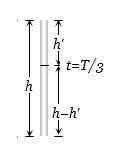
$A$ ball is released from the top of a tower of height $h$ meters. It takes $T$ seconds to reach the ground. What is the position of the ball in $\frac{T}{3}$ seconds?
A
$\frac{h}{9}$ meters from the ground
B
$\frac{7h}{9}$ meters from the ground
C
$\frac{8h}{9}$ meters from the ground
D
$\frac{17h}{18}$ meters from the ground
Solution
(C) For a ball released from rest,the total height $h$ covered in time $T$ is given by the equation of motion:
$h = ut + \frac{1}{2}gT^2$
Since the initial velocity $u = 0$,we have:
$h = \frac{1}{2}gT^2$ --- $(1)$
After time $t = \frac{T}{3}$,the distance $h'$ covered by the ball from the top is:
$h' = \frac{1}{2}g\left(\frac{T}{3}\right)^2 = \frac{1}{2}g\left(\frac{T^2}{9}\right) = \frac{1}{9} \left(\frac{1}{2}gT^2\right)$
Substituting equation $(1)$ into this expression:
$h' = \frac{h}{9}$
The position of the ball from the ground is the total height minus the distance covered from the top:
$\text{Position from ground} = h - h' = h - \frac{h}{9} = \frac{8h}{9} \text{ meters}$.
$h = ut + \frac{1}{2}gT^2$
Since the initial velocity $u = 0$,we have:
$h = \frac{1}{2}gT^2$ --- $(1)$
After time $t = \frac{T}{3}$,the distance $h'$ covered by the ball from the top is:
$h' = \frac{1}{2}g\left(\frac{T}{3}\right)^2 = \frac{1}{2}g\left(\frac{T^2}{9}\right) = \frac{1}{9} \left(\frac{1}{2}gT^2\right)$
Substituting equation $(1)$ into this expression:
$h' = \frac{h}{9}$
The position of the ball from the ground is the total height minus the distance covered from the top:
$\text{Position from ground} = h - h' = h - \frac{h}{9} = \frac{8h}{9} \text{ meters}$.
0 likes
View Solution58
EasyMCQ
Two balls of the same size,but where the density of one is greater than that of the other,are dropped from the same height. Which ball will reach the Earth first (air resistance is negligible)?
A
Heavy ball
B
Light ball
C
Both simultaneously
D
Will depend upon the density of the balls
Solution
(C) According to the equations of motion under gravity,the time taken $t$ to fall from a height $h$ is given by $h = \frac{1}{2}gt^2$,which simplifies to $t = \sqrt{\frac{2h}{g}}$.
Since the acceleration due to gravity $g$ is independent of the mass or density of the object,both balls will experience the same acceleration.
Therefore,both balls will reach the Earth at the same time.
Since the acceleration due to gravity $g$ is independent of the mass or density of the object,both balls will experience the same acceleration.
Therefore,both balls will reach the Earth at the same time.
0 likes
View Solution59
EasyMCQ
$A$ packet is dropped from a balloon which is going upwards with a velocity of $12 \, m/s$. The velocity of the packet after $2 \, s$ will be ........ $m/s$.
A
$-12$
B
$12$
C
$-7.6$
D
$7.6$
Solution
(C) When the packet is released from the balloon,it initially possesses the same velocity as the balloon,which is $u = +12 \, m/s$ (taking upward direction as positive).
After being released,the packet is under the influence of gravity alone,so its acceleration is $a = -g = -9.8 \, m/s^2$.
Using the first equation of motion,$v = u + at$:
$v = 12 + (-9.8) \times 2$
$v = 12 - 19.6$
$v = -7.6 \, m/s$.
The negative sign indicates that the packet is moving downwards.
After being released,the packet is under the influence of gravity alone,so its acceleration is $a = -g = -9.8 \, m/s^2$.
Using the first equation of motion,$v = u + at$:
$v = 12 + (-9.8) \times 2$
$v = 12 - 19.6$
$v = -7.6 \, m/s$.
The negative sign indicates that the packet is moving downwards.
0 likes
View Solution60
DifficultMCQ
If a freely falling body travels in the last second a distance equal to the distance travelled by it in the first three seconds,the time of the travel is ........ $sec$.
A
$6$
B
$5$
C
$4$
D
$3$
Solution
(B) For a freely falling body,the initial velocity $u = 0$ and acceleration $a = g = 9.8 \ m/s^2$.
The distance traveled in the last second of motion for a total time $t$ is given by the formula:
$S_{\text{last}} = u + \frac{g}{2}(2t - 1) = 0 + \frac{9.8}{2}(2t - 1) = 4.9(2t - 1)$.
The distance traveled in the first $3 \ s$ is given by:
$S_{3} = ut + \frac{1}{2}gt^2 = 0 + \frac{1}{2} \times 9.8 \times (3)^2 = 4.9 \times 9 = 44.1 \ m$.
According to the problem,$S_{\text{last}} = S_{3}$:
$4.9(2t - 1) = 44.1$
$2t - 1 = \frac{44.1}{4.9}$
$2t - 1 = 9$
$2t = 10$
$t = 5 \ s$.
The distance traveled in the last second of motion for a total time $t$ is given by the formula:
$S_{\text{last}} = u + \frac{g}{2}(2t - 1) = 0 + \frac{9.8}{2}(2t - 1) = 4.9(2t - 1)$.
The distance traveled in the first $3 \ s$ is given by:
$S_{3} = ut + \frac{1}{2}gt^2 = 0 + \frac{1}{2} \times 9.8 \times (3)^2 = 4.9 \times 9 = 44.1 \ m$.
According to the problem,$S_{\text{last}} = S_{3}$:
$4.9(2t - 1) = 44.1$
$2t - 1 = \frac{44.1}{4.9}$
$2t - 1 = 9$
$2t = 10$
$t = 5 \ s$.
0 likes
View Solution61
EasyMCQ
The effective acceleration of a body,when thrown upwards with acceleration $a$,will be:
A
$\sqrt {a - {g^2}} $
B
$\sqrt {{a^2} + {g^2}} $
C
$(a - g)$
D
$(a + g)$
Solution
(C) When a body is thrown upwards with an acceleration $a$,it is also subjected to the acceleration due to gravity $g$ acting downwards.
Since the acceleration $a$ is directed upwards and the acceleration due to gravity $g$ is directed downwards,the net (effective) acceleration is the difference between the two.
Therefore,the effective acceleration = $a - g$.
Since the acceleration $a$ is directed upwards and the acceleration due to gravity $g$ is directed downwards,the net (effective) acceleration is the difference between the two.
Therefore,the effective acceleration = $a - g$.
0 likes
View Solution62
MediumMCQ
$A$ body is thrown vertically upwards with velocity $u$. The distance travelled by it in the fifth and the sixth seconds are equal. The velocity $u$ is given by.........$m/s$ $(g = 9.8\, m/s^{2})$
A
$24.5$
B
$49$
C
$73.5$
D
$98$
Solution
(B) The distance travelled in the $n^{th}$ second is given by $S_n = u + \frac{g}{2}(2n - 1)$.
Since the body is moving upwards,the acceleration due to gravity is $-g$. Thus,$S_n = u - \frac{g}{2}(2n - 1)$.
For the $5^{th}$ second $(n=5)$: $S_5 = u - \frac{g}{2}(2(5) - 1) = u - 4.5g$.
For the $6^{th}$ second $(n=6)$: $S_6 = u - \frac{g}{2}(2(6) - 1) = u - 5.5g$.
However,the distance travelled is the magnitude of displacement. If the body reaches its highest point between the $5^{th}$ and $6^{th}$ second,the displacement in the $5^{th}$ second is positive and in the $6^{th}$ second is negative.
Given $|S_5| = |S_6|$,we have $u - 4.5g = -(u - 5.5g)$.
$u - 4.5g = -u + 5.5g$.
$2u = 10g$.
$u = 5g = 5 \times 9.8 = 49\, m/s$.
Since the body is moving upwards,the acceleration due to gravity is $-g$. Thus,$S_n = u - \frac{g}{2}(2n - 1)$.
For the $5^{th}$ second $(n=5)$: $S_5 = u - \frac{g}{2}(2(5) - 1) = u - 4.5g$.
For the $6^{th}$ second $(n=6)$: $S_6 = u - \frac{g}{2}(2(6) - 1) = u - 5.5g$.
However,the distance travelled is the magnitude of displacement. If the body reaches its highest point between the $5^{th}$ and $6^{th}$ second,the displacement in the $5^{th}$ second is positive and in the $6^{th}$ second is negative.
Given $|S_5| = |S_6|$,we have $u - 4.5g = -(u - 5.5g)$.
$u - 4.5g = -u + 5.5g$.
$2u = 10g$.
$u = 5g = 5 \times 9.8 = 49\, m/s$.
0 likes
View Solution63
EasyMCQ
$A$ body,thrown upwards with some velocity,reaches a maximum height of $50 \,m$. Another body with double the mass,thrown up with double the initial velocity,will reach a maximum height of............$m$.
A
$100$
B
$200$
C
$300$
D
$400$
Solution
(B) The maximum height $H$ attained by a body projected vertically upwards with an initial velocity $u$ is given by the formula: $H = \frac{u^2}{2g}$.
From this relation,we can see that $H \propto u^2$.
Since the mass of the body does not affect the maximum height reached in the absence of air resistance,the change in mass is irrelevant.
If the initial velocity is doubled $(u' = 2u)$,the new maximum height $H'$ will be: $H' = \frac{(2u)^2}{2g} = 4 \times \frac{u^2}{2g} = 4H$.
Given $H = 50 \,m$,the new height is $H' = 4 \times 50 \,m = 200 \,m$.
From this relation,we can see that $H \propto u^2$.
Since the mass of the body does not affect the maximum height reached in the absence of air resistance,the change in mass is irrelevant.
If the initial velocity is doubled $(u' = 2u)$,the new maximum height $H'$ will be: $H' = \frac{(2u)^2}{2g} = 4 \times \frac{u^2}{2g} = 4H$.
Given $H = 50 \,m$,the new height is $H' = 4 \times 50 \,m = 200 \,m$.
1 likes
View Solution64
DifficultMCQ
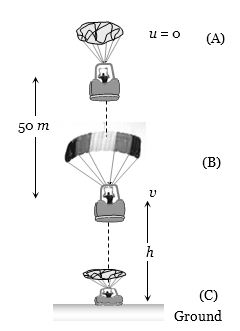
$A$ parachutist after bailing out falls $50\, m$ without friction. When the parachute opens,it decelerates at $2\, m/s^2$. He reaches the ground with a speed of $3\, m/s$. At what height did he bail out (in $, m$)?
A
$293$
B
$111$
C
$91$
D
$182$
Solution
(A) $1$. Free fall phase (from point $A$ to $B$): The parachutist falls freely under gravity for a distance $s_1 = 50\, m$. Initial velocity $u_1 = 0$,acceleration $a_1 = 9.8\, m/s^2$.
The velocity $v$ at point $B$ is given by $v^2 = u_1^2 + 2a_1s_1 = 0 + 2 \times 9.8 \times 50 = 980$.
So,$v = \sqrt{980}\, m/s$.
$2$. Deceleration phase (from point $B$ to $C$): The parachute opens,and the parachutist decelerates at $a_2 = -2\, m/s^2$. The final velocity at the ground is $v_f = 3\, m/s$. Let the distance covered be $h$.
Using $v_f^2 = v^2 + 2a_2h$:
$(3)^2 = 980 + 2(-2)h$
$9 = 980 - 4h$
$4h = 980 - 9 = 971$
$h = 971 / 4 = 242.75\, m$.
$3$. Total height: The total height from which he bailed out is $H = s_1 + h = 50 + 242.75 = 292.75\, m \approx 293\, m$.
The velocity $v$ at point $B$ is given by $v^2 = u_1^2 + 2a_1s_1 = 0 + 2 \times 9.8 \times 50 = 980$.
So,$v = \sqrt{980}\, m/s$.
$2$. Deceleration phase (from point $B$ to $C$): The parachute opens,and the parachutist decelerates at $a_2 = -2\, m/s^2$. The final velocity at the ground is $v_f = 3\, m/s$. Let the distance covered be $h$.
Using $v_f^2 = v^2 + 2a_2h$:
$(3)^2 = 980 + 2(-2)h$
$9 = 980 - 4h$
$4h = 980 - 9 = 971$
$h = 971 / 4 = 242.75\, m$.
$3$. Total height: The total height from which he bailed out is $H = s_1 + h = 50 + 242.75 = 292.75\, m \approx 293\, m$.
2 likes
View Solution65
MediumMCQ
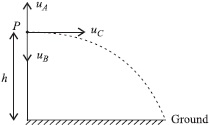
Three particles $A$, $B$, and $C$ are thrown from the top of a tower with the same speed. $A$ is thrown up, $B$ is thrown down, and $C$ is thrown horizontally. They hit the ground with speeds $V_A$, $V_B$, and $V_C$ respectively. Which of the following is correct?
A
$V_A = V_B = V_C$
B
$V_A = V_B > V_C$
C
$V_B > V_C > V_A$
D
$V_A > V_B = V_C$
Solution
(A) According to the law of conservation of energy, the total mechanical energy of a particle remains constant if only gravity acts on it.
Let the height of the tower be $h$ and the initial speed of each particle be $u$.
The initial energy of each particle at the top of the tower is $E_i = \frac{1}{2}mu^2 + mgh$.
The final energy of each particle just before hitting the ground is $E_f = \frac{1}{2}mV^2 + 0$, where $V$ is the final speed.
Since $E_i = E_f$, we have:
$\frac{1}{2}mu^2 + mgh = \frac{1}{2}mV^2$
$u^2 + 2gh = V^2$
$V = \sqrt{u^2 + 2gh}$
Since $u$ and $h$ are the same for all three particles, the final speed $V$ will be the same for all three particles regardless of the direction of projection.
Therefore, $V_A = V_B = V_C$.
Let the height of the tower be $h$ and the initial speed of each particle be $u$.
The initial energy of each particle at the top of the tower is $E_i = \frac{1}{2}mu^2 + mgh$.
The final energy of each particle just before hitting the ground is $E_f = \frac{1}{2}mV^2 + 0$, where $V$ is the final speed.
Since $E_i = E_f$, we have:
$\frac{1}{2}mu^2 + mgh = \frac{1}{2}mV^2$
$u^2 + 2gh = V^2$
$V = \sqrt{u^2 + 2gh}$
Since $u$ and $h$ are the same for all three particles, the final speed $V$ will be the same for all three particles regardless of the direction of projection.
Therefore, $V_A = V_B = V_C$.
0 likes
View Solution66
EasyMCQ
From the top of a tower,two stones,whose masses are in the ratio $1:2$,are thrown: one straight up with an initial speed $u$ and the second straight down with the same speed $u$. Neglecting air resistance,which of the following is true?
A
The heavier stone hits the ground with a higher speed.
B
The lighter stone hits the ground with a higher speed.
C
Both the stones will have the same speed when they hit the ground.
D
The speed cannot be determined with the given data.
Solution
(C) Let the height of the tower be $h$. The acceleration due to gravity is $g$ acting downwards.
For the first stone thrown upwards with speed $u$:
When it returns to the level of the tower top,its speed is $u$ downwards. Using the third equation of motion $v^2 = u^2 + 2as$,where $v$ is the final speed at the ground,$u$ is the initial speed at the tower top,$a = g$,and $s = h$:
$v_1^2 = u^2 + 2gh$
For the second stone thrown downwards with speed $u$:
Using the same equation of motion with initial speed $u$ downwards and $a = g$:
$v_2^2 = u^2 + 2gh$
Since the final speeds $v_1$ and $v_2$ depend only on the initial speed $u$,the height $h$,and the acceleration $g$,both stones will hit the ground with the same speed. The mass does not affect the final speed in the absence of air resistance.
Therefore,option $C$ is correct.
For the first stone thrown upwards with speed $u$:
When it returns to the level of the tower top,its speed is $u$ downwards. Using the third equation of motion $v^2 = u^2 + 2as$,where $v$ is the final speed at the ground,$u$ is the initial speed at the tower top,$a = g$,and $s = h$:
$v_1^2 = u^2 + 2gh$
For the second stone thrown downwards with speed $u$:
Using the same equation of motion with initial speed $u$ downwards and $a = g$:
$v_2^2 = u^2 + 2gh$
Since the final speeds $v_1$ and $v_2$ depend only on the initial speed $u$,the height $h$,and the acceleration $g$,both stones will hit the ground with the same speed. The mass does not affect the final speed in the absence of air resistance.
Therefore,option $C$ is correct.
0 likes
View Solution67
MediumMCQ
When a ball is thrown up vertically with velocity $V_o$,it reaches a maximum height of $h$. If one wishes to triple the maximum height,then the ball should be thrown with what velocity?
A
$\sqrt{3} V_o$
B
$3 V_o$
C
$9 V_o$
D
$\frac{3}{2} V_o$
Solution
(A) The maximum height $h$ reached by a ball thrown vertically with initial velocity $u$ is given by the formula $h = \frac{u^2}{2g}$.
From this relation,we can see that $h \propto u^2$,which implies $u \propto \sqrt{h}$.
Let the initial velocity be $V_o$ for height $h$,and the new velocity be $V'$ for height $3h$.
Then,$\frac{V'}{V_o} = \sqrt{\frac{3h}{h}} = \sqrt{3}$.
Therefore,$V' = \sqrt{3} V_o$.
From this relation,we can see that $h \propto u^2$,which implies $u \propto \sqrt{h}$.
Let the initial velocity be $V_o$ for height $h$,and the new velocity be $V'$ for height $3h$.
Then,$\frac{V'}{V_o} = \sqrt{\frac{3h}{h}} = \sqrt{3}$.
Therefore,$V' = \sqrt{3} V_o$.
0 likes
View Solution68
DifficultMCQ
$A$ stone is dropped from a building of height $h$ and it reaches the ground after $t$ seconds. From the same building,if two stones are thrown (one upwards and one downwards) with the same velocity $u$ and they reach the earth's surface after $t_1$ and $t_2$ seconds respectively,then:
A
$t = t_1 - t_2$
B
$t = \frac{t_1 + t_2}{2}$
C
$t = \sqrt{t_1 t_2}$
D
$t = t_1^2 t_2^2$
Solution
(C) For a stone dropped from height $h$,the equation of motion is: $h = \frac{1}{2} g t^2$ ... $(i)$
For a stone thrown upwards with velocity $u$,the displacement is $-h$ (taking downward as positive): $-h = -u t_1 + \frac{1}{2} g t_1^2$,which simplifies to $h = u t_1 - \frac{1}{2} g t_1^2$ ... (ii)
For a stone thrown downwards with velocity $u$: $h = u t_2 + \frac{1}{2} g t_2^2$ ... (iii)
Equating $(i)$ with (ii) and (iii):
$u t_1 - \frac{1}{2} g t_1^2 = \frac{1}{2} g t^2 \implies u t_1 = \frac{1}{2} g (t^2 + t_1^2)$ ... (iv)
$u t_2 + \frac{1}{2} g t_2^2 = \frac{1}{2} g t^2 \implies u t_2 = \frac{1}{2} g (t^2 - t_2^2)$ ... $(v)$
Dividing (iv) by $(v)$:
$\frac{t_1}{t_2} = \frac{t^2 + t_1^2}{t^2 - t_2^2}$
$t_1 t^2 - t_1 t_2^2 = t_2 t^2 + t_1^2 t_2$
$t^2 (t_1 - t_2) = t_1 t_2 (t_1 - t_2)$
Since $t_1 \neq t_2$,we get $t^2 = t_1 t_2$,so $t = \sqrt{t_1 t_2}$.
For a stone thrown upwards with velocity $u$,the displacement is $-h$ (taking downward as positive): $-h = -u t_1 + \frac{1}{2} g t_1^2$,which simplifies to $h = u t_1 - \frac{1}{2} g t_1^2$ ... (ii)
For a stone thrown downwards with velocity $u$: $h = u t_2 + \frac{1}{2} g t_2^2$ ... (iii)
Equating $(i)$ with (ii) and (iii):
$u t_1 - \frac{1}{2} g t_1^2 = \frac{1}{2} g t^2 \implies u t_1 = \frac{1}{2} g (t^2 + t_1^2)$ ... (iv)
$u t_2 + \frac{1}{2} g t_2^2 = \frac{1}{2} g t^2 \implies u t_2 = \frac{1}{2} g (t^2 - t_2^2)$ ... $(v)$
Dividing (iv) by $(v)$:
$\frac{t_1}{t_2} = \frac{t^2 + t_1^2}{t^2 - t_2^2}$
$t_1 t^2 - t_1 t_2^2 = t_2 t^2 + t_1^2 t_2$
$t^2 (t_1 - t_2) = t_1 t_2 (t_1 - t_2)$
Since $t_1 \neq t_2$,we get $t^2 = t_1 t_2$,so $t = \sqrt{t_1 t_2}$.
0 likes
View Solution69
DifficultMCQ
$A$ ball is projected upwards from a height $h$ above the surface of the earth with velocity $v$. The time at which the ball strikes the ground is
A
$\frac{v}{g} + \frac{\sqrt{2hg}}{2}$
B
$\frac{v}{g}\left[ 1 - \sqrt{1 + \frac{2gh}{v^2}} \right]$
C
$\frac{v}{g}\left[ 1 + \sqrt{1 + \frac{2gh}{v^2}} \right]$
D
$\frac{v}{g}\left[ 1 + \sqrt{v^2 + \frac{2g}{h}} \right]$
Solution
(C) Let the upward direction be positive and the downward direction be negative. The initial position is $y_0 = h$ and the final position is $y = 0$.
Using the equation of motion $y = y_0 + v_0 t + \frac{1}{2} a t^2$:
$0 = h + vt - \frac{1}{2} g t^2$
Rearranging the terms to form a quadratic equation in $t$:
$\frac{1}{2} g t^2 - vt - h = 0$
$g t^2 - 2vt - 2h = 0$
Using the quadratic formula $t = \frac{-b \pm \sqrt{b^2 - 4ac}}{2a}$:
$t = \frac{2v \pm \sqrt{(-2v)^2 - 4(g)(-2h)}}{2g}$
$t = \frac{2v \pm \sqrt{4v^2 + 8gh}}{2g}$
Since time must be positive,we take the positive root:
$t = \frac{2v + 2\sqrt{v^2 + 2gh}}{2g}$
$t = \frac{v}{g} + \frac{\sqrt{v^2(1 + \frac{2gh}{v^2})}}{g}$
$t = \frac{v}{g} \left[ 1 + \sqrt{1 + \frac{2gh}{v^2}} \right]$
Using the equation of motion $y = y_0 + v_0 t + \frac{1}{2} a t^2$:
$0 = h + vt - \frac{1}{2} g t^2$
Rearranging the terms to form a quadratic equation in $t$:
$\frac{1}{2} g t^2 - vt - h = 0$
$g t^2 - 2vt - 2h = 0$
Using the quadratic formula $t = \frac{-b \pm \sqrt{b^2 - 4ac}}{2a}$:
$t = \frac{2v \pm \sqrt{(-2v)^2 - 4(g)(-2h)}}{2g}$
$t = \frac{2v \pm \sqrt{4v^2 + 8gh}}{2g}$
Since time must be positive,we take the positive root:
$t = \frac{2v + 2\sqrt{v^2 + 2gh}}{2g}$
$t = \frac{v}{g} + \frac{\sqrt{v^2(1 + \frac{2gh}{v^2})}}{g}$
$t = \frac{v}{g} \left[ 1 + \sqrt{1 + \frac{2gh}{v^2}} \right]$
0 likes
View Solution70
DifficultMCQ
$A$ particle is dropped vertically from rest from a height. The time taken by it to fall through successive distances of $1\, m$ each will then be
A
All equal,being equal to $\sqrt{2/g}$ seconds
B
In the ratio of the square roots of the integers $1, 2, 3, \dots$
C
In the ratio of the difference in the square roots of the integers,i.e.,$\sqrt{1}, (\sqrt{2} - \sqrt{1}), (\sqrt{3} - \sqrt{2}), (\sqrt{4} - \sqrt{3}), \dots$
D
In the ratio of the reciprocal of the square roots of the integers,i.e.,$\frac{1}{\sqrt{1}}, \frac{1}{\sqrt{2}}, \frac{1}{\sqrt{3}}, \frac{1}{\sqrt{4}}, \dots$
Solution
(C) Let the particle fall through successive distances of $d = 1\, m$ each.
The total time $T_n$ taken to fall a total distance $H_n = n \times d = n$ meters is given by $H_n = \frac{1}{2}g T_n^2$,which implies $T_n = \sqrt{\frac{2n}{g}}$.
The time $t_n$ taken to fall through the $n$-th interval of $1\, m$ is the difference between the total time to fall $n$ meters and the total time to fall $(n-1)$ meters.
$t_n = T_n - T_{n-1} = \sqrt{\frac{2n}{g}} - \sqrt{\frac{2(n-1)}{g}} = \sqrt{\frac{2}{g}} (\sqrt{n} - \sqrt{n-1})$.
Thus,the times taken for successive intervals are proportional to $(\sqrt{1} - \sqrt{0}), (\sqrt{2} - \sqrt{1}), (\sqrt{3} - \sqrt{2}), \dots$,which simplifies to $1, (\sqrt{2} - 1), (\sqrt{3} - \sqrt{2}), \dots$.
The total time $T_n$ taken to fall a total distance $H_n = n \times d = n$ meters is given by $H_n = \frac{1}{2}g T_n^2$,which implies $T_n = \sqrt{\frac{2n}{g}}$.
The time $t_n$ taken to fall through the $n$-th interval of $1\, m$ is the difference between the total time to fall $n$ meters and the total time to fall $(n-1)$ meters.
$t_n = T_n - T_{n-1} = \sqrt{\frac{2n}{g}} - \sqrt{\frac{2(n-1)}{g}} = \sqrt{\frac{2}{g}} (\sqrt{n} - \sqrt{n-1})$.
Thus,the times taken for successive intervals are proportional to $(\sqrt{1} - \sqrt{0}), (\sqrt{2} - \sqrt{1}), (\sqrt{3} - \sqrt{2}), \dots$,which simplifies to $1, (\sqrt{2} - 1), (\sqrt{3} - \sqrt{2}), \dots$.
0 likes
View Solution71
MediumMCQ
$A$ man throws balls with the same speed vertically upwards one after the other at an interval of $2\,s$. What should be the speed of the throw so that more than two balls are in the sky at any time? (Given $g = 9.8\,m/s^2$)
A
At least $0.8\,m/s$
B
Any speed less than $19.6\,m/s$
C
Only with speed $19.6\,m/s$
D
More than $19.6\,m/s$
Solution
(D) The interval between consecutive throws is $\Delta t = 2\,s$.
For more than two balls to be in the air simultaneously,the time of flight $(T)$ of the first ball must be greater than the time taken to throw the third ball.
The first ball is thrown at $t = 0$.
The second ball is thrown at $t = 2\,s$.
The third ball is thrown at $t = 4\,s$.
For the first ball to still be in the air when the third ball is thrown,its time of flight must satisfy $T > 4\,s$.
Since the time of flight $T = \frac{2u}{g}$,we have:
$\frac{2u}{9.8} > 4$
$2u > 39.2$
$u > 19.6\,m/s$.
Therefore,the speed of the throw must be greater than $19.6\,m/s$.
For more than two balls to be in the air simultaneously,the time of flight $(T)$ of the first ball must be greater than the time taken to throw the third ball.
The first ball is thrown at $t = 0$.
The second ball is thrown at $t = 2\,s$.
The third ball is thrown at $t = 4\,s$.
For the first ball to still be in the air when the third ball is thrown,its time of flight must satisfy $T > 4\,s$.
Since the time of flight $T = \frac{2u}{g}$,we have:
$\frac{2u}{9.8} > 4$
$2u > 39.2$
$u > 19.6\,m/s$.
Therefore,the speed of the throw must be greater than $19.6\,m/s$.
0 likes
View Solution72
MediumMCQ
If a ball is thrown vertically upwards with speed $u$,the distance covered during the last $t$ seconds of its ascent is
A
$\frac{1}{2}gt^2$
B
$ut - \frac{1}{2}gt^2$
C
$(u - gt)t$
D
$ut$
Solution
(A) The motion of a ball thrown vertically upwards is symmetric. The distance covered by the ball during the last $t$ seconds of its upward motion is exactly equal to the distance covered by it in the first $t$ seconds of its downward motion starting from the highest point.
At the highest point,the initial velocity for the downward motion is $u_{down} = 0$.
Using the equation of motion $h = ut + \frac{1}{2}at^2$ for the downward journey:
Here,$u = 0$,$a = g$,and time $= t$.
Substituting these values,we get:
$h = (0)t + \frac{1}{2}gt^2$
$h = \frac{1}{2}gt^2$
Therefore,the distance covered during the last $t$ seconds of its ascent is $\frac{1}{2}gt^2$.
At the highest point,the initial velocity for the downward motion is $u_{down} = 0$.
Using the equation of motion $h = ut + \frac{1}{2}at^2$ for the downward journey:
Here,$u = 0$,$a = g$,and time $= t$.
Substituting these values,we get:
$h = (0)t + \frac{1}{2}gt^2$
$h = \frac{1}{2}gt^2$
Therefore,the distance covered during the last $t$ seconds of its ascent is $\frac{1}{2}gt^2$.
0 likes
View Solution73
EasyMCQ
The velocity-time curve for a body projected vertically upwards is:
A
Parabola
B
Ellipse
C
Hyperbola
D
Straight line
Solution
(D) The equation of motion for a body projected vertically upwards is given by $v = u - gt$,where $v$ is the final velocity,$u$ is the initial velocity,$g$ is the acceleration due to gravity,and $t$ is time.
Since $g$ is constant,this equation is of the form $y = mx + c$,which represents a straight line.
Therefore,the velocity-time graph for a body projected vertically upwards is a straight line with a negative slope equal to $-g$.
Since $g$ is constant,this equation is of the form $y = mx + c$,which represents a straight line.
Therefore,the velocity-time graph for a body projected vertically upwards is a straight line with a negative slope equal to $-g$.
0 likes
View Solution74
DifficultMCQ
$A$ ball is thrown vertically upwards. Which of the following plots represents the speed-time graph of the ball during its flight if air resistance is not ignored?
A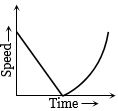
B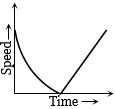
C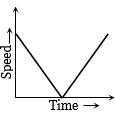
D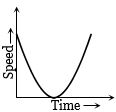
Solution
(B) When a ball is thrown vertically upwards,air resistance acts in the direction opposite to the motion.
During the upward motion,both gravity $(g)$ and air resistance $(a)$ act downwards. Thus,the net acceleration is $a_{up} = -(g + a)$,which is constant and directed downwards. Since acceleration is constant,the speed decreases linearly with time.
During the downward motion,gravity $(g)$ acts downwards and air resistance $(a)$ acts upwards. Thus,the net acceleration is $a_{down} = (g - a)$,which is also constant and directed downwards. Since acceleration is constant,the speed increases linearly with time.
However,because $|a_{up}| > |a_{down}|$,the slope of the speed-time graph (which represents the magnitude of acceleration) will be steeper during the upward motion than during the downward motion. This corresponds to the graph shown in option $B$.
During the upward motion,both gravity $(g)$ and air resistance $(a)$ act downwards. Thus,the net acceleration is $a_{up} = -(g + a)$,which is constant and directed downwards. Since acceleration is constant,the speed decreases linearly with time.
During the downward motion,gravity $(g)$ acts downwards and air resistance $(a)$ acts upwards. Thus,the net acceleration is $a_{down} = (g - a)$,which is also constant and directed downwards. Since acceleration is constant,the speed increases linearly with time.
However,because $|a_{up}| > |a_{down}|$,the slope of the speed-time graph (which represents the magnitude of acceleration) will be steeper during the upward motion than during the downward motion. This corresponds to the graph shown in option $B$.
0 likes
View Solution75
EasyMCQ
Two bodies of masses $1 kg$ and $5 kg$ are dropped gently from the top of a tower. At a point $20 cm$ from the ground,both the bodies will have the same
A
Momentum
B
Kinetic energy
C
Velocity
D
Total energy
Solution
(C) When an object is dropped from a height,it undergoes free fall under the influence of gravity.
According to the equations of motion for an object falling from rest,the velocity $v$ at a distance $h$ from the starting point is given by $v = \sqrt{2gh}$.
Since the acceleration due to gravity $g$ is constant and independent of the mass of the object,the velocity acquired by both bodies at any given height above the ground will be the same.
Therefore,at a point $20 cm$ from the ground,both bodies will have the same velocity.
According to the equations of motion for an object falling from rest,the velocity $v$ at a distance $h$ from the starting point is given by $v = \sqrt{2gh}$.
Since the acceleration due to gravity $g$ is constant and independent of the mass of the object,the velocity acquired by both bodies at any given height above the ground will be the same.
Therefore,at a point $20 cm$ from the ground,both bodies will have the same velocity.
1 likes
View Solution76
EasyMCQ
An iron ball and a wooden ball of the same radius are released from a height $h$ in vacuum. The time taken by both of them to reach the ground is
A
Unequal
B
Exactly equal
C
Roughly equal
D
Zero
Solution
(B) The time of descent $t$ for an object falling from a height $h$ under gravity is given by the kinematic equation $h = ut + \frac{1}{2}gt^2$. Since the balls are released from rest,$u = 0$,so $h = \frac{1}{2}gt^2$.
Solving for $t$,we get $t = \sqrt{\frac{2h}{g}}$.
In a vacuum,there is no air resistance,and the only force acting on the objects is gravity. Since the time $t$ depends only on the height $h$ and the acceleration due to gravity $g$,and both are independent of the mass or material of the objects,both balls will take the same amount of time to reach the ground.
Therefore,the time taken is exactly equal.
Solving for $t$,we get $t = \sqrt{\frac{2h}{g}}$.
In a vacuum,there is no air resistance,and the only force acting on the objects is gravity. Since the time $t$ depends only on the height $h$ and the acceleration due to gravity $g$,and both are independent of the mass or material of the objects,both balls will take the same amount of time to reach the ground.
Therefore,the time taken is exactly equal.
0 likes
View Solution77
EasyMCQ
An iron ball and a wooden ball of the same radius are released from a height $h$ in vacuum. The time taken by both of them to reach the ground is equal based on:
A
Acceleration due to gravity in vacuum is same irrespective of size and mass of the body
B
Acceleration due to gravity in vacuum depends on the mass of the body
C
There is no acceleration due to gravity in vacuum
D
In vacuum there is resistance offered to the motion of the body and this resistance depends on the mass of the body
Solution
(A) The equation of motion for an object falling from rest from a height $h$ is given by $h = \frac{1}{2}gt^2$,where $g$ is the acceleration due to gravity and $t$ is the time taken.
Solving for $t$,we get $t = \sqrt{\frac{2h}{g}}$.
In a vacuum,there is no air resistance,and the acceleration due to gravity $g$ is independent of the mass and size of the falling object.
Since both balls are released from the same height $h$ and experience the same acceleration $g$,the time taken $t$ to reach the ground will be the same for both.
Therefore,the correct option is $A$.
Solving for $t$,we get $t = \sqrt{\frac{2h}{g}}$.
In a vacuum,there is no air resistance,and the acceleration due to gravity $g$ is independent of the mass and size of the falling object.
Since both balls are released from the same height $h$ and experience the same acceleration $g$,the time taken $t$ to reach the ground will be the same for both.
Therefore,the correct option is $A$.
0 likes
View Solution78
MediumMCQ
What is the speed-time graph for a ball thrown vertically upwards? (Neglect air resistance)
A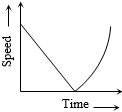
B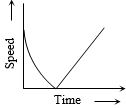
C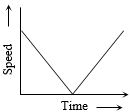
D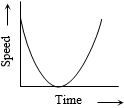
Solution
(C) When a ball is thrown vertically upwards with an initial velocity $u$,its velocity $v$ at any time $t$ is given by $v = u - gt$,where $g$ is the acceleration due to gravity.
Speed is the magnitude of velocity,so $\text{Speed} = |v| = |u - gt|$.
During the upward journey,the velocity decreases linearly from $u$ to $0$ as $t$ increases from $0$ to $u/g$. Thus,the speed decreases linearly.
At the maximum height,the velocity is $0$,so the speed is $0$.
During the downward journey,the velocity becomes negative and its magnitude increases linearly from $0$ as $t$ increases beyond $u/g$. Thus,the speed increases linearly.
Therefore,the speed-time graph consists of two straight lines meeting at the time axis,representing a linear decrease followed by a linear increase. This corresponds to option $C$.
Speed is the magnitude of velocity,so $\text{Speed} = |v| = |u - gt|$.
During the upward journey,the velocity decreases linearly from $u$ to $0$ as $t$ increases from $0$ to $u/g$. Thus,the speed decreases linearly.
At the maximum height,the velocity is $0$,so the speed is $0$.
During the downward journey,the velocity becomes negative and its magnitude increases linearly from $0$ as $t$ increases beyond $u/g$. Thus,the speed increases linearly.
Therefore,the speed-time graph consists of two straight lines meeting at the time axis,representing a linear decrease followed by a linear increase. This corresponds to option $C$.
0 likes
View Solution79
MediumMCQ
Which of the following represents the velocity-time graph for a ball thrown vertically upwards (neglecting air resistance)?
A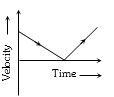
B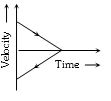
C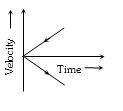
D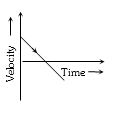
Solution
(D) When a ball is thrown vertically upwards with an initial velocity $u$,it moves under the influence of constant gravitational acceleration $g$ acting downwards.
Taking the upward direction as positive,the velocity at any time $t$ is given by $v = u - gt$.
This is a linear equation of the form $y = mx + c$,where the slope is $-g$ (a constant negative value).
Initially,the velocity is positive and decreases linearly as the ball rises.
At the maximum height,the velocity becomes zero.
After reaching the maximum height,the ball starts moving downwards,so its velocity becomes negative and continues to decrease (become more negative) at a constant rate due to gravity.
Therefore,the velocity-time graph is a straight line with a constant negative slope that passes through the time axis,representing the transition from upward motion (positive velocity) to downward motion (negative velocity).
This corresponds to the graph shown in option $D$.
Taking the upward direction as positive,the velocity at any time $t$ is given by $v = u - gt$.
This is a linear equation of the form $y = mx + c$,where the slope is $-g$ (a constant negative value).
Initially,the velocity is positive and decreases linearly as the ball rises.
At the maximum height,the velocity becomes zero.
After reaching the maximum height,the ball starts moving downwards,so its velocity becomes negative and continues to decrease (become more negative) at a constant rate due to gravity.
Therefore,the velocity-time graph is a straight line with a constant negative slope that passes through the time axis,representing the transition from upward motion (positive velocity) to downward motion (negative velocity).
This corresponds to the graph shown in option $D$.
0 likes
View Solution80
MediumMCQ
$A$ ball is thrown vertically upwards with a velocity of $15 \ m/s$. To what maximum height will it reach? (Take $g = 10 \ m/s^2$)
A
$11.25$
B
$16.2$
C
$24.5$
D
$7.62$
Solution
(A) Given: Initial velocity $u = 15 \ m/s$,Final velocity at maximum height $v = 0 \ m/s$,Acceleration due to gravity $g = 10 \ m/s^2$.
Using the third equation of motion: $v^2 = u^2 - 2gH$.
Substituting the values: $0^2 = (15)^2 - 2 \times 10 \times H$.
$0 = 225 - 20H$.
$20H = 225$.
$H = \frac{225}{20} = 11.25 \ m$.
Therefore,the maximum height reached is $11.25 \ m$.
Using the third equation of motion: $v^2 = u^2 - 2gH$.
Substituting the values: $0^2 = (15)^2 - 2 \times 10 \times H$.
$0 = 225 - 20H$.
$20H = 225$.
$H = \frac{225}{20} = 11.25 \ m$.
Therefore,the maximum height reached is $11.25 \ m$.
0 likes
View Solution81
DifficultMCQ
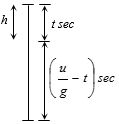
$A$ ball is thrown vertically upwards with a velocity $u$. What is the distance covered by it in the last $t$ seconds of its upward motion?
A
$\frac{1}{2}gt^2$
B
$ut - \frac{1}{2}gt^2$
C
$(u - gt)t$
D
$ut$
Solution
(A) The total time taken by the ball to reach the maximum height is $T = \frac{u}{g}$.
The motion in the last $t$ seconds of the upward journey is equivalent to the motion of a body falling freely from rest for $t$ seconds.
Let the ball reach the maximum height at time $T = \frac{u}{g}$. At this point,its velocity is $v = 0$.
Considering the motion in reverse (starting from the maximum height at $t=0$ with initial velocity $u_0 = 0$ and acceleration $g$ downwards),the distance $h$ covered in time $t$ is given by the kinematic equation:
$h = u_0 t + \frac{1}{2} g t^2$
Since $u_0 = 0$,we get:
$h = 0 \cdot t + \frac{1}{2} g t^2 = \frac{1}{2} g t^2$
Thus,the distance covered in the last $t$ seconds is $\frac{1}{2} g t^2$.
The motion in the last $t$ seconds of the upward journey is equivalent to the motion of a body falling freely from rest for $t$ seconds.
Let the ball reach the maximum height at time $T = \frac{u}{g}$. At this point,its velocity is $v = 0$.
Considering the motion in reverse (starting from the maximum height at $t=0$ with initial velocity $u_0 = 0$ and acceleration $g$ downwards),the distance $h$ covered in time $t$ is given by the kinematic equation:
$h = u_0 t + \frac{1}{2} g t^2$
Since $u_0 = 0$,we get:
$h = 0 \cdot t + \frac{1}{2} g t^2 = \frac{1}{2} g t^2$
Thus,the distance covered in the last $t$ seconds is $\frac{1}{2} g t^2$.
0 likes
View Solution82
MediumMCQ
$A$ body is thrown vertically upwards. At half of the maximum height,its velocity is $10 \ m/s$. What is the maximum height attained by the body? (Take $g = 10 \ m/s^2$)
A
$8$
B
$10$
C
$12$
D
$16$
Solution
(B) Let the maximum height attained be $H$. The initial velocity is $u$. At maximum height,the final velocity is $0$.
Using the equation $v^2 = u^2 - 2gh$,at maximum height $H$,we have $0 = u^2 - 2gH$,which gives $u^2 = 2gH$.
At half the maximum height,$h = H/2$,the velocity is $v = 10 \ m/s$.
Substituting these into the equation $v^2 = u^2 - 2gh$:
$(10)^2 = u^2 - 2g(H/2)$
$100 = u^2 - gH$
Since $u^2 = 2gH$,we substitute this into the equation:
$100 = 2gH - gH$
$100 = gH$
Given $g = 10 \ m/s^2$,we have $100 = 10 \times H$.
Therefore,$H = 10 \ m$.
Using the equation $v^2 = u^2 - 2gh$,at maximum height $H$,we have $0 = u^2 - 2gH$,which gives $u^2 = 2gH$.
At half the maximum height,$h = H/2$,the velocity is $v = 10 \ m/s$.
Substituting these into the equation $v^2 = u^2 - 2gh$:
$(10)^2 = u^2 - 2g(H/2)$
$100 = u^2 - gH$
Since $u^2 = 2gH$,we substitute this into the equation:
$100 = 2gH - gH$
$100 = gH$
Given $g = 10 \ m/s^2$,we have $100 = 10 \times H$.
Therefore,$H = 10 \ m$.
1 likes
View Solution83
DifficultMCQ
$A$ body is projected vertically upward with a velocity of $20 \, m/s$ from the top of a tower of height $200 \, m$. With what velocity will it strike the ground (in $m/s$)? (Take $g = 10 \, m/s^2$)
A
$60$
B
$65$
C
$70$
D
$75$
Solution
(B) Let the upward direction be positive and the downward direction be negative.
Initial velocity $u = +20 \, m/s$.
Displacement $s = -200 \, m$ (since it lands below the starting point).
Acceleration $a = g = -10 \, m/s^2$.
Using the third equation of motion: $v^2 = u^2 + 2as$.
$v^2 = (20)^2 + 2(-10)(-200)$.
$v^2 = 400 + 4000 = 4400$.
$v = \sqrt{4400} \approx 66.33 \, m/s$.
However, if we consider the energy conservation approach:
Total energy at top = Total energy at bottom.
$\frac{1}{2}mu^2 + mgh = \frac{1}{2}mv^2$.
$v^2 = u^2 + 2gh = (20)^2 + 2(10)(200) = 400 + 4000 = 4400$.
$v = \sqrt{4400} \approx 66.33 \, m/s$.
Given the options provided, the closest integer value is $65 \, m/s$.
Initial velocity $u = +20 \, m/s$.
Displacement $s = -200 \, m$ (since it lands below the starting point).
Acceleration $a = g = -10 \, m/s^2$.
Using the third equation of motion: $v^2 = u^2 + 2as$.
$v^2 = (20)^2 + 2(-10)(-200)$.
$v^2 = 400 + 4000 = 4400$.
$v = \sqrt{4400} \approx 66.33 \, m/s$.
However, if we consider the energy conservation approach:
Total energy at top = Total energy at bottom.
$\frac{1}{2}mu^2 + mgh = \frac{1}{2}mv^2$.
$v^2 = u^2 + 2gh = (20)^2 + 2(10)(200) = 400 + 4000 = 4400$.
$v = \sqrt{4400} \approx 66.33 \, m/s$.
Given the options provided, the closest integer value is $65 \, m/s$.
0 likes
View Solution84
DifficultMCQ
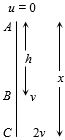
$A$ body is dropped from rest. It acquires a velocity $V$ after falling through a distance $h$. What distance must it fall further to acquire a velocity of $2V$ (in $h$)?
A
$2$
B
$4$
C
$3$
D
$8$
Solution
(C) For a body falling from rest,the velocity $v$ after falling a distance $h$ is given by the equation of motion $v^2 = u^2 + 2as$. Here $u = 0$,$a = g$,and $s = h$.
So,$V^2 = 0 + 2gh$ ... $(i)$
Let the total distance covered to acquire a velocity $2V$ be $x$. Using the same equation:
$(2V)^2 = 0 + 2gx$
$4V^2 = 2gx$ ... (ii)
Dividing equation (ii) by equation $(i)$:
$4V^2 / V^2 = (2gx) / (2gh)$
$4 = x / h$
$x = 4h$
The total distance to reach velocity $2V$ is $4h$. The distance it must fall *further* from point $B$ is $x - h = 4h - h = 3h$.
So,$V^2 = 0 + 2gh$ ... $(i)$
Let the total distance covered to acquire a velocity $2V$ be $x$. Using the same equation:
$(2V)^2 = 0 + 2gx$
$4V^2 = 2gx$ ... (ii)
Dividing equation (ii) by equation $(i)$:
$4V^2 / V^2 = (2gx) / (2gh)$
$4 = x / h$
$x = 4h$
The total distance to reach velocity $2V$ is $4h$. The distance it must fall *further* from point $B$ is $x - h = 4h - h = 3h$.
0 likes
View Solution85
DifficultMCQ
$A$ stone is thrown vertically upwards with a velocity $V_0$ from a tower of height $h$ and it reaches the ground in time $t_1$. If the stone is thrown downwards with the same velocity $V_0$ from the same tower,it reaches the ground in time $t_2$. If the stone is dropped from the tower,it reaches the ground in time $t$. Find the value of $t$.
A
$t = t_1 - t_2$
B
$t = \frac{t_1 + t_2}{2}$
C
$t = \sqrt{t_1 t_2}$
D
$t = t_1^2 t_2^2$
Solution
(C) Let the height of the tower be $h$ and the acceleration due to gravity be $g$. The time taken to fall freely from height $h$ is given by $h = \frac{1}{2}gt^2$,so $t = \sqrt{\frac{2h}{g}}$.
For the stone thrown upwards with velocity $V_0$,the displacement is $-h$:
$-h = V_0 t_1 - \frac{1}{2}g t_1^2 \implies h = \frac{1}{2}g t_1^2 - V_0 t_1$. Since $h = \frac{1}{2}gt^2$,we have $\frac{1}{2}gt^2 = \frac{1}{2}g t_1^2 - V_0 t_1 \implies V_0 t_1 = \frac{1}{2}g(t_1^2 - t^2) \dots (1)$.
For the stone thrown downwards with velocity $V_0$,the displacement is $-h$:
$-h = -V_0 t_2 - \frac{1}{2}g t_2^2 \implies h = V_0 t_2 + \frac{1}{2}g t_2^2$. Since $h = \frac{1}{2}gt^2$,we have $\frac{1}{2}gt^2 = V_0 t_2 + \frac{1}{2}g t_2^2 \implies V_0 t_2 = \frac{1}{2}g(t^2 - t_2^2) \dots (2)$.
Dividing equation $(1)$ by $(2)$:
$\frac{V_0 t_1}{V_0 t_2} = \frac{\frac{1}{2}g(t_1^2 - t^2)}{\frac{1}{2}g(t^2 - t_2^2)} \implies \frac{t_1}{t_2} = \frac{t_1^2 - t^2}{t^2 - t_2^2}$.
Cross-multiplying: $t_1 t^2 - t_1 t_2^2 = t_2 t_1^2 - t_2 t^2$.
$t^2(t_1 + t_2) = t_1 t_2(t_1 + t_2)$.
$t^2 = t_1 t_2 \implies t = \sqrt{t_1 t_2}$.
For the stone thrown upwards with velocity $V_0$,the displacement is $-h$:
$-h = V_0 t_1 - \frac{1}{2}g t_1^2 \implies h = \frac{1}{2}g t_1^2 - V_0 t_1$. Since $h = \frac{1}{2}gt^2$,we have $\frac{1}{2}gt^2 = \frac{1}{2}g t_1^2 - V_0 t_1 \implies V_0 t_1 = \frac{1}{2}g(t_1^2 - t^2) \dots (1)$.
For the stone thrown downwards with velocity $V_0$,the displacement is $-h$:
$-h = -V_0 t_2 - \frac{1}{2}g t_2^2 \implies h = V_0 t_2 + \frac{1}{2}g t_2^2$. Since $h = \frac{1}{2}gt^2$,we have $\frac{1}{2}gt^2 = V_0 t_2 + \frac{1}{2}g t_2^2 \implies V_0 t_2 = \frac{1}{2}g(t^2 - t_2^2) \dots (2)$.
Dividing equation $(1)$ by $(2)$:
$\frac{V_0 t_1}{V_0 t_2} = \frac{\frac{1}{2}g(t_1^2 - t^2)}{\frac{1}{2}g(t^2 - t_2^2)} \implies \frac{t_1}{t_2} = \frac{t_1^2 - t^2}{t^2 - t_2^2}$.
Cross-multiplying: $t_1 t^2 - t_1 t_2^2 = t_2 t_1^2 - t_2 t^2$.
$t^2(t_1 + t_2) = t_1 t_2(t_1 + t_2)$.
$t^2 = t_1 t_2 \implies t = \sqrt{t_1 t_2}$.
0 likes
View Solution86
DifficultMCQ
$A$ body is dropped from a height $h$. It covers a distance of $9h/25$ in the last second of its motion. What is the height $h$ in $m$?
A
$100$
B
$122.5$
C
$145$
D
$167.5$
Solution
(B) Let the total time taken to reach the ground be $n$ seconds.
The total distance covered is $h = \frac{1}{2}gn^2$ ---$(1)$
The distance covered in the last second is given by $S_n = \frac{g}{2}(2n - 1)$.
According to the problem,$S_n = \frac{9h}{25}$.
Substituting $h$ from equation $(1)$ into the expression for $S_n$:
$\frac{g}{2}(2n - 1) = \frac{9}{25} \times (\frac{1}{2}gn^2)$
$(2n - 1) = \frac{9n^2}{25}$
$50n - 25 = 9n^2$
$9n^2 - 50n + 25 = 0$
Solving the quadratic equation using the quadratic formula $n = \frac{-b \pm \sqrt{b^2 - 4ac}}{2a}$:
$n = \frac{50 \pm \sqrt{2500 - 900}}{18} = \frac{50 \pm \sqrt{1600}}{18} = \frac{50 \pm 40}{18}$
Taking the positive value,$n = \frac{90}{18} = 5 \, s$.
Now,substitute $n = 5$ into equation $(1)$ with $g = 9.8 \, m/s^2$:
$h = \frac{1}{2} \times 9.8 \times (5)^2 = 4.9 \times 25 = 122.5 \, m$.
The total distance covered is $h = \frac{1}{2}gn^2$ ---$(1)$
The distance covered in the last second is given by $S_n = \frac{g}{2}(2n - 1)$.
According to the problem,$S_n = \frac{9h}{25}$.
Substituting $h$ from equation $(1)$ into the expression for $S_n$:
$\frac{g}{2}(2n - 1) = \frac{9}{25} \times (\frac{1}{2}gn^2)$
$(2n - 1) = \frac{9n^2}{25}$
$50n - 25 = 9n^2$
$9n^2 - 50n + 25 = 0$
Solving the quadratic equation using the quadratic formula $n = \frac{-b \pm \sqrt{b^2 - 4ac}}{2a}$:
$n = \frac{50 \pm \sqrt{2500 - 900}}{18} = \frac{50 \pm \sqrt{1600}}{18} = \frac{50 \pm 40}{18}$
Taking the positive value,$n = \frac{90}{18} = 5 \, s$.
Now,substitute $n = 5$ into equation $(1)$ with $g = 9.8 \, m/s^2$:
$h = \frac{1}{2} \times 9.8 \times (5)^2 = 4.9 \times 25 = 122.5 \, m$.
0 likes
View Solution87
EasyMCQ
$A$ body is dropped from a tower of height $h$. It reaches the ground at $t = 4\, s$. What is the height of the tower in $m$?
A
$80$
B
$40$
C
$20$
D
$160$
Solution
(A) The body is dropped,so the initial velocity $u = 0\, m/s$.
The time taken to reach the ground is $t = 4\, s$.
Using the equation of motion for free fall: $h = ut + \frac{1}{2}gt^2$.
Substituting $u = 0$,$g = 10\, m/s^2$,and $t = 4\, s$:
$h = 0 \times 4 + \frac{1}{2} \times 10 \times (4)^2$.
$h = 0 + 5 \times 16$.
$h = 80\, m$.
Therefore,the height of the tower is $80\, m$.
The time taken to reach the ground is $t = 4\, s$.
Using the equation of motion for free fall: $h = ut + \frac{1}{2}gt^2$.
Substituting $u = 0$,$g = 10\, m/s^2$,and $t = 4\, s$:
$h = 0 \times 4 + \frac{1}{2} \times 10 \times (4)^2$.
$h = 0 + 5 \times 16$.
$h = 80\, m$.
Therefore,the height of the tower is $80\, m$.
0 likes
View Solution88
MediumMCQ
Two bodies $A$ (of mass $1\,kg$) and $B$ (of mass $3\,kg$) are dropped from heights of $16\,m$ and $25\,m$ respectively. The ratio of the time taken by them to reach the ground is:
A
$0.8$
B
$1.25$
C
$2.4$
D
$0.42$
Solution
(A) The time $t$ taken by a body to reach the ground when dropped from a height $h$ is given by the formula $t = \sqrt{\frac{2h}{g}}$.
Since both bodies are dropped,their initial velocity is $0$ and they are under the influence of the same acceleration due to gravity $g$.
The ratio of the time taken by body $A$ $(t_A)$ to the time taken by body $B$ $(t_B)$ is:
$\frac{t_A}{t_B} = \frac{\sqrt{\frac{2h_A}{g}}}{\sqrt{\frac{2h_B}{g}}} = \sqrt{\frac{h_A}{h_B}}$
Given $h_A = 16\,m$ and $h_B = 25\,m$:
$\frac{t_A}{t_B} = \sqrt{\frac{16}{25}} = \frac{4}{5} = 0.8$
Thus,the ratio of the time taken is $0.8$.
Since both bodies are dropped,their initial velocity is $0$ and they are under the influence of the same acceleration due to gravity $g$.
The ratio of the time taken by body $A$ $(t_A)$ to the time taken by body $B$ $(t_B)$ is:
$\frac{t_A}{t_B} = \frac{\sqrt{\frac{2h_A}{g}}}{\sqrt{\frac{2h_B}{g}}} = \sqrt{\frac{h_A}{h_B}}$
Given $h_A = 16\,m$ and $h_B = 25\,m$:
$\frac{t_A}{t_B} = \sqrt{\frac{16}{25}} = \frac{4}{5} = 0.8$
Thus,the ratio of the time taken is $0.8$.
0 likes
View Solution89
MediumMCQ
$A$ ball is dropped from a high-rise platform at $t=0$ starting from rest. After $6$ seconds,another ball is thrown downwards from the same platform with a speed $v$. The two balls meet at $t=18\,s$. What is the value of $v$ in $m/s$? (Take $g= 10\,m/s^2$)
A
$75$
B
$55$
C
$40$
D
$60$
Solution
(A) Let the distance from the platform where the two balls meet be $x$.
For the first ball:
Initial velocity $u_1 = 0$,time $t_1 = 18\,s$,acceleration $g = 10\,m/s^2$.
Using the equation of motion $h = ut + \frac{1}{2}gt^2$:
$x = 0 \times 18 + \frac{1}{2} \times 10 \times (18)^2 = 5 \times 324 = 1620\,m$.
For the second ball:
Initial velocity $u_2 = v$,time $t_2 = 18 - 6 = 12\,s$,acceleration $g = 10\,m/s^2$.
Using the equation of motion $h = ut + \frac{1}{2}gt^2$:
$x = v \times 12 + \frac{1}{2} \times 10 \times (12)^2 = 12v + 5 \times 144 = 12v + 720$.
Equating the two expressions for $x$:
$1620 = 12v + 720$
$12v = 1620 - 720 = 900$
$v = \frac{900}{12} = 75\,m/s$.
For the first ball:
Initial velocity $u_1 = 0$,time $t_1 = 18\,s$,acceleration $g = 10\,m/s^2$.
Using the equation of motion $h = ut + \frac{1}{2}gt^2$:
$x = 0 \times 18 + \frac{1}{2} \times 10 \times (18)^2 = 5 \times 324 = 1620\,m$.
For the second ball:
Initial velocity $u_2 = v$,time $t_2 = 18 - 6 = 12\,s$,acceleration $g = 10\,m/s^2$.
Using the equation of motion $h = ut + \frac{1}{2}gt^2$:
$x = v \times 12 + \frac{1}{2} \times 10 \times (12)^2 = 12v + 5 \times 144 = 12v + 720$.
Equating the two expressions for $x$:
$1620 = 12v + 720$
$12v = 1620 - 720 = 900$
$v = \frac{900}{12} = 75\,m/s$.
0 likes
View Solution90
EasyMCQ
$A$ boy standing at the top of a tower of $20 \, m$ height drops a stone. Assuming $g = 10 \, m/s^2$,the velocity with which it hits the ground is ......... $m/s$.
A
$40$
B
$5$
C
$10$
D
$20$
Solution
(D) Given: Initial velocity $u = 0 \, m/s$,acceleration due to gravity $g = 10 \, m/s^2$,and height $h = 20 \, m$.
Using the third equation of motion: $v^2 = u^2 + 2gh$.
Substituting the values: $v^2 = 0^2 + 2 \times 10 \times 20$.
$v^2 = 400$.
Taking the square root: $v = \sqrt{400} = 20 \, m/s$.
Therefore,the velocity with which the stone hits the ground is $20 \, m/s$.
Using the third equation of motion: $v^2 = u^2 + 2gh$.
Substituting the values: $v^2 = 0^2 + 2 \times 10 \times 20$.
$v^2 = 400$.
Taking the square root: $v = \sqrt{400} = 20 \, m/s$.
Therefore,the velocity with which the stone hits the ground is $20 \, m/s$.
0 likes
View Solution91
MediumMCQ
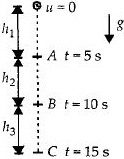
$A$ stone falls freely under gravity. It covers distances $h_1, h_2$ and $h_3$ in the first $5 \ s$,the next $5 \ s$ and the next $5 \ s$ respectively. The relation between $h_1, h_2$ and $h_3$ is:
A
$h_1 = 2h_2 = 3h_3$
B
$h_1 = \frac{h_2}{3} = \frac{h_3}{5}$
C
$h_2 = 3h_1$ and $h_3 = 3h_2$
D
$h_1 = h_2 = h_3$
Solution
(B) For a body falling freely from rest $(u = 0)$,the distance covered in time $t$ is given by $h = \frac{1}{2}gt^2$.
$1$. Distance covered in the first $5 \ s$ $(t = 5 \ s)$:
$h_1 = \frac{1}{2}g(5)^2 = \frac{25}{2}g$ ... $(i)$
$2$. Distance covered in the first $10 \ s$ $(t = 10 \ s)$:
$h_1 + h_2 = \frac{1}{2}g(10)^2 = \frac{100}{2}g$ ... (ii)
$3$. Distance covered in the first $15 \ s$ $(t = 15 \ s)$:
$h_1 + h_2 + h_3 = \frac{1}{2}g(15)^2 = \frac{225}{2}g$ ... (iii)
Subtracting $(i)$ from (ii):
$h_2 = (h_1 + h_2) - h_1 = \frac{100}{2}g - \frac{25}{2}g = \frac{75}{2}g = 3 \left( \frac{25}{2}g \right) = 3h_1$
Subtracting (ii) from (iii):
$h_3 = (h_1 + h_2 + h_3) - (h_1 + h_2) = \frac{225}{2}g - \frac{100}{2}g = \frac{125}{2}g = 5 \left( \frac{25}{2}g \right) = 5h_1$
Thus,$h_1 = \frac{h_2}{3} = \frac{h_3}{5}$.
$1$. Distance covered in the first $5 \ s$ $(t = 5 \ s)$:
$h_1 = \frac{1}{2}g(5)^2 = \frac{25}{2}g$ ... $(i)$
$2$. Distance covered in the first $10 \ s$ $(t = 10 \ s)$:
$h_1 + h_2 = \frac{1}{2}g(10)^2 = \frac{100}{2}g$ ... (ii)
$3$. Distance covered in the first $15 \ s$ $(t = 15 \ s)$:
$h_1 + h_2 + h_3 = \frac{1}{2}g(15)^2 = \frac{225}{2}g$ ... (iii)
Subtracting $(i)$ from (ii):
$h_2 = (h_1 + h_2) - h_1 = \frac{100}{2}g - \frac{25}{2}g = \frac{75}{2}g = 3 \left( \frac{25}{2}g \right) = 3h_1$
Subtracting (ii) from (iii):
$h_3 = (h_1 + h_2 + h_3) - (h_1 + h_2) = \frac{225}{2}g - \frac{100}{2}g = \frac{125}{2}g = 5 \left( \frac{25}{2}g \right) = 5h_1$
Thus,$h_1 = \frac{h_2}{3} = \frac{h_3}{5}$.
0 likes
View Solution92
MediumMCQ
$A$ stone is dropped from a height $h$. It hits the ground with a certain momentum $P$. If the same stone is dropped from a height $100\%$ more than the previous height,the momentum when it hits the ground will change by ........... $\%$.
A
$68$
B
$41$
C
$200$
D
$100$
Solution
(B) When a stone is dropped from a height $h$,its velocity $v$ upon hitting the ground is given by $v = \sqrt{2gh}$.
Thus,the initial momentum is $P = m\sqrt{2gh} \dots (i)$.
If the height is increased by $100\%$,the new height $h' = h + 100\% \text{ of } h = h + h = 2h$.
The new momentum $P'$ is $P' = m\sqrt{2g(2h)} = m\sqrt{2gh} \times \sqrt{2} = P\sqrt{2}$.
Given $\sqrt{2} \approx 1.414$.
The percentage change in momentum is $\frac{P' - P}{P} \times 100\% = \frac{P\sqrt{2} - P}{P} \times 100\% = (\sqrt{2} - 1) \times 100\%$.
$= (1.414 - 1) \times 100\% = 0.414 \times 100\% = 41.4\% \approx 41\%$.
Thus,the initial momentum is $P = m\sqrt{2gh} \dots (i)$.
If the height is increased by $100\%$,the new height $h' = h + 100\% \text{ of } h = h + h = 2h$.
The new momentum $P'$ is $P' = m\sqrt{2g(2h)} = m\sqrt{2gh} \times \sqrt{2} = P\sqrt{2}$.
Given $\sqrt{2} \approx 1.414$.
The percentage change in momentum is $\frac{P' - P}{P} \times 100\% = \frac{P\sqrt{2} - P}{P} \times 100\% = (\sqrt{2} - 1) \times 100\%$.
$= (1.414 - 1) \times 100\% = 0.414 \times 100\% = 41.4\% \approx 41\%$.
0 likes
View Solution93
DifficultMCQ
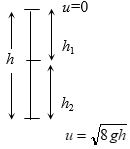
$A$ stone is dropped from a height $h$. Simultaneously,another stone is thrown up from the ground which reaches a height $4h$. The two stones cross each other after time:
A
$\sqrt{\frac{h}{8g}}$
B
$\sqrt{8gh}$
C
$\sqrt{2gh}$
D
$\sqrt{\frac{h}{2g}}$
Solution
(A) For the first stone dropped from height $h$,the initial velocity $u_1 = 0$. The distance covered by it in time $t$ is $h_1 = \frac{1}{2}gt^2$.
For the second stone thrown upwards from the ground,it reaches a maximum height $H = 4h$. Using the formula $H = \frac{u_2^2}{2g}$,we get $4h = \frac{u_2^2}{2g}$,which implies $u_2^2 = 8gh$ or $u_2 = \sqrt{8gh}$.
The distance covered by the second stone in time $t$ is $h_2 = u_2t - \frac{1}{2}gt^2 = \sqrt{8gh}t - \frac{1}{2}gt^2$.
Since the stones cross each other,the sum of the distances covered by them must equal the total height $h$,so $h_1 + h_2 = h$.
Substituting the expressions: $\frac{1}{2}gt^2 + (\sqrt{8gh}t - \frac{1}{2}gt^2) = h$.
This simplifies to $\sqrt{8gh}t = h$.
Solving for $t$,we get $t = \frac{h}{\sqrt{8gh}} = \sqrt{\frac{h^2}{8gh}} = \sqrt{\frac{h}{8g}}$.
For the second stone thrown upwards from the ground,it reaches a maximum height $H = 4h$. Using the formula $H = \frac{u_2^2}{2g}$,we get $4h = \frac{u_2^2}{2g}$,which implies $u_2^2 = 8gh$ or $u_2 = \sqrt{8gh}$.
The distance covered by the second stone in time $t$ is $h_2 = u_2t - \frac{1}{2}gt^2 = \sqrt{8gh}t - \frac{1}{2}gt^2$.
Since the stones cross each other,the sum of the distances covered by them must equal the total height $h$,so $h_1 + h_2 = h$.
Substituting the expressions: $\frac{1}{2}gt^2 + (\sqrt{8gh}t - \frac{1}{2}gt^2) = h$.
This simplifies to $\sqrt{8gh}t = h$.
Solving for $t$,we get $t = \frac{h}{\sqrt{8gh}} = \sqrt{\frac{h^2}{8gh}} = \sqrt{\frac{h}{8g}}$.
0 likes
View Solution94
DifficultMCQ
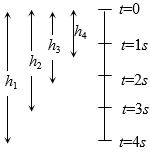
Four marbles are dropped from the top of a tower one after the other with an interval of one second. The first one reaches the ground after $4$ seconds. When the first one reaches the ground,the distances between the first and second,the second and third,and the third and fourth marbles will be respectively:
A
$35, 25$ and $15 \, m$
B
$30, 20$ and $10 \, m$
C
$20, 10$ and $5 \, m$
D
$40, 30$ and $20 \, m$
Solution
(A) Let the acceleration due to gravity be $g = 10 \, m/s^2$.
The first marble is dropped at $t = 0$ and reaches the ground at $t = 4 \, s$. Its distance from the top is $h_1 = \frac{1}{2} g (4)^2 = 8g = 80 \, m$.
The second marble is dropped at $t = 1 \, s$,so at $t = 4 \, s$,it has been falling for $3 \, s$. Its distance is $h_2 = \frac{1}{2} g (3)^2 = 4.5g = 45 \, m$.
The third marble is dropped at $t = 2 \, s$,so at $t = 4 \, s$,it has been falling for $2 \, s$. Its distance is $h_3 = \frac{1}{2} g (2)^2 = 2g = 20 \, m$.
The fourth marble is dropped at $t = 3 \, s$,so at $t = 4 \, s$,it has been falling for $1 \, s$. Its distance is $h_4 = \frac{1}{2} g (1)^2 = 0.5g = 5 \, m$.
The distance between the first and second marble is $h_1 - h_2 = 80 - 45 = 35 \, m$.
The distance between the second and third marble is $h_2 - h_3 = 45 - 20 = 25 \, m$.
The distance between the third and fourth marble is $h_3 - h_4 = 20 - 5 = 15 \, m$.
Thus,the distances are $35 \, m, 25 \, m$ and $15 \, m$.
The first marble is dropped at $t = 0$ and reaches the ground at $t = 4 \, s$. Its distance from the top is $h_1 = \frac{1}{2} g (4)^2 = 8g = 80 \, m$.
The second marble is dropped at $t = 1 \, s$,so at $t = 4 \, s$,it has been falling for $3 \, s$. Its distance is $h_2 = \frac{1}{2} g (3)^2 = 4.5g = 45 \, m$.
The third marble is dropped at $t = 2 \, s$,so at $t = 4 \, s$,it has been falling for $2 \, s$. Its distance is $h_3 = \frac{1}{2} g (2)^2 = 2g = 20 \, m$.
The fourth marble is dropped at $t = 3 \, s$,so at $t = 4 \, s$,it has been falling for $1 \, s$. Its distance is $h_4 = \frac{1}{2} g (1)^2 = 0.5g = 5 \, m$.
The distance between the first and second marble is $h_1 - h_2 = 80 - 45 = 35 \, m$.
The distance between the second and third marble is $h_2 - h_3 = 45 - 20 = 25 \, m$.
The distance between the third and fourth marble is $h_3 - h_4 = 20 - 5 = 15 \, m$.
Thus,the distances are $35 \, m, 25 \, m$ and $15 \, m$.
0 likes
View Solution95
MediumMCQ
$A$ balloon rises from rest with a constant acceleration $g/8$. $A$ stone is released from it when it has risen to height $h$. The time taken by the stone to reach the ground is
A
$4\sqrt{\frac{h}{g}}$
B
$2\sqrt{\frac{h}{g}}$
C
$\sqrt{\frac{2h}{g}}$
D
$\sqrt{\frac{g}{h}}$
Solution
(B) The balloon starts from rest with acceleration $a = g/8$. At height $h$,its velocity $v$ is given by $v^2 = u^2 + 2ah = 0 + 2(g/8)h = gh/4$. Thus,$v = \frac{1}{2}\sqrt{gh}$.
When the stone is released,it possesses an initial upward velocity $v = \frac{1}{2}\sqrt{gh}$.
Using the equation of motion for the stone: $s = ut + \frac{1}{2}at^2$,where $s = -h$ (downward displacement),$u = v = \frac{1}{2}\sqrt{gh}$,and $a = -g$.
$-h = (\frac{1}{2}\sqrt{gh})t - \frac{1}{2}gt^2$.
Rearranging gives $\frac{1}{2}gt^2 - (\frac{1}{2}\sqrt{gh})t - h = 0$.
Multiplying by $2/g$: $t^2 - (\sqrt{h/g})t - 2h/g = 0$.
Using the quadratic formula $t = \frac{-b \pm \sqrt{b^2 - 4ac}}{2a}$:
$t = \frac{\sqrt{h/g} \pm \sqrt{h/g + 8h/g}}{2} = \frac{\sqrt{h/g} \pm 3\sqrt{h/g}}{2}$.
Taking the positive root,$t = \frac{4\sqrt{h/g}}{2} = 2\sqrt{\frac{h}{g}}$.
When the stone is released,it possesses an initial upward velocity $v = \frac{1}{2}\sqrt{gh}$.
Using the equation of motion for the stone: $s = ut + \frac{1}{2}at^2$,where $s = -h$ (downward displacement),$u = v = \frac{1}{2}\sqrt{gh}$,and $a = -g$.
$-h = (\frac{1}{2}\sqrt{gh})t - \frac{1}{2}gt^2$.
Rearranging gives $\frac{1}{2}gt^2 - (\frac{1}{2}\sqrt{gh})t - h = 0$.
Multiplying by $2/g$: $t^2 - (\sqrt{h/g})t - 2h/g = 0$.
Using the quadratic formula $t = \frac{-b \pm \sqrt{b^2 - 4ac}}{2a}$:
$t = \frac{\sqrt{h/g} \pm \sqrt{h/g + 8h/g}}{2} = \frac{\sqrt{h/g} \pm 3\sqrt{h/g}}{2}$.
Taking the positive root,$t = \frac{4\sqrt{h/g}}{2} = 2\sqrt{\frac{h}{g}}$.
0 likes
View Solution96
MediumMCQ
Two bodies are thrown simultaneously from a tower with the same initial velocity $v_0$: one vertically upwards,the other vertically downwards. The distance between the two bodies after time $t$ is
A
$2v_0t + \frac{1}{2}gt^2$
B
$2v_0t$
C
$v_0t + \frac{1}{2}gt^2$
D
$v_0t$
Solution
(B) Let the tower be the origin. For the body thrown vertically upwards,the displacement after time $t$ is $y_1 = v_0t - \frac{1}{2}gt^2$.
For the body thrown vertically downwards,the displacement after time $t$ is $y_2 = -v_0t - \frac{1}{2}gt^2$ (taking downward direction as negative).
The distance between the two bodies is the magnitude of the difference in their positions: $d = |y_1 - y_2|$.
$d = |(v_0t - \frac{1}{2}gt^2) - (-v_0t - \frac{1}{2}gt^2)|$.
$d = |v_0t - \frac{1}{2}gt^2 + v_0t + \frac{1}{2}gt^2| = |2v_0t| = 2v_0t$.
For the body thrown vertically downwards,the displacement after time $t$ is $y_2 = -v_0t - \frac{1}{2}gt^2$ (taking downward direction as negative).
The distance between the two bodies is the magnitude of the difference in their positions: $d = |y_1 - y_2|$.
$d = |(v_0t - \frac{1}{2}gt^2) - (-v_0t - \frac{1}{2}gt^2)|$.
$d = |v_0t - \frac{1}{2}gt^2 + v_0t + \frac{1}{2}gt^2| = |2v_0t| = 2v_0t$.
0 likes
View Solution97
MediumMCQ
$A$ body falls freely from the top of a tower. It covers $36\%$ of the total height in the last second before striking the ground level. The height of the tower is........$m$
A
$50$
B
$75$
C
$100$
D
$125$
Solution
(D) Let the total height of the tower be $h$ and the total time taken to reach the ground be $t$ seconds.
Since the body falls freely,the initial velocity $u = 0$.
Using the equation of motion $h = \frac{1}{2}gt^2$ ... $(i)$.
In the last second,the body covers $36\%$ of the total height,which is $0.36h$.
Therefore,in the first $(t - 1)$ seconds,the body covers the remaining height: $h - 0.36h = 0.64h$.
Using the equation of motion for $(t - 1)$ seconds: $0.64h = \frac{1}{2}g(t - 1)^2$ ... $(ii)$.
Dividing equation $(ii)$ by equation $(i)$:
$\frac{0.64h}{h} = \frac{\frac{1}{2}g(t - 1)^2}{\frac{1}{2}gt^2}$
$0.64 = \frac{(t - 1)^2}{t^2}$
Taking the square root on both sides: $0.8 = \frac{t - 1}{t}$.
$0.8t = t - 1 \implies 0.2t = 1 \implies t = 5 \text{ s}$.
Substituting $t = 5$ in equation $(i)$ (taking $g = 10 \text{ m/s}^2$):
$h = \frac{1}{2} \times 10 \times (5)^2 = 5 \times 25 = 125 \text{ m}$.
Since the body falls freely,the initial velocity $u = 0$.
Using the equation of motion $h = \frac{1}{2}gt^2$ ... $(i)$.
In the last second,the body covers $36\%$ of the total height,which is $0.36h$.
Therefore,in the first $(t - 1)$ seconds,the body covers the remaining height: $h - 0.36h = 0.64h$.
Using the equation of motion for $(t - 1)$ seconds: $0.64h = \frac{1}{2}g(t - 1)^2$ ... $(ii)$.
Dividing equation $(ii)$ by equation $(i)$:
$\frac{0.64h}{h} = \frac{\frac{1}{2}g(t - 1)^2}{\frac{1}{2}gt^2}$
$0.64 = \frac{(t - 1)^2}{t^2}$
Taking the square root on both sides: $0.8 = \frac{t - 1}{t}$.
$0.8t = t - 1 \implies 0.2t = 1 \implies t = 5 \text{ s}$.
Substituting $t = 5$ in equation $(i)$ (taking $g = 10 \text{ m/s}^2$):
$h = \frac{1}{2} \times 10 \times (5)^2 = 5 \times 25 = 125 \text{ m}$.
0 likes
View Solution98
MediumMCQ
$A$ particle is projected upwards. The times corresponding to height $h$ while ascending and while descending are $t_1$ and $t_2$ respectively. The velocity of projection will be
A
$g t_1$
B
$g t_2$
C
$g (t_1 + t_2)$
D
$\frac{g (t_1 + t_2)}{2}$
Solution
(D) Let the initial velocity of projection be $u$. The equation of motion for a particle at height $h$ is given by $h = ut - \frac{1}{2}gt^2$.
Rearranging this,we get a quadratic equation in $t$: $\frac{1}{2}gt^2 - ut + h = 0$.
The roots of this equation are $t_1$ and $t_2$,which represent the times at which the particle is at height $h$ during ascent and descent.
From the properties of quadratic equations,the sum of the roots is given by $t_1 + t_2 = -\frac{b}{a} = \frac{u}{1/2g} = \frac{2u}{g}$.
Solving for the initial velocity $u$,we get $u = \frac{g(t_1 + t_2)}{2}$.
Rearranging this,we get a quadratic equation in $t$: $\frac{1}{2}gt^2 - ut + h = 0$.
The roots of this equation are $t_1$ and $t_2$,which represent the times at which the particle is at height $h$ during ascent and descent.
From the properties of quadratic equations,the sum of the roots is given by $t_1 + t_2 = -\frac{b}{a} = \frac{u}{1/2g} = \frac{2u}{g}$.
Solving for the initial velocity $u$,we get $u = \frac{g(t_1 + t_2)}{2}$.
0 likes
View Solution99
DifficultMCQ
$A$ projectile is fired vertically upwards with an initial velocity $u$. After an interval of $T$ seconds,a second projectile is fired vertically upwards,also with initial velocity $u$.
A
They meet at time $t = \frac{u}{g}$ and at a height $\frac{u^2}{2g} + \frac{gT^2}{8}$
B
They meet at time $t = \frac{u}{g} + \frac{T}{2}$ and at a height $\frac{u^2}{2g} + \frac{gT^2}{8}$
C
They meet at time $t = \frac{u}{g} + \frac{T}{2}$ and at a height $\frac{u^2}{2g} - \frac{gT^2}{8}$
D
They never meet
Solution
(C) For the first projectile,the height at time $t$ is $h_1 = ut - \frac{1}{2}gt^2$.
For the second projectile,which is fired after time $T$,the height at time $t$ is $h_2 = u(t - T) - \frac{1}{2}g(t - T)^2$.
When both meet,$h_1 = h_2$.
$ut - \frac{1}{2}gt^2 = u(t - T) - \frac{1}{2}g(t - T)^2$.
Expanding the right side: $ut - \frac{1}{2}gt^2 = ut - uT - \frac{1}{2}g(t^2 - 2tT + T^2)$.
$ut - \frac{1}{2}gt^2 = ut - uT - \frac{1}{2}gt^2 + gtT - \frac{1}{2}gT^2$.
Canceling common terms: $0 = -uT + gtT - \frac{1}{2}gT^2$.
$uT + \frac{1}{2}gT^2 = gtT$.
Dividing by $gT$: $t = \frac{u}{g} + \frac{T}{2}$.
Substituting $t$ back into $h_1$: $h_1 = u(\frac{u}{g} + \frac{T}{2}) - \frac{1}{2}g(\frac{u}{g} + \frac{T}{2})^2$.
$h_1 = \frac{u^2}{g} + \frac{uT}{2} - \frac{1}{2}g(\frac{u^2}{g^2} + \frac{uT}{g} + \frac{T^2}{4})$.
$h_1 = \frac{u^2}{g} + \frac{uT}{2} - \frac{u^2}{2g} - \frac{uT}{2} - \frac{gT^2}{8}$.
$h_1 = \frac{u^2}{2g} - \frac{gT^2}{8}$.
For the second projectile,which is fired after time $T$,the height at time $t$ is $h_2 = u(t - T) - \frac{1}{2}g(t - T)^2$.
When both meet,$h_1 = h_2$.
$ut - \frac{1}{2}gt^2 = u(t - T) - \frac{1}{2}g(t - T)^2$.
Expanding the right side: $ut - \frac{1}{2}gt^2 = ut - uT - \frac{1}{2}g(t^2 - 2tT + T^2)$.
$ut - \frac{1}{2}gt^2 = ut - uT - \frac{1}{2}gt^2 + gtT - \frac{1}{2}gT^2$.
Canceling common terms: $0 = -uT + gtT - \frac{1}{2}gT^2$.
$uT + \frac{1}{2}gT^2 = gtT$.
Dividing by $gT$: $t = \frac{u}{g} + \frac{T}{2}$.
Substituting $t$ back into $h_1$: $h_1 = u(\frac{u}{g} + \frac{T}{2}) - \frac{1}{2}g(\frac{u}{g} + \frac{T}{2})^2$.
$h_1 = \frac{u^2}{g} + \frac{uT}{2} - \frac{1}{2}g(\frac{u^2}{g^2} + \frac{uT}{g} + \frac{T^2}{4})$.
$h_1 = \frac{u^2}{g} + \frac{uT}{2} - \frac{u^2}{2g} - \frac{uT}{2} - \frac{gT^2}{8}$.
$h_1 = \frac{u^2}{2g} - \frac{gT^2}{8}$.
0 likes
View SolutionMotion in Straight Line — Motion Under Gravity · Frequently Asked Questions
1Are these Motion in Straight Line questions useful for JEE and NEET?
Yes. All questions in this section are mapped to JEE Main and NEET exam patterns. Previous year questions from JEE Main, NEET, GUJCET and state-level exams are included with full solutions.
2Can I switch to Hindi or Gujarati for these questions?
Yes. Use the language tabs in the hero section or the sidebar to view the same questions and solutions in English, Hindi or Gujarati.
3How do I generate a question paper from this subtopic?
Use the Vedclass Exam Paper Generator — select the chapter and subtopic, set difficulty, and generate Sets A, B, C, D automatically. First 3 chapters of every subject are free.
Vedclass Products
For Students
Vedclass Test Series
Mock tests in real JEE/NEET style with performance analysis. 5-day free trial.
Start Free TrialFor Teachers
Exam Paper Generator
Generate Set A/B/C/D papers from this chapter in 2 minutes. 3 chapters free.
Try FreeFor Institutes
Online Exam Module
Live online exams with unlimited students, 360° analytics & white-label branding.
See DemoFor Teachers & Institutes
Generate a Motion in Straight Line Exam Paper in 2 Minutes
Select subtopic & difficulty — Sets A, B, C, D auto-generated with No Repeat logic.
First 3 chapters of every subject are free — no payment required.