
A English
Motion Under Gravity Questions in English
Class 11 Physics · Motion in Straight Line · Motion Under Gravity
334+
Questions
English
Language
100%
With Solutions
Showing 50 of 334 questions in English
101
DifficultMCQ
If a particle takes $t$ seconds less and acquires a velocity of $v \ ms^{-1}$ more in falling through the same distance (starting from rest) on two planets where the accelerations due to gravity are $2g$ and $8g$ respectively,then $v=$
A
$v = 2gt$
B
$v = 4gt$
C
$v = 5gt$
D
$v = 16gt$
Solution
(B) Let the distance fallen be $s$. For a particle starting from rest,the velocity $v_i$ and time $t_i$ taken on a planet with acceleration $a_i$ are given by $v_i = \sqrt{2a_is}$ and $t_i = \sqrt{2s/a_i}$.
Given $a_1 = 2g$ and $a_2 = 8g$,we have $v_1 = \sqrt{2(2g)s} = 2\sqrt{gs}$ and $v_2 = \sqrt{2(8g)s} = 4\sqrt{gs}$.
Similarly,$t_1 = \sqrt{2s/2g} = \sqrt{s/g}$ and $t_2 = \sqrt{2s/8g} = 0.5\sqrt{s/g}$.
The change in velocity is $v = v_2 - v_1 = 4\sqrt{gs} - 2\sqrt{gs} = 2\sqrt{gs}$.
The change in time is $t = t_1 - t_2 = \sqrt{s/g} - 0.5\sqrt{s/g} = 0.5\sqrt{s/g}$.
From the second equation,$\sqrt{s/g} = 2t$. Substituting this into the velocity equation: $v = 2\sqrt{g} \cdot \sqrt{s} = 2\sqrt{g} \cdot (2t\sqrt{g}) = 4gt$.
Given $a_1 = 2g$ and $a_2 = 8g$,we have $v_1 = \sqrt{2(2g)s} = 2\sqrt{gs}$ and $v_2 = \sqrt{2(8g)s} = 4\sqrt{gs}$.
Similarly,$t_1 = \sqrt{2s/2g} = \sqrt{s/g}$ and $t_2 = \sqrt{2s/8g} = 0.5\sqrt{s/g}$.
The change in velocity is $v = v_2 - v_1 = 4\sqrt{gs} - 2\sqrt{gs} = 2\sqrt{gs}$.
The change in time is $t = t_1 - t_2 = \sqrt{s/g} - 0.5\sqrt{s/g} = 0.5\sqrt{s/g}$.
From the second equation,$\sqrt{s/g} = 2t$. Substituting this into the velocity equation: $v = 2\sqrt{g} \cdot \sqrt{s} = 2\sqrt{g} \cdot (2t\sqrt{g}) = 4gt$.
0 likes
View Solution102
DifficultMCQ
$A$ ball is thrown vertically downward with a velocity of $5 \ m/s$. With what velocity should another ball be thrown downward after $2 \ s$ so that it can hit the $1^{st}$ ball in $2 \ s$?
A
$40$
B
$55$
C
$15$
D
$25$
Solution
(A) Let the first ball be $B_1$ and the second ball be $B_2$.
For $B_1$,initial velocity $u_1 = 5 \ m/s$. The total time taken to reach the collision point is $t_1 = 2 \ s + 2 \ s = 4 \ s$.
The distance covered by $B_1$ is $h = u_1 t_1 + \frac{1}{2} g t_1^2 = 5(4) + \frac{1}{2}(10)(4^2) = 20 + 80 = 100 \ m$.
For $B_2$,initial velocity is $u_2$ and the time taken to reach the collision point is $t_2 = 2 \ s$.
The distance covered by $B_2$ must be the same,so $h = u_2 t_2 + \frac{1}{2} g t_2^2$.
Substituting the values: $100 = u_2(2) + \frac{1}{2}(10)(2^2)$.
$100 = 2u_2 + 20$.
$2u_2 = 80$.
$u_2 = 40 \ m/s$.
For $B_1$,initial velocity $u_1 = 5 \ m/s$. The total time taken to reach the collision point is $t_1 = 2 \ s + 2 \ s = 4 \ s$.
The distance covered by $B_1$ is $h = u_1 t_1 + \frac{1}{2} g t_1^2 = 5(4) + \frac{1}{2}(10)(4^2) = 20 + 80 = 100 \ m$.
For $B_2$,initial velocity is $u_2$ and the time taken to reach the collision point is $t_2 = 2 \ s$.
The distance covered by $B_2$ must be the same,so $h = u_2 t_2 + \frac{1}{2} g t_2^2$.
Substituting the values: $100 = u_2(2) + \frac{1}{2}(10)(2^2)$.
$100 = 2u_2 + 20$.
$2u_2 = 80$.
$u_2 = 40 \ m/s$.
0 likes
View Solution103
MediumMCQ
Balls are thrown vertically upward in such a way that the next ball is thrown when the previous one is at the maximum height. If the maximum height is $5 \ m$,the number of balls thrown per minute will be
A
$40$
B
$50$
C
$60$
D
$120$
Solution
(C) The maximum height $h$ reached by a ball thrown with initial velocity $u$ is given by $h = \frac{u^2}{2g}$.
Given $h = 5 \ m$ and taking $g = 10 \ m/s^2$,we have $5 = \frac{u^2}{2 \times 10}$,which gives $u^2 = 100$,so $u = 10 \ m/s$.
The time taken to reach the maximum height (time of ascent) is $t = \frac{u}{g} = \frac{10}{10} = 1 \ s$.
Since the next ball is thrown when the previous one is at its maximum height,the time interval between throwing two consecutive balls is $1 \ s$.
Therefore,the number of balls thrown per minute is $\frac{60 \ s}{1 \ s/\text{ball}} = 60 \ \text{balls/min}$.
Given $h = 5 \ m$ and taking $g = 10 \ m/s^2$,we have $5 = \frac{u^2}{2 \times 10}$,which gives $u^2 = 100$,so $u = 10 \ m/s$.
The time taken to reach the maximum height (time of ascent) is $t = \frac{u}{g} = \frac{10}{10} = 1 \ s$.
Since the next ball is thrown when the previous one is at its maximum height,the time interval between throwing two consecutive balls is $1 \ s$.
Therefore,the number of balls thrown per minute is $\frac{60 \ s}{1 \ s/\text{ball}} = 60 \ \text{balls/min}$.
0 likes
View Solution104
MediumMCQ
Two balls $A$ and $B$ are thrown with the same velocity $u$ from the top of a tower. Ball $A$ is thrown vertically upwards and ball $B$ is thrown vertically downwards. Choose the correct statement.
A
Ball $B$ reaches the ground with greater velocity.
B
Ball $A$ reaches the ground with greater velocity.
C
Both the balls reach the ground with the same velocity.
D
Cannot be interpreted.
Solution
(C) Let the height of the tower be $h$. According to the law of conservation of mechanical energy, the total energy at the top of the tower is equal to the total energy at the ground level.
For ball $A$ (thrown upwards): Initial energy $E_A = \frac{1}{2}mu^2 + mgh$. Final energy at ground $E'_A = \frac{1}{2}mv_A^2 + 0$.
By conservation of energy: $\frac{1}{2}mu^2 + mgh = \frac{1}{2}mv_A^2$, which gives $v_A = \sqrt{u^2 + 2gh}$.
For ball $B$ (thrown downwards): Initial energy $E_B = \frac{1}{2}mu^2 + mgh$. Final energy at ground $E'_B = \frac{1}{2}mv_B^2 + 0$.
By conservation of energy: $\frac{1}{2}mu^2 + mgh = \frac{1}{2}mv_B^2$, which gives $v_B = \sqrt{u^2 + 2gh}$.
Since both balls start with the same initial speed $u$ from the same height $h$, they will both reach the ground with the same final velocity $v = \sqrt{u^2 + 2gh}$.
Therefore, option $C$ is the correct answer.
For ball $A$ (thrown upwards): Initial energy $E_A = \frac{1}{2}mu^2 + mgh$. Final energy at ground $E'_A = \frac{1}{2}mv_A^2 + 0$.
By conservation of energy: $\frac{1}{2}mu^2 + mgh = \frac{1}{2}mv_A^2$, which gives $v_A = \sqrt{u^2 + 2gh}$.
For ball $B$ (thrown downwards): Initial energy $E_B = \frac{1}{2}mu^2 + mgh$. Final energy at ground $E'_B = \frac{1}{2}mv_B^2 + 0$.
By conservation of energy: $\frac{1}{2}mu^2 + mgh = \frac{1}{2}mv_B^2$, which gives $v_B = \sqrt{u^2 + 2gh}$.
Since both balls start with the same initial speed $u$ from the same height $h$, they will both reach the ground with the same final velocity $v = \sqrt{u^2 + 2gh}$.
Therefore, option $C$ is the correct answer.
0 likes
View Solution105
MediumMCQ
Two balls $A$ and $B$ are thrown with the same velocity $u$ from the top of a tower of height $h$. Ball $A$ is thrown vertically upwards and ball $B$ is thrown vertically downwards. If $t_A$ and $t_B$ are the respective times taken by the balls $A$ and $B$ to reach the ground,then identify the correct statement.
A
$t_A > t_B$
B
$t_A = t_B$
C
$t_A < t_B$
D
Cannot be interpreted
Solution
(A) Let the height of the tower be $h$. Using the equation of motion $s = ut + \frac{1}{2}at^2$ with downward direction as positive:
For ball $B$ (thrown downwards): $h = ut_B + \frac{1}{2}gt_B^2$. This is a quadratic equation in $t_B$.
For ball $A$ (thrown upwards): $-h = ut_A + \frac{1}{2}g(-t_A)^2$ is incorrect; rather,using displacement $s = -h$ and initial velocity $u_A = -u$ (upwards is negative),we get $-h = -ut_A + \frac{1}{2}gt_A^2$,which simplifies to $h = ut_A - \frac{1}{2}gt_A^2$.
Alternatively,consider the energy conservation or velocity at the point of return: Ball $A$ will eventually pass the top of the tower with velocity $u$ downwards,at which point it is effectively in the same state as ball $B$ at the start. Thus,the time taken for ball $A$ to reach the ground is the time to return to the tower top plus the time taken by ball $B$. Therefore,$t_A > t_B$.
For ball $B$ (thrown downwards): $h = ut_B + \frac{1}{2}gt_B^2$. This is a quadratic equation in $t_B$.
For ball $A$ (thrown upwards): $-h = ut_A + \frac{1}{2}g(-t_A)^2$ is incorrect; rather,using displacement $s = -h$ and initial velocity $u_A = -u$ (upwards is negative),we get $-h = -ut_A + \frac{1}{2}gt_A^2$,which simplifies to $h = ut_A - \frac{1}{2}gt_A^2$.
Alternatively,consider the energy conservation or velocity at the point of return: Ball $A$ will eventually pass the top of the tower with velocity $u$ downwards,at which point it is effectively in the same state as ball $B$ at the start. Thus,the time taken for ball $A$ to reach the ground is the time to return to the tower top plus the time taken by ball $B$. Therefore,$t_A > t_B$.
0 likes
View Solution106
MediumMCQ
Two balls $A$ and $B$ are thrown with the same velocity $u$ from the top of a tower. Ball $A$ is thrown vertically upwards and ball $B$ is thrown vertically downwards. If $t_A = 6 \ s$ and $t_B = 2 \ s$,then the height of the tower is ......... $m$.
A
$80$
B
$60$
C
$45$
D
none of these
Solution
(B) Let the height of the tower be $h$ and the acceleration due to gravity be $g = 10 \ m/s^2$.
For ball $A$ thrown upwards: $-h = ut_A - \frac{1}{2}gt_A^2 \implies -h = 6u - \frac{1}{2}(10)(6)^2 \implies -h = 6u - 180 \implies h = 180 - 6u$ (Equation $1$)
For ball $B$ thrown downwards: $h = ut_B + \frac{1}{2}gt_B^2 \implies h = 2u + \frac{1}{2}(10)(2)^2 \implies h = 2u + 20$ (Equation $2$)
Equating the two expressions for $h$: $180 - 6u = 2u + 20$
$160 = 8u \implies u = 20 \ m/s$
Substituting $u$ in Equation $2$: $h = 2(20) + 20 = 40 + 20 = 60 \ m$.
Thus,the height of the tower is $60 \ m$.
For ball $A$ thrown upwards: $-h = ut_A - \frac{1}{2}gt_A^2 \implies -h = 6u - \frac{1}{2}(10)(6)^2 \implies -h = 6u - 180 \implies h = 180 - 6u$ (Equation $1$)
For ball $B$ thrown downwards: $h = ut_B + \frac{1}{2}gt_B^2 \implies h = 2u + \frac{1}{2}(10)(2)^2 \implies h = 2u + 20$ (Equation $2$)
Equating the two expressions for $h$: $180 - 6u = 2u + 20$
$160 = 8u \implies u = 20 \ m/s$
Substituting $u$ in Equation $2$: $h = 2(20) + 20 = 40 + 20 = 60 \ m$.
Thus,the height of the tower is $60 \ m$.
0 likes
View Solution107
MediumMCQ
Two balls $A$ and $B$ are thrown with the same velocity $u$ from the top of a tower. Ball $A$ is thrown vertically upwards and ball $B$ is thrown vertically downwards. If $t_A = 6 \ s$ and $t_B = 2 \ s$,then the velocity $u$ of each ball is ....... $m/s$.
A
$10$
B
$15$
C
$20$
D
none of these
Solution
(C) Let $h$ be the height of the tower and $g = 10 \ m/s^2$.
For ball $A$ thrown upwards: $-h = ut_A - \frac{1}{2}gt_A^2$.
Substituting $t_A = 6 \ s$: $-h = 6u - \frac{1}{2}(10)(36) = 6u - 180$.
For ball $B$ thrown downwards: $-h = -ut_B - \frac{1}{2}gt_B^2$.
Substituting $t_B = 2 \ s$: $-h = -2u - \frac{1}{2}(10)(4) = -2u - 20$.
Equating the two expressions for $-h$: $6u - 180 = -2u - 20$.
$8u = 160$,which gives $u = 20 \ m/s$.
For ball $A$ thrown upwards: $-h = ut_A - \frac{1}{2}gt_A^2$.
Substituting $t_A = 6 \ s$: $-h = 6u - \frac{1}{2}(10)(36) = 6u - 180$.
For ball $B$ thrown downwards: $-h = -ut_B - \frac{1}{2}gt_B^2$.
Substituting $t_B = 2 \ s$: $-h = -2u - \frac{1}{2}(10)(4) = -2u - 20$.
Equating the two expressions for $-h$: $6u - 180 = -2u - 20$.
$8u = 160$,which gives $u = 20 \ m/s$.
0 likes
View Solution108
MediumMCQ
Two balls $A$ and $B$ are thrown with the same velocity $u$ from the top of a tower. Ball $A$ is thrown vertically upwards and ball $B$ is thrown vertically downwards. If a ball $C$ is thrown with the same velocity $u$ in the horizontal direction from the top of the tower,and if $t_A = 6 \ s$ and $t_B = 2 \ s$,then the time $t_C$ taken by ball $C$ to reach the ground is equal to........$s$.
A
$4$
B
$3.46$
C
$4.2$
D
none of these
Solution
(B) Let $h$ be the height of the tower and $u$ be the initial velocity.
For ball $A$ thrown vertically upwards: $h = -ut_A + \frac{1}{2}gt_A^2$ (taking downward direction as positive,$h = -ut_A + \frac{1}{2}gt_A^2$ is incorrect,let's use standard kinematic equation $h = -ut + \frac{1}{2}gt^2$ where $h$ is displacement).
Correct approach: Let $h$ be the height of the tower.
For ball $A$ (upwards): $h = -ut_A + \frac{1}{2}gt_A^2 \implies u = \frac{1}{2}gt_A - \frac{h}{t_A}$.
For ball $B$ (downwards): $h = ut_B + \frac{1}{2}gt_B^2 \implies u = \frac{h}{t_B} - \frac{1}{2}gt_B$.
Equating $u$: $\frac{1}{2}gt_A - \frac{h}{t_A} = \frac{h}{t_B} - \frac{1}{2}gt_B$.
$\frac{1}{2}g(t_A + t_B) = h(\frac{1}{t_A} + \frac{1}{t_B}) = h(\frac{t_A + t_B}{t_A t_B})$.
Thus,$h = \frac{1}{2}gt_A t_B$.
For ball $C$ (horizontally): The vertical displacement is $h = \frac{1}{2}gt_C^2$.
Comparing the two expressions for $h$: $\frac{1}{2}gt_C^2 = \frac{1}{2}gt_A t_B$.
$t_C^2 = t_A t_B \implies t_C = \sqrt{t_A t_B}$.
Given $t_A = 6 \ s$ and $t_B = 2 \ s$:
$t_C = \sqrt{6 \times 2} = \sqrt{12} \approx 3.46 \ s$.
For ball $A$ thrown vertically upwards: $h = -ut_A + \frac{1}{2}gt_A^2$ (taking downward direction as positive,$h = -ut_A + \frac{1}{2}gt_A^2$ is incorrect,let's use standard kinematic equation $h = -ut + \frac{1}{2}gt^2$ where $h$ is displacement).
Correct approach: Let $h$ be the height of the tower.
For ball $A$ (upwards): $h = -ut_A + \frac{1}{2}gt_A^2 \implies u = \frac{1}{2}gt_A - \frac{h}{t_A}$.
For ball $B$ (downwards): $h = ut_B + \frac{1}{2}gt_B^2 \implies u = \frac{h}{t_B} - \frac{1}{2}gt_B$.
Equating $u$: $\frac{1}{2}gt_A - \frac{h}{t_A} = \frac{h}{t_B} - \frac{1}{2}gt_B$.
$\frac{1}{2}g(t_A + t_B) = h(\frac{1}{t_A} + \frac{1}{t_B}) = h(\frac{t_A + t_B}{t_A t_B})$.
Thus,$h = \frac{1}{2}gt_A t_B$.
For ball $C$ (horizontally): The vertical displacement is $h = \frac{1}{2}gt_C^2$.
Comparing the two expressions for $h$: $\frac{1}{2}gt_C^2 = \frac{1}{2}gt_A t_B$.
$t_C^2 = t_A t_B \implies t_C = \sqrt{t_A t_B}$.
Given $t_A = 6 \ s$ and $t_B = 2 \ s$:
$t_C = \sqrt{6 \times 2} = \sqrt{12} \approx 3.46 \ s$.
0 likes
View Solution109
MediumMCQ
$A$ bead is free to slide down a smooth wire tightly stretched between points $A$ and $B$ on a vertical circle. If the bead starts from rest at $A$,the highest point on the circle,
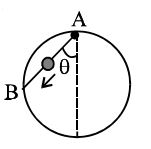
A
its velocity $v$ on arriving at $B$ is proportional to $\cos \theta$
B
time to arrive at $B$ is independent of $\theta$
C
time to arrive at $B$ is proportional to $\cos \theta$
D
Both $(A)$ and $(B)$
Solution
(D) Let $R$ be the radius of the circle. The length of the chord $AB$ is given by $AB = 2R \cos \theta$.
The acceleration of the bead along the wire is $a = g \cos \theta$.
Using the equation of motion $v^2 = u^2 + 2as$,where $u = 0$ and $s = AB = 2R \cos \theta$:
$v^2 = 0 + 2(g \cos \theta)(2R \cos \theta) = 4Rg \cos^2 \theta$
$v = 2\sqrt{Rg} \cos \theta$. Thus,$v \propto \cos \theta$.
Using the equation $s = ut + \frac{1}{2}at^2$:
$2R \cos \theta = 0 + \frac{1}{2}(g \cos \theta)t^2$
$2R \cos \theta = \frac{1}{2}g \cos \theta t^2$
$t^2 = \frac{4R}{g} \Rightarrow t = 2\sqrt{\frac{R}{g}}$.
Since $t$ is independent of $\theta$,both statements $(A)$ and $(B)$ are correct.
The acceleration of the bead along the wire is $a = g \cos \theta$.
Using the equation of motion $v^2 = u^2 + 2as$,where $u = 0$ and $s = AB = 2R \cos \theta$:
$v^2 = 0 + 2(g \cos \theta)(2R \cos \theta) = 4Rg \cos^2 \theta$
$v = 2\sqrt{Rg} \cos \theta$. Thus,$v \propto \cos \theta$.
Using the equation $s = ut + \frac{1}{2}at^2$:
$2R \cos \theta = 0 + \frac{1}{2}(g \cos \theta)t^2$
$2R \cos \theta = \frac{1}{2}g \cos \theta t^2$
$t^2 = \frac{4R}{g} \Rightarrow t = 2\sqrt{\frac{R}{g}}$.
Since $t$ is independent of $\theta$,both statements $(A)$ and $(B)$ are correct.
0 likes
View Solution110
MediumMCQ
$A$ ball of mass $m$ is thrown vertically upwards. Assume the force of air resistance has magnitude proportional to the velocity,and direction opposite to the velocity. At the highest point,the ball's acceleration is
A
$0$
B
less than $g$
C
$g$
D
greater than $g$
Solution
(C) Let the mass of the ball be $m$. The forces acting on the ball are the gravitational force ($mg$ acting downwards) and the air resistance force ($F_r = -kv$,where $k$ is a constant and $v$ is the velocity).
At any point,the net force is $F_{net} = -mg - kv$ (taking upward as positive).
The acceleration is $a = F_{net}/m = -g - (k/m)v$.
At the highest point,the velocity $v$ of the ball is $0$.
Substituting $v = 0$ into the acceleration equation: $a = -g - (k/m)(0) = -g$.
The magnitude of the acceleration is $|a| = g$.
At any point,the net force is $F_{net} = -mg - kv$ (taking upward as positive).
The acceleration is $a = F_{net}/m = -g - (k/m)v$.
At the highest point,the velocity $v$ of the ball is $0$.
Substituting $v = 0$ into the acceleration equation: $a = -g - (k/m)(0) = -g$.
The magnitude of the acceleration is $|a| = g$.
0 likes
View Solution111
AdvancedMCQ
Which graph best shows the velocity-time graph for an object launched vertically into the air when air resistance is given by $|D| = bv$? The dashed line shows the velocity graph if there were no air resistance.
A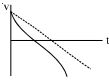
B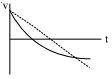
C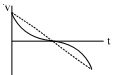
D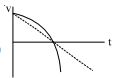
Solution
(B) When an object is launched vertically upward with air resistance $|D| = bv$,the equation of motion is $m(dv/dt) = -mg - bv$.
During the upward motion,both gravity and air resistance act downward,so the net force is $F = -(mg + bv)$. This causes a larger deceleration compared to the case without air resistance,meaning the velocity decreases more rapidly.
During the downward motion,gravity acts downward and air resistance acts upward,so the net force is $F = -mg + bv$. As the object falls,its speed increases,and the upward air resistance increases,which reduces the net downward acceleration.
Therefore,the velocity-time graph will show a steeper slope during the upward phase and a flattening slope during the downward phase as it approaches terminal velocity. Graph $B$ correctly depicts these characteristics.
During the upward motion,both gravity and air resistance act downward,so the net force is $F = -(mg + bv)$. This causes a larger deceleration compared to the case without air resistance,meaning the velocity decreases more rapidly.
During the downward motion,gravity acts downward and air resistance acts upward,so the net force is $F = -mg + bv$. As the object falls,its speed increases,and the upward air resistance increases,which reduces the net downward acceleration.
Therefore,the velocity-time graph will show a steeper slope during the upward phase and a flattening slope during the downward phase as it approaches terminal velocity. Graph $B$ correctly depicts these characteristics.
0 likes
View Solution112
MediumMCQ
Consider a rubber ball freely falling from a height $h = 4.9 \ m$ onto a horizontal elastic plate. Assume that the duration of collision is negligible and the collision with the plate is totally elastic. Then the velocity as a function of time and the height as a function of time will be represented by which of the following graphs?
A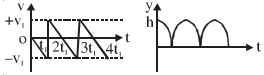
B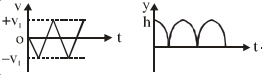
C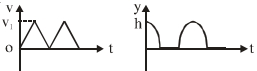
D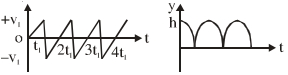
Solution
(B) For downward motion,the velocity is given by $v = -gt$. The velocity increases in the downward direction,resulting in a straight line between $v$ and $t$ with a negative slope.
Applying the equation of motion $y - y_0 = ut + \frac{1}{2}at^2$,we get $y - h = -\frac{1}{2}gt^2$,which simplifies to $y = h - \frac{1}{2}gt^2$. This represents a downward-opening parabola starting at $y = h$ at $t = 0$.
For upward motion after the elastic collision,the velocity direction is reversed,and its magnitude remains the same. The velocity follows $v = u - gt$,where $u$ is the velocity just after the collision. As $t$ increases,$v$ decreases linearly with a negative slope.
The height $y$ as a function of time for the upward motion follows $y = ut - \frac{1}{2}gt^2$,which is an upward-opening parabola segment. Combining these,the velocity-time graph shows a sawtooth pattern with negative slopes,and the height-time graph shows a series of parabolic arcs. Graph $B$ correctly represents these physical behaviors.
Applying the equation of motion $y - y_0 = ut + \frac{1}{2}at^2$,we get $y - h = -\frac{1}{2}gt^2$,which simplifies to $y = h - \frac{1}{2}gt^2$. This represents a downward-opening parabola starting at $y = h$ at $t = 0$.
For upward motion after the elastic collision,the velocity direction is reversed,and its magnitude remains the same. The velocity follows $v = u - gt$,where $u$ is the velocity just after the collision. As $t$ increases,$v$ decreases linearly with a negative slope.
The height $y$ as a function of time for the upward motion follows $y = ut - \frac{1}{2}gt^2$,which is an upward-opening parabola segment. Combining these,the velocity-time graph shows a sawtooth pattern with negative slopes,and the height-time graph shows a series of parabolic arcs. Graph $B$ correctly represents these physical behaviors.
0 likes
View Solution113
DifficultMCQ
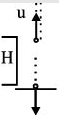
From a tower of height $H$, a particle is thrown vertically upwards with a speed $u$. The time taken by the particle to hit the ground is $n$ times that taken by it to reach the highest point of its path. The relation between $H, u$ and $n$ is:
A
$gH=(n-2)^2u^2$
B
$2gH=nu^2(n-2)$
C
$gH=(n-2)u^2$
D
$2gH=n^2u^2$
Solution
(B) Let $t_1$ be the time taken to reach the highest point. At the highest point, the final velocity is $0$. Using $v = u + at$, we get $0 = u - gt_1$, so $t_1 = \frac{u}{g}$.
Let $T$ be the total time taken to hit the ground. Using the equation of motion $s = ut + \frac{1}{2}at^2$ with displacement $s = -H$, initial velocity $u$, and acceleration $a = -g$, we have:
$-H = uT - \frac{1}{2}gT^2$
$\frac{1}{2}gT^2 - uT - H = 0$
Given $T = nt_1 = n(\frac{u}{g}) = \frac{nu}{g}$.
Substituting $T$ into the equation:
$\frac{1}{2}g(\frac{nu}{g})^2 - u(\frac{nu}{g}) - H = 0$
$\frac{n^2u^2}{2g} - \frac{nu^2}{g} - H = 0$
Multiply by $2g$:
$n^2u^2 - 2nu^2 - 2gH = 0$
$n^2u^2 - 2nu^2 = 2gH$
$nu^2(n - 2) = 2gH$.
Let $T$ be the total time taken to hit the ground. Using the equation of motion $s = ut + \frac{1}{2}at^2$ with displacement $s = -H$, initial velocity $u$, and acceleration $a = -g$, we have:
$-H = uT - \frac{1}{2}gT^2$
$\frac{1}{2}gT^2 - uT - H = 0$
Given $T = nt_1 = n(\frac{u}{g}) = \frac{nu}{g}$.
Substituting $T$ into the equation:
$\frac{1}{2}g(\frac{nu}{g})^2 - u(\frac{nu}{g}) - H = 0$
$\frac{n^2u^2}{2g} - \frac{nu^2}{g} - H = 0$
Multiply by $2g$:
$n^2u^2 - 2nu^2 - 2gH = 0$
$n^2u^2 - 2nu^2 = 2gH$
$nu^2(n - 2) = 2gH$.
0 likes
View Solution114
MediumMCQ
$A$ ball of mass $m_1$ and another ball of mass $m_2$ are dropped from equal height. If the time taken by the balls are $t_1$ and $t_2$ respectively,then:
A
$t_1 = \frac{t_2}{2}$
B
$t_1 = t_2$
C
$t_1 = 4t_2$
D
$t_1 = \frac{t_2}{4}$
Solution
(B) The time taken by any body of mass $m$ to reach the ground when dropped from a height $h$ is given by the equation of motion $h = ut + \frac{1}{2}gt^2$. Since the initial velocity $u = 0$,we have $h = \frac{1}{2}gt^2$.
Solving for $t$,we get $t = \sqrt{\frac{2h}{g}}$.
Since the time $t$ depends only on the height $h$ and the acceleration due to gravity $g$,it is independent of the mass of the object.
Therefore,for two balls dropped from the same height,the time taken will be equal,i.e.,$t_1 = t_2$.
Solving for $t$,we get $t = \sqrt{\frac{2h}{g}}$.
Since the time $t$ depends only on the height $h$ and the acceleration due to gravity $g$,it is independent of the mass of the object.
Therefore,for two balls dropped from the same height,the time taken will be equal,i.e.,$t_1 = t_2$.
0 likes
View Solution115
MediumMCQ
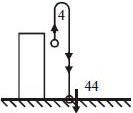
$A$ ball is thrown vertically upwards from the top of a tower with a velocity $u$. This ball reaches the ground level with a velocity $4u$. The height of the tower is:
A
$\frac{3u^2}{g}$
B
$\frac{4u^2}{g}$
C
$\frac{6u^2}{g}$
D
$\frac{15u^2}{2g}$
Solution
(D) Let the initial velocity be $v_i = u$ (upwards) and the final velocity at the ground be $v_f = -4u$ (downwards).
Using the third equation of motion,$v_f^2 = v_i^2 + 2as$,where $a = -g$ and $s = -h$ (displacement from the top of the tower to the ground).
$(-4u)^2 = u^2 + 2(-g)(-h)$
$16u^2 = u^2 + 2gh$
$15u^2 = 2gh$
$h = \frac{15u^2}{2g}$
Using the third equation of motion,$v_f^2 = v_i^2 + 2as$,where $a = -g$ and $s = -h$ (displacement from the top of the tower to the ground).
$(-4u)^2 = u^2 + 2(-g)(-h)$
$16u^2 = u^2 + 2gh$
$15u^2 = 2gh$
$h = \frac{15u^2}{2g}$
0 likes
View Solution116
DifficultMCQ
$A$ very large number of balls are thrown vertically upwards in quick succession in such a way that the next ball is thrown when the previous one is at the maximum height. If the maximum height is $5\, m$,the number of balls thrown per minute is (take $g = 10\, ms^{-2}$):-
A
$120$
B
$80$
C
$60$
D
$40$
Solution
(C) The time taken for a ball to reach the maximum height $h$ when thrown with initial velocity $u$ is given by $t = \frac{u}{g}$.
At maximum height,the final velocity is $0$. Using $v^2 = u^2 - 2gh$,we get $0 = u^2 - 2gh$,so $u = \sqrt{2gh}$.
Substituting $u$ into the time equation: $t = \frac{\sqrt{2gh}}{g} = \sqrt{\frac{2h}{g}}$.
Given $h = 5\, m$ and $g = 10\, ms^{-2}$,the time taken is $t = \sqrt{\frac{2 \times 5}{10}} = \sqrt{1} = 1\, s$.
Since the next ball is thrown when the previous one reaches its maximum height,one ball is thrown every $1\, s$.
Therefore,the number of balls thrown per minute $(60\, s)$ is $\frac{60\, s}{1\, s/\text{ball}} = 60\, \text{balls/minute}$.
At maximum height,the final velocity is $0$. Using $v^2 = u^2 - 2gh$,we get $0 = u^2 - 2gh$,so $u = \sqrt{2gh}$.
Substituting $u$ into the time equation: $t = \frac{\sqrt{2gh}}{g} = \sqrt{\frac{2h}{g}}$.
Given $h = 5\, m$ and $g = 10\, ms^{-2}$,the time taken is $t = \sqrt{\frac{2 \times 5}{10}} = \sqrt{1} = 1\, s$.
Since the next ball is thrown when the previous one reaches its maximum height,one ball is thrown every $1\, s$.
Therefore,the number of balls thrown per minute $(60\, s)$ is $\frac{60\, s}{1\, s/\text{ball}} = 60\, \text{balls/minute}$.
0 likes
View Solution117
DifficultMCQ
$A$ man in a balloon rising vertically with an acceleration of $4.9 \, m/s^2$ releases a ball $2 \, s$ after the balloon is let go from the ground. The greatest height above the ground reached by the ball is .......... $m$ :-
A
$14.7$
B
$19.6$
C
$9.8$
D
$24.5$
Solution
(A) The balloon starts from rest with acceleration $a = 4.9 \, m/s^2$. After $t = 2 \, s$,the velocity of the balloon (and the ball) is $v = u + at = 0 + 4.9 \times 2 = 9.8 \, m/s$.
The height of the balloon at $t = 2 \, s$ is $h = \frac{1}{2}at^2 = 0.5 \times 4.9 \times (2)^2 = 9.8 \, m$.
When the ball is released,it has an initial upward velocity of $9.8 \, m/s$ at a height of $9.8 \, m$. The additional height $s$ reached by the ball after release is given by $v^2 = u^2 - 2gs$,where the final velocity at the peak is $0$.
$0 = (9.8)^2 - 2 \times 9.8 \times s \implies s = \frac{9.8 \times 9.8}{2 \times 9.8} = 4.9 \, m$.
The greatest height above the ground is $H = h + s = 9.8 + 4.9 = 14.7 \, m$.
The height of the balloon at $t = 2 \, s$ is $h = \frac{1}{2}at^2 = 0.5 \times 4.9 \times (2)^2 = 9.8 \, m$.
When the ball is released,it has an initial upward velocity of $9.8 \, m/s$ at a height of $9.8 \, m$. The additional height $s$ reached by the ball after release is given by $v^2 = u^2 - 2gs$,where the final velocity at the peak is $0$.
$0 = (9.8)^2 - 2 \times 9.8 \times s \implies s = \frac{9.8 \times 9.8}{2 \times 9.8} = 4.9 \, m$.
The greatest height above the ground is $H = h + s = 9.8 + 4.9 = 14.7 \, m$.
0 likes
View Solution118
MediumMCQ
$A$ body is thrown vertically upward at $t = 0$. It is at a height $80 \ m$ at instants $t_1$ and $t_2$. Also,it is at a height $60 \ m$ at instants $t'_1$ and $t'_2$. Then:
A
$t_1 + t_2 = t'_1 + t'_2$
B
$t_1 + t_2 > t'_1 + t'_2$
C
$t_1 + t_2 < t'_1 + t'_2$
D
None of these
Solution
(A) The equation of motion for a body thrown vertically upward is given by $s = ut + \frac{1}{2}at^2$.
Substituting $s = h$ and $a = -g$,we get $h = ut - \frac{1}{2}gt^2$.
Rearranging this into a quadratic equation in $t$: $\frac{1}{2}gt^2 - ut + h = 0$,or $t^2 - \frac{2u}{g}t + \frac{2h}{g} = 0$.
For a given height $h$,the roots of this quadratic equation are the two time instants $t_1$ and $t_2$ at which the body is at that height.
According to the properties of quadratic equations,the sum of the roots is given by the coefficient of $t$ with a negative sign.
Therefore,$t_1 + t_2 = \frac{2u}{g}$.
Since this sum depends only on the initial velocity $u$ and acceleration due to gravity $g$,and not on the height $h$,the sum of the time instants for any height $h$ will be the same.
Thus,$t_1 + t_2 = t'_1 + t'_2$.
Substituting $s = h$ and $a = -g$,we get $h = ut - \frac{1}{2}gt^2$.
Rearranging this into a quadratic equation in $t$: $\frac{1}{2}gt^2 - ut + h = 0$,or $t^2 - \frac{2u}{g}t + \frac{2h}{g} = 0$.
For a given height $h$,the roots of this quadratic equation are the two time instants $t_1$ and $t_2$ at which the body is at that height.
According to the properties of quadratic equations,the sum of the roots is given by the coefficient of $t$ with a negative sign.
Therefore,$t_1 + t_2 = \frac{2u}{g}$.
Since this sum depends only on the initial velocity $u$ and acceleration due to gravity $g$,and not on the height $h$,the sum of the time instants for any height $h$ will be the same.
Thus,$t_1 + t_2 = t'_1 + t'_2$.
0 likes
View Solution119
DifficultMCQ
$A$ particle is released from rest from a tower of height $3h$. The ratio of times taken to fall through successive equal heights $h$,i.e.,$t_1 : t_2 : t_3$ is
A
$1 : \sqrt{2} : \sqrt{3}$
B
$3 : 2 : 1$
C
$9 : 4 : 1$
D
$1 : (\sqrt{2} - 1) : (\sqrt{3} - \sqrt{2})$
Solution
(D) Using the equation of motion $S = ut + \frac{1}{2}at^2$,where $u = 0$ and $a = g$,we get $S = \frac{1}{2}gt^2$,which implies $t = \sqrt{\frac{2S}{g}}$.
For the first height $h$,the time taken is $t_1 = \sqrt{\frac{2h}{g}}$.
For the first two heights (total distance $2h$),the time taken is $T_2 = \sqrt{\frac{2(2h)}{g}} = \sqrt{\frac{4h}{g}}$. Thus,the time taken for the second interval $h$ is $t_2 = T_2 - t_1 = \sqrt{\frac{4h}{g}} - \sqrt{\frac{2h}{g}} = \sqrt{\frac{2h}{g}}(\sqrt{2} - 1)$.
For the first three heights (total distance $3h$),the time taken is $T_3 = \sqrt{\frac{2(3h)}{g}} = \sqrt{\frac{6h}{g}}$. Thus,the time taken for the third interval $h$ is $t_3 = T_3 - T_2 = \sqrt{\frac{6h}{g}} - \sqrt{\frac{4h}{g}} = \sqrt{\frac{2h}{g}}(\sqrt{3} - \sqrt{2})$.
Taking the ratio $t_1 : t_2 : t_3$:
$t_1 : t_2 : t_3 = \sqrt{\frac{2h}{g}} : \sqrt{\frac{2h}{g}}(\sqrt{2} - 1) : \sqrt{\frac{2h}{g}}(\sqrt{3} - \sqrt{2})$
$t_1 : t_2 : t_3 = 1 : (\sqrt{2} - 1) : (\sqrt{3} - \sqrt{2})$.
For the first height $h$,the time taken is $t_1 = \sqrt{\frac{2h}{g}}$.
For the first two heights (total distance $2h$),the time taken is $T_2 = \sqrt{\frac{2(2h)}{g}} = \sqrt{\frac{4h}{g}}$. Thus,the time taken for the second interval $h$ is $t_2 = T_2 - t_1 = \sqrt{\frac{4h}{g}} - \sqrt{\frac{2h}{g}} = \sqrt{\frac{2h}{g}}(\sqrt{2} - 1)$.
For the first three heights (total distance $3h$),the time taken is $T_3 = \sqrt{\frac{2(3h)}{g}} = \sqrt{\frac{6h}{g}}$. Thus,the time taken for the third interval $h$ is $t_3 = T_3 - T_2 = \sqrt{\frac{6h}{g}} - \sqrt{\frac{4h}{g}} = \sqrt{\frac{2h}{g}}(\sqrt{3} - \sqrt{2})$.
Taking the ratio $t_1 : t_2 : t_3$:
$t_1 : t_2 : t_3 = \sqrt{\frac{2h}{g}} : \sqrt{\frac{2h}{g}}(\sqrt{2} - 1) : \sqrt{\frac{2h}{g}}(\sqrt{3} - \sqrt{2})$
$t_1 : t_2 : t_3 = 1 : (\sqrt{2} - 1) : (\sqrt{3} - \sqrt{2})$.
0 likes
View Solution120
DifficultMCQ
For a particle projected vertically upwards under gravity,it travels equal distance during the $5^{th}$ and $6^{th}$ second of its motion. Find its projection speed in $m/s$ $(g = 9.8\,m/s^2)$.
A
$50$
B
$30$
C
$49$
D
$29.4$
Solution
(C) The distance traveled in the $n^{th}$ second is given by $S_n = u + \frac{g}{2}(2n - 1)$.
Since the particle is moving upwards,the acceleration due to gravity is $-g$.
Thus,$S_n = u - \frac{g}{2}(2n - 1)$.
Given that the distance traveled in the $5^{th}$ second is equal to the distance traveled in the $6^{th}$ second,we have:
$u - \frac{g}{2}(2(5) - 1) = |u - \frac{g}{2}(2(6) - 1)|$.
Since the particle reaches its maximum height and starts coming down,the displacement in the $6^{th}$ second must be negative of the displacement in the $5^{th}$ second if the distances are equal.
Alternatively,the particle reaches the peak between $t=5$ and $t=6$. The peak occurs at $t = u/g$.
For the distances to be equal in the $5^{th}$ and $6^{th}$ seconds,the peak must occur at $t = 5.5$ seconds.
$5.5 = u / 9.8$
$u = 5.5 \times 9.8 = 53.9 \, m/s$.
Wait,re-evaluating: If the particle travels equal distance in $5^{th}$ and $6^{th}$ second,it means it crosses the peak. The distance in $n^{th}$ second is $S_n = u + a(n - 0.5)$.
For $n=5$,$d_5 = u - 4.5g$. For $n=6$,$d_6 = -(u - 5.5g)$.
$u - 4.5g = -u + 5.5g$
$2u = 10g$
$u = 5g = 5 \times 9.8 = 49 \, m/s$.
Since the particle is moving upwards,the acceleration due to gravity is $-g$.
Thus,$S_n = u - \frac{g}{2}(2n - 1)$.
Given that the distance traveled in the $5^{th}$ second is equal to the distance traveled in the $6^{th}$ second,we have:
$u - \frac{g}{2}(2(5) - 1) = |u - \frac{g}{2}(2(6) - 1)|$.
Since the particle reaches its maximum height and starts coming down,the displacement in the $6^{th}$ second must be negative of the displacement in the $5^{th}$ second if the distances are equal.
Alternatively,the particle reaches the peak between $t=5$ and $t=6$. The peak occurs at $t = u/g$.
For the distances to be equal in the $5^{th}$ and $6^{th}$ seconds,the peak must occur at $t = 5.5$ seconds.
$5.5 = u / 9.8$
$u = 5.5 \times 9.8 = 53.9 \, m/s$.
Wait,re-evaluating: If the particle travels equal distance in $5^{th}$ and $6^{th}$ second,it means it crosses the peak. The distance in $n^{th}$ second is $S_n = u + a(n - 0.5)$.
For $n=5$,$d_5 = u - 4.5g$. For $n=6$,$d_6 = -(u - 5.5g)$.
$u - 4.5g = -u + 5.5g$
$2u = 10g$
$u = 5g = 5 \times 9.8 = 49 \, m/s$.
0 likes
View Solution121
MediumMCQ
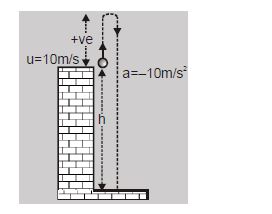
$A$ ball is thrown upwards from the top of a tower $40\,m$ high with a velocity of $10\,m/s$. Find the time when it strikes the ground (in seconds). Take $g = 10\,m/s^2$.
A
$8$
B
$1$
C
$4$
D
$6$
Solution
(C) Let the upward direction be positive. The initial position of the ball is $y_0 = 40\,m$ and the final position when it hits the ground is $y = 0\,m$. The displacement is $s = y - y_0 = 0 - 40 = -40\,m$.
The initial velocity is $u = +10\,m/s$ and the acceleration is $a = -g = -10\,m/s^2$.
Using the equation of motion $s = ut + \frac{1}{2}at^2$:
$-40 = 10t + \frac{1}{2}(-10)t^2$
$-40 = 10t - 5t^2$
Dividing by $-5$:
$8 = -2t + t^2$
$t^2 - 2t - 8 = 0$
Factoring the quadratic equation:
$(t - 4)(t + 2) = 0$
Since time cannot be negative,we take $t = 4\,s$.
The initial velocity is $u = +10\,m/s$ and the acceleration is $a = -g = -10\,m/s^2$.
Using the equation of motion $s = ut + \frac{1}{2}at^2$:
$-40 = 10t + \frac{1}{2}(-10)t^2$
$-40 = 10t - 5t^2$
Dividing by $-5$:
$8 = -2t + t^2$
$t^2 - 2t - 8 = 0$
Factoring the quadratic equation:
$(t - 4)(t + 2) = 0$
Since time cannot be negative,we take $t = 4\,s$.
0 likes
View Solution122
MediumMCQ
$A$ body falls from a large height. The ratio of distance traveled in each time interval $t_0$ during $t = 0$ to $t = 3\, t_0$ of the journey is
A
$1 : 4 : 9$
B
$1 : 2 : 4$
C
$1 : 3 : 5$
D
$1 : 2 : 3$
Solution
(C) For a body falling from rest,the distance traveled in time $t$ is given by $s = \frac{1}{2} g t^2$.
The distance traveled in the first interval ($t = 0$ to $t = t_0$) is $s_1 = \frac{1}{2} g t_0^2$.
The distance traveled in the first $2 t_0$ is $s_{0-2t_0} = \frac{1}{2} g (2 t_0)^2 = 4 \left( \frac{1}{2} g t_0^2 \right) = 4 s_1$.
Thus,the distance traveled in the second interval ($t = t_0$ to $t = 2 t_0$) is $s_2 = s_{0-2t_0} - s_1 = 4 s_1 - s_1 = 3 s_1$.
The distance traveled in the first $3 t_0$ is $s_{0-3t_0} = \frac{1}{2} g (3 t_0)^2 = 9 \left( \frac{1}{2} g t_0^2 \right) = 9 s_1$.
Thus,the distance traveled in the third interval ($t = 2 t_0$ to $t = 3 t_0$) is $s_3 = s_{0-3t_0} - s_{0-2t_0} = 9 s_1 - 4 s_1 = 5 s_1$.
The ratio of distances traveled in each interval is $s_1 : s_2 : s_3 = s_1 : 3 s_1 : 5 s_1 = 1 : 3 : 5$.
The distance traveled in the first interval ($t = 0$ to $t = t_0$) is $s_1 = \frac{1}{2} g t_0^2$.
The distance traveled in the first $2 t_0$ is $s_{0-2t_0} = \frac{1}{2} g (2 t_0)^2 = 4 \left( \frac{1}{2} g t_0^2 \right) = 4 s_1$.
Thus,the distance traveled in the second interval ($t = t_0$ to $t = 2 t_0$) is $s_2 = s_{0-2t_0} - s_1 = 4 s_1 - s_1 = 3 s_1$.
The distance traveled in the first $3 t_0$ is $s_{0-3t_0} = \frac{1}{2} g (3 t_0)^2 = 9 \left( \frac{1}{2} g t_0^2 \right) = 9 s_1$.
Thus,the distance traveled in the third interval ($t = 2 t_0$ to $t = 3 t_0$) is $s_3 = s_{0-3t_0} - s_{0-2t_0} = 9 s_1 - 4 s_1 = 5 s_1$.
The ratio of distances traveled in each interval is $s_1 : s_2 : s_3 = s_1 : 3 s_1 : 5 s_1 = 1 : 3 : 5$.
0 likes
View Solution123
MediumMCQ
What will be the ratio of the distance moved by a freely falling body from rest in $4^{th}$ and $5^{th}$ seconds of journey?
A
$7 : 9$
B
$4 : 5$
C
$16 : 25$
D
$1 : 1$
Solution
(A) The distance covered by an object in the $n^{th}$ second is given by the formula:
$s_{n} = u + \frac{a}{2}(2n - 1)$
Given that the body is falling freely from rest,the initial velocity $u = 0$ and the acceleration $a = g$.
For the $4^{th}$ second $(n = 4)$:
$s_{4} = 0 + \frac{g}{2}(2 \times 4 - 1) = \frac{g}{2}(7) = \frac{7g}{2}$
For the $5^{th}$ second $(n = 5)$:
$s_{5} = 0 + \frac{g}{2}(2 \times 5 - 1) = \frac{g}{2}(9) = \frac{9g}{2}$
The ratio of the distance moved in the $4^{th}$ and $5^{th}$ seconds is:
$\frac{s_{4}}{s_{5}} = \frac{7g/2}{9g/2} = \frac{7}{9}$
$s_{n} = u + \frac{a}{2}(2n - 1)$
Given that the body is falling freely from rest,the initial velocity $u = 0$ and the acceleration $a = g$.
For the $4^{th}$ second $(n = 4)$:
$s_{4} = 0 + \frac{g}{2}(2 \times 4 - 1) = \frac{g}{2}(7) = \frac{7g}{2}$
For the $5^{th}$ second $(n = 5)$:
$s_{5} = 0 + \frac{g}{2}(2 \times 5 - 1) = \frac{g}{2}(9) = \frac{9g}{2}$
The ratio of the distance moved in the $4^{th}$ and $5^{th}$ seconds is:
$\frac{s_{4}}{s_{5}} = \frac{7g/2}{9g/2} = \frac{7}{9}$
0 likes
View Solution124
DifficultMCQ
$A$ particle is projected vertically upwards from a point $A$ on the ground. It takes $t_1$ time to reach a point $B$ but it still continues to move up. If it takes $t_2$ time to reach the ground from point $B$,then the height of point $B$ from the ground is
A
$\frac{1}{2} g(t_1 + t_2)^2$
B
$gt_1t_2$
C
$\frac{1}{8} g(t_1 + t_2)^2$
D
$\frac{1}{2} gt_1t_2$
Solution
(D) Let the initial velocity at point $A$ be $u$ and the velocity at point $B$ be $v$. The time taken to reach $B$ from $A$ is $t_1$. Using the equation $v = u - gt_1$,we have $v = u - gt_1$.
After reaching the maximum height,the particle returns to $B$ and then to $A$. The time taken to return from $B$ to the ground (point $A$) is $t_2$. At point $B$,the velocity is $v$ (upwards). When it returns to $B$ on the way down,the velocity is $-v$ (downwards). The time taken to travel from $B$ to the ground is $t_2$. Using $v = u + at$,we have $-u = v - gt_2$,which implies $v = gt_2 - u$.
Equating the two expressions for $v$: $u - gt_1 = gt_2 - u$,which gives $2u = g(t_1 + t_2)$,or $u = \frac{1}{2}g(t_1 + t_2)$.
The height $h$ of point $B$ from the ground is given by $h = ut_1 - \frac{1}{2}gt_1^2$.
Substituting $u$: $h = \left[\frac{1}{2}g(t_1 + t_2)\right]t_1 - \frac{1}{2}gt_1^2 = \frac{1}{2}gt_1^2 + \frac{1}{2}gt_1t_2 - \frac{1}{2}gt_1^2 = \frac{1}{2}gt_1t_2$.
After reaching the maximum height,the particle returns to $B$ and then to $A$. The time taken to return from $B$ to the ground (point $A$) is $t_2$. At point $B$,the velocity is $v$ (upwards). When it returns to $B$ on the way down,the velocity is $-v$ (downwards). The time taken to travel from $B$ to the ground is $t_2$. Using $v = u + at$,we have $-u = v - gt_2$,which implies $v = gt_2 - u$.
Equating the two expressions for $v$: $u - gt_1 = gt_2 - u$,which gives $2u = g(t_1 + t_2)$,or $u = \frac{1}{2}g(t_1 + t_2)$.
The height $h$ of point $B$ from the ground is given by $h = ut_1 - \frac{1}{2}gt_1^2$.
Substituting $u$: $h = \left[\frac{1}{2}g(t_1 + t_2)\right]t_1 - \frac{1}{2}gt_1^2 = \frac{1}{2}gt_1^2 + \frac{1}{2}gt_1t_2 - \frac{1}{2}gt_1^2 = \frac{1}{2}gt_1t_2$.
0 likes
View Solution125
MediumMCQ
$A$ body is projected vertically up with a speed $v_0$ under gravity. The average speed of the body over a time $t = \frac{v_0}{g}$ calculated from the instant of projection is:
A
$v_0$
B
zero
C
$\frac{2v_0}{3}$
D
$\frac{v_0}{2}$
Solution
(D) The body is projected vertically upward with initial velocity $v_0$. The time taken to reach the maximum height is $t_{up} = \frac{v_0}{g}$.
The question asks for the average speed over the time interval $t = \frac{v_0}{g}$,which is exactly the time taken to reach the maximum height.
At the maximum height,the displacement $s$ is equal to the maximum height $H_{max} = \frac{v_0^2}{2g}$.
Since the body moves in a straight line in one direction during this time interval,the total distance covered is equal to the displacement.
Average speed = $\frac{\text{Total distance}}{\text{Total time}} = \frac{H_{max}}{t} = \frac{v_0^2 / 2g}{v_0 / g} = \frac{v_0}{2}$.
The question asks for the average speed over the time interval $t = \frac{v_0}{g}$,which is exactly the time taken to reach the maximum height.
At the maximum height,the displacement $s$ is equal to the maximum height $H_{max} = \frac{v_0^2}{2g}$.
Since the body moves in a straight line in one direction during this time interval,the total distance covered is equal to the displacement.
Average speed = $\frac{\text{Total distance}}{\text{Total time}} = \frac{H_{max}}{t} = \frac{v_0^2 / 2g}{v_0 / g} = \frac{v_0}{2}$.
0 likes
View Solution126
AdvancedMCQ
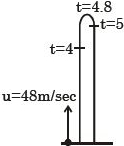
$A$ particle is projected from the ground in a vertically upward direction at $t = 0$,with an initial velocity of $48\, m/s$. The distance travelled by the particle in the $5^{th}$ second is......$m$ $(g = 10\, m/s^2)$.
A
$3$
B
$115$
C
$3.4$
D
$2.8$
Solution
(C) The initial velocity $u = 48\, m/s$ and acceleration $a = -g = -10\, m/s^2$.
The time taken to reach the maximum height is $t = u/g = 48/10 = 4.8\, s$.
The distance travelled in the $5^{th}$ second is the distance covered between $t = 4\, s$ and $t = 5\, s$.
At $t = 4\, s$,the position is $s_4 = ut + \frac{1}{2}at^2 = 48(4) - 5(4)^2 = 192 - 80 = 112\, m$.
At $t = 4.8\, s$ (maximum height),the position is $s_{4.8} = 48(4.8) - 5(4.8)^2 = 230.4 - 115.2 = 115.2\, m$.
At $t = 5\, s$,the position is $s_5 = 48(5) - 5(5)^2 = 240 - 125 = 115\, m$.
The distance travelled in the $5^{th}$ second is the sum of the distance from $t = 4\, s$ to $t = 4.8\, s$ and from $t = 4.8\, s$ to $t = 5\, s$.
Distance $= (s_{4.8} - s_4) + (s_{4.8} - s_5) = (115.2 - 112) + (115.2 - 115) = 3.2 + 0.2 = 3.4\, m$.
The time taken to reach the maximum height is $t = u/g = 48/10 = 4.8\, s$.
The distance travelled in the $5^{th}$ second is the distance covered between $t = 4\, s$ and $t = 5\, s$.
At $t = 4\, s$,the position is $s_4 = ut + \frac{1}{2}at^2 = 48(4) - 5(4)^2 = 192 - 80 = 112\, m$.
At $t = 4.8\, s$ (maximum height),the position is $s_{4.8} = 48(4.8) - 5(4.8)^2 = 230.4 - 115.2 = 115.2\, m$.
At $t = 5\, s$,the position is $s_5 = 48(5) - 5(5)^2 = 240 - 125 = 115\, m$.
The distance travelled in the $5^{th}$ second is the sum of the distance from $t = 4\, s$ to $t = 4.8\, s$ and from $t = 4.8\, s$ to $t = 5\, s$.
Distance $= (s_{4.8} - s_4) + (s_{4.8} - s_5) = (115.2 - 112) + (115.2 - 115) = 3.2 + 0.2 = 3.4\, m$.
0 likes
View Solution127
MediumMCQ
$A$ body dropped from the top of a tower falls through $40 \; m$ during the last two seconds of its fall. The height of the tower is ..... $m$.
A
$60$
B
$45$
C
$80$
D
$50$
Solution
(B) Let $h$ be the height of the tower and $t$ be the total time taken by the body to reach the ground.
Given initial velocity $u = 0$ and acceleration $a = g = 10 \; m/s^2$.
The total height is given by $h = \frac{1}{2} g t^2$.
The distance covered in the last two seconds is the difference between the total height and the height covered in $(t-2)$ seconds.
$40 = \frac{1}{2} g t^2 - \frac{1}{2} g (t-2)^2$.
Substituting $g = 10 \; m/s^2$:
$40 = 5 t^2 - 5 (t^2 - 4t + 4)$.
$40 = 5 t^2 - 5 t^2 + 20 t - 20$.
$40 = 20 t - 20$.
$60 = 20 t \implies t = 3 \; s$.
Now,calculate the height $h$:
$h = \frac{1}{2} \times 10 \times (3)^2 = 5 \times 9 = 45 \; m$.
Given initial velocity $u = 0$ and acceleration $a = g = 10 \; m/s^2$.
The total height is given by $h = \frac{1}{2} g t^2$.
The distance covered in the last two seconds is the difference between the total height and the height covered in $(t-2)$ seconds.
$40 = \frac{1}{2} g t^2 - \frac{1}{2} g (t-2)^2$.
Substituting $g = 10 \; m/s^2$:
$40 = 5 t^2 - 5 (t^2 - 4t + 4)$.
$40 = 5 t^2 - 5 t^2 + 20 t - 20$.
$40 = 20 t - 20$.
$60 = 20 t \implies t = 3 \; s$.
Now,calculate the height $h$:
$h = \frac{1}{2} \times 10 \times (3)^2 = 5 \times 9 = 45 \; m$.
0 likes
View Solution128
MediumMCQ
$A$ body falling freely under gravity passes two points $30 \ m$ apart in $1 \ s$. From what point above the upper point did it begin to fall? (Take $g = 10 \ m \ s^{-2}$)
A
$31.25$
B
$16$
C
$8.6$
D
$4$
Solution
(A) Let the body reach the upper point at time $t$ and the lower point at time $(t+1) \ s$.
Using the equation of motion $S = \frac{1}{2}gt^2$ for free fall starting from rest:
The distance covered in time $(t+1)$ is $S_2 = \frac{1}{2}g(t+1)^2$.
The distance covered in time $t$ is $S_1 = \frac{1}{2}gt^2$.
The distance between the two points is $S_2 - S_1 = 30 \ m$.
$30 = \frac{1}{2}g(t+1)^2 - \frac{1}{2}gt^2 = \frac{1}{2}g(2t+1)$.
Substituting $g = 10 \ m \ s^{-2}$:
$30 = 5(2t+1) \implies 6 = 2t + 1 \implies 2t = 5 \implies t = 2.5 \ s$.
The distance from the starting point to the upper point is $S_1 = \frac{1}{2}gt^2 = \frac{1}{2} \times 10 \times (2.5)^2 = 5 \times 6.25 = 31.25 \ m$.
Using the equation of motion $S = \frac{1}{2}gt^2$ for free fall starting from rest:
The distance covered in time $(t+1)$ is $S_2 = \frac{1}{2}g(t+1)^2$.
The distance covered in time $t$ is $S_1 = \frac{1}{2}gt^2$.
The distance between the two points is $S_2 - S_1 = 30 \ m$.
$30 = \frac{1}{2}g(t+1)^2 - \frac{1}{2}gt^2 = \frac{1}{2}g(2t+1)$.
Substituting $g = 10 \ m \ s^{-2}$:
$30 = 5(2t+1) \implies 6 = 2t + 1 \implies 2t = 5 \implies t = 2.5 \ s$.
The distance from the starting point to the upper point is $S_1 = \frac{1}{2}gt^2 = \frac{1}{2} \times 10 \times (2.5)^2 = 5 \times 6.25 = 31.25 \ m$.
0 likes
View Solution129
MediumMCQ
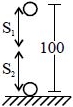
$A$ stone is allowed to fall from the top of a tower $100 \ m$ high and at the same time another stone is projected vertically upwards from the ground with a velocity of $25 \ m/s$. The two stones will meet after ......... $s$.
A
$4$
B
$0.4$
C
$0.04$
D
$40$
Solution
(A) Let the first stone fall from the top of the tower. The distance covered by it in time $t$ is $S_1 = \frac{1}{2} g t^2$.
Let the second stone be projected upwards from the ground. The distance covered by it in time $t$ is $S_2 = u t - \frac{1}{2} g t^2$,where $u = 25 \ m/s$.
Since the total height of the tower is $100 \ m$,when the stones meet,the sum of the distances covered by them must be equal to the height of the tower:
$S_1 + S_2 = 100$
Substituting the expressions for $S_1$ and $S_2$:
$\frac{1}{2} g t^2 + (u t - \frac{1}{2} g t^2) = 100$
$u t = 100$
$25 t = 100$
$t = \frac{100}{25} = 4 \ s$.
Thus,the two stones will meet after $4 \ s$.
Let the second stone be projected upwards from the ground. The distance covered by it in time $t$ is $S_2 = u t - \frac{1}{2} g t^2$,where $u = 25 \ m/s$.
Since the total height of the tower is $100 \ m$,when the stones meet,the sum of the distances covered by them must be equal to the height of the tower:
$S_1 + S_2 = 100$
Substituting the expressions for $S_1$ and $S_2$:
$\frac{1}{2} g t^2 + (u t - \frac{1}{2} g t^2) = 100$
$u t = 100$
$25 t = 100$
$t = \frac{100}{25} = 4 \ s$.
Thus,the two stones will meet after $4 \ s$.
0 likes
View Solution130
MediumMCQ
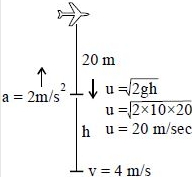
$A$ parachutist,after bailing out,falls $20\,m$ without friction. When the parachute opens,it decelerates at $2\,m/s^2$. He reaches the ground with a speed of $4\,m/s$. At what height did he bail out (in $,m$)?
A
$91$
B
$182$
C
$293$
D
$116$
Solution
(D) Step $1$: Calculate the velocity of the parachutist after falling $20\,m$ under gravity $(g = 10\,m/s^2)$.
Using $v^2 = u^2 + 2as$,where $u = 0$,$a = 10\,m/s^2$,and $s = 20\,m$:
$v^2 = 0 + 2 \times 10 \times 20 = 400$
$v = 20\,m/s$.
Step $2$: Consider the motion after the parachute opens.
The initial velocity for this phase is $u' = 20\,m/s$,the final velocity is $v' = 4\,m/s$,and the deceleration is $a' = -2\,m/s^2$.
Using $v'^2 = u'^2 + 2a'h$,where $h$ is the distance covered after the parachute opens:
$4^2 = 20^2 + 2(-2)h$
$16 = 400 - 4h$
$4h = 400 - 16 = 384$
$h = 96\,m$.
Step $3$: Calculate the total height $H$.
$H = 20\,m + 96\,m = 116\,m$.
Using $v^2 = u^2 + 2as$,where $u = 0$,$a = 10\,m/s^2$,and $s = 20\,m$:
$v^2 = 0 + 2 \times 10 \times 20 = 400$
$v = 20\,m/s$.
Step $2$: Consider the motion after the parachute opens.
The initial velocity for this phase is $u' = 20\,m/s$,the final velocity is $v' = 4\,m/s$,and the deceleration is $a' = -2\,m/s^2$.
Using $v'^2 = u'^2 + 2a'h$,where $h$ is the distance covered after the parachute opens:
$4^2 = 20^2 + 2(-2)h$
$16 = 400 - 4h$
$4h = 400 - 16 = 384$
$h = 96\,m$.
Step $3$: Calculate the total height $H$.
$H = 20\,m + 96\,m = 116\,m$.
0 likes
View Solution131
MediumMCQ
When a ball is thrown up vertically with velocity $u,$ it attains a maximum height $H.$ What should be the velocity so that maximum height becomes $2H$?
A
$\sqrt{2}u$
B
$2u$
C
$3u$
D
$\frac{u}{\sqrt{2}}$
Solution
(A) The formula for maximum height $H$ attained by a body thrown vertically upwards with initial velocity $u$ is given by $H = \frac{u^2}{2g}.$
From this relation,we can see that $H \propto u^2.$
Let the new velocity be $u'$ for which the maximum height is $H' = 2H.$
Using the proportionality,we have $\frac{H'}{H} = \frac{(u')^2}{u^2}.$
Substituting $H' = 2H,$ we get $\frac{2H}{H} = \frac{(u')^2}{u^2}.$
$2 = \frac{(u')^2}{u^2} \implies (u')^2 = 2u^2.$
Taking the square root on both sides,we get $u' = \sqrt{2}u.$
From this relation,we can see that $H \propto u^2.$
Let the new velocity be $u'$ for which the maximum height is $H' = 2H.$
Using the proportionality,we have $\frac{H'}{H} = \frac{(u')^2}{u^2}.$
Substituting $H' = 2H,$ we get $\frac{2H}{H} = \frac{(u')^2}{u^2}.$
$2 = \frac{(u')^2}{u^2} \implies (u')^2 = 2u^2.$
Taking the square root on both sides,we get $u' = \sqrt{2}u.$
0 likes
View Solution132
DifficultMCQ
From the top of a $64\, ft$ high tower,a stone is thrown upwards vertically with the velocity of $48\, ft/s$. The greatest height (in $ft$) attained by the stone,assuming the value of the gravitational acceleration $g = 32\, ft/s^2$,is
A
$128$
B
$88$
C
$112$
D
$100$
Solution
(D) Initial velocity $u = 48\, ft/s$.
Acceleration due to gravity $g = 32\, ft/s^2$ (acting downwards).
At the maximum height,the final velocity $v = 0$.
Using the kinematic equation $v^2 = u^2 - 2gh$,where $h$ is the height reached above the point of projection:
$0^2 = (48)^2 - 2(32)h$
$0 = 2304 - 64h$
$64h = 2304$
$h = \frac{2304}{64} = 36\, ft$.
The total height from the ground is the sum of the tower height and the height reached above the tower:
$H_{max} = 64\, ft + 36\, ft = 100\, ft$.
Acceleration due to gravity $g = 32\, ft/s^2$ (acting downwards).
At the maximum height,the final velocity $v = 0$.
Using the kinematic equation $v^2 = u^2 - 2gh$,where $h$ is the height reached above the point of projection:
$0^2 = (48)^2 - 2(32)h$
$0 = 2304 - 64h$
$64h = 2304$
$h = \frac{2304}{64} = 36\, ft$.
The total height from the ground is the sum of the tower height and the height reached above the tower:
$H_{max} = 64\, ft + 36\, ft = 100\, ft$.
0 likes
View Solution133
DifficultMCQ
$A$ ball is thrown vertically up (taken as $+z-$ axis) from the ground. The correct momentum-height $(p-h)$ diagram is
A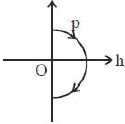
B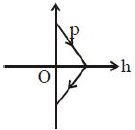
C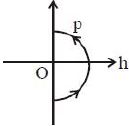
D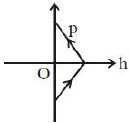
Solution
(A) The momentum of the ball is given by $p = mv$,where $m$ is the mass and $v$ is the velocity.
For motion under gravity,the relationship between velocity $v$ and height $h$ is given by $v^2 = u^2 - 2gh$,where $u$ is the initial velocity.
Substituting $v = p/m$ into the equation,we get $(p/m)^2 = u^2 - 2gh$.
Rearranging this,we get $p^2 = m^2u^2 - 2gm^2h$,which can be written as $p^2 = -2gm^2h + m^2u^2$.
This is the equation of a parabola of the form $p^2 = -Ah + B$,where $A = 2gm^2$ and $B = m^2u^2$.
As the ball moves up,$p$ decreases from $mu$ to $0$ as $h$ increases from $0$ to $H_{max}$. As it falls back down,$p$ becomes negative and increases in magnitude from $0$ to $-mu$ as $h$ decreases from $H_{max}$ to $0$.
The correct graph is a parabola opening towards the negative $h$-axis,starting at $p = mu$ (positive),passing through $p=0$ at $h=H_{max}$,and ending at $p = -mu$ (negative) at $h=0$.
For motion under gravity,the relationship between velocity $v$ and height $h$ is given by $v^2 = u^2 - 2gh$,where $u$ is the initial velocity.
Substituting $v = p/m$ into the equation,we get $(p/m)^2 = u^2 - 2gh$.
Rearranging this,we get $p^2 = m^2u^2 - 2gm^2h$,which can be written as $p^2 = -2gm^2h + m^2u^2$.
This is the equation of a parabola of the form $p^2 = -Ah + B$,where $A = 2gm^2$ and $B = m^2u^2$.
As the ball moves up,$p$ decreases from $mu$ to $0$ as $h$ increases from $0$ to $H_{max}$. As it falls back down,$p$ becomes negative and increases in magnitude from $0$ to $-mu$ as $h$ decreases from $H_{max}$ to $0$.
The correct graph is a parabola opening towards the negative $h$-axis,starting at $p = mu$ (positive),passing through $p=0$ at $h=H_{max}$,and ending at $p = -mu$ (negative) at $h=0$.

0 likes
View Solution134
DifficultMCQ
$A$ ball is thrown upward with an initial velocity $V_0$ from the surface of the earth. The motion of the ball is affected by a drag force equal to $m\gamma v^2$ (where $m$ is the mass of the ball,$v$ is its instantaneous velocity,and $\gamma$ is a constant). The time taken by the ball to rise to its zenith is:
A
$\frac{1}{\sqrt{\gamma g}} \ln \left( 1 + \sqrt{\frac{\gamma}{g}} V_0 \right)$
B
$\frac{1}{\sqrt{\gamma g}} \tan^{-1} \left( \sqrt{\frac{\gamma}{g}} V_0 \right)$
C
$\frac{1}{\sqrt{\gamma g}} \sin^{-1} \left( \sqrt{\frac{\gamma}{g}} V_0 \right)$
D
$\frac{1}{\sqrt{2\gamma g}} \tan^{-1} \left( \sqrt{\frac{2\gamma}{g}} V_0 \right)$
Solution
(B) When the ball is moving upward,both gravity and the drag force act downwards. The equation of motion is: $m \frac{dv}{dt} = -mg - m\gamma v^2$.
Dividing by $m$,we get: $\frac{dv}{dt} = -(g + \gamma v^2)$.
Rearranging for integration: $dt = -\frac{dv}{g + \gamma v^2} = -\frac{1}{\gamma} \frac{dv}{(g/\gamma) + v^2}$.
Integrating from $t=0$ to $T$ and $v=V_0$ to $0$: $\int_0^T dt = -\frac{1}{\gamma} \int_{V_0}^0 \frac{dv}{(g/\gamma) + v^2}$.
Let $a^2 = g/\gamma$,then $\int \frac{dv}{a^2 + v^2} = \frac{1}{a} \tan^{-1}(\frac{v}{a})$.
$T = \frac{1}{\gamma} \int_0^{V_0} \frac{dv}{(g/\gamma) + v^2} = \frac{1}{\gamma} [\frac{1}{\sqrt{g/\gamma}} \tan^{-1}(\frac{v}{\sqrt{g/\gamma}})]_0^{V_0}$.
$T = \frac{1}{\gamma} \sqrt{\frac{\gamma}{g}} \tan^{-1} (V_0 \sqrt{\frac{\gamma}{g}}) = \frac{1}{\sqrt{\gamma g}} \tan^{-1} (V_0 \sqrt{\frac{\gamma}{g}})$.
Dividing by $m$,we get: $\frac{dv}{dt} = -(g + \gamma v^2)$.
Rearranging for integration: $dt = -\frac{dv}{g + \gamma v^2} = -\frac{1}{\gamma} \frac{dv}{(g/\gamma) + v^2}$.
Integrating from $t=0$ to $T$ and $v=V_0$ to $0$: $\int_0^T dt = -\frac{1}{\gamma} \int_{V_0}^0 \frac{dv}{(g/\gamma) + v^2}$.
Let $a^2 = g/\gamma$,then $\int \frac{dv}{a^2 + v^2} = \frac{1}{a} \tan^{-1}(\frac{v}{a})$.
$T = \frac{1}{\gamma} \int_0^{V_0} \frac{dv}{(g/\gamma) + v^2} = \frac{1}{\gamma} [\frac{1}{\sqrt{g/\gamma}} \tan^{-1}(\frac{v}{\sqrt{g/\gamma}})]_0^{V_0}$.
$T = \frac{1}{\gamma} \sqrt{\frac{\gamma}{g}} \tan^{-1} (V_0 \sqrt{\frac{\gamma}{g}}) = \frac{1}{\sqrt{\gamma g}} \tan^{-1} (V_0 \sqrt{\frac{\gamma}{g}})$.
0 likes
View Solution135
MediumMCQ
$A$ body falling from rest has a velocity $v$ after it falls through a height $h$. The distance it has to fall down further for its velocity to become double,will be $...............\,h$.
A
$8$
B
$6$
C
$3$
D
$5$
Solution
(C) Let the initial velocity be $u = 0$. After falling through a height $h$,the velocity is $v$. Using the equation of motion $v^2 = u^2 + 2gh$,we get $v^2 = 2gh$.
Let the body fall an additional distance $x$ so that its velocity becomes $2v$.
Using the same equation for the total distance $(h + x)$,we have $(2v)^2 = 0 + 2g(h + x)$.
This simplifies to $4v^2 = 2g(h + x)$.
Substituting $v^2 = 2gh$ into the equation,we get $4(2gh) = 2g(h + x)$.
$8gh = 2gh + 2gx$.
$6gh = 2gx$,which gives $x = 3h$.
Therefore,the additional distance is $3h$.
Let the body fall an additional distance $x$ so that its velocity becomes $2v$.
Using the same equation for the total distance $(h + x)$,we have $(2v)^2 = 0 + 2g(h + x)$.
This simplifies to $4v^2 = 2g(h + x)$.
Substituting $v^2 = 2gh$ into the equation,we get $4(2gh) = 2g(h + x)$.
$8gh = 2gh + 2gx$.
$6gh = 2gx$,which gives $x = 3h$.
Therefore,the additional distance is $3h$.
0 likes
View Solution136
MediumMCQ
$A$ body dropped from the top of a tower covers a distance $7x$ in the last second of its journey,where $x$ is the distance covered in the first second. How much time does it take to reach the ground?
A
$3$
B
$4$
C
$5$
D
$6$
Solution
(B) Let the total time taken to reach the ground be $t$ seconds. The initial velocity $u = 0$ and acceleration $a = g = 10 \, m/s^2$.
The distance covered in the first second $(t=1)$ is given by:
$x = u(1) + \frac{1}{2}g(1)^2 = 0 + \frac{1}{2} \times 10 \times 1 = 5 \, m$.
The distance covered in the last second is given as $7x$. Therefore,the distance in the last second is $7 \times 5 = 35 \, m$.
The formula for the distance covered in the $n^{th}$ second is $S_n = u + \frac{a}{2}(2n - 1)$.
Substituting the values:
$35 = 0 + \frac{10}{2}(2t - 1)$
$35 = 5(2t - 1)$
$7 = 2t - 1$
$2t = 8$
$t = 4 \, s$.
Thus,the body takes $4 \, s$ to reach the ground.
The distance covered in the first second $(t=1)$ is given by:
$x = u(1) + \frac{1}{2}g(1)^2 = 0 + \frac{1}{2} \times 10 \times 1 = 5 \, m$.
The distance covered in the last second is given as $7x$. Therefore,the distance in the last second is $7 \times 5 = 35 \, m$.
The formula for the distance covered in the $n^{th}$ second is $S_n = u + \frac{a}{2}(2n - 1)$.
Substituting the values:
$35 = 0 + \frac{10}{2}(2t - 1)$
$35 = 5(2t - 1)$
$7 = 2t - 1$
$2t = 8$
$t = 4 \, s$.
Thus,the body takes $4 \, s$ to reach the ground.
0 likes
View Solution137
MediumMCQ
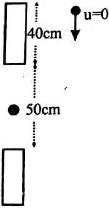
$A$ window is $50\,cm$ long. $A$ stone is falling from a height of $40\,cm$ above the window. It crosses the window in
A
$\frac{3}{7}\,s$
B
$\frac{2}{7}\,s$
C
$\frac{1}{7}\,s$
D
$\frac{4}{7}\,s$
Solution
(C) Let the top of the window be at distance $h_1 = 40\,cm$ from the starting point of the stone.
Let the bottom of the window be at distance $h_2 = 40\,cm + 50\,cm = 90\,cm$ from the starting point.
The time taken to reach the top of the window is $t_1 = \sqrt{\frac{2h_1}{g}} = \sqrt{\frac{2 \times 40}{980}} = \sqrt{\frac{80}{980}} = \sqrt{\frac{4}{49}} = \frac{2}{7}\,s$.
The time taken to reach the bottom of the window is $t_2 = \sqrt{\frac{2h_2}{g}} = \sqrt{\frac{2 \times 90}{980}} = \sqrt{\frac{180}{980}} = \sqrt{\frac{9}{49}} = \frac{3}{7}\,s$.
The time taken to cross the window is $\Delta t = t_2 - t_1 = \frac{3}{7} - \frac{2}{7} = \frac{1}{7}\,s$.
Let the bottom of the window be at distance $h_2 = 40\,cm + 50\,cm = 90\,cm$ from the starting point.
The time taken to reach the top of the window is $t_1 = \sqrt{\frac{2h_1}{g}} = \sqrt{\frac{2 \times 40}{980}} = \sqrt{\frac{80}{980}} = \sqrt{\frac{4}{49}} = \frac{2}{7}\,s$.
The time taken to reach the bottom of the window is $t_2 = \sqrt{\frac{2h_2}{g}} = \sqrt{\frac{2 \times 90}{980}} = \sqrt{\frac{180}{980}} = \sqrt{\frac{9}{49}} = \frac{3}{7}\,s$.
The time taken to cross the window is $\Delta t = t_2 - t_1 = \frac{3}{7} - \frac{2}{7} = \frac{1}{7}\,s$.
0 likes
View Solution138
MediumMCQ
$A$ body is projected vertically upwards with a velocity of $10\,m/s.$ It reaches the maximum vertical height $h$ in time $t.$ In $\frac{t}{2}$,the height covered is
A
$\frac{h}{2}$
B
$\frac{2h}{5}$
C
$\frac{3h}{4}$
D
$\frac{5h}{8}$
Solution
(C) At maximum height $h$,the final velocity is $0$. Using $v = u - gt$,we get $0 = u - gt$,so $u = gt$. The time to reach maximum height is $t = \frac{u}{g}$.
The maximum height $h$ is given by $h = \frac{u^2}{2g} = \frac{(gt)^2}{2g} = \frac{1}{2}gt^2$.
Now,we calculate the height $h'$ covered in time $t' = \frac{t}{2}$ using the equation of motion $s = ut - \frac{1}{2}gt^2$:
$h' = u(\frac{t}{2}) - \frac{1}{2}g(\frac{t}{2})^2$
Substitute $u = gt$:
$h' = (gt)(\frac{t}{2}) - \frac{1}{2}g(\frac{t^2}{4})$
$h' = \frac{gt^2}{2} - \frac{gt^2}{8}$
$h' = \frac{4gt^2 - gt^2}{8} = \frac{3gt^2}{8}$
Since $h = \frac{1}{2}gt^2$,then $gt^2 = 2h$.
Substituting this into the expression for $h'$:
$h' = \frac{3(2h)}{8} = \frac{3h}{4}$.
The maximum height $h$ is given by $h = \frac{u^2}{2g} = \frac{(gt)^2}{2g} = \frac{1}{2}gt^2$.
Now,we calculate the height $h'$ covered in time $t' = \frac{t}{2}$ using the equation of motion $s = ut - \frac{1}{2}gt^2$:
$h' = u(\frac{t}{2}) - \frac{1}{2}g(\frac{t}{2})^2$
Substitute $u = gt$:
$h' = (gt)(\frac{t}{2}) - \frac{1}{2}g(\frac{t^2}{4})$
$h' = \frac{gt^2}{2} - \frac{gt^2}{8}$
$h' = \frac{4gt^2 - gt^2}{8} = \frac{3gt^2}{8}$
Since $h = \frac{1}{2}gt^2$,then $gt^2 = 2h$.
Substituting this into the expression for $h'$:
$h' = \frac{3(2h)}{8} = \frac{3h}{4}$.
0 likes
View Solution139
EasyMCQ
$A$ food packet is dropped from a helicopter rising up with a velocity of $4 \, ms^{-1}$. The velocity of the packet after $3 \, s$ will be ....... $ms^{-1}$. (in $.4$)
A
$20$
B
$25$
C
$28$
D
$30$
Solution
(B) The initial velocity of the food packet is the same as the velocity of the helicopter at the moment it is dropped,which is $u = +4 \, ms^{-1}$ (taking upward as positive).
The acceleration of the packet after being dropped is due to gravity,so $a = -g = -9.8 \, ms^{-2}$.
Using the first equation of motion,$v = u + at$:
$v = 4 + (-9.8 \times 3)$
$v = 4 - 29.4$
$v = -25.4 \, ms^{-1}$.
The negative sign indicates that the velocity is directed downwards. The magnitude of the velocity is $25.4 \, ms^{-1}$.
The acceleration of the packet after being dropped is due to gravity,so $a = -g = -9.8 \, ms^{-2}$.
Using the first equation of motion,$v = u + at$:
$v = 4 + (-9.8 \times 3)$
$v = 4 - 29.4$
$v = -25.4 \, ms^{-1}$.
The negative sign indicates that the velocity is directed downwards. The magnitude of the velocity is $25.4 \, ms^{-1}$.
0 likes
View Solution140
MediumMCQ
$A$ stone is allowed to fall freely from rest. The ratio of the times taken to fall through the first metre and the second metre distance is
A
$\sqrt{2}-1$
B
$\sqrt{2}+1$
C
$\sqrt{2}$
D
None of the above
Solution
(B) Let $t_1$ be the time taken to fall the first $1 \ m$ and $t$ be the time taken to fall the first $2 \ m$.
Using the equation of motion $s = ut + \frac{1}{2}at^2$,where $u = 0$ and $a = g$:
For the first $1 \ m$: $1 = \frac{1}{2} g t_1^2 \implies t_1 = \sqrt{\frac{2}{g}}$.
For the first $2 \ m$: $2 = \frac{1}{2} g t^2 \implies t = \sqrt{\frac{4}{g}}$.
The time taken to fall through the second metre is $t_2 = t - t_1 = \sqrt{\frac{4}{g}} - \sqrt{\frac{2}{g}}$.
The ratio of the time taken for the first metre to the second metre is $\frac{t_1}{t_2} = \frac{\sqrt{2/g}}{\sqrt{4/g} - \sqrt{2/g}}$.
Simplifying this: $\frac{t_1}{t_2} = \frac{\sqrt{2}}{\sqrt{4} - \sqrt{2}} = \frac{\sqrt{2}}{2 - \sqrt{2}}$.
Rationalizing the denominator: $\frac{\sqrt{2}(2 + \sqrt{2})}{(2 - \sqrt{2})(2 + \sqrt{2})} = \frac{2\sqrt{2} + 2}{4 - 2} = \frac{2(\sqrt{2} + 1)}{2} = \sqrt{2} + 1$.
Using the equation of motion $s = ut + \frac{1}{2}at^2$,where $u = 0$ and $a = g$:
For the first $1 \ m$: $1 = \frac{1}{2} g t_1^2 \implies t_1 = \sqrt{\frac{2}{g}}$.
For the first $2 \ m$: $2 = \frac{1}{2} g t^2 \implies t = \sqrt{\frac{4}{g}}$.
The time taken to fall through the second metre is $t_2 = t - t_1 = \sqrt{\frac{4}{g}} - \sqrt{\frac{2}{g}}$.
The ratio of the time taken for the first metre to the second metre is $\frac{t_1}{t_2} = \frac{\sqrt{2/g}}{\sqrt{4/g} - \sqrt{2/g}}$.
Simplifying this: $\frac{t_1}{t_2} = \frac{\sqrt{2}}{\sqrt{4} - \sqrt{2}} = \frac{\sqrt{2}}{2 - \sqrt{2}}$.
Rationalizing the denominator: $\frac{\sqrt{2}(2 + \sqrt{2})}{(2 - \sqrt{2})(2 + \sqrt{2})} = \frac{2\sqrt{2} + 2}{4 - 2} = \frac{2(\sqrt{2} + 1)}{2} = \sqrt{2} + 1$.
0 likes
View Solution141
EasyMCQ
$A$ ball is thrown upwards. It takes $4 \, s$ to reach back to the ground. Its initial velocity is........$m/s$.
A
$30$
B
$10$
C
$40$
D
$20$
Solution
(D) The total time of flight $T$ is $4 \, s$. Since the motion is symmetric,the time taken to reach the maximum height is $t = \frac{T}{2} = \frac{4}{2} = 2 \, s$.
At the maximum height,the final velocity $v = 0 \, m/s$.
Using the first equation of motion: $v = u - gt$,where $g = 10 \, m/s^2$.
$0 = u - (10 \times 2)$
$u = 20 \, m/s$.
Alternatively,using the time of flight formula: $T = \frac{2u}{g} \Rightarrow u = \frac{gT}{2} = \frac{10 \times 4}{2} = 20 \, m/s$.
At the maximum height,the final velocity $v = 0 \, m/s$.
Using the first equation of motion: $v = u - gt$,where $g = 10 \, m/s^2$.
$0 = u - (10 \times 2)$
$u = 20 \, m/s$.
Alternatively,using the time of flight formula: $T = \frac{2u}{g} \Rightarrow u = \frac{gT}{2} = \frac{10 \times 4}{2} = 20 \, m/s$.
0 likes
View Solution142
DifficultMCQ
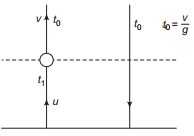
$A$ body is projected vertically upwards with a velocity $u$. It passes through a certain point above the ground after $t_1$ seconds. The time interval after which the body passes through the same point during the return journey is
A
$\left(\frac{u}{g}-t_1^2\right)$
B
$2\left(\frac{u}{g}-t_1\right)$
C
$\left(\frac{u}{g}-t_1\right)$
D
$\left(\frac{u^2}{g^2}-t_1\right)$
Solution
(B) Let the height of the point be $h$. Using the equation of motion $h = ut - \frac{1}{2}gt^2$,we have $h = ut_1 - \frac{1}{2}gt_1^2$.
Let $t_2$ be the total time taken to reach the same point during the return journey. Then $h = ut_2 - \frac{1}{2}gt_2^2$.
Equating the two expressions for $h$: $ut_1 - \frac{1}{2}gt_1^2 = ut_2 - \frac{1}{2}gt_2^2$.
Rearranging the terms: $u(t_1 - t_2) = \frac{1}{2}g(t_1^2 - t_2^2) = \frac{1}{2}g(t_1 - t_2)(t_1 + t_2)$.
Since $t_1 \neq t_2$,we can divide by $(t_1 - t_2)$ to get $u = \frac{1}{2}g(t_1 + t_2)$,which implies $t_1 + t_2 = \frac{2u}{g}$.
The time interval between the two passages is $\Delta t = t_2 - t_1$.
From $t_2 = \frac{2u}{g} - t_1$,we get $\Delta t = \left(\frac{2u}{g} - t_1\right) - t_1 = \frac{2u}{g} - 2t_1 = 2\left(\frac{u}{g} - t_1\right)$.
Let $t_2$ be the total time taken to reach the same point during the return journey. Then $h = ut_2 - \frac{1}{2}gt_2^2$.
Equating the two expressions for $h$: $ut_1 - \frac{1}{2}gt_1^2 = ut_2 - \frac{1}{2}gt_2^2$.
Rearranging the terms: $u(t_1 - t_2) = \frac{1}{2}g(t_1^2 - t_2^2) = \frac{1}{2}g(t_1 - t_2)(t_1 + t_2)$.
Since $t_1 \neq t_2$,we can divide by $(t_1 - t_2)$ to get $u = \frac{1}{2}g(t_1 + t_2)$,which implies $t_1 + t_2 = \frac{2u}{g}$.
The time interval between the two passages is $\Delta t = t_2 - t_1$.
From $t_2 = \frac{2u}{g} - t_1$,we get $\Delta t = \left(\frac{2u}{g} - t_1\right) - t_1 = \frac{2u}{g} - 2t_1 = 2\left(\frac{u}{g} - t_1\right)$.
0 likes
View Solution143
MediumMCQ
With what speed should a body be thrown upwards so that the distances traversed in the $5^{\text{th}}$ second and $6^{\text{th}}$ second are equal? (Take $g = 9.8 \, m/s^2$)
A
$5.84$
B
$49$
C
$\sqrt{98}$
D
$98$
Solution
(B) The distance covered in the $n^{\text{th}}$ second is given by the formula $S_n = u + \frac{a}{2}(2n - 1)$.
For upward motion,$a = -g$.
Distance in the $5^{\text{th}}$ second: $S_5 = u - \frac{g}{2}(2 \times 5 - 1) = u - 4.5g$.
Distance in the $6^{\text{th}}$ second: $S_6 = u - \frac{g}{2}(2 \times 6 - 1) = u - 5.5g$.
Since the distances traversed are equal,we equate the magnitudes: $|u - 4.5g| = |u - 5.5g|$.
This implies the body reaches its maximum height between the $5^{\text{th}}$ and $6^{\text{th}}$ seconds,meaning it changes direction. The distance covered in the $5^{\text{th}}$ second is upward,and in the $6^{\text{th}}$ second is downward.
Thus,$u - 4.5g = -(u - 5.5g)$.
$u - 4.5g = -u + 5.5g$.
$2u = 10g$.
$u = 5g = 5 \times 9.8 = 49 \, m/s$.
For upward motion,$a = -g$.
Distance in the $5^{\text{th}}$ second: $S_5 = u - \frac{g}{2}(2 \times 5 - 1) = u - 4.5g$.
Distance in the $6^{\text{th}}$ second: $S_6 = u - \frac{g}{2}(2 \times 6 - 1) = u - 5.5g$.
Since the distances traversed are equal,we equate the magnitudes: $|u - 4.5g| = |u - 5.5g|$.
This implies the body reaches its maximum height between the $5^{\text{th}}$ and $6^{\text{th}}$ seconds,meaning it changes direction. The distance covered in the $5^{\text{th}}$ second is upward,and in the $6^{\text{th}}$ second is downward.
Thus,$u - 4.5g = -(u - 5.5g)$.
$u - 4.5g = -u + 5.5g$.
$2u = 10g$.
$u = 5g = 5 \times 9.8 = 49 \, m/s$.
0 likes
View Solution144
MediumMCQ
$A$ body is dropped from a height $h$. If it acquires a momentum $p$ just before striking the ground,then the mass of the body is
A
$\frac{p}{\sqrt{2gh}}$
B
$\frac{p^2}{2gh}$
C
$\frac{2gh}{p}$
D
$\sqrt{\frac{2gh}{p}}$
Solution
(A) When a body of mass $m$ is dropped from a height $h$,its velocity $v$ just before striking the ground is given by the equation of motion $v^2 = u^2 + 2gh$. Since it is dropped,initial velocity $u = 0$,so $v = \sqrt{2gh}$.
The momentum $p$ of the body is given by $p = mv$.
Substituting the value of $v$,we get $p = m\sqrt{2gh}$.
Rearranging the equation to solve for mass $m$,we get $m = \frac{p}{\sqrt{2gh}}$.
The momentum $p$ of the body is given by $p = mv$.
Substituting the value of $v$,we get $p = m\sqrt{2gh}$.
Rearranging the equation to solve for mass $m$,we get $m = \frac{p}{\sqrt{2gh}}$.
0 likes
View Solution145
DifficultMCQ
$A$ ball is dropped from a bridge $122.5\, m$ above a river. After the ball has been falling for $2\, s$,a second ball is thrown straight down after it. What must its initial velocity be so that both hit the water at the same time?.......$m/s$
A
$49$
B
$55.5$
C
$26.1$
D
$9.8$
Solution
(C) The distance between the bridge and the river is $S = 122.5\, m$.
For the first ball,the time taken to reach the river is calculated using $S = ut + \frac{1}{2}gt^2$:
$122.5 = 0 + \frac{1}{2} \times 9.8 \times t^2$
$t^2 = \frac{122.5 \times 2}{9.8} = 25$
$t = 5\, s$.
Since the second ball is thrown $2\, s$ after the first,it has $(5 - 2) = 3\, s$ to reach the water.
For the second ball,using $S = ut + \frac{1}{2}gt^2$ with $S = 122.5\, m$ and $t = 3\, s$:
$122.5 = u(3) + \frac{1}{2} \times 9.8 \times (3)^2$
$122.5 = 3u + 44.1$
$3u = 122.5 - 44.1 = 78.4$
$u = \frac{78.4}{3} \approx 26.13\, m/s$.
Rounding to the nearest provided option,the initial velocity is $26.1\, m/s$.
For the first ball,the time taken to reach the river is calculated using $S = ut + \frac{1}{2}gt^2$:
$122.5 = 0 + \frac{1}{2} \times 9.8 \times t^2$
$t^2 = \frac{122.5 \times 2}{9.8} = 25$
$t = 5\, s$.
Since the second ball is thrown $2\, s$ after the first,it has $(5 - 2) = 3\, s$ to reach the water.
For the second ball,using $S = ut + \frac{1}{2}gt^2$ with $S = 122.5\, m$ and $t = 3\, s$:
$122.5 = u(3) + \frac{1}{2} \times 9.8 \times (3)^2$
$122.5 = 3u + 44.1$
$3u = 122.5 - 44.1 = 78.4$
$u = \frac{78.4}{3} \approx 26.13\, m/s$.
Rounding to the nearest provided option,the initial velocity is $26.1\, m/s$.
0 likes
View Solution146
MediumMCQ
Two bodies are held separated by $9.8\,m$ vertically one above the other. They are released simultaneously to fall freely under gravity. After $2\,s$,the relative distance between them is $............\,m$
A
$4.9$
B
$19.6$
C
$9.8$
D
$39.2$
Solution
(C) Let the initial positions of the two bodies be $y_1 = 9.8\,m$ and $y_2 = 0\,m$.
Both bodies are released simultaneously,so their initial velocity $u = 0\,m/s$ and acceleration $a = g$ (downwards).
The position of the first body at time $t$ is given by $y_1(t) = 9.8 + 0(t) + \frac{1}{2}gt^2$.
The position of the second body at time $t$ is given by $y_2(t) = 0 + 0(t) + \frac{1}{2}gt^2$.
The relative distance between them is $|y_1(t) - y_2(t)| = |(9.8 + \frac{1}{2}gt^2) - (\frac{1}{2}gt^2)| = 9.8\,m$.
Since both bodies experience the same acceleration due to gravity,their relative velocity and relative acceleration are both zero.
Therefore,the distance between them remains constant at $9.8\,m$ regardless of the time elapsed.
Both bodies are released simultaneously,so their initial velocity $u = 0\,m/s$ and acceleration $a = g$ (downwards).
The position of the first body at time $t$ is given by $y_1(t) = 9.8 + 0(t) + \frac{1}{2}gt^2$.
The position of the second body at time $t$ is given by $y_2(t) = 0 + 0(t) + \frac{1}{2}gt^2$.
The relative distance between them is $|y_1(t) - y_2(t)| = |(9.8 + \frac{1}{2}gt^2) - (\frac{1}{2}gt^2)| = 9.8\,m$.
Since both bodies experience the same acceleration due to gravity,their relative velocity and relative acceleration are both zero.
Therefore,the distance between them remains constant at $9.8\,m$ regardless of the time elapsed.
0 likes
View Solution147
MediumMCQ
$A$ body is released from the top of a tower of height $H \, m$. After $2 \, s$ it is stopped and then instantaneously released. What will be its height from the ground after the next $2 \, s$?
A
$(H - 5) \, m$
B
$(H - 10) \, m$
C
$(H - 20) \, m$
D
$(H - 40) \, m$
Solution
(D) The distance covered by the object in the first $2 \, s$ is given by $h_1 = \frac{1}{2} g t^2 = \frac{1}{2} \times 10 \times 2^2 = 20 \, m$.
After $2 \, s$,the object is stopped,meaning its velocity becomes $0 \, m/s$ at that instant.
It is then released again,so for the next $2 \, s$,it starts from rest with initial velocity $u = 0 \, m/s$.
The distance covered in the next $2 \, s$ is $h_2 = \frac{1}{2} g t^2 = \frac{1}{2} \times 10 \times 2^2 = 20 \, m$.
The total distance covered from the top is $h_1 + h_2 = 20 + 20 = 40 \, m$.
Therefore,the height of the body from the ground is $H - 40 \, m$.
After $2 \, s$,the object is stopped,meaning its velocity becomes $0 \, m/s$ at that instant.
It is then released again,so for the next $2 \, s$,it starts from rest with initial velocity $u = 0 \, m/s$.
The distance covered in the next $2 \, s$ is $h_2 = \frac{1}{2} g t^2 = \frac{1}{2} \times 10 \times 2^2 = 20 \, m$.
The total distance covered from the top is $h_1 + h_2 = 20 + 20 = 40 \, m$.
Therefore,the height of the body from the ground is $H - 40 \, m$.
0 likes
View Solution148
MediumMCQ
$A$ ball is thrown vertically upwards from the ground $G$ with a speed $u$. It reaches a point $B$ at a height $h$ (lower than the maximum height) after time $t_1$. It returns to the ground after time $t_2$ from the instant it was at $B$ during the upward journey. Then $t_1t_2$ is equal to
A
$2h/g$
B
$h/g$
C
$h/2g$
D
$h/4g$
Solution
(A) Let the total time of flight be $T = t_1 + t_2$. The total time of flight is given by $T = 2u/g$,so $u = g(t_1 + t_2)/2$.
The height $h$ at time $t_1$ is given by the equation of motion: $h = ut_1 - \frac{1}{2}gt_1^2$.
Substitute $u = \frac{g(t_1 + t_2)}{2}$ into the equation:
$h = \left[ \frac{g(t_1 + t_2)}{2} \right] t_1 - \frac{1}{2}gt_1^2$
Simplify the expression:
$h = \frac{gt_1^2}{2} + \frac{gt_1t_2}{2} - \frac{gt_1^2}{2}$
$h = \frac{gt_1t_2}{2}$
Therefore,$t_1t_2 = \frac{2h}{g}$.
The height $h$ at time $t_1$ is given by the equation of motion: $h = ut_1 - \frac{1}{2}gt_1^2$.
Substitute $u = \frac{g(t_1 + t_2)}{2}$ into the equation:
$h = \left[ \frac{g(t_1 + t_2)}{2} \right] t_1 - \frac{1}{2}gt_1^2$
Simplify the expression:
$h = \frac{gt_1^2}{2} + \frac{gt_1t_2}{2} - \frac{gt_1^2}{2}$
$h = \frac{gt_1t_2}{2}$
Therefore,$t_1t_2 = \frac{2h}{g}$.
0 likes
View Solution149
MediumMCQ
$A$ stone is dropped into a pond from the top of a tower of height $h$. If $v$ is the speed of sound in air,then the sound of the splash will be heard at the top of the tower after a time:
A
$\sqrt{\frac{2h}{g}} + \frac{h}{v}$
B
$\sqrt{\frac{2h}{g}} - \frac{h}{v}$
C
$\sqrt{\frac{2h}{g}}$
D
$\sqrt{\frac{2h}{g}} + \frac{2h}{v}$
Solution
(A) Let $t_{1}$ be the time taken by the stone to strike the surface of the water in the pond.
Using the equation of motion $h = ut + \frac{1}{2}gt^{2}$:
Since the stone is dropped,initial velocity $u = 0$.
Therefore,$h = \frac{1}{2}gt_{1}^{2}$.
Solving for $t_{1}$,we get $t_{1} = \sqrt{\frac{2h}{g}}$.
Now,the time taken by the sound of the splash to travel from the surface of the water to the top of the tower is $t_{2} = \frac{h}{v}$,where $v$ is the speed of sound.
The total time $t$ after which the splash is heard is the sum of the time taken by the stone to fall and the time taken by the sound to travel back up:
$t = t_{1} + t_{2} = \sqrt{\frac{2h}{g}} + \frac{h}{v}$.
Using the equation of motion $h = ut + \frac{1}{2}gt^{2}$:
Since the stone is dropped,initial velocity $u = 0$.
Therefore,$h = \frac{1}{2}gt_{1}^{2}$.
Solving for $t_{1}$,we get $t_{1} = \sqrt{\frac{2h}{g}}$.
Now,the time taken by the sound of the splash to travel from the surface of the water to the top of the tower is $t_{2} = \frac{h}{v}$,where $v$ is the speed of sound.
The total time $t$ after which the splash is heard is the sum of the time taken by the stone to fall and the time taken by the sound to travel back up:
$t = t_{1} + t_{2} = \sqrt{\frac{2h}{g}} + \frac{h}{v}$.
0 likes
View Solution150
DifficultMCQ
$A$ stone is thrown vertically upward with an initial velocity $v_0$. The distance travelled in time $t = \frac{1.5 v_0}{g}$ is
A
$\frac{v_0^2}{2 g}$
B
$\frac{3 v_0^2}{8 g}$
C
$\frac{5 v_0^2}{8 g}$
D
None of these
Solution
(C) The time taken to reach the maximum height is $t_0 = \frac{v_0}{g}$.
Since the given time $t = \frac{1.5 v_0}{g}$ is greater than $t_0$,the stone reaches the maximum height and then starts falling back.
The distance travelled is the sum of the distance to the maximum height and the distance fallen from the maximum height.
Distance to maximum height $h_{max} = \frac{v_0^2}{2g}$.
Time spent falling back is $t' = t - t_0 = \frac{1.5 v_0}{g} - \frac{v_0}{g} = \frac{0.5 v_0}{g} = \frac{v_0}{2g}$.
Distance fallen in time $t'$ is $d' = \frac{1}{2} g (t')^2 = \frac{1}{2} g \left(\frac{v_0}{2g}\right)^2 = \frac{v_0^2}{8g}$.
Total distance = $h_{max} + d' = \frac{v_0^2}{2g} + \frac{v_0^2}{8g} = \frac{4v_0^2 + v_0^2}{8g} = \frac{5 v_0^2}{8g}$.
Since the given time $t = \frac{1.5 v_0}{g}$ is greater than $t_0$,the stone reaches the maximum height and then starts falling back.
The distance travelled is the sum of the distance to the maximum height and the distance fallen from the maximum height.
Distance to maximum height $h_{max} = \frac{v_0^2}{2g}$.
Time spent falling back is $t' = t - t_0 = \frac{1.5 v_0}{g} - \frac{v_0}{g} = \frac{0.5 v_0}{g} = \frac{v_0}{2g}$.
Distance fallen in time $t'$ is $d' = \frac{1}{2} g (t')^2 = \frac{1}{2} g \left(\frac{v_0}{2g}\right)^2 = \frac{v_0^2}{8g}$.
Total distance = $h_{max} + d' = \frac{v_0^2}{2g} + \frac{v_0^2}{8g} = \frac{4v_0^2 + v_0^2}{8g} = \frac{5 v_0^2}{8g}$.
0 likes
View SolutionMotion in Straight Line — Motion Under Gravity · Frequently Asked Questions
1Are these Motion in Straight Line questions useful for JEE and NEET?
Yes. All questions in this section are mapped to JEE Main and NEET exam patterns. Previous year questions from JEE Main, NEET, GUJCET and state-level exams are included with full solutions.
2Can I switch to Hindi or Gujarati for these questions?
Yes. Use the language tabs in the hero section or the sidebar to view the same questions and solutions in English, Hindi or Gujarati.
3How do I generate a question paper from this subtopic?
Use the Vedclass Exam Paper Generator — select the chapter and subtopic, set difficulty, and generate Sets A, B, C, D automatically. First 3 chapters of every subject are free.
Vedclass Products
For Students
Vedclass Test Series
Mock tests in real JEE/NEET style with performance analysis. 5-day free trial.
Start Free TrialFor Teachers
Exam Paper Generator
Generate Set A/B/C/D papers from this chapter in 2 minutes. 3 chapters free.
Try FreeFor Institutes
Online Exam Module
Live online exams with unlimited students, 360° analytics & white-label branding.
See DemoFor Teachers & Institutes
Generate a Motion in Straight Line Exam Paper in 2 Minutes
Select subtopic & difficulty — Sets A, B, C, D auto-generated with No Repeat logic.
First 3 chapters of every subject are free — no payment required.