
A English
Acceleration and its graph Questions in English
Class 11 Physics · Motion in Straight Line · Acceleration and its graph
76+
Questions
English
Language
100%
With Solutions
Showing 26 of 76 questions in English
51
MediumMCQ
$A$ body is moving with variable acceleration $a$ along a straight line. The average acceleration of the body in the time interval $t_1$ to $t_2$ is
A
$\frac{a[t_2+t_1]}{2}$
B
$\frac{a[t_2-t_1]}{2}$
C
$\frac{\int_{t_1}^{t_2} a dt}{t_2+t_1}$
D
$\frac{\int_{t_1}^{t_2} a dt}{t_2-t_1}$
Solution
(D) The average acceleration $a_{av}$ is defined as the total change in velocity divided by the total time interval.
By definition,the change in velocity $\Delta v$ over a time interval from $t_1$ to $t_2$ is given by the integral of acceleration with respect to time: $\Delta v = \int_{t_1}^{t_2} a dt$.
The time interval is $\Delta t = t_2 - t_1$.
Therefore,the average acceleration is $a_{av} = \frac{\Delta v}{\Delta t} = \frac{\int_{t_1}^{t_2} a dt}{t_2 - t_1}$.
By definition,the change in velocity $\Delta v$ over a time interval from $t_1$ to $t_2$ is given by the integral of acceleration with respect to time: $\Delta v = \int_{t_1}^{t_2} a dt$.
The time interval is $\Delta t = t_2 - t_1$.
Therefore,the average acceleration is $a_{av} = \frac{\Delta v}{\Delta t} = \frac{\int_{t_1}^{t_2} a dt}{t_2 - t_1}$.
0 likes
View Solution52
MediumMCQ
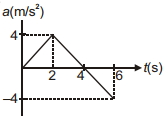
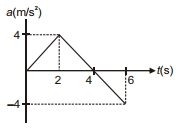
For the acceleration-time $(a-t)$ graph shown in the figure, the change in velocity of the particle from $t=0$ to $t=6 \, s$ is ........ $m/s$.
A
$10$
B
$4$
C
$12$
D
$8$
Solution
(B) The change in velocity $(\Delta v)$ is equal to the area under the acceleration-time $(a-t)$ graph.
From the graph, the area from $t=0$ to $t=4 \, s$ is a triangle with base $4 \, s$ and height $4 \, m/s^2$:
Area$_1 = \frac{1}{2} \times \text{base} \times \text{height} = \frac{1}{2} \times 4 \times 4 = 8 \, m/s$.
The area from $t=4 \, s$ to $t=6 \, s$ is a triangle below the time axis with base $(6-4) = 2 \, s$ and height $-4 \, m/s^2$:
Area$_2 = \frac{1}{2} \times 2 \times (-4) = -4 \, m/s$.
The total change in velocity is the sum of these areas:
$\Delta v = \text{Area}_1 + \text{Area}_2 = 8 + (-4) = 4 \, m/s$.
Thus, the correct option is $(b)$.
From the graph, the area from $t=0$ to $t=4 \, s$ is a triangle with base $4 \, s$ and height $4 \, m/s^2$:
Area$_1 = \frac{1}{2} \times \text{base} \times \text{height} = \frac{1}{2} \times 4 \times 4 = 8 \, m/s$.
The area from $t=4 \, s$ to $t=6 \, s$ is a triangle below the time axis with base $(6-4) = 2 \, s$ and height $-4 \, m/s^2$:
Area$_2 = \frac{1}{2} \times 2 \times (-4) = -4 \, m/s$.
The total change in velocity is the sum of these areas:
$\Delta v = \text{Area}_1 + \text{Area}_2 = 8 + (-4) = 4 \, m/s$.
Thus, the correct option is $(b)$.
0 likes
View Solution53
EasyMCQ
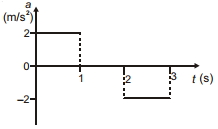
The acceleration-time graph for a particle is given in the figure. If it starts motion at $t=0$, the distance travelled in $3 \, s$ will be ........... $m$.
A
$4$
B
$2$
C
$0$
D
$6$
Solution
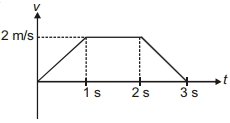
(A) The distance travelled is equal to the area under the velocity-time $(v-t)$ graph.
First, we construct the $v-t$ graph from the given acceleration-time $(a-t)$ graph:
$1$. For $0 \le t \le 1 \, s$, $a = 2 \, m/s^2$. Since $v = \int a \, dt$, $v = 2t$. At $t = 1 \, s$, $v = 2 \, m/s$.
$2$. For $1 \le t \le 2 \, s$, $a = 0$, so velocity remains constant at $v = 2 \, m/s$.
$3$. For $2 \le t \le 3 \, s$, $a = -2 \, m/s^2$. Velocity decreases from $2 \, m/s$ to $0 \, m/s$ at $t = 3 \, s$.
The resulting $v-t$ graph is a trapezoid with parallel sides of length $1 \, s$ (from $t=1$ to $t=2$) and $3 \, s$ (from $t=0$ to $t=3$), and height $2 \, m/s$.
Distance = Area of the trapezoid = $\frac{1}{2} \times (\text{sum of parallel sides}) \times \text{height}$
Distance = $\frac{1}{2} \times (1 + 3) \times 2 = 4 \, m$.
First, we construct the $v-t$ graph from the given acceleration-time $(a-t)$ graph:
$1$. For $0 \le t \le 1 \, s$, $a = 2 \, m/s^2$. Since $v = \int a \, dt$, $v = 2t$. At $t = 1 \, s$, $v = 2 \, m/s$.
$2$. For $1 \le t \le 2 \, s$, $a = 0$, so velocity remains constant at $v = 2 \, m/s$.
$3$. For $2 \le t \le 3 \, s$, $a = -2 \, m/s^2$. Velocity decreases from $2 \, m/s$ to $0 \, m/s$ at $t = 3 \, s$.
The resulting $v-t$ graph is a trapezoid with parallel sides of length $1 \, s$ (from $t=1$ to $t=2$) and $3 \, s$ (from $t=0$ to $t=3$), and height $2 \, m/s$.
Distance = Area of the trapezoid = $\frac{1}{2} \times (\text{sum of parallel sides}) \times \text{height}$
Distance = $\frac{1}{2} \times (1 + 3) \times 2 = 4 \, m$.
0 likes
View Solution54
DifficultMCQ
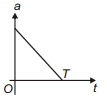
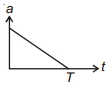
The acceleration $(a)$-time $(t)$ graph for a particle moving along a straight line starting from rest is shown in the figure. Which of the following graphs is the best representation of the variation of its velocity $(v)$ with time $(t)$?
A
B
C
D
Solution
(A) From the given acceleration $(a)$-time $(t)$ graph,it is evident that the acceleration is positive and decreasing linearly with time.
Let the acceleration be represented as $a = a_0 - kt$,where $a_0$ is the initial acceleration and $k$ is a positive constant.
Since the particle starts from rest,the initial velocity $v(0) = 0$.
We know that $a = \frac{dv}{dt}$,so $\frac{dv}{dt} = a_0 - kt$.
Integrating both sides with respect to time $t$:
$\int_{0}^{v} dv = \int_{0}^{t} (a_0 - kt) dt$
$v = a_0 t - \frac{1}{2} kt^2$.
This equation represents a downward-opening parabola starting from the origin $(0,0)$.
As time $t$ increases,the slope of the velocity-time graph,which is the acceleration $a$,decreases. Therefore,the velocity-time graph should be a curve that starts with a positive slope and becomes flatter (slope decreases) as time approaches $T$. This corresponds to the graph shown in option $(A)$.
Let the acceleration be represented as $a = a_0 - kt$,where $a_0$ is the initial acceleration and $k$ is a positive constant.
Since the particle starts from rest,the initial velocity $v(0) = 0$.
We know that $a = \frac{dv}{dt}$,so $\frac{dv}{dt} = a_0 - kt$.
Integrating both sides with respect to time $t$:
$\int_{0}^{v} dv = \int_{0}^{t} (a_0 - kt) dt$
$v = a_0 t - \frac{1}{2} kt^2$.
This equation represents a downward-opening parabola starting from the origin $(0,0)$.
As time $t$ increases,the slope of the velocity-time graph,which is the acceleration $a$,decreases. Therefore,the velocity-time graph should be a curve that starts with a positive slope and becomes flatter (slope decreases) as time approaches $T$. This corresponds to the graph shown in option $(A)$.
0 likes
View Solution55
MediumMCQ
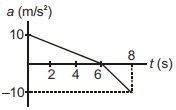
The acceleration-time graph for a particle moving along the $x$-axis is shown in the figure. If the initial velocity of the particle is $-5 \, m/s$, the velocity at $t = 8 \, s$ is ....... $m/s$.
A
$+15$
B
$+20$
C
$-15$
D
$-20$
Solution
(A) The change in velocity of a particle is equal to the area under the acceleration-time $(a-t)$ graph.
Given:
Initial velocity, $u = -5 \, m/s$
From the graph:
$1$. The area under the $a-t$ graph from $t = 0$ to $t = 6 \, s$ is a triangle with base $6 \, s$ and height $10 \, m/s^2$.
Area$_1 = \frac{1}{2} \times 6 \times 10 = 30 \, m/s$.
$2$. The area under the $a-t$ graph from $t = 6 \, s$ to $t = 8 \, s$ is a triangle with base $(8 - 6) = 2 \, s$ and height $-10 \, m/s^2$.
Area$_2 = \frac{1}{2} \times 2 \times (-10) = -10 \, m/s$.
Net area under the graph = Area$_1 +$ Area$_2 = 30 + (-10) = 20 \, m/s$.
Since $\Delta v = v - u = \text{Net Area}$, we have:
$v - (-5) = 20$
$v + 5 = 20$
$v = 15 \, m/s$.
Therefore, the velocity at $t = 8 \, s$ is $15 \, m/s$.
Given:
Initial velocity, $u = -5 \, m/s$
From the graph:
$1$. The area under the $a-t$ graph from $t = 0$ to $t = 6 \, s$ is a triangle with base $6 \, s$ and height $10 \, m/s^2$.
Area$_1 = \frac{1}{2} \times 6 \times 10 = 30 \, m/s$.
$2$. The area under the $a-t$ graph from $t = 6 \, s$ to $t = 8 \, s$ is a triangle with base $(8 - 6) = 2 \, s$ and height $-10 \, m/s^2$.
Area$_2 = \frac{1}{2} \times 2 \times (-10) = -10 \, m/s$.
Net area under the graph = Area$_1 +$ Area$_2 = 30 + (-10) = 20 \, m/s$.
Since $\Delta v = v - u = \text{Net Area}$, we have:
$v - (-5) = 20$
$v + 5 = 20$
$v = 15 \, m/s$.
Therefore, the velocity at $t = 8 \, s$ is $15 \, m/s$.
0 likes
View Solution56
MediumMCQ
The velocity of a body depends on time according to the equation $v = \frac{t^2}{10} + 20$. The body is undergoing
A
Uniform acceleration
B
Uniform retardation
C
Non-uniform acceleration
D
Zero acceleration
Solution
(C) Given the velocity equation: $v = \frac{t^2}{10} + 20$.
To find the acceleration $a$,we differentiate the velocity with respect to time $t$:
$a = \frac{dv}{dt} = \frac{d}{dt} \left( \frac{t^2}{10} + 20 \right)$.
Applying the power rule:
$a = \frac{2t}{10} + 0 = \frac{t}{5}$.
Since the acceleration $a$ depends on time $t$ $(a \propto t)$,it is not constant. Therefore,the body is undergoing non-uniform acceleration.
To find the acceleration $a$,we differentiate the velocity with respect to time $t$:
$a = \frac{dv}{dt} = \frac{d}{dt} \left( \frac{t^2}{10} + 20 \right)$.
Applying the power rule:
$a = \frac{2t}{10} + 0 = \frac{t}{5}$.
Since the acceleration $a$ depends on time $t$ $(a \propto t)$,it is not constant. Therefore,the body is undergoing non-uniform acceleration.
0 likes
View Solution57
EasyMCQ
$A$ body starts from the origin and moves along the $x$-axis such that its position at any instant is $x = 4t^2 - 12t$,where $t$ is in seconds and $x$ is in meters. What is the acceleration of the particle in $m/s^2$?
A
$4$
B
$8$
C
$24$
D
$0$
Solution
(B) The position of the body is given by the equation $x = 4t^2 - 12t$.
To find the velocity $v$,we differentiate the position $x$ with respect to time $t$:
$v = \frac{dx}{dt} = \frac{d}{dt}(4t^2 - 12t) = 8t - 12 \, m/s$.
To find the acceleration $a$,we differentiate the velocity $v$ with respect to time $t$:
$a = \frac{dv}{dt} = \frac{d}{dt}(8t - 12) = 8 \, m/s^2$.
Therefore,the acceleration of the particle is $8 \, m/s^2$.
To find the velocity $v$,we differentiate the position $x$ with respect to time $t$:
$v = \frac{dx}{dt} = \frac{d}{dt}(4t^2 - 12t) = 8t - 12 \, m/s$.
To find the acceleration $a$,we differentiate the velocity $v$ with respect to time $t$:
$a = \frac{dv}{dt} = \frac{d}{dt}(8t - 12) = 8 \, m/s^2$.
Therefore,the acceleration of the particle is $8 \, m/s^2$.
0 likes
View Solution58
DifficultMCQ
$A$ particle is moving in one dimension (along $x$-axis) under the action of a variable force. Its initial position was $16 \,m$ right of the origin. The variation of its position $(x)$ with time $(t)$ is given as $x = -3t^3 + 18t^2 + 16t$,where $x$ is in $m$ and $t$ is in $s$. The velocity of the particle when its acceleration becomes zero is . . . . . . $m/s$.
A
$50$
B
$52$
C
$57$
D
$60$
Solution
(B) Given position function: $x = -3t^3 + 18t^2 + 16t$.
Velocity $v$ is the first derivative of position with respect to time: $v = \frac{dx}{dt} = \frac{d}{dt}(-3t^3 + 18t^2 + 16t) = -9t^2 + 36t + 16$.
Acceleration $a$ is the derivative of velocity with respect to time: $a = \frac{dv}{dt} = \frac{d}{dt}(-9t^2 + 36t + 16) = -18t + 36$.
Set acceleration to zero to find the time: $-18t + 36 = 0 \implies 18t = 36 \implies t = 2 \,s$.
Substitute $t = 2 \,s$ into the velocity equation: $v = -9(2)^2 + 36(2) + 16$.
$v = -9(4) + 72 + 16 = -36 + 72 + 16 = 52 \,m/s$.
Velocity $v$ is the first derivative of position with respect to time: $v = \frac{dx}{dt} = \frac{d}{dt}(-3t^3 + 18t^2 + 16t) = -9t^2 + 36t + 16$.
Acceleration $a$ is the derivative of velocity with respect to time: $a = \frac{dv}{dt} = \frac{d}{dt}(-9t^2 + 36t + 16) = -18t + 36$.
Set acceleration to zero to find the time: $-18t + 36 = 0 \implies 18t = 36 \implies t = 2 \,s$.
Substitute $t = 2 \,s$ into the velocity equation: $v = -9(2)^2 + 36(2) + 16$.
$v = -9(4) + 72 + 16 = -36 + 72 + 16 = 52 \,m/s$.
0 likes
View Solution59
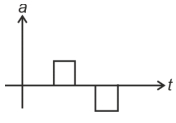
MediumMCQ
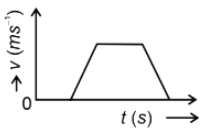
The velocity $(v)-$ time $(t)$ plot of the motion of a body is shown below:
The acceleration $(a)-$ time $(t)$ graph that best suits this motion is:
The acceleration $(a)-$ time $(t)$ graph that best suits this motion is:
A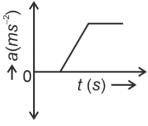
B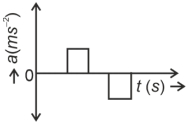
C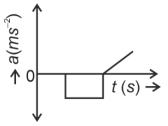
D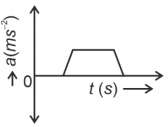
Solution
(B) The acceleration $(a)$ is defined as the rate of change of velocity,which corresponds to the slope of the velocity-time $(v-t)$ graph,i.e.,$a = \frac{dv}{dt}$.
$1$. In the first interval,the velocity increases linearly with time. Since the slope is constant and positive,the acceleration is constant and positive.
$2$. In the second interval,the velocity is constant. Since the slope of a horizontal line is zero,the acceleration is zero.
$3$. In the third interval,the velocity decreases linearly with time. Since the slope is constant and negative,the acceleration is constant and negative.
Comparing this with the given options,the graph that shows a positive constant acceleration,followed by zero acceleration,and then a negative constant acceleration is represented by option $B$.
$1$. In the first interval,the velocity increases linearly with time. Since the slope is constant and positive,the acceleration is constant and positive.
$2$. In the second interval,the velocity is constant. Since the slope of a horizontal line is zero,the acceleration is zero.
$3$. In the third interval,the velocity decreases linearly with time. Since the slope is constant and negative,the acceleration is constant and negative.
Comparing this with the given options,the graph that shows a positive constant acceleration,followed by zero acceleration,and then a negative constant acceleration is represented by option $B$.
0 likes
View Solution60
MediumMCQ
$A$ particle moves along the $x$-axis and its displacement $x$ varies with time $t$ according to the equation $x = c_0(t^2 - 2) + c(t - 2)^2$,where $c_0$ and $c$ are constants of appropriate dimensions. Which of the following statements is correct?
A
The acceleration of the particle is $2c_0$.
B
The acceleration of the particle is $2c$.
C
The initial velocity of the particle is $4c$.
D
The acceleration of the particle is $2(c + c_0)$.
Solution
(D) Given the displacement equation: $x = c_0(t^2 - 2) + c(t - 2)^2$.
To find the velocity $v$,we differentiate $x$ with respect to $t$:
$v = \frac{dx}{dt} = \frac{d}{dt}[c_0(t^2 - 2) + c(t - 2)^2] = 2c_0t + 2c(t - 2)$.
To find the acceleration $a$,we differentiate $v$ with respect to $t$:
$a = \frac{dv}{dt} = \frac{d}{dt}[2c_0t + 2c(t - 2)] = 2c_0 + 2c = 2(c_0 + c)$.
Thus,the acceleration of the particle is $2(c + c_0)$.
To find the velocity $v$,we differentiate $x$ with respect to $t$:
$v = \frac{dx}{dt} = \frac{d}{dt}[c_0(t^2 - 2) + c(t - 2)^2] = 2c_0t + 2c(t - 2)$.
To find the acceleration $a$,we differentiate $v$ with respect to $t$:
$a = \frac{dv}{dt} = \frac{d}{dt}[2c_0t + 2c(t - 2)] = 2c_0 + 2c = 2(c_0 + c)$.
Thus,the acceleration of the particle is $2(c + c_0)$.
0 likes
View Solution61
MediumMCQ
$A$ particle is moving with constant acceleration,whose direction is the same as that of its instantaneous motion. The distance $(s)-$velocity $(v)$ graph for the particle is:
A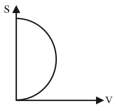
B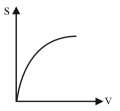
C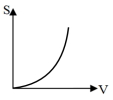
D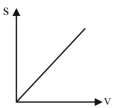
Solution
(C) Let the constant acceleration be $a = k$,where $k$ is a positive constant.
We know that acceleration $a = v \frac{dv}{ds}$.
Substituting $a = k$,we get $k = v \frac{dv}{ds}$.
Rearranging the terms,we have $k \, ds = v \, dv$.
Integrating both sides with initial conditions $s=0$ at $v=0$ (assuming the particle starts from rest):
$\int_0^{s} k \, ds = \int_0^{v} v \, dv$
$ks = \frac{v^2}{2}$
$v^2 = 2ks$
This equation represents a parabola opening along the $s$-axis. Since $s = \frac{v^2}{2k}$,the graph of $s$ versus $v$ is a parabola symmetric about the $s$-axis,opening towards the positive $s$-direction. Looking at the provided options,Graph $C$ represents this relationship where $s$ increases quadratically with $v$.
We know that acceleration $a = v \frac{dv}{ds}$.
Substituting $a = k$,we get $k = v \frac{dv}{ds}$.
Rearranging the terms,we have $k \, ds = v \, dv$.
Integrating both sides with initial conditions $s=0$ at $v=0$ (assuming the particle starts from rest):
$\int_0^{s} k \, ds = \int_0^{v} v \, dv$
$ks = \frac{v^2}{2}$
$v^2 = 2ks$
This equation represents a parabola opening along the $s$-axis. Since $s = \frac{v^2}{2k}$,the graph of $s$ versus $v$ is a parabola symmetric about the $s$-axis,opening towards the positive $s$-direction. Looking at the provided options,Graph $C$ represents this relationship where $s$ increases quadratically with $v$.
0 likes
View Solution62
MediumMCQ
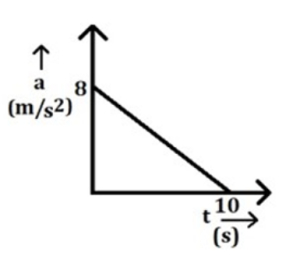
The acceleration $(a)$ - time $(t)$ graph for a body starting from rest is given below. The maximum speed of the body is (in $m/s$)
A
$40$
B
$80$
C
$160$
D
$200$
Solution
(A) The change in velocity $(\Delta v)$ is equal to the area under the acceleration-time $(a-t)$ graph.
Given that the body starts from rest, the initial velocity $(u = 0 \ m/s)$.
The area under the $a-t$ graph is a right-angled triangle with base $(b = 10 \ s)$ and height $(h = 8 \ m/s^2)$.
Area = $\frac{1}{2} \times \text{base} \times \text{height}$
Area = $\frac{1}{2} \times 10 \ s \times 8 \ m/s^2 = 40 \ m/s$.
Since $\Delta v = v_{max} - u = 40 \ m/s$ and $u = 0 \ m/s$, the maximum speed is $v_{max} = 40 \ m/s$.
Given that the body starts from rest, the initial velocity $(u = 0 \ m/s)$.
The area under the $a-t$ graph is a right-angled triangle with base $(b = 10 \ s)$ and height $(h = 8 \ m/s^2)$.
Area = $\frac{1}{2} \times \text{base} \times \text{height}$
Area = $\frac{1}{2} \times 10 \ s \times 8 \ m/s^2 = 40 \ m/s$.
Since $\Delta v = v_{max} - u = 40 \ m/s$ and $u = 0 \ m/s$, the maximum speed is $v_{max} = 40 \ m/s$.
0 likes
View Solution63
EasyMCQ
The position $x$ of a particle varies with time as $x = at^2 - bt^3$,where $a$ and $b$ are constants. The acceleration of the particle will be zero at:
A
$\frac{2a}{3b}$
B
$\frac{a}{b}$
C
$\frac{a}{3b}$
D
zero
Solution
(C) Given the position function: $x = at^2 - bt^3$
Velocity $v$ is the first derivative of position with respect to time: $v = \frac{dx}{dt} = 2at - 3bt^2$
Acceleration $a_{acc}$ is the derivative of velocity with respect to time: $a_{acc} = \frac{dv}{dt} = 2a - 6bt$
To find the time when acceleration is zero,set $a_{acc} = 0$:
$0 = 2a - 6bt$
$6bt = 2a$
$t = \frac{2a}{6b} = \frac{a}{3b}$
Velocity $v$ is the first derivative of position with respect to time: $v = \frac{dx}{dt} = 2at - 3bt^2$
Acceleration $a_{acc}$ is the derivative of velocity with respect to time: $a_{acc} = \frac{dv}{dt} = 2a - 6bt$
To find the time when acceleration is zero,set $a_{acc} = 0$:
$0 = 2a - 6bt$
$6bt = 2a$
$t = \frac{2a}{6b} = \frac{a}{3b}$
0 likes
View Solution64
DifficultMCQ
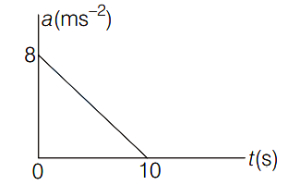
$A$ particle starts from rest. Its acceleration $a$ versus time $t$ is shown in the figure. The maximum speed of the particle will be (in $m/s$)
A
$80$
B
$40$
C
$18$
D
$2$
Solution
(B) The change in velocity of a particle is equal to the area under the acceleration-time $(a-t)$ graph.
Given that the particle starts from rest,the initial velocity $u = 0$.
The area under the $a-t$ graph is a triangle with base $b = 10 \ s$ and height $h = 8 \ m/s^2$.
Area $= \frac{1}{2} \times \text{base} \times \text{height}$
Area $= \frac{1}{2} \times 10 \times 8 = 40 \ m/s$.
Since $\Delta v = v - u = \text{Area}$,and $u = 0$,we have $v = 40 \ m/s$.
Thus,the maximum speed of the particle is $40 \ m/s$.
Given that the particle starts from rest,the initial velocity $u = 0$.
The area under the $a-t$ graph is a triangle with base $b = 10 \ s$ and height $h = 8 \ m/s^2$.
Area $= \frac{1}{2} \times \text{base} \times \text{height}$
Area $= \frac{1}{2} \times 10 \times 8 = 40 \ m/s$.
Since $\Delta v = v - u = \text{Area}$,and $u = 0$,we have $v = 40 \ m/s$.
Thus,the maximum speed of the particle is $40 \ m/s$.
0 likes
View Solution65
MediumMCQ
The correct position $(x)$ - time $(t)$ graph for a particle moving with negative acceleration is
A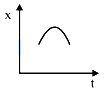
B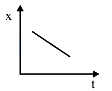
C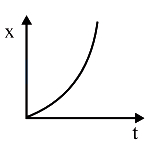
D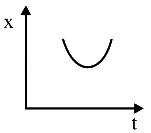
Solution
(A) The equation of motion for a particle with constant acceleration is given by $x(t) = x_0 + v_0 t + \frac{1}{2} a t^2$.
If the acceleration $a$ is negative,the graph of $x$ versus $t$ is a parabola opening downwards.
In a position-time graph,the slope represents the velocity $(v = \frac{dx}{dt})$.
For a downward-opening parabola,the slope starts as positive,decreases to zero at the peak (where the particle momentarily stops),and then becomes negative as the particle moves in the opposite direction.
This behavior corresponds to a constant negative acceleration.
Therefore,the graph that represents a downward-opening parabola is the correct one,which is shown in option $(A)$.
If the acceleration $a$ is negative,the graph of $x$ versus $t$ is a parabola opening downwards.
In a position-time graph,the slope represents the velocity $(v = \frac{dx}{dt})$.
For a downward-opening parabola,the slope starts as positive,decreases to zero at the peak (where the particle momentarily stops),and then becomes negative as the particle moves in the opposite direction.
This behavior corresponds to a constant negative acceleration.
Therefore,the graph that represents a downward-opening parabola is the correct one,which is shown in option $(A)$.
0 likes
View Solution66
MediumMCQ
If the displacement ($s$ in metre) of a moving particle in terms of time ($t$ in second) is $s = t^3 - 6t^2 + 18t + 9$,then the minimum velocity attained by the particle is (in $m \ s^{-1}$)
A
$29$
B
$5$
C
$6$
D
$12$
Solution
(C) The displacement of the particle is given by $s = t^3 - 6t^2 + 18t + 9$.
The velocity $v$ is the first derivative of displacement with respect to time: $v = \frac{ds}{dt} = 3t^2 - 12t + 18$.
To find the minimum velocity,we find the derivative of velocity with respect to time and set it to zero: $\frac{dv}{dt} = 6t - 12$.
Setting $\frac{dv}{dt} = 0$,we get $6t - 12 = 0$,which implies $t = 2 \ s$.
Now,substitute $t = 2 \ s$ into the velocity equation to find the minimum velocity:
$v_{min} = 3(2)^2 - 12(2) + 18 = 3(4) - 24 + 18 = 12 - 24 + 18 = 6 \ m \ s^{-1}$.
The velocity $v$ is the first derivative of displacement with respect to time: $v = \frac{ds}{dt} = 3t^2 - 12t + 18$.
To find the minimum velocity,we find the derivative of velocity with respect to time and set it to zero: $\frac{dv}{dt} = 6t - 12$.
Setting $\frac{dv}{dt} = 0$,we get $6t - 12 = 0$,which implies $t = 2 \ s$.
Now,substitute $t = 2 \ s$ into the velocity equation to find the minimum velocity:
$v_{min} = 3(2)^2 - 12(2) + 18 = 3(4) - 24 + 18 = 12 - 24 + 18 = 6 \ m \ s^{-1}$.
0 likes
View Solution67
MediumMCQ
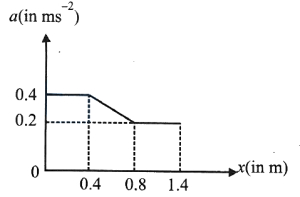
The acceleration of a particle which moves along the positive $x$-axis varies with its position as shown in the figure. If the velocity of the particle is $0.8 \,ms^{-1}$ at $x=0$, then its velocity at $x=1.4 \,m$ is (in $ms^{-1}$)
A
$1.6$
B
$1.2$
C
$1.4$
D
$0.8$
Solution
(B) We know that $a = v \frac{dv}{dx}$, which implies $v dv = a dx$.
Integrating both sides, we get $\int_{u}^{v} v dv = \int_{x_1}^{x_2} a dx$.
$\frac{v^2 - u^2}{2} = \text{Area under the } a-x \text{ graph}$.
$v^2 = u^2 + 2 \times (\text{Area under the } a-x \text{ graph})$.
The area under the $a-x$ graph from $x=0$ to $x=1.4$ consists of a rectangle, a trapezoid, and another rectangle:
Area $1$ (from $x=0$ to $0.4$): $0.4 \times 0.4 = 0.16$.
Area $2$ (from $x=0.4$ to $0.8$): $\frac{1}{2} \times (0.4 + 0.2) \times 0.4 = 0.12$.
Area $3$ (from $x=0.8$ to $1.4$): $0.2 \times 0.6 = 0.12$.
Total Area $= 0.16 + 0.12 + 0.12 = 0.4$.
Given $u = 0.8 \,ms^{-1}$, so $u^2 = 0.64$.
$v^2 = 0.64 + 2 \times (0.4) = 0.64 + 0.8 = 1.44$.
$v = \sqrt{1.44} = 1.2 \,ms^{-1}$.
Integrating both sides, we get $\int_{u}^{v} v dv = \int_{x_1}^{x_2} a dx$.
$\frac{v^2 - u^2}{2} = \text{Area under the } a-x \text{ graph}$.
$v^2 = u^2 + 2 \times (\text{Area under the } a-x \text{ graph})$.
The area under the $a-x$ graph from $x=0$ to $x=1.4$ consists of a rectangle, a trapezoid, and another rectangle:
Area $1$ (from $x=0$ to $0.4$): $0.4 \times 0.4 = 0.16$.
Area $2$ (from $x=0.4$ to $0.8$): $\frac{1}{2} \times (0.4 + 0.2) \times 0.4 = 0.12$.
Area $3$ (from $x=0.8$ to $1.4$): $0.2 \times 0.6 = 0.12$.
Total Area $= 0.16 + 0.12 + 0.12 = 0.4$.
Given $u = 0.8 \,ms^{-1}$, so $u^2 = 0.64$.
$v^2 = 0.64 + 2 \times (0.4) = 0.64 + 0.8 = 1.44$.
$v = \sqrt{1.44} = 1.2 \,ms^{-1}$.
0 likes
View Solution68
EasyMCQ
The velocity of a particle is given by $v = 2t^2 - 8t + 15 \,ms^{-1}$. Find its instantaneous acceleration at $t = 5 \,s$. (in $\,ms^{-2}$)
A
$18$
B
$20$
C
$5$
D
$12$
Solution
(D) Given, velocity $v = 2t^2 - 8t + 15$.
We know that instantaneous acceleration $a$ is the derivative of velocity with respect to time $t$, i.e., $a = \frac{dv}{dt}$.
Differentiating the given expression for velocity with respect to $t$:
$a = \frac{d}{dt}(2t^2 - 8t + 15) = 4t - 8$.
Now, substitute the value $t = 5 \,s$ into the expression for acceleration:
$a = 4(5) - 8 = 20 - 8 = 12 \,ms^{-2}$.
Therefore, the instantaneous acceleration at $t = 5 \,s$ is $12 \,ms^{-2}$.
We know that instantaneous acceleration $a$ is the derivative of velocity with respect to time $t$, i.e., $a = \frac{dv}{dt}$.
Differentiating the given expression for velocity with respect to $t$:
$a = \frac{d}{dt}(2t^2 - 8t + 15) = 4t - 8$.
Now, substitute the value $t = 5 \,s$ into the expression for acceleration:
$a = 4(5) - 8 = 20 - 8 = 12 \,ms^{-2}$.
Therefore, the instantaneous acceleration at $t = 5 \,s$ is $12 \,ms^{-2}$.
0 likes
View Solution69
MediumMCQ
The acceleration at the end of $2 \ s$ of a particle whose motion is represented by the equation $S = 4t^3 - 8t^2 + 5t + 4$ is $......$ (in $m \ s^{-2}$)
A
$32$
B
$40$
C
$37$
D
$35$
Solution
(A) Given the displacement equation: $S = 4t^3 - 8t^2 + 5t + 4$.
Velocity $v$ is the first derivative of displacement with respect to time: $v = \frac{dS}{dt} = \frac{d}{dt}(4t^3 - 8t^2 + 5t + 4) = 12t^2 - 16t + 5$.
Acceleration $a$ is the derivative of velocity with respect to time: $a = \frac{dv}{dt} = \frac{d}{dt}(12t^2 - 16t + 5) = 24t - 16$.
To find the acceleration at $t = 2 \ s$,substitute $t = 2$ into the acceleration equation: $a = 24(2) - 16 = 48 - 16 = 32 \ m \ s^{-2}$.
Velocity $v$ is the first derivative of displacement with respect to time: $v = \frac{dS}{dt} = \frac{d}{dt}(4t^3 - 8t^2 + 5t + 4) = 12t^2 - 16t + 5$.
Acceleration $a$ is the derivative of velocity with respect to time: $a = \frac{dv}{dt} = \frac{d}{dt}(12t^2 - 16t + 5) = 24t - 16$.
To find the acceleration at $t = 2 \ s$,substitute $t = 2$ into the acceleration equation: $a = 24(2) - 16 = 48 - 16 = 32 \ m \ s^{-2}$.
0 likes
View Solution70
MediumMCQ
The displacement is given by $x = 2t^2 + t + 5$. The acceleration at $t = 2 \ s$ is:
A
$4 \ m \cdot s^{-2}$
B
$8 \ m \cdot s^{-2}$
C
$10 \ m \cdot s^{-2}$
D
$15 \ m \cdot s^{-2}$
Solution
(A) Given the displacement equation: $x = 2t^2 + t + 5$.
Velocity $v$ is the first derivative of displacement with respect to time: $v = \frac{dx}{dt} = \frac{d}{dt}(2t^2 + t + 5) = 4t + 1$.
Acceleration $a$ is the derivative of velocity with respect to time: $a = \frac{dv}{dt} = \frac{d}{dt}(4t + 1) = 4 \ m \cdot s^{-2}$.
Since the acceleration is constant,the acceleration at $t = 2 \ s$ is $4 \ m \cdot s^{-2}$.
Velocity $v$ is the first derivative of displacement with respect to time: $v = \frac{dx}{dt} = \frac{d}{dt}(2t^2 + t + 5) = 4t + 1$.
Acceleration $a$ is the derivative of velocity with respect to time: $a = \frac{dv}{dt} = \frac{d}{dt}(4t + 1) = 4 \ m \cdot s^{-2}$.
Since the acceleration is constant,the acceleration at $t = 2 \ s$ is $4 \ m \cdot s^{-2}$.
0 likes
View Solution71
MediumMCQ
Motion of a particle is given by the equation $s = (3t^3 + 7t^2 + 3t + 8) \ m$. The acceleration of the particle at $t = 1 \ s$ is: (in $m/s^2$)
A
$32$
B
$10$
C
$16$
D
$23$
Solution
(A) The position of the particle is given by $s(t) = 3t^3 + 7t^2 + 3t + 8$.
Velocity $v(t)$ is the first derivative of position with respect to time: $v(t) = \frac{ds}{dt} = \frac{d}{dt}(3t^3 + 7t^2 + 3t + 8) = 9t^2 + 14t + 3$.
Acceleration $a(t)$ is the derivative of velocity with respect to time: $a(t) = \frac{dv}{dt} = \frac{d}{dt}(9t^2 + 14t + 3) = 18t + 14$.
At $t = 1 \ s$,the acceleration is $a(1) = 18(1) + 14 = 18 + 14 = 32 \ m/s^2$.
Velocity $v(t)$ is the first derivative of position with respect to time: $v(t) = \frac{ds}{dt} = \frac{d}{dt}(3t^3 + 7t^2 + 3t + 8) = 9t^2 + 14t + 3$.
Acceleration $a(t)$ is the derivative of velocity with respect to time: $a(t) = \frac{dv}{dt} = \frac{d}{dt}(9t^2 + 14t + 3) = 18t + 14$.
At $t = 1 \ s$,the acceleration is $a(1) = 18(1) + 14 = 18 + 14 = 32 \ m/s^2$.
0 likes
View Solution72
EasyMCQ
The velocity of a particle is given by the equation $v(x) = 3x^2 - 4x$,where $x$ is the distance covered by the particle. The expression for its acceleration is
A
$(6x - 4)$
B
$6(3x^2 - 4x)$
C
$(3x^2 - 4x)(6x - 4)$
D
$(6x - 4)^2$
Solution
(C) The velocity of the particle is given by $v = 3x^2 - 4x$.
Acceleration $a$ is defined as the rate of change of velocity with respect to time,which can be expressed in terms of position $x$ as $a = v \cdot \frac{dv}{dx}$.
First,differentiate $v$ with respect to $x$: $\frac{dv}{dx} = \frac{d}{dx}(3x^2 - 4x) = 6x - 4$.
Now,substitute $v$ and $\frac{dv}{dx}$ into the acceleration formula: $a = (3x^2 - 4x)(6x - 4)$.
Thus,the correct expression for acceleration is $(3x^2 - 4x)(6x - 4)$.
Acceleration $a$ is defined as the rate of change of velocity with respect to time,which can be expressed in terms of position $x$ as $a = v \cdot \frac{dv}{dx}$.
First,differentiate $v$ with respect to $x$: $\frac{dv}{dx} = \frac{d}{dx}(3x^2 - 4x) = 6x - 4$.
Now,substitute $v$ and $\frac{dv}{dx}$ into the acceleration formula: $a = (3x^2 - 4x)(6x - 4)$.
Thus,the correct expression for acceleration is $(3x^2 - 4x)(6x - 4)$.
0 likes
View Solution73
EasyMCQ
The motion of a particle along a straight line is described by the function $x = (2t - 3)^2$,where $x$ is in metres and $t$ is in seconds. The acceleration of the particle at $t = 2 \,s$ is (in $\,m/s^2$)
A
$1$
B
$4$
C
$8$
D
$7$
Solution
(C) Given the position function: $x = (2t - 3)^2$.
Expanding the expression: $x = 4t^2 - 12t + 9$.
Velocity $v$ is the first derivative of position with respect to time: $v = \frac{dx}{dt} = \frac{d}{dt}(4t^2 - 12t + 9) = 8t - 12$.
Acceleration $a$ is the derivative of velocity with respect to time: $a = \frac{dv}{dt} = \frac{d}{dt}(8t - 12) = 8 \,m/s^2$.
Since the acceleration is constant,at $t = 2 \,s$,the acceleration remains $8 \,m/s^2$.
Expanding the expression: $x = 4t^2 - 12t + 9$.
Velocity $v$ is the first derivative of position with respect to time: $v = \frac{dx}{dt} = \frac{d}{dt}(4t^2 - 12t + 9) = 8t - 12$.
Acceleration $a$ is the derivative of velocity with respect to time: $a = \frac{dv}{dt} = \frac{d}{dt}(8t - 12) = 8 \,m/s^2$.
Since the acceleration is constant,at $t = 2 \,s$,the acceleration remains $8 \,m/s^2$.
0 likes
View Solution74
MediumMCQ
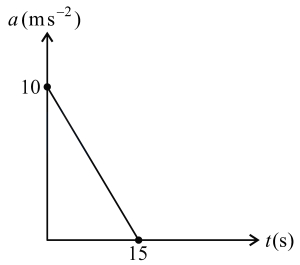
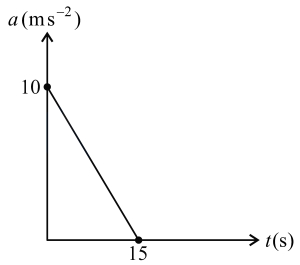
$A$ particle starts from rest. Its acceleration $(a)$ versus time $(t)$ graph is as shown in the figure. The maximum speed of the particle will be (in $m \ s^{-1}$)
A
$150$
B
$75$
C
$37.5$
D
$45$
Solution
(B) The particle starts from rest,so its initial velocity $u = 0 \ m \ s^{-1}$.
In an acceleration-time $(a-t)$ graph,the change in velocity $(\Delta v)$ is equal to the area under the curve.
Since the acceleration is positive throughout the interval from $t = 0 \ s$ to $t = 15 \ s$,the velocity of the particle increases continuously.
Therefore,the maximum speed is attained at $t = 15 \ s$.
The area under the $a-t$ graph is the area of the right-angled triangle with base $15 \ s$ and height $10 \ m \ s^{-2}$.
$\Delta v = \text{Area} = \frac{1}{2} \times \text{base} \times \text{height}$
$\Delta v = \frac{1}{2} \times 15 \ s \times 10 \ m \ s^{-2} = 75 \ m \ s^{-1}$.
Since $v_{max} = u + \Delta v = 0 + 75 \ m \ s^{-1} = 75 \ m \ s^{-1}$.
In an acceleration-time $(a-t)$ graph,the change in velocity $(\Delta v)$ is equal to the area under the curve.
Since the acceleration is positive throughout the interval from $t = 0 \ s$ to $t = 15 \ s$,the velocity of the particle increases continuously.
Therefore,the maximum speed is attained at $t = 15 \ s$.
The area under the $a-t$ graph is the area of the right-angled triangle with base $15 \ s$ and height $10 \ m \ s^{-2}$.
$\Delta v = \text{Area} = \frac{1}{2} \times \text{base} \times \text{height}$
$\Delta v = \frac{1}{2} \times 15 \ s \times 10 \ m \ s^{-2} = 75 \ m \ s^{-1}$.
Since $v_{max} = u + \Delta v = 0 + 75 \ m \ s^{-1} = 75 \ m \ s^{-1}$.
0 likes
View Solution75
MediumMCQ
The relation between the displacement $x$ (in metre) and the time $t$ (in second) of a particle is $t = 2x^2 + 3x$. If the displacement of the particle is $25 \ cm$ from the origin $(x = 0)$,then the acceleration of the particle is:
A
$+\frac{1}{16} \ ms^{-2}$
B
$-\frac{1}{16} \ ms^{-2}$
C
$+\frac{1}{8} \ ms^{-2}$
D
$-\frac{1}{8} \ ms^{-2}$
Solution
(B) Given the relation: $t = 2x^2 + 3x$.
To find velocity $v$,differentiate $t$ with respect to $x$: $\frac{dt}{dx} = 4x + 3$.
Since $v = \frac{dx}{dt}$,we have $v = \frac{1}{4x + 3} = (4x + 3)^{-1}$.
To find acceleration $a$,differentiate $v$ with respect to $t$: $a = \frac{dv}{dt} = \frac{dv}{dx} \cdot \frac{dx}{dt} = \frac{dv}{dx} \cdot v$.
$\frac{dv}{dx} = -1(4x + 3)^{-2} \cdot 4 = -\frac{4}{(4x + 3)^2}$.
Thus,$a = -\frac{4}{(4x + 3)^2} \cdot \frac{1}{4x + 3} = -\frac{4}{(4x + 3)^3}$.
Given displacement $x = 25 \ cm = 0.25 \ m = \frac{1}{4} \ m$.
Substitute $x = \frac{1}{4}$ into the acceleration formula: $a = -\frac{4}{(4(1/4) + 3)^3} = -\frac{4}{(1 + 3)^3} = -\frac{4}{4^3} = -\frac{4}{64} = -\frac{1}{16} \ ms^{-2}$.
To find velocity $v$,differentiate $t$ with respect to $x$: $\frac{dt}{dx} = 4x + 3$.
Since $v = \frac{dx}{dt}$,we have $v = \frac{1}{4x + 3} = (4x + 3)^{-1}$.
To find acceleration $a$,differentiate $v$ with respect to $t$: $a = \frac{dv}{dt} = \frac{dv}{dx} \cdot \frac{dx}{dt} = \frac{dv}{dx} \cdot v$.
$\frac{dv}{dx} = -1(4x + 3)^{-2} \cdot 4 = -\frac{4}{(4x + 3)^2}$.
Thus,$a = -\frac{4}{(4x + 3)^2} \cdot \frac{1}{4x + 3} = -\frac{4}{(4x + 3)^3}$.
Given displacement $x = 25 \ cm = 0.25 \ m = \frac{1}{4} \ m$.
Substitute $x = \frac{1}{4}$ into the acceleration formula: $a = -\frac{4}{(4(1/4) + 3)^3} = -\frac{4}{(1 + 3)^3} = -\frac{4}{4^3} = -\frac{4}{64} = -\frac{1}{16} \ ms^{-2}$.
0 likes
View Solution76
DifficultMCQ
The velocity of a particle is given as $\vec{v} = -x\hat{i} + 2y\hat{j} - z\hat{k} \text{ m/s}$. The magnitude of acceleration at point $(1, 2, 4)$ is . . . . . . $\text{m/s}^2$.
A
$\sqrt{6}$
B
$9$
C
$\sqrt{33}$
D
$0$
Solution
(B) The acceleration vector is given by the material derivative of velocity: $\vec{a} = \frac{d\vec{v}}{dt} = (\vec{v} \cdot \nabla) \vec{v}$.
Given $\vec{v} = -x\hat{i} + 2y\hat{j} - z\hat{k}$,we calculate the components:
$a_x = v_x \frac{\partial v_x}{\partial x} + v_y \frac{\partial v_x}{\partial y} + v_z \frac{\partial v_x}{\partial z} = (-x)(-1) + (2y)(0) + (-z)(0) = x$.
$a_y = v_x \frac{\partial v_y}{\partial x} + v_y \frac{\partial v_y}{\partial y} + v_z \frac{\partial v_y}{\partial z} = (-x)(0) + (2y)(2) + (-z)(0) = 4y$.
$a_z = v_x \frac{\partial v_z}{\partial x} + v_y \frac{\partial v_z}{\partial y} + v_z \frac{\partial v_z}{\partial z} = (-x)(0) + (2y)(0) + (-z)(-1) = z$.
Thus,$\vec{a} = x\hat{i} + 4y\hat{j} + z\hat{k}$.
At point $(1, 2, 4)$,$\vec{a} = 1\hat{i} + 4(2)\hat{j} + 4\hat{k} = 1\hat{i} + 8\hat{j} + 4\hat{k}$.
The magnitude is $|\vec{a}| = \sqrt{1^2 + 8^2 + 4^2} = \sqrt{1 + 64 + 16} = \sqrt{81} = 9 \text{ m/s}^2$.
Given $\vec{v} = -x\hat{i} + 2y\hat{j} - z\hat{k}$,we calculate the components:
$a_x = v_x \frac{\partial v_x}{\partial x} + v_y \frac{\partial v_x}{\partial y} + v_z \frac{\partial v_x}{\partial z} = (-x)(-1) + (2y)(0) + (-z)(0) = x$.
$a_y = v_x \frac{\partial v_y}{\partial x} + v_y \frac{\partial v_y}{\partial y} + v_z \frac{\partial v_y}{\partial z} = (-x)(0) + (2y)(2) + (-z)(0) = 4y$.
$a_z = v_x \frac{\partial v_z}{\partial x} + v_y \frac{\partial v_z}{\partial y} + v_z \frac{\partial v_z}{\partial z} = (-x)(0) + (2y)(0) + (-z)(-1) = z$.
Thus,$\vec{a} = x\hat{i} + 4y\hat{j} + z\hat{k}$.
At point $(1, 2, 4)$,$\vec{a} = 1\hat{i} + 4(2)\hat{j} + 4\hat{k} = 1\hat{i} + 8\hat{j} + 4\hat{k}$.
The magnitude is $|\vec{a}| = \sqrt{1^2 + 8^2 + 4^2} = \sqrt{1 + 64 + 16} = \sqrt{81} = 9 \text{ m/s}^2$.
0 likes
View SolutionMotion in Straight Line — Acceleration and its graph · Frequently Asked Questions
1Are these Motion in Straight Line questions useful for JEE and NEET?
Yes. All questions in this section are mapped to JEE Main and NEET exam patterns. Previous year questions from JEE Main, NEET, GUJCET and state-level exams are included with full solutions.
2Can I switch to Hindi or Gujarati for these questions?
Yes. Use the language tabs in the hero section or the sidebar to view the same questions and solutions in English, Hindi or Gujarati.
3How do I generate a question paper from this subtopic?
Use the Vedclass Exam Paper Generator — select the chapter and subtopic, set difficulty, and generate Sets A, B, C, D automatically. First 3 chapters of every subject are free.
Vedclass Products
For Students
Vedclass Test Series
Mock tests in real JEE/NEET style with performance analysis. 5-day free trial.
Start Free TrialFor Teachers
Exam Paper Generator
Generate Set A/B/C/D papers from this chapter in 2 minutes. 3 chapters free.
Try FreeFor Institutes
Online Exam Module
Live online exams with unlimited students, 360° analytics & white-label branding.
See DemoFor Teachers & Institutes
Generate a Motion in Straight Line Exam Paper in 2 Minutes
Select subtopic & difficulty — Sets A, B, C, D auto-generated with No Repeat logic.
First 3 chapters of every subject are free — no payment required.