
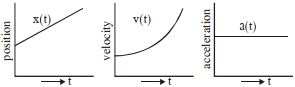
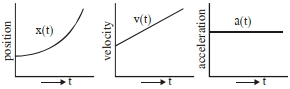
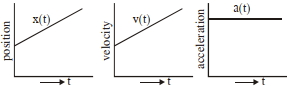
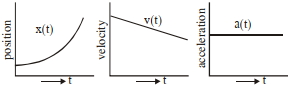
The position,velocity,and acceleration of a particle moving with a constant acceleration can be represented by:
- A
- B
- C
- D
Explore More
Similar Questions
The acceleration at the end of $2 \ s$ of a particle whose motion is represented by the equation $S = 4t^3 - 8t^2 + 5t + 4$ is $......$ (in $m \ s^{-2}$)
The velocity $(v)-$ time $(t)$ plot of the motion of a body is shown below:
The acceleration $(a)-$ time $(t)$ graph that best suits this motion is:
The acceleration $(a)-$ time $(t)$ graph that best suits this motion is:
MediumNEET 2024
View SolutionAn object with a mass $10 \, kg$ moves at a constant velocity of $10 \, m/s$. $A$ constant force then acts for $4 \, s$ on the object and gives it a speed of $2 \, m/s$ in the opposite direction. The acceleration produced in it is ........ $m/s^2$.
Easy
View SolutionThe acceleration of a particle which moves along the positive $x$-axis varies with its position as shown in the graph. If the velocity of the particle is $0.8 \ m/s$ at $x = 0$,find the velocity of the particle at $x = 1.4 \ m$ (in $m/s$).
Difficult
View SolutionThe motion of a particle along a straight line is described by the function $x = (2t - 3)^2$,where $x$ is in metres and $t$ is in seconds. The acceleration of the particle at $t = 2 \,s$ is (in $\,m/s^2$)
Vedclass Products
For Students
Vedclass Test Series
Mock tests in real JEE/NEET style with performance analysis. 5-day free trial.
Start Free TrialFor Teachers
Exam Paper Generator
Generate Set A/B/C/D exam papers from 7.5L+ questions in 2 minutes. 3 chapters free.
Try FreeFor Institutes
Online Exam Module
Live online exams with unlimited students, 360° analytics & white-label branding.
See Demo