
A English
Basic of Elasticity, Stress and Strain relationship and Graphical analysis Questions in English
Class 11 Physics · Mechanical Properties of Solids · Basic of Elasticity, Stress and Strain relationship and Graphical analysis
169+
Questions
English
Language
100%
With Solutions
Showing 17 of 169 questions in English
151
MediumMCQ
Two wires $A$ and $B$ are stretched by the same load. The radius of wire $A$ is double the radius of wire $B$. The stress on the wire $B$ as compared to the stress on the wire $A$ is
A
twice
B
four times
C
half
D
equal
Solution
(B) Stress is defined as the force applied per unit area: $\text{Stress} = \frac{F}{A} = \frac{F}{\pi r^2}$.
Since both wires are stretched by the same load,the force $F$ is constant.
Therefore,$\text{Stress} \propto \frac{1}{r^2}$.
Given that the radius of wire $A$ is double the radius of wire $B$,we have $r_A = 2r_B$.
Comparing the stresses $S_A$ and $S_B$:
$\frac{S_B}{S_A} = \frac{r_A^2}{r_B^2} = \left(\frac{2r_B}{r_B}\right)^2 = (2)^2 = 4$.
Thus,$S_B = 4 S_A$.
The stress on wire $B$ is four times the stress on wire $A$.
Since both wires are stretched by the same load,the force $F$ is constant.
Therefore,$\text{Stress} \propto \frac{1}{r^2}$.
Given that the radius of wire $A$ is double the radius of wire $B$,we have $r_A = 2r_B$.
Comparing the stresses $S_A$ and $S_B$:
$\frac{S_B}{S_A} = \frac{r_A^2}{r_B^2} = \left(\frac{2r_B}{r_B}\right)^2 = (2)^2 = 4$.
Thus,$S_B = 4 S_A$.
The stress on wire $B$ is four times the stress on wire $A$.
0 likes
View Solution152
MediumMCQ
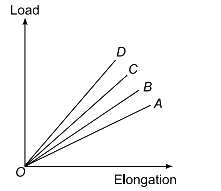
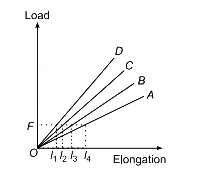
The load versus elongation graph for four wires of the same material is shown in the figure. The thinnest wire is represented by the line
A
$OC$
B
$OD$
C
$OA$
D
$OB$
Solution
(C) The Young's modulus $Y$ is given by $Y = \frac{FL}{A \Delta l}$,where $F$ is the load,$L$ is the original length,$A$ is the cross-sectional area,and $\Delta l$ is the elongation.
Since all wires are of the same material,$Y$ is constant. For wires of the same length $L$,we have $A = \frac{FL}{Y \Delta l}$.
For a constant load $F$,the area $A$ is inversely proportional to the elongation $\Delta l$ $(A \propto \frac{1}{\Delta l})$.
From the graph,for a given load $F$,the elongation $\Delta l$ is maximum for line $OA$ (i.e.,$\Delta l_A > \Delta l_B > \Delta l_C > \Delta l_D$).
Since $A \propto \frac{1}{\Delta l}$,the wire with the maximum elongation will have the minimum cross-sectional area.
Therefore,the line $OA$ represents the thinnest wire.
Since all wires are of the same material,$Y$ is constant. For wires of the same length $L$,we have $A = \frac{FL}{Y \Delta l}$.
For a constant load $F$,the area $A$ is inversely proportional to the elongation $\Delta l$ $(A \propto \frac{1}{\Delta l})$.
From the graph,for a given load $F$,the elongation $\Delta l$ is maximum for line $OA$ (i.e.,$\Delta l_A > \Delta l_B > \Delta l_C > \Delta l_D$).
Since $A \propto \frac{1}{\Delta l}$,the wire with the maximum elongation will have the minimum cross-sectional area.
Therefore,the line $OA$ represents the thinnest wire.
0 likes
View Solution153
EasyMCQ
Two wires $A$ and $B$ are stretched by the same load. If the area of cross-section of wire $A$ is double that of wire $B$,then the stress on wire $B$ is
A
Equal to that on $A$
B
Twice that on $A$
C
Half that on $A$
D
Four times that on $A$
Solution
(B) Stress is defined as the force applied per unit area,given by the formula: $\text{Stress} = \frac{F}{A}$.
Given that both wires are stretched by the same load,the force $F$ is constant for both wires.
Let $A_A$ be the area of wire $A$ and $A_B$ be the area of wire $B$. According to the problem,$A_A = 2 A_B$.
The stress on wire $A$ is $\sigma_A = \frac{F}{A_A} = \frac{F}{2 A_B}$.
The stress on wire $B$ is $\sigma_B = \frac{F}{A_B}$.
Comparing the two,we get $\sigma_B = 2 \times \left(\frac{F}{2 A_B}\right) = 2 \sigma_A$.
Therefore,the stress on wire $B$ is twice that on wire $A$.
Given that both wires are stretched by the same load,the force $F$ is constant for both wires.
Let $A_A$ be the area of wire $A$ and $A_B$ be the area of wire $B$. According to the problem,$A_A = 2 A_B$.
The stress on wire $A$ is $\sigma_A = \frac{F}{A_A} = \frac{F}{2 A_B}$.
The stress on wire $B$ is $\sigma_B = \frac{F}{A_B}$.
Comparing the two,we get $\sigma_B = 2 \times \left(\frac{F}{2 A_B}\right) = 2 \sigma_A$.
Therefore,the stress on wire $B$ is twice that on wire $A$.
0 likes
View Solution154
MediumMCQ
The elastic limit of a metal is $\frac{400}{\pi} \text{ MPa}$. If a rod of this metal is to support a $484 \text{ N}$ load without exceeding its elastic limit, the minimum diameter of the rod is: (in $\text{ mm}$)
A
$2.2$
B
$1.2$
C
$2$
D
$1.6$
Solution
(A) The stress $\sigma$ is defined as the force $F$ divided by the cross-sectional area $A$. The elastic limit is the maximum stress the material can withstand.
Given: Elastic limit $\sigma = \frac{400}{\pi} \text{ MPa} = \frac{400}{\pi} \times 10^6 \text{ Pa}$, Force $F = 484 \text{ N}$.
The area of the cross-section of a rod with diameter $d$ is $A = \pi \frac{d^2}{4}$.
Using the formula $\sigma = \frac{F}{A}$, we have:
$\frac{400}{\pi} \times 10^6 = \frac{484}{\pi \frac{d^2}{4}}$
$\frac{400}{\pi} \times 10^6 = \frac{484 \times 4}{\pi d^2}$
Canceling $\pi$ from both sides:
$400 \times 10^6 = \frac{1936}{d^2}$
$d^2 = \frac{1936}{400 \times 10^6} = 4.84 \times 10^{-6} \text{ m}^2$
$d = \sqrt{4.84 \times 10^{-6}} = 2.2 \times 10^{-3} \text{ m} = 2.2 \text{ mm}$.
Given: Elastic limit $\sigma = \frac{400}{\pi} \text{ MPa} = \frac{400}{\pi} \times 10^6 \text{ Pa}$, Force $F = 484 \text{ N}$.
The area of the cross-section of a rod with diameter $d$ is $A = \pi \frac{d^2}{4}$.
Using the formula $\sigma = \frac{F}{A}$, we have:
$\frac{400}{\pi} \times 10^6 = \frac{484}{\pi \frac{d^2}{4}}$
$\frac{400}{\pi} \times 10^6 = \frac{484 \times 4}{\pi d^2}$
Canceling $\pi$ from both sides:
$400 \times 10^6 = \frac{1936}{d^2}$
$d^2 = \frac{1936}{400 \times 10^6} = 4.84 \times 10^{-6} \text{ m}^2$
$d = \sqrt{4.84 \times 10^{-6}} = 2.2 \times 10^{-3} \text{ m} = 2.2 \text{ mm}$.
0 likes
View Solution155
EasyMCQ
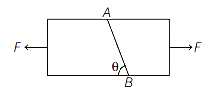
Two equal and opposite forces each $F$ act on a rod of uniform cross-sectional area $a$ as shown in the figure. The shearing stress on the section $AB$ will be
A
$\frac{F \sin \theta \cos \theta}{a}$
B
$\frac{F \sin \theta}{a}$
C
$\frac{F \cos \theta}{a}$
D
$\frac{F \sin ^2 \theta}{a}$
Solution
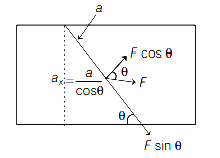
(A) Let the cross-sectional area of the rod be $a$. The area of the inclined section $AB$ is $A' = \frac{a}{\sin \theta}$.
The force $F$ acting on the rod can be resolved into two components along the section $AB$:
$1$. Normal component: $F_n = F \sin \theta$
$2$. Tangential (shearing) component: $F_s = F \cos \theta$
The shearing stress $\tau$ is defined as the tangential force divided by the area of the section:
$\tau = \frac{F_s}{A'} = \frac{F \cos \theta}{a / \sin \theta} = \frac{F \sin \theta \cos \theta}{a}$
The force $F$ acting on the rod can be resolved into two components along the section $AB$:
$1$. Normal component: $F_n = F \sin \theta$
$2$. Tangential (shearing) component: $F_s = F \cos \theta$
The shearing stress $\tau$ is defined as the tangential force divided by the area of the section:
$\tau = \frac{F_s}{A'} = \frac{F \cos \theta}{a / \sin \theta} = \frac{F \sin \theta \cos \theta}{a}$
0 likes
View Solution156
MediumMCQ
The length of a rod under longitudinal tension $T_1$ is $L_1$ and that under longitudinal tension $T_2$ is $L_2$. What is the actual length of the rod,in the absence of tensions?
A
$\frac{L_1 T_1-L_2 T_2}{T_2-T_1}$
B
$\frac{L_1 T_2-L_2 T_1}{T_2+T_1}$
C
$\frac{L_1 T_1-L_2 T_2}{T_2+T_1}$
D
$\frac{L_1 T_2-L_2 T_1}{T_2-T_1}$
Solution
(D) Let the natural length of the rod be $L_0$.
According to Hooke's law,the stress is proportional to strain within the elastic limit:
$\text{Stress} = Y \times \text{Strain}$
$\frac{T}{A} = Y \frac{L - L_0}{L_0}$
Rearranging for the change in length:
$L - L_0 = \frac{T L_0}{A Y}$
Let $k = \frac{L_0}{A Y}$,which is a constant for the rod.
Then,$L = L_0 + k T$.
For tension $T_1$,$L_1 = L_0 + k T_1$ --- $(i)$
For tension $T_2$,$L_2 = L_0 + k T_2$ --- (ii)
Subtracting $(i)$ from (ii):
$L_2 - L_1 = k(T_2 - T_1) \Rightarrow k = \frac{L_2 - L_1}{T_2 - T_1}$
Substitute $k$ into equation $(i)$:
$L_0 = L_1 - k T_1 = L_1 - \left( \frac{L_2 - L_1}{T_2 - T_1} \right) T_1$
$L_0 = \frac{L_1(T_2 - T_1) - T_1(L_2 - L_1)}{T_2 - T_1}$
$L_0 = \frac{L_1 T_2 - L_1 T_1 - T_1 L_2 + L_1 T_1}{T_2 - T_1}$
$L_0 = \frac{L_1 T_2 - L_2 T_1}{T_2 - T_1}$
According to Hooke's law,the stress is proportional to strain within the elastic limit:
$\text{Stress} = Y \times \text{Strain}$
$\frac{T}{A} = Y \frac{L - L_0}{L_0}$
Rearranging for the change in length:
$L - L_0 = \frac{T L_0}{A Y}$
Let $k = \frac{L_0}{A Y}$,which is a constant for the rod.
Then,$L = L_0 + k T$.
For tension $T_1$,$L_1 = L_0 + k T_1$ --- $(i)$
For tension $T_2$,$L_2 = L_0 + k T_2$ --- (ii)
Subtracting $(i)$ from (ii):
$L_2 - L_1 = k(T_2 - T_1) \Rightarrow k = \frac{L_2 - L_1}{T_2 - T_1}$
Substitute $k$ into equation $(i)$:
$L_0 = L_1 - k T_1 = L_1 - \left( \frac{L_2 - L_1}{T_2 - T_1} \right) T_1$
$L_0 = \frac{L_1(T_2 - T_1) - T_1(L_2 - L_1)}{T_2 - T_1}$
$L_0 = \frac{L_1 T_2 - L_1 T_1 - T_1 L_2 + L_1 T_1}{T_2 - T_1}$
$L_0 = \frac{L_1 T_2 - L_2 T_1}{T_2 - T_1}$
0 likes
View Solution157
EasyMCQ
$A$ force $F$ is needed to break a copper wire having radius $R$. The force needed to break a copper wire of radius $2R$ will be
A
$\frac{F}{2}$
B
$2F$
C
$4F$
D
$\frac{F}{4}$
Solution
(C) The breaking force of a wire is determined by its breaking stress,which is a material property. The breaking force $F$ is given by the product of breaking stress $\sigma$ and the cross-sectional area $A$ of the wire.
$F = \sigma \times A = \sigma \times (\pi R^2)$
Since the material is the same (copper),the breaking stress $\sigma$ remains constant.
Therefore,$F \propto R^2$.
If $F_1 = F$ for radius $R_1 = R$,and $F_2$ is the force for radius $R_2 = 2R$,then:
$\frac{F_2}{F_1} = \left(\frac{R_2}{R_1}\right)^2 = \left(\frac{2R}{R}\right)^2 = 4$
$F_2 = 4F_1 = 4F$.
$F = \sigma \times A = \sigma \times (\pi R^2)$
Since the material is the same (copper),the breaking stress $\sigma$ remains constant.
Therefore,$F \propto R^2$.
If $F_1 = F$ for radius $R_1 = R$,and $F_2$ is the force for radius $R_2 = 2R$,then:
$\frac{F_2}{F_1} = \left(\frac{R_2}{R_1}\right)^2 = \left(\frac{2R}{R}\right)^2 = 4$
$F_2 = 4F_1 = 4F$.
0 likes
View Solution158
EasyMCQ
According to Hooke's law,the force required to change the length of a wire by $l$ is proportional to
A
$l^{-2}$
B
$l^{-1}$
C
$l$
D
$l^2$
Solution
(C) According to Hooke's law,within the elastic limit,stress is directly proportional to strain.
$\text{Stress} = Y \times \text{Strain}$
Where $Y$ is Young's modulus.
$\frac{F}{A} = Y \times \frac{\Delta l}{L}$
Here,$F$ is the force,$A$ is the cross-sectional area,$\Delta l$ is the change in length,and $L$ is the original length.
Rearranging for force $F$:
$F = \frac{Y A}{L} \Delta l$
Since $Y$,$A$,and $L$ are constants for a given wire,we have:
$F \propto \Delta l$
Given that the change in length is $l$,we get:
$F \propto l$
Therefore,the force is proportional to $l$.
$\text{Stress} = Y \times \text{Strain}$
Where $Y$ is Young's modulus.
$\frac{F}{A} = Y \times \frac{\Delta l}{L}$
Here,$F$ is the force,$A$ is the cross-sectional area,$\Delta l$ is the change in length,and $L$ is the original length.
Rearranging for force $F$:
$F = \frac{Y A}{L} \Delta l$
Since $Y$,$A$,and $L$ are constants for a given wire,we have:
$F \propto \Delta l$
Given that the change in length is $l$,we get:
$F \propto l$
Therefore,the force is proportional to $l$.
0 likes
View Solution159
MediumMCQ
When a load of $80 \,N$ is suspended from a string,its length is $101 \,mm$. If a load of $100 \,N$ is suspended,its length is $102 \,mm$. If a load of $160 \,N$ is suspended from it,then the length of the string is (Assume the area of cross-section is unchanged). (in $\,cm$)
A
$15.5$
B
$13.5$
C
$16.5$
D
$10.5$
Solution
(D) According to Hooke's Law,the extension $\Delta l$ is proportional to the applied force $T$. Let $l_0$ be the natural length and $k$ be the force constant of the string.
The length $l$ under tension $T$ is given by $l = l_0 + \frac{T}{k}$.
For $T_1 = 80 \,N$,$l_1 = 101 \,mm = l_0 + \frac{80}{k}$ --- $(1)$
For $T_2 = 100 \,N$,$l_2 = 102 \,mm = l_0 + \frac{100}{k}$ --- $(2)$
Subtracting $(1)$ from $(2)$: $102 - 101 = \frac{100-80}{k} \implies 1 = \frac{20}{k} \implies k = 20 \,N/mm$.
Substituting $k$ into $(1)$: $101 = l_0 + \frac{80}{20} \implies 101 = l_0 + 4 \implies l_0 = 97 \,mm$.
Now,for $T_3 = 160 \,N$,the length $l_3 = l_0 + \frac{T_3}{k} = 97 + \frac{160}{20} = 97 + 8 = 105 \,mm$.
Converting to cm: $105 \,mm = 10.5 \,cm$.
The length $l$ under tension $T$ is given by $l = l_0 + \frac{T}{k}$.
For $T_1 = 80 \,N$,$l_1 = 101 \,mm = l_0 + \frac{80}{k}$ --- $(1)$
For $T_2 = 100 \,N$,$l_2 = 102 \,mm = l_0 + \frac{100}{k}$ --- $(2)$
Subtracting $(1)$ from $(2)$: $102 - 101 = \frac{100-80}{k} \implies 1 = \frac{20}{k} \implies k = 20 \,N/mm$.
Substituting $k$ into $(1)$: $101 = l_0 + \frac{80}{20} \implies 101 = l_0 + 4 \implies l_0 = 97 \,mm$.
Now,for $T_3 = 160 \,N$,the length $l_3 = l_0 + \frac{T_3}{k} = 97 + \frac{160}{20} = 97 + 8 = 105 \,mm$.
Converting to cm: $105 \,mm = 10.5 \,cm$.
0 likes
View Solution160
EasyMCQ
The length of a metal wire is $l_1$ when the tension in it is $F_1$ and $l_2$ when the tension is $F_2$. Then,the original length of the wire is
A
$\frac{l_1 F_1+l_2 F_2}{F_1+F_2}$
B
$\frac{l_2-l_1}{F_2-F_1}$
C
$\frac{l_1 F_2-l_2 F_1}{F_2-F_1}$
D
$\frac{l_1 F_1-l_2 F_2}{F_2-F_1}$
Solution
(C) According to Hooke's Law,the extension in a wire is proportional to the applied force: $F = k(l - l_0)$,where $l_0$ is the original length and $k$ is the force constant.
For the first case: $F_1 = k(l_1 - l_0)$ -- $(1)$
For the second case: $F_2 = k(l_2 - l_0)$ -- $(2)$
Dividing $(1)$ by $(2)$,we get: $\frac{F_1}{F_2} = \frac{l_1 - l_0}{l_2 - l_0}$
Cross-multiplying: $F_1(l_2 - l_0) = F_2(l_1 - l_0)$
$F_1 l_2 - F_1 l_0 = F_2 l_1 - F_2 l_0$
$F_2 l_0 - F_1 l_0 = F_2 l_1 - F_1 l_2$
$l_0(F_2 - F_1) = F_2 l_1 - F_1 l_2$
$l_0 = \frac{F_2 l_1 - F_1 l_2}{F_2 - F_1}$
For the first case: $F_1 = k(l_1 - l_0)$ -- $(1)$
For the second case: $F_2 = k(l_2 - l_0)$ -- $(2)$
Dividing $(1)$ by $(2)$,we get: $\frac{F_1}{F_2} = \frac{l_1 - l_0}{l_2 - l_0}$
Cross-multiplying: $F_1(l_2 - l_0) = F_2(l_1 - l_0)$
$F_1 l_2 - F_1 l_0 = F_2 l_1 - F_2 l_0$
$F_2 l_0 - F_1 l_0 = F_2 l_1 - F_1 l_2$
$l_0(F_2 - F_1) = F_2 l_1 - F_1 l_2$
$l_0 = \frac{F_2 l_1 - F_1 l_2}{F_2 - F_1}$
0 likes
View Solution161
MediumMCQ
If the length of a string is $P$ when the tension in it is $6 \ N$ and its length is $Q$ when the tension in it is $8 \ N$,then the original length of the string is
A
$3P + 4Q$
B
$3P - 4Q$
C
$4P + 3Q$
D
$4P - 3Q$
Solution
(D) Let $L$ be the original length of the string and $k$ be the force constant of the string.
The final length is given by: $\text{Final length} = \text{Original length} + \text{Elongation}$.
Using Hooke's Law,$\text{Elongation} = \frac{F}{k}$.
Thus,$L' = L + \frac{F}{k}$.
For the first condition: $P = L + \frac{6}{k} \quad ...(i)$
For the second condition: $Q = L + \frac{8}{k} \quad ...(ii)$
To eliminate $k$,multiply equation $(i)$ by $4$ and equation $(ii)$ by $3$:
$4P = 4L + \frac{24}{k} \quad ...(iii)$
$3Q = 3L + \frac{24}{k} \quad ...(iv)$
Subtracting equation $(iv)$ from equation $(iii)$:
$4P - 3Q = (4L - 3L) + (\frac{24}{k} - \frac{24}{k})$
$4P - 3Q = L$
Therefore,the original length of the string is $4P - 3Q$.
The final length is given by: $\text{Final length} = \text{Original length} + \text{Elongation}$.
Using Hooke's Law,$\text{Elongation} = \frac{F}{k}$.
Thus,$L' = L + \frac{F}{k}$.
For the first condition: $P = L + \frac{6}{k} \quad ...(i)$
For the second condition: $Q = L + \frac{8}{k} \quad ...(ii)$
To eliminate $k$,multiply equation $(i)$ by $4$ and equation $(ii)$ by $3$:
$4P = 4L + \frac{24}{k} \quad ...(iii)$
$3Q = 3L + \frac{24}{k} \quad ...(iv)$
Subtracting equation $(iv)$ from equation $(iii)$:
$4P - 3Q = (4L - 3L) + (\frac{24}{k} - \frac{24}{k})$
$4P - 3Q = L$
Therefore,the original length of the string is $4P - 3Q$.
0 likes
View Solution162
EasyMCQ
$A$ wire of length $40 \text{ cm}$ is stretched by $0.1 \text{ cm}$. The strain on the wire is
A
$25 \times 10^{-4}$
B
$40 \times 10^{-4}$
C
$10 \times 10^{-4}$
D
$12.5 \times 10^{-4}$
Solution
(A) The strain is defined as the ratio of the change in length to the original length.
$\text{Strain} = \frac{\Delta \ell}{\ell}$
Given:
Original length $\ell = 40 \text{ cm}$
Change in length $\Delta \ell = 0.1 \text{ cm}$
$\text{Strain} = \frac{0.1}{40}$
$\text{Strain} = \frac{1}{400} = 0.0025$
$\text{Strain} = 25 \times 10^{-4}$
$\text{Strain} = \frac{\Delta \ell}{\ell}$
Given:
Original length $\ell = 40 \text{ cm}$
Change in length $\Delta \ell = 0.1 \text{ cm}$
$\text{Strain} = \frac{0.1}{40}$
$\text{Strain} = \frac{1}{400} = 0.0025$
$\text{Strain} = 25 \times 10^{-4}$
0 likes
View Solution163
EasyMCQ
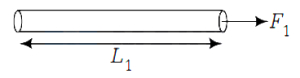
When a force $F_1$ is applied on a metallic wire,the length of the wire is $L_1$. If a force $F_2$ is applied on the same wire,the length of the wire is $L_2$. The original length of the wire $L$ is
A
$\frac{L_1 F_1+L_2 F_2}{F_1+F_2}$
B
$\frac{L_2-L_1}{F_1+F_2}$
C
$\frac{F_1 L_2-F_2 L_1}{F_1-F_2}$
D
$\frac{F_1 L_1-F_2 L_2}{F_1-F_2}$
Solution
(C) According to Hooke's Law,the change in length of a wire is directly proportional to the applied force within the elastic limit.
Let $L$ be the original length and $K$ be the force constant of the wire.
For force $F_1$,the extension is $(L_1 - L)$,so $F_1 = K(L_1 - L)$ --- $(i)$
For force $F_2$,the extension is $(L_2 - L)$,so $F_2 = K(L_2 - L)$ --- (ii)
Dividing equation $(i)$ by equation (ii):
$\frac{F_1}{F_2} = \frac{K(L_1 - L)}{K(L_2 - L)}$
$\frac{F_1}{F_2} = \frac{L_1 - L}{L_2 - L}$
Cross-multiplying gives:
$F_1(L_2 - L) = F_2(L_1 - L)$
$F_1 L_2 - F_1 L = F_2 L_1 - F_2 L$
Rearranging to solve for $L$:
$F_2 L - F_1 L = F_2 L_1 - F_1 L_2$
$L(F_2 - F_1) = F_2 L_1 - F_1 L_2$
$L = \frac{F_2 L_1 - F_1 L_2}{F_2 - F_1} = \frac{F_1 L_2 - F_2 L_1}{F_1 - F_2}$
Let $L$ be the original length and $K$ be the force constant of the wire.
For force $F_1$,the extension is $(L_1 - L)$,so $F_1 = K(L_1 - L)$ --- $(i)$
For force $F_2$,the extension is $(L_2 - L)$,so $F_2 = K(L_2 - L)$ --- (ii)
Dividing equation $(i)$ by equation (ii):
$\frac{F_1}{F_2} = \frac{K(L_1 - L)}{K(L_2 - L)}$
$\frac{F_1}{F_2} = \frac{L_1 - L}{L_2 - L}$
Cross-multiplying gives:
$F_1(L_2 - L) = F_2(L_1 - L)$
$F_1 L_2 - F_1 L = F_2 L_1 - F_2 L$
Rearranging to solve for $L$:
$F_2 L - F_1 L = F_2 L_1 - F_1 L_2$
$L(F_2 - F_1) = F_2 L_1 - F_1 L_2$
$L = \frac{F_2 L_1 - F_1 L_2}{F_2 - F_1} = \frac{F_1 L_2 - F_2 L_1}{F_1 - F_2}$
0 likes
View Solution164
DifficultMCQ
The length of an elastic string is $a$ metres when the longitudinal tension is $4 \ N$ and $b$ metres when the longitudinal tension is $5 \ N$. The length of the string in metres when the longitudinal tension is $9 \ N$ is
A
$a-b$
B
$5b-4a$
C
$2b-\frac{1}{4}a$
D
$4a-3b$
Solution
(B) According to Hooke's Law,the extension of an elastic string is proportional to the applied tension. Let $l$ be the natural length of the string and $k$ be the force constant.
The length of the string under tension $T$ is given by $L = l + \frac{T}{k}$.
For $T_1 = 4 \ N$,$L_1 = a = l + \frac{4}{k} \implies \frac{4}{k} = a - l$ (Equation $1$).
For $T_2 = 5 \ N$,$L_2 = b = l + \frac{5}{k} \implies \frac{5}{k} = b - l$ (Equation $2$).
Subtracting Equation $1$ from Equation $2$: $\frac{5}{k} - \frac{4}{k} = (b - l) - (a - l) \implies \frac{1}{k} = b - a$.
Substituting $\frac{1}{k}$ into Equation $1$: $a = l + 4(b - a) \implies a = l + 4b - 4a \implies l = 5a - 4b$.
Now,for $T_3 = 9 \ N$,the length $x$ is $x = l + \frac{9}{k}$.
Substituting $l = 5a - 4b$ and $\frac{1}{k} = b - a$:
$x = (5a - 4b) + 9(b - a) = 5a - 4b + 9b - 9a = 5b - 4a$.
The length of the string under tension $T$ is given by $L = l + \frac{T}{k}$.
For $T_1 = 4 \ N$,$L_1 = a = l + \frac{4}{k} \implies \frac{4}{k} = a - l$ (Equation $1$).
For $T_2 = 5 \ N$,$L_2 = b = l + \frac{5}{k} \implies \frac{5}{k} = b - l$ (Equation $2$).
Subtracting Equation $1$ from Equation $2$: $\frac{5}{k} - \frac{4}{k} = (b - l) - (a - l) \implies \frac{1}{k} = b - a$.
Substituting $\frac{1}{k}$ into Equation $1$: $a = l + 4(b - a) \implies a = l + 4b - 4a \implies l = 5a - 4b$.
Now,for $T_3 = 9 \ N$,the length $x$ is $x = l + \frac{9}{k}$.
Substituting $l = 5a - 4b$ and $\frac{1}{k} = b - a$:
$x = (5a - 4b) + 9(b - a) = 5a - 4b + 9b - 9a = 5b - 4a$.
0 likes
View Solution165
DifficultMCQ
If a string,suspended from the ceiling,is given a downward force $F_1$,its length becomes $L_1$. Its length becomes $L_2$ if the downward force is $F_2$. What is its actual length?
A
$\frac{L_1+L_2}{2}$
B
$\sqrt{L_1 L_2}$
C
$\frac{F_2 L_1+F_1 L_2}{F_2+F_1}$
D
$\frac{F_2 L_1-F_1 L_2}{F_2-F_1}$
Solution
(D) Let the actual length of the string be $L$ and the force constant be $k = \frac{AY}{L_0}$.
According to Hooke's Law,the extension is proportional to the applied force: $F = k \Delta L$.
For the first case: $F_1 = k(L_1 - L)$.
For the second case: $F_2 = k(L_2 - L)$.
Dividing the two equations: $\frac{F_1}{F_2} = \frac{L_1 - L}{L_2 - L}$.
Cross-multiplying gives: $F_1(L_2 - L) = F_2(L_1 - L)$.
$F_1 L_2 - F_1 L = F_2 L_1 - F_2 L$.
Rearranging to solve for $L$: $F_2 L - F_1 L = F_2 L_1 - F_1 L_2$.
$L(F_2 - F_1) = F_2 L_1 - F_1 L_2$.
Therefore,$L = \frac{F_2 L_1 - F_1 L_2}{F_2 - F_1}$.
According to Hooke's Law,the extension is proportional to the applied force: $F = k \Delta L$.
For the first case: $F_1 = k(L_1 - L)$.
For the second case: $F_2 = k(L_2 - L)$.
Dividing the two equations: $\frac{F_1}{F_2} = \frac{L_1 - L}{L_2 - L}$.
Cross-multiplying gives: $F_1(L_2 - L) = F_2(L_1 - L)$.
$F_1 L_2 - F_1 L = F_2 L_1 - F_2 L$.
Rearranging to solve for $L$: $F_2 L - F_1 L = F_2 L_1 - F_1 L_2$.
$L(F_2 - F_1) = F_2 L_1 - F_1 L_2$.
Therefore,$L = \frac{F_2 L_1 - F_1 L_2}{F_2 - F_1}$.
0 likes
View Solution166
DifficultMCQ
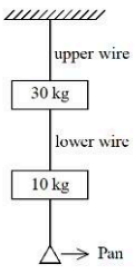
Two wires as shown in the figure below,made of steel,have a breaking stress of $12 \times 10^8 \text{ N/m}^2$. The area of cross-section of the upper wire is $0.008 \text{ cm}^2$ and that of the lower wire is $0.004 \text{ cm}^2$. The maximum mass that can be added to the pan without breaking any wire is . . . . . . kg. (Take $g = 10 \text{ m/s}^2$)
A
$56$
B
$38$
C
$96$
D
$5.6$
Solution
(B) Breaking stress is defined as $\text{Stress} = \frac{F_{max}}{A}$,which implies $F_{max} = \text{Stress} \times A$.
For the lower wire:
$F_L = (12 \times 10^8 \text{ N/m}^2) \times (0.004 \times 10^{-4} \text{ m}^2) = 480 \text{ N}$.
The weight supported by the lower wire is $(m_{pan} + 10)g = 480 \text{ N}$.
$(m_{pan} + 10) \times 10 = 480 \Rightarrow m_{pan} + 10 = 48 \Rightarrow m_{pan} = 38 \text{ kg}$.
For the upper wire:
$F_U = (12 \times 10^8 \text{ N/m}^2) \times (0.008 \times 10^{-4} \text{ m}^2) = 960 \text{ N}$.
The weight supported by the upper wire is $(m_{pan} + 10 + 30)g = 960 \text{ N}$.
$(m_{pan} + 40) \times 10 = 960 \Rightarrow m_{pan} + 40 = 96 \Rightarrow m_{pan} = 56 \text{ kg}$.
To ensure both wires remain safe,we must choose the smaller mass,which is $38 \text{ kg}$.
For the lower wire:
$F_L = (12 \times 10^8 \text{ N/m}^2) \times (0.004 \times 10^{-4} \text{ m}^2) = 480 \text{ N}$.
The weight supported by the lower wire is $(m_{pan} + 10)g = 480 \text{ N}$.
$(m_{pan} + 10) \times 10 = 480 \Rightarrow m_{pan} + 10 = 48 \Rightarrow m_{pan} = 38 \text{ kg}$.
For the upper wire:
$F_U = (12 \times 10^8 \text{ N/m}^2) \times (0.008 \times 10^{-4} \text{ m}^2) = 960 \text{ N}$.
The weight supported by the upper wire is $(m_{pan} + 10 + 30)g = 960 \text{ N}$.
$(m_{pan} + 40) \times 10 = 960 \Rightarrow m_{pan} + 40 = 96 \Rightarrow m_{pan} = 56 \text{ kg}$.
To ensure both wires remain safe,we must choose the smaller mass,which is $38 \text{ kg}$.
0 likes
View Solution167
DifficultMCQ
$A$ lift of mass $1600 \text{ kg}$ is supported by a thick iron wire. If the maximum stress which the wire can withstand is $4 \times 10^8 \text{ N/m}^2$ and its radius is $4 \text{ mm}$,then the maximum acceleration the lift can take is . . . . . . $\text{m/s}^2$. (Take $g = 10 \text{ m/s}^2$ and $\pi = 3.14$)
A
$2.56$
B
$3.89$
C
$4.32$
D
$5.16$
Solution
(A) The wire must support the weight of the lift and the additional force due to acceleration. The tension $T$ in the wire is given by $T = m(g + a)$.
Given: Stress $\sigma = 4 \times 10^8 \text{ N/m}^2$,mass $m = 1600 \text{ kg}$,radius $r = 4 \text{ mm} = 4 \times 10^{-3} \text{ m}$,and $g = 10 \text{ m/s}^2$.
The cross-sectional area $A$ of the wire is $A = \pi r^2 = 3.14 \times (4 \times 10^{-3} \text{ m})^2 = 3.14 \times 16 \times 10^{-6} \text{ m}^2 = 50.24 \times 10^{-6} \text{ m}^2$.
The maximum tension $T$ the wire can withstand is $T = \sigma \times A = (4 \times 10^8 \text{ N/m}^2) \times (50.24 \times 10^{-6} \text{ m}^2) = 20096 \text{ N}$.
Using the equation of motion $T = m(g + a)$,we have $20096 = 1600(10 + a)$.
Dividing both sides by $1600$,we get $10 + a = \frac{20096}{1600} = 12.56$.
Therefore,$a = 12.56 - 10 = 2.56 \text{ m/s}^2$.
Given: Stress $\sigma = 4 \times 10^8 \text{ N/m}^2$,mass $m = 1600 \text{ kg}$,radius $r = 4 \text{ mm} = 4 \times 10^{-3} \text{ m}$,and $g = 10 \text{ m/s}^2$.
The cross-sectional area $A$ of the wire is $A = \pi r^2 = 3.14 \times (4 \times 10^{-3} \text{ m})^2 = 3.14 \times 16 \times 10^{-6} \text{ m}^2 = 50.24 \times 10^{-6} \text{ m}^2$.
The maximum tension $T$ the wire can withstand is $T = \sigma \times A = (4 \times 10^8 \text{ N/m}^2) \times (50.24 \times 10^{-6} \text{ m}^2) = 20096 \text{ N}$.
Using the equation of motion $T = m(g + a)$,we have $20096 = 1600(10 + a)$.
Dividing both sides by $1600$,we get $10 + a = \frac{20096}{1600} = 12.56$.
Therefore,$a = 12.56 - 10 = 2.56 \text{ m/s}^2$.
0 likes
View SolutionMechanical Properties of Solids — Basic of Elasticity, Stress and Strain relationship and Graphical analysis · Frequently Asked Questions
1Are these Mechanical Properties of Solids questions useful for JEE and NEET?
Yes. All questions in this section are mapped to JEE Main and NEET exam patterns. Previous year questions from JEE Main, NEET, GUJCET and state-level exams are included with full solutions.
2Can I switch to Hindi or Gujarati for these questions?
Yes. Use the language tabs in the hero section or the sidebar to view the same questions and solutions in English, Hindi or Gujarati.
3How do I generate a question paper from this subtopic?
Use the Vedclass Exam Paper Generator — select the chapter and subtopic, set difficulty, and generate Sets A, B, C, D automatically. First 3 chapters of every subject are free.
Vedclass Products
For Students
Vedclass Test Series
Mock tests in real JEE/NEET style with performance analysis. 5-day free trial.
Start Free TrialFor Teachers
Exam Paper Generator
Generate Set A/B/C/D papers from this chapter in 2 minutes. 3 chapters free.
Try FreeFor Institutes
Online Exam Module
Live online exams with unlimited students, 360° analytics & white-label branding.
See DemoFor Teachers & Institutes
Generate a Mechanical Properties of Solids Exam Paper in 2 Minutes
Select subtopic & difficulty — Sets A, B, C, D auto-generated with No Repeat logic.
First 3 chapters of every subject are free — no payment required.