
A English
Rigidity Modulus Questions in English
Class 11 Physics · Mechanical Properties of Solids · Rigidity Modulus
40+
Questions
English
Language
100%
With Solutions
Showing 40 of 40 questions in English
1
EasyMCQ
The units of modulus of rigidity are
A
$N \cdot m$
B
$N/m$
C
$N \cdot m^2$
D
$N/m^2$
Solution
(D) The modulus of rigidity (also known as shear modulus) is defined as the ratio of shear stress to shear strain.
$\text{Modulus of rigidity} = \frac{\text{Shear Stress}}{\text{Shear Strain}}$
Since shear strain is a dimensionless quantity (it is a ratio of two lengths),the unit of the modulus of rigidity is the same as the unit of stress.
Stress is defined as force per unit area,so its unit is $\frac{N}{m^2}$ or $\text{Pascal} (Pa)$.
Therefore,the correct unit is $N/m^2$.
$\text{Modulus of rigidity} = \frac{\text{Shear Stress}}{\text{Shear Strain}}$
Since shear strain is a dimensionless quantity (it is a ratio of two lengths),the unit of the modulus of rigidity is the same as the unit of stress.
Stress is defined as force per unit area,so its unit is $\frac{N}{m^2}$ or $\text{Pascal} (Pa)$.
Therefore,the correct unit is $N/m^2$.
0 likes
View Solution2
EasyMCQ
The dimensional formula for the modulus of rigidity is
A
$M L^2 T^{-2}$
B
$M L^{-1} T^{-3}$
C
$M L^{-2} T^{-2}$
D
$M L^{-1} T^{-2}$
Solution
(D) The modulus of rigidity $(\eta)$ is defined as the ratio of shear stress to shear strain.
Shear stress is defined as force per unit area,so its dimensional formula is $[F]/[A] = [MLT^{-2}]/[L^2] = [ML^{-1}T^{-2}]$.
Shear strain is a dimensionless quantity because it is the ratio of two lengths.
Therefore,the dimensional formula for the modulus of rigidity is the same as that of stress,which is $[ML^{-1}T^{-2}]$.
Thus,the correct option is $D$.
Shear stress is defined as force per unit area,so its dimensional formula is $[F]/[A] = [MLT^{-2}]/[L^2] = [ML^{-1}T^{-2}]$.
Shear strain is a dimensionless quantity because it is the ratio of two lengths.
Therefore,the dimensional formula for the modulus of rigidity is the same as that of stress,which is $[ML^{-1}T^{-2}]$.
Thus,the correct option is $D$.
0 likes
View Solution3
MediumMCQ
The dimensions of shear modulus are
A
$MLT^{-1}$
B
$ML^2T^{-2}$
C
$ML^{-1}T^{-2}$
D
$MLT^{-2}$
Solution
(C) Shear modulus is defined as the ratio of shearing stress to shearing strain.
Shearing stress = $\frac{\text{Force}}{\text{Area}} = \frac{[MLT^{-2}]}{[L^2]} = [ML^{-1}T^{-2}]$.
Shearing strain is a dimensionless quantity.
Therefore,the dimensions of shear modulus are the same as those of stress,which is $[ML^{-1}T^{-2}]$.
Shearing stress = $\frac{\text{Force}}{\text{Area}} = \frac{[MLT^{-2}]}{[L^2]} = [ML^{-1}T^{-2}]$.
Shearing strain is a dimensionless quantity.
Therefore,the dimensions of shear modulus are the same as those of stress,which is $[ML^{-1}T^{-2}]$.
0 likes
View Solution4
EasyMCQ
The modulus of rigidity of diamond is:
A
Too less
B
Greater than all materials
C
Less than all materials
D
Zero
Solution
(B) The modulus of rigidity (also known as shear modulus) measures the resistance of a material to shear deformation. Diamond is the hardest known natural material,characterized by a very strong covalent crystal lattice structure. Due to this extremely strong atomic bonding,it exhibits the highest resistance to deformation among all known materials. Therefore,its modulus of rigidity is greater than that of any other material. The correct option is $B$.
0 likes
View Solution5
EasyMCQ
The ratio of lengths of two rods $A$ and $B$ of the same material is $1:2$ and the ratio of their radii is $2:1$. What is the ratio of the modulus of rigidity of $A$ and $B$ (in $:1$)?
A
$4$
B
$16$
C
$8$
D
$1$
Solution
(D) The modulus of rigidity (also known as the shear modulus) is an intrinsic property of the material of the rod.
Since both rods $A$ and $B$ are made of the same material,their modulus of rigidity will be identical.
Therefore,the ratio of the modulus of rigidity of $A$ to $B$ is $1:1$.
Since both rods $A$ and $B$ are made of the same material,their modulus of rigidity will be identical.
Therefore,the ratio of the modulus of rigidity of $A$ to $B$ is $1:1$.
0 likes
View Solution6
DifficultMCQ
Two wires $A$ and $B$ of the same length and of the same material have the respective radii $r_1$ and $r_2$. Their one end is fixed to a rigid support,and at the other end,an equal twisting couple is applied. The ratio of the angle of twist at the end of $A$ to the angle of twist at the end of $B$ will be:
A
$r_1^2 / r_2^2$
B
$r_2^2 / r_1^2$
C
$r_2^4 / r_1^4$
D
$r_1^4 / r_2^4$
Solution
(C) The twisting couple $C$ required to produce an angle of twist $\theta$ in a wire of length $l$,radius $r$,and modulus of rigidity $\eta$ is given by the formula:
$C = \frac{\pi \eta r^4 \theta}{2l}$
From this expression,we can see that for a constant twisting couple $C$,length $l$,and material property $\eta$:
$\theta = \frac{2lC}{\pi \eta r^4}$
This implies that $\theta \propto \frac{1}{r^4}$.
Therefore,for wires $A$ and $B$ with radii $r_1$ and $r_2$ respectively,the ratio of the angles of twist $\theta_1$ and $\theta_2$ is:
$\frac{\theta_1}{\theta_2} = \frac{r_2^4}{r_1^4}$
Thus,the correct option is $C$.
$C = \frac{\pi \eta r^4 \theta}{2l}$
From this expression,we can see that for a constant twisting couple $C$,length $l$,and material property $\eta$:
$\theta = \frac{2lC}{\pi \eta r^4}$
This implies that $\theta \propto \frac{1}{r^4}$.
Therefore,for wires $A$ and $B$ with radii $r_1$ and $r_2$ respectively,the ratio of the angles of twist $\theta_1$ and $\theta_2$ is:
$\frac{\theta_1}{\theta_2} = \frac{r_2^4}{r_1^4}$
Thus,the correct option is $C$.
0 likes
View Solution7
EasyMCQ
What is the modulus of rigidity of a liquid?
A
Non-zero constant
B
Infinite
C
Zero
D
Cannot be predicted
Solution
(C) The modulus of rigidity,also known as the shear modulus,is defined as the ratio of shear stress to shear strain.
Liquids do not have a fixed shape and offer no resistance to shear stress.
When a shear stress is applied to a liquid,it begins to flow continuously,resulting in an infinite shear strain for any finite shear stress.
Since the modulus of rigidity is defined as $\text{Shear Stress} / \text{Shear Strain}$,and the shear strain becomes infinitely large for any applied shear stress,the modulus of rigidity for a liquid is $0$.
Liquids do not have a fixed shape and offer no resistance to shear stress.
When a shear stress is applied to a liquid,it begins to flow continuously,resulting in an infinite shear strain for any finite shear stress.
Since the modulus of rigidity is defined as $\text{Shear Stress} / \text{Shear Strain}$,and the shear strain becomes infinitely large for any applied shear stress,the modulus of rigidity for a liquid is $0$.
0 likes
View Solution8
MediumMCQ
The upper end of a wire of radius $4\, mm$ and length $100\, cm$ is clamped and its other end is twisted through an angle of $30^\circ$. The angle of shear is ..... $^\circ$.
A
$12$
B
$0.12$
C
$1.2$
D
$0.012$
Solution
(B) The angle of shear $\phi$ is given by the formula $\phi = \frac{r\theta}{L}$,where $r$ is the radius of the wire,$\theta$ is the angle of twist in radians,and $L$ is the length of the wire.
Given: $r = 4\, mm = 0.4\, cm$,$L = 100\, cm$,and $\theta = 30^\circ$.
Substituting the values into the formula:
$\phi = \frac{0.4\, cm}{100\, cm} \times 30^\circ$
$\phi = 0.004 \times 30^\circ = 0.12^\circ$.
Therefore,the angle of shear is $0.12^\circ$.
Given: $r = 4\, mm = 0.4\, cm$,$L = 100\, cm$,and $\theta = 30^\circ$.
Substituting the values into the formula:
$\phi = \frac{0.4\, cm}{100\, cm} \times 30^\circ$
$\phi = 0.004 \times 30^\circ = 0.12^\circ$.
Therefore,the angle of shear is $0.12^\circ$.
0 likes
View Solution9
DifficultMCQ
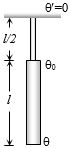
$A$ rod of length $l$ and radius $r$ is joined to a rod of length $l/2$ and radius $r/2$ of the same material. The free end of the small rod is fixed to a rigid base,and the free end of the larger rod is given a twist of $\theta^\circ$. The twist angle at the joint will be:
A
$\theta /4$
B
$\theta /2$
C
$5\theta /6$
D
$8\theta /9$
Solution
(D) The torsional rigidity of a rod is given by $C = \frac{\pi \eta r^4}{2L}$,where $\eta$ is the modulus of rigidity.
Since the rods are joined in series,the torque $\tau$ transmitted through both rods is the same.
Let $\theta_0$ be the twist angle at the joint.
For the small rod (length $l/2$,radius $r/2$): $\tau = C_1(\theta_0 - 0) = \frac{\pi \eta (r/2)^4}{2(l/2)} \theta_0 = \frac{\pi \eta r^4}{16(l/2)} \theta_0 = \frac{\pi \eta r^4}{8l} \theta_0$.
For the large rod (length $l$,radius $r$): $\tau = C_2(\theta - \theta_0) = \frac{\pi \eta r^4}{2l} (\theta - \theta_0)$.
Equating the torques: $\frac{\pi \eta r^4}{8l} \theta_0 = \frac{\pi \eta r^4}{2l} (\theta - \theta_0)$.
$\frac{\theta_0}{8} = \frac{\theta - \theta_0}{2} \Rightarrow \theta_0 = 4(\theta - \theta_0) \Rightarrow \theta_0 = 4\theta - 4\theta_0 \Rightarrow 5\theta_0 = 4\theta \Rightarrow \theta_0 = 4\theta/5$.
Wait,re-evaluating the expression: $\frac{\theta_0}{4} = \theta - \theta_0 \Rightarrow \theta_0 = 4\theta - 4\theta_0 \Rightarrow 5\theta_0 = 4\theta$.
Let's re-check the torsional constant: $C = \frac{\pi \eta r^4}{2L}$.
$C_1 = \frac{\pi \eta (r/2)^4}{2(l/2)} = \frac{\pi \eta r^4 / 16}{l} = \frac{\pi \eta r^4}{16l}$.
$C_2 = \frac{\pi \eta r^4}{2l}$.
$C_1 \theta_0 = C_2(\theta - \theta_0) \Rightarrow \frac{\pi \eta r^4}{16l} \theta_0 = \frac{\pi \eta r^4}{2l} (\theta - \theta_0) \Rightarrow \frac{\theta_0}{8} = \theta - \theta_0 \Rightarrow \theta_0 = 8\theta - 8\theta_0 \Rightarrow 9\theta_0 = 8\theta \Rightarrow \theta_0 = 8\theta/9$.
Since the rods are joined in series,the torque $\tau$ transmitted through both rods is the same.
Let $\theta_0$ be the twist angle at the joint.
For the small rod (length $l/2$,radius $r/2$): $\tau = C_1(\theta_0 - 0) = \frac{\pi \eta (r/2)^4}{2(l/2)} \theta_0 = \frac{\pi \eta r^4}{16(l/2)} \theta_0 = \frac{\pi \eta r^4}{8l} \theta_0$.
For the large rod (length $l$,radius $r$): $\tau = C_2(\theta - \theta_0) = \frac{\pi \eta r^4}{2l} (\theta - \theta_0)$.
Equating the torques: $\frac{\pi \eta r^4}{8l} \theta_0 = \frac{\pi \eta r^4}{2l} (\theta - \theta_0)$.
$\frac{\theta_0}{8} = \frac{\theta - \theta_0}{2} \Rightarrow \theta_0 = 4(\theta - \theta_0) \Rightarrow \theta_0 = 4\theta - 4\theta_0 \Rightarrow 5\theta_0 = 4\theta \Rightarrow \theta_0 = 4\theta/5$.
Wait,re-evaluating the expression: $\frac{\theta_0}{4} = \theta - \theta_0 \Rightarrow \theta_0 = 4\theta - 4\theta_0 \Rightarrow 5\theta_0 = 4\theta$.
Let's re-check the torsional constant: $C = \frac{\pi \eta r^4}{2L}$.
$C_1 = \frac{\pi \eta (r/2)^4}{2(l/2)} = \frac{\pi \eta r^4 / 16}{l} = \frac{\pi \eta r^4}{16l}$.
$C_2 = \frac{\pi \eta r^4}{2l}$.
$C_1 \theta_0 = C_2(\theta - \theta_0) \Rightarrow \frac{\pi \eta r^4}{16l} \theta_0 = \frac{\pi \eta r^4}{2l} (\theta - \theta_0) \Rightarrow \frac{\theta_0}{8} = \theta - \theta_0 \Rightarrow \theta_0 = 8\theta - 8\theta_0 \Rightarrow 9\theta_0 = 8\theta \Rightarrow \theta_0 = 8\theta/9$.
0 likes
View Solution10
DifficultMCQ
Two wires of the same length and same material have radii $r_1$ and $r_2$. Their one end is fixed,and when an equal torque is applied to the other end,what is the ratio of their angular displacement?
A
$r_1^2 / r_2^2$
B
$r_2^2 / r_1^2$
C
$r_2^4 / r_1^4$
D
$r_1^4 / r_2^4$
Solution
(C) The torque $\tau$ required to produce an angular displacement $\theta$ in a wire of length $l$,radius $r$,and modulus of rigidity $\eta$ is given by $\tau = \frac{\pi \eta r^4 \theta}{2l}$.
Since the length $l$ and material (modulus of rigidity $\eta$) are the same for both wires,and the applied torque $\tau$ is equal,we have:
$\tau_1 = \tau_2$
$\frac{\pi \eta r_1^4 \theta_1}{2l} = \frac{\pi \eta r_2^4 \theta_2}{2l}$
$r_1^4 \theta_1 = r_2^4 \theta_2$
$\frac{\theta_1}{\theta_2} = \frac{r_2^4}{r_1^4}$
Since the length $l$ and material (modulus of rigidity $\eta$) are the same for both wires,and the applied torque $\tau$ is equal,we have:
$\tau_1 = \tau_2$
$\frac{\pi \eta r_1^4 \theta_1}{2l} = \frac{\pi \eta r_2^4 \theta_2}{2l}$
$r_1^4 \theta_1 = r_2^4 \theta_2$
$\frac{\theta_1}{\theta_2} = \frac{r_2^4}{r_1^4}$
0 likes
View Solution11
MediumMCQ
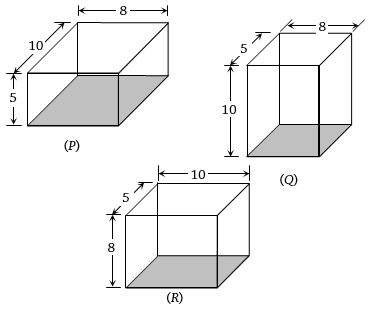
$A$ rectangular block of size $10\,cm \times 8\,cm \times 5\,cm$ is kept in three different positions $P, Q,$ and $R$ in turn as shown in the figure. In each case,the shaded area is rigidly fixed and a definite force $F$ is applied tangentially to the opposite face to deform the block. The displacement of the upper face will be
A
Same in all the three cases
B
Maximum in $P$ position
C
Maximum in $Q$ position
D
Maximum in $R$ position
Solution
(C) The modulus of rigidity $\eta$ is defined as the ratio of shearing stress to shearing strain:
$\eta = \frac{F/A}{x/L}$
where $F$ is the tangential force,$A$ is the area of the face on which the force is applied,$x$ is the lateral displacement,and $L$ is the height of the block perpendicular to the force.
Rearranging for displacement $x$:
$x = \frac{F \cdot L}{\eta \cdot A}$
Since $\eta$ and $F$ are constant for all cases,the displacement $x$ is proportional to the ratio of height to area: $x \propto \frac{L}{A}$.
Calculating $L/A$ for each case:
For position $P$: $L = 5\,cm$,$A = 10 \times 8 = 80\,cm^2$. So,$L/A = 5/80 = 0.0625\,cm^{-1}$.
For position $Q$: $L = 10\,cm$,$A = 8 \times 5 = 40\,cm^2$. So,$L/A = 10/40 = 0.25\,cm^{-1}$.
For position $R$: $L = 8\,cm$,$A = 10 \times 5 = 50\,cm^2$. So,$L/A = 8/50 = 0.16\,cm^{-1}$.
Comparing the values,the ratio $L/A$ is maximum in position $Q$. Therefore,the displacement is maximum in position $Q$.
$\eta = \frac{F/A}{x/L}$
where $F$ is the tangential force,$A$ is the area of the face on which the force is applied,$x$ is the lateral displacement,and $L$ is the height of the block perpendicular to the force.
Rearranging for displacement $x$:
$x = \frac{F \cdot L}{\eta \cdot A}$
Since $\eta$ and $F$ are constant for all cases,the displacement $x$ is proportional to the ratio of height to area: $x \propto \frac{L}{A}$.
Calculating $L/A$ for each case:
For position $P$: $L = 5\,cm$,$A = 10 \times 8 = 80\,cm^2$. So,$L/A = 5/80 = 0.0625\,cm^{-1}$.
For position $Q$: $L = 10\,cm$,$A = 8 \times 5 = 40\,cm^2$. So,$L/A = 10/40 = 0.25\,cm^{-1}$.
For position $R$: $L = 8\,cm$,$A = 10 \times 5 = 50\,cm^2$. So,$L/A = 8/50 = 0.16\,cm^{-1}$.
Comparing the values,the ratio $L/A$ is maximum in position $Q$. Therefore,the displacement is maximum in position $Q$.
0 likes
View Solution12
DifficultMCQ
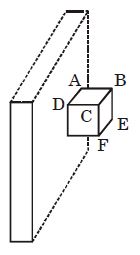
$A$ steel rod is projecting out of a rigid wall. The shearing strength of steel is $345 \, MN/m^2$. The dimensions are $AB = 5 \, cm$ and $BC = BE = 2 \, cm$. The maximum load that can be put on the face $ABCD$ is .......... $kg$ (neglect bending of the rod). Take $g = 10 \, m/s^2$.
A
$3450$
B
$1380$
C
$13800$
D
$345$
Solution
(C) The shearing stress is defined as the ratio of the shearing force to the area of the surface parallel to the force.
Given,shearing strength (maximum shearing stress) $\tau_{max} = 345 \, MN/m^2 = 345 \times 10^6 \, N/m^2$.
The area of the face $ABCD$ subjected to shear is $A = BC \times BE = 2 \, cm \times 2 \, cm = 4 \, cm^2 = 4 \times 10^{-4} \, m^2$.
The maximum shearing force $F$ that the rod can withstand is $F = \tau_{max} \times A$.
$F = (345 \times 10^6 \, N/m^2) \times (4 \times 10^{-4} \, m^2) = 345 \times 4 \times 10^2 \, N = 138000 \, N$.
Since $F = mg$,where $m$ is the mass of the load and $g = 10 \, m/s^2$:
$m = F / g = 138000 / 10 = 13800 \, kg$.
Thus,the maximum load is $13800 \, kg$.
Given,shearing strength (maximum shearing stress) $\tau_{max} = 345 \, MN/m^2 = 345 \times 10^6 \, N/m^2$.
The area of the face $ABCD$ subjected to shear is $A = BC \times BE = 2 \, cm \times 2 \, cm = 4 \, cm^2 = 4 \times 10^{-4} \, m^2$.
The maximum shearing force $F$ that the rod can withstand is $F = \tau_{max} \times A$.
$F = (345 \times 10^6 \, N/m^2) \times (4 \times 10^{-4} \, m^2) = 345 \times 4 \times 10^2 \, N = 138000 \, N$.
Since $F = mg$,where $m$ is the mass of the load and $g = 10 \, m/s^2$:
$m = F / g = 138000 / 10 = 13800 \, kg$.
Thus,the maximum load is $13800 \, kg$.
0 likes
View Solution13
MediumMCQ
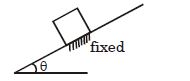
Assume that a block of very low shear modulus is fixed on an inclined plane as shown. Due to elastic forces,it will deform. What will be the shape of the block?
A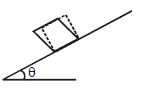
B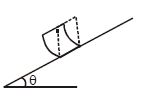
C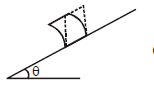
D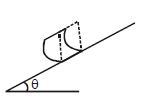
Solution
(A) The block is fixed to an inclined plane. Gravity acts on the block,which can be resolved into two components: one perpendicular to the inclined plane $(mg \cos \theta)$ and one parallel to the inclined plane $(mg \sin \theta)$.
The component $mg \sin \theta$ acts as a shear force on the block,causing it to deform due to its low shear modulus. This deformation is a shear strain,which results in the block tilting in the direction of the force.
Since the base is fixed,the top surface of the block will shift parallel to the inclined plane while the vertical sides will tilt. This results in the block taking the shape of a parallelogram,as shown in option $A$.
The component $mg \sin \theta$ acts as a shear force on the block,causing it to deform due to its low shear modulus. This deformation is a shear strain,which results in the block tilting in the direction of the force.
Since the base is fixed,the top surface of the block will shift parallel to the inclined plane while the vertical sides will tilt. This results in the block taking the shape of a parallelogram,as shown in option $A$.
0 likes
View Solution14
DifficultMCQ
As shown in the figure,forces of $10^5\,N$ each are applied in opposite directions on the upper and lower faces of a cube of side $10\,cm$,shifting the upper face parallel to itself by $0.5\,cm$. If the side of another cube of the same material is $20\,cm$,then under similar conditions as above,the displacement will be ......... $cm$.
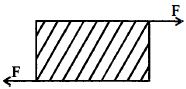
A
$1.00$
B
$0.25$
C
$0.37$
D
$0.75$
Solution
(B) For the same material,the modulus of rigidity $\eta$ is constant,where $\eta = \frac{\text{Shear Stress}}{\text{Shear Strain}}$.
Shear stress is given by $\sigma = \frac{F}{A}$,where $A = L^2$ is the area of the face.
Shear strain is given by $\gamma = \frac{\Delta x}{L}$,where $\Delta x$ is the displacement and $L$ is the side length.
Thus,$\eta = \frac{F/L^2}{\Delta x/L} = \frac{F}{L \cdot \Delta x}$.
For the first cube: $L_1 = 10\,cm = 0.1\,m$,$\Delta x_1 = 0.5\,cm = 0.005\,m$,$F = 10^5\,N$.
For the second cube: $L_2 = 20\,cm = 0.2\,m$,$\Delta x_2 = x$,$F = 10^5\,N$.
Since the material is the same,$\eta_1 = \eta_2$:
$\frac{F}{L_1 \cdot \Delta x_1} = \frac{F}{L_2 \cdot \Delta x_2}$
$L_1 \cdot \Delta x_1 = L_2 \cdot \Delta x_2$
$10\,cm \times 0.5\,cm = 20\,cm \times x$
$5 = 20x$
$x = \frac{5}{20} = 0.25\,cm$.
Shear stress is given by $\sigma = \frac{F}{A}$,where $A = L^2$ is the area of the face.
Shear strain is given by $\gamma = \frac{\Delta x}{L}$,where $\Delta x$ is the displacement and $L$ is the side length.
Thus,$\eta = \frac{F/L^2}{\Delta x/L} = \frac{F}{L \cdot \Delta x}$.
For the first cube: $L_1 = 10\,cm = 0.1\,m$,$\Delta x_1 = 0.5\,cm = 0.005\,m$,$F = 10^5\,N$.
For the second cube: $L_2 = 20\,cm = 0.2\,m$,$\Delta x_2 = x$,$F = 10^5\,N$.
Since the material is the same,$\eta_1 = \eta_2$:
$\frac{F}{L_1 \cdot \Delta x_1} = \frac{F}{L_2 \cdot \Delta x_2}$
$L_1 \cdot \Delta x_1 = L_2 \cdot \Delta x_2$
$10\,cm \times 0.5\,cm = 20\,cm \times x$
$5 = 20x$
$x = \frac{5}{20} = 0.25\,cm$.
0 likes
View Solution15
DifficultMCQ
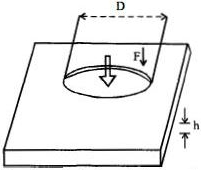
Steel ruptures when a shear stress of $3.5 \times 10^8 \, N \, m^{-2}$ is applied. The force needed to punch a $1 \, cm$ diameter hole in a steel sheet $0.3 \, cm$ thick is nearly:
A
$1.4 \times 10^4 \, N$
B
$2.7 \times 10^4 \, N$
C
$3.3 \times 10^4 \, N$
D
$1.1 \times 10^4 \, N$
Solution
(C) To punch a hole of diameter $D = 1 \, cm = 10^{-2} \, m$ in a steel sheet of thickness $h = 0.3 \, cm = 0.3 \times 10^{-2} \, m$,the shearing force must act along the cylindrical surface area of the hole.
The shearing stress $\sigma_{max}$ is given as $3.5 \times 10^8 \, N \, m^{-2}$.
The area $A$ resisting the shear is the lateral surface area of the cylinder being punched out:
$A = \text{Circumference} \times \text{thickness} = (\pi D) \times h$
Substituting the values:
$A = \pi \times (10^{-2} \, m) \times (0.3 \times 10^{-2} \, m) = 0.3 \pi \times 10^{-4} \, m^2$
The force $F$ required is:
$F = \sigma_{max} \times A$
$F = (3.5 \times 10^8 \, N \, m^{-2}) \times (0.3 \pi \times 10^{-4} \, m^2)$
$F = 3.5 \times 0.3 \times 3.14159 \times 10^4 \, N$
$F \approx 3.298 \times 10^4 \, N$
Rounding to the nearest value,we get $F \approx 3.3 \times 10^4 \, N$.
The shearing stress $\sigma_{max}$ is given as $3.5 \times 10^8 \, N \, m^{-2}$.
The area $A$ resisting the shear is the lateral surface area of the cylinder being punched out:
$A = \text{Circumference} \times \text{thickness} = (\pi D) \times h$
Substituting the values:
$A = \pi \times (10^{-2} \, m) \times (0.3 \times 10^{-2} \, m) = 0.3 \pi \times 10^{-4} \, m^2$
The force $F$ required is:
$F = \sigma_{max} \times A$
$F = (3.5 \times 10^8 \, N \, m^{-2}) \times (0.3 \pi \times 10^{-4} \, m^2)$
$F = 3.5 \times 0.3 \times 3.14159 \times 10^4 \, N$
$F \approx 3.298 \times 10^4 \, N$
Rounding to the nearest value,we get $F \approx 3.3 \times 10^4 \, N$.
0 likes
View Solution16
MediumMCQ
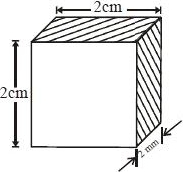
The force required to punch a square hole of side $2\,cm$ in a steel sheet of thickness $2\,mm$ is (given: shearing stress of steel sheet $= 3.5 \times 10^8\,N/m^2$)
A
$5.6 \times 10^4\,N$
B
$3.4 \times 10^4\,N$
C
$9.1 \times 10^4\,N$
D
$6.8 \times 10^4\,N$
Solution
(A) The shearing force acts on the area of the boundary (perimeter) of the hole.
The perimeter of the square hole is $P = 4 \times \text{side} = 4 \times 2\,cm = 8\,cm = 0.08\,m$.
The thickness of the sheet is $t = 2\,mm = 0.002\,m = 2 \times 10^{-3}\,m$.
The area $A$ over which the shearing force acts is the product of the perimeter and the thickness:
$A = P \times t = 0.08\,m \times 0.002\,m = 1.6 \times 10^{-4}\,m^2$.
Given the shearing stress $\tau = 3.5 \times 10^8\,N/m^2$, the force $F$ is calculated as:
$F = \tau \times A$
$F = (3.5 \times 10^8\,N/m^2) \times (1.6 \times 10^{-4}\,m^2)$
$F = 5.6 \times 10^4\,N$.
The perimeter of the square hole is $P = 4 \times \text{side} = 4 \times 2\,cm = 8\,cm = 0.08\,m$.
The thickness of the sheet is $t = 2\,mm = 0.002\,m = 2 \times 10^{-3}\,m$.
The area $A$ over which the shearing force acts is the product of the perimeter and the thickness:
$A = P \times t = 0.08\,m \times 0.002\,m = 1.6 \times 10^{-4}\,m^2$.
Given the shearing stress $\tau = 3.5 \times 10^8\,N/m^2$, the force $F$ is calculated as:
$F = \tau \times A$
$F = (3.5 \times 10^8\,N/m^2) \times (1.6 \times 10^{-4}\,m^2)$
$F = 5.6 \times 10^4\,N$.
0 likes
View Solution17
DifficultMCQ
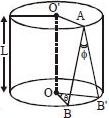
The upper end of a wire $1\,m$ long and $4\,mm$ radius is clamped. The lower end is twisted by an angle of $30^\circ$. The angle of shear is ...... $^\circ$.
A
$12$
B
$1.2$
C
$0.12$
D
$0.012$
Solution
(C) Given:
Length of wire $L = 1\,m = 100\,cm$.
Radius of wire $r = 4\,mm = 0.4\,cm$.
Angle of twist $\theta = 30^\circ$.
From the geometry of a twisted cylinder,the arc length $BB^{\prime}$ can be expressed in two ways:
$BB^{\prime} = r \theta = L \phi$
where $\phi$ is the angle of shear.
Rearranging for $\phi$:
$\phi = \frac{r \theta}{L}$
Substituting the values:
$\phi = \frac{0.4\,cm \times 30^\circ}{100\,cm}$
$\phi = \frac{12}{100} = 0.12^\circ$.
Thus,the angle of shear is $0.12^\circ$.
Length of wire $L = 1\,m = 100\,cm$.
Radius of wire $r = 4\,mm = 0.4\,cm$.
Angle of twist $\theta = 30^\circ$.
From the geometry of a twisted cylinder,the arc length $BB^{\prime}$ can be expressed in two ways:
$BB^{\prime} = r \theta = L \phi$
where $\phi$ is the angle of shear.
Rearranging for $\phi$:
$\phi = \frac{r \theta}{L}$
Substituting the values:
$\phi = \frac{0.4\,cm \times 30^\circ}{100\,cm}$
$\phi = \frac{12}{100} = 0.12^\circ$.
Thus,the angle of shear is $0.12^\circ$.
0 likes
View Solution18
MediumMCQ
The upper end of a wire of radius $4 \, mm$ and length $100 \, cm$ is clamped and its other end is twisted through an angle of $60^o$. The angle of shear is .......... $^o$.
A
$12$
B
$0.12$
C
$1.2$
D
$0.24$
Solution
(D) Given: Radius $r = 4 \, mm = 4 \times 10^{-3} \, m$,Length $L = 100 \, cm = 1 \, m$,and angle of twist $\theta = 60^o = 60 \times \frac{\pi}{180} \, rad = \frac{\pi}{3} \, rad$.
For a wire twisted by an angle $\theta$,the angle of shear $\phi$ at the surface is given by the relation $\phi = \frac{r \theta}{L}$.
Substituting the values: $\phi = \frac{4 \times 10^{-3} \, m \times (60^o)}{1 \, m} = 4 \times 10^{-3} \times 60^o = 0.24^o$.
For a wire twisted by an angle $\theta$,the angle of shear $\phi$ at the surface is given by the relation $\phi = \frac{r \theta}{L}$.
Substituting the values: $\phi = \frac{4 \times 10^{-3} \, m \times (60^o)}{1 \, m} = 4 \times 10^{-3} \times 60^o = 0.24^o$.
0 likes
View Solution19
EasyMCQ
Shear modulus is zero for
A
solids
B
liquids
C
gases
D
liquids and gases
Solution
(D) Shear modulus,also known as the modulus of rigidity,measures the resistance of a material to shear deformation.
It is defined only for solids because they possess a definite shape and can resist tangential forces.
Fluids (liquids and gases) do not have a fixed shape and cannot sustain shear stress; they flow when subjected to such forces.
Therefore,the shear modulus for both liquids and gases is $0$.
It is defined only for solids because they possess a definite shape and can resist tangential forces.
Fluids (liquids and gases) do not have a fixed shape and cannot sustain shear stress; they flow when subjected to such forces.
Therefore,the shear modulus for both liquids and gases is $0$.
0 likes
View Solution20
Medium
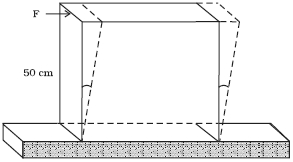
$A$ square lead slab of side $50\, cm$ and thickness $10\, cm$ is subject to a shearing force (on its narrow face) of $9.0 \times 10^{4} \, N$. The lower edge is riveted to the floor. How much will the upper edge be displaced? (Given: Shear modulus of lead $G = 5.6 \times 10^{9} \, N/m^2$)
Solution
(N/A) The lead slab is fixed at the bottom,and a shearing force $F = 9.0 \times 10^{4} \, N$ is applied parallel to the top narrow face.
The area $A$ of the face on which the force is applied is:
$A = 50 \, cm \times 10 \, cm = 0.5 \, m \times 0.1 \, m = 0.05 \, m^2$
The shearing stress is given by:
$\text{Stress} = \frac{F}{A} = \frac{9.0 \times 10^{4} \, N}{0.05 \, m^2} = 1.8 \times 10^{6} \, N/m^2$
We know that the shearing strain is defined as:
$\text{Strain} = \frac{\Delta x}{L} = \frac{\text{Stress}}{G}$
Where $L = 50 \, cm = 0.5 \, m$ is the height of the slab and $G = 5.6 \times 10^{9} \, N/m^2$ is the shear modulus of lead.
Therefore,the displacement $\Delta x$ is:
$\Delta x = \frac{\text{Stress} \times L}{G} = \frac{1.8 \times 10^{6} \, N/m^2 \times 0.5 \, m}{5.6 \times 10^{9} \, N/m^2}$
$\Delta x = \frac{0.9 \times 10^{6}}{5.6 \times 10^{9}} \, m \approx 0.1607 \times 10^{-3} \, m$
$\Delta x \approx 1.6 \times 10^{-4} \, m = 0.16 \, mm$
The area $A$ of the face on which the force is applied is:
$A = 50 \, cm \times 10 \, cm = 0.5 \, m \times 0.1 \, m = 0.05 \, m^2$
The shearing stress is given by:
$\text{Stress} = \frac{F}{A} = \frac{9.0 \times 10^{4} \, N}{0.05 \, m^2} = 1.8 \times 10^{6} \, N/m^2$
We know that the shearing strain is defined as:
$\text{Strain} = \frac{\Delta x}{L} = \frac{\text{Stress}}{G}$
Where $L = 50 \, cm = 0.5 \, m$ is the height of the slab and $G = 5.6 \times 10^{9} \, N/m^2$ is the shear modulus of lead.
Therefore,the displacement $\Delta x$ is:
$\Delta x = \frac{\text{Stress} \times L}{G} = \frac{1.8 \times 10^{6} \, N/m^2 \times 0.5 \, m}{5.6 \times 10^{9} \, N/m^2}$
$\Delta x = \frac{0.9 \times 10^{6}}{5.6 \times 10^{9}} \, m \approx 0.1607 \times 10^{-3} \, m$
$\Delta x \approx 1.6 \times 10^{-4} \, m = 0.16 \, mm$
1 likes
View Solution21
EasyMCQ
The edge of an aluminium cube is $10\; cm$ long. One face of the cube is firmly fixed to a vertical wall. $A$ mass of $100\; kg$ is then attached to the opposite face of the cube. The shear modulus of aluminium is $25\; GPa$. What is the vertical deflection of this face?
A
$7.56 \times 10^{-8}\; m$
B
$2.23 \times 10^{-6}\; m$
C
$3.92 \times 10^{-7}\; m$
D
$5.56 \times 10^{-5}\; m$
Solution
(C) The shear modulus $\eta$ is defined as the ratio of shear stress to shear strain:
$\eta = \frac{F/A}{\Delta L/L}$
Where $F$ is the force applied,$A$ is the area of the face,$L$ is the side length of the cube,and $\Delta L$ is the vertical deflection.
Rearranging for $\Delta L$:
$\Delta L = \frac{F L}{A \eta}$
Given:
$F = mg = 100\; kg \times 9.8\; m/s^2 = 980\; N$
$L = 10\; cm = 0.1\; m$
$A = L^2 = (0.1\; m)^2 = 0.01\; m^2 = 10^{-2}\; m^2$
$\eta = 25\; GPa = 25 \times 10^9\; Pa$
Substituting the values:
$\Delta L = \frac{980 \times 0.1}{10^{-2} \times 25 \times 10^9}$
$\Delta L = \frac{98}{0.25 \times 10^9} = 392 \times 10^{-9}\; m = 3.92 \times 10^{-7}\; m$
The vertical deflection is $3.92 \times 10^{-7}\; m$.
$\eta = \frac{F/A}{\Delta L/L}$
Where $F$ is the force applied,$A$ is the area of the face,$L$ is the side length of the cube,and $\Delta L$ is the vertical deflection.
Rearranging for $\Delta L$:
$\Delta L = \frac{F L}{A \eta}$
Given:
$F = mg = 100\; kg \times 9.8\; m/s^2 = 980\; N$
$L = 10\; cm = 0.1\; m$
$A = L^2 = (0.1\; m)^2 = 0.01\; m^2 = 10^{-2}\; m^2$
$\eta = 25\; GPa = 25 \times 10^9\; Pa$
Substituting the values:
$\Delta L = \frac{980 \times 0.1}{10^{-2} \times 25 \times 10^9}$
$\Delta L = \frac{98}{0.25 \times 10^9} = 392 \times 10^{-9}\; m = 3.92 \times 10^{-7}\; m$
The vertical deflection is $3.92 \times 10^{-7}\; m$.
0 likes
View Solution22
MediumMCQ
What is the shear modulus for a liquid?
A
Infinity
B
Zero
C
One
D
Negative
Solution
(B) The shear modulus $(G)$ is defined as the ratio of shear stress to shear strain.
Liquids do not have a fixed shape and cannot sustain a tangential (shear) force.
When a tangential force is applied to a liquid,it flows continuously,meaning the shear strain increases indefinitely over time.
Since the liquid cannot resist shear stress,the shear modulus for a liquid is $0$.
Liquids do not have a fixed shape and cannot sustain a tangential (shear) force.
When a tangential force is applied to a liquid,it flows continuously,meaning the shear strain increases indefinitely over time.
Since the liquid cannot resist shear stress,the shear modulus for a liquid is $0$.
0 likes
View Solution23
MediumMCQ
Given below are two statements: One is labelled as Assertion $(A)$ and the other is labelled as Reason $(R)$.
Assertion $(A)$: The stretching of a spring is determined by the shear modulus of the material of the spring.
Reason $(R)$: $A$ coil spring of copper has more tensile strength than a steel spring of same dimensions.
In the light of the above statements,choose the most appropriate answer from the options given below:
Assertion $(A)$: The stretching of a spring is determined by the shear modulus of the material of the spring.
Reason $(R)$: $A$ coil spring of copper has more tensile strength than a steel spring of same dimensions.
In the light of the above statements,choose the most appropriate answer from the options given below:
A
Both $(A)$ and $(R)$ are true and $(R)$ is not the correct explanation of $(A)$
B
$(A)$ is true but $(R)$ is false
C
$(A)$ is false but $(R)$ is true
D
Both $(A)$ and $(R)$ are true and $(R)$ is the correct explanation of $(A)$
Solution
(B) When a spring is stretched,the wire of the spring undergoes a change in shape (twisting/shearing) rather than just a change in length. Therefore,the stiffness of the spring is determined by the shear modulus $(G)$ of the material.
Assertion $(A)$ is true.
Regarding Reason $(R)$,steel has a much higher Young's modulus and tensile strength compared to copper. Therefore,a steel spring is stronger and more resistant to deformation than a copper spring of the same dimensions. Thus,the statement that a copper spring has more tensile strength than a steel spring is false.
Reason $(R)$ is false.
Therefore,the correct option is $(B)$.
Assertion $(A)$ is true.
Regarding Reason $(R)$,steel has a much higher Young's modulus and tensile strength compared to copper. Therefore,a steel spring is stronger and more resistant to deformation than a copper spring of the same dimensions. Thus,the statement that a copper spring has more tensile strength than a steel spring is false.
Reason $(R)$ is false.
Therefore,the correct option is $(B)$.
0 likes
View Solution24
EasyMCQ
$A$ square aluminium (shear modulus is $25 \times 10^{9} \, N m^{-2}$) slab of side $60 \, cm$ and thickness $15 \, cm$ is subjected to a shearing force (on its narrow face) of $18.0 \times 10^{4} \, N$. The lower edge is riveted to the floor. The displacement of the upper edge is $....... \mu m$.
A
$24$
B
$12$
C
$48$
D
$96$
Solution
(C) The shear modulus $\eta$ is given by the formula: $\eta = \frac{F/A}{x/L}$,where $F$ is the shearing force,$A$ is the area of the face on which the force is applied,$x$ is the displacement,and $L$ is the side length of the slab.
Rearranging for displacement $x$: $x = \frac{F \cdot L}{A \cdot \eta}$.
Given: $F = 18.0 \times 10^{4} \, N$,$L = 60 \, cm = 0.6 \, m$,thickness $t = 15 \, cm = 0.15 \, m$,and $\eta = 25 \times 10^{9} \, N m^{-2}$.
The area $A$ of the narrow face is $L \times t = 0.6 \, m \times 0.15 \, m = 0.09 \, m^2$.
Substituting the values: $x = \frac{18.0 \times 10^{4} \times 0.6}{0.09 \times 25 \times 10^{9}}$.
$x = \frac{10.8 \times 10^{4}}{2.25 \times 10^{9}} = 4.8 \times 10^{-5} \, m = 48 \times 10^{-6} \, m = 48 \, \mu m$.
Rearranging for displacement $x$: $x = \frac{F \cdot L}{A \cdot \eta}$.
Given: $F = 18.0 \times 10^{4} \, N$,$L = 60 \, cm = 0.6 \, m$,thickness $t = 15 \, cm = 0.15 \, m$,and $\eta = 25 \times 10^{9} \, N m^{-2}$.
The area $A$ of the narrow face is $L \times t = 0.6 \, m \times 0.15 \, m = 0.09 \, m^2$.
Substituting the values: $x = \frac{18.0 \times 10^{4} \times 0.6}{0.09 \times 25 \times 10^{9}}$.
$x = \frac{10.8 \times 10^{4}}{2.25 \times 10^{9}} = 4.8 \times 10^{-5} \, m = 48 \times 10^{-6} \, m = 48 \, \mu m$.
0 likes
View Solution25
MediumMCQ
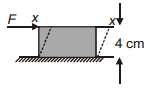
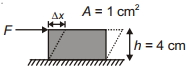
$A$ steel plate of face area $1 \, cm^2$ and thickness $4 \, cm$ is fixed rigidly at the lower surface. $A$ tangential force $F = 10 \, kN$ is applied on the upper surface as shown in the figure. The lateral displacement $x$ of the upper surface with respect to the lower surface is .............. $m$ (Modulus of rigidity for steel is $8 \times 10^{11} \, N/m^2$).
A
$5 \times 10^{-5}$
B
$5 \times 10^{-6}$
C
$2.5 \times 10^{-3}$
D
$2.5 \times 10^{-4}$
Solution
(B) The modulus of rigidity $(G)$ is defined as the ratio of shear stress to shear strain.
$G = \frac{\text{Shear Stress}}{\text{Shear Strain}} = \frac{F/A}{x/L} = \frac{FL}{Ax}$
Given:
$F = 10 \, kN = 10 \times 10^3 \, N$
$L = 4 \, cm = 0.04 \, m$
$A = 1 \, cm^2 = 1 \times 10^{-4} \, m^2$
$G = 8 \times 10^{11} \, N/m^2$
Rearranging the formula to solve for lateral displacement $x$:
$x = \frac{FL}{AG}$
Substituting the values:
$x = \frac{10 \times 10^3 \times 0.04}{1 \times 10^{-4} \times 8 \times 10^{11}}$
$x = \frac{400}{8 \times 10^7} = 50 \times 10^{-7} = 5 \times 10^{-6} \, m$
Thus,the lateral displacement is $5 \times 10^{-6} \, m$.
$G = \frac{\text{Shear Stress}}{\text{Shear Strain}} = \frac{F/A}{x/L} = \frac{FL}{Ax}$
Given:
$F = 10 \, kN = 10 \times 10^3 \, N$
$L = 4 \, cm = 0.04 \, m$
$A = 1 \, cm^2 = 1 \times 10^{-4} \, m^2$
$G = 8 \times 10^{11} \, N/m^2$
Rearranging the formula to solve for lateral displacement $x$:
$x = \frac{FL}{AG}$
Substituting the values:
$x = \frac{10 \times 10^3 \times 0.04}{1 \times 10^{-4} \times 8 \times 10^{11}}$
$x = \frac{400}{8 \times 10^7} = 50 \times 10^{-7} = 5 \times 10^{-6} \, m$
Thus,the lateral displacement is $5 \times 10^{-6} \, m$.
0 likes
View Solution26
MediumMCQ
Two wires $A$ and $B$ of same length and of same material have radii $r_1$ and $r_2$ respectively. Their one end is fixed with a rigid support and at the other end,an equal twisting couple is applied. Then,the ratio of the angle of twist at the end of $A$ to the angle of twist at the end of $B$ will be ..............
A
$r_1^2 / r_2^2$
B
$r_2^4 / r_1^4$
C
$r_2^2 / r_1^2$
D
$r_1^4 / r_2^4$
Solution
(B) The twisting couple (torque) $\tau$ applied to a wire is given by the formula: $\tau = \frac{\pi \eta r^4 \phi}{2L}$,where $\eta$ is the modulus of rigidity,$r$ is the radius,$\phi$ is the angle of twist,and $L$ is the length of the wire.
Since the wires have the same length $L$,same material (same $\eta$),and are subjected to the same twisting couple $\tau$,we have: $\tau = \frac{\pi \eta r_1^4 \phi_A}{2L} = \frac{\pi \eta r_2^4 \phi_B}{2L}$.
Equating the two expressions: $r_1^4 \phi_A = r_2^4 \phi_B$.
Therefore,the ratio of the angle of twist at the end of $A$ to the angle of twist at the end of $B$ is: $\frac{\phi_A}{\phi_B} = \frac{r_2^4}{r_1^4}$.
Since the wires have the same length $L$,same material (same $\eta$),and are subjected to the same twisting couple $\tau$,we have: $\tau = \frac{\pi \eta r_1^4 \phi_A}{2L} = \frac{\pi \eta r_2^4 \phi_B}{2L}$.
Equating the two expressions: $r_1^4 \phi_A = r_2^4 \phi_B$.
Therefore,the ratio of the angle of twist at the end of $A$ to the angle of twist at the end of $B$ is: $\frac{\phi_A}{\phi_B} = \frac{r_2^4}{r_1^4}$.
0 likes
View Solution27
MediumMCQ
The strain energy stored in a body of volume $V$ due to shear strain $\phi$ is (shear modulus is $\eta$ ).
A
$\frac{\phi^2 V}{2 \eta}$
B
$\frac{\phi V^2}{2 \eta}$
C
$\frac{\phi^2 V}{\eta}$
D
$\frac{1}{2} \eta \phi^2 V$
Solution
(D) The shear modulus $\eta$ is defined as the ratio of shear stress to shear strain $\phi$:
$\eta = \frac{\text{Shear stress}}{\phi}$
Therefore,the shear stress is given by:
$\text{Shear stress} = \eta \phi$
The strain energy per unit volume is given by the formula:
$\text{Energy density} = \frac{1}{2} \times \text{Shear stress} \times \text{Shear strain}$
Substituting the values:
$\frac{\text{Strain energy}}{V} = \frac{1}{2} \times (\eta \phi) \times \phi$
$\frac{\text{Strain energy}}{V} = \frac{1}{2} \eta \phi^2$
Multiplying by volume $V$,we get the total strain energy:
$\text{Strain energy} = \frac{1}{2} \eta \phi^2 V$
Thus,the correct option is $D$.
$\eta = \frac{\text{Shear stress}}{\phi}$
Therefore,the shear stress is given by:
$\text{Shear stress} = \eta \phi$
The strain energy per unit volume is given by the formula:
$\text{Energy density} = \frac{1}{2} \times \text{Shear stress} \times \text{Shear strain}$
Substituting the values:
$\frac{\text{Strain energy}}{V} = \frac{1}{2} \times (\eta \phi) \times \phi$
$\frac{\text{Strain energy}}{V} = \frac{1}{2} \eta \phi^2$
Multiplying by volume $V$,we get the total strain energy:
$\text{Strain energy} = \frac{1}{2} \eta \phi^2 V$
Thus,the correct option is $D$.
0 likes
View Solution28
MediumMCQ
$A$ uniform wire of length $L$ and radius $r$ is twisted by an angle $\alpha$. If the modulus of rigidity of the wire is $\eta$,then the elastic potential energy stored in the wire is .........
A
$\frac{\pi \eta r^4 \alpha}{2 L^2}$
B
$\frac{\pi \eta r^4 \alpha}{4 L^2}$
C
$\frac{\pi \eta r^4 \alpha^2}{4 L}$
D
$\frac{\pi \eta r^4 \alpha^2}{2 L}$
Solution
(C) The elastic potential energy $U$ stored in a twisted wire is equal to the work done in twisting it.
The formula for the work done in twisting a wire of length $L$,radius $r$,and modulus of rigidity $\eta$ by an angle $\alpha$ is given by:
$U = \frac{1}{2} C \alpha^2$
where $C$ is the torsional rigidity (or torque constant) of the wire.
The torsional rigidity $C$ is given by:
$C = \frac{\pi \eta r^4}{2 L}$
Substituting the value of $C$ into the energy equation:
$U = \frac{1}{2} \left( \frac{\pi \eta r^4}{2 L} \right) \alpha^2$
$U = \frac{\pi \eta r^4 \alpha^2}{4 L}$
Thus,the correct option is $C$.
The formula for the work done in twisting a wire of length $L$,radius $r$,and modulus of rigidity $\eta$ by an angle $\alpha$ is given by:
$U = \frac{1}{2} C \alpha^2$
where $C$ is the torsional rigidity (or torque constant) of the wire.
The torsional rigidity $C$ is given by:
$C = \frac{\pi \eta r^4}{2 L}$
Substituting the value of $C$ into the energy equation:
$U = \frac{1}{2} \left( \frac{\pi \eta r^4}{2 L} \right) \alpha^2$
$U = \frac{\pi \eta r^4 \alpha^2}{4 L}$
Thus,the correct option is $C$.
0 likes
View Solution29
EasyMCQ
The upper end of a wire of diameter $12\,mm$ and length $1\,m$ is clamped and its other end is twisted through an angle of $30^{\circ}$. The angle of shear is $........^{\circ}$.
A
$18$
B
$0.18$
C
$36$
D
$0.36$
Solution
(B) Given: Diameter $d = 12\,mm$,so radius $r = 6\,mm = 6 \times 10^{-3}\,m$.
Length of the wire $\ell = 1\,m$.
Angle of twist $\theta = 30^{\circ}$.
The relationship between the angle of shear $\phi$ and the angle of twist $\theta$ for a wire is given by $r \theta = \ell \phi$.
Therefore,$\phi = \frac{r \theta}{\ell}$.
Substituting the values: $\phi = \frac{6 \times 10^{-3}\,m \times 30^{\circ}}{1\,m} = 180 \times 10^{-3}\,^{\circ} = 0.18^{\circ}$.
Thus,the angle of shear is $0.18^{\circ}$.
Length of the wire $\ell = 1\,m$.
Angle of twist $\theta = 30^{\circ}$.
The relationship between the angle of shear $\phi$ and the angle of twist $\theta$ for a wire is given by $r \theta = \ell \phi$.
Therefore,$\phi = \frac{r \theta}{\ell}$.
Substituting the values: $\phi = \frac{6 \times 10^{-3}\,m \times 30^{\circ}}{1\,m} = 180 \times 10^{-3}\,^{\circ} = 0.18^{\circ}$.
Thus,the angle of shear is $0.18^{\circ}$.
0 likes
View Solution30
MediumMCQ
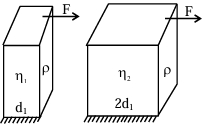
Two slabs with square cross-sections of different materials $(1, 2)$ have equal sides $(l)$ and thicknesses $d_1$ and $d_2$ such that $d_2 = 2d_1$ and $l > d_2$. Considering the lower edges of these slabs are fixed to the floor,we apply equal shearing force on the narrow faces. The angle of deformation is $\theta_2 = 2\theta_1$. If the shear modulus of material $1$ is $4 \times 10^9 \ N/m^2$,then the shear modulus of material $2$ is $x \times 10^9 \ N/m^2$,where the value of $x$ is . . . . . . .
A
$2$
B
$1$
C
$9$
D
$7$
Solution
(B) The shear stress $\sigma$ is defined as the force $F$ applied per unit area $A$. For a slab of side $l$ and thickness $d$,the area of the face on which the force is applied is $A = l \times d$.
Thus,the shear stress for the two slabs is:
$\sigma_1 = \frac{F}{l d_1}$ and $\sigma_2 = \frac{F}{l d_2}$.
The shear modulus $\eta$ is defined as the ratio of shear stress to the angle of deformation $\theta$ (for small angles,$\theta \approx \tan \theta$):
$\eta = \frac{\sigma}{\theta} \Rightarrow \theta = \frac{\sigma}{\eta}$.
Given $\theta_2 = 2\theta_1$,we substitute the expressions:
$\frac{\sigma_2}{\eta_2} = 2 \left( \frac{\sigma_1}{\eta_1} \right)$.
Substituting $\sigma_1 = \frac{F}{l d_1}$,$\sigma_2 = \frac{F}{l d_2}$,and $d_2 = 2d_1$:
$\frac{F}{l d_2 \eta_2} = 2 \left( \frac{F}{l d_1 \eta_1} \right)$.
$\frac{1}{2d_1 \eta_2} = \frac{2}{d_1 \eta_1} \Rightarrow \frac{1}{\eta_2} = \frac{4}{\eta_1} \Rightarrow \eta_2 = \frac{\eta_1}{4}$.
Given $\eta_1 = 4 \times 10^9 \ N/m^2$,we get:
$\eta_2 = \frac{4 \times 10^9}{4} = 1 \times 10^9 \ N/m^2$.
Comparing this with $x \times 10^9 \ N/m^2$,we find $x = 1$.
Thus,the shear stress for the two slabs is:
$\sigma_1 = \frac{F}{l d_1}$ and $\sigma_2 = \frac{F}{l d_2}$.
The shear modulus $\eta$ is defined as the ratio of shear stress to the angle of deformation $\theta$ (for small angles,$\theta \approx \tan \theta$):
$\eta = \frac{\sigma}{\theta} \Rightarrow \theta = \frac{\sigma}{\eta}$.
Given $\theta_2 = 2\theta_1$,we substitute the expressions:
$\frac{\sigma_2}{\eta_2} = 2 \left( \frac{\sigma_1}{\eta_1} \right)$.
Substituting $\sigma_1 = \frac{F}{l d_1}$,$\sigma_2 = \frac{F}{l d_2}$,and $d_2 = 2d_1$:
$\frac{F}{l d_2 \eta_2} = 2 \left( \frac{F}{l d_1 \eta_1} \right)$.
$\frac{1}{2d_1 \eta_2} = \frac{2}{d_1 \eta_1} \Rightarrow \frac{1}{\eta_2} = \frac{4}{\eta_1} \Rightarrow \eta_2 = \frac{\eta_1}{4}$.
Given $\eta_1 = 4 \times 10^9 \ N/m^2$,we get:
$\eta_2 = \frac{4 \times 10^9}{4} = 1 \times 10^9 \ N/m^2$.
Comparing this with $x \times 10^9 \ N/m^2$,we find $x = 1$.
0 likes
View Solution31
MediumMCQ
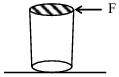
$A$ cylindrical rod of length $1 \ m$ and radius $4 \ cm$ is mounted vertically. It is subjected to a shear force of $10^5 \ N$ at the top. Considering infinitesimally small displacement in the upper edge,the angular displacement $\theta$ of the rod axis from its original position would be: (Shear modulus,$G = 10^{10} \ N/m^2$)
A
$1 / 160 \pi$
B
$1 / 4 \pi$
C
$1 / 40 \pi$
D
$1 / 2 \pi$
Solution
(A) The shear modulus $G$ is defined as the ratio of shear stress to shear strain (angular displacement $\theta$ for small angles).
$G = \frac{\text{Shear Stress}}{\theta}$
Shear stress $\sigma = \frac{F}{A}$,where $F = 10^5 \ N$ and $A = \pi r^2$.
Given $r = 4 \ cm = 0.04 \ m = 4 \times 10^{-2} \ m$.
Area $A = \pi \times (4 \times 10^{-2})^2 = 16 \pi \times 10^{-4} \ m^2$.
Now,substitute the values into the formula:
$10^{10} = \frac{10^5 / (16 \pi \times 10^{-4})}{\theta}$
$\theta = \frac{10^5}{16 \pi \times 10^{-4} \times 10^{10}}$
$\theta = \frac{10^5}{16 \pi \times 10^6} = \frac{1}{160 \pi} \text{ radian}$.
$G = \frac{\text{Shear Stress}}{\theta}$
Shear stress $\sigma = \frac{F}{A}$,where $F = 10^5 \ N$ and $A = \pi r^2$.
Given $r = 4 \ cm = 0.04 \ m = 4 \times 10^{-2} \ m$.
Area $A = \pi \times (4 \times 10^{-2})^2 = 16 \pi \times 10^{-4} \ m^2$.
Now,substitute the values into the formula:
$10^{10} = \frac{10^5 / (16 \pi \times 10^{-4})}{\theta}$
$\theta = \frac{10^5}{16 \pi \times 10^{-4} \times 10^{10}}$
$\theta = \frac{10^5}{16 \pi \times 10^6} = \frac{1}{160 \pi} \text{ radian}$.
0 likes
View Solution32
EasyMCQ
$A$ $2 \ m$ long rod of radius $1 \ cm$,which is fixed from one end,is given a twist of $0.8 \ radian$. The shear strain developed (in radian) will be $:-$
A
$0.002$
B
$0.004$
C
$0.008$
D
$0.016$
Solution
(B) Given: Length of the rod $L = 2 \ m = 200 \ cm$. Radius of the rod $R = 1 \ cm$. Angle of twist $\theta = 0.8 \ rad$.
For a rod twisted at one end,the relationship between the shear strain $\phi$,the radius $R$,the angle of twist $\theta$,and the length $L$ is given by the formula: $L \phi = R \theta$.
Substituting the values into the equation:
$\phi = \frac{R \theta}{L} = \frac{1 \ cm \times 0.8 \ rad}{200 \ cm}$.
$\phi = \frac{0.8}{200} = 0.004 \ rad$.
Therefore,the shear strain developed is $0.004 \ rad$.
For a rod twisted at one end,the relationship between the shear strain $\phi$,the radius $R$,the angle of twist $\theta$,and the length $L$ is given by the formula: $L \phi = R \theta$.
Substituting the values into the equation:
$\phi = \frac{R \theta}{L} = \frac{1 \ cm \times 0.8 \ rad}{200 \ cm}$.
$\phi = \frac{0.8}{200} = 0.004 \ rad$.
Therefore,the shear strain developed is $0.004 \ rad$.
0 likes
View Solution33
EasyMCQ
$A$ force $F$ of the same magnitude is applied tangentially on the upper and lower faces of a cube in opposite directions. The side of the cube is $L$. The upper face of the cube shifts parallel to itself by a distance $x_{1}$. If another cube of the same material but with side $2L$ is subjected to the same condition,then the displacement of the top layer is:
A
$x_{1}/6$
B
$x_{1}/2$
C
$x_{1}/8$
D
$x_{1}/4$
Solution
(B) The shear modulus $\eta$ is defined as $\eta = \frac{\text{Shear Stress}}{\text{Shear Strain}} = \frac{F/A}{\Delta x/L}$,where $A$ is the area of the face,$\Delta x$ is the displacement,and $L$ is the side length.
For the first cube: $\eta = \frac{F/L^2}{x_{1}/L} = \frac{F}{L x_{1}}$.
Thus,$x_{1} = \frac{F}{\eta L}$.
For the second cube of side $2L$: The area $A' = (2L)^2 = 4L^2$. The shear modulus $\eta$ remains the same as the material is the same.
Let the new displacement be $x_{2}$. Then $\eta = \frac{F/A'}{x_{2}/(2L)} = \frac{F/(4L^2)}{x_{2}/(2L)} = \frac{F}{2L x_{2}}$.
Equating the two expressions for $\eta$: $\frac{F}{L x_{1}} = \frac{F}{2L x_{2}}$.
Solving for $x_{2}$: $x_{2} = \frac{x_{1}}{2}$.
For the first cube: $\eta = \frac{F/L^2}{x_{1}/L} = \frac{F}{L x_{1}}$.
Thus,$x_{1} = \frac{F}{\eta L}$.
For the second cube of side $2L$: The area $A' = (2L)^2 = 4L^2$. The shear modulus $\eta$ remains the same as the material is the same.
Let the new displacement be $x_{2}$. Then $\eta = \frac{F/A'}{x_{2}/(2L)} = \frac{F/(4L^2)}{x_{2}/(2L)} = \frac{F}{2L x_{2}}$.
Equating the two expressions for $\eta$: $\frac{F}{L x_{1}} = \frac{F}{2L x_{2}}$.
Solving for $x_{2}$: $x_{2} = \frac{x_{1}}{2}$.
0 likes
View Solution34
MediumMCQ
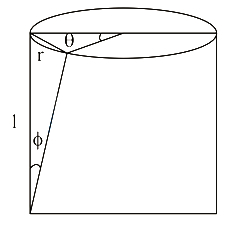
$A$ wire of length $1 \text{ m}$ and radius $2 \text{ mm}$ is vertically clamped. The lower end is twisted through an angle of $45^{\circ}$. The angle of shear is $.....$ (in $^{\circ}$)
A
$0.09$
B
$0.9$
C
$9$
D
$90$
Solution
(A) Let $l$ be the length of the wire,$r$ be the radius,$\theta$ be the angle of twist,and $\phi$ be the angle of shear.
From the geometry of the twisted wire,the arc length $s$ on the circumference is given by $s = r \theta$.
For small angles,the angle of shear $\phi$ is related to the arc length $s$ and the length of the wire $l$ by $\phi = \frac{s}{l}$.
Substituting $s = r \theta$,we get $\phi = \frac{r \theta}{l}$.
Given: $l = 1 \text{ m}$,$r = 2 \text{ mm} = 2 \times 10^{-3} \text{ m}$,and $\theta = 45^{\circ}$.
Substituting these values: $\phi = \frac{2 \times 10^{-3} \text{ m} \times 45^{\circ}}{1 \text{ m}} = 90 \times 10^{-3} \text{ degrees} = 0.09^{\circ}$.
Therefore,the angle of shear is $0.09^{\circ}$.
From the geometry of the twisted wire,the arc length $s$ on the circumference is given by $s = r \theta$.
For small angles,the angle of shear $\phi$ is related to the arc length $s$ and the length of the wire $l$ by $\phi = \frac{s}{l}$.
Substituting $s = r \theta$,we get $\phi = \frac{r \theta}{l}$.
Given: $l = 1 \text{ m}$,$r = 2 \text{ mm} = 2 \times 10^{-3} \text{ m}$,and $\theta = 45^{\circ}$.
Substituting these values: $\phi = \frac{2 \times 10^{-3} \text{ m} \times 45^{\circ}}{1 \text{ m}} = 90 \times 10^{-3} \text{ degrees} = 0.09^{\circ}$.
Therefore,the angle of shear is $0.09^{\circ}$.
0 likes
View Solution35
EasyMCQ
$A$ rectangular metallic block of dimensions $40 \text{ mm} \times 20 \text{ mm}$ when pulled with a tension of $50 \text{ kN}$ undergoes only elastic deformation. The strain in the block is (The shear modulus of the material of the block is $40 \times 10^9 \text{ Nm}^{-2}$)
A
$1.56 \times 10^{-3}$
B
$2.4 \times 10^{-3}$
C
$3.2 \times 10^{-3}$
D
$1.56 \times 10^{-3}$
Solution
(A) Given: Force $F = 50 \text{ kN} = 50 \times 10^3 \text{ N}$.
Dimensions: $40 \text{ mm} \times 20 \text{ mm} = 40 \times 10^{-3} \text{ m} \times 20 \times 10^{-3} \text{ m} = 800 \times 10^{-6} \text{ m}^2$.
Shear Modulus $G = 40 \times 10^9 \text{ Nm}^{-2}$.
Stress $\sigma = \frac{F}{A} = \frac{50 \times 10^3}{800 \times 10^{-6}} = \frac{50 \times 10^9}{800} = 0.0625 \times 10^9 \text{ Nm}^{-2} = 6.25 \times 10^7 \text{ Nm}^{-2}$.
Strain $\epsilon = \frac{\text{Stress}}{G} = \frac{6.25 \times 10^7}{40 \times 10^9} = \frac{6.25}{40} \times 10^{-2} = 0.15625 \times 10^{-2} = 1.5625 \times 10^{-3}$.
Thus,the strain is approximately $1.56 \times 10^{-3}$.
Dimensions: $40 \text{ mm} \times 20 \text{ mm} = 40 \times 10^{-3} \text{ m} \times 20 \times 10^{-3} \text{ m} = 800 \times 10^{-6} \text{ m}^2$.
Shear Modulus $G = 40 \times 10^9 \text{ Nm}^{-2}$.
Stress $\sigma = \frac{F}{A} = \frac{50 \times 10^3}{800 \times 10^{-6}} = \frac{50 \times 10^9}{800} = 0.0625 \times 10^9 \text{ Nm}^{-2} = 6.25 \times 10^7 \text{ Nm}^{-2}$.
Strain $\epsilon = \frac{\text{Stress}}{G} = \frac{6.25 \times 10^7}{40 \times 10^9} = \frac{6.25}{40} \times 10^{-2} = 0.15625 \times 10^{-2} = 1.5625 \times 10^{-3}$.
Thus,the strain is approximately $1.56 \times 10^{-3}$.
0 likes
View Solution36
EasyMCQ
When a spiral spring is stretched by suspending a load from it,the strain produced is called . . . . . . strain.
A
volume
B
shearing
C
transverse
D
longitudinal
Solution
(B) When a load is suspended from a spiral spring,the wire of the spring experiences a twisting effect.
This twisting effect creates a torque that leads to a change in the shape of the wire cross-section without changing its volume.
This type of deformation is characterized by shearing stress and shearing strain.
Therefore,the strain produced in the wire of a spiral spring when stretched is shearing strain.
This twisting effect creates a torque that leads to a change in the shape of the wire cross-section without changing its volume.
This type of deformation is characterized by shearing stress and shearing strain.
Therefore,the strain produced in the wire of a spiral spring when stretched is shearing strain.
0 likes
View Solution37
MediumMCQ
$A$ rubber cube of side $5 \ cm$ has one face fixed while a tangential force $1800 \ N$ is applied on its opposite face. If the modulus of rigidity of rubber is $2.4 \times 10^6 \ N \ m^{-2}$,then the lateral displacement of the strained face is $......$ . (in $mm$)
A
$3$
B
$5$
C
$15$
D
$1.5$
Solution
(C) The modulus of rigidity $\eta$ is defined as the ratio of tangential stress to shear strain: $\eta = \frac{F/A}{\Delta x/L}$,where $F$ is the tangential force,$A$ is the area of the face,$\Delta x$ is the lateral displacement,and $L$ is the side length of the cube.
Given: $L = 5 \ cm = 0.05 \ m$,$A = L^2 = (0.05 \ m)^2 = 25 \times 10^{-4} \ m^2$,$F = 1800 \ N$,and $\eta = 2.4 \times 10^6 \ N \ m^{-2}$.
Rearranging the formula for lateral displacement $\Delta x$: $\Delta x = \frac{F \cdot L}{A \cdot \eta}$.
Substituting the values: $\Delta x = \frac{1800 \times 0.05}{25 \times 10^{-4} \times 2.4 \times 10^6}$.
$\Delta x = \frac{90}{6000} = 0.015 \ m$.
Converting to millimeters: $\Delta x = 0.015 \times 1000 \ mm = 15 \ mm$.
Given: $L = 5 \ cm = 0.05 \ m$,$A = L^2 = (0.05 \ m)^2 = 25 \times 10^{-4} \ m^2$,$F = 1800 \ N$,and $\eta = 2.4 \times 10^6 \ N \ m^{-2}$.
Rearranging the formula for lateral displacement $\Delta x$: $\Delta x = \frac{F \cdot L}{A \cdot \eta}$.
Substituting the values: $\Delta x = \frac{1800 \times 0.05}{25 \times 10^{-4} \times 2.4 \times 10^6}$.
$\Delta x = \frac{90}{6000} = 0.015 \ m$.
Converting to millimeters: $\Delta x = 0.015 \times 1000 \ mm = 15 \ mm$.
0 likes
View Solution38
EasyMCQ
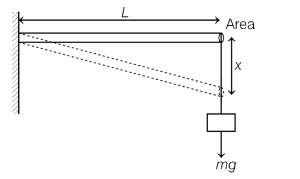
$A$ horizontal aluminium rod of diameter $4 \text{ cm}$ projects $6 \text{ cm}$ from a wall. An object of mass $400 \pi \text{ kg}$ is suspended from the end of the rod. The shearing modulus of aluminium is $3.0 \times 10^{10} \text{ N/m}^2$. The vertical deflection of the end of the rod is (given $g = 10 \text{ m/s}^2$): (in $\text{ mm}$)
A
$0.01$
B
$0.02$
C
$0.03$
D
$0.04$
Solution
(B) The vertical deflection $x$ of a cantilever rod due to a load $F = mg$ at its end is related to the shear modulus $\eta$ by the formula:
$\eta = \frac{F L}{A x} \Rightarrow x = \frac{mg L}{A \eta}$
Where $L = 6 \text{ cm} = 6 \times 10^{-2} \text{ m}$,radius $r = 2 \text{ cm} = 2 \times 10^{-2} \text{ m}$,$m = 400 \pi \text{ kg}$,$g = 10 \text{ m/s}^2$,and $\eta = 3 \times 10^{10} \text{ N/m}^2$.
The cross-sectional area $A = \pi r^2 = \pi (2 \times 10^{-2})^2 = 4 \pi \times 10^{-4} \text{ m}^2$.
Substituting these values into the formula:
$x = \frac{(400 \pi \times 10) \times (6 \times 10^{-2})}{(4 \pi \times 10^{-4}) \times (3 \times 10^{10})}$
$x = \frac{4000 \pi \times 6 \times 10^{-2}}{12 \pi \times 10^6}$
$x = \frac{24000 \pi \times 10^{-2}}{12 \pi \times 10^6} = \frac{240 \pi}{12 \pi \times 10^6} = 20 \times 10^{-6} \text{ m}$
$x = 20 \times 10^{-3} \text{ mm} = 0.02 \text{ mm}$.
Thus,the correct option is $B$.
$\eta = \frac{F L}{A x} \Rightarrow x = \frac{mg L}{A \eta}$
Where $L = 6 \text{ cm} = 6 \times 10^{-2} \text{ m}$,radius $r = 2 \text{ cm} = 2 \times 10^{-2} \text{ m}$,$m = 400 \pi \text{ kg}$,$g = 10 \text{ m/s}^2$,and $\eta = 3 \times 10^{10} \text{ N/m}^2$.
The cross-sectional area $A = \pi r^2 = \pi (2 \times 10^{-2})^2 = 4 \pi \times 10^{-4} \text{ m}^2$.
Substituting these values into the formula:
$x = \frac{(400 \pi \times 10) \times (6 \times 10^{-2})}{(4 \pi \times 10^{-4}) \times (3 \times 10^{10})}$
$x = \frac{4000 \pi \times 6 \times 10^{-2}}{12 \pi \times 10^6}$
$x = \frac{24000 \pi \times 10^{-2}}{12 \pi \times 10^6} = \frac{240 \pi}{12 \pi \times 10^6} = 20 \times 10^{-6} \text{ m}$
$x = 20 \times 10^{-3} \text{ mm} = 0.02 \text{ mm}$.
Thus,the correct option is $B$.
0 likes
View Solution39
MediumMCQ
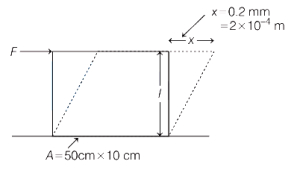
$A$ slab of side $50 \text{ cm}$ and thickness $10 \text{ cm}$ is subjected to a shearing force of $10^5 \text{ N}$ on its narrow edge. If the lower edge is riveted to the floor and the upper edge is displaced by $0.2 \text{ mm}$, then the shear modulus of the material of the slab is: (in $\text{ GPa}$)
A
$6$
B
$5$
C
$4$
D
$4.5$
Solution
(B) Given: Side of the slab $L = 50 \text{ cm} = 0.5 \text{ m}$, thickness $t = 10 \text{ cm} = 0.1 \text{ m}$, shearing force $F = 10^5 \text{ N}$, displacement $x = 0.2 \text{ mm} = 0.2 \times 10^{-3} \text{ m}$.
Area of the face subjected to force $A = L \times t = 0.5 \text{ m} \times 0.1 \text{ m} = 0.05 \text{ m}^2$.
Shear stress $= \frac{F}{A} = \frac{10^5}{0.05} = 2 \times 10^6 \text{ N/m}^2$.
Shear strain $= \frac{x}{L} = \frac{0.2 \times 10^{-3} \text{ m}}{0.5 \text{ m}} = 0.4 \times 10^{-3} = 4 \times 10^{-4}$.
Shear modulus $\eta = \frac{\text{Shear stress}}{\text{Shear strain}} = \frac{2 \times 10^6}{4 \times 10^{-4}} = 0.5 \times 10^{10} \text{ N/m}^2 = 5 \times 10^9 \text{ N/m}^2 = 5 \text{ GPa}$.
Area of the face subjected to force $A = L \times t = 0.5 \text{ m} \times 0.1 \text{ m} = 0.05 \text{ m}^2$.
Shear stress $= \frac{F}{A} = \frac{10^5}{0.05} = 2 \times 10^6 \text{ N/m}^2$.
Shear strain $= \frac{x}{L} = \frac{0.2 \times 10^{-3} \text{ m}}{0.5 \text{ m}} = 0.4 \times 10^{-3} = 4 \times 10^{-4}$.
Shear modulus $\eta = \frac{\text{Shear stress}}{\text{Shear strain}} = \frac{2 \times 10^6}{4 \times 10^{-4}} = 0.5 \times 10^{10} \text{ N/m}^2 = 5 \times 10^9 \text{ N/m}^2 = 5 \text{ GPa}$.
0 likes
View Solution40
DifficultMCQ
$A$ cube has side length $5$ cm and modulus of rigidity $10^5$ $N$/m$^2$. The displacement produced by a force of $10$ $N$ in the upper face of cube is . . . . . . mm.
A
$1$
B
$2$
C
$3$
D
$4$
Solution
(B) The modulus of rigidity $\eta$ is defined as the ratio of shear stress to shear strain: $\eta = \frac{\text{Shear Stress}}{\text{Shear Strain}} = \frac{F/A}{x/L}$.
Rearranging the formula to solve for displacement $x$: $x = \frac{FL}{A\eta}$.
Given values: side length $L = 5$ cm $= 0.05$ m,area $A = L^2 = (0.05)^2 = 0.0025$ m$^2$,force $F = 10$ $N$,and modulus of rigidity $\eta = 10^5$ $N$/m$^2$.
Substituting these values into the formula: $x = \frac{10 \times 0.05}{0.0025 \times 10^5}$.
$x = \frac{0.5}{250} = 0.002$ m.
Converting meters to millimeters: $0.002$ m $= 2$ mm.
Rearranging the formula to solve for displacement $x$: $x = \frac{FL}{A\eta}$.
Given values: side length $L = 5$ cm $= 0.05$ m,area $A = L^2 = (0.05)^2 = 0.0025$ m$^2$,force $F = 10$ $N$,and modulus of rigidity $\eta = 10^5$ $N$/m$^2$.
Substituting these values into the formula: $x = \frac{10 \times 0.05}{0.0025 \times 10^5}$.
$x = \frac{0.5}{250} = 0.002$ m.
Converting meters to millimeters: $0.002$ m $= 2$ mm.
0 likes
View SolutionMechanical Properties of Solids — Rigidity Modulus · Frequently Asked Questions
1Are these Mechanical Properties of Solids questions useful for JEE and NEET?
Yes. All questions in this section are mapped to JEE Main and NEET exam patterns. Previous year questions from JEE Main, NEET, GUJCET and state-level exams are included with full solutions.
2Can I switch to Hindi or Gujarati for these questions?
Yes. Use the language tabs in the hero section or the sidebar to view the same questions and solutions in English, Hindi or Gujarati.
3How do I generate a question paper from this subtopic?
Use the Vedclass Exam Paper Generator — select the chapter and subtopic, set difficulty, and generate Sets A, B, C, D automatically. First 3 chapters of every subject are free.
Vedclass Products
For Students
Vedclass Test Series
Mock tests in real JEE/NEET style with performance analysis. 5-day free trial.
Start Free TrialFor Teachers
Exam Paper Generator
Generate Set A/B/C/D papers from this chapter in 2 minutes. 3 chapters free.
Try FreeFor Institutes
Online Exam Module
Live online exams with unlimited students, 360° analytics & white-label branding.
See DemoFor Teachers & Institutes
Generate a Mechanical Properties of Solids Exam Paper in 2 Minutes
Select subtopic & difficulty — Sets A, B, C, D auto-generated with No Repeat logic.
First 3 chapters of every subject are free — no payment required.