
A English
Basic of Elasticity, Stress and Strain relationship and Graphical analysis Questions in English
Class 11 Physics · Mechanical Properties of Solids · Basic of Elasticity, Stress and Strain relationship and Graphical analysis
169+
Questions
English
Language
100%
With Solutions
Showing 50 of 169 questions in English
51
MediumMCQ
$A$ cable that can support a load $W$ is cut into two equal parts. The maximum load that can be supported by either part is
A
$W/4$
B
$W/2$
C
$W$
D
$2W$
Solution
(C) The maximum load a cable can support is determined by its breaking stress and its cross-sectional area. The breaking stress is a material property and does not change with the length of the cable. Since the cross-sectional area remains the same when the cable is cut,the maximum load capacity remains $W$ for each part.
0 likes
View Solution52
EasyMCQ
$A$ rod is placed on a smooth horizontal surface. What is the stress developed when the temperature is increased by $40\,^{\circ}C$?
$[\alpha = 5\, \times\, 10^{-5}\,^{\circ}C^{-1},\, Y = 5\, \times\, 10^{11}\, N/m^2]$
$[\alpha = 5\, \times\, 10^{-5}\,^{\circ}C^{-1},\, Y = 5\, \times\, 10^{11}\, N/m^2]$
A
$10^9\, N/m^2$
B
$2\, \times\, 10^9\, N/m^2$
C
$10^{11}\, N/m^2$
D
Zero
Solution
(D) Thermal stress is developed in a material only when its thermal expansion is restricted.
In this problem,the rod is placed on a smooth horizontal surface,which means there is no friction to oppose the expansion.
Since both ends of the rod are free to expand,the rod can expand freely without any resistance.
Therefore,no internal restoring force is generated,and the stress developed in the rod is $0$.
In this problem,the rod is placed on a smooth horizontal surface,which means there is no friction to oppose the expansion.
Since both ends of the rod are free to expand,the rod can expand freely without any resistance.
Therefore,no internal restoring force is generated,and the stress developed in the rod is $0$.
0 likes
View Solution53
DifficultMCQ
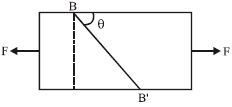
$A$ bar of cross-sectional area $A$ is subjected to two equal and opposite tensile forces at its ends as shown in the figure. Consider a plane $BB'$ making an angle $\theta$ with the length. The ratio of tensile stress to the shearing stress on the plane $BB'$ is
A
$tan\, \theta$
B
$sec\, \theta$
C
$cot\, \theta$
D
$cos\, \theta$
Solution
(A) Let the cross-sectional area of the bar be $A$. The force $F$ acts perpendicular to the cross-section of area $A$.
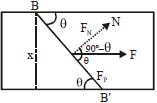
Consider a plane $BB'$ inclined at an angle $\theta$ with the length of the bar. The normal to this plane makes an angle $\theta$ with the direction of the force $F$.
The area of the inclined plane $BB'$ is $A' = A / \sin \theta$.
The force $F$ can be resolved into two components relative to the plane $BB'$:
$1$. Normal force component: $F_N = F \sin \theta$ (acting perpendicular to the plane $BB'$).
$2$. Tangential (shearing) force component: $F_S = F \cos \theta$ (acting along the plane $BB'$).
The tensile stress (normal stress) on plane $BB'$ is $\sigma = F_N / A' = (F \sin \theta) / (A / \sin \theta) = (F / A) \sin^2 \theta$.
The shearing stress on plane $BB'$ is $\tau = F_S / A' = (F \cos \theta) / (A / \sin \theta) = (F / A) \sin \theta \cos \theta$.
The ratio of tensile stress to shearing stress is:
$\frac{\sigma}{\tau} = \frac{(F/A) \sin^2 \theta}{(F/A) \sin \theta \cos \theta} = \frac{\sin \theta}{\cos \theta} = \tan \theta$.
Consider a plane $BB'$ inclined at an angle $\theta$ with the length of the bar. The normal to this plane makes an angle $\theta$ with the direction of the force $F$.
The area of the inclined plane $BB'$ is $A' = A / \sin \theta$.
The force $F$ can be resolved into two components relative to the plane $BB'$:
$1$. Normal force component: $F_N = F \sin \theta$ (acting perpendicular to the plane $BB'$).
$2$. Tangential (shearing) force component: $F_S = F \cos \theta$ (acting along the plane $BB'$).
The tensile stress (normal stress) on plane $BB'$ is $\sigma = F_N / A' = (F \sin \theta) / (A / \sin \theta) = (F / A) \sin^2 \theta$.
The shearing stress on plane $BB'$ is $\tau = F_S / A' = (F \cos \theta) / (A / \sin \theta) = (F / A) \sin \theta \cos \theta$.
The ratio of tensile stress to shearing stress is:
$\frac{\sigma}{\tau} = \frac{(F/A) \sin^2 \theta}{(F/A) \sin \theta \cos \theta} = \frac{\sin \theta}{\cos \theta} = \tan \theta$.
0 likes
View Solution54
MediumMCQ
$A$ wire can be broken by applying a load of $20 \, kg$ weight. The force required to break the wire of twice the diameter is .......... $kg \, wt$.
A
$20$
B
$5$
C
$80$
D
$160$
Solution
(C) Breaking stress is a material property and remains constant for a given material.
Breaking stress $= \frac{F}{A} = \text{constant}$.
Let $F_1 = 20 \, kg \, wt$ be the force required to break a wire of radius $r_1$.
Let $F_2$ be the force required to break a wire of radius $r_2 = 2r_1$ (since the diameter is doubled).
Since the breaking stress is constant: $\frac{F_1}{A_1} = \frac{F_2}{A_2}$.
$F_2 = F_1 \times \frac{A_2}{A_1} = F_1 \times \frac{\pi r_2^2}{\pi r_1^2}$.
Substituting $r_2 = 2r_1$: $F_2 = F_1 \times \frac{(2r_1)^2}{r_1^2} = F_1 \times 4$.
$F_2 = 20 \times 4 = 80 \, kg \, wt$.
Breaking stress $= \frac{F}{A} = \text{constant}$.
Let $F_1 = 20 \, kg \, wt$ be the force required to break a wire of radius $r_1$.
Let $F_2$ be the force required to break a wire of radius $r_2 = 2r_1$ (since the diameter is doubled).
Since the breaking stress is constant: $\frac{F_1}{A_1} = \frac{F_2}{A_2}$.
$F_2 = F_1 \times \frac{A_2}{A_1} = F_1 \times \frac{\pi r_2^2}{\pi r_1^2}$.
Substituting $r_2 = 2r_1$: $F_2 = F_1 \times \frac{(2r_1)^2}{r_1^2} = F_1 \times 4$.
$F_2 = 20 \times 4 = 80 \, kg \, wt$.
0 likes
View Solution55
MediumMCQ
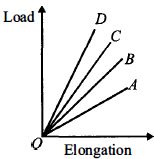
The load versus elongation graphs for four wires of same length and made of the same material are shown in the figure. The thinnest wire is represented by the line
A
$OA$
B
$OC$
C
$OD$
D
$OB$
Solution
(A) Young's modulus $Y$ is given by $Y = \frac{FL}{A\Delta L}$,where $F$ is the load,$L$ is the length,$A$ is the area of cross-section,and $\Delta L$ is the elongation.
Rearranging for elongation,we get $\Delta L = \frac{F}{A} \cdot \frac{L}{Y}$.
Since all wires have the same length $L$ and are made of the same material (same $Y$),the elongation $\Delta L$ is inversely proportional to the area of cross-section $A$ for a constant load $F$ (i.e.,$\Delta L \propto \frac{1}{A}$).
The thinnest wire has the smallest area of cross-section $A$,which means it will have the maximum elongation for a given load.
From the graph,for a constant load,the elongation is maximum for the line $OA$.
Therefore,$OA$ represents the thinnest wire.
Rearranging for elongation,we get $\Delta L = \frac{F}{A} \cdot \frac{L}{Y}$.
Since all wires have the same length $L$ and are made of the same material (same $Y$),the elongation $\Delta L$ is inversely proportional to the area of cross-section $A$ for a constant load $F$ (i.e.,$\Delta L \propto \frac{1}{A}$).
The thinnest wire has the smallest area of cross-section $A$,which means it will have the maximum elongation for a given load.
From the graph,for a constant load,the elongation is maximum for the line $OA$.
Therefore,$OA$ represents the thinnest wire.
0 likes
View Solution56
MediumMCQ
$A$ steel wire having a radius of $2.0 \, mm$, carrying a load of $4 \, kg$, is hanging from a ceiling. Given that $g = 3.1\pi \, m/s^2$, what will be the tensile stress that would be developed in the wire?
A
$6.2 \times 10^6 \, N/m^2$
B
$4.8 \times 10^6 \, N/m^2$
C
$5.2 \times 10^6 \, N/m^2$
D
$3.1 \times 10^6 \, N/m^2$
Solution
(D) The tensile stress $(\sigma)$ in the wire is defined as the ratio of the tensile force $(F)$ to the cross-sectional area $(A)$.
Given:
Radius $(r)$ = $2.0 \, mm = 2.0 \times 10^{-3} \, m$
Load $(m)$ = $4 \, kg$
Acceleration due to gravity $(g)$ = $3.1\pi \, m/s^2$
Formula:
$\sigma = \frac{F}{A} = \frac{mg}{\pi r^2}$
Calculation:
$\sigma = \frac{4 \times 3.1\pi}{\pi \times (2.0 \times 10^{-3})^2}$
$\sigma = \frac{4 \times 3.1\pi}{\pi \times 4.0 \times 10^{-6}}$
$\sigma = \frac{12.4\pi}{4.0\pi \times 10^{-6}}$
$\sigma = 3.1 \times 10^6 \, N/m^2$
Given:
Radius $(r)$ = $2.0 \, mm = 2.0 \times 10^{-3} \, m$
Load $(m)$ = $4 \, kg$
Acceleration due to gravity $(g)$ = $3.1\pi \, m/s^2$
Formula:
$\sigma = \frac{F}{A} = \frac{mg}{\pi r^2}$
Calculation:
$\sigma = \frac{4 \times 3.1\pi}{\pi \times (2.0 \times 10^{-3})^2}$
$\sigma = \frac{4 \times 3.1\pi}{\pi \times 4.0 \times 10^{-6}}$
$\sigma = \frac{12.4\pi}{4.0\pi \times 10^{-6}}$
$\sigma = 3.1 \times 10^6 \, N/m^2$
0 likes
View Solution57
MediumMCQ
The elastic limit of brass is $379\,MPa$. What should be the minimum diameter (in $mm$) of a brass rod if it is to support a $400\,N$ load without exceeding its elastic limit?
A
$1$
B
$1.16$
C
$0.90$
D
$1.36$
Solution
(B) The stress $\sigma$ is defined as the force $F$ divided by the cross-sectional area $A$. To remain within the elastic limit,the stress must not exceed the elastic limit $\sigma_{max} = 379\,MPa = 379 \times 10^6\,Pa$.
The formula for stress is $\sigma = \frac{F}{A} = \frac{F}{\frac{\pi}{4}d^2}$.
Given $F = 400\,N$ and $\sigma = 379 \times 10^6\,Pa$,we have:
$379 \times 10^6 = \frac{400}{\frac{\pi}{4}d^2}$.
Rearranging for $d^2$:
$d^2 = \frac{4 \times 400}{\pi \times 379 \times 10^6} = \frac{1600}{1190.7 \times 10^6} \approx 1.3437 \times 10^{-6}\,m^2$.
Taking the square root:
$d = \sqrt{1.3437} \times 10^{-3}\,m \approx 1.159 \times 10^{-3}\,m$.
Converting to $mm$:
$d \approx 1.16\,mm$.
The formula for stress is $\sigma = \frac{F}{A} = \frac{F}{\frac{\pi}{4}d^2}$.
Given $F = 400\,N$ and $\sigma = 379 \times 10^6\,Pa$,we have:
$379 \times 10^6 = \frac{400}{\frac{\pi}{4}d^2}$.
Rearranging for $d^2$:
$d^2 = \frac{4 \times 400}{\pi \times 379 \times 10^6} = \frac{1600}{1190.7 \times 10^6} \approx 1.3437 \times 10^{-6}\,m^2$.
Taking the square root:
$d = \sqrt{1.3437} \times 10^{-3}\,m \approx 1.159 \times 10^{-3}\,m$.
Converting to $mm$:
$d \approx 1.16\,mm$.
0 likes
View Solution58
DifficultMCQ
The length of a metal wire is $l_1$ when the tension in it is $T_1$,and it is $l_2$ when the tension is $T_2$. The unstretched length of the wire is
A
$\sqrt{l_1 l_2}$
B
$\frac{l_1 + l_2}{2}$
C
$\frac{l_1 T_2 - l_2 T_1}{T_2 - T_1}$
D
$\frac{l_1 T_2 + l_2 T_1}{T_2 + T_1}$
Solution
(C) According to Hooke's Law,the tension $T$ in a wire is given by $T = k(l - l_0)$,where $k$ is the force constant and $l_0$ is the unstretched length.
For the first case: $T_1 = k(l_1 - l_0)$ $...(1)$
For the second case: $T_2 = k(l_2 - l_0)$ $...(2)$
Dividing equation $(1)$ by equation $(2)$:
$\frac{T_1}{T_2} = \frac{l_1 - l_0}{l_2 - l_0}$
Cross-multiplying gives:
$T_1(l_2 - l_0) = T_2(l_1 - l_0)$
$T_1 l_2 - T_1 l_0 = T_2 l_1 - T_2 l_0$
Rearranging the terms to solve for $l_0$:
$T_2 l_0 - T_1 l_0 = T_2 l_1 - T_1 l_2$
$l_0(T_2 - T_1) = T_2 l_1 - T_1 l_2$
$l_0 = \frac{T_2 l_1 - T_1 l_2}{T_2 - T_1}$
For the first case: $T_1 = k(l_1 - l_0)$ $...(1)$
For the second case: $T_2 = k(l_2 - l_0)$ $...(2)$
Dividing equation $(1)$ by equation $(2)$:
$\frac{T_1}{T_2} = \frac{l_1 - l_0}{l_2 - l_0}$
Cross-multiplying gives:
$T_1(l_2 - l_0) = T_2(l_1 - l_0)$
$T_1 l_2 - T_1 l_0 = T_2 l_1 - T_2 l_0$
Rearranging the terms to solve for $l_0$:
$T_2 l_0 - T_1 l_0 = T_2 l_1 - T_1 l_2$
$l_0(T_2 - T_1) = T_2 l_1 - T_1 l_2$
$l_0 = \frac{T_2 l_1 - T_1 l_2}{T_2 - T_1}$
0 likes
View Solution59
MediumMCQ
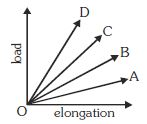
The load versus elongation graph for four wires of the same material and same length is shown in the figure. The thinnest wire is represented by the line
A
$OA$
B
$OB$
C
$OC$
D
$OD$
Solution
(A) The Young's modulus $Y$ is given by $Y = \frac{\text{stress}}{\text{strain}} = \frac{F/A}{\Delta L/L} = \frac{F}{\Delta L} \cdot \frac{L}{A}$.
Since the material and length $L$ are the same for all wires,$Y$ is constant. Thus,the slope of the load-elongation graph,which is $\frac{F}{\Delta L}$,is proportional to the cross-sectional area $A$ $(slope \propto A)$.
The wire with the smallest slope will have the smallest cross-sectional area $A$,meaning it is the thinnest wire.
Looking at the graph,the line $OA$ has the smallest slope.
Therefore,$OA$ represents the thinnest wire.
Since the material and length $L$ are the same for all wires,$Y$ is constant. Thus,the slope of the load-elongation graph,which is $\frac{F}{\Delta L}$,is proportional to the cross-sectional area $A$ $(slope \propto A)$.
The wire with the smallest slope will have the smallest cross-sectional area $A$,meaning it is the thinnest wire.
Looking at the graph,the line $OA$ has the smallest slope.
Therefore,$OA$ represents the thinnest wire.
0 likes
View Solution60
EasyMCQ
$Assertion:$ Stress is the internal restoring force per unit area of a body.
$Reason:$ Rubber is more elastic than steel.
$Reason:$ Rubber is more elastic than steel.
A
If both Assertion and Reason are correct and the Reason is a correct explanation of the Assertion.
B
If the Assertion is correct but Reason is incorrect.
C
If both Assertion and Reason are correct but Reason is not a correct explanation of the Assertion.
D
If both the Assertion and Reason are incorrect.
Solution
(B) The Assertion is correct: Stress is defined as the internal restoring force per unit area of a body when it is deformed.
The Reason is incorrect: Elasticity is defined by the Young's modulus $(Y)$. Since steel requires a much larger force to produce the same strain compared to rubber,steel is more elastic than rubber. Therefore,rubber is less elastic than steel.
The Reason is incorrect: Elasticity is defined by the Young's modulus $(Y)$. Since steel requires a much larger force to produce the same strain compared to rubber,steel is more elastic than rubber. Therefore,rubber is less elastic than steel.
0 likes
View Solution61
MediumMCQ
$Assertion :$ Strain causes the stress in an elastic body.
$Reason :$ An elastic rubber is more plastic in nature.
$Reason :$ An elastic rubber is more plastic in nature.
A
If both Assertion and Reason are correct but Reason is not a correct explanation of the Assertion.
B
If both Assertion and Reason are correct and the Reason is a correct explanation of the Assertion.
C
If the Assertion is correct but Reason is incorrect.
D
If both the Assertion and Reason are incorrect.
Solution
(C) The $Assertion$ is correct. According to Hooke's Law,within the elastic limit,stress is directly proportional to strain $(Stress \propto Strain)$. When an external force is applied to an elastic body,it undergoes deformation (strain),which in turn develops an internal restoring force per unit area (stress).
The $Reason$ is incorrect. Rubber is considered one of the most elastic materials because it can return to its original shape after the removal of a deforming force. $A$ material is considered 'plastic' if it undergoes permanent deformation and does not return to its original shape,which is the opposite of the behavior of rubber.
Therefore,the $Assertion$ is correct,but the $Reason$ is incorrect.
The $Reason$ is incorrect. Rubber is considered one of the most elastic materials because it can return to its original shape after the removal of a deforming force. $A$ material is considered 'plastic' if it undergoes permanent deformation and does not return to its original shape,which is the opposite of the behavior of rubber.
Therefore,the $Assertion$ is correct,but the $Reason$ is incorrect.
0 likes
View Solution62
EasyMCQ
$A$ steel cable with a radius of $1.5 \; cm$ supports a chairlift at a ski area. If the maximum stress is not to exceed $10^{8} \; N m^{-2}$,what is the maximum load the cable can support?
A
$6.035 \times 10^{6} \; N$
B
$7.065 \times 10^{4} \; N$
C
$2.56 \times 10^{3} \; N$
D
$6.425 \times 10^{5} \; N$
Solution
(B) The formula for stress is given by $\text{Stress} = \frac{F}{A}$,where $F$ is the force (load) and $A$ is the cross-sectional area.
Given radius $r = 1.5 \; cm = 0.015 \; m$.
The cross-sectional area $A = \pi r^2 = \pi (0.015)^2 \; m^2$.
Given maximum stress $\sigma_{max} = 10^8 \; N m^{-2}$.
Maximum load $F_{max} = \sigma_{max} \times A$.
$F_{max} = 10^8 \times \pi \times (0.015)^2$.
$F_{max} = 10^8 \times 3.14159 \times 0.000225$.
$F_{max} = 7.0685 \times 10^4 \; N \approx 7.065 \times 10^4 \; N$.
Thus,the cable can support a maximum load of $7.065 \times 10^4 \; N$.
Given radius $r = 1.5 \; cm = 0.015 \; m$.
The cross-sectional area $A = \pi r^2 = \pi (0.015)^2 \; m^2$.
Given maximum stress $\sigma_{max} = 10^8 \; N m^{-2}$.
Maximum load $F_{max} = \sigma_{max} \times A$.
$F_{max} = 10^8 \times \pi \times (0.015)^2$.
$F_{max} = 10^8 \times 3.14159 \times 0.000225$.
$F_{max} = 7.0685 \times 10^4 \; N \approx 7.065 \times 10^4 \; N$.
Thus,the cable can support a maximum load of $7.065 \times 10^4 \; N$.
0 likes
View Solution63
MediumMCQ
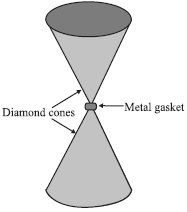
Anvils made of single crystals of diamond,with the shape as shown in the figure,are used to investigate the behavior of materials under very high pressures. The flat faces at the narrow end of the anvil have a diameter of $0.50 \; mm$,and the wide ends are subjected to a compressional force of $50,000 \; N$. What is the pressure at the tip of the anvil?
A
$4.56 \times 10^{10} \; Pa$
B
$2.55 \times 10^{11} \; Pa$
C
$9.45 \times 10^{12} \; Pa$
D
$8.62 \times 10^{9} \; Pa$
Solution
(B) The diameter of the cones at the narrow ends is $d = 0.50 \; mm = 0.50 \times 10^{-3} \; m$.
The radius is $r = \frac{d}{2} = 0.25 \times 10^{-3} \; m$.
The compressional force applied is $F = 50,000 \; N$.
The pressure $p$ at the tip of the anvil is given by the formula:
$p = \frac{F}{A} = \frac{F}{\pi r^2}$
Substituting the values:
$p = \frac{50,000}{\pi (0.25 \times 10^{-3})^2}$
$p = \frac{50,000}{\pi (0.0625 \times 10^{-6})}$
$p = \frac{50,000}{0.19635 \times 10^{-6}}$
$p \approx 2.546 \times 10^{11} \; Pa \approx 2.55 \times 10^{11} \; Pa$.
Therefore,the pressure at the tip of the anvil is $2.55 \times 10^{11} \; Pa$.
The radius is $r = \frac{d}{2} = 0.25 \times 10^{-3} \; m$.
The compressional force applied is $F = 50,000 \; N$.
The pressure $p$ at the tip of the anvil is given by the formula:
$p = \frac{F}{A} = \frac{F}{\pi r^2}$
Substituting the values:
$p = \frac{50,000}{\pi (0.25 \times 10^{-3})^2}$
$p = \frac{50,000}{\pi (0.0625 \times 10^{-6})}$
$p = \frac{50,000}{0.19635 \times 10^{-6}}$
$p \approx 2.546 \times 10^{11} \; Pa \approx 2.55 \times 10^{11} \; Pa$.
Therefore,the pressure at the tip of the anvil is $2.55 \times 10^{11} \; Pa$.
0 likes
View Solution64
EasyMCQ
What is elasticity? What is an elastic body?
A
Elasticity is the ability to stretch.
B
Elasticity is the property of a body to regain its original shape after the removal of a deforming force.
C
Elasticity is the tendency to break under stress.
D
Elasticity is the property of a body to remain permanently deformed.
Solution
(B) Elasticity is the property of a body by virtue of which it tends to regain its original size and shape when the applied deforming force is removed.
An elastic body is a substance that exhibits the property of elasticity. When an external force is applied to such a body,it undergoes deformation,but it returns to its original configuration once the force is removed.
In contrast,if a substance like putty or mud is subjected to a force,it does not regain its original shape and remains permanently deformed. Such substances are called plastic,and this property is known as plasticity.
An elastic body is a substance that exhibits the property of elasticity. When an external force is applied to such a body,it undergoes deformation,but it returns to its original configuration once the force is removed.
In contrast,if a substance like putty or mud is subjected to a force,it does not regain its original shape and remains permanently deformed. Such substances are called plastic,and this property is known as plasticity.
0 likes
View Solution65
Medium
What is a plastic body and plasticity?
Solution
(N/A) $plastic$ $body$ is a material that does not regain its original shape and size after the removal of the deforming force. Such materials undergo permanent deformation.
$Plasticity$ is the property of a material by virtue of which it does not regain its original shape and size after the removal of the deforming force. In other words,it is the inability of a body to recover its original configuration after the deforming force is removed. Examples include clay,putty,and lead.
$Plasticity$ is the property of a material by virtue of which it does not regain its original shape and size after the removal of the deforming force. In other words,it is the inability of a body to recover its original configuration after the deforming force is removed. Examples include clay,putty,and lead.
0 likes
View Solution66
Easy
Explain the spring-ball model of the elastic behavior of solids.
Solution
(N/A) We know that in a solid,each atom or molecule is surrounded by neighboring atoms or molecules.
These are bonded together by interatomic or intermolecular forces and stay in a stable equilibrium position.
When a solid is deformed,the atoms or molecules are displaced from their equilibrium positions,causing a change in the interatomic distances.
When the deforming force is removed,the interatomic forces tend to drive them back to their original positions,and the body regains its original shape and size.
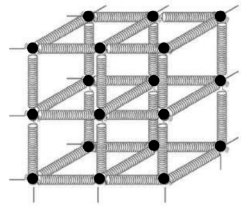
The restoring mechanism can be visualized by taking a model of a spring-ball system as shown in the figure. Here,the balls represent atoms and the springs represent interatomic forces.
If you try to displace any ball from its equilibrium position,the spring system tries to restore the ball back to its original position.
Thus,the elastic behavior of a solid can be explained in terms of the microscopic nature of the solid.
These are bonded together by interatomic or intermolecular forces and stay in a stable equilibrium position.
When a solid is deformed,the atoms or molecules are displaced from their equilibrium positions,causing a change in the interatomic distances.
When the deforming force is removed,the interatomic forces tend to drive them back to their original positions,and the body regains its original shape and size.
The restoring mechanism can be visualized by taking a model of a spring-ball system as shown in the figure. Here,the balls represent atoms and the springs represent interatomic forces.
If you try to displace any ball from its equilibrium position,the spring system tries to restore the ball back to its original position.
Thus,the elastic behavior of a solid can be explained in terms of the microscopic nature of the solid.
0 likes
View Solution67
Medium
What are solid bodies composed of? Why do solid bodies stay in stable equilibrium positions?
Solution
(N/A) Solid bodies are composed of a large number of atoms or molecules arranged in a specific geometric pattern,held together by strong interatomic or intermolecular forces.
These bodies stay in stable equilibrium positions because the atoms or molecules are at a distance where the net interatomic force is zero. If an external force displaces them,the interatomic forces act as restoring forces,pulling them back to their original equilibrium positions,thereby maintaining the structural stability of the solid.
These bodies stay in stable equilibrium positions because the atoms or molecules are at a distance where the net interatomic force is zero. If an external force displaces them,the interatomic forces act as restoring forces,pulling them back to their original equilibrium positions,thereby maintaining the structural stability of the solid.
0 likes
View Solution68
EasyMCQ
For what reasons can the elastic behavior of a solid body be explained?
A
Interatomic forces
B
Gravitational forces
C
Magnetic forces
D
Nuclear forces
Solution
(A) The elastic behavior of a solid body is explained by the microscopic nature of the material.
In a solid,atoms are held together by interatomic forces.
When an external deforming force is applied,the distance between the atoms changes.
When the deforming force is removed,these interatomic forces act as restoring forces,pulling the atoms back to their original equilibrium positions,which results in the material regaining its original shape and size.
In a solid,atoms are held together by interatomic forces.
When an external deforming force is applied,the distance between the atoms changes.
When the deforming force is removed,these interatomic forces act as restoring forces,pulling the atoms back to their original equilibrium positions,which results in the material regaining its original shape and size.
0 likes
View Solution69
Medium
Explain what is stress? Write its unit and dimensional formula.
Solution
(N/A) When forces are applied on a body such that it remains in static equilibrium,it undergoes deformation.
The extent of deformation depends on the nature of the material and the magnitude of the deforming force.
When a body is subjected to a deforming force,a restoring force is developed within the body to oppose the deformation.
This restoring force is equal in magnitude but opposite in direction to the applied force. The restoring force per unit area is defined as stress.
If $F$ is the applied force and $A$ is the cross-sectional area of the body,then:
$\text{Stress} = \frac{F}{A}$
The $SI$ unit of stress is $N m^{-2}$ or Pascal $(Pa)$.
The dimensional formula of stress is $[ML^{-1} T^{-2}]$.
The extent of deformation depends on the nature of the material and the magnitude of the deforming force.
When a body is subjected to a deforming force,a restoring force is developed within the body to oppose the deformation.
This restoring force is equal in magnitude but opposite in direction to the applied force. The restoring force per unit area is defined as stress.
If $F$ is the applied force and $A$ is the cross-sectional area of the body,then:
$\text{Stress} = \frac{F}{A}$
The $SI$ unit of stress is $N m^{-2}$ or Pascal $(Pa)$.
The dimensional formula of stress is $[ML^{-1} T^{-2}]$.
0 likes
View Solution70
Easy
Explain longitudinal stress.
Solution
Longitudinal stress occurs when a deforming force is applied normal to the cross-sectional area of a body,resulting in a change in its length.
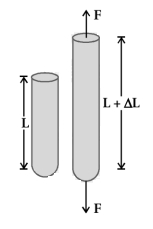
If a cylinder is stretched by two equal and opposite forces applied normal to its cross-sectional area,the restoring force per unit area is called tensile stress.
If the cylinder is compressed under the action of applied forces,the restoring force per unit area is known as compressive stress.
Tensile or compressive stress $(\sigma)$ is collectively known as longitudinal stress. It is defined as the ratio of the restoring force $(F)$ to the area of cross-section $(A)$,given by $\sigma = F/A$.
If a cylinder is stretched by two equal and opposite forces applied normal to its cross-sectional area,the restoring force per unit area is called tensile stress.
If the cylinder is compressed under the action of applied forces,the restoring force per unit area is known as compressive stress.
Tensile or compressive stress $(\sigma)$ is collectively known as longitudinal stress. It is defined as the ratio of the restoring force $(F)$ to the area of cross-section $(A)$,given by $\sigma = F/A$.
0 likes
View Solution71
Easy
What is strain? Explain longitudinal strain $(\varepsilon)$.
Solution
(N/A) When a solid body is subjected to an external deforming force,its dimensions change in three ways:
$(1)$ In length,$(2)$ In volume,and $(3)$ In shape.
The ratio of the change in dimension to the original dimension of a body is known as strain.
Longitudinal Strain: The deforming force that produces a fractional change in the length of a body is known as longitudinal strain.
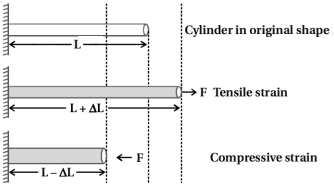
If $L$ is the original length of the body and $F$ is the deforming force causing a change in length $\Delta L$,then the longitudinal strain $\varepsilon_{l}$ is given by:
$\varepsilon_{l} = \frac{\Delta L}{L}$
If the length increases,the corresponding longitudinal strain is called tensile strain,and if the length decreases,the corresponding strain is called compressive strain.
$(1)$ In length,$(2)$ In volume,and $(3)$ In shape.
The ratio of the change in dimension to the original dimension of a body is known as strain.
Longitudinal Strain: The deforming force that produces a fractional change in the length of a body is known as longitudinal strain.
If $L$ is the original length of the body and $F$ is the deforming force causing a change in length $\Delta L$,then the longitudinal strain $\varepsilon_{l}$ is given by:
$\varepsilon_{l} = \frac{\Delta L}{L}$
If the length increases,the corresponding longitudinal strain is called tensile strain,and if the length decreases,the corresponding strain is called compressive strain.
0 likes
View Solution72
Medium
Explain tangential or shearing stress and shearing strain.
Solution
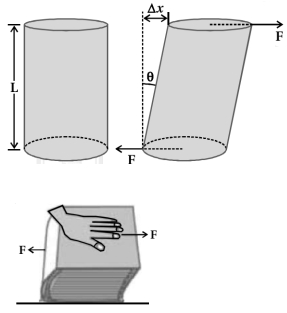
(N/A) Tangential or Shearing Stress: When two equal and opposite deforming forces are applied parallel to the cross-sectional area of a cylinder,causing a relative displacement between the opposite faces,the restoring force per unit area developed is known as tangential or shearing stress.
Shearing Strain: As a result of the applied tangential force,there is a relative displacement $\Delta x$ between the opposite faces of the cylinder,as shown in the figure. The strain produced is known as shearing strain and is defined as the ratio of the relative displacement of the faces to the length of the cylinder $L$:
$\text{Shearing strain } \varepsilon_{\theta} = \frac{\Delta x}{L} = \tan \theta \approx \theta$
Here,$\theta$ is the angular displacement of the cylinder from the vertical. Since $\theta$ is usually very small,$\tan \theta$ is nearly equal to $\theta$.
$A$ common example is when a book is pressed with the hand and pushed horizontally; the vertical side makes a small angle $\theta$ with the vertical.
Shearing Strain: As a result of the applied tangential force,there is a relative displacement $\Delta x$ between the opposite faces of the cylinder,as shown in the figure. The strain produced is known as shearing strain and is defined as the ratio of the relative displacement of the faces to the length of the cylinder $L$:
$\text{Shearing strain } \varepsilon_{\theta} = \frac{\Delta x}{L} = \tan \theta \approx \theta$
Here,$\theta$ is the angular displacement of the cylinder from the vertical. Since $\theta$ is usually very small,$\tan \theta$ is nearly equal to $\theta$.
$A$ common example is when a book is pressed with the hand and pushed horizontally; the vertical side makes a small angle $\theta$ with the vertical.
0 likes
View Solution73
Easy
What is stress? Write its unit and dimensional formula.
Solution
(N/A) Stress is defined as the restoring force per unit area of a body that has been deformed by an external force. Mathematically,$\text{Stress} = \frac{F}{A}$,where $F$ is the restoring force and $A$ is the cross-sectional area.
The $SI$ unit of stress is $\text{Pascal (Pa)}$ or $\text{N/m}^2$.
The dimensional formula of stress is calculated as: $\text{Dimension of Force} = [MLT^{-2}]$ and $\text{Dimension of Area} = [L^2]$.
Therefore,$\text{Dimension of Stress} = \frac{[MLT^{-2}]}{[L^2]} = [ML^{-1}T^{-2}]$.
The $SI$ unit of stress is $\text{Pascal (Pa)}$ or $\text{N/m}^2$.
The dimensional formula of stress is calculated as: $\text{Dimension of Force} = [MLT^{-2}]$ and $\text{Dimension of Area} = [L^2]$.
Therefore,$\text{Dimension of Stress} = \frac{[MLT^{-2}]}{[L^2]} = [ML^{-1}T^{-2}]$.
0 likes
View Solution74
Medium
Explain tensile stress and compressive stress.
Solution
(N/A) $1$. Tensile Stress: When a deforming force is applied to a body such that the length of the body increases along the direction of the force,the restoring force per unit area is called tensile stress. It occurs when the body is under tension (stretched).
$2$. Compressive Stress: When a deforming force is applied to a body such that the length of the body decreases along the direction of the force,the restoring force per unit area is called compressive stress. It occurs when the body is under compression (squeezed).
$2$. Compressive Stress: When a deforming force is applied to a body such that the length of the body decreases along the direction of the force,the restoring force per unit area is called compressive stress. It occurs when the body is under compression (squeezed).
0 likes
View Solution75
Easy
What is strain? Give its units. Define longitudinal stress.
Solution
(N/A) Strain is defined as the ratio of the change in dimension to the original dimension of a body when it is subjected to a deforming force. Mathematically,$\text{Strain} = \frac{\Delta L}{L}$.
Since strain is a ratio of two similar physical quantities (lengths),it is a dimensionless quantity and has no units.
Longitudinal stress is defined as the restoring force per unit area when the deforming force produces a change in the length of the body. It is given by $\sigma = \frac{F}{A}$,where $F$ is the applied force and $A$ is the cross-sectional area. Its $SI$ unit is $\text{N/m}^2$ or $\text{Pascal (Pa)}$.
Since strain is a ratio of two similar physical quantities (lengths),it is a dimensionless quantity and has no units.
Longitudinal stress is defined as the restoring force per unit area when the deforming force produces a change in the length of the body. It is given by $\sigma = \frac{F}{A}$,where $F$ is the applied force and $A$ is the cross-sectional area. Its $SI$ unit is $\text{N/m}^2$ or $\text{Pascal (Pa)}$.
0 likes
View Solution76
MediumMCQ
Define longitudinal strain and shearing (tangential) stress and write their formulas. What is the magnitude of hydraulic stress?
A
Longitudinal strain = $\Delta L / L$,Shearing stress = $F/A$,Hydraulic stress = $F/A$
B
Longitudinal strain = $L / \Delta L$,Shearing stress = $A/F$,Hydraulic stress = $P$
C
Longitudinal strain = $\Delta L / L$,Shearing stress = $F_{tangential}/A$,Hydraulic stress = $P = F/A$
D
Longitudinal strain = $\Delta L / L$,Shearing stress = $F/A$,Hydraulic stress = $0$
Solution
(C) $1$. Longitudinal strain: It is defined as the ratio of the change in length $(\Delta L)$ to the original length $(L)$ of the body. Formula: $\text{Longitudinal strain} = \frac{\Delta L}{L}$.
$2$. Shearing (tangential) stress: It is the tangential force $(F_{tangential})$ applied per unit area $(A)$ parallel to the surface. Formula: $\text{Shearing stress} = \frac{F_{tangential}}{A}$.
$3$. Hydraulic stress: When a body is submerged in a fluid,it experiences a uniform force from all sides,which is equal to the pressure $(P)$ exerted by the fluid. The magnitude of hydraulic stress is equal to the pressure $P = F/A$.
$2$. Shearing (tangential) stress: It is the tangential force $(F_{tangential})$ applied per unit area $(A)$ parallel to the surface. Formula: $\text{Shearing stress} = \frac{F_{tangential}}{A}$.
$3$. Hydraulic stress: When a body is submerged in a fluid,it experiences a uniform force from all sides,which is equal to the pressure $(P)$ exerted by the fluid. The magnitude of hydraulic stress is equal to the pressure $P = F/A$.
0 likes
View Solution77
Easy
Explain Hooke's Law.
Solution
(N/A) Hooke's Law states that for small deformations,the stress and strain are proportional to each other.
$\text{stress} \propto \text{strain}$
$\therefore \text{stress} = k \times \text{strain}$
Here,$k$ is the proportionality constant,known as the modulus of elasticity.
Hooke's law is an empirical law and is valid for most materials within their elastic limit.
However,some materials do not exhibit this linear relationship.
The $SI$ unit of $k$ is $N \ m^{-2}$ or $Pa$. The dimensional formula is $[M^1 L^{-1} T^{-2}]$.
$\text{stress} \propto \text{strain}$
$\therefore \text{stress} = k \times \text{strain}$
Here,$k$ is the proportionality constant,known as the modulus of elasticity.
Hooke's law is an empirical law and is valid for most materials within their elastic limit.
However,some materials do not exhibit this linear relationship.
The $SI$ unit of $k$ is $N \ m^{-2}$ or $Pa$. The dimensional formula is $[M^1 L^{-1} T^{-2}]$.
0 likes
View Solution78
Medium
What is a yield point? What is a yield strength?
Solution
(N/A) $1$. Yield Point: The yield point is the point on the stress-strain curve beyond which the material starts to deform plastically. Up to this point,the material exhibits elastic behavior,meaning it will return to its original shape once the deforming force is removed. Beyond the yield point,the material undergoes permanent deformation.
$2$. Yield Strength: The yield strength is defined as the value of stress corresponding to the yield point. It represents the maximum stress a material can withstand without undergoing permanent plastic deformation. It is a critical parameter in engineering design to ensure that structural components remain within their elastic limits under operational loads.
$2$. Yield Strength: The yield strength is defined as the value of stress corresponding to the yield point. It represents the maximum stress a material can withstand without undergoing permanent plastic deformation. It is a critical parameter in engineering design to ensure that structural components remain within their elastic limits under operational loads.
0 likes
View Solution79
Easy
Define plastic deformation and tensile strength.
Solution
(N/A) $1$. Plastic Deformation: It is the permanent deformation of a material that occurs when the applied stress exceeds the elastic limit of the material. In this state,the material does not return to its original shape or size even after the removal of the external deforming force.
$2$. Tensile Strength: It is defined as the maximum stress that a material can withstand while being stretched or pulled before breaking or failing. It is calculated as the ratio of the maximum load applied to the original cross-sectional area of the material.
$2$. Tensile Strength: It is defined as the maximum stress that a material can withstand while being stretched or pulled before breaking or failing. It is calculated as the ratio of the maximum load applied to the original cross-sectional area of the material.
0 likes
View Solution80
Medium
What is called a brittle material? What is called a ductile material?
Solution
(N/A) $1$. Brittle Material: $A$ material is called brittle if it breaks or fractures suddenly without undergoing significant plastic deformation when subjected to an external force. Examples include glass,ceramics,and cast iron.
$2$. Ductile Material: $A$ material is called ductile if it can be drawn into thin wires or undergoes significant plastic deformation before breaking when subjected to a tensile force. Examples include copper,aluminum,and mild steel.
$2$. Ductile Material: $A$ material is called ductile if it can be drawn into thin wires or undergoes significant plastic deformation before breaking when subjected to a tensile force. Examples include copper,aluminum,and mild steel.
0 likes
View Solution81
Medium
What are elastomers? Give examples of elastomers.
Solution
(N/A) Elastomers are materials that can be stretched to a large extent and return to their original shape and size upon the removal of the stretching force. These materials exhibit a large elastic region in their stress-strain curve.
Examples of elastomers include:
$1$. Rubber (e.g.,vulcanized rubber).
$2$. Tissue of the aorta (the large tube carrying blood from the heart).
$3$. Elastin (a protein in connective tissue).
Examples of elastomers include:
$1$. Rubber (e.g.,vulcanized rubber).
$2$. Tissue of the aorta (the large tube carrying blood from the heart).
$3$. Elastin (a protein in connective tissue).
0 likes
View Solution82
Easy
What is Elastic Moduli?
Solution
(N/A) The ratio of stress to strain is called the modulus of elasticity.
It depends on the characteristics of the material but does not depend on the dimensions of the material.
There are three types of modulus of elasticity:
$(i)$ Young's modulus $(Y)$
$(ii)$ Bulk modulus $(B)$ and its reciprocal,Compressibility $(k)$
$(iii)$ Shear modulus or modulus of rigidity $(G)$
It depends on the characteristics of the material but does not depend on the dimensions of the material.
There are three types of modulus of elasticity:
$(i)$ Young's modulus $(Y)$
$(ii)$ Bulk modulus $(B)$ and its reciprocal,Compressibility $(k)$
$(iii)$ Shear modulus or modulus of rigidity $(G)$
0 likes
View Solution83
MediumMCQ
$A$ $50 \;kg$ girl wearing high heel shoes balances on a single heel. The heel is circular with a diameter $1.0 \;cm$. What is the pressure exerted by the heel on the horizontal floor?
A
$1.95 \times 10^{7} \;N m^{-2}$
B
$8.62 \times 10^{5} \;N m^{-2}$
C
$2.65 \times 10^{5} \;N m^{-2}$
D
$6.24 \times 10^{6} \;N m^{-2}$
Solution
(D) Mass of the girl,$m = 50 \;kg$.
Diameter of the heel,$d = 1 \;cm = 0.01 \;m$.
Radius of the heel,$r = d/2 = 0.005 \;m$.
Area of the heel,$A = \pi r^2 = \pi(0.005)^2 \approx 7.85 \times 10^{-5} \;m^2$.
Force exerted by the heel on the floor,$F = mg = 50 \times 9.8 = 490 \;N$.
Pressure exerted by the heel on the floor,$P = F/A = 490 / (7.85 \times 10^{-5}) \approx 6.24 \times 10^6 \;N m^{-2}$.
Diameter of the heel,$d = 1 \;cm = 0.01 \;m$.
Radius of the heel,$r = d/2 = 0.005 \;m$.
Area of the heel,$A = \pi r^2 = \pi(0.005)^2 \approx 7.85 \times 10^{-5} \;m^2$.
Force exerted by the heel on the floor,$F = mg = 50 \times 9.8 = 490 \;N$.
Pressure exerted by the heel on the floor,$P = F/A = 490 / (7.85 \times 10^{-5}) \approx 6.24 \times 10^6 \;N m^{-2}$.
0 likes
View Solution84
Medium
Distinguish between a liquid body and a solid body.
Solution
(N/A) $1$. $A$ solid body can withstand shear stress,which changes its shape while keeping its volume fixed.
$2$. $A$ liquid (fluid) body changes its shape continuously under the application of even a very small shear stress.
$3$. The shearing stress required to deform a fluid is about a million times smaller than that required for a solid.
$2$. $A$ liquid (fluid) body changes its shape continuously under the application of even a very small shear stress.
$3$. The shearing stress required to deform a fluid is about a million times smaller than that required for a solid.
0 likes
View Solution85
Medium
What is the difference between a rigid body and a solid body?
Solution
(N/A) $rigid$ $body$ is an idealized object in physics where the distance between any two particles remains constant,regardless of the external forces applied. It does not deform under stress.
$A$ $solid$ $body$ is a state of matter characterized by structural rigidity and resistance to a force applied to the surface. Unlike a $rigid$ $body$,a $solid$ $body$ can undergo deformation (elastic or plastic) when subjected to external forces.
Key differences:
$1$. $Rigid$ $body$ is a theoretical model; $solid$ $body$ is a physical state of matter.
$2$. In a $rigid$ $body$,the relative distance between particles is invariant. In a $solid$ $body$,the relative distance can change due to deformation.
$3$. $Rigid$ $body$ dynamics ignore internal stresses,whereas $solid$ $body$ mechanics (like elasticity) account for them.
$A$ $solid$ $body$ is a state of matter characterized by structural rigidity and resistance to a force applied to the surface. Unlike a $rigid$ $body$,a $solid$ $body$ can undergo deformation (elastic or plastic) when subjected to external forces.
Key differences:
$1$. $Rigid$ $body$ is a theoretical model; $solid$ $body$ is a physical state of matter.
$2$. In a $rigid$ $body$,the relative distance between particles is invariant. In a $solid$ $body$,the relative distance can change due to deformation.
$3$. $Rigid$ $body$ dynamics ignore internal stresses,whereas $solid$ $body$ mechanics (like elasticity) account for them.
0 likes
View Solution86
Easy
What is a perfectly elastic body and a perfectly plastic body?
Solution
(N/A) perfectly elastic body is defined as a body that regains its original shape and size completely upon the removal of the deforming force.
$A$ perfectly plastic body is defined as a body that shows no tendency to regain its original shape and size after the removal of the deforming force.
$A$ perfectly plastic body is defined as a body that shows no tendency to regain its original shape and size after the removal of the deforming force.
0 likes
View Solution87
Easy
Explain with the illustration of cranes the applications of the elastic behaviour of materials.
Solution
(A) In all engineering designs,the elastic behaviour of materials plays an important role. Let us consider the illustration of cranes for this.
Cranes used for lifting and moving heavy loads from one place to another have a thick metal rope to which the load is attached,and thus the rope (cable) is under stress.
Suppose we want to design a crane with a lifting capacity of $10$ tonnes or metric tons ($1$ metric ton $= 1000 \text{ kg}$). How thick should the steel rope be?
To ensure the load does not deform the rope permanently,the extension should not exceed the elastic limit.
This means the stress produced in the rope must be less than the yield strength $(S_y)$. Suppose the minimum cross-sectional area of the mild steel rope is $A$ and the yield strength of mild steel $(S_y)$ is $300 \times 10^6 \text{ N m}^{-2}$.
$\therefore A \geq \frac{W}{S_y}$
$= \frac{Mg}{S_y}$
$= \frac{10^4 \text{ kg} \times 10 \text{ m s}^{-2}}{300 \times 10^6 \text{ N m}^{-2}}$
$= 3.3 \times 10^{-4} \text{ m}^2$
$\therefore A \geq 3.3 \times 10^{-4} \text{ m}^2$
If $g = 3.1 \pi \text{ m s}^{-2}$ and $A = \pi r^2$,then the radius $r$ can be calculated to determine the thickness of the rope.
Cranes used for lifting and moving heavy loads from one place to another have a thick metal rope to which the load is attached,and thus the rope (cable) is under stress.
Suppose we want to design a crane with a lifting capacity of $10$ tonnes or metric tons ($1$ metric ton $= 1000 \text{ kg}$). How thick should the steel rope be?
To ensure the load does not deform the rope permanently,the extension should not exceed the elastic limit.
This means the stress produced in the rope must be less than the yield strength $(S_y)$. Suppose the minimum cross-sectional area of the mild steel rope is $A$ and the yield strength of mild steel $(S_y)$ is $300 \times 10^6 \text{ N m}^{-2}$.
$\therefore A \geq \frac{W}{S_y}$
$= \frac{Mg}{S_y}$
$= \frac{10^4 \text{ kg} \times 10 \text{ m s}^{-2}}{300 \times 10^6 \text{ N m}^{-2}}$
$= 3.3 \times 10^{-4} \text{ m}^2$
$\therefore A \geq 3.3 \times 10^{-4} \text{ m}^2$
If $g = 3.1 \pi \text{ m s}^{-2}$ and $A = \pi r^2$,then the radius $r$ can be calculated to determine the thickness of the rope.
0 likes
View Solution88
Medium
What should be the shape of the pillars or columns in buildings and bridges?
Solution
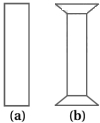
The shape of a pillar or column in buildings and bridges should be designed to distribute the load effectively.
As shown in the figure,a pillar with a distributed shape at the ends (as in figure $b$) is more efficient than a simple cylindrical pillar (as in figure $a$).
$A$ pillar with a distributed shape at the ends provides a larger surface area for contact,which helps in distributing the load over a wider area,thereby reducing the stress (force per unit area) and increasing the load-bearing capacity of the structure.
Conversely,a pillar with rounded or narrow ends supports less load because the stress concentration is higher at the contact points.
As shown in the figure,a pillar with a distributed shape at the ends (as in figure $b$) is more efficient than a simple cylindrical pillar (as in figure $a$).
$A$ pillar with a distributed shape at the ends provides a larger surface area for contact,which helps in distributing the load over a wider area,thereby reducing the stress (force per unit area) and increasing the load-bearing capacity of the structure.
Conversely,a pillar with rounded or narrow ends supports less load because the stress concentration is higher at the contact points.
0 likes
View Solution89
Medium
Why is rubber used to make cycle seats instead of wood or iron?
Solution
(N/A) Rubber is an elastomer,which means it can undergo large deformations and return to its original shape due to strong intermolecular restoring forces. When a bicycle passes over uneven ground,the seat material experiences stress and deforms,absorbing the energy of the shocks. Because of its elasticity,the rubber molecules return to their equilibrium positions once the force is removed,providing comfort. In contrast,wood and iron are rigid materials; they do not deform significantly under such loads,meaning they would transmit the shocks directly to the rider,causing discomfort.
0 likes
View Solution90
Medium
Why do spring balances show wrong readings of weight after they have been used for a long time?
Solution
(N/A) spring balance works on the principle of Hooke's Law,which states that the extension of a spring is directly proportional to the applied force within the elastic limit. After repeated use over a long period,the spring undergoes elastic fatigue. This means the material of the spring loses its original elastic strength and may undergo permanent deformation. Consequently,the spring does not return to its original shape or length when the load is removed,leading to incorrect readings.
0 likes
View Solution91
Easy
If under an external force,a change in length $\Delta l$ occurs in a rod of original length $l$,then write the formula for longitudinal strain.
Solution
(N/A) Longitudinal strain is defined as the ratio of the change in length to the original length of the object.
Formula: $\varepsilon_{l} = \frac{\Delta l}{l}$
Formula: $\varepsilon_{l} = \frac{\Delta l}{l}$
0 likes
View Solution92
Medium
What is stress? Give its two definitions.
Solution
(N/A) $(i)$ The restoring force per unit area of cross-section of a body is known as stress.
$(ii)$ The ratio of the restoring force to the area of cross-section is known as stress.
$(ii)$ The ratio of the restoring force to the area of cross-section is known as stress.
0 likes
View Solution93
Medium
Write the formula and unit of volume stress. Can volume stress be a pressure?
Solution
(N/A) Volume stress is defined as the restoring force per unit area acting on a body when its volume changes.
Formula: $\sigma_{V} = \frac{F}{A} = P$,where $F$ is the force acting normally on the surface area $A$,and $P$ is the pressure applied.
Unit: The $SI$ unit of volume stress is the same as pressure,which is $N \ m^{-2}$ or $Pa$ (Pascal).
Yes,volume stress is equivalent to pressure because it is defined as the force applied per unit area perpendicular to the surface.
Formula: $\sigma_{V} = \frac{F}{A} = P$,where $F$ is the force acting normally on the surface area $A$,and $P$ is the pressure applied.
Unit: The $SI$ unit of volume stress is the same as pressure,which is $N \ m^{-2}$ or $Pa$ (Pascal).
Yes,volume stress is equivalent to pressure because it is defined as the force applied per unit area perpendicular to the surface.
0 likes
View Solution94
Easy
Define shearing stress and write its formula.
Solution
(N/A) Shearing stress is defined as the ratio of the tangential component of the applied force to the area of the cross-section upon which it acts.
The formula for shearing stress $(\tau)$ is given by:
$\tau = \frac{F_{t}}{A}$
Where:
$F_{t}$ = Tangential component of the force applied parallel to the surface.
$A$ = Area of the cross-section.
The formula for shearing stress $(\tau)$ is given by:
$\tau = \frac{F_{t}}{A}$
Where:
$F_{t}$ = Tangential component of the force applied parallel to the surface.
$A$ = Area of the cross-section.
0 likes
View Solution95
Easy
Pressure and stress have the same unit (and dimension),although they are not the same physical quantity. Why?
Solution
(N/A) Pressure is defined as the normal force applied per unit area,which is a scalar quantity because it acts equally in all directions at a point in a fluid.
Stress is defined as the restoring force per unit area developed within a material due to an external deforming force. Since stress depends on the direction of the applied force and the orientation of the surface,it is a tensor quantity (often treated as a vector in basic contexts) because it has both magnitude and direction.
Stress is defined as the restoring force per unit area developed within a material due to an external deforming force. Since stress depends on the direction of the applied force and the orientation of the surface,it is a tensor quantity (often treated as a vector in basic contexts) because it has both magnitude and direction.
0 likes
View Solution96
MediumMCQ
What is the shape of the graph of stress $\to$ strain up to the elastic limit?
A
Parabolic
B
Straight line (linear)
C
Hyperbolic
D
Exponential
Solution
(B) According to Hooke's Law,within the elastic limit,the stress is directly proportional to the strain.
Mathematically,$\text{Stress} \propto \text{Strain}$,which implies $\text{Stress} = Y \times \text{Strain}$,where $Y$ is Young's modulus.
This equation represents a linear relationship,which corresponds to a straight line passing through the origin on a stress-strain graph.
Mathematically,$\text{Stress} \propto \text{Strain}$,which implies $\text{Stress} = Y \times \text{Strain}$,where $Y$ is Young's modulus.
This equation represents a linear relationship,which corresponds to a straight line passing through the origin on a stress-strain graph.
0 likes
View Solution97
MediumMCQ
What is the slope of the graph of stress $\to$ strain up to the elastic limit?
A
Young's modulus
B
Bulk modulus
C
Shear modulus
D
Poisson's ratio
Solution
(A) According to Hooke's Law,within the elastic limit,stress is directly proportional to strain.
Mathematically,$\text{Stress} = Y \times \text{Strain}$,where $Y$ is the Young's modulus (or elastic modulus).
The graph of stress versus strain is a straight line passing through the origin.
The slope of this graph is given by $\frac{\text{Stress}}{\text{Strain}} = Y$.
Therefore,the slope of the stress-strain graph up to the elastic limit represents the elastic modulus of the material.
Mathematically,$\text{Stress} = Y \times \text{Strain}$,where $Y$ is the Young's modulus (or elastic modulus).
The graph of stress versus strain is a straight line passing through the origin.
The slope of this graph is given by $\frac{\text{Stress}}{\text{Strain}} = Y$.
Therefore,the slope of the stress-strain graph up to the elastic limit represents the elastic modulus of the material.
0 likes
View Solution98
Easy
Write copper,steel,glass,and rubber in the order of increasing coefficient of elasticity.
Solution
(A) The coefficient of elasticity (Young's modulus) represents the stiffness of a material. $A$ higher value indicates that the material is more elastic (stiffer). The approximate values of Young's modulus $(Y)$ for these materials are:
$1$. Rubber: $\approx 0.01 \times 10^9 \ N/m^2$
$2$. Glass: $\approx 50-90 \times 10^9 \ N/m^2$
$3$. Copper: $\approx 110-130 \times 10^9 \ N/m^2$
$4$. Steel: $\approx 200 \times 10^9 \ N/m^2$
Therefore,the order of increasing coefficient of elasticity is: Rubber < Glass < Copper < Steel.
$1$. Rubber: $\approx 0.01 \times 10^9 \ N/m^2$
$2$. Glass: $\approx 50-90 \times 10^9 \ N/m^2$
$3$. Copper: $\approx 110-130 \times 10^9 \ N/m^2$
$4$. Steel: $\approx 200 \times 10^9 \ N/m^2$
Therefore,the order of increasing coefficient of elasticity is: Rubber < Glass < Copper < Steel.
0 likes
View Solution99
Easy
Give an example of pure shear.
Solution
(N/A) Pure shear is a state of stress where the material is subjected to shear forces without any change in volume. $A$ classic example of pure shear is the bending of a cylinder or a beam. When a beam is subjected to a bending moment,the internal layers experience shear stress,which can be approximated as pure shear in specific regions of the material.
0 likes
View Solution100
Easy
Why does strain have no unit?
Solution
(N/A) Strain is defined as the ratio of the change in dimension to the original dimension of a body.
Mathematically,$\text{Strain} = \frac{\Delta L}{L}$.
Since both the numerator (change in dimension) and the denominator (original dimension) represent the same physical quantity (length),their units cancel each other out.
Therefore,strain is a dimensionless and unitless quantity.
Mathematically,$\text{Strain} = \frac{\Delta L}{L}$.
Since both the numerator (change in dimension) and the denominator (original dimension) represent the same physical quantity (length),their units cancel each other out.
Therefore,strain is a dimensionless and unitless quantity.
0 likes
View SolutionMechanical Properties of Solids — Basic of Elasticity, Stress and Strain relationship and Graphical analysis · Frequently Asked Questions
1Are these Mechanical Properties of Solids questions useful for JEE and NEET?
Yes. All questions in this section are mapped to JEE Main and NEET exam patterns. Previous year questions from JEE Main, NEET, GUJCET and state-level exams are included with full solutions.
2Can I switch to Hindi or Gujarati for these questions?
Yes. Use the language tabs in the hero section or the sidebar to view the same questions and solutions in English, Hindi or Gujarati.
3How do I generate a question paper from this subtopic?
Use the Vedclass Exam Paper Generator — select the chapter and subtopic, set difficulty, and generate Sets A, B, C, D automatically. First 3 chapters of every subject are free.
Vedclass Products
For Students
Vedclass Test Series
Mock tests in real JEE/NEET style with performance analysis. 5-day free trial.
Start Free TrialFor Teachers
Exam Paper Generator
Generate Set A/B/C/D papers from this chapter in 2 minutes. 3 chapters free.
Try FreeFor Institutes
Online Exam Module
Live online exams with unlimited students, 360° analytics & white-label branding.
See DemoFor Teachers & Institutes
Generate a Mechanical Properties of Solids Exam Paper in 2 Minutes
Select subtopic & difficulty — Sets A, B, C, D auto-generated with No Repeat logic.
First 3 chapters of every subject are free — no payment required.