
A English
Basic of Elasticity, Stress and Strain relationship and Graphical analysis Questions in English
Class 11 Physics · Mechanical Properties of Solids · Basic of Elasticity, Stress and Strain relationship and Graphical analysis
169+
Questions
English
Language
100%
With Solutions
Showing 50 of 169 questions in English
1
EasyMCQ
The unit of stress is:
A
$N/m$
B
$N \cdot m$
C
$N/m^2$
D
$N \cdot m^2$
Solution
(C) Stress is defined as the restoring force per unit area.
$\text{Stress} = \frac{\text{Force}}{\text{Area}}$
Since the unit of force is Newton $(N)$ and the unit of area is square meter $(m^2)$,the unit of stress is $N/m^2$ (also known as Pascal,$Pa$).
$\text{Stress} = \frac{\text{Force}}{\text{Area}}$
Since the unit of force is Newton $(N)$ and the unit of area is square meter $(m^2)$,the unit of stress is $N/m^2$ (also known as Pascal,$Pa$).
0 likes
View Solution2
EasyMCQ
The dimensions of stress are equal to
A
Force
B
Pressure
C
Work
D
$\frac{1}{\text{Pressure}}$
Solution
(B) Stress is defined as the restoring force per unit area,given by $\text{Stress} = \frac{\text{Force}}{\text{Area}}$.
Its dimensional formula is $\frac{[MLT^{-2}]}{[L^2]} = [ML^{-1}T^{-2}]$.
Pressure is defined as the thrust or force acting normally per unit area,given by $\text{Pressure} = \frac{\text{Force}}{\text{Area}}$.
Its dimensional formula is also $\frac{[MLT^{-2}]}{[L^2]} = [ML^{-1}T^{-2}]$.
Therefore,the dimensions of stress are equal to the dimensions of pressure.
Its dimensional formula is $\frac{[MLT^{-2}]}{[L^2]} = [ML^{-1}T^{-2}]$.
Pressure is defined as the thrust or force acting normally per unit area,given by $\text{Pressure} = \frac{\text{Force}}{\text{Area}}$.
Its dimensional formula is also $\frac{[MLT^{-2}]}{[L^2]} = [ML^{-1}T^{-2}]$.
Therefore,the dimensions of stress are equal to the dimensions of pressure.
0 likes
View Solution3
EasyMCQ
Dimensions of strain are
A
$MLT^{-1}$
B
$ML^2T^{-1}$
C
$MLT^{-2}$
D
$M^0L^0T^0$
Solution
(D) Strain is defined as the ratio of the change in dimension to the original dimension.
Mathematically,$\text{Strain} = \frac{\Delta L}{L}$.
Since both the numerator and the denominator have the same dimension of length $(L)$,they cancel each other out.
Therefore,strain is a dimensionless quantity,represented as $M^0L^0T^0$.
Mathematically,$\text{Strain} = \frac{\Delta L}{L}$.
Since both the numerator and the denominator have the same dimension of length $(L)$,they cancel each other out.
Therefore,strain is a dimensionless quantity,represented as $M^0L^0T^0$.
0 likes
View Solution4
EasyMCQ
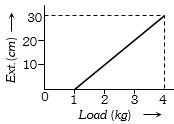
The pointer reading versus load graph for a spring balance is as given in the figure. The spring constant is ........ $kg/cm$.
A
$0.1$
B
$5$
C
$0.3$
D
$1$
Solution
(A) The spring constant $k$ is defined by Hooke's Law as $F = kx$,where $F$ is the applied force (load) and $x$ is the extension.
From the graph,the extension $x$ is zero when the load is $1 \, kg$. This indicates an initial offset.
We consider the change in load $\Delta F$ and the corresponding change in extension $\Delta x$.
At load $F_1 = 1 \, kg$,extension $x_1 = 0 \, cm$.
At load $F_2 = 4 \, kg$,extension $x_2 = 30 \, cm$.
Therefore,$\Delta F = F_2 - F_1 = 4 - 1 = 3 \, kg$.
And $\Delta x = x_2 - x_1 = 30 - 0 = 30 \, cm$.
The spring constant $k$ is the reciprocal of the slope of the extension versus load graph (or $k = \frac{\Delta F}{\Delta x}$):
$k = \frac{3 \, kg}{30 \, cm} = 0.1 \, kg/cm$.
From the graph,the extension $x$ is zero when the load is $1 \, kg$. This indicates an initial offset.
We consider the change in load $\Delta F$ and the corresponding change in extension $\Delta x$.
At load $F_1 = 1 \, kg$,extension $x_1 = 0 \, cm$.
At load $F_2 = 4 \, kg$,extension $x_2 = 30 \, cm$.
Therefore,$\Delta F = F_2 - F_1 = 4 - 1 = 3 \, kg$.
And $\Delta x = x_2 - x_1 = 30 - 0 = 30 \, cm$.
The spring constant $k$ is the reciprocal of the slope of the extension versus load graph (or $k = \frac{\Delta F}{\Delta x}$):
$k = \frac{3 \, kg}{30 \, cm} = 0.1 \, kg/cm$.
0 likes
View Solution5
EasyMCQ
The increase in length is $l$ of a wire of length $L$ by the longitudinal stress. Then the stress is proportional to
A
$L/l$
B
$l/L$
C
$l \times L$
D
$l^2 \times L$
Solution
(B) According to Hooke's Law,within the elastic limit,stress is directly proportional to strain.
Stress $\propto$ Strain.
Strain is defined as the ratio of the change in length $(l)$ to the original length $(L)$.
Strain = $\frac{l}{L}$.
Therefore,Stress $\propto \frac{l}{L}$.
Stress $\propto$ Strain.
Strain is defined as the ratio of the change in length $(l)$ to the original length $(L)$.
Strain = $\frac{l}{L}$.
Therefore,Stress $\propto \frac{l}{L}$.
1 likes
View Solution6
EasyMCQ
Hooke's law defines:
A
Stress
B
Strain
C
Modulus of elasticity
D
Elastic limit
Solution
(C) Hooke's law states that within the elastic limit,the stress applied to a material is directly proportional to the strain produced in it.
Mathematically,$\text{Stress} \propto \text{Strain}$.
$\text{Stress} = E \times \text{Strain}$,where $E$ is the constant of proportionality known as the Modulus of Elasticity.
Therefore,Hooke's law defines the Modulus of Elasticity.
Mathematically,$\text{Stress} \propto \text{Strain}$.
$\text{Stress} = E \times \text{Strain}$,where $E$ is the constant of proportionality known as the Modulus of Elasticity.
Therefore,Hooke's law defines the Modulus of Elasticity.
0 likes
View Solution7
EasyMCQ
The material which practically does not show elastic after effect is
A
Copper
B
Rubber
C
Steel
D
Quartz
Solution
(D) Elastic after effect refers to the delay in the recovery of the original shape of a material after the deforming force is removed.
Quartz is a material that exhibits practically no elastic after effect,meaning it returns to its original state almost instantaneously after the removal of the deforming force.
Therefore,the correct option is $D$.
Quartz is a material that exhibits practically no elastic after effect,meaning it returns to its original state almost instantaneously after the removal of the deforming force.
Therefore,the correct option is $D$.
0 likes
View Solution8
EasyMCQ
If the temperature increases,the modulus of elasticity
A
Decreases
B
Increases
C
Remains constant
D
Becomes zero
Solution
(A) The modulus of elasticity represents the stiffness of a material,which is determined by the strength of the intermolecular forces.
When the temperature of a material increases,the kinetic energy of the molecules increases,causing them to vibrate more vigorously.
This increased thermal agitation weakens the intermolecular forces that hold the atoms together.
Since the modulus of elasticity is directly related to the strength of these forces,a decrease in intermolecular force strength leads to a decrease in the modulus of elasticity.
Therefore,the correct option is $A$.
When the temperature of a material increases,the kinetic energy of the molecules increases,causing them to vibrate more vigorously.
This increased thermal agitation weakens the intermolecular forces that hold the atoms together.
Since the modulus of elasticity is directly related to the strength of these forces,a decrease in intermolecular force strength leads to a decrease in the modulus of elasticity.
Therefore,the correct option is $A$.
0 likes
View Solution9
MediumMCQ
$A$ and $B$ are two wires. The radius of $A$ is twice that of $B$. They are stretched by the same load. Then the stress on $B$ is
A
Equal to that on $A$
B
Four times that on $A$
C
Two times that on $A$
D
Half that on $A$
Solution
(B) Stress is defined as the force applied per unit area,given by the formula: $\text{Stress} = \frac{F}{A} = \frac{F}{\pi r^2}$.
Since the load $F$ is the same for both wires,the stress is inversely proportional to the square of the radius: $\text{Stress} \propto \frac{1}{r^2}$.
Given that the radius of wire $A$ is twice that of wire $B$,we have $r_A = 2r_B$,which implies $\frac{r_A}{r_B} = 2$.
Comparing the stress on wire $B$ $(S_B)$ and wire $A$ $(S_A)$:
$\frac{S_B}{S_A} = \left( \frac{r_A}{r_B} \right)^2 = (2)^2 = 4$.
Therefore,the stress on $B$ is $4$ times the stress on $A$ $(S_B = 4S_A)$.
Since the load $F$ is the same for both wires,the stress is inversely proportional to the square of the radius: $\text{Stress} \propto \frac{1}{r^2}$.
Given that the radius of wire $A$ is twice that of wire $B$,we have $r_A = 2r_B$,which implies $\frac{r_A}{r_B} = 2$.
Comparing the stress on wire $B$ $(S_B)$ and wire $A$ $(S_A)$:
$\frac{S_B}{S_A} = \left( \frac{r_A}{r_B} \right)^2 = (2)^2 = 4$.
Therefore,the stress on $B$ is $4$ times the stress on $A$ $(S_B = 4S_A)$.
0 likes
View Solution10
EasyMCQ
The spring balance does not read properly after its long use,because
A
The elasticity of spring increases
B
The elasticity decreases
C
Its plastic power decreases
D
Its plastic power increases
Solution
(B) When a spring is used for a long time,it undergoes repeated cycles of loading and unloading. This leads to a phenomenon known as elastic fatigue. Due to elastic fatigue,the material of the spring loses some of its elastic properties,meaning its elasticity decreases. As a result,the spring does not return to its original shape perfectly,causing the spring balance to provide inaccurate readings.
0 likes
View Solution11
EasyMCQ
If a load of $9 \, kg$ is suspended on a wire,the increase in length is $4.5 \, mm$. The force constant of the wire is
A
$0.49 \times 10^4 \, N/m$
B
$1.96 \times 10^4 \, N/m$
C
$4.9 \times 10^4 \, N/m$
D
$0.196 \times 10^4 \, N/m$
Solution
(B) The force applied by the load is $F = mg = 9 \, kg \times 9.8 \, m/s^2 = 88.2 \, N$.
The extension produced in the wire is $x = 4.5 \, mm = 4.5 \times 10^{-3} \, m$.
The force constant $K$ is defined by Hooke's Law as $F = Kx$,which implies $K = \frac{F}{x}$.
Substituting the values: $K = \frac{88.2}{4.5 \times 10^{-3}} = 19.6 \times 10^3 \, N/m = 1.96 \times 10^4 \, N/m$.
The extension produced in the wire is $x = 4.5 \, mm = 4.5 \times 10^{-3} \, m$.
The force constant $K$ is defined by Hooke's Law as $F = Kx$,which implies $K = \frac{F}{x}$.
Substituting the values: $K = \frac{88.2}{4.5 \times 10^{-3}} = 19.6 \times 10^3 \, N/m = 1.96 \times 10^4 \, N/m$.
0 likes
View Solution12
EasyMCQ
The elasticity of Invar:
A
Increases with temperature rise
B
Decreases with temperature rise
C
Does not depend on temperature
D
None of the above
Solution
(C) Invar is an alloy of $Fe$ and $Ni$ known for its extremely low coefficient of thermal expansion.
Because Invar exhibits negligible thermal expansion or contraction over a wide range of temperatures,its internal atomic structure remains remarkably stable.
Consequently,the elastic properties of Invar,such as Young's modulus,remain effectively constant with changes in temperature.
Therefore,the elasticity of Invar does not depend on temperature.
Because Invar exhibits negligible thermal expansion or contraction over a wide range of temperatures,its internal atomic structure remains remarkably stable.
Consequently,the elastic properties of Invar,such as Young's modulus,remain effectively constant with changes in temperature.
Therefore,the elasticity of Invar does not depend on temperature.
0 likes
View Solution13
EasyMCQ
After effects of elasticity are maximum for
A
Glass
B
Quartz
C
Rubber
D
Metal
Solution
(C) The after-effects of elasticity refer to the delay in the recovery of the original state of a body after the deforming force is removed.
Materials that take a longer time to regain their original shape exhibit greater after-effects.
Among the given options,$Rubber$ is a polymer that shows significant hysteresis and takes a considerable amount of time to return to its original state after the deforming force is removed.
Therefore,the after-effects of elasticity are maximum for $Rubber$.
Materials that take a longer time to regain their original shape exhibit greater after-effects.
Among the given options,$Rubber$ is a polymer that shows significant hysteresis and takes a considerable amount of time to return to its original state after the deforming force is removed.
Therefore,the after-effects of elasticity are maximum for $Rubber$.
0 likes
View Solution14
EasyMCQ
The property of a material which opposes the change in shape,volume,or length is called
A
Intermolecular repulsion
B
Intermolecular behaviour
C
Viscosity
D
Elasticity
Solution
(D) The correct answer is $(D)$.
Elasticity is the property of a material by virtue of which it regains its original shape and size after the removal of the deforming force.
When an external force is applied to a body,it causes a change in its shape,volume,or length. The internal restoring forces within the material oppose this change.
For example,when a rubber band is stretched,internal restoring forces are developed that oppose the external pull. Once the external force is removed,these restoring forces cause the material to return to its original configuration.
Elasticity is the property of a material by virtue of which it regains its original shape and size after the removal of the deforming force.
When an external force is applied to a body,it causes a change in its shape,volume,or length. The internal restoring forces within the material oppose this change.
For example,when a rubber band is stretched,internal restoring forces are developed that oppose the external pull. Once the external force is removed,these restoring forces cause the material to return to its original configuration.
0 likes
View Solution15
EasyMCQ
The longitudinal strain is only possible in
A
Gases
B
Fluids
C
Solids
D
Liquids
Solution
(C) Longitudinal strain is defined as the ratio of the change in length to the original length of an object when a deforming force is applied.
Since longitudinal strain requires a change in length and a defined shape to maintain that length,it is only possible in solids.
Gases and liquids (fluids) do not have a fixed shape or length and undergo volume changes rather than longitudinal changes when subjected to stress.
Therefore,the correct option is $C$.
Since longitudinal strain requires a change in length and a defined shape to maintain that length,it is only possible in solids.
Gases and liquids (fluids) do not have a fixed shape or length and undergo volume changes rather than longitudinal changes when subjected to stress.
Therefore,the correct option is $C$.
0 likes
View Solution16
EasyMCQ
The elastic limit for a gas
A
Exists
B
Exists only at absolute zero
C
Exists for a perfect gas
D
Does not exist
Solution
(D) The concept of an elastic limit is defined for solids,which possess a definite shape and size and can return to their original configuration after the removal of a deforming force. Gases do not have a fixed shape or size and their behavior is governed by pressure and volume relationships (like the ideal gas law). When a gas is compressed or expanded,it does not exhibit an elastic limit in the same way a solid does,because it does not have a permanent structure to return to. Therefore,the elastic limit does not exist for a gas.
0 likes
View Solution17
EasyMCQ
Which of the following statements is correct?
A
Hooke's law is applicable only within the elastic limit.
B
The adiabatic and isothermal elastic constants of a gas are equal.
C
Young's modulus is dimensionless.
D
Stress multiplied by strain is equal to the stored energy.
Solution
(A) According to Hooke's law,the stress is directly proportional to the strain within the elastic limit. Therefore,Hooke's law is valid only within the elastic limit of a material.
Option $A$ is correct because it accurately describes the condition for the validity of Hooke's law.
Option $B$ is incorrect because the adiabatic elastic constant is $\gamma$ times the isothermal elastic constant.
Option $C$ is incorrect because Young's modulus has the same units as stress ($\text{N/m}^2$ or $\text{Pa}$).
Option $D$ is incorrect because the energy density (stored energy per unit volume) is given by $\frac{1}{2} \times \text{stress} \times \text{strain}$.
Option $A$ is correct because it accurately describes the condition for the validity of Hooke's law.
Option $B$ is incorrect because the adiabatic elastic constant is $\gamma$ times the isothermal elastic constant.
Option $C$ is incorrect because Young's modulus has the same units as stress ($\text{N/m}^2$ or $\text{Pa}$).
Option $D$ is incorrect because the energy density (stored energy per unit volume) is given by $\frac{1}{2} \times \text{stress} \times \text{strain}$.
0 likes
View Solution18
EasyMCQ
Which one of the following quantities does not have the unit of force per unit area?
A
Stress
B
Strain
C
Young's modulus of elasticity
D
Pressure
Solution
(B) The unit of force per unit area is $N/m^2$ or Pascal $(Pa)$.
Stress is defined as the restoring force per unit area,so it has the unit $N/m^2$.
Pressure is defined as the thrust force per unit area,so it has the unit $N/m^2$.
Young's modulus of elasticity is defined as the ratio of stress to strain. Since strain is dimensionless,the unit of Young's modulus is the same as stress,which is $N/m^2$.
Strain is defined as the ratio of change in dimension to the original dimension. Since it is a ratio of two similar quantities,it is a dimensionless and unitless quantity.
Therefore,the correct option is $(B)$.
Stress is defined as the restoring force per unit area,so it has the unit $N/m^2$.
Pressure is defined as the thrust force per unit area,so it has the unit $N/m^2$.
Young's modulus of elasticity is defined as the ratio of stress to strain. Since strain is dimensionless,the unit of Young's modulus is the same as stress,which is $N/m^2$.
Strain is defined as the ratio of change in dimension to the original dimension. Since it is a ratio of two similar quantities,it is a dimensionless and unitless quantity.
Therefore,the correct option is $(B)$.
0 likes
View Solution19
EasyMCQ
In solids,inter-atomic forces are
A
Totally repulsive
B
Totally attractive
C
Combination of $(a)$ and $(b)$
D
None of these
Solution
(C) In solids,the inter-atomic forces are a combination of both attractive and repulsive forces.
At large distances,the inter-atomic force is attractive,which holds the atoms together.
At very small distances,the inter-atomic force becomes strongly repulsive due to the overlapping of electron clouds,which prevents the atoms from collapsing into each other.
Therefore,the equilibrium position of atoms in a solid is determined by the balance between these two forces.
At large distances,the inter-atomic force is attractive,which holds the atoms together.
At very small distances,the inter-atomic force becomes strongly repulsive due to the overlapping of electron clouds,which prevents the atoms from collapsing into each other.
Therefore,the equilibrium position of atoms in a solid is determined by the balance between these two forces.
0 likes
View Solution20
EasyMCQ
Under the elastic limit,the stress is:
A
Inversely proportional to strain
B
Directly proportional to strain
C
Square root of strain
D
Independent of strain
Solution
(B) According to Hooke's Law,within the elastic limit,the stress applied to a material is directly proportional to the strain produced in it.
Mathematically,this is expressed as $\text{Stress} \propto \text{Strain}$,or $\text{Stress} = E \times \text{Strain}$,where $E$ is the modulus of elasticity (Young's modulus,shear modulus,or bulk modulus depending on the type of stress).
Therefore,the correct option is $B$.
Mathematically,this is expressed as $\text{Stress} \propto \text{Strain}$,or $\text{Stress} = E \times \text{Strain}$,where $E$ is the modulus of elasticity (Young's modulus,shear modulus,or bulk modulus depending on the type of stress).
Therefore,the correct option is $B$.
0 likes
View Solution21
EasyMCQ
Stress to strain ratio is equivalent to
A
Modulus of elasticity
B
Poisson's ratio
C
Reynolds number
D
Froude number
Solution
(A) The ratio of stress to strain is defined as the modulus of elasticity (or Young's modulus,shear modulus,or bulk modulus,depending on the type of stress and strain).
Within the elastic limit of a material,according to Hooke's Law,stress is directly proportional to strain.
Therefore,$\text{Stress} / \text{Strain} = \text{Constant} = \text{Modulus of elasticity}$.
This constant represents the stiffness of the material.
Within the elastic limit of a material,according to Hooke's Law,stress is directly proportional to strain.
Therefore,$\text{Stress} / \text{Strain} = \text{Constant} = \text{Modulus of elasticity}$.
This constant represents the stiffness of the material.
0 likes
View Solution22
EasyMCQ
The breaking stress of a wire depends upon
A
Length of the wire
B
Radius of the wire
C
Material of the wire
D
Shape of the cross section
Solution
(C) Breaking stress is a characteristic property of the material of the wire.
It represents the maximum stress a material can withstand before it breaks.
Since it is an intrinsic property,it does not depend on the dimensions of the wire such as length,radius,or the shape of the cross-section.
Therefore,the correct option is $C$.
It represents the maximum stress a material can withstand before it breaks.
Since it is an intrinsic property,it does not depend on the dimensions of the wire such as length,radius,or the shape of the cross-section.
Therefore,the correct option is $C$.
0 likes
View Solution23
EasyMCQ
According to Hooke's law,force is proportional to:
A
$1/x$
B
$1/x^2$
C
$x$
D
$x^2$
Solution
(C) According to Hooke's law,within the elastic limit for an elastic material,the material acts like a spring that reforms its shape after being deformed by an external force.
This results in a restoring force $F$ given by the equation:
$F = -kx$,where $k$ is the spring constant.
Since $k$ is a constant,the magnitude of the restoring force is directly proportional to the displacement $x$.
Therefore,$F \propto x$.
This results in a restoring force $F$ given by the equation:
$F = -kx$,where $k$ is the spring constant.
Since $k$ is a constant,the magnitude of the restoring force is directly proportional to the displacement $x$.
Therefore,$F \propto x$.
1 likes
View Solution24
EasyMCQ
$A$ wire of diameter $1\, mm$ breaks under a tension of $1000\, N.$ Another wire,of the same material as that of the first one,but of diameter $2\, mm$ breaks under a tension of ...... $N$.
A
$500$
B
$1000$
C
$10000$
D
$4000$
Solution
(D) The breaking stress of a material is defined as the maximum force per unit area that the material can withstand before breaking. It is a constant property of the material.
Breaking Stress = $\frac{\text{Breaking Force}}{\text{Area of Cross-section}}$
Breaking Force = $\text{Breaking Stress} \times \text{Area} = \text{Breaking Stress} \times \pi r^2 = \text{Breaking Stress} \times \pi \left(\frac{d}{2}\right)^2$.
Since the material is the same,the breaking stress is constant. Therefore,the breaking force is directly proportional to the square of the diameter $(F \propto d^2)$.
Given: $d_1 = 1\, mm$,$F_1 = 1000\, N$,$d_2 = 2\, mm$.
$\frac{F_2}{F_1} = \left(\frac{d_2}{d_1}\right)^2 = \left(\frac{2}{1}\right)^2 = 4$.
$F_2 = 4 \times F_1 = 4 \times 1000\, N = 4000\, N$.
Breaking Stress = $\frac{\text{Breaking Force}}{\text{Area of Cross-section}}$
Breaking Force = $\text{Breaking Stress} \times \text{Area} = \text{Breaking Stress} \times \pi r^2 = \text{Breaking Stress} \times \pi \left(\frac{d}{2}\right)^2$.
Since the material is the same,the breaking stress is constant. Therefore,the breaking force is directly proportional to the square of the diameter $(F \propto d^2)$.
Given: $d_1 = 1\, mm$,$F_1 = 1000\, N$,$d_2 = 2\, mm$.
$\frac{F_2}{F_1} = \left(\frac{d_2}{d_1}\right)^2 = \left(\frac{2}{1}\right)^2 = 4$.
$F_2 = 4 \times F_1 = 4 \times 1000\, N = 4000\, N$.
0 likes
View Solution25
EasyMCQ
When a spiral spring is stretched by suspending a load on it,the strain produced is called
A
Shearing
B
Longitudinal
C
Volume
D
Transverse
Solution
(A) When a load is suspended from a spiral spring,the wire of the spring undergoes a twisting effect.
This twisting effect creates a torque within the wire,which results in shearing stress.
Consequently,the strain produced in the material of the spring is shearing strain.
This twisting effect creates a torque within the wire,which results in shearing stress.
Consequently,the strain produced in the material of the spring is shearing strain.
0 likes
View Solution26
EasyMCQ
$A$ cube of aluminium of sides $0.1 \, m$ is subjected to a shearing force of $100 \, N$. The top face of the cube is displaced through $0.02 \, cm$ with respect to the bottom face. The shearing strain would be
A
$0.02$
B
$0.1$
C
$0.005$
D
$0.002$
Solution
(D) The shearing strain $\varphi$ is defined as the ratio of the relative displacement of the top face $(x)$ to the distance between the faces $(L)$.
Given:
Side length $L = 0.1 \, m = 10 \, cm$.
Displacement $x = 0.02 \, cm$.
Formula: $\varphi = \frac{x}{L}$.
Substituting the values:
$\varphi = \frac{0.02 \, cm}{10 \, cm} = 0.002$.
Therefore,the shearing strain is $0.002$.
Given:
Side length $L = 0.1 \, m = 10 \, cm$.
Displacement $x = 0.02 \, cm$.
Formula: $\varphi = \frac{x}{L}$.
Substituting the values:
$\varphi = \frac{0.02 \, cm}{10 \, cm} = 0.002$.
Therefore,the shearing strain is $0.002$.
0 likes
View Solution27
EasyMCQ
The reason for the change in shape of a regular body is
A
Volume stress
B
Shearing strain
C
Longitudinal strain
D
Metallic strain
Solution
(B) When a tangential force is applied to a body,it causes a change in the shape of the body while the volume remains constant. This type of deformation is known as shearing strain. Therefore,the change in shape of a regular body is due to shearing strain.
0 likes
View Solution28
EasyMCQ
The lower surface of a cube is fixed. On its upper surface,a force is applied at an angle of $30^{\circ}$ from its surface. The change will be of the type:
A
Shape
B
Size
C
None
D
Shape and size
Solution
(D) When a force is applied at an angle of $30^{\circ}$ to the surface of a cube,it can be resolved into two rectangular components.
$1$. The component parallel to the surface $(F cos 30^{\circ})$ causes shear stress,which results in a change in the shape of the cube.
$2$. The component perpendicular to the surface $(F sin 30^{\circ})$ causes normal stress (compressive or tensile),which results in a change in the size (volume) of the cube.
Therefore,the applied force produces both shear and normal stresses,leading to a change in both the shape and the size of the cube.
$1$. The component parallel to the surface $(F cos 30^{\circ})$ causes shear stress,which results in a change in the shape of the cube.
$2$. The component perpendicular to the surface $(F sin 30^{\circ})$ causes normal stress (compressive or tensile),which results in a change in the size (volume) of the cube.
Therefore,the applied force produces both shear and normal stresses,leading to a change in both the shape and the size of the cube.
0 likes
View Solution29
EasyMCQ
Shearing stress causes change in
A
Length
B
Breadth
C
Shape
D
Volume
Solution
(C) Shearing stress is defined as the force applied tangentially to a surface per unit area.
When a shearing stress is applied to a body,it results in a change in the shape of the body while the volume remains constant.
This type of deformation is known as shearing strain,which involves a change in the angles between the faces of the object.
Therefore,the correct option is $C$.
When a shearing stress is applied to a body,it results in a change in the shape of the body while the volume remains constant.
This type of deformation is known as shearing strain,which involves a change in the angles between the faces of the object.
Therefore,the correct option is $C$.
0 likes
View Solution30
MediumMCQ
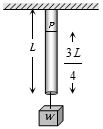
One end of a uniform wire of length $L$ and weight $W$ is attached rigidly to a point in the roof,and a weight $W_1$ is suspended from its lower end. If $S$ is the area of cross-section of the wire,the stress in the wire at a height $3L/4$ from its lower end is
A
$\frac{W_1}{S}$
B
$\frac{W_1 + (W/4)}{S}$
C
$\frac{W_1 + (3W/4)}{S}$
D
$\frac{W_1 + W}{S}$
Solution
(C) The stress at any point in the wire is defined as the force acting on the cross-section at that point divided by the area of cross-section $S$.
At a height $3L/4$ from the lower end,the total force acting on the cross-section is the sum of the weight $W_1$ suspended at the bottom and the weight of the portion of the wire below that point.
Since the wire is uniform,the weight of a portion of the wire is proportional to its length.
The length of the wire below the point at height $3L/4$ from the lower end is $3L/4$.
Therefore,the weight of this portion of the wire is $(3/4)W$.
The total force at this cross-section is $F = W_1 + (3W/4)$.
Thus,the stress is $\sigma = \frac{F}{S} = \frac{W_1 + (3W/4)}{S}$.
At a height $3L/4$ from the lower end,the total force acting on the cross-section is the sum of the weight $W_1$ suspended at the bottom and the weight of the portion of the wire below that point.
Since the wire is uniform,the weight of a portion of the wire is proportional to its length.
The length of the wire below the point at height $3L/4$ from the lower end is $3L/4$.
Therefore,the weight of this portion of the wire is $(3/4)W$.
The total force at this cross-section is $F = W_1 + (3W/4)$.
Thus,the stress is $\sigma = \frac{F}{S} = \frac{W_1 + (3W/4)}{S}$.
0 likes
View Solution31
EasyMCQ
Which one of the following is the weakest kind of bonding in solids?
A
Ionic
B
Metallic
C
Van der Waals
D
Covalent
Solution
(C) The strength of bonding in solids is determined by the energy required to break the bonds.
$1$. Ionic bonds are electrostatic attractions between ions,which are very strong.
$2$. Metallic bonds involve the sharing of free electrons among a lattice of positive ions,which are strong.
$3$. Covalent bonds involve the sharing of electron pairs between atoms,which are very strong.
$4$. Van der Waals forces are weak intermolecular forces arising from temporary or permanent dipole-dipole interactions.
Therefore,Van der Waals bonding is the weakest among the given options.
$1$. Ionic bonds are electrostatic attractions between ions,which are very strong.
$2$. Metallic bonds involve the sharing of free electrons among a lattice of positive ions,which are strong.
$3$. Covalent bonds involve the sharing of electron pairs between atoms,which are very strong.
$4$. Van der Waals forces are weak intermolecular forces arising from temporary or permanent dipole-dipole interactions.
Therefore,Van der Waals bonding is the weakest among the given options.
0 likes
View Solution32
EasyMCQ
In a crystal,the atoms are located at the position of
A
Maximum potential energy
B
Minimum potential energy
C
Zero potential energy
D
Infinite potential energy
Solution
(B) In a crystal,atoms are arranged in a stable lattice structure.
For a system to be stable,the potential energy of the system must be at its minimum.
If the atoms were at any other position,the forces between them would cause them to move until they reach the equilibrium position where the potential energy is minimum.
Therefore,the correct option is $B$.
For a system to be stable,the potential energy of the system must be at its minimum.
If the atoms were at any other position,the forces between them would cause them to move until they reach the equilibrium position where the potential energy is minimum.
Therefore,the correct option is $B$.
0 likes
View Solution33
EasyMCQ
Which of the following is an amorphous solid?
A
Glass
B
Diamond
C
Salt
D
Sugar
Solution
(A) Amorphous solids are those in which the constituent particles (atoms, molecules, or ions) are arranged in a completely irregular or random manner over long distances.
Among the given options, $\text{Glass}$ is a classic example of an amorphous solid, often referred to as a supercooled liquid.
Diamond, Salt $(NaCl)$, and Sugar are all examples of crystalline solids, which possess a long-range ordered structure.
Therefore, the correct option is $A$.
Among the given options, $\text{Glass}$ is a classic example of an amorphous solid, often referred to as a supercooled liquid.
Diamond, Salt $(NaCl)$, and Sugar are all examples of crystalline solids, which possess a long-range ordered structure.
Therefore, the correct option is $A$.
0 likes
View Solution34
DifficultMCQ
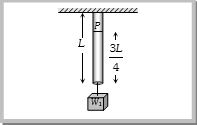
One end of a wire of length $L$ and weight $W$ is attached to a ceiling,and the other end is attached to a weight $W_1$. If the cross-sectional area of the wire is $S$,what is the stress at a distance $3L/4$ from the lower end of the wire?
A
$\frac{W_1}{S}$
B
$\frac{W_1 + (W/4)}{S}$
C
$\frac{W_1 + (3W/4)}{S}$
D
$\frac{W_1 + W}{S}$
Solution
(C) The total force acting at a cross-section at a distance $x$ from the lower end is the sum of the weight $W_1$ and the weight of the wire segment below that point.
Since the wire has a uniform weight $W$ and length $L$,the weight per unit length is $W/L$.
The weight of the wire segment of length $3L/4$ is $(W/L) \times (3L/4) = 3W/4$.
Therefore,the total force $F$ at this cross-section is $F = W_1 + 3W/4$.
Stress is defined as force per unit area,so $\text{Stress} = F/S = \frac{W_1 + 3W/4}{S}$.
Since the wire has a uniform weight $W$ and length $L$,the weight per unit length is $W/L$.
The weight of the wire segment of length $3L/4$ is $(W/L) \times (3L/4) = 3W/4$.
Therefore,the total force $F$ at this cross-section is $F = W_1 + 3W/4$.
Stress is defined as force per unit area,so $\text{Stress} = F/S = \frac{W_1 + 3W/4}{S}$.
0 likes
View Solution35
DifficultMCQ
$A$ wire of length $l$ and cross-sectional area $A$ is stretched by a weight $Mg$ such that its length becomes double. What is the stress in the wire?
A
$Mg/A$
B
$Mg/2A$
C
$2Mg/A$
D
$4Mg/A$
Solution
(C) The volume of the wire remains constant during stretching. Let the initial length be $l$ and initial area be $A$. The initial volume is $V = A \cdot l$.
When the length becomes double $(l' = 2l)$,the new area $A'$ must satisfy $A' \cdot l' = A \cdot l$.
Substituting $l' = 2l$,we get $A' \cdot (2l) = A \cdot l$,which implies $A' = A/2$.
Stress is defined as the force applied per unit area: $\text{Stress} = \frac{F}{A'}$.
Substituting the values $F = Mg$ and $A' = A/2$,we get $\text{Stress} = \frac{Mg}{A/2} = \frac{2Mg}{A}$.
When the length becomes double $(l' = 2l)$,the new area $A'$ must satisfy $A' \cdot l' = A \cdot l$.
Substituting $l' = 2l$,we get $A' \cdot (2l) = A \cdot l$,which implies $A' = A/2$.
Stress is defined as the force applied per unit area: $\text{Stress} = \frac{F}{A'}$.
Substituting the values $F = Mg$ and $A' = A/2$,we get $\text{Stress} = \frac{Mg}{A/2} = \frac{2Mg}{A}$.
0 likes
View Solution36
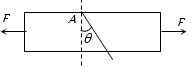
MediumMCQ
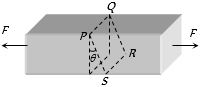
What is the tensile stress on the cross-section $PQRS$?
A
$F / A$
B
$F \cos \theta / A$
C
$F \cos^2 \theta / A$
D
$F / (A \cos \theta)$
Solution
(C) Tensile stress is defined as the normal force per unit area acting on the cross-section.
Let $A$ be the area of the cross-section perpendicular to the force $F$.
The area of the inclined cross-section $PQRS$ is $A' = A / \cos \theta$.
The component of the force $F$ normal to the cross-section $PQRS$ is $F_N = F \cos \theta$.
Therefore,the tensile stress $\sigma$ is given by:
$\sigma = \frac{F_N}{A'} = \frac{F \cos \theta}{A / \cos \theta} = \frac{F \cos^2 \theta}{A}$.
Let $A$ be the area of the cross-section perpendicular to the force $F$.
The area of the inclined cross-section $PQRS$ is $A' = A / \cos \theta$.
The component of the force $F$ normal to the cross-section $PQRS$ is $F_N = F \cos \theta$.
Therefore,the tensile stress $\sigma$ is given by:
$\sigma = \frac{F_N}{A'} = \frac{F \cos \theta}{A / \cos \theta} = \frac{F \cos^2 \theta}{A}$.
0 likes
View Solution37
MediumMCQ
For the tangential stress on the cross-section $PQRS$ to be maximum,$\theta = $ ....... $^o$
A
$0$
B
$30$
C
$45$
D
$90$
Solution
(C) The tangential stress (shear stress) on an inclined plane at an angle $\theta$ to the cross-section is given by the formula: $\tau = \frac{F \sin 2\theta}{2A}$.
For the tangential stress to be maximum,$\sin 2\theta$ must be maximum.
The maximum value of $\sin 2\theta$ is $1$.
Therefore,$\sin 2\theta = 1 \implies 2\theta = 90^o$.
Solving for $\theta$,we get $\theta = 45^o$.
For the tangential stress to be maximum,$\sin 2\theta$ must be maximum.
The maximum value of $\sin 2\theta$ is $1$.
Therefore,$\sin 2\theta = 1 \implies 2\theta = 90^o$.
Solving for $\theta$,we get $\theta = 45^o$.
0 likes
View Solution38
EasyMCQ
$A$ tangential force of $100 \,N$ is applied on the top face of a cubic block of side $0.1 \,m$. If the top face is displaced by $0.02 \,cm$ relative to the bottom face,what is the tangential strain?
A
$0.02$
B
$0.1$
C
$0.005$
D
$0.002$
Solution
(D) Tangential strain (or shear strain) is defined as the ratio of the relative displacement of the top face $(x)$ to the distance between the faces $(L)$.
Given:
Displacement $x = 0.02 \,cm = 0.02 \times 10^{-2} \,m = 2 \times 10^{-4} \,m$.
Side length $L = 0.1 \,m = 10^{-1} \,m$.
Tangential strain $\varphi = \frac{x}{L}$.
Substituting the values:
$\varphi = \frac{2 \times 10^{-4} \,m}{10^{-1} \,m} = 2 \times 10^{-3} = 0.002$.
Therefore,the tangential strain is $0.002$.
Given:
Displacement $x = 0.02 \,cm = 0.02 \times 10^{-2} \,m = 2 \times 10^{-4} \,m$.
Side length $L = 0.1 \,m = 10^{-1} \,m$.
Tangential strain $\varphi = \frac{x}{L}$.
Substituting the values:
$\varphi = \frac{2 \times 10^{-4} \,m}{10^{-1} \,m} = 2 \times 10^{-3} = 0.002$.
Therefore,the tangential strain is $0.002$.
0 likes
View Solution39
EasyMCQ
If the length of a wire is doubled,what is the strain?
A
$2$
B
$1$
C
$0$
D
$0.5$
Solution
(B) Strain is defined as the ratio of the change in length to the original length.
Let the original length of the wire be $L$.
When the length is doubled,the new length becomes $2L$.
The change in length is $\Delta L = 2L - L = L$.
Therefore,the strain is given by $\text{Strain} = \frac{\Delta L}{L} = \frac{L}{L} = 1$.
Let the original length of the wire be $L$.
When the length is doubled,the new length becomes $2L$.
The change in length is $\Delta L = 2L - L = L$.
Therefore,the strain is given by $\text{Strain} = \frac{\Delta L}{L} = \frac{L}{L} = 1$.
0 likes
View Solution40
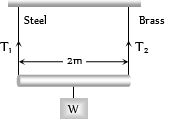
MediumMCQ
The cross-sectional areas of steel and brass wires are $0.1 \,cm^2$ and $0.2 \,cm^2$ respectively. If the same stress is produced in both by a weight $W$,what is the ratio of the tensions $T_1/T_2$?
A
None of these
B
$T_1/T_2 = 2$
C
$T_1/T_2 = 1$
D
$T_1/T_2 = 0.5$
Solution
(D) Stress is defined as the ratio of force (tension) to the cross-sectional area: $\text{Stress} = \frac{T}{A}$.
Given that the stress is the same in both wires,we have:
$\frac{T_1}{A_1} = \frac{T_2}{A_2}$
Rearranging the terms to find the ratio of tensions:
$\frac{T_1}{T_2} = \frac{A_1}{A_2}$
Substituting the given values $A_1 = 0.1 \,cm^2$ and $A_2 = 0.2 \,cm^2$:
$\frac{T_1}{T_2} = \frac{0.1}{0.2} = 0.5$
Therefore,the ratio of the tensions is $0.5$.
Given that the stress is the same in both wires,we have:
$\frac{T_1}{A_1} = \frac{T_2}{A_2}$
Rearranging the terms to find the ratio of tensions:
$\frac{T_1}{T_2} = \frac{A_1}{A_2}$
Substituting the given values $A_1 = 0.1 \,cm^2$ and $A_2 = 0.2 \,cm^2$:
$\frac{T_1}{T_2} = \frac{0.1}{0.2} = 0.5$
Therefore,the ratio of the tensions is $0.5$.
0 likes
View Solution41
MediumMCQ
$A$ force of $1000 \, N$ is required to break a copper wire of radius $1 \, mm$. What force is required to break a copper wire of radius $2 \, mm$?
A
$500$
B
$1000$
C
$10000$
D
$4000$
Solution
(D) The breaking force $F$ is proportional to the cross-sectional area $A$ of the wire.
$F = \sigma \times A$,where $\sigma$ is the breaking stress (a material property).
Since $A = \pi r^2$,we have $F \propto r^2$.
Given $F_1 = 1000 \, N$ for $r_1 = 1 \, mm$.
We need to find $F_2$ for $r_2 = 2 \, mm$.
Using the ratio: $\frac{F_2}{F_1} = \left( \frac{r_2}{r_1} \right)^2$.
$\frac{F_2}{1000} = \left( \frac{2 \, mm}{1 \, mm} \right)^2 = 2^2 = 4$.
$F_2 = 1000 \times 4 = 4000 \, N$.
$F = \sigma \times A$,where $\sigma$ is the breaking stress (a material property).
Since $A = \pi r^2$,we have $F \propto r^2$.
Given $F_1 = 1000 \, N$ for $r_1 = 1 \, mm$.
We need to find $F_2$ for $r_2 = 2 \, mm$.
Using the ratio: $\frac{F_2}{F_1} = \left( \frac{r_2}{r_1} \right)^2$.
$\frac{F_2}{1000} = \left( \frac{2 \, mm}{1 \, mm} \right)^2 = 2^2 = 4$.
$F_2 = 1000 \times 4 = 4000 \, N$.
0 likes
View Solution42
EasyMCQ
If the side of a cube decreases by $1\%$,the volume strain is ........ $\%$.
A
$1$
B
$6$
C
$2$
D
$3$
Solution
(D) Let the side of the cube be $L$. The volume of the cube is $V = L^3$.
Taking the derivative,the change in volume is given by $\Delta V = 3L^2 \Delta L$.
The fractional change in volume (volume strain) is $\frac{\Delta V}{V} = \frac{3L^2 \Delta L}{L^3} = 3 \frac{\Delta L}{L}$.
Given that the side decreases by $1\%$,we have $\frac{\Delta L}{L} = 1\% = 0.01$.
Therefore,the volume strain is $3 \times 1\% = 3\%$.
Thus,the volume strain is $3\%$.
Taking the derivative,the change in volume is given by $\Delta V = 3L^2 \Delta L$.
The fractional change in volume (volume strain) is $\frac{\Delta V}{V} = \frac{3L^2 \Delta L}{L^3} = 3 \frac{\Delta L}{L}$.
Given that the side decreases by $1\%$,we have $\frac{\Delta L}{L} = 1\% = 0.01$.
Therefore,the volume strain is $3 \times 1\% = 3\%$.
Thus,the volume strain is $3\%$.
0 likes
View Solution43
EasyMCQ
The breaking stress of a wire of length $L$ and radius $r$ is $5 \ kg-wt/m^2$. The wire of length $2L$ and radius $2r$ of the same material will have a breaking stress in $kg-wt/m^2$ of:
A
$5$
B
$10$
C
$20$
D
$80$
Solution
(A) Breaking stress is an intrinsic property of a material. It depends only on the nature of the material and not on the dimensions of the wire,such as its length or radius.
Since the second wire is made of the same material as the first wire,its breaking stress will remain the same.
Therefore,the breaking stress of the wire of length $2L$ and radius $2r$ is $5 \ kg-wt/m^2$.
Since the second wire is made of the same material as the first wire,its breaking stress will remain the same.
Therefore,the breaking stress of the wire of length $2L$ and radius $2r$ is $5 \ kg-wt/m^2$.
1 likes
View Solution44
MediumMCQ
$A$ rod of length $2 \ m$ rests on a smooth horizontal floor. If the rod is heated from $0^\circ C$ to $20^\circ C$,find the longitudinal strain developed? $(\alpha = 5 \times 10^{-5} / ^\circ C)$
A
$10^{-3}$
B
$2 \times 10^{-3}$
C
$0$
D
None
Solution
(C) Longitudinal strain is defined as the ratio of change in length to the original length,which occurs only when the thermal expansion is restricted or opposed by external forces.
Since the rod is placed on a smooth horizontal floor,there is no friction or external constraint to oppose its expansion.
As the rod is free to expand,the change in length occurs without any internal stress.
Therefore,the longitudinal strain developed in the rod is $0$.
Since the rod is placed on a smooth horizontal floor,there is no friction or external constraint to oppose its expansion.
As the rod is free to expand,the change in length occurs without any internal stress.
Therefore,the longitudinal strain developed in the rod is $0$.
0 likes
View Solution45
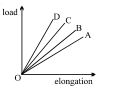
MediumMCQ
The load versus elongation graph for four wires of the same material is shown in the figure. The thickest wire is represented by the line
A
$OB$
B
$OA$
C
$OD$
D
$OC$
Solution
(C) From the formula for Young's modulus,$Y = \frac{F L}{A \Delta L}$,we have $\Delta L = \frac{F L}{A Y}$.
Since the material is the same,$Y$ is constant. For wires of the same length $L$,we have $\Delta L \propto \frac{1}{A}$.
Since $A = \pi r^2$,we have $\Delta L \propto \frac{1}{r^2}$.
This means that for a given load $F$,the wire with the largest radius (thickest wire) will show the minimum elongation $\Delta L$.
In the load versus elongation graph,the slope is given by $\frac{\text{load}}{\text{elongation}} = \frac{F}{\Delta L} = \frac{A Y}{L}$.
$A$ steeper slope indicates a larger area $A$,which corresponds to a thicker wire.
Looking at the graph,the line $OD$ has the steepest slope,representing the minimum elongation for a given load.
Therefore,the thickest wire is represented by the line $OD$.
Since the material is the same,$Y$ is constant. For wires of the same length $L$,we have $\Delta L \propto \frac{1}{A}$.
Since $A = \pi r^2$,we have $\Delta L \propto \frac{1}{r^2}$.
This means that for a given load $F$,the wire with the largest radius (thickest wire) will show the minimum elongation $\Delta L$.
In the load versus elongation graph,the slope is given by $\frac{\text{load}}{\text{elongation}} = \frac{F}{\Delta L} = \frac{A Y}{L}$.
$A$ steeper slope indicates a larger area $A$,which corresponds to a thicker wire.
Looking at the graph,the line $OD$ has the steepest slope,representing the minimum elongation for a given load.
Therefore,the thickest wire is represented by the line $OD$.
0 likes
View Solution46
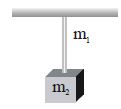
DifficultMCQ
One end of a uniform rod of mass $m_1$ and cross-sectional area $A$ is hung from a ceiling. The other end of the rod is supporting a mass $m_2$. The stress at the midpoint of the rod is:
A
$\frac{g(m_2 + 2m_1)}{2A}$
B
$\frac{g(m_2 + m_1)}{2A}$
C
$\frac{g(2m_2 + m_1)}{2A}$
D
$\frac{g(m_2 + m_1)}{A}$
Solution
(C) The stress at any cross-section of the rod is defined as the force acting on that cross-section divided by the area $A$.
Consider the rod of mass $m_1$ and length $L$. The mass per unit length is $\lambda = \frac{m_1}{L}$.
At the midpoint of the rod,the total force acting downwards is the sum of the mass $m_2$ and the mass of the lower half of the rod.
The mass of the lower half of the rod is $m_{half} = \frac{m_1}{2}$.
Therefore,the total force $F$ at the midpoint is:
$F = (m_2 + \frac{m_1}{2})g$
Stress is given by $\text{Stress} = \frac{F}{A}$.
Substituting the value of $F$:
$\text{Stress} = \frac{(m_2 + \frac{m_1}{2})g}{A} = \frac{(\frac{2m_2 + m_1}{2})g}{A} = \frac{g(2m_2 + m_1)}{2A}$.
Consider the rod of mass $m_1$ and length $L$. The mass per unit length is $\lambda = \frac{m_1}{L}$.
At the midpoint of the rod,the total force acting downwards is the sum of the mass $m_2$ and the mass of the lower half of the rod.
The mass of the lower half of the rod is $m_{half} = \frac{m_1}{2}$.
Therefore,the total force $F$ at the midpoint is:
$F = (m_2 + \frac{m_1}{2})g$
Stress is given by $\text{Stress} = \frac{F}{A}$.
Substituting the value of $F$:
$\text{Stress} = \frac{(m_2 + \frac{m_1}{2})g}{A} = \frac{(\frac{2m_2 + m_1}{2})g}{A} = \frac{g(2m_2 + m_1)}{2A}$.
0 likes
View Solution47
DifficultMCQ
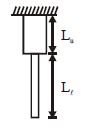
$A$ composite heavy rope made of two materials is suspended vertically from a high ceiling. The ratios of different quantities for the upper rope to the lower rope are: length $\frac{L_u}{L_l} = \frac{1}{2}$,cross-sectional area $\frac{A_u}{A_l} = \frac{2}{1}$,and density $\frac{d_u}{d_l} = \frac{2}{3}$. What is the ratio of the maximum stress in the two ropes?
A
$\frac{2}{3}$
B
$\frac{3}{4}$
C
$\frac{5}{6}$
D
$\frac{4}{5}$
Solution
(C) The stress in a rope at any point is given by $\text{Stress} = \frac{F}{A}$,where $F$ is the tension at that point.
For the lower rope,the maximum stress occurs at its top,where it supports its own weight: $\sigma_l = \frac{m_l g}{A_l} = \frac{d_l A_l L_l g}{A_l} = d_l L_l g$.
For the upper rope,the maximum stress occurs at its top,where it supports the weight of both the upper and lower ropes: $\sigma_u = \frac{(m_u + m_l) g}{A_u} = \frac{(d_u A_u L_u + d_l A_l L_l) g}{A_u} = (d_u L_u + d_l L_l \frac{A_l}{A_u}) g$.
Now,calculating the ratio $\frac{\sigma_u}{\sigma_l}$:
$\frac{\sigma_u}{\sigma_l} = \frac{d_u L_u + d_l L_l (A_l / A_u)}{d_l L_l} = \frac{d_u}{d_l} \cdot \frac{L_u}{L_l} + \frac{A_l}{A_u} = (\frac{2}{3} \cdot \frac{1}{2}) + \frac{1}{2} = \frac{1}{3} + \frac{1}{2} = \frac{2+3}{6} = \frac{5}{6}$.
For the lower rope,the maximum stress occurs at its top,where it supports its own weight: $\sigma_l = \frac{m_l g}{A_l} = \frac{d_l A_l L_l g}{A_l} = d_l L_l g$.
For the upper rope,the maximum stress occurs at its top,where it supports the weight of both the upper and lower ropes: $\sigma_u = \frac{(m_u + m_l) g}{A_u} = \frac{(d_u A_u L_u + d_l A_l L_l) g}{A_u} = (d_u L_u + d_l L_l \frac{A_l}{A_u}) g$.
Now,calculating the ratio $\frac{\sigma_u}{\sigma_l}$:
$\frac{\sigma_u}{\sigma_l} = \frac{d_u L_u + d_l L_l (A_l / A_u)}{d_l L_l} = \frac{d_u}{d_l} \cdot \frac{L_u}{L_l} + \frac{A_l}{A_u} = (\frac{2}{3} \cdot \frac{1}{2}) + \frac{1}{2} = \frac{1}{3} + \frac{1}{2} = \frac{2+3}{6} = \frac{5}{6}$.
0 likes
View Solution48
AdvancedMCQ
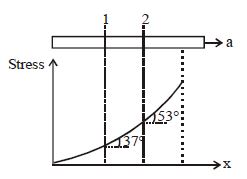
$A$ rod of constant cross-section moves towards the right with constant acceleration $a$. The graph of stress versus distance from the left end is shown in the figure. If the density of the material of the rod at cross-section $1$ is $9 \text{ g/cm}^3$,find the density at cross-section $2$ in $\text{g/cm}^3$.
A
$16$
B
$20$
C
$24$
D
$12$
Solution
(A) The stress $\sigma$ at a distance $x$ from the free end is given by $\sigma = \frac{F}{A}$.
For a small element of length $dx$ and mass $dm = \rho A dx$,the force $dF$ required to accelerate it is $dF = (dm)a = \rho A a dx$.
Thus,the rate of change of stress with respect to $x$ is $\frac{d\sigma}{dx} = \frac{1}{A} \frac{dF}{dx} = \frac{\rho A a}{A} = \rho a$.
This represents the slope of the stress-distance graph,so $\tan \theta = \rho a$.
Since the acceleration $a$ is constant for the entire rod,we have $\frac{\tan \theta_1}{\tan \theta_2} = \frac{\rho_1}{\rho_2}$.
Given $\theta_1 = 37^\circ$ and $\theta_2 = 53^\circ$,and $\rho_1 = 9 \text{ g/cm}^3$:
$\frac{\tan 37^\circ}{\tan 53^\circ} = \frac{9}{\rho_2} \Rightarrow \frac{3/4}{4/3} = \frac{9}{\rho_2} \Rightarrow \frac{9}{16} = \frac{9}{\rho_2}$.
Therefore,$\rho_2 = 16 \text{ g/cm}^3$.
For a small element of length $dx$ and mass $dm = \rho A dx$,the force $dF$ required to accelerate it is $dF = (dm)a = \rho A a dx$.
Thus,the rate of change of stress with respect to $x$ is $\frac{d\sigma}{dx} = \frac{1}{A} \frac{dF}{dx} = \frac{\rho A a}{A} = \rho a$.
This represents the slope of the stress-distance graph,so $\tan \theta = \rho a$.
Since the acceleration $a$ is constant for the entire rod,we have $\frac{\tan \theta_1}{\tan \theta_2} = \frac{\rho_1}{\rho_2}$.
Given $\theta_1 = 37^\circ$ and $\theta_2 = 53^\circ$,and $\rho_1 = 9 \text{ g/cm}^3$:
$\frac{\tan 37^\circ}{\tan 53^\circ} = \frac{9}{\rho_2} \Rightarrow \frac{3/4}{4/3} = \frac{9}{\rho_2} \Rightarrow \frac{9}{16} = \frac{9}{\rho_2}$.
Therefore,$\rho_2 = 16 \text{ g/cm}^3$.
0 likes
View Solution49
MediumMCQ
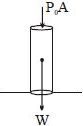
If a solid breaks under a pressure greater than $13 \ atm$ and that solid has a specific gravity of $4$,what is the maximum height of a cylinder made from the solid that can be built at the Earth's surface (in $m$)? (Note: $1 \ atm = 10^5 \ Pa$ and take $g = 10 \ m/s^2$.)
A
$4$
B
$32.5$
C
$24$
D
$30$
Solution
(D) The pressure at the base of the cylinder is the sum of the atmospheric pressure $(P_0)$ and the pressure exerted by the weight of the cylinder $(P_{solid} = h \rho g)$.
Given that the solid breaks when the total pressure exceeds $P_{max} = 13 \ atm$,we have:
$P_{total} = P_0 + h \rho g \leq P_{max}$
$h \rho g \leq P_{max} - P_0$
$h \leq \frac{P_{max} - P_0}{\rho g}$
Here,$P_{max} = 13 \ atm = 13 \times 10^5 \ Pa$,$P_0 = 1 \ atm = 1 \times 10^5 \ Pa$,and the density of the solid $\rho = 4 \times 10^3 \ kg/m^3$ (since specific gravity is $4$).
$h = \frac{(13 - 1) \times 10^5}{4 \times 10^3 \times 10} = \frac{12 \times 10^5}{4 \times 10^4} = 30 \ m$.
Given that the solid breaks when the total pressure exceeds $P_{max} = 13 \ atm$,we have:
$P_{total} = P_0 + h \rho g \leq P_{max}$
$h \rho g \leq P_{max} - P_0$
$h \leq \frac{P_{max} - P_0}{\rho g}$
Here,$P_{max} = 13 \ atm = 13 \times 10^5 \ Pa$,$P_0 = 1 \ atm = 1 \times 10^5 \ Pa$,and the density of the solid $\rho = 4 \times 10^3 \ kg/m^3$ (since specific gravity is $4$).
$h = \frac{(13 - 1) \times 10^5}{4 \times 10^3 \times 10} = \frac{12 \times 10^5}{4 \times 10^4} = 30 \ m$.
0 likes
View Solution50
MediumMCQ
The breaking stress for a wire of radius $r$ of a given material is $F \ Nm^{-2}$. The breaking stress for a wire of the same material of radius $2r$ will be:
A
$F$
B
$F/2$
C
$F/3$
D
$4F$
Solution
(A) Breaking stress is a fundamental property of the material of the wire. It depends only on the nature of the material and not on the dimensions of the wire,such as its radius or length.
Since the material remains the same,the breaking stress remains unchanged regardless of the change in radius.
Therefore,the breaking stress for a wire of radius $2r$ is also $F \ Nm^{-2}$.
Since the material remains the same,the breaking stress remains unchanged regardless of the change in radius.
Therefore,the breaking stress for a wire of radius $2r$ is also $F \ Nm^{-2}$.
0 likes
View SolutionMechanical Properties of Solids — Basic of Elasticity, Stress and Strain relationship and Graphical analysis · Frequently Asked Questions
1Are these Mechanical Properties of Solids questions useful for JEE and NEET?
Yes. All questions in this section are mapped to JEE Main and NEET exam patterns. Previous year questions from JEE Main, NEET, GUJCET and state-level exams are included with full solutions.
2Can I switch to Hindi or Gujarati for these questions?
Yes. Use the language tabs in the hero section or the sidebar to view the same questions and solutions in English, Hindi or Gujarati.
3How do I generate a question paper from this subtopic?
Use the Vedclass Exam Paper Generator — select the chapter and subtopic, set difficulty, and generate Sets A, B, C, D automatically. First 3 chapters of every subject are free.
Vedclass Products
For Students
Vedclass Test Series
Mock tests in real JEE/NEET style with performance analysis. 5-day free trial.
Start Free TrialFor Teachers
Exam Paper Generator
Generate Set A/B/C/D papers from this chapter in 2 minutes. 3 chapters free.
Try FreeFor Institutes
Online Exam Module
Live online exams with unlimited students, 360° analytics & white-label branding.
See DemoFor Teachers & Institutes
Generate a Mechanical Properties of Solids Exam Paper in 2 Minutes
Select subtopic & difficulty — Sets A, B, C, D auto-generated with No Repeat logic.
First 3 chapters of every subject are free — no payment required.