
A English
Mix Examples-Motion in Plane Questions in English
Class 11 Physics · 3-2.Motion in Plane · Mix Examples-Motion in Plane
396+
Questions
English
Language
100%
With Solutions
Showing 50 of 396 questions in English
51
DifficultMCQ
$A$ car moving with a linear speed of $72 \ km/h$ has wheels of radius $0.250 \ m$. If the wheels come to rest after $20$ rotations upon applying brakes,the angular retardation produced by the brakes is ....... $rad \ s^{-2}$. (in $.5$)
A
$-25$
B
$-29$
C
$-35$
D
$-45$
Solution
(A) Given: Linear speed $v = 72 \ km/h = 72 \times \frac{5}{18} = 20 \ m/s$.
Radius $r = 0.25 \ m$.
Initial angular velocity $\omega_0 = \frac{v}{r} = \frac{20}{0.25} = 80 \ rad \ s^{-1}$.
Final angular velocity $\omega = 0 \ rad \ s^{-1}$.
Number of rotations $n = 20$.
Total angular displacement $\theta = 2\pi n = 2 \times \pi \times 20 = 40\pi \ rad$.
Using the kinematic equation $\omega^2 = \omega_0^2 + 2\alpha\theta$:
$0^2 = (80)^2 + 2 \times \alpha \times (40\pi)$
$0 = 6400 + 80\pi\alpha$
$80\pi\alpha = -6400$
$\alpha = -\frac{6400}{80\pi} = -\frac{80}{\pi} \approx -\frac{80}{3.1416} \approx -25.46 \ rad \ s^{-2}$.
Rounding to the nearest value,we get $-25.5 \ rad \ s^{-2}$.
Radius $r = 0.25 \ m$.
Initial angular velocity $\omega_0 = \frac{v}{r} = \frac{20}{0.25} = 80 \ rad \ s^{-1}$.
Final angular velocity $\omega = 0 \ rad \ s^{-1}$.
Number of rotations $n = 20$.
Total angular displacement $\theta = 2\pi n = 2 \times \pi \times 20 = 40\pi \ rad$.
Using the kinematic equation $\omega^2 = \omega_0^2 + 2\alpha\theta$:
$0^2 = (80)^2 + 2 \times \alpha \times (40\pi)$
$0 = 6400 + 80\pi\alpha$
$80\pi\alpha = -6400$
$\alpha = -\frac{6400}{80\pi} = -\frac{80}{\pi} \approx -\frac{80}{3.1416} \approx -25.46 \ rad \ s^{-2}$.
Rounding to the nearest value,we get $-25.5 \ rad \ s^{-2}$.
0 likes
View Solution52
MediumMCQ
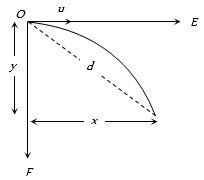
$A$ body of mass $2 \; kg$ has an initial velocity of $3 \; m/s$ along $OE$ and it is subjected to a force of $4 \; N$ in the $OF$ direction,which is perpendicular to $OE$. The displacement of the body from $O$ after $4 \; s$ will be: (in $; m$)
A
$12$
B
$28$
C
$20$
D
$48$
Solution
(C) Given: Mass $m = 2 \; kg$,initial velocity $u = 3 \; m/s$ along $OE$,force $F = 4 \; N$ along $OF$,time $t = 4 \; s$.
Along $OE$ (x-direction),there is no force,so acceleration $a_x = 0$. The displacement $x$ is:
$x = u_x t = 3 \times 4 = 12 \; m$
Along $OF$ (y-direction),the initial velocity $u_y = 0$. The acceleration $a_y$ is:
$a_y = \frac{F}{m} = \frac{4}{2} = 2 \; m/s^2$
The displacement $y$ is:
$y = u_y t + \frac{1}{2} a_y t^2 = 0 + \frac{1}{2} \times 2 \times (4)^2 = 16 \; m$
The total displacement $d$ from $O$ is:
$d = \sqrt{x^2 + y^2} = \sqrt{12^2 + 16^2} = \sqrt{144 + 256} = \sqrt{400} = 20 \; m$
Along $OE$ (x-direction),there is no force,so acceleration $a_x = 0$. The displacement $x$ is:
$x = u_x t = 3 \times 4 = 12 \; m$
Along $OF$ (y-direction),the initial velocity $u_y = 0$. The acceleration $a_y$ is:
$a_y = \frac{F}{m} = \frac{4}{2} = 2 \; m/s^2$
The displacement $y$ is:
$y = u_y t + \frac{1}{2} a_y t^2 = 0 + \frac{1}{2} \times 2 \times (4)^2 = 16 \; m$
The total displacement $d$ from $O$ is:
$d = \sqrt{x^2 + y^2} = \sqrt{12^2 + 16^2} = \sqrt{144 + 256} = \sqrt{400} = 20 \; m$
0 likes
View Solution53
MediumMCQ
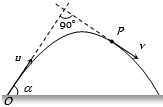
$A$ body is projected with velocity $u$ making an angle $\alpha$ with the horizontal. Its velocity when it is perpendicular to the initial velocity vector $u$ is
A
$u \tan \alpha$
B
$u \cot \alpha$
C
$u \csc \alpha$
D
$u \sec \alpha$
Solution
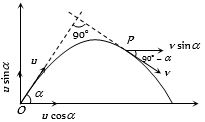
(B) Let the initial velocity be $\vec{u} = u \cos \alpha \hat{i} + u \sin \alpha \hat{j}$.
Let the velocity at point $P$ be $\vec{v} = v_x \hat{i} + v_y \hat{j}$.
Since horizontal velocity remains constant,$v_x = u \cos \alpha$.
Given that the velocity $\vec{v}$ is perpendicular to the initial velocity $\vec{u}$,their dot product must be zero:
$\vec{u} \cdot \vec{v} = 0$
$(u \cos \alpha \hat{i} + u \sin \alpha \hat{j}) \cdot (u \cos \alpha \hat{i} + v_y \hat{j}) = 0$
$u^2 \cos^2 \alpha + u \sin \alpha v_y = 0$
$v_y = -\frac{u^2 \cos^2 \alpha}{u \sin \alpha} = -u \frac{\cos^2 \alpha}{\sin \alpha}$
The magnitude of the velocity $v$ is given by $v = \sqrt{v_x^2 + v_y^2}$.
$v = \sqrt{(u \cos \alpha)^2 + (-u \frac{\cos^2 \alpha}{\sin \alpha})^2}$
$v = u \cos \alpha \sqrt{1 + \frac{\cos^2 \alpha}{\sin^2 \alpha}} = u \cos \alpha \sqrt{\frac{\sin^2 \alpha + \cos^2 \alpha}{\sin^2 \alpha}}$
$v = u \cos \alpha \cdot \frac{1}{\sin \alpha} = u \cot \alpha$.
Let the velocity at point $P$ be $\vec{v} = v_x \hat{i} + v_y \hat{j}$.
Since horizontal velocity remains constant,$v_x = u \cos \alpha$.
Given that the velocity $\vec{v}$ is perpendicular to the initial velocity $\vec{u}$,their dot product must be zero:
$\vec{u} \cdot \vec{v} = 0$
$(u \cos \alpha \hat{i} + u \sin \alpha \hat{j}) \cdot (u \cos \alpha \hat{i} + v_y \hat{j}) = 0$
$u^2 \cos^2 \alpha + u \sin \alpha v_y = 0$
$v_y = -\frac{u^2 \cos^2 \alpha}{u \sin \alpha} = -u \frac{\cos^2 \alpha}{\sin \alpha}$
The magnitude of the velocity $v$ is given by $v = \sqrt{v_x^2 + v_y^2}$.
$v = \sqrt{(u \cos \alpha)^2 + (-u \frac{\cos^2 \alpha}{\sin \alpha})^2}$
$v = u \cos \alpha \sqrt{1 + \frac{\cos^2 \alpha}{\sin^2 \alpha}} = u \cos \alpha \sqrt{\frac{\sin^2 \alpha + \cos^2 \alpha}{\sin^2 \alpha}}$
$v = u \cos \alpha \cdot \frac{1}{\sin \alpha} = u \cot \alpha$.
0 likes
View Solution54
DifficultMCQ
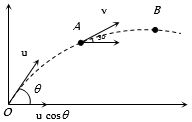
$A$ particle is projected. If after $2 \, s$ it makes an angle of $30^\circ$ with the horizontal and after $1 \, s$ more it is moving horizontally,find the initial velocity and angle of projection of the particle.
A
$20\sqrt {2} \, m/s, 60^\circ$
B
$20\sqrt {3} \, m/s, 60^\circ$
C
$6\sqrt {40} \, m/s, 30^\circ$
D
$40\sqrt {6} \, m/s, 30^\circ$
Solution
(B) Let the initial velocity be $u$ and the angle of projection be $\theta$.
At the highest point,the vertical component of velocity is zero. The particle reaches the highest point $1 \, s$ after the $2 \, s$ mark,so the total time to reach the highest point is $T = 2 + 1 = 3 \, s$.
Using $T = \frac{u \sin \theta}{g} = 3 \, s$,we get $u \sin \theta = 3g = 30 \, m/s$ ... $(i)$
At $t = 2 \, s$,the velocity makes an angle of $30^\circ$ with the horizontal. The horizontal component of velocity remains constant: $v_x = u \cos \theta$.
The vertical component at $t = 2 \, s$ is $v_y = u \sin \theta - g(2) = 30 - 20 = 10 \, m/s$.
Since $\tan 30^\circ = \frac{v_y}{v_x}$,we have $\frac{1}{\sqrt{3}} = \frac{10}{u \cos \theta}$,so $u \cos \theta = 10\sqrt{3} \, m/s$ ... (ii)
Dividing $(i)$ by (ii): $\tan \theta = \frac{30}{10\sqrt{3}} = \sqrt{3}$,so $\theta = 60^\circ$.
Substituting $\theta = 60^\circ$ in $(i)$: $u \sin 60^\circ = 30 \implies u(\frac{\sqrt{3}}{2}) = 30 \implies u = \frac{60}{\sqrt{3}} = 20\sqrt{3} \, m/s$.
At the highest point,the vertical component of velocity is zero. The particle reaches the highest point $1 \, s$ after the $2 \, s$ mark,so the total time to reach the highest point is $T = 2 + 1 = 3 \, s$.
Using $T = \frac{u \sin \theta}{g} = 3 \, s$,we get $u \sin \theta = 3g = 30 \, m/s$ ... $(i)$
At $t = 2 \, s$,the velocity makes an angle of $30^\circ$ with the horizontal. The horizontal component of velocity remains constant: $v_x = u \cos \theta$.
The vertical component at $t = 2 \, s$ is $v_y = u \sin \theta - g(2) = 30 - 20 = 10 \, m/s$.
Since $\tan 30^\circ = \frac{v_y}{v_x}$,we have $\frac{1}{\sqrt{3}} = \frac{10}{u \cos \theta}$,so $u \cos \theta = 10\sqrt{3} \, m/s$ ... (ii)
Dividing $(i)$ by (ii): $\tan \theta = \frac{30}{10\sqrt{3}} = \sqrt{3}$,so $\theta = 60^\circ$.
Substituting $\theta = 60^\circ$ in $(i)$: $u \sin 60^\circ = 30 \implies u(\frac{\sqrt{3}}{2}) = 30 \implies u = \frac{60}{\sqrt{3}} = 20\sqrt{3} \, m/s$.
0 likes
View Solution55
DifficultMCQ
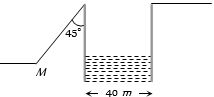
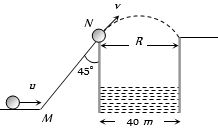
$A$ particle is projected with velocity $u$ from point $M$ on a frictionless incline of length $20\sqrt{2} \, m$. If it crosses a $40 \, m$ wide well at an angle of $45^o$,what should be its velocity at point $M$?
A
$40 \, m/s$
B
$40\sqrt{2} \, m/s$
C
$20 \, m/s$
D
$20\sqrt{2} \, m/s$
Solution
(D) Let $v$ be the velocity of the particle at the top of the incline. The particle performs projectile motion to cross the $40 \, m$ wide well at an angle of $45^o$. The range $R$ of the projectile is given by $R = \frac{v^2 \sin(2\theta)}{g}$.
Given $R = 40 \, m$ and $\theta = 45^o$,we have $40 = \frac{v^2 \sin(90^o)}{g} = \frac{v^2}{g}$.
Assuming $g = 10 \, m/s^2$,we get $v^2 = 400$,so $v = 20 \, m/s$.
Now,consider the motion on the frictionless incline of length $s = 20\sqrt{2} \, m$. The acceleration along the incline is $a = -g \sin(45^o) = -\frac{g}{\sqrt{2}}$.
Using the equation of motion $v^2 = u^2 + 2as$,where $u$ is the initial velocity at point $M$:
$(20)^2 = u^2 + 2(-\frac{g}{\sqrt{2}})(20\sqrt{2})$.
$400 = u^2 - 2g(20) = u^2 - 40(10) = u^2 - 400$.
$u^2 = 800$,which gives $u = \sqrt{800} = 20\sqrt{2} \, m/s$.
Given $R = 40 \, m$ and $\theta = 45^o$,we have $40 = \frac{v^2 \sin(90^o)}{g} = \frac{v^2}{g}$.
Assuming $g = 10 \, m/s^2$,we get $v^2 = 400$,so $v = 20 \, m/s$.
Now,consider the motion on the frictionless incline of length $s = 20\sqrt{2} \, m$. The acceleration along the incline is $a = -g \sin(45^o) = -\frac{g}{\sqrt{2}}$.
Using the equation of motion $v^2 = u^2 + 2as$,where $u$ is the initial velocity at point $M$:
$(20)^2 = u^2 + 2(-\frac{g}{\sqrt{2}})(20\sqrt{2})$.
$400 = u^2 - 2g(20) = u^2 - 40(10) = u^2 - 400$.
$u^2 = 800$,which gives $u = \sqrt{800} = 20\sqrt{2} \, m/s$.
0 likes
View Solution56
MediumMCQ
$A$ body of mass $100 \, g$ is projected at an angle of $30^\circ$ with the horizontal with a velocity of $20 \, m \, s^{-1}$. What is the change in its momentum at the maximum height in $kg \, m \, s^{-1}$?
A
$\sqrt{3}$
B
$1/2$
C
$\sqrt{2}$
D
$1$
Solution
(D) The initial momentum of the body is $\vec{p}_i = m\vec{v}_i = m(v \cos \theta \hat{i} + v \sin \theta \hat{j})$.
At the maximum height,the vertical component of velocity becomes zero,so the velocity is $\vec{v}_f = v \cos \theta \hat{i}$.
The final momentum is $\vec{p}_f = m(v \cos \theta \hat{i})$.
The change in momentum is $\Delta \vec{p} = \vec{p}_f - \vec{p}_i = -m v \sin \theta \hat{j}$.
The magnitude of the change in momentum is $|\Delta \vec{p}| = m v \sin \theta$.
Given $m = 100 \, g = 0.1 \, kg$,$v = 20 \, m \, s^{-1}$,and $\theta = 30^\circ$.
$|\Delta \vec{p}| = 0.1 \times 20 \times \sin(30^\circ) = 0.1 \times 20 \times 0.5 = 1 \, kg \, m \, s^{-1}$.
At the maximum height,the vertical component of velocity becomes zero,so the velocity is $\vec{v}_f = v \cos \theta \hat{i}$.
The final momentum is $\vec{p}_f = m(v \cos \theta \hat{i})$.
The change in momentum is $\Delta \vec{p} = \vec{p}_f - \vec{p}_i = -m v \sin \theta \hat{j}$.
The magnitude of the change in momentum is $|\Delta \vec{p}| = m v \sin \theta$.
Given $m = 100 \, g = 0.1 \, kg$,$v = 20 \, m \, s^{-1}$,and $\theta = 30^\circ$.
$|\Delta \vec{p}| = 0.1 \times 20 \times \sin(30^\circ) = 0.1 \times 20 \times 0.5 = 1 \, kg \, m \, s^{-1}$.
0 likes
View Solution57
EasyMCQ
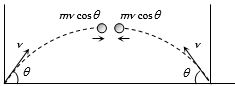
Two objects of equal mass are projected with the same velocity $v$ at the same angle $\theta$ towards each other from a distance $R$. What is the momentum of the system at the moment of collision?
A
$0$
B
$2mv \cos\theta$
C
$-2mv \cos\theta$
D
None of these
Solution
(A) The horizontal component of velocity for both objects is $v_x = v \cos\theta$.
Since the objects are moving towards each other,their horizontal velocities are equal in magnitude but opposite in direction.
Let the mass of each object be $m$.
The momentum of the first object is $\vec{p}_1 = m(v \cos\theta) \hat{i}$.
The momentum of the second object is $\vec{p}_2 = m(-v \cos\theta) \hat{i}$.
The total momentum of the system is $\vec{P} = \vec{p}_1 + \vec{p}_2 = m v \cos\theta \hat{i} - m v \cos\theta \hat{i} = 0$.
Therefore,the momentum of the system at the moment of collision is $0$.
Since the objects are moving towards each other,their horizontal velocities are equal in magnitude but opposite in direction.
Let the mass of each object be $m$.
The momentum of the first object is $\vec{p}_1 = m(v \cos\theta) \hat{i}$.
The momentum of the second object is $\vec{p}_2 = m(-v \cos\theta) \hat{i}$.
The total momentum of the system is $\vec{P} = \vec{p}_1 + \vec{p}_2 = m v \cos\theta \hat{i} - m v \cos\theta \hat{i} = 0$.
Therefore,the momentum of the system at the moment of collision is $0$.
0 likes
View Solution58
DifficultMCQ
Bullets are fired in all directions with the same velocity $u$. What is the maximum area covered by them?
A
$\pi \frac{u^2}{g}$
B
$\pi \frac{u^4}{g^2}$
C
$\pi^2 \frac{u^4}{g^2}$
D
$\pi^2 \frac{u^2}{g^2}$
Solution
(B) The range of a projectile fired with velocity $u$ at an angle $\theta$ is given by $R = \frac{u^2 \sin(2\theta)}{g}$.
For a fixed velocity $u$,the maximum horizontal range $R_{\max}$ is achieved when $\theta = 45^\circ$,which is $R_{\max} = \frac{u^2}{g}$.
Since bullets are fired in all directions,they cover a circular area on the ground with radius $r = R_{\max} = \frac{u^2}{g}$.
The area $A$ covered is given by $A = \pi r^2$.
Substituting the value of $r$,we get $A = \pi \left( \frac{u^2}{g} \right)^2 = \pi \frac{u^4}{g^2}$.
For a fixed velocity $u$,the maximum horizontal range $R_{\max}$ is achieved when $\theta = 45^\circ$,which is $R_{\max} = \frac{u^2}{g}$.
Since bullets are fired in all directions,they cover a circular area on the ground with radius $r = R_{\max} = \frac{u^2}{g}$.
The area $A$ covered is given by $A = \pi r^2$.
Substituting the value of $r$,we get $A = \pi \left( \frac{u^2}{g} \right)^2 = \pi \frac{u^4}{g^2}$.
0 likes
View Solution59
DifficultMCQ
Two projectiles are thrown with the same range $R$. If their maximum heights are $h_1$ and $h_2$ respectively,then what is the value of the range $R$?
A
$R = \sqrt{h_1 h_2}$
B
$R = \sqrt{2 h_1 h_2}$
C
$R = 2 \sqrt{h_1 h_2}$
D
$R = 4 \sqrt{h_1 h_2}$
Solution
(D) For a given range $R$,the two angles of projection are $\theta$ and $(90^\circ - \theta)$.
The maximum height for angle $\theta$ is $h_1 = \frac{u^2 \sin^2 \theta}{2g}$.
The maximum height for angle $(90^\circ - \theta)$ is $h_2 = \frac{u^2 \sin^2(90^\circ - \theta)}{2g} = \frac{u^2 \cos^2 \theta}{2g}$.
Multiplying $h_1$ and $h_2$,we get:
$h_1 h_2 = \frac{u^2 \sin^2 \theta}{2g} \cdot \frac{u^2 \cos^2 \theta}{2g} = \frac{u^4 \sin^2 \theta \cos^2 \theta}{4g^2}$.
We know that the range $R = \frac{u^2 \sin 2\theta}{g} = \frac{2u^2 \sin \theta \cos \theta}{g}$.
Squaring the range,$R^2 = \frac{4u^4 \sin^2 \theta \cos^2 \theta}{g^2}$.
Comparing the two expressions,we see that $h_1 h_2 = \frac{R^2}{16}$.
Therefore,$R^2 = 16 h_1 h_2$,which implies $R = 4 \sqrt{h_1 h_2}$.
The maximum height for angle $\theta$ is $h_1 = \frac{u^2 \sin^2 \theta}{2g}$.
The maximum height for angle $(90^\circ - \theta)$ is $h_2 = \frac{u^2 \sin^2(90^\circ - \theta)}{2g} = \frac{u^2 \cos^2 \theta}{2g}$.
Multiplying $h_1$ and $h_2$,we get:
$h_1 h_2 = \frac{u^2 \sin^2 \theta}{2g} \cdot \frac{u^2 \cos^2 \theta}{2g} = \frac{u^4 \sin^2 \theta \cos^2 \theta}{4g^2}$.
We know that the range $R = \frac{u^2 \sin 2\theta}{g} = \frac{2u^2 \sin \theta \cos \theta}{g}$.
Squaring the range,$R^2 = \frac{4u^4 \sin^2 \theta \cos^2 \theta}{g^2}$.
Comparing the two expressions,we see that $h_1 h_2 = \frac{R^2}{16}$.
Therefore,$R^2 = 16 h_1 h_2$,which implies $R = 4 \sqrt{h_1 h_2}$.
0 likes
View Solution60
DifficultMCQ
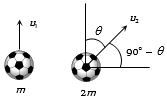
Two balls are thrown as shown in the figure and they reach the ground in the same time. What is the ratio of the maximum heights attained by them?
A
$2 : 1$
B
$1 : 1$
C
$1 : \cos \theta$
D
$1 : \sec \theta$
Solution
(B) For the first ball thrown vertically upwards with velocity $u_1$,the time of flight is $T_1 = \frac{2u_1}{g}$.
For the second ball thrown at an angle $(90^\circ - \theta)$ with the horizontal with velocity $u_2$,the time of flight is $T_2 = \frac{2u_2 \sin(90^\circ - \theta)}{g} = \frac{2u_2 \cos \theta}{g}$.
Given that $T_1 = T_2$,we have $\frac{2u_1}{g} = \frac{2u_2 \cos \theta}{g}$,which implies $u_1 = u_2 \cos \theta$.
The maximum height attained by the first ball is $H_1 = \frac{u_1^2}{2g}$.
The maximum height attained by the second ball is $H_2 = \frac{(u_2 \sin(90^\circ - \theta))^2}{2g} = \frac{u_2^2 \cos^2 \theta}{2g}$.
Taking the ratio of the heights: $\frac{H_1}{H_2} = \frac{u_1^2 / 2g}{u_2^2 \cos^2 \theta / 2g} = \frac{u_1^2}{u_2^2 \cos^2 \theta}$.
Substituting $u_1 = u_2 \cos \theta$,we get $\frac{H_1}{H_2} = \frac{(u_2 \cos \theta)^2}{u_2^2 \cos^2 \theta} = 1$.
Thus,the ratio is $1 : 1$.
For the second ball thrown at an angle $(90^\circ - \theta)$ with the horizontal with velocity $u_2$,the time of flight is $T_2 = \frac{2u_2 \sin(90^\circ - \theta)}{g} = \frac{2u_2 \cos \theta}{g}$.
Given that $T_1 = T_2$,we have $\frac{2u_1}{g} = \frac{2u_2 \cos \theta}{g}$,which implies $u_1 = u_2 \cos \theta$.
The maximum height attained by the first ball is $H_1 = \frac{u_1^2}{2g}$.
The maximum height attained by the second ball is $H_2 = \frac{(u_2 \sin(90^\circ - \theta))^2}{2g} = \frac{u_2^2 \cos^2 \theta}{2g}$.
Taking the ratio of the heights: $\frac{H_1}{H_2} = \frac{u_1^2 / 2g}{u_2^2 \cos^2 \theta / 2g} = \frac{u_1^2}{u_2^2 \cos^2 \theta}$.
Substituting $u_1 = u_2 \cos \theta$,we get $\frac{H_1}{H_2} = \frac{(u_2 \cos \theta)^2}{u_2^2 \cos^2 \theta} = 1$.
Thus,the ratio is $1 : 1$.
0 likes
View Solution61
MediumMCQ
$A$ projectile is fired at an angle of $45^o$ with an initial kinetic energy $K$. What is the kinetic energy of the projectile at its maximum height?
A
$K/\sqrt{2}$
B
$K/2$
C
$2K$
D
$K$
Solution
(B) Let the initial velocity be $v$ and the angle of projection be $\theta = 45^o$. The initial kinetic energy is $K = \frac{1}{2}mv^2$.
At the maximum height,the vertical component of velocity becomes zero,and the projectile only possesses the horizontal component of velocity,which is $v_x = v \cos \theta$.
The kinetic energy at the maximum height is $K' = \frac{1}{2}m(v_x)^2 = \frac{1}{2}m(v \cos \theta)^2$.
Substituting $K = \frac{1}{2}mv^2$,we get $K' = K \cos^2 \theta$.
Given $\theta = 45^o$,we have $\cos 45^o = 1/\sqrt{2}$.
Therefore,$K' = K (1/\sqrt{2})^2 = K/2$.
At the maximum height,the vertical component of velocity becomes zero,and the projectile only possesses the horizontal component of velocity,which is $v_x = v \cos \theta$.
The kinetic energy at the maximum height is $K' = \frac{1}{2}m(v_x)^2 = \frac{1}{2}m(v \cos \theta)^2$.
Substituting $K = \frac{1}{2}mv^2$,we get $K' = K \cos^2 \theta$.
Given $\theta = 45^o$,we have $\cos 45^o = 1/\sqrt{2}$.
Therefore,$K' = K (1/\sqrt{2})^2 = K/2$.
0 likes
View Solution62
MediumMCQ
Two balls are thrown with the same velocity,one vertically upward and the other at an angle of $60^\circ$ with the vertical. What is the ratio of their potential energies at their respective maximum heights?
A
$3 : 2$
B
$2 : 1$
C
$4 : 1$
D
$4 : 3$
Solution
(C) The potential energy $(PE)$ at maximum height $(H)$ is given by $PE = mgH$.
For a projectile launched with velocity $u$ at an angle $\theta$ with the horizontal,the maximum height is $H = \frac{u^2 \sin^2 \theta}{2g}$.
Thus,$PE = mg \left( \frac{u^2 \sin^2 \theta}{2g} \right) = \frac{1}{2} m u^2 \sin^2 \theta$.
For the first ball thrown vertically upward,the angle with the horizontal is $\theta_1 = 90^\circ$. Therefore,$(PE)_1 = \frac{1}{2} m u^2 \sin^2(90^\circ) = \frac{1}{2} m u^2$.
For the second ball thrown at an angle of $60^\circ$ with the vertical,the angle with the horizontal is $\theta_2 = 90^\circ - 60^\circ = 30^\circ$. Therefore,$(PE)_2 = \frac{1}{2} m u^2 \sin^2(30^\circ) = \frac{1}{2} m u^2 (\frac{1}{2})^2 = \frac{1}{8} m u^2$.
The ratio of their potential energies is $\frac{(PE)_1}{(PE)_2} = \frac{\frac{1}{2} m u^2}{\frac{1}{8} m u^2} = \frac{8}{2} = 4:1$.
For a projectile launched with velocity $u$ at an angle $\theta$ with the horizontal,the maximum height is $H = \frac{u^2 \sin^2 \theta}{2g}$.
Thus,$PE = mg \left( \frac{u^2 \sin^2 \theta}{2g} \right) = \frac{1}{2} m u^2 \sin^2 \theta$.
For the first ball thrown vertically upward,the angle with the horizontal is $\theta_1 = 90^\circ$. Therefore,$(PE)_1 = \frac{1}{2} m u^2 \sin^2(90^\circ) = \frac{1}{2} m u^2$.
For the second ball thrown at an angle of $60^\circ$ with the vertical,the angle with the horizontal is $\theta_2 = 90^\circ - 60^\circ = 30^\circ$. Therefore,$(PE)_2 = \frac{1}{2} m u^2 \sin^2(30^\circ) = \frac{1}{2} m u^2 (\frac{1}{2})^2 = \frac{1}{8} m u^2$.
The ratio of their potential energies is $\frac{(PE)_1}{(PE)_2} = \frac{\frac{1}{2} m u^2}{\frac{1}{8} m u^2} = \frac{8}{2} = 4:1$.
0 likes
View Solution63
DifficultMCQ
$A$ body moves along a circular path of radius $100 \,m$ and completes one revolution in $40 \,sec$. What is the total distance covered at the end of $2 \,min \,20 \,sec$ (in $\pi$)?
A
$700$
B
$1400$
C
$1100$
D
$2200$
Solution
(A) The total time given is $2 \,min \,20 \,sec = (2 \times 60) + 20 = 140 \,sec$.
The time period of one revolution is $T = 40 \,sec$.
The number of revolutions $n$ is given by $n = \frac{\text{Total time}}{T} = \frac{140}{40} = 3.5$.
The distance covered in one revolution is the circumference of the circle, $C = 2\pi r$.
Total distance $d = n \times (2\pi r) = 3.5 \times 2 \times \pi \times 100$.
$d = 7 \times \pi \times 100 = 700\pi \,m$.
The time period of one revolution is $T = 40 \,sec$.
The number of revolutions $n$ is given by $n = \frac{\text{Total time}}{T} = \frac{140}{40} = 3.5$.
The distance covered in one revolution is the circumference of the circle, $C = 2\pi r$.
Total distance $d = n \times (2\pi r) = 3.5 \times 2 \times \pi \times 100$.
$d = 7 \times \pi \times 100 = 700\pi \,m$.
0 likes
View Solution64
MediumMCQ
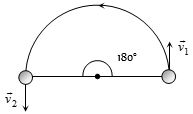
$A$ particle moves with a constant speed of $5 \, ms^{-1}$ as shown in the figure. What is the change in velocity during half a revolution in $ms^{-1}$?
A
$0$
B
$10$
C
$10\sqrt{2}$
D
$10/\sqrt{2}$
Solution
(B) The change in velocity is given by the vector difference $\Delta \vec{v} = \vec{v}_2 - \vec{v}_1$.
Since the speed is constant,let $v = |\vec{v}_1| = |\vec{v}_2| = 5 \, ms^{-1}$.
For a half revolution,the angle between the initial velocity vector $\vec{v}_1$ and the final velocity vector $\vec{v}_2$ is $180^\circ$.
The magnitude of the change in velocity is given by $\Delta v = |\vec{v}_2 - \vec{v}_1| = \sqrt{v^2 + v^2 - 2v^2 \cos(180^\circ)} = \sqrt{2v^2 + 2v^2} = 2v$.
Alternatively,using the formula $\Delta v = 2v \sin(\theta/2)$,where $\theta = 180^\circ$:
$\Delta v = 2 \times 5 \times \sin(180^\circ / 2) = 10 \times \sin(90^\circ) = 10 \times 1 = 10 \, ms^{-1}$.
Since the speed is constant,let $v = |\vec{v}_1| = |\vec{v}_2| = 5 \, ms^{-1}$.
For a half revolution,the angle between the initial velocity vector $\vec{v}_1$ and the final velocity vector $\vec{v}_2$ is $180^\circ$.
The magnitude of the change in velocity is given by $\Delta v = |\vec{v}_2 - \vec{v}_1| = \sqrt{v^2 + v^2 - 2v^2 \cos(180^\circ)} = \sqrt{2v^2 + 2v^2} = 2v$.
Alternatively,using the formula $\Delta v = 2v \sin(\theta/2)$,where $\theta = 180^\circ$:
$\Delta v = 2 \times 5 \times \sin(180^\circ / 2) = 10 \times \sin(90^\circ) = 10 \times 1 = 10 \, ms^{-1}$.
0 likes
View Solution65
DifficultMCQ
$A$ particle moves along a circle of radius $R$ with kinetic energy $K = as^2$,where $s$ is the distance traveled. What is the net force acting on the particle?
A
$2a\frac{s^2}{R}$
B
$2as\left( 1 + \frac{s^2}{R^2} \right)^{1/2}$
C
$2as$
D
$2a\frac{R^2}{s}$
Solution
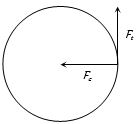
(B) The net force on the particle is given by the vector sum of the centripetal force $(F_c)$ and the tangential force $(F_t)$:
$F_{Net} = \sqrt{F_c^2 + F_t^2}$ ... $(i)$
Given kinetic energy $K = \frac{1}{2}mv^2 = as^2$,we have $v^2 = \frac{2as^2}{m}$.
The centripetal force is $F_c = \frac{mv^2}{R} = \frac{m}{R} \left( \frac{2as^2}{m} \right) = \frac{2as^2}{R}$ ... (ii)
To find the tangential force,we use $F_t = ma_t$,where $a_t = \frac{dv}{dt} = \frac{dv}{ds} \cdot \frac{ds}{dt} = v \frac{dv}{ds}$.
Since $v = s \sqrt{\frac{2a}{m}}$,we have $\frac{dv}{ds} = \sqrt{\frac{2a}{m}}$.
Thus,$a_t = \left( s \sqrt{\frac{2a}{m}} \right) \left( \sqrt{\frac{2a}{m}} \right) = \frac{2as}{m}$.
Therefore,$F_t = m \left( \frac{2as}{m} \right) = 2as$ ... (iii)
Substituting (ii) and (iii) into $(i)$:
$F_{Net} = \sqrt{\left( \frac{2as^2}{R} \right)^2 + (2as)^2} = \sqrt{(2as)^2 \left( \frac{s^2}{R^2} + 1 \right)} = 2as \sqrt{1 + \frac{s^2}{R^2}}$.
$F_{Net} = \sqrt{F_c^2 + F_t^2}$ ... $(i)$
Given kinetic energy $K = \frac{1}{2}mv^2 = as^2$,we have $v^2 = \frac{2as^2}{m}$.
The centripetal force is $F_c = \frac{mv^2}{R} = \frac{m}{R} \left( \frac{2as^2}{m} \right) = \frac{2as^2}{R}$ ... (ii)
To find the tangential force,we use $F_t = ma_t$,where $a_t = \frac{dv}{dt} = \frac{dv}{ds} \cdot \frac{ds}{dt} = v \frac{dv}{ds}$.
Since $v = s \sqrt{\frac{2a}{m}}$,we have $\frac{dv}{ds} = \sqrt{\frac{2a}{m}}$.
Thus,$a_t = \left( s \sqrt{\frac{2a}{m}} \right) \left( \sqrt{\frac{2a}{m}} \right) = \frac{2as}{m}$.
Therefore,$F_t = m \left( \frac{2as}{m} \right) = 2as$ ... (iii)
Substituting (ii) and (iii) into $(i)$:
$F_{Net} = \sqrt{\left( \frac{2as^2}{R} \right)^2 + (2as)^2} = \sqrt{(2as)^2 \left( \frac{s^2}{R^2} + 1 \right)} = 2as \sqrt{1 + \frac{s^2}{R^2}}$.
0 likes
View Solution66
DifficultMCQ
$A$ block of mass $5 \, kg$ is moving with a horizontal velocity of $1.5 \, m/s$. $A$ force of $5 \, N$ is applied in the perpendicular (vertical) direction for $4 \, s$. The total distance covered by the block is .......... $m$.
A
$10$
B
$8$
C
$6$
D
$2$
Solution
(A) The block has an initial horizontal velocity $u_x = 1.5 \, m/s$ and initial vertical velocity $u_y = 0 \, m/s$.
Horizontal displacement $S_x = u_x \times t = 1.5 \times 4 = 6 \, m$.
Vertical acceleration $a_y = F/m = 5/5 = 1 \, m/s^2$.
Vertical displacement $S_y = u_y t + \frac{1}{2} a_y t^2 = 0 + \frac{1}{2} \times 1 \times (4)^2 = 8 \, m$.
The total distance (displacement) covered by the block is $S = \sqrt{S_x^2 + S_y^2} = \sqrt{6^2 + 8^2} = \sqrt{36 + 64} = \sqrt{100} = 10 \, m$.
Horizontal displacement $S_x = u_x \times t = 1.5 \times 4 = 6 \, m$.
Vertical acceleration $a_y = F/m = 5/5 = 1 \, m/s^2$.
Vertical displacement $S_y = u_y t + \frac{1}{2} a_y t^2 = 0 + \frac{1}{2} \times 1 \times (4)^2 = 8 \, m$.
The total distance (displacement) covered by the block is $S = \sqrt{S_x^2 + S_y^2} = \sqrt{6^2 + 8^2} = \sqrt{36 + 64} = \sqrt{100} = 10 \, m$.
0 likes
View Solution67
MediumMCQ
$A$ car runs at a constant speed on a circular track of radius $100\,m$,taking $62.8\,s$ for every circular lap. The average velocity and average speed for each circular lap respectively are:
A
$10\,m/s, 0\,m/s$
B
$0\,m/s, 0\,m/s$
C
$0\,m/s, 10\,m/s$
D
$10\,m/s, 10\,m/s$
Solution
(C) The distance traveled in one complete circular lap is equal to the circumference of the track,which is $2\pi r$.
Given $r = 100\,m$ and time $t = 62.8\,s$.
Average speed is defined as the total distance divided by the total time:
$\text{Average speed} = \frac{2\pi r}{t} = \frac{2 \times 3.14 \times 100}{62.8} = \frac{628}{62.8} = 10\,m/s$.
Since the car completes one full lap,the final position is the same as the initial position.
Therefore,the net displacement is $0\,m$.
Average velocity is defined as the net displacement divided by the total time:
$\text{Average velocity} = \frac{\text{net displacement}}{t} = \frac{0}{62.8} = 0\,m/s$.
Thus,the average velocity is $0\,m/s$ and the average speed is $10\,m/s$.
Given $r = 100\,m$ and time $t = 62.8\,s$.
Average speed is defined as the total distance divided by the total time:
$\text{Average speed} = \frac{2\pi r}{t} = \frac{2 \times 3.14 \times 100}{62.8} = \frac{628}{62.8} = 10\,m/s$.
Since the car completes one full lap,the final position is the same as the initial position.
Therefore,the net displacement is $0\,m$.
Average velocity is defined as the net displacement divided by the total time:
$\text{Average velocity} = \frac{\text{net displacement}}{t} = \frac{0}{62.8} = 0\,m/s$.
Thus,the average velocity is $0\,m/s$ and the average speed is $10\,m/s$.
0 likes
View Solution68
MediumMCQ
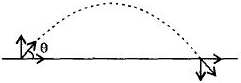
$A$ particle of mass $m$ is projected with velocity $v$ making an angle of $45^\circ$ with the horizontal. When the particle lands on the level ground,the magnitude of the change in its momentum will be
A
$\sqrt{2}mv$
B
$0$
C
$2mv$
D
$\frac{mv}{\sqrt{2}}$
Solution
(A) The initial velocity of the particle is $\vec{u} = v \cos \theta \hat{i} + v \sin \theta \hat{j}$.
The final velocity of the particle when it lands on the ground is $\vec{v}_f = v \cos \theta \hat{i} - v \sin \theta \hat{j}$.
The initial momentum is $\vec{p}_i = m(v \cos \theta \hat{i} + v \sin \theta \hat{j})$.
The final momentum is $\vec{p}_f = m(v \cos \theta \hat{i} - v \sin \theta \hat{j})$.
The change in momentum is $\Delta \vec{p} = \vec{p}_f - \vec{p}_i = -2mv \sin \theta \hat{j}$.
The magnitude of the change in momentum is $|\Delta \vec{p}| = 2mv \sin \theta$.
Given $\theta = 45^\circ$,we have $\sin 45^\circ = \frac{1}{\sqrt{2}}$.
Therefore,$|\Delta \vec{p}| = 2mv \times \frac{1}{\sqrt{2}} = \sqrt{2}mv$.
The final velocity of the particle when it lands on the ground is $\vec{v}_f = v \cos \theta \hat{i} - v \sin \theta \hat{j}$.
The initial momentum is $\vec{p}_i = m(v \cos \theta \hat{i} + v \sin \theta \hat{j})$.
The final momentum is $\vec{p}_f = m(v \cos \theta \hat{i} - v \sin \theta \hat{j})$.
The change in momentum is $\Delta \vec{p} = \vec{p}_f - \vec{p}_i = -2mv \sin \theta \hat{j}$.
The magnitude of the change in momentum is $|\Delta \vec{p}| = 2mv \sin \theta$.
Given $\theta = 45^\circ$,we have $\sin 45^\circ = \frac{1}{\sqrt{2}}$.
Therefore,$|\Delta \vec{p}| = 2mv \times \frac{1}{\sqrt{2}} = \sqrt{2}mv$.
0 likes
View Solution69
DifficultMCQ
$A$ particle has an initial velocity $(3\hat{i} + 4\hat{j})$ and an acceleration of $(0.4\hat{i} + 0.3\hat{j})$. Its speed after $10\,s$ is:
A
$7$ units
B
$7\sqrt{2}$ units
C
$8.5$ units
D
$10$ units
Solution
(B) Given:
Initial velocity,$\vec{u} = (3\hat{i} + 4\hat{j})\,m/s$
Acceleration,$\vec{a} = (0.4\hat{i} + 0.3\hat{j})\,m/s^2$
Time,$t = 10\,s$
Using the first equation of motion for vectors:
$\vec{v} = \vec{u} + \vec{a}t$
$\vec{v} = (3\hat{i} + 4\hat{j}) + (0.4\hat{i} + 0.3\hat{j}) \times 10$
$\vec{v} = (3\hat{i} + 4\hat{j}) + (4\hat{i} + 3\hat{j})$
$\vec{v} = (3+4)\hat{i} + (4+3)\hat{j} = 7\hat{i} + 7\hat{j}$
The speed is the magnitude of the velocity vector $\vec{v}$:
$|\vec{v}| = \sqrt{(7)^2 + (7)^2}$
$|\vec{v}| = \sqrt{49 + 49} = \sqrt{98}$
$|\vec{v}| = 7\sqrt{2}$ units.
Initial velocity,$\vec{u} = (3\hat{i} + 4\hat{j})\,m/s$
Acceleration,$\vec{a} = (0.4\hat{i} + 0.3\hat{j})\,m/s^2$
Time,$t = 10\,s$
Using the first equation of motion for vectors:
$\vec{v} = \vec{u} + \vec{a}t$
$\vec{v} = (3\hat{i} + 4\hat{j}) + (0.4\hat{i} + 0.3\hat{j}) \times 10$
$\vec{v} = (3\hat{i} + 4\hat{j}) + (4\hat{i} + 3\hat{j})$
$\vec{v} = (3+4)\hat{i} + (4+3)\hat{j} = 7\hat{i} + 7\hat{j}$
The speed is the magnitude of the velocity vector $\vec{v}$:
$|\vec{v}| = \sqrt{(7)^2 + (7)^2}$
$|\vec{v}| = \sqrt{49 + 49} = \sqrt{98}$
$|\vec{v}| = 7\sqrt{2}$ units.
0 likes
View Solution70
MediumMCQ
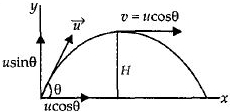
The speed of a projectile at its maximum height is half of its initial speed. The angle of projection is ......... $^o$
A
$60$
B
$15$
C
$30$
D
$45$
Solution
(A) Let $u$ be the initial speed of the projectile and $\theta$ be the angle of projection.
At the maximum height,the vertical component of velocity becomes zero,and the velocity of the projectile is only due to the horizontal component.
Thus,the speed at maximum height is $v = u \cos \theta$.
According to the problem,the speed at maximum height is half of its initial speed:
$v = \frac{u}{2}$
Equating the two expressions for $v$:
$u \cos \theta = \frac{u}{2}$
$\cos \theta = \frac{1}{2}$
$\theta = \cos^{-1}(\frac{1}{2}) = 60^o$
Therefore,the angle of projection is $60^o$.
At the maximum height,the vertical component of velocity becomes zero,and the velocity of the projectile is only due to the horizontal component.
Thus,the speed at maximum height is $v = u \cos \theta$.
According to the problem,the speed at maximum height is half of its initial speed:
$v = \frac{u}{2}$
Equating the two expressions for $v$:
$u \cos \theta = \frac{u}{2}$
$\cos \theta = \frac{1}{2}$
$\theta = \cos^{-1}(\frac{1}{2}) = 60^o$
Therefore,the angle of projection is $60^o$.
1 likes
View Solution71
MediumMCQ
$A$ particle has an initial velocity $(2\hat i + 3\hat j)$ and an acceleration $(0.3\hat i + 0.2\hat j)$. Its speed after $10\,s$ is:
A
$9\sqrt{2}$ Units
B
$5\sqrt{2}$ Units
C
$5$ Units
D
$9$ Units
Solution
(B) Given:
Initial velocity,$\vec{u} = 2\hat{i} + 3\hat{j}$
Acceleration,$\vec{a} = 0.3\hat{i} + 0.2\hat{j}$
Time,$t = 10\,s$
Using the first equation of motion for vectors:
$\vec{v} = \vec{u} + \vec{a}t$
$\vec{v} = (2\hat{i} + 3\hat{j}) + (0.3\hat{i} + 0.2\hat{j})(10)$
$\vec{v} = 2\hat{i} + 3\hat{j} + 3\hat{i} + 2\hat{j}$
$\vec{v} = 5\hat{i} + 5\hat{j}$
Speed is the magnitude of the velocity vector:
$|\vec{v}| = \sqrt{(5)^2 + (5)^2}$
$|\vec{v}| = \sqrt{25 + 25} = \sqrt{50} = 5\sqrt{2}\,\text{units}$
Initial velocity,$\vec{u} = 2\hat{i} + 3\hat{j}$
Acceleration,$\vec{a} = 0.3\hat{i} + 0.2\hat{j}$
Time,$t = 10\,s$
Using the first equation of motion for vectors:
$\vec{v} = \vec{u} + \vec{a}t$
$\vec{v} = (2\hat{i} + 3\hat{j}) + (0.3\hat{i} + 0.2\hat{j})(10)$
$\vec{v} = 2\hat{i} + 3\hat{j} + 3\hat{i} + 2\hat{j}$
$\vec{v} = 5\hat{i} + 5\hat{j}$
Speed is the magnitude of the velocity vector:
$|\vec{v}| = \sqrt{(5)^2 + (5)^2}$
$|\vec{v}| = \sqrt{25 + 25} = \sqrt{50} = 5\sqrt{2}\,\text{units}$
0 likes
View Solution72
MediumMCQ
$A$ projectile is fired from the surface of the earth with a velocity of $5 \, m s^{-1}$ and angle $\theta$ with the horizontal. Another projectile is fired from another planet with a velocity of $3 \, m s^{-1}$ at the same angle and follows a trajectory which is identical to the trajectory of the projectile fired from the earth. The value of the acceleration due to gravity on the planet is (in $m s^{-2}$) (Given $g = 9.8 \, m s^{-2}$):
A
$3.5$
B
$5.9$
C
$16.3$
D
$110.8$
Solution
(A) The equation of the trajectory of a projectile is given by: $y = x \tan \theta - \frac{g x^2}{2 u^2 \cos^2 \theta}$.
For two trajectories to be identical with the same angle of projection $\theta$,the term $\frac{g}{u^2}$ must be constant.
Therefore,$\frac{g_{earth}}{u_{earth}^2} = \frac{g_{planet}}{u_{planet}^2}$.
Given $g_{earth} = 9.8 \, m s^{-2}$,$u_{earth} = 5 \, m s^{-1}$,and $u_{planet} = 3 \, m s^{-1}$.
Substituting the values: $\frac{9.8}{5^2} = \frac{g_{planet}}{3^2}$.
$\frac{9.8}{25} = \frac{g_{planet}}{9}$.
$g_{planet} = \frac{9.8 \times 9}{25} = \frac{88.2}{25} = 3.528 \, m s^{-2}$.
Rounding to the nearest provided option,the value is $3.5 \, m s^{-2}$.
For two trajectories to be identical with the same angle of projection $\theta$,the term $\frac{g}{u^2}$ must be constant.
Therefore,$\frac{g_{earth}}{u_{earth}^2} = \frac{g_{planet}}{u_{planet}^2}$.
Given $g_{earth} = 9.8 \, m s^{-2}$,$u_{earth} = 5 \, m s^{-1}$,and $u_{planet} = 3 \, m s^{-1}$.
Substituting the values: $\frac{9.8}{5^2} = \frac{g_{planet}}{3^2}$.
$\frac{9.8}{25} = \frac{g_{planet}}{9}$.
$g_{planet} = \frac{9.8 \times 9}{25} = \frac{88.2}{25} = 3.528 \, m s^{-2}$.
Rounding to the nearest provided option,the value is $3.5 \, m s^{-2}$.
0 likes
View Solution73
MediumMCQ
$A$ particle is moving such that its position coordinates $(x, y)$ are $(2 \, m, 3 \, m)$ at time $t = 0$,$(6 \, m, 7 \, m)$ at time $t = 2 \, s$,and $(13 \, m, 14 \, m)$ at $t = 5 \, s$. The average velocity vector $\vec{v}_{av}$ from $t = 0$ to $t = 5 \, s$ is:
A
$\frac{1}{5}(13\hat{i} + 14\hat{j})$
B
$\frac{7}{3}(\hat{i} + \hat{j})$
C
$2(\hat{i} + \hat{j})$
D
$\frac{11}{5}(\hat{i} + \hat{j})$
Solution
(D) At time $t_1 = 0 \, s$,the position vector of the particle is $\vec{r}_1 = 2\hat{i} + 3\hat{j}$.
At time $t_2 = 5 \, s$,the position vector of the particle is $\vec{r}_2 = 13\hat{i} + 14\hat{j}$.
The displacement $\Delta \vec{r}$ from $t = 0$ to $t = 5 \, s$ is given by $\Delta \vec{r} = \vec{r}_2 - \vec{r}_1$.
$\Delta \vec{r} = (13\hat{i} + 14\hat{j}) - (2\hat{i} + 3\hat{j}) = 11\hat{i} + 11\hat{j}$.
The average velocity $\vec{v}_{av}$ is defined as the total displacement divided by the total time interval $\Delta t = t_2 - t_1 = 5 - 0 = 5 \, s$.
$\vec{v}_{av} = \frac{\Delta \vec{r}}{\Delta t} = \frac{11\hat{i} + 11\hat{j}}{5} = \frac{11}{5}(\hat{i} + \hat{j}) \, m/s$.
At time $t_2 = 5 \, s$,the position vector of the particle is $\vec{r}_2 = 13\hat{i} + 14\hat{j}$.
The displacement $\Delta \vec{r}$ from $t = 0$ to $t = 5 \, s$ is given by $\Delta \vec{r} = \vec{r}_2 - \vec{r}_1$.
$\Delta \vec{r} = (13\hat{i} + 14\hat{j}) - (2\hat{i} + 3\hat{j}) = 11\hat{i} + 11\hat{j}$.
The average velocity $\vec{v}_{av}$ is defined as the total displacement divided by the total time interval $\Delta t = t_2 - t_1 = 5 - 0 = 5 \, s$.
$\vec{v}_{av} = \frac{\Delta \vec{r}}{\Delta t} = \frac{11\hat{i} + 11\hat{j}}{5} = \frac{11}{5}(\hat{i} + \hat{j}) \, m/s$.
0 likes
View Solution74
DifficultMCQ
The position vector of a particle $\vec{R}$ as a function of time is given by $\vec{R} = 4\sin(2\pi t)\hat{i} + 4\cos(2\pi t)\hat{j}$,where $R$ is in meters,$t$ is in seconds,and $\hat{i}$ and $\hat{j}$ denote unit vectors along $x$- and $y$-directions,respectively. Which one of the following statements is wrong for the motion of the particle?
A
Path of the particle is a circle of radius $4 \ m$.
B
Acceleration vector is along $-\vec{R}$.
C
Magnitude of acceleration vector is $\frac{V^2}{R}$,where $V$ is the velocity of the particle.
D
Magnitude of the velocity of the particle is $8 \ m/s$.
Solution
(D) Given position vector: $\vec{R} = 4\sin(2\pi t)\hat{i} + 4\cos(2\pi t)\hat{j}$.
Since $x = 4\sin(2\pi t)$ and $y = 4\cos(2\pi t)$,then $x^2 + y^2 = 16(\sin^2(2\pi t) + \cos^2(2\pi t)) = 16$. This represents a circle of radius $4 \ m$.
Velocity $\vec{v} = \frac{d\vec{R}}{dt} = 8\pi\cos(2\pi t)\hat{i} - 8\pi\sin(2\pi t)\hat{j}$.
Magnitude of velocity $|\vec{v}| = \sqrt{(8\pi\cos(2\pi t))^2 + (-8\pi\sin(2\pi t))^2} = 8\pi \ m/s$.
Acceleration $\vec{a} = \frac{d\vec{v}}{dt} = -16\pi^2\sin(2\pi t)\hat{i} - 16\pi^2\cos(2\pi t)\hat{j} = -4\pi^2\vec{R}$.
Since $\vec{a} = -4\pi^2\vec{R}$,the acceleration is directed towards the origin (along $-\vec{R}$).
For uniform circular motion,$a = \frac{V^2}{R}$. Here $V = 8\pi$ and $R = 4$,so $a = \frac{(8\pi)^2}{4} = 16\pi^2$. This matches the magnitude of $\vec{a}$.
Statement $(D)$ claims the magnitude of velocity is $8 \ m/s$,but it is $8\pi \ m/s$. Thus,$(D)$ is the wrong statement.
Since $x = 4\sin(2\pi t)$ and $y = 4\cos(2\pi t)$,then $x^2 + y^2 = 16(\sin^2(2\pi t) + \cos^2(2\pi t)) = 16$. This represents a circle of radius $4 \ m$.
Velocity $\vec{v} = \frac{d\vec{R}}{dt} = 8\pi\cos(2\pi t)\hat{i} - 8\pi\sin(2\pi t)\hat{j}$.
Magnitude of velocity $|\vec{v}| = \sqrt{(8\pi\cos(2\pi t))^2 + (-8\pi\sin(2\pi t))^2} = 8\pi \ m/s$.
Acceleration $\vec{a} = \frac{d\vec{v}}{dt} = -16\pi^2\sin(2\pi t)\hat{i} - 16\pi^2\cos(2\pi t)\hat{j} = -4\pi^2\vec{R}$.
Since $\vec{a} = -4\pi^2\vec{R}$,the acceleration is directed towards the origin (along $-\vec{R}$).
For uniform circular motion,$a = \frac{V^2}{R}$. Here $V = 8\pi$ and $R = 4$,so $a = \frac{(8\pi)^2}{4} = 16\pi^2$. This matches the magnitude of $\vec{a}$.
Statement $(D)$ claims the magnitude of velocity is $8 \ m/s$,but it is $8\pi \ m/s$. Thus,$(D)$ is the wrong statement.
0 likes
View Solution75
MediumMCQ
$A$ ball of mass $1 \; kg$ is thrown vertically upwards and returns to the ground after $3 \; s$. Another ball,thrown at $60^{\circ}$ with the vertical,also stays in the air for the same time before it touches the ground. The ratio of the two maximum heights reached is:
A
$1:2$
B
$1:1$
C
$2:1$
D
$1:3$
Solution
(B) For the first ball thrown vertically upwards,the time of flight is $T_1 = \frac{2u_1}{g} = 3 \; s$. Thus,$u_1 = \frac{3g}{2}$. The maximum height is $H_1 = \frac{u_1^2}{2g} = \frac{(3g/2)^2}{2g} = \frac{9g}{8}$.
For the second ball thrown at an angle $\theta = 60^{\circ}$ with the vertical,the angle with the horizontal is $\alpha = 90^{\circ} - 60^{\circ} = 30^{\circ}$. The time of flight is $T_2 = \frac{2u_2 \sin \alpha}{g} = 3 \; s$. Thus,$u_2 \sin \alpha = \frac{3g}{2}$.
The maximum height is $H_2 = \frac{(u_2 \sin \alpha)^2}{2g} = \frac{(3g/2)^2}{2g} = \frac{9g}{8}$.
Comparing the two heights,$\frac{H_1}{H_2} = \frac{9g/8}{9g/8} = 1:1$.
For the second ball thrown at an angle $\theta = 60^{\circ}$ with the vertical,the angle with the horizontal is $\alpha = 90^{\circ} - 60^{\circ} = 30^{\circ}$. The time of flight is $T_2 = \frac{2u_2 \sin \alpha}{g} = 3 \; s$. Thus,$u_2 \sin \alpha = \frac{3g}{2}$.
The maximum height is $H_2 = \frac{(u_2 \sin \alpha)^2}{2g} = \frac{(3g/2)^2}{2g} = \frac{9g}{8}$.
Comparing the two heights,$\frac{H_1}{H_2} = \frac{9g/8}{9g/8} = 1:1$.
0 likes
View Solution76
MediumMCQ
Two stones of masses $m$ and $2\,m$ are whirled in horizontal circles,the heavier one in a radius $\frac{r}{2}$ and the lighter one in radius $r$. The tangential speed of the lighter stone is $n$ times that of the heavier stone when they experience the same centripetal force. The value of $n$ is
A
$1$
B
$2$
C
$3$
D
$4$
Solution
(B) Let $v$ be the tangential speed of the heavier stone.
Given that the centripetal force experienced by both stones is the same.
The centripetal force for the lighter stone (mass $m$,radius $r$,speed $nv$) is given by:
$F_{lighter} = \frac{m(nv)^2}{r} = \frac{mn^2v^2}{r}$
The centripetal force for the heavier stone (mass $2m$,radius $r/2$,speed $v$) is given by:
$F_{heavier} = \frac{(2m)v^2}{r/2} = \frac{4mv^2}{r}$
Equating the two forces:
$\frac{mn^2v^2}{r} = \frac{4mv^2}{r}$
$n^2 = 4$
$n = 2$
Given that the centripetal force experienced by both stones is the same.
The centripetal force for the lighter stone (mass $m$,radius $r$,speed $nv$) is given by:
$F_{lighter} = \frac{m(nv)^2}{r} = \frac{mn^2v^2}{r}$
The centripetal force for the heavier stone (mass $2m$,radius $r/2$,speed $v$) is given by:
$F_{heavier} = \frac{(2m)v^2}{r/2} = \frac{4mv^2}{r}$
Equating the two forces:
$\frac{mn^2v^2}{r} = \frac{4mv^2}{r}$
$n^2 = 4$
$n = 2$
0 likes
View Solution77
MediumMCQ
$A$ particle of mass $10\, g$ moves along a circle of radius $6.4\, cm$ with a constant tangential acceleration. What is the magnitude of this acceleration if the kinetic energy of the particle becomes equal to $8 \times 10^{-4}\, J$ by the end of the second revolution after the beginning of the motion? .............. $m/s^2$
A
$0.15$
B
$0.18$
C
$0.2$
D
$0.1$
Solution
(D) Given: Mass $m = 10\, g = 10^{-2}\, kg$,Radius $R = 6.4\, cm = 6.4 \times 10^{-2}\, m$,Final kinetic energy $K_f = 8 \times 10^{-4}\, J$,Initial kinetic energy $K_i = 0$.
The work done by the tangential force is equal to the change in kinetic energy,as the centripetal force does no work.
Work done $W = F_t \times d$,where $F_t = m a_t$ and $d$ is the distance covered in two revolutions.
Distance $d = 2 \times (2\pi R) = 4\pi R$.
Using the work-energy theorem: $W = K_f - K_i = K_f$.
$m a_t (4\pi R) = K_f$.
$a_t = \frac{K_f}{4\pi R m}$.
Substituting the values: $a_t = \frac{8 \times 10^{-4}}{4 \times 3.14159 \times 6.4 \times 10^{-2} \times 10^{-2}}$.
$a_t = \frac{8 \times 10^{-4}}{4 \times 3.14159 \times 6.4 \times 10^{-4}} = \frac{8}{25.6 \times 3.14159} \approx \frac{8}{80.42} \approx 0.0995\, m/s^2$.
Rounding to the nearest value,$a_t \approx 0.1\, m/s^2$.
The work done by the tangential force is equal to the change in kinetic energy,as the centripetal force does no work.
Work done $W = F_t \times d$,where $F_t = m a_t$ and $d$ is the distance covered in two revolutions.
Distance $d = 2 \times (2\pi R) = 4\pi R$.
Using the work-energy theorem: $W = K_f - K_i = K_f$.
$m a_t (4\pi R) = K_f$.
$a_t = \frac{K_f}{4\pi R m}$.
Substituting the values: $a_t = \frac{8 \times 10^{-4}}{4 \times 3.14159 \times 6.4 \times 10^{-2} \times 10^{-2}}$.
$a_t = \frac{8 \times 10^{-4}}{4 \times 3.14159 \times 6.4 \times 10^{-4}} = \frac{8}{25.6 \times 3.14159} \approx \frac{8}{80.42} \approx 0.0995\, m/s^2$.
Rounding to the nearest value,$a_t \approx 0.1\, m/s^2$.
0 likes
View Solution78
DifficultMCQ
$A$ particle performs uniform circular motion in a horizontal plane. The radius of the circle is $20 \, cm$. The centripetal force acting on the particle is $10 \, N$. Its kinetic energy is ........ $J$.
A
$0.1$
B
$0.2$
C
$2.0$
D
$1.0$
Solution
(D) The centripetal force $F_c$ acting on a particle in uniform circular motion is given by $F_c = \frac{mv^2}{r}$.
Given,$F_c = 10 \, N$ and $r = 20 \, cm = 0.2 \, m$.
So,$\frac{mv^2}{0.2} = 10$,which implies $mv^2 = 10 \times 0.2 = 2 \, J$.
The kinetic energy $K$ of the particle is given by $K = \frac{1}{2}mv^2$.
Substituting the value of $mv^2$,we get $K = \frac{1}{2} \times 2 = 1 \, J$.
Therefore,the correct option is $D$.
Given,$F_c = 10 \, N$ and $r = 20 \, cm = 0.2 \, m$.
So,$\frac{mv^2}{0.2} = 10$,which implies $mv^2 = 10 \times 0.2 = 2 \, J$.
The kinetic energy $K$ of the particle is given by $K = \frac{1}{2}mv^2$.
Substituting the value of $mv^2$,we get $K = \frac{1}{2} \times 2 = 1 \, J$.
Therefore,the correct option is $D$.
0 likes
View Solution79
MediumMCQ
$A$ man standing on the roof of a house of height $h$ throws one particle vertically downwards and another particle horizontally with the same velocity $u$. The ratio of their velocities when they reach the earth's surface will be
A
$\sqrt {2gh + u^2} : u$
B
$1:2$
C
$1:1$
D
$\sqrt {2gh + u^2} : \sqrt {2gh}$
Solution
(C) For the particle thrown vertically downwards:
Using the equation of motion $v^2 = u^2 + 2gh$,the final velocity $v_1$ at the ground is $v_1 = \sqrt{u^2 + 2gh}$.
For the particle thrown horizontally:
The horizontal component of velocity remains $v_x = u$.
The vertical component of velocity at the ground is $v_y = \sqrt{0^2 + 2gh} = \sqrt{2gh}$.
The resultant velocity $v_2$ at the ground is $v_2 = \sqrt{v_x^2 + v_y^2} = \sqrt{u^2 + 2gh}$.
Comparing the two,$v_1 = v_2 = \sqrt{u^2 + 2gh}$.
Therefore,the ratio of their velocities is $1:1$.
Using the equation of motion $v^2 = u^2 + 2gh$,the final velocity $v_1$ at the ground is $v_1 = \sqrt{u^2 + 2gh}$.
For the particle thrown horizontally:
The horizontal component of velocity remains $v_x = u$.
The vertical component of velocity at the ground is $v_y = \sqrt{0^2 + 2gh} = \sqrt{2gh}$.
The resultant velocity $v_2$ at the ground is $v_2 = \sqrt{v_x^2 + v_y^2} = \sqrt{u^2 + 2gh}$.
Comparing the two,$v_1 = v_2 = \sqrt{u^2 + 2gh}$.
Therefore,the ratio of their velocities is $1:1$.
0 likes
View Solution80
EasyMCQ
$A$ projectile is projected at an angle of $30^{\circ}$ from the horizontal with an initial velocity $u$. If the range of the projectile is $R$,what will be the range if the projectile is projected at an angle of $60^{\circ}$ with the same initial velocity?
A
$R$
B
$2R$
C
$R/2$
D
$R^2$
Solution
(A) The horizontal range $R$ of a projectile is given by the formula: $R = \frac{u^2 \sin(2\theta)}{g}$,where $u$ is the initial velocity,$\theta$ is the angle of projection,and $g$ is the acceleration due to gravity.
For the first case,$\theta_1 = 30^{\circ}$,so $R = \frac{u^2 \sin(2 \times 30^{\circ})}{g} = \frac{u^2 \sin(60^{\circ})}{g}$.
For the second case,$\theta_2 = 60^{\circ}$,so $R' = \frac{u^2 \sin(2 \times 60^{\circ})}{g} = \frac{u^2 \sin(120^{\circ})}{g}$.
Since $\sin(120^{\circ}) = \sin(180^{\circ} - 60^{\circ}) = \sin(60^{\circ})$,we have $R' = \frac{u^2 \sin(60^{\circ})}{g} = R$.
Thus,for complementary angles (where $\theta_1 + \theta_2 = 90^{\circ}$),the horizontal range is the same.
For the first case,$\theta_1 = 30^{\circ}$,so $R = \frac{u^2 \sin(2 \times 30^{\circ})}{g} = \frac{u^2 \sin(60^{\circ})}{g}$.
For the second case,$\theta_2 = 60^{\circ}$,so $R' = \frac{u^2 \sin(2 \times 60^{\circ})}{g} = \frac{u^2 \sin(120^{\circ})}{g}$.
Since $\sin(120^{\circ}) = \sin(180^{\circ} - 60^{\circ}) = \sin(60^{\circ})$,we have $R' = \frac{u^2 \sin(60^{\circ})}{g} = R$.
Thus,for complementary angles (where $\theta_1 + \theta_2 = 90^{\circ}$),the horizontal range is the same.
0 likes
View Solution81
MediumMCQ
$A$ body of mass $m$ is projected at an angle of $45^{\circ}$ with the horizontal with an initial velocity $v$. If air resistance is negligible,then the total change in momentum when it strikes the ground is:
A
$2mv$
B
$\sqrt{2}mv$
C
$mv$
D
$mv/\sqrt{2}$
Solution
(B) The initial velocity of the body is $v$ at an angle $\theta = 45^{\circ}$ with the horizontal.
The initial momentum vector is $\vec{p}_i = m(v \cos \theta \hat{i} + v \sin \theta \hat{j})$.
When the body strikes the ground,the horizontal component of velocity remains $v \cos \theta$ and the vertical component becomes $-v \sin \theta$.
The final momentum vector is $\vec{p}_f = m(v \cos \theta \hat{i} - v \sin \theta \hat{j})$.
The change in momentum $\Delta \vec{p} = \vec{p}_f - \vec{p}_i = -2mv \sin \theta \hat{j}$.
The magnitude of the change in momentum is $|\Delta \vec{p}| = 2mv \sin \theta$.
Substituting $\theta = 45^{\circ}$,we get $|\Delta \vec{p}| = 2mv \sin(45^{\circ}) = 2mv \times \frac{1}{\sqrt{2}} = \sqrt{2}mv$.
The initial momentum vector is $\vec{p}_i = m(v \cos \theta \hat{i} + v \sin \theta \hat{j})$.
When the body strikes the ground,the horizontal component of velocity remains $v \cos \theta$ and the vertical component becomes $-v \sin \theta$.
The final momentum vector is $\vec{p}_f = m(v \cos \theta \hat{i} - v \sin \theta \hat{j})$.
The change in momentum $\Delta \vec{p} = \vec{p}_f - \vec{p}_i = -2mv \sin \theta \hat{j}$.
The magnitude of the change in momentum is $|\Delta \vec{p}| = 2mv \sin \theta$.
Substituting $\theta = 45^{\circ}$,we get $|\Delta \vec{p}| = 2mv \sin(45^{\circ}) = 2mv \times \frac{1}{\sqrt{2}} = \sqrt{2}mv$.
0 likes
View Solution82
EasyMCQ
$A$ ball of mass $m$ is thrown vertically upwards. Another ball of mass $2m$ is thrown at an angle $\theta$ with the vertical. Both of them stay in air for the same period of time. The heights attained by the two balls are in the ratio of
A
$2:1$
B
$1:\cos \theta$
C
$1:1$
D
$\cos \theta:1$
Solution
(C) The time of flight $T$ for a projectile is given by $T = \frac{2u_y}{g}$,where $u_y$ is the vertical component of the initial velocity.
Since both balls stay in the air for the same period of time,their vertical components of initial velocity $(u_y)$ must be equal.
The maximum height attained by a projectile is given by $H = \frac{u_y^2}{2g}$.
Since $u_y$ and $g$ are the same for both balls,the maximum height $H$ attained by both balls will be identical.
Therefore,the ratio of the heights attained is $H_1 : H_2 = 1:1$.
Since both balls stay in the air for the same period of time,their vertical components of initial velocity $(u_y)$ must be equal.
The maximum height attained by a projectile is given by $H = \frac{u_y^2}{2g}$.
Since $u_y$ and $g$ are the same for both balls,the maximum height $H$ attained by both balls will be identical.
Therefore,the ratio of the heights attained is $H_1 : H_2 = 1:1$.
0 likes
View Solution83
MediumMCQ
$A$ point $P$ on the circumference of a wheel is initially in contact with the ground. If the radius of the wheel is $5 \, m$,what will be the displacement of point $P$ when the wheel rolls forward by half a revolution?
A
$5 \, m$
B
$10 \, m$
C
$2.5 \, m$
D
$5\sqrt{\pi^2 + 4} \, m$
Solution
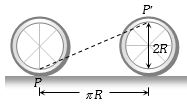
(D) Let the radius of the wheel be $R = 5 \, m$. After half a revolution,the wheel moves forward by a horizontal distance equal to half its circumference,which is $\pi R$. The vertical displacement of point $P$ is equal to the diameter of the wheel,which is $2R$. The total displacement $d$ is the straight-line distance between the initial and final positions of point $P$,given by the Pythagorean theorem: $d = \sqrt{(\pi R)^2 + (2R)^2} = R\sqrt{\pi^2 + 4}$. Substituting $R = 5 \, m$,we get $d = 5\sqrt{\pi^2 + 4} \, m$.
0 likes
View Solution84
DifficultMCQ
$A$ particle is performing uniform circular motion with angular momentum $L$. If the frequency of motion is doubled and the kinetic energy is halved,the new angular momentum will be
A
$2L$
B
$4L$
C
$L/2$
D
$L/4$
Solution
(D) The kinetic energy $E$ of a particle in uniform circular motion is given by $E = \frac{1}{2} L \omega$,where $\omega = 2\pi n$ and $n$ is the frequency of motion.
Thus,$E = \frac{1}{2} L (2\pi n) = \pi L n$.
This implies $E \propto L \times n$,or $L \propto \frac{E}{n}$.
Given the initial state $(E_1, n_1, L_1)$ and final state $(E_2, n_2, L_2)$ where $E_2 = \frac{E_1}{2}$ and $n_2 = 2n_1$,we have:
$\frac{L_2}{L_1} = \frac{E_2}{E_1} \times \frac{n_1}{n_2} = \frac{E_1/2}{E_1} \times \frac{n_1}{2n_1} = \frac{1}{2} \times \frac{1}{2} = \frac{1}{4}$.
Therefore,$L_2 = \frac{L_1}{4} = \frac{L}{4}$.
Thus,$E = \frac{1}{2} L (2\pi n) = \pi L n$.
This implies $E \propto L \times n$,or $L \propto \frac{E}{n}$.
Given the initial state $(E_1, n_1, L_1)$ and final state $(E_2, n_2, L_2)$ where $E_2 = \frac{E_1}{2}$ and $n_2 = 2n_1$,we have:
$\frac{L_2}{L_1} = \frac{E_2}{E_1} \times \frac{n_1}{n_2} = \frac{E_1/2}{E_1} \times \frac{n_1}{2n_1} = \frac{1}{2} \times \frac{1}{2} = \frac{1}{4}$.
Therefore,$L_2 = \frac{L_1}{4} = \frac{L}{4}$.
0 likes
View Solution85
DifficultMCQ
The coordinates of a moving particle at a time $t$ are given by $x = 5 \sin 10t$ and $y = 5 \cos 10t$. The speed of the particle is:
A
$25$
B
$50$
C
$10$
D
None
Solution
(B) The velocity components are obtained by differentiating the position coordinates with respect to time $t$.
$v_{x} = \frac{dx}{dt} = \frac{d}{dt}(5 \sin 10t) = 50 \cos 10t$
$v_{y} = \frac{dy}{dt} = \frac{d}{dt}(5 \cos 10t) = -50 \sin 10t$
The speed of the particle is the magnitude of the velocity vector:
$\text{Speed} = \sqrt{v_{x}^{2} + v_{y}^{2}}$
$\text{Speed} = \sqrt{(50 \cos 10t)^{2} + (-50 \sin 10t)^{2}}$
$\text{Speed} = \sqrt{2500 \cos^{2} 10t + 2500 \sin^{2} 10t}$
$\text{Speed} = \sqrt{2500(\cos^{2} 10t + \sin^{2} 10t)}$
Since $\sin^{2} \theta + \cos^{2} \theta = 1$,we get:
$\text{Speed} = \sqrt{2500 \times 1} = 50$
$v_{x} = \frac{dx}{dt} = \frac{d}{dt}(5 \sin 10t) = 50 \cos 10t$
$v_{y} = \frac{dy}{dt} = \frac{d}{dt}(5 \cos 10t) = -50 \sin 10t$
The speed of the particle is the magnitude of the velocity vector:
$\text{Speed} = \sqrt{v_{x}^{2} + v_{y}^{2}}$
$\text{Speed} = \sqrt{(50 \cos 10t)^{2} + (-50 \sin 10t)^{2}}$
$\text{Speed} = \sqrt{2500 \cos^{2} 10t + 2500 \sin^{2} 10t}$
$\text{Speed} = \sqrt{2500(\cos^{2} 10t + \sin^{2} 10t)}$
Since $\sin^{2} \theta + \cos^{2} \theta = 1$,we get:
$\text{Speed} = \sqrt{2500 \times 1} = 50$
0 likes
View Solution86
MediumMCQ
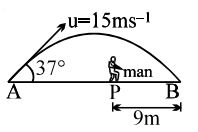
$A$ ball is hit by a batsman at an angle of $37^o$ with an initial velocity $u = 15 \ m/s$ as shown in the figure. The man standing at $P$ is at a distance of $9 \ m$ from the point $B$ where the ball would strike the ground. What is the minimum velocity at which the man should run to catch the ball before it hits the ground? Assume the height of the man is negligible. ........ $m/s$
A
$3$
B
$5$
C
$9$
D
$12$
Solution
(B) The initial velocity of the ball is $u = 15 \ m/s$ and the angle of projection is $\theta = 37^o$. Taking $g = 10 \ m/s^2$,we have $\sin(37^o) \approx 0.6$.
The total time of flight $T$ is given by:
$T = \frac{2u \sin(\theta)}{g} = \frac{2 \times 15 \times 0.6}{10} = \frac{18}{10} = 1.8 \ s$.
The man is at point $P$,which is $9 \ m$ away from the landing point $B$. To catch the ball,the man must cover this distance $d = 9 \ m$ within the time of flight $T = 1.8 \ s$.
The minimum velocity $v$ required is:
$v = \frac{d}{T} = \frac{9}{1.8} = 5 \ m/s$.
The total time of flight $T$ is given by:
$T = \frac{2u \sin(\theta)}{g} = \frac{2 \times 15 \times 0.6}{10} = \frac{18}{10} = 1.8 \ s$.
The man is at point $P$,which is $9 \ m$ away from the landing point $B$. To catch the ball,the man must cover this distance $d = 9 \ m$ within the time of flight $T = 1.8 \ s$.
The minimum velocity $v$ required is:
$v = \frac{d}{T} = \frac{9}{1.8} = 5 \ m/s$.
0 likes
View Solution87
AdvancedMCQ
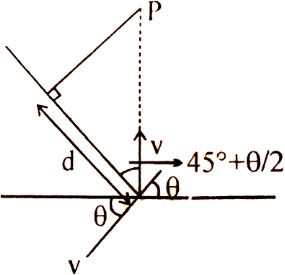
$A$ particle is projected vertically upwards from $O$ with velocity $v$ and a second particle is projected at the same instant from $P$ (at a height $h$ above $O$) with velocity $v$ at an angle of projection $\theta$. The time when the distance between them is minimum is
A
$\frac{h}{2v \sin \theta}$
B
$\frac{h}{2v \cos \theta}$
C
$h/v$
D
$h/2v$
Solution
(D) Let the position of the first particle projected from $O$ be $\vec{r}_1(t) = (0, vt - \frac{1}{2}gt^2)$.
Let the position of the second particle projected from $P(0, h)$ be $\vec{r}_2(t) = (vt \cos \theta, h + vt \sin \theta - \frac{1}{2}gt^2)$.
The relative position vector $\vec{r}_{rel} = \vec{r}_2 - \vec{r}_1 = (vt \cos \theta, h + vt \sin \theta - vt) = (vt \cos \theta, h - vt(1 - \sin \theta))$.
The square of the distance $D^2 = |\vec{r}_{rel}|^2 = (vt \cos \theta)^2 + (h - vt(1 - \sin \theta))^2$.
To minimize $D^2$,we differentiate with respect to $t$ and set to zero:
$\frac{d(D^2)}{dt} = 2(vt \cos \theta)(v \cos \theta) + 2(h - vt(1 - \sin \theta))(-v(1 - \sin \theta)) = 0$.
$v^2 t \cos^2 \theta - hv(1 - \sin \theta) + v^2 t(1 - \sin \theta)^2 = 0$.
$v^2 t [\cos^2 \theta + (1 - \sin \theta)^2] = hv(1 - \sin \theta)$.
$v^2 t [\cos^2 \theta + 1 + \sin^2 \theta - 2 \sin \theta] = hv(1 - \sin \theta)$.
$v^2 t [2 - 2 \sin \theta] = hv(1 - \sin \theta)$.
$2v^2 t (1 - \sin \theta) = hv(1 - \sin \theta)$.
$t = \frac{h}{2v}$.
Let the position of the second particle projected from $P(0, h)$ be $\vec{r}_2(t) = (vt \cos \theta, h + vt \sin \theta - \frac{1}{2}gt^2)$.
The relative position vector $\vec{r}_{rel} = \vec{r}_2 - \vec{r}_1 = (vt \cos \theta, h + vt \sin \theta - vt) = (vt \cos \theta, h - vt(1 - \sin \theta))$.
The square of the distance $D^2 = |\vec{r}_{rel}|^2 = (vt \cos \theta)^2 + (h - vt(1 - \sin \theta))^2$.
To minimize $D^2$,we differentiate with respect to $t$ and set to zero:
$\frac{d(D^2)}{dt} = 2(vt \cos \theta)(v \cos \theta) + 2(h - vt(1 - \sin \theta))(-v(1 - \sin \theta)) = 0$.
$v^2 t \cos^2 \theta - hv(1 - \sin \theta) + v^2 t(1 - \sin \theta)^2 = 0$.
$v^2 t [\cos^2 \theta + (1 - \sin \theta)^2] = hv(1 - \sin \theta)$.
$v^2 t [\cos^2 \theta + 1 + \sin^2 \theta - 2 \sin \theta] = hv(1 - \sin \theta)$.
$v^2 t [2 - 2 \sin \theta] = hv(1 - \sin \theta)$.
$2v^2 t (1 - \sin \theta) = hv(1 - \sin \theta)$.
$t = \frac{h}{2v}$.
0 likes
View Solution88
DifficultMCQ
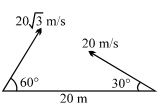
In the figure shown,the two projectiles are fired simultaneously. The minimum distance between them during their flight is ........ $m$.
A
$20$
B
$10\sqrt{3}$
C
$10$
D
None
Solution
(C) Let the origin be at the left projectile $A$ and the $x$-axis be along the line connecting $A$ and $B$. The initial position of $A$ is $(0, 0)$ and $B$ is $(20, 0)$.
The velocity of $A$ is $\vec{v}_A = 20\sqrt{3}(\cos 60^{\circ} \hat{i} + \sin 60^{\circ} \hat{j}) = 20\sqrt{3}(\frac{1}{2} \hat{i} + \frac{\sqrt{3}}{2} \hat{j}) = 10\sqrt{3} \hat{i} + 30 \hat{j}$.
The velocity of $B$ is $\vec{v}_B = 20(\cos 150^{\circ} \hat{i} + \sin 150^{\circ} \hat{j}) = 20(-\frac{\sqrt{3}}{2} \hat{i} + \frac{1}{2} \hat{j}) = -10\sqrt{3} \hat{i} + 10 \hat{j}$.
The relative velocity of $A$ with respect to $B$ is $\vec{v}_{AB} = \vec{v}_A - \vec{v}_B = (10\sqrt{3} - (-10\sqrt{3})) \hat{i} + (30 - 10) \hat{j} = 20\sqrt{3} \hat{i} + 20 \hat{j}$.
The relative initial position is $\vec{r}_{AB} = \vec{r}_A - \vec{r}_B = (0 - 20) \hat{i} + (0 - 0) \hat{j} = -20 \hat{i}$.
The minimum distance is the perpendicular distance from the origin to the line of relative motion,given by $d_{\min} = \frac{|\vec{r}_{AB} \times \vec{v}_{AB}|}{|\vec{v}_{AB}|}$.
$|\vec{r}_{AB} \times \vec{v}_{AB}| = |(-20 \hat{i}) \times (20\sqrt{3} \hat{i} + 20 \hat{j})| = |-400 \hat{k}| = 400$.
$|\vec{v}_{AB}| = \sqrt{(20\sqrt{3})^2 + 20^2} = \sqrt{1200 + 400} = \sqrt{1600} = 40$.
$d_{\min} = \frac{400}{40} = 10 \ m$.
The velocity of $A$ is $\vec{v}_A = 20\sqrt{3}(\cos 60^{\circ} \hat{i} + \sin 60^{\circ} \hat{j}) = 20\sqrt{3}(\frac{1}{2} \hat{i} + \frac{\sqrt{3}}{2} \hat{j}) = 10\sqrt{3} \hat{i} + 30 \hat{j}$.
The velocity of $B$ is $\vec{v}_B = 20(\cos 150^{\circ} \hat{i} + \sin 150^{\circ} \hat{j}) = 20(-\frac{\sqrt{3}}{2} \hat{i} + \frac{1}{2} \hat{j}) = -10\sqrt{3} \hat{i} + 10 \hat{j}$.
The relative velocity of $A$ with respect to $B$ is $\vec{v}_{AB} = \vec{v}_A - \vec{v}_B = (10\sqrt{3} - (-10\sqrt{3})) \hat{i} + (30 - 10) \hat{j} = 20\sqrt{3} \hat{i} + 20 \hat{j}$.
The relative initial position is $\vec{r}_{AB} = \vec{r}_A - \vec{r}_B = (0 - 20) \hat{i} + (0 - 0) \hat{j} = -20 \hat{i}$.
The minimum distance is the perpendicular distance from the origin to the line of relative motion,given by $d_{\min} = \frac{|\vec{r}_{AB} \times \vec{v}_{AB}|}{|\vec{v}_{AB}|}$.
$|\vec{r}_{AB} \times \vec{v}_{AB}| = |(-20 \hat{i}) \times (20\sqrt{3} \hat{i} + 20 \hat{j})| = |-400 \hat{k}| = 400$.
$|\vec{v}_{AB}| = \sqrt{(20\sqrt{3})^2 + 20^2} = \sqrt{1200 + 400} = \sqrt{1600} = 40$.
$d_{\min} = \frac{400}{40} = 10 \ m$.
0 likes
View Solution89
MediumMCQ
Two projectiles $A$ and $B$ are thrown with the same speed such that $A$ makes an angle $\theta$ with the horizontal and $B$ makes an angle $\theta$ with the vertical. Then:
A
Both must have the same time of flight.
B
Both must achieve the same maximum height.
C
$A$ must have a greater horizontal range than $B$.
D
Both may have the same time of flight.
Solution
(D) Let the speed of projection be $u$. For projectile $A$,the angle with the horizontal is $\theta_A = \theta$. For projectile $B$,the angle with the vertical is $\theta$,so the angle with the horizontal is $\theta_B = 90^{\circ} - \theta$.
Since $\theta_B$ is the complement of $\theta_A$,these are complementary angles.
For complementary angles,the horizontal range is the same $(R_A = R_B)$.
However,the time of flight $T = \frac{2u \sin \theta}{g}$ and maximum height $H = \frac{u^2 \sin^2 \theta}{2g}$ depend on the specific angle $\theta$.
If $\theta = 45^{\circ}$,then $\theta_A = \theta_B = 45^{\circ}$,and all parameters (time of flight,maximum height,and range) will be identical.
If $\theta \neq 45^{\circ}$,the time of flight and maximum height will be different for $A$ and $B$.
Therefore,the statement that they 'may' have the same time of flight is correct,as it holds true for the case $\theta = 45^{\circ}$.
Since $\theta_B$ is the complement of $\theta_A$,these are complementary angles.
For complementary angles,the horizontal range is the same $(R_A = R_B)$.
However,the time of flight $T = \frac{2u \sin \theta}{g}$ and maximum height $H = \frac{u^2 \sin^2 \theta}{2g}$ depend on the specific angle $\theta$.
If $\theta = 45^{\circ}$,then $\theta_A = \theta_B = 45^{\circ}$,and all parameters (time of flight,maximum height,and range) will be identical.
If $\theta \neq 45^{\circ}$,the time of flight and maximum height will be different for $A$ and $B$.
Therefore,the statement that they 'may' have the same time of flight is correct,as it holds true for the case $\theta = 45^{\circ}$.
0 likes
View Solution90
DifficultMCQ
Particles $A$ and $B$ are moving with constant velocities along the $x$ and $y$ axes respectively. The graph of the separation $S$ between them with time $t$ is:

A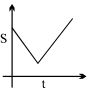
B
C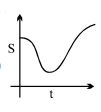
D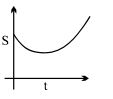
Solution
(D) Let the initial positions of particles $A$ and $B$ be $(-x_0, 0)$ and $(0, -y_0)$ respectively,where $x_0, y_0 > 0$.
Let their constant velocities be $\vec{v}_A = v_A \hat{i}$ and $\vec{v}_B = v_B \hat{j}$.
At any time $t$,the positions are $\vec{r}_A(t) = (-x_0 + v_A t) \hat{i}$ and $\vec{r}_B(t) = (-y_0 + v_B t) \hat{j}$.
The separation $S$ between them is given by $S = |\vec{r}_B - \vec{r}_A| = \sqrt{(v_B t - y_0)^2 + (x_0 - v_A t)^2}$.
Squaring both sides,$S^2 = (v_B^2 + v_A^2) t^2 - 2(v_B y_0 + v_A x_0) t + (y_0^2 + x_0^2)$.
This is a quadratic equation of the form $S^2 = at^2 + bt + c$,which represents a hyperbola. The graph of $S$ versus $t$ is a hyperbola that decreases to a minimum value and then increases,which corresponds to the curve shown in option $D$.
Let their constant velocities be $\vec{v}_A = v_A \hat{i}$ and $\vec{v}_B = v_B \hat{j}$.
At any time $t$,the positions are $\vec{r}_A(t) = (-x_0 + v_A t) \hat{i}$ and $\vec{r}_B(t) = (-y_0 + v_B t) \hat{j}$.
The separation $S$ between them is given by $S = |\vec{r}_B - \vec{r}_A| = \sqrt{(v_B t - y_0)^2 + (x_0 - v_A t)^2}$.
Squaring both sides,$S^2 = (v_B^2 + v_A^2) t^2 - 2(v_B y_0 + v_A x_0) t + (y_0^2 + x_0^2)$.
This is a quadratic equation of the form $S^2 = at^2 + bt + c$,which represents a hyperbola. The graph of $S$ versus $t$ is a hyperbola that decreases to a minimum value and then increases,which corresponds to the curve shown in option $D$.
0 likes
View Solution91
MediumMCQ
Two particles are projected simultaneously in the same vertical plane,from the same point on the ground,with the same speeds but at different angles $( < 90^o )$ to the horizontal. The path followed by one,as seen by the other,is
A
a vertical straight line
B
a straight line making a constant angle with the horizontal
C
a parabola
D
a hyperbola
Solution
(B) Let $\vec{u}_{1}$ and $\vec{u}_{2}$ be the initial velocities of the two particles and $\theta_{1}$ and $\theta_{2}$ be their angles of projection with the horizontal.
The velocities of the two particles at any time $t$ are given by:
$\vec{v}_{1} = (u \cos \theta_{1}) \hat{i} + (u \sin \theta_{1} - gt) \hat{j}$
$\vec{v}_{2} = (u \cos \theta_{2}) \hat{i} + (u \sin \theta_{2} - gt) \hat{j}$
The relative velocity of one particle with respect to the other is:
$\vec{v}_{12} = \vec{v}_{1} - \vec{v}_{2} = u(\cos \theta_{1} - \cos \theta_{2}) \hat{i} + u(\sin \theta_{1} - \sin \theta_{2}) \hat{j}$
Since the relative velocity $\vec{v}_{12}$ is independent of time $t$,the relative acceleration is zero $(\vec{a}_{12} = \vec{a}_{1} - \vec{a}_{2} = -g\hat{j} - (-g\hat{j}) = 0)$.
Because the relative acceleration is zero and the relative initial position is zero (both start from the same point),the relative motion is a straight line passing through the origin. Since the relative velocity vector is constant,the path is a straight line making a constant angle with the horizontal.
The velocities of the two particles at any time $t$ are given by:
$\vec{v}_{1} = (u \cos \theta_{1}) \hat{i} + (u \sin \theta_{1} - gt) \hat{j}$
$\vec{v}_{2} = (u \cos \theta_{2}) \hat{i} + (u \sin \theta_{2} - gt) \hat{j}$
The relative velocity of one particle with respect to the other is:
$\vec{v}_{12} = \vec{v}_{1} - \vec{v}_{2} = u(\cos \theta_{1} - \cos \theta_{2}) \hat{i} + u(\sin \theta_{1} - \sin \theta_{2}) \hat{j}$
Since the relative velocity $\vec{v}_{12}$ is independent of time $t$,the relative acceleration is zero $(\vec{a}_{12} = \vec{a}_{1} - \vec{a}_{2} = -g\hat{j} - (-g\hat{j}) = 0)$.
Because the relative acceleration is zero and the relative initial position is zero (both start from the same point),the relative motion is a straight line passing through the origin. Since the relative velocity vector is constant,the path is a straight line making a constant angle with the horizontal.
0 likes
View Solution92
MediumMCQ
Two projectiles are thrown simultaneously in the same plane from the same point. If their velocities are $v_1$ and $v_2$ at angles $\theta_1$ and $\theta_2$ respectively from the horizontal,then the trajectory of particle $1$ with respect to particle $2$ will be:
A
a parabola
B
a straight line
C
a vertical straight line
D
a horizontal straight line
Solution
(B) Let the velocities of the two projectiles be $\vec{v}_1 = v_1 \cos \theta_1 \hat{i} + v_1 \sin \theta_1 \hat{j}$ and $\vec{v}_2 = v_2 \cos \theta_2 \hat{i} + v_2 \sin \theta_2 \hat{j}$.
Both projectiles experience the same acceleration due to gravity,$\vec{a}_1 = \vec{a}_2 = -g \hat{j}$.
The relative acceleration of particle $1$ with respect to particle $2$ is $\vec{a}_{12} = \vec{a}_1 - \vec{a}_2 = 0$.
Since the relative acceleration is zero,the relative velocity $\vec{v}_{12} = \vec{v}_1 - \vec{v}_2$ is constant.
The relative velocity is $\vec{v}_{12} = (v_1 \cos \theta_1 - v_2 \cos \theta_2) \hat{i} + (v_1 \sin \theta_1 - v_2 \sin \theta_2) \hat{j}$.
Since the relative acceleration is zero and the relative velocity is constant,the relative position vector $\vec{r}_{12} = \vec{v}_{12} t$ represents a straight line equation in the $xy$-plane.
Both projectiles experience the same acceleration due to gravity,$\vec{a}_1 = \vec{a}_2 = -g \hat{j}$.
The relative acceleration of particle $1$ with respect to particle $2$ is $\vec{a}_{12} = \vec{a}_1 - \vec{a}_2 = 0$.
Since the relative acceleration is zero,the relative velocity $\vec{v}_{12} = \vec{v}_1 - \vec{v}_2$ is constant.
The relative velocity is $\vec{v}_{12} = (v_1 \cos \theta_1 - v_2 \cos \theta_2) \hat{i} + (v_1 \sin \theta_1 - v_2 \sin \theta_2) \hat{j}$.
Since the relative acceleration is zero and the relative velocity is constant,the relative position vector $\vec{r}_{12} = \vec{v}_{12} t$ represents a straight line equation in the $xy$-plane.
0 likes
View Solution93
MediumMCQ
Two projectiles are thrown simultaneously in the same plane from the same point. If their velocities are $v_1$ and $v_2$ at angles $\theta_1$ and $\theta_2$ respectively from the horizontal,then answer the following question. If $v_1 \cos \theta_1 = v_2 \cos \theta_2$,then choose the incorrect statement.
A
one particle will remain exactly below or above the other particle
B
the trajectory of one with respect to other will be a vertical straight line
C
both will have the same range
D
none of these
Solution
(C) The horizontal components of the velocities are given as $u_{x1} = v_1 \cos \theta_1$ and $u_{x2} = v_2 \cos \theta_2$. Given $v_1 \cos \theta_1 = v_2 \cos \theta_2$,the horizontal velocities are equal.
Since the horizontal acceleration for both projectiles is zero,their horizontal positions at any time $t$ are $x_1 = (v_1 \cos \theta_1)t$ and $x_2 = (v_2 \cos \theta_2)t$.
Because $v_1 \cos \theta_1 = v_2 \cos \theta_2$,it follows that $x_1 = x_2$ for all $t$.
This means one particle will always remain exactly below or above the other particle (Option $A$ is correct).
The relative horizontal displacement is $x_{rel} = x_1 - x_2 = 0$. Thus,the trajectory of one with respect to the other is a vertical straight line (Option $B$ is correct).
The range of a projectile is $R = \frac{v^2 \sin(2\theta)}{g} = \frac{2(v \cos \theta)(v \sin \theta)}{g}$. Since $v_1 \cos \theta_1 = v_2 \cos \theta_2$,the ranges are equal only if $v_1 \sin \theta_1 = v_2 \sin \theta_2$,which is not necessarily true. Therefore,the statement that both will have the same range is not necessarily true. Thus,Option $C$ is the incorrect statement.
Since the horizontal acceleration for both projectiles is zero,their horizontal positions at any time $t$ are $x_1 = (v_1 \cos \theta_1)t$ and $x_2 = (v_2 \cos \theta_2)t$.
Because $v_1 \cos \theta_1 = v_2 \cos \theta_2$,it follows that $x_1 = x_2$ for all $t$.
This means one particle will always remain exactly below or above the other particle (Option $A$ is correct).
The relative horizontal displacement is $x_{rel} = x_1 - x_2 = 0$. Thus,the trajectory of one with respect to the other is a vertical straight line (Option $B$ is correct).
The range of a projectile is $R = \frac{v^2 \sin(2\theta)}{g} = \frac{2(v \cos \theta)(v \sin \theta)}{g}$. Since $v_1 \cos \theta_1 = v_2 \cos \theta_2$,the ranges are equal only if $v_1 \sin \theta_1 = v_2 \sin \theta_2$,which is not necessarily true. Therefore,the statement that both will have the same range is not necessarily true. Thus,Option $C$ is the incorrect statement.
0 likes
View Solution94
MediumMCQ
Two projectiles are thrown simultaneously in the same plane from the same point. If their velocities are $v_1$ and $v_2$ at angles $\theta_1$ and $\theta_2$ respectively from the horizontal,and $v_1 \sin \theta_1 = v_2 \sin \theta_2$,then choose the incorrect statement.
A
The time of flight of both the particles will be same.
B
The maximum height attained by the particles will be same.
C
The trajectory of one with respect to another will be a horizontal straight line.
D
None of these.
Solution
(D) The time of flight for a projectile is given by $T = \frac{2v \sin \theta}{g}$. Since $v_1 \sin \theta_1 = v_2 \sin \theta_2$,it follows that $T_1 = T_2$. Thus,option $A$ is correct.
The maximum height is given by $H = \frac{v^2 \sin^2 \theta}{2g}$. Since $v_1 \sin \theta_1 = v_2 \sin \theta_2$,it follows that $H_1 = H_2$. Thus,option $B$ is correct.
The relative acceleration between the two projectiles is $\vec{a}_{rel} = \vec{g} - \vec{g} = 0$. Since the relative acceleration is zero,the relative velocity $\vec{v}_{rel}$ remains constant. The relative vertical velocity is $v_{1y} - v_{2y} = v_1 \sin \theta_1 - v_2 \sin \theta_2 = 0$. Since the relative vertical velocity is zero,the relative motion is purely horizontal. Thus,the trajectory of one with respect to the other is a horizontal straight line. Option $C$ is correct.
Since all statements $A$,$B$,and $C$ are correct,the incorrect statement is none of these.
The maximum height is given by $H = \frac{v^2 \sin^2 \theta}{2g}$. Since $v_1 \sin \theta_1 = v_2 \sin \theta_2$,it follows that $H_1 = H_2$. Thus,option $B$ is correct.
The relative acceleration between the two projectiles is $\vec{a}_{rel} = \vec{g} - \vec{g} = 0$. Since the relative acceleration is zero,the relative velocity $\vec{v}_{rel}$ remains constant. The relative vertical velocity is $v_{1y} - v_{2y} = v_1 \sin \theta_1 - v_2 \sin \theta_2 = 0$. Since the relative vertical velocity is zero,the relative motion is purely horizontal. Thus,the trajectory of one with respect to the other is a horizontal straight line. Option $C$ is correct.
Since all statements $A$,$B$,and $C$ are correct,the incorrect statement is none of these.
0 likes
View Solution95
MediumMCQ
Two projectiles are thrown simultaneously in the same plane from the same point. If their velocities are $v_1$ and $v_2$ at angles $\theta_1$ and $\theta_2$ respectively from the horizontal,then answer the following question. If $v_1 = v_2$ and $\theta_1 > \theta_2$,then choose the incorrect statement.
A
The slope of the trajectory of particle $2$ with respect to $1$ is always positive.
B
Particle $2$ moves under the particle $1$.
C
Both the particles will have the same range if $\theta_1 + \theta_2 = 90^\circ$.
D
None of these.
Solution
(D) For two projectiles with the same initial velocity $v$ and different angles $\theta_1$ and $\theta_2$,the equations of motion are $x_1 = v \cos \theta_1 t$,$y_1 = v \sin \theta_1 t - \frac{1}{2}gt^2$ and $x_2 = v \cos \theta_2 t$,$y_2 = v \sin \theta_2 t - \frac{1}{2}gt^2$.
Since $\theta_1 > \theta_2$,we have $\cos \theta_1 < \cos \theta_2$,so $x_1 < x_2$ for any time $t > 0$.
Also,the relative vertical position is $y_1 - y_2 = v t (\sin \theta_1 - \sin \theta_2)$. Since $\theta_1 > \theta_2$,$\sin \theta_1 > \sin \theta_2$,so $y_1 > y_2$.
This means particle $1$ is always above particle $2$,so particle $2$ moves under particle $1$.
The slope of the relative trajectory is $\frac{dy_1 - dy_2}{dx_1 - dx_2}$,which remains positive under these conditions.
Option $C$ is a general property of complementary angles,but the question asks for the incorrect statement regarding the specific condition $\theta_1 > \theta_2$. Since $A$ and $B$ are correct,and $C$ is a true statement about range,$D$ is the correct choice as there is no incorrect statement among the given options.
Since $\theta_1 > \theta_2$,we have $\cos \theta_1 < \cos \theta_2$,so $x_1 < x_2$ for any time $t > 0$.
Also,the relative vertical position is $y_1 - y_2 = v t (\sin \theta_1 - \sin \theta_2)$. Since $\theta_1 > \theta_2$,$\sin \theta_1 > \sin \theta_2$,so $y_1 > y_2$.
This means particle $1$ is always above particle $2$,so particle $2$ moves under particle $1$.
The slope of the relative trajectory is $\frac{dy_1 - dy_2}{dx_1 - dx_2}$,which remains positive under these conditions.
Option $C$ is a general property of complementary angles,but the question asks for the incorrect statement regarding the specific condition $\theta_1 > \theta_2$. Since $A$ and $B$ are correct,and $C$ is a true statement about range,$D$ is the correct choice as there is no incorrect statement among the given options.
0 likes
View Solution96
MediumMCQ
$A$ projectile crosses two walls of equal height $H$ symmetrically as shown in the figure. The time of flight $T$ is given by ........ $\text{s}$.
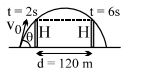
A
$8$
B
$9$
C
$7$
D
$10$
Solution
(A) The projectile crosses the two walls of equal height $H$ symmetrically.
Let the time taken to reach the first wall be $t_1 = 2 \text{ s}$ and the time taken to reach the second wall be $t_2 = 6 \text{ s}$.
Due to the symmetry of the projectile motion,the peak of the trajectory occurs exactly halfway between the two walls.
The time at which the projectile reaches its maximum height is $t_{peak} = \frac{t_1 + t_2}{2} = \frac{2 + 6}{2} = 4 \text{ s}$.
For a projectile launched from the ground,the total time of flight $T$ is twice the time taken to reach the maximum height.
Therefore,$T = 2 \times t_{peak} = 2 \times 4 = 8 \text{ s}$.
Let the time taken to reach the first wall be $t_1 = 2 \text{ s}$ and the time taken to reach the second wall be $t_2 = 6 \text{ s}$.
Due to the symmetry of the projectile motion,the peak of the trajectory occurs exactly halfway between the two walls.
The time at which the projectile reaches its maximum height is $t_{peak} = \frac{t_1 + t_2}{2} = \frac{2 + 6}{2} = 4 \text{ s}$.
For a projectile launched from the ground,the total time of flight $T$ is twice the time taken to reach the maximum height.
Therefore,$T = 2 \times t_{peak} = 2 \times 4 = 8 \text{ s}$.
0 likes
View Solution97
DifficultMCQ
$A$ projectile crosses two walls of equal height $H$ symmetrically as shown. The height of each wall is ........ $m$.
A
$240$
B
$120$
C
$60$
D
$30$
Solution
(C) The projectile crosses the two walls at times $t_1 = 2 \ s$ and $t_2 = 6 \ s$.
Since the motion is symmetric,the time taken to reach the peak of the trajectory is $t_{peak} = \frac{t_1 + t_2}{2} = \frac{2 + 6}{2} = 4 \ s$.
The vertical displacement $H$ at time $t = 2 \ s$ is given by $H = (v_0 \sin \theta) t - \frac{1}{2} g t^2$.
At the peak,the vertical velocity is zero,so $v_y = v_0 \sin \theta - g t_{peak} = 0$,which gives $v_0 \sin \theta = g t_{peak} = 10 \times 4 = 40 \ m/s$ (taking $g = 10 \ m/s^2$).
Substituting this into the equation for $H$:
$H = (40)(2) - \frac{1}{2} (10)(2)^2$
$H = 80 - 20 = 60 \ m$.
Since the motion is symmetric,the time taken to reach the peak of the trajectory is $t_{peak} = \frac{t_1 + t_2}{2} = \frac{2 + 6}{2} = 4 \ s$.
The vertical displacement $H$ at time $t = 2 \ s$ is given by $H = (v_0 \sin \theta) t - \frac{1}{2} g t^2$.
At the peak,the vertical velocity is zero,so $v_y = v_0 \sin \theta - g t_{peak} = 0$,which gives $v_0 \sin \theta = g t_{peak} = 10 \times 4 = 40 \ m/s$ (taking $g = 10 \ m/s^2$).
Substituting this into the equation for $H$:
$H = (40)(2) - \frac{1}{2} (10)(2)^2$
$H = 80 - 20 = 60 \ m$.
0 likes
View Solution98
DifficultMCQ
$A$ projectile crosses two walls of equal height $H$ symmetrically as shown. If the horizontal distance between the two walls is $d = 120\, m$ and the times at which the projectile crosses the walls are $t_1 = 2\, s$ and $t_2 = 6\, s$,then the range of the projectile is ........ $m$.
A
$240$
B
$160$
C
$300$
D
$200$
Solution
(A) The horizontal velocity $v_x$ of the projectile is constant. The horizontal distance between the two walls is $d = 120\, m$,and the time taken to travel this distance is $\Delta t = t_2 - t_1 = 6\, s - 2\, s = 4\, s$.
Thus,the horizontal velocity is $v_x = \frac{d}{\Delta t} = \frac{120\, m}{4\, s} = 30\, m/s$.
Due to the symmetry of the projectile motion,the total time of flight $T$ is the sum of the times at which it crosses the walls symmetrically relative to the peak. The peak occurs at the midpoint of the time interval $[t_1, t_2]$,which is $t_{peak} = \frac{t_1 + t_2}{2} = \frac{2 + 6}{2} = 4\, s$.
The total time of flight $T$ is $2 \times t_{peak} = 2 \times 4\, s = 8\, s$.
The range $R$ of the projectile is given by $R = v_x \times T$.
Substituting the values,$R = 30\, m/s \times 8\, s = 240\, m$.
Thus,the horizontal velocity is $v_x = \frac{d}{\Delta t} = \frac{120\, m}{4\, s} = 30\, m/s$.
Due to the symmetry of the projectile motion,the total time of flight $T$ is the sum of the times at which it crosses the walls symmetrically relative to the peak. The peak occurs at the midpoint of the time interval $[t_1, t_2]$,which is $t_{peak} = \frac{t_1 + t_2}{2} = \frac{2 + 6}{2} = 4\, s$.
The total time of flight $T$ is $2 \times t_{peak} = 2 \times 4\, s = 8\, s$.
The range $R$ of the projectile is given by $R = v_x \times T$.
Substituting the values,$R = 30\, m/s \times 8\, s = 240\, m$.
0 likes
View Solution99
DifficultMCQ
$A$ projectile crosses two walls of equal height $H$ symmetrically as shown. The angle of projection of the projectile is:
A
$tan^{-1}(3/4)$
B
$tan^{-1}(4/3)$
C
$tan^{-1}(4/5)$
D
$tan^{-1}(3/5)$
Solution
(B) The vertical displacement of the projectile is given by $y = u \sin \theta t - \frac{1}{2} g t^2$.
At $t_1 = 2 \, s$ and $t_2 = 6 \, s$,the projectile is at the same height $H$.
Thus,$H = u \sin \theta (2) - \frac{1}{2} g (2)^2 = 2 u \sin \theta - 2g$ and $H = u \sin \theta (6) - \frac{1}{2} g (6)^2 = 6 u \sin \theta - 18g$.
Equating the two expressions for $H$:
$2 u \sin \theta - 2g = 6 u \sin \theta - 18g$
$4 u \sin \theta = 16g$
$u \sin \theta = 4g = 40 \, m/s$ (assuming $g = 10 \, m/s^2$).
The horizontal distance between the two walls is $d = 120 \, m$. The time interval between crossing the two walls is $\Delta t = 6 - 2 = 4 \, s$.
Since horizontal velocity $u \cos \theta$ is constant:
$u \cos \theta = \frac{d}{\Delta t} = \frac{120}{4} = 30 \, m/s$.
Now,$\tan \theta = \frac{u \sin \theta}{u \cos \theta} = \frac{40}{30} = \frac{4}{3}$.
Therefore,$\theta = tan^{-1}(4/3)$.
At $t_1 = 2 \, s$ and $t_2 = 6 \, s$,the projectile is at the same height $H$.
Thus,$H = u \sin \theta (2) - \frac{1}{2} g (2)^2 = 2 u \sin \theta - 2g$ and $H = u \sin \theta (6) - \frac{1}{2} g (6)^2 = 6 u \sin \theta - 18g$.
Equating the two expressions for $H$:
$2 u \sin \theta - 2g = 6 u \sin \theta - 18g$
$4 u \sin \theta = 16g$
$u \sin \theta = 4g = 40 \, m/s$ (assuming $g = 10 \, m/s^2$).
The horizontal distance between the two walls is $d = 120 \, m$. The time interval between crossing the two walls is $\Delta t = 6 - 2 = 4 \, s$.
Since horizontal velocity $u \cos \theta$ is constant:
$u \cos \theta = \frac{d}{\Delta t} = \frac{120}{4} = 30 \, m/s$.
Now,$\tan \theta = \frac{u \sin \theta}{u \cos \theta} = \frac{40}{30} = \frac{4}{3}$.
Therefore,$\theta = tan^{-1}(4/3)$.
0 likes
View Solution100
AdvancedMCQ
At $t = 0$,a projectile is fired from a point $O$ (taken as origin) on the ground with a speed of $50 \ m/s$ at an angle of $53^{\circ}$ with the horizontal. It passes through two points $A$ and $B$,each at a height of $75 \ m$ above the horizontal,as shown in the figure. The horizontal separation between the points $A$ and $B$ is . . . . . . $m$.
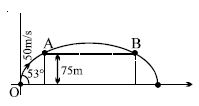
A
$30$
B
$60$
C
$90$
D
None
Solution
(B) Given: Initial speed $u = 50 \ m/s$,angle of projection $\theta = 53^{\circ}$,and height $y = 75 \ m$.
Using the trajectory equation of a projectile: $y = x \tan \theta - \frac{g x^2}{2 u^2 \cos^2 \theta}$.
Taking $g = 10 \ m/s^2$,$\tan 53^{\circ} = \frac{4}{3}$,and $\cos 53^{\circ} = \frac{3}{5}$.
Substituting the values: $75 = x \left(\frac{4}{3}\right) - \frac{10 x^2}{2 \times (50)^2 \times (3/5)^2}$.
$75 = \frac{4x}{3} - \frac{10 x^2}{2 \times 2500 \times (9/25)}$.
$75 = \frac{4x}{3} - \frac{10 x^2}{1800} \times 25 = \frac{4x}{3} - \frac{x^2}{180}$.
Multiplying by $180$: $13500 = 240x - x^2$.
Rearranging into a quadratic equation: $x^2 - 240x + 13500 = 0$.
Solving for $x$ using the quadratic formula $x = \frac{-b \pm \sqrt{b^2 - 4ac}}{2a}$:
$x = \frac{240 \pm \sqrt{57600 - 4(13500)}}{2} = \frac{240 \pm \sqrt{57600 - 54000}}{2} = \frac{240 \pm \sqrt{3600}}{2} = \frac{240 \pm 60}{2}$.
$x_1 = \frac{300}{2} = 150 \ m$ and $x_2 = \frac{180}{2} = 90 \ m$.
The horizontal separation is $\Delta x = |x_1 - x_2| = 150 - 90 = 60 \ m$.
Using the trajectory equation of a projectile: $y = x \tan \theta - \frac{g x^2}{2 u^2 \cos^2 \theta}$.
Taking $g = 10 \ m/s^2$,$\tan 53^{\circ} = \frac{4}{3}$,and $\cos 53^{\circ} = \frac{3}{5}$.
Substituting the values: $75 = x \left(\frac{4}{3}\right) - \frac{10 x^2}{2 \times (50)^2 \times (3/5)^2}$.
$75 = \frac{4x}{3} - \frac{10 x^2}{2 \times 2500 \times (9/25)}$.
$75 = \frac{4x}{3} - \frac{10 x^2}{1800} \times 25 = \frac{4x}{3} - \frac{x^2}{180}$.
Multiplying by $180$: $13500 = 240x - x^2$.
Rearranging into a quadratic equation: $x^2 - 240x + 13500 = 0$.
Solving for $x$ using the quadratic formula $x = \frac{-b \pm \sqrt{b^2 - 4ac}}{2a}$:
$x = \frac{240 \pm \sqrt{57600 - 4(13500)}}{2} = \frac{240 \pm \sqrt{57600 - 54000}}{2} = \frac{240 \pm \sqrt{3600}}{2} = \frac{240 \pm 60}{2}$.
$x_1 = \frac{300}{2} = 150 \ m$ and $x_2 = \frac{180}{2} = 90 \ m$.
The horizontal separation is $\Delta x = |x_1 - x_2| = 150 - 90 = 60 \ m$.
0 likes
View Solution3-2.Motion in Plane — Mix Examples-Motion in Plane · Frequently Asked Questions
1Are these 3-2.Motion in Plane questions useful for JEE and NEET?
Yes. All questions in this section are mapped to JEE Main and NEET exam patterns. Previous year questions from JEE Main, NEET, GUJCET and state-level exams are included with full solutions.
2Can I switch to Hindi or Gujarati for these questions?
Yes. Use the language tabs in the hero section or the sidebar to view the same questions and solutions in English, Hindi or Gujarati.
3How do I generate a question paper from this subtopic?
Use the Vedclass Exam Paper Generator — select the chapter and subtopic, set difficulty, and generate Sets A, B, C, D automatically. First 3 chapters of every subject are free.
Vedclass Products
For Students
Vedclass Test Series
Mock tests in real JEE/NEET style with performance analysis. 5-day free trial.
Start Free TrialFor Teachers
Exam Paper Generator
Generate Set A/B/C/D papers from this chapter in 2 minutes. 3 chapters free.
Try FreeFor Institutes
Online Exam Module
Live online exams with unlimited students, 360° analytics & white-label branding.
See DemoFor Teachers & Institutes
Generate a 3-2.Motion in Plane Exam Paper in 2 Minutes
Select subtopic & difficulty — Sets A, B, C, D auto-generated with No Repeat logic.
First 3 chapters of every subject are free — no payment required.