
A English
Mix Examples-Motion in Plane Questions in English
Class 11 Physics · 3-2.Motion in Plane · Mix Examples-Motion in Plane
396+
Questions
English
Language
100%
With Solutions
Showing 48 of 396 questions in English
101
AdvancedMCQ
At $t = 0$,a projectile is fired from a point $O$ (taken as origin) on the ground with a speed of $50 \, m/s$ at an angle of $53^{\circ}$ with the horizontal. It passes through two points $A$ and $B$,each at a height of $75 \, m$ above the horizontal,as shown in the figure. Find the distance (in meters) of the particle from the origin at $t = 2 \, s$.
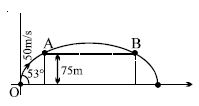
A
$60\sqrt{2}$
B
$100$
C
$60$
D
$120$
Solution
(A) Given: Initial speed $u = 50 \, m/s$,angle $\theta = 53^{\circ}$,time $t = 2 \, s$.
The horizontal and vertical components of initial velocity are:
$u_x = u \cos 53^{\circ} = 50 \times \frac{3}{5} = 30 \, m/s$
$u_y = u \sin 53^{\circ} = 50 \times \frac{4}{5} = 40 \, m/s$
At any time $t$,the position coordinates $(x, y)$ of the projectile are given by:
$x = u_x t = 30 \times 2 = 60 \, m$
$y = u_y t - \frac{1}{2} g t^2 = 40 \times 2 - \frac{1}{2} \times 10 \times (2)^2 = 80 - 20 = 60 \, m$
The distance $d$ of the particle from the origin $(0, 0)$ at $t = 2 \, s$ is:
$d = \sqrt{x^2 + y^2} = \sqrt{60^2 + 60^2} = \sqrt{2 \times 60^2} = 60\sqrt{2} \, m$.
The horizontal and vertical components of initial velocity are:
$u_x = u \cos 53^{\circ} = 50 \times \frac{3}{5} = 30 \, m/s$
$u_y = u \sin 53^{\circ} = 50 \times \frac{4}{5} = 40 \, m/s$
At any time $t$,the position coordinates $(x, y)$ of the projectile are given by:
$x = u_x t = 30 \times 2 = 60 \, m$
$y = u_y t - \frac{1}{2} g t^2 = 40 \times 2 - \frac{1}{2} \times 10 \times (2)^2 = 80 - 20 = 60 \, m$
The distance $d$ of the particle from the origin $(0, 0)$ at $t = 2 \, s$ is:
$d = \sqrt{x^2 + y^2} = \sqrt{60^2 + 60^2} = \sqrt{2 \times 60^2} = 60\sqrt{2} \, m$.
0 likes
View Solution102
AdvancedMCQ
Three particles,located initially on the vertices of an equilateral triangle of side $L$,start moving with a constant speed $v$ towards each other in a cyclic manner,forming spiral loci that converge at the centroid of the triangle. The length of one such spiral locus will be
A
$L$
B
$2L/\sqrt{3}$
C
$L/\sqrt{3}$
D
$2L/3$
Solution
(D) Let the particles be at vertices $A, B,$ and $C$ of an equilateral triangle with side $L$. Each particle moves towards the next one. The velocity of particle $A$ is directed towards $B$,and the velocity of particle $B$ is directed towards $C$. The component of the velocity of $A$ along the line $AB$ is $v$,and the component of the velocity of $B$ along $AB$ is $-v \cos(60^{\circ}) = -v/2$. The relative velocity of approach between $A$ and $B$ is $v_{rel} = v - (-v/2) = 3v/2$. The time taken for the particles to meet at the centroid is $t = L / v_{rel} = L / (3v/2) = 2L / (3v)$. Since each particle moves with a constant speed $v$,the distance covered by each particle is $s = v \times t = v \times (2L / 3v) = 2L/3$.
0 likes
View Solution103
AdvancedMCQ
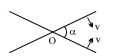
Find the speed of the intersection point $O$ of the two wires if the wires start moving perpendicular to themselves with speed $v$ as shown in the figure.
A
$v \csc(\alpha /2)$
B
$v \csc(\alpha)$
C
$v \cos(\alpha /2)$
D
$v \sec(\alpha /2)$
Solution
(A) Let the two wires intersect at point $O$ with an angle $\alpha$ between them. Each wire moves perpendicular to its length with a speed $v$.
Consider the bisector of the angle $\alpha$. Due to symmetry,the intersection point $O$ must move along this bisector.
Let the speed of the intersection point be $V$.
Consider one wire. The velocity of the intersection point $V$ makes an angle $\alpha /2$ with the direction of the wire's velocity $v$.
The component of the velocity of the intersection point $V$ along the direction of the wire's motion must be equal to the speed of the wire,$v$.
Therefore,$V \sin(\alpha /2) = v$.
Solving for $V$,we get $V = v / \sin(\alpha /2) = v \csc(\alpha /2)$.
Consider the bisector of the angle $\alpha$. Due to symmetry,the intersection point $O$ must move along this bisector.
Let the speed of the intersection point be $V$.
Consider one wire. The velocity of the intersection point $V$ makes an angle $\alpha /2$ with the direction of the wire's velocity $v$.
The component of the velocity of the intersection point $V$ along the direction of the wire's motion must be equal to the speed of the wire,$v$.
Therefore,$V \sin(\alpha /2) = v$.
Solving for $V$,we get $V = v / \sin(\alpha /2) = v \csc(\alpha /2)$.
0 likes
View Solution104
MediumMCQ
$A$ particle is moving along a curve. Then
A
if its speed is constant,it has no acceleration.
B
the direction of its acceleration cannot be along the tangent.
C
if its speed is constant,the magnitude of its acceleration is proportional to its curvature.
D
Both $(B)$ and $(C)$.
Solution
(D) For a particle moving along a curve,the acceleration vector $\vec{a}$ is given by $\vec{a} = \frac{dv}{dt} \hat{t} + \frac{v^2}{R} \hat{n}$,where $v$ is the speed,$R$ is the radius of curvature,$\hat{t}$ is the unit tangent vector,and $\hat{n}$ is the unit normal vector.
If the speed is constant,$\frac{dv}{dt} = 0$,so $\vec{a} = \frac{v^2}{R} \hat{n}$. This acceleration is directed towards the center of curvature (normal direction),not along the tangent. Thus,option $(B)$ is correct.
Since $\vec{a} = \frac{v^2}{R} \hat{n}$,the magnitude of acceleration is $|\vec{a}| = \frac{v^2}{R} = v^2 \kappa$,where $\kappa = \frac{1}{R}$ is the curvature. Thus,the magnitude of acceleration is proportional to the curvature $\kappa$. Thus,option $(C)$ is correct.
Therefore,both $(B)$ and $(C)$ are correct.
If the speed is constant,$\frac{dv}{dt} = 0$,so $\vec{a} = \frac{v^2}{R} \hat{n}$. This acceleration is directed towards the center of curvature (normal direction),not along the tangent. Thus,option $(B)$ is correct.
Since $\vec{a} = \frac{v^2}{R} \hat{n}$,the magnitude of acceleration is $|\vec{a}| = \frac{v^2}{R} = v^2 \kappa$,where $\kappa = \frac{1}{R}$ is the curvature. Thus,the magnitude of acceleration is proportional to the curvature $\kappa$. Thus,option $(C)$ is correct.
Therefore,both $(B)$ and $(C)$ are correct.
0 likes
View Solution105
DifficultMCQ
$A$ particle moves in a circle of radius $R$,with a constant speed $v$. Then,during a time interval $t = \pi R / 3v$,which of the following is true?
A
| average acceleration | = $3v^2 / \pi R$
B
| average velocity | = $3v / \pi$
C
| average acceleration | = $2v^2 / \pi R$
D
Both $(A)$ and $(B)$
Solution
(D) The angular velocity is $\omega = v / R$. The angle covered in time $t = \pi R / 3v$ is $\Delta \theta = \omega t = (v / R) \times (\pi R / 3v) = \pi / 3$ radians $(60^\circ)$.
Average velocity is given by $|\vec{v}_{avg}| = |\Delta \vec{r}| / t$. The magnitude of displacement is $|\Delta \vec{r}| = 2R \sin(\Delta \theta / 2) = 2R \sin(30^\circ) = 2R \times (1 / 2) = R$.
Thus,$|\vec{v}_{avg}| = R / (\pi R / 3v) = 3v / \pi$.
Average acceleration is given by $|\vec{a}_{avg}| = |\Delta \vec{v}| / t$. The magnitude of change in velocity is $|\Delta \vec{v}| = 2v \sin(\Delta \theta / 2) = 2v \sin(30^\circ) = 2v \times (1 / 2) = v$.
Thus,$|\vec{a}_{avg}| = v / (\pi R / 3v) = 3v^2 / \pi R$.
Since both $(A)$ and $(B)$ are correct,the answer is $(D)$.
Average velocity is given by $|\vec{v}_{avg}| = |\Delta \vec{r}| / t$. The magnitude of displacement is $|\Delta \vec{r}| = 2R \sin(\Delta \theta / 2) = 2R \sin(30^\circ) = 2R \times (1 / 2) = R$.
Thus,$|\vec{v}_{avg}| = R / (\pi R / 3v) = 3v / \pi$.
Average acceleration is given by $|\vec{a}_{avg}| = |\Delta \vec{v}| / t$. The magnitude of change in velocity is $|\Delta \vec{v}| = 2v \sin(\Delta \theta / 2) = 2v \sin(30^\circ) = 2v \times (1 / 2) = v$.
Thus,$|\vec{a}_{avg}| = v / (\pi R / 3v) = 3v^2 / \pi R$.
Since both $(A)$ and $(B)$ are correct,the answer is $(D)$.
0 likes
View Solution106
DifficultMCQ
$A$ projectile of mass $1 \, kg$ is projected with a velocity of $\sqrt{20} \, m/s$ such that it strikes on the same level as the point of projection at a distance of $\sqrt{3} \, m$. Which of the following options are incorrect:
A
the maximum height reached by the projectile can be $0.25 \, m$.
B
the minimum velocity during its motion can be $\sqrt{15} \, m/s$.
C
the time taken for the flight can be $\sqrt{\frac{3}{5}} \, sec$.
D
maximum potential energy during its motion can be $6 \, J$.
Solution
(D) Given: $m = 1 \, kg$,$u = \sqrt{20} \, m/s$,$R = \sqrt{3} \, m$,$g = 10 \, m/s^2$.
Using range formula: $R = \frac{u^2 \sin 2\theta}{g} \Rightarrow \sqrt{3} = \frac{20 \sin 2\theta}{10} \Rightarrow \sin 2\theta = \frac{\sqrt{3}}{2}$.
Thus,$2\theta = 60^\circ$ or $120^\circ$,so $\theta = 30^\circ$ or $60^\circ$.
For $\theta = 30^\circ$: $H = \frac{u^2 \sin^2 30^\circ}{2g} = \frac{20 \times (1/4)}{20} = 0.25 \, m$.
For $\theta = 60^\circ$: $H = \frac{u^2 \sin^2 60^\circ}{2g} = \frac{20 \times (3/4)}{20} = 0.75 \, m$.
Minimum velocity $v_{\min} = u \cos \theta$. For $\theta = 30^\circ$,$v_{\min} = \sqrt{20} \times \frac{\sqrt{3}}{2} = \sqrt{15} \, m/s$.
Time of flight $T = \frac{2u \sin \theta}{g}$. For $\theta = 60^\circ$,$T = \frac{2 \sqrt{20} \times \frac{\sqrt{3}}{2}}{10} = \sqrt{\frac{3}{5}} \, s$.
Maximum potential energy $U_{\max} = mgH_{\max} = 1 \times 10 \times 0.75 = 7.5 \, J$.
Comparing with options: $(a)$ is correct ($0.25 \, m$ is possible),$(b)$ is correct ($\sqrt{15} \, m/s$ is possible),$(c)$ is correct ($\sqrt{3/5} \, s$ is possible),$(d)$ is incorrect $(7.5 \, J \neq 6 \, J)$. Thus,option $(d)$ is the incorrect statement.
Using range formula: $R = \frac{u^2 \sin 2\theta}{g} \Rightarrow \sqrt{3} = \frac{20 \sin 2\theta}{10} \Rightarrow \sin 2\theta = \frac{\sqrt{3}}{2}$.
Thus,$2\theta = 60^\circ$ or $120^\circ$,so $\theta = 30^\circ$ or $60^\circ$.
For $\theta = 30^\circ$: $H = \frac{u^2 \sin^2 30^\circ}{2g} = \frac{20 \times (1/4)}{20} = 0.25 \, m$.
For $\theta = 60^\circ$: $H = \frac{u^2 \sin^2 60^\circ}{2g} = \frac{20 \times (3/4)}{20} = 0.75 \, m$.
Minimum velocity $v_{\min} = u \cos \theta$. For $\theta = 30^\circ$,$v_{\min} = \sqrt{20} \times \frac{\sqrt{3}}{2} = \sqrt{15} \, m/s$.
Time of flight $T = \frac{2u \sin \theta}{g}$. For $\theta = 60^\circ$,$T = \frac{2 \sqrt{20} \times \frac{\sqrt{3}}{2}}{10} = \sqrt{\frac{3}{5}} \, s$.
Maximum potential energy $U_{\max} = mgH_{\max} = 1 \times 10 \times 0.75 = 7.5 \, J$.
Comparing with options: $(a)$ is correct ($0.25 \, m$ is possible),$(b)$ is correct ($\sqrt{15} \, m/s$ is possible),$(c)$ is correct ($\sqrt{3/5} \, s$ is possible),$(d)$ is incorrect $(7.5 \, J \neq 6 \, J)$. Thus,option $(d)$ is the incorrect statement.
0 likes
View Solution107
DifficultMCQ
Choose the correct alternative$(s)$.
A
If the greatest height to which a man can throw a stone is $h$,then the greatest horizontal distance up to which he can throw the stone is $2h$.
B
The angle of projection for a projectile motion whose range $R$ is $n$ times the maximum height $H$ is $\theta = \tan^{-1}(4/n)$.
C
The time of flight $T$ and the horizontal range $R$ of a projectile are connected by the equation $gT^2 = 2R \tan \theta$,where $\theta$ is the angle of projection.
D
All of the above.
Solution
(D) $1$. For option $A$: Maximum height $H = u^2 / (2g)$ when $\theta = 90^\circ$. Maximum range $R_{max} = u^2 / g$ when $\theta = 45^\circ$. Thus,$R_{max} = 2H$. Option $A$ is correct.
$2$. For option $B$: $R = (u^2 \sin 2\theta) / g$ and $H = (u^2 \sin^2 \theta) / (2g)$. Given $R = nH$,we have $(2u^2 \sin \theta \cos \theta) / g = n \cdot (u^2 \sin^2 \theta) / (2g)$. This simplifies to $4 \cos \theta = n \sin \theta$,so $\tan \theta = 4/n$ or $\theta = \tan^{-1}(4/n)$. Option $B$ is correct.
$3$. For option $C$: $T = (2u \sin \theta) / g$,so $T^2 = (4u^2 \sin^2 \theta) / g^2$. Also $R = (u^2 \sin 2\theta) / g = (2u^2 \sin \theta \cos \theta) / g$. Then $2R \tan \theta = 2 \cdot [(2u^2 \sin \theta \cos \theta) / g] \cdot [\sin \theta / \cos \theta] = (4u^2 \sin^2 \theta) / g = gT^2$. Option $C$ is correct.
Since all statements are correct,the answer is $D$.
$2$. For option $B$: $R = (u^2 \sin 2\theta) / g$ and $H = (u^2 \sin^2 \theta) / (2g)$. Given $R = nH$,we have $(2u^2 \sin \theta \cos \theta) / g = n \cdot (u^2 \sin^2 \theta) / (2g)$. This simplifies to $4 \cos \theta = n \sin \theta$,so $\tan \theta = 4/n$ or $\theta = \tan^{-1}(4/n)$. Option $B$ is correct.
$3$. For option $C$: $T = (2u \sin \theta) / g$,so $T^2 = (4u^2 \sin^2 \theta) / g^2$. Also $R = (u^2 \sin 2\theta) / g = (2u^2 \sin \theta \cos \theta) / g$. Then $2R \tan \theta = 2 \cdot [(2u^2 \sin \theta \cos \theta) / g] \cdot [\sin \theta / \cos \theta] = (4u^2 \sin^2 \theta) / g = gT^2$. Option $C$ is correct.
Since all statements are correct,the answer is $D$.
0 likes
View Solution108
AdvancedMCQ
If $T$ is the total time of flight,$h$ is the maximum height,and $R$ is the horizontal range,how are the $x$ and $y$ coordinates of projectile motion related to time $t$ and range $R$?
A
$y = 4h\left( \frac{t}{T} \right)\left( 1 - \frac{t}{T} \right)$
B
$y = 4h\left( \frac{x}{R} \right)\left( 1 - \frac{x}{R} \right)$
C
$y = 4h\left( \frac{T}{t} \right)\left( 1 - \frac{T}{t} \right)$
D
Both $(A)$ and $(B)$
Solution
(D) For a projectile launched with initial velocity $u$ at an angle $\theta$ with the horizontal:
$1$. The horizontal displacement is $x = (u \cos \theta)t$. Since $R = (u \cos \theta)T$,we have $x/R = t/T$.
$2$. The vertical displacement is $y = (u \sin \theta)t - \frac{1}{2}gt^2$. Since $h = \frac{u^2 \sin^2 \theta}{2g}$ and $T = \frac{2u \sin \theta}{g}$,we can write $u \sin \theta = \frac{gT}{2}$.
$3$. Substituting $u \sin \theta$ and $g = \frac{2u \sin \theta}{T}$ into the equation for $y$:
$y = \left( \frac{gT}{2} \right)t - \frac{1}{2}g t^2 = \frac{gT^2}{2} \left( \frac{t}{T} \right) - \frac{gT^2}{2} \left( \frac{t}{T} \right)^2 = \frac{gT^2}{2} \left( \frac{t}{T} \right) \left( 1 - \frac{t}{T} \right)$.
$4$. Since $h = \frac{(u \sin \theta)^2}{2g} = \frac{(gT/2)^2}{2g} = \frac{gT^2}{8}$,we have $\frac{gT^2}{2} = 4h$.
$5$. Thus,$y = 4h \left( \frac{t}{T} \right) \left( 1 - \frac{t}{T} \right)$.
$6$. Substituting $t/T = x/R$,we get $y = 4h \left( \frac{x}{R} \right) \left( 1 - \frac{x}{R} \right)$.
Therefore,both $(A)$ and $(B)$ are correct.
$1$. The horizontal displacement is $x = (u \cos \theta)t$. Since $R = (u \cos \theta)T$,we have $x/R = t/T$.
$2$. The vertical displacement is $y = (u \sin \theta)t - \frac{1}{2}gt^2$. Since $h = \frac{u^2 \sin^2 \theta}{2g}$ and $T = \frac{2u \sin \theta}{g}$,we can write $u \sin \theta = \frac{gT}{2}$.
$3$. Substituting $u \sin \theta$ and $g = \frac{2u \sin \theta}{T}$ into the equation for $y$:
$y = \left( \frac{gT}{2} \right)t - \frac{1}{2}g t^2 = \frac{gT^2}{2} \left( \frac{t}{T} \right) - \frac{gT^2}{2} \left( \frac{t}{T} \right)^2 = \frac{gT^2}{2} \left( \frac{t}{T} \right) \left( 1 - \frac{t}{T} \right)$.
$4$. Since $h = \frac{(u \sin \theta)^2}{2g} = \frac{(gT/2)^2}{2g} = \frac{gT^2}{8}$,we have $\frac{gT^2}{2} = 4h$.
$5$. Thus,$y = 4h \left( \frac{t}{T} \right) \left( 1 - \frac{t}{T} \right)$.
$6$. Substituting $t/T = x/R$,we get $y = 4h \left( \frac{x}{R} \right) \left( 1 - \frac{x}{R} \right)$.
Therefore,both $(A)$ and $(B)$ are correct.
0 likes
View Solution109
DifficultMCQ
$A$ ball is rolled off along the edge of a horizontal table with velocity $4 \, m/s$. It hits the ground after time $0.4 \, s$. Which of the following are correct?
A
The height of the table is $0.8 \, m$
B
It hits the ground with vertical velocity $4 \, m/s$
C
It covers a horizontal distance $1.6 \, m$ from the table
D
All of the above
Solution
(D) The vertical displacement is given by $y = u_y t + \frac{1}{2} a_y t^2$. Since the ball is rolled horizontally,the initial vertical velocity $u_y = 0$. Taking downward as positive,$h = \frac{1}{2} g t^2 = \frac{1}{2} \times 10 \times (0.4)^2 = 0.8 \, m$. So,option $A$ is correct.
The vertical velocity at time $t$ is $v_y = u_y + g t = 0 + 10 \times 0.4 = 4 \, m/s$. So,option $B$ is correct.
The horizontal distance covered is $x = u_x t = 4 \times 0.4 = 1.6 \, m$. So,option $C$ is correct.
Since all statements $A, B,$ and $C$ are correct,the correct answer is $D$.
The vertical velocity at time $t$ is $v_y = u_y + g t = 0 + 10 \times 0.4 = 4 \, m/s$. So,option $B$ is correct.
The horizontal distance covered is $x = u_x t = 4 \times 0.4 = 1.6 \, m$. So,option $C$ is correct.
Since all statements $A, B,$ and $C$ are correct,the correct answer is $D$.
0 likes
View Solution110
MediumMCQ
$A$ particle is projected from the ground with velocity $u$ at an angle $\theta$ with the horizontal. The horizontal range,maximum height,and time of flight are $R, H$,and $T$ respectively. They are given by $R = \frac{u^2 \sin 2\theta}{g}$,$H = \frac{u^2 \sin^2 \theta}{2g}$,and $T = \frac{2u \sin \theta}{g}$. Now,keeping $u$ fixed,$\theta$ is varied from $30^o$ to $60^o$. Then,
A
$R$ will first increase then decrease,$H$ will increase and $T$ will decrease
B
$R$ will first increase then decrease while $H$ and $T$ both will increase
C
$R$ will decrease while $H$ and $T$ will increase
D
$R$ will increase while $H$ and $T$ will increase
Solution
(B) Given the formulas: $R = \frac{u^2 \sin 2\theta}{g}$,$H = \frac{u^2 \sin^2 \theta}{2g}$,and $T = \frac{2u \sin \theta}{g}$.
Since $u$ is constant,we analyze the trigonometric functions as $\theta$ varies from $30^o$ to $60^o$.
For $R$: The term $\sin 2\theta$ varies from $\sin 60^o = \frac{\sqrt{3}}{2} \approx 0.866$ to $\sin 120^o = \frac{\sqrt{3}}{2} \approx 0.866$,passing through $\sin 90^o = 1$ at $\theta = 45^o$. Thus,$R$ increases until $45^o$ and then decreases.
For $H$: The term $\sin^2 \theta$ increases monotonically as $\theta$ increases from $30^o$ to $60^o$ (since $\sin 30^o = 0.5$ and $\sin 60^o \approx 0.866$). Thus,$H$ increases.
For $T$: The term $\sin \theta$ increases monotonically as $\theta$ increases from $30^o$ to $60^o$. Thus,$T$ increases.
Therefore,$R$ first increases then decreases,while $H$ and $T$ both increase.
Since $u$ is constant,we analyze the trigonometric functions as $\theta$ varies from $30^o$ to $60^o$.
For $R$: The term $\sin 2\theta$ varies from $\sin 60^o = \frac{\sqrt{3}}{2} \approx 0.866$ to $\sin 120^o = \frac{\sqrt{3}}{2} \approx 0.866$,passing through $\sin 90^o = 1$ at $\theta = 45^o$. Thus,$R$ increases until $45^o$ and then decreases.
For $H$: The term $\sin^2 \theta$ increases monotonically as $\theta$ increases from $30^o$ to $60^o$ (since $\sin 30^o = 0.5$ and $\sin 60^o \approx 0.866$). Thus,$H$ increases.
For $T$: The term $\sin \theta$ increases monotonically as $\theta$ increases from $30^o$ to $60^o$. Thus,$T$ increases.
Therefore,$R$ first increases then decreases,while $H$ and $T$ both increase.
0 likes
View Solution111
MediumMCQ
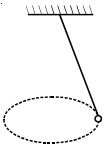
In a conical pendulum,the bob is rotated with different angular velocities and the tension in the string is calculated for different values of $\omega$. Which of the following is the correct graph between $T$ and $\omega$?
A
B
C
D
Solution
(A) For a conical pendulum,the bob moves in a horizontal circle of radius $r = l \sin \theta$,where $l$ is the length of the string and $\theta$ is the angle with the vertical.
The forces acting on the bob are tension $T$ along the string and weight $mg$ downwards.
The vertical component of tension balances the weight: $T \cos \theta = mg \implies T = \frac{mg}{\cos \theta}$.
The horizontal component provides the centripetal force: $T \sin \theta = m \omega^2 r = m \omega^2 (l \sin \theta)$.
From the horizontal component,$T = ml \omega^2$. This implies that for a fixed length $l$,$T$ is directly proportional to $\omega^2$.
However,as $\omega$ increases,the angle $\theta$ increases. At $\omega = 0$,the bob is at rest,and $T = mg$. As $\omega$ increases,the bob starts moving in a circle,and the tension increases as $T = ml \omega^2$ (for small angles,$T \approx mg + \frac{1}{2}ml\omega^2$ is a common approximation,but generally $T$ increases with $\omega^2$).
Looking at the options,option $A$ represents the behavior where $T$ starts at $mg$ (at $\omega=0$) and increases with $\omega^2$ as the pendulum gains angular velocity.
The forces acting on the bob are tension $T$ along the string and weight $mg$ downwards.
The vertical component of tension balances the weight: $T \cos \theta = mg \implies T = \frac{mg}{\cos \theta}$.
The horizontal component provides the centripetal force: $T \sin \theta = m \omega^2 r = m \omega^2 (l \sin \theta)$.
From the horizontal component,$T = ml \omega^2$. This implies that for a fixed length $l$,$T$ is directly proportional to $\omega^2$.
However,as $\omega$ increases,the angle $\theta$ increases. At $\omega = 0$,the bob is at rest,and $T = mg$. As $\omega$ increases,the bob starts moving in a circle,and the tension increases as $T = ml \omega^2$ (for small angles,$T \approx mg + \frac{1}{2}ml\omega^2$ is a common approximation,but generally $T$ increases with $\omega^2$).
Looking at the options,option $A$ represents the behavior where $T$ starts at $mg$ (at $\omega=0$) and increases with $\omega^2$ as the pendulum gains angular velocity.
0 likes
View Solution112
MediumMCQ
$A$ particle is moving in a circle:
A
The resultant force may be towards the centre.
B
The direction of the angular acceleration and the angular velocity must be the same.
C
The resultant force on the particle must be towards the centre.
D
The cross product of the tangential acceleration and the angular velocity will be zero.
Solution
(A) In circular motion,the acceleration of a particle has two components: centripetal acceleration $(a_c)$ directed towards the center and tangential acceleration $(a_t)$ directed along the tangent.
The resultant force $F = ma$ is the vector sum of the centripetal force $(F_c = ma_c)$ and the tangential force $(F_t = ma_t)$.
If the motion is uniform circular motion,$a_t = 0$,so the resultant force is purely centripetal (towards the center).
If the motion is non-uniform circular motion,$a_t \neq 0$,so the resultant force is not directed towards the center.
Therefore,the resultant force may be towards the center (in uniform circular motion) or at an angle to the radius (in non-uniform circular motion).
Option $A$ is correct because it states the force 'may' be towards the center,which covers the uniform case.
The resultant force $F = ma$ is the vector sum of the centripetal force $(F_c = ma_c)$ and the tangential force $(F_t = ma_t)$.
If the motion is uniform circular motion,$a_t = 0$,so the resultant force is purely centripetal (towards the center).
If the motion is non-uniform circular motion,$a_t \neq 0$,so the resultant force is not directed towards the center.
Therefore,the resultant force may be towards the center (in uniform circular motion) or at an angle to the radius (in non-uniform circular motion).
Option $A$ is correct because it states the force 'may' be towards the center,which covers the uniform case.
0 likes
View Solution113
DifficultMCQ
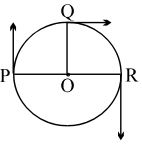
Three point particles $P, Q, R$ move in a circle of radius $r$ with different but constant speeds. They start moving at $t = 0$ from their initial positions as shown in the figure. The angular velocities (in $rad/s$) of $P, Q,$ and $R$ are $5\pi, 2\pi,$ and $3\pi$ respectively, in the same sense. Find the time interval after which they are at the same angular position.
A
$2/3 \, s$
B
$1/6 \, s$
C
$1/2 \, s$
D
$3/2 \, s$
Solution
(C) Let the angular positions at $t=0$ be $\theta_P(0) = \pi$, $\theta_Q(0) = \pi/2$, and $\theta_R(0) = 0$.
The angular positions at time $t$ are:
$\theta_P(t) = 5\pi t + \pi$
$\theta_Q(t) = 2\pi t + \pi/2$
$\theta_R(t) = 3\pi t + 0$
For particles $P$ and $Q$ to be at the same position: $\theta_P(t) - \theta_Q(t) = 2n\pi$ (where $n$ is an integer).
$3\pi t + \pi/2 = 2n\pi \implies 3t = 2n - 1/2 \implies t = (4n-1)/6$.
For $n=1, t = 3/6 = 1/2 \, s$. For $n=2, t = 7/6 \, s$. For $n=3, t = 11/6 \, s$.
For particles $Q$ and $R$ to be at the same position: $\theta_Q(t) - \theta_R(t) = 2m\pi$.
$-\pi t + \pi/2 = 2m\pi \implies t = 1/2 - 2m$.
For $m=0, t = 1/2 \, s$. For $m=-1, t = 2.5 \, s$.
Comparing the times, they all meet at $t = 1/2 \, s$.
The angular positions at time $t$ are:
$\theta_P(t) = 5\pi t + \pi$
$\theta_Q(t) = 2\pi t + \pi/2$
$\theta_R(t) = 3\pi t + 0$
For particles $P$ and $Q$ to be at the same position: $\theta_P(t) - \theta_Q(t) = 2n\pi$ (where $n$ is an integer).
$3\pi t + \pi/2 = 2n\pi \implies 3t = 2n - 1/2 \implies t = (4n-1)/6$.
For $n=1, t = 3/6 = 1/2 \, s$. For $n=2, t = 7/6 \, s$. For $n=3, t = 11/6 \, s$.
For particles $Q$ and $R$ to be at the same position: $\theta_Q(t) - \theta_R(t) = 2m\pi$.
$-\pi t + \pi/2 = 2m\pi \implies t = 1/2 - 2m$.
For $m=0, t = 1/2 \, s$. For $m=-1, t = 2.5 \, s$.
Comparing the times, they all meet at $t = 1/2 \, s$.
0 likes
View Solution114
DifficultMCQ
Three point particles $P, Q, R$ move in a circle of radius $r$ with different but constant speeds. They start moving at $t = 0$ from their initial positions as shown in the figure. The angular velocities (in $\text{rad/s}$) of $P, Q$ and $R$ are $5\pi, 2\pi$ and $3\pi$ respectively,in the same sense. The number of times $P$ and $Q$ meet in the time interval $t = 0$ to $t = 1 \text{ s}$ is:
A
$4$
B
$1$
C
$3$
D
$9$
Solution
(B) Let the initial angular positions be $\theta_P(0) = \pi$,$\theta_Q(0) = \pi/2$,and $\theta_R(0) = 0$ (taking $R$ at the positive $x$-axis).
The angular positions at time $t$ are given by $\theta(t) = \theta(0) + \omega t$.
$\theta_P(t) = \pi + 5\pi t$
$\theta_Q(t) = \pi/2 + 2\pi t$
Particles $P$ and $Q$ meet when $\theta_P(t) = \theta_Q(t) + 2n\pi$,where $n$ is an integer.
$\pi + 5\pi t = \pi/2 + 2\pi t + 2n\pi$
$3\pi t = 2n\pi - \pi/2$
$3t = 2n - 0.5$
$t = (2n - 0.5) / 3$
For $0 \le t \le 1$:
$0 \le (2n - 0.5) / 3 \le 1$
$0 \le 2n - 0.5 \le 3$
$0.5 \le 2n \le 3.5$
$0.25 \le n \le 1.75$
Since $n$ must be an integer,$n = 1$.
Thus,they meet only once at $t = (2(1) - 0.5) / 3 = 1.5 / 3 = 0.5 \text{ s}$.
The angular positions at time $t$ are given by $\theta(t) = \theta(0) + \omega t$.
$\theta_P(t) = \pi + 5\pi t$
$\theta_Q(t) = \pi/2 + 2\pi t$
Particles $P$ and $Q$ meet when $\theta_P(t) = \theta_Q(t) + 2n\pi$,where $n$ is an integer.
$\pi + 5\pi t = \pi/2 + 2\pi t + 2n\pi$
$3\pi t = 2n\pi - \pi/2$
$3t = 2n - 0.5$
$t = (2n - 0.5) / 3$
For $0 \le t \le 1$:
$0 \le (2n - 0.5) / 3 \le 1$
$0 \le 2n - 0.5 \le 3$
$0.5 \le 2n \le 3.5$
$0.25 \le n \le 1.75$
Since $n$ must be an integer,$n = 1$.
Thus,they meet only once at $t = (2(1) - 0.5) / 3 = 1.5 / 3 = 0.5 \text{ s}$.
0 likes
View Solution115
DifficultMCQ
$A$ body of mass $1 \, kg$ starts moving from rest at $t = 0$ in a circular path of radius $8 \, m$. Its kinetic energy varies as a function of time as: $K.E. = 2t^2 \, J$,where $t$ is in seconds. Then:
A
tangential acceleration $= 4 \, m/s^2$
B
power of all forces at $t = 2 \, s$ is $8 \, W$
C
first round is completed in $2 \, s$
D
tangential force at $t = 2 \, s$ is $4 \, N$
Solution
(B) Given $K.E. = \frac{1}{2}mv^2 = 2t^2$. Since $m = 1 \, kg$,we have $\frac{1}{2}(1)v^2 = 2t^2$,which implies $v^2 = 4t^2$,so $v = 2t \, m/s$.
Tangential acceleration $a_t = \frac{dv}{dt} = \frac{d}{dt}(2t) = 2 \, m/s^2$. Thus,option $A$ is incorrect.
Power $P = \frac{d(K.E.)}{dt} = \frac{d}{dt}(2t^2) = 4t$. At $t = 2 \, s$,$P = 4(2) = 8 \, W$. Thus,option $B$ is correct.
Tangential force $F_t = m \cdot a_t = 1 \cdot 2 = 2 \, N$. Thus,option $D$ is incorrect.
For the first round,distance $s = 2\pi r = 2\pi(8) = 16\pi \, m$. Since $v = 2t$,$s = \int v \, dt = \int_0^T 2t \, dt = T^2$. Setting $T^2 = 16\pi$,$T = 4\sqrt{\pi} \, s \neq 2 \, s$. Thus,option $C$ is incorrect.
Tangential acceleration $a_t = \frac{dv}{dt} = \frac{d}{dt}(2t) = 2 \, m/s^2$. Thus,option $A$ is incorrect.
Power $P = \frac{d(K.E.)}{dt} = \frac{d}{dt}(2t^2) = 4t$. At $t = 2 \, s$,$P = 4(2) = 8 \, W$. Thus,option $B$ is correct.
Tangential force $F_t = m \cdot a_t = 1 \cdot 2 = 2 \, N$. Thus,option $D$ is incorrect.
For the first round,distance $s = 2\pi r = 2\pi(8) = 16\pi \, m$. Since $v = 2t$,$s = \int v \, dt = \int_0^T 2t \, dt = T^2$. Setting $T^2 = 16\pi$,$T = 4\sqrt{\pi} \, s \neq 2 \, s$. Thus,option $C$ is incorrect.
0 likes
View Solution116
DifficultMCQ
$A$ projectile of mass $m$ is projected from the ground with a speed of $50 \, m/s$ at an angle of $53^{\circ}$ with the horizontal. It breaks up into two equal parts at the highest point of the trajectory. One particle comes to rest immediately after the explosion. The ratio of the radii of curvatures of the moving particle just before and just after the explosion is:
A
$1 : 4$
B
$1 : 3$
C
$2 : 3$
D
$4 : 9$
Solution
(A) At the highest point,the velocity of the projectile just before the explosion is $v_x = u \cos 53^{\circ} = 50 \times 0.6 = 30 \, m/s$.
Let the mass of the projectile be $2m$. At the highest point,the momentum is $P_i = (2m)v_x = 60m$.
After the explosion,one part of mass $m$ comes to rest $(v_1 = 0)$,and the other part of mass $m$ moves with velocity $v_2$.
By conservation of linear momentum: $P_i = P_f \implies 60m = m(0) + m(v_2) \implies v_2 = 60 \, m/s$.
The radius of curvature is given by $R = \frac{v^2}{a_n}$,where $a_n$ is the normal acceleration.
At the highest point,the only acceleration acting is gravity $(g = 10 \, m/s^2)$,which is perpendicular to the velocity.
Radius of curvature just before explosion: $R_1 = \frac{v_x^2}{g} = \frac{30^2}{10} = 90 \, m$.
Radius of curvature just after explosion for the moving particle: $R_2 = \frac{v_2^2}{g} = \frac{60^2}{10} = 360 \, m$.
The ratio is $\frac{R_1}{R_2} = \frac{90}{360} = \frac{1}{4}$.
Let the mass of the projectile be $2m$. At the highest point,the momentum is $P_i = (2m)v_x = 60m$.
After the explosion,one part of mass $m$ comes to rest $(v_1 = 0)$,and the other part of mass $m$ moves with velocity $v_2$.
By conservation of linear momentum: $P_i = P_f \implies 60m = m(0) + m(v_2) \implies v_2 = 60 \, m/s$.
The radius of curvature is given by $R = \frac{v^2}{a_n}$,where $a_n$ is the normal acceleration.
At the highest point,the only acceleration acting is gravity $(g = 10 \, m/s^2)$,which is perpendicular to the velocity.
Radius of curvature just before explosion: $R_1 = \frac{v_x^2}{g} = \frac{30^2}{10} = 90 \, m$.
Radius of curvature just after explosion for the moving particle: $R_2 = \frac{v_2^2}{g} = \frac{60^2}{10} = 360 \, m$.
The ratio is $\frac{R_1}{R_2} = \frac{90}{360} = \frac{1}{4}$.
0 likes
View Solution117
AdvancedMCQ
Two particles move on a circular path (one just inside and the other just outside) with angular velocities $\omega$ and $5\omega$ starting from the same point. Then
A
they cross each other at points on the path subtending $90^{\circ}$ at the centre if their angular velocities are in the same sense.
B
they cross each other at points on the path subtending an angle of $60^{\circ}$ at the centre if their angular velocities are oppositely directed.
C
they cross at intervals of time $\frac{\pi}{3\omega}$ if their angular velocities are oppositely directed.
D
All of the above
Solution
(D) Case $1$: When both move in opposite directions.
Let the angular positions be $\theta_1 = \omega t$ and $\theta_2 = 5\omega t$.
They meet when the sum of their angular displacements equals $2\pi$ radians: $\theta_2 + \theta_1 = 2\pi$.
$5\omega t + \omega t = 2\pi \implies 6\omega t = 2\pi \implies \omega t = \frac{\pi}{3} = 60^{\circ}$.
Thus,they cross at points subtending $60^{\circ}$ at the center.
The time interval between crossings is $T = \frac{2\pi}{\omega_{rel}} = \frac{2\pi}{5\omega + \omega} = \frac{2\pi}{6\omega} = \frac{\pi}{3\omega}$.
Case $2$: When both move in the same direction.
They meet when the difference of their angular displacements equals $2\pi$ radians: $\theta_2 - \theta_1 = 2\pi$.
$5\omega t - \omega t = 2\pi \implies 4\omega t = 2\pi \implies \omega t = \frac{\pi}{2} = 90^{\circ}$.
Thus,they cross at points subtending $90^{\circ}$ at the center.
Since all statements are correct,the answer is $D$.
Let the angular positions be $\theta_1 = \omega t$ and $\theta_2 = 5\omega t$.
They meet when the sum of their angular displacements equals $2\pi$ radians: $\theta_2 + \theta_1 = 2\pi$.
$5\omega t + \omega t = 2\pi \implies 6\omega t = 2\pi \implies \omega t = \frac{\pi}{3} = 60^{\circ}$.
Thus,they cross at points subtending $60^{\circ}$ at the center.
The time interval between crossings is $T = \frac{2\pi}{\omega_{rel}} = \frac{2\pi}{5\omega + \omega} = \frac{2\pi}{6\omega} = \frac{\pi}{3\omega}$.
Case $2$: When both move in the same direction.
They meet when the difference of their angular displacements equals $2\pi$ radians: $\theta_2 - \theta_1 = 2\pi$.
$5\omega t - \omega t = 2\pi \implies 4\omega t = 2\pi \implies \omega t = \frac{\pi}{2} = 90^{\circ}$.
Thus,they cross at points subtending $90^{\circ}$ at the center.
Since all statements are correct,the answer is $D$.
0 likes
View Solution118
MediumMCQ
$A$ cart moves with a constant speed along a horizontal circular path. From the cart,a particle is thrown up vertically with respect to the cart.
A
The particle will land somewhere on the circular path.
B
The particle will land outside the circular path.
C
The particle will follow a parabolic path.
D
Both $(B)$ and $(C)$.
Solution
(D) When the particle is thrown vertically upward from the moving cart,it possesses the same horizontal velocity as the cart at the instant of projection. This horizontal velocity is directed tangentially to the circular path.
Since the cart continues to move along the circular path while the particle is in the air,the particle's horizontal motion is linear (tangential),whereas the cart's motion is curved. Consequently,the particle will land outside the circular path.
Additionally,because the particle has both a constant horizontal velocity (tangential) and a vertical velocity influenced by gravity,its trajectory relative to the ground is a parabola. Therefore,both $(B)$ and $(C)$ are correct.
Since the cart continues to move along the circular path while the particle is in the air,the particle's horizontal motion is linear (tangential),whereas the cart's motion is curved. Consequently,the particle will land outside the circular path.
Additionally,because the particle has both a constant horizontal velocity (tangential) and a vertical velocity influenced by gravity,its trajectory relative to the ground is a parabola. Therefore,both $(B)$ and $(C)$ are correct.
0 likes
View Solution119
MediumMCQ
$A$ particle moves in the $xy$ plane according to the law $x = a \sin \omega t$ and $y = a(1 - \cos \omega t)$,where $a$ and $\omega$ are constants. The particle traces:
A
a distance proportional to time.
B
a straight line equally inclined to $x$ and $y$ axes.
C
a circle.
D
$(A)$ and $(C)$ both.
Solution
(C) Given the equations of motion:
$x = a \sin(\omega t) \Rightarrow \frac{x}{a} = \sin(\omega t)$
$y = a(1 - \cos(\omega t)) \Rightarrow \frac{y}{a} = 1 - \cos(\omega t) \Rightarrow \frac{y}{a} - 1 = -\cos(\omega t) \Rightarrow 1 - \frac{y}{a} = \cos(\omega t)$
Squaring and adding both equations:
$(\frac{x}{a})^2 + (1 - \frac{y}{a})^2 = \sin^2(\omega t) + \cos^2(\omega t)$
$\frac{x^2}{a^2} + \frac{(a - y)^2}{a^2} = 1$
$x^2 + (y - a)^2 = a^2$
This is the equation of a circle with center $(0, a)$ and radius $a$.
$x = a \sin(\omega t) \Rightarrow \frac{x}{a} = \sin(\omega t)$
$y = a(1 - \cos(\omega t)) \Rightarrow \frac{y}{a} = 1 - \cos(\omega t) \Rightarrow \frac{y}{a} - 1 = -\cos(\omega t) \Rightarrow 1 - \frac{y}{a} = \cos(\omega t)$
Squaring and adding both equations:
$(\frac{x}{a})^2 + (1 - \frac{y}{a})^2 = \sin^2(\omega t) + \cos^2(\omega t)$
$\frac{x^2}{a^2} + \frac{(a - y)^2}{a^2} = 1$
$x^2 + (y - a)^2 = a^2$
This is the equation of a circle with center $(0, a)$ and radius $a$.
0 likes
View Solution120
MediumMCQ
$A$ particle has an initial velocity of $(3\hat i + 4\hat j) \; ms^{-1}$ and an acceleration of $(0.4\hat i + 0.3\hat j) \; ms^{-2}$. Its speed after $10 \; s$ is:
A
$7$ unit
B
$8.5$ unit
C
$10$ unit
D
$7\sqrt{2}$ unit
Solution
(D) Given: Initial velocity $\vec{u} = (3\hat{i} + 4\hat{j}) \; ms^{-1}$,acceleration $\vec{a} = (0.4\hat{i} + 0.3\hat{j}) \; ms^{-2}$,and time $t = 10 \; s$.
Using the first equation of motion for vectors: $\vec{v} = \vec{u} + \vec{a}t$.
Substituting the values: $\vec{v} = (3\hat{i} + 4\hat{j}) + (0.4\hat{i} + 0.3\hat{j}) \times 10$.
$\vec{v} = (3\hat{i} + 4\hat{j}) + (4\hat{i} + 3\hat{j}) = 7\hat{i} + 7\hat{j}$.
The speed is the magnitude of the velocity vector $\vec{v}$.
$|\vec{v}| = \sqrt{7^2 + 7^2} = \sqrt{49 + 49} = \sqrt{98} = 7\sqrt{2} \; ms^{-1}$.
Using the first equation of motion for vectors: $\vec{v} = \vec{u} + \vec{a}t$.
Substituting the values: $\vec{v} = (3\hat{i} + 4\hat{j}) + (0.4\hat{i} + 0.3\hat{j}) \times 10$.
$\vec{v} = (3\hat{i} + 4\hat{j}) + (4\hat{i} + 3\hat{j}) = 7\hat{i} + 7\hat{j}$.
The speed is the magnitude of the velocity vector $\vec{v}$.
$|\vec{v}| = \sqrt{7^2 + 7^2} = \sqrt{49 + 49} = \sqrt{98} = 7\sqrt{2} \; ms^{-1}$.
0 likes
View Solution121
DifficultMCQ
$A$ particle is moving with velocity $\vec v = K(y\hat i + x\hat j)$ where $K$ is a constant. The general equation for its path is
A
$y^2 = x^2 + \text{constant}$
B
$y = x^2 + \text{constant}$
C
$y^2 = x + \text{constant}$
D
$xy = \text{constant}$
Solution
(A) Given the velocity vector $\vec v = K(y\hat i + x\hat j)$.
We know that $\vec v = v_x \hat i + v_y \hat j = \frac{dx}{dt} \hat i + \frac{dy}{dt} \hat j$.
Comparing the components,we get $\frac{dx}{dt} = Ky$ and $\frac{dy}{dt} = Kx$.
To find the path of the particle,we divide the two equations: $\frac{dy/dt}{dx/dt} = \frac{Kx}{Ky}$.
This simplifies to $\frac{dy}{dx} = \frac{x}{y}$.
Rearranging the terms,we get $y \, dy = x \, dx$.
Integrating both sides,we obtain $\int y \, dy = \int x \, dx$.
This results in $\frac{y^2}{2} = \frac{x^2}{2} + C'$,where $C'$ is a constant.
Multiplying by $2$,we get $y^2 = x^2 + C$,where $C = 2C'$ is another constant.
Thus,the equation of the path is $y^2 = x^2 + \text{constant}$.
We know that $\vec v = v_x \hat i + v_y \hat j = \frac{dx}{dt} \hat i + \frac{dy}{dt} \hat j$.
Comparing the components,we get $\frac{dx}{dt} = Ky$ and $\frac{dy}{dt} = Kx$.
To find the path of the particle,we divide the two equations: $\frac{dy/dt}{dx/dt} = \frac{Kx}{Ky}$.
This simplifies to $\frac{dy}{dx} = \frac{x}{y}$.
Rearranging the terms,we get $y \, dy = x \, dx$.
Integrating both sides,we obtain $\int y \, dy = \int x \, dx$.
This results in $\frac{y^2}{2} = \frac{x^2}{2} + C'$,where $C'$ is a constant.
Multiplying by $2$,we get $y^2 = x^2 + C$,where $C = 2C'$ is another constant.
Thus,the equation of the path is $y^2 = x^2 + \text{constant}$.
0 likes
View Solution122
MediumMCQ
$A$ particle moves along a circle with a constant angular speed $\omega$. Its displacement,with respect to the initial position of the particle at time $t = 0$,is plotted against time. The graph would look like:
A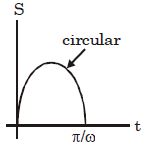
B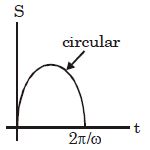
C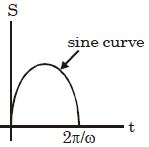
D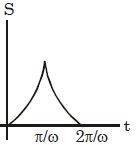
Solution
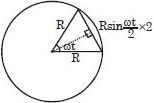
(C) Let the particle move on a circle of radius $R$ with constant angular speed $\omega$. At $t = 0$,the particle is at a position $P_0$. At time $t$,the particle is at position $P$,such that the angle $\angle P_0OP = \theta = \omega t$.
The displacement $S$ is the chord length $P_0P$. In the isosceles triangle $\triangle P_0OP$,the length of the chord is given by $S = 2R \sin(\frac{\theta}{2}) = 2R \sin(\frac{\omega t}{2})$.
This function represents a sine curve with a period $T = \frac{2\pi}{\omega}$.
At $t = 0$,$S = 0$. At $t = \frac{\pi}{\omega}$,$S = 2R \sin(\frac{\pi}{2}) = 2R$ (maximum displacement). At $t = \frac{2\pi}{\omega}$,$S = 2R \sin(\pi) = 0$.
Thus,the graph is a sine curve starting from $0$,reaching a maximum at $t = \frac{\pi}{\omega}$,and returning to $0$ at $t = \frac{2\pi}{\omega}$. This corresponds to the graph shown in option $C$.
The displacement $S$ is the chord length $P_0P$. In the isosceles triangle $\triangle P_0OP$,the length of the chord is given by $S = 2R \sin(\frac{\theta}{2}) = 2R \sin(\frac{\omega t}{2})$.
This function represents a sine curve with a period $T = \frac{2\pi}{\omega}$.
At $t = 0$,$S = 0$. At $t = \frac{\pi}{\omega}$,$S = 2R \sin(\frac{\pi}{2}) = 2R$ (maximum displacement). At $t = \frac{2\pi}{\omega}$,$S = 2R \sin(\pi) = 0$.
Thus,the graph is a sine curve starting from $0$,reaching a maximum at $t = \frac{\pi}{\omega}$,and returning to $0$ at $t = \frac{2\pi}{\omega}$. This corresponds to the graph shown in option $C$.
0 likes
View Solution123
DifficultMCQ
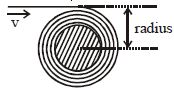
The given diagram shows a straight length of tape being wound on to a reel. The reel is rotating about a fixed axis with constant angular velocity and its radius is increasing at a steady rate. Which graph correctly shows the variation with time of the speed $v$ at which the tape moves towards the roll?
A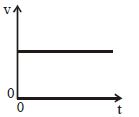
B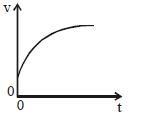
C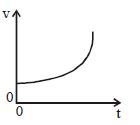
D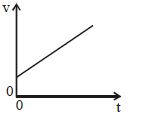
Solution
(D) The speed $v$ at which the tape moves towards the reel is given by the relation $v = \omega R$,where $\omega$ is the angular velocity of the reel and $R$ is its current radius.
Given that the reel rotates with a constant angular velocity,$\omega = \text{constant}$.
The radius $R$ of the reel is increasing at a steady rate,which means $\frac{dR}{dt} = \text{constant}$.
To find the variation of speed $v$ with time $t$,we differentiate the expression for $v$ with respect to time:
$\frac{dv}{dt} = \frac{d}{dt}(\omega R) = \omega \cdot \frac{dR}{dt}$.
Since both $\omega$ and $\frac{dR}{dt}$ are constants,their product $\frac{dv}{dt}$ is also a constant.
$A$ constant rate of change of speed with respect to time implies that the $v-t$ graph is a straight line with a constant positive slope.
Given that the reel rotates with a constant angular velocity,$\omega = \text{constant}$.
The radius $R$ of the reel is increasing at a steady rate,which means $\frac{dR}{dt} = \text{constant}$.
To find the variation of speed $v$ with time $t$,we differentiate the expression for $v$ with respect to time:
$\frac{dv}{dt} = \frac{d}{dt}(\omega R) = \omega \cdot \frac{dR}{dt}$.
Since both $\omega$ and $\frac{dR}{dt}$ are constants,their product $\frac{dv}{dt}$ is also a constant.
$A$ constant rate of change of speed with respect to time implies that the $v-t$ graph is a straight line with a constant positive slope.
0 likes
View Solution124
MediumMCQ
Two particles $A$ and $B$ are moving in the $XY$ plane. Particle $A$ moves along a line with equation $y = x$,while particle $B$ moves along the $X$-axis such that their $X$-coordinates are always equal. If particle $B$ moves with a uniform speed of $3 \ m/s$,what is the speed of particle $A$?
A
$3 \ m/s$
B
$\frac{1}{3} \ m/s$
C
$3\sqrt{2} \ m/s$
D
$\frac{3}{\sqrt{2}} \ m/s$
Solution
(C) For particle $A$,the path is given by $y = x$.
Differentiating with respect to time $t$,we get $\frac{dy}{dt} = \frac{dx}{dt}$,which implies $v_{y_A} = v_{x_A}$.
Since particle $B$ moves along the $X$-axis with a uniform speed of $3 \ m/s$,its velocity is $\vec{v}_B = 3 \hat{i}$.
Given that the $X$-coordinates of $A$ and $B$ are always equal,the $X$-component of the velocity of $A$ must be equal to the velocity of $B$,so $v_{x_A} = 3 \ m/s$.
Since $v_{y_A} = v_{x_A}$,we have $v_{y_A} = 3 \ m/s$.
Thus,the velocity vector of particle $A$ is $\vec{v}_A = 3 \hat{i} + 3 \hat{j}$.
The speed of particle $A$ is the magnitude of its velocity vector: $|\vec{v}_A| = \sqrt{3^2 + 3^2} = \sqrt{9 + 9} = \sqrt{18} = 3\sqrt{2} \ m/s$.
Differentiating with respect to time $t$,we get $\frac{dy}{dt} = \frac{dx}{dt}$,which implies $v_{y_A} = v_{x_A}$.
Since particle $B$ moves along the $X$-axis with a uniform speed of $3 \ m/s$,its velocity is $\vec{v}_B = 3 \hat{i}$.
Given that the $X$-coordinates of $A$ and $B$ are always equal,the $X$-component of the velocity of $A$ must be equal to the velocity of $B$,so $v_{x_A} = 3 \ m/s$.
Since $v_{y_A} = v_{x_A}$,we have $v_{y_A} = 3 \ m/s$.
Thus,the velocity vector of particle $A$ is $\vec{v}_A = 3 \hat{i} + 3 \hat{j}$.
The speed of particle $A$ is the magnitude of its velocity vector: $|\vec{v}_A| = \sqrt{3^2 + 3^2} = \sqrt{9 + 9} = \sqrt{18} = 3\sqrt{2} \ m/s$.
0 likes
View Solution125
MediumMCQ
There are two points $P$ and $Q$ on a projectile path with velocities $v_P$ and $v_Q$ respectively,such that $v_P$ is perpendicular to $v_Q$. If $\alpha$ is the angle that $v_P$ makes with the horizontal at point $P$,find the correct option.
A
$\tan \alpha = \frac{v_Q}{v_P}$
B
$\cos \alpha = \frac{v_Q}{v_P}$
C
$\sec \alpha = \frac{v_Q}{v_P}$
D
$\cot \alpha = \frac{v_Q}{v_P}$
Solution
(D) Let the initial velocity of the projectile be $u$ at an angle $\theta$ with the horizontal. The horizontal component of velocity remains constant throughout the motion,$v_x = u \cos \theta$.
At any point,the velocity vector is $\vec{v} = v_x \hat{i} + v_y \hat{j}$.
For point $P$,$\vec{v}_P = v_x \hat{i} + v_{yP} \hat{j}$. The angle $\alpha$ with the horizontal is given by $\tan \alpha = \frac{v_{yP}}{v_x}$,so $v_{yP} = v_x \tan \alpha$.
For point $Q$,$\vec{v}_Q = v_x \hat{i} + v_{yQ} \hat{j}$.
Since $\vec{v}_P \perp \vec{v}_Q$,their dot product is zero: $\vec{v}_P \cdot \vec{v}_Q = 0$.
$(v_x \hat{i} + v_{yP} \hat{j}) \cdot (v_x \hat{i} + v_{yQ} \hat{j}) = 0 \implies v_x^2 + v_{yP} v_{yQ} = 0$.
Thus,$v_{yQ} = -\frac{v_x^2}{v_{yP}} = -\frac{v_x^2}{v_x \tan \alpha} = -v_x \cot \alpha$.
The magnitudes are $v_P = \sqrt{v_x^2 + v_{yP}^2} = \sqrt{v_x^2 + v_x^2 \tan^2 \alpha} = v_x \sec \alpha$.
And $v_Q = \sqrt{v_x^2 + v_{yQ}^2} = \sqrt{v_x^2 + v_x^2 \cot^2 \alpha} = v_x \csc \alpha$.
Therefore,$\frac{v_Q}{v_P} = \frac{v_x \csc \alpha}{v_x \sec \alpha} = \frac{1/\sin \alpha}{1/\cos \alpha} = \cot \alpha$.
At any point,the velocity vector is $\vec{v} = v_x \hat{i} + v_y \hat{j}$.
For point $P$,$\vec{v}_P = v_x \hat{i} + v_{yP} \hat{j}$. The angle $\alpha$ with the horizontal is given by $\tan \alpha = \frac{v_{yP}}{v_x}$,so $v_{yP} = v_x \tan \alpha$.
For point $Q$,$\vec{v}_Q = v_x \hat{i} + v_{yQ} \hat{j}$.
Since $\vec{v}_P \perp \vec{v}_Q$,their dot product is zero: $\vec{v}_P \cdot \vec{v}_Q = 0$.
$(v_x \hat{i} + v_{yP} \hat{j}) \cdot (v_x \hat{i} + v_{yQ} \hat{j}) = 0 \implies v_x^2 + v_{yP} v_{yQ} = 0$.
Thus,$v_{yQ} = -\frac{v_x^2}{v_{yP}} = -\frac{v_x^2}{v_x \tan \alpha} = -v_x \cot \alpha$.
The magnitudes are $v_P = \sqrt{v_x^2 + v_{yP}^2} = \sqrt{v_x^2 + v_x^2 \tan^2 \alpha} = v_x \sec \alpha$.
And $v_Q = \sqrt{v_x^2 + v_{yQ}^2} = \sqrt{v_x^2 + v_x^2 \cot^2 \alpha} = v_x \csc \alpha$.
Therefore,$\frac{v_Q}{v_P} = \frac{v_x \csc \alpha}{v_x \sec \alpha} = \frac{1/\sin \alpha}{1/\cos \alpha} = \cot \alpha$.
0 likes
View Solution126
MediumMCQ
$A$ particle moves towards east with a velocity of $5\ m/s$. After $10\ s$,its direction changes towards north with the same velocity. The average acceleration of the particle is:
A
Zero
B
$\frac{1}{\sqrt{2}}\ m/s^2$ North-West
C
$\frac{1}{\sqrt{2}}\ m/s^2$ North-East
D
$\frac{1}{\sqrt{2}}\ m/s^2$ South-West
Solution
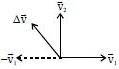
(B) Initial velocity $\vec{v}_1 = 5\hat{i}\ m/s$.
Final velocity $\vec{v}_2 = 5\hat{j}\ m/s$.
Change in velocity $\Delta\vec{v} = \vec{v}_2 - \vec{v}_1 = 5\hat{j} - 5\hat{i}$.
The magnitude of change in velocity is $|\Delta\vec{v}| = \sqrt{(-5)^2 + 5^2} = \sqrt{25 + 25} = \sqrt{50} = 5\sqrt{2}\ m/s$.
The direction of $\Delta\vec{v}$ is North-West.
Average acceleration $\vec{a}_{avg} = \frac{\Delta\vec{v}}{\Delta t} = \frac{5\sqrt{2}}{10} = \frac{\sqrt{2}}{2} = \frac{1}{\sqrt{2}}\ m/s^2$.
Thus,the average acceleration is $\frac{1}{\sqrt{2}}\ m/s^2$ in the North-West direction.
Final velocity $\vec{v}_2 = 5\hat{j}\ m/s$.
Change in velocity $\Delta\vec{v} = \vec{v}_2 - \vec{v}_1 = 5\hat{j} - 5\hat{i}$.
The magnitude of change in velocity is $|\Delta\vec{v}| = \sqrt{(-5)^2 + 5^2} = \sqrt{25 + 25} = \sqrt{50} = 5\sqrt{2}\ m/s$.
The direction of $\Delta\vec{v}$ is North-West.
Average acceleration $\vec{a}_{avg} = \frac{\Delta\vec{v}}{\Delta t} = \frac{5\sqrt{2}}{10} = \frac{\sqrt{2}}{2} = \frac{1}{\sqrt{2}}\ m/s^2$.
Thus,the average acceleration is $\frac{1}{\sqrt{2}}\ m/s^2$ in the North-West direction.
0 likes
View Solution127
AdvancedMCQ
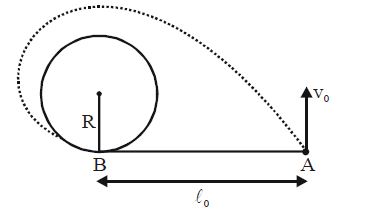
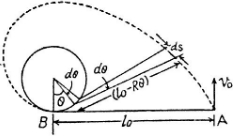
$A$ horizontal plane supports a stationary vertical cylinder of radius $R = 1 \ m$ and a disc $A$ attached to the cylinder by a horizontal thread $AB$ of length $l_0 = 2 \ m$ (seen in figure,top view). An initial velocity $v_0 = 1 \ m/s$ is imparted to the disc as shown in the figure. How many seconds will it move along the plane until it strikes against the cylinder? (All surfaces are assumed to be smooth.)
A
$1$
B
$2$
C
$5$
D
$3$
Solution
(B) Since the tension force is always perpendicular to the velocity vector of the disc,the work done by the tension force is zero.
According to the work-energy theorem,the kinetic energy and thus the speed of the disc remain constant throughout its motion.
Therefore,the time taken $t$ is given by $t = \frac{s}{v_0}$,where $s$ is the total distance traversed by the disc.
At an arbitrary position,the infinitesimal distance $ds$ covered by the disc is $ds = (l_0 - R\theta) d\theta$.
The total distance $s$ is obtained by integrating from $\theta = 0$ to $\theta = \frac{l_0}{R}$:
$s = \int_{0}^{l_0/R} (l_0 - R\theta) d\theta = [l_0\theta - \frac{1}{2}R\theta^2]_{0}^{l_0/R} = l_0(\frac{l_0}{R}) - \frac{1}{2}R(\frac{l_0}{R})^2 = \frac{l_0^2}{R} - \frac{l_0^2}{2R} = \frac{l_0^2}{2R}$.
Substituting the values $l_0 = 2 \ m$,$R = 1 \ m$,and $v_0 = 1 \ m/s$:
$t = \frac{l_0^2}{2Rv_0} = \frac{2^2}{2 \times 1 \times 1} = \frac{4}{2} = 2 \ s$.
According to the work-energy theorem,the kinetic energy and thus the speed of the disc remain constant throughout its motion.
Therefore,the time taken $t$ is given by $t = \frac{s}{v_0}$,where $s$ is the total distance traversed by the disc.
At an arbitrary position,the infinitesimal distance $ds$ covered by the disc is $ds = (l_0 - R\theta) d\theta$.
The total distance $s$ is obtained by integrating from $\theta = 0$ to $\theta = \frac{l_0}{R}$:
$s = \int_{0}^{l_0/R} (l_0 - R\theta) d\theta = [l_0\theta - \frac{1}{2}R\theta^2]_{0}^{l_0/R} = l_0(\frac{l_0}{R}) - \frac{1}{2}R(\frac{l_0}{R})^2 = \frac{l_0^2}{R} - \frac{l_0^2}{2R} = \frac{l_0^2}{2R}$.
Substituting the values $l_0 = 2 \ m$,$R = 1 \ m$,and $v_0 = 1 \ m/s$:
$t = \frac{l_0^2}{2Rv_0} = \frac{2^2}{2 \times 1 \times 1} = \frac{4}{2} = 2 \ s$.
0 likes
View Solution128
DifficultMCQ
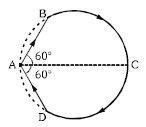
Consider a circle of radius $R = 42\ cm$. An insect crawls with a uniform speed of $v = 1.3\ cm/s$ along the chord $AB$, then along the circular arc $BCD$, and finally along the chord $DA$ to return to point $A$. The time taken by the insect to crawl from $A$ back to $A$ is closest to ......... $\sec$.
A
$200$
B
$196$
C
$256$
D
$100$
Solution
(A) $1$. The path consists of two chords $AB$ and $DA$, and a circular arc $BCD$.
$2$. Given the radius $R = 42\ cm$ and the central angles $\angle BAC = 60^\circ$ and $\angle DAC = 60^\circ$, the total angle subtended by the arc $BCD$ at the center is $240^\circ$ (or $\frac{4\pi}{3}\ radians$).
$3$. Length of chord $AB = 2R \sin(60^\circ/2) = 2R \sin(30^\circ) = R = 42\ cm$. Similarly, $DA = 42\ cm$.
$4$. Length of arc $BCD = R \theta = 42 \times \frac{4\pi}{3} = 56\pi \approx 56 \times 3.14159 = 175.93\ cm$.
$5$. Total distance $D = AB + \text{arc } BCD + DA = 42 + 175.93 + 42 = 259.93\ cm$.
$6$. Time $t = \frac{D}{v} = \frac{259.93}{1.3} \approx 199.95\ s$.
$7$. The value is closest to $200\ s$.
$2$. Given the radius $R = 42\ cm$ and the central angles $\angle BAC = 60^\circ$ and $\angle DAC = 60^\circ$, the total angle subtended by the arc $BCD$ at the center is $240^\circ$ (or $\frac{4\pi}{3}\ radians$).
$3$. Length of chord $AB = 2R \sin(60^\circ/2) = 2R \sin(30^\circ) = R = 42\ cm$. Similarly, $DA = 42\ cm$.
$4$. Length of arc $BCD = R \theta = 42 \times \frac{4\pi}{3} = 56\pi \approx 56 \times 3.14159 = 175.93\ cm$.
$5$. Total distance $D = AB + \text{arc } BCD + DA = 42 + 175.93 + 42 = 259.93\ cm$.
$6$. Time $t = \frac{D}{v} = \frac{259.93}{1.3} \approx 199.95\ s$.
$7$. The value is closest to $200\ s$.
0 likes
View Solution129
DifficultMCQ
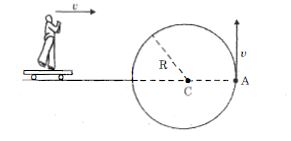
$A$ boy is moving with a constant speed $v$ on a small trolley towards a distant circle as shown in the figure. $A$ point mass is moving on the circle with a constant speed $v$. What is the frequency of change in the magnitude of the relative velocity of the point mass,as observed by the boy?
A
$\frac{v}{{4R}}$
B
$\frac{v}{{2\pi R}}$
C
$\frac{v}{{4\pi R}}$
D
$\frac{v}{{\pi R}}$
Solution
(B) Let the boy's velocity be $\vec{v}_B = v \hat{i}$.
Let the position of the point mass on the circle of radius $R$ be given by $\theta = \omega t$,where $\omega = \frac{v}{R}$.
The velocity of the point mass is $\vec{v}_P = -v \sin(\omega t) \hat{i} + v \cos(\omega t) \hat{j}$.
The relative velocity is $\vec{v}_{rel} = \vec{v}_P - \vec{v}_B = (-v \sin(\omega t) - v) \hat{i} + v \cos(\omega t) \hat{j}$.
The magnitude of relative velocity is $|\vec{v}_{rel}| = \sqrt{(-v \sin(\omega t) - v)^2 + (v \cos(\omega t))^2}$.
$|\vec{v}_{rel}| = \sqrt{v^2 \sin^2(\omega t) + v^2 + 2v^2 \sin(\omega t) + v^2 \cos^2(\omega t)} = \sqrt{2v^2 + 2v^2 \sin(\omega t)} = v \sqrt{2(1 + \sin(\omega t))}$.
The magnitude varies periodically with the angular frequency $\omega = \frac{v}{R}$.
The time period of this variation is $T = \frac{2\pi}{\omega} = \frac{2\pi R}{v}$.
The frequency of change is $f = \frac{1}{T} = \frac{v}{2\pi R}$.
Thus,the correct option is $B$.
Let the position of the point mass on the circle of radius $R$ be given by $\theta = \omega t$,where $\omega = \frac{v}{R}$.
The velocity of the point mass is $\vec{v}_P = -v \sin(\omega t) \hat{i} + v \cos(\omega t) \hat{j}$.
The relative velocity is $\vec{v}_{rel} = \vec{v}_P - \vec{v}_B = (-v \sin(\omega t) - v) \hat{i} + v \cos(\omega t) \hat{j}$.
The magnitude of relative velocity is $|\vec{v}_{rel}| = \sqrt{(-v \sin(\omega t) - v)^2 + (v \cos(\omega t))^2}$.
$|\vec{v}_{rel}| = \sqrt{v^2 \sin^2(\omega t) + v^2 + 2v^2 \sin(\omega t) + v^2 \cos^2(\omega t)} = \sqrt{2v^2 + 2v^2 \sin(\omega t)} = v \sqrt{2(1 + \sin(\omega t))}$.
The magnitude varies periodically with the angular frequency $\omega = \frac{v}{R}$.
The time period of this variation is $T = \frac{2\pi}{\omega} = \frac{2\pi R}{v}$.
The frequency of change is $f = \frac{1}{T} = \frac{v}{2\pi R}$.
Thus,the correct option is $B$.
0 likes
View Solution130
AdvancedMCQ
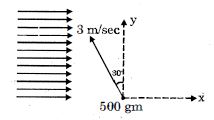
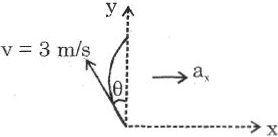
The figure shows a sphere of mass $500 \ g$ moving in a steady flow of air in the $x$-direction. The air-stream exerts an essentially constant force of $0.9 \ N$ on the sphere in the $x$-direction. If at $t = 0$ the sphere is moving as shown in the figure,determine the time required for the sphere to cross the $y$-axis again in $\sec$. (in $.66$)
A
$1$
B
$2$
C
$3$
D
$4$
Solution
(A) The motion of the sphere is analogous to projectile motion where the acceleration is constant in the $x$-direction.
Given: Mass $m = 500 \ g = 0.5 \ kg$,Force $F_x = 0.9 \ N$,Initial velocity $v = 3 \ m/s$ at an angle $\theta = 30^{\circ}$ with the $y$-axis.
The acceleration in the $x$-direction is $a_x = \frac{F_x}{m} = \frac{0.9 \ N}{0.5 \ kg} = 1.8 \ m/s^2$.
The initial velocity component in the $x$-direction is $u_x = v \sin(30^{\circ}) = 3 \times 0.5 = 1.5 \ m/s$.
The sphere crosses the $y$-axis again when its displacement in the $x$-direction becomes zero,i.e.,$s_x = 0$.
Using the equation of motion $s_x = u_x t + \frac{1}{2} a_x t^2$:
$0 = (1.5)t + \frac{1}{2} (-1.8) t^2$ (Note: The force acts in the $+x$ direction,but the initial velocity component is in the $-x$ direction,so acceleration is opposite to initial velocity).
$0 = 1.5 t - 0.9 t^2$
$0.9 t^2 = 1.5 t$
$t = \frac{1.5}{0.9} = \frac{15}{9} = \frac{5}{3} \approx 1.66 \ \sec$.
Given: Mass $m = 500 \ g = 0.5 \ kg$,Force $F_x = 0.9 \ N$,Initial velocity $v = 3 \ m/s$ at an angle $\theta = 30^{\circ}$ with the $y$-axis.
The acceleration in the $x$-direction is $a_x = \frac{F_x}{m} = \frac{0.9 \ N}{0.5 \ kg} = 1.8 \ m/s^2$.
The initial velocity component in the $x$-direction is $u_x = v \sin(30^{\circ}) = 3 \times 0.5 = 1.5 \ m/s$.
The sphere crosses the $y$-axis again when its displacement in the $x$-direction becomes zero,i.e.,$s_x = 0$.
Using the equation of motion $s_x = u_x t + \frac{1}{2} a_x t^2$:
$0 = (1.5)t + \frac{1}{2} (-1.8) t^2$ (Note: The force acts in the $+x$ direction,but the initial velocity component is in the $-x$ direction,so acceleration is opposite to initial velocity).
$0 = 1.5 t - 0.9 t^2$
$0.9 t^2 = 1.5 t$
$t = \frac{1.5}{0.9} = \frac{15}{9} = \frac{5}{3} \approx 1.66 \ \sec$.
0 likes
View Solution131
DifficultMCQ
$A$ charged particle of mass $m = 2 \ kg$ and charge $q = 1 \ \mu C$ is projected from a horizontal ground at an angle $\theta = 45^{\circ}$ with speed $u = 10 \ ms^{-1}$. In space,a horizontal electric field $E = 2 \times 10^7 \ NC^{-1}$ exists in the direction of projection. The range of the projectile is......$m$.
A
$20$
B
$60$
C
$200$
D
$180$
Solution
(A) The horizontal acceleration due to the electric field is $a_x = \frac{qE}{m} = \frac{10^{-6} \times 2 \times 10^7}{2} = 10 \ ms^{-2}$.
The time of flight $T$ is determined by the vertical motion: $T = \frac{2u \sin \theta}{g} = \frac{2 \times 10 \times \sin 45^{\circ}}{10} = \frac{2 \times 10 \times \frac{1}{\sqrt{2}}}{10} = \sqrt{2} \ s$.
The horizontal range $R$ is given by the kinematic equation $R = u_x T + \frac{1}{2} a_x T^2$.
Here,$u_x = u \cos 45^{\circ} = 10 \times \frac{1}{\sqrt{2}} = \frac{10}{\sqrt{2}} \ ms^{-1}$.
Substituting the values: $R = (\frac{10}{\sqrt{2}}) \times \sqrt{2} + \frac{1}{2} \times 10 \times (\sqrt{2})^2$.
$R = 10 + \frac{1}{2} \times 10 \times 2 = 10 + 10 = 20 \ m$.
The time of flight $T$ is determined by the vertical motion: $T = \frac{2u \sin \theta}{g} = \frac{2 \times 10 \times \sin 45^{\circ}}{10} = \frac{2 \times 10 \times \frac{1}{\sqrt{2}}}{10} = \sqrt{2} \ s$.
The horizontal range $R$ is given by the kinematic equation $R = u_x T + \frac{1}{2} a_x T^2$.
Here,$u_x = u \cos 45^{\circ} = 10 \times \frac{1}{\sqrt{2}} = \frac{10}{\sqrt{2}} \ ms^{-1}$.
Substituting the values: $R = (\frac{10}{\sqrt{2}}) \times \sqrt{2} + \frac{1}{2} \times 10 \times (\sqrt{2})^2$.
$R = 10 + \frac{1}{2} \times 10 \times 2 = 10 + 10 = 20 \ m$.
0 likes
View Solution132
DifficultMCQ
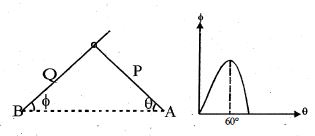
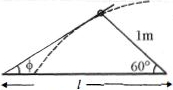
$A$ rod $P$ of length $1 \ m$ is hinged at one end $A$ and there is a ring attached to the other end by a light inextensible thread. Another long rod $Q$ is hinged at $B$ and it passes through the ring. The rod $P$ is rotated about an axis which is perpendicular to the plane in which both the rods are present and the variation between the angles $\theta$ and $\phi$ is plotted as shown. The distance between the hinges $A$ and $B$ is ........ $m$.
A
$3$
B
$2$
C
$1$
D
$0.5$
Solution
(B) Let the distance between the hinges $A$ and $B$ be $l$. The ring moves in a circular path of radius $R = 1 \ m$ centered at $A$.
When the angle $\phi$ is at its maximum value,the rod $Q$ is tangent to the circular path of the ring.
In this configuration,the triangle formed by the hinges $A, B$ and the position of the ring is a right-angled triangle with the right angle at the ring's position.
Given that the angle at $A$ is $\theta = 60^{\circ}$ at the maximum value of $\phi$,we have:
$\cos \theta = \frac{\text{Adjacent side}}{\text{Hypotenuse}} = \frac{R}{l}$
$\cos 60^{\circ} = \frac{1}{l}$
$\frac{1}{2} = \frac{1}{l}$
$l = 2 \ m$
Thus,the distance between the hinges $A$ and $B$ is $2 \ m$.
When the angle $\phi$ is at its maximum value,the rod $Q$ is tangent to the circular path of the ring.
In this configuration,the triangle formed by the hinges $A, B$ and the position of the ring is a right-angled triangle with the right angle at the ring's position.
Given that the angle at $A$ is $\theta = 60^{\circ}$ at the maximum value of $\phi$,we have:
$\cos \theta = \frac{\text{Adjacent side}}{\text{Hypotenuse}} = \frac{R}{l}$
$\cos 60^{\circ} = \frac{1}{l}$
$\frac{1}{2} = \frac{1}{l}$
$l = 2 \ m$
Thus,the distance between the hinges $A$ and $B$ is $2 \ m$.
0 likes
View Solution133
DifficultMCQ
The velocity of a particle moving in a curvilinear path in a horizontal $X-Y$ plane varies with time as $\vec{v} = (2t\hat{i} + t^2\hat{j}) \ m/s$. Here,$t$ is in seconds. At $t = 1 \ s$:
A
acceleration of the particle is $8 \ m/s^2$
B
tangential acceleration of the particle is $\frac{4}{\sqrt{5}} \ m/s^2$
C
radial acceleration of the particle is $\frac{6}{\sqrt{5}} \ m/s^2$
D
radius of curvature of the path is $\frac{5\sqrt{5}}{2} \ m$
Solution
(D) Given velocity: $\vec{v} = 2t\hat{i} + t^2\hat{j}$.
Acceleration $\vec{a} = \frac{d\vec{v}}{dt} = 2\hat{i} + 2t\hat{j}$.
At $t = 1 \ s$,$\vec{a} = 2\hat{i} + 2\hat{j}$,so magnitude $a = \sqrt{2^2 + 2^2} = \sqrt{8} = 2\sqrt{2} \ m/s^2$.
Speed $v = |\vec{v}| = \sqrt{(2t)^2 + (t^2)^2} = \sqrt{4t^2 + t^4}$.
At $t = 1 \ s$,$v = \sqrt{4+1} = \sqrt{5} \ m/s$.
Tangential acceleration $a_t = \frac{dv}{dt} = \frac{1}{2\sqrt{4t^2 + t^4}} \cdot (8t + 4t^3)$.
At $t = 1 \ s$,$a_t = \frac{8+4}{2\sqrt{5}} = \frac{12}{2\sqrt{5}} = \frac{6}{\sqrt{5}} \ m/s^2$.
Radial (centripetal) acceleration $a_c = \sqrt{a^2 - a_t^2} = \sqrt{8 - \frac{36}{5}} = \sqrt{\frac{40-36}{5}} = \sqrt{\frac{4}{5}} = \frac{2}{\sqrt{5}} \ m/s^2$.
Radius of curvature $R = \frac{v^2}{a_c} = \frac{(\sqrt{5})^2}{2/\sqrt{5}} = \frac{5 \cdot \sqrt{5}}{2} = \frac{5\sqrt{5}}{2} \ m$.
Thus,option $D$ is correct.
Acceleration $\vec{a} = \frac{d\vec{v}}{dt} = 2\hat{i} + 2t\hat{j}$.
At $t = 1 \ s$,$\vec{a} = 2\hat{i} + 2\hat{j}$,so magnitude $a = \sqrt{2^2 + 2^2} = \sqrt{8} = 2\sqrt{2} \ m/s^2$.
Speed $v = |\vec{v}| = \sqrt{(2t)^2 + (t^2)^2} = \sqrt{4t^2 + t^4}$.
At $t = 1 \ s$,$v = \sqrt{4+1} = \sqrt{5} \ m/s$.
Tangential acceleration $a_t = \frac{dv}{dt} = \frac{1}{2\sqrt{4t^2 + t^4}} \cdot (8t + 4t^3)$.
At $t = 1 \ s$,$a_t = \frac{8+4}{2\sqrt{5}} = \frac{12}{2\sqrt{5}} = \frac{6}{\sqrt{5}} \ m/s^2$.
Radial (centripetal) acceleration $a_c = \sqrt{a^2 - a_t^2} = \sqrt{8 - \frac{36}{5}} = \sqrt{\frac{40-36}{5}} = \sqrt{\frac{4}{5}} = \frac{2}{\sqrt{5}} \ m/s^2$.
Radius of curvature $R = \frac{v^2}{a_c} = \frac{(\sqrt{5})^2}{2/\sqrt{5}} = \frac{5 \cdot \sqrt{5}}{2} = \frac{5\sqrt{5}}{2} \ m$.
Thus,option $D$ is correct.
0 likes
View Solution134
MediumMCQ
$A$ projectile has the same range $R$ for two angles of projection. If $T_1$ and $T_2$ are the times of flight in the two cases,then $R$ is
A
$T_1T_2g$
B
$\frac{T_1T_2g}{2}$
C
$(T_1^2 + T_2^2)g$
D
$\frac{(T_1^2 + T_2^2)}{2}g$
Solution
(B) For a projectile,the range $R$ is the same for two complementary angles of projection,$\theta$ and $(90^\circ - \theta)$.
The time of flight for angle $\theta$ is $T_1 = \frac{2u \sin \theta}{g}$.
The time of flight for angle $(90^\circ - \theta)$ is $T_2 = \frac{2u \sin(90^\circ - \theta)}{g} = \frac{2u \cos \theta}{g}$.
Multiplying $T_1$ and $T_2$,we get:
$T_1 T_2 = \left(\frac{2u \sin \theta}{g}\right) \left(\frac{2u \cos \theta}{g}\right) = \frac{4u^2 \sin \theta \cos \theta}{g^2} = \frac{2u^2 (2 \sin \theta \cos \theta)}{g^2} = \frac{2u^2 \sin 2\theta}{g^2}$.
Since the range $R = \frac{u^2 \sin 2\theta}{g}$,we can substitute this into the equation:
$T_1 T_2 = \frac{2R}{g}$.
Therefore,$R = \frac{T_1 T_2 g}{2}$.
The time of flight for angle $\theta$ is $T_1 = \frac{2u \sin \theta}{g}$.
The time of flight for angle $(90^\circ - \theta)$ is $T_2 = \frac{2u \sin(90^\circ - \theta)}{g} = \frac{2u \cos \theta}{g}$.
Multiplying $T_1$ and $T_2$,we get:
$T_1 T_2 = \left(\frac{2u \sin \theta}{g}\right) \left(\frac{2u \cos \theta}{g}\right) = \frac{4u^2 \sin \theta \cos \theta}{g^2} = \frac{2u^2 (2 \sin \theta \cos \theta)}{g^2} = \frac{2u^2 \sin 2\theta}{g^2}$.
Since the range $R = \frac{u^2 \sin 2\theta}{g}$,we can substitute this into the equation:
$T_1 T_2 = \frac{2R}{g}$.
Therefore,$R = \frac{T_1 T_2 g}{2}$.
0 likes
View Solution135
MediumMCQ
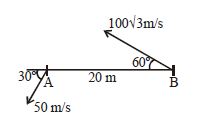
The velocities of two particles $A$ and $B$,separated by a distance of $20 \ m$,are as shown in the figure. Find the angular velocity of $B$ with respect to $A$ in $rad/s$.
A
$4.75$
B
$8.75$
C
$16.75$
D
None of these
Solution
(D) The angular velocity of $B$ with respect to $A$ is given by $\omega_{BA} = \frac{v_{\perp}}{r}$,where $v_{\perp}$ is the relative velocity of $B$ with respect to $A$ perpendicular to the line joining $A$ and $B$.
Let the line $AB$ be along the $x$-axis.
Velocity of $B$ is $\vec{v}_B = (-100\sqrt{3} \cos 60^{\circ}) \hat{i} + (100\sqrt{3} \sin 60^{\circ}) \hat{j} = -150 \hat{i} + 150 \sqrt{3} \hat{j} \ m/s$.
Velocity of $A$ is $\vec{v}_A = (-50 \cos 30^{\circ}) \hat{i} - (50 \sin 30^{\circ}) \hat{j} = -25\sqrt{3} \hat{i} - 25 \hat{j} \ m/s$.
Relative velocity $\vec{v}_{BA} = \vec{v}_B - \vec{v}_A = (-150 + 25\sqrt{3}) \hat{i} + (150\sqrt{3} + 25) \hat{j} \ m/s$.
The component of $\vec{v}_{BA}$ perpendicular to $AB$ (which is along the $y$-axis) is $v_{\perp} = 150\sqrt{3} + 25 \ m/s$.
$\omega_{BA} = \frac{150\sqrt{3} + 25}{20} = \frac{150(1.732) + 25}{20} = \frac{259.8 + 25}{20} = \frac{284.8}{20} = 14.24 \ rad/s$.
Since $14.24 \ rad/s$ is not among the options,the correct choice is $D$.
Let the line $AB$ be along the $x$-axis.
Velocity of $B$ is $\vec{v}_B = (-100\sqrt{3} \cos 60^{\circ}) \hat{i} + (100\sqrt{3} \sin 60^{\circ}) \hat{j} = -150 \hat{i} + 150 \sqrt{3} \hat{j} \ m/s$.
Velocity of $A$ is $\vec{v}_A = (-50 \cos 30^{\circ}) \hat{i} - (50 \sin 30^{\circ}) \hat{j} = -25\sqrt{3} \hat{i} - 25 \hat{j} \ m/s$.
Relative velocity $\vec{v}_{BA} = \vec{v}_B - \vec{v}_A = (-150 + 25\sqrt{3}) \hat{i} + (150\sqrt{3} + 25) \hat{j} \ m/s$.
The component of $\vec{v}_{BA}$ perpendicular to $AB$ (which is along the $y$-axis) is $v_{\perp} = 150\sqrt{3} + 25 \ m/s$.
$\omega_{BA} = \frac{150\sqrt{3} + 25}{20} = \frac{150(1.732) + 25}{20} = \frac{259.8 + 25}{20} = \frac{284.8}{20} = 14.24 \ rad/s$.
Since $14.24 \ rad/s$ is not among the options,the correct choice is $D$.
0 likes
View Solution136
DifficultMCQ
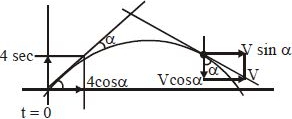
If at any point on the path of a projectile its velocity is $u$ at an inclination $\alpha$ to the horizontal,then after what time will it move at right angles to its former direction?
A
$\frac{u}{g \csc \alpha}$
B
$\frac{u}{g \sin \alpha}$
C
$\frac{u}{g \cos \alpha}$
D
$\frac{u}{g \sec \alpha}$
Solution
(B) Let the initial velocity be $u$ at an angle $\alpha$ with the horizontal. The horizontal component is $u_x = u \cos \alpha$ and the vertical component is $u_y = u \sin \alpha$.
After time $t$,let the velocity be $v$. The horizontal component remains constant: $v_x = u \cos \alpha$.
The vertical component becomes $v_y = u \sin \alpha - gt$.
For the velocity to be at right angles to the initial direction,the dot product of the initial velocity vector $\vec{u}$ and the final velocity vector $\vec{v}$ must be zero,or more simply,the slope of the new velocity must be the negative reciprocal of the initial slope.
Alternatively,using the condition that the velocity vector $\vec{v}$ is perpendicular to $\vec{u}$,we have $\vec{u} \cdot \vec{v} = 0$.
$(u \cos \alpha \hat{i} + u \sin \alpha \hat{j}) \cdot (u \cos \alpha \hat{i} + (u \sin \alpha - gt) \hat{j}) = 0$
$u^2 \cos^2 \alpha + u \sin \alpha (u \sin \alpha - gt) = 0$
$u^2 \cos^2 \alpha + u^2 \sin^2 \alpha - ugt \sin \alpha = 0$
$u^2 (\cos^2 \alpha + \sin^2 \alpha) = ugt \sin \alpha$
$u^2 = ugt \sin \alpha$
$t = \frac{u}{g \sin \alpha}$
After time $t$,let the velocity be $v$. The horizontal component remains constant: $v_x = u \cos \alpha$.
The vertical component becomes $v_y = u \sin \alpha - gt$.
For the velocity to be at right angles to the initial direction,the dot product of the initial velocity vector $\vec{u}$ and the final velocity vector $\vec{v}$ must be zero,or more simply,the slope of the new velocity must be the negative reciprocal of the initial slope.
Alternatively,using the condition that the velocity vector $\vec{v}$ is perpendicular to $\vec{u}$,we have $\vec{u} \cdot \vec{v} = 0$.
$(u \cos \alpha \hat{i} + u \sin \alpha \hat{j}) \cdot (u \cos \alpha \hat{i} + (u \sin \alpha - gt) \hat{j}) = 0$
$u^2 \cos^2 \alpha + u \sin \alpha (u \sin \alpha - gt) = 0$
$u^2 \cos^2 \alpha + u^2 \sin^2 \alpha - ugt \sin \alpha = 0$
$u^2 (\cos^2 \alpha + \sin^2 \alpha) = ugt \sin \alpha$
$u^2 = ugt \sin \alpha$
$t = \frac{u}{g \sin \alpha}$
0 likes
View Solution137
DifficultMCQ
Range of a bullet fired at $45^o$ to the horizontal is $980 \, m$. If the bullet is fired at the same angle from a car travelling horizontally at $18 \, km/h$ towards the target,then the range will be increased by:
A
$100 \sqrt{2} \, m$
B
$100 \sqrt{7} \, m$
C
$50 \sqrt{2} \, m$
D
$50 \sqrt{7} \, m$
Solution
(C) The range of a projectile is given by $R = \frac{u^2 \sin(2\theta)}{g}$.
Given $R = 980 \, m$ and $\theta = 45^o$,we have $980 = \frac{u^2 \sin(90^o)}{g} = \frac{u^2}{g}$.
Thus,$u^2 = 980 \times 9.8 = 9604$,so $u = 98 \, m/s$.
The time of flight is $T = \frac{2u \sin\theta}{g} = \frac{2 \times 98 \times \sin(45^o)}{9.8} = \frac{20 \times 1}{\sqrt{2}} = 10\sqrt{2} \, s$.
When fired from a car moving at $v = 18 \, km/h = 5 \, m/s$,the horizontal component of velocity increases by $\Delta v = 5 \, m/s$.
The increase in range is $\Delta R = \Delta v \times T = 5 \times 10\sqrt{2} = 50\sqrt{2} \, m$.
Given $R = 980 \, m$ and $\theta = 45^o$,we have $980 = \frac{u^2 \sin(90^o)}{g} = \frac{u^2}{g}$.
Thus,$u^2 = 980 \times 9.8 = 9604$,so $u = 98 \, m/s$.
The time of flight is $T = \frac{2u \sin\theta}{g} = \frac{2 \times 98 \times \sin(45^o)}{9.8} = \frac{20 \times 1}{\sqrt{2}} = 10\sqrt{2} \, s$.
When fired from a car moving at $v = 18 \, km/h = 5 \, m/s$,the horizontal component of velocity increases by $\Delta v = 5 \, m/s$.
The increase in range is $\Delta R = \Delta v \times T = 5 \times 10\sqrt{2} = 50\sqrt{2} \, m$.
0 likes
View Solution138
MediumMCQ
The range of a projectile of mass $1\, kg$ is $80\, m$ while it attains a maximum height of $20\, m$. Its change in momentum during the complete motion is ............ $N-s$.
A
$30$
B
$40$
C
$60$
D
$90$
Solution
(B) The maximum height $H$ is given by $H = \frac{u_y^2}{2g}$.
Given $H = 20\, m$ and $g = 10\, m/s^2$,we have $20 = \frac{u_y^2}{2 \times 10}$,so $u_y^2 = 400$,which gives $u_y = 20\, m/s$.
The time of flight $T$ is given by $T = \frac{2u_y}{g} = \frac{2 \times 20}{10} = 4\, s$.
The change in momentum $\Delta \vec{P}$ is equal to the impulse provided by the gravitational force,which acts downwards throughout the motion.
$\Delta \vec{P} = \vec{F}_{ext} \times T = (mg) \times T$.
Substituting the values: $\Delta \vec{P} = 1\, kg \times 10\, m/s^2 \times 4\, s = 40\, N-s$.
Given $H = 20\, m$ and $g = 10\, m/s^2$,we have $20 = \frac{u_y^2}{2 \times 10}$,so $u_y^2 = 400$,which gives $u_y = 20\, m/s$.
The time of flight $T$ is given by $T = \frac{2u_y}{g} = \frac{2 \times 20}{10} = 4\, s$.
The change in momentum $\Delta \vec{P}$ is equal to the impulse provided by the gravitational force,which acts downwards throughout the motion.
$\Delta \vec{P} = \vec{F}_{ext} \times T = (mg) \times T$.
Substituting the values: $\Delta \vec{P} = 1\, kg \times 10\, m/s^2 \times 4\, s = 40\, N-s$.
0 likes
View Solution139
MediumMCQ
$A$ particle has an initial velocity of $(\hat{i} + \hat{j}) \, m/s$ and an acceleration of $(\hat{i} + \hat{j}) \, m/s^2$. Its speed after $10 \, s$ will be:
A
$11 \, m/s$
B
$22 \, m/s$
C
$2 \sqrt{11} \, m/s$
D
$11 \sqrt{2} \, m/s$
Solution
(D) Given:
Initial velocity $\vec{u} = (\hat{i} + \hat{j}) \, m/s$
Acceleration $\vec{a} = (\hat{i} + \hat{j}) \, m/s^2$
Time $t = 10 \, s$
Using the first equation of motion for vectors:
$\vec{v} = \vec{u} + \vec{a}t$
Substituting the values:
$\vec{v} = (\hat{i} + \hat{j}) + (\hat{i} + \hat{j}) \times 10$
$\vec{v} = \hat{i} + \hat{j} + 10\hat{i} + 10\hat{j}$
$\vec{v} = 11\hat{i} + 11\hat{j} \, m/s$
The speed is the magnitude of the velocity vector:
$|\vec{v}| = \sqrt{(11)^2 + (11)^2}$
$|\vec{v}| = \sqrt{121 + 121} = \sqrt{242}$
$|\vec{v}| = 11\sqrt{2} \, m/s$
Initial velocity $\vec{u} = (\hat{i} + \hat{j}) \, m/s$
Acceleration $\vec{a} = (\hat{i} + \hat{j}) \, m/s^2$
Time $t = 10 \, s$
Using the first equation of motion for vectors:
$\vec{v} = \vec{u} + \vec{a}t$
Substituting the values:
$\vec{v} = (\hat{i} + \hat{j}) + (\hat{i} + \hat{j}) \times 10$
$\vec{v} = \hat{i} + \hat{j} + 10\hat{i} + 10\hat{j}$
$\vec{v} = 11\hat{i} + 11\hat{j} \, m/s$
The speed is the magnitude of the velocity vector:
$|\vec{v}| = \sqrt{(11)^2 + (11)^2}$
$|\vec{v}| = \sqrt{121 + 121} = \sqrt{242}$
$|\vec{v}| = 11\sqrt{2} \, m/s$
0 likes
View Solution140
DifficultMCQ
$A$ particle of mass $m$ is projected at $45^o$ at $V_0$ speed from point $P$ at $t = 0$. The angular momentum of the particle about $P$ at $t = \frac{V_0}{g}$ is:
A
$\frac{1}{2 \sqrt{2}} \frac{mV_0^3}{g}$
B
$\frac{1}{2 \sqrt{2}} \frac{mV_0^2}{g}$
C
$\frac{1}{2} \frac{mV_0^3}{g}$
D
$\frac{1}{2} \frac{mV_0^2}{g}$
Solution
(A) The torque $\tau$ acting on the particle about point $P$ is due to the gravitational force $mg$ acting downwards at a horizontal distance $x$ from $P$.
$\tau = mgx$
Since the horizontal velocity is constant,$x = (V_0 \cos 45^o) t = \frac{V_0}{\sqrt{2}} t$.
Therefore,$\tau = mg \left( \frac{V_0}{\sqrt{2}} t \right) = \frac{mgV_0}{\sqrt{2}} t$.
We know that torque is the rate of change of angular momentum: $\tau = \frac{dL}{dt}$.
Integrating with respect to time from $t = 0$ to $t = \frac{V_0}{g}$:
$L = \int_{0}^{t} \tau dt = \int_{0}^{V_0/g} \frac{mgV_0}{\sqrt{2}} t dt$
$L = \frac{mgV_0}{\sqrt{2}} \left[ \frac{t^2}{2} \right]_{0}^{V_0/g}$
$L = \frac{mgV_0}{\sqrt{2}} \cdot \frac{1}{2} \left( \frac{V_0}{g} \right)^2$
$L = \frac{mgV_0^3}{2 \sqrt{2} g^2} = \frac{1}{2 \sqrt{2}} \frac{mV_0^3}{g}$
$\tau = mgx$
Since the horizontal velocity is constant,$x = (V_0 \cos 45^o) t = \frac{V_0}{\sqrt{2}} t$.
Therefore,$\tau = mg \left( \frac{V_0}{\sqrt{2}} t \right) = \frac{mgV_0}{\sqrt{2}} t$.
We know that torque is the rate of change of angular momentum: $\tau = \frac{dL}{dt}$.
Integrating with respect to time from $t = 0$ to $t = \frac{V_0}{g}$:
$L = \int_{0}^{t} \tau dt = \int_{0}^{V_0/g} \frac{mgV_0}{\sqrt{2}} t dt$
$L = \frac{mgV_0}{\sqrt{2}} \left[ \frac{t^2}{2} \right]_{0}^{V_0/g}$
$L = \frac{mgV_0}{\sqrt{2}} \cdot \frac{1}{2} \left( \frac{V_0}{g} \right)^2$
$L = \frac{mgV_0^3}{2 \sqrt{2} g^2} = \frac{1}{2 \sqrt{2}} \frac{mV_0^3}{g}$
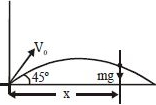
0 likes
View Solution141
DifficultMCQ
As shown in the figure,there is a spring-block system. $A$ block of mass $500\,g$ is pressed against a horizontal spring fixed at one end to compress the spring by $5.0\,cm$. The spring constant is $500\,N/m$. When released,calculate the horizontal distance from the edge of the table where it will hit the ground $4\,m$ below the spring. $(g = 10\,m/s^2)$
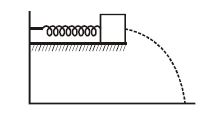
A
$1\,m$
B
$\sqrt{2}\,m$
C
$\sqrt{3}\,m$
D
$4\,m$
Solution
(B) $1$. Conservation of Mechanical Energy: The potential energy stored in the compressed spring is converted into the kinetic energy of the block as it leaves the spring.
$\frac{1}{2} kx^2 = \frac{1}{2} mv^2$
$v = \sqrt{\frac{k}{m}} x$
Given: $k = 500\,N/m$,$x = 5.0\,cm = 0.05\,m$,$m = 500\,g = 0.5\,kg$.
$v = \sqrt{\frac{500}{0.5}} \times 0.05 = \sqrt{1000} \times 0.05 = 10\sqrt{10} \times 0.05 = 0.5\sqrt{10}\,m/s$.
$2$. Projectile Motion: The block leaves the table horizontally at height $H = 4\,m$.
The time of flight $t$ is given by $H = \frac{1}{2} gt^2 \implies t = \sqrt{\frac{2H}{g}}$.
$t = \sqrt{\frac{2 \times 4}{10}} = \sqrt{0.8} = \sqrt{\frac{4}{5}} = \frac{2}{\sqrt{5}}\,s$.
$3$. Horizontal Distance $(R)$: $R = v \times t$
$R = (0.5\sqrt{10}) \times (\frac{2}{\sqrt{5}}) = 0.5 \times 2 \times \sqrt{\frac{10}{5}} = 1 \times \sqrt{2} = \sqrt{2}\,m$.
Therefore,the correct option is $B$.
$\frac{1}{2} kx^2 = \frac{1}{2} mv^2$
$v = \sqrt{\frac{k}{m}} x$
Given: $k = 500\,N/m$,$x = 5.0\,cm = 0.05\,m$,$m = 500\,g = 0.5\,kg$.
$v = \sqrt{\frac{500}{0.5}} \times 0.05 = \sqrt{1000} \times 0.05 = 10\sqrt{10} \times 0.05 = 0.5\sqrt{10}\,m/s$.
$2$. Projectile Motion: The block leaves the table horizontally at height $H = 4\,m$.
The time of flight $t$ is given by $H = \frac{1}{2} gt^2 \implies t = \sqrt{\frac{2H}{g}}$.
$t = \sqrt{\frac{2 \times 4}{10}} = \sqrt{0.8} = \sqrt{\frac{4}{5}} = \frac{2}{\sqrt{5}}\,s$.
$3$. Horizontal Distance $(R)$: $R = v \times t$
$R = (0.5\sqrt{10}) \times (\frac{2}{\sqrt{5}}) = 0.5 \times 2 \times \sqrt{\frac{10}{5}} = 1 \times \sqrt{2} = \sqrt{2}\,m$.
Therefore,the correct option is $B$.
0 likes
View Solution142
MediumMCQ
The position vector of a particle is given as $\vec{r} = (t^2 - 8t + 12)\hat{i} + t^2\hat{j}$. The time after which the velocity vector and acceleration vector become perpendicular to each other is equal to ........ $sec$.
A
$1$
B
$2.5$
C
$2$
D
$1.5$
Solution
(C) The position vector is $\vec{r} = (t^2 - 8t + 12)\hat{i} + t^2\hat{j}$.
Velocity $\vec{v} = \frac{d\vec{r}}{dt} = (2t - 8)\hat{i} + 2t\hat{j}$.
Acceleration $\vec{a} = \frac{d\vec{v}}{dt} = 2\hat{i} + 2\hat{j}$.
For the velocity and acceleration vectors to be perpendicular,their dot product must be zero: $\vec{v} \cdot \vec{a} = 0$.
$(2t - 8)(2) + (2t)(2) = 0$.
$4t - 16 + 4t = 0$.
$8t = 16$.
$t = 2 \text{ sec}$.
Velocity $\vec{v} = \frac{d\vec{r}}{dt} = (2t - 8)\hat{i} + 2t\hat{j}$.
Acceleration $\vec{a} = \frac{d\vec{v}}{dt} = 2\hat{i} + 2\hat{j}$.
For the velocity and acceleration vectors to be perpendicular,their dot product must be zero: $\vec{v} \cdot \vec{a} = 0$.
$(2t - 8)(2) + (2t)(2) = 0$.
$4t - 16 + 4t = 0$.
$8t = 16$.
$t = 2 \text{ sec}$.
0 likes
View Solution143
MediumMCQ
$A$ particle is moving with a constant speed of $\sqrt{2} \, m/s$ on a circular path of radius $10 \, cm$. Find the magnitude of the average velocity when it has covered $\frac{3}{4}$ of the circular path.
A
$\frac{\pi}{3} \, m/s$
B
$\frac{3}{2\pi} \, m/s$
C
$\frac{3}{\pi} \, m/s$
D
$\frac{4}{3\pi} \, m/s$
Solution
(D) The radius of the circular path is $R = 10 \, cm = 0.1 \, m$. The speed of the particle is $v = \sqrt{2} \, m/s$.
When the particle covers $\frac{3}{4}$ of the circular path,its displacement $\Delta r$ is the distance between the initial point $A$ and the final point $B$. This forms the hypotenuse of a right-angled triangle with two sides of length $R$.
Displacement $\Delta r = \sqrt{R^2 + R^2} = R\sqrt{2}$.
The distance covered is $d = \frac{3}{4} \times (2\pi R) = \frac{3\pi R}{2}$.
The time taken is $t = \frac{d}{v} = \frac{3\pi R}{2v}$.
The magnitude of average velocity is $|v_{avg}| = \frac{\text{Displacement}}{\text{Time}} = \frac{R\sqrt{2}}{\frac{3\pi R}{2v}} = \frac{2\sqrt{2}v}{3\pi}$.
Substituting $v = \sqrt{2} \, m/s$,we get $|v_{avg}| = \frac{2\sqrt{2} \times \sqrt{2}}{3\pi} = \frac{4}{3\pi} \, m/s$.
When the particle covers $\frac{3}{4}$ of the circular path,its displacement $\Delta r$ is the distance between the initial point $A$ and the final point $B$. This forms the hypotenuse of a right-angled triangle with two sides of length $R$.
Displacement $\Delta r = \sqrt{R^2 + R^2} = R\sqrt{2}$.
The distance covered is $d = \frac{3}{4} \times (2\pi R) = \frac{3\pi R}{2}$.
The time taken is $t = \frac{d}{v} = \frac{3\pi R}{2v}$.
The magnitude of average velocity is $|v_{avg}| = \frac{\text{Displacement}}{\text{Time}} = \frac{R\sqrt{2}}{\frac{3\pi R}{2v}} = \frac{2\sqrt{2}v}{3\pi}$.
Substituting $v = \sqrt{2} \, m/s$,we get $|v_{avg}| = \frac{2\sqrt{2} \times \sqrt{2}}{3\pi} = \frac{4}{3\pi} \, m/s$.
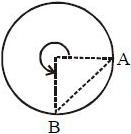
0 likes
View Solution144
MediumMCQ
$A$ projectile is thrown at an angle $\theta$ to the horizontal from $O$ and it hits the ground at $O'$. During the entire motion (select the wrong statement):
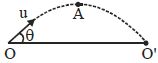
A
Power delivered by gravity at $O$ is negative
B
Power delivered by gravity at $O'$ is negative
C
Power delivered by gravity at $O'$ is positive
D
Power delivered by gravity at $A$ is zero
Solution
(B) The power delivered by a force $\vec{F}$ is given by $P = \vec{F} \cdot \vec{v}$,where $\vec{v}$ is the velocity vector.
Here,the force is gravity,$\vec{F} = m\vec{g} = -mg\hat{j}$.
At point $O$ (start),the velocity $\vec{v}$ has an upward vertical component. Thus,$\vec{F} \cdot \vec{v} = (-mg\hat{j}) \cdot (v_x\hat{i} + v_y\hat{j}) = -mgv_y$. Since $v_y > 0$,the power is negative. Statement $A$ is correct.
At point $A$ (highest point),the velocity is purely horizontal,so $\vec{v} = v_x\hat{i}$. Thus,$P = (-mg\hat{j}) \cdot (v_x\hat{i}) = 0$. Statement $D$ is correct.
At point $O'$ (end),the velocity $\vec{v}$ has a downward vertical component. Thus,$v_y < 0$. Therefore,$P = -mgv_y > 0$. The power is positive. Statement $C$ is correct.
Since statement $C$ is correct,statement $B$ (which says power at $O'$ is negative) is the wrong statement.
Here,the force is gravity,$\vec{F} = m\vec{g} = -mg\hat{j}$.
At point $O$ (start),the velocity $\vec{v}$ has an upward vertical component. Thus,$\vec{F} \cdot \vec{v} = (-mg\hat{j}) \cdot (v_x\hat{i} + v_y\hat{j}) = -mgv_y$. Since $v_y > 0$,the power is negative. Statement $A$ is correct.
At point $A$ (highest point),the velocity is purely horizontal,so $\vec{v} = v_x\hat{i}$. Thus,$P = (-mg\hat{j}) \cdot (v_x\hat{i}) = 0$. Statement $D$ is correct.
At point $O'$ (end),the velocity $\vec{v}$ has a downward vertical component. Thus,$v_y < 0$. Therefore,$P = -mgv_y > 0$. The power is positive. Statement $C$ is correct.
Since statement $C$ is correct,statement $B$ (which says power at $O'$ is negative) is the wrong statement.
0 likes
View Solution145
DifficultMCQ
Two balls of same mass are projected with the same speed, one vertically upwards and the other at an angle of $60^{\circ}$ with the vertical. The ratio of their potential energies at the highest point is:
A
$3:2$
B
$2:1$
C
$4:1$
D
$4:3$
Solution
(C) Let the mass of each ball be $m$ and the projection speed be $u$.
For the first ball projected vertically upwards, the maximum height reached is $H_1 = \frac{u^2}{2g}$. The potential energy at the highest point is $PE_1 = mgH_1 = mg \left(\frac{u^2}{2g}\right) = \frac{1}{2}mu^2$.
For the second ball projected at an angle $\theta = 60^{\circ}$ with the vertical, the angle with the horizontal is $\alpha = 90^{\circ} - 60^{\circ} = 30^{\circ}$. The maximum height reached is $H_2 = \frac{u^2 \sin^2 \alpha}{2g} = \frac{u^2 \sin^2 30^{\circ}}{2g} = \frac{u^2 (1/2)^2}{2g} = \frac{u^2}{8g}$.
The potential energy at the highest point is $PE_2 = mgH_2 = mg \left(\frac{u^2}{8g}\right) = \frac{1}{8}mu^2$.
The ratio of their potential energies is $\frac{PE_1}{PE_2} = \frac{\frac{1}{2}mu^2}{\frac{1}{8}mu^2} = \frac{8}{2} = \frac{4}{1}$.
For the first ball projected vertically upwards, the maximum height reached is $H_1 = \frac{u^2}{2g}$. The potential energy at the highest point is $PE_1 = mgH_1 = mg \left(\frac{u^2}{2g}\right) = \frac{1}{2}mu^2$.
For the second ball projected at an angle $\theta = 60^{\circ}$ with the vertical, the angle with the horizontal is $\alpha = 90^{\circ} - 60^{\circ} = 30^{\circ}$. The maximum height reached is $H_2 = \frac{u^2 \sin^2 \alpha}{2g} = \frac{u^2 \sin^2 30^{\circ}}{2g} = \frac{u^2 (1/2)^2}{2g} = \frac{u^2}{8g}$.
The potential energy at the highest point is $PE_2 = mgH_2 = mg \left(\frac{u^2}{8g}\right) = \frac{1}{8}mu^2$.
The ratio of their potential energies is $\frac{PE_1}{PE_2} = \frac{\frac{1}{2}mu^2}{\frac{1}{8}mu^2} = \frac{8}{2} = \frac{4}{1}$.
1 likes
View Solution146
MediumMCQ
$A$ body is moving with velocity $30 \; m/s$ towards east. After $10 \; s$,its velocity becomes $40 \; m/s$ towards north. The average acceleration of the body is ...... $m/s^2$.
A
$5$
B
$7$
C
$\sqrt{7}$
D
$1$
Solution
(A) Initial velocity $\vec{u} = 30 \hat{i} \; m/s$.
Final velocity $\vec{v} = 40 \hat{j} \; m/s$.
Change in velocity $\Delta \vec{v} = \vec{v} - \vec{u} = 40 \hat{j} - 30 \hat{i}$.
Magnitude of change in velocity $|\Delta \vec{v}| = \sqrt{(-30)^2 + (40)^2} = \sqrt{900 + 1600} = \sqrt{2500} = 50 \; m/s$.
Average acceleration $\vec{a}_{avg} = \frac{\Delta \vec{v}}{\Delta t} = \frac{50 \; m/s}{10 \; s} = 5 \; m/s^2$.
Final velocity $\vec{v} = 40 \hat{j} \; m/s$.
Change in velocity $\Delta \vec{v} = \vec{v} - \vec{u} = 40 \hat{j} - 30 \hat{i}$.
Magnitude of change in velocity $|\Delta \vec{v}| = \sqrt{(-30)^2 + (40)^2} = \sqrt{900 + 1600} = \sqrt{2500} = 50 \; m/s$.
Average acceleration $\vec{a}_{avg} = \frac{\Delta \vec{v}}{\Delta t} = \frac{50 \; m/s}{10 \; s} = 5 \; m/s^2$.
0 likes
View Solution147
MediumMCQ
Four bodies $P, Q, R$ and $S$ are projected with equal velocities having angles of projection $15^{\circ}, 30^{\circ}, 45^{\circ}$ and $60^{\circ}$ with the horizontal respectively. The body having the shortest range is
A
$P$
B
$Q$
C
$R$
D
$S$
Solution
(A) The horizontal range $R$ of a projectile is given by the formula $R = \frac{u^2 \sin(2\theta)}{g}$,where $u$ is the initial velocity,$\theta$ is the angle of projection,and $g$ is the acceleration due to gravity.
Since all bodies are projected with the same velocity $u$,the range depends on $\sin(2\theta)$.
For $P$: $\theta = 15^{\circ}$,so $2\theta = 30^{\circ}$,$\sin(30^{\circ}) = 0.5$.
For $Q$: $\theta = 30^{\circ}$,so $2\theta = 60^{\circ}$,$\sin(60^{\circ}) \approx 0.866$.
For $R$: $\theta = 45^{\circ}$,so $2\theta = 90^{\circ}$,$\sin(90^{\circ}) = 1$.
For $S$: $\theta = 60^{\circ}$,so $2\theta = 120^{\circ}$,$\sin(120^{\circ}) = \sin(60^{\circ}) \approx 0.866$.
Comparing the values,$\sin(30^{\circ})$ is the smallest. Therefore,body $P$ has the shortest range.
Since all bodies are projected with the same velocity $u$,the range depends on $\sin(2\theta)$.
For $P$: $\theta = 15^{\circ}$,so $2\theta = 30^{\circ}$,$\sin(30^{\circ}) = 0.5$.
For $Q$: $\theta = 30^{\circ}$,so $2\theta = 60^{\circ}$,$\sin(60^{\circ}) \approx 0.866$.
For $R$: $\theta = 45^{\circ}$,so $2\theta = 90^{\circ}$,$\sin(90^{\circ}) = 1$.
For $S$: $\theta = 60^{\circ}$,so $2\theta = 120^{\circ}$,$\sin(120^{\circ}) = \sin(60^{\circ}) \approx 0.866$.
Comparing the values,$\sin(30^{\circ})$ is the smallest. Therefore,body $P$ has the shortest range.
0 likes
View Solution148
DifficultMCQ
Two balls are thrown simultaneously from the ground with the same velocity of $10\,m/s$ but at different angles of projection with the horizontal. Both balls fall at the same distance $5\sqrt{3}\,m$ from the point of projection. What is the time interval between the balls striking the ground?
A
$(\sqrt{3}-1)\,s$
B
$(\sqrt{3}+1)\,s$
C
$\sqrt{3}\,s$
D
$1\,s$
Solution
(A) The horizontal range $R$ is given by $R = \frac{u^2 \sin 2\theta}{g}$.
Given $R = 5\sqrt{3}\,m$,$u = 10\,m/s$,and taking $g = 10\,m/s^2$:
$5\sqrt{3} = \frac{10^2 \sin 2\theta}{10} \implies 5\sqrt{3} = 10 \sin 2\theta \implies \sin 2\theta = \frac{\sqrt{3}}{2}$.
Thus,$2\theta = 60^{\circ}$ or $2\theta = 120^{\circ}$,which gives $\theta_1 = 30^{\circ}$ and $\theta_2 = 60^{\circ}$.
The time of flight is given by $T = \frac{2u \sin \theta}{g}$.
For $\theta_1 = 30^{\circ}$,$T_1 = \frac{2 \times 10 \times \sin 30^{\circ}}{10} = 2 \times 0.5 = 1\,s$.
For $\theta_2 = 60^{\circ}$,$T_2 = \frac{2 \times 10 \times \sin 60^{\circ}}{10} = 2 \times \frac{\sqrt{3}}{2} = \sqrt{3}\,s$.
The time interval between the balls striking the ground is $\Delta t = T_2 - T_1 = (\sqrt{3} - 1)\,s$.
Given $R = 5\sqrt{3}\,m$,$u = 10\,m/s$,and taking $g = 10\,m/s^2$:
$5\sqrt{3} = \frac{10^2 \sin 2\theta}{10} \implies 5\sqrt{3} = 10 \sin 2\theta \implies \sin 2\theta = \frac{\sqrt{3}}{2}$.
Thus,$2\theta = 60^{\circ}$ or $2\theta = 120^{\circ}$,which gives $\theta_1 = 30^{\circ}$ and $\theta_2 = 60^{\circ}$.
The time of flight is given by $T = \frac{2u \sin \theta}{g}$.
For $\theta_1 = 30^{\circ}$,$T_1 = \frac{2 \times 10 \times \sin 30^{\circ}}{10} = 2 \times 0.5 = 1\,s$.
For $\theta_2 = 60^{\circ}$,$T_2 = \frac{2 \times 10 \times \sin 60^{\circ}}{10} = 2 \times \frac{\sqrt{3}}{2} = \sqrt{3}\,s$.
The time interval between the balls striking the ground is $\Delta t = T_2 - T_1 = (\sqrt{3} - 1)\,s$.
0 likes
View Solution3-2.Motion in Plane — Mix Examples-Motion in Plane · Frequently Asked Questions
1Are these 3-2.Motion in Plane questions useful for JEE and NEET?
Yes. All questions in this section are mapped to JEE Main and NEET exam patterns. Previous year questions from JEE Main, NEET, GUJCET and state-level exams are included with full solutions.
2Can I switch to Hindi or Gujarati for these questions?
Yes. Use the language tabs in the hero section or the sidebar to view the same questions and solutions in English, Hindi or Gujarati.
3How do I generate a question paper from this subtopic?
Use the Vedclass Exam Paper Generator — select the chapter and subtopic, set difficulty, and generate Sets A, B, C, D automatically. First 3 chapters of every subject are free.
Vedclass Products
For Students
Vedclass Test Series
Mock tests in real JEE/NEET style with performance analysis. 5-day free trial.
Start Free TrialFor Teachers
Exam Paper Generator
Generate Set A/B/C/D papers from this chapter in 2 minutes. 3 chapters free.
Try FreeFor Institutes
Online Exam Module
Live online exams with unlimited students, 360° analytics & white-label branding.
See DemoFor Teachers & Institutes
Generate a 3-2.Motion in Plane Exam Paper in 2 Minutes
Select subtopic & difficulty — Sets A, B, C, D auto-generated with No Repeat logic.
First 3 chapters of every subject are free — no payment required.