
A English
Angular Variables and Basic of Uniform Circular Motion Questions in English
Class 11 Physics · 3-2.Motion in Plane · Angular Variables and Basic of Uniform Circular Motion
176+
Questions
English
Language
100%
With Solutions
Showing 49 of 176 questions in English
51
MediumMCQ
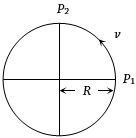
The figure below shows a body of mass $M$ moving with a uniform speed $v$ on a circular path of radius $R$. What is the change in acceleration when moving from point $P_1$ to $P_2$?
A
Zero
B
${v^2}/2R$
C
$2{v^2}/R$
D
$\frac{{{v^2}}}{R} \sqrt 2 $
Solution
(D) In uniform circular motion,the magnitude of centripetal acceleration is $a = \frac{v^2}{R}$.
At point $P_1$,the acceleration vector $\vec{a}_1$ is directed towards the center,i.e.,$\vec{a}_1 = \frac{v^2}{R} \hat{i}$.
At point $P_2$,the acceleration vector $\vec{a}_2$ is directed towards the center,i.e.,$\vec{a}_2 = \frac{v^2}{R} \hat{j}$.
The change in acceleration is $\Delta \vec{a} = \vec{a}_2 - \vec{a}_1 = \frac{v^2}{R} \hat{j} - \frac{v^2}{R} \hat{i}$.
The magnitude of the change in acceleration is $|\Delta \vec{a}| = \sqrt{(\frac{v^2}{R})^2 + (-\frac{v^2}{R})^2} = \sqrt{2(\frac{v^2}{R})^2} = \frac{v^2}{R} \sqrt{2}$.
At point $P_1$,the acceleration vector $\vec{a}_1$ is directed towards the center,i.e.,$\vec{a}_1 = \frac{v^2}{R} \hat{i}$.
At point $P_2$,the acceleration vector $\vec{a}_2$ is directed towards the center,i.e.,$\vec{a}_2 = \frac{v^2}{R} \hat{j}$.
The change in acceleration is $\Delta \vec{a} = \vec{a}_2 - \vec{a}_1 = \frac{v^2}{R} \hat{j} - \frac{v^2}{R} \hat{i}$.
The magnitude of the change in acceleration is $|\Delta \vec{a}| = \sqrt{(\frac{v^2}{R})^2 + (-\frac{v^2}{R})^2} = \sqrt{2(\frac{v^2}{R})^2} = \frac{v^2}{R} \sqrt{2}$.
0 likes
View Solution52
EasyMCQ
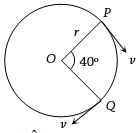
$A$ particle is moving on a circular path of radius $r$ with uniform speed $v$. The change in velocity when the particle moves from $P$ to $Q$ is $(\angle POQ = 40^\circ)$.
A
$2v \cos 40^\circ$
B
$2v \sin 20^\circ$
C
$2v \sin 40^\circ$
D
$2v \cos 20^\circ$
Solution
(B) In uniform circular motion,the speed $v$ remains constant,but the direction of velocity changes.
Let the velocity at point $P$ be $\vec{v}_1$ and at point $Q$ be $\vec{v}_2$.
The magnitude of both velocities is $|\vec{v}_1| = |\vec{v}_2| = v$.
The angle between the velocity vectors $\vec{v}_1$ and $\vec{v}_2$ is equal to the angle subtended by the arc $PQ$ at the center,which is $\theta = 40^\circ$.
The change in velocity is given by $\Delta \vec{v} = \vec{v}_2 - \vec{v}_1$.
The magnitude of the change in velocity is $|\Delta \vec{v}| = \sqrt{v^2 + v^2 - 2v^2 \cos \theta} = \sqrt{2v^2(1 - \cos \theta)} = \sqrt{2v^2(2 \sin^2(\theta/2))} = 2v \sin(\theta/2)$.
Substituting $\theta = 40^\circ$,we get $|\Delta \vec{v}| = 2v \sin(40^\circ/2) = 2v \sin 20^\circ$.
Let the velocity at point $P$ be $\vec{v}_1$ and at point $Q$ be $\vec{v}_2$.
The magnitude of both velocities is $|\vec{v}_1| = |\vec{v}_2| = v$.
The angle between the velocity vectors $\vec{v}_1$ and $\vec{v}_2$ is equal to the angle subtended by the arc $PQ$ at the center,which is $\theta = 40^\circ$.
The change in velocity is given by $\Delta \vec{v} = \vec{v}_2 - \vec{v}_1$.
The magnitude of the change in velocity is $|\Delta \vec{v}| = \sqrt{v^2 + v^2 - 2v^2 \cos \theta} = \sqrt{2v^2(1 - \cos \theta)} = \sqrt{2v^2(2 \sin^2(\theta/2))} = 2v \sin(\theta/2)$.
Substituting $\theta = 40^\circ$,we get $|\Delta \vec{v}| = 2v \sin(40^\circ/2) = 2v \sin 20^\circ$.
0 likes
View Solution53
EasyMCQ
In uniform circular motion,
A
Both velocity and acceleration are constant
B
Acceleration and speed are constant but velocity changes
C
Both acceleration and velocity change
D
Both acceleration and speed are constant
Solution
(C) In uniform circular motion,the speed of the particle remains constant,but the direction of motion changes continuously at every point along the circular path.
Since velocity is a vector quantity (having both magnitude and direction),a change in direction implies a change in velocity.
Furthermore,the acceleration in uniform circular motion is the centripetal acceleration,which is directed towards the center of the circle.
As the particle moves,the direction of this centripetal acceleration vector also changes continuously to remain directed towards the center.
Therefore,both velocity and acceleration change in direction,even though their magnitudes remain constant.
Since velocity is a vector quantity (having both magnitude and direction),a change in direction implies a change in velocity.
Furthermore,the acceleration in uniform circular motion is the centripetal acceleration,which is directed towards the center of the circle.
As the particle moves,the direction of this centripetal acceleration vector also changes continuously to remain directed towards the center.
Therefore,both velocity and acceleration change in direction,even though their magnitudes remain constant.
0 likes
View Solution54
MediumMCQ
What is the angular velocity of the second hand of a clock?
A
$\frac{\pi}{60} \text{ rad/s}$
B
$\frac{\pi}{30} \text{ rad/s}$
C
$60\pi \text{ rad/s}$
D
$30\pi \text{ rad/s}$
Solution
(B) The angular velocity $\omega$ is given by the formula $\omega = \frac{2\pi}{T}$,where $T$ is the time period.
For the second hand of a clock,the time taken to complete one full revolution is $T = 60 \text{ seconds}$.
Substituting the value of $T$ into the formula:
$\omega = \frac{2\pi}{60} \text{ rad/s} = \frac{\pi}{30} \text{ rad/s}$.
Therefore,the correct option is $B$.
For the second hand of a clock,the time taken to complete one full revolution is $T = 60 \text{ seconds}$.
Substituting the value of $T$ into the formula:
$\omega = \frac{2\pi}{60} \text{ rad/s} = \frac{\pi}{30} \text{ rad/s}$.
Therefore,the correct option is $B$.
0 likes
View Solution55
MediumMCQ
The angular velocity of a flywheel making $120$ revolutions per minute is:
A
$\pi \, rad/s$
B
$2\pi \, rad/s$
C
$4\pi \, rad/s$
D
$4\pi^2 \, rad/s$
Solution
(C) The angular velocity $\omega$ is given by the formula $\omega = 2\pi n$,where $n$ is the frequency in revolutions per second.
Given,$n = 120 \text{ revolutions per minute} = \frac{120}{60} \text{ revolutions per second} = 2 \text{ rev/s}$.
Substituting the value of $n$ into the formula:
$\omega = 2\pi \times 2 = 4\pi \, rad/s$.
Therefore,the correct option is $C$.
Given,$n = 120 \text{ revolutions per minute} = \frac{120}{60} \text{ revolutions per second} = 2 \text{ rev/s}$.
Substituting the value of $n$ into the formula:
$\omega = 2\pi \times 2 = 4\pi \, rad/s$.
Therefore,the correct option is $C$.
0 likes
View Solution56
EasyMCQ
In which case is the use of angular velocity useful?
A
When the body is rotating
B
When the body moves in a straight line
C
When the body is changing its direction of motion
D
None of these
Solution
(A) Angular velocity $(\omega)$ is defined as the rate of change of angular displacement with respect to time.
It is a vector quantity used to describe the rotational motion of a rigid body about an axis.
Therefore,it is useful when the body is rotating.
Thus,the correct option is $(A)$.
It is a vector quantity used to describe the rotational motion of a rigid body about an axis.
Therefore,it is useful when the body is rotating.
Thus,the correct option is $(A)$.
0 likes
View Solution57
MediumMCQ
$A$ motor shaft rotates at a constant angular velocity of $3000$ revolutions per minute. Through what angle (in radians) will it rotate in $1$ second?
A
$1000\pi$
B
$100\pi$
C
$\pi$
D
$10\pi$
Solution
(B) The angular velocity $\omega$ is given as $3000$ revolutions per minute (rpm).
First,convert this to revolutions per second: $\omega = \frac{3000}{60} = 50$ revolutions per second.
Since $1$ revolution corresponds to $2\pi$ radians,the angular velocity in radians per second is $\omega = 50 \times 2\pi = 100\pi \text{ rad/s}$.
The angle $\theta$ rotated in time $t = 1$ second is given by $\theta = \omega t$.
Substituting the values,$\theta = 100\pi \times 1 = 100\pi \text{ radians}$.
First,convert this to revolutions per second: $\omega = \frac{3000}{60} = 50$ revolutions per second.
Since $1$ revolution corresponds to $2\pi$ radians,the angular velocity in radians per second is $\omega = 50 \times 2\pi = 100\pi \text{ rad/s}$.
The angle $\theta$ rotated in time $t = 1$ second is given by $\theta = \omega t$.
Substituting the values,$\theta = 100\pi \times 1 = 100\pi \text{ radians}$.
0 likes
View Solution58
MediumMCQ
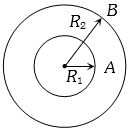
An annular ring with inner and outer radii $R_{1}$ and $R_{2}$ is rotating with a uniform angular speed $\omega$ about its central axis. The ratio of the centripetal forces experienced by two particles of equal mass $m$ situated on the inner and outer parts of the ring,$\frac{F_{1}}{F_{2}}$ is
A
$1$
B
$\frac{R_{1}}{R_{2}}$
C
$\frac{R_{2}}{R_{1}}$
D
$\left(\frac{R_{1}}{R_{2}}\right)^{2}$
Solution
(B) For a particle of mass $m$ rotating in a circle of radius $r$ with a uniform angular speed $\omega$,the centripetal force is given by $F = m \omega^{2} r$.
For the particle on the inner part of the ring at radius $R_{1}$,the centripetal force is $F_{1} = m \omega^{2} R_{1}$.
For the particle on the outer part of the ring at radius $R_{2}$,the centripetal force is $F_{2} = m \omega^{2} R_{2}$.
Taking the ratio of these two forces:
$\frac{F_{1}}{F_{2}} = \frac{m \omega^{2} R_{1}}{m \omega^{2} R_{2}} = \frac{R_{1}}{R_{2}}$.
Thus,the ratio of the forces is $\frac{R_{1}}{R_{2}}$.
For the particle on the inner part of the ring at radius $R_{1}$,the centripetal force is $F_{1} = m \omega^{2} R_{1}$.
For the particle on the outer part of the ring at radius $R_{2}$,the centripetal force is $F_{2} = m \omega^{2} R_{2}$.
Taking the ratio of these two forces:
$\frac{F_{1}}{F_{2}} = \frac{m \omega^{2} R_{1}}{m \omega^{2} R_{2}} = \frac{R_{1}}{R_{2}}$.
Thus,the ratio of the forces is $\frac{R_{1}}{R_{2}}$.
0 likes
View Solution59
EasyMCQ
If the linear speed of a particle moving in a circular path is constant,then the angular speed is proportional to (where $r$ is the radius of the circle):
A
$ 1/r $
B
$ 1/r^2 $
C
$ 1/r^3 $
D
$ 1/r^5 $
Solution
(A) The relationship between linear speed $(v)$,angular speed $(\omega)$,and the radius of the circular path $(r)$ is given by the formula: $v = r\omega$.
Given that the linear speed $(v)$ is constant,we can rearrange the formula to solve for angular speed: $\omega = \frac{v}{r}$.
Since $v$ is constant,it follows that $\omega \propto \frac{1}{r}$.
Therefore,the angular speed is inversely proportional to the radius of the circle.
Given that the linear speed $(v)$ is constant,we can rearrange the formula to solve for angular speed: $\omega = \frac{v}{r}$.
Since $v$ is constant,it follows that $\omega \propto \frac{1}{r}$.
Therefore,the angular speed is inversely proportional to the radius of the circle.
0 likes
View Solution60
MediumMCQ
$A$ particle is moving in uniform circular motion. About which point in the plane of the circle will the angular momentum of the particle always remain conserved?
A
About the center of the circle
B
About a point on the circumference of the circle
C
About a point inside the circle
D
About a point outside the circle
Solution
(A) The angular momentum $L$ of a particle is defined as $L = r \times p$. The rate of change of angular momentum is equal to the torque applied,given by $\frac{dL}{dt} = \tau = r \times F$.
In uniform circular motion,the centripetal force $F$ always acts towards the center of the circle.
Since the position vector $r$ is measured from the center,the force $F$ passes through the center,making the lever arm zero.
Therefore,the torque $\tau = r \times F = 0$ about the center of the circle.
Since $\tau = 0$,the angular momentum $L$ remains constant (conserved) about the center of the circle.
In uniform circular motion,the centripetal force $F$ always acts towards the center of the circle.
Since the position vector $r$ is measured from the center,the force $F$ passes through the center,making the lever arm zero.
Therefore,the torque $\tau = r \times F = 0$ about the center of the circle.
Since $\tau = 0$,the angular momentum $L$ remains constant (conserved) about the center of the circle.
0 likes
View Solution61
DifficultMCQ
The magnitude of displacement of a particle moving in a circle of radius $a$ with constant angular speed $\omega$ varies with time $t$ as:
A
$2a \sin \omega t$
B
$2a \sin \frac{\omega t}{2}$
C
$2a \cos \omega t$
D
$2a \cos \frac{\omega t}{2}$
Solution
(B) Let the particle start from point $A(a, 0)$ at $t = 0$. After time $t$,the particle reaches point $B$ such that the angle subtended at the center is $\theta = \omega t$.
The coordinates of the particle at time $t$ are $(a \cos \omega t, a \sin \omega t)$.
The displacement vector $\vec{d}$ is the vector from $A$ to $B$: $\vec{d} = (a \cos \omega t - a) \hat{i} + (a \sin \omega t) \hat{j}$.
The magnitude of displacement $d$ is given by $d = \sqrt{(a \cos \omega t - a)^2 + (a \sin \omega t)^2}$.
$d = \sqrt{a^2(\cos^2 \omega t - 2 \cos \omega t + 1) + a^2 \sin^2 \omega t}$.
Using $\sin^2 \omega t + \cos^2 \omega t = 1$,we get $d = \sqrt{a^2(2 - 2 \cos \omega t)}$.
Using the identity $1 - \cos \theta = 2 \sin^2(\theta/2)$,we have $d = \sqrt{2a^2(1 - \cos \omega t)} = \sqrt{4a^2 \sin^2(\omega t / 2)}$.
Thus,$d = 2a \sin(\omega t / 2)$.
The coordinates of the particle at time $t$ are $(a \cos \omega t, a \sin \omega t)$.
The displacement vector $\vec{d}$ is the vector from $A$ to $B$: $\vec{d} = (a \cos \omega t - a) \hat{i} + (a \sin \omega t) \hat{j}$.
The magnitude of displacement $d$ is given by $d = \sqrt{(a \cos \omega t - a)^2 + (a \sin \omega t)^2}$.
$d = \sqrt{a^2(\cos^2 \omega t - 2 \cos \omega t + 1) + a^2 \sin^2 \omega t}$.
Using $\sin^2 \omega t + \cos^2 \omega t = 1$,we get $d = \sqrt{a^2(2 - 2 \cos \omega t)}$.
Using the identity $1 - \cos \theta = 2 \sin^2(\theta/2)$,we have $d = \sqrt{2a^2(1 - \cos \omega t)} = \sqrt{4a^2 \sin^2(\omega t / 2)}$.
Thus,$d = 2a \sin(\omega t / 2)$.
0 likes
View Solution62
MediumMCQ
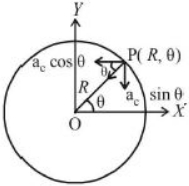
For a particle in uniform circular motion,the acceleration $\vec{a}$ at a point $P(R, \theta)$ on the circle of radius $R$ is (Here $\theta$ is measured from the $x$-axis):
A
$\frac{V^2}{R}\hat{i} + \frac{V^2}{R}\hat{j}$
B
$-\frac{V^2}{R}\cos\theta\hat{i} + \frac{V^2}{R}\sin\theta\hat{j}$
C
$-\frac{V^2}{R}\sin\theta\hat{i} + \frac{V^2}{R}\cos\theta\hat{j}$
D
$-\frac{V^2}{R}\cos\theta\hat{i} - \frac{V^2}{R}\sin\theta\hat{j}$
Solution
(D) In uniform circular motion,the acceleration is the centripetal acceleration $\vec{a}_c$,which is always directed towards the center of the circle.
For a point $P$ at an angle $\theta$ with the $x$-axis,the position vector makes an angle $\theta$ with the $x$-axis.
The centripetal acceleration vector $\vec{a}_c$ points from $P$ towards the origin $O$.
The magnitude of centripetal acceleration is $a_c = \frac{V^2}{R}$.
Resolving this vector into components:
The $x$-component is $a_x = -a_c \cos\theta = -\frac{V^2}{R} \cos\theta$.
The $y$-component is $a_y = -a_c \sin\theta = -\frac{V^2}{R} \sin\theta$.
Thus,the acceleration vector is $\vec{a} = -\frac{V^2}{R} \cos\theta \hat{i} - \frac{V^2}{R} \sin\theta \hat{j}$.
For a point $P$ at an angle $\theta$ with the $x$-axis,the position vector makes an angle $\theta$ with the $x$-axis.
The centripetal acceleration vector $\vec{a}_c$ points from $P$ towards the origin $O$.
The magnitude of centripetal acceleration is $a_c = \frac{V^2}{R}$.
Resolving this vector into components:
The $x$-component is $a_x = -a_c \cos\theta = -\frac{V^2}{R} \cos\theta$.
The $y$-component is $a_y = -a_c \sin\theta = -\frac{V^2}{R} \sin\theta$.
Thus,the acceleration vector is $\vec{a} = -\frac{V^2}{R} \cos\theta \hat{i} - \frac{V^2}{R} \sin\theta \hat{j}$.
0 likes
View Solution63
MediumMCQ
Two cars of masses $m_1$ and $m_2$ are moving along circular paths of radii $r_1$ and $r_2$ respectively. Their speeds are such that they complete one round in the same time. The ratio of the angular speeds of the two cars is:
A
$m_1 : m_2$
B
$r_1 : r_2$
C
$1 : 1$
D
$m_1r_1 : m_2r_2$
Solution
(C) The angular speed $\omega$ of an object moving in a circular path is defined as the rate of change of angular displacement,given by the formula $\omega = \frac{2\pi}{T}$,where $T$ is the time period taken to complete one full revolution.
Since both cars complete one round in the same time $T$,their time periods are equal $(T_1 = T_2 = T)$.
Therefore,the angular speed of the first car is $\omega_1 = \frac{2\pi}{T}$ and the angular speed of the second car is $\omega_2 = \frac{2\pi}{T}$.
The ratio of their angular speeds is $\frac{\omega_1}{\omega_2} = \frac{2\pi / T}{2\pi / T} = 1$.
Thus,the ratio is $1 : 1$.
Since both cars complete one round in the same time $T$,their time periods are equal $(T_1 = T_2 = T)$.
Therefore,the angular speed of the first car is $\omega_1 = \frac{2\pi}{T}$ and the angular speed of the second car is $\omega_2 = \frac{2\pi}{T}$.
The ratio of their angular speeds is $\frac{\omega_1}{\omega_2} = \frac{2\pi / T}{2\pi / T} = 1$.
Thus,the ratio is $1 : 1$.
0 likes
View Solution64
MediumMCQ
$A$ particle moves in a circle of radius $5 \; cm$ with constant speed and time period $0.2 \pi \; sec$. The acceleration of the particle is .... $m/sec^2$.
A
$15$
B
$36$
C
$5$
D
$25$
Solution
(C) The radius of the circle is $r = 5 \; cm = 5 \times 10^{-2} \; m$.
The time period is $T = 0.2 \pi \; sec$.
The speed of the particle is $v = \frac{2 \pi r}{T}$.
Substituting the values: $v = \frac{2 \pi \times 5 \times 10^{-2}}{0.2 \pi} = \frac{10 \times 10^{-2}}{0.2} = 0.5 \; m/s$.
The centripetal acceleration is given by $a = \frac{v^2}{r}$.
Substituting the values: $a = \frac{(0.5)^2}{5 \times 10^{-2}} = \frac{0.25}{0.05} = 5 \; m/s^2$.
The time period is $T = 0.2 \pi \; sec$.
The speed of the particle is $v = \frac{2 \pi r}{T}$.
Substituting the values: $v = \frac{2 \pi \times 5 \times 10^{-2}}{0.2 \pi} = \frac{10 \times 10^{-2}}{0.2} = 0.5 \; m/s$.
The centripetal acceleration is given by $a = \frac{v^2}{r}$.
Substituting the values: $a = \frac{(0.5)^2}{5 \times 10^{-2}} = \frac{0.25}{0.05} = 5 \; m/s^2$.
0 likes
View Solution65
EasyMCQ
Check the only correct statement in the following:
A
$A$ body has a constant velocity and still it can have a varying speed.
B
$A$ body has a constant speed but it can have a varying velocity.
C
$A$ body having constant speed cannot have any acceleration.
D
$A$ body in motion under a force acting upon it must always have work done upon it.
Solution
(B) Velocity is a vector quantity,meaning it has both magnitude (speed) and direction. For velocity to be constant,both magnitude and direction must remain constant.
If a body has a constant speed,its velocity can still vary if its direction changes. $A$ classic example is uniform circular motion,where the speed is constant,but the direction of motion changes at every point,resulting in a changing velocity and the presence of centripetal acceleration.
Option $A$ is incorrect because constant velocity implies constant speed.
Option $B$ is correct because a body moving in a circle at a constant speed has a varying velocity due to the continuous change in direction.
Option $C$ is incorrect because a body with constant speed in a circular path experiences centripetal acceleration.
Option $D$ is incorrect because if a force acts perpendicular to the displacement (like centripetal force),the work done is zero.
If a body has a constant speed,its velocity can still vary if its direction changes. $A$ classic example is uniform circular motion,where the speed is constant,but the direction of motion changes at every point,resulting in a changing velocity and the presence of centripetal acceleration.
Option $A$ is incorrect because constant velocity implies constant speed.
Option $B$ is correct because a body moving in a circle at a constant speed has a varying velocity due to the continuous change in direction.
Option $C$ is incorrect because a body with constant speed in a circular path experiences centripetal acceleration.
Option $D$ is incorrect because if a force acts perpendicular to the displacement (like centripetal force),the work done is zero.
0 likes
View Solution66
EasyMCQ
$A$ motorcyclist going round in a circular track at a constant speed has:
A
Constant linear velocity
B
Constant acceleration
C
Constant angular velocity
D
Constant force
Solution
(C) In uniform circular motion,the speed of the object remains constant,but the direction of motion changes at every point.
Since linear velocity is a vector quantity (having both magnitude and direction),it changes continuously.
Acceleration in circular motion is centripetal acceleration,which is directed towards the center of the circle. As the direction of the object changes,the direction of this acceleration also changes continuously.
Since force is related to acceleration by $F = ma$,the direction of the force also changes continuously.
However,the angular velocity $\omega$ remains constant because the rate of change of angular displacement is constant in uniform circular motion.
Since linear velocity is a vector quantity (having both magnitude and direction),it changes continuously.
Acceleration in circular motion is centripetal acceleration,which is directed towards the center of the circle. As the direction of the object changes,the direction of this acceleration also changes continuously.
Since force is related to acceleration by $F = ma$,the direction of the force also changes continuously.
However,the angular velocity $\omega$ remains constant because the rate of change of angular displacement is constant in uniform circular motion.
0 likes
View Solution67
MediumMCQ
$A$ man is running with constant speed along a circular path of radius $2 \sqrt 2 \, m$. He completes $1$ round in $10 \, s$. Find the instantaneous speed at $2.5 \, s$.
A
$\frac{\sqrt 2 \pi}{5} \, m/s$
B
$\frac{2 \sqrt 2 \pi}{5} \, m/s$
C
$\frac{2 \sqrt 3 \pi}{5} \, m/s$
D
$\frac{5 \sqrt 2 \pi}{5} \, m/s$
Solution
(B) The man is running with a constant speed along a circular path.
In uniform circular motion,the speed of the object remains constant at all points on the path.
The radius of the path is $r = 2 \sqrt 2 \, m$.
The time taken to complete one round (period) is $T = 10 \, s$.
The distance covered in one round is the circumference of the circle,$C = 2 \pi r$.
$C = 2 \pi (2 \sqrt 2) = 4 \sqrt 2 \pi \, m$.
The constant speed $v$ is given by the ratio of total distance to total time:
$v = \frac{C}{T} = \frac{4 \sqrt 2 \pi}{10} = \frac{2 \sqrt 2 \pi}{5} \, m/s$.
Since the speed is constant,the instantaneous speed at any time $t$,including $t = 2.5 \, s$,is the same as the average speed.
Therefore,the instantaneous speed is $\frac{2 \sqrt 2 \pi}{5} \, m/s$.
In uniform circular motion,the speed of the object remains constant at all points on the path.
The radius of the path is $r = 2 \sqrt 2 \, m$.
The time taken to complete one round (period) is $T = 10 \, s$.
The distance covered in one round is the circumference of the circle,$C = 2 \pi r$.
$C = 2 \pi (2 \sqrt 2) = 4 \sqrt 2 \pi \, m$.
The constant speed $v$ is given by the ratio of total distance to total time:
$v = \frac{C}{T} = \frac{4 \sqrt 2 \pi}{10} = \frac{2 \sqrt 2 \pi}{5} \, m/s$.
Since the speed is constant,the instantaneous speed at any time $t$,including $t = 2.5 \, s$,is the same as the average speed.
Therefore,the instantaneous speed is $\frac{2 \sqrt 2 \pi}{5} \, m/s$.
0 likes
View Solution68
EasyMCQ
Two cars of masses $m_1$ and $m_2$ are moving in circles of radii $r_1$ and $r_2$,respectively. Their speeds are such that they make complete circles in the same time $t$. The ratio of their centripetal acceleration is
A
$1 : 1$
B
$m_1 r_1 : m_2 r_2$
C
$m_1 : m_2$
D
$r_1 : r_2$
Solution
(D) The centripetal acceleration $a_c$ of an object moving in a circle is given by $a_c = \omega^2 r$,where $\omega$ is the angular velocity and $r$ is the radius of the circle.
Since both cars complete their circles in the same time $t$,their angular velocities are equal,given by $\omega = \frac{2\pi}{t}$.
Let $a_1$ and $a_2$ be the centripetal accelerations of the two cars respectively.
Then,$a_1 = \omega^2 r_1$ and $a_2 = \omega^2 r_2$.
The ratio of their centripetal acceleration is $\frac{a_1}{a_2} = \frac{\omega^2 r_1}{\omega^2 r_2} = \frac{r_1}{r_2}$.
Thus,the ratio is $r_1 : r_2$.
Since both cars complete their circles in the same time $t$,their angular velocities are equal,given by $\omega = \frac{2\pi}{t}$.
Let $a_1$ and $a_2$ be the centripetal accelerations of the two cars respectively.
Then,$a_1 = \omega^2 r_1$ and $a_2 = \omega^2 r_2$.
The ratio of their centripetal acceleration is $\frac{a_1}{a_2} = \frac{\omega^2 r_1}{\omega^2 r_2} = \frac{r_1}{r_2}$.
Thus,the ratio is $r_1 : r_2$.
0 likes
View Solution69
MediumMCQ
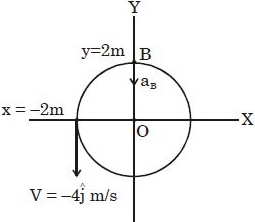
An object moves at a constant speed along a circular path in the horizontal $XY$ plane with the center at the origin. When the object is at $x = -2 \, m$,its velocity is $-(4 \, m/s) \hat{j}$. What is the object's acceleration when it is at $y = 2 \, m$?
A
$-(8 \, m/s^2) \hat{j}$
B
$-(8 \, m/s^2) \hat{i}$
C
$-(4 \, m/s^2) \hat{j}$
D
$(4 \, m/s^2) \hat{i}$
Solution
(A) The object moves in a circular path with the center at the origin $(0,0)$.
Given that at $x = -2 \, m$,the velocity is $\vec{v} = -(4 \, m/s) \hat{j}$.
Since the velocity is tangent to the circular path,at $x = -2 \, m$ (which is on the negative $X$-axis),the velocity vector points in the negative $Y$-direction. This implies the object is moving clockwise.
The radius of the circle is $R = 2 \, m$.
The speed of the object is $v = 4 \, m/s$.
For uniform circular motion,the acceleration is centripetal,directed towards the center.
When the object is at $y = 2 \, m$ (which is on the positive $Y$-axis),the center is at $(0,0)$,so the acceleration vector must point towards the origin,i.e.,in the negative $Y$-direction.
The magnitude of centripetal acceleration is $a_c = \frac{v^2}{R} = \frac{(4)^2}{2} = \frac{16}{2} = 8 \, m/s^2$.
Therefore,the acceleration vector at $y = 2 \, m$ is $\vec{a} = -(8 \, m/s^2) \hat{j}$.
Given that at $x = -2 \, m$,the velocity is $\vec{v} = -(4 \, m/s) \hat{j}$.
Since the velocity is tangent to the circular path,at $x = -2 \, m$ (which is on the negative $X$-axis),the velocity vector points in the negative $Y$-direction. This implies the object is moving clockwise.
The radius of the circle is $R = 2 \, m$.
The speed of the object is $v = 4 \, m/s$.
For uniform circular motion,the acceleration is centripetal,directed towards the center.
When the object is at $y = 2 \, m$ (which is on the positive $Y$-axis),the center is at $(0,0)$,so the acceleration vector must point towards the origin,i.e.,in the negative $Y$-direction.
The magnitude of centripetal acceleration is $a_c = \frac{v^2}{R} = \frac{(4)^2}{2} = \frac{16}{2} = 8 \, m/s^2$.
Therefore,the acceleration vector at $y = 2 \, m$ is $\vec{a} = -(8 \, m/s^2) \hat{j}$.
0 likes
View Solution70
MediumMCQ
$A$ particle is moving along a circular path with a constant speed of $10\,m/s.$ What is the magnitude of the change in velocity of the particle,when it moves through an angle of $60^{\circ}$ around the centre of the circle? .......... $m/s$
A
$10\sqrt{3}$
B
$0$
C
$10\sqrt{2}$
D
$10$
Solution
(D) The magnitude of the change in velocity $\Delta \vec{v}$ for a particle moving with constant speed $v$ through an angle $\theta$ is given by the formula:
$\Delta v = 2v \sin\left(\frac{\theta}{2}\right)$
Given:
Speed $v = 10\,m/s$
Angle $\theta = 60^{\circ}$
Substituting the values:
$\Delta v = 2 \times 10 \times \sin\left(\frac{60^{\circ}}{2}\right)$
$\Delta v = 20 \times \sin(30^{\circ})$
Since $\sin(30^{\circ}) = 0.5$:
$\Delta v = 20 \times 0.5 = 10\,m/s$
Therefore,the magnitude of the change in velocity is $10\,m/s$.
$\Delta v = 2v \sin\left(\frac{\theta}{2}\right)$
Given:
Speed $v = 10\,m/s$
Angle $\theta = 60^{\circ}$
Substituting the values:
$\Delta v = 2 \times 10 \times \sin\left(\frac{60^{\circ}}{2}\right)$
$\Delta v = 20 \times \sin(30^{\circ})$
Since $\sin(30^{\circ}) = 0.5$:
$\Delta v = 20 \times 0.5 = 10\,m/s$
Therefore,the magnitude of the change in velocity is $10\,m/s$.
0 likes
View Solution71
MediumMCQ
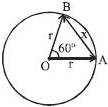
$A$ particle is moving on a circular path of radius $r$ with uniform speed $v$. What is the displacement of the particle after it has described an angle of $60^{\circ}$?
A
$r\sqrt{2}$
B
$r\sqrt{3}$
C
$r$
D
$2r$
Solution
(C) Let the initial position of the particle be $A$ and the final position be $B$ on a circular path of radius $r$. The angle subtended at the center $O$ is $\theta = 60^{\circ}$.
The displacement is the straight-line distance between $A$ and $B$,denoted by $x$.
In $\triangle OAB$,$OA = OB = r$ and $\angle AOB = 60^{\circ}$.
Since two sides are equal and the included angle is $60^{\circ}$,the triangle is equilateral.
Therefore,the third side $x = AB = r$.
The displacement is the straight-line distance between $A$ and $B$,denoted by $x$.
In $\triangle OAB$,$OA = OB = r$ and $\angle AOB = 60^{\circ}$.
Since two sides are equal and the included angle is $60^{\circ}$,the triangle is equilateral.
Therefore,the third side $x = AB = r$.
0 likes
View Solution72
MediumMCQ
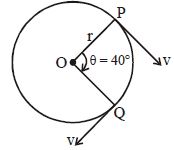
$A$ particle is moving on a circular path of radius $r$ with uniform speed $v$. The magnitude of change in velocity when the particle moves from $P$ to $Q$ is $(\angle POQ = 40^o)$.
A
$2v \cos 40^o$
B
$2v \sin 40^o$
C
$2v \sin 20^o$
D
$2v \cos 20^o$
Solution
(C) The velocity vector of a particle moving in a circle is always tangential to the path.
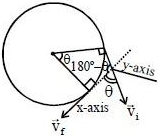
Let the initial velocity at point $P$ be $\vec{v}_i$ and the final velocity at point $Q$ be $\vec{v}_f$.
The magnitude of both velocities is $v$, so $|\vec{v}_i| = |\vec{v}_f| = v$.
The angle between the two velocity vectors is equal to the angle subtended by the arc $PQ$ at the center, which is $\theta = 40^o$.
The magnitude of the change in velocity is given by $|\Delta \vec{v}| = |\vec{v}_f - \vec{v}_i|$.
Using the vector subtraction formula, $|\vec{A} - \vec{B}| = \sqrt{A^2 + B^2 - 2AB \cos \theta}$.
Substituting the values: $|\Delta \vec{v}| = \sqrt{v^2 + v^2 - 2v^2 \cos \theta} = \sqrt{2v^2(1 - \cos \theta)}$.
Using the trigonometric identity $1 - \cos \theta = 2 \sin^2(\theta/2)$:
$|\Delta \vec{v}| = \sqrt{2v^2(2 \sin^2(\theta/2))} = \sqrt{4v^2 \sin^2(\theta/2)} = 2v \sin(\theta/2)$.
Given $\theta = 40^o$, the magnitude of change in velocity is $2v \sin(40^o/2) = 2v \sin 20^o$.
Let the initial velocity at point $P$ be $\vec{v}_i$ and the final velocity at point $Q$ be $\vec{v}_f$.
The magnitude of both velocities is $v$, so $|\vec{v}_i| = |\vec{v}_f| = v$.
The angle between the two velocity vectors is equal to the angle subtended by the arc $PQ$ at the center, which is $\theta = 40^o$.
The magnitude of the change in velocity is given by $|\Delta \vec{v}| = |\vec{v}_f - \vec{v}_i|$.
Using the vector subtraction formula, $|\vec{A} - \vec{B}| = \sqrt{A^2 + B^2 - 2AB \cos \theta}$.
Substituting the values: $|\Delta \vec{v}| = \sqrt{v^2 + v^2 - 2v^2 \cos \theta} = \sqrt{2v^2(1 - \cos \theta)}$.
Using the trigonometric identity $1 - \cos \theta = 2 \sin^2(\theta/2)$:
$|\Delta \vec{v}| = \sqrt{2v^2(2 \sin^2(\theta/2))} = \sqrt{4v^2 \sin^2(\theta/2)} = 2v \sin(\theta/2)$.
Given $\theta = 40^o$, the magnitude of change in velocity is $2v \sin(40^o/2) = 2v \sin 20^o$.
0 likes
View Solution73
MediumMCQ
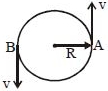
$A$ particle is moving with a constant speed $v$ in a circle. What is the magnitude of average velocity after half rotation?
A
$2\,v$
B
$2\,\frac{v}{\pi}$
C
$\frac{v}{2}$
D
$\frac{v}{2\pi}$
Solution
(B) Let $R$ be the radius of the circle. After half rotation,the particle moves from point $A$ to point $B$.
Displacement is the straight-line distance between $A$ and $B$,which is the diameter of the circle,$AB = 2R$.
The distance covered along the circular path is $\pi R$.
Since the speed is constant $v$,the time taken $t$ is given by $t = \frac{\text{distance}}{\text{speed}} = \frac{\pi R}{v}$.
Average velocity is defined as the total displacement divided by the total time taken.
$\text{Average velocity} = \frac{\text{Displacement}}{\text{Time taken}} = \frac{2R}{\pi R / v} = \frac{2v}{\pi}$.
Displacement is the straight-line distance between $A$ and $B$,which is the diameter of the circle,$AB = 2R$.
The distance covered along the circular path is $\pi R$.
Since the speed is constant $v$,the time taken $t$ is given by $t = \frac{\text{distance}}{\text{speed}} = \frac{\pi R}{v}$.
Average velocity is defined as the total displacement divided by the total time taken.
$\text{Average velocity} = \frac{\text{Displacement}}{\text{Time taken}} = \frac{2R}{\pi R / v} = \frac{2v}{\pi}$.
0 likes
View Solution74
DifficultMCQ
If the angular velocity of a merry-go-round is $60^o/s$ and you are $3.5\,m$ from the centre of rotation,your linear velocity will be
A
$\frac{22}{7}\,m/s$
B
$\frac{7\pi}{3}\,m/s$
C
$\frac{7\pi}{6}\,m/s$
D
$\pi\,m/s$
Solution
(C) The angular velocity is given as $\omega = 60^\circ/s$.
To convert degrees to radians,we use the relation $180^\circ = \pi\,rad$. Thus,$\omega = 60 \times \frac{\pi}{180} = \frac{\pi}{3}\,rad/s$.
The distance from the centre of rotation is $r = 3.5\,m = \frac{7}{2}\,m$.
The linear velocity $v$ is given by the formula $v = r\omega$.
Substituting the values,$v = \frac{7}{2} \times \frac{\pi}{3} = \frac{7\pi}{6}\,m/s$.
To convert degrees to radians,we use the relation $180^\circ = \pi\,rad$. Thus,$\omega = 60 \times \frac{\pi}{180} = \frac{\pi}{3}\,rad/s$.
The distance from the centre of rotation is $r = 3.5\,m = \frac{7}{2}\,m$.
The linear velocity $v$ is given by the formula $v = r\omega$.
Substituting the values,$v = \frac{7}{2} \times \frac{\pi}{3} = \frac{7\pi}{6}\,m/s$.
0 likes
View Solution75
DifficultMCQ
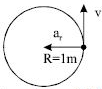
$A$ stone tied to the end of a string of $1\, m$ length is whirled in a horizontal circle with a constant speed. If the stone makes $22$ revolutions in $44\, s$,what is the magnitude and direction of the acceleration of the stone?
A
${\pi ^2}\,m\,s^{ - 2}$ and direction along the radius towards the centre.
B
${\pi ^2}\,m\,s^{ - 2}$ and direction along the radius away from the centre.
C
${\pi ^2}\,m\,s^{ - 2}$ and direction along the tangent to the circle.
D
${\pi ^2}/4\,m\,s^{ - 2}$ and direction along the radius towards the centre.
Solution
(A) Given:
Radius $R = 1\, m$
Number of revolutions $n = 22$
Time $t = 44\, s$
Frequency $f = \frac{n}{t} = \frac{22}{44} = 0.5\, Hz$
Angular velocity $\omega = 2\pi f = 2\pi \times 0.5 = \pi\, rad/s$
The centripetal acceleration is given by $a_r = \omega^2 R$
Substituting the values: $a_r = (\pi)^2 \times 1 = \pi^2\, m/s^2$
Since the speed is constant,the tangential acceleration $a_t = 0$. Thus,the net acceleration is the centripetal acceleration,which is directed towards the centre of the circle.
Radius $R = 1\, m$
Number of revolutions $n = 22$
Time $t = 44\, s$
Frequency $f = \frac{n}{t} = \frac{22}{44} = 0.5\, Hz$
Angular velocity $\omega = 2\pi f = 2\pi \times 0.5 = \pi\, rad/s$
The centripetal acceleration is given by $a_r = \omega^2 R$
Substituting the values: $a_r = (\pi)^2 \times 1 = \pi^2\, m/s^2$
Since the speed is constant,the tangential acceleration $a_t = 0$. Thus,the net acceleration is the centripetal acceleration,which is directed towards the centre of the circle.
0 likes
View Solution76
MediumMCQ
$A$ particle moves in a circle of radius $25\, cm$ at two revolutions per second. The acceleration of the particle in $m/s^2$ is
A
${\pi ^2}$
B
$8\,{\pi ^2}$
C
$4\,{\pi ^2}$
D
$2\,{\pi ^2}$
Solution
(C) Given radius $r = 25\, cm = 0.25\, m$.
Frequency $f = 2\, rev/s$.
The angular velocity is given by $\omega = 2\pi f = 2\pi \times 2 = 4\pi\, rad/s$.
The centripetal acceleration $a_c$ is given by the formula $a_c = r\omega^2$.
Substituting the values: $a_c = 0.25 \times (4\pi)^2$.
$a_c = 0.25 \times 16\pi^2$.
$a_c = 4\pi^2\, m/s^2$.
Frequency $f = 2\, rev/s$.
The angular velocity is given by $\omega = 2\pi f = 2\pi \times 2 = 4\pi\, rad/s$.
The centripetal acceleration $a_c$ is given by the formula $a_c = r\omega^2$.
Substituting the values: $a_c = 0.25 \times (4\pi)^2$.
$a_c = 0.25 \times 16\pi^2$.
$a_c = 4\pi^2\, m/s^2$.
0 likes
View Solution77
MediumMCQ
Two particles $A$ and $B$ are moving in uniform circular motion in concentric circles of radii $r_{A}$ and $r_{B}$ with speeds $v_A$ and $v_B$ respectively. The time period of rotation is the same. The ratio of angular speed of $A$ to that of $B$ will be
A
$r_{A}: r_{B}$
B
$v_{A}: v_{B}$
C
$r_{B}: r_{A}$
D
$1: 1$
Solution
(D) The angular speed $\omega$ of a particle in uniform circular motion is related to its time period $T$ by the formula $\omega = \frac{2\pi}{T}$.
Given that the time periods of particles $A$ and $B$ are the same,i.e.,$T_A = T_B = T$.
Therefore,the angular speed of particle $A$ is $\omega_A = \frac{2\pi}{T_A} = \frac{2\pi}{T}$.
Similarly,the angular speed of particle $B$ is $\omega_B = \frac{2\pi}{T_B} = \frac{2\pi}{T}$.
Taking the ratio of the angular speeds,we get $\frac{\omega_A}{\omega_B} = \frac{2\pi/T}{2\pi/T} = 1$.
Thus,the ratio of the angular speed of $A$ to that of $B$ is $1: 1$.
Given that the time periods of particles $A$ and $B$ are the same,i.e.,$T_A = T_B = T$.
Therefore,the angular speed of particle $A$ is $\omega_A = \frac{2\pi}{T_A} = \frac{2\pi}{T}$.
Similarly,the angular speed of particle $B$ is $\omega_B = \frac{2\pi}{T_B} = \frac{2\pi}{T}$.
Taking the ratio of the angular speeds,we get $\frac{\omega_A}{\omega_B} = \frac{2\pi/T}{2\pi/T} = 1$.
Thus,the ratio of the angular speed of $A$ to that of $B$ is $1: 1$.
0 likes
View Solution78
MediumMCQ
$A$ particle moves such that its position vector $\overrightarrow{r}(t) = \cos \omega t \hat{i} + \sin \omega t \hat{j}$,where $\omega$ is a constant and $t$ is time. Which of the following statements is true for the velocity $\overrightarrow{v}(t)$ and acceleration $\overrightarrow{a}(t)$ of the particle?
A
$\overrightarrow{v}$ is perpendicular to $\overrightarrow{r}$ and $\overrightarrow{a}$ is directed towards the origin.
B
$\overrightarrow{v}$ and $\overrightarrow{a}$ both are parallel to $\overrightarrow{r}$.
C
$\overrightarrow{v}$ and $\overrightarrow{a}$ both are perpendicular to $\overrightarrow{r}$.
D
$\overrightarrow{v}$ is perpendicular to $\overrightarrow{r}$ and $\overrightarrow{a}$ is directed away from the origin.
Solution
(A) Given the position vector: $\overrightarrow{r}(t) = \cos \omega t \hat{i} + \sin \omega t \hat{j}$.
To find the velocity $\overrightarrow{v}(t)$,we differentiate $\overrightarrow{r}(t)$ with respect to time $t$:
$\overrightarrow{v}(t) = \frac{d\overrightarrow{r}}{dt} = -\omega \sin \omega t \hat{i} + \omega \cos \omega t \hat{j}$.
To find the acceleration $\overrightarrow{a}(t)$,we differentiate $\overrightarrow{v}(t)$ with respect to time $t$:
$\overrightarrow{a}(t) = \frac{d\overrightarrow{v}}{dt} = -\omega^2 \cos \omega t \hat{i} - \omega^2 \sin \omega t \hat{j} = -\omega^2 (\cos \omega t \hat{i} + \sin \omega t \hat{j}) = -\omega^2 \overrightarrow{r}$.
Now,check the dot product of $\overrightarrow{v}$ and $\overrightarrow{r}$:
$\overrightarrow{v} \cdot \overrightarrow{r} = (-\omega \sin \omega t)(\cos \omega t) + (\omega \cos \omega t)(\sin \omega t) = 0$.
Since the dot product is $0$,$\overrightarrow{v}$ is perpendicular to $\overrightarrow{r}$.
Since $\overrightarrow{a} = -\omega^2 \overrightarrow{r}$,the acceleration vector is in the opposite direction of the position vector $\overrightarrow{r}$,meaning it is directed towards the origin.
To find the velocity $\overrightarrow{v}(t)$,we differentiate $\overrightarrow{r}(t)$ with respect to time $t$:
$\overrightarrow{v}(t) = \frac{d\overrightarrow{r}}{dt} = -\omega \sin \omega t \hat{i} + \omega \cos \omega t \hat{j}$.
To find the acceleration $\overrightarrow{a}(t)$,we differentiate $\overrightarrow{v}(t)$ with respect to time $t$:
$\overrightarrow{a}(t) = \frac{d\overrightarrow{v}}{dt} = -\omega^2 \cos \omega t \hat{i} - \omega^2 \sin \omega t \hat{j} = -\omega^2 (\cos \omega t \hat{i} + \sin \omega t \hat{j}) = -\omega^2 \overrightarrow{r}$.
Now,check the dot product of $\overrightarrow{v}$ and $\overrightarrow{r}$:
$\overrightarrow{v} \cdot \overrightarrow{r} = (-\omega \sin \omega t)(\cos \omega t) + (\omega \cos \omega t)(\sin \omega t) = 0$.
Since the dot product is $0$,$\overrightarrow{v}$ is perpendicular to $\overrightarrow{r}$.
Since $\overrightarrow{a} = -\omega^2 \overrightarrow{r}$,the acceleration vector is in the opposite direction of the position vector $\overrightarrow{r}$,meaning it is directed towards the origin.
0 likes
View Solution79
EasyMCQ
Can a moving object have a constant speed but a changing velocity?
A
Yes
B
No
C
Only in circular motion
D
Only in linear motion
Solution
(A) Yes,an object can have a constant speed but a changing velocity if it is moving along a curved path.
Velocity is a vector quantity,meaning it depends on both magnitude (speed) and direction.
If the direction of motion changes,the velocity changes even if the speed remains constant.
Velocity is a vector quantity,meaning it depends on both magnitude (speed) and direction.
If the direction of motion changes,the velocity changes even if the speed remains constant.
0 likes
View Solution80
EasyMCQ
Give an example of a motion where the object has acceleration but is still considered to have uniform motion.
A
Uniform linear motion
B
Uniform circular motion
C
Projectile motion
D
Free fall
Solution
(B) In uniform circular motion,the speed of the object remains constant,which is why it is called 'uniform'. However,the direction of the object changes at every point along the circular path. Since acceleration is defined as the rate of change of velocity (which is a vector quantity),the change in direction results in a centripetal acceleration. Therefore,an object in uniform circular motion is accelerating despite having a constant speed.
0 likes
View Solution81
MediumMCQ
What is the direction of instantaneous velocity for an angular path?
A
Along the radius directed towards the center
B
Along the radius directed away from the center
C
Along the tangent to the path at that point
D
Along the axis of rotation
Solution
(C) The instantaneous velocity of a particle moving along a curved or angular path is defined as the limit of the average velocity as the time interval approaches zero.
Mathematically,$\vec{v} = \lim_{\Delta t \to 0} \frac{\Delta \vec{r}}{\Delta t} = \frac{d\vec{r}}{dt}$.
Geometrically,the displacement vector $\Delta \vec{r}$ becomes tangent to the path as $\Delta t$ becomes infinitesimally small.
Therefore,the direction of the instantaneous velocity vector is always tangent to the path of the particle at that specific point.
Mathematically,$\vec{v} = \lim_{\Delta t \to 0} \frac{\Delta \vec{r}}{\Delta t} = \frac{d\vec{r}}{dt}$.
Geometrically,the displacement vector $\Delta \vec{r}$ becomes tangent to the path as $\Delta t$ becomes infinitesimally small.
Therefore,the direction of the instantaneous velocity vector is always tangent to the path of the particle at that specific point.
0 likes
View Solution82
Difficult
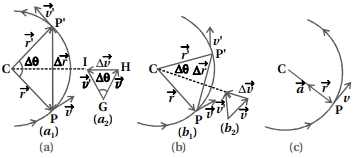
What is uniform circular motion? By using a proper figure,derive the equation for centripetal acceleration $a_c = \frac{v^2}{r}$ for uniform circular motion. Show that its direction is towards the center.
Solution
(N/A) Uniform circular motion is the motion of an object traveling at a constant speed along a circular path.
Consider an object moving with a constant speed $v$ in a circle of radius $r$. Since the direction of velocity changes continuously,the object undergoes acceleration.
Let $\vec{r}$ and $\vec{r}'$ be the position vectors,and $\vec{v}$ and $\vec{v}'$ be the velocity vectors of the object at points $P$ and $P'$ respectively.
The velocity vector at any point is tangent to the path at that point.
From the triangle law of vector addition,the change in velocity $\Delta \vec{v} = \vec{v}' - \vec{v}$ is shown in figure $(a_2)$.
Since the path is circular,$\vec{v}$ is perpendicular to $\vec{r}$,and $\vec{v}'$ is perpendicular to $\vec{r}'$. Thus,$\Delta \vec{v}$ is perpendicular to $\Delta \vec{r}$.
Since the average acceleration $\vec{a} = \frac{\Delta \vec{v}}{\Delta t}$,the direction of $\vec{a}$ is the same as $\Delta \vec{v}$.
As $\Delta t \rightarrow 0$,the triangle formed by $\Delta \vec{v}$ becomes similar to the triangle formed by $\Delta \vec{r}$.
From the similarity of triangles,$\frac{|\Delta \vec{v}|}{v} = \frac{|\Delta \vec{r}|}{r}$.
Dividing by $\Delta t$,we get $\frac{|\Delta \vec{v}|}{\Delta t} = \frac{v}{r} \frac{|\Delta \vec{r}|}{\Delta t}$.
As $\Delta t \rightarrow 0$,$|\Delta \vec{r}| \approx v \Delta t$,so $a_c = \lim_{\Delta t \rightarrow 0} \frac{|\Delta \vec{v}|}{\Delta t} = \frac{v}{r} (v) = \frac{v^2}{r}$.
Thus,the acceleration is directed towards the center.
Consider an object moving with a constant speed $v$ in a circle of radius $r$. Since the direction of velocity changes continuously,the object undergoes acceleration.
Let $\vec{r}$ and $\vec{r}'$ be the position vectors,and $\vec{v}$ and $\vec{v}'$ be the velocity vectors of the object at points $P$ and $P'$ respectively.
The velocity vector at any point is tangent to the path at that point.
From the triangle law of vector addition,the change in velocity $\Delta \vec{v} = \vec{v}' - \vec{v}$ is shown in figure $(a_2)$.
Since the path is circular,$\vec{v}$ is perpendicular to $\vec{r}$,and $\vec{v}'$ is perpendicular to $\vec{r}'$. Thus,$\Delta \vec{v}$ is perpendicular to $\Delta \vec{r}$.
Since the average acceleration $\vec{a} = \frac{\Delta \vec{v}}{\Delta t}$,the direction of $\vec{a}$ is the same as $\Delta \vec{v}$.
As $\Delta t \rightarrow 0$,the triangle formed by $\Delta \vec{v}$ becomes similar to the triangle formed by $\Delta \vec{r}$.
From the similarity of triangles,$\frac{|\Delta \vec{v}|}{v} = \frac{|\Delta \vec{r}|}{r}$.
Dividing by $\Delta t$,we get $\frac{|\Delta \vec{v}|}{\Delta t} = \frac{v}{r} \frac{|\Delta \vec{r}|}{\Delta t}$.
As $\Delta t \rightarrow 0$,$|\Delta \vec{r}| \approx v \Delta t$,so $a_c = \lim_{\Delta t \rightarrow 0} \frac{|\Delta \vec{v}|}{\Delta t} = \frac{v}{r} (v) = \frac{v^2}{r}$.
Thus,the acceleration is directed towards the center.
0 likes
View Solution83
Medium
Write the equation for centripetal acceleration in uniform circular motion. Obtain these equations in terms of angular velocity $(\omega)$ and frequency $(\nu)$.
Solution
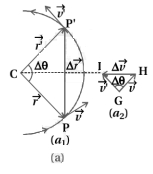
(N/A) In uniform circular motion,an object moves along a circular path of radius $R$ with constant speed $v$.
As the object moves from point $P$ to $P'$ in time interval $\Delta t$,the position vector turns through an angle $\Delta \theta$.
The angular velocity $\omega$ is defined as the rate of change of angular displacement: $\omega = \frac{\Delta \theta}{\Delta t}$.
Since the arc length $\Delta S = R \Delta \theta$,the linear speed is $v = \frac{\Delta S}{\Delta t} = R \frac{\Delta \theta}{\Delta t} = R \omega$.
The centripetal acceleration $a_c$ is given by $a_c = \frac{v^2}{R}$.
Substituting $v = R \omega$,we get $a_c = \frac{(R \omega)^2}{R} = R \omega^2$.
Since angular velocity $\omega = 2 \pi \nu$,where $\nu$ is the frequency,we can also express centripetal acceleration as:
$a_c = R (2 \pi \nu)^2 = 4 \pi^2 \nu^2 R$.
As the object moves from point $P$ to $P'$ in time interval $\Delta t$,the position vector turns through an angle $\Delta \theta$.
The angular velocity $\omega$ is defined as the rate of change of angular displacement: $\omega = \frac{\Delta \theta}{\Delta t}$.
Since the arc length $\Delta S = R \Delta \theta$,the linear speed is $v = \frac{\Delta S}{\Delta t} = R \frac{\Delta \theta}{\Delta t} = R \omega$.
The centripetal acceleration $a_c$ is given by $a_c = \frac{v^2}{R}$.
Substituting $v = R \omega$,we get $a_c = \frac{(R \omega)^2}{R} = R \omega^2$.
Since angular velocity $\omega = 2 \pi \nu$,where $\nu$ is the frequency,we can also express centripetal acceleration as:
$a_c = R (2 \pi \nu)^2 = 4 \pi^2 \nu^2 R$.
0 likes
View Solution84
Difficult
What is uniform circular motion? Write the formula for centripetal acceleration in uniform circular motion.
Solution
(N/A) Uniform circular motion is the motion of an object traveling at a constant speed along a circular path.
In this motion,the magnitude of the velocity remains constant,but the direction of the velocity changes continuously at every point.
Since acceleration is defined as the rate of change of velocity,and the direction of velocity is changing,the object experiences an acceleration directed towards the center of the circle.
This acceleration is known as centripetal acceleration $(a_c)$.
The formula for centripetal acceleration is given by: $a_c = \frac{v^2}{r} = \omega^2 r$,where $v$ is the linear speed,$r$ is the radius of the circular path,and $\omega$ is the angular velocity.
In this motion,the magnitude of the velocity remains constant,but the direction of the velocity changes continuously at every point.
Since acceleration is defined as the rate of change of velocity,and the direction of velocity is changing,the object experiences an acceleration directed towards the center of the circle.
This acceleration is known as centripetal acceleration $(a_c)$.
The formula for centripetal acceleration is given by: $a_c = \frac{v^2}{r} = \omega^2 r$,where $v$ is the linear speed,$r$ is the radius of the circular path,and $\omega$ is the angular velocity.
0 likes
View Solution85
Medium
Derive the formula $a_c = R\omega^2$ from $a_c = \frac{v^2}{R}$.
Solution
(N/A) We are given the centripetal acceleration formula as $a_c = \frac{v^2}{R}$.
We know the relationship between linear velocity $v$ and angular velocity $\omega$ is given by $v = R\omega$,where $R$ is the radius of the circular path.
Substitute $v = R\omega$ into the centripetal acceleration formula:
$a_c = \frac{(R\omega)^2}{R}$
$a_c = \frac{R^2\omega^2}{R}$
By simplifying the expression,we get:
$a_c = R\omega^2$.
We know the relationship between linear velocity $v$ and angular velocity $\omega$ is given by $v = R\omega$,where $R$ is the radius of the circular path.
Substitute $v = R\omega$ into the centripetal acceleration formula:
$a_c = \frac{(R\omega)^2}{R}$
$a_c = \frac{R^2\omega^2}{R}$
By simplifying the expression,we get:
$a_c = R\omega^2$.
0 likes
View Solution86
EasyMCQ
Write the formula for centripetal acceleration in terms of frequency in uniform circular motion.
A
$a_c = 4\pi^2 f^2 r$
B
$a_c = 2\pi^2 f^2 r$
C
$a_c = 4\pi f^2 r$
D
$a_c = \pi^2 f^2 r$
Solution
(A) In uniform circular motion,the centripetal acceleration is given by $a_c = \omega^2 r$,where $\omega$ is the angular velocity and $r$ is the radius of the circular path.
We know that the relationship between angular velocity $\omega$ and frequency $f$ is $\omega = 2\pi f$.
Substituting this value into the centripetal acceleration formula:
$a_c = (2\pi f)^2 r$
$a_c = 4\pi^2 f^2 r$
Thus,the formula for centripetal acceleration in terms of frequency is $a_c = 4\pi^2 f^2 r$.
We know that the relationship between angular velocity $\omega$ and frequency $f$ is $\omega = 2\pi f$.
Substituting this value into the centripetal acceleration formula:
$a_c = (2\pi f)^2 r$
$a_c = 4\pi^2 f^2 r$
Thus,the formula for centripetal acceleration in terms of frequency is $a_c = 4\pi^2 f^2 r$.
0 likes
View Solution87
EasyMCQ
Find the angular speed of the hour hand of a clock.
A
$\frac{\pi}{6} \text{ rad h}^{-1}$
B
$\frac{\pi}{12} \text{ rad h}^{-1}$
C
$\frac{\pi}{3} \text{ rad h}^{-1}$
D
$\frac{\pi}{2} \text{ rad h}^{-1}$
Solution
(A) The angular speed $\omega$ is defined as the ratio of angular displacement $\Delta \theta$ to the time interval $\Delta t$.
For the hour hand of a clock,it completes one full revolution ($2\pi$ radians) in $12$ hours.
Therefore,$\omega = \frac{\Delta \theta}{\Delta t} = \frac{2\pi \text{ rad}}{12 \text{ h}} = \frac{\pi}{6} \text{ rad h}^{-1}$.
For the hour hand of a clock,it completes one full revolution ($2\pi$ radians) in $12$ hours.
Therefore,$\omega = \frac{\Delta \theta}{\Delta t} = \frac{2\pi \text{ rad}}{12 \text{ h}} = \frac{\pi}{6} \text{ rad h}^{-1}$.
0 likes
View Solution88
EasyMCQ
Find the angle between the velocity vector and the acceleration vector for a particle in uniform circular motion. (in $^{\circ}$)
A
$0$
B
$45$
C
$90$
D
$180$
Solution
(C) In uniform circular motion,the speed of the particle remains constant,but the direction of velocity changes continuously.
The acceleration in uniform circular motion is centripetal acceleration,which is directed towards the center of the circular path.
The velocity vector is always tangent to the circular path at any given point.
Since the radius (position vector) is perpendicular to the tangent at any point on the circle,the centripetal acceleration (directed along the radius) is always perpendicular to the velocity vector.
Therefore,the angle between the velocity vector $\vec{v}$ and the acceleration vector $\vec{a}$ is $90^{\circ}$.
The acceleration in uniform circular motion is centripetal acceleration,which is directed towards the center of the circular path.
The velocity vector is always tangent to the circular path at any given point.
Since the radius (position vector) is perpendicular to the tangent at any point on the circle,the centripetal acceleration (directed along the radius) is always perpendicular to the velocity vector.
Therefore,the angle between the velocity vector $\vec{v}$ and the acceleration vector $\vec{a}$ is $90^{\circ}$.
0 likes
View Solution89
EasyMCQ
If the speed $(v)$ and radius $(r)$ of a particle performing uniform circular motion are both doubled,find its new centripetal acceleration.
A
$a_{c}$
B
$2a_{c}$
C
$4a_{c}$
D
$8a_{c}$
Solution
(B) The formula for centripetal acceleration is $a_{c} = \frac{v^{2}}{r}$.
Given that the new speed is $v' = 2v$ and the new radius is $r' = 2r$.
The new centripetal acceleration $a_{c}'$ is given by:
$a_{c}' = \frac{(v')^{2}}{r'} = \frac{(2v)^{2}}{2r} = \frac{4v^{2}}{2r}$.
Simplifying this,we get $a_{c}' = 2 \left( \frac{v^{2}}{r} \right)$.
Therefore,$a_{c}' = 2a_{c}$.
Given that the new speed is $v' = 2v$ and the new radius is $r' = 2r$.
The new centripetal acceleration $a_{c}'$ is given by:
$a_{c}' = \frac{(v')^{2}}{r'} = \frac{(2v)^{2}}{2r} = \frac{4v^{2}}{2r}$.
Simplifying this,we get $a_{c}' = 2 \left( \frac{v^{2}}{r} \right)$.
Therefore,$a_{c}' = 2a_{c}$.
0 likes
View Solution90
Medium
$A$ cyclist starts from the centre $O$ of a circular park of radius $1\, km$ and moves along the path $OPRQO$ as shown in the figure. If he maintains a constant speed of $10\, m/s$,what is his acceleration at point $R$ in magnitude and direction?

Solution
(N/A) The cyclist is moving along a circular path with a constant speed. Therefore,the motion is uniform circular motion.
In uniform circular motion,the acceleration is purely centripetal,directed towards the centre of the circle.
The magnitude of centripetal acceleration is given by $a = \frac{v^2}{r}$.
Given: speed $v = 10\, m/s$ and radius $r = 1\, km = 1000\, m$.
Substituting the values:
$a = \frac{(10\, m/s)^2}{1000\, m} = \frac{100}{1000}\, m/s^2 = 0.1\, m/s^2$.
The direction of this acceleration is always towards the centre of the circular path,which is point $O$. Thus,the acceleration is $0.1\, m/s^2$ directed along $RO$.
In uniform circular motion,the acceleration is purely centripetal,directed towards the centre of the circle.
The magnitude of centripetal acceleration is given by $a = \frac{v^2}{r}$.
Given: speed $v = 10\, m/s$ and radius $r = 1\, km = 1000\, m$.
Substituting the values:
$a = \frac{(10\, m/s)^2}{1000\, m} = \frac{100}{1000}\, m/s^2 = 0.1\, m/s^2$.
The direction of this acceleration is always towards the centre of the circular path,which is point $O$. Thus,the acceleration is $0.1\, m/s^2$ directed along $RO$.

0 likes
View Solution91
Medium
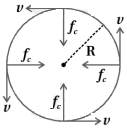
For uniform circular motion,write the equations for centripetal force and centripetal acceleration. Also,provide examples.
Solution
(N/A) When a body of mass $m$ moves on a circular path of radius $R$ with a constant speed $v$,it experiences a centripetal or radial acceleration given by $a = \frac{v^2}{R}$. The direction of this acceleration is always toward the center of the circle.
By Newton's second law of motion,the necessary force to provide this acceleration is $F_c = \frac{mv^2}{R}$. The direction of this force is also toward the center of the circle; hence,it is called centripetal force.
In different situations,centripetal force is provided as follows:
$(1)$ For a planet revolving around the Sun,the necessary centripetal force is provided by the gravitational force.
$(2)$ For an electron revolving around the nucleus in an atom,the necessary centripetal force is provided by the Coulombian force (electric force).
$(3)$ For vehicles moving on a level circular track,the necessary centripetal force is provided by the friction force between the tyres and the road.
By Newton's second law of motion,the necessary force to provide this acceleration is $F_c = \frac{mv^2}{R}$. The direction of this force is also toward the center of the circle; hence,it is called centripetal force.
In different situations,centripetal force is provided as follows:
$(1)$ For a planet revolving around the Sun,the necessary centripetal force is provided by the gravitational force.
$(2)$ For an electron revolving around the nucleus in an atom,the necessary centripetal force is provided by the Coulombian force (electric force).
$(3)$ For vehicles moving on a level circular track,the necessary centripetal force is provided by the friction force between the tyres and the road.
0 likes
View Solution92
Difficult
Write the equations for centripetal acceleration and centripetal force for uniform circular motion.
Solution
(N/A) For an object of mass $m$ moving in a circular path of radius $r$ with a constant speed $v$ (or angular velocity $\omega$),the equations are as follows:
$1$. Centripetal Acceleration $(a_c)$: The acceleration directed towards the center of the circular path is given by:
$a_c = \frac{v^2}{r} = r\omega^2$
$2$. Centripetal Force $(F_c)$: According to Newton's second law $(F = ma)$,the force required to maintain uniform circular motion is:
$F_c = m a_c = \frac{mv^2}{r} = mr\omega^2$
Here,$v$ is the linear speed,$r$ is the radius of the circular path,$m$ is the mass of the object,and $\omega$ is the angular velocity.
$1$. Centripetal Acceleration $(a_c)$: The acceleration directed towards the center of the circular path is given by:
$a_c = \frac{v^2}{r} = r\omega^2$
$2$. Centripetal Force $(F_c)$: According to Newton's second law $(F = ma)$,the force required to maintain uniform circular motion is:
$F_c = m a_c = \frac{mv^2}{r} = mr\omega^2$
Here,$v$ is the linear speed,$r$ is the radius of the circular path,$m$ is the mass of the object,and $\omega$ is the angular velocity.
0 likes
View Solution93
EasyMCQ
If the direction of motion of an object performing uniform circular motion is reversed,what will be the effect on the direction of the centripetal force?
A
The direction of the centripetal force will be reversed.
B
The direction of the centripetal force will remain unchanged.
C
The centripetal force will become zero.
D
The centripetal force will act tangentially.
Solution
(B) The centripetal force is always directed towards the center of the circular path.
In uniform circular motion,the centripetal force is given by $F_c = \frac{mv^2}{r}$,where $m$ is the mass,$v$ is the speed,and $r$ is the radius.
The direction of the centripetal force depends only on the position of the object relative to the center of the circle,not on the direction of its velocity (tangential motion).
Therefore,reversing the direction of motion does not change the direction of the centripetal force; it remains directed towards the center.
In uniform circular motion,the centripetal force is given by $F_c = \frac{mv^2}{r}$,where $m$ is the mass,$v$ is the speed,and $r$ is the radius.
The direction of the centripetal force depends only on the position of the object relative to the center of the circle,not on the direction of its velocity (tangential motion).
Therefore,reversing the direction of motion does not change the direction of the centripetal force; it remains directed towards the center.
0 likes
View Solution94
EasyMCQ
$A$ heavy stone is tied to the end of a string and whirled in a horizontal circular path of radius $20 \, cm$ with a constant angular speed. If the centripetal acceleration is $980 \, cm \, s^{-2}$,what is its angular speed?
A
$7 \, rad \, s^{-1}$
B
$14 \, rad \, s^{-1}$
C
$21 \, rad \, s^{-1}$
D
$49 \, rad \, s^{-1}$
Solution
(A) The formula for centripetal acceleration $a_c$ is given by $a_c = r \omega^2$,where $r$ is the radius and $\omega$ is the angular speed.
Given: $r = 20 \, cm$ and $a_c = 980 \, cm \, s^{-2}$.
Substituting the values into the formula:
$980 = 20 \times \omega^2$
$\omega^2 = \frac{980}{20} = 49$
$\omega = \sqrt{49} = 7 \, rad \, s^{-1}$.
Given: $r = 20 \, cm$ and $a_c = 980 \, cm \, s^{-2}$.
Substituting the values into the formula:
$980 = 20 \times \omega^2$
$\omega^2 = \frac{980}{20} = 49$
$\omega = \sqrt{49} = 7 \, rad \, s^{-1}$.
0 likes
View Solution95
MediumMCQ
How much work is done by the centripetal force on an object moving in uniform circular motion?
A
$0$
B
$mv^2/r$
C
$mv^2$
D
$2\pi r$
Solution
(A) In uniform circular motion,the centripetal force $\vec{F}$ acts towards the center of the circle,while the displacement $\vec{d}$ (or velocity vector $\vec{v}$) is always tangent to the circular path.
Since the force is always perpendicular to the displacement,the angle $\theta$ between them is $90^{\circ}$.
The work done $W$ is given by the formula $W = F d \cos \theta$.
Substituting $\theta = 90^{\circ}$,we get $W = F d \cos 90^{\circ} = F d (0) = 0$.
Therefore,the work done by the centripetal force is $0$.
Since the force is always perpendicular to the displacement,the angle $\theta$ between them is $90^{\circ}$.
The work done $W$ is given by the formula $W = F d \cos \theta$.
Substituting $\theta = 90^{\circ}$,we get $W = F d \cos 90^{\circ} = F d (0) = 0$.
Therefore,the work done by the centripetal force is $0$.
0 likes
View Solution96
Medium
Define angular speed and angular velocity.
Solution
(N/A) Angular speed is defined as the rate of change of angular displacement with respect to time. It is a scalar quantity. If an object rotates by an angle $\Delta \theta$ in time $\Delta t$,the average angular speed is $\omega_{avg} = \frac{\Delta \theta}{\Delta t}$. The instantaneous angular speed is $\omega = \lim_{\Delta t \to 0} \frac{\Delta \theta}{\Delta t} = \frac{d\theta}{dt}$.
Angular velocity is defined as the rate of change of angular displacement vector with respect to time. It is a vector quantity,denoted by $\vec{\omega}$. Its direction is given by the right-hand rule,perpendicular to the plane of rotation. The instantaneous angular velocity is $\vec{\omega} = \frac{d\vec{\theta}}{dt}$.
Angular velocity is defined as the rate of change of angular displacement vector with respect to time. It is a vector quantity,denoted by $\vec{\omega}$. Its direction is given by the right-hand rule,perpendicular to the plane of rotation. The instantaneous angular velocity is $\vec{\omega} = \frac{d\vec{\theta}}{dt}$.
0 likes
View Solution97
Medium
Write the relation between linear speed and angular speed.
Solution
(N/A) The linear speed $v$ of a particle moving in a circular path of radius $r$ is related to its angular speed $\omega$ by the formula:
$v = r\omega$
where:
$v$ is the linear speed (in $m/s$),
$r$ is the radius of the circular path (in $m$),
$\omega$ is the angular speed (in $rad/s$).
$v = r\omega$
where:
$v$ is the linear speed (in $m/s$),
$r$ is the radius of the circular path (in $m$),
$\omega$ is the angular speed (in $rad/s$).
0 likes
View Solution98
Difficult
Write the relation between linear velocity and angular velocity.
Solution
(N/A) The relation between linear velocity $\vec{v}$ and angular velocity $\vec{\omega}$ for a particle moving in a circular path of radius $\vec{r}$ is given by the vector product: $\vec{v} = \vec{\omega} \times \vec{r}$.
In terms of magnitude,for a particle moving in a circle of radius $r$,the relation is $v = r\omega$,where $v$ is the linear speed,$\omega$ is the angular speed,and $r$ is the radius of the circular path.
In terms of magnitude,for a particle moving in a circle of radius $r$,the relation is $v = r\omega$,where $v$ is the linear speed,$\omega$ is the angular speed,and $r$ is the radius of the circular path.
0 likes
View Solution99
MediumMCQ
What is the linear velocity of a particle in uniform circular motion of radius $A$ and angular velocity $\omega$?
A
$v = A\omega$
B
$v = A/\omega$
C
$v = \omega/A$
D
$v = A^2\omega$
Solution
(A) In uniform circular motion,a particle moves along a circular path of radius $A$ with a constant angular velocity $\omega$.
The relationship between linear velocity $v$,angular velocity $\omega$,and the radius of the circular path $A$ is given by the formula:
$v = r\omega$
Substituting the given radius $r = A$,we get:
$v = A\omega$
Therefore,the linear velocity of the particle is $A\omega$.
The relationship between linear velocity $v$,angular velocity $\omega$,and the radius of the circular path $A$ is given by the formula:
$v = r\omega$
Substituting the given radius $r = A$,we get:
$v = A\omega$
Therefore,the linear velocity of the particle is $A\omega$.
0 likes
View Solution3-2.Motion in Plane — Angular Variables and Basic of Uniform Circular Motion · Frequently Asked Questions
1Are these 3-2.Motion in Plane questions useful for JEE and NEET?
Yes. All questions in this section are mapped to JEE Main and NEET exam patterns. Previous year questions from JEE Main, NEET, GUJCET and state-level exams are included with full solutions.
2Can I switch to Hindi or Gujarati for these questions?
Yes. Use the language tabs in the hero section or the sidebar to view the same questions and solutions in English, Hindi or Gujarati.
3How do I generate a question paper from this subtopic?
Use the Vedclass Exam Paper Generator — select the chapter and subtopic, set difficulty, and generate Sets A, B, C, D automatically. First 3 chapters of every subject are free.
Vedclass Products
For Students
Vedclass Test Series
Mock tests in real JEE/NEET style with performance analysis. 5-day free trial.
Start Free TrialFor Teachers
Exam Paper Generator
Generate Set A/B/C/D papers from this chapter in 2 minutes. 3 chapters free.
Try FreeFor Institutes
Online Exam Module
Live online exams with unlimited students, 360° analytics & white-label branding.
See DemoFor Teachers & Institutes
Generate a 3-2.Motion in Plane Exam Paper in 2 Minutes
Select subtopic & difficulty — Sets A, B, C, D auto-generated with No Repeat logic.
First 3 chapters of every subject are free — no payment required.