
A English
Angular Variables and Basic of Uniform Circular Motion Questions in English
Class 11 Physics · 3-2.Motion in Plane · Angular Variables and Basic of Uniform Circular Motion
176+
Questions
English
Language
100%
With Solutions
Showing 25 of 176 questions in English
151
MediumMCQ
Two particles having mass $M$ and $m$ are moving in a circular path with radius $R$ and $r$ respectively. The time period for both the particles is same. The ratio of angular velocity of the first particle to the second particle will be
A
$1: 1$
B
$1: 2$
C
$2: 3$
D
$3: 4$
Solution
(A) The angular velocity $\omega$ of a particle moving in a circular path is related to its time period $T$ by the formula: $\omega = \frac{2\pi}{T}$.
Since the time period $T$ is the same for both particles $(T_1 = T_2 = T)$,their angular velocities are:
$\omega_1 = \frac{2\pi}{T_1}$ and $\omega_2 = \frac{2\pi}{T_2}$.
Therefore,$\omega_1 = \omega_2$.
The ratio of the angular velocity of the first particle to the second particle is $\frac{\omega_1}{\omega_2} = \frac{1}{1}$.
Since the time period $T$ is the same for both particles $(T_1 = T_2 = T)$,their angular velocities are:
$\omega_1 = \frac{2\pi}{T_1}$ and $\omega_2 = \frac{2\pi}{T_2}$.
Therefore,$\omega_1 = \omega_2$.
The ratio of the angular velocity of the first particle to the second particle is $\frac{\omega_1}{\omega_2} = \frac{1}{1}$.
0 likes
View Solution152
EasyMCQ
$A$ particle moves along a circular path of radius $r$ with uniform speed $v$. The angle described by a particle in one second is
A
$v r^2$
B
$\frac{v^2}{r}$
C
$\frac{r}{v}$
D
$\frac{v}{r}$
Solution
(D) particle moves along a circular path of radius $r$ with uniform speed $v$.
The angular velocity $\omega$ of the particle is given by the relation $\omega = \frac{v}{r}$.
The angle $\theta$ described by the particle in time $t$ is given by $\theta = \omega t$.
For $t = 1 \ s$,the angle described is $\theta = \omega \times 1 = \frac{v}{r}$ radians.
The angular velocity $\omega$ of the particle is given by the relation $\omega = \frac{v}{r}$.
The angle $\theta$ described by the particle in time $t$ is given by $\theta = \omega t$.
For $t = 1 \ s$,the angle described is $\theta = \omega \times 1 = \frac{v}{r}$ radians.
0 likes
View Solution153
EasyMCQ
The angular velocity of the minute hand of a clock in degrees per second is
A
$0.24$
B
$0.1$
C
$0.6$
D
$0.12$
Solution
(B) The angular velocity $\omega$ is defined as the angle described per unit time.
For the minute hand of a clock,it completes one full revolution $(360^{\circ})$ in $60$ minutes.
Since $1$ minute $= 60$ seconds,the time taken for one full revolution is $60 \times 60 = 3600 \ s$.
Therefore,the angular velocity $\omega = \frac{360^{\circ}}{3600 \ s} = 0.1^{\circ}/s$.
For the minute hand of a clock,it completes one full revolution $(360^{\circ})$ in $60$ minutes.
Since $1$ minute $= 60$ seconds,the time taken for one full revolution is $60 \times 60 = 3600 \ s$.
Therefore,the angular velocity $\omega = \frac{360^{\circ}}{3600 \ s} = 0.1^{\circ}/s$.
0 likes
View Solution154
EasyMCQ
$A$ body moves along a circular path of radius $15 \ cm$. It starts from a point on the circular path and reaches the end of the diameter in $3 \ s$. The angular speed of the body in $rad/s$ is
A
$\frac{\pi}{2}$
B
$\frac{\pi}{3}$
C
$\frac{\pi}{4}$
D
$\frac{\pi}{5}$
Solution
(B) The body moves from one end of the diameter to the other end along the circular path. This corresponds to covering an angular displacement of $\Delta \theta = \pi \ rad$ (half of the circle).
Given time taken,$\Delta t = 3 \ s$.
The angular speed $\omega$ is defined as the rate of change of angular displacement:
$\omega = \frac{\Delta \theta}{\Delta t} = \frac{\pi \ rad}{3 \ s} = \frac{\pi}{3} \ rad/s$.
Given time taken,$\Delta t = 3 \ s$.
The angular speed $\omega$ is defined as the rate of change of angular displacement:
$\omega = \frac{\Delta \theta}{\Delta t} = \frac{\pi \ rad}{3 \ s} = \frac{\pi}{3} \ rad/s$.
0 likes
View Solution155
EasyMCQ
$A$ particle is moving in a circle with uniform speed. It has constant
A
velocity.
B
acceleration.
C
kinetic energy.
D
displacement.
Solution
(C) The kinetic energy of a particle is given by the formula $K = \frac{1}{2} mv^2$.
Since the particle is moving in a circle with uniform speed,the magnitude of the velocity $(v)$ remains constant.
Consequently,the kinetic energy $(K)$ remains constant throughout the motion.
Velocity and displacement are vectors that change direction continuously in circular motion,and acceleration (centripetal) changes direction as well.
Since the particle is moving in a circle with uniform speed,the magnitude of the velocity $(v)$ remains constant.
Consequently,the kinetic energy $(K)$ remains constant throughout the motion.
Velocity and displacement are vectors that change direction continuously in circular motion,and acceleration (centripetal) changes direction as well.
0 likes
View Solution156
EasyMCQ
An athlete runs along a circular track of diameter $80 \ m$. The distance travelled and the magnitude of displacement of the athlete when he covers $3/4$th of the circle is (in $m$):
A
$60 \pi, 40 \sqrt{2}$
B
$40 \pi, 60 \sqrt{2}$
C
$120 \pi, 80 \sqrt{2}$
D
$80 \pi, 120 \sqrt{2}$
Solution
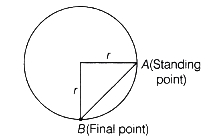
(A) Given,diameter,$d = 80 \ m$.
Therefore,radius,$r = d/2 = 40 \ m$.
Distance travelled after completion of $3/4$ revolution is given by:
Distance $= (3/4) \times (2 \pi r) = (3/2) \times \pi \times 40 = 60 \pi \ m$.
Displacement is the shortest distance between the initial point $A$ and the final point $B$. Since the athlete covers $3/4$ of the circle,the angle between the initial and final position vectors is $90^{\circ}$.
Using the Pythagorean theorem for the right-angled triangle formed by the two radii:
Displacement $= \sqrt{r^2 + r^2} = r \sqrt{2} = 40 \sqrt{2} \ m$.
Therefore,radius,$r = d/2 = 40 \ m$.
Distance travelled after completion of $3/4$ revolution is given by:
Distance $= (3/4) \times (2 \pi r) = (3/2) \times \pi \times 40 = 60 \pi \ m$.
Displacement is the shortest distance between the initial point $A$ and the final point $B$. Since the athlete covers $3/4$ of the circle,the angle between the initial and final position vectors is $90^{\circ}$.
Using the Pythagorean theorem for the right-angled triangle formed by the two radii:
Displacement $= \sqrt{r^2 + r^2} = r \sqrt{2} = 40 \sqrt{2} \ m$.
0 likes
View Solution157
EasyMCQ
The circular motion of a particle with constant speed is
A
neither periodic nor $SHM$
B
periodic but not $SHM$
C
$SHM$ but not periodic
D
periodic and also $SHM$
Solution
(B) motion is said to be periodic if it repeats its path at regular intervals of time. In uniform circular motion,the particle returns to the same position after every time interval $T = \frac{2\pi r}{v}$,so it is periodic.
Simple Harmonic Motion $(SHM)$ is a specific type of oscillatory motion where the restoring force is directly proportional to the displacement from the mean position $(F = -kx)$.
In uniform circular motion,the acceleration is always directed towards the center (centripetal acceleration),which does not satisfy the condition for $SHM$ along a straight line.
Therefore,uniform circular motion is periodic but not $SHM$.
Simple Harmonic Motion $(SHM)$ is a specific type of oscillatory motion where the restoring force is directly proportional to the displacement from the mean position $(F = -kx)$.
In uniform circular motion,the acceleration is always directed towards the center (centripetal acceleration),which does not satisfy the condition for $SHM$ along a straight line.
Therefore,uniform circular motion is periodic but not $SHM$.
0 likes
View Solution158
EasyMCQ
The angle between velocity and acceleration of a particle describing uniform circular motion is (in $^{\circ}$)
A
$45$
B
$60$
C
$90$
D
$180$
Solution
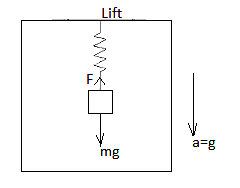
(C) In uniform circular motion,the speed of the particle remains constant,but the direction of velocity changes continuously.
This change in the direction of velocity is caused by centripetal acceleration,which is always directed towards the center of the circular path.
The velocity vector is always tangent to the circular path at any given point.
Since the tangent to a circle is always perpendicular to the radius at the point of contact,the angle between the velocity vector (tangent) and the centripetal acceleration vector (radius) is $90^{\circ}$.
This change in the direction of velocity is caused by centripetal acceleration,which is always directed towards the center of the circular path.
The velocity vector is always tangent to the circular path at any given point.
Since the tangent to a circle is always perpendicular to the radius at the point of contact,the angle between the velocity vector (tangent) and the centripetal acceleration vector (radius) is $90^{\circ}$.
0 likes
View Solution159
MediumMCQ
The displacement of a body when it covers a distance of $C / 4$ (where,$C$ is circumference) along the circumference of a circle of radius $r$ with a uniform speed $u$ is
A
$r$
B
$r \sqrt{2}$
C
$2 r$
D
$\frac{r}{2}$
Solution
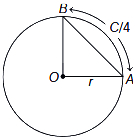
(B) The given situation is shown in the figure. When the body covers a distance of $C / 4$,where $C$ is the circumference,it moves from point $A$ to point $B$ along the circular path.
Since the distance covered is one-fourth of the circumference,the angle subtended at the center $O$ is $90^{\circ}$.
Thus,$\triangle OAB$ is a right-angled triangle with $OA = OB = r$.
The displacement is the straight-line distance between the initial position $A$ and the final position $B$.
Using the Pythagorean theorem:
$\text{Displacement} = AB = \sqrt{OA^2 + OB^2}$
$\text{Displacement} = \sqrt{r^2 + r^2} = \sqrt{2r^2} = r \sqrt{2}$
Since the distance covered is one-fourth of the circumference,the angle subtended at the center $O$ is $90^{\circ}$.
Thus,$\triangle OAB$ is a right-angled triangle with $OA = OB = r$.
The displacement is the straight-line distance between the initial position $A$ and the final position $B$.
Using the Pythagorean theorem:
$\text{Displacement} = AB = \sqrt{OA^2 + OB^2}$
$\text{Displacement} = \sqrt{r^2 + r^2} = \sqrt{2r^2} = r \sqrt{2}$
0 likes
View Solution160
EasyMCQ
$A$ particle revolving in a circular path travels the first half of the circumference in $4 \ s$ and the next half in $2 \ s$. What is its average angular velocity?
A
$\frac{4 \pi}{9} \ rad/s$
B
$\frac{\pi}{6} \ rad/s$
C
$\frac{2 \pi}{3} \ rad/s$
D
$\frac{\pi}{3} \ rad/s$
Solution
(D) Average angular velocity is defined as the total angular displacement divided by the total time taken.
Total angular displacement for one full revolution is $\theta_{\text{total}} = 2\pi \ rad$.
Total time taken is $t_{\text{total}} = 4 \ s + 2 \ s = 6 \ s$.
Therefore,the average angular velocity $\omega_{\text{avg}} = \frac{\theta_{\text{total}}}{t_{\text{total}}} = \frac{2\pi}{6} = \frac{\pi}{3} \ rad/s$.
Total angular displacement for one full revolution is $\theta_{\text{total}} = 2\pi \ rad$.
Total time taken is $t_{\text{total}} = 4 \ s + 2 \ s = 6 \ s$.
Therefore,the average angular velocity $\omega_{\text{avg}} = \frac{\theta_{\text{total}}}{t_{\text{total}}} = \frac{2\pi}{6} = \frac{\pi}{3} \ rad/s$.
0 likes
View Solution161
EasyMCQ
$A$ body is moving with a uniform speed of $20 \,m/s$ on a horizontal circle. The change in velocity of the body in half a revolution is
A
$20 \,m/s$
B
$10 \,m/s$
C
$40 \,m/s$
D
$\frac{20}{\sqrt{2}} \,m/s$
Solution
(C) The speed of the body is $v = 20 \,m/s$.
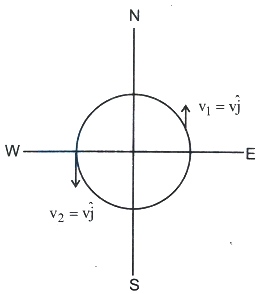
In a uniform circular motion, the velocity vector is always tangent to the circle.
Let the initial velocity be $\vec{v}_1 = v \hat{j}$ (directed towards North).
After half a revolution, the body moves in the opposite direction, so the final velocity is $\vec{v}_2 = -v \hat{j}$ (directed towards South).
The change in velocity $\Delta \vec{v}$ is given by:
$\Delta \vec{v} = \vec{v}_2 - \vec{v}_1$
$\Delta \vec{v} = (-v \hat{j}) - (v \hat{j}) = -2v \hat{j}$
The magnitude of the change in velocity is:
$|\Delta \vec{v}| = |-2v| = 2v$
Substituting the value of $v = 20 \,m/s$:
$|\Delta \vec{v}| = 2 \times 20 = 40 \,m/s$.
In a uniform circular motion, the velocity vector is always tangent to the circle.
Let the initial velocity be $\vec{v}_1 = v \hat{j}$ (directed towards North).
After half a revolution, the body moves in the opposite direction, so the final velocity is $\vec{v}_2 = -v \hat{j}$ (directed towards South).
The change in velocity $\Delta \vec{v}$ is given by:
$\Delta \vec{v} = \vec{v}_2 - \vec{v}_1$
$\Delta \vec{v} = (-v \hat{j}) - (v \hat{j}) = -2v \hat{j}$
The magnitude of the change in velocity is:
$|\Delta \vec{v}| = |-2v| = 2v$
Substituting the value of $v = 20 \,m/s$:
$|\Delta \vec{v}| = 2 \times 20 = 40 \,m/s$.
0 likes
View Solution162
MediumMCQ
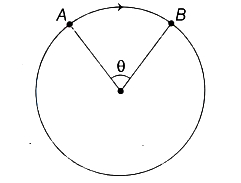
$A$ particle is moving on a circular path with a constant speed $v$. Its change of velocity as it moves from $A$ to $B$ in the figure is
A
$2 v \sin \frac{\theta}{2}$
B
$v \sin \theta$
C
$\frac{v \sin 2 \theta}{2}$
D
$2 v \sin \theta$
Solution
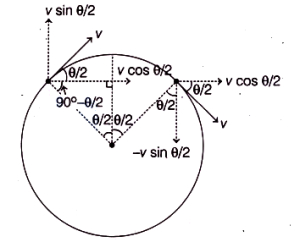
(A) Let the velocity at point $A$ be $\vec{v}_1$ and at point $B$ be $\vec{v}_2$. Since the speed is constant,$|\vec{v}_1| = |\vec{v}_2| = v$.
The change in velocity is given by $\Delta \vec{v} = \vec{v}_2 - \vec{v}_1$.
The magnitude of the change in velocity for a particle moving in a circle with constant speed $v$ through an angle $\theta$ is given by the vector subtraction formula:
$|\Delta \vec{v}| = \sqrt{v^2 + v^2 - 2v^2 \cos \theta}$
$|\Delta \vec{v}| = \sqrt{2v^2(1 - \cos \theta)}$
Using the trigonometric identity $1 - \cos \theta = 2 \sin^2 \frac{\theta}{2}$,we get:
$|\Delta \vec{v}| = \sqrt{2v^2 \cdot 2 \sin^2 \frac{\theta}{2}}$
$|\Delta \vec{v}| = \sqrt{4v^2 \sin^2 \frac{\theta}{2}}$
$|\Delta \vec{v}| = 2v \sin \frac{\theta}{2}$
The change in velocity is given by $\Delta \vec{v} = \vec{v}_2 - \vec{v}_1$.
The magnitude of the change in velocity for a particle moving in a circle with constant speed $v$ through an angle $\theta$ is given by the vector subtraction formula:
$|\Delta \vec{v}| = \sqrt{v^2 + v^2 - 2v^2 \cos \theta}$
$|\Delta \vec{v}| = \sqrt{2v^2(1 - \cos \theta)}$
Using the trigonometric identity $1 - \cos \theta = 2 \sin^2 \frac{\theta}{2}$,we get:
$|\Delta \vec{v}| = \sqrt{2v^2 \cdot 2 \sin^2 \frac{\theta}{2}}$
$|\Delta \vec{v}| = \sqrt{4v^2 \sin^2 \frac{\theta}{2}}$
$|\Delta \vec{v}| = 2v \sin \frac{\theta}{2}$
0 likes
View Solution163
EasyMCQ
Two cars $A$ and $B$ are moving along concentric circular paths of radii $R_A$ and $R_B$. If both cars complete their respective circular paths in the same time,what is the ratio of the angular speed of $A$ to that of $B$?
A
$1: 1$
B
$R_A: R_B$
C
$R_B: R_A$
D
$1: 2$
Solution
(A) The angular speed $\omega$ of an object moving in a circular path is defined as the rate of change of angular displacement,given by the formula: $\omega = \frac{2\pi}{T}$,where $T$ is the time period taken to complete one full revolution.
Since both cars $A$ and $B$ complete their circular paths in the same time,their time periods are equal,i.e.,$T_A = T_B$.
Therefore,the ratio of their angular speeds is: $\frac{\omega_A}{\omega_B} = \frac{2\pi / T_A}{2\pi / T_B} = \frac{T_B}{T_A}$.
Substituting $T_A = T_B$,we get: $\frac{\omega_A}{\omega_B} = \frac{T_A}{T_A} = 1$.
Thus,the ratio of the angular speed of $A$ to $B$ is $1: 1$.
Since both cars $A$ and $B$ complete their circular paths in the same time,their time periods are equal,i.e.,$T_A = T_B$.
Therefore,the ratio of their angular speeds is: $\frac{\omega_A}{\omega_B} = \frac{2\pi / T_A}{2\pi / T_B} = \frac{T_B}{T_A}$.
Substituting $T_A = T_B$,we get: $\frac{\omega_A}{\omega_B} = \frac{T_A}{T_A} = 1$.
Thus,the ratio of the angular speed of $A$ to $B$ is $1: 1$.
0 likes
View Solution164
EasyMCQ
$A$ particle executing uniform circular motion has:
A
Radial velocity and radial acceleration
B
Transverse velocity and radial acceleration
C
Radial velocity and transverse acceleration
D
Transverse velocity and transverse acceleration
Solution
(B) In uniform circular motion,the speed of the particle remains constant,and the particle moves along a circular path.
$1$. Velocity: The velocity vector is always tangent to the circular path at any point. This component is known as the transverse velocity $(v_t = r\omega)$. There is no radial component of velocity $(v_r = 0)$ because the distance from the center remains constant.
$2$. Acceleration: Since the direction of the velocity changes continuously,there is an acceleration directed towards the center of the circle,known as centripetal or radial acceleration $(a_r = v^2/r = r\omega^2)$. There is no tangential (transverse) acceleration $(a_t = 0)$ because the speed is constant.
Therefore,the particle has transverse velocity and radial acceleration.
$1$. Velocity: The velocity vector is always tangent to the circular path at any point. This component is known as the transverse velocity $(v_t = r\omega)$. There is no radial component of velocity $(v_r = 0)$ because the distance from the center remains constant.
$2$. Acceleration: Since the direction of the velocity changes continuously,there is an acceleration directed towards the center of the circle,known as centripetal or radial acceleration $(a_r = v^2/r = r\omega^2)$. There is no tangential (transverse) acceleration $(a_t = 0)$ because the speed is constant.
Therefore,the particle has transverse velocity and radial acceleration.
0 likes
View Solution165
EasyMCQ
Assertion $(A)$: The speed of a body in uniform circular motion is constant.
Reason $(R)$: In uniform circular motion,the acceleration of the body is constant.
Reason $(R)$: In uniform circular motion,the acceleration of the body is constant.
A
Both $(A)$ and $(R)$ are true and $(R)$ is the correct explanation of $(A)$.
B
Both $(A)$ and $(R)$ are true but $(R)$ is not the correct explanation of $(A)$.
C
$(A)$ is true but $(R)$ is false.
D
$(A)$ is false but $(R)$ is true.
Solution
(C) $(i)$ Assertion is correct: In uniform circular motion,a body moves with constant speed. It is the magnitude of velocity that remains constant.
$(ii)$ Reason is incorrect: In uniform circular motion,the acceleration is centripetal acceleration,which is directed towards the center of the circular path. Since the direction of the particle changes at every point,the direction of the centripetal acceleration also changes continuously. Because acceleration is a vector quantity,a change in direction implies that the acceleration is not constant.
$(ii)$ Reason is incorrect: In uniform circular motion,the acceleration is centripetal acceleration,which is directed towards the center of the circular path. Since the direction of the particle changes at every point,the direction of the centripetal acceleration also changes continuously. Because acceleration is a vector quantity,a change in direction implies that the acceleration is not constant.
0 likes
View Solution166
EasyMCQ
The ratio of the angular velocity of the hour hand of a watch to the angular velocity of the rotation of the Earth is:
A
$1$:$1$
B
$2$:$1$
C
$4$:$1$
D
$1$:$2$
Solution
(B) The angular velocity $\omega$ is given by $\omega = \frac{2\pi}{T}$,where $T$ is the time period.
For the hour hand of a watch,the time period $T_h = 12 \text{ hours}$.
Thus,$\omega_h = \frac{2\pi}{12} \text{ rad/hour}$.
For the rotation of the Earth,the time period $T_e = 24 \text{ hours}$.
Thus,$\omega_e = \frac{2\pi}{24} \text{ rad/hour}$.
The ratio of the angular velocity of the hour hand to the angular velocity of the Earth is $\frac{\omega_h}{\omega_e} = \frac{2\pi/12}{2\pi/24} = \frac{24}{12} = 2:1$.
For the hour hand of a watch,the time period $T_h = 12 \text{ hours}$.
Thus,$\omega_h = \frac{2\pi}{12} \text{ rad/hour}$.
For the rotation of the Earth,the time period $T_e = 24 \text{ hours}$.
Thus,$\omega_e = \frac{2\pi}{24} \text{ rad/hour}$.
The ratio of the angular velocity of the hour hand to the angular velocity of the Earth is $\frac{\omega_h}{\omega_e} = \frac{2\pi/12}{2\pi/24} = \frac{24}{12} = 2:1$.
0 likes
View Solution167
MediumMCQ
$A$ particle is acted upon by a force of constant magnitude such that its velocity and acceleration are always perpendicular to each other,then its
A
linear momentum is constant
B
kinetic energy is constant
C
velocity is constant
D
acceleration is constant
Solution
(B) The power delivered by a force is given by $P = \vec{F} \cdot \vec{v}$.
Since the force $\vec{F}$ is proportional to acceleration $\vec{a}$ (by Newton's second law,$\vec{F} = m\vec{a}$),the condition that velocity $\vec{v}$ and acceleration $\vec{a}$ are perpendicular implies that $\vec{F} \cdot \vec{v} = 0$.
Therefore,the power delivered to the particle is zero $(P = 0)$.
Since power is the rate of change of kinetic energy $(P = \frac{dK}{dt})$,$P = 0$ implies that the kinetic energy $K$ is constant.
Thus,the kinetic energy of the particle remains constant throughout the motion.
Since the force $\vec{F}$ is proportional to acceleration $\vec{a}$ (by Newton's second law,$\vec{F} = m\vec{a}$),the condition that velocity $\vec{v}$ and acceleration $\vec{a}$ are perpendicular implies that $\vec{F} \cdot \vec{v} = 0$.
Therefore,the power delivered to the particle is zero $(P = 0)$.
Since power is the rate of change of kinetic energy $(P = \frac{dK}{dt})$,$P = 0$ implies that the kinetic energy $K$ is constant.
Thus,the kinetic energy of the particle remains constant throughout the motion.
0 likes
View Solution168
DifficultMCQ
An athlete completes one round of a circular track of radius $R$ in $40 \,s$. What will be his displacement at the end of $2 \,min \,20 \,s$?
A
$7 R$
B
$2 R$
C
$2 \pi R$
D
$7 \pi R$
Solution
(B) The total time given is $2 \,min \,20 \,s$.
Converting this into seconds: $2 \times 60 \,s + 20 \,s = 120 \,s + 20 \,s = 140 \,s$.
The athlete completes one round in $40 \,s$.
The number of rounds completed in $140 \,s$ is $\frac{140}{40} = 3.5$ rounds.
After $3$ complete rounds, the athlete returns to the starting point, so the displacement for these $3$ rounds is $0$.
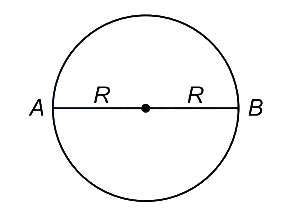
In the remaining $0.5$ round, the athlete moves from the starting point $A$ to the diametrically opposite point $B$.
The displacement is the shortest distance between the initial and final positions, which is the diameter of the circular track.
Therefore, the displacement $= 2R$.
Converting this into seconds: $2 \times 60 \,s + 20 \,s = 120 \,s + 20 \,s = 140 \,s$.
The athlete completes one round in $40 \,s$.
The number of rounds completed in $140 \,s$ is $\frac{140}{40} = 3.5$ rounds.
After $3$ complete rounds, the athlete returns to the starting point, so the displacement for these $3$ rounds is $0$.
In the remaining $0.5$ round, the athlete moves from the starting point $A$ to the diametrically opposite point $B$.
The displacement is the shortest distance between the initial and final positions, which is the diameter of the circular track.
Therefore, the displacement $= 2R$.
0 likes
View Solution169
EasyMCQ
If a body moving in a circular path maintains a constant speed of $10 \,ms^{-1}$, then which of the following correctly describes the relation between acceleration $(a)$ and radius $(r)$?
A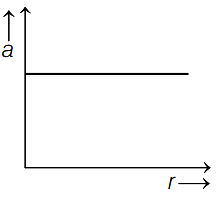
B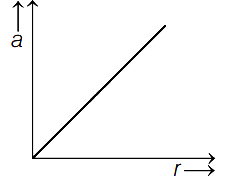
C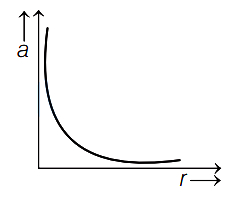
D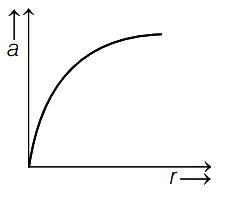
Solution
(C) For a body moving in a circular path with a constant speed $v$, the centripetal acceleration $a$ is given by the formula:
$a = \frac{v^2}{r}$
Given that the speed $v = 10 \,ms^{-1}$, we substitute this value into the equation:
$a = \frac{(10)^2}{r} = \frac{100}{r}$
This shows that the acceleration $a$ is inversely proportional to the radius $r$ $(a \propto \frac{1}{r})$.
Therefore, the graph representing this relationship is a rectangular hyperbola, which corresponds to the graph shown in option $C$.
$a = \frac{v^2}{r}$
Given that the speed $v = 10 \,ms^{-1}$, we substitute this value into the equation:
$a = \frac{(10)^2}{r} = \frac{100}{r}$
This shows that the acceleration $a$ is inversely proportional to the radius $r$ $(a \propto \frac{1}{r})$.
Therefore, the graph representing this relationship is a rectangular hyperbola, which corresponds to the graph shown in option $C$.
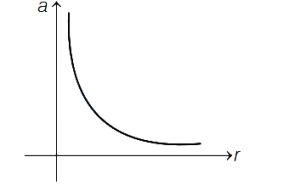
0 likes
View Solution170
EasyMCQ
$A$ merry-go-round rotating at a constant angular speed completes $9$ rotations in $18$ seconds. What is its angular speed?
A
$\pi / 2 \text{ rad/s}$
B
$\pi \text{ rad/s}$
C
$2\pi \text{ rad/s}$
D
$3\pi \text{ rad/s}$
Solution
(B) The angular displacement for one complete rotation is $2\pi \text{ radians}$.
Since the merry-go-round completes $9$ rotations,the total angular displacement $\Delta\theta = 9 \times 2\pi = 18\pi \text{ radians}$.
The time taken $\Delta t = 18 \text{ seconds}$.
The angular speed $\omega$ is given by the formula $\omega = \frac{\Delta\theta}{\Delta t}$.
Substituting the values,$\omega = \frac{18\pi}{18} = \pi \text{ rad/s}$.
Since the merry-go-round completes $9$ rotations,the total angular displacement $\Delta\theta = 9 \times 2\pi = 18\pi \text{ radians}$.
The time taken $\Delta t = 18 \text{ seconds}$.
The angular speed $\omega$ is given by the formula $\omega = \frac{\Delta\theta}{\Delta t}$.
Substituting the values,$\omega = \frac{18\pi}{18} = \pi \text{ rad/s}$.
0 likes
View Solution171
EasyMCQ
$A$ particle is moving in a circle of radius $5 \,cm$ with uniform speed and completes the circle in $5 \,s$. What is the magnitude of linear acceleration?
A
$0.8 \pi^2 \,cm / s^2$
B
$0.8 \pi^2 \,m / s^2$
C
$0.8 \pi \,cm / s^2$
D
$0.8 \pi \,m / s^2$
Solution
(A) Radius of the circle,$r = 5 \,cm$.
Time period,$T = 5 \,s$.
Angular velocity is given by $\omega = \frac{2 \pi}{T} = \frac{2 \pi}{5} \,rad/s$.
Linear speed is $v = \omega r = (\frac{2 \pi}{5}) \times 5 = 2 \pi \,cm/s$.
Since the particle is in uniform circular motion,the acceleration is centripetal acceleration,given by $a = \frac{v^2}{r}$.
Substituting the values,$a = \frac{(2 \pi)^2}{5} = \frac{4 \pi^2}{5} = 0.8 \pi^2 \,cm/s^2$.
Time period,$T = 5 \,s$.
Angular velocity is given by $\omega = \frac{2 \pi}{T} = \frac{2 \pi}{5} \,rad/s$.
Linear speed is $v = \omega r = (\frac{2 \pi}{5}) \times 5 = 2 \pi \,cm/s$.
Since the particle is in uniform circular motion,the acceleration is centripetal acceleration,given by $a = \frac{v^2}{r}$.
Substituting the values,$a = \frac{(2 \pi)^2}{5} = \frac{4 \pi^2}{5} = 0.8 \pi^2 \,cm/s^2$.
0 likes
View Solution172
EasyMCQ
In uniform circular motion,which of the following statements is wrong?
A
Work done during one complete cycle is zero.
B
Centripetal force acts towards the centre of the circle.
C
Angular velocity is constant.
D
Tangential velocity is constant.
Solution
(D) In uniform circular motion,the following properties hold true:
$(a)$ Since the centripetal force is always perpendicular to the displacement,the work done during one complete cycle is zero.
$(b)$ The centripetal force is a radial force that acts towards the centre of the circle.
$(c)$ The angular velocity $\omega$ remains constant in magnitude and direction.
$(d)$ While the speed (magnitude of velocity) is constant,the tangential velocity is a vector quantity. Since the direction of motion changes continuously at every point on the circular path,the tangential velocity is not constant.
Therefore,the statement that tangential velocity is constant is wrong.
$(a)$ Since the centripetal force is always perpendicular to the displacement,the work done during one complete cycle is zero.
$(b)$ The centripetal force is a radial force that acts towards the centre of the circle.
$(c)$ The angular velocity $\omega$ remains constant in magnitude and direction.
$(d)$ While the speed (magnitude of velocity) is constant,the tangential velocity is a vector quantity. Since the direction of motion changes continuously at every point on the circular path,the tangential velocity is not constant.
Therefore,the statement that tangential velocity is constant is wrong.
0 likes
View Solution173
EasyMCQ
For a particle executing uniform circular motion:
A
velocity is transverse and acceleration is radial
B
velocity is transverse and acceleration is transverse
C
velocity is radial and acceleration is transverse
D
velocity is radial and acceleration is radial
Solution
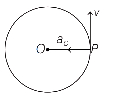
(A) In uniform circular motion,the particle moves along a circular path with a constant speed.
At any point $P$ on the circle,the velocity vector $\vec{v}$ is directed along the tangent to the circle at that point. This direction is perpendicular to the radius,which is referred to as the transverse direction.
The acceleration in uniform circular motion is the centripetal acceleration $\vec{a}_c$,which is always directed towards the center $O$ of the circle. This direction is along the radius,which is referred to as the radial direction.
Therefore,the velocity is transverse and the acceleration is radial.
At any point $P$ on the circle,the velocity vector $\vec{v}$ is directed along the tangent to the circle at that point. This direction is perpendicular to the radius,which is referred to as the transverse direction.
The acceleration in uniform circular motion is the centripetal acceleration $\vec{a}_c$,which is always directed towards the center $O$ of the circle. This direction is along the radius,which is referred to as the radial direction.
Therefore,the velocity is transverse and the acceleration is radial.
0 likes
View Solution174
EasyMCQ
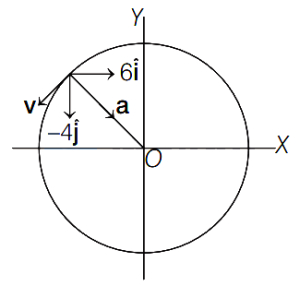
$A$ point $P$ is moving in uniform circular motion with radius $3 \ m$. Let at some instant the acceleration of the point be $a = (6 \hat{i} - 4 \hat{j}) \ m/s^2$,the position vector be $r$,and the velocity vector be $v$. Choose the correct statement.
A
$v \cdot a = 0$ and $r \times a \neq 0$
B
$v \cdot a \neq 0$ and $r \times a \neq 0$
C
$v \cdot a = 0$ and $r \times a = 0$
D
$v \cdot a \neq 0$ and $r \times a = 0$
Solution
(C) In uniform circular motion,the speed of the particle is constant. Therefore,the acceleration of the particle is purely centripetal,meaning it is directed towards the center of the circular path.
Since the centripetal acceleration is always directed towards the center,it is always parallel to the position vector $r$ (measured from the center) and perpendicular to the velocity vector $v$ (which is tangential to the path).
$1$. Because the acceleration $a$ is perpendicular to the velocity $v$,their dot product must be zero: $v \cdot a = 0$.
$2$. Because the acceleration $a$ is directed towards the center,it is collinear with the position vector $r$. Two vectors that are collinear (parallel or anti-parallel) have a cross product equal to zero: $r \times a = 0$.
Thus,the correct statement is $v \cdot a = 0$ and $r \times a = 0$.
Since the centripetal acceleration is always directed towards the center,it is always parallel to the position vector $r$ (measured from the center) and perpendicular to the velocity vector $v$ (which is tangential to the path).
$1$. Because the acceleration $a$ is perpendicular to the velocity $v$,their dot product must be zero: $v \cdot a = 0$.
$2$. Because the acceleration $a$ is directed towards the center,it is collinear with the position vector $r$. Two vectors that are collinear (parallel or anti-parallel) have a cross product equal to zero: $r \times a = 0$.
Thus,the correct statement is $v \cdot a = 0$ and $r \times a = 0$.
0 likes
View Solution175
EasyMCQ
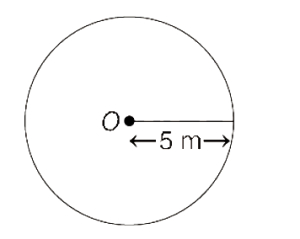
Consider an object making uniform motion around a circle of radius $5 \ m$ with tangential velocity $2 \ ms^{-1}$. The time it takes to complete $2$ revolutions and the magnitude of acceleration respectively are
A
$0.2 \pi \ s$ and $0.8 \ ms^{-2}$
B
$0.5 \pi \ s$ and $1 \ ms^{-2}$
C
$10 \pi \ s$ and $0.8 \ ms^{-2}$
D
$5 \pi \ s$ and $5 \ ms^{-2}$
Solution
(C) Given: Radius $R = 5 \ m$,tangential velocity $v = 2 \ ms^{-1}$.
For uniform circular motion,the angular velocity $\omega$ is given by $\omega = \frac{v}{R} = \frac{2}{5} = 0.4 \ rad \ s^{-1}$.
The time period $T$ for one revolution is $T = \frac{2 \pi}{\omega} = \frac{2 \pi}{0.4} = 5 \pi \ s$.
The time taken to complete $2$ revolutions is $t = 2 \times T = 2 \times 5 \pi = 10 \pi \ s$.
The magnitude of centripetal acceleration $a_c$ is $a_c = \frac{v^2}{R} = \frac{2^2}{5} = \frac{4}{5} = 0.8 \ ms^{-2}$.
Thus,the time taken is $10 \pi \ s$ and the acceleration is $0.8 \ ms^{-2}$.
For uniform circular motion,the angular velocity $\omega$ is given by $\omega = \frac{v}{R} = \frac{2}{5} = 0.4 \ rad \ s^{-1}$.
The time period $T$ for one revolution is $T = \frac{2 \pi}{\omega} = \frac{2 \pi}{0.4} = 5 \pi \ s$.
The time taken to complete $2$ revolutions is $t = 2 \times T = 2 \times 5 \pi = 10 \pi \ s$.
The magnitude of centripetal acceleration $a_c$ is $a_c = \frac{v^2}{R} = \frac{2^2}{5} = \frac{4}{5} = 0.8 \ ms^{-2}$.
Thus,the time taken is $10 \pi \ s$ and the acceleration is $0.8 \ ms^{-2}$.
0 likes
View Solution3-2.Motion in Plane — Angular Variables and Basic of Uniform Circular Motion · Frequently Asked Questions
1Are these 3-2.Motion in Plane questions useful for JEE and NEET?
Yes. All questions in this section are mapped to JEE Main and NEET exam patterns. Previous year questions from JEE Main, NEET, GUJCET and state-level exams are included with full solutions.
2Can I switch to Hindi or Gujarati for these questions?
Yes. Use the language tabs in the hero section or the sidebar to view the same questions and solutions in English, Hindi or Gujarati.
3How do I generate a question paper from this subtopic?
Use the Vedclass Exam Paper Generator — select the chapter and subtopic, set difficulty, and generate Sets A, B, C, D automatically. First 3 chapters of every subject are free.
Vedclass Products
For Students
Vedclass Test Series
Mock tests in real JEE/NEET style with performance analysis. 5-day free trial.
Start Free TrialFor Teachers
Exam Paper Generator
Generate Set A/B/C/D papers from this chapter in 2 minutes. 3 chapters free.
Try FreeFor Institutes
Online Exam Module
Live online exams with unlimited students, 360° analytics & white-label branding.
See DemoFor Teachers & Institutes
Generate a 3-2.Motion in Plane Exam Paper in 2 Minutes
Select subtopic & difficulty — Sets A, B, C, D auto-generated with No Repeat logic.
First 3 chapters of every subject are free — no payment required.