
A English
Addition and Subtraction of Vectors Questions in English
Class 11 Physics · 3-1.Vectors · Addition and Subtraction of Vectors
221+
Questions
English
Language
100%
With Solutions
Showing 50 of 221 questions in English
51
EasyMCQ
The planes of two rigid discs are perpendicular to each other. They are rotating about their axes. If their angular velocities are $3 \, rad/s$ and $4 \, rad/s$ respectively,then the resultant angular velocity of the system would be ........ $rad/s$.
A
$1$
B
$7$
C
$5$
D
$\sqrt{12}$
Solution
(C) Angular velocity is a vector quantity. Let the angular velocity of the first disc be $\vec{\omega}_1 = 3 \hat{i} \, rad/s$ and the angular velocity of the second disc be $\vec{\omega}_2 = 4 \hat{j} \, rad/s$.
Since the planes of the discs are perpendicular,their axes of rotation are also perpendicular.
The resultant angular velocity $\vec{\omega}_{res}$ is given by the vector sum of the two individual angular velocities:
$\vec{\omega}_{res} = \vec{\omega}_1 + \vec{\omega}_2$.
The magnitude of the resultant angular velocity is given by:
$|\vec{\omega}_{res}| = \sqrt{\omega_1^2 + \omega_2^2}$.
Substituting the given values:
$|\vec{\omega}_{res}| = \sqrt{3^2 + 4^2} = \sqrt{9 + 16} = \sqrt{25} = 5 \, rad/s$.
Since the planes of the discs are perpendicular,their axes of rotation are also perpendicular.
The resultant angular velocity $\vec{\omega}_{res}$ is given by the vector sum of the two individual angular velocities:
$\vec{\omega}_{res} = \vec{\omega}_1 + \vec{\omega}_2$.
The magnitude of the resultant angular velocity is given by:
$|\vec{\omega}_{res}| = \sqrt{\omega_1^2 + \omega_2^2}$.
Substituting the given values:
$|\vec{\omega}_{res}| = \sqrt{3^2 + 4^2} = \sqrt{9 + 16} = \sqrt{25} = 5 \, rad/s$.
0 likes
View Solution52
MediumMCQ
$A$ bus is moving on a straight road towards north with a uniform speed of $50 \; km/h$. Then it turns left through $90^{\circ}$. If the speed remains unchanged after turning,the increase in the velocity of the bus in the turning process is:
A
$50 \; km/h$ along west
B
$0$
C
$70.7 \; km/h$ along south-west direction
D
$70.7 \; km/h$ along north-west direction
Solution
(C) Let the initial velocity be $\vec{v}_1 = 50 \; \text{km/h}$ due north.
After turning left by $90^{\circ}$,the final velocity is $\vec{v}_2 = 50 \; \text{km/h}$ due west.
The change in velocity is given by $\Delta \vec{v} = \vec{v}_2 - \vec{v}_1 = \vec{v}_2 + (-\vec{v}_1)$.
Here,$-\vec{v}_1 = 50 \; \text{km/h}$ due south.
The magnitude of the change in velocity is $|\Delta \vec{v}| = \sqrt{v_2^2 + v_1^2} = \sqrt{50^2 + 50^2} = \sqrt{2500 + 2500} = \sqrt{5000} \approx 70.7 \; \text{km/h}$.
The direction of $\Delta \vec{v}$ is the resultant of a vector pointing west and a vector pointing south,which is in the south-west direction.
After turning left by $90^{\circ}$,the final velocity is $\vec{v}_2 = 50 \; \text{km/h}$ due west.
The change in velocity is given by $\Delta \vec{v} = \vec{v}_2 - \vec{v}_1 = \vec{v}_2 + (-\vec{v}_1)$.
Here,$-\vec{v}_1 = 50 \; \text{km/h}$ due south.
The magnitude of the change in velocity is $|\Delta \vec{v}| = \sqrt{v_2^2 + v_1^2} = \sqrt{50^2 + 50^2} = \sqrt{2500 + 2500} = \sqrt{5000} \approx 70.7 \; \text{km/h}$.
The direction of $\Delta \vec{v}$ is the resultant of a vector pointing west and a vector pointing south,which is in the south-west direction.
0 likes
View Solution53
DifficultMCQ
If the resultant vector of vectors $\vec{A} = 4\hat{i} + 3\hat{j} + 6\hat{k}$ and $\vec{B} = -\hat{i} + 3\hat{j} - 8\hat{k}$ is parallel to a unit vector,then $\vec{R}$ is:
A
$\frac{1}{7}(3\hat{i} + 6\hat{j} - 2\hat{k})$
B
$\frac{1}{7}(3\hat{i} + 6\hat{j} + 2\hat{k})$
C
$\frac{1}{49}(3\hat{i} + 6\hat{j} + 2\hat{k})$
D
$\frac{1}{49}(3\hat{i} + 6\hat{j} - 2\hat{k})$
Solution
(A) The resultant vector $\vec{R}$ is given by $\vec{R} = \vec{A} + \vec{B}$.
Substituting the given vectors: $\vec{R} = (4\hat{i} + 3\hat{j} + 6\hat{k}) + (-\hat{i} + 3\hat{j} - 8\hat{k})$.
Combining the components: $\vec{R} = (4-1)\hat{i} + (3+3)\hat{j} + (6-8)\hat{k} = 3\hat{i} + 6\hat{j} - 2\hat{k}$.
The unit vector parallel to $\vec{R}$ is $\hat{R} = \frac{\vec{R}}{|\vec{R}|}$.
First,calculate the magnitude $|\vec{R}| = \sqrt{3^2 + 6^2 + (-2)^2} = \sqrt{9 + 36 + 4} = \sqrt{49} = 7$.
Therefore,the unit vector is $\hat{R} = \frac{3\hat{i} + 6\hat{j} - 2\hat{k}}{7} = \frac{1}{7}(3\hat{i} + 6\hat{j} - 2\hat{k})$.
Substituting the given vectors: $\vec{R} = (4\hat{i} + 3\hat{j} + 6\hat{k}) + (-\hat{i} + 3\hat{j} - 8\hat{k})$.
Combining the components: $\vec{R} = (4-1)\hat{i} + (3+3)\hat{j} + (6-8)\hat{k} = 3\hat{i} + 6\hat{j} - 2\hat{k}$.
The unit vector parallel to $\vec{R}$ is $\hat{R} = \frac{\vec{R}}{|\vec{R}|}$.
First,calculate the magnitude $|\vec{R}| = \sqrt{3^2 + 6^2 + (-2)^2} = \sqrt{9 + 36 + 4} = \sqrt{49} = 7$.
Therefore,the unit vector is $\hat{R} = \frac{3\hat{i} + 6\hat{j} - 2\hat{k}}{7} = \frac{1}{7}(3\hat{i} + 6\hat{j} - 2\hat{k})$.
0 likes
View Solution54
MediumMCQ
For two vectors $\vec{a}$ and $\vec{b}$,if $|\vec{a} + \vec{b}| = |\vec{a} - \vec{b}|$,then the angle between $\vec{a}$ and $\vec{b}$ is:
A
$\frac{\pi}{3}$
B
$\pi$
C
$\frac{\pi}{2}$
D
$0$
Solution
(C) Given the condition $|\vec{a} + \vec{b}| = |\vec{a} - \vec{b}|$.
Squaring both sides,we get $|\vec{a} + \vec{b}|^2 = |\vec{a} - \vec{b}|^2$.
Using the property $|\vec{v}|^2 = \vec{v} \cdot \vec{v}$,we expand the expression:
$(\vec{a} + \vec{b}) \cdot (\vec{a} + \vec{b}) = (\vec{a} - \vec{b}) \cdot (\vec{a} - \vec{b})$.
$|\vec{a}|^2 + |\vec{b}|^2 + 2(\vec{a} \cdot \vec{b}) = |\vec{a}|^2 + |\vec{b}|^2 - 2(\vec{a} \cdot \vec{b})$.
Canceling $|\vec{a}|^2$ and $|\vec{b}|^2$ from both sides,we get $2(\vec{a} \cdot \vec{b}) = -2(\vec{a} \cdot \vec{b})$.
This implies $4(\vec{a} \cdot \vec{b}) = 0$,so $\vec{a} \cdot \vec{b} = 0$.
Since the dot product of two non-zero vectors is zero,the vectors must be perpendicular to each other.
Therefore,the angle between $\vec{a}$ and $\vec{b}$ is $\frac{\pi}{2}$.
Squaring both sides,we get $|\vec{a} + \vec{b}|^2 = |\vec{a} - \vec{b}|^2$.
Using the property $|\vec{v}|^2 = \vec{v} \cdot \vec{v}$,we expand the expression:
$(\vec{a} + \vec{b}) \cdot (\vec{a} + \vec{b}) = (\vec{a} - \vec{b}) \cdot (\vec{a} - \vec{b})$.
$|\vec{a}|^2 + |\vec{b}|^2 + 2(\vec{a} \cdot \vec{b}) = |\vec{a}|^2 + |\vec{b}|^2 - 2(\vec{a} \cdot \vec{b})$.
Canceling $|\vec{a}|^2$ and $|\vec{b}|^2$ from both sides,we get $2(\vec{a} \cdot \vec{b}) = -2(\vec{a} \cdot \vec{b})$.
This implies $4(\vec{a} \cdot \vec{b}) = 0$,so $\vec{a} \cdot \vec{b} = 0$.
Since the dot product of two non-zero vectors is zero,the vectors must be perpendicular to each other.
Therefore,the angle between $\vec{a}$ and $\vec{b}$ is $\frac{\pi}{2}$.
0 likes
View Solution55
EasyMCQ
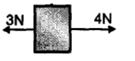
Two forces of magnitudes $3 \ N$ and $4 \ N$ act on an object. If the angle between them is $180^\circ$,then their resultant force is ......... $N$.
A
$4$
B
$1$
C
$6$
D
$7$
Solution
(B) Given,two forces $F_1 = 3 \ N$ and $F_2 = 4 \ N$.
The angle between them is $\theta = 180^\circ$.
Since the angle is $180^\circ$,the forces are anti-parallel (acting in opposite directions).
The resultant force $R$ is given by the difference of the magnitudes of the two forces:
$R = |F_2 - F_1| = |4 \ N - 3 \ N| = 1 \ N$.
The direction of the resultant force is in the direction of the larger force (i.e.,the $4 \ N$ force).
The angle between them is $\theta = 180^\circ$.
Since the angle is $180^\circ$,the forces are anti-parallel (acting in opposite directions).
The resultant force $R$ is given by the difference of the magnitudes of the two forces:
$R = |F_2 - F_1| = |4 \ N - 3 \ N| = 1 \ N$.
The direction of the resultant force is in the direction of the larger force (i.e.,the $4 \ N$ force).
0 likes
View Solution56
EasyMCQ
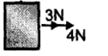
Two forces of magnitude $3\;N$ and $4\;N$ respectively are acting on a body. Calculate the resultant force if the angle between them is $0^{\circ}$. (in $;N$)
A
$4$
B
$5$
C
$6$
D
$7$
Solution
(D) When the angle between two vectors is $\theta = 0^{\circ}$,the vectors are parallel and act in the same direction.
The resultant force $R$ is given by the sum of the magnitudes of the two forces:
$R = F_1 + F_2$
Given $F_1 = 3\;N$ and $F_2 = 4\;N$,
$R = 3\;N + 4\;N = 7\;N$.
The direction of the resultant force is the same as the direction of the individual forces.
The resultant force $R$ is given by the sum of the magnitudes of the two forces:
$R = F_1 + F_2$
Given $F_1 = 3\;N$ and $F_2 = 4\;N$,
$R = 3\;N + 4\;N = 7\;N$.
The direction of the resultant force is the same as the direction of the individual forces.
0 likes
View Solution57
MediumMCQ
If the square of the resultant of two forces of equal magnitude is equal to three times their product,then the angle between them is ........ $^o$.
A
$0$
B
$45$
C
$60$
D
$90$
Solution
(C) Let the two forces be $F_1 = F$ and $F_2 = F$.
The magnitude of the resultant force $R$ is given by $R^2 = F_1^2 + F_2^2 + 2F_1F_2 \cos \theta$,where $\theta$ is the angle between the forces.
Given that $R^2 = 3(F_1 \times F_2) = 3F^2$.
Substituting the values into the formula:
$F^2 + F^2 + 2F^2 \cos \theta = 3F^2$
$2F^2 + 2F^2 \cos \theta = 3F^2$
$2F^2 \cos \theta = F^2$
$\cos \theta = \frac{1}{2}$
Therefore,$\theta = 60^o$.
The magnitude of the resultant force $R$ is given by $R^2 = F_1^2 + F_2^2 + 2F_1F_2 \cos \theta$,where $\theta$ is the angle between the forces.
Given that $R^2 = 3(F_1 \times F_2) = 3F^2$.
Substituting the values into the formula:
$F^2 + F^2 + 2F^2 \cos \theta = 3F^2$
$2F^2 + 2F^2 \cos \theta = 3F^2$
$2F^2 \cos \theta = F^2$
$\cos \theta = \frac{1}{2}$
Therefore,$\theta = 60^o$.
1 likes
View Solution58
EasyMCQ
The magnitude of the vector sum of two forces $10 \ N$ and $6 \ N$ cannot be ......... $N$.
A
$4$
B
$8$
C
$12$
D
$2$
Solution
(D) The magnitude of the resultant vector $\vec{R} = \vec{A} + \vec{B}$ of two vectors with magnitudes $A$ and $B$ must lie in the range $|A - B| \leq R \leq A + B$.
Given $A = 10 \ N$ and $B = 6 \ N$,the range is $|10 - 6| \leq R \leq 10 + 6$,which simplifies to $4 \leq R \leq 16$.
This means the resultant magnitude $R$ must be between $4 \ N$ and $16 \ N$ (inclusive).
Among the given options,$2 \ N$ is less than $4 \ N$,so it cannot be the magnitude of the resultant vector.
Given $A = 10 \ N$ and $B = 6 \ N$,the range is $|10 - 6| \leq R \leq 10 + 6$,which simplifies to $4 \leq R \leq 16$.
This means the resultant magnitude $R$ must be between $4 \ N$ and $16 \ N$ (inclusive).
Among the given options,$2 \ N$ is less than $4 \ N$,so it cannot be the magnitude of the resultant vector.
0 likes
View Solution59
MediumMCQ
Which vector must be added to the resultant vector $\vec{P} = 2\hat{i} + 7\hat{j} - 10\hat{k}$ and $\vec{Q} = \hat{i} + 2\hat{j} + 3\hat{k}$ to obtain a unit vector along the $X$-axis?
A
$-2\hat{i} - 9\hat{j} + 7\hat{k}$
B
$2\hat{i} + 7\hat{j} - 10\hat{k}$
C
$\hat{i} + 2\hat{j} + 3\hat{k}$
D
$2\hat{i} + 9\hat{j} + 7\hat{k}$
Solution
(A) The resultant vector $\vec{R} = \vec{P} + \vec{Q} = (2\hat{i} + 7\hat{j} - 10\hat{k}) + (\hat{i} + 2\hat{j} + 3\hat{k})$.
$\vec{R} = (2+1)\hat{i} + (7+2)\hat{j} + (-10+3)\hat{k} = 3\hat{i} + 9\hat{j} - 7\hat{k}$.
Let the required vector be $\vec{S}$. We are given that $\vec{R} + \vec{S} = \hat{i}$ (the unit vector along the $X$-axis).
Therefore,$\vec{S} = \hat{i} - \vec{R} = \hat{i} - (3\hat{i} + 9\hat{j} - 7\hat{k})$.
$\vec{S} = (1-3)\hat{i} - 9\hat{j} + 7\hat{k} = -2\hat{i} - 9\hat{j} + 7\hat{k}$.
$\vec{R} = (2+1)\hat{i} + (7+2)\hat{j} + (-10+3)\hat{k} = 3\hat{i} + 9\hat{j} - 7\hat{k}$.
Let the required vector be $\vec{S}$. We are given that $\vec{R} + \vec{S} = \hat{i}$ (the unit vector along the $X$-axis).
Therefore,$\vec{S} = \hat{i} - \vec{R} = \hat{i} - (3\hat{i} + 9\hat{j} - 7\hat{k})$.
$\vec{S} = (1-3)\hat{i} - 9\hat{j} + 7\hat{k} = -2\hat{i} - 9\hat{j} + 7\hat{k}$.
0 likes
View Solution60
DifficultMCQ
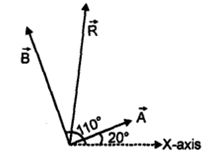
Vectors $\vec{A}$ and $\vec{B}$ make angles of $20^\circ$ and $110^\circ$ with the $x$-axis,respectively. The magnitudes of these vectors are $5 \ m$ and $12 \ m$,respectively. The angle that their resultant vector makes with the $x$-axis is:
A
$\tan^{-1}(12/5)$
B
$\tan^{-1}(12/5) + 20^\circ$
C
$\tan^{-1}(14/7) + 90^\circ$
D
$\tan^{-1}(12/17) + 20^\circ$
Solution
(B) The angle between vectors $\vec{A}$ and $\vec{B}$ is $\theta = 110^\circ - 20^\circ = 90^\circ$.
The magnitude of the resultant vector $\vec{R}$ is given by:
$R = \sqrt{A^2 + B^2 + 2AB \cos(90^\circ)} = \sqrt{5^2 + 12^2} = \sqrt{25 + 144} = \sqrt{169} = 13 \ m$.
Let $\alpha$ be the angle that the resultant vector $\vec{R}$ makes with vector $\vec{A}$.
Using the formula for the direction of the resultant:
$\tan \alpha = \frac{B \sin \theta}{A + B \cos \theta} = \frac{12 \sin 90^\circ}{5 + 12 \cos 90^\circ} = \frac{12 \times 1}{5 + 12 \times 0} = \frac{12}{5}$.
Therefore,$\alpha = \tan^{-1}(12/5)$.
Since vector $\vec{A}$ itself makes an angle of $20^\circ$ with the $x$-axis,the angle of the resultant vector $\vec{R}$ with the $x$-axis is $\alpha + 20^\circ = \tan^{-1}(12/5) + 20^\circ$.
The magnitude of the resultant vector $\vec{R}$ is given by:
$R = \sqrt{A^2 + B^2 + 2AB \cos(90^\circ)} = \sqrt{5^2 + 12^2} = \sqrt{25 + 144} = \sqrt{169} = 13 \ m$.
Let $\alpha$ be the angle that the resultant vector $\vec{R}$ makes with vector $\vec{A}$.
Using the formula for the direction of the resultant:
$\tan \alpha = \frac{B \sin \theta}{A + B \cos \theta} = \frac{12 \sin 90^\circ}{5 + 12 \cos 90^\circ} = \frac{12 \times 1}{5 + 12 \times 0} = \frac{12}{5}$.
Therefore,$\alpha = \tan^{-1}(12/5)$.
Since vector $\vec{A}$ itself makes an angle of $20^\circ$ with the $x$-axis,the angle of the resultant vector $\vec{R}$ with the $x$-axis is $\alpha + 20^\circ = \tan^{-1}(12/5) + 20^\circ$.
0 likes
View Solution61
MediumMCQ
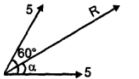
Two vectors of equal magnitude $5$ units have an angle $60^\circ$ between them. Find the magnitude of $(a)$ the sum of the vectors and $(b)$ the difference of the vectors.
A
$5\sqrt{3}$ units and $5$ units
B
$5$ units and $5\sqrt{3}$ units
C
$5\sqrt{3}$ units and $5\sqrt{3}$ units
D
$5$ units and $5$ units
Solution
(A) Given: Magnitude of vectors $A = B = 5$ units,angle $\theta = 60^\circ$.
$(a)$ Magnitude of the sum of vectors: $R_s = \sqrt{A^2 + B^2 + 2AB \cos \theta} = \sqrt{5^2 + 5^2 + 2(5)(5) \cos 60^\circ} = \sqrt{25 + 25 + 50(0.5)} = \sqrt{75} = 5\sqrt{3}$ units.
$(b)$ Magnitude of the difference of vectors: $R_d = \sqrt{A^2 + B^2 - 2AB \cos \theta} = \sqrt{5^2 + 5^2 - 2(5)(5) \cos 60^\circ} = \sqrt{25 + 25 - 50(0.5)} = \sqrt{25} = 5$ units.
$(a)$ Magnitude of the sum of vectors: $R_s = \sqrt{A^2 + B^2 + 2AB \cos \theta} = \sqrt{5^2 + 5^2 + 2(5)(5) \cos 60^\circ} = \sqrt{25 + 25 + 50(0.5)} = \sqrt{75} = 5\sqrt{3}$ units.
$(b)$ Magnitude of the difference of vectors: $R_d = \sqrt{A^2 + B^2 - 2AB \cos \theta} = \sqrt{5^2 + 5^2 - 2(5)(5) \cos 60^\circ} = \sqrt{25 + 25 - 50(0.5)} = \sqrt{25} = 5$ units.
0 likes
View Solution62
MediumMCQ
The resultant of two vectors $\vec{A}$ and $\vec{B}$ is $\vec{R_1}$. If vector $\vec{B}$ is reversed,the resultant becomes $\vec{R_2}$. What is the value of $R_1^2 + R_2^2$?
A
$A^2 + B^2$
B
$A^2 - B^2$
C
$2(A^2 + B^2)$
D
$2(A^2 - B^2)$
Solution
(C) Given that $\vec{R_1} = \vec{A} + \vec{B}$.
Taking the magnitude squared: $R_1^2 = |\vec{A} + \vec{B}|^2 = A^2 + B^2 + 2AB \cos \theta$,where $\theta$ is the angle between $\vec{A}$ and $\vec{B}$.
When vector $\vec{B}$ is reversed,the new resultant is $\vec{R_2} = \vec{A} - \vec{B}$.
Taking the magnitude squared: $R_2^2 = |\vec{A} - \vec{B}|^2 = A^2 + B^2 - 2AB \cos \theta$.
Adding the two equations:
$R_1^2 + R_2^2 = (A^2 + B^2 + 2AB \cos \theta) + (A^2 + B^2 - 2AB \cos \theta)$.
$R_1^2 + R_2^2 = 2A^2 + 2B^2 = 2(A^2 + B^2)$.
Taking the magnitude squared: $R_1^2 = |\vec{A} + \vec{B}|^2 = A^2 + B^2 + 2AB \cos \theta$,where $\theta$ is the angle between $\vec{A}$ and $\vec{B}$.
When vector $\vec{B}$ is reversed,the new resultant is $\vec{R_2} = \vec{A} - \vec{B}$.
Taking the magnitude squared: $R_2^2 = |\vec{A} - \vec{B}|^2 = A^2 + B^2 - 2AB \cos \theta$.
Adding the two equations:
$R_1^2 + R_2^2 = (A^2 + B^2 + 2AB \cos \theta) + (A^2 + B^2 - 2AB \cos \theta)$.
$R_1^2 + R_2^2 = 2A^2 + 2B^2 = 2(A^2 + B^2)$.
0 likes
View Solution63
EasyMCQ
The vector sum of two forces is perpendicular to their vector difference. In this case,the forces:
A
are equal to each other.
B
have equal magnitudes.
C
do not have equal magnitudes.
D
cannot be predicted.
Solution
(B) Let the two forces be $\vec{F}_1$ and $\vec{F}_2$.
The vector sum is $(\vec{F}_1 + \vec{F}_2)$ and the vector difference is $(\vec{F}_1 - \vec{F}_2)$.
Given that the sum is perpendicular to the difference,their dot product must be zero:
$(\vec{F}_1 + \vec{F}_2) \cdot (\vec{F}_1 - \vec{F}_2) = 0$
Expanding the dot product:
$\vec{F}_1 \cdot \vec{F}_1 - \vec{F}_1 \cdot \vec{F}_2 + \vec{F}_2 \cdot \vec{F}_1 - \vec{F}_2 \cdot \vec{F}_2 = 0$
Since the dot product is commutative $(\vec{F}_1 \cdot \vec{F}_2 = \vec{F}_2 \cdot \vec{F}_1)$,the middle terms cancel out:
$|\vec{F}_1|^2 - |\vec{F}_2|^2 = 0$
Therefore,$|\vec{F}_1|^2 = |\vec{F}_2|^2$,which implies $|\vec{F}_1| = |\vec{F}_2|$.
Thus,the forces have equal magnitudes.
The vector sum is $(\vec{F}_1 + \vec{F}_2)$ and the vector difference is $(\vec{F}_1 - \vec{F}_2)$.
Given that the sum is perpendicular to the difference,their dot product must be zero:
$(\vec{F}_1 + \vec{F}_2) \cdot (\vec{F}_1 - \vec{F}_2) = 0$
Expanding the dot product:
$\vec{F}_1 \cdot \vec{F}_1 - \vec{F}_1 \cdot \vec{F}_2 + \vec{F}_2 \cdot \vec{F}_1 - \vec{F}_2 \cdot \vec{F}_2 = 0$
Since the dot product is commutative $(\vec{F}_1 \cdot \vec{F}_2 = \vec{F}_2 \cdot \vec{F}_1)$,the middle terms cancel out:
$|\vec{F}_1|^2 - |\vec{F}_2|^2 = 0$
Therefore,$|\vec{F}_1|^2 = |\vec{F}_2|^2$,which implies $|\vec{F}_1| = |\vec{F}_2|$.
Thus,the forces have equal magnitudes.
0 likes
View Solution64
EasyMCQ
The resultant of two vectors $\vec{A}$ and $\vec{B}$ is perpendicular to $\vec{A}$. What is the angle between $\vec{A}$ and $\vec{B}$?
A
$\cos^{-1}\left(-\frac{A}{B}\right)$
B
$\cos^{-1}\left(\frac{A}{B}\right)$
C
$\sin^{-1}\left(\frac{A}{B}\right)$
D
$\sin^{-1}\left(-\frac{A}{B}\right)$
Solution
(A) Let the resultant vector be $\vec{R} = \vec{A} + \vec{B}$.
Given that $\vec{R} \perp \vec{A}$,the dot product $\vec{R} \cdot \vec{A} = 0$.
Substituting $\vec{R} = \vec{A} + \vec{B}$,we get $(\vec{A} + \vec{B}) \cdot \vec{A} = 0$.
Expanding the dot product: $\vec{A} \cdot \vec{A} + \vec{B} \cdot \vec{A} = 0$.
This simplifies to $A^2 + AB \cos \theta = 0$,where $\theta$ is the angle between $\vec{A}$ and $\vec{B}$.
Solving for $\cos \theta$: $\cos \theta = -\frac{A^2}{AB} = -\frac{A}{B}$.
Therefore,$\theta = \cos^{-1}\left(-\frac{A}{B}\right)$.
Given that $\vec{R} \perp \vec{A}$,the dot product $\vec{R} \cdot \vec{A} = 0$.
Substituting $\vec{R} = \vec{A} + \vec{B}$,we get $(\vec{A} + \vec{B}) \cdot \vec{A} = 0$.
Expanding the dot product: $\vec{A} \cdot \vec{A} + \vec{B} \cdot \vec{A} = 0$.
This simplifies to $A^2 + AB \cos \theta = 0$,where $\theta$ is the angle between $\vec{A}$ and $\vec{B}$.
Solving for $\cos \theta$: $\cos \theta = -\frac{A^2}{AB} = -\frac{A}{B}$.
Therefore,$\theta = \cos^{-1}\left(-\frac{A}{B}\right)$.
1 likes
View Solution65
EasyMCQ
What is the minimum number of vectors of equal magnitude required to produce a zero resultant vector?
A
$2$
B
$3$
C
$4$
D
More than $4$
Solution
(A) To obtain a zero resultant vector,the vectors must form a closed polygon when placed head-to-tail.
For vectors of equal magnitude,the minimum number of vectors required to form a closed polygon is $2$ (if they are in opposite directions,i.e.,$\vec{A} + (-\vec{A}) = 0$).
Therefore,the minimum number of vectors of equal magnitude required to produce a zero resultant is $2$.
For vectors of equal magnitude,the minimum number of vectors required to form a closed polygon is $2$ (if they are in opposite directions,i.e.,$\vec{A} + (-\vec{A}) = 0$).
Therefore,the minimum number of vectors of equal magnitude required to produce a zero resultant is $2$.
0 likes
View Solution66
MediumMCQ
The resultant of two vectors $\vec{P}$ and $\vec{Q}$ is $\vec{R}$. If $\vec{Q}$ is doubled,the new resultant vector is perpendicular to $\vec{P}$. What is the magnitude of $\vec{R}$?
A
$\frac{P^2 - Q^2}{2PQ}$
B
$Q$
C
$\frac{P}{Q}$
D
$\frac{P + Q}{P - Q}$
Solution
(B) Let $\theta$ be the angle between $\vec{P}$ and $\vec{Q}$. The resultant $\vec{R} = \vec{P} + \vec{Q}$.
When $\vec{Q}$ is doubled,the new resultant is $\vec{R}' = \vec{P} + 2\vec{Q}$.
It is given that $\vec{R}'$ is perpendicular to $\vec{P}$,so their dot product is zero:
$(\vec{P} + 2\vec{Q}) \cdot \vec{P} = 0$
$\vec{P} \cdot \vec{P} + 2(\vec{Q} \cdot \vec{P}) = 0$
$P^2 + 2PQ \cos \theta = 0$
$2PQ \cos \theta = -P^2$
Now,the magnitude of the original resultant $\vec{R}$ is:
$R = |\vec{P} + \vec{Q}| = \sqrt{P^2 + Q^2 + 2PQ \cos \theta}$
Substituting $2PQ \cos \theta = -P^2$ into the equation:
$R = \sqrt{P^2 + Q^2 - P^2}$
$R = \sqrt{Q^2} = Q$
When $\vec{Q}$ is doubled,the new resultant is $\vec{R}' = \vec{P} + 2\vec{Q}$.
It is given that $\vec{R}'$ is perpendicular to $\vec{P}$,so their dot product is zero:
$(\vec{P} + 2\vec{Q}) \cdot \vec{P} = 0$
$\vec{P} \cdot \vec{P} + 2(\vec{Q} \cdot \vec{P}) = 0$
$P^2 + 2PQ \cos \theta = 0$
$2PQ \cos \theta = -P^2$
Now,the magnitude of the original resultant $\vec{R}$ is:
$R = |\vec{P} + \vec{Q}| = \sqrt{P^2 + Q^2 + 2PQ \cos \theta}$
Substituting $2PQ \cos \theta = -P^2$ into the equation:
$R = \sqrt{P^2 + Q^2 - P^2}$
$R = \sqrt{Q^2} = Q$
0 likes
View Solution67
MediumMCQ
The $x$-component of the resultant of several vectors is:
A
$(a)$ equal to the sum of the $x$-components of the vectors.
B
$(b)$ may be smaller than the sum of the magnitudes of the vectors.
C
$(c)$ may be greater than the sum of the magnitudes of the vectors.
D
$(d)$ equal to the sum of the magnitudes of the vectors.
Solution
(B) Let there be $n$ vectors $\vec{A}_1, \vec{A}_2, ..., \vec{A}_n$ with $x$-components $A_{1x}, A_{2x}, ..., A_{nx}$ and magnitudes $|\vec{A}_1|, |\vec{A}_2|, ..., |\vec{A}_n|$.
The resultant vector is $\vec{R} = \sum_{i=1}^{n} \vec{A}_i$.
The $x$-component of the resultant is $R_x = \sum_{i=1}^{n} A_{ix}$. Thus,statement $(a)$ is correct.
Since $|A_{ix}| \le |\vec{A}_i|$,the sum of $x$-components $\sum A_{ix} \le \sum |\vec{A}_i|$. Therefore,the $x$-component of the resultant is generally smaller than or equal to the sum of the magnitudes of the vectors. Thus,statement $(b)$ is correct.
Statement $(c)$ is incorrect because the $x$-component of a vector cannot exceed its own magnitude,and consequently,the sum of $x$-components cannot exceed the sum of magnitudes.
Statement $(d)$ is only true if all vectors are directed along the positive $x$-axis. In general,it is not true. Thus,statement $(d)$ is incorrect.
Therefore,the correct statements are $(a)$ and $(b)$.
The resultant vector is $\vec{R} = \sum_{i=1}^{n} \vec{A}_i$.
The $x$-component of the resultant is $R_x = \sum_{i=1}^{n} A_{ix}$. Thus,statement $(a)$ is correct.
Since $|A_{ix}| \le |\vec{A}_i|$,the sum of $x$-components $\sum A_{ix} \le \sum |\vec{A}_i|$. Therefore,the $x$-component of the resultant is generally smaller than or equal to the sum of the magnitudes of the vectors. Thus,statement $(b)$ is correct.
Statement $(c)$ is incorrect because the $x$-component of a vector cannot exceed its own magnitude,and consequently,the sum of $x$-components cannot exceed the sum of magnitudes.
Statement $(d)$ is only true if all vectors are directed along the positive $x$-axis. In general,it is not true. Thus,statement $(d)$ is incorrect.
Therefore,the correct statements are $(a)$ and $(b)$.
0 likes
View Solution68
EasyMCQ
If the magnitudes of vectors $\vec P$,$\vec Q$,and $\vec R$ are $5$,$12$,and $13$ units respectively,and if $\vec P + \vec Q = \vec R$,then the angle between $\vec Q$ and $\vec R$ is:
A
$\cos^{-1}(\frac{5}{12})$
B
$\cos^{-1}(\frac{5}{13})$
C
$\cos^{-1}(\frac{12}{13})$
D
$\cos^{-1}(\frac{2}{13})$
Solution
(C) Given that the magnitudes are $P = 5$,$Q = 12$,and $R = 13$.
Since $5^2 + 12^2 = 25 + 144 = 169 = 13^2$,the vectors form a right-angled triangle where $\vec R$ is the hypotenuse.
In the triangle formed by vectors $\vec P$,$\vec Q$,and $\vec R$,the angle $\theta$ is between $\vec Q$ and $\vec R$.
Using trigonometry in the right-angled triangle,$\cos \theta = \frac{\text{Adjacent side}}{\text{Hypotenuse}} = \frac{Q}{R}$.
Substituting the values,$\cos \theta = \frac{12}{13}$.
Therefore,$\theta = \cos^{-1}(\frac{12}{13})$.
Since $5^2 + 12^2 = 25 + 144 = 169 = 13^2$,the vectors form a right-angled triangle where $\vec R$ is the hypotenuse.
In the triangle formed by vectors $\vec P$,$\vec Q$,and $\vec R$,the angle $\theta$ is between $\vec Q$ and $\vec R$.
Using trigonometry in the right-angled triangle,$\cos \theta = \frac{\text{Adjacent side}}{\text{Hypotenuse}} = \frac{Q}{R}$.
Substituting the values,$\cos \theta = \frac{12}{13}$.
Therefore,$\theta = \cos^{-1}(\frac{12}{13})$.
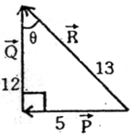
0 likes
View Solution69
MediumMCQ
Vectors $\vec{A}$ and $\vec{B}$ make angles of $20^\circ$ and $110^\circ$ with the $X$-axis,respectively. The magnitudes of these vectors are $5 \, m$ and $12 \, m$,respectively. The magnitude of the resultant vector of these two vectors is ....... $m$.
A
$11$
B
$13$
C
$17$
D
$19$
Solution
(B) The angle between vector $\vec{A}$ and vector $\vec{B}$ is $\theta = 110^\circ - 20^\circ = 90^\circ$.
The magnitude of the resultant vector $R$ is given by the formula:
$R = \sqrt{A^2 + B^2 + 2AB \cos \theta}$
Substituting the given values $A = 5 \, m$,$B = 12 \, m$,and $\theta = 90^\circ$:
$R = \sqrt{5^2 + 12^2 + 2(5)(12) \cos 90^\circ}$
Since $\cos 90^\circ = 0$:
$R = \sqrt{25 + 144 + 0} = \sqrt{169} = 13 \, m$.
Thus,the magnitude of the resultant vector is $13 \, m$.
The magnitude of the resultant vector $R$ is given by the formula:
$R = \sqrt{A^2 + B^2 + 2AB \cos \theta}$
Substituting the given values $A = 5 \, m$,$B = 12 \, m$,and $\theta = 90^\circ$:
$R = \sqrt{5^2 + 12^2 + 2(5)(12) \cos 90^\circ}$
Since $\cos 90^\circ = 0$:
$R = \sqrt{25 + 144 + 0} = \sqrt{169} = 13 \, m$.
Thus,the magnitude of the resultant vector is $13 \, m$.
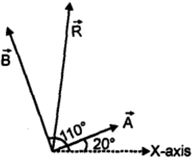
0 likes
View Solution70
MediumMCQ
$A$ vector of length $\ell$ is turned by an angle $\theta$. Find the change in the position vector of the tip.
A
$\ell \cos \frac{\theta}{2}$
B
$2\ell \sin \frac{\theta}{2}$
C
$2\ell \cos \frac{\theta}{2}$
D
$\ell \sin \frac{\theta}{2}$
Solution
(B) Let the initial vector be $\vec{\ell}_1$ and the final vector be $\vec{\ell}_2$. Both have magnitude $\ell$,so $|\vec{\ell}_1| = |\vec{\ell}_2| = \ell$.
The change in the position vector of the tip is given by $\Delta \vec{\ell} = \vec{\ell}_2 - \vec{\ell}_1$.
The magnitude of the change is $|\Delta \vec{\ell}| = \sqrt{|\vec{\ell}_2|^2 + |\vec{\ell}_1|^2 - 2|\vec{\ell}_2||\vec{\ell}_1| \cos \theta}$.
Substituting the magnitudes,we get $|\Delta \vec{\ell}| = \sqrt{\ell^2 + \ell^2 - 2\ell^2 \cos \theta}$.
$|\Delta \vec{\ell}| = \sqrt{2\ell^2(1 - \cos \theta)}$.
Using the trigonometric identity $1 - \cos \theta = 2 \sin^2 \frac{\theta}{2}$,we get:
$|\Delta \vec{\ell}| = \sqrt{2\ell^2 \cdot 2 \sin^2 \frac{\theta}{2}} = \sqrt{4\ell^2 \sin^2 \frac{\theta}{2}}$.
$|\Delta \vec{\ell}| = 2\ell \sin \frac{\theta}{2}$.
The change in the position vector of the tip is given by $\Delta \vec{\ell} = \vec{\ell}_2 - \vec{\ell}_1$.
The magnitude of the change is $|\Delta \vec{\ell}| = \sqrt{|\vec{\ell}_2|^2 + |\vec{\ell}_1|^2 - 2|\vec{\ell}_2||\vec{\ell}_1| \cos \theta}$.
Substituting the magnitudes,we get $|\Delta \vec{\ell}| = \sqrt{\ell^2 + \ell^2 - 2\ell^2 \cos \theta}$.
$|\Delta \vec{\ell}| = \sqrt{2\ell^2(1 - \cos \theta)}$.
Using the trigonometric identity $1 - \cos \theta = 2 \sin^2 \frac{\theta}{2}$,we get:
$|\Delta \vec{\ell}| = \sqrt{2\ell^2 \cdot 2 \sin^2 \frac{\theta}{2}} = \sqrt{4\ell^2 \sin^2 \frac{\theta}{2}}$.
$|\Delta \vec{\ell}| = 2\ell \sin \frac{\theta}{2}$.
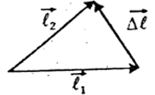
0 likes
View Solution71
MediumMCQ
$ABC$ is an equilateral triangle. The length of each side is $a$ and the centroid is point $O$. If $|\overrightarrow{AB} + \overrightarrow{BC} + \overrightarrow{AC}| = na$,find the value of $n$.
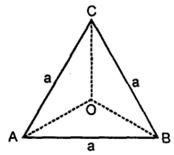
A
$0$
B
$1$
C
$2$
D
$3$
Solution
(C) According to the triangle law of vector addition,$\overrightarrow{AB} + \overrightarrow{BC} = \overrightarrow{AC}$.
Substituting this into the given expression: $|\overrightarrow{AB} + \overrightarrow{BC} + \overrightarrow{AC}| = |\overrightarrow{AC} + \overrightarrow{AC}|$.
This simplifies to $|2\overrightarrow{AC}| = 2|\overrightarrow{AC}|$.
Since the length of each side of the equilateral triangle is $a$,$|\overrightarrow{AC}| = a$.
Therefore,$|2\overrightarrow{AC}| = 2a$.
Comparing this with the given expression $na$,we get $na = 2a$,which implies $n = 2$.
Substituting this into the given expression: $|\overrightarrow{AB} + \overrightarrow{BC} + \overrightarrow{AC}| = |\overrightarrow{AC} + \overrightarrow{AC}|$.
This simplifies to $|2\overrightarrow{AC}| = 2|\overrightarrow{AC}|$.
Since the length of each side of the equilateral triangle is $a$,$|\overrightarrow{AC}| = a$.
Therefore,$|2\overrightarrow{AC}| = 2a$.
Comparing this with the given expression $na$,we get $na = 2a$,which implies $n = 2$.
0 likes
View Solution72
EasyMCQ
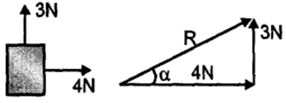
Two forces of magnitudes $3 \, N$ and $4 \, N$ are acting on an object. If the angle between them is $90^\circ$,then their resultant force is ... $N$.
A
$4$
B
$5$
C
$6$
D
$7$
Solution
(B) Given,the two forces are $A = 3 \, N$ and $B = 4 \, N$ with an angle $\theta = 90^\circ$ between them.
Since the forces are perpendicular,the resultant force $R$ is given by:
$R = \sqrt{A^2 + B^2 + 2AB \cos \theta}$
$R = \sqrt{3^2 + 4^2 + 2(3)(4) \cos 90^\circ}$
Since $\cos 90^\circ = 0$,we have:
$R = \sqrt{3^2 + 4^2} = \sqrt{9 + 16} = \sqrt{25} = 5 \, N$
The direction of the resultant force with respect to the $4 \, N$ force is given by:
$\tan \alpha = \frac{3}{4} \implies \alpha = \tan^{-1}(0.75) \approx 37^\circ$.
Since the forces are perpendicular,the resultant force $R$ is given by:
$R = \sqrt{A^2 + B^2 + 2AB \cos \theta}$
$R = \sqrt{3^2 + 4^2 + 2(3)(4) \cos 90^\circ}$
Since $\cos 90^\circ = 0$,we have:
$R = \sqrt{3^2 + 4^2} = \sqrt{9 + 16} = \sqrt{25} = 5 \, N$
The direction of the resultant force with respect to the $4 \, N$ force is given by:
$\tan \alpha = \frac{3}{4} \implies \alpha = \tan^{-1}(0.75) \approx 37^\circ$.
0 likes
View Solution73
EasyMCQ
If $\vec{A} + \vec{B} = \vec{C}$ and $A + B = C$,what is the angle between $\vec{A}$ and $\vec{B}$?
A
$0$
B
$\frac{\pi}{4}$
C
$\frac{\pi}{2}$
D
$\pi$
Solution
(A) The magnitude of the resultant vector $\vec{C} = \vec{A} + \vec{B}$ is given by the formula $C = \sqrt{A^2 + B^2 + 2AB \cos \theta}$,where $\theta$ is the angle between $\vec{A}$ and $\vec{B}$.
Given that $C = A + B$,we substitute this into the equation:
$A + B = \sqrt{A^2 + B^2 + 2AB \cos \theta}$
Squaring both sides:
$(A + B)^2 = A^2 + B^2 + 2AB \cos \theta$
$A^2 + B^2 + 2AB = A^2 + B^2 + 2AB \cos \theta$
Subtracting $A^2 + B^2$ from both sides:
$2AB = 2AB \cos \theta$
Assuming $A, B \neq 0$,we divide by $2AB$:
$1 = \cos \theta$
Therefore,$\theta = 0$.
Given that $C = A + B$,we substitute this into the equation:
$A + B = \sqrt{A^2 + B^2 + 2AB \cos \theta}$
Squaring both sides:
$(A + B)^2 = A^2 + B^2 + 2AB \cos \theta$
$A^2 + B^2 + 2AB = A^2 + B^2 + 2AB \cos \theta$
Subtracting $A^2 + B^2$ from both sides:
$2AB = 2AB \cos \theta$
Assuming $A, B \neq 0$,we divide by $2AB$:
$1 = \cos \theta$
Therefore,$\theta = 0$.
0 likes
View Solution74
MediumMCQ
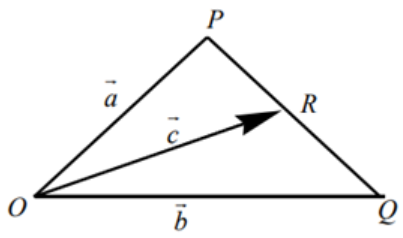
The figure shows three vectors $\vec{a}, \vec{b}$ and $\vec{c}$,where $R$ is the midpoint of $PQ$. Which of the following relations is correct?
A
$\vec{a} + \vec{b} = 2\vec{c}$
B
$\vec{a} + \vec{b} = \vec{c}$
C
$\vec{a} - \vec{b} = 2\vec{c}$
D
$\vec{a} - \vec{b} = \vec{c}$
Solution
(A) Step $1$: Applying the triangle law of vector addition.
In $\triangle OPR$,by the triangle law of vector addition:
$\vec{a} = \vec{c} + \overrightarrow{RP} \quad (1)$
In $\triangle ORQ$,by the triangle law of vector addition:
$\vec{b} = \overrightarrow{RQ} - \vec{c} \implies \vec{c} + \vec{b} = \overrightarrow{RQ} \implies \vec{b} = \overrightarrow{RQ} - \vec{c}$ (Wait,let's re-evaluate the geometry).
Correct approach: In $\triangle OPR$,$\vec{a} = \vec{c} + \overrightarrow{RP}$.
In $\triangle ORQ$,$\vec{c} = \vec{b} + \overrightarrow{RQ} \implies \overrightarrow{RQ} = \vec{c} - \vec{b}$.
Since $R$ is the midpoint of $PQ$,$\overrightarrow{PR} + \overrightarrow{RQ} = 0$,so $\overrightarrow{RP} = -\overrightarrow{RQ}$.
From $\triangle OPR$,$\overrightarrow{RP} = \vec{a} - \vec{c}$.
From $\triangle ORQ$,$\overrightarrow{RQ} = \vec{c} - \vec{b}$.
Since $\overrightarrow{RP} + \overrightarrow{RQ} = 0$,we have $(\vec{a} - \vec{c}) + (\vec{c} - \vec{b}) = 0$ is incorrect. Let's use position vectors.
Let origin be $O$. Then $\vec{a} = \vec{P}$,$\vec{b} = \vec{Q}$,$\vec{c} = \vec{R}$.
Since $R$ is the midpoint of $PQ$,$\vec{R} = \frac{\vec{P} + \vec{Q}}{2}$.
Therefore,$\vec{c} = \frac{\vec{a} + \vec{b}}{2}$,which implies $\vec{a} + \vec{b} = 2\vec{c}$.
In $\triangle OPR$,by the triangle law of vector addition:
$\vec{a} = \vec{c} + \overrightarrow{RP} \quad (1)$
In $\triangle ORQ$,by the triangle law of vector addition:
$\vec{b} = \overrightarrow{RQ} - \vec{c} \implies \vec{c} + \vec{b} = \overrightarrow{RQ} \implies \vec{b} = \overrightarrow{RQ} - \vec{c}$ (Wait,let's re-evaluate the geometry).
Correct approach: In $\triangle OPR$,$\vec{a} = \vec{c} + \overrightarrow{RP}$.
In $\triangle ORQ$,$\vec{c} = \vec{b} + \overrightarrow{RQ} \implies \overrightarrow{RQ} = \vec{c} - \vec{b}$.
Since $R$ is the midpoint of $PQ$,$\overrightarrow{PR} + \overrightarrow{RQ} = 0$,so $\overrightarrow{RP} = -\overrightarrow{RQ}$.
From $\triangle OPR$,$\overrightarrow{RP} = \vec{a} - \vec{c}$.
From $\triangle ORQ$,$\overrightarrow{RQ} = \vec{c} - \vec{b}$.
Since $\overrightarrow{RP} + \overrightarrow{RQ} = 0$,we have $(\vec{a} - \vec{c}) + (\vec{c} - \vec{b}) = 0$ is incorrect. Let's use position vectors.
Let origin be $O$. Then $\vec{a} = \vec{P}$,$\vec{b} = \vec{Q}$,$\vec{c} = \vec{R}$.
Since $R$ is the midpoint of $PQ$,$\vec{R} = \frac{\vec{P} + \vec{Q}}{2}$.
Therefore,$\vec{c} = \frac{\vec{a} + \vec{b}}{2}$,which implies $\vec{a} + \vec{b} = 2\vec{c}$.
0 likes
View Solution75
MediumMCQ
If $|\vec{A} + \vec{B}| = |\vec{A}| = |\vec{B}|$,then the angle between $\vec{A}$ and $\vec{B}$ is ............ $^o$.
A
$90$
B
$120$
C
$0$
D
$60$
Solution
(B) Let $|\vec{A}| = |\vec{B}| = A$.
Given that $|\vec{A} + \vec{B}| = A$.
The magnitude of the resultant vector is given by the formula: $|\vec{A} + \vec{B}| = \sqrt{A^2 + B^2 + 2AB \cos \theta}$.
Substituting the given values: $A = \sqrt{A^2 + A^2 + 2A^2 \cos \theta}$.
Squaring both sides: $A^2 = 2A^2 + 2A^2 \cos \theta$.
Dividing by $A^2$: $1 = 2 + 2 \cos \theta$.
$-1 = 2 \cos \theta$.
$\cos \theta = -1/2$.
Therefore,$\theta = 120^o$.
Given that $|\vec{A} + \vec{B}| = A$.
The magnitude of the resultant vector is given by the formula: $|\vec{A} + \vec{B}| = \sqrt{A^2 + B^2 + 2AB \cos \theta}$.
Substituting the given values: $A = \sqrt{A^2 + A^2 + 2A^2 \cos \theta}$.
Squaring both sides: $A^2 = 2A^2 + 2A^2 \cos \theta$.
Dividing by $A^2$: $1 = 2 + 2 \cos \theta$.
$-1 = 2 \cos \theta$.
$\cos \theta = -1/2$.
Therefore,$\theta = 120^o$.
0 likes
View Solution76
DifficultMCQ
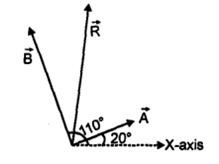
Vectors $\vec{A}$ and $\vec{B}$ make angles of $20^\circ$ and $110^\circ$ with the $X$-axis respectively. The magnitudes of these vectors are $5 \, m$ and $12 \, m$ respectively. Find the angle made by the resultant vector with the $X$-axis.
A
$\tan^{-1}(11/4)$
B
$\tan^{-1}(12/5)$
C
$\tan^{-1}(14/7)$
D
$\tan^{-1}(19/3)$
Solution
(B) The angle between vectors $\vec{A}$ and $\vec{B}$ is $\theta = 110^\circ - 20^\circ = 90^\circ$.
The magnitude of the resultant vector $\vec{R}$ is given by:
$R = \sqrt{A^2 + B^2 + 2AB \cos 90^\circ} = \sqrt{5^2 + 12^2} = \sqrt{25 + 144} = \sqrt{169} = 13 \, m$.
Let $\alpha$ be the angle that the resultant vector $\vec{R}$ makes with vector $\vec{A}$.
Using the formula $\tan \alpha = \frac{B \sin \theta}{A + B \cos \theta}$:
$\tan \alpha = \frac{12 \sin 90^\circ}{5 + 12 \cos 90^\circ} = \frac{12 \times 1}{5 + 12 \times 0} = \frac{12}{5}$.
Thus,$\alpha = \tan^{-1}(12/5)$.
Since $\vec{A}$ makes an angle of $20^\circ$ with the $X$-axis,the angle of the resultant vector $\vec{R}$ with the $X$-axis is $\alpha + 20^\circ = \tan^{-1}(12/5) + 20^\circ$.
The magnitude of the resultant vector $\vec{R}$ is given by:
$R = \sqrt{A^2 + B^2 + 2AB \cos 90^\circ} = \sqrt{5^2 + 12^2} = \sqrt{25 + 144} = \sqrt{169} = 13 \, m$.
Let $\alpha$ be the angle that the resultant vector $\vec{R}$ makes with vector $\vec{A}$.
Using the formula $\tan \alpha = \frac{B \sin \theta}{A + B \cos \theta}$:
$\tan \alpha = \frac{12 \sin 90^\circ}{5 + 12 \cos 90^\circ} = \frac{12 \times 1}{5 + 12 \times 0} = \frac{12}{5}$.
Thus,$\alpha = \tan^{-1}(12/5)$.
Since $\vec{A}$ makes an angle of $20^\circ$ with the $X$-axis,the angle of the resultant vector $\vec{R}$ with the $X$-axis is $\alpha + 20^\circ = \tan^{-1}(12/5) + 20^\circ$.
0 likes
View Solution77
DifficultMCQ
At what angle do two forces $(x + y)$ and $(x - y)$ act so that their resultant is $\sqrt{x^2 + y^2}$?
A
$\cos^{-1} \left( \frac{-(x^2 + y^2)}{2(x^2 - y^2)} \right)$
B
$\cos^{-1} \left( \frac{-2(x^2 - y^2)}{x^2 + y^2} \right)$
C
$\cos^{-1} \left( \frac{-(x^2 + y^2)}{x^2 - y^2} \right)$
D
$\cos^{-1} \left( \frac{x^2 - y^2}{x^2 + y^2} \right)$
Solution
(A) The magnitude of the resultant $R$ of two vectors $A$ and $B$ acting at an angle $\theta$ is given by $R = \sqrt{A^2 + B^2 + 2AB \cos \theta}$.
Given $A = (x + y)$,$B = (x - y)$,and $R = \sqrt{x^2 + y^2}$.
Squaring both sides: $R^2 = A^2 + B^2 + 2AB \cos \theta$.
Substituting the values: $x^2 + y^2 = (x + y)^2 + (x - y)^2 + 2(x + y)(x - y) \cos \theta$.
Expanding the terms: $x^2 + y^2 = (x^2 + y^2 + 2xy) + (x^2 + y^2 - 2xy) + 2(x^2 - y^2) \cos \theta$.
Simplifying: $x^2 + y^2 = 2x^2 + 2y^2 + 2(x^2 - y^2) \cos \theta$.
Rearranging: $x^2 + y^2 - 2x^2 - 2y^2 = 2(x^2 - y^2) \cos \theta$.
$-(x^2 + y^2) = 2(x^2 - y^2) \cos \theta$.
Therefore,$\cos \theta = \frac{-(x^2 + y^2)}{2(x^2 - y^2)}$.
Thus,$\theta = \cos^{-1} \left( \frac{-(x^2 + y^2)}{2(x^2 - y^2)} \right)$.
Given $A = (x + y)$,$B = (x - y)$,and $R = \sqrt{x^2 + y^2}$.
Squaring both sides: $R^2 = A^2 + B^2 + 2AB \cos \theta$.
Substituting the values: $x^2 + y^2 = (x + y)^2 + (x - y)^2 + 2(x + y)(x - y) \cos \theta$.
Expanding the terms: $x^2 + y^2 = (x^2 + y^2 + 2xy) + (x^2 + y^2 - 2xy) + 2(x^2 - y^2) \cos \theta$.
Simplifying: $x^2 + y^2 = 2x^2 + 2y^2 + 2(x^2 - y^2) \cos \theta$.
Rearranging: $x^2 + y^2 - 2x^2 - 2y^2 = 2(x^2 - y^2) \cos \theta$.
$-(x^2 + y^2) = 2(x^2 - y^2) \cos \theta$.
Therefore,$\cos \theta = \frac{-(x^2 + y^2)}{2(x^2 - y^2)}$.
Thus,$\theta = \cos^{-1} \left( \frac{-(x^2 + y^2)}{2(x^2 - y^2)} \right)$.
0 likes
View Solution78
MediumMCQ
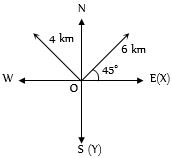
$A$ car travels a distance of $6 \, km$ at an angle of $45^\circ$ with the East,and then travels a distance of $4 \, km$ at an angle of $135^\circ$ with the East. What is the distance from the origin?
A
$\sqrt{50} \, km$
B
$10 \, km$
C
$\sqrt{52} \, km$
D
$\sqrt{42} \, km$
Solution
(C) Let the origin be $(0, 0)$.
The first displacement vector $\vec{d_1}$ is $6 \, km$ at $45^\circ$ with the East (x-axis).
$\vec{d_1} = 6 \cos 45^\circ \hat{i} + 6 \sin 45^\circ \hat{j} = 6 \left( \frac{1}{\sqrt{2}} \right) \hat{i} + 6 \left( \frac{1}{\sqrt{2}} \right) \hat{j} = 3\sqrt{2} \hat{i} + 3\sqrt{2} \hat{j}$.
The second displacement vector $\vec{d_2}$ is $4 \, km$ at $135^\circ$ with the East.
$\vec{d_2} = 4 \cos 135^\circ \hat{i} + 4 \sin 135^\circ \hat{j} = 4 \left( -\frac{1}{\sqrt{2}} \right) \hat{i} + 4 \left( \frac{1}{\sqrt{2}} \right) \hat{j} = -2\sqrt{2} \hat{i} + 2\sqrt{2} \hat{j}$.
The resultant displacement vector $\vec{s} = \vec{d_1} + \vec{d_2} = (3\sqrt{2} - 2\sqrt{2}) \hat{i} + (3\sqrt{2} + 2\sqrt{2}) \hat{j} = \sqrt{2} \hat{i} + 5\sqrt{2} \hat{j}$.
The magnitude of the displacement is $|\vec{s}| = \sqrt{(\sqrt{2})^2 + (5\sqrt{2})^2} = \sqrt{2 + 50} = \sqrt{52} \, km$.
The first displacement vector $\vec{d_1}$ is $6 \, km$ at $45^\circ$ with the East (x-axis).
$\vec{d_1} = 6 \cos 45^\circ \hat{i} + 6 \sin 45^\circ \hat{j} = 6 \left( \frac{1}{\sqrt{2}} \right) \hat{i} + 6 \left( \frac{1}{\sqrt{2}} \right) \hat{j} = 3\sqrt{2} \hat{i} + 3\sqrt{2} \hat{j}$.
The second displacement vector $\vec{d_2}$ is $4 \, km$ at $135^\circ$ with the East.
$\vec{d_2} = 4 \cos 135^\circ \hat{i} + 4 \sin 135^\circ \hat{j} = 4 \left( -\frac{1}{\sqrt{2}} \right) \hat{i} + 4 \left( \frac{1}{\sqrt{2}} \right) \hat{j} = -2\sqrt{2} \hat{i} + 2\sqrt{2} \hat{j}$.
The resultant displacement vector $\vec{s} = \vec{d_1} + \vec{d_2} = (3\sqrt{2} - 2\sqrt{2}) \hat{i} + (3\sqrt{2} + 2\sqrt{2}) \hat{j} = \sqrt{2} \hat{i} + 5\sqrt{2} \hat{j}$.
The magnitude of the displacement is $|\vec{s}| = \sqrt{(\sqrt{2})^2 + (5\sqrt{2})^2} = \sqrt{2 + 50} = \sqrt{52} \, km$.
0 likes
View Solution79
DifficultMCQ
Among three vectors,two vectors are equal in magnitude,and the magnitude of the third vector is $\sqrt{2}$ times the magnitude of the other two vectors. If $\overrightarrow{A} + \overrightarrow{B} + \overrightarrow{C} = 0$,find the angles between the vectors.
A
$30^\circ, 60^\circ, 90^\circ$
B
$45^\circ, 45^\circ, 90^\circ$
C
$45^\circ, 60^\circ, 90^\circ$
D
$90^\circ, 135^\circ, 135^\circ$
Solution
(D) Let the magnitudes of the vectors be $|\overrightarrow{A}| = |\overrightarrow{B}| = x$ and $|\overrightarrow{C}| = x\sqrt{2}$.
Given $\overrightarrow{A} + \overrightarrow{B} + \overrightarrow{C} = 0$,which implies $\overrightarrow{A} + \overrightarrow{B} = -\overrightarrow{C}$.
Squaring both sides: $|\overrightarrow{A}|^2 + |\overrightarrow{B}|^2 + 2|\overrightarrow{A}||\overrightarrow{B}|\cos(\theta_{AB}) = |\overrightarrow{C}|^2$.
Substituting the values: $x^2 + x^2 + 2x^2\cos(\theta_{AB}) = (x\sqrt{2})^2 = 2x^2$.
$2x^2 + 2x^2\cos(\theta_{AB}) = 2x^2$,which gives $\cos(\theta_{AB}) = 0$,so $\theta_{AB} = 90^\circ$.
Since the vectors form a closed triangle,the exterior angles between the vectors are determined by the geometry of the triangle. The angles between the vectors are $90^\circ, 135^\circ, 135^\circ$.
Given $\overrightarrow{A} + \overrightarrow{B} + \overrightarrow{C} = 0$,which implies $\overrightarrow{A} + \overrightarrow{B} = -\overrightarrow{C}$.
Squaring both sides: $|\overrightarrow{A}|^2 + |\overrightarrow{B}|^2 + 2|\overrightarrow{A}||\overrightarrow{B}|\cos(\theta_{AB}) = |\overrightarrow{C}|^2$.
Substituting the values: $x^2 + x^2 + 2x^2\cos(\theta_{AB}) = (x\sqrt{2})^2 = 2x^2$.
$2x^2 + 2x^2\cos(\theta_{AB}) = 2x^2$,which gives $\cos(\theta_{AB}) = 0$,so $\theta_{AB} = 90^\circ$.
Since the vectors form a closed triangle,the exterior angles between the vectors are determined by the geometry of the triangle. The angles between the vectors are $90^\circ, 135^\circ, 135^\circ$.
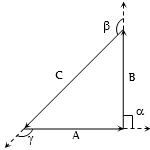
0 likes
View Solution80
MediumMCQ
If $\overrightarrow A = 4\hat i - 3\hat j$ and $\overrightarrow B = 6\hat i + 8\hat j$,find the magnitude and direction of $\overrightarrow A + \overrightarrow B$.
A
$5, \tan^{-1}(3/4)$
B
$5\sqrt{5}, \tan^{-1}(1/2)$
C
$10, \tan^{-1}(5)$
D
$25, \tan^{-1}(3/4)$
Solution
(B) Given vectors are $\overrightarrow A = 4\hat i - 3\hat j$ and $\overrightarrow B = 6\hat i + 8\hat j$.
Sum of vectors: $\overrightarrow A + \overrightarrow B = (4+6)\hat i + (-3+8)\hat j = 10\hat i + 5\hat j$.
Magnitude: $|\overrightarrow A + \overrightarrow B| = \sqrt{(10)^2 + (5)^2} = \sqrt{100 + 25} = \sqrt{125} = 5\sqrt{5}$.
Direction: $\tan \theta = \frac{y}{x} = \frac{5}{10} = \frac{1}{2}$.
Therefore,$\theta = \tan^{-1}(1/2)$.
Sum of vectors: $\overrightarrow A + \overrightarrow B = (4+6)\hat i + (-3+8)\hat j = 10\hat i + 5\hat j$.
Magnitude: $|\overrightarrow A + \overrightarrow B| = \sqrt{(10)^2 + (5)^2} = \sqrt{100 + 25} = \sqrt{125} = 5\sqrt{5}$.
Direction: $\tan \theta = \frac{y}{x} = \frac{5}{10} = \frac{1}{2}$.
Therefore,$\theta = \tan^{-1}(1/2)$.
0 likes
View Solution81
MediumMCQ
$A$ car moves with a speed of $20 \, m/s$ towards the North. It turns and moves with the same speed towards the West. What is the change in velocity?
A
$40 \, m/s \, N-W$
B
$20\sqrt{2} \, m/s \, N-W$
C
$40 \, m/s \, S-W$
D
$20\sqrt{2} \, m/s \, S-W$
Solution
(D) Let the initial velocity be $\vec{v}_1 = 20\hat{j} \, m/s$ (towards North).
After turning,the final velocity is $\vec{v}_2 = -20\hat{i} \, m/s$ (towards West).
The change in velocity is given by $\Delta \vec{v} = \vec{v}_2 - \vec{v}_1$.
$\Delta \vec{v} = -20\hat{i} - 20\hat{j} = -20(\hat{i} + \hat{j}) \, m/s$.
The magnitude of change in velocity is $|\Delta \vec{v}| = \sqrt{(-20)^2 + (-20)^2} = \sqrt{400 + 400} = \sqrt{800} = 20\sqrt{2} \, m/s$.
The direction is given by $\tan \theta = \frac{|\Delta v_y|}{|\Delta v_x|} = \frac{20}{20} = 1$,so $\theta = 45^\circ$.
Since both components are negative,the direction is South-West $(S-W)$.
After turning,the final velocity is $\vec{v}_2 = -20\hat{i} \, m/s$ (towards West).
The change in velocity is given by $\Delta \vec{v} = \vec{v}_2 - \vec{v}_1$.
$\Delta \vec{v} = -20\hat{i} - 20\hat{j} = -20(\hat{i} + \hat{j}) \, m/s$.
The magnitude of change in velocity is $|\Delta \vec{v}| = \sqrt{(-20)^2 + (-20)^2} = \sqrt{400 + 400} = \sqrt{800} = 20\sqrt{2} \, m/s$.
The direction is given by $\tan \theta = \frac{|\Delta v_y|}{|\Delta v_x|} = \frac{20}{20} = 1$,so $\theta = 45^\circ$.
Since both components are negative,the direction is South-West $(S-W)$.
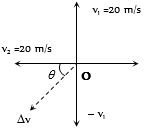
0 likes
View Solution82
DifficultMCQ
If the sum of two unit vectors is a unit vector,find the magnitude of their difference.
A
$\sqrt{2}$
B
$\sqrt{3}$
C
$1/\sqrt{2}$
D
$\sqrt{5}$
Solution
(B) Let the two unit vectors be $\vec{A}$ and $\vec{B}$,where $|\vec{A}| = 1$ and $|\vec{B}| = 1$.
Given that their sum is also a unit vector: $|\vec{A} + \vec{B}| = 1$.
Squaring both sides: $|\vec{A} + \vec{B}|^2 = 1^2$.
$|\vec{A}|^2 + |\vec{B}|^2 + 2|\vec{A}||\vec{B}| \cos \theta = 1$,where $\theta$ is the angle between them.
$1 + 1 + 2(1)(1) \cos \theta = 1 \implies 2 + 2 \cos \theta = 1 \implies 2 \cos \theta = -1 \implies \cos \theta = -1/2$.
Now,we need to find the magnitude of their difference: $|\vec{A} - \vec{B}|$.
$|\vec{A} - \vec{B}|^2 = |\vec{A}|^2 + |\vec{B}|^2 - 2|\vec{A}||\vec{B}| \cos \theta$.
Substituting the values: $|\vec{A} - \vec{B}|^2 = 1 + 1 - 2(1)(1)(-1/2)$.
$|\vec{A} - \vec{B}|^2 = 2 + 1 = 3$.
Therefore,$|\vec{A} - \vec{B}| = \sqrt{3}$.
Given that their sum is also a unit vector: $|\vec{A} + \vec{B}| = 1$.
Squaring both sides: $|\vec{A} + \vec{B}|^2 = 1^2$.
$|\vec{A}|^2 + |\vec{B}|^2 + 2|\vec{A}||\vec{B}| \cos \theta = 1$,where $\theta$ is the angle between them.
$1 + 1 + 2(1)(1) \cos \theta = 1 \implies 2 + 2 \cos \theta = 1 \implies 2 \cos \theta = -1 \implies \cos \theta = -1/2$.
Now,we need to find the magnitude of their difference: $|\vec{A} - \vec{B}|$.
$|\vec{A} - \vec{B}|^2 = |\vec{A}|^2 + |\vec{B}|^2 - 2|\vec{A}||\vec{B}| \cos \theta$.
Substituting the values: $|\vec{A} - \vec{B}|^2 = 1 + 1 - 2(1)(1)(-1/2)$.
$|\vec{A} - \vec{B}|^2 = 2 + 1 = 3$.
Therefore,$|\vec{A} - \vec{B}| = \sqrt{3}$.
0 likes
View Solution83
MediumMCQ
$A$ force ${F_1} = 1\,N$ acts along the direction of $x = 0$,and a force ${F_2} = 2\,N$ acts along the direction of $y = 0$. Find the resultant force.
A
$1\hat i + 2\hat j$
B
$1\hat i + 1\hat j$
C
$3\hat i + 2\hat j$
D
$2\hat i + 1\hat j$
Solution
(D) The line $x = 0$ corresponds to the $y$-axis. Therefore,the force ${F_1} = 1\,N$ acting along the $y$-axis is represented as ${\overrightarrow F _1} = 1\hat j$.
The line $y = 0$ corresponds to the $x$-axis. Therefore,the force ${F_2} = 2\,N$ acting along the $x$-axis is represented as ${\overrightarrow F _2} = 2\hat i$.
The resultant force $\overrightarrow F$ is the vector sum of the two forces:
$\overrightarrow F = {\overrightarrow F _1} + {\overrightarrow F _2} = 2\hat i + 1\hat j$.
The line $y = 0$ corresponds to the $x$-axis. Therefore,the force ${F_2} = 2\,N$ acting along the $x$-axis is represented as ${\overrightarrow F _2} = 2\hat i$.
The resultant force $\overrightarrow F$ is the vector sum of the two forces:
$\overrightarrow F = {\overrightarrow F _1} + {\overrightarrow F _2} = 2\hat i + 1\hat j$.
0 likes
View Solution84
MediumMCQ
If $\overrightarrow A = 2\hat i + \hat j$,$\overrightarrow B = 3\hat j - \hat k$,and $\overrightarrow C = 6\hat i - 2\hat k$,find the value of $\overrightarrow A - 2\overrightarrow B + 3\overrightarrow C$.
A
$20\hat i + 5\hat j + 4\hat k$
B
$20\hat i - 5\hat j - 4\hat k$
C
$4\hat i + 5\hat j + 20\hat k$
D
$5\hat i + 4\hat j + 10\hat k$
Solution
(B) Given vectors are $\overrightarrow A = 2\hat i + \hat j$,$\overrightarrow B = 3\hat j - \hat k$,and $\overrightarrow C = 6\hat i - 2\hat k$.
We need to calculate the expression $\overrightarrow A - 2\overrightarrow B + 3\overrightarrow C$.
Substituting the given vectors into the expression:
$= (2\hat i + \hat j) - 2(3\hat j - \hat k) + 3(6\hat i - 2\hat k)$
$= 2\hat i + \hat j - 6\hat j + 2\hat k + 18\hat i - 6\hat k$
Grouping the components of $\hat i$,$\hat j$,and $\hat k$:
$= (2 + 18)\hat i + (1 - 6)\hat j + (2 - 6)\hat k$
$= 20\hat i - 5\hat j - 4\hat k$.
We need to calculate the expression $\overrightarrow A - 2\overrightarrow B + 3\overrightarrow C$.
Substituting the given vectors into the expression:
$= (2\hat i + \hat j) - 2(3\hat j - \hat k) + 3(6\hat i - 2\hat k)$
$= 2\hat i + \hat j - 6\hat j + 2\hat k + 18\hat i - 6\hat k$
Grouping the components of $\hat i$,$\hat j$,and $\hat k$:
$= (2 + 18)\hat i + (1 - 6)\hat j + (2 - 6)\hat k$
$= 20\hat i - 5\hat j - 4\hat k$.
0 likes
View Solution85
MediumMCQ
If $|A|=2$ and $|B|=4$ and the angle between them is $60^{\circ}$,then $|A-B|$ is
A
$\sqrt{13}$
B
$3\sqrt{3}$
C
$\sqrt{3}$
D
$2\sqrt{3}$
Solution
(D) The magnitude of the difference of two vectors $A$ and $B$ is given by the formula:
$|A-B| = \sqrt{|A|^2 + |B|^2 - 2|A||B|\cos\theta}$
Given $|A| = 2$,$|B| = 4$,and $\theta = 60^{\circ}$.
Substituting the values into the formula:
$|A-B| = \sqrt{2^2 + 4^2 - 2(2)(4)\cos(60^{\circ})}$
$|A-B| = \sqrt{4 + 16 - 16 \times \frac{1}{2}}$
$|A-B| = \sqrt{20 - 8}$
$|A-B| = \sqrt{12}$
$|A-B| = 2\sqrt{3}$
$|A-B| = \sqrt{|A|^2 + |B|^2 - 2|A||B|\cos\theta}$
Given $|A| = 2$,$|B| = 4$,and $\theta = 60^{\circ}$.
Substituting the values into the formula:
$|A-B| = \sqrt{2^2 + 4^2 - 2(2)(4)\cos(60^{\circ})}$
$|A-B| = \sqrt{4 + 16 - 16 \times \frac{1}{2}}$
$|A-B| = \sqrt{20 - 8}$
$|A-B| = \sqrt{12}$
$|A-B| = 2\sqrt{3}$
0 likes
View Solution86
EasyMCQ
If $A$ and $B$ are two non-zero vectors having equal magnitude,the angle between the vectors $A$ and $A - B$ is
A
$0^{\circ}$
B
$90^{\circ}$
C
$180^{\circ}$
D
dependent on the orientation of $A$ and $B$
Solution
(D) Let the magnitude of vectors $A$ and $B$ be $|A| = |B| = a$. Let the angle between $A$ and $B$ be $\theta$.
Consider the vector $R = A - B$. This can be written as $R = A + (-B)$.
The magnitude of vector $-B$ is equal to the magnitude of vector $B$,which is $a$.
The angle between $A$ and $-B$ is $(180^{\circ} - \theta)$.
Using the law of vector addition,the resultant vector $R$ forms a triangle with $A$ and $-B$.
Since $|A| = |-B| = a$,the triangle formed by $A$,$-B$,and $R$ is an isosceles triangle.
The angle $\alpha$ between $A$ and $R$ (which is $A - B$) is given by the base angle of this isosceles triangle.
The sum of angles in a triangle is $180^{\circ}$. The angle between $A$ and $-B$ is $(180^{\circ} - \theta)$.
Thus,$2\alpha + (180^{\circ} - \theta) = 180^{\circ}$.
Solving for $\alpha$,we get $2\alpha = \theta$,or $\alpha = \frac{\theta}{2}$.
Since the angle $\alpha$ depends on $\theta$ (the angle between $A$ and $B$),the correct option is $(d)$.
Consider the vector $R = A - B$. This can be written as $R = A + (-B)$.
The magnitude of vector $-B$ is equal to the magnitude of vector $B$,which is $a$.
The angle between $A$ and $-B$ is $(180^{\circ} - \theta)$.
Using the law of vector addition,the resultant vector $R$ forms a triangle with $A$ and $-B$.
Since $|A| = |-B| = a$,the triangle formed by $A$,$-B$,and $R$ is an isosceles triangle.
The angle $\alpha$ between $A$ and $R$ (which is $A - B$) is given by the base angle of this isosceles triangle.
The sum of angles in a triangle is $180^{\circ}$. The angle between $A$ and $-B$ is $(180^{\circ} - \theta)$.
Thus,$2\alpha + (180^{\circ} - \theta) = 180^{\circ}$.
Solving for $\alpha$,we get $2\alpha = \theta$,or $\alpha = \frac{\theta}{2}$.
Since the angle $\alpha$ depends on $\theta$ (the angle between $A$ and $B$),the correct option is $(d)$.
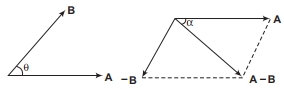
0 likes
View Solution87
MediumMCQ
$A$ force of $6\,N$ and another of $8\,N$ can be applied together to produce the effect of a single force of $..........\,N$
A
$1$
B
$11$
C
$15$
D
$20$
Solution
(B) The resultant force $R$ of two forces $F_1$ and $F_2$ acting at an angle $\theta$ is given by $R = \sqrt{F_1^2 + F_2^2 + 2F_1F_2 \cos \theta}$.
For two forces of $6\,N$ and $8\,N$,the maximum resultant is $F_1 + F_2 = 6 + 8 = 14\,N$ (when $\theta = 0^\circ$).
The minimum resultant is $|F_1 - F_2| = |6 - 8| = 2\,N$ (when $\theta = 180^\circ$).
Therefore,the resultant force must lie in the range $[2\,N, 14\,N]$.
Among the given options,only $11\,N$ lies within this range.
Thus,the correct option is $B$.
For two forces of $6\,N$ and $8\,N$,the maximum resultant is $F_1 + F_2 = 6 + 8 = 14\,N$ (when $\theta = 0^\circ$).
The minimum resultant is $|F_1 - F_2| = |6 - 8| = 2\,N$ (when $\theta = 180^\circ$).
Therefore,the resultant force must lie in the range $[2\,N, 14\,N]$.
Among the given options,only $11\,N$ lies within this range.
Thus,the correct option is $B$.
0 likes
View Solution88
MediumMCQ
Two vectors having equal magnitudes $A$ make an angle $\theta$ with each other. The magnitude and direction of the resultant are respectively
A
$2\,A \cos \frac{\theta}{2}$,along bisector
B
$A \cos \frac{\theta}{2}$,at $45^{\circ}$ from one vector
C
$2\,A \sin \frac{\theta}{2}$,along bisector
D
$A \cos \frac{\theta}{2}$,along bisector
Solution
(A) Let the two vectors be $\vec{P}$ and $\vec{Q}$ such that $|\vec{P}| = |\vec{Q}| = A$.
The magnitude of the resultant vector $\vec{R} = \vec{P} + \vec{Q}$ is given by $R = \sqrt{P^2 + Q^2 + 2PQ \cos \theta}$.
Substituting the values,we get $R = \sqrt{A^2 + A^2 + 2A^2 \cos \theta} = \sqrt{2A^2(1 + \cos \theta)}$.
Using the trigonometric identity $1 + \cos \theta = 2 \cos^2 \frac{\theta}{2}$,we get $R = \sqrt{2A^2 \cdot 2 \cos^2 \frac{\theta}{2}} = \sqrt{4A^2 \cos^2 \frac{\theta}{2}} = 2A \cos \frac{\theta}{2}$.
Since the magnitudes of the two vectors are equal,the resultant vector bisects the angle between them. Thus,the direction is along the angle bisector.
The magnitude of the resultant vector $\vec{R} = \vec{P} + \vec{Q}$ is given by $R = \sqrt{P^2 + Q^2 + 2PQ \cos \theta}$.
Substituting the values,we get $R = \sqrt{A^2 + A^2 + 2A^2 \cos \theta} = \sqrt{2A^2(1 + \cos \theta)}$.
Using the trigonometric identity $1 + \cos \theta = 2 \cos^2 \frac{\theta}{2}$,we get $R = \sqrt{2A^2 \cdot 2 \cos^2 \frac{\theta}{2}} = \sqrt{4A^2 \cos^2 \frac{\theta}{2}} = 2A \cos \frac{\theta}{2}$.
Since the magnitudes of the two vectors are equal,the resultant vector bisects the angle between them. Thus,the direction is along the angle bisector.
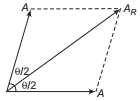
0 likes
View Solution89
MediumMCQ
Given that $P + Q + R = 0$. Which of the following statements is true?
A
$|P| + |Q| = |R|$
B
$|P + Q| = |R|$
C
$|P| - |Q| = |R|$
D
$|P - Q| = |R|$
Solution
(B) Given the vector equation $P + Q + R = 0$.
We can rewrite this as $P + Q = -R$.
Taking the magnitude on both sides,we get $|P + Q| = |-R|$.
Since the magnitude of a vector is always non-negative,$|-R| = |R|$.
Therefore,$|P + Q| = |R|$.
Thus,the correct statement is $|P + Q| = |R|$.
We can rewrite this as $P + Q = -R$.
Taking the magnitude on both sides,we get $|P + Q| = |-R|$.
Since the magnitude of a vector is always non-negative,$|-R| = |R|$.
Therefore,$|P + Q| = |R|$.
Thus,the correct statement is $|P + Q| = |R|$.
0 likes
View Solution90
MediumMCQ
Two vectors $\vec{A}$ and $\vec{B}$ have magnitudes $3 \text{ units}$ and $4 \text{ units}$ respectively. If the angle between them is $60^{\circ}$,find the magnitude of their resultant vector.
A
$5 \text{ units}$
B
$7 \text{ units}$
C
$\sqrt{37} \text{ units}$
D
$\sqrt{13} \text{ units}$
Solution
(C) The magnitude of the resultant vector $\vec{R} = \vec{A} + \vec{B}$ is given by the formula:
$R = \sqrt{A^2 + B^2 + 2AB \cos \theta}$
Given: $A = 3$,$B = 4$,and $\theta = 60^{\circ}$.
Substituting the values:
$R = \sqrt{3^2 + 4^2 + 2(3)(4) \cos 60^{\circ}}$
Since $\cos 60^{\circ} = 0.5$:
$R = \sqrt{9 + 16 + 24(0.5)}$
$R = \sqrt{25 + 12}$
$R = \sqrt{37} \text{ units}$.
$R = \sqrt{A^2 + B^2 + 2AB \cos \theta}$
Given: $A = 3$,$B = 4$,and $\theta = 60^{\circ}$.
Substituting the values:
$R = \sqrt{3^2 + 4^2 + 2(3)(4) \cos 60^{\circ}}$
Since $\cos 60^{\circ} = 0.5$:
$R = \sqrt{9 + 16 + 24(0.5)}$
$R = \sqrt{25 + 12}$
$R = \sqrt{37} \text{ units}$.
0 likes
View Solution91
EasyMCQ
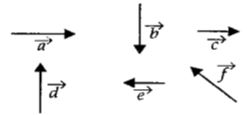
Six vectors,$\overrightarrow a$ through $\overrightarrow f$,have the magnitudes and directions indicated in the figure. Which of the following statements is true?
A
$\overrightarrow {b} +\overrightarrow {c} =\overrightarrow {f} $
B
$\overrightarrow {d} +\overrightarrow {c} = \overrightarrow {f} $
C
$\overrightarrow {d} +\overrightarrow {e}=\overrightarrow {f} $
D
$\overrightarrow {b} +\overrightarrow {e}=\overrightarrow {f} $
Solution
(C) According to the triangle law of vector addition,when two vectors are represented by two sides of a triangle in sequence,their sum is represented by the third side taken in the opposite order.
From the provided figure,if we place the tail of vector $\overrightarrow e$ at the head of vector $\overrightarrow d$,the resultant vector $\overrightarrow f$ connects the tail of $\overrightarrow d$ to the head of $\overrightarrow e$.
Therefore,$\overrightarrow d + \overrightarrow e = \overrightarrow f$.
From the provided figure,if we place the tail of vector $\overrightarrow e$ at the head of vector $\overrightarrow d$,the resultant vector $\overrightarrow f$ connects the tail of $\overrightarrow d$ to the head of $\overrightarrow e$.
Therefore,$\overrightarrow d + \overrightarrow e = \overrightarrow f$.

0 likes
View Solution92
MediumMCQ
If the magnitude of the sum of two vectors is equal to the magnitude of the difference of the two vectors,the angle between these vectors is ........ $^o$.
A
$90$
B
$120$
C
$45$
D
$60$
Solution
(A) Let the two vectors be $\vec{A}$ and $\vec{B}$.
The magnitude of the sum of $\vec{A}$ and $\vec{B}$ is given by: $|\vec{A} + \vec{B}| = \sqrt{A^2 + B^2 + 2AB \cos \theta}$.
The magnitude of the difference of $\vec{A}$ and $\vec{B}$ is given by: $|\vec{A} - \vec{B}| = \sqrt{A^2 + B^2 - 2AB \cos \theta}$.
Given that $|\vec{A} + \vec{B}| = |\vec{A} - \vec{B}|$,we square both sides:
$A^2 + B^2 + 2AB \cos \theta = A^2 + B^2 - 2AB \cos \theta$.
Subtracting $A^2 + B^2$ from both sides,we get:
$2AB \cos \theta = -2AB \cos \theta$.
$4AB \cos \theta = 0$.
Since $A$ and $B$ are non-zero vectors,$4AB \neq 0$,therefore $\cos \theta = 0$.
This implies $\theta = 90^o$.
The magnitude of the sum of $\vec{A}$ and $\vec{B}$ is given by: $|\vec{A} + \vec{B}| = \sqrt{A^2 + B^2 + 2AB \cos \theta}$.
The magnitude of the difference of $\vec{A}$ and $\vec{B}$ is given by: $|\vec{A} - \vec{B}| = \sqrt{A^2 + B^2 - 2AB \cos \theta}$.
Given that $|\vec{A} + \vec{B}| = |\vec{A} - \vec{B}|$,we square both sides:
$A^2 + B^2 + 2AB \cos \theta = A^2 + B^2 - 2AB \cos \theta$.
Subtracting $A^2 + B^2$ from both sides,we get:
$2AB \cos \theta = -2AB \cos \theta$.
$4AB \cos \theta = 0$.
Since $A$ and $B$ are non-zero vectors,$4AB \neq 0$,therefore $\cos \theta = 0$.
This implies $\theta = 90^o$.
0 likes
View Solution93
MediumMCQ
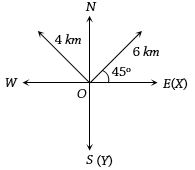
$A$ car travels $6 \, km$ at an angle of $45^o$ north of east and then travels a distance of $4 \, km$ at an angle of $135^o$ north of east. How far is the final point from the starting point? What angle does the straight line joining its initial and final position make with the east direction?
A
$\sqrt{50} \, km$ and $\tan^{-1}(5)$
B
$10 \, km$ and $\tan^{-1}(\sqrt{5})$
C
$\sqrt{52} \, km$ and $\tan^{-1}(5)$
D
$\sqrt{52} \, km$ and $\tan^{-1}(\sqrt{5})$
Solution
(C) Let the starting point be the origin $(0,0)$.
First displacement vector $\vec{d_1} = 6 \cos(45^o) \hat{i} + 6 \sin(45^o) \hat{j} = 6(\frac{1}{\sqrt{2}}) \hat{i} + 6(\frac{1}{\sqrt{2}}) \hat{j} = 3\sqrt{2} \hat{i} + 3\sqrt{2} \hat{j}$.
Second displacement vector $\vec{d_2} = 4 \cos(135^o) \hat{i} + 4 \sin(135^o) \hat{j} = 4(-\frac{1}{\sqrt{2}}) \hat{i} + 4(\frac{1}{\sqrt{2}}) \hat{j} = -2\sqrt{2} \hat{i} + 2\sqrt{2} \hat{j}$.
Resultant displacement $\vec{R} = \vec{d_1} + \vec{d_2} = (3\sqrt{2} - 2\sqrt{2}) \hat{i} + (3\sqrt{2} + 2\sqrt{2}) \hat{j} = \sqrt{2} \hat{i} + 5\sqrt{2} \hat{j}$.
Magnitude $|\vec{R}| = \sqrt{(\sqrt{2})^2 + (5\sqrt{2})^2} = \sqrt{2 + 50} = \sqrt{52} \, km$.
Angle with east direction $\theta = \tan^{-1}(\frac{R_y}{R_x}) = \tan^{-1}(\frac{5\sqrt{2}}{\sqrt{2}}) = \tan^{-1}(5)$.
First displacement vector $\vec{d_1} = 6 \cos(45^o) \hat{i} + 6 \sin(45^o) \hat{j} = 6(\frac{1}{\sqrt{2}}) \hat{i} + 6(\frac{1}{\sqrt{2}}) \hat{j} = 3\sqrt{2} \hat{i} + 3\sqrt{2} \hat{j}$.
Second displacement vector $\vec{d_2} = 4 \cos(135^o) \hat{i} + 4 \sin(135^o) \hat{j} = 4(-\frac{1}{\sqrt{2}}) \hat{i} + 4(\frac{1}{\sqrt{2}}) \hat{j} = -2\sqrt{2} \hat{i} + 2\sqrt{2} \hat{j}$.
Resultant displacement $\vec{R} = \vec{d_1} + \vec{d_2} = (3\sqrt{2} - 2\sqrt{2}) \hat{i} + (3\sqrt{2} + 2\sqrt{2}) \hat{j} = \sqrt{2} \hat{i} + 5\sqrt{2} \hat{j}$.
Magnitude $|\vec{R}| = \sqrt{(\sqrt{2})^2 + (5\sqrt{2})^2} = \sqrt{2 + 50} = \sqrt{52} \, km$.
Angle with east direction $\theta = \tan^{-1}(\frac{R_y}{R_x}) = \tan^{-1}(\frac{5\sqrt{2}}{\sqrt{2}}) = \tan^{-1}(5)$.
0 likes
View Solution94
MediumMCQ
At what angle must the two forces $(x + y)$ and $(x - y)$ act so that the resultant may be $\sqrt{x^2 + y^2}$?
A
$\cos^{-1}\left(-\frac{x^2 + y^2}{2(x^2 - y^2)}\right)$
B
$\cos^{-1}\left(-\frac{2(x^2 - y^2)}{x^2 + y^2}\right)$
C
$\cos^{-1}\left(-\frac{x^2 + y^2}{x^2 - y^2}\right)$
D
$\cos^{-1}\left(-\frac{x^2 - y^2}{x^2 + y^2}\right)$
Solution
(A) The magnitude of the resultant $R$ of two vectors $A$ and $B$ acting at an angle $\theta$ is given by $R = \sqrt{A^2 + B^2 + 2AB \cos \theta}$.
Given $A = (x + y)$,$B = (x - y)$,and $R = \sqrt{x^2 + y^2}$.
Squaring both sides,we get $R^2 = A^2 + B^2 + 2AB \cos \theta$.
Substituting the values: $x^2 + y^2 = (x + y)^2 + (x - y)^2 + 2(x + y)(x - y) \cos \theta$.
Expanding the terms: $x^2 + y^2 = (x^2 + 2xy + y^2) + (x^2 - 2xy + y^2) + 2(x^2 - y^2) \cos \theta$.
Simplifying: $x^2 + y^2 = 2x^2 + 2y^2 + 2(x^2 - y^2) \cos \theta$.
Rearranging: $x^2 + y^2 - 2x^2 - 2y^2 = 2(x^2 - y^2) \cos \theta$.
$- (x^2 + y^2) = 2(x^2 - y^2) \cos \theta$.
Therefore,$\cos \theta = -\frac{x^2 + y^2}{2(x^2 - y^2)}$.
Thus,$\theta = \cos^{-1}\left(-\frac{x^2 + y^2}{2(x^2 - y^2)}\right)$.
Given $A = (x + y)$,$B = (x - y)$,and $R = \sqrt{x^2 + y^2}$.
Squaring both sides,we get $R^2 = A^2 + B^2 + 2AB \cos \theta$.
Substituting the values: $x^2 + y^2 = (x + y)^2 + (x - y)^2 + 2(x + y)(x - y) \cos \theta$.
Expanding the terms: $x^2 + y^2 = (x^2 + 2xy + y^2) + (x^2 - 2xy + y^2) + 2(x^2 - y^2) \cos \theta$.
Simplifying: $x^2 + y^2 = 2x^2 + 2y^2 + 2(x^2 - y^2) \cos \theta$.
Rearranging: $x^2 + y^2 - 2x^2 - 2y^2 = 2(x^2 - y^2) \cos \theta$.
$- (x^2 + y^2) = 2(x^2 - y^2) \cos \theta$.
Therefore,$\cos \theta = -\frac{x^2 + y^2}{2(x^2 - y^2)}$.
Thus,$\theta = \cos^{-1}\left(-\frac{x^2 + y^2}{2(x^2 - y^2)}\right)$.
0 likes
View Solution95
MediumMCQ
The resultant of $\vec{A} + \vec{B}$ is $\vec{R}_1$. On reversing the vector $\vec{B}$,the resultant becomes $\vec{R}_2$. What is the value of $R_1^2 + R_2^2$?
A
$A^2 + B^2$
B
$A^2 - B^2$
C
$2(A^2 + B^2)$
D
$2(A^2 - B^2)$
Solution
(C) Given,$\vec{R}_1 = \vec{A} + \vec{B}$ and $\vec{R}_2 = \vec{A} - \vec{B}$.
Using the parallelogram law of vector addition,the magnitude of the resultant is given by $R^2 = A^2 + B^2 + 2AB \cos \theta$.
For $\vec{R}_1$,the magnitude squared is $R_1^2 = A^2 + B^2 + 2AB \cos \theta$.
For $\vec{R}_2$,the angle between $\vec{A}$ and $-\vec{B}$ is $(180^\circ - \theta)$,so $R_2^2 = A^2 + B^2 + 2AB \cos(180^\circ - \theta) = A^2 + B^2 - 2AB \cos \theta$.
Adding these two equations:
$R_1^2 + R_2^2 = (A^2 + B^2 + 2AB \cos \theta) + (A^2 + B^2 - 2AB \cos \theta)$
$R_1^2 + R_2^2 = 2(A^2 + B^2)$.
Using the parallelogram law of vector addition,the magnitude of the resultant is given by $R^2 = A^2 + B^2 + 2AB \cos \theta$.
For $\vec{R}_1$,the magnitude squared is $R_1^2 = A^2 + B^2 + 2AB \cos \theta$.
For $\vec{R}_2$,the angle between $\vec{A}$ and $-\vec{B}$ is $(180^\circ - \theta)$,so $R_2^2 = A^2 + B^2 + 2AB \cos(180^\circ - \theta) = A^2 + B^2 - 2AB \cos \theta$.
Adding these two equations:
$R_1^2 + R_2^2 = (A^2 + B^2 + 2AB \cos \theta) + (A^2 + B^2 - 2AB \cos \theta)$
$R_1^2 + R_2^2 = 2(A^2 + B^2)$.
0 likes
View Solution96
DifficultMCQ
Given $A = 2 \hat{i} + \hat{j}$,$B = 3 \hat{j} - \hat{k}$,and $C = 6 \hat{i} - 2 \hat{k}$. The value of $A - 2B + 3C$ is:
A
$20 \hat{i} + 5 \hat{j} + 4 \hat{k}$
B
$20 \hat{i} - 5 \hat{j} - 4 \hat{k}$
C
$4 \hat{i} + 5 \hat{j} + 20 \hat{k}$
D
$5 \hat{i} + 4 \hat{j} + 10 \hat{k}$
Solution
(B) Given vectors are $A = 2 \hat{i} + \hat{j}$,$B = 3 \hat{j} - \hat{k}$,and $C = 6 \hat{i} - 2 \hat{k}$.
We need to calculate $A - 2B + 3C$.
Substitute the given vectors into the expression:
$A - 2B + 3C = (2 \hat{i} + \hat{j}) - 2(3 \hat{j} - \hat{k}) + 3(6 \hat{i} - 2 \hat{k})$
Expand the terms:
$= 2 \hat{i} + \hat{j} - 6 \hat{j} + 2 \hat{k} + 18 \hat{i} - 6 \hat{k}$
Group the components of $\hat{i}$,$\hat{j}$,and $\hat{k}$:
$= (2 + 18) \hat{i} + (1 - 6) \hat{j} + (2 - 6) \hat{k}$
$= 20 \hat{i} - 5 \hat{j} - 4 \hat{k}$
We need to calculate $A - 2B + 3C$.
Substitute the given vectors into the expression:
$A - 2B + 3C = (2 \hat{i} + \hat{j}) - 2(3 \hat{j} - \hat{k}) + 3(6 \hat{i} - 2 \hat{k})$
Expand the terms:
$= 2 \hat{i} + \hat{j} - 6 \hat{j} + 2 \hat{k} + 18 \hat{i} - 6 \hat{k}$
Group the components of $\hat{i}$,$\hat{j}$,and $\hat{k}$:
$= (2 + 18) \hat{i} + (1 - 6) \hat{j} + (2 - 6) \hat{k}$
$= 20 \hat{i} - 5 \hat{j} - 4 \hat{k}$
0 likes
View Solution97
MediumMCQ
Two forces $F_1 = 3 \ N$ at $0^o$ and $F_2 = 5 \ N$ at $60^o$ act on a body. Then a single force that would balance the two forces must have a magnitude of .......... $N$
A
$3$
B
$5$
C
$7$
D
$8$
Solution
(C) The resultant force $R$ of two vectors $F_1$ and $F_2$ with an angle $\theta$ between them is given by the formula: $R = \sqrt{F_1^2 + F_2^2 + 2F_1F_2 \cos \theta}$.
Given $F_1 = 3 \ N$,$F_2 = 5 \ N$,and $\theta = 60^o$.
Substituting the values: $R = \sqrt{3^2 + 5^2 + 2(3)(5) \cos 60^o}$.
Since $\cos 60^o = 0.5$,we have $R = \sqrt{9 + 25 + 30(0.5)} = \sqrt{34 + 15} = \sqrt{49} = 7 \ N$.
$A$ force that balances these two forces must be equal in magnitude and opposite in direction to the resultant force.
Therefore,the magnitude of the balancing force is $7 \ N$.
Given $F_1 = 3 \ N$,$F_2 = 5 \ N$,and $\theta = 60^o$.
Substituting the values: $R = \sqrt{3^2 + 5^2 + 2(3)(5) \cos 60^o}$.
Since $\cos 60^o = 0.5$,we have $R = \sqrt{9 + 25 + 30(0.5)} = \sqrt{34 + 15} = \sqrt{49} = 7 \ N$.
$A$ force that balances these two forces must be equal in magnitude and opposite in direction to the resultant force.
Therefore,the magnitude of the balancing force is $7 \ N$.
0 likes
View Solution98
DifficultMCQ
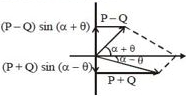
Two forces $P + Q$ and $P - Q$ make an angle $2 \alpha$ with each other,and their resultant makes an angle $\theta$ with the bisector of the angle between them. Then:
A
$P \tan \theta = Q \tan \alpha$
B
$P \sin \theta = Q \sin \alpha$
C
$P \cos \alpha = Q \sin \theta$
D
$P \sin \alpha = Q \sin \theta$
Solution
(A) Let the two forces be $F_1 = P + Q$ and $F_2 = P - Q$. The angle between them is $2 \alpha$. The bisector divides this into two angles of $\alpha$ each.
If the resultant makes an angle $\theta$ with the bisector,then the angle between the resultant and $F_1$ is $(\alpha - \theta)$ and the angle between the resultant and $F_2$ is $(\alpha + \theta)$.
Resolving the forces perpendicular to the resultant,the components must cancel out:
$(P + Q) \sin (\alpha - \theta) = (P - Q) \sin (\alpha + \theta)$
Expanding the terms:
$P \sin (\alpha - \theta) + Q \sin (\alpha - \theta) = P \sin (\alpha + \theta) - Q \sin (\alpha + \theta)$
Rearranging terms to group $P$ and $Q$:
$Q [\sin (\alpha + \theta) + \sin (\alpha - \theta)] = P [\sin (\alpha + \theta) - \sin (\alpha - \theta)]$
Using trigonometric identities $\sin(A+B) + \sin(A-B) = 2 \sin A \cos B$ and $\sin(A+B) - \sin(A-B) = 2 \cos A \sin B$:
$Q [2 \sin \alpha \cos \theta] = P [2 \cos \alpha \sin \theta]$
Dividing both sides by $2 \cos \alpha \cos \theta$:
$Q \tan \alpha = P \tan \theta$
Thus,$P \tan \theta = Q \tan \alpha$.
If the resultant makes an angle $\theta$ with the bisector,then the angle between the resultant and $F_1$ is $(\alpha - \theta)$ and the angle between the resultant and $F_2$ is $(\alpha + \theta)$.
Resolving the forces perpendicular to the resultant,the components must cancel out:
$(P + Q) \sin (\alpha - \theta) = (P - Q) \sin (\alpha + \theta)$
Expanding the terms:
$P \sin (\alpha - \theta) + Q \sin (\alpha - \theta) = P \sin (\alpha + \theta) - Q \sin (\alpha + \theta)$
Rearranging terms to group $P$ and $Q$:
$Q [\sin (\alpha + \theta) + \sin (\alpha - \theta)] = P [\sin (\alpha + \theta) - \sin (\alpha - \theta)]$
Using trigonometric identities $\sin(A+B) + \sin(A-B) = 2 \sin A \cos B$ and $\sin(A+B) - \sin(A-B) = 2 \cos A \sin B$:
$Q [2 \sin \alpha \cos \theta] = P [2 \cos \alpha \sin \theta]$
Dividing both sides by $2 \cos \alpha \cos \theta$:
$Q \tan \alpha = P \tan \theta$
Thus,$P \tan \theta = Q \tan \alpha$.
0 likes
View Solution99
DifficultMCQ
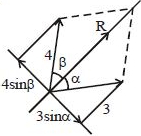
Two vectors of magnitude $3$ and $4$ have a resultant which makes angles $\alpha$ and $\beta$ respectively with them (given $\alpha + \beta \neq 90^o$).
A
$\frac{\sin \alpha}{\sin \beta} = \frac{3}{4}$
B
$\frac{\sin \alpha}{\cos \beta} = \frac{3}{4}$
C
$\frac{\sin \alpha}{\sin \beta} = \frac{4}{3}$
D
None of the above
Solution
(C) Let the two vectors be $\vec{A}$ and $\vec{B}$ with magnitudes $A = 3$ and $B = 4$. Let $\vec{R}$ be their resultant.
If we resolve both vectors along the direction perpendicular to the resultant $\vec{R}$,the sum of the components must be zero because the resultant has no component perpendicular to itself.
Thus,the component of vector $3$ perpendicular to $\vec{R}$ must be equal in magnitude to the component of vector $4$ perpendicular to $\vec{R}$ in the opposite direction.
Therefore,$3 \sin \alpha = 4 \sin \beta$.
Rearranging the terms,we get $\frac{\sin \alpha}{\sin \beta} = \frac{4}{3}$.
If we resolve both vectors along the direction perpendicular to the resultant $\vec{R}$,the sum of the components must be zero because the resultant has no component perpendicular to itself.
Thus,the component of vector $3$ perpendicular to $\vec{R}$ must be equal in magnitude to the component of vector $4$ perpendicular to $\vec{R}$ in the opposite direction.
Therefore,$3 \sin \alpha = 4 \sin \beta$.
Rearranging the terms,we get $\frac{\sin \alpha}{\sin \beta} = \frac{4}{3}$.
0 likes
View Solution100
MediumMCQ
If $\vec{a}$ and $\vec{b}$ are two unit vectors inclined at an angle of $60^{\circ}$ to each other,then:
A
$| \vec{a} + \vec{b} | > 1$
B
$| \vec{a} + \vec{b} | < 1$
C
$| \vec{a} - \vec{b} | > 1$
D
$| \vec{a} - \vec{b} | < 1$
Solution
(A) Given that $\vec{a}$ and $\vec{b}$ are unit vectors,so $|\vec{a}| = 1$ and $|\vec{b}| = 1$.
The angle between them is $\theta = 60^{\circ}$.
For the sum of vectors,the magnitude is given by $|\vec{a} + \vec{b}| = \sqrt{|\vec{a}|^2 + |\vec{b}|^2 + 2|\vec{a}| |\vec{b}| \cos \theta}$.
Substituting the values: $|\vec{a} + \vec{b}| = \sqrt{1^2 + 1^2 + 2(1)(1) \cos 60^{\circ}} = \sqrt{1 + 1 + 2(0.5)} = \sqrt{3} \approx 1.732$.
Since $1.732 > 1$,it follows that $|\vec{a} + \vec{b}| > 1$.
For the difference of vectors,the magnitude is given by $|\vec{a} - \vec{b}| = \sqrt{|\vec{a}|^2 + |\vec{b}|^2 - 2|\vec{a}| |\vec{b}| \cos \theta}$.
Substituting the values: $|\vec{a} - \vec{b}| = \sqrt{1^2 + 1^2 - 2(1)(1) \cos 60^{\circ}} = \sqrt{1 + 1 - 2(0.5)} = \sqrt{1} = 1$.
Thus,the correct statement is $|\vec{a} + \vec{b}| > 1$.
The angle between them is $\theta = 60^{\circ}$.
For the sum of vectors,the magnitude is given by $|\vec{a} + \vec{b}| = \sqrt{|\vec{a}|^2 + |\vec{b}|^2 + 2|\vec{a}| |\vec{b}| \cos \theta}$.
Substituting the values: $|\vec{a} + \vec{b}| = \sqrt{1^2 + 1^2 + 2(1)(1) \cos 60^{\circ}} = \sqrt{1 + 1 + 2(0.5)} = \sqrt{3} \approx 1.732$.
Since $1.732 > 1$,it follows that $|\vec{a} + \vec{b}| > 1$.
For the difference of vectors,the magnitude is given by $|\vec{a} - \vec{b}| = \sqrt{|\vec{a}|^2 + |\vec{b}|^2 - 2|\vec{a}| |\vec{b}| \cos \theta}$.
Substituting the values: $|\vec{a} - \vec{b}| = \sqrt{1^2 + 1^2 - 2(1)(1) \cos 60^{\circ}} = \sqrt{1 + 1 - 2(0.5)} = \sqrt{1} = 1$.
Thus,the correct statement is $|\vec{a} + \vec{b}| > 1$.
0 likes
View Solution3-1.Vectors — Addition and Subtraction of Vectors · Frequently Asked Questions
1Are these 3-1.Vectors questions useful for JEE and NEET?
Yes. All questions in this section are mapped to JEE Main and NEET exam patterns. Previous year questions from JEE Main, NEET, GUJCET and state-level exams are included with full solutions.
2Can I switch to Hindi or Gujarati for these questions?
Yes. Use the language tabs in the hero section or the sidebar to view the same questions and solutions in English, Hindi or Gujarati.
3How do I generate a question paper from this subtopic?
Use the Vedclass Exam Paper Generator — select the chapter and subtopic, set difficulty, and generate Sets A, B, C, D automatically. First 3 chapters of every subject are free.
Vedclass Products
For Students
Vedclass Test Series
Mock tests in real JEE/NEET style with performance analysis. 5-day free trial.
Start Free TrialFor Teachers
Exam Paper Generator
Generate Set A/B/C/D papers from this chapter in 2 minutes. 3 chapters free.
Try FreeFor Institutes
Online Exam Module
Live online exams with unlimited students, 360° analytics & white-label branding.
See DemoFor Teachers & Institutes
Generate a 3-1.Vectors Exam Paper in 2 Minutes
Select subtopic & difficulty — Sets A, B, C, D auto-generated with No Repeat logic.
First 3 chapters of every subject are free — no payment required.