
A English
Latent Heat and Heating Curve Questions in English
Class 11 Physics · 10-1.Thermometry, Thermal Expansion and Calorimetry · Latent Heat and Heating Curve
63+
Questions
English
Language
100%
With Solutions
Showing 13 of 63 questions in English
51
Medium
When a man eats $100 \, g$ of ice in a minute,how much power will he get? The latent heat of ice is $80 \, cal/g$.
Solution
(560 W) Mass of ice eaten by the man per second,$m = \frac{100 \, g}{60 \, s} = \frac{5}{3} \, g/s$.
Latent heat of ice,$L = 80 \, cal/g$.
Energy required per second (Power) $P = m \times L$.
$P = \frac{5}{3} \, g/s \times 80 \, cal/g = \frac{400}{3} \, cal/s$.
Converting calories to Joules $(1 \, cal = 4.2 \, J)$:
$P = \frac{400}{3} \times 4.2 \, J/s = 400 \times 1.4 \, W = 560 \, W$.
Latent heat of ice,$L = 80 \, cal/g$.
Energy required per second (Power) $P = m \times L$.
$P = \frac{5}{3} \, g/s \times 80 \, cal/g = \frac{400}{3} \, cal/s$.
Converting calories to Joules $(1 \, cal = 4.2 \, J)$:
$P = \frac{400}{3} \times 4.2 \, J/s = 400 \times 1.4 \, W = 560 \, W$.
0 likes
View Solution52
Medium
Write the unit and dimensional formula for latent heat. On what factors does the value of latent heat depend?
Solution
(N/A) The latent heat $(L)$ is defined as the amount of heat energy required to change the state of a unit mass of a substance without changing its temperature. It is given by the formula $L = Q/m$,where $Q$ is the heat energy and $m$ is the mass.
$1$. Unit: The $SI$ unit of latent heat is $J/kg$ (joule per kilogram).
$2$. Dimensional Formula: Since $Q$ has dimensions $[M L^2 T^{-2}]$ and $m$ has dimensions $[M]$,the dimensional formula for latent heat is $[M^0 L^2 T^{-2}]$.
$3$. Dependency: The value of latent heat depends on the nature of the substance and the temperature/pressure at which the phase change occurs.
$1$. Unit: The $SI$ unit of latent heat is $J/kg$ (joule per kilogram).
$2$. Dimensional Formula: Since $Q$ has dimensions $[M L^2 T^{-2}]$ and $m$ has dimensions $[M]$,the dimensional formula for latent heat is $[M^0 L^2 T^{-2}]$.
$3$. Dependency: The value of latent heat depends on the nature of the substance and the temperature/pressure at which the phase change occurs.
0 likes
View Solution53
Difficult
What is latent heat of fusion? What is latent heat of vaporization? Give its value for water.
Solution
$1$. Latent heat of fusion: It is the amount of heat energy required to change $1 \ kg$ of a substance from solid state to liquid state at its melting point without any change in temperature.
$2$. Latent heat of vaporization: It is the amount of heat energy required to change $1 \ kg$ of a substance from liquid state to gaseous state at its boiling point without any change in temperature.
$3$. For water:
- Latent heat of fusion $(L_f)$ = $3.34 \times 10^5 \ J/kg$ (or $80 \ cal/g$).
- Latent heat of vaporization $(L_v)$ = $2.26 \times 10^6 \ J/kg$ (or $540 \ cal/g$).
$2$. Latent heat of vaporization: It is the amount of heat energy required to change $1 \ kg$ of a substance from liquid state to gaseous state at its boiling point without any change in temperature.
$3$. For water:
- Latent heat of fusion $(L_f)$ = $3.34 \times 10^5 \ J/kg$ (or $80 \ cal/g$).
- Latent heat of vaporization $(L_v)$ = $2.26 \times 10^6 \ J/kg$ (or $540 \ cal/g$).
1 likes
View Solution54
Medium
Why do we get burnt more by steam than by boiling water at the same temperature?
Solution
(N/A) The temperature of both boiling water and steam is $100^{\circ}C$. However,steam contains additional latent heat of vaporization. When steam condenses into water at $100^{\circ}C$,it releases $22.6 \times 10^{5} \ J \ kg^{-1}$ of energy. Because of this extra heat energy,steam causes more severe burns than boiling water at the same temperature.
0 likes
View Solution55
Easy
Match the following according to conversion by heat:
| Column-$I$ | Column-$II$ |
|---|---|
| $(a)$ Required heat to convert solid into gaseous. | $(i)$ Latent heat of fusion |
| $(b)$ Required heat to convert solid into liquid. | $(ii)$ Latent heat of vaporization |
Solution
(A) The latent heat of fusion is the heat required to change a substance from a solid state to a liquid state at its melting point.
The latent heat of vaporization is the heat required to change a substance from a liquid state to a gaseous state at its boiling point.
However,the direct conversion from solid to gas is called sublimation. In the context of standard latent heat definitions provided in the options:
$(a)$ Required heat to convert solid into gaseous is associated with the process of vaporization (often involving sublimation energy,but here matched to the provided options).
$(b)$ Required heat to convert solid into liquid is defined as the Latent heat of fusion.
Therefore,the correct matching is $(a-ii), (b-i)$.
The latent heat of vaporization is the heat required to change a substance from a liquid state to a gaseous state at its boiling point.
However,the direct conversion from solid to gas is called sublimation. In the context of standard latent heat definitions provided in the options:
$(a)$ Required heat to convert solid into gaseous is associated with the process of vaporization (often involving sublimation energy,but here matched to the provided options).
$(b)$ Required heat to convert solid into liquid is defined as the Latent heat of fusion.
Therefore,the correct matching is $(a-ii), (b-i)$.
0 likes
View Solution56
EasyMCQ
Values for latent heat in Column-$I$ and its values are given in Column-$II$. Match the following:
| Column-$I$ | Column-$II$ |
| $(a)$ Latent heat of vaporization $L_V$ | $(i)$ $22.6 \times 10^5 \, J/kg$ |
| $(b)$ Latent heat of fusion $L_f$ | $(ii)$ $33.3 \times 10^5 \, J/kg$ |
| $(iii)$ $3.33 \times 10^5 \, J/kg$ |
A
$(a-i), (b-iii)$
B
$(a-i), (b-ii)$
C
$(a-iii), (b-ii)$
D
$(a-ii), (b-i)$
Solution
(A) The latent heat of vaporization of water $(L_V)$ is approximately $22.6 \times 10^5 \, J/kg$.
The latent heat of fusion of ice $(L_f)$ is approximately $3.33 \times 10^5 \, J/kg$.
Comparing these with the given options:
$(a)$ matches with $(i)$.
$(b)$ matches with $(iii)$.
Therefore,the correct match is $(a-i), (b-iii)$.
The latent heat of fusion of ice $(L_f)$ is approximately $3.33 \times 10^5 \, J/kg$.
Comparing these with the given options:
$(a)$ matches with $(i)$.
$(b)$ matches with $(iii)$.
Therefore,the correct match is $(a-i), (b-iii)$.
0 likes
View Solution57
AdvancedMCQ
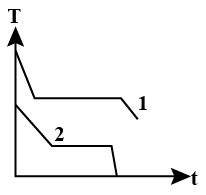
Two different liquids of the same mass are kept in two identical vessels, which are placed in a freezer that extracts heat from them at the same rate, causing each liquid to transform into a solid. The schematic figure below shows the temperature $T$ versus time $t$ plot for the two materials. We denote the specific heat in the liquid states as $C_{L 1}$ and $C_{L 2}$ for materials $1$ and $2$, respectively, and the latent heats of fusion as $L_1$ and $L_2$, respectively. Choose the correct option.
A
$C_{L 1} > C_{L 2}$ and $L_1 < L_2$
B
$C_{L 1} > C_{L 2}$ and $L_1 > L_2$
C
$C_{L 1} < C_{L 2}$ and $L_1 > L_2$
D
$C_{L 1} < C_{L 2}$ and $L_1 < L_2$
Solution
(C) The rate of heat extraction is constant, let it be $P$.
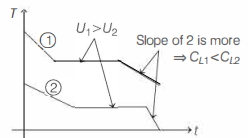
For the liquid cooling phase, the heat released is $H = m C_L \Delta T$. Since $H = P \cdot t$, we have $P \cdot t = m C_L \Delta T$, which gives the slope of the $T-t$ graph as $\frac{\Delta T}{t} = \frac{P}{m C_L}$.
Since $P$ and $m$ are the same for both, the slope is inversely proportional to the specific heat $C_L$. From the graph, the slope of line $2$ is steeper than that of line $1$, so $C_{L 2} > C_{L 1}$, or $C_{L 1} < C_{L 2}$.
For the phase change (solidification) part, the heat released is $H = m L$. Since $H = P \cdot t_{phase}$, we have $P \cdot t_{phase} = m L$, which gives $L = \frac{P}{m} t_{phase}$.
Thus, the latent heat $L$ is directly proportional to the time $t_{phase}$ spent in the phase change. From the graph, the horizontal segment for material $1$ is longer than that for material $2$, so $t_{phase, 1} > t_{phase, 2}$, which implies $L_1 > L_2$.
Therefore, $C_{L 1} < C_{L 2}$ and $L_1 > L_2$. The correct option is $C$.
For the liquid cooling phase, the heat released is $H = m C_L \Delta T$. Since $H = P \cdot t$, we have $P \cdot t = m C_L \Delta T$, which gives the slope of the $T-t$ graph as $\frac{\Delta T}{t} = \frac{P}{m C_L}$.
Since $P$ and $m$ are the same for both, the slope is inversely proportional to the specific heat $C_L$. From the graph, the slope of line $2$ is steeper than that of line $1$, so $C_{L 2} > C_{L 1}$, or $C_{L 1} < C_{L 2}$.
For the phase change (solidification) part, the heat released is $H = m L$. Since $H = P \cdot t_{phase}$, we have $P \cdot t_{phase} = m L$, which gives $L = \frac{P}{m} t_{phase}$.
Thus, the latent heat $L$ is directly proportional to the time $t_{phase}$ spent in the phase change. From the graph, the horizontal segment for material $1$ is longer than that for material $2$, so $t_{phase, 1} > t_{phase, 2}$, which implies $L_1 > L_2$.
Therefore, $C_{L 1} < C_{L 2}$ and $L_1 > L_2$. The correct option is $C$.
0 likes
View Solution58
EasyMCQ
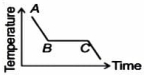
The portion $AB$ of the cooling curve representing the state of matter denotes:
A
Change from gaseous state to liquid state
B
The liquid state of matter
C
Gaseous state of matter
D
All of these
Solution
(B) In a cooling curve,the temperature decreases with time as heat is removed from the system.
$1$. The segment $AB$ represents the cooling of a substance in a single phase,where the temperature drops as time passes.
$2$. In this specific cooling curve,the segment $AB$ corresponds to the cooling of the substance while it is in the liquid state.
$3$. The horizontal segment $BC$ represents a phase change (e.g.,liquid to solid) where the temperature remains constant.
$4$. Therefore,the portion $AB$ represents the liquid state of matter.
Thus,the correct option is $B$.
$1$. The segment $AB$ represents the cooling of a substance in a single phase,where the temperature drops as time passes.
$2$. In this specific cooling curve,the segment $AB$ corresponds to the cooling of the substance while it is in the liquid state.
$3$. The horizontal segment $BC$ represents a phase change (e.g.,liquid to solid) where the temperature remains constant.
$4$. Therefore,the portion $AB$ represents the liquid state of matter.
Thus,the correct option is $B$.
0 likes
View Solution59
MediumMCQ
$A$ block of ice at $-10^{\circ} C$ is slowly heated and converted to steam at $100^{\circ} C$. Which of the following curves represent the phenomenon qualitatively:
A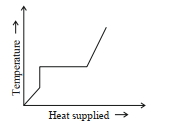
B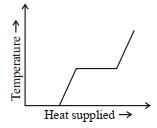
C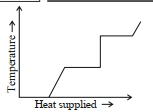
D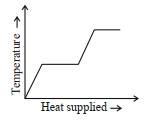
Solution
(C) The process of heating ice at $-10^{\circ} C$ to steam at $100^{\circ} C$ involves several stages:
$1$. Heating ice from $-10^{\circ} C$ to $0^{\circ} C$: Temperature increases linearly with heat supplied.
$2$. Melting ice at $0^{\circ} C$ to water at $0^{\circ} C$: Temperature remains constant (phase change,latent heat of fusion).
$3$. Heating water from $0^{\circ} C$ to $100^{\circ} C$: Temperature increases linearly with heat supplied.
$4$. Boiling water at $100^{\circ} C$ to steam at $100^{\circ} C$: Temperature remains constant (phase change,latent heat of vaporization).
Thus,the heating curve should show two distinct horizontal segments representing the phase changes at $0^{\circ} C$ and $100^{\circ} C$,separated by a rising segment for water heating,and followed by a rising segment for steam heating. Graph $C$ correctly depicts these two phase changes (horizontal lines) and the intermediate heating stages.
$1$. Heating ice from $-10^{\circ} C$ to $0^{\circ} C$: Temperature increases linearly with heat supplied.
$2$. Melting ice at $0^{\circ} C$ to water at $0^{\circ} C$: Temperature remains constant (phase change,latent heat of fusion).
$3$. Heating water from $0^{\circ} C$ to $100^{\circ} C$: Temperature increases linearly with heat supplied.
$4$. Boiling water at $100^{\circ} C$ to steam at $100^{\circ} C$: Temperature remains constant (phase change,latent heat of vaporization).
Thus,the heating curve should show two distinct horizontal segments representing the phase changes at $0^{\circ} C$ and $100^{\circ} C$,separated by a rising segment for water heating,and followed by a rising segment for steam heating. Graph $C$ correctly depicts these two phase changes (horizontal lines) and the intermediate heating stages.
0 likes
View Solution60
EasyMCQ
Boiling water is changing into steam. The specific heat of boiling water is
A
zero
B
One
C
Infinity
D
less than one
Solution
(C) Specific heat $s$ of a substance is defined as the amount of heat $Q$ required to raise the temperature of a unit mass $m$ of the substance by a unit degree $\Delta T$.
The formula is given by $s = \frac{Q}{m \Delta T}$.
During the process of boiling water changing into steam,the substance undergoes a phase change.
In a phase change process,the temperature of the substance remains constant,meaning $\Delta T = 0$.
Substituting this into the formula,we get $s = \frac{Q}{m \times 0} = \infty$.
Therefore,the specific heat of boiling water during this phase change is infinite.
The formula is given by $s = \frac{Q}{m \Delta T}$.
During the process of boiling water changing into steam,the substance undergoes a phase change.
In a phase change process,the temperature of the substance remains constant,meaning $\Delta T = 0$.
Substituting this into the formula,we get $s = \frac{Q}{m \times 0} = \infty$.
Therefore,the specific heat of boiling water during this phase change is infinite.
0 likes
View Solution61
MediumMCQ
Match the following items in Column-$I$ with their corresponding definitions in Column-$II$.
| Column-$I$ | Column-$II$ |
| $A$. Conversion of liquid into solid is | $1$. Regelation |
| $B$. Conversion of liquid into vapour is | $2$. Sublimation |
| $C$. Conversion of solid into vapour directly is | $3$. Fusion |
| $D$. Melting of ice caused by pressure is | $4$. Vaporisation |
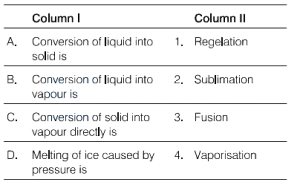
A
$3, 4, 2, 1$
B
$1, 3, 4, 2$
C
$3, 4, 1, 2$
D
$4, 2, 1, 3$
Solution
(A) The correct matches are as follows:
$(A)$ The process of converting a liquid into a solid is called freezing or fusion (in some contexts,fusion refers to melting,but here it corresponds to the phase change process).
$(B)$ The process of converting a liquid into vapour is known as vaporisation.
$(C)$ The process of converting a solid directly into vapour without passing through the liquid state is known as sublimation.
$(D)$ The phenomenon of melting of ice due to the application of pressure is known as regelation.
Therefore,the correct matching is $A-3, B-4, C-2, D-1$.
$(A)$ The process of converting a liquid into a solid is called freezing or fusion (in some contexts,fusion refers to melting,but here it corresponds to the phase change process).
$(B)$ The process of converting a liquid into vapour is known as vaporisation.
$(C)$ The process of converting a solid directly into vapour without passing through the liquid state is known as sublimation.
$(D)$ The phenomenon of melting of ice due to the application of pressure is known as regelation.
Therefore,the correct matching is $A-3, B-4, C-2, D-1$.
0 likes
View Solution62
EasyMCQ
Latent heat of vaporisation of water is $22.6 \times 10^5 \ J \ kg^{-1}$. The amount of heat needed to convert $100 \ kg$ of water into vapour at $100^{\circ} C$ is
A
$11.3 \times 10^5 \ J$
B
$11.3 \times 10^6 \ J$
C
$22.6 \times 10^6 \ J$
D
$22.6 \times 10^7 \ J$
Solution
(D) Given: Latent heat of vaporization $L_v = 22.6 \times 10^5 \ J \ kg^{-1}$.
Mass of water,$m = 100 \ kg$.
The heat required $(Q)$ to convert water into vapour at constant temperature is given by the formula:
$Q = m \times L_v$
Substituting the given values:
$Q = 100 \ kg \times (22.6 \times 10^5 \ J \ kg^{-1})$
$Q = 10^2 \times 22.6 \times 10^5 \ J$
$Q = 22.6 \times 10^7 \ J$
Therefore,the amount of heat needed is $22.6 \times 10^7 \ J$.
Mass of water,$m = 100 \ kg$.
The heat required $(Q)$ to convert water into vapour at constant temperature is given by the formula:
$Q = m \times L_v$
Substituting the given values:
$Q = 100 \ kg \times (22.6 \times 10^5 \ J \ kg^{-1})$
$Q = 10^2 \times 22.6 \times 10^5 \ J$
$Q = 22.6 \times 10^7 \ J$
Therefore,the amount of heat needed is $22.6 \times 10^7 \ J$.
0 likes
View Solution63
EasyMCQ
$A$ solution consists of ether and $5.0 \ g$ of water at $0^{\circ} C$. If the ether evaporates completely to freeze the water,then the mass of the ether in the solution is (in $g$)
A
$5$
B
$4$
C
$4.5$
D
$6$
Solution
(C) Latent heat of fusion of water $(L_f)$ $= 80 \ cal/g$.
Latent heat of vaporization of ether $(L_v)$ $= 90 \ cal/g$.
Let the mass of the ether be $m$.
To freeze $5 \ g$ of water at $0^{\circ} C$,the heat removed from the water is $Q = m_{water} \times L_f = 5 \ g \times 80 \ cal/g = 400 \ cal$.
This heat is absorbed by the ether as it evaporates: $Q = m \times L_v$.
Equating the heat: $400 \ cal = m \times 90 \ cal/g$.
$m = \frac{400}{90} \ g \approx 4.44 \ g$.
Rounding to the nearest provided option,the mass is approximately $4.5 \ g$.
Latent heat of vaporization of ether $(L_v)$ $= 90 \ cal/g$.
Let the mass of the ether be $m$.
To freeze $5 \ g$ of water at $0^{\circ} C$,the heat removed from the water is $Q = m_{water} \times L_f = 5 \ g \times 80 \ cal/g = 400 \ cal$.
This heat is absorbed by the ether as it evaporates: $Q = m \times L_v$.
Equating the heat: $400 \ cal = m \times 90 \ cal/g$.
$m = \frac{400}{90} \ g \approx 4.44 \ g$.
Rounding to the nearest provided option,the mass is approximately $4.5 \ g$.
0 likes
View Solution10-1.Thermometry, Thermal Expansion and Calorimetry — Latent Heat and Heating Curve · Frequently Asked Questions
1Are these 10-1.Thermometry, Thermal Expansion and Calorimetry questions useful for JEE and NEET?
Yes. All questions in this section are mapped to JEE Main and NEET exam patterns. Previous year questions from JEE Main, NEET, GUJCET and state-level exams are included with full solutions.
2Can I switch to Hindi or Gujarati for these questions?
Yes. Use the language tabs in the hero section or the sidebar to view the same questions and solutions in English, Hindi or Gujarati.
3How do I generate a question paper from this subtopic?
Use the Vedclass Exam Paper Generator — select the chapter and subtopic, set difficulty, and generate Sets A, B, C, D automatically. First 3 chapters of every subject are free.
Vedclass Products
For Students
Vedclass Test Series
Mock tests in real JEE/NEET style with performance analysis. 5-day free trial.
Start Free TrialFor Teachers
Exam Paper Generator
Generate Set A/B/C/D papers from this chapter in 2 minutes. 3 chapters free.
Try FreeFor Institutes
Online Exam Module
Live online exams with unlimited students, 360° analytics & white-label branding.
See DemoFor Teachers & Institutes
Generate a 10-1.Thermometry, Thermal Expansion and Calorimetry Exam Paper in 2 Minutes
Select subtopic & difficulty — Sets A, B, C, D auto-generated with No Repeat logic.
First 3 chapters of every subject are free — no payment required.