
A English
Mix Examples-Complex numbers Questions in English
Class 11 Mathematics · 4-1.Complex numbers · Mix Examples-Complex numbers
263+
Questions
English
Language
100%
With Solutions
Showing 49 of 263 questions in English
51
DifficultMCQ
The value of the infinite product $(\cos \theta + i\sin \theta )(\cos \frac{\theta }{2} + i\sin \frac{\theta }{2})(\cos \frac{\theta }{2^2} + i\sin \frac{\theta }{2^2}) \dots$ is
A
$\cos 2\theta - i\sin 2\theta $
B
$\cos 2\theta + i\sin 2\theta $
C
$\sin 2\theta - i\cos 2\theta $
D
$\sin 2\theta + i\cos 2\theta $
Solution
(B) Using the property of complex numbers in polar form,$(\cos \alpha + i\sin \alpha)(\cos \beta + i\sin \beta) = \cos(\alpha + \beta) + i\sin(\alpha + \beta)$.
Given the product is $P = (\cos \theta + i\sin \theta )(\cos \frac{\theta }{2} + i\sin \frac{\theta }{2})(\cos \frac{\theta }{2^2} + i\sin \frac{\theta }{2^2}) \dots \infty$.
This simplifies to $P = \cos(\theta + \frac{\theta }{2} + \frac{\theta }{2^2} + \dots) + i\sin(\theta + \frac{\theta }{2} + \frac{\theta }{2^2} + \dots)$.
The exponent sum is a geometric series with first term $a = \theta$ and common ratio $r = 1/2$.
The sum of the infinite series is $S = \frac{a}{1-r} = \frac{\theta}{1 - 1/2} = \frac{\theta}{1/2} = 2\theta$.
Therefore,$P = \cos(2\theta) + i\sin(2\theta)$.
Given the product is $P = (\cos \theta + i\sin \theta )(\cos \frac{\theta }{2} + i\sin \frac{\theta }{2})(\cos \frac{\theta }{2^2} + i\sin \frac{\theta }{2^2}) \dots \infty$.
This simplifies to $P = \cos(\theta + \frac{\theta }{2} + \frac{\theta }{2^2} + \dots) + i\sin(\theta + \frac{\theta }{2} + \frac{\theta }{2^2} + \dots)$.
The exponent sum is a geometric series with first term $a = \theta$ and common ratio $r = 1/2$.
The sum of the infinite series is $S = \frac{a}{1-r} = \frac{\theta}{1 - 1/2} = \frac{\theta}{1/2} = 2\theta$.
Therefore,$P = \cos(2\theta) + i\sin(2\theta)$.
0 likes
View Solution52
AdvancedMCQ
$z_1$ and $z_2$ are two complex numbers such that $|z_1 + z_2| = 1$ and $|z_1^2 + z_2^2| = 25$. Then the minimum value of $|z_1^3 + z_2^3|$ is
A
$24$
B
$42$
C
$37$
D
$33$
Solution
(C) Given $|z_1 + z_2| = 1$ and $|z_1^2 + z_2^2| = 25$.
We know that $z_1^3 + z_2^3 = (z_1 + z_2)(z_1^2 - z_1z_2 + z_2^2)$.
Also,$(z_1 + z_2)^2 = z_1^2 + z_2^2 + 2z_1z_2$,so $z_1z_2 = \frac{1}{2}((z_1 + z_2)^2 - (z_1^2 + z_2^2))$.
Substituting this into the expression for $z_1^3 + z_2^3$:
$z_1^3 + z_2^3 = (z_1 + z_2)(z_1^2 + z_2^2 - \frac{1}{2}((z_1 + z_2)^2 - (z_1^2 + z_2^2)))$
$z_1^3 + z_2^3 = (z_1 + z_2)(\frac{3}{2}(z_1^2 + z_2^2) - \frac{1}{2}(z_1 + z_2)^2)$.
Taking the modulus on both sides:
$|z_1^3 + z_2^3| = |z_1 + z_2| \cdot |\frac{3}{2}(z_1^2 + z_2^2) - \frac{1}{2}(z_1 + z_2)^2|$.
Using the triangle inequality $|a - b| \ge ||a| - |b||$:
$|z_1^3 + z_2^3| \ge |z_1 + z_2| \cdot |\frac{3}{2}|z_1^2 + z_2^2| - \frac{1}{2}|z_1 + z_2|^2|$.
Substituting the given values $|z_1 + z_2| = 1$ and $|z_1^2 + z_2^2| = 25$:
$|z_1^3 + z_2^3| \ge 1 \cdot |\frac{3}{2}(25) - \frac{1}{2}(1)^2| = |37.5 - 0.5| = 37$.
We know that $z_1^3 + z_2^3 = (z_1 + z_2)(z_1^2 - z_1z_2 + z_2^2)$.
Also,$(z_1 + z_2)^2 = z_1^2 + z_2^2 + 2z_1z_2$,so $z_1z_2 = \frac{1}{2}((z_1 + z_2)^2 - (z_1^2 + z_2^2))$.
Substituting this into the expression for $z_1^3 + z_2^3$:
$z_1^3 + z_2^3 = (z_1 + z_2)(z_1^2 + z_2^2 - \frac{1}{2}((z_1 + z_2)^2 - (z_1^2 + z_2^2)))$
$z_1^3 + z_2^3 = (z_1 + z_2)(\frac{3}{2}(z_1^2 + z_2^2) - \frac{1}{2}(z_1 + z_2)^2)$.
Taking the modulus on both sides:
$|z_1^3 + z_2^3| = |z_1 + z_2| \cdot |\frac{3}{2}(z_1^2 + z_2^2) - \frac{1}{2}(z_1 + z_2)^2|$.
Using the triangle inequality $|a - b| \ge ||a| - |b||$:
$|z_1^3 + z_2^3| \ge |z_1 + z_2| \cdot |\frac{3}{2}|z_1^2 + z_2^2| - \frac{1}{2}|z_1 + z_2|^2|$.
Substituting the given values $|z_1 + z_2| = 1$ and $|z_1^2 + z_2^2| = 25$:
$|z_1^3 + z_2^3| \ge 1 \cdot |\frac{3}{2}(25) - \frac{1}{2}(1)^2| = |37.5 - 0.5| = 37$.
0 likes
View Solution53
AdvancedMCQ
The complex numbers $\sin x + i \cos 2x$ and $\cos x - i \sin 2x$ are conjugate to each other,for
A
$x = n\pi, n \in Z$
B
$x = 0$
C
$x = \frac{n\pi}{2}, n \in Z$
D
No value of $x$
Solution
(D) Two complex numbers $z_1 = a + ib$ and $z_2 = c + id$ are conjugates if $z_1 = \overline{z_2}$.
Given $z_1 = \sin x + i \cos 2x$ and $z_2 = \cos x - i \sin 2x$.
The conjugate of $z_2$ is $\overline{z_2} = \cos x + i \sin 2x$.
Equating $z_1 = \overline{z_2}$,we get $\sin x + i \cos 2x = \cos x + i \sin 2x$.
Comparing real and imaginary parts:
$1$) $\sin x = \cos x$ $\Rightarrow \tan x = 1$ $\Rightarrow x = n\pi + \frac{\pi}{4}$.
$2$) $\cos 2x = \sin 2x$ $\Rightarrow \tan 2x = 1$ $\Rightarrow 2x = m\pi + \frac{\pi}{4}$ $\Rightarrow x = \frac{m\pi}{2} + \frac{\pi}{8}$.
Since there is no common value of $x$ that satisfies both equations simultaneously,there is no value of $x$ for which these complex numbers are conjugates.
Given $z_1 = \sin x + i \cos 2x$ and $z_2 = \cos x - i \sin 2x$.
The conjugate of $z_2$ is $\overline{z_2} = \cos x + i \sin 2x$.
Equating $z_1 = \overline{z_2}$,we get $\sin x + i \cos 2x = \cos x + i \sin 2x$.
Comparing real and imaginary parts:
$1$) $\sin x = \cos x$ $\Rightarrow \tan x = 1$ $\Rightarrow x = n\pi + \frac{\pi}{4}$.
$2$) $\cos 2x = \sin 2x$ $\Rightarrow \tan 2x = 1$ $\Rightarrow 2x = m\pi + \frac{\pi}{4}$ $\Rightarrow x = \frac{m\pi}{2} + \frac{\pi}{8}$.
Since there is no common value of $x$ that satisfies both equations simultaneously,there is no value of $x$ for which these complex numbers are conjugates.
0 likes
View Solution54
AdvancedMCQ
If $z_1, z_2, z_3$ are the roots of the equation $z^3 - z^2(4 + 3i) + z(3 + 8i) - 5i = 0$, then $Re(z_1) + Re(z_2) + Re(z_3)$ is -
A
$0$
B
$-1$
C
$3$
D
$4$
Solution
(D) For a cubic equation of the form $az^3 + bz^2 + cz + d = 0$, the sum of the roots $z_1 + z_2 + z_3$ is given by $-\frac{b}{a}$.
Here, the given equation is $z^3 - z^2(4 + 3i) + z(3 + 8i) - 5i = 0$.
Comparing this with the standard form, we have $a = 1$ and $b = -(4 + 3i)$.
Therefore, the sum of the roots is $z_1 + z_2 + z_3 = -\frac{-(4 + 3i)}{1} = 4 + 3i$.
We are asked to find $Re(z_1) + Re(z_2) + Re(z_3)$, which is equal to $Re(z_1 + z_2 + z_3)$.
Since $z_1 + z_2 + z_3 = 4 + 3i$, the real part is $Re(4 + 3i) = 4$.
Thus, $Re(z_1) + Re(z_2) + Re(z_3) = 4$.
Here, the given equation is $z^3 - z^2(4 + 3i) + z(3 + 8i) - 5i = 0$.
Comparing this with the standard form, we have $a = 1$ and $b = -(4 + 3i)$.
Therefore, the sum of the roots is $z_1 + z_2 + z_3 = -\frac{-(4 + 3i)}{1} = 4 + 3i$.
We are asked to find $Re(z_1) + Re(z_2) + Re(z_3)$, which is equal to $Re(z_1 + z_2 + z_3)$.
Since $z_1 + z_2 + z_3 = 4 + 3i$, the real part is $Re(4 + 3i) = 4$.
Thus, $Re(z_1) + Re(z_2) + Re(z_3) = 4$.
0 likes
View Solution55
DifficultMCQ
If $a = \cos \alpha + i\sin \alpha$,$b = \cos \beta + i\sin \beta$,$c = \cos \gamma + i\sin \gamma$ and $\frac{b}{c} + \frac{c}{a} + \frac{a}{b} = 1$,then $\cos (\beta - \gamma) + \cos (\gamma - \alpha) + \cos (\alpha - \beta)$ is equal to
A
$\frac{3}{2}$
B
$\frac{-3}{2}$
C
$0$
D
$1$
Solution
(D) Given that $a = e^{i\alpha}$,$b = e^{i\beta}$,and $c = e^{i\gamma}$.
Substituting these into the equation $\frac{b}{c} + \frac{c}{a} + \frac{a}{b} = 1$,we get:
$e^{i(\beta - \gamma)} + e^{i(\gamma - \alpha)} + e^{i(\alpha - \beta)} = 1$.
Using Euler's formula $e^{i\theta} = \cos \theta + i\sin \theta$,we have:
$(\cos(\beta - \gamma) + i\sin(\beta - \gamma)) + (\cos(\gamma - \alpha) + i\sin(\gamma - \alpha)) + (\cos(\alpha - \beta) + i\sin(\alpha - \beta)) = 1 + 0i$.
Equating the real parts on both sides:
$\cos(\beta - \gamma) + \cos(\gamma - \alpha) + \cos(\alpha - \beta) = 1$.
Substituting these into the equation $\frac{b}{c} + \frac{c}{a} + \frac{a}{b} = 1$,we get:
$e^{i(\beta - \gamma)} + e^{i(\gamma - \alpha)} + e^{i(\alpha - \beta)} = 1$.
Using Euler's formula $e^{i\theta} = \cos \theta + i\sin \theta$,we have:
$(\cos(\beta - \gamma) + i\sin(\beta - \gamma)) + (\cos(\gamma - \alpha) + i\sin(\gamma - \alpha)) + (\cos(\alpha - \beta) + i\sin(\alpha - \beta)) = 1 + 0i$.
Equating the real parts on both sides:
$\cos(\beta - \gamma) + \cos(\gamma - \alpha) + \cos(\alpha - \beta) = 1$.
0 likes
View Solution56
DifficultMCQ
If ${z_r} = \cos \frac{{r\alpha }}{{{n^2}}} + i\sin \frac{{r\alpha }}{{{n^2}}}$,where $r = 1, 2, 3, \dots, n$,then $\mathop {\lim }\limits_{n \to \infty } {z_1}{z_2}{z_3} \dots {z_n}$ is equal to
A
$\cos \alpha + i\sin \alpha$
B
$\cos \left( \frac{\alpha}{2} \right) - i\sin \left( \frac{\alpha}{2} \right)$
C
$e^{i\alpha / 2}$
D
$\sqrt[3]{e^{i\alpha}}$
Solution
(C) Given ${z_r} = \cos \frac{r\alpha}{n^2} + i\sin \frac{r\alpha}{n^2} = e^{i \frac{r\alpha}{n^2}}$.
Then the product $P = {z_1}{z_2} \dots {z_n} = \prod_{r=1}^{n} e^{i \frac{r\alpha}{n^2}} = e^{i \frac{\alpha}{n^2} \sum_{r=1}^{n} r}$.
Using the sum formula $\sum_{r=1}^{n} r = \frac{n(n+1)}{2}$,we get:
$P = e^{i \frac{\alpha}{n^2} \cdot \frac{n(n+1)}{2}} = e^{i \frac{\alpha(n^2+n)}{2n^2}} = e^{i \frac{\alpha}{2} (1 + \frac{1}{n})}$.
Taking the limit as $n \to \infty$:
$\mathop {\lim }\limits_{n \to \infty } P = e^{i \frac{\alpha}{2} (1 + 0)} = e^{i \frac{\alpha}{2}} = \cos \frac{\alpha}{2} + i\sin \frac{\alpha}{2}$.
Then the product $P = {z_1}{z_2} \dots {z_n} = \prod_{r=1}^{n} e^{i \frac{r\alpha}{n^2}} = e^{i \frac{\alpha}{n^2} \sum_{r=1}^{n} r}$.
Using the sum formula $\sum_{r=1}^{n} r = \frac{n(n+1)}{2}$,we get:
$P = e^{i \frac{\alpha}{n^2} \cdot \frac{n(n+1)}{2}} = e^{i \frac{\alpha(n^2+n)}{2n^2}} = e^{i \frac{\alpha}{2} (1 + \frac{1}{n})}$.
Taking the limit as $n \to \infty$:
$\mathop {\lim }\limits_{n \to \infty } P = e^{i \frac{\alpha}{2} (1 + 0)} = e^{i \frac{\alpha}{2}} = \cos \frac{\alpha}{2} + i\sin \frac{\alpha}{2}$.
0 likes
View Solution57
AdvancedMCQ
Let $A = \{z : (\frac{z - \bar{z}}{2i})^2 \leqslant 2(\frac{z - \bar{z}}{2i})\}$ where $i = \sqrt{-1}$ and $B = \{z : |z| \leqslant \sqrt{5}\}$. The number of points with integral real and imaginary parts of $z$ lying in $A \cap B$ is -
A
$3$
B
$5$
C
$7$
D
$13$
Solution
(D) Let $z = x + iy$. Then $\frac{z - \bar{z}}{2i} = y$.
Given the condition for $A$: $y^2 \leqslant 2y$,which simplifies to $y^2 - 2y \leqslant 0$,so $0 \leqslant y \leqslant 2$.
Given the condition for $B$: $|z| \leqslant \sqrt{5}$,which implies $x^2 + y^2 \leqslant 5$.
We need to find points $(x, y)$ where $x, y \in \mathbb{Z}$ such that $0 \leqslant y \leqslant 2$ and $x^2 + y^2 \leqslant 5$.
Case $y = 0$: $x^2 \leqslant 5 \implies x \in \{-2, -1, 0, 1, 2\}$. Points: $(-2, 0), (-1, 0), (0, 0), (1, 0), (2, 0)$.
Case $y = 1$: $x^2 + 1 \leqslant 5 \implies x^2 \leqslant 4 \implies x \in \{-2, -1, 0, 1, 2\}$. Points: $(-2, 1), (-1, 1), (0, 1), (1, 1), (2, 1)$.
Case $y = 2$: $x^2 + 4 \leqslant 5 \implies x^2 \leqslant 1 \implies x \in \{-1, 0, 1\}$. Points: $(-1, 2), (0, 2), (1, 2)$.
Total points = $5 + 5 + 3 = 13$.
Given the condition for $A$: $y^2 \leqslant 2y$,which simplifies to $y^2 - 2y \leqslant 0$,so $0 \leqslant y \leqslant 2$.
Given the condition for $B$: $|z| \leqslant \sqrt{5}$,which implies $x^2 + y^2 \leqslant 5$.
We need to find points $(x, y)$ where $x, y \in \mathbb{Z}$ such that $0 \leqslant y \leqslant 2$ and $x^2 + y^2 \leqslant 5$.
Case $y = 0$: $x^2 \leqslant 5 \implies x \in \{-2, -1, 0, 1, 2\}$. Points: $(-2, 0), (-1, 0), (0, 0), (1, 0), (2, 0)$.
Case $y = 1$: $x^2 + 1 \leqslant 5 \implies x^2 \leqslant 4 \implies x \in \{-2, -1, 0, 1, 2\}$. Points: $(-2, 1), (-1, 1), (0, 1), (1, 1), (2, 1)$.
Case $y = 2$: $x^2 + 4 \leqslant 5 \implies x^2 \leqslant 1 \implies x \in \{-1, 0, 1\}$. Points: $(-1, 2), (0, 2), (1, 2)$.
Total points = $5 + 5 + 3 = 13$.
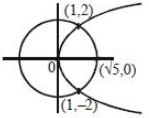
0 likes
View Solution58
AdvancedMCQ
If $z_1$ and $z_2$ are two unimodular complex numbers that satisfy $z_1^2 + z_2^2 = 5,$ then $(z_1 - \bar{z}_1)^2 + (z_2 - \bar{z}_2)^2$ is equal to -
A
$6$
B
$5$
C
$9$
D
$10$
Solution
(A) Given that $z_1$ and $z_2$ are unimodular,we have $|z_1| = 1$ and $|z_2| = 1.$
Since $|z|^2 = z \bar{z} = 1$,we have $\bar{z}_1 = \frac{1}{z_1}$ and $\bar{z}_2 = \frac{1}{z_2}.$
Given $z_1^2 + z_2^2 = 5.$
We need to evaluate $E = (z_1 - \bar{z}_1)^2 + (z_2 - \bar{z}_2)^2.$
Expanding the terms: $E = (z_1^2 + \bar{z}_1^2 - 2z_1\bar{z}_1) + (z_2^2 + \bar{z}_2^2 - 2z_2\bar{z}_2).$
Since $z_1\bar{z}_1 = |z_1|^2 = 1$ and $z_2\bar{z}_2 = |z_2|^2 = 1$,we have:
$E = (z_1^2 + z_2^2) + (\bar{z}_1^2 + \bar{z}_2^2) - 2(1) - 2(1).$
Since $z_1^2 + z_2^2 = 5$,taking the conjugate gives $\bar{z}_1^2 + \bar{z}_2^2 = \bar{5} = 5.$
Substituting these values: $E = 5 + 5 - 4 = 6.$
Since $|z|^2 = z \bar{z} = 1$,we have $\bar{z}_1 = \frac{1}{z_1}$ and $\bar{z}_2 = \frac{1}{z_2}.$
Given $z_1^2 + z_2^2 = 5.$
We need to evaluate $E = (z_1 - \bar{z}_1)^2 + (z_2 - \bar{z}_2)^2.$
Expanding the terms: $E = (z_1^2 + \bar{z}_1^2 - 2z_1\bar{z}_1) + (z_2^2 + \bar{z}_2^2 - 2z_2\bar{z}_2).$
Since $z_1\bar{z}_1 = |z_1|^2 = 1$ and $z_2\bar{z}_2 = |z_2|^2 = 1$,we have:
$E = (z_1^2 + z_2^2) + (\bar{z}_1^2 + \bar{z}_2^2) - 2(1) - 2(1).$
Since $z_1^2 + z_2^2 = 5$,taking the conjugate gives $\bar{z}_1^2 + \bar{z}_2^2 = \bar{5} = 5.$
Substituting these values: $E = 5 + 5 - 4 = 6.$
0 likes
View Solution59
AdvancedMCQ
If $z_1, z_2, z_3, z_4$ are the roots of the equation $z^4 + z^3 + z^2 + z + 1 = 0$,then $\prod_{i=1}^{4} (z_i + 2)$ is equal to:
A
$1$
B
$8$
C
$11$
D
$17$
Solution
(C) Let $P(z) = z^4 + z^3 + z^2 + z + 1 = (z - z_1)(z - z_2)(z - z_3)(z - z_4)$.
We want to find the value of $\prod_{i=1}^{4} (z_i + 2)$.
Note that $\prod_{i=1}^{4} (z_i + 2) = (-1)^4 \prod_{i=1}^{4} (-2 - z_i) = P(-2)$.
Substituting $z = -2$ into the polynomial $P(z)$:
$P(-2) = (-2)^4 + (-2)^3 + (-2)^2 + (-2) + 1$
$P(-2) = 16 - 8 + 4 - 2 + 1$
$P(-2) = 11$.
Therefore,the product is $11$.
We want to find the value of $\prod_{i=1}^{4} (z_i + 2)$.
Note that $\prod_{i=1}^{4} (z_i + 2) = (-1)^4 \prod_{i=1}^{4} (-2 - z_i) = P(-2)$.
Substituting $z = -2$ into the polynomial $P(z)$:
$P(-2) = (-2)^4 + (-2)^3 + (-2)^2 + (-2) + 1$
$P(-2) = 16 - 8 + 4 - 2 + 1$
$P(-2) = 11$.
Therefore,the product is $11$.
0 likes
View Solution60
AdvancedMCQ
In a cubic equation,the coefficient of $x^2$ is $0$ and the remaining coefficients are real. If one root is $\alpha = 3 + 4i$,and the remaining roots are $\beta$ and $\gamma$,then find the value of $\alpha \beta \gamma$.
A
$150$
B
$-150$
C
$25$
D
None of these
Solution
(B) Since the coefficients are real,the complex roots must occur in conjugate pairs. Given $\alpha = 3 + 4i$,the second root is $\beta = 3 - 4i$.
Let the cubic equation be $x^3 + ax^2 + bx + c = 0$. Since the coefficient of $x^2$ is $0$,the sum of the roots is $\alpha + \beta + \gamma = 0$.
Substituting the known values: $(3 + 4i) + (3 - 4i) + \gamma = 0$.
$6 + \gamma = 0 \implies \gamma = -6$.
The product of the roots is $\alpha \beta \gamma = (3 + 4i)(3 - 4i)(-6)$.
Since $(3 + 4i)(3 - 4i) = 3^2 + 4^2 = 9 + 16 = 25$,we have $\alpha \beta \gamma = 25 \times (-6) = -150$.
Let the cubic equation be $x^3 + ax^2 + bx + c = 0$. Since the coefficient of $x^2$ is $0$,the sum of the roots is $\alpha + \beta + \gamma = 0$.
Substituting the known values: $(3 + 4i) + (3 - 4i) + \gamma = 0$.
$6 + \gamma = 0 \implies \gamma = -6$.
The product of the roots is $\alpha \beta \gamma = (3 + 4i)(3 - 4i)(-6)$.
Since $(3 + 4i)(3 - 4i) = 3^2 + 4^2 = 9 + 16 = 25$,we have $\alpha \beta \gamma = 25 \times (-6) = -150$.
0 likes
View Solution61
AdvancedMCQ
If $x_r = \cos(\pi/3^r) - i\sin(\pi/3^r)$ (where $i = \sqrt{-1}$),then the value of $x_1 \cdot x_2 \cdot x_3 \cdots \infty$ is:
A
$1$
B
$-1$
C
$-i$
D
$i$
Solution
(C) Given $x_r = \cos(\pi/3^r) - i\sin(\pi/3^r)$.
We need to find the product $P = x_1 \cdot x_2 \cdot x_3 \cdots \infty$.
Using the property of complex numbers,$e^{-i\theta} = \cos \theta - i\sin \theta$,we have $x_r = e^{-i\pi/3^r}$.
Thus,$P = e^{-i\pi/3} \cdot e^{-i\pi/9} \cdot e^{-i\pi/27} \cdots \infty$.
$P = e^{-i\pi (1/3 + 1/9 + 1/27 + \cdots \infty)}$.
The exponent is a geometric series with first term $a = 1/3$ and common ratio $r = 1/3$.
The sum of the infinite geometric series is $S = a / (1 - r) = (1/3) / (1 - 1/3) = (1/3) / (2/3) = 1/2$.
Therefore,$P = e^{-i\pi(1/2)} = e^{-i\pi/2}$.
Using Euler's formula,$e^{-i\pi/2} = \cos(\pi/2) - i\sin(\pi/2) = 0 - i(1) = -i$.
We need to find the product $P = x_1 \cdot x_2 \cdot x_3 \cdots \infty$.
Using the property of complex numbers,$e^{-i\theta} = \cos \theta - i\sin \theta$,we have $x_r = e^{-i\pi/3^r}$.
Thus,$P = e^{-i\pi/3} \cdot e^{-i\pi/9} \cdot e^{-i\pi/27} \cdots \infty$.
$P = e^{-i\pi (1/3 + 1/9 + 1/27 + \cdots \infty)}$.
The exponent is a geometric series with first term $a = 1/3$ and common ratio $r = 1/3$.
The sum of the infinite geometric series is $S = a / (1 - r) = (1/3) / (1 - 1/3) = (1/3) / (2/3) = 1/2$.
Therefore,$P = e^{-i\pi(1/2)} = e^{-i\pi/2}$.
Using Euler's formula,$e^{-i\pi/2} = \cos(\pi/2) - i\sin(\pi/2) = 0 - i(1) = -i$.
0 likes
View Solution62
AdvancedMCQ
Consider the regions for complex number $z$ defined by $A: \frac{1}{\log_2 |z|} - \frac{1}{\log_2 |z| - 1} - 1 < 0$ and $B: \operatorname{Im}(z) = 0$. The range of values of $\operatorname{Re}(z)$ lying in the region $A \cap B$ is
A
$(-\infty, -1) \cup (1, \infty)$
B
$(-\infty, -2) \cup (-1, 0) \cup (0, 1) \cup (2, \infty)$
C
$(-\infty, -2) \cup (-1, 1) \cup (2, \infty)$
D
$(-\infty, -2) \cup (-1, 0) \cup (2, \infty)$
Solution
(B) Let $z = x + iy$. Since $B: \operatorname{Im}(z) = 0$, we have $y = 0$, so $|z| = |x|$.
Substituting into the inequality for $A$: $\frac{1}{\log_2 |x|} - \frac{1}{\log_2 |x| - 1} < 1$.
Let $t = \log_2 |x|$. Then $\frac{1}{t} - \frac{1}{t-1} < 1$.
$\frac{(t-1) - t}{t(t-1)} < 1 \Rightarrow \frac{-1}{t(t-1)} < 1$.
$\frac{1}{t(t-1)} + 1 > 0 \Rightarrow \frac{1 + t^2 - t}{t(t-1)} > 0$.
Since the discriminant of $t^2 - t + 1$ is $1 - 4 = -3 < 0$, the quadratic $t^2 - t + 1$ is always positive.
Thus, we require $t(t-1) > 0$, which implies $t < 0$ or $t > 1$.
Case $1$: $\log_2 |x| < 0 \Rightarrow 0 < |x| < 1 \Rightarrow x \in (-1, 0) \cup (0, 1)$.
Case $2$: $\log_2 |x| > 1 \Rightarrow |x| > 2 \Rightarrow x \in (-\infty, -2) \cup (2, \infty)$.
Combining these, $x \in (-\infty, -2) \cup (-1, 0) \cup (0, 1) \cup (2, \infty)$.
Substituting into the inequality for $A$: $\frac{1}{\log_2 |x|} - \frac{1}{\log_2 |x| - 1} < 1$.
Let $t = \log_2 |x|$. Then $\frac{1}{t} - \frac{1}{t-1} < 1$.
$\frac{(t-1) - t}{t(t-1)} < 1 \Rightarrow \frac{-1}{t(t-1)} < 1$.
$\frac{1}{t(t-1)} + 1 > 0 \Rightarrow \frac{1 + t^2 - t}{t(t-1)} > 0$.
Since the discriminant of $t^2 - t + 1$ is $1 - 4 = -3 < 0$, the quadratic $t^2 - t + 1$ is always positive.
Thus, we require $t(t-1) > 0$, which implies $t < 0$ or $t > 1$.
Case $1$: $\log_2 |x| < 0 \Rightarrow 0 < |x| < 1 \Rightarrow x \in (-1, 0) \cup (0, 1)$.
Case $2$: $\log_2 |x| > 1 \Rightarrow |x| > 2 \Rightarrow x \in (-\infty, -2) \cup (2, \infty)$.
Combining these, $x \in (-\infty, -2) \cup (-1, 0) \cup (0, 1) \cup (2, \infty)$.
0 likes
View Solution63
AdvancedMCQ
Let $z, w \in \mathbb{C}$ satisfy $z^2 + \bar{w} = z$ and $w^2 + \bar{z} = w$. Then,the number of ordered pairs of complex numbers $(z, w)$ is equal to
A
$0$
B
$1$
C
$2$
D
$3$
Solution
(D) Given equations are:
$z^2 + \bar{w} = z$ ......$(i)$
$w^2 + \bar{z} = w$ ......$(ii)$
Taking the conjugate of $(ii)$,we get $\bar{w}^2 + z = \bar{w}$,which implies $z = \bar{w} - \bar{w}^2$.
Substituting this into $(i)$:
$(\bar{w} - \bar{w}^2)^2 + \bar{w} = \bar{w} - \bar{w}^2$
$(\bar{w} - \bar{w}^2)^2 + \bar{w}^2 = 0$
$\bar{w}^2(1 - \bar{w})^2 + \bar{w}^2 = 0$
$\bar{w}^2((1 - \bar{w})^2 + 1) = 0$
$\bar{w}^2(1 - 2\bar{w} + \bar{w}^2 + 1) = 0$
$\bar{w}^2(\bar{w}^2 - 2\bar{w} + 2) = 0$
This gives $\bar{w} = 0$ or $\bar{w} = \frac{2 \pm \sqrt{4 - 8}}{2} = 1 \pm i$.
If $\bar{w} = 0$,then $w = 0$ and $z = 0$. Pair: $(0, 0)$.
If $\bar{w} = 1 + i$,then $w = 1 - i$ and $z = \bar{w} - \bar{w}^2 = (1 + i) - (1 + i)^2 = (1 + i) - 2i = 1 - i$. Pair: $(1 - i, 1 - i)$.
If $\bar{w} = 1 - i$,then $w = 1 + i$ and $z = \bar{w} - \bar{w}^2 = (1 - i) - (1 - i)^2 = (1 - i) - (-2i) = 1 + i$. Pair: $(1 + i, 1 + i)$.
Thus,there are $3$ ordered pairs: $(0, 0), (1 - i, 1 - i), (1 + i, 1 + i)$.
$z^2 + \bar{w} = z$ ......$(i)$
$w^2 + \bar{z} = w$ ......$(ii)$
Taking the conjugate of $(ii)$,we get $\bar{w}^2 + z = \bar{w}$,which implies $z = \bar{w} - \bar{w}^2$.
Substituting this into $(i)$:
$(\bar{w} - \bar{w}^2)^2 + \bar{w} = \bar{w} - \bar{w}^2$
$(\bar{w} - \bar{w}^2)^2 + \bar{w}^2 = 0$
$\bar{w}^2(1 - \bar{w})^2 + \bar{w}^2 = 0$
$\bar{w}^2((1 - \bar{w})^2 + 1) = 0$
$\bar{w}^2(1 - 2\bar{w} + \bar{w}^2 + 1) = 0$
$\bar{w}^2(\bar{w}^2 - 2\bar{w} + 2) = 0$
This gives $\bar{w} = 0$ or $\bar{w} = \frac{2 \pm \sqrt{4 - 8}}{2} = 1 \pm i$.
If $\bar{w} = 0$,then $w = 0$ and $z = 0$. Pair: $(0, 0)$.
If $\bar{w} = 1 + i$,then $w = 1 - i$ and $z = \bar{w} - \bar{w}^2 = (1 + i) - (1 + i)^2 = (1 + i) - 2i = 1 - i$. Pair: $(1 - i, 1 - i)$.
If $\bar{w} = 1 - i$,then $w = 1 + i$ and $z = \bar{w} - \bar{w}^2 = (1 - i) - (1 - i)^2 = (1 - i) - (-2i) = 1 + i$. Pair: $(1 + i, 1 + i)$.
Thus,there are $3$ ordered pairs: $(0, 0), (1 - i, 1 - i), (1 + i, 1 + i)$.
0 likes
View Solution64
AdvancedMCQ
If $z$ is a complex number satisfying $|z|^2 - |z| - 2 < 0$,then the value of $|z^2 + z \sin \theta|$,for all values of $\theta$,is
A
equal to $4$
B
equal to $6$
C
more than $6$
D
less than $6$
Solution
(D) Given the inequality $|z|^2 - |z| - 2 < 0$.
Let $t = |z|$,then $t^2 - t - 2 < 0$.
$(t - 2)(t + 1) < 0$.
Since $|z| \ge 0$,we have $t + 1 > 0$,so $t - 2 < 0$,which implies $|z| < 2$.
Now,using the triangle inequality $|a + b| \le |a| + |b|$,we have:
$|z^2 + z \sin \theta| \le |z^2| + |z \sin \theta| = |z|^2 + |z| \cdot |\sin \theta|$.
Since $|\sin \theta| \le 1$,we get $|z^2 + z \sin \theta| \le |z|^2 + |z|$.
Since $|z| < 2$,then $|z|^2 < 4$.
Therefore,$|z|^2 + |z| < 4 + 2 = 6$.
Thus,$|z^2 + z \sin \theta| < 6$.
Let $t = |z|$,then $t^2 - t - 2 < 0$.
$(t - 2)(t + 1) < 0$.
Since $|z| \ge 0$,we have $t + 1 > 0$,so $t - 2 < 0$,which implies $|z| < 2$.
Now,using the triangle inequality $|a + b| \le |a| + |b|$,we have:
$|z^2 + z \sin \theta| \le |z^2| + |z \sin \theta| = |z|^2 + |z| \cdot |\sin \theta|$.
Since $|\sin \theta| \le 1$,we get $|z^2 + z \sin \theta| \le |z|^2 + |z|$.
Since $|z| < 2$,then $|z|^2 < 4$.
Therefore,$|z|^2 + |z| < 4 + 2 = 6$.
Thus,$|z^2 + z \sin \theta| < 6$.
0 likes
View Solution65
AdvancedMCQ
If $z = x + iy$ $(x, y \in R, x \neq -1/2)$,the number of values of $z$ satisfying $|z|^n = z^2|z|^{n-2} + z|z|^{n-2} + 1$ $(n \in N, n > 1)$ is
A
$0$
B
$1$
C
$2$
D
$3$
Solution
(B) The given equation is $|z|^n = (z^2 + z)|z|^{n-2} + 1$.
Dividing by $|z|^{n-2}$ (assuming $z \neq 0$),we get $|z|^2 = z^2 + z + \frac{1}{|z|^{n-2}}$.
Since $|z|^2 = z\bar{z}$,we have $z\bar{z} = z^2 + z + \frac{1}{|z|^{n-2}}$.
Rearranging,$z^2 - z\bar{z} + z + \frac{1}{|z|^{n-2}} = 0$.
For $z^2 + z$ to be real,$z^2 + z = \bar{z}^2 + \bar{z}$,which implies $(z - \bar{z})(z + \bar{z} + 1) = 0$.
Given $x \neq -1/2$,$z + \bar{z} + 1 = 2x + 1 \neq 0$,so $z = \bar{z}$,meaning $z$ is real $(z = x)$.
The equation becomes $x^n = x^2|x|^{n-2} + x|x|^{n-2} + 1$.
Since $x$ is real,$|x|^n = (x^2 + x)|x|^{n-2} + 1$.
If $x > 0$,$x^n = x^n + x^{n-1} + 1 \Rightarrow x^{n-1} = -1$,which is impossible for $x > 0$.
If $x < 0$,let $x = -k$ where $k > 0$. Then $k^n = (k^2 - k)k^{n-2} + 1 = k^n - k^{n-1} + 1$.
This implies $k^{n-1} = 1$,so $k = 1$,which means $x = -1$.
Thus,there is only $1$ value of $z$ satisfying the equation.
Dividing by $|z|^{n-2}$ (assuming $z \neq 0$),we get $|z|^2 = z^2 + z + \frac{1}{|z|^{n-2}}$.
Since $|z|^2 = z\bar{z}$,we have $z\bar{z} = z^2 + z + \frac{1}{|z|^{n-2}}$.
Rearranging,$z^2 - z\bar{z} + z + \frac{1}{|z|^{n-2}} = 0$.
For $z^2 + z$ to be real,$z^2 + z = \bar{z}^2 + \bar{z}$,which implies $(z - \bar{z})(z + \bar{z} + 1) = 0$.
Given $x \neq -1/2$,$z + \bar{z} + 1 = 2x + 1 \neq 0$,so $z = \bar{z}$,meaning $z$ is real $(z = x)$.
The equation becomes $x^n = x^2|x|^{n-2} + x|x|^{n-2} + 1$.
Since $x$ is real,$|x|^n = (x^2 + x)|x|^{n-2} + 1$.
If $x > 0$,$x^n = x^n + x^{n-1} + 1 \Rightarrow x^{n-1} = -1$,which is impossible for $x > 0$.
If $x < 0$,let $x = -k$ where $k > 0$. Then $k^n = (k^2 - k)k^{n-2} + 1 = k^n - k^{n-1} + 1$.
This implies $k^{n-1} = 1$,so $k = 1$,which means $x = -1$.
Thus,there is only $1$ value of $z$ satisfying the equation.
0 likes
View Solution66
DifficultMCQ
Let $z = 1 + ai$ be a complex number,$a > 0$,such that $z^3$ is a real number. Then the sum $1 + z + z^2 + .... + z^{11}$ is equal to
A
$1365\sqrt{3}i$
B
$-1365\sqrt{3}i$
C
$-1250\sqrt{3}i$
D
$1250\sqrt{3}i$
Solution
(B) $z = 1 + ai$
$z^3 = (1 + ai)^3 = 1^3 + 3(1)^2(ai) + 3(1)(ai)^2 + (ai)^3$
$z^3 = 1 + 3ai - 3a^2 - a^3i = (1 - 3a^2) + i(3a - a^3)$
Since $z^3$ is a real number,the imaginary part must be zero:
$3a - a^3 = 0 \Rightarrow a(3 - a^2) = 0$
Given $a > 0$,we have $a^2 = 3$,so $a = \sqrt{3}$.
Thus,$z = 1 + \sqrt{3}i = 2(\cos \frac{\pi}{3} + i \sin \frac{\pi}{3})$.
The sum is a geometric series: $S = \frac{z^{12} - 1}{z - 1}$.
$z^{12} = [2(\cos \frac{\pi}{3} + i \sin \frac{\pi}{3})]^{12} = 2^{12}(\cos 4\pi + i \sin 4\pi) = 2^{12} = 4096$.
$S = \frac{4096 - 1}{1 + \sqrt{3}i - 1} = \frac{4095}{\sqrt{3}i} = \frac{4095}{\sqrt{3}i} \times \frac{i}{i} = \frac{4095i}{-\sqrt{3}} = -\frac{4095}{3} \sqrt{3}i = -1365\sqrt{3}i$.
$z^3 = (1 + ai)^3 = 1^3 + 3(1)^2(ai) + 3(1)(ai)^2 + (ai)^3$
$z^3 = 1 + 3ai - 3a^2 - a^3i = (1 - 3a^2) + i(3a - a^3)$
Since $z^3$ is a real number,the imaginary part must be zero:
$3a - a^3 = 0 \Rightarrow a(3 - a^2) = 0$
Given $a > 0$,we have $a^2 = 3$,so $a = \sqrt{3}$.
Thus,$z = 1 + \sqrt{3}i = 2(\cos \frac{\pi}{3} + i \sin \frac{\pi}{3})$.
The sum is a geometric series: $S = \frac{z^{12} - 1}{z - 1}$.
$z^{12} = [2(\cos \frac{\pi}{3} + i \sin \frac{\pi}{3})]^{12} = 2^{12}(\cos 4\pi + i \sin 4\pi) = 2^{12} = 4096$.
$S = \frac{4096 - 1}{1 + \sqrt{3}i - 1} = \frac{4095}{\sqrt{3}i} = \frac{4095}{\sqrt{3}i} \times \frac{i}{i} = \frac{4095i}{-\sqrt{3}} = -\frac{4095}{3} \sqrt{3}i = -1365\sqrt{3}i$.
0 likes
View Solution67
DifficultMCQ
If $2 + 3i$ is one of the roots of the equation $2x^3 - 9x^2 + kx - 13 = 0,$ where $k \in R,$ then the real root of this equation:
A
exists and is equal to $-\frac{1}{2}.$
B
exists and is equal to $\frac{1}{2}.$
C
exists and is equal to $1.$
D
does not exist.
Solution
(B) Since the coefficients of the polynomial $2x^3 - 9x^2 + kx - 13 = 0$ are real,complex roots must occur in conjugate pairs.
Given one root is $\alpha = 2 + 3i,$ the other complex root must be $\beta = 2 - 3i.$
Let the real root be $\gamma.$
According to the relation between roots and coefficients for a cubic equation $ax^3 + bx^2 + cx + d = 0,$ the product of the roots is given by $\alpha \beta \gamma = -\frac{d}{a}.$
Here,$a = 2$ and $d = -13,$ so the product of the roots is $-\frac{-13}{2} = \frac{13}{2}.$
Substituting the known roots: $(2 + 3i)(2 - 3i) \gamma = \frac{13}{2}.$
$(2^2 + 3^2) \gamma = \frac{13}{2}.$
$(4 + 9) \gamma = \frac{13}{2}.$
$13 \gamma = \frac{13}{2}.$
$\gamma = \frac{1}{2}.$
Thus,the real root exists and is equal to $\frac{1}{2}.$
Given one root is $\alpha = 2 + 3i,$ the other complex root must be $\beta = 2 - 3i.$
Let the real root be $\gamma.$
According to the relation between roots and coefficients for a cubic equation $ax^3 + bx^2 + cx + d = 0,$ the product of the roots is given by $\alpha \beta \gamma = -\frac{d}{a}.$
Here,$a = 2$ and $d = -13,$ so the product of the roots is $-\frac{-13}{2} = \frac{13}{2}.$
Substituting the known roots: $(2 + 3i)(2 - 3i) \gamma = \frac{13}{2}.$
$(2^2 + 3^2) \gamma = \frac{13}{2}.$
$(4 + 9) \gamma = \frac{13}{2}.$
$13 \gamma = \frac{13}{2}.$
$\gamma = \frac{1}{2}.$
Thus,the real root exists and is equal to $\frac{1}{2}.$
0 likes
View Solution68
DifficultMCQ
If $z$ is a non-real complex number, then the minimum value of $\frac{\operatorname{Im}(z^5)}{(\operatorname{Im} z)^5}$ is
A
$-1$
B
$-4$
C
$-2$
D
$-5$
Solution
(B) Let $z = r(\cos \theta + i \sin \theta) = r e^{i \theta}$, where $\operatorname{Im}(z) = r \sin \theta$.
Then $z^5 = r^5(\cos 5\theta + i \sin 5\theta)$, so $\operatorname{Im}(z^5) = r^5 \sin 5\theta$.
The expression becomes $\frac{\operatorname{Im}(z^5)}{(\operatorname{Im} z)^5} = \frac{r^5 \sin 5\theta}{(r \sin \theta)^5} = \frac{\sin 5\theta}{\sin^5 \theta}$.
Using the identity $\sin 5\theta = 16 \sin^5 \theta - 20 \sin^3 \theta + 5 \sin \theta$, we get:
$\frac{\sin 5\theta}{\sin^5 \theta} = \frac{16 \sin^5 \theta - 20 \sin^3 \theta + 5 \sin \theta}{\sin^5 \theta} = 16 - 20 \csc^2 \theta + 5 \csc^4 \theta$.
Let $x = \csc^2 \theta$. Since $z$ is non-real, $\sin \theta \neq 0$, so $x \geq 1$.
The expression is $f(x) = 5x^2 - 20x + 16$.
This is a parabola opening upwards with vertex at $x = -\frac{b}{2a} = -\frac{-20}{2(5)} = 2$.
Since $x=2$ is in the domain $[1, \infty)$, the minimum value is $f(2) = 5(2)^2 - 20(2) + 16 = 20 - 40 + 16 = -4$.
Then $z^5 = r^5(\cos 5\theta + i \sin 5\theta)$, so $\operatorname{Im}(z^5) = r^5 \sin 5\theta$.
The expression becomes $\frac{\operatorname{Im}(z^5)}{(\operatorname{Im} z)^5} = \frac{r^5 \sin 5\theta}{(r \sin \theta)^5} = \frac{\sin 5\theta}{\sin^5 \theta}$.
Using the identity $\sin 5\theta = 16 \sin^5 \theta - 20 \sin^3 \theta + 5 \sin \theta$, we get:
$\frac{\sin 5\theta}{\sin^5 \theta} = \frac{16 \sin^5 \theta - 20 \sin^3 \theta + 5 \sin \theta}{\sin^5 \theta} = 16 - 20 \csc^2 \theta + 5 \csc^4 \theta$.
Let $x = \csc^2 \theta$. Since $z$ is non-real, $\sin \theta \neq 0$, so $x \geq 1$.
The expression is $f(x) = 5x^2 - 20x + 16$.
This is a parabola opening upwards with vertex at $x = -\frac{b}{2a} = -\frac{-20}{2(5)} = 2$.
Since $x=2$ is in the domain $[1, \infty)$, the minimum value is $f(2) = 5(2)^2 - 20(2) + 16 = 20 - 40 + 16 = -4$.
0 likes
View Solution69
DifficultMCQ
For all complex numbers $z$ of the form $1 + i\alpha$,where $\alpha \in R$,if $z^2 = x + iy$,then which of the following relations holds?
A
$y^2 - 4x + 2 = 0$
B
$y^2 + 4x - 4 = 0$
C
$y^2 - 4x - 4 = 0$
D
$y^2 + 4x + 2 = 0$
Solution
(B) Given $z = 1 + i\alpha$,where $\alpha \in R$.
Squaring both sides,we get $z^2 = (1 + i\alpha)^2 = 1^2 + (i\alpha)^2 + 2(1)(i\alpha)$.
$z^2 = 1 - \alpha^2 + 2i\alpha$.
Given $z^2 = x + iy$,we equate the real and imaginary parts:
$x = 1 - \alpha^2$ and $y = 2\alpha$.
From $y = 2\alpha$,we have $\alpha = \frac{y}{2}$.
Substituting this into the expression for $x$:
$x = 1 - (\frac{y}{2})^2$
$x = 1 - \frac{y^2}{4}$
Multiplying by $4$:
$4x = 4 - y^2$
$y^2 + 4x - 4 = 0$.
Squaring both sides,we get $z^2 = (1 + i\alpha)^2 = 1^2 + (i\alpha)^2 + 2(1)(i\alpha)$.
$z^2 = 1 - \alpha^2 + 2i\alpha$.
Given $z^2 = x + iy$,we equate the real and imaginary parts:
$x = 1 - \alpha^2$ and $y = 2\alpha$.
From $y = 2\alpha$,we have $\alpha = \frac{y}{2}$.
Substituting this into the expression for $x$:
$x = 1 - (\frac{y}{2})^2$
$x = 1 - \frac{y^2}{4}$
Multiplying by $4$:
$4x = 4 - y^2$
$y^2 + 4x - 4 = 0$.
0 likes
View Solution70
DifficultMCQ
If a complex number $z$ satisfies the equation $z + \sqrt{2} |z + 1| + i = 0$,then $|z|$ is equal to
A
$2$
B
$\sqrt{3}$
C
$\sqrt{5}$
D
$1$
Solution
(C) Given equation is $z + \sqrt{2} |z + 1| + i = 0$.
Let $z = x + iy$. Substituting this into the equation:
$(x + iy) + \sqrt{2} |x + iy + 1| + i = 0$
$(x + iy) + \sqrt{2} \sqrt{(x + 1)^2 + y^2} + i = 0$
Equating the real and imaginary parts to zero:
Real part: $x + \sqrt{2} \sqrt{(x + 1)^2 + y^2} = 0$
Imaginary part: $y + 1 = 0 \Rightarrow y = -1$
Substitute $y = -1$ into the real part equation:
$x + \sqrt{2} \sqrt{(x + 1)^2 + (-1)^2} = 0$
$x + \sqrt{2} \sqrt{x^2 + 2x + 1 + 1} = 0$
$\sqrt{2} \sqrt{x^2 + 2x + 2} = -x$
Squaring both sides:
$2(x^2 + 2x + 2) = x^2$
$2x^2 + 4x + 4 = x^2$
$x^2 + 4x + 4 = 0$
$(x + 2)^2 = 0 \Rightarrow x = -2$
Thus,$z = -2 - i$.
The modulus $|z| = \sqrt{(-2)^2 + (-1)^2} = \sqrt{4 + 1} = \sqrt{5}$.
Let $z = x + iy$. Substituting this into the equation:
$(x + iy) + \sqrt{2} |x + iy + 1| + i = 0$
$(x + iy) + \sqrt{2} \sqrt{(x + 1)^2 + y^2} + i = 0$
Equating the real and imaginary parts to zero:
Real part: $x + \sqrt{2} \sqrt{(x + 1)^2 + y^2} = 0$
Imaginary part: $y + 1 = 0 \Rightarrow y = -1$
Substitute $y = -1$ into the real part equation:
$x + \sqrt{2} \sqrt{(x + 1)^2 + (-1)^2} = 0$
$x + \sqrt{2} \sqrt{x^2 + 2x + 1 + 1} = 0$
$\sqrt{2} \sqrt{x^2 + 2x + 2} = -x$
Squaring both sides:
$2(x^2 + 2x + 2) = x^2$
$2x^2 + 4x + 4 = x^2$
$x^2 + 4x + 4 = 0$
$(x + 2)^2 = 0 \Rightarrow x = -2$
Thus,$z = -2 - i$.
The modulus $|z| = \sqrt{(-2)^2 + (-1)^2} = \sqrt{4 + 1} = \sqrt{5}$.
0 likes
View Solution71
DifficultMCQ
Let $Z$ and $W$ be complex numbers such that $|Z| = |W|$,and $\text{arg } Z$ denotes the principal argument of $Z$.
Statement $1$: If $\text{arg } Z + \text{arg } W = \pi$,then $Z = -\overline{W}$.
Statement $2$: $|Z| = |W|$ implies $\text{arg } Z - \text{arg } \overline{W} = \pi$.
Statement $1$: If $\text{arg } Z + \text{arg } W = \pi$,then $Z = -\overline{W}$.
Statement $2$: $|Z| = |W|$ implies $\text{arg } Z - \text{arg } \overline{W} = \pi$.
A
Statement $1$ is true,Statement $2$ is false.
B
Statement $1$ is true,Statement $2$ is true,Statement $2$ is a correct explanation for Statement $1$.
C
Statement $1$ is true,Statement $2$ is true,Statement $2$ is not a correct explanation for Statement $1$.
D
Statement $1$ is false,Statement $2$ is true.
Solution
(B) Let $|Z| = |W| = r$.
Then $Z = r e^{i\theta}$ and $W = r e^{i\phi}$,where $\theta = \text{arg } Z$ and $\phi = \text{arg } W$.
Given $\theta + \phi = \pi$,we have $\theta = \pi - \phi$.
Thus,$Z = r e^{i(\pi - \phi)} = r e^{i\pi} e^{-i\phi} = -r e^{-i\phi}$.
Since $\overline{W} = r e^{-i\phi}$,we get $Z = -\overline{W}$. So,Statement $1$ is true.
For Statement $2$,$\text{arg } \overline{W} = -\text{arg } W = -\phi$.
Then $\text{arg } Z - \text{arg } \overline{W} = \theta - (-\phi) = \theta + \phi = \pi$.
Thus,Statement $2$ is also true and explains Statement $1$.
Then $Z = r e^{i\theta}$ and $W = r e^{i\phi}$,where $\theta = \text{arg } Z$ and $\phi = \text{arg } W$.
Given $\theta + \phi = \pi$,we have $\theta = \pi - \phi$.
Thus,$Z = r e^{i(\pi - \phi)} = r e^{i\pi} e^{-i\phi} = -r e^{-i\phi}$.
Since $\overline{W} = r e^{-i\phi}$,we get $Z = -\overline{W}$. So,Statement $1$ is true.
For Statement $2$,$\text{arg } \overline{W} = -\text{arg } W = -\phi$.
Then $\text{arg } Z - \text{arg } \overline{W} = \theta - (-\phi) = \theta + \phi = \pi$.
Thus,Statement $2$ is also true and explains Statement $1$.
0 likes
View Solution72
DifficultMCQ
Let $z_1$ and $z_2$ be any two non-zero complex numbers such that $3|z_1| = 4|z_2|$. If $z = \frac{3z_1}{2z_2} + \frac{2z_2}{3z_1}$,then:
A
$\text{Re}(z) = 0$
B
$|z| = \sqrt{\frac{5}{2}}$
C
$|z| = \frac{1}{2}\sqrt{\frac{17}{2}}$
D
$\text{Im}(z) \neq 0$
Solution
(D) Given $3|z_1| = 4|z_2|$,we have $\left|\frac{3z_1}{2z_2}\right| = \frac{3|z_1|}{2|z_2|} = \frac{4|z_2|}{2|z_2|} = 2$.
Let $w = \frac{3z_1}{2z_2}$. Then $|w| = 2$,so we can write $w = 2(\cos \theta + i \sin \theta)$.
Then $z = w + \frac{1}{w} = 2(\cos \theta + i \sin \theta) + \frac{1}{2(\cos \theta + i \sin \theta)}$.
$z = 2(\cos \theta + i \sin \theta) + \frac{1}{2}(\cos \theta - i \sin \theta)$.
$z = (2 + \frac{1}{2}) \cos \theta + i(2 - \frac{1}{2}) \sin \theta = \frac{5}{2} \cos \theta + i \frac{3}{2} \sin \theta$.
Since $\text{Im}(z) = \frac{3}{2} \sin \theta$,it is not necessarily zero for all $\theta$. Thus,$\text{Im}(z) \neq 0$ is the correct statement in general.
Let $w = \frac{3z_1}{2z_2}$. Then $|w| = 2$,so we can write $w = 2(\cos \theta + i \sin \theta)$.
Then $z = w + \frac{1}{w} = 2(\cos \theta + i \sin \theta) + \frac{1}{2(\cos \theta + i \sin \theta)}$.
$z = 2(\cos \theta + i \sin \theta) + \frac{1}{2}(\cos \theta - i \sin \theta)$.
$z = (2 + \frac{1}{2}) \cos \theta + i(2 - \frac{1}{2}) \sin \theta = \frac{5}{2} \cos \theta + i \frac{3}{2} \sin \theta$.
Since $\text{Im}(z) = \frac{3}{2} \sin \theta$,it is not necessarily zero for all $\theta$. Thus,$\text{Im}(z) \neq 0$ is the correct statement in general.
0 likes
View Solution73
DifficultMCQ
If $z = \frac{\sqrt{3}}{2} + \frac{i}{2}$ where $i = \sqrt{-1}$,then $(1 + iz + z^5 + iz^8)^9$ is equal to:
A
$-1$
B
$1$
C
$(-1 + 2i)^9$
D
$0$
Solution
(A) Given $z = \frac{\sqrt{3}}{2} + \frac{i}{2} = \cos(\frac{\pi}{6}) + i \sin(\frac{\pi}{6}) = e^{i\pi/6}$.
We need to evaluate $(1 + iz + z^5 + iz^8)^9$.
First,simplify the expression inside the parenthesis:
$1 + iz + z^5 + iz^8 = 1 + i(e^{i\pi/6}) + (e^{i\pi/6})^5 + i(e^{i\pi/6})^8$
$= 1 + e^{i\pi/2}e^{i\pi/6} + e^{i5\pi/6} + e^{i\pi/2}e^{i8\pi/6}$
$= 1 + e^{i2\pi/3} + e^{i5\pi/6} + e^{i11\pi/6}$
$= 1 + (-\frac{1}{2} + i\frac{\sqrt{3}}{2}) + (-\frac{\sqrt{3}}{2} + i\frac{1}{2}) + (\frac{\sqrt{3}}{2} - i\frac{1}{2})$
$= 1 - \frac{1}{2} + i\frac{\sqrt{3}}{2} = \frac{1}{2} + i\frac{\sqrt{3}}{2} = e^{i\pi/3}$.
Now,raise this to the power of $9$:
$(e^{i\pi/3})^9 = e^{i3\pi} = \cos(3\pi) + i \sin(3\pi) = -1 + 0 = -1$.
We need to evaluate $(1 + iz + z^5 + iz^8)^9$.
First,simplify the expression inside the parenthesis:
$1 + iz + z^5 + iz^8 = 1 + i(e^{i\pi/6}) + (e^{i\pi/6})^5 + i(e^{i\pi/6})^8$
$= 1 + e^{i\pi/2}e^{i\pi/6} + e^{i5\pi/6} + e^{i\pi/2}e^{i8\pi/6}$
$= 1 + e^{i2\pi/3} + e^{i5\pi/6} + e^{i11\pi/6}$
$= 1 + (-\frac{1}{2} + i\frac{\sqrt{3}}{2}) + (-\frac{\sqrt{3}}{2} + i\frac{1}{2}) + (\frac{\sqrt{3}}{2} - i\frac{1}{2})$
$= 1 - \frac{1}{2} + i\frac{\sqrt{3}}{2} = \frac{1}{2} + i\frac{\sqrt{3}}{2} = e^{i\pi/3}$.
Now,raise this to the power of $9$:
$(e^{i\pi/3})^9 = e^{i3\pi} = \cos(3\pi) + i \sin(3\pi) = -1 + 0 = -1$.
0 likes
View Solution74
DifficultMCQ
If $z$ and $w$ are two complex numbers such that $|zw| = 1$ and $\arg(z) - \arg(w) = \frac{\pi}{2}$,then
A
$\bar{z}w = i$
B
$z\bar{w} = \frac{-1 + i}{\sqrt{2}}$
C
$z\bar{w} = \frac{1 - i}{\sqrt{2}}$
D
$\bar{z}w = -i$
Solution
(D) Let $z = r_1 e^{i\theta_1}$ and $w = r_2 e^{i\theta_2}$.
Given $|zw| = |z||w| = r_1 r_2 = 1$,so $r_2 = \frac{1}{r_1}$.
Given $\arg(z) - \arg(w) = \theta_1 - \theta_2 = \frac{\pi}{2}$,so $\theta_1 = \theta_2 + \frac{\pi}{2}$.
Now,consider $\bar{z}w = (r_1 e^{-i\theta_1})(r_2 e^{i\theta_2}) = (r_1 r_2) e^{i(\theta_2 - \theta_1)}$.
Substituting the values,$\bar{z}w = (1) e^{i(-\pi/2)} = \cos(-\pi/2) + i\sin(-\pi/2) = -i$.
Thus,$\bar{z}w = -i$.
Given $|zw| = |z||w| = r_1 r_2 = 1$,so $r_2 = \frac{1}{r_1}$.
Given $\arg(z) - \arg(w) = \theta_1 - \theta_2 = \frac{\pi}{2}$,so $\theta_1 = \theta_2 + \frac{\pi}{2}$.
Now,consider $\bar{z}w = (r_1 e^{-i\theta_1})(r_2 e^{i\theta_2}) = (r_1 r_2) e^{i(\theta_2 - \theta_1)}$.
Substituting the values,$\bar{z}w = (1) e^{i(-\pi/2)} = \cos(-\pi/2) + i\sin(-\pi/2) = -i$.
Thus,$\bar{z}w = -i$.
0 likes
View Solution75
DifficultMCQ
If the equation $x^{2}+bx+45=0$ $(b \in R)$ has conjugate complex roots and they satisfy $|z+1|=2\sqrt{10}$,then
A
$b^{2}-b=42$
B
$b^{2}+b=12$
C
$b^{2}+b=72$
D
$b^{2}-b=30$
Solution
(D) Let the roots of the equation $x^{2}+bx+45=0$ be $z$ and $\bar{z}$.
Since the roots are complex,the discriminant $D < 0$,so $b^{2}-4(45) < 0$,which means $b^{2} < 180$.
The roots are $z = \frac{-b \pm i\sqrt{180-b^{2}}}{2}$.
Given $|z+1| = 2\sqrt{10}$,we have $|z+1|^{2} = 40$.
Let $z = x+iy$,then $x = -b/2$ and $y = \pm \frac{\sqrt{180-b^{2}}}{2}$.
So,$(x+1)^{2} + y^{2} = 40$.
Substituting the values,$(1 - b/2)^{2} + \frac{180-b^{2}}{4} = 40$.
$1 - b + \frac{b^{2}}{4} + 45 - \frac{b^{2}}{4} = 40$.
$46 - b = 40$,which gives $b = 6$.
Now,checking the options for $b=6$:
$b^{2}-b = 36-6 = 30$.
Thus,the correct option is $D$.
Since the roots are complex,the discriminant $D < 0$,so $b^{2}-4(45) < 0$,which means $b^{2} < 180$.
The roots are $z = \frac{-b \pm i\sqrt{180-b^{2}}}{2}$.
Given $|z+1| = 2\sqrt{10}$,we have $|z+1|^{2} = 40$.
Let $z = x+iy$,then $x = -b/2$ and $y = \pm \frac{\sqrt{180-b^{2}}}{2}$.
So,$(x+1)^{2} + y^{2} = 40$.
Substituting the values,$(1 - b/2)^{2} + \frac{180-b^{2}}{4} = 40$.
$1 - b + \frac{b^{2}}{4} + 45 - \frac{b^{2}}{4} = 40$.
$46 - b = 40$,which gives $b = 6$.
Now,checking the options for $b=6$:
$b^{2}-b = 36-6 = 30$.
Thus,the correct option is $D$.
0 likes
View Solution76
MediumMCQ
Find real $\theta$ such that $\frac{3+2 i \sin \theta}{1-2 i \sin \theta}$ is purely real.
A
$\theta = n\pi, n \in Z$
B
$\theta = 2n\pi, n \in Z$
C
$\theta = (2n+1)\frac{\pi}{2}, n \in Z$
D
$\theta = n\pi + \frac{\pi}{4}, n \in Z$
Solution
(A) Let $z = \frac{3+2 i \sin \theta}{1-2 i \sin \theta}$.
Multiplying the numerator and denominator by the conjugate of the denominator $(1+2 i \sin \theta)$:
$z = \frac{(3+2 i \sin \theta)(1+2 i \sin \theta)}{(1-2 i \sin \theta)(1+2 i \sin \theta)}$
$z = \frac{3 + 6 i \sin \theta + 2 i \sin \theta + 4 i^2 \sin^2 \theta}{1^2 - (2 i \sin \theta)^2}$
Since $i^2 = -1$,we have:
$z = \frac{3 + 8 i \sin \theta - 4 \sin^2 \theta}{1 + 4 \sin^2 \theta}$
$z = \frac{3 - 4 \sin^2 \theta}{1 + 4 \sin^2 \theta} + i \frac{8 \sin \theta}{1 + 4 \sin^2 \theta}$
For $z$ to be purely real,the imaginary part must be zero:
$\frac{8 \sin \theta}{1 + 4 \sin^2 \theta} = 0$
This implies $\sin \theta = 0$.
Therefore,$\theta = n\pi$ for any integer $n \in Z$.
Multiplying the numerator and denominator by the conjugate of the denominator $(1+2 i \sin \theta)$:
$z = \frac{(3+2 i \sin \theta)(1+2 i \sin \theta)}{(1-2 i \sin \theta)(1+2 i \sin \theta)}$
$z = \frac{3 + 6 i \sin \theta + 2 i \sin \theta + 4 i^2 \sin^2 \theta}{1^2 - (2 i \sin \theta)^2}$
Since $i^2 = -1$,we have:
$z = \frac{3 + 8 i \sin \theta - 4 \sin^2 \theta}{1 + 4 \sin^2 \theta}$
$z = \frac{3 - 4 \sin^2 \theta}{1 + 4 \sin^2 \theta} + i \frac{8 \sin \theta}{1 + 4 \sin^2 \theta}$
For $z$ to be purely real,the imaginary part must be zero:
$\frac{8 \sin \theta}{1 + 4 \sin^2 \theta} = 0$
This implies $\sin \theta = 0$.
Therefore,$\theta = n\pi$ for any integer $n \in Z$.
0 likes
View Solution77
DifficultMCQ
Convert the complex number $z = \frac{i-1}{\cos \frac{\pi}{3} + i \sin \frac{\pi}{3}}$ into polar form.
A
$\sqrt{2} \left( \cos \frac{7 \pi}{12} + i \sin \frac{7 \pi}{12} \right)$
B
$\sqrt{2} \left( \cos \frac{5 \pi}{12} + i \sin \frac{5 \pi}{12} \right)$
C
$\sqrt{2} \left( \cos \frac{\pi}{12} + i \sin \frac{\pi}{12} \right)$
D
$\sqrt{2} \left( \cos \frac{11 \pi}{12} + i \sin \frac{11 \pi}{12} \right)$
Solution
(B) Given $z = \frac{i-1}{\cos \frac{\pi}{3} + i \sin \frac{\pi}{3}}$.
Since $\cos \frac{\pi}{3} = \frac{1}{2}$ and $\sin \frac{\pi}{3} = \frac{\sqrt{3}}{2}$,we have $z = \frac{i-1}{\frac{1}{2} + i \frac{\sqrt{3}}{2}} = \frac{2(i-1)}{1 + i \sqrt{3}}$.
Multiplying numerator and denominator by the conjugate $(1 - i \sqrt{3})$:
$z = \frac{2(i-1)(1 - i \sqrt{3})}{(1 + i \sqrt{3})(1 - i \sqrt{3})} = \frac{2(i + \sqrt{3} - 1 - i^2 \sqrt{3})}{1 + 3} = \frac{2(\sqrt{3}-1 + i(\sqrt{3}+1))}{4} = \frac{\sqrt{3}-1}{2} + i \frac{\sqrt{3}+1}{2}$.
For polar form $z = r(\cos \theta + i \sin \theta)$,$r = |z| = \sqrt{(\frac{\sqrt{3}-1}{2})^2 + (\frac{\sqrt{3}+1}{2})^2} = \sqrt{\frac{3-2\sqrt{3}+1 + 3+2\sqrt{3}+1}{4}} = \sqrt{\frac{8}{4}} = \sqrt{2}$.
Now,$\cos \theta = \frac{\sqrt{3}-1}{2\sqrt{2}}$ and $\sin \theta = \frac{\sqrt{3}+1}{2\sqrt{2}}$.
Using $\cos(A+B) = \cos A \cos B - \sin A \sin B$ and $\sin(A+B) = \sin A \cos B + \cos A \sin B$,we find $\theta = \frac{5\pi}{12}$.
Thus,$z = \sqrt{2} (\cos \frac{5\pi}{12} + i \sin \frac{5\pi}{12})$.
Since $\cos \frac{\pi}{3} = \frac{1}{2}$ and $\sin \frac{\pi}{3} = \frac{\sqrt{3}}{2}$,we have $z = \frac{i-1}{\frac{1}{2} + i \frac{\sqrt{3}}{2}} = \frac{2(i-1)}{1 + i \sqrt{3}}$.
Multiplying numerator and denominator by the conjugate $(1 - i \sqrt{3})$:
$z = \frac{2(i-1)(1 - i \sqrt{3})}{(1 + i \sqrt{3})(1 - i \sqrt{3})} = \frac{2(i + \sqrt{3} - 1 - i^2 \sqrt{3})}{1 + 3} = \frac{2(\sqrt{3}-1 + i(\sqrt{3}+1))}{4} = \frac{\sqrt{3}-1}{2} + i \frac{\sqrt{3}+1}{2}$.
For polar form $z = r(\cos \theta + i \sin \theta)$,$r = |z| = \sqrt{(\frac{\sqrt{3}-1}{2})^2 + (\frac{\sqrt{3}+1}{2})^2} = \sqrt{\frac{3-2\sqrt{3}+1 + 3+2\sqrt{3}+1}{4}} = \sqrt{\frac{8}{4}} = \sqrt{2}$.
Now,$\cos \theta = \frac{\sqrt{3}-1}{2\sqrt{2}}$ and $\sin \theta = \frac{\sqrt{3}+1}{2\sqrt{2}}$.
Using $\cos(A+B) = \cos A \cos B - \sin A \sin B$ and $\sin(A+B) = \sin A \cos B + \cos A \sin B$,we find $\theta = \frac{5\pi}{12}$.
Thus,$z = \sqrt{2} (\cos \frac{5\pi}{12} + i \sin \frac{5\pi}{12})$.
0 likes
View Solution78
Medium
If $(x+iy)^{3}=u+iv$,then show that: $\frac{u}{x}+\frac{v}{y}=4(x^{2}-y^{2})$
Solution
(A) Given $(x+iy)^{3}=u+iv$.
Expanding the left side using $(a+b)^{3} = a^{3}+b^{3}+3ab(a+b)$:
$(x+iy)^{3} = x^{3}+(iy)^{3}+3(x)(iy)(x+iy) = u+iv$
$x^{3}+i^{3}y^{3}+3x^{2}yi+3xy^{2}i^{2} = u+iv$
Since $i^{2}=-1$ and $i^{3}=-i$:
$x^{3}-iy^{3}+3x^{2}yi-3xy^{2} = u+iv$
Grouping real and imaginary parts:
$(x^{3}-3xy^{2}) + i(3x^{2}y-y^{3}) = u+iv$
Equating real and imaginary parts:
$u = x^{3}-3xy^{2}$ and $v = 3x^{2}y-y^{3}$
Now,evaluate $\frac{u}{x}+\frac{v}{y}$:
$\frac{u}{x} = \frac{x^{3}-3xy^{2}}{x} = x^{2}-3y^{2}$
$\frac{v}{y} = \frac{3x^{2}y-y^{3}}{y} = 3x^{2}-y^{2}$
Adding these results:
$\frac{u}{x}+\frac{v}{y} = (x^{2}-3y^{2}) + (3x^{2}-y^{2})$
$= 4x^{2}-4y^{2} = 4(x^{2}-y^{2})$
Hence,proved.
Expanding the left side using $(a+b)^{3} = a^{3}+b^{3}+3ab(a+b)$:
$(x+iy)^{3} = x^{3}+(iy)^{3}+3(x)(iy)(x+iy) = u+iv$
$x^{3}+i^{3}y^{3}+3x^{2}yi+3xy^{2}i^{2} = u+iv$
Since $i^{2}=-1$ and $i^{3}=-i$:
$x^{3}-iy^{3}+3x^{2}yi-3xy^{2} = u+iv$
Grouping real and imaginary parts:
$(x^{3}-3xy^{2}) + i(3x^{2}y-y^{3}) = u+iv$
Equating real and imaginary parts:
$u = x^{3}-3xy^{2}$ and $v = 3x^{2}y-y^{3}$
Now,evaluate $\frac{u}{x}+\frac{v}{y}$:
$\frac{u}{x} = \frac{x^{3}-3xy^{2}}{x} = x^{2}-3y^{2}$
$\frac{v}{y} = \frac{3x^{2}y-y^{3}}{y} = 3x^{2}-y^{2}$
Adding these results:
$\frac{u}{x}+\frac{v}{y} = (x^{2}-3y^{2}) + (3x^{2}-y^{2})$
$= 4x^{2}-4y^{2} = 4(x^{2}-y^{2})$
Hence,proved.
0 likes
View Solution79
DifficultMCQ
Let a complex number $z$,$|z| \neq 1$,satisfy $\log_{\frac{1}{\sqrt{2}}} \left( \frac{|z|+11}{(|z|-1)^2} \right) \leq 2$. Then,the largest value of $|z|$ is equal to ............
A
$8$
B
$7$
C
$6$
D
$5$
Solution
(B) Given the inequality: $\log_{\frac{1}{\sqrt{2}}} \left( \frac{|z|+11}{(|z|-1)^2} \right) \leq 2$.
Since the base $\frac{1}{\sqrt{2}} < 1$,the inequality sign reverses when removing the logarithm:
$\frac{|z|+11}{(|z|-1)^2} \geq \left( \frac{1}{\sqrt{2}} \right)^2 = \frac{1}{2}$.
Cross-multiplying (since $(|z|-1)^2 > 0$ for $|z| \neq 1$):
$2(|z|+11) \geq (|z|-1)^2$.
$2|z| + 22 \geq |z|^2 - 2|z| + 1$.
Rearranging the terms:
$|z|^2 - 4|z| - 21 \leq 0$.
Factoring the quadratic expression:
$(|z|-7)(|z|+3) \leq 0$.
Since $|z| \geq 0$,we have $|z|+3 > 0$,so $|z|-7 \leq 0$,which implies $|z| \leq 7$.
Given $|z| \neq 1$,the largest value of $|z|$ is $7$.
Since the base $\frac{1}{\sqrt{2}} < 1$,the inequality sign reverses when removing the logarithm:
$\frac{|z|+11}{(|z|-1)^2} \geq \left( \frac{1}{\sqrt{2}} \right)^2 = \frac{1}{2}$.
Cross-multiplying (since $(|z|-1)^2 > 0$ for $|z| \neq 1$):
$2(|z|+11) \geq (|z|-1)^2$.
$2|z| + 22 \geq |z|^2 - 2|z| + 1$.
Rearranging the terms:
$|z|^2 - 4|z| - 21 \leq 0$.
Factoring the quadratic expression:
$(|z|-7)(|z|+3) \leq 0$.
Since $|z| \geq 0$,we have $|z|+3 > 0$,so $|z|-7 \leq 0$,which implies $|z| \leq 7$.
Given $|z| \neq 1$,the largest value of $|z|$ is $7$.
0 likes
View Solution80
DifficultMCQ
Let $z$ and $w$ be two complex numbers such that $w = z \bar{z} - 2z + 2$, $\left| \frac{z+i}{z-3i} \right| = 1$ and $\operatorname{Re}(w)$ has a minimum value. Then, the minimum value of $n \in N$ for which $w^n$ is real, is equal to..........
A
$5$
B
$2$
C
$4$
D
$6$
Solution
(C) Given $\left| \frac{z+i}{z-3i} \right| = 1$, we have $|z+i| = |z-3i|$.
This represents the perpendicular bisector of the segment joining $-i$ and $3i$ on the complex plane, which is the line $\operatorname{Im}(z) = 1$.
Let $z = x + i$, where $x \in \mathbb{R}$.
Given $w = z \bar{z} - 2z + 2$, substituting $z = x + i$:
$w = (x+i)(x-i) - 2(x+i) + 2$
$w = (x^2 + 1) - 2x - 2i + 2$
$w = (x^2 - 2x + 3) - 2i$.
Thus, $\operatorname{Re}(w) = x^2 - 2x + 3$.
To find the minimum value of $\operatorname{Re}(w)$, we differentiate with respect to $x$ or use the vertex formula $x = -b/(2a) = 2/2 = 1$.
At $x = 1$, $\operatorname{Re}(w) = 1 - 2 + 3 = 2$.
Then $w = 2 - 2i = 2(1 - i) = 2\sqrt{2} e^{-i\pi/4}$.
For $w^n$ to be real, the argument of $w^n$ must be a multiple of $\pi$.
$\operatorname{arg}(w^n) = n \times (-\pi/4) = -n\pi/4$.
For this to be $k\pi$, we need $n/4$ to be an integer.
The minimum $n \in N$ is $4$.
This represents the perpendicular bisector of the segment joining $-i$ and $3i$ on the complex plane, which is the line $\operatorname{Im}(z) = 1$.
Let $z = x + i$, where $x \in \mathbb{R}$.
Given $w = z \bar{z} - 2z + 2$, substituting $z = x + i$:
$w = (x+i)(x-i) - 2(x+i) + 2$
$w = (x^2 + 1) - 2x - 2i + 2$
$w = (x^2 - 2x + 3) - 2i$.
Thus, $\operatorname{Re}(w) = x^2 - 2x + 3$.
To find the minimum value of $\operatorname{Re}(w)$, we differentiate with respect to $x$ or use the vertex formula $x = -b/(2a) = 2/2 = 1$.
At $x = 1$, $\operatorname{Re}(w) = 1 - 2 + 3 = 2$.
Then $w = 2 - 2i = 2(1 - i) = 2\sqrt{2} e^{-i\pi/4}$.
For $w^n$ to be real, the argument of $w^n$ must be a multiple of $\pi$.
$\operatorname{arg}(w^n) = n \times (-\pi/4) = -n\pi/4$.
For this to be $k\pi$, we need $n/4$ to be an integer.
The minimum $n \in N$ is $4$.
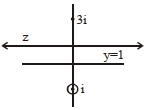
0 likes
View Solution81
DifficultMCQ
The value of $\left(\frac{-1+i \sqrt{3}}{1-i}\right)^{30}$ is
A
$2^{15} i$
B
$-2^{15}$
C
$-2^{15} i$
D
$6^{5}$
Solution
(C) Let $z = \frac{-1+i \sqrt{3}}{1-i}$.
First,express the numerator in polar form: $-1+i \sqrt{3} = 2 \left( \cos \frac{2\pi}{3} + i \sin \frac{2\pi}{3} \right) = 2e^{i 2\pi/3}$.
Next,express the denominator: $1-i = \sqrt{2} \left( \cos \frac{-\pi}{4} + i \sin \frac{-\pi}{4} \right) = \sqrt{2}e^{-i \pi/4}$.
Then,$z = \frac{2e^{i 2\pi/3}}{\sqrt{2}e^{-i \pi/4}} = \sqrt{2} e^{i (2\pi/3 + \pi/4)} = \sqrt{2} e^{i 11\pi/12}$.
Now,$z^{30} = (\sqrt{2})^{30} e^{i (11\pi/12) \cdot 30} = 2^{15} e^{i 55\pi/2}$.
Since $e^{i 55\pi/2} = e^{i (26\pi + 3\pi/2)} = e^{i 3\pi/2} = -i$.
Therefore,$z^{30} = 2^{15} \cdot (-i) = -2^{15} i$.
First,express the numerator in polar form: $-1+i \sqrt{3} = 2 \left( \cos \frac{2\pi}{3} + i \sin \frac{2\pi}{3} \right) = 2e^{i 2\pi/3}$.
Next,express the denominator: $1-i = \sqrt{2} \left( \cos \frac{-\pi}{4} + i \sin \frac{-\pi}{4} \right) = \sqrt{2}e^{-i \pi/4}$.
Then,$z = \frac{2e^{i 2\pi/3}}{\sqrt{2}e^{-i \pi/4}} = \sqrt{2} e^{i (2\pi/3 + \pi/4)} = \sqrt{2} e^{i 11\pi/12}$.
Now,$z^{30} = (\sqrt{2})^{30} e^{i (11\pi/12) \cdot 30} = 2^{15} e^{i 55\pi/2}$.
Since $e^{i 55\pi/2} = e^{i (26\pi + 3\pi/2)} = e^{i 3\pi/2} = -i$.
Therefore,$z^{30} = 2^{15} \cdot (-i) = -2^{15} i$.
0 likes
View Solution82
DifficultMCQ
The least value of $|z|$ where $z$ is a complex number satisfying the inequality $\exp \left(\frac{(|z|+3)(|z|-1)}{|z|+1} \log _{ e } 2\right) \geq \log _{\sqrt{2}}|5 \sqrt{7}+9 i |$,where $i=\sqrt{-1}$,is equal to:
A
$3$
B
$\sqrt{5}$
C
$2$
D
$8$
Solution
(A) Given the inequality: $\exp \left(\frac{(|z|+3)(|z|-1)}{|z|+1} \ln 2\right) \geq \log _{\sqrt{2}}|5 \sqrt{7}+9 i |$
First,simplify the right side: $|5 \sqrt{7}+9 i| = \sqrt{(5 \sqrt{7})^2 + 9^2} = \sqrt{175 + 81} = \sqrt{256} = 16$.
So,$\log _{\sqrt{2}}(16) = \log _{2^{1/2}}(2^4) = 8 \log _{2}(2) = 8$.
Now,the inequality becomes: $2^{\frac{(|z|+3)(|z|-1)}{|z|+1}} \geq 8$.
Since $8 = 2^3$,we have: $\frac{(|z|+3)(|z|-1)}{|z|+1} \geq 3$.
Let $x = |z|$,where $x \geq 0$. Then $\frac{(x+3)(x-1)}{x+1} \geq 3$.
$(x^2 + 2x - 3) \geq 3(x+1)$.
$x^2 + 2x - 3 \geq 3x + 3$.
$x^2 - x - 6 \geq 0$.
$(x-3)(x+2) \geq 0$.
Since $x = |z| \geq 0$,$x+2$ is always positive,so $x-3 \geq 0$,which means $|z| \geq 3$.
Thus,the least value of $|z|$ is $3$.
First,simplify the right side: $|5 \sqrt{7}+9 i| = \sqrt{(5 \sqrt{7})^2 + 9^2} = \sqrt{175 + 81} = \sqrt{256} = 16$.
So,$\log _{\sqrt{2}}(16) = \log _{2^{1/2}}(2^4) = 8 \log _{2}(2) = 8$.
Now,the inequality becomes: $2^{\frac{(|z|+3)(|z|-1)}{|z|+1}} \geq 8$.
Since $8 = 2^3$,we have: $\frac{(|z|+3)(|z|-1)}{|z|+1} \geq 3$.
Let $x = |z|$,where $x \geq 0$. Then $\frac{(x+3)(x-1)}{x+1} \geq 3$.
$(x^2 + 2x - 3) \geq 3(x+1)$.
$x^2 + 2x - 3 \geq 3x + 3$.
$x^2 - x - 6 \geq 0$.
$(x-3)(x+2) \geq 0$.
Since $x = |z| \geq 0$,$x+2$ is always positive,so $x-3 \geq 0$,which means $|z| \geq 3$.
Thus,the least value of $|z|$ is $3$.
0 likes
View Solution83
DifficultMCQ
If $z$ and $\omega$ are two complex numbers such that $|z \omega|=1$ and $\arg(z) - \arg(\omega) = \frac{3 \pi}{2}$,then $\arg \left(\frac{1-2 \bar{z} \omega}{1+3 \bar{z} \omega}\right)$ is:
(Here $\arg(z)$ denotes the principal argument of complex number $z$)
(Here $\arg(z)$ denotes the principal argument of complex number $z$)
A
$\frac{3 \pi}{4}$
B
$-\frac{\pi}{4}$
C
$-\frac{3 \pi}{4}$
D
$\frac{\pi}{4}$
Solution
(C) Given $|z \omega| = 1$ and $\arg(z) - \arg(\omega) = \frac{3 \pi}{2}$.
Let $z = r e^{i \theta_1}$ and $\omega = \frac{1}{r} e^{i \theta_2}$.
Then $\bar{z} = r e^{-i \theta_1}$.
Thus,$\bar{z} \omega = r e^{-i \theta_1} \cdot \frac{1}{r} e^{i \theta_2} = e^{i(\theta_2 - \theta_1)}$.
Since $\theta_1 - \theta_2 = \frac{3 \pi}{2}$,we have $\theta_2 - \theta_1 = -\frac{3 \pi}{2} = \frac{\pi}{2} - 2\pi \equiv \frac{\pi}{2} \pmod{2\pi}$.
So,$\bar{z} \omega = e^{i \pi/2} = i$.
Now,substitute this into the expression:
$\frac{1 - 2 \bar{z} \omega}{1 + 3 \bar{z} \omega} = \frac{1 - 2i}{1 + 3i}$.
To find the argument,multiply by the conjugate of the denominator:
$\frac{1 - 2i}{1 + 3i} \times \frac{1 - 3i}{1 - 3i} = \frac{1 - 3i - 2i + 6i^2}{1^2 + 3^2} = \frac{1 - 5i - 6}{10} = \frac{-5 - 5i}{10} = -\frac{1}{2} - \frac{1}{2}i$.
This complex number lies in the third quadrant.
The argument is $\tan^{-1}\left(\frac{-1/2}{-1/2}\right) - \pi = \tan^{-1}(1) - \pi = \frac{\pi}{4} - \pi = -\frac{3 \pi}{4}$.
Let $z = r e^{i \theta_1}$ and $\omega = \frac{1}{r} e^{i \theta_2}$.
Then $\bar{z} = r e^{-i \theta_1}$.
Thus,$\bar{z} \omega = r e^{-i \theta_1} \cdot \frac{1}{r} e^{i \theta_2} = e^{i(\theta_2 - \theta_1)}$.
Since $\theta_1 - \theta_2 = \frac{3 \pi}{2}$,we have $\theta_2 - \theta_1 = -\frac{3 \pi}{2} = \frac{\pi}{2} - 2\pi \equiv \frac{\pi}{2} \pmod{2\pi}$.
So,$\bar{z} \omega = e^{i \pi/2} = i$.
Now,substitute this into the expression:
$\frac{1 - 2 \bar{z} \omega}{1 + 3 \bar{z} \omega} = \frac{1 - 2i}{1 + 3i}$.
To find the argument,multiply by the conjugate of the denominator:
$\frac{1 - 2i}{1 + 3i} \times \frac{1 - 3i}{1 - 3i} = \frac{1 - 3i - 2i + 6i^2}{1^2 + 3^2} = \frac{1 - 5i - 6}{10} = \frac{-5 - 5i}{10} = -\frac{1}{2} - \frac{1}{2}i$.
This complex number lies in the third quadrant.
The argument is $\tan^{-1}\left(\frac{-1/2}{-1/2}\right) - \pi = \tan^{-1}(1) - \pi = \frac{\pi}{4} - \pi = -\frac{3 \pi}{4}$.
0 likes
View Solution84
DifficultMCQ
Let $n$ denote the number of solutions of the equation $z^{2}+3 \bar{z}=0$,where $z$ is a complex number. Then the value of $\sum_{k=0}^{\infty} \frac{1}{n^{k}}$ is equal to:
A
$1$
B
$2$
C
$\frac{4}{3}$
D
$\frac{3}{2}$
Solution
(C) Given equation: $z^{2}+3 \bar{z}=0$.
Let $z=x+iy$,where $x, y \in \mathbb{R}$.
Substituting into the equation: $(x+iy)^{2}+3(x-iy)=0$.
$x^{2}-y^{2}+2ixy+3x-3iy=0$.
$(x^{2}-y^{2}+3x) + i(2xy-3y) = 0$.
Equating real and imaginary parts to zero:
$1) \ 2xy-3y=0 \Rightarrow y(2x-3)=0$.
This gives $y=0$ or $x=\frac{3}{2}$.
Case $1$: If $y=0$,then $x^{2}+3x=0 \Rightarrow x(x+3)=0$,so $x=0$ or $x=-3$. Solutions: $(0,0)$ and $(-3,0)$.
Case $2$: If $x=\frac{3}{2}$,then $(\frac{3}{2})^{2}-y^{2}+3(\frac{3}{2})=0$ $\Rightarrow \frac{9}{4}-y^{2}+\frac{9}{2}=0$ $\Rightarrow y^{2}=\frac{27}{4}$ $\Rightarrow y=\pm \frac{3\sqrt{3}}{2}$. Solutions: $(\frac{3}{2}, \frac{3\sqrt{3}}{2})$ and $(\frac{3}{2}, -\frac{3\sqrt{3}}{2})$.
Total number of solutions $n=4$.
We need to calculate $\sum_{k=0}^{\infty} \frac{1}{n^{k}} = \sum_{k=0}^{\infty} (\frac{1}{4})^{k}$.
This is an infinite geometric series with first term $a=1$ and common ratio $r=\frac{1}{4}$.
Sum $= \frac{a}{1-r} = \frac{1}{1-\frac{1}{4}} = \frac{1}{\frac{3}{4}} = \frac{4}{3}$.
Let $z=x+iy$,where $x, y \in \mathbb{R}$.
Substituting into the equation: $(x+iy)^{2}+3(x-iy)=0$.
$x^{2}-y^{2}+2ixy+3x-3iy=0$.
$(x^{2}-y^{2}+3x) + i(2xy-3y) = 0$.
Equating real and imaginary parts to zero:
$1) \ 2xy-3y=0 \Rightarrow y(2x-3)=0$.
This gives $y=0$ or $x=\frac{3}{2}$.
Case $1$: If $y=0$,then $x^{2}+3x=0 \Rightarrow x(x+3)=0$,so $x=0$ or $x=-3$. Solutions: $(0,0)$ and $(-3,0)$.
Case $2$: If $x=\frac{3}{2}$,then $(\frac{3}{2})^{2}-y^{2}+3(\frac{3}{2})=0$ $\Rightarrow \frac{9}{4}-y^{2}+\frac{9}{2}=0$ $\Rightarrow y^{2}=\frac{27}{4}$ $\Rightarrow y=\pm \frac{3\sqrt{3}}{2}$. Solutions: $(\frac{3}{2}, \frac{3\sqrt{3}}{2})$ and $(\frac{3}{2}, -\frac{3\sqrt{3}}{2})$.
Total number of solutions $n=4$.
We need to calculate $\sum_{k=0}^{\infty} \frac{1}{n^{k}} = \sum_{k=0}^{\infty} (\frac{1}{4})^{k}$.
This is an infinite geometric series with first term $a=1$ and common ratio $r=\frac{1}{4}$.
Sum $= \frac{a}{1-r} = \frac{1}{1-\frac{1}{4}} = \frac{1}{\frac{3}{4}} = \frac{4}{3}$.
0 likes
View Solution85
MediumMCQ
If the real part of the complex number $z = \frac{3 + 2i \cos \theta}{1 - 3i \cos \theta}$, where $\theta \in (0, \frac{\pi}{2})$, is zero, then the value of $\sin^2 3\theta + \cos^2 \theta$ is equal to:
A
$1$
B
$3$
C
$2$
D
$4$
Solution
(A) Given $z = \frac{3 + 2i \cos \theta}{1 - 3i \cos \theta}$.
To find the real part, multiply the numerator and denominator by the conjugate of the denominator $(1 + 3i \cos \theta)$:
$z = \frac{(3 + 2i \cos \theta)(1 + 3i \cos \theta)}{(1 - 3i \cos \theta)(1 + 3i \cos \theta)}$
$z = \frac{3 + 9i \cos \theta + 2i \cos \theta + 6i^2 \cos^2 \theta}{1 + 9 \cos^2 \theta}$
Since $i^2 = -1$, we have:
$z = \frac{3 - 6 \cos^2 \theta + 11i \cos \theta}{1 + 9 \cos^2 \theta}$
The real part is $\operatorname{Re}(z) = \frac{3 - 6 \cos^2 \theta}{1 + 9 \cos^2 \theta}$.
Given $\operatorname{Re}(z) = 0$, we have $3 - 6 \cos^2 \theta = 0$, which implies $\cos^2 \theta = \frac{1}{2}$.
Since $\theta \in (0, \frac{\pi}{2})$, $\cos \theta = \frac{1}{\sqrt{2}}$, so $\theta = \frac{\pi}{4}$.
Now, calculate $\sin^2 3\theta + \cos^2 \theta$:
$\sin^2 3(\frac{\pi}{4}) + \cos^2(\frac{\pi}{4}) = \sin^2(\frac{3\pi}{4}) + (\frac{1}{\sqrt{2}})^2$
$= (\frac{1}{\sqrt{2}})^2 + \frac{1}{2} = \frac{1}{2} + \frac{1}{2} = 1$.
To find the real part, multiply the numerator and denominator by the conjugate of the denominator $(1 + 3i \cos \theta)$:
$z = \frac{(3 + 2i \cos \theta)(1 + 3i \cos \theta)}{(1 - 3i \cos \theta)(1 + 3i \cos \theta)}$
$z = \frac{3 + 9i \cos \theta + 2i \cos \theta + 6i^2 \cos^2 \theta}{1 + 9 \cos^2 \theta}$
Since $i^2 = -1$, we have:
$z = \frac{3 - 6 \cos^2 \theta + 11i \cos \theta}{1 + 9 \cos^2 \theta}$
The real part is $\operatorname{Re}(z) = \frac{3 - 6 \cos^2 \theta}{1 + 9 \cos^2 \theta}$.
Given $\operatorname{Re}(z) = 0$, we have $3 - 6 \cos^2 \theta = 0$, which implies $\cos^2 \theta = \frac{1}{2}$.
Since $\theta \in (0, \frac{\pi}{2})$, $\cos \theta = \frac{1}{\sqrt{2}}$, so $\theta = \frac{\pi}{4}$.
Now, calculate $\sin^2 3\theta + \cos^2 \theta$:
$\sin^2 3(\frac{\pi}{4}) + \cos^2(\frac{\pi}{4}) = \sin^2(\frac{3\pi}{4}) + (\frac{1}{\sqrt{2}})^2$
$= (\frac{1}{\sqrt{2}})^2 + \frac{1}{2} = \frac{1}{2} + \frac{1}{2} = 1$.
0 likes
View Solution86
DifficultMCQ
The sum of the squares of the modulus of all complex numbers $z$ satisfying $\bar{z} = i z^{2} + z^{2} - z$ is equal to
A
$50$
B
$2$
C
$29$
D
$9$
Solution
(B) Given equation: $\bar{z} = i z^{2} + z^{2} - z$
Rearranging the terms: $z + \bar{z} = (1 + i) z^{2}$
Let $z = x + iy$. Then $z + \bar{z} = 2x$.
So,$2x = (1 + i)(x + iy)^{2} = (1 + i)(x^{2} - y^{2} + 2xyi)$.
$2x = (x^{2} - y^{2} - 2xy) + i(x^{2} - y^{2} + 2xy)$.
Equating real and imaginary parts:
$1) \ 2x = x^{2} - y^{2} - 2xy$
$2) \ 0 = x^{2} - y^{2} + 2xy \Rightarrow x^{2} - y^{2} = -2xy$.
Substitute $(2)$ into $(1)$: $2x = -2xy - 2xy = -4xy$.
$2x(1 + 2y) = 0$,so $x = 0$ or $y = -1/2$.
If $x = 0$,then from $(2)$,$y^{2} = 0 \Rightarrow y = 0$. Thus $z = 0$,$|z|^{2} = 0$.
If $y = -1/2$,then from $(2)$,$x^{2} - (-1/2)^{2} = -2x(-1/2)$ $\Rightarrow x^{2} - 1/4 = x$ $\Rightarrow 4x^{2} - 4x - 1 = 0$.
The roots are $x = \frac{4 \pm \sqrt{16 + 16}}{8} = \frac{4 \pm 4\sqrt{2}}{8} = \frac{1 \pm \sqrt{2}}{2}$.
For these values,$|z|^{2} = x^{2} + y^{2} = x^{2} + 1/4$.
From $4x^{2} - 4x - 1 = 0$,$x^{2} = x + 1/4$.
So $|z|^{2} = x + 1/4 + 1/4 = x + 1/2$.
For $x_{1} = \frac{1 + \sqrt{2}}{2}$,$|z_{1}|^{2} = \frac{1 + \sqrt{2}}{2} + \frac{1}{2} = \frac{2 + \sqrt{2}}{2} = 1 + \frac{\sqrt{2}}{2}$.
For $x_{2} = \frac{1 - \sqrt{2}}{2}$,$|z_{2}|^{2} = \frac{1 - \sqrt{2}}{2} + \frac{1}{2} = \frac{2 - \sqrt{2}}{2} = 1 - \frac{\sqrt{2}}{2}$.
Sum of squares of modulus: $0 + (1 + \frac{\sqrt{2}}{2}) + (1 - \frac{\sqrt{2}}{2}) = 2$.
Rearranging the terms: $z + \bar{z} = (1 + i) z^{2}$
Let $z = x + iy$. Then $z + \bar{z} = 2x$.
So,$2x = (1 + i)(x + iy)^{2} = (1 + i)(x^{2} - y^{2} + 2xyi)$.
$2x = (x^{2} - y^{2} - 2xy) + i(x^{2} - y^{2} + 2xy)$.
Equating real and imaginary parts:
$1) \ 2x = x^{2} - y^{2} - 2xy$
$2) \ 0 = x^{2} - y^{2} + 2xy \Rightarrow x^{2} - y^{2} = -2xy$.
Substitute $(2)$ into $(1)$: $2x = -2xy - 2xy = -4xy$.
$2x(1 + 2y) = 0$,so $x = 0$ or $y = -1/2$.
If $x = 0$,then from $(2)$,$y^{2} = 0 \Rightarrow y = 0$. Thus $z = 0$,$|z|^{2} = 0$.
If $y = -1/2$,then from $(2)$,$x^{2} - (-1/2)^{2} = -2x(-1/2)$ $\Rightarrow x^{2} - 1/4 = x$ $\Rightarrow 4x^{2} - 4x - 1 = 0$.
The roots are $x = \frac{4 \pm \sqrt{16 + 16}}{8} = \frac{4 \pm 4\sqrt{2}}{8} = \frac{1 \pm \sqrt{2}}{2}$.
For these values,$|z|^{2} = x^{2} + y^{2} = x^{2} + 1/4$.
From $4x^{2} - 4x - 1 = 0$,$x^{2} = x + 1/4$.
So $|z|^{2} = x + 1/4 + 1/4 = x + 1/2$.
For $x_{1} = \frac{1 + \sqrt{2}}{2}$,$|z_{1}|^{2} = \frac{1 + \sqrt{2}}{2} + \frac{1}{2} = \frac{2 + \sqrt{2}}{2} = 1 + \frac{\sqrt{2}}{2}$.
For $x_{2} = \frac{1 - \sqrt{2}}{2}$,$|z_{2}|^{2} = \frac{1 - \sqrt{2}}{2} + \frac{1}{2} = \frac{2 - \sqrt{2}}{2} = 1 - \frac{\sqrt{2}}{2}$.
Sum of squares of modulus: $0 + (1 + \frac{\sqrt{2}}{2}) + (1 - \frac{\sqrt{2}}{2}) = 2$.
0 likes
View Solution87
MediumMCQ
Let $\alpha$ and $\beta$ be the roots of the equation $x^{2} + (2i - 1) = 0$. Then,the value of $|\alpha^{8} + \beta^{8}|$ is equal to
A
$50$
B
$250$
C
$1250$
D
$1500$
Solution
(A) Given the equation $x^{2} + (2i - 1) = 0$,we have $x^{2} = 1 - 2i$.
Since $\alpha$ and $\beta$ are the roots,$\alpha^{2} = 1 - 2i$ and $\beta^{2} = 1 - 2i$.
Thus,$\alpha^{8} = (\alpha^{2})^{4} = (1 - 2i)^{4}$ and $\beta^{8} = (\beta^{2})^{4} = (1 - 2i)^{4}$.
Therefore,$\alpha^{8} = \beta^{8}$.
We need to find $|\alpha^{8} + \beta^{8}| = |2\alpha^{8}| = 2|\alpha^{8}| = 2|\alpha^{2}|^{4}$.
Calculate the modulus $|\alpha^{2}| = |1 - 2i| = \sqrt{1^{2} + (-2)^{2}} = \sqrt{1 + 4} = \sqrt{5}$.
Then,$|\alpha^{8} + \beta^{8}| = 2(\sqrt{5})^{4} = 2(5^{2}) = 2(25) = 50$.
Since $\alpha$ and $\beta$ are the roots,$\alpha^{2} = 1 - 2i$ and $\beta^{2} = 1 - 2i$.
Thus,$\alpha^{8} = (\alpha^{2})^{4} = (1 - 2i)^{4}$ and $\beta^{8} = (\beta^{2})^{4} = (1 - 2i)^{4}$.
Therefore,$\alpha^{8} = \beta^{8}$.
We need to find $|\alpha^{8} + \beta^{8}| = |2\alpha^{8}| = 2|\alpha^{8}| = 2|\alpha^{2}|^{4}$.
Calculate the modulus $|\alpha^{2}| = |1 - 2i| = \sqrt{1^{2} + (-2)^{2}} = \sqrt{1 + 4} = \sqrt{5}$.
Then,$|\alpha^{8} + \beta^{8}| = 2(\sqrt{5})^{4} = 2(5^{2}) = 2(25) = 50$.
0 likes
View Solution88
DifficultMCQ
If $z = x + iy$ satisfies $|z|-2=0$ and $|z-i|-|z+5i|=0$,then
A
$x + 2y - 4 = 0$
B
$x^2 + y + 4 = 0$
C
$x - 2y - 4 = 0$
D
$x^2 - y + 3 = 0$
Solution
(C) Given $|z| - 2 = 0$,so $|z| = 2$. This implies $x^2 + y^2 = 4$.
Given $|z - i| - |z + 5i| = 0$,so $|z - i| = |z + 5i|$.
Substituting $z = x + iy$:
$|x + (y - 1)i| = |x + (y + 5)i|$
$x^2 + (y - 1)^2 = x^2 + (y + 5)^2$
$(y - 1)^2 = (y + 5)^2$
$y^2 - 2y + 1 = y^2 + 10y + 25$
$-12y = 24$
$y = -2$.
Substituting $y = -2$ into $x^2 + y^2 = 4$:
$x^2 + (-2)^2 = 4$
$x^2 + 4 = 4$
$x^2 = 0$,so $x = 0$.
Thus,the point is $(0, -2)$.
Checking the options for $(0, -2)$:
$A: 0 + 2(-2) - 4 = -8 \neq 0$
$B: 0^2 + (-2) + 4 = 2 \neq 0$
$C: 0 - 2(-2) - 4 = 4 - 4 = 0$.
Therefore,the correct option is $C$.
Given $|z - i| - |z + 5i| = 0$,so $|z - i| = |z + 5i|$.
Substituting $z = x + iy$:
$|x + (y - 1)i| = |x + (y + 5)i|$
$x^2 + (y - 1)^2 = x^2 + (y + 5)^2$
$(y - 1)^2 = (y + 5)^2$
$y^2 - 2y + 1 = y^2 + 10y + 25$
$-12y = 24$
$y = -2$.
Substituting $y = -2$ into $x^2 + y^2 = 4$:
$x^2 + (-2)^2 = 4$
$x^2 + 4 = 4$
$x^2 = 0$,so $x = 0$.
Thus,the point is $(0, -2)$.
Checking the options for $(0, -2)$:
$A: 0 + 2(-2) - 4 = -8 \neq 0$
$B: 0^2 + (-2) + 4 = 2 \neq 0$
$C: 0 - 2(-2) - 4 = 4 - 4 = 0$.
Therefore,the correct option is $C$.
0 likes
View Solution89
AdvancedMCQ
Let $S$ be the set of all $(\alpha, \beta)$ such that $\pi < \alpha, \beta < 2\pi$,for which the complex number $\frac{1-i \sin \alpha}{1+2i \sin \alpha}$ is purely imaginary and $\frac{1+i \cos \beta}{1-2i \cos \beta}$ is purely real. Let $Z_{\alpha \beta} = \sin 2\alpha + i \cos 2\beta$ for $(\alpha, \beta) \in S$. Then $\sum_{(\alpha, \beta) \in S} \left(i Z_{\alpha \beta} + \frac{1}{i \bar{Z}_{\alpha \beta}}\right)$ is equal to:
A
$3$
B
$3i$
C
$1$
D
$2-i$
Solution
(C) Given $\pi < \alpha, \beta < 2\pi$.
For $\frac{1-i \sin \alpha}{1+2i \sin \alpha}$ to be purely imaginary,its real part must be zero.
$\frac{(1-i \sin \alpha)(1-2i \sin \alpha)}{1+4 \sin^2 \alpha} = \frac{1 - 2\sin^2 \alpha - 3i \sin \alpha}{1+4 \sin^2 \alpha}$.
Setting the real part to zero: $1 - 2\sin^2 \alpha = 0 \Rightarrow \sin^2 \alpha = \frac{1}{2}$.
Since $\pi < \alpha < 2\pi$,$\sin \alpha = -\frac{1}{\sqrt{2}}$,so $\alpha = \frac{5\pi}{4}, \frac{7\pi}{4}$.
For $\frac{1+i \cos \beta}{1-2i \cos \beta}$ to be purely real,its imaginary part must be zero.
$\frac{(1+i \cos \beta)(1+2i \cos \beta)}{1+4 \cos^2 \beta} = \frac{1 - 2\cos^2 \beta + 3i \cos \beta}{1+4 \cos^2 \beta}$.
Setting the imaginary part to zero: $3 \cos \beta = 0 \Rightarrow \cos \beta = 0$.
Since $\pi < \beta < 2\pi$,$\beta = \frac{3\pi}{2}$.
For $\alpha = \frac{5\pi}{4}$,$\sin 2\alpha = \sin \frac{5\pi}{2} = 1$. For $\alpha = \frac{7\pi}{4}$,$\sin 2\alpha = \sin \frac{7\pi}{2} = -1$.
For $\beta = \frac{3\pi}{2}$,$\cos 2\beta = \cos 3\pi = -1$.
Thus,$Z_1 = 1-i$ and $Z_2 = -1-i$.
For $Z = 1-i$,$iZ + \frac{1}{i\bar{Z}} = i(1-i) + \frac{1}{i(1+i)} = (1+i) + \frac{1}{i-1} = 1+i + \frac{-1-i}{2} = \frac{1+i}{2}$.
For $Z = -1-i$,$iZ + \frac{1}{i\bar{Z}} = i(-1-i) + \frac{1}{i(-1+i)} = (1-i) + \frac{1}{-i-1} = 1-i + \frac{i-1}{2} = \frac{1-i}{2}$.
Sum $= \frac{1+i}{2} + \frac{1-i}{2} = 1$.
For $\frac{1-i \sin \alpha}{1+2i \sin \alpha}$ to be purely imaginary,its real part must be zero.
$\frac{(1-i \sin \alpha)(1-2i \sin \alpha)}{1+4 \sin^2 \alpha} = \frac{1 - 2\sin^2 \alpha - 3i \sin \alpha}{1+4 \sin^2 \alpha}$.
Setting the real part to zero: $1 - 2\sin^2 \alpha = 0 \Rightarrow \sin^2 \alpha = \frac{1}{2}$.
Since $\pi < \alpha < 2\pi$,$\sin \alpha = -\frac{1}{\sqrt{2}}$,so $\alpha = \frac{5\pi}{4}, \frac{7\pi}{4}$.
For $\frac{1+i \cos \beta}{1-2i \cos \beta}$ to be purely real,its imaginary part must be zero.
$\frac{(1+i \cos \beta)(1+2i \cos \beta)}{1+4 \cos^2 \beta} = \frac{1 - 2\cos^2 \beta + 3i \cos \beta}{1+4 \cos^2 \beta}$.
Setting the imaginary part to zero: $3 \cos \beta = 0 \Rightarrow \cos \beta = 0$.
Since $\pi < \beta < 2\pi$,$\beta = \frac{3\pi}{2}$.
For $\alpha = \frac{5\pi}{4}$,$\sin 2\alpha = \sin \frac{5\pi}{2} = 1$. For $\alpha = \frac{7\pi}{4}$,$\sin 2\alpha = \sin \frac{7\pi}{2} = -1$.
For $\beta = \frac{3\pi}{2}$,$\cos 2\beta = \cos 3\pi = -1$.
Thus,$Z_1 = 1-i$ and $Z_2 = -1-i$.
For $Z = 1-i$,$iZ + \frac{1}{i\bar{Z}} = i(1-i) + \frac{1}{i(1+i)} = (1+i) + \frac{1}{i-1} = 1+i + \frac{-1-i}{2} = \frac{1+i}{2}$.
For $Z = -1-i$,$iZ + \frac{1}{i\bar{Z}} = i(-1-i) + \frac{1}{i(-1+i)} = (1-i) + \frac{1}{-i-1} = 1-i + \frac{i-1}{2} = \frac{1-i}{2}$.
Sum $= \frac{1+i}{2} + \frac{1-i}{2} = 1$.
0 likes
View Solution90
DifficultMCQ
Let $z = a + ib, b \neq 0$ be a complex number satisfying $z^{2} = \overline{z} \cdot 2^{1-|z|}$. Then the least value of $n \in N$ such that $z^{n} = (z + 1)^{n}$ is equal to:
A
$0$
B
$6$
C
$5$
D
$4$
Solution
(B) Given $z^{2} = \overline{z} \cdot 2^{1-|z|}$. Taking the modulus on both sides,we get $|z|^{2} = |\overline{z}| \cdot 2^{1-|z|}$.
Since $|\overline{z}| = |z|$,we have $|z|^{2} = |z| \cdot 2^{1-|z|}$.
Since $b \neq 0$,$z \neq 0$,so $|z| = 2^{1-|z|}$.
By inspection,$|z| = 1$ satisfies the equation $(1 = 2^{1-1} = 2^{0} = 1)$.
Substituting $|z| = 1$ into the original equation,$z^{2} = \overline{z}$.
Multiplying by $z$,we get $z^{3} = z\overline{z} = |z|^{2} = 1$.
Thus,$z$ is a cube root of unity,i.e.,$z = \omega$ or $z = \omega^{2}$,where $\omega = e^{i2\pi/3}$.
We want to find the least $n \in N$ such that $z^{n} = (z + 1)^{n}$.
Since $1 + \omega = -\omega^{2}$,the equation becomes $\omega^{n} = (-\omega^{2})^{n} = (-1)^{n} \omega^{2n}$.
This implies $1 = (-1)^{n} \omega^{n}$,or $\omega^{n} = (-1)^{n}$.
If $n = 3$,$\omega^{3} = 1$ and $(-1)^{3} = -1$ (not equal).
If $n = 6$,$\omega^{6} = 1$ and $(-1)^{6} = 1$. Thus,$n = 6$ is the least natural number.
Since $|\overline{z}| = |z|$,we have $|z|^{2} = |z| \cdot 2^{1-|z|}$.
Since $b \neq 0$,$z \neq 0$,so $|z| = 2^{1-|z|}$.
By inspection,$|z| = 1$ satisfies the equation $(1 = 2^{1-1} = 2^{0} = 1)$.
Substituting $|z| = 1$ into the original equation,$z^{2} = \overline{z}$.
Multiplying by $z$,we get $z^{3} = z\overline{z} = |z|^{2} = 1$.
Thus,$z$ is a cube root of unity,i.e.,$z = \omega$ or $z = \omega^{2}$,where $\omega = e^{i2\pi/3}$.
We want to find the least $n \in N$ such that $z^{n} = (z + 1)^{n}$.
Since $1 + \omega = -\omega^{2}$,the equation becomes $\omega^{n} = (-\omega^{2})^{n} = (-1)^{n} \omega^{2n}$.
This implies $1 = (-1)^{n} \omega^{n}$,or $\omega^{n} = (-1)^{n}$.
If $n = 3$,$\omega^{3} = 1$ and $(-1)^{3} = -1$ (not equal).
If $n = 6$,$\omega^{6} = 1$ and $(-1)^{6} = 1$. Thus,$n = 6$ is the least natural number.
0 likes
View Solution91
MediumMCQ
If $z = 2 + 3i$,then $z^{5} + (\bar{z})^{5}$ is equal to:
A
$244$
B
$224$
C
$245$
D
$265$
Solution
(A) Given $z = 2 + 3i$,then $\bar{z} = 2 - 3i$.
We need to evaluate $z^{5} + (\bar{z})^{5} = (2 + 3i)^{5} + (2 - 3i)^{5}$.
Using the binomial expansion $(a+b)^{n} + (a-b)^{n} = 2 \sum_{k=0, 2, 4, ...} \binom{n}{k} a^{n-k} b^{k}$,we have:
$z^{5} + (\bar{z})^{5} = 2 [\binom{5}{0} 2^{5} + \binom{5}{2} 2^{3} (3i)^{2} + \binom{5}{4} 2^{1} (3i)^{4}]$
$= 2 [1 \times 32 + 10 \times 8 \times (-9) + 5 \times 2 \times 81]$
$= 2 [32 - 720 + 810]$
$= 2 [122]$
$= 244$.
We need to evaluate $z^{5} + (\bar{z})^{5} = (2 + 3i)^{5} + (2 - 3i)^{5}$.
Using the binomial expansion $(a+b)^{n} + (a-b)^{n} = 2 \sum_{k=0, 2, 4, ...} \binom{n}{k} a^{n-k} b^{k}$,we have:
$z^{5} + (\bar{z})^{5} = 2 [\binom{5}{0} 2^{5} + \binom{5}{2} 2^{3} (3i)^{2} + \binom{5}{4} 2^{1} (3i)^{4}]$
$= 2 [1 \times 32 + 10 \times 8 \times (-9) + 5 \times 2 \times 81]$
$= 2 [32 - 720 + 810]$
$= 2 [122]$
$= 244$.
0 likes
View Solution92
AdvancedMCQ
Let $z=x+iy$ and $w=u+iv$ be complex numbers on the unit circle such that $z^2+w^2=1$. Then the number of ordered pairs $(z, w)$ is
A
$0$
B
$4$
C
$8$
D
infinite
Solution
(C) Given that $z$ and $w$ are complex numbers on the unit circle,we have $|z|=1$ and $|w|=1$.
This implies $z\bar{z}=1 \Rightarrow \bar{z}=\frac{1}{z}$ and $w\bar{w}=1 \Rightarrow \bar{w}=\frac{1}{w}$.
Given $z^2+w^2=1$.
Taking the conjugate of both sides,we get $\bar{z}^2+\bar{w}^2=1$.
Substituting $\bar{z}=\frac{1}{z}$ and $\bar{w}=\frac{1}{w}$,we get $\frac{1}{z^2}+\frac{1}{w^2}=1$,which simplifies to $\frac{z^2+w^2}{z^2w^2}=1$.
Since $z^2+w^2=1$,we have $\frac{1}{z^2w^2}=1$,so $z^2w^2=1$,which means $(zw)^2=1$,so $zw=1$ or $zw=-1$.
Case $1$: $zw=1$. Then $w=\frac{1}{z}$. Substituting into $z^2+w^2=1$,we get $z^2+\frac{1}{z^2}=1 \Rightarrow z^4-z^2+1=0$. This is a quadratic in $z^2$,giving $z^2 = \frac{1 \pm \sqrt{1-4}}{2} = \frac{1 \pm i\sqrt{3}}{2} = e^{\pm i\pi/3}$. Thus $z^2 = e^{i\pi/3}$ or $z^2 = e^{-i\pi/3}$. Each gives $2$ values for $z$,total $4$ values.
Case $2$: $zw=-1$. Then $w=-\frac{1}{z}$. Substituting into $z^2+w^2=1$,we get $z^2+\frac{1}{z^2}=1$,which is the same equation as Case $1$. This also gives $4$ values for $z$.
Total number of ordered pairs $(z, w)$ is $4+4=8$.
This implies $z\bar{z}=1 \Rightarrow \bar{z}=\frac{1}{z}$ and $w\bar{w}=1 \Rightarrow \bar{w}=\frac{1}{w}$.
Given $z^2+w^2=1$.
Taking the conjugate of both sides,we get $\bar{z}^2+\bar{w}^2=1$.
Substituting $\bar{z}=\frac{1}{z}$ and $\bar{w}=\frac{1}{w}$,we get $\frac{1}{z^2}+\frac{1}{w^2}=1$,which simplifies to $\frac{z^2+w^2}{z^2w^2}=1$.
Since $z^2+w^2=1$,we have $\frac{1}{z^2w^2}=1$,so $z^2w^2=1$,which means $(zw)^2=1$,so $zw=1$ or $zw=-1$.
Case $1$: $zw=1$. Then $w=\frac{1}{z}$. Substituting into $z^2+w^2=1$,we get $z^2+\frac{1}{z^2}=1 \Rightarrow z^4-z^2+1=0$. This is a quadratic in $z^2$,giving $z^2 = \frac{1 \pm \sqrt{1-4}}{2} = \frac{1 \pm i\sqrt{3}}{2} = e^{\pm i\pi/3}$. Thus $z^2 = e^{i\pi/3}$ or $z^2 = e^{-i\pi/3}$. Each gives $2$ values for $z$,total $4$ values.
Case $2$: $zw=-1$. Then $w=-\frac{1}{z}$. Substituting into $z^2+w^2=1$,we get $z^2+\frac{1}{z^2}=1$,which is the same equation as Case $1$. This also gives $4$ values for $z$.
Total number of ordered pairs $(z, w)$ is $4+4=8$.
0 likes
View Solution93
AdvancedMCQ
Suppose $z$ is any root of $11 z^8 + 21 i z^7 + 10 i z - 22 = 0$ where $i = \sqrt{-1}$. Then,$S = |z|^2 + |z| + 1$ satisfies
A
$S \leq 3$
B
$3 < S < 7$
C
$7 \leq S < 13$
D
$S \geq 13$
Solution
(B) Given the equation $11 z^8 + 21 i z^7 + 10 i z - 22 = 0$.
We can rewrite this as $11 z^8 - 22 = -21 i z^7 - 10 i z$.
Taking the modulus on both sides,we get $|11 z^8 - 22| = |-21 i z^7 - 10 i z|$.
Using the triangle inequality,$|11 z^8 - 22| \leq |11 z^8| + |-22| = 11|z|^8 + 22$.
Also,$|-21 i z^7 - 10 i z| = |21 i z^7 + 10 i z| = |z| |21 i z^6 + 10 i| \leq |z| (21|z|^6 + 10)$.
By Rouché's theorem or analyzing the bounds of the roots,it can be shown that for this polynomial,the roots satisfy $1 < |z| < 2$.
Let $r = |z|$. Then $1 < r < 2$.
We define $S = r^2 + r + 1$.
Since $1 < r < 2$,we have $1^2 + 1 + 1 < r^2 + r + 1 < 2^2 + 2 + 1$.
This simplifies to $3 < S < 7$.
Thus,the correct option is $B$.
We can rewrite this as $11 z^8 - 22 = -21 i z^7 - 10 i z$.
Taking the modulus on both sides,we get $|11 z^8 - 22| = |-21 i z^7 - 10 i z|$.
Using the triangle inequality,$|11 z^8 - 22| \leq |11 z^8| + |-22| = 11|z|^8 + 22$.
Also,$|-21 i z^7 - 10 i z| = |21 i z^7 + 10 i z| = |z| |21 i z^6 + 10 i| \leq |z| (21|z|^6 + 10)$.
By Rouché's theorem or analyzing the bounds of the roots,it can be shown that for this polynomial,the roots satisfy $1 < |z| < 2$.
Let $r = |z|$. Then $1 < r < 2$.
We define $S = r^2 + r + 1$.
Since $1 < r < 2$,we have $1^2 + 1 + 1 < r^2 + r + 1 < 2^2 + 2 + 1$.
This simplifies to $3 < S < 7$.
Thus,the correct option is $B$.
0 likes
View Solution94
DifficultMCQ
If $z$ is a complex number satisfying $|z^3+z^{-3}| \leq 2$,then the maximum possible value of $|z+z^{-1}|$ is
A
$2$
B
$\sqrt[3]{2}$
C
$2\sqrt{2}$
D
$1$
Solution
(A) Given $|z^3+z^{-3}| \leq 2$.
Let $z = re^{i\theta}$. Then $|z^3+z^{-3}| = |r^3e^{i3\theta} + r^{-3}e^{-i3\theta}| \leq 2$.
Using the triangle inequality,$|z^3+z^{-3}| \geq | |z^3| - |z^{-3}| | = |r^3 - r^{-3}|$.
However,we know that $|z^3+z^{-3}| \leq |z^3| + |z^{-3}| = r^3 + r^{-3}$.
By the $AM$-$GM$ inequality,$r^3 + r^{-3} \geq 2$.
Since $|z^3+z^{-3}| \leq 2$ and $r^3+r^{-3} \geq 2$,the only way for the condition to hold is if $|z|=1$.
If $|z|=1$,then $z = e^{i\theta}$,so $|z+z^{-1}| = |e^{i\theta} + e^{-i\theta}| = |2\cos\theta|$.
The maximum value of $|2\cos\theta|$ is $2$ when $\cos\theta = \pm 1$.
Let $z = re^{i\theta}$. Then $|z^3+z^{-3}| = |r^3e^{i3\theta} + r^{-3}e^{-i3\theta}| \leq 2$.
Using the triangle inequality,$|z^3+z^{-3}| \geq | |z^3| - |z^{-3}| | = |r^3 - r^{-3}|$.
However,we know that $|z^3+z^{-3}| \leq |z^3| + |z^{-3}| = r^3 + r^{-3}$.
By the $AM$-$GM$ inequality,$r^3 + r^{-3} \geq 2$.
Since $|z^3+z^{-3}| \leq 2$ and $r^3+r^{-3} \geq 2$,the only way for the condition to hold is if $|z|=1$.
If $|z|=1$,then $z = e^{i\theta}$,so $|z+z^{-1}| = |e^{i\theta} + e^{-i\theta}| = |2\cos\theta|$.
The maximum value of $|2\cos\theta|$ is $2$ when $\cos\theta = \pm 1$.
0 likes
View Solution95
AdvancedMCQ
Suppose $n$ is a natural number such that $|i + 2i^2 + 3i^3 + \ldots + ni^n| = 18\sqrt{2}$,where $i = \sqrt{-1}$. Then,$n$ is
A
$9$
B
$18$
C
$36$
D
$72$
Solution
(C) Let $S_n = i + 2i^2 + 3i^3 + \ldots + ni^n$ $(i)$
Multiplying by $i$,we get $iS_n = i^2 + 2i^3 + \ldots + (n-1)i^n + ni^{n+1}$ (ii)
Subtracting (ii) from $(i)$:
$S_n(1 - i) = i + i^2 + i^3 + \ldots + i^n - ni^{n+1}$
$S_n(1 - i) = \frac{i(1 - i^n)}{1 - i} - ni^{n+1}$
Since $(1 - i)^2 = 1 - 2i + i^2 = -2i$,we have:
$S_n = \frac{i(1 - i^n)}{(1 - i)^2} - \frac{ni^{n+1}}{1 - i} = \frac{i(1 - i^n)}{-2i} - \frac{ni^{n+1}(1 + i)}{2} = \frac{i^n - 1}{2} - \frac{ni^{n+1}(1 + i)}{2}$
For large $n$,the term involving $n$ dominates the magnitude. Given $|S_n| = 18\sqrt{2}$,we consider the magnitude of the dominant term:
$|S_n| \approx |\frac{ni^{n+1}(1 + i)}{2}| = \frac{n|i^{n+1}| |1 + i|}{2} = \frac{n \cdot 1 \cdot \sqrt{2}}{2} = \frac{n}{\sqrt{2}}$
Setting $\frac{n}{\sqrt{2}} = 18\sqrt{2}$,we get $n = 18 \times 2 = 36$.
Multiplying by $i$,we get $iS_n = i^2 + 2i^3 + \ldots + (n-1)i^n + ni^{n+1}$ (ii)
Subtracting (ii) from $(i)$:
$S_n(1 - i) = i + i^2 + i^3 + \ldots + i^n - ni^{n+1}$
$S_n(1 - i) = \frac{i(1 - i^n)}{1 - i} - ni^{n+1}$
Since $(1 - i)^2 = 1 - 2i + i^2 = -2i$,we have:
$S_n = \frac{i(1 - i^n)}{(1 - i)^2} - \frac{ni^{n+1}}{1 - i} = \frac{i(1 - i^n)}{-2i} - \frac{ni^{n+1}(1 + i)}{2} = \frac{i^n - 1}{2} - \frac{ni^{n+1}(1 + i)}{2}$
For large $n$,the term involving $n$ dominates the magnitude. Given $|S_n| = 18\sqrt{2}$,we consider the magnitude of the dominant term:
$|S_n| \approx |\frac{ni^{n+1}(1 + i)}{2}| = \frac{n|i^{n+1}| |1 + i|}{2} = \frac{n \cdot 1 \cdot \sqrt{2}}{2} = \frac{n}{\sqrt{2}}$
Setting $\frac{n}{\sqrt{2}} = 18\sqrt{2}$,we get $n = 18 \times 2 = 36$.
0 likes
View Solution96
AdvancedMCQ
Let $p(x) = a_0 + a_1 x + \ldots + a_n x^n$ be a non-zero polynomial with integer coefficients. If $p(\sqrt{2} + \sqrt{3} + \sqrt{6}) = 0$,then the smallest possible value of $n$ is
A
$8$
B
$6$
C
$4$
D
$2$
Solution
(C) Let $x = \sqrt{2} + \sqrt{3} + \sqrt{6}$.
Squaring both sides:
$x^2 = 2 + 3 + 6 + 2(\sqrt{6} + \sqrt{12} + \sqrt{18}) = 11 + 2(\sqrt{6} + 2\sqrt{3} + 3\sqrt{2})$.
Alternatively,consider $x - \sqrt{6} = \sqrt{2} + \sqrt{3}$.
Squaring both sides:
$(x - \sqrt{6})^2 = (\sqrt{2} + \sqrt{3})^2$
$x^2 - 2\sqrt{6}x + 6 = 2 + 3 + 2\sqrt{6}$
$x^2 + 1 = 2\sqrt{6}(x + 1)$.
Squaring again:
$(x^2 + 1)^2 = 24(x + 1)^2$
$x^4 + 2x^2 + 1 = 24(x^2 + 2x + 1)$
$x^4 - 22x^2 - 48x - 23 = 0$.
Since $p(x)$ has integer coefficients and $p(\sqrt{2} + \sqrt{3} + \sqrt{6}) = 0$,the minimal polynomial of $\alpha = \sqrt{2} + \sqrt{3} + \sqrt{6}$ over $\mathbb{Q}$ must divide any such $p(x)$.
The degree of the minimal polynomial is $4$. Thus,the smallest possible value of $n$ is $4$.
Squaring both sides:
$x^2 = 2 + 3 + 6 + 2(\sqrt{6} + \sqrt{12} + \sqrt{18}) = 11 + 2(\sqrt{6} + 2\sqrt{3} + 3\sqrt{2})$.
Alternatively,consider $x - \sqrt{6} = \sqrt{2} + \sqrt{3}$.
Squaring both sides:
$(x - \sqrt{6})^2 = (\sqrt{2} + \sqrt{3})^2$
$x^2 - 2\sqrt{6}x + 6 = 2 + 3 + 2\sqrt{6}$
$x^2 + 1 = 2\sqrt{6}(x + 1)$.
Squaring again:
$(x^2 + 1)^2 = 24(x + 1)^2$
$x^4 + 2x^2 + 1 = 24(x^2 + 2x + 1)$
$x^4 - 22x^2 - 48x - 23 = 0$.
Since $p(x)$ has integer coefficients and $p(\sqrt{2} + \sqrt{3} + \sqrt{6}) = 0$,the minimal polynomial of $\alpha = \sqrt{2} + \sqrt{3} + \sqrt{6}$ over $\mathbb{Q}$ must divide any such $p(x)$.
The degree of the minimal polynomial is $4$. Thus,the smallest possible value of $n$ is $4$.
0 likes
View Solution97
DifficultMCQ
The value of $\left(\frac{1+\sin \frac{2 \pi}{9}+i \cos \frac{2 \pi}{9}}{1+\sin \frac{2 \pi}{9}-i \cos \frac{2 \pi}{9}}\right)^3$ is
A
$\frac{-1}{2}(1-i \sqrt{3})$
B
$\frac{1}{2}(1-i \sqrt{3})$
C
$\frac{-1}{2}(\sqrt{3}-i)$
D
$\frac{1}{2}(\sqrt{3}+i)$
Solution
(C) Let $z = \sin \frac{2 \pi}{9} + i \cos \frac{2 \pi}{9}$.
Note that $|z|^2 = \sin^2 \frac{2 \pi}{9} + \cos^2 \frac{2 \pi}{9} = 1$,so $\bar{z} = \frac{1}{z}$.
The expression becomes $\left(\frac{1+z}{1+\bar{z}}\right)^3 = \left(\frac{1+z}{1+\frac{1}{z}}\right)^3 = \left(\frac{1+z}{\frac{z+1}{z}}\right)^3 = z^3$.
Now,$z = i(\cos \frac{2 \pi}{9} - i \sin \frac{2 \pi}{9}) = i e^{-i \frac{2 \pi}{9}}$.
Then $z^3 = (i e^{-i \frac{2 \pi}{9}})^3 = i^3 e^{-i \frac{6 \pi}{9}} = -i e^{-i \frac{2 \pi}{3}}$.
$z^3 = -i (\cos \frac{2 \pi}{3} - i \sin \frac{2 \pi}{3}) = -i (-\frac{1}{2} - i \frac{\sqrt{3}}{2}) = i \frac{1}{2} - \frac{\sqrt{3}}{2} = -\frac{1}{2}(\sqrt{3}-i)$.
Note that $|z|^2 = \sin^2 \frac{2 \pi}{9} + \cos^2 \frac{2 \pi}{9} = 1$,so $\bar{z} = \frac{1}{z}$.
The expression becomes $\left(\frac{1+z}{1+\bar{z}}\right)^3 = \left(\frac{1+z}{1+\frac{1}{z}}\right)^3 = \left(\frac{1+z}{\frac{z+1}{z}}\right)^3 = z^3$.
Now,$z = i(\cos \frac{2 \pi}{9} - i \sin \frac{2 \pi}{9}) = i e^{-i \frac{2 \pi}{9}}$.
Then $z^3 = (i e^{-i \frac{2 \pi}{9}})^3 = i^3 e^{-i \frac{6 \pi}{9}} = -i e^{-i \frac{2 \pi}{3}}$.
$z^3 = -i (\cos \frac{2 \pi}{3} - i \sin \frac{2 \pi}{3}) = -i (-\frac{1}{2} - i \frac{\sqrt{3}}{2}) = i \frac{1}{2} - \frac{\sqrt{3}}{2} = -\frac{1}{2}(\sqrt{3}-i)$.
0 likes
View Solution98
DifficultMCQ
For two non-zero complex numbers $z_1$ and $z_2$, if $\operatorname{Re}(z_1 z_2) = 0$ and $\operatorname{Re}(z_1 + z_2) = 0$, then which of the following are possible?
$(A) \operatorname{Im}(z_1) > 0$ and $\operatorname{Im}(z_2) > 0$
$(B) \operatorname{Im}(z_1) < 0$ and $\operatorname{Im}(z_2) > 0$
$(C) \operatorname{Im}(z_1) > 0$ and $\operatorname{Im}(z_2) < 0$
$(D) \operatorname{Im}(z_1) < 0$ and $\operatorname{Im}(z_2) < 0$
Choose the correct answer from the options given below:
$(A) \operatorname{Im}(z_1) > 0$ and $\operatorname{Im}(z_2) > 0$
$(B) \operatorname{Im}(z_1) < 0$ and $\operatorname{Im}(z_2) > 0$
$(C) \operatorname{Im}(z_1) > 0$ and $\operatorname{Im}(z_2) < 0$
$(D) \operatorname{Im}(z_1) < 0$ and $\operatorname{Im}(z_2) < 0$
Choose the correct answer from the options given below:
A
$B$ and $D$
B
$B$ and $C$
C
$A$ and $B$
D
$A$ and $C$
Solution
(B) Let $z_1 = x_1 + i y_1$ and $z_2 = x_2 + i y_2$, where $x_1, x_2, y_1, y_2 \in \mathbb{R}$.
Given $\operatorname{Re}(z_1 + z_2) = x_1 + x_2 = 0$, which implies $x_2 = -x_1$.
Given $\operatorname{Re}(z_1 z_2) = x_1 x_2 - y_1 y_2 = 0$.
Substituting $x_2 = -x_1$ into the second equation, we get $x_1(-x_1) - y_1 y_2 = 0$, which simplifies to $-x_1^2 - y_1 y_2 = 0$, or $y_1 y_2 = -x_1^2$.
Since $z_1, z_2$ are non-zero, if $x_1 = 0$, then $x_2 = 0$. Consequently, $y_1 y_2 = 0$. Since $z_1, z_2 \neq 0$, this would imply $y_1 \neq 0$ and $y_2 \neq 0$, which contradicts $y_1 y_2 = 0$. Thus, $x_1 \neq 0$, so $x_1^2 > 0$.
Therefore, $y_1 y_2 = -x_1^2 < 0$.
This indicates that $y_1$ and $y_2$ must have opposite signs.
Thus, $\operatorname{Im}(z_1)$ and $\operatorname{Im}(z_2)$ have opposite signs, which corresponds to cases $(B)$ and $(C)$.
Given $\operatorname{Re}(z_1 + z_2) = x_1 + x_2 = 0$, which implies $x_2 = -x_1$.
Given $\operatorname{Re}(z_1 z_2) = x_1 x_2 - y_1 y_2 = 0$.
Substituting $x_2 = -x_1$ into the second equation, we get $x_1(-x_1) - y_1 y_2 = 0$, which simplifies to $-x_1^2 - y_1 y_2 = 0$, or $y_1 y_2 = -x_1^2$.
Since $z_1, z_2$ are non-zero, if $x_1 = 0$, then $x_2 = 0$. Consequently, $y_1 y_2 = 0$. Since $z_1, z_2 \neq 0$, this would imply $y_1 \neq 0$ and $y_2 \neq 0$, which contradicts $y_1 y_2 = 0$. Thus, $x_1 \neq 0$, so $x_1^2 > 0$.
Therefore, $y_1 y_2 = -x_1^2 < 0$.
This indicates that $y_1$ and $y_2$ must have opposite signs.
Thus, $\operatorname{Im}(z_1)$ and $\operatorname{Im}(z_2)$ have opposite signs, which corresponds to cases $(B)$ and $(C)$.
0 likes
View Solution99
DifficultMCQ
The complex number $z = \frac{i-1}{\cos \frac{\pi}{3} + i \sin \frac{\pi}{3}}$ is equal to $.....$
A
$\sqrt{2} \left( \cos \frac{5 \pi}{12} + i \sin \frac{5 \pi}{12} \right)$
B
$\cos \frac{\pi}{12} - i \sin \frac{\pi}{12}$
C
$\sqrt{2} \left( \cos \frac{\pi}{12} + i \sin \frac{\pi}{12} \right)$
D
$\sqrt{2} i \left( \cos \frac{5 \pi}{12} - i \sin \frac{5 \pi}{12} \right)$
Solution
(A) Given $z = \frac{i-1}{\cos \frac{\pi}{3} + i \sin \frac{\pi}{3}}$.
Using Euler's formula,the denominator is $e^{i\pi/3}$.
So,$z = (i-1) e^{-i\pi/3}$.
We know $i-1 = \sqrt{2} \left( -\frac{1}{\sqrt{2}} + i \frac{1}{\sqrt{2}} \right) = \sqrt{2} \left( \cos \frac{3\pi}{4} + i \sin \frac{3\pi}{4} \right) = \sqrt{2} e^{i 3\pi/4}$.
Therefore,$z = \sqrt{2} e^{i 3\pi/4} \cdot e^{-i\pi/3} = \sqrt{2} e^{i(3\pi/4 - \pi/3)} = \sqrt{2} e^{i(9\pi/12 - 4\pi/12)} = \sqrt{2} e^{i 5\pi/12}$.
In polar form,this is $\sqrt{2} \left( \cos \frac{5\pi}{12} + i \sin \frac{5\pi}{12} \right)$.
Using Euler's formula,the denominator is $e^{i\pi/3}$.
So,$z = (i-1) e^{-i\pi/3}$.
We know $i-1 = \sqrt{2} \left( -\frac{1}{\sqrt{2}} + i \frac{1}{\sqrt{2}} \right) = \sqrt{2} \left( \cos \frac{3\pi}{4} + i \sin \frac{3\pi}{4} \right) = \sqrt{2} e^{i 3\pi/4}$.
Therefore,$z = \sqrt{2} e^{i 3\pi/4} \cdot e^{-i\pi/3} = \sqrt{2} e^{i(3\pi/4 - \pi/3)} = \sqrt{2} e^{i(9\pi/12 - 4\pi/12)} = \sqrt{2} e^{i 5\pi/12}$.
In polar form,this is $\sqrt{2} \left( \cos \frac{5\pi}{12} + i \sin \frac{5\pi}{12} \right)$.
0 likes
View Solution4-1.Complex numbers — Mix Examples-Complex numbers · Frequently Asked Questions
1Are these 4-1.Complex numbers questions useful for JEE and NEET?
Yes. All questions in this section are mapped to JEE Main and NEET exam patterns. Previous year questions from JEE Main, NEET, GUJCET and state-level exams are included with full solutions.
2Can I switch to Hindi or Gujarati for these questions?
Yes. Use the language tabs in the hero section or the sidebar to view the same questions and solutions in English, Hindi or Gujarati.
3How do I generate a question paper from this subtopic?
Use the Vedclass Exam Paper Generator — select the chapter and subtopic, set difficulty, and generate Sets A, B, C, D automatically. First 3 chapters of every subject are free.
Vedclass Products
For Students
Vedclass Test Series
Mock tests in real JEE/NEET style with performance analysis. 5-day free trial.
Start Free TrialFor Teachers
Exam Paper Generator
Generate Set A/B/C/D papers from this chapter in 2 minutes. 3 chapters free.
Try FreeFor Institutes
Online Exam Module
Live online exams with unlimited students, 360° analytics & white-label branding.
See DemoFor Teachers & Institutes
Generate a 4-1.Complex numbers Exam Paper in 2 Minutes
Select subtopic & difficulty — Sets A, B, C, D auto-generated with No Repeat logic.
First 3 chapters of every subject are free — no payment required.