
A English
Square root, Representation and Logarithm of complex numbers Questions in English
Class 11 Mathematics · 4-1.Complex numbers · Square root, Representation and Logarithm of complex numbers
50+
Questions
English
Language
100%
With Solutions
Showing 47 of 50 questions in English
1
MediumMCQ
$\sqrt{3 + \sqrt{5}}$ is equal to
A
$\sqrt{5} + 1$
B
$\sqrt{3} + \sqrt{2}$
C
$\frac{\sqrt{5} + 1}{\sqrt{2}}$
D
$\frac{1}{2}(\sqrt{5} + 1)$
Solution
(C) Let $\sqrt{3 + \sqrt{5}} = \sqrt{x} + \sqrt{y}$.
Squaring both sides,we get $3 + \sqrt{5} = x + y + 2\sqrt{xy}$.
Comparing the rational and irrational parts,we have $x + y = 3$ and $2\sqrt{xy} = \sqrt{5}$,which implies $4xy = 5$,so $xy = \frac{5}{4}$.
We know that $(x - y)^2 = (x + y)^2 - 4xy = 3^2 - 4(\frac{5}{4}) = 9 - 5 = 4$.
Thus,$x - y = 2$.
Solving the system $x + y = 3$ and $x - y = 2$,we get $2x = 5 \implies x = \frac{5}{2}$ and $2y = 1 \implies y = \frac{1}{2}$.
Therefore,$\sqrt{3 + \sqrt{5}} = \sqrt{\frac{5}{2}} + \sqrt{\frac{1}{2}} = \frac{\sqrt{5} + 1}{\sqrt{2}}$.
Squaring both sides,we get $3 + \sqrt{5} = x + y + 2\sqrt{xy}$.
Comparing the rational and irrational parts,we have $x + y = 3$ and $2\sqrt{xy} = \sqrt{5}$,which implies $4xy = 5$,so $xy = \frac{5}{4}$.
We know that $(x - y)^2 = (x + y)^2 - 4xy = 3^2 - 4(\frac{5}{4}) = 9 - 5 = 4$.
Thus,$x - y = 2$.
Solving the system $x + y = 3$ and $x - y = 2$,we get $2x = 5 \implies x = \frac{5}{2}$ and $2y = 1 \implies y = \frac{1}{2}$.
Therefore,$\sqrt{3 + \sqrt{5}} = \sqrt{\frac{5}{2}} + \sqrt{\frac{1}{2}} = \frac{\sqrt{5} + 1}{\sqrt{2}}$.
0 likes
View Solution2
MediumMCQ
The value of $\sqrt{12 - \sqrt{68 + 48\sqrt{2}}} = $
A
$2 + \sqrt{2}$
B
$2 - \sqrt{2}$
C
$\sqrt{2} - 1$
D
None of these
Solution
(B) We are given the expression $\sqrt{12 - \sqrt{68 + 48\sqrt{2}}}$.
First,simplify the inner radical $\sqrt{68 + 48\sqrt{2}}$.
Note that $68 + 48\sqrt{2} = 6^2 + (4\sqrt{2})^2 + 2 \times 6 \times 4\sqrt{2} = (6 + 4\sqrt{2})^2$.
Thus,$\sqrt{68 + 48\sqrt{2}} = 6 + 4\sqrt{2}$.
Substituting this back into the original expression,we get $\sqrt{12 - (6 + 4\sqrt{2})} = \sqrt{6 - 4\sqrt{2}}$.
Now,express $6 - 4\sqrt{2}$ as a perfect square: $6 - 4\sqrt{2} = 2^2 + (\sqrt{2})^2 - 2 \times 2 \times \sqrt{2} = (2 - \sqrt{2})^2$.
Therefore,$\sqrt{6 - 4\sqrt{2}} = \sqrt{(2 - \sqrt{2})^2} = 2 - \sqrt{2}$.
First,simplify the inner radical $\sqrt{68 + 48\sqrt{2}}$.
Note that $68 + 48\sqrt{2} = 6^2 + (4\sqrt{2})^2 + 2 \times 6 \times 4\sqrt{2} = (6 + 4\sqrt{2})^2$.
Thus,$\sqrt{68 + 48\sqrt{2}} = 6 + 4\sqrt{2}$.
Substituting this back into the original expression,we get $\sqrt{12 - (6 + 4\sqrt{2})} = \sqrt{6 - 4\sqrt{2}}$.
Now,express $6 - 4\sqrt{2}$ as a perfect square: $6 - 4\sqrt{2} = 2^2 + (\sqrt{2})^2 - 2 \times 2 \times \sqrt{2} = (2 - \sqrt{2})^2$.
Therefore,$\sqrt{6 - 4\sqrt{2}} = \sqrt{(2 - \sqrt{2})^2} = 2 - \sqrt{2}$.
0 likes
View Solution3
MediumMCQ
The square root of $\sqrt{50} + \sqrt{48}$ is
A
$2^{1/4}(3 + \sqrt{2})$
B
$2^{1/4}(\sqrt{3} + 2)$
C
$2^{1/4}(2 + \sqrt{2})$
D
$2^{1/4}(\sqrt{3} + \sqrt{2})$
Solution
(D) Given expression: $\sqrt{50} + \sqrt{48} = 5\sqrt{2} + 4\sqrt{3}$.
We want to find $\sqrt{\sqrt{50} + \sqrt{48}}$.
Note that $\sqrt{50} + \sqrt{48} = \sqrt{2}(25 + \sqrt{24}) = \sqrt{2}(5^2 + (\sqrt{24})^2 + 2 \times 5 \times \sqrt{24})$ is not quite right. Let us rewrite $\sqrt{50} + \sqrt{48} = 5\sqrt{2} + 4\sqrt{3}$.
Consider the square of $(\sqrt{3} + \sqrt{2})$: $(\sqrt{3} + \sqrt{2})^2 = 3 + 2 + 2\sqrt{6} = 5 + 2\sqrt{6}$.
Then $\sqrt{2}(\sqrt{3} + \sqrt{2})^2 = \sqrt{2}(5 + 2\sqrt{6}) = 5\sqrt{2} + 2\sqrt{12} = 5\sqrt{2} + 4\sqrt{3} = \sqrt{50} + \sqrt{48}$.
Therefore,$\sqrt{\sqrt{50} + \sqrt{48}} = \sqrt{\sqrt{2}(\sqrt{3} + \sqrt{2})^2} = 2^{1/4}(\sqrt{3} + \sqrt{2})$.
We want to find $\sqrt{\sqrt{50} + \sqrt{48}}$.
Note that $\sqrt{50} + \sqrt{48} = \sqrt{2}(25 + \sqrt{24}) = \sqrt{2}(5^2 + (\sqrt{24})^2 + 2 \times 5 \times \sqrt{24})$ is not quite right. Let us rewrite $\sqrt{50} + \sqrt{48} = 5\sqrt{2} + 4\sqrt{3}$.
Consider the square of $(\sqrt{3} + \sqrt{2})$: $(\sqrt{3} + \sqrt{2})^2 = 3 + 2 + 2\sqrt{6} = 5 + 2\sqrt{6}$.
Then $\sqrt{2}(\sqrt{3} + \sqrt{2})^2 = \sqrt{2}(5 + 2\sqrt{6}) = 5\sqrt{2} + 2\sqrt{12} = 5\sqrt{2} + 4\sqrt{3} = \sqrt{50} + \sqrt{48}$.
Therefore,$\sqrt{\sqrt{50} + \sqrt{48}} = \sqrt{\sqrt{2}(\sqrt{3} + \sqrt{2})^2} = 2^{1/4}(\sqrt{3} + \sqrt{2})$.
0 likes
View Solution4
MediumMCQ
$\sqrt{3 + \sqrt{5}} - \sqrt{2 + \sqrt{3}} = $
A
$\sqrt{5/2} + \sqrt{3/2}$
B
$\sqrt{5/2} - \sqrt{3/2}$
C
$\sqrt{5/2} - \sqrt{1/2}$
D
$\sqrt{3/2} - \sqrt{1/2}$
Solution
(B) To simplify $\sqrt{3 + \sqrt{5}} - \sqrt{2 + \sqrt{3}}$,we multiply and divide by $\sqrt{2}$ inside the square roots:
$\sqrt{3 + \sqrt{5}} - \sqrt{2 + \sqrt{3}} = \sqrt{\frac{6 + 2\sqrt{5}}{2}} - \sqrt{\frac{4 + 2\sqrt{3}}{2}}$
$= \frac{\sqrt{(\sqrt{5})^2 + 1^2 + 2\sqrt{5}}}{\sqrt{2}} - \frac{\sqrt{(\sqrt{3})^2 + 1^2 + 2\sqrt{3}}}{\sqrt{2}}$
$= \frac{\sqrt{(\sqrt{5} + 1)^2}}{\sqrt{2}} - \frac{\sqrt{(\sqrt{3} + 1)^2}}{\sqrt{2}}$
$= \frac{\sqrt{5} + 1}{\sqrt{2}} - \frac{\sqrt{3} + 1}{\sqrt{2}}$
$= \frac{\sqrt{5} + 1 - \sqrt{3} - 1}{\sqrt{2}}$
$= \frac{\sqrt{5} - \sqrt{3}}{\sqrt{2}}$
$= \sqrt{\frac{5}{2}} - \sqrt{\frac{3}{2}}$
$\sqrt{3 + \sqrt{5}} - \sqrt{2 + \sqrt{3}} = \sqrt{\frac{6 + 2\sqrt{5}}{2}} - \sqrt{\frac{4 + 2\sqrt{3}}{2}}$
$= \frac{\sqrt{(\sqrt{5})^2 + 1^2 + 2\sqrt{5}}}{\sqrt{2}} - \frac{\sqrt{(\sqrt{3})^2 + 1^2 + 2\sqrt{3}}}{\sqrt{2}}$
$= \frac{\sqrt{(\sqrt{5} + 1)^2}}{\sqrt{2}} - \frac{\sqrt{(\sqrt{3} + 1)^2}}{\sqrt{2}}$
$= \frac{\sqrt{5} + 1}{\sqrt{2}} - \frac{\sqrt{3} + 1}{\sqrt{2}}$
$= \frac{\sqrt{5} + 1 - \sqrt{3} - 1}{\sqrt{2}}$
$= \frac{\sqrt{5} - \sqrt{3}}{\sqrt{2}}$
$= \sqrt{\frac{5}{2}} - \sqrt{\frac{3}{2}}$
0 likes
View Solution5
DifficultMCQ
The cube root of $9\sqrt{3} + 11\sqrt{2}$ is
A
$2\sqrt{3} + \sqrt{2}$
B
$\sqrt{3} + 2\sqrt{2}$
C
$3\sqrt{3} + \sqrt{2}$
D
$\sqrt{3} + \sqrt{2}$
Solution
(D) Let $x = (9\sqrt{3} + 11\sqrt{2})^{1/3}$.
Then $x^3 = 9\sqrt{3} + 11\sqrt{2}$.
We know that $(a + b)^3 = a^3 + b^3 + 3ab(a + b)$.
Let $a = \sqrt{3}$ and $b = \sqrt{2}$.
Then $a^3 = (\sqrt{3})^3 = 3\sqrt{3}$ and $b^3 = (\sqrt{2})^3 = 2\sqrt{2}$.
$a^3 + b^3 = 3\sqrt{3} + 2\sqrt{2}$.
$3ab(a + b) = 3(\sqrt{3})(\sqrt{2})(\sqrt{3} + \sqrt{2}) = 3\sqrt{6}(\sqrt{3} + \sqrt{2}) = 3(3\sqrt{2} + 2\sqrt{3}) = 9\sqrt{2} + 6\sqrt{3}$.
Adding these,$x^3 = (3\sqrt{3} + 2\sqrt{2}) + (9\sqrt{2} + 6\sqrt{3}) = 9\sqrt{3} + 11\sqrt{2}$.
Thus,$x^3 = (\sqrt{3} + \sqrt{2})^3$.
Therefore,$x = \sqrt{3} + \sqrt{2}$.
Then $x^3 = 9\sqrt{3} + 11\sqrt{2}$.
We know that $(a + b)^3 = a^3 + b^3 + 3ab(a + b)$.
Let $a = \sqrt{3}$ and $b = \sqrt{2}$.
Then $a^3 = (\sqrt{3})^3 = 3\sqrt{3}$ and $b^3 = (\sqrt{2})^3 = 2\sqrt{2}$.
$a^3 + b^3 = 3\sqrt{3} + 2\sqrt{2}$.
$3ab(a + b) = 3(\sqrt{3})(\sqrt{2})(\sqrt{3} + \sqrt{2}) = 3\sqrt{6}(\sqrt{3} + \sqrt{2}) = 3(3\sqrt{2} + 2\sqrt{3}) = 9\sqrt{2} + 6\sqrt{3}$.
Adding these,$x^3 = (3\sqrt{3} + 2\sqrt{2}) + (9\sqrt{2} + 6\sqrt{3}) = 9\sqrt{3} + 11\sqrt{2}$.
Thus,$x^3 = (\sqrt{3} + \sqrt{2})^3$.
Therefore,$x = \sqrt{3} + \sqrt{2}$.
0 likes
View Solution6
MediumMCQ
Evaluate: $\frac{\sqrt{6 + 2\sqrt{3} + 2\sqrt{2} + 2\sqrt{6}} - 1}{\sqrt{5 + 2\sqrt{6}}}$
A
$1$
B
$-1$
C
$0$
D
None of these
Solution
(A) First,simplify the numerator term $\sqrt{6 + 2\sqrt{3} + 2\sqrt{2} + 2\sqrt{6}}$.
Note that $(1 + \sqrt{2} + \sqrt{3})^2 = 1^2 + (\sqrt{2})^2 + (\sqrt{3})^2 + 2(1)(\sqrt{2}) + 2(1)(\sqrt{3}) + 2(\sqrt{2})(\sqrt{3}) = 1 + 2 + 3 + 2\sqrt{2} + 2\sqrt{3} + 2\sqrt{6} = 6 + 2\sqrt{2} + 2\sqrt{3} + 2\sqrt{6}$.
Thus,$\sqrt{6 + 2\sqrt{3} + 2\sqrt{2} + 2\sqrt{6}} = 1 + \sqrt{2} + \sqrt{3}$.
Next,simplify the denominator $\sqrt{5 + 2\sqrt{6}}$.
Note that $(\sqrt{3} + \sqrt{2})^2 = 3 + 2 + 2\sqrt{6} = 5 + 2\sqrt{6}$.
Thus,$\sqrt{5 + 2\sqrt{6}} = \sqrt{3} + \sqrt{2}$.
Substituting these into the expression: $\frac{(1 + \sqrt{2} + \sqrt{3}) - 1}{\sqrt{3} + \sqrt{2}} = \frac{\sqrt{3} + \sqrt{2}}{\sqrt{3} + \sqrt{2}} = 1$.
Note that $(1 + \sqrt{2} + \sqrt{3})^2 = 1^2 + (\sqrt{2})^2 + (\sqrt{3})^2 + 2(1)(\sqrt{2}) + 2(1)(\sqrt{3}) + 2(\sqrt{2})(\sqrt{3}) = 1 + 2 + 3 + 2\sqrt{2} + 2\sqrt{3} + 2\sqrt{6} = 6 + 2\sqrt{2} + 2\sqrt{3} + 2\sqrt{6}$.
Thus,$\sqrt{6 + 2\sqrt{3} + 2\sqrt{2} + 2\sqrt{6}} = 1 + \sqrt{2} + \sqrt{3}$.
Next,simplify the denominator $\sqrt{5 + 2\sqrt{6}}$.
Note that $(\sqrt{3} + \sqrt{2})^2 = 3 + 2 + 2\sqrt{6} = 5 + 2\sqrt{6}$.
Thus,$\sqrt{5 + 2\sqrt{6}} = \sqrt{3} + \sqrt{2}$.
Substituting these into the expression: $\frac{(1 + \sqrt{2} + \sqrt{3}) - 1}{\sqrt{3} + \sqrt{2}} = \frac{\sqrt{3} + \sqrt{2}}{\sqrt{3} + \sqrt{2}} = 1$.
0 likes
View Solution7
MediumMCQ
The square root of $134 + \sqrt{6292}$ is
A
$21 + \sqrt{13}$
B
$11 + \sqrt{13}$
C
$13 + \sqrt{11}$
D
$13 + \sqrt{21}$
Solution
(B) We need to find the square root of $134 + \sqrt{6292}$.
First,simplify $\sqrt{6292} = \sqrt{4 \times 1573} = 2\sqrt{1573} = 2\sqrt{121 \times 13} = 2 \times 11 \sqrt{13} = 22\sqrt{13}$.
Now,the expression is $134 + 22\sqrt{13}$.
We want to write this in the form $(a + b)^2 = a^2 + b^2 + 2ab$.
Let $a = 11$ and $b = \sqrt{13}$.
Then $a^2 + b^2 = 11^2 + (\sqrt{13})^2 = 121 + 13 = 134$.
And $2ab = 2 \times 11 \times \sqrt{13} = 22\sqrt{13}$.
Thus,$134 + 22\sqrt{13} = 11^2 + (\sqrt{13})^2 + 2(11)(\sqrt{13}) = (11 + \sqrt{13})^2$.
Therefore,$\sqrt{134 + \sqrt{6292}} = \sqrt{(11 + \sqrt{13})^2} = 11 + \sqrt{13}$.
First,simplify $\sqrt{6292} = \sqrt{4 \times 1573} = 2\sqrt{1573} = 2\sqrt{121 \times 13} = 2 \times 11 \sqrt{13} = 22\sqrt{13}$.
Now,the expression is $134 + 22\sqrt{13}$.
We want to write this in the form $(a + b)^2 = a^2 + b^2 + 2ab$.
Let $a = 11$ and $b = \sqrt{13}$.
Then $a^2 + b^2 = 11^2 + (\sqrt{13})^2 = 121 + 13 = 134$.
And $2ab = 2 \times 11 \times \sqrt{13} = 22\sqrt{13}$.
Thus,$134 + 22\sqrt{13} = 11^2 + (\sqrt{13})^2 + 2(11)(\sqrt{13}) = (11 + \sqrt{13})^2$.
Therefore,$\sqrt{134 + \sqrt{6292}} = \sqrt{(11 + \sqrt{13})^2} = 11 + \sqrt{13}$.
0 likes
View Solution8
MediumMCQ
$\sqrt{-8 - 6i} = $
A
$1 \pm 3i$
B
$\pm(1 - 3i)$
C
$\pm(1 + 3i)$
D
$\pm(3 - i)$
Solution
(B) Let $\sqrt{-8 - 6i} = x + iy$.
Squaring both sides,we get $-8 - 6i = (x + iy)^2 = x^2 - y^2 + 2xyi$.
Equating real and imaginary parts,we have $x^2 - y^2 = -8$ $(i)$ and $2xy = -6$ $(ii)$.
We know that $(x^2 + y^2)^2 = (x^2 - y^2)^2 + (2xy)^2$.
$(x^2 + y^2)^2 = (-8)^2 + (-6)^2 = 64 + 36 = 100$.
Since $x^2 + y^2$ must be positive,$x^2 + y^2 = 10$ $(iii)$.
Adding $(i)$ and $(iii)$,$2x^2 = 2 \implies x^2 = 1 \implies x = \pm 1$.
Subtracting $(i)$ from $(iii)$,$2y^2 = 18 \implies y^2 = 9 \implies y = \pm 3$.
From $(ii)$,$2xy = -6$,so $x$ and $y$ must have opposite signs.
Thus,the square roots are $\pm(1 - 3i)$.
Squaring both sides,we get $-8 - 6i = (x + iy)^2 = x^2 - y^2 + 2xyi$.
Equating real and imaginary parts,we have $x^2 - y^2 = -8$ $(i)$ and $2xy = -6$ $(ii)$.
We know that $(x^2 + y^2)^2 = (x^2 - y^2)^2 + (2xy)^2$.
$(x^2 + y^2)^2 = (-8)^2 + (-6)^2 = 64 + 36 = 100$.
Since $x^2 + y^2$ must be positive,$x^2 + y^2 = 10$ $(iii)$.
Adding $(i)$ and $(iii)$,$2x^2 = 2 \implies x^2 = 1 \implies x = \pm 1$.
Subtracting $(i)$ from $(iii)$,$2y^2 = 18 \implies y^2 = 9 \implies y = \pm 3$.
From $(ii)$,$2xy = -6$,so $x$ and $y$ must have opposite signs.
Thus,the square roots are $\pm(1 - 3i)$.
0 likes
View Solution9
MediumMCQ
If $(-7 - 24i)^{1/2} = x - iy$,then $x^2 + y^2 = $
A
$15$
B
$25$
C
$-25$
D
None of these
Solution
(B) Given that $\sqrt{-7 - 24i} = x - iy$.
Squaring both sides,we get $-7 - 24i = (x - iy)^2 = x^2 - y^2 - 2xyi$.
Equating the real and imaginary parts,we have $x^2 - y^2 = -7$ and $2xy = 24$.
We know that $(x^2 + y^2)^2 = (x^2 - y^2)^2 + (2xy)^2$.
Substituting the values,$(x^2 + y^2)^2 = (-7)^2 + (24)^2 = 49 + 576 = 625$.
Taking the square root,$x^2 + y^2 = \sqrt{625} = 25$ (since $x^2 + y^2$ must be positive).
Squaring both sides,we get $-7 - 24i = (x - iy)^2 = x^2 - y^2 - 2xyi$.
Equating the real and imaginary parts,we have $x^2 - y^2 = -7$ and $2xy = 24$.
We know that $(x^2 + y^2)^2 = (x^2 - y^2)^2 + (2xy)^2$.
Substituting the values,$(x^2 + y^2)^2 = (-7)^2 + (24)^2 = 49 + 576 = 625$.
Taking the square root,$x^2 + y^2 = \sqrt{625} = 25$ (since $x^2 + y^2$ must be positive).
0 likes
View Solution10
MediumMCQ
If $\sqrt{x + iy} = \pm(a + ib)$,then $\sqrt{-x - iy}$ is equal to
A
$\pm(b + ia)$
B
$\pm(a - ib)$
C
$\pm(b - ia)$
D
None of these
Solution
(C) Given $\sqrt{x + iy} = \pm(a + ib)$.
Squaring both sides,we get $x + iy = (a + ib)^2 = a^2 - b^2 + 2iab$.
Comparing real and imaginary parts,$x = a^2 - b^2$ and $y = 2ab$.
Now,we need to find $\sqrt{-x - iy} = \sqrt{-(x + iy)}$.
Substituting the values,$\sqrt{-x - iy} = \sqrt{-(a^2 - b^2 + 2iab)} = \sqrt{b^2 - a^2 - 2iab}$.
We can rewrite the expression inside the square root as $(b - ia)^2 = b^2 + (ia)^2 - 2iab = b^2 - a^2 - 2iab$.
Therefore,$\sqrt{-x - iy} = \sqrt{(b - ia)^2} = \pm(b - ia)$.
Squaring both sides,we get $x + iy = (a + ib)^2 = a^2 - b^2 + 2iab$.
Comparing real and imaginary parts,$x = a^2 - b^2$ and $y = 2ab$.
Now,we need to find $\sqrt{-x - iy} = \sqrt{-(x + iy)}$.
Substituting the values,$\sqrt{-x - iy} = \sqrt{-(a^2 - b^2 + 2iab)} = \sqrt{b^2 - a^2 - 2iab}$.
We can rewrite the expression inside the square root as $(b - ia)^2 = b^2 + (ia)^2 - 2iab = b^2 - a^2 - 2iab$.
Therefore,$\sqrt{-x - iy} = \sqrt{(b - ia)^2} = \pm(b - ia)$.
0 likes
View Solution11
EasyMCQ
The square root of $3 - 4i$ is
A
$\pm (2 - i)$
B
$\pm (2 + i)$
C
$\pm (1 - 2i)$
D
$\pm (1 + 2i)$
Solution
(A) Let $\sqrt{3 - 4i} = x + iy$.
Squaring both sides,we get $3 - 4i = (x^2 - y^2) + 2ixy$.
Equating real and imaginary parts:
$x^2 - y^2 = 3$ and $2xy = -4$ (so $xy = -2$).
We know that $(x^2 + y^2)^2 = (x^2 - y^2)^2 + (2xy)^2$.
$(x^2 + y^2)^2 = (3)^2 + (-4)^2 = 9 + 16 = 25$.
Thus,$x^2 + y^2 = 5$ (since $x^2 + y^2 > 0$).
Adding $x^2 - y^2 = 3$ and $x^2 + y^2 = 5$,we get $2x^2 = 8$,so $x^2 = 4$,which means $x = \pm 2$.
Subtracting the equations,we get $2y^2 = 2$,so $y^2 = 1$,which means $y = \pm 1$.
Since $xy = -2$ (negative),$x$ and $y$ must have opposite signs.
Therefore,the square roots are $\pm (2 - i)$.
Squaring both sides,we get $3 - 4i = (x^2 - y^2) + 2ixy$.
Equating real and imaginary parts:
$x^2 - y^2 = 3$ and $2xy = -4$ (so $xy = -2$).
We know that $(x^2 + y^2)^2 = (x^2 - y^2)^2 + (2xy)^2$.
$(x^2 + y^2)^2 = (3)^2 + (-4)^2 = 9 + 16 = 25$.
Thus,$x^2 + y^2 = 5$ (since $x^2 + y^2 > 0$).
Adding $x^2 - y^2 = 3$ and $x^2 + y^2 = 5$,we get $2x^2 = 8$,so $x^2 = 4$,which means $x = \pm 2$.
Subtracting the equations,we get $2y^2 = 2$,so $y^2 = 1$,which means $y = \pm 1$.
Since $xy = -2$ (negative),$x$ and $y$ must have opposite signs.
Therefore,the square roots are $\pm (2 - i)$.
0 likes
View Solution12
EasyMCQ
If $\sqrt{a + ib} = x + iy$,then the possible value of $\sqrt{a - ib}$ is
A
$x^2 + y^2$
B
$\sqrt{x^2 + y^2}$
C
$x + iy$
D
$x - iy$
Solution
(D) Given $\sqrt{a + ib} = x + iy$.
Squaring both sides,we get $a + ib = (x + iy)^2 = x^2 - y^2 + 2xyi$.
Comparing real and imaginary parts,we have $a = x^2 - y^2$ and $b = 2xy$.
Now,consider $\sqrt{a - ib} = \sqrt{(x^2 - y^2) - 2xyi}$.
This can be written as $\sqrt{x^2 + (iy)^2 - 2x(iy)} = \sqrt{(x - iy)^2} = x - iy$.
Thus,the correct option is $D$.
Squaring both sides,we get $a + ib = (x + iy)^2 = x^2 - y^2 + 2xyi$.
Comparing real and imaginary parts,we have $a = x^2 - y^2$ and $b = 2xy$.
Now,consider $\sqrt{a - ib} = \sqrt{(x^2 - y^2) - 2xyi}$.
This can be written as $\sqrt{x^2 + (iy)^2 - 2x(iy)} = \sqrt{(x - iy)^2} = x - iy$.
Thus,the correct option is $D$.
0 likes
View Solution13
DifficultMCQ
The real part of $(1 - i)^{-i}$ is
A
$e^{-\pi/4} \cos \left( \frac{1}{2} \log 2 \right)$
B
$-e^{-\pi/4} \sin \left( \frac{1}{2} \log 2 \right)$
C
$e^{\pi/4} \cos \left( \frac{1}{2} \log 2 \right)$
D
$e^{-\pi/4} \sin \left( \frac{1}{2} \log 2 \right)$
Solution
(A) Let $z = (1 - i)^{-i}$. Taking $\log$ on both sides,
$\log z = -i \log(1 - i) = -i \log \left( \sqrt{2} e^{-i\pi/4} \right)$
$= -i \left[ \log \sqrt{2} + \log(e^{-i\pi/4}) \right]$
$= -i \left[ \frac{1}{2} \log 2 - \frac{i\pi}{4} \right]$
$= -\frac{i}{2} \log 2 - \frac{\pi}{4}$
Therefore,$z = e^{-\pi/4} e^{-i(\frac{1}{2} \log 2)}$.
Using Euler's formula $e^{i\theta} = \cos \theta + i \sin \theta$,we have $z = e^{-\pi/4} \left[ \cos \left( \frac{1}{2} \log 2 \right) - i \sin \left( \frac{1}{2} \log 2 \right) \right]$.
The real part is $\text{Re}(z) = e^{-\pi/4} \cos \left( \frac{1}{2} \log 2 \right)$.
$\log z = -i \log(1 - i) = -i \log \left( \sqrt{2} e^{-i\pi/4} \right)$
$= -i \left[ \log \sqrt{2} + \log(e^{-i\pi/4}) \right]$
$= -i \left[ \frac{1}{2} \log 2 - \frac{i\pi}{4} \right]$
$= -\frac{i}{2} \log 2 - \frac{\pi}{4}$
Therefore,$z = e^{-\pi/4} e^{-i(\frac{1}{2} \log 2)}$.
Using Euler's formula $e^{i\theta} = \cos \theta + i \sin \theta$,we have $z = e^{-\pi/4} \left[ \cos \left( \frac{1}{2} \log 2 \right) - i \sin \left( \frac{1}{2} \log 2 \right) \right]$.
The real part is $\text{Re}(z) = e^{-\pi/4} \cos \left( \frac{1}{2} \log 2 \right)$.
0 likes
View Solution14
DifficultMCQ
$i \log \left( \frac{x - i}{x + i} \right)$ is equal to $(x \in R)$
A
$\pi + 2 \tan^{-1} x$
B
$\pi - 2 \tan^{-1} x$
C
$-\pi + 2 \tan^{-1} x$
D
$-\pi - 2 \tan^{-1} x$
Solution
(B) Let $z = i \log \left( \frac{x - i}{x + i} \right)$.
Then $\frac{z}{i} = \log \left( \frac{x - i}{x + i} \right)$.
Multiplying the numerator and denominator by $(x - i)$,we get:
$\frac{z}{i} = \log \left( \frac{(x - i)^2}{x^2 + 1} \right) = \log \left( \frac{x^2 - 1 - 2ix}{x^2 + 1} \right) = \log \left( \frac{x^2 - 1}{x^2 + 1} - i \frac{2x}{x^2 + 1} \right)$.
Using the polar form $\log(a + ib) = \log \sqrt{a^2 + b^2} + i \tan^{-1}(\frac{b}{a})$,where $a = \frac{x^2 - 1}{x^2 + 1}$ and $b = \frac{-2x}{x^2 + 1}$:
$\sqrt{a^2 + b^2} = \sqrt{\frac{(x^2 - 1)^2 + 4x^2}{(x^2 + 1)^2}} = \sqrt{\frac{x^4 + 2x^2 + 1}{(x^2 + 1)^2}} = 1$.
So,$\frac{z}{i} = \log(1) + i \tan^{-1} \left( \frac{-2x / (x^2 + 1)}{(x^2 - 1) / (x^2 + 1)} \right) = 0 + i \tan^{-1} \left( \frac{-2x}{x^2 - 1} \right) = i \tan^{-1} \left( \frac{2x}{1 - x^2} \right)$.
Using the identity $2 \tan^{-1} x = \tan^{-1} \left( \frac{2x}{1 - x^2} \right)$ (for $|x| < 1$),we get $\frac{z}{i} = i(2 \tan^{-1} x)$.
Thus,$z = i^2(2 \tan^{-1} x) = -2 \tan^{-1} x$. Considering the branch of the logarithm,the expression evaluates to $\pi - 2 \tan^{-1} x$.
Then $\frac{z}{i} = \log \left( \frac{x - i}{x + i} \right)$.
Multiplying the numerator and denominator by $(x - i)$,we get:
$\frac{z}{i} = \log \left( \frac{(x - i)^2}{x^2 + 1} \right) = \log \left( \frac{x^2 - 1 - 2ix}{x^2 + 1} \right) = \log \left( \frac{x^2 - 1}{x^2 + 1} - i \frac{2x}{x^2 + 1} \right)$.
Using the polar form $\log(a + ib) = \log \sqrt{a^2 + b^2} + i \tan^{-1}(\frac{b}{a})$,where $a = \frac{x^2 - 1}{x^2 + 1}$ and $b = \frac{-2x}{x^2 + 1}$:
$\sqrt{a^2 + b^2} = \sqrt{\frac{(x^2 - 1)^2 + 4x^2}{(x^2 + 1)^2}} = \sqrt{\frac{x^4 + 2x^2 + 1}{(x^2 + 1)^2}} = 1$.
So,$\frac{z}{i} = \log(1) + i \tan^{-1} \left( \frac{-2x / (x^2 + 1)}{(x^2 - 1) / (x^2 + 1)} \right) = 0 + i \tan^{-1} \left( \frac{-2x}{x^2 - 1} \right) = i \tan^{-1} \left( \frac{2x}{1 - x^2} \right)$.
Using the identity $2 \tan^{-1} x = \tan^{-1} \left( \frac{2x}{1 - x^2} \right)$ (for $|x| < 1$),we get $\frac{z}{i} = i(2 \tan^{-1} x)$.
Thus,$z = i^2(2 \tan^{-1} x) = -2 \tan^{-1} x$. Considering the branch of the logarithm,the expression evaluates to $\pi - 2 \tan^{-1} x$.
0 likes
View Solution15
MediumMCQ
$\sqrt[3]{61 - 46\sqrt{5}} = $
A
$1 - 2\sqrt{5}$
B
$1 - \sqrt{5}$
C
$2 - \sqrt{5}$
D
None of these
Solution
(A) Let $\sqrt[3]{61 - 46\sqrt{5}} = x - y\sqrt{5}$.
Cubing both sides,we get $61 - 46\sqrt{5} = (x - y\sqrt{5})^3$.
Using the identity $(a - b)^3 = a^3 - 3a^2b + 3ab^2 - b^3$,we have:
$61 - 46\sqrt{5} = x^3 - 3x^2(y\sqrt{5}) + 3x(y\sqrt{5})^2 - (y\sqrt{5})^3$.
$61 - 46\sqrt{5} = x^3 - 3x^2y\sqrt{5} + 15xy^2 - 5y^3\sqrt{5}$.
$61 - 46\sqrt{5} = (x^3 + 15xy^2) - (3x^2y + 5y^3)\sqrt{5}$.
Comparing the rational and irrational parts:
$x^3 + 15xy^2 = 61$ and $3x^2y + 5y^3 = 46$.
If we test $x = 1$ and $y = 2$:
$1^3 + 15(1)(2^2) = 1 + 60 = 61$ (Satisfied).
$3(1^2)(2) + 5(2^3) = 6 + 40 = 46$ (Satisfied).
Thus,$\sqrt[3]{61 - 46\sqrt{5}} = 1 - 2\sqrt{5}$.
Cubing both sides,we get $61 - 46\sqrt{5} = (x - y\sqrt{5})^3$.
Using the identity $(a - b)^3 = a^3 - 3a^2b + 3ab^2 - b^3$,we have:
$61 - 46\sqrt{5} = x^3 - 3x^2(y\sqrt{5}) + 3x(y\sqrt{5})^2 - (y\sqrt{5})^3$.
$61 - 46\sqrt{5} = x^3 - 3x^2y\sqrt{5} + 15xy^2 - 5y^3\sqrt{5}$.
$61 - 46\sqrt{5} = (x^3 + 15xy^2) - (3x^2y + 5y^3)\sqrt{5}$.
Comparing the rational and irrational parts:
$x^3 + 15xy^2 = 61$ and $3x^2y + 5y^3 = 46$.
If we test $x = 1$ and $y = 2$:
$1^3 + 15(1)(2^2) = 1 + 60 = 61$ (Satisfied).
$3(1^2)(2) + 5(2^3) = 6 + 40 = 46$ (Satisfied).
Thus,$\sqrt[3]{61 - 46\sqrt{5}} = 1 - 2\sqrt{5}$.
0 likes
View Solution17
DifficultMCQ
$\sqrt[4]{17 + 12\sqrt{2}} = $
A
$\sqrt{2} + 1$
B
$2^{1/4}(\sqrt{2} + 1)$
C
$2\sqrt{2} + 1$
D
None of these
Solution
(A) We have $\sqrt{17 + 12\sqrt{2}} = \sqrt{3^2 + (2\sqrt{2})^2 + 2 \times 3 \times 2\sqrt{2}}$.
This simplifies to $\sqrt{(3 + 2\sqrt{2})^2} = 3 + 2\sqrt{2}$.
Therefore,$\sqrt[4]{17 + 12\sqrt{2}} = \sqrt{3 + 2\sqrt{2}}$.
Since $3 + 2\sqrt{2} = 2 + 1 + 2\sqrt{2} = (\sqrt{2})^2 + 1^2 + 2\sqrt{2} = (\sqrt{2} + 1)^2$,
we get $\sqrt{3 + 2\sqrt{2}} = \sqrt{(\sqrt{2} + 1)^2} = \sqrt{2} + 1$.
This simplifies to $\sqrt{(3 + 2\sqrt{2})^2} = 3 + 2\sqrt{2}$.
Therefore,$\sqrt[4]{17 + 12\sqrt{2}} = \sqrt{3 + 2\sqrt{2}}$.
Since $3 + 2\sqrt{2} = 2 + 1 + 2\sqrt{2} = (\sqrt{2})^2 + 1^2 + 2\sqrt{2} = (\sqrt{2} + 1)^2$,
we get $\sqrt{3 + 2\sqrt{2}} = \sqrt{(\sqrt{2} + 1)^2} = \sqrt{2} + 1$.
0 likes
View Solution18
DifficultMCQ
The value of $\sqrt{12 - \sqrt{68 + 48\sqrt{2}}}$ is:
A
$2 + \sqrt{2}$
B
$2 - \sqrt{2}$
C
$\sqrt{2} - 1$
D
None of these
Solution
(B) First,simplify the inner nested radical $\sqrt{68 + 48\sqrt{2}}$.
We can write $48\sqrt{2} = 2 \times 24 \times \sqrt{2} = 2 \times \sqrt{576 \times 2} = 2 \times \sqrt{1152}$.
Alternatively,express $68 + 48\sqrt{2}$ in the form $(a + b\sqrt{2})^2 = a^2 + 2b^2 + 2ab\sqrt{2}$.
Comparing,$2ab = 48 \implies ab = 24$. Let $a = 6, b = 4$. Then $a^2 + 2b^2 = 36 + 2(16) = 36 + 32 = 68$.
So,$\sqrt{68 + 48\sqrt{2}} = \sqrt{(6 + 4\sqrt{2})^2} = 6 + 4\sqrt{2}$.
Now,substitute this into the original expression: $\sqrt{12 - (6 + 4\sqrt{2})} = \sqrt{6 - 4\sqrt{2}}$.
We need to simplify $\sqrt{6 - 4\sqrt{2}}$. Let $\sqrt{6 - 4\sqrt{2}} = \sqrt{x} - \sqrt{y}$.
Squaring both sides: $6 - 4\sqrt{2} = x + y - 2\sqrt{xy}$.
Thus,$x + y = 6$ and $2\sqrt{xy} = 4\sqrt{2} \implies \sqrt{xy} = 2\sqrt{2} = \sqrt{8} \implies xy = 8$.
The numbers $x$ and $y$ are $4$ and $2$.
Therefore,$\sqrt{6 - 4\sqrt{2}} = \sqrt{4} - \sqrt{2} = 2 - \sqrt{2}$.
We can write $48\sqrt{2} = 2 \times 24 \times \sqrt{2} = 2 \times \sqrt{576 \times 2} = 2 \times \sqrt{1152}$.
Alternatively,express $68 + 48\sqrt{2}$ in the form $(a + b\sqrt{2})^2 = a^2 + 2b^2 + 2ab\sqrt{2}$.
Comparing,$2ab = 48 \implies ab = 24$. Let $a = 6, b = 4$. Then $a^2 + 2b^2 = 36 + 2(16) = 36 + 32 = 68$.
So,$\sqrt{68 + 48\sqrt{2}} = \sqrt{(6 + 4\sqrt{2})^2} = 6 + 4\sqrt{2}$.
Now,substitute this into the original expression: $\sqrt{12 - (6 + 4\sqrt{2})} = \sqrt{6 - 4\sqrt{2}}$.
We need to simplify $\sqrt{6 - 4\sqrt{2}}$. Let $\sqrt{6 - 4\sqrt{2}} = \sqrt{x} - \sqrt{y}$.
Squaring both sides: $6 - 4\sqrt{2} = x + y - 2\sqrt{xy}$.
Thus,$x + y = 6$ and $2\sqrt{xy} = 4\sqrt{2} \implies \sqrt{xy} = 2\sqrt{2} = \sqrt{8} \implies xy = 8$.
The numbers $x$ and $y$ are $4$ and $2$.
Therefore,$\sqrt{6 - 4\sqrt{2}} = \sqrt{4} - \sqrt{2} = 2 - \sqrt{2}$.
0 likes
View Solution19
DifficultMCQ
What is the square root of $\sqrt{50} + \sqrt{48}$?
A
$2^{1/4}(3 + \sqrt{2})$
B
$2^{1/4}(\sqrt{3} + 2)$
C
$2^{1/4}(2 + \sqrt{2})$
D
$2^{1/4}(\sqrt{3} + \sqrt{2})$
Solution
(D) We need to find the square root of $\sqrt{50} + \sqrt{48}$.
First,simplify the expression: $\sqrt{50} + \sqrt{48} = 5\sqrt{2} + 4\sqrt{3}$.
Let $\sqrt{5\sqrt{2} + 4\sqrt{3}} = \sqrt{x} + \sqrt{y}$.
Squaring both sides,we get $5\sqrt{2} + 4\sqrt{3} = x + y + 2\sqrt{xy}$.
This does not simplify easily into the form $\sqrt{a} + \sqrt{b}$.
Let us factor out $2^{1/2}$ from the expression: $\sqrt{50} + \sqrt{48} = \sqrt{2}(5 + \sqrt{24}) = \sqrt{2}(5 + 2\sqrt{6})$.
Now,we need the square root of $\sqrt{2}(5 + 2\sqrt{6})$.
This is equal to $2^{1/4} \times \sqrt{5 + 2\sqrt{6}}$.
We know that $5 + 2\sqrt{6} = 3 + 2 + 2\sqrt{3 \times 2} = (\sqrt{3} + \sqrt{2})^2$.
Therefore,$\sqrt{5 + 2\sqrt{6}} = \sqrt{3} + \sqrt{2}$.
Thus,the expression becomes $2^{1/4}(\sqrt{3} + \sqrt{2})$.
First,simplify the expression: $\sqrt{50} + \sqrt{48} = 5\sqrt{2} + 4\sqrt{3}$.
Let $\sqrt{5\sqrt{2} + 4\sqrt{3}} = \sqrt{x} + \sqrt{y}$.
Squaring both sides,we get $5\sqrt{2} + 4\sqrt{3} = x + y + 2\sqrt{xy}$.
This does not simplify easily into the form $\sqrt{a} + \sqrt{b}$.
Let us factor out $2^{1/2}$ from the expression: $\sqrt{50} + \sqrt{48} = \sqrt{2}(5 + \sqrt{24}) = \sqrt{2}(5 + 2\sqrt{6})$.
Now,we need the square root of $\sqrt{2}(5 + 2\sqrt{6})$.
This is equal to $2^{1/4} \times \sqrt{5 + 2\sqrt{6}}$.
We know that $5 + 2\sqrt{6} = 3 + 2 + 2\sqrt{3 \times 2} = (\sqrt{3} + \sqrt{2})^2$.
Therefore,$\sqrt{5 + 2\sqrt{6}} = \sqrt{3} + \sqrt{2}$.
Thus,the expression becomes $2^{1/4}(\sqrt{3} + \sqrt{2})$.
0 likes
View Solution20
DifficultMCQ
The value of $\sqrt{12\sqrt{5} + 2\sqrt{55}}$ is:
A
$5^{1/2}(\sqrt{11} + 1)$
B
$5^{1/2}(\sqrt{11} - 1)$
C
$5^{1/4}(\sqrt{11} + 1)$
D
$5^{1/4}(\sqrt{11} - 1)$
Solution
(C) Let the expression be $x = \sqrt{12\sqrt{5} + 2\sqrt{55}}$.
We can rewrite the expression inside the square root as $12\sqrt{5} + 2\sqrt{55} = 2\sqrt{5}(6 + \sqrt{11})$.
This does not immediately simplify to a perfect square of the form $(\sqrt{a} + \sqrt{b})^2$.
Let us re-examine the expression: $\sqrt{12\sqrt{5} + 2\sqrt{55}} = \sqrt{2\sqrt{5} \cdot 6 + 2\sqrt{55}} = \sqrt{2\sqrt{5}(6 + \sqrt{11})}$.
Alternatively,consider the form $(\sqrt{x} + \sqrt{y})^2 = x + y + 2\sqrt{xy}$.
We have $12\sqrt{5} + 2\sqrt{55} = 2\sqrt{5} \cdot 6 + 2\sqrt{55} = 2\sqrt{5} \cdot \sqrt{36} + 2\sqrt{55} = 2\sqrt{180} + 2\sqrt{55}$.
This is not standard. Let's try to express $12\sqrt{5} + 2\sqrt{55}$ as $(\sqrt{a} + \sqrt{b})^2 = a + b + 2\sqrt{ab}$.
$a + b = 12\sqrt{5}$ and $ab = 55$.
Solving $t^2 - (12\sqrt{5})t + 55 = 0$ using the quadratic formula:
$t = \frac{12\sqrt{5} \pm \sqrt{(12\sqrt{5})^2 - 4(55)}}{2} = \frac{12\sqrt{5} \pm \sqrt{720 - 220}}{2} = \frac{12\sqrt{5} \pm \sqrt{500}}{2} = \frac{12\sqrt{5} \pm 10\sqrt{5}}{2}$.
$t_1 = \frac{22\sqrt{5}}{2} = 11\sqrt{5}$ and $t_2 = \frac{2\sqrt{5}}{2} = \sqrt{5}$.
Thus,$12\sqrt{5} + 2\sqrt{55} = (\sqrt{11\sqrt{5}} + \sqrt{\sqrt{5}})^2$.
Taking the square root,we get $\sqrt{11\sqrt{5}} + \sqrt{\sqrt{5}} = \sqrt{11} \cdot 5^{1/4} + 5^{1/4} = 5^{1/4}(\sqrt{11} + 1)$.
We can rewrite the expression inside the square root as $12\sqrt{5} + 2\sqrt{55} = 2\sqrt{5}(6 + \sqrt{11})$.
This does not immediately simplify to a perfect square of the form $(\sqrt{a} + \sqrt{b})^2$.
Let us re-examine the expression: $\sqrt{12\sqrt{5} + 2\sqrt{55}} = \sqrt{2\sqrt{5} \cdot 6 + 2\sqrt{55}} = \sqrt{2\sqrt{5}(6 + \sqrt{11})}$.
Alternatively,consider the form $(\sqrt{x} + \sqrt{y})^2 = x + y + 2\sqrt{xy}$.
We have $12\sqrt{5} + 2\sqrt{55} = 2\sqrt{5} \cdot 6 + 2\sqrt{55} = 2\sqrt{5} \cdot \sqrt{36} + 2\sqrt{55} = 2\sqrt{180} + 2\sqrt{55}$.
This is not standard. Let's try to express $12\sqrt{5} + 2\sqrt{55}$ as $(\sqrt{a} + \sqrt{b})^2 = a + b + 2\sqrt{ab}$.
$a + b = 12\sqrt{5}$ and $ab = 55$.
Solving $t^2 - (12\sqrt{5})t + 55 = 0$ using the quadratic formula:
$t = \frac{12\sqrt{5} \pm \sqrt{(12\sqrt{5})^2 - 4(55)}}{2} = \frac{12\sqrt{5} \pm \sqrt{720 - 220}}{2} = \frac{12\sqrt{5} \pm \sqrt{500}}{2} = \frac{12\sqrt{5} \pm 10\sqrt{5}}{2}$.
$t_1 = \frac{22\sqrt{5}}{2} = 11\sqrt{5}$ and $t_2 = \frac{2\sqrt{5}}{2} = \sqrt{5}$.
Thus,$12\sqrt{5} + 2\sqrt{55} = (\sqrt{11\sqrt{5}} + \sqrt{\sqrt{5}})^2$.
Taking the square root,we get $\sqrt{11\sqrt{5}} + \sqrt{\sqrt{5}} = \sqrt{11} \cdot 5^{1/4} + 5^{1/4} = 5^{1/4}(\sqrt{11} + 1)$.
0 likes
View Solution21
DifficultMCQ
What is the cube root of $9\sqrt{3} + 11\sqrt{2}$?
A
$2\sqrt{3} + \sqrt{2}$
B
$\sqrt{3} + 2\sqrt{2}$
C
$3\sqrt{3} + \sqrt{2}$
D
$\sqrt{3} + \sqrt{2}$
Solution
(D) Let the cube root be $(a\sqrt{3} + b\sqrt{2})$.
Then,$(a\sqrt{3} + b\sqrt{2})^3 = 9\sqrt{3} + 11\sqrt{2}$.
Expanding the left side: $(a\sqrt{3})^3 + 3(a\sqrt{3})^2(b\sqrt{2}) + 3(a\sqrt{3})(b\sqrt{2})^2 + (b\sqrt{2})^3 = 9\sqrt{3} + 11\sqrt{2}$.
$27a^3\sqrt{3} + 3(3a^2)(b\sqrt{2}) + 3(a\sqrt{3})(2b^2) + 2b^3\sqrt{2} = 9\sqrt{3} + 11\sqrt{2}$.
$9a^3\sqrt{3} + 9a^2b\sqrt{2} + 6ab^2\sqrt{3} + 2b^3\sqrt{2} = 9\sqrt{3} + 11\sqrt{2}$.
Grouping terms with $\sqrt{3}$ and $\sqrt{2}$:
$(9a^3 + 6ab^2)\sqrt{3} + (9a^2b + 2b^3)\sqrt{2} = 9\sqrt{3} + 11\sqrt{2}$.
Comparing coefficients:
$9a^3 + 6ab^2 = 9 \implies 3a^3 + 2ab^2 = 3$.
$9a^2b + 2b^3 = 11$.
If $a=1, b=1$: $3(1)^3 + 2(1)(1)^2 = 3+2 = 5 \neq 3$.
If $a=1, b=1$ for the second equation: $9(1)^2(1) + 2(1)^3 = 9+2 = 11$. This matches.
Let's recheck the first equation with $a=1, b=1$: $9(1)^3 + 6(1)(1)^2 = 9+6 = 15 \neq 9$.
Try $a=1, b=1$ was wrong. Let's test option $B$: $(\sqrt{3} + 2\sqrt{2})^3 = (\sqrt{3})^3 + 3(\sqrt{3})^2(2\sqrt{2}) + 3(\sqrt{3})(2\sqrt{2})^2 + (2\sqrt{2})^3 = 3\sqrt{3} + 3(3)(2\sqrt{2}) + 3\sqrt{3}(8) + 16\sqrt{2} = 3\sqrt{3} + 18\sqrt{2} + 24\sqrt{3} + 16\sqrt{2} = 27\sqrt{3} + 34\sqrt{2}$.
Try option $A$: $(2\sqrt{3} + \sqrt{2})^3 = (2\sqrt{3})^3 + 3(2\sqrt{3})^2(\sqrt{2}) + 3(2\sqrt{3})(\sqrt{2})^2 + (\sqrt{2})^3 = 24\sqrt{3} + 3(12)(\sqrt{2}) + 6\sqrt{3}(2) + 2\sqrt{2} = 24\sqrt{3} + 36\sqrt{2} + 12\sqrt{3} + 2\sqrt{2} = 36\sqrt{3} + 38\sqrt{2}$.
Wait,checking the question again: $(a\sqrt{3} + b\sqrt{2})^3 = a^3(3\sqrt{3}) + 3a^2b(3\sqrt{2}) + 3ab^2(2\sqrt{3}) + b^3(2\sqrt{2}) = (3a^3 + 6ab^2)\sqrt{3} + (9a^2b + 2b^3)\sqrt{2}$.
For $a=1, b=1$: $(3+6)\sqrt{3} + (9+2)\sqrt{2} = 9\sqrt{3} + 11\sqrt{2}$.
Thus,$a=1, b=1$ works,so the cube root is $1\sqrt{3} + 1\sqrt{2} = \sqrt{3} + \sqrt{2}$.
Then,$(a\sqrt{3} + b\sqrt{2})^3 = 9\sqrt{3} + 11\sqrt{2}$.
Expanding the left side: $(a\sqrt{3})^3 + 3(a\sqrt{3})^2(b\sqrt{2}) + 3(a\sqrt{3})(b\sqrt{2})^2 + (b\sqrt{2})^3 = 9\sqrt{3} + 11\sqrt{2}$.
$27a^3\sqrt{3} + 3(3a^2)(b\sqrt{2}) + 3(a\sqrt{3})(2b^2) + 2b^3\sqrt{2} = 9\sqrt{3} + 11\sqrt{2}$.
$9a^3\sqrt{3} + 9a^2b\sqrt{2} + 6ab^2\sqrt{3} + 2b^3\sqrt{2} = 9\sqrt{3} + 11\sqrt{2}$.
Grouping terms with $\sqrt{3}$ and $\sqrt{2}$:
$(9a^3 + 6ab^2)\sqrt{3} + (9a^2b + 2b^3)\sqrt{2} = 9\sqrt{3} + 11\sqrt{2}$.
Comparing coefficients:
$9a^3 + 6ab^2 = 9 \implies 3a^3 + 2ab^2 = 3$.
$9a^2b + 2b^3 = 11$.
If $a=1, b=1$: $3(1)^3 + 2(1)(1)^2 = 3+2 = 5 \neq 3$.
If $a=1, b=1$ for the second equation: $9(1)^2(1) + 2(1)^3 = 9+2 = 11$. This matches.
Let's recheck the first equation with $a=1, b=1$: $9(1)^3 + 6(1)(1)^2 = 9+6 = 15 \neq 9$.
Try $a=1, b=1$ was wrong. Let's test option $B$: $(\sqrt{3} + 2\sqrt{2})^3 = (\sqrt{3})^3 + 3(\sqrt{3})^2(2\sqrt{2}) + 3(\sqrt{3})(2\sqrt{2})^2 + (2\sqrt{2})^3 = 3\sqrt{3} + 3(3)(2\sqrt{2}) + 3\sqrt{3}(8) + 16\sqrt{2} = 3\sqrt{3} + 18\sqrt{2} + 24\sqrt{3} + 16\sqrt{2} = 27\sqrt{3} + 34\sqrt{2}$.
Try option $A$: $(2\sqrt{3} + \sqrt{2})^3 = (2\sqrt{3})^3 + 3(2\sqrt{3})^2(\sqrt{2}) + 3(2\sqrt{3})(\sqrt{2})^2 + (\sqrt{2})^3 = 24\sqrt{3} + 3(12)(\sqrt{2}) + 6\sqrt{3}(2) + 2\sqrt{2} = 24\sqrt{3} + 36\sqrt{2} + 12\sqrt{3} + 2\sqrt{2} = 36\sqrt{3} + 38\sqrt{2}$.
Wait,checking the question again: $(a\sqrt{3} + b\sqrt{2})^3 = a^3(3\sqrt{3}) + 3a^2b(3\sqrt{2}) + 3ab^2(2\sqrt{3}) + b^3(2\sqrt{2}) = (3a^3 + 6ab^2)\sqrt{3} + (9a^2b + 2b^3)\sqrt{2}$.
For $a=1, b=1$: $(3+6)\sqrt{3} + (9+2)\sqrt{2} = 9\sqrt{3} + 11\sqrt{2}$.
Thus,$a=1, b=1$ works,so the cube root is $1\sqrt{3} + 1\sqrt{2} = \sqrt{3} + \sqrt{2}$.
0 likes
View Solution22
AdvancedMCQ
Let $z = i^{2i}$,then $|z|$ is (where $i = \sqrt{-1}$)
A
$1$
B
$e^{\pi}$
C
$e^{-\pi}$
D
$e^{\pi/2}$
Solution
(C) We know that $i = e^{i\pi/2}$.
Substituting this into the expression for $z$:
$z = (e^{i\pi/2})^{2i} = e^{(i\pi/2) \times (2i)} = e^{i^2 \pi} = e^{-\pi}$.
Since $e^{-\pi}$ is a real positive number,its modulus is $|z| = |e^{-\pi}| = e^{-\pi}$.
Substituting this into the expression for $z$:
$z = (e^{i\pi/2})^{2i} = e^{(i\pi/2) \times (2i)} = e^{i^2 \pi} = e^{-\pi}$.
Since $e^{-\pi}$ is a real positive number,its modulus is $|z| = |e^{-\pi}| = e^{-\pi}$.
0 likes
View Solution23
Medium
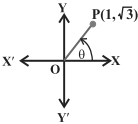
Represent the complex number $z=1+i \sqrt{3}$ in the polar form.
Solution
(N/A) Let $1=r \cos \theta$ and $\sqrt{3}=r \sin \theta$.
By squaring and adding,we get:
$r^{2}(\cos ^{2} \theta+\sin ^{2} \theta)=1^{2}+(\sqrt{3})^{2}$
$r^{2}(1)=1+3=4$
$r=\sqrt{4}=2$ (conventionally,$r>0$).
Therefore,$\cos \theta=\frac{1}{2}$ and $\sin \theta=\frac{\sqrt{3}}{2}$,which gives $\theta=\frac{\pi}{3}$.
Thus,the required polar form is $z=2(\cos \frac{\pi}{3}+i \sin \frac{\pi}{3})$.
The complex number $z=1+i \sqrt{3}$ is represented in the Cartesian plane as shown in the figure.
By squaring and adding,we get:
$r^{2}(\cos ^{2} \theta+\sin ^{2} \theta)=1^{2}+(\sqrt{3})^{2}$
$r^{2}(1)=1+3=4$
$r=\sqrt{4}=2$ (conventionally,$r>0$).
Therefore,$\cos \theta=\frac{1}{2}$ and $\sin \theta=\frac{\sqrt{3}}{2}$,which gives $\theta=\frac{\pi}{3}$.
Thus,the required polar form is $z=2(\cos \frac{\pi}{3}+i \sin \frac{\pi}{3})$.
The complex number $z=1+i \sqrt{3}$ is represented in the Cartesian plane as shown in the figure.
0 likes
View Solution24
MediumMCQ
The imaginary part of $(3+2 \sqrt{-54})^{1/2} - (3-2 \sqrt{-54})^{1/2}$ can be
A
$-2 \sqrt{6}$
B
$6$
C
$\sqrt{6}$
D
$-\sqrt{6}$
Solution
(A) Let $z = (3+2 \sqrt{-54})^{1/2} - (3-2 \sqrt{-54})^{1/2}$.
First,simplify the expression inside the square root: $\sqrt{-54} = \sqrt{54}i = 3\sqrt{6}i$.
So,$3+2\sqrt{-54} = 3 + 2(3\sqrt{6}i) = 3 + 6\sqrt{6}i$. This does not form a perfect square of the form $(a+bi)^2$ easily.
Let $(3+2\sqrt{-54})^{1/2} = x+iy$. Then $x^2-y^2 = 3$ and $2xy = 2\sqrt{54} = 6\sqrt{6}$.
$x^2+y^2 = \sqrt{3^2 + (6\sqrt{6})^2} = \sqrt{9 + 216} = \sqrt{225} = 15$.
Adding the equations: $2x^2 = 18 \implies x^2 = 9 \implies x = \pm 3$.
Subtracting: $2y^2 = 12 \implies y^2 = 6 \implies y = \pm \sqrt{6}$.
Thus,$(3+2\sqrt{-54})^{1/2} = \pm(3+\sqrt{6}i)$ and $(3-2\sqrt{-54})^{1/2} = \pm(3-\sqrt{6}i)$.
Possible values for the expression are:
$1) (3+\sqrt{6}i) - (3-\sqrt{6}i) = 2\sqrt{6}i$
$2) (3+\sqrt{6}i) - (-(3-\sqrt{6}i)) = 6$
$3) -(3+\sqrt{6}i) - (3-\sqrt{6}i) = -6$
$4) -(3+\sqrt{6}i) - (-(3-\sqrt{6}i)) = -2\sqrt{6}i$.
The imaginary parts are $2\sqrt{6}$ and $-2\sqrt{6}$.
Comparing with options,the correct choice is $-2\sqrt{6}$.
First,simplify the expression inside the square root: $\sqrt{-54} = \sqrt{54}i = 3\sqrt{6}i$.
So,$3+2\sqrt{-54} = 3 + 2(3\sqrt{6}i) = 3 + 6\sqrt{6}i$. This does not form a perfect square of the form $(a+bi)^2$ easily.
Let $(3+2\sqrt{-54})^{1/2} = x+iy$. Then $x^2-y^2 = 3$ and $2xy = 2\sqrt{54} = 6\sqrt{6}$.
$x^2+y^2 = \sqrt{3^2 + (6\sqrt{6})^2} = \sqrt{9 + 216} = \sqrt{225} = 15$.
Adding the equations: $2x^2 = 18 \implies x^2 = 9 \implies x = \pm 3$.
Subtracting: $2y^2 = 12 \implies y^2 = 6 \implies y = \pm \sqrt{6}$.
Thus,$(3+2\sqrt{-54})^{1/2} = \pm(3+\sqrt{6}i)$ and $(3-2\sqrt{-54})^{1/2} = \pm(3-\sqrt{6}i)$.
Possible values for the expression are:
$1) (3+\sqrt{6}i) - (3-\sqrt{6}i) = 2\sqrt{6}i$
$2) (3+\sqrt{6}i) - (-(3-\sqrt{6}i)) = 6$
$3) -(3+\sqrt{6}i) - (3-\sqrt{6}i) = -6$
$4) -(3+\sqrt{6}i) - (-(3-\sqrt{6}i)) = -2\sqrt{6}i$.
The imaginary parts are $2\sqrt{6}$ and $-2\sqrt{6}$.
Comparing with options,the correct choice is $-2\sqrt{6}$.
0 likes
View Solution25
MediumMCQ
The square roots of the complex number $(-5-12i)$ are
A
$\pm(2-3i)$
B
$\pm(3+2i)$
C
$\pm(2+3i)$
D
$\pm(3-2i)$
Solution
(A) Let $\sqrt{-5-12i} = a+ib$,where $a, b \in \mathbb{R}$.
Squaring both sides,we get $(a+ib)^2 = -5-12i$.
$(a^2-b^2) + i(2ab) = -5-12i$.
Equating real and imaginary parts: $a^2-b^2 = -5$ and $2ab = -12$,which implies $ab = -6$.
Since $b = -6/a$,substituting into the first equation gives $a^2 - (-6/a)^2 = -5$.
$a^2 - 36/a^2 = -5 \implies a^4 + 5a^2 - 36 = 0$.
Factoring the quadratic in $a^2$: $(a^2+9)(a^2-4) = 0$.
Since $a \in \mathbb{R}$,$a^2 = 4$,so $a = \pm 2$.
If $a = 2$,$b = -6/2 = -3$. If $a = -2$,$b = -6/(-2) = 3$.
Thus,the square roots are $\pm(2-3i)$.
Squaring both sides,we get $(a+ib)^2 = -5-12i$.
$(a^2-b^2) + i(2ab) = -5-12i$.
Equating real and imaginary parts: $a^2-b^2 = -5$ and $2ab = -12$,which implies $ab = -6$.
Since $b = -6/a$,substituting into the first equation gives $a^2 - (-6/a)^2 = -5$.
$a^2 - 36/a^2 = -5 \implies a^4 + 5a^2 - 36 = 0$.
Factoring the quadratic in $a^2$: $(a^2+9)(a^2-4) = 0$.
Since $a \in \mathbb{R}$,$a^2 = 4$,so $a = \pm 2$.
If $a = 2$,$b = -6/2 = -3$. If $a = -2$,$b = -6/(-2) = 3$.
Thus,the square roots are $\pm(2-3i)$.
0 likes
View Solution26
EasyMCQ
The real part of the principal value of $2^{-i}$ is
A
$\sin (\log 2)$
B
$\cos \left(\frac{1}{\log 2}\right)$
C
$\cos \left[\log \left(\frac{1}{2}\right)\right]$
D
$\cos (\log 2)$
Solution
(C) Let $z = 2^{-i}$.
Taking the natural logarithm on both sides,we get:
$\log z = \log (2^{-i})$
$\Rightarrow \log z = -i \log 2$
Since $z = e^{\log z}$,we have:
$z = e^{-i \log 2} = e^{i \log(1/2)}$
Using Euler's formula,$e^{i \theta} = \cos \theta + i \sin \theta$,where $\theta = \log(1/2)$:
$z = \cos(\log(1/2)) + i \sin(\log(1/2))$
The real part of $z$ is $\cos(\log(1/2))$.
Taking the natural logarithm on both sides,we get:
$\log z = \log (2^{-i})$
$\Rightarrow \log z = -i \log 2$
Since $z = e^{\log z}$,we have:
$z = e^{-i \log 2} = e^{i \log(1/2)}$
Using Euler's formula,$e^{i \theta} = \cos \theta + i \sin \theta$,where $\theta = \log(1/2)$:
$z = \cos(\log(1/2)) + i \sin(\log(1/2))$
The real part of $z$ is $\cos(\log(1/2))$.
0 likes
View Solution27
EasyMCQ
The imaginary part of $i^{i}$ is
A
$0$
B
$1$
C
$2$
D
-$1$
Solution
(A) Let $z = i^{i}$.
Taking the natural logarithm on both sides,we get $\ln(z) = i \ln(i)$.
We know that $i = e^{i(\pi/2 + 2n\pi)}$ for any integer $n$. Taking the principal value where $n=0$,we have $\ln(i) = i\pi/2$.
Substituting this into the equation,we get $\ln(z) = i(i\pi/2) = i^{2}(\pi/2) = -\pi/2$.
Therefore,$z = e^{-\pi/2}$.
Since $e^{-\pi/2}$ is a purely real number,it can be written as $e^{-\pi/2} + 0i$.
Thus,the imaginary part of $i^{i}$ is $0$.
Taking the natural logarithm on both sides,we get $\ln(z) = i \ln(i)$.
We know that $i = e^{i(\pi/2 + 2n\pi)}$ for any integer $n$. Taking the principal value where $n=0$,we have $\ln(i) = i\pi/2$.
Substituting this into the equation,we get $\ln(z) = i(i\pi/2) = i^{2}(\pi/2) = -\pi/2$.
Therefore,$z = e^{-\pi/2}$.
Since $e^{-\pi/2}$ is a purely real number,it can be written as $e^{-\pi/2} + 0i$.
Thus,the imaginary part of $i^{i}$ is $0$.
0 likes
View Solution28
MediumMCQ
By taking $\sqrt{a \pm i b}=x \pm i y, x>0$,if we get $\frac{\sqrt{21+12 \sqrt{2} i}}{\sqrt{21-12 \sqrt{2} i}}=a+i b$,then $\frac{b}{a}=$
A
$\frac{4 \sqrt{2}}{7}$
B
$\frac{12 \sqrt{2}}{17}$
C
$\frac{4 \sqrt{3}}{7}$
D
$\frac{12 \sqrt{3}}{17}$
Solution
(A) Let $z = \frac{\sqrt{21+12 \sqrt{2} i}}{\sqrt{21-12 \sqrt{2} i}}$.
Note that $21+12 \sqrt{2} i = (2 \sqrt{2} + 3i)^2$ because $(2 \sqrt{2})^2 - 3^2 + 2(2 \sqrt{2})(3)i = 8 - 9 + 12 \sqrt{2} i = -1 + 12 \sqrt{2} i$. This is not correct.
Let us find the square root of $21+12 \sqrt{2} i$. Let $(x+iy)^2 = 21+12 \sqrt{2} i$.
$x^2-y^2 = 21$ and $2xy = 12 \sqrt{2} \implies xy = 6 \sqrt{2}$.
$(x^2+y^2)^2 = (x^2-y^2)^2 + (2xy)^2 = 21^2 + (12 \sqrt{2})^2 = 441 + 288 = 729$.
$x^2+y^2 = 27$.
Adding $x^2-y^2=21$ and $x^2+y^2=27$,we get $2x^2 = 48 \implies x^2 = 24 \implies x = 2 \sqrt{6}$.
$2y^2 = 6 \implies y^2 = 3 \implies y = \sqrt{3}$.
So,$\sqrt{21+12 \sqrt{2} i} = 2 \sqrt{6} + i \sqrt{3}$.
Similarly,$\sqrt{21-12 \sqrt{2} i} = 2 \sqrt{6} - i \sqrt{3}$.
Then $z = \frac{2 \sqrt{6} + i \sqrt{3}}{2 \sqrt{6} - i \sqrt{3}} = \frac{(2 \sqrt{6} + i \sqrt{3})^2}{(2 \sqrt{6})^2 + (\sqrt{3})^2} = \frac{24 - 3 + 4 \sqrt{18} i}{24 + 3} = \frac{21 + 12 \sqrt{2} i}{27} = \frac{21}{27} + i \frac{12 \sqrt{2}}{27} = \frac{7}{9} + i \frac{4 \sqrt{2}}{9}$.
Here $a = \frac{7}{9}$ and $b = \frac{4 \sqrt{2}}{9}$.
Thus,$\frac{b}{a} = \frac{4 \sqrt{2} / 9}{7 / 9} = \frac{4 \sqrt{2}}{7}$.
Note that $21+12 \sqrt{2} i = (2 \sqrt{2} + 3i)^2$ because $(2 \sqrt{2})^2 - 3^2 + 2(2 \sqrt{2})(3)i = 8 - 9 + 12 \sqrt{2} i = -1 + 12 \sqrt{2} i$. This is not correct.
Let us find the square root of $21+12 \sqrt{2} i$. Let $(x+iy)^2 = 21+12 \sqrt{2} i$.
$x^2-y^2 = 21$ and $2xy = 12 \sqrt{2} \implies xy = 6 \sqrt{2}$.
$(x^2+y^2)^2 = (x^2-y^2)^2 + (2xy)^2 = 21^2 + (12 \sqrt{2})^2 = 441 + 288 = 729$.
$x^2+y^2 = 27$.
Adding $x^2-y^2=21$ and $x^2+y^2=27$,we get $2x^2 = 48 \implies x^2 = 24 \implies x = 2 \sqrt{6}$.
$2y^2 = 6 \implies y^2 = 3 \implies y = \sqrt{3}$.
So,$\sqrt{21+12 \sqrt{2} i} = 2 \sqrt{6} + i \sqrt{3}$.
Similarly,$\sqrt{21-12 \sqrt{2} i} = 2 \sqrt{6} - i \sqrt{3}$.
Then $z = \frac{2 \sqrt{6} + i \sqrt{3}}{2 \sqrt{6} - i \sqrt{3}} = \frac{(2 \sqrt{6} + i \sqrt{3})^2}{(2 \sqrt{6})^2 + (\sqrt{3})^2} = \frac{24 - 3 + 4 \sqrt{18} i}{24 + 3} = \frac{21 + 12 \sqrt{2} i}{27} = \frac{21}{27} + i \frac{12 \sqrt{2}}{27} = \frac{7}{9} + i \frac{4 \sqrt{2}}{9}$.
Here $a = \frac{7}{9}$ and $b = \frac{4 \sqrt{2}}{9}$.
Thus,$\frac{b}{a} = \frac{4 \sqrt{2} / 9}{7 / 9} = \frac{4 \sqrt{2}}{7}$.
0 likes
View Solution29
EasyMCQ
If the real parts of $\sqrt{-5-12 i}$ and $\sqrt{5+12 i}$ are positive,the real part of $\sqrt{-8-6 i}$ is negative,and $a+i b = \frac{\sqrt{-5-12 i}+\sqrt{5+12 i}}{\sqrt{-8-6 i}}$,then $2 a+b =$
A
$3$
B
$2$
C
$-3$
D
$-2$
Solution
(C) Let $\sqrt{-5-12 i} = x+y i$,where $x > 0$.
$-5-12 i = (x+y i)^2 = x^2-y^2+2 x y i$.
Equating real and imaginary parts: $x^2-y^2 = -5$ and $2 x y = -12$.
$x^2+y^2 = \sqrt{(-5)^2+(-12)^2} = \sqrt{25+144} = 13$.
Adding the equations $x^2-y^2 = -5$ and $x^2+y^2 = 13$ gives $2 x^2 = 8$,so $x = 2$ (since $x > 0$).
Then $y = -3$. Thus,$\sqrt{-5-12 i} = 2-3 i$.
Similarly,for $\sqrt{5+12 i} = u+v i$ with $u > 0$: $u^2-v^2 = 5$ and $2 u v = 12$.
$u^2+v^2 = 13$. Adding gives $2 u^2 = 18$,so $u = 3$ and $v = 2$. Thus,$\sqrt{5+12 i} = 3+2 i$.
For $\sqrt{-8-6 i} = m+n i$ with $m < 0$: $m^2-n^2 = -8$ and $2 m n = -6$.
$m^2+n^2 = \sqrt{(-8)^2+(-6)^2} = 10$.
Adding gives $2 m^2 = 2$,so $m = -1$ (since $m < 0$).
Then $n = 3$. Thus,$\sqrt{-8-6 i} = -1+3 i$.
Now,$a+b i = \frac{(2-3 i)+(3+2 i)}{-1+3 i} = \frac{5-i}{-1+3 i}$.
Multiplying by the conjugate: $\frac{5-i}{-1+3 i} \times \frac{-1-3 i}{-1-3 i} = \frac{-5-15 i+i+3 i^2}{1+9} = \frac{-8-14 i}{10} = -0.8-1.4 i$.
So $a = -0.8$ and $b = -1.4$.
$2 a+b = 2(-0.8)+(-1.4) = -1.6-1.4 = -3$.
$-5-12 i = (x+y i)^2 = x^2-y^2+2 x y i$.
Equating real and imaginary parts: $x^2-y^2 = -5$ and $2 x y = -12$.
$x^2+y^2 = \sqrt{(-5)^2+(-12)^2} = \sqrt{25+144} = 13$.
Adding the equations $x^2-y^2 = -5$ and $x^2+y^2 = 13$ gives $2 x^2 = 8$,so $x = 2$ (since $x > 0$).
Then $y = -3$. Thus,$\sqrt{-5-12 i} = 2-3 i$.
Similarly,for $\sqrt{5+12 i} = u+v i$ with $u > 0$: $u^2-v^2 = 5$ and $2 u v = 12$.
$u^2+v^2 = 13$. Adding gives $2 u^2 = 18$,so $u = 3$ and $v = 2$. Thus,$\sqrt{5+12 i} = 3+2 i$.
For $\sqrt{-8-6 i} = m+n i$ with $m < 0$: $m^2-n^2 = -8$ and $2 m n = -6$.
$m^2+n^2 = \sqrt{(-8)^2+(-6)^2} = 10$.
Adding gives $2 m^2 = 2$,so $m = -1$ (since $m < 0$).
Then $n = 3$. Thus,$\sqrt{-8-6 i} = -1+3 i$.
Now,$a+b i = \frac{(2-3 i)+(3+2 i)}{-1+3 i} = \frac{5-i}{-1+3 i}$.
Multiplying by the conjugate: $\frac{5-i}{-1+3 i} \times \frac{-1-3 i}{-1-3 i} = \frac{-5-15 i+i+3 i^2}{1+9} = \frac{-8-14 i}{10} = -0.8-1.4 i$.
So $a = -0.8$ and $b = -1.4$.
$2 a+b = 2(-0.8)+(-1.4) = -1.6-1.4 = -3$.
0 likes
View Solution30
EasyMCQ
The square root of $7+24 i$ is:
A
$4+3 i$
B
$3+4 i$
C
$3-4 i$
D
$4-3 i$
Solution
(A) Let $\sqrt{7+24 i} = x+iy$. Squaring both sides,we get $7+24 i = (x^2-y^2) + 2xyi$.
Equating the real and imaginary parts,we have $x^2-y^2 = 7$ and $2xy = 24$,which implies $xy = 12$ or $y = \frac{12}{x}$.
Substituting $y$ into the first equation: $x^2 - (\frac{12}{x})^2 = 7 \Rightarrow x^2 - \frac{144}{x^2} = 7$.
Multiplying by $x^2$: $x^4 - 7x^2 - 144 = 0$.
Let $u = x^2$,then $u^2 - 7u - 144 = 0$. Factoring gives $(u-16)(u+9) = 0$.
Since $x$ is real,$x^2 = 16$,so $x = \pm 4$.
If $x = 4$,$y = 3$. If $x = -4$,$y = -3$.
Thus,the square roots are $\pm(4+3i)$.
Equating the real and imaginary parts,we have $x^2-y^2 = 7$ and $2xy = 24$,which implies $xy = 12$ or $y = \frac{12}{x}$.
Substituting $y$ into the first equation: $x^2 - (\frac{12}{x})^2 = 7 \Rightarrow x^2 - \frac{144}{x^2} = 7$.
Multiplying by $x^2$: $x^4 - 7x^2 - 144 = 0$.
Let $u = x^2$,then $u^2 - 7u - 144 = 0$. Factoring gives $(u-16)(u+9) = 0$.
Since $x$ is real,$x^2 = 16$,so $x = \pm 4$.
If $x = 4$,$y = 3$. If $x = -4$,$y = -3$.
Thus,the square roots are $\pm(4+3i)$.
0 likes
View Solution31
MediumMCQ
If $a > 0$ and $z = x + iy$,then $\log_{\cos^2 \theta} |z - a| > \log_{\cos^2 \theta} |z - ai|$ for $\theta \in R$ implies:
A
$x > y$
B
$x < y$
C
$x + y = \cos \theta$
D
$x + y < 0$
Solution
(A) Given the inequality: $\log_{\cos^2 \theta} |z - a| > \log_{\cos^2 \theta} |z - ai|$.
Since $\cos^2 \theta$ is the base of the logarithm,we must have $\cos^2 \theta \in (0, 1)$.
Because the base is between $0$ and $1$,the inequality reverses when removing the logarithm:
$|z - a| < |z - ai|$.
Substituting $z = x + iy$:
$|x + iy - a| < |x + iy - ai|$
$|(x - a) + iy| < |x + i(y - a)|$.
Squaring both sides:
$(x - a)^2 + y^2 < x^2 + (y - a)^2$
$x^2 - 2ax + a^2 + y^2 < x^2 + y^2 - 2ay + a^2$.
Subtracting $x^2 + y^2 + a^2$ from both sides:
$-2ax < -2ay$.
Since $a > 0$,dividing by $-2a$ reverses the inequality:
$x > y$.
Since $\cos^2 \theta$ is the base of the logarithm,we must have $\cos^2 \theta \in (0, 1)$.
Because the base is between $0$ and $1$,the inequality reverses when removing the logarithm:
$|z - a| < |z - ai|$.
Substituting $z = x + iy$:
$|x + iy - a| < |x + iy - ai|$
$|(x - a) + iy| < |x + i(y - a)|$.
Squaring both sides:
$(x - a)^2 + y^2 < x^2 + (y - a)^2$
$x^2 - 2ax + a^2 + y^2 < x^2 + y^2 - 2ay + a^2$.
Subtracting $x^2 + y^2 + a^2$ from both sides:
$-2ax < -2ay$.
Since $a > 0$,dividing by $-2a$ reverses the inequality:
$x > y$.
0 likes
View Solution32
MediumMCQ
If $2 \cosh 2x + 10 \sinh 2x = 5$,then $x =$
A
$\frac{1}{2} \log \frac{4}{3}$
B
$\frac{1}{2} \log \frac{2}{3}$
C
$\frac{1}{2} \log \frac{3}{2}$
D
$\frac{1}{2} \log \frac{3}{4}$
Solution
(A) Given the equation: $2 \cosh 2x + 10 \sinh 2x = 5$.
Using the definitions $\cosh 2x = \frac{e^{2x} + e^{-2x}}{2}$ and $\sinh 2x = \frac{e^{2x} - e^{-2x}}{2}$:
$2 \left( \frac{e^{2x} + e^{-2x}}{2} \right) + 10 \left( \frac{e^{2x} - e^{-2x}}{2} \right) = 5$
$(e^{2x} + e^{-2x}) + 5(e^{2x} - e^{-2x}) = 5$
$6e^{2x} - 4e^{-2x} = 5$
Multiply by $e^{2x}$: $6(e^{2x})^2 - 5e^{2x} - 4 = 0$.
Let $u = e^{2x}$,then $6u^2 - 5u - 4 = 0$.
Factoring the quadratic: $(3u - 4)(2u + 1) = 0$.
So,$u = \frac{4}{3}$ or $u = -\frac{1}{2}$.
Since $e^{2x} > 0$,we have $e^{2x} = \frac{4}{3}$.
Taking the natural logarithm on both sides: $2x = \ln \frac{4}{3}$.
Therefore,$x = \frac{1}{2} \ln \frac{4}{3}$.
Using the definitions $\cosh 2x = \frac{e^{2x} + e^{-2x}}{2}$ and $\sinh 2x = \frac{e^{2x} - e^{-2x}}{2}$:
$2 \left( \frac{e^{2x} + e^{-2x}}{2} \right) + 10 \left( \frac{e^{2x} - e^{-2x}}{2} \right) = 5$
$(e^{2x} + e^{-2x}) + 5(e^{2x} - e^{-2x}) = 5$
$6e^{2x} - 4e^{-2x} = 5$
Multiply by $e^{2x}$: $6(e^{2x})^2 - 5e^{2x} - 4 = 0$.
Let $u = e^{2x}$,then $6u^2 - 5u - 4 = 0$.
Factoring the quadratic: $(3u - 4)(2u + 1) = 0$.
So,$u = \frac{4}{3}$ or $u = -\frac{1}{2}$.
Since $e^{2x} > 0$,we have $e^{2x} = \frac{4}{3}$.
Taking the natural logarithm on both sides: $2x = \ln \frac{4}{3}$.
Therefore,$x = \frac{1}{2} \ln \frac{4}{3}$.
0 likes
View Solution33
DifficultMCQ
$\sec h^{-1}\left(\frac{1}{2}\right)-\operatorname{cosec} h^{-1}\left(\frac{3}{4}\right)$ is equal to
A
$\log _e(3(2+\sqrt{3}))$
B
$\log _e\left(\frac{1+\sqrt{3}}{3}\right)$
C
$\log _e\left(\frac{2+\sqrt{3}}{3}\right)$
D
$\log _e\left(\frac{2-\sqrt{3}}{3}\right)$
Solution
(C) We use the logarithmic forms of inverse hyperbolic functions:
$\sec h^{-1} x = \log _e\left(\frac{1+\sqrt{1-x^2}}{x}\right)$ and $\operatorname{cosec} h^{-1} x = \log _e\left(\frac{1+\sqrt{1+x^2}}{x}\right)$.
For $\sec h^{-1}\left(\frac{1}{2}\right)$:
$\sec h^{-1}\left(\frac{1}{2}\right) = \log _e\left(\frac{1+\sqrt{1-(1/2)^2}}{1/2}\right) = \log _e\left(\frac{1+\sqrt{3/4}}{1/2}\right) = \log _e\left(\frac{1+\sqrt{3}/2}{1/2}\right) = \log _e(2+\sqrt{3})$.
For $\operatorname{cosec} h^{-1}\left(\frac{3}{4}\right)$:
$\operatorname{cosec} h^{-1}\left(\frac{3}{4}\right) = \log _e\left(\frac{1+\sqrt{1+(3/4)^2}}{3/4}\right) = \log _e\left(\frac{1+\sqrt{25/16}}{3/4}\right) = \log _e\left(\frac{1+5/4}{3/4}\right) = \log _e\left(\frac{9/4}{3/4}\right) = \log _e(3)$.
Subtracting the two values:
$\log _e(2+\sqrt{3}) - \log _e(3) = \log _e\left(\frac{2+\sqrt{3}}{3}\right)$.
$\sec h^{-1} x = \log _e\left(\frac{1+\sqrt{1-x^2}}{x}\right)$ and $\operatorname{cosec} h^{-1} x = \log _e\left(\frac{1+\sqrt{1+x^2}}{x}\right)$.
For $\sec h^{-1}\left(\frac{1}{2}\right)$:
$\sec h^{-1}\left(\frac{1}{2}\right) = \log _e\left(\frac{1+\sqrt{1-(1/2)^2}}{1/2}\right) = \log _e\left(\frac{1+\sqrt{3/4}}{1/2}\right) = \log _e\left(\frac{1+\sqrt{3}/2}{1/2}\right) = \log _e(2+\sqrt{3})$.
For $\operatorname{cosec} h^{-1}\left(\frac{3}{4}\right)$:
$\operatorname{cosec} h^{-1}\left(\frac{3}{4}\right) = \log _e\left(\frac{1+\sqrt{1+(3/4)^2}}{3/4}\right) = \log _e\left(\frac{1+\sqrt{25/16}}{3/4}\right) = \log _e\left(\frac{1+5/4}{3/4}\right) = \log _e\left(\frac{9/4}{3/4}\right) = \log _e(3)$.
Subtracting the two values:
$\log _e(2+\sqrt{3}) - \log _e(3) = \log _e\left(\frac{2+\sqrt{3}}{3}\right)$.
0 likes
View Solution34
EasyMCQ
$\cosh (\log 4) = $
A
$\frac{8}{17}$
B
$\frac{17}{8}$
C
$0$
D
$\frac{9}{8}$
Solution
(B) We know that $\cosh(x) = \frac{e^x + e^{-x}}{2}$.
Substituting $x = \log 4$,we get $\cosh(\log 4) = \frac{e^{\log 4} + e^{-\log 4}}{2}$.
Since $e^{\log 4} = 4$ and $e^{-\log 4} = e^{\log(4^{-1})} = \frac{1}{4}$,
$\cosh(\log 4) = \frac{4 + \frac{1}{4}}{2} = \frac{\frac{17}{4}}{2} = \frac{17}{8}$.
Substituting $x = \log 4$,we get $\cosh(\log 4) = \frac{e^{\log 4} + e^{-\log 4}}{2}$.
Since $e^{\log 4} = 4$ and $e^{-\log 4} = e^{\log(4^{-1})} = \frac{1}{4}$,
$\cosh(\log 4) = \frac{4 + \frac{1}{4}}{2} = \frac{\frac{17}{4}}{2} = \frac{17}{8}$.
0 likes
View Solution35
DifficultMCQ
If $\tanh^{-1}(x+iy) = \frac{1}{2} \tanh^{-1}\left(\frac{2x}{1+x^2+y^2}\right) + \frac{i}{2} \tan^{-1}\left(\frac{2y}{1-x^2-y^2}\right)$,where $x, y \in \mathbb{R}$,then $\tanh^{-1}(iy) =$
A
$i \tanh^{-1}(y)$
B
$-i \tanh^{-1}(y)$
C
$i \tan^{-1}(y)$
D
$-i \tan^{-1}(y)$
Solution
(C) We know the relationship between the inverse hyperbolic tangent and the inverse trigonometric tangent function: $\tanh^{-1}(z) = \frac{1}{i} \tan^{-1}(iz)$.
To find $\tanh^{-1}(iy)$,we substitute $z = iy$ into the formula:
$\tanh^{-1}(iy) = \frac{1}{i} \tan^{-1}(i(iy))$
Since $i^2 = -1$,this simplifies to:
$\tanh^{-1}(iy) = \frac{1}{i} \tan^{-1}(-y)$
Using the property $\tan^{-1}(-y) = -\tan^{-1}(y)$,we get:
$\tanh^{-1}(iy) = \frac{1}{i} (-\tan^{-1}(y)) = -\frac{1}{i} \tan^{-1}(y)$
Since $\frac{1}{i} = -i$,we have $-\frac{1}{i} = i$.
Therefore,$\tanh^{-1}(iy) = i \tan^{-1}(y)$.
Thus,option $C$ is correct.
To find $\tanh^{-1}(iy)$,we substitute $z = iy$ into the formula:
$\tanh^{-1}(iy) = \frac{1}{i} \tan^{-1}(i(iy))$
Since $i^2 = -1$,this simplifies to:
$\tanh^{-1}(iy) = \frac{1}{i} \tan^{-1}(-y)$
Using the property $\tan^{-1}(-y) = -\tan^{-1}(y)$,we get:
$\tanh^{-1}(iy) = \frac{1}{i} (-\tan^{-1}(y)) = -\frac{1}{i} \tan^{-1}(y)$
Since $\frac{1}{i} = -i$,we have $-\frac{1}{i} = i$.
Therefore,$\tanh^{-1}(iy) = i \tan^{-1}(y)$.
Thus,option $C$ is correct.
0 likes
View Solution36
MediumMCQ
One of the values of $\sqrt{24-70 i}+\sqrt{-24+70 i}$ is
A
$2+12 i$
B
$12-2 i$
C
$-12+2 i$
D
$-12-2 i$
Solution
(D) Let $z_1 = 24-70 i$ and $z_2 = -24+70 i$.
We need to find $\sqrt{z_1} + \sqrt{z_2}$.
Note that $z_2 = -z_1$,so we are looking for $\sqrt{z_1} + \sqrt{-z_1}$.
Let $\sqrt{24-70 i} = x+iy$. Squaring both sides,$x^2-y^2+2ixy = 24-70 i$.
Equating real and imaginary parts: $x^2-y^2 = 24$ and $2xy = -70 \implies xy = -35$.
Since $x^2+y^2 = \sqrt{24^2+(-70)^2} = \sqrt{576+4900} = \sqrt{5476} = 74$.
Adding $x^2-y^2=24$ and $x^2+y^2=74$,we get $2x^2 = 98 \implies x^2 = 49 \implies x = \pm 7$.
If $x=7, y=-5$. If $x=-7, y=5$. So $\sqrt{24-70 i} = \pm(7-5 i)$.
Similarly,$\sqrt{-24+70 i} = \pm(5-7 i)$.
Possible sums are:
$1$) $(7-5 i) + (5-7 i) = 12-12 i$
$2$) $(7-5 i) - (5-7 i) = 2+2 i$
$3$) $-(7-5 i) + (5-7 i) = -2-2 i$
$4$) $-(7-5 i) - (5-7 i) = -12+12 i$
Wait,checking the options provided,there might be a typo in the question or options. Re-evaluating: $\sqrt{24-70 i} = \pm(7-5 i)$ and $\sqrt{-24+70 i} = \pm i(7-5 i) = \pm(5+7 i)$.
Sum: $\pm(7-5 i) \pm(5+7 i)$.
Possible values: $(7-5 i) + (5+7 i) = 12+2 i$,$(7-5 i) - (5+7 i) = 2-12 i$,$-(7-5 i) + (5+7 i) = -2+12 i$,$-(7-5 i) - (5+7 i) = -12-2 i$.
Option $D$ matches $-12-2 i$.
We need to find $\sqrt{z_1} + \sqrt{z_2}$.
Note that $z_2 = -z_1$,so we are looking for $\sqrt{z_1} + \sqrt{-z_1}$.
Let $\sqrt{24-70 i} = x+iy$. Squaring both sides,$x^2-y^2+2ixy = 24-70 i$.
Equating real and imaginary parts: $x^2-y^2 = 24$ and $2xy = -70 \implies xy = -35$.
Since $x^2+y^2 = \sqrt{24^2+(-70)^2} = \sqrt{576+4900} = \sqrt{5476} = 74$.
Adding $x^2-y^2=24$ and $x^2+y^2=74$,we get $2x^2 = 98 \implies x^2 = 49 \implies x = \pm 7$.
If $x=7, y=-5$. If $x=-7, y=5$. So $\sqrt{24-70 i} = \pm(7-5 i)$.
Similarly,$\sqrt{-24+70 i} = \pm(5-7 i)$.
Possible sums are:
$1$) $(7-5 i) + (5-7 i) = 12-12 i$
$2$) $(7-5 i) - (5-7 i) = 2+2 i$
$3$) $-(7-5 i) + (5-7 i) = -2-2 i$
$4$) $-(7-5 i) - (5-7 i) = -12+12 i$
Wait,checking the options provided,there might be a typo in the question or options. Re-evaluating: $\sqrt{24-70 i} = \pm(7-5 i)$ and $\sqrt{-24+70 i} = \pm i(7-5 i) = \pm(5+7 i)$.
Sum: $\pm(7-5 i) \pm(5+7 i)$.
Possible values: $(7-5 i) + (5+7 i) = 12+2 i$,$(7-5 i) - (5+7 i) = 2-12 i$,$-(7-5 i) + (5+7 i) = -2+12 i$,$-(7-5 i) - (5+7 i) = -12-2 i$.
Option $D$ matches $-12-2 i$.
0 likes
View Solution37
MediumMCQ
If the value of $\sqrt{-5-12 i}+\sqrt{7+24 i}$ is a negative real number $k$,then $k=$
A
$-5$
B
$-7$
C
$-6$
D
$-4$
Solution
(C) Let $Z = \sqrt{-5-12 i} + \sqrt{7+24 i}$.
We use the formula $\sqrt{a+ib} = \pm \left( \sqrt{\frac{|Z|+a}{2}} + i \frac{b}{|b|} \sqrt{\frac{|Z|-a}{2}} \right)$.
For $\sqrt{-5-12 i}$,$|Z| = \sqrt{(-5)^2 + (-12)^2} = 13$. Thus,$\sqrt{-5-12 i} = \pm \left( \sqrt{\frac{13-5}{2}} - i \sqrt{\frac{13+5}{2}} \right) = \pm(2-3i)$.
For $\sqrt{7+24 i}$,$|Z| = \sqrt{7^2 + 24^2} = 25$. Thus,$\sqrt{7+24 i} = \pm \left( \sqrt{\frac{25+7}{2}} + i \sqrt{\frac{25-7}{2}} \right) = \pm(4+3i)$.
Given $Z = \pm(2-3i) \pm(4+3i)$.
Possible values for $Z$ are $(2-3i) + (4+3i) = 6$,$(2-3i) - (4+3i) = -2-6i$,$-(2-3i) + (4+3i) = 2+6i$,and $-(2-3i) - (4+3i) = -6$.
Since $k$ is a negative real number,$k = -6$.
We use the formula $\sqrt{a+ib} = \pm \left( \sqrt{\frac{|Z|+a}{2}} + i \frac{b}{|b|} \sqrt{\frac{|Z|-a}{2}} \right)$.
For $\sqrt{-5-12 i}$,$|Z| = \sqrt{(-5)^2 + (-12)^2} = 13$. Thus,$\sqrt{-5-12 i} = \pm \left( \sqrt{\frac{13-5}{2}} - i \sqrt{\frac{13+5}{2}} \right) = \pm(2-3i)$.
For $\sqrt{7+24 i}$,$|Z| = \sqrt{7^2 + 24^2} = 25$. Thus,$\sqrt{7+24 i} = \pm \left( \sqrt{\frac{25+7}{2}} + i \sqrt{\frac{25-7}{2}} \right) = \pm(4+3i)$.
Given $Z = \pm(2-3i) \pm(4+3i)$.
Possible values for $Z$ are $(2-3i) + (4+3i) = 6$,$(2-3i) - (4+3i) = -2-6i$,$-(2-3i) + (4+3i) = 2+6i$,and $-(2-3i) - (4+3i) = -6$.
Since $k$ is a negative real number,$k = -6$.
0 likes
View Solution38
EasyMCQ
$\sqrt{(-3+4 i)(8+6 i)} = ?$
A
$\pm(1+2 i)$
B
$\pm(3+i)$
C
$\pm(1+7 i)$
D
$\pm(7-i)$
Solution
(C) Let $z = \sqrt{(-3+4 i)(8+6 i)}$.
First,calculate the product inside the square root:
$(-3+4 i)(8+6 i) = -24 - 18 i + 32 i + 24 i^2$
Since $i^2 = -1$,we have:
$-24 + 14 i - 24 = -48 + 14 i$.
Now,we need to find $\sqrt{-48 + 14 i}$.
Let $\sqrt{-48 + 14 i} = x + i y$,where $x, y \in \mathbb{R}$.
Squaring both sides: $(x + i y)^2 = -48 + 14 i$
$x^2 - y^2 + 2 i x y = -48 + 14 i$.
Comparing real and imaginary parts:
$x^2 - y^2 = -48$ $(1)$
$2 x y = 14 \Rightarrow x y = 7$ $(2)$
From $(2)$,$y = \frac{7}{x}$. Substituting into $(1)$:
$x^2 - (\frac{7}{x})^2 = -48$
$x^2 - \frac{49}{x^2} = -48$
$x^4 + 48 x^2 - 49 = 0$
$(x^2 + 49)(x^2 - 1) = 0$.
Since $x \in \mathbb{R}$,$x^2 = 1$,so $x = \pm 1$.
If $x = 1$,$y = 7$. If $x = -1$,$y = -7$.
Thus,the square roots are $\pm(1 + 7 i)$.
First,calculate the product inside the square root:
$(-3+4 i)(8+6 i) = -24 - 18 i + 32 i + 24 i^2$
Since $i^2 = -1$,we have:
$-24 + 14 i - 24 = -48 + 14 i$.
Now,we need to find $\sqrt{-48 + 14 i}$.
Let $\sqrt{-48 + 14 i} = x + i y$,where $x, y \in \mathbb{R}$.
Squaring both sides: $(x + i y)^2 = -48 + 14 i$
$x^2 - y^2 + 2 i x y = -48 + 14 i$.
Comparing real and imaginary parts:
$x^2 - y^2 = -48$ $(1)$
$2 x y = 14 \Rightarrow x y = 7$ $(2)$
From $(2)$,$y = \frac{7}{x}$. Substituting into $(1)$:
$x^2 - (\frac{7}{x})^2 = -48$
$x^2 - \frac{49}{x^2} = -48$
$x^4 + 48 x^2 - 49 = 0$
$(x^2 + 49)(x^2 - 1) = 0$.
Since $x \in \mathbb{R}$,$x^2 = 1$,so $x = \pm 1$.
If $x = 1$,$y = 7$. If $x = -1$,$y = -7$.
Thus,the square roots are $\pm(1 + 7 i)$.
0 likes
View Solution39
MediumMCQ
$\sinh (\log (3+\sqrt{8}))=$
A
$3^{3/2}$
B
$2^{3/2}$
C
$8^{2/3}$
D
$3^{1/2}$
Solution
(B) We know that $\sinh(x) = \frac{e^x - e^{-x}}{2}$.
Let $x = \log(3+\sqrt{8})$.
Then $e^x = 3+\sqrt{8} = 3+2\sqrt{2} = (\sqrt{2}+1)^2$.
Also,$e^{-x} = \frac{1}{e^x} = \frac{1}{(\sqrt{2}+1)^2} = (\sqrt{2}-1)^2$.
Substituting these into the formula:
$\sinh(x) = \frac{(\sqrt{2}+1)^2 - (\sqrt{2}-1)^2}{2}$.
Expanding the squares:
$(\sqrt{2}+1)^2 = 2+1+2\sqrt{2} = 3+2\sqrt{2}$.
$(\sqrt{2}-1)^2 = 2+1-2\sqrt{2} = 3-2\sqrt{2}$.
$\sinh(x) = \frac{(3+2\sqrt{2}) - (3-2\sqrt{2})}{2} = \frac{4\sqrt{2}}{2} = 2\sqrt{2}$.
Since $2\sqrt{2} = 2^1 \times 2^{1/2} = 2^{3/2}$,the correct option is $B$.
Let $x = \log(3+\sqrt{8})$.
Then $e^x = 3+\sqrt{8} = 3+2\sqrt{2} = (\sqrt{2}+1)^2$.
Also,$e^{-x} = \frac{1}{e^x} = \frac{1}{(\sqrt{2}+1)^2} = (\sqrt{2}-1)^2$.
Substituting these into the formula:
$\sinh(x) = \frac{(\sqrt{2}+1)^2 - (\sqrt{2}-1)^2}{2}$.
Expanding the squares:
$(\sqrt{2}+1)^2 = 2+1+2\sqrt{2} = 3+2\sqrt{2}$.
$(\sqrt{2}-1)^2 = 2+1-2\sqrt{2} = 3-2\sqrt{2}$.
$\sinh(x) = \frac{(3+2\sqrt{2}) - (3-2\sqrt{2})}{2} = \frac{4\sqrt{2}}{2} = 2\sqrt{2}$.
Since $2\sqrt{2} = 2^1 \times 2^{1/2} = 2^{3/2}$,the correct option is $B$.
0 likes
View Solution40
EasyMCQ
If $\theta = \frac{\pi}{12}$ and $x = \log \left(\cot \left(\frac{\pi}{4} + \theta\right)\right)$,then $\cosh x =$
A
$\frac{2}{\sqrt{3}}$
B
$\frac{-2}{\sqrt{3}}$
C
$\frac{\sqrt{3}}{2}$
D
$\frac{2}{\sqrt{3}}$ is not correct,the calculated value is $\frac{2}{\sqrt{3}}$
Solution
(A) Given: $x = \log \left(\cot \left(\frac{\pi}{4} + \theta\right)\right)$
Substitute $\theta = \frac{\pi}{12}$:
$x = \log \left(\cot \left(\frac{\pi}{4} + \frac{\pi}{12}\right)\right) = \log \left(\cot \left(\frac{3\pi + \pi}{12}\right)\right) = \log \left(\cot \left(\frac{\pi}{3}\right)\right)$
Since $\cot \left(\frac{\pi}{3}\right) = \frac{1}{\sqrt{3}}$,we have $x = \log \left(\frac{1}{\sqrt{3}}\right) = -\log \sqrt{3} = -\frac{1}{2} \log 3$.
Then $e^x = \frac{1}{\sqrt{3}}$ and $e^{-x} = \sqrt{3}$.
The definition of $\cosh x$ is $\frac{e^x + e^{-x}}{2}$.
$\cosh x = \frac{\frac{1}{\sqrt{3}} + \sqrt{3}}{2} = \frac{\frac{1 + 3}{\sqrt{3}}}{2} = \frac{4}{2\sqrt{3}} = \frac{2}{\sqrt{3}}$.
Substitute $\theta = \frac{\pi}{12}$:
$x = \log \left(\cot \left(\frac{\pi}{4} + \frac{\pi}{12}\right)\right) = \log \left(\cot \left(\frac{3\pi + \pi}{12}\right)\right) = \log \left(\cot \left(\frac{\pi}{3}\right)\right)$
Since $\cot \left(\frac{\pi}{3}\right) = \frac{1}{\sqrt{3}}$,we have $x = \log \left(\frac{1}{\sqrt{3}}\right) = -\log \sqrt{3} = -\frac{1}{2} \log 3$.
Then $e^x = \frac{1}{\sqrt{3}}$ and $e^{-x} = \sqrt{3}$.
The definition of $\cosh x$ is $\frac{e^x + e^{-x}}{2}$.
$\cosh x = \frac{\frac{1}{\sqrt{3}} + \sqrt{3}}{2} = \frac{\frac{1 + 3}{\sqrt{3}}}{2} = \frac{4}{2\sqrt{3}} = \frac{2}{\sqrt{3}}$.
0 likes
View Solution41
MediumMCQ
If $\sinh x = \frac{3}{4}$ and $\cosh y = \frac{5}{3}$,then $x + y =$
A
$\log 2$
B
$\log 6$
C
$\log 3$
D
$\log 5$
Solution
(B) Given $\sinh x = \frac{3}{4}$.
Using the formula $\sinh^{-1} z = \log(z + \sqrt{z^2 + 1})$:
$x = \log(\frac{3}{4} + \sqrt{(\frac{3}{4})^2 + 1}) = \log(\frac{3}{4} + \sqrt{\frac{9}{16} + 1}) = \log(\frac{3}{4} + \frac{5}{4}) = \log(2)$.
Given $\cosh y = \frac{5}{3}$.
Using the formula $\cosh^{-1} z = \log(z + \sqrt{z^2 - 1})$:
$y = \log(\frac{5}{3} + \sqrt{(\frac{5}{3})^2 - 1}) = \log(\frac{5}{3} + \sqrt{\frac{25}{9} - 1}) = \log(\frac{5}{3} + \frac{4}{3}) = \log(3)$.
Therefore,$x + y = \log 2 + \log 3 = \log(2 \times 3) = \log 6$.
Using the formula $\sinh^{-1} z = \log(z + \sqrt{z^2 + 1})$:
$x = \log(\frac{3}{4} + \sqrt{(\frac{3}{4})^2 + 1}) = \log(\frac{3}{4} + \sqrt{\frac{9}{16} + 1}) = \log(\frac{3}{4} + \frac{5}{4}) = \log(2)$.
Given $\cosh y = \frac{5}{3}$.
Using the formula $\cosh^{-1} z = \log(z + \sqrt{z^2 - 1})$:
$y = \log(\frac{5}{3} + \sqrt{(\frac{5}{3})^2 - 1}) = \log(\frac{5}{3} + \sqrt{\frac{25}{9} - 1}) = \log(\frac{5}{3} + \frac{4}{3}) = \log(3)$.
Therefore,$x + y = \log 2 + \log 3 = \log(2 \times 3) = \log 6$.
0 likes
View Solution42
EasyMCQ
If $\cosh ^{-1} x = 2 \log _e(\sqrt{2}+1)$,then $x=$
A
$1$
B
$2$
C
$4$
D
$3$
Solution
(D) We have,$\cosh ^{-1} x = 2 \log _e(\sqrt{2}+1)$.
Using the logarithmic property $n \log a = \log a^n$,we get:
$\cosh ^{-1} x = \log _e(\sqrt{2}+1)^2$.
We know that $\cosh ^{-1} x = \log _e(x + \sqrt{x^2-1})$.
Therefore,$\log _e(x + \sqrt{x^2-1}) = \log _e(2 + 1 + 2\sqrt{2}) = \log _e(3 + 2\sqrt{2})$.
Comparing both sides,we have $x + \sqrt{x^2-1} = 3 + 2\sqrt{2}$.
Let $x = 3$,then $\sqrt{x^2-1} = \sqrt{9-1} = \sqrt{8} = 2\sqrt{2}$.
Thus,$3 + 2\sqrt{2} = 3 + 2\sqrt{2}$,which satisfies the equation.
Hence,$x = 3$.
Using the logarithmic property $n \log a = \log a^n$,we get:
$\cosh ^{-1} x = \log _e(\sqrt{2}+1)^2$.
We know that $\cosh ^{-1} x = \log _e(x + \sqrt{x^2-1})$.
Therefore,$\log _e(x + \sqrt{x^2-1}) = \log _e(2 + 1 + 2\sqrt{2}) = \log _e(3 + 2\sqrt{2})$.
Comparing both sides,we have $x + \sqrt{x^2-1} = 3 + 2\sqrt{2}$.
Let $x = 3$,then $\sqrt{x^2-1} = \sqrt{9-1} = \sqrt{8} = 2\sqrt{2}$.
Thus,$3 + 2\sqrt{2} = 3 + 2\sqrt{2}$,which satisfies the equation.
Hence,$x = 3$.
0 likes
View Solution43
MediumMCQ
$\sinh^{-1}(-2) + \operatorname{cosech}^{-1}(-2) + \coth^{-1}(-2) = $
A
$\log \left(\frac{7-3 \sqrt{5}}{2 \sqrt{3}}\right)$
B
$\log \left(\frac{3-\sqrt{5}}{2 \sqrt{3}}\right)$
C
$\log \left(\frac{7+3 \sqrt{5}}{2 \sqrt{3}}\right)$
D
$\log \left(\frac{3+\sqrt{5}}{2 \sqrt{3}}\right)$
Solution
(A) We use the logarithmic definitions of inverse hyperbolic functions:
$\sinh^{-1}(x) = \log(x + \sqrt{x^2+1})$
$\operatorname{cosech}^{-1}(x) = \log\left(\frac{1}{x} + \sqrt{\frac{1}{x^2}+1}\right)$
$\coth^{-1}(x) = \frac{1}{2} \log\left(\frac{x+1}{x-1}\right)$
Substituting $x = -2$:
$\sinh^{-1}(-2) = \log(-2 + \sqrt{5})$
$\operatorname{cosech}^{-1}(-2) = \log\left(-\frac{1}{2} + \sqrt{\frac{1}{4}+1}\right) = \log\left(\frac{-1+\sqrt{5}}{2}\right)$
$\coth^{-1}(-2) = \frac{1}{2} \log\left(\frac{-2+1}{-2-1}\right) = \frac{1}{2} \log\left(\frac{-1}{-3}\right) = \frac{1}{2} \log\left(\frac{1}{3}\right) = \log\left(\frac{1}{\sqrt{3}}\right)$
Summing these:
$\log(-2 + \sqrt{5}) + \log\left(\frac{\sqrt{5}-1}{2}\right) + \log\left(\frac{1}{\sqrt{3}}\right) = \log\left[(-2 + \sqrt{5}) \cdot \left(\frac{\sqrt{5}-1}{2}\right) \cdot \frac{1}{\sqrt{3}}\right]$
$= \log\left[\frac{-2\sqrt{5} + 2 + 5 - \sqrt{5}}{2\sqrt{3}}\right] = \log\left(\frac{7-3\sqrt{5}}{2\sqrt{3}}\right)$
$\sinh^{-1}(x) = \log(x + \sqrt{x^2+1})$
$\operatorname{cosech}^{-1}(x) = \log\left(\frac{1}{x} + \sqrt{\frac{1}{x^2}+1}\right)$
$\coth^{-1}(x) = \frac{1}{2} \log\left(\frac{x+1}{x-1}\right)$
Substituting $x = -2$:
$\sinh^{-1}(-2) = \log(-2 + \sqrt{5})$
$\operatorname{cosech}^{-1}(-2) = \log\left(-\frac{1}{2} + \sqrt{\frac{1}{4}+1}\right) = \log\left(\frac{-1+\sqrt{5}}{2}\right)$
$\coth^{-1}(-2) = \frac{1}{2} \log\left(\frac{-2+1}{-2-1}\right) = \frac{1}{2} \log\left(\frac{-1}{-3}\right) = \frac{1}{2} \log\left(\frac{1}{3}\right) = \log\left(\frac{1}{\sqrt{3}}\right)$
Summing these:
$\log(-2 + \sqrt{5}) + \log\left(\frac{\sqrt{5}-1}{2}\right) + \log\left(\frac{1}{\sqrt{3}}\right) = \log\left[(-2 + \sqrt{5}) \cdot \left(\frac{\sqrt{5}-1}{2}\right) \cdot \frac{1}{\sqrt{3}}\right]$
$= \log\left[\frac{-2\sqrt{5} + 2 + 5 - \sqrt{5}}{2\sqrt{3}}\right] = \log\left(\frac{7-3\sqrt{5}}{2\sqrt{3}}\right)$
0 likes
View Solution44
MediumMCQ
$\sinh^{-1}\left(2^{3/2}\right)$ is equal to :
A
$\log(3+\sqrt{8})$
B
$\log(3-\sqrt{8})$
C
$\log(2+\sqrt{18})$
D
$\log(\sqrt{8}+\sqrt{27})$
Solution
(A) We know that the formula for the inverse hyperbolic sine function is $\sinh^{-1}(x) = \log\{x + \sqrt{x^2 + 1}\}$.
Substituting $x = 2^{3/2}$ into the formula:
$\sinh^{-1}(2^{3/2}) = \log\{2^{3/2} + \sqrt{(2^{3/2})^2 + 1\}}$.
Since $2^{3/2} = \sqrt{2^3} = \sqrt{8}$,we have:
$\sinh^{-1}(2^{3/2}) = \log\{\sqrt{8} + \sqrt{8 + 1\}}$.
$= \log\{\sqrt{8} + \sqrt{9\}}$.
$= \log\{3 + \sqrt{8\}}$.
Thus,the correct option is $A$.
Substituting $x = 2^{3/2}$ into the formula:
$\sinh^{-1}(2^{3/2}) = \log\{2^{3/2} + \sqrt{(2^{3/2})^2 + 1\}}$.
Since $2^{3/2} = \sqrt{2^3} = \sqrt{8}$,we have:
$\sinh^{-1}(2^{3/2}) = \log\{\sqrt{8} + \sqrt{8 + 1\}}$.
$= \log\{\sqrt{8} + \sqrt{9\}}$.
$= \log\{3 + \sqrt{8\}}$.
Thus,the correct option is $A$.
0 likes
View Solution45
MediumMCQ
$\sinh^{-1}(2) + \cosh^{-1}(2) - \tanh^{-1}\left(\frac{2}{3}\right) + \coth^{-1}(-2) = $
A
$\log \left(\frac{4+2 \sqrt{3}+2 \sqrt{5}+\sqrt{15}}{\sqrt{15}}\right)$
B
$\log \left(\frac{4+\sqrt{3}+\sqrt{5}+\sqrt{15}}{\sqrt{15}}\right)$
C
$\log \left(\frac{(2+\sqrt{3})(2+\sqrt{5}) \sqrt{5}}{\sqrt{3}}\right)$
D
$\log \left(\frac{(2+\sqrt{3})(2+\sqrt{5}) \sqrt{3}}{\sqrt{5}}\right)$
Solution
(D) We use the logarithmic definitions of inverse hyperbolic functions:
$\sinh^{-1}(x) = \ln(x + \sqrt{x^2+1})$
$\cosh^{-1}(x) = \ln(x + \sqrt{x^2-1})$
$\tanh^{-1}(x) = \frac{1}{2} \ln\left(\frac{1+x}{1-x}\right)$
$\coth^{-1}(x) = \frac{1}{2} \ln\left(\frac{x+1}{x-1}\right)$
Substituting the values:
$\sinh^{-1}(2) = \ln(2 + \sqrt{5})$
$\cosh^{-1}(2) = \ln(2 + \sqrt{3})$
$\tanh^{-1}\left(\frac{2}{3}\right) = \frac{1}{2} \ln\left(\frac{1+2/3}{1-2/3}\right) = \frac{1}{2} \ln(5)$
$\coth^{-1}(-2) = \frac{1}{2} \ln\left(\frac{-2+1}{-2-1}\right) = \frac{1}{2} \ln\left(\frac{-1}{-3}\right) = \frac{1}{2} \ln\left(\frac{1}{3}\right) = -\frac{1}{2} \ln(3)$
Now,sum them up:
$\ln(2+\sqrt{5}) + \ln(2+\sqrt{3}) - \frac{1}{2} \ln(5) - \frac{1}{2} \ln(3)$
$= \ln((2+\sqrt{5})(2+\sqrt{3})) - \frac{1}{2} \ln(15)$
$= \ln((2+\sqrt{5})(2+\sqrt{3})) - \ln(\sqrt{15})$
$= \ln\left(\frac{(2+\sqrt{5})(2+\sqrt{3})}{\sqrt{15}}\right)$
$= \ln\left(\frac{(2+\sqrt{5})(2+\sqrt{3}) \sqrt{3}}{\sqrt{5} \cdot 3} \cdot \sqrt{3}\right) = \ln\left(\frac{(2+\sqrt{5})(2+\sqrt{3}) \sqrt{3}}{\sqrt{5}}\right)$
Thus,the correct option is $D$.
$\sinh^{-1}(x) = \ln(x + \sqrt{x^2+1})$
$\cosh^{-1}(x) = \ln(x + \sqrt{x^2-1})$
$\tanh^{-1}(x) = \frac{1}{2} \ln\left(\frac{1+x}{1-x}\right)$
$\coth^{-1}(x) = \frac{1}{2} \ln\left(\frac{x+1}{x-1}\right)$
Substituting the values:
$\sinh^{-1}(2) = \ln(2 + \sqrt{5})$
$\cosh^{-1}(2) = \ln(2 + \sqrt{3})$
$\tanh^{-1}\left(\frac{2}{3}\right) = \frac{1}{2} \ln\left(\frac{1+2/3}{1-2/3}\right) = \frac{1}{2} \ln(5)$
$\coth^{-1}(-2) = \frac{1}{2} \ln\left(\frac{-2+1}{-2-1}\right) = \frac{1}{2} \ln\left(\frac{-1}{-3}\right) = \frac{1}{2} \ln\left(\frac{1}{3}\right) = -\frac{1}{2} \ln(3)$
Now,sum them up:
$\ln(2+\sqrt{5}) + \ln(2+\sqrt{3}) - \frac{1}{2} \ln(5) - \frac{1}{2} \ln(3)$
$= \ln((2+\sqrt{5})(2+\sqrt{3})) - \frac{1}{2} \ln(15)$
$= \ln((2+\sqrt{5})(2+\sqrt{3})) - \ln(\sqrt{15})$
$= \ln\left(\frac{(2+\sqrt{5})(2+\sqrt{3})}{\sqrt{15}}\right)$
$= \ln\left(\frac{(2+\sqrt{5})(2+\sqrt{3}) \sqrt{3}}{\sqrt{5} \cdot 3} \cdot \sqrt{3}\right) = \ln\left(\frac{(2+\sqrt{5})(2+\sqrt{3}) \sqrt{3}}{\sqrt{5}}\right)$
Thus,the correct option is $D$.
0 likes
View Solution46
DifficultMCQ
$\operatorname{sech}^{-1}\left(\frac{3}{5}\right)-\tanh ^{-1}\left(\frac{3}{5}\right)=$
A
$\log_e 6$
B
$\log_e 5$
C
$\log _e\left(\frac{3}{2}\right)$
D
$\log _e\left(\frac{2}{3}\right)$
Solution
(C) We need to evaluate $\operatorname{sech}^{-1}\left(\frac{3}{5}\right)-\tanh ^{-1}\left(\frac{3}{5}\right)$.
First,we use the identity $\operatorname{sech}^{-1}(x) = \cosh^{-1}\left(\frac{1}{x}\right)$.
So,$\operatorname{sech}^{-1}\left(\frac{3}{5}\right) = \cosh^{-1}\left(\frac{5}{3}\right)$.
Using the logarithmic form $\cosh^{-1}(x) = \log_e(x + \sqrt{x^2 - 1})$:
$\cosh^{-1}\left(\frac{5}{3}\right) = \log_e\left(\frac{5}{3} + \sqrt{\frac{25}{9} - 1}\right) = \log_e\left(\frac{5}{3} + \sqrt{\frac{16}{9}}\right) = \log_e\left(\frac{5}{3} + \frac{4}{3}\right) = \log_e(3)$.
Next,we use the identity $\tanh^{-1}(x) = \frac{1}{2} \log_e\left(\frac{1+x}{1-x}\right)$.
So,$\tanh^{-1}\left(\frac{3}{5}\right) = \frac{1}{2} \log_e\left(\frac{1 + 3/5}{1 - 3/5}\right) = \frac{1}{2} \log_e\left(\frac{8/5}{2/5}\right) = \frac{1}{2} \log_e(4) = \frac{1}{2} \log_e(2^2) = \log_e(2)$.
Finally,subtracting the two values:
$\operatorname{sech}^{-1}\left(\frac{3}{5}\right) - \tanh^{-1}\left(\frac{3}{5}\right) = \log_e(3) - \log_e(2) = \log_e\left(\frac{3}{2}\right)$.
First,we use the identity $\operatorname{sech}^{-1}(x) = \cosh^{-1}\left(\frac{1}{x}\right)$.
So,$\operatorname{sech}^{-1}\left(\frac{3}{5}\right) = \cosh^{-1}\left(\frac{5}{3}\right)$.
Using the logarithmic form $\cosh^{-1}(x) = \log_e(x + \sqrt{x^2 - 1})$:
$\cosh^{-1}\left(\frac{5}{3}\right) = \log_e\left(\frac{5}{3} + \sqrt{\frac{25}{9} - 1}\right) = \log_e\left(\frac{5}{3} + \sqrt{\frac{16}{9}}\right) = \log_e\left(\frac{5}{3} + \frac{4}{3}\right) = \log_e(3)$.
Next,we use the identity $\tanh^{-1}(x) = \frac{1}{2} \log_e\left(\frac{1+x}{1-x}\right)$.
So,$\tanh^{-1}\left(\frac{3}{5}\right) = \frac{1}{2} \log_e\left(\frac{1 + 3/5}{1 - 3/5}\right) = \frac{1}{2} \log_e\left(\frac{8/5}{2/5}\right) = \frac{1}{2} \log_e(4) = \frac{1}{2} \log_e(2^2) = \log_e(2)$.
Finally,subtracting the two values:
$\operatorname{sech}^{-1}\left(\frac{3}{5}\right) - \tanh^{-1}\left(\frac{3}{5}\right) = \log_e(3) - \log_e(2) = \log_e\left(\frac{3}{2}\right)$.
0 likes
View Solution47
EasyMCQ
$\sqrt{12-\sqrt{68+48 \sqrt{2}}}$ is equal to :
A
$\sqrt{2}-3$
B
$2+\sqrt{2}$
C
$2-\sqrt{2}$
D
$6-2 \sqrt{8}$
Solution
(C) Given expression: $\sqrt{12-\sqrt{68+48 \sqrt{2}}}$
First,simplify the inner radical: $\sqrt{68+48 \sqrt{2}} = \sqrt{68+2 \times 24 \sqrt{2}} = \sqrt{68+2 \times 6 \times 4 \sqrt{2}}$
Since $(6)^2 + (4 \sqrt{2})^2 = 36 + 32 = 68$,we have $\sqrt{68+48 \sqrt{2}} = \sqrt{(6+4 \sqrt{2})^2} = 6+4 \sqrt{2}$
Substitute this back: $\sqrt{12-(6+4 \sqrt{2})} = \sqrt{6-4 \sqrt{2}}$
Now,express $6-4 \sqrt{2}$ as a perfect square: $6-4 \sqrt{2} = 4 + 2 - 2 \times 2 \times \sqrt{2} = (2)^2 + (\sqrt{2})^2 - 2 \times 2 \times \sqrt{2} = (2-\sqrt{2})^2$
Therefore,$\sqrt{6-4 \sqrt{2}} = \sqrt{(2-\sqrt{2})^2} = 2-\sqrt{2}$
First,simplify the inner radical: $\sqrt{68+48 \sqrt{2}} = \sqrt{68+2 \times 24 \sqrt{2}} = \sqrt{68+2 \times 6 \times 4 \sqrt{2}}$
Since $(6)^2 + (4 \sqrt{2})^2 = 36 + 32 = 68$,we have $\sqrt{68+48 \sqrt{2}} = \sqrt{(6+4 \sqrt{2})^2} = 6+4 \sqrt{2}$
Substitute this back: $\sqrt{12-(6+4 \sqrt{2})} = \sqrt{6-4 \sqrt{2}}$
Now,express $6-4 \sqrt{2}$ as a perfect square: $6-4 \sqrt{2} = 4 + 2 - 2 \times 2 \times \sqrt{2} = (2)^2 + (\sqrt{2})^2 - 2 \times 2 \times \sqrt{2} = (2-\sqrt{2})^2$
Therefore,$\sqrt{6-4 \sqrt{2}} = \sqrt{(2-\sqrt{2})^2} = 2-\sqrt{2}$
0 likes
View Solution4-1.Complex numbers — Square root, Representation and Logarithm of complex numbers · Frequently Asked Questions
1Are these 4-1.Complex numbers questions useful for JEE and NEET?
Yes. All questions in this section are mapped to JEE Main and NEET exam patterns. Previous year questions from JEE Main, NEET, GUJCET and state-level exams are included with full solutions.
2Can I switch to Hindi or Gujarati for these questions?
Yes. Use the language tabs in the hero section or the sidebar to view the same questions and solutions in English, Hindi or Gujarati.
3How do I generate a question paper from this subtopic?
Use the Vedclass Exam Paper Generator — select the chapter and subtopic, set difficulty, and generate Sets A, B, C, D automatically. First 3 chapters of every subject are free.
Vedclass Products
For Students
Vedclass Test Series
Mock tests in real JEE/NEET style with performance analysis. 5-day free trial.
Start Free TrialFor Teachers
Exam Paper Generator
Generate Set A/B/C/D papers from this chapter in 2 minutes. 3 chapters free.
Try FreeFor Institutes
Online Exam Module
Live online exams with unlimited students, 360° analytics & white-label branding.
See DemoFor Teachers & Institutes
Generate a 4-1.Complex numbers Exam Paper in 2 Minutes
Select subtopic & difficulty — Sets A, B, C, D auto-generated with No Repeat logic.
First 3 chapters of every subject are free — no payment required.