
A English
Quantum number, Electronic configuration and Shape of orbitals Questions in English
Class 11 Chemistry · Structure of Atom · Quantum number, Electronic configuration and Shape of orbitals
1023+
Questions
English
Language
100%
With Solutions
Showing 44 of 1023 questions in English
951
MediumMCQ
To which orbital among the following may an electron having zero angular momentum belong?
A
$3s$
B
$3p$
C
$3d$
D
$4f$
Solution
(A) The angular momentum of an electron in an orbital is given by the formula: $\text{Angular momentum} = \sqrt{l(l+1)} \frac{h}{2\pi}$.
If the angular momentum is $0$,then $\sqrt{l(l+1)} \frac{h}{2\pi} = 0$,which implies $l(l+1) = 0$.
This means the azimuthal quantum number $l$ must be equal to $0$.
The $s$-orbital corresponds to $l = 0$.
Therefore,the $3s$ orbital is the correct answer.
If the angular momentum is $0$,then $\sqrt{l(l+1)} \frac{h}{2\pi} = 0$,which implies $l(l+1) = 0$.
This means the azimuthal quantum number $l$ must be equal to $0$.
The $s$-orbital corresponds to $l = 0$.
Therefore,the $3s$ orbital is the correct answer.
0 likes
View Solution952
EasyMCQ
Find the exact orbital from the following for which $n=4$ and $l=1$.
A
$4 s$
B
$3 d$
C
$4 d$
D
$4 p$
Solution
(D) For an orbital,the principal quantum number $n$ represents the shell,and the azimuthal quantum number $l$ represents the subshell.
Given $n=4$ and $l=1$.
Since $l=1$ corresponds to the $p$ subshell,the orbital is $4p$.
Comparing with the options:
$4s \rightarrow n=4, l=0$
$3d \rightarrow n=3, l=2$
$4d \rightarrow n=4, l=2$
$4p \rightarrow n=4, l=1$
Therefore,the correct option is $D$.
Given $n=4$ and $l=1$.
Since $l=1$ corresponds to the $p$ subshell,the orbital is $4p$.
Comparing with the options:
$4s \rightarrow n=4, l=0$
$3d \rightarrow n=3, l=2$
$4d \rightarrow n=4, l=2$
$4p \rightarrow n=4, l=1$
Therefore,the correct option is $D$.
0 likes
View Solution953
EasyMCQ
How many orbitals is/are possible with $n=3$,$l=1$ and $m_l=-1$ values?
A
$2$
B
$3$
C
$5$
D
$1$
Solution
(D) The symbol $n$ represents the principal quantum number (shell). The symbol $l$ represents the azimuthal quantum number (subshell),and $m_l$ represents the magnetic quantum number (orientation of the orbital).
Given $n=3$,$l=1$,and $m_l=-1$.
For a given set of quantum numbers $(n, l, m_l)$,only one specific orbital is defined.
Here,$n=3$ and $l=1$ corresponds to the $3p$ subshell,and $m_l=-1$ specifies one of the three $p$-orbitals (e.g.,$p_x$ or $p_y$).
Thus,only $1$ orbital is possible for this specific set of quantum numbers.
Therefore,option $(D)$ is the correct answer.
Given $n=3$,$l=1$,and $m_l=-1$.
For a given set of quantum numbers $(n, l, m_l)$,only one specific orbital is defined.
Here,$n=3$ and $l=1$ corresponds to the $3p$ subshell,and $m_l=-1$ specifies one of the three $p$-orbitals (e.g.,$p_x$ or $p_y$).
Thus,only $1$ orbital is possible for this specific set of quantum numbers.
Therefore,option $(D)$ is the correct answer.
0 likes
View Solution954
EasyMCQ
Number of completely filled orbitals in xenon atom $(Xe)$ is
A
$17$
B
$18$
C
$27$
D
$28$
Solution
(C) The electronic configuration of xenon $(Xe)$ with atomic number $54$ is: $1s^2, 2s^2, 2p^6, 3s^2, 3p^6, 3d^{10}, 4s^2, 4p^6, 4d^{10}, 5s^2, 5p^6$.
Counting the orbitals:
$1s$ ($1$ orbital),$2s$ ($1$ orbital),$2p$ ($3$ orbitals),$3s$ ($1$ orbital),$3p$ ($3$ orbitals),$3d$ ($5$ orbitals),$4s$ ($1$ orbital),$4p$ ($3$ orbitals),$4d$ ($5$ orbitals),$5s$ ($1$ orbital),$5p$ ($3$ orbitals).
Total number of orbitals = $1 + 1 + 3 + 1 + 3 + 5 + 1 + 3 + 5 + 1 + 3 = 27$.
Counting the orbitals:
$1s$ ($1$ orbital),$2s$ ($1$ orbital),$2p$ ($3$ orbitals),$3s$ ($1$ orbital),$3p$ ($3$ orbitals),$3d$ ($5$ orbitals),$4s$ ($1$ orbital),$4p$ ($3$ orbitals),$4d$ ($5$ orbitals),$5s$ ($1$ orbital),$5p$ ($3$ orbitals).
Total number of orbitals = $1 + 1 + 3 + 1 + 3 + 5 + 1 + 3 + 5 + 1 + 3 = 27$.
0 likes
View Solution955
MediumMCQ
Identify the correct statements:
a) In an atom,the maximum number of electrons with $n=4$ and $m_s=+\frac{1}{2}$ is $16$.
b) There are $4$ subshells associated with $n=5$.
c) $n=2, l=1, m_l=0$ and $m_s=-\frac{1}{2}$ is a possible set of quantum numbers.
d) The number of radial nodes for $3s$ orbital is $2$.
a) In an atom,the maximum number of electrons with $n=4$ and $m_s=+\frac{1}{2}$ is $16$.
b) There are $4$ subshells associated with $n=5$.
c) $n=2, l=1, m_l=0$ and $m_s=-\frac{1}{2}$ is a possible set of quantum numbers.
d) The number of radial nodes for $3s$ orbital is $2$.
A
$a, b, c$
B
$a, c$
C
$a, c, d$
D
$a, b, d$
Solution
(C) For $n=4$,total orbitals = $n^2 = 16$. Each orbital can have one electron with $m_s=+\frac{1}{2}$. Thus,$16$ electrons are possible. (Correct)
b) For $n=5$,subshells are $s, p, d, f, g$ $(l=0, 1, 2, 3, 4)$,so there are $5$ subshells. (Incorrect)
c) For $n=2$,$l$ can be $0, 1$. If $l=1$,$m_l$ can be $-1, 0, +1$. Thus,$n=2, l=1, m_l=0, m_s=-\frac{1}{2}$ is valid. (Correct)
d) Radial nodes = $n-l-1$. For $3s$,$n=3, l=0$. Nodes = $3-0-1 = 2$. (Correct)
Therefore,statements $a, c,$ and $d$ are correct.
b) For $n=5$,subshells are $s, p, d, f, g$ $(l=0, 1, 2, 3, 4)$,so there are $5$ subshells. (Incorrect)
c) For $n=2$,$l$ can be $0, 1$. If $l=1$,$m_l$ can be $-1, 0, +1$. Thus,$n=2, l=1, m_l=0, m_s=-\frac{1}{2}$ is valid. (Correct)
d) Radial nodes = $n-l-1$. For $3s$,$n=3, l=0$. Nodes = $3-0-1 = 2$. (Correct)
Therefore,statements $a, c,$ and $d$ are correct.
0 likes
View Solution956
EasyMCQ
Which of the following sets of quantum numbers is correct for an electron in a $3d$-orbital?
A
$n=3, l=2, m=-3, s=+\frac{1}{2}$
B
$n=3, l=3, m=+3, s=-\frac{1}{2}$
C
$n=3, l=2, m=-2, s=+\frac{1}{2}$
D
$n=3, l=2, m=-3, s=-\frac{1}{2}$
Solution
(C) For a $3d$-orbital,the principal quantum number $n=3$ and the azimuthal quantum number $l=2$.
For $l=2$,the magnetic quantum number $m$ can take any integer value from $-l$ to $+l$,which means $m \in \{-2, -1, 0, +1, +2\}$.
The spin quantum number $s$ can be either $+\frac{1}{2}$ or $-\frac{1}{2}$.
Comparing these conditions with the given options,option $C$ $(n=3, l=2, m=-2, s=+\frac{1}{2})$ satisfies all the criteria.
For $l=2$,the magnetic quantum number $m$ can take any integer value from $-l$ to $+l$,which means $m \in \{-2, -1, 0, +1, +2\}$.
The spin quantum number $s$ can be either $+\frac{1}{2}$ or $-\frac{1}{2}$.
Comparing these conditions with the given options,option $C$ $(n=3, l=2, m=-2, s=+\frac{1}{2})$ satisfies all the criteria.
0 likes
View Solution957
MediumMCQ
In an element with atomic number $(Z) = 25$,the number of electrons with $(n+l)$ value equal to $3$ and $4$ are $x$ and $y$ respectively. The value of $(x+y)$ is
A
$21$
B
$12$
C
$14$
D
$16$
Solution
(D) The electronic configuration of an element with atomic number $(Z) = 25$ is $1s^2, 2s^2, 2p^6, 3s^2, 3p^6, 4s^2, 3d^5$.
For $(n+l) = 3$:
- $2p$ orbital $(n=2, l=1)$: $(n+l) = 2+1 = 3$. Number of electrons = $6$.
- $3s$ orbital $(n=3, l=0)$: $(n+l) = 3+0 = 3$. Number of electrons = $2$.
So,$x = 6 + 2 = 8$.
For $(n+l) = 4$:
- $3p$ orbital $(n=3, l=1)$: $(n+l) = 3+1 = 4$. Number of electrons = $6$.
- $4s$ orbital $(n=4, l=0)$: $(n+l) = 4+0 = 4$. Number of electrons = $2$.
So,$y = 6 + 2 = 8$.
The value of $(x+y) = 8 + 8 = 16$.
For $(n+l) = 3$:
- $2p$ orbital $(n=2, l=1)$: $(n+l) = 2+1 = 3$. Number of electrons = $6$.
- $3s$ orbital $(n=3, l=0)$: $(n+l) = 3+0 = 3$. Number of electrons = $2$.
So,$x = 6 + 2 = 8$.
For $(n+l) = 4$:
- $3p$ orbital $(n=3, l=1)$: $(n+l) = 3+1 = 4$. Number of electrons = $6$.
- $4s$ orbital $(n=4, l=0)$: $(n+l) = 4+0 = 4$. Number of electrons = $2$.
So,$y = 6 + 2 = 8$.
The value of $(x+y) = 8 + 8 = 16$.
0 likes
View Solution958
MediumMCQ
Which of the following electron arrangements does not obey Hund's rule?
A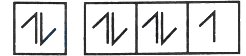
B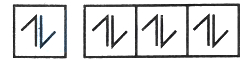
C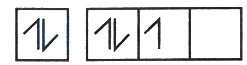
D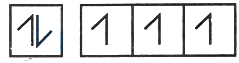
Solution
(C) According to Hund's rule of maximum multiplicity,pairing of electrons in the orbitals of a particular subshell does not take place until each orbital of that subshell is singly occupied.
In option $(C)$,the $p$-subshell has one orbital paired while the second orbital has only one electron and the third is empty. This violates Hund's rule because the electron should have occupied the third orbital singly before pairing occurred in the first orbital.
In option $(C)$,the $p$-subshell has one orbital paired while the second orbital has only one electron and the third is empty. This violates Hund's rule because the electron should have occupied the third orbital singly before pairing occurred in the first orbital.
0 likes
View Solution959
EasyMCQ
An element has $d^5$ configuration. The total number of electron exchanges possible for it is
A
$18$
B
$10$
C
$12$
D
$15$
Solution
(B) The total number of electron exchanges is given by the formula $\frac{n(n-1)}{2}$,where $n$ is the number of electrons with the same spin in the same subshell.
For a $d^5$ configuration,all $5$ electrons have the same spin (parallel spin) in $5$ different orbitals.
Substituting $n = 5$ into the formula:
$\text{Total exchanges} = \frac{5(5-1)}{2} = \frac{5 \times 4}{2} = \frac{20}{2} = 10$.
For a $d^5$ configuration,all $5$ electrons have the same spin (parallel spin) in $5$ different orbitals.
Substituting $n = 5$ into the formula:
$\text{Total exchanges} = \frac{5(5-1)}{2} = \frac{5 \times 4}{2} = \frac{20}{2} = 10$.
0 likes
View Solution960
EasyMCQ
"No two electrons in an atom can have the same set of all four quantum numbers." This principle is called:
A
Zeeman effect
B
Pauli's exclusion principle
C
Stark effect
D
Heisenberg principle
Solution
(B) According to $Pauli's$ exclusion principle,no two electrons in an atom can have the same set of all four quantum numbers $(n, l, m_l, m_s)$.
This implies that an orbital can accommodate a maximum of two electrons with opposite spins.
This implies that an orbital can accommodate a maximum of two electrons with opposite spins.
0 likes
View Solution961
MediumMCQ
The number of electrons that can be present in sub-shells having $m_s$ value of $\frac{-1}{2}$,for $n$ up to $3$.
A
$18$
B
$9$
C
$14$
D
$12$
Solution
(C) For $n=1$,the orbital is $1s$ ($1$ orbital).
For $n=2$,the orbitals are $2s$ and $2p$ ($1+3=4$ orbitals).
For $n=3$,the orbitals are $3s$,$3p$,and $3d$ ($1+3+5=9$ orbitals).
The total number of orbitals for $n$ up to $3$ is $1 + 4 + 9 = 14$.
Each orbital can accommodate exactly one electron with a spin quantum number $m_s = -\frac{1}{2}$.
Therefore,the total number of electrons with $m_s = -\frac{1}{2}$ is $14$.
Hence,the correct option is $C$.
For $n=2$,the orbitals are $2s$ and $2p$ ($1+3=4$ orbitals).
For $n=3$,the orbitals are $3s$,$3p$,and $3d$ ($1+3+5=9$ orbitals).
The total number of orbitals for $n$ up to $3$ is $1 + 4 + 9 = 14$.
Each orbital can accommodate exactly one electron with a spin quantum number $m_s = -\frac{1}{2}$.
Therefore,the total number of electrons with $m_s = -\frac{1}{2}$ is $14$.
Hence,the correct option is $C$.
0 likes
View Solution962
EasyMCQ
The maximum number of electrons that can have the set of quantum numbers $n=4$,$m_l=0$,and $m_s=\frac{1}{2}$ is
A
$3$
B
$4$
C
$5$
D
$6$
Solution
(B) For a given principal quantum number $n=4$,the possible subshells are $4s$,$4p$,$4d$,and $4f$.
Each subshell contains at least one orbital with $m_l=0$ (specifically the $ns$,$np_z$,$nd_{z^2}$,and $nf_{z^3}$ orbitals).
There are $4$ such orbitals in the $n=4$ shell that have $m_l=0$.
Since each orbital can hold only one electron with a specific spin $m_s=\frac{1}{2}$,the total number of electrons is $4 \times 1 = 4$.
Each subshell contains at least one orbital with $m_l=0$ (specifically the $ns$,$np_z$,$nd_{z^2}$,and $nf_{z^3}$ orbitals).
There are $4$ such orbitals in the $n=4$ shell that have $m_l=0$.
Since each orbital can hold only one electron with a specific spin $m_s=\frac{1}{2}$,the total number of electrons is $4 \times 1 = 4$.
0 likes
View Solution963
DifficultMCQ
In which of the following species,the ratio of $s$-electrons to $p$-electrons is the same?
A
$K^{+}, Cr^{3+}$
B
$Zn, Fe^{2+}$
C
$Zn, Cr^{3+}$
D
$Na^{+}, K^{+}$
Solution
(A) The ratio of $s$-electrons to $p$-electrons is determined by the electronic configuration of each species.
For $K^{+}$ $(Z=19)$: $1s^2 2s^2 2p^6 3s^2 3p^6$. Total $s$-electrons = $2+2+2 = 6$. Total $p$-electrons = $6+6 = 12$. Ratio = $6:12 = 1:2$.
For $Cr^{3+}$ $(Z=24)$: $1s^2 2s^2 2p^6 3s^2 3p^6 3d^3$. Total $s$-electrons = $2+2+2 = 6$. Total $p$-electrons = $6+6 = 12$. Ratio = $6:12 = 1:2$.
Since both $K^{+}$ and $Cr^{3+}$ have the same ratio of $1:2$,the correct option is $A$.
For $K^{+}$ $(Z=19)$: $1s^2 2s^2 2p^6 3s^2 3p^6$. Total $s$-electrons = $2+2+2 = 6$. Total $p$-electrons = $6+6 = 12$. Ratio = $6:12 = 1:2$.
For $Cr^{3+}$ $(Z=24)$: $1s^2 2s^2 2p^6 3s^2 3p^6 3d^3$. Total $s$-electrons = $2+2+2 = 6$. Total $p$-electrons = $6+6 = 12$. Ratio = $6:12 = 1:2$.
Since both $K^{+}$ and $Cr^{3+}$ have the same ratio of $1:2$,the correct option is $A$.
0 likes
View Solution964
MediumMCQ
Identify the pair of elements in which the ratio of the number of $s$-electrons to $p$-electrons is $2:3$.
A
$P, Mg$
B
$P, Ca$
C
$O, Mg$
D
$O, S$
Solution
(B) For $P$ $(Z=15)$: $1s^2 2s^2 2p^6 3s^2 3p^3$. Total $s$-electrons = $2+2+2 = 6$. Total $p$-electrons = $6+3 = 9$. Ratio = $6/9 = 2/3$.
For $Ca$ $(Z=20)$: $1s^2 2s^2 2p^6 3s^2 3p^6 4s^2$. Total $s$-electrons = $2+2+2+2 = 8$. Total $p$-electrons = $6+6 = 12$. Ratio = $8/12 = 2/3$.
Thus,the pair is $P$ and $Ca$.
For $Ca$ $(Z=20)$: $1s^2 2s^2 2p^6 3s^2 3p^6 4s^2$. Total $s$-electrons = $2+2+2+2 = 8$. Total $p$-electrons = $6+6 = 12$. Ratio = $8/12 = 2/3$.
Thus,the pair is $P$ and $Ca$.
0 likes
View Solution965
MediumMCQ
The degeneracy of the energy level of a hydrogen atom that has an energy of $\left(\frac{-R_{H}}{16}\right)$ is
A
$4$
B
$16$
C
$9$
D
$12$
Solution
(B) Given,$E = \left( \frac{-R_{H}}{n^2} \right) = \left( \frac{-R_{H}}{16} \right)$.
Comparing the denominators,we get $n^2 = 16$,which implies $n = 4$.
For a hydrogen atom,the energy depends only on the principal quantum number $n$.
The degeneracy of a level with principal quantum number $n$ is given by the formula $n^2$.
For $n = 4$,the degeneracy is $4^2 = 16$.
This corresponds to the $16$ orbitals present in the $n = 4$ shell: $4s$ ($1$ orbital),$4p$ ($3$ orbitals),$4d$ ($5$ orbitals),and $4f$ ($7$ orbitals),totaling $1 + 3 + 5 + 7 = 16$.
Comparing the denominators,we get $n^2 = 16$,which implies $n = 4$.
For a hydrogen atom,the energy depends only on the principal quantum number $n$.
The degeneracy of a level with principal quantum number $n$ is given by the formula $n^2$.
For $n = 4$,the degeneracy is $4^2 = 16$.
This corresponds to the $16$ orbitals present in the $n = 4$ shell: $4s$ ($1$ orbital),$4p$ ($3$ orbitals),$4d$ ($5$ orbitals),and $4f$ ($7$ orbitals),totaling $1 + 3 + 5 + 7 = 16$.
0 likes
View Solution966
MediumMCQ
Identify the incorrect statement from the following:
A
$m_l$ designates the orientation of the orbital
B
The probability density of electron is expressed by $|\psi|^2$
C
The total information about electron in atom is stored in its $\psi$
D
Total number of orbitals in a sub level is equal to $(2l+1)$
Solution
(C) The wave function $\psi$ itself does not have any direct physical meaning. It is a mathematical function that describes the state of an electron in an atom. The physical significance of $\psi$ is that the square of its magnitude,$|\psi|^2$,represents the probability density of finding an electron at a particular point in space. Therefore,the statement that the total information about an electron in an atom is stored in its $\psi$ is incorrect because $\psi$ is just a mathematical amplitude,whereas the physical probability is given by $|\psi|^2$.
0 likes
View Solution967
MediumMCQ
In $Sr$ $(Z=38)$,the number of electrons with $l=0$ is $x$,and the number of electrons with $l=2$ is $y$. The value of $(x-y)$ is equal to:
($l=$ Azimuthal quantum number)
($l=$ Azimuthal quantum number)
A
$0$
B
$8$
C
$-2$
D
$2$
Solution
(A) The electronic configuration of $Sr$ $(Z=38)$ is $1s^2, 2s^2, 2p^6, 3s^2, 3p^6, 4s^2, 3d^{10}, 4p^6, 5s^2$.
Electrons with $l=0$ (s-orbitals) are: $1s^2, 2s^2, 3s^2, 4s^2, 5s^2$. Total electrons $x = 2+2+2+2+2 = 10$.
Electrons with $l=2$ (d-orbitals) are: $3d^{10}$. Total electrons $y = 10$.
Therefore,$(x-y) = 10 - 10 = 0$.
Electrons with $l=0$ (s-orbitals) are: $1s^2, 2s^2, 3s^2, 4s^2, 5s^2$. Total electrons $x = 2+2+2+2+2 = 10$.
Electrons with $l=2$ (d-orbitals) are: $3d^{10}$. Total electrons $y = 10$.
Therefore,$(x-y) = 10 - 10 = 0$.
0 likes
View Solution968
EasyMCQ
If $n$ and $l$ represent the principal and azimuthal quantum numbers respectively,the formula used to determine the number of radial nodes possible for a given orbital is:
A
$(n-l)$
B
$(n-l+1)$
C
$(n-l-1)$
D
$(n-2)$
Solution
(C) The number of radial nodes in an orbital is given by the formula: $\text{Radial nodes} = n - l - 1$.
Angular nodes are given by: $\text{Angular nodes} = l$.
The total number of nodes is the sum of radial and angular nodes: $\text{Total nodes} = (n - l - 1) + l = n - 1$.
Angular nodes are given by: $\text{Angular nodes} = l$.
The total number of nodes is the sum of radial and angular nodes: $\text{Total nodes} = (n - l - 1) + l = n - 1$.
0 likes
View Solution969
MediumMCQ
Identify the impossible quantum number set for an electron from the following:
A
$n=2, l=0, m=0, s=-\frac{1}{2}$
B
$n=2, l=1, m=0, s=\frac{1}{2}$
C
$n=3, l=3, m=1, s=\frac{1}{2}$
D
$n=4, l=2, m=1, s=\frac{1}{2}$
Solution
(C) The rules for quantum numbers are:
$1$. The principal quantum number '$n$' can be any positive integer $(1, 2, 3, \dots)$.
$2$. The azimuthal quantum number '$l$' can have values from $0$ to $(n-1)$.
$3$. The magnetic quantum number '$m$' can have values from $-l$ to $+l$ including $0$.
$4$. The spin quantum number '$s$' can be $\pm\frac{1}{2}$.
In option $C$,$n=3$,so the maximum value of '$l$' is $(n-1) = 2$.
Since the given value is $l=3$,which is not possible for $n=3$,this set is impossible.
$1$. The principal quantum number '$n$' can be any positive integer $(1, 2, 3, \dots)$.
$2$. The azimuthal quantum number '$l$' can have values from $0$ to $(n-1)$.
$3$. The magnetic quantum number '$m$' can have values from $-l$ to $+l$ including $0$.
$4$. The spin quantum number '$s$' can be $\pm\frac{1}{2}$.
In option $C$,$n=3$,so the maximum value of '$l$' is $(n-1) = 2$.
Since the given value is $l=3$,which is not possible for $n=3$,this set is impossible.
0 likes
View Solution970
MediumMCQ
The number of electrons with $(n+\ell)$ values equal to $3, 4$ and $5$ in an element with atomic number $(Z) = 24$ are respectively $(n =$ principal quantum number and $\ell =$ azimuthal quantum number).
A
$7, 8, 5$
B
$6, 8, 6$
C
$8, 7, 5$
D
$8, 8, 5$
Solution
(C) The atomic number $Z = 24$ corresponds to Chromium $(Cr)$.
The electronic configuration of $Cr$ is $1s^2 2s^2 2p^6 3s^2 3p^6 3d^5 4s^1$.
For $(n+\ell) = 3$: The orbitals are $2p$ $(n=2, \ell=1)$ and $3s$ $(n=3, \ell=0)$. Total electrons $= 6 + 2 = 8$.
For $(n+\ell) = 4$: The orbitals are $3p$ $(n=3, \ell=1)$ and $4s$ $(n=4, \ell=0)$. Total electrons $= 6 + 1 = 7$.
For $(n+\ell) = 5$: The orbital is $3d$ $(n=3, \ell=2)$. Total electrons $= 5$.
The electronic configuration of $Cr$ is $1s^2 2s^2 2p^6 3s^2 3p^6 3d^5 4s^1$.
For $(n+\ell) = 3$: The orbitals are $2p$ $(n=2, \ell=1)$ and $3s$ $(n=3, \ell=0)$. Total electrons $= 6 + 2 = 8$.
For $(n+\ell) = 4$: The orbitals are $3p$ $(n=3, \ell=1)$ and $4s$ $(n=4, \ell=0)$. Total electrons $= 6 + 1 = 7$.
For $(n+\ell) = 5$: The orbital is $3d$ $(n=3, \ell=2)$. Total electrons $= 5$.
0 likes
View Solution971
MediumMCQ
The orbital angular momentum of an electron in a $d$ orbital is equal to:
A
$0$
B
$2 \sqrt{3} \hbar$
C
$6 \hbar$
D
$\sqrt{6} \hbar$
Solution
(D) The orbital angular momentum $(L)$ of an electron is given by the formula: $L = \sqrt{l(l+1)} \hbar$,where $l$ is the azimuthal quantum number and $\hbar = \frac{h}{2\pi}$.
For a $d$ orbital,the value of the azimuthal quantum number $l$ is $2$.
Substituting $l = 2$ into the formula:
$L = \sqrt{2(2+1)} \hbar$
$L = \sqrt{2(3)} \hbar$
$L = \sqrt{6} \hbar$
Therefore,the orbital angular momentum of an electron in a $d$ orbital is $\sqrt{6} \hbar$.
For a $d$ orbital,the value of the azimuthal quantum number $l$ is $2$.
Substituting $l = 2$ into the formula:
$L = \sqrt{2(2+1)} \hbar$
$L = \sqrt{2(3)} \hbar$
$L = \sqrt{6} \hbar$
Therefore,the orbital angular momentum of an electron in a $d$ orbital is $\sqrt{6} \hbar$.
0 likes
View Solution972
EasyMCQ
The maximum number of orbitals present in $n=4$ energy level of an atom and the maximum number of electrons with spin value $+\frac{1}{2}$ in the same orbitals are,respectively.
A
$16, 5$
B
$16, 7$
C
$16, 9$
D
$16, 16$
Solution
(D) For a given energy level $n$,the total number of orbitals is given by $n^2$.
For $n=4$,the total number of orbitals $= 4^2 = 16$.
Each orbital can hold a maximum of $2$ electrons with opposite spins,i.e.,$+\frac{1}{2}$ and $-\frac{1}{2}$.
Since there are $16$ orbitals,the total number of electrons is $16 \times 2 = 32$.
Out of these $32$ electrons,exactly half will have a spin value of $+\frac{1}{2}$.
Therefore,the number of electrons with spin $+\frac{1}{2} = \frac{32}{2} = 16$.
Thus,the values are $16$ and $16$.
For $n=4$,the total number of orbitals $= 4^2 = 16$.
Each orbital can hold a maximum of $2$ electrons with opposite spins,i.e.,$+\frac{1}{2}$ and $-\frac{1}{2}$.
Since there are $16$ orbitals,the total number of electrons is $16 \times 2 = 32$.
Out of these $32$ electrons,exactly half will have a spin value of $+\frac{1}{2}$.
Therefore,the number of electrons with spin $+\frac{1}{2} = \frac{32}{2} = 16$.
Thus,the values are $16$ and $16$.
0 likes
View Solution973
MediumMCQ
For an electron in the $d$-orbital,the orbital angular momentum is
A
$\frac{h}{2 \pi}$
B
$\frac{\sqrt{2} h}{2 \pi}$
C
$\frac{\sqrt{6} h}{2 \pi}$
D
$\frac{\sqrt{6} h}{2 \pi}$
Solution
(D) The orbital angular momentum of an electron is given by the formula: $\sqrt{l(l+1)} \frac{h}{2 \pi}$.
For a $d$-orbital,the azimuthal quantum number $(l)$ is $2$.
Substituting the value of $l$ into the formula:
Orbital angular momentum $= \sqrt{2(2+1)} \frac{h}{2 \pi} = \sqrt{2(3)} \frac{h}{2 \pi} = \sqrt{6} \frac{h}{2 \pi}$.
Thus,the correct option is $D$.
For a $d$-orbital,the azimuthal quantum number $(l)$ is $2$.
Substituting the value of $l$ into the formula:
Orbital angular momentum $= \sqrt{2(2+1)} \frac{h}{2 \pi} = \sqrt{2(3)} \frac{h}{2 \pi} = \sqrt{6} \frac{h}{2 \pi}$.
Thus,the correct option is $D$.
0 likes
View Solution974
EasyMCQ
The orbital with $4$ radial and $1$ angular nodes is
A
$5p_{y}$
B
$6p_{z}$
C
$4d_{xy}$
D
$5d_{yz}$
Solution
(B) The number of angular nodes is given by the azimuthal quantum number $l$. Here,angular nodes $= 1$,so $l = 1$,which corresponds to a $p$-subshell.
The number of radial nodes is given by the formula $n - l - 1$,where $n$ is the principal quantum number.
Given radial nodes $= 4$ and $l = 1$,we have $n - 1 - 1 = 4$,which gives $n = 6$.
Therefore,the orbital is $6p$ (e.g.,$6p_{z}$).
The number of radial nodes is given by the formula $n - l - 1$,where $n$ is the principal quantum number.
Given radial nodes $= 4$ and $l = 1$,we have $n - 1 - 1 = 4$,which gives $n = 6$.
Therefore,the orbital is $6p$ (e.g.,$6p_{z}$).
0 likes
View Solution975
MediumMCQ
An orbital with one angular node shows three maxima in its radial probability distribution curve,the orbital is
A
$3s$
B
$4p$
C
$5d$
D
$3p$
Solution
(B) The number of angular nodes is given by the azimuthal quantum number,$l$. Given that the orbital has one angular node,$l = 1$,which corresponds to a $p$-orbital.
The number of maxima in the radial probability distribution curve is given by the formula $n - l$.
Given that the number of maxima is $3$,we have $n - l = 3$.
Substituting $l = 1$ into the equation: $n - 1 = 3$,which gives $n = 4$.
Therefore,the orbital is $4p$.
The number of maxima in the radial probability distribution curve is given by the formula $n - l$.
Given that the number of maxima is $3$,we have $n - l = 3$.
Substituting $l = 1$ into the equation: $n - 1 = 3$,which gives $n = 4$.
Therefore,the orbital is $4p$.
0 likes
View Solution976
EasyMCQ
The number of radial nodes in $3s$ and $2p$-orbitals,respectively are
A
$2 : 2$
B
$2 : 0$
C
$0 : 0$
D
$3 : 2$
Solution
(B) The number of radial nodes is calculated using the formula: $\text{Radial nodes} = n - l - 1$.
For the $3s$ orbital,$n = 3$ and $l = 0$. Thus,$\text{Radial nodes} = 3 - 0 - 1 = 2$.
For the $2p$ orbital,$n = 2$ and $l = 1$. Thus,$\text{Radial nodes} = 2 - 1 - 1 = 0$.
Therefore,the number of radial nodes in $3s$ and $2p$ orbitals are $2$ and $0$ respectively.
For the $3s$ orbital,$n = 3$ and $l = 0$. Thus,$\text{Radial nodes} = 3 - 0 - 1 = 2$.
For the $2p$ orbital,$n = 2$ and $l = 1$. Thus,$\text{Radial nodes} = 2 - 1 - 1 = 0$.
Therefore,the number of radial nodes in $3s$ and $2p$ orbitals are $2$ and $0$ respectively.
0 likes
View Solution977
MediumMCQ
The correct order of decreasing energy for the electrons whose quantum numbers $n$ and $l$ are given below,is
$A$. $n=5, l=2$
$B$. $n=5, l=0$
$C$. $n=4, l=3$
$D$. $n=4, l=1$
$A$. $n=5, l=2$
$B$. $n=5, l=0$
$C$. $n=4, l=3$
$D$. $n=4, l=1$
A
$A > C > B > D$
B
$A > B > C > D$
C
$C > A > D > B$
D
$A > B > D > C$
Solution
(A) The energy of an orbital is determined by the $(n+l)$ rule. According to this rule,the orbital with a higher $(n+l)$ value has higher energy.
If the $(n+l)$ values are the same,the orbital with the higher value of $n$ has higher energy.
Calculating $(n+l)$ values for each:
$A: n=5, l=2 \implies (n+l) = 5+2 = 7$
$B: n=5, l=0 \implies (n+l) = 5+0 = 5$
$C: n=4, l=3 \implies (n+l) = 4+3 = 7$
$D: n=4, l=1 \implies (n+l) = 4+1 = 5$
Comparing the values:
For $A$ and $C$,$(n+l) = 7$. Since $A$ has a higher $n$ $(5 > 4)$,$A > C$.
For $B$ and $D$,$(n+l) = 5$. Since $B$ has a higher $n$ $(5 > 4)$,$B > D$.
Therefore,the decreasing order of energy is $A > C > B > D$.
If the $(n+l)$ values are the same,the orbital with the higher value of $n$ has higher energy.
Calculating $(n+l)$ values for each:
$A: n=5, l=2 \implies (n+l) = 5+2 = 7$
$B: n=5, l=0 \implies (n+l) = 5+0 = 5$
$C: n=4, l=3 \implies (n+l) = 4+3 = 7$
$D: n=4, l=1 \implies (n+l) = 4+1 = 5$
Comparing the values:
For $A$ and $C$,$(n+l) = 7$. Since $A$ has a higher $n$ $(5 > 4)$,$A > C$.
For $B$ and $D$,$(n+l) = 5$. Since $B$ has a higher $n$ $(5 > 4)$,$B > D$.
Therefore,the decreasing order of energy is $A > C > B > D$.
0 likes
View Solution978
EasyMCQ
The maximum number of possible electrons in a subshell with $n=3$ and $l=2$ is
A
$10$
B
$12$
C
$14$
D
$16$
Solution
(A) The subshell is defined by the azimuthal quantum number $l$. For $l=2$,the subshell is the $d$-subshell.
The number of orbitals in a subshell is given by $(2l+1)$.
For $l=2$,the number of orbitals $= 2(2)+1 = 5$.
Since each orbital can hold a maximum of $2$ electrons,the maximum number of electrons in the $d$-subshell is $5 \times 2 = 10$.
The number of orbitals in a subshell is given by $(2l+1)$.
For $l=2$,the number of orbitals $= 2(2)+1 = 5$.
Since each orbital can hold a maximum of $2$ electrons,the maximum number of electrons in the $d$-subshell is $5 \times 2 = 10$.
0 likes
View Solution979
EasyMCQ
From the following sets of quantum numbers,which set is possible?
A
$n=1, l=0, m_l=+1, m_s=-\frac{1}{2}$
B
$n=1, l=1, m_l=0, m_s=+\frac{1}{2}$
C
$n=3, l=1, m_l=0, m_s=+\frac{1}{2}$
D
$n=3, l=3, m_l=-3, m_s=+\frac{1}{2}$
Solution
(C) The rules for quantum numbers are:
$1$. $n = 1, 2, 3, \dots$
$2$. $l = 0$ to $(n-1)$
$3$. $m_l = -l$ to $+l$
$4$. $m_s = \pm \frac{1}{2}$
Check each option:
$(A)$ For $n=1, l=0$,the only possible value for $m_l$ is $0$. Thus,$m_l=+1$ is incorrect.
$(B)$ For $n=1$,$l$ can only be $0$. Thus,$l=1$ is incorrect.
$(C)$ For $n=3$,$l$ can be $0, 1, 2$. If $l=1$,$m_l$ can be $-1, 0, +1$. Since $m_l=0$ and $m_s=+\frac{1}{2}$ are valid,this set is possible.
$(D)$ For $n=3$,$l$ can only be $0, 1, 2$. Thus,$l=3$ is incorrect.
Therefore,option $(C)$ is correct.
$1$. $n = 1, 2, 3, \dots$
$2$. $l = 0$ to $(n-1)$
$3$. $m_l = -l$ to $+l$
$4$. $m_s = \pm \frac{1}{2}$
Check each option:
$(A)$ For $n=1, l=0$,the only possible value for $m_l$ is $0$. Thus,$m_l=+1$ is incorrect.
$(B)$ For $n=1$,$l$ can only be $0$. Thus,$l=1$ is incorrect.
$(C)$ For $n=3$,$l$ can be $0, 1, 2$. If $l=1$,$m_l$ can be $-1, 0, +1$. Since $m_l=0$ and $m_s=+\frac{1}{2}$ are valid,this set is possible.
$(D)$ For $n=3$,$l$ can only be $0, 1, 2$. Thus,$l=3$ is incorrect.
Therefore,option $(C)$ is correct.
0 likes
View Solution980
EasyMCQ
Maximum number of electrons in a subshell with $n=4$ and $l=3$ is
A
$10$
B
$12$
C
$14$
D
$16$
Solution
(C) The maximum number of electrons in a subshell is given by the formula $2(2l + 1)$.
For a subshell with $n=4$ and $l=3$,the subshell is $4f$.
Substituting $l=3$ into the formula:
$= 2(2 \times 3 + 1) = 2(6 + 1) = 2 \times 7 = 14$ electrons.
For a subshell with $n=4$ and $l=3$,the subshell is $4f$.
Substituting $l=3$ into the formula:
$= 2(2 \times 3 + 1) = 2(6 + 1) = 2 \times 7 = 14$ electrons.
0 likes
View Solution981
MediumMCQ
Which of the following are correct?
$(1)$ Electron density in $XY$ plane for $d_{x^2-y^2}$ orbital is zero.
$(2)$ The energy of $3p$-orbital is higher than the energy of $2p$-orbital.
$(3)$ $3p_z$-orbital has one angular node.
$(4)$ $4f$-orbital has no radial node.
$(1)$ Electron density in $XY$ plane for $d_{x^2-y^2}$ orbital is zero.
$(2)$ The energy of $3p$-orbital is higher than the energy of $2p$-orbital.
$(3)$ $3p_z$-orbital has one angular node.
$(4)$ $4f$-orbital has no radial node.
A
$1, 2, 3, 4$
B
$2, 3, 1$
C
$2, 3, 4$
D
$3, 4, 1$
Solution
(C) $1$. In $d_{x^2-y^2}$ orbital,electrons are present along the $x$ and $y$ axes,so the electron density in the $XY$ plane is not zero.
$2$. According to the $(n+l)$ rule,the energy increases as the sum of $(n+l)$ increases.
For $3p$,$(n+l) = 3+1 = 4$.
For $2p$,$(n+l) = 2+1 = 3$.
Thus,$3p$ has higher energy than $2p$.
$3$. The number of angular nodes is equal to the azimuthal quantum number $l$.
For $p$-orbitals,$l = 1$,so $3p_z$ has one angular node.
$4$. The number of radial nodes is given by $(n-l-1)$.
For $4f$,$n = 4$ and $l = 3$,so radial nodes $= 4-3-1 = 0$.
$2$. According to the $(n+l)$ rule,the energy increases as the sum of $(n+l)$ increases.
For $3p$,$(n+l) = 3+1 = 4$.
For $2p$,$(n+l) = 2+1 = 3$.
Thus,$3p$ has higher energy than $2p$.
$3$. The number of angular nodes is equal to the azimuthal quantum number $l$.
For $p$-orbitals,$l = 1$,so $3p_z$ has one angular node.
$4$. The number of radial nodes is given by $(n-l-1)$.
For $4f$,$n = 4$ and $l = 3$,so radial nodes $= 4-3-1 = 0$.
0 likes
View Solution982
EasyMCQ
The number of radial nodes present in $3p$ orbital is
A
$0$
B
$1$
C
$2$
D
$3$
Solution
(B) The formula for calculating the number of radial nodes is given by: $\text{Radial nodes} = n - l - 1$.
For the $3p$ orbital,the principal quantum number $n = 3$ and the azimuthal quantum number $l = 1$.
Substituting these values into the formula: $\text{Radial nodes} = 3 - 1 - 1 = 1$.
For the $3p$ orbital,the principal quantum number $n = 3$ and the azimuthal quantum number $l = 1$.
Substituting these values into the formula: $\text{Radial nodes} = 3 - 1 - 1 = 1$.
0 likes
View Solution983
EasyMCQ
The number of angular and radial nodes of $4d$ orbital respectively are
A
$2, 1$
B
$1, 2$
C
$3, 0$
D
$4, 0$
Solution
(A) For $4d$ orbital,the principal quantum number $n = 4$ and the azimuthal quantum number $l = 2$.
Number of angular nodes $= l = 2$.
Number of radial nodes $= n - l - 1 = 4 - 2 - 1 = 1$.
Therefore,the number of angular and radial nodes are $2$ and $1$ respectively.
Number of angular nodes $= l = 2$.
Number of radial nodes $= n - l - 1 = 4 - 2 - 1 = 1$.
Therefore,the number of angular and radial nodes are $2$ and $1$ respectively.
0 likes
View Solution984
MediumMCQ
The quantum number which explains the line spectra observed as doublets in the case of hydrogen and alkali metals,and doublets and triplets in the case of alkaline earth metals is:
A
$Spin$
B
$Azimuthal$
C
$Magnetic$
D
$Principal$
Solution
(A) The $Spin$ quantum number $(s)$ explains the fine structure of spectral lines,such as the doublets observed in the spectra of $H$ and alkali metals,and the doublets and triplets observed in the spectra of alkaline earth metals,due to the electron spin angular momentum.
0 likes
View Solution985
MediumMCQ
The maximum number of sub-levels,orbitals and electrons in $N$ shell of an atom are respectively
A
$4, 12, 32$
B
$4, 16, 30$
C
$4, 16, 32$
D
$4, 32, 64$
Solution
(C) For the $N$ shell,the principal quantum number $n = 4$.
Number of sub-levels (sub-shells) is equal to $n$,so there are $4$ sub-levels.
Number of orbitals is given by $n^2 = 4^2 = 16$.
Number of electrons is given by $2n^2 = 2 \times 4^2 = 32$.
Thus,the values are $4, 16, 32$.
Number of sub-levels (sub-shells) is equal to $n$,so there are $4$ sub-levels.
Number of orbitals is given by $n^2 = 4^2 = 16$.
Number of electrons is given by $2n^2 = 2 \times 4^2 = 32$.
Thus,the values are $4, 16, 32$.
0 likes
View Solution986
MediumMCQ
Two statements are given below:
Statement $I$: In $H$ atom,the energy of $2s$ and $2p$ orbitals is same.
Statement $II$: In $He$ atom,the energy of $2s$ and $2p$ orbitals is same.
The correct answer is:
Statement $I$: In $H$ atom,the energy of $2s$ and $2p$ orbitals is same.
Statement $II$: In $He$ atom,the energy of $2s$ and $2p$ orbitals is same.
The correct answer is:
A
Both statements $I$ and $II$ are correct
B
Both statements $I$ and $II$ are not correct
C
Statement $I$ is correct but statement $II$ is not correct
D
Statement $I$ is not correct but statement $II$ is correct
Solution
(C) In a hydrogen atom,which is a single-electron system,the energy of orbitals depends only on the principal quantum number $(n)$. Therefore,$2s$ and $2p$ orbitals have the same energy.
In multi-electron atoms like $He$,the energy of orbitals depends on both the principal quantum number $(n)$ and the azimuthal quantum number $(l)$. Due to the shielding effect,the $2s$ orbital has lower energy than the $2p$ orbital.
Thus,statement $I$ is correct,and statement $II$ is incorrect.
In multi-electron atoms like $He$,the energy of orbitals depends on both the principal quantum number $(n)$ and the azimuthal quantum number $(l)$. Due to the shielding effect,the $2s$ orbital has lower energy than the $2p$ orbital.
Thus,statement $I$ is correct,and statement $II$ is incorrect.
0 likes
View Solution987
MediumMCQ
Based on the quantum numbers,what will be the maximum number of elements in the sixth period of the periodic table?
A
$22$
B
$30$
C
$32$
D
$34$
Solution
(C) The number of elements in a period is equal to the number of electrons that can be filled in the orbitals being filled for that period.
For the $6^{th}$ period,the orbitals being filled are $6s$,$4f$,$5d$,and $6p$.
The maximum number of electrons that can be accommodated in these orbitals is:
$6s: 2$ electrons
$4f: 14$ electrons
$5d: 10$ electrons
$6p: 6$ electrons
Total number of elements = $2 + 14 + 10 + 6 = 32$.
Thus,the $6^{th}$ period contains $32$ elements,ranging from atomic number $(Z) = 55$ to $(Z) = 86$.
For the $6^{th}$ period,the orbitals being filled are $6s$,$4f$,$5d$,and $6p$.
The maximum number of electrons that can be accommodated in these orbitals is:
$6s: 2$ electrons
$4f: 14$ electrons
$5d: 10$ electrons
$6p: 6$ electrons
Total number of elements = $2 + 14 + 10 + 6 = 32$.
Thus,the $6^{th}$ period contains $32$ elements,ranging from atomic number $(Z) = 55$ to $(Z) = 86$.
0 likes
View Solution988
EasyMCQ
The order of filling of electrons in orbitals in $Ti$ is
A
$1 s, 2 s, 2 p, 3 s, 3 p, 3 d$ and $4 s$
B
$1 s, 2 s, 2 p, 3 s, 3 p, 4 s$ and $3 d$
C
$1 s, 2 s, 2 p, 3 s, 4 s, 3 p$ and $3 d$
D
$1 s, 2 s, 2 p, 3 s, 3 d, 3 p$ and $4 s$
Solution
(B) According to the Aufbau principle,electrons are filled in orbitals in increasing order of their energy,which is determined by the $(n+l)$ rule.
For $Ti$ $(Z=22)$,the electronic configuration is $1s^2, 2s^2, 2p^6, 3s^2, 3p^6, 4s^2, 3d^2$.
The order of filling of orbitals is $1s, 2s, 2p, 3s, 3p, 4s, 3d$.
For $Ti$ $(Z=22)$,the electronic configuration is $1s^2, 2s^2, 2p^6, 3s^2, 3p^6, 4s^2, 3d^2$.
The order of filling of orbitals is $1s, 2s, 2p, 3s, 3p, 4s, 3d$.
0 likes
View Solution989
EasyMCQ
The element with the electronic configuration $1s^2 2s^2 2p^6 3s^2 3p^6 3d^{10} 4s^1$ is
A
$Cu$
B
$Ca$
C
$Cr$
D
$CO$
Solution
(A) The given electronic configuration is $1s^2 2s^2 2p^6 3s^2 3p^6 3d^{10} 4s^1$.
Summing the electrons: $2+2+6+2+6+10+1 = 29$.
The element with atomic number $29$ is Copper $(Cu)$.
This configuration represents the stable ground state of $Cu$ where the $3d$ subshell is completely filled.
Summing the electrons: $2+2+6+2+6+10+1 = 29$.
The element with atomic number $29$ is Copper $(Cu)$.
This configuration represents the stable ground state of $Cu$ where the $3d$ subshell is completely filled.
0 likes
View Solution990
MediumMCQ
Assertion $(A)$: Atoms with completely filled and half-filled subshells are stable.
Reason $(R)$: Completely filled and half-filled subshells have symmetrical distribution of electrons and have maximum exchange energy.
The correct answer is:
Reason $(R)$: Completely filled and half-filled subshells have symmetrical distribution of electrons and have maximum exchange energy.
The correct answer is:
A
$(A)$ and $(R)$ are correct,$(R)$ is the correct explanation of $(A)$
B
$(A)$ and $(R)$ are correct,$(R)$ is not the correct explanation of $(A)$
C
$(A)$ is correct,but $(R)$ is not correct
D
$(A)$ is not correct,but $(R)$ is correct
Solution
(A) The extra stability of half-filled and fully filled electronic configurations can be explained in terms of symmetry and exchange energy.
All the orbitals of the same subshell that are either completely filled or half-filled have a more symmetrical distribution of electrons.
Consequently,the shielding of electrons is relatively small,and the electrons are more strongly attracted by the nucleus.
Furthermore,the number of possible exchanges is maximum in these configurations,which leads to higher exchange energy and,therefore,greater stability of the atom.
Thus,both $(A)$ and $(R)$ are correct,and $(R)$ is the correct explanation of $(A)$.
All the orbitals of the same subshell that are either completely filled or half-filled have a more symmetrical distribution of electrons.
Consequently,the shielding of electrons is relatively small,and the electrons are more strongly attracted by the nucleus.
Furthermore,the number of possible exchanges is maximum in these configurations,which leads to higher exchange energy and,therefore,greater stability of the atom.
Thus,both $(A)$ and $(R)$ are correct,and $(R)$ is the correct explanation of $(A)$.
0 likes
View Solution991
MediumMCQ
An element in $+2$ oxidation state has $24$ electrons. The atomic number of the element and the number of unpaired electrons in it respectively are
A
$24$ and $4$
B
$26$ and $4$
C
$24$ and $2$
D
$26$ and $5$
Solution
(B) The electronic configuration of an element with atomic number $Z$ in $+2$ oxidation state is equivalent to an atom with $Z-2$ electrons.
Given $Z-2 = 24$,the atomic number $Z = 26$. The element is $Fe$.
The ground state electronic configuration of $Fe$ $(Z=26)$ is $[Ar] 3d^6 4s^2$.
The configuration of $Fe^{2+}$ is $[Ar] 3d^6$.
In the $3d^6$ configuration,the electrons are distributed in $5$ orbitals of $d$-subshell according to Hund's rule: $d_{xy}^2, d_{yz}^1, d_{zx}^1, d_{x^2-y^2}^1, d_{z^2}^1$.
Thus,there are $4$ unpaired electrons.
Given $Z-2 = 24$,the atomic number $Z = 26$. The element is $Fe$.
The ground state electronic configuration of $Fe$ $(Z=26)$ is $[Ar] 3d^6 4s^2$.
The configuration of $Fe^{2+}$ is $[Ar] 3d^6$.
In the $3d^6$ configuration,the electrons are distributed in $5$ orbitals of $d$-subshell according to Hund's rule: $d_{xy}^2, d_{yz}^1, d_{zx}^1, d_{x^2-y^2}^1, d_{z^2}^1$.
Thus,there are $4$ unpaired electrons.
0 likes
View Solution992
MediumMCQ
In an atom,the order of increasing energy of electrons with quantum numbers $(i)$ $n=4, l=1$,(ii) $n=4, l=0$,(iii) $n=3, l=2$,and (iv) $n=3, l=1$ is:
A
$(iii) < (i) < (iv) < (ii)$
B
$(ii) < (iv) < (i) < (iii)$
C
$(i) < (iii) < (ii) < (iv)$
D
$(iv) < (ii) < (iii) < (i)$
Solution
(D) The order of increasing energy is determined by the $(n+l)$ rule.
If two orbitals have the same value of $(n+l)$,the orbital with the lower value of $n$ has lower energy.
$(i)$ For $n=4, l=1$,$(n+l) = 4+1 = 5$.
(ii) For $n=4, l=0$,$(n+l) = 4+0 = 4$.
(iii) For $n=3, l=2$,$(n+l) = 3+2 = 5$.
(iv) For $n=3, l=1$,$(n+l) = 3+1 = 4$.
Comparing the values: (iv) and (ii) have $(n+l) = 4$. Since (iv) has lower $n$,$(iv) < (ii)$.
$(i)$ and (iii) have $(n+l) = 5$. Since (iii) has lower $n$,$(iii) < (i)$.
Thus,the increasing order of energy is $(iv) < (ii) < (iii) < (i)$.
If two orbitals have the same value of $(n+l)$,the orbital with the lower value of $n$ has lower energy.
$(i)$ For $n=4, l=1$,$(n+l) = 4+1 = 5$.
(ii) For $n=4, l=0$,$(n+l) = 4+0 = 4$.
(iii) For $n=3, l=2$,$(n+l) = 3+2 = 5$.
(iv) For $n=3, l=1$,$(n+l) = 3+1 = 4$.
Comparing the values: (iv) and (ii) have $(n+l) = 4$. Since (iv) has lower $n$,$(iv) < (ii)$.
$(i)$ and (iii) have $(n+l) = 5$. Since (iii) has lower $n$,$(iii) < (i)$.
Thus,the increasing order of energy is $(iv) < (ii) < (iii) < (i)$.
0 likes
View Solution993
MediumMCQ
The atomic numbers of elements $X, Y$ and $Z$ are $19, 21$ and $25$ respectively. The number of electrons present in the $M$-shell of these elements follow the order:
A
$Z > X > Y$
B
$X > Y > Z$
C
$Z > Y > X$
D
$Y > Z > X$
Solution
(C) The electronic configurations of the elements are as follows:
For $X$ $(Z=19)$: $1s^2 2s^2 2p^6 3s^2 3p^6 4s^1$. The $M$-shell $(n=3)$ contains $2+6 = 8$ electrons.
For $Y$ $(Z=21)$: $1s^2 2s^2 2p^6 3s^2 3p^6 3d^1 4s^2$. The $M$-shell $(n=3)$ contains $2+6+1 = 9$ electrons.
For $Z$ $(Z=25)$: $1s^2 2s^2 2p^6 3s^2 3p^6 3d^5 4s^2$. The $M$-shell $(n=3)$ contains $2+6+5 = 13$ electrons.
Comparing the number of electrons in the $M$-shell: $Z (13) > Y (9) > X (8)$.
Thus,the correct order is $Z > Y > X$.
For $X$ $(Z=19)$: $1s^2 2s^2 2p^6 3s^2 3p^6 4s^1$. The $M$-shell $(n=3)$ contains $2+6 = 8$ electrons.
For $Y$ $(Z=21)$: $1s^2 2s^2 2p^6 3s^2 3p^6 3d^1 4s^2$. The $M$-shell $(n=3)$ contains $2+6+1 = 9$ electrons.
For $Z$ $(Z=25)$: $1s^2 2s^2 2p^6 3s^2 3p^6 3d^5 4s^2$. The $M$-shell $(n=3)$ contains $2+6+5 = 13$ electrons.
Comparing the number of electrons in the $M$-shell: $Z (13) > Y (9) > X (8)$.
Thus,the correct order is $Z > Y > X$.
0 likes
View Solution994
MediumMCQ
Which of the following elements has the least number of electrons in its $M$ shell?
A
$K$
B
$Mn$
C
$Ni$
D
$Sc$
Solution
(A) The electronic configurations of the given elements are as follows:
$K (Z=19): 1s^2, 2s^2 2p^6, 3s^2 3p^6, 4s^1$. The $M$ shell $(n=3)$ has $2+6 = 8$ electrons.
$Mn (Z=25): 1s^2, 2s^2 2p^6, 3s^2 3p^6 3d^5, 4s^2$. The $M$ shell $(n=3)$ has $2+6+5 = 13$ electrons.
$Ni (Z=28): 1s^2, 2s^2 2p^6, 3s^2 3p^6 3d^8, 4s^2$. The $M$ shell $(n=3)$ has $2+6+8 = 16$ electrons.
$Sc (Z=21): 1s^2, 2s^2 2p^6, 3s^2 3p^6 3d^1, 4s^2$. The $M$ shell $(n=3)$ has $2+6+1 = 9$ electrons.
Comparing the number of electrons in the $M$ shell: $K (8) < Sc (9) < Mn (13) < Ni (16)$.
Thus,$K$ has the least number of electrons in its $M$ shell.
$K (Z=19): 1s^2, 2s^2 2p^6, 3s^2 3p^6, 4s^1$. The $M$ shell $(n=3)$ has $2+6 = 8$ electrons.
$Mn (Z=25): 1s^2, 2s^2 2p^6, 3s^2 3p^6 3d^5, 4s^2$. The $M$ shell $(n=3)$ has $2+6+5 = 13$ electrons.
$Ni (Z=28): 1s^2, 2s^2 2p^6, 3s^2 3p^6 3d^8, 4s^2$. The $M$ shell $(n=3)$ has $2+6+8 = 16$ electrons.
$Sc (Z=21): 1s^2, 2s^2 2p^6, 3s^2 3p^6 3d^1, 4s^2$. The $M$ shell $(n=3)$ has $2+6+1 = 9$ electrons.
Comparing the number of electrons in the $M$ shell: $K (8) < Sc (9) < Mn (13) < Ni (16)$.
Thus,$K$ has the least number of electrons in its $M$ shell.
0 likes
View SolutionStructure of Atom — Quantum number, Electronic configuration and Shape of orbitals · Frequently Asked Questions
1Are these Structure of Atom questions useful for JEE and NEET?
Yes. All questions in this section are mapped to JEE Main and NEET exam patterns. Previous year questions from JEE Main, NEET, GUJCET and state-level exams are included with full solutions.
2Can I switch to Hindi or Gujarati for these questions?
Yes. Use the language tabs in the hero section or the sidebar to view the same questions and solutions in English, Hindi or Gujarati.
3How do I generate a question paper from this subtopic?
Use the Vedclass Exam Paper Generator — select the chapter and subtopic, set difficulty, and generate Sets A, B, C, D automatically. First 3 chapters of every subject are free.
Vedclass Products
For Students
Vedclass Test Series
Mock tests in real JEE/NEET style with performance analysis. 5-day free trial.
Start Free TrialFor Teachers
Exam Paper Generator
Generate Set A/B/C/D papers from this chapter in 2 minutes. 3 chapters free.
Try FreeFor Institutes
Online Exam Module
Live online exams with unlimited students, 360° analytics & white-label branding.
See DemoFor Teachers & Institutes
Generate a Structure of Atom Exam Paper in 2 Minutes
Select subtopic & difficulty — Sets A, B, C, D auto-generated with No Repeat logic.
First 3 chapters of every subject are free — no payment required.