
A English
Quantum number, Electronic configuration and Shape of orbitals Questions in English
Class 11 Chemistry · Structure of Atom · Quantum number, Electronic configuration and Shape of orbitals
1023+
Questions
English
Language
100%
With Solutions
Showing 50 of 1023 questions in English
851
DifficultMCQ
The hydrogen-like species $Li^{2+}$ is in a spherically symmetric state $S_1$ with one radial node. Upon absorbing light,the ion undergoes transition to a state $S_2$. The state $S_2$ has one radial node and its energy is equal to the ground state energy of the hydrogen atom.
$1.$ The state $S_1$ is
$(A)$ $1s$ $(B)$ $2s$ $(C)$ $2p$ $(D)$ $3s$
$2.$ Energy of the state $S_1$ in units of the hydrogen atom ground state energy is
$(A)$ $0.75$ $(B)$ $1.50$ $(C)$ $2.25$ $(D)$ $4.50$
$3.$ The orbital angular momentum quantum number of the state $S_2$ is
$(A)$ $0$ $(B)$ $1$ $(C)$ $2$ $(D)$ $3$
Give the answer for questions $1, 2$ and $3.$
$1.$ The state $S_1$ is
$(A)$ $1s$ $(B)$ $2s$ $(C)$ $2p$ $(D)$ $3s$
$2.$ Energy of the state $S_1$ in units of the hydrogen atom ground state energy is
$(A)$ $0.75$ $(B)$ $1.50$ $(C)$ $2.25$ $(D)$ $4.50$
$3.$ The orbital angular momentum quantum number of the state $S_2$ is
$(A)$ $0$ $(B)$ $1$ $(C)$ $2$ $(D)$ $3$
Give the answer for questions $1, 2$ and $3.$
A
$(B, C, B)$
B
$(B, C, A)$
C
$(A, B, A)$
D
$(D, B, C)$
Solution
(B) $1.$ For $S_1$ (spherically symmetric,$\ell = 0$):
$\text{Radial node} = n - \ell - 1 = 1$ $\Rightarrow n - 0 - 1 = 1$ $\Rightarrow n = 2.$
Thus,state $S_1$ is $2s$.
For $S_2$,energy $E_{S_2} = E_H(\text{ground}) = -13.6 \ eV$.
$E_{S_2} = \frac{-13.6 \times Z^2}{n^2} = -13.6 \ eV$ $\Rightarrow \frac{3^2}{n^2} = 1$ $\Rightarrow n = 3.$
Given $S_2$ has one radial node: $n - \ell - 1 = 1$ $\Rightarrow 3 - \ell - 1 = 1$ $\Rightarrow \ell = 1$.
$2.$ Energy of $S_1$ $(n=2, Z=3)$: $E_{S_1} = \frac{-13.6 \times 3^2}{2^2} = -13.6 \times 2.25 \ eV$.
In units of $E_H(\text{ground}) = -13.6 \ eV$,the energy is $2.25$.
$3.$ For $S_2$,$\ell = 1$ (as calculated above).
$\text{Radial node} = n - \ell - 1 = 1$ $\Rightarrow n - 0 - 1 = 1$ $\Rightarrow n = 2.$
Thus,state $S_1$ is $2s$.
For $S_2$,energy $E_{S_2} = E_H(\text{ground}) = -13.6 \ eV$.
$E_{S_2} = \frac{-13.6 \times Z^2}{n^2} = -13.6 \ eV$ $\Rightarrow \frac{3^2}{n^2} = 1$ $\Rightarrow n = 3.$
Given $S_2$ has one radial node: $n - \ell - 1 = 1$ $\Rightarrow 3 - \ell - 1 = 1$ $\Rightarrow \ell = 1$.
$2.$ Energy of $S_1$ $(n=2, Z=3)$: $E_{S_1} = \frac{-13.6 \times 3^2}{2^2} = -13.6 \times 2.25 \ eV$.
In units of $E_H(\text{ground}) = -13.6 \ eV$,the energy is $2.25$.
$3.$ For $S_2$,$\ell = 1$ (as calculated above).
0 likes
View Solution852
DifficultMCQ
The maximum number of electrons that can have principal quantum number,$n=3$,and spin quantum number,$m_s=-1/2$,is
A
$2$
B
$7$
C
$9$
D
$5$
Solution
(C) For a shell with principal quantum number $n$,the total number of orbitals is $n^2$.
For $n=3$,the total number of orbitals is $3^2 = 9$.
Each orbital can hold a maximum of $2$ electrons,one with $m_s = +1/2$ and one with $m_s = -1/2$.
Therefore,for $n=3$,there are $9$ orbitals,and each can accommodate exactly one electron with $m_s = -1/2$.
Thus,the maximum number of electrons with $n=3$ and $m_s = -1/2$ is $9$.
For $n=3$,the total number of orbitals is $3^2 = 9$.
Each orbital can hold a maximum of $2$ electrons,one with $m_s = +1/2$ and one with $m_s = -1/2$.
Therefore,for $n=3$,there are $9$ orbitals,and each can accommodate exactly one electron with $m_s = -1/2$.
Thus,the maximum number of electrons with $n=3$ and $m_s = -1/2$ is $9$.
0 likes
View Solution853
MediumMCQ
The ground state energy of a hydrogen atom is $-13.6 \ eV$. Consider an electronic state $\Psi$ of $He^+$ whose energy,azimuthal quantum number,and magnetic quantum number are $-3.4 \ eV$,$2$,and $0$ respectively. Which of the following statement$(s)$ is(are) true for the state $\Psi$?
$(1)$ It has $2$ angular nodes
$(2)$ It has $3$ radial nodes
$(3)$ It is a $4d$ state
$(4)$ The nuclear charge experienced by the electron in this state is less than $2e$,where $e$ is the magnitude of the electronic charge.
$(1)$ It has $2$ angular nodes
$(2)$ It has $3$ radial nodes
$(3)$ It is a $4d$ state
$(4)$ The nuclear charge experienced by the electron in this state is less than $2e$,where $e$ is the magnitude of the electronic charge.
A
$1, 3$
B
$1, 4$
C
$1, 2$
D
$1, 2, 3$
Solution
(A) For a hydrogen-like species,the energy is given by $E_n = -13.6 \times \frac{Z^2}{n^2} \ eV$.
For $He^+$,$Z = 2$. Given $E = -3.4 \ eV$,we have $-3.4 = -13.6 \times \frac{2^2}{n^2}$,which simplifies to $n^2 = 16$,so $n = 4$.
Given azimuthal quantum number $\ell = 2$,the state is $4d$.
Number of angular nodes $= \ell = 2$.
Number of radial nodes $= n - \ell - 1 = 4 - 2 - 1 = 1$.
Since $He^+$ is a single-electron species,the nuclear charge experienced is the full nuclear charge $Z = 2e$,so statement $(4)$ is incorrect.
Thus,statements $(1)$ and $(3)$ are true.
For $He^+$,$Z = 2$. Given $E = -3.4 \ eV$,we have $-3.4 = -13.6 \times \frac{2^2}{n^2}$,which simplifies to $n^2 = 16$,so $n = 4$.
Given azimuthal quantum number $\ell = 2$,the state is $4d$.
Number of angular nodes $= \ell = 2$.
Number of radial nodes $= n - \ell - 1 = 4 - 2 - 1 = 1$.
Since $He^+$ is a single-electron species,the nuclear charge experienced is the full nuclear charge $Z = 2e$,so statement $(4)$ is incorrect.
Thus,statements $(1)$ and $(3)$ are true.
0 likes
View Solution854
EasyMCQ
In an atom,the total number of electrons having quantum numbers $n=4$,$|m_{\ell}|=1$ and $m_s=-1/2$ is
A
$4$
B
$5$
C
$6$
D
$7$
Solution
(C) For $n=4$,the possible subshells are $4s, 4p, 4d, 4f$.
Condition $|m_{\ell}|=1$ implies $m_{\ell} = +1$ or $m_{\ell} = -1$.
- In $4p$ subshell $(\ell=1)$: $m_{\ell} = -1, 0, +1$. The orbitals with $|m_{\ell}|=1$ are $m_{\ell} = -1$ and $m_{\ell} = +1$ ($2$ orbitals).
- In $4d$ subshell $(\ell=2)$: $m_{\ell} = -2, -1, 0, +1, +2$. The orbitals with $|m_{\ell}|=1$ are $m_{\ell} = -1$ and $m_{\ell} = +1$ ($2$ orbitals).
- In $4f$ subshell $(\ell=3)$: $m_{\ell} = -3, -2, -1, 0, +1, +2, +3$. The orbitals with $|m_{\ell}|=1$ are $m_{\ell} = -1$ and $m_{\ell} = +1$ ($2$ orbitals).
Total number of orbitals with $|m_{\ell}|=1$ is $2+2+2 = 6$. Since each orbital can hold one electron with $m_s=-1/2$,the total number of electrons is $6$.
Condition $|m_{\ell}|=1$ implies $m_{\ell} = +1$ or $m_{\ell} = -1$.
- In $4p$ subshell $(\ell=1)$: $m_{\ell} = -1, 0, +1$. The orbitals with $|m_{\ell}|=1$ are $m_{\ell} = -1$ and $m_{\ell} = +1$ ($2$ orbitals).
- In $4d$ subshell $(\ell=2)$: $m_{\ell} = -2, -1, 0, +1, +2$. The orbitals with $|m_{\ell}|=1$ are $m_{\ell} = -1$ and $m_{\ell} = +1$ ($2$ orbitals).
- In $4f$ subshell $(\ell=3)$: $m_{\ell} = -3, -2, -1, 0, +1, +2, +3$. The orbitals with $|m_{\ell}|=1$ are $m_{\ell} = -1$ and $m_{\ell} = +1$ ($2$ orbitals).
Total number of orbitals with $|m_{\ell}|=1$ is $2+2+2 = 6$. Since each orbital can hold one electron with $m_s=-1/2$,the total number of electrons is $6$.
0 likes
View Solution855
DifficultMCQ
Not considering the electronic spin,the degeneracy of the second excited state $(n=3)$ of $H$ atom is $9$,while the degeneracy of the second excited state of $H^{-}$ is
A
$1$
B
$2$
C
$3$
D
$4$
Solution
(C) For a multi-electron species like $H^-$,the electronic configuration is $1s^2$.
Ground state: $1s^2$.
First excited state: One electron is promoted to the next available orbital,$1s^1 2s^1$.
Second excited state: One electron is promoted to the $2p$ subshell,$1s^1 2p^1$.
The $2p$ subshell consists of three degenerate orbitals $(2p_x, 2p_y, 2p_z)$.
Since the $1s$ electron is fixed,the degeneracy is determined by the number of available $2p$ orbitals,which is $3$.
Ground state: $1s^2$.
First excited state: One electron is promoted to the next available orbital,$1s^1 2s^1$.
Second excited state: One electron is promoted to the $2p$ subshell,$1s^1 2p^1$.
The $2p$ subshell consists of three degenerate orbitals $(2p_x, 2p_y, 2p_z)$.
Since the $1s$ electron is fixed,the degeneracy is determined by the number of available $2p$ orbitals,which is $3$.
0 likes
View Solution856
DifficultMCQ
Given below are two statements :
Statement $I$ : $A$ spectral line will be observed for a $2p_x \rightarrow 2p_y$ transition.
Statement $II$ : $2p_x$ and $2p_y$ are degenerate orbitals.
In the light of the above statements,choose the correct answer from the options given below :
Statement $I$ : $A$ spectral line will be observed for a $2p_x \rightarrow 2p_y$ transition.
Statement $II$ : $2p_x$ and $2p_y$ are degenerate orbitals.
In the light of the above statements,choose the correct answer from the options given below :
A
Both Statement-$I$ and Statement-$II$ are true.
B
Both Statement-$I$ and Statement-$II$ are false.
C
Statement-$I$ is true but Statement-$II$ is false.
D
Statement-$I$ is false but Statement-$II$ is true.
Solution
(D) Degenerate orbitals are orbitals that have the same energy level.
In a hydrogen-like atom,$2p_x$ and $2p_y$ orbitals possess the same energy,making them degenerate.
$A$ spectral line is observed only when an electron transitions between orbitals of different energy levels (i.e.,$\Delta E \neq 0$).
Since $2p_x$ and $2p_y$ have the same energy,the transition $2p_x \rightarrow 2p_y$ involves no change in energy $(\Delta E = 0)$,and thus no spectral line is observed.
Therefore,Statement-$I$ is false and Statement-$II$ is true.
In a hydrogen-like atom,$2p_x$ and $2p_y$ orbitals possess the same energy,making them degenerate.
$A$ spectral line is observed only when an electron transitions between orbitals of different energy levels (i.e.,$\Delta E \neq 0$).
Since $2p_x$ and $2p_y$ have the same energy,the transition $2p_x \rightarrow 2p_y$ involves no change in energy $(\Delta E = 0)$,and thus no spectral line is observed.
Therefore,Statement-$I$ is false and Statement-$II$ is true.
0 likes
View Solution857
MediumMCQ
Given below are two statements:
Statement $I$ : For a given shell,the total number of allowed orbitals is given by $n^2$.
Statement $II$ : For any subshell,the spatial orientation of the orbitals is given by $-l$ to $+l$ values including zero.
In the light of the above statements,choose the correct answer from the options given below:
Statement $I$ : For a given shell,the total number of allowed orbitals is given by $n^2$.
Statement $II$ : For any subshell,the spatial orientation of the orbitals is given by $-l$ to $+l$ values including zero.
In the light of the above statements,choose the correct answer from the options given below:
A
Statement $I$ is true but Statement $II$ is false
B
Statement $I$ is false but Statement $II$ is true
C
Both Statement $I$ and Statement $II$ are true
D
Both Statement $I$ and Statement $II$ are false
Solution
(C) Statement $I$ is true: For a given principal quantum number $n$,the total number of orbitals in a shell is calculated as $n^2$.
Statement $II$ is true: The magnetic quantum number $m_l$ determines the spatial orientation of orbitals and ranges from $-l$ to $+l$ including zero,which corresponds to the number of orbitals in a subshell.
Statement $II$ is true: The magnetic quantum number $m_l$ determines the spatial orientation of orbitals and ranges from $-l$ to $+l$ including zero,which corresponds to the number of orbitals in a subshell.
0 likes
View Solution858
MediumMCQ
For a hydrogen atom,the orbital$(s)$ with the lowest energy is/are:
$A$. $4s$
$B$. $3p_x$
$C$. $3d_{x^2-y^2}$
$D$. $3d_{z^2}$
$E$. $4p_z$
Choose the correct answer from the options given below:
$A$. $4s$
$B$. $3p_x$
$C$. $3d_{x^2-y^2}$
$D$. $3d_{z^2}$
$E$. $4p_z$
Choose the correct answer from the options given below:
A
$B, C$ and $D$ only
B
$B$ only
C
$A$ only
D
$A$ and $E$ only
Solution
(A) In a hydrogen atom,the energy of an orbital depends only on the principal quantum number $(n)$.
For a given $n$,all orbitals are degenerate (have the same energy).
The given orbitals have the following $n$ values:
$A$. $4s$ $(n=4)$
$B$. $3p_x$ $(n=3)$
$C$. $3d_{x^2-y^2}$ $(n=3)$
$D$. $3d_{z^2}$ $(n=3)$
$E$. $4p_z$ $(n=4)$
Since the energy increases with $n$,the orbitals with $n=3$ $(3p_x, 3d_{x^2-y^2}, 3d_{z^2})$ have the lowest energy.
Therefore,the correct option is $B, C$ and $D$ only.
For a given $n$,all orbitals are degenerate (have the same energy).
The given orbitals have the following $n$ values:
$A$. $4s$ $(n=4)$
$B$. $3p_x$ $(n=3)$
$C$. $3d_{x^2-y^2}$ $(n=3)$
$D$. $3d_{z^2}$ $(n=3)$
$E$. $4p_z$ $(n=4)$
Since the energy increases with $n$,the orbitals with $n=3$ $(3p_x, 3d_{x^2-y^2}, 3d_{z^2})$ have the lowest energy.
Therefore,the correct option is $B, C$ and $D$ only.
0 likes
View Solution859
MediumMCQ
In a multielectron atom,which of the following orbitals described by three quantum numbers will have the same energy in the absence of electric and magnetic fields?
$A: n=1, \ell=0, m_{\ell}=0$
$B: n=2, \ell=0, m_{\ell}=0$
$C: n=2, \ell=1, m_{\ell}=1$
$D: n=3, \ell=2, m_{\ell}=1$
$E: n=3, \ell=2, m_{\ell}=0$
Choose the correct answer from the options given below:
$A: n=1, \ell=0, m_{\ell}=0$
$B: n=2, \ell=0, m_{\ell}=0$
$C: n=2, \ell=1, m_{\ell}=1$
$D: n=3, \ell=2, m_{\ell}=1$
$E: n=3, \ell=2, m_{\ell}=0$
Choose the correct answer from the options given below:
A
$A$ and $B$ only
B
$B$ and $C$ only
C
$C$ and $D$ only
D
$D$ and $E$ only
Solution
(D) The energy of an orbital in a multielectron atom depends on the principal quantum number $(n)$ and the azimuthal quantum number $(\ell)$.
$A: n=1, \ell=0, m_{\ell}=0 \rightarrow 1s$
$B: n=2, \ell=0, m_{\ell}=0 \rightarrow 2s$
$C: n=2, \ell=1, m_{\ell}=1 \rightarrow 2p$
$D: n=3, \ell=2, m_{\ell}=1 \rightarrow 3d$
$E: n=3, \ell=2, m_{\ell}=0 \rightarrow 3d$
In the absence of external electric and magnetic fields,all orbitals belonging to the same subshell (same $n$ and $\ell$) are degenerate,meaning they have the same energy.
Since both $D$ and $E$ correspond to the $3d$ subshell,they have the same energy.
$A: n=1, \ell=0, m_{\ell}=0 \rightarrow 1s$
$B: n=2, \ell=0, m_{\ell}=0 \rightarrow 2s$
$C: n=2, \ell=1, m_{\ell}=1 \rightarrow 2p$
$D: n=3, \ell=2, m_{\ell}=1 \rightarrow 3d$
$E: n=3, \ell=2, m_{\ell}=0 \rightarrow 3d$
In the absence of external electric and magnetic fields,all orbitals belonging to the same subshell (same $n$ and $\ell$) are degenerate,meaning they have the same energy.
Since both $D$ and $E$ correspond to the $3d$ subshell,they have the same energy.
0 likes
View Solution860
MediumMCQ
Which of the following is/are not correct with respect to energy of atomic orbitals of hydrogen atom?
$A$. $1s < 2p < 3d < 4s$
$B$. $1s < 2s = 2p < 3s = 3p$
$C$. $1s < 2s < 2p < 3s < 3p$
$D$. $1s < 2s < 4s < 3d$
Choose the correct answer from the options given below:
$A$. $1s < 2p < 3d < 4s$
$B$. $1s < 2s = 2p < 3s = 3p$
$C$. $1s < 2s < 2p < 3s < 3p$
$D$. $1s < 2s < 4s < 3d$
Choose the correct answer from the options given below:
A
$B$ and $D$ only
B
$A$ and $C$ only
C
$C$ and $D$ only
D
$A$ and $B$ only
Solution
(C) For a single-electron species like the hydrogen atom,the energy of an orbital depends only on the principal quantum number $(n)$.
Therefore,orbitals with the same $n$ value have the same energy,regardless of the azimuthal quantum number $(l)$.
Thus,$2s = 2p$,$3s = 3p = 3d$,and $4s = 4p = 4d = 4f$.
Evaluating the given statements:
$A$. $1s < 2p < 3d < 4s$ is incorrect because $3d = 4s$ is not true; actually $3d < 4s$ is false as they have different $n$ values,but $3d$ and $4s$ are not equal. Wait,for $H$,$E_n \propto 1/n^2$,so $E_{3d} < E_{4s}$. Thus $A$ is correct.
$B$. $1s < 2s = 2p < 3s = 3p$ is correct.
$C$. $1s < 2s < 2p < 3s < 3p$ is incorrect because $2s = 2p$ and $3s = 3p$.
$D$. $1s < 2s < 4s < 3d$ is incorrect because $3d < 4s$.
Since $C$ and $D$ are not correct,the answer is $C$ and $D$ only.
Therefore,orbitals with the same $n$ value have the same energy,regardless of the azimuthal quantum number $(l)$.
Thus,$2s = 2p$,$3s = 3p = 3d$,and $4s = 4p = 4d = 4f$.
Evaluating the given statements:
$A$. $1s < 2p < 3d < 4s$ is incorrect because $3d = 4s$ is not true; actually $3d < 4s$ is false as they have different $n$ values,but $3d$ and $4s$ are not equal. Wait,for $H$,$E_n \propto 1/n^2$,so $E_{3d} < E_{4s}$. Thus $A$ is correct.
$B$. $1s < 2s = 2p < 3s = 3p$ is correct.
$C$. $1s < 2s < 2p < 3s < 3p$ is incorrect because $2s = 2p$ and $3s = 3p$.
$D$. $1s < 2s < 4s < 3d$ is incorrect because $3d < 4s$.
Since $C$ and $D$ are not correct,the answer is $C$ and $D$ only.
0 likes
View Solution861
DifficultMCQ
Which of the following statements are true?
$(A)$ The subsidiary quantum number $\ell$ describes the shape of the orbital occupied by the electron.
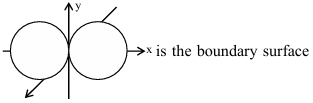
$(B)$ The image shows the boundary surface diagram of the $2p_x$ orbital.
$(C)$ The $+$ and $-$ signs in the wave function of the $2p_x$ orbital refer to charge.
$(D)$ The wave function of the $2p_x$ orbital is zero everywhere in the $yz$ plane.
$(A)$ The subsidiary quantum number $\ell$ describes the shape of the orbital occupied by the electron.
$(B)$ The image shows the boundary surface diagram of the $2p_x$ orbital.
$(C)$ The $+$ and $-$ signs in the wave function of the $2p_x$ orbital refer to charge.
$(D)$ The wave function of the $2p_x$ orbital is zero everywhere in the $yz$ plane.
A
$(B)$ and $(D)$ only
B
$(A)$,$(B)$ and $(C)$ only
C
$(C)$ and $(D)$ only
D
$(A)$ and $(B)$ only
Solution
(D) The azimuthal (subsidiary) quantum number $\ell$ determines the shape of the orbital.
$(B)$ The provided image represents the boundary surface diagram of the $2p_x$ orbital.
$(C)$ The $+$ and $-$ signs in the wave function of the $2p_x$ orbital represent the phase of the wave function,not the electrical charge.
$(D)$ The wave function of the $2p_x$ orbital is zero in the $yz$ plane,which acts as the nodal plane for this orbital.
Therefore,statements $(A)$ and $(B)$ are correct.
$(B)$ The provided image represents the boundary surface diagram of the $2p_x$ orbital.
$(C)$ The $+$ and $-$ signs in the wave function of the $2p_x$ orbital represent the phase of the wave function,not the electrical charge.
$(D)$ The wave function of the $2p_x$ orbital is zero in the $yz$ plane,which acts as the nodal plane for this orbital.
Therefore,statements $(A)$ and $(B)$ are correct.
0 likes
View Solution862
MediumMCQ
For an electron in $2s$ and $2p$ orbitals,the orbital angular momentum values,respectively,are $:$
A
$\sqrt{2} \frac{h}{2 \pi}$ and $0$
B
$\frac{h}{2 \pi}$ and $\sqrt{2} \frac{h}{2 \pi}$
C
$0$ and $\sqrt{6} \frac{h}{2 \pi}$
D
$0$ and $\sqrt{2} \frac{h}{2 \pi}$
Solution
(D) The orbital angular momentum is given by the formula $\sqrt{\ell(\ell+1)} \frac{h}{2 \pi}$.
For the $2s$ orbital,the azimuthal quantum number $\ell = 0$.
Therefore,the orbital angular momentum $= \sqrt{0(0+1)} \frac{h}{2 \pi} = 0$.
For the $2p$ orbital,the azimuthal quantum number $\ell = 1$.
Therefore,the orbital angular momentum $= \sqrt{1(1+1)} \frac{h}{2 \pi} = \sqrt{2} \frac{h}{2 \pi}$.
For the $2s$ orbital,the azimuthal quantum number $\ell = 0$.
Therefore,the orbital angular momentum $= \sqrt{0(0+1)} \frac{h}{2 \pi} = 0$.
For the $2p$ orbital,the azimuthal quantum number $\ell = 1$.
Therefore,the orbital angular momentum $= \sqrt{1(1+1)} \frac{h}{2 \pi} = \sqrt{2} \frac{h}{2 \pi}$.
0 likes
View Solution863
MediumMCQ
Consider the ground state of chromium atom $(Z=24)$. How many electrons are with Azimuthal quantum number $l=1$ and $l=2$ respectively?
A
$12$ and $4$
B
$16$ and $4$
C
$12$ and $5$
D
$16$ and $5$
Solution
(C) The electronic configuration of $Cr$ $(Z=24)$ is $1s^2, 2s^2, 2p^6, 3s^2, 3p^6, 3d^5, 4s^1$.
Azimuthal quantum number $l=1$ corresponds to $p$-orbitals. The electrons in $p$-orbitals are in $2p^6$ and $3p^6$,which gives $6+6 = 12$ electrons.
Azimuthal quantum number $l=2$ corresponds to $d$-orbitals. The electrons in $d$-orbitals are in $3d^5$,which gives $5$ electrons.
Therefore,the number of electrons with $l=1$ is $12$ and with $l=2$ is $5$.
Azimuthal quantum number $l=1$ corresponds to $p$-orbitals. The electrons in $p$-orbitals are in $2p^6$ and $3p^6$,which gives $6+6 = 12$ electrons.
Azimuthal quantum number $l=2$ corresponds to $d$-orbitals. The electrons in $d$-orbitals are in $3d^5$,which gives $5$ electrons.
Therefore,the number of electrons with $l=1$ is $12$ and with $l=2$ is $5$.
0 likes
View Solution864
DifficultMCQ
The extra stability of half-filled subshells is due to:
$(A)$ Symmetrical distribution of electrons
$(B)$ Smaller coulombic repulsion energy
$(C)$ The presence of electrons with the same spin in non-degenerate orbitals
$(D)$ Larger exchange energy
$(E)$ Relatively smaller shielding of electrons by one another
Identify the correct statements.
$(A)$ Symmetrical distribution of electrons
$(B)$ Smaller coulombic repulsion energy
$(C)$ The presence of electrons with the same spin in non-degenerate orbitals
$(D)$ Larger exchange energy
$(E)$ Relatively smaller shielding of electrons by one another
Identify the correct statements.
A
$(B), (D)$ and $(E)$ only
B
$(A), (B), (D)$ and $(E)$ only
C
$(B), (C)$ and $(D)$ only
D
$(A), (B)$ and $(D)$ only
Solution
(B) The extra stability of half-filled subshells is attributed to the following factors:
$(I)$ Symmetrical distribution of electrons: Electrons are distributed symmetrically in the orbitals,which leads to lower energy.
$(II)$ Larger exchange energy: The number of possible exchanges for electrons with parallel spins is maximum in half-filled and fully-filled configurations,resulting in higher exchange energy and greater stability.
$(III)$ Smaller coulombic repulsion: Due to the symmetrical arrangement,the inter-electronic repulsion is minimized.
$(IV)$ Smaller shielding of electrons by one another: The effective nuclear charge experienced by the electrons is optimized in these configurations.
Therefore,statements $(A), (B), (D),$ and $(E)$ are correct.
$(I)$ Symmetrical distribution of electrons: Electrons are distributed symmetrically in the orbitals,which leads to lower energy.
$(II)$ Larger exchange energy: The number of possible exchanges for electrons with parallel spins is maximum in half-filled and fully-filled configurations,resulting in higher exchange energy and greater stability.
$(III)$ Smaller coulombic repulsion: Due to the symmetrical arrangement,the inter-electronic repulsion is minimized.
$(IV)$ Smaller shielding of electrons by one another: The effective nuclear charge experienced by the electrons is optimized in these configurations.
Therefore,statements $(A), (B), (D),$ and $(E)$ are correct.
0 likes
View Solution865
MediumMCQ
Correct statements for an element with atomic number $9$ are:
$A.$ There can be $5$ electrons for which $m_{s}=+\frac{1}{2}$ and $4$ electrons for which $m_{s}=-\frac{1}{2}$
$B.$ There is only one electron in $p_z$ orbital
$C.$ The last electron goes to an orbital with $n=2$ and $l=1$
$D.$ The sum of angular nodes of all the atomic orbitals is $1$
Choose the correct answer from the options given below:
$A.$ There can be $5$ electrons for which $m_{s}=+\frac{1}{2}$ and $4$ electrons for which $m_{s}=-\frac{1}{2}$
$B.$ There is only one electron in $p_z$ orbital
$C.$ The last electron goes to an orbital with $n=2$ and $l=1$
$D.$ The sum of angular nodes of all the atomic orbitals is $1$
Choose the correct answer from the options given below:
A
$C$ and $D$ Only
B
$A$ and $C$ Only
C
$A, C$ and $D$ Only
D
$A$ and $B$ Only
Solution
(B) The element with atomic number $9$ is Fluorine $(F)$,with electronic configuration $1s^2 2s^2 2p^5$.
$(A)$ In $1s^2 2s^2 2p^5$,there are $9$ electrons. Filling them: $1s$ $(2)$,$2s$ $(2)$,$2p$ $(5)$. Total up-spins $(m_s = +\frac{1}{2})$ are $1+1+3 = 5$ and down-spins $(m_s = -\frac{1}{2})$ are $1+1+2 = 4$. Statement $A$ is correct.
$(B)$ The $2p^5$ configuration means $p_x^2 p_y^2 p_z^1$ or similar. The unpaired electron can be in any of the three $p$ orbitals,so $B$ is not necessarily true. Statement $B$ is incorrect.
$(C)$ The last electron enters the $2p$ subshell where $n=2$ and $l=1$. Statement $C$ is correct.
$(D)$ Angular nodes = $l$. For $1s$ $(l=0)$,$2s$ $(l=0)$,$2p$ $(l=1)$. Total angular nodes = $0+0+1+1+1 = 3$. Statement $D$ is incorrect.
Therefore,only $A$ and $C$ are correct.
$(A)$ In $1s^2 2s^2 2p^5$,there are $9$ electrons. Filling them: $1s$ $(2)$,$2s$ $(2)$,$2p$ $(5)$. Total up-spins $(m_s = +\frac{1}{2})$ are $1+1+3 = 5$ and down-spins $(m_s = -\frac{1}{2})$ are $1+1+2 = 4$. Statement $A$ is correct.
$(B)$ The $2p^5$ configuration means $p_x^2 p_y^2 p_z^1$ or similar. The unpaired electron can be in any of the three $p$ orbitals,so $B$ is not necessarily true. Statement $B$ is incorrect.
$(C)$ The last electron enters the $2p$ subshell where $n=2$ and $l=1$. Statement $C$ is correct.
$(D)$ Angular nodes = $l$. For $1s$ $(l=0)$,$2s$ $(l=0)$,$2p$ $(l=1)$. Total angular nodes = $0+0+1+1+1 = 3$. Statement $D$ is incorrect.
Therefore,only $A$ and $C$ are correct.
0 likes
View Solution866
MediumMCQ
The two electrons $X$ and $Y$ have the following sets of quantum numbers:
Which of the following is the correct statement?
| $X: n=3, l=2, m=-2, s=+1/2$ | $Y: n=3, l=0, m=0, s=+1/2$ |
Which of the following is the correct statement?
A
$X$ and $Y$ have the same energy
B
$X$ has greater energy than $Y$
C
$X$ has less energy than $Y$
D
$X$ and $Y$ represent the same electron
Solution
(B) The energy of an electron in an atom is determined by the $(n+l)$ rule.
For electron $X$: $n=3, l=2$. Therefore,$(n+l) = 3+2 = 5$.
For electron $Y$: $n=3, l=0$. Therefore,$(n+l) = 3+0 = 3$.
Since the $(n+l)$ value for $X$ $(5)$ is greater than the $(n+l)$ value for $Y$ $(3)$,the energy of $X$ is greater than the energy of $Y$.
For electron $X$: $n=3, l=2$. Therefore,$(n+l) = 3+2 = 5$.
For electron $Y$: $n=3, l=0$. Therefore,$(n+l) = 3+0 = 3$.
Since the $(n+l)$ value for $X$ $(5)$ is greater than the $(n+l)$ value for $Y$ $(3)$,the energy of $X$ is greater than the energy of $Y$.
0 likes
View Solution867
MediumMCQ
In which of the following electron distributions in the ground state is only Hund's rule violated?
A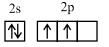
B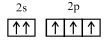
C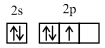
D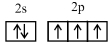
Solution
(C) Hund's rule of maximum multiplicity states that for a given electron configuration,the term with the maximum multiplicity has the lowest energy. This means that electrons should occupy degenerate orbitals singly as far as possible before pairing occurs.
$(A)$ $2s^2 2p^2$: Electrons are singly occupied in $2p$ orbitals. This follows Hund's rule.
$(B)$ $2s^2 2p^3$: The $2s$ orbital has two electrons with parallel spins,which violates the Pauli exclusion principle. The $2p$ orbital follows Hund's rule.
$(C)$ $2s^2 2p^2$: Electrons are paired in one $2p$ orbital instead of being singly occupied. This violates Hund's rule.
$(D)$ $2s^2 2p^3$: This is the correct ground state configuration following both Pauli's exclusion principle and Hund's rule.
Therefore,only Hund's rule is violated in option $(C)$.
$(A)$ $2s^2 2p^2$: Electrons are singly occupied in $2p$ orbitals. This follows Hund's rule.
$(B)$ $2s^2 2p^3$: The $2s$ orbital has two electrons with parallel spins,which violates the Pauli exclusion principle. The $2p$ orbital follows Hund's rule.
$(C)$ $2s^2 2p^2$: Electrons are paired in one $2p$ orbital instead of being singly occupied. This violates Hund's rule.
$(D)$ $2s^2 2p^3$: This is the correct ground state configuration following both Pauli's exclusion principle and Hund's rule.
Therefore,only Hund's rule is violated in option $(C)$.
0 likes
View Solution868
MediumMCQ
Which of the following statements are correct?
$(a)$ When an electron in an atom moves from $n=4$ to $n=2$,it gains energy.
$(b)$ An electron in a $3p$ orbital would have less energy than an electron in a $2p$ orbital.
$(c)$ $A$ $3s$ subshell has a maximum of $2$ electrons.
$(d)$ $A$ $3^{rd}$ orbit may contain a maximum of $10$ electrons.
$(a)$ When an electron in an atom moves from $n=4$ to $n=2$,it gains energy.
$(b)$ An electron in a $3p$ orbital would have less energy than an electron in a $2p$ orbital.
$(c)$ $A$ $3s$ subshell has a maximum of $2$ electrons.
$(d)$ $A$ $3^{rd}$ orbit may contain a maximum of $10$ electrons.
A
$a, b$ and $c$
B
$a$ and $c$
C
$b$ and $d$
D
Only $c$
Solution
(D) Statement $(a)$ is incorrect: When an electron moves from a higher energy level $(n=4)$ to a lower energy level $(n=2)$,it emits energy,it does not gain it.
Statement $(b)$ is incorrect: Energy of an orbital increases with the principal quantum number $(n)$. Thus,a $3p$ orbital has higher energy than a $2p$ orbital.
Statement $(c)$ is correct: Any $s$-orbital (or subshell) can hold a maximum of $2$ electrons.
Statement $(d)$ is incorrect: The maximum number of electrons in an orbit is given by $2n^2$. For the $3^{rd}$ orbit $(n=3)$,the maximum number of electrons is $2(3)^2 = 2(9) = 18$ electrons.
Statement $(b)$ is incorrect: Energy of an orbital increases with the principal quantum number $(n)$. Thus,a $3p$ orbital has higher energy than a $2p$ orbital.
Statement $(c)$ is correct: Any $s$-orbital (or subshell) can hold a maximum of $2$ electrons.
Statement $(d)$ is incorrect: The maximum number of electrons in an orbit is given by $2n^2$. For the $3^{rd}$ orbit $(n=3)$,the maximum number of electrons is $2(3)^2 = 2(9) = 18$ electrons.
0 likes
View Solution869
MediumMCQ
The orbital angular momentum of an electron in a $d-$orbital is $:-$
A
$\sqrt{6} \frac{h}{2 \pi}$
B
$\sqrt{2} \frac{h}{2 \pi}$
C
$\frac{h}{2 \pi}$
D
$\frac{2 h}{2 \pi}$
Solution
(A) The orbital angular momentum of an electron is given by the formula: $L = \sqrt{l(l+1)} \frac{h}{2 \pi}$.
For a $d-$orbital,the azimuthal quantum number $l = 2$.
Substituting the value of $l$ into the formula:
$L = \sqrt{2(2+1)} \frac{h}{2 \pi} = \sqrt{2(3)} \frac{h}{2 \pi} = \sqrt{6} \frac{h}{2 \pi}$.
Therefore,the correct option is $A$.
For a $d-$orbital,the azimuthal quantum number $l = 2$.
Substituting the value of $l$ into the formula:
$L = \sqrt{2(2+1)} \frac{h}{2 \pi} = \sqrt{2(3)} \frac{h}{2 \pi} = \sqrt{6} \frac{h}{2 \pi}$.
Therefore,the correct option is $A$.
0 likes
View Solution870
MediumMCQ
If the value of $(n+\ell)$ is not greater than $3$,which of the following subshells is not possible $-$
A
$2s$
B
$3s$
C
$3p$
D
$2p$
Solution
(C) The condition given is $(n+\ell) \leq 3$.
For $3p$,the principal quantum number $n = 3$ and the azimuthal quantum number $\ell = 1$.
Therefore,$(n+\ell) = 3 + 1 = 4$.
Since $4 > 3$,the $3p$ subshell is not possible under the given condition.
For $3p$,the principal quantum number $n = 3$ and the azimuthal quantum number $\ell = 1$.
Therefore,$(n+\ell) = 3 + 1 = 4$.
Since $4 > 3$,the $3p$ subshell is not possible under the given condition.
0 likes
View Solution871
DifficultMCQ
Match the column:
Correct match will be $:-$
| Column-$I$ | Column-$II$ |
|---|---|
| $A$. The orbital which has two angular nodes | $P$. $4d_{x^2-y^2}$ |
| $B$. The $d$ orbital with zero nodal plane | $Q$. $3d_{z^2}$ |
| $C$. The orbital with two radial nodes | $R$. $4f$ |
| $D$. The orbital with three angular nodes | $S$. $3s$ |
Correct match will be $:-$
A
$A-P, B-Q, C-S, D-R$
B
$A-S, B-P, C-Q, D-R$
C
$A-Q, B-P, C-S, D-R$
D
$A-P, B-Q, C-R, D-S$
Solution
(A) $1$. Angular nodes are equal to the azimuthal quantum number $(l)$. For $d$-orbitals,$l=2$,so they have $2$ angular nodes. Thus,$A$ matches $P$ $(4d_{x^2-y^2})$.
$2$. The $d_{z^2}$ orbital has zero nodal planes (it has two conical nodal surfaces). Thus,$B$ matches $Q$ $(3d_{z^2})$.
$3$. Radial nodes are calculated by the formula $(n - l - 1)$. For $3s$,$n=3, l=0$,so radial nodes $= 3-0-1 = 2$. Thus,$C$ matches $S$ $(3s)$.
$4$. Angular nodes for $f$-orbitals are $l=3$. Thus,$D$ matches $R$ $(4f)$.
Therefore,the correct match is $A-P, B-Q, C-S, D-R$.
$2$. The $d_{z^2}$ orbital has zero nodal planes (it has two conical nodal surfaces). Thus,$B$ matches $Q$ $(3d_{z^2})$.
$3$. Radial nodes are calculated by the formula $(n - l - 1)$. For $3s$,$n=3, l=0$,so radial nodes $= 3-0-1 = 2$. Thus,$C$ matches $S$ $(3s)$.
$4$. Angular nodes for $f$-orbitals are $l=3$. Thus,$D$ matches $R$ $(4f)$.
Therefore,the correct match is $A-P, B-Q, C-S, D-R$.
0 likes
View Solution872
EasyMCQ
Assertion :- In $H$-atom,the energy of $3d$-level is smaller than $4s$-level.
Reason :- In multi-electron species,an orbital with lower value of $(n+\ell)$ has energy smaller than the orbital with larger value of $(n+\ell)$.
Reason :- In multi-electron species,an orbital with lower value of $(n+\ell)$ has energy smaller than the orbital with larger value of $(n+\ell)$.
A
Both Assertion & Reason are True & the Reason is a correct explanation of the Assertion.
B
Both Assertion & Reason are True but Reason is not a correct explanation of the Assertion.
C
Assertion is True but the Reason is False.
D
Both Assertion & Reason are False.
Solution
(B) In a hydrogen atom ($H$-atom),the energy of an orbital depends only on the principal quantum number $(n)$. Therefore,$3d$ $(n=3)$ has lower energy than $4s$ $(n=4)$.
However,the Assertion states the energy of $3d$ is smaller than $4s$,which is true for the $H$-atom.
The Reason provided describes the $(n+\ell)$ rule,which applies only to multi-electron species,not to the $H$-atom.
For the $H$-atom,the energy order is $1s < 2s = 2p < 3s = 3p = 3d < 4s = 4p = 4d = 4f$.
Since the Reason explains the energy order for multi-electron species and not the $H$-atom,it is not the correct explanation for the Assertion.
Thus,both statements are true,but the Reason is not the correct explanation for the Assertion.
However,the Assertion states the energy of $3d$ is smaller than $4s$,which is true for the $H$-atom.
The Reason provided describes the $(n+\ell)$ rule,which applies only to multi-electron species,not to the $H$-atom.
For the $H$-atom,the energy order is $1s < 2s = 2p < 3s = 3p = 3d < 4s = 4p = 4d = 4f$.
Since the Reason explains the energy order for multi-electron species and not the $H$-atom,it is not the correct explanation for the Assertion.
Thus,both statements are true,but the Reason is not the correct explanation for the Assertion.
0 likes
View Solution873
EasyMCQ
Orbital angular momentum of an electron in $3s$ and $3p$ subshells are:
A
$0, \frac{h}{\sqrt{2} \pi}$
B
$\frac{h}{\sqrt{2} \pi}, 0$
C
$0, \frac{\sqrt{2}h}{2 \pi}$
D
$0, \sqrt{2} \frac{h}{2 \pi}$
Solution
(A) The formula for orbital angular momentum is $\sqrt{\ell(\ell+1)} \frac{h}{2 \pi}$.
For a $3s$ subshell,the azimuthal quantum number $\ell = 0$. Thus,the orbital angular momentum $= \sqrt{0(0+1)} \frac{h}{2 \pi} = 0$.
For a $3p$ subshell,the azimuthal quantum number $\ell = 1$. Thus,the orbital angular momentum $= \sqrt{1(1+1)} \frac{h}{2 \pi} = \sqrt{2} \frac{h}{2 \pi} = \frac{h}{\sqrt{2} \pi}$.
For a $3s$ subshell,the azimuthal quantum number $\ell = 0$. Thus,the orbital angular momentum $= \sqrt{0(0+1)} \frac{h}{2 \pi} = 0$.
For a $3p$ subshell,the azimuthal quantum number $\ell = 1$. Thus,the orbital angular momentum $= \sqrt{1(1+1)} \frac{h}{2 \pi} = \sqrt{2} \frac{h}{2 \pi} = \frac{h}{\sqrt{2} \pi}$.
0 likes
View Solution874
MediumMCQ
Which of the following orbitals will have $2$ nodal planes and $4$ total nodes?
A
$5d$
B
$4d$
C
$4f$
D
$5f$
Solution
(A) For an orbital with principal quantum number $n$ and azimuthal quantum number $l$:
$1.$ Number of angular nodes (nodal planes) $= l$
$2.$ Number of radial nodes $= n - l - 1$
$3.$ Total number of nodes $= (n - l - 1) + l = n - 1$
Given: Number of nodal planes $= 2$,so $l = 2$ (which corresponds to a $d$-orbital).
Given: Total nodes $= 4$,so $n - 1 = 4$,which implies $n = 5$.
Therefore,the orbital is $5d$.
$1.$ Number of angular nodes (nodal planes) $= l$
$2.$ Number of radial nodes $= n - l - 1$
$3.$ Total number of nodes $= (n - l - 1) + l = n - 1$
Given: Number of nodal planes $= 2$,so $l = 2$ (which corresponds to a $d$-orbital).
Given: Total nodes $= 4$,so $n - 1 = 4$,which implies $n = 5$.
Therefore,the orbital is $5d$.
0 likes
View Solution875
EasyMCQ
The four quantum numbers for the valence shell electron of Sodium $(Z=11)$ are:
A
$n=2, \ell=1, m=-1, s=-\frac{1}{2}$
B
$n=3, \ell=0, m=0, s=+\frac{1}{2}$
C
$n=3, \ell=2, m=-2, s=-\frac{1}{2}$
D
$n=3, \ell=2, m=2, s=+\frac{1}{2}$
Solution
(B) The electronic configuration of Sodium $(Z=11)$ is $1s^2, 2s^2, 2p^6, 3s^1$.
The valence shell electron is in the $3s$ orbital.
For the $3s$ orbital,the principal quantum number $n = 3$.
For an $s$-orbital,the azimuthal quantum number $\ell = 0$.
Since $\ell = 0$,the magnetic quantum number $m = 0$.
The spin quantum number $s$ for the first electron in an orbital is typically taken as $+\frac{1}{2}$.
The valence shell electron is in the $3s$ orbital.
For the $3s$ orbital,the principal quantum number $n = 3$.
For an $s$-orbital,the azimuthal quantum number $\ell = 0$.
Since $\ell = 0$,the magnetic quantum number $m = 0$.
The spin quantum number $s$ for the first electron in an orbital is typically taken as $+\frac{1}{2}$.
0 likes
View Solution876
EasyMCQ
In an atom having $2$ $K$,$8$ $L$,$8$ $M$ and $2$ $N$ electrons,the number of electrons with $m=0$ and $s=+\frac{1}{2}$ is $:-$
A
$6$
B
$2$
C
$8$
D
$10$
Solution
(A) The electronic configuration of the atom is $1s^2 2s^2 2p^6 3s^2 3p^6 4s^2$.
We need to find the number of electrons with magnetic quantum number $m=0$ and spin quantum number $s=+\frac{1}{2}$.
- $1s^2$: One electron has $m=0, s=+\frac{1}{2}$.
- $2s^2$: One electron has $m=0, s=+\frac{1}{2}$.
- $2p^6$: The $2p_z$ orbital has $m=0$. It contains $2$ electrons,one of which has $s=+\frac{1}{2}$.
- $3s^2$: One electron has $m=0, s=+\frac{1}{2}$.
- $3p^6$: The $3p_z$ orbital has $m=0$. It contains $2$ electrons,one of which has $s=+\frac{1}{2}$.
- $4s^2$: One electron has $m=0, s=+\frac{1}{2}$.
Total number of electrons with $m=0$ and $s=+\frac{1}{2}$ is $1+1+1+1+1+1 = 6$.
We need to find the number of electrons with magnetic quantum number $m=0$ and spin quantum number $s=+\frac{1}{2}$.
- $1s^2$: One electron has $m=0, s=+\frac{1}{2}$.
- $2s^2$: One electron has $m=0, s=+\frac{1}{2}$.
- $2p^6$: The $2p_z$ orbital has $m=0$. It contains $2$ electrons,one of which has $s=+\frac{1}{2}$.
- $3s^2$: One electron has $m=0, s=+\frac{1}{2}$.
- $3p^6$: The $3p_z$ orbital has $m=0$. It contains $2$ electrons,one of which has $s=+\frac{1}{2}$.
- $4s^2$: One electron has $m=0, s=+\frac{1}{2}$.
Total number of electrons with $m=0$ and $s=+\frac{1}{2}$ is $1+1+1+1+1+1 = 6$.
0 likes
View Solution877
EasyMCQ
Consider the following statements :
$(a)$ Electron density in the $xy$ plane in $3d_{x^2-y^2}$ orbital is zero.
$(b)$ Electron density in the $xy$ plane in $3d_{z^2}$ orbital is zero.
$(c)$ $2s$ orbital has one nodal surface.
$(d)$ For $2p_z$ orbital,$yz$ is the nodal plane.
Select the incorrect statements $:-$
$(a)$ Electron density in the $xy$ plane in $3d_{x^2-y^2}$ orbital is zero.
$(b)$ Electron density in the $xy$ plane in $3d_{z^2}$ orbital is zero.
$(c)$ $2s$ orbital has one nodal surface.
$(d)$ For $2p_z$ orbital,$yz$ is the nodal plane.
Select the incorrect statements $:-$
A
$a \& c$
B
$b \& c$
C
only $b$
D
$a, b, d$
Solution
(B) The $3d_{x^2-y^2}$ orbital has lobes along the $x$ and $y$ axes. The electron density is concentrated along these axes,not in the $xy$ plane. Thus,the statement is correct.
$(b)$ The $3d_{z^2}$ orbital has lobes along the $z$-axis and a ring of electron density in the $xy$ plane. Thus,the statement that electron density in the $xy$ plane is zero is incorrect.
$(c)$ The number of radial nodes is given by $(n - l - 1)$. For $2s$,$n=2, l=0$,so nodes $= 2 - 0 - 1 = 1$. Thus,the statement is correct.
$(d)$ For $2p_z$ orbital,the nodal plane is the $xy$ plane (where $z=0$). The $yz$ plane is not a nodal plane for $2p_z$. Thus,the statement is incorrect.
Therefore,statements $(b)$ and $(d)$ are incorrect.
$(b)$ The $3d_{z^2}$ orbital has lobes along the $z$-axis and a ring of electron density in the $xy$ plane. Thus,the statement that electron density in the $xy$ plane is zero is incorrect.
$(c)$ The number of radial nodes is given by $(n - l - 1)$. For $2s$,$n=2, l=0$,so nodes $= 2 - 0 - 1 = 1$. Thus,the statement is correct.
$(d)$ For $2p_z$ orbital,the nodal plane is the $xy$ plane (where $z=0$). The $yz$ plane is not a nodal plane for $2p_z$. Thus,the statement is incorrect.
Therefore,statements $(b)$ and $(d)$ are incorrect.
0 likes
View Solution878
MediumMCQ
Which of the sequences given below shows the correct increasing order of energy?
A
$3s, 3p, 4s, 4p, 3d, 5s, 5p, 4d$
B
$3s, 3p, 3d, 4s, 4p, 4d, 5s, 5p$
C
$3s, 3p, 4s, 3d, 4p, 5s, 4d, 5p$
D
$3s, 3p, 4s, 4p, 5s, 3d, 4d, 5p$
Solution
(C) The energy of an orbital is determined by the $(n + \ell)$ rule.
For orbitals with the same $(n + \ell)$ value,the orbital with the lower $n$ value has lower energy.
Calculating $(n + \ell)$ values:
$3s: 3 + 0 = 3$
$3p: 3 + 1 = 4$
$4s: 4 + 0 = 4$
$3d: 3 + 2 = 5$
$4p: 4 + 1 = 5$
$5s: 5 + 0 = 5$
$4d: 4 + 2 = 6$
$5p: 5 + 1 = 6$
Comparing these,the correct increasing order is $3s < 3p < 4s < 3d < 4p < 5s < 4d < 5p$.
For orbitals with the same $(n + \ell)$ value,the orbital with the lower $n$ value has lower energy.
Calculating $(n + \ell)$ values:
$3s: 3 + 0 = 3$
$3p: 3 + 1 = 4$
$4s: 4 + 0 = 4$
$3d: 3 + 2 = 5$
$4p: 4 + 1 = 5$
$5s: 5 + 0 = 5$
$4d: 4 + 2 = 6$
$5p: 5 + 1 = 6$
Comparing these,the correct increasing order is $3s < 3p < 4s < 3d < 4p < 5s < 4d < 5p$.
0 likes
View Solution879
EasyMCQ
The electronic configurations of ${}_{24}Cr$ and ${}_{29}Cu$ are abnormal because $:-$
A
Half-filled and fully-filled subshells are more stable
B
They are $d-$block elements
C
Both of the above
D
They follow Aufbau's principle
Solution
(A) The electronic configuration of ${}_{24}Cr$ is $[Ar] 3d^5 4s^1$ and that of ${}_{29}Cu$ is $[Ar] 3d^{10} 4s^1$.
These configurations are considered abnormal because they deviate from the expected filling order of the Aufbau principle.
The stability of these configurations arises because half-filled $(d^5)$ and fully-filled $(d^{10})$ subshells possess extra stability due to symmetry and exchange energy.
While they are indeed $d-$block elements,the primary reason for the specific electronic arrangement is the stability of the filled/half-filled subshells.
These configurations are considered abnormal because they deviate from the expected filling order of the Aufbau principle.
The stability of these configurations arises because half-filled $(d^5)$ and fully-filled $(d^{10})$ subshells possess extra stability due to symmetry and exchange energy.
While they are indeed $d-$block elements,the primary reason for the specific electronic arrangement is the stability of the filled/half-filled subshells.
0 likes
View Solution880
EasyMCQ
$4s^2$ is the configuration of the outermost orbit of an element. Its atomic number would be $:-$
A
$29$
B
$24$
C
$30$
D
$19$
Solution
(C) The electronic configuration of the elements provided in the options are as follows:
$Cu (Z=29): 1s^2 2s^2 2p^6 3s^2 3p^6 4s^1 3d^{10}$
$Cr (Z=24): 1s^2 2s^2 2p^6 3s^2 3p^6 4s^1 3d^5$
$Zn (Z=30): 1s^2 2s^2 2p^6 3s^2 3p^6 4s^2 3d^{10}$
$K (Z=19): 1s^2 2s^2 2p^6 3s^2 3p^6 4s^1$
Among the given options,only $Zn$ $(Z=30)$ has a $4s^2$ configuration in its outermost shell.
$Cu (Z=29): 1s^2 2s^2 2p^6 3s^2 3p^6 4s^1 3d^{10}$
$Cr (Z=24): 1s^2 2s^2 2p^6 3s^2 3p^6 4s^1 3d^5$
$Zn (Z=30): 1s^2 2s^2 2p^6 3s^2 3p^6 4s^2 3d^{10}$
$K (Z=19): 1s^2 2s^2 2p^6 3s^2 3p^6 4s^1$
Among the given options,only $Zn$ $(Z=30)$ has a $4s^2$ configuration in its outermost shell.
0 likes
View Solution881
EasyMCQ
Consider the Argon atom. For how many electrons does this atom have $m = 1$?
A
$1$
B
$6$
C
$4$
D
$2$
Solution
(C) The electronic configuration of Argon ($Ar$,$Z=18$) is $1s^2 2s^2 2p^6 3s^2 3p^6$.
For a $p$-orbital,the magnetic quantum number $m$ takes values $-1, 0, +1$.
In the $2p^6$ subshell,there are $3$ orbitals $(2p_x, 2p_y, 2p_z)$. Each orbital contains $2$ electrons.
The orbital with $m = +1$ contains $2$ electrons.
Similarly,in the $3p^6$ subshell,there are $3$ orbitals. The orbital with $m = +1$ contains $2$ electrons.
Total number of electrons with $m = +1$ is $2 + 2 = 4$.
For a $p$-orbital,the magnetic quantum number $m$ takes values $-1, 0, +1$.
In the $2p^6$ subshell,there are $3$ orbitals $(2p_x, 2p_y, 2p_z)$. Each orbital contains $2$ electrons.
The orbital with $m = +1$ contains $2$ electrons.
Similarly,in the $3p^6$ subshell,there are $3$ orbitals. The orbital with $m = +1$ contains $2$ electrons.
Total number of electrons with $m = +1$ is $2 + 2 = 4$.
0 likes
View Solution882
EasyMCQ
Which two orbitals are located along the axis,and not between the axes?
A
$d_{xy}, d_{z^2}$
B
$d_{xy}, p_{z}$
C
$d_{yz}, p_{x}$
D
$p_{z}, d_{x^2-y^2}$
Solution
(D) The $p$-orbitals $(p_x, p_y, p_z)$ are oriented along the $x, y,$ and $z$ axes respectively.
Among the $d$-orbitals,$d_{x^2-y^2}$ and $d_{z^2}$ are oriented along the axes.
Specifically,$d_{x^2-y^2}$ has lobes along the $x$ and $y$ axes,and $d_{z^2}$ has lobes along the $z$ axis.
In contrast,$d_{xy}, d_{yz},$ and $d_{zx}$ orbitals have lobes located between the axes.
Therefore,$p_z$ and $d_{x^2-y^2}$ are both located along the axes.
Among the $d$-orbitals,$d_{x^2-y^2}$ and $d_{z^2}$ are oriented along the axes.
Specifically,$d_{x^2-y^2}$ has lobes along the $x$ and $y$ axes,and $d_{z^2}$ has lobes along the $z$ axis.
In contrast,$d_{xy}, d_{yz},$ and $d_{zx}$ orbitals have lobes located between the axes.
Therefore,$p_z$ and $d_{x^2-y^2}$ are both located along the axes.
0 likes
View Solution883
MediumMCQ
How many orbitals are present in the $4^{th}$ shell with $\ell = 2$?
A
$16$
B
$3$
C
$5$
D
$1$
Solution
(C) The $4^{th}$ shell $(n = 4)$ contains subshells corresponding to $\ell = 0, 1, 2, 3$.
For $\ell = 2$,the subshell is $4d$.
The number of orbitals in a subshell is given by the formula $(2\ell + 1)$.
Substituting $\ell = 2$,we get $2(2) + 1 = 5$ orbitals.
For $\ell = 2$,the subshell is $4d$.
The number of orbitals in a subshell is given by the formula $(2\ell + 1)$.
Substituting $\ell = 2$,we get $2(2) + 1 = 5$ orbitals.
0 likes
View Solution884
MediumMCQ
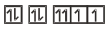
For the configuration shown in the image,which rule is violated $:-$
A
Aufbau Rule
B
$(n+\ell)$ Rule
C
Hund's Rule
D
Pauli's Rule
Solution
(D) In the provided image,the third orbital (the first box of the $p$-subshell) contains two electrons with the same spin (both pointing upwards).
According to Pauli's exclusion principle,no two electrons in an atom can have the same set of four quantum numbers.
This implies that in a single orbital,electrons must have opposite spins.
Since the two electrons in the same orbital have the same spin,Pauli's exclusion principle is violated.
According to Pauli's exclusion principle,no two electrons in an atom can have the same set of four quantum numbers.
This implies that in a single orbital,electrons must have opposite spins.
Since the two electrons in the same orbital have the same spin,Pauli's exclusion principle is violated.
0 likes
View Solution885
MediumMCQ
Identify the orbital having the highest energy from the following:
A
$2p$
B
$3s$
C
$3d$
D
$4p$
Solution
(D) The energy of an orbital is determined by the $(n+l)$ rule. Higher the sum of $(n+l)$ value of an orbital,the higher is its energy.
If two orbitals have the same value of $(n+l)$,then the orbital with the higher value of $n$ will have more energy.
Let us calculate $(n+l)$ for each:
$(A)$ $2p$: $n=2, l=1 \implies n+l = 3$
$(B)$ $3s$: $n=3, l=0 \implies n+l = 3$
$(C)$ $3d$: $n=3, l=2 \implies n+l = 5$
$(D)$ $4p$: $n=4, l=1 \implies n+l = 5$
Comparing $3d$ and $4p$,both have $(n+l) = 5$. Since $4p$ has a higher principal quantum number $(n=4)$ compared to $3d$ $(n=3)$,$4p$ has the highest energy.
If two orbitals have the same value of $(n+l)$,then the orbital with the higher value of $n$ will have more energy.
Let us calculate $(n+l)$ for each:
$(A)$ $2p$: $n=2, l=1 \implies n+l = 3$
$(B)$ $3s$: $n=3, l=0 \implies n+l = 3$
$(C)$ $3d$: $n=3, l=2 \implies n+l = 5$
$(D)$ $4p$: $n=4, l=1 \implies n+l = 5$
Comparing $3d$ and $4p$,both have $(n+l) = 5$. Since $4p$ has a higher principal quantum number $(n=4)$ compared to $3d$ $(n=3)$,$4p$ has the highest energy.
0 likes
View Solution886
EasyMCQ
Identify the orbital having the lowest energy from the following.
A
$2p$
B
$3s$
C
$3d$
D
$4p$
Solution
(A) The energy of an orbital is determined by the $(n+l)$ rule,where $n$ is the principal quantum number and $l$ is the azimuthal quantum number. The orbital with the lowest $(n+l)$ value has the lowest energy. If $(n+l)$ values are equal,the orbital with the lower $n$ value has lower energy.
Calculating $(n+l)$ for each:
$2p: n=2, l=1 \implies n+l = 3$
$3s: n=3, l=0 \implies n+l = 3$
$3d: n=3, l=2 \implies n+l = 5$
$4p: n=4, l=1 \implies n+l = 5$
Comparing $2p$ and $3s$,both have $(n+l) = 3$. Since $2p$ has a lower $n$ value $(n=2)$ compared to $3s$ $(n=3)$,$2p$ has the lowest energy.
Calculating $(n+l)$ for each:
$2p: n=2, l=1 \implies n+l = 3$
$3s: n=3, l=0 \implies n+l = 3$
$3d: n=3, l=2 \implies n+l = 5$
$4p: n=4, l=1 \implies n+l = 5$
Comparing $2p$ and $3s$,both have $(n+l) = 3$. Since $2p$ has a lower $n$ value $(n=2)$ compared to $3s$ $(n=3)$,$2p$ has the lowest energy.
0 likes
View Solution887
EasyMCQ
Find the number of unpaired electrons for copper in ground state configuration.
A
$1$
B
$2$
C
$3$
D
$4$
Solution
(A) The atomic number of copper $(Cu)$ is $29$.
The ground state electronic configuration of $Cu$ is $[Ar] 3d^{10} 4s^1$.
In the $3d$ subshell,all $10$ electrons are paired.
In the $4s$ subshell,there is $1$ electron,which is unpaired.
Therefore,the number of unpaired electrons in $Cu$ is $1$.
The ground state electronic configuration of $Cu$ is $[Ar] 3d^{10} 4s^1$.
In the $3d$ subshell,all $10$ electrons are paired.
In the $4s$ subshell,there is $1$ electron,which is unpaired.
Therefore,the number of unpaired electrons in $Cu$ is $1$.
0 likes
View Solution888
MediumMCQ
What is the total number of unpaired electrons in an element placed at period-$4$ and group-$12$ either in excited or at ground state?
A
Zero
B
One
C
Two
D
Three
Solution
(A) The element located in period-$4$ and group-$12$ is Zinc $(Zn)$.
$Zn$ has an atomic number of $30$.
The electronic configuration of $Zn$ in the ground state is $[Ar] \ 3d^{10} \ 4s^2$.
In this configuration,all $3d$ and $4s$ orbitals are completely filled,meaning there are $0$ unpaired electrons.
In the excited state (e.g.,$Zn^{2+}$ ion),the configuration is $[Ar] \ 3d^{10}$,which also contains $0$ unpaired electrons.
Therefore,the total number of unpaired electrons is $0$.
$Zn$ has an atomic number of $30$.
The electronic configuration of $Zn$ in the ground state is $[Ar] \ 3d^{10} \ 4s^2$.
In this configuration,all $3d$ and $4s$ orbitals are completely filled,meaning there are $0$ unpaired electrons.
In the excited state (e.g.,$Zn^{2+}$ ion),the configuration is $[Ar] \ 3d^{10}$,which also contains $0$ unpaired electrons.
Therefore,the total number of unpaired electrons is $0$.
0 likes
View Solution889
EasyMCQ
What is the number of electrons present in the $3d$ orbital of $Ti$ in the $+2$ oxidation state?
A
Zero
B
One
C
Two
D
Three
Solution
(C) The atomic number of $Ti$ is $22$. The electronic configuration of $Ti$ is $[Ar] 3d^2 4s^2$.
In the $+2$ oxidation state,$Ti^{2+}$ loses two electrons from the $4s$ orbital.
Therefore,the electronic configuration of $Ti^{2+}$ is $[Ar] 3d^2$.
Thus,there are $2$ electrons present in the $3d$ orbital.
In the $+2$ oxidation state,$Ti^{2+}$ loses two electrons from the $4s$ orbital.
Therefore,the electronic configuration of $Ti^{2+}$ is $[Ar] 3d^2$.
Thus,there are $2$ electrons present in the $3d$ orbital.
0 likes
View Solution890
EasyMCQ
What is the number of unpaired electrons present in $d$ orbitals of $Cr (Z=24)$ to have extra stability?
A
$0$
B
$1$
C
$4$
D
$5$
Solution
(D) The electronic configuration of $Cr (Z=24)$ is $[Ar] 3d^5 4s^1$.
This configuration is adopted because half-filled $d$-orbitals $(d^5)$ provide extra stability.
In the $3d$ subshell,there are $5$ electrons,each occupying one of the $5$ $d$-orbitals singly.
Therefore,the number of unpaired electrons in the $d$-orbitals is $5$.
This configuration is adopted because half-filled $d$-orbitals $(d^5)$ provide extra stability.
In the $3d$ subshell,there are $5$ electrons,each occupying one of the $5$ $d$-orbitals singly.
Therefore,the number of unpaired electrons in the $d$-orbitals is $5$.
0 likes
View Solution891
EasyMCQ
What is the total number of unpaired electrons present in the observed electronic configuration of $Cr$ $(Z=24)$?
A
$4$
B
$5$
C
$6$
D
$3$
Solution
(C) The atomic number of Chromium $(Cr)$ is $24$.
Its expected electronic configuration is $[Ar] 3d^4 4s^2$.
However,due to the extra stability of half-filled $d$-orbitals,the actual electronic configuration is $[Ar] 3d^5 4s^1$.
In this configuration,there are $5$ unpaired electrons in the $3d$ subshell and $1$ unpaired electron in the $4s$ subshell.
Therefore,the total number of unpaired electrons is $5 + 1 = 6$.
Its expected electronic configuration is $[Ar] 3d^4 4s^2$.
However,due to the extra stability of half-filled $d$-orbitals,the actual electronic configuration is $[Ar] 3d^5 4s^1$.
In this configuration,there are $5$ unpaired electrons in the $3d$ subshell and $1$ unpaired electron in the $4s$ subshell.
Therefore,the total number of unpaired electrons is $5 + 1 = 6$.
0 likes
View Solution892
EasyMCQ
What is the number of radial nodes in the $2s$ orbital?
A
$0$
B
$1$
C
$2$
D
$3$
Solution
(B) The number of radial nodes in an orbital is given by the formula: $\text{Radial nodes} = n - l - 1$.
For the $2s$ orbital,the principal quantum number $n = 2$ and the azimuthal quantum number $l = 0$.
Substituting these values into the formula: $\text{Radial nodes} = 2 - 0 - 1 = 1$.
Therefore,the $2s$ orbital has $1$ radial node.
For the $2s$ orbital,the principal quantum number $n = 2$ and the azimuthal quantum number $l = 0$.
Substituting these values into the formula: $\text{Radial nodes} = 2 - 0 - 1 = 1$.
Therefore,the $2s$ orbital has $1$ radial node.
0 likes
View Solution893
EasyMCQ
Which of the following $d$-orbitals has a different shape compared to the others?
A
$d_{xy}$
B
$d_{yz}$
C
$d_{xz}$
D
$d_{z^2}$
Solution
(D) The $d$-orbitals are five in number: $d_{xy}$,$d_{yz}$,$d_{xz}$,$d_{x^2-y^2}$,and $d_{z^2}$.
Among these,the first four ($d_{xy}$,$d_{yz}$,$d_{xz}$,and $d_{x^2-y^2}$) have a double-dumbbell shape.
The $d_{z^2}$ orbital has a unique shape consisting of a dumbbell along the $z$-axis with a doughnut-shaped ring of electron density in the $xy$-plane.
Therefore,$d_{z^2}$ has a different shape compared to the others.
Among these,the first four ($d_{xy}$,$d_{yz}$,$d_{xz}$,and $d_{x^2-y^2}$) have a double-dumbbell shape.
The $d_{z^2}$ orbital has a unique shape consisting of a dumbbell along the $z$-axis with a doughnut-shaped ring of electron density in the $xy$-plane.
Therefore,$d_{z^2}$ has a different shape compared to the others.
0 likes
View Solution894
EasyMCQ
Which of the following orbitals has the same value of $(n+l)$ as that of the $3d$ orbital?
A
$4s$
B
$3s$
C
$4p$
D
$2p$
Solution
(C) The value of $(n+l)$ for the $3d$ orbital is calculated as follows:
For $3d$,$n=3$ and $l=2$,so $(n+l) = 3+2 = 5$.
Now,let us calculate the $(n+l)$ values for the given options:
$A) 4s$: $n=4, l=0 \implies (n+l) = 4+0 = 4$
$B) 3s$: $n=3, l=0 \implies (n+l) = 3+0 = 3$
$C) 4p$: $n=4, l=1 \implies (n+l) = 4+1 = 5$
$D) 2p$: $n=2, l=1 \implies (n+l) = 2+1 = 3$
Comparing these values,the $4p$ orbital has the same $(n+l)$ value of $5$ as the $3d$ orbital.
For $3d$,$n=3$ and $l=2$,so $(n+l) = 3+2 = 5$.
Now,let us calculate the $(n+l)$ values for the given options:
$A) 4s$: $n=4, l=0 \implies (n+l) = 4+0 = 4$
$B) 3s$: $n=3, l=0 \implies (n+l) = 3+0 = 3$
$C) 4p$: $n=4, l=1 \implies (n+l) = 4+1 = 5$
$D) 2p$: $n=2, l=1 \implies (n+l) = 2+1 = 3$
Comparing these values,the $4p$ orbital has the same $(n+l)$ value of $5$ as the $3d$ orbital.
0 likes
View Solution895
EasyMCQ
Which of the following orbitals is represented by $n=3$ and $l=2$?
A
$3s$
B
$3p$
C
$3d$
D
$3f$
Solution
(C) The principal quantum number $n$ represents the shell number,and the azimuthal quantum number $l$ represents the subshell type.
For $l=0$,the subshell is $s$.
For $l=1$,the subshell is $p$.
For $l=2$,the subshell is $d$.
For $l=3$,the subshell is $f$.
Given $n=3$ and $l=2$,the orbital is $3d$.
For $l=0$,the subshell is $s$.
For $l=1$,the subshell is $p$.
For $l=2$,the subshell is $d$.
For $l=3$,the subshell is $f$.
Given $n=3$ and $l=2$,the orbital is $3d$.
0 likes
View Solution896
EasyMCQ
What is the total number of orbitals present in $N$ shell?
A
$1$
B
$4$
C
$9$
D
$16$
Solution
(D) The $N$ shell corresponds to the principal quantum number $n = 4$.
For a given $n$,the possible values of the azimuthal quantum number $l$ range from $0$ to $n-1$.
Thus,for $n = 4$,$l = 0, 1, 2, 3$ (corresponding to $4s, 4p, 4d, 4f$ subshells).
The number of orbitals in a subshell is given by $2l + 1$.
For $l = 0$ $(4s)$: $2(0) + 1 = 1$ orbital.
For $l = 1$ $(4p)$: $2(1) + 1 = 3$ orbitals.
For $l = 2$ $(4d)$: $2(2) + 1 = 5$ orbitals.
For $l = 3$ $(4f)$: $2(3) + 1 = 7$ orbitals.
Total number of orbitals in $N$ shell $= 1 + 3 + 5 + 7 = 16$.
Alternatively,the total number of orbitals in a shell is given by $n^2 = 4^2 = 16$.
For a given $n$,the possible values of the azimuthal quantum number $l$ range from $0$ to $n-1$.
Thus,for $n = 4$,$l = 0, 1, 2, 3$ (corresponding to $4s, 4p, 4d, 4f$ subshells).
The number of orbitals in a subshell is given by $2l + 1$.
For $l = 0$ $(4s)$: $2(0) + 1 = 1$ orbital.
For $l = 1$ $(4p)$: $2(1) + 1 = 3$ orbitals.
For $l = 2$ $(4d)$: $2(2) + 1 = 5$ orbitals.
For $l = 3$ $(4f)$: $2(3) + 1 = 7$ orbitals.
Total number of orbitals in $N$ shell $= 1 + 3 + 5 + 7 = 16$.
Alternatively,the total number of orbitals in a shell is given by $n^2 = 4^2 = 16$.
0 likes
View Solution897
EasyMCQ
What is the designation of an orbital with quantum numbers $n=4$ and $l=3$?
A
$4s$
B
$4p$
C
$4d$
D
$4f$
Solution
(D) The orbital designation is determined by the principal quantum number $n$ and the azimuthal quantum number $l$.
For $l=0$,the orbital is $s$.
For $l=1$,the orbital is $p$.
For $l=2$,the orbital is $d$.
For $l=3$,the orbital is $f$.
Given $n=4$ and $l=3$,the orbital is $4f$.
For $l=0$,the orbital is $s$.
For $l=1$,the orbital is $p$.
For $l=2$,the orbital is $d$.
For $l=3$,the orbital is $f$.
Given $n=4$ and $l=3$,the orbital is $4f$.
0 likes
View Solution898
EasyMCQ
Identify degenerate orbitals from the following for a hydrogen atom.
A
$1s$ and $2s$
B
$1s$ and $2p$
C
$2s$ and $2p$
D
$3s$ and $2p$
Solution
(C) In a hydrogen atom,the energy of an orbital depends only on the principal quantum number $(n)$.
Since $2s$ and $2p$ both have $n = 2$,they have the same energy.
Orbitals having the same energy are called degenerate orbitals.
Therefore,$2s$ and $2p$ are degenerate orbitals.
Since $2s$ and $2p$ both have $n = 2$,they have the same energy.
Orbitals having the same energy are called degenerate orbitals.
Therefore,$2s$ and $2p$ are degenerate orbitals.
0 likes
View Solution899
MediumMCQ
The maximum number of electrons in a $p$-orbital with $n=5, m=1$ is$-$
A
$6$
B
$2$
C
$14$
D
$10$
Solution
(B) According to the Pauli Exclusion Principle,any single orbital can accommodate a maximum of $2$ electrons with opposite spins.
Since the question specifies a single $p$-orbital defined by the quantum numbers $n=5$ and $m=1$,it can hold a maximum of $2$ electrons.
Since the question specifies a single $p$-orbital defined by the quantum numbers $n=5$ and $m=1$,it can hold a maximum of $2$ electrons.
0 likes
View Solution900
MediumMCQ
Find the number of orbitals and maximum electrons respectively present in $M$-shell?
A
$4, 8$
B
$9, 18$
C
$16, 32$
D
$1, 2$
Solution
(B) The $M$-shell corresponds to the principal quantum number $n = 3$.
For $n = 3$,the possible values of the azimuthal quantum number $l$ are $0, 1, 2$,which correspond to the $3s, 3p,$ and $3d$ subshells.
The number of orbitals in a subshell is given by $2l + 1$.
For $l = 0$ $(3s)$: $2(0) + 1 = 1$ orbital.
For $l = 1$ $(3p)$: $2(1) + 1 = 3$ orbitals.
For $l = 2$ $(3d)$: $2(2) + 1 = 5$ orbitals.
Total number of orbitals $= 1 + 3 + 5 = 9$.
Each orbital can accommodate a maximum of $2$ electrons.
Therefore,the maximum number of electrons in the $M$-shell $= 9 \times 2 = 18$.
For $n = 3$,the possible values of the azimuthal quantum number $l$ are $0, 1, 2$,which correspond to the $3s, 3p,$ and $3d$ subshells.
The number of orbitals in a subshell is given by $2l + 1$.
For $l = 0$ $(3s)$: $2(0) + 1 = 1$ orbital.
For $l = 1$ $(3p)$: $2(1) + 1 = 3$ orbitals.
For $l = 2$ $(3d)$: $2(2) + 1 = 5$ orbitals.
Total number of orbitals $= 1 + 3 + 5 = 9$.
Each orbital can accommodate a maximum of $2$ electrons.
Therefore,the maximum number of electrons in the $M$-shell $= 9 \times 2 = 18$.
0 likes
View SolutionStructure of Atom — Quantum number, Electronic configuration and Shape of orbitals · Frequently Asked Questions
1Are these Structure of Atom questions useful for JEE and NEET?
Yes. All questions in this section are mapped to JEE Main and NEET exam patterns. Previous year questions from JEE Main, NEET, GUJCET and state-level exams are included with full solutions.
2Can I switch to Hindi or Gujarati for these questions?
Yes. Use the language tabs in the hero section or the sidebar to view the same questions and solutions in English, Hindi or Gujarati.
3How do I generate a question paper from this subtopic?
Use the Vedclass Exam Paper Generator — select the chapter and subtopic, set difficulty, and generate Sets A, B, C, D automatically. First 3 chapters of every subject are free.
Vedclass Products
For Students
Vedclass Test Series
Mock tests in real JEE/NEET style with performance analysis. 5-day free trial.
Start Free TrialFor Teachers
Exam Paper Generator
Generate Set A/B/C/D papers from this chapter in 2 minutes. 3 chapters free.
Try FreeFor Institutes
Online Exam Module
Live online exams with unlimited students, 360° analytics & white-label branding.
See DemoFor Teachers & Institutes
Generate a Structure of Atom Exam Paper in 2 Minutes
Select subtopic & difficulty — Sets A, B, C, D auto-generated with No Repeat logic.
First 3 chapters of every subject are free — no payment required.