
A English
Quantum number, Electronic configuration and Shape of orbitals Questions in English
Class 11 Chemistry · Structure of Atom · Quantum number, Electronic configuration and Shape of orbitals
1023+
Questions
English
Language
100%
With Solutions
Showing 50 of 1023 questions in English
901
EasyMCQ
What does magnetic quantum number describe?
A
Orientation of an orbital in the given subshell
B
Spin of an electron
C
Shape of an orbital
D
Size of an orbital
Solution
(A) The magnetic quantum number $(m_l)$ describes the orientation of an orbital in $3D$ space relative to the chosen coordinate system.
0 likes
View Solution902
EasyMCQ
Identify an orbital with the quantum numbers $n=4, \ell=3, m=0$.
A
$4f$
B
$4p$
C
$4s$
D
$4d$
Solution
(A) The principal quantum number $n=4$ indicates the $4th$ shell.
The azimuthal quantum number $\ell=3$ corresponds to the $f$-subshell.
Therefore,the orbital is $4f$.
The azimuthal quantum number $\ell=3$ corresponds to the $f$-subshell.
Therefore,the orbital is $4f$.
0 likes
View Solution903
EasyMCQ
How many values of magnetic quantum number are possible for each value of azimuthal quantum number?
A
$n \ell$
B
$2 \ell+1$
C
$n-\ell$
D
$2 \ell$
Solution
(B) For a given azimuthal quantum number $\ell$,the magnetic quantum number $m_\ell$ can take values ranging from $-\ell$ to $+\ell$,including zero.
Therefore,the total number of possible values for the magnetic quantum number is $(2 \ell + 1)$.
Therefore,the total number of possible values for the magnetic quantum number is $(2 \ell + 1)$.
0 likes
View Solution904
EasyMCQ
What is the maximum number of electrons accommodated in a subshell having azimuthal quantum number,$\ell=2$?
A
$10$
B
$12$
C
$14$
D
$18$
Solution
(A) The azimuthal quantum number $\ell=2$ corresponds to the $d$-subshell.
Each orbital can hold a maximum of $2$ electrons.
The number of orbitals in a subshell is given by $(2\ell+1)$.
For $\ell=2$,the number of orbitals $= 2(2)+1 = 5$.
Therefore,the maximum number of electrons $= 5 \times 2 = 10$ electrons.
Each orbital can hold a maximum of $2$ electrons.
The number of orbitals in a subshell is given by $(2\ell+1)$.
For $\ell=2$,the number of orbitals $= 2(2)+1 = 5$.
Therefore,the maximum number of electrons $= 5 \times 2 = 10$ electrons.
0 likes
View Solution905
EasyMCQ
"No two electrons in an atom can have the identical set of four quantum numbers." The statement is known as
A
Pauli's exclusion principle.
B
Hund's rule.
C
Aufbau rule.
D
Heisenberg uncertainty principle.
Solution
(A) The statement "No two electrons in an atom can have the identical set of four quantum numbers" is the definition of $Pauli's \ exclusion \ principle$.
According to this principle,each orbital can hold a maximum of two electrons,and these two electrons must have opposite spins.
According to this principle,each orbital can hold a maximum of two electrons,and these two electrons must have opposite spins.
0 likes
View Solution906
EasyMCQ
Which of the following elements contains the maximum number of unpaired electrons?
A
Fluorine
B
Sodium
C
Nitrogen
D
Oxygen
Solution
(C) To find the number of unpaired electrons,we write the electronic configuration for each element:
$1$. Fluorine ($F$,$Z=9$): $1s^2 2s^2 2p^5$. The $2p$ subshell has $5$ electrons,resulting in $1$ unpaired electron.
$2$. Sodium ($Na$,$Z=11$): $1s^2 2s^2 2p^6 3s^1$. The $3s$ subshell has $1$ unpaired electron.
$3$. Nitrogen ($N$,$Z=7$): $1s^2 2s^2 2p^3$. According to Hund's rule,the $2p$ subshell has $3$ electrons in separate orbitals,resulting in $3$ unpaired electrons.
$4$. Oxygen ($O$,$Z=8$): $1s^2 2s^2 2p^4$. The $2p$ subshell has $4$ electrons,resulting in $2$ unpaired electrons.
Comparing the values,Nitrogen has the maximum number of unpaired electrons $(3)$.
$1$. Fluorine ($F$,$Z=9$): $1s^2 2s^2 2p^5$. The $2p$ subshell has $5$ electrons,resulting in $1$ unpaired electron.
$2$. Sodium ($Na$,$Z=11$): $1s^2 2s^2 2p^6 3s^1$. The $3s$ subshell has $1$ unpaired electron.
$3$. Nitrogen ($N$,$Z=7$): $1s^2 2s^2 2p^3$. According to Hund's rule,the $2p$ subshell has $3$ electrons in separate orbitals,resulting in $3$ unpaired electrons.
$4$. Oxygen ($O$,$Z=8$): $1s^2 2s^2 2p^4$. The $2p$ subshell has $4$ electrons,resulting in $2$ unpaired electrons.
Comparing the values,Nitrogen has the maximum number of unpaired electrons $(3)$.
0 likes
View Solution907
EasyMCQ
"Pairing of electrons in the orbitals belonging to the same subshell does not occur unless each orbital belonging to that subshell has got one electron each." This statement is known as
A
Pauli's exclusion principle
B
Hund's rule
C
Aufbau rule
D
Heisenberg uncertainty principle
Solution
(B) The statement describes $Hund's \ rule \ of \ maximum \ multiplicity$.
According to this rule,for a given electron configuration,the term with maximum multiplicity has the lowest energy.
In simpler terms,pairing of electrons in the orbitals of a given subshell $(p, d, f)$ does not take place until each orbital is singly occupied.
According to this rule,for a given electron configuration,the term with maximum multiplicity has the lowest energy.
In simpler terms,pairing of electrons in the orbitals of a given subshell $(p, d, f)$ does not take place until each orbital is singly occupied.
0 likes
View Solution908
EasyMCQ
Which of the following rules or principles states that "No two electrons in an atom can have the same set of four quantum numbers"?
A
Pauli's exclusion principle
B
Hund's rule
C
Aufbau rule
D
Heisenberg uncertainty principle
Solution
(A) According to Pauli's exclusion principle,no two electrons in an atom can have the same set of four quantum numbers $(n, l, m_l, m_s)$.
This implies that an orbital can hold a maximum of two electrons,and they must have opposite spins.
This implies that an orbital can hold a maximum of two electrons,and they must have opposite spins.
0 likes
View Solution909
EasyMCQ
Identify the element from the following having six unpaired electrons in its observed electronic configuration.
A
$Cu$
B
$Zn$
C
$Cr$
D
$Ti$
Solution
(C) Chromium $(Cr)$ has an atomic number of $24$.
Its expected electronic configuration is $[Ar] 3d^4 4s^2$.
However,due to the extra stability of half-filled $d$-orbitals,the observed electronic configuration is $[Ar] 3d^5 4s^1$.
In this configuration,there are $5$ unpaired electrons in the $3d$ subshell and $1$ unpaired electron in the $4s$ orbital.
Therefore,the total number of unpaired electrons is $5 + 1 = 6$.
Its expected electronic configuration is $[Ar] 3d^4 4s^2$.
However,due to the extra stability of half-filled $d$-orbitals,the observed electronic configuration is $[Ar] 3d^5 4s^1$.
In this configuration,there are $5$ unpaired electrons in the $3d$ subshell and $1$ unpaired electron in the $4s$ orbital.
Therefore,the total number of unpaired electrons is $5 + 1 = 6$.
0 likes
View Solution910
MediumMCQ
Identify the element if its expected electronic configuration is $[Ar] 3d^{10} 4s^{2}$.
A
$Hg$
B
$Co$
C
$Cd$
D
$Zn$
Solution
(D) The given electronic configuration is $[Ar] 3d^{10} 4s^{2}$.
Summing the electrons: $18 (Ar) + 10 (3d) + 2 (4s) = 30$.
The atomic number $Z = 30$ corresponds to the element Zinc $(Zn)$.
Summing the electrons: $18 (Ar) + 10 (3d) + 2 (4s) = 30$.
The atomic number $Z = 30$ corresponds to the element Zinc $(Zn)$.
0 likes
View Solution911
EasyMCQ
Which among the following elements possesses one electron in the $4s$ orbital in its observed electronic configuration?
A
$V (Z=23)$
B
$Ni (Z=28)$
C
$Mn (Z=25)$
D
$Cu (Z=29)$
Solution
(D) The electronic configuration of $Cu (Z=29)$ is $[Ar] 3d^{10} 4s^{1}$.
This occurs because a fully filled $3d$ subshell provides extra stability to the atom.
Therefore,$Cu$ has only one electron in the $4s$ orbital.
This occurs because a fully filled $3d$ subshell provides extra stability to the atom.
Therefore,$Cu$ has only one electron in the $4s$ orbital.
0 likes
View Solution912
EasyMCQ
What is the atomic number of the element with $M^{2+}$ ion having electronic configuration $[Ar] 3d^8$?
A
$26$
B
$27$
C
$28$
D
$25$
Solution
(C) The electronic configuration of the $M^{2+}$ ion is $[Ar] 3d^8$.
This means the neutral atom $M$ has lost $2$ electrons to form the $M^{2+}$ ion.
To find the configuration of the neutral atom $M$,we add the $2$ electrons back to the $3d^8$ configuration.
The configuration of the neutral atom $M$ is $[Ar] 3d^8 4s^2$.
The total number of electrons in the neutral atom is $18$ (from $[Ar]$) $+ 8 + 2 = 28$.
Therefore,the atomic number of the element is $28$.
This means the neutral atom $M$ has lost $2$ electrons to form the $M^{2+}$ ion.
To find the configuration of the neutral atom $M$,we add the $2$ electrons back to the $3d^8$ configuration.
The configuration of the neutral atom $M$ is $[Ar] 3d^8 4s^2$.
The total number of electrons in the neutral atom is $18$ (from $[Ar]$) $+ 8 + 2 = 28$.
Therefore,the atomic number of the element is $28$.
0 likes
View Solution913
EasyMCQ
What is the electronic configuration of $Cr$?
A
$[Ar] 3d^4 4s^2$
B
$[Ar] 3d^5 4s^1$
C
$[Ar] 3d^5 4s^0$
D
$[Ar] 3d^4 4s^0$
Solution
(B) The atomic number of Chromium $(Cr)$ is $24$.
According to the Aufbau principle,the expected configuration is $[Ar] 3d^4 4s^2$.
However,half-filled $d$-orbitals are more stable due to exchange energy and symmetry.
Therefore,one electron from the $4s$ orbital shifts to the $3d$ orbital,resulting in the stable configuration $[Ar] 3d^5 4s^1$.
Thus,the correct option is $B$.
According to the Aufbau principle,the expected configuration is $[Ar] 3d^4 4s^2$.
However,half-filled $d$-orbitals are more stable due to exchange energy and symmetry.
Therefore,one electron from the $4s$ orbital shifts to the $3d$ orbital,resulting in the stable configuration $[Ar] 3d^5 4s^1$.
Thus,the correct option is $B$.
0 likes
View Solution914
MediumMCQ
Among the elements from atomic number $1$ to $36$,the number of elements which have an unpaired electron in their $s$-subshell is
A
$7$
B
$09$
C
$04$
D
$06$
Solution
(D) The elements with an unpaired electron in their $s$-subshell are those that have an $ns^1$ configuration in their ground state.
These include the alkali metals $(H, Li, Na, K)$ and elements where an electron is promoted to the $s$-subshell to achieve stability,such as $Cr$ $([Ar] 3d^5 4s^1)$ and $Cu$ $([Ar] 3d^{10} 4s^1)$.
Thus,the elements are $H$ $(Z=1)$,$Li$ $(Z=3)$,$Na$ $(Z=11)$,$K$ $(Z=19)$,$Cr$ $(Z=24)$,and $Cu$ $(Z=29)$.
Total number of such elements is $6$.
These include the alkali metals $(H, Li, Na, K)$ and elements where an electron is promoted to the $s$-subshell to achieve stability,such as $Cr$ $([Ar] 3d^5 4s^1)$ and $Cu$ $([Ar] 3d^{10} 4s^1)$.
Thus,the elements are $H$ $(Z=1)$,$Li$ $(Z=3)$,$Na$ $(Z=11)$,$K$ $(Z=19)$,$Cr$ $(Z=24)$,and $Cu$ $(Z=29)$.
Total number of such elements is $6$.
0 likes
View Solution915
MediumMCQ
The correct set of quantum numbers for the unpaired electron of a chlorine atom is:
A
$2, 0, 0, +\frac{1}{2}$
B
$2, 1, -1, +\frac{1}{2}$
C
$3, 1, 1, \pm \frac{1}{2}$
D
$3, 0, 0, \pm \frac{1}{2}$
Solution
(C) The electronic configuration of a chlorine atom $(Z=17)$ is $1s^2 2s^2 2p^6 3s^2 3p^5$.
The unpaired electron is present in the $3p$ subshell.
For the $3p$ orbital: Principal quantum number $(n)$ = $3$,Azimuthal quantum number $(l)$ = $1$.
The $3p^5$ configuration fills the orbitals as follows: $m_l = -1$ ($2$ electrons),$m_l = 0$ ($2$ electrons),$m_l = +1$ ($1$ electron).
Thus,for the unpaired electron: $n=3$,$l=1$,$m_l=1$,and $m_s = \pm \frac{1}{2}$.
The unpaired electron is present in the $3p$ subshell.
For the $3p$ orbital: Principal quantum number $(n)$ = $3$,Azimuthal quantum number $(l)$ = $1$.
The $3p^5$ configuration fills the orbitals as follows: $m_l = -1$ ($2$ electrons),$m_l = 0$ ($2$ electrons),$m_l = +1$ ($1$ electron).
Thus,for the unpaired electron: $n=3$,$l=1$,$m_l=1$,and $m_s = \pm \frac{1}{2}$.
0 likes
View Solution916
EasyMCQ
The electronic configuration of $Cu^{2+}$ ion is
A
$[Ar] 3d^8 4s^1$
B
$[Ar] 3d^9 4s^0$
C
$[Ar] 3d^7 4s^2$
D
$[Ar] 3d^8 4s^0$
Solution
(B) The atomic number of copper $(Cu)$ is $29$.
The ground state electronic configuration of $Cu$ is $[Ar] 3d^{10} 4s^1$.
To form the $Cu^{2+}$ ion,two electrons are removed,one from the $4s$ orbital and one from the $3d$ orbital.
Therefore,the electronic configuration of $Cu^{2+}$ is $[Ar] 3d^9 4s^0$.
The ground state electronic configuration of $Cu$ is $[Ar] 3d^{10} 4s^1$.
To form the $Cu^{2+}$ ion,two electrons are removed,one from the $4s$ orbital and one from the $3d$ orbital.
Therefore,the electronic configuration of $Cu^{2+}$ is $[Ar] 3d^9 4s^0$.
0 likes
View Solution917
EasyMCQ
The number of orbitals associated with the '$N$' shell of an atom is
A
$16$
B
$32$
C
$3$
D
$4$
Solution
(A) The shell '$N$' corresponds to the principal quantum number $n = 4$.
The total number of orbitals in a shell is given by the formula $n^2$.
Substituting $n = 4$ into the formula,we get $4^2 = 16$.
Therefore,the number of orbitals associated with the '$N$' shell is $16$.
The total number of orbitals in a shell is given by the formula $n^2$.
Substituting $n = 4$ into the formula,we get $4^2 = 16$.
Therefore,the number of orbitals associated with the '$N$' shell is $16$.
0 likes
View Solution918
MediumMCQ
The number of angular and radial nodes in $3p$ orbital respectively are
A
$3, 1$
B
$1, 1$
C
$2, 1$
D
$2, 3$
Solution
(B) For the $3p$ orbital,the principal quantum number $n = 3$ and the azimuthal quantum number $l = 1$.
The number of angular nodes is given by $l = 1$.
The number of radial nodes is given by the formula $(n - l - 1)$.
Substituting the values: $3 - 1 - 1 = 1$.
Therefore,the number of angular and radial nodes in the $3p$ orbital are $1$ and $1$ respectively.
The number of angular nodes is given by $l = 1$.
The number of radial nodes is given by the formula $(n - l - 1)$.
Substituting the values: $3 - 1 - 1 = 1$.
Therefore,the number of angular and radial nodes in the $3p$ orbital are $1$ and $1$ respectively.
0 likes
View Solution919
EasyMCQ
Consider the following sets of quantum numbers. Which of the below settings is not a permissible arrangement of electrons in an atom?
A
$n = 4, l = 0, m = 0, s = +1/2$
B
$n = 5, l = 3, m = 0, s = -1/2$
C
$n = 3, l = 2, m = -2, s = +1/2$
D
$n = 3, l = 2, m = -3, s = +1/2$
Solution
(D) The rules for quantum numbers are as follows:
$1$. The principal quantum number $n$ can be any positive integer.
$2$. The azimuthal quantum number $l$ can have values from $0$ to $n-1$.
$3$. The magnetic quantum number $m_l$ can have values from $-l$ to $+l$.
$4$. The spin quantum number $s$ can only be $+1/2$ or $-1/2$.
Evaluating the options:
- In option $D$,for $n = 3$,the maximum value of $l$ is $2$. If $l = 2$,the possible values for $m_l$ are $-2, -1, 0, +1, +2$.
- Therefore,$m_l = -3$ is not permissible for $l = 2$.
- Additionally,the spin quantum number $s$ must be $\pm 1/2$. The original options provided $s = \pm 2$,which is physically impossible.
$1$. The principal quantum number $n$ can be any positive integer.
$2$. The azimuthal quantum number $l$ can have values from $0$ to $n-1$.
$3$. The magnetic quantum number $m_l$ can have values from $-l$ to $+l$.
$4$. The spin quantum number $s$ can only be $+1/2$ or $-1/2$.
Evaluating the options:
- In option $D$,for $n = 3$,the maximum value of $l$ is $2$. If $l = 2$,the possible values for $m_l$ are $-2, -1, 0, +1, +2$.
- Therefore,$m_l = -3$ is not permissible for $l = 2$.
- Additionally,the spin quantum number $s$ must be $\pm 1/2$. The original options provided $s = \pm 2$,which is physically impossible.
0 likes
View Solution920
MediumMCQ
The two electrons have the following set of quantum numbers:
$P = 3, 2, -2, +1/2$
$Q = 3, 0, 0, +1/2$
Which of the following statements is true?
$P = 3, 2, -2, +1/2$
$Q = 3, 0, 0, +1/2$
Which of the following statements is true?
A
$P$ and $Q$ have same energy
B
$P$ has greater energy than $Q$
C
$P$ has lesser energy than $Q$
D
$P$ and $Q$ represent same electron
Solution
(B) For electron $P$,the quantum numbers are $n = 3$ and $l = 2$.
Thus,the value of $(n + l) = 3 + 2 = 5$.
For electron $Q$,the quantum numbers are $n = 3$ and $l = 0$.
Thus,the value of $(n + l) = 3 + 0 = 3$.
According to the $(n + l)$ rule (Aufbau principle),the orbital with a higher $(n + l)$ value has higher energy.
Therefore,$P$ has greater energy than $Q$.
Thus,the value of $(n + l) = 3 + 2 = 5$.
For electron $Q$,the quantum numbers are $n = 3$ and $l = 0$.
Thus,the value of $(n + l) = 3 + 0 = 3$.
According to the $(n + l)$ rule (Aufbau principle),the orbital with a higher $(n + l)$ value has higher energy.
Therefore,$P$ has greater energy than $Q$.
0 likes
View Solution921
DifficultMCQ
Which of the following orbitals is impossible?
A
$3f$
B
$2p$
C
$4d$
D
$2s$
Solution
(A) For any orbital,the principal quantum number $n$ and the azimuthal quantum number $l$ must satisfy the condition $l < n$.
For the $3f$ orbital,$n = 3$ and for an $f$-subshell,$l = 3$.
Since $l$ cannot be equal to or greater than $n$ ($l < n$ is required),the $3f$ orbital is impossible.
In the other options:
$2p$: $n=2, l=1$ ($1 < 2$ is valid).
$4d$: $n=4, l=2$ ($2 < 4$ is valid).
$2s$: $n=2, l=0$ ($0 < 2$ is valid).
For the $3f$ orbital,$n = 3$ and for an $f$-subshell,$l = 3$.
Since $l$ cannot be equal to or greater than $n$ ($l < n$ is required),the $3f$ orbital is impossible.
In the other options:
$2p$: $n=2, l=1$ ($1 < 2$ is valid).
$4d$: $n=4, l=2$ ($2 < 4$ is valid).
$2s$: $n=2, l=0$ ($0 < 2$ is valid).
0 likes
View Solution922
EasyMCQ
The correct set of four quantum numbers for the outermost electron of sodium $(Z=11)$ is
A
$3, 1, 1, \frac{1}{2}$
B
$3, 2, 1, \frac{1}{2}$
C
$3, 0, 0, \frac{1}{2}$
D
$3, 1, 0, \frac{1}{2}$
Solution
(C) The electronic configuration of sodium $(Z=11)$ is $1s^2, 2s^2, 2p^6, 3s^1$.
For the outermost electron,which is in the $3s$ orbital:
Principal quantum number $(n) = 3$.
Azimuthal quantum number $(l)$ for $s$-orbital $= 0$.
Magnetic quantum number $(m_l) = 0$.
Spin quantum number $(m_s) = +\frac{1}{2}$ (or $-\frac{1}{2}$).
Thus,the set of quantum numbers is $(3, 0, 0, \frac{1}{2})$.
For the outermost electron,which is in the $3s$ orbital:
Principal quantum number $(n) = 3$.
Azimuthal quantum number $(l)$ for $s$-orbital $= 0$.
Magnetic quantum number $(m_l) = 0$.
Spin quantum number $(m_s) = +\frac{1}{2}$ (or $-\frac{1}{2}$).
Thus,the set of quantum numbers is $(3, 0, 0, \frac{1}{2})$.
0 likes
View Solution923
EasyMCQ
Which one of the following sets of quantum numbers represents the highest energy level in an atom?
A
$n=4, l=0, m=0, s=+\frac{1}{2}$
B
$n=3, l=1, m=1, s=+\frac{1}{2}$
C
$n=3, l=2, m=-2, s=+\frac{1}{2}$
D
$n=3, l=0, m=0, s=+\frac{1}{2}$
Solution
(C) According to the $(n+l)$ rule,the energy of an orbital increases as the value of $(n+l)$ increases.
For option $A$: $n+l = 4+0 = 4$.
For option $B$: $n+l = 3+1 = 4$.
For option $C$: $n+l = 3+2 = 5$.
For option $D$: $n+l = 3+0 = 3$.
Since the value of $(n+l)$ is maximum for option $C$,it represents the highest energy level.
For option $A$: $n+l = 4+0 = 4$.
For option $B$: $n+l = 3+1 = 4$.
For option $C$: $n+l = 3+2 = 5$.
For option $D$: $n+l = 3+0 = 3$.
Since the value of $(n+l)$ is maximum for option $C$,it represents the highest energy level.
0 likes
View Solution924
EasyMCQ
The set of quantum numbers for the outermost electron for copper $(Cu)$ in its ground state is:
A
$4, 1, 1, +\frac{1}{2}$
B
$3, 2, 2, +\frac{1}{2}$
C
$4, 0, 0, +\frac{1}{2}$
D
$4, 2, 2, +\frac{1}{2}$
Solution
(C) The electronic configuration of the $Cu$ $(Z=29)$ atom is $[Ar] 3d^{10} 4s^{1}$.
Since the outermost shell is $4s$,the outermost electron resides in the $4s$ orbital.
For the $4s^{1}$ electron:
Principal quantum number $(n)$ = $4$.
Azimuthal quantum number $(l)$ for $s$-orbital = $0$.
Magnetic quantum number $(m_l)$ = $0$.
Spin quantum number $(m_s)$ = $+\frac{1}{2}$.
Thus,the set of quantum numbers is $(4, 0, 0, +\frac{1}{2})$.
Since the outermost shell is $4s$,the outermost electron resides in the $4s$ orbital.
For the $4s^{1}$ electron:
Principal quantum number $(n)$ = $4$.
Azimuthal quantum number $(l)$ for $s$-orbital = $0$.
Magnetic quantum number $(m_l)$ = $0$.
Spin quantum number $(m_s)$ = $+\frac{1}{2}$.
Thus,the set of quantum numbers is $(4, 0, 0, +\frac{1}{2})$.
0 likes
View Solution925
EasyMCQ
The correct set of four quantum numbers for the outermost electron of potassium $(Z=19)$ is
A
$4, 1, 0, \frac{1}{2}$
B
$3, 1, 0, \frac{1}{2}$
C
$4, 0, 0, \frac{1}{2}$
D
$3, 0, 0, \frac{1}{2}$
Solution
(C) The electronic configuration of potassium $(Z=19)$ is $1s^{2} 2s^{2} 2p^{6} 3s^{2} 3p^{6} 4s^{1}$.
The outermost electron is in the $4s$ orbital.
For the $4s$ orbital,the principal quantum number $(n) = 4$.
The azimuthal quantum number $(l)$ for an $s$-orbital is $0$.
The magnetic quantum number $(m_l)$ is $0$.
The spin quantum number $(m_s)$ is $+\frac{1}{2}$ (or $-\frac{1}{2}$).
Thus,the correct set of quantum numbers is $4, 0, 0, \frac{1}{2}$.
The outermost electron is in the $4s$ orbital.
For the $4s$ orbital,the principal quantum number $(n) = 4$.
The azimuthal quantum number $(l)$ for an $s$-orbital is $0$.
The magnetic quantum number $(m_l)$ is $0$.
The spin quantum number $(m_s)$ is $+\frac{1}{2}$ (or $-\frac{1}{2}$).
Thus,the correct set of quantum numbers is $4, 0, 0, \frac{1}{2}$.
0 likes
View Solution926
EasyMCQ
When the azimuthal quantum number has the value of $2$,the number of orbitals possible are
A
$7$
B
$5$
C
$3$
D
$0$
Solution
(B) Given,azimuthal quantum number $(l) = 2$.
The number of orbitals is given by the formula $(2l + 1)$.
Substituting the value of $l$:
Number of orbitals $= (2 \times 2 + 1) = 4 + 1 = 5$.
The number of orbitals is given by the formula $(2l + 1)$.
Substituting the value of $l$:
Number of orbitals $= (2 \times 2 + 1) = 4 + 1 = 5$.
0 likes
View Solution927
EasyMCQ
The orbital nearest to the nucleus is
A
$4f$
B
$5d$
C
$4s$
D
$7p$
Solution
(C) The distance of an orbital from the nucleus depends on the principal quantum number $(n)$.
For a given $n$,the penetration power of orbitals follows the order $s > p > d > f$.
Among the given options,$4s$ has the lowest principal quantum number $(n=4)$ and the highest penetration power,making it the closest to the nucleus.
For a given $n$,the penetration power of orbitals follows the order $s > p > d > f$.
Among the given options,$4s$ has the lowest principal quantum number $(n=4)$ and the highest penetration power,making it the closest to the nucleus.
0 likes
View Solution928
EasyMCQ
In which of the following,orbitals are correctly arranged in the increasing order of their energies?
A
$4f < 5p < 5d < 6s$
B
$5p < 4f < 6s < 5d$
C
$5p < 6s < 4f < 5d$
D
$5p < 5d < 4f < 6s$
Solution
(C) For multi-electron atoms,the energy of the orbitals increases with an increase in their $(n+l)$ value.
According to the $(n+l)$ rule:
For $5p$: $n=5, l=1$,$(n+l) = 6$
For $6s$: $n=6, l=0$,$(n+l) = 6$
For $4f$: $n=4, l=3$,$(n+l) = 7$
For $5d$: $n=5, l=2$,$(n+l) = 7$
When $(n+l)$ values are equal,the orbital with the lower $n$ value has lower energy.
Comparing $5p$ and $6s$: $5p$ has lower $n$,so $5p < 6s$.
Comparing $4f$ and $5d$: $4f$ has lower $n$,so $4f < 5d$.
Thus,the correct increasing order of energy is: $5p < 6s < 4f < 5d$.
According to the $(n+l)$ rule:
For $5p$: $n=5, l=1$,$(n+l) = 6$
For $6s$: $n=6, l=0$,$(n+l) = 6$
For $4f$: $n=4, l=3$,$(n+l) = 7$
For $5d$: $n=5, l=2$,$(n+l) = 7$
When $(n+l)$ values are equal,the orbital with the lower $n$ value has lower energy.
Comparing $5p$ and $6s$: $5p$ has lower $n$,so $5p < 6s$.
Comparing $4f$ and $5d$: $4f$ has lower $n$,so $4f < 5d$.
Thus,the correct increasing order of energy is: $5p < 6s < 4f < 5d$.
0 likes
View Solution929
EasyMCQ
The number of $d$ electrons in $Fe$ is equal to which of the following?
$i$. Total number of '$s$' electrons of $Mg$
$ii$. Total number of '$p$' electrons of $Cl$
$iii$. Total number of '$p$' electrons of $Ne$
The correct option is
$i$. Total number of '$s$' electrons of $Mg$
$ii$. Total number of '$p$' electrons of $Cl$
$iii$. Total number of '$p$' electrons of $Ne$
The correct option is
A
$i, ii$ only
B
$ii, iii$ only
C
$i, iii$ only
D
$i, ii, iii$
Solution
(C) The electronic configuration of $Fe$ $(Z=26)$ is $[Ar] 3d^6 4s^2$. Thus,$Fe$ has $6$ electrons in the $d$ orbital.
Electronic configurations of the given elements:
$Mg$ $(Z=12)$: $1s^2 2s^2 2p^6 3s^2$. Total '$s$' electrons = $2+2+2 = 6$.
$Cl$ $(Z=17)$: $1s^2 2s^2 2p^6 3s^2 3p^5$. Total '$p$' electrons = $6+5 = 11$.
$Ne$ $(Z=10)$: $1s^2 2s^2 2p^6$. Total '$p$' electrons = $6$.
Comparing these values,the number of $d$ electrons in $Fe$ $(6)$ is equal to the total '$s$' electrons of $Mg$ $(6)$ and the total '$p$' electrons of $Ne$ $(6)$.
Therefore,statements $(i)$ and $(iii)$ are correct.
Electronic configurations of the given elements:
$Mg$ $(Z=12)$: $1s^2 2s^2 2p^6 3s^2$. Total '$s$' electrons = $2+2+2 = 6$.
$Cl$ $(Z=17)$: $1s^2 2s^2 2p^6 3s^2 3p^5$. Total '$p$' electrons = $6+5 = 11$.
$Ne$ $(Z=10)$: $1s^2 2s^2 2p^6$. Total '$p$' electrons = $6$.
Comparing these values,the number of $d$ electrons in $Fe$ $(6)$ is equal to the total '$s$' electrons of $Mg$ $(6)$ and the total '$p$' electrons of $Ne$ $(6)$.
Therefore,statements $(i)$ and $(iii)$ are correct.
0 likes
View Solution930
EasyMCQ
The electron configuration of $Fe^{3+}$ is (atomic number of $Fe = 26$)
A
$[Ar] 3d^5 4s^1$
B
$[Ar] 3d^6 4s^0$
C
$[Ar] 3d^5 4s^0$
D
$[Ar] 3d^6 4s^2$
Solution
(C) The atomic number of $Fe$ is $26$. The ground state electronic configuration of a neutral $Fe$ atom is $[Ar] 3d^6 4s^2$.
To form the $Fe^{3+}$ ion,we must remove $3$ electrons from the neutral atom.
Electrons are removed from the outermost shell first,which is the $4s$ orbital,followed by the $3d$ orbital.
Removing $2$ electrons from $4s$ and $1$ electron from $3d$ results in the configuration: $[Ar] 3d^5 4s^0$.
To form the $Fe^{3+}$ ion,we must remove $3$ electrons from the neutral atom.
Electrons are removed from the outermost shell first,which is the $4s$ orbital,followed by the $3d$ orbital.
Removing $2$ electrons from $4s$ and $1$ electron from $3d$ results in the configuration: $[Ar] 3d^5 4s^0$.
0 likes
View Solution931
EasyMCQ
Which of the following atoms,in its ground state,has the highest number of unpaired electrons?
A
Chromium $[Z=24]$
B
Iron $[Z=26]$
C
Manganese $[Z=25]$
D
Vanadium $[Z=23]$
Solution
(A) . Chromium $(Z=24)$: Electronic configuration $(EC) = [Ar] 3d^5 4s^1$. Number of unpaired electrons $= 6$.
$B$. Iron $(Z=26)$: $EC = [Ar] 3d^6 4s^2$. Number of unpaired electrons $= 4$.
$C$. Manganese $(Z=25)$: $EC = [Ar] 3d^5 4s^2$. Number of unpaired electrons $= 5$.
$D$. Vanadium $(Z=23)$: $EC = [Ar] 3d^3 4s^2$. Number of unpaired electrons $= 3$.
Therefore,chromium $(Cr)$ has the maximum number of unpaired electrons.
$B$. Iron $(Z=26)$: $EC = [Ar] 3d^6 4s^2$. Number of unpaired electrons $= 4$.
$C$. Manganese $(Z=25)$: $EC = [Ar] 3d^5 4s^2$. Number of unpaired electrons $= 5$.
$D$. Vanadium $(Z=23)$: $EC = [Ar] 3d^3 4s^2$. Number of unpaired electrons $= 3$.
Therefore,chromium $(Cr)$ has the maximum number of unpaired electrons.
0 likes
View Solution932
EasyMCQ
How many unpaired electrons will be present in the ground state of an atom which has valence electronic configuration $3d^6$ in its $+3$ oxidation state?
A
$1$
B
$3$
C
$4$
D
$7$
Solution
(B) The atom has a valence electronic configuration of $3d^6$ in its $+3$ oxidation state. This corresponds to the $Co^{3+}$ ion $(Z=27)$.
To find the ground state configuration of the neutral atom $(Co)$,we add back the $3$ electrons removed during oxidation.
The neutral $Co$ atom has the configuration $[Ar] 3d^7 4s^2$.
In the $3d^7$ subshell,there are $5$ orbitals. According to Hund's rule,the $7$ electrons are filled as follows: $5$ electrons occupy the orbitals singly,and $2$ electrons pair up.
This leaves $5 - 2 = 3$ unpaired electrons in the $3d$ subshell.
Therefore,the number of unpaired electrons in the ground state of the atom is $3$.
To find the ground state configuration of the neutral atom $(Co)$,we add back the $3$ electrons removed during oxidation.
The neutral $Co$ atom has the configuration $[Ar] 3d^7 4s^2$.
In the $3d^7$ subshell,there are $5$ orbitals. According to Hund's rule,the $7$ electrons are filled as follows: $5$ electrons occupy the orbitals singly,and $2$ electrons pair up.
This leaves $5 - 2 = 3$ unpaired electrons in the $3d$ subshell.
Therefore,the number of unpaired electrons in the ground state of the atom is $3$.
0 likes
View Solution933
EasyMCQ
Which of the following sets of quantum numbers is not possible for an electron?
A
$n=3, l=1, m=0, s=+\frac{1}{2}$
B
$n=4, l=0, m=0, s=-\frac{1}{2}$
C
$n=3, l=3, m=-3, s=+\frac{1}{2}$
D
$n=1, l=0, m=0, s=-\frac{1}{2}$
Solution
(C) For any electron,the value of the azimuthal quantum number $l$ must range from $0$ to $n-1$.
In option $C$,$n=3$,which implies that $l$ can only take values $0, 1, \text{or } 2$.
Since $l=3$ is given,this set of quantum numbers is impossible because $l$ cannot be equal to or greater than $n$.
Therefore,the correct option is $C$.
In option $C$,$n=3$,which implies that $l$ can only take values $0, 1, \text{or } 2$.
Since $l=3$ is given,this set of quantum numbers is impossible because $l$ cannot be equal to or greater than $n$.
Therefore,the correct option is $C$.
0 likes
View Solution934
MediumMCQ
The total maximum number of electrons possible in $3d$,$6d$,$5s$,and $4f$ orbitals with $m_l$ (magnetic quantum number) value $-2$ is
A
$6$
B
$8$
C
$10$
D
$12$
Solution
(A) The magnetic quantum number $m_l$ ranges from $-l$ to $+l$. An orbital can contain a maximum of $2$ electrons (with opposite spins).
$1$. For $3d$ orbital $(l=2)$: $m_l$ values are $-2, -1, 0, +1, +2$. The value $m_l = -2$ is possible. Max electrons = $2$.
$2$. For $6d$ orbital $(l=2)$: $m_l$ values are $-2, -1, 0, +1, +2$. The value $m_l = -2$ is possible. Max electrons = $2$.
$3$. For $5s$ orbital $(l=0)$: $m_l$ value is $0$. The value $m_l = -2$ is not possible. Max electrons = $0$.
$4$. For $4f$ orbital $(l=3)$: $m_l$ values are $-3, -2, -1, 0, +1, +2, +3$. The value $m_l = -2$ is possible. Max electrons = $2$.
Total electrons = $2 + 2 + 0 + 2 = 6$.
$1$. For $3d$ orbital $(l=2)$: $m_l$ values are $-2, -1, 0, +1, +2$. The value $m_l = -2$ is possible. Max electrons = $2$.
$2$. For $6d$ orbital $(l=2)$: $m_l$ values are $-2, -1, 0, +1, +2$. The value $m_l = -2$ is possible. Max electrons = $2$.
$3$. For $5s$ orbital $(l=0)$: $m_l$ value is $0$. The value $m_l = -2$ is not possible. Max electrons = $0$.
$4$. For $4f$ orbital $(l=3)$: $m_l$ values are $-3, -2, -1, 0, +1, +2, +3$. The value $m_l = -2$ is possible. Max electrons = $2$.
Total electrons = $2 + 2 + 0 + 2 = 6$.
0 likes
View Solution935
MediumMCQ
The number of electrons with magnetic quantum number,$m_l=0$ in the elements with atomic numbers $Z=24$ and $Z=29$ are respectively
A
$12, 13$
B
$12, 12$
C
$13, 12$
D
$14, 15$
Solution
(A) For $Z=24$ (Chromium): The electronic configuration is $[Ar] 3d^5 4s^1$.
Electrons with $m_l=0$:
$1s^2$ ($2$ electrons),$2s^2$ ($2$ electrons),$2p^6$ ($2$ electrons in $2p_z$),$3s^2$ ($2$ electrons),$3p^6$ ($2$ electrons in $3p_z$),$3d^5$ ($1$ electron in $3d_{z^2}$),$4s^1$ ($1$ electron).
Total = $2+2+2+2+2+1+1 = 12$.
For $Z=29$ (Copper): The electronic configuration is $[Ar] 3d^{10} 4s^1$.
Electrons with $m_l=0$:
$1s^2$ $(2)$,$2s^2$ $(2)$,$2p^6$ $(2)$,$3s^2$ $(2)$,$3p^6$ $(2)$,$3d^{10}$ ($2$ electrons in $3d_{z^2}$),$4s^1$ $(1)$.
Total = $2+2+2+2+2+2+1 = 13$.
Thus,the values are $12$ and $13$.
Electrons with $m_l=0$:
$1s^2$ ($2$ electrons),$2s^2$ ($2$ electrons),$2p^6$ ($2$ electrons in $2p_z$),$3s^2$ ($2$ electrons),$3p^6$ ($2$ electrons in $3p_z$),$3d^5$ ($1$ electron in $3d_{z^2}$),$4s^1$ ($1$ electron).
Total = $2+2+2+2+2+1+1 = 12$.
For $Z=29$ (Copper): The electronic configuration is $[Ar] 3d^{10} 4s^1$.
Electrons with $m_l=0$:
$1s^2$ $(2)$,$2s^2$ $(2)$,$2p^6$ $(2)$,$3s^2$ $(2)$,$3p^6$ $(2)$,$3d^{10}$ ($2$ electrons in $3d_{z^2}$),$4s^1$ $(1)$.
Total = $2+2+2+2+2+2+1 = 13$.
Thus,the values are $12$ and $13$.
0 likes
View Solution936
EasyMCQ
The correct set of four quantum numbers for the valence electron of strontium $(Z=38)$ is:
A
$n=5, l=0, m_l=0, m_s=+\frac{1}{2}$
B
$n=5, l=1, m_l=0, m_s=+\frac{1}{2}$
C
$n=5, l=1, m_l=1, m_s=+\frac{1}{2}$
D
$n=6, l=0, m_l=0, m_s=+\frac{1}{2}$
Solution
(A) The atomic number of strontium $(Sr)$ is $38$. The electronic configuration is $[Kr] 5s^2$.
The valence electrons are present in the $5s$ orbital.
For the $5s$ orbital:
Principal quantum number $(n) = 5$.
Azimuthal quantum number $(l) = 0$ (for $s$-orbital).
Magnetic orbital quantum number $(m_l) = 0$.
Electron spin quantum number $(m_s) = +\frac{1}{2}$ or $-\frac{1}{2}$.
Thus,the correct set of quantum numbers is $n=5, l=0, m_l=0, m_s=+\frac{1}{2}$.
The valence electrons are present in the $5s$ orbital.
For the $5s$ orbital:
Principal quantum number $(n) = 5$.
Azimuthal quantum number $(l) = 0$ (for $s$-orbital).
Magnetic orbital quantum number $(m_l) = 0$.
Electron spin quantum number $(m_s) = +\frac{1}{2}$ or $-\frac{1}{2}$.
Thus,the correct set of quantum numbers is $n=5, l=0, m_l=0, m_s=+\frac{1}{2}$.
0 likes
View Solution937
MediumMCQ
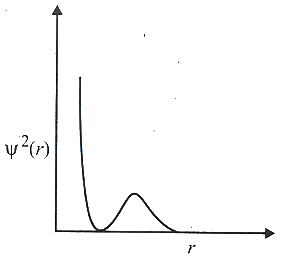
The graph showing the variation of probability density,$\psi^2(r)$ with the distance of the electron from the nucleus,$r$ is given below. This represents:
A
$1s-$orbital
B
$2s-$orbital
C
$3s-$orbital
D
$2p-$orbital
Solution
(B) The region where the probability density function,$\psi^2(r)$ reduces to zero is called a nodal surface or simply a node.
For an $ns$ orbital,the number of radial nodes is given by $(n-1)$.
The provided graph shows one point where the probability density touches the $r$-axis (one radial node).
For $1s$ orbital: $(n-1) = (1-1) = 0$ nodes.
For $2s$ orbital: $(n-1) = (2-1) = 1$ node.
For $3s$ orbital: $(n-1) = (3-1) = 2$ nodes.
Since the graph has one node,it represents the $2s-$orbital.
For an $ns$ orbital,the number of radial nodes is given by $(n-1)$.
The provided graph shows one point where the probability density touches the $r$-axis (one radial node).
For $1s$ orbital: $(n-1) = (1-1) = 0$ nodes.
For $2s$ orbital: $(n-1) = (2-1) = 1$ node.
For $3s$ orbital: $(n-1) = (3-1) = 2$ nodes.
Since the graph has one node,it represents the $2s-$orbital.
0 likes
View Solution938
EasyMCQ
The sum of the number of angular nodes and radial nodes for a $4d$ orbital is:
A
$2$
B
$3$
C
$4$
D
$5$
Solution
(B) The number of radial nodes is given by the formula: $\text{Radial nodes} = n - l - 1$.
The number of angular nodes is given by the value of the azimuthal quantum number: $\text{Angular nodes} = l$.
For a $4d$ orbital,the principal quantum number $n = 4$ and the azimuthal quantum number $l = 2$.
Therefore,$\text{Angular nodes} = 2$.
$\text{Radial nodes} = 4 - 2 - 1 = 1$.
The sum of angular and radial nodes is $2 + 1 = 3$.
The number of angular nodes is given by the value of the azimuthal quantum number: $\text{Angular nodes} = l$.
For a $4d$ orbital,the principal quantum number $n = 4$ and the azimuthal quantum number $l = 2$.
Therefore,$\text{Angular nodes} = 2$.
$\text{Radial nodes} = 4 - 2 - 1 = 1$.
The sum of angular and radial nodes is $2 + 1 = 3$.
0 likes
View Solution939
MediumMCQ
The minimum number of quantum numbers required to specify an orbital in an atom is
A
$1$
B
$4$
C
$2$
D
$3$
Solution
(D) An orbital in an atom is defined by the first three quantum numbers: the principal quantum number $(n)$,the azimuthal quantum number $(l)$,and the magnetic orbital quantum number $(m_l)$.
These three quantum numbers specify the size,shape,and orientation of the orbital.
The fourth quantum number,the spin quantum number $(m_s)$,is used to describe the spin of the electron within the orbital,not the orbital itself.
These three quantum numbers specify the size,shape,and orientation of the orbital.
The fourth quantum number,the spin quantum number $(m_s)$,is used to describe the spin of the electron within the orbital,not the orbital itself.
0 likes
View Solution940
MediumMCQ
Maximum number of electrons theoretically possible for an orbit with principal quantum number $n=6$ in an atom is
A
$27$
B
$98$
C
$72$
D
$50$
Solution
(C) The maximum number of electrons that can be accommodated in an orbit with principal quantum number $n$ is given by the formula $2n^2$.
For $n=6$,the number of electrons $= 2(6)^2 = 2 \times 36 = 72$.
For $n=6$,the number of electrons $= 2(6)^2 = 2 \times 36 = 72$.
0 likes
View Solution941
EasyMCQ
Total number of angular nodes of orbitals associated with third shell $(n=3)$ of an atom is
A
$3$
B
$4$
C
$2$
D
$1$
Solution
(A) The number of angular nodes for an orbital is given by the azimuthal quantum number $l$.
For the third shell $(n=3)$,the possible subshells are $3s$,$3p$,and $3d$.
For $3s$ orbital,$l=0$,so the number of angular nodes is $0$.
For $3p$ orbital,$l=1$,so the number of angular nodes is $1$.
For $3d$ orbital,$l=2$,so the number of angular nodes is $2$.
Therefore,the total number of angular nodes for all orbitals in the third shell is $0 + 1 + 2 = 3$.
For the third shell $(n=3)$,the possible subshells are $3s$,$3p$,and $3d$.
For $3s$ orbital,$l=0$,so the number of angular nodes is $0$.
For $3p$ orbital,$l=1$,so the number of angular nodes is $1$.
For $3d$ orbital,$l=2$,so the number of angular nodes is $2$.
Therefore,the total number of angular nodes for all orbitals in the third shell is $0 + 1 + 2 = 3$.
0 likes
View Solution942
EasyMCQ
Which of the following sets of quantum numbers is correct for an electron in $4f$ orbital?
A
$n=3, \ell=2, m_l=-2, m_s=+1/2$
B
$n=4, \ell=3, m_l=+1, m_s=+1/2$
C
$n=4, \ell=3, m_l=+4, m_s=+1/2$
D
$n=4, \ell=4, m_l=+4, m_s=-1/2$
Solution
(B) For a $4f$ orbital,the principal quantum number $n=4$ and the azimuthal quantum number $\ell=3$.
For a given value of $\ell$,the magnetic quantum number $m_l$ can take values from $-\ell$ to $+\ell$,i.e.,$-3, -2, -1, 0, +1, +2, +3$.
Thus,$m_l=+1$ is a valid value.
The spin quantum number $m_s$ can be either $+\frac{1}{2}$ or $-\frac{1}{2}$.
Therefore,the set $n=4, \ell=3, m_l=+1, m_s=+1/2$ is correct.
For a given value of $\ell$,the magnetic quantum number $m_l$ can take values from $-\ell$ to $+\ell$,i.e.,$-3, -2, -1, 0, +1, +2, +3$.
Thus,$m_l=+1$ is a valid value.
The spin quantum number $m_s$ can be either $+\frac{1}{2}$ or $-\frac{1}{2}$.
Therefore,the set $n=4, \ell=3, m_l=+1, m_s=+1/2$ is correct.
0 likes
View Solution943
MediumMCQ
The number of radial nodes and angular nodes of a $4f$-orbital are respectively:
A
$0, 3$
B
$1, 2$
C
$2, 1$
D
$2, 0$
Solution
(A) For any orbital,the number of angular nodes is equal to the azimuthal quantum number $(l)$.
For a $4f$-orbital,the principal quantum number $n = 4$ and the azimuthal quantum number $l = 3$.
Angular nodes $= l = 3$.
The number of radial nodes is given by the formula: $\text{Radial nodes} = n - l - 1$.
Substituting the values: $\text{Radial nodes} = 4 - 3 - 1 = 0$.
Therefore,the number of radial nodes is $0$ and the number of angular nodes is $3$.
For a $4f$-orbital,the principal quantum number $n = 4$ and the azimuthal quantum number $l = 3$.
Angular nodes $= l = 3$.
The number of radial nodes is given by the formula: $\text{Radial nodes} = n - l - 1$.
Substituting the values: $\text{Radial nodes} = 4 - 3 - 1 = 0$.
Therefore,the number of radial nodes is $0$ and the number of angular nodes is $3$.
0 likes
View Solution944
MediumMCQ
Which quantum number provides information about the shape of an orbital?
A
Spin quantum number
B
Azimuthal quantum number
C
Magnetic quantum number
D
Principal quantum number
Solution
(B) The azimuthal quantum number $(l)$ determines the shape of the orbital.
It is a quantum number for an atomic orbital that determines its orbital angular momentum and describes its shape.
The azimuthal quantum number is the second of a set of quantum numbers representing an electron's unique quantum state.
For example,$l = 0$ represents a spherical orbital ($s$-orbital),and $l = 1$ represents a dumbbell-shaped orbital ($p$-orbital).
Hence,option $B$ is the correct answer.
It is a quantum number for an atomic orbital that determines its orbital angular momentum and describes its shape.
The azimuthal quantum number is the second of a set of quantum numbers representing an electron's unique quantum state.
For example,$l = 0$ represents a spherical orbital ($s$-orbital),and $l = 1$ represents a dumbbell-shaped orbital ($p$-orbital).
Hence,option $B$ is the correct answer.
0 likes
View Solution945
MediumMCQ
The maximum number of electrons present in an orbital with $n=4, l=3$ is
A
$6$
B
$14$
C
$10$
D
$2$
Solution
(D) According to the $Pauli$ exclusion principle,any single orbital can hold a maximum of $2$ electrons with opposite spins.
The quantum numbers $n=4$ and $l=3$ specify a $4f$ subshell,which contains $7$ distinct orbitals.
However,the question asks for the maximum number of electrons in an orbital (singular),not the entire subshell.
Therefore,regardless of the values of $n$ and $l$,any single orbital can accommodate a maximum of $2$ electrons.
The quantum numbers $n=4$ and $l=3$ specify a $4f$ subshell,which contains $7$ distinct orbitals.
However,the question asks for the maximum number of electrons in an orbital (singular),not the entire subshell.
Therefore,regardless of the values of $n$ and $l$,any single orbital can accommodate a maximum of $2$ electrons.
0 likes
View Solution946
MediumMCQ
Maximum number of electrons possible with spin quantum number $+\frac{1}{2}$ with principal quantum number $n=4$ in an atom is
A
$16$
B
$9$
C
$4$
D
$25$
Solution
(A) The total number of electrons in a shell with principal quantum number $n$ is given by $2n^2$.
For $n=4$,the total number of electrons is $2 \times 4^2 = 32$.
Since each orbital can hold a maximum of $2$ electrons with opposite spins ($+\frac{1}{2}$ and $-\frac{1}{2}$),exactly half of the total electrons will have a spin quantum number of $+\frac{1}{2}$.
Therefore,the number of electrons with spin $+\frac{1}{2}$ is $\frac{32}{2} = 16$.
For $n=4$,the total number of electrons is $2 \times 4^2 = 32$.
Since each orbital can hold a maximum of $2$ electrons with opposite spins ($+\frac{1}{2}$ and $-\frac{1}{2}$),exactly half of the total electrons will have a spin quantum number of $+\frac{1}{2}$.
Therefore,the number of electrons with spin $+\frac{1}{2}$ is $\frac{32}{2} = 16$.
0 likes
View Solution947
EasyMCQ
The incorrect set of quantum numbers $(n, l, m, s)$ for an electron in $3p$ orbital is
A
$3, 1, -1, 1/2$
B
$3, 1, -2, -1/2$
C
$3, 1, 1, 1/2$
D
$3, 1, +1, -1/2$
Solution
(B) For an electron in a $3p$-orbital,the principal quantum number $n = 3$.
For a $p$-orbital,the azimuthal quantum number $l = 1$.
The magnetic quantum number $m$ can take values from $-l$ to $+l$,which means $m = -1, 0, +1$.
The spin quantum number $s$ can be $+1/2$ or $-1/2$.
Comparing these with the given options,in option $(b)$,the value of $m$ is given as $-2$,which is not possible for $l = 1$.
Therefore,the set $(3, 1, -2, -1/2)$ is incorrect.
For a $p$-orbital,the azimuthal quantum number $l = 1$.
The magnetic quantum number $m$ can take values from $-l$ to $+l$,which means $m = -1, 0, +1$.
The spin quantum number $s$ can be $+1/2$ or $-1/2$.
Comparing these with the given options,in option $(b)$,the value of $m$ is given as $-2$,which is not possible for $l = 1$.
Therefore,the set $(3, 1, -2, -1/2)$ is incorrect.
0 likes
View Solution948
EasyMCQ
The sum of electrons present in all subshells of an atom with $m_s$ value of $+\frac{1}{2}$ for $n=4$ and $m_s$ value of $-\frac{1}{2}$ for $n=3$ is
A
$25$
B
$16$
C
$09$
D
$32$
Solution
(A) The maximum number of electrons in a shell with principal quantum number $n$ is given by $2n^2$.
For $n=4$,the total number of electrons is $2(4)^2 = 32$. The number of electrons with $m_s = +\frac{1}{2}$ is $32/2 = 16$.
For $n=3$,the total number of electrons is $2(3)^2 = 18$. The number of electrons with $m_s = -\frac{1}{2}$ is $18/2 = 9$.
The sum of these electrons is $16 + 9 = 25$.
For $n=4$,the total number of electrons is $2(4)^2 = 32$. The number of electrons with $m_s = +\frac{1}{2}$ is $32/2 = 16$.
For $n=3$,the total number of electrons is $2(3)^2 = 18$. The number of electrons with $m_s = -\frac{1}{2}$ is $18/2 = 9$.
The sum of these electrons is $16 + 9 = 25$.
0 likes
View Solution949
EasyMCQ
$A$ subshell with $n=3$ and $l=2$ can accommodate a maximum of:
A
$10$ electrons
B
$6$ electrons
C
$18$ electrons
D
$16$ electrons
Solution
(A) The azimuthal quantum number $(l)$ determines the subshell type. For a given subshell,the number of orbitals is given by $(2l + 1)$.
Each orbital can hold a maximum of $2$ electrons.
Therefore,the maximum number of electrons in a subshell is $2 \times (2l + 1)$.
Given $n=3$ and $l=2$,this corresponds to the $3d$ subshell.
Substituting $l=2$ into the formula: $2 \times (2(2) + 1) = 2 \times (4 + 1) = 2 \times 5 = 10$ electrons.
Thus,the $3d$ subshell can accommodate a maximum of $10$ electrons.
Each orbital can hold a maximum of $2$ electrons.
Therefore,the maximum number of electrons in a subshell is $2 \times (2l + 1)$.
Given $n=3$ and $l=2$,this corresponds to the $3d$ subshell.
Substituting $l=2$ into the formula: $2 \times (2(2) + 1) = 2 \times (4 + 1) = 2 \times 5 = 10$ electrons.
Thus,the $3d$ subshell can accommodate a maximum of $10$ electrons.
0 likes
View Solution950
MediumMCQ
Which orbital among the following has zero radial nodes and $2$ angular nodes?
A
$4s$
B
$3d$
C
$2p$
D
$5s$
Solution
(B) The number of angular nodes is given by the azimuthal quantum number $l$. For $d$-orbitals,$l = 2$,so they have $2$ angular nodes.
The number of radial nodes is calculated using the formula: $\text{Radial nodes} = n - l - 1$.
For the $3d$ orbital: $n = 3$ and $l = 2$.
$\text{Radial nodes} = 3 - 2 - 1 = 0$.
Thus,the $3d$ orbital has $0$ radial nodes and $2$ angular nodes.
The number of radial nodes is calculated using the formula: $\text{Radial nodes} = n - l - 1$.
For the $3d$ orbital: $n = 3$ and $l = 2$.
$\text{Radial nodes} = 3 - 2 - 1 = 0$.
Thus,the $3d$ orbital has $0$ radial nodes and $2$ angular nodes.
0 likes
View SolutionStructure of Atom — Quantum number, Electronic configuration and Shape of orbitals · Frequently Asked Questions
1Are these Structure of Atom questions useful for JEE and NEET?
Yes. All questions in this section are mapped to JEE Main and NEET exam patterns. Previous year questions from JEE Main, NEET, GUJCET and state-level exams are included with full solutions.
2Can I switch to Hindi or Gujarati for these questions?
Yes. Use the language tabs in the hero section or the sidebar to view the same questions and solutions in English, Hindi or Gujarati.
3How do I generate a question paper from this subtopic?
Use the Vedclass Exam Paper Generator — select the chapter and subtopic, set difficulty, and generate Sets A, B, C, D automatically. First 3 chapters of every subject are free.
Vedclass Products
For Students
Vedclass Test Series
Mock tests in real JEE/NEET style with performance analysis. 5-day free trial.
Start Free TrialFor Teachers
Exam Paper Generator
Generate Set A/B/C/D papers from this chapter in 2 minutes. 3 chapters free.
Try FreeFor Institutes
Online Exam Module
Live online exams with unlimited students, 360° analytics & white-label branding.
See DemoFor Teachers & Institutes
Generate a Structure of Atom Exam Paper in 2 Minutes
Select subtopic & difficulty — Sets A, B, C, D auto-generated with No Repeat logic.
First 3 chapters of every subject are free — no payment required.