
A English
Quantum number, Electronic configuration and Shape of orbitals Questions in English
Class 11 Chemistry · Structure of Atom · Quantum number, Electronic configuration and Shape of orbitals
1023+
Questions
English
Language
100%
With Solutions
Showing 22 of 1023 questions in English
1001
MediumMCQ
In the ground state,an element has $13$ electrons in the $M$ shell. The element is
A
copper
B
chromium
C
nickel
D
iron
Solution
(B) The $M$ shell corresponds to the $n=3$ principal energy level.
For an element to have $13$ electrons in the $M$ shell,the electronic configuration must include $3s^2, 3p^6, 3d^5$.
Considering the Aufbau principle and stability,the configuration is $1s^2, 2s^2, 2p^6, 3s^2, 3p^6, 3d^5, 4s^1$.
The total number of electrons is $2+2+6+2+6+5+1 = 24$.
The element with atomic number $24$ is chromium $(Cr)$.
For an element to have $13$ electrons in the $M$ shell,the electronic configuration must include $3s^2, 3p^6, 3d^5$.
Considering the Aufbau principle and stability,the configuration is $1s^2, 2s^2, 2p^6, 3s^2, 3p^6, 3d^5, 4s^1$.
The total number of electrons is $2+2+6+2+6+5+1 = 24$.
The element with atomic number $24$ is chromium $(Cr)$.
0 likes
View Solution1002
EasyMCQ
The electronic configuration of $Cu$ is
A
$[Ne] 3s^{2}, 3p^{6}, 3d^{9}, 4s^{2}$
B
$[Ar] 3d^{10}, 4s^{1}$
C
$[Ne] 3s^{2}, 3p^{6}, 3d^{3}, 4s^{2}, 4p^{6}$
D
$[Ne] 3s^{2}, 3p^{6}, 3d^{5}, 4s^{2}, 4p^{4}$
Solution
(B) The atomic number of $Cu$ is $29$.
According to the Aufbau principle,the expected configuration is $[Ar] 3d^{9} 4s^{2}$.
However,fully filled $d$-orbitals are more stable than partially filled ones.
Therefore,one electron from the $4s$ orbital shifts to the $3d$ orbital to make it $3d^{10}$.
The correct electronic configuration is $[Ar] 3d^{10} 4s^{1}$.
According to the Aufbau principle,the expected configuration is $[Ar] 3d^{9} 4s^{2}$.
However,fully filled $d$-orbitals are more stable than partially filled ones.
Therefore,one electron from the $4s$ orbital shifts to the $3d$ orbital to make it $3d^{10}$.
The correct electronic configuration is $[Ar] 3d^{10} 4s^{1}$.
0 likes
View Solution1003
MediumMCQ
The representation of the ground state electronic configuration of $He$ by box-diagram as $\uparrow \uparrow$ is wrong because it violates
A
Hund's Rule
B
Bohr's Quantization Theory of Angular Momenta
C
Pauli Exclusion Principle
D
Heisenberg's Uncertainty Principle
Solution
(C) According to the $Pauli$ $Exclusion$ $Principle$,an orbital can accommodate a maximum of two electrons,and these electrons must have opposite spins.
The representation $\uparrow \uparrow$ shows two electrons with parallel spins in the same orbital,which violates this principle.
The representation $\uparrow \uparrow$ shows two electrons with parallel spins in the same orbital,which violates this principle.
0 likes
View Solution1004
MediumMCQ
An electron in the $5d$ orbital can be represented by the following $(n, l, m_l)$ values:
A
$(5, 2, 1)$
B
$(5, 1, -1)$
C
$(5, 0, 1)$
D
$(5, 2, -1)$
Solution
(A) For an electron in the $5d$ orbital,the principal quantum number $n = 5$ and the azimuthal quantum number $l = 2$ (since $s=0, p=1, d=2, f=3$).
The magnetic quantum number $m_l$ can take any integer value from $-l$ to $+l$,which is $-2, -1, 0, 1, 2$.
Both $(5, 2, 1)$ and $(5, 2, -1)$ are valid sets of quantum numbers for a $5d$ electron.
However,in multiple-choice questions of this type,if multiple options are mathematically valid,we select the one provided in the set. Since both $A$ and $D$ are valid,but $D$ is often cited in standard examples,we identify the valid range.
The magnetic quantum number $m_l$ can take any integer value from $-l$ to $+l$,which is $-2, -1, 0, 1, 2$.
Both $(5, 2, 1)$ and $(5, 2, -1)$ are valid sets of quantum numbers for a $5d$ electron.
However,in multiple-choice questions of this type,if multiple options are mathematically valid,we select the one provided in the set. Since both $A$ and $D$ are valid,but $D$ is often cited in standard examples,we identify the valid range.
0 likes
View Solution1005
EasyMCQ
Which one of the following is the correct set of four quantum numbers $(n, l, m, s)$?
A
$(3, 0, -1, +\frac{1}{2})$
B
$(4, 3, -2, -\frac{1}{2})$
C
$(3, 1, -2, -\frac{1}{2})$
D
$(4, 2, -3, +\frac{1}{2})$
Solution
(B) The rules for quantum numbers are as follows:
$1$. Principal quantum number $n$ can be any positive integer $(1, 2, 3, ...)$.
$2$. Azimuthal quantum number $\ell$ ranges from $0$ to $n-1$.
$3$. Magnetic quantum number $m$ ranges from $-\ell$ to $+\ell$.
$4$. Spin quantum number $s$ can be $+\frac{1}{2}$ or $-\frac{1}{2}$.
Evaluating the options:
$A$: $(3, 0, -1, +\frac{1}{2})$ is incorrect because $m$ cannot be $-1$ when $\ell=0$.
$B$: $(4, 3, -2, -\frac{1}{2})$ is correct because for $n=4$,$\ell=3$ is allowed,and for $\ell=3$,$m=-2$ is allowed.
$C$: $(3, 1, -2, -\frac{1}{2})$ is incorrect because $m$ cannot be $-2$ when $\ell=1$.
$D$: $(4, 2, -3, +\frac{1}{2})$ is incorrect because $m$ cannot be $-3$ when $\ell=2$.
$1$. Principal quantum number $n$ can be any positive integer $(1, 2, 3, ...)$.
$2$. Azimuthal quantum number $\ell$ ranges from $0$ to $n-1$.
$3$. Magnetic quantum number $m$ ranges from $-\ell$ to $+\ell$.
$4$. Spin quantum number $s$ can be $+\frac{1}{2}$ or $-\frac{1}{2}$.
Evaluating the options:
$A$: $(3, 0, -1, +\frac{1}{2})$ is incorrect because $m$ cannot be $-1$ when $\ell=0$.
$B$: $(4, 3, -2, -\frac{1}{2})$ is correct because for $n=4$,$\ell=3$ is allowed,and for $\ell=3$,$m=-2$ is allowed.
$C$: $(3, 1, -2, -\frac{1}{2})$ is incorrect because $m$ cannot be $-2$ when $\ell=1$.
$D$: $(4, 2, -3, +\frac{1}{2})$ is incorrect because $m$ cannot be $-3$ when $\ell=2$.
0 likes
View Solution1006
MediumMCQ
The difference between the orbital angular momentum of an electron in a $4f$ orbital and another electron in a $4s$ orbital is
A
$2 \sqrt{3} \times \frac{h}{2 \pi}$
B
$3 \sqrt{2} \times \frac{h}{2 \pi}$
C
$\sqrt{3} \times \frac{h}{2 \pi}$
D
$2 \times \frac{h}{2 \pi}$
Solution
(A) The orbital angular momentum is given by the formula: $\text{Orbital angular momentum} = \sqrt{\ell(\ell+1)} \frac{h}{2 \pi}$.
For a $4f$ orbital,the azimuthal quantum number $\ell = 3$. Therefore,the orbital angular momentum is $\sqrt{3(3+1)} \frac{h}{2 \pi} = \sqrt{12} \frac{h}{2 \pi} = 2 \sqrt{3} \frac{h}{2 \pi}$.
For a $4s$ orbital,the azimuthal quantum number $\ell = 0$. Therefore,the orbital angular momentum is $\sqrt{0(0+1)} \frac{h}{2 \pi} = 0$.
The difference between the two is $2 \sqrt{3} \frac{h}{2 \pi} - 0 = 2 \sqrt{3} \frac{h}{2 \pi}$.
For a $4f$ orbital,the azimuthal quantum number $\ell = 3$. Therefore,the orbital angular momentum is $\sqrt{3(3+1)} \frac{h}{2 \pi} = \sqrt{12} \frac{h}{2 \pi} = 2 \sqrt{3} \frac{h}{2 \pi}$.
For a $4s$ orbital,the azimuthal quantum number $\ell = 0$. Therefore,the orbital angular momentum is $\sqrt{0(0+1)} \frac{h}{2 \pi} = 0$.
The difference between the two is $2 \sqrt{3} \frac{h}{2 \pi} - 0 = 2 \sqrt{3} \frac{h}{2 \pi}$.
0 likes
View Solution1007
MediumMCQ
Which of these species will have a non-zero magnetic moment?
A
$Na^{+}$
B
$Mg$
C
$F^{-}$
D
$Ar^{+}$
Solution
(D) Key point: Species with one or more unpaired electrons exhibit a non-zero magnetic moment.
Electronic configurations:
$Na^{+} (Z=11) = 1s^{2} 2s^{2} 2p^{6}$ (All electrons paired)
$Mg (Z=12) = 1s^{2} 2s^{2} 2p^{6} 3s^{2}$ (All electrons paired)
$F^{-} (Z=9) = 1s^{2} 2s^{2} 2p^{6}$ (All electrons paired)
$Ar^{+} (Z=18) = 1s^{2} 2s^{2} 2p^{6} 3s^{2} 3p^{5}$ (One unpaired electron in $3p$ orbital)
Since $Ar^{+}$ has an unpaired electron,it possesses a non-zero magnetic moment. Therefore,$(d)$ is the correct option.
Electronic configurations:
$Na^{+} (Z=11) = 1s^{2} 2s^{2} 2p^{6}$ (All electrons paired)
$Mg (Z=12) = 1s^{2} 2s^{2} 2p^{6} 3s^{2}$ (All electrons paired)
$F^{-} (Z=9) = 1s^{2} 2s^{2} 2p^{6}$ (All electrons paired)
$Ar^{+} (Z=18) = 1s^{2} 2s^{2} 2p^{6} 3s^{2} 3p^{5}$ (One unpaired electron in $3p$ orbital)
Since $Ar^{+}$ has an unpaired electron,it possesses a non-zero magnetic moment. Therefore,$(d)$ is the correct option.
0 likes
View Solution1008
EasyMCQ
Identify the correct statement.
A
Quantum numbers $(n, l, m, s)$ are arbitrary.
B
All the quantum numbers $(n, l, m, s)$ for any pair of electrons in an atom can be identical under special circumstances.
C
All the quantum numbers $(n, l, m, s)$ may not be required to describe an electron of an atom completely.
D
All the quantum numbers $(n, l, m, s)$ are required to describe an electron of an atom completely.
Solution
(D) According to the Pauli Exclusion Principle,no two electrons in an atom can have the same set of all four quantum numbers $(n, l, m, s)$.
Therefore,all four quantum numbers are necessary to uniquely identify and describe the state of an electron in an atom.
$n$ (Principal quantum number) defines the shell and energy.
$l$ (Azimuthal quantum number) defines the subshell and orbital shape.
$m$ (Magnetic quantum number) defines the spatial orientation.
$s$ (Spin quantum number) defines the electron spin direction.
Therefore,all four quantum numbers are necessary to uniquely identify and describe the state of an electron in an atom.
$n$ (Principal quantum number) defines the shell and energy.
$l$ (Azimuthal quantum number) defines the subshell and orbital shape.
$m$ (Magnetic quantum number) defines the spatial orientation.
$s$ (Spin quantum number) defines the electron spin direction.
0 likes
View Solution1009
EasyMCQ
Which of the following orbitals will have zero probability of finding the electron in the $yz$ plane?
A
$p_x$
B
$p_y$
C
$p_z$
D
$d_{yz}$
Solution
(A) The $yz$ plane is defined by the equation $x = 0$.
An orbital will have zero probability of finding an electron in the $yz$ plane if it has a nodal plane coinciding with the $yz$ plane.
The $p_x$ orbital has its electron density distributed along the $x$-axis,and its nodal plane is the $yz$ plane.
Therefore,the probability of finding an electron in the $yz$ plane for the $p_x$ orbital is zero.
An orbital will have zero probability of finding an electron in the $yz$ plane if it has a nodal plane coinciding with the $yz$ plane.
The $p_x$ orbital has its electron density distributed along the $x$-axis,and its nodal plane is the $yz$ plane.
Therefore,the probability of finding an electron in the $yz$ plane for the $p_x$ orbital is zero.
0 likes
View Solution1010
MediumMCQ
The maximum number of electrons in an atom in which the last electron filled has the quantum numbers $n=3, \ell=2$ and $m=-1$ is
A
$17$
B
$27$
C
$28$
D
$30$
Solution
(D) The quantum numbers $n=3$ and $\ell=2$ correspond to the $3d$ subshell.
Since the last electron is filled in the $3d$ subshell,we look for the maximum number of electrons possible when the $3d$ subshell is completely filled.
The electronic configuration for a completely filled $3d$ subshell is $1s^2 2s^2 2p^6 3s^2 3p^6 4s^2 3d^{10}$.
Counting the total number of electrons: $2+2+6+2+6+2+10 = 30$.
This corresponds to the element Zinc $(Zn)$ with atomic number $30$.
Since the last electron is filled in the $3d$ subshell,we look for the maximum number of electrons possible when the $3d$ subshell is completely filled.
The electronic configuration for a completely filled $3d$ subshell is $1s^2 2s^2 2p^6 3s^2 3p^6 4s^2 3d^{10}$.
Counting the total number of electrons: $2+2+6+2+6+2+10 = 30$.
This corresponds to the element Zinc $(Zn)$ with atomic number $30$.
0 likes
View Solution1011
MediumMCQ
Which one of the following electronic arrangements is absurd?
A
$n=3, l=1, m=-1$
B
$n=3, l=0, m=0$
C
$n=2, l=0, m=-1$
D
$n=2, l=1, m=0$
Solution
(C) For a given value of azimuthal quantum number $l$,the magnetic quantum number $m$ can have values ranging from $-l$ to $+l$ (including zero).
If $l=0$,then $m$ must be $0$.
In option $(c)$,$l=0$ but $m=-1$,which violates the rule $-l \leq m \leq l$.
Therefore,the arrangement $n=2, l=0, m=-1$ is impossible and absurd.
If $l=0$,then $m$ must be $0$.
In option $(c)$,$l=0$ but $m=-1$,which violates the rule $-l \leq m \leq l$.
Therefore,the arrangement $n=2, l=0, m=-1$ is impossible and absurd.
0 likes
View Solution1012
EasyMCQ
Which of the following sets of quantum numbers is not possible?
A
$n=3, l=0, m=0$
B
$n=3, l=1, m=-1$
C
$n=2, l=0, m=-1$
D
$n=2, l=1, m=0$
Solution
(C) For a given value of $n$,the azimuthal quantum number $l$ can have values from $0$ to $n-1$.
For a given value of $l$,the magnetic quantum number $m$ can have values from $-l$ to $+l$ including $0$.
In option $C$,$n=2$ and $l=0$.
For $l=0$,the only possible value for $m$ is $0$.
Therefore,$m=-1$ is not possible for $l=0$.
For a given value of $l$,the magnetic quantum number $m$ can have values from $-l$ to $+l$ including $0$.
In option $C$,$n=2$ and $l=0$.
For $l=0$,the only possible value for $m$ is $0$.
Therefore,$m=-1$ is not possible for $l=0$.
0 likes
View Solution1013
EasyMCQ
The number of unpaired electrons in $Ni$ (atomic number $= 28$) is:
A
$0$
B
$2$
C
$4$
D
$8$
Solution
(B) The atomic number of $Ni$ is $28$.
Its electronic configuration is: $1s^2 2s^2 2p^6 3s^2 3p^6 4s^2 3d^8$.
In the $3d$ subshell,there are $8$ electrons.
According to Hund's rule,these $8$ electrons are filled in the $5$ $d$-orbitals as follows:
First,$5$ electrons are filled singly,and then the remaining $3$ electrons are paired.
This results in $3$ paired orbitals and $2$ singly occupied (unpaired) orbitals.
Therefore,the number of unpaired electrons in $Ni$ is $2$.
Its electronic configuration is: $1s^2 2s^2 2p^6 3s^2 3p^6 4s^2 3d^8$.
In the $3d$ subshell,there are $8$ electrons.
According to Hund's rule,these $8$ electrons are filled in the $5$ $d$-orbitals as follows:
First,$5$ electrons are filled singly,and then the remaining $3$ electrons are paired.
This results in $3$ paired orbitals and $2$ singly occupied (unpaired) orbitals.
Therefore,the number of unpaired electrons in $Ni$ is $2$.
0 likes
View Solution1014
EasyMCQ
If the given four electronic configurations:
$(i)$ $n=4, l=1$
$(ii)$ $n=4, l=0$
$(iii)$ $n=3, l=2$
$(iv)$ $n=3, l=1$
are arranged in order of increasing energy,then the order will be:
$(i)$ $n=4, l=1$
$(ii)$ $n=4, l=0$
$(iii)$ $n=3, l=2$
$(iv)$ $n=3, l=1$
are arranged in order of increasing energy,then the order will be:
A
$(iv) < (ii) < (iii) < (i)$
B
$(ii) < (iv) < (i) < (iii)$
C
$(i) < (iii) < (ii) < (iv)$
D
$(iii) < (i) < (iv) < (ii)$
Solution
(A) According to the $(n+l)$ rule:
$1$. The orbital with a lower $(n+l)$ value has lower energy.
$2$. If the $(n+l)$ values are the same,the orbital with the lower $n$ value has lower energy.
Calculating $(n+l)$ values:
$(i)$ $n+l = 4+1 = 5$
$(ii)$ $n+l = 4+0 = 4$
$(iii)$ $n+l = 3+2 = 5$
$(iv)$ $n+l = 3+1 = 4$
Comparing the values:
For $(iv)$ and $(ii)$,both have $(n+l) = 4$. Since $(iv)$ has $n=3$ and $(ii)$ has $n=4$,$(iv) < (ii)$.
For $(iii)$ and $(i)$,both have $(n+l) = 5$. Since $(iii)$ has $n=3$ and $(i)$ has $n=4$,$(iii) < (i)$.
Combining these,the order of increasing energy is $(iv) < (ii) < (iii) < (i)$.
$1$. The orbital with a lower $(n+l)$ value has lower energy.
$2$. If the $(n+l)$ values are the same,the orbital with the lower $n$ value has lower energy.
Calculating $(n+l)$ values:
$(i)$ $n+l = 4+1 = 5$
$(ii)$ $n+l = 4+0 = 4$
$(iii)$ $n+l = 3+2 = 5$
$(iv)$ $n+l = 3+1 = 4$
Comparing the values:
For $(iv)$ and $(ii)$,both have $(n+l) = 4$. Since $(iv)$ has $n=3$ and $(ii)$ has $n=4$,$(iv) < (ii)$.
For $(iii)$ and $(i)$,both have $(n+l) = 5$. Since $(iii)$ has $n=3$ and $(i)$ has $n=4$,$(iii) < (i)$.
Combining these,the order of increasing energy is $(iv) < (ii) < (iii) < (i)$.
0 likes
View Solution1015
EasyMCQ
Which of the following sets of quantum numbers represents the $19^{\text{th}}$ electron of $Cr$ $(Z=24)$?
A
$(4, 1, -1, +\frac{1}{2})$
B
$(4, 0, 0, +\frac{1}{2})$
C
$(3, 2, 0, -\frac{1}{2})$
D
$(3, 2, -2, +\frac{1}{2})$
Solution
(B) The electronic configuration of $Cr$ $(Z=24)$ is $[Ar]_{18} 4s^1 3d^5$.
Electrons $1$ to $18$ are filled in the $Ar$ core.
The $19^{\text{th}}$ electron is the first electron to enter the $4s$ orbital.
For the $4s$ orbital: principal quantum number $n=4$,azimuthal quantum number $l=0$,magnetic quantum number $m_l=0$,and spin quantum number $m_s=+\frac{1}{2}$.
Thus,the set of quantum numbers is $(4, 0, 0, +\frac{1}{2})$.
Electrons $1$ to $18$ are filled in the $Ar$ core.
The $19^{\text{th}}$ electron is the first electron to enter the $4s$ orbital.
For the $4s$ orbital: principal quantum number $n=4$,azimuthal quantum number $l=0$,magnetic quantum number $m_l=0$,and spin quantum number $m_s=+\frac{1}{2}$.
Thus,the set of quantum numbers is $(4, 0, 0, +\frac{1}{2})$.
0 likes
View Solution1016
DifficultMCQ
Given,
$(A)$ $n=5, m_l=-1$
$(B)$ $n=3, l=2, m_l=-1, m_s=+\frac{1}{2}$
The maximum number of electron$(s)$ in an atom that can have the quantum numbers as given in $(A)$ and $(B)$ respectively are:
$(A)$ $n=5, m_l=-1$
$(B)$ $n=3, l=2, m_l=-1, m_s=+\frac{1}{2}$
The maximum number of electron$(s)$ in an atom that can have the quantum numbers as given in $(A)$ and $(B)$ respectively are:
A
$26$ and $1$
B
$4$ and $1$
C
$2$ and $4$
D
$8$ and $1$
Solution
(D) For $n=5$:
For each subshell $l$,the number of orbitals with $m_l=-1$ is $1$ (if $l \ge 1$).
Subshells present in $n=5$ are $l=0, 1, 2, 3, 4$.
$m_l=-1$ is possible for $l=1, 2, 3, 4$.
Each orbital can hold $2$ electrons.
Total electrons $= 4 \text{ orbitals} \times 2 \text{ electrons/orbital} = 8$ electrons.
$(B)$ For $n=3, l=2, m_l=-1, m_s=+\frac{1}{2}$:
This set of quantum numbers defines a specific orbital and a specific spin.
Only $1$ electron can have these exact quantum numbers.
For each subshell $l$,the number of orbitals with $m_l=-1$ is $1$ (if $l \ge 1$).
Subshells present in $n=5$ are $l=0, 1, 2, 3, 4$.
$m_l=-1$ is possible for $l=1, 2, 3, 4$.
Each orbital can hold $2$ electrons.
Total electrons $= 4 \text{ orbitals} \times 2 \text{ electrons/orbital} = 8$ electrons.
$(B)$ For $n=3, l=2, m_l=-1, m_s=+\frac{1}{2}$:
This set of quantum numbers defines a specific orbital and a specific spin.
Only $1$ electron can have these exact quantum numbers.
0 likes
View Solution1017
DifficultMCQ
Figure $1$ shows the electron density distribution for a $2s$ orbital. Figure $2$ shows the radial wave function plot for a $2s$ orbital. Which of the following points $(A, B, C, D)$ in Figure $2$ most accurately represents the spherical nodal surface as shown in Figure $1$?
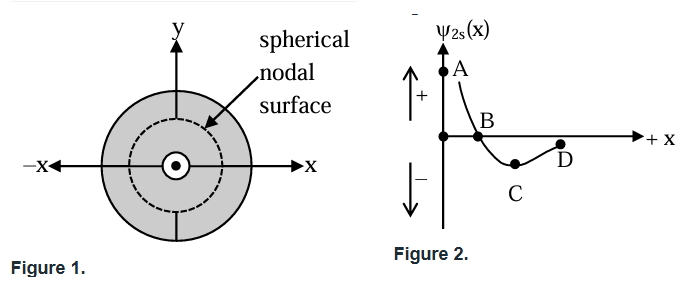
A
$B$
B
$D$
C
$C$
D
$A$
Solution
(C) node is a region where the probability of finding an electron is zero. For a radial wave function,this corresponds to the point where the wave function $\psi(r)$ crosses the x-axis,i.e.,$\psi(r) = 0$.
In the radial wave function plot for a $2s$ orbital,the curve crosses the x-axis at a specific distance from the nucleus. Based on standard representations of this graph,point $C$ typically marks the intersection where $\psi(r) = 0$,representing the spherical node.
In the radial wave function plot for a $2s$ orbital,the curve crosses the x-axis at a specific distance from the nucleus. Based on standard representations of this graph,point $C$ typically marks the intersection where $\psi(r) = 0$,representing the spherical node.
0 likes
View Solution1018
MediumMCQ
Arrange the following atomic orbitals of multi-electron atoms in order of increasing energy.
$A$. $n=3, l=2, m=+1$
$B$. $n=4, l=0, m=0$
$C$. $n=6, l=1, m=0$
$D$. $n=5, l=1, m=+1$
$E$. $n=2, l=1, m=+1$
Choose the correct answer from the options given below:
$A$. $n=3, l=2, m=+1$
$B$. $n=4, l=0, m=0$
$C$. $n=6, l=1, m=0$
$D$. $n=5, l=1, m=+1$
$E$. $n=2, l=1, m=+1$
Choose the correct answer from the options given below:
A
$C < D < B < A < E$
B
$B < A < E < C < D$
C
$E < C < D < B < A$
D
$E < B < A < D < C$
Solution
(D) The energy of atomic orbitals in multi-electron atoms is determined by the $(n+l)$ rule.
$1$. According to the $(n+l)$ rule,the orbital with the lower $(n+l)$ value has lower energy.
$2$. If the $(n+l)$ values are equal,the orbital with the lower value of $n$ has lower energy.
Calculating $(n+l)$ for each orbital:
$A: n=3, l=2 \implies n+l = 3+2 = 5$
$B: n=4, l=0 \implies n+l = 4+0 = 4$
$C: n=6, l=1 \implies n+l = 6+1 = 7$
$D: n=5, l=1 \implies n+l = 5+1 = 6$
$E: n=2, l=1 \implies n+l = 2+1 = 3$
Comparing the $(n+l)$ values: $3 (E) < 4 (B) < 5 (A) < 6 (D) < 7 (C)$.
Therefore,the order of increasing energy is $E < B < A < D < C$.
$1$. According to the $(n+l)$ rule,the orbital with the lower $(n+l)$ value has lower energy.
$2$. If the $(n+l)$ values are equal,the orbital with the lower value of $n$ has lower energy.
Calculating $(n+l)$ for each orbital:
$A: n=3, l=2 \implies n+l = 3+2 = 5$
$B: n=4, l=0 \implies n+l = 4+0 = 4$
$C: n=6, l=1 \implies n+l = 6+1 = 7$
$D: n=5, l=1 \implies n+l = 5+1 = 6$
$E: n=2, l=1 \implies n+l = 2+1 = 3$
Comparing the $(n+l)$ values: $3 (E) < 4 (B) < 5 (A) < 6 (D) < 7 (C)$.
Therefore,the order of increasing energy is $E < B < A < D < C$.
0 likes
View Solution1019
DifficultMCQ
Match the $LIST$-$I$ with $LIST$-$II$:
| List-$I$ (Orbital) | List-$II$ (Radial nodes and nodal plane) |
| $A$. $2s$ | $I$. $1$ Radial node + two nodal planes |
| $B$. $3s$ | $II$. $1$ Radial node + one nodal plane |
| $C$. $3p$ | $III$. $2$ Radial nodes + No nodal plane |
| $D$. $4d$ | $IV$. $1$ Radial node + No nodal plane |
A
$A-IV, B-I, C-III, D-II$
B
$A-IV, B-II, C-III, D-I$
C
$A-III, B-I, C-IV, D-II$
D
$A-IV, B-III, C-II, D-I$
Solution
(D) The number of radial nodes is given by the formula $(n-l-1)$ and the number of angular nodes (nodal planes) is given by $l$.
$A$. For $2s$ orbital: $n=2, l=0$. Radial nodes $= 2-0-1 = 1$. Nodal planes $= l = 0$. This matches $IV$.
$B$. For $3s$ orbital: $n=3, l=0$. Radial nodes $= 3-0-1 = 2$. Nodal planes $= l = 0$. This matches $III$.
$C$. For $3p$ orbital: $n=3, l=1$. Radial nodes $= 3-1-1 = 1$. Nodal planes $= l = 1$. This matches $II$.
$D$. For $4d$ orbital: $n=4, l=2$. Radial nodes $= 4-2-1 = 1$. Nodal planes $= l = 2$. This matches $I$.
Therefore,the correct matching is $A-IV, B-III, C-II, D-I$.
$A$. For $2s$ orbital: $n=2, l=0$. Radial nodes $= 2-0-1 = 1$. Nodal planes $= l = 0$. This matches $IV$.
$B$. For $3s$ orbital: $n=3, l=0$. Radial nodes $= 3-0-1 = 2$. Nodal planes $= l = 0$. This matches $III$.
$C$. For $3p$ orbital: $n=3, l=1$. Radial nodes $= 3-1-1 = 1$. Nodal planes $= l = 1$. This matches $II$.
$D$. For $4d$ orbital: $n=4, l=2$. Radial nodes $= 4-2-1 = 1$. Nodal planes $= l = 2$. This matches $I$.
Therefore,the correct matching is $A-IV, B-III, C-II, D-I$.
0 likes
View Solution1020
MediumMCQ
Which of the following is the correct set of $4$ quantum numbers for the $19^{th}$ electron in Chromium (Atomic number = $24$) in accordance with the Aufbau principle?
A
$n=3, l=2, m=+2, s=+\frac{1}{2}$
B
$n=3, l=2, m=-2, s=+\frac{1}{2}$
C
$n=4, l=1, m=0, s=+\frac{1}{2}$
D
$n=4, l=0, m=0, s=+\frac{1}{2}$
Solution
(D) The electronic configuration of $Cr$ $(Z=24)$ is $[Ar] 3d^5 4s^1$.
The first $18$ electrons occupy the Argon core $(1s^2 2s^2 2p^6 3s^2 3p^6)$.
According to the Aufbau principle,the $19^{th}$ electron enters the $4s$ orbital.
For the $4s$ orbital,the principal quantum number $n=4$,the azimuthal quantum number $l=0$,the magnetic quantum number $m=0$,and the spin quantum number $s=+\frac{1}{2}$.
The first $18$ electrons occupy the Argon core $(1s^2 2s^2 2p^6 3s^2 3p^6)$.
According to the Aufbau principle,the $19^{th}$ electron enters the $4s$ orbital.
For the $4s$ orbital,the principal quantum number $n=4$,the azimuthal quantum number $l=0$,the magnetic quantum number $m=0$,and the spin quantum number $s=+\frac{1}{2}$.
0 likes
View Solution1021
MediumMCQ
Which of the following statement$(s)$ is/are true?
$A$. If two orbitals have the same value of $(n+l)$,the orbital with lower value of $n$ will have lower energy.
$B$. Energies of the orbitals in the same subshell increase with increase in atomic number.
$C$. The size of $2p_x$ orbital is less than the size of $3p_x$ orbital.
$D$. Among $5f, 6s, 4d, 5p$ and $5d$ orbitals,none of the orbitals have $2$ radial nodes.
$A$. If two orbitals have the same value of $(n+l)$,the orbital with lower value of $n$ will have lower energy.
$B$. Energies of the orbitals in the same subshell increase with increase in atomic number.
$C$. The size of $2p_x$ orbital is less than the size of $3p_x$ orbital.
$D$. Among $5f, 6s, 4d, 5p$ and $5d$ orbitals,none of the orbitals have $2$ radial nodes.
A
$A, B$ and $C$ only
B
$A$ and $C$ only
C
$C$ and $D$ only
D
$A$ only
Solution
(B) is true: According to the $(n+l)$ rule,if two orbitals have the same $(n+l)$ value,the one with the lower $n$ value has lower energy.
$B$ is false: In a multi-electron atom,the energy of an orbital depends on the effective nuclear charge $(Z_{eff})$,not just the atomic number.
$C$ is true: The size of an orbital increases as the principal quantum number $n$ increases. Since $n=2$ for $2p_x$ and $n=3$ for $3p_x$,$2p_x$ is smaller.
$D$ is false: The number of radial nodes is given by the formula $(n-l-1)$.
For $5f$: $5-3-1 = 1$ radial node.
For $6s$: $6-0-1 = 5$ radial nodes.
For $4d$: $4-2-1 = 1$ radial node.
For $5p$: $5-1-1 = 3$ radial nodes.
For $5d$: $5-2-1 = 2$ radial nodes.
Since $5d$ has $2$ radial nodes,statement $D$ is incorrect.
Therefore,only statements $A$ and $C$ are true.
$B$ is false: In a multi-electron atom,the energy of an orbital depends on the effective nuclear charge $(Z_{eff})$,not just the atomic number.
$C$ is true: The size of an orbital increases as the principal quantum number $n$ increases. Since $n=2$ for $2p_x$ and $n=3$ for $3p_x$,$2p_x$ is smaller.
$D$ is false: The number of radial nodes is given by the formula $(n-l-1)$.
For $5f$: $5-3-1 = 1$ radial node.
For $6s$: $6-0-1 = 5$ radial nodes.
For $4d$: $4-2-1 = 1$ radial node.
For $5p$: $5-1-1 = 3$ radial nodes.
For $5d$: $5-2-1 = 2$ radial nodes.
Since $5d$ has $2$ radial nodes,statement $D$ is incorrect.
Therefore,only statements $A$ and $C$ are true.
0 likes
View Solution1022
MediumMCQ
Match List-$I$ with List-$II$ :
Choose the correct answer from the options given below :
| List-$I$ (Quantum numbers) | List-$II$ (Orbital) |
| $A$. $n = 2, l = 1$ | $I$. $3d$ |
| $B$. $n = 4, l = 0$ | $II$. $2p$ |
| $C$. $n = 5, l = 3$ | $III$. $4s$ |
| $D$. $n = 3, l = 2$ | $IV$. $5f$ |
Choose the correct answer from the options given below :
A
$A-II, B-III, C-IV, D-I$
B
$A-I, B-II, C-III, D-IV$
C
$A-II, B-I, C-III, D-IV$
D
$A-III, B-II, C-I, D-III$
Solution
(A) The orbital is represented as $nl$,where $n$ is the principal quantum number and $l$ is the azimuthal quantum number.
The values of $l$ correspond to orbitals: $l=0$ $(s)$,$l=1$ $(p)$,$l=2$ $(d)$,$l=3$ $(f)$.
$(A)$ $n=2, l=1$ corresponds to $2p$.
$(B)$ $n=4, l=0$ corresponds to $4s$.
$(C)$ $n=5, l=3$ corresponds to $5f$.
$(D)$ $n=3, l=2$ corresponds to $3d$.
Therefore,the correct matching is $A-II, B-III, C-IV, D-I$.
The values of $l$ correspond to orbitals: $l=0$ $(s)$,$l=1$ $(p)$,$l=2$ $(d)$,$l=3$ $(f)$.
$(A)$ $n=2, l=1$ corresponds to $2p$.
$(B)$ $n=4, l=0$ corresponds to $4s$.
$(C)$ $n=5, l=3$ corresponds to $5f$.
$(D)$ $n=3, l=2$ corresponds to $3d$.
Therefore,the correct matching is $A-II, B-III, C-IV, D-I$.
0 likes
View SolutionStructure of Atom — Quantum number, Electronic configuration and Shape of orbitals · Frequently Asked Questions
1Are these Structure of Atom questions useful for JEE and NEET?
Yes. All questions in this section are mapped to JEE Main and NEET exam patterns. Previous year questions from JEE Main, NEET, GUJCET and state-level exams are included with full solutions.
2Can I switch to Hindi or Gujarati for these questions?
Yes. Use the language tabs in the hero section or the sidebar to view the same questions and solutions in English, Hindi or Gujarati.
3How do I generate a question paper from this subtopic?
Use the Vedclass Exam Paper Generator — select the chapter and subtopic, set difficulty, and generate Sets A, B, C, D automatically. First 3 chapters of every subject are free.
Vedclass Products
For Students
Vedclass Test Series
Mock tests in real JEE/NEET style with performance analysis. 5-day free trial.
Start Free TrialFor Teachers
Exam Paper Generator
Generate Set A/B/C/D papers from this chapter in 2 minutes. 3 chapters free.
Try FreeFor Institutes
Online Exam Module
Live online exams with unlimited students, 360° analytics & white-label branding.
See DemoFor Teachers & Institutes
Generate a Structure of Atom Exam Paper in 2 Minutes
Select subtopic & difficulty — Sets A, B, C, D auto-generated with No Repeat logic.
First 3 chapters of every subject are free — no payment required.