
A English
Mix Examples-Hydrocarbon Questions in English
Class 11 Chemistry · Hydrocarbons · Mix Examples-Hydrocarbon
317+
Questions
English
Language
100%
With Solutions
Showing 49 of 317 questions in English
51
EasyMCQ
The order of reactivity of $C_2H_6$,$C_2H_4$,and $C_2H_2$ is.......
A
$C_2H_6 > C_2H_4 > C_2H_2$
B
$C_2H_2 > C_2H_6 > C_2H_4$
C
$C_2H_2 > C_2H_4 > C_2H_6$
D
All are equally reactive.
Solution
(C) The reactivity of hydrocarbons towards electrophilic addition reactions depends on the electron density of the carbon-carbon bond.
$C_2H_2$ (ethyne) contains a triple bond,$C_2H_4$ (ethene) contains a double bond,and $C_2H_6$ (ethane) contains only single bonds.
Triple bonds are more electron-rich and reactive than double bonds,which are in turn more reactive than single bonds.
Therefore,the order of reactivity is $C_2H_2 > C_2H_4 > C_2H_6$.
$C_2H_2$ (ethyne) contains a triple bond,$C_2H_4$ (ethene) contains a double bond,and $C_2H_6$ (ethane) contains only single bonds.
Triple bonds are more electron-rich and reactive than double bonds,which are in turn more reactive than single bonds.
Therefore,the order of reactivity is $C_2H_2 > C_2H_4 > C_2H_6$.
0 likes
View Solution52
MediumMCQ
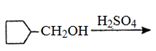
What is the major product in the given reaction?
A
Cyclobutylidenemethane
B
$1-$Methylcyclobutene
C
Cyclohexene
D
Bicyclo[$2.1$.$0$]pentane
Solution
(B) The reaction involves the acid-catalyzed dehydration of cyclobutylmethanol.
$1$. Protonation of the hydroxyl group occurs to form a good leaving group $(-OH_2^+)$.
$2$. Loss of water generates a primary carbocation (cyclobutyl-methyl cation).
$3$. This primary carbocation undergoes a ring expansion rearrangement to form a more stable five-membered ring (cyclopentyl cation).
$4$. Loss of a proton from the cyclopentyl cation yields cyclopentene as the major product.
Note: The provided options do not include cyclopentene. Among the given structures,if we assume the question implies a rearrangement leading to a more stable alkene,the most stable product formed from such rearrangements is typically cyclopentene.
$1$. Protonation of the hydroxyl group occurs to form a good leaving group $(-OH_2^+)$.
$2$. Loss of water generates a primary carbocation (cyclobutyl-methyl cation).
$3$. This primary carbocation undergoes a ring expansion rearrangement to form a more stable five-membered ring (cyclopentyl cation).
$4$. Loss of a proton from the cyclopentyl cation yields cyclopentene as the major product.
Note: The provided options do not include cyclopentene. Among the given structures,if we assume the question implies a rearrangement leading to a more stable alkene,the most stable product formed from such rearrangements is typically cyclopentene.
0 likes
View Solution53
DifficultMCQ
What is the correct order of bond dissociation energy for the following $C-H$ bonds?
$I. \, CH_3-H$
$II. \, CH_3CH_2-H$
$III. \, CH_2=CH-CH_2-H$
$IV. \, C_6H_5-H$
$I. \, CH_3-H$
$II. \, CH_3CH_2-H$
$III. \, CH_2=CH-CH_2-H$
$IV. \, C_6H_5-H$
A
$IV > I > II > III$
B
$I > II > III > IV$
C
$IV > III > II > I$
D
$II > I > IV > III$
Solution
(A) The bond dissociation energy $(BDE)$ is inversely proportional to the stability of the free radical formed after the homolytic cleavage of the $C-H$ bond.
$I. \, CH_3-H \rightarrow \cdot CH_3$ (Methyl radical,least stable)
$II. \, CH_3CH_2-H \rightarrow CH_3\cdot CH_2$ (Primary radical,more stable than methyl)
$III. \, CH_2=CH-CH_2-H \rightarrow CH_2=CH-\cdot CH_2$ (Allyl radical,resonance stabilized,very stable)
$IV. \, C_6H_5-H \rightarrow \cdot C_6H_5$ (Phenyl radical,$sp^2$ hybridized carbon,least stable due to high $s$-character)
Comparing the stability of radicals: $Allyl > Ethyl > Methyl > Phenyl$.
Therefore,the order of $BDE$ is: $Phenyl > Methyl > Ethyl > Allyl$.
Thus,the correct order is $IV > I > II > III$.
$I. \, CH_3-H \rightarrow \cdot CH_3$ (Methyl radical,least stable)
$II. \, CH_3CH_2-H \rightarrow CH_3\cdot CH_2$ (Primary radical,more stable than methyl)
$III. \, CH_2=CH-CH_2-H \rightarrow CH_2=CH-\cdot CH_2$ (Allyl radical,resonance stabilized,very stable)
$IV. \, C_6H_5-H \rightarrow \cdot C_6H_5$ (Phenyl radical,$sp^2$ hybridized carbon,least stable due to high $s$-character)
Comparing the stability of radicals: $Allyl > Ethyl > Methyl > Phenyl$.
Therefore,the order of $BDE$ is: $Phenyl > Methyl > Ethyl > Allyl$.
Thus,the correct order is $IV > I > II > III$.
0 likes
View Solution54
MediumMCQ
Which alkene reacts fastest with $H_2$ under catalytic hydrogenation conditions?
A
B
C
D
Solution
(B) The rate of catalytic hydrogenation of alkenes is inversely proportional to the stability of the alkene.
More substituted alkenes are more stable due to the electron-donating inductive effect and hyperconjugation of the alkyl groups $(R)$.
Therefore,the stability order is: Tetrasubstituted > Trisubstituted > Disubstituted > Monosubstituted.
Since the rate of hydrogenation is inversely proportional to stability,the least substituted alkene will react the fastest.
Among the given options,the alkene with the fewest substituents (disubstituted) will react the fastest.
Comparing the options,the disubstituted alkenes ($A$ and $B$) are less stable than the trisubstituted $(C)$ and tetrasubstituted $(D)$ alkenes.
Between the two disubstituted alkenes,the cis-isomer $(B)$ is generally less stable than the trans-isomer $(A)$ due to steric hindrance.
Therefore,the cis-disubstituted alkene $(B)$ reacts the fastest.
More substituted alkenes are more stable due to the electron-donating inductive effect and hyperconjugation of the alkyl groups $(R)$.
Therefore,the stability order is: Tetrasubstituted > Trisubstituted > Disubstituted > Monosubstituted.
Since the rate of hydrogenation is inversely proportional to stability,the least substituted alkene will react the fastest.
Among the given options,the alkene with the fewest substituents (disubstituted) will react the fastest.
Comparing the options,the disubstituted alkenes ($A$ and $B$) are less stable than the trisubstituted $(C)$ and tetrasubstituted $(D)$ alkenes.
Between the two disubstituted alkenes,the cis-isomer $(B)$ is generally less stable than the trans-isomer $(A)$ due to steric hindrance.
Therefore,the cis-disubstituted alkene $(B)$ reacts the fastest.
0 likes
View Solution55
MediumMCQ
What is the decreasing order of acidic strength for ethane $(I)$,ethene $(II)$,ethyne $(III)$,and propyne $(IV)$?
A
$I > II > III > IV$
B
$II > III > I > IV$
C
$III > IV > II > I$
D
$IV > III > II > I$
Solution
(C) The acidity of hydrocarbons depends on the percentage of $s$-character in the $C-H$ bond.
$1$. Ethyne $(CH \equiv CH)$ has $sp$ hybridization ($50\% \ s$-character).
$2$. Propyne $(CH_3-C \equiv CH)$ has an acidic terminal hydrogen attached to an $sp$ hybridized carbon.
$3$. Ethene $(CH_2=CH_2)$ has $sp^2$ hybridization ($33.3\% \ s$-character).
$4$. Ethane $(CH_3-CH_3)$ has $sp^3$ hybridization ($25\% \ s$-character).
Comparing ethyne $(III)$ and propyne $(IV)$,the methyl group in propyne is electron-donating ($+I$ effect),which decreases the acidity of the terminal hydrogen compared to ethyne.
Thus,the decreasing order of acidity is: $III > IV > II > I$.
$1$. Ethyne $(CH \equiv CH)$ has $sp$ hybridization ($50\% \ s$-character).
$2$. Propyne $(CH_3-C \equiv CH)$ has an acidic terminal hydrogen attached to an $sp$ hybridized carbon.
$3$. Ethene $(CH_2=CH_2)$ has $sp^2$ hybridization ($33.3\% \ s$-character).
$4$. Ethane $(CH_3-CH_3)$ has $sp^3$ hybridization ($25\% \ s$-character).
Comparing ethyne $(III)$ and propyne $(IV)$,the methyl group in propyne is electron-donating ($+I$ effect),which decreases the acidity of the terminal hydrogen compared to ethyne.
Thus,the decreasing order of acidity is: $III > IV > II > I$.
0 likes
View Solution56
MediumMCQ
Complete oxidation of hydrocarbons always produces........... as products.
A
Acid
B
Aldehyde
C
$H_2O + CO_2$
D
Dihydric alcohol
Solution
(C) The complete combustion (oxidation) of any hydrocarbon in the presence of excess oxygen results in the formation of carbon dioxide $(CO_2)$ and water $(H_2O)$ as the final products.
For a general hydrocarbon $C_xH_y$,the reaction is: $C_xH_y + (x + y/4) O_2 \rightarrow x CO_2 + (y/2) H_2O$.
For a general hydrocarbon $C_xH_y$,the reaction is: $C_xH_y + (x + y/4) O_2 \rightarrow x CO_2 + (y/2) H_2O$.
0 likes
View Solution57
MediumMCQ
The compound $C_6H_{12}$ is a/an......
A
Saturated aliphatic
B
Alicyclic
C
Aromatic
D
Heterocyclic
Solution
(B) The general formula $C_nH_{2n}$ corresponds to either alkenes or cycloalkanes. Since $C_6H_{12}$ represents cyclohexane,it is an alicyclic compound.
0 likes
View Solution58
MediumMCQ
If the heat of hydrogenation of $1$-butene is $30 \ kcal$,what is the heat of hydrogenation of $1,3$-butadiene (in $kcal$)?
A
$30$
B
$60$
C
$57$
D
$25$
Solution
(C) $1,3$-Butadiene requires $2 \ mol$ of $H_2$ for complete hydrogenation.
Theoretical heat of hydrogenation would be $2 \times 30 = 60 \ kcal$.
However,$1,3$-butadiene is stabilized by resonance energy.
Therefore,the actual heat of hydrogenation is less than the theoretical value.
Thus,the value is approximately $57 \ kcal$.
Theoretical heat of hydrogenation would be $2 \times 30 = 60 \ kcal$.
However,$1,3$-butadiene is stabilized by resonance energy.
Therefore,the actual heat of hydrogenation is less than the theoretical value.
Thus,the value is approximately $57 \ kcal$.
0 likes
View Solution59
MediumMCQ
Which of the following homologous series has an incorrect general formula?
A
Alkynes: $C_nH_{2n-2}$
B
Alkanols: $C_nH_{2n+2}O$
C
Alkanals: $C_nH_{2n+1}O$
D
Carboxylic acids: $C_nH_{2n}O_2$
Solution
(C) The general formula for alkanals (aldehydes) is $C_nH_{2n}O$.
For example,for $n=1$ (methanal),the formula is $CH_2O$.
The given formula $C_nH_{2n+1}O$ is incorrect because it does not account for the correct number of hydrogen atoms required to satisfy the valency of the carbonyl group and the alkyl chain.
For example,for $n=1$ (methanal),the formula is $CH_2O$.
The given formula $C_nH_{2n+1}O$ is incorrect because it does not account for the correct number of hydrogen atoms required to satisfy the valency of the carbonyl group and the alkyl chain.
0 likes
View Solution60
MediumMCQ
What is the organic product obtained when ethylene glycol is heated with acidified potassium permanganate?
A
Oxalic acid
B
Glyoxal
C
Formic acid
D
Acetaldehyde
Solution
(A) Ethylene glycol $(HOCH_2-CH_2OH)$ undergoes oxidation when treated with strong oxidizing agents like acidified $KMnO_4$.
The reaction proceeds as follows:
$HOCH_2-CH_2OH + 2[O] \xrightarrow{H^+/KMnO_4} HOOC-COOH + 2H_2O$
The final product obtained is oxalic acid $(HOOC-COOH)$.
The reaction proceeds as follows:
$HOCH_2-CH_2OH + 2[O] \xrightarrow{H^+/KMnO_4} HOOC-COOH + 2H_2O$
The final product obtained is oxalic acid $(HOOC-COOH)$.
0 likes
View Solution61
MediumMCQ
What is the acid $(A)$ obtained in the following reaction sequence?
${C_2H_5I}$ $\xrightarrow{\text{alc. KOH}} X$ $\xrightarrow[CCl_4]{Br_2} Y$ $\xrightarrow{KCN} Z$ $\xrightarrow{H_3O^+} A$
${C_2H_5I}$ $\xrightarrow{\text{alc. KOH}} X$ $\xrightarrow[CCl_4]{Br_2} Y$ $\xrightarrow{KCN} Z$ $\xrightarrow{H_3O^+} A$
A
Succinic acid
B
Malonic acid
C
Oxalic acid
D
Maleic acid
Solution
(A) The reaction sequence is as follows:
$1$. ${C_2H_5I} \xrightarrow{\text{alc. KOH}} CH_2=CH_2$ (Ethene,$X$)
$2$. $CH_2=CH_2 \xrightarrow[CCl_4]{Br_2} BrCH_2-CH_2Br$ ($1$,$2$-Dibromoethane,$Y$)
$3$. $BrCH_2-CH_2Br \xrightarrow{KCN} NC-CH_2-CH_2-CN$ (Butanedinitrile,$Z$)
$4$. $NC-CH_2-CH_2-CN \xrightarrow{H_3O^+} HOOC-CH_2-CH_2-COOH$ (Succinic acid,$A$)
Thus,the final product $(A)$ is Succinic acid.
$1$. ${C_2H_5I} \xrightarrow{\text{alc. KOH}} CH_2=CH_2$ (Ethene,$X$)
$2$. $CH_2=CH_2 \xrightarrow[CCl_4]{Br_2} BrCH_2-CH_2Br$ ($1$,$2$-Dibromoethane,$Y$)
$3$. $BrCH_2-CH_2Br \xrightarrow{KCN} NC-CH_2-CH_2-CN$ (Butanedinitrile,$Z$)
$4$. $NC-CH_2-CH_2-CN \xrightarrow{H_3O^+} HOOC-CH_2-CH_2-COOH$ (Succinic acid,$A$)
Thus,the final product $(A)$ is Succinic acid.
0 likes
View Solution62
MediumMCQ
Which one of the following alkenes will react fastest with $H_2$ under catalytic hydrogenation condition?
A
B
C
D
Solution
(A) The rate of catalytic hydrogenation of an alkene is inversely proportional to its stability.
More substituted alkenes are more stable due to hyperconjugation and inductive effects,and therefore,they react more slowly with $H_2$.
The order of stability of alkenes is:
Tetrasubstituted > Trisubstituted > Disubstituted > Monosubstituted > Ethene.
Conversely,the order of reactivity towards catalytic hydrogenation is:
Monosubstituted > Disubstituted > Trisubstituted > Tetrasubstituted.
Among the given options,the alkene with the least number of substituents (monosubstituted or the least substituted one) will react fastest.
Based on the provided structures,the alkene with the fewest $R$ groups (most $H$ atoms) will be the most reactive.
More substituted alkenes are more stable due to hyperconjugation and inductive effects,and therefore,they react more slowly with $H_2$.
The order of stability of alkenes is:
Tetrasubstituted > Trisubstituted > Disubstituted > Monosubstituted > Ethene.
Conversely,the order of reactivity towards catalytic hydrogenation is:
Monosubstituted > Disubstituted > Trisubstituted > Tetrasubstituted.
Among the given options,the alkene with the least number of substituents (monosubstituted or the least substituted one) will react fastest.
Based on the provided structures,the alkene with the fewest $R$ groups (most $H$ atoms) will be the most reactive.
0 likes
View Solution63
DifficultMCQ
Which one of the following on ozonolysis followed by oxidation will give adipic acid?
A
Cyclohexene
B
$1-$Methylcyclohexene
C
$1,3-$Cyclohexadiene
D
Toluene
Solution
(A)
$Cyclohexene$ on ozonolysis followed by oxidation gives adipic acid $(hexanedioic \ acid)$.
$C_6H_{10}$ $\xrightarrow{O_3} OHC-(CH_2)_4-CHO$ $\xrightarrow{[O]} HOOC-(CH_2)_4-COOH$ (Adipic acid).
$Cyclohexene$ on ozonolysis followed by oxidation gives adipic acid $(hexanedioic \ acid)$.
$C_6H_{10}$ $\xrightarrow{O_3} OHC-(CH_2)_4-CHO$ $\xrightarrow{[O]} HOOC-(CH_2)_4-COOH$ (Adipic acid).

0 likes
View Solution64
DifficultMCQ
Which of the following structures corresponds to the product expected when an excess of $C_6H_6$ reacts with $CH_2Cl_2$ in the presence of anhydrous $AlCl_3$?
A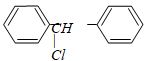
B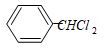
C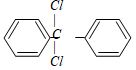
D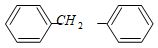
Solution
(D) The reaction of benzene $(C_6H_6)$ with dichloromethane $(CH_2Cl_2)$ in the presence of anhydrous $AlCl_3$ is a Friedel-Crafts alkylation reaction. Since benzene is in excess,both chlorine atoms of $CH_2Cl_2$ are replaced by phenyl groups,resulting in the formation of diphenylmethane $(C_6H_5-CH_2-C_6H_5)$ and $2HCl$. The reaction is: $2C_6H_6 + CH_2Cl_2 \xrightarrow{AlCl_3} C_6H_5-CH_2-C_6H_5 + 2HCl$.
0 likes
View Solution65
DifficultMCQ
$Ph-C \equiv C-CH_3 \xrightarrow{Hg^{2+}/H^{+}} A$. $A$ is
A
B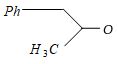
C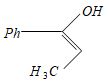
D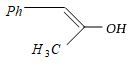
Solution
(A) The reaction of an internal alkyne with $Hg^{2+}/H^{+}$ (Kuccherov reaction) involves the hydration of the alkyne to form a ketone.
For the unsymmetrical alkyne $Ph-C \equiv C-CH_3$,the hydration can occur at either carbon of the triple bond.
However,the formation of the ketone is governed by the stability of the intermediate carbocation or the electronic effects of the substituents.
In this case,the reaction proceeds to form $Ph-CO-CH_2-CH_3$ (propiophenone derivative) as the major product,which corresponds to the structure in image $287-$a474.
For the unsymmetrical alkyne $Ph-C \equiv C-CH_3$,the hydration can occur at either carbon of the triple bond.
However,the formation of the ketone is governed by the stability of the intermediate carbocation or the electronic effects of the substituents.
In this case,the reaction proceeds to form $Ph-CO-CH_2-CH_3$ (propiophenone derivative) as the major product,which corresponds to the structure in image $287-$a474.
0 likes
View Solution66
DifficultMCQ
The product obtained by dry distillation of calcium formate on reacting with ammonia yields
A
Formamide
B
Acetamide
C
Acetaldehyde ammonia
D
Urotropine
Solution
(D) $2(HCOO)_2Ca \xrightarrow{\text{Dry distillation}} 2HCHO + 2CaCO_3$
$6HCHO + 4NH_3 \to (CH_2)_6N_4 + 6H_2O$
The product $(CH_2)_6N_4$ is known as Urotropine.
$6HCHO + 4NH_3 \to (CH_2)_6N_4 + 6H_2O$
The product $(CH_2)_6N_4$ is known as Urotropine.
0 likes
View Solution67
MediumMCQ
Which of the following compounds shall not produce propene by reaction with $HBr$ followed by elimination or direct only elimination reaction?
A
Cyclopropane
B
$CH_3-CH_2-CH_2OH$
C
$CH_2=C=O$
D
$CH_3-CH_2-CH_2Br$
Solution
(C) Let us analyze each option:
$(i)$ $CH_3-CH_2-CH_2Br$ undergoes elimination to form propene $(CH_3-CH=CH_2)$.
(ii) Cyclopropane undergoes ring-opening elimination to form propene $(CH_3-CH=CH_2)$.
(iii) $CH_3-CH_2-CH_2OH$ reacts with $HBr$ to form $CH_3-CH_2-CH_2Br$,which then undergoes elimination to form propene $(CH_3-CH=CH_2)$.
(iv) $CH_2=C=O$ (ketene) does not produce propene by reaction with $HBr$ or by direct elimination.
Therefore,the correct option is $C$.
$(i)$ $CH_3-CH_2-CH_2Br$ undergoes elimination to form propene $(CH_3-CH=CH_2)$.
(ii) Cyclopropane undergoes ring-opening elimination to form propene $(CH_3-CH=CH_2)$.
(iii) $CH_3-CH_2-CH_2OH$ reacts with $HBr$ to form $CH_3-CH_2-CH_2Br$,which then undergoes elimination to form propene $(CH_3-CH=CH_2)$.
(iv) $CH_2=C=O$ (ketene) does not produce propene by reaction with $HBr$ or by direct elimination.
Therefore,the correct option is $C$.
0 likes
View Solution68
MediumMCQ
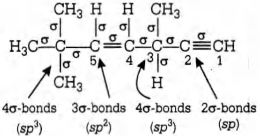
The state of hybridisation of $C_2, C_3, C_5$ and $C_6$ of the hydrocarbon $CH_3-C_6(CH_3)_2-C_5H=C_4H-C_3H(CH_3)-C_2 \equiv C_1H$ is in the following sequence:
A
$sp^3, sp^2, sp^2$ and $sp$
B
$sp, sp^2, sp^2$ and $sp^3$
C
$sp, sp^2, sp^3$ and $sp^2$
D
$sp, sp^3, sp^2$ and $sp^3$
Solution
(D) The correct option is $(d)$.
In the given hydrocarbon structure:
$1.$ $C_2$ is involved in a triple bond $(C \equiv C)$,so it is $sp$ hybridized.
$2.$ $C_3$ is bonded to four other atoms ($C_2, C_4, H$,and the $C$ of the $CH_3$ group) via single bonds,so it is $sp^3$ hybridized.
$3.$ $C_5$ is involved in a double bond $(C=C)$,so it is $sp^2$ hybridized.
$4.$ $C_6$ is bonded to four other atoms ($C_5, C_7$,and the $C$ atoms of two $CH_3$ groups) via single bonds,so it is $sp^3$ hybridized.
Thus,the sequence for $C_2, C_3, C_5$ and $C_6$ is $sp, sp^3, sp^2, sp^3$.
In the given hydrocarbon structure:
$1.$ $C_2$ is involved in a triple bond $(C \equiv C)$,so it is $sp$ hybridized.
$2.$ $C_3$ is bonded to four other atoms ($C_2, C_4, H$,and the $C$ of the $CH_3$ group) via single bonds,so it is $sp^3$ hybridized.
$3.$ $C_5$ is involved in a double bond $(C=C)$,so it is $sp^2$ hybridized.
$4.$ $C_6$ is bonded to four other atoms ($C_5, C_7$,and the $C$ atoms of two $CH_3$ groups) via single bonds,so it is $sp^3$ hybridized.
Thus,the sequence for $C_2, C_3, C_5$ and $C_6$ is $sp, sp^3, sp^2, sp^3$.
0 likes
View Solution69
MediumMCQ
In the hydrocarbon,$CH_3(1) - CH(2) = CH(3) - CH_2(4) - C(5) \equiv CH(6)$,the state of hybridization of carbons $1, 3$ and $5$ are in the following sequence:
A
$sp, sp^2, sp^3$
B
$sp^3, sp^2, sp$
C
$sp^2, sp, sp^3$
D
$sp, sp^3, sp^2$
Solution
(B) To determine the hybridization of carbon atoms,we count the number of sigma bonds and lone pairs attached to each carbon atom.
$1$. Carbon $1$ $(CH_3)$: It is bonded to $3$ hydrogen atoms and $1$ carbon atom via single bonds. Total $4$ sigma bonds $\rightarrow sp^3$ hybridization.
$2$. Carbon $3$ $(-CH=)$: It is bonded to $1$ hydrogen atom,$1$ carbon atom via a single bond,and $1$ carbon atom via a double bond. Total $3$ sigma bonds $\rightarrow sp^2$ hybridization.
$3$. Carbon $5$ $(-C \equiv)$: It is bonded to $1$ carbon atom via a single bond and $1$ carbon atom via a triple bond. Total $2$ sigma bonds $\rightarrow sp$ hybridization.
Thus,the sequence of hybridization for carbons $1, 3,$ and $5$ is $sp^3, sp^2, sp$.
$1$. Carbon $1$ $(CH_3)$: It is bonded to $3$ hydrogen atoms and $1$ carbon atom via single bonds. Total $4$ sigma bonds $\rightarrow sp^3$ hybridization.
$2$. Carbon $3$ $(-CH=)$: It is bonded to $1$ hydrogen atom,$1$ carbon atom via a single bond,and $1$ carbon atom via a double bond. Total $3$ sigma bonds $\rightarrow sp^2$ hybridization.
$3$. Carbon $5$ $(-C \equiv)$: It is bonded to $1$ carbon atom via a single bond and $1$ carbon atom via a triple bond. Total $2$ sigma bonds $\rightarrow sp$ hybridization.
Thus,the sequence of hybridization for carbons $1, 3,$ and $5$ is $sp^3, sp^2, sp$.
0 likes
View Solution70
DifficultMCQ
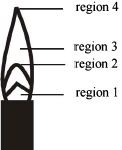
The hottest region of the Bunsen flame shown in the figure below is:
A
region $3$
B
region $4$
C
region $1$
D
region $2$
Solution
(A) Bunsen flame consists of several zones based on the extent of combustion.
Region $1$ is the innermost dark zone containing unburnt fuel.
Region $2$ is the luminous zone where incomplete combustion occurs.
Region $3$ is the non-luminous zone where complete combustion occurs,making it the hottest part of the flame.
Region $4$ is the tip of the flame.
Therefore,the hottest region is region $3$.
Region $1$ is the innermost dark zone containing unburnt fuel.
Region $2$ is the luminous zone where incomplete combustion occurs.
Region $3$ is the non-luminous zone where complete combustion occurs,making it the hottest part of the flame.
Region $4$ is the tip of the flame.
Therefore,the hottest region is region $3$.
0 likes
View Solution71
DifficultMCQ
Identify the correct order of heat of hydrogenation.
A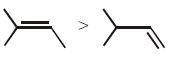
B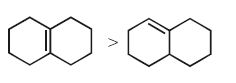
C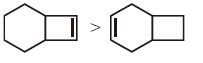
D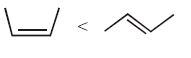
Solution
(C) The heat of hydrogenation $(\Delta H_{hyd})$ is inversely proportional to the stability of the alkene.
$1$. More substituted alkenes are more stable,hence they have lower $\Delta H_{hyd}$.
$2$. Trans-alkenes are more stable than cis-alkenes,hence cis-alkenes have higher $\Delta H_{hyd}$.
$3$. Increased ring strain leads to higher $\Delta H_{hyd}$.
In option $C$,the first molecule is a highly strained bicyclic alkene (bridgehead double bond in a small ring system),which makes it significantly less stable than the isomer in the second part of the option. Therefore,the first molecule has a higher heat of hydrogenation,making the order $C$ correct.
$1$. More substituted alkenes are more stable,hence they have lower $\Delta H_{hyd}$.
$2$. Trans-alkenes are more stable than cis-alkenes,hence cis-alkenes have higher $\Delta H_{hyd}$.
$3$. Increased ring strain leads to higher $\Delta H_{hyd}$.
In option $C$,the first molecule is a highly strained bicyclic alkene (bridgehead double bond in a small ring system),which makes it significantly less stable than the isomer in the second part of the option. Therefore,the first molecule has a higher heat of hydrogenation,making the order $C$ correct.
0 likes
View Solution72
DifficultMCQ
Which of the following reactions does not produce a product that gives a white precipitate with $AgNO_3 / NH_4OH$?
A
$CaC_2 \xrightarrow{H_2O}$
B
$CHCl_3 \xrightarrow[\Delta]{Ag}$
C
$Mg_2C_3 \xrightarrow{H_2O}$
D
$Al_4C_3 \xrightarrow{H_2O}$
Solution
(D) $1$. $CaC_2 + 2H_2O \rightarrow Ca(OH)_2 + C_2H_2$ (Acetylene). Acetylene is a terminal alkyne $(HC \equiv CH)$,which reacts with $AgNO_3 / NH_4OH$ (Tollens' reagent) to form a white precipitate of silver acetylide $(AgC \equiv CAg)$.
$2$. $2CHCl_3 + 6Ag \xrightarrow{\Delta} HC \equiv CH + 6AgCl$. Acetylene is formed,which gives a white precipitate with $AgNO_3 / NH_4OH$.
$3$. $Mg_2C_3 + 4H_2O \rightarrow 2Mg(OH)_2 + CH_3-C \equiv CH$ (Propyne). Propyne is a terminal alkyne,which reacts with $AgNO_3 / NH_4OH$ to form a white precipitate of silver propyne $(CH_3-C \equiv CAg)$.
$4$. $Al_4C_3 + 12H_2O \rightarrow 4Al(OH)_3 + 3CH_4$ (Methane). Methane is an alkane and does not react with $AgNO_3 / NH_4OH$ to form a precipitate.
Therefore,the reaction that does not give a white precipitate is $Al_4C_3 \xrightarrow{H_2O}$.
$2$. $2CHCl_3 + 6Ag \xrightarrow{\Delta} HC \equiv CH + 6AgCl$. Acetylene is formed,which gives a white precipitate with $AgNO_3 / NH_4OH$.
$3$. $Mg_2C_3 + 4H_2O \rightarrow 2Mg(OH)_2 + CH_3-C \equiv CH$ (Propyne). Propyne is a terminal alkyne,which reacts with $AgNO_3 / NH_4OH$ to form a white precipitate of silver propyne $(CH_3-C \equiv CAg)$.
$4$. $Al_4C_3 + 12H_2O \rightarrow 4Al(OH)_3 + 3CH_4$ (Methane). Methane is an alkane and does not react with $AgNO_3 / NH_4OH$ to form a precipitate.
Therefore,the reaction that does not give a white precipitate is $Al_4C_3 \xrightarrow{H_2O}$.
0 likes
View Solution73
DifficultMCQ
Action of hydrogen chloride on $CH_3-C(CH_3)=CH_2$ and on $CH \equiv CH$ will predominantly give the compounds,respectively:
A
$CH_3-CH(CH_3)-CH_2Cl$ and $CH_2Cl-CH_2Cl$
B
$CH_3-CCl(CH_3)-CH_3$ and $CH_3-CHCl_2$
C
$CH_3-CH(CH_3)-CH_2Cl$ and $CH_3-CHCl_2$
D
$CH_3-CH(CH_3)-CH_3$ and $CH_2Cl-CH_2Cl$
Solution
(B) The addition of $HCl$ to $2$-methylpropene follows Markovnikov's rule,where the $Cl^-$ attaches to the more substituted carbon atom.
$CH_3-C(CH_3)=CH_2 + HCl \rightarrow CH_3-CCl(CH_3)-CH_3$
The addition of $HCl$ to ethyne follows Markovnikov's rule in the second step,leading to the formation of a geminal dihalide.
$CH \equiv CH + HCl$ $\rightarrow CH_2=CHCl$ $\xrightarrow{HCl} CH_3-CHCl_2$
Thus,the products are $CH_3-CCl(CH_3)-CH_3$ and $CH_3-CHCl_2$.
$CH_3-C(CH_3)=CH_2 + HCl \rightarrow CH_3-CCl(CH_3)-CH_3$
The addition of $HCl$ to ethyne follows Markovnikov's rule in the second step,leading to the formation of a geminal dihalide.
$CH \equiv CH + HCl$ $\rightarrow CH_2=CHCl$ $\xrightarrow{HCl} CH_3-CHCl_2$
Thus,the products are $CH_3-CCl(CH_3)-CH_3$ and $CH_3-CHCl_2$.
0 likes
View Solution74
DifficultMCQ
$A$ hydrocarbon $C_5H_8$ consumes two moles of hydrogen. On ozonolysis,it produces $2-$oxopropanal and methanal. The hydrocarbon is:
A
$CH_2=CH-CH_2-CH=CH_2$
B
$CH_2=C(CH_3)-CH_2-CH=CH_2$
C
$CH_3-CH=C=CH-CH_3$
D
$CH_2=C(CH_3)-CH=CH_2$
Solution
(D) The hydrocarbon $C_5H_8$ consumes $2$ moles of $H_2$,which indicates the presence of two double bonds (a diene).
Ozonolysis of $2-$methyl$-1,3-$butadiene $(CH_2=C(CH_3)-CH=CH_2)$ breaks the double bonds to form $HCHO$ (methanal) and $CH_3-CO-CHO$ ($2-$oxopropanal).
The reaction is:
$CH_2=C(CH_3)-CH=CH_2 \xrightarrow{1. O_3, 2. Zn/H_2O} HCHO + CH_3-CO-CHO + HCHO$.
Ozonolysis of $2-$methyl$-1,3-$butadiene $(CH_2=C(CH_3)-CH=CH_2)$ breaks the double bonds to form $HCHO$ (methanal) and $CH_3-CO-CHO$ ($2-$oxopropanal).
The reaction is:
$CH_2=C(CH_3)-CH=CH_2 \xrightarrow{1. O_3, 2. Zn/H_2O} HCHO + CH_3-CO-CHO + HCHO$.
0 likes
View Solution75
DifficultMCQ
Which of the following has the highest heat of hydrogenation?
A
$1,4-$cyclohexadiene
B
$1-$methylenecyclohex$-2-$ene
C
$1,3-$cyclohexadiene
D
methylenecyclohexane
Solution
(B) The heat of hydrogenation $(HOH)$ is directly proportional to the number of $\pi-$bonds present in the molecule.
$1$. $1,4-$cyclohexadiene has $2$ $\pi-$bonds.
$2$. $1-$methylenecyclohex$-2-$ene has $3$ $\pi-$bonds.
$3$. $1,3-$cyclohexadiene has $2$ $\pi-$bonds.
$4$. Methylenecyclohexane has $1$ $\pi-$bond.
Since $1-$methylenecyclohex$-2-$ene has the highest number of $\pi-$bonds $(3)$,it will have the highest heat of hydrogenation.
$1$. $1,4-$cyclohexadiene has $2$ $\pi-$bonds.
$2$. $1-$methylenecyclohex$-2-$ene has $3$ $\pi-$bonds.
$3$. $1,3-$cyclohexadiene has $2$ $\pi-$bonds.
$4$. Methylenecyclohexane has $1$ $\pi-$bond.
Since $1-$methylenecyclohex$-2-$ene has the highest number of $\pi-$bonds $(3)$,it will have the highest heat of hydrogenation.
0 likes
View Solution76
DifficultMCQ
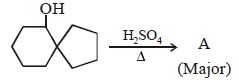
The major product $A$ is:
A
B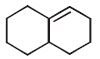
C
D
Solution
(D) The reaction involves the acid-catalyzed dehydration of $1$-hydroxybicyclo[$4.4$.$0$]decane (decalol).
$H_2SO_4$ protonates the hydroxyl group, forming a good leaving group $(-OH_2^+)$.
Loss of water generates a carbocation at the bridgehead position.
According to Bredt's rule, a double bond at the bridgehead of a small bicyclic system is unstable.
However, in a decalin system (bicyclo[$4.4$.$0$]decane), the double bond can form at the bridgehead position (forming $\Delta^{1,6}$-octalin or bicyclo[$4.4$.$0$]dec-$1$$(6)$-ene) as it is the most substituted and stable alkene isomer (Zaitsev's rule).
Thus, the major product is bicyclo[$4.4$.$0$]dec-$1$$(6)$-ene.
$H_2SO_4$ protonates the hydroxyl group, forming a good leaving group $(-OH_2^+)$.
Loss of water generates a carbocation at the bridgehead position.
According to Bredt's rule, a double bond at the bridgehead of a small bicyclic system is unstable.
However, in a decalin system (bicyclo[$4.4$.$0$]decane), the double bond can form at the bridgehead position (forming $\Delta^{1,6}$-octalin or bicyclo[$4.4$.$0$]dec-$1$$(6)$-ene) as it is the most substituted and stable alkene isomer (Zaitsev's rule).
Thus, the major product is bicyclo[$4.4$.$0$]dec-$1$$(6)$-ene.
0 likes
View Solution77
MediumMCQ
$CH_2(COOH)_2 \xrightarrow{P_4O_{10}, \, 150^\circ C} X$
Compound $(X)$ is
Compound $(X)$ is
A
malonic acid
B
carbon suboxide
C
tartaric acid
D
acetic acid
Solution
(B) The dehydration of malonic acid $(CH_2(COOH)_2)$ using phosphorus pentoxide $(P_4O_{10})$ at $150^\circ C$ results in the formation of carbon suboxide $(C_3O_2)$.
The chemical reaction is:
$3 CH_2(COOH)_2 \xrightarrow{P_4O_{10}, \, 150^\circ C} 3 C_3O_2 + 4 H_3PO_4$
Therefore,compound $(X)$ is carbon suboxide.
The chemical reaction is:
$3 CH_2(COOH)_2 \xrightarrow{P_4O_{10}, \, 150^\circ C} 3 C_3O_2 + 4 H_3PO_4$
Therefore,compound $(X)$ is carbon suboxide.
0 likes
View Solution78
DifficultMCQ
Among the following pairs,in which case does the second compound have a higher heat of hydrogenation?
A
Cyclobutene and cyclopentene
B
$cis-2-$butene and $trans-2-$butene
C
Bicyclo[$4.2$.$0$]oct$-1-$ene and bicyclo[$4.2$.$0$]oct$-2-$ene
D
$1-$butene and $2-$butene
Solution
(C) The heat of hydrogenation is inversely proportional to the stability of the alkene.
For option $A$,cyclobutene is more strained than cyclopentene,so it has a higher heat of hydrogenation.
For option $B$,$cis-2-$butene is less stable than $trans-2-$butene due to steric hindrance,so it has a higher heat of hydrogenation.
For option $C$,the second compound (bicyclo[$4.2$.$0$]oct$-2-$ene) has a double bond in a smaller,more strained ring (cyclobutene ring) compared to the first compound (bicyclo[$4.2$.$0$]oct$-1-$ene),where the double bond is shared between the rings. Therefore,the second compound has higher ring strain and higher heat of hydrogenation.
For option $D$,$1-$butene is less stable than $2-$butene,so it has a higher heat of hydrogenation.
Thus,the correct pair where the second compound has a higher heat of hydrogenation is $C$.
For option $A$,cyclobutene is more strained than cyclopentene,so it has a higher heat of hydrogenation.
For option $B$,$cis-2-$butene is less stable than $trans-2-$butene due to steric hindrance,so it has a higher heat of hydrogenation.
For option $C$,the second compound (bicyclo[$4.2$.$0$]oct$-2-$ene) has a double bond in a smaller,more strained ring (cyclobutene ring) compared to the first compound (bicyclo[$4.2$.$0$]oct$-1-$ene),where the double bond is shared between the rings. Therefore,the second compound has higher ring strain and higher heat of hydrogenation.
For option $D$,$1-$butene is less stable than $2-$butene,so it has a higher heat of hydrogenation.
Thus,the correct pair where the second compound has a higher heat of hydrogenation is $C$.
0 likes
View Solution79
EasyMCQ
Acrolein is formed when glycerol is heated with -
A
Acidified $KMnO_4$
B
$Br_2$ water
C
$KHSO_4$
D
$HNO_3$
Solution
(C) When glycerol $(CH_2OH-CHOH-CH_2OH)$ is heated with a dehydrating agent like potassium bisulfate $(KHSO_4)$,it undergoes dehydration.
Two molecules of water are removed from the glycerol molecule to form acrolein $(CH_2=CH-CHO)$.
Two molecules of water are removed from the glycerol molecule to form acrolein $(CH_2=CH-CHO)$.
0 likes
View Solution80
MediumMCQ
Which of the following substituted benzene derivatives would furnish three isomers in significant amount when one more substituent is introduced:
A
$m-$Nitrotoluene
B
$o-$Nitrotoluene
C
$p-$Nitrotoluene
D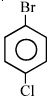
$2, 4, 6-$Trinitrotoluene
Solution
(A) When an electrophile attacks a substituted benzene ring,the orientation is determined by the existing groups.
In $m-$Nitrotoluene,the $-CH_3$ group is $o/p-$directing and the $-NO_2$ group is $m-$directing.
The positions available for electrophilic substitution are the $2, 4,$ and $6$ positions relative to the methyl group.
Due to the directing effects of both groups,substitution at these positions leads to three distinct isomers in significant amounts.
In contrast,$o-$Nitrotoluene and $p-$Nitrotoluene have symmetry that reduces the number of distinct isomers formed,and $2, 4, 6-$Trinitrotoluene is highly deactivated towards electrophilic substitution.
In $m-$Nitrotoluene,the $-CH_3$ group is $o/p-$directing and the $-NO_2$ group is $m-$directing.
The positions available for electrophilic substitution are the $2, 4,$ and $6$ positions relative to the methyl group.
Due to the directing effects of both groups,substitution at these positions leads to three distinct isomers in significant amounts.
In contrast,$o-$Nitrotoluene and $p-$Nitrotoluene have symmetry that reduces the number of distinct isomers formed,and $2, 4, 6-$Trinitrotoluene is highly deactivated towards electrophilic substitution.
0 likes
View Solution81
MediumMCQ
If the mixture of the following four aromatic compounds is oxidized by a strong oxidizing agent,what is the product?

A
Mixture of $C_6H_5CH_2OH + C_6H_5COOH$
B
Mixture of $C_6H_5CHO + C_6H_5COOH$
C
Only $C_6H_5COOH$
D
None of the above
Solution
(C) The four compounds are toluene $(C_6H_5CH_3)$,ethylbenzene $(C_6H_5C_2H_5)$,benzyl alcohol $(C_6H_5CH_2OH)$,and benzaldehyde $(C_6H_5CHO)$.
Strong oxidizing agents (like $KMnO_4/H^+$ or $K_2Cr_2O_7/H^+$) oxidize alkyl groups attached to a benzene ring to a carboxylic acid group,provided there is at least one benzylic hydrogen.
$1$. Toluene $(C_6H_5CH_3)$ is oxidized to benzoic acid $(C_6H_5COOH)$.
$2$. Ethylbenzene $(C_6H_5CH_2CH_3)$ is oxidized to benzoic acid $(C_6H_5COOH)$.
$3$. Benzyl alcohol $(C_6H_5CH_2OH)$ is oxidized to benzoic acid $(C_6H_5COOH)$.
$4$. Benzaldehyde $(C_6H_5CHO)$ is oxidized to benzoic acid $(C_6H_5COOH)$.
Since all four compounds are converted into benzoic acid,the final product is only $C_6H_5COOH$.
Strong oxidizing agents (like $KMnO_4/H^+$ or $K_2Cr_2O_7/H^+$) oxidize alkyl groups attached to a benzene ring to a carboxylic acid group,provided there is at least one benzylic hydrogen.
$1$. Toluene $(C_6H_5CH_3)$ is oxidized to benzoic acid $(C_6H_5COOH)$.
$2$. Ethylbenzene $(C_6H_5CH_2CH_3)$ is oxidized to benzoic acid $(C_6H_5COOH)$.
$3$. Benzyl alcohol $(C_6H_5CH_2OH)$ is oxidized to benzoic acid $(C_6H_5COOH)$.
$4$. Benzaldehyde $(C_6H_5CHO)$ is oxidized to benzoic acid $(C_6H_5COOH)$.
Since all four compounds are converted into benzoic acid,the final product is only $C_6H_5COOH$.
0 likes
View Solution82
MediumMCQ
Consider the following reaction sequence:
$C_6H_5CH=CH_2$ $\xrightarrow{Br_2} A$ $\xrightarrow{KMnO_4} B$
Compound $A$ and $B$ respectively are:
$C_6H_5CH=CH_2$ $\xrightarrow{Br_2} A$ $\xrightarrow{KMnO_4} B$
Compound $A$ and $B$ respectively are:
A
$o-$ Bromostyrene,benzoic acid
B
$p-$ Bromostyrene,benzaldehyde
C
$m-$ Bromostyrene,benzaldehyde
D
Styrene dibromide,benzoic acid
Solution
(D) The reaction of styrene $(C_6H_5CH=CH_2)$ with $Br_2$ is an electrophilic addition reaction across the double bond.
This results in the formation of styrene dibromide $(C_6H_5CH(Br)CH_2Br)$,which is compound $A$.
When styrene dibromide is treated with $KMnO_4$ (a strong oxidizing agent),the side chain is oxidized.
Specifically,the alkyl group attached to the benzene ring is oxidized to a carboxylic acid group,resulting in the formation of benzoic acid $(C_6H_5COOH)$,which is compound $B$.
Therefore,$A$ is styrene dibromide and $B$ is benzoic acid.
This results in the formation of styrene dibromide $(C_6H_5CH(Br)CH_2Br)$,which is compound $A$.
When styrene dibromide is treated with $KMnO_4$ (a strong oxidizing agent),the side chain is oxidized.
Specifically,the alkyl group attached to the benzene ring is oxidized to a carboxylic acid group,resulting in the formation of benzoic acid $(C_6H_5COOH)$,which is compound $B$.
Therefore,$A$ is styrene dibromide and $B$ is benzoic acid.
0 likes
View Solution83
DifficultMCQ
Product $(C)$ is
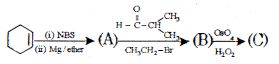
A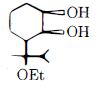
B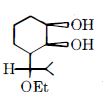
C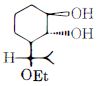
D
Both $1 + 2$
Solution
(C) $1$. Cyclohexene reacts with $NBS$ followed by $Mg/ether$ to form cyclohex$-2-$en$-1-$ylmagnesium bromide.
$2$. This Grignard reagent reacts with isobutyraldehyde to form an alkoxide,which is then alkylated with ethyl bromide $(CH_3CH_2Br)$ to form an ether derivative of cyclohexenol.
$3$. Finally,the reaction with $OsO_4/H_2O_2$ performs syn-dihydroxylation of the double bond,resulting in the product shown in the solution image.
$2$. This Grignard reagent reacts with isobutyraldehyde to form an alkoxide,which is then alkylated with ethyl bromide $(CH_3CH_2Br)$ to form an ether derivative of cyclohexenol.
$3$. Finally,the reaction with $OsO_4/H_2O_2$ performs syn-dihydroxylation of the double bond,resulting in the product shown in the solution image.
0 likes
View Solution84
DifficultMCQ
Which of the following does **$NOT$** liberate $H_2$ gas on reaction with $Na$ metal?
A
Cyclopentadiene
B
tert-Butyl alcohol
C
Cyclooctatetraene
D
Acetic acid
Solution
(C) The reaction of $Na$ metal with compounds containing acidic hydrogen atoms (like $-OH$ or $-COOH$ groups) or compounds that can form stable aromatic anions (like cyclopentadiene) results in the liberation of $H_2$ gas.
$1$. Cyclopentadiene $(C_5H_6)$ reacts with $Na$ to form the aromatic cyclopentadienyl anion $(C_5H_5^-)$,releasing $H_2$ gas.
$2$. tert-Butyl alcohol $((CH_3)_3COH)$ reacts with $Na$ to form sodium tert-butoxide $((CH_3)_3CONa)$,releasing $H_2$ gas.
$3$. Acetic acid $(CH_3COOH)$ reacts with $Na$ to form sodium acetate $(CH_3COONa)$,releasing $H_2$ gas.
$4$. Cyclooctatetraene $(C_8H_8)$ is a non-aromatic,tub-shaped molecule. While it can react with $Na$ to form the aromatic cyclooctatetraenide dianion $(C_8H_8^{2-})$,this reaction involves the addition of electrons (reduction) rather than the liberation of $H_2$ gas.
Therefore,cyclooctatetraene does not liberate $H_2$ gas.
$1$. Cyclopentadiene $(C_5H_6)$ reacts with $Na$ to form the aromatic cyclopentadienyl anion $(C_5H_5^-)$,releasing $H_2$ gas.
$2$. tert-Butyl alcohol $((CH_3)_3COH)$ reacts with $Na$ to form sodium tert-butoxide $((CH_3)_3CONa)$,releasing $H_2$ gas.
$3$. Acetic acid $(CH_3COOH)$ reacts with $Na$ to form sodium acetate $(CH_3COONa)$,releasing $H_2$ gas.
$4$. Cyclooctatetraene $(C_8H_8)$ is a non-aromatic,tub-shaped molecule. While it can react with $Na$ to form the aromatic cyclooctatetraenide dianion $(C_8H_8^{2-})$,this reaction involves the addition of electrons (reduction) rather than the liberation of $H_2$ gas.
Therefore,cyclooctatetraene does not liberate $H_2$ gas.
0 likes
View Solution85
MediumMCQ
The product $(P)$ in the reaction is:
A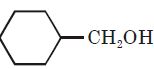
B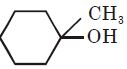
C
D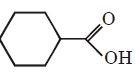
Solution
(A) The question is incomplete as it does not specify the reactants or the reaction conditions. However,based on the options provided,if the reaction involves the hydroboration-oxidation of methylenecyclohexane,the product would be cyclohexylmethanol (Option $A$). If it involves the hydration of $1-$methylcyclohexene,the product would be $1-$methylcyclohexanol (Option $B$). Without the specific reaction,a definitive answer cannot be determined.
0 likes
View Solution86
AdvancedMCQ
An organic compound $C_8H_{12}$ on ozonolysis gives $2 \ moles$ of $3-$oxobutanal. Then the structure of the compound can not be
A
$1,4-$dimethylcyclohexa$-1,4-$diene
B
$1,5-$dimethylcyclohexa$-1,4-$diene
C
$1,2-$dimethylcyclohexa$-1,4-$diene
D
$2,3-$dimethylcyclohexa$-1,3-$diene
Solution
(C) The molecular formula $C_8H_{12}$ indicates a degree of unsaturation of $2$.
Ozonolysis of the compound yields $2 \ moles$ of $3-$oxobutanal $(CH_3COCH_2CHO)$.
This implies the original compound must be a cyclic diene that,upon cleavage of its two double bonds,produces two identical fragments of $3-$oxobutanal.
$1$,$4$-dimethylcyclohexa$-1,4-$diene (Option $A$) on ozonolysis gives $2 \ moles$ of $3-$oxobutanal.
$1$,$5$-dimethylcyclohexa$-1,4-$diene (Option $B$) is the same as $1,4-$dimethylcyclohexa-$1,4-$diene.
$1$,$2$-dimethylcyclohexa$-1,4-$diene (Option $C$) on ozonolysis gives $1 \ mole$ of $2,3-$dioxobutane and $1 \ mole$ of $1,4-$butanedial.
$2$,$3$-dimethylcyclohexa$-1,3-$diene (Option $D$) on ozonolysis gives $1 \ mole$ of $2,3-$dioxobutane and $1 \ mole$ of $1,4-$butanedial.
Since the question asks for the structure that $CAN$ $NOT$ be the compound,and both $C$ and $D$ do not yield $3-$oxobutanal,there is an ambiguity in the provided options. However,based on standard chemistry problems of this type,$1,4-$dimethylcyclohexa-$1,4-$diene is the intended structure that $DOES$ produce $3-$oxobutanal. Given the options,$C$ and $D$ are incorrect structures.
Ozonolysis of the compound yields $2 \ moles$ of $3-$oxobutanal $(CH_3COCH_2CHO)$.
This implies the original compound must be a cyclic diene that,upon cleavage of its two double bonds,produces two identical fragments of $3-$oxobutanal.
$1$,$4$-dimethylcyclohexa$-1,4-$diene (Option $A$) on ozonolysis gives $2 \ moles$ of $3-$oxobutanal.
$1$,$5$-dimethylcyclohexa$-1,4-$diene (Option $B$) is the same as $1,4-$dimethylcyclohexa-$1,4-$diene.
$1$,$2$-dimethylcyclohexa$-1,4-$diene (Option $C$) on ozonolysis gives $1 \ mole$ of $2,3-$dioxobutane and $1 \ mole$ of $1,4-$butanedial.
$2$,$3$-dimethylcyclohexa$-1,3-$diene (Option $D$) on ozonolysis gives $1 \ mole$ of $2,3-$dioxobutane and $1 \ mole$ of $1,4-$butanedial.
Since the question asks for the structure that $CAN$ $NOT$ be the compound,and both $C$ and $D$ do not yield $3-$oxobutanal,there is an ambiguity in the provided options. However,based on standard chemistry problems of this type,$1,4-$dimethylcyclohexa-$1,4-$diene is the intended structure that $DOES$ produce $3-$oxobutanal. Given the options,$C$ and $D$ are incorrect structures.
0 likes
View Solution87
DifficultMCQ
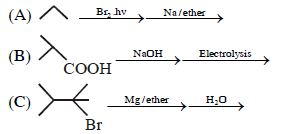
Which of the following reactions produce the same product?
A
$A, B$
B
$B, C$
C
$A, B, C$
D
$A, C$
Solution
(C) Let us analyze each reaction:
$(A)$ Propane $(CH_3CH_2CH_3)$ reacts with $Br_2/h\nu$ to form $2-$bromopropane $(CH_3CH(Br)CH_3)$. Further reaction with $Na/ether$ (Wurtz reaction) gives $2,3-$dimethylbutane.
$(B)$ Isobutyric acid $((CH_3)_2CHCOOH)$ reacts with $NaOH$ to form sodium isobutyrate. Electrolysis (Kolbe's electrolysis) of sodium isobutyrate gives $2,3-$dimethylbutane.
$(C)$ $2-$bromo$-2,3-$dimethylbutane $((CH_3)_2CH-C(Br)(CH_3)_2)$ reacts with $Mg/ether$ to form a Grignard reagent,which upon hydrolysis with $H_2O$ gives $2,3-$dimethylbutane.
Thus,all three reactions $(A, B, C)$ produce the same product,$2$,$3$-dimethylbutane.
$(A)$ Propane $(CH_3CH_2CH_3)$ reacts with $Br_2/h\nu$ to form $2-$bromopropane $(CH_3CH(Br)CH_3)$. Further reaction with $Na/ether$ (Wurtz reaction) gives $2,3-$dimethylbutane.
$(B)$ Isobutyric acid $((CH_3)_2CHCOOH)$ reacts with $NaOH$ to form sodium isobutyrate. Electrolysis (Kolbe's electrolysis) of sodium isobutyrate gives $2,3-$dimethylbutane.
$(C)$ $2-$bromo$-2,3-$dimethylbutane $((CH_3)_2CH-C(Br)(CH_3)_2)$ reacts with $Mg/ether$ to form a Grignard reagent,which upon hydrolysis with $H_2O$ gives $2,3-$dimethylbutane.
Thus,all three reactions $(A, B, C)$ produce the same product,$2$,$3$-dimethylbutane.
0 likes
View Solution88
MediumMCQ
Identify the product $(C)$ in the following series of reaction:
$\text{Cyclopentane}$ $\xrightarrow{Br_2, hv} A$ $\xrightarrow{\text{alc. KOH}} B$ $\xrightarrow{\text{NBS}} C$
$\text{Cyclopentane}$ $\xrightarrow{Br_2, hv} A$ $\xrightarrow{\text{alc. KOH}} B$ $\xrightarrow{\text{NBS}} C$
A
$3-$Bromocyclopent$-1-$ene
B
$3-$Bromocyclopent$-1-$ene
C
Cyclopentene
D
Bromocyclopentane
Solution
(B) $1$. The reaction starts with cyclopentane. Treatment with $Br_2$ in the presence of $hv$ (free radical substitution) gives bromocyclopentane as product $(A)$.
$2$. Bromocyclopentane $(A)$ reacts with alcoholic $KOH$ (dehydrohalogenation) to form cyclopentene as product $(B)$.
$3$. Cyclopentene $(B)$ reacts with $NBS$ ($N$-Bromosuccinimide),which is a specific reagent for allylic bromination,to form $3-$bromocyclopent$-1-$ene as product $(C)$.
$2$. Bromocyclopentane $(A)$ reacts with alcoholic $KOH$ (dehydrohalogenation) to form cyclopentene as product $(B)$.
$3$. Cyclopentene $(B)$ reacts with $NBS$ ($N$-Bromosuccinimide),which is a specific reagent for allylic bromination,to form $3-$bromocyclopent$-1-$ene as product $(C)$.
0 likes
View Solution89
AdvancedMCQ
The reaction is given by:
($1$-hydroxycyclopentane$-1,1-$dicarboxylic acid) $\xrightarrow[\Delta ]{K_2Cr_2O_7}\,(P)$
Product $(P)$ will be:
($1$-hydroxycyclopentane$-1,1-$dicarboxylic acid) $\xrightarrow[\Delta ]{K_2Cr_2O_7}\,(P)$
Product $(P)$ will be:
A
Cyclopentanol
B
$2-$oxocyclopentanecarboxylic acid
C
Cyclopentanone
D
Cyclopentanecarboxylic acid
Solution
(C) The starting material is $1$-hydroxycyclopentane-$1,1$-dicarboxylic acid.
When this compound is heated with an oxidizing agent like $K_2Cr_2O_7$,it undergoes oxidation of the secondary alcohol group to a ketone,followed by decarboxylation of the gem-dicarboxylic acid group.
Specifically,the $1$-hydroxy group is oxidized to a ketone,forming $1$-oxocyclopentane-$1,1$-dicarboxylic acid.
This $\beta$-keto acid (or specifically,a gem-dicarboxylic acid derivative) is unstable upon heating and undergoes decarboxylation (loss of $CO_2$) to yield cyclopentanone.
When this compound is heated with an oxidizing agent like $K_2Cr_2O_7$,it undergoes oxidation of the secondary alcohol group to a ketone,followed by decarboxylation of the gem-dicarboxylic acid group.
Specifically,the $1$-hydroxy group is oxidized to a ketone,forming $1$-oxocyclopentane-$1,1$-dicarboxylic acid.
This $\beta$-keto acid (or specifically,a gem-dicarboxylic acid derivative) is unstable upon heating and undergoes decarboxylation (loss of $CO_2$) to yield cyclopentanone.
0 likes
View Solution90
MediumMCQ
The correct order of heats of combustion of the following compounds is:
$(I)$ Cyclopropane
$(II)$ Cyclobutane
$(III)$ Cyclopentane
$(I)$ Cyclopropane
$(II)$ Cyclobutane
$(III)$ Cyclopentane
A
$I > II > III$
B
$II > I > III$
C
$III > II > I$
D
$III > I > II$
Solution
(C) The heat of combustion is directly proportional to the number of carbon atoms in the molecule.
Cyclopropane $(C_3H_6)$ has $3$ carbon atoms.
Cyclobutane $(C_4H_8)$ has $4$ carbon atoms.
Cyclopentane $(C_5H_{10})$ has $5$ carbon atoms.
Therefore,the order of heat of combustion is $III > II > I$.
Cyclopropane $(C_3H_6)$ has $3$ carbon atoms.
Cyclobutane $(C_4H_8)$ has $4$ carbon atoms.
Cyclopentane $(C_5H_{10})$ has $5$ carbon atoms.
Therefore,the order of heat of combustion is $III > II > I$.
0 likes
View Solution91
MediumMCQ
Which one of the following dienes would you expect to be the most stable?
A
$1,3-$dimethyl$-1,3-$cyclohexadiene
B
$2,4-$dimethyl$-1,3-$cyclohexadiene
C
$1,5-$dimethyl$-1,3-$cyclohexadiene
D
$2,6-$dimethyl$-1,3-$cyclohexadiene
Solution
(A) The stability of a conjugated diene is determined by the extent of conjugation and the number of hyperconjugative structures (alpha-hydrogens).
In $1,3$-cyclohexadiene derivatives,conjugation is present in all options.
Comparing the number of alpha-hydrogens:
$A$) $1,3$-dimethyl$-1,3-$cyclohexadiene has $10$ alpha-hydrogens.
$B$) $2,4$-dimethyl$-1,3-$cyclohexadiene has $8$ alpha-hydrogens.
$C$) $1,5$-dimethyl$-1,3-$cyclohexadiene has $8$ alpha-hydrogens.
$D$) $2,6$-dimethyl$-1,3-$cyclohexadiene has $8$ alpha-hydrogens.
Since $1,3$-dimethyl$-1,3-$cyclohexadiene has the highest number of alpha-hydrogens $(10)$,it is the most stable due to greater hyperconjugation.
In $1,3$-cyclohexadiene derivatives,conjugation is present in all options.
Comparing the number of alpha-hydrogens:
$A$) $1,3$-dimethyl$-1,3-$cyclohexadiene has $10$ alpha-hydrogens.
$B$) $2,4$-dimethyl$-1,3-$cyclohexadiene has $8$ alpha-hydrogens.
$C$) $1,5$-dimethyl$-1,3-$cyclohexadiene has $8$ alpha-hydrogens.
$D$) $2,6$-dimethyl$-1,3-$cyclohexadiene has $8$ alpha-hydrogens.
Since $1,3$-dimethyl$-1,3-$cyclohexadiene has the highest number of alpha-hydrogens $(10)$,it is the most stable due to greater hyperconjugation.
0 likes
View Solution92
AdvancedMCQ
In which of the following reactions does an acid-base reaction take place?
A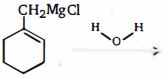
B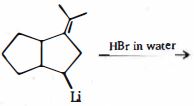
C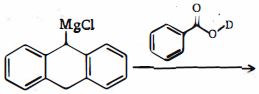
D
All of these
Solution
(D) Organometallic compounds like Grignard reagents $(R-MgX)$ and organolithium compounds $(R-Li)$ are strong bases.
They react rapidly with any compound containing an acidic hydrogen $(H)$ or deuterium $(D)$ atom (such as water,alcohols,or acids) to form hydrocarbons.
These reactions are classified as acid-base reactions because the organometallic species acts as a Brønsted-Lowry base,abstracting a proton or deuteron from the substrate.
Therefore,all the given reactions involve an acid-base mechanism.
They react rapidly with any compound containing an acidic hydrogen $(H)$ or deuterium $(D)$ atom (such as water,alcohols,or acids) to form hydrocarbons.
These reactions are classified as acid-base reactions because the organometallic species acts as a Brønsted-Lowry base,abstracting a proton or deuteron from the substrate.
Therefore,all the given reactions involve an acid-base mechanism.
0 likes
View Solution93
DifficultMCQ
Which of the following reactions is an elimination reaction?
A
Cyclohexanol $\xrightarrow{H_2SO_4}$ Cyclohexene + $H_2O$
B
trans$-1,2-$dibromocyclohexane $\xrightarrow{KI}$ Cyclohexene + $IBr$ + $KBr$
C
Bromocyclohexane $\xrightarrow{NaOCH_3}$ Methoxycyclohexane + $NaBr$
D
both $(a)$ and $(b)$
Solution
(D) An elimination reaction involves the removal of atoms or groups from adjacent carbon atoms to form a $\pi$-bond (double or triple bond).
In reaction $(a)$,cyclohexanol undergoes dehydration in the presence of $H_2SO_4$ to form cyclohexene,which is an elimination reaction.
In reaction $(b)$,trans$-1,2-$dibromocyclohexane reacts with $KI$ to undergo debromination,forming cyclohexene,which is also an elimination reaction.
Reaction $(c)$ is a substitution reaction where the methoxy group replaces the bromine atom.
Therefore,both $(a)$ and $(b)$ are elimination reactions.
In reaction $(a)$,cyclohexanol undergoes dehydration in the presence of $H_2SO_4$ to form cyclohexene,which is an elimination reaction.
In reaction $(b)$,trans$-1,2-$dibromocyclohexane reacts with $KI$ to undergo debromination,forming cyclohexene,which is also an elimination reaction.
Reaction $(c)$ is a substitution reaction where the methoxy group replaces the bromine atom.
Therefore,both $(a)$ and $(b)$ are elimination reactions.
0 likes
View Solution94
DifficultMCQ
The end product $(P)$ of the following reaction is:

A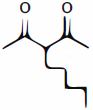
B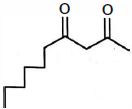
C
D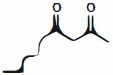
Solution
(C) The reaction involves the treatment of acetylacetone $(CH_3COCH_2COCH_3)$ with $2$ equivalents of $KNH_2$ in liquid ammonia $(NH_3(l))$.
$KNH_2$ is a strong base that removes both acidic protons from the central methylene group,forming a dianion: $[CH_3COCHCOCH_3]^{2-}$.
This dianion is highly nucleophilic.
When treated with $n-C_4H_9Br$,the more nucleophilic carbon (the terminal carbon of the enolate,which is less sterically hindered) attacks the alkyl halide via an $S_N2$ mechanism.
After acidic workup with $H_3O^+$,the product formed is $CH_3COCH_2COCH_2CH_2CH_2CH_2CH_3$ (octane$-2,4-$dione substituted at the terminal position).
Looking at the options,the structure corresponding to the alkylation at the terminal methyl group is $C$.
$KNH_2$ is a strong base that removes both acidic protons from the central methylene group,forming a dianion: $[CH_3COCHCOCH_3]^{2-}$.
This dianion is highly nucleophilic.
When treated with $n-C_4H_9Br$,the more nucleophilic carbon (the terminal carbon of the enolate,which is less sterically hindered) attacks the alkyl halide via an $S_N2$ mechanism.
After acidic workup with $H_3O^+$,the product formed is $CH_3COCH_2COCH_2CH_2CH_2CH_2CH_3$ (octane$-2,4-$dione substituted at the terminal position).
Looking at the options,the structure corresponding to the alkylation at the terminal methyl group is $C$.
0 likes
View Solution95
DifficultMCQ
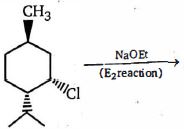
What is the major product of the following $E2$ reaction?
A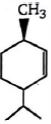
B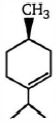
C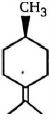
D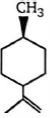
Solution
(B) In an $E2$ elimination reaction,the base $(NaOEt)$ abstracts a $\beta$-hydrogen that is anti-periplanar to the leaving group $(Cl^-)$.
For the given molecule,there are two possible $\beta$-hydrogens available for elimination.
Elimination of the hydrogen at $C_2$ leads to a less substituted alkene,while elimination of the hydrogen at $C_6$ leads to a more substituted,and thus more stable,alkene.
According to Zaitsev's rule,the more substituted alkene is the major product.
Therefore,the product with the double bond formed towards the more substituted side is the major product.
For the given molecule,there are two possible $\beta$-hydrogens available for elimination.
Elimination of the hydrogen at $C_2$ leads to a less substituted alkene,while elimination of the hydrogen at $C_6$ leads to a more substituted,and thus more stable,alkene.
According to Zaitsev's rule,the more substituted alkene is the major product.
Therefore,the product with the double bond formed towards the more substituted side is the major product.
0 likes
View Solution96
MediumMCQ
What sequence of reagents is required to accomplish the following transformation?

A
$1$. $NBS, ROOR$ $2$. $CH_3CH_2O^{-}$ $3$. $2HBr$ $4$. $NH_2^-$ $5$. disiamyl borane $6$. $H_2O_2, OH^{-}$
B
$1$. $Cl_2, hv$ $2$. $OH^{-}$,heat; $3$. $2HCl$ $4$. $OH^{-}$,heat $5$. $HgSO_4, H_2SO_4$
C
$1$. $NBS, ROOR$; $OH^{-}$,$DMSO$
D
$1$. $Br_2, hv$ $2$. $t-BuO^{-}$ $3$. $BH_3, THF$ $4$. $H_2O_2, OH^{-}$
Solution
(D) The transformation involves converting $2,2-dimethylbutane$ to $3,3-dimethylbutan-1-ol$.
Step $1$: Radical bromination using $Br_2, hv$ selectively replaces the hydrogen at the $C-3$ position to form $3-bromo-2,2-dimethylbutane$.
Step $2$: Elimination using a bulky base like $t-BuO^-$ ($E_2$ mechanism) yields the less substituted alkene,$3,3-dimethylbut-1-ene$.
Step $3$: Hydroboration-oxidation ($BH_3, THF$ followed by $H_2O_2, OH^-$) performs an anti-Markovnikov hydration of the terminal alkene to give the primary alcohol,$3,3-dimethylbutan-1-ol$.
Thus,the correct sequence is $1$. $Br_2, hv$ $2$. $t-BuO^-$ $3$. $BH_3, THF$ $4$. $H_2O_2, OH^-$.
Step $1$: Radical bromination using $Br_2, hv$ selectively replaces the hydrogen at the $C-3$ position to form $3-bromo-2,2-dimethylbutane$.
Step $2$: Elimination using a bulky base like $t-BuO^-$ ($E_2$ mechanism) yields the less substituted alkene,$3,3-dimethylbut-1-ene$.
Step $3$: Hydroboration-oxidation ($BH_3, THF$ followed by $H_2O_2, OH^-$) performs an anti-Markovnikov hydration of the terminal alkene to give the primary alcohol,$3,3-dimethylbutan-1-ol$.
Thus,the correct sequence is $1$. $Br_2, hv$ $2$. $t-BuO^-$ $3$. $BH_3, THF$ $4$. $H_2O_2, OH^-$.

0 likes
View Solution97
MediumMCQ
The double bond equivalent $(DBE)$ of cubane is:

A
$4$
B
$5$
C
$6$
D
$7$
Solution
(B) The molecular formula of cubane is $C_8H_8$.
For a hydrocarbon with formula $C_xH_y$,the double bond equivalent $(DBE)$ is calculated using the formula: $DBE = x - \frac{y}{2} + 1$.
Substituting the values $x = 8$ and $y = 8$:
$DBE = 8 - \frac{8}{2} + 1 = 8 - 4 + 1 = 5$.
Alternatively,the $DBE$ is equal to the number of rings plus the number of pi bonds. Cubane has $5$ rings and $0$ pi bonds,so $DBE = 5 + 0 = 5$.
For a hydrocarbon with formula $C_xH_y$,the double bond equivalent $(DBE)$ is calculated using the formula: $DBE = x - \frac{y}{2} + 1$.
Substituting the values $x = 8$ and $y = 8$:
$DBE = 8 - \frac{8}{2} + 1 = 8 - 4 + 1 = 5$.
Alternatively,the $DBE$ is equal to the number of rings plus the number of pi bonds. Cubane has $5$ rings and $0$ pi bonds,so $DBE = 5 + 0 = 5$.
0 likes
View Solution98
DifficultMCQ
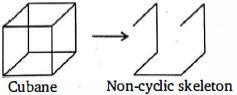
How many bond cleavages are required to convert cubane into a non-cyclic skeleton?
A
$2$
B
$3$
C
$4$
D
$5$
Solution
(D) Cubane is a polycyclic hydrocarbon with the formula $C_8H_8$,consisting of eight carbon atoms arranged in a cube.
To convert a cyclic structure into a non-cyclic (acyclic) skeleton,we must break enough bonds to eliminate all rings.
For a polycyclic system,the number of bonds to be broken is equal to the number of rings present.
Cubane has $5$ faces (rings) that are fused together.
As shown in the process:
$1$. Breaking $2$ bonds opens the first set of rings.
$2$. Breaking another $2$ bonds opens further rings.
$3$. Breaking $1$ final bond results in a non-cyclic structure.
Total bond cleavages required = $2 + 2 + 1 = 5$.
To convert a cyclic structure into a non-cyclic (acyclic) skeleton,we must break enough bonds to eliminate all rings.
For a polycyclic system,the number of bonds to be broken is equal to the number of rings present.
Cubane has $5$ faces (rings) that are fused together.
As shown in the process:
$1$. Breaking $2$ bonds opens the first set of rings.
$2$. Breaking another $2$ bonds opens further rings.
$3$. Breaking $1$ final bond results in a non-cyclic structure.
Total bond cleavages required = $2 + 2 + 1 = 5$.

0 likes
View Solution99
MediumMCQ
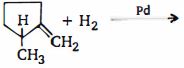
The product of the reaction shown below will be:
A
Racemic mixture
B
Diastereomers
C
Meso
D
Constitutional isomers
Solution
(B) The reaction involves the catalytic hydrogenation of $3$-methylmethylenecyclopentane using $Pd$ catalyst.
Hydrogenation is a $syn$-addition process,meaning both hydrogen atoms add to the same face of the double bond.
Since the starting material has a chiral center at the $C-3$ position,the addition of $H_2$ to the exocyclic double bond creates a new chiral center at the $C-1$ position.
Because the $H_2$ can add from either the same side as the methyl group or the opposite side,two stereoisomeric products are formed.
These two products are non-mirror image stereoisomers,which are classified as diastereomers.
Hydrogenation is a $syn$-addition process,meaning both hydrogen atoms add to the same face of the double bond.
Since the starting material has a chiral center at the $C-3$ position,the addition of $H_2$ to the exocyclic double bond creates a new chiral center at the $C-1$ position.
Because the $H_2$ can add from either the same side as the methyl group or the opposite side,two stereoisomeric products are formed.
These two products are non-mirror image stereoisomers,which are classified as diastereomers.
0 likes
View SolutionHydrocarbons — Mix Examples-Hydrocarbon · Frequently Asked Questions
1Are these Hydrocarbons questions useful for JEE and NEET?
Yes. All questions in this section are mapped to JEE Main and NEET exam patterns. Previous year questions from JEE Main, NEET, GUJCET and state-level exams are included with full solutions.
2Can I switch to Hindi or Gujarati for these questions?
Yes. Use the language tabs in the hero section or the sidebar to view the same questions and solutions in English, Hindi or Gujarati.
3How do I generate a question paper from this subtopic?
Use the Vedclass Exam Paper Generator — select the chapter and subtopic, set difficulty, and generate Sets A, B, C, D automatically. First 3 chapters of every subject are free.
Vedclass Products
For Students
Vedclass Test Series
Mock tests in real JEE/NEET style with performance analysis. 5-day free trial.
Start Free TrialFor Teachers
Exam Paper Generator
Generate Set A/B/C/D papers from this chapter in 2 minutes. 3 chapters free.
Try FreeFor Institutes
Online Exam Module
Live online exams with unlimited students, 360° analytics & white-label branding.
See DemoFor Teachers & Institutes
Generate a Hydrocarbons Exam Paper in 2 Minutes
Select subtopic & difficulty — Sets A, B, C, D auto-generated with No Repeat logic.
First 3 chapters of every subject are free — no payment required.