
A English
Mix Examples-Hydrocarbon Questions in English
Class 11 Chemistry · Hydrocarbons · Mix Examples-Hydrocarbon
317+
Questions
English
Language
100%
With Solutions
Showing 50 of 317 questions in English
151
MediumMCQ
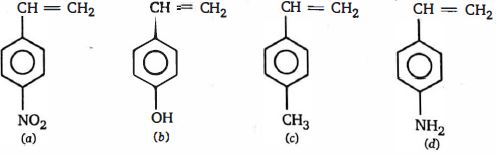
The decreasing order of the rate of reaction of the following molecules towards electrophilic addition reaction is:
A
$d > b > c > a$
B
$b > c > a > d$
C
$a > b > c > d$
D
$b > d > c > a$
Solution
(A) The rate of electrophilic addition reaction depends on the stability of the intermediate carbocation formed. Electron-donating groups $(EDG)$ increase the stability of the carbocation,thereby increasing the rate of reaction,while electron-withdrawing groups $(EWG)$ decrease it.
The substituents attached to the benzene ring are:
$(a) -NO_2$ (strong $EWG$,$-R$ and $-I$ effect)
$(b) -OH$ (strong $EDG$,$+R$ effect)
$(c) -CH_3$ (weak $EDG$,$+I$ and hyperconjugation)
$(d) -NH_2$ (strongest $EDG$,$+R$ effect)
The order of electron-donating ability is $-NH_2 > -OH > -CH_3 > -NO_2$.
Therefore,the stability of the carbocation intermediate follows the order $d > b > c > a$.
Thus,the decreasing order of the rate of reaction is $d > b > c > a$.
The substituents attached to the benzene ring are:
$(a) -NO_2$ (strong $EWG$,$-R$ and $-I$ effect)
$(b) -OH$ (strong $EDG$,$+R$ effect)
$(c) -CH_3$ (weak $EDG$,$+I$ and hyperconjugation)
$(d) -NH_2$ (strongest $EDG$,$+R$ effect)
The order of electron-donating ability is $-NH_2 > -OH > -CH_3 > -NO_2$.
Therefore,the stability of the carbocation intermediate follows the order $d > b > c > a$.
Thus,the decreasing order of the rate of reaction is $d > b > c > a$.
0 likes
View Solution152
MediumMCQ
$2CH_3-C(Ph)=CH_2 \xrightarrow{H-A (acid)} (A) (major)$
Product $(A)$ is:
Product $(A)$ is:
A
$1,3,3-$trimethyl$-1-$phenylindane
B
$1,1,3-$trimethyl$-3-$phenylindane
C
$1,1,3-$trimethyl$-2-$phenylindane
D
$1,3,3-$trimethyl$-2-$phenylindane
Solution
(B) The reaction involves the acid-catalyzed dimerization of $\alpha$-methylstyrene.
Step $1$: Protonation of $\alpha$-methylstyrene $(CH_3-C(Ph)=CH_2)$ by $H^{+}$ gives the stable tertiary benzylic carbocation $CH_3-C^{+}(Ph)-CH_3$.
Step $2$: This carbocation acts as an electrophile and attacks another molecule of $\alpha$-methylstyrene to form a dimer carbocation: $CH_3-C(Ph)(CH_3)-CH_2-C^{+}(Ph)-CH_3$.
Step $3$: The carbocation undergoes intramolecular electrophilic aromatic substitution (Friedel-Crafts alkylation) followed by loss of a proton to form the cyclic product $1,1,3$-trimethyl-$3$-phenylindane.
Step $1$: Protonation of $\alpha$-methylstyrene $(CH_3-C(Ph)=CH_2)$ by $H^{+}$ gives the stable tertiary benzylic carbocation $CH_3-C^{+}(Ph)-CH_3$.
Step $2$: This carbocation acts as an electrophile and attacks another molecule of $\alpha$-methylstyrene to form a dimer carbocation: $CH_3-C(Ph)(CH_3)-CH_2-C^{+}(Ph)-CH_3$.
Step $3$: The carbocation undergoes intramolecular electrophilic aromatic substitution (Friedel-Crafts alkylation) followed by loss of a proton to form the cyclic product $1,1,3$-trimethyl-$3$-phenylindane.
0 likes
View Solution153
MediumMCQ
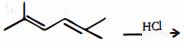
What is the product of $1, 4$-addition in the reaction shown below?
A
$2-$chloro$-2,5-$dimethylhex$-3-$ene
B
$5-$chloro$-2,5-$dimethylhex$-2-$ene
C
$2-$chloro$-2,5-$dimethylhex$-4-$ene
D
$3-$chloro$-2,5-$dimethylhex$-2-$ene
Solution
(A) The reaction of $HCl$ with a conjugated diene proceeds via the formation of a resonance-stabilized allylic carbocation.
$1$. Protonation of the double bond occurs to form the most stable carbocation.
$2$. The resulting allylic carbocation has two resonance structures.
$3$. $1, 4$-addition occurs when the chloride ion $(Cl^-)$ attacks the terminal carbon of the allylic system.
$4$. Based on the provided reaction mechanism,the $1, 4$-addition product is $2$-chloro-$2, 5$-dimethylhex-$3$-ene.
$1$. Protonation of the double bond occurs to form the most stable carbocation.
$2$. The resulting allylic carbocation has two resonance structures.
$3$. $1, 4$-addition occurs when the chloride ion $(Cl^-)$ attacks the terminal carbon of the allylic system.
$4$. Based on the provided reaction mechanism,the $1, 4$-addition product is $2$-chloro-$2, 5$-dimethylhex-$3$-ene.
0 likes
View Solution154
MediumMCQ
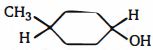
Dehydration of the above compound will give
A
meso product
B
racemic mixture
C
diastereomer
D
optically pure enantiomer
Solution
(B) The dehydration of $4$-methylcyclohexanol in the presence of an acid catalyst $(H^+)$ and heat $(\Delta)$ involves the formation of a carbocation intermediate.
This leads to the formation of $4$-methylcyclohexene.
Since the product $4$-methylcyclohexene contains a chiral center at the $C-4$ position (indicated by the asterisk in the provided solution image),the reaction produces both enantiomers in equal amounts.
Therefore,the final product is a racemic mixture.
This leads to the formation of $4$-methylcyclohexene.
Since the product $4$-methylcyclohexene contains a chiral center at the $C-4$ position (indicated by the asterisk in the provided solution image),the reaction produces both enantiomers in equal amounts.
Therefore,the final product is a racemic mixture.
0 likes
View Solution155
MediumMCQ
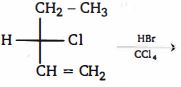
What is the stereochemistry of the product formed in the following reaction?
A
Racemic mixture
B
Optically inactive
C
Diastereomers
D
Meso product
Solution
(C) The reaction involves the electrophilic addition of $HBr$ to the alkene. The starting material contains a chiral center. Upon protonation of the double bond,a carbocation is formed at the $C-2$ position. The subsequent attack of the bromide ion $(Br^-)$ can occur from either side of the planar carbocation,leading to the formation of two new chiral centers. Since the molecule already possesses one chiral center,the formation of a second chiral center results in the creation of two diastereomeric products. These products are not mirror images of each other and are therefore diastereomers.
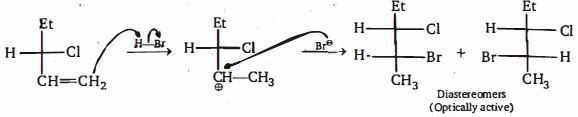
0 likes
View Solution156
MediumMCQ
The end product formed in the above reaction is:

A
Optically active
B
Racemic
C
Meso
D
Diastereomer
Solution
(B) The reaction starts with $hex-5-yn-1-ol$. Hydrogenation with $H_2$ (typically over a catalyst like $Pd/BaSO_4$ or similar) reduces the alkyne to an alkene,forming $hex-5-en-1-ol$ (intermediate $A$).
In the presence of an acid catalyst $(H^{\oplus})$,the alkene undergoes protonation to form a carbocation at the $C_5$ position. The oxygen atom of the hydroxyl group then attacks this $sp^2$-hybridized carbocation to form a cyclic ether (tetrahydropyran derivative).
Since the carbon atom where the ring closure occurs becomes a chiral center and the attack can occur from either face of the planar carbocation,both $R$ and $S$ enantiomers are formed in equal amounts.
Therefore,the end product is a racemic mixture.
In the presence of an acid catalyst $(H^{\oplus})$,the alkene undergoes protonation to form a carbocation at the $C_5$ position. The oxygen atom of the hydroxyl group then attacks this $sp^2$-hybridized carbocation to form a cyclic ether (tetrahydropyran derivative).
Since the carbon atom where the ring closure occurs becomes a chiral center and the attack can occur from either face of the planar carbocation,both $R$ and $S$ enantiomers are formed in equal amounts.
Therefore,the end product is a racemic mixture.
0 likes
View Solution157
MediumMCQ
In which of the following reactions $1,3$-butadiene will be obtained as a major product?
A
$Br-CH_2-CH_2-CH_2-CH_2-Br \xrightarrow[(CH_3)_3COH]{(CH_3)_3COK (2 \ mole)} CH_2=CH-CH=CH_2$
B
$HO-CH_2-CH_2-CH_2-CH_2-OH \xrightarrow{Conc. \ H_2SO_4} CH_2=CH-CH=CH_2$
C
$H_2C=CH-C\equiv CH \xrightarrow[Ni_2B]{H_2 (1 \ mole)} H_2C=CH-CH=CH_2$
D
All of these
Solution
(D) In $(a)$,a double dehydrohalogenation ($E_2$ mechanism) occurs using a strong base to yield $1,3$-butadiene.
In $(b)$,acid-catalyzed dehydration of $1,4$-butanediol occurs to yield $1,3$-butadiene.
In $(c)$,partial hydrogenation of vinylacetylene $(but-1-en-3-yne)$ using $Ni_2B$ ($P$-$2$ catalyst) selectively reduces the triple bond to a double bond to yield $1,3$-butadiene.
In $(b)$,acid-catalyzed dehydration of $1,4$-butanediol occurs to yield $1,3$-butadiene.
In $(c)$,partial hydrogenation of vinylacetylene $(but-1-en-3-yne)$ using $Ni_2B$ ($P$-$2$ catalyst) selectively reduces the triple bond to a double bond to yield $1,3$-butadiene.
0 likes
View Solution158
MediumMCQ
Identify $A$ in the following reaction sequence:

A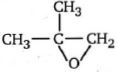
B
$CH_3-CH(CH_3)-CHO$
C
$CH_3-CO-CH_2-CH_3$
D
$CH_3-C(CH_3)=CH_2$
Solution
(B) The reaction starts with the chlorination of $2$-methylpropene to form $1,2$-dichloro-$2$-methylpropane.
Treatment with $H_2O$ followed by $Ca(OH)_2$ leads to the formation of an epoxide intermediate ($1,2$-epoxy-$2$-methylpropane) via neighboring group participation $(NGP)$.
Finally,in the presence of $H^+$ and heat,the epoxide undergoes ring opening followed by a hydride shift to form the stable carbonyl compound,$2$-methylpropanal $(CH_3-CH(CH_3)-CHO)$.
Treatment with $H_2O$ followed by $Ca(OH)_2$ leads to the formation of an epoxide intermediate ($1,2$-epoxy-$2$-methylpropane) via neighboring group participation $(NGP)$.
Finally,in the presence of $H^+$ and heat,the epoxide undergoes ring opening followed by a hydride shift to form the stable carbonyl compound,$2$-methylpropanal $(CH_3-CH(CH_3)-CHO)$.
0 likes
View Solution159
MediumMCQ
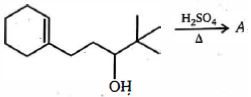
Product $(A)$ is
A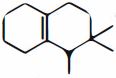
B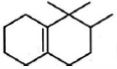
C
D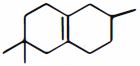
Solution
(C) The reaction involves the acid-catalyzed dehydration of an alcohol.
$1$. Protonation of the $-OH$ group occurs,followed by the loss of a water molecule to form a secondary carbocation.
$2$. $A$ methyl shift occurs to rearrange the carbocation into a more stable tertiary carbocation.
$3$. The carbocation then undergoes an intramolecular electrophilic attack on the double bond to form a new ring.
$4$. Finally,the loss of a proton $(-H^+)$ leads to the formation of the final product,which is a bicyclic alkene.
$1$. Protonation of the $-OH$ group occurs,followed by the loss of a water molecule to form a secondary carbocation.
$2$. $A$ methyl shift occurs to rearrange the carbocation into a more stable tertiary carbocation.
$3$. The carbocation then undergoes an intramolecular electrophilic attack on the double bond to form a new ring.
$4$. Finally,the loss of a proton $(-H^+)$ leads to the formation of the final product,which is a bicyclic alkene.
0 likes
View Solution160
MediumMCQ
Which of the following is an incorrect statement about the heats of combustion?
A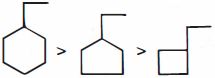
B
C
$Iso-butene > trans-2-butene > 1-butene$
D
$n-Hexane < n-Heptane < n-Octane$
Solution
(C) The heat of combustion is directly proportional to the number of carbon atoms in the molecule for homologous series. For isomers,it is inversely proportional to the stability of the molecule.
$(A)$ The image shows alkyl-substituted cycloalkanes. The heat of combustion increases with the number of carbon atoms.
$(B)$ The image shows bicyclic compounds. The heat of combustion increases with the number of carbon atoms.
$(C)$ For isomers of butene $(C_4H_8)$,the stability order is $trans-2-butene > iso-butene > 1-butene$. Since heat of combustion is inversely proportional to stability,the order of heat of combustion should be $1-butene > iso-butene > trans-2-butene$. Thus,the statement $Iso-butene > trans-2-butene > 1-butene$ is incorrect.
$(D)$ For $n-alkanes$,the heat of combustion increases as the number of carbon atoms increases $(n-Hexane < n-Heptane < n-Octane)$. This is a correct statement.
Therefore,the incorrect statement is $(C)$.
$(A)$ The image shows alkyl-substituted cycloalkanes. The heat of combustion increases with the number of carbon atoms.
$(B)$ The image shows bicyclic compounds. The heat of combustion increases with the number of carbon atoms.
$(C)$ For isomers of butene $(C_4H_8)$,the stability order is $trans-2-butene > iso-butene > 1-butene$. Since heat of combustion is inversely proportional to stability,the order of heat of combustion should be $1-butene > iso-butene > trans-2-butene$. Thus,the statement $Iso-butene > trans-2-butene > 1-butene$ is incorrect.
$(D)$ For $n-alkanes$,the heat of combustion increases as the number of carbon atoms increases $(n-Hexane < n-Heptane < n-Octane)$. This is a correct statement.
Therefore,the incorrect statement is $(C)$.
0 likes
View Solution161
MediumMCQ
The product of the reaction is:
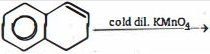
A
Meso compound
B
Enantiomeric pair
C
Diastereomers
D
Optically pure enantiomer
Solution
(B) The reaction of $1,2$-dihydronaphthalene with cold,dilute alkaline $KMnO_4$ (Baeyer's reagent) is a syn-hydroxylation reaction.
This process adds two hydroxyl $(-OH)$ groups to the same side of the double bond.
Since the molecule is chiral and lacks a plane of symmetry in the product,the syn-addition results in the formation of a pair of enantiomers (racemic mixture).
Therefore,the product is an enantiomeric pair.
This process adds two hydroxyl $(-OH)$ groups to the same side of the double bond.
Since the molecule is chiral and lacks a plane of symmetry in the product,the syn-addition results in the formation of a pair of enantiomers (racemic mixture).
Therefore,the product is an enantiomeric pair.
0 likes
View Solution162
MediumMCQ
Addition of a mineral acid to an olefin bond leads to a major product. Identify it.

A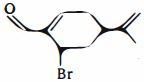
B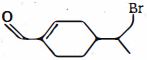
C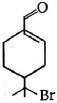
D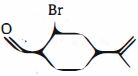
Solution
(C) The reaction follows the electrophilic addition mechanism,where the rate-determining step is the formation of a carbocation intermediate.
In the given molecule,there are two double bonds: one in the ring and one in the side chain.
The double bond in the side chain is more substituted and its protonation leads to a more stable $3^o$ carbocation compared to the secondary carbocation that would form from the ring double bond.
Therefore,the $H^+$ ion adds to the terminal carbon of the side chain to form a $3^o$ carbocation,which is then attacked by the $Br^-$ ion to form the major product.
In the given molecule,there are two double bonds: one in the ring and one in the side chain.
The double bond in the side chain is more substituted and its protonation leads to a more stable $3^o$ carbocation compared to the secondary carbocation that would form from the ring double bond.
Therefore,the $H^+$ ion adds to the terminal carbon of the side chain to form a $3^o$ carbocation,which is then attacked by the $Br^-$ ion to form the major product.
0 likes
View Solution163
MediumMCQ
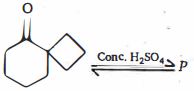
Identify product $(P)$
A
Spiro[$3.4$]octan$-5-$one
B
Spiro[$3.4$]octan$-6-$one
C
Spiro[$4.4$]nonan$-1-$one
D
Spiro[$4.4$]non$-1-$en$-2-$one
Solution
(C) The reaction involves an acid-catalyzed ring expansion (a type of Wagner-Meerwein rearrangement).
$1$. Protonation of the carbonyl oxygen of the spiro-ketone creates a carboxonium ion $(A)$.
$2$. The cyclobutane ring undergoes a $1,2$-alkyl shift to the adjacent carbocation center,which is driven by the relief of ring strain (cyclobutane has a high strain energy of $\approx 26 \ kcal/mol$ compared to the cyclopentane ring formed).
$3$. This rearrangement expands the four-membered ring into a five-membered ring,resulting in a spiro[$4.4$]nonan$-1-$one system.
$4$. Deprotonation yields the final product,spiro[$4.4$]nonan$-1-$one.
$1$. Protonation of the carbonyl oxygen of the spiro-ketone creates a carboxonium ion $(A)$.
$2$. The cyclobutane ring undergoes a $1,2$-alkyl shift to the adjacent carbocation center,which is driven by the relief of ring strain (cyclobutane has a high strain energy of $\approx 26 \ kcal/mol$ compared to the cyclopentane ring formed).
$3$. This rearrangement expands the four-membered ring into a five-membered ring,resulting in a spiro[$4.4$]nonan$-1-$one system.
$4$. Deprotonation yields the final product,spiro[$4.4$]nonan$-1-$one.
0 likes
View Solution164
MediumMCQ
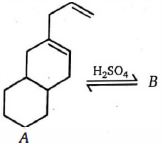
$A$ isomerises to $B$ on addition of traces of acid $H_2SO_4$. Compound $(B)$ is
A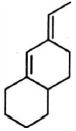
B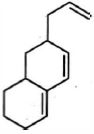
C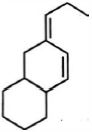
D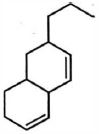
Solution
(A) The addition of traces of acid $H_2SO_4$ initiates the protonation of the double bond in compound $A$,leading to the formation of a carbocation intermediate. Through a series of rearrangements,including a $1,2-H$ shift,the carbocation stabilizes and subsequently loses a proton to form a more substituted,and thus more stable,conjugated diene system. The final product $B$ is the structure shown in option $A$.
0 likes
View Solution165
MediumMCQ
Which of the following reactions do not represent the major product of given Birch reductions?
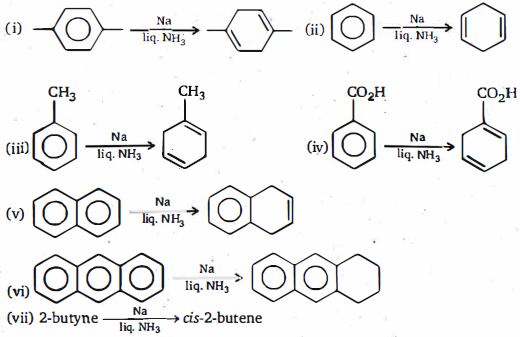
A
$i, iii, vi$
B
$iv, vi, vii$
C
$iv, v, vi$
D
$i, ii, v, vii$
Solution
(C) Birch reduction of aromatic rings follows specific rules based on substituents:
$(i)$ Toluene with $Na/liq. NH_3$ gives $1-$methyl$-1,4-$cyclohexadiene. This is correct.
(ii) Benzene with $Na/liq. NH_3$ gives $1,4-$cyclohexadiene. This is correct.
(iii) Toluene with $Na/liq. NH_3$ gives $1-$methyl$-1,4-$cyclohexadiene. The structure shown is incorrect.
(iv) Benzoic acid with $Na/liq. NH_3$ gives $1-$carboxy$-2,5-$cyclohexadiene. The structure shown is incorrect.
$(v)$ Naphthalene with $Na/liq. NH_3$ gives $1,4,5,8-$tetrahydronaphthalene. The structure shown is incorrect.
(vi) Anthracene with $Na/liq. NH_3$ gives $9,10-$dihydroanthracene. The structure shown is incorrect.
(vii) $2-$butyne with $Na/liq. NH_3$ gives trans$-2-$butene,not cis$-2-$butene. This is incorrect.
Thus,the reactions that do not represent the major product are $iii, iv, v, vi, vii$. Among the given options,option $C$ $(iv, v, vi)$ contains the most incorrect representations.
$(i)$ Toluene with $Na/liq. NH_3$ gives $1-$methyl$-1,4-$cyclohexadiene. This is correct.
(ii) Benzene with $Na/liq. NH_3$ gives $1,4-$cyclohexadiene. This is correct.
(iii) Toluene with $Na/liq. NH_3$ gives $1-$methyl$-1,4-$cyclohexadiene. The structure shown is incorrect.
(iv) Benzoic acid with $Na/liq. NH_3$ gives $1-$carboxy$-2,5-$cyclohexadiene. The structure shown is incorrect.
$(v)$ Naphthalene with $Na/liq. NH_3$ gives $1,4,5,8-$tetrahydronaphthalene. The structure shown is incorrect.
(vi) Anthracene with $Na/liq. NH_3$ gives $9,10-$dihydroanthracene. The structure shown is incorrect.
(vii) $2-$butyne with $Na/liq. NH_3$ gives trans$-2-$butene,not cis$-2-$butene. This is incorrect.
Thus,the reactions that do not represent the major product are $iii, iv, v, vi, vii$. Among the given options,option $C$ $(iv, v, vi)$ contains the most incorrect representations.
0 likes
View Solution166
MediumMCQ
The product $(x)$ is
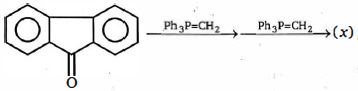
A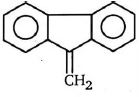
B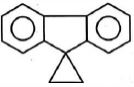
C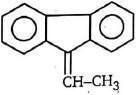
D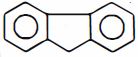
Solution
(B) The reaction shown is a Wittig reaction between fluorenone and the Wittig reagent $Ph_3P=CH_2$.
In the first step,the carbonyl oxygen of fluorenone is replaced by the methylene group $(=CH_2)$ of the Wittig reagent to form $9-$methylenefluorene.
Since the reaction is indicated to proceed further with the same reagent,and $9-$methylenefluorene is an alkene,it can undergo a cyclopropanation reaction (often via a carbene or similar mechanism if conditions allow,though typically Wittig reagents react with carbonyls).
However,in the context of standard chemistry problems of this type,the reaction of a ketone with $Ph_3P=CH_2$ yields the corresponding alkene. If the reagent is added in excess to the product,it can lead to the formation of a cyclopropane ring across the newly formed double bond.
Thus,the product $(x)$ is the spiro-cyclopropane derivative of fluorene.
In the first step,the carbonyl oxygen of fluorenone is replaced by the methylene group $(=CH_2)$ of the Wittig reagent to form $9-$methylenefluorene.
Since the reaction is indicated to proceed further with the same reagent,and $9-$methylenefluorene is an alkene,it can undergo a cyclopropanation reaction (often via a carbene or similar mechanism if conditions allow,though typically Wittig reagents react with carbonyls).
However,in the context of standard chemistry problems of this type,the reaction of a ketone with $Ph_3P=CH_2$ yields the corresponding alkene. If the reagent is added in excess to the product,it can lead to the formation of a cyclopropane ring across the newly formed double bond.
Thus,the product $(x)$ is the spiro-cyclopropane derivative of fluorene.
0 likes
View Solution167
MediumMCQ
Product $(A)$ is
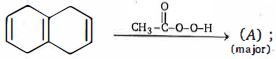
A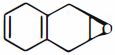
B
C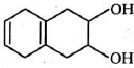
D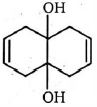
Solution
(A) The reaction of an alkene with a peroxyacid (like peroxyacetic acid,$CH_3CO_3H$) is an epoxidation reaction.
In the given molecule,there are two double bonds. One is a tetrasubstituted double bond (at the bridgehead) and the other is a disubstituted double bond.
According to the reactivity of alkenes towards electrophilic attack (epoxidation),the more electron-rich (more substituted) alkene reacts faster.
Therefore,the tetrasubstituted double bond will undergo epoxidation to form the epoxide product $(A)$.
In the given molecule,there are two double bonds. One is a tetrasubstituted double bond (at the bridgehead) and the other is a disubstituted double bond.
According to the reactivity of alkenes towards electrophilic attack (epoxidation),the more electron-rich (more substituted) alkene reacts faster.
Therefore,the tetrasubstituted double bond will undergo epoxidation to form the epoxide product $(A)$.
0 likes
View Solution168
DifficultMCQ
To carry out the given conversions,select the correct option.
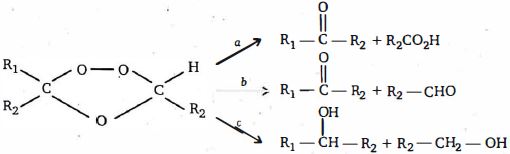
A
$a = Ag_2O, b = Zn/CH_3CO_2H, c = LiAlH_4$
B
$a = H_2O_2, b = CH_3-S-CH_3, c = NaBH_4$
C
Both $(a)$ and $(b)$
D
None of these
Solution
(C) The given reaction shows the decomposition of an ozonide intermediate formed from an alkene.
$a$ represents oxidative ozonolysis,which can be achieved using $H_2O_2$ or $Ag_2O$ as an oxidizing agent.
$b$ represents reductive ozonolysis,which can be achieved using $Zn/CH_3COOH$ or $CH_3-S-CH_3$ (dimethyl sulfide).
$c$ represents the reduction of carbonyl products (ketones and aldehydes) to their corresponding alcohols,which can be achieved using $LiAlH_4$ or $NaBH_4$.
Since both sets $(a)$ and $(b)$ provide valid reagents for the respective pathways,the correct option is $(c)$.
$a$ represents oxidative ozonolysis,which can be achieved using $H_2O_2$ or $Ag_2O$ as an oxidizing agent.
$b$ represents reductive ozonolysis,which can be achieved using $Zn/CH_3COOH$ or $CH_3-S-CH_3$ (dimethyl sulfide).
$c$ represents the reduction of carbonyl products (ketones and aldehydes) to their corresponding alcohols,which can be achieved using $LiAlH_4$ or $NaBH_4$.
Since both sets $(a)$ and $(b)$ provide valid reagents for the respective pathways,the correct option is $(c)$.
0 likes
View Solution169
MediumMCQ
$CH_3-C(ONa)=CH_2$ $\xrightarrow{HC\equiv CH}$ $\xrightarrow{H^{+}}$ $\xrightarrow[Pd-BaSO_4]{H_2}$ $\xrightarrow[\Delta]{Al_2O_3}$
End product of the reaction is
End product of the reaction is
A
$H_2C=C(CH_3)-CH=CH_2$
B
$CH_3-CH=CH-CH=CH_2$
C
$H_2C=CH-CH=CH_2$
D
$H_2C=CH-CH_2-CH=CH_2$
Solution
(A) $1$. The reaction starts with the nucleophilic attack of the enolate $CH_3-C(O^-)=CH_2$ on acetylene $(HC\equiv CH)$,followed by protonation to form $CH_3-C(OH)(CH_3)-C\equiv CH$ (after tautomerization and rearrangement steps as shown in the mechanism).
$2$. The partial hydrogenation of the alkyne using Lindlar's catalyst $(H_2/Pd-BaSO_4)$ reduces the triple bond to a double bond,yielding $CH_3-C(OH)(CH_3)-CH=CH_2$.
$3$. Finally,dehydration using $Al_2O_3$ at high temperature removes a water molecule to form the conjugated diene,$H_2C=C(CH_3)-CH=CH_2$ (Isoprene).
$2$. The partial hydrogenation of the alkyne using Lindlar's catalyst $(H_2/Pd-BaSO_4)$ reduces the triple bond to a double bond,yielding $CH_3-C(OH)(CH_3)-CH=CH_2$.
$3$. Finally,dehydration using $Al_2O_3$ at high temperature removes a water molecule to form the conjugated diene,$H_2C=C(CH_3)-CH=CH_2$ (Isoprene).
0 likes
View Solution170
MediumMCQ
The major product of the given reaction is:

A
$2,3-$Dimethylbut$-2-$ene
B
$2-$Methylpent$-1-$ene
C
$3-$Methylpent$-1-$ene
D
$CH_2=C(CH_3)-CH_2-CH_2-CH_3$
Solution
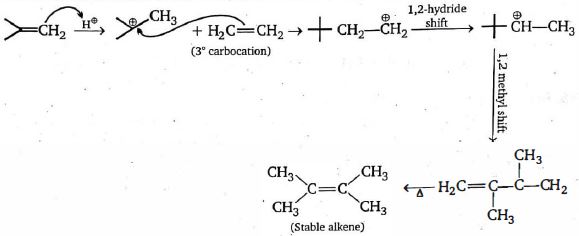
(A) The reaction involves the acid-catalyzed dimerization of isobutylene ($2$-methylpropene) with ethene.
$1$. Protonation of isobutylene forms a stable $3^{\circ}$ carbocation: $(CH_3)_2C^+-CH_3$.
$2$. This carbocation attacks ethene to form a new carbocation: $(CH_3)_3C-CH_2-CH_2^+$.
$3$. Through a series of rearrangements ($1,2$-hydride shift followed by $1,2$-methyl shift),the carbocation rearranges to a more stable form.
$4$. Finally,deprotonation leads to the most stable alkene,which is $2,3$-dimethylbut-$2$-ene.
$1$. Protonation of isobutylene forms a stable $3^{\circ}$ carbocation: $(CH_3)_2C^+-CH_3$.
$2$. This carbocation attacks ethene to form a new carbocation: $(CH_3)_3C-CH_2-CH_2^+$.
$3$. Through a series of rearrangements ($1,2$-hydride shift followed by $1,2$-methyl shift),the carbocation rearranges to a more stable form.
$4$. Finally,deprotonation leads to the most stable alkene,which is $2,3$-dimethylbut-$2$-ene.
0 likes
View Solution171
MediumMCQ
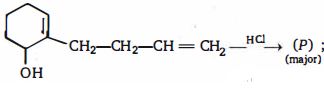
The product $(P)$ is:
A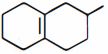
B
C
D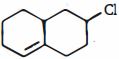
Solution
(D) The reaction involves the protonation of the hydroxyl group by $HCl$,followed by the loss of water to form a carbocation. This carbocation undergoes an intramolecular electrophilic addition to the double bond,leading to a bicyclic system. Finally,the chloride ion attacks the resulting carbocation to form the major product. The reaction sequence is as follows:
$1$. Protonation of $-OH$ group: The $-OH$ group is protonated by $HCl$ to form $-OH_2^+$.
$2$. Formation of carbocation: Water is eliminated to form a carbocation at the allylic position.
$3$. Cyclization: The double bond attacks the carbocation,leading to the formation of a bicyclic carbocation.
$4$. Nucleophilic attack: The $Cl^-$ ion attacks the carbocation to yield the final product,which is a substituted bicyclic compound.
$1$. Protonation of $-OH$ group: The $-OH$ group is protonated by $HCl$ to form $-OH_2^+$.
$2$. Formation of carbocation: Water is eliminated to form a carbocation at the allylic position.
$3$. Cyclization: The double bond attacks the carbocation,leading to the formation of a bicyclic carbocation.
$4$. Nucleophilic attack: The $Cl^-$ ion attacks the carbocation to yield the final product,which is a substituted bicyclic compound.
0 likes
View Solution172
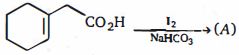
MediumMCQ
The major product of the reaction is:
A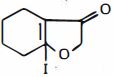
B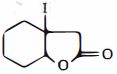
C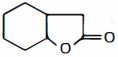
D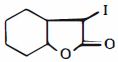
Solution
(B) The reaction is an iodolactonization.
$1$. The $I_2$ reacts with the alkene to form a cyclic iodonium ion intermediate.
$2$. The $NaHCO_3$ acts as a base to deprotonate the carboxylic acid group,forming a carboxylate ion.
$3$. The carboxylate oxygen performs an intramolecular nucleophilic attack on the more substituted carbon of the iodonium ion,leading to the formation of a five-membered lactone ring.
$4$. The final product is an iodolactone,where the iodine atom and the oxygen atom are added across the double bond in an anti-fashion.
Based on the structure,the correct product is the one where the iodine is at the bridgehead position and the lactone ring is fused to the cyclohexane ring.
$1$. The $I_2$ reacts with the alkene to form a cyclic iodonium ion intermediate.
$2$. The $NaHCO_3$ acts as a base to deprotonate the carboxylic acid group,forming a carboxylate ion.
$3$. The carboxylate oxygen performs an intramolecular nucleophilic attack on the more substituted carbon of the iodonium ion,leading to the formation of a five-membered lactone ring.
$4$. The final product is an iodolactone,where the iodine atom and the oxygen atom are added across the double bond in an anti-fashion.
Based on the structure,the correct product is the one where the iodine is at the bridgehead position and the lactone ring is fused to the cyclohexane ring.
0 likes
View Solution173
MediumMCQ
Product $(B)$ is
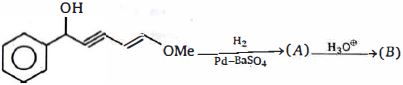
A
$Ph-CH(OH)-CH=CH-CH_2-CHO$
B
$Ph-CH=CH-CHO$
C
$Ph-(CH=CH)_2-CHO$
D
$Ph-(CH=CH)_3-CHO$
Solution
(C) $1$. The starting material is $Ph-CH(OH)-C \equiv C-CH=CH-OMe$.
$2$. Treatment with $H_2 / Pd-BaSO_4$ (Lindlar's catalyst) selectively reduces the alkyne to a cis-alkene,forming intermediate $(A)$: $Ph-CH(OH)-CH=CH-CH=CH-OMe$.
$3$. Subsequent treatment with $H_3O^+$ leads to the hydrolysis of the enol ether. The protonation of the double bond followed by resonance and water attack leads to the formation of an aldehyde.
$4$. The final product $(B)$ is $Ph-CH=CH-CH=CH-CHO$,which can be written as $Ph-(CH=CH)_2-CHO$.
$2$. Treatment with $H_2 / Pd-BaSO_4$ (Lindlar's catalyst) selectively reduces the alkyne to a cis-alkene,forming intermediate $(A)$: $Ph-CH(OH)-CH=CH-CH=CH-OMe$.
$3$. Subsequent treatment with $H_3O^+$ leads to the hydrolysis of the enol ether. The protonation of the double bond followed by resonance and water attack leads to the formation of an aldehyde.
$4$. The final product $(B)$ is $Ph-CH=CH-CH=CH-CHO$,which can be written as $Ph-(CH=CH)_2-CHO$.
0 likes
View Solution174
MediumMCQ
Product $(C)$ is

A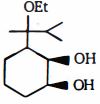
B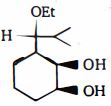
C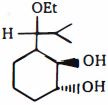
D
Both $(a)$ and $(b)$
Solution
(A) $1$. Cyclohexene reacts with $NBS$ followed by $Mg/ether$ to form the Grignard reagent,cyclohex$-2-$en$-1-$ylmagnesium bromide $(A)$.
$2$. The Grignard reagent $(A)$ reacts with isobutyraldehyde to form an alkoxide,which then undergoes an $S_N2$ reaction with ethyl bromide to form an ether derivative $(B)$.
$3$. Finally,the reaction with $OsO_4/H_2O_2$ performs syn-dihydroxylation of the double bond to yield the final product $(C)$.
$4$. The syn-addition of two $-OH$ groups to the double bond results in the structure shown in option $(A)$.
$2$. The Grignard reagent $(A)$ reacts with isobutyraldehyde to form an alkoxide,which then undergoes an $S_N2$ reaction with ethyl bromide to form an ether derivative $(B)$.
$3$. Finally,the reaction with $OsO_4/H_2O_2$ performs syn-dihydroxylation of the double bond to yield the final product $(C)$.
$4$. The syn-addition of two $-OH$ groups to the double bond results in the structure shown in option $(A)$.
0 likes
View Solution175
MediumMCQ
The following reaction takes place in high yields. Use your knowledge of alkene chemistry to predict the product.
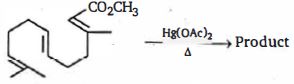
A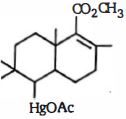
$A$
B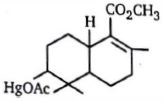
$B$
C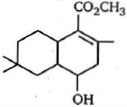
$C$
D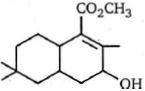
$D$
Solution
(B) The reaction involves the electrophilic cyclization of a polyene initiated by mercuric acetate $(Hg(OAc)_2)$.
$1$. The $Hg(OAc)^+$ electrophile attacks the more nucleophilic alkene (the one with the gem-dimethyl group) to form a cyclic mercurinium ion.
$2$. This intermediate undergoes a concerted cyclization where the second alkene attacks the electrophilic carbon,leading to the formation of a bicyclic system.
$3$. The resulting carbocation is stabilized by the proximity of the electron-withdrawing group $(CO_2CH_3)$.
$4$. Finally,the acetate ion $(OAc^-)$ acts as a base to abstract a proton,leading to the formation of the final bicyclic product as shown in option $B$.
$1$. The $Hg(OAc)^+$ electrophile attacks the more nucleophilic alkene (the one with the gem-dimethyl group) to form a cyclic mercurinium ion.
$2$. This intermediate undergoes a concerted cyclization where the second alkene attacks the electrophilic carbon,leading to the formation of a bicyclic system.
$3$. The resulting carbocation is stabilized by the proximity of the electron-withdrawing group $(CO_2CH_3)$.
$4$. Finally,the acetate ion $(OAc^-)$ acts as a base to abstract a proton,leading to the formation of the final bicyclic product as shown in option $B$.
0 likes
View Solution176
MediumMCQ
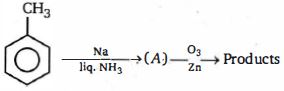
Which of the following products cannot be obtained in the above reaction?
A
$O=CH-CH_2-CHO$
B
$CH_3-CO-CH_2-CHO$
C
$CH_3-CH(CHO)-CHO$
D
None of these
Solution
(C) The reaction of toluene with $Na$ in liquid $NH_3$ is a Birch reduction,which reduces the benzene ring to $1-$methyl$-1,4-$cyclohexadiene.
Ozonolysis of $1-$methyl$-1,4-$cyclohexadiene followed by reductive workup $(O_3/Zn)$ cleaves the double bonds to produce $CH_3-CO-CH_2-CHO$ and $OHC-CH_2-CHO$ (which is $O=CH-CH_2-CHO$).
Since both $CH_3-CO-CH_2-CHO$ and $O=CH-CH_2-CHO$ are obtained as products,option $C$ $(CH_3-CH(CHO)-CHO)$ cannot be obtained.
Thus,the correct answer is $C$.
Ozonolysis of $1-$methyl$-1,4-$cyclohexadiene followed by reductive workup $(O_3/Zn)$ cleaves the double bonds to produce $CH_3-CO-CH_2-CHO$ and $OHC-CH_2-CHO$ (which is $O=CH-CH_2-CHO$).
Since both $CH_3-CO-CH_2-CHO$ and $O=CH-CH_2-CHO$ are obtained as products,option $C$ $(CH_3-CH(CHO)-CHO)$ cannot be obtained.
Thus,the correct answer is $C$.
0 likes
View Solution177
MediumMCQ
Product $(A)$ of the reaction is
A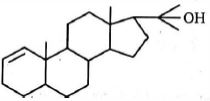
B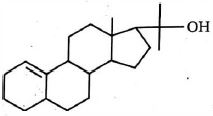
C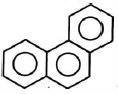
D
None of these
Solution
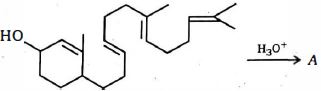
(B) The reaction involves the acid-catalyzed cyclization of a polyene alcohol.
In the presence of $H_3O^+$,the hydroxyl group is protonated and leaves as $H_2O$,generating a carbocation.
This carbocation then undergoes a series of intramolecular electrophilic additions (cyclization) to form the polycyclic structure.
The mechanism involves the formation of the steroid-like skeleton through successive ring closures.
The final product $(A)$ corresponds to the structure shown in option $(B)$.
In the presence of $H_3O^+$,the hydroxyl group is protonated and leaves as $H_2O$,generating a carbocation.
This carbocation then undergoes a series of intramolecular electrophilic additions (cyclization) to form the polycyclic structure.
The mechanism involves the formation of the steroid-like skeleton through successive ring closures.
The final product $(A)$ corresponds to the structure shown in option $(B)$.
0 likes
View Solution178
MediumMCQ
Which of the following would not rearrange to a more stable form?
A
B
C
D
Solution
(C) The cyclopropylmethyl cation is exceptionally stable due to $\sigma$-resonance (also known as bent bond resonance or dance of electrons),where the electrons of the cyclopropane ring overlap with the vacant $p$-orbital of the carbocation. This stabilization makes it highly stable,and it does not undergo rearrangement to a more stable form.
0 likes
View Solution179
MediumMCQ
The product $(Z)$ is:

A
$A$ bromocyclohexane derivative
B
$1-$bromocyclopentane
C
$2-$bromocyclopent$-1-$ene
D
$1-$bromo$-2-$methylcyclopentane
Solution
(D) $1$. The reaction starts with methylcyclopentane reacting with $Br_2/h\nu$ (free radical substitution). The major product $(X)$ is $1-$bromo$-1-$methylcyclopentane.
$2$. Treatment of $(X)$ with alcoholic $KOH/\Delta$ (dehydrohalogenation) follows $E2$ mechanism to form the more stable alkene,$1$-methylcyclopent$-1-$ene,as the major product $(Y)$.
$3$. The reaction of $(Y)$ with $HBr$ in the presence of peroxide follows the anti-Markovnikov addition mechanism. The $Br$ atom attaches to the less substituted carbon of the double bond,resulting in $1-$bromo$-2-$methylcyclopentane as the major product $(Z)$.
$2$. Treatment of $(X)$ with alcoholic $KOH/\Delta$ (dehydrohalogenation) follows $E2$ mechanism to form the more stable alkene,$1$-methylcyclopent$-1-$ene,as the major product $(Y)$.
$3$. The reaction of $(Y)$ with $HBr$ in the presence of peroxide follows the anti-Markovnikov addition mechanism. The $Br$ atom attaches to the less substituted carbon of the double bond,resulting in $1-$bromo$-2-$methylcyclopentane as the major product $(Z)$.
0 likes
View Solution180
MediumMCQ
Which one of the following is the intermediate in the preparation of a ketone by hydration of an alkyne in the presence of sulfuric acid and mercury $(II)$ sulphate?
A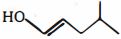
B
C
D
Solution
(D) The hydration of an alkyne in the presence of $H_2SO_4$ and $HgSO_4$ is known as the Kucherov reaction.
The reaction proceeds via the electrophilic addition of water to the alkyne,catalyzed by the mercury $(II)$ ion,to form an unstable intermediate known as an enol.
An enol is a compound containing a hydroxyl group $(-OH)$ attached to a carbon atom that is part of a carbon-carbon double bond $(C=C)$.
The enol then undergoes tautomerization to form a more stable ketone.
Among the given options,the structure in image $287-$d899 represents an enol intermediate,where the $-OH$ group is directly attached to a $sp^2$ hybridized carbon of the double bond.
Therefore,the correct option is $(d)$.
The reaction proceeds via the electrophilic addition of water to the alkyne,catalyzed by the mercury $(II)$ ion,to form an unstable intermediate known as an enol.
An enol is a compound containing a hydroxyl group $(-OH)$ attached to a carbon atom that is part of a carbon-carbon double bond $(C=C)$.
The enol then undergoes tautomerization to form a more stable ketone.
Among the given options,the structure in image $287-$d899 represents an enol intermediate,where the $-OH$ group is directly attached to a $sp^2$ hybridized carbon of the double bond.
Therefore,the correct option is $(d)$.
0 likes
View Solution181
MediumMCQ
Compound $(X)$ will be:
Compound $(X) \xrightarrow[Pt]{5H_2} \text{Saturated compound}$
Compound $(X) \xrightarrow{AgNO_3} \text{Precipitate}$
Compound $(X) \xrightarrow[Me_2S]{O_3} OHC-CH_2-CH_2-CO-CHO + HOOC-CHO + HCOOH + OHC-CHO$
Compound $(X) \xrightarrow[Pt]{5H_2} \text{Saturated compound}$
Compound $(X) \xrightarrow{AgNO_3} \text{Precipitate}$
Compound $(X) \xrightarrow[Me_2S]{O_3} OHC-CH_2-CH_2-CO-CHO + HOOC-CHO + HCOOH + OHC-CHO$
A
$A$ structure showing a cyclohexadiene ring with a side chain $-CH=CH-C \equiv CH$
B
$A$ structure showing a cyclohexadiene ring with a side chain $=CH-CH_2-C \equiv CH$
C
$A$ structure showing a cyclohexadiene ring with a side chain $=CH-CH_2-C \equiv CH$ (different isomer)
D
$A$ structure showing a cyclohexadiene ring with a side chain $=C-CH-C \equiv CH$
Solution
(A) Compound $(X)$ reacts with $5$ moles of $H_2$,indicating $5$ $\pi$ bonds.
The reaction with $AgNO_3$ to form a precipitate confirms the presence of a terminal alkyne $(-C \equiv CH)$.
Reductive ozonolysis $(O_3/Me_2S)$ yields four fragments: $OHC-CH_2-CH_2-CO-CHO$ ($5$ carbons),$HOOC-CHO$ ($2$ carbons),$HCOOH$ ($1$ carbon),and $OHC-CHO$ ($2$ carbons).
Reassembling these fragments based on the carbon count ($10$ carbons) and the degree of unsaturation leads to the structure $1-$vinyl$-2-$ethynyl$-1,3-$cyclohexadiene.
The cleavage of the ring and side chains at the double and triple bonds matches the observed products.
The reaction with $AgNO_3$ to form a precipitate confirms the presence of a terminal alkyne $(-C \equiv CH)$.
Reductive ozonolysis $(O_3/Me_2S)$ yields four fragments: $OHC-CH_2-CH_2-CO-CHO$ ($5$ carbons),$HOOC-CHO$ ($2$ carbons),$HCOOH$ ($1$ carbon),and $OHC-CHO$ ($2$ carbons).
Reassembling these fragments based on the carbon count ($10$ carbons) and the degree of unsaturation leads to the structure $1-$vinyl$-2-$ethynyl$-1,3-$cyclohexadiene.
The cleavage of the ring and side chains at the double and triple bonds matches the observed products.
0 likes
View Solution182
MediumMCQ
What is the degree of unsaturation (double bond equivalent) in compound $(A)$?

A
$7$
B
$8$
C
$9$
D
$10$
Solution
(D) The reaction shows that compound $(A)$ reacts with $2H_2$ to form Carlina oxide.
Carlina oxide has the structure $C_6H_5-CH_2-CH_2-CH_2-(C_4H_3O)$.
The molecular formula of Carlina oxide is $C_{13}H_{12}O$.
The degree of unsaturation ($D$.$U$.) for $C_{13}H_{12}O$ is calculated as:
$D.U. = C + 1 - \frac{H}{2} + \frac{N}{2} - \frac{X}{2} = 13 + 1 - \frac{12}{2} = 14 - 6 = 8$.
Since compound $(A)$ reacts with $2H_2$ to form Carlina oxide,it means $2$ moles of $H_2$ were added to saturate two double bonds present in $(A)$.
Therefore,the $D$.$U$. of compound $(A)$ is $8 + 2 = 10$.
Carlina oxide has the structure $C_6H_5-CH_2-CH_2-CH_2-(C_4H_3O)$.
The molecular formula of Carlina oxide is $C_{13}H_{12}O$.
The degree of unsaturation ($D$.$U$.) for $C_{13}H_{12}O$ is calculated as:
$D.U. = C + 1 - \frac{H}{2} + \frac{N}{2} - \frac{X}{2} = 13 + 1 - \frac{12}{2} = 14 - 6 = 8$.
Since compound $(A)$ reacts with $2H_2$ to form Carlina oxide,it means $2$ moles of $H_2$ were added to saturate two double bonds present in $(A)$.
Therefore,the $D$.$U$. of compound $(A)$ is $8 + 2 = 10$.
0 likes
View Solution183
AdvancedMCQ
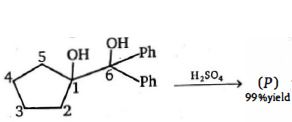
The unknown $(P)$ of the reaction is
A
B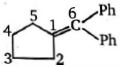
C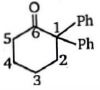
D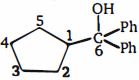
Solution
(C) The reaction is a pinacol-pinacolone rearrangement.
$1$. Protonation of the more substituted hydroxyl group leads to the formation of a stable $3^{\circ}$ carbocation at the $C-6$ position.
$2$. The cyclopentyl ring undergoes ring expansion to form a more stable $6$-membered ring carbocation.
$3$. The oxygen atom on the $C-1$ position donates its lone pair to form a $C=O$ double bond.
$4$. Loss of a proton $(H^+)$ yields the final product,which is $2,2$-diphenylcyclohexanone.
$1$. Protonation of the more substituted hydroxyl group leads to the formation of a stable $3^{\circ}$ carbocation at the $C-6$ position.
$2$. The cyclopentyl ring undergoes ring expansion to form a more stable $6$-membered ring carbocation.
$3$. The oxygen atom on the $C-1$ position donates its lone pair to form a $C=O$ double bond.
$4$. Loss of a proton $(H^+)$ yields the final product,which is $2,2$-diphenylcyclohexanone.
0 likes
View Solution184
DifficultMCQ
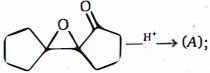
The product $(A)$ is
A
B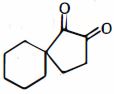
C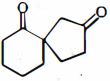
D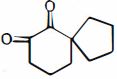
Solution
(A) The reaction involves an acid-catalyzed rearrangement of an epoxy-ketone.
$1$. Protonation of the epoxide oxygen occurs,making the epoxide ring more susceptible to ring opening.
$2$. The ring opens to form a more stable carbocation or through a concerted rearrangement where the bond shifts to form a more stable carbonyl compound.
$3$. In this specific case,the epoxy-ketone undergoes a rearrangement to form a spiro-diketone,specifically spiro[$4.5$]decane$-1,6-$dione.
$4$. The mechanism involves the migration of the alkyl group to the more substituted carbon of the epoxide,leading to the formation of the dione structure as shown in option $(A)$.
$1$. Protonation of the epoxide oxygen occurs,making the epoxide ring more susceptible to ring opening.
$2$. The ring opens to form a more stable carbocation or through a concerted rearrangement where the bond shifts to form a more stable carbonyl compound.
$3$. In this specific case,the epoxy-ketone undergoes a rearrangement to form a spiro-diketone,specifically spiro[$4.5$]decane$-1,6-$dione.
$4$. The mechanism involves the migration of the alkyl group to the more substituted carbon of the epoxide,leading to the formation of the dione structure as shown in option $(A)$.
0 likes
View Solution185
MediumMCQ
The conversion of cyclohexene to $HO-(CH_2)_6-OH$ can be achieved by:
A
$O_3, Zn,$ then $LiAlH_4$
B
$O_3/H_2O_2,$ then $LiAlH_4$
C
Cold dil. $KMnO_4, HIO_4$ then $LiAlH_4$
D
All of these
Solution
(D) The target molecule is hexane$-1,6-$diol. Let's analyze the options:
$1$. $O_3, Zn/H_2O$ (reductive ozonolysis) converts cyclohexene to hexane$-1,6-$dial. Subsequent reduction with $LiAlH_4$ gives hexane$-1,6-$diol.
$2$. $O_3/H_2O_2$ (oxidative ozonolysis) converts cyclohexene to adipic acid (hexane$-1,6-$dioic acid). Subsequent reduction with $LiAlH_4$ gives hexane$-1,6-$diol.
$3$. Cold dil. $KMnO_4$ (Baeyer's reagent) converts cyclohexene to cyclohexane$-1,2-$diol. Treatment with $HIO_4$ (periodic acid) cleaves the diol to hexane$-1,6-$dial. Subsequent reduction with $LiAlH_4$ gives hexane$-1,6-$diol.
Since all three pathways lead to the desired product,the correct answer is $D$.
$1$. $O_3, Zn/H_2O$ (reductive ozonolysis) converts cyclohexene to hexane$-1,6-$dial. Subsequent reduction with $LiAlH_4$ gives hexane$-1,6-$diol.
$2$. $O_3/H_2O_2$ (oxidative ozonolysis) converts cyclohexene to adipic acid (hexane$-1,6-$dioic acid). Subsequent reduction with $LiAlH_4$ gives hexane$-1,6-$diol.
$3$. Cold dil. $KMnO_4$ (Baeyer's reagent) converts cyclohexene to cyclohexane$-1,2-$diol. Treatment with $HIO_4$ (periodic acid) cleaves the diol to hexane$-1,6-$dial. Subsequent reduction with $LiAlH_4$ gives hexane$-1,6-$diol.
Since all three pathways lead to the desired product,the correct answer is $D$.
0 likes
View Solution186
MediumMCQ
Relationship between products $(Q)$ and $(S)$ is
$CH_3-CH=CH_2$ $\xrightarrow[H_2O_2, OH^{-}]{BH_3, THF}$ $(P)$ $\xrightarrow[CH_2Cl_2]{PCC}$ $(Q)$
$CH_3-CH=CH_2$ $\xrightarrow[NaBH_4, HO^{-}]{Hg(OAc)_2, H_2O}$ $(R)$ $\xrightarrow[CH_2Cl_2]{PCC}$ $(S)$
$CH_3-CH=CH_2$ $\xrightarrow[H_2O_2, OH^{-}]{BH_3, THF}$ $(P)$ $\xrightarrow[CH_2Cl_2]{PCC}$ $(Q)$
$CH_3-CH=CH_2$ $\xrightarrow[NaBH_4, HO^{-}]{Hg(OAc)_2, H_2O}$ $(R)$ $\xrightarrow[CH_2Cl_2]{PCC}$ $(S)$
A
Positional isomer
B
Chain isomer
C
Stereoisomer
D
Functional isomer
Solution
(D) $1$. The first reaction sequence is hydroboration-oxidation of propene,which follows anti-Markovnikov addition to give propan$-1-$ol $(P)$. Oxidation of $(P)$ with $PCC$ gives propanal $(Q)$,which is an aldehyde.
$2$. The second reaction sequence is oxymercuration-demercuration of propene,which follows Markovnikov addition to give propan$-2-$ol $(R)$. Oxidation of $(R)$ with $PCC$ gives propan$-2-$one $(S)$,which is a ketone.
$3$. Both $(Q)$ (propanal) and $(S)$ (propan$-2-$one) have the same molecular formula $C_3H_6O$ but different functional groups (aldehyde vs ketone). Therefore,they are functional isomers.
$2$. The second reaction sequence is oxymercuration-demercuration of propene,which follows Markovnikov addition to give propan$-2-$ol $(R)$. Oxidation of $(R)$ with $PCC$ gives propan$-2-$one $(S)$,which is a ketone.
$3$. Both $(Q)$ (propanal) and $(S)$ (propan$-2-$one) have the same molecular formula $C_3H_6O$ but different functional groups (aldehyde vs ketone). Therefore,they are functional isomers.
0 likes
View Solution187
MediumMCQ
$Ph-CH_2-C\equiv N$ $\xrightarrow[THF]{LDA}$ $\xrightarrow{CH_3I} 71\%;$ The end product of this reaction will be:
A
$Ph-CH_2-CH_2-NH_2$
B
$Ph-CH_2-NH_2$
C
$Ph-CH(CH_3)-C\equiv N$
D
$Ph-CH=C=N-CH_3$
Solution
(C) The reaction involves the use of $LDA$ (Lithium Di-isopropylamide),which is a strong,sterically hindered base.
$LDA$ abstracts the acidic $\alpha$-hydrogen from the phenylacetonitrile $(Ph-CH_2-C\equiv N)$ to form a resonance-stabilized carbanion: $Ph-CH^--C\equiv N \leftrightarrow Ph-CH=C=N^-$.
This carbanion then acts as a nucleophile and attacks the methyl iodide $(CH_3I)$ in an $S_N2$ reaction.
The resulting product is $Ph-CH(CH_3)-C\equiv N$.
$LDA$ abstracts the acidic $\alpha$-hydrogen from the phenylacetonitrile $(Ph-CH_2-C\equiv N)$ to form a resonance-stabilized carbanion: $Ph-CH^--C\equiv N \leftrightarrow Ph-CH=C=N^-$.
This carbanion then acts as a nucleophile and attacks the methyl iodide $(CH_3I)$ in an $S_N2$ reaction.
The resulting product is $Ph-CH(CH_3)-C\equiv N$.
0 likes
View Solution188
DifficultMCQ
In the reaction,
$C_5H_6 + CH_3COCH_3 \xrightarrow{EtONa/EtOH, \text{heat}} X$,
the product $(X)$ is
$C_5H_6 + CH_3COCH_3 \xrightarrow{EtONa/EtOH, \text{heat}} X$,
the product $(X)$ is
A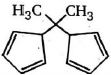
B
C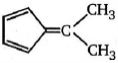
D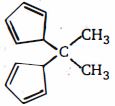
Solution
(C) The reaction involves the formation of a cyclopentadienyl anion from cyclopentadiene using a base $(EtONa)$.
This anion is aromatic and stable.
The cyclopentadienyl anion acts as a nucleophile and attacks the carbonyl carbon of acetone $(CH_3COCH_3)$.
This is a nucleophilic addition reaction,which leads to the formation of $2$-cyclopentadienylpropan-$2$-ol.
This anion is aromatic and stable.
The cyclopentadienyl anion acts as a nucleophile and attacks the carbonyl carbon of acetone $(CH_3COCH_3)$.
This is a nucleophilic addition reaction,which leads to the formation of $2$-cyclopentadienylpropan-$2$-ol.
0 likes
View Solution189
DifficultMCQ
Structure of $A$ is
A
B
C
D
Solution
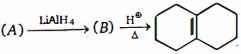
(C) The reaction sequence is as follows:
$1$. The starting material $(A)$ is a ketone,specifically spiro[$5.4$]decan$-1-$one.
$2$. Treatment with $LiAlH_4$ reduces the ketone group to a secondary alcohol,forming spiro[$5.4$]decan$-1-$ol $(B)$.
$3$. Subsequent treatment with $H^{\oplus}$ and heat causes acid-catalyzed dehydration of the alcohol to form the alkene,which is octahydronaphthalene (or a related bicyclic alkene structure depending on the rearrangement).
$4$. Based on the provided options and the final product structure,$(A)$ is spiro[$5.4$]decan$-1-$one.
$1$. The starting material $(A)$ is a ketone,specifically spiro[$5.4$]decan$-1-$one.
$2$. Treatment with $LiAlH_4$ reduces the ketone group to a secondary alcohol,forming spiro[$5.4$]decan$-1-$ol $(B)$.
$3$. Subsequent treatment with $H^{\oplus}$ and heat causes acid-catalyzed dehydration of the alcohol to form the alkene,which is octahydronaphthalene (or a related bicyclic alkene structure depending on the rearrangement).
$4$. Based on the provided options and the final product structure,$(A)$ is spiro[$5.4$]decan$-1-$one.
0 likes
View Solution190
MediumMCQ
Identify the product $(C)$ in the following reaction sequence:
$CH_3-CH(Cl)-CH(Cl)-COO^-$ $\xrightarrow{-CO_2} A$ $\xrightarrow{HCl} B$ $\xrightarrow{aq. KOH} C$
$CH_3-CH(Cl)-CH(Cl)-COO^-$ $\xrightarrow{-CO_2} A$ $\xrightarrow{HCl} B$ $\xrightarrow{aq. KOH} C$
A
$CH_3-CH=CH-Cl$
B
$CH_3-CH_2-CH(Cl)_2$
C
$CH_3-CH_2-CHO$
D
$CH_3-CO-CH_3$
Solution
(C) $1$. The starting material is a $\beta$-halo carboxylate. Upon decarboxylation $(-CO_2)$,it forms an alkene: $CH_3-CH(Cl)-CH(Cl)-COO^- \rightarrow CH_3-CH=CH-Cl$ (Product $A$).
$2$. Addition of $HCl$ to $A$ follows Markovnikov's rule: $CH_3-CH=CH-Cl + HCl \rightarrow CH_3-CH_2-CH(Cl)_2$ (Product $B$,a gem-dichloride).
$3$. Hydrolysis of the gem-dichloride with aqueous $KOH$ replaces the chlorine atoms with hydroxyl groups,which are unstable on the same carbon and eliminate water to form an aldehyde: $CH_3-CH_2-CH(Cl)_2 + 2KOH(aq)$ $\rightarrow CH_3-CH_2-CH(OH)_2$ $\rightarrow CH_3-CH_2-CHO + H_2O$ (Product $C$).
$2$. Addition of $HCl$ to $A$ follows Markovnikov's rule: $CH_3-CH=CH-Cl + HCl \rightarrow CH_3-CH_2-CH(Cl)_2$ (Product $B$,a gem-dichloride).
$3$. Hydrolysis of the gem-dichloride with aqueous $KOH$ replaces the chlorine atoms with hydroxyl groups,which are unstable on the same carbon and eliminate water to form an aldehyde: $CH_3-CH_2-CH(Cl)_2 + 2KOH(aq)$ $\rightarrow CH_3-CH_2-CH(OH)_2$ $\rightarrow CH_3-CH_2-CHO + H_2O$ (Product $C$).
0 likes
View Solution191
DifficultMCQ
Identify $(A)$.
A
B
C
D
Solution
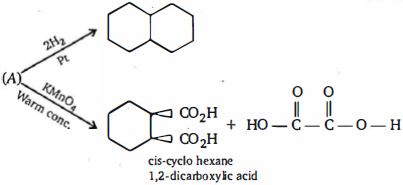
(A) The reaction of $(A)$ with $2H_2/Pt$ gives decalin (a saturated bicyclic compound),indicating $(A)$ is a bicyclic diene.
The reaction of $(A)$ with warm concentrated $KMnO_4$ (oxidative cleavage) yields $cis$-cyclohexane$-1,2-$dicarboxylic acid and oxalic acid $(HOOC-COOH)$.
This cleavage pattern is characteristic of $\Delta^{9,10}$-octalin (also known as $1,2,3,4,5,6,7,8$-octahydronaphthalene),which has a double bond at the bridgehead position. However,the specific cleavage products provided in the image correspond to the oxidative cleavage of $\Delta^{1,9}$-octalin or similar structures. Given the options,the structure in option $(A)$ represents a bicyclic system with a double bond at the bridgehead,which is the correct precursor for the observed products.
The reaction of $(A)$ with warm concentrated $KMnO_4$ (oxidative cleavage) yields $cis$-cyclohexane$-1,2-$dicarboxylic acid and oxalic acid $(HOOC-COOH)$.
This cleavage pattern is characteristic of $\Delta^{9,10}$-octalin (also known as $1,2,3,4,5,6,7,8$-octahydronaphthalene),which has a double bond at the bridgehead position. However,the specific cleavage products provided in the image correspond to the oxidative cleavage of $\Delta^{1,9}$-octalin or similar structures. Given the options,the structure in option $(A)$ represents a bicyclic system with a double bond at the bridgehead,which is the correct precursor for the observed products.
0 likes
View Solution192
DifficultMCQ
Total number of enol forms possible for the compound formed during the given reaction will be (including stereoisomers):
$CH_3MgBr + CH_3CH_2COCl \to$
$CH_3MgBr + CH_3CH_2COCl \to$
A
$2$
B
$3$
C
$4$
D
$5$
Solution
(B) The reaction between $CH_3MgBr$ and $CH_3CH_2COCl$ produces $CH_3COCH_2CH_3$ $(2-Butanone)$.
$2-Butanone$ $(CH_3-CO-CH_2-CH_3)$ can form enols by removing an $\alpha$-hydrogen from either side of the carbonyl group.
$1.$ Removal of $\alpha$-hydrogen from the $CH_3$ group gives $CH_2=C(OH)-CH_2CH_3$ ($1$ form).
$2.$ Removal of $\alpha$-hydrogen from the $CH_2$ group gives $CH_3-C(OH)=CH-CH_3$. This form exhibits geometrical isomerism,resulting in $cis$ and $trans$ isomers ($2$ forms).
Total number of enol forms = $1 + 2 = 3$.
$2-Butanone$ $(CH_3-CO-CH_2-CH_3)$ can form enols by removing an $\alpha$-hydrogen from either side of the carbonyl group.
$1.$ Removal of $\alpha$-hydrogen from the $CH_3$ group gives $CH_2=C(OH)-CH_2CH_3$ ($1$ form).
$2.$ Removal of $\alpha$-hydrogen from the $CH_2$ group gives $CH_3-C(OH)=CH-CH_3$. This form exhibits geometrical isomerism,resulting in $cis$ and $trans$ isomers ($2$ forms).
Total number of enol forms = $1 + 2 = 3$.
0 likes
View Solution193
DifficultMCQ
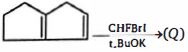
What is the product $(Q)$ of the following reaction?
A
B
C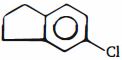
D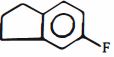
Solution
(D) The reaction involves the generation of a carbene intermediate,$:CFBr$,from $CHFBrI$ in the presence of a strong base,$t-BuOK$.
This carbene then undergoes a cyclopropanation reaction with the alkene.
Specifically,the carbene adds across the double bond of the bicyclic system.
Since $Br^-$ is a better leaving group than $F^-$,the carbene species $:CFBr$ is formed,and it adds to the double bond to form a cyclopropane ring containing a fluorine atom.
Looking at the options,the product $(Q)$ is the cyclopropanated derivative with a fluorine substituent.
This carbene then undergoes a cyclopropanation reaction with the alkene.
Specifically,the carbene adds across the double bond of the bicyclic system.
Since $Br^-$ is a better leaving group than $F^-$,the carbene species $:CFBr$ is formed,and it adds to the double bond to form a cyclopropane ring containing a fluorine atom.
Looking at the options,the product $(Q)$ is the cyclopropanated derivative with a fluorine substituent.
0 likes
View Solution194
AdvancedMCQ
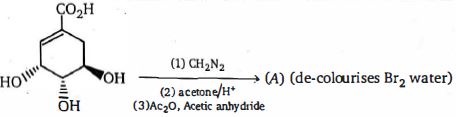
Product $A$ of the above reaction is
A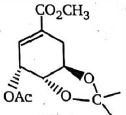
B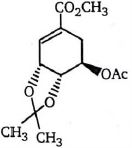
C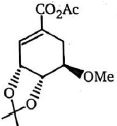
D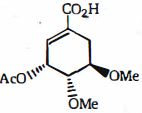
Solution
(B) The reaction sequence is as follows:
$1$. The starting material is shikimic acid. Treatment with $CH_2N_2$ (diazomethane) esterifies the carboxylic acid group to a methyl ester $(CO_2CH_3)$.
$2$. Treatment with acetone in the presence of $H^+$ (acid catalyst) forms an acetonide (cyclic ketal) with the two cis-hydroxyl groups.
$3$. Treatment with $Ac_2O$ (acetic anhydride) acetylates the remaining hydroxyl group to form an acetate ester $(OAc)$.
$4$. The final product retains the double bond,which is why it decolourises $Br_2$ water.
Comparing this with the given options,the structure corresponds to the methyl ester of the protected shikimic acid derivative with an acetylated hydroxyl group.
$1$. The starting material is shikimic acid. Treatment with $CH_2N_2$ (diazomethane) esterifies the carboxylic acid group to a methyl ester $(CO_2CH_3)$.
$2$. Treatment with acetone in the presence of $H^+$ (acid catalyst) forms an acetonide (cyclic ketal) with the two cis-hydroxyl groups.
$3$. Treatment with $Ac_2O$ (acetic anhydride) acetylates the remaining hydroxyl group to form an acetate ester $(OAc)$.
$4$. The final product retains the double bond,which is why it decolourises $Br_2$ water.
Comparing this with the given options,the structure corresponds to the methyl ester of the protected shikimic acid derivative with an acetylated hydroxyl group.
0 likes
View Solution195
AdvancedMCQ
The product $(B)$ is:

A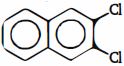
B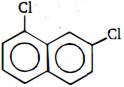
C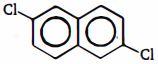
D
Solution
(C) The reaction of the given bicyclic diene with $CHCl_3$ and $KOH$ generates dichlorocarbene $(:CCl_2)$,which undergoes a $[2+1]$ cycloaddition followed by ring expansion to form an aromatic system.
This process is known as the $Doering-LaFlamme$ type ring expansion.
In the first step,the addition of $:CCl_2$ to one of the double bonds followed by rearrangement leads to the formation of a chloronaphthalene derivative $(A)$.
In the second step,the addition of another equivalent of $:CCl_2$ to the remaining double bond followed by rearrangement leads to the formation of a dichloronaphthalene derivative $(B)$.
The final product $(B)$ is $2,6$-dichloronaphthalene.
This process is known as the $Doering-LaFlamme$ type ring expansion.
In the first step,the addition of $:CCl_2$ to one of the double bonds followed by rearrangement leads to the formation of a chloronaphthalene derivative $(A)$.
In the second step,the addition of another equivalent of $:CCl_2$ to the remaining double bond followed by rearrangement leads to the formation of a dichloronaphthalene derivative $(B)$.
The final product $(B)$ is $2,6$-dichloronaphthalene.
0 likes
View Solution196
AdvancedMCQ
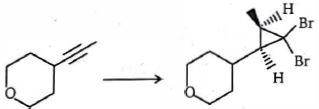
Identify the reagents used for the following conversion in the correct order.
A
$Na/liq. NH_3, CHBr_3/NaOH$
B
$H_2/Pd-CaCO_3, CHBr_3/NaOH$
C
$Na/liq. NH_3, CHCl_3/NaOH$
D
$H_2/Pd-CaCO_3, CHCl_3/NaOH$
Solution
(B) The given conversion involves two steps:
$1$. The reduction of an alkyne to a cis-alkene. This is achieved using Lindlar's catalyst $(H_2/Pd-CaCO_3)$.
$2$. The cyclopropanation of the alkene to form a dibromocyclopropane derivative. This is achieved by the addition of dibromocarbene $(:CBr_2)$,which is generated in situ from bromoform $(CHBr_3)$ and a strong base $(NaOH)$.
Therefore,the correct sequence of reagents is $H_2/Pd-CaCO_3$ followed by $CHBr_3/NaOH$.
$1$. The reduction of an alkyne to a cis-alkene. This is achieved using Lindlar's catalyst $(H_2/Pd-CaCO_3)$.
$2$. The cyclopropanation of the alkene to form a dibromocyclopropane derivative. This is achieved by the addition of dibromocarbene $(:CBr_2)$,which is generated in situ from bromoform $(CHBr_3)$ and a strong base $(NaOH)$.
Therefore,the correct sequence of reagents is $H_2/Pd-CaCO_3$ followed by $CHBr_3/NaOH$.
0 likes
View Solution197
MediumMCQ
The number of sigma and pi-bonds in but$-1-$ene$-3-$yne are
A
$5$ sigma and $5$ pi
B
$7$ sigma and $3$ pi
C
$8$ sigma and $2$ pi
D
$6$ sigma and $4$ pi
Solution
(B) The structure of but$-1-$ene$-3-$yne is $HC \equiv C-CH=CH_2$.
To find the number of sigma $(\sigma)$ and pi $(\pi)$ bonds:
$1$. The molecule has $3$ carbon-carbon bonds: one triple bond $(C \equiv C)$ and one double bond $(C=C)$ and one single bond $(C-C)$.
$2$. The triple bond $(C \equiv C)$ consists of $1$ $\sigma$ and $2$ $\pi$ bonds.
$3$. The double bond $(C=C)$ consists of $1$ $\sigma$ and $1$ $\pi$ bond.
$4$. The single bond $(C-C)$ consists of $1$ $\sigma$ bond.
$5$. There are $4$ $C-H$ single bonds,each being a $\sigma$ bond.
Total $\sigma$ bonds = $1$ (from $C \equiv C$) + $1$ (from $C=C$) + $1$ (from $C-C$) + $4$ (from $C-H$) = $7$ $\sigma$ bonds.
Total $\pi$ bonds = $2$ (from $C \equiv C$) + $1$ (from $C=C$) = $3$ $\pi$ bonds.
Therefore,the molecule has $7$ $\sigma$ and $3$ $\pi$ bonds.
To find the number of sigma $(\sigma)$ and pi $(\pi)$ bonds:
$1$. The molecule has $3$ carbon-carbon bonds: one triple bond $(C \equiv C)$ and one double bond $(C=C)$ and one single bond $(C-C)$.
$2$. The triple bond $(C \equiv C)$ consists of $1$ $\sigma$ and $2$ $\pi$ bonds.
$3$. The double bond $(C=C)$ consists of $1$ $\sigma$ and $1$ $\pi$ bond.
$4$. The single bond $(C-C)$ consists of $1$ $\sigma$ bond.
$5$. There are $4$ $C-H$ single bonds,each being a $\sigma$ bond.
Total $\sigma$ bonds = $1$ (from $C \equiv C$) + $1$ (from $C=C$) + $1$ (from $C-C$) + $4$ (from $C-H$) = $7$ $\sigma$ bonds.
Total $\pi$ bonds = $2$ (from $C \equiv C$) + $1$ (from $C=C$) = $3$ $\pi$ bonds.
Therefore,the molecule has $7$ $\sigma$ and $3$ $\pi$ bonds.
0 likes
View Solution198
DifficultMCQ
How many cyclic structures are possible for $C_4H_6$?
A
$3$
B
$5$
C
$6$
D
$4$
Solution
(B) The molecular formula $C_4H_6$ corresponds to a degree of unsaturation (double bond equivalent) of $2$.
For cyclic structures,this means the molecule must contain either two double bonds,one triple bond,or two rings,or one ring and one double bond.
The possible cyclic structures for $C_4H_6$ are:
$1$. Cyclobutene
$2$. $1$-methylcyclopropene
$3$. $3$-methylcyclopropene (often referred to as $2$-methylcyclopropene in some contexts)
$4$. Methylenecyclopropane
$5$. Bicyclo$[1.1.0]$butane
Thus,there are $5$ possible cyclic structures.
For cyclic structures,this means the molecule must contain either two double bonds,one triple bond,or two rings,or one ring and one double bond.
The possible cyclic structures for $C_4H_6$ are:
$1$. Cyclobutene
$2$. $1$-methylcyclopropene
$3$. $3$-methylcyclopropene (often referred to as $2$-methylcyclopropene in some contexts)
$4$. Methylenecyclopropane
$5$. Bicyclo$[1.1.0]$butane
Thus,there are $5$ possible cyclic structures.
0 likes
View Solution199
DifficultMCQ
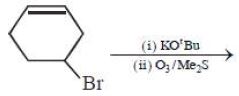
The major product$(s)$ obtained in the following reaction is/are:
A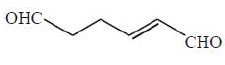
B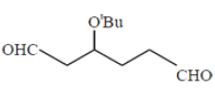
C
D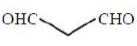
Solution
(C) Step $1$: The reaction of $3$-bromocyclohexene with $KO^tBu$ (a strong,bulky base) undergoes an $E2$ elimination reaction to form $1,3$-cyclohexadiene.
Step $2$: The subsequent reaction with $O_3/Me_2S$ is a reductive ozonolysis of $1,3$-cyclohexadiene.
Step $3$: Reductive ozonolysis of $1,3$-cyclohexadiene cleaves both double bonds to yield two molecules of glyoxal $(OHC-CHO)$ and one molecule of succinaldehyde $(OHC-CH_2-CH_2-CHO)$.
However,based on the provided options,the product is a mixture of $OHC-CH_2-CH_2-CHO$ and $OHC-CHO$.
Step $2$: The subsequent reaction with $O_3/Me_2S$ is a reductive ozonolysis of $1,3$-cyclohexadiene.
Step $3$: Reductive ozonolysis of $1,3$-cyclohexadiene cleaves both double bonds to yield two molecules of glyoxal $(OHC-CHO)$ and one molecule of succinaldehyde $(OHC-CH_2-CH_2-CHO)$.
However,based on the provided options,the product is a mixture of $OHC-CH_2-CH_2-CHO$ and $OHC-CHO$.
0 likes
View Solution200
AdvancedMCQ
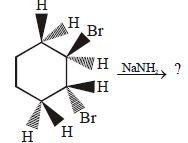
What is the major product of the following reaction?
(Image of trans$-1,2-$dibromocyclohexane reacting with $NaNH_2$)
(Image of trans$-1,2-$dibromocyclohexane reacting with $NaNH_2$)
A
$3-$bromocyclohexene
B
$1,3-$cyclohexadiene
C
$1,4-$cyclohexadiene
D
cyclohexene
Solution
(B) The reaction involves the dehydrohalogenation of $trans-1,2-dibromocyclohexane$ using a strong base,$NaNH_2$ (sodium amide).
$1$. The first equivalent of $NaNH_2$ removes $HBr$ to form $3-bromocyclohexene$.
$2$. The second equivalent of $NaNH_2$ removes another molecule of $HBr$ from the $3-bromocyclohexene$ to form a conjugated diene,$1,3-cyclohexadiene$.
$3$. $1,3-cyclohexadiene$ is the thermodynamically stable product compared to $1,4-cyclohexadiene$ due to conjugation.
Therefore,the major product is $1,3-cyclohexadiene$.
$1$. The first equivalent of $NaNH_2$ removes $HBr$ to form $3-bromocyclohexene$.
$2$. The second equivalent of $NaNH_2$ removes another molecule of $HBr$ from the $3-bromocyclohexene$ to form a conjugated diene,$1,3-cyclohexadiene$.
$3$. $1,3-cyclohexadiene$ is the thermodynamically stable product compared to $1,4-cyclohexadiene$ due to conjugation.
Therefore,the major product is $1,3-cyclohexadiene$.
0 likes
View SolutionHydrocarbons — Mix Examples-Hydrocarbon · Frequently Asked Questions
1Are these Hydrocarbons questions useful for JEE and NEET?
Yes. All questions in this section are mapped to JEE Main and NEET exam patterns. Previous year questions from JEE Main, NEET, GUJCET and state-level exams are included with full solutions.
2Can I switch to Hindi or Gujarati for these questions?
Yes. Use the language tabs in the hero section or the sidebar to view the same questions and solutions in English, Hindi or Gujarati.
3How do I generate a question paper from this subtopic?
Use the Vedclass Exam Paper Generator — select the chapter and subtopic, set difficulty, and generate Sets A, B, C, D automatically. First 3 chapters of every subject are free.
Vedclass Products
For Students
Vedclass Test Series
Mock tests in real JEE/NEET style with performance analysis. 5-day free trial.
Start Free TrialFor Teachers
Exam Paper Generator
Generate Set A/B/C/D papers from this chapter in 2 minutes. 3 chapters free.
Try FreeFor Institutes
Online Exam Module
Live online exams with unlimited students, 360° analytics & white-label branding.
See DemoFor Teachers & Institutes
Generate a Hydrocarbons Exam Paper in 2 Minutes
Select subtopic & difficulty — Sets A, B, C, D auto-generated with No Repeat logic.
First 3 chapters of every subject are free — no payment required.