
A English
Aromatic hydrocarbon Questions in English
Class 11 Chemistry · Hydrocarbons · Aromatic hydrocarbon
872+
Questions
English
Language
100%
With Solutions
Showing 50 of 872 questions in English
151
DifficultMCQ
What is produced when benzene is alkylated with $n$-propyl chloride in the presence of anhydrous $AlCl_3$?
A
$n$-propylbenzene
B
Isopropylbenzene
C
$o$-dipropylbenzene
D
$A$ mixture of all of these
Solution
(B) The reaction proceeds via the formation of a carbocation intermediate. $n$-propyl chloride reacts with $AlCl_3$ to form a primary carbocation,which undergoes a $1,2$-hydride shift to form a more stable secondary isopropyl carbocation.
$CH_3-CH_2-CH_2-Cl + AlCl_3 \rightarrow CH_3-CH_2-CH_2^+ + AlCl_4^-$
$CH_3-CH_2-CH_2^+ \xrightarrow{\text{1,2-hydride shift}} CH_3-CH^+-CH_3$
This secondary carbocation then attacks the benzene ring to form isopropylbenzene (cumene) as the major product.
$CH_3-CH_2-CH_2-Cl + AlCl_3 \rightarrow CH_3-CH_2-CH_2^+ + AlCl_4^-$
$CH_3-CH_2-CH_2^+ \xrightarrow{\text{1,2-hydride shift}} CH_3-CH^+-CH_3$
This secondary carbocation then attacks the benzene ring to form isopropylbenzene (cumene) as the major product.
0 likes
View Solution152
MediumMCQ
Which product is obtained by the oxidation of ethylbenzene with $KMnO_4$?
A
Benzophenone
B
Acetophenone
C
Benzoic acid
D
Benzyl alcohol
Solution
(C) The oxidation of an alkyl group attached to a benzene ring,which possesses at least one benzylic hydrogen,using $KMnO_4/H^+$ results in the formation of benzoic acid.
In the case of ethylbenzene $(C_6H_5CH_2CH_3)$,the side chain is oxidized to a carboxylic acid group,yielding benzoic acid $(C_6H_5COOH)$.
In the case of ethylbenzene $(C_6H_5CH_2CH_3)$,the side chain is oxidized to a carboxylic acid group,yielding benzoic acid $(C_6H_5COOH)$.
0 likes
View Solution153
MediumMCQ
Which of the following is a Friedel-Crafts reaction $(FCR)$?
A
Toluene + $Cl_2$ $\xrightarrow{\text{Boiling}}$ Benzyl chloride
B
Benzene + $CH_3Cl$ $\xrightarrow{\text{Anhydrous } AlCl_3}$ Toluene
C
Benzyl chloride + $AgNO_2$ $\to$ Benzyl nitro compound
D
$CH_3CHO + HCN \to CH_3CH(OH)CN$
Solution
(B) The Friedel-Crafts reaction $(FCR)$ is a type of electrophilic aromatic substitution reaction where an alkyl or acyl group is introduced into an aromatic ring in the presence of a Lewis acid catalyst like anhydrous $AlCl_3$.
Option $(B)$ represents the Friedel-Crafts alkylation of benzene with methyl chloride $(CH_3Cl)$ in the presence of anhydrous $AlCl_3$ to form toluene,which is a classic example of a Friedel-Crafts reaction.
Option $(B)$ represents the Friedel-Crafts alkylation of benzene with methyl chloride $(CH_3Cl)$ in the presence of anhydrous $AlCl_3$ to form toluene,which is a classic example of a Friedel-Crafts reaction.
0 likes
View Solution154
MediumMCQ
The presence of a nitro group in a benzene ring......
A
activates the ring towards electrophilic substitution.
B
makes the ring basic.
C
deactivates the ring towards nucleophilic substitution.
D
deactivates the ring towards electrophilic substitution.
Solution
(D) The nitro group $(-NO_2)$ is a strong electron-withdrawing group due to its $-I$ and $-M$ effects.
It withdraws electron density from the benzene ring,thereby reducing the electron density available for electrophilic attack.
Consequently,it deactivates the benzene ring towards electrophilic substitution reactions.
It withdraws electron density from the benzene ring,thereby reducing the electron density available for electrophilic attack.
Consequently,it deactivates the benzene ring towards electrophilic substitution reactions.
0 likes
View Solution155
EasyMCQ
Which of the following is not aromatic?
A
Benzene
B
Naphthalene
C
Pyridine
D
$1,3,5$-Heptatriene
Solution
(D) Aromatic compounds must follow $H$ückel's rule,which states they must be cyclic,planar,fully conjugated,and contain $(4n + 2) \pi$ electrons.
$1,3,5$-Heptatriene is an open-chain polyene. Since it is not cyclic,it cannot be aromatic.
$1,3,5$-Heptatriene is an open-chain polyene. Since it is not cyclic,it cannot be aromatic.
0 likes
View Solution156
MediumMCQ
Which of the following compounds does not undergo the Friedel-Crafts reaction?
A
Benzene
B
Toluene
C
Nitrobenzene
D
Naphthalene
Solution
(C) The Friedel-Crafts reaction is an electrophilic aromatic substitution reaction.
Strongly deactivating groups,such as the nitro group $(-NO_2)$,withdraw electron density from the benzene ring,making it insufficiently nucleophilic to attack the electrophile.
Therefore,nitrobenzene does not undergo the Friedel-Crafts reaction.
Strongly deactivating groups,such as the nitro group $(-NO_2)$,withdraw electron density from the benzene ring,making it insufficiently nucleophilic to attack the electrophile.
Therefore,nitrobenzene does not undergo the Friedel-Crafts reaction.
0 likes
View Solution157
EasyMCQ
Coal tar is the main source of $....$.
A
Aromatic compounds
B
Aliphatic compounds
C
Cycloalkanes
D
Heterocyclic compounds
Solution
(A) Coal tar is a thick,dark liquid obtained as a byproduct during the destructive distillation of coal. It is a complex mixture of various organic compounds,primarily serving as the main industrial source of aromatic compounds such as benzene,toluene,naphthalene,and anthracene.
0 likes
View Solution158
EasyMCQ
Which of the following is not used in the Friedel-Crafts reaction?
A
$FeCl_3$
B
$FeBr_3$
C
$FeBr_2$
D
$NaCl$
Solution
(D) The Friedel-Crafts reaction requires a Lewis acid catalyst to generate the electrophile.
$FeCl_3$ and $FeBr_3$ are common Lewis acid catalysts used in electrophilic substitution reactions.
$FeBr_2$ is not a strong Lewis acid and is not typically used as a catalyst for Friedel-Crafts reactions.
$NaCl$ is an ionic salt and does not act as a Lewis acid catalyst.
However,among the given options,$NaCl$ is the most distinct non-catalyst,but in the context of Friedel-Crafts specifically,$FeBr_2$ is also not a standard catalyst. Given the standard curriculum,$NaCl$ is the correct answer as it is a simple salt.
$FeCl_3$ and $FeBr_3$ are common Lewis acid catalysts used in electrophilic substitution reactions.
$FeBr_2$ is not a strong Lewis acid and is not typically used as a catalyst for Friedel-Crafts reactions.
$NaCl$ is an ionic salt and does not act as a Lewis acid catalyst.
However,among the given options,$NaCl$ is the most distinct non-catalyst,but in the context of Friedel-Crafts specifically,$FeBr_2$ is also not a standard catalyst. Given the standard curriculum,$NaCl$ is the correct answer as it is a simple salt.
0 likes
View Solution159
MediumMCQ
What is the final product of the nitration of toluene?
A
$o$-Nitrotoluene
B
$m$-Nitrotoluene
C
$2,4$-Dinitrotoluene
D
$2,4,6$-Trinitrotoluene
Solution
(D) The nitration of toluene is an electrophilic aromatic substitution reaction.
Since the methyl group $(-CH_3)$ is an ortho/para-directing group,the nitration proceeds in steps.
With excess concentrated $HNO_3$ and concentrated $H_2SO_4$,the reaction continues until all available ortho and para positions are substituted.
The final product formed is $2,4,6$-trinitrotoluene,commonly known as $TNT$.
Since the methyl group $(-CH_3)$ is an ortho/para-directing group,the nitration proceeds in steps.
With excess concentrated $HNO_3$ and concentrated $H_2SO_4$,the reaction continues until all available ortho and para positions are substituted.
The final product formed is $2,4,6$-trinitrotoluene,commonly known as $TNT$.
0 likes
View Solution160
MediumMCQ
Which of the following compounds is used for the laboratory preparation of benzene?
A
$C_6H_5N_2Cl$
B
$C_6H_5OH$
C
$C_6H_5COONa$
D
$C_6H_5SO_3H$
Solution
(C) In the laboratory,benzene is prepared by heating sodium benzoate $(C_6H_5COONa)$ with soda lime $(NaOH + CaO)$.
This reaction is known as decarboxylation.
The chemical equation is: $C_6H_5COONa + NaOH \xrightarrow{CaO, \Delta} C_6H_6 + Na_2CO_3$.
This reaction is known as decarboxylation.
The chemical equation is: $C_6H_5COONa + NaOH \xrightarrow{CaO, \Delta} C_6H_6 + Na_2CO_3$.
0 likes
View Solution161
EasyMCQ
The reaction $C_6H_6 \rightarrow C_6H_5CH_3$ is known as:
A
Friedel-Crafts reaction
B
Wurtz reaction
C
Perkin reaction
D
Grignard reaction
Solution
(A) The reaction $C_6H_6 + CH_3Cl \xrightarrow{AlCl_3} C_6H_5CH_3 + HCl$ is an example of Friedel-Crafts alkylation.
In this reaction,benzene reacts with an alkyl halide in the presence of a Lewis acid catalyst like $AlCl_3$ to introduce an alkyl group onto the benzene ring.
In this reaction,benzene reacts with an alkyl halide in the presence of a Lewis acid catalyst like $AlCl_3$ to introduce an alkyl group onto the benzene ring.
0 likes
View Solution162
EasyMCQ
Nitration of toluene occurs at the ....... position.
A
Ortho
B
Meta
C
Para
D
Both ortho and para
0 likes
View Solution163
MediumMCQ
Which of the following is true for arenes?
A
Electrophilic addition
B
Delocalization of $\pi$-electrons
C
High stability
D
Resonance
Solution
(B) Arenes are aromatic hydrocarbons characterized by the presence of a cyclic,planar structure with $(4n+2) \pi$-electrons,which leads to the delocalization of $\pi$-electrons. This delocalization provides extra stability to the molecule,known as resonance energy. While resonance and high stability are properties of arenes,the defining characteristic that allows for their unique reactivity (electrophilic substitution rather than addition) is the delocalization of $\pi$-electrons. Therefore,all options are technically properties,but delocalization is the fundamental electronic feature.
0 likes
View Solution164
MediumMCQ
Nitration of nitrobenzene yields .....
A
$o-$dinitrobenzene
B
$m-$dinitrobenzene
C
$p-$dinitrobenzene
D
None of the above
Solution
(B) The nitro group $(-NO_2)$ is a strongly deactivating and meta-directing group.
When nitrobenzene undergoes nitration using a mixture of concentrated $HNO_3$ and concentrated $H_2SO_4$,the incoming nitro group is directed to the meta position.
Therefore,the product formed is $m-$dinitrobenzene.
When nitrobenzene undergoes nitration using a mixture of concentrated $HNO_3$ and concentrated $H_2SO_4$,the incoming nitro group is directed to the meta position.
Therefore,the product formed is $m-$dinitrobenzene.
0 likes
View Solution165
MediumMCQ
In the Friedel-Crafts reaction,anhydrous $AlCl_3$ is used because...
A
It is an electron donor.
B
It is electron-deficient.
C
It is soluble in ether.
D
It is insoluble in aluminum ion and chloride ion.
Solution
(B) In the Friedel-Crafts reaction,anhydrous $AlCl_3$ acts as a Lewis acid.
$AlCl_3$ is electron-deficient because the aluminum atom has only $6$ electrons in its valence shell.
It accepts a lone pair of electrons from the alkyl or acyl halide to form a carbocation,which acts as an electrophile in the substitution reaction.
$AlCl_3$ is electron-deficient because the aluminum atom has only $6$ electrons in its valence shell.
It accepts a lone pair of electrons from the alkyl or acyl halide to form a carbocation,which acts as an electrophile in the substitution reaction.
0 likes
View Solution166
MediumMCQ
The Friedel-Crafts alkylation of benzene with propene proceeds through the formation of which of the following intermediates?
A
$CH_3CH_2CH_2^+$
B
$CH_3CH^+CH_3$
C
$CH_3CH_2CH_2^\bullet$
D
$CH_3CH^\bullet CH_3$
Solution
(B) In the Friedel-Crafts alkylation of benzene with propene,the reaction proceeds via the formation of a carbocation intermediate.
Propene reacts with the electrophile $(H^+)$ to form a carbocation.
The secondary carbocation,$CH_3CH^+CH_3$,is more stable than the primary carbocation,$CH_3CH_2CH_2^+$,due to hyperconjugation and inductive effects.
Therefore,the reaction proceeds through the formation of the isopropyl carbocation $(CH_3CH^+CH_3)$.
Propene reacts with the electrophile $(H^+)$ to form a carbocation.
The secondary carbocation,$CH_3CH^+CH_3$,is more stable than the primary carbocation,$CH_3CH_2CH_2^+$,due to hyperconjugation and inductive effects.
Therefore,the reaction proceeds through the formation of the isopropyl carbocation $(CH_3CH^+CH_3)$.
0 likes
View Solution167
EasyMCQ
Which of the following compounds is not aromatic?
A
Cyclohexane
B
Trinitrotoluene
C
Picric acid
D
Xylene
Solution
(A) Aromatic compounds must follow $H$ückel's rule ($4n + 2$ $\pi$ electrons) and must be planar,cyclic,and fully conjugated.
$Cyclohexane$ $(C_6H_{12})$ is a saturated cyclic alkane with $sp^3$ hybridized carbon atoms.
It lacks a conjugated $\pi$ system and does not satisfy $H$ückel's rule,therefore it is non-aromatic.
$Trinitrotoluene$,$Picric$ $acid$,and $Xylene$ are all derivatives of benzene and are aromatic.
$Cyclohexane$ $(C_6H_{12})$ is a saturated cyclic alkane with $sp^3$ hybridized carbon atoms.
It lacks a conjugated $\pi$ system and does not satisfy $H$ückel's rule,therefore it is non-aromatic.
$Trinitrotoluene$,$Picric$ $acid$,and $Xylene$ are all derivatives of benzene and are aromatic.
0 likes
View Solution168
MediumMCQ
The heat of hydrogenation of one double bond in cyclohexene is $28.6 \, kcal \, mol^{-1}$ and the heat of hydrogenation of benzene to cyclohexane is $50 \, kcal \, mol^{-1}$. The resonance stabilization energy of benzene is ...... $kcal \, mol^{-1}$.
A
$28.6$
B
$55$
C
$85.8$
D
$35.8$
Solution
(D) The resonance energy is defined as the difference between the calculated heat of hydrogenation (assuming three isolated double bonds) and the experimental heat of hydrogenation.
Calculated heat of hydrogenation for benzene = $3 \times 28.6 \, kcal \, mol^{-1} = 85.8 \, kcal \, mol^{-1}$.
Experimental heat of hydrogenation for benzene = $50 \, kcal \, mol^{-1}$.
Resonance energy = $85.8 - 50 = 35.8 \, kcal \, mol^{-1}$.
Calculated heat of hydrogenation for benzene = $3 \times 28.6 \, kcal \, mol^{-1} = 85.8 \, kcal \, mol^{-1}$.
Experimental heat of hydrogenation for benzene = $50 \, kcal \, mol^{-1}$.
Resonance energy = $85.8 - 50 = 35.8 \, kcal \, mol^{-1}$.
0 likes
View Solution169
EasyMCQ
The electrophile required for the chlorination of benzene in the presence of $FeCl_3$ is.....
A
$Cl^{+}$
B
$Cl^{-}$
C
$Cl$
D
$FeCl_3$
Solution
(A) In the presence of a Lewis acid like $FeCl_3$,the chlorination of benzene proceeds via an electrophilic aromatic substitution mechanism.
$FeCl_3$ acts as a catalyst and reacts with $Cl_2$ to generate the electrophile $Cl^{+}$ (chloronium ion).
The reaction is: $Cl_2 + FeCl_3 \rightarrow Cl^{+} + [FeCl_4]^{-}$.
Thus,the electrophile required is $Cl^{+}$.
$FeCl_3$ acts as a catalyst and reacts with $Cl_2$ to generate the electrophile $Cl^{+}$ (chloronium ion).
The reaction is: $Cl_2 + FeCl_3 \rightarrow Cl^{+} + [FeCl_4]^{-}$.
Thus,the electrophile required is $Cl^{+}$.
0 likes
View Solution170
MediumMCQ
Which of the following groups increases the reactivity of electrophilic aromatic substitution?
A
$-CN$
B
$-CHO$
C
$-CH_3$
D
$-NO_2$
Solution
(C) Electrophilic aromatic substitution is facilitated by electron-donating groups $(EDG)$ attached to the benzene ring.
These groups increase the electron density of the ring through the inductive effect $(+I)$ or resonance effect ($+R$ or $+M$).
Among the given options:
$1$. $-CN$,$-CHO$,and $-NO_2$ are electron-withdrawing groups $(EWG)$ that decrease the electron density of the ring.
$2$. $-CH_3$ is an electron-donating group due to the hyperconjugation effect and inductive effect $(+I)$,which increases the electron density of the benzene ring,thereby activating it towards electrophilic substitution.
These groups increase the electron density of the ring through the inductive effect $(+I)$ or resonance effect ($+R$ or $+M$).
Among the given options:
$1$. $-CN$,$-CHO$,and $-NO_2$ are electron-withdrawing groups $(EWG)$ that decrease the electron density of the ring.
$2$. $-CH_3$ is an electron-donating group due to the hyperconjugation effect and inductive effect $(+I)$,which increases the electron density of the benzene ring,thereby activating it towards electrophilic substitution.
0 likes
View Solution171
MediumMCQ
When excess $C_6H_6$ is reacted with $CH_2Cl_2$ in the presence of anhydrous $AlCl_3$,which of the following products is obtained?
A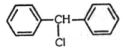
Diphenylchloromethane
B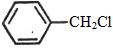
Benzyl chloride
C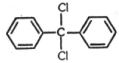
Dichlorodiphenylmethane
D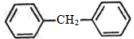
Diphenylmethane
Solution
(D) The reaction of benzene $(C_6H_6)$ with dichloromethane $(CH_2Cl_2)$ in the presence of anhydrous $AlCl_3$ is a Friedel-Crafts alkylation reaction.
Since benzene is in excess,the reaction proceeds in two steps:
$1$. $C_6H_6 + CH_2Cl_2 \xrightarrow{AlCl_3} C_6H_5-CH_2Cl + HCl$
$2$. $C_6H_5-CH_2Cl + C_6H_6 \xrightarrow{AlCl_3} C_6H_5-CH_2-C_6H_5 + HCl$
The final product obtained is diphenylmethane $(C_6H_5-CH_2-C_6H_5)$.
Since benzene is in excess,the reaction proceeds in two steps:
$1$. $C_6H_6 + CH_2Cl_2 \xrightarrow{AlCl_3} C_6H_5-CH_2Cl + HCl$
$2$. $C_6H_5-CH_2Cl + C_6H_6 \xrightarrow{AlCl_3} C_6H_5-CH_2-C_6H_5 + HCl$
The final product obtained is diphenylmethane $(C_6H_5-CH_2-C_6H_5)$.
0 likes
View Solution172
MediumMCQ
What will be the major product in the following reaction?
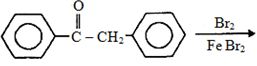
A
$1-$($4$-bromophenyl)$-2-$phenylethan$-1-$one
B
$1-$phenyl$-2-$($4$-bromophenyl)ethan$-1-$one
C
$2-$bromo$-1,2-$diphenylethan$-1-$one
D
$1-$($3$-bromophenyl)$-2-$($4$-bromophenyl)ethan$-1-$one
Solution
(B) The reaction is an electrophilic aromatic substitution reaction. The reactant is $1,2$-diphenylethan-$1$-one. The carbonyl group $(-CO-)$ is a strongly electron-withdrawing group and is meta-directing. The phenyl ring attached directly to the carbonyl group is deactivated,while the other phenyl ring (attached to the $-CH_2-$ group) is relatively more activated towards electrophilic substitution. The $-CH_2-$ group is ortho/para-directing. Therefore,the electrophile $Br^+$ will attack the para-position of the phenyl ring attached to the $-CH_2-$ group to form the major product,which is $1$-phenyl-$2$-($4$-bromophenyl)ethan-$1$-one.
0 likes
View Solution173
MediumMCQ
Which of the following statements is correct for benzene?
A
Benzene easily undergoes addition reactions due to unsaturation.
B
There are three types of $C-H$ bonds in benzene.
C
Benzene contains cyclically delocalized $C-C$ $\pi$-bonds.
D
The first substitution of benzene yields a mixture of three isomers.
0 likes
View Solution174
MediumMCQ
The product obtained by the complete nitration of toluene is ......... .
A
$o$-Nitrotoluene
B
$p$-Nitrotoluene
C
$2,4$-Dinitrotoluene
D
$2,4,6$-Trinitrotoluene
Solution
(D) The complete nitration of toluene involves the reaction of toluene with concentrated $HNO_3$ in the presence of concentrated $H_2SO_4$.
Since the methyl group $(-CH_3)$ is an ortho/para directing group,it activates the ring towards electrophilic substitution.
Upon complete nitration,the nitro groups $(-NO_2)$ occupy all available ortho and para positions,resulting in the formation of $2,4,6$-trinitrotoluene $(TNT)$.
Since the methyl group $(-CH_3)$ is an ortho/para directing group,it activates the ring towards electrophilic substitution.
Upon complete nitration,the nitro groups $(-NO_2)$ occupy all available ortho and para positions,resulting in the formation of $2,4,6$-trinitrotoluene $(TNT)$.
0 likes
View Solution175
EasyMCQ
In Friedel-Crafts reactions,......... is used as a catalyst.
A
Anhydrous $ZnCl_2$
B
Anhydrous $CaSO_4$
C
Anhydrous $AlCl_3$
D
Anhydrous $Al_2(SO_4)_3$
Solution
(C) Friedel-Crafts reactions (alkylation and acylation) involve the electrophilic substitution of aromatic rings.
These reactions require a strong Lewis acid catalyst to generate the electrophile.
Anhydrous $AlCl_3$ is the most commonly used Lewis acid catalyst for these reactions.
These reactions require a strong Lewis acid catalyst to generate the electrophile.
Anhydrous $AlCl_3$ is the most commonly used Lewis acid catalyst for these reactions.
0 likes
View Solution176
MediumMCQ
The product obtained by the reaction of benzene with $CH_3COCl$ in the presence of $AlCl_3$ is .....
A
$C_6H_5Cl$
B
$C_6H_5COCH_3$
C
$C_6H_5CH_3$
D
$C_6H_5COCl$
Solution
(B) The reaction of benzene with acetyl chloride $(CH_3COCl)$ in the presence of anhydrous aluminum chloride $(AlCl_3)$ is a classic example of Friedel-Crafts acylation.
In this reaction,the acetyl group $(CH_3CO-)$ replaces a hydrogen atom on the benzene ring to form acetophenone $(C_6H_5COCH_3)$.
In this reaction,the acetyl group $(CH_3CO-)$ replaces a hydrogen atom on the benzene ring to form acetophenone $(C_6H_5COCH_3)$.
0 likes
View Solution177
EasyMCQ
Which of the following is not a $m-$directing group?
A
$-SO_3H$
B
$-NO_2$
C
$-CN$
D
$-NH_2$
Solution
(D) Groups that withdraw electrons from the benzene ring via inductive or resonance effects are $m-$directing.
$-SO_3H$,$-NO_2$,and $-CN$ are electron-withdrawing groups and are $m-$directing.
$-NH_2$ is an electron-donating group due to the lone pair on nitrogen,which increases electron density at the $o-$ and $p-$ positions through resonance.
Therefore,$-NH_2$ is an $o, p-$directing group,not a $m-$directing group.
$-SO_3H$,$-NO_2$,and $-CN$ are electron-withdrawing groups and are $m-$directing.
$-NH_2$ is an electron-donating group due to the lone pair on nitrogen,which increases electron density at the $o-$ and $p-$ positions through resonance.
Therefore,$-NH_2$ is an $o, p-$directing group,not a $m-$directing group.
0 likes
View Solution178
EasyMCQ
When a mixture of concentrated $HNO_3$ and $H_2SO_4$ reacts with benzene at $353 \, K$,what is the name of this reaction?
A
Sulfonation
B
Nitration
C
Hydrogenation
D
Dehydration
Solution
(B) The reaction of benzene with a mixture of concentrated $HNO_3$ and $H_2SO_4$ (nitrating mixture) at $353 \, K$ is known as nitration.
In this reaction,the nitro group $(-NO_2)$ replaces a hydrogen atom on the benzene ring to form nitrobenzene.
In this reaction,the nitro group $(-NO_2)$ replaces a hydrogen atom on the benzene ring to form nitrobenzene.
0 likes
View Solution179
MediumMCQ
Which of the following statements is correct regarding the nitration of aromatic compounds?
A
The rate of nitration of benzene is the same as that of hexadeuterobenzene.
B
The rate of nitration of toluene is higher than that of benzene.
C
The rate of nitration of benzene is higher than that of hexadeuterobenzene.
D
Nitration is an electrophilic substitution reaction.
Solution
(D) $1$. Nitration of aromatic compounds is an electrophilic aromatic substitution reaction where the rate-determining step involves the formation of the sigma complex (arenium ion).
$2$. In the case of benzene and hexadeuterobenzene $(C_6D_6)$,the $C-H$ or $C-D$ bond is not broken in the rate-determining step,so there is no primary kinetic isotope effect. Thus,the rate of nitration is the same.
$3$. Toluene contains a methyl group $(-CH_3)$,which is an electron-donating group by inductive and hyperconjugation effects. This increases the electron density on the benzene ring,making it more reactive towards electrophilic substitution compared to benzene.
$4$. Therefore,both statements $B$ and $D$ are technically correct in a general context. However,in standard chemistry examinations,if multiple correct statements are present,the most fundamental characteristic is often sought. Given the options,$B$ and $D$ are both correct. If this is a single-choice question,$D$ is the most fundamental definition,while $B$ is a specific comparative observation.
$2$. In the case of benzene and hexadeuterobenzene $(C_6D_6)$,the $C-H$ or $C-D$ bond is not broken in the rate-determining step,so there is no primary kinetic isotope effect. Thus,the rate of nitration is the same.
$3$. Toluene contains a methyl group $(-CH_3)$,which is an electron-donating group by inductive and hyperconjugation effects. This increases the electron density on the benzene ring,making it more reactive towards electrophilic substitution compared to benzene.
$4$. Therefore,both statements $B$ and $D$ are technically correct in a general context. However,in standard chemistry examinations,if multiple correct statements are present,the most fundamental characteristic is often sought. Given the options,$B$ and $D$ are both correct. If this is a single-choice question,$D$ is the most fundamental definition,while $B$ is a specific comparative observation.
0 likes
View Solution180
DifficultMCQ
In Friedel-Crafts alkylation,the other suitable substance used with $AlCl_3$ is..........
A
$C_6H_6 + CH_3Cl$
B
$C_6H_6 + CH_4$
C
$C_6H_6 + NH_3$
D
$C_6H_6 + CH_3COCl$
Solution
(A) Friedel-Crafts alkylation involves the reaction of an aromatic hydrocarbon (like benzene) with an alkyl halide in the presence of a Lewis acid catalyst such as $AlCl_3$.
In the given options,$C_6H_6 + CH_3Cl$ represents the reaction between benzene and methyl chloride,which is a classic example of Friedel-Crafts alkylation.
$C_6H_6 + CH_3COCl$ represents Friedel-Crafts acylation,not alkylation.
Therefore,the correct option is $A$.
In the given options,$C_6H_6 + CH_3Cl$ represents the reaction between benzene and methyl chloride,which is a classic example of Friedel-Crafts alkylation.
$C_6H_6 + CH_3COCl$ represents Friedel-Crafts acylation,not alkylation.
Therefore,the correct option is $A$.
0 likes
View Solution181
EasyMCQ
Benzene was discovered by.....
A
Faraday
B
Kekule
C
Priestley
D
Dalton
Solution
(A) Benzene $(C_6H_6)$ was first isolated by Michael Faraday in $1825$ from the oily residue left after illuminating gas was compressed. Therefore,the correct answer is $A$.
0 likes
View Solution182
EasyMCQ
The nitration of benzene using nitric acid and sulfuric acid is an example of which of the following reactions?
A
Electrophilic substitution
B
Electrophilic addition
C
Nucleophilic substitution
D
Free radical substitution
Solution
(A) The nitration of benzene involves the reaction of benzene with a mixture of concentrated $HNO_3$ and concentrated $H_2SO_4$ at $323-333 \ K$.
In this reaction,the nitronium ion $(NO_2^+)$ acts as an electrophile.
This electrophile attacks the electron-rich benzene ring,leading to the replacement of a hydrogen atom.
Therefore,this process is classified as an electrophilic substitution reaction.
In this reaction,the nitronium ion $(NO_2^+)$ acts as an electrophile.
This electrophile attacks the electron-rich benzene ring,leading to the replacement of a hydrogen atom.
Therefore,this process is classified as an electrophilic substitution reaction.
0 likes
View Solution183
EasyMCQ
In the Friedel-Crafts reaction,toluene can be prepared by using:
A
$C_6H_6 + CH_3Cl$
B
$C_6H_5Cl + CH_4$
C
$C_6H_6 + CH_2Cl_2$
D
$C_6H_6 + CH_3COCl$
Solution
(A) The Friedel-Crafts alkylation of benzene involves the reaction of benzene $(C_6H_6)$ with an alkyl halide (such as $CH_3Cl$) in the presence of an anhydrous Lewis acid catalyst like $AlCl_3$.
This reaction substitutes a hydrogen atom on the benzene ring with an alkyl group.
For the preparation of toluene $(C_6H_5CH_3)$,benzene reacts with methyl chloride $(CH_3Cl)$:
$C_6H_6 + CH_3Cl \xrightarrow{Anhydrous \ AlCl_3} C_6H_5CH_3 + HCl$
Therefore,the correct option is $A$.
This reaction substitutes a hydrogen atom on the benzene ring with an alkyl group.
For the preparation of toluene $(C_6H_5CH_3)$,benzene reacts with methyl chloride $(CH_3Cl)$:
$C_6H_6 + CH_3Cl \xrightarrow{Anhydrous \ AlCl_3} C_6H_5CH_3 + HCl$
Therefore,the correct option is $A$.
0 likes
View Solution184
MediumMCQ
Benzene and its derivatives readily undergo which of the following reactions?
A
Electrophilic addition
B
Electrophilic substitution
C
Nucleophilic addition
D
Nucleophilic substitution
Solution
(B) Benzene and its derivatives are electron-rich due to the presence of a delocalized $\pi$-electron cloud.
Because of this,they are susceptible to attack by electrophiles (electron-deficient species).
Therefore,the characteristic reaction of benzene and its derivatives is $Electrophilic \ substitution$ reaction,where an electrophile replaces a hydrogen atom on the aromatic ring to maintain aromaticity.
Because of this,they are susceptible to attack by electrophiles (electron-deficient species).
Therefore,the characteristic reaction of benzene and its derivatives is $Electrophilic \ substitution$ reaction,where an electrophile replaces a hydrogen atom on the aromatic ring to maintain aromaticity.
0 likes
View Solution185
EasyMCQ
Identify the reaction shown in the following chemical equation: $C_6H_6 + CH_3Cl \xrightarrow{\text{Anhydrous } AlCl_3} C_6H_5CH_3 + HCl$
A
Wurtz reaction
B
Friedel-Crafts reaction
C
Etard reaction
D
Reimer-Tiemann reaction
Solution
(B) The given reaction involves the alkylation of benzene with methyl chloride $(CH_3Cl)$ in the presence of an anhydrous Lewis acid catalyst,$AlCl_3$.
This specific type of electrophilic aromatic substitution is known as the Friedel-Crafts alkylation reaction.
This specific type of electrophilic aromatic substitution is known as the Friedel-Crafts alkylation reaction.
0 likes
View Solution186
MediumMCQ
What is the product formed by the reaction of toluene with $KMnO_4$?
A
Benzene
B
Chlorobenzene
C
Benzaldehyde
D
Benzoic acid
Solution
(D) The oxidation of toluene with alkaline $KMnO_4$ followed by acidification results in the formation of benzoic acid.
The reaction is: $C_6H_5CH_3 + [O]$ $\xrightarrow{KMnO_4/OH^-} C_6H_5COOK$ $\xrightarrow{H_3O^+} C_6H_5COOH$.
The reaction is: $C_6H_5CH_3 + [O]$ $\xrightarrow{KMnO_4/OH^-} C_6H_5COOK$ $\xrightarrow{H_3O^+} C_6H_5COOH$.
0 likes
View Solution187
EasyMCQ
What is obtained by the bromination of benzene in the presence of $U.V.$ light?
A
$C_6H_5Br$
B
$C_6H_6Br_6$
C
$o-$ and $p-$ dibromobenzene
D
No reaction occurs
Solution
(B) In the presence of $U.V.$ light,benzene undergoes an addition reaction with bromine to form benzene hexabromide $(C_6H_6Br_6)$,also known as hexabromocyclohexane.
This is a free radical addition reaction.
The reaction is: $C_6H_6 + 3Br_2 \xrightarrow{U.V. \text{ light}} C_6H_6Br_6$.
This is a free radical addition reaction.
The reaction is: $C_6H_6 + 3Br_2 \xrightarrow{U.V. \text{ light}} C_6H_6Br_6$.
0 likes
View Solution188
MediumMCQ
The reaction of benzene with isobutylene in the presence of $H_2SO_4$ gives:
A
Isobutylbenzene
B
tert-Butylbenzene
C
$n$-Butylbenzene
D
No reaction
Solution
(B) The reaction of benzene with isobutylene in the presence of $H_2SO_4$ is an electrophilic aromatic substitution reaction (Friedel-Crafts alkylation).
$1$. $H_2SO_4$ protonates isobutylene $(CH_3)_2C=CH_2$ to form a stable tert-butyl carbocation $(CH_3)_3C^+$.
$2$. This carbocation acts as an electrophile and attacks the benzene ring.
$3$. The final product formed is tert-butylbenzene.
$1$. $H_2SO_4$ protonates isobutylene $(CH_3)_2C=CH_2$ to form a stable tert-butyl carbocation $(CH_3)_3C^+$.
$2$. This carbocation acts as an electrophile and attacks the benzene ring.
$3$. The final product formed is tert-butylbenzene.
0 likes
View Solution189
MediumMCQ
The product obtained from the ozonolysis of benzene is........
A
Glyoxal
B
Benzene triozonide
C
Ethanediol
D
All of these
Solution
(A) When benzene reacts with ozone $(O_3)$,it forms benzene triozonide as an intermediate product.
Upon further hydrolysis (reductive ozonolysis) of benzene triozonide,it breaks down into three molecules of glyoxal $(CHO-CHO)$.
Therefore,the final stable product obtained is glyoxal.
Upon further hydrolysis (reductive ozonolysis) of benzene triozonide,it breaks down into three molecules of glyoxal $(CHO-CHO)$.
Therefore,the final stable product obtained is glyoxal.
0 likes
View Solution190
MediumMCQ
What is the product formed when ethylbenzene is oxidized by $KMnO_4$?
A
Benzoquinone
B
Acetophenone
C
Benzoic acid
D
Benzyl alcohol
Solution
(C) The oxidation of alkylbenzenes with alkaline $KMnO_4$ followed by acidification leads to the formation of benzoic acid,regardless of the length of the alkyl side chain,provided that the benzylic carbon has at least one hydrogen atom.
Ethylbenzene $(C_6H_5CH_2CH_3)$ undergoes oxidation to form benzoic acid $(C_6H_5COOH)$.
Ethylbenzene $(C_6H_5CH_2CH_3)$ undergoes oxidation to form benzoic acid $(C_6H_5COOH)$.
0 likes
View Solution191
MediumMCQ
Which of the following compounds is most reactive towards electrophilic nitration?
A
Benzene
B
Toluene
C
Benzoic acid
D
Nitrobenzene
Solution
(B) The $-CH_3$ group present in Toluene is an electron-donating group ($+I$ effect and hyperconjugation),which increases the electron density of the benzene ring.
This makes the ring more reactive towards electrophilic substitution compared to Benzene.
In contrast,$-COOH$ and $-NO_2$ groups are electron-withdrawing groups,which deactivate the benzene ring towards electrophilic nitration.
Therefore,Toluene is the most reactive among the given options.
This makes the ring more reactive towards electrophilic substitution compared to Benzene.
In contrast,$-COOH$ and $-NO_2$ groups are electron-withdrawing groups,which deactivate the benzene ring towards electrophilic nitration.
Therefore,Toluene is the most reactive among the given options.
0 likes
View Solution192
MediumMCQ
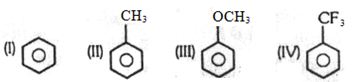
Arrange the following compounds in increasing order of their reactivity towards electrophilic substitution:
A
$IV < I < II < III$
B
$III < II < I < IV$
C
$I < IV < III < II$
D
$II < III < I < IV$
Solution
(A) The reactivity towards electrophilic aromatic substitution $(ESR)$ depends on the electron density in the benzene ring. Substituents that increase electron density (electron-donating groups) activate the ring,while those that decrease it (electron-withdrawing groups) deactivate the ring.
$(I)$ Benzene: Reference compound.
$(II)$ Toluene $(-CH_3)$: $-CH_3$ is an electron-donating group by $+I$ and hyperconjugation effects,activating the ring.
$(III)$ Anisole $(-OCH_3)$: $-OCH_3$ is a strong electron-donating group by $+M$ effect,which strongly activates the ring.
$(IV)$ Trifluoromethylbenzene $(-CF_3)$: $-CF_3$ is a strong electron-withdrawing group by $-I$ effect,which strongly deactivates the ring.
Order of activation: $-CF_3$ (deactivating) < Benzene < $-CH_3$ (activating) < $-OCH_3$ (strongly activating).
Therefore,the increasing order of reactivity is $IV < I < II < III$.
$(I)$ Benzene: Reference compound.
$(II)$ Toluene $(-CH_3)$: $-CH_3$ is an electron-donating group by $+I$ and hyperconjugation effects,activating the ring.
$(III)$ Anisole $(-OCH_3)$: $-OCH_3$ is a strong electron-donating group by $+M$ effect,which strongly activates the ring.
$(IV)$ Trifluoromethylbenzene $(-CF_3)$: $-CF_3$ is a strong electron-withdrawing group by $-I$ effect,which strongly deactivates the ring.
Order of activation: $-CF_3$ (deactivating) < Benzene < $-CH_3$ (activating) < $-OCH_3$ (strongly activating).
Therefore,the increasing order of reactivity is $IV < I < II < III$.
0 likes
View Solution193
MediumMCQ
The correct order of reactivity towards electrophilic substitution for the compounds $(I)$ Aniline,$(II)$ Benzene,and $(III)$ Nitrobenzene is:
A
$III > II > I$
B
$II > III > I$
C
$I < II > III$
D
$I > II > III$
Solution
(D) The reactivity of aromatic compounds towards electrophilic substitution depends on the electron density of the benzene ring.
An electron-donating group (like $-NH_2$ in Aniline) increases the electron density,making the ring more reactive.
An electron-withdrawing group (like $-NO_2$ in Nitrobenzene) decreases the electron density,making the ring less reactive.
Benzene has no substituent,so its reactivity is intermediate.
Thus,the order of reactivity is: Aniline $(I) >$ Benzene $(II) >$ Nitrobenzene $(III)$.
An electron-donating group (like $-NH_2$ in Aniline) increases the electron density,making the ring more reactive.
An electron-withdrawing group (like $-NO_2$ in Nitrobenzene) decreases the electron density,making the ring less reactive.
Benzene has no substituent,so its reactivity is intermediate.
Thus,the order of reactivity is: Aniline $(I) >$ Benzene $(II) >$ Nitrobenzene $(III)$.
0 likes
View Solution194
EasyMCQ
The number of sigma $(\sigma)$ bonds and pi $(\pi)$ bonds in benzene are respectively .......
A
$12, 6$
B
$6, 6$
C
$6, 12$
D
$12, 3$
Solution
(D) The molecular formula of benzene is $C_6H_6$.
In the structure of benzene,there are $6$ $C-C$ sigma bonds and $6$ $C-H$ sigma bonds,making a total of $12$ sigma bonds.
Benzene contains $3$ alternating double bonds,where each double bond consists of one sigma bond and one pi bond.
Therefore,there are $3$ pi $(\pi)$ bonds in benzene.
Thus,the number of sigma bonds is $12$ and the number of pi bonds is $3$.
In the structure of benzene,there are $6$ $C-C$ sigma bonds and $6$ $C-H$ sigma bonds,making a total of $12$ sigma bonds.
Benzene contains $3$ alternating double bonds,where each double bond consists of one sigma bond and one pi bond.
Therefore,there are $3$ pi $(\pi)$ bonds in benzene.
Thus,the number of sigma bonds is $12$ and the number of pi bonds is $3$.
0 likes
View Solution195
MediumMCQ
Which of the following represents the Friedel-Crafts reaction?
A
$C_6H_5Br + 2Na + BrCH_3 \rightarrow C_6H_5CH_3 + 2NaBr$
B
$C_6H_6 + CH_3COCl \xrightarrow{AlCl_3} C_6H_5COCH_3 + HCl$
C
$C_6H_5OH + Zn \xrightarrow{\Delta} C_6H_6 + ZnO$
D
None of the above
Solution
(B) The Friedel-Crafts reaction involves the electrophilic substitution of an aromatic ring.
Option $B$ represents the Friedel-Crafts acylation reaction,where benzene reacts with acetyl chloride in the presence of an anhydrous $AlCl_3$ catalyst to form acetophenone.
Option $B$ represents the Friedel-Crafts acylation reaction,where benzene reacts with acetyl chloride in the presence of an anhydrous $AlCl_3$ catalyst to form acetophenone.
0 likes
View Solution196
MediumMCQ
Which compound is formed when benzene is reacted with ethyl chloride in the presence of anhydrous aluminum chloride?
A
B
C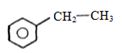
D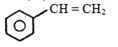
Solution
(C) The reaction of benzene with an alkyl halide (like ethyl chloride,$CH_3CH_2Cl$) in the presence of a Lewis acid catalyst such as anhydrous aluminum chloride $(AlCl_3)$ is known as the Friedel-Crafts alkylation reaction.
In this reaction,the ethyl group $(-CH_2CH_3)$ replaces a hydrogen atom on the benzene ring to form ethylbenzene.
The chemical equation is:
$C_6H_6 + CH_3CH_2Cl \xrightarrow{anhydrous \ AlCl_3} C_6H_5CH_2CH_3 + HCl$
Comparing this with the given options,the structure corresponding to ethylbenzene is shown in option $C$.
In this reaction,the ethyl group $(-CH_2CH_3)$ replaces a hydrogen atom on the benzene ring to form ethylbenzene.
The chemical equation is:
$C_6H_6 + CH_3CH_2Cl \xrightarrow{anhydrous \ AlCl_3} C_6H_5CH_2CH_3 + HCl$
Comparing this with the given options,the structure corresponding to ethylbenzene is shown in option $C$.
0 likes
View Solution197
MediumMCQ
The reaction of benzene with a mixture of concentrated $HNO_3$ and concentrated $H_2SO_4$ yields nitrobenzene. In this mixture,$HNO_3$ acts as a/an ......
A
Base
B
Acid
C
Reducing agent
D
Catalyst
Solution
(A) In the nitration of benzene,the mixture of concentrated $HNO_3$ and concentrated $H_2SO_4$ is used.
$H_2SO_4$ is a stronger acid than $HNO_3$,so it protonates the $HNO_3$ molecule.
The reaction is: $HNO_3 + H_2SO_4 \rightleftharpoons H_2NO_3^+ + HSO_4^- \rightleftharpoons H_2O + NO_2^+ + HSO_4^-$.
Here,$H_2SO_4$ acts as an acid (proton donor) and $HNO_3$ acts as a base (proton acceptor) to generate the electrophile $NO_2^+$ (nitronium ion).
$H_2SO_4$ is a stronger acid than $HNO_3$,so it protonates the $HNO_3$ molecule.
The reaction is: $HNO_3 + H_2SO_4 \rightleftharpoons H_2NO_3^+ + HSO_4^- \rightleftharpoons H_2O + NO_2^+ + HSO_4^-$.
Here,$H_2SO_4$ acts as an acid (proton donor) and $HNO_3$ acts as a base (proton acceptor) to generate the electrophile $NO_2^+$ (nitronium ion).
0 likes
View Solution198
MediumMCQ
In benzene,the $C-C-C$ and $C-C-H$ bond angles are.........
A
$180^o$
B
$120^o$
C
$100^o$
D
$109^o28'$
Solution
(B) Benzene $(C_6H_6)$ is a planar molecule with a hexagonal ring structure.
Each carbon atom in the benzene ring is $sp^2$ hybridized.
Due to $sp^2$ hybridization,the geometry around each carbon atom is trigonal planar,which results in bond angles of $120^o$ for both $C-C-C$ and $C-C-H$ bonds.
Each carbon atom in the benzene ring is $sp^2$ hybridized.
Due to $sp^2$ hybridization,the geometry around each carbon atom is trigonal planar,which results in bond angles of $120^o$ for both $C-C-C$ and $C-C-H$ bonds.
0 likes
View Solution199
MediumMCQ
Benzene does not undergo addition reactions easily because .......
A
It contains six hydrogen atoms.
B
It has a cyclic structure.
C
The double bonds present in benzene are strong.
D
It maintains a resonance-stabilized system.
Solution
(D) Benzene is a highly stable molecule due to the phenomenon of resonance.
The $6 \pi$-electrons are delocalized over the entire ring,which provides extra stability to the molecule.
Addition reactions would involve the breaking of this delocalized $\pi$-electron system,which would result in the loss of resonance energy.
Therefore,benzene prefers substitution reactions over addition reactions to preserve its aromatic character and resonance stability.
The $6 \pi$-electrons are delocalized over the entire ring,which provides extra stability to the molecule.
Addition reactions would involve the breaking of this delocalized $\pi$-electron system,which would result in the loss of resonance energy.
Therefore,benzene prefers substitution reactions over addition reactions to preserve its aromatic character and resonance stability.
0 likes
View Solution200
MediumMCQ
Which of the following compounds undergoes sulfonation most easily?
A
Benzene
B
Nitrobenzene
C
Benzoic acid
D
Toluene
Solution
(D) Sulfonation is an electrophilic aromatic substitution reaction. The rate of this reaction depends on the electron density of the benzene ring.
Groups that donate electrons to the ring (activating groups) increase the electron density,making the ring more reactive towards electrophiles.
$Toluene$ $(C_6H_5CH_3)$ contains a methyl group $(-CH_3)$,which is an electron-donating group due to the $+I$ effect and hyperconjugation.
$Benzene$ has no substituent.
$Nitrobenzene$ $(-NO_2)$ and $Benzoic$ $acid$ $(-COOH)$ contain electron-withdrawing groups,which deactivate the ring.
Therefore,$Toluene$ undergoes sulfonation most easily.
Groups that donate electrons to the ring (activating groups) increase the electron density,making the ring more reactive towards electrophiles.
$Toluene$ $(C_6H_5CH_3)$ contains a methyl group $(-CH_3)$,which is an electron-donating group due to the $+I$ effect and hyperconjugation.
$Benzene$ has no substituent.
$Nitrobenzene$ $(-NO_2)$ and $Benzoic$ $acid$ $(-COOH)$ contain electron-withdrawing groups,which deactivate the ring.
Therefore,$Toluene$ undergoes sulfonation most easily.
0 likes
View SolutionHydrocarbons — Aromatic hydrocarbon · Frequently Asked Questions
1Are these Hydrocarbons questions useful for JEE and NEET?
Yes. All questions in this section are mapped to JEE Main and NEET exam patterns. Previous year questions from JEE Main, NEET, GUJCET and state-level exams are included with full solutions.
2Can I switch to Hindi or Gujarati for these questions?
Yes. Use the language tabs in the hero section or the sidebar to view the same questions and solutions in English, Hindi or Gujarati.
3How do I generate a question paper from this subtopic?
Use the Vedclass Exam Paper Generator — select the chapter and subtopic, set difficulty, and generate Sets A, B, C, D automatically. First 3 chapters of every subject are free.
Vedclass Products
For Students
Vedclass Test Series
Mock tests in real JEE/NEET style with performance analysis. 5-day free trial.
Start Free TrialFor Teachers
Exam Paper Generator
Generate Set A/B/C/D papers from this chapter in 2 minutes. 3 chapters free.
Try FreeFor Institutes
Online Exam Module
Live online exams with unlimited students, 360° analytics & white-label branding.
See DemoFor Teachers & Institutes
Generate a Hydrocarbons Exam Paper in 2 Minutes
Select subtopic & difficulty — Sets A, B, C, D auto-generated with No Repeat logic.
First 3 chapters of every subject are free — no payment required.