
A English
Aromatic hydrocarbon Questions in English
Class 11 Chemistry · Hydrocarbons · Aromatic hydrocarbon
872+
Questions
English
Language
100%
With Solutions
Showing 50 of 872 questions in English
101
MediumMCQ
Benzene can be obtained by heating either benzoic acid with $X$ or phenol with $Y$. $X$ and $Y$ are respectively
A
Zinc dust and soda lime
B
Soda lime and zinc dust
C
Zinc dust and sodium hydroxide
D
Soda lime and copper
Solution
(B) Benzoic acid $(C_6H_5COOH)$ reacts with soda lime $(NaOH + CaO)$ to produce benzene via decarboxylation: $C_6H_5COOH + NaOH \xrightarrow{CaO} C_6H_6 + Na_2CO_3$. Thus,$X$ is soda lime.
Phenol $(C_6H_5OH)$ reacts with zinc dust to produce benzene via reduction: $C_6H_5OH + Zn \xrightarrow{\Delta} C_6H_6 + ZnO$. Thus,$Y$ is zinc dust.
Therefore,$X$ and $Y$ are respectively soda lime and zinc dust.
Phenol $(C_6H_5OH)$ reacts with zinc dust to produce benzene via reduction: $C_6H_5OH + Zn \xrightarrow{\Delta} C_6H_6 + ZnO$. Thus,$Y$ is zinc dust.
Therefore,$X$ and $Y$ are respectively soda lime and zinc dust.
0 likes
View Solution102
MediumMCQ
Aromatisation of $n$-heptane by passing over $(Al_2O_3 + Cr_2O_3)$ catalyst at $773 \ K$ gives:
A
Benzene
B
Toluene
C
Mixture of both
D
Heptylene
Solution
(B) When $n$-heptane $(CH_3(CH_2)_5CH_3)$ is heated to $773 \ K$ under high pressure in the presence of $V_2O_5$,$Cr_2O_3$,or $Mo_2O_3$ supported over $Al_2O_3$,it undergoes cyclization and dehydrogenation to form toluene $(C_6H_5CH_3)$.
This process is known as aromatization or reforming.
This process is known as aromatization or reforming.
0 likes
View Solution103
MediumMCQ
Which of the following is a Friedel-Crafts reaction?
A
$C_6H_6 + FeCl_3 + Cl_2 \to C_6H_5Cl$
B
$C_6H_5CHO + CH_3CHO + KOH \to C_6H_5CH = CH - CHO$
C
$C_6H_6 + CH_3COCl + AlCl_3 \to C_6H_5 - CO - CH_3$
D
$C_6H_5OH + CHCl_3 + KOH \to \text{Salicylaldehyde}$
Solution
(C) The correct option is $(C)$.
Friedel-Crafts acylation involves the reaction of an aromatic compound (like benzene) with an acyl halide (like $CH_3COCl$) in the presence of a Lewis acid catalyst (like anhydrous $AlCl_3$) to form an aromatic ketone.
The reaction is: $C_6H_6 + CH_3COCl \xrightarrow{\text{anhydrous } AlCl_3} C_6H_5COCH_3 + HCl$.
Friedel-Crafts acylation involves the reaction of an aromatic compound (like benzene) with an acyl halide (like $CH_3COCl$) in the presence of a Lewis acid catalyst (like anhydrous $AlCl_3$) to form an aromatic ketone.
The reaction is: $C_6H_6 + CH_3COCl \xrightarrow{\text{anhydrous } AlCl_3} C_6H_5COCH_3 + HCl$.
0 likes
View Solution104
MediumMCQ
Nitrobenzene can be prepared from benzene by using a mixture of conc. $HNO_3$ and conc. $H_2SO_4$. In the nitrating mixture,$HNO_3$ acts as a
A
Base
B
Acid
C
Reducing agent
D
Catalyst
Solution
(A) In the nitration of benzene,the mixture of concentrated $HNO_3$ and concentrated $H_2SO_4$ is used.
Here,$H_2SO_4$ acts as a stronger acid and protonates $HNO_3$ to generate the electrophile $NO_2^+$.
The reaction is as follows:
$HNO_3 + H_2SO_4 \rightleftharpoons H_2NO_3^+ + HSO_4^-$
$H_2NO_3^+ \rightleftharpoons H_2O + NO_2^+$
Since $HNO_3$ accepts a proton from $H_2SO_4$,it acts as a base in this reaction.
Here,$H_2SO_4$ acts as a stronger acid and protonates $HNO_3$ to generate the electrophile $NO_2^+$.
The reaction is as follows:
$HNO_3 + H_2SO_4 \rightleftharpoons H_2NO_3^+ + HSO_4^-$
$H_2NO_3^+ \rightleftharpoons H_2O + NO_2^+$
Since $HNO_3$ accepts a proton from $H_2SO_4$,it acts as a base in this reaction.
0 likes
View Solution105
MediumMCQ
Which order is correct for the decreasing reactivity to ring monobromination of the following compounds: $C_6H_5CH_3$ $(I)$,$C_6H_5COOH$ $(II)$,$C_6H_6$ $(III)$,and $C_6H_5NO_2$ $(IV)$?
A
$I > II > III > IV$
B
$I > III > II > IV$
C
$II > III > IV > I$
D
$III > I > II > IV$
Solution
(B) Ring monobromination is an electrophilic aromatic substitution reaction.
The reactivity of the benzene ring depends on the nature of the substituent group.
Activating groups (electron-donating groups like $-CH_3$) increase the electron density on the ring and increase reactivity,while deactivating groups (electron-withdrawing groups like $-COOH$ and $-NO_2$) decrease the electron density and decrease reactivity.
Benzene $(III)$ is more reactive than rings with deactivating groups but less reactive than rings with activating groups.
Among the deactivating groups,$-NO_2$ is more strongly deactivating than $-COOH$.
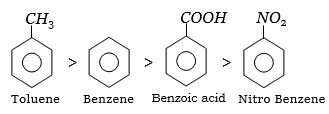
Therefore,the correct decreasing order of reactivity is: $C_6H_5CH_3$ $(I)$ > $C_6H_6$ $(III)$ > $C_6H_5COOH$ $(II)$ > $C_6H_5NO_2$ $(IV)$.
The reactivity of the benzene ring depends on the nature of the substituent group.
Activating groups (electron-donating groups like $-CH_3$) increase the electron density on the ring and increase reactivity,while deactivating groups (electron-withdrawing groups like $-COOH$ and $-NO_2$) decrease the electron density and decrease reactivity.
Benzene $(III)$ is more reactive than rings with deactivating groups but less reactive than rings with activating groups.
Among the deactivating groups,$-NO_2$ is more strongly deactivating than $-COOH$.
Therefore,the correct decreasing order of reactivity is: $C_6H_5CH_3$ $(I)$ > $C_6H_6$ $(III)$ > $C_6H_5COOH$ $(II)$ > $C_6H_5NO_2$ $(IV)$.
0 likes
View Solution106
MediumMCQ
Benzene is obtained by
A
Substitution of three acetylene molecules
B
Addition of three $C_2H_2$ molecules
C
Polymerisation of three $C_2H_2$ molecules
D
Condensation of three $C_2H_2$ molecules
Solution
(C) The correct answer is $(C)$.
Benzene is obtained by the cyclic polymerization of three molecules of acetylene $(C_2H_2)$ when passed through a red-hot iron or copper tube at $500\ ^oC$.
The reaction is as follows:
$3CH \equiv CH \xrightarrow{\text{Red hot } Cu/Fe, 500\ ^oC} C_6H_6$
Benzene is obtained by the cyclic polymerization of three molecules of acetylene $(C_2H_2)$ when passed through a red-hot iron or copper tube at $500\ ^oC$.
The reaction is as follows:
$3CH \equiv CH \xrightarrow{\text{Red hot } Cu/Fe, 500\ ^oC} C_6H_6$
0 likes
View Solution107
EasyMCQ
In benzene,the $1, 3$ position is called:
A
Meta
B
Para
C
Ortho
D
Odd position
Solution
(A) In a benzene ring,the relative positions of substituents are defined as follows:
$1, 2$ or $1, 6$ positions are known as $ortho$.
$1, 3$ or $1, 5$ positions are known as $meta$.
$1, 4$ position is known as $para$.
Therefore,the $1, 3$ position is called $meta$.
$1, 2$ or $1, 6$ positions are known as $ortho$.
$1, 3$ or $1, 5$ positions are known as $meta$.
$1, 4$ position is known as $para$.
Therefore,the $1, 3$ position is called $meta$.
0 likes
View Solution108
DifficultMCQ
Which of the following is formed as a result of biological oxidation of benzene in the body of the dog?
A
Acrylic acid
B
Cinnamic acid
C
Maleic acid
D
Gluconic acid
Solution
(B) The biological oxidation of benzene in the body of a dog leads to the formation of $Cinnamic \ acid$ $(C_6H_5CH=CHCOOH)$.
0 likes
View Solution109
MediumMCQ
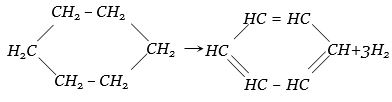
In the following reaction,the catalyst used is:
A
$Al_{2}O_{3}$
B
$Cr_{2}O_{3}$
C
$Cr_{2}O_{3}$ and $Al_{2}O_{3}$
D
$Zn$ dust
Solution
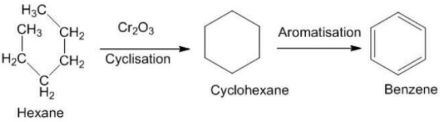
(C) The reaction shown is the aromatization of cyclohexane to benzene. This process involves dehydrogenation and cyclization. The catalyst commonly used for this industrial process is a mixture of chromium oxide $(Cr_{2}O_{3})$ supported on alumina $(Al_{2}O_{3})$. Therefore,the correct option is $(C)$.
0 likes
View Solution110
EasyMCQ
Which of the following is used as a catalyst in the manufacture of toluene from benzene with $CH_3Cl$?
A
$Ni$
B
Anhydrous $AlCl_3$
C
$Pd$
D
$Pt$
Solution
(B) The reaction of benzene with methyl chloride $(CH_3Cl)$ in the presence of an anhydrous Lewis acid catalyst like $AlCl_3$ is known as the Friedel-Crafts alkylation reaction.
The chemical equation is: $C_6H_6 + CH_3Cl \xrightarrow{\text{Anhydrous } AlCl_3} C_6H_5CH_3 + HCl$.
Therefore,anhydrous $AlCl_3$ is used as the catalyst.
The chemical equation is: $C_6H_6 + CH_3Cl \xrightarrow{\text{Anhydrous } AlCl_3} C_6H_5CH_3 + HCl$.
Therefore,anhydrous $AlCl_3$ is used as the catalyst.
0 likes
View Solution111
MediumMCQ
Number of $\pi$-bonds present in $B.H.C.$ ($Benzene$ $hexachloride$) are
A
$6$
B
$3$
C
$0$
D
$12$
Solution
(C) $B.H.C.$ stands for $Benzene$ $hexachloride$,which has the chemical formula $C_6H_6Cl_6$.
In the structure of $B.H.C.$,all carbon atoms are $sp^3$ hybridized.
Since there are no double or triple bonds present in the molecule,the number of $\pi$-bonds is $0$.
In the structure of $B.H.C.$,all carbon atoms are $sp^3$ hybridized.
Since there are no double or triple bonds present in the molecule,the number of $\pi$-bonds is $0$.
0 likes
View Solution112
MediumMCQ
$C_6H_6 + 3Cl_2 \xrightarrow{UV \ \text{light}} \text{Product}$. In the above reaction,the product is:
A
$CCl_3CHO$
B
$C_6H_6Cl_6$
C
$C_6H_{12}Cl_6$
D
$C_6H_9Cl_2$
Solution
(B) The reaction of benzene $(C_6H_6)$ with chlorine $(Cl_2)$ in the presence of $UV$ light is an addition reaction.
$C_6H_6 + 3Cl_2 \xrightarrow{UV \ \text{light}} C_6H_6Cl_6$.
The product formed is $C_6H_6Cl_6$,which is commonly known as $BHC$ (Benzene Hexachloride) or Gammaxene.
$C_6H_6 + 3Cl_2 \xrightarrow{UV \ \text{light}} C_6H_6Cl_6$.
The product formed is $C_6H_6Cl_6$,which is commonly known as $BHC$ (Benzene Hexachloride) or Gammaxene.
0 likes
View Solution113
MediumMCQ
Benzene reacts with chlorine to form benzene hexachloride in the presence of:
A
Nickel
B
$AlCl_3$
C
Bright sunlight
D
Zinc
Solution
(C) The reaction of benzene with chlorine in the presence of ultraviolet light or bright sunlight is an addition reaction.
In this reaction,three molecules of chlorine add to the benzene ring to form benzene hexachloride $(C_6H_6Cl_6)$,also known as $BHC$ or gammaxene.
The reaction is:
$C_6H_6 + 3Cl_2 \xrightarrow{\text{Sunlight}} C_6H_6Cl_6$
Therefore,the correct option is $(C)$.
In this reaction,three molecules of chlorine add to the benzene ring to form benzene hexachloride $(C_6H_6Cl_6)$,also known as $BHC$ or gammaxene.
The reaction is:
$C_6H_6 + 3Cl_2 \xrightarrow{\text{Sunlight}} C_6H_6Cl_6$
Therefore,the correct option is $(C)$.
0 likes
View Solution114
AdvancedMCQ
When chlorine is passed through warm benzene in the presence of sunlight,the product obtained is:
A
Benzotrichloride
B
Chlorobenzene
C
Gammexane
D
$DDT$
Solution
(C) When chlorine is passed through benzene in the presence of sunlight,an addition reaction occurs to form benzene hexachloride $(C_6H_6Cl_6)$.
This product is commonly known as Gammexane,$BHC$,or Lindane.
It is widely used as an insecticide.
This product is commonly known as Gammexane,$BHC$,or Lindane.
It is widely used as an insecticide.
0 likes
View Solution115
DifficultMCQ
In the presence of $AlCl_3$,benzene and $n$-propyl bromide react in a Friedel-Crafts alkylation reaction to form:
A
$n$-propyl benzene
B
$1, 2$-di-$n$-propyl benzene
C
$1, 4$-di-$n$-propyl benzene
D
Isopropyl benzene
Solution
(D) In the Friedel-Crafts alkylation of benzene with $n$-propyl bromide in the presence of $AlCl_3$,the primary carbocation $(CH_3-CH_2-CH_2^+)$ formed initially undergoes a $1, 2$-hydride shift to form a more stable secondary carbocation $(CH_3-CH^+-CH_3)$.
This secondary carbocation then attacks the benzene ring to form isopropyl benzene (cumene) as the major product.
This secondary carbocation then attacks the benzene ring to form isopropyl benzene (cumene) as the major product.
0 likes
View Solution116
DifficultMCQ
When benzene is heated with chlorine in the presence of sunlight,it forms:
A
$B.H.C.$
B
Cyclopropane
C
$p-$dichlorobenzene
D
None of these
Solution
(A) When benzene $(C_6H_6)$ reacts with chlorine $(Cl_2)$ in the presence of sunlight (ultraviolet light),an addition reaction occurs.
This reaction results in the formation of benzene hexachloride $(C_6H_6Cl_6)$,which is commonly known as $B.H.C.$ or gammaxene.
The chemical equation is: $C_6H_6 + 3Cl_2 \xrightarrow{\text{sunlight}} C_6H_6Cl_6$ $(B.H.C.)$.
This reaction results in the formation of benzene hexachloride $(C_6H_6Cl_6)$,which is commonly known as $B.H.C.$ or gammaxene.
The chemical equation is: $C_6H_6 + 3Cl_2 \xrightarrow{\text{sunlight}} C_6H_6Cl_6$ $(B.H.C.)$.
0 likes
View Solution117
EasyMCQ
$TNT$ has the structure
A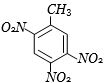
B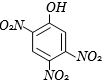
C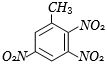
D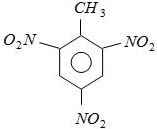
Solution
(D) $TNT$ stands for $2,4,6$-trinitrotoluene.
Its structure consists of a benzene ring with a methyl group $(-CH_3)$ at position $1$ and three nitro groups $(-NO_2)$ at positions $2, 4,$ and $6$.
This corresponds to the structure shown in image $353-$s157.
Its structure consists of a benzene ring with a methyl group $(-CH_3)$ at position $1$ and three nitro groups $(-NO_2)$ at positions $2, 4,$ and $6$.
This corresponds to the structure shown in image $353-$s157.
0 likes
View Solution118
MediumMCQ
Which one of the following compounds is prepared in the laboratory from benzene by a substitution reaction?
A
Glyoxal
B
Cyclohexane
C
Acetophenone
D
Hexabromo cyclohexane
Solution
(C) The correct answer is $(C)$.
Acetophenone is prepared from benzene by the Friedel-Crafts acylation reaction.
In this reaction,benzene reacts with acetyl chloride $(CH_3COCl)$ in the presence of anhydrous aluminum chloride $(AlCl_3)$ to form acetophenone $(C_6H_5COCH_3)$ and hydrogen chloride $(HCl)$.
This is an electrophilic aromatic substitution reaction.
Acetophenone is prepared from benzene by the Friedel-Crafts acylation reaction.
In this reaction,benzene reacts with acetyl chloride $(CH_3COCl)$ in the presence of anhydrous aluminum chloride $(AlCl_3)$ to form acetophenone $(C_6H_5COCH_3)$ and hydrogen chloride $(HCl)$.
This is an electrophilic aromatic substitution reaction.
0 likes
View Solution119
MediumMCQ
When $o$-xylene is oxidized in the presence of $V_2O_5$,the product is:
A
Benzoic acid
B
Phenyl acetic acid
C
Phthalic acid
D
Acetic acid
Solution
(C) The catalytic oxidation of $o$-xylene in the presence of vanadium pentoxide $(V_2O_5)$ at high temperatures leads to the oxidation of both methyl groups attached to the benzene ring into carboxylic acid groups.
This reaction produces phthalic acid (benzene$-1,2-$dicarboxylic acid).
The reaction is represented as:
$o$-xylene $\xrightarrow{V_2O_5, \text{Oxidation}}$ Phthalic acid.
This reaction produces phthalic acid (benzene$-1,2-$dicarboxylic acid).
The reaction is represented as:
$o$-xylene $\xrightarrow{V_2O_5, \text{Oxidation}}$ Phthalic acid.
0 likes
View Solution120
MediumMCQ
By aerial oxidation,which one of the following gives phthalic acid?
A
Naphthalene
B
Benzene
C
Mesitylene
D
Toluene
Solution
(A) The aerial oxidation of $Naphthalene$ in the presence of a catalyst like $V_2O_5$ at high temperature leads to the formation of phthalic anhydride,which upon hydrolysis yields phthalic acid.
$C_{10}H_8 + 4.5 O_2 \xrightarrow{V_2O_5, \Delta} C_8H_4O_3 (\text{Phthalic anhydride}) + 2CO_2 + 2H_2O$
$C_8H_4O_3 + H_2O \rightarrow C_6H_4(COOH)_2 (\text{Phthalic acid})$
Therefore,the correct option is $A$.
$C_{10}H_8 + 4.5 O_2 \xrightarrow{V_2O_5, \Delta} C_8H_4O_3 (\text{Phthalic anhydride}) + 2CO_2 + 2H_2O$
$C_8H_4O_3 + H_2O \rightarrow C_6H_4(COOH)_2 (\text{Phthalic acid})$
Therefore,the correct option is $A$.
0 likes
View Solution121
MediumMCQ
Toluene is oxidised to benzoic acid by
A
$KMnO_4$
B
$K_2Cr_2O_7$
C
$H_2SO_4$
D
Both $(a)$ and $(b)$
Solution
(D) Toluene can be oxidized to benzoic acid using strong oxidizing agents such as alkaline $KMnO_4$ or acidic $K_2Cr_2O_7$.
Both $KMnO_4$ and $K_2Cr_2O_7$ are effective oxidizing agents for the side-chain oxidation of alkylbenzenes to carboxylic acids.
Therefore,the correct option is $(d)$.
Both $KMnO_4$ and $K_2Cr_2O_7$ are effective oxidizing agents for the side-chain oxidation of alkylbenzenes to carboxylic acids.
Therefore,the correct option is $(d)$.
0 likes
View Solution122
DifficultMCQ
Hydrogenation of $C_6H_5CHOHCOOH$ over $Rh-Al_2O_3$ catalyst in methanol gives:
A
$C_6H_5CH_2COOH$
B
$C_6H_{11}CHOHCOOH$
C
$C_6H_5CHOHCH_2OH$
D
$C_6H_{11}CH_2COOH$
Solution
(B) The hydrogenation of $C_6H_5CHOHCOOH$ (mandelic acid) over a $Rh-Al_2O_3$ catalyst is a selective reaction that reduces the aromatic benzene ring to a cyclohexane ring while leaving the carboxylic acid $(-COOH)$ and hydroxyl $(-OH)$ groups intact.
The reaction is as follows:
$C_6H_5CHOHCOOH + 3H_2 \xrightarrow{Rh-Al_2O_3} C_6H_{11}CHOHCOOH$
Thus,the product formed is $C_6H_{11}CHOHCOOH$ (cyclohexylmandelic acid).
The reaction is as follows:
$C_6H_5CHOHCOOH + 3H_2 \xrightarrow{Rh-Al_2O_3} C_6H_{11}CHOHCOOH$
Thus,the product formed is $C_6H_{11}CHOHCOOH$ (cyclohexylmandelic acid).
0 likes
View Solution123
MediumMCQ
Nitrobenzene can be prepared from benzene by using a mixture of conc. $HNO_3$ and conc. $H_2SO_4$. In the nitrating mixture,$HNO_3$ acts as a
A
Acid
B
Base
C
Catalyst
D
Reducing agent
Solution
(B) In the nitration of benzene,the reaction between conc. $HNO_3$ and conc. $H_2SO_4$ occurs as follows:
$HNO_3 + H_2SO_4 \rightleftharpoons H_2NO_3^+ + HSO_4^-$
$H_2NO_3^+ \rightleftharpoons H_2O + NO_2^+$
Here,$H_2SO_4$ is a stronger acid than $HNO_3$,so it protonates $HNO_3$. Thus,$HNO_3$ acts as a base in the presence of conc. $H_2SO_4$ to generate the electrophile $NO_2^+$.
$HNO_3 + H_2SO_4 \rightleftharpoons H_2NO_3^+ + HSO_4^-$
$H_2NO_3^+ \rightleftharpoons H_2O + NO_2^+$
Here,$H_2SO_4$ is a stronger acid than $HNO_3$,so it protonates $HNO_3$. Thus,$HNO_3$ acts as a base in the presence of conc. $H_2SO_4$ to generate the electrophile $NO_2^+$.
0 likes
View Solution124
MediumMCQ
The rate-determining step for the preparation of nitrobenzene from benzene is:
A
Removal of $NO_2^+$
B
Removal of $NO_3^+$
C
Formation of $NO_2^+$
D
Formation of $NO_3^+$
Solution
(C) The nitration of benzene involves the reaction of benzene with a nitrating mixture $(conc. \ HNO_3 + conc. \ H_2SO_4)$.
The rate-determining step of this electrophilic aromatic substitution reaction is the formation of the electrophile,the nitronium ion $(NO_2^+)$,from the nitrating mixture.
The rate-determining step of this electrophilic aromatic substitution reaction is the formation of the electrophile,the nitronium ion $(NO_2^+)$,from the nitrating mixture.
0 likes
View Solution125
MediumMCQ
The nitro group in nitrobenzene is a
A
Ortho director
B
Meta director
C
Para director
D
Ortho and para director
Solution
(B) . The $-NO_2$ group is a strong electron-withdrawing group due to its $-I$ and $-M$ effects.
It decreases the electron density at the $o-$ (ortho) and $p-$ (para) positions of the benzene ring.
As a result,the incoming electrophile is directed to the $m-$ (meta) position,where the electron density is relatively higher compared to the $o-$ and $p-$ positions.
Therefore,it is a $m-$directing group.
It decreases the electron density at the $o-$ (ortho) and $p-$ (para) positions of the benzene ring.
As a result,the incoming electrophile is directed to the $m-$ (meta) position,where the electron density is relatively higher compared to the $o-$ and $p-$ positions.
Therefore,it is a $m-$directing group.
0 likes
View Solution126
DifficultMCQ
The product formed when benzene is nitrated by fuming nitric acid is
A
$m$-dinitrobenzene
B
Nitrobenzene
C
sym-trinitrobenzene
D
None of these
Solution
(C) When benzene is treated with fuming nitric acid $(HNO_3)$ in the presence of concentrated sulfuric acid $(H_2SO_4)$,it undergoes electrophilic aromatic substitution to form $1,3,5$-trinitrobenzene,also known as sym-trinitrobenzene.
The reaction is as follows:
$C_6H_6 + 3HNO_3 \xrightarrow{conc. H_2SO_4} C_6H_3(NO_2)_3 + 3H_2O$
Therefore,the correct option is $(C)$.
The reaction is as follows:
$C_6H_6 + 3HNO_3 \xrightarrow{conc. H_2SO_4} C_6H_3(NO_2)_3 + 3H_2O$
Therefore,the correct option is $(C)$.
0 likes
View Solution127
EasyMCQ
The maximum number of $-NO_2$ groups that can be introduced into benzene by direct nitration is usually
A
$4$
B
$2$
C
$3$
D
$6$
Solution
(C) The nitration of benzene is an electrophilic aromatic substitution reaction.
Each $-NO_2$ group introduced into the benzene ring is strongly electron-withdrawing,which deactivates the ring towards further electrophilic substitution.
After the introduction of three $-NO_2$ groups,the ring becomes so deactivated that further nitration under standard conditions is extremely difficult.
Therefore,the maximum number of $-NO_2$ groups that can be introduced by direct nitration is $3$,resulting in $1,3,5$-trinitrobenzene.
Each $-NO_2$ group introduced into the benzene ring is strongly electron-withdrawing,which deactivates the ring towards further electrophilic substitution.
After the introduction of three $-NO_2$ groups,the ring becomes so deactivated that further nitration under standard conditions is extremely difficult.
Therefore,the maximum number of $-NO_2$ groups that can be introduced by direct nitration is $3$,resulting in $1,3,5$-trinitrobenzene.
0 likes
View Solution128
DifficultMCQ
Product '$A$' in the above reaction is:
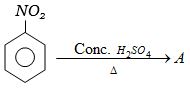
A
$2-$Nitrobenzenesulfonic acid
B
$3-$Nitrobenzenesulfonic acid
C
$4-$Nitrobenzenesulfonic acid
D
None of these
Solution
(B) The reaction of nitrobenzene with concentrated $H_2SO_4$ at high temperature (sulfonation) yields $3$-nitrobenzenesulfonic acid as the major product.
This is because the $-NO_2$ group is a strong electron-withdrawing group and is meta-directing for electrophilic aromatic substitution reactions.
Therefore,the electrophile $SO_3$ attacks the meta-position relative to the $-NO_2$ group.
This is because the $-NO_2$ group is a strong electron-withdrawing group and is meta-directing for electrophilic aromatic substitution reactions.
Therefore,the electrophile $SO_3$ attacks the meta-position relative to the $-NO_2$ group.
0 likes
View Solution129
DifficultMCQ
The correct order of reactivity towards the electrophilic substitution of the compounds aniline $(I)$,benzene $(II)$,and nitrobenzene $(III)$ is
A
$I > II > III$
B
$III > II > I$
C
$II > III > I$
D
$I < II > III$
Solution
(A) The reactivity towards electrophilic aromatic substitution depends on the electron density of the benzene ring.
$1$. The $-NH_2$ group in aniline $(I)$ is a strong electron-donating group due to its $+M$ effect,which significantly increases the electron density on the ring,making it highly reactive.
$2$. Benzene $(II)$ has no substituents,serving as the reference point.
$3$. The $-NO_2$ group in nitrobenzene $(III)$ is a strong electron-withdrawing group due to its $-M$ and $-I$ effects,which significantly decreases the electron density on the ring,making it the least reactive.
Therefore,the correct order of reactivity is $I > II > III$.
$1$. The $-NH_2$ group in aniline $(I)$ is a strong electron-donating group due to its $+M$ effect,which significantly increases the electron density on the ring,making it highly reactive.
$2$. Benzene $(II)$ has no substituents,serving as the reference point.
$3$. The $-NO_2$ group in nitrobenzene $(III)$ is a strong electron-withdrawing group due to its $-M$ and $-I$ effects,which significantly decreases the electron density on the ring,making it the least reactive.
Therefore,the correct order of reactivity is $I > II > III$.
0 likes
View Solution130
MediumMCQ
Which of the following would be most reactive towards nitration?
A
Benzene
B
Nitrobenzene
C
Toluene
D
Chlorobenzene
Solution
(C) The order of reactivity towards electrophilic aromatic substitution is governed by the presence of electron-donating or electron-withdrawing groups attached to the benzene ring.
$Toluene$ contains a methyl group $(-CH_3)$,which is an electron-donating group due to hyperconjugation and the inductive effect,making the ring more reactive towards electrophiles.
$Benzene$ is the standard reference.
$Nitrobenzene$ $(C_6H_5NO_2)$ has a strongly electron-withdrawing nitro group $(-NO_2)$,which deactivates the ring.
$Chlorobenzene$ has a chloro group $(-Cl)$,which is deactivating due to its strong $-I$ effect.
Thus,$Toluene$ is the most reactive towards nitration.
$Toluene$ contains a methyl group $(-CH_3)$,which is an electron-donating group due to hyperconjugation and the inductive effect,making the ring more reactive towards electrophiles.
$Benzene$ is the standard reference.
$Nitrobenzene$ $(C_6H_5NO_2)$ has a strongly electron-withdrawing nitro group $(-NO_2)$,which deactivates the ring.
$Chlorobenzene$ has a chloro group $(-Cl)$,which is deactivating due to its strong $-I$ effect.
Thus,$Toluene$ is the most reactive towards nitration.
0 likes
View Solution131
EasyMCQ
The starting material for the preparation of styrene is
A
Ethane
B
Ethene
C
Ethyne
D
Vinyl chloride
Solution
(B) Styrene is primarily produced from ethylbenzene.
Ethylbenzene is synthesized via the Friedel-Crafts alkylation of benzene with ethylene $(C_2H_4)$ in the presence of an acid catalyst.
Subsequently,styrene is obtained by the catalytic dehydrogenation of ethylbenzene:
$C_6H_5CH_2CH_3 \rightarrow C_6H_5CH=CH_2 + H_2$.
Thus,ethylene (ethene) is a key starting material for the synthesis of styrene.
Ethylbenzene is synthesized via the Friedel-Crafts alkylation of benzene with ethylene $(C_2H_4)$ in the presence of an acid catalyst.
Subsequently,styrene is obtained by the catalytic dehydrogenation of ethylbenzene:
$C_6H_5CH_2CH_3 \rightarrow C_6H_5CH=CH_2 + H_2$.
Thus,ethylene (ethene) is a key starting material for the synthesis of styrene.
0 likes
View Solution132
EasyMCQ
Styrene at room temperature is
A
Solid
B
Liquid
C
Gas
D
Colloidal solution
Solution
(B) Styrene $(C_6H_5CH=CH_2)$ is a colorless,oily liquid at room temperature.
0 likes
View Solution133
MediumMCQ
What is the number of $\pi$ bonds in naphthalene?
A
$6$
B
$3$
C
$4$
D
$5$
Solution
(D) Naphthalene $(C_{10}H_8)$ consists of two fused benzene rings.
In its Kekule structure,there are $5$ double bonds.
Each double bond contains one $\pi$ bond.
Therefore,the total number of $\pi$ bonds in naphthalene is $5$.
In its Kekule structure,there are $5$ double bonds.
Each double bond contains one $\pi$ bond.
Therefore,the total number of $\pi$ bonds in naphthalene is $5$.
0 likes
View Solution134
MediumMCQ
What is the number of $\sigma$ and $\pi$ bonds in toluene?
A
$3\pi + 8\sigma$
B
$3\pi + 6\sigma$
C
$3\pi + 15\sigma$
D
$6\pi + 6\sigma$
Solution
(C) The chemical formula of toluene is $C_6H_5CH_3$.
In the benzene ring,there are $6$ carbon atoms and $5$ hydrogen atoms attached to the ring.
The methyl group $(-CH_3)$ has $1$ carbon and $3$ hydrogen atoms.
Total $\sigma$ bonds:
- $6$ $C-C$ $\sigma$ bonds (including ring and methyl attachment).
- $5$ $C-H$ $\sigma$ bonds in the ring.
- $3$ $C-H$ $\sigma$ bonds in the methyl group.
Total $\sigma$ bonds = $6 + 5 + 3 = 15$.
Total $\pi$ bonds:
- There are $3$ double bonds in the benzene ring,each containing $1$ $\pi$ bond.
Total $\pi$ bonds = $3$.
Thus,toluene has $15\sigma$ and $3\pi$ bonds.
In the benzene ring,there are $6$ carbon atoms and $5$ hydrogen atoms attached to the ring.
The methyl group $(-CH_3)$ has $1$ carbon and $3$ hydrogen atoms.
Total $\sigma$ bonds:
- $6$ $C-C$ $\sigma$ bonds (including ring and methyl attachment).
- $5$ $C-H$ $\sigma$ bonds in the ring.
- $3$ $C-H$ $\sigma$ bonds in the methyl group.
Total $\sigma$ bonds = $6 + 5 + 3 = 15$.
Total $\pi$ bonds:
- There are $3$ double bonds in the benzene ring,each containing $1$ $\pi$ bond.
Total $\pi$ bonds = $3$.
Thus,toluene has $15\sigma$ and $3\pi$ bonds.
0 likes
View Solution135
MediumMCQ
At what angle are the carbon atoms arranged in a benzene molecule?
A
$120^o$
B
$180^o$
C
$109^o 28'$
D
$60^o$
Solution
(A) In a benzene molecule,each carbon atom undergoes $sp^2$ hybridization.
Due to this $sp^2$ hybridization,the bond angle between the carbon atoms is $120^o$.
Due to this $sp^2$ hybridization,the bond angle between the carbon atoms is $120^o$.
0 likes
View Solution136
MediumMCQ
Which of the following compounds has the lowest bond dissociation energy for a $C-H$ bond?
A
Toluene
B
Benzene
C
$n$-Pentane
D
$2,2$-Dimethylpropane
Solution
(A) In $Toluene$,the $C-H$ bond of the methyl group is the weakest.
This is because the resulting benzyl radical (after homolytic cleavage) or benzyl carbocation (after heterolytic cleavage) is resonance-stabilized by the benzene ring.
This is because the resulting benzyl radical (after homolytic cleavage) or benzyl carbocation (after heterolytic cleavage) is resonance-stabilized by the benzene ring.
0 likes
View Solution137
MediumMCQ
Which of the following statements is incorrect?
A
All activating groups are $o-, p-$ directing.
B
Halogens are $o-, p-$ directing despite being slightly deactivating.
C
Groups that are $m-$ directing are more deactivating than halogens.
D
$t-$butylbenzene undergoes nitration more easily than toluene.
Solution
(D) $1$. Activating groups (like $-OH, -NH_2, -CH_3$) increase electron density on the ring and are $o-, p-$ directing.
$2$. Halogens are deactivating due to the $-I$ effect but are $o-, p-$ directing due to the $+M$ effect.
$3$. $m-$directing groups (like $-NO_2, -CHO, -COOH$) are strongly deactivating,which is more than the deactivating effect of halogens.
$4$. Regarding $t-$butylbenzene vs toluene: Toluene has a methyl group $(-CH_3)$ which is a stronger activator than the $t-$butyl group $(-C(CH_3)_3)$ due to steric hindrance and the nature of the inductive effect in the transition state. Therefore,toluene undergoes nitration more easily than $t-$butylbenzene. Thus,statement $D$ is incorrect.
$2$. Halogens are deactivating due to the $-I$ effect but are $o-, p-$ directing due to the $+M$ effect.
$3$. $m-$directing groups (like $-NO_2, -CHO, -COOH$) are strongly deactivating,which is more than the deactivating effect of halogens.
$4$. Regarding $t-$butylbenzene vs toluene: Toluene has a methyl group $(-CH_3)$ which is a stronger activator than the $t-$butyl group $(-C(CH_3)_3)$ due to steric hindrance and the nature of the inductive effect in the transition state. Therefore,toluene undergoes nitration more easily than $t-$butylbenzene. Thus,statement $D$ is incorrect.
0 likes
View Solution138
MediumMCQ
Arrange the following compounds in the decreasing order of their reactivity towards electrophilic substitution reaction: Aniline $(I)$,Benzene $(II)$,and Nitrobenzene $(III)$.
A
$I > II > III$
B
$III > II > I$
C
$II > III > I$
D
$I < II > III$
Solution
(A) The reactivity towards electrophilic substitution depends on the electron density of the benzene ring.
In Aniline $(I)$,the $-NH_2$ group is a strong electron-donating group due to its $+M$ effect,which increases electron density at the ortho and para positions,making it highly reactive.
In Benzene $(II)$,there is no substituent to alter the electron density.
In Nitrobenzene $(III)$,the $-NO_2$ group is a strong electron-withdrawing group due to both $-I$ and $-M$ effects,which significantly decreases the electron density of the ring,making it the least reactive.
Therefore,the order of reactivity is $I > II > III$.
In Aniline $(I)$,the $-NH_2$ group is a strong electron-donating group due to its $+M$ effect,which increases electron density at the ortho and para positions,making it highly reactive.
In Benzene $(II)$,there is no substituent to alter the electron density.
In Nitrobenzene $(III)$,the $-NO_2$ group is a strong electron-withdrawing group due to both $-I$ and $-M$ effects,which significantly decreases the electron density of the ring,making it the least reactive.
Therefore,the order of reactivity is $I > II > III$.
0 likes
View Solution139
MediumMCQ
What is obtained when benzene reacts with fuming nitric acid?
A
Dinitrobenzene
B
Nitrobenzene
C
Symmetric trinitrobenzene
D
None of these
Solution
(C) When benzene reacts with fuming nitric acid $(HNO_3)$ in the presence of concentrated sulfuric acid $(H_2SO_4)$,it undergoes electrophilic aromatic substitution to form $1,3,5$-trinitrobenzene,also known as symmetric trinitrobenzene. The reaction is: $C_6H_6 + 3HNO_3 \xrightarrow{conc. H_2SO_4} C_6H_3(NO_2)_3 + 3H_2O$.
0 likes
View Solution140
EasyMCQ
What is formed by the nitration of nitrobenzene in the presence of fuming nitric acid?
A
Solid product
B
Gaseous product
C
Semi-solid product
D
Liquid product
Solution
(A) The nitration of nitrobenzene using fuming $HNO_3$ and concentrated $H_2SO_4$ at high temperatures $(373 \ K)$ leads to the formation of $m$-dinitrobenzene.
$m$-Dinitrobenzene is a solid compound at room temperature.
Therefore,the correct option is $A$.
$m$-Dinitrobenzene is a solid compound at room temperature.
Therefore,the correct option is $A$.
0 likes
View Solution141
MediumMCQ
Which of the following compounds is most reactive towards nitration?
A
Benzene
B
Nitrobenzene
C
Toluene
D
Chlorobenzene
Solution
(C) The reactivity of aromatic compounds towards electrophilic substitution (like nitration) depends on the electron density of the ring.
Groups that donate electrons to the ring (activating groups) increase reactivity,while electron-withdrawing groups decrease it.
$1$. $Toluene$ $(CH_3-C_6H_5)$ has a methyl group,which is an electron-donating group ($+I$ and hyperconjugation effect),making the ring more reactive than benzene.
$2$. $Benzene$ $(C_6H_6)$ is the reference.
$3$. $Chlorobenzene$ $(C_6H_5Cl)$ has a chlorine atom,which is deactivating due to its strong $-I$ effect,despite being ortho/para directing.
$4$. $Nitrobenzene$ $(C_6H_5NO_2)$ has a nitro group,which is a strongly deactivating group due to its $-I$ and $-M$ effects.
Therefore,$Toluene$ is the most reactive towards nitration.
Groups that donate electrons to the ring (activating groups) increase reactivity,while electron-withdrawing groups decrease it.
$1$. $Toluene$ $(CH_3-C_6H_5)$ has a methyl group,which is an electron-donating group ($+I$ and hyperconjugation effect),making the ring more reactive than benzene.
$2$. $Benzene$ $(C_6H_6)$ is the reference.
$3$. $Chlorobenzene$ $(C_6H_5Cl)$ has a chlorine atom,which is deactivating due to its strong $-I$ effect,despite being ortho/para directing.
$4$. $Nitrobenzene$ $(C_6H_5NO_2)$ has a nitro group,which is a strongly deactivating group due to its $-I$ and $-M$ effects.
Therefore,$Toluene$ is the most reactive towards nitration.
0 likes
View Solution142
MediumMCQ
In the nitration of benzene using a mixture of concentrated $HNO_3$ and concentrated $H_2SO_4$,how does nitric acid behave in the nitrating mixture?
A
Base
B
Acid
C
Reducing agent
D
Catalyst
Solution
(A) In the nitration of benzene,the nitrating mixture consists of concentrated $HNO_3$ and concentrated $H_2SO_4$.
$H_2SO_4$ acts as a strong acid and protonates $HNO_3$.
The reaction is: $HNO_3 + H_2SO_4 \rightleftharpoons H_2NO_3^+ + HSO_4^- \rightleftharpoons NO_2^+ + H_2O + HSO_4^-$.
Here,$HNO_3$ accepts a proton from $H_2SO_4$,therefore $HNO_3$ acts as a base.
$H_2SO_4$ acts as a strong acid and protonates $HNO_3$.
The reaction is: $HNO_3 + H_2SO_4 \rightleftharpoons H_2NO_3^+ + HSO_4^- \rightleftharpoons NO_2^+ + H_2O + HSO_4^-$.
Here,$HNO_3$ accepts a proton from $H_2SO_4$,therefore $HNO_3$ acts as a base.
0 likes
View Solution143
DifficultMCQ
Which of the following statements is incorrect for the nitration of an aromatic compound?
A
The rate of nitration of benzene is the same as that of hexadeuterobenzene.
B
The rate of nitration of toluene is higher than that of benzene.
C
The rate of nitration of benzene is higher than that of hexadeuterobenzene.
D
Nitration is an electrophilic substitution reaction.
Solution
(C) $1$. Nitration of aromatic compounds is an electrophilic aromatic substitution reaction where the rate-determining step involves the formation of the sigma complex.
$2$. In the case of benzene and hexadeuterobenzene $(C_6D_6)$,the rate-determining step does not involve the breaking of the $C-H$ or $C-D$ bond.
$3$. Therefore,there is no primary kinetic isotope effect,and the rates of nitration for benzene and hexadeuterobenzene are essentially the same.
$4$. Toluene has a methyl group which is electron-donating ($+I$ and hyperconjugation),making the ring more reactive towards electrophilic substitution than benzene.
$5$. Thus,statement $C$ is incorrect because the rates are equal,not different.
$2$. In the case of benzene and hexadeuterobenzene $(C_6D_6)$,the rate-determining step does not involve the breaking of the $C-H$ or $C-D$ bond.
$3$. Therefore,there is no primary kinetic isotope effect,and the rates of nitration for benzene and hexadeuterobenzene are essentially the same.
$4$. Toluene has a methyl group which is electron-donating ($+I$ and hyperconjugation),making the ring more reactive towards electrophilic substitution than benzene.
$5$. Thus,statement $C$ is incorrect because the rates are equal,not different.
0 likes
View Solution144
MediumMCQ
When toluene is reacted with $Br_2/Fe$,$p$-bromotoluene is formed as the major product because the $CH_3$ group is...
A
ortho and para directing
B
meta directing
C
deactivates the ring by hyperconjugation
D
deactivates the ring
0 likes
View Solution145
MediumMCQ
What is the number of monosubstituted products possible for benzene?
A
$1$
B
$2$
C
$3$
D
$0$
Solution
(A) Benzene $(C_6H_6)$ is a highly symmetrical molecule where all six carbon atoms and all six hydrogen atoms are equivalent.
Due to this high degree of symmetry,replacing any one of the six hydrogen atoms with a substituent results in the same product.
Therefore,only $1$ monosubstituted product is possible for benzene.
Due to this high degree of symmetry,replacing any one of the six hydrogen atoms with a substituent results in the same product.
Therefore,only $1$ monosubstituted product is possible for benzene.
0 likes
View Solution146
MediumMCQ
What is the product formed when chloroform reacts with benzene in the presence of $AlCl_3$?
A
Chlorobenzene
B
Toluene
C
Mixture of ortho and para-chlorotoluene
D
Triphenylmethane
Solution
(D) The reaction of benzene with chloroform $(CHCl_3)$ in the presence of anhydrous $AlCl_3$ is a Friedel-Crafts alkylation reaction.
In this reaction,three molecules of benzene react with one molecule of chloroform to form triphenylmethane.
The chemical equation is: $3C_6H_6 + CHCl_3 \xrightarrow{AlCl_3} (C_6H_5)_3CH + 3HCl$.
In this reaction,three molecules of benzene react with one molecule of chloroform to form triphenylmethane.
The chemical equation is: $3C_6H_6 + CHCl_3 \xrightarrow{AlCl_3} (C_6H_5)_3CH + 3HCl$.
0 likes
View Solution147
DifficultMCQ
What is '$X$' in the given reaction?
$C_6H_6 + CH_2=CH_2 \xrightarrow{\text{Anhydrous } AlCl_3} X$
$C_6H_6 + CH_2=CH_2 \xrightarrow{\text{Anhydrous } AlCl_3} X$
A
o-Xylene
B
Chlorobenzene
C
Styrene
D
Ethylbenzene
Solution
(D) The reaction of benzene $(C_6H_6)$ with ethene $(CH_2=CH_2)$ in the presence of an anhydrous Lewis acid catalyst like $AlCl_3$ is an example of Friedel-Crafts alkylation.
In this reaction,the ethene molecule acts as an alkylating agent,adding an ethyl group $(-C_2H_5)$ to the benzene ring.
The product formed is ethylbenzene ($C_6H_5-CH_2CH_3$ or $C_6H_5C_2H_5$).
In this reaction,the ethene molecule acts as an alkylating agent,adding an ethyl group $(-C_2H_5)$ to the benzene ring.
The product formed is ethylbenzene ($C_6H_5-CH_2CH_3$ or $C_6H_5C_2H_5$).
0 likes
View Solution148
MediumMCQ
At room temperature,styrene is in the ....... state.
A
Solid
B
Liquid
C
Gas
D
Colloidal solution
Solution
(B) Styrene $(C_6H_5CH=CH_2)$ is a clear,colorless,oily liquid at room temperature.
0 likes
View Solution149
DifficultMCQ
What are the major products obtained in each case when compounds $P, Q,$ and $S$ are nitrated using a mixture of $HNO_3/H_2SO_4$?
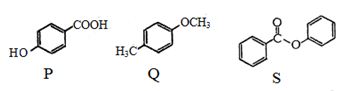
A
For $P$: $3$-nitro$-4-$hydroxybenzoic acid; For $Q$: $2$-nitro$-1-$methoxy$-4-$methylbenzene; For $S$: $4$-nitrophenyl benzoate
B
For $P$: $3$-nitro$-4-$hydroxybenzoic acid; For $Q$: $2$-nitro$-1-$methoxy$-4-$methylbenzene; For $S$: $2$-nitrophenyl benzoate
C
For $P$: $3$-nitro$-4-$hydroxybenzoic acid; For $Q$: $2$-nitro$-1-$methoxy$-4-$methylbenzene; For $S$: $4$-nitrophenyl benzoate
D
For $P$: $3$-nitro$-4-$hydroxybenzoic acid; For $Q$: $2$-nitro$-1-$methoxy$-4-$methylbenzene; For $S$: $3$-nitrophenyl benzoate
Solution
(D) For compound $P$ ($4$-hydroxybenzoic acid): The $-OH$ group is strongly activating and ortho/para-directing,while the $-COOH$ group is deactivating and meta-directing. The $-OH$ group dominates,directing the nitro group to the ortho position relative to itself (position $3$ relative to $-COOH$).
For compound $Q$ ($1$-methoxy$-4-$methylbenzene): The $-OCH_3$ group is strongly activating and ortho/para-directing,while the $-CH_3$ group is weakly activating and ortho/para-directing. The $-OCH_3$ group dominates,directing the nitro group to its ortho position (position $2$ relative to $-OCH_3$).
For compound $S$ (phenyl benzoate): The benzoate group $(-O-CO-C_6H_5)$ is deactivating and meta-directing. However,the ring attached to the oxygen atom is activated by the oxygen lone pair (ortho/para-directing). Nitration occurs on the ring attached to the oxygen,specifically at the meta position relative to the ester linkage due to the electronic influence of the ester group on the phenoxy ring. The correct product is $3$-nitrophenyl benzoate.
For compound $Q$ ($1$-methoxy$-4-$methylbenzene): The $-OCH_3$ group is strongly activating and ortho/para-directing,while the $-CH_3$ group is weakly activating and ortho/para-directing. The $-OCH_3$ group dominates,directing the nitro group to its ortho position (position $2$ relative to $-OCH_3$).
For compound $S$ (phenyl benzoate): The benzoate group $(-O-CO-C_6H_5)$ is deactivating and meta-directing. However,the ring attached to the oxygen atom is activated by the oxygen lone pair (ortho/para-directing). Nitration occurs on the ring attached to the oxygen,specifically at the meta position relative to the ester linkage due to the electronic influence of the ester group on the phenoxy ring. The correct product is $3$-nitrophenyl benzoate.
0 likes
View Solution150
MediumMCQ
The product obtained in the reaction of benzene with chlorine in the presence of ultraviolet light is ...... .
A
$CCl_4$
B
$C_6H_5Cl$
C
$C_6H_6Cl_6$
D
$C_6Cl_6$
Solution
(C) When benzene reacts with chlorine in the presence of ultraviolet $(UV)$ light,it undergoes an addition reaction rather than electrophilic substitution.
This reaction involves the addition of three molecules of $Cl_2$ to the benzene ring,resulting in the formation of benzene hexachloride $(C_6H_6Cl_6)$,also known as gammaxene or lindane.
The reaction is: $C_6H_6 + 3Cl_2 \xrightarrow{UV} C_6H_6Cl_6$.
This reaction involves the addition of three molecules of $Cl_2$ to the benzene ring,resulting in the formation of benzene hexachloride $(C_6H_6Cl_6)$,also known as gammaxene or lindane.
The reaction is: $C_6H_6 + 3Cl_2 \xrightarrow{UV} C_6H_6Cl_6$.
0 likes
View SolutionHydrocarbons — Aromatic hydrocarbon · Frequently Asked Questions
1Are these Hydrocarbons questions useful for JEE and NEET?
Yes. All questions in this section are mapped to JEE Main and NEET exam patterns. Previous year questions from JEE Main, NEET, GUJCET and state-level exams are included with full solutions.
2Can I switch to Hindi or Gujarati for these questions?
Yes. Use the language tabs in the hero section or the sidebar to view the same questions and solutions in English, Hindi or Gujarati.
3How do I generate a question paper from this subtopic?
Use the Vedclass Exam Paper Generator — select the chapter and subtopic, set difficulty, and generate Sets A, B, C, D automatically. First 3 chapters of every subject are free.
Vedclass Products
For Students
Vedclass Test Series
Mock tests in real JEE/NEET style with performance analysis. 5-day free trial.
Start Free TrialFor Teachers
Exam Paper Generator
Generate Set A/B/C/D papers from this chapter in 2 minutes. 3 chapters free.
Try FreeFor Institutes
Online Exam Module
Live online exams with unlimited students, 360° analytics & white-label branding.
See DemoFor Teachers & Institutes
Generate a Hydrocarbons Exam Paper in 2 Minutes
Select subtopic & difficulty — Sets A, B, C, D auto-generated with No Repeat logic.
First 3 chapters of every subject are free — no payment required.