
A English
Aromatic hydrocarbon Questions in English
Class 11 Chemistry · Hydrocarbons · Aromatic hydrocarbon
872+
Questions
English
Language
100%
With Solutions
Showing 48 of 872 questions in English
51
MediumMCQ
Nitration of benzene by nitric acid and sulphuric acid is
A
Electrophilic substitution
B
Electrophilic addition
C
Nucleophilic substitution
D
Free radical substitution
Solution
(A) The nitration of benzene is a classic example of an electrophilic aromatic substitution reaction.
In this process,$HNO_3$ reacts with $H_2SO_4$ to generate the nitronium ion $(NO_2^+)$,which acts as a strong electrophile.
The benzene ring,being electron-rich,attacks the electrophile $(NO_2^+)$ to form a carbocation intermediate (arenium ion).
Finally,the loss of a proton restores the aromaticity of the benzene ring,resulting in the formation of nitrobenzene.
In this process,$HNO_3$ reacts with $H_2SO_4$ to generate the nitronium ion $(NO_2^+)$,which acts as a strong electrophile.
The benzene ring,being electron-rich,attacks the electrophile $(NO_2^+)$ to form a carbocation intermediate (arenium ion).
Finally,the loss of a proton restores the aromaticity of the benzene ring,resulting in the formation of nitrobenzene.
0 likes
View Solution52
MediumMCQ
Which of the following are necessary conditions for the electrophilic aromatic halogenation of benzene?
A
Cold and dark
B
Presence of a halogen carrier
C
Both $(a)$ and $(b)$
D
None of the above
Solution
(B) The electrophilic aromatic substitution (halogenation) of benzene requires the presence of a Lewis acid catalyst,which acts as a halogen carrier.
$1.$ $A$ halogen carrier like $FeCl_3$ or $AlCl_3$ is necessary to polarize the halogen molecule $(X_2)$ to generate the electrophile $(X^+)$.
$2.$ The reaction is typically carried out in the dark to prevent free-radical substitution,which would otherwise occur at the side chain (benzylic position) in the presence of light.
$3.$ Therefore,the reaction conditions for electrophilic aromatic halogenation are the presence of a halogen carrier and the absence of light (dark conditions).
$1.$ $A$ halogen carrier like $FeCl_3$ or $AlCl_3$ is necessary to polarize the halogen molecule $(X_2)$ to generate the electrophile $(X^+)$.
$2.$ The reaction is typically carried out in the dark to prevent free-radical substitution,which would otherwise occur at the side chain (benzylic position) in the presence of light.
$3.$ Therefore,the reaction conditions for electrophilic aromatic halogenation are the presence of a halogen carrier and the absence of light (dark conditions).
0 likes
View Solution53
MediumMCQ
$C_6H_6 + CH_3Cl \xrightarrow{anhydrous \ AlCl_3} C_6H_5CH_3 + HCl$ is an example of
A
Friedel-Crafts reaction
B
Kolbe's synthesis
C
Wurtz reaction
D
Grignard reaction
Solution
(A) The given reaction $C_6H_6 + CH_3Cl \xrightarrow{anhydrous \ AlCl_3} C_6H_5CH_3 + HCl$ involves the alkylation of benzene in the presence of a Lewis acid catalyst $(AlCl_3)$.
This is a classic example of a Friedel-Crafts alkylation reaction.
This is a classic example of a Friedel-Crafts alkylation reaction.
0 likes
View Solution54
MediumMCQ
The reaction of benzene with chlorine in the presence of iron gives:
A
Benzene hexachloride
B
Chlorobenzene
C
Benzyl chloride
D
Benzoyl chloride
Solution
(B) The reaction of benzene with chlorine in the presence of an iron catalyst (or $FeCl_3$) is an electrophilic aromatic substitution reaction.
In this reaction,the iron catalyst reacts with chlorine to generate the electrophile $Cl^+$.
This electrophile then attacks the benzene ring to form chlorobenzene $(C_6H_5Cl)$ by replacing a hydrogen atom.
The reaction is represented as:
$C_6H_6 + Cl_2 \xrightarrow{Fe} C_6H_5Cl + HCl$
Therefore,the correct option is $(B)$.
In this reaction,the iron catalyst reacts with chlorine to generate the electrophile $Cl^+$.
This electrophile then attacks the benzene ring to form chlorobenzene $(C_6H_5Cl)$ by replacing a hydrogen atom.
The reaction is represented as:
$C_6H_6 + Cl_2 \xrightarrow{Fe} C_6H_5Cl + HCl$
Therefore,the correct option is $(B)$.
0 likes
View Solution55
EasyMCQ
Benzene was discovered by
A
Ramsay
B
Dalton
C
Faraday
D
Priestley
Solution
(C) Michael Faraday first isolated and identified benzene in $1825$ from the oily residue derived from the production of illuminating gas,giving it the name bicarburet of hydrogen.
0 likes
View Solution56
EasyMCQ
The correct structure of benzene was proposed by
A
Faraday
B
Davy
C
Kekule
D
Wohler
Solution
(C) The structure of benzene has been of interest since its discovery.
German chemist August Kekule von Stradonitz proposed the cyclic structure of benzene in $1866$,which consists of six carbon atoms with alternating single and double bonds.
German chemist August Kekule von Stradonitz proposed the cyclic structure of benzene in $1866$,which consists of six carbon atoms with alternating single and double bonds.
0 likes
View Solution57
EasyMCQ
The centric structure of benzene was proposed by
A
Dewar
B
Ladenberg
C
Kekule
D
Armstrong and Baeyer
Solution
(D) The centric structure of benzene was proposed by $Armstrong$ and $Baeyer$.
0 likes
View Solution58
EasyMCQ
The six carbon atoms of benzene are of:
A
One type
B
Two types
C
Three types
D
Six types
Solution
(A) In benzene $(C_6H_6)$,the structure is a regular hexagon due to the resonance and delocalization of $\pi$-electrons.
All $C-C$ bonds have an equal bond length of $1.39 \mathring{A}$.
All six carbon atoms are $sp^2$ hybridized and are equivalent in terms of their chemical environment.
Therefore,all six carbon atoms are of the same type.
All $C-C$ bonds have an equal bond length of $1.39 \mathring{A}$.
All six carbon atoms are $sp^2$ hybridized and are equivalent in terms of their chemical environment.
Therefore,all six carbon atoms are of the same type.
0 likes
View Solution59
MediumMCQ
On heating a mixture of sodium benzoate and sodalime,the following is obtained:
A
Toluene
B
Phenol
C
Benzene
D
Benzoic acid
Solution
(C) The reaction of sodium benzoate $(C_6H_5COONa)$ with sodalime $(NaOH + CaO)$ is a decarboxylation reaction.
When sodium benzoate is heated with sodalime,it undergoes decarboxylation to produce benzene $(C_6H_6)$ and sodium carbonate $(Na_2CO_3)$.
The chemical equation is:
$C_6H_5COONa + NaOH \xrightarrow{CaO} C_6H_6 + Na_2CO_3$
Therefore,the correct option is $(C)$.
When sodium benzoate is heated with sodalime,it undergoes decarboxylation to produce benzene $(C_6H_6)$ and sodium carbonate $(Na_2CO_3)$.
The chemical equation is:
$C_6H_5COONa + NaOH \xrightarrow{CaO} C_6H_6 + Na_2CO_3$
Therefore,the correct option is $(C)$.
0 likes
View Solution60
MediumMCQ
Benzene on treatment with a mixture of conc. $HNO_3$ and conc. $H_2SO_4$ at $100 \ ^oC$ gives
A
Nitrobenzene
B
$m-$dinitrobenzene
C
$p-$dinitrobenzene
D
$o-$dinitrobenzene
Solution
(B) The nitration of benzene with a mixture of conc. $HNO_3$ and conc. $H_2SO_4$ at $50-60 \ ^oC$ yields nitrobenzene.
Further nitration of nitrobenzene at higher temperatures (around $100 \ ^oC$) leads to the formation of $m-$dinitrobenzene because the $-NO_2$ group is a deactivating and meta-directing group.
Thus,the final product is $m-$dinitrobenzene.
Further nitration of nitrobenzene at higher temperatures (around $100 \ ^oC$) leads to the formation of $m-$dinitrobenzene because the $-NO_2$ group is a deactivating and meta-directing group.
Thus,the final product is $m-$dinitrobenzene.
0 likes
View Solution61
MediumMCQ
What is the end product obtained on the nitration of toluene?
A
$o-$nitrotoluene
B
$p-$nitrotoluene
C
$2, 4-$dinitrotoluene
D
$2, 4, 6-$trinitrotoluene
Solution
(D) The nitration of toluene with concentrated $HNO_3$ in the presence of concentrated $H_2SO_4$ leads to the formation of $2, 4, 6-$trinitrotoluene $(TNT)$ as the final product.
The reaction is as follows:
$C_6H_5CH_3 + 3HNO_3 \xrightarrow{Conc. H_2SO_4} C_6H_2(NO_2)_3CH_3 + 3H_2O$
Thus,the correct option is $(d)$.
The reaction is as follows:
$C_6H_5CH_3 + 3HNO_3 \xrightarrow{Conc. H_2SO_4} C_6H_2(NO_2)_3CH_3 + 3H_2O$
Thus,the correct option is $(d)$.
0 likes
View Solution62
MediumMCQ
Which of the following processes is reversible?
A
Halogenation
B
Sulphonation
C
Nitration
D
None
Solution
(B) The process of sulphonation of benzene is a reversible reaction.
In this reaction,benzene reacts with concentrated $H_2SO_4$ (or fuming $H_2SO_4$,i.e.,oleum) to form benzenesulphonic acid.
The reaction is as follows:
$C_6H_6 + H_2SO_4 \rightleftharpoons C_6H_5SO_3H + H_2O$
Since the reaction is reversible,the addition of superheated steam can reverse the process to regenerate benzene from benzenesulphonic acid.
In this reaction,benzene reacts with concentrated $H_2SO_4$ (or fuming $H_2SO_4$,i.e.,oleum) to form benzenesulphonic acid.
The reaction is as follows:
$C_6H_6 + H_2SO_4 \rightleftharpoons C_6H_5SO_3H + H_2O$
Since the reaction is reversible,the addition of superheated steam can reverse the process to regenerate benzene from benzenesulphonic acid.
0 likes
View Solution63
MediumMCQ
Which xylene is most easily sulphonated?
A
$Ortho-xylene$
B
$Para-xylene$
C
$Meta-xylene$
D
All at the same rate
Solution
(C) $m-xylene$ is most easily sulphonated because it has the most reactive positions available for electrophilic substitution.
In $m-xylene$,the two methyl groups are at $1,3-$ positions,which activates the $2, 4,$ and $6$ positions towards electrophilic attack.
Specifically,the $4$ position is highly activated and less sterically hindered compared to the positions in $o-xylene$ and $p-xylene$.
In $m-xylene$,the two methyl groups are at $1,3-$ positions,which activates the $2, 4,$ and $6$ positions towards electrophilic attack.
Specifically,the $4$ position is highly activated and less sterically hindered compared to the positions in $o-xylene$ and $p-xylene$.
0 likes
View Solution64
MediumMCQ
Toluene on oxidation with dilute $HNO_3$ and alkaline $KMnO_4$ gives:
A
Benzaldehyde
B
Phenol
C
Nitrotoluene
D
Benzoic acid
Solution
(D) The oxidation of alkyl benzenes (like toluene) with strong oxidizing agents such as alkaline $KMnO_4$ results in the oxidation of the alkyl side chain to a carboxylic acid group.
Even in the presence of dilute $HNO_3$,the strong oxidizing action of alkaline $KMnO_4$ converts the methyl group $(-CH_3)$ of toluene into a carboxyl group $(-COOH)$.
Thus,toluene is oxidized to benzoic acid $(C_6H_5COOH)$.
Even in the presence of dilute $HNO_3$,the strong oxidizing action of alkaline $KMnO_4$ converts the methyl group $(-CH_3)$ of toluene into a carboxyl group $(-COOH)$.
Thus,toluene is oxidized to benzoic acid $(C_6H_5COOH)$.
0 likes
View Solution65
MediumMCQ
Benzene vapour mixed with air when passed over $V_2O_5$ catalyst at $775 \ K$ gives
A
Glyoxal
B
Oxalic acid
C
Maleic anhydride
D
Fumaric acid
Solution
(C) When benzene vapour is mixed with air and passed over $V_2O_5$ catalyst at $775 \ K$,it undergoes catalytic oxidation to form maleic anhydride.
The reaction is as follows:
$C_6H_6 + \frac{9}{2} O_2 \xrightarrow{V_2O_5, 775 \ K} \text{Maleic anhydride} + 2CO_2 + 2H_2O$
This process involves the oxidation of the benzene ring followed by dehydration to yield maleic anhydride.
The reaction is as follows:
$C_6H_6 + \frac{9}{2} O_2 \xrightarrow{V_2O_5, 775 \ K} \text{Maleic anhydride} + 2CO_2 + 2H_2O$
This process involves the oxidation of the benzene ring followed by dehydration to yield maleic anhydride.
0 likes
View Solution66
MediumMCQ
Most common reactions of benzene (aromatic hydrocarbon) and its derivatives are
A
Electrophilic addition reactions
B
Electrophilic substitution reactions
C
Nucleophilic addition reactions
D
Nucleophilic substitution reactions
Solution
(B) Benzene and its derivatives possess extra stability due to resonance,which makes them less prone to addition reactions as that would disrupt the aromatic system.
The delocalized $\pi$-electron cloud above and below the plane of the ring is electron-rich,making it susceptible to attack by electrophiles.
Therefore,the characteristic reactions of benzene and its derivatives are $Electrophilic \ substitution \ reactions$.
The delocalized $\pi$-electron cloud above and below the plane of the ring is electron-rich,making it susceptible to attack by electrophiles.
Therefore,the characteristic reactions of benzene and its derivatives are $Electrophilic \ substitution \ reactions$.
0 likes
View Solution67
MediumMCQ
$o, p-$ directing groups are mostly
A
Activating groups
B
Deactivating groups
C
Neutral groups
D
None of these
Solution
(A) Most $o, p-$directing groups are Activating Groups.
If electrophilic aromatic substitution of a monosubstituted benzene is faster than that of benzene under identical conditions,the substituent in the monosubstituted benzene is called an Activating Group.
If electrophilic aromatic substitution of a monosubstituted benzene is faster than that of benzene under identical conditions,the substituent in the monosubstituted benzene is called an Activating Group.
0 likes
View Solution68
MediumMCQ
The compound that is most reactive towards electrophilic nitration is
A
Toluene
B
Benzene
C
Benzoic acid
D
Nitrobenzene
Solution
(A) Electrophilic aromatic substitution is facilitated by electron-donating groups on the benzene ring,which increase the electron density of the ring.
$1$. The $-CH_3$ group in Toluene is an electron-donating group due to the $+I$ effect and hyperconjugation.
$2$. Benzene has no substituents.
$3$. The $-COOH$ group in Benzoic acid and the $-NO_2$ group in Nitrobenzene are electron-withdrawing groups,which decrease the electron density of the ring.
Therefore,Toluene is the most reactive towards electrophilic nitration among the given options.
$1$. The $-CH_3$ group in Toluene is an electron-donating group due to the $+I$ effect and hyperconjugation.
$2$. Benzene has no substituents.
$3$. The $-COOH$ group in Benzoic acid and the $-NO_2$ group in Nitrobenzene are electron-withdrawing groups,which decrease the electron density of the ring.
Therefore,Toluene is the most reactive towards electrophilic nitration among the given options.
0 likes
View Solution69
MediumMCQ
Amongst the following,the compound that can be most readily sulphonated is
A
Benzene
B
Nitrobenzene
C
Toluene
D
Chlorobenzene
Solution
(C) Sulphonation is an electrophilic aromatic substitution reaction.
The rate of reaction depends on the electron density of the benzene ring.
Electron-donating groups (like $-CH_3$ in Toluene) increase the electron density of the ring,making it more reactive towards electrophilic attack.
Electron-withdrawing groups (like $-NO_2$ in Nitrobenzene) decrease the electron density,making it less reactive.
Therefore,Toluene is the most reactive among the given compounds towards electrophilic sulphonation.
The rate of reaction depends on the electron density of the benzene ring.
Electron-donating groups (like $-CH_3$ in Toluene) increase the electron density of the ring,making it more reactive towards electrophilic attack.
Electron-withdrawing groups (like $-NO_2$ in Nitrobenzene) decrease the electron density,making it less reactive.
Therefore,Toluene is the most reactive among the given compounds towards electrophilic sulphonation.
0 likes
View Solution70
DifficultMCQ
Select the true statement about benzene from amongst the following.
A
Because of unsaturation,benzene easily undergoes addition reactions.
B
There are two types of $C-C$ bonds in a benzene molecule.
C
There is a cyclic delocalisation of $\pi$ electrons in benzene.
D
Monosubstitution of benzene gives three isomeric substances.
Solution
(C) In a benzene molecule,all $C-C$ bond lengths are equal due to resonance.
Benzene does not readily undergo addition reactions because it is highly stable due to aromaticity.
There is a cyclic delocalisation of $\pi$ electrons in the benzene ring.
Monosubstitution of benzene gives only a single isomeric product because all six positions in the benzene ring are equivalent.
Benzene does not readily undergo addition reactions because it is highly stable due to aromaticity.
There is a cyclic delocalisation of $\pi$ electrons in the benzene ring.
Monosubstitution of benzene gives only a single isomeric product because all six positions in the benzene ring are equivalent.
0 likes
View Solution71
MediumMCQ
In Friedel-Crafts alkylation,besides $AlCl_3$ the other reactants are
A
$C_6H_6 + CH_3Cl$
B
$C_6H_6 + CH_4$
C
$C_6H_6 + NH_3$
D
$C_6H_6 + CH_3COCl$
Solution
(A) In Friedel-Crafts alkylation,an alkyl group is introduced into the benzene ring by reacting benzene with an alkyl halide in the presence of a Lewis acid catalyst like $AlCl_3$.
For the methylation of benzene,the reactants are benzene $(C_6H_6)$ and methyl chloride $(CH_3Cl)$.
The reaction is: $C_6H_6 + CH_3Cl \xrightarrow{AlCl_3} C_6H_5CH_3 + HCl$.
For the methylation of benzene,the reactants are benzene $(C_6H_6)$ and methyl chloride $(CH_3Cl)$.
The reaction is: $C_6H_6 + CH_3Cl \xrightarrow{AlCl_3} C_6H_5CH_3 + HCl$.
0 likes
View Solution72
MediumMCQ
Nitration of benzene is a
A
Electrophilic displacement
B
Electrophilic addition
C
Nucleophilic addition
D
Nucleophilic displacement
Solution
(A) The nitration of benzene is an example of an electrophilic aromatic substitution reaction.
In this process,the nitronium ion $(NO_2^+)$ acts as a strong electrophile.
Benzene,being electron-rich,attacks the electrophile to form a sigma complex (arenium ion).
Finally,the loss of a proton $(H^+)$ restores the aromaticity of the benzene ring.
Since the hydrogen atom is replaced by a nitro group,it is classified as an electrophilic displacement (substitution) reaction.
In this process,the nitronium ion $(NO_2^+)$ acts as a strong electrophile.
Benzene,being electron-rich,attacks the electrophile to form a sigma complex (arenium ion).
Finally,the loss of a proton $(H^+)$ restores the aromaticity of the benzene ring.
Since the hydrogen atom is replaced by a nitro group,it is classified as an electrophilic displacement (substitution) reaction.
0 likes
View Solution73
MediumMCQ
Benzene shows
A
Substitution
B
Addition
C
Oxidation
D
All of these
Solution
(D) Benzene is a stable aromatic compound due to the delocalization of $\pi$-electrons.
Because of this stability,it primarily undergoes electrophilic substitution reactions rather than addition reactions,as addition would destroy the aromaticity.
However,under specific conditions,benzene can undergo addition reactions (e.g.,hydrogenation to cyclohexane).
Furthermore,alkyl-substituted benzenes can undergo oxidation of the side chain using strong oxidizing agents like alkaline $KMnO_4$.
Since benzene and its derivatives exhibit all these types of reactions under appropriate conditions,the correct answer is $All \ of \ these$.
Because of this stability,it primarily undergoes electrophilic substitution reactions rather than addition reactions,as addition would destroy the aromaticity.
However,under specific conditions,benzene can undergo addition reactions (e.g.,hydrogenation to cyclohexane).
Furthermore,alkyl-substituted benzenes can undergo oxidation of the side chain using strong oxidizing agents like alkaline $KMnO_4$.
Since benzene and its derivatives exhibit all these types of reactions under appropriate conditions,the correct answer is $All \ of \ these$.
0 likes
View Solution74
MediumMCQ
Benzene can be obtained in the reaction:
A
Ethene $+ 1,3-$butadiene
B
Trimerisation of ethyne
C
Reduction of $PhCHO$
D
All of these
Solution
(B) The correct answer is $(B)$.
Benzene $(C_6H_6)$ is obtained by the cyclic trimerisation of ethyne $(C_2H_2)$.
When ethyne gas is passed through a red-hot iron tube at $873 \ K$,it undergoes cyclic polymerisation to form benzene.
Benzene $(C_6H_6)$ is obtained by the cyclic trimerisation of ethyne $(C_2H_2)$.
When ethyne gas is passed through a red-hot iron tube at $873 \ K$,it undergoes cyclic polymerisation to form benzene.
0 likes
View Solution75
MediumMCQ
Thiophene and benzene are separated by
A
Sulphonation of thiophene
B
Sulphonation of benzene
C
Nitration of thiophene
D
Nitration of benzene
Solution
(A) Thiophene is significantly more reactive toward electrophilic aromatic substitution than benzene due to the electron-donating effect of the sulfur atom.
When a mixture of benzene and thiophene is shaken with concentrated sulfuric acid $(H_2SO_4)$ at room temperature,thiophene undergoes sulfonation to form thiophene$-2-$sulfonic acid,which is water-soluble.
Benzene does not undergo sulfonation under these mild conditions.
The resulting mixture forms two layers: the organic layer containing benzene and the aqueous layer containing the thiophene-sulfonic acid.
These layers can be separated using a separating funnel,effectively isolating the benzene.
When a mixture of benzene and thiophene is shaken with concentrated sulfuric acid $(H_2SO_4)$ at room temperature,thiophene undergoes sulfonation to form thiophene$-2-$sulfonic acid,which is water-soluble.
Benzene does not undergo sulfonation under these mild conditions.
The resulting mixture forms two layers: the organic layer containing benzene and the aqueous layer containing the thiophene-sulfonic acid.
These layers can be separated using a separating funnel,effectively isolating the benzene.
0 likes
View Solution76
MediumMCQ
Which of the following is a hydrocarbon?
A
Urea
B
Benzene
C
Ammonium cyanate
D
Phenol
Solution
(B) hydrocarbon is an organic compound consisting entirely of hydrogen and carbon.
$(B)$ Benzene $(C_6H_6)$ consists only of carbon and hydrogen atoms,making it a hydrocarbon.
Urea $(NH_2CONH_2)$,Ammonium cyanate $(NH_4OCN)$,and Phenol $(C_6H_5OH)$ contain other elements like nitrogen or oxygen.
$(B)$ Benzene $(C_6H_6)$ consists only of carbon and hydrogen atoms,making it a hydrocarbon.
Urea $(NH_2CONH_2)$,Ammonium cyanate $(NH_4OCN)$,and Phenol $(C_6H_5OH)$ contain other elements like nitrogen or oxygen.
0 likes
View Solution77
MediumMCQ
Aromatic compounds burn with a sooty flame because
A
They have a ring structure of carbon atoms
B
They have a relatively high percentage of hydrogen
C
They have a relatively high percentage of carbon
D
They resist reaction with oxygen of air
Solution
(C) Aromatic compounds have a high carbon-to-hydrogen ratio compared to aliphatic hydrocarbons.
Due to this high percentage of carbon,there is insufficient oxygen available for complete combustion,leading to the formation of unburnt carbon particles,which appear as soot.
Therefore,they burn with a sooty flame.
Due to this high percentage of carbon,there is insufficient oxygen available for complete combustion,leading to the formation of unburnt carbon particles,which appear as soot.
Therefore,they burn with a sooty flame.
0 likes
View Solution78
MediumMCQ
Among the following statements on the nitration of aromatic compounds,the false one is:
A
The rate of nitration of benzene is almost the same as that of hexadeuterobenzene
B
The rate of nitration of toluene is greater than that of benzene
C
The rate of nitration of benzene is greater than that of hexadeuterobenzene
D
Nitration is an electrophilic substitution reaction
Solution
(C) Nitration of aromatic compounds is an electrophilic aromatic substitution reaction where the rate-determining step is the formation of the sigma complex (arenium ion).
Since the $C-H$ or $C-D$ bond cleavage occurs after the rate-determining step,there is no primary kinetic isotope effect observed.
Therefore,the rate of nitration of benzene $(C_6H_6)$ and hexadeuterobenzene $(C_6D_6)$ is essentially the same.
Statement $C$ is false because the rates are equal,not greater.
Since the $C-H$ or $C-D$ bond cleavage occurs after the rate-determining step,there is no primary kinetic isotope effect observed.
Therefore,the rate of nitration of benzene $(C_6H_6)$ and hexadeuterobenzene $(C_6D_6)$ is essentially the same.
Statement $C$ is false because the rates are equal,not greater.
0 likes
View Solution79
MediumMCQ
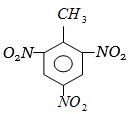
How is $2,4,6-$trinitrotoluene widely used?
A
Insecticide
B
Drug
C
Explosive
D
Dye
Solution
(C) $2,4,6-$Trinitrotoluene,commonly known as $TNT$,is a chemical compound widely used as an explosive.
0 likes
View Solution80
MediumMCQ
Which compound is formed when benzene is heated with chlorine in the presence of sunlight?
A
$C_6H_5CCl_3$
B
$C_6H_5CHCl_2$
C
$C_6H_5CH_2Cl$
D
$C_6H_6Cl_6$
Solution
(D) When benzene reacts with chlorine in the presence of sunlight ($UV$ light),an addition reaction occurs instead of substitution.
The delocalized $\pi$-electron system of the benzene ring is broken,and one chlorine atom adds to each of the six carbon atoms.
The product formed is $1,2,3,4,5,6-$hexachlorocyclohexane,commonly known as benzene hexachloride $(BHC)$ or gammexane,with the formula $C_6H_6Cl_6$.
The delocalized $\pi$-electron system of the benzene ring is broken,and one chlorine atom adds to each of the six carbon atoms.
The product formed is $1,2,3,4,5,6-$hexachlorocyclohexane,commonly known as benzene hexachloride $(BHC)$ or gammexane,with the formula $C_6H_6Cl_6$.
0 likes
View Solution81
MediumMCQ
The addition of $Cl_2$ to benzene in the presence of $AlCl_3$ is an example of:
A
Addition
B
Halogenation
C
Elimination
D
Substitution
Solution
(D) The reaction of benzene with $Cl_2$ in the presence of a Lewis acid catalyst like $AlCl_3$ is an electrophilic aromatic substitution reaction.
In this reaction,a hydrogen atom on the benzene ring is replaced by a chlorine atom to form chlorobenzene and $HCl$.
Therefore,it is specifically an example of electrophilic substitution (or halogenation).
Among the given options,'Substitution' is the most accurate classification of the reaction mechanism.
In this reaction,a hydrogen atom on the benzene ring is replaced by a chlorine atom to form chlorobenzene and $HCl$.
Therefore,it is specifically an example of electrophilic substitution (or halogenation).
Among the given options,'Substitution' is the most accurate classification of the reaction mechanism.
0 likes
View Solution82
MediumMCQ
Three fused benzene rings are found in
A
Naphthalene
B
Anthracene
C
Phenanthroline
D
Triphenyl methane
Solution
(B) Anthracene is a solid polycyclic aromatic hydrocarbon $(PAH)$ with the formula $C_{14}H_{10}$,which consists of three linearly fused benzene rings.
Naphthalene consists of two fused benzene rings.
Phenanthroline is a heterocyclic compound containing nitrogen atoms.
Triphenyl methane consists of three phenyl groups attached to a central carbon atom,not fused rings.
Therefore,the correct answer is Anthracene.
Naphthalene consists of two fused benzene rings.
Phenanthroline is a heterocyclic compound containing nitrogen atoms.
Triphenyl methane consists of three phenyl groups attached to a central carbon atom,not fused rings.
Therefore,the correct answer is Anthracene.
0 likes
View Solution83
MediumMCQ
After ozonolysis of benzene (not hydrolysis),the product is
A
Benzene triozonide
B
Glyoxal
C
Ethanediol
D
All of them
Solution
(A) The reaction of benzene with ozone $(O_3)$ leads to the formation of benzene triozonide as an intermediate product.
If the process is stopped after the addition of ozone and no hydrolysis (reduction) step is performed,the final product isolated is benzene triozonide.
Hydrolysis or reductive cleavage of benzene triozonide using $Zn/H_2O$ is required to obtain glyoxal $(CHO-CHO)$.
If the process is stopped after the addition of ozone and no hydrolysis (reduction) step is performed,the final product isolated is benzene triozonide.
Hydrolysis or reductive cleavage of benzene triozonide using $Zn/H_2O$ is required to obtain glyoxal $(CHO-CHO)$.
0 likes
View Solution84
MediumMCQ
Catalytic dehydrogenation of $n-heptane$ in the presence of $Cr_2O_3/Al_2O_3$ at $750 \ K$ gives:
A
$iso-heptane$
B
$1-heptene$
C
toluene
D
$2, 3-dimethylpentene-1$
Solution
(C) The catalytic dehydrogenation and cyclization of $n-heptane$ in the presence of $Cr_2O_3/Al_2O_3$ at $750 \ K$ results in the formation of toluene.
This process is known as aromatization or reforming.
The reaction is: $n-C_7H_{16} \xrightarrow[750 \ K]{Cr_2O_3/Al_2O_3} \text{Toluene} + 4H_2$.
This process is known as aromatization or reforming.
The reaction is: $n-C_7H_{16} \xrightarrow[750 \ K]{Cr_2O_3/Al_2O_3} \text{Toluene} + 4H_2$.
0 likes
View Solution85
MediumMCQ
$C_6H_6$ $\xrightarrow{HNO_3, H_2SO_4} X$ $\xrightarrow{Cl_2, FeCl_3} Y$. In the above sequence,$Y$ is:
A
$1-$nitrochlorobenzene
B
$3-$nitrochlorobenzene
C
$4-$nitrochlorobenzene
D
$1,2-$nitrochlorobenzene
Solution
(B) $1$. The reaction of benzene $(C_6H_6)$ with nitrating mixture $(HNO_3 + H_2SO_4)$ is an electrophilic aromatic substitution reaction that yields nitrobenzene $(X)$.
$2$. Nitrobenzene $(X)$ contains a $-NO_2$ group,which is a strong electron-withdrawing group and a meta-directing group.
$3$. When nitrobenzene reacts with chlorine $(Cl_2)$ in the presence of a Lewis acid catalyst $(FeCl_3)$,the incoming electrophile $(Cl^+)$ is directed to the meta-position.
$4$. Therefore,the product $Y$ is $3-$nitrochlorobenzene (also known as $m-$nitrochlorobenzene).
$2$. Nitrobenzene $(X)$ contains a $-NO_2$ group,which is a strong electron-withdrawing group and a meta-directing group.
$3$. When nitrobenzene reacts with chlorine $(Cl_2)$ in the presence of a Lewis acid catalyst $(FeCl_3)$,the incoming electrophile $(Cl^+)$ is directed to the meta-position.
$4$. Therefore,the product $Y$ is $3-$nitrochlorobenzene (also known as $m-$nitrochlorobenzene).
0 likes
View Solution86
MediumMCQ
Which of the following has the lowest knocking property?
A
Olefins
B
Straight chain paraffins
C
Aromatic hydrocarbons
D
Branched chain paraffins
Solution
(C) Knocking is the premature ignition of the fuel-air mixture in an engine,which causes a metallic sound. The knocking property is inversely related to the octane rating of the fuel.
The order of knocking tendency is: $\text{Straight chain paraffins} > \text{Branched chain paraffins} > \text{Olefins} > \text{Cycloalkanes} > \text{Aromatic hydrocarbons}$.
Since aromatic hydrocarbons have the highest octane rating,they exhibit the lowest knocking property.
The order of knocking tendency is: $\text{Straight chain paraffins} > \text{Branched chain paraffins} > \text{Olefins} > \text{Cycloalkanes} > \text{Aromatic hydrocarbons}$.
Since aromatic hydrocarbons have the highest octane rating,they exhibit the lowest knocking property.
0 likes
View Solution87
MediumMCQ
Benzene is prepared in the laboratory from which one of the following compounds?
A
$C_6H_5N_2Cl$
B
$C_6H_5OH$
C
$C_6H_5COONa$
D
$C_6H_5SO_3H$
Solution
(C) Benzene is prepared in the laboratory by the decarboxylation of sodium benzoate with soda lime $(NaOH + CaO)$.
The reaction is: $C_6H_5COONa + NaOH \xrightarrow{CaO, \Delta} C_6H_6 + Na_2CO_3$.
Thus,the correct option is $C$.
The reaction is: $C_6H_5COONa + NaOH \xrightarrow{CaO, \Delta} C_6H_6 + Na_2CO_3$.
Thus,the correct option is $C$.
0 likes
View Solution88
EasyMCQ
In chlorination of benzene,the reactive species is
A
$Cl^{+}$
B
$Cl^{-}$
C
$Cl_2$
D
$Cl_2^{-}$
Solution
(A) The chlorination of benzene is an electrophilic aromatic substitution reaction.
In the presence of a Lewis acid catalyst like $FeCl_3$ or $AlCl_3$,the chlorine molecule $(Cl_2)$ reacts to generate the electrophile,which is the chloronium ion $(Cl^{+})$.
Therefore,the reactive species is $Cl^{+}$.
In the presence of a Lewis acid catalyst like $FeCl_3$ or $AlCl_3$,the chlorine molecule $(Cl_2)$ reacts to generate the electrophile,which is the chloronium ion $(Cl^{+})$.
Therefore,the reactive species is $Cl^{+}$.
0 likes
View Solution89
MediumMCQ
Which of the following has delocalised electrons?
A
Benzene
B
Cyclohexane
C
$CH_4$
D
$C_2H_6$
Solution
(A) The presence of delocalised $\pi$ electrons is a characteristic feature of aromatic compounds.
Benzene $(C_6H_6)$ is an aromatic compound that contains a cyclic system of $6$ delocalised $\pi$ electrons.
Benzene $(C_6H_6)$ is an aromatic compound that contains a cyclic system of $6$ delocalised $\pi$ electrons.
0 likes
View Solution90
MediumMCQ
The benzene molecule is
A
Tetrahedral
B
Planar
C
Pyramidal
D
Trigonal
Solution
(B) In benzene,all the six carbon atoms are present in the same plane. All the carbon atoms are $sp^2$ hybridized. Hence,it is a planar molecule.
0 likes
View Solution91
MediumMCQ
The electrophile in the case of chlorination of benzene in the presence of $FeCl_3$ is
A
$Cl^{+}$
B
$Cl^{-}$
C
$Cl$
D
$FeCl_3$
Solution
(A) In the chlorination of benzene,$FeCl_3$ acts as a Lewis acid catalyst.
It reacts with $Cl_2$ to generate the electrophile $Cl^{+}$ (chloronium ion).
The reaction is: $Cl_2 + FeCl_3 \rightarrow Cl^{+} + [FeCl_4]^{-}$.
Therefore,the correct option is $A$.
It reacts with $Cl_2$ to generate the electrophile $Cl^{+}$ (chloronium ion).
The reaction is: $Cl_2 + FeCl_3 \rightarrow Cl^{+} + [FeCl_4]^{-}$.
Therefore,the correct option is $A$.
0 likes
View Solution92
MediumMCQ
Nitration of toluene takes place at
A
$o-$position
B
$m-$position
C
$p-$position
D
Both $o-$ and $p-$positions
Solution
(D) The $-CH_3$ group in toluene is an electron-donating group due to the inductive effect and hyperconjugation.
It activates the benzene ring towards electrophilic substitution reactions and is ortho-para directing.
Therefore,nitration of toluene with concentrated $HNO_3$ and concentrated $H_2SO_4$ yields a mixture of $o-$nitrotoluene and $p-$nitrotoluene.
The reaction is:
$2C_6H_5CH_3 + 2HNO_3 \xrightarrow{Conc. H_2SO_4} C_6H_4(CH_3)(NO_2) (o-) + C_6H_4(CH_3)(NO_2) (p-) + 2H_2O$.
It activates the benzene ring towards electrophilic substitution reactions and is ortho-para directing.
Therefore,nitration of toluene with concentrated $HNO_3$ and concentrated $H_2SO_4$ yields a mixture of $o-$nitrotoluene and $p-$nitrotoluene.
The reaction is:
$2C_6H_5CH_3 + 2HNO_3 \xrightarrow{Conc. H_2SO_4} C_6H_4(CH_3)(NO_2) (o-) + C_6H_4(CH_3)(NO_2) (p-) + 2H_2O$.
0 likes
View Solution93
MediumMCQ
The compound '$A$' with molecular formula $C_8H_{10}$ (aromatic) which gives $1$ mononitro substituted product and $3$ dinitro substituted products is:
A
$m-$Xylene
B
$p-$Xylene
C
$o-$Xylene
D
Ethylbenzene
Solution
(B) $1$. The molecular formula $C_8H_{10}$ corresponds to the degree of unsaturation $4$,indicating an aromatic ring with two alkyl substituents.
$2$. $p-$Xylene ($1,4-$dimethylbenzene) has a high degree of symmetry. Due to the equivalence of positions,it yields only $1$ mononitro derivative.
$3$. Upon further nitration,$p-$Xylene can yield $3$ dinitro isomers depending on the sequence of substitution and steric factors,making it the correct choice.
$2$. $p-$Xylene ($1,4-$dimethylbenzene) has a high degree of symmetry. Due to the equivalence of positions,it yields only $1$ mononitro derivative.
$3$. Upon further nitration,$p-$Xylene can yield $3$ dinitro isomers depending on the sequence of substitution and steric factors,making it the correct choice.
0 likes
View Solution94
MediumMCQ
Catalytic hydrogenation of benzene gives
A
Xylene
B
Cyclohexane
C
Benzoic acid
D
Toluene
Solution
(B) The catalytic hydrogenation of benzene $(C_6H_6)$ involves the addition of $3$ moles of hydrogen $(H_2)$ in the presence of a catalyst like nickel $(Ni)$,palladium $(Pd)$,or platinum $(Pt)$ at high temperature and pressure.
This reaction results in the saturation of the aromatic ring to form cyclohexane $(C_6H_{12})$.
The chemical equation is: $C_6H_6 + 3H_2 \xrightarrow{Ni} C_6H_{12}$ (Cyclohexane).
This reaction results in the saturation of the aromatic ring to form cyclohexane $(C_6H_{12})$.
The chemical equation is: $C_6H_6 + 3H_2 \xrightarrow{Ni} C_6H_{12}$ (Cyclohexane).
0 likes
View Solution95
MediumMCQ
Benzene is obtained from
A
Coal tar
B
Plant
C
Animal
D
Charcoal
Solution
(A) Benzene was first discovered by the English scientist Michael Faraday in $1825$ in illuminating gas.
In $1834$,German chemist Eilhardt Mitscherlich heated benzoic acid with lime and produced benzene.
In $1845$,German chemist $A$.$W$. von Hofmann isolated benzene from coal tar.
Thus,coal tar is a primary industrial source of benzene.
In $1834$,German chemist Eilhardt Mitscherlich heated benzoic acid with lime and produced benzene.
In $1845$,German chemist $A$.$W$. von Hofmann isolated benzene from coal tar.
Thus,coal tar is a primary industrial source of benzene.
0 likes
View Solution96
MediumMCQ
The 'middle oil' fraction of coal tar distillation contains
A
Benzene
B
Anthracene
C
Naphthalene
D
Xylene
Solution
(C) Aromatic hydrocarbons are obtained by fractional distillation of coal tar.
The first fraction (crude light oil) mainly contains benzene,toluene,and xylene.
The second fraction (middle oil) contains $C_{10}H_8$ (naphthalene).
The next fraction (heavy oil/green oil) contains mainly anthracene and phenanthrene.
The first fraction (crude light oil) mainly contains benzene,toluene,and xylene.
The second fraction (middle oil) contains $C_{10}H_8$ (naphthalene).
The next fraction (heavy oil/green oil) contains mainly anthracene and phenanthrene.
0 likes
View Solution97
MediumMCQ
Lindane can be obtained by the reaction of benzene with:
A
$CH_3Cl$ / anhydrous $AlCl_3$
B
$Cl_2$ / sunlight
C
$C_2H_5I$ / anhydrous $AlCl_3$
D
$CH_3COCl$ / $AlCl_3$
Solution
(B) Lindane,also known as $BHC$ (Benzene Hexachloride) or gammaxene,is obtained by the additive chlorination of benzene in the presence of ultraviolet light (sunlight).
The reaction is as follows:
$C_6H_6 + 3Cl_2 \xrightarrow{h\nu} C_6H_6Cl_6$ (Lindane/$BHC$)
Therefore,the correct option is $(b)$.
The reaction is as follows:
$C_6H_6 + 3Cl_2 \xrightarrow{h\nu} C_6H_6Cl_6$ (Lindane/$BHC$)
Therefore,the correct option is $(b)$.
0 likes
View Solution98
MediumMCQ
Which of the following oil is obtained from benzene after fractional distillation of coal tar?
A
Light oil
B
Heavy oil
C
Middle oil
D
Anthracene oil
Solution
(A) The fractional distillation of coal tar yields various fractions based on their boiling points. $Benzene$ is obtained from the $Light \ oil$ fraction,which distills over at a temperature range of $350 \ K$ to $440 \ K$. It is called light oil because its density is lower than that of water.
0 likes
View SolutionHydrocarbons — Aromatic hydrocarbon · Frequently Asked Questions
1Are these Hydrocarbons questions useful for JEE and NEET?
Yes. All questions in this section are mapped to JEE Main and NEET exam patterns. Previous year questions from JEE Main, NEET, GUJCET and state-level exams are included with full solutions.
2Can I switch to Hindi or Gujarati for these questions?
Yes. Use the language tabs in the hero section or the sidebar to view the same questions and solutions in English, Hindi or Gujarati.
3How do I generate a question paper from this subtopic?
Use the Vedclass Exam Paper Generator — select the chapter and subtopic, set difficulty, and generate Sets A, B, C, D automatically. First 3 chapters of every subject are free.
Vedclass Products
For Students
Vedclass Test Series
Mock tests in real JEE/NEET style with performance analysis. 5-day free trial.
Start Free TrialFor Teachers
Exam Paper Generator
Generate Set A/B/C/D papers from this chapter in 2 minutes. 3 chapters free.
Try FreeFor Institutes
Online Exam Module
Live online exams with unlimited students, 360° analytics & white-label branding.
See DemoFor Teachers & Institutes
Generate a Hydrocarbons Exam Paper in 2 Minutes
Select subtopic & difficulty — Sets A, B, C, D auto-generated with No Repeat logic.
First 3 chapters of every subject are free — no payment required.